LIFE & ARTS
Jewelry business co-founded by pair of Aggie sisters in parents’ backyard shed growing into nationwide brand A4
Jewelry business co-founded by pair of Aggie sisters in parents’ backyard shed growing into nationwide brand A4
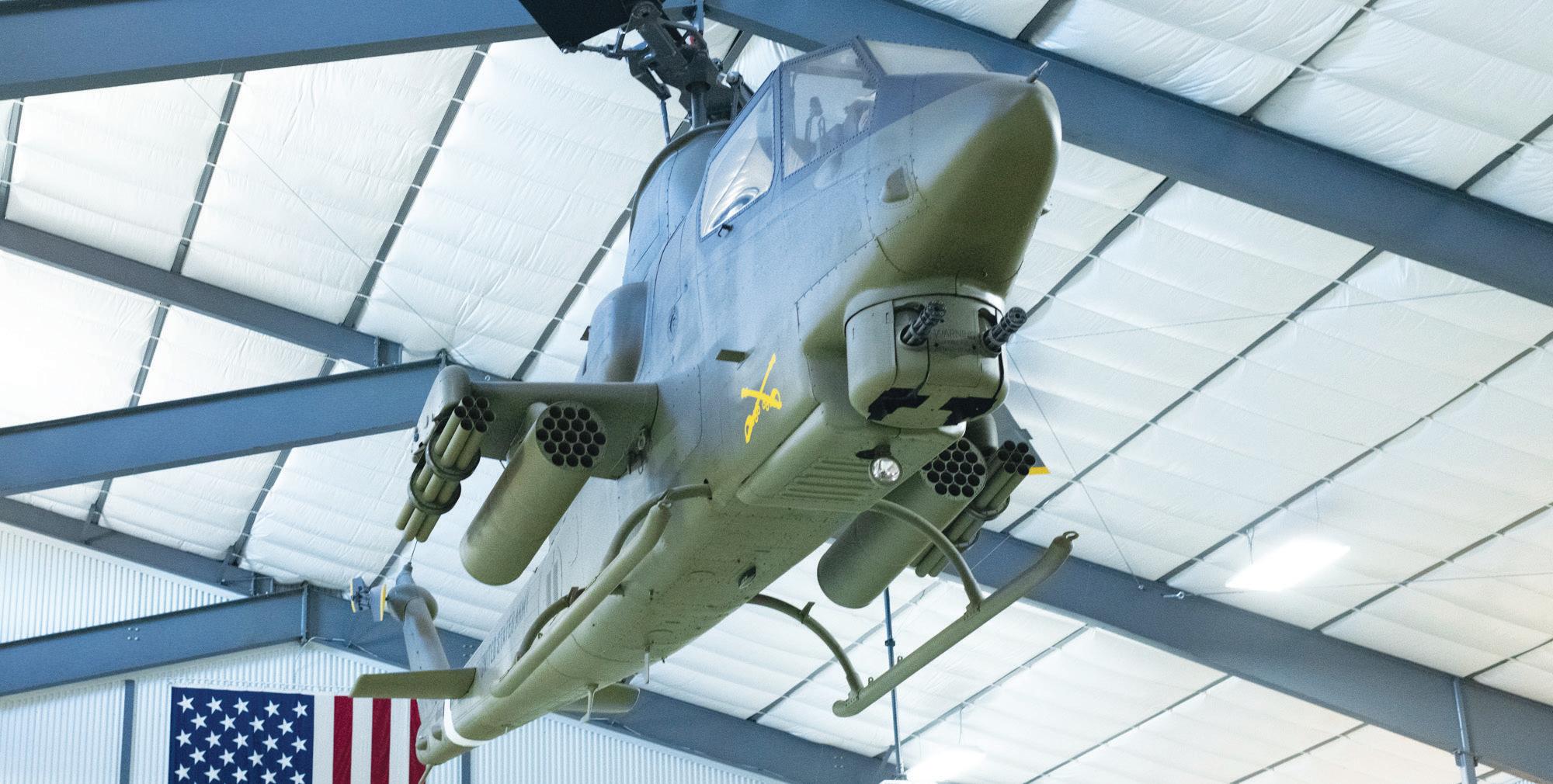
Patrons to fire historic weapons, ride in tanks at Museum of the American G.I. showcase
By Ethan Rhame News Reporter
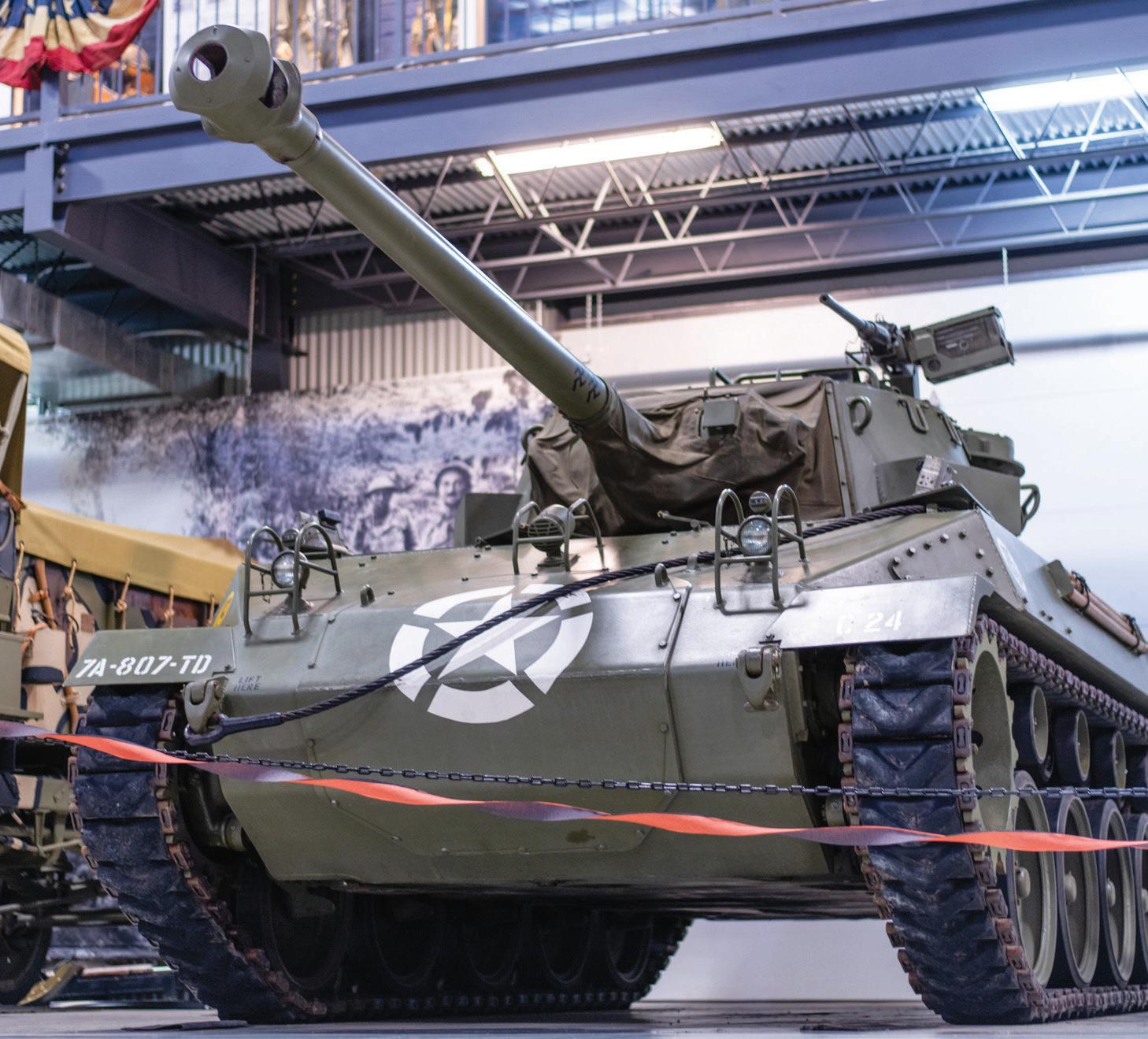
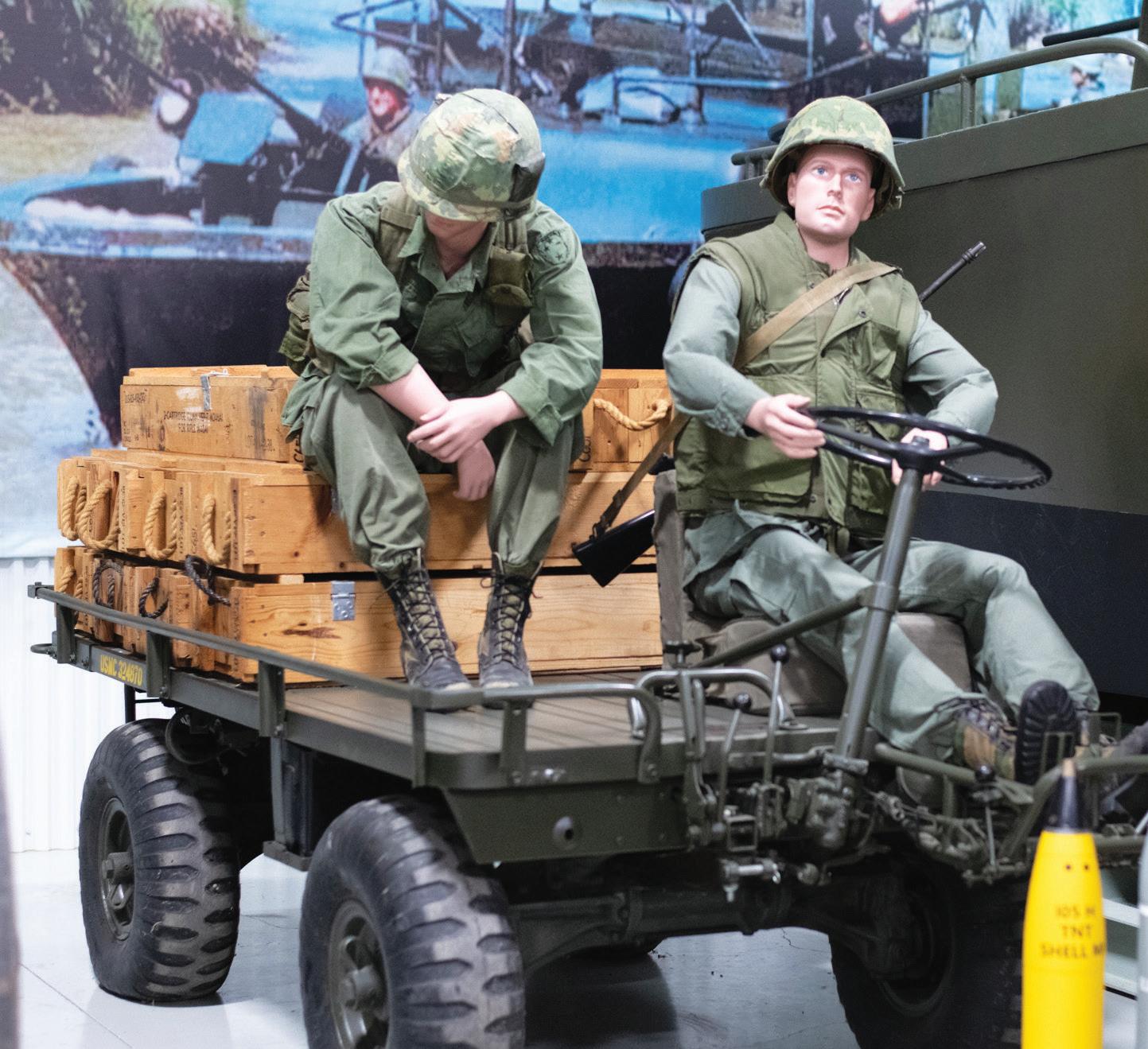
The Museum of the American G.I. will host its annual History in Motion event on Saturday and Sunday, Nov. 8 and 9. The museum will be offering tank rides, artillery demonstrations, celebrations for America’s 250th anniversary and more.
The event will last from 10 a.m. to 3 p.m. both days and will give patrons of all ages hands-on opportunities to explore living history, including the handling and firing of historic weapons.
Along with vehicle and artillery demonstrations, the event will also include interactive living history camps, where patrons can experience historically accurate displays of troop camps from the Civil War and other conflicts.
Executive Director Leisha Mullins, Ph.D., expressed the importance of experiencing history firsthand, especially in the 21st century.
“To be able to go forward, you need to know where you came from,” Mullins said. “… Also, the United States has grown as a country. … We are not the same as we were 250 years ago. … It also gives us a chance to appreciate how much we’ve been able to change and grow while we still can acknowledge we have things that we still need to address.”
Mullins explained that, though many of these historical weapons carry war-torn pasts, it’s critical for people today to understand the true nature of such weapons.
“[A flamethrower] is a terrible weapon, but if you don’t understand its lethality, and you don’t understand why we used it, then … that goes back to making the same mistake over again,” Mullins said. “ … But now you have a chance to see these weapons in person. While it’s fun to fire them, it still might give you a chance to understand what their original design was for.”
The History in Motion event will hold a unique small-arms firearm display at 10:30 a.m. each day to celebrate the 250th anniversary of the country.
The demonstration will begin with small arms from the Revolutionary War, gradually progressing forward in time with each weapon.
Mullins said the day will end with a massive artillery demonstration of different weapons firing off individually before being fired off all together for one grand finale.
For the vehicles, Mullins explained that each display will feature a different exhibition for crowds to witness.
“We might fire the machine gun, another one we’ll fire the main gun, and another, maybe, will show how the crews get on and off the vehicle or the turret turns,” Mullins said. “So each one’s gonna have some little special demonstration.”
There will be two major vehicle demonstrations each day at both 11:30 a.m. and 1:30 p.m..
History senior and Texas A&M Phi Alpha Theta National History Honor Society President Hannah Kalinkewicz urged community members to support the museum and witness these artifacts in action.
“Museums are the cornerstone of education,” Kalinkewicz said. “It’s what makes education accessible for leagues of people, people from all over the world. So I think History in Motion … it’s kind of awe-inspir-

ing. History is no longer just a paper, it’s no longer just words on a page that you’re reading … it’s something that you can see and you can touch and you can feel and experience that with a community … to understand what it was like to be there.”
Two new additions to the museum’s vehicle collection will be unveiled at the event this year: a Marine Corps Landing Vehicle, Tracked and a Marine Corps Jeep equipped to carry radio equipment. Both vehicles will be stationary during the event, available for patrons to observe in static displays.
The museum will also be celebrating the 250th anniversary of the Marine Corps, offering birthday cake to attendees while supplies last.
Mullins recommended that patrons arrive early if they want to guarantee a ride in the tanks, as tickets sell fast. General admission tickets are available in person or online. Food trucks will also be on site, and parking will be available for free in the Blitzen Lot of Santa’s Wonderland.
Mullins said that in order to keep looking forward to the future, sometimes people need to take a step back in time.
“People tend a lot of times to look at just what’s left to be done,” Mullins said. “‘What do we still have left to do? What have we not accomplished yet?’ Instead of looking at, ‘No, we’re not where we want to be as a country, but we have problems that we might have had 250 years ago. We’ve addressed some of them, and we’ve been able to go forward.’ … [History in Motion] is just an opportunity to really take stock and take pride in what we’ve been able to do and change and accomplish.”
Tickets are $25 for adults, $10 for kids aged 5 to 17 and free for those 5 and under. Patrons can skip the line at the gate by ordering a ticket online. Gates open both days at 9 a.m., an hour before the event begins.
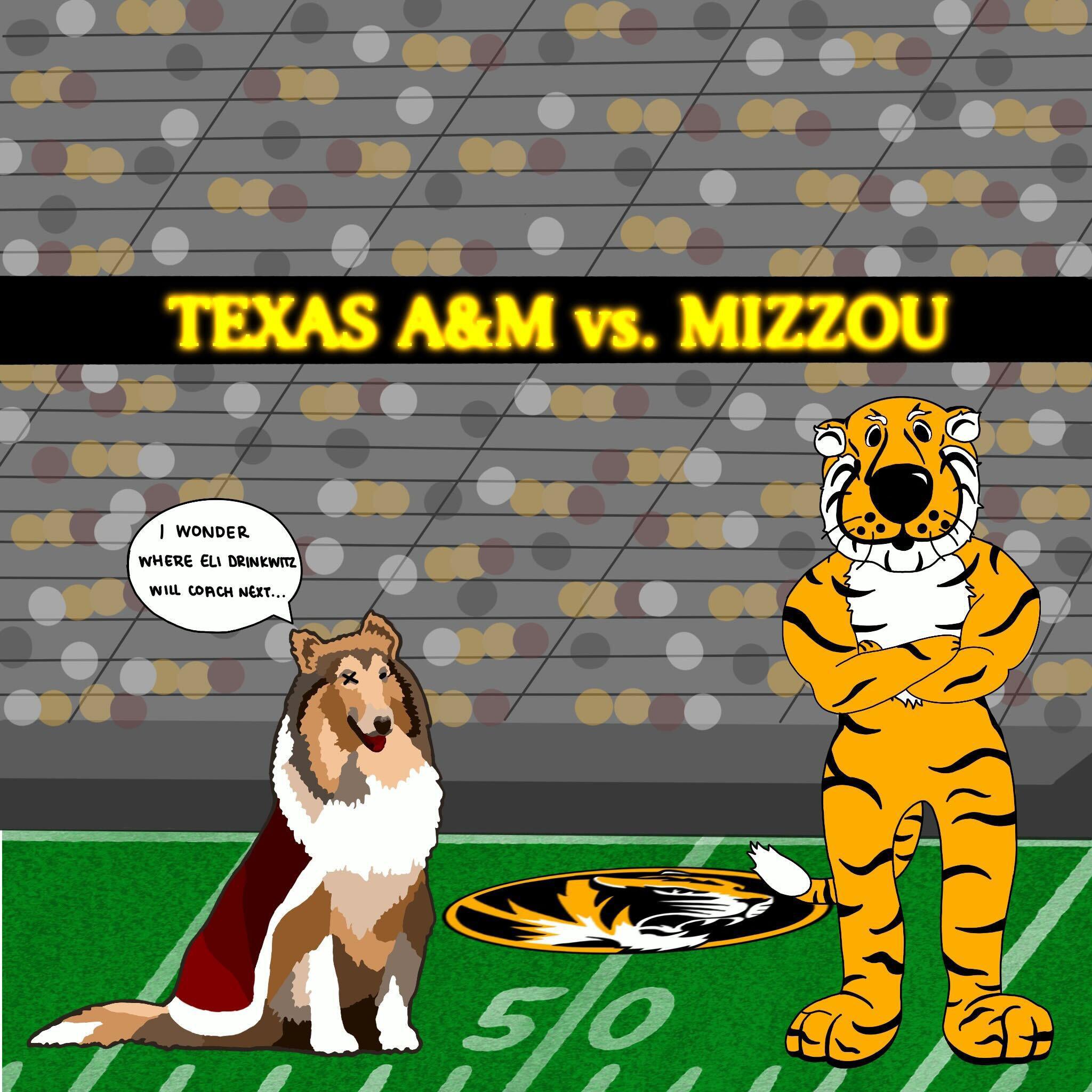
After bye week, No. 3 Texas A&M football heads to Columbia, Missouri, to face No. 19 Mizzou Tigers A9
From streamlining literature reviews to writing conference papers, AI technology use is quickly accelerating at A&M
By Erin Wunderlich News Reporter
This year, Stanford University organized Agents4Science, the first open conference to accept papers written entirely by artificial intelligence.
The conference’s mission was to serve as a “sandbox” to explore the future of AI-driven scientific discovery and review processes. Among the accepted were three papers written by Liner, an AI company that draws from over 200 million journals and ranked first in SimpleQA’s Benchmark for the world’s most accurate search engine in March of 2025.
According to Kyum Kim, head of Liner’s United States operations, about 1% of Texas A&M students and faculty use their large language model, or LLM, a machine learning AI program that draws from massive data sets to understand and generate human-like text.
Like most LLMs, Liner has free and paid options for its users. Its main features include agents — tools that automate tasks — targeted for literature review searches, citation recommendations and even peer reviews.
“AI can augment the process of finding information and knowledge creation, but it should be done by humans at the end of the day,” Kim said. “Liner is filling a gap by drawing from trustworthy sources that give people accurate information about what’s out there. From there, our users are creating new research with it — that’s what we’re built for.”
A major challenge in using broad-spectrum LLMs, like ChatGPT or Gemini, for academic research is that they often “hallucinate.” Hallucination refers to the generation of fabricated information that AI draws from limited, unverified sources.
For example, Kim said that if other LLMs are prompted to write a paper about a highly specialized research topic, they sometimes generate false references to “fill in the gaps,” thus undermining the LLM’s credibility.
A way to reduce this problem is retrieval-augmented generation. Nuclear engineering graduate student Zaid Abulawi described the process in terms of mathematical vectors.
“Let’s say you have a book with three chapters: one about birds, the second on lions and the third about cooking,” Abulawi said. “AI will convert the information in those chapters into vector equations and store them in a ‘space.’ Because birds and lions are both animals, their information will be stored close together and within easy reach, with cooking further away. AI hallucinates when it reaches for information in a specific vector format that is not readily available, and instead draws on the closest similar vector — often generating false information.”
Assistant Professor of Computer Science and Engineering Tomer Galanti, Ph.D., said he’s seen peer-reviewed journals publish papers later found with false, AI-generated citations. These instances usually result from a game of authorship and ego, or when scientists hide the use of AI to receive full credit, Galanti explained.


By Theresa Lozano Social Media Editor
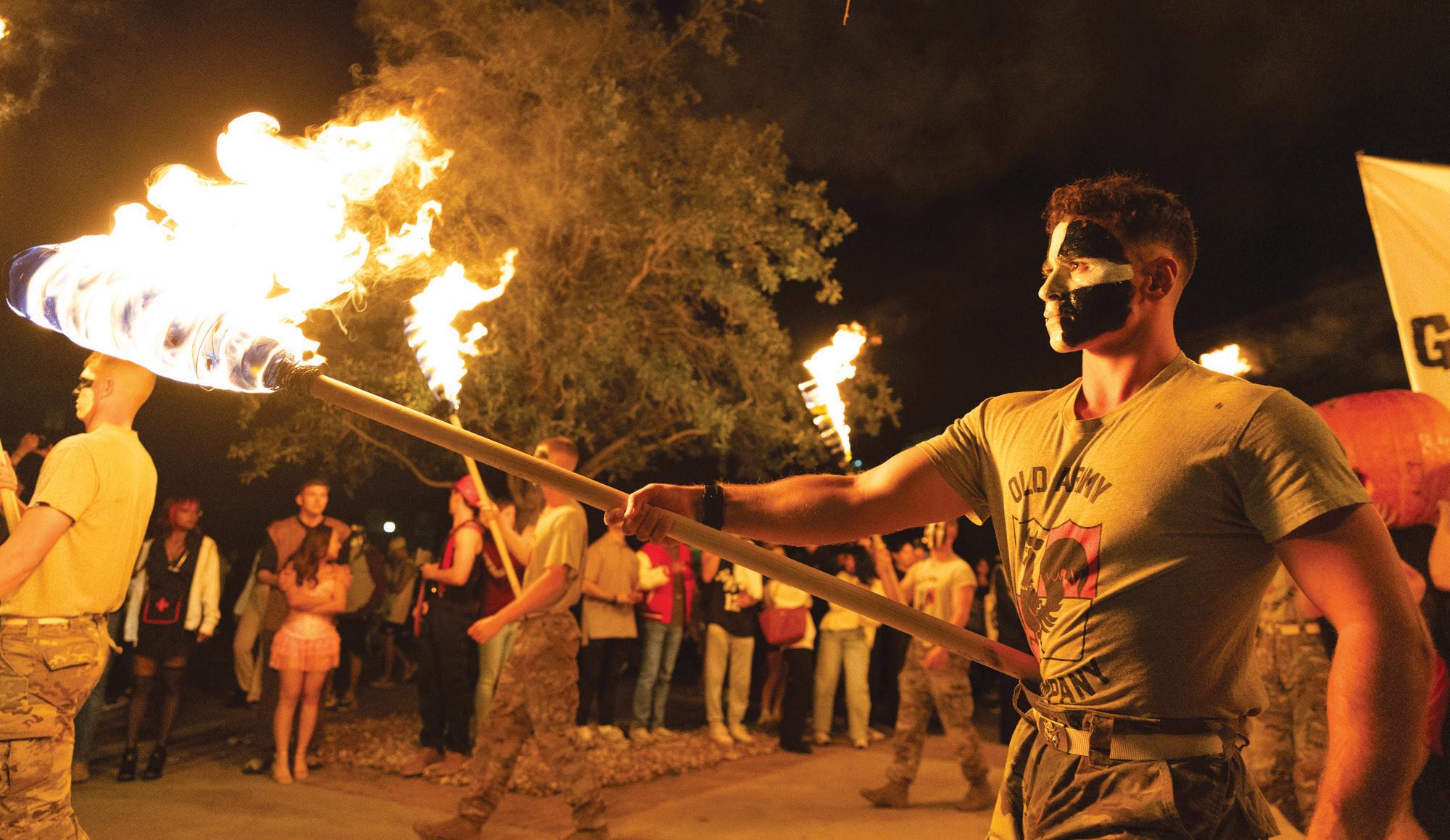
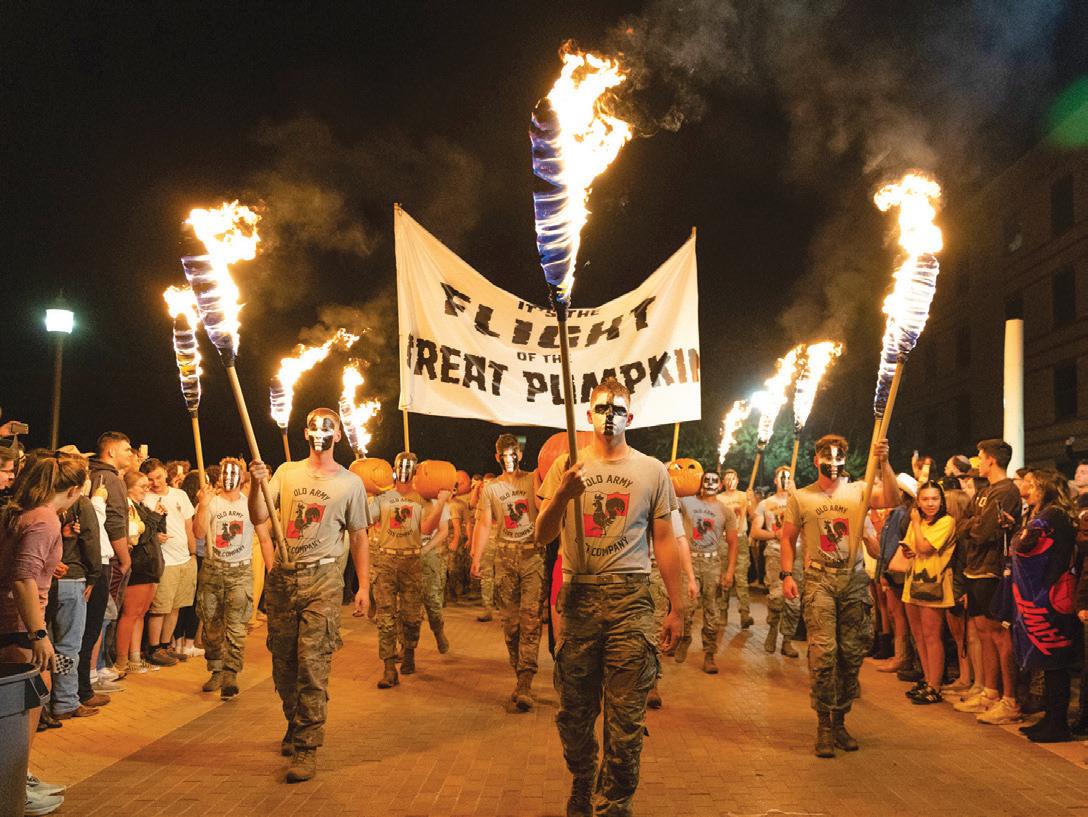
Lit torches burn bright in front of the Corps of Cadets’ Arches as eager spectators check their watches.
The clock hits 10:31 p.m. — “O Fortuna” queues through a speaker.
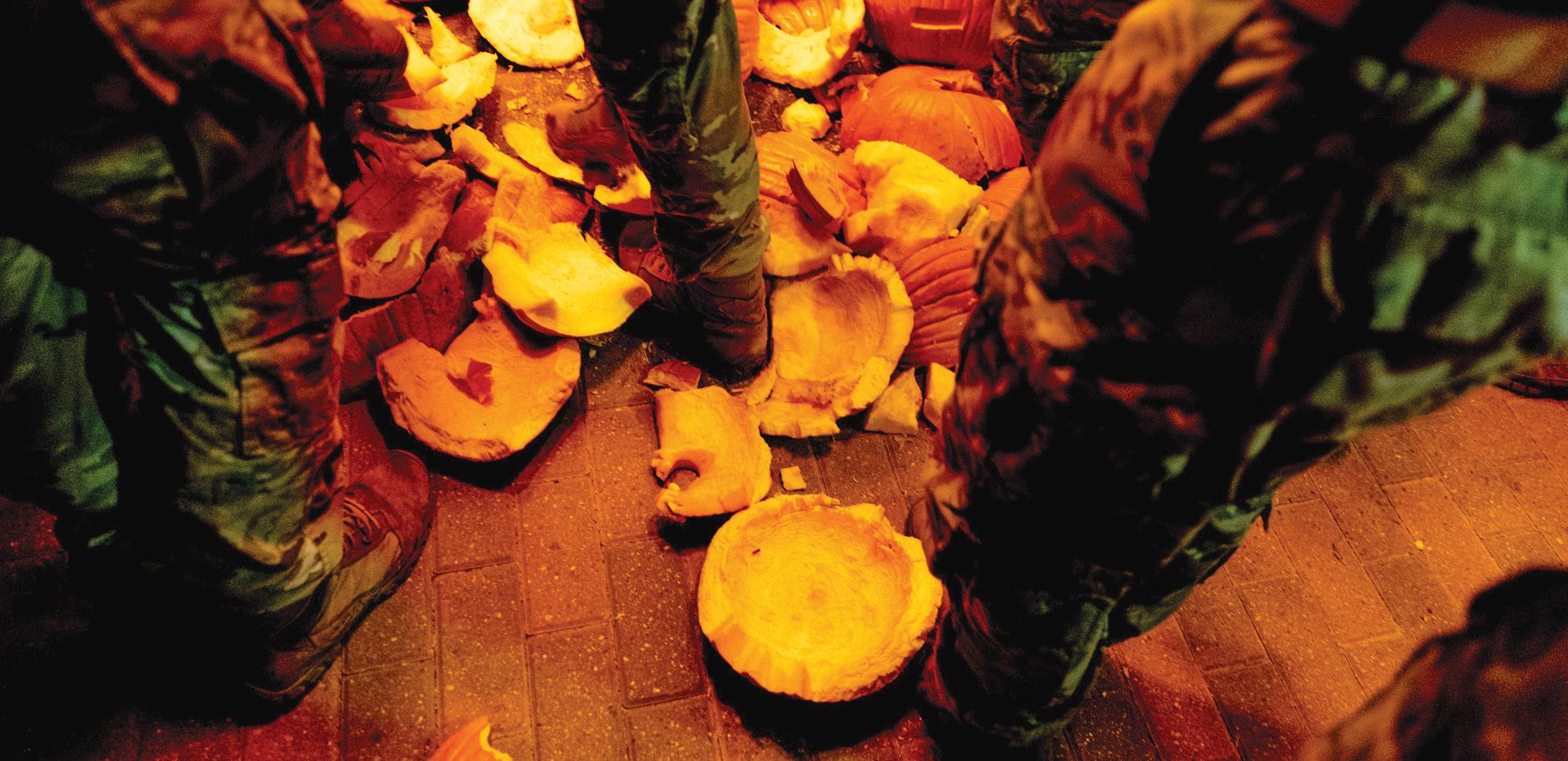
As the scent of smashed pumpkins filled the air after a lap around the Quad, the Corps marked another year as the Flight of the Great Pumpkin took off once again.
This Halloween, the Flight of the Great Pumpkin, the Corps’ oldest tradition on the Quad, celebrated its 60th anniversary on the Quad.
Each year, the event, put on by cadets in Company C-2, takes place on the Friday before Oct. 31 — however, this year the Great Pumpkin made its return on Halloween night. “Flight,” which made its unofficial debut in 1963, has slightly different origin stories depending on the source. Since its formal establishment in 1965, not only have the night’s events changed, but also what it stands for.
The tradition began as a prank in which seniors put a pumpkin on a freshman’s head and made them run up and down the hallways of the Corps’ dorms. Later, the event became a battle between C-2 and the Fightin’ Texas Aggie Band — then, years down the line, another shift marked a new era of unity and Good Bull between the two, according to Flight legend.
According to C-2 cadet and political science junior Matthew Davidson, the origin of the Great Pumpkin started when a freshman was sent outside with a broom lit on fire. The freshman created a streak of flames as he ran around the Quad calling himself the “Great Pumpkin,” — in reference to the Charlie Brown Halloween special — and the rest is history.
Different elements of this past are what make up C-2’s yearly spectacle. Every class of the outfit plays a different role in Flight — seniors bear the torches, juniors carry the jack o’ lanterns, sophomores clean pumpkin remains and freshmen pass out candy.
While those roles receive public recognition, there remains a specific in-house secret — who is the junior who wears the Pumpkin Head?
“As an outfit, we pick,” C-2 cadet and political science senior Tyler Milligan said. “We don’t talk about who we pick. It’s based on the previous year’s Pumpkin Head … who embodies the outfit’s mentality the best, who they trust, who they think is a leader in their class.”
To acquire the Great Pumpkin, a class of cadets drove to a pumpkin farm in Lubbock, where it set aside its biggest pumpkins in the patch for the cadets to choose from. Cadets brought back three and gifted one to the band, while the junior cadets were sent to retrieve their own pumpkin to carve and carry.
“I spent like 20 minutes at H-E-B trying to find, you know, the most perfectly shaped big one,” Davidson said. “I was like digging through the piles of pumpkins there. People [were] staring at me because I have like 20 pumpkins on the ground, like inspecting them and stuff.”
Along with gathering materials, every year the wooden torches are made new, wrapped with towels and doused in kerosene.
“Someone lights the Great Pumpkin’s torch on the night, and you’ll see him light the guy to his left and right,” Milligan said. “And then they’ll just pass out through the senior class. They’ll take their torches and light the next guy’s torches. But they’re soaked in kerosene, so they’ll burn pretty long and pretty hot so that they don’t go out in the middle of Flight.”
Flight begins at 10:31 p.m. — 10 for the month of October, and 31 for Halloween. The juniors and seniors painted their faces for the occasion, while only the front three sported crosses. The march concluded when the Pumpkin Head threw down the Great Pumpkin and dashed to the dorms, then the juniors smashed their own.
“[The sophomores] go throw [the pumpkin remnants] away while the seniors hold the torches and really kind of unify around them,” Milligan said. “And then after that … we’ll come back out to the families. And that’s kind of the point where the alumni talk to the upperclassmen, and it’s kind of like everyone shakes hands and talks. Where the brotherhood comes out of it is afterwards. We’ve all done this thing, so now it’s time to talk to people, tell stories and all that kind of cool stuff.”
The cadets said they look forward to seeing the attendees, including their loved ones and alumni of the outfit.
“As a senior … I’m excited to see [the juniors] do it,” Milligan said. “I see a lot of these guys like my brothers. So I’m excited for them to have the same experience that I had and be as excited as I was when I did it, you know?”






By Claire Frazier Life & Arts Writer
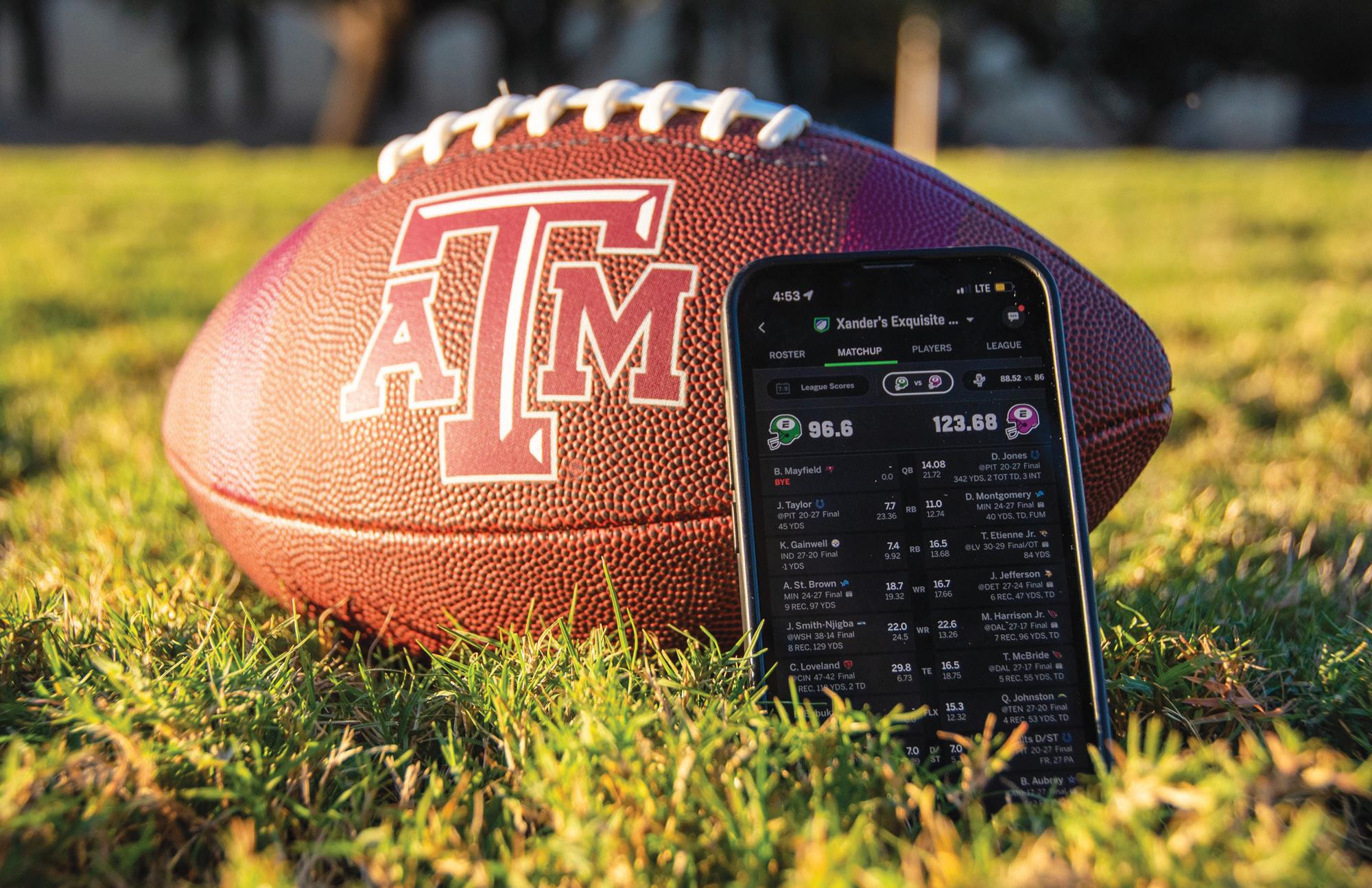
Every Sunday, group chats light up. The trash talk starts early.
Screens flash with live stats and fantasy points, but one league runs deeper than merely vying for bragging rights or avoiding a punishment. Each lineup and every Sunday spent glued to the game is an act of remembrance — a tribute wrapped in touchdowns and competition.
For years, Hunter Crane ‘22 was the one who made it all happen. She was a football fanatic who loved watching Texas A&M football play every Saturday and the Dallas Cowboys on Sundays. The league was her way to bring family, friends, roommates and coworkers together for friendly competition and plenty of smack talk.
“I just was the younger sister, where, you know, you tag along,” Hunter’s sister and visualization senior Chloe Crane said. “You’re like, ‘I’m gonna do what you do, too.’ So it definitely started out as her interest, and then I would always just pay just to play. She just really likes football. It naturally happened.”
out the total.
“There’s other places you can donate, but some charities, it’s kind of hard to tell where the money is actually going,” Chloe said. “And she was actually treated at MD Anderson, so it felt natural to pay it back to them.”
Hunter’s high school friend and college roommate, Bailey Farrow ‘22, has played in the league since it was founded and said the change felt right.
“She was always the one that initiated restarting the fantasy league every year,” Farrow said. “Her sister reached out after she passed and said she wanted to keep it going, but instead of the winner getting the prize, we’d donate it all. Everyone was on board right away.”
Now, a patchwork of Hunter’s friends and family stick together to keep her memory alive, bringing new people into the fold as they go.
“It initially was mostly Hunter’s connections,” Farrow said. “Some of her coworkers,
For legal studies graduate student Madison Crowell, the league offers a sense of connection to her late, randomly-assigned, freshman-year roommate.
“This is something that Hunter loves,” Crowell said. “Anytime it’s Aggie football, it’s the Cowboys, whatever it be, she’s gonna watch the game. And that was the biggest thing for me. This is something that ties me to one of my closest friends.”
Hunter’s passion for life stretched far beyond football. After earning her bachelor’s degree in biomedical sciences in 2022, she completed her master’s in veterinary public health and epidemiology. Her goal was to become a veterinarian specializing in large animals.
“Some of her professors still remember her,” Chloe said. “She’s actually on the dairy science page. It’s a picture of her and the cows.”
Even in her absence, Hunter’s influence remains in every joke exchanged in the group chat, every Sunday spent watching games and every dollar donated to help others.
But instead of the winner getting the prize, we’d donate it all. Everyone was on board right away.
Bailey Farrow ‘22 Hunter’s Friend and Roommate “ “
After four years of battling colon cancer, Hunter passed away in January at just 25 years old. Seven months later, her sister knew that she couldn’t let the tradition end.
“My sister and I have hosted a fantasy football league for the past five years, but she passed away in January,” Chloe said. “So her husband and I still want to do her fantasy football league this year.”
This fall, Chloe revived the league in Hunter’s memory, but this season, no one’s playing for a prize. Instead, every buy-in went to MD Anderson Cancer Center, where Hunter received treatment.
“Typically in our league, we would raise money and give it to the winner,” Chloe said. “But we changed that rule. We want to donate this money instead.”
By the time the draft rolled around, the league had raised $500 for colon cancer research. Most players donated more than the asked buy-in, and Hunter’s husband, Ethan Craven, matched the donations to round
her friends from school, her sister, even her grandma and cousin. And over the years, more people joined. Friends of friends, fiances, it’s just grown. Everyone feels connected through her.”
Like any fantasy football league, though, Chloe said its heart really lies in the trash talk. Hunter was known for her competitive spirit and quick banter.
“Hunter would love to talk smack and then lose,” Chloe said. “We did make it like a rule. You have to bad-mouth each other because this is what Hunter used to do. So we have to honor that. You’re gonna talk trash and then proceed to lose.”
Even without her in the group chat, that trademark has lived on. It didn’t take long for the rule to catch on with the rest of the league.
“Her sister reminded us at the start of the season, ‘Hunter would have loved for there to be smack talk,’” Farrow said. “And she was right. Hunter talked the biggest game for someone whose team wasn’t very good.”
Aggies step into ring for night of costumed wrestling
Onlookers erupt at each brutal blow shared between wrestlers at Halloween-themed match
By Liam Bramble Life & Arts Writer
Under the evening lights behind the Liberal Arts and Arts & Humanities Building, cheers echoed across campus as wrestlers threw each other across the ring. Students and families packed around the ropes, watching as masked fighters, monsters and lumberjacks battled for glory and laughs in a Halloween-themed wrestling showcase.
The two-hour event on Oct. 29 was part of Texas A&M’s Lorefest, an annual arts and folklore festival connecting campus and the community through storytelling. Hosted by Lions Pride Sports, the wrestling show combined performance, athleticism and local tradition.
Founded in Bryan-College Station, Lions Pride Sports brings professional wrestling to the Brazos Valley while training the next generation of wrestlers. For Lorefest, the group staged four matches featuring both professionals and students who learned to wrestle in less than a week.
“This event is so great because I actually do lectures at A&M, and I teach people about professional wrestling and the art of professional wrestling,” Lions Pride Sports owner and A&M guest lecturer Houston Carson said. “It takes athleticism, and it’s a lot of theater; it’s a lot of storytelling, psychology, good versus evil.”
Carson founded Lions Pride Sports eight years ago to provide those who are interested in wrestling with hands-on experience in the sport. He said six A&M students stepped into the ring for the first time last week after training for only two days at Lions Pride Sports’ facility.
“They had a lore story that they learned in their class, and then they came to our wrestling school,” Carson said. “We taught them how to learn the fundamentals of wrestling, and then we choreographed these performances, and they crushed it.”
The crowd roared as wrestlers stormed the ring one by one. The show opened with Ax Manson and Karcass defeating Trent Mercer and Chris Chaos and ended with the final match between Hastur and Timur the Great — Hastur emerging victorious. Each match mixed exciting moves with theatrical moments. Costumes, characters and taunts drew as many cheers from the audience as the wrestling itself, with the crowd reacting to every punch, slam and kick.
Among the loudest reactions came when a lumberjack wrestler known as Ax Manson began peeling off layers of flannel; first one jacket, which revealed another flannel jacket underneath, only for that to be thrown aside, revealing a flannel tank top.
“I play a very simple character — I am a lumberjack who just wears a lot of flannels,” Manson said. “It’s always fun whenever you go to all these other shows and they’re super complex wrestling … but then they see their reaction to me whenever I come out, and I’m just super simple, and they can do all their crazy high flying stuff, and I just gotta take off a flannel and the crowd goes mental.”
Behind the theatrics, Manson said Lions Pride Sports is about teaching fundamentals — not just the moves, but the storytelling and character work that keep the audience engaged with the action.
“We teach fundamentals at the training facility three days of the week,” Manson said. “We go over a lot of basic stuff … rolls, how to bump, how to take hits, how to give hits as real as possible without hurting somebody. Safety is our number one thing because we wanna be doing this for as long as we can.”
“Hunter was so young, and it really is very uncommon for people to get colon cancer at such a young age,” Farrow said. “So being able to donate toward research that could help find a cure, it’s something we all care a lot about.”
Beyond just making trades and scoring points in Hunter’s honor, Chloe also continues to post and talk about their league, in the hopes that others will pay closer attention to their health. According to MD Anderson, there has been an increase in colorectal cancer diagnoses for younger adults in recent years.
“Originally, doctors did dismiss my sister’s symptoms and thought it was something less severe simply due to her being young,” Chloe said. “Age is not a factor, and if people notice something, they should fight to get the care they need. Had we known in time, my sister may still be here today.”
Every week as the scores roll in and the group chat buzzes with friendly jabs, the league members know they’re doing more than just playing a game.
They’re carrying on Hunter’s favorite tradition, remembering her with laughter, competition and love, all while raising awareness and money for colon cancer research.
“This is the best way to honor her,” Chloe said.
He said every match involves both planning and improvisation to adapt to the crowd.
“You can plan out so many moves and what you think a crowd will react to,” Manson said. “But you’re never going to know exactly what the crowd is going to react the most to. So you gotta be able to improv … even if it’s not a move, you have to react as naturally as possible.”
For applied mathematics junior and student wrestler Major McIlvain, the performance was both terrifying and exhilarating.
“It was exciting, “ McIlvain said. “It was nerve-wracking. At the very beginning, some of the stuff they were asking us to do was a little daunting, but I couldn’t speak any higher of [Carson] … he made everything really easy and a lot of fun.”
McIlvain said the group learned basic moves on the first day of training and drilled choreography on the second. By the time he stepped under the lights of the stage, adrenaline took over.
“Definitely the most memorable part was right when we got in the ring,” McIlvain said. “ … People cheering and almost blacking out from the adrenaline and just going at it and just having fun.”

Bagel shop founded by New York native Michael Discon brings authentic East Coaststyle taste to College Station
By Kaitlyn Cates Life & Arts Writer
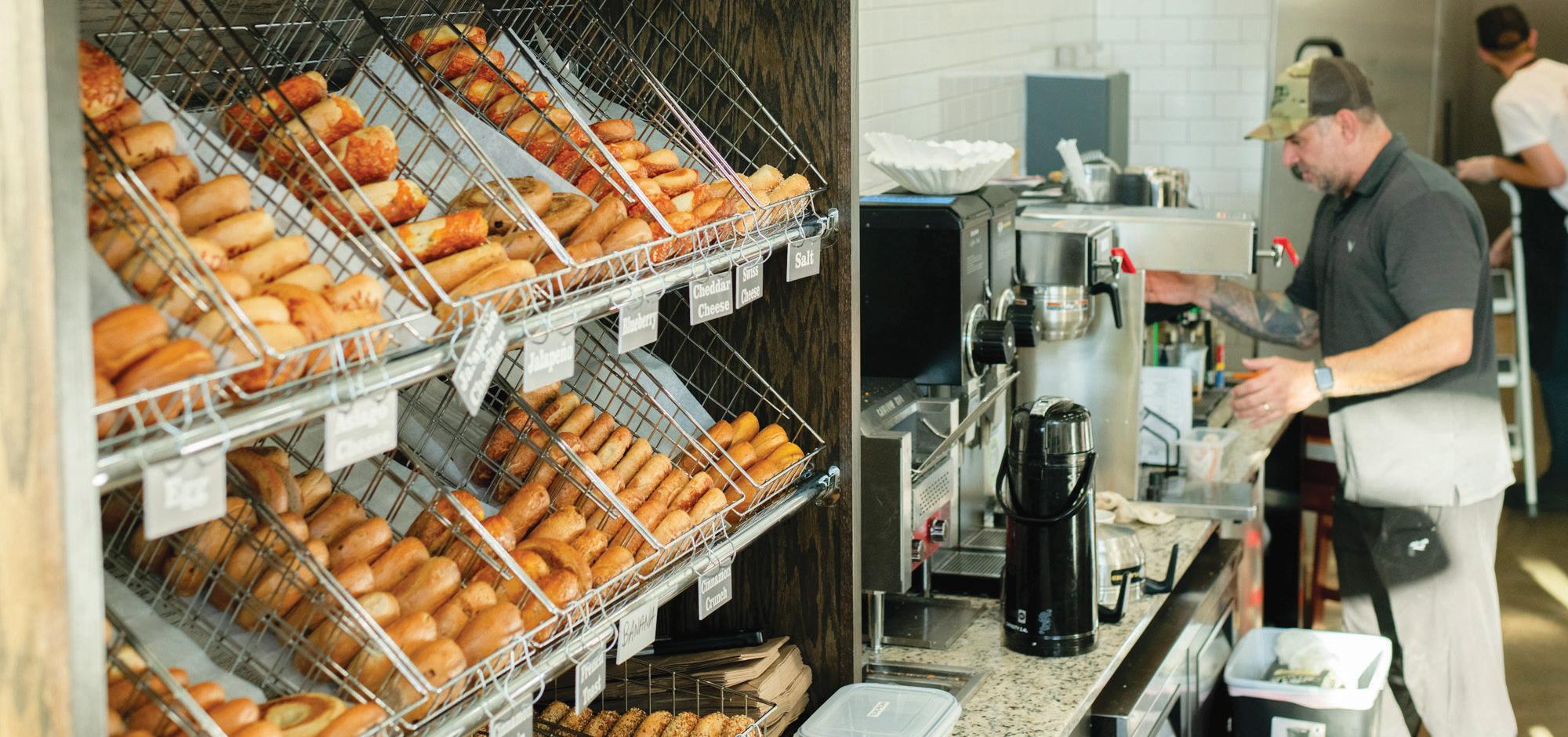
A typical day for Michael Discon starts around 2:30 a.m. when he wakes up to begin baking fresh bagels from scratch for his family-owned business — 4 Brothers NY Bagels. When the store opens, he is busy working behind the counter, making bagel orders and greeting patrons with a smile on his face.
The New York native started his bagel business in his home kitchen, and it has since grown into a family-owned shop with multiple locations across the Houston area. His most recent store, which had its grand opening on Nov. 1, is located at Century Square. The shop features 26 bagel flavors and 15 hand-spun cream cheeses made fresh daily, along with various breakfast options, sandwiches and pastries.
One of nine siblings, Discon said he comes from a close family, and food was an integral part of his childhood. Although he and his siblings were raised in New York, all four Discon brothers now reside in Houston. He recalled working in butcher shops as a kid and cooking every Sunday with his mom for family dinner. Discon chose the name for his business as an homage to his close relationship with his family.
“We’ve been in the food business a long
time,” Discon said. “We’ve always been around delis and pizzerias and butcher shops. We’re Italian, so food is always very prevalent in our life.”
Discon has owned and operated several businesses, from finance and construction to Boar’s Head deli meats distribution. The idea for 4 Brothers NY Bagels began when he moved to Houston in 2019 and tried a local bagel shop. Fresh from New York, he said he knew what a good bagel was and was left disappointed.
“Six years ago, I knew nothing about bagels, really,” Discon said. “So I went into that bagel shop and, literally, a light bulb went off in my head. I left that store that day, got on the phone with my friend in New York who does bagels, and I said, ‘Hey, man, how hard is it to do bagels?’”
Discon began developing his recipe using a countertop mixer and hand-rolling bagels with his son. Just before the COVID-19 pandemic hit, he began selling bagels at farmers’ markets, and the growing business resulted in Discon transforming his garage into a commercial kitchen.
“We did whatever we had to do to make the bagels, and I was selling out,” Discon said. “Every time I went to these farmers’ markets, I was selling out in less than an hour, no matter how much I brought.”
Discon said the success of his product hit home for him a few months into working at those farmers’ markets. He said that one day he went, and before he had even set up the tent, there was a line, and he was wondering what they were all waiting for.
“Dude, they’re waiting on your bagel,” he recalled the neighboring vendor saying.
“So it was very humbling, you know, it was very cool to have that many people
right away be that interested,” Discon said.
“And I said, ‘I’m gonna have a go of it, man.’”
After attaining a cottage license and finding success at farmers’ markets, Discon had the opportunity to open his first 4 Brothers NY Bagels location as a coffee and bagel kiosk inside of an H-E-B location in Cypress in 2021. Three more locations in the Houston area opened in the following years, and College Station now marks the fifth. He said his business produces over 30,000 bagels a week across his five locations.
“I have a big vision,” Discon said. “I think we have one of the best bagels around, period. I mean, I’ll put my bagel against anybody.”
For Discon, the heart of the business isn’t just in his product — it’s in the people. Even with five busy locations, he takes pride in building lasting relationships with regulars and remembering their “usual,” believing that great customer service keeps his shops thriving.
“For me, it’s not about the money, it’s more about the people and the journey,” Discon said. “I know half their orders before they even order it. You want them to be customers forever. All this, this is what I live for.”
Discon writes his goals down in yellow legal pads almost every day and said he has been doing it for 30 years; his plan was to finally scratch off the words “College Station” that have been immortalized in his notebooks for years after his grand opening in Aggieland — and now he can.
“College Station has been on my goal list since 2022, and I’m very happy to say I haven’t scratched it off the list yet,” Discon
said. “I scratched off Fairfield, I scratched off H-E-B, I scratched off getting to certain numbers, I’m going to be very emotional about it.”
Discon said that one of the most important aspects of business is being able to give back. Beyond bagels, his business supports the local community and nonprofits, namely donating to Coffee for the Troops. Discon said he has donated over 300 pounds of coffee to troops last year, and has previously sent coffee to troops overseas.
“Those are the things that drive me, and I consider those pivotal,” Discon said. “It just gives me more fuel to continue to strive to be better and to make my product and to push it out there to the world.”
Discon explained that running a business in today’s market is a constant balancing act between location, labor and costs. For him, success comes from valuing people and staying vigilant about every financial decision, from payroll to which vendor to buy ingredients from that week.
“I put my people before profits,” Discon said. “I overpay people because I know quality people cost money, and good labor isn’t cheap, and cheap labor isn’t good. You’ve got to find that sweet spot.”
From cleaning toilets to scrubbing the floors, Discon said there is nothing in the store he would ask an employee to do that he has not already done. According to Discon, owners should lead by example for employees in their business.
“We treat people the way we want to be treated, you know, that’s how I was always taught,” Discon said. “So I think with keeping that motto where you treat people with love, respect and great food, great coffee, I think the sky’s the limit with that.”
From stringing bracelets at dining room tables to buying their parents their own beach house, Beaded Blondes grows
By Kennedy Long Life & Arts Writer
The hard work of sisters Lauren Schwing ‘18 and Lexi Lindemulder ‘22 can be seen on campus at Texas A&M every day. It glints off the wrists and fingers of college girls, with the iconic look of gold beads tied into large bows.
In true Steve-Jobs-garage-startup fashion, the two sisters started their business — Beaded Blondes — at their parents’ dining room table in October 2020, co-founder Lindemulder said. Now, the brand is available in more than 2,000 stores nationwide, licensed to create merchandise for 18 universities and has grown from a team of two to a warehouse of 70 employees and friends alike.
Now a household name among College Station residents, Beaded Blondes’ journey started when co-founder Lauren began accenting her Aggie Ring with small gold beads to add her own personal touch to the tradition, Schwing said.
“Finding something that’s a void needing to be filled is so important when starting something,” Lindemulder said. “The affordable way to accent your class ring really wasn’t a thing, so when Lauren started pairing it with her ring, that’s when we felt like this is something that we need to share with the world.”
As they began sharing and selling their gold-beaded Aggie Ring wraps, the two college students soon realized they had entered an untapped market. Schwing and Lindemulder saw that the stylish gold-filled beaded jewelry was the quality and price that A&M students were seeking, according to @beadedblondes on Instagram. It all started growing up in a tight-knit family and watching their parents run their
own businesses, Schwing and Lindemulder said. With Schwing being more analytical and Lindemulder favoring the creative design side of the business, the pair was confident they’d make strong co-founders — being sisters was just a bonus.
“It’s a perk that we’re so close, just because we can really tell each other exactly how we’re feeling, and we both want what’s best for each other and what’s best for the brand,” Lindemulder said. “So it’s honestly really nice that we are sisters in business.”
After both sisters graduated, one year into the business, they bought a 12-by24 shed for their parents’ backyard with a single extension cord running through the grass to supply power. They named it the “She Shed” and hired four girls to be the company’s first stringers, Lindemulder said.
“Once we had a space that was outside of our parents’ dining room, we felt like that was a good point to where we could start hiring people,” Lindemulder said. “Because it was a little more separate.”
In 2023, Lindemulder said the duo decided to upgrade to a 1,600-squarefoot shed where they worked to grow the business for another year and a half. The shed commonly fell victim to the Texas weather, leaving the girls on both extremes of the hot and cold spectrum throughout the year.
As they noticed themselves growing out of the shed once again, the sisters moved into a new 4,000-square-foot shed in February — opening up their first Beaded Blondes showroom attached to the workspace, Schwing said.
“It’s funny because we always know when it’s time for us to go ahead and move to the next step,” Lindemulder said. “We get to a point where we’re covered in boxes and can’t really move anymore.”



Democratic freedoms, selfgovernance and inalienable rights are worth the sacrifice
By Sidney Uy Opinion Writer
In 1865 — from one side of the Atlantic Ocean to the other — French intellectual Édouard de Laboulaye proposed a gift from the people of France to the people of the United States. Laboulaye was motivated to commemorate the centennial anniversary of the Declaration of Independence. Laboulaye, like any modern thinker worth his salt, was also deeply moved by the American abolitionist cause.
Thus, Lady Liberty, or “Liberty Enlightening the World,” was born. Notably, the shackles at her feet are broken, symbolizing the end of chattel slavery and the potency of her influence — “Give me your tired, your poor, Your huddled masses yearning to breathe free.”
Lady Liberty’s crown is a radiant halo that symbolizes the truth of liberty. In a sense, it is the only “true crown” we Americans are motivated to be loyal to. That loyalty is to ourselves; it is an obligation to carry the flickering torch across uncharted waters.
Are we living up to her promise?
The answer is yes. We are struggling to realize her promise of democracy and selfgovernance. Every day in the U.S. is a quiet revolution. Recently, that revolution has broken its silence, traveling from state to state and even country to country.
In the heart of the Immigration and Customs Enforcement-resistance movement — Chicago — in the heart of the American Civil Rights Movement — Montgomery, Alabama — and in the heart of our community — the phrase “No Kings” has been uttered and exchanged in solidarity. It has incurred an abundance of meanings for each unique community. Reciprocated from neighbor to neighbor, the rallying cry has reinvigorated a real desire for autonomy.
It is our unifying history that motivates Americans to oppose an all-powerful authority figure who has no desire or incentive to respect our constitutionally protected, inalienable rights.
Likewise, this message is a flat-out rejection of a monarch and the hierarchical structure they uphold.
There is no real American monarch with

an existing and recognized royal family lineage, but only a hostile executive who treats himself to the spoils of royalty, yet does not uphold the duties of one.
In other words, the construction of a White House ballroom for the rich and the forgoing of social safety nets for the poor — a crucial aspect of stabilizing a country — is
the epitome of corruption. In due time, authority figures who go unchecked eventually tend to be corrupted and become ruthless dictators, or — at the very least — continue to uphold a hierarchy that punishes the less fortunate masses. The common people are left to starve, suffer and brutalize each other for resources that the
government refuses to provide the public, using their own taxes.
What is perhaps “nasty and brutish” is not the body of people who supposedly need ruling over, but rather the concentration of power that permits the rapid destabilization of crucial institutions.
Today, the Supplemental Nutrition Assistance Program, or SNAP, is experiencing major halts for reasons other than a simple budgetary shortfall. During the longest government shutdown in U.S. history — due to a partisan showdown to cut off Medicaid subsidies — the budget or federal allocation of funds has been paralyzed. This has led to 42 million, or roughly 1 out of 8 Americans, actively losing out on SNAP benefits.
President Donald Trump previously claimed the government would not allocate emergency funds to pay SNAP benefits. Following the president’s contradictory statements threatening to deny payments and a federal court order to pay SNAP benefits — since Nov. 4 — the administration is now claiming it will pay out only half the amount that participants in the program typically receive.
The people who rely on this program, which costs around $8 billion each month, are those who are low-income and working class. 3.5 million Texans, including 1.7 million children, depend on SNAP assistance for their basic needs.
This prolonged interruption has forced millions of Americans to rely on community food banks, trade rent for food purchases or cut back on meals altogether just before Thanksgiving. When people starve, their very freedom is jeopardized, and their ability to protest their starvation is oppressed. This unprecedented shutdown has truly fashioned a crisis reminiscent of bread prices and tea tariffs — both of which directly prompted a series of revolutions and the creation of our country.
Given that the supposed masters and monarchs of our time are undependable, disconnected and actively work to divide the country, it’s safe to say that only the people are in a position to govern and prevent yet another manufactured famine. Those occur when monarchies — perhaps by design — choose to obey the man wearing the crown and exploit the people subjected to it.
Nevertheless, it is our job to move the American democratic experiment forward, not replace dead kings with worse ones.
Sidney Uy is a philosophy junior and opinion writer for The Battalion.
Hierarchies prevent the risky, myopic nature of democracy
By Aidan Zamany Opinion Writer
The streets are echoing with the chant “No Kings” in protest of alleged abuses of power by President Donald Trump.
Demonstrators are out in full force to oppose the perceived authoritarian policies of President Trump, including his deployment of the military domestically, excessive use of executive orders to bypass Congress and collusion with techbillionaires to capitalize on his political power. All of these objections are perfectly rational and — ironically — examples of flaws fundamental to democracy, not monarchy.
So, in this tumultuous time of political polarization and uncertainty, let us ask the question: How does traditional monarchy compare to liberal democracy?
As Americans, we value freedom and personal liberties above all, as emphasized in our Constitution, Declaration of Independence and the Federalist Papers.
Yet, I would argue that traditional monarchy tends to push a society toward increased freedom, while democracy is less effective for that end.
Due to the hereditary nature of traditional monarchy, sovereigns have longterm interests in their territories, and they therefore possess an incentive to maintain stability and foster a healthy political and economic environment for their heirs to adopt. As the head of state, the king holds absolute accountability for the condition of the country, good or bad.With the Sword of Damocles hanging above them on a string, they defend their dynastical patrimony with particular vigilance.
Arbiters of democracy, on the other hand, are willing to take risky action and abuse power in order to accomplish the lofty campaign promises they made before their short terms end.
Checks and balances are easily hurdled over thanks to the mechanics of the executive order, which is increasingly popular with hawkish presidents like Trump and former President Barack Obama. Despite their ability to exercise power, our presidents are slaves to polls and public opinion. Their decision making is constrained by the timetable of an election

cycle and the prospect of a second term. Finally, on the subject of accountability, I draw from the remarks of Lord Horatio Nelson, 1st Viscount Nelson, who argued that, “A King may be ill advised and act wrong, a Republic never acts right, for a knot of villains support each other, and together they do what no single person
dare attempt.” We see this even today, with our congressmen deflecting responsibility back to one another and blaming voters for national outcomes. Today, America may be more oligarchy than democracy, and it is undeniable that corporations wield extraordinary power over both the economy and the government.
This has been highlighted by protests against the apparent courtship between Trump and the PayPal Mafia.
In this regard, I propose that kings are far more effective in dealing with domestic issues than your democratically elected officials.
Firstly, monarchs are usually raised from childhood with a specialized education centered on constitutional law, history and statecraft suited for a future leader. They tend to be surrounded by a guardianship of loyal advisors, wise experts and experienced relatives who can mentor the sovereign on all issues of importance. It is safe to say that he who bears the crown is often well prepared for it. Meanwhile, our congressmen and presidents have worked in various occupations, including dentistry, farming, filmmaking, accounting and real estate development — many of which are not especially pertinent to operating within public administration. At best, democratic leaders’ vocations involve hasty training from campaign managers, intermittent words of advice from incumbents and colleagues and perhaps a law degree.
However, Congress is especially ineffective in dealing with many domestic issues. Partisanship and committee work make lawmaking unproductive and untimely. Additionally, Congress can easily be undermined by outside groups — often the same factions that perpetuate societal issues — because elected politicians require immense capital in order to be viable candidates. Where our delegates are unashamingly willing to serve private interests and acquiesce to lobbyists in exchange for funding, a monarch can put the national interest first, free from contractual corporate influence.
Let the status quo serve as the strongest evidence against democracy. If we the people are suffering against tyrannical leadership, an emerging tech-oligarchy and unprecedented inequality under the mask of liberty and fair elections, then we ought to look to the path not taken. Perhaps what is required today is not another modern political experiment, but a reactionary movement to return us to the watchful, paternalistic protection of kings.
To hierarchy without oppression, classicism instead of classism and unity, I say God save the king.
Aidan Zamany is a political science sophomore and opinion writer for The Battalion.

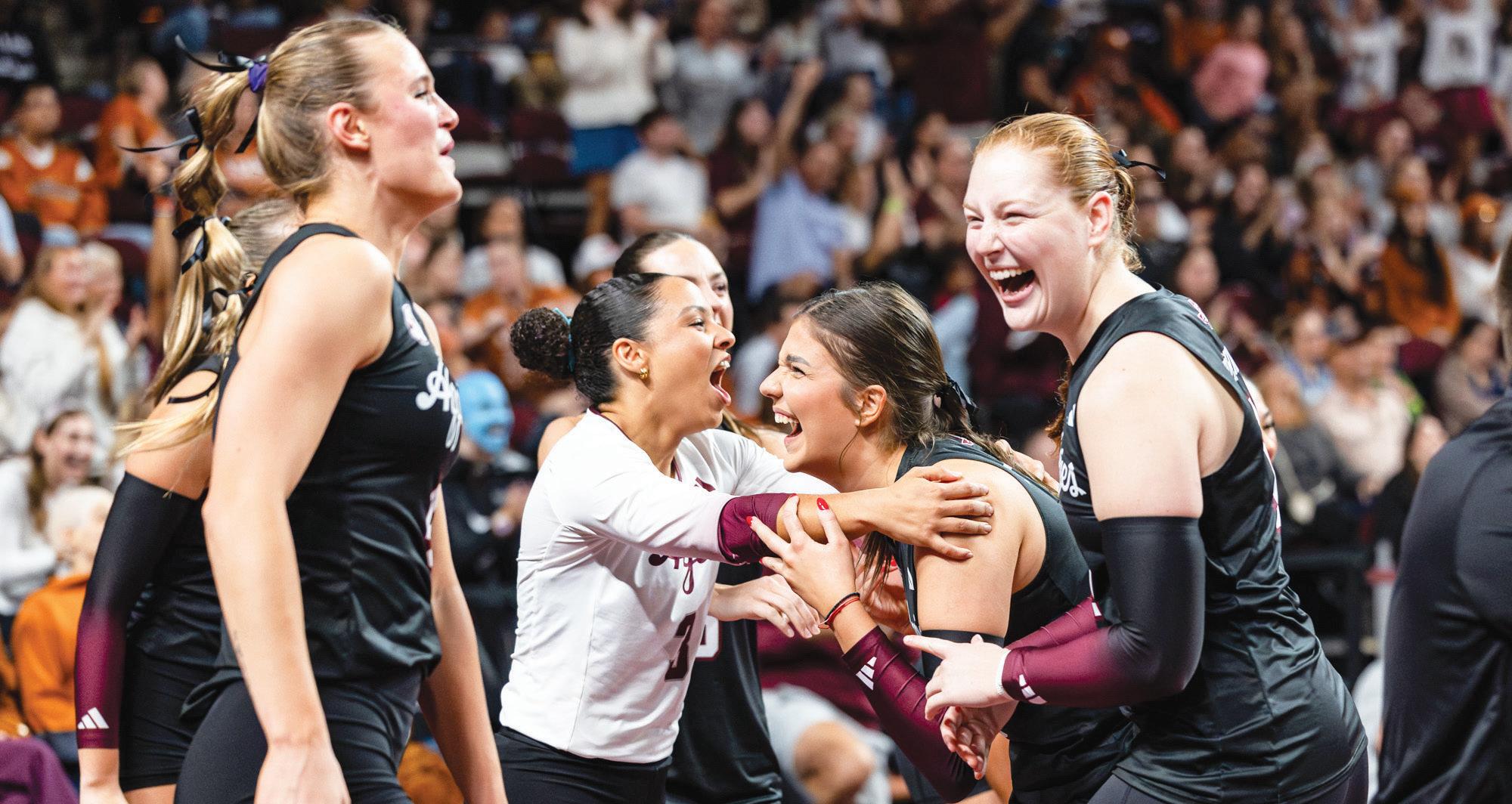




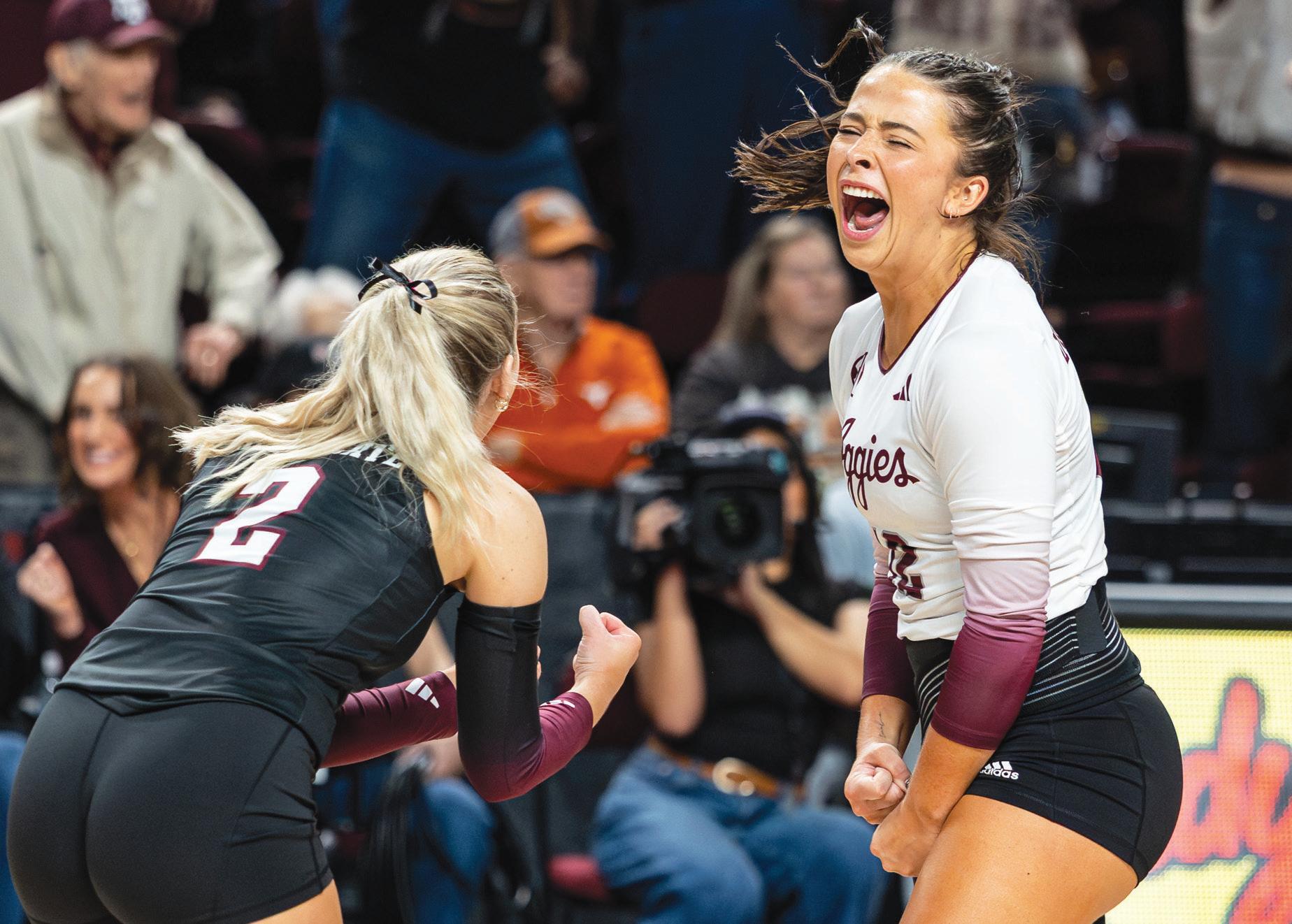
middle blocker Ifenna Cos-Okpalla, who recently earned SEC Player of the Week for the third time this season.
Cos-Okpalla also climbed to No. 5 in program history for career blocks, cementing her status as one of the cornerstones of A&M’s success.
By Kohen Hinojosa Sports Writer
No. 6 Texas A&M volleyball will travel to Neville Arena in Auburn, Alabama, on Friday, Nov. 7 to take on Auburn for its third-to-last regular season matchup. As Southeastern Conference play comes to a close, the Aggies will look to continue their dominant run, starting with the Tigers.
The Aggies enter the contest 11-1 in SEC play and on a seven-match win streak, proving themselves as SEC contenders. This was most recently showcased by A&M’s back-to-back wins over in-state rival thenNo. 2 Texas and then-No. 16 Tennessee.
The Maroon and White’s path to dominance has been spearheaded by senior
As Cos-Okpalla defends the net, senior opposite hitter Logan Lednicky continues to show off her offensive guns, leading the team with 282 kills.Lednicky’s offensive consistency has been key for A&M’s success, routinely leading the team in kills and allowing the Aggies to pressure opponents from both sides while maintaining offensive rhythm — even in long rallies.
Lednicky’s ability to perform in highstress games has fueled several of A&M’s biggest wins this season. For instance, Lednicky recorded 12 kills and 17 digs against the Longhorns and another double-double of 13 kills and 12 digs in the Aggies’ win over the Lady Volunteers to extend her streak of double-digit kills.
These performances underscore not just her individual talent, but her importance as a two-way player who keeps the Aggies in control during the most crucial moments.
A&M’s stretch of successful performances reflects coach Jamie Morrison’s vision for A&M to not only be a top SEC contender, but a nationally-recognized program.
“A foundation and a team capable of great things,” Morrison said. “I’m looking forward to the challenge of taking it to a championship level.”
Nonetheless, Auburn — hungry for a statement win — remains a fierce opponent for A&M, especially at Neville Arena where it boasts an 8-1 home record.
The Tigers offensive front is led by sophomore outside hitter Lauren Dreves — the team’s top leader in kills with 308 on the season. Her ability to generate points across the nets will make her a threat for the Aggies.
While Auburn doesn’t boast the same record as A&M, its dogfight mentality
on offense has given several ranked SEC programs a run for their money this season, including a matchup against No. 3 Kentucky, where Auburn kept it close with only a total 10-point difference.
A nice pair to its offensive capability is Auburn’s ability to defend the net with an average of 2.94 blocks per set in comparison to A&M’s 2.51 per set.
Auburn’s front row will look to shut down pin hitters like Lednicky, redshirt sophomore OH Kyndal Stowers and senior OH Emily Hellmuth, who lead the team in kills at 282, 221 and 205, respectively.
With just three matches left in the regular season, each team is looking to secure its spot in the NCAA Tournament. A&M will enter the match with momentum, but it’ll face a desperate Auburn squad fighting to make its mark late in conference play. A&M and Auburn are set to clash at 6 p.m. on Friday, Nov. 7, where the Maroon and White will
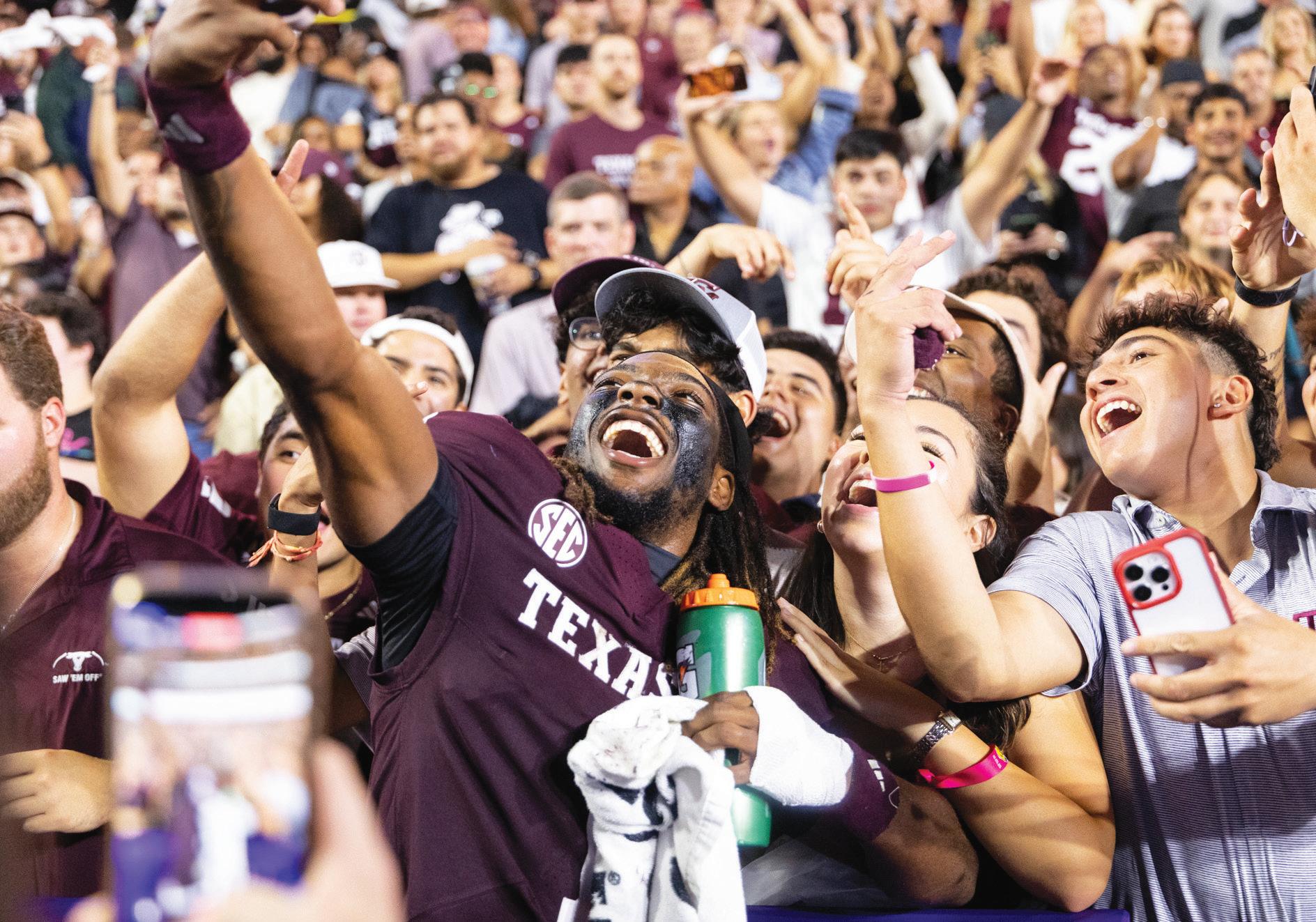
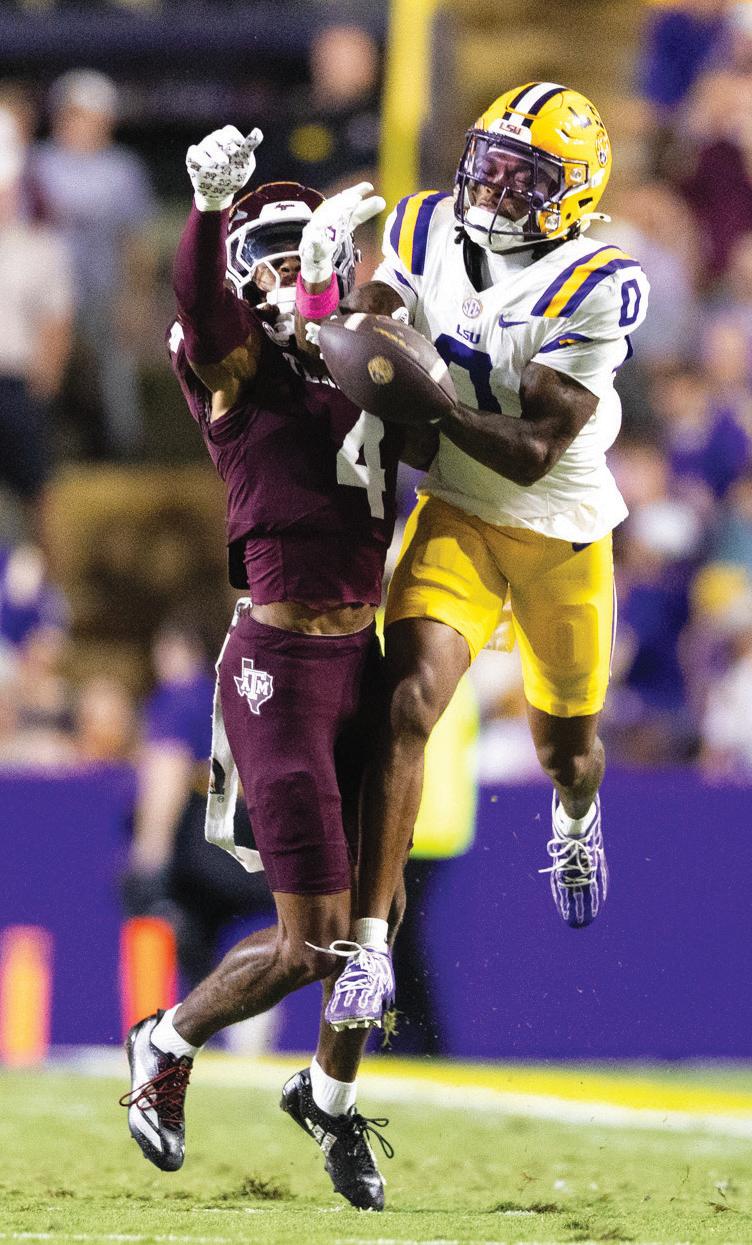

Aggies to close out monthlong road stint against Missouri Tigers’ backup quarterback, SEC-leading rusher
By Roman Arteaga Senior Sports Writer
A desperate and momentum-filled No. 3
Texas A&M football looks to stay undefeated when it travels to Columbia, Missouri, to visit a conference opponent in the No. 19 Missouri Tigers at Faurot Field at Memorial Stadium on Saturday, Nov. 8.
The Aggies have started 8-0 for the first time since 1992, and aim to disrupt the Tigers by utilizing their offensive firepower with redshirt sophomore quarterback Marcel Reed at the helm. The Maroon and White will be looking to emphasize three things: Reed’s continuous development through the air, stopping the Tigers’ run game and adapting to freshman QB Matt Zollers.
the Aggies forward.
“That’s the thing that in the last few weeks you’ve seen at a really high level,” Elko said. “How clean the pocket has been for Marcel. And then obviously, he plays a role with his athleticism. When the pocket does break down, he can make things happen.”
Missouri’s defense is charged with experience all over the field. Its secondary is anchored by senior cornerback Toriano Pride Jr., who has contributed 12 tackles, an interception and two pass breakups, proving he could hang with any receiver in the country. Graduate student safety Daylan Carnell has also displayed his worth this season, tallying 22 tackles and an interception. Both defensive backs will attempt to disrupt Concepcion and Craver’s game to protect their home field.
The team also boasts experience at the linebacker and defensive line positions. Se-
Texas A&M Football Coach “
really well. The ball jumps out of his hands, you can see that. So I anticipate him being able to make all of the throws and see what he can do with his feet. He’s an athletic kid, I think he’ll present a lot of challenges to us.”
The run game has been a huge reason for the Tigers’ offensive success as they have averaged over 235 rushing yards per game, good for 10th in the country. Louisiana-Monroe transfer sophomore running back Ahmad Hardy leads the Tigers’ running back room, with 937 yards and 11 touchdowns through the first eight games of the season.
“He’s a really talented back,” Elko said. “He is big, he’s powerful. He runs through tackles. They have a really, really strong system in how they run the football that they’re committed to, and they do it really well.”
They have a really, really strong system in how they run the football that they’re committed to and they do it really well.
A&M’s offense has proven to be a nightmare for opposing defenses, averaging over 459.3 yards of total offense per game, 19th-best in the country. Big contributions have come from both sophomore wide receiver Mario Craver, who is averaging just under 90 receiving yards per game and NC State transfer junior WR KC Concepcion, who has recorded 545 receiving yards and seven touchdowns for the Maroon and White. Concepcion is coming off of a stellar showing against then-No. 20 LSU, tallying three receptions for 45 receiving yards and a touchdown. While his offensive production has been exceptional, his impact on special teams is where he made a difference in Week 9, returning a punt for a touchdown that shifted the game’s momentum toward the Aggies
“I think we got momentum,” coach Mike Elko said after the LSU game. “The punt return really put us up, we started playing from the front, and I thought we had a really big advantage at that point … I think it pushed out the lead to three scores and it was a critical point of the game.” Reed has continued to thrive under center, throwing for 17 touchdowns to only six interceptions while rushing for six more scores. His elusive running and knack for finding open receivers have torched defenses, as he now accounts for 290 yards per game. Reed will look to quiet the Tiger fans at Faurot Field, while continuing to push
Opinion: Fired football coaches have feelings, too
Coaches need a character check before a paycheck
By Noah Ruiz Senior Sports Writer
In the grand scheme of jobs and career paths, being a fired college coach is a welcome profession to many an average Joe or Josephine. Getting paid to leave a place sounds like a dynamite circumstance for a shotcaller when considering how much money is at hand. But amid recent events, maybe it’s time to examine the human element in these job terminations.
Maybe it’s not all about the money. Maybe the emotional investment and family uprooting are bigger than the checks athletic directors are writing. Maybe not every coach that says goodbye to their old position smiles at their bank account. Instead, maybe they shed a tear at what could have been.
The world of college football is a polarizing environment, summed up simply by disappointments on one side and expectations on the other — and it seems the former is highlighted far more than the latter. With that in mind, a head coaching position at a prominent program demands not only success, but a coach who fits within the school.
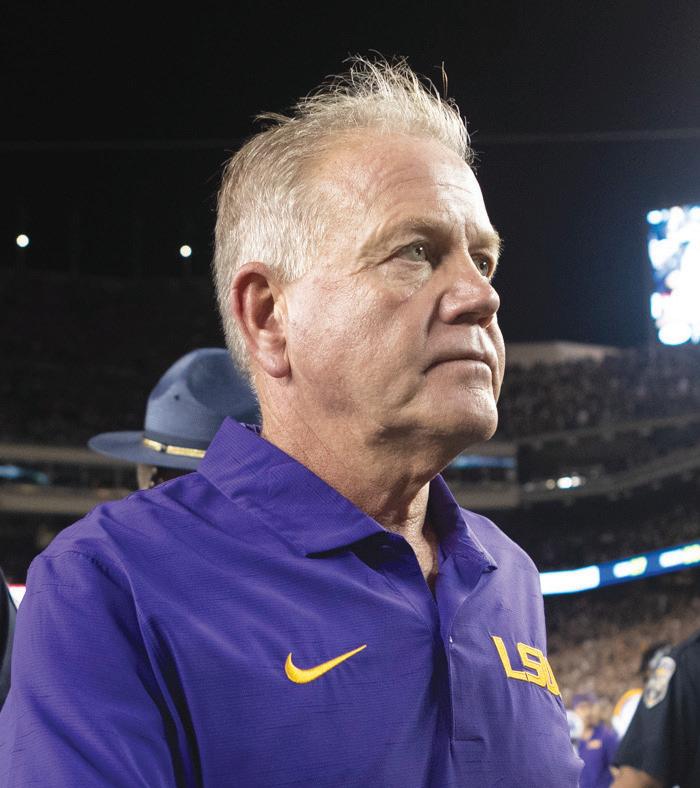
This idea of a personal fit is more essential than some may think, as certain personalities don’t mesh well when thrown into the wrong environment. A perfect example can be seen in coach Brian Kelly at LSU. In what world does a Boston guy develop a Bayou-braised accent when it was surely his first time south of the Mason-Dixon Line?
The experiment was destined to fail because Kelly didn’t seem interested in embracing the culture that is Tiger football — an entity that the whole state of Louisiana rallies behind. His brisk firing of staffers from the previous regime may have been part of his undoing as well, since former LSU strength and conditioning coach Tommy Moffitt assumed the same role for Texas A&M and, frankly, beat the fake-Cajun out of him.
The Tigers’ collapse made sense and was even warranted considering Kelly’s past incidents at Notre Dame. Fans can easily see him as a man they wouldn’t share a beer with, to put it plainly. There’s a human element to understanding who a person is outside of coaching college football. Too much baggage and a lack of understanding will kill a coaching hire, and ironically enough, most college relationships.
Mike Elko
nior linebacker Khalil Jacobs has been effective at stopping the run and pressuring opposing quarterbacks, recording 23 tackles and three sacks on the year. West Virginia transfer redshirt sophomore LB Josiah Trotter has also made an immediate impact, leading the Tigers’ defense with 53 tackles and eight tackles for loss. Together, he and Jacobs will attempt to dismantle the Aggies’ run game while applying constant relentless pressure on Reed.
Michigan State transfer senior defensive end Zion Young will test A&M’s offensive line and its ability to protect Reed. Young, who has been one of the most impactful defensive players for the Tigers, has made 25 tackles, 9.5 tackles for loss and five sacks to go along with two pass breakups.
While getting past the Tigers’ defense is a key factor, preventing their running game is also crucial to winning the game. With senior QB Beau Pribula injured, Zollers will start under center. In their last matchup against Vanderbilt, Zollers and Pribula combined for 220 all-purpose yards and a touchdown, demonstrating that both could play at a high level.
“Obviously he’s a talented kid,” Elko said about Zollers. “I think he throws the ball
This matchup will require the Aggies’ graduate student defensive tackles Tyler Onyedim and Albert Regis, — who have combined for 60 total tackles and 2.5 sacks this season — to be at their best to contain Hardy and the dual-threat QB. Redshirt senior DE Cashius Howell and junior DE T.J. Searcy will also be vital in stopping Missouri’s run game. With 31 tackles and 11 sacks on the year, their speed, strength and power will be key to containing Hardy.
“Tyler had another really disruptive game,” Elko said. “They don’t always show up in the stats, what the inside tackles do, but he played a really good game both against the run and the pass for us.”
While Missouri likes to run the football, it is proficient in throwing as well, averaging over 237 passing yards per game with big contributions coming from Mississippi State transfer senior WR Kevin Coleman Jr. and junior WR Marquis Johnson, who have combined for 898 yards and three touchdowns.
The Aggies’ senior cornerback Will Lee III and junior S Dalton Brooks will look to lockdown the Tigers’ receivers in this matchup, as they have combined for 76 tackles on the year. Making open-field tackles and breaking up passes will be a key factor for the Maroon and White.
For A&M to maintain its undefeated record, it will need to convert on the past and power through the elite Missouri defense while containing Hardy and the run game. Adapting to Zollers will be important as well and if the Aggies can set the tone early, they will put themselves in a good spot to prevail.
On that note, relationships can also end mutually, with one side reminiscing about where it all went wrong, with a willingness to try again. Take the recent outing of former Florida coach Billy Napier from his position as the head of Gator football.
No controversy surrounded the former Louisiana Ragin’ Cajuns coach, as he was granted an opportunity to lead a Southeastern Conference team into contention on the national stage, but ultimately fell short. It’s easier to look at the situation with a more sympathetic heart, as being told “you’re not good enough” must surely hurt, despite the number of dollars you can withdraw.
Napier led a team that fought for him till the very end, he didn’t throw anyone under the bus but rather kept rallying his troops to hopefully win the day. However, time and again, the Gators rallying fell flat on their noses. At a certain point, business decisions have to be made, but that doesn’t mean a coach shouldn’t get sympathy just because he can go out and buy a yacht now.
These coaches invest years of their lives, and their families’ lives, to be committed to one destination, and a move from California to Arkansas, or Mississippi to Virginia rarely has any consolation despite the buyout. All of that to say that while football is just a game to some, many across the country would consider it a livelihood. Developing and molding young men into the stars of tomorrow becomes woven into the fabric of 136 FBS coaches every season, with countless other coaches doing the same in other divisions of college football.
Next time a coach is let go, perhaps it would be wise to look at the makeup of his character before rash comments are thrown here and there. While a coach is simply his title to those on the outside looking in, maybe take time to consider the ones who are trying to be upstanding fathers, husbands and leaders within the community.
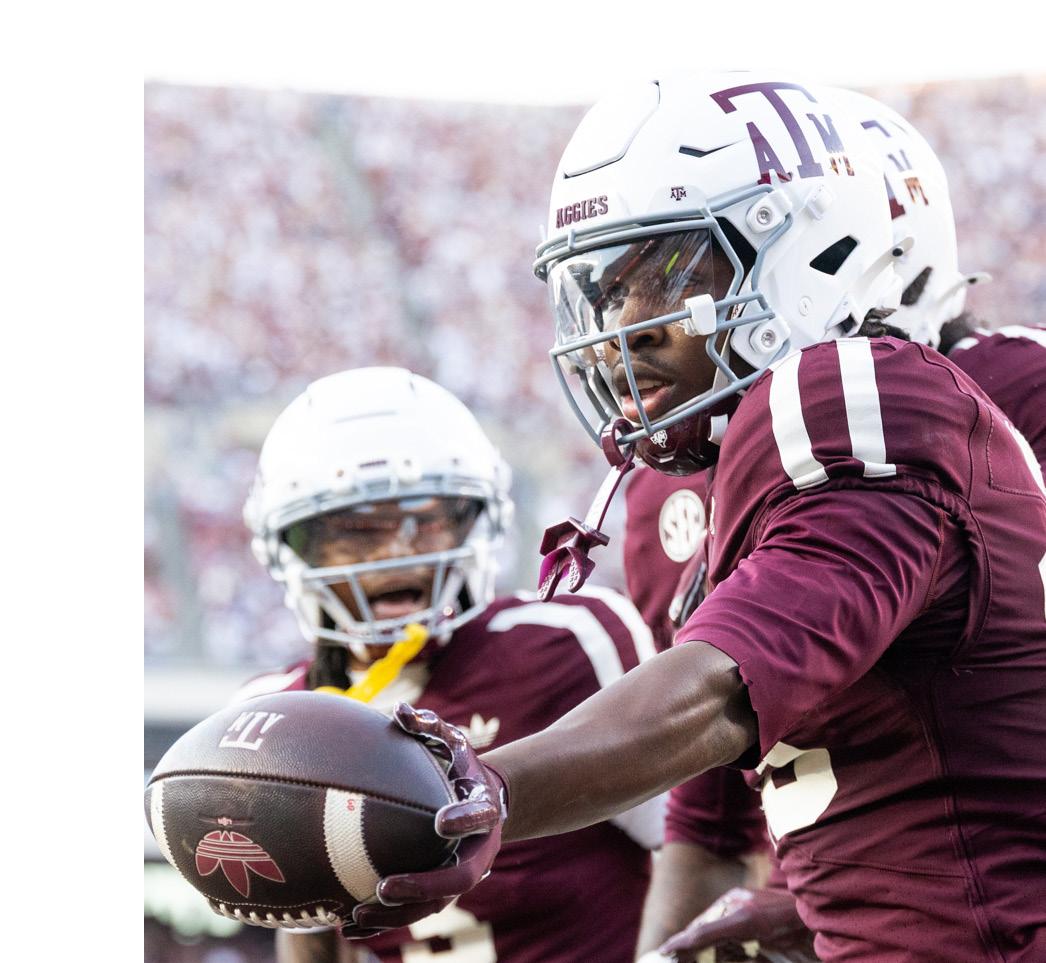
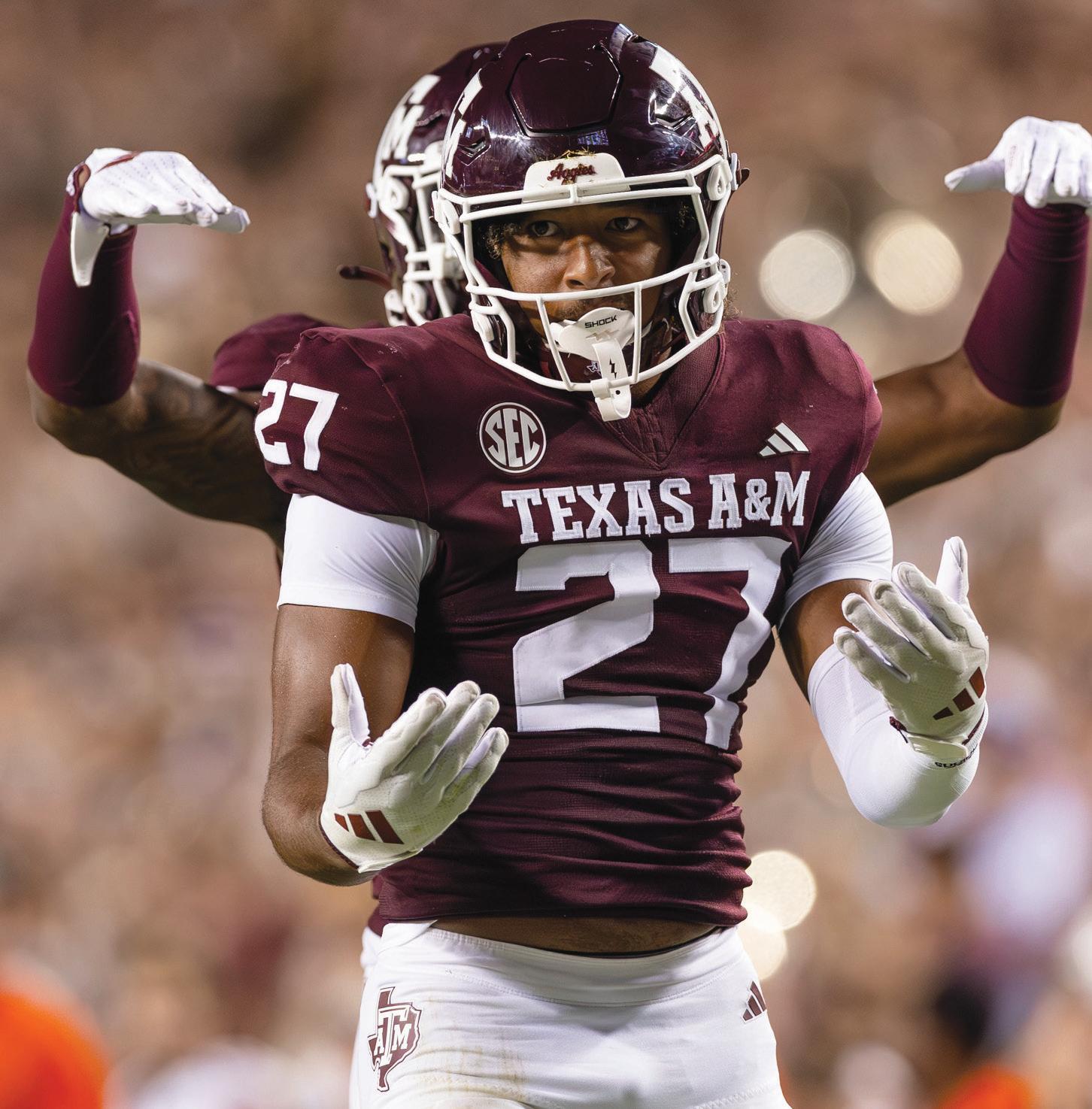
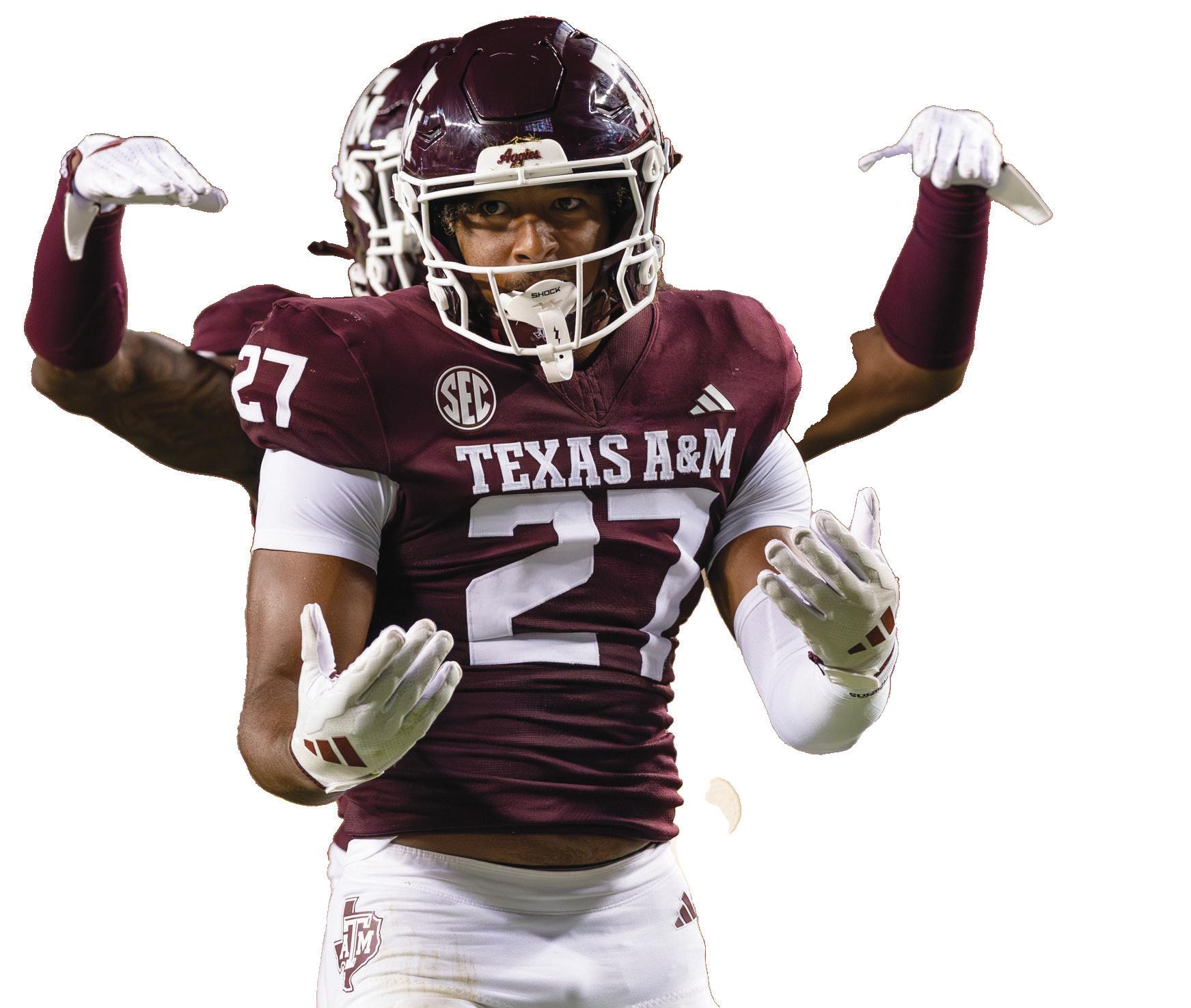
No. 3 Aggies head to Faurot Field to face No. 19 Tigers in hopes of returning home to Aggieland with 9-0 record
By Diego Saenz Senior Sports Writer
No. 3 Texas A&M football heads to Columbia, Missouri, well rested after a bye week and ready for a crucial road test against No. 19 Missouri.
The Tigers will look to keep their season alive at home, but it will not come easy with a freshman quarterback set to make his first career start against one of the most physical defenses in the country.
For the Aggies, a win would mark an undefeated 3-0 road stretch in what was considered the toughest part of their schedule. It would also move A&M one step closer to clinching a playoff berth as the regular season winds down.
Matt Zollers, freshman quarterback, Missouri
Meet the starting quarterback for Saturday’s showdown versus the Aggies. After graduate student quarterback Beau Pribula dislocated his left ankle against Vanderbilt, freshman QB Matt Zollers was thrust into action. Before that, he had only attempted five passes in his collegiate career.
He wasn’t too shabby, but didn’t exactly impress either: Coming off the bench in the third quarter, Zollers threw for 138 yards and a touchdown on 14-for-23 passing. What stands out about Zollers is his
6-foot-4, 214-pound frame. 247Sports
Director of Recruiting Andrew Ivins described him as an “athletic quarterback prospect with a projectable frame that can whip the ball around the yard.”
The former four-star prospect’s first start will come against a disciplined A&M secondary that allows just 203 passing yards per game. Coach Mike Elko will likely dial up different looks and blitzes to confuse the young quarterback, so expect Missouri to lean heavily on its ground game.
Ahmad Hardy, sophomore running back, Missouri
Despite having a freshman make his debut under center, coach Eli Drinkwitz’s Tigers have the luxury of sophomore running back Ahmar Hardy to help shoulder the load.
A Louisiana-Monroe transfer, Hardy has been the focal point of Mizzou’s attack this season and ranks among the nation’s top rushers. Through nine games, he’s totaled 937 yards and 11 touchdowns while averaging 5.9 yards per carry.
Hardy opened the season red-hot, surpassing 100 yards in each of the Tigers’ first five games. However, he hasn’t reached the 100-yard mark in the past three weeks, averaging just 69 yards per game. He’ll need to rediscover his early season form if Missouri is to have any chance at keeping up with A&M’s high-powered offense.
Kevin Coleman Jr., senior wide receiver, Missouri
Another transfer addition for the Tigers, senior wide receiver Kevin Coleman Jr. has been Mizzou’s most dynamic playmaker outside of Hardy. He leads the team in re-

ceptions with 51 catches for 558 yards and one touchdown.
Coleman will play a key role in simplifying the game plan for Zollers by providing a reliable target. He’s coming off a seven-catch, 109-yard performance along with two carries for 44 yards against Vanderbilt, with 68 of those receiving yards coming on passes from Zollers.
Missouri’s passing success may depend on Coleman’s ability to create separation against A&M’s cornerback duo of redshirt sophomore Dezz Ricks and senior Will Lee III.
Damon Wilson II, junior defensive end, Missouri
Switching over to the other side of the ball, junior defensive end Damon Wilson anchors one of the top units in the Southeastern Conference.
The Tigers rank first in total and passing defense, allowing just 245.8 total yards and 155.4 through the air per game. They also sit at fourth against the run, averaging 90.4 yards and third in scoring defense with 16.8 points per game.
Wilson has totaled 13 tackles, 6 sacks and an interception this season. His most notable performance came against Alabama, when the 6-foot-4, 250-pound defender recorded five tackles and two sacks.
Facing one of the SEC’s most explosive offenses, Wilson II will need another standout performance if the Tigers hope to slow down A&M’s attack.
Jamarion Morrow, freshman running back, Texas A&M
Freshman RB Jamarion Morrow was supposed to be wearing black and yellow



for this game. That all changed on Dec. 3, 2024, when he decided to flip his commitment toward Elko’s Aggies over the Tigers. That decision has proven wise. The freshman broke out against LSU, scoring twice — including a highlight-worthy spin move that showed flashes of greatness.
Morrow’s workload has steadily increased since the injury to senior RB Le’Veon Moss, and his ability to catch passes out of the backfield should earn him even more snaps. With Missouri boasting one of the SEC’s best defenses, the Aggies will need every playmaker available to find ways to crack the Tigers’ front.
Daymion Sanford, junior linebacker, Texas A&M
When senior linebacker Scooby Williams went down with an injury, junior LB Daymion Sanford was asked to step into a larger role, and he has delivered. Sanford has thrived in disrupting opposing backfields while providing crucial depth.
He ranks second on the team in tackles for loss with 6.5, and fourth in total tackles at 33, while also recording an interception, a forced fumble and 2.5 sacks.
Sanford did struggle with gap discipline against Arkansas’ ground-heavy offense, splitting time with Williams as the coaching staff searched for answers against the run. That will need to be corrected this week against a Missouri rushing attack that leads the SEC with 235.5 yards per game.
Sanford and the linebacker corps will need to be at their best to contain one of the country’s top backs in Hardy. With heavy conference and playoff implications in this matchup, the battle between these two units could very well shape the postseason.