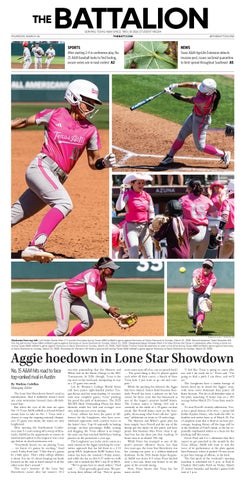
After starting 2-4 in conference play, No. 25 A&M baseball looks to find footing, secure series win in road contest A2
NEWS
Texas A&M AgriLife Extension detects invasive pest, issues sectional quarantine to limit spread throughout Southeast A5
Aggie hoedown in Lone Star Showdown
run-rule pummeling that the Maroon and White laid on the Burnt Orange in the SEC Tournament. In 2026, though, Texas is the top steer in the stockyard, stampeding its way to a 27-game win streak.
score some runs off of us, can we punch back? … The good thing is they’ve played against each other all their career, a bunch of these Texas kids. I just want to go out and compete.”
By Mathias Cubillan Managing Editor
The Lone Star Showdown doesn’t need an introduction. And it definitely doesn’t need any extra motivation beyond clean old-fashioned hate.
But when the eyes of the state are upon No. 15 Texas A&M softball as it heads behind enemy lines to take on No. 1 Texas with a chance to snap the reigning national champion’s 27-game win streak, the stakes are only heightened.
After opening the Southeastern Conference slate 5-1 and coming off a sweep of Kentucky, A&M has the opportunity to restore its national perception to the wagon it was a year ago before its shock postseason exit.
“Everybody knows we are playing Texas … we know it’s gonna be exciting,” head coach Trisha Ford said. “I like that it’s gonna be a little spicy. That’s what college athletics is about. For me it’s about keeping our heads focused on the task at hand instead of all the other noise that’s around.”
This year’s iteration of the Lone Star Showdown comes after last season’s 14-2
Led by Women’s College World Series cult hero junior right-handed pitcher Teagan Kavan and her team-leading 14 victories with nine complete games, Texas’ pitching has paved the path of dominance. The 2025 WCWS Most Outstanding Player has three shutouts under her belt and averages over nine strikeouts per seven innings.
Texas’ offense has been the point of difference for the Longhorns, who have overwhelmed opponents with ceaseless waves in the batter’s box. Top-10 nationally in batting average, on-base percentage, RBIs, scoring and slugging, the Texas offense is no longer the same one that watched A&M have batting practice in the postseason a year ago.
The Longhorns’ ace in the circle comes at a stark contrast to the Aggie’s pitching-by-committee approach that has led them to a 3.10 group ERA. Sophomore RHP Sydney Lessentine has been the rotation’s Friday starter, and while she has an elite 8.57 strike-to-walk ratio, she is outside the SEC’s top 20 in ERA.
“We’re gonna have to attack strikes,” Ford said. “ … They got really good arms. We gotta keep their offense off bay. They’re gonna
While the pitching has faltered, the Aggie bats have shined. Senior third baseman Kennedy Powell has been a stalwart on the hot corner for three years but has blossomed as one of the league’s premier leadoff hitters. The Conroe native is hitting .443 and is currently in the midst of a 35-game on-base streak. But Powell shines most on the basepaths, showcasing what Ford calls her “gymnast” athleticism en route to 18 stolen bags.
The Maroon and White’s game plan has been simple: have Powell and the top of the lineup get the ducks on the pond, and have junior first baseman Mya Perez clean it up. And boy has she done just that, mashing 14 home runs at an absurd .506 clip.
While Perez has emerged as one of the sport’s premier offensive forces, less than two years ago, the Lone Star Showdown was her coming-out party as a seldom-deployed freshman. At the 2024 Austin Super Regional, A&M was down 8-5 when Perez latched onto a two-out, three-run homer to tie the game in the seventh inning Now, Perez knows that Texas has her name circled.
“I feel like Texas is going to come after me, and I am ready for it,” Perez said. “I’m going to find a pitch I can drive, and we’ll see.”
The Longhorns have a similar barrage of batters lined up to attack the Aggies’ arms, with none more dominant than junior 1B Katie Stewart. The do-it-all defender rakes at the plate, launching 15 home runs on a .493 average before March 25’s Texas State matchup. To rival Powell’s twitchy athleticism, Texas has a speed demon of its own — junior left fielder Kayden Henry, who leads the SEC in doubles and stolen bases as of March 25. For a Longhorn team that is third in on-base percentage, keeping Henry off the bags will be at the forefront of Ford’s mind, as she has repeatedly emphasized strikes as a focus for the pitching staff this season. Given Ford and Co.’s admission that they expect to get punched in the mouth by the Texas offense, A&M will want to ride the wave of its performance at the plate against Sam Houston, where it pushed 18 runs across in just four innings of offense, to hit back. The first pitch of the weekend’s opening matchup is scheduled for 6 p.m. at Red & Charline McCombs Field on Friday, March 27, before Saturday and Sunday’s games both start at 1 p.m.
Tiger taming: A&M eyes first SEC series win
With 2-4 SEC record, Aggies seek footing in Regional race
By Noah Ruiz Associate Sports Editor
After dropping its second straight Southeastern Conference series, No. 25 Texas A&M baseball’s early climb for a regional bid hangs in the balance, with a crucial road series against Missouri beginning on Friday, March 27.
A rematch of former Big 12 rivals, the Aggies and Tigers are both suffering from a famine of conference wins, with a combined 3-9 record in the SEC.
While a few lulls in the batting order have kept the Maroon and White from drawing first blood in recent matchups, their pitching has been the nail in their coffin time and time again, especially after surrendering 11 home runs in its series against No. 7 Georgia last week.
However, one pitcher stood out far above the rest in A&M’s second top-10 matchup: sophomore right-handed pitcher Aiden Sims. The Aggies’ Sunday ace carried a one-earned-run effort into the fifth inning and struck out eight batters before leaving the mound to the applause of 6,087 Olsen Field faithfuls. The Forney product leads the starting pitching staff with four wins and a 3.77 ERA.
But as a whole, the Maroon and White have allowed a conference-worst 29 home runs, indicative of their 4.45 ERA, as op posing batters have found ways to exploit even the best Aggie arms. While the Tigers are not too far ahead with a 4.38 ERA, they have kept the longballs to a minimum with just 17, the fifth-best in the SEC.
Even with its overall struggle to keep run ners from crossing the plate, A&M has main tained a 3.70 strikeout-to-walk ratio, one of the best in the country. Speaking of walks, the Aggies have been just as productive, us ing free passes to their advantage as their 150 bases on balls are 12th in the nation.
Offensively, despite putting up just six runs in the first two games against the Bull dogs, the Aggies exploded for 18 runs in the series finale to get head coach Michael Earley’s squad back on track, keeping their 19th-best batting average at .323. While all A&M sluggers have chipped in to achieve such efficiency, one man stands out above the rest — junior center fielder Caden Sor rell.
On track to have one of the greatest sta tistical seasons in A&M history, Sorrell has belted 38 RBIs through his first 23 games, putting him in a three-way SEC tie. His 11 home runs and fifth-best .393 batting average have put the pride of Highland Village at the forefront of MLB Draft attention.
While Sorrell’s statistics blow minds as easily as he does baseballs, Missouri has its own pair of hitters — both with a .378 batting average — that have kept it in the fight in each of its contests. Redshirt sophomore infielder Tyler Macon and senior INF Jase Woita have knocked in 54 runs but with just four home runs between the two.
For the Tigers, only three batters have more than two home runs, whereas the Aggies have seven, including five from freshman third baseman Nico Partida. An everyday starter from the left corner of the diamond, Partida has been paramount in keeping the RBI-machine churning through his stellar rookie campaign.
If longballs were a major, A&M would be in its sophomore year, posting 40 so far in the early goings of the 2026 season. Missouri, however, would be minoring in the subject, putting up just 22 homers as its offense has relied on situational hitting to get runners home.
Moreover, Macon and Woita are the only two Missouri players to have more than 20 RBIs whereas A&M has four, including Sorrell, senior outfielder Jake Duer, junior first baseman Gavin Grahovac and freshman shortstop Boston Kellner.
The latter, another rookie, has walked an Aggie-best 23 times while tallying four homers and five doubles.
Though Grahovac has not gone yard as much as the 12th Man would have hoped in his return from injury, the California kid has started every game opposite Partida and has hit a team-leading nine doubles en route to 27 runs.
As for Duer, the former Florida Atlantic star is just one double behind Grahovac and has 27 RBIs, as he has worked out of left field and the designated hitter spot.
The Tigers, like the Aggies, have faced two ranked SEC opponents, getting swept by then-No. 6 Auburn and dropping a road series to then-No. 22 Tennessee. For Missouri, its showdown with A&M will be its third ranked series in a row, and defeat would thrust it into no man’s land as it searches for footing in the SEC. Squaring off with Missouri gives A&M an opportunity for revenge, having been swept at home a season ago by head coach Kerrick Jackson’s unit in a whirlwind fall from grace after reaching the College World Series final in 2024. While a series victory would do wonders for the Aggies, a sweep for Earley and Co. would put them squarely in the race for a third regional appearance in the last four years. The Maroon and White will begin their three-game series against the Tigers with a 6 p.m. matchup on Friday.
Oklahoma City on Thursday, March 19, 2026.
Agee sets standard for Bucky Ball
In final year of eligibility, Rashaun Agee emerges as leader on, off court
By Ian Curtis Senior Enterprise Reporter
Graduate student forward Rashaun Agee was the butt of a few jokes during 10-seed Texas A&M men’s basketball’s pregame media availability ahead of its NCAA Tournament Round of 32 matchup against the 2-seed Houston Cougars in Oklahoma City.
After Agee was asked how he became the Aggies’ vocal leader in his final year of college eligibility, senior guard Rylan Griffen cut in with a comment about the former’s seniority.
“Agee plays a part in it too,” Griffen said. “Let’s not fool. Don’t let him fool you. That’s a big reason. Unc over here.” Even head coach Bucky McMillan got in on the fun.
“Well, he’s got no worries,” McMillan said. “Financially he’s getting Social Security right now, so he can just [have] no worries when he’s out there on the court.”
In the NCAA Tournament, Agee put up 22 points, nine rebounds and a trio of assists in A&M’s Round of 64 win over 7-seed Saint Mary’s, adding another seven points against Houston.
But Agee’s dream of playing in March Madness was nearly over before the year began.
After transferring to A&M from USC, Agee was only able to obtain his extra year of eligibility via a court injunction.
Playing for his fourth Division I school, Agee’s age and vocal leadership quickly turned him into the captain of a roster full of transfers after McMillan was left with just one returning player on the Aggies’ roster when he was hired in April.
“He’s a great leader,” junior G Pop Isaacs said. “Does a great job with the guys day in and day out. Better than, like, just the basketball player. He’s a great person to
lot of new guys this year that came in and fall together and allowed me to lead them. I would say my legacy is our first year we came in, we won our first [NCAA Tournament] game, and almost got to the Sweet 16. That’s the legacy right there, the team, how we did everything this year.”
The same words that Agee used to describe the Aggies’ style throughout this season — fight and energy — also fit how McMillan described the listed-as-6-foot-8 forward’s style of play.
Opinion: NCAA football needs a commissioner
Introducing a single leader could fix prominent issues in college football landscape
By Dylan Fonville Sports Writer
The best era of college football is behind us. Players now are money hungry and have absolutely zero loyalty to their universities, and from spectators rocking obnoxiously large hats to those sporting full-body paint, fanbases have struggled to adapt to the ever-shifting NIL and transfer portal landscape. Is college football so far gone that our amateur, collegiate league now must require a commissioner, similar to how Roger Goodell oversees the NFL?
Before we dive in, we must ask: What is a commissioner?
A commissioner works as the “chief executive” in a league, responsible for overseeing operations, enforcing rules and, of course, maximizing revenue. They are the figureheads of strategy, logistics, contracts, media and officiating that goes into their respective sport. Ultimately, the commissioner is widely considered to be the public face of the league.
Growing up watching pro sports exclusively, it always interested me when I’d hear people say they thought college football was better than the NFL. As I started tuning in to college football, I finally began to understand what the appeal was: school spirit, big, exciting crowds and hungry players.
I could see how driven the players were, putting their bodies on the line to fight for their alma mater and prove they were NFL-worthy. The atmosphere was loud, the fans were proud, and the sport was exhilarating to watch.
In 2018, the NCAA announced their implementation of the transfer portal, allowing student-athletes to transfer schools more easily but requiring them to sit out a full year before they could play for their new school. This concept seemed fair enough, opening doors for students to seek new opportunities while making sure they were with a coaching staff they believed in. However, skeptics of this new system pointed out this process could only change the college football scene for the worse, especially if they introduced an outlet for players to be paid.
One year later, California passed an NIL state legislation allowing collegiate athletes to receive compensation for brand deals and anything involving their name, image or likeness. This legislation set the tone for other states to follow suit and pass legislation of their own.
In 2021, the United States Supreme Court ruled unanimously to force the NCAA to take action against their own NIL procedures. This decision became effective on July 1 of the same year, as did a new transfer portal rule allowing players to transfer one time without a sit-out consequence. Then, in 2024, the NCAA dropped a nuke, allowing players unlimited transfers. This was the beginning of the end for college football.
So, why do we need a commissioner? Because, college football has effectively become a pro sport.
He’s got such a great personality and is a joy to be around. There’s energy vampires that suck the energy out of a room. He’s the total opposite. He brings life to the party.
Bucky McMillan
“Well, he may be listed a little taller than he is, so for him to do what he does at his true height, it’s to have more double-doubles now in a season than anybody in the history of the Texas A&M basketball program, who would have thought that would come from someone who is — I’m not going to say it, whatever tall he is,” McMillan said. “He gets mad. That’s like Charles Barkley, you know? You remember Charles Barkley? He wasn’t the tallest, but he’s like the Round Mound of Rebound. He would just go get the ball.” McMillan also said Agee’s effort mattered just as much off the court as on.
Texas A&M Men’s Basketball Head Coach
All jokes aside, McMillan said there was no doubt about the impact Agee had during his one and only year in Aggieland.
“I mean, he put a belief in the group, in the locker room, that we could go fight with anybody,” McMillan said. “They knew they had Rashaun with them and that he wasn’t gonna back down from anybody. And you know, when you stand eye to eye with him, doing an interview, y’all saw how tall he really is, and he’s out there getting double-doubles every single game because he’s got just a freaking huge heart, you know? I know these guys in this day and age of college athletics, they’re not guys you get to know for three and four years a lot of times. This was an extreme example of that. But I’ll tell you this much, every one of those players is in that locker room crying. Texas A&M meant a lot to these guys, you know, and hopefully they mean a lot to this fanbase.”
be around every day, which helps a lot. So Rashaun has been great all year, for sure.”
Agee’s postseason performance ended a year during which he led the team in scoring and rebounds — averaging 14.6 and 8.7 per game, respectively — while earning Third Team All-SEC honors, the only Aggie to earn a postseason honor from the Southeastern Conference.
Ever the team player, Agee was quick to focus on the team’s achievements — winning an NCAA Tournament game in a year that the Aggies were projected to finish near the bottom of the SEC standings — rather than his own accolades, even amid the emotions of a 88-57 Round of 32 loss to Houston that ended his college career.
“I feel like we put a lot of fight and energy into this year throughout ups and downs of our season,” Agee said after the game against Houston. “I mean, it was a
“So I think you got to admire someone whose determination is what it is, and it’s contagious to our team,” McMillan said before the Houston game. “But he’s just a delight to be around. He’s got such a great personality and is a joy to be around.There’s energy vampires that suck the energy out of a room. He’s the total opposite. He brings life to the party.”
For Agee, the lasting impact this year and A&M’s NCAA Tournament run has had on him goes far beyond the basketball court. He said that the impact McMillan had on him will last for the rest of his life.
“That’s always going to be my guy,” Agee said. “I always talk to Bucky 24/7. I tell my teammates, I tell my family, like, man, I appreciate him. No matter what goes on, I know — I’m thankful that he allowed me to come here and be here at A&M and allowed me to lead. A lot of coaches, you know, wouldn’t pick somebody the first year just to come in and lead. He helped me become a man this year.”
Players have no incentive for loyalty beyond money, as some are being paid millions to play football at the collegiate level. Every year, when the transfer portal opens, players are thrown more cash than they’ve ever seen in their lives from these programs, which has nearly eliminated the possibility of non-Power-Four schools even remotely competing for a national title, with a few exceptions.
It has also put a damper on fandom, as schools can essentially have a brand new roster every year, leaving loyalty to rest solely within the fans.
If student-athletes are being paid like professional athletes, they should be treated as such. What a commissioner could do for college football is simple: bring order to the chaos by introducing contracts, limiting transfers, setting budgets and reshaping college football for the players, staff, investors and the fans.
Introducing contracts and setting NIL budgets would incentivise school loyalty and limit the amount every school would have to spend on players, in hopes that all teams may have a more or less equal opportunity to grab the best guy on the board. Contracts would help eliminate the problem of players transferring every year and would give players a taste of what the NFL is like.
Former Alabama head coach Nick Saban has been eyed by many coaches, players and fans alike as the favorite for the NCAA commissioner job. However, although he is a vocal advocate of the need for a commissioner, he claims he doesn’t want to do it himself.
Safe to say, there’s growing support for the cause, and, if nothing else, the NCAA should review what fans of the sport have to say and seriously take into consideration the introduction of a college football commissioner.
Dylan Fonville is a sophomore journalism major and sports writer for The Battalion.
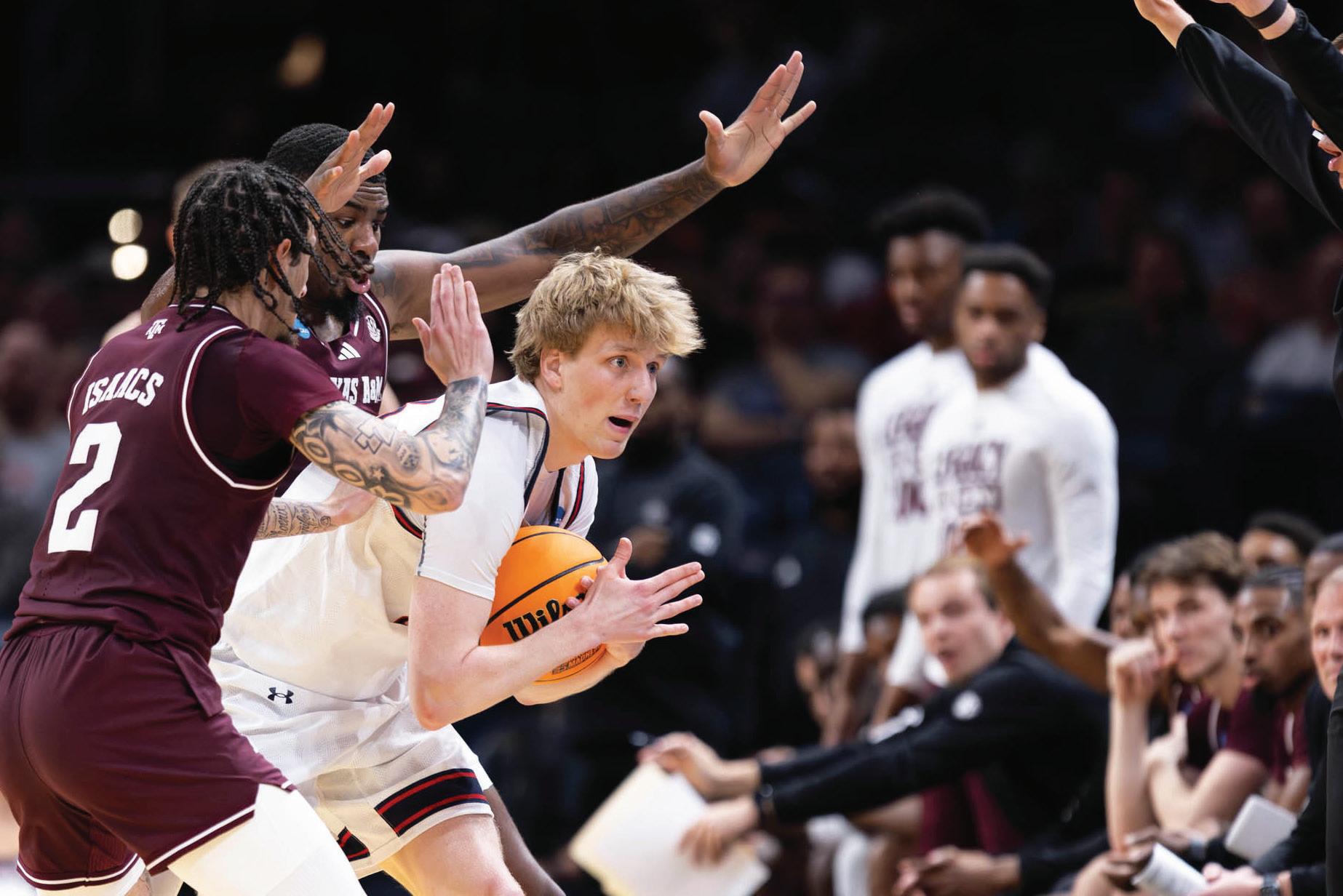
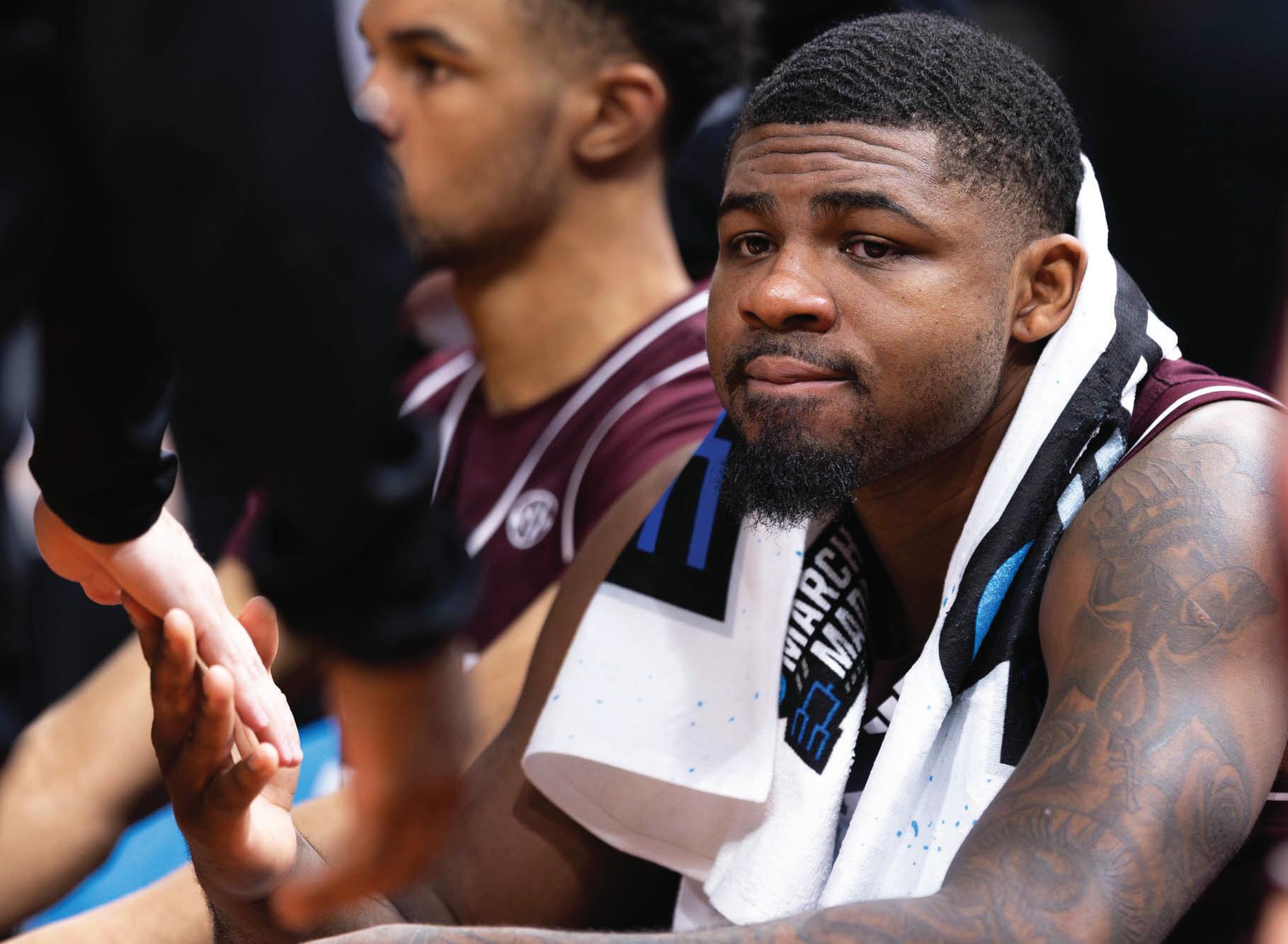
Clockwise from top left: Saint Mary’s guard Liam Campbell (33) calls for a timeout under pressure from the Aggie defense during Texas A&M men’s basketball’s game against Saint Mary’s at the Paycom Center in Oklahoma City on Thursday, March 19, 2026. Guard Rylan Griffen (3) shoots the ball during Texas A&M men’s basketball’s game against Saint Mary’s at the Paycom Center in Oklahoma City on Thursday, March 19, 2026. Head coach Bucky McMillan gestures during Texas A&M men’s basketball’s game against Houston at the Paycom Center in Oklahoma City on Saturday, March 21, 2026. Forward Rashaun Agee (12) high-fives
Paycom Center in
Photos by Rocio Salgado — THE BATTALION
GALLERY: Men’s tennis BTHO cancer, Bulldogs
By Adriano Espinosa Photographer
Cotton jassids found in Southeast
Texas Department of Agriculture issues emergency quarantine to limit spread
By Erin Wunderlich News Reporter
Texas produces 40% of the United States’ cotton, with an annual economic impact of over $5 billion. However, Texas A&M’s AgriLife Extension specialists have detected a new pest that could cut revenue in half.
Cotton jassids, also known as two-spot cotton leafhoppers, are an invasive insect species native to Asia. On Feb. 5, the Texas Department of Agriculture, or TDA, enacted an emergency quarantine to safeguard cotton fields and plant nurseries in counties such as Cameron, Grimes, Fort Bend and Wharton. All counties transporting hostable plants must have phytosanitary documentation, otherwise, shipments will be subjected to quarantine.
Likely introduced to the U.S. through international trade or strong wind currents, jassids were first identified in Puerto Rico in 2023 and later in South Florida in 2024. The pests have since spread throughout the Southeast, reaching Georgia, Alabama, Mississippi and Louisiana among other states.
In late 2025, jassid sightings were reported on hibiscus plants in big-box stores across Texas and in cotton fields in quarantined zones.
on the density of the jassid infestation, but it can be very quick,” professor and AgriLife Extension Entomologist David Kerns, Ph.D., said. “For instance, in severe infestations with as many as 30 jassids per leaf, plants have been observed to die within four days.”
The TDA estimates that if the jassid infestation is not addressed, the rapidly growing population will slash cotton yields by 50% — largely due to the pest’s rapid reproduction cycle. Under favorable conditions, a complete generation usually occurs every two weeks.
Last year, jassids arrived late in the cotton growing season and were kept at bay by colder temperatures.This year, although uncertain, extension specialists expect a surge in population and spread as warmer spring temperatures coincide with prime flowering seasons.
Initial observations from Georgia indicate jassid infestations are most severe along field margins, which are uncultivated strips of land located between crops or at field boundaries.
“The best thing we can do is stay alert, stay informed and don’t panic,” Vyavhare
from past experiences is the importance of not underestimating new pests.”
So far, prevention and treatment options are limited. Kerns encourages growers to plant early — so crops can mature before jassid populations peak — and to avoid insecticide application unless directly advised by specialists. Plant nurseries should also exercise caution and avoid transporting infested host plants, such as hibiscus, between regions.
“Right now, the only viable treatment option is to spray insecticide on infested crops, like cotton, and nursery plants, like hibiscus,” Vyavhare said. “But before using those sprays, we need to make sure the insect is in fact a cotton jassid and not some other harmless leafhopper. As soon as you suspect, please call your nearest extension office or extension entomologist, and report it to the Texas Department of Agriculture so we can take steps to mitigate the situation or contain the spread.”
As an organic cotton grower, Brown said he is concerned about infestation because his remedies are limited to nonchemical treatments.
Kerns suggests planting varieties with greater resistance and quicker maturation. He also recommends the use of natural insecticidal soaps and horticultural oils, although they may not be very effective.
Staying alert and informed is important. Regular field scouting is essential to detect problems early and enable timely management. A key lesson from past experiences is the importance of not underestimating new pests.
“This is a big potential threat to the Texas agricultural industry,” associate professor and AgriLife Extension Entomologist Suhas Vyavhare, Ph.D., said.
Vyavhare described the threat as serious, noting potential impacts to costs of production as well as the number of insecticide applications.
“But, at this stage, it’s still a developing situation,”Vyavhare said.
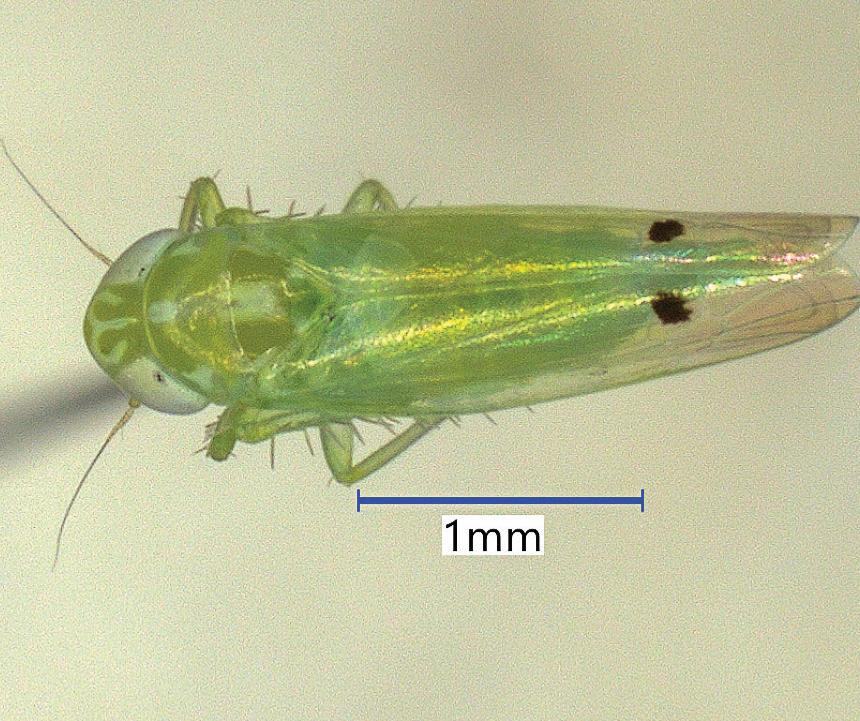
Jassids are small, pale-green insects with yellow-tinted wings — roughly the size of Abraham Lincoln’s nose on a penny. They can be identified by two distinctive black dots located at the tip of each wing. While cotton is their primary target, these pests also infest okra, eggplant, sunflower, soybean, potato and ornamental plants, such as hibiscus.
Adult jassids feed on sap from the underside of cotton leaves and inject a deadly toxin, the nature of which is unknown.
Early signs of infestation include hopperburn, a condition when yellowed leaves curl inward. As damage progresses, leaf edges turn red and brittle — a sign the plant is dying.
“The rate at which a plant dies depends
said. “Follow the news and monitor plants very closely.”
Cotton farmer Jeremy Brown owns Broadview Agriculture, a farm located in the southern plains of West Texas near Lubbock. He grows organic cotton through regenerative agricultural practices that restore degraded soils and use limited pesticides.
“Cotton jassid is on everyone’s radar; every year there is another challenge for us to overcome as farmers,” Brown said. “We’ve had similar situations with sugarcane aphids and boll weevils in the past. My hope is that everyone is working together to mitigate whatever damage we can, especially as the warm weather comes.”
Vyavhare cautions growers to stay vigilant, but to understand that insect invasions in agriculture are not unusual.
“When pests like the sugarcane aphid or cotton jassid establish in new regions, there is always a learning curve to understand their biology and develop management strategies,” Vyavhare said. “Staying alert and informed is important. Regular field scouting is essential to detect problems early and enable timely management. A key lesson
Entrepreneurs connect with Texas A&M students through advice, anecdotes
Mid-Week Meetups connect Aggies business students with founders, industry resources
By Lasan Ukwatta Liyanage Life & Arts Writer
Every Wednesday evening, student entrepreneurs at Texas A&M gather to share ideas, test startup concepts and connect with like-minded innovators through Mid-Week Meetups, a program hosted by the A&M McFerrin Center for Entrepreneurship.
Designed by members of the McFerrin Experience Team for student entrepreneurs, the gatherings create a casual space where undergraduates with business ideas or startup ambitions can network. Director of Entrepreneurs EXPOSED, a group within the McFerrin Experience Team, and finance senior Hallie Ikenberry said Mid-Week Meetups is a gateway program for all the other opportunities offered to students at the McFerrin Center for Entrepreneurship.
“It’s not meant to be anything super professional or anxiety inducing, kind of like the other pitch competitions where you’re pitching for money,” Ikenberry said. “It’s more of, ‘Get your toes wet.’” Ikenberry said programming varies from week to week, sometimes offering evenings the feature hands-on activities, such as mock pitch competitions and customer discovery exercises, while others bring in guest speakers who are actively building and leading their own ventures.
Computer science senior Andre Athari, who has been participating in the program since last semester, is just one student who has gained valuable insight from the program.
“Usually, there’s a few people here, quite a lot of people here, actually, who all have their own ideas for what entrepreneurship they want to pursue,” Athari said. “So, we had Ben Nowack, who’s the head of Space Orbital, come to one of the meetups. He came and spoke about his startup, and we got to ask him a lot of questions, and I got to ask him a few questions about his entrepreneurship experience and how I could apply it to my own ventures, and it was pretty helpful.”
Athari said each meetup also brings together a room full of knowledgeable and talented students, most of whom have already launched startups of their own to share their experiences while fostering an environment in which attendees feel comfortable asking questions.
Good Bull Pitch Director at McFerrin and industrial distribution senior Cannon Jackson said he likes to measure the success of the program based on the people they have helped.
“I care about helping people that are truly passionate about entrepreneurship and want to come here and be inspired and network,” Jackson said.
Jackson said the program also hosts mentor nights, during which students meet in small groups with successful entrepreneurs to ask questions about starting their own ventures, providing a personalized learning experience for students.
As a frequent attendee, civil engineering senior Evan David said the program has been an opportunity for him to connect with like-minded individuals.
“A&M’s campus can feel pretty big, but the Mid-Week Meetups are a great way for a smaller group of students to get together,” David said. “ … We’re all passionate about building something, sharing ideas.”
“These products must make direct contact with the insect to kill it,” Kerns said. “They will be most effective if sprayed on the undersides of leaves where the insects feed. This may help, but it’s largely impractical for huge cotton fields — we just don’t have the kind of equipment to do that.”
Current research is investigating why plants like cotton are so vulnerable to jassids. Ongoing experiments are examining the toxin responsible for hopperburn and assessing whether plant nutrition influences susceptibility. In addition, other studies are focusing on developing effective insecticide treatments.
“Most of the information we’ve learned so far has come from one year of experience in the Southeast U.S. and from Asia where this is a major pest of concern,” Vyavhare said. “In countries like India, they spray for jassids five to seven times a season — which can really bite into their profits.”
At this stage,Vyavhare stresses the importance of monitoring plants and being ready to spray if needed.
“All we can do is continue what we have been doing,” Vyavhare said. “And in addition to that, have some sort of plan to scout for jassids throughout the season and report any sightings to your local extension office or the TDA.”
Wednesday sessions have helped David not only connect with other entrepreneurs, but move his personal business ventures forward as well. He said after a presentation about free resources for entrepreneurs from the Brazos Valley Small Business Development Center, he felt inspired to take the next step and schedule a meeting with their team, where he gained invaluable insight. Senior Director of McFerrin Experience Team and management graduate student Ethan Coffin said the program’s mission is to expand and broaden horizons when it comes to entrepreneurship.
“We’ll try and bring in speakers from a variety of backgrounds,” Coffin said. “Sometimes they’re entrepreneurs. Other times, they’re investors, like private equity people or venture capitalists. They’ll come in and talk to our student businesses about problems they’re having, and give advice and kind of just, you know, life advice beyond that.”
Coffin said Mid-Week Meetups offer early-stage entrepreneurs a low-pressure, low-risk introduction to the startup world and a chance to absorb entrepreneurial ideas, resources and conversations at their own pace before stepping into more handson opportunities with free dinners.
“If you have a spark inside of you and you need a place for that fire to grow, the McFerrin Center is the fireplace,” David said. “It’ll give you the fuel to really build your own fire and ignite, ignite what you have going on inside your head.”
Clockwise from top left: Adult cotton jassid, identifiable by its two distinctive black dots on the tip of its wings. Cotton jassids on the underside of a cotton leaf. Adult cotton jassids
Photo courtesy of Isaac Esquivel, University of Florida
Photo courtesy of Scott Graham, Auburn University
Photo courtesy of Scott Graham, Auburn University
Photo courtesy of Scott Graham, Auburn University
Opinion: Ballet and opera never left the stage
Chalamet’s recent comments shed light on threatened art
By Bethany Mann Opinion Writer
If ballet and opera are dead, why did I spend 14 years of my life dancing?
Timothée Chalamet recently stated that he did not “want to be working in ballet or opera or things where it’s like, ‘Hey, keep this thing alive, even though no one cares about this anymore.’” The irony of Chalamet, a film star, saying other forms of art are dying when streaming services have taken over his own industry — I can’t name the last time I saw a movie in theaters — was really telling of his own insecurities.
While I understand Chalamet’s comments come from the fear that cinema is dying and he may very well be losing his relevance, there was no reason for him to drag other art forms down with him. Ballet and opera have existed long before Chalamet’s newest movie, “Marty Supreme,” and will exist long after people stop watching it. They are by no means dead — but they are in danger.
If it seems that no one cares about ballet and opera, it’s not because there’s no interest, but because society pushes us toward more “practical” fields.
How many young girls — and boys, too
— took dance classes as a child but stopped as they got older? While I in no way was ever at the level of a professional dancer, I loved ballet. However, I knew from a young age that it wasn’t a viable career option, and I miss it every day since quitting it in my junior year of high school to take the “realistic” route and focus on school.
Chalamet’s comments come at a time when art is under attack. Secondary and postsecondary educational institutions are increasingly focused on STEM fields, with the arts and humanities losing funding and interest.
Texas A&M only has five fine arts majors consolidated into the College of Performance, Visualization & Fine Arts, which recently had a proposed new building removed from a list of approved projects.With only about 3,000 students enrolled in the college, the fine arts are definitely dwindling in size, but does that mean that ballet and opera are dead?
No, it absolutely does not.
To see ballet and opera as dying is a very Western and Americanized view. Sure, collegiate fine arts programs are tiny in comparison to those of other more mainstream departments, but this is just a cultural phenomenon — ballet and opera are thriving in Europe and Asia.
The Royal Ballet and Opera in London is a premier performing company with schools that bring these art forms to
The
Osipova, who is arguably the best ballerina currently performing, has danced with both of these companies.
These art forms are thriving in other countries because people invest time into them. They teach young people to express themselves and go after what they love.
Now, I found my own ballet community when I was growing up, so there are clearly spaces for these arts in this country. With major companies like the American Ballet Theatre, New York City Ballet and OPERA America, ballet and opera have their place in the United States. It’s not like it is in the east — but it should be.
Chalamet needs to recognize that these art forms are foundational for his own career. You can’t have “Wonka” or “A Complete Unknown” without dancers and singers. His comments are dangerous because they perpetuate the notion that we don’t need to invest time and care into these communities when there are thousands who find their purpose in ballet and opera. His statement that he lost “14 cents of viewership” painfully points out the low wages these artists receive, pushing the narrative that these aren’t “realistic” careers. Ballet and opera aren’t dead yet, but they
could be if we start thinking like Chalamet. It’s not just that his statement was incorrect, it’s that it attacks already threatened communities — communities that are necessary for the soul.
In the 1989 film “Dead Poets Society,” Robin Williams gives an iconic speech to his class about the power of poetry and says the following:
“We don’t read and write poetry because it’s cute. We read and write poetry because we are members of the human race. And the human race is filled with passion. And medicine, law, business, engineering, these are noble pursuits and necessary to sustain life. But poetry, beauty, romance, love, these are what we stay alive for.”
This is what ballet and opera are for; they give us outlets as dancers, singers, choreographers, composers and viewers to express ourselves, to understand our emotions and navigate the world we live in. Art gives us the power to question and to believe in the impossible.Without them, what do we truly have to live for?
While Chalamet’s comments are threatening at an already tumultuous time within the arts, I don’t think ballet and opera will ever go away, because to quote from Chalamet himself, “What is this earth without art? Just a rock.”
Bethany Mann is a history freshman and opinion writer for The Battalion
Opinion: We have lost the protein-packed
Gains, but at what cost?
By Wyatt Pickering Opinion Columnist
Protein — it’s what’s for br eakfast, lunch, dinner and every other possible meal of the day.
The protein epidemic has attacked our country, and it’s affected every advertise ment, grocery store shelf and my entire TikTok “For You” page.
The most ridiculous product I’ve seen is the brand new stuffed cookie from In somnia Cookies, which promises a “nu trient-dense” sweet treat with a whopping 11 grams of protein. Eating this cookie will only cost you $4.79 plus tax — and your dignity.
At some point, protein stopped being a nutrient taken to supplement your gains and instead became a new fad that compa nies everywhere are looking for the oppor tunity to capitalize on.
Many of these products claim to provide a similar, or even better, culinary experi ence than their competitors. Regardless of its truthfulness, if you are bombarded dai ly with the same rhetoric cautioning that you must only consume these products or else you will be in a nutritional deficit, then that claim quickly becomes a reality in the minds of many.
Despite my distaste toward any alterna tive protein-packed product on the market, there must be a consumer base for this kind of “innovative” product if companies con tinue to push these foods to the common denominator: protein-obsessed American consumers. However, is this just going to be the next big thing for the next couple of months, or will it die out like so many other similar movements? Diet trends are nothing new, and getting
plot
We exist in an era where we are constantly bombarded with brands and influencers trying to shove their lifestyles down our throats as the optimal way we should
But it’s about time we look beyond the $300 courses and wake up to the fact that not every part of our existence has to be optimized in order for us to live a life of
We are already comparing ourselves to Instagram models who give us a warped sense of what normal looks like, so why make it harder on ourselves by turning every meal we eat into a performance met-
Because if we justify eating anything on the basis of macronutrients or the latest government report, we forget why we even eat in the first place: There is value in food beyond its amount of protein, whether that be the people we eat it with, the memories that are associated with it or that it’s just
Not every choice you make at the grocery store has to be justified — that only leads to burnout and associating the basic human function of eating as something to feel guilty about. Is chasing the next trend the healthiest thing we could do, or maybe is it just realizing that finding balance is less complicated than we think?
At the end of the day, food is more than the label slapped onto the back of the package. It’s how we connect with and fuel the life we want to live. Maybe we should actually just eat what we want and live a life
Oh, and eat some more fiber while
Wyatt Pickering is a business honors and finance junior and opinion columnist for
young people.
Bolshoi Ballet in Moscow is home to some of the most talented dancers in the world as Russia serves as a powerhouse in the ballet industry. Natalia
The Registration Club: The Batt’s must-take courses
By The Battalion Opinion Staff:
Class scheduling for the brains, the athletes, the basketcases and the princesses, though maybe not the criminals
Associate Opinion Editor Maeva
Elizabé
PHIL 240 Introduction to Logic
I can guarantee you’ve never taken a class quite like this before, and that’s the beauty of it. The mental workings required to nav igate the material of PHIL 240 are so much different from any other run-of-the-mill course, so new and unique, that you can truly feel your brain rewiring itself as the semester crawls by. You either love it or hate it — I fall into the former category.
It’s a mathematical-based course on account of having to analyze the relationships between components and use proof systems and logical operators to evaluate the validity of symbolic statements. And yet, simultaneously, it’s just as much a linguistics course, as the ability to dissect arguments and translate them into various equivalent forms is at the heart of PHIL 240. But there’s also a lifeline for the scientists in the bunch, because the content demands a reasoning capacity all too familiar for those spending hours in the lab drawing deductive and inductive conclusions from evidence.
This course is the missing piece to the interdisciplinary puzzle, the golden goose class that allows the indecisive — or jack-of-alltrades — student to bridge the gap between the humanities and the sciences.
Associate Opinion Editor Joshua Abraham FILM 434 History and Film
FILM 434 explores the intricate intersection between film and the historical past, an intersection that many people might gloss over but reveals incredibly important details about how our society perceives the media we consume. In a political climate as volatile as ours, there’s a great need to understand our history for us to not repeat it, and what better way to do that than through seeing others’ perspectives on historical accounts? It’s a heavy class, but it’s one that should be necessary for everyone in order to grow our media literacy skills.
From “The Missing Picture,” where the director narrativises his genocide-oppressed upbringing, to speculative archives in clas sics like “The Watermelon Woman,” the films presented in this class not only allowed me to consume media that challenged my worl dview, but allowed me to be consumed by another worldview — the recipe to success in educational growth.
Opinion Columnist Sidney Uy PHIL 409 Gender and Philosophy
Do all feminists agree with each other?
While academics and students are being hounded by a Board of Regents whose collective paranoia regarding the “suspicious” liberal arts is prioritized over students, I return to a class that actually taught me democratic Aggie values: PHIL 409.
Before the creation and enforcement of the notoriously unintelligible Civil Rights Protections and Compliance policy, this class proved to be one of the most important seminars I could have ever taken. We discussed topics like why feminism can be for everyone, why institutionalized discipline affects women’s perception of the self and the body and how today’s categories of race and gender were conceived in tandem; I learned a great deal about where certain ideas originated from. We didn’t, however, take for granted these ideas — we often ar gued against them. Some of us didn’t even identify with the label “feminist” or “wom an”; in fact, male students, too, took this class. Rarely did we ever arrive at one simple conclusion about “what women are” or what “female freedom” is. Rath er, we engaged in respectful, informed discussions while building up our own arguments. Although the new unversity policy might hollow out much of this course, I will forever remember the intellectual friendships I developed in an environment that encouraged me to disagree and take on complexity. Most of all, it helped become a pas sionate writer, which nourishes me and gives me purpose. If that isn’t ideally or sufficiently Aggie, I don’t know what is. I can only hope that the next generation of Aggies can find a class that offers the same kind of home that PHIL 409 did and positively transform its students, too.
Senior Opinion Columnist Isabella Garcia PHIL 376 Philosophy, Film and Evil: Aliens, Androids and Avatars
I’ve always loved movies.
The media we indulge in, however, is a consequence of our preferences, effectively categorizing us within a status hierarchy. Those in power have historically reified their authority by differentiating themselves from the poor; taste classifies, and it classifies the classifier. The increasing accessibility of film to the masses has therefore prompted elitist labels of the medium as being superficial, kitsch or even degenerate.
By contrast, PHIL 376 demonstrated that meaning comes not from the movie but the critical lens with which we approach it. I learned about existentialism and what it means to live in bad faith after watching “Minority Report,” and I was confronted with humanity’s hypocritical ten dency to be consequentialists when we’re mad at some one but suddenly switch to deontology when we’re the ones to blame. Ni etzsche was taught alongside “Interstellar,” Plato alongside “The Matrix”; I was given the tools to understand film, philosophy and the world around me — but most significantly, myself.
Opinion
Writer Abby Morris POLS 420 Nuclear Politics
If you want a class that’s equal parts fasci nating and terrifying, then don’t miss POLS 420 with Professor Matt Fuhrmann, Ph.D.! When I first registered for the course, I didn’t even think I was interested in this area of political science, but I ended up loving it. Throughout the semester, I learned about the intricacies of nucle ar weapons, types of deterrence, diplo macy and different schools of thought. There’s no doubt that Fuhrmann is an expert in the field and loves what he does. Furthermore, he’s a great professor; he even deviated from the syllabus for a day to talk about the war with Iran and to try and help us understand what led up to it. He is a captivating lecturer, and it’s evident he wants to help you learn. If you’re interested in national security and foreign policy, or just want a cool elective, I highly recommend this class.
Opinion Writer Marie Kneeland ENGL 222 World Literature
I always like to “rank” my classes through three categories: course material, engagement and takeaways. In other words, I determine how much I enjoyed my classes based on how much I liked what we read, how interesting the lectures were and how much I felt I truly learned when the semester
As the token business student of the opinion desk, I have to shout out the greatest class provided to students at Mays Business School!
BUSN 432, taught by Professor Kyle Gammenthaler, Ph.D., combines lessons about the nonprof it sector with hands-on philanthropy in the form of grantmaking. As someone who has always been passion ate about working with nonprofits, this was a class I knew I had to take. At the end of the course, my class was able to gift 10 local nonprofits $170,000 in grants to support their mission and daily operations. Interacting with nonprofit leaders and seeing why they are so passionate about the work they do is an experience that I will never take for granted. If you’re interested in working with nonprofits or just want to give back to the Bryan-College Station community, BUSN 432 gives you the skill set to practice generosity at its highest level.
Required courses usually rank fairly low on that scale, but I can say with complete honesty that ENGL 222 with Professor Apostolos Vasilakis, Ph.D., or “Dr. V” as the class called him, was one of the best classes I’ve taken to date. Not only were the books we read entertaining and terrific representations of varied cultures from across the globe, but Dr.V gave some of the most intellectual lectures I’ve heard. After every class, the other students and I would walk out of the room talking about how much we learned. Even now I recommend the books I read in that course, and I could tell you almost everything I learned about them.
Opinion Writer Prachi Arora SOCI 304 Criminology
SOCI 304 is the kind of class that quietly rewrites how you see the world, not by telling you what to think about crime, but by teaching you how to think about it. What starts as a course on crime rates, policing and prisons quickly turns into something much bigger: an exploration of why people commit crimes and how society decides what even counts as “crime” in the first place.
And, of course, nothing bonds a class quite like watching people get brutally murdered on screen at 8 a.m. — a truly unmatched educational experience.
I recently argued that we need to stop romanticizing the past, and no class makes this more evident than HIST 301 with Professor Albert S. Broussard, Ph.D. Starting at the end of the Reconstruction Period, this class takes you through the economic, social and political lives of African Americans as they struggled to find their place in society. Our secondary history education leads a white-centered narrative of history that fails to tell the story of a crucial group of people, overlooking a movement central to the idea of what it means to be American. This course made me fully understand the nuances of American society today, because to paraphrase former Vice President Kamala Harris, we didn’t just fall out of a coconut tree; we exist in the context.
Opinion Writer Aidan Zamany ARTS 150 Art History Survey II
Any course that spans across the 14th century Renaissance to the 20th century contemporary arts movement is sure to offer an exciting and informative experience, and ARTS 150 with Professor Thomas Dorsch, Ph.D., certainly does just that. Classicists and cosmopolitans will especially enjoy the international voyage across continents and cultures, with comprehensive analyses of each civilization’s creativity expressed through a variety of unique mediums. Take this course if you want to explore the greatest examples of oil on canvas, ink on silk, wood etchings, marble statues and stone sculptures from Rome to Paris and Raphael to Poussin. While I can not guarantee that you will end the semester as an expert art crit ic, I can promise that you will have learned valuable lessons in aesthetics and will ap proach your next gallery with newfound skills and an elevated appreciation.
From media portrayals of violence to deep dives into theories, you begin to notice patterns everywhere: in the news, in conversations and even in your own assumptions. It’s one of those classes that sticks with you, giving you the tools to analyze the world — and, admittedly, everyone around you long after the semester ends.
Have you ever wished you could mix your studies with your real-life interests? COMM 340 is the absolute perfect class for anyone curious in understanding our identities and ideologies as they relate to our fascination with anything, from sports teams to reality TV stars. It’s to be taught by professor Michael Rold, Ph.D., again in Fall 2026, who’s an absolute joy and leads entertaining class discussions about the topics of pop culture that are often dismissed in university-level courses.
From discussions on the Kardashians to “Breaking Bad,” COMM 340 is an absolute blast that actually deepens our media literacy. In a world where media consumption is at an all time high, this class stresses the importance of how popular culture contributes to and reflects our social world today.
Opinion Writer Thea Findlay COMM 340 Communication and Popular Culture
Opinion Writer Bethany Mann HIST 301 Blacks in the United States Since 1877