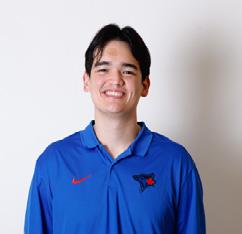
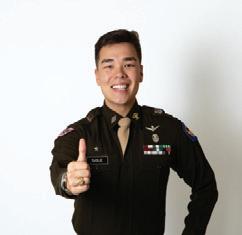
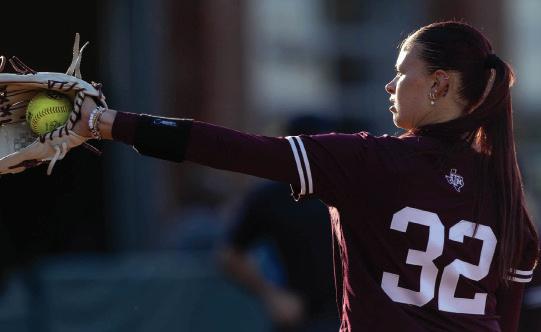
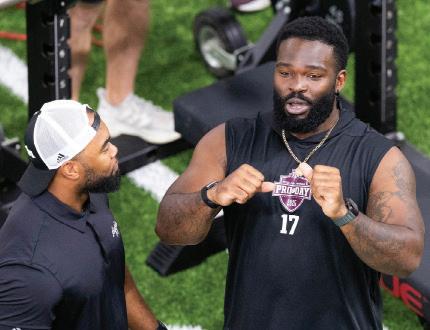
Zaiyan Xu, Blake Kevin-Harrison Dorman to be honored at Silver Taps Ceremony on Tuesday, April 7, at Academic Plaza A4
SPORTS
After a series sweep over Missouri on the road, No. 20 A&M baseball heads back to Olsen Field to take on Vanderbilt B1
By Emily Anderson News Reporter
Upcoming changes to Parent PLUS loans could affect students and families who can’t afford to pay for college or do not receive sufficient financial aid.
The changes, which will go into effect Wednesday, July 1, are part of President Donald Trump’s One Big Beautiful Bill Act. New borrowing limits for parents will cap college loans at $20,000 per year and $65,000 total, whereas borrowing was previously capped at the full cost of attendance. The limits only apply to new Parent PLUS loanees, as existing borrowers may continue to borrow up to the amount of attendance until their child graduates.
Parent PLUS loans are offered through the Department of Education to eligible parents or guardians after families have exhausted scholarships, grants and student loans, which are usually limited to $5,500 to $7,500 per academic year, founder of The College Investor Robert Farrington said.
The average amount of federal loans offered to students at Texas A&M falls below that amount. Students who are still dependents of their parents are eligible for $3,500 their freshman year, $4,500 their sophomore year and $5,500 their junior and senior years, according to Executive Director of Scholarships and Financial Aid at A&M Bridgette Ingram.
YUVA event rings in new year
India’s diverse regional celebrations come to Aggie Park
By Adhithi Shankar Life & Arts Writer
On the evening of March 27, Aggie Park overflowed with students and families dressed in traditional Indian kurtas and lehengas. Two rows of bright orange booths stretched across the lawn, sporting informational posters about cultural traditions and offering everything from authentic chai, a spiced tea, to mehndi, an Indian temporary tattoo art. It was a New Year’s celebration in the middle of March.
For many Indian families, international students and immigrants in Bryan-College Station, it can be difficult to find a community that celebrates the full diversity of the religious holidays of Hinduism. To close this gap, the first-ever Texas A&M chapter of Hindu Youth for Unity, Virtue and Action, better known as Hindu YUVA, was founded in 2022.
On March 27, the organization’s volunteers gathered to host their third annual Hindu New Year festival, a symbolic event that marks the beginning of the Hindu lunisolar calendar.
Hindu YUVA Marketing Officer and biomedical engineering junior Aditya Krishna explained that this holiday is unique because of how differently it is celebrated in various regions of India.
“[This event is] tailored to specific cultures rather than just a general Hindu event,” Krishna said. “For example, I’m from Tamil-
nadu myself, so there’s a booth for that. There’s also a booth for Telugu, for Hindi. So it’s very tailored to what you speak and what you know.”
At the event check-in, each visitor had the opportunity to grab a “cultural passport” and collect colorful stamps from volunteers manning posters at various booths, each representing a distinct culture within India and their respective New Year’s traditions. According to Krishna, the goal of this interactive element was to emphasize that India — consisting of 28 states that speak over 121 languages combined — is not a monolith, with the same holiday being celebrated in radically different ways between regions.
One poster featured information about the traditional clothes, foods and dances that make up Nutan Varsh, the New Year’s tradition celebrated by the Gujarati people. Another focused on the version of the holiday observed by Telugu and Kannada speakers, a festival named Ugadi that’s centered around a flavorful mango dish called Ugadi Pachadi.
“It’s a nice aspect that isn’t really shown in events that are just a general gathering of Hindus,” Krishna said. “In this community here, and you get to see some pretty cool performances, and the best part is probably bringing along your friends and making even more friends.”
As crowds of visitors sprawled across the main lawn at Aggie Park and socialized, they turned their eyes to the performances onstage. The opening performer of the evening, economics junior Nischintha Srinivasan, sang in a music style commonly practiced in South India.
“I’m trained in Carnatic music, which is Indian classical singing,” Srinivasan said. “I actually grew up in India, in Bangalore, and I was put into those classes and have been learning music for about probably 10 years.”
Srinivasan performed the classical Tamil song “Maadu Meikum Kanne,” a staple at religious holidays. First composed in the 18th century, the lyrics are a tender dialogue between the Hindu god Krishna and his mother.
Chemical engineering graduate student Divyang Patel, who recently moved to College Station from the Indian state of Gujarat, also had the chance to perform the songs “Tum Prem Ho” and “Mithe Ras Se Bharyo Radha Rani Lage.”
“I can sing bhajans and devotional songs very well, and they gave me a platform to do that,” Patel said. “I received a heartwarming welcome from the host, and when I started singing, I saw the audience enjoying my piece of music. That gave me confidence.”
After the performances, dinner was served. Visitors that collected stamps from every booth were rewarded with a feast of biryani, a spicy mixed rice dish, and kesari, a sweet pudding made of roasted semolina flour and often served on religious holidays.
Reflecting on the event, Patel explained how the Hindu YUVA community gave him a little piece of home in a completely new environment.
“After coming to College Station in Fall ‘25, I was worried about where I could find a temple, as I often go to a temple to find peace,” Patel said. “I found out about Hindu YUVA. … Each and every festival is celebrated with enthusiasm.”
“If there’s any remaining gap, parents have to step in one way or the other, and the options are really private student loans or Parent PLUS loans,” Farrington said. “So they’re kind of like the last resort to pay for college.”
In the 2024-25 academic year, 5% of enrolled freshmen were supported by Parent PLUS loans. The average support amounted to $19,908, the highest of any other kind of loan. Now, families will be unable to take out that same amount each year without exceeding the new $65,000 cap, leaving students who would have otherwise relied on the help of Parent PLUS loans to turn to other funding methods to cover the remaining costs.
“They can look at alternative loans; we also have payment plans at Texas A&M,” Ingram said. “We have emergency tuition fee loans and short-term loans.” Typically, students from low-income families, or “an individual whose family’s taxable income for the preceding year did not exceed 150 percent of the poverty level amount,” receive enough scholarships and financial aid to cover their tuition, Ingram noted. Families that are not classified as low income but have limited savings are the most likely applicants to take advantage of Parent PLUS loans.
Families may now be forced to turn from Parent PLUS loans to private loans, which could have potential downsides.
“[Private loans] are credit based, and so families that don’t have as good of credit may get a higher interest rate,” Ingram said. “There are fewer protections on those alternative loans because they come from private lenders.”
Ingram said that parents and students should research alternative loans and different ways to reduce the cost of attendance.
“If living at home is cheaper, then that could reduce the cost of attendance,” Ingram said. “Or if a student is working while in school, that can also reduce that cost.”
Ingram and Farrington agreed that changes to Parent PLUS loans may cause families to choose schools that are more affordable or offer more scholarships.
“You have education, which is getting your bachelor’s degree,” Farrington said. “Then you have experience. What does that dorm situation, housing situation look like? And they are very different.”
Farrington also hopes that changes to loan programs will stir up conversation about the financial harm that can be done when prospective students choose to attend a school based on the experience it offers rather than the education.
Another option that families have is choosing alternative school types.
“It may be that students choose to go to a community college for two years somewhere else before coming to a four-year public institution,” Ingram said.
Transfer students make up around 4% of the undergraduate population at A&M. Many of those students chose to attend Blinn College for two years before attending A&M. Changes in loan programs could drive even more students to make that decision.
Ultimately, Ingram encourages students and families to consider all their financial options before deciding which school to attend.
“I just think that this is a big change, and parents and students do have to know about this coming into college,” Ingram said. “It’s important that we try to get the word out.”
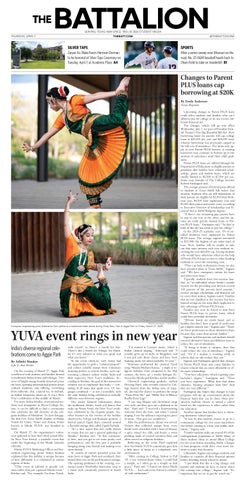
Computer engineering junior Sreeharine Govi performs a traditional Indian dance during Hindu New Year at Aggie Park on Friday, March 27, 2026.
Photos by Corby Maupin — THE BATTALION
SILVER TAPS
Ceremony: Tuesday, April 7, at 10:30 p.m. at Academic Plaza.
Warning: There will be gun sounds at the ceremony. Please remember to remain quiet upon arrival.
Zaiyan Xu
January 7, 1997- February 23, 2026
n Aggie who made others feel seen
A computer engineering Ph.D. candidate at Texas A&M, Zaiyan Xu’s legacy extends far beyond his intellect. Throughout his time as an Aggie, he acted as a beam of emotional support for every person he encountered. His long-time friend and colleague, computer engineering Ph.D. candidate Chen Chen, describes Zaiyan as an emotionally intuitive individual who never failed to help — and occasionally cook for — a person in need.
“So, you know, the first time when I met him is in my friend’s home, and he cooked some Chinese chicken,” Chen said. “I forgot the name, and it was very delicious.”
Not only did he provide for those he loved, but Zaiyan was extremely passionate about making others aware of the details of life, acting as a teacher who stressed life’s importance.
“And then he knows a lot about, you know, food, cuisine, and he cares a lot about details,” Chen said. “For example, he also taught me, you know, how to dress, especially how to dress in a suit. Also, when he prepared foods, he cared a lot about those details.”
Instead of limiting his attention to detail to his hobbies, Zaiyan used his gift to make sure everyone around him knew that they were seen and taken care of.
“Yeah, and another memory I remember, when I was working on my last paper, not the last paper, I would say the most recent top-tier paper,” Chen said. “We published paper together, but the process is difficult. And he kind of identified that I need some support, but maybe I didn’t realize, so he just came and talked with me and tried to
support me.”
During a time of intense academic pressure, when it would otherwise be easy to crawl into himself, Zaiyan never failed to notice others around him.
Because of him and his gift of compassion, many of his friends never failed to feel cared for.
“In other words, he can recognize your mood more precisely than yourself,” Chen said. “It’s like, yeah, like sometimes I couldn’t recognize, ‘Oh, hey, maybe I’m in a bad mood,’ but it’s difficult for me to express or identify by myself, but he’s like, he can identify and he can point out, so he’s, from some point, he’s like therapist.”
As much as Zaiyan poured into others, he never expected anything in return. A man of true selflessness, he acted as a therapist for everyone who needed it, even when he may have needed help himself.
“He has lots of friends in the [Electrical and Computer Engineering] Department,” Chen said. “Yeah, but I don’t, unfortunately, in the last moment, I don’t think some are smart enough to, you know, identify his weakness, or like he really needs support in the last moments.”
Reminiscing on all of their memories at Aggie Park and in the lab, Chen was filled with gratitude for having had such a thoughtful and intentional friend. Although he may be gone, Chen has a farewell statement for Zaiyan to express his appreciation for all the good he infused into the lives around him.
“Thank you to him for bringing love to us,” Chen said. “We will bring this love to other people.”
Blake Kevin-Harrison Dorman
AAs a sport management senior at Texas A&M, a son, a brother, a DJ and a friend, Blake Kevin-Harrison Dorman was widely known for many reasons. Because of his career as a DJ on Northgate and his faithborn community, he was able to touch the lives of many his time at A&M, and the string that ties all of these encounters together is his genuine kindness and care for others.
“Your life was a bright energetic flame that lit up every room whether you’re behind the decks at Hurricane Harry’s,” Blake’s mother Dianne Dorman wrote in a tribute to him. “It wasn’t just a dance hall, it was a rite of passage for an Aggie where we truly saw you bloom whether it was DJing the perfect set, spinning a partner across the dance floor or showing off your sharp focus discipline on the competitive shooting range. That booth brought you out of your shell and opened the doors to your tribe.”
Many times on the way home from a gig, Blake would notice a student struggling to get home, and he would offer them a ride. According to Dianne, there are many testimonies to how Blake saved someone in a time of need.
“He had, one of his brothers died in a DWI when he was, in March 1st of ‘07, so he was 5, and he was 22,” Dianne said. “So his brothers and he were far apart, so he always wanted to make sure people got home safely.”
This fierce love for his family was not restricted to his siblings, as he was known to be the “funcle” to his nieces, constantly bringing a wave of joy and love into their lives.
“He loved his nieces to death,” Dianne said. “He loved, you know, he loved his family, faith and friends and his music. His life revolved around all of them.”
As for his DJ career, Blake’s love for music started at a very young age, when he would get lost in song and attend many concerts
December 26, 2001- February 15, 2026
beam of joy and kindness for all who knew him
with his mother.
“I mean, we, from the time he was young, hit him with his first concert,” Dianne said.
“I think he was 2, you know, so we spent a lot of time going to concerts and music festivals and things like that. We spent, he spent, a lot of time seeing a lot of great bands and met a lot of great people.”
Blake was a man of many talents and passions. A beam of energy and joy, he could be found anywhere from Northgate to Declaration Church, but the impact his authentic care had on those around him is what has built his legacy, sometimes literally giving the shirt off of his back for the ones he loved.
“They [Blake and one of his friends] were driving to church one day and because of my son’s driving skills, he ended up spilling a flaming hot coffee on his shirt while driving down the road,” Dianne said. “Blake was taking him to his church, and his friend was like, ‘Dude,’ you know, ‘You messed up my shirt,’ and driving down the road, Blake unbuttoned his own shirt and literally gave it to him and put on his friend’s dirty shirt so that his friend wouldn’t be embarrassed walking in a church with coffee all over him.”
Although many qualities and memories can be attributed to him, the joy that Blake spread when he entered the life of everyone he encountered will hold strong as a steady and untainted legacy.
“Though the roll call for the absence came far too soon, I know that you were standing tall in the great Aggie reunion in the sky,” Dianne wrote. “My heart is shattered, yet it’s also bursting with pride to have been your mom. You lived, you loved and were loved beyond measure. To my son who has joined the ranks of the departed, when they call your name at Aggie Muster, I will whisper ‘Here.’ Rest in peace my sweet boy. You are forever young, forever cherished and forever my 12th Man.”
Applicant data shows declining acceptance
Numbers show steady decline in Texas A&M admissions
By Sam McMahan News Reporter
Admissions data at Texas A&M shows a decline in the acceptance rate of applicants in the 2025-26 academic school year, and the current trends predict an even steeper drop for Fall 2026.
A culmination of factors, including the increasing popularity of A&M among both in-and-out-of-state applicants, has led to historic application numbers, and the subsequent competitive selection process is contributing to this growing margin. Prospective students have speculated about the causes of this decline and how this relates to their own chances of acceptance.
Associate Vice President for Enrollment Management and Chief Enrollment Officer Christopher Reed stated that what people are seeing in these admissions statistics are not a decrease in the number of students accepted, but a dramatic increase in the overall applicant pool.
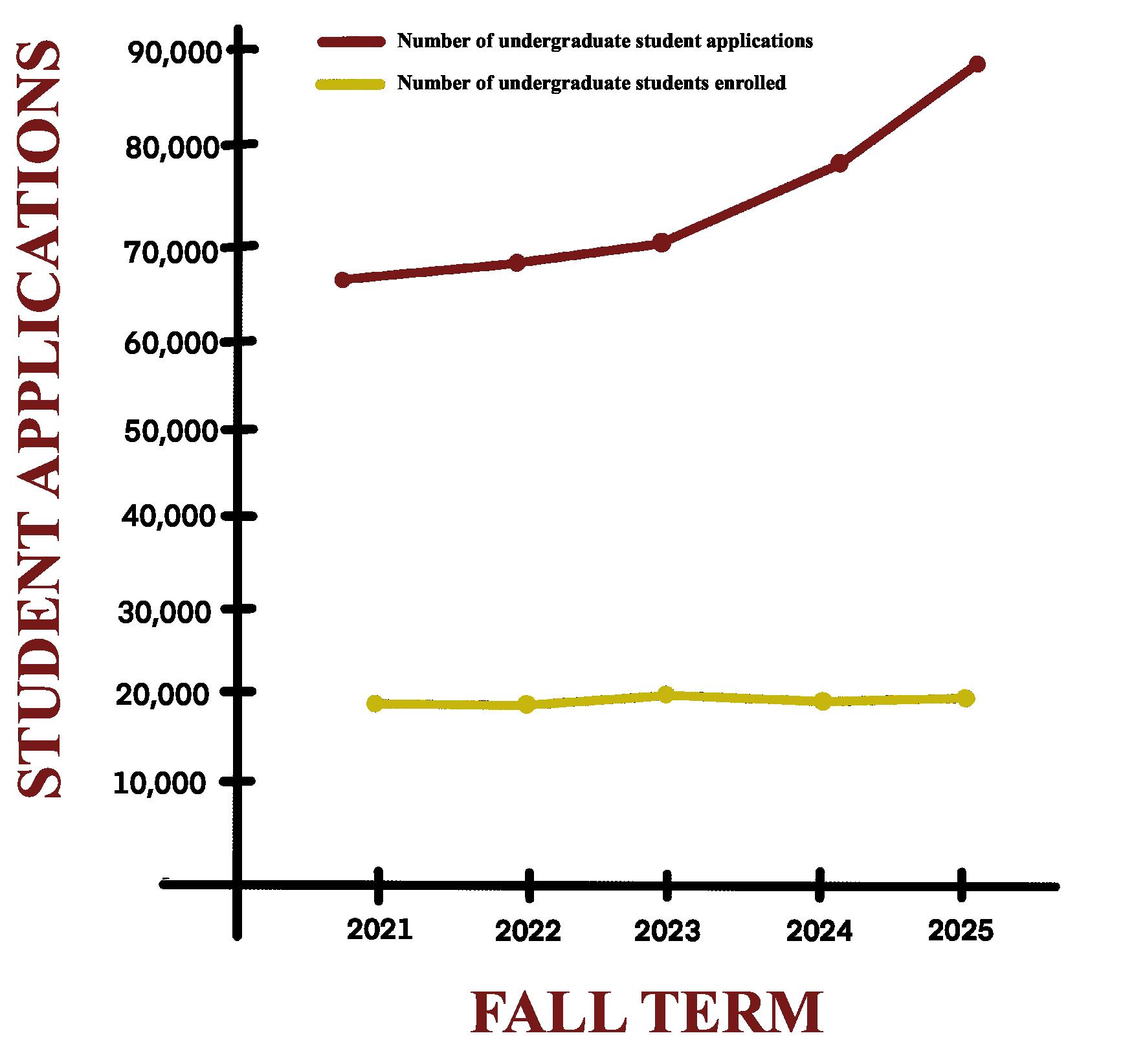
Within the last five years, A&M experienced a 34.78% increase in overall applications. The Fall 2021 semester received a total of 66,346 applications, whereas the Fall 2025 semester saw 89,422 total applicants.
Reed went on to say that a baseline of 20,000 students is accepted per freshman class, and admissions have only trended upward. Although the number of accepted applicants remains approximately the same each year, the growing diversity of applications make the process increasingly selective.
High school students who are in the top 10% of their class receive automatic admission to public universities in Texas, including A&M. For students who apply under holistic review, however, the changing applicant pool requires new approaches to applications.
Reed gave advice on how prospective students applying through holistic review can stand out from the crowd and earn their spot. He highlighted the importance of visiting campus, putting sincere effort into the application and meeting with admissions advisors.
“It is always a good idea to meet with your advisors,” Reed said.
Reed also noted that although SAT and ACT scores are optional, a good score can only improve one’s chances of acceptance.
Some people in online forums contend that A&M’s competitiveness has not grown drastically, and the only figure that has changed is the number of applicants.
“Even if the acceptance rate decreases, that really doesn’t mean it was more competitive, especially at a stats-based university like A&M,” one user wrote. “It’s just more applications by people who didn’t meet the standards, but I doubt median class rank/ SAT of accepted applicants has changed significantly.”
Data released by the Office of Academic and Business Performance Analytics reveals that test score trends from previous years tend to fluctuate rather than gradually increase.
The Fall 2022 academic term saw an average SAT score of 1267 with a median score of 1270. The Fall 2023 term experienced a drop in SAT scores with an average of 1257 and a median of 1260, and for Fall 2024, scores rose back up with an average of 1271, bringing the median back to 1270. The average and median ACT scores remained the exact same for all three years at 28.
The increase in averages, while the medians remained stagnant, suggests a bigger pool of outliers on the top end of score statistics.
This indicates that there is a growing number of highly competitive students. However, standardized college admissions tests have become more difficult to measure in recent datasets, especially at a university such as A&M, as these tests are not a requirement for the application process.
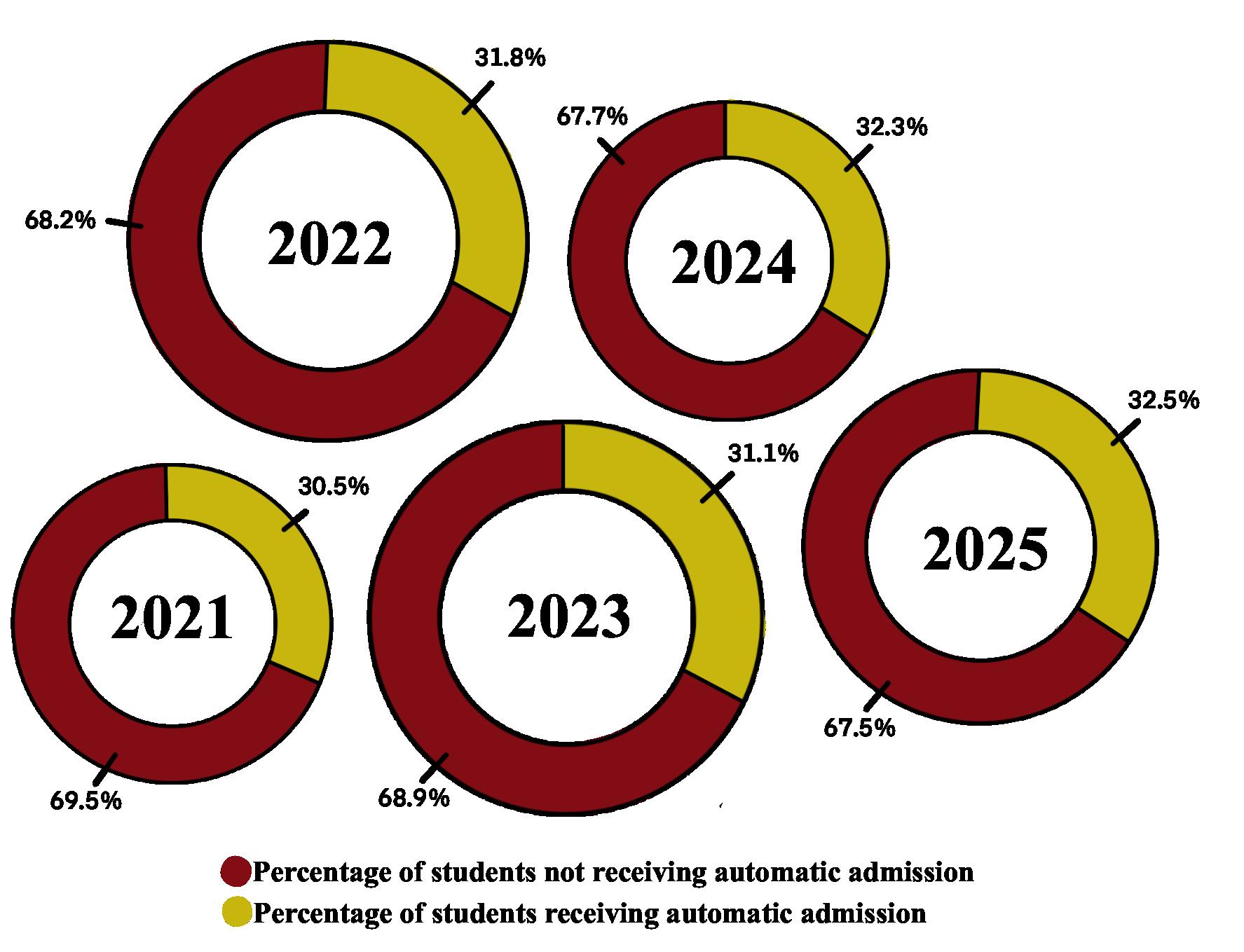
Another measure of competitiveness that can be analyzed is the number of automatically admitted students. This number made up 41.76% of enrolled students in Fall 2025, according to A&M data.
This number has also fluctuated rather than having a steady rise or fall, with 2022 totaling the highest enrollment percentage among this category. However, prior to 2021, the automatic admissions standard was for a student to be in the top 25% of their high school class. Lowering the cut-off to the top 10% marked a dramatic shift in A&M’s application restrictions, suggesting a desire to select from a more competitive applicant pool.
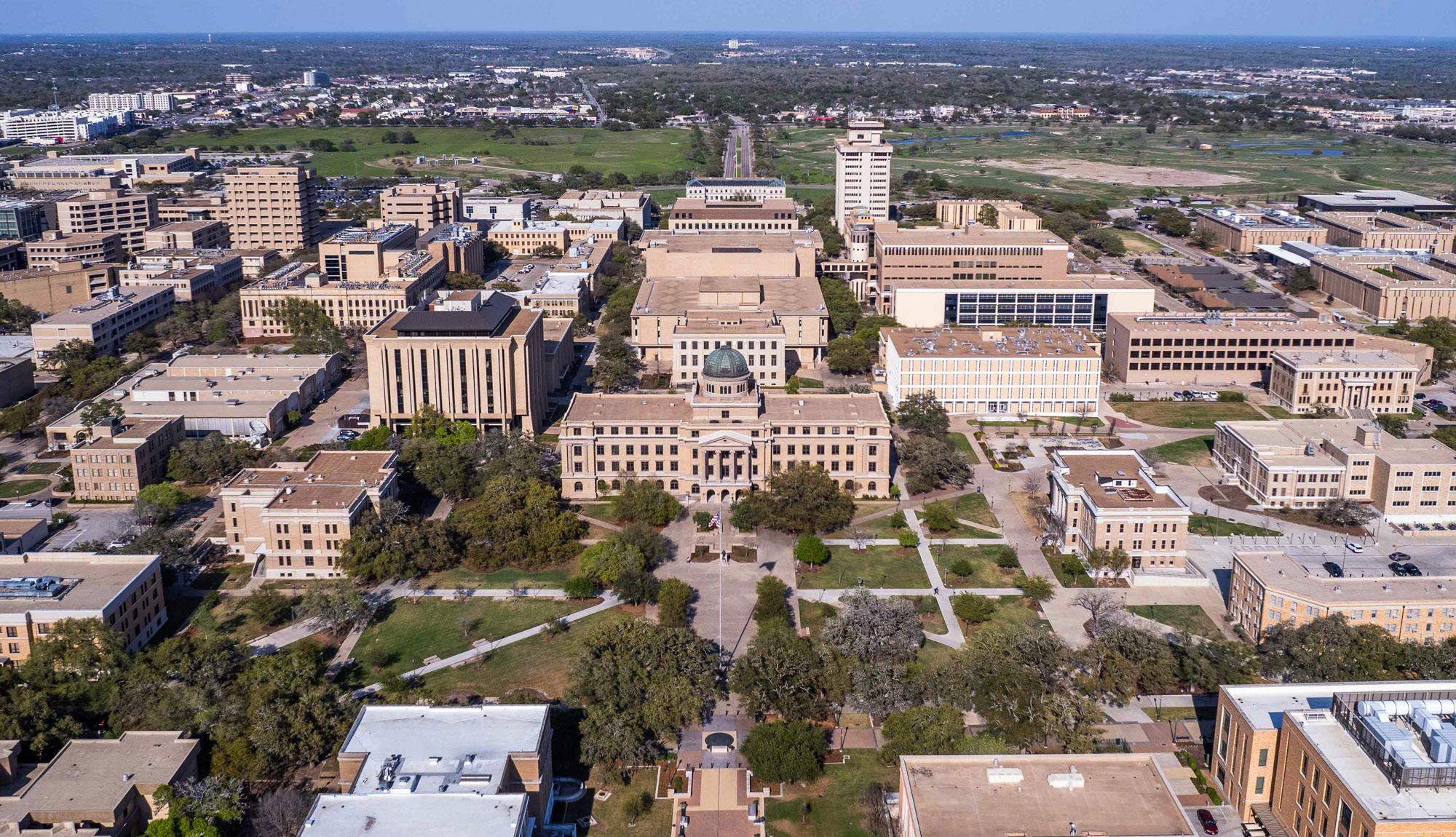
Aerial view of the Texas A&M main campus on Monday, March 11, 2024.
Infographics by Kynlee Joyner —
BATTALION
LIFE & ARTS
‘Extinction is a solvable problem’
A&M graduates aid in first eastern bongo calf born via cross-species eland surrogate
By Mathias Cubillan Managing Editor
Typically, a groundbreaking scientific achievement and decades of work come to light under the high-quality sterile lighting of a lab or an operating room.
For Dr. Will Weise ‘09, though, that milestone was realized under the buzzing LEDs of a QuikTrip.
Weise, a veterinarian on the project, wasn’t at the scene when the first critically endangered bongo was born via eland surrogate, forced instead to watch the sudden birth on his cell phone in the gas station. But the Texas A&M graduate’s fingerprints were nonetheless all over the pioneering breakthrough.
In collaboration with Infinity Exotics, a privately owned wildlife preserve in Meridian that houses some of the endangered bongo — an antelope native to Kenya, with around 100 left in the wild — Weise was a part of the team that used “super ovulation” to put bongo embryos into the much more common surrogate eland.
“We give them medications so that they super ovulate,” Weise said. “ … Instead of just ovulating once, we’re getting six embryos every time, and we can do it four or five times a year per animal. The idea is we take, instead of one baby a year, those embryos and put them into surrogates … and we can really, really increase the population numbers really quickly. Like 20x potentially.”
In November 2025, the fruit of decades of labor and research was born. Pope, a healthy male calf, became the living, breathing proof of what had been conceptualized in the 1980s. Pope still resides at Infinity Exotics where, to the mild surprise of the researchers, his surrogate mother immediately began caring for him following his birth.
“I am so proud to be able to do this, it’s maybe an accomplishment that I’ll never be able to surpass,” Weise said. “I do feel very protective of him. I’m always on the phone checking with the caretakers, making sure he’s OK. He’s a beast; he’s a big old boy, and he’s nice and healthy.”
The calf’s name holds a special meaning to those who worked on the project. Earle Pope, Ph.D., a pioneer in the field, performed an interspecies embryonic transfer between a bongo and an eland in 1983.
“He shared his wealth of knowledge with me and kind of got us started in the
right direction,” Weise said. “He was just somebody who inspired us, so we named our baby in his honor.”
Though the foundation was laid decades earlier, technology and financing needed time to catch up, with the project building a bridge between different generations of research.
For Exotic Wildlife Veterinary Service Founder Dr. Brittni East ‘13, another veterinarian who worked with Weise, this project was conceived as a means of “conserving wild populations of animals by using captive animals as a model.”
According to East, that model has only been feasible with the help of private conservationists. Brent Teeter, founder and owner of Infinity Exotics, provided the animals that made the research possible. Without the partnership, the breakthrough may have remained theoretical.
“Conservation is about ensuring these animals have a future, and that requires both commitment and innovation,” Teeter wrote in a statement. “At Infinity Exotics, we’ve proven that what was once considered aspirational is now achievable, and that opens doors for endangered and exotic animals worldwide. … This breakthrough signals that we may now have the tools, techniques and precision needed to bring these methods into mainstream conservation practice.”
Pope’s successful birth and healthy status mirrors other high-stakes conservation efforts across the globe to prevent species extinction.
In Kenya, the planet’s two remaining northern white rhinoceroses are housed in Ol Pejeta Conservancy, a private sanctuary where similar cross-species embryonic transfers are being conducted to save the animal from extinction.
East said her small-scale efforts with the bongo can be applied to other species and that with the continued help of private conservationists, preventing extinction is an achievable goal.
“It proved that science continues despite all odds as long as you’re driven enough and you believe in it enough,” East said. “It’s the first of what I hope will be many wildlife conservation reproductive efforts that are done in the private sector. … My hope is that it would be inspiring to like young entrepreneurs or young scientists, be that at A&M or anywhere else.”
For Weise, Pope has given him hope that the light is now being shone on the value of interspecies embryonic transfers. Weise said that it’s “outrageous” to have animals still going extinct in 2026 when the resources are available to stop it.
“Extinction is a solvable problem,” Weise said. “We have the technology to do it. I know we can do it.”
Running community forms on Cloud 9
Aggies find outlet, love for movement in student-led club
By Jenica Panicker Life & Arts Writer
Feet pounding on pavement, wind rushing across faces and music fueling the movement — having existed for millions of years, running is one of the oldest forms of movement.
In Bryan-College Station, a modern-day community for the sport has emerged; a group of people running to improve, support and help each other. That is the mission of the run club Cloud 9, better known as C9 to its members.
Chatting over a giant BJ’s Restaurant and Brewhouse Pizookie, five Texas A&M students decided Bryan-College Station was missing a movement: a running movement. This group of friends launched their first run club event in September 2025 and have been going strong ever since.
Biomedical sciences senior Janak Abraham said that this community of like-minded students was lacking in Bryan-College Station.
“We see it in Austin, we see it in Houston with all these run clubs coming about, bringing a community together,” Abraham said. “ … I feel like bringing that here was our main goal and that was our main mission, and with that brought community, with that brought people who are like-minded.”
The club aims to bring a fresh perspective to the running movement in Bryan-College Station, hosting free events rooted in community.
“At A&M there’s so much tradition,” biomedical sciences junior Esha Chowdhury said. “To have something new and fresh, I feel like is really good for the community.”
According to current members, the Aggie community has shown up for the run club through support from entrepreneurial undergrads, small businesses and community members.
“Especially in College Station, like, people are really willing to help you, and it’s just a matter of reaching out and being like ‘Hey, could you do this for us?’” C9 Co-founder and neuroscience senior Aditi Mohankumar said. “ … And that’s something that’s
very different from bigger cities.”
Soon after C9’s first event, Red Bull reached out to support the startup, collaborating with them to establish a heartbeat in A&M’s campus life with one of Red Bull’s biggest worldwide events: Wings for Life. Runners worldwide start the race at the exact same time, on the exact same day, to raise money and awareness for spinal cord research.
This year, on May 10, hundreds of runners will be at the start line in College Station thanks to C9.
“So she [a Red Bull representative] pitched it to us, she was like, ‘We don’t really have a heartbeat in A&M. Y’all are really close to the student population … so we need y’all to do what we can’t,’” Abraham said. “So they came to us with the whole proposition, and that’s when we started kind of C9 came to be and came to form around Wings for Life.”
However, C9 has not stopped with its run club. Its founders are currently working on a new approach to gain even more traction with its participants by introducing the Cloud 9 Collective. Consisting of “Sweat and Chill” events to promote community and “Run and Sip” events to foster greater engagement with small business and student organizations in the Bryan-College Station area, C9 is reaching for the stars.
Its first “Sweat and Chill” event, a yoga and Lululemon pop-up, was hosted at PopStroke on March 28.
“We are really trying to push the ‘work hard, play hard’ mentality,” Mohankumar said. “But like with the orgs and stuff, we want to partner with them to host mixers and have people connect on more of a health and wellness aspect.”
In lieu of the strenuous time commitments, C9 aims to primarily serve as a social club, with an emphasis on the come-andgo-as-you-please mindset. The mission is to focus on positive social connection and fun events.
“Even if they just come to one event, as long as they walk out of the event, happy and at least feeling good, that they accomplished something, that’s all we really intend with their time,” Abraham said. “Have fun with it.”
Biomedical sciences freshman John Nguyen said that C9 has helped him find community during his time at A&M. As a
student that was looking for community, Nguyen said that the run club has not only helped with consistency, but also helped him to find friendly faces at such a large school.
“I just think it’s a good way to meet people,” Nguyen said. “It’s like, I see the same faces once a month. … It also holds me accountable because I’ve always wanted to be consistent with running.”
Neuroscience junior Shivaali Vibarajan has encouraged utilizing C9 as an introduction to what a personalized wellness lifestyle can look like.
“I think, especially for Cloud 9, it’s like a type of introduction to your workout lifestyle,”Vibarajan said. “Like you can just fig-
ure out what kind of mile pace you want to go, if you even like running. … I feel like it’s a type of thing that you can find social connection, get back into a lifestyle that actually helps you, and it’s actually good for your mind, body [and] soul.” C9 members explained that the club stands for fostering positivity, community and providing a jumpstart to health and wellness living, even for the biggest running skeptics.
“Cloud 9 really has changed my outlook on just approaching people,” Abraham said. “ … All you can do is be a positive light for them in case they want to come back and actually change their outlook on their whole day.”
Photos courtesy of Infinity Exotics
Top to bottom: An eland and its bongo calf lay on the floor. A bongo calf with eland surrogate mother.
Photo courtesy of Alex Samardzija Cloud 9 participants run down
Satire: Tragimusicals — the newest theater wave
Sad media isn’t sad enough — let’s add a dance number
By Marie Kneeland Opinion Writer
On Nov. 12, 2025, “The Hunger Games: On Stage” opened to rapt audiences at London’s Troubadour Canary Wharf Theatre. The longer the show played, the more reviews came out.
This new adaptation included bright costumes, moving audience seating and — drumroll please — multiple extensive dance numbers!
While some naysayers called the production wildly inappropriate and extremely controversial, ticket sales alone proved that “The Hunger Games: On Stage” was a massive hit.
Because ticket sales mean quality media. Obviously.
Given the success, Director Stage D. McPhilm has decided to adapt several more classic stories into performances for live audiences — specifically, musical adaptations.
“We feel it’s the perfect way to get the messages of these stories across,” McPhilm said. “I mean, the point of ‘The Hunger Games’ is literally that we should watch kids kill kids. And music makes that more entertaining! Who doesn’t want to see someone mauled to death by a wolf to the tune of ‘Manchild?’”
The next adaptation has already been announced: Theatergoers, don’t fear “The Silence of the Lambs: On Stage” is coming your way. The production will include
Satire:
musical numbers such as “No Good Feed,” “Empty Chairs at Full Tables” and “Alexander Hannibal-ton.” Audiences will be encouraged to participate and really connect with the main characters by joining them for a meal with undisclosed menu items.
Test audiences are giving glowing reviews.
“Stories like this are meant to be enjoyed,” one viewer, avid theatergoer Val Idopinion, said. “Being uncomfortable is canceled! This is 2026, people!”
Idopinion’s favorite musical to date is another show he had the joy of previewing: “1984, Live! On Stage” as inspired by George Orwell’s classic novel.
“That might be the best dance sequence put to stage,” Idopinion added, reminiscing fondly. “Especially the electric torture part.”
If you’re concerned, don’t worry. Other directors are taking McPhilm’s artistic choices into consideration and making their own productions; you won’t need to fret about being limited to seeing just one tragimusical this year. After the completely book-accurate adaptation of “Wuthering Heights” Emerald Fennell is taking her script to Broadway. I can’t share much at this time, but be ready to have “Lay All Your Love on My Grave” on repeat in your car, paired with a visual of Heathcliff digging up Cathy’s corpse. A truly magical number, I assure you.
“The Road,” “Schindler’s List” and “Midsommar” are also rumored to have adaptations in late 2026.
Marie Kneeland is an English honors freshman and opinion writer for The Battalion.
How to win over a male engineer’s heart
Forget the flowers and fall in love with the men of Zachry
By Sidney Uy Opinion Columnist
Dear ladies of Texas A&M: Besides getting accepted into your desired major and becoming a full-time student, the greatest pleasures known to womankind come from latching onto a man, locking him down and making him a suitable husband.
Thus, whirling around in my inherently effeminate and, therefore, irrational imagination, I couldn’t help but wonder what kind of eligible bachelor our campus has to offer. I suspect we all know the answer to this one: Yes, ladies — engineering ma jors. Let’s get real about your biological clock; it nev er hurts to have a plan. Entering the forays of col lege dating can be scary, but these are tried and true ways to become an engineer’s perfect match:
Always acknowledge how difficult his major is
It’s a really tough time to be a man in this world, especially one as gifted and talented as our Aggie engineers. By now, you’ve probably overheard them in passing groaning about ETAM and are feeling pricks of sympathy. This is the perfect time to vocalize them.
Satire: ‘The Secret Lives of Corps Wives’ unfolds
WagTok won’t
survive this one
By Wyatt Pickering Opinion Columnist
Amyleigh Jones is a communication senior, but she is better known for being the leader of WagTok, a group consisting of the most devout lovers of the Texas A&M Corps of Cadets.
Rather than study or go to class, these determined boy-crazy women frequent the Starbucks on the Quad looking for the next eligible bachelor to be their bald man of the month.
In an interview with Amberleigh Prexton — another member of WagTok — I was able to get a better understanding of who these women are and why they are fa mous to begin with.
“WagTok is famous because it’s a group of women Aggies just liv ing life together,” Prexton said. “Oftentimes, I know my man’s dorm room better than my own, so I need people on my side who just get it. There may be drama, fights, lying, cheating, stealing and tolerating those who do, but I wouldn’t have it any other way.”
When asked if she had been in volved in any of the listed debaucherous activities herself, Prexton de clined to comment, saying, “Watch the show if you want to know.”
But beyond the coordinated out fits and the highpitched “Whoops” lies a group of women who live drama-filled lives fully documented by the film crews that
Sooner or later, ladies, you’ll realize that an engineering man doesn’t have a lot of time to offer. He’ll often be stuck in Evans
Library or the Zachry Engineering Education Complex. An engineering man needs a break from the monotony of study, so taking the initiative to live according to his schedule will surely make him appreciate your efforts.
They are not used to being around women, so be patient
Good news: He’s surrounded by men.
Bad news: He’s surrounded by men. Since around 22% of A&M engineering students are female, our eligible bachelor is typically not apt at interacting with women, meaning it’s naturally a woman’s responsibility to be proactive. Being the one to communicate first, organize dates and initiate conversation is a typical rite of passage that takes time to master.
Why he’ll melt: An engineering man wants to be validated as the most valuable, deserving and intelligent student gracing this campus. Acknowledge this, and you’ll save yourself time from going back and forth on why your liberal arts degree matters. Keep it simple, and he won’t have to feel embarrassed about the fact that he can’t come up with anything good to say for anyone outside of STEM.
Make yourself available to his schedule
Ignore his MAGA-veiled politics
Fifty-eight percent of Gen Z men voted for President Donald Trump, according to a post election survey. Needless to say, at least half of the time, you will meet an engineering man who either supports or tolerates MAGA pol-
Though it’s great to have personal values, what kind of values will exist if you’re unable to create a family to carry those beliefs across generations? The choice is simple. A rookie mistake: The reality is, giving him the benefit of the doubt regarding his questionable beliefs will ensure that you are kept in his personal orbit as the “woman who is not like the others.”
And even if you are keenly aware of how disconnected he is, engaging apolitically with others is not a moral failure. It’s simply a womanly virtue.
Sidney Uy is a philosophy junior and opinion columnist for The Battalion.
follow them around.
A source close to The Battalion — my roommate — reportedly saw Jones get into a heated argument with her current Corps boyfriend, Colton Walker, just outside the Corps’ dorms. She allegedly caught him holding hands with his roommate and, in response, said she was going to go “Taylor Frankie y’all” on Walker. Now I don’t know what that means, but apparently she threw all three of her Stanley water bottles at Walker, with one of the bottles hitting Reveille in the muzzle as the First Lady of Aggieland was being walked past this altercation.
Jones is scheduled to appear before the Honor Council regarding her assault on the Queen of Aggieland, and is meanwhile facing the brunt of significant social media backlash. As such, WagTok has been relegated back to irrelevancy, as no coordinated TikTok dance can get them out of this con-
As the fate of WagTok rests in the hands of A&M and the public’s opinion as a whole, it serves as a reminder of what boot and clout chasing can lead to in our modern society. Maybe it’s time these Aggie women hang up the uniform and watch the drama from their TVs in-
Wyatt Pickering is a business honors and finance junior and opinion columnist for The Battalion.
Satire: An advisory on the spread of thought
Protect yourself against intellectual contamination
By Isabella Garcia Senior Opinion Columnist
Attention: The following is an excerpt from an infected student’s diary and has been distributed to warn against the spreading sickness. For your safety, contact The Texas A&M University System Board of Regents if you notice any similar symptoms of thought in your fellow classmates IMMEDIATELY.
I am a sick [REMOVED FOR IDEOLOGICAL CONTENT].
The outbreak began last year after a professor became infected. Fortunately, the University of Mechanized and Automated Thinking, or UMAT, wanted to protect us from contamination, so it forced her to practice intellectual distancing.
In an effort to control future spread, however, UMAT set forth additional rules banning any sort of thinking. Nonetheless, it soon became evident that even further sterilization of our campus was necessary.
Practically overnight, the virus had mutated into its Platonic Form, which, naturally, required the burning of any related readings. Students — myself included — were conscripted into aiding … yes, it was a pleasure to burn. But I had already begun to feel strange by then; I didn’t yet understand what was wrong with me.
By the time UMAT cut the [REMOVED FOR IDEOLOGICAL CONTENT] and [REMOVED FOR IDEOLOGICAL CONTENT] Studies program, it was already too late.
My symptoms violently manifested on a bright, cold day in April. I was attempting to focus during class, but my peers kept prattling about a viral professor’s post on X that demanded writers be required to read.
Obviously, this is a ridiculous notion; vocabulary has nothing to do with reading. True art can only emerge when unsullied by exposure to other minds. It would be as though you expected a chef to eat — or worse, a composer to listen to music. All creatives are simply born complete, and to suggest otherwise is blatantly heretical to the art form.
But as I went home, I found myself increasingly agitated, unable to quell the peculiar feeling that — to my utter disgust — I … agreed with the professor. It was a sentiment
that kept me up that night, and I’ve been turning it over in my mind ever since.
Yes, that’s the horrifying truth: I — thought about it.
Despite knowing all too well that “thinking” is a serious disease, these subversive tendencies have seeped into every part of me, poisoning my mind with reflection and nuance. It’s revolting.
I find myself afflicted well into the night; I’ll begin with how reading someone else’s words undoubtedly taints your own creative abilities, detracting from your a priori talent. And suddenly, I’ll be overtaken by a perspective — of all things — that asks: Does not everything one encounters leave a trace on the mind to some extent? Why would writing be any exception?
God, I’ll never be able to sleep again. I’ve become sick, it is clear; I never had thoughts before, but now I am incessantly plagued by them. I’m afraid — I can feel the infection spreading into multiple perspectives. I can feel one of the fits coming on even now … if reading taints one’s ability to write, then wouldn’t that be akin to saying a professor teaching corrupts a student’s ability to learn? What sickness!
I am exceedingly unwell, disturbed, in despair. This illness has metastasized into a cancer. Apparently, I’ve developed a soul: I [REMOVED FOR IDEOLOGICAL CONTENT], therefore I am.
Isabella Garcia is an economics senior and senior opinion columnist for The Battalion.
Illustration by Alejandra Yepez — THE BATTALION
Illustration by Chi-Chi Zhang — THE BATTALION
Illustration by Allison Fernandes — THE BATTALION
Commodores drop anchor in Aggieland
After 6-0 stretch, No. 20 A&M hopes to keep bats hot in series against Vanderbilt
By Brody Vaughn Sports Writer
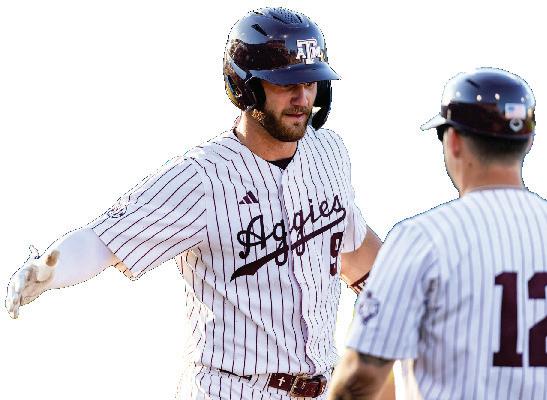
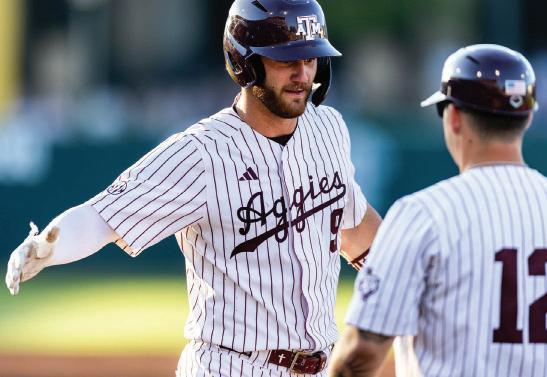
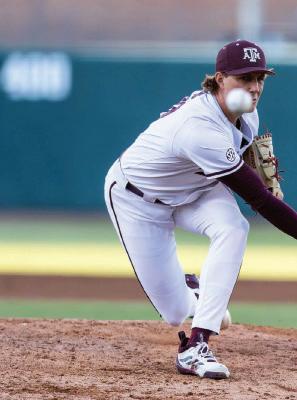
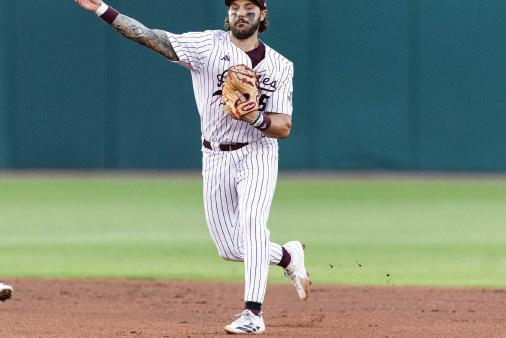
Coming off of a decisive sweep over Missouri, No. 20 Texas A&M baseball looks to continue its climb up the Southeastern Conference standings in a weekend series against Vanderbilt back at Olsen Field.
After dropping their first two series of SEC play, the Aggies bounced back against the Tigers, taking 3 out of 3 to climb to 5-4 in conference play. The A&M offense remained strong over the three-game stretch, totaling 39 runs.
Game 1 saw a back-and-forth bout go down to the wire. The Aggie offense exploded early, quickly climbing to a 10-1 lead in the fourth inning. The Tigers weren’t tamed easily. though, responding with a sixrun inning of their own, then tacking on two more to make it a one-run game. The A&M bullpen held things down in the late innings to contain the final score to 11-9.
Game 2 saw a similar offensive effort from the Aggies but with better results on the pitching front. Recently named SEC Player of the Week, junior first baseman Gavin Grahovac started his weekend of dominance, punching two home runs in the Saturday contest; freshman third baseman Nico Partida joined the fun as well, going yard twice himself. The A&M bullpen once again kept Missouri under control, with sophomore right-handed pitcher Gavin Lyons grabbing his third win of the year in two scoreless innings of work.
Game 3 saw much of the same as Game 2, this time ending in just seven innings. Grahovac launched two more bombs for the second game in a row as, in the outfield, freshman right fielder Jorian Wilson continued to make his case to be a full-time starter, going 3-for-4 and scoring in the conclusion of the series.
Currently, the Aggies and the Commodores share a 5-4 record in conference play. Most notably, Vanderbilt earned a series sweep over then-No. 21 Tennessee, all games ending in walk-off fashion. Although starting off the season under the national radar, the Commodores have held their own against quality opponents with ranked series wins over the Volunteers and then-No. 13 LSU Tigers.
A&M’s starting pitching has struggled to begin SEC play thus far, with only sophomore RHP Aiden Sims holding below a 4.00 ERA. The anticipated return of junior left-handed pitcher Shane Sdao has left much to be desired, as the Montgomery native has allowed 16 runs in his three starts so far. With a 6.75 ERA, junior LHP Weston Moss holds a team worst out of pitchers who have thrown more than 12 innings.The Aggies have benefited from great work out of the bullpen, primarily from Lyons, who’s been great in long-inning relief situations, and junior RHP Clayton Freshcorn, who’s tallied a team-leading six saves. Nonetheless, A&M will need a major step-up from its starting pitchers to contend in the remainder of SEC play.
Pitching wise, the Commodores’ junior RHP Connor Fennell will be a name to keep tabs on. The Londonderry, New Hampshire native made his best start of the season against Tennessee, giving up just one earned run over seven innings. Junior RHP Brennan Seiber will be a threat out of the pen, having been the workhorse for the VandyBoys this season, making nine relief appearances to a 3.68 ERA.Vanderbilt as a whole hasn’t yet put the pieces together; their team-ERA of 5.37 puts them at 112th in the nation and right near the bottom of the SEC.
Grahovac has stepped up in a major way, being the leadoff hitter the Aggies needed. The Orange, California native more than doubled his home run total on the season, sending four out of the park. While Grahovac fared well to start the season with over a .300 batting average, he lacked the power he has shown in years past with the long ball. If this weekend was any indication of what the rest of the season might look like, the Aggie offense is in good shape going into the midway point of its conference schedule.
The Vanderbilt bats have been led by sophomore second baseman Brodie Johnston, who currently leads the team in batting average, hitting .364 with eight home runs. Overall, the Commodores’ offense has shown the ability to go toeto-toe with the best, finding itself 23rd in the nation in runs this season and putting up 25 runs in its series against the Volunteers and their impressive arms.
With two top-tier offenses and two struggling pitching staffs, fireworks are expected to fly in this Easter-weekend series. The difference will be made by which staff can keep their starters in the longest to keep their bullpens fresh for the tough series ahead. The three-game showdown will kick off on Thursday, April 2, at Olsen Field at 6 p.m., with the series continuing through Saturday, April 4.
Aggies host ranked Bulldogs
come down to the team who can execute.”
A&M welcomes Georgia to Davis Diamond for second
By Trey Bohne Sports Writer
With a 9-7 win over No. 1 Texas on March 29, No. 15 Texas A&M softball avoided the sweep against its top-ranked rival. The Aggies went 1-2 in Austin over the weekend, falling to the Longhorns in Games 1 and 2, pushing their record to 6-3 in Southeastern Conference play. Led by head coach Trisha Ford, A&M will continue through its SEC gauntlet with eyes set on No. 11 Georgia.
“Offensively, we’ll hang with anybody in the country,” Ford said after Sunday’s game. “But, I also think we need to get better in the circle. If we would have done a couple of things differently at the critical moments, the games would have ended differently. It’s really a game of inches.”
The Maroon and White have put their offensive firepower on display this season, recording 52 home runs and outscoring their opponents 262-127 through 35 games. Senior first baseman Micaela Wark leads A&M’s offense with 15 home runs on the season, followed by junior designated player Mya Perez with 13. The Aggies’ batting lineup presents five straight batters with an on-base percentage of .450 or higher, including senior third baseman Kennedy Powell, sophomore catcher Ariel
Kowalewski, senior second baseman Tallen Edwards, Perez and Wark.
In the circle, A&M has relied on the right-handed pitching duo of sophomore Sydney Lessentine and junior Sidne Peters. Throughout the Aggies’ 35 games, the pair has accounted for 25 starts in the circle, compared to the rest of the pitching staff’s 10 starts combined. Lessentine started Friday, surrendering five hits and five runs, but she only allowed three runs in Saturday’s affair. Though falling to the Longhorns by only a single run in both of the weekend’s losses, the Aggies’ lack of depth in the circle continues to serve as a major hurdle to the season’s success.
“We’ve had a quick start every game,” Wark said after Sunday’s win over Texas. “It’s about taking the punches and punching back as hard as we can. We could have won those other games, but we’re going to learn from our mistakes and grow from this.”
Georgia will travel to Aggieland in the midst of a five-game win streak after sweeping Kentucky on the road over the weekend. The Bulldogs are led by the powerful hitting duo of graduate student 2B Keirstin Roose and senior right fielder Sarah Gordon, who lead the team in long balls with a combined 19 homers and 75 runs.
Senior DP Tyler Ellison leads Georgia with 35 RBIs and a .544 on-base percentage, offering little relief to any A&M pitcher who steps into the circle this weekend.
“They can swing it,” Ford said in Tuesday’s press conference. “If you look at them stats-wise, they’re very similar to us; home runs, doubles and pitching. It’s going to
Georgia’s pitching staff faces similar challenges as A&M’s, with junior left-handed pitcher Randi Roelling and sophomore RHP Addisen Fisher accounting for 24 of the team’s 36 starts in the circle. The Bulldogs’ bullpen is equipped with a combined ERA of 3.15, giving them a slight edge over the Aggies’ combined 3.41 ERA.
“Randi has started and thrown in most of their games, kind of like Lessentine has for us,” Ford said. “The last time Georgia was here, we didn’t win. My hope is for us to come out and play our game. Instead of worrying about what could happen, let’s focus on what should happen.”
The intraconference foes each secured a series victory over Kentucky this season, with the Aggies sweeping the Wildcats at home, while the Bulldogs got the job done on the road. Both A&M and Georgia’s offenses plated 26 total runs against Kentucky in its respective series. The Bulldogs’ pitching staff held the Wildcats to three total runs through three games, while the Aggies’ defense allowed nine.
Both A&M and Georgia will enter the Easter weekend series opener with a conference record of 6-3 and only a single SEC series loss. While the Aggies hold a losing, 3-4 record on the road, the Bulldogs have shown themselves to be comfortable away from home, holding a 4-2 away record. Hoping to avoid a rubber match on Easter Sunday,
SPORTS
Taurean York: Just a kid from Temple
Team captain’s road to NFL Draft started long before arriving in College Station
By Matthew Seaver Sports Editor
Matthew 7:7 reads: “Ask and it will be given to you; seek and you will find; knock and the door will be opened to you.”
Junior linebacker Taurean York has been asking, seeking and knocking since the very beginning of his football career. The twoyear team captain was not a consensus fivestar or blue chip prospect — hell, he wasn’t even originally committed to Texas A&M.
The Temple native grew up just 30 minutes outside of Waco and intended to go to Baylor before decommitting from the Bears on Dec. 11, 2022. Two days later, on Dec. 13, York received a scholarship from A&M and committed to the Aggies within just six days. For York, the scholarship to A&M, 80 miles southeast of Temple, wasn’t just the chance to further his athletic career, but proof that the countless hours he and his mom spent driving around to different camps was worth it.
“I knew where I belonged,” York said. “That’s kind of why I decommitted from Baylor, you know, great people, great staff,
Coach [Dave] Aranda, great man. But, I knew ultimately I belonged on the biggest stage in front of the biggest crowd and the best fan base in America. So, just a really good feeling to know that you called your shot, you took care of business and you just continue to do things the right way.”
And call his shot he did. The three-star recruit out of Temple High School stood at just 5-foot-10 and 227 pounds, but that didn’t matter to York, nor to then-A&M defensive coordinator DJ Durkin. Despite being the 13th-ranked recruit from A&M’s 2023 signing class, York’s intelligence and competitive spirit instantly earned him a starting spot in the defensive lineup for the Aggies.
“I did not believe him [Durkin] because at that point where A&M was at, they did not play people of my status,” York said. “And so I didn’t really believe him until the second day, I kept starting and I was like, ‘OK, he’s the real deal, he’s a man of his word.’”
Durkin was indeed a man of his word, as York started all 13 games of his freshman season, finishing second in total tackles while also being named to the Southeastern Conference All-Freshman team.
However, the 2023 season was not one to remember for the 12th Man as A&M finished just 7-5 and fired then-head coach Jimbo Fisher for the largest buy-out in
college football history at $76.8 million. A coaching change might have deterred some, yet it only added fuel to York’s fire.
Fisher’s replacement, head coach Mike Elko, was a name York knew all too well: Elko had spent the 2022-23 seasons at Duke, where he nearly signed York right out of high school after offering him a scholarship to play for the Blue Devils.
er the new regime, York was voted team captain by his teammates, an honor that the once-83rd ranked linebacker recruit accepted with great pride.
“It means a lot because I know what it took to get here,” York said at the time. “And with me being still 18 years old and being chosen by my teammates to lead a group of men who are much older than me, I felt like it meant the world to me to be honest.”
York started every single game during his collegiate career, claiming to have missed practice only once due to sickness.
The Maroon and White ironman served as the eyes and ears of Elko’s defense — racking up 155 combined tackles, including 17 tackles for loss, all the while guiding A&M’s defense to the program’s first College Football Playoff appearance.
Playing for the Aggies and answered prayers York had been saying since he was a 14-year-old freshman starting on varsity. However, following his three seasons in
Aggieland, he believed it was time for the next stage of his career, so, on Jan. 6, York declared for the 2026 NFL Draft, forgoing his final year of eligibility.
The road to the NFL can be described as “the world’s strangest job interview,” and for York, this interview process has become all too familiar.
Since entering his name into the draft, he’s been on a mission to prove scouts and skeptics wrong about the kid from Temple.
“To be honest with you, kinda feel like high school a little bit,” York said. “Everybody loves bigger, stronger, faster, you know. … But I’ve already been through it once, so I’m not really letting it shake me.”
York has done everything he possibly can to be noticed by NFL scouts, but ultimately when and where he goes in this year’s draft doesn’t matter, really.
Because the 5-foot-10 linebacker, who didn’t have a single offer after his junior year of high school, won’t stop knocking — take it from the man himself.
“There’s so many times where I felt like I wasn’t going to get a fair chance, or, you know, they’re not going to give me the respect I deserve, and they’re still not,” York said. “But that’s okay, though. I’m just going to continue to work and continue to outdo people, outlast people. Like, when we look up in 20 years, I’m still going to be taking care of business.”
Family fuels Regis’ football journey
Aggie defensive tackle reflects on support system at Pro Day
By Mathias Cubillan Managing Editor
When graduate student defensive tackle Albert Regis had a respite from the ceaseless hubbub of the 2026 NFL Scouting Combine, he didn’t call his agent to see what drills he should participate in, he didn’t put his headphones on to tune out the endless stream of opinions, and he didn’t scroll through social media to see what every armchair scout was saying.
Instead, before his 40-yard dash, he spoke with his fiancee, Kaley Schmidt, and his 1-year-old daughter, Akari, who had both made the trip to Indianapolis to support him.
That conversation, Regis said, gave him the rejuvenation he needed to go back under the lights and finish strong, and he became 1 of only 6 defensive tackles to record a sub-five-second 40-yard dash.
While Texas A&M football’s March 25 Pro Day was hardly on the same scale as the Combine, Regis’ family was nonetheless back to support him in a full-circle moment.
“I wouldn’t be here if not for them,” Regis said. “There’s been a lot of stressful days where I’ve just been overwhelmed and emotionally just worried. … Having them with me, and I’m like, ‘OK, cool, I can keep doing this,’ and that’s all the motivation I need.”
A&M’s Pro Day featured 23 Aggies with NFL aspirations, platforming them in front of head coaches, general managers and talent evaluators. But looking beyond the opportunity in front of him, Regis recognized the moment as emblematic of the growth from his journey.
“I was literally telling my fiancee, I used to be the guy always watching behind the gate, timing everybody’s 40,” Regis said. “Now to be a part of it, it’s surreal. I always dreamt of being in a pro day, let alone one of A&M’s, if not our best pro day ever.”
Although A&M’s Pro Day was massive, with all 32 teams in attendance and a potentially historic draft class on the ever-approaching horizon, Regis was as trim as he’s
ever been. The La Porte native was down 20 pounds since the end of the season, dropping from 21% to 15% body fat and adding three pounds of lean mass.
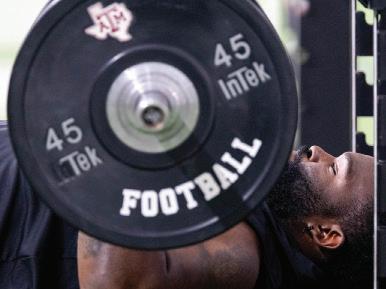
“I really locked in,” Regis said. “When I would hit 310, my body would kind of hit a plateau, and I’d be like, ‘Oh, I can’t lose weight past 310.’ … I lowered my carb intake. I mean, for dinner, I was eating these protein chicken nuggets you can air fry. I was eating a salad with that and some fruit. Or my fiancee would make some air-fried lemon pepper chicken thighs. I’d eat that for dinner with salad and fruit.” Regis’ dream day culminated in something he’d done hundreds of times before, but with just a few more onlookers than normal: the bench press. As scouts gathered around the bench and his teammates hooted and hollered, the 6-foot-1, 295-pound defensive tackle pumped out 27 reps, much to the delight of the team.
“I prayed right before, and I was like, ‘Lord, give me the strength,’” Regis said. “ … I had my little rhythm going, I hit flow state, and I’m happy with what I got.”
While each player took turns running individual drills, the back slapping and chanting of rep counts during the bench was a reminder of the closeness of the A&M team.
Regis reiterated that despite occasionally slipping through the cracks of the national spotlight thanks to his headline-grabbing partners on the defensive line — namely redshirt senior edge rusher Cashius Howell and graduate student DT Tyler Onyedim — he has nothing but love for his teammates.
“We all got our own paths,” Regis said. “We’re all on the same train, just with different stops. … So, I wasn’t going to hate on their journey because I know my time would come.”
Now that his time is here and his name will be called on NFL Draft weekend, Regis has had a chance to reflect not on where he will be playing next, but on the legacy he is leaving behind in Aggieland both as a player and as an individual.
“I hope they remember my name and everything that I’ve done,” Regis said. “I know what I did here, I served my time and did my due diligence, and I believe I left my mark hopefully in a positive way in many people’s eyes. I appreciate the 12th Man.”
Photos by Adriano Espinosa —
SPORTS
New-look Aggies excel in first pair of spring games
By Matthew Seaver Sports Editor
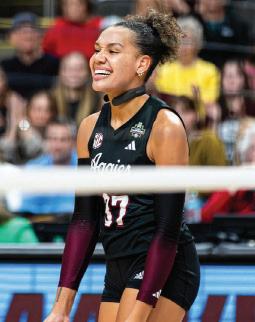
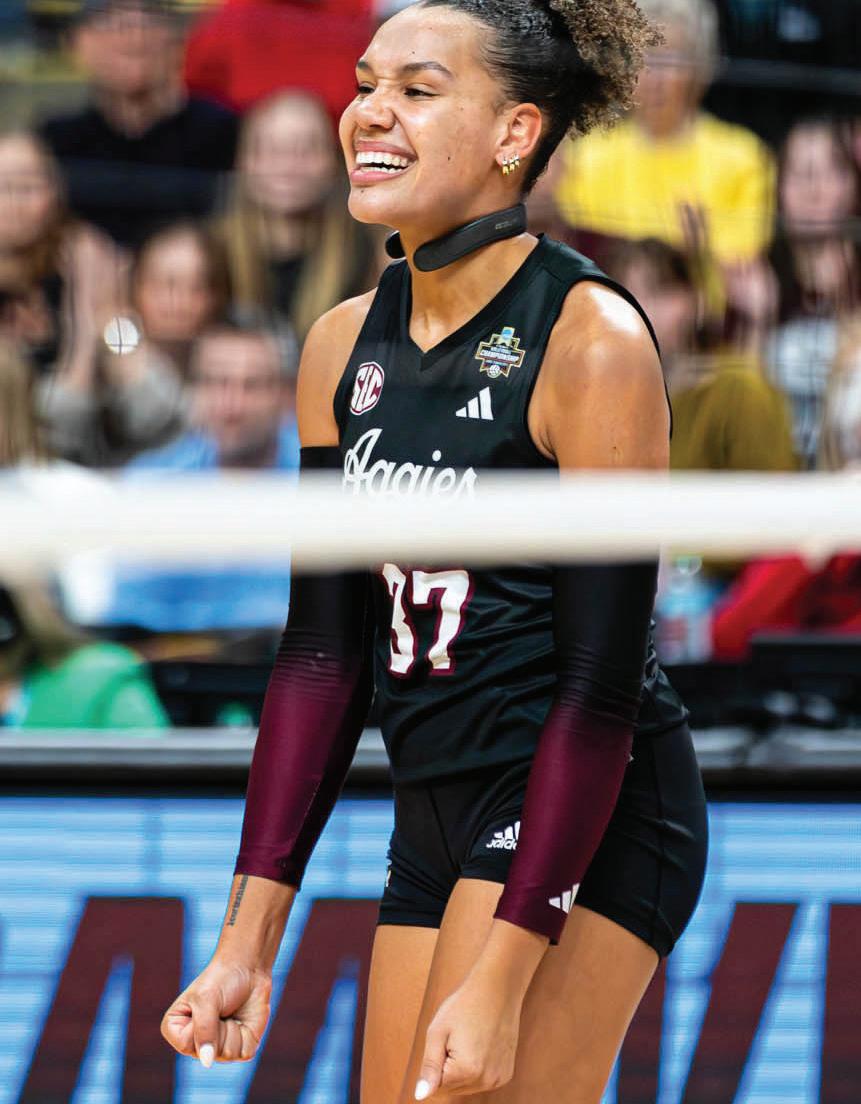
For the first time since its national championship victory over Kentucky on Dec. 21, 2025, Texas A&M volleyball took the court against a pair of in-state opponents, Sam Houston and Houston, at Reed Arena on Saturday, March 28.
The Aggies took 2 of the first 3 sets against the Bearkats before winning a shortened Set 4, 15-11, due to modified scheduling.
The first lineup for head coach Jamie Morrison against Sam Houston consisted of four returning sophomores in middle blocker Djurdja Stanojevic, outside hitters Megan Fitch and Amaré Hernandez and libero Addi Applegate. Also starting was a pair of new faces to Aggieland, freshman opposite hitter Brooke Lacewell and senior setter Lily Nicholson.
Two more immediate names tossed into the Aggies’ rotation were redshirt sopho-
more MB Eliza Sharp and redshirt junior setter Margot Manning. Sharp transferred to A&M from Boise State after winning Mountain West Freshman of the Year with the Broncos and ranking second in team kills, tallying 250. Nicholson was a later addition to A&M’s roster through the portal, arriving from Florida State where she tallied a team-best 594 assists.
The Aggies led the entire way through the first set en route to a 25-20 victory. Morrison rotated the squad for Set 2, with two more debutants in freshman L Gabi Rodriguez and graduate student OH Natalie Ring.
One of many highly touted transfers, Ring arrived in College Station after having taken on Marquette to the Round of 32 last season, where she also took home Third Team All-American honors.
Another duo of freshmen made their premier in libero/defensive specialist Jenna Thedford and OH Sara Bowcutt. The Aggies rode their strong rotation to another win, taking the second set, 25-17.
Two more names saw action in Set 3, including sophomore OH/OPP Taryn Mor-
A&M turns page on national championship
ris and redshirt sophomore MB Kaia Castle.
An Ohio State transfer, Castle recorded 91 blocks in 2025, shattering the program’s single-match block record.
“Kaia is gonna come in here and be a really good middle blocker for us,” Morrison said. “She saw what the 12th Man was like … and she was like, ‘I want to play there.’”
The third set saw a falter in form from the Aggies as they trailed the entire time, dropping Set 3 25-20. A&M responded immediately, winning the match in a shortened fourth set, 15-11.
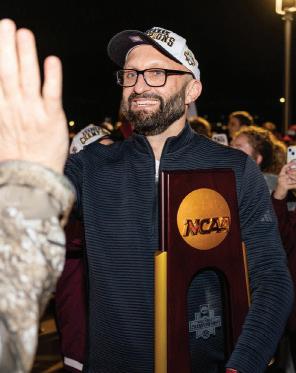
In between games, Morrison gave a deep dive into the Aggies’ national championship run and his perspective of the program to members of the 12th Man. When asked about what supporters of the Maroon and White could do to help, Morrison only needed four words.
“Show up, be loud,” Morrison said.
Throughout last season, Morrison expressed his belief in turning A&M into a premier program similar to Nebraska, who the Aggies beat in last year’s Elite 8. Morrison acknowledged that while winning the national championship is the goal, last season is still just a stepping stone to establish-
ing a culture that loves volleyball as much as him.
“We’re on the map now,” Morrison said. “The next thing is to push it over the top. To sell out Reed Arena, to maybe one day go sell out Kyle Field like Nebraska. I just want to build that audience, is the No. 1 thing I could ask you guys.”
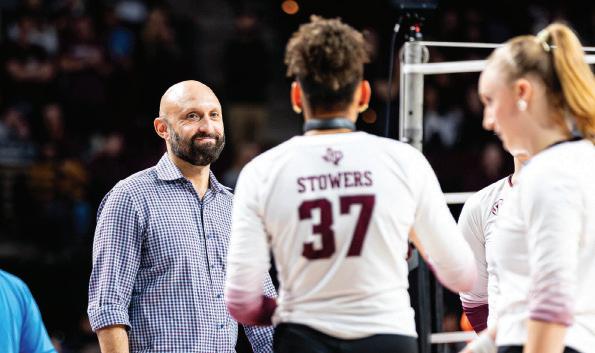
That memorable speech was followed by A&M’s matchup against Houston, which the Aggies won 3-1.The only unused player to appear for the Aggies was redshirt junior OH Kyndal Stowers. The NCAA Tournament Most Outstanding Player never left the court versus the Cougars after not having appeared against the Bearkats.
Stower’s high-level experience on the court paid off immediately, as the Fightin’ Farmers took the first two sets by identical scores of 25-20. The Cougars claimed the third, 25-20, but couldn’t take a highly contested fourth set, 25-23.
A&M continues its spring schedule against TCU and Rice on Friday, April 3, at 3:30 p.m. and 5:30 p.m., respectively, at the Tudor Fieldhouse in Houston.
‘She’s just made my experience here so great’
How Joni Taylor recruited Lauren Ware, helped establish A&M’s new program direction
By Dylan Fonville Sports Writer
As Texas A&M women’s basketball’s 2025-2026 season came to a sudden close following its first-round exit from the Women’s Basketball Invitation Tournament, there were questions over whether head coach Joni Taylor would be given an opportunity to return to the Aggies after her sixth year as head coach in 2028. It has been a roller-coaster ride of a time at A&M for Taylor, the only consistent piece being graduate student forward Lauren Ware.
On March 23, 2022, Taylor signed a sixyear contract with A&M with the option of a multi-year extension. At that same time, Ware had just come out of her sophomore year at Arizona and was set to compete in Arizona for the 2022-2023 season. During offseason training in August 2022, Ware re-dislocated her right knee, which redshirted her for the entire season. Back in the southeast, the “Joni era” got off to an extremely sloppy start, as the Aggies finished 9-20 overall, with a 2-14 conference record and an 0-11 road record.
Ware, the 31st-ranked transfer prospect, made the decision to take her talents to College Station for her redshirt junior year on May 28, 2023, joining forces with Taylor for the very first time. Her arrival was
very heavily anticipated, and the 12th Man hoped that with a new weapon they would be able to turn over a new leaf for the 20232024 season.
“We are very excited to have Lauren join our family,” Taylor said on May 4, 2023. “She brings a wealth of experience and has competed on a national championship stage. She is a two-way player that will excel in our style of play. Lauren will have an immediate impact on our program. We cannot wait for her to get to Aggieland. 12th Man, get ready!”
The 6-foot-5 talent seemed to be the missing piece, as the Fightin’ Farmers’ record saw the biggest jump in wins the SEC had seen since 1981, finishing with 10 more wins than the year prior. Getting a bid to the 2024 NCAA Tournament for the first time in three years. Lauren finished with a season average of 9.1 points, 7.9 rebounds, 1.7 blocks, 1.3 assists per game and a 48.1% field-goal percentage across 30 starts. Entering the postseason, in an SEC media availability,Ware shared her thoughts on her new head coach.
“Joni’s just an amazing person, honestly,” Ware said. “As a coach, she’s what any player would want, she’s honest, she knows the game really well. As a person, she’s even better. She cares about you off the court.”