The Safety Net L O C AT I O N C O N S U LT I N G
DESIGN & ENGINEERING
DESIGN-BUILD
MARCH 2019
IT’S ALWAYS SAFETY FIRST. CONSTRUCTION & CONTRACTING
VOLUME 13 ISSUE 3
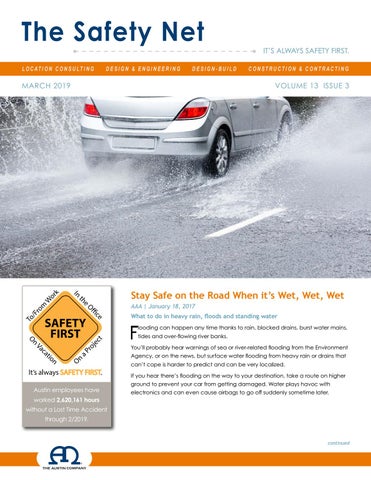
Stay Safe on the Road When it’s Wet, Wet, Wet AAA | January 18, 2017 What to do in heavy rain, floods and standing water
F
looding can happen any time thanks to rain, blocked drains, burst water mains, tides and over-flowing river banks.
You’ll probably hear warnings of sea or river-related flooding from the Environment Agency, or on the news, but surface water flooding from heavy rain or drains that can’t cope is harder to predict and can be very localized.
SAFETY FIRST. Austin employees have
If you hear there’s flooding on the way to your destination, take a route on higher ground to prevent your car from getting damaged. Water plays havoc with electronics and can even cause airbags to go off suddenly sometime later.
worked 2,620,161 hours without a Lost Time Accident through 2/2019.
continued
Heavy Rain • Turn your headlights on. The Highway Code says you must use
• Test your brakes as soon as you can after driving through water. • Fast-moving water is very powerful
them when visibility is seriously
—take care or your car could be
reduced (less than 100m).
swept away.
• Use fog lights if you like, but switch them off when visibility improves. • Leave twice as much space between you and the car in front— it takes longer to stop in the wet. • If your steering feels light due to aquaplaning, ease off the accelerator and slow down gradually. • If you break down, don’t prop the bonnet open while you wait. Rainsoaked electronics can make it harder to start the engine. • Floods and Standing Water • Try to avoid standing water if you can. • Don’t drive into flood water that is moving or more than 10cm (4 inches) deep. Let approaching cars pass first. • Drive slowly and steadily to avoid making a bow wave.
What to Watch Out For • Avoid slip and trip hazards, like curbs, under the water. • Manhole covers can get lifted and moved.
If you do get stuck in flood water, it’s usually best to wait in the car and call for help, rather than try to get out.
Why slow down?
• Water levels can change quickly. • Assume that flood water is contaminated: • Urban flood water can carry dangerous bacteria from
• Driving fast through water is dangerous, inconsiderate and can
drains and sewers that could
end up being very expensive.
cause disease.
• Your tires can lose contact with the
• Rural flood water is more
road, causing you to lose steering
likely to be contaminated by
control – called aquaplaning. If you
agricultural chemicals and
feel it happening, hold the steering
animal waste.
lightly and lift off to slow down gently until your tires grip again. • At anything above a slow crawl, you’ll throw water onto pavements, soaking pedestrians or cyclists. You could be fined and get points on your license for this. • It only takes an egg-cupful of
Fords Just because the road goes into the river on one side and comes out on the other, that doesn’t mean a ford is safe to cross. The depth and speed of the water changes with the weather. More on safely fording a river.
water in your engine to wreck it, and on many cars, the engine’s air intake is low down at the front.
FLOODWATER FACTS • Most drowning deaths happen within only 3m of a safe point. • Two thirds of those who die in flood-related accidents are good swimmers. • A third (32%) of flood-related deaths are in vehicles. • Cold water reduces your muscle strength – 20 minutes in water at 12ºC lowers muscle temperature from 37ºC to 27ºC, reducing strength by 30%. • Just 15cm of fast-flowing water can knock you off your
• It’s a challenge to stand in waist-deep water flowing at only 1m/s. By 1.8m/s (4mph) everyone is washed off their feet. • If the speed of the flood water doubles, the force it exerts on you or your car goes up four times. • Just 60cm of standing water will float your car. • Just 30cm of flowing water could be enough to move your car. • Culverts (tunnels carrying water under a road) are
feet and be enough for you not to be able to regain
dangerous when flooded—the siphon effect can drag
your footing.
in pets, children and even adults.
2
March is Workplace Eye Wellness Month Prevent Blindness has declared March as Workplace Eye Wellness Month to provide employers and employees with free information on the best ways to keep vision healthy on the job.
According to the CDC, every single
smart phone use throughout the day
3. Use proper eye protection that fits
day, about 2,000 U.S. workers sustain
increases the risk of digital eye strain.
correctly, such as non-prescription
a job-related eye injury that requires
Symptoms include blurred vision, dry
or prescription safety glasses,
medical treatment. There are more
eyes and headaches.
goggles, face shields, welding
than 15,000 welding equipment-
helmets or full-face respirators.
related eye injuries a year and power
4. With more than 700,000 work-
tools come in second, contributing
related eye injuries happening
to nearly 10,000 eye injuries a year.
each year, Americans can use a
Nearly one million Americans have
few tips on how to prevent eye
already lost some degree of sight due
injuries in the workplace.
to an eye injury. Prevent Blindness, the nation’s oldest volunteer eye health and safety group, has declared March as Workplace Eye Wellness Month to
Luckily, almost all workplace eye injuries
provide employers and employees
are preventable with the use of proper
with free information on the best ways
safety eyewear. Eye injuries cost over
to keep vision healthy on the job.
$467 million a year, but indirect costs, such as legal fees, fines and higher insurance rates, bump that estimate up to over $934 million each year. “Keeping eyes healthy today actually saves on healthcare costs in the future,” said Hugh R. Parry, President and CEO of Prevent Blindness. “We encourage everyone to talk with their employers about the best ways to keep their vision protected at work.
Common causes of workplace eye
And, make sure to talk to an eyecare
injuries include:
professional about the best eye
• Flying debris, like metal or glass
protection for any activity.”
• Tools
To prevent an eye injury at work,
• Chemicals • Harmful radiation
Prevent Blindness provides the following tips: 1. Know the eye safety hazards
• Eye strain due to digital devices
at work by completing an eye
Most injuries occur when eye
hazard assessment.
protection is worn, but is improper or
2. Eliminate hazards before
ill-fitting, and when eye protection
starting work. Use machine
isn’t worn at all. In an office setting,
guarding, work screens or other
excessive computer, table and
engineering controls.
Great Ideas To Bring Company Awareness to Workplace Eye Wellness Month 1. Host a safety meeting or toolbox talk on eye safety. 2. Deliver an eye safety message from management leadership to the staff. 3. Contribute to the conversation on social media using the hashtag #WorkplaceEyeWellnessMonth. 4. Include information on your company’s participation in Workplace Eye Wellness Month and workplace eye safety tips in your company’s newsletter. 5. Put up eye safety posters around the workplace. 6. Conduct a review of all eye safety signs in your workplace to ensure there are adequate Caution and Reminder signs to “Wear Eye Protection” in the areas they are needed. Order more or replace as needed.
3
10 Ways to Prevent Occupational Eye Injuries
There are more than 15,000 welding equipment-related eye injuries a year, according to the U.S. Consumer Product Safety Commission. Power tools come in second, contributing to nearly 10,000 eye injuries a year. Wear the correct safety eyewear so YOU don’t become a statistic! Good vision is priceless! Luckily, 90% of all workplace eye injuries are preventable with the use of proper safety eyewear. Yet, the Bureau of Labor Statistics reports that workplace eye injuries cost over $467 million a year. With indirect costs, such as legal fees, judgements and training new workers, the estimated total is more than $934 million each year. Nearly one million Americans have already lost some degree of sight due to an eye injury. With more than 700,000 work-related eye injuries happening each year, Americans can use a few tips on how to prevent eye injuries in the workplace.
ASSESS! Look carefully at plant operations. Inspect work areas, access routes and equipment. Study eye accident and injury reports. Identify operations and areas that present eye hazards.
TEST! Uncorrected vision problems can cause accidents. Use vision testing in your employee pre-placement and routine physical examinations.
PROTECT! Select protective eyewear designed for a specific duty or hazard. Protective eyewear must meet the current standards referenced by the Occupational Safety and Health Act of 1970 and later revisions.
This publication is copyrighted. This sheet may be reproduced—unaltered in hard print (photocopied) for educational purposes only. The Prevent Blindness America name, logo, telephone number and copyright information may not be omitted. Electronic reproduction, other reprint, excerption or use is not permitted without written consent. Because of the time-sensitive nature of the information contained in this publication, contact Prevent Blindness America for updates.
MK33 7/10 © 2010 Prevent Blindness America® All rights reserved. A COPY OF THE OFFICIAL REGISTRATION AND FINANCIAL INFORMATION MAY BE OBTAINED FROM THE DIVISION OF CONSUMER SERVICES BY CALLING TOLL-FREE (800.435.7352) WITHIN THE STATE. REGISTRATION DOES NOT IMPLY ENDORSEMENT, APPROVAL, OR RECOMMENDATION BY THE STATE. s. 496-405
4
10 Ways to Prevent Occupational Eye Injuries—Continued PARTICIPATE! For maximum protection against eye injuries, establish a 100% mandatory program that requires eye protection in all operation areas of your plant. Experience shows this kind of program prevents more injuries and is easier to enforce than one limited to certain departments, areas or jobs.
FIT! Workers cannot be expected to use their protective eyewear unless it fits well and is comfortable. To ensure that eyewear is adequate, have it fitted by an eye care professional or someone trained to do this. Provide the means for repair of eyewear and require each worker to be responsible for his or her own gear.
PLAN FOR AN EMERGENCY! Establish first-aid procedures for eye injuries. Make eyewash stations accessible, especially where chemicals are used. Train workers in basic first aid and identify those with more advanced first-aid training.
EDUCATE! Conduct ongoing educational programs to establish, maintain and reinforce the need for protective eyewear. Add eye safety to your regular employee education/training programs and include it as a part of new employee orientation.
SUPPORT! Management support is key to having a successful eye safety program. Management should all set an example by wearing protective eyewear whenever and wherever needed.
REVIEW! Continually review and, when needed, revise your accident prevention policies. The goal should be to have NO eye injuries or accidents!
PUT IT IN WRITING! When all parts of your safety program have been created, put them in writing. Display a copy of the policy in areas where workers go, and include a review of the policy in new employee orientation.
5
Women in Safety: Jana Gessner, PepsiCo's EHS Vice President EHS | Adrienne M. Selko | February 12, 2019 "Our recipe for success is that we spend a lot of time devising a workplace that meets the needs of our employees," says Jana Gessner, vice president, for EHS at PepsiCo. `
In competitive times, companies need
One of the differences that has been
Across PepsiCo, there are several
an edge.
widely studied, is the collaborative style
internal programs designed for the
of women. “This style leads to strong
development and advancement of
strategic partnerships,” says Gessner.
women in the supply chain, including
Strong partnerships are part of the
a program called LIFT, or Leadership
diverse and inclusive environment
Investment For Tomorrow, which
that PepsiCo has carefully cultivated.
connects executives in sponsoring high-
“We have women plant managers
potential women for development,
and have brought women into
visibility and career opportunities.
management roles,” says Gessner.
But it's not just leadership roles that
workforce that views situations in a
In fact, 29% of the company's supply
are opening up to women. This
new light. Women’s experiences and
chain workforce are women. Work is
strategy applies to all job levels at the
thought processes are different.”
being done to increase that number.
company. There is a Women’s Inclusion
For PepsiCo, that edge takes the shape of the diversity of its workforce. “Evaluating manufacturing in North America and here at PepsiCo, the supply chain continues to modernize and become more complex,” explains Jana Gessner, vice president for EHS at PepsiCo. “Complexity requires a
6
Network that helps keep female
To date, 6,500 students have been
supply chain roles. In 2017 alone,
frontline associates engaged by
reached, with a focus on girls and
PepsiCo recognized more than 60
helping connect PepsiCo associates
underserved communities.
North America-based supply chain
with internal and external partners.
Regular campus visits and social
Building a career is not something that
media engagement are also part of
Pepsi leaves to chance. For example,
the company’s efforts to encourage
its North America Beverage team is
college students to consider
piloting a program called Women
manufacturing careers at PepsiCo.
in Operations, which connects
“I find it very exciting to talk to women
female supply chain colleagues. “This program offers ‘coffee talks’ where women can discuss issues that are both personal, such as how to balance work and family life, and how to move their careers forward by ensuring their voices are heard at work,” says Gessner. One way to ensure women choose to build careers at Pepsi is to understand the capabilities of their workforce. “I have 189 people on my team and I have a clear idea of where my talent is and where they want to go,” says Gessner. Through a program called People Planning, employees can decide what types of roles they want and at what locations. “This is a huge advantage for an employee. I can offer people a variety of roles and critical experiences to match their aspirations.”
at college campuses about the issues our company deals with and how they can become involved," says Gessner. “For example, I talk about technology and how it impacts safety. We need to make the connection between scientific developments and manufacturing.” These efforts have been successful, as 53% of new manufacturing leadership hires at Frito-Lay were women. Once these women walk through the front doors at PepsiCo, the company works hard to retain them. Formal programs ensure their continued skill development, which is important to new employees. A program called the PepsiCo STEM Women’s Community works to foster a work environment that supports and retains PepsiCo Women in STEM careers, including those in
associates for their extraordinary contributions as part of our annual Chairman’s Circle of Champions awards. Approximately one-third of the honorees were women. All these programs and strategies are working. When the company has offered jobs based on campus recruiting, 90-95% of those who accepted are staying with the company. “We are seeing diversity across our global supply chain,” says Gessner. The company’s efforts are being recognized externally as well. PepsiCo was a recipient of the first ever Women’s Foodservice Forum Women in Manufacturing Award, which recognizes companies in the manufacturing sector of the food industry with demonstrated commitment to drive gender equity in their organizations and across the industry.
Best Practices “Our recipe for success is that we spend a lot of time devising a
Attracting Talent
supply chain positions.
While ensuring the current talent is
In addition to career development,
our employees,” says Gessner. “The
retained, the company also needs
mentoring has been shown to be a
company culture includes humility,
to attract new talent, which is a
useful tool in retaining employees.
which I have learned as I have
top concern of all manufacturing
PepsiCo is a platinum sponsor of
traveled around the world. And we
companies.
Million Women Mentors, a movement
encourage employees to travel
that involves 60 corporations across
and understand different cultures.
44 states, working to help young girls
We provide a work-life balance and
and women enter and persist in STEM-
want employees to have personal
related pathways through mentoring
satisfaction in their work. And, we are
relationships. PepsiCo is working
continually working on improving ways
to secure 1,000 associate mentors
to support women in our organization.”
As part of the company’s STEM outreach program, young women at the middle school and high school age are being encouraged to explore STEM careers at PepsiCo. Through its Career Accelerator Days, PepsiCo associates provide middle and high
workplace that meets the needs of
globally by the year 2020.
school students, administrators,
And of course, recognition is key
teachers and parents with exposure
to keeping job satisfaction at high
to its careers through demonstrations,
levels, so PepsiCo regularly recognizes
discussion and hands-on experiences.
the contribution of women in
7
Washing Your Hands of a Situation Can Be a Good Thing EHS | Dave Blanchard | February 8, 2019 One of the best ways to protect your hands—and the rest of you—is good, old-fashioned soap.
Ok, apologies in advance if this topic
nasty. So I’m especially annoyed
Part of it seems to be a gender thing,
grosses you out, but there’s a study
when people leave a restroom
according to the survey, which says
out that says more than half of the
without even pretending to clean
63% of men frequently or occasionally
people who use their companies’
up after themselves. I mean, c’mon!
don’t wash their hands after using the
restrooms don’t wash their hands
That’s just nasty!
restroom, compared to 49% of women.
Anyways, the study, conducted
I don’t know … I’m not comforted
before leaving. That’s just wrong in so many ways, but what really gets me to wondering is: Why?
by Bradley Corp. (a company that
much by the thought that only half of
manufactures commercial washroom,
women don’t wash their hands.
It’s not like it costs the employee
emergency safety and industrial
Is it a pride thing? One of those, “I’m
anything to use the water or the soap
solutions), speculates that maybe the
too cool to bother with washing
or the towels (whether paper, cloth
employees are in a rush to get on
my hands” attitudes? Is it a matter
or air-blowers). Plus, while we’re all
with something else – but that seems
of upbringing, a lapse in common
understandably squeamish about
like a lousy reason. They’re putting
sense that can be laid at the feet of
those nasty germs being spread on
themselves and their fellow workers at
absent parents who never explained
doorknobs, desks and other things the
danger for the sake of saving, what,
to their kids how and why to wash
employee might end up touching, the
an extra 30 seconds to wash and dry
their hands? Is it just plain rudeness, or
majority of those germs are staying
their hands? Nobody is that busy.
even worse, a deliberate act meant
right there with him or her.
to spread nasty substances
So again I wonder: Why?
throughout the world? The
I’m currently fighting a
survey doesn’t really say.
cold—living in Ohio, it’s a
But for those of you who want
mere matter of time before
to know what constitutes a
the elements caught up
good, thorough hand-washing
to me—despite all my best
experience, Bradley Corp.
efforts to wash my hands
recommends using soap, running
early and often and to
water and vigorous scrubbing for
avoid touching anything
at least 20 seconds.
that looks in the least bit
8
Best Practices for Enforcing Policies with Contractors EHS - Bill Burket - Environmental Health and Safety Compliance Consultant
Organizations that hire and employ contractors and suppliers
1. Thoroughly vet your contractors. One of the best ways
look for professional and responsible people who can do the
to ensure your contractors and suppliers are following
work. They expect their contractors will follow safety policies
required policies is through validated third-party audits.
and procedures to ensure safety incidents are avoided.
Comprehensive auditing is hard for organizations to
They rely on their contractors to follow the guidelines,
achieve on their own because the process requires
but the truth is, many of these companies have no way to verify compliance. And without policy enforcement, these companies risk increased injuries, production failures, penalties for noncompliance and even lawsuits resulting from employee injury. Let’s look at a typical job site. Perhaps the contractors are working hard and trying to do what’s right – but the contractor’s idea of what’s right might not be in line with your safety requirements. Or perhaps the contractors are trying to find ways to finish the job faster – even if it means ignoring a few safety policies along the way. We’re not talking gross negligence here. It could be as simple as a janitor using a strong detergent to clean a floor, but only rinsing the floor once, instead of the three times required for that type of cleanser. If another employee then slips and falls on the slick floor, the hiring company has a safety violation that may stop production, require an investigation and trigger legal action. When workers don’t follow safety guidelines, injuries are more likely to become an issue and without enforcement, incidents will continue to escalate, along with risks to the business. To reduce incidents and keep production and workflow moving as planned, it’s critical for your contractors and suppliers to understand all policies and follow them exactly as required.
considerable skill and manpower. Look for partners that can provide third-party, on-site audits to make sure your contractors and suppliers review the policies, understand them and abide by all regulations. 2. Use third-party on-site audits to ensure policy enforcement. To help your contractors implement best practices, start by finding out what they know. Begin with a questionnaire to identify specific industry or service capabilities, including skills, training, and the best practices they have in place. Then, by using the information provided in the questionnaire, you can assess whether or not the contractor’s capabilities meet your requirements. Because best practices and standards are not set in stone, it’s essential to have safety professionals on your team who constantly review new standards and regulations to make sure you and your contractors are always up-to-date. 3. Always choose the right contractor for the job. With a variety of organizations creating best practices and consensus standards – which often evolve into regulations – it’s not always clear which are the most current, which will provide your organization with the greatest value, and what kind of variances may be required to meet your objectives. For example,
9
the National Fire Protection Association (NFPA) offers
4. Get help finding the right safety standards for your
275 codes and standards that affect virtually every
organization. It’s important to have the right people
building, process, service, design and installation.
available at the right time for the right job. For example,
The American Petroleum Institute establishes and
if you need a crane operator, you first want to be
maintains dozens of standards aimed at enhancing
certain the contractor you select has the right training,
the safety of industry operations, assuring quality and
license and insurance to operate the crane. Companies
reducing waste.
actively seek highly rated contractors as their top choice
When there are literally thousands of standards and
because they know those contractors are well-trained,
best practices, it’s impossible for organizations to know
productive workers who will follow best practices and
them all. To make matters worse, there are many
promote a safe, healthy work environment. But putting
legacy standards still around, as well as standards that
the wrong contractor into the wrong work environment
conflict with each other. If you’re trying to manage
can have lasting impact. It pays to have a contractor
best practices on your own, it’s difficult to know which
management partner that can help you choose the
ones fit your industry. As a result, your business could
right contractor for the job every time.
be mistakenly flagged for failure to comply.
OSHA Delays Enforcement of Crane Operator Documentation Requirements for ‘Good Faith’ Employers National Safety Council | February 11, 2019 Washington: Employers who make “good faith efforts” to document their evaluations of crane operators have an additional 60 days to comply with OSHA’s Cranes and Derricks in Construction: Operator Certification Extension, according to a Feb. 7 enforcement memorandum from the agency. The rule, published in the Nov. 9 Federal Register, required employers to evaluate operators and document those evaluations by Feb. 7. In the memo, sent to regional administrators and State Plan designees, Scott C. Ketcham, acting director of OSHA’s Directorate of Construction, said OSHA “has received feedback from the construction industry indicating some employers may need more time to document evaluations of crane operators prior to the … effective date.” During the initial 60 days of enforcement (until April 15), OSHA will “evaluate good faith efforts taken by employers in their attempt to meet the new documentation requirements.” The agency is offering compliance assistance, instead of enforcement, for those employers acting in good faith. Citations will be issued to employers who are deemed not to be operating in good faith. The memo also states that OSHA is enforcing its employer evaluation requirements of crane operators, which must be completed before employees are allowed to work on their own. Ketcham instructs regional administrators and State Plan designees to consult with his office before issuing any proposed citations.
10
Chipping, Crushing Exposes Construction Workers to High Levels of Silica Dust, Study Shows National Safety Council | January 30, 2019
Lowell, MA: Certain job tasks may
Workers performing concrete
challenging for chipping workers and
expose construction workers to silica
chipping at substructure bridge
crushing machine tenders. Even with
dust at levels more than 10 times
repair sites had the highest level of
the use of dust suppression controls,
the permissible exposure limit set by
respirable crystalline silica exposure,
respiratory protection may be required
OSHA, according to the results of a
a time-weighted average of 527
for various tasks,” the researchers said.
recent study.
micrograms per cubic meter of air.
They recommend that employers
Researchers from the Department
That is more than 10 times the PEL of
provide additional respiratory
50 micrograms per cubic meter that
safeguards for these workers.
of Public Health at the University of Massachusetts Lowell collected 51
OSHA established in its most recent
Crystalline silica is a known
personal breathing-zone samples from
silica regulation (1926.1153).
workers at demolition, crushing and
Workers operating crushing machine
and artificial stone. Exposure to silica
bridge repair sites in Massachusetts.
tenders had a respirable crystalline
dust can trigger silicosis, a chronic
Another 33 “area samples” were
silica exposure of 93.3 micrograms
disease that involves scarring of the
taken near demolition or crushing
per cubic meter. Operating engineers
lungs. OSHA estimates that 2.3 million
sites to determine possible exposure
and laborers had the lowest exposure,
workers are exposed to the dust,
to bystanders. Comparison samples
a time-weighted average of 17
including 2 million in construction.
were taken at sites that had dust
micrograms per cubic meter.
suppression controls and those that did not, when possible.
carcinogen found in sand, stone
The study was published online Oct.
Controlling or reducing silica
31 in the Annals of Work Exposures
exposure below OSHA’s PEL “remains
and Health.
11
Who’s Allowed to Unlock Equipment That’s Been Locked and Tagged Out? Safeopedia | Steve Prentice | February 13, 2019
Q: Who’s allowed to unlock equipment that’s been locked and tagged out? A: There’s a very straightforward answer to this question: the person who locks a machine is the only one who should unlock it. But let’s dive a little deeper into why that is the case and when an exception can be made.
Basically, the rule applies to any piece
When leaving the scene, either for the
of equipment that has the potential
day or just temporarily, it is vital that
to cause injury or death if left in a
the machine is rendered inoperable
state where it could be used by an
until the operator returns.
unauthorized individual or where it could re-engage by itself.
When Can Someone Else Unlock the Equipment?
LOTO in a Nutshell
Only One Person Should Have the
Lockout/Tagout (LOTO) is a procedure
Authority to Unlock the Equipment
for ensuring that a machine or tool
There should be just one person
unlock the device, a second person
of any sort is made impossible to use
who has the authority to unlock
may be authorized to do it, but only
when the authorized operator is not
or reconnect such a piece of
by following a clear set of prepared
around. This includes any machine or
equipment, and that’s the person
steps that have been developed and
tool that uses some form of energy,
who locked it up or disconnected it
incorporated into the company’s
such as electricity, fuel or compressed
after it was last used. This could be a
authorized health and safety program.
air, as well as any device like a control
supervisor, but it is usually the operator,
panel or tool cabinet that gives access
since they’re the last one who had
Why Authorization Matters
to other dangerous equipment.
their hands on the device.
Once the machine is locked out (kept
If—and only if—the authorized individual is not available to lock or
turned off by a lock, seal or other device) and tagged out (placing a warning tag on the equipment), unauthorized use of it is forbidden. Formalities like this might appear tedious, but they help ensure the safety of people and machinery by reducing the risk of accidental or unauthorized events in the workplace. LOTO also makes it illegal for another person to unlock the machine. This is a regulation established and enforced by health and safety authorities like OSHA. Violations can result in hefty fines and severe punishments.
12
Face-to-Face Safety: The Right Way to Build a Safety Culture
The Journey to Zero!
Safeopedia | Bryan McWhorter | August 16, 2017
Takeaway: Accidents are preventable and following
Takeaway: There is no substitute for face-to-face
these tips will help you reach the goal of zero
communication. If you want a safety culture, invest in
workplace accidents.
Safeopedia | Bryan McWhorter | October 18, 2016
regular face time focused on safety.
When I was the head of safety for a large factory back in 2008, if someone would have asked me whether achieving zero accidents was possible, I would have said “no.” And I would have been wrong. As the supervisor for a large department in a factory that
“Whether you think you can, or you think you can’t - you’re
ran 24/7, I was used to long hours. I remember arriving to
right.” – Henry Ford
work early one morning only to find my boss walking into our
That quote has been referred to so many times, it may have
offices off the factory floor. I was worried that something bad
lost some of its power, but it is just as true today as it was
had happened. When I asked if everything was okay, he
when Henry Ford first said it. Our beliefs dictate our effort.
told me “Yes. I was just out visiting with workers about safety.”
When it comes to keeping workers safe, we need a goal of
My manager and mentor explained that he wanted
zero accidents.
employees to know safety is important to management. He made it clear to them that he never wanted to put safety at risk in some attempt to drive performance. Performance must be sustainable, which means zero accidents (see The Journey to Zero! (below) to learn more). He also loved pointing out that we are social beings. It’s human nature to talk about what’s important to us. When managers, supervisors, or anyone in a leadership role doesn’t engage in face-to-face safety talks, workers pick up on a clear message: “Safety is not important.”
13
DART Rate: What It Is and How to Calculate It Safeopedia | Terry Creason | February 12, 2018
Days Away, Restricted or Transferred (DART) Definition: What does Days Away, Restricted, or Transferred (DART) mean? Days away, restricted or transferred (DART) is a safety metric used by the Occupational Safety and Health Administration (OSHA) to show how many workplace injuries and illnesses caused the affected employees to remain away from work, restricted their work activities or resulted in a transfer to another job as they were unable to do their usual job within a calendar year. The DART rate helps the employer and senior management to identify safety matters in the workplace.
Safeopedia explains Days Away, Restricted, or Transferred (DART) Days away, restricted or transferred (DART) rate is a mathematical calculation that defines the number of recordable incidents per 100 full-time employees that resulted in lost work days, restricted work days or job transfer due to workplace injuries or illnesses. It can be determined by the following formula: DART rate = (Total number of recordable injuries and illnesses, or one or more Restricted Days that resulted in an employee transferring to a different job within the company x 200,000) / Total number of hours worked by all employees WForm OSHA 300 is used to calculate DART rate. It logs all work-related injuries and illnesses and whether it caused a death, time away from work, job restriction or a job transfer. A similar term – incident rate – calculates all accidents and illnesses, but the DART rate calculates recordable loss rate. Ideally, the DART rate needs to be lower than the incident rate.
14
Can You Be Held Criminally Liable for a Workplace Injury? Shane Hedmond | January 24, 2019
Article was written by Alex Barthet, the founder and principal of The Barthet Firm, a 13 lawyer construction practice which has been serving South Florida’s construction industry for over 20 years. Be careful - owners and contractors are now being held criminally liable for their carelessness and disregard of safety protocols. Safety may be Job #1 on any number of job sites, but state and Federal prosecutors are now charging developers, general contractors and
Another mishap in California illustrated
including the lack of proper safety
subcontractors with actual crimes. No
a lack of proper training on the use
lines, but more importantly, the lack of
longer are safety violators just facing
of powered nailing tools. Apparently,
proper oversight that allowed workers
monetary fines, they are looking at
a worker holding a switched-on nail
on the bridge after it developed
actual jail time.
gun, accidentally discharged it,
significant cracks.
A New York case involving a wall collapse at an excavation site that killed one worker and injured two others has an owner, his companies and the permit holder in the crosshairs.
shooting a nail into his arm, seriously injuring himself. The company was criminally charged for ignoring safety codes and overlooking obligations to properly protect its workers.
So companies would be smart to have regular compliance audits, keep accurate records and promptly deal with OSHA citations. Having ample insurance coverage in place
It didn’t help that the worker who died
In Washington state, prosecutors
that includes protection for officers
was an undocumented immigrant
charged an owner with negligent
and directors is also a must. Of
and a contractor was hired to just
homicide after a worker died in a
course, all bets are off if those seeking
pull the permit. Worse, the owner
trench collapse. As so often is the
insurance coverage have actual
continued to ignore warnings from
case in these types of accidents, the
prior knowledge of a dangerous
workers at the project complaining
excavation site had not been properly
condition and do nothing to address
the area was not safe. The owner has
shored. This was seen as a willful and
it. Today, construction accidents not
been indicted for manslaughter.
intentional disregard of established
only trigger monetary fines, but the
safety regulations and amounted to
potential for real jail time.
The targets are not just owners. Two project managers were recently
criminal negligence.
indicted in New York because of the
And in Miami, while a number of
reckless use of a crane that toppled
companies face significant fines as a
over, injuring several workers. The
result of the tragic Florida International
supervisors had not pulled the right
University bridge collapse, the incident
permits and were not properly trained
remains under review as to the possible
on the use of the crane. When it
imposition of criminal charges. Federal
capsized, the crane was carrying a
authorities have already cited folks
load twice its noted limit.
for serious worker safety violations,
15
Congratulations to members of our Anheuser Busch project team!
Duane Lofdahl, Mike Brodeur, and Ron Litherland completed the required training for Confine Space and Crystalline Silica. Ron Litherland also completed QA/Safety Procore App Training.
16