



MAY AND JUNE

MAY 4 - MAY 8
National Safety Week
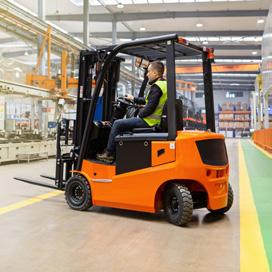
MAY 25
Memorial Day
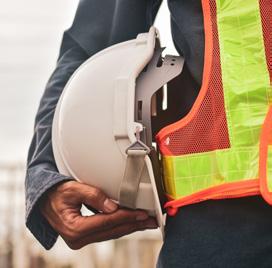
JUNE 9
National Forklift Safety Day
OTHER DATES TO NOTE
National Safety Month (Workplace and Community)
MAY AND JUNE
MAY 4 - MAY 8
National Safety Week
MAY 25
Memorial Day
JUNE 9
National Forklift Safety Day
OTHER DATES TO NOTE
National Safety Month (Workplace and Community)
MAY 6
Energy Wheel Overview
Cleveland Office
IF YOU ARE INTERESTED
MAY 7
First Aid and CPR Course
Cleveland Office
Sign up by emailing julysa.garcia@theaustin.com
These trainings are required for field personnel.
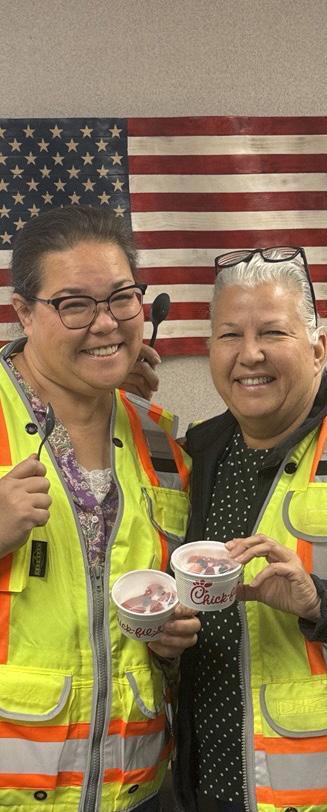
What led you to a career in construction? i did not pursue construction specifically. Just ended up in it. I do enjoy the variety of people and projects.
What is your current trade and what do you enjoy most about it?
administration – I enjoy helping the clients and team members.
What has been the biggest challenge of being a woman in your trade and how did you overcome it?
Being taken seriously in certain situations. Overcame it by being persistent and providing viable suggestions and solutions when needed.
What is the most surprising part of working in construction? nothing really surprises me anymore.
What advice would you give to a woman starting her career in construction? don’t be intimated. Believe in yourself and what you can bring to the project and the team.
What led you to a career in construction?
My dad. He works in construction and I guess I wanted to follow in his footsteps.
What is your current trade and what do you enjoy most about it?
General contractor. I love that I can be involved on both sides (office and field).
What has been the biggest challenge of being a woman in your trade and how did you overcome it?
When I first started working, it was a little intimidating to be the only girl in the room but that didn’t last long because everyone was so welcoming and open to hear what I have to say.
What is the most surprising part of working in construction?
There is so much to learn every single day no matter how long you’ve been in the industry.
What advice would you give to a woman starting her career in construction?
Believe in your abilities, speak up with confidence and don’t be afraid to ask questions. Construction is an industry where knowledge, work ethic and resilience earn respect.

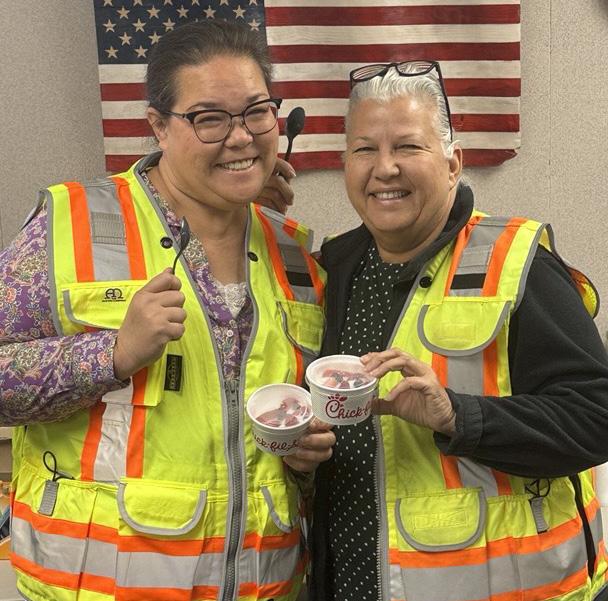
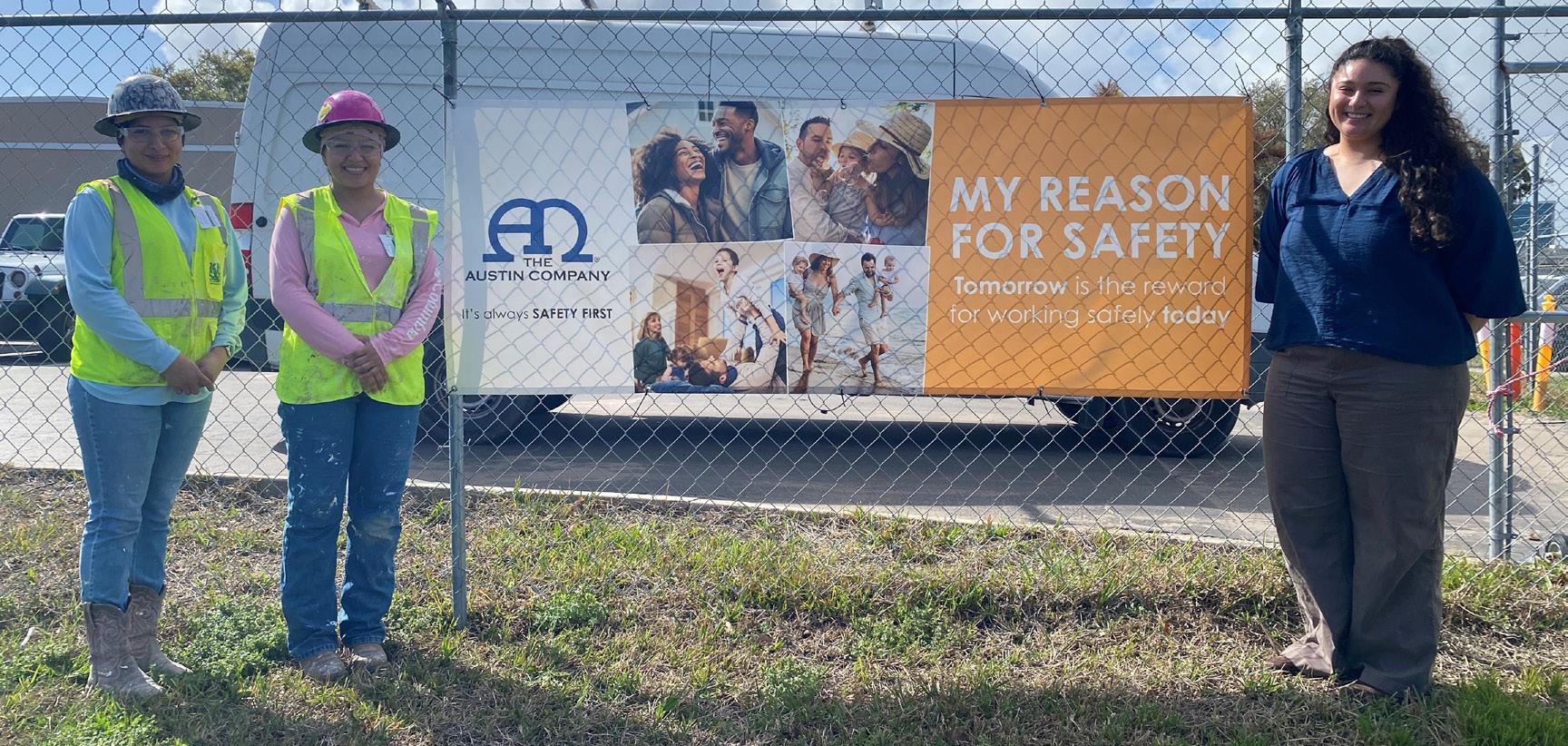
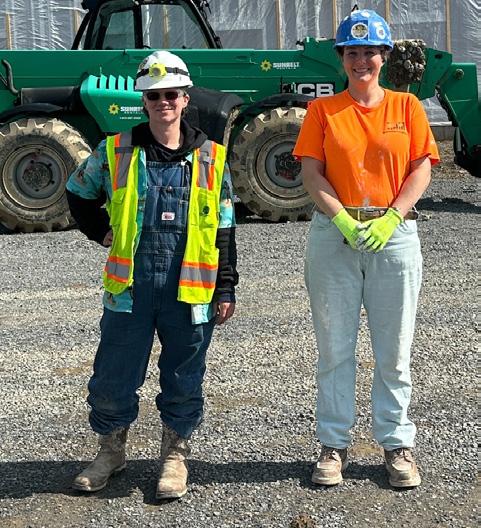
What led you to a career in construction?
My father and brothers introduced me to the trade.
What is your current trade and what do you enjoy most about it? Drywall finisher.
What has been the biggest challenge of being a woman in your trade and how did you overcome it?
I would say to show my work is equal to a male’s.
What is the most surprising part of working in construction? The support and help from others.
What advice would you give to a woman starting her career in construction? To continue showing up and to not be scared to be in this field.
What led you to a career in construction? Wanted to be a drywall finisher
What is your current trade and what do you enjoy most about it? Currently a drywall finisher and I enjoy everything about it.
What has been the biggest challenge of being a woman in your trade and how did you overcome it?
Construction is a man’s world.
What is the most surprising part of working in construction? How challenging it is
What advice would you give to a woman starting her career in construction? Be strong

MIT Technology Review | July 2, 2025
The technology could save lives—so long as it doesn’t fully replace humans that monitor safety.
Last winter, during the construction of an affordable housing project on Martha’s Vineyard, Massachusetts, a 32-year-old worker named Jose Luis Collaguazo Crespo slipped off a ladder on the second floor and plunged to his death in the basement. He was one of more than 1,000 construction workers who die on the job each year in the US , making it the most dangerous industry for fatal slips, trips, and falls.
“Everyone talks about [how] ‘safety is the number-one priority,’” entrepreneur and executive Philip Lorenzo said during a presentation at Construction Innovation Day 2025, a conference at the University of California, Berkeley, in April. “But then maybe internally, it’s not that high priority. People take shortcuts on job sites. And so there’s this whole tug-of-war between … safety and productivity.”
To combat the shortcuts and risk-taking, Lorenzo is working on a tool for the San Francisco–based company DroneDeploy, which sells software that creates daily digital models of work progress from videos and images, known in the trade as “reality capture.” The tool, called Safety AI, analyzes each day’s reality capture imagery and flags conditions that violate Occupational Safety and Health Administration (OSHA) rules, with what he claims is 95% accuracy.
That means that for any safety risk the software flags, there is 95% certainty that the flag is accurate and relates to a specific OSHA regulation. Launched in October 2024, it’s now being deployed on hundreds of construction sites in the US, Lorenzo says, and versions specific to the building regulations in countries including Canada, the UK, South Korea, and Australia have also been deployed. Safety AI is one of multiple AI construction safety
tools that have emerged in recent years, from Silicon Valley to Hong Kong to Jerusalem. Many of these rely on teams of human “clickers,” often in low-wage countries, to manually draw bounding boxes around images of key objects like ladders, in order to label large volumes of data to train an algorithm.
Lorenzo says Safety AI is the first one to use generative AI to flag safety violations, which means an algorithm that can do more than recognize objects such as ladders or hard hats. The software can “reason” about what is going on in an image of a site and draw a conclusion about whether there is an OSHA violation. This is a more advanced form of analysis than the object detection that is the current industry standard, Lorenzo claims. But as the 95% success rate suggests, Safety AI is not a flawless and all-knowing intelligence. It requires an experienced safety inspector as an overseer.
Robots and AI tend to thrive in controlled, largely static environments, like factory floors or shipping terminals. But construction sites are, by definition, changing a little bit every day.
Lorenzo thinks he’s built a better way to monitor sites, using a type of generative AI called a visual language model, or VLM. A VLM is an LLM with a vision encoder, allowing it to “see” images of the world and analyze what is going on in the scene.
Using years of reality capture imagery gathered from customers, with their explicit permission, Lorenzo’s team has assembled what he calls a “golden data set” encompassing tens of thousands of images of OSHA violations. Having carefully stockpiled this specific data for years, he is not worried that even a billion-dollar tech giant will be able to “copy and crush” him.
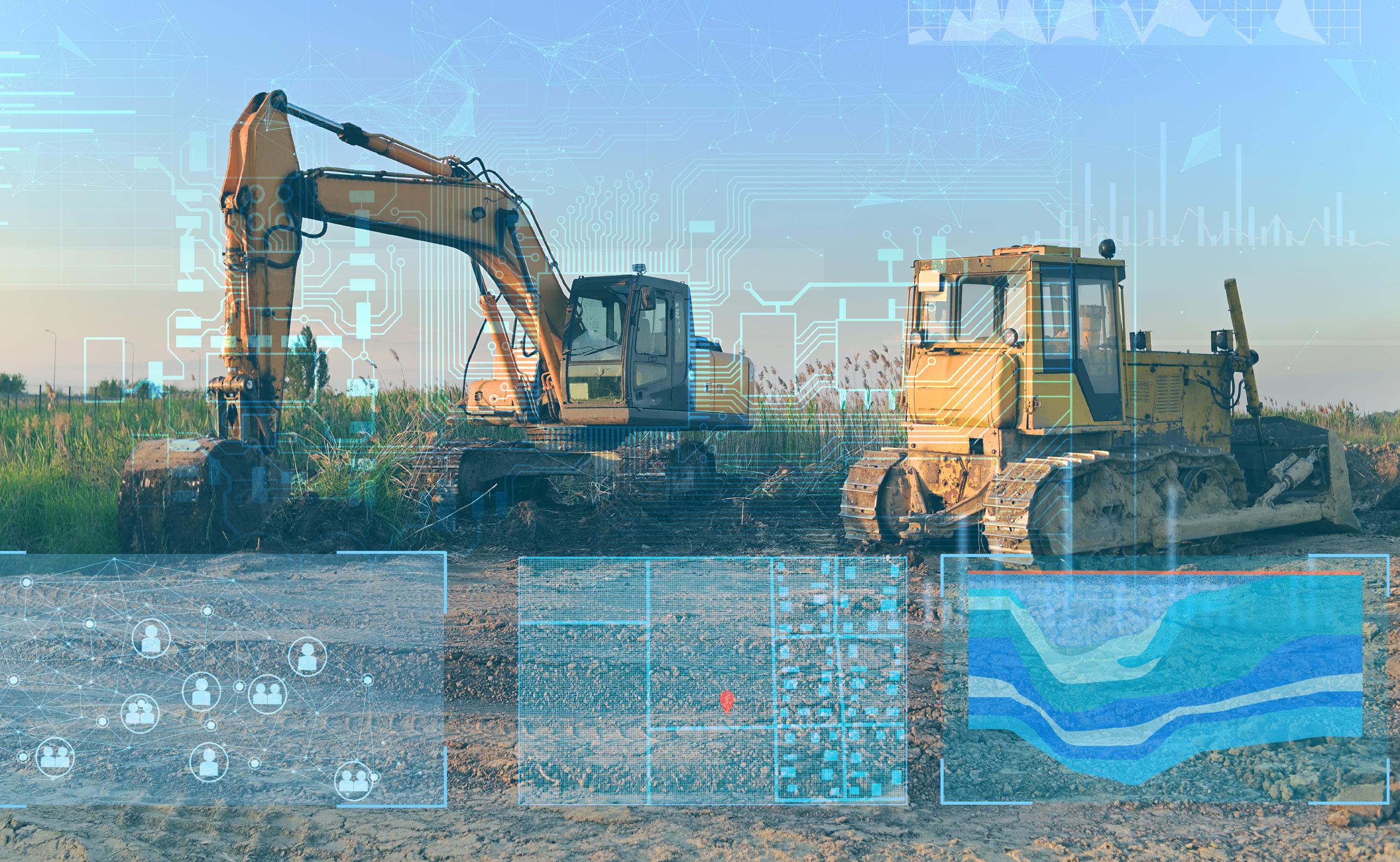
To help train the model, Lorenzo has a smaller team of construction safety pros ask strategic questions of the AI. The trainers input test scenes from the golden data set to the VLM and ask questions that guide the model through the process of breaking down the scene and analyzing it step by step the way an experienced human would. If the VLM doesn’t generate the correct response—for example, it misses a violation or registers a false positive—the human trainers go back and tweak the prompts or inputs. Lorenzo says that rather than simply learning to recognize objects, the VLM is taught “how to think in a certain way,” which means it can draw subtle conclusions about what is happening in an image.
As an example, Lorenzo says VLMs are much better than older methods at analyzing ladder usage,

which is responsible for 24% of the fall deaths in the construction industry.
“With traditional machine learning, it’s very difficult to answer the question of ‘Is a person using a ladder unsafely?’” says Lorenzo. “You can find the ladders. You can find the people. But to logically reason and say ‘Well, that person is fine’ or ‘Oh no, that person’s standing on the top step’—only the VLM can logically reason and then be like, ‘All right, it’s unsafe. And here’s the OSHA reference that says you can’t be on the top rung.’”
Answers to multiple questions (Does the person on the ladder have three points of contact? Are they using the ladder as stilts to move around? ) are combined to determine whether the ladder in the picture is being used safely. “Our system has over a dozen layers of questioning just to get to that answer,” Lorenzo says. DroneDeploy has not publicly released its data for review, but he says he hopes to have his methodology independently audited by safety experts.
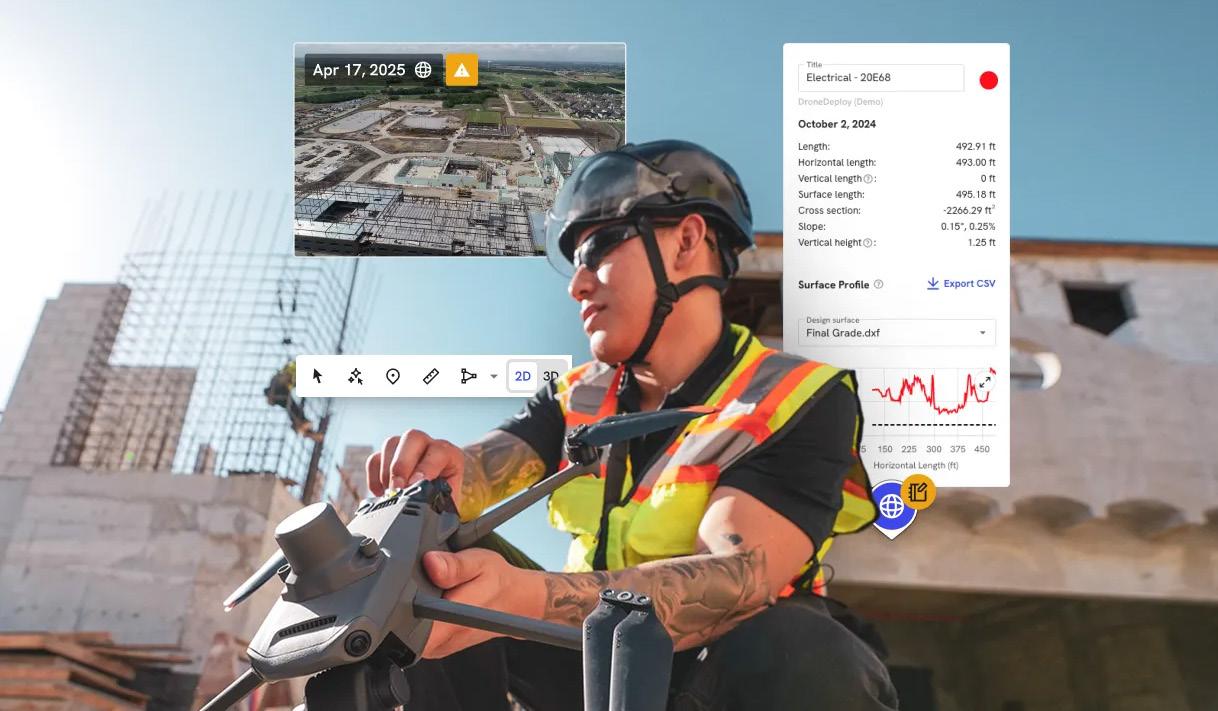
Using vision language models for construction AI shows promise, but there are “some pretty fundamental issues” to resolve, including hallucinations and the problem of edge cases, those anomalous hazards for which the VLM hasn’t trained, says Chen Feng. He leads New York University’s AI4CE lab , which develops technologies for 3D mapping and scene understanding in construction robotics and other areas. “Ninety-five percent is encouraging—but how do we fix that remaining 5%?” he asks of Safety AI’s success rate.
Feng points to a 2024 paper called “Eyes Wide Shut? ”— written by Shengbang Tong, a PhD student at NYU, and coauthored by AI luminary Yann LeCun—that noted “systematic shortcomings” in VLMs. “For object detection, they can reach human-level performance pretty well,” Feng says. “However, for more complicated things—these capabilities are still
to be improved.” He notes that VLMs have struggled to interpret 3D scene structure from 2D images, don’t have good situational awareness in reasoning about spatial relationships, and often lack “common sense” about visual scenes.
Lorenzo concedes that there are “some major flaws” with LLMs and that they struggle with spatial reasoning. So Safety AI also employs some older machine-learning methods to help create spatial models of construction sites. These methods include the segmentation of images into crucial components and photogrammetry, an established technique for creating a 3D digital model from a 2D image. Safety AI has also trained heavily in 10 different problem areas , including ladder usage, to anticipate the most common violations.
Even so, Lorenzo admits there are edge cases that the LLM will fail to recognize. But he notes that
for overworked safety managers, who are often responsible for as many as 15 sites at once, having an extra set of digital “eyes” is still an improvement. Aaron Tan, a concrete project manager based in the San Francisco Bay Area, says that a tool like Safety AI could be helpful for these overextended safety managers, who will save a lot of time if they can get an emailed alert rather than having to make a twohour drive to visit a site in person. And if the software can demonstrate that it is helping keep people safe, he thinks workers will eventually embrace it. However, Tan notes that workers also fear that these types of tools will be “ bossware” used to get them in trouble . “At my last company, we implemented cameras [as] a security system. And the guys didn’t like that,” he says. “They were like, ‘Oh, Big Brother. You guys are always watching me—I have no privacy.’”
Izhak Paz, CEO of a Jerusalem-based company called Safeguard AI, has considered incorporating VLMs, but he has stuck with the older machinelearning paradigm because he considers it more reliable. The “old computer vision” based on machine learning “is still better, because it’s hybrid between the machine itself and human intervention on dealing with deviation,” he says. To train the algorithm on a new category of danger, his team aggregates a large volume of labeled footage related to the specific hazard and then optimizes the algorithm by trimming false positives and false negatives. The process can take anywhere from weeks to over six months, Paz says.
With training completed, Safeguard AI performs a risk assessment to identify potential hazards on the site. It can “see” the site in real time by accessing footage from any nearby internet-connected camera. Then it uses an AI agent to push instructions on what to do next to the site managers’ mobile devices. Paz declines to give a precise price tag, but he says his product is affordable only for builders at the “midmarket” level and above, specifically those managing multiple sites. The tool is in use at roughly 3,500 sites in Israel, the United States, and Brazil.
He says that gaining labeled training data is actually much easier than it was when he and his cofounders began the project in 2018, since gathering video
footage of sites means that each object, such as a socket, might be captured and then labeled in many different frames. But the tool is high-end—about 50 builders, most with revenue over $250 million, are using Buildots in Europe, the Middle East, Africa, Canada, and the US. It’s been used on over 300 projects so far.
Ryan Calo, a specialist in robotics and AI law at the University of Washington, likes the idea of AI for construction safety. Since experienced safety managers are already spread thin in construction, however, Calo worries that builders will be tempted to automate humans out of the safety process entirely. “I think AI and drones for spotting safety problems that would otherwise kill workers is super smart,” he says. “So long as it’s verified by a person.”
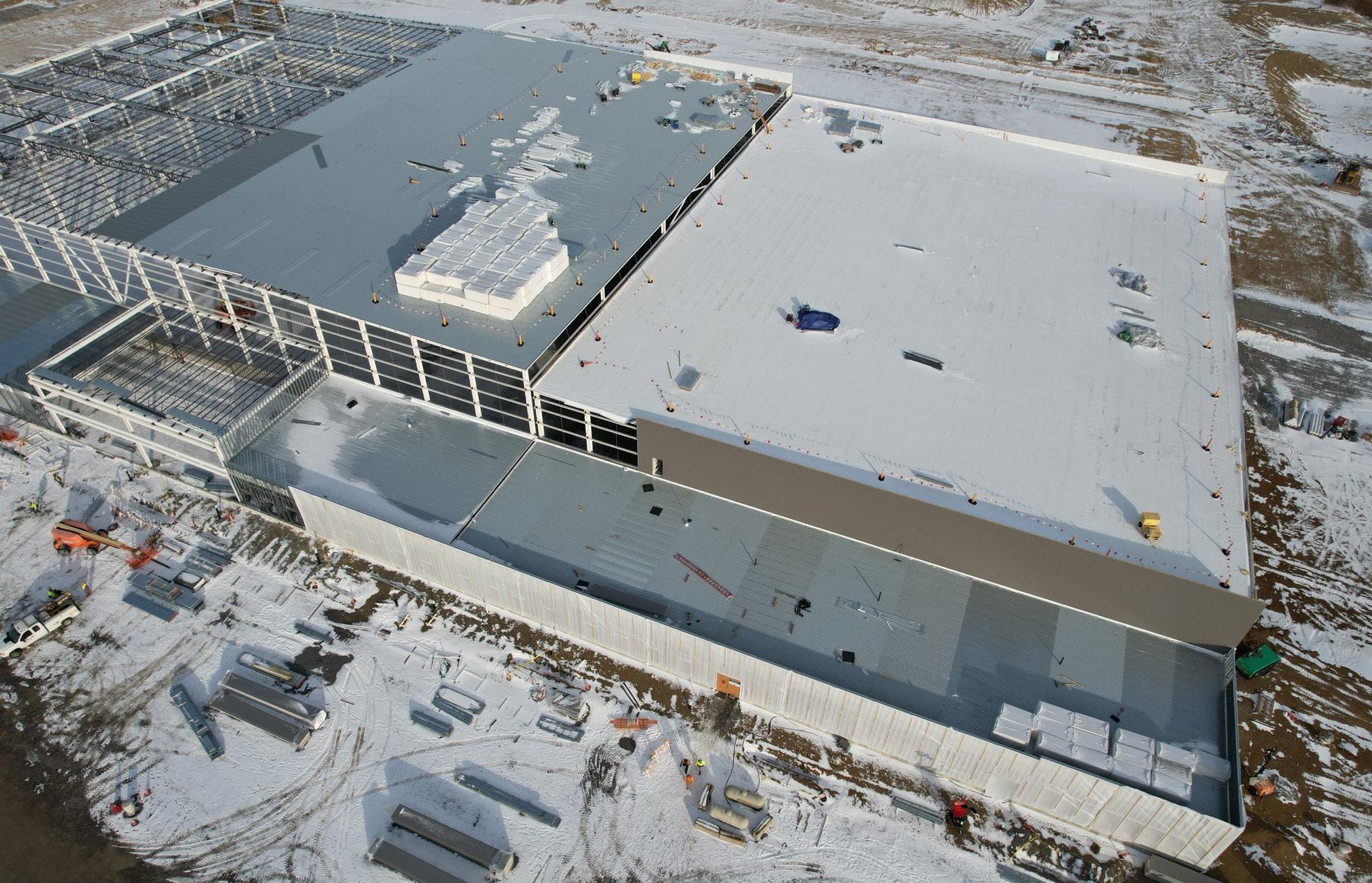
Project Horizon is a 180,000 SF electrical component manufacturing facility for Mitsubishi Electric Power Products in Western Pennsylvania. The building is about 11 months into its 16 month duration and is quickly progressing. This winter we have had to work through the worst winter Pennsylvania has seen in two decades, with temperatures consistently under ten degrees below zero (not factoring in windchill) for months and consistent winds in excess of twenty miles an hour. Snow accumulation has consistently been our largest battle, at one point having to resort to lifting full-sized snowblowers onto the partial roof after we received more than two feet of snowfall in a 24-hour period just to keep our roofers working. This severely hampered the progress we could make on the roof and exterior of the building, however the interior build out for mechanical, electrical and plumbing systems were minimally impacted. Despite these harsh conditions we are proud to say that the project is still on schedule with zero lost time incidents. The most recent milestone we have passed was that all our rooftop units have been set and secured in place at the beginning of this month.
Liberty Mutual (Kris Geltz) conducted an insurance risk assessment on March 12 and did not identify any safety violations nor had any recommendations.
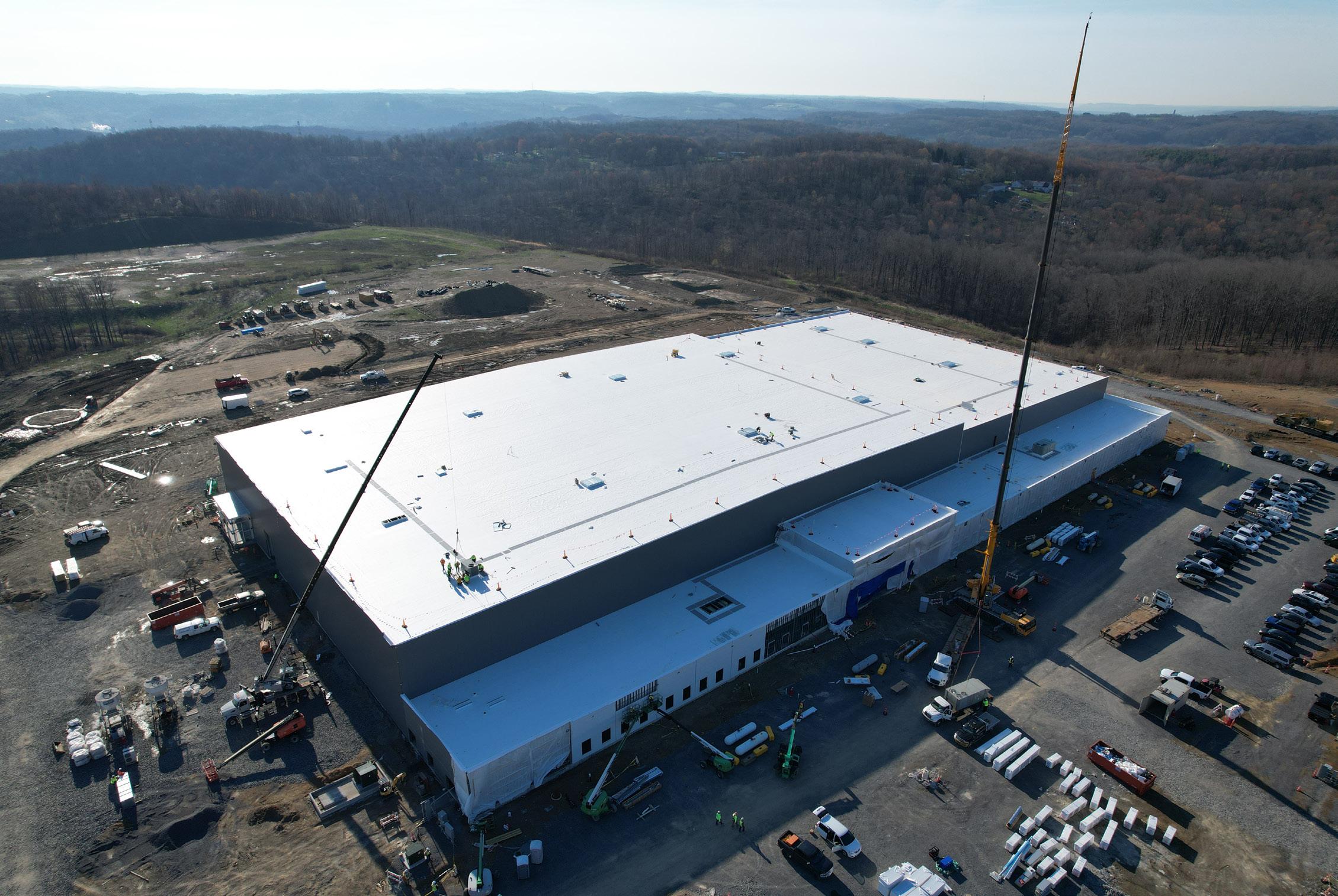
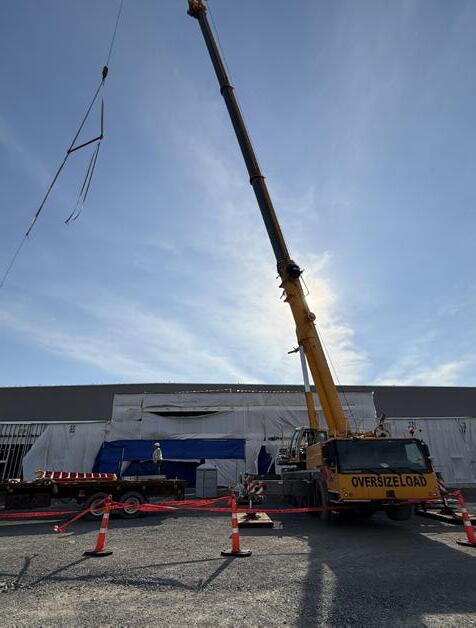
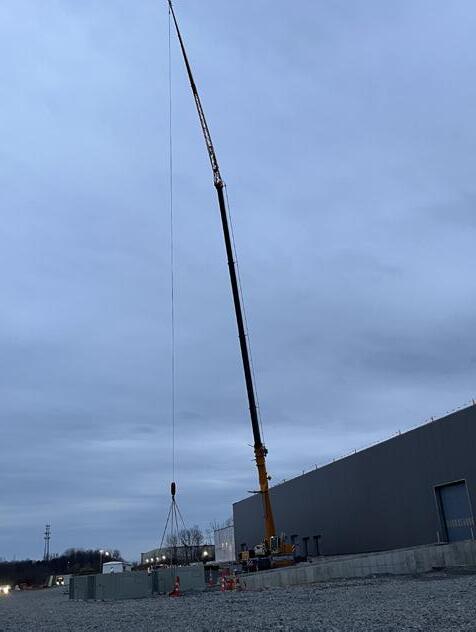
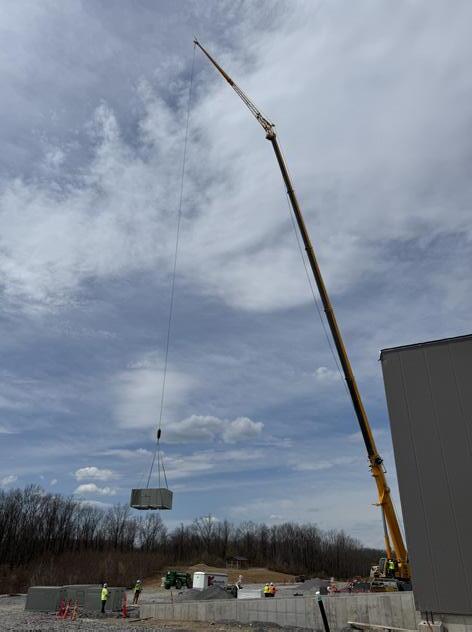
Last week our team successfully installed 17 rooftop HVAC units using a crane lift. Completing a lift of this scale keeps the project on schedule and sets the stage for critical interior build-out and system commissioning in the weeks ahead.
• Major logistical effort: Installing 17 rooftop HVAC units in a single crane lift required extensive planning, coordination, and precision.
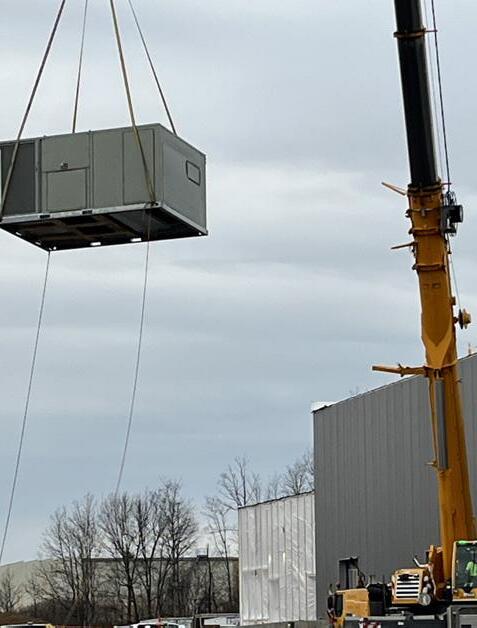
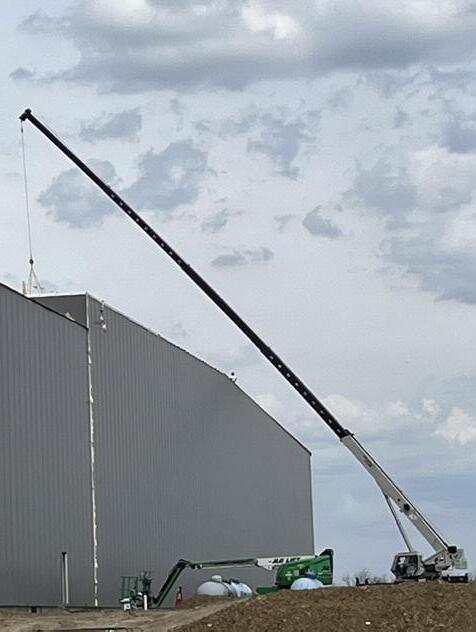
• Safety-critical operation: Crane lifts demand strict safety measures and seamless collaboration across multiple trades.
• Schedule milestone: Completing this phase keeps the project on track and unlocks the next stages of interior build-out and system commissioning.
• Progress marker: The successful lift signals a transition from exterior and structural work to mechanical and operational readiness.

SENIOR SUPERINTENDENT
2 Years at The Austin Company
What project are you currently working on (and where is it located)?
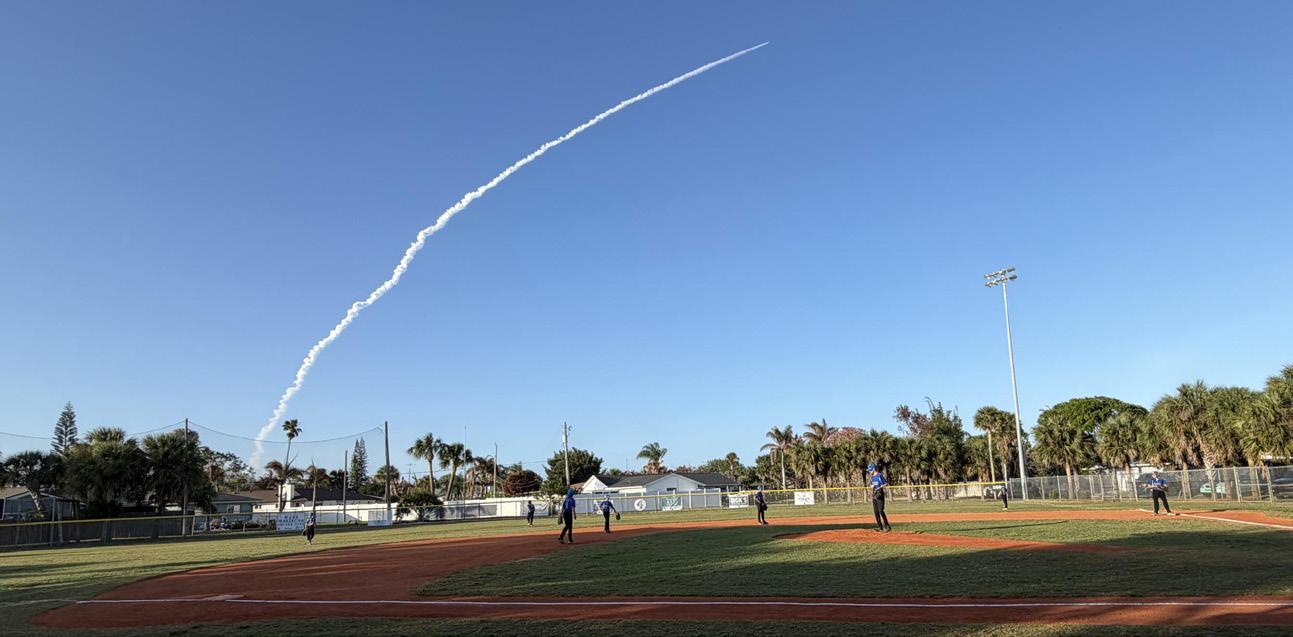
SAMT–Melbourne, Florida
What part of your job are you most proud of?
Relationship building.
What’s one thing you wish people who don’t work in the field better understood about your day-to-day work?
The number of interactions thru all levels of external and internal teams required to coordinate daily.
How does your team support each other on the job?
Working to each other’s strengths, and assisting “to get it done” is part of our culture and success.
What does “Results, not Excuses” mean to you in your role?
Success is a requirement, not an option. Proactive thinking and planning and team culture are the path to that success.
Share a piece of safety advice or a lesson you’ve learned. Finish the sentence: “My Reason for Safety is…”
Tragedy leaves lifetime scares to families and coworkers. Safety is not optional.
Do you have any hobbies, special skills, or hidden talents?
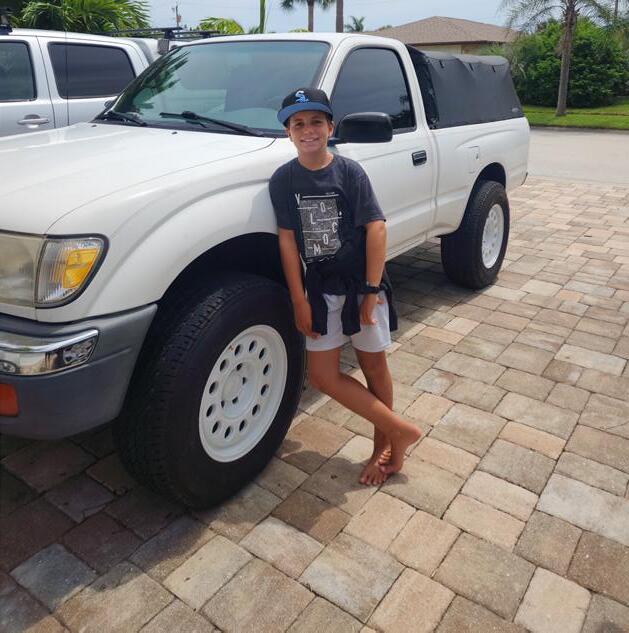
Carpentry and vehicle restoration with son.
What’s something about you that might surprise your coworkers? I started construction doing early to mid 1800’s restorations.
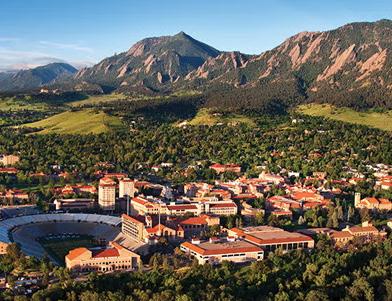
The Austin Company is involved in University of Colorado – Boulder Construction Safety Research Alliance (CSRA).
CSRA research includes teams of safety individuals from the construction industry, government, and academic leaders with doctorate degrees in engineering.
Through their involvement with the CSRA, they are researching why employees continue to experience seriously injuries and fatalities (SIFs) on construction projects. The research results are not someone’s opinion, but proven facts, backed by data, and with recommendations of what can be done to prevent SIFs.
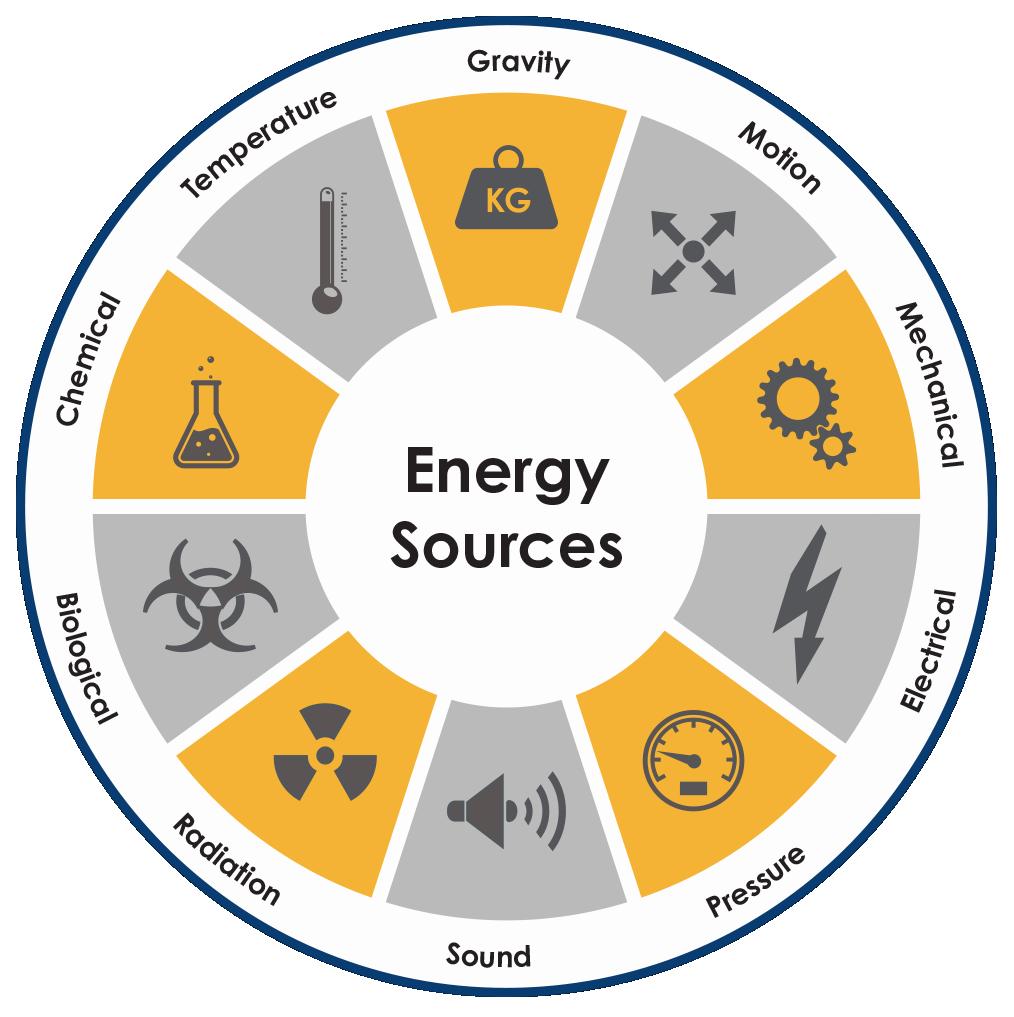
Serious injuries and fatalities are more than just a number— it’s shaped by the interplay of energy, controls, and time, and is influenced by a complex array of human, organizational, and managerial factors. By leveraging tools like high-energy control assessments, climate diagnostics, and human factors analysis, we can peel back the layers of SIF risk.
This deeper understanding will help us to create a more comprehensive and objective method of assessing SIF risk, enabling smarter, datadriven decisions that reduce risk during design and planning stages.
Charlie Engel is currently working with the CSRA team study on “EnergyBased Risk Assessment.”
Steve Lotz is currently working with the CSRA team study on “Safety Starts with Design.”
Design is an important and powerful ability. It affords us the opportunity to create an environment to our liking. While architects and engineers design buildings and bridges, in the construction industry, this project is about designing work processes. Whatever we design and build, good design demands attention; that is especially true during logistics planning and work process design that could affect worker safety. However, for complex projects that contain high-energy hazards, designing safe work operations may be easier said than done. In this study, we aim to explore tools and practices that support risk management and enable the effective design of safe construction work operations during pre-construction planning. We will conduct experiments to document the efficacy and value of selected tools and practices and develop guidance for their effective implementation.
We envision the study will lead to a protocol for their implementation in practice and ultimately facilitate a culture of safe design within construction firms when planning and scheduling work operations.
CSRA Content Library | CSRA HIERARCHY
JJ Keller | April 4, 2026

Protecting workers’ heads takes more than a hard hat.
A 2017 National Institute of Health (NIH) study looked at employees across four Kansas worksites and found a clear link between stress and productivity. The study revealed that higher stress scores were significantly associated with lower productivity and greater job dissatisfaction. The result of this study suggests that employers who actively work to reduce stress are not just improving mental health and morale, but they’re boosting productivity as well.
When Sebastian walked into the office each morning, no one could see the weight he carried. Deadlines were met, meetings attended, yet his smile never faltered. Inside, stress and anxiety were taking a toll, and his story wasn’t unique.
One study showed a very interesting contrast: most employees (about 77%) stated they were comfortable
supporting a coworker’s mental health. However, when it comes to their own stress or burnout, 42% worry that opening up about it or seeking help could hurt their career or make them a target. Even more striking, one in four have thought about quitting because of mental health challenges. And it’s not just long-term stress. A recent Gallup poll found that 41% of workers felt highly stressed just “yesterday.”
These statistics underscore a troubling theme that employees value and wish to nurture mental wellness; however, stigma, insufficient support, and overwhelming stress persist. Employers need to begin recognizing and proactively addressing workplace mental health in order to cultivate resilient, productive teams.
The state of Michigan is piloting a new initiative aimed at improving workplace mental health which is increasingly being recognized as an
have thought about quitting because of mental health challenges.


occupational safety and health issue. This expands the state’s historically stringent approach to reducing on-the-job risks.
Michigan’s LEADS program—short for Learn, Educate, Act, Deploy, Study—is a four-month initiative designed to give employers practical tools to tackle stress, burnout, and communication breakdowns that often lead to safety incidents. The idea is simple: when communication falters and stress goes unchecked, mistakes happen. Those mistakes can mean more human errors, higher injury rates, quiet quitting, and turnover.
One of the program’s key features is an evidencebased organizational assessment. Think of it like a safety audit that’s focused on mental health risk s rather than physical hazards. Employers get a clear picture of issues such as heavy workloads, unclear roles, workplace conflict or bullying, and weak support systems that can quickly erode a strong safety culture.
The end goal of the LEADS program is not to replace existing safety programs but rather strengthen them. Consider joining Michigan in their effort to enhance communication, better define workers’ roles, support unfettered reporting, and more effectively engage employees.
Key to remember: Stress doesn’t just weigh people down; it can have significant safety and productivity consequences. Programs like Michigan’s LEADS pilot initiative are giving employers the ability to tackle stress and burnout before they lead to mistakes, injuries, or turnover.

9+ MILLION EMR RATE
Work hours without a lost time incident