The Safety Net L O C AT I O N C O N S U LT I N G
DESIGN & ENGINEERING
DESIGN-BUILD
NOVEMBER 2019
IT’S ALWAYS SAFETY FIRST. CONSTRUCTION & CONTRACTING
VOLUME 13 ISSUE 11
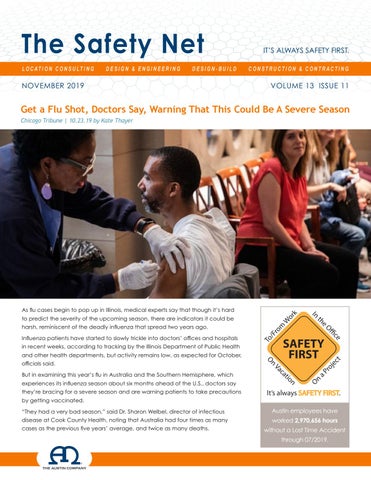
Get a Flu Shot, Doctors Say, Warning That This Could Be A Severe Season Chicago Tribune | 10.23.19 by Kate Thayer
As flu cases begin to pop up in Illinois, medical experts say that though it’s hard to predict the severity of the upcoming season, there are indicators it could be harsh, reminiscent of the deadly influenza that spread two years ago. Influenza patients have started to slowly trickle into doctors’ offices and hospitals in recent weeks, according to tracking by the Illinois Department of Public Health and other health departments, but activity remains low, as expected for October, officials said. But in examining this year’s flu in Australia and the Southern Hemisphere, which experiences its influenza season about six months ahead of the U.S., doctors say they’re bracing for a severe season and are warning patients to take precautions by getting vaccinated.
SAFETY FIRST.
“They had a very bad season,” said Dr. Sharon Welbel, director of infectious
Austin employees have
disease at Cook County Health, noting that Australia had four times as many
worked 2,970,656 hours
cases as the previous five years’ average, and twice as many deaths.
without a Lost Time Accident through 07/2019.
The predominant virus for the Southern Hemisphere was
CDC officials earlier this month urged pregnant women to
H3N2 — also blamed for the severe 2017-18 season in
get a flu shot after finding in a report that most do not get
the U.S. that sickened 49 million people and killed nearly
vaccinated for influenza and whooping cough despite
80,000. The Centers for Disease Control and Prevention
advice to do so from their doctors.
called it the deadliest flu season in decades.
Dr. Michael Fitzgerald, a family medicine physician with
Welbel said that while public health officials look at
DuPage Medical Group in Naperville, said that while he
Australia’s season to help predict what might happen in
has yet to see a patient with the flu, “it’s on our radar.”
the Northern Hemisphere, it’s not always accurate. She
Anyone who comes in with a fever, cough or sore throat is
estimated that about “50 to 70 percent of the time we
checked for flu, he added. Because last year’s flu season
mirror what we saw in the Southern Hemisphere.”
was more mild — especially compared with the previous
IDPH Director Dr. Ngozi Ezike said this year’s flu vaccine
year’s severe one — Fitzgerald said he worries people may
was delayed as public health officials continued to
be complacent and skip their flu shot this year.
determine which strains to include. But it’s now available,
He said he’s been proactive in spreading the word to his
and anyone who is at least 6 months old should get one
patients, offering them the vaccine during visits, as well
by the end of October, she said. Though it’s never too late,
as hosting separate clinics where anyone can stop in for
“the sooner the better.”
the shot.
The H3N2 strain is included in the vaccine, and that
“Flu hurts people; it hospitalizes people, and it kills people,”
particular strain is known to be more severe, Ezike said.
he said he tells his patients. With the flu shot, “really, you’re
However, strains can mutate, so they may not match
preventing hospitalization and death.”
what’s in the vaccine, she said, but “even if it’s not a perfect match, it’s going to be more protective than having nothing.”
16 Tips For Staying Healthy While Traveling Traveler.com | 2014 Come what may—cold, flu, norovirus—certain travelers
3. Wear glasses instead of contact lenses. Contact lenses
manage to jet-set all over the world, attend the most
can dry your eyes and make them vulnerable to microbial
crowded events, and rarely get sick. If you’re not one of the
invaders. Wearing glasses also makes you less likely to touch
lucky few, there are still some ways to mitigate the negative
or rub your eyes.
health effects of frequent travel. Here’s what you need to know to stay well on your next getaway.
BEFORE YOUR TRIP
AT AIRPORTS, TRAIN STATIONS, & OTHER PUBLIC SPACES 1. Stay at least six feet away from people who are coughing, sneezing, or who simply look sick. That’s the
1. Strengthen your immune system. The scientific evidence
distance tiny virus-filled droplets can travel when exhaled
on the powers of supplements to prevent cold and flu isn’t
by a flu-infected person—landing in your eyes or nose and
yet conclusive, but it doesn’t hurt to take them if they’ve
ending up in your respiratory system.
worked for you in the past, says Phyllis Kozarsky, M.D., the
2. Sanitize hands after touching germy hot spots: For
Centers for Disease Control’s travelers’ health consultant. A frequent traveler herself, she favors probiotics to boost gut health.
instance, the ticket kiosk, ATM, security-line bins (have you seen anyone clean those between use?), door handles, dining trays and tables, and anything in the bathroom. “If
2. Pack these items in your carry-on: Hand sanitizer with
it’s touched by a lot of people, it’s a potential problem,”
at least 50 percent alcohol; disinfecting wipes (such as
says Vincent Racaniello, Ph.D., professor of microbiology
Clorox or Lysol); a light shawl or coat that can be used as
and immunology at Columbia University, and founder of a
a blanket; a travel pillow (on a long-haul flight or train trip);
blog about viruses. Use sanitizer on all parts of your hands,
bandages; and nasal spray.
making sure to include fingertips and any rings. If you can’t
2
clean right away, at least be mindful of not touching your
3. Use your hand sanitizer throughout the trip—particularly:
hands, nose, and mouth.
after putting your luggage away (lots of people touch the
3. Treat public bathrooms as the germy cesspool they are.
handles); after you read the magazine in the back pocket;
Do not put your bags on the floor, or your toiletry kit on the counter (if you must, then use disinfectant wipes afterward). Do your business without sitting on the toilet. Close the lid before flushing, or, if there isn’t one, flush as you leave, to
and after you get out of the bathroom. “The longer the flight the greater the number of infections that can be expected,” says Harunor Rashid, M.D., an epidemiologist with The National Centre for Immunisation Research &
minimize spray-back. Avoid touching surfaces with hands.
Surveillance, in Sydney, Australia.
Wash hands with soap and water for a full 15 seconds
4. Pay attention to your armrest if you’re in an aisle seat.
before you leave. Use your drying towel to exit without
In a 2008 Centers for Disease Control investigation of a
touching the door handle (if you can’t, then use hand
norovirus-infected flight between Boston and Los Angeles,
sanitizer after you leave the bathroom).
aisle-seat passengers were particularly vulnerable. These
4. Wear socks through the security line of an airport.
armrests are often touched by passengers heading in and
The chances of getting a fungal infection are low—
out of the restroom, says Gerba—and most people don’t
you need a damp floor for that to happen—but you
have clean hands.
may pick up something on your feet, which then gets
5. Notify a staff person if you notice someone who is visibly
transmitted onto your hands as you put your shoes back
ill. If possible he or she can move the passenger away from
on (and then your face).
you (and others, depending on the situation), and if it’s a
5. Buy a bottle of water (or two) before boarding on a
respiratory problem, they will provide a face mask. But it’s
plane. While the tap water on-board has greatly improved in the last 10 years, random samplings have still every so often picked up fecal bacteria, says Charles Gerba, Ph.D., professor of microbiology & environmental sciences at the University of Arizona in Tucson. If you anticipate brushing your teeth or splashing your face during your flight, use bottled water.
not just the person sitting next to the sick passenger that’s vulnerable to cold or flu viruses: The conventional wisdom is that the two rows in front and in back of the sick person are most vulnerable, but in an “Emerging Infectious Diseases” paper published earlier this year, a passenger was, in fact, infected by the initially flu-infected person eight rows away.
USING GROUND TRANSPORTATION
ON A PLANE OR TRAIN
1. Find the least crowded spot possible on buses and
1. Prep your seating area. Flight crews have little time to
subways. There’s no bathroom on these vehicles, and the
disinfect between flights, so break out the wipes and tackle the backseat tray table and latch, armrests, headphones, digital screens, and window shutters. Cold and flu viruses can live a few hours to three days on inanimate surfaces.
trip is usually short, so the risks are smaller than on a plane or long-haul train. However, close contact makes you vulnerable. You’re not entirely in the clear when taking a cab if the driver is coughing, says Racaniello, but you can
“Norovirus is particularly hardy and can live up to four
open the window to help aerate the space.
weeks,” says Gerba. Trade the standard-issue blanket
2. Take a seat. “Sitting is better than standing,” says
and pillow for your own. And use your carry-on as storage
Racaniello. Seats are less contaminated than poles and
instead of your backseat pocket. After all, how can you be
straps—both of which are very much so. If you must hang on
sure that the passenger before you didn’t put a dirty diaper
to one, make sure not to touch your face during the ride.
or used tissues inside?
3. Sanitize your hands after leaving buses, subways, and
2. Point the overhead air vent down so the current flows
taxis. Whether you touched the ticket turnstile, or swiped
vertically in front of your face. This helps divert potentially
the screen on the cab, or are just not sure, clean your
infectious droplets away from your eyes, nose, and mouth.
hands. In a 2011 BMC Infectious Diseases paper, British
If your nose feels dry, refresh with nasal spray—keeping
individuals were at six times higher risk for contracting flu
the mucus membrane moist will increase its ability to fight
during winter if they use a bus or tram compared to if they
infectious microbes, says Gendreau.
never do.
3
How Often Should You Change Your Smoke Detector Battery? eHow DISCOVER | 10.24.19 by Tim Plaehn Your home smoke detectors are
Why Your Doctor May Not Be Able To Help You Avoid Diabetes ISHN | 09.16.19
important to your home safety. Proper maintenance of these devices could be a lifesaver. The batteries in the smoke detectors are the last line of power for them to continue functioning. The worst way to find out that the batteries are dead in your smoke detector is to have a fire in your home and the detector fails to provide a warning.
Smoke Alarm basics It is important to have a smoke alarm on every level of your home and outside each bedroom. If they are wired into the electrical system they should be interconnected. Newer homes will meet these requirements, but if you have an older home, it is important to make sure you have adequate smoke alarm protection. Smoke detectors that are wired into the home’s electrical system will have a battery backup so the detectors will function if the power is out. Detectors that are added after the home was built often are battery-powered only.
Statistics
According to the U.S. Centers for Disease Control and Prevention, prediabetes is a serious health condition in which blood sugar levels are higher than normal, but not high enough to meet the threshold for type 2 diabetes. The federal agency says that some 84 million Americans ages 18 or older — more than one out of three — have prediabetes but 90% don’t know it. Must get your blood tested.
Almost half of reported house fires between 2001 and 2004 occurred in homes with no smoke detectors or non-functioning smoke detectors, according to the National Fire Protection Association. The organization says 65 percent of all fire deaths were in homes without smoke alarms or in homes where they malfunctioned. Seventy-three percent of smoke alarm failures were due to missing or dead batteries.
Maintenance The U.S. Consumer Product Commission recommends that you check your smoke detector batteries once a month. The alarms will have a test button that, when pushed, will cause the alarm to sound. If it does not, replace the battery immediately. Your should install new batteries once a year. Pick a date, like a birthday or the change to daylight-savings time, and make sure all of the smoke detector batteries in the home are replaced. If a smoke detector battery does run down or goes dead in a hard-wired system, the alarm will emit a regular chirping noise. Find the beeping alarm and replace the battery with a new one. Some newer smoke alarms have 10-year lithium batteries. These alarms should be tested regularly and replaced if they do not respond. Replace the entire alarm after 10 years.
4
First Aid For Grand Mal Seizures National Safety Council | 10.22.19
Eating at Your Desk? Keep it Safe National Safety Council | 09.30.19
“When most people think of a seizure, they think of a generalized tonic-clonic seizure, also called a grand mal seizure,” the Centers
Do you regularly eat at your desk? If so,
for Disease Control and Prevention says. “In this type of seizure, the
you’ll want to make sure to “give bacteria
person may cry out, fall, shake or jerk, and become unaware of
the pink slip the next time you desktop dine,”
what’s going on around them.”
the Academy of Nutrition and Dietetics says.
Grand mal seizures are caused by abnormal electrical activity in
Here’s how:
the brain, according to the Mayo Clinic, and usually are a result of
• Thoroughly wash your hands before and
epilepsy, although they can be triggered by a stroke, low blood sugar or a high fever. This type of seizure has two stages: the tonic phase, in which loss of consciousness occurs, the muscles contract and the person falls down; and the clonic phase, in which the muscles experience rhythmic contractions of flexing and contracting. Basic steps to follow if you suspect a co-worker is experiencing a grand mal seizure, according to CDC, are: • Ease the person to the floor. • Turn the person gently onto one side, which will aid breathing. • Make sure the area around the person is clear of sharp or hard objects. • Put something soft under the person’s head and remove eyeglasses. • Time the seizures, and call 911 if they last longer than five minutes. CDC notes that workers trying to help should never hold a person
after eating. If you can’t get to a sink to wash your hands, use an antibacterial hand cleaner at your desk. • Don’t let food sit out for more than two hours before putting it in a refrigerator. • Ensure the temperature of workplace refrigerators is below 40º F. • Frequently wash reusable lunch totes or insulated bags. • Don’t thaw frozen foods on countertops – do so in a refrigerator or microwave instead. • Eating leftovers for lunch? Make sure you reheat them to at least 165º F.
down or try to stop the person’s movements, and never put anything
Don’t forget: The same food safety tips apply
in a person’s mouth, which could cause injury to the person’s teeth or
to carry-out and fast food.
jaw. Additionally, don’t give mouth-to-mouth resuscitation, as seizure victims usually start breathing on their own after the seizure ends.
5
Alcohol And Drugs Have No Place At Work 2019 Working while you’re affected by alcohol or drugs is dangerous. Your employer, you, and your coworkers need to take steps to keep alcohol and drugs out of the workplace.
Know the hazards The harmful effects of alcohol and drugs include: • ALCOHOL causes impaired judgment and reduced
Recognize abuse Substance abuse can lead to: • Poor job performance, • Accidents or injuries, • Medical complications, • Family problems, and • Legal problems. If you think a coworker has a substance abuse problem, urge him or her to get help. If you are uncomfortable talking with the coworker, bring your concerns to your
reaction time. It is a common cause of motor vehicle
supervisor. Ignoring the problem doesn’t help anyone.
crashes and the resulting deaths and injuries.
If you have a problem with substance abuse, get help.
• OPIOIDS can cause sleepiness and dizziness, confusion,
Many employers offer a confidential employee assistance
and depression, among other side effects. They also
program (EAP). You also can talk with your personal
pose a serious risk of addiction, abuse, and overdose.
physician or get help from a community program.
• MARIJUANA reduces a person’s ability to concentrate. It also can cause a person to panic or become anxious, and its use can lead to lung disease. • INHALANTS (commercial products, such as paint thinner, cleaning fluids, and adhesives that contain
Learn the policy The use of alcohol and drugs in the workplace can cause serious problems with: • Employee health
solvents) cause short-term inebriation. Use can affect
• Employee morale
the brain and nervous system, the blood, the heart,
• Safety
and other organs. • METHAMPHETAMINE can cause paranoia, hallucinations, and out-of-control rages. It is addictive and can
• Product quality • Productivity • Security
damage the heart. • COCAINE is a stimulant that is powerfully addictive, and its use has been linked to heart disease.
An alcohol- and drug-free workplace program helps to keep substance abuse from causing these problems. You should understand and follow the policy.
Quiz – Alcohol And Drugs Have No Place At Work For each question, show if you think the statement is True or False. 1. Workplace substance abuse can cause workplace security problems.
drugs at work. False
2. Drunk driving is a common cause of car crashes. True
False
3. Methamphetamine isn’t addictive. True
True
False
5. Your doctor can help you if you have a problem with alcohol or drugs. True
False
False
6 1. True 2. True 3. False 4. False 5. True
True
4. Never report a coworker if you see him abusing
STAR Program ECS Corporation Services | 2019
We Value Safety
participation by all employees and performs office and
ECS has integrated safety into our culture by developing it
field audits.
as a value, not just a priority. While priorities may change,
“At ECS, safety is more than a priority or culture; it is
values do not.
employees caring for one another so that their families will
Our STAR program is a behavior-based process in which employees observe coworkers regularly to reinforce good safety practices, as well as identify and correct unsafe practices that might lead to injury.
see them come through the door at the end of the day, just the way they left in the morning—without injury.” – Jim Carpenter, Chief Engineer
In Our Own Words
S: Stop what they are doing
“I was monitoring a pier job when the drill rig started
T: Think about the dangers present and safe
shaking and shooting out metal bearings. A few made
ways to perform the task
deep gashes in my hard hat, but had I not been wearing
A: Act in a safe manner, and frequently reassess R: Refine their actions so they can perform the task even more safely next time
my safety gear, I could have been seriously injured. Safety is not an accident and we all want to go home to our family at the end of the day! The bottom line is it’s better to lose a minute of your life to prepare for safety than to lose your life
Each office has a trained Safety Officer who oversees their STAR Safety program, trains new employees in the STAR process, conducts frequent safety meetings, promotes
in a minute!” – Edward DeLeon Edward DeLeon has been with ECS since 2003 and is a Senior Field Technician in our Austin, TX office.
“The bottom line is it’s better to lose a minute of your life to prepare for safety than to lose your life in a minute!” - Edward DeLeon
7
When OSHA Shows Up at Your Project Weeklysafety.com | 10.22.19 OSHA may make inspections to any commercial or residential jobsite and rarely will advance notice be provided. These inspections may cover the entire workplace or jobsite, or just a few operations. Why OSHA may select a company for inspection, in order of priority: • Imminent Danger, when there is a good chance that a hazard could result in death or serious harm. • Fatal or Catastrophic Accidents, all work-related fatalities must be reported within 8 hours and all work-related inpatient hospitalizations, amputations, or losses of an eye must be reported within 24 hours. • Employee Complaints of unsafe working conditions or alleged safety violations. • Program Inspections in industries that have a higher than normal accident rate. • Special Emphasis Programs that are currently being targeted by OSHA, like Excavations for example. • Follow-up Inspections to verify that cited violations have been corrected (abated).
BEST PRACTICE Because OSHA visits are unannounced, ensure that the work site is compliant at all times. WHEN AN OSHA COMPLIANCE OFFICER ARRIVES ON SITE,
5. During the walk-around inspection, the Compliance
here is what all employees and managers should know
Officer is permitted to take notes and photographs and
about ahead of time.
shall comply with the safety and health rules required at
1. Notify the person responsible for the site, such as the
the job site.
supervisor, manager, project superintendent or owner. 2. Request identification, write down the Compliance Officer’s name and ID number, and ask which area office they represent. 3. The purpose of the inspection should be stated by
6. Employees may be interviewed or written statements may be requested. 7. A company representative should take notes and photos of all inspection activities. 8. A closing conference will be arranged to allow the
the Compliance Officer before or during an opening
Compliance Officer to review any violations observed
conference at the beginning of the visit.
and refer to applicable OSHA standards.
4. A manager should escort the Compliance Officer at all times.
9. Instructions on follow-up procedures will be provided at the end of the inspection.
8
During the inspection, everyone on site should follow these guidelines: • Be cooperative. • Do not evade questions or try to hide anything. • Answer questions truthfully, but do not speculate. • Do not be sarcastic or argumentative.
HANDWASHING: Cool Water As Effective As Hot For Removing Germs ISHN | 10.16.19 by Robin Lally
• Do not volunteer information, answer only the questions asked. • Do not volunteer an admission of guilt. • Take notes, measurements and photos. • If possible, fix any violation immediately.
OSHA Standard 1926.3(a)(1) states that any authorized representative shall have a right of entry to any site of contract performance ... to inspect or investigate the matter of compliance with the safety and health standards... Can the foreman of the job site refuse to let the Compliance Officer on site? Yes, but it is not recommended. It is always best to cooperate with any OSHA compliance officer. Does the Compliance Officer need to show a warrant?
We all know that washing our hands
No, but entry can be refused until a warrant is
can keep us from spreading germs
provided. However, cooperation with OSHA is always
and getting sick. But a new Rutgers-
recommended and granting immediate entry will get the inspection off to a good start. Can an employee refuse to be interviewed? Yes, but cooperation by all employees is advisable. An employee can ask that they have another person with them during
New Brunswick study found that cool water removes the same amount of harmful bacteria as hot.
the interview.
“People need to feel comfortable
If hardhats or PPE are required in the work area, can
when they are washing their hands
the Compliance Officer refuse to comply with the
but as far as effectiveness, this study
PPE requirements since they work for OSHA? No, the
shows us that the temperature of
Compliance Officer must wear any PPE required in the work area they are inspecting.
the water used didn’t matter,” said
What can happen if the company receives a citation?
Donald Schaffner, distinguished
If a violation is recorded, OSHA will require a corrective
professor and extension specialist in
and preventive action plan, the violation will be on the company’s public record and there may be a financial
food science.
penalty assessed.
9
OSHA Top 10 JJ Keller | 10.02.19 by Rachel Krubsack
Patrick Kapust, Deputy Director of the Directorate of Enforcement for OSHA, announced the preliminary “top ten” most cited safety violations for 2019 at the National Safety Council Congress and Expo in San Diego on September 10. The preliminary list is based on data from October 1, 2018, to August 15, 2019, and is still subject to changes. OSHA will reveal the final top ten most cited violations in November. The 2019 most cited violation, for fall protection in construction, has been number one on the list since 2011. Many employers use the top 10 list each year to gauge the effectiveness of their safety programs.
OSHA’s Top Ten Violations for 2019 (preliminary) 1. Fall Protection: General Requirements (1926.501)
6,010 citations 2. Hazard Communication (1910.1200) 3,671 citations 3. Scaffolding (1926.451) 2,813 citations 4. Lockout/Tagout (1910.147) 2,606 citations 5. Respiratory Protection (1910.134) 2,450 citations
6. Ladders (1926.1053) 2,345 citations 7. Powered Industrial Trucks (1910.178) 2,093 citations 8. Fall Protection: Training Requirements (1926.503) 1,773 citations 9. Machine Guarding (1910.212) 1,743 citations 10. Eye and Face Protection (1926.102) 1,411 citations
10
Employee Safety Training Advisor
Leadership Gaps and Situational Awareness
WORKPLACE SAFETY: OSHA approves new
Know the causes of cognitive errors
respirator fit testing protocols
ISHN | 09.12.19 by David Sarkus MS, CSP
Jj Keller | 09.26.19 by Rachel Krubsack
The knowledge gap within utilities, construction, and related industries is more of a growing concern than ever — especially when it comes to serious injuries and exposures. I often speak with clients about their need for trainable or experienced workers in carpentry, electrical, plumbing, welding, or in HVAC systems. And if we look further, this gap certainly extends to leaders who are expected to support workers with these skills, especially leaders who have limited experiences of their own. Leaders who lack hands-on experience often lack the competencies to more fully understand various jobs and the
OSHA has issued a final rule that provides employers with two new fit testing protocols for ensuring that employees’ respirators fit properly. The new protocols are the modified ambient aerosol condensation nuclei counter (CNC) quantitative fit testing protocol for full-facepiece and half-mask elastomeric respirators, and the modified ambient aerosol CNC quantitative fit testing protocol for filtering facepiece respirators. Both protocols are variations of the original OSHA-approved ambient aerosol CNC protocol, but have fewer test exercises, shorter exercise duration, and a more streamlined sampling sequence.
situational hazards that could lead to various errors and harm producing incidents.
Increasing knowledge of mental errors We now have more tools at our disposal than ever before. One evolving field of study that is showing more interest and application is that of the cognitive sciences, and mental errors, cognitive slips, attentional control, and situational awareness. There are many models and thoughts floating around, but I believe our efforts should be directed toward using applied work that is readily understandable for both front-line leaders and workers. The aerospace industries along with the medical researchers have taken the lead in this arena, especially over the past 20 years or more. So, please let me throw some mud against the wall and see what may stick for you and your organizations.
These two quantitative methods add to the four existing in Appendix A of OSHA’s
What causes errors?
Respiratory Protection Standard at 1910.134,
Having a taxonomy of causal factors to categorize errors and
which contains mandatory respirator fittesting protocols that employers must choose from to protect employees from hazardous airborne contaminants.
appropriate interventions is a good starting point. And situational awareness seems to be one causal factor that often becomes a major contributor to errors and subsequent accidents (Endsley, MR, 1995). I believe in parsimony in creating a practical model for
OSHA says the rule does not require employers
use by front-line supervisors and workers. When we do this, we can
in general industries, shipyard employment,
obtain greater buy-in and use but may limit the enhancements
and construction to update or replace their
and comprehensive nature of a more sophisticated model. But I’ll
current fit testing methods, and does not impose
take buy-in and practical use, any day of the week.
additional costs. The rule took effect September 26, 2019.
...continued on next page
11
Here are seven causal factors: 1. Poor planning at any level will cause a host of safetyrelated problems. Good planning includes materials, people, tools, equipment, and processes. Each of these are a big part of getting a job done efficiently, effectively, and safely. 2. Failure to recognize hazards needs to be supported by training and follow-up. Pre-job briefings, task hazard analyses, and related learnings requires attention and abatement of the concerns identified. 3. Failure to incorporate hazards. When work operations become busy, workers may recognize various hazards but forget about them throughout the course of their day, which may lead to unabated hazards and injuries. Mental overload may be an underlying concern that should be addressed. 4. Incomplete information. Some leaders make decisions
6. Failure to predict consequences. In some cases, workers recognize a given hazard but fail to attach meaning to what they’ve seen. Individuals may continue working but fail to understand how that hazard could eventually impose harm. For example, the movement of people and related line-of-fire risks, or an open container of low flash point solvents that could be ignited through the use of nearby tools or equipment. 7. Fatigue may play a big part in physical and mental miscues that underlie many near-misses and accidents. Time-outs, appropriate breaks, diet and exercise are all part of the solution.
Diminishing unwanted errors I’m fully aware of other contemporary taxonomies that are more comprehensive, but some organizations, along with their front-line leaders and workers, may not benefit from such complexities (Zhang J., Patel V.L., Johnson
on the floor or in the field with limited knowledge and
T.R., Shortliffe E.H., 2004). Even more, today’s data-driven
proceed somewhat blindly. Some hazards on a start-up
solutions provide similar models that may need to be
job may not have been well identified, subsequently a
enhanced. Our challenge, as professionals, is to provide
line or job is launched, leading to a serious accident.
meaningful categorizations of situational or mental errors,
Something as simple as a guard or new tool that wasn’t
and corresponding interventions and training that can
properly installed, or appropriate training may be part
lessen their impact.
of the solution. 5. Procedural deviations such as omitting an important
Finally, today’s complex organizations, with intricate people interactions, processes, and human factors interfaces,
step or task is an oversight, knowledge or execution
may require more robust but practical strategies. However,
gap that requires significant attention. Salience in
having a starting point to limit cognitive errors and issues,
communications and a thorough understanding of
through front-line leaders and workers, is a key factor in
procedures becomes increasingly important.
diminishing unwanted consequences.
12