THE SAFETY NET CO N SU LTA N T S
•
DESIGNERS
SEPTEMBER 2021
•
ENGINEERS
IT’S ALWAYS SAFETY FIRST. •
CO N STRUCTO RS
VOLUME 15 ISSUE 09
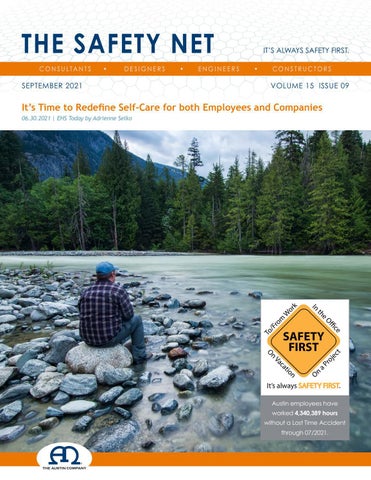
It’s Time to Redefine Self-Care for both Employees and Companies 06.30.2021 | EHS Today by Adrienne Selko
SAFETY FIRST. Austin employees have worked 4,340,389 hours without a Lost Time Accident through 07/2021.
“As companies did a great job pivoting during the
people uncomfortable, to ask people how they are doing. It
pandemic, they must continue to do the same when it
can make a great impact. It can start a discussion,” says Allen.
comes to self-care,” explains Robert Allen, CEO of New Dimensions Consulting Services. At some level, all of us know that stress takes a terrible toll on our health and ultimately how we are able to perform our jobs. What we don’t know is how to figure out at what point stress will turn into anxiety and even depression which
And from there a company can place the information in a more formal structure. He suggests taking a quick survey asking people specific questions with specific measurements. • How is your stress level using a scale of 1 to 5? • What times of the day do you feel more stress?
will affect both our personal and professional lives.
• How is your work/life balance?
While companies have tried a variety of methods to help
• How can the company make your time at work better?
employees, either through employee assistance programs
Looking at the answers can provide great insight into the
( EAPs) or more recently due to the pandemic more information and discussions about burnout, there is more that can be done.
company’s culture. What the company feels is a good working schedule, may turn out not to be. What is self-care to one person, perhaps flexible shifts, seems disruptive
“As companies did a great job pivoting during the
to others. These answers can be a great starting point to
pandemic, they must continue to do the same when it
evaluate the culture that currently exists and open up ways
comes to self-care,” explains Robert Allen, CEO of New
to readjust and improve.
Dimensions Consulting Services and author of Self-care Let’s
The next step is to take this data and analyze it to
Start the Conversation. “As individuals, and as companies, we need to examine our levels of stress and chart a new course.” He describes the process as the 4r’s – Retreat, Reflect, Replenish and Regroup. The best starting point is to do an assessment of a company’s current practices which determines the company’s culture. He provides the example of working with a company whose leadership sessions were quite lackluster, with the majority of the leaders not paying attention during the meeting. Consulting with the COO, he asked to take over the first ten minutes of these meetings. Allen played music and posed ice-breaking type of questions, such as asking about favorite cartoons. Once the group relaxed and had fun, everyone was able to absorb the content of the meeting. In fact, with time, the first ten minutes of the meeting turned into a time to meditate and
determine where the problem is, just as you would look at data to see where the machinery is breaking down. While human solutions are not as clear-cut as machine maintenance, there are many ways to readjust working conditions. “I tell companies that in some instances if employees work a six-hour day it would be more productive than an eight-hour day, as often two hours are spent fixing mistakes. If people are at their optimal performance level for 6 hours, overall company productivity could improve.” Once areas of improvement are noted, there are several ways to move forward. “I suggest that leaders just walk around the company, much like the Gemba walk of manufacturers, and see for themselves what is going on,” says Allen. “Read the sign language. As an outsider, I can usually tell pretty easily the state of the culture.”
relax bringing stress levels way down. “The leadership of this
Companies can opt to bring in consultants such as Allen,
company enjoyed the new atmosphere and brought that
but they can also hire what he calls Goal Coaches. These
to the managers and down the line of the organization. It
coaches can work to figure out ways to address the
was a true culture shift,” says Allen.
issues. An example Allen cites is a financial firm that has a
The structure for this type of activity isn’t really all that different from what many in the manufacturing, and other sectors, do which is getting to the root cause of an issue. Just as any company regularly checks on the health of its machinery or other assets, this method is in fact a check on the human assets. And just as many companies have safety
psychologist, as a coach, on staff to work with stockbrokers to see where and how they get stuck. Sometimes it’s business processes or sometimes it’s something in their personal lives that need to be addressed. “Using a coach takes away a stigma that many people have about discussing their mental health,” Allen points out.
meetings at the beginning of the day, Allen says to use that
Allen is very hopeful that given the tools both employees
time to check on the health of the employees. “Take a few
and employers can find methods to put self-care at the
minutes at the start of a group meeting, so as not to make
core of the culture leading to healthier people and companies.
Take Care of Your People 08.09.2021 | EHS Today by Adrienne Selko Self-care and a sense of purpose are ways to help
from the COO, Allen took over the first 10 minutes of these
employees cope with workplace stress.
meetings. Allen played music and posed ice breaker
A few months ago, I was talking with an EHS professional
questions, which captured everyone’s attention. Eventually,
about the safety processes and procedures he implemented to help his staff through the pandemic. He mentioned that his next priority is making sure staff are doing well on a personal level. “I want to ensure that they
the first 10 minutes of the meeting turned into a meditation segment that brought stress levels way down. “The leadership of this company enjoyed the new atmosphere and brought that to the managers and down the line of the
are taking care of both their physical and mental health
organization,” Allen says. “It was a true culture shift.”
now that we are past the immediate concerns. That is my
Read more: It’s Time to Redefine Self-Care for Both
top goal this year.”
Employees and Companies
There are several paths that EHS professionals will be
A useful tactic to formalize a changing culture is to gather
taking to help their workforce post-pandemic. I discovered
and analyze data. Allen suggests taking a quick survey to
a couple of interesting approaches in my recent
ask employees specific questions with specific measurements:
conversations with Robert Allen, CEO of New Dimensions Consulting Services, and Vic Strecher, professor of public health at the University of Michigan and CEO of Kumanu. “As companies did a great job pivoting during the
• How is your stress level using a scale of 1 to 5? • What times of the day do you feel more stress? • How is your work/life balance?
pandemic, they must continue to do the same when it
• How can the company make your time at work better?
comes to self-care,” Allen says, adding that because of the
The results can expose old ways that are not working and
high levels of stress and burnout, self-care should be given top priority. “As individuals, and as companies, we need to examine our levels of stress and chart a new course.” He describes the process as the 4 Rs: Retreat, Reflect, Replenish and Regroup. In stepping back to reflect on a company’s culture to examine if it’s healthy, Allen provides the example of a leadership session that was quite lackluster and not achieving the intended purpose. After receiving permission
lead to ways to readjust and improve. Along with taking the emotional temperature of the organization, there is an underlying core issue that needs to be understood as well. People need to look at the root cause of their existence, Strecher says. “Dig deep past the answer that you are going to your job to support yourself, your family, your loved ones. Is there a larger, greater purpose to the work you are doing?” Strecher asks. ...continued on next page 3
This question, an existential one to be sure, is what many people across the country are asking themselves after trying to come to terms with the pandemic. They are examining their lives, and many are questioning whether they are finding meaning and purpose in their jobs. “Pointing out that work has a purpose can cause a number of things to happen,” Strecher says. “The soul-level satisfaction in finding purpose in how you spend the majority of your day changes your behavior. If you feel what you are doing matters, then you become more engaged. An employee with a purpose brings their best self to work. They take better care of themselves by eating better, working out and choosing less risky health behaviors since the lack of purpose are often at the root cause of these behaviors.” Allen offers a new approach to helping employees tackle these issues: a goal coach. “Using a goal coach takes away a stigma that many people have about discussing their mental health,” Allen says. Mental health is now showing up in safety standards as well. As one EHS Today reader commented: “As we consider the outcomes of the ISO 45003 standard on the psychological safety and health, we are reminded that everyone within the organization has a role to play. Leadership and management can have a profound effect on the workforce and can provide guidance on the critical issues important to the human performance of the organization. Together, the result can improve human relations and capacity.”
National Heat Safety Coalition Created to Address Risk from Heat Stress 07.14.2021 | EHS Today Staff Although heat illness is 100% preventable, thousands are
job, from sports, or home improvements, occur in the first
injured every year from occupational heat exposure, with
few days of working in hot environments. Heat illness is a
many cases ending in fatality.
problem indoors as well, as many manufacturing facilities
A new alliance, the National Heat Safety Coalition,
with heat-producing equipment and no air conditioning are
was announced on July 13. It was formed by The Korey
hotter on the inside than the summer temperatures outside.
Stringer Institute at the University of Connecticut, Mission,
By forming the National Heat Safety Coalition, the
a company providing industry-related technologies and
organizations also aim to address the risk factors that may
Magid, a PPE company.
increase the susceptibility of heat-related illnesses on the
“Heat stress is a constant concern for laborers who are
job and identify current barriers in the industrial sector
called on to work in hot conditions,” says Dr. Douglas Casa,
to help inform best-practice recommendations for the
CEO of the Korey Stringer Institute. “The formation of this
prevention of exertional heat illnesses.
coalition will help develop better methods for heat safety
The group will establish heat safety solutions and standards
such as body cooling, work to rest ratios, and hydration,
for the industrial sectors as well as heat-safety research,
which is an important part of our commitment to
solutions, education and awareness.
protecting workers.”
The National Heat Safety Coalition will kick off with a series
Millions of U.S. workers are exposed each day to heat-
of virtual roundtable discussions with major companies and
related illnesses in their workplaces. Although heat illness is
consumer groups who possess a wide knowledge of health
100% preventable, thousands are injured every year from
and heat safety, cooling solutions, and industrial needs.
occupational heat exposure, with many cases ending in fatality. 50% - 70% of outdoor fatalities, whether on the
5
Material Handling 08.21.2021 | Weeklysafety.com Handling materials can involve diverse operations such as
Use caution when manually handling material.
hoisting tons of steel with a crane, driving a truck loaded with
• If lifting is required to move a load, remember to bend at
concrete blocks, carrying bags or materials manually, and stacking palletized bricks or other materials such as drums, barrels, kegs, and lumber. Material handling operations provide a continuous flow of parts and assemblies through the work site and ensure that materials are available when needed. Unfortunately, the improper handling of materials often result in costly injuries. • Workers must be aware of both manual handling safety concerns and safe equipment operating techniques. • Whether moving materials manually or mechanically, workers must know and understand the potential hazards associated material handling and the controls to implement to minimize the danger. Some of the common hazards associated with material handling include: • Falling materials and collapsing loads that can crush or pin workers • Back injuries due to improper lifting techniques • Struck-by material or equipment hazards • Caught-in or pinch point material handling injuries • Damage to racking systems and inventory • Injuries due to incorrectly cutting ties or securing devices
the knees, not at the waist. • To prevent injury from attempting to lift oversize loads, seek help when loads are so bulky that it cannot be grasped properly, when you can’t see around or over a load when carrying it, or anytime you can’t handle a load safely by yourself. • Stack heavier goods and materials that will be handled manually on the bottom or mid-level shelves to reduce strain on the back. • When placing blocks under a raised load, be careful to ensure that the load is not released before removing your hands from under the load. Beware of laceration and puncture hazards when packing or unpacking crates or boxes. • Watch for protrusions such as nails, screws, staples, splintering wood, broken boards, and metal banding or straps. • Removing any sharp object that could cause injury is a priority when unpacking any crate. • When cutting shrink wrap, boxes or other material, direct the blade away from your face and body. • Do not use any cutting device near your eyes/face and ensure co-workers are a safe distance from the area where blades of any kind are being used.
Wood pallets are the most common type of pallet used but they
• Have clear visibility of the work area and ensure you
can be also be made of plastic or metal. When working with
have enough clearance when raising, loading, and
pallets, injuries can be caused by issues such as:
operating a forklift.
• Using a damaged pallet • Selecting the wrong sized pallet for racking
• Consider the noise level at the worksite. Do not assume other workers are able to hear a back-up alarm.
• Handling pallets with a forklift incorrectly
• Adjust the load to the lowest position when traveling.
• Exceeding the maximum load for the pallet
• Pile and cross-tier all stacked loads correctly when possible.
• Inspect pallets before use, specifically looking for loose
• Always wear a seatbelt when operating a forklift.
or broken boards or stringers or protruding nails. Ensure any pallets in use are not damaged. • Know the safe load capacity of the pallets being used. • Use pallets that are the correct size. Pallets that are too small for the rack may become a hazard. • Stack empty pallets flat, not leaning up on their sides.
• Be aware of other vehicles in the work area. • Use horns at cross aisles and obstructed areas. • Watch for pedestrians and observe speed limits. • Keep a safe distance from platform and ramp edges. When using aisles and passageways to move materials mechanically, workers must allow sufficient clearance for aisles
• Always wear gloves when handling pallets.
at loading docks, through doorways, wherever turns must be
Pallet jacks are commonly regarded as being safer than a
made, and in other parts of the work site.
forklift, but there are still safety precautions that all pallet
• Providing sufficient clearance for mechanically-moved
jack operators should follow, including:
materials will prevent:
• Operate the pallet jack at a safe speed. Start moving
1. workers from being pinned between the equipment
slowly and come to a stop slowly. • Do not steer pallet jacks onto uneven surfaces and avoid steep inclines. • When descending any ramp, always keep the pallet jack in front of you. Never pull a pallet jack down any incline! Using mechanical equipment, like forklifts, to move and store materials increases the potential for employee injuries. Important! Only trained and authorized workers are allowed
and fixtures, such as walls, racks, posts, stacks of material or other heavy equipment. 2. the load from striking an obstruction and falling on a worker. • Aisles and passageways must be kept clear and in good repair to allow for the safe movement of material handling equipment. • When there is a difference in road or working levels,
to operate forklifts.
use ramps, blocking or grading to ensure that material
• All materials handling equipment has rated capacities
handling equipment can move safely between the two levels.
that determine the maximum weight the equipment
Wear appropriate PPE for all material handling work tasks, which
can safely handle and the conditions under which it can
may include:
handle that weight. • Do not exceed the maximum load capacity when moving materials with equipment. When moving materials with a forklift: • Center the load on the forks as close to the mast as possible to minimize the potential for the truck tipping or the load falling.
• Gloves, when unpacking crates and handling materials to protect from lacerations • Steel-Toed Boots, to protect feet when handling heavy loads that could fall • Safety Glasses, when cutting banding, strapping or shrink wrap • Hard Hats, to protect yourself from struck-by or falling object hazards
7
Material Storage 08.21.2021 | Weeklysafety.com Applying general safety principles can help reduce
OSHA Standard 1926.250(c) Storage areas shall be kept
incidents involving the moving, handling, and storing
free from accumulation of materials that constitute hazards
of materials. Workers should know and understand the
from tripping, fire, explosion, or pest harborage. Vegetation
potential hazards associated with material storage and
control will be exercised when necessary.
how to control the worksite to minimize the danger. Stored materials must not create a hazard for workers. Consider factors such as the materials’ height and weight, how accessible the stored materials are, and the condition of the containers where the materials are being stored. • To prevent creating hazards when storing materials, it is important to keep storage areas free from accumulated materials that can cause tripping, fires, or explosions, or that may contribute to the harboring of rats and other pests. • When putting materials into storage, put bound material on racks when possible, or otherwise secure items by stacking, blocking, or interlocking them to prevent sliding, falling, or collapsing. OSHA Standard 1926.250(a)(1) All materials stored in tiers shall be stacked, racked, blocked, interlocked, or otherwise secured to prevent sliding, falling or collapse.
All passageways that workers use must remain clear of obstructions and tripping hazards. • Workers should not store materials in excess of supplies needed for immediate operations in aisles. • Do not store materials on scaffolds in excess of supplies needed for the immediate task. To follow fire safety precautions, workers must understand that flammable and combustible materials must be stored according to their fire characteristics. • Flammable liquids must be separated from other material by a fire wall. • Combustibles must be stored in an area where smoking and using an open flame or a spark-producing device is prohibited. • Dissimilar materials that are dangerous when they come into contact must be stored apart from each other.
Storage areas should be kept neat, clean and orderly to
Unique safety precautions are required for the storage of
eliminate hazards and conserve space.
hazardous materials.
• Material and supplies should never block access to
• All chemicals and hazardous materials must be stored
emergency exits, fire extinguishers, fire alarms, fire hoses, or electrical panel boxes.
safely and securely, and away from forklift traffic areas. • Drums containing hazardous liquids should be stored in a protected area out of the sunlight.
• Safety Data Sheets (SDS) must be available for all
• Inspect racks regularly to discover any damage, wear,
chemicals that workers may be exposed to on the job
or problems. Report any damage found on racks and
and employees must follow the instructions on the SDS
ensure that repairs are made quickly.
when handling chemical products. • Spill cleanup kits should be available in areas where chemicals are stored, and workers should know where to locate the written spill control plan. • Workers must be trained to clean up spills safely including what PPE they should wear for cleanup and how to properly dispose of used materials.
• If necessary, unload racks, and then tag and mark or barricade them to remove them from service until repairs are completed. Consider the safety requirements of specific materials as they are handled and placed into storage. • Drums, barrels, and kegs should be stored symmetrically with planks, sheets of plywood dunnage, or pallets
Compressed gas cylinders should be stored on a smooth
between each tier of drums, barrels, and kegs to make
floor in an upright position with the valve covers in place.
a firm, flat, stacking surface. If stored on their sides, block
• All cylinders should be chained or fastened against a wall or stable surface to prevent displacement. • Different kinds of gases, especially those that are incompatible, should be stored separately. • Empty cylinders should be stored in a location away from the full cylinders. • Traffic should be restricted in areas where compressed gas cylinders are stored. Steel storage racks or pallet racks are used to hold goods stacked on pallets. The two most common causes of racking failures are: 1. Racking that is not installed properly. 2. Damaged racking that is not reported or not repaired quickly. • Every piece or component of pallet racking must be installed according to the manufacturer’s requirements. • Column or post guards help prevent impacts and protect uprights from damage that could result in
the bottom tiers of drums, barrels, and kegs to keep them from rolling. • Lumber should be stored in such a way that is stable and self-supporting with all nails removed. Store lumber no more than 16 feet high if it is handled manually, and no more than 20 feet if using a forklift. • Boxed materials should be banded or secured with cross-ties or shrink-wrap. Interlocking boxes will create a more stable stack. For stability, boxes can be placed on a pallet which will also make them easier to move. • Bags and bundles can be stored in interlocking rows to keep them secure. • Pipes and bars should be stored in racks or stacked and blocked to prevent spreading or tilting. Do not store pipes and bars in racks that face main aisles to avoid creating a hazard to passersby when removing supplies. • Baled paper and rags stored inside a building should be no closer than 18 inches to the walls, partitions, or sprinkler heads.
catastrophic failures.
9
Is Idea Generation a Reason to Spend Some Time in the Office? Yes and No 07.22.2021 | EHS Today by Adrienne Selko One expert says collaboration in person is key, while another says online collaboration is a better way to expand the pool of ideas. Most companies are still deep in discussions about where employees will work. While some want employees showing up at a physical location daily, most seem to be endorsing a hybrid model where employees spend some days at the office and others at home. One reason given for working face-to-face is that ideas flow from face-to-face interaction. In an article on Carnegie Mellon University’s website, Sunkee Lee, an assistant professor of organizational theory and strategy at the Tepper School of Business, offers a twist on this idea. He said that his research has shown that physically bringing together people who don’t typically interact with one another can spark new ideas. In the article, he said: “That is why for organizations whose goal is to innovate, bringing back employees to the office can be important. But if limited office space precludes an employer from bringing back workers at a full scale, the employer should consider who needs to come back first. Bringing back people who know each other well could improve productivity, but these people are likely to work effectively as a team even online. Bringing back people who are not familiar with each other could seem counterintuitive, but spontaneous interactions between them could lead to new collaborations and the creation of new ideas. Of course, no relationships stay new, so periodically changing the batch of people who physically come to the office could be useful. But that’s not the last word on the subject. Darren Menabney, who leads global employee engagement at Ricoh, said in an article for Fast Company: “We don’t have to be less creative when working remotely, or even when working from home— we can be more creative. By leveraging what’s unique about remote work—work from home in particular—we can boost our creativity, both individually and collectively.
Menabney offers ways to be more creative when working remotely:
LET EVERYONE CONTRIBUTE IDEAS He suggested that as opposed to a brainstorming session in which usually a few people dominate the discussion, companies should use brainwriting, which can be done by having each team member individually creates their ideas, during or before the brainstorming session, without discussion. Then he suggests sharing the ideas on an online collaborative whiteboard. This technique is a better way to include ideas from introverts as well as those for whom English is not their first language.
CREATIVITY IS BOOSTED BY GREATER TEAM DIVERSITY Not being limited to the brainpower and creativity of just the people in the room. “We can bring in a more diverse range of collaborators from other parts of our organization—in the same city or a different country—or outside the organization. More diverse teams lead to more creativity, so remote work lets us tap into a new pool of expertise and creativity, which we couldn’t access when collaborating in-person,” he points out.
ACCESS TO BETTER FACILITATORS In-person limits facilitators to either colleagues or a local facilitator. With remote work, we can bring in expert facilitators from across our organization or recruit from a bigger pool of external facilitators. “Looking outside your own team for a facilitator is always a good idea. Facilitators shouldn’t have skin in the game or a vested interest in an ideation session’s output,” he says.
LET WORKING FROM HOME INSPIRE YOU Being able to take a walk, exercise or do other physical activities that boost creativity is much easier at home than in an office setting. “Quiet time to recharge is also easier when working from home. Suddenly sitting down for a 20-minute mindfulness session is much easier to pull off at home than in the middle of an open-concept office,” Menabney says.
OSHA Proposes $1.3M Fines After Construction Worker Deaths in Boston 08.19.2021 | ISHN Federal workplace safety regulators on Wednesday, August 18, 2021, proposed $1.3 million in penalties for the construction company that employed two men who died when they were struck by a dump truck and pushed into a 9-foot (2.75-meter) deep trench at a sewer project in Boston in February, according to the Associated Press. The Occupational Safety and Health Administration cited Atlantic Coast Utilities LLC/Advanced Utilities Inc., owner Laurence Moloney, and two associated companies for what it called “a long history of ignoring the safety and health of its employees.” Jordy Alexander Castaneda Romero, 27, and Juan Carlos Figueroa Gutierrez, 33, died in the Feb. 24 accident in the city’s Financial District. OSHA in a statement said the violations included “the company’s refusal to train Romero, Gutierrez and other workers to recognize and avoid work-related hazards.” Atlantic Coast Utilities “failed to conduct worksite inspections to identify and correct hazards, including the risks of being struck by construction vehicles and other traffic, crushed or engulfed in an unguarded trench, and being overcome by oxygen-deficient or toxic atmospheres in the trench and an adjacent manhole,” OSHA said. The company has 15 business days to either pay the penalties or contest them. Atlantic Coast Utilities said in a statement it was “devastated” by the deaths and continues to grieve. “The company will assess the actions taken by OSHA [on Wednesday] and will determine its next steps, including contesting any assertion of company error or negligence,” the statement said. “It is clear that this was a tragic accident and any attempt to portray it otherwise is both inaccurate and imprudent.”
11
Fed OSHA’s COVID-19 ETS: What You Need to Know About Face Masks, Respiratory Protection and Other PPE 07.20.2021 | OSHA Defense Report by Beeta R. Lashkar Today’s topic on the Fed OSHA COVID-19 ETS is face masks, respiratory protection, and other personal protective equipment (“PPE”)…what is required and when. 29 C.F.R. Section 1910.502(f) of the ETS establishes the personal protective equipment (“PPE”), including respiratory protection, requirements that must be implemented at covered facilities. This summary describes these requirements.
FACE MASKS The standard does not mandate that all employees wear N95 or other higher-level respiratory protection at all times. Rather, it allows employees who work at covered facilities
• Have a medical condition, disability or religious beliefs that prevents use • Would risk serious injury or death by their use (in other words, where mask use poses a greater hazard) • Need to see another’s mouth when communicating (e.g., deaf employees) In the above situations (except when alone or eating/ drinking), the employer must ensure that employees are provided with and use other protection, such as a face shield, if feasible and where it will not pose the same concerns as use of a face mask. The standard establishes specific requirements for shields, such as the requirement to
but do not have exposures to suspected or confirmed
ensure that they are cleaned at least daily and are not damaged.
COVID-19 persons to wear face masks, defined as “surgical,
RESPIRATORS
medical procedure, dental, or isolation mask[s] that [are] FDA-cleared, authorized by an FDA EUA, or offered or distributed as described in an FDA enforcement policy.” Face masks must be worn on all employees indoors or when in a vehicle with another person (for work purposes). The face masks must be provided at no cost to the employee, and the employer must ensure that employees change their masks at least once per day (or when they are soiled, damaged or for other patient-care related reasons). Certain exceptions to the requirement to wear face masks are allowed under the ETS, including when employees: • Are alone in a room • Are eating or drinking (and remain 6 feet from others or are separated by a physical barrier)
Whenever an employee has exposure to or will perform an aerosol-generating procedure on a person with suspected or confirmed COVID-19, the ETS reverts to OSHA’s respiratory protection standard, requiring employers to provide and require use of respiratory protection pursuant under 29. C.F.R. Section 1910.134 (with all the attendant requirements of Section 1910.134, such as fit-testing, a written program document, and medical evaluations). Apparently recognizing that this requirement may spur additional N95 shortages, under the section of the standard related to exposures to persons with suspected or confirmed COVID-19, the ETS builds in the guidance CDC issued last year for situations where the country faces supply shortages of this PPE. The standard expressly identifies
and allows employers to follow the CDC’s “Strategies for Optimizing the Supply of N95 Respirators” guidance, but encourages employers to choose PAPRs or elastomeric respirators rather than N95s to avoid future shortages. PAPRs and elastomeric respirators also are encouraged over N95s (but not required) for all employees performing aerosol-generating procedures on a patient.
VOLUNTARY USE RESPIRATORS The ETS also establishes a new “mini-respiratory program” that must be followed under voluntary use conditions. Specifically, under either of these following scenarios, the ETS requires implementation of its new “mini-respiratory program”:
OTHER PPE When respirators – as opposed to face masks – are required, additional PPE is also required. Specifically, when employees are exposed to suspected or confirmed COVID-19 persons and/or where an aerosol-generating procedure is performed on a suspected or confirmed COVID-19 person, in addition to respirators regulated under Section 1910.134, employees must be provided with gloves, an isolation gown or protective clothing, and eye protection.
AEROSOL-GENERATING PROCEDURES ON COVID-19 PERSONS Note that the ETS establishes specific limitations on the
• employers voluntarily provide N95s or other respirators to
performance of aerosol-generating procedures on people
employees who are required only to wear face masks
who are suspected or COVID-19 patients. Specifically, the
under the standard; or
employer must:
• employees bring in their own respirators to use in the
• Limit the number of employees present during the
workplace. (Per the ETS, employers are required to allow
procedure to only those essential for patient care and
employees to bring in and use their own respirators when
procedure support;
those employees otherwise would be required simply to where face masks.) The new mini-respiratory program establishes a higher standard for voluntary use respirators than OSHA’s existing respiratory protection program. For employees bringing in their own respirator, a specific notice to the employee
• Ensure that the procedure is performed in an existing airborne infection isolation room (AIIR), if available; and • Ensure that the surfaces and equipment where the procedure is performed are cleaned and disinfected after it is conducted.
regarding respirator use is required to be given by the
Please contact any of the OSHA-specialist attorneys in
employer to the employee.
Conn Maciel Carey’s national OSHA Practice if you need
For employers who voluntarily provided respirators to employees in lieu of face masks, the employer must ensure that the employee is trained in: how to inspect the
help determining ETS requirements regarding face masks and/or respiratory protection. Also, check out our articles about other sections of the ETS, including:
respirator; limits and capabilities of the respirator; proper
• Hazard Assessments and COVID-19 Plans
storage and maintenance techniques; how to conduct a
• Recordkeeping
proper seal check; and the medical signs and symptoms limiting effectiveness. Additionally, employers of employees
• Reporting
wearing voluntary use respirators must ensure that these
• Physical Barriers
employees: perform a seal check before use and correct
• Physical Distancing
any problems identified during the seal check; and reuse only their own respirator and only when the respirator
• Cleaning/Disinfecting
is appropriate for reuse (not soiled/damaged, etc.). Employers are also responsible for ensuring that employees discontinue use of these voluntarily used respirators if the employer is made aware of signs and symptoms indicating a risk with the use of the respirator. The mini-respiratory program is found at 29 C.F.R. Section 1910.504.
13