The Safety Net L O C AT I O N C O N S U LT I N G
DESIGN & ENGINEERING
DESIGN-BUILD
SEPTEMBER 2019
IT’S ALWAYS SAFETY FIRST. CONSTRUCTION & CONTRACTING
VOLUME 13 ISSUE 9
Distracted Driving Kills 3K+ a Year ISHN | 08.09.19
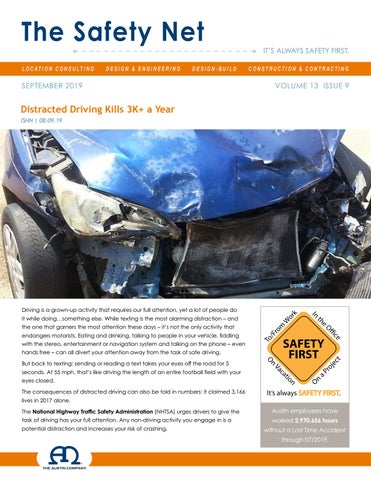
Driving is a grown-up activity that requires our full attention, yet a lot of people do it while doing…something else. While texting is the most alarming distraction – and the one that garners the most attention these days – it’s not the only activity that endangers motorists. Eating and drinking, talking to people in your vehicle, fiddling with the stereo, entertainment or navigation system and talking on the phone – even hands free – can all divert your attention away from the task of safe driving. But back to texting: sending or reading a text takes your eyes off the road for 5 seconds. At 55 mph, that’s like driving the length of an entire football field with your eyes closed. The consequences of distracted driving can also be told in numbers: it claimed 3,166 lives in 2017 alone.
SAFETY FIRST.
The National Highway Traffic Safety Administration (NHTSA) urges drivers to give the
Austin employees have
task of driving has your full attention. Any non-driving activity you engage in is a
worked 2,970,656 hours
potential distraction and increases your risk of crashing.
without a Lost Time Accident through 07/2019.
Teens In its efforts to reduce distracted driving, the NHTSA pays special attention
to
teens, who are less experienced drivers. Additionally, teens are especially active on digital devices and may tend to underestimate the hazards of driving while doing something. According to the NHTSA” Teens can be the best messengers with their peers, so we encourage them to speak up when they see a friend driving while distracted, to have their friends sign a pledge to never drive distracted, to become involved in their local Students Against Destructive Decisions chapter, and to share messages on social media that remind their friends, family, and neighbors not to make the deadly choice to drive distracted.”
Parents Parents should set a good, non-distracted example for their teens, as well as having conversations with them about distraction and all of the responsibilities that come with driving. “Have everyone in the family sign the pledge to commit to distractionfree driving. Remind your teen driver that in States with graduated driver licensing (GDL), a violation of distracted-driving laws could mean a delayed or suspended license,” says the NHTSA.
Teachers Educators and employers can play a part, too, by spreading the word at your school or workplace about the dangers of distracted driving and asking students to commit to distraction-free driving. Your state legislature and governor make the laws regarding distracted driving. Many states now have laws against texting, talking on a cell phone, and other distractions while driving. You can visit the Governors Highway Safety Association to learn about the laws in your state.
2
Apple Has Swatted Away Distracted Driving Lawsuits Without Much Trouble So Far ISHN | 02.28.19
Garrett Wilhelm was chatting with the Facetime app on his
terms. “Texting while driving has become so widespread
Apple iPhone, police say, as he sped along an interstate
that it is doubtful that law enforcement will have any
highway northwest of Dallas on the day before Christmas
significant effect on stopping the process,” it said.
in 2014. He crashed his SUV into a sedan carrying a young family, killing five-year-old Moriah Modisette and injuring her parents and sister.
Yet Apple didn’t implement the lockout technology. That led to a trickle of lawsuits stemming from distracted driving crashes, though Apple so far has made short work of these
Ashley Kubiak was reading a text on her iPhone when she
cases. All have been dismissed, prior to trial, including those
drove her Dodge Ram pickup into a Chevy Tahoe in Rusk
filed by the Modisette and Meador families. And today,
County, Texas, in April 30, 2013. Seven-year old Sammy Lane
Apple notched another victory when the California Supreme
Meador was left paralyzed, and his grandmother and great
Court declined to review the Modisette case, leaving only
aunt were killed.
the Meador claim hanging by a thread. In rejecting at least
Wilhelm and Kubiak would face criminal charges, but the
five cases, courts have ruled that Apple had no legal duty to
legal fallout has touched Apple as well. Apple had clearly grasped the danger of drivers compulsively fiddling with their iPhones. In 2008, the company submitted a patent for a lockout system that could disable smartphone functions “that may interfere with the safe operation of a vehicle by a driver.” The document summed up the need for the lockout in blunt
implement the lockout technology, nor was responsible for the reckless acts of distracted drivers. That is likely to be the prevailing view “until the judge’s daughter gets run over by somebody who’s texting,” groused Jonathan Michaels, a Southern California plaintiff lawyer who filed one of the failed lawsuits. “This is a ridiculously dangerous issue,” he said. ...continued on next page
3
Successful product litigation can have the force of
For their part, the Apple lawyers argued that the appeals
regulation, causing manufacturers to add safety features as
ruling did not warrant Supreme Court review. It merely
a shield against liability. However, device makers and wireless
“echoes what courts in California and nationwide have
service providers so far have flicked away legal attacks.
consistently recognized: that product manufacturers are
There has been an “unbroken line” of court decisions
not liable for distracted driving accidents.”
“rejecting attempts to expand tort liability for distracted driving,” Apple lawyers said in a recent court filing.
The Meador case was filed in 2015 in U.S. District Court for the Eastern District of Texas. It, too, was dismissed, and
Still, the lawsuits might have had one modest effect In 2017,
last month the 5th Circuit Court of Appeals shot down
Apple introduced “Do Not Disturb While Driving,” an app
the appeal. “No Texas case has addressed whether
that allows motorists to block incoming messages and calls.
a smartphone manufacturer should be liable” for the
But like other anti-distraction apps, it must be activated
actions of a distracted driver,” the court declared. “To our
by the driver, so its use is completely voluntary. Critics say
knowledge, no court in the country has yet held that, and
drivers who know better than to use their smartphones
numerous courts have declined to do so.”
behind the wheel don’t need “Do Not Disturb,” while the compulsive users will ignore it.
Gregory Love, a lawyer in Henderson, Texas, for both the Meadors and Modisettes, said a petition for U.S. Supreme
An Apple spokeswoman declined to comment on the
Court review of the Meador case will be filed this spring.
litigation, and wouldn’t say if it prompted the rollout of the
In an email to FairWarning, Love said the only way to
anti-distraction app.
address what he described as an ”epidemic” of distracted
Bethany and James Modisette, parents of Moriah, filed their
driving tragedies was at “the smartphone design level…
wrongful death suit in Santa Clara County Superior Court in California, Apple’s home base. After the court threw out
If you create the monster, you have a duty to control the monster,” he said.
the case, a state appeals court in December rejected the Modisette’s appeal. “We are not persuaded that California law imposes a duty on the manufacturer of a cell phone to design it in such a manner that a user is incapable of using it while driving,” the panel ruled.
MORE COVERAGE: What happens when a driver kills someone while fiddling with a cellphone? often, not much
In January, the Modisettes filed the petition that the state’s highest court today denied without comment. Citing the compulsive behavior triggered by smartphones, the Modisette lawyers said they could not be compared with
Don’t drive distracted, wireless industry says, but safety advocates want more than talk
other sources of distraction. “A device which in numerous respects has altered the way mankind lives, behaves and
However, in absolving Apple the courts are finding that it
thinks, cannot be equated to a cheeseburger, a tube of
is “not inducing this unsafe use of the product, they’re just
lipstick, or even an ordinary cell phone,” the petition said.
not preventing it,” said Gregory Keating, a professor of
“Apple and the body of studies observing smartphone
law and philosophy at the University of Southern California
induced distracted driving recognize that law enforcement aimed at drivers will likely not be enough to effectively limit or prevent distracted driving” the petition said. “This case therefore presents important legal issues for not only this particular case, but for the safety of everyone using
Gould School of Law. The cases are “close to the line,” he said, and a court could decide one differently, but a string of similar rulings has a “persuasive impact.” Once several courts “go one way,” Keating said, “the less likely another jurisdiction is to go the other way.”
California’s highways and roads.”
4
Employee Safety Training Advisor Moreover, in suing Apple, plaintiffs are
WORKPLACE SAFETY
“taking on maybe the most famous
IJJ Keller | 07.25.19 by Rachel Krubsack
and admired company in America,” he observed. That “doesn’t make a close case any easier to win.” In 2017, according to a federal figures, distracted driving crashes killed an estimated 3,166 people–some due to cellphone use. Officials concede that distraction deaths relating to cellphones may be substantially undercounted, since it’s usually hard to determine if a driver in a fatal crash was on a phone. Safety advocates have urged the National Highway Traffic Safety Administration to adopt regulations to limit distraction from smartphones and other portable devices. The agency has spurned the idea of mandatory standards. But in December, 2016, it proposed nonbinding guidelines calling for device makers and wireless providers
One way a safety trainer can help reduce the concern over employee complaints (and subsequent OSHA inspections) is to provide effective, proactive training and to be responsive when employees point out a hazard.
to collaborate on technology that could
In Fiscal Year (FY) 2018, OSHA conducted 32,023 total inspections. About 60
disable drivers’ phones without blocking
percent of these (18,067) were unprogrammed inspections, which includes
the devices of passengers.
employee complaints, injuries/fatalities, and referrals. The remaining 13,956
Despite their nonbinding nature, the proposed guidelines came under furious attack from the wireless industry, with the powerful Consumer Technology Association branding them ”the worst of
inspections (about 40 percent of the total) were programmed inspections. Programmed inspections focus OSHA’s enforcement resources towards the industries and employers where known hazards exist (e.g., amputations, combustible dust, chemical processing, crystalline silica, etc.). Overall, OSHA conducted about 400 fewer inspections than it did in FY 2017.
government overreach.”
OSHA INSPECTION STATISTICS
FY 2017
FY 2018
More than two years later, NHTSA has
Total Inspections
32,408
32,023
not adopted the guidelines nor said
Total Programmed Inspections
14,377
13,956
Total Unprogrammed Inspections
18,031
18,067
837
941
Complaints Inspections
8,249
7,489
Referrals*
6,286
6,463
Other Unprogrammed Inspections
2,659
3,174
if it will. Many regulatory initiatives advanced during the Obama administration have been watered down or revoked since President Trump took office. This one seems simply to have fallen off the radar. NHTSA did not
Fatality/Catastrophe Inspections
respond to a question about the status of the guidelines.
*Referral inspections encompass all subtypes of referrals such as those received from compliance safety and health officers, safety and health agencies, other city/county/state/federal governments, media, and employer reported.
5
‘There’s A Business Case’: Study Of Construction Workers Links Poor Sleep To Injury Risk National Safety Council | 08.08.19
Fort Collins, CO — Employers should prioritize efforts to help workers get a good night’s sleep, researchers from Colorado State University say after their study of construction workers found a connection between poor quality sleep and the risk of workplace incidents and injuries. Construction workers from two public works departments
Among the cognitive failures: • Not remembering correct work procedures or if equipment was turned off. • Unintentionally pressing a control switch on machines. • Stopping or starting the wrong machine unintentionally.
in Portland, OR, completed three surveys over a 12-month
• Daydreaming instead of listening to a co-worker.
period. The data collected, which was part of an Oregon
“Organizations, especially safety-sensitive ones like
Healthy Workforce Center study, was used to determine the respondents’ self-reported sleep quality and quantity, and was then compared with subsequent reports on safety behavior and workplace injuries.
construction, should care about their employees’ sleep because it can impact the safety of the workplace and put workers at risk,” Rebecca Brossoit, study co-author and a CSU graduate student, said in a June 5 press release.
Respondents who reported more insomnia symptoms, on
“There’s a business case for caring about sleep.”
average, experienced more “cognitive failures” – such
The study is scheduled to be published online Nov. 29 in the
as lapses in attention, memory or action – at work. More failures were related to an increase in minor injuries and a
Journal of Occupational Health Psychology.
reduction in required and voluntary safety behaviors.
6
PRESS RELEASE: New Jersey Company and Its President Found in Contempt of Court After Failing to Pay $412,000 in Penalties for OSHA Violations U.S. Department of Labor | 07.31.19 WASHINGTON, DC – The U.S. Court of Appeals for the Third Circuit has found Altor Inc. - a construction company based in Washington Township, New Jersey - and its president Vasilio Saites in contempt of court for failing to pay $412,000 in penalties assessed by the U.S. Department of Labor’s Occupational Safety and Health Administration (OSHA). OSHA has cited Altor for numerous safety violations, including multiple willful violations of OSHA’s fall protection standards. The court previously ordered Altor and Saites to pay the fine after the Occupational Safety and Health Review Commission (OSHRC) affirmed the violations. The court’s July 25, 2019, contempt judgment specifies that Saites is liable for the full amount of the penalty if Altor does not pay. If Altor and Saites do not fully pay within 30 days or show the court why they cannot do so, the Secretary of Labor is to propose a daily penalty for the court to assess. “The U.S. Department of Labor will use all appropriate and available legal tools to ensure that employers are held accountable for their obligations under the Occupational Safety and Health Act to help ensure that workplaces are safe and employers who violate the law do not gain an unfair economic advantage over law-abiding competitors,” said Solicitor of Labor Kate S. O’Scannlain. The court’s ruling is the result of lengthy litigation by the Department’s Office of the Solicitor including multiple hearings before the OSHRC and the court of appeals to affirm Altor’s violations of OSHA’s safety requirements and remedy the company’s longstanding refusal to pay the associated penalties. Under the Occupational Safety and Health Act of 1970, employers are responsible for providing safe and healthful workplaces for their employees. OSHA’s role is to help ensure these conditions for American working men and women by setting and enforcing standards, and providing training, education, and assistance.
What Is Wrong With This Picture U.S. Department of Labor | 07.31.19
1 No safety glass – Dirt could blow in his eyes
2 One of the out riggers is not out
3 Some equipment manufactures require all wheels to be up off the ground when operating
7
25 Construction Safety Statistics and Trends for 2019 BIGRENTZ | 05.14.19 by Lior Zitzman The construction industry is known for being one of the most dangerous fields to work in. Out of every 5,000 private-industry worker fatalities, 20 percent are in construction. That means one out of every five worker deaths is construction-related! Construction also results in many non-fatal injuries that cost companies millions of dollars per year. This makes safety paramount in the industry. While safety measures and precautions, like those outlined by OSHA, can be costly upfront, their ROI can be massive. A successful construction business will maintain effective safety programs, stay updated on OSHA regulations and pay the expenses involved even when business is slow. Not only because OSHA violations can range anywhere from a warning to $70K per incident, but because they care about their employees. To illustrate the importance of worksite safety, we’ve compiled 25 construction safety statistics that cover the high number of injuries and fatalities, the cost of these accidents and the benefits of safe practices.
Construction Fatality Statistics 1. One in five worker deaths annually is in construction. [OSHA] 2. Workplace fatalities that were crane-related fell to their lowest level recorded in 2017 with 33 deaths. [BLS] 3. Out of all worker deaths, construction, transportation and material moving workers accounted for 47 percent. [BLS] 4. The “Fatal Four” leading causes of private sector working fatalities in the construction industry are falls, being struck by an object, electrocution and being caught in something or between two objects. These accidents are responsible for 59.9 percent of construction worker deaths. [OSHA] 5. Companies with 10 or fewer employees and those who are self-employed account for nearly half of all deaths on construction sites. [CDC] 6. Of all industries, construction sees the most fatal falls, accounting for 51 percent of all falls in the United States. [CDC] 7. During a 45-year career, there is a 1 in 200 chance that a construction worker will die from a work-related incident. [Safety & Health Magazine]
8
Non-Fatal Injuries in Construction 8. One in every 10 construction workers is injured annually. [OSHA] 9. Construction sees non-fatal injury rates that are 71% higher than any other industry. [Accident Analysis & Prevention] 10. Around half of serious workplace injuries go unreported each year. [LD&G] 11. Lifting, using a tool or machine, and carrying heavy objects are the leading causes of strain injuries in construction. [CWPR] (graphs) 12. Workers who are between the ages of 25 and 34 are the most likely to be injured while working in construction. [LaborPress] 13. Construction worker illnesses and injuries are down from 10.9 incidents per 100 workers in 1972 to 2.8 per 100 workers in 2017. [BLS]
The Cost of Jobsite Injuries 14. One fatal injury costs an average of $991,027 in hospital costs. [Converge Point] 15. The construction industry sees a 71 percent higher spend on workers’ compensation than all goods-producing industries combined. That’s more than twice the mean cost for the average employer in all other industries. [CWPR] 16. 15 percent of overall workers’ compensation costs are spent on workers who were injured at a construction site. [Workers Compensation] 17. Work-related injuries have caused companies to lose 104,000,000 production days. [National Safety Council] 18. Indirect costs for injuries in the construction industry can be as much as 17 times more than direct costs. [Safety & Health Magazine]
It Pays to Practice Safety 19. Construction companies can save an average of $32,000 for each medically consulted injury they avoid. [National Safety Council] 20. Construction companies can save $4 in indirect costs for every $1 in direct costs by evading an injury in the workplace. [National Safety Council] 21. Studies show that a business can save $8 for every dollar spent on a quality health and safety program. [Construction Business Owner] ...continued on next page
9
22. Construction site injuries account for 6–9 percent of project costs, while safety and health programs only account for 2.5 percent of project costs. [CPWR] 23. A company must sell an additional $1,667,000 in services to offset $50,000 in losses from injuries, illness or damage and still make a 3% profit. [CPWR] 24. Better and more frequent training, regular inspections and regular health and safety meetings with construction supervisors result in lower costs, fewer lost-time injuries and more profits. [CPWR] 25. Eliminating the “Fatal Four” causes of construction accidents would save 582 workers’ lives in the United States each year. [OSHA]
What We Can Learn from Construction Industry Statistics? While the construction industry is inherently risky, proper safety and health training, as well as regular inspections and updated equipment, can mitigate some of these risks. Working to eliminate safety hazards associated with falls, falling objects and electrocution can save companies thousands per year. Cost savings to the company are secondary to the obvious benefits of keeping workers safe. A safe workplace can also result in indirect benefits like a positive company reputation, the ability to recruit the best talent and improved employee morale. Regardless of why a company decides to focus on workplace safety, it should be viewed as an essential task. It is important that every construction crew member, even seasoned veterans, attend training and regular safety meetings. When construction companies make safety a priority, everyone wins.
10
2019 Fatalities in Michigan DATE
OCCUPATION AGE
TYPE OF INJURY
DESCRIPTION A 54-year-old technician was receiving training while working adjacent
02/09/19
Technician
54
Fall (from
to a large chemical tank. The technician fell into the tank. He was
elevation)
removed from tank with the assistance of a co-worker and transported for treatment. He later died as a result of his injuries. A 34-year-old truck operator was crushed by his vehicle at a landfill. The truck operator’s vehicle experienced mechanical problems and was
02/08/19
Truck Operator
34
Struck by
being moved by an operator of heavy equipment. At some point, the truck operator got out of his vehicle to access his mechanical breakdown. The operator of the heavy equipment continued to move the vehicle and the truck operator was subsequently crushed under his vehicle. The employer was performing maintenance/inspection at a job site which
03/08/19
Service Technician
30
Struck by
had two cranes, one small crane and a larger crane above it. A 30-yearold service technician was working on the smaller crane that was locked out. He was struck on the back of the head by the larger crane.
05/23/19
General Laborer
A 19-year-old general laborer was moving/guiding a metal truss, which 19
Electrocution
came into contact with an energized overhead power line during the building of a hoop barn. Employees were performing construction activities in an existing
05/31/19
Journeyman Electrician
53
Shock
substation. A 53-year-old journeyman electrician was working in an uninsulated aerial work platform removing insulated grounding jumper cables when he was electrocuted. A 19-year-old electrician was working with a 277-volt system in a drop ceiling. He was standing on a fiberglass ladder and had both of his hands
06/18/19
Electrician
19
Shock
above a ceiling tile while leaning his chest on the metal ceiling tile trim dividers. Witnesses believe that he touched a live wire while he was leaning on the metal trim dividers of the ceiling grid and was electrocuted. A 23-year-old general laborer was working on an aerial work platform converting overhead florescent light fixtures into overhead LED fixtures.
06/28/19
General Laborer
23
Shock
Attempts were made to contact him but were unsuccessful. The aerial work platform was lowered where the general laborer was found unresponsive and emergency services were called. It appears he was electrocuted. A 55-year-old repair mechanic was performing maintenance and
07/02/19
Repair Mechanic
cleaning on duct work on the roof of the facility. He was in the process of 55
Struck by
cleaning sand and fine metal particles out of the duct work. While walking underneath a section of the duct work, it collapsed and fell down crushing the repair mechanic. A 48-year-old route driver was in a parking lot adjacent to one of his
05/24/19
Route Driver
48
Struck by
designated delivery stops. He was struck by an unknown automobile that left the scene.
08/17/19
Drywaller/ Laborer
51
Fall (from elevation)
A 51-year-old drywaller/laborer fell off a balcony while hanging drywall.
11
Employer or employee: Who’s to blame for OSHA violations? Construction Dive | 07.29.19
Construction firms can fight OSHA violations that stem from employee misconduct.
Lack of compliance The Crown Roofing case raises interesting questions: What if
Although Sarasota, Florida-based Crown Roofing has been
a contractor has trained its employees on safety rules and
subject to multiple OSHA inspections on its project sites during
a few workers simply refuse to follow procedures? Is the
the last four years, company executives say they are not
employer still responsible?
completely at fault.
As it turns out, this could be considered employee
The firm has contested the more than $500,000 in fines it
misconduct, which can be used as defense against an OSHA
has received since 2017 for failure to provide adequate fall
violation. In fact, while the vast majority of OSHA standards
protection for its employees. In an interview with NBC2 News
deal with employer responsibilities for workplace safety,
last month, Crown Roofing Safety Director Aleksey Mendez
section 5(b) of the Occupational Safety and Health Act of
said the incidents occurred because some employees were
1970 requires employees to comply with jobsite safety rules
not obeying company safety rules.
and regulations.
He told a reporter that the company believes it is being
But to mount a successful defense against an OSHA citation
unfairly targeted by OSHA, adding that it spent more than
using employees’ lack of compliance as the basis, employers
$1 million dollars last year to provide safety training for its
need to make sure they’ve incorporated four distinct
employees, particularly those working on roofs.
elements into their safety policies, said Edwin G. Foulke Jr.,
“We train our workers on the safety program and provide
partner in the Atlanta and Washington, D.C, offices of law firm
the necessary equipment for them to work safe,” Mendez
Fisher Phillips and former assistant secretary of labor for OSHA
said. “The notion that Crown Roofing does not care
under President George W. Bush.
about employee safety is not only factually incorrect but
• The first part, Foulke said, is to provide employees with
intellectually dishonest. To keep fining the employer for
a written policy that outlines general safety policies
actions that are [wittingly] done by the employee is not
and procedures and those that deal with the alleged
making them safer.”
violation the employer is contesting.
12
So, for example, if an employer is fighting an OSHA
After a first offense, the company issues the worker in
citation issued after an inspector observed an employee
question a written warning. Before returning to the jobsite,
not wearing adequate fall protection equipment, the
the employee is also required to attend the same mandatory
company must be able to point to one of its written
safety orientation session — including the exam — that he or
regulations showing that the employee was required to
she went through when first starting work at McCarthy.
wear it. • The second part is training. Employers, Foulke said,
The second breach will earn the worker a two-day suspension without pay and another orientation session. A third safety
must educate all employees on its safety policies and
violation requires that the worker be barred from working on
procedures and then have them sign a statement
any McCarthy project for at least 12 months.
affirming that they have received the training. • The third part is a system of verifying that the rules are
In cases of “imminent-danger,” violations like exposing oneself or others to a fall by not using proper personal protective
being enforced. This is usually accomplished, Foulke
equipment, Maitland said, the company could accelerate
said, by documenting the visual observations made by
the disciplinary process by moving directly to a second- or
the contractor’s staff.
third-step action even for first offenses.
For example, the foreman might make several passes around the job each day to make sure employees are following the rules, while the superintendent might make two trips and the project manager one. They must put their notes from these inspections in writing and maintain them as part of the job record. • Last, Foulke said, is written documentation that proves employees are routinely disciplined when they violate the rules. Discipline according to company policy is important, Foulke said, even if the employee is injured as a result of his or her actions. “There is case law that says if you don’t discipline the person who was observed [committing] the violation by the OSHA inspector, then you don’t have that [employee misconduct] defense.”
“We expect our workers to follow safe work practices, and those performing work in an unsafe manner will be disciplined or terminated,” Maitland said. “This policy applies to both management and field workers across the board.” If an employer has followed and performed the four steps correctly, Foulke said, and OSHA is presented with the proof, then the chances are that the agency will either withdraw the citation or an administrative judge will throw it out.
Criminal charges But while the employee misconduct defense can be used to successfully fight OSHA citations, that argument could lose credibility and effectiveness if used too often, said attorney Phillip Russell with Ogletree Deakins Nash Smoak & Stewart in Tampa, Florida. You can’t use a tight hiring market and a good economy as the reason you cannot enforce the safety rules. - Phillip Russell,
Preventing violations
Attorney, Ogletree Deakins Nash Smoak & Stewart
Most large construction companies have these types of
“If this is happening over and over again,” he said,” the
procedures in place. At St. Louis-based McCarthy Building
defense becomes weak and irrelevant.” This is especially
Cos., said corporate vice president of safety Kevin Maitland,
true in a high-risk trade like roofing, where the dangers are
the disciplinary process entails three steps.
wellknown, and employers in that business are under pressure
We expect our workers to follow safe work practices, and those performing work in an unsafe manner will be disciplined or terminated. - Kevin Maitland, Corporate vice
to make their jobsites safer.
president of safety, McCarthy Building Cos.
hard to find qualified tradesmen these days. “You can’t use
If, in fact, an employee consistently breaks the safety rules, Russell said, the answer might be termination, even though it’s a tight hiring market and a good economy as the reason you cannot enforce the safety rules,” he said. ...continued on next page
13
While there is no mechanism for OSHA to issue a citation to employees who refuse to follow company safety rules, employment department at Seyfarth Shaw LLP in Atlanta,
How To Ensure Your Electrical Safety Program Is Driving Compliance
they can be charged criminally in some cases.
Panduit Connections | 08.20.19 by Karen Dziekan
said attorney Benjamin Briggs, partner in the labor and
One such situation is if an employee learns of an impending OSHA inspection and provides advance notice of it. “Under those circumstances,” he said, “an individual employee can be penalized financially and even imprisoned.” Another scenario, Briggs said, is when an employee knowingly makes a false statement to OSHA during the course of an inspection. This can also leave the employee with the prospect of steep financial penalties and potential jail time. Workers can also be criminally charged, he said, if their willful violation of a standard results in a fatality. In these cases, in addition to incarceration, the business can be penalized up to $500,000 and the individual up to $250,000.
Avoid being a target Construction sites are more vulnerable to inspections than
Ensuring compliance with an electrical safety program isn’t
other industries because the work takes place outside and
always easy, but there are plenty of tools available to help
often is in plain view of those passing by, unlike work that
you succeed.
happens in the relative privacy of a factory floor.
As a safety manager, your job is not only to be prepared
“So, if an OSHA compliance officer is driving by a construction
and consistent with regards to all aspects of plant
site and sees somebody working at [a certain] height without
safety, but also to make sure that everyone else – from
fall protection or sees somebody in a trench that doesn’t
management through to janitorial and office staff – prioritize
have a trench box, they are going to stop and have a
safety as much as you do. Being proactive will result in your
conversation,” Briggs said. “And they might start an inspection
facility being in compliance – or not – as well helping to
under those circumstances.”
avoid serious injuries and fatalities around the workplace.
But what about claims that OSHA is unfairly targeting one
A good place to begin preparation is in places that are
employer with multiple, consecutive inspections, along with a
frequently overlooked. OSHA’s top cited violations tell
slew of citations and fines?
us that electrical safety falls into this category. Being
“If you have OSHA repeatedly showing up on your jobsite,
knowledgeable on the latest updated standards can
figure out why,” Russell said, “and do what you can on
help modernize your electrical safety programs, while also
your jobsite … to show them that you take [potential
providing opportunities to address evolving safety concerns
violations] seriously.”
with employees so that all are up to date on best practices
If all violations have been addressed, and the agency still
in electrical safety and incidents are avoided.
continues to make what seems to be an unreasonable
As one example, OSHA found failing to properly control
number of inspection visits, he said, then there are some
energy accounted for nearly 10 percent of serious
remedies, like escalating the issue up the OSHA ladder, all the
accidents in many industries. Realizing that its existing
way to Washington, D.C., if necessary.
measures weren’t enough, OSHA recommended the
“But I can’t go make an argument to the agency that you take it seriously if you’re having problems on your jobsite,” Russell said. “And, if they’re showing up, and they’re finding
creation of NFPA 70E, a requirement for safe work practices to protect personnel by reducing exposure to major electrical hazards.
things, that’s on you. That’s not on the agency.”
14
OSHA’s general duty clause requires facilities to provide
magnitude of the hazardous energy sources present at
employees with a place of employment that is “free from
the facility, and the methods for isolating and controlling
recognized hazards that are causing or are likely to cause
these energy sources. Authorized Employees must also
death or serious harm.” While NFPA 70E is a voluntary
receive training on machine-specific procedures.
standard, with its compliance not required by law, it effectively describes electrical hazards and best practices to mitigate them. Because OSHA regulations are not frequently updated, they will often reference consensus standards such as NFPA 70E as a best practice when issuing citations to the general duty clause.
Implementing NFPA 70E In Your Facility NFPA 70E helps facilities and employees avoid workplace injuries and fatalities due to shock, electrocution, arc flash,
• Affected Employees operate equipment or work in an area in which an energy control procedure is being implemented. Affected employees are not themselves responsible for locking and tagging out but must understand their purpose in order to avoid attempts to start up or use equipment during these procedures. • Other Employees include office or warehouse personnel who may work in an area where an energy control procedure is utilized.
and arc blast during maintenance and construction in
Verifying Absence of Voltage. When electrical maintenance
industrial plants. There are a couple of areas where you will
is needed, NFPA 70E requires that workers establish and
need to update training procedures within your facility in
verify equipment is in an electrically safe state. This
order to comply with NFPA 70E:
involves a test for absence of voltage. Although NFPA 70E is comprehensive around LOTO guidelines and the need to first verify the absence of voltage, it does not articulate the removal of hazards before this maintenance or inspection begins, therefore increasing risk to the electrician. Eliminating a hazard is the most effective method according to the hierarchy of controls, and should be the first choice whenever possible. NFPA 70E emphasizes the need to work on electrical systems only when they are placed in an electrically safe working condition, but creating and verifying this condition requires more than just de-energizing, as it involves multiple steps to confirm the system is safe and to verify the absence of voltage. Absence of Voltage Testers (AVTs) are permanently mounted testing devices that are specifically designed to determine if a circuit part is de-¬energized prior to
Lockout/Tagout (LOTO). Every year workers are unnecessarily
opening panels or removing covers to access and maintain
exposed to hazardous energy sources during servicing,
electrical equipment. They are designed to automatically
maintenance, or setting up equipment. By implementing
run internal diagnostics and administer the live-dead-live
a lockout device to ensure that equipment on the energy
type of verification testing with an internal known voltage
isolating device cannot be operated until the lockout
source and actively indicate the absence of voltage. AVTs
device is removed and a tagout device to indicate that
also help improve electrical safety through a Prevention
an energy isolating device may not be operated until
through Design approach, making them an ideal option for
the tagout device is removed, risks such as injuries, asset
maintenance and service professionals.
damage and production downtime are diminished.
While training can deliver the result, a facility is looking for,
When it comes to implementing a LOTO program to adhere
every plant is different and safety professionals should seek
to NFPA 70E, three types of employees need to be covered:
out third-party support in order to better understand the
• Authorized Employees are responsible for implementing
latest standards that can keep them in compliance.
energy control procedures and performing the required servicing or maintenance. Training for Authorized Employees includes details about the type and
15
UPDATE AND SOLUTION: For 3M™ DBI-SALA® Twin-Leg Nano-Lok™ Stop Use & Recall Notice 08.06.19 3M Fall Protection - 3833 SALA Way - Red Wing, MN 55066 3M™ DBI-SALA® Twin-Leg Nano-Lok™ edge Self-Retracting Lifelines (ANSI Versions Only) 3M Fall Protection is pleased to announce it has resolved the partial deployment of the energy absorber that led to the immediate stop use and recall of the 3M™ DBI-SALA® TwinLeg Nano-Lok™ edge SRL issued in North America on July 25, 2019. A robust solution has been identified, tested and certified to the ANSI standard Z359.14. With this solution, the energy absorber of these units will deploy properly under all circumstances of use for which these products are intended. The affected units can now be repaired and safely returned to service. Due to regional regulatory requirements, this solution is currently available ONLY in regions that recognize the ANSI standard. As other regulatory certifications are received, this solution will be made available in those regions. Until your unit has been repaired or replaced as described above, the “Stop Use and Recall” remains in effect and these units must be removed from service. The original Notice and a list of affected products by part number and regulatory standard can be found at www.NanoLokEdgeRecall.com Note: At the time of this update, the solution described above does not include the Twin-Leg Nano-Lok™ Wrap Back SRL or the Twin-Leg NanoLok™ edge Tie Back versions. USERS/OWNERS: Please go to www.NanoLokEdgeRecall.com and follow the instructions on how to return your device. We will inspect and repair or replace your unit and return it to you at 3M’s expense. If our inspection determines that your NanoLok needs to be taken out of service for reasons unrelated to the stop use/recall, we will inform you of that fact. To minimize any disruption to your business, we will also provide you a list of authorized repair centers near you that can complete the inspection and repair. Note that cash is no longer an option for owners/users of ANSI versions of the affected units for which a solution is available. The cash option remains available until a solution has been certified for the remaining SKUs (see website for a complete list of SKUs that can be repaired at this time). DISTRIBUTORS: Please contact our Customer Service department at 1-833-638-2697 or email us at 3musfpserviceaction@ mmm.com to obtain a listing of all Twin-Leg Nano-Lok edge and Twin-Leg Wrap Back SRLs sold to you. If you have any of these devices in stock, please return them to 3M Fall Protection for replacement at 3M’s expense. Please immediately forward the original Notice together with this Update to any of your customers/users who have purchased Twin-Leg Nano-Lok edge and/or Twin-Leg Nano-Lok Wrap Back SRLs from you and ask them to read and comply with this Notice & Update immediately. Please contact 3M Customer Service for assistance, additional recall information, or alternative solutions at 1-833-6382697 or 3musfpserviceaction@mmm.com.
16