THE SAFETY NET CO N SU LTA N T S
▪
DESIGNERS
▪
ENGINEERS
IT’S ALWAYS SAFETY FIRST. CON STRUCTORS
▪
MAY 2021
VOLUME 15 ISSUE 05
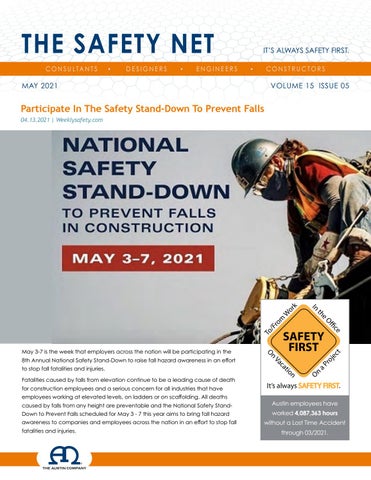
Participate In The Safety Stand-Down To Prevent Falls 04.13.2021 | Weeklysafety.com
May 3-7 is the week that employers across the nation will be participating in the 8th Annual National Safety Stand-Down to raise fall hazard awareness in an effort to stop fall fatalities and injuries. Fatalities caused by falls from elevation continue to be a leading cause of death for construction employees and a serious concern for all industries that have employees working at elevated levels, on ladders or on scaffolding. All deaths
SAFETY FIRST.
caused by falls from any height are preventable and the National Safety Stand-
Austin employees have
Down to Prevent Falls scheduled for May 3 - 7 this year aims to bring fall hazard
worked 4,087,363 hours
awareness to companies and employees across the nation in an effort to stop fall fatalities and injuries.
without a Lost Time Accident through 03/2021.
Anyone who wants to prevent falls in the workplace can participate in the Stand-Down. Despite the name, participation is NOT limited only to construction companies. In past years, participants included commercial construction companies of all sizes, residential construction contractors, sub- and independent contractors, highway construction companies, general industry employers, the U.S. Military, other government participants, unions, A Safety Stand-Down doesn’t mean that work stops for the whole week and everyone has to do some fall prevention
employer’s trade associations, institutes, employee interest organizations, and safety equipment manufacturers.
training. Work doesn’t stop, production doesn’t suffer and employees don’t get paid for doing nothing…that’s not the intention of a Stand-Down. A Safety Stand-Down is a voluntary event for employers to talk directly to employees about safety. Any workplace can hold a stand-down by taking a break to focus on “Fall Hazards” and reinforcing the importance of “Fall Prevention”. It’s an opportunity for employers to have a conversation with employees about hazards, protective methods, and the company’s safety policies and goals. It can also be an opportunity for employees to talk to management about fall hazards they see. OSHA is partnering with key groups to promote and bring awareness to the 2021 Fall Prevention Safety StandDown including: • National Institute for Occupational Safety and Health (NIOSH) • National Occupational Research Agenda (NORA) • OSHA approved State Plans • State consultation programs • Center for Construction Research and Training (CPWR) • American Society of Safety Professionals (ASSP) • National Safety Council • National Construction Safety Executives (NCSE) • U.S. Air Force • OSHA Training Institute (OTI) Education Centers
If your organization has employees, volunteers, team members, students or contractors that work at elevated heights, that use ladders or that may work on scaffolding, please consider participating in the Safety Stand-Down this year. The way that you participate and the amount of time your organization dedicates to the Stand-Down is entirely up to you. Managers are encouraged to plan a Stand-Down that works best for their workplace anytime during the week. • Companies can conduct a Safety Stand-Down by taking a break to have a toolbox talk about fall hazards with a discussion on how to prevent falls that are common in your industry. • Organizations can send out daily email reminders throughout the week with tips about fall prevention. • Supervisors can lead team safety activities such as conducting equipment safety inspections, developing rescue plans or discussing job specific hazards. • Visit OSHA’s Stop Falls Stand Down website to find events in your area that your organization may want to participate in as part of the Stand Down effort. OSHA provides many resources organizations can use on their Stand-Down website at osha.gov/stop-falls-standdown. There you can find posters, videos, outreach training
materials, fact sheets, infographics, a fall prevention training guide, and so much more.
Don’t forget to use the hashtag #StandDown4Safety to share your Stand-Down activities on social media. Organizations that participate in Safety activities, like this Stand-Down, should be proud to share their efforts and it helps cultivate a spirit of community when others see that Workplace Safety is important to so many companies and organizations across the nation. Employers will also be able to provide feedback about their Stand-Down and download a Certificate of Participation following the Stand-Down.
Awareness campaigns, like the National Stand-Down to Prevent Falls, offer a great opportunity to safety management, business owners and management to highlight the importance and commitment the organization has to worker safety. It doesn’t take a lot of time, money or resources to participate. At minimum, consider a brief safety meeting on the fall hazards found in your workplace or jobsite. ...continued on next page 3
The Cost Of Musculoskeletal Injuries To Construction Industry Employers Has Been Escalating For Over 8 Decades 04.08.2021 | Construction Network by R.A. “Art” McNeil Healthcare spending in America accounts for 17.7% of the gross domestic product (GDP). The majority of which ($3.8 trillion) is covered by employers. Most developed countries have healthcare spending to GDP percentages in the single digits. Spending on healthcare by American employers is the major problem. Musculoskeletal (sprains, strains, breaks, contusions, concussions, etc.) are the primary drivers of absorbent healthcare spending, with over 30% of healthcare dollars spent dealing with musculoskeletal issues. This article addresses how employers inadvertently became America’s primary healthcare
HISTORY OF EMPLOYER-SPONSORED HEALTHCARE Prior to 1930, with only a few exceptions, healthcare was not an employer-sponsored benefit. A few dangerous professions, such as mining and railroads, gave employees access to company doctors, industrial clinics, or union operated medical centers. Their priority was musculoskeletal injuries (the most frequent and causing the majority of lost time). These healthcare outposts were quite different from the emergency care clinics we have today.
spender, why the current system is failing employers, and
In the 1930’s the Great Depression forced law-makers
how telemedicine adaptations are significantly driving
to consider universal healthcare coverage because so
down employer costs--while at the same time, taking better
many Americans were out of work, with no money to
care of employees.
pay for hospital or physician bills. Due partly to significant opposition from the American Medical Association, Franklin
Roosevelt, who was elected in 1932, decided not to pursue
musculoskeletal physical examinations by the medical
a universal healthcare plan. Because there was an urgent
profession at large. Although efforts to strengthen
need for healthcare, private health insurers sprung up to
the musculoskeletal curriculum in nursing schools and
meet the needs of American workers.
medical schools to include musculoskeletal medicine
WORLD WAR II, INFLATION, AND THE RISE OF EMPLOYER-SPONSORED PLANS
have been initiated in a few institutions, major changes have not been made across the board. Therefore, the treatment of musculoskeletal disease is
In 1942, out of concern for rising inflation, the US passed the
often ineffective at treatment centers (urgent cares,
“Stabilization Act” which encouraged competition for what
occupational health centers, nursing call lines and
was then a scarce workforce. It provided worker benefits,
emergency departments).
rather than increased wages. To survive, employers had to offer health benefits to attract and retain employees. Healthcare was not counted as income, therefore workers did not have to pay taxes on the benefit. By 1943, this government-induced change had radically changed the provision of healthcare in the United States—and launched out-of-control cost increases.
HOW MUSCULOSKELETAL PROBLEMS ARE KILLING AMERICAN BUSINESS According to recent research from the Journal of the American Medical Association, there are three primary drivers of healthcare spending: musculoskeletal issues, diabetes, and cardiovascular problems. It was noted that musculoskeletal issues account for three times the spending associated with the next most common problem, diabetes, and four times more than cardiovascular health issues. Because chronic and acute musculoskeletal problems present such a debilitating hurdle, employers are looking for ways to contain spiraling costs--the most productive innovation being recent telemedicine adaptations. There are several reasons why musculoskeletal problems are not treated properly, resulting in escalating premiums, increased time off the job, and more complex compliance regulations. In every workplace, but particularly in industries where there is high risk of injury, musculoskeletal spending (for both chronic and acute issues) is at an all-time high--making it the primary driver of increased employer healthcare spending. There are several reasons why employers suffer significant losses when a worker gets injured. 1. Nurses and physicians are not typically well-trained
2. It is rare that when a worker gets injured, that they are diagnosed or receive treatment at the workplace—resulting in considerable loss of time and money. Traditional models involve traveling (usually accompanied by another employee) to an urgent care, occupational health clinic, or emergency department. There, they spend the day working through x-rays, tests and scheduling follow-ups with someone with musculoskeletal expertise. Time off the job results in indirect costs for employers that is estimated to be between $5,000 to $10,000 per injury. 3. Musculoskeletal health issue that employers face is the administration of what are referred within the medical space as “ancillary services.” Ancillary services are things such as physical therapy, durable medical equipment (like braces, slings, and wraps), and several forms of imaging, i.e. ultrasound, MRI and CT scans. These services are often owned by the physicians and therapists who prescribe them. While this is completely legal, from a business standpoint it frequently results in unnecessary and excessive costs to the employer. Add to that, hundreds of thousands of unnecessary shoulder, knee, and spine surgeries that are performed. Recent telemedicine adaptations have solved most of the issues that employers face without wielding the potential threat of surgery. As mentioned previously, experts in the musculoskeletal space are hard to come by and do not exist in remote or industrial workplaces. The traditional models of nurse-call lines have shown a triage rate of approximately 35-40%, resulting in many simple issues being treated aggressively and expensively. A worst-case scenario, as described by many health safety personnel is
with musculoskeletal issues and therefore their
when a person suffers a “sprain or strain.” For example, a
initial diagnosis and treatment of musculoskeletal
worker is injured on the job while lifting an object. Out of
problems is often poorly performed--sometimes
concern for the worker, a call is made to a nurse triage line.
resulting in delayed or prolonged illness. For example,
Because the nurse is unable to diagnose the injury over the
diagnosis of musculoskeletal issues is difficult for most
phone and might be concerned about symptoms such as
providers due to a lack of proper history taking and
severe pain or swelling, the injured worker is typically sent ...continued on next page 5
for images at a local urgent care, ER or occupational health center. The ever-common lumbar spine strain,
Personal Fall Arrest Systems Save Lives On The Job
or pulled back muscle, is given a
04.13.2021 | Weeklysafety.com
worker, usually diagnosed with the
prescription for a muscle relaxant, an anti-inflammatory, or possibly narcotics—and finally is asked to attend physical therapy. A lumbar support may also be ordered. This familiar story sends the employer a bill of around $3500 and the worker is unable to work until they are off medication and cleared OK by a physician. It has been demonstrated that musculoskeletal injuries result in a median lost work time of over 8 working days in industrial settings. One of the latest telemedicine adaptations is a unique tool leveraged by a phone or computer that puts experts in front of the injured worker at the site of injury,
Fall hazards are recognized as one of the OSHA Big Four which account for
resulting in a quick and accurate
the majority of fatalities in the construction industry. Personal Fall Arrest Systems
diagnosis, that doesn’t involve
(PFAS) are a common type of protection used by workers when serious fall
extraneous or unnecessary
hazards exist in their working environment.
treatments. According to recent
Personal Fall Arrest Systems (PFAS) typically consist of an Anchor Point, a Body
research, the majority of injuries in
Harness, and a Connector such as a lanyard.
the workplace are minor in nature and stem from sprains and strains. Many of these injuries warrant selfcare, but injured employees usually end up in the hospital ER simply because the employer isn’t aware
Fall Arrest Systems MUST be inspected before each use. Inspections should include looking for any signs of damage, excessive wear, rust or chemical damage. Any fall arrest system equipment found to be defective must be removed from service immediately. Workers must be trained in fall protection and the specific types of Personal Fall
of a more effective and less costly
Arrest Systems they will be using on the job. Training topics include:
option. For employers, “time off the
• How to put on harnesses
job” results in more than 216 million productive days of work lost in the USA each year. Telemedicine adaptations are radically decreasing the volume and
• Limitations of fall protection equipment • How to properly inspect the PFAS equipment
cost of acute injuries to the extent
• What is a safe anchor or “tie-off”
that many employers are asking that
Workers using specialized climbing
chronic conditions of employees
and fall protection equipment on a high pitched roof.
such as osteoarthritis and low back or neck pain be treated as well.
Weeklysafety.com encourages and promotes all companies to schedule weekly safety meetings on a variety of topics throughout the year. Safety topics can range from walking/working surfaces hazards, to electrical cord safety, to seasonal flu prevention.
Avoiding Three Frequently-Cited Forklift Violations 04.12.2021 | EHS Insider OSHA’s powered industrial truck standard consistently
be removed from service. Citations can be issued for
appears in the top five most-cited general industry
seemingly minor issues like a headlight out or a horn not
regulations. Many of those citations fall into just three
working. Missing these items during a pre-shift inspection (or
categories: training and evaluations, operating unsafe
assuming they are not serious) can result in citations.
equipment, and capacity plates.
TRAINING Since forklift training must include an evaluation of competence, unsafe operating habits can result in citations for training. For example, if an OSHA inspector sees an operator raising or lower a load while moving, or driving
Even if a pre-shift inspection finds everything working, something may break during the shift, so operators should watch for failures throughout the shift. If something breaks or fails, the operator must remove the truck from service. Driving a defective vehicle until the end of the shift is not acceptable.
at excessive speeds, the inspector can cite the employer
CAPACITY PLATES
for inadequate training. Similarly, if the operator cannot
Every forklift has a plate showing the truck’s carrying
answer questions regarding safe operation, the employer could be cited.
capacity along with other information. The OSHA regulation requires that all nameplates and markings be maintained in
OSHA also requires that each operator’s performance
a legible condition, but after years of use, the plate might
be evaluated at least once every three years. This must
become worn or otherwise unreadable.
cover both skills and knowledge, so it must include
If the truck uses attachments, the truck manufacturer must
observing the operator in the work area as well as questioning the operator on safety. These evaluations must be performed by someone who has the knowledge, training, and experience to train operators and evaluate their competence.
TRUCKS WITH DEFECTS Operator training must include how to conduct pre-
approve the attachment, and the capacity plate must be updated to include data for that attachment. OSHA can issue citations for failing to update the plate. Finally, the operator must be trained to use attachments by someone who has experience using that particular type of attachment. Otherwise, the employer can again be cited for training failures.
shift inspections. If defects are found, the vehicle must
7
Make Time for “Me Time” 04.01.2021 | Harvard Business Review by Elizabeth Grace Saunders
SUMMARY We’re all busy. Whether it’s responsibilities at home or at work, many of us focus so much on doing it all that we forget to focus on ourselves. But ensuring your own health and happiness is critical. How do you carve out time for yourself, your health, and your needs when you’re always on? First, define what you need. We all need the basics of sleep, physical movement, and sufficient food, so ask yourself what you need and what you want. Next, determine what you can do within the time you have. Then, set the time. Scheduling helps you to see where self-care fits into your schedule, and how other essential activities have their places around it. Be sure to prepare yourself for these times. Eliminate hurdles and put items in place that reinforce positive behaviors. Finally, be
The first step is to stop, take a deep breath, and realize that the world doesn’t rest completely on your shoulders. Many times the people around you could help more if you simply asked and spread out the responsibilities both professionally and personally. And in some cases, you need to let go and trust that everything will be OK, even if some tasks on your list are done imperfectly or not at all. The next step is to give yourself permission to take care of yourself now. If you put off self-care until work is less busy, your kids are back in school, your house is in order, or some other circumstances are exactly right, you may never get to it. But if you take a brief pause and go through these steps, you can begin to take care of yourself, even when it feels like the responsibilities at home and at work never end.
clear with others about your time.
DEFINE WHAT YOU NEED
Do you feel so busy that you don’t have the bandwidth to
When it comes to health and happiness, different people
think about your own needs, let alone do anything about
have different needs. But there are some universal truths.
them? Maybe you’re constantly thinking about work, or
We all need the basics of sleep, physical movement, and
worry that you’re not proving yourself or your value if you
sufficient food. And to thrive, most require quality time with
aren’t available 24/7 (especially if you’re working remotely).
people, time in nature, time for spiritual connection, and
Perhaps you’re juggling childcare, eldercare, pet care, or
time doing something that brings joy.
other family commitments. Or maybe you’re just caught up in the regular “life” tasks of paying bills, keeping a clean house, and managing the day-to-day. How do you carve out time for yourself, your health, and your needs when you’re always on?
Take a moment to define what you need and what you want. Ask yourself: • How many hours of sleep are sufficient for you to be alert throughout the day?
• What kind of physical movement keeps you feeling in shape and pain-free? • What nourishment keeps up your energy and makes you feel satisfied? • Which people do you enjoy spending time with? • How can you find ways to be outside? • How can you connect with yourself and find your spiritual center? • What activities give you joy (a hobby, reading, volunteering, etc.)? You don’t need to apologize for your needs. They’re valid. And it’s also OK to have wants, even when your life is very full.
DETERMINE WHAT YOU CAN DO At certain stages of your life — when work is particularly busy, you’re managing kids in remote schooling, or you’re going through a big change like a move — you may not be able to do all the self-care you would prefer. But you can still do something.
lunch or alongside your child before bed. You could do a short nap or meditation during the afternoon energy slump, or go on a walk as a household after dinner before settling down in front of the TV. Or, plan nights to get takeout so that you save the cooking time and can fit in an errand or exercise video. Think through when you want to make taking care of yourself a priority. Not only does self-care reenergize you, but it can also motivate you to stop wasting time on unsatisfying activities. It’s less tempting to scroll through Instagram in the afternoon if you could use those few minutes for a quick mindfulness exercise or you know you need to get your work done by 5 p.m. to get in your workout before dinner.
PREP YOURSELF To make this happen, you’ll need to have resolved that your self-care time is sacred and that you’re going to follow through on it. That means eliminating hurdles and putting in items that reinforce positive behaviors. For example, if you want to exercise more, clean off the treadmill, have
Think through what’s reasonable given your current
your favorite workout videos queued up, or sign up for
situation. For example, maybe it’s not possible to train for a
exercise classes in advance where there’s a penalty if you
half marathon right now, but you could take half an hour
cancel last-minute. Or if you want to eat healthier, have
to run a few times a week. Maybe you can’t guarantee
a standard weekly grocery list of nutritious food, remove
that you’ll sleep through the night given the ages of your
unhealthy food from your kitchen, and have some quick
kids, but you can go to bed an hour early to give yourself
premade or takeout options for those days when you’re in
some margin. Perhaps you can’t see your friends as much
a pinch. You could also join a challenge where you have
in person, but you can give them a phone call while you’re
accountability, support, and sometimes even win prizes for
cooking dinner or running errands. Take a look at your
achieving your self-care goals.
schedule and where there may be small pockets of time. What would work to fulfill your needs now, within the time you have?
SET THE TIME If you feel as though there is always more you could be doing, you’ll need to consciously set aside time for selfcare. In doing so, you will clearly give yourself permission that this is the most important and appropriate thing to do now. Scheduling helps you to see where self-care fits into your schedule, and how other essential activities have their
To reinforce positive behaviors in the moment, think about the details in advance. Eliminate the friction between yourself and your goal. Lay out your workout clothes by the foot of your bed — or even wear them to bed as pajamas — to save time before going out for a run. Or, install an app on your phone and computer that locks you out at a certain time as a reminder to get sufficient sleep. Remember what you’re doing and why it’s important to you, so when you’re tired or feeling unmotivated, you have the gumption to follow through.
places around it.
BE CLEAR WITH OTHERS
For example, I have a get-ready-for-bed alarm that goes
Finally, prep others. If your spouse tends to stay up late
off on my phone from Sunday through Thursday night to
watching TV, let them know when you need to watch the
remind me that sleep needs to be the priority. I have a
final show and then head to bed. If your kids get up super
time set aside in the morning to work out — in my case,
early and are old enough to safely play by themselves for
swimming. And I have times planned in for prayer, family,
a little while, explain that you’ll be exercising, reading, or
and friends. You could also put in time for reading during
sipping a cup of coffee on the porch in the morning, and ...continued on next page 9
they can join you if they like or play until you’re done. Set similar boundaries at
The Role of Technology in a Post-Pandemic World
work. If someone suggests
04.02.2021 | EHS Today by Lesley McLeod & Shachar Harari
an early morning or late
A look back at how technology has helped
more who were regarded as essential
worker health and safety during COVID-19
workers. They still needed to show up to
that will work better for your
and imagining its role in the future.
perform their jobs in order to keep the
sleep schedule or other
A little over a year ago, we didn’t know
economy—and the country—moving.
self-care routines. And if
much about social distancing, lockdowns
These essential industries had to retool and
you find yourself perpetually
or self-isolation—or that we would live
redesign operations to accommodate
having last-minute requests
through them for the rest of the year.
plexiglass screens, hand sanitizer stations,
given to you by your boss or
Nobody could have foreseen the storm
face masks and other personal protective
clients, have a conversation
that was brewing. Who’d have thought
equipment (PPE) into everyday workflows.
with them about the
that 2020 would be the year when we’d
Their actions served as a blueprint for
possibilities. Could you be
have to knock elbows instead of shaking
businesses of all types when they were
informed of upcoming
hands, stand two meters apart from one
eventually allowed to reopen.
needs sooner? Could you
another at all times, or abandon going
receive work earlier? Could
into the office altogether?
night meeting and it’s negotiable, ask for a time
deadlines be negotiated? To have time for self-care, you’ll need to advocate for yourself and your needs to make it happen. I can’t guarantee that you will ever feel really “off.” But you can take steps to make sure that you put focus and attention on taking care of yourself each day. “Always on” doesn’t have to mean you must sacrifice your needs. It just means sometimes finding the time to make sure that your focus is on yourself. Elizabeth Grace Saunders is a time management coach and the founder of
The fact is, things have changed. Even with vaccines now being rolled out, there are elements of this so-called new normal that are likely to stay with us for the foreseeable future—perhaps even forever. Workplaces in all sectors, from health care to manufacturing, have had to adapt rapidly to new health and safety guidelines to keep employees safe. For some workplaces, that means regular COVID-19 testing where available and rearranged processes to maintain social distancing. For others, it’s meant forging new ways of working altogether, such as embracing online meetings and virtual communications. Let’s take a closer look at the year that was as we begin to imagine the future of health and safety.
Real Life E Time Coaching
THE IMPACT OF THE PANDEMIC
& Speaking. She is author
Early in the pandemic, the government
of How to Invest Your Time Like Money and Divine Time Management. Find out more at www.RealLifeE.com.
urged people to work from home wherever possible. This is good advice during a
ADAPTING TO THE NEW NORMAL Protecting worker health and safety has always been labyrinthine by nature. So many of these achievements have come through a process of attrition, gradually shifting the needle over time to make conditions incrementally better for workers. This past year, however, has not afforded the luxury of time to any of us. Health and safety professionals have had to adapt almost overnight, with the federal and local government creating COVID-19 workplace safety guidelines in a matter of weeks, many of which that have continued to evolve and are still in place today. Some of these changes are temporary, such as the need for social distancing. Others may be more fundamental and long term, such as the need for better air filtration systems in office buildings or the use of contactless cards to gain entry. These long-term adaptations will improve worker safety and help us in the event of
viral outbreak, but the operative words
future pandemics.
“wherever possible” made this a hollow
One demand that is shared by virtually
sentiment for construction workers, health
all workplaces—particularly those
care employees, emergency services staff,
on the frontline—is the need for safe
grocery workers, bus drivers and the many
communication. Typically, these industries
might have relied on push-to-talk radios or intercom systems
likely play a key part in helping to shape health and safety
to relay critical information, but in a post-COVID-19 world,
standards in the coming years.
these technologies come with associated risk. For instance, push-to-talk radios are often shared among many employees and require contact to operate. Intercom phone systems also use shared surfaces, which would require constant disinfecting between uses—hardly ideal during a busy shift on the factory floor or a hospital wing. Even if intercom systems were disinfected between uses, staff in areas that required heavy PPE would still find themselves
WEARABLE TECHNOLOGY Statista Research Department predicts there will be over 1.1 billion connected wearable devices worldwide by 2022, facilitated largely by the advent of widespread 5G rollouts. There’s little doubt that the discovery of new use cases, such as the application of wearables in workplaces, will contribute greatly to this rapid adoption rate.
removing gloves, visors and masks to use them properly, thus
In that regard, the COVID-19 pandemic has acted has a
making themselves and those nearby more vulnerable.
huge catalyst. Many essential workplaces such as hospitals
SMART PPE AND COMMUNICATION To remedy this communication problem, we’re likely to see smart PPE soar in popularity. Smart PPE simply refers to PPE that’s been outfitted with intelligent technology to increase its function, such as a hands-free, voice-activated communication device built into a helmet or an augmented reality overlay built into a visor or pair of goggles. In the coming years, teams working over entire construction sites, warehouses or hospitals might contact one another without any kind of physical interfacing. Communication devices could be seamlessly integrated into existing PPE equipment such as visors, helmets and overalls. That would
and factories are looking for new ways to keep their businesses moving while maintaining social distancing and limiting contact. From biometric smartwatches to Bluetooth headsets to experimental augmented reality products such as Google Glass, we’ve been trying to crack wearable tech for a long time. The wearables market has been gaining steady traction for the past decade or so, but 2020 has put it under the spotlight. Suddenly, we’re living in a world where minimizing physical contact is not just a luxury but a necessity. The advantages of wearable tech for workers are becoming readily apparent.
give business leaders far more choice when it comes to
THE NEW HEALTH AND SAFETY RULE BOOK
tackling social distancing and contamination. Such devices
For decades, health and safety protocols have been a
could even use mesh communication networks to advance their communication capabilities further.
tangible set of rules focused largely on physical measures, particularly at worksites and factories. We’re used to hard
A mesh-based intercom system doesn’t replace land
hats and steel-capped boots, non-slip surfaces and ear
mobile radio (also known as private mobile radio) or cellular
protection, but health and safety measures are going to
technology altogether, but it’s quickly becoming the
look a little bit different going forward.
technology of choice for small teams that need to exchange
In addition to the tangible physical measures we’re all
complex information quickly, reliably and securely.
used to, we’re likely to see more intangible health and
One of the greatest advantages of wireless mesh
safety measures take the spotlight. Things like air filtration
communication is that it operates as a self-sufficient
quality will climb up the health and safety agenda as well
standalone network, with no need for a base station
as things like person-to-person proximity. Employee health
and zero dependence on cellular reception. Mesh
and well-being is also likely to be treated with more scrutiny
communication is also self-healing, meaning if a unit goes
and care moving forward, with companies enforcing strict
out of range, the rest stay connected and when that
policies regarding home working when ill.
unit comes back in range, it automatically rejoins. Some
Even after the COVID-19 pandemic is declared over,
devices are also voice activated, making them a viable option for COVID-secure work environments where contact should be kept to a minimum. It would be up to PPE manufacturers and businesses
it will have left a lasting mark on the health and safety rulebook. It’ll be up to individual businesses to embrace new methods and technologies to help keep workers safe, pandemic or otherwise.
themselves to figure out how best to incorporate mesh communication into their own equipment lineup, but it will
11
I’m Not Sure I’m Doing This Right—Home Office Ergonomics 03.31.2021 | EHS Today by Adrienne Selko We need to be as diligent about work from home ergonomics
wasn’t part of an employee’s job, but that has changed. It’s
as we are in an office or on a work site.
really an opportunity to provide education and resources for
It wasn’t until I had worked three months at home that I
people to have a better understanding of how their comfort
noticed some odd aches and pains. My upper arm started to
levels affect productivity.”
hurt all the time. My shoulders, neck and back seemed more
I had to laugh when Barker said this since I actually had to
sore than usual.
stop working past my usual quitting time, which I have done
I’m embarrassed to say that it took me awhile to figure out
regularly since working at home, as my arm hurt too much.
that my home office ergonomics were the culprit. (I thought it was the extra workout routines.) My workstation at my employer’s office was designed for optimal health. I participated in an extensive online tutorial, and my employer implemented the ergonomic recommendations for my personal space. However, my home office designer—me—hadn’t taken any of this into
But he said this is no laughing matter, as people aren’t as effective when they are uncomfortable. And losing just a little productivity per employee can result in a major loss when spread across a company. Setting up a home office improperly is pretty common, says Kermit Davis, PhD, an expert in office ergonomics at the University of Cincinnati College of Medicine. In an article
consideration when setting up my home office.
published in the journal Ergonomics in Design: The Quarterly
IT TURNS OUT I’M NOT ALONE.
an ergonomic assessment study conducted on University of
of Human Factors Applications (July 2020) on the results of
“Often, employees have relied on having someone physically
Cincinnati employees, Davis found several problems.
checking their workstations once a year to ensure they were
The study evaluated home workstations and identified several
correct,” explains Rick Barker, principal solution strategist-
issues that could adversely affect workers.
ergonomics with VelocityEHS. “Understanding ergonomics
12
• Chairs: First, the chairs were not the correct height—41% were too low and 2% were too high. • Armrests: While 53% of workers had armrests on their
HOW CAN COMPANIES ADDRESS THESE ISSUES? Barker offered a best practice that he has observed, whereby
chairs, 32% did not use them. For 18% of workers,
companies provide small sums, say $30-$400, to employees
the armrests were improperly adjusted. Not using an
for them to set up an office that fits their individual needs
armrest can cause stress on the forearms, while resting
rather than buy in bulk. Trying to find equipment that works
hands on the hard edge of a work surface can strain
for everyone is not practical, he points out. Even more
the upper back.
importantly, this method has the added advantage of
• Back support: A majority (69%) of workers did not use the
encouraging employees to become more aware of their own
back of the chair for support and 73% did not have any
personal safety practices.
type of lumbar support.
And for safety, the process is important. “Building out the
• Computer monitors: Almost 75% of the monitors were
internal process of evaluating a workstation to apply to
laptops and those were too low relative to the worker’s
a homework station is the first step,” Barker says. “There
eye height. External monitors were routinely set up too
should be available documentation which employees
low 52% of the time or too high 4% of the time. Another
can use to identify problems. The process should include
common issue with monitors was primary screens not
continuous improvement suggestions.” Continuous
being centered in front of workers. This occurred with
improvement will prove to a very useful tool as most
31% of workers and resulted in people twisting their
research is showing that working from home will continue
necks or backs to view the monitor.
in some form for many companies.
The information below shares preliminary details about the 3rd Michigan worker death of 2021 reported to the Michigan Occupational Safety and Health Administration (MIOSHA) which is believed to be covered by the MIOSH Act. Employers and employees are urged to use extreme care and safety diligence in all work activities. The description reflects information provided to MIOSHA at the initial report of the incident and is not the result of the official MIOSHA investigation. To report fatalities/catastrophes, call MIOSHA at 800-858-0397. If you need help or assistance in ensuring your workplace is safe, MIOSHA is here with resources to help. The Consultation Education and Training (CET) Division provides workplace safety and health training and consultations to employers and employees throughout Michigan free of charge. Contact CET today at 800-866-4674 or submit a request online at www. michigan.gov/cetrca. Every life is precious. Our mutual goal must be that every employee goes home at the end of every shift. DATE 04/06/21
OCCUPATION AGE Owner
42
TYPE OF INJURY Struck by
DESCRIPTION A 42-year-old lawn care service company's owner was found pinned underneath the wheel of a dump truck.
INCIDENT LOCATION Ypsilanti
A firm was onsite to service a sticking well rod. A driver was backing the service truck to the well head to set up the 01/21/21
Drilling Hand
31
Struck by equipment and derrick, that was being guided by two
New Era
employees, when a 31-year-old drilling hand was struck and pinned between the service truck and the well head. 01/13/21
Flagger
56
Struck by
A driver did not stop for the work zone and pinned a 56-year-old flagger between two vehicles.
Bates Township
13
‘Wear the Damn Mask’ 04.06.2021 | EHS Today by David Sparkman Employers can follow Gov. Hogan’s example in requiring
mandates. In fact, President Biden has made it clear that he
workers to wear masks.
regards mask wearing as such a clear imperative one of his
Last year during the height of the COVID-19 pandemic,
first acts when he was sworn in was to require it for all federal
Maryland Gov. Larry Hogan (R) became famous when he
government facilities.
made a public service announcement where at the end
OSHA’s most recent and highly detailed guidance for
he looked intently into the camera and said loudly, “Wear
employers that was issued on Jan. 29, also at the order of the
the damn mask!” Now it turns out that even where state
President, clearly sets out mask wearing as a priority. It even
governments are abandoning mask mandates, employers
urges employers to provide workers with face coverings at no
can still require their workers to wear them.
cost and require non-workers who visit workplaces to wear
“Generally, employers have wide discretion when it comes
face coverings as well.
to enforcing safety and health requirements,” says attorney
“Any employer looking to continue face covering
Dana N. Berber of the Akerman LLP law firm. “Under various
mandates in its workplace can look directly to OSHA
federal, state and local laws, employers actually have an
for support,” Berber says, with one possible exception.
affirmative obligation to provide a reasonably safe working
“Of course, employers must discuss reasonable
environment for their employees—as well as for any clients,
accommodations with any workers who cannot wear
customers, or other visitors.”
certain types of face coverings due to a disability.”
This is particularly the case for employers because the
OSHA’s guidance also cautions employers not to implement
Centers for Disease Control and Prevention (CDC) and the
measures that would single out employees who are not
Occupational Safety and Health Administration (OSHA)
vaccinated, such as by requiring only unvaccinated
mandated mask wearing in workplaces, and nothing suggests
employees to wear masks, for example.
that the federal government is supporting an end to mask
“And, as always, employers should continue to take steps to
covering rules at work, employers can in fact require that
ensure that workers are not retaliated against for raising any
face coverings are worn in the workplace or on the job in
safety concerns,” Berber stresses. “These protections against
accordance with its own policies.”
retaliation and discrimination are just as important now as before, especially given that workers may begin to no longer wear face coverings because he/she has been vaccinated.”
Continuing to require face coverings may not only make an employer compliant with OSHA standards, it also could end up reducing the threat of liability as they begin to reopen
This is one of many issues that must be top of mind for those
their businesses to employees and the public. Berber points
employers facing possible inspections from OSHA after
out that employers have been facing swarms of pandemic-
it announced ramped-up enforcement resulting from a
related lawsuits filed by attorneys on behalf of employees
recently-declared National Emphasis Program (NEP)
since last year.
targeting COVID-19 in the workplace.
These cases often involve employer liability and claims of
OSHA kicked off this new wave of inspections on March 26.
wrongful death, negligence, allegations of violation of OSHA
Each of its regional offices will conduct targeted COVID-19
standards, and the failure to enforce safety measures. In cases
inspections of targets chosen from a randomized list of
where employers are alleged to have intentionally violated
organizations in sectors responsible for generating the highest
federal, state, or local standards, employees may be able to
number of complaints, including the healthcare industry,
sue in state or federal court instead of bringing worker’s comp
warehousing, meat packing, supermarkets and certain kinds
claims, Berber explains.
of manufacturing.
If employees refuse or fail to comply with mask mandates,
This NEP will remain in effect through March 12, 2022, unless
employers can discipline and even terminate them in the
it is canceled or extended by a new superseding directive.
name of keeping their co-workers and the public safe from
The agency currently forecasts that the enforcement drive
the spread of COVID-19, he says. “Employers should ensure
accompanying the NEP will generate about 1,600 inspections
that they have established face covering, mask and other
OSHA-wide in the short term.
COVID-19 policies if they wish to enforce such requirements
“With some exceptions, employers can still mandate face
among all employees.”
coverings in the workplace as they see fit, especially because mask policies relate directly to safety protocols that ensure the health of employees,” Berber says. “Thus, when faced with employees who are refusing to comply with mask/face-
15
The Best Fire Safety Plan Is To Ensure No Fires Happen At All. 04.20.2021 | Weeklysafety.com When learning about fire protection and prevention on the
purpose dry chemical fire extinguishers rated BC or ABC,
job, it is important to understand the different types of fire
can be used to put out a Class B fire.
that may have the opportunity to occur at any specific
CLASS C fires involve energized electrical equipment such
work location.
as computers, servers, motors, transformers, wiring, fuse
In the United States, there are 5 major classifications of
boxes, and appliances. A Class C fire can ignite when there
fire, known as A, B, C, D and K. Depending on which
is faulty wiring, overcharged devices, overloaded outlets,
class of fire ignites will determine how trained personnel
electrical cord damage or a short circuit. Carbon Dioxide
act to extinguish the fire because different types of fire
(CO2) fire extinguishers or multi-purpose dry chemical fire
extinguishers are designed to fight different classes of fire.
extinguishers rated BC or ABC, can be used to put out a
CLASS A fires involve ordinary combustible materials like
Class C fire.
cloth, wood, paper, rubber, many plastics, and most kinds
CLASS D fires involve powders, flakes, dust, machine
of trash. Water is one of the most used extinguishing agents
shavings or other fine pieces of combustible metals like
for Class A fires. Multi-Purpose Dry Chemical Extinguishers,
lithium, magnesium, potassium, sodium, titanium, or
rated ABC, may also be used to put out a Class A fire.
zirconium. The most common method for extinguishing a
CLASS B fires involve flammable and combustible liquids
combustible metal fire is to cover the burning material with
such as gasoline, alcohols, oil-based paints, petroleum greases, tars, oils, and solvents. Class B fires can also be
a dry powder extinguishing agent that works by smothering the fire, separating it from oxygen and absorbing the heat.
started with flammable gases like propane and butane.
Different metals may require different extinguishing agents.
Class B fires do not include fires involving cooking oils and
CLASS K fires involve vegetable oils, animal fats and grease
grease. Carbon Dioxide (CO2) fire extinguishers or multi-
in cooking appliances. Fire extinguishers with a K rating
may be required in commercial kitchens where large
Reminder: Portable fire extinguishers are useful for putting
quantities of food are prepared using oil or grease. Do not
out small fires, but they are not effective against larger fires
use a Class A fire extinguisher that contains water or a CO2
or fires that are spreading quickly.
fire extinguisher on a deep fat fryer because an explosive reaction may occur.
All workers should have a clear understanding of the organization’s fire safety plan. Guidance to employees
Fire requires three elements which are
should include when it might be appropriate and helpful to
fuel, heat, and oxygen, known as the fire
fight a small fire with a portable fire extinguisher and when it
triangle, and in the right combination
is the right decision to evacuate immediately.
the resulting chemical reaction can cause a fire. The key to extinguishing a fire is to remove at least one of the elements from the fire and this is what portable fire extinguishers are designed to accomplish. Fire extinguishers are classified by the type of fire they are intended to be used on. They can have a classification like A, ABC, BC, D or K that easily explains the type of fire they are designed to fight. It is critically important that the right type of extinguisher be used on the specific class of fire to avoid personal injury and damage to property.
OSHA CONSTRUCTION STANDARD 1926.150(A)(1) The employer shall be responsible for the development of a fire protection program to be followed throughout all phases of the construction and demolition work, and shall provide for the firefighting equipment. Using a fire extinguisher may seem easy, but it is best for every employee to have some basic knowledge of fire safety including an understanding of the different types of fires and fire extinguishers, how to make a decision to attempt to fight a fire or evacuate, and how to use a fire extinguisher in the event of a fire emergency. All employees should be familiar with the location and types of extinguishers available.
OSHA GENERAL INDUSTRY STANDARD 1910.157(D)(1) Portable fire extinguishers shall be provided for employee use and selected and distributed based on the classes of anticipated workplace fires and on the size and degree of hazard which would affect their use.
OSHA Construction Standard 1926.352(d) Suitable fire extinguishing equipment shall be immediately available in the work area and shall be maintained in a state of readiness for instant use. Personnel who are trained and authorized to use portable fire extinguishers must know how to conduct a risk assessment to determine whether it is safe to fight a
Using the wrong type of fire extinguisher could be
fire or if the best course of action is to evacuate. Before
ineffective, result in electrical shock, cause an explosion, or
attempting to extinguish any fire, these questions should
even spread the fire.
be considered first.
17
How big is the fire? Only attempt to put out a fire if it
familiarize employees with the general principles of fire
is contained to a small area, is in the early stages of
extinguisher use and the hazards involved with incipient
developing, and has not started to spread quickly, also
stage fire fighting.
known as an incipient stage fire.
Report any fire extinguishers that have been used. Even
Is the atmosphere safe? If there is a lot of smoke, hot
if the extinguisher was used for a short time, it should be
temperatures, limited visibility, or hazardous materials in the
reported as used.
area, then no one should attempt to stay and fight the fire.
All firefighting equipment, including fire extinguishers,
Where is the escape route? If anyone attempts to fight
must be periodically inspected and receive routine
a fire, an escape route should be behind them. No one
maintenance on a regular basis to ensure they are
should use a fire extinguisher if their means of evacuation is
operating properly and ready, if needed.
not clear or is compromised.
OSHA Construction Standard 1926.150(a)(4) All firefighting
Is the correct fire extinguisher available? Make sure the fire
equipment shall be periodically inspected and maintained
extinguisher on hand matches the type of fuel that is burning.
in operating condition. Defective equipment shall be
Are you calm and in control? If you feel panicked,
immediately replaced.
overwhelmed, or unsure of the situation, do not attempt to
Portable fire extinguishers should be inspected by a
fight the fire.
trained professional once a year with a visual inspection
When the decision has been made to attempt to put out
conducted monthly.
a fire, take these actions first, before pulling the pin on the fire extinguisher. • Activate the fire alarm system and notify emergency services or delegate someone to do this. • Ensure that personnel evacuation has started and all other workers are safely exiting the area. • Identify a safe evacuation route. If no person on site attempts to extinguish the fire, then all personnel should evacuate the area immediately. If indoors, everyone should exit the building, no matter how far away from the fire they are located.
OSHA GENERAL INDUSTRY STANDARD 1910.157(E) Portable extinguishers … shall be visually inspected monthly. The employer shall assure that portable fire extinguishers are subjected to an annual maintenance check. Visual inspections are quick checks to ensure that the fire extinguisher is fully charged, in good operating condition and ready for use, should it be needed. During monthly inspections also check the surrounding area to ensure the fire extinguisher remains easily accessible in the event of an emergency. Working in a shop, on a construction site, at a distribution
OSHA GENERAL INDUSTRY STANDARD 1910.157(G)(1) Where the employer has provided portable fire extinguishers for employee use in the workplace, the employer shall also provide an educational program to
center, in an office… regardless of the work environment, fire prevention as well as fire protection are both great safety meeting topics to cover at least once a year with all employees.