THE SAFETY NET CO N SU LTA N T S
▪
DESIGNERS
▪
ENGINEERS
APRIL 2021
IT’S ALWAYS SAFETY FIRST. ▪
CON STRUCTORS
VOLUME 15 ISSUE 04
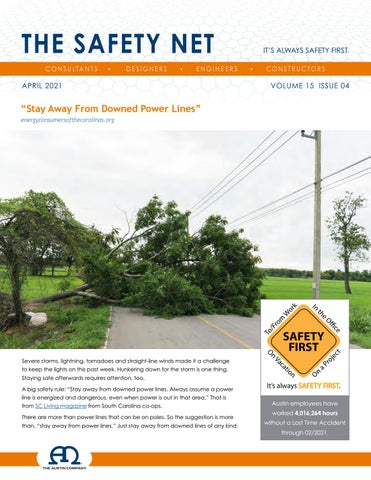
“Stay Away From Downed Power Lines” energyconsumersofthecarolinas.org
Severe storms, lightning, tornadoes and straight-line winds made it a challenge to keep the lights on this past week. Hunkering down for the storm is one thing. Staying safe afterwards requires attention, too. A big safety rule: “Stay away from downed power lines. Always assume a power line is energized and dangerous, even when power is out in that area.” That is from SC Living magazine from South Carolina co-ops. There are more than power lines that can be on poles. So the suggestion is more than, “stay away from power lines.” Just stay away from downed lines of any kind.
SAFETY FIRST. Austin employees have worked 4,016,264 hours without a Lost Time Accident through 02/2021.
The SC Living article says, “If you see a downed power line: • Move at least 50 feet away from the line and away from anything touching it. Call 911 immediately. Electricity from a live wire touching the ground can radiate outward, making the area unsafe around that point of contact. • The best way to move away is to shuffle with small steps, keeping both feet together and on the ground at all times. This minimizes the potential for a strong electric shock.” SC Living magazine continues, “If someone or something is touching the line: • Anything touching the line can be a conductor of electricity, including the human body. Don’t touch anyone or anything that is in contact with a power line. That could make you the next victim. • Also, don’t attempt to move anything that is touching the line by using another object, such as a broom or a stick. Even materials that are normally nonconductive can, if they are slightly wet, conduct electricity and electrocute you.” See the SC Living article for all its advice. Downed power lines are obviously serious business. Here’s a vivid example. Cypress Pointe Fire and Rescue, northwest of Fayetteville, NC, posted a video of an electric power line catching on fire after a tree fell on it near Cameron, NC. This wasn’t last week, though, it was the results Hurricane Florence. (Story on Myrtle Beach Online) Another source to electric safety information is at the Electrical Safety Foundation International website. All kinds of resources there. Including a page of general overhead line safety. ESFI reinforces to consider all lines to be live and dangerous. Again: There are more than power lines that can be on poles. So the suggestion is more than “stay away from power lines.” Just stay away from downed lines of any kind. Be cautious. Be safe.
Click here to see video.
The Most Terrifying Part About Getting Struck by Lightning Is What Happens Afterwards 04.21.2016 | Business Insider by Ali Sundermier Somewhere in the sky, in the guts of a storm, lightning is forming.
industrial shock. The energy can even exceed the power
Although it’s rare, with the odds of getting struck in your
of a nuclear reactor. When the lightning hits the ground, it
lifetime being roughly 1 in 12,000, every now and then a
causes a trail of plasma that lights the sky with those telltale
human will provide an attractive target for lightning bolts to
zigzags of blueish white light that we see as lightning.
unleash their energy. And of the roughly 500 people who
THE FIRST THREE MILLISECONDS
are struck by lightning each year, about 90 percent survive. Here’s what you should expect if you ever find yourself in the path of lightning.
HOW LIGHTNING FORMS Although we’re still not sure what causes it, scientists believe that ice particles bumping together inside a cloud can cause an excess of negative charge to collect at the bottom of the cloud. This charge can be so powerful that it repels electrons, negatively charged particles, on the ground beneath it, causing the ground to become positively charged. As an insanely strong electrical field roils in the cloud above, an intense attraction builds between the cloud and the ground. Lightning is the runaway force that discharges this field. It races toward the ground at nearly 300,000 kilometers per hour, striking the ground with an energy of 300 kV, up to 150 times more powerful than an ...continued on next page 3
A lot can happen in the three milliseconds it takes for a lightning bolt to course through your body.
BUT IT DOESN’T END THERE. In the wake of a lightning attack, you might be faced
As the lightning strikes and then exits your body, it will leave
with a lifetime of neurological afflictions for reasons that
you with deep wounds, often accompanied with third
scientists still don’t fully understand. Some scientists believe
degree burns. Your hair and clothing might singe or catch
that the lightning scrambles your internal circuitry, altering
fire. Your clothes might even be shredded by the explosive
the behaviour of your cells. You might undergo personality
force of the surrounding air being superheated to up to
changes, mood swings, and memory loss. It’s also possible
50,000 degrees Fahrenheit (27,700 degrees Celsius), which is
that you will suffer from chronic pain and constant
five times hotter than the surface of the Sun.
Parkinson’s-like muscle twitches.
If you happen to be wearing any metal objects, like
In some cases, however, a lightning strike can lead to
necklaces or a piercings, they could channel the electric
strange super talents. In a blog post for Psychology Today,
current, superheating and searing your skin. And if the
University of Miami neuroscientist Berit Brogaard writes
lightning exits through your feet, the force could literally
about an incident where an orthopaedic surgeon who was
knock your shoes off.
struck by lightning developed an urge to learn to play the
Blood vessels bursting from the electric discharge and heat
piano. He began to compose music he had mysteriously
might create something called a Lichtenberg figure on
started hearing in his head since the strike. After a few
your skin. This is a pattern of scars that branches out across
months he abandoned his career as a surgeon and
your body like the limbs of a tree, likely tracing the path the
became a classical musician. This type of phenomenon
electricity took as it travelled through you.
baffles scientists.
It’s not uncommon for the blast to rupture your eardrums,
One theory that Brogaard says is currently being tested
possibly leading to hearing loss. And, of course, you can
is that cell death caused by being struck by lightning
expect a whole world of pain. One victim recalled it as “the
could cause a one-time flooding of the brain with
pain of a thousand wasps stinging from within”.
neurotransmitters that are released from the dying neurons.
IN THE WAKE OF A LIGHTNING STRIKE Immediately after being struck, the disruption the lightning would have caused to your heart’s electrical rhythm could result in cardiac arrest, one of the leading causes of death in lightning strike victims. The shock could also cause seizures or respiratory arrest. If the electric current enters your skull, it could literally cook your brain, resulting in brain damage or putting you in a coma. The strike could even cause temporary or permanent paralysis.
This causes a rewiring of neurons, providing access to areas of the brain that were previously inaccessible. But as cool as it would be, you shouldn’t count on that stray bolt of electricity turning you into a prodigy in one swift flash. The overwhelming majority of consequences of being struck by lightning are painful and debilitating, and could stay with you for the rest of your life. While your chances of being struck by lightning are low, you can stay safe by tossing aside that fishing pole or golf club when you see clouds forming and heading indoors.
Burnout is More of a Systemic Workplace Issue than an Employee Issue 03.19.2021 | EHS Today by Adrienne Selko THE STRUCTURE OF THE WORKPLACE IS A MAIN DRIVER OF
that there are no resources to hire more people. While this
EMPLOYEE BURNOUT.
is a complicated issue, an organization has to understand
Burnout is a manifestation of chronic workplace stress.
and address this in a manner that provides some relief.
“We view burnout as an individual’s issue, but the real
LACK OF RECOGNITION
problem is that something is out of balance in the
While each generation desires different levels of recognition
workplace,” explains Paula Davis, founder of the Stress and Resilience Institute. “It boils down to too many job demands and too few job resources.” Burnout is a systemic issue that is based on a variety of
all need some form of recognition. This aspect needs to have a lot more attention than it has been given in the past, Davis notes.
factors. “It’s influenced by how leaders conduct themselves
LACK OF SUPPORT
as well as how people interact within a team,” says Davis.
Psychological safety is often the foundation of both
Of course, organizations are also under stress from a variety
resilience and high performance. “The essence of this
of sources which include regulations, financial and market
concept is that a level of trust must be established in
conditions. So, the goal is to have a holistic approach
a team so that employees feel that they can share
to viewing an organization and its interactions and then
information, especially innovative ideas, in a space where
alleviating burnout.
respect is the cornerstone,” says Davis. This concept is the
First, it’s important to understand the drivers of burnout. From Davis’ research she has found these three causes:
HIGH WORKLOAD
foundation upon which teams can build positive cultures, notes Davis. Having healthy teams creates an atmosphere that fosters both acceptance and transparency, which can greatly
This is the most common problem, people have too many
reduce stress. “When your team isn’t cohesive, it can be
responsibilities and not enough resources. And they are told
very exhausting,” says Davis. ...continued on next page 5
As is always the case, measurement is a key to understanding a problem
Crane Collapses on Jobsite in Syracuse, NY, No Injuries Reported 02.24.2021 | Construction Junkie by Shane Hedmond
and that holds true for determining whether burnout is a problem in an organization. Employers should have an assessment of the current state of their workforce’s stress levels, advises Davis. And to help employers with designing assessments, she includes samples in her new book, “Beating Burnout at Work: Why Teams Hold the Secret to Well-Being and Resilience.”
In her book, she offers case studies of companies that created successful strategies to overcome burnout. “The organizations that are successful in addressing burnout end up building a resilient, thriving,
On Tuesday morning, February 23, the Syracuse Fire Department
and engaged workplace.”
responded to a call about a collapsed crane on a construction site near the university. Thankfully, no injuries were reported. According to WIVB, the collapse was first reported around 9am and, once first responders arrived at the scene, they determined that there were no injuries and no buildings damaged. The crane landed within the confines of the site, as well, which will be the future home of a new building at the Upstate Medical University campus.
The piece of equipment is partially obstructed in the photos of the scene, but it appears to be a crawler crane. At the time of the collapse, the crane was picking some steel off a flatbed truck. Syracuse Deputy Fire Chief explained to local reporters that there was no risk to any further tipping or causing any injuries, but the contractors will be making arrangements to get the crane removed from the site.
Time-Specific Injuries in Construction 03.01.2021 | EHS Today A new study finds during the first four hours of their shift,
injury required overnight hospitalization or could result in
workers are most likely to suffer traumatic injuries
permanent disability or death.
By looking at the timing of injuries, the hope is that
Common injuries in construction include falls; work-related
companies will be able to reduce their number which in the
musculoskeletal disorders including joint inflammation,
construction industry is especially high.
tendonitis and pinched nerves; and wounds sustained after
A study released by Oregon State University on Feb. 10,
being struck by objects.
2021, found that it’s during the first four hours of their shift
The overall disabling claims rate decreased significantly
workers are most likely to suffer traumatic injuries. And those
from 2007 to 2013, but construction is still one of the
working the night shift suffer more severe injuries than those
most dangerous industries for injury claims, and Oregon
working the day shift.
fares worse than other states. Census data shows that
The study is one of the first to analyze workers’ compensation
Oregon’s non-fatal work-related injury and illness rate in the
injury claims data by the hour of work. “I really hope that
construction industry was 1.6 times higher than the national
people could learn from this and realize that the chance of
rate in 2017.
getting injured or getting more severe injuries are related to
According to the OSU study, nearly 80% of injuries occurred
the hours of your work,” said lead author Liu Yang, a recent
among workers ages 25-54, though older workers incurred
doctoral graduate in OSU’s College of Public Health and
much higher medical costs and missed more workdays
Human Sciences, in a statement.
when they were injured. Overall, the average medical
The study, which appears in the Journal of Occupational
compensation awarded per injury was $12,000 and the
Health, looked at 12,222 workers’ compensation claims
average loss of work was 80.5 days.
from the Oregon construction industry from 2007-2013
During the workday, workers were most likely to sustain an
that was accepted by insurers as disabling. “Disabling”
injury during the fourth hour of work. The hourly injury rate
claims were defined as work-related injury or illness caused
decreased after that but increased slightly at the end of an
the worker to miss at least three days of work, or the
eight-hour shift.
7
While injuries were less frequent after the fourth hour of work, injuries that were reported at that time tended to be more severe. Based on the data, Yang speculated that most construction workers take a mid-shift rest or meal break and experience some restorative benefits, but if they are unable to, they may risk a more severe injury. The study also looked at injuries among workers who start after 6 p.m. and work evening or night shifts. It was a small sample, as only a few subsectors of construction work at night, but evening and night shift workers suffered more frequent and more severe injuries than day shift workers. Young workers aged 16-24 were also a vulnerable population, experiencing the highest rates of injury. Yang is working with the Oregon Health Authority to look more closely at the risk factors among young workers in hopes they might pinpoint specific safety measures to help avoid injury on the job. Two interventions that could help are increased workplace supervision and work organization, which takes into consideration hours of work, and strict enforcement of mandatory rest breaks and meal breaks, Yang said. “In Oregon, we have regulations about breaks; however, it is unclear what workers experience in practice,” she said. “The construction industry is fast-paced; they may need to finish their task at a certain time, so they may not really take their rest and meal breaks as required.”
Forklift Training Basics 03.18.2021 | OH&S Occupational Health & Safety
If you use forklifts at your facility, you know you have to train your operators. OSHA’s standards for Powered Industrial Trucks at 29 CFR 1910.178 and 29 CFR 1926.602 require all forklift operators to receive a combination of formal instruction and hands-on experience. Formal training can be made up of classroom lectures, discussions, interactive computer learning, videos, and written materials. Hands-on training may include demonstrations by the trainer and practical exercises performed by the employee. Employers must evaluate all employees on their skills before allowing them to operate a forklift at the facility. Employees must also be evaluated after refresher training and at least once every three years, or whenever an operator is observed to operate in an unsafe manner, or who is involved in an accident or a near miss. If the employee doesn’t pass the evaluation, then you must provide refresher training. Of course, if the operator is assigned to a different type of truck, that will require additional training on the specifics of that vehicle.
Incident Reporting Is Critical, And Near-Miss Reporting Is Important, But Hazard Reporting Is Also Extremely Necessary For The Safety Of Your Workforce. 03.09.2021 | weeklysafety.com All hazards that are found in the workplace should
mandatory all-day in-person training session for high-hazard
be reported immediately to a supervisor, the safety
jobs, or on-the-job training led by a competent supervisor,
department or management. This is a standard practice
or even a 30-minute safety meeting. For low-hazard jobs, at
that should exist in any workplace and every employee
least consider an annual online training or email reminder
should be made aware that this is the appropriate action
so employees understand hazard reporting is not only
to take should they encounter any hazard or potential
acceptable but also expected.
hazard they discover. However, many employees may feel
DURING HAZARD REPORTING TRAINING, THE FOLLOWING POINTS SHOULD BE EMPHASIZED:
(justified or not) that the hazards they encounter, sometimes on a daily basis, are just how things are and reporting them is not necessary. Designing, setting up and communicating a Hazard Reporting Program is a good idea for any business to help avoid this potentially dangerous attitude. Implementing a Hazard Reporting Program will help ensure that your workplace is safer for your employees and reduce costly incidents or business interruptions. Employees should be trained in hazard recognition and avoidance. Hazard Reporting is a critical part of this training so that employees know exactly what to do when they encounter a hazard they can’t immediately correct. Don’t get overwhelmed by the word “training” because you can design the training to be as simple as you need for your specific team. Depending on the types of hazards your employees might encounter, this training could be a
What is an unsafe condition that should be reported? This is any circumstance found in the workplace that could allow an incident to occur that might harm people, equipment or property. Give examples specific to your workplace such as rusted or broken tools, inadequate PPE provided, containers that are not labeled, insufficient stairway lighting, broken machine guards, or a leaking refrigerator in the breakroom. What is an unsafe act that should be reported? This is any behavior that could lead to an incident that might harm people, equipment or property. Unsafe acts might not be intentional. Examples of unsafe acts might include using equipment in a careless manner or not using PPE as required.
9
What should be done if an unsafe condition or act is
Example 4:
witnessed in the workplace? This depends on the hazard reporting procedure in your workplace so be specific. Let employees know exactly what steps they should take which could be filling out a form or verbally telling a supervisor. When should a hazard be reported? Any unsafe condition or act should be reported immediately, or at the next available safe opportunity that the employee has to do so.
Example 5:
What should employees expect after a hazard is reported? Let employees know what the expected time frame is for corrective and preventative measures that are expected and how employees can follow-up on the corrections progress, if needed. Where can employees find a copy of the Hazard Reporting Procedure? Are hard copies of procedures kept at headquarters, or is the Safety Manual found online on the company’s intranet? It’s important that employees know how they can access all company policies and procedures on their own. Here are some examples of what a hazard reporting program might look like, simple to more complex. Design a program that works for your company and your employees. Document the procedure in a step-by-step format that is easy to understand and the communicate to your employees what the process is and where they can find the procedure to reference at any time. Example 1:
Incident and accident reporting is critical, and near-miss incident reporting is important, but hazard reporting is also extremely necessary for the safety of your workforce. Addressing a potential hazard before it causes an injury or property damage can save any company significant losses. Giving employees an avenue that they can pursue to report hazards and unsafe acts empowers them to feel like they are an integral part of the company, but only if those hazards are addressed, corrected and resolved. A successful workplace safety and health program includes a hazard reporting process that is effective. Hazard reporting ensures employees: • are involved in your safety management system • aware and vigilant for current safety issues • respect safety management as a means of creating a safe, productive work environment Hazard reporting ensures that supervisors, managers and the safety department have the information they need to
Example 2:
control hazards before they become a liability, ultimately saving the company money. If employees are reluctant to report hazards in the workplace, here are some great ways to improve the quality of hazard reporting in your safety program. 1. Make reporting as easy as possible. 2. Ensure there is no negative stigma and no punishment
Example 3:
attached to hazard reporting. 3. Give recognition to those who submit hazard reports. 4. Engage workers in the resolution of hazards to ensure the correction is satisfactory for all involved and does not create additional hardships inadvertently.
5. Keep an open discussion about safety issues, perhaps following up on the specific hazard reported at the next safety meeting. 6. Never assign blame to an individual when it comes to hazards found. Rather, attribute hazards to “systems” like insufficient budget assigned for tool replacements, lack of training, or comprehensive process needed. 7. Post signs or posters around the workplace that reinforces the message that unsafe conditions and acts must be reported. Hosting a safety meeting on hazard reporting is an excellent way to get the word out to employees about your hazard reporting process and expectations.
Man Lifts and Aerial Lifts weeklysafety.com
MAN LIFTS || Aerial Lifts Volume 1 Issue 6
Aerial Lifts are useful pieces of equipment with specialized features, uses, and unique potential hazards. Extensible boom lifts are very helpful when you need to access heights without the expense of a crane or set-up required to use a scaffold. Articulating boom lifts are especially useful when needing to access difficult to reach areas and interior locations with high ceilings and odd angles.
This safety topic is intended to help workers recognize the dangers of working with aerial lifts.
Steelworkers using an aerial lift to prepare the exterior of a building for glass installation. (*1)
OSHA Standard 1926.453(b)(2)(ii) Only authorized persons [designated by the employer] shall operate an aerial lift. In addition, OSHA Standard 1926.453(b)(2)(iv) Employees shall always stand firmly on the floor of the basket, and shall not sit or climb on the edge of the basket or use planks, ladders, or other devices for a work position. © Weeklysafety.com, LLC
1
11
MAN LIFTS || Aerial Lifts Volume 1 Issue 6
➢ Only trained and authorized operators can use aerial lifts! • Employees must receive training in the safe operation of the lifts so they will understand and avoid unsafe conditions that could lead to injuries. ➢ Common hazards found with aerial lifts include: • Electrocution from accidental contact with energized wires • Tip-over hazards from driving on step or unstable surfaces • Collisions or struck-against hazards • Fall hazards from improper use of the lifts and failure to use proper fall protection
OSHA Standard 1926.21(b)(2) The employer shall instruct each employee in the recognition and avoidance of unsafe conditions and the regulations applicable to his work environment to control or eliminate any hazards or other exposure to illness or injury.
MAN LIFTS || Aerial Lifts
Image: Common Danger Sticker found on most American versions of aerial lifts. Always follow the manufacturer’s safety recommendations and requirements. © Weeklysafety.com, LLC
Volume 1 Issue 6
2
➢ Avoid tip-over hazards! • Always use proper fall protection when operating an aerial lift. • Never alter or disable warning devices or limit switches – they are there to help avoid tip-over hazards. • Survey the area where the lift will be used before moving or driving the lift to identify and avoid potential hazards such as curbs, pot-holes, excavations, or floor holes.
(*2) News Article: news.nationalpost.com (http://bit.ly/1Ew9db8) © Weeklysafety.com, LLC
3 12
MAN LIFTS || Aerial Lifts Volume 1 Issue 6
➢ Always look for overhead power lines and electricity lines feeding adjacent buildings and structures. Danger signs should be posted warning aerial lift operators of potential hazards.
Worker using an articulating boom lift to perform construction work on the framework of a temporary theater. (*3)
MAN LIFTS || Aerial Lifts
© Weeklysafety.com, LLC
4
Volume 1 Issue 6
➢ Remember these important safety precautions when working with aerial lifts: • Never sit or climb on the edge of the basket or use planks, ladders, or other devices on an aerial lift. • Always use proper fall protection when operating an aerial lift. • Always look for overhead power lines and electricity lines before and during lift operation. • Only use lifts that you are trained and authorized to use. • Survey the area to identify and avoid potential curbs, potholes, excavations, or floor holes.
Proper fall protection and safe use of this articulating boom lift by a crew working on an elevated rail in New York City. (*4)
© Weeklysafety.com, LLC
5 13
MAN LIFTS || Aerial Lifts Volume 1 Issue 6
COPYRIGHT AND DISCLAIMER This material is the copyrighted property of Weeklysafety.com, LLC. Purchase of this material from Weeklysafety.com, LLC grants the owner the right to use this material for workplace safety and education purposes only. Use of this material for any other purpose, particularly commercial use, is prohibited. This material, including the photos, may not be resold. Weeklysafety.com, LLC does not warrant or assume any legal liability or responsibility for the accuracy, completeness, or usefulness of any information, apparatus, product, or process disclosed in these materials. Photos shown in this presentation may depict situations that are not in compliance with applicable Occupational Safety and Health Administration (OSHA) safety requirements. These materials are meant for informational purposes only and it is not the intent of Weeklysafety.com, LLC to provide compliance-based training. The intent is more to address hazard awareness in the construction and related industries, and to recognize the potential hazards present in many workplaces. These materials are intended to discuss Federal Regulations only, as individual State requirements may be more stringent. Many states operate their own state OSHA and may have standards that are different from information presented in this training. It is the responsibility of the employer and its employees to comply with all pertinent OSHA safety rules and regulations in the jurisdiction in which they work.
PHOTO ACKNOWLEDGMENTS Unless specified below, all photos are the copyrighted property of Weeklysafety.com, LLC and may not be used in any other training materials or resold for any purpose. • (*1) Photo Credit – U.S. Army Corps of Engineers. Steelworkers prepare exterior of NGA for glass installation. http://bit.ly/1ElhQoI/ • (*2) Photo Credit – news.nationalpost.com; OSHA investigates Edmond forklift accident. http://bit.ly/1Ew9db8 • (*3) Photo Credit – Nick Ansell; In Fog and Falling Snow theatre construction. https://www.flickr.com/photos/nican45/17079032620 • (*4) Photo Credit – Metropolitan transportation; Weekend at Work. https://www.flickr.com/photos/mtaphotos/14708848762/ Creative Commons License: https://creativecommons.org/licenses/by-nd/2.0/
For more information on this weekly safety topic, other topics that are available and the full list of FAQs please visit www.weeklysafety.com or email safety@weeklysafety.com. © Weeklysafety.com, LLC
6