THE SAFETY NET CO N SU LTA N T S
▪
DESIGNERS
▪
ENGINEERS
IT’S ALWAYS SAFETY FIRST. ▪
APRIL 2020
CON STRUCTORS
VOLUME 14 ISSUE 4
The Coronavirus Isn’t Alive. That’s Why It’s So Hard To Kill. The Washington Post | 03.23.2020 by By Sarah Kaplan, William Wan and Joel Achenbach
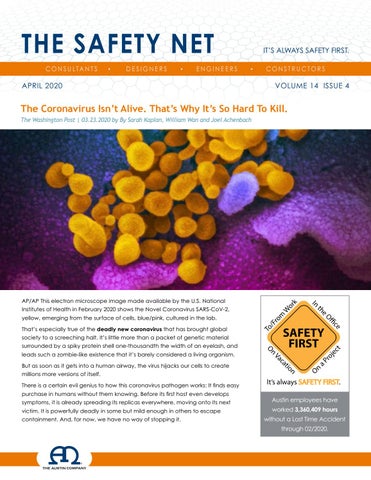
AP/AP This electron microscope image made available by the U.S. National Institutes of Health in February 2020 shows the Novel Coronavirus SARS-CoV-2, yellow, emerging from the surface of cells, blue/pink, cultured in the lab. That’s especially true of the deadly new coronavirus that has brought global society to a screeching halt. It’s little more than a packet of genetic material surrounded by a spiky protein shell one-thousandth the width of an eyelash, and leads such a zombie-like existence that it’s barely considered a living organism. But as soon as it gets into a human airway, the virus hijacks our cells to create millions more versions of itself. There is a certain evil genius to how this coronavirus pathogen works: It finds easy purchase in humans without them knowing. Before its first host even develops
SAFETY FIRST.
symptoms, it is already spreading its replicas everywhere, moving onto its next
Austin employees have
victim. It is powerfully deadly in some but mild enough in others to escape
worked 3,360,409 hours
containment. And, for now, we have no way of stopping it.
without a Lost Time Accident through 02/2020.
As researchers race to develop drugs and vaccines for
And all are caused by viruses that encode their genetic
the disease that has already sickened 350,000 and killed
material in RNA.
more than 15,000 people, and counting, this is a scientific portrait of what they are up against.
That’s no coincidence, scientists say. The zombielike existence of RNA viruses makes them easy to catch and hard to kill. Outside a host, viruses are dormant. They have none of the traditional trappings of life: metabolism, motion, the ability to reproduce. And they can last this way for quite a long time. Recent laboratory research showed that, although SARS-CoV-2 typically degrades in minutes or a few hours outside a host, some particles can remain viable — potentially infectious — on cardboard for up to 24 hours and on plastic and stainless steel for up to three days. In 2014, a virus frozen in permafrost for 30,000 years that scientists retrieved was able to infect an amoeba after being revived in the lab. When viruses encounter a host, they use proteins on their surfaces to unlock and invade its unsuspecting
A man at U.S. border wears a mask provided by Border Patrol because he
cells. Then they take control of those cells’ molecular
was coughing. (Larry W. Smith/EPA-EFE/Shutterstock)
machinery to produce and assemble the materials needed for more viruses.
‘BETWEEN CHEMISTRY AND BIOLOGY’ Respiratory viruses tend to infect and replicate in two places: In the nose and throat, where they are highly contagious, or lower in the lungs, where they spread less easily but are much more deadly. This new coronavirus, SARS-CoV-2, adeptly cuts the difference. It dwells in the upper respiratory tract, where it is easily sneezed or coughed onto its next victim. But in some patients, it can lodge itself deep within the lungs, where the disease can kill. That combination gives it the
“It’s switching between alive and not alive,” said Gary Whittaker, a Cornell University professor of virology. He described a virus as being somewhere “between chemistry and biology.” Among RNA viruses, coronaviruses — named for the protein spikes that adorn them like points of a crown — are unique for their size and relative sophistication. They are three times bigger than the pathogens that cause dengue, West Nile and Zika, and are capable of producing extra proteins that bolster their success.
contagiousness of some colds, along with some of the
“Let’s say dengue has a tool belt with only one hammer,”
lethality of its close molecular cousin SARS, which caused
said Vineet Menachery, a virologist at the University of
a 2002-2003 outbreak in Asia.
Texas Medical Branch. This coronavirus has three different
Another insidious characteristic of this virus: By giving up
hammers, each for a different situation.
that bit of lethality, its symptoms emerge less readily than
Among those tools is a proofreading protein, which allows
SARS, which means people often pass it to others before
coronaviruses to fix some errors that happen during the
they even know they have it.
replication process. They can still mutate faster than
It is, in other words, just sneaky enough to wreak worldwide havoc. Viruses much like this one have been responsible for many of the most destructive outbreaks of the past 100 years: the flus of 1918, 1957 and 1968; and SARS, MERS and Ebola. Like the coronavirus, all these diseases are zoonotic —
bacteria but are less likely to produce offspring so riddled with detrimental mutations that they can’t survive. Meanwhile, the ability to change helps the germ adapt to new environments, whether it’s a camel’s gut or the airway of a human unknowingly granting it entry with an inadvertent scratch of her nose.
they jumped from an animal population into humans.
2
Scientists believe that the SARS virus originated as a bat
For this reason, antiviral drugs must be extremely targeted
virus that reached humans via civet cats sold in animal
and specific, said Stanford virologist Karla Kirkegaard.
markets. This current virus, which can also be traced to
They tend to target proteins produced by the virus (using
bats, is thought to have had an intermediate host, possibly
our cellular machinery) as part of its replication process.
an endangered scaly anteater called a pangolin.
These proteins are unique to their viruses. This means the
“I think nature has been telling us over the course of 20
drugs that fight one disease generally don’t work across
years that, ‘Hey, coronaviruses that start out in bats can
multiple ones.
cause pandemics in humans, and we have to think of
And because viruses evolve so quickly, the few treatments
them as being like influenza, as long-term threats,’” said
scientists do manage to develop don’t always work for
Jeffery Taubenberger, virologist with the National Institute
long. This is why scientists must constantly develop new
of Allergy and Infectious Diseases.
drugs to treat HIV, and why patients take a “cocktail” of
Funding for research on coronaviruses increased after the
antivirals that viruses must mutate multiple times to resist.
SARS outbreak, but in recent years that funding has dried
“Modern medicine is constantly needing to catch up to
up, Taubenberger said. Such viruses usually simply cause
new emerging viruses,” Kirkegaard said.
colds and were not considered as important as other viral pathogens, he said.
THE SEARCH FOR WEAPONS Once inside a cell, a virus can make 10,000 copies of itself in a matter of hours. Within a few days, the infected person will carry hundreds of millions of viral particles in every teaspoon of his blood. The onslaught triggers an intense response from the host’s immune system: Defensive chemicals are released. The body’s temperature rises, causing fever. Armies of germeating white blood cells swarm the infected region. Often, this response is what makes a person feel sick. Andrew Pekosz, a virologist at Johns Hopkins University, compared viruses to particularly destructive burglars: They break into your home, eat your food, use your furniture and have 10,000 babies. “And then they leave the place trashed,” he said. Unfortunately, humans have few defenses against these burglars.
SARS-CoV-2 emerges from the surface of cells cultured in a lab. (National Institutes of Health/AFP)
Most antimicrobials work by interfering with the functions of the germs they target. For example, penicillin blocks
SARS-CoV-2 is particularly enigmatic. Though its behavior is
a molecule used by bacteria to build their cell walls. The
different from that of its cousin SARS, there are no obvious
drug works against thousands of kinds of bacteria, but
differences in the viruses’ spiky protein “keys” that allow
because human cells don’t use that protein, we can
them to invade host cells.
ingest it without being harmed.
Understanding these proteins could be critical to
But viruses function through us. With no cellular machinery
developing a vaccine, said Alessandro Sette, head of the
of their own, they become intertwined with ours. Their
center for infectious disease at the La Jolla Institute for
proteins are our proteins. Their weaknesses are our
Immunology. Previous research has shown that the spike
weaknesses. Most drugs that might hurt them would hurt
proteins on SARS are what trigger the immune system’s
us, too.
protective response. In a paper published this month, Sette found the same is true of SARS-CoV-2.
3
This gives scientists reason for optimism, according to Sette.
Evolutionarily speaking, experts believe, the ultimate goal
It affirms researchers’ hunch that the spike protein is a
of viruses is to be contagious while also gentle on their
good target for vaccines. If people are inoculated with a
hosts — less a destructive burglar and more a considerate
version of that protein, it could teach their immune system
house guest.
to recognize the virus and allow them to respond to the invader more quickly.
That’s because highly lethal viruses like SARS and Ebola tend to burn themselves out, leaving no one alive to
“It also says the novel coronavirus is not that novel,” Sette said.
spread them.
And if SARS-CoV-2 is not so different from its older cousin
But a germ that’s merely annoying can perpetuate itself
SARS, then the virus is probably not evolving very fast,
indefinitely. One 2014 study found that the virus causing
giving scientists developing vaccines time to catch up.
oral herpes has been with the human lineage for 6 million
In the meantime, Kirkegaard said, the best weapons we have
years. “That’s a very successful virus,” Kirkegaard said.
against the coronavirus are public health measures, such as
Seen through this lens, the novel coronavirus that is killing
testing and social distancing, and our own immune systems.
thousands across the world is still early in its life. It replicates
Some virologists believe we have one other thing working
destructively, unaware that there’s a better way to survive.
in our favor: the virus itself.
But bit by bit, over time, its RNA will change. Until one day,
For all its evil genius and efficient, lethal design, Kirkegaard
not so far in the future, it will be just another one of the
said, “the virus doesn’t really want to kill us. It’s good for them, good for their population, if you’re walking around
handful of common cold coronaviruses that circulate every year, giving us a cough or sniffle and nothing more.
being perfectly healthy.”
Researchers work with samples of the coronavirus at the Center for Vaccine Research at the University of Pittsburgh. (Nate Guidry/Pittsburgh Post-Gazette/AP)
4
Key Takeaways from Briq’s COVID-19 & Construction Panel Discussion OH&S Occupational Safety and Health | 02.06.2020 By Raul Chacon There has been a ton of uncertainty surrounding the
collapse. He stressed that unlike those two events, the banks
Coronavirus pandemic that is currently shutting down the
were in strong financial standing prior to the shutdowns and
entire continental United States and the information seems
are “not going to walk away from credit lines.” He said that
to be changing by the minute. To help navigate your
the difference between a deep recession versus a shallow
construction businesses through this mess, the team at Briq
depression will be the ability to help small businesses recover.
hosts an expert panel discussion yesterday titled “The War Room: A Construction Disaster Preparedness Panel.” Moderated by the CEO of Briq, Bassem Hamdy, the panel featured: • Moti Jungreis, Vice Chair and Head of Global Markets, TD Securities • Cal Beyer, Vice President, Workforce Risk and Mental Well-being, Cobb Strecker Dunphy Zimmerman (CADZ)
LEARNING FROM THE PAST James Benham talked about his experiences navigating through the 2001 and 2008 downturns and stressed the need to trim non-essential expenses in order to retain critical staff through your hardest times. His number one rule of business is to just survive and to find a way to keep your business operating, which could mean pivoting into different, but related, work, like service work instead of new builds.
• James Benham, CEO, JBKnowledge
WORKING REMOTELY
I want to give a brief overview of the discussions that took
Being a technology guru, Benham also shared insights on
place, but you can watch the full replay of the hour long discussion on Briq’s website here: https://www.br.iq/the-warroom-panel
OVERALL EFFECT ON THE ECONOMY Jungreis led off the discussion by explaining the overall impact the pandemic has had on the economy so far, drawing comparisons to the post-9/11 recession and the 2008 housing
the best practices for working remotely and some readily available software to help get you through it. Programs like Microsoft Teams, Slack, WhatsApp, and Zoom will help keep your teams in productive communication while working remotely. He says that his favorite app for internal meetings is Teams, whereas he prefers Zoom for external meetings. WhatsApp is his favorite for mobile.
5
LEAN ON YOUR PEER GROUPS Both Benham and Beyer talked about
UPRIGHT SITTING
DECLINDED
keeping in touch with your peer groups to help get navigate through hard times. Using the software mentioned above, you don’t have to cancel in person meetings, just move to web meetings. Use these peers to bounce ideas off of and gain valuable insights from their past experiences.
EMPLOYEE MENTAL HEALTH Beyer discussed the challenges of dealing with the mental health of employees, who may be experiencing additional stress related to money or health. He said that it’s pivotal for your company to exhibit a caring culture and to “recognize and acknowledge that these rapidly changing conditions are going to create stress and anxiety.” He also said that keeping communication lines open and developing a business continuity plan can help ease concerns.
FIND THE OPPORTUNITY If you have set your company up for success by practicing fiscal conservatism, this economic downturn can prove fruitful if you know where to look. Benham touched on his past experiences when he was able to hire key staff from other
Working from home: Ergonomic checklist Liberty Mutual | 03.19.2020
1. CHAIR AND POSTURE
2. MONITOR
• Use the backrest of the chair to
• Place the monitor directly in
provide full support to lower back. • Make sure your chair allows
companies that laid them off, or find
clearance behind your
equipment at a great price.
knees when seated against
JOB SITE SHUTDOWNS
Maintain proper body posture:
about potential job site shutdowns and
• Sit with your hips and knees at a
Hamdy said that your company needs
90-degree or greater angle.
happened, the Mayor of Boston had shut down all of the city’s construction projects
length away. • Position the top of the monitor screen at or below eye level.
the backrest.
Attendees on the call expressed concern
to be prepared for them. Since the call
front of you about an arm’s
• Keep your feet flat on the floor or on a footrest.
3. KEYBOARD AND INPUT DEVICES • Adjust the keyboard or chair height to keep forearms, wrists, and hands in a straight line.
citing a recent increase in Coronavirus
• Keep your arms relaxed at your
cases. There may be more on the way,
sides, ideally with elbows at 70 –
devices near to and at the same
as the count continues to rise throughout
135 degrees.
height as your keyboard.
the rest of the country.
• Change posture frequently. Common postures include
• Place mouse and other input
• Keep your elbows close to your body.
upright sitting, reclined sitting, and standing.
6
SITTING
RECLINED SITTING
4. WORK AREA AND LIGHTING • Allow ample clearance to move your knees and legs under the keyboard and desk. • Avoid contact stress with edge of the desk and keyboard.
5. ACCESSORIES • Get a headset if you regularly talk on the phone for extended periods. Use a lowered voice.
Use an adjustable document holder to: • Place reference materials as
To reduce glare and shadows on
close to the computer screen
your work surface:
as possible.
• Adjust window shades or decrease overhead lighting. • Adjust the monitor screen or add an anti-glare filter. • Add a task light to illuminate paper references.
• Keep materials at the same height and distance as your
STANDING
6. H EALTHY COMPUTING HABITS • Use softer touch when keying and relax your grip on the mouse. • Avoid working too long in one position. • Change your body posture. • Take frequently breaks and stretch periodically. • Give your eyes a visual break.
computer screen. • Use your ergonomic accessories to support body posture (e.g. lumbar support, armrests, monitor blocks, external keyboard).
7
Workplace Fire Destroys Savannah Apartment Construction Project! Safety Bob’s Occupational Safety Talk | 03.01.2020 Fire safety is very serious business on the construction jobsite.
of Broad Street in Savannah right along the Savannah River.
It’s about knowledge, preparation, having fire extinguishers
The fire, the cause of which remains under investigation,
ready and accessible, and making certain all site workers
was visible from as far away as Tybee Island, Georgia,
are trained to take action without a moment’s hesitation.
over 20 miles away. The fire happened in the first phase
If all those things aren’t in place at any construction site,
of construction, which is a five-story apartment and retail
there’s a real potential for disaster.
building surrounding a concrete parking deck. The entire
And disaster is sadly what happened last Thursday,
project sits on 54 acres and was to be a mix of residences,
February, 27, 2020, at the Eastern Wharf luxury apartment
and retail businesses.
construction project in Savannah, Georgia. The 125 million
FIRE SAFETY NEEDS TO BE IMPORTANT PART OF EVERY CONSTRUCTION JOBSITE
dollar complex, which was to be completed in just a few months, (in June, 2020), was utterly destroyed. The only silver lining of this horrible fire incident is that none of the 100+ construction workers, who had been working on the site on Thursday when the fire started, were hurt.
As noted, the cause of the Savannah Eastern Wharf fire is still under investigation, but initial reports indicate that the fire broke out just after 12:00 Noon last Thursday, on the upper level of the project. Workers on the level were
The Eastern Wharf Project was being built by Choate
interviewed and said they attempted to put out the flames
Construction Company, and the project was located east
with fire extinguishers, but heavy winds caused the fire to
8
quickly spread out of control, leading to an evacuation of the project site. And while no one was injured at Eastern Wharf, this fire
• Are “NO SMOKING” signs posted as necessary, such as near any fuel tanks on the project site? • Are fire extinguishers checked visually at least once
disaster still begs several important fire safety questions for
every month by project staff, and also fully inspected,
us all; first, do we take fire safety seriously at our projects
documented and tagged by a qualified third party, at
and worksites? Because no matter the size or the scope
least once each year?
of your project or your work, fire safety is always important; review the fire safety questions and regulations on the next page to make sure you and your project site are doing all that’s necessary to be protected from fire disasters.
FIRE SAFETY QUESTIONS FOR YOUR CONSTRUCTION JOBSITE • Are all employees and site workers trained in fire safety
• Are workers instructed to store chemicals in their proper containers? • Are all spills clean-up immediately, taking extra care to clean-up any flammable liquid spill? • Do all heavy equipment and vehicles should have a mounted fire extinguisher inside the cab… does your heavy equipment have a mounted fire extinguisher
and do all know where the nearest fire extinguisher is
within the cab? Ask all Equipment Operators to check
located… ask this question of all your employees…
the fire extinguisher in their equipment after your next
• Do all employees and site workers know what you would do in the event of a fire? What if your workplace
safety meeting! • Are employees and workers instructed on how to
was filled with smoke, could all exit safely? Have you
properly use a fire extinguisher using the “PASS” method.
conducted a fire drill? Where would workers meet in
Pull the pin, Aim at the base of the fire, Squeeze the
the event of a fire evacuation? Would you be able
handle, and then Sweep from side to side until the fire is
to account for all workers at your site to Fire personnel
completely out.
arriving in the event of a fire? • Are all work areas kept clean? Debris and other
• Finally, ask workers in your next safety meeting if they have a fire safety plan at home? Tragically many
unorganized or misplaced materials are major sources
children are killed in home fires—as they often “hide”
of work site fires; are all combustible materials kept
in a closet or under a bed in the event of a home fire,
away from any ignition sources? Do you allow workers
simply because they didn’t know where to go or what to
to smoke on your project site? If so, are there proper
do. Having a fire plan as home can save lives!
receptacles for extinguished cigarettes?
Fires can destroy a workplace or valuable equipment
• Does your project site have enough fire extinguishers,
in just minutes. But much worse, fires can take lives. Be
and are fire extinguishers located where workers can
smart, be prepared, and don’t let a fire destroy a work
see them and access them easily? Ask your workers
area or your jobsite.
– where is the nearest fire extinguisher? Get workers to answer that question during your next safety talk. • Are employees or workers who conduct “hot-work” have a fire extinguisher nearby, and have they also taken all other necessary precautions, such as using screens, barricades, fire blankets or even a fire watch. NOTE: officials don’t exactly what started the Savannah Eastern Wharf construction fire, but the high winds on that top level of the project where the fire started should have kept workers there from doing any “hot” work in that location, without otherwise taking extreme precautions. • Are employees and workers instructed to immediately correct any potential fire hazards, such as open flames, sparks hitting combustible materials, or any electrical equipment that is hot to the touch?
9
Distracted Driving Statistics Zebra | 03.23.2020 by Taylor Covington In January 2020, The Zebra conducted a survey to observe
Continuing a survey conducted in 2019 by The Zebra, we
the driving behaviors and attitudes of 2,000 Americans.
analyzed the driving patterns of individuals categorized
• 37.1% of respondents completely agree that distractions
by their mobile device’s operating system.
on your mobile device impair your ability to drive safely,
• 58.6% of respondents using Apple iOS said they felt
yet 28.6% of all respondents admitted to texting and
a very high degree of pressure to respond to a text
driving as their number one distracted driving behavior,
message, while only 17.7% of Google Android users felt
over video-chatting, engaging with work emails, and
the same.
taking photos or videos.
• 70.4% of Apple iOS using-respondents admitted to
• 56.7% of all respondents reported that they eat or drink while driving.
video-chatting while driving, while only 23.7% made the same choice.
• 8.9% of respondents aged 25 to 34 said they felt a high
• 53.7% of Android users in this survey completely agree
degree of pressure to respond to a text message as soon
texting and driving is equally dangerous as drinking
as it came in, and 7.3% of that same age group also felt
and driving, while only 51.5% of iPhone users feel the
a high degree of pressure to respond to work-related
same way.
messages/emails while driving. • Of those respondents who completely agree that texting and driving is equally as dangerous as drinking and driving, 39.9% said they have engaged with drinking alcohol while driving.
THERE ARE THREE KINDS OF DISTRACTED DRIVING (texting involves all three)
VISUAL DISTRACTION
MANUAL DISTRACTION
MENTAL DISTRACTION
Doing something that requires the driver to look away from the roadway
Doing something that requires the driver to take hands off of the steering wheel
Thinking hard about something other than driving
10
TO WHAT DEGREE DO YOU THINK DISTRACTIONS ON YOUR MOBILE DEVICE IMPAIR YOUR ABILITY TO DRIVE SAFELY? Based on a survey conducted in 2020. SOMEWHAT DISAGREE
8.1% SOMEWHAT AGREE
COMPLETELY AGREE
16.7%
37.1%
NEUTRAL
18.5%
COMPLETELY DISAGREE
19.5%
MIOSHA 03.20.2020 ROCHESTER HILLS A 42-year-old mechanic was changing the oil in a car that was a manual transmission. Another mechanic started the car to cycle the oil and released the clutch, causing the car to jump forward striking and pinning the mechanic against a toolbox. Emergency services were called and he was taken to hospital where he was pronounced deceased.
11