THE SAFETY NET CO N SU LTA N T S
▪
DESIGNERS
▪
ENGINEERS
IT’S ALWAYS SAFETY FIRST. CON STRUCTORS
▪
MARCH 2021
VOLUME 15 ISSUE 03
A Weighty Proposition: Exoskeletons in the Workplace 02.08.2021 | EHS Today by Karl Zelik & Matthew Marino
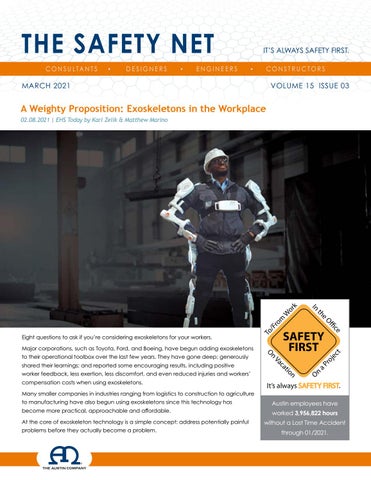
Eight questions to ask if you’re considering exoskeletons for your workers. Major corporations, such as Toyota, Ford, and Boeing, have begun adding exoskeletons to their operational toolbox over the last few years. They have gone deep; generously shared their learnings; and reported some encouraging results, including positive worker feedback, less exertion, less discomfort, and even reduced injuries and workers’ compensation costs when using exoskeletons.
SAFETY FIRST.
Many smaller companies in industries ranging from logistics to construction to agriculture to manufacturing have also begun using exoskeletons since this technology has
Austin employees have
become more practical, approachable and affordable.
worked 3,956,822 hours
At the core of exoskeleton technology is a simple concept: address potentially painful problems before they actually become a problem.
without a Lost Time Accident through 01/2021.
Overexertion continues to be a leading cause of pain,
Exos can help reduce strain, fatigue and injury risk in the
stakeholders will be critical. Question 7 discusses how exo
And watch out for posture aids masquerading as exos.
physical disability, missed work, lost productivity, turnover
workplace. They are a complementary new tool in the
implementation experts can help your organization build
There are devices that provide tactile feedback to remind
and medical expenses. According to the Centers for
ergonomics and safety toolbox that can be utilized with
awareness of exos and increase worker buy in.
workers to use good posture (similar to back belts), but true
Disease Control and Prevention, back pain is the most
traditional engineering, administrative and behavioral controls.
prevalent work-related health problem. The Occupational Safety and Health Administration estimates that employers pay nearly $1 billion for direct workers’ compensation. That’s why exos (rigid exoskeletons and flexible, textilebased exosuits) are becoming a popular investment to ensure worker safety, well-being and productivity. Companies that are successfully integrating exo technology
Exos are becoming part of a comprehensive health, ergonomics and safety program. They are not a replacement for good ergonomics. If everything has been done to improve the ergonomics of a job but risk factors for overexertion, fatigue, injuries or turnover persist, then exos might be worth exploring.
4. W HAT TASKS WOULD BENEFIT MOST, AND HOW LONG DO WORKERS PERFORM THESE EACH DAY? Identifying the pain point tasks in your workplace will help make sure you are looking at the right types of exos (e.g.,
exos are a very different class of device. Exos can both promote good posture and substantially offload the muscles and bones. This offloading benefit is what distinguishes exos from back belts and posture aids and why exos reduce overexertion injury risks.
(e.g., a worker bent over a conveyor belt) and others
6. W ILL A GIVEN EXOSUIT FIT YOUR WORKFORCE COMFORTABLY, SAFELY AND WITHOUT INTERFERING WITH OTHER TASKS?
designed for highly dynamic jobs that involve lots of lifting,
Most companies that explore exos start with a pilot
shoulder vs. back). Even within back exos, there are models that excel for more static jobs that involve lots of bending
into their workflow have been purposeful in matching the
2. WHERE DO YOUR WORKERS NEED HELP?
right type of device to the right job. Some organizations
There are many types of exoskeletons, including ones that
consider exos to be tools while others consider them to be
specialize in supporting certain body parts or functions. For
PPE or even a form of engineering control.
example, there are shoulder-assist exoskeletons. Toyota
porter and construction worker).
uses such an exoskeleton for its workers who are frequently
You also need to understand how
acceptance and the likelihood
working overhead on the assembly line. There are also
often exo assistance would be
an exo can fit into their workflow.
back-assist exosuits that provide low-back support and
needed. Will your workers only
assistance for workers who lift, bend and reach throughout
need to use an exo for the most
But before you bring in a new
their shift.
strenuous tasks or all day for 40-
Consider the primary movements of your workers, what
plus hours per week?
injuries are prevalent or where your workers are sore day in
Knowing the answers to these
would this solution be feasible
and day out. Then look into the exos that provide that kind
questions helps narrow potential
to roll out and scale to the rest
of support.
exo solutions. Some are great
of your workforce?
for short stints but can be
It’s best to know this upfront. For
Regardless, these companies have discovered that effective exo technology is built on three pillars: comfort, assistance and freedom of movement. You need all three working in unison to get the most out of an exo. After years of experience in designing, testing and implementing occupational exos, we’ve identified a list of key questions for occupational health and safety professionals to ask when exploring the use of exos to sustain and support the hardworking women and men in their organizations.
1. H AVE YOU EXPLORED TRADITIONAL ERGONOMIC CONTROLS? Ergonomics and safety efforts have been very effective in reducing injury rates over the last few decades. The Hierarchy of Controls is an effective approach for reducing risk that has helped tremendously. Proactively preventing injuries is always better than reacting to them for both employees and employers. Despite excellent progress, there are still work-related injuries. In a perfect world, there would be none. National Safety Council’s Work to Zero Initiative aims to eliminate workplace fatalities through the use of technology. A similar initiative to reduce work-related injuries could be very helpful, especially one aimed at reducing preventable work-related musculoskeletal disorders (WMSDs) such as sprains and strains, which can be debilitating and costly for people and companies alike. Previous injuries are the top predictor of future injuries. That’s why it’s critical to prevent as many injuries as possible in the first place. It’s also important to reduce the cumulative wear and tear many workers experience as they age.
3. A RE YOUR WORKERS INTERESTED IN RELIEF? ARE MANAGERS OPEN TO NEW IDEAS?
stooping, walking or other tasks (e.g., case picker, aerial
uncomfortable or obstructive for long durations. Others have been optimized for longer use and can
Culture is an important factor in the successful adoption
accommodate all sorts of tasks
of exos. It will be much easier to implement exos if workers
and postures without getting in
and managers are interested and have bought in.
the way. If workers are going to be using it all day, it better
First ask workers and managers if they are familiar with
be light and comfortable. If they are going to take it on
occupational exos. This is an emerging tech, and they
and off, then it better don/doff in seconds.
may not realize practical workplace exos exist. They may also have erroneous preconceptions based on Hollywood movies or an exo they tried five years ago and did not like. Much like early cell phones, there’s no comparing modern exos to those previous models. There have been major advances in the last five to 10 years, including models that are much lighter weight, lower profile and more like clothing (exosuits). Exos are not as clunky and obstructive as they used to be. Most now use springs, rather than
test on a small number of workers, often about 2-50, to assess effectiveness, worker
exo, or any new tech, be sure to think it through. If the first workers love this exo, then
instance, consider the cost and whether the exo will fit people of different sizes, shapes and genders. Don’t assume that all exos fit women’s bodies; this has long been a problem for exoskeletons and other types of PPE. But this is changing, and there are now companies offering specific versions of exos for women.
5. I S THERE EVIDENCE THE EXO YOU’RE CONSIDERING ACTUALLY WORKS?
You also need to consider if there are any other
There is a large body of evidence that exos (as a general
as extreme heat or cold, electrical hazards, dirty/dusty
class of device, including rigid, soft, active, passive and quasi-passive devices) assist workers and relieve strain on the body—and not just by transferring loads elsewhere (see sidebar, “Common Misconceptions about Exo Technology”). But you still have to do your homework.
motors and batteries to assist, which has made exos much
When considering models, review lab-based validation
more affordable.
studies and field tests.
It’s not impossible to implement exos if your workers are
Look at the quality of evidence as well. Is it a random
not initially interested in exos (particularly if they are not
plot on a webpage without any source for the data or is
aware of the newest tech), but it can be more difficult.
it peer-reviewed science with supporting evidence from
Communicating with and educating workers and other
multiple studies?
environmental constraints with respect to safety, such environment, sensitive equipment and confined spaces? Would the exo you are considering be able to hold up in this environment, or would it get in the way? Can workers quickly don/doff if they need to use the bathroom, or turn off the exo and still be comfortable if they have a short break or need to hop in a forklift? As important as it is to identify the tasks that need assistance, it is equally important to identify the tasks that do not. Do your workers need to sit down occasionally, climb ladders, get on their knees, walk, run or enter confined spaces? Movement interference has been one of the largest ...continued on next page 3
barriers to exoskeleton adoption. This has historically been a
and accessible information for those interested in learning
challenge for wearable assist devices, but some modern exos
more about exoskeletons and exosuits.
are using soft textiles, lightweight designs, and get-out-of-the way (on/off) modes to ensure worker freedom of movement. It’s truly the beginning of a new era for exos.
7. D OES THE EXO VENDOR PROVIDE TRAINING AND IMPLEMENTATION SUPPORT BEYOND THE PRODUCT SALE? There are a number of considerations for successful implementation depending on the size of your organization, the industry and other internal dynamics. If your organization
Exos are now available that can help companies promote a healthier and safer workplace in ways that make financial sense, too. Active workers are now able to work better—and safer—at their jobs and live better away from them, too.
SIDEBAR: Common Misconceptions about Exoskeleton Technology
is new to exos, you likely would benefit from advice and guidance on implementation from a vendor that has been implementing exos for years.
Because exoskeletons (exos) are still relatively new to
A few key questions to ask: How do you prepare for
the market, there are some prevailing misconceptions
implementation before exos arrive on-site? Who is needed
about them.
to support new exoskeleton users? How do you make sure a
DO EXOS CAUSE ATROPHY?
given exo fits well and continues to fit well over time? How will exos be maintained, stored and cleaned to ensure safe and sanitary use?
8. W HAT DOES SUCCESS LOOK LIKE FOR YOUR ORGANIZATION? As safety professionals, you have to be in the driver’s seat for this. Exos are not about technology. They are about people and organizations—keeping people healthy and energized, and organizations intact and productive. You should understand upfront: What does success look like? What metrics or factors will your organization use to assess success? Do you have the support needed to roll out exos more broadly if your workers respond enthusiastically? Also, does everyone in your organization understand that the goal is not for workers to wear exoskeltons so they can
To date, there is no evidence that exos have caused, or will cause, muscles to atrophy. For instance, employees in warehouses have to lift and move 25-pound boxes. For workers wearing exosuits, they feel more like 15-pound boxes. These jobs still require plenty of effort, but even slight reductions in strain and fatigue can make a significant difference to workers’ health and well-being, especially over time. And a little-known fact: Muscle atrophy can actually occur when there is too little or too much muscle activation. That means overexertion can lead to muscle atrophy, as can the lack of muscle use after an injury. The purpose of exos is to keep workers in that healthier “sweet spot.”
DO EXOS JUST SHIFT FORCES TO OTHER PARTS OF THE BODY?
handle heavier things? The goal is to protect workers from
No, this is a misconception of how exos function. Exos use
injury risks, not push them harder.
leverage to do the mechanical work more efficiently. They
If you are new to exos, you ideally want support from EHS personnel, management, the workers themselves and also external guidance (e.g., exo vendor) on implementation support.
PARTING THOUGHTS
allow your body to do the same amount of physical work— for instance, to lift a box—but with lower forces applied to bones, muscles and joints. Most exos also are not meant to encourage employees to do even more work. They are designed to reduce the risk for injury, help combat overexertion and fatigue
There’s a lot to consider when exploring exos to
over the course of a work shift and, quite simply, improve
supplement and expand your occupational health and
people’s lives.
safety toolbox. However, exos have never been more practical and approachable. Sites like ExoskeletonReport.com offer balanced, valuable
OSHA Issued Additional Guidance On January 29 With Information On Protecting Workers By Mitigating And Preventing The Spread Of Covid-19 In The Workplace. 02.02.2021 | weeklysafety.com This updated guidance provided by OSHA is intended to
To view the guidance in full visit OSHA’s Coronavirus Disease
inform employers and workers in most workplace settings
home page at osha.gov/coronavirus/safework,
outside of healthcare to help them identify risks of being exposed to and/or contracting COVID-19 at work and to help them determine appropriate control measures to implement. In addition to the general guidance, links to industry-specific guidance are also provided. The recommendations provided by OSHA are advisory in nature, informational in content, and are intended to assist employers in providing a safe and healthful workplace. This guidance is not a standard or regulation, and it creates no new legal obligations. Social distancing and the use of face coverings are emphasized in the guidance, as well as additional information on implementing COVID-19 prevention programs in the workplace. There is no OSHA standard specific to COVID-19; however, employers still are required under the General Duty Clause, Section 5(a)(1) of the OSH Act, to provide a safe and healthful workplace that is free from recognized hazards that can cause serious physical harm or death.
OSHA General Duty Clause 5(a)(1) Each employer shall furnish to each of his employees employment and a place of employment which are free from recognized hazards that are causing or are likely to cause death or serious physical harm to his employees.
5
• More alternative labeling options where a
Make Time for Your Mental Health 12.15.2020 | EHS Today by Nicole Stempak
manufacturer or importer can demonstrate that it is
they are exposed, by means of a hazard communication
not feasible to use traditional pull-out labels, fold-back
program, labels and other forms of warning, including
labels, or tags containing the full label information
safety data sheets, and information and training.
normally required under the standard, including specific alternative requirements for containers less
The Occupational Safety and Health
than or equal to 100ml capacity and for containers less
Administration (OSHA) has proposed
than or equal to 3ml capacity.
a new rule to update its Hazard
• New requirements to update the labels on individual
Communication Standard (HCS) to bring
containers that have been released for shipment but
it into alignment with the latest version of
are awaiting future distribution where the manufacturer,
the United Nations Globally Harmonized
importer or distributer becomes aware of new significant
System of Classification and Labeling of
information regarding the hazards of the chemical.
Chemicals (GHS). OSHA’s proposed modifications to the standard include codifying enforcement policies currently in OSHA’s
employees about the hazardous chemicals to which
“Consistent labeling requirements have also enabled employers to identify the most hazardous materials in the workplace, understand more about the health effects of these chemicals, and address which hazardous chemicals they may want to replace with safer alternatives,” OSHA said research has shown. At the international level, the GHS provides a universally harmonized approach to classifying chemicals and communicating hazard information,
OSHA asserts that its proposed modifications to the HCS
OSHA stresses. Core tenets of the GHS include the
“will increase worker protections and reduce the incidence
establishment of universal standards for hazard testing
of chemical-related occupational illnesses and injuries by
criteria, warning pictograms and safety data sheets for
further improving the information on the labels and Safety
a wide range of hazardous chemicals.
compliance directive, clarifying requirements related to
By signing onto the UN program, the U.S.
the transport of hazardous chemicals, adding alternative
pledged to make sweeping changes
labeling provisions for small containers and adopting
in its own hazmat regulations and labeling
new requirements related to preparation of Safety Data
requirement. Initially, OSHA’s original proposed changes
Originally established in 1983, OSHA’s HazCom Standard
the 16-section SDS format indicate that the new format
Sheets (SDS).
in the HCS caused widespread consternation because
is designed to provide a systematized approach to
improves comprehension in the workplace. OSHA says
OSHA last updated its HCS in 2012, in order to align it with
they were poorly publicized by the agency and were little
communicating workplace hazards that are associated
industry representatives also have reported that workers
noticed by participants in the distribution industry until
with exposure to hazardous chemicals.
responded positively to training on pictograms and
shortly before they went into effect. But attitudes have
Under the standard, chemical manufacturers and/or
hazard statements because it provides an opportunity to
what was then the third version of GHS. The agency’s regulatory update is being proposed at the same time that
Data Sheets for hazardous chemicals,” Lawson explains.
the United States’ major international trading partners—
changed since that first implementation.
including Canada, Australia, New Zealand and those
“Information OSHA has collected since publication of the
which they produce or import into the U.S., and all
in Europe—similarly prepare to align their own hazard
2012 updates to the HCS indicates that aligning the HCS
employers are required to provide information to their
communications rules with recent U.N. changes.
with the GHS has had a positive impact,” the agency
To be in compliance with the standard, employers must
reported in the new rulemaking notice. “Data from
maintain a GHS-style, 16-section SDS for each chemical which is considered to be a health or physical hazard under American law and regulations. The OSHA rules proposal is intended to bring U.S. regulations in line with the seventh version of the GHS, which the U.N. published in 2017, as well as with the eighth version issued in 2019. “The proposed changes to the HCS will result in better alignment between the standard and the continuallyevolving GHS,” OSHA said. In its recently published advanced notice of proposed rulemaking, OSHA clarifies that it is “not proposing to change the fundamental structure” of its HCS, but instead seeking to “address specific issues that have arisen since the 2012 rulemaking” and to provide better alignment with international trading partners, notes attorney Matthew G. Lawson of the law firm of Jenner & Block LLP.
published studies indicate that the hazard communication approach taken in the 2012 HCS has been effective, when implemented appropriately, in enabling workers to
importers are required to classify the hazards of chemicals
Several studies published since 2012 when HCS adopted
address distinctions between acute toxicity and chronic health effects.
The Austin Team at Project Emerald Completed First Aid, CPR & AED Left Front Tom Wilkinson, Andrew Loveless, Back Row Left Ron Litherland and Matt Gibbons
understand, avoid and mitigate exposures to hazardous chemicals in the workplace.”
EMPLOYERS SAY CHANGES NEEDED OSHA also said that among changes being proposed, a number are the result of feedback from employers concerning needed improvements. Among the key modifications included in the new proposed rule are: • Additional flexibility for labeling bulk shipments of hazardous chemicals, including allowing labels to be placed on the immediate container or transmitted with shipping papers, bills of lading, or by other technological or electronic means that are immediately available to workers in printed form on the receiving end of the shipment;
7
Prevent Overexposure To Welding Fumes And Gases
Study Links Increased Diesel Exhaust Exposure To ALS Among Men
12.20.2020 | Safety + Health
03.21.2018 | Safety + Health
Overexposure to welding fumes and gases can cause both short-term and chronic health effects, resulting in dizziness,
Boston — Workers frequently exposed to diesel exhaust
unconsciousness, illness and even death.
may face a higher risk of amyotrophic lateral sclerosis,
Workplaces where welding is performed must have proper ventilation to keep exposure to these airborne contaminants
and the risk may increase with length of exposure, a
Researchers found no association among women. According to OSHA, occupations with potential exposure to diesel exhaust include miners; construction workers;
below permissible limits. The American Welding Society says proper ventilation depends on many factors, including:
preliminary study from Harvard University suggests.
• Size, shape and ambient conditions of the workplace
Researchers analyzed the medical and employment
railroad workers; oil and gas workers; loading dock
histories of 1,639 Danish National Patient Registry entrants
workers; truck drivers; material handling operators;
who had been diagnosed with ALS between 1982 and
farmworkers; long-shoring workers; and automobile, truck
• Contents of the fume plume
2013 at an average age of 56. The researchers matched
and bus maintenance garage workers.
• Type and effectiveness of the ventilation
each diagnosed person with 100 people of the same
• Number and type of operations
If you’re working near fumes, AWS recommends:
age and sex who did not have ALS, and then used employment history to estimate diesel exposure before
heavy equipment operators; bridge and tunnel workers;
“There is some suggestion from previous studies of occupation that workers in jobs with higher exposure to diesel exhaust may have a higher risk of ALS,” Aisha
• Having a technically qualified person evaluate the exposure to determine if the ventilation is adequate.
the person’s diagnosis.
• Wearing an approved respirator when ventilation is not adequate or practical.
Results showed that men who had any level of
research fellow, said in a Feb. 27 press release. “However,
• Opening windows, roof vents and doors to provide natural ventilation.
occupational exposure to diesel exhaust for at least 10
no studies have directly looked at the relation between
years before diagnosis were 20 percent more likely to
diesel exhaust exposure during different time points in life
• Running fans – making sure to position the fan so the air is blowing away from workers.
Dickerson, lead study author and Harvard University
develop ALS than those who experienced no exposure
and ALS. The overall risk of developing ALS is low, but our
Position of the welder’s head matters too. Workers should be reminded to reposition their work, their head or both to
during the same period. Men who had more than a 50
findings suggest that the greater the exposure to diesel
keep from breathing in welding fumes.
percent chance of occupational exposure for both five
exhaust, the greater the risk of developing ALS.”
and 10 years before diagnosis were 45 percent more likely to develop ALS than those unexposed.
The research is scheduled to be presented in April at the American Academy of Neurology’s annual meeting in LA.
9
The Accelerating Transformation Of Employee Mental Health & Safety 02.01.2021 | Forbs by Timothy R. Clark In 1788 the British Parliament passed the “Chimney
intangible hazards in a workplace that have the potential
Sweepers Act” to stop the practice of conscripting boys
to cause mental, emotional, or psychological harm.
as young as four years old to be apprenticed to master
We’re talking about things such as excessive work hours
chimney sweeps. That law gave expression to a moral
and workloads, poor leadership and culture, bullying,
position that employers had a “duty of care” to their
harassment, role clarity, involvement in decisions, and lack
employees—a concept that has evolved from the time
of support.
Charles Dickens described England’s “dark, satanic mills” as “soot-vomiting.” Since then the conscience of the world regarding employee mental health and safety has shifted glacially. That is, until now. The convulsions of 2020 marked the beginning of an accelerating transformation. Emerging from our discontent has come a permanent change in our understanding of employee mental health and safety and what our duty of care is to each other.
PHYSICAL & PSYCHOLOGICAL SAFETY We have moved from an (1) agrarian to an (2) industrial to a (3) service, and finally to an (4) experience economy, yet it took more than 250 years to fully acknowledge the need for physical health and safety and build a management system to sustain it. The applied discipline of physical safety is built on a rubric that identifies four standard hazard categories: 1. Physical
CEMENTING THE NEED FOR PSYCHOLOGICAL SAFETY The COVID-19 pandemic and the racial tensions that
2. Biological
erupted in 2020 cemented the need to acknowledge
3. Chemical
psychological safety as a universal human right. The
4. Ergonomic Thousands of organizations around the world have become proficient at continuously identifying and removing these hazards. For example, in the United States, during the nearly 50 years that the Bureau of Labor Statistics has been tracking the data, the incidence rate of nonfatal injuries and illnesses among private industry workplaces has fallen from 10.9 cases per 100 full-time equivalent workers in 1972 to 2.8 cases in 2018.
compounding effect of these crises invoked a stress response unlike anything we had witnessed in our lifetimes, signaling a shift in our collective consciousness. Leaders across institutions looked deep into their institutional souls and realized that they lacked a truly sustainable commitment to mental health and safety which can only be achieved by removing sources of psychosocial risk and building psychological safety. Systemic racism, for example, reflects a profound lack of progress in mitigating psychosocial risk and vulnerability.
But it’s only been in recent years that we have begun to
In 2020 we learned that we were not prepared for
reconceive employee health and safety as an integrative
the devastating emotional blows these events would
concept that includes both physical and psychological
deliver. Very few organizations had ever done a critical
domains. As a result, we have adopted a fifth hazard
event preparedness exercise before COVID-19 based
category—psychosocial. Psychosocial risk refers to
on psychosocial risk. The pandemic continues to inflict ...continued on next page 11
a devastating toll on mental and emotional health,
5. Psychological Demands
revealing the bread and depth of our liabilities.
6. Growth & Development
Millions of baby boomers and Gen Xers had been
7. Recognition & Reward
hardened with so-called “thick skin” socialization. They were taught to grin and bear the full range of psychosocial
8. Involvement & Influence
threats and interpersonal indignities that might come along.
9. Workload Management
But that strategy has been no match for the relentless
10. Engagement
pounding of these events on mental and emotional health. For example, the CDC reports that levels of adverse mental
11. Balance
health conditions, substance use, and suicidal ideation
12. Psychological Protection
in adults have increased. In June of 2020, a full 40% of US
13. Protection of Physical Safety
adults reported struggling with mental health or substance abuse. Even before the pandemic, the Word Health Organization estimated that poor mental health costs the global economy US $1 Trillion annually in lost productivity.
The standard is a response to the finding that 21.4% of Canadians suffer mental health problems and illnesses. While voluntary, the standard is seen as a starting point for more formal and binding regulations.
EVOLVING LAWS, REGULATIONS, AND STANDARDS
Finally, and perhaps most importantly, ISO, the
The landscape of laws, regulations, and standards that
Standardization is in the draft stage of creating an
address comprehensive employee health and safety
international standard (ISO 45003) that addresses mental
continue to evolve in two categories—legally binding
and emotional safety: “Occupational health and safety
measures and non binding or voluntary measures. Both
management—Psychological health and safety at work:
national and supranational bodies are working hard
managing psychosocial risks— Guidelines to help support
to address psychosocial risks more effectively. Let me
and project workers from psychosocial risks.”
mention the two most significant national developments
The standard is due to be published as a full International
and the single most important global effort to develop a universal standard.
non-governmental International Organization for
Protecting Workers: Guidance on Mitigating and Preventing the Spread of COVID-19 in the Workplace
Standard in the summer of this year. Though the standard
United States Department of Labor
is in draft stage, it is considered 95% complete and
Performing enhanced cleaning and disinfection after people with suspected or confirmed COVID-19 have been in the
In 2011, Australia passed and published the model Work
organizations are starting to apply it to help guide their
Health and Safety Act (WHS) to provide a nationally
psychosocial health and safety efforts.
consistent framework and standard of health and safety
ACCELERATING PROGRESS IN 2021
1. Closing areas used by the potentially infected person for enhanced cleaning.
as both physical and psychological and includes the model
The crises of 2020 exposed our weaknesses in preparation
2. Opening outside doors and windows to increase air circulation in the area.
WHS Act, model WHS Regulations, and model Codes of
and commitment to address the mental and emotional health of employees, but they are also serving as an
3. Waiting as long as practical before cleaning or disinfecting (24 hours is optimal).
Practice. Amendments continue to be added and the laws are passed and applied by jurisdiction.
accelerator to transform workplaces into sanctuaries of
protection for all Australian workers. The act defines safety
In 2013, Canada introduced the National Standard for Psychological Health and Safety. It’s a voluntary standard created to address the rising legal, social, and economic costs of mental health issues in Canadian workplaces. The standard aims to promote psychological health and
facility. If someone who has been in the facility is suspected or confirmed to have COVID-19, follow the CDC cleaning and disinfection recommendations. This includes:
4. Cleaning and disinfecting all immediate work areas and equipment used by the potentially infected person, such as
psychological safety. A broad-based crisis has the benefit of liquefying the status quo. We are now in a fluid state which allows leaders the opportunity to shift the prevailing norms of their organizations much faster than if they were starting with a fossilized current state.
psychosocial factors:
safety. Now it is the time to consolidate our commitment to
3. Clear Leadership & Expectations 4. Civility & Respect
5. Vacuuming the space if needed. Use a vacuum equipped with a high-efficiency particulate air (HEPA) filter, if available. Wait until the room or space is unoccupied to vacuum. required based on the cleaning/disinfectant products being used and whether there is a risk of splash.
We have consolidated our understanding of employee
2. Psychological and Social Support
tablets, touch screens, keyboards, and remote controls.
6. Providing cleaning workers with disposable gloves. Additional PPE (e.g., safety glasses, goggles, aprons) might be
prevent psychological harm based on the following 13 1. Organizational Culture
offices, bathrooms, shared tools and workplace items, tables or work surfaces, and shared electronic equipment like
it. Humans are social creatures that crave and are entitled to connection and belonging. They have a perpetual
7. After cleaning, disinfecting the surface with an appropriate EPA-registered disinfectant on List N: Disinfectants for use against SARS-CoV-2. 8. Following requirements in OSHA standards 29 CFR 1910.1200 and 1910.132, 133, and 138 for hazard communication and
need to bond and collaborate. Now is the time to crack ourselves open, reflect deeply on the duty of care we have
PPE appropriate for exposure to cleaning chemicals. Once the area has been appropriately disinfected, it can be opened for use. Workers without close contact with the
for each other, and transform our workplaces.
potentially infected person can return to the area immediately after disinfection.
12
13
2. IDENTIFY THE IMPACT OF THE ACTION OR BEHAVIOR. There are two components of impact worth sharing: first, how the action or behavior affected the person giving the feedback and second, the broader impact, whether it be on the organization, audience, peers, etc. Personalizing the impact makes the feedback easier to digest. Did their action, behavior, event, or process make you feel pleased, intrigued, disappointed, angry, confused, excited, etc? If this is important enough to provide feedback, there should be some emotion that arose, telling you that you should address it. Perhaps this is a good time to remind ourselves that, since feedback is important, we may need to train ourselves to notice those opportunities and to respond and provide feedback. Providing a broader context aligns the person’s performance with the organization’s values and goals. Did an action add value to a meeting or discussion; did it fit nicely into the organization’s desired culture; did it hinder a project or hurt a team’s collaboration? Again, our goal in feedback is to be as specific as possible in order to tie the referenced action with the results, either positive or negative. Specifics make it more likely for the feedback to be clearly understood and accepted, thus increasing the likelihood of long-term impact. A statement such as “You were rude, and I don’t want that to happen again” has little value. Rather a statement like this is more likely to gain the attention and acceptance of the recipient: “I was disappointed to hear the rude comment you made when you said ___. That sort of comment breaks down the cohesion of our team and makes it more difficult to work together. We want this organization to be a place where each person is valued and accepted.”
3. SET EXPECTATIONS FOR FUTURE ACTIONS OR BEHAVIORS.
The 3 Elements of Effective Feedback for a Safer Workplace
Feedback is about identifying what we want more, less, or the same amount of in the future. This requires a statement or a
01.22.2021 | EHS Today by Ken Vaughan
discussion of our expectations relative to the specific action that we are addressing. The feedback process must provide clear expectations for the future. This can be a simple statement, such as, “I hope you continue to find more opportunities
Employees’ actions can be shaped to align with actions and behaviors and expectations. Management often thinks that wage levels or benefits are the most important elements of creating satisfaction in employees. But instead, workers are
to repeat this” or “I trust you understand, agree, and will not repeat this behavior.” Depending upon the situation, the third step of the feedback process might also include consequences or a plan of action.
saying, “Tell me how I’m doing” or “Help me grow and do a better job.”
If we are talking about a serious negative action or behavior, the process may call for identifying the disciplinary action that
Of course they want feedback: It’s necessary to shape their actions and behaviors in the workplace to align with
will take place in the event of a next occurrence. If we have communicated the specific action and the specific impact of
desired culture, established policy, and the leader’s expectations.
that action, it is only natural that a specific consequence be communicated.
For the feedback process to be effective, these three elements must be clearly communicated.
On the other hand, the feedback discussion may be related to an action
1. RECOGNITION OF A SPECIFIC ACTION OR BEHAVIOR.
or behavior that is beyond the recipient’s present capabilities. In this case,
This recognition can be either in direct response to something we want to see more of or less of in the future. We
developmental plan of action or it may require that the feedback provider
the discussion may call for either the feedback recipient to create a
often say that “feedback is best served warm,” meaning that it should happen as soon as possible after observing
and the recipient together define a developmental plan.
the action or behavior, while it is still fresh and relevant. The feedback process is not appropriate for addressing job performance, attitude, or other longer-term matters. These are better dealt with through a performance review discussion or a coaching session.
One of the highest priorities for leaders is the development of the people around them. Effective feedback is a tool to guide that development. Spotting opportunities where feedback is appropriate and then providing it in a way
“The growth and development of people is the highest calling of leadership.” – Harvey S. Firestone
The conversation might begin with a description of the action, such as “the way that you helped the team reach a
that helps the recipient’s development is the best way to guide the growth
consensus by drawing each person in was great” or “the three crisp and concise conclusions as you wrapped up your
of the people that we lead. Nudging the actions and behaviors of team
presentation really hit the mark.” Or, in the case of corrective feedback, “the tone that you used in replying to Joe seemed
members to align with organizational vision, goals, culture, and strategy is the
very condescending” or “the facts that you presented don’t support the conclusions that you drew.”
best way to maximize the effectiveness of the organization. As leaders, we need to understand the power of feedback and
Too often people think that they are providing feedback with a very general statement, such as “great job on the presentation”
prioritize the many opportunities for providing it.
or “you add a lot to this team.” Such general statements have little value for guiding future behavior, thus not really constituting feedback. The more specific and descriptive our statement, the better guidance it provides for future behavior. Often feedback is better received when we first ask for permission, especially in the case of corrective feedback. Also, when providing corrective feedback, a bit of positive at the front end makes the recipient more open to the negative. An example might be, “Your presentation was good, with a logical flow of the background information and each slide was a nice, bite-sized addition to our understanding, but may I offer some advice?” and then move into identifying specific opportunities for improvement.
14
15
OSHA General Industry Standard 1910.95(i)(1): Employers shall make hearing protectors available to all employees exposed to an 8-hour time-weighted average of 85 decibels or greater at no cost to the employees. Hearing protectors shall be
The 3 Elements of Effective Feedback for a Safer Workplace
replaced as necessary.
01.22.2021 | EHS Today by Ken Vaughan
• Hearing protection must be provided for the level and/or range of noise that workers will be exposed to during their work hours.
Workers in any industry who are exposed to high levels of noise can suffer permanent hearing loss. Understand the employer’s responsibility and the employees’ rights when it comes to hearing protection.
• Different types of devices may be used depending on the work environment as well as the hazardous noise.
According to OSHA, twenty-two million workers are exposed to potentially damaging noise at work each year. U.S. businesses pay more than $1.5 million in penalties annually for not protecting workers from noise, and hearing loss directly
• Where noise levels are extremely dangerous or potential impact noise levels
impacts the quality of life not only for those workers but also their families.
are present workers may have to wear two layers of hearing protection such
Workers who are exposed to high levels of noise can suffer permanent hearing loss and then sometimes not even surgery
as a combination of ear plugs and ear muffs.
or a hearing aid can help. In addition, even repeated exposures to loud noise for just short periods of time can add up to permanent damage to hearing.
OSHA General Industry Standard 1910.95(i)(3): Employees shall be given the opportunity to select their hearing protectors from a variety of suitable hearing
IE. Ear plug packages with rating levels & limits.
protectors provided by the employer. • Never improvise hearing protection by stuffing cotton, tissue, wax or other items into your ears. • Items can get stuck in the ear canal and in severe cases puncture the ear drum.
OSHA Construction Standard 1926.10(c): Plain cotton is not acceptable protective device. OSHA General Industry Standard 1910.95(i)(4): The employer shall provide training in the use and care of all hearing protectors provided to employees. OSHA General Industry Standard 1910.95(c)(1): The employer shall administer a continuing, effective hearing conservation program... whenever employee noise exposure equal or exceed an 8-hour time-weighted average sound level (TWA) of 85 decibels... without regards to... the use of personal protective equipment. OSHA Construction Standard 1926.52(b): When employees are subjected to sound levels exceeding those in Table D-2 of this section, feasible administrative or engineering controls shall be utilized. If such controls fail to reduce sound levels within the levels of the table, personal protective equipment as required in Subpart E, shall be provided and used to reduce sound levels within the levels of the table.
OSHA General Industry Standard 1910.95(i)(5): The employer shall ensure proper initial fitting and supervise the correct use of all hearing protectors. OSHA Construction Standard 1926.95(b): Where employees provide their own protective equipment, the employer shall be responsible to assure its adequacy, including proper maintenance, and sanitation of such equipment. Remember these important tips to avoid hearing loss while on the job: • Workers who are exposed to high levels of noise can suffer permanent hearing loss.
• Workers must be protected from hazardous levels of noise.
• Workers must be protected from hazardous levels of noise.
• Workplace noise is measured using special noise monitoring
• Workers must pay attention to all signs and warnings of potentially dangerous noise levels.
equipment and the levels are displayed in decibels.
• OSHA regulations state that 85 decibels (dB) is the action level where workers may need to use hearing protection.
• Normal speaking voice is usually around 70 decibels (dB) and
• Hearing protection must be provided for the level and/or range of noise that workers will be exposed to during their work hours.
operating a loud construction excavator is usually
• Never improvise hearing protection by stuffing cotton, tissue, wax or other items into your ears.
around 110 dB.
• Proper personal protective equipment such as ear plugs or ear muffs must be maintained and worn correctly at all times.
• OSHA regulations state that 85 decibels (dB) is the action level where workers may need to use hearing protection.
Want this safety information in an easy to download file so you can share this with your team? Better yet, want it in a PowerPoint presentation format, with a pre-filled sign-in sheet and bonus information? You can get this safety information
• When choosing hearing protection, consider the employee’s hearing needs on the job, their current hearing ability, convenience,
and so much more with a subscription to Weeklysafety.com.
ease of use, the work environment and the compatibility with any other PPE the worker may need to wear.
Weeklysafety.com gives you and your company access to hundreds of safety meeting topics and toolbox talks, safety
• The best hearing protection is a solution that is worn properly by the worker every single time they are exposed to loud
resources you won’t find anywhere else, safety topics professionally translated into Spanish, and so much more. This includes a safety meeting topic on Hearing Protection in both English & Spanish. Two versions are available with your membership
noise on the job.
including a 6-page Manager’s Presentation and a 2-page Foreman’s Topic.
16
17
Winter Weather 02.18.2021 | OSHA.gov Outdoor work requires proper preparation, especially in severe winter weather conditions. Although OSHA does not have a specific standard that covers working in cold environments, employers have a responsibility to provide workers with employment and a place of employment which are free from recognized hazards, including winter weather related hazards, which are causing or are likely to cause death or serious physical harm to them (Section 5(a)
EMPLOYERS SHOULD PROVIDE ENGINEERING CONTROLS
• Acclimatizing new workers and those returning after
Engineering controls can be effective in reducing the risk of cold stress. For example, radiant heaters may be used to warm workplaces like outdoor security stations. If possible, employers should shield work areas from drafts or wind to reduce wind chill. Employers should use engineering controls to protect
Employers should, therefore, train workers on the hazards
workers from other winter weather related hazards, for
of the job and safety measures to use, such as engineering
example, aerial lifts or ladders can be used for safely
controls and safe work practices, that will protect workers’
applying de-icing materials to roofs, to protect workers from
safety and health.
the hazard of falling through sky lights.
• Employers Should: • Train Workers
EMPLOYERS SHOULD IMPLEMENT SAFE WORK PRACTICES
• Provide Engineering Controls
Safe work practices that employers can implement to
• Implement Safe Work Practices • Consider Protective Clothing that Provides Warmth • Dressing Properly for the Cold
• The importance of self-monitoring and monitoring coworkers for symptoms • First aid and how to call for additional medical assistance in an emergency • How to select proper clothing for cold, wet, and windy conditions • Other winter weather related hazards that workers may be exposed to, for example, slippery roads and surfaces,
inner layers of clothing that will hold more body heat
cold environment
than cotton.
• Having a means of communicating with workers,
• The National Oceanic and Atmospheric
• Providing workers with the proper tools and equipment to do their jobs
• Scheduling maintenance and repair jobs for
EMPLOYERS SHOULD CONSIDER PROTECTIVE CLOTHING THAT PROVIDES WARMTH (PPE), for example, fall protection, when required by
in the warmer part of the day when possible • Limiting the amount of time spent outdoors on extremely cold days
• Providing warm areas for use during break periods • Providing warm liquids (no alcohol) to workers
is no OSHA requirement for employers to provide workers
• Insulated and waterproof boots to protect the feet
symptoms of cold stress • Monitor your physical condition and that of your coworkers
• Stay dry in the cold because moisture or dampness, e.g.
ordinary sunglasses, and sunscreen (29 CFR 1910.132(h) (4)). Regardless of this, many employers provide their
from sweating, can increase the rate of heat loss from the body • Keep extra clothing (including underwear) handy in case you get wet and need to change
DRESSING PROPERLY FOR THE COLD
• Drink warm sweetened fluids (no alcohol)
Dressing properly is extremely important to preventing cold
• Use proper engineering controls, safe work practices,
be avoided, the following would help protect workers from
• How to recognize these hazards
• Monitoring the weather conditions during a winter
cold stress:
equipment, including personal protective equipment
the hands
• Dress appropriately for the cold
• Monitoring workers who are at risk of cold stress
safe work practices and proper selection of
• Insulated gloves (water resistant if necessary), to protect
jackets, gloves, parkas, rubber boots, hats, raincoats,
stress. When cold environments or temperatures cannot
storm, having a reliable means of communicating
body heat that escapes from your head.
solely for protection from weather, such as winter coats,
windy conditions, and downed power lines
• How workers will be protected: engineering controls,
your whole body warmer. Hats reduce the amount of
• Your employer should ensure that you know the
jackets and gloves.
demanding jobs
• Hat that will cover your ears as well. A hat will help keep
SAFETY TIPS FOR WORKERS
workers with winter weather gear such as winter coats/
• Using relief workers to assign extra workers for long,
• Knit mask to cover face and mouth (if needed)
However, in limited cases specified in the standard (29
with ordinary clothing, skin creams, or other items, used
• Avoiding exposure to extremely cold temperatures
• Tight clothing reduces blood circulation. Warm blood
OSHA standards to protect workers’ safety, and health.
employers to provide PPE to workers. For instance, there
• Scheduling jobs that expose workers to the cold weather
some ventilation to prevent overheating.
coat/jacket (water resistant if necessary)
CFR 1910.132), there are exceptions to the requirement for
warmer months
• An outer wind and rain protection layer that allows
needs to be circulated to the extremities. Insulated
Employers must provide personal protective equipment
• Developing work plans that identify potential
insulation even when wet.
stay informed about winter storms. If you are notified
NOAA Weather Radio
protect workers from injuries, illnesses and fatalities include:
• A middle layer of wool or synthetic to provide
Administration (NOAA) provides multiple ways to
instructions from your local authorities:
protect workers
prevent cold stress injuries and illnesses
areas, as they build up a tolerance for working in the
of a winter storm watch, advisory or warning, follow
EMPLOYERS SHOULD TRAIN WORKERS
• How to recognize the symptoms of cold stress,
body. Thermal wear, wool, silk or polypropylene,
severe weather: outdoor sirens, radio, and television
hazards and the safety measures that will be used to
• Cold Stress:
(polypropylene) to keep moisture away from the
workload, and allowing more frequent breaks in warm
• Knowing how the community warns the public about
• Safety Tips for Workers
At a minimum train workers on:
time away from work by gradually increasing their
especially in remote areas
(1) of the Occupational Safety and Health Act of 1970).
• An inner layer of wool, silk or synthetic
and personal protective equipment (PPE) provided by your employer
• Wear at least three layers of loose fitting clothing.
with workers and being able to stop work or evacuate
Layering provides better insulation.
when necessary
18
19