THE SAFETY NET CO N SU LTA N T S
▪
DESIGNERS
▪
ENGINEERS
FEBRUARY 2021
IT’S ALWAYS SAFETY FIRST. ▪
CON STRUCTORS
VOLUME 15 ISSUE 02
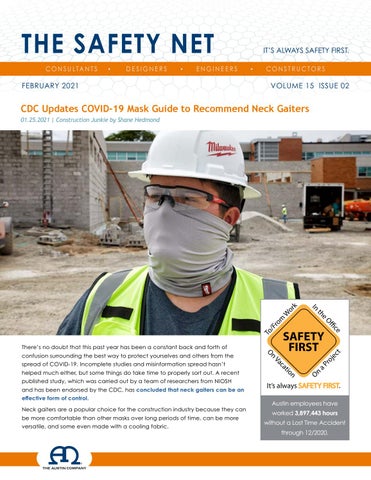
CDC Updates COVID-19 Mask Guide to Recommend Neck Gaiters 01.25.2021 | Construction Junkie by Shane Hedmond
There’s no doubt that this past year has been a constant back and forth of confusion surrounding the best way to protect yourselves and others from the spread of COVID-19. Incomplete studies and misinformation spread hasn’t helped much either, but some things do take time to properly sort out. A recent published study, which was carried out by a team of researchers from NIOSH and has been endorsed by the CDC, has concluded that neck gaiters can be an effective form of control. Neck gaiters are a popular choice for the construction industry because they can be more comfortable than other masks over long periods of time, can be more versatile, and some even made with a cooling fabric.
SAFETY FIRST. Austin employees have worked 3,897,443 hours without a Lost Time Accident through 12/2020.
According to the study, titled “Efficacy of face masks, neck gaiters and face shields for reducing the expulsion of simulated cough-generated aerosols,” neck gaiters worn in a single layer are nearly as effective at blocking aerosol particles from coughs as cloth masks. Worn in a double layer, the gaiters can actually be more effective than their cloth equivalents. • Face shield: blocks 2% of cough aerosols • Single layer neck gaiter: 47% • Cotton cloth face mask: 51% • Medical procedure mask: 59% • Double layer neck gaiter: 60% To reflect the results of this study, the CDC has updated their Guide to Masks to recommend the use of double layered neck gaiters as a mask. As you can imagine from reading the chart above, the study – and subsequently the CDC – do not recommend the use of face shield to prevent the spread of the virus. The study also underlines the fact that cloth masks and neck gaiters are meant to protect other people, not the wearer, from the spread of large respiratory aerosols, which are airborne liquid droplets and dried particles that are spread through talking, singing, coughing, breathing, or sneezing. COVID-19 can be carried through these droplets of an infected person. It’s important to note that cloth masks and neck gaiters are not considered PPE and can not be used in place of respirators for construction tasks that require them, such as concrete demolition.
YOUR GUIDE TO MASKS COVID-19 CDC CDC recommends that people wear masks in public settings, like on public and mass transportation, at events and gatherings, and anywhere they will be around other people.
HOW TO SELECT When selecting a mask, there are many choices. Here are some do’s and don’ts.
SPECIAL CONSIDERATIONS
HOW TO WEAR Wear a mask correctly and consistently for the best protection. • Be sure to wash your hands or use hand sanitizer before putting on a mask. • Do NOT touch the mask when wearing it. If you have to often touch/adjust your mask, it doesn’t fit you properly and you may need to find a different mask or make adjustments. For more information, visit our How to Wear Masks webpage. ...continued on next page 3
HOW TO CLEAN Reusable masks should be washed regularly. Always remove masks correctly and wash your hands after handling or touching a used mask. • Include your mask with your regular laundry • Use regular laundry detergent and the warmest appropriate water setting for the cloth used to make the mask • Use the highest heat setting and leave in the dryer until completely dry
OSHA Raises Penalty Maximums, Establishes New Debt Collection Procedures 01.22.2021 | OSGA.org
DIVE BRIEF: • OSHA has raised its maximum civil penalty amounts for 2021 according to the rate of inflation. The new penalties go into effect Jan. 16. • The maximum federal penalty for serious and other-thanserious violations is now $13,653 per violation, up from $13,494. The maximum penalty for willful or repeated violations is now $136,532 per violation, up from $134,937. • OSHA increased its monetary penalties by more than 80% in August 2016 in order to reflect cost-of-living increases since 1990, the last time the penalties had been raised. Since 2017, OSHA has adjusted the fines according to the Cost of Living Index every year.
DIVE INSIGHT: The agency also announced that it is changing the way it
fails to make timely payment based on a final order — one at seven days, the second at 30 days and the next at 60 days. OSHA will also contact those that don’t pay their fines on time by phone 14 days after the payment is due. If an establishment fails to make payment and does not have an affordable payment plan in place, OSHA will put that establishment on a priority list for more inspections. In addition, OSHA compliance safety and health officers will collect employer identification numbers as part of the preinspection process. OSHA issues citations and levies fines for safety violations as well as for administrative infractions like failure to perform adequate recordkeeping. For instance, covered employers must submit electronically their “OSHA Form 300A Summary of Work-Related Injuries and Illnesses” data by March 2.
collects citation penalties that have been levied against
OSHA’s new payment letter initiative is part of a wider
establishments, which OSHA defines as single, physical
Department of Labor push to maximize collections.
locations where business is conducted.
The new process also aims to shorten the time in which
Currently, all demands for payment after the first are issued at 30-day intervals. Moving forward, OSHA will send a series of three penalty payment after an establishment
unpaid debts are referred to the Department of Justice for litigation, according to the Labor Department’s final rule as published in the Federal Register.
5
Make Time for Your Mental Health 12.15.2020 | EHS Today by Nicole Stempak Prioritizing yourself is always important but especially so as
about a quarter of white workers. It’s worth noting that
the COVID-19 pandemic draws on.
a majority of respondents (71%) said they were working
Sunday afternoon, I made room for fun, literally.
in-person, and 68% said their job has been considered
I cleared a spot on the dining room table by pushing aside the bills, holiday cards and wrapping paper — all signs of
essential during the pandemic. What’s more, the survey found the pandemic is being
what a responsible adult should be doing on a day off —
viewed differently by gender.
and started working a holiday puzzle I had just returned
“We did find, in general, that women were more likely to
home with. (Clearly, I don’t have children.)
say that the pandemic was a source of stress, not that they
Later that night, I painted my fingernails a light metallic
were more likely to take leave or considering quitting, but
color. It was something I always enjoyed as a child but largely stopped doing once I started working. I often find it difficult to make time for myself, but I decided that’s exactly why I need to focus on self-care. It seems like millions of others could benefit from some extra pampering and kindness, too. The COVID-19 pandemic continues to take a toll on all of us, both in our personal and professional lives. One in four respondents have considered quitting their job, according to a recent survey. Respondents also reported that they have cut back on their hours (28%) and have taken leave (20%). The Associated Press-NORC Center for Public Affairs Research, with funding from SAP, conducted this survey of 1,015 full-time and part-time U.S. employees
50% of women said the pandemic was a source of stress over one-third of men,” said Marjorie Connelly, senior fellow for The Associated Press-NORC Center for Public Affairs Research, to CNN. The survey also asked about how employers have responded to the pandemic. More than 80% of respondents had a positive outlook for how their employer has handled the pandemic. When asked further, employees rated their employer as doing a good job in protecting their physical health (54%), mental health (45%) and financial well-being (47%). Still, there’s room for improvement. Respondents said their employer was doing a neither good nor bad job expanding paid sick leave, offering counseling or other mental health
in mid-September.
resources, and providing hazard pay for at-risk workers.
It’s no surprise that when listing stressors, 43% of all
Those, and many other granular questions mentioned
respondents said the pandemic is a major source of stress. That number is even higher among non-white workers: 65% of Black workers along with 43% of Hispanic workers reported it was a major source of stress compared with 39%
in the survey, can only be answered by management. In the meantime, employees can focus on what they can control: prioritizing their own health. The self-care movement has been building momentum and seems to
of white workers.
have hit its stride in 2020.
One contributing factor is that in addition to working during
While companies have tried to capitalize on everything
a pandemic, many employees are also now responsible for their children’s education, or at least dealing with oft changing school and daycare arrangements. Parents with
from face masks to sweatpants to at-home gym equipment, many forms of self-care can be free or little cost. Maybe it’s going for a walk, watching a holiday
children who are unable to physically attend a school or
movie, lighting a candle or even taking a nap.
daycare center are among those experiencing high levels
I recognize that these activities may seem like a low priority
of stress. Sixty eight percent of working parents reported it
or frivolous during these times. I know painting my fingernails
a significant source of stress, and 45% said it was impacting
isn’t necessary for survival. That’s why I dangled the
how much work they were getting done.
prospect of an at-home manicure as a reward for finishing
More than half of the schools or daycare centers attended
more important tasks. But I came to realize that’s the wrong
by non-white workers’ children are closed compared with
way to view self-care.
2020 has been a challenging year that no one could have expected. We owe it to ourselves to reward ourselves for making it through nine months of a global pandemic and practice self-care as a way to help us endure some dark months ahead. For me, self-care Sunday involved working on a puzzle, painting my nails, making a pizza and listening to an audiobook. It was, hands down, one of my best days in recent memory and helped Monday land more gently. There is always work to be done, and while we should never stop trying to improve, sometimes we forget to take a pause and congratulate ourselves for making it this far in the first place. Let’s start by making time for ourselves and our mental health.
7
How Safety Leaders Can Manage the Impact of COVID-19 01.21.2021 | EHS Today by Sean Salvas The COVID-19 pandemic continues to have varied and
to work on-site with ready access to their employer’s
widespread impacts on enterprises in nearly all industries
facilities or must work remotely, EHS professionals
as well as across the entire public sector. Besides
can continue to have a measurable impact on their
sustaining significant hits to their revenues, employers
organization’s ability to deal with the effects of COVID-19
able to remain or resume operating have had to
on their enterprises.
navigate dramatic changes to their workplaces, business processes and workforces.
1. EMBRACE NEW RESPONSIBILITIES AS WORKING FROM HOME BECOMES THE NEW NORMAL.
Even under these dynamic conditions, ensuring
Across the U.S. and around the world, work life and
employee health, wellness and safety still ranks among any organization’s highest priorities. Although EHS professionals play a central role in these critical initiatives, the development and implementation of effective health and safety programs that address evolving needs require close coordination with multiple functions and disciplines. They also call for ready access to timely data about regional and local virus spread rates, employee infections and exposures, as well as details on evolving employer requirements emanating from federal, state and local governments and regulators. Here are five ways EHS professionals can ramp up their organization’s focus on health and safety to address the evolving challenges posed by the COVID-19 pandemic. Regardless of whether they and their colleagues are able
social life have changed dramatically from the impacts of COVID-19. All industries have been impacted by the virus—from manufacturing and industrial operations to retail, banking, financial and professional services, the public sector and educational institutions. How and where individuals work has been transformed, in some cases significantly, in only a few months. Prior to the pandemic, roughly 3.6% of the total U.S. employee workforce was working from home at least half the time or more, according to Global Workplace Analytics. However, by the end of 2021, an estimated 2530% of employees will be working from home multiple days each week, according to the Global Work-from-Home Experience Survey.
These new challenges have also reimagined the roles and responsibilities of EHS professionals. In addition to their traditional focus areas on regulatory compliance and enhanced safety culture, EHS professionals are taking on additional roles involving data science, ergonomics, employee well-being, enhanced collaboration tools, and a deeper focus on industrial hygiene and occupational health.
3. ADOPT A TEAM APPROACH, MAKING USE OF COLLABORATIVE TOOLS. Now, more than in the past, the team approach to managing workplace and remote work arrangements has taken center stage as employers work to navigate the challenges of the sustained pandemic. Over the years, EHS professionals have often been the catalyst to bringing about greater collaboration among team members from
2. RECOGNIZE THE NEED FOR A HEIGHTENED FOCUS ON ERGONOMICS.
various functions in all types of work environments.
With more people working remotely as well as in
weekly or monthly) safety meetings to address key safety
retrofitted and different work environments, a new push
topics affecting an organization. These meetings typically
for ergonomic best practices has become top of mind for
were held in person so all risks could be discussed and
EHS professionals. As one example, many employers lack
prioritized, and any related remedial actions could be
a process to facilitate and ensure safely working from
implemented on a coordinated, programmed basis. The
home. Notably, employees often have difficulty obtaining
pandemic has made it critical for EHS professionals to take
proper equipment to ensure an ergonomically sound
a more proactive role in driving this process.
home workspace.
Ordinarily, EHS professionals would conduct frequent (daily,
Furthermore, given how quickly circumstances can evolve,
Within their home environments, employees typically station
EHS team members may need to leverage virtual briefings
themselves at raised kitchen counters, coffee tables, or
and information-sharing technologies to help document
even on their couch or in their bed. Many risks exist with
and quantify safety issues, risks and non-conformance
these remote work environments as home workspaces
situations in real-time. To facilitate prompt action, EHS
are typically non-adjustable, which increases the risk of
professionals must capture a steady flow of inputs and
developing musculoskeletal disorders (MSDs) as compared
insights from facilities and those working remotely or
to traditional office settings. Some of these risk factors
traveling on business to assess, prioritize and manage what
include prolonged laptop usage, inadequate seating and
may be an evolving set of critical risks.
fixed-height worksurfaces.
4. UNDERSTAND HOW TECHNOLOGY AND AUTOMATION CAN HELP.
As an interim remedy, many employers now provide equipment stipends to help mitigate the cost of appropriate office furniture to facilitate a sound work environment. However, although these measures may be well-intentioned, most employees lack sufficient awareness of ergonomics to make informed decisions about their work-from-home setups. Consequently, many EHS professionals and ergonomists are now prioritizing the use of virtual ergonomic assessments to better manage home-based workstations and work environments with an emphasis on proper workspaces that include correct posture, table or desk and chair setups. By using virtual assessments, EHS professionals can get a better handle on varied office setup risks while helping manage work/rest cycles, awkward angles and repetitive tasks (typing/clicking), all of which represent injury risks that can be addressed with effective ergonomics solutions and best practices.
In the dynamic workplaces of today, the need for effective automation and streamlined processes has become critical to compress response times to COVID-19 outbreaks and employee incidents, as well as to make on-the-fly adjustments to safety planning and management. With fewer resources at facilities and reduced staff to manage risks associated with a dynamic operating environment, automated processes not only help ensure compliance, but also allow the EHS professional to refocus priorities to address elevated health and safety risks at individual facilities as changes are made to their operations. Besides retrofits to provide appropriate social distancing for on-site workers, employers are making refinements to operations to accommodate new product lines, such as the manufacture of PPE or accelerated production to meet dramatic spikes in demand. These include situations facing food and other manufacturing ...continued on next page 9
industries, warehousing and distribution, among other
With mask mandates, for example, EHS professionals may
sectors. Under these circumstances, EHS professionals
be actively involved with employer programs for fit testing
may need to be the catalyst to drive the adoption and
and maintaining adequate levels of PPE across all of an
implementation of technology solutions to maintain or
organization’s operations. These responsibilities include
adapt their enterprise’s safety practices to what can be
addressing logistical challenges to ensure PPE is supplied
rapidly evolving work conditions.
and available at all pertinent sites.
During the past year, the accelerated adoption of
Meanwhile, EHS professionals also may be summoned
technologies—such as wearable devices to measure
to play a key role in helping assess and adjust their
ergonomics risk factors, remote sensors to measure vitals
enterprise’s response to catastrophic events, including
and work activities in remote locations, and sensors to
natural disasters such as hurricanes, wildfires, floods and
capture environmental exceedances—have all helped
earthquakes. Emergency response and business continuity
to roll-up risk factors and safety metrics. Many of these
plans may need to be adjusted to address issues related
tools can be utilized in a dynamic work environment
to social distancing, adequate PPE supplies, remote
where EHS professionals may be working remotely while
workers, and scaled down or expanded operations,
managing exposures.
among other factors.
Incidents, near misses and potential hazards historically
As these plans are updated to address the operational
recorded on paper, and tracked and assessed using
changes, regional pandemic outbreaks and other
spreadsheets can now be reported instantly using online
circumstances, EHS needs to be a key part of the planning
portals. Captured data can be analyzed quickly and
team to make sure any adjustments in planning consider
accurately through artificial intelligence and machine
COVID-19 appropriate health and safety precautions.
learning-supported predictive modeling tools, shared internally to drive remedial actions and communicated externally to ensure timely regulatory compliance.
As the COVID-19 pandemic continues to have widespread impacts on governments, communities and employers throughout the U.S. and around the world, EHS professionals
5. STAY AWARE OF THE PANDEMIC’S WIDESPREAD POTENTIAL IMPLICATIONS ON SAFETY AND HEALTH.
bring critical skills and expertise their organizations need to
With new guidance and local requirements now in place
navigate the various challenges the pandemic presents.
in many areas of the world, EHS has moved deeper into areas involving industrial hygiene and occupational health.
keep employees and customers as safe as possible as they
Eight Tips for Hearing Testing Day 12-01-20 | OH&S by Chad Coleman There’s no official checklist or cheat sheet to make sure
think about and start to schedule your testing. Give yourself
hearing testing is an effortless experience—some things
plenty of time—you want to be fully scheduled a month
come with experience and time.
before your testing date. Use technology to stay organized.
Your annual hearing testing is around the corner, and you
Once you have a date on the calendar, set reminders
are working hard to ensure this integral part of your hearing
on your laptop or phone. Creating a project through a
conservation program is successful.
productivity tool is also a helpful method to stay on track.
There are various ways of ensuring you are in compliance.
Just like anything else, it’s all about preparation when
Offsite clinic visits, your onsite nurse or a mobile hearing testing partner that visits your site are several examples of testing that are available. While there are pros and cons to each, they all ensure the hearing of your workforce is protected and safe. While the OSHA standard on occupational noise exposure is your guide for compliance, there’s no official checklist or cheat sheet to make sure hearing testing is an effortless experience for you and your team. Some things only come with experience and time. Here is a list of ideas, tips and advice compiled to help you prepare for an organized and efficient testing process.
SCHEDULING IS KEY It all starts with scheduling. This is key, as hearing testing is an annual event. Compliance testing can approach rapidly and you want to be ready. It’s never too soon to
it comes to success for a smooth operation. If you are working with a mobile testing partner that will come onsite, know the details beforehand, such as the number of employees to be tested, individual employee needs, flow rates and logistical requirements. When using a clinic, stagger the clinic visits across time to ensure your workers have shifts covered and production still runs smoothly on the site. The key to success? Finding a partner that communicates with you. You want to understand all that is required of you and your workforce: a month out, a week out and the day before testing. Having someone you can rely on to guide you during this process is a benefit to all safety managers.
LIMIT EXPOSURE BEFORE TESTING DAY Ideally, your employees are treating every day like testing day by limiting their exposure to loud noises with the use of ...continued on next page 11
protective equipment or through distancing. We all know
prevent an accurate measurement of hearing change.
that this is not the reality.
Take special care and consideration of these employees
However, when it comes to the day before testing,
when it comes to testing.
limiting noise exposure becomes necessary. In fact,
DOCTOR’S ORDERS
controlling occupational noise exposure 14 hours before testing is required by OSHA for anyone undergoing their baseline test. It’s strongly encouraged for all employees to avoid activities that involve loud or excessive noise such motorcycling, setting off fireworks, shooting guns or attending concerts without the use of hearing protection the day, or days, leading to hearing testing day.
TIME OF TESTING DURING YOUR SHIFT Hearing testing should be conducted throughout an employee’s work shift. As such, it’s imperative to arrange testing later in the work schedule, rather than earlier. A test later in a work shift is the best way to assess how well the hearing protection portion of the hearing conservation program is working. If hearing protection is working as it
If an employee has a note from a physician stating they are currently under medical care for an ear problem, they still need to be tested if they are in your hearing conservation program. Often times a medical problem will not result in a hearing shift. Unless the ear is painful to the touch or has active drainage, you are encouraged to have the employees tested. It’s important to note that hearing protection, or the lack thereof, can cause serious medical issues. For instance, a medical professional may recommend that an employee not use hearing protection or that they need to wear hearing protection at all times at work for various medical reasons. If either of these are truly medical necessities, then the employee cannot work in noise and will need to be otherwise accommodated and the situation will need to be
should, an employee should be able to be tested at any
further evaluated.
point during the work shift while showing no hearing shift.
Additionally, be aware of your claustrophobic and anxious
BRING HEARING PROTECTION TO THE TEST…
employees before the testing process when sound booths or other smaller spaces are involved. The employee may need to be tested alone so that the technician can allow
Employees should always bring their hearing protection—
brief breaks during the session. If possible, schedule these
whether foam earplugs, earmuffs or other types of
employees at the end of the test day or before a test break
protection—to the testing location. When you are working
to allow for a longer test time, if needed. If a claustrophobic
with a mobile testing compliance partner, they should
employee cannot tolerate testing in a sound booth, make
mention this as a reminder to tell your employees. If doing
sure to schedule other arrangements.
this yourself or sending employees to a clinic, ensure this step is followed. This allows the technician to verify whether
TESTING FOLLOW UP
your employees are correctly using the protection they
Once testing is completed, you will probably have
wear, as poorly fitting equipment is a major cause of
questions or concerns about the test results. Audiologists
inadequate protection and hearing damage.
dedicated to occupational hearing loss prevention bring
…BUT DON’T WEAR IT DURING THE TEST
the expertise and knowledge to help understand and analyze test results. These professionals have a thorough
Anything that has been inserted into the ear canal must
understanding of the inner working of the ear, expert
be removed before taking the hearing test. While this may
knowledge of noise and noise management related to
seem like an obvious and unnecessary piece of advice,
industrial hygiene, as well as ear diseases and the severe
too often employees go in for testing with disposable foam
impact of hearing loss. The audiologist should be able
hearing protection wedged in their ear.
to perform work-related evaluations, investigations that
The same is true for anyone wearing hearing aids, as they
confirm hearing shifts and determine if it was a professional
must be removed during testing. While those with hearing
or personal incident.
aids may fear they have a disadvantage during the test,
Additionally, data management is another essential part
this is simply not the case. The purpose of the annual
of testing follow up. By analyzing your hearing testing
hearing test is to determine if an employee’s hearing
data, you can uncover potential hazards as well as
has worsened. Wearing a hearing aid during the test will
highlight and pursue areas of success. Make sure you have
12
a platform that easily allows you to gain insights into your Hearing Conservation Program, report your results and plan for the future. After all, it’s not just about checking the box on annual hearing testing—it’s about the long-term safety and health of your team.
IN THE AGE OF COVID-19 During the COVID-19 pandemic, the need for industrial sanitation has never been more important. In attempts to reduce the virus transmission, make sure you or your testing partner are closely adhering to CDC and OSHA guidelines and regulations. Sanitation and distancing are essential with hearing testing. Sanitizing all contact surfaces between use is an important safety step to be taken to reduce the risk of virus spread. Other steps include adding partitions between testing and training spaces and adding air purifiers to all gathering spaces. Moreover, temperature checks should be a requirement before testing, and face masks should be worn by all testing staff and employee participants. Studies have shown that when both parties wear a mask, the spread of the virus is significantly reduced. Test administrators should also wear masks, gloves and even full-body protective covering. The goal is to allow you to continue with compliance testing while keeping employees and testers as safe as possible from viral infection.
TREAT EVERY DAY LIKE IT IS HEARING TESTING DAY When it comes to hearing protection, your employees should treat every day like hearing testing day. Consistent and careful use of hearing protection, as well as proper training and monitoring, should be a daily occurrence on the job. Too often, hearing protection usage increases right before hearing testing occurs. This occurrence doesn’t accurately represent your workforce’s typical hearing practice and can result in damaged hearing health if the pattern continues. More importantly, protecting ear and hearing health prevents a host of other physical and mental health complications, such as poor balance, impaired memory, increased blood pressure, depression, social withdrawal and anxiety. Behaving as if every day is hearing testing day keeps everyone safe.
13