THE SAFETY NET CO N SU LTA N T S
▪
DESIGNERS
▪
ENGINEERS
JANUARY 2021
IT’S ALWAYS SAFETY FIRST. ▪
CO N STRUCTO RS
VOLUME 15 ISSUE 1
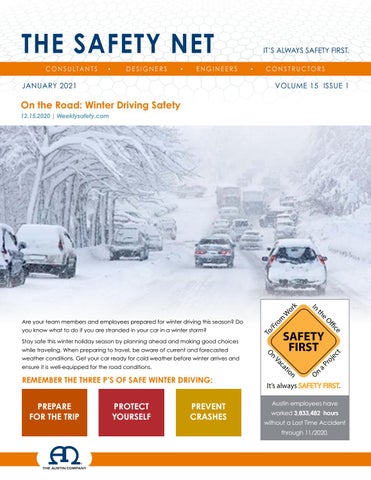
On the Road: Winter Driving Safety 12.15.2020 | Weeklysafety.com
Are your team members and employees prepared for winter driving this season? Do you know what to do if you are stranded in your car in a winter storm? Stay safe this winter holiday season by planning ahead and making good choices while traveling. When preparing to travel, be aware of current and forecasted weather conditions. Get your car ready for cold weather before winter arrives and ensure it is well-equipped for the road conditions.
REMEMBER THE THREE P’S OF SAFE WINTER DRIVING:
PREPARE FOR THE TRIP
PROTECT YOURSELF
PREVENT CRASHES
SAFETY FIRST. Austin employees have worked 3,833,482 hours without a Lost Time Accident through 11/2020.
BE SURE YOUR VEHICLE IS READY FOR RIGORS OF WINTER • CHECK THE CONDITION OF YOUR WINDSHIELD WIPER BLADES. Most blades are recommended for replacement at one year or less. • USE A WINTER WINDSHIELD WASHER FLUID. IT SHOULD BE RATED NOT TO FREEZE AT 00F (IF YOU ARE TRAVELING IN AN AREA SUBJECT TO FREEZING). In areas of extreme cold use washer fluid with a freeze point of -250F to -350F. • CHECK THE VEHICLE’S EXTERIOR LIGHTS AND LAMPS. Visibility is generally reduced during winter weather and there are fewer daylight hours. Make sure they are working. • CLEAR ALL WINDOWS, HEADLAMPS, TAIL LAMPS AND
WINTER DRIVING SAFETY TIPS • Speed limits are based on normal road conditions so reduce your speed when there is ice or snow. • Stay at least 200 feet back if you are behind a snow plow. • Bridges, ramps and overpasses freeze first, so use extreme caution. • Know how to safely maneuver a vehicle if skidding on ice occurs. • Maintain at least three times the normal following distance when driving on snow and ice. • Be aware of ‘black ice’ which is a nearly invisible layer of ice that can develop on roads and cause a driver to rapidly lose control. Black ice is especially common at night.
SIGNAL MAPS OF FROST, ICE AND SNOW. See and be
Keep a safety kit in every car with supplies you might need
seen in winter weather.
in the event of an unexpected roadside emergency. Ideas
• CHECK ALL VITAL FLUIDS. Engine oil, transmission fluid,
for winter include:
coolant/antifreeze, and brake fluid need to be within
• Snacks and bottled water, medication if needed
their normal operating range.
• First aid kit and plastic bags (for sanitation)
• CHECK TIRE INFLATION. As temperatures fall, tire air pressure can drop by as much as 1 PSI (pounds per square inch) for every 10 degrees the temperature falls.
MAKE SURE YOUR TIRES ARE READY FOR WINTER WEATHER • CHECK TIRE INFLATION. As temperature fall, tire air pressure can drop. • DON’T RELY ON TIRE PRESSURE MONITORING SYSTEMS
• Blankets, or other items to keep warm • Cat litter or sand for icy areas • Booster cables, tow chain or rope, and flares • Spare tire and tire jack • Flashlights, battery powered radio, batteries • Windshield scraper and brush If you do become stranded in a winter storm, don’t panic
(TPMS). These systems are only designed to warn drivers
and stay with your car unless safety or help is less than 100
when tires become approx. 20 percent or more under-
yards away.
inflated.
Follow these tips until help arrives.
• MAKE SURE YOUR TIRES ARE SUITABLE FOR THE CONDITIONS YOU TRAVEL IN. “All-season” tires are good choice for year-round traction in areas that don’t experience significant snow and ice. Specialized winter tires are designed to cope with challenging snow and ice conditions. • VERIFY YOUR TIRES HAVE THE RIGHT AMOUNT OF TREAD. If traveling in snow or ice conditions tires should have a minimum of 6/32 of tread remaining. If traveling in wet or rainy conditions the tire should have a minimum of 4/32 tread remaining.
• Continue to move arms and legs • Stay visible by putting a bright cloth on the antenna, turning on the inside light when the engine is on and raising the hood when the snow isn’t falling • Run the engine and heater only 10 minutes every hour • Keep a downwind window open • Make sure the tailpipe is not blocked If employees are going to be on the road this winter, then winter driving is a great topic for a safety meeting.
54% of Americans Think Employers Should Require COVID-19 Vaccine 12.15.2020 | EHS Today 63% plan on getting a vaccine as soon as they are able with
with the insurance providers coming in next at 30% and
only 37% not wanting to get the vaccine.
employers that require it at 9%.
As the vaccination process begins, there are a lot of
SURVEY REPORT: AMERICAN PERCEPTIONS OF COVID-19 VACCINES SURVEY RESULTS
issues to consider. And the question as to what level of involvement employers should be taking is one of the hardest to navigate. In a survey of 2,000 adults in the U.S in November, Skyes, a solutions provider, asked if employers should require nonremote employees to take the vaccine and 54% said yes. Breaking this out by age groups, those 55 and older said yes more than their younger counterparts. Almost 60% of baby boomers are in favor of workplace requirements. That number falls to 57% for Gen Z (ages 18–24). For those ages 45-54, that number is 53%. And the youngest, ages 23-35 reports the lowest number at 49%.
When news started breaking on promising COVID-19 vaccines, SYKES surveyed 2,000 U.S. adults regarding their interest (or lack thereof) in getting vaccinated, as well as their opinions on how schools, employers, and the country should handle future regulations. Standing out from the many unpredictable outcomes of COVID-19 is one very predictable one: vocal and wideranging opinions. From mask mandates to lockdown orders to social distancing policies, Americans are torn on best practices but united by one common goal: leaving the novel coronavirus in the past. Still, one promising means to that end
In alignment with these results, a substantial majority, 63% plan
— a vaccine — is similarly wrought with varying beliefs.
on getting a vaccine as soon as they are able with only 37%
At the time this report was written, multiple vaccines with
not wanting to get the vaccine. Interestingly, more men, 73% will opt for the vaccine compared to 56% of the women.
high success rates during testing have dominated the news cycle, introducing hopes of a quick release to the public.
For those who want to get the vaccine, when asked who
This is, of course, the primary objective of the collaborative
they would prefer to administer the vaccine, the majority
Operation Warp Speed, with the goal of delivering 300
(57%) will go to their primary care physician or nurse. Twenty-
million doses of safe and effective vaccines beginning late
three percent will to the health department and 13% will go
December 2020 or January 2021. While it seems inevitable
to their local pharmacy. Only 3% said they will take the shot
that at least one vaccine will be available to the most at-risk
at their workplace.
population in the coming months, many questions remain:
For those that won’t be getting the vaccine, the reasons vary: • 38% Worry about the safety of the COVID-19 vaccine • 26% Worry about the effectiveness of the vaccine
Who should pay for it? Will the majority of Americans willingly accept the vaccine? Should schools, employers, and government entities require it? These are just a few of the questions SYKES asked 2,000 U.S.
• 14% Worry about the cost
adults in November 2020 via survey platform Pollfish. While
• 12% Have underlying health issues
their answers varied greatly, they offer unique insights into
When asked about who should pay for people to receive the vaccine, the majority chose the U.S. government ( 58%)
what COVID-19 is up against in 2021, and how Americans will respond. ...continued on next page 3
DO YOU PLAN TO GET THE COVID-19 VACCINE ONCE IT’S AVAILABLE TO YOU? 63.35% - Yes 36.65% - No Roughly a year into COVID-19’s deadly global spread, multiple vaccines have been produced, tested, and are right around the corner from widespread distribution. In the coming months, many will have the opportunity to receive a vaccine. However, as our survey indicates, many will not take advantage of it — at least, not right away. Of all respondents, 63.35% plan on getting vaccinated as soon as it’s available, while 36.65% do not.
Broken down by gender, 72.97% of men and 56.06% of women answered “yes” to this question. Around the country, the Western U.S. had the highest percentage of “yes” respondents, at 67.96%, whereas the Northeast (64.87%), Midwest (61.29%), and South (60.29%) trailed slightly. And by age group, Gen Z led the pack in vaccine proponents (68.75%), while millennials ages 35–44 (65.31%), baby boomers (63.56%), and millennials ages 25–34 (61.80%) rounded the middle. The age group with the lowest percentage of “yes” answers was Gen X, at only 57.73%. The novel coronavirus is likely to slow as effective vaccines ramp up, despite the holdouts. But even for them — as our report will demonstrate — many of those who initially answered “no” are likely to change their minds.
WHAT MIGHT CONVINCE YOU TO GET THE COVID-19 VACCINE? 21.63% - If people I know get the COVID-19 vaccine without issue 19.37% - Nothing: I don’t believe vaccines are safe 14.51% - Other 13.99% - If it is free or very affordable for me 12.86% - If my employer requires it 9.30% - If getting the COVID-19 vaccine meant I would no longer have to wear a mask or social distance 6.43% - If it is required for international travel 1.91% Nothing. My religion prohibits vaccines Although more than a third of respondents indicated they wouldn’t get a COVID-19 vaccine as soon as it becomes available, it doesn’t mean they won’t be willing to in the future. For many holdouts, it’s simply a matter of the vast unknowns that comes alongside a brand-new vaccine. Others are taking a more practical approach, such as cost considerations or waiting till their employer requires it. And for those holdouts, perhaps the data will shed some light on when they might come around: 21.63% would be persuaded to get a vaccine when people they know do so without issue, 13.99% said they will when it’s free or affordable to them, a combined 19.29% will do so when it’s required for work or international travel, and 9.30% would if it meant the easing of mask requirements or social distancing measures. An additional 9.82% responded with answers like, “after 3–5 years of safety data”; “if okayed by Dr. [Anthony] Fauci and [the] CDC”; and “if it’s pregnancy safe.” Still, there are sure to be some who refuse to be vaccinated, as evidenced by the 19.37% who don’t believe vaccines are safe. In that case, the science is still out on whether the number of those vaccinated would be enough to effect herd immunity. But the overwhelming scientific consensus is that vaccines, in general, are safe and effective. Regardless, vaccine holdouts were common before the age of COVID. This choose-all-that-apply survey question was given to those who indicated they would not be getting a COVID-19 vaccine once it is available. The percentages shown were calculated by dividing the number of each individual answer by the total number of all answers.
DID YOU GET A FLU SHOT THIS YEAR? 63.35% - Yes 36.65% - No While the percentage of those who stated they don’t believe vaccines are safe is a high number indeed, it isn’t nearly as high as the percentage of those who didn’t get a flu shot. According to a December 2019 survey by the National Opinion Research Center, 37% of respondents who didn’t get a flu shot last year made their decision based on concerns about the vaccination’s side effects, 36% didn’t believe they work, and 22% were concerned they would get the flu from the shot itself. And because many of these beliefs surrounding the flu (whether true or not) come from word of mouth, social channels, or the media, it’s worth exploring where dissidents are consuming news of COVID-19 vaccine developments.
...continued on next page 5
DO YOU KNOW ANYONE WHO HAS SAID THEY WILL NOT GET THE COVID-19 VACCINE? 50.71% - Yes 49.29% - No While the majority of our respondents indicated they would be getting a COVID-19 vaccine once it is available, a slim majority of that number (50.71%) knows someone personally who won’t be getting it. But the real surprise is found in breaking down the numbers by age group. Of baby boomer respondents (55+), only 35.67% knew someone who wouldn’t get the vaccine. This is in stark opposition to their younger counterparts, who answered significantly higher:
So, why the disparity? Why do baby boomers (whose answers regarding whether they would get the vaccine weren’t much different from other generations) know so many fewer people who are actively saying they won’t get it? This may partially be due to the fact that COVID-19 can affect older people severely, causing fewer in their age group to dismiss the idea of a vaccine. But another consideration is the COVID-19 vaccine timeline: It’s widely acknowledged that vaccines will be dispersed to first-responders and older people as soon as possible. And phase 1 trials of the Moderna vaccine were proven to be effective on older adults well before its most recent 95% success findings. So, baby boomers might simply be more willing (and more trusting) at the outset. Of course, they may also be eager to see their grandchildren again. This survey question was asked to those who indicated they would be getting a COVID-19 vaccine once it was available.
DO YOU PLAN TO VACCINATE YOUR CHILDREN? 40.35% - Yes 23.25% - No 36.40% - I don’t have children
Like many sides of this study, varying opinions around this question are common. While children are less likely to experience major symptoms, they are by no means in the clear. Interestingly though, the number of respondents with children (a combined 63.60% for this question) who said they would vaccinate their kids is several percentage points lower than the number of respondents who would get the vaccine themselves (57.62% vs. 63.35%). This, perhaps, speaks to the hesitations they have about a non-time-tested vaccine, particularly when it comes to giving it to their children.
WHAT HESITATIONS DO YOU HAVE ABOUT GETTING THE COVID-19 VACCINE? 37.66% - I worry about the safety of the COVID-19 vaccine 26.31% - I worry about the effectiveness of the COVID-19 vaccine 13.50% - I worry about the cost 12.08% - I have underlying health issues 8.42% - I don’t have any hesitation about getting the vaccine 2.03% - Other
Despite personal hesitations, though, it seems to be only a matter of time before a vaccine release date is announced — segueing the conversation from personal beliefs to whether schools, employers, and government entities will require it.
DO YOU THINK K–12 PUBLIC SCHOOLS SHOULD REQUIRE STUDENTS TO GET THE COVID-19 VACCINE? 58.70% - Yes 41.30% - No Roughly the same percentage of respondents who said they will get their kids vaccinated also said schools should require it of students (57.62% vs. 58.70%). This suggests parents would prefer the same precautions from their students’ peers as they do from their own kids. Of course, school immunization mandates have been in place since the Supreme Court upheld the practice nearly 100 years ago. And though vaccines have been proven to be massively effective (as evidenced by the near elimination of smallpox and polio), our survey shows that a huge number of Americans (over 41%) believe a COVID-19 vaccine shouldn’t be required for students.
DO YOU THINK COLLEGES/UNIVERSITIES SHOULD REQUIRE STUDENTS TO GET THE COVID-19 VACCINE? 61.25% - Yes 38.75% - No In a slight uptick, more Americans believe vaccines should be required for college and university students than for K–12 students — particularly as it is not uncommon for higher education institutions to require vaccines against common diseases such as the measles and hepatitis B. Of some interest, far more men feel this way (69.03%) than women (55.36%). In a similar disparity by U.S. region, respondents in the West (66.93%) and Northeast (65.38%) answered affirmatively much higher than those in the South (57.75%) and Midwest (56.91%). And of our collegeage respondents (18–24)? Sixty-five percent answered yes, while the previous generation of college grads (ages 25–34) felt differently, at only 56.22%. ...continued on next page 7
DO YOU THINK EMPLOYERS SHOULD REQUIRE NON-REMOTE EMPLOYEES TO GET THE COVID-19 VACCINE? 53.90% - Yes 46.10% - No As the conversation surrounding vaccine requirements shifts to the workplace, the number of proponents begins to drop. Only 53.90% of our respondents believe non-remote employees should be required to be vaccinated. However, respondents ages 55+ answered “yes” significantly more than younger generations: Nearly 60% of baby boomers want workplace vaccine requirements. And while 56.77% of Gen Zers (18–24) agreed with them, only 48.83% of respondents 25–34 and 52.58% of those 45–54 said the same.
DO YOU THINK COUNTRIES SHOULD REQUIRE FOREIGN TRAVELERS TO PROVE THEY’VE BEEN VACCINATED VBEFORE TRAVELING? 71.30% - Yes 28.70% - No COVID-19 has proven its immunity to geographic barriers, as it spread all over the world with terrifying speed. In attempts to quell the virus’s spread, countries shut down their borders and restricted air travel. And now, with at least one vaccine right around the corner, international travel is once again entering the conversation. Of our respondents, 71.30% believe countries should require foreign travelers to prove their vaccinations. Tying back to question two, 10.08% of those who originally answered “no” to getting the vaccine right away would be convinced to get it if it were required for international travel. So, not only do Americans believe countries should require vaccinations from their foreign visitors, they are more willing to receive a vaccination if it meant they could travel, too. And, if Americans overwhelmingly believe countries should require vaccinations from foreign travelers, it comes as no surprise that they believe travelers to the U.S. should prove their vaccinations, too.
HOW LONG DO YOU THINK IT WILL BE BEFORE THE COVID-19 VACCINE IS ACCESSIBLE TO YOU AND YOUR FRIENDS/FAMILY? 27.55% - April|May|June 2021 27.05% - January|February|March 2021 20.15% - I’m not sure 10.10% - July|August|September 2021 9.45% - October|November|December 2021 5.70% - December 2020
Although the recent Pfizer and Moderna announcements represent a titanic blow to COVID-19, most Americans believe it will be some time before a vaccine is accessible to them. January/February/March is the expected time range for 27.05%, while almost the same amount (27.55%) are looking to April, May, or June. Only 10% expect to wait until the summer months, and even fewer (9.45%) anticipate an autumn 2021 availability. However, more baby boomers (55+) believe they will have to wait until April/May/June than younger generations. In fact, while 35.22% of baby boomers are anticipating a spring vaccine, a nearly identical number (34.90%) of Gen Zers (18–24) believe it’ll be available to them sometime between January and March.
HOW LONG DO YOU THINK IT WILL BE BEFORE THE COVID-19 VACCINE IS ACCESSIBLE TO YOU AND YOUR FRIENDS/FAMILY? 26.35% - Summer 2021 22.15% - I’m not sure 18.45% - Sometime in 2022 17.20% - Winter 2021 15.85% - Fall 2021 While most of our respondents expect they and their friends and family will have the option for a vaccine between January and June, they also expect it to be a bit longer for the majority of the U.S. More than a quarter (26.35%) responded to this question by saying summer 2021, 15.85% said autumn 2021, and 17.20% believed winter 2021. For this question, 32.83% of male respondents were far more hopeful for a summer nationwide vaccine than female respondents (at only 21.44%). As of this report, individual states are compiling their vaccine phase plans to provide to the Centers for Disease Control and Prevention (CDC). These plans, in part, identify priority populations, select a network of providers, develop a data-collection system, and implement a communication strategy. As each state takes up its role within a 328-million person undertaking to ensure safe vaccines are offered to every American, it begs considering: Who’s going to pay for it?
WHO DO YOU THINK SHOULD PAY FOR PEOPLE TO RECEIVE THE COVID-19 VACCINE? 58.10% The U.S. Government 29.90% - Insurance providers 8.90% - Employers or schools that requrie it 3.10% - Other While the majority of respondents (58.10%) believe the U.S. government should foot the bill for their vaccine, traditional vaccines (such as the flu shot) are typically covered by insurance providers or employers. And, to that point, a combined 38.80% said that should be the case for COVID-19 vaccines. However, it’s worth exploring why most Americans said their government should pay for this one. Perhaps this stems from March’s Coronavirus Aid, Relief, and Economic Security (CARES) Act, a federal program which deferred interest on student loans and aided American workers and businesses. Additionally, federal administrations have indicated the potential for free access to vaccines. However, as a counterpoint, the U.S. government has largely encouraged individual states to set their own COVID-19 regulations, such as mask mandates. So, while many expect the U.S. government to pay for its citizens’ vaccines, that particular conversation may just be beginning. ...continued on next page 9
THE ROAD TO VACCINATING AMERICA Excitement and hesitancies surrounding COVID-19 vaccines abound, and each comes with its own set of expectations. For those looking forward to a vaccine, they expect a return to normalcy. For holdouts, they expect to make their choice in their own time and based on a variety of determinant factors. Others have said they will never be vaccinated and expect to carry on as usual. For all Americans though — regardless of expectations — the impacts of COVID-19 are far from over. Still, a vaccine is a sigh of relief for many. “The vaccine is really the light at the end of the tunnel,” said top infectious disease expert Dr. Anthony Fauci, while urging Americans to continue following official scientific guidelines. To this point, Moderna may anticipate rolling out millions of doses of their frontrunning vaccine by the end of 2020, but it is unlikely that it will be enough to make a significant dent in the virus’s spread. Optimal herd immunity can be achieved through a vaccine, but objections to that vaccine — as outlined throughout this report — could have adverse reactions, leading to future rampant spreads. So, for Americans who plan on getting vaccinated, either as soon as it’s accessible or sometime down the line, the science is clear: There is no fix-all to this disease — even by a vaccine. Rather, it requires all of us to look past our varying beliefs and toward our common goal.
Addressing a Repeat Safety Offender 12.07.2020 | JJ Keller Management Suite Most workers go through their entire careers without
• SUPERVISION. Supervisors are often the pacesetters for
suffering a serious job-related injury. That is the good news.
their workers. If the supervisor has a history of injuries
The bad news is that many workers still get injured, and a
or disregard for safety or places a huge emphasis on
few tend to suffer injuries repeatedly, sometimes because
production, this may be part of the worker’s problem.
they repeatedly ignore safety rules. So, what can be done about the repeat safety offender?
FIND THE ROOT CAUSES The first step in stopping a worker from repeatedly becoming injured or having accidents is determining the underlying cause. A few typical (and likely) reasons might be:
• PERFORMANCE. Is the worker having problems in other areas besides safety? Is his quality suffering, also? Attendance? If it’s more than just safety, you may get other areas of the company involved, like HR, in helping to remedy the situation. • EXAGGERATING. Some workers have been known to “fake” or exaggerate injuries to get workers’
• BEHAVIOR. The problem could be as simple as the worker
compensation. While this possibility should be considered,
using bad safety behavior, such as rushing to get the job
be wary of assuming that a repeat offender is committing
done. A worker who regularly takes shortcuts, or who
fraud. If evidence of fraud gets uncovered, however,
puts speed ahead of safety, is likely to get injured more
then appropriate action can be taken.
frequently. • REPORTING. Is the worker the only one being repeatedly injured, or just the only worker that is consistently reporting injuries? This needs to be investigated. If there is a widespread problem with under-reporting injuries or near-misses, then additional training may be needed. • PHYSICAL PROBLEMS. Does the worker have a physical problem that could cause him to over stress himself to meet production demands? Is the worker compensating for a physical problem by working with poor posture or other means that could lead to injury? • TRAINING. Has the worker been trained? Have you verified that he understood the training? Is the supervisor
FIND A SOLUTION Naturally, the way you address a repeat issue will vary depending on the root cause(s). In many cases, retraining will be a part of your approach. This training shouldn’t be the same training you initially gave, however. If the prior training did not work for the repeat safety offenders, they may need training that is geared toward them. In particular, they need to be shown what specifically they are doing that is unsafe and causing injury. Finally, you may also need to train workers on your discipline policy if safety rules are not being followed, and ensure that policy is carried out when appropriate.
enforcing the training?
11
Getting Employees to Take a Vaccine 12.08.2020 | EHS Today by David Sparkman The recent news about the imminent release of a safe and
In regard to the COVID-19 vaccine, there is some
effective vaccine for COVID-19 is like catching a glimpse
speculation in the legal community that OSHA may use
of blue sky between distant clouds in the midst of a driving
the OSH Act’s General Duty Clause to issue citations
thunderstorm. Inevitably, however, practical questions arise,
to employers who fail to offer COVID-19 vaccines, the
in particular for employers.
attorneys reveal. As of now, there is no OSHA standard that
“Although much remains speculative, employers can look
would mandate employers to offer a COVID-19 vaccine
to the regulation of current vaccines as the basis for their
when one becomes available.
preliminary planning,” say attorneys for the law firm of
Ultimately, the agency’s ability to issue a General Duty
Morgan Lewis & Bockius. “Those who begin to plan now will
Clause citation will depend on a variety of factors,
be better positioned to navigate the various risks and
including guidances issued by the Centers for Disease
issues involved.”
Control and Prevention (CDC) and OSHA itself about use
It will be some time next year before the vaccine will become
of the vaccine in the workplace. It also will depend on the
available to the general population. Among the first to receive it will be frontline healthcare workers who are likely to
strength of the employer’s COVID-19 safety and health program and the extent to which it follows other guidances
be exposed to COVID-19 and critical infrastructure workers.
from public health officials.
Next in line will be people at increased risk because of their
Alternatively, OSHA is facing substantial political pressure to
health, including those with underlying medical conditions and older adults, especially those living in nursing homes, convalescent and similar facilities. But eventually the vaccine will become more generally available throughout
publish an emergency temporary standard (ETS) covering COVID-19, which also could be used to address the vaccine issue. It is reasonable to expect that issuing an ETS is a step the agency would take sooner rather than later
the rest of the population.
under a new Biden Administration.
When it comes to vaccinating the workforce, Sherelle Wu,
MIND THE UNIONS’ ROLE
an attorney for the law firm of Bowditch & Dewey, points
Employers with unionized workforces should be mindful
out that the Occupational Safety and Health Administration (OSHA) permits employers to establish what are considered legitimate health and safety policies so long as they are job-related and consistent with business necessity.
OSHA RULES EXIST OSHA has not yet provided guidance on a future COVID-19 vaccine, but in a 2009 letter of interpretation, OSHA said employers who wished to require employees to receive a seasonal flu vaccine could do so, subject to certain exceptions, according to the Morgan Lewis attorneys. OSHA stressed that employees need to be properly informed of the benefits of the vaccinations. It clarified that
of the National Labor Relations Act (NLRA) and any labor contract obligations, the Morgan Lewis attorneys state.
“Requiring COVID-19 vaccinations may be considered a mandatory subject of bargaining that gives rise to a duty to bargain prior to implementation, unless there’s an existing labor contract that provides for management’s right to implement such a decision without bargaining.”
if employees refuse the vaccine due to a reasonable belief
Employers also should consider whether any labor contract
that they have a medical condition creating a real danger
language would foreclose mandatory vaccination. If
of serious illness or death (for example, a serious reaction to
there is no collective bargaining agreement in effect, the
the vaccine), they may be protected the same way as a
employer may be required to bargain to agreement or
whistleblower under the Occupational Safety and Health
impasse before implementing a mandatory vaccination
Act (OSH Act).
policy, depending on the circumstances and the industry.
Even in a nonunionized setting, there are potential NLRA
workers’ compensation schemes, the Morgan Lewis
implications. Specifically, Section 7 of that law grants
attorneys believe. On the other hand, depending on
employees the right to engage in what are considered
the state law, the workers’ comp exclusivity bar may be
protected activities, that is “concerted activities” for the
defeated when the employer is found to have engaged in
purpose of “mutual aid and protection,” which commonly
gross negligence or reckless conduct.
means any issues regarding wages and working conditions.
If employers choose to administer the vaccine, they
The attorneys hold that
also could be protected by
this provision may protect
the Public Readiness and
the rights of employees
Emergency Preparedness
who engage in concerted
Act (PREP). To obtain this
activities with regard to
immunity an employer must
a mandatory workplace
obtain authorization from
vaccine. Examples of this
the federal government
include protesting against
or a state or local health
a mandatory vaccination
authority in connection with
policy, organized office
administering vaccinations.
communications or flyers among coworkers concerning
EEOC CAN WEIGH IN
a vaccination mandate, or
The Equal Employment
simply coworker discussions
Opportunity Commission
about the vaccine.
(EEOC), in a guidance issued in 2009 about pandemic
STATE AND LOCAL DUTIES
preparedness, explicitly said that employers could require
Don’t forget to take into account any state laws that may
employees to get the flu vaccine so long as employers
play a role regarding regulation of a COVID-19 vaccine
provided reasonable accommodations to people with
response by employers, as well as regulation by local public
disabilities and those with religious objections, as required
health authorities, who have become more prominent as
by the Americans with Disabilities Act (ADA) and the Civil
regulators since the pandemic began.
Rights Act, respectively.
For example, nearly all states require certain healthcare
An employer is not required to provide a reasonable
facilities to mandate or offer various immunizations, such as
accommodation under the ADA if none is available, if the
seasonal influenza, Hepatitis B, and Measles, Mumps and
reasonable accommodation would present an undue
Rubella (MMR), to their workers.
hardship to the employer, or if the employee would pose a
Some states strictly limit the reasons a vaccination may
direct threat to the health or safety of others that could not
be declined. For example, Illinois provides that “general
be mitigated through the reasonable accommodation.
philosophical or moral reluctance to influenza vaccinations
The reasonable accommodation and undue hardship
does not provide basis for an exemption” to healthcare
analyses are individualized assessments that take into account
employees. However, a significant number of other states—
the nature of the employee’s disability, the conditions of the
Alabama, Kentucky, Massachusetts, North Carolina,
job, the vaccine, and the employer’s circumstances.
Pennsylvania and Tennessee—permit an employee to decline the influenza vaccination for any reason, so long as the employee was informed of the health risks beforehand.
“In the case of an employee who cannot be vaccinated, possible accommodations may include telework, protective equipment such as face masks and face shields,
A handful of other industries—such as drug treatment
increased social distancing measures, or a modified work
centers and homeless shelters in California, or childcare
schedule,” the Morgan Lewis attorneys say. “Of course,
facilities in Texas and Rhode Island—may be subject to
the range of potential accommodations may narrow for
various vaccine requirements on a state-by-state basis.
industries that require close face-to-face interaction with
Any injury or illness arising after a vaccine approved by
coworkers or the public.”
the FDA would likely be compensable under many states’ ...continued on next page 13
Title VII of the federal civil rights law states that employers requiring vaccination as a condition of employment must provide reasonable accommodations for employees with a religious belief, practice, or observance that prevents them from taking the vaccine. Keep in mind that this protection does not extend to
Wu says these possible accommodations include: • Receiving an alternate formulation of the vaccine. • Wearing additional PPE (i.e., face mask) while on site. • Moving the employee’s workstation to a more isolated location.
nonreligious beliefs and would not exempt an employee
• Working remotely.
who objects to vaccination due to political beliefs or for
• Granting a temporary leave of absence.
other personal reasons (although such concerns might be protected under state law). For any employer faced with a request for a religious exemption, it is considered reasonable to request supporting information verifying that the basis for the request is, in fact, a sincerely held religious belief.
• Temporarily reassigning the employee to a different, less public-facing position or facility. (Note that employers are not obligated to create a position to accommodate an employee.)
SEPARATE VACCINE GUIDANCE? Although the EEOC has issued a guidance on COVID-19, it is entirely possible that the commission will issue different guidance regarding the vaccine, the Morgan Lewis lawyers say. “Given the fact that the agency has already proclaimed that COVID-19 poses a direct threat to the health and safety of others in the workplace, however, we presume that EEOC will apply the above legal analysis to the COVID-19 vaccine as well.” In addition, employers are not required to provide accommodations for religious objections if that would pose an undue hardship under Title VII. Also, as it is defined under
MAKE A WRITTEN POLICY
Title VII, “undue hardship” is a much lower standard than
“An employer implementing a vaccine mandate should
under the ADA and requires only “more than de minimis” cost or burden to the employer.
make sure to have an objective written policy based on business necessity (that is, actual job requirements) and
By contrast, an employer citing “undue hardship” under
apply the policy consistently,” Wu recommends. “The
the ADA must be prepared to show that the proposed
mandate can be narrowly tailored to apply only to specific
accommodation poses a “significant difficulty or expense,”
employees whose job duties involve interaction with the
the Morgan Lewis attorneys explain.
public rather than the employer’s entire workforce.”
Wu adds that relevant factors in considering an “undue
Employers also should educate their employees on the
hardship” in the vaccination context would include, among
benefits of vaccination and the process to request an
other things, the risk to the public due to noncompliance, the
accommodation, she adds. If your company requires
availability of an alternate means of infection control such
proof of vaccination, make sure to be careful about
as personal protective equipment (PPE), and the number of
safeguarding the privacy of employees’ medical
employees who actually request an accommodation.
information, including but not limited to keeping it separate
“Certain industries, like healthcare or childcare, may be
from personnel files.
more likely to find that a vaccine exemption request poses
Ultimately, employers should base the decision to institute
an undue hardship,” she says.
a mandatory flu vaccine policy that can be extended
When an employee requests an exemption, both the ADA and Title VII of the civil rights law require that an employer engage in the interactive process to determine effective accommodations.
to cover the COVID-19 vaccine, Wu stresses. It should be based on an evaluation of their industry, number of employees and specific workplace situations (for example, the number of employees working fully remotely or interacting with the public).
Target Lockout/Tagout Refresher Training: Where It’s Needed 11.30.2020 | JJ Keller Management Suite You have delivered lockout/tagout training for your authorized employees on all of the standard’s requirements. The authorized employees completed that initial training knowing everything they need to know about:
VERIFY THE WRITTEN PROCEDURES Mechanics and maintenance teams can work on dozens of machines, and each machine may have its own unique, descriptive lockout/tagout procedure. But do the
• Recognizing applicable hazardous energy sources.
mechanics actually read and follow the procedures for
• The type and magnitude of the energy available
each machine? Or do they just “know what to do” from
in the workplace. • The methods and means necessary for energy isolation and control. • Tagout system limitations.
experience? Could others follow the procedures as written? For lockout/tagout refresher training, work with your authorized employees to go through the details of the procedures.
• How to use your written lockout/tagout procedures.
BE USER-FRIENDLY
When it’s time for refresher training, you have an
Emphasize that you want the written procedures to be
opportunity to improve the program. Retraining is required
accurate and easy to use. If experienced mechanics
when there’s a change in the job, equipment, or process;
think the procedure is hard to follow, you want to correct
or when a periodic inspection reveals a problem.
those issues before contractors or new employees use the
ELIMINATE CONFUSION
procedure. Be open to suggestions for adding illustrations or changing the format of the written procedures. Would
Ask the authorized employees if they are unsure about
labels on the machine help?
any parts of the procedures for any of the machines or
Getting authorized employees involved in reviews of
equipment they service. Conduct the training session at the machine and ask the mechanics show you where the procedure is unclear. If needed, call in an expert (electrician, engineer, etc.) if the questions are more than the training group can handle. As necessary, revise the
lockout/tagout procedures leverages their expertise and experience. Complete and accurate procedures not only keep your company in compliance, but help keep your employees safe.
written procedure until it’s easier to understand.
15
Team Players: Strengthening the Relationship Between Safety Pros and Frontline Supervisors 11.22.2020 | Safety + Health by Susan Vargas Safety is never a solo job. To succeed, safety professionals
And that’s where matters get tricky, because not all
need to form partnerships at all levels of the organization
supervisors are eager to cooperate with safety programs or
– especially with frontline supervisors who oversee workers
make them a top priority, and even those who are willing
day in and day out.
aren’t always effective safety leaders. Safety+Health asked
“Supervisors, after all, set the daily tone for the company,”
Douros, Harper and other experts to identify the root causes
said Chuck Douros, corporate director of safety for
of problems safety pros face in developing supervisors as
Nashville, TN-based BFC Solutions. “They deliver the
safety leaders, and to provide practical solutions.
priorities, they establish the pace, they set the attitude for
Key points
the day. So, teaching frontline leaders to proactively coach for performance and safety is one of the most powerful things a safety professional can do for the organization.” Frontline supervisors also are responsible for many safetyrelated functions – from inspections and observations to making sure workers are properly qualified, trained and equipped to perform their jobs. This means their support can make or break a safety program, said Amy Harper, senior director of workplace training and consulting at the National Safety Council, which offers training through its Supervisors’ Safety Development Program. “Supervisors are the linchpin to company safety being implemented enthusiastically or undermined,” Harper said. “They’re either the friend or the foe of safety – there’s not a lot of middle ground.”
• Safety professionals don’t usually hold formal positions of authority over supervisors, one expert says. • Safety typically is a distant third priority behind production and quality. • Safety pros can make allies of supervisors by positioning themselves as coaches, resources and partners rather than “safety cops.”
PROBLEM 1: THE RELUCTANT SAFETY LEADER No supervisor wants to see a worker injured on his or her watch. So why do some appear indifferent – or even resistant – to safety programs and policies?
They don’t trust you (yet). Attempting to force a reluctant supervisor to get in line with safety initiatives isn’t an option, said Judy Agnew, senior vice president of safety solutions at Atlanta-based Aubrey Daniels International. As Agnew pointed out, safety pros don’t usually hold formal positions of authority over supervisors, and even if they did,
SPEAKING WITH SUPERVISORS Good communication is essential for productive safety professional-supervisor relationships. Experts who spoke with Safety+Health offered these tips to keep conversations clear and comfortable:
mandating safety never really works.
Put the relationship first. Unless it’s an emergency, don’t
“What we know from the science of behavior is, if you take a negative, directive approach – what we call the ‘do-it-or-else approach’ – you’re going to get resistance,” Agnew said. “People will do only as much as they have to.”
reestablish the person-to-person relationship,” said Steven
The better alternative, she suggested, is to exercise positive influence, which relies on good relationships. Relationships matter because they affect how people receive and respond to feedback, especially feedback that can be interpreted as criticism. Steven Simon, founder and president of Larchmont, NY-based Culture Change Consultants Inc., gave the example of having to speak to a frontline supervisor about workers not locking and tagging out equipment. “In the absence of a good working relationship, it becomes a battle,” Simon said. “Nobody wants to listen to someone who’s coming down on them and doesn’t know where they come from. And everybody’s willing to have a conversation if they think you understand and have empathy for their situation.” So, how can you convince supervisors that you’re all on the same team? The key, the experts agreed, is to position yourself as a coach, resource and partner, rather than the traditional “safety cop.” “If safety professionals come across as compliance-focused ‘clipboard commandos’ – somebody who’s coming to inspect and find fault rather than to have a conversation and find solutions – that’s a mistake,” Harper said.
open with work talk. “Take that extra 45 seconds to Simon, founder and president of Larchmont, NY-based Culture Change Consultants Inc. “Instead of, ‘Hey Steve, it’s the 30th of the month. Did you do your quality field audit for me?’ start with, ‘Hey Steve, how’s it going?’ The relationship should be first and the task second.” Skip the jargon. Safety pros live in a world of technical terms and acronyms, which can be incomprehensible to supervisors. “Instead of OIR, TRIR, DART and LTIR, all you really need to say is, ‘It’s how frequently our people are getting hurt or how seriously they’re being hurt,’” said Chuck Douros, corporate director of safety for Nashville, TN-based BFC Solutions. Tell stories. A conversation about technical issues doesn’t need to be dry. “Adults learn far better with stories, pictures and anecdotes than they do with facts and figures,” Douros said. “Tell a story about somebody they know who didn’t do the inspection properly and the price they paid.” Highlight the benefits. Try viewing safety initiatives from the supervisor’s point of view. “Often, the supervisor looks at safety as a cost to them because they’re losing a worker for two hours to go to a safety meeting,” said Amy Harper, senior director of workplace training and consulting services at the National Safety Council. “Try to position safety as a plus: ‘You don’t want this person to be hurt or to stop the production line, so let’s do the right thing.’” Follow up. Making a point and walking away isn’t enough – especially if it feels like you’re having the same conversations over and over. “Just telling people what to do will never change behavior permanently,” said Judy
Instead, she recommended asking a lot of “why” questions
Agnew, senior vice president of safety solutions at Atlanta-
and listening carefully. “You’re a lot more approachable
based Aubrey Daniels International. “It’s the consequences
and more likely to build good relationships with supervisors if
we experience after we engage in a behavior that
you seek to understand first,” she continued. “Because they
determine whether we keep doing it or not. So, when
have very good reasons why they do things a certain way
people know you’re going to follow up, they’re much more
now; you just have to understand what those reasons are so
likely to do what you’ve asked.”
you can address the real issue.”
...continued on next page 17
They’re overwhelmed. Supervisors may see safety as one
This approach can be particularly helpful when dealing
more task you’re asking them to cram into a schedule
with safety “non-believers.” Instead of bypassing them, try
that’s already jam-packed.
recruiting them to a safety committee or task force.
“Too many supervisors are torn because they have to plan
“If they’re part of the solution, they’re less likely to resist the
the work, they’re pulled into meetings, they’ve got reports
efforts or voice their displeasure,” Harper said.
to write and then they’ve got a million emails to answer,” for their supervisors to be good safety leaders because
PROBLEM 2: THE ‘SAFETY-THIRD’ LEADER
they’re so busy that they simply don’t have time to be out
When supervisors say they support your initiatives but
in the field or on the shop floor.”
relegate “safety first” to a distant third behind priorities such
Agnew said. “Many organizations have made it impossible
Aside from advocating to management on supervisors’
as production and quality, experts say it’s often because:
behalf, safety pros don’t have many options to reduce
They’re getting mixed signals. What you see as a lack
these pressures. However, they can help maximize the
of commitment to safety on the front lines may actually
impact of the time supervisors spend on safety.
be supervisors coping with a lack of alignment in safety
“If supervisors can only interact with their direct reports once
messaging across the organization.
or twice a day, then help them think through the best time to
“Supervisors are being told that safety is No. 1,” Simon said.
do it and the biggest risks and hazards to focus on,” Agnew
“But really, production is No. 1. For example, if we have
said. “Even better, give them something small, concrete and
the value that it’s OK to stop the production line when
easy to do, like, ‘When you interact with your mechanics
there’s a safety issue, a mixed message would be, ‘If you
today, ask them what hazards they identified in their pre-task
stop the line, you’re going to get called on the carpet for
assessment,’ and then follow up. You’re likely to hear: A) ‘It
why production is down, and you’d better be right – you’d
wasn’t that hard to do,’ and B) ‘It actually helped!’”
better justify it.’”
They aren’t sure what they’re committing to. Supervisors
Safety pros can help clarify these messages by facilitating
may be in favor of safety leadership in theory but hesitant
more open dialogue across different levels of the
because they don’t know what it requires in practice.
organization. First, Simon suggested, try sitting down with
“If you ask the average supervisor what a good safety leader would do over the course of a day or week, they cannot tell you in specifics, which is part of why they’re not doing it,” Agnew said. “If you want them to have three safety interactions in a day, or discuss hazards during a preshift meeting, then lay that out specifically.” They aren’t in on the plan. It’s easy to understand why supervisors might be resistant to a safety directive that’s planned and implemented without their input. “It’s often been said that people support what they create,” Douros said. “Imagine a three-day workshop where safety leaders and the senior team get in a room and bang out a three-year strategy, including a set of initiatives. And then they hand that strategy to supervisors
a few supervisors, asking about any mixed messages that interfere with their safety efforts, and then raising those issues with management at a staff meeting.
“Once they realize supervisors don’t trust that they’re going to be backed up and supported, I’ve seen site managers call supervisors together and say, ‘Listen, I don’t want anybody getting hurt in this plant. I am willing to stop the line, and if you’re wrong and it wasn’t really a safety issue, I want you to know I’ve got your back.’”
in a document and say, ‘Make it happen.’ Now, imagine
Remember that safety doesn’t have to be at odds with
a workshop where they include a select group of key
other priorities. For example, UCOR, an environmental
supervisor stakeholders, who spend three days elbow to
cleanup and nuclear operations contractor for the
elbow with the leadership team and are a substantial part
Department of Energy, has aligned its productivity and
of the strategy. It’s our experience that the supervisors then
safety goals “to the point where they’re synonymous
become far more willing to participate – not just now or a
with one another,” said Clinton Wolfley, vice president of
month from now, but three to five years from now.”
safety systems and services for the Oak Ridge, TN-based organization. “That means that the greater the production,
the greater the safety, and vice versa. We can take on
They lack training and coaching. Many supervisors weren’t
higher-risk work with confidence because of the emphasis
chosen for their leadership skills.
we’ve placed on safety.”
“They deliver the priorities, they establish the pace, they set the attitude for the day. So, teaching frontline leaders to proactively coach for performance and safety is one of the most powerful things a safety professional can do for the organization.”- Chuck Douros, Corporate Director of Safety BFC Solutions
“A lot of times, your best skilled labor becomes frontline supervisors,” Wolfley said. “And what we’ve seen in the past is that a lot of those supervisors get very little to no training on how to lead, so they rely on their own experience and how they were treated.” That doesn’t always bode well for safety leadership, which is one reason UCOR emphasizes professional development for new supervisors, using tools such as extensive training as well as certification through the Board of Certified Safety Professionals’ Safety Trained Supervisor Construction program.
They aren’t getting adequate feedback on safety metrics.
“The more education, awareness and tools you give to
It’s natural for supervisors to focus on what they’re being
first-line supervisors, the better they can make informed
evaluated most frequently.
decisions,” Wolfley said.
“Safety metrics often get recorded and talked about on a monthly basis, whereas production and quality metrics are being passed down to supervisors sometimes on an hourly basis,” Harper said. One reason for this discrepancy is a focus on lagging indicators of safety performance, such as incident rates. “If supervisors are only held accountable for how many incidents they have, then a supervisor who hasn’t had an incident for a while can assume all is well and focus on other things,” Agnew said. “They know their boss isn’t going to say anything to them about safety, but will definitely ask about other key performance indicators.” Agnew also pointed out that a lack of incidents doesn’t necessarily mean a crew is safe. Harper suggested working with your human resources department to build leading indicators into performance rating systems or incentive programs. These measures could include: • Preventive activities that can be tracked on a daily or weekly basis, such as inspections and observations. • Closure rates for corrective actions on issues that come up in audits or inspections. • Risk scores for particular activities that can be tracked and lowered as controls are put in place.
PROBLEM 3: THE INEFFECTIVE SAFETY LEADER When supervisors care deeply about worker safety but can’t seem to channel that enthusiasm into effective safety leadership, it’s often because:
“So much of safety for people is negative. We’ve got to start turning that around, celebrating our successes and recognizing people for what they are doing well.” - Judy Agnew, Senior VP of Safety Solutions, Aubry Daniels International They can be “clipboard commandos,” too. Supervisors face many of the same leadership challenges as safety pros, especially if they haven’t been coached to avoid common missteps. “There are still many supervisors who say their role is to serve as the enforcer,” Agnew said. “If we really want to get people engaged and helping, then we can’t set our supervisors up to be the safety cop.” Safety pros can counter the “enforcer” mentality by modeling the behaviors they’d like to see, such as asking questions instead of rushing to judgment. “Supervisors really need to understand why their workers are taking risks,” Douros said. “We can’t prescribe before we diagnose, and we can’t diagnose without an inquiry, without asking why.” Are workers taking risks consciously or just out of habit? Is an obstacle (such as broken or missing equipment) keeping them from doing their work safely? The answers to these questions will help supervisors identify and address the real problems behind risky behaviors. Positive feedback is another powerful tool, because many only hear about safety when they’ve done something wrong.
19
GREAT SAFETY MEETING TOPIC
Working in Cold Environments: Preventing Cold Stress 12.08.2020 | Weeklysafety.com
IMPORTANT TIPS TO PREVENT COLD STRESS • Wear proper clothing for cold, wet and windy conditions. • Take frequent, short breaks in warm, dry shelters. • Schedule work for the warmest part of the day. • Avoid exhaustion or fatigue. • Keep extra clothing handy in case clothes get wet. • Drink warm, sweet beverages and avoid drinks with caffeine or alcohol. • Eat warm, high-calorie foods. Cold stress is not just a hazard for outdoor workers. What are the best ways to prevent cold stress injuries and illnesses and what is the best clothing to wear in cold environments? Anyone working in a cold environment may be at risk for cold stress. This could include an indoor workplace like cold storage or an outdoor job in construction or agriculture. Prolonged exposure to cold and/or freezing temperatures while on the job may cause serious health problems such as
• Use the buddy-system - work in pairs so that one worker can recognize the danger signs. • Stay dry in the cold because moisture or dampness, even from sweating, can increase the rate of heat loss from the body. Dressing properly is extremely important to preventing cold stress. Wear at least three layers of loose fitting clothing.
trench foot, frostbite and hypothermia. In extreme cases,
Layers provides better insulation.
exposure to cold temperatures can lead to death.
• An inner layer of thermal wear, wool, silk or synthetic
Although OSHA does not have a specific standard that covers working in cold environments, under the Occupational Safety and Health Act (OSH Act) of 1970, employers have a duty to protect workers from recognized hazards, including cold stress hazards, that are causing or likely to cause death or serious physical harm in the workplace. Risk factors for cold stress include: • Overexposure to cold temperatures • Increase wind speed, and the wind chill effect • Wet clothing and/or wet skin • Dressing improperly for the weather • Exhaustion • Health conditions such as high blood pressure, diabetes or asthma • Poor physical conditioning • Inadequate training on how to work safely in cold temperatures
(polypropylene) to keep moisture away from the body. • A middle layer of wool or synthetic to provide insulation even when wet. • An outer wind and rain protection layer that allows some ventilation to prevent overheating. Tight clothing reduces blood circulation and warm blood needs to be circulated to the extremities.
OTHER IMPORTANT CLOTHING THAT CAN HELP PREVENT COLD STRESS: • Insulated coat/jacket (water resistant if necessary) • Knit mask to cover face and mouth • Hat that covers the ears. • Insulated gloves (water resistant if necessary, to protect the hands • Insulated and waterproof boots to protect the feet