
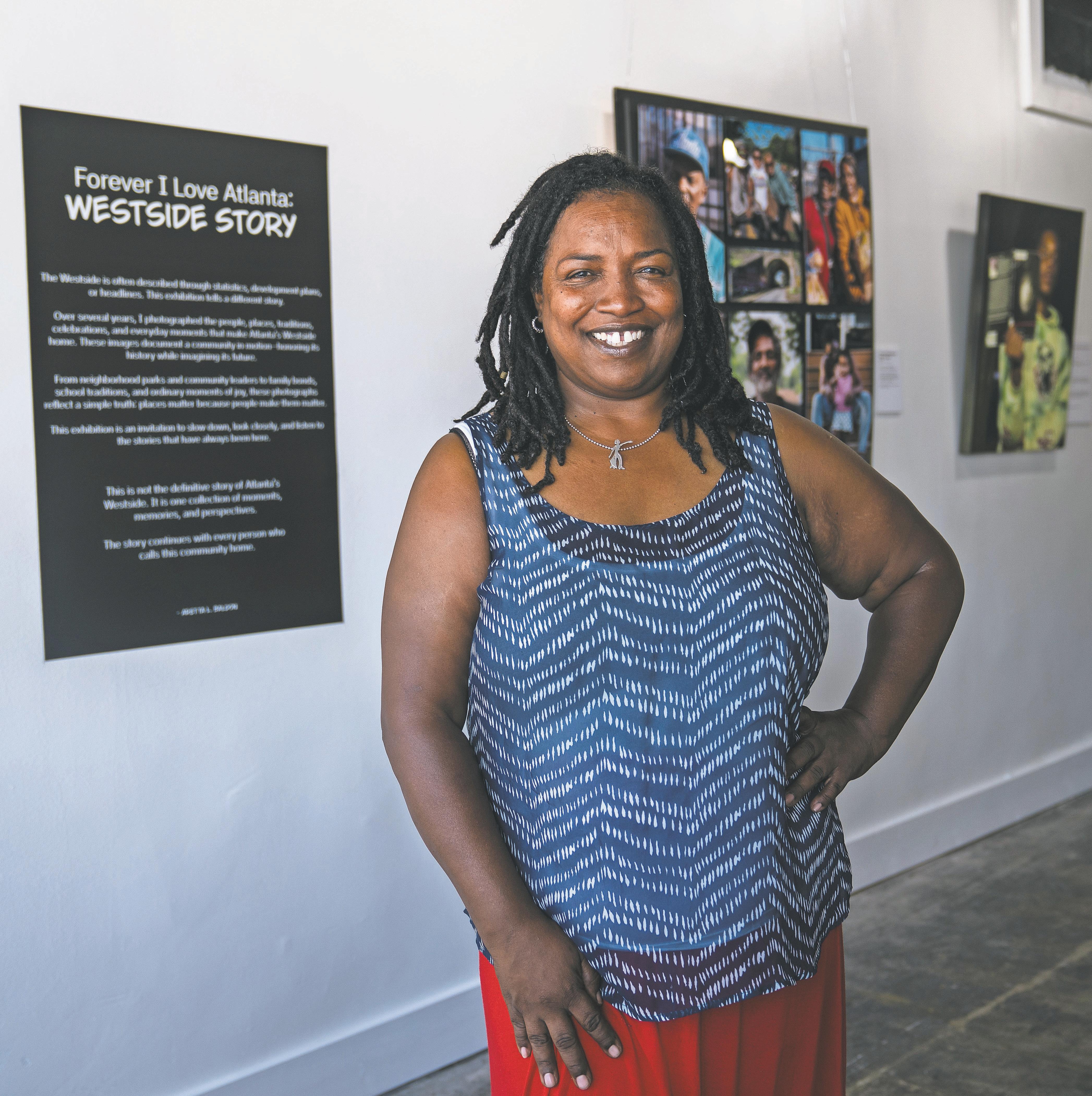
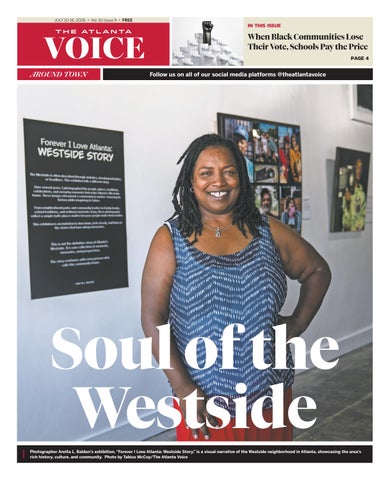
Photographer Aretta L. Baldon’s exhibition, “Forever I Love Atlanta: Westside Story,” is a visual narrative of the Westside neighborhood in Atlanta, showcasing the area’s rich history, culture, and community. Photo by Tabius McCoy/The Atlanta Voice
By NOAH WASHINGTON
On the Westside, Aretta L. Baldon says, a person can go from pre-K to becoming a doctor without ever leaving a one-mile radius, Atlanta Public Schools to Clark Atlanta, Spelman, Morris Brown, or Morehouse, then on to graduate programs like the Interdenominational Theological Center or Morehouse School of Medicine. “And then you can come back and serve,” she said.
That loop, a neighborhood that raises people and gets something
back in return, is the idea running through her photography exhibition, “Forever I Love Atlanta: Westside Story,” now showing at 960 Martin Luther King Jr. Dr. NW.
“The Westside is often described through statistics, development plans, or headlines,” Baldon’s artist statement reads. “This exhibition tells a different story.”
Baldon arrived in Atlanta in 1991 from Springfield, Illinois, to attend Spelman College. “I say I was cornbread and peach fed, because I was green when I came down here,” she said. Her father had given her
a camera before she left home, and though she’d always been the one in front of the lens at family gatherings, something shifted once she started documenting Spelman herself.
“I was the one with the camera capturing moments, and it really wasn’t technical, I wasn’t trained, it was just something that I enjoyed doing,” she said. The habit followed her back to the Westside as an adult, where clients like West Side Future Fund and Spelman College gave her a growing catalog of images — and, eventually, the raw material for a Mayor’s Office of Cultural Affairs grant she says outgrew its own ambitions.
“The idea ended up being way bigger than what they were giving,” Baldon said. “I believed in the idea, and it’s like I need to make this happen.” She raised the rest with help from the city, West Side Future Fund, and City Council members Byron Amos, Eshe’ Collins, and Matt Westmoreland.
That same instinct, to look at what’s already there and see something larger, shapes how the show is built. Two of its central pieces are framed in materials pulled from buildings the Westside lost. An iron window grate salvaged from a demolished English Avenue house holds “Sankofa: Iron Sharpens Iron,” a collection of images of men across generations, fathers and sons, coaches and athletes, mentors and students. Its wall text describes

the piece as a study of “lessons being taught, stories being shared, and wisdom being passed forward,” with the reclaimed grate itself standing in as “a symbol of remembrance, responsibility, and connection.”
A window reclaimed from a torndown Hollowell Parkway apartment complex frames its companion piece, “Held,” built around women, mothers, sisters, and mentors holding one another up.
“While the Sankofa represented the men in the male relationships, Held represents the female relationships,” Baldon said. She found the Sankofa mural itself almost by accident, stopped mid-stride on Sunset Avenue by a mockingbird’s song. “I turned around, I spoke to the bird, and then I looked”, and saw work by community elder Tillman Ward, who she said “has held my feet to the fire” during her years on the Atlanta school board.
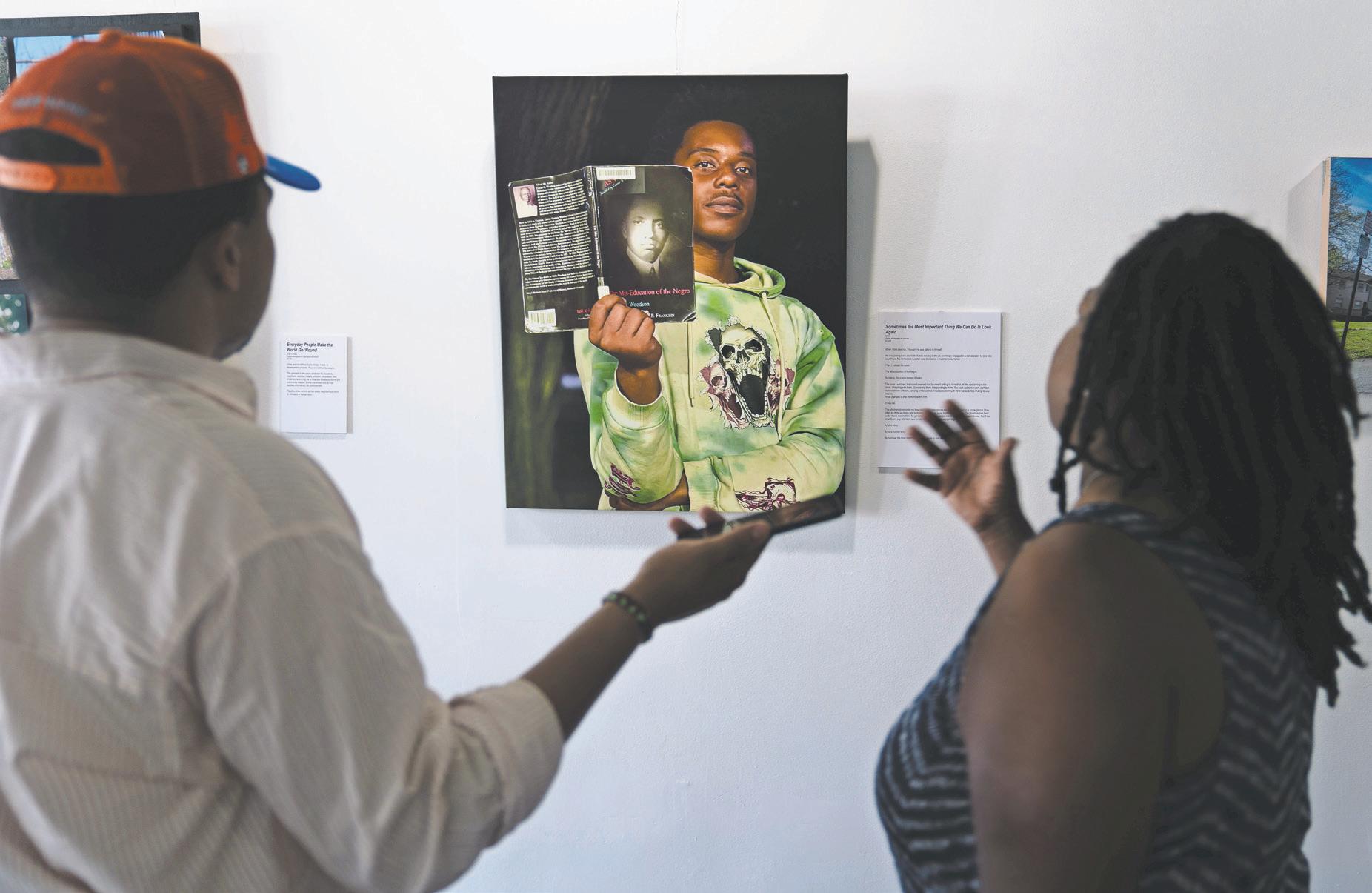
That habit of looking twice runs through the exhibit’s best-known image, taken on a dog walk near a MARTA station. Baldon saw a young man pacing and gesturing and assumed he was in distress, until she noticed the title of the library book in his hands. “I was like, he is reading Carter G. Woodson,” she said. “This man was not having a mental episode; he was in dialogue with this book.” The wall text distills the moment: “What changed in that moment wasn’t him. It was me.”
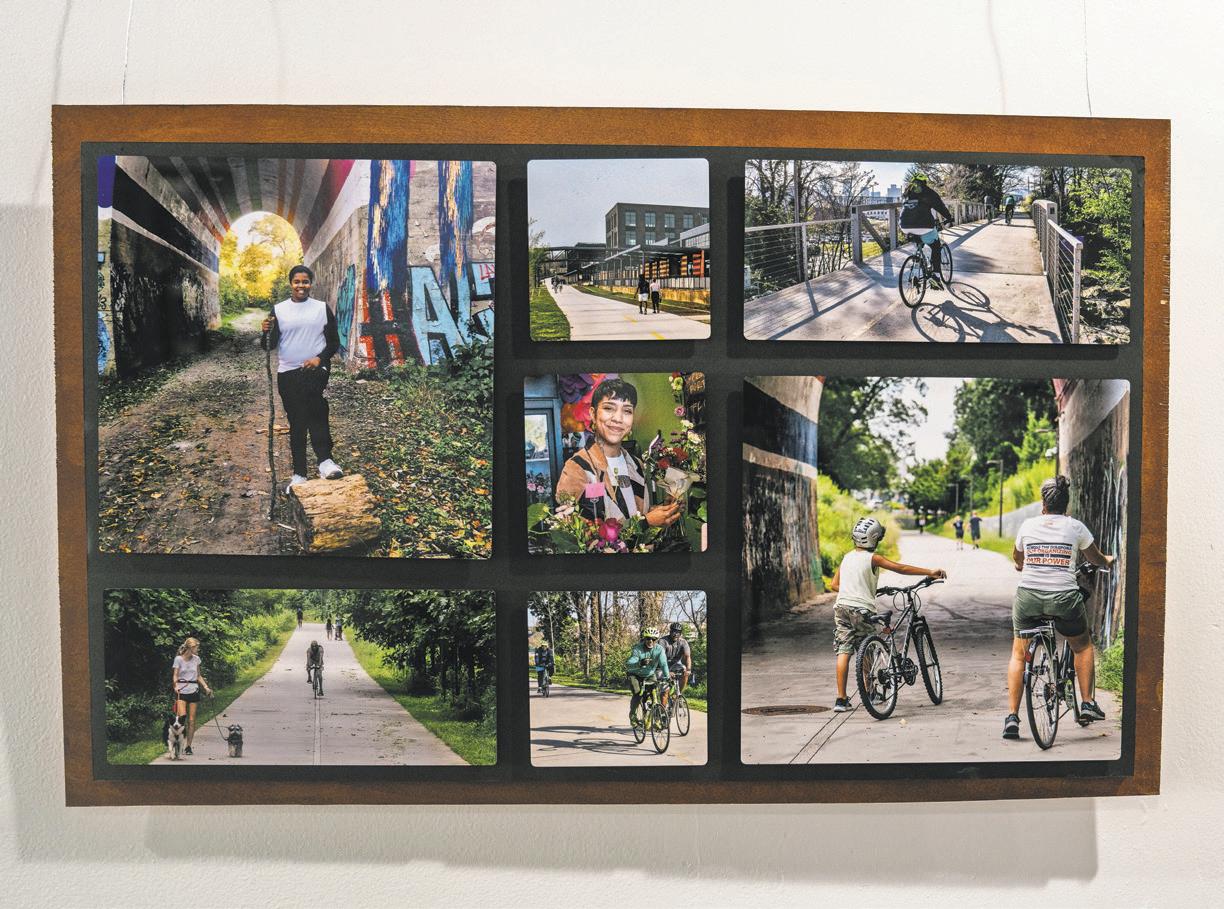
The Westside she’s photographing is also visibly in motion. “Pathways” follows the Beltline from its unpaved years, when she and her daughter walked it “back when you would get a broken ankle”, through its current form, tracking a neighborhood she jokes “officially flipped” once she started seeing strollers alongside longtime residents.
Its future, in Baldon’s telling, runs through young people, and
through C.J. Stewart, founder of the LEAD Center for Youth, whose portrait, “Breaking Barriers,” shows him in a “Mayor of Bankhead” T-shirt against a Grove Park mural. Stewart was drafted by the Chicago Cubs and played in their organization before returning to Atlanta, where he said he found himself “training young white kids in the suburbs” until, Baldon said, “he had an epiphany of why am I planting seeds in somebody else’s garden when I got a whole plethora of stuff I could develop on the West Side.”
That epiphany became LEAD, based at Washington High School, which Baldon says uses baseball and, more recently, tennis to reach kids through what the organization calls the three curveballs of life: crime, racism, and poverty. The program runs an ambassador track for older students, a junior ambassadors group, and a “rookie league” for younger kids, and requires every coach to complete its training.
“Your coach can be the most influential person,” Baldon said, “and if they are not operating in a positive way, then that could be more detrimental than it is helpful.” Stewart, she noted, is among the roughly 4% of Atlantans born into poverty who make it out, and chose to move back into the Bankhead community as a gift to himself on his 50th birthday.
Baldon serves on LEAD’s advisory council, a role she took on while serving on the Atlanta school board, where she also helped clear the way for a 2020 student-led protest following the deaths of George Floyd and Rayshard Brooks.
Asked what all of it adds up to, Baldon didn’t hesitate.
“It’s the past, the present, and the future,” she said.
The exhibit is on display through July 11.
By NOAH WASHINGTON
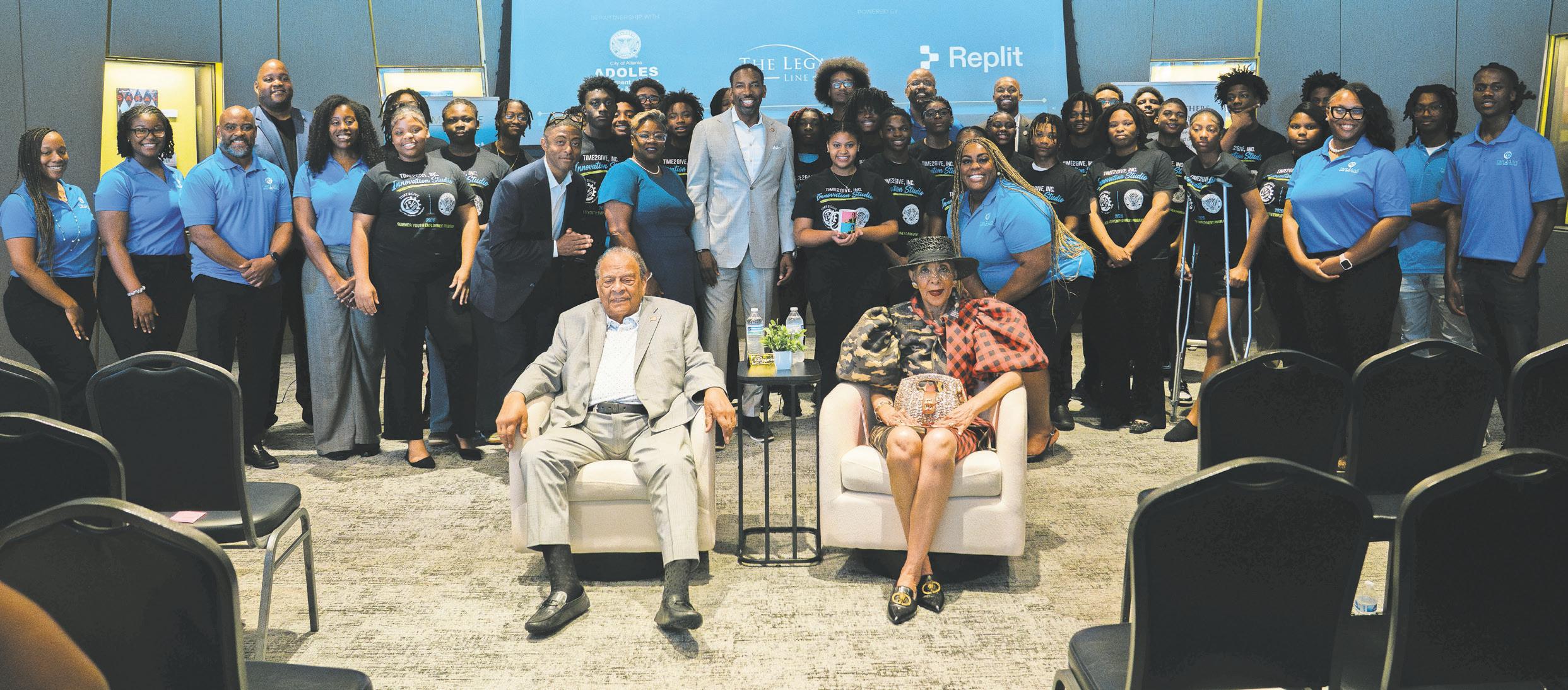
The lower level of the National Center for Civil and Human Rights became a stage for the city’s youngest innovators Thursday morning, as students from the City of Atlanta’s Summer Youth Employment Program (SYEP) unveiled AI-powered projects honoring the legacy of Ambassador Andrew Young and Mrs. Carolyn Young.
The Living Legacies Showcase capped four weeks of work through The Innovation Studio, known as iStudio, a program powered by The Legacy Line in partnership with Time2Give, Inc. Students used Replit’s AI-powered software to build interactive experiences combining artificial intelligence, augmented reality and immersive storytelling, all designed around the Youngs’ decades of civil rights and diplomatic work, accompanied by real life-merchandise ranging from Andrew Young themed mugs to puzzles.
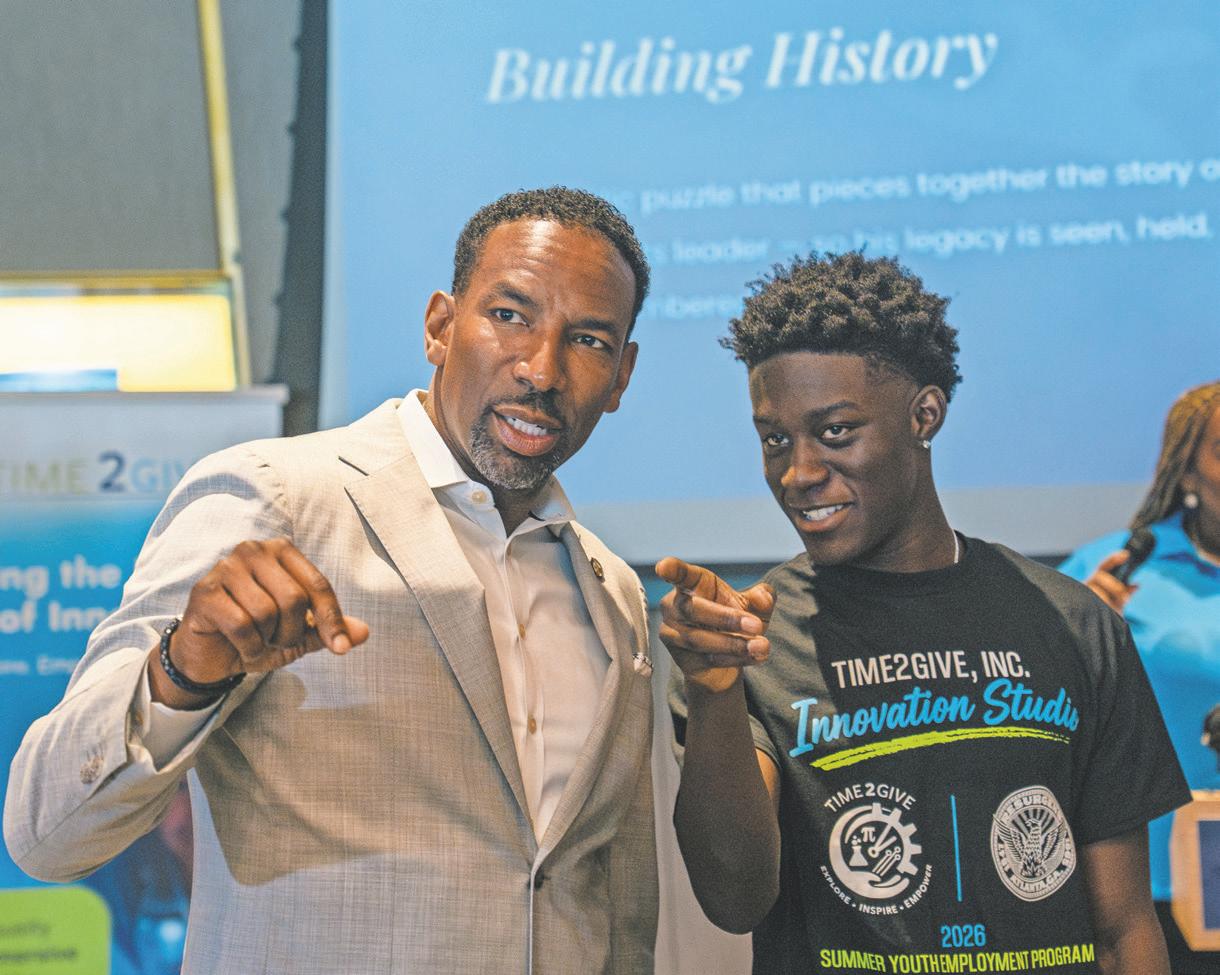
Mayor Andre Dickens opened his remarks by noting that the students were compensated for their four weeks of work through SYEP, along with leadership training.
“You’ve already been having an exciting summer filled with learning and friendship exploration, and it doesn’t hurt to get paid,” Dickens said. “Someone’s getting paid to do this, so it’s pretty good to have a good time.”
Dickens told students in the room that Young’s influence reached him long before he held office.
“When I was 16 years old, I believed I could become mayor. That was my dream,” Dickens said. “He was the mayor at the time, when I was 16, and I got inspired to become the mayor, and I articulated it. I said it. I told people that’s my goal.”
Dickens, who noted the current SYEP participants are between 14 and 17 years old, pointed to Atlanta’s role in hosting FIFA World Cup 2026 matches as another piece of Young’s imprint on the city.
“It would be a very slim chance that we’d have had the FIFA World Cup had we not had the 1996 Olympics, largely because of this man’s hard work,” he said.
Laron Walker, founder of Time2Give and co-founder of The Legacy Line, said the program traces
back to his own path out of Atlanta’s Pittsburgh neighborhood and through a scholarship that got him to Tennessee State University.
“Born and raised in Atlanta, I grew up in a neighborhood called Pittsburgh, around the corner, within probably two miles from here,” Walker said. He recalled that a $1,000, 3.0 GPA scholarship opened the door to college, where he learned to code HTML in 1996. “I told myself one day when I was able, I would kind of address that, repay that back,” he said.
That promise became Time2Give roughly 25 years ago, Walker said, starting with book scholarships before evolving into a broader push to connect young people with technology, mentorship and access. Thursday’s showcase marked the fifth year of the program’s partnership with the city.
“How do we take time to give and not just focus on scholarships, but focus on things that make a difference,” Walker said. “Build sustainable communities through tech, through exposure and through access.”
Brandon Middleton, head of education at Replit, told students the technology now lets young people move from idea to product in days rather than years.
“A kid from the south side of Chicago or from Atlanta can actually have an idea and express that idea
all in the same day and take that idea to market and build an actual product around it in a couple of days or a week,” Middleton said. He framed his vision for education around building and entrepreneurship rather than testing and memorization. “What if, instead of going to college to get a job at the end of your college graduation, you actually build a business while you’re going to school, and you impact your community while you’re actually learning things,” he said.
Dr. Charity Rowe-Marshall,
executive director of Time2Give, opened the program by asking the audience to rally around every student team, including those less eager for the spotlight.
“No one should be louder celebrating more than one team,” Rowe-Marshall told the crowd, encouraging attendees to support innovators who “happen to be on the shyest side of things.”
Five student teams presented projects during the showcase, each structuring their pitch as a full business built around a physical product,
complete with a target demographic and business model. The lineup ranged from marble coasters to a commemorative mug to a puzzle, each tied back to the legacy of Ambassador Young and Mrs. Young. One team built a set of marble coasters paired with a digital companion and art book honoring Carolyn McClain Young, Ambassador Young’s wife. Another team, presenting as “All Stars,” introduced a commemorative mug designed to activate Young’s legacy through augmented reality, describing it as a way to bring history into an everyday morning routine.
The program included a formal recognition ceremony and pinning for the Youngs, along with a student-created gift presentation, before moving into an exhibition and networking reception where guests could view the student projects firsthand.
For Dickens, the day carried a message he hoped would outlast the morning’s presentations.
“You may have something in your spirit, in your heart, telling you, I want to be a pilot, I want to be a CEO, I want to be a whatever, a mayor,” he said. “Don’t let that be suppressed. Build that up. Tell somebody, tell your parents and teachers and the leaders of the programs you’re in, because they can help nurture you till indeed you get to the spot where you’re trying to get to.”
By DENISE FORTE
For generations, Black families have understood that the right to vote and the right to a quality public education are not distinct but inseparable. Education, according to Frederick Douglass, “means emancipation. It means light and liberty.”
That is why the recent Supreme Court decision in Louisiana v. Callais, which gutted a key provision of the Voting Rights Act, is not only a threat to democracy but a direct attack on educational equity.
Because elected officials control school funding, curriculum, accountability and access to opportunity, reducing Black political representation by weakening Black political power ultimately threatens Black communities’ ability to shape the education of their children.
Education and the Vote
The fight for civil rights and justice has always run through America’s classrooms. Elected officials control public school access and quality through funding. Denying access to education has always been central to politicians seeking to deny Black self-determination and political power.
Political representation influences nearly every public education decision, many of which are made locally: school funding, reading and math investments, history and language arts curricula; library catalogs; student supports and resources; school board representation; and the weight of student, parent, and community voices.
When Black communities lose representation, they also lose power over the systems and schools serving their children.
That reality is especially significant in the Deep South, where generations of Black civil rights activists and their allies fought to secure investments in public education that many communities had long been denied. The Voting Rights Act opened pathways to representation, and representation created access to education resources, accountability, and opportunity.
The connection is not abstract. Black voters helped elect a new

generation of Black leaders across the South, including Mississippi’s Robert Clark, the state’s first Black congressional representative since Reconstruction and later chair of the House Education Committee.
Increased Black political power made government more responsive to Black communities and expanded educational opportunities.
The stakes are evident today. By weakening Section 2 of the Voting Rights Act, the Supreme Court has made it harder to challenge maps that dilute Black voting power. It’s no coincidence that, within days of the decision, Louisiana moved to eliminate a majority-Black congressional district, while Alabama was allowed to proceed with a map
that did the same.
When Black communities lose representation, they lose influence over decisions that shape their children’s education.
The ongoing attacks on voting rights will weaken Black communities’ ability to advocate for equitable schools and educational opportunity.
As advocates and communities respond, the conversation must not become siloed. In this moment, advocates must speak in one voice and say: “Public education gives power to the vote. The vote powers public education.”
We must all make clear the
consequences of the Supreme Court’s decision that could affect classrooms across the country. We’re likely to see more underfunded schools in Black communities, and more inequitable access to advanced coursework as well as watered-down curriculum, distorted history, and racist disciplinary policies.
The right for Black communities to shape the educational futures of their children must remain intact.
The right to responsive representation must endure. The demand of state and federal elected officials is simple: Defend the power of the vote and the power of an excellent education.
Denise Forte is the president and CEO at EdTrust
FOUNDED
May 11, 1966
FOUNDER/EDITOR
Ed Clayton Immortalis Memoria
PUBLISHER/EDITOR
J. Lowell Ware
Immortalis Memoria
The Atlanta Voice honors the life of J. Lowell Ware.
PUBLISHER Janis Ware
PRESIDENT/
GENERAL MANAGER
James A. Washington 2018-2024
COO Richard Dunn rdunn@theatlantavoice.com
DEVELOPMENT SPECIALIST
Jazmine Brazier jbrazier@theatlantavoice.com
EXECUTIVE ASSISTANT TO PUBLISHER
Chia Suggs csuggs@theatlantavoice.com
EDITOR IN CHIEF Donnell Suggs editor@theatlantavoice.com
GENERAL ASSIGNMENT REPORTERS Laura Nwogu lnwogu@theatlantavoice.com Noah Washington nwashington@theatlantavoice.com
BUSINESS REPORTER
Tabius H. McCoy tmccoy@theatlantavoice.com
EDITOR AT LARGE Stan Washington swashington@theatlantavoice.com
ADVERTISING, SALES & CIRCULATION
ADVERTISING ADMINISTRATOR
Chia Suggs advertising@theatlantavoice.com
SALES
RDW Jackson rdwadman@gmail.com
SUBMISSIONS editor@theatlantavoice.com
DIRECTOR OF PUBLIC RELATIONS
Martel Sharpe msharpe@theatlantavoice.com
CONTACT INFORMATION
633 Pryor Street, S.W. Atlanta, GA 30312 Office: 404-524-6426 info@theatlantavoice.com

By DONNELL SUGGS
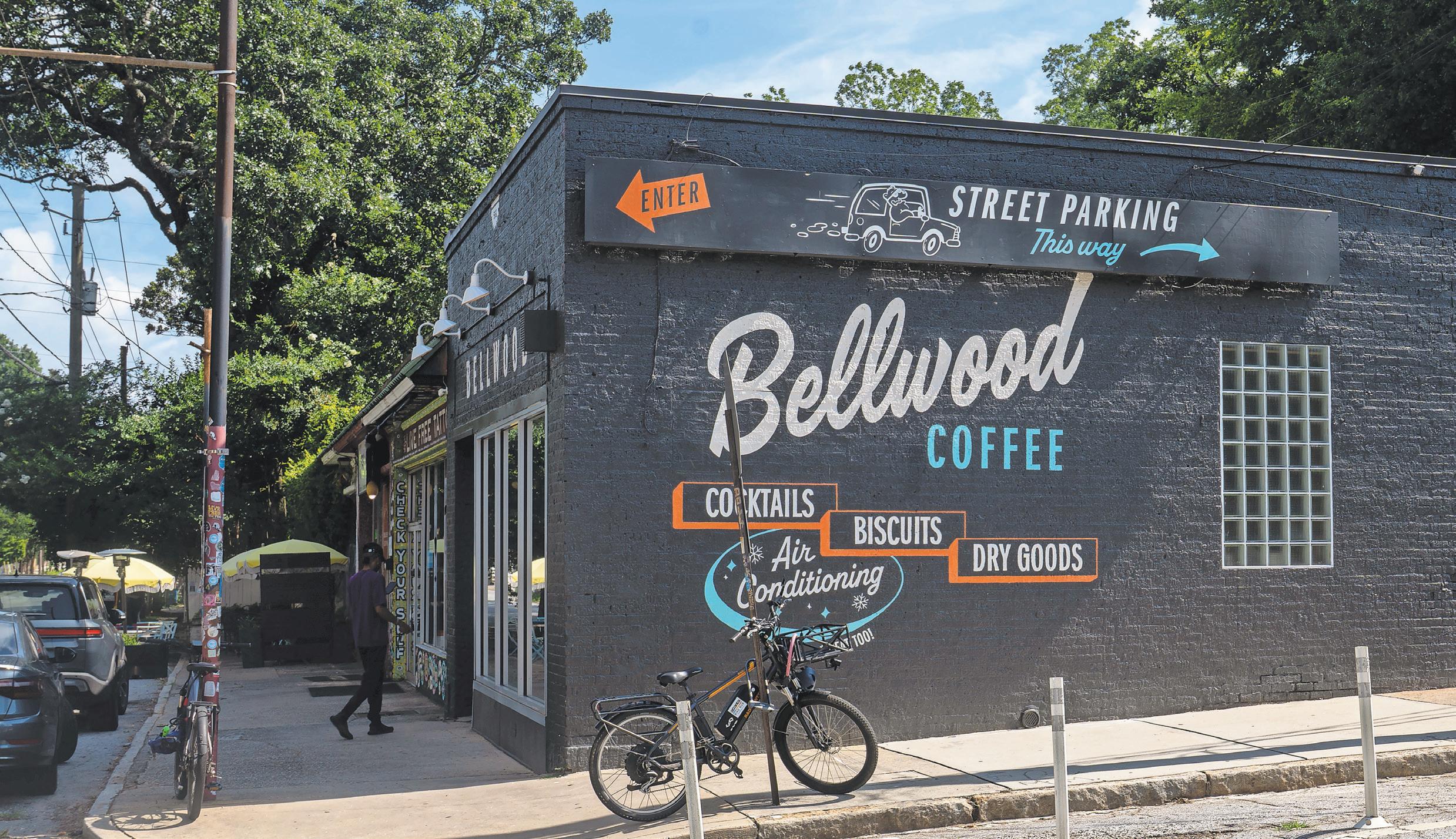
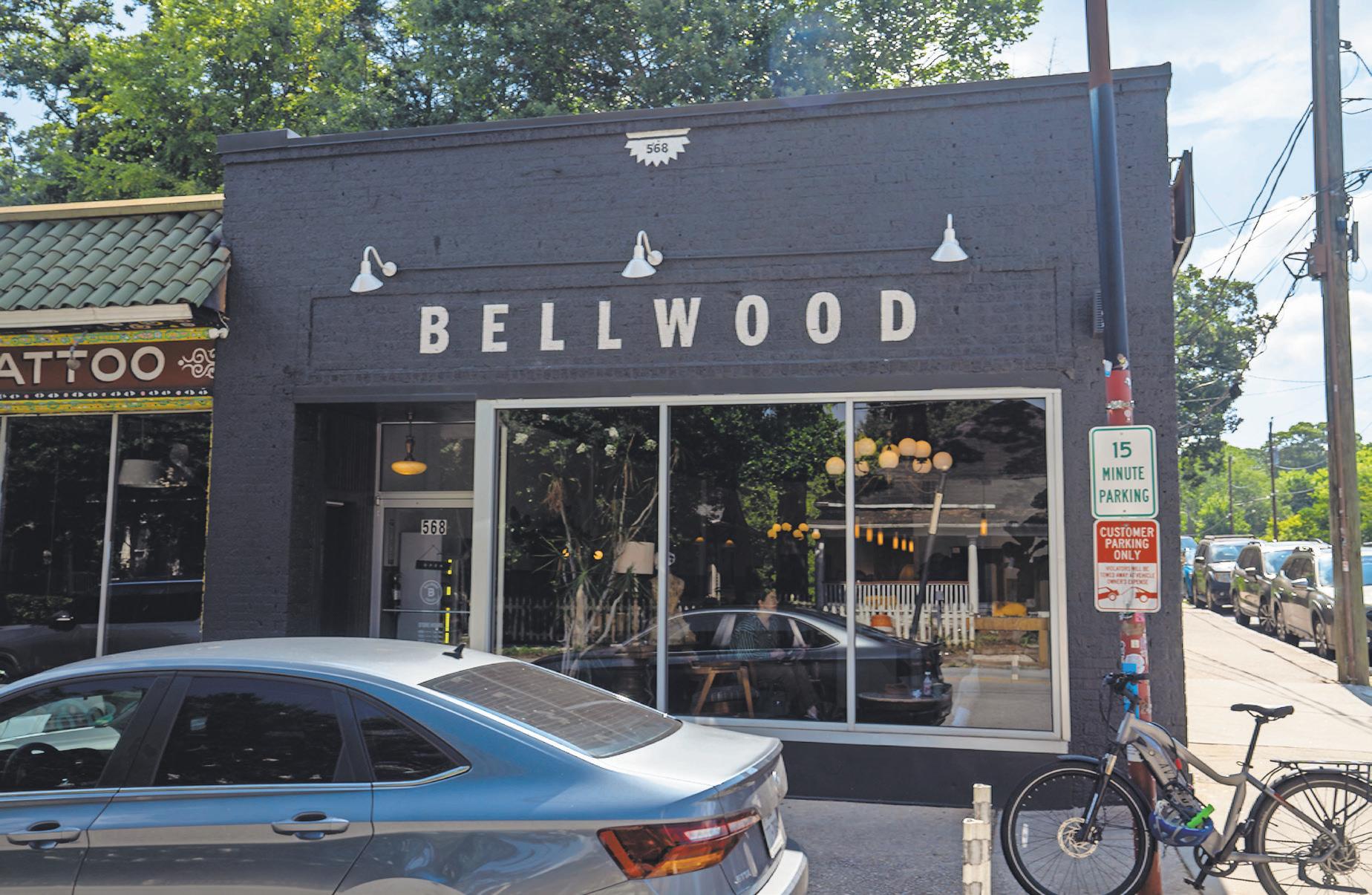
At the corner of Boulevard, SE. and Rosalia St., SE., directly across the street from an abandoned home and a Methodist Church, is Bellwood Coffee. One of hundreds of coffee shops in Atlanta, this place of business would not be worth a solitary discussion if not for the way its exterior walls are currently painted. There was once a mural depicting the late Jovita Moore, a beloved journalist who worked in Atlanta for decades. Moore, who passed away in 2021, mentored many of the people you see on television news casts today. Though her legacy will never be forgotten, it was the mural of her image that was erased.
“We’re currently working on it. You should see some movement in the weeks to come”
Tommy Bronx
In April, members of the Grant Park community voiced their disgust at the mural, which graced a side wall of the building now occupied by Bellwood Coffee’s Grant Park location, before it was painted over. In its place are the words “Bellwood Coffee; Cocktails, Biscuits, Dry Goods, Air Conditioning. *Heat Too”. In May, the business owners responded to the community pushback on social media by acknowledging they did not know who Moore was before painting over her image. And later admitted that they did not attempt to find out what she meant to the community.
On May 21, the Bellwood Coffee Instagram account had a post about being “in close contact with Jovita’s family and are actively working on next steps in this process.” Two months later, the mural has not been replaced, repainted, or repositioned on the property. Nothing has been done. Black history is often erased, most recently by the current Presidential administration, but oftentimes on a
smaller, quieter scale. The mural was originally painted by muralist Tommy Bronx, who had been in contact with the business owners about repainting it. As of July 6,
Tommy Bronx had responded to a direct message via his Instagram account from The Atlanta Voice about any updates on his plans to repaint the mural.
“We’re currently working on it. You should see some movement in the weeks to come,” he wrote in a response.
On Monday, July 6, the business had several patrons inside, and was running smoothly with three employees manning the counter. The Atlanta Voice dropped by Bellwood Coffee to get a look at the exterior wall where the mural once stood as a memorial to a journalist and mother who lost her life to brain cancer at the young age of 54. Moore’s image added some color to the block. The grey wall in its place does not.
A direct message was sent to the Bellwood Coffee Instagram account, and there hasn’t been a response as of 9 a.m. on Tuesday. As of 9:52 a.m. Tuesday morning, Bellwood Coffee posted a response acknowledging that there are plans to commission a new mural and that they have “an install date scheduled.
There have been multiple responses to social media posts about this mural by this reporter and The Atlanta Voice
For many Black LGBTQ+ Christians, acceptance is only the beginning. Advocates say true inclusion requires churches to rethink power, theology and belonging.
By LOyALTy JEANAIMÉ Craig Newmark Graduate School of Journalism Intern
For many Black LGBTQ+ individuals, their religious walk is often interrupted at the onset of adulthood. McKenzie Shorter, a 24-year-old Christian woman, recalls an experience familiar to many LGBTQ+ young adults. Raised in a Christian household, Shorter became disengaged from church when she moved away for college and began to navigate her identity.
“I started to pull away from traditional church, and I think me being gay definitely had something to do with that,” said Shorter. “I wanted more answers and to feel more accepted”.
From 2007 to 2024, the share of religious adults who said homosexuality should be accepted by society increased from 46% to 59%, according to the Pew Research Center.
But acceptance is only half the battle. Many LGBTQ+ congregants still struggle to feel that their houses of worship are truly championing them.
Shorter describes it as being “halfway accepted”. Some churches might be open to LGBTQ+ congregants, but still believe that homosexuality is doctrinally wrong.
“I don’t think you can fully accept somebody but actively try to change them or wish that part of them would change,” said Shorter.
For many LGBTQ+ people of faith, the question is no longer whether churches will open their doors, but whether they will make room for them to belong fully. Advocates say true inclusion requires more than
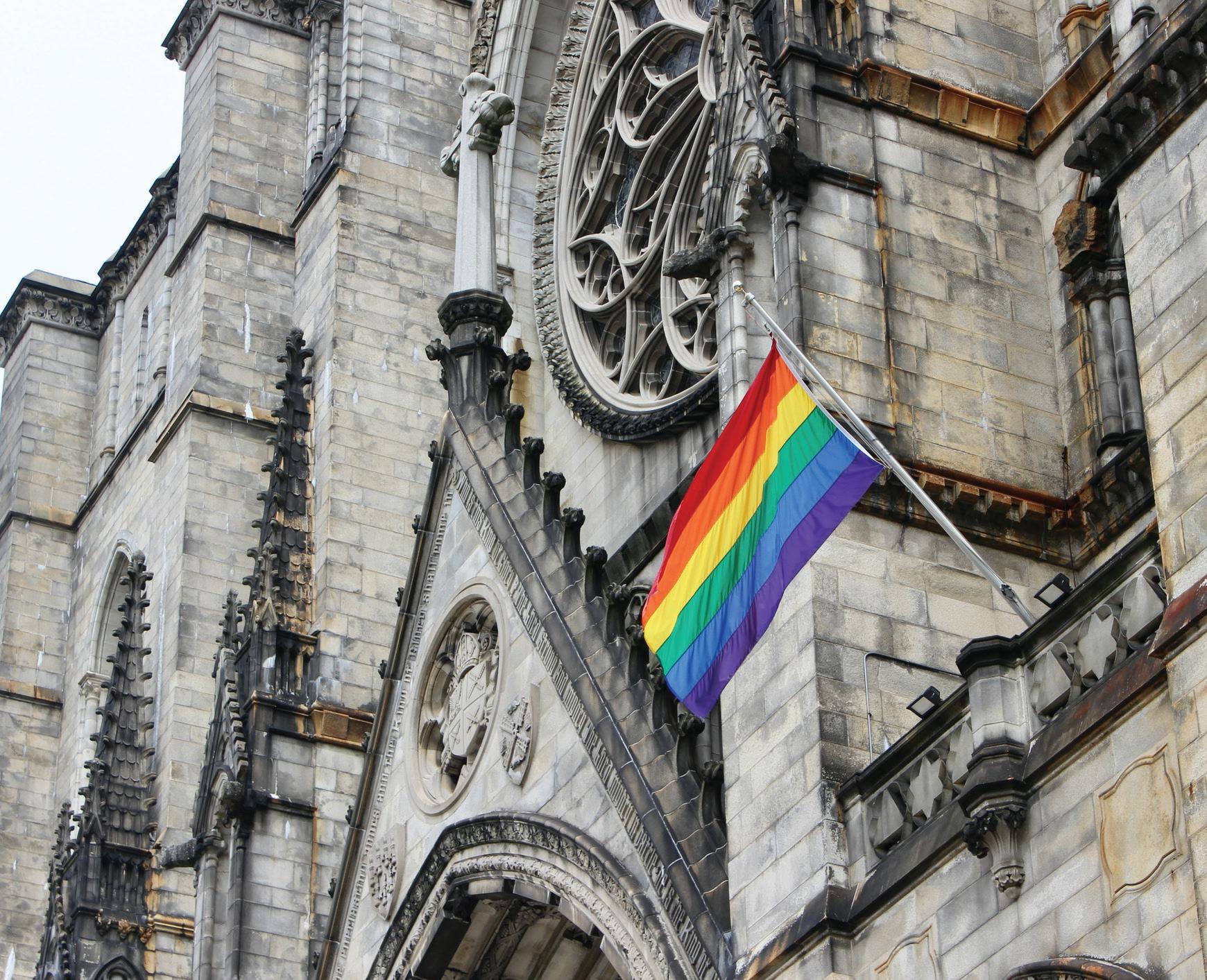
acceptance. It requires changes in leadership, advocacy, and theology.
Deeper than acceptance, deeper than an invitation
Don Abram is the founder of Toward Pride, a nonprofit organization that helps institutions advocate for the well-being of Black LGBTQ+ communities.
Toward Pride has developed a framework for the path of inclusion. The framework
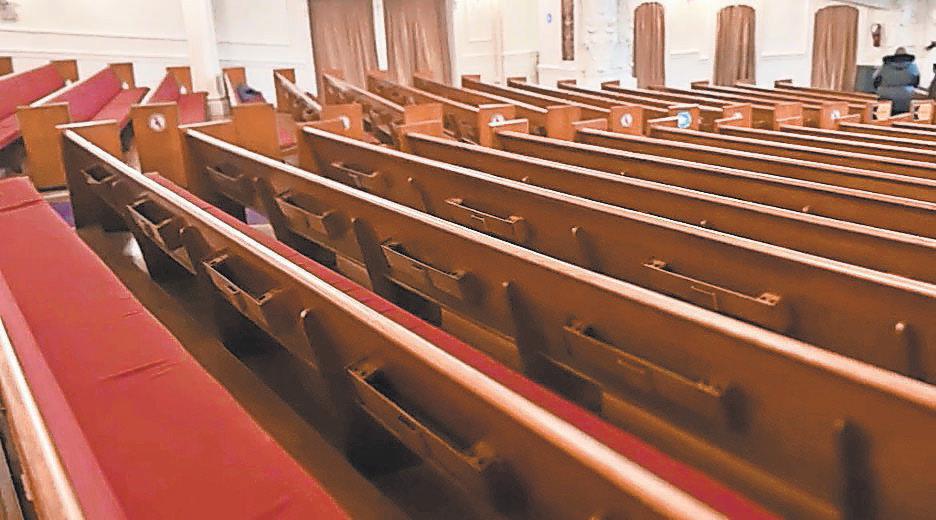
describes a progression from antagonism or avoidance of LGBTQ+ issues to acceptance, affirmation, and ultimately, advocacy.
“We call the accepting church the don’t ask, don’t tell church,” Abram said. “The idea is that we want you to come as you are, but after you’ve been with us a while, we don’t want you to stay as you are.”
Abram notes that these types of spaces can be the most insidious because while the pastor may not be openly antagonistic or homophobic, the limits of inclusion become clear elsewhere.
“Upon further inspection, you’ll discover that you actually cannot get married in your church, your kids cannot get baptized, and you cannot be elevated in positions of authority or power,” said Abram.
Craig Ford Jr., a theologian and professor at Emory University, calls this dynamic the “logic of invitation”. An invitation allows an individual to enter a space, but the host still expects them to follow all the house rules.
“As a colleague of mine put it, churches want the gays, but they don’t want them to touch any of the furniture.”
In contrast, Ford explains that a “true welcome” requires a power shift, in which the guest is invited to help shape the community and share ownership of its future.
“The United Church of Christ has pride
flags all year long, and they ordain people who are LGBTQ+. That’s a powerful witness to what inclusion looks like.”
But the shift in power doesn’t stop there.
Abram says that the real goal is for churches to become public advocates for LGBTQ+ rights. An advocating church leverages its political and social power to effect change in the lives of LGBTQ+ people.
“Based on what we heard from Black LGBTQ+ folks, it’s fine for you to preach in the pulpit on Sunday morning, affirming my humanity, but if you’re not out at City Hall, or at the state legislature, or at Congress, then you’re not really doing the work.”
Prioritizing sacred lives over sacred texts
For many churches, the path from acceptance to advocacy is shaped by their interpretation of the scripture.
For example, while the late Pope Francis adopted a more welcoming tone toward the LGBTQ+ community, saying “Homosexuality is not a crime,” he still upheld traditional Catholic doctrine that interpreted homosexual acts as sinful.
Ford argues that sacred texts should be interpreted with special attention to their consequences. Just as the church eventually retired its biblical defense of slavery to follow a “deeper insight” from the Spirit, modern theology is called to retire ideals that dehumanize LGBTQ+ people.
Abram says that the most profound theological hindrance is the “refusal to see the other as a sacred text”. To deny queer and transgender people their humanity, Abram argues, is also to deny their inherent divinity. It’s also a missed opportunity to learn from them as “living epistles”.
Shorter said she finds spiritual grounding in God’s Wisdom.
“God doesn’t make mistakes. I’m created in God’s image. I know who I am, and I feel firm in it.”
For potential LGBTQ+ congregants seeking a church home, advocates encourage people to connect with the divine in creative ways.
“You can connect with the divine at church, or the stairmaster, or sitting by a lake,” said Abram.
Over time, Shorter has maintained a connection to religious communities through virtual church services and practicing Bhakti yoga.
Ford says the metric for finding a church home should be peace.
“Go where you feel peace. Wherever peace is, God is leading us there.”
By LAURA NWOGU
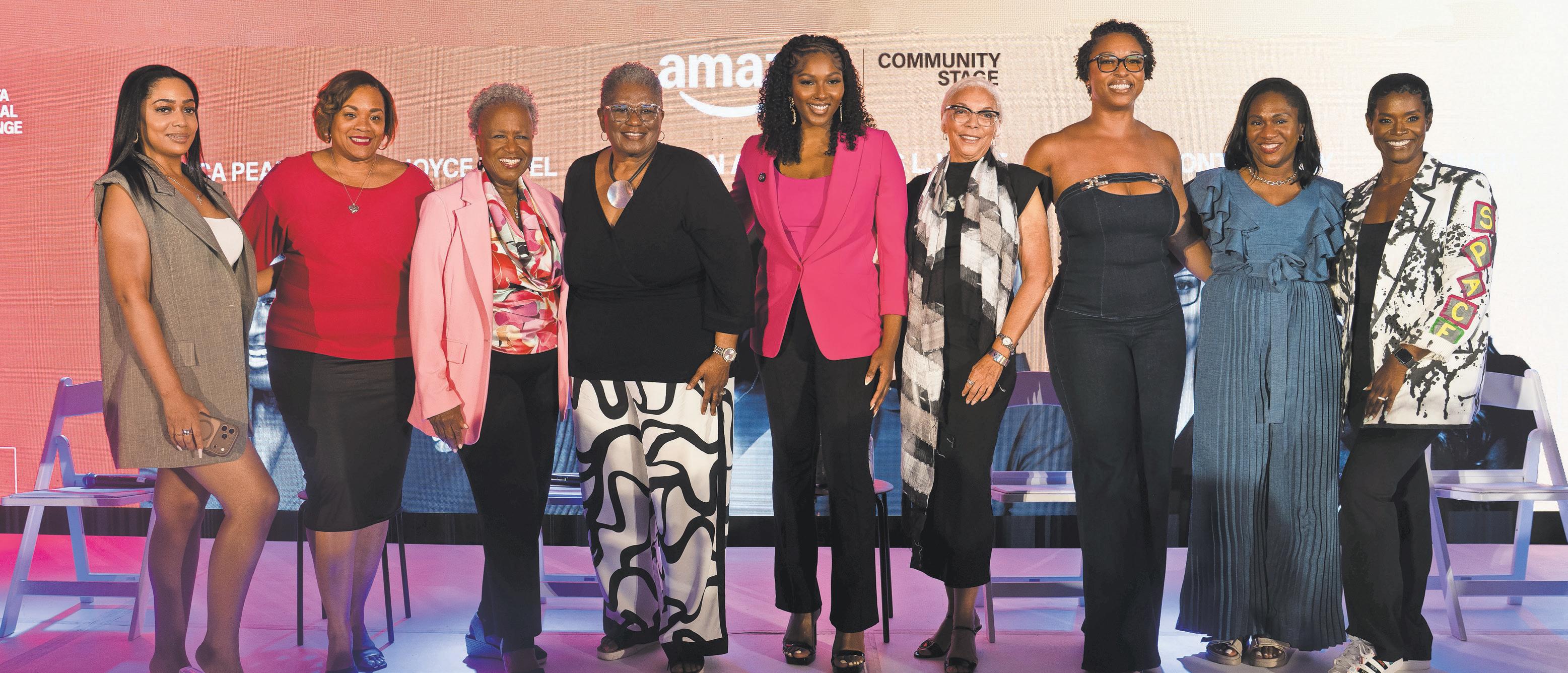
The Atlanta Cultural Exchange, the month-long immersive platform taking place alongside the FIFA World Cup, continues to host engaging discussions and panels on music, art, business, and culture at the CTR (the former CNN Center). On Monday afternoon, the platform featured a panel titled “Unapologetically Influential: The Women Who Defined Atlanta’s Media Culture,” which honored women whose voices, leadership, and platforms have shaped Atlanta’s media landscape across generations, including the award-winning The Atlanta Voice publisher Janis Ware.
Ware was joined by award-winning journalist and news anchor Monica Pearson; Atlanta radio legend Joyce Littel; multi-media personality Rashan Ali; and media strategist and culture critic Dawn Montgomery. The panel was moderated by TV and radio personality Liz Smith, who asked the women questions about their careers, challenges, and the importance of influence over success.
Nearly 50 years after deciding to work for her father, J. Lowell Ware, the co-founder of The Atlanta Voice newspaper, Janis Ware has continued his mission of amplifying Black voices and stories across generations.
“I can’t count the number of people who have crossed through the doors and who work with us,” Ware told the audience. “It’s important for us to be influential, to be powerful, and
to reach back and help other young people. The fact is that the road is a little rockier today in the news industry, so we just have to pray that we can continue to make certain our stories are heard and that they remain relevant in this environment.”
Pearson and Littel, who have collectively spent close to 40 years in the media industry, reminisced about the glass ceilings they had to break in their career journeys, from being the first female and minority evening news anchor at WSB-TV to navigating a male-dominated industry and being the first female to host V-103’s “The Quiet Storm.”
“That’s the thing about moving to Atlanta, particularly way back then. 52 years ago, the city was growing, and it provided an opportunity for women, and particularly Black women on air to change the story, and that was important,” Pearson said. “Because when I look at the number of women who are now on the air, you just take it for granted.”
They were candid about the struggles they’ve faced, from workplace discrimination and public scrutiny to battling emotions, making hard decisions for the betterment of their company, and balancing motherhood with the fear and reality of losing their job. But the women also took the opportunity to impart wisdom to the audience, encouraging them to seek advice from veteran journalists, diversify their skill sets, and stand firm in who they are and in their values.
“I guess my hair’s too gray, I’m too old to tell
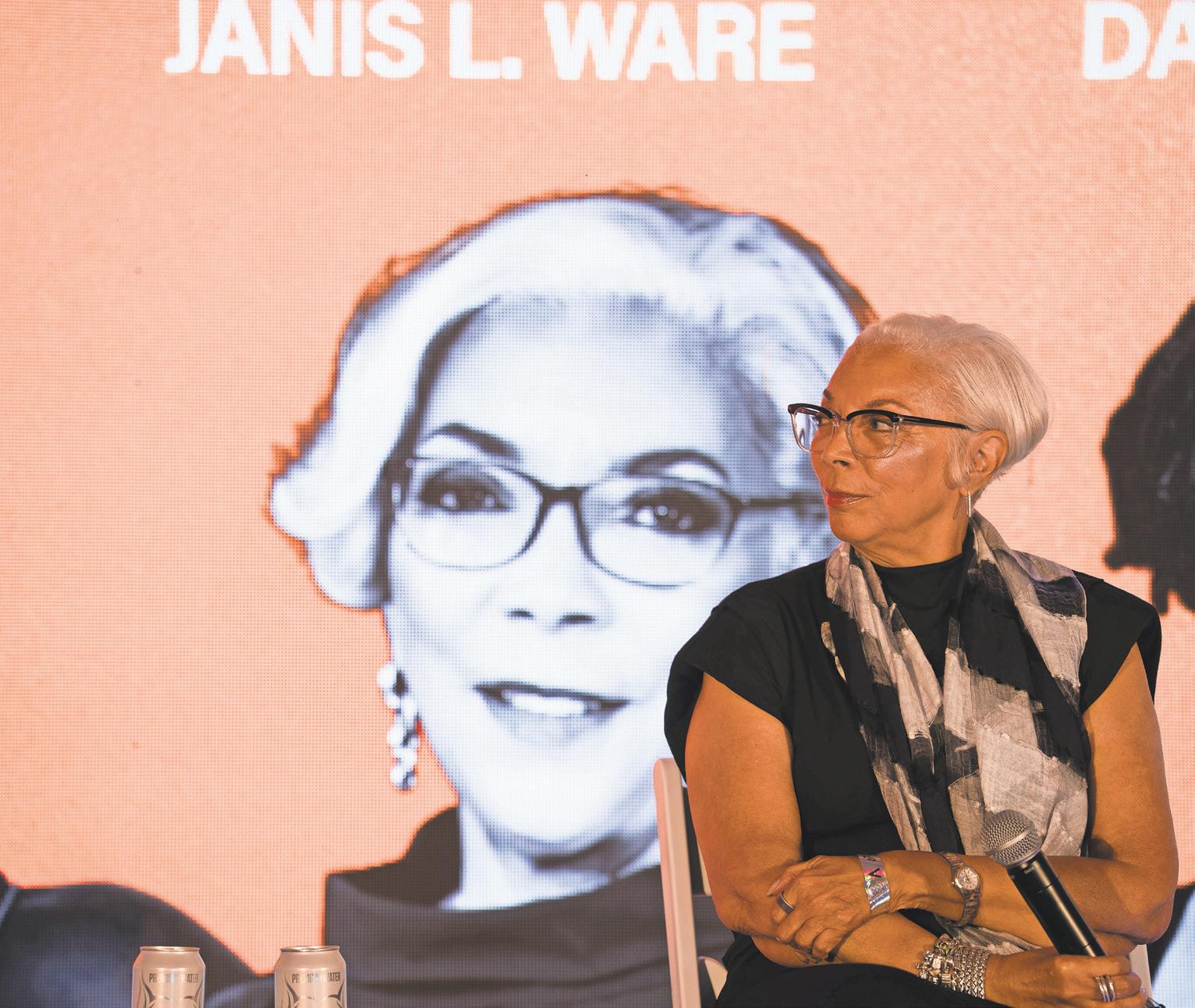
“It’s important for us to be influential, to be powerful, and to reach back and help other young people.”
you something, but I should be able to tell you something, because I’m still in it. 42 years in, and I don’t play, so I just need for our younger audience and people to know that yes, this is a
digital world, and you are influencers, but we are too,” Littel said. “And maybe we can help you go through some spaces that you might not have to go through because you asked us about it.”
By JATIKA HUDSON
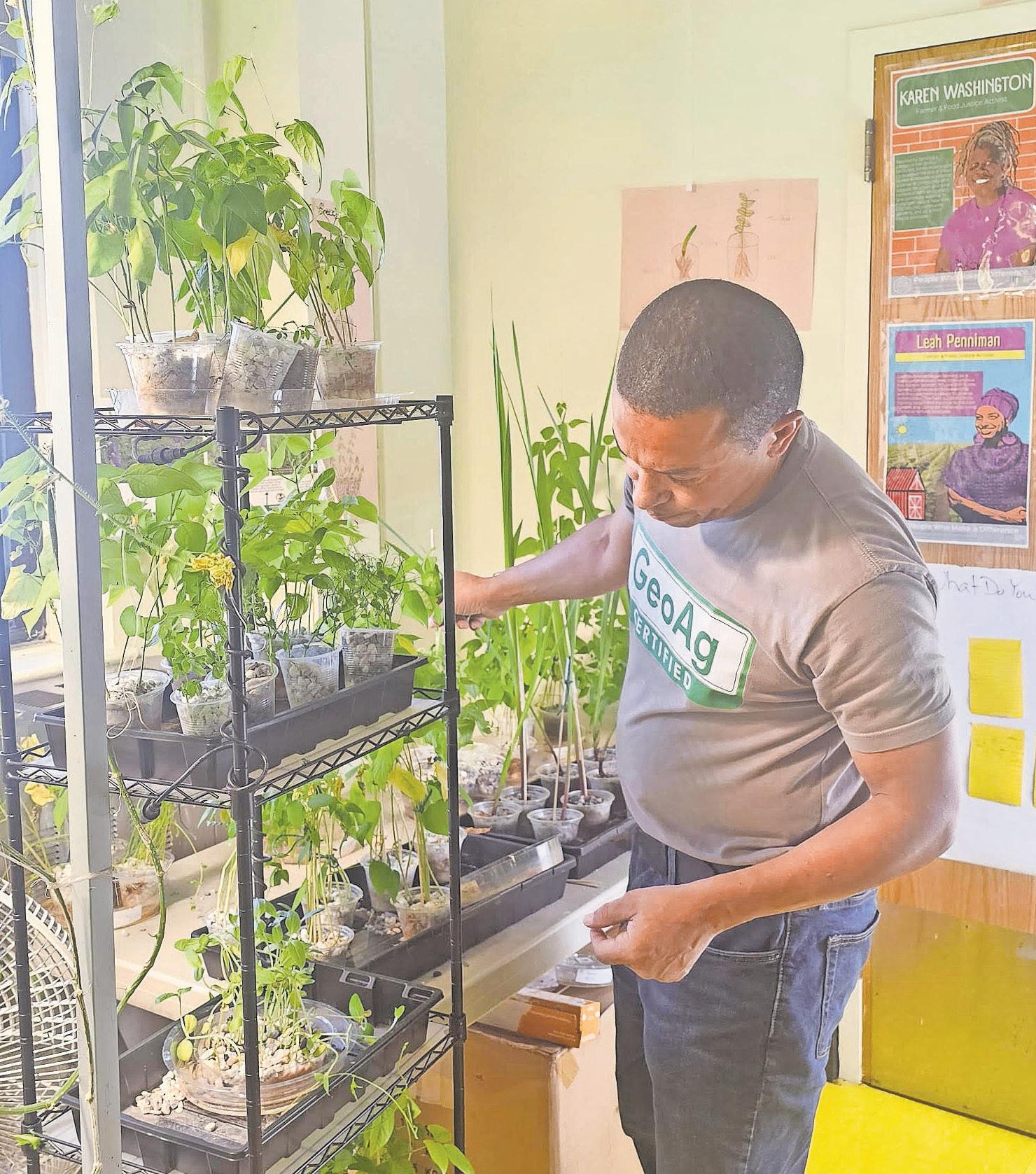
Geological agriculture is the method of growing a garden amongst rocks. It’s not a new idea, but Richard Campbell, founder of GeoAg, explains the benefits of rock gardening, a method he discovered by “accidental seed” while visiting his uncle in Nashville, Tennessee. They both called it a phenomenon that grew from his uncle’s landscaping rocks. However, the more he learned, the more his passion in life was redirected.
“My uncle, Dr. Thomas Logan, was landscaping at his Nashville, Tennessee home when he called me outside,” the Morehouse College graduate says. “He said, ‘Hey, Richard, come outside and explain this phenomenon. I went outside, and I saw a vine with a mini watermelon.” As they both stared at the plant emerging from the rocks, his uncle challenged him to find out how it happened. Campbell studied finance in college, but he didn’t let that stop him from diving into the world of science to discover how this vine grew and found a way out of the stones. The rocks are providing the food for that watermelon. My uncle said it was impossible, but I told him, well, it’s not impossible, we’re looking at it, so it can’t be impossible if we’re looking at it,” explains. “So, look at it this way. Rocks are minerals, minerals are nutrients, and nutrients are fertilizers. As Campbell dove deeper into the method, he fell in love with the idea of helping
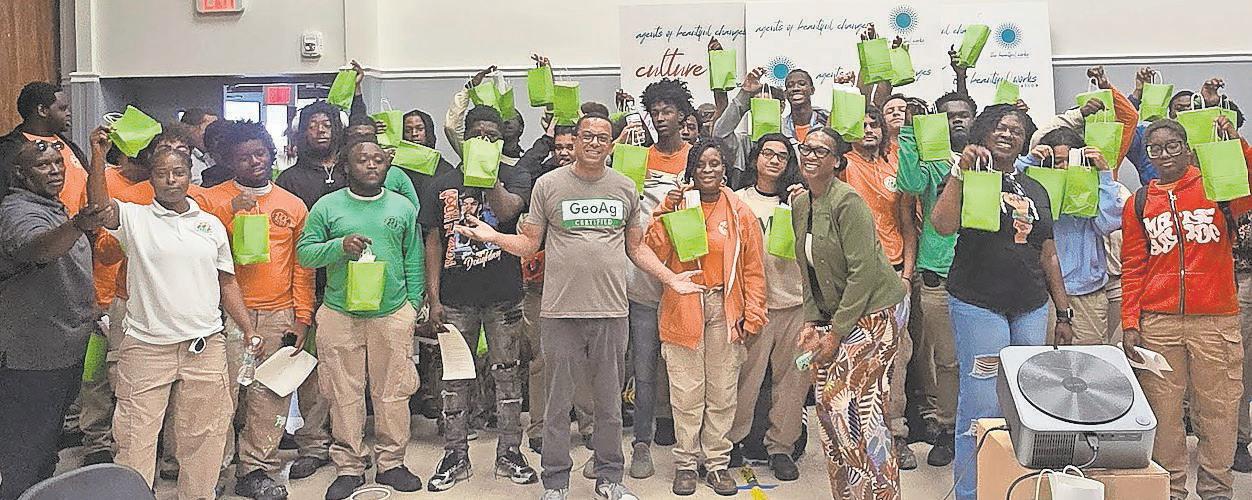
communities without access to healthy food nearby and with little money to spend on food. Through his discoveries, he created GeoAg, an agricultural business that travels to historically black colleges and universities.
He discovered that the minerals in the stones – he suggests Home Depot – can be taken in by the vegetables as they grow. Another benefit is that rock gardens are an option for small spaces, as they can be in a container as small as a flowerpot or as large as an outside planter. This provides an inexpensive food source for people in underserved communities that are considered food deserts. Up to 25 percent of metropolitan Atlanta residents live in a food desert. Communities where residents are more
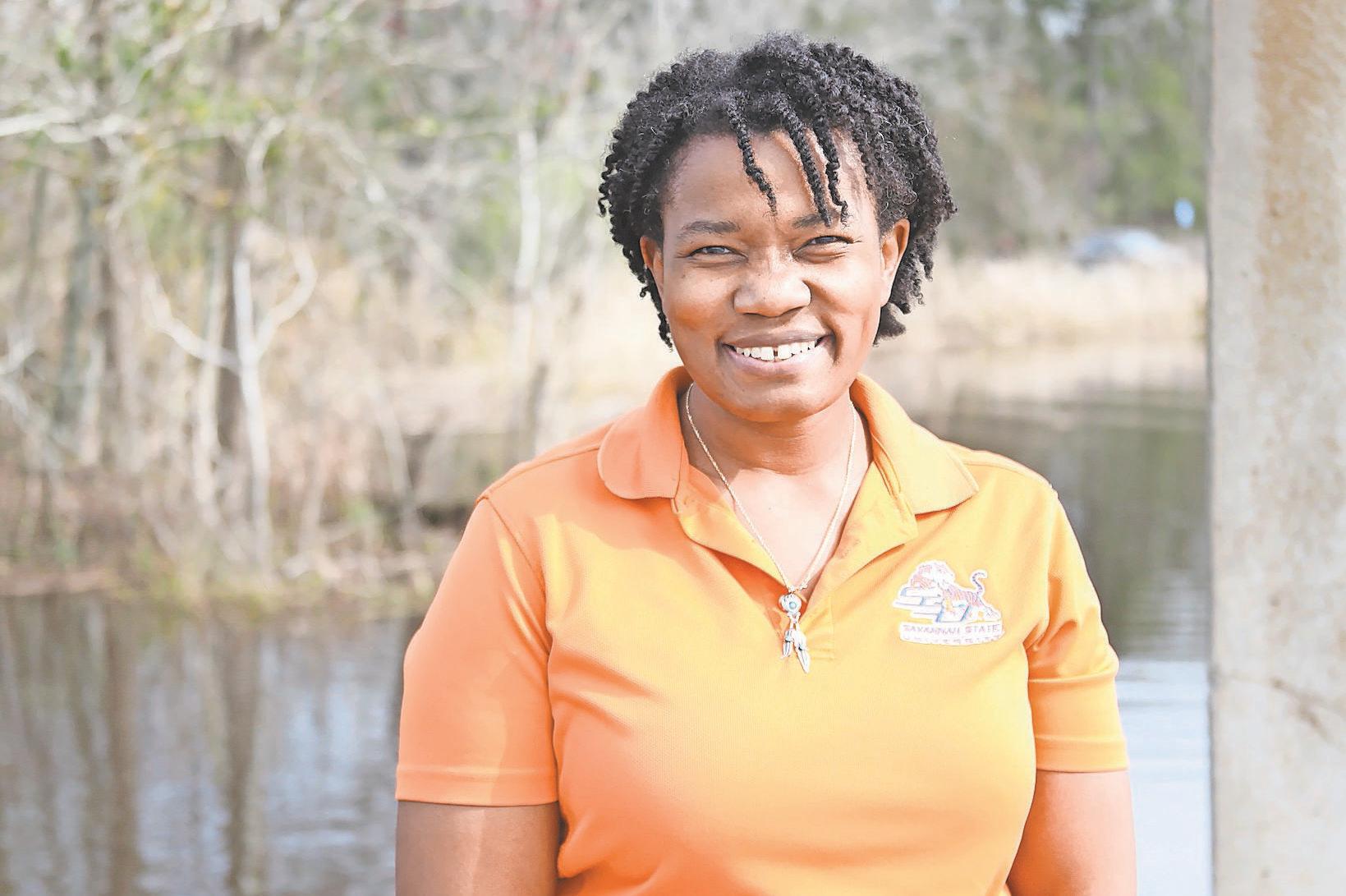
than one mile away from healthy food and grocery stores, have low to no access to personal or public transportation, and are living in low-earning households keep them from vital nutrients that come from healthy foods. Unfortunately, black families are the main demographic that live in these poorest parts of the city. Solving these issues takes time and money that may take years to raise. Richard Campbell is traveling to elementary schools and historically black colleges and universities, teaching GeoAg to students, teachers, and parents. Dr. Sue Ebanks, a tenured professor in the Department of Marine and Environmental Sciences at Savannah State University, welcomed Campbell to instruct GeoAg about students on rock gardening. “[SSU] already had a community garden, approved and started on campus. It’s a more traditional raised-bed and in-ground garden for people to share space and barter with whatever they decide to grow,” she shared. “So, GeoAg offered a great opportunity to concentrate because gardens are relatively high expense compared to what we’re talking about with GeoAg. So, that knocked down the expense side of things even more dramatically than what we were already doing in some of the other initiatives.” The Georgia institution is one of more than 20 HBCUs teaching geological agriculture with the hope of spreading the method to more communities and families. Seven of these institutions
will be represented at the virtual 5 th Annual GeoAg Conference hosted by SSU on November 7. Campbell has dreams of catching the attention of the United Nations. He believes that their involvement would offer hunger solutions worldwide. “They would have to open an Office of Geological Agriculture. That’s what needs to happen. If we want
to feed everybody in the world,” he says. “When you talk about where to go next. We can go anywhere in the world with this. It’s really who has access to us now. And no gauge. But for us and our job, we have to get the U.N. to say, “We’ll adopt this holistically and begin the process of bringing it to all the other countries.”
By DONNELL SUGGS
The latest national job numbers are out, and June has been steady, if not spectacular. The unemployment rate across the country fell by a tenth of a point in June to 4.2%. The unemployment rate was 4.3 % in May, according to data from the United States Bureau of Labor Statistics. That percentage may seem low, but it represents just over seven million Americans.
The national unemployment rate for adult men is 3.9%, while the rate for women remains lower at 3.7%. Black unemployment has hovered below 7% this year, while white (3.6%), Asian (3.9%), and Hispanic (5.2%) unemployment rates remain lower. The fact that there are only 42 million Black Americans among the more than 340 million Americans in the country, according to census data, skews the Black unemployment rate much higher.
Teenage unemployment is at 14.6%, and long-term unemployed people, those who have been unemployed for 27 weeks or more, are up to nearly 2 million people. That is up by 268,000 over the year.
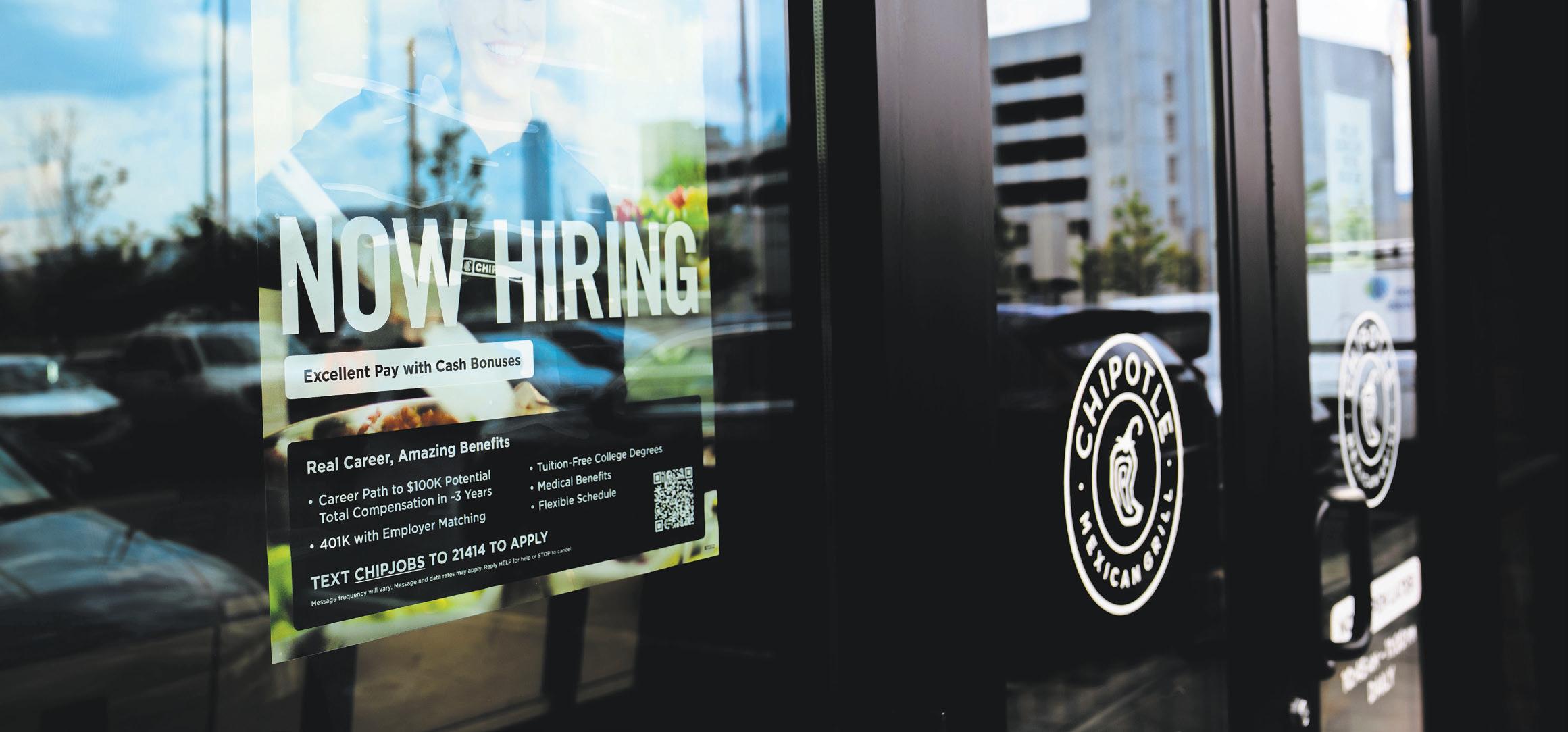
Throughout Metro Atlanta, “now hiring” signs can be seen at small businesses and large restaurant chains like Starbucks and Chipotle. The job numbers reflect people who are working in places like those more than they reflect the C-Suite and above-average earners,
particularly outside of Metro Atlanta.
The Georgia Department of Labor reports that there are now more than 5 million jobs in play. That is an all-time high for the state’s labor force, according to a recent release.

Food service jobs remain the highest in number, while administrative, support services, transportation, and warehousing jobs are also abundant. Health care and social assistance jobs saw the most gains over the
past year.
The average median household income in Georgia between 2020 and 2024 was just $77,353, according to the United States Census Bureau.







By DONNELL SUGGS
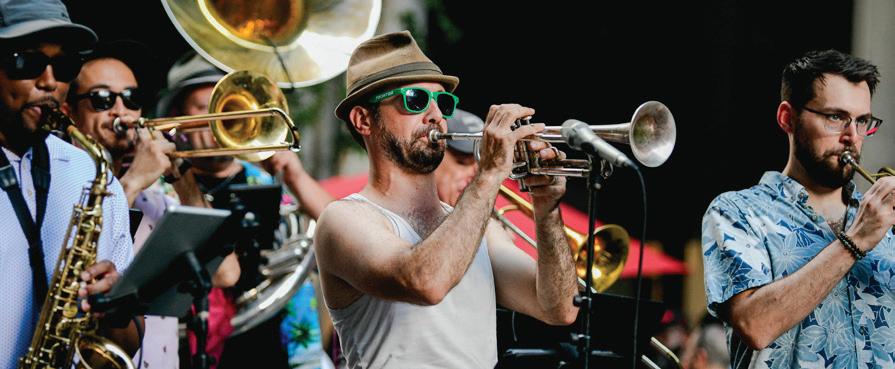
As large crowds marched into MercedesBenz Stadium for FIFA World Cup matches this summer, one can easily forget that this is the home of the Atlanta United Football Club. Major League Soccer (MLS), like professional soccer leagues across the world, is on hiatus for the duration of the world’s most important soccer tournament.
Fan bases for national teams from Argentina, Cabo Verde, Egypt, Haiti, DR Congo, Morocco, and Spain displayed their country’s colors for all of Atlanta to see. The 2026 World Cup experience has been indoors and outdoors. Whether inside The Benz, where regular attendance during the tournament was over 68,000, or outside in Centennial Olympic Park, where the free event was so well attended that every day has been sold out.
One day soon, the MLS season will begin again, and the Five Stripes (3-2-9 this season) will
return to The Benz. The question is whether the large and boisterous crowds will follow? No one can honestly answer that question. We’ll have to wait and see.
Until they return home on Saturday, August 15, against the New York Red Bulls, Atlanta United will play four road games. Trips to play southern rivals and a pair of games on the East Coast will test the mettle of a team that is currently 3-29 overall and playing some of the worst soccer in MLS.
Atlanta United returned to onfield action on Thursday morning for a friendly with Sporting KC at the Children’s Healthcare Training Ground in Marietta. They will return to games that count on Friday, July 17, in Nashville against Nashville SC (10-3-1 overall). Atlanta United has an opportunity to improve its alltime record at Geodis Park, which currently stands at 3-3-3.
Next, Atlanta United will travel up I-85 to play Charlotte FC (6-36) and United States Men’s National Team captain Tim Ream

on Wednesday, July 22. The Five Stripes are 3-2 all-time at Bank of America Stadium.
There’s no rest for the weary as Atlanta United returns to action three days later on Saturday, July 25, in New England. The Five Stripes faced New England earlier
this season on April 22 and lost 2-1. Despite the loss, Atlanta United manager Tata Martino was positive about what he saw that night.
“We controlled the game, created five of six chances, we scored, so we had the lead and didn’t have to chase the game,” Atlanta United
By DENNIS MALCOLM ByRON AKA ALE SHARPTON
When the 2026 Chevrolet Silverado 1500 ZR2 appeared for a review, I felt like I could take on anything that came my way once on the road. I had the same sensation when this 2025 Silverado Trail Boss entered the lot last year. Finished in a custom “White Sands” exterior balanced with a jet black and graystone interior, this 2026 version brought a— shall I say upscale ruggedness—perfect for either an off-road trail or parked outside one of my favorite Mediterranean restaurants. What I didn’t realize was just how many pickup truck fans there were in Atlanta. Everywhere I went, people were checking out the Silverado. Even a couple of valet attendants were eager to jump in, asking “So this is the new one?”
The ZR2 trim I had is built for taking on whatever elements. Its two-inch lift, red recovery hooks, skid plates, 18-inch wheels with spokes and accents, and various other appointments. Under the hood flexes a 6.2-liter EcoTec3 V8 producing plenty of power, paired with a smooth-shifting 10-speed automatic transmission and four-wheel-drive

Inside, the Silverado offers plenty of technology, including a 13.4inch infotainment touchscreen with Google Built-In, wireless Apple CarPlay and Android Auto, a 12.3inch digital driver display, head-up display, and adaptive cruise control. The ventilated seats and heated steering wheel also added a nice touch answering today’s demands for comfort.

system. The combination delivers strong acceleration and enough muscle to make merging, passing, and, I’m assume, towing feel effortless.
What impressed me most was how civilized the Silverado felt on the road. Despite its size and off-road credentials, the steering was responsive and handling surprisingly nimble. I will admit that my wife and I had to develop a technique for climbing into the lifted truck by grabbing the handles and swinging ourselves in. Thankfully, it only took a little getting used to and soon became part of the experience like living on the range in Montana.
The cabin materials still trail a few competitors with an inexpensive feel, and fuel economy isn’t limiting strips to petro stations at 15 mpg combined, but that is expected to come with the territory for this sector. I am definitely seeing what the hybrid trims bring though.
Ultimately, with a sticker price of $73,495 including a few options, the 2026 Chevrolet Silverado 1500 ZR2 remains a fair cost for such a solid pickup that successfully blends work, play, comfort, and off-road confidence, complete with stares from especially Atlantans who want to take a ride. Or at least valet it. For more information, visit Chevy. com
manager Tata Martino said.
The following Saturday, Atlanta United will be back on the East Coast, this time in Chester, Pennsylvania, to play the Philadelphia Union. The teams met in Atlanta on March 14, with Atlanta United winning 3-1 in a match that could be described as their best overall effort this season. Emmanuel Latte Lath, Tomas Jacob, and Alexey Miranchuk each scored a goal during that match.
Attendance for that match was 35,308, nearly half the number of fans who made their way into Mercedes-Benz Stadium to watch what will go down as one of the most exciting World Cup matches of all time between reigning champion Argentina and Egypt on Tuesday, July 7. There will undoubtedly be 70,000 people in the building for the semifinals on Wednesday, July 15. Maybe some of these good vibes and soccer connectivity will trickle back into The Benz by the time Atlanta United returns home in August.

JULIANA SANTOS, LLC D/B/A Brazilian Wax by Andreia is now hiring fulltime Janitorial Staff in Atlanta, GA. Job duties consist of: Cleaning and sanitizing treatment rooms, bathrooms, and common areas; sweeping, mopping, vacuuming, and taking out trash; disinfecting high-touch surfaces; and restocking cleaning supplies and paper goods. The role also involves reporting maintenance needs and assisting with occasional extra cleaning tasks. Upholding proper hygiene and safety procedures. Upholding proper hygiene and safety procedures. Must work weekends. Salary: $27,165.00 To apply mail resume to: JULIANA SANTOS, LLC D/B/A Brazilian Wax by Andreia PO Box 680368, Marietta, GA 30068 Attn: Chris Guilmet
JULIANA SANTOS, LLC D/B/A Brazilian Wax by Andreia is now hiring fulltime Estheticiann Assistant in ATLANTA, GA.
Job duties: Welcome and prepare clients for waxing services while ensuring comfort and privacy. Prep wax, organize tools, and restock supplies. Assist with client flow and front desk support. Keep all areas stocked and organized. Help track inventory & scheduling. Document client info and support daily salon operations. Must work weekends. Salary: $26,021.00 To apply mail resume to: JULIANA SANTOS, LLC D/B/A Brazilian Wax by Andreia PO Box 680368, Marietta, GA 30068 Attn: Chris Guilmet
RFP for Folio House Phase 1B located at 143 Alabama St SW, Atlanta, GA. BIDS DUE: July 28, 2026, at 2:00 pm
PRE-BID MEETING will be held on site on July 14, 2026, at 9:00 am.
PLANS: Hard Copies of plans available upon request and at subcontractor’s expense from A1 BluePrint (www.a1blue.com), Phone: 404-524-8881 OR for a link contact Linda at Lstache@gormanusa.com.
Contact Info: Linda Stache, Gorman & Company, Phone: 608-835-5177
CERTIFICATIONS: SBE/MBE/WBE/EBE/DBE/VBE and a prevailing wage rate project. This project is also NGBS Bronze, Invest Atlanta, Historic and DCA Project
Oversee and manage all aspects of construction projects from preconstruction to completion; ensure work is performed per the contract, schedule, and budget; monitor costs, manage schedules, review shop drawings and submittals, and oversee subcontractor performance; support field operations, resolve technical or logistical issues, and ensure timely communication among all parties. Req’d bachelor’s degree in architecture, architectural engineering or related; foreign edu. equiv. acceptable, plus 5 years of prev. work exp. as an architect, architectural engineer, or related. Req’d local travel of about once per week to clients’ work sites at various unanticipated locations. Full-time. Send resume to GMC Blue Service Inc. (AKA GMC Construction / GMC Blue) at 6062 Buford Hwy, Ste. 207, Norcross GA, 30071
RFP Solicitation for 26RFP1617363C-MH Utility Bill Printing & Mailing Services for the Finance Department will be accepted by the Fulton County Purchasing & Contract Compliance Department electronically, via BidNet Direct on Tuesday, July 28, 2026. All proposals submitted must be received no later than 11:00 a.m. local (Eastern) time on the stated date.
Proposal(s) shall be publicly viewed via BidNet Direct web, only the names of the Proposers shall be disclosed at the opening.
Scope of Work: Fulton County, Georgia (“County”) is soliciting Proposals from qualified providers for the monthly Printing, Inserting, Mailing, and Electronic Delivery (e-billing) of Water and Sewer Bills for the Finance Department. Through the issuance of this Request for Proposal (“RFP” and/ or “Proposals”), the County is soliciting Proposals from qualified Proposers for the printing, inserting, mailing and electronic delivery (e-billing) of water and sewer bills for the Finance Department.
The detailed scope of work and technical specifications are outlined in the Scope of Work of the bid document.
Fee: N/A
Contract Term: One (1) Year with two (2) Renewable years.
Pre-Proposal Conference: will be held via a Web Conference on Monday, July 13, 2026 at 11:00 A.M to provide bidder(s) with information regarding this project and to address any questions.
Link: https://zoom.us/webinar/register/WN_d36P9w6CSt-VUHN7er_CMA
If you have any questions regarding this project please contact Mark Hawks, CAPA Email: mark.hawks@fultoncountyga.gov.
Fulton County reserves the right to accept or reject any or all bids and to waive technicalities.