
By NOAH WASHINGTON
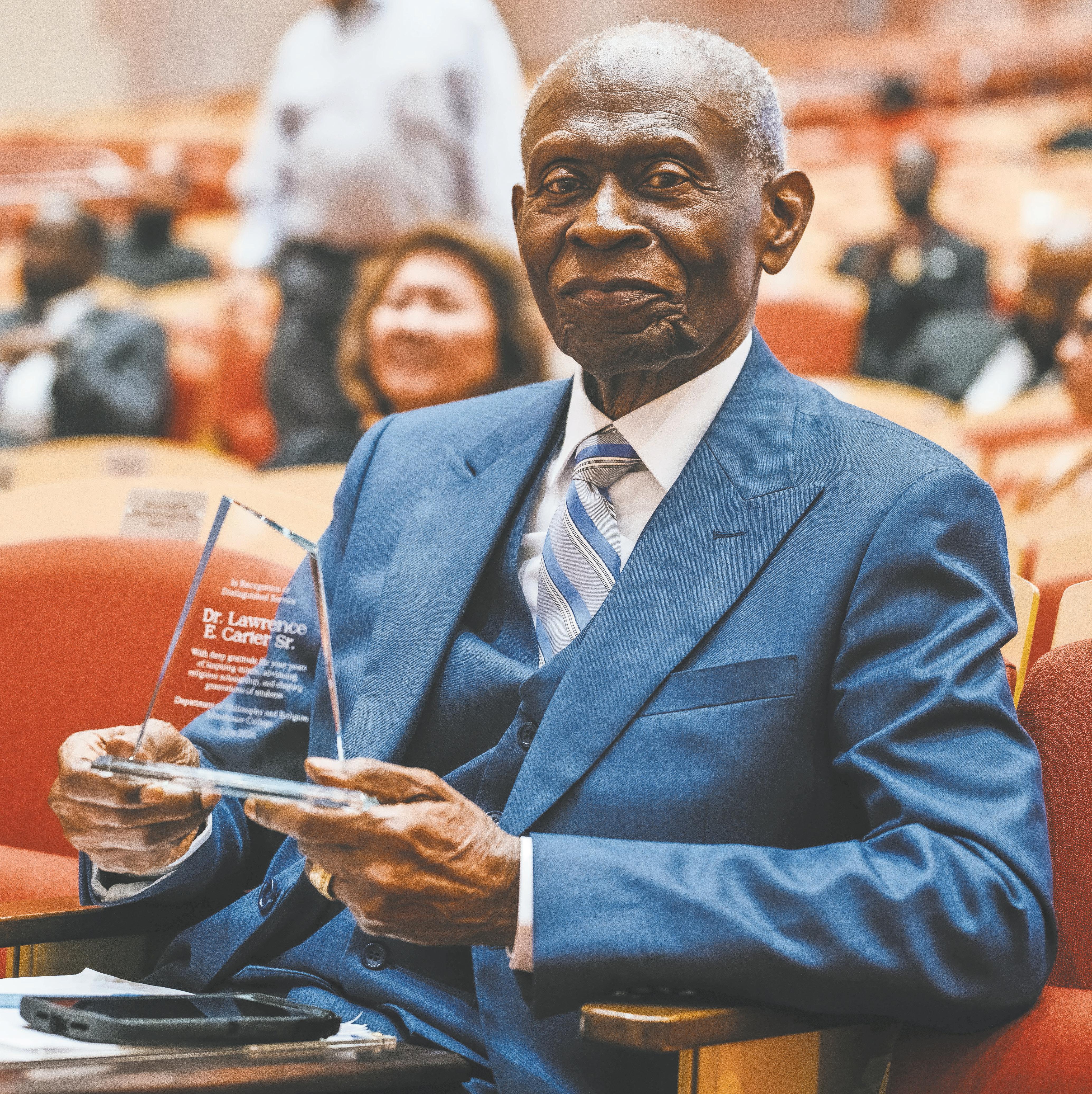
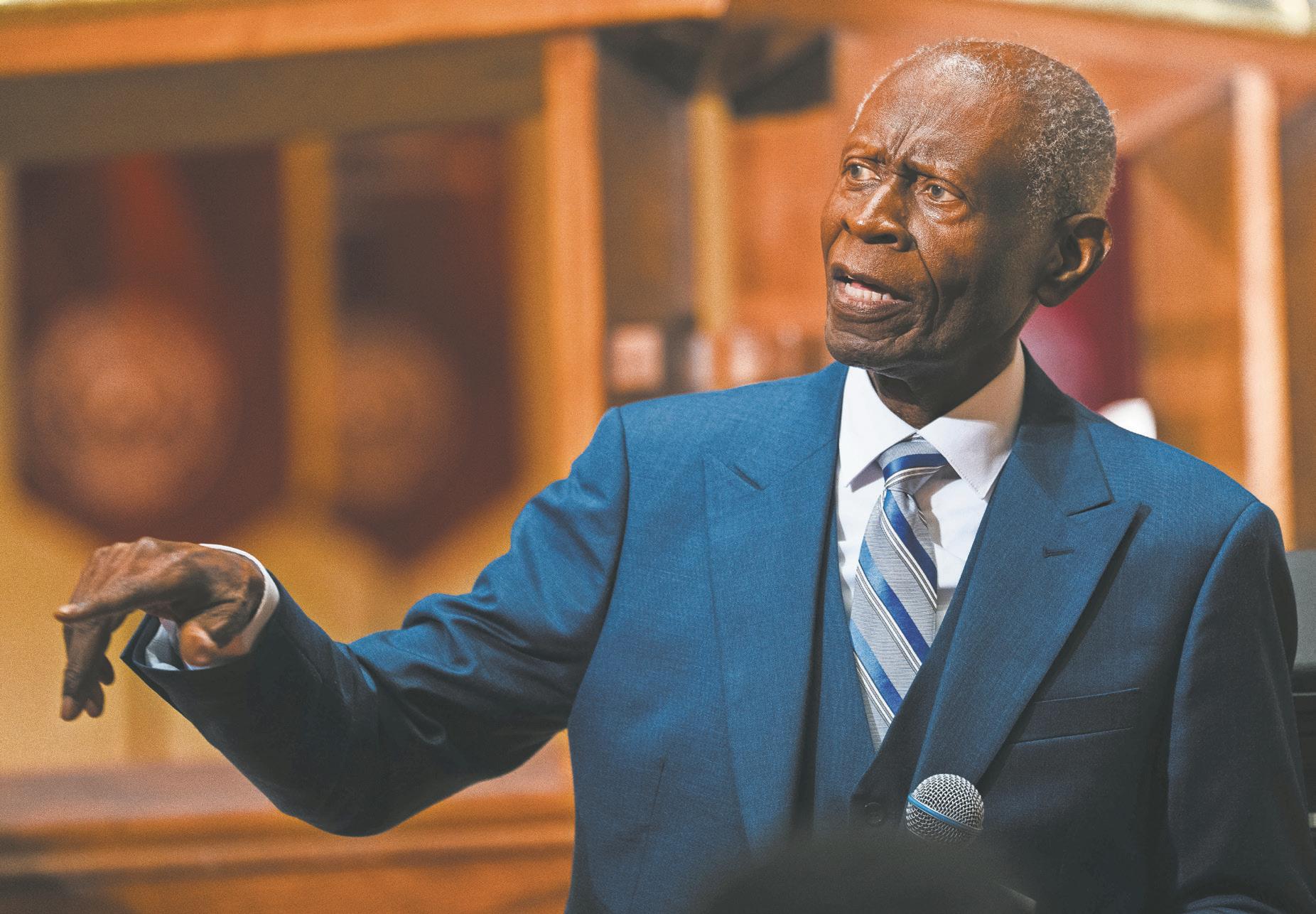
ivine providence is always at work,” the Rev. Dr. Lawrence Edward Carter Sr. told the attending audience at Martin Luther King Jr. International Chapel on Thursday evening, during his expression of appreciation ceremony. “There are no accidents in the universe.”
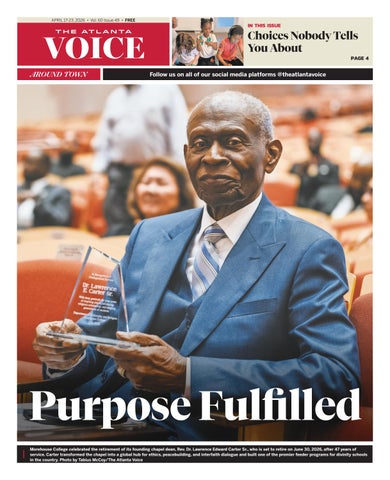
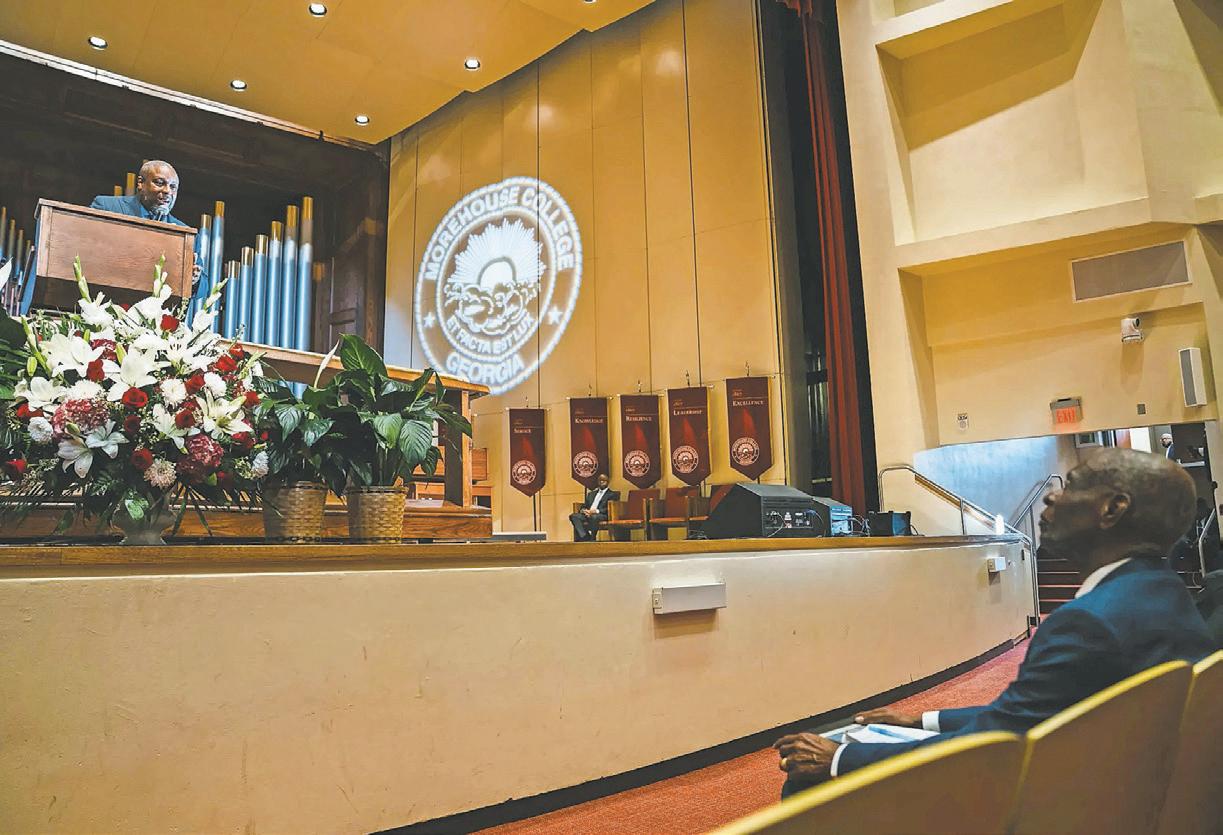
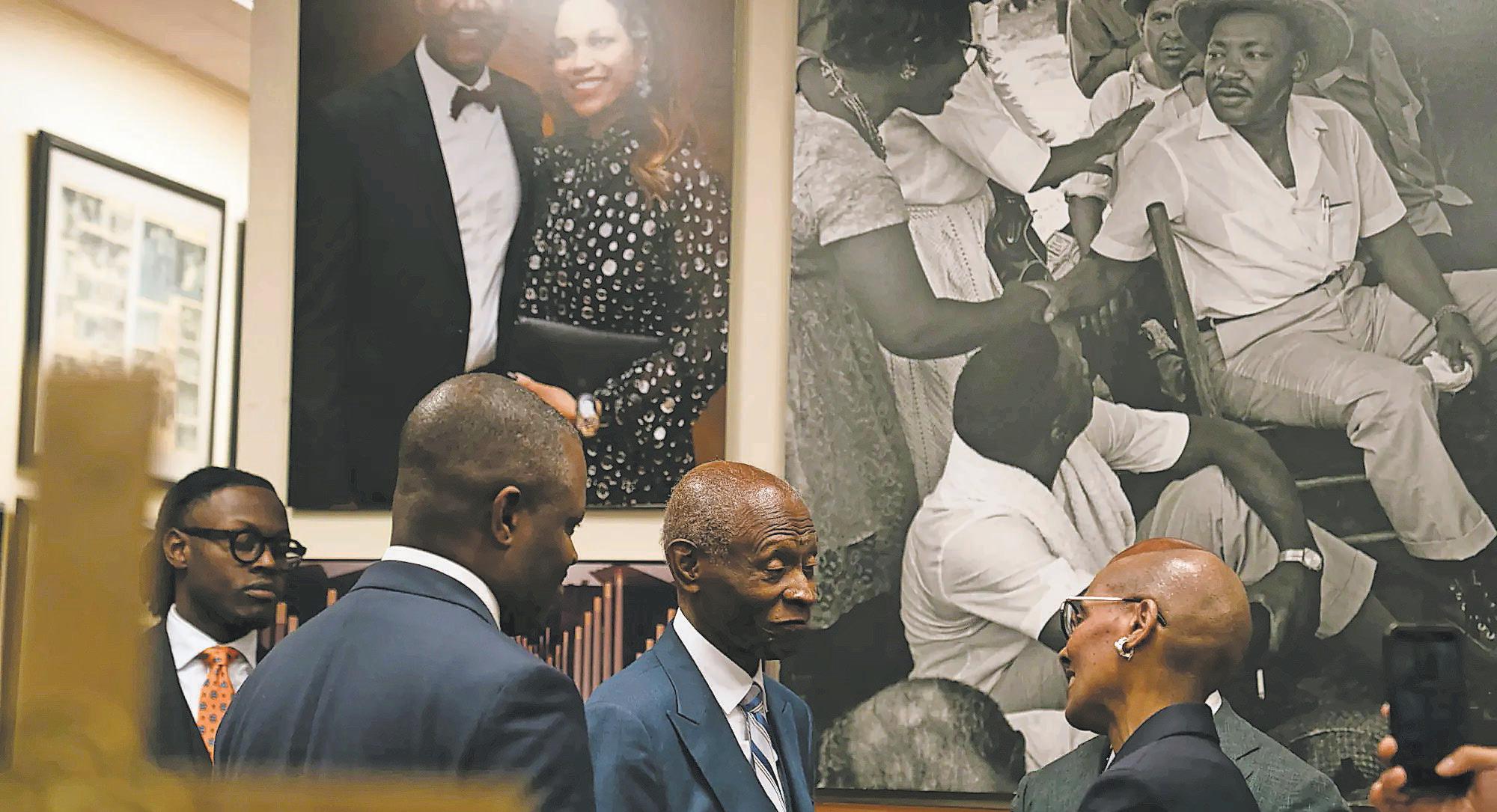
Morehouse College honored its founding chapel dean, April 9, 2026, with a day-long celebration that drew divinity scholars, elected officials, alumni, and ministry leaders from across the country and as far as Kingston, Jamaica, each arriving to bear witness to the close of one of the longest tenures in the historically Black men’s college’s history. Carter, set to retire from the deanship on June 30, 2026, after nearly five decades of reshaping the Martin Luther King Jr. International Chapel into a global hub for ethics, peacebuilding, and interfaith dialogue.
Colleagues, students, divinity scholars, and ministry leaders from as far as Kingston, Jamaica, gathered at the Martin Luther King Jr. International Chapel on the Morehouse campus to celebrate Carter’s retirement as founding dean, set for June 30, 2026, after 47 years of service. The day-long tribute included a morning induction
ceremony with U.S. Sen. Raphael Warnock as preacher, a retirement luncheon at Forbes Arena, oil portrait unveilings, and an evening open mic for those who wished to offer personal testimony.
When asked to describe the day in a single sentence, Carter did not hesitate.
“Fulfilled,” he said. “The people have told me that I’d done what the Lord told me to do, and that I can be at peace and go on to the next stage for my new assignments.”
Carter spent his tenure reshaping what had been called Memorial Chapel into the Martin Luther King Jr. International Chapel, insisting
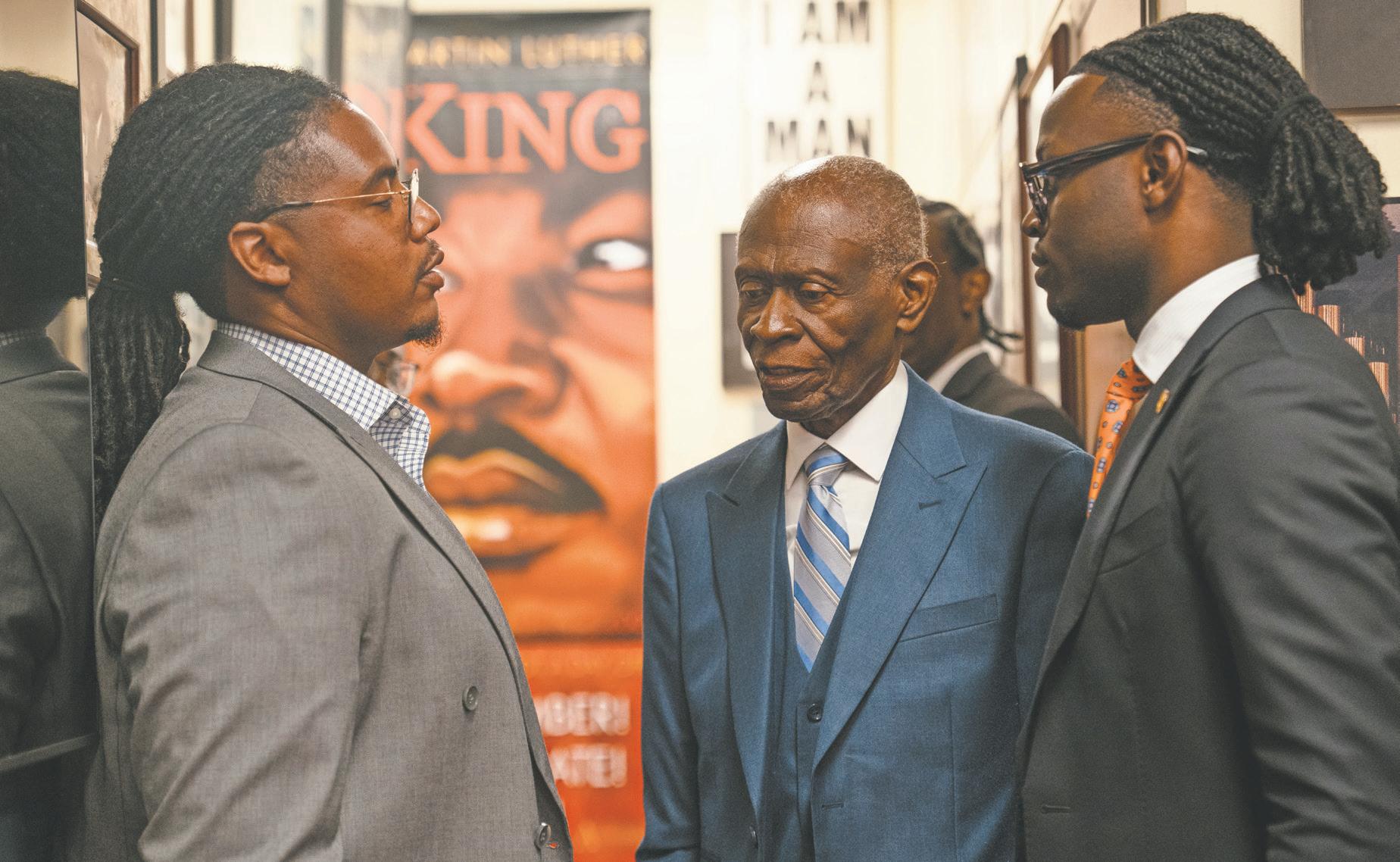
from the start that the space reflect a living mission rather than a monument to battles already won. He launched the Chapel Assistants Pre-Seminarians Program, introduced the Gandhi–King–Ikeda awards and built what recruiters widely regard as one of the premier feeder programs for divinity schools in the country. Stone tablets salvaged from a King monument at Boston University were installed on the chapel’s facade under his watch, artifacts Carter accepted as confirmation of his calling to remain at Morehouse.
The reach of that work was on
full display Thursday. Kelly Brown Douglas, canon theologian of the Washington National Cathedral and a visiting professor at Harvard Divinity School, was among those receiving an oil portrait tribute from Carter’s chapel. She said the encounter left her with a singular feeling.
“I’m humbled by this moment and by this award,” Douglas said, “but he has done the most significant work, and that work is that he has helped generations of young men to move from this place, to find their own ministry, to find their own voice, and he sent them out into the world. I’ve had these young men in my classes, and you can tell they’re marked by his excellence.”
The Rev. Michael Bernard Beckwith, founder and senior minister of Agape International Spiritual Center in Los Angeles, recalled the first time he encountered Carter. The impression was immediate. “I went home, and I said I met Dean Carter,” Beckwith said. “I want to be better. That was the effect.”
In the attending audience of the celebration was Rev. Dr. Sheila McKeithen, president of the Universal Foundation for Better Living, a network of ministries spanning North and South America and the Caribbean. McKeithen, who flew in from Kingston, Jamaica, specifically for the occasion, said the turnout spoke to something larger than ceremony.
“We have to give people their flowers while they can smell them, and we have to say the kind words while they can hear them,” she
said. “Let people know you appreciate them while they can hear you,
By LAURA NWOGU
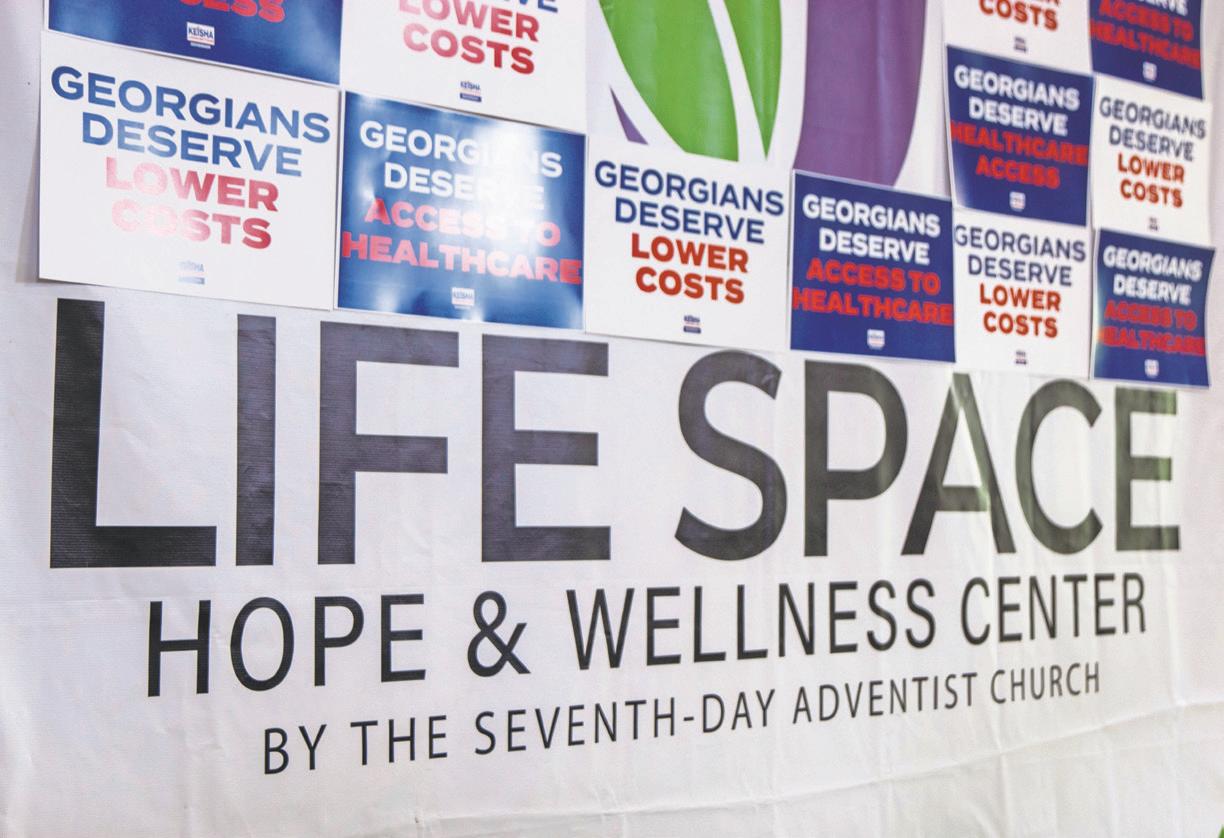
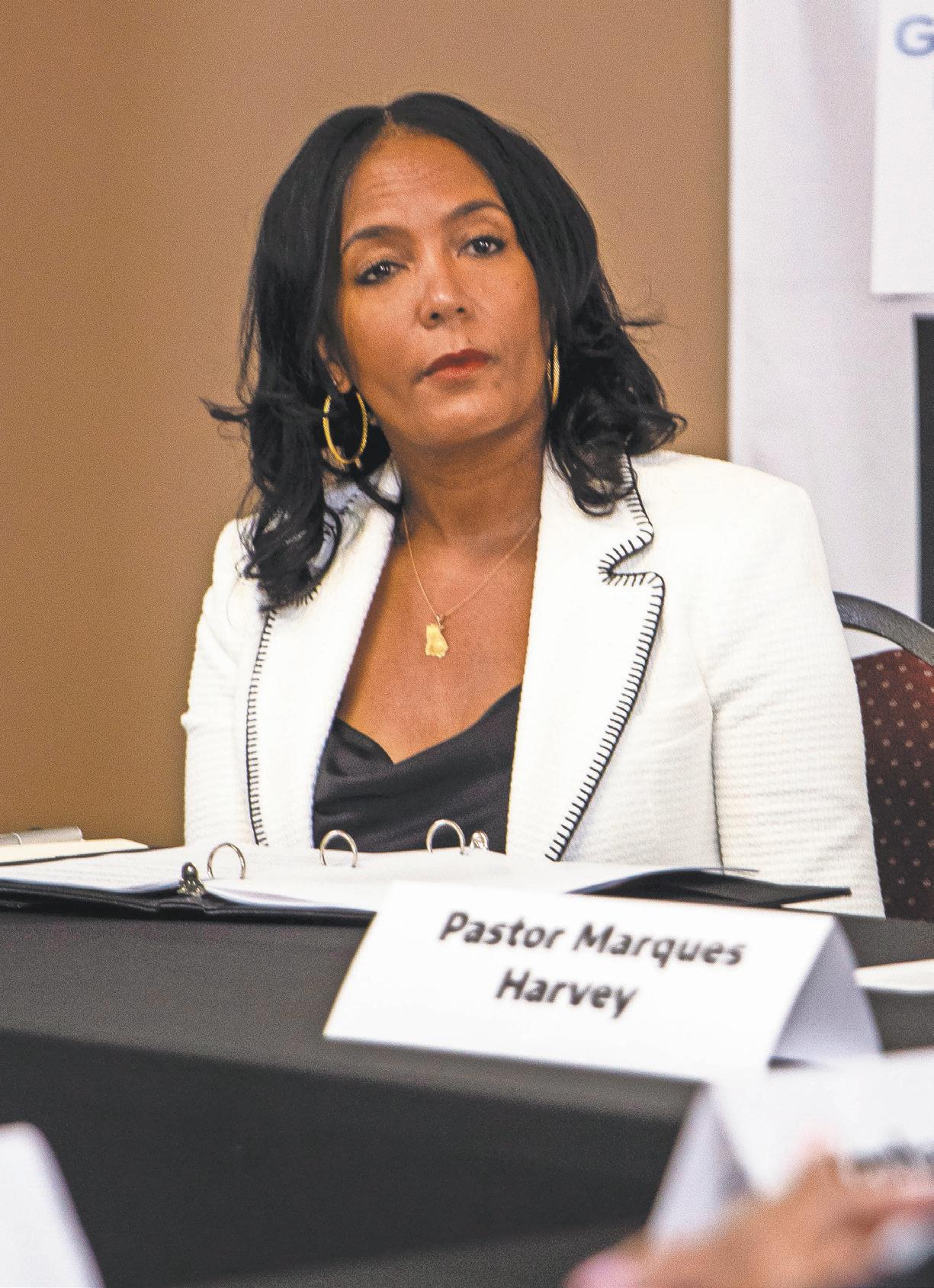
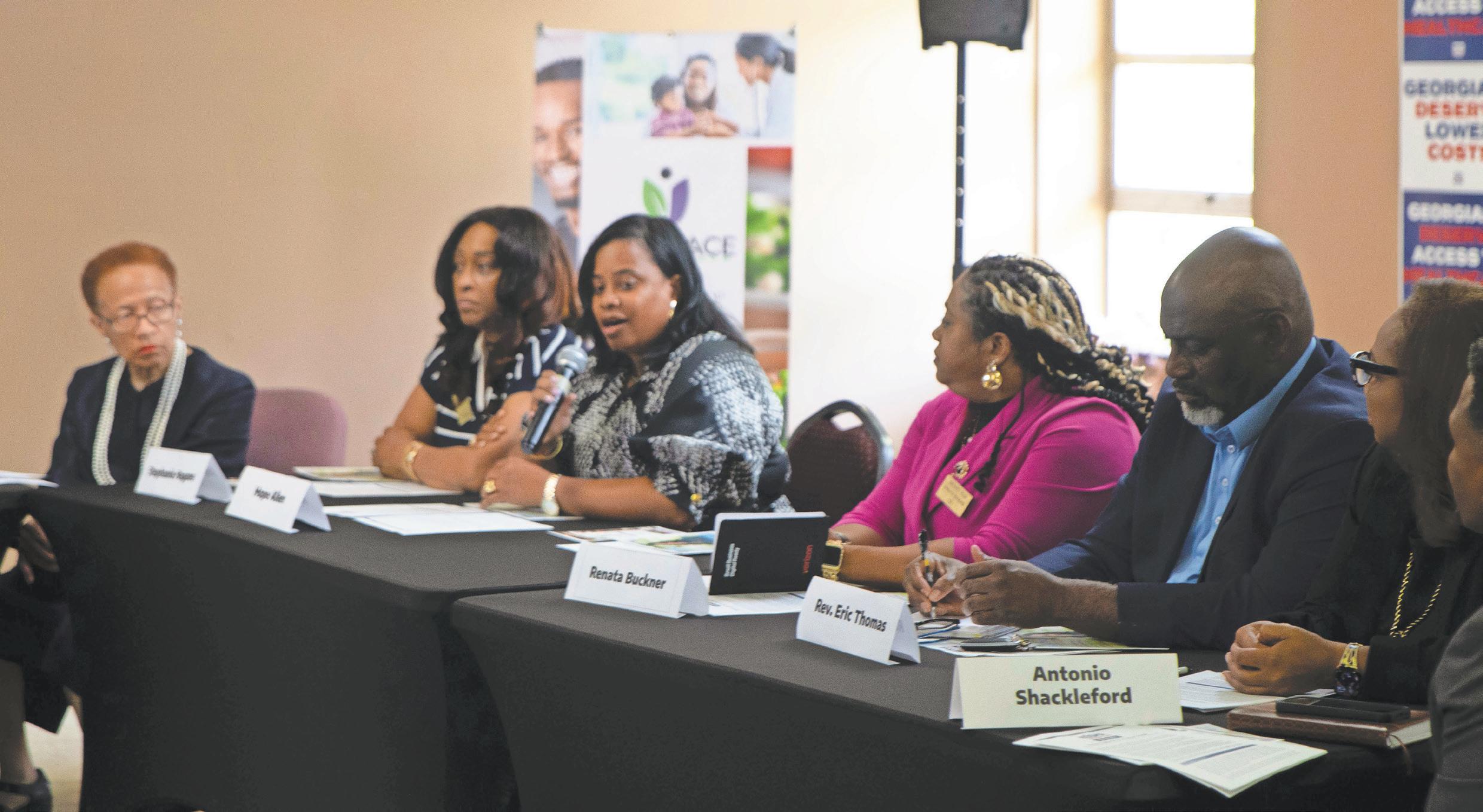
Gubernatorial candidate and former Atlanta Mayor Keisha Lance Bottoms hosted a community roundtable at Life Space Wellness Center on Monday to share her plans for a “healthier Georgia.” Lance Bottoms sat at the center of the room, surrounded by faith leaders, healthcare providers and community members. Behind her, posters displayed exactly what Lance Bottoms hoped for Georgians: lower costs and access to healthcare. Those impacted by rising healthcare costs gathered as Lance Bottoms encouraged an open discussion on healthcare in Georgia and shared her CARE plan to cut costs, expand access, recruit providers, and improve long-term health through better nutrition.
It builds upon Lance Bottoms’ work as mayor, where she appointed Atlanta’s first-ever Chief Health Officer to tackle chronic disease and improve community health, and initiated the transformation of the Atlanta City Detention Center (ACDC) into a Center for Diversion and Services that connects people facing homelessness, mental health needs and addiction to the services they need.
“There are so many underlying conditions within our communities, whether it’s asthma, high blood pressure, diabetes, etc., and it’s the reason that, especially communities of color, were so especially hard hit [during the pandemic],” Lance Bottoms said. “It’s often said that when America catches a cold, Black America catches the flu, and what we know is that epidemic is a daily occurrence in our community.”
The roundtable was a representation of small business owners, farmers, female entrepreneurs, truckers, older adults, and veterans. The community members highlighted issues from substance abuse and care for special needs adults and veterans to the skyrocketing premiums and the shortcomings of Medicaid when it comes to medical events, such as covering heart transplants and providing accessible home care for older adults.
Participants of the roundtable shared anecdotes that highlighted the faults of healthcare in Georgia. Hope Allen, the CEO of Logistically Speaking Online and an advocate for small business owners in
“There are so many underlying conditions within our communities, whether it’s asthma, high blood pressure, diabetes, etc., and it’s the reason that, especially communities of color, were so especially hard hit [during the pandemic],” Lance Bottoms (not shown) said. Photo by Laura Nwogu/The Atlanta Voice
trucking and logistics, shared that she is the caregiver for both her husband, who is suffering from glaucoma, and her autistic son. She revealed that both of them were both dropped from Medicaid, hindering their care. Rev. Eric Thomas of St. Peter Missionary Baptist Church discussed his heart transplant journey and how he watched as men younger than him who had Medicaid died because Georgia is one of the few states where the health plan does not pay for heart
transplants. He noted that it inordinately affected Black men and those in rural and urban areas.
“What is it that the governor can do and what can be done?” asked Renata Buckner, a coach at addiction treatment center Infinity Plus in West Point, Ga. “We know that just because it’s a smaller area, that doesn’t mean the care is not great. So, the area may be small, but the need and the necessity is very, very large. And one of the things that I feel can benefit some of the smaller
communities is going into the smaller community to have those subject-matter experts. Not that the higher-ups don’t know what’s going on, but the people who are
in the community that are dealing with these different issues are the ones who kind of know. There are a very limited number of resources within these communities.”
By DAWN MONTGOMERy
My mother moved me from one of the best public school districts in Mississippi to one of the worst the summer before my sophomore year. She had just gotten remarried. I didn’t have a say in it, nor did I understand or care about the disruptions that come with life. All I knew was that I went from a school that had everything I needed to one that looked at me sideways when I asked if they had a club I could join.
I went from a high school with resources, scholarships to pursue, and teachers who encouraged me to push beyond my limitations to one that had very little of any of these. I still made the grades. I was still the overachiever. But I was miserable, and my mother was unable to see past her new chapter long enough to hear me.
I carried that with me into parenthood. When my first son was old enough for school, I didn’t wait to see what the system would offer him. I put him in a Montessori daycare in Cobb County. In a smaller setting, he received more attention from teachers who were close enough to actually know him. Then life did what it does. I got married, moved to DeKalb County, and had to pull him out of a setting that was working. My son was paying a price, and history was repeating itself. A new marriage had rearranged the geography of his education, and I was now standing exactly where my mother once stood. The elementary school he landed in was probably one of the worst experiences he had.
I started paying attention to test

scores. Like Atlanta weather, one side of town looked one way, the other side looked entirely different, and I knew that if I picked up my kids and moved, their chances would move with us. That’s the reality of Atlanta. Equity in Education, an Atlanta-based organization dedicated to ensuring all students have access to high-quality education, laid it out clearly in their 2023 school landscape report, Two Atlantas. The report profiles two students in Atlanta Public Schools, one in Buckhead and one in Lakewood, with vastly different outcomes shaped entirely by geography. As Courtney English, the chief policy officer to Mayor Andre Dickens, states in the report, you have to feed them, house them, and make sure they’re safe before you can expect them to learn.
That disparity is what led
affluent backgrounds. It’s crucial to have experienced teachers in these spaces to meet the individual needs of every student.” A class of 30 can’t do that. A class of eight can.
I arrived at school choice through parenting, not policy. I was paying $1,700 a month in tuition at one point. Most parents I know can’t do that, and it’s unreasonable to expect them to. That’s what makes places like the Morgan Oliver School different. Six tuition tiers, with nearly half of its families paying under $2,000 a year. If I had known about a school like that when I was writing those monthly checks for Montessori, that would have changed my math entirely.
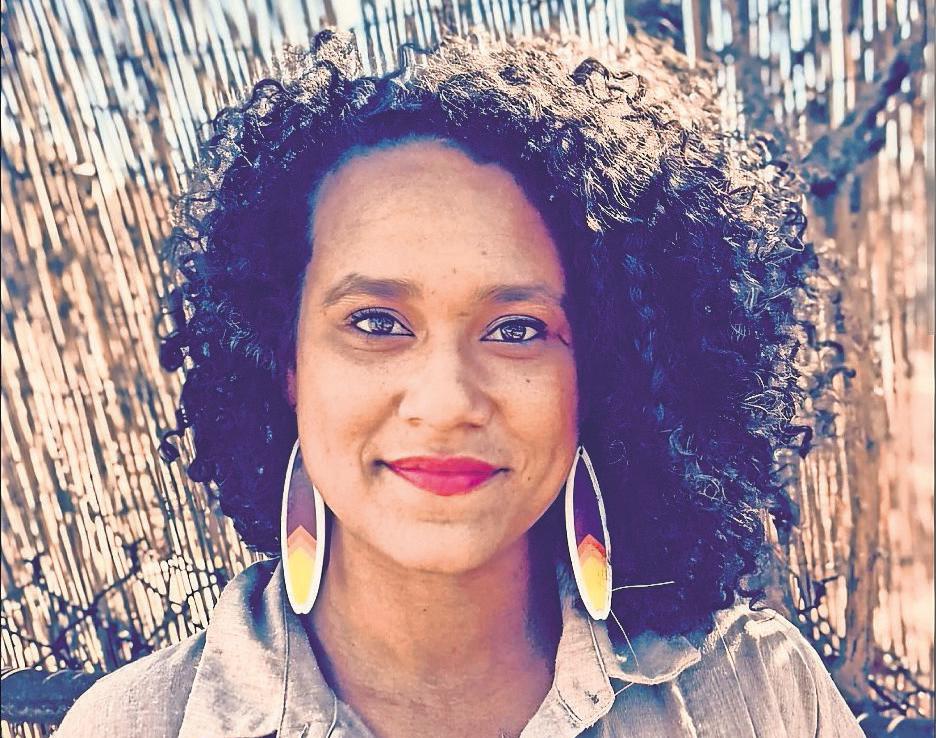
Sanidia Oliver Stone to found The Morgan Oliver School for Anti-Racism in Kirkwood in 2020. Sanidia, a former public school educator, saw the same patterns across metro Atlanta and decided not to wait for the system to correct itself. She built something instead.
With an 8:1 teacher-to-student ratio and only 32 students, the Morgan Oliver School operates nothing like a traditional classroom. Every teacher holds a master’s degree and brings at least ten years of experience. The curriculum is built around math, literacy, enrichment, and anti-racism, a deliberate counter to the removal of DEI programs and Critical Race Theory from public school classrooms. Sanidia understands that Black and brown students need to see themselves in what they’re learning and that a comprehensive history isn’t optional.
The proof is that 100% of Morgan Oliver School students perform at or above grade levels in literacy. Across Atlanta, according to the Annie E. Casey Foundation, only 21% of Black and brown children are proficient. That gap is a crisis that the Morgan Oliver School is already addressing.
What makes the model work is what I’ve been chasing for my own children across three schools and two sides of DeKalb County: experienced teachers in small classrooms who have the space to know each child individually. Sanidia explains it simply: “The student body is diverse, including children from generational trauma, environmental scarcity, and
There’s also the Georgia Promise Scholarship, which provides up to $6,500 per student per year at approved private schools. The Morgan Oliver School qualifies. But here’s the catch, and this is the part that frustrates parents like me: right now, only new students entering kindergarten from qualifying public schools are eligible. Returning families are still waiting on the legislature to catch up. There is privilege in knowing your options. There is privilege in being able to pick up and move to a better school district. I did it.
I left the Avondale Estates side of DeKalb for Druid Hills, and my rent went from $1,900 to nearly $3,000 a month. Not every family can do that. But what families can do, what they should have access to, is to know that places like the Morgan Oliver School exist, understand what funding is available, and make an informed decision for their child.
Sanidia calls microschools “acts of survival, created by educators and parents who refuse to wait for systems to change.” I’d take it further. School choice, at its core, is empowerment. It’s a parent figuring out the educational experience their child needs and making it happen, even when the system wasn’t designed to help them do that.
You might not be able to make that move this year. Maybe not next year either. But you can start putting things in place. You can visit a school. You can look into what your state offers. You can test your child outside of what the district tells you. And you can stop waiting for a system that wasn’t built for your child to suddenly decide to prioritize them.
FOUNDED
May 11, 1966
FOUNDER/EDITOR
Ed Clayton Immortalis Memoria
PUBLISHER/EDITOR
J. Lowell Ware
Immortalis Memoria
The Atlanta Voice honors the life of J. Lowell Ware.
PUBLISHER
Janis Ware
PRESIDENT/
GENERAL MANAGER
James A. Washington 2018-2024
EXECUTIVE ASSISTANT TO PUBLISHER
Chia Suggs csuggs@theatlantavoice.com
EDITOR IN CHIEF Donnell Suggs editor@theatlantavoice.com
GENERAL ASSIGNMENT REPORTERS Isaiah Singleton isingleton@theatlantavoice.com
Laura Nwogu lnwogu@theatlantavoice.com Noah Washington nwashington@theatlantavoice.com
BUSINESS REPORTER
Tabius H. McCoy tmccoy@theatlantavoice.com
EDITOR AT LARGE Stan Washington swashington@theatlantavoice.com
ADVERTISING, SALES & CIRCULATION
ADVERTISING ADMINISTRATOR
Chia Suggs advertising@theatlantavoice.com
SALES
RDW Jackson rdwadman@gmail.com
SUBMISSIONS editor@theatlantavoice.com
DIRECTOR OF PUBLIC RELATIONS
Martel Sharpe msharpe@theatlantavoice.com
CONTACT INFORMATION
633 Pryor Street, S.W. Atlanta, GA 30312 Office: 404-524-6426 info@theatlantavoice.com

SPONSORED CONTENT
PROVIDED BY MEDTRONIC
High blood pressure is a common health issue that affects people around the world. However, studies show that communities of color and underserved communities in the U.S. are disproportionately impacted by high blood pressure risks.1,2 U.S. guidelines from the American Heart Association define high blood pressure as any value greater than 130/80 mmHg.3
In the state of Georgia, 45% of Black Americans have reported being told by a health professional that they had high blood pressure, compared to 36% of all adults in the state.4,5
1. Hypertension is common in the Black community.
Black Americans are 20% more likely to have high blood pressure.6
In addition, Black Americans experience 5x the mortality risk from high blood pressure compared to white Americans – meaning you or someone you know, love or work with may have high blood pressure.6 High blood pressure is often called a “silent killer” because there are usually no signs or symptoms. When symptoms do show up, they might look like headaches, nosebleeds, or difficulty breathing.7
The good news is there are simple things you can do every day to lower your risk — like eating healthy, going for a walk, and finding ways
to manage stress.3
2. Know your family history and understand your risk.
Beyond diet and lifestyle, if you have a family history of high blood pressure, your chances of developing it are higher, which makes knowing your risk an important part of prevention.8
Just as importantly, make your annual check-up a non-negotiable appointment. Regular visits are one of the best ways to catch high blood pressure early and protect your health for the future.
3. New treatment options are now available.
Blood pressure can be challenging to treat. Even with lifestyle changes and medications, up to 50% of patients become non-adherent within one year.9 The good news is that new treatment options are available.
The Symplicity Spyral™ renal denervation (RDN) procedure is a minimally invasive treatment designed to complement your existing efforts to manage high blood pressure.10,11,12 It works alongside the lifestyle changes and medications you may already be using to help control your blood pressure more effectively.10,11,12 The Symplicity blood pressure procedure may help you achieve long-term reductions without the same side effects as medications.13,14*
Let’s continue to honor our community’s culture and traditions by
protecting its future health. For more information on hypertension and treatment options, and to view the important safety information, visit BeyondHBP.com or call 800-633-8766.
Medtronic is proud to partner with the Association of Black Cardiologists (ABC) on its mission to eliminate the disparities related to cardiovascular disease in all people of color.
*Data available through three years. Not every person will experience the same results. Talk to your doctor to see if the Symplicity blood pressure procedure is right for you. Your doctor should discuss all potential benefits and risks with you.
The Symplicity Spyral renal denervation system is indicated to reduce blood pressure as an adjunctive treatment in patients with hypertension for whom lifestyle modifications and antihypertensive medications do not adequately control blood pressure.
The Symplicity procedure has known risks that should be considered in relation to the potential benefits of the procedure. Potential procedure-related adverse events, including pain, vascular access site complications, and vasospasm, are most common.
1 Lackland DT. Am J Med Sci. 2014;348(2):135-138. 2 Martin SS, Aday AW, Allen NB, et al. 2025 Heart Disease and Stroke Statistics: A Report of US and Global Data From the American Heart Association. Circulation. 2025 Feb 25;151(8):e41-e660. doi:


10.1161/CIR.0000000000001303. Epub 2025 Jan 27. Erratum in: Circulation. 2025 Jun 24;151(25):e1096. 3 Jones DW, Ferdinand KC, Taler SJ, et al. 2025 AHA/ACC/AANP/AAPA/ ABC/ACCP/ACPM/AGS/AMA/ASPC/ NMA/PCNA/SGIM Guideline for the Prevention, Detection, Evaluation, and Management of High Blood Pressure in Adults: A Report of the American College of Cardiology/American Heart Association Joint Committee on Clinical Practice Guidelines. J Am Coll Cardiol. 2025 Nov 4;86(18):1567-1678.4 America’s Health Rankings. (2023). High Blood Pressure in Georgia: Black https:// www.americashealthrankings.org/ explore/measures/Hypertension/hypertension_Black/GA. Accessed on Jan. 20, 2026. 5 Explore High Blood Pressure in Georgia | AHR. (2026). High Blood Pressure in Georgia https://www.americashealthrankings.org/explore/measures/Hypertension/hypertension_White/ GA. Accessed on Jan. 20, 2026. 6 Aggarwal R, et al. Hypertension. 2021;78(6):1719-1726. 7 World Health Organization. https://www.who.int/ news-room/fact-sheets/detail/hypertension. Accessed on Jan. 20, 2026. 8 American Heart Association. Know Your Risk Factors for High Blood Pressure. https://www.heart.org/en/ health-topics/high-blood-pressure/ why-high-blood-pressure-is-a-silentkiller/know-your-risk-factors-forhigh-blood-pressure. Accessed on Jan. 20, 2026. 9 Berra E, et al. Hypertension. 2016 Aug;68(2):297-306. 10 Medtronic Symplicity Spyral multi-electrode renal denervation catheter instructions for use. 11 Kandzari DE, Townsend RR, Kario K, et al. Safety and Efficacy of Renal Denervation in Patients Taking Antihypertensive Medications. J Am Coll Cardiol. November 7, 2023;82(19):1809–1823. 12 Böhm M, Kario K, Kandzari DE, et al. Efficacy of catheter-based renal denervation in the absence of antihypertensive medications (SPYRAL HTN-OFF MED Pivotal): a multicentre, randomized, sham-controlled trial. Lancet. May 2, 2020;395(10234):1444-1451. 13 Mahfoud F, Mancia G, Schmieder R, et al. Blood pressure and MACE reductions after renal denervation: 3-year Global Symplicity Registry results. Presented at PCR e-Course 2022.14 Kandzari, DE. SPYRAL HTN-ON MED 3 Year Data. Transcatheter Cardiovascular Therapeutics (TCT) conference. October 2025.
US-SE-2600191 v 2.0 ©2026 Medtronic. Medtronic, Medtronic logo, and Engineering the extraordinary are trademarks of Medtronic. All other brands are trademarks of a Medtronic company
By NOAH WASHINGTON
Every community has a design language, a look, a feel, a presence that is entirely its own. Since Virgil Abloh brought conceptual thinking to streetwear and luxury fashion, design is no longer confined to showrooms and galleries, and the conversation around what counts as design and who it belongs to has never been more alive. The High Museum of Art is now making a similar case, arguing that Isamu Noguchi knew that long before Abloh did, and Atlanta has had the proof sitting in Piedmont Park for 50 years.
“Isamu Noguchi: ‘I am not a designer’” opened Thursday at the High, running through Aug. 2 and featuring nearly 200 objects spanning every decade of the artist’s career, from clock and kitchen timers and fashion illustration for Harper’s Bazaar in the 1920s and 1930s to the monumental civic plazas and artist-designed playgrounds that defined the final stretch of his life. It is Noguchi’s first design retrospective in nearly 25 years, and Atlanta is where it begins.
That choice is not incidental. A 10-minute walk from the museum, tucked inside Piedmont Park, sits Playscapes, the only playground Noguchi ever built in the United States during his lifetime. It opened in May 1976, following

Conservancy and the city’s parks department, working in coordination with the museum, recently renovated Playscapes ahead of the exhibition’s opening.
The timing of the retrospective is equally deliberate. This year marks the 50th anniversary of Playscapes, and with the 2026 FIFA World Cup bringing international visitors to Atlanta through the summer, the exhibition will be in view as the city occupies a global stage.
“I hope that international visitors who are coming to Atlanta understand that we have wonderful amenities and wonderful resources, like Playscapes in Piedmont Park,” Obniski said. “I love that this participates in a broader kind of park culture that we have. We’re the city in a forest, and you cannot say that about another American city.”

the High Museum’s commissioning of the work alongside Atlanta’s bicentennial celebrations. For exhibition co-curator Monica Obniski, that fact is the exhibition’s beating heart.
“It is really because of Playscapes that I wanted to do this exhibition,” said Obniski, the High’s curator of decorative arts and design. “I wanted to shed light on Atlanta. I wanted to bring the national design dialog here, to let people know that we have cool things going on in the city.”
Noguchi had spent more than
four decades trying to build a playground in the United States. He attempted it repeatedly in New York. He attempted it in Hawaii. In 1965, he created a playground in Japan, called Kodomo No Kuni, designed with architect Sachio Otani. But the United States would not come until Atlanta. In 1975, the High’s then-director, Gudmund Vigtel, invited Noguchi to the city for what amounted to a creative workshop, gathering him with a host of fundraisers to imagine what could be built. What they imagined was a playground. The Piedmont Park
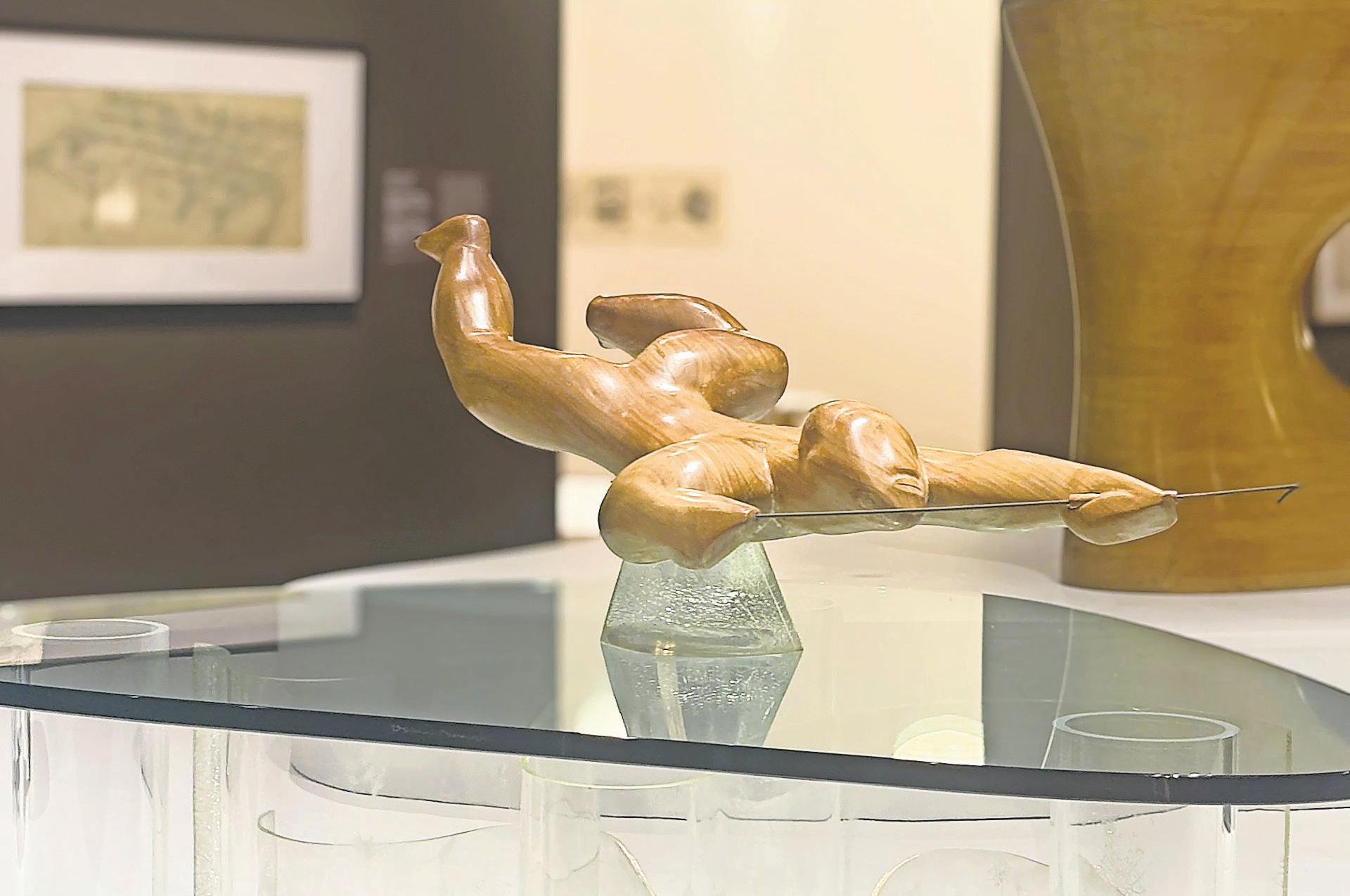
The exhibition was co-curated with Marin R. Sullivan, an art historian and independent curator based in Chicago who specializes in sculpture. Organized thematically rather than chronologically, the show moves through three sections: “Making Multiples,” which explores how Noguchi’s commercial and industrial design work, including the iconic Herman Miller coffee table (IN-50, designed 1944) and Knoll-manufactured rocking stools (designed 1954-1955), operated within and against the conventions of fine art production; “Elements of Architecture,” which tracks his expansion into inhabitable interiors and large-scale architectural collaboration, highlighted by the stage set for choreographer
Martha Graham’s “Seraphic Dialogue” (1955), not seen since the 1960s; and “Shaping Spaces,” focused on his civic and public work, including the playgrounds he began designing in the 1930s.
The 1949 statement that titles the show carries a specific historical weight, Sullivan noted. Noguchi wanted to be taken seriously as a fine artist, and at that moment, creating functional objects was, in her words, a stain on a fine artist’s practice.
“Today, sneakers are art, clothing is art,” Sullivan said. “There’s a fluidity across practice between what we might think of as the fine artist and the designer. Noguchi was thinking about that in the 30s, in the 40s, in the 50s. Labels don’t
matter. It’s about your creative vision, and it’s about creating things that people can use and enjoy.”
Sullivan drew a direct line between Noguchi’s boundary-dissolving practice and the contemporary designers who have brought that conversation into mainstream culture. The museum is planning a closing-weekend program in August featuring contemporary designers in conversation about his legacy.
Obniski, who joined the High in 2020 and began developing the exhibition almost immediately, said the show’s deeper argument is that Noguchi’s design work was never peripheral to his “What I would love people to come away with is a sense for the breadth of his work,” she said. practice as a sculptor. It was the practice.
“He wasn’t just doing one thing. And I think that what was important to him, which for us is really wanting to make places better, wanting to make homes better, wanting to make public spaces better, there’s this kind of public good that is at the heart of a lot of work, like Playscapes, for example.”
The exhibition is presented with support from Bank of America, the Terra Foundation for American Art, the Henry Luce Foundation, the Forward Arts Foundation, and Delta Air Lines, Inc.
“I want everyone to know the name of Noguchi,” Obniski said, “and then to know that they have this resource in their backyard.”
n an era dominated by social media health trends and rapid weight loss promises, Dr. Alicia Shelly is working to shift the conversation, especially in communities often overlooked in traditional healthcare messaging. An obesity medicine specialist with roots in Cobb County, Shelly is helping patients and community members understand a critical truth: weight and wellness are far more complex than commonly portrayed. “Obesity is more than just willpower,” Shelly said. “People feel like they’re doing everything right and not seeing results, but there are other factors involved.”
Before specializing in obesity medicine, Shelly spent more than a decade practicing internal medicine. Her transition into the field was not only professional but also personal. Having struggled with weight herself, she understands the frustration many patients feel. That lived experience now informs how she approaches care, focusing on empathy
Continued from page 2
and not when they’re in a pine box.”
Alumni returned from across the country. Elijah Waller, Class of 2024 and the 38th president of the Chapel Assistants program Carter founded, said the dean’s influence extended well beyond any classroom or chapel service. Waller said he stayed for the entirety of the day’s events, unwilling to leave before seeing Carter’s reaction to the outpouring of gratitude that had been building since the retirement announcement.
“Dean Carter changed the entire trajectory of not just my life, but my
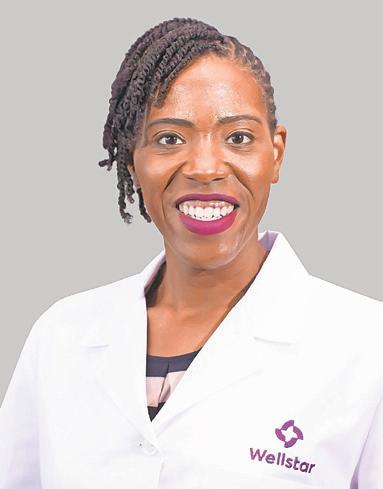
Photo submitted
Dr. Alicia Shelly, MD, is an internist practicing internal medicine and obesity medicine.
and individualized treatment. “I’m able to meet people where they are and let them know they’re not alone,” she said. Her work also reflects a broader mission: addressing health disparities and ensuring communities have access to accurate, culturally relevant health information.
While diet and exercise are often emphasized, Shelly says they are only part of the picture, especially for women. Hormonal changes tied to pregnancy, perimenopause, and menopause can significantly impact weight. Conditions such as polycystic ovary syndrome, thyroid disorders, depression,
ministry,” Waller said. “I would not be where I am today if it were not for Dean Lawrence Edward Carter Sr.”
Morehouse College has announced an international search for Carter’s successor, to be chaired by trustee and alumnus the Rev. Dr. Delman Coates, Class of 1995. Carter plans to maintain his professorship and take a one-year sabbatical, a quieter pace after nearly five decades at the center of the college’s spiritual life.
“They’ve been telling me that I did it,” he said. “And then the strange thing is, they’re saying nobody else could have done this, but you’ve done it.”
What drove him, he said, was
and anxiety can also contribute. “There are so many factors that people don’t realize are contributing,” Shelly said. Genetics and certain medications, including some forms of birth control and long-term steroid use, can further complicate weight management. The result challenges the idea that weight is simply a matter of discipline.
For many patients, the biggest barrier is not knowledge. It is consistency. Life events, stress, and demanding schedules often disrupt even the best intentions. Shelly encourages patients to focus on realistic, manageable changes rather than drastic overhauls.
“If you don’t like vegetables, we find one you can tolerate and build from there,” she said. In the South, where sugary drinks like soda and sweet tea are deeply ingrained in the culture, she suggests gradual adjustments, such as reducing portion sizes instead of eliminating them entirely. “It’s about getting one percent better,” she added.
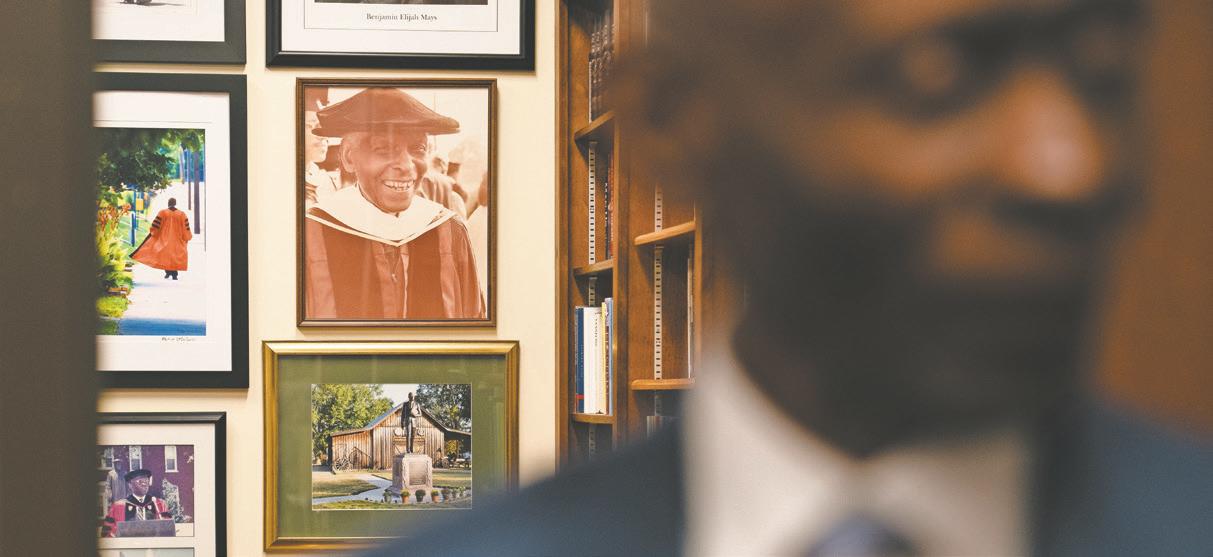
never the institution itself. It was the man the institution was named for. “I have wanted more than anything to do something significant for Martin Luther King Jr., before I close my eyes, having been powerfully impacted by his ministry,” Carter said. “I thought he deserved the most dynamic memorial possible. That’s why I was given the chance as founding dean to create it.”
With the growing popularity of GLP-1 medications like Ozempic, conversations around obesity have become more visible. Shelly sees this as a step forward. “It’s helping people understand that obesity is a chronic disease,” she said. However, she cautions against viewing these medications as a standalone solution. “They’re not magic. You still need nutrition and physical activity to make lasting changes,” she said.
One of the most common misconceptions Shelly encounters is the expectation of rapid weight loss. “The idea that you’re going to lose 20 pounds in a month is not realistic,” she said. Short-term diets may produce temporary results, but they are rarely sustainable. Instead, Shelly emphasizes long-term lifestyle changes that can be maintained over time. “If it’s not sustainable, it’s not going to last,” she said.
For those discouraged by slow progress, Shelly urges a shift in
perspective. Weight is only one measure of health. Improvements in strength, mobility, and overall well-being are equally important indicators of success. “You may not see the scale move, but your clothes fit better, you have more energy, or you’re able to do things you couldn’t do before,” she said. Celebrating those small victories, she adds, can make a significant difference in staying motivated. “This is a marathon, not a sprint,” she said.
Through community health fairs and outreach efforts, Shelly hopes to empower individuals with knowledge and access to care. From screenings to educational talks, these events offer an opportunity for people to better understand their health and take the next steps toward improvement. Her message remains consistent: obesity is a chronic condition that requires comprehensive, long-term care, not judgment. “It’s more than just willpower,” Shelly said. “And people deserve real solutions.”

Athletes’ careers are unpredictable. Less than 2% of NCAA college athletes turn professional and many professional athletes retire before they’re 35. Yet nearly 65% of athletes say they never had financial education in school.
To help address the unique challenges athletes face, JPMorganChase announced a new initiative to help athletes navigate every aspect of their financial lives, from early career stages through retirement.
The JPMorganChase Athlete Council brings together some of the world’s most accomplished sports figures who will meet with JPMC leaders on a regular basis to discuss the unique financial needs of athletes and guide the development of programs to address them.
“Sports careers can be short and retirement unexpected,” said Kristin Lemkau, CEO of J.P. Morgan Wealth Management. “We want to develop a program by athletes for athletes to help them from college to professional sports to retirement.”
“Athletes face unique challenges and opportunities. Having the right educational resources and guidance is critical to making smart decisions about money as your career evolves,” said 3-time NBA champion and 2-time NBA Hall of Famer Dwyane Wade.
At its inaugural meeting, JPMorganChase Athlete Council members shared their own personal experiences and discussed a range of topics, including the needs athletes have at different stages of their career and how to support them effectively in making smart financial choices.
“I’m excited to join the JPMorganChase Athlete Council and to serve as chair of this incredible group of athletes. The Council gives us the opportunity to share our experience and insights to help athletes build their financial knowledge and plan beyond their playing careers,” said Wade.
JPMorganChase has a long history of serving athletes, teams and owners, including sponsorships of tournaments, venues and individual teams and players, such as Hawks Rewards presented by Chase.

Chase is also the designated financial education partner for League One Volleyball (LOVB) and Hudl, a leading sports tech platform for youth to college athletes.
“Our goal is to truly empower the athletes of today – and tomorrow – with financial literacy throughout their career,” said Stevie Baron, Head of Private Client Banking at JPMorganChase. “We are excited to partner with some of the nation’s top athletes to deliver a fully integrated experience.”
The JPMorganChase Athlete Council includes:
• Ally Love – Peloton Instructor + VP, Instructor Strategy & Development | TODAY On-Air Contributor | Founder & CEO, Love Squad
• Tom Brady – Seven-time Super Bowl champion with 10 Super Bowl appearances and 18 division titles
• Dwyane Wade (chair)–Entrepreneur, two-time NBA Hall of Famer and three-time NBA champion celebrated for his legendary career with the Miami HEAT
• Megan Rapinoe – Former professional soccer
winger who co-captained the U.S. Women’s National Soccer Team and won two World Cup titles and an Olympic gold
• Kayvon Thibodeaux – New York Giants edge rusher and 2022 NFL Draft fifth overall pick. Founded JREAM to support underserved youth
• Alex Morgan – Two-time FIFA World Cup champion, Olympic gold medalist and former co-captain of the U.S. women’s national soccer team
• Jalen Brunson – Knicks AllStar Guard and Clutch Player of the Year, empowering youth through his Second Round Foundation
• Sue Bird – Seattle Storm WNBA champion and 5-time Olympic gold medalist turned first-ever managing director for USA Women’s Basketball
• A’ja Wilson – Unprecedented four-time WNBA MVP winner who’s led the Las Vegas Aces to three championships Names listed in photo order from left to right for each row.
“Every athlete on this Council has been deeply committed to paying it forward to help the more
than 500,000 college, working and retired athletes avoid some of the same pitfalls they stepped in. At JPMorganChase, we can help every athlete regardless of income level manage their financial plan for the future,” said Lemkau.
The firm is also supporting athletes with its new “Athlete Center of Excellence” run by financial professionals who deeply understand the athlete experience and through financial education outreach at universities and major sports events to meet athletes where they are with curriculums designed specifically for them.JPMorganChase recently launched a dedicated educational content hub at jpmorgan.com/ace with a range of resources for athletes and tailored guides for each phase of their sports career.
Participation on the Athletes Council or at JPMorganChase events does not constitute an endorsement or testimonial relating to the investment advisory services of J.P. Morgan Securities LLC, its advisors, and wealth management businesses.
Learn more about the JPMorganChase Athlete Council at: jpmorgan.com/athletescouncil
For informational/educational purposes only: Views and strategies described in this article or provided via links may not be appropriate for everyone and are not intended as specific advice/recommendation for any business. Information has been obtained from sources believed to be reliable, but JPMorgan Chase & Co. or its affiliates and/or subsidiaries do not warrant its completeness or accuracy. The material is not intended to provide legal, tax, or financial advice or to indicate the availability or suitability of any JPMorgan Chase Bank, N.A. product or service. You should carefully consider your needs and objectives before making any decisions and consult the appropriate professional(s). Outlooks and past performance are not guarantees of future results. JPMorgan Chase & Co. and its affiliates are not responsible for, and do not provide or endorse third party products, services, or other content.
Deposit products provided by JPMorgan Chase Bank, N.A. Member FDIC. Equal Opportunity Lender.
The last time The Atlanta Voice spoke with the CEO and President of luxury swim and resort wear brand Yacht Club Access, Natasha Simmons, was right after the Colombia Mission Trip back in 2022.
Fast forward four years, Simmons has unveiled her newest collection called Yacht Club: Pura Vida Collection, which gives elevated, coastal, global, and tropical luxury.
The collection includes matching sets for families, kids, and dogs, and features sustainable materials sourced from Costa Rica and Brazil.
“We have gone from fast fashion to now cut and sew, which, if you’re a designer, or if you’re familiar with the fashion world, it’s very expensive,” she said. “In our process of curating the designs, I went back to those moments where I had all these visions of how I want my brand to be, and seeing little things with how Victoria’s Secret does their stuff and all the brand, higher-end brands, and just taking little tidbits to make it my own.”
With this collection and the pattern Simmons chose, she said, it brings her to the mind of Costa Rica, where she wanted to bring forth the culture, the sustainability of green and eco-friendly. They also used recycled and upcycled fabric compositions, specifically sourced

Additionally, Simmons says the Colombia trip taught her so many ways to go about her own journey.
“At that time [of the trip], I had a vision for what I wanted Yacht Club to be, and it just seemed so clear of what that vision was, but it was so hard to carry out it,” she said. “Through that time leading up to now, I’ve done so many turns, so many pivoting, and it’s been a lot.”
Simmons says she knows now she can get to her end goal and not sprint forward to get there.
“I don’t have to go down the lanes that everyone else did. When this idea or this roadmap or direction doesn’t work, then I can try
something else, and that’s why a lot of entrepreneurs fail,” she said. “Just because one way you thought about how you’re going to get there didn’t work out, don’t mean you give up. The first three years in business, most people don’t succeed because that’s the grimmest time.”
Fortunately, Simmons came from a family of entrepreneurs, so her first three years were her assessing the market and learning what she needed to learn.
In 2023, at that three-year mark, that’s when Simmons decided to push forward and achieve the certifications and licensing.
What drives Simmons as an entrepreneur, she says, is her experience with teenage homelessness. Through lots of reflection, Simmons says she had to take pauses and get to know who she is, what her purpose was, her true passion, and clean out the childhood trauma by going on an apology tour for the things she has done.
“It’s always stuck with me, and fast forward to know, a lot of entrepreneurs don’t expect to end up meeting the higher version of themselves,” she said. “What drives me is I want to show other women, whether they’re entrepreneurs or not, that you are worth more than what you think you are. You’re worth going inside yourself and facing those dark holes, those black places, and becoming a higher version of yourself.
After the Colombia trip, Simmons says she came off the trip with a vision, passion, motivation, courage, and boldness.
“I engulfed myself in the industry of business and fashion. I took moments in time of reading and watching documentaries about all the high-end designers, listening to successful people about their journey, how they’re getting there, and even, like celebrities and reality stars, and the ones who went into the fashion lane and how they got started,” she said.
Yacht Club, according to Simmons, plans to expand online, build a VIP influencer club, and explore retail opportunities in airports and malls. The brand aims to become a major luxury brand like LVMH within five to ten years, introducing new product lines and expanding globally.
For advice to other entrepreneurs, Simmons says to be prepared to reintroduce yourself, and the journey has its challenges, but what makes it hard is the blockage that we carry.
“When you remove that blockage, that’s when your journey becomes a bit easier because the things you’re manifesting and you’re wanting will be attracted to you,” she said. “Don’t be afraid to pivot”.
The Pura Vida Collection is planned to drop in the summer, and when it does, people can shop at the official Yacht Club website.
By LAURA NWOGU
The UGG store is celebrating its grand reopening at Lenox Mall this weekend, with a newly-designed layout, limited-edition gifts, and fun activities from April 10-12. The store, which is the only UGG location in Atlanta, temporarily closed its doors in January for a remodel. The “Coming Soon” sign has teased shoppers for months as they passed the storefront on Lenox’s third floor.
The new layout is sleek and modern, featuring shades of neutral colors highlighted by curved sofas, arched doorways, and arched fulllength mirrors. The brightly lit room showcases everything from UGG’s popular winter boots to the Minimel sneakers, a sporty, low-profile sneaker that is a variation of the Lowmel and Highmel shoes and is available in different shades.
Opening day featured a custom

lace bar with limited-edition Atlanta pins. Saturday and Sunday will feature a 90s-inspired mall portrait studio. Exclusive gifts will also be available with purchase throughout the weekend.
The UGG store is located at 3393 Peachtree Rd. NE on the third floor of Lenox Mall and will be open from 10 a.m.-8 p.m. on Friday, April 10, and Saturday, April 11. The store will be open from noon to 7 p.m. on Sunday.

By ISAIAH SINGLETON
Nearly one year after the debut of Edibles. com, the company announced the opening of its first flagship retail location in Atlanta’s vibrant Inman Park neighborhood.
As lawmakers reassess hemp-derived THC regulation and consumer demand continues to grow, Edibles.com™ is introducing a new retail model grounded in trust, compliance, and education.
Located steps from the Atlanta BeltLine and surrounded by neighborhood destinations like Del Bar and Painted Park, the flagship is positioned as both a community retail addition and a real-world blueprint for the future of hemp commerce.
It’s Built by Atlanta-based Edible Brands®, the platform is now extending its national e-commerce success into physical retail, creating a scalable model

for responsible, in-person hemp commerce.
At a time of ongoing regulatory uncertainty, the company stays focused on expanding safe, transparent access to hemp-derived THC products.
The store features a modern, welcoming design and a
concierge-style service model, with trained staff guiding customers through a curated assortment of products. The retail experience mirrors the company’s online marketplace, featuring leading national brands such as Cann, Wana, and Wyld, as well as local partners, including Atlanta-based Scofflaw
Brewing.
This flagship location proves a clear path forward for structured, compliant access in the rapidly evolving category.
General Manager and Executive Vice President of Edibles.com Thomas Winstanley said their commitment to education comes to life
in the store.
Consumers, he says, are already seeking out these products, and it’s critical to show what this category looks like in a regulated, responsible environment.“This store allows us to engage directly, helping people understand how these products may fit into their lives, whether that’s managing stress, replacing alcohol, or improving sleep. These are conversations best had face-toface,” he said.
CEO of Edibles.com Somia Farid Silber said as an Atlanta-based company, they chose to launch their first flagship in Atlanta because the city represents both programs and accountability.
“We believe hemp retail can and should run with transparency, education, and consumer protection at its core. This store reflects our long-term commitment to building this category the right way—for consumers, communities, and the industry,” she said.
By DONNELL SUGGS
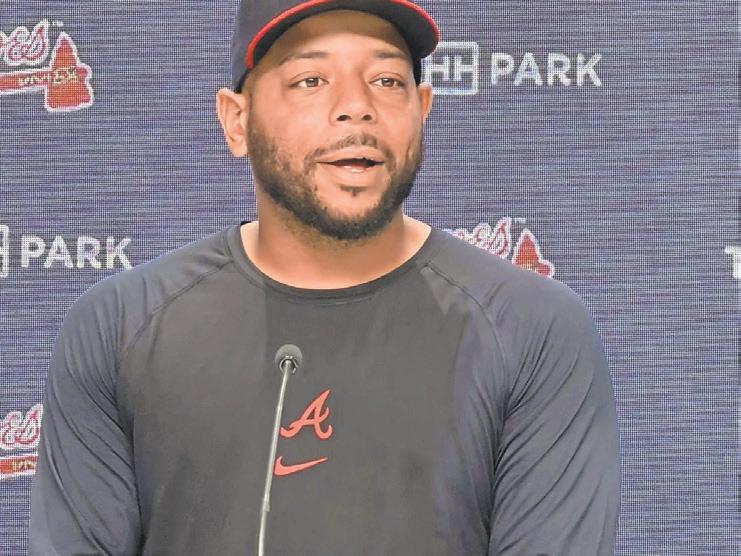
On Tuesday night against the Miami Marlins, with the Braves down 4-0 in the second inning, Dom Smith, batting seventh in the lineup, drove in Ozzie Albies from second with a single. The Braves’ offense was floundering, and Smith, the gem, according to his manager, came through once again. During the same game, Smith continued his strong run of play this season, leading off the seventh inning with a single, and after advancing to second on a fielder’s choice, was left there by Michael Harris II, Mauricio Dubon, and Ronald Acuna, Jr.
Smith would get another chance at the plate in the eighth inning with the bases loaded and the Braves down 5-3. Braves manager Walt Weiss has described the free-agent pickup as a “professional hitter,” and the at-bat in the seventh inning could be used as the perfect description of what Smith continues to do for Atlanta this season. While he fought off several pitches from Marlins right-hander Pete Fairbanks, Smith kept the fans, just over 29,000 at Truist Park after a weekend of sellout crowds, before doubling off the center field wall and driving in three runs. Heading into the ninth, the score was 6-5 Braves. The final score was the same, and Smith, once again, was the hero.
“How about Dom Smith?” said Weiss as soon as he sat down in the press conference room after the game. “This is turning into a great story. I’m so happy for him.”
Dominic David Renee Smith has become a talisman of sorts for the Atlanta Braves. Through the first month of the season, he already has a walk-off home run (See: March 28 at Truist Park during the Braves’ 6-2 win over the Kansas City Royals) and has made an impact in the clubhouse, according to his manager.
“Dom’s a gem,” said Weiss after the Braves’ 11-5 win on April 10. “He’s a wonderful person and a great teammate. He’s been awesome for us.”
Two times this season, Smith, who through 15 games is batting nearly .400 and has a 1.099 OPS, has had multi-hit games, including a three-hit game against the Guardians on Friday, April 10. That was one of the three games this season in which he has driven in two or more runs. That game-winning walkoff homerun against Kansas City on opening week was a grand slam.
Asked what he thought about Weiss describing him as a “professional hitter,” Smith said that was always what he was aiming for when he started his baseball journey.
“That’s how I grew up and that’s what I thought from 12 years old to 30 [years old] now,” he said. “I’ve always wanted to be a high-average guy, and I think if you’re a high-average guy, that’s how you kind of
get labeled a professional hitter. When you watch the game, and you see good at-bats, and you see some of the pitches, whether I lay off or whether I get a hit, that just quantifies being a professional hitter.”
The Braves were without the gem last Saturday night, and they lost 6-0. He returned to the lineup and batted seventh on the following Sunday and wasted little time making an impact, hitting a first-pitch two-run home run in the fourth inning. The Braves won that game 13-1.
It’s no coincidence that when first-year Atlanta Braves designated hitter Dom Smith is in the lineup, the Braves are better off.
Smith played for five Major League Baseball teams before he arrived in Atlanta, including the team that drafted him, the New York Mets, and National League East rivals, the Washington Nationals. The Braves will be in Washington for a four-game series beginning on Monday, April 20. During his time in the majors, Smith has been moved around a lot, but seems to have found a home in Atlanta. Through the first month of the season, Smith has played in 13 games and is hitting well over .300 with three home runs and 11 RBI.
Drafted in the first round by the Mets in 2013 at the age of 18, Smith made his major league debut on August 11, 2017, in a game against the Phillies. He was 22 years old and went 1-3. A Roc Nation client, Smith turns 31 on June 15, and these days, when he comes to the plate, Weiss is feeling better about what’s to come. “I used to hate to see him get in the box in a big spot because I knew it was going to be a tough out,” Weiss said.
Smith, a native of Gardena, California, is wreaking havoc on Braves opponents at the bottom of the lineup as a designated hitter. His other position is first base, but with Braves All-Star first baseman Matt Olson having recently passed the 800 consecutive games mark, Smith’s bat will be his best chance to remain in the lineup and at the plate on a regular basis. The bottom third of the Braves’


lineup has been lauded as a godsend by Weiss for their production this season.
After the game on Tuesday, Smith said getting away from that “professional hitter”
mentality, something that might have hurt his career a bit, but he’s in a better headspace these days. “I’m just trying to be who I am, and that’s who I am.”


You are hereby notified, in accordance with OCGA 40-11-19 (a)(2), that the above-referenced vehicles are subject to a lien and a petition may be filed in court to foreclose a lien for all amounts owed. If the lien is foreclosed, a court shall order the sale of the vehicle to satisfy the debt. The vehicle is currently located at 1314 Brookwood Avenue, Jackson, Georgia 30233. Anyone with an ownership interest in this vehicle should contact the following immediately: Southern Style Towing 1314 Brookwood Avenue Jackson, GA 30233 : 470-344-1634
Vehicle 2002 Infiniti G20 VIN JNKCP11A82T509081
Vehicle 2016 Chevrolet Cruze Limited VIN 1G1PC5SH6G7131921
Vehicle 2012 Chevrolet Cruze VIN 1G1PF5SC4C7306558 Vehicle 1996 Nissan Sentra VIN 3N1AB41DXTL005059