

By DONNELL SUGGS
With hundreds of
TSA agents calling out of work this week, the stress levels at Hartsfield-Jackson Atlanta International Airport have been high. The current administration in the White House took the opportunity to raise the temperature at the country’s busiest airport by sending ICE agents there to assist.
ICE agents are not involved in airport security screenings or handling logistics at ticket windows. They are not assisting travelers with directions to their gates or helping organize the long lines that have been going viral on social media.
The presence of ICE at Atlanta’s airport, the city’s largest employer, has been more cosmetic than cathartic.
“It is unclear how ICE’s presence will improve the passenger experience. One thing is certain: ensuring our hardworking TSA agents are paid will decrease the need for additional federal support,” wrote Atlanta Mayor Andre Dickens in a statement to local and elected officials.
In the statement, Dickens says his office had been advised that ICE and Homeland Security Investigations (HSI) agents have not been deployed to the airport to conduct immigration enforcement. In other words, this isn’t Minneapolis.
“While the City of Atlanta has owned and successfully operated
Hartsfield-Jackson, this occurrence is unprecedented in the 100year history of the airport,” Wrote Dickens, who added that this visit from ICE and HSI isn’t unique to Atlanta’s airport.
“This is happening at airports across the country.”
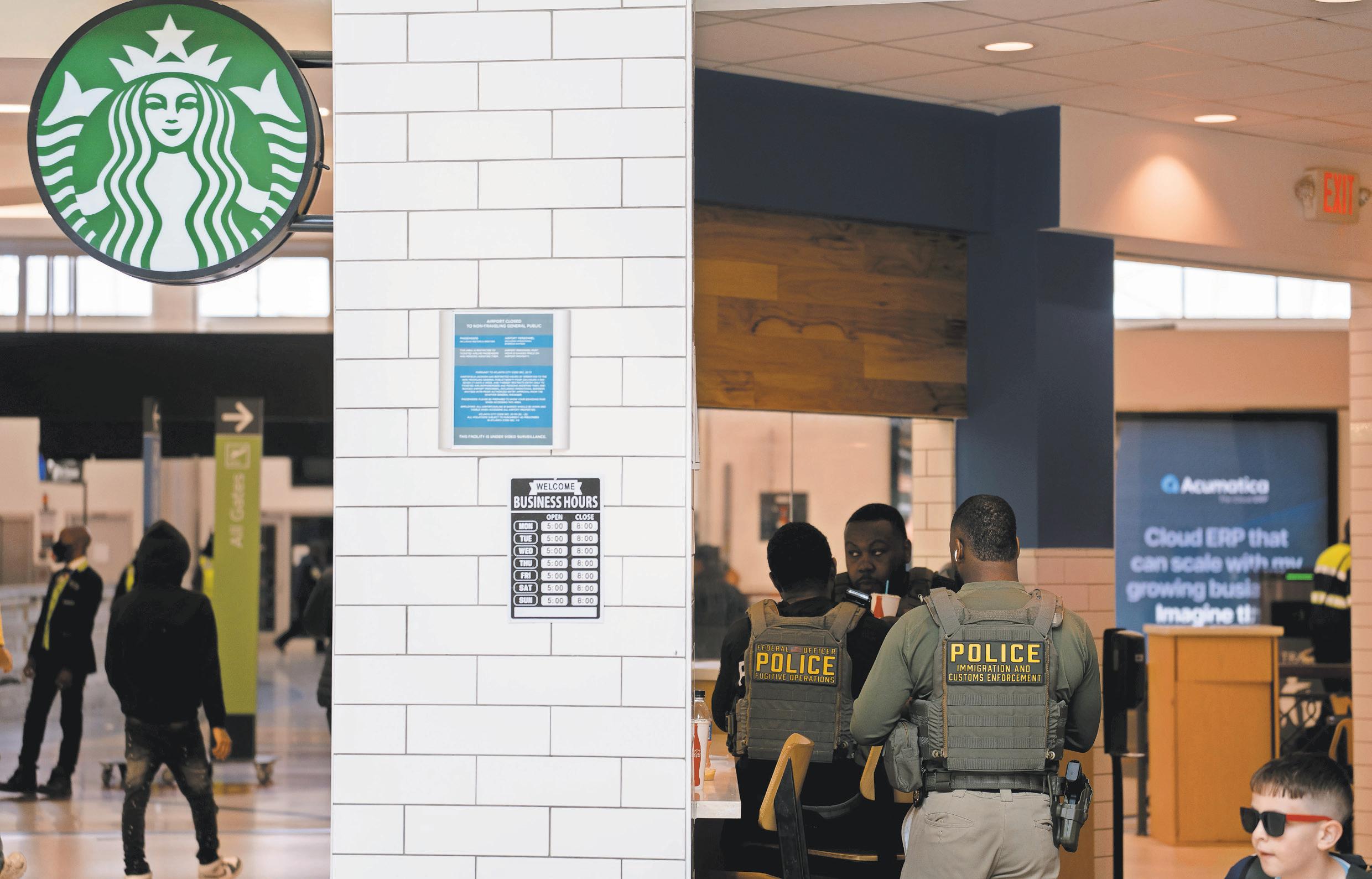
On Tuesday afternoon, ICE agents could be seen standing by the Starbucks in the domestic terminal, or leaning against
a wall, heads down, looking at their cellphones. Others were walking through the terminal, hands in their pockets, looking seemingly bored or uninterested in whatever it was that their

latest assignment was.
“In the world’s busiest airport, Donald Trump is holding TSA agents’ pay hostage while paying ICE to wreak havoc — the same agency he’s weaponized to kill American citizens and attack our democracy,” said former Georgia State Senator and current gubernatorial candidate Jason Esteves in a statement to The Atlanta Voice. “Trump could put an end to his chaos today, but instead threatens Georgians’ livelihoods and our entire economy. When I’m governor, I will use every tool at my disposal to stop Trump’s disgraceful political games.”
On Wednesday morning at 5:30 a.m., wait times at the main checkpoint in the south terminal ranged from 1 to 1.5 hours. The lines were long, and travelers marched along slowly as ICE agents looked on. Some members of ICE stood behind TSA agents near the ID check-in, stretching their legs or marching in place to get the blood flowing in their feet.
Their presence was neither helpful nor hurtful, like it was in Minneapolis or in Los Angeles. It wasn’t anything. There was no point to it at all.
By ISAIAH SINGLETON
Atlanta City Councilmembers Andrea L. Boone and Eshé Collins invited the public to a “Meet Your State Senator” Town Hall Meeting and Q&A on Tuesday, March 17, at the C. T. Martin Recreation Center.
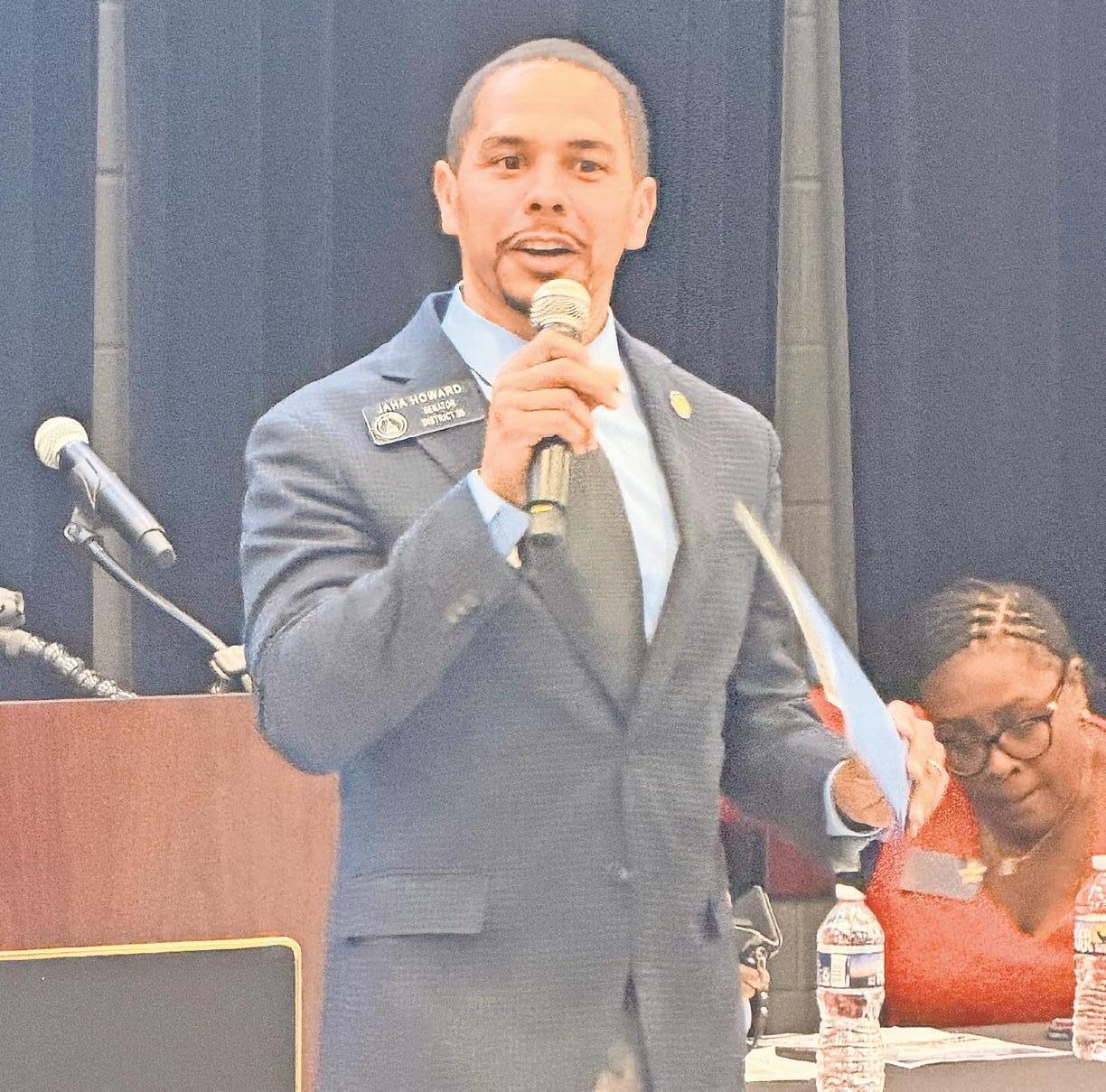
Featuring special guests District 35 Georgia State Sen. Jaha Howard, District 38 Georgia State Sen. Rashaun Kemp, and District 39 Georgia State Sen. Sonya Halpern, this town hall invited the community to hear about legislative priorities and issues affecting local neighborhoods.
During the town hall, community members were given the opportunity to ask questions and voice their concerns to the senators. Various community concerns included illegal split pad house arrangements, difficulty in contacting the mayor’s office, and issues with code violations.
“I feel ambivalent about these split pad arrangements, but I have one of these houses across the street from my home, and the house is overburdened,” Southwest Atlanta resident Kevin Price said. “There are six or seven people in the house, and no one takes responsibility for the trash that does not fit into the receptacles, and when I’ve spoken to them, I’ve been cursed at. I need some help.”
Resident Quincy Jordan voiced his concern over missed opportunities for affordable housing and infrastructure development.
“I remember years ago, you all said, ‘we’re going to make this MLK, the best MLK in the United States. I haven’t seen that happen yet,” he said. “What I have seen happen are a lot of the missed opportunities. We all like affordable housing. However, it’s too much in this one court, but also, that’s one of the largest land tracks.
Another resident, Steven Nichol, raised concerns about accessible sidewalk ramps for people with disabilities and the burden on teachers. Other concerns included property damage from highway construction and the need for urban farmer support, vibrations/noise from a nearby project, a tree removal, increased noise from highway construction, and the need for neighborhood protection measures.
Community members express concerns about environmental justice, school closures, economic disinvestment, and crime.
On literacy and education, Kemp said, for about 20 years, kids have been instructed to use a method that taught them to guess the word by looking at pictures. He said there was a lack of use of the science of reading and a greater reliance on multiple-choice methods.
“That’s what the literacy bill did in
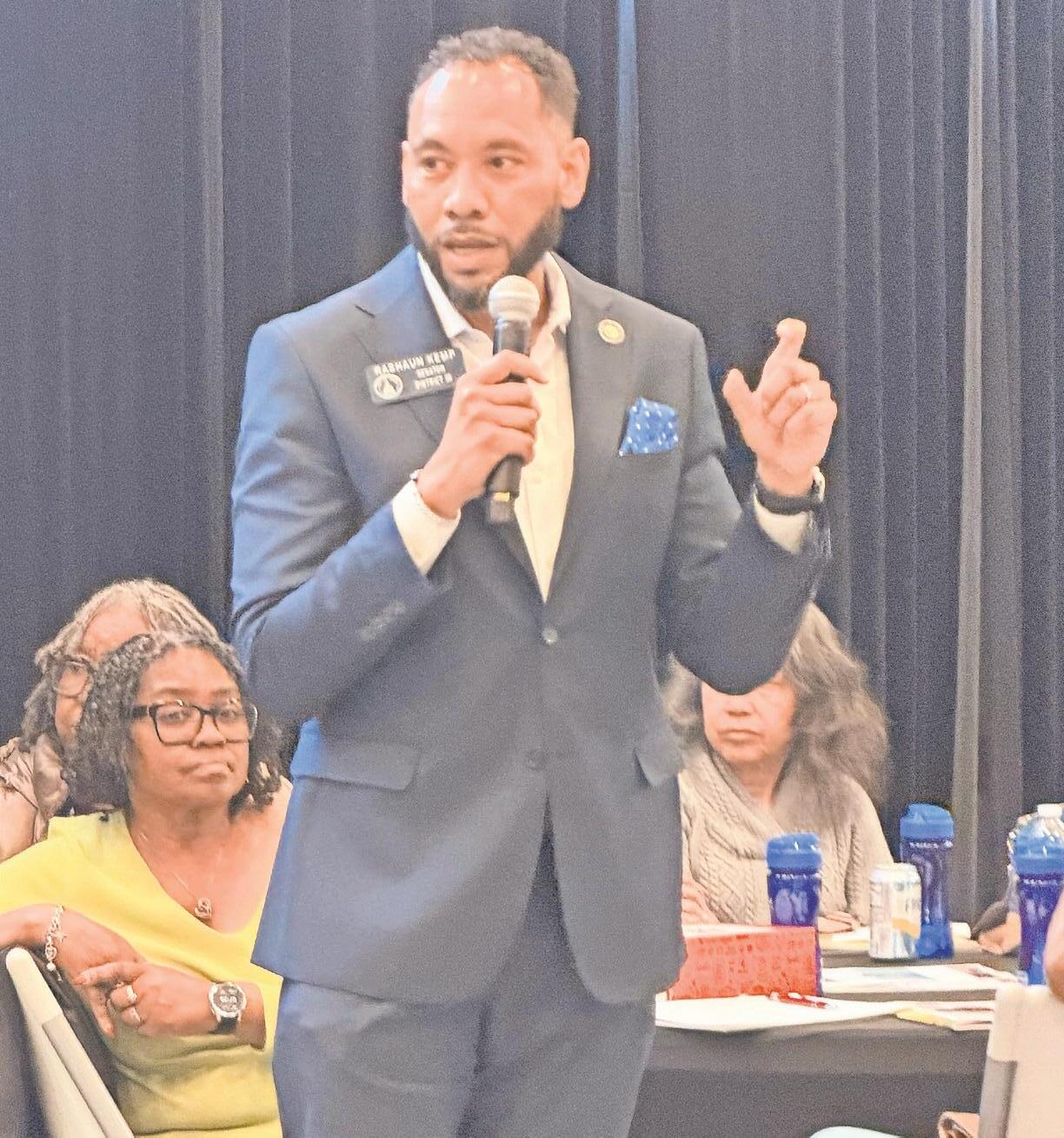
terms of funding our state QBE, the way that all our school districts get money, is called the QBE formula.”
He says the QBE formula has not been updated since 1985.
“It requires the state to update that funding formula. In the meantime, I did introduce legislation that will put additional funding into schools with students who are in poverty,” he said. “We do have a bill this year that is going to place literacy coaches in every single elementary school across the state.”
Howard discussed the public’s concern about tax reform and said Senate Republicans would introduce a budget plan that would address affordability by slashing income taxes.
Howard also says they understand the people’s concerns, and the senators can’t just sit on their hands and need to communicate more with the public.
“We want to make sure the public is aware of how it affects their senior services and schools. The only way to make up for that type of revenue dip is to make it up somewhere, and that comes from spending sales tax,” he said. “If you’re going to promise people you’re going to lower your income tax, we have to lower your property tax.”
He also mentioned a concern about access to Medicaid, where he says they were able to get a Medicaid expansion vote on the floor of the Senate.
“The republican senators voted it down. If we want a Medicaid expansion, you must get us a democrat governor and get us some folks in the state house, the state senate, who are Democrats,” he said. “Some things are complicated, but Medicaid expansion is not. This is a high priority for Democrats on the Senate side and the House of Representatives.”
Halpern addressed certain concerns about tax rebates, saying if you paid state income tax in 2025 and you are single, you should expect a $250 property tax rebate as well if you own your property.
“You will be receiving anywhere from $500 to $750 each in a direct check. If you are somebody who has paid state income tax or owned a property, and you didn’t get your check, you need to reach out to your representative and allow us to help you figure out what happened,” she said.
Halpern addressed concerns about MARTA and public transportation.
“MARTA was started in 1971 as a
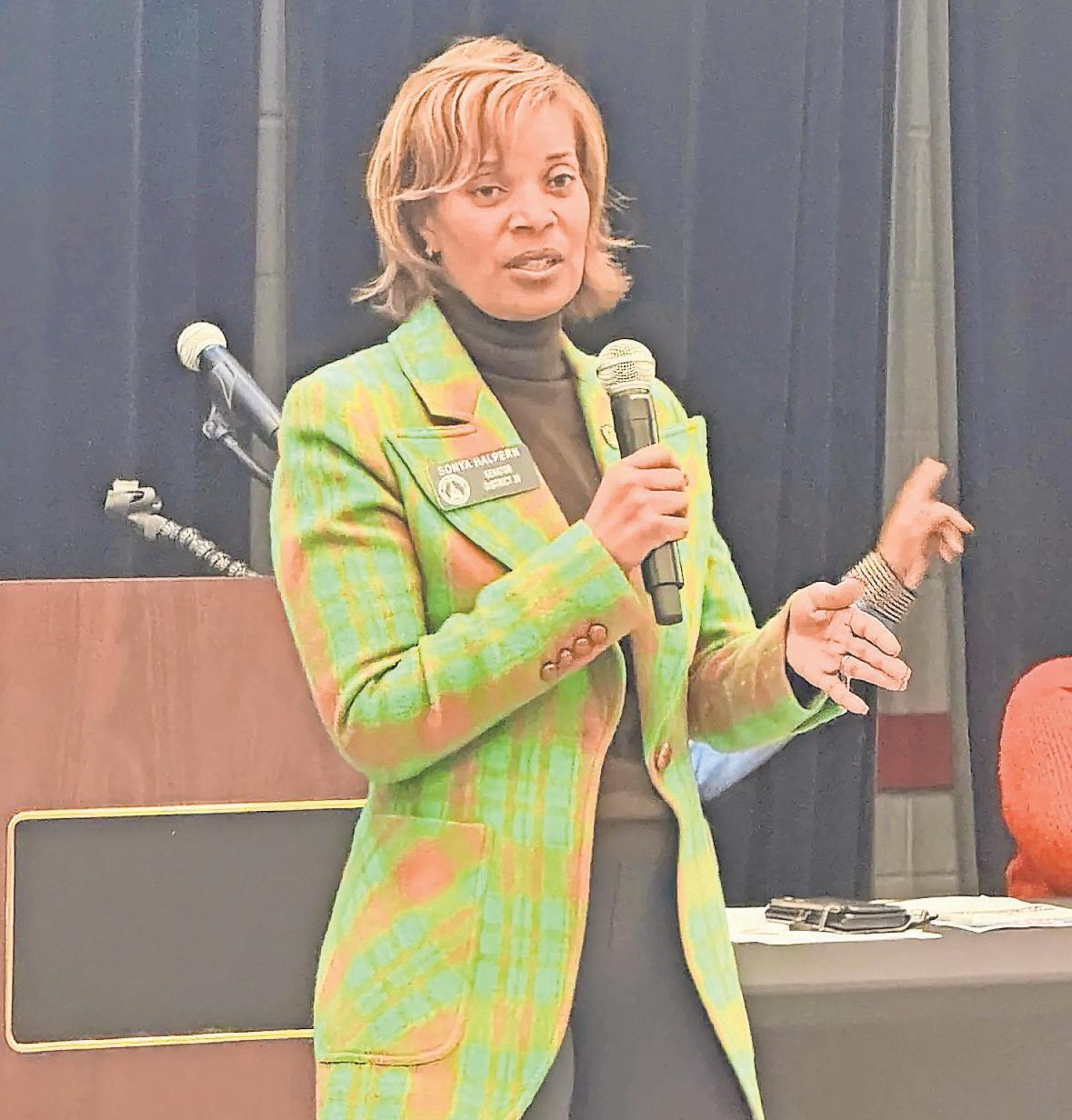
state act, and we understand MARTA has not delivered in the ways we all would like to have them deliver in terms of excellence. We all know there are some ridership issues and safety issues,” she said. “I will only tell you from everything that I have heard from MARTA executives, including the new interim CEO, these are things that they are aware of. They are working to address these issues.”
Halpern says MARTA wants to be
the preferred method of public transit, and not just because you must do it, but because anybody, even with a car, wants to ride with MARTA.
“It will take time, but they are testing a new MARTA Breeze Card to make it easier to swipe and pay to get in and out,” she said. “MARTA is an important piece of Atlanta’s ability to attract the big-scale events that we attract, like the World Cup and the Super Bowl, other major sporting events, and conventions.”
By THERESE L. M y ERS
Ten years ago, I made a decision that quietly transformed the way I lead, serve, and show up for my community. As a working professional, mother, and community advocate, I enrolled at Western Governors University to earn my bachelor’s degree in business marketing, and later my master’s in leadership.
That experience reshaped my understanding of access, mentorship, and what becomes possible when education meets courage. It affirmed something I had long believed: when women are supported, they build pathways not just for themselves, but for the next generation.
In many of our neighborhoods, girls are growing up with talent and ambition, but without consistent access to spaces that nurture both. That belief — that access changes outcomes — is the heartbeat behind Yes Girls Create, the New York-based nonprofit I founded to empower girls ages 8 to 18 through creativity, mentorship, and wellness programming.
Our mission is simple but urgent: to ensure girls have spaces where their voices are heard, their ideas are nurtured, and their potential is affirmed early. We bring girls together with women leaders across industries for hands-on experiences that connect imagination to real-world opportunity.
At Yes Girls Create, creativity is a strategy for confidence and connection.
Each month, our participants engage in collaborative labs led by artists, entrepreneurs, engineers, wellness practitioners, and educators. A session might involve designing a product, creating a personal fragrance, building a small-business concept, or exploring STEM through tactile, engaging projects.
Whether the focus is financial literacy, leadership, mental health, or technology, we infuse each experience with a creative component that helps girls process what they are learning and see themselves reflected

in possibility.
We have learned that when girls create with their hands, they begin to shape their identities. They speak up more. They ask sharper questions. They imagine futures they may not have previously seen modeled.
Just as important, they build community with one another. Many of our participants come from neighborhoods where access to enrichment programs can be inconsistent. Yes Girls Create works to close that gap by providing safe, affirming spaces where girls can explore their talents without pressure or limitation.
To date, we have served more than 500 youth.
Families now gather at our annual Create Her Well Girls Conference, where girls and their parents engage in a full day of mentorship, wellness conversations, and career exploration. Parents also participate in a “Parent Academy” designed to strengthen legacy planning, financial literacy, and personal growth alongside their children’s journeys.
We have watched mothers enroll in college after attending our sessions. We have seen girls who
were once shy step into leadership roles, present their ideas, and mentor younger participants. These moments remind us that when you invest in one girl, you often uplift an entire household — and sometimes more.
We also launched WISELY — Women in STEM and Engineering Leading Youth — an initiative that connects girls directly with women working in science, technology, engineering, and math.
When a girl meets a woman who looks like her in a field she has never considered, the distance between aspiration and achievement narrows. Our goal is to make those introductions early and often, so possibility feels familiar, not far away.
We have seen increased confidence in our participants, stronger peer relationships, and a growing network of women committed to mentoring the next generation. Our girls leave sessions with tangible projects and a renewed sense of belonging in spaces that once felt out of reach.
My journey as a graduate student taught me that leadership is
about building bridges.
As we look ahead, our work continues to expand across New York City and beyond. We are forming new partnerships with schools, community organizations, and corporate leaders who understand that mentorship and creative development are essential.
This work matters now because the challenges facing our girls — from mental health pressures to economic uncertainty — show up in our homes and classrooms every day.
When I think about the future, I think about the girls who walk into our programs curious, cautious, and hopeful. I think about the moment they realize their dreams are valid and their creativity is powerful.
One decision — one “yes” — can ripple outward in ways we may never fully know.
Yes Girls Create exists to ensure that ripple continues, reaching more girls, more families, and more communities.
Because when girls are supported, their possibilities are limitless. And when a community invests in its girls, it invests in a future that is brighter for us all.
Therese L. Myers is the founder of Yes Girls Create Inc.
FOUNDED
May 11, 1966
FOUNDER/EDITOR
Ed Clayton
Immortalis Memoria
PUBLISHER/EDITOR
J. Lowell Ware
Immortalis Memoria
The Atlanta Voice honors the life of J. Lowell Ware.
PUBLISHER
Janis Ware
PRESIDENT/
GENERAL MANAGER
James A. Washington 2018-2024
EXECUTIVE ASSISTANT TO PUBLISHER
Chia Suggs csuggs@theatlantavoice.com
EDITOR IN CHIEF Donnell Suggs editor@theatlantavoice.com
GENERAL ASSIGNMENT REPORTERS
Isaiah Singleton isingleton@theatlantavoice.com
Laura Nwogu lnwogu@theatlantavoice.com
Noah Washington nwashington@theatlantavoice.com
BUSINESS REPORTER
Tabius H. McCoy tmccoy@theatlantavoice.com
EDITOR AT LARGE Stan Washington swashington@theatlantavoice.com
ADVERTISING, SALES & CIRCULATION
ADVERTISING ADMINISTRATOR
Chia Suggs advertising@theatlantavoice.com
SALES
RDW Jackson rdwadman@gmail.com
SUBMISSIONS editor@theatlantavoice.com
DIRECTOR OF PUBLIC RELATIONS
Martel Sharpe msharpe@theatlantavoice.com
CONTACT INFORMATION
633 Pryor Street, S.W. Atlanta, GA 30312 Office: 404-524-6426 info@theatlantavoice.com

By LAURA NWOGU
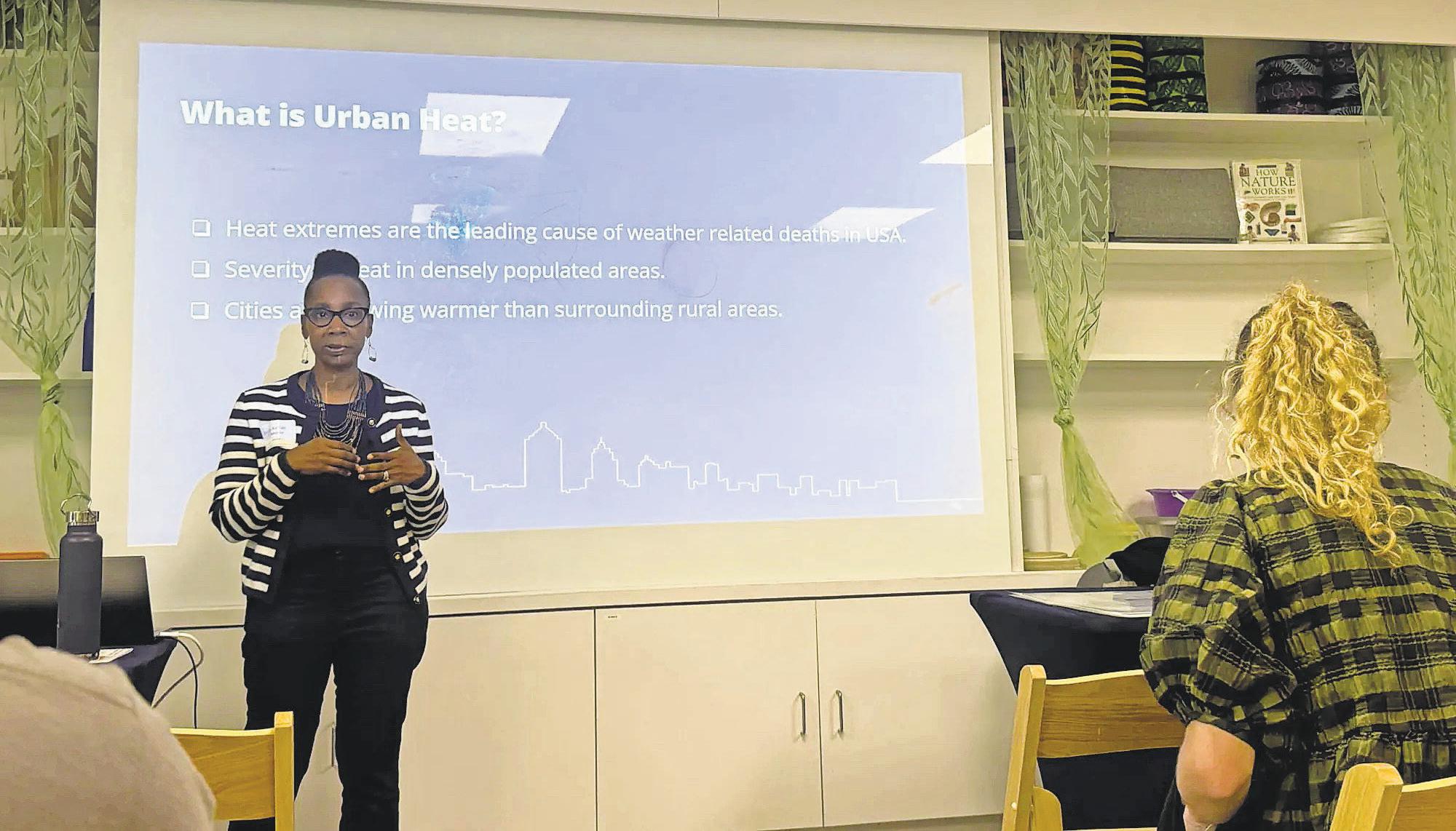
Atlanta is often called the “city in a forest” because of its dense urban tree canopy that spans nearly half the city. With trees come shade and cooling; however, in underserved communities in the Atlanta metro area, that nickname is beginning to lose its power as they experience disproportionate heat islands. According to the U.S. Environmental Protection Agency (EPA), extreme heat is the leading cause of weather-related deaths in the U.S. Urban heat islands occur when a city experiences much warmer temperatures than nearby rural areas.
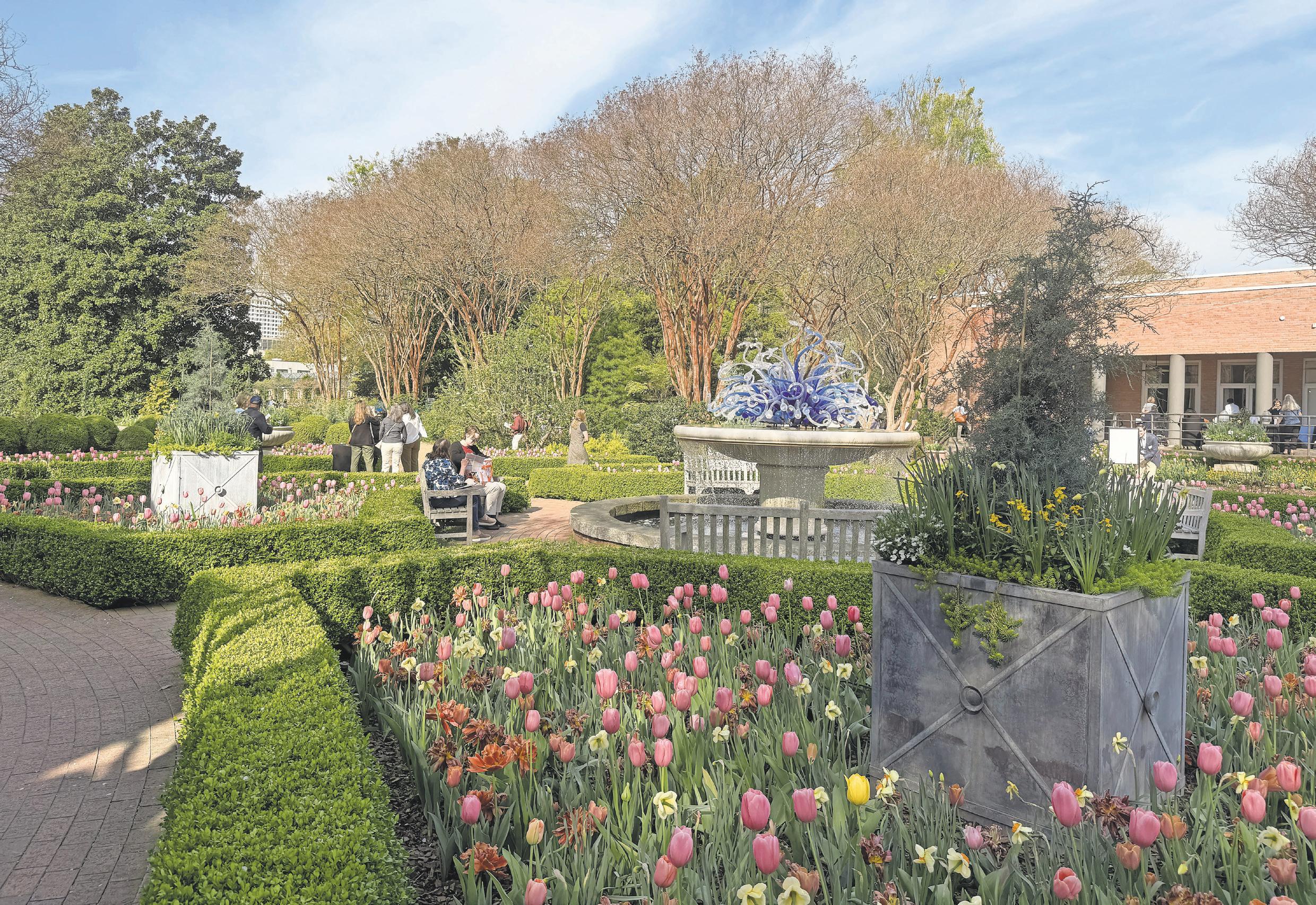
The annual Parks and Greenspace Conference, which took place on Monday at the Atlanta Botanical Gardens, addressed these concerns with a workshop featuring UrbanHeatATL. UrbanHeatATL is a cross-disciplinary project that began in 2021 and is aimed at mapping Atlanta’s heat islands through community science. It began as a partnership between Spelman College, the Georgia Institute of Technology, West Atlanta Watershed Alliance, and the Mayor’s Office of Sustainability and Resilience. With the help of students and local community members, UrbanHeatATL is walking and cycling through Atlanta neighborhoods and collecting temperatures in underserved areas to further environmental and climate justice in Atlanta.
Since 2021, they’ve collected over 1.9 million temperature records, totaling to about 588 hours worth of data. The project has attracted 200 contributors and received about 1,500 submissions. With their research, they’ve found that maximum urban heating often occurs in locations that reflect the compounded impacts of historic racism. In Atlanta, it’s often reflected in areas with a lack of green spaces and lots of industrial development nearby, with unshaded asphalt areas amplifying that heat and echoing it back into the neighborhoods. Exposure to extreme heat has been associated with a number of chronic disease conditions, such as asthma, with youth asthma prevalence on the rise. This heat greatly impacts older adults and those living in energy-inefficient houses, leading to higher energy costs due to aging buildings and a
lack of infrastructure.
One of the neighborhoods this can be seen in is Vine City, a historically Black neighborhood in Atlanta’s Westside, which has been identified as one of the city’s areas with a low amount of tree canopy.
“It’s also being impacted by things like the West Side Superfund
site, which means, because of soil remediation, lead contamination in Vine City and English Avenue is causing some additional trees to be taken down as a part of the remediation activities.
“Heat extremes is something that we’re really seeing every summer,” said Na’Taki Osborne Jelks,
an environmental justice and public health activist and scholar. “Even if we think about what we’ve been experiencing here recently, we’ve had 80-degree days in March. The data tells us — and climate scientists have been researching this for a while — in terms of the city of Atlanta, that
extreme heat is one of the climate hazards that we should be concerned about and that we should be doing something about.”
A goal for UrbanHeatATL is to prove that some neighborhoods are hotter than others. According to the organization, research shows that more than 70% of U.S. counties, low-income, non-white neighborhoods, experience more extreme surface heat than their wealthier, whiter counterparts.
“We see a lot of severity in terms of urban heat, or heat extremes, in densely-populated urban areas. As we think about the city of Atlanta, and how our tree canopy is starting to decrease quite a bit despite some of our efforts to try to restore it. Heat is one of the hazards that we can expect to be dealing with between now and 2050 and perhaps beyond.”
UrbanHeatATL encourages residents to build coalitions within these communities and engage with management companies. They hope that government officials will respond to their data and provide more well-maintained parks, green space and trees in communities of color.
SPONSORED CONTENT PROVIDED
BY SADIE G. MAYS HEALTH & REHABILITATION CENTER
For nearly eight decades, Sadie G. Mays Health & Rehabilitation Center (Sadie G. Mays) has stood as a cornerstone of compassionate healthcare in Atlanta. On Tuesday, March 24, 2026, when the center celebrates its 79th anniversary, it will also honor a legacy of dignity, healing, and advocacy for older adults and individuals in need of long-term care.
Founded in 1947 by Sadie Gray Mays, the pioneering social worker, professor, and wife of renowned Morehouse College President,
Dr. Benjamin E. Mays, the center was created during a time when healthcare access for African Americans was limited and inequitable. Mrs. Mays envisioned a facility where seniors and vulnerable citizens could receive quality care in a safe and respectful environment. Her vision became a reality when she and her fellow churchwomen opened the doors of the Happy Haven Nursing Home on the site of the former Battle Hill sanatorium in northwest Atlanta. After her death in 1969, the facility was renamed for Mrs. Mays, and her mission has continued ever since.
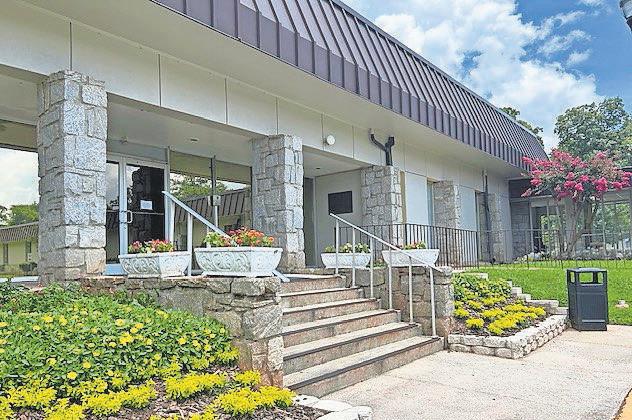
Today, Sadie G. Mays serves as one of Atlanta’s trusted providers of skilled nursing,
rehabilitation services, and hospice care.
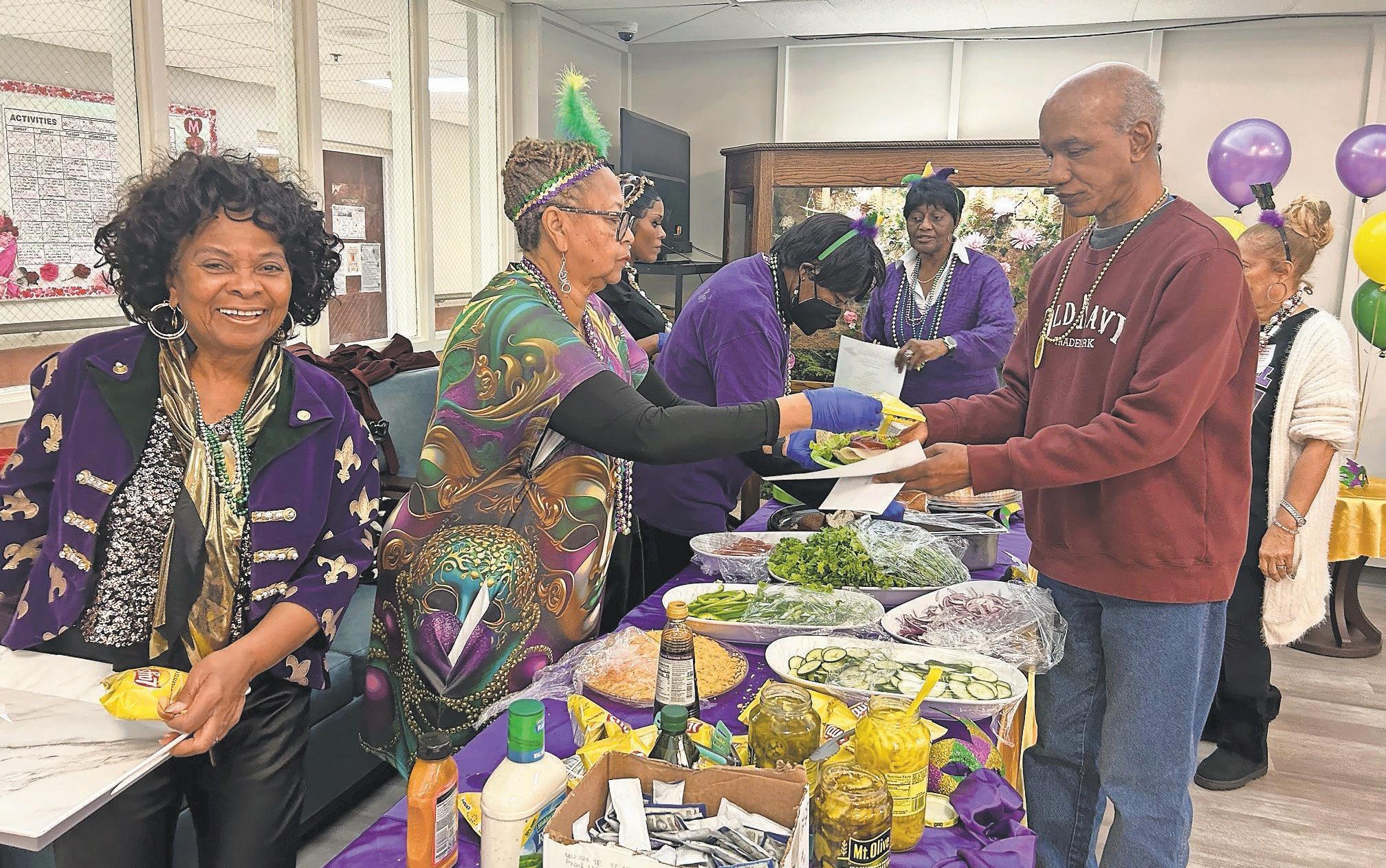
The 206-bed, nonprofit facility, which recently completed a $3.2 million renovation, supports residents through a comprehensive approach that emphasizes clinical excellence while honoring the individuality and dignity of every resident. “We proudly stand on the shoulders of Sadie Gray Mays and continue her legacy by providing high-quality, compassionate nursing and rehabilitative care,” said Executive Director, Gerri Cooper. At the heart of the center’s success is its dedicated team of healthcare professionals—nurses, therapists, physicians, nursing assistants, and others, who work together to deliver personalized care.
“Being here was the best thing for me,” said resident, Nathaniel Swinger. “I was not living a good lifestyle, and I couldn’t even walk when I first came here. Now I can walk again, and I’m experiencing things I never had before, like the musical we went to see at Christmas time.”
Over the years, the organization has maintained a strong connection to the surrounding
community. Families throughout Atlanta have trusted Sadie G. Mays to care for their loved ones, creating relationships that span generations. Community partnerships, outreach initiatives, family engagement, and the work of many volunteer groups, individuals, and donors have helped the center remain deeply rooted in the people it serves.
As healthcare continues to evolve, Sadie G. Mays is focused on the future, investing in modern care practices, strengthening rehabilitation services, and enhancing the resident experience. A strong suit is their innovative and culturally relevant programming which ranges from the residents’ book club and choir to concerts and dance performances presented by local nonprofits.
This 79th anniversary is more than a milestone—it is a celebration of the residents whose lives have been touched, the families who have placed their trust in the organization, and the dedicated professionals who have devoted their careers to caring for others. For more information or to make a 79th anniversary donation, see www.sgmays.org.

By NOAH WASHINGTON
Roughly 400,000 skilled trade jobs sit unfilled across the United States, a number projected to climb to nearly 2 million by 2033, according to the Bureau of Labor Statistics, as reported by CBS News.
Tulsa Welding School is looking to change that, opening a 44,639-square-foot Atlanta Metro campus on Friday in Decatur, designed to prepare the next generation of tradespeople for careers in welding, HVAC/R, and electrical technologies.
StrataTech Education Group, the parent company of Tulsa Welding School and The Refrigeration School, Inc., hosted a ribbon-cutting ceremony and campus tours at 1287 Columbia Drive in Decatur.
The facility offers hands-on training programs in some of the region’s most in-demand fields under the leadership of Tamekia Morris, campus president of Tulsa Welding School Atlanta, who said the
region’s rapid growth made the expansion a natural fit.
“The Atlanta region is growing,” Morris said. “If you think about all of the infrastructure, the advanced manufacturing, logistics, energy, and commercial construction, the demand for welders, HVAC technicians, and electricians is constantly on the rise.”
Morris said employers are not simply looking to fill open positions. They want workers who are safety-focused and ready to contribute from their first day on the job, qualities she said the school is built to develop.
The campus operates on a seven-month program model, with students spending four days a week in hands-on lab settings and one day in online coursework. Morris described the labs as mirrors of real-world job sites.
“The more you burn, the more you learn,” she said, noting the school’s emphasis on applied training over lecture-based learning.
Lavita Vessel, director of adult admissions, said the admissions
process is designed to be accessible. Prospective students can apply at tulsawelding.edu or connect with an admissions representative who follows up on inquiries from social media and web searches. The school also maintains a partnership with Amazon and Walmart, offering a 10-week course held on Tuesdays and Thursdays.
“The first thing is making sure they have the confidence to believe in themselves and know that we are here to support them, and most of all, leaving with a career,” Vessel said.
Beyond adult learners, the school is actively working to reach younger students through its high school admissions team. Joshua Nixon, director of high school admissions, said his team of four covers territories across the Atlanta area, visiting high schools to conduct career workshops and meeting with counselors, instructors and administrators.
“There are a lot of young students out there that are trying to make a plan, or maybe they don’t know what their plan is,” Nixon said. “Our
By ISAIAH SINGLETON
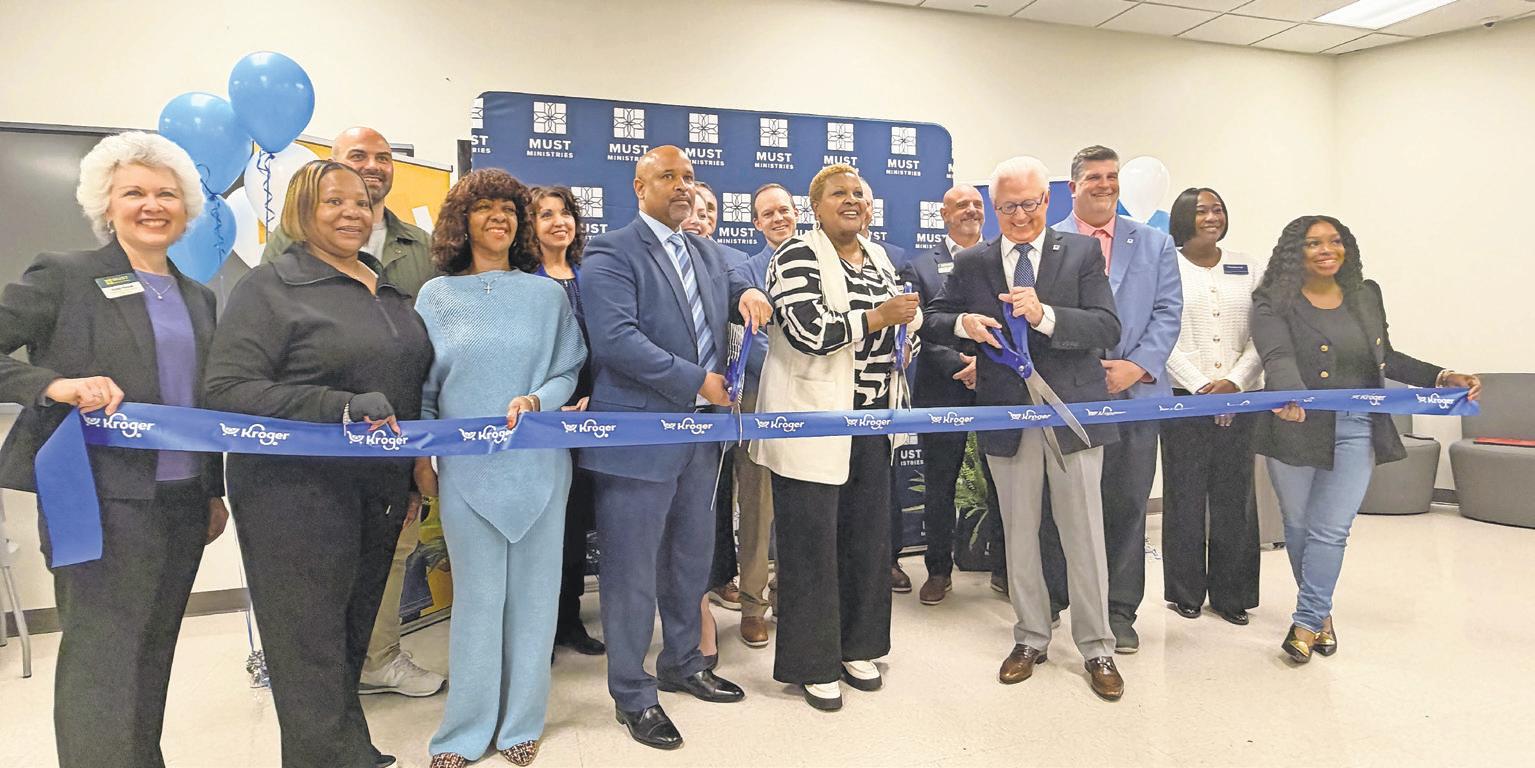
Kroger’s Atlanta Division, MUST Ministries, and Henry Louis “Hank” Aaron New Beginnings Academy unveiled a new school-based pantry on March 19, expanding access to groceries for students and families in the Atlanta Public Schools system.
Across metro Atlanta, schools are increasingly serving as hubs of support for students and their families. By locating food pantries in schools, families can access groceries in a familiar, trusted environment, helping ensure students arrive in the classroom ready to focus on learning.
The pantry is expected to support approximately 150 families each month. The event also included a ribbon cutting, pantry reveal, and check presentation. Educators say access to food is a crucial factor in helping students stay focused, engaged, and ready to learn.
Principal of Hank Aaron Academy Robinson Zawadaski said they are celebrating a new and extremely valuable partnership with MUST Ministries, Kroger’s, and their affiliated partnerships.
“I am elated to welcome all of you to the Henry Louis Hank Aaron New Beginnings Academy. This pantry is not only sustainable, but it is also the future. It provides a need,” he said.
Henry Louis Hank Aaron Academy is a nontraditional school serving students in grades 6 through 12, and Zawadaski says it helps fill in the gaps so students can become scholars and more productive citizens.
“We have two priorities here: Academic growth and SRT. SRT, as we focus on social-emotional learning, restorative practices, and trauma- and therapy-informed practices. It is a positive, highly instructed family environment, and I want to thank you for coming today,” he said.
Head of Communications and Public Affairs for Kroger’s Atlanta Division, Tammie Young-Ennaemba, said they are continuing to advance Kroger’s Zero Hunger/Zero Waste mission.
“Step by step and school by school, we are helping ensure students can focus on learning — not worrying about whether they will have enough to eat. Together with MUST Ministries, dedicated educators, and vendor partners, we are building a stronger support
goal is to help them understand what those realistic career opportunities look like once they graduate.”
Nixon said the workshops cover practical topics such as budgeting and learning styles, helping students who may already be enrolled in shop classes or career and technical education programs see how those interests can lead to a defined career path.
Morris acknowledged that vocational training has historically struggled to compete with the visibility of four-year college pathways, particularly among younger students. She argued that the conversation is shifting. The World Economic Forum’s Future of Jobs Report 2025 projects that AI and related technologies will displace 92 million jobs globally by 2030, while creating 170 million new ones, with construction and skilled trades among the roles expected to see net growth. Morris said that reality makes programs like hers not just viable but urgent.
The Atlanta Metro campus is part of StrataTech Education Group’s
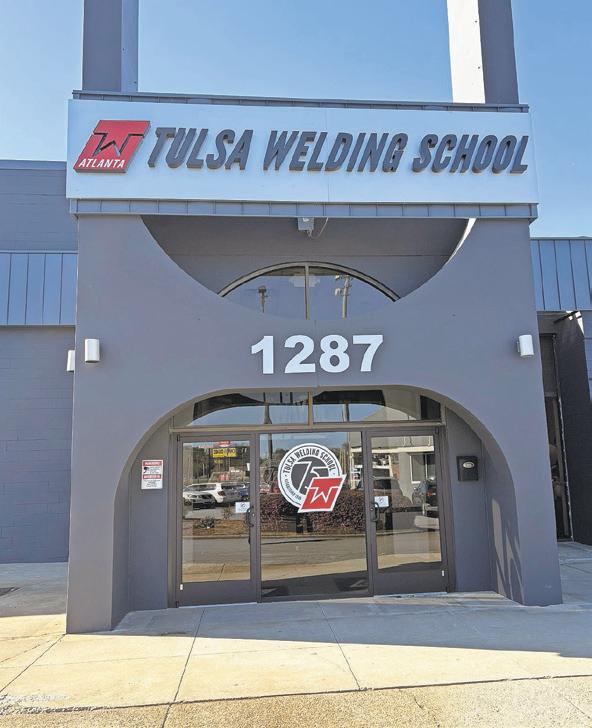
Tulsa Welding School has opened a 44,639-square-foot Atlanta Metro campus in Decatur.
ongoing effort to expand access to skilled-trade education in markets where workforce demand is outpacing supply. The facility at 1287 Columbia Drive is now enrolling students. For many of those students, Morris said, the stakes extend well beyond a first paycheck.
“They’re building something for their families,” Morris said, “to change the trajectory of their lives and their children’s lives.”
system for students and families,” she said.
Additionally, MUST Ministries addresses the basic needs of individuals, families, and children with facilities in Cobb and Cherokee counties, as well as programs across many metro Atlanta communities.
In November 2024, MUST Ministries announced a partnership with Kroger and its vendor partners to expand MUST’s Neighborhood Pantry program, which supports metro Atlanta students through pantries embedded in schools and communities.
Kroger donated $207,000 over two years to help grow the program and provide students and their families with fresh, healthy food. Through this partnership, school pantries
have been set up at Cherokee High School, Dunleith Middle School, Marietta Sixth Grade Academy, Marietta Middle School, and Cobb Horizon High School.
Earlier this year, Kroger and its vendor partners presented an added $339,432 donation to MUST Ministries and Caring for Others to expand school pantries across the metro area, including Henry Louis “Hank” Aaron New Beginnings Academy, Long Middle School, and South Atlanta High School.
Together, these partnerships are helping expand a growing network of school-based food pantries designed to provide reliable access to groceries for families where students already learn and gather.
By DONNELL SUGGS
The Atlanta Braves held their annual media day on Tuesday, March 24. There is much to celebrate as a new Major League Baseball season begins again. For the Braves, the longest continuing franchise in Major League Baseball history, this season marks its 60th in Atlanta. April 12 will mark the first game in Atlanta Braves history.
On the field, there are familiar concerns on the minds of first-year manager Walt Weiss and his staff. Pros and cons: There are healthy hitters back, like third baseman Austin Riley (102 games in 2025), and unhealthy starting pitchers like Spencer Strider (oblique strain), who will begin the 2026 season on the injured list.
There are the what-if’s: Michael Harris II gets off to a strong start to the season instead of how he started in 2025, the Braves open the season by winning seven straight instead of losing seven straight like in 2025, the pitching staff holds up for an entire season instead of periodically breaking down like it did last year. And then there’s the staff ace, who also missed time due to injury last season.
The team recently announced that Chris Sale (145 career wins, 2024 Cy Young) will be the opening day starter. Sale missed a chunk
of the 2025 season with a rib injury, and his absence hurt the Braves.
The Braves are beginning the season with consecutive three-game home series against the Kansas City Royals and the Sacramento A’s.
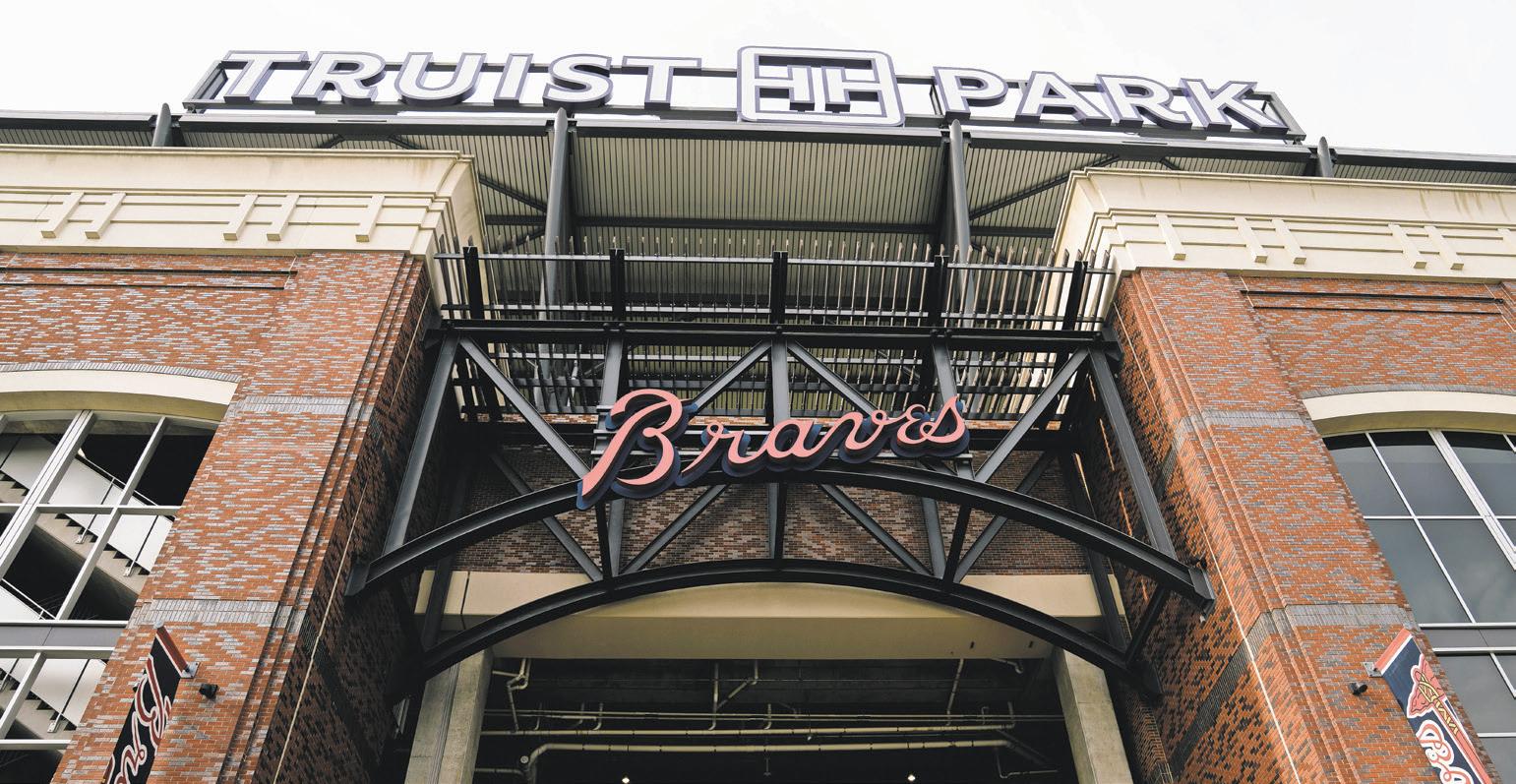
During an introduction to the media, Braves President & CEO Derek Schiller spoke about all of the new bells and whistles at Truist Park, including the new red and blue flood lights above the field. Asked if he believes making
the postseason, particularly during the anniversary season, is critical to the goals for 2026, Schiller said that’s always the goal around these parts.
“Our goal every year is to make the World Series,” said Schiller. “We didn’t meet that goal last year, but that remains our goal. We think we’re breaking camp with a fantastic team. We think we’re ready to go. We’re excited about getting going, because at the end of the day, that’s what the Atlanta Braves are all about.”
Schiller spoke about Braves Vision, the team’s broadcast arm, that will debut on Opening Day at 6 p.m. with a pregame show. “It is the way we’re going to connect to our fans via broadcast media,” he said.
There will be several summer concerts taking place at Truist Park and the Savannah Bananas will play three games there as well. “We’re very excited about what we do around here,” Schiller said.
One of the new additions to Truist Park will cater to one of the oldest and time-honored sports-related hobbies. South End Trading Co., a card and memorabilia shop on the main level of the park. South End Trading Co. will host card ripping nights, autograph signings, and other baseball card-related events. The shop is decorated with black and white images of old baseball cards, including that of Braves legend and Baseball Hall of Famer Hank Aaaron.
“We will have some unique items that are for sale,” said Lisa Williams, vice president of retail at Truist Park.
Asked if the card shop, which included signed and game-used memorabilia from past and present Braves games, is an attempt to attract the baseball cards fans to the ballpark, Williams answered in the affirmative.
“That’s part of the move over to this side of the ballpark,” she said.
By DONNELL SUGGS
MARIETTA, GA. - Last Saturday night, following the 0-0 draw between Atlanta United and D.C. United, the nameplates above the stalls inside the Atlanta United locker room were being taken down in anticipation of some special guests.
The United States Men’s National Team will host the Belgium Men’s National Team on Saturday, March 28, at Mercedes-Benz Stadium. The international friendly will be a warm-up for the FIFA World Cup 2026. It will also be a chance for Team USA soccer supporters to see the squad before the tournament begins on June 11.
There is always the possibility that the Stars and Stripes will be playing in one of the semifinal matches of the tournament. One of those semifinals will be in Mercedes-Benz Stadium. For now, they are training at Atlanta United’s training facility in Marietta.
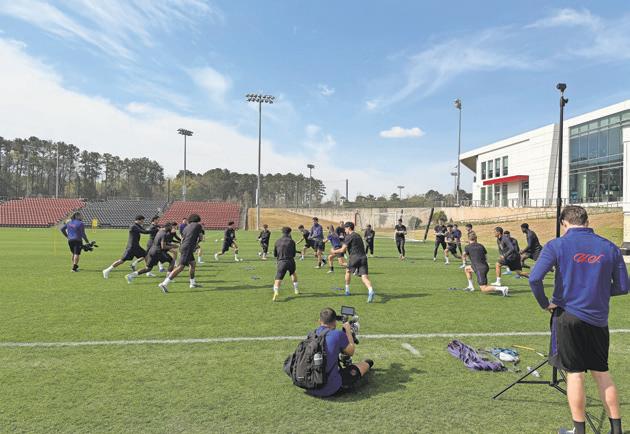
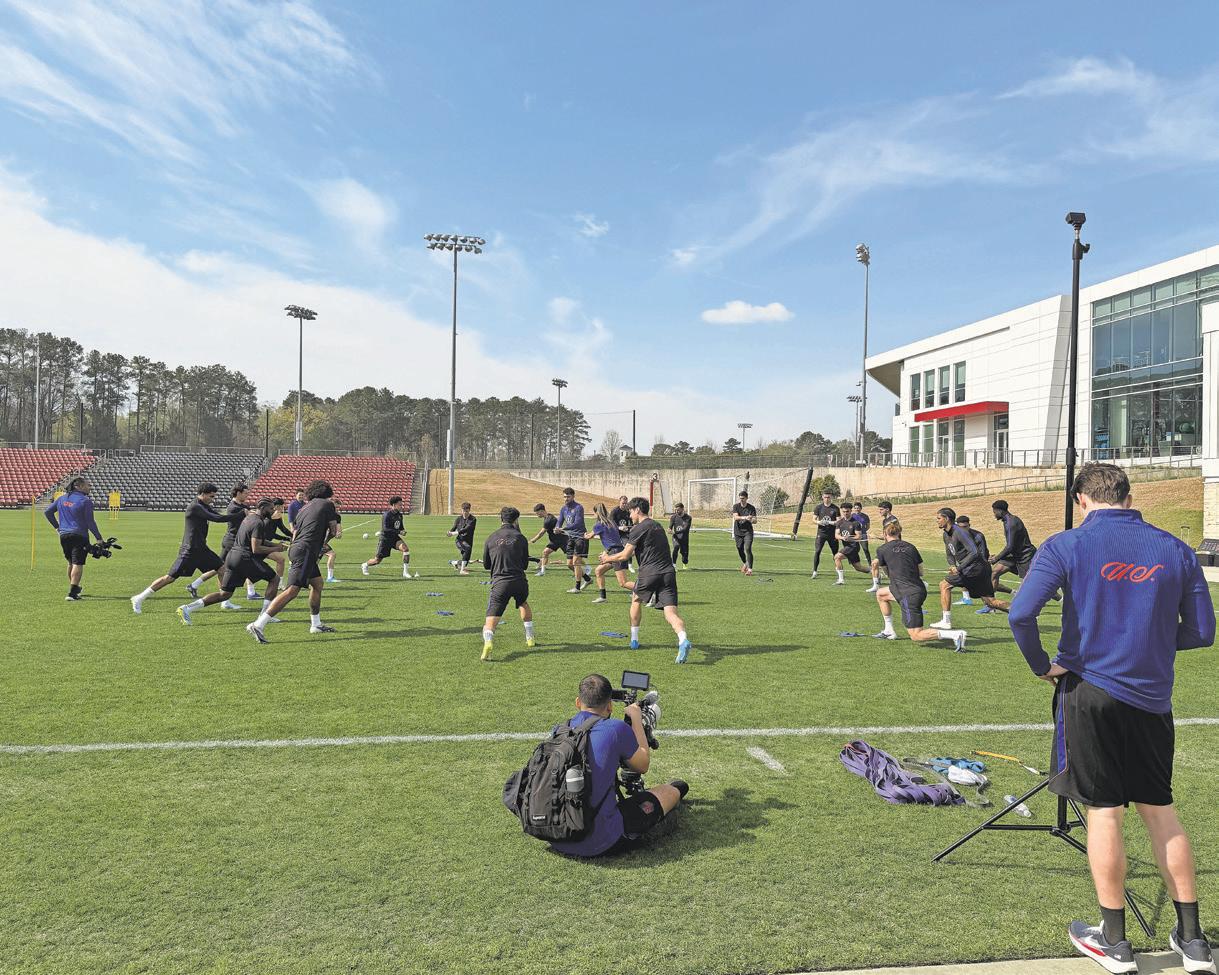
On Monday, March 23, the United States National Team made its way down a short flight of stairs onto one of the training pitches at the Atlanta United Training
Grounds for the first day of a week’s worth of training. For players like Miles Robinson, a veteran of the National Team and former Atlanta United, and current Cincinnati FC defender, the return to familiar territory may help prepare him for a big summer. Along with Robinson, the National Team has over 10 Black players on its roster, many of whom are young, upcoming, and playing in Europe.
Players like Weston McKennie (Juventus FC), Patrick Agyemang (Derby County), Timothy Weah (Olympique Marseille), Alexander Freeman (Villareal CF), Antonee Robinson (Fulham FC), Mark Tillman (Bayer 04 Leverkusen), Chris Richards (Crystal Palace), and Forlarin Balogun (AS Monaco), are going to be necessary if the United States is going to make some noise this summer.
In anticipation of the high-level competition on tap at the World Cup, the National Team will play four friendlies before departing for the World Cup; two of those matches will be in Atlanta, against Belgium on Saturday and Portugal
on Tuesday, March 31. The U.S. will play Senegal in Charlotte on May 31 and Germany in Chicago on June 6.
On Monday morning, as a drone flew overhead, Freeman went through drills; his socks displayed a black crucifix. Having moved from Major League Soccer and Orlando City SC to La Liga in Spain, Freeman is one of the bright young stars on the World Cup roster. Alongside him was Tim Ream, a member of Charlotte FC;s back line and a veteran of both Major League Soccer and the United States National Team. Ream’s former teammate, Agyemang, could be seen working his way through a dribbling drill. From the sidelines, former Atlanta United and United States Men’s National Team goalkeeper Brad Guzan looked on. After 64 caps with the National Team and two World Cup appearances, Guzan is done with international play, and the goalkeeping duties will fall to MLS goalkeepers Matt Turner (New England), Matt Freese (New York City FC), Patrick Schulte (Columbus Crew), and Christopher Brady (Chicago Fire FC).
The United States has not played well against Belgium in the past, including during the World Cup.
The all-time head-to-head record between the two countries is 3-1 in Belgium’s favor. That record
includes a 4-2 Belgium win in 2013 and a 2-1 Belgium victory during the 2014 World Cup. The only victory the United States can claim in this series is a 3-0 result during the 1930 World Cup.
By LAURA NWOGU
In West Africa, maquis are small, open-air restaurants that serve as go-to meeting places for locals. It’s a concept where bustling social hubs meet communal dining, centering on good food and good people. Fanta and Fabiola Agbale hope to evoke that feeling with their restaurant Le Nouveau Maquis. With two locations in DeKalb County, one in Stone Mountain and
a newly-opened location in Tucker, the mother-daughter duo is bringing a taste of home to metro Atlanta and crafting their own maquis one West African dish at a time.
“A maquis is supposed to be a space that’s on your street or in your neighborhood. So, if your mom didn’t cook at home, you can go there,” Fabiola said. “I think feeling like home is always a good thing.”
What has now become a popular

spot for the diaspora in the Atlanta area once started at the back of an African store on Memorial Drive with only 10 seating spaces. While it wasn’t Fabiola’s initial plan to venture into the restaurant business with her mom, she believed Le Nouveau Maquis could reach new heights. When she graduated from school, the pair opened their first storefront in 2020 on the same street.
Since then, the restaurant has become a staple in the metro area for West African food, garnering love from locals who are and aren’t familiar with the cuisine. The passion for what they’ve been able to build can be seen as soon as you step into the restaurants, with memorabilia from Africa greeting guests as the sounds of afrobeats, highlife, coupé-décalé and mbalax surround them. Oftentimes, you can see Fabiola cooking in the kitchen or greeting guests in the dining area as the smell of authentic spices and flavors waft throughout the restaurant.
“I want to see the people that I’m serving. I want to see what they like, what they don’t like. I want to see their vibes in general. I think from going from the back of the African store, I was doing front of the house. It was only me, so I was cooking and giving them the food, or picking up the phone because there was just no need to have so many people. But going into bigger spaces, I thought it was still important for people to
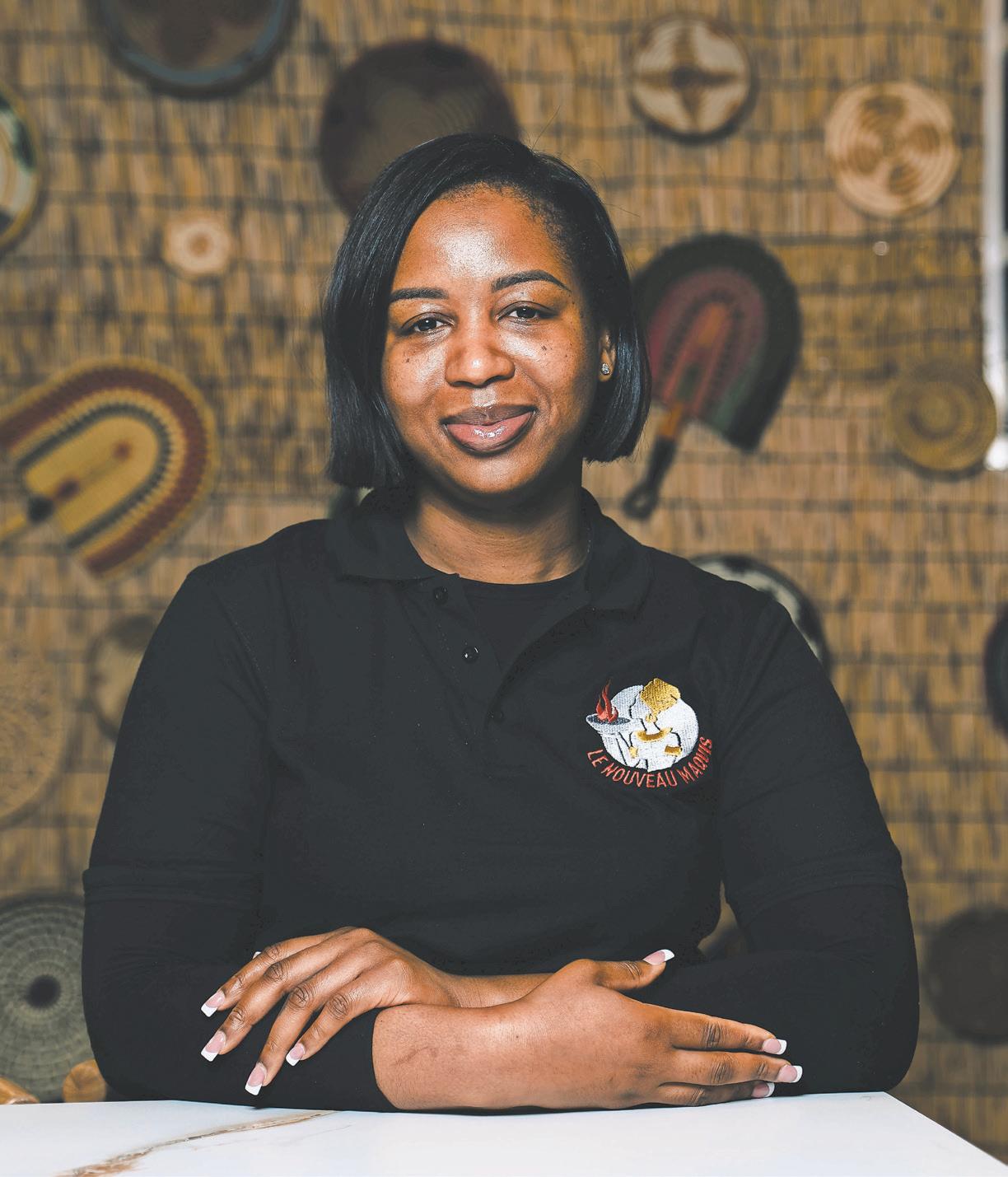
“I want to see the people that I’m serving. I want to see what they like and what they don’t. I want to see their vibes in general,” said Le
still know who we are and know that we’re still there cooking.”
For decades, the African diaspora’s stronghold in Atlanta has grown, especially among business owners. African restaurants and grocery stores dot the metro Atlanta area, creating corridors and pockets that feel like homes away from home. Within that, Le Nouveau Maquis has created a burgeoning space for itself, bringing dishes all across West Africa to the forefront. The menu features dishes from 10 West African countries, from Liberia, Senegal, and Nigeria to dishes from Togo, their home country.
“I think being able to give you diversity in food is what makes us special. So, you can come and look for maybe Nigerian food, or you could come and look for Togolese food, and you’d still find it. You’d still find something from Ghana, Sierra Leone, or whatnot. Other places don’t necessarily provide that, in my opinion; they might provide something based on one culture, mainly, which I think kind of does it a disservice, seeing that most of us already eat just about the same things.
“We have family from a lot of these places. We’re from Togo, but we have family in Congo. We have family in the Ivory Coast. So it was only right that we do them justice and do food from their
spaces as well.”
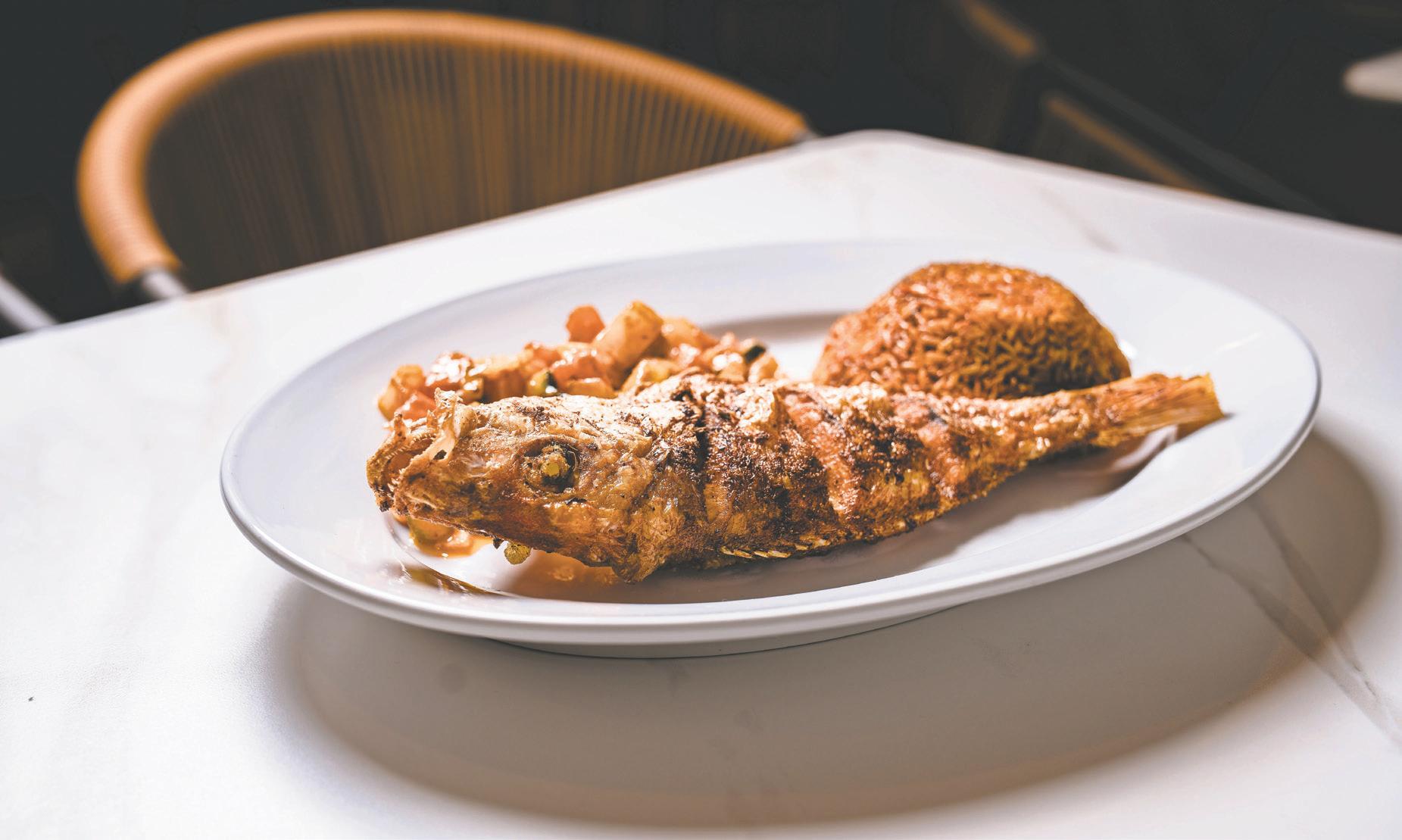
Patrons can feast on a tour of dishes such as egusi soup and beef suya from Nigeria, thieboudienne and chicken yassa from Senegal, waakye from Ghana and attiéké from Côte d’Ivoire, to name a few. Fanta and Fabiola celebrated the grand opening of their Tucker location in February. While their Memorial Drive location is intended to provide a homey feeling, the Tucker location extends that vision into an upscale, elevated space with more seating and space so they can give their customers the best experience.
“I think this space just takes us to another step. To me, it’s not about replicating the same ambiance everywhere, but just going a step further every single time that we can. The food may be the same, but the space is just a little bit more elevated. I always try to give you something new with something old, so that nobody ever feels out of place.”
As Le Nouveau continues to grow, Fabiola said their eyes are set on hopefully expanding with more locations and bringing the food of West Africa to the world.
“We’re hoping for three, four, five more Le Nouveaus in Georgia, in the DMV, in Africa — anywhere. You never know. As long as the food is still good, as long as we have our bases covered, I don’t see why we can’t get more.”
By DONNELL SUGGS
Professor, mother, wife, and investigative journalist, Nicole Carr will add a new role to her already impressive list when her first book, “The Price of Exclusion: The pursuit of healthcare in a segregated nation” (DEYST/William Morrow) debuts on June 16.
The book, Carr’s first, is described as “the untold history of Black medical professionals who have long fought to heal their communities while confronting a system built to exclude them”.
Carr has spent her career unearthing stories that for whatever reason were being kept in the dark. Her series of stories on school board meetings gone wrong, “Chaos at the School Board,” shone a light on how routine meetings can become the worst day in someone’s life. Investigative reporting is at the heart of “The Price of Exclusion”. Carr travels domestically and internationally in order to dive into what it took for Black physicians to break into the field. From Raleigh, North Carolina to rural South Georgia to New York, Texas, and Port Antonio, Jamaica, the reporting in the book provides readers with stories
of both victory and defeat.
In many cases, like in Hancock County, Georgia, the lack of Black doctors (in the United States, only 5% of doctors are Black) comes from the lack of a local hospital. There isn’t a full-service hospital in Hancock County, population 8,600. Residents rely on clinics and old-school remedies.
“You’ll kick rocks before you get to a hospital around here,” said Michael, one of the subjects from Hancock County in “The Price of Exclusion”.
Weaving her family’s history in the profession with historical data on other Black doctors, “The Price of Exclusion” can be described as part historical document, research tool, Black history text book, and diary.
“I’ve come to Raleigh to touch the space that I hope will explain the divide that remains today between civil rights, community health, and Black Life,” said Carr in an early chapter of the book.
Like with any book, research paper, movie script, or reported article, whenever someone digs into the American South, the KKK will make an appearance. The foundation and existence of a former Black medical school is one of

many stories Carr shares in the book. There are just four Historically Black College and University (HBCU) medical schools in the country.
On a reporting trip to the divinity school at Shaw University in Raleigh, Carr speaks about what was once the HBCU’s medical school. “I am here because the Klan could not run Henry and Sarah Tupper from the Negro college they built,” she wrote.
Throughout the book, Carr refers to her research, reporting, and ultimately, her writing, as a calling. Near the book’s close, there is a sense of hope. Xavier University, the HBCU in New Orleans, will host the first
Black medical school of this century. It’s a sign of hope, but Carr is quick to bring readers back to reality. After all, it’s her job as an investigative reporter to investigate all sides of the issue. He says that by 2036, the United States won’t have enough physicians to properly address its population’s needs.
That includes doctors of any race.
“That call can be heard whenever one dares to find what the dead have left behind - handwritten notes, maps, explanations of why they did what they did in their time,” Carr says in the book. “They often leave us answers. All we have to do is find them.”
By DENNIS MALCOLM ByRON AKA ALE SHARPTON
Yes, it’s true, the three-row SUV segment is loaded, but the 2026 Buick Enclave Sport Touring finds a way to stand out. I love how the brand once considered your grandparents’ brand has upgraded multiple facets with the Enclave proving it. It’s a great blend of style, upscale comfort, modern technology, and practicality. Redesign is evidently a focal point and I dig it. The Touring trim delivers with a price that stays within the budget of most families looking for an upgraded riding experience.
Under the hood, the Enclave provides a 2.5-liter turbocharged DOHC SIDI four-cylinder engine paired with an 8-speed automatic transmission. It seems like six-cylinder engines are becoming an afterthought with today’s demand for gas conservation and I miss that power, but I still get adequate acceleration for highway merges and city errands. The all-wheel drive makes maneuvering effortless, and at its size, the suspension smooths out

the driving experience while providing stable handling.
Stepping inside, the Enclave’s interior successfully pampers up to seven guests thanks to its perforated leatherette materials, heated front seats, and an eight-way power driver seat with adjustable lumbar support. A heated steering wheel and tri-zone automatic climate control makes sure everyone gets some love. I appreciate rides with low noise, and Buick’s signature QuietTuning uses everything from acoustic laminated glass to an “engineered acoustic system” to optimize active
noise cancellation.
Addressing technology, the Enclave gets busy. Dominating the dashboard is a massive 30-inch diagonal LCD display with Google built-in, which creates a welcomed intuitive infotainment advantage. Wireless Apple CarPlay and Android Auto, wireless phone charging, and an available WiFi hotspot keep drivers and especially the kids connected on the go. Audiophiles like me will appreciate the Bose premium 12-speaker audio system with subwoofer, which blesses ears throughout the spacious cabin.
Driver assistance is becoming more and more advanced, and Buick brings it. The Super Cruise package allows handsfree driving on compatible highways, a feature typically found in higher-end luxury vehicles that usually break the bank. Additional safety technology includes adaptive cruise control, forward collision alert, driver attention assist, and HD surround vision, collectively reassuring drivers with every trip.
Presented in three trims—Preferred, the high-end Avenir, and reviewed Sport Touring version—my model flaunted 20-inch alloy wheels, black
roof rails with a gloss finish, the AutoSense power liftgate, panoramic sunroof, head-up display, and a rear camera mirror to name a few amenities.
Fuel economy for the AWD model comes in at 21 mpg combined (20 city/24 highway), which is pretty respectable for a full-size, three-row SUV.
With a starting price of $49,700 and a total price around $62,795 as reviewed (including Super Cruise, Illumination, and Power Packages; the all-wheel drive system; and power panoramic sunroof), the 2026 Buick Enclave Sport Touring conveys an attractive mix of comfort, technology, and everyday adaptability. For families looking for a refined SUV with numerous features and a quiet ride, the Enclave proves Buick is more than up to date with today’s demands.
Fuel Economy: 20 city/24 highway/21 combined
Price: The 2026 Buick Enclave Sport Touring is $49,700 MSRP, and $62,795 including all the listed packages and destination charges.
For more information, visit Buick. com.

Spacious 1-Bedroom Affordable! Rent Based on Annual Income Amenities, Great Location, and Convenient to Marta Please call for detailed information (404) 586-9098

Manager, Metrics - Analytics and Reporting (Victor Insurance Managers LLC) (FT; Atlanta, GA – Telecommuting/hybrid work schedule permitted, in accordance w/ company policies.) Lead, mentor & develop team of data analysts responsible for data integrity & business insights. RQTS: Bach deg or foreign equiv in Actuarial Sci, Finance, Stats, or rel + 2 yrs exp in position oSered or rel. Must have 2 yrs of exp w/: Performing analysis of insurance statistics; Utilizing PowerBI to visualize key performance indicators of production environment & analyze product trend, class of business & agency behavior.
APPLY: https://careers.marsh.com/global/en/ using Keyword R_344329. EOE
Snowflake Inc has mltpl Solution Architect positions avail in Atlanta, GA. Prsntng Snowflake tech & vsion to execs & tchncl cntrbutrs to custmrs. Tlcmtg prmttd. Successful candidate’s starting sal will be dtrmnd based on permissible, non-discriminatory fctrs such as skills, exp, & geo lctn. This role is also elgbl for a cmptve bnfts pckge that incld: medical, dental, vision, life, & disability insrnce; 401(k) ret plan; FSA & HSA; at least 12 paid holidays; PTO; parental leave; ee asst program; & other co bnfts. $143000 - 187950/yr. To apply, send rsme & trnspts w/ job title & Ref#10007634 to resume@snowflake.com. EOE.