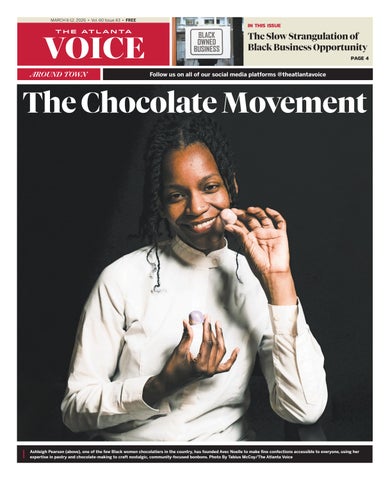
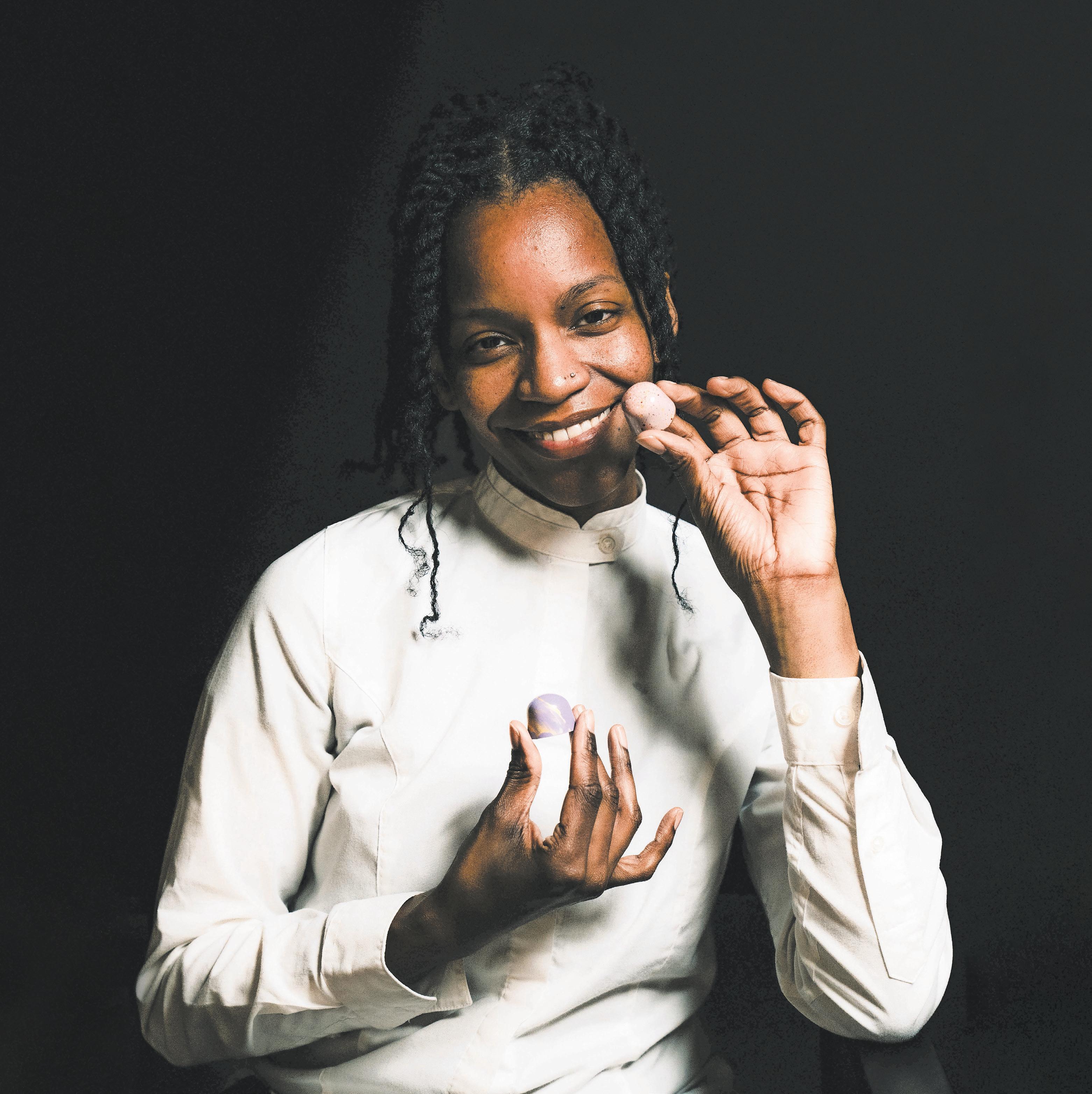
Ashleigh Pearson (above), one of the few Black women chocolatiers in the country, has founded Avec Noelle to make fine confections accessible to everyone, using her expertise in pastry and chocolate-making to craft nostalgic, community-focused bonbons. Photo By Tabius McCoy/The Atlanta Voice
In The Black
Avec Noelle: The Journey of a Black Woman Chocolatier
By LAURA NWOGU
Chocolatier Ashleigh Pearson is intent on making fine confections, a luxury usually found in fine dining restaurants, available at the drop of a hand. From D.C. to France to Atlanta, Pearson has spent 15 years satiating sweet tooths and honing her craft as a pastry chef and now one of the few Black women chocolatiers in the country. Now, she’s doing things her way with Avec Noelle, creating handcrafted bonbons that blend nostalgia, community, quality, and convenience.
The Atlanta Voice: What inspired you to get into the world of chocolates?
Ashleigh Pearson: “I actually never thought I would be a chocolatier. I started off wanting to be a pastry chef. I literally was a biology student, and I knocked on the back door of a French restaurant in Georgetown, and I was just like, ‘I want to work here for the summer. I want to help out. I want to get involved.’ They were like, ‘You don’t have the credentials to be here, but if you want to help out and hang around, just stay out of our way.’ I worked there and did everything that they said. They eventually ended up giving me a job”
AV: From biology to pastries is an interesting leap.
AP: “My family are academics. Everyone loves science, so I always thought I would do research or something like that. After Paris, I graduated first in my class, and it led me to New York City. I had the opportunity to work for Chef Thomas Keller at three-Michelin-starred Per Se, and they brought me on to work on entremets, which are really detailed layer cakes. That science mind of mine just loved that layering, that precision, that beauty. And then one day he told me, ‘You’re going to become our chocolatier,’ and you don’t really tell Thomas Keller no. But I was like, wait, I love this thing, and I think I’m good at it. But I did it, and I realized that was my medium. I found a thing that I knew I was going to do for the rest of my life.
AV: What did those experiences teach you in the transition to opening your own business?
AP: “I realized that I was going to open my own business when I would go home and talk to my family about all the things that I was making at work, and they were like, that sounds incredible. And I was like, my own family has never experienced the things that I’m serving people every single night.”
AV: Now you have an Avec Noelle, which is named after your daughter. I read that you had another business before this one, but
closed it down because you didn’t believe you could handle both motherhood and entrepreneurship. What changed that mindset for you?
AP: “Prior to being a mom, I thought I could never do this. I was putting so many limitations on what I thought I could do, even though I’d already done so many hard things. And if I’m just being honest, being a mom gives you another level of superpower that you start to tap into, and I realized, I can do this. And most importantly, as I raised her, I didn’t want her to think that I didn’t finish my life’s work because of her.
AV: Well said. Going into the science of it all, what goes into making handcrafted perfections?
AP: “A lot goes into it, and everyone does it at different levels. There are so many spectrums of candy and candy making, and for me, I’m always pushing myself to have some innovation, but to make sure I keep a level of familiarity. So, we’re always technique-driven. With Avec Noelle, the first and foremost thing is a beautifully tempered bowl of chocolate.
AV: And now you’re doing pop-ups all around the Atlanta area. What has it been
like for you to see that mission that you had of making this luxury accessible for people?
AP: “It’s incredible, and it’s so fun when people say, can I just eat that? People go from wondering, what is this? To eating it and having that nostalgic moment. The most important thing about this brand is to pull the
pretension out of chocolate and fine foods and fine confections. This is for everybody. Pop it in your mouth. Does this feel familiar, like something you’ve had as a kid? One of my bonbons that I make is modeled after a cake that my dad used to make. It’s all those nostalgic things that you’ll find from this brand. We don’t particularly focus on any crazy flavor combinations. We try to perfect the classics.”
AV: Can you talk about your new pop up at Grant Park market?
AP: “I’m so excited. Grant Park market has let us do a long-term pop up. Every Friday and Saturday, from 4-7p.m. from this weekend until Mother’s Day, we’ll be at Grant Park market bringing in new products, growing the brand, growing some visibility. We’ll also, in that time, be launching nationwide shipping. So, as people learn about our brand, they can also send it to their loved ones and give them something that’s local, something from an Atlanta chocolatier.”
AV: What do you hope for the future of Avec Noelle?
AP: “For the future of Avec Noelle, I really hope to become a mainstay in Atlanta. For this business, I want to see it grow into the community. I want to see it meet the needs of the people around it. I want to see it evolve and grow with local goods and doing collaborations with local people.
AV: There aren’t a lot of Black women chocolatiers. How did you navigate setting your own table and making your own seat at the table.
AP: “I’m grateful that my parents always raised me to have a mentality to push. Doesn’t matter what you want to do. My dad said to me, ‘You can be a garbage person. You better be the best garbage person.’
“I actually never thought I would be a chocolatier. I started off wanting to be a pastry chef,” said Pearson. Photo by Tabius McCoy/the Atlanta Voice
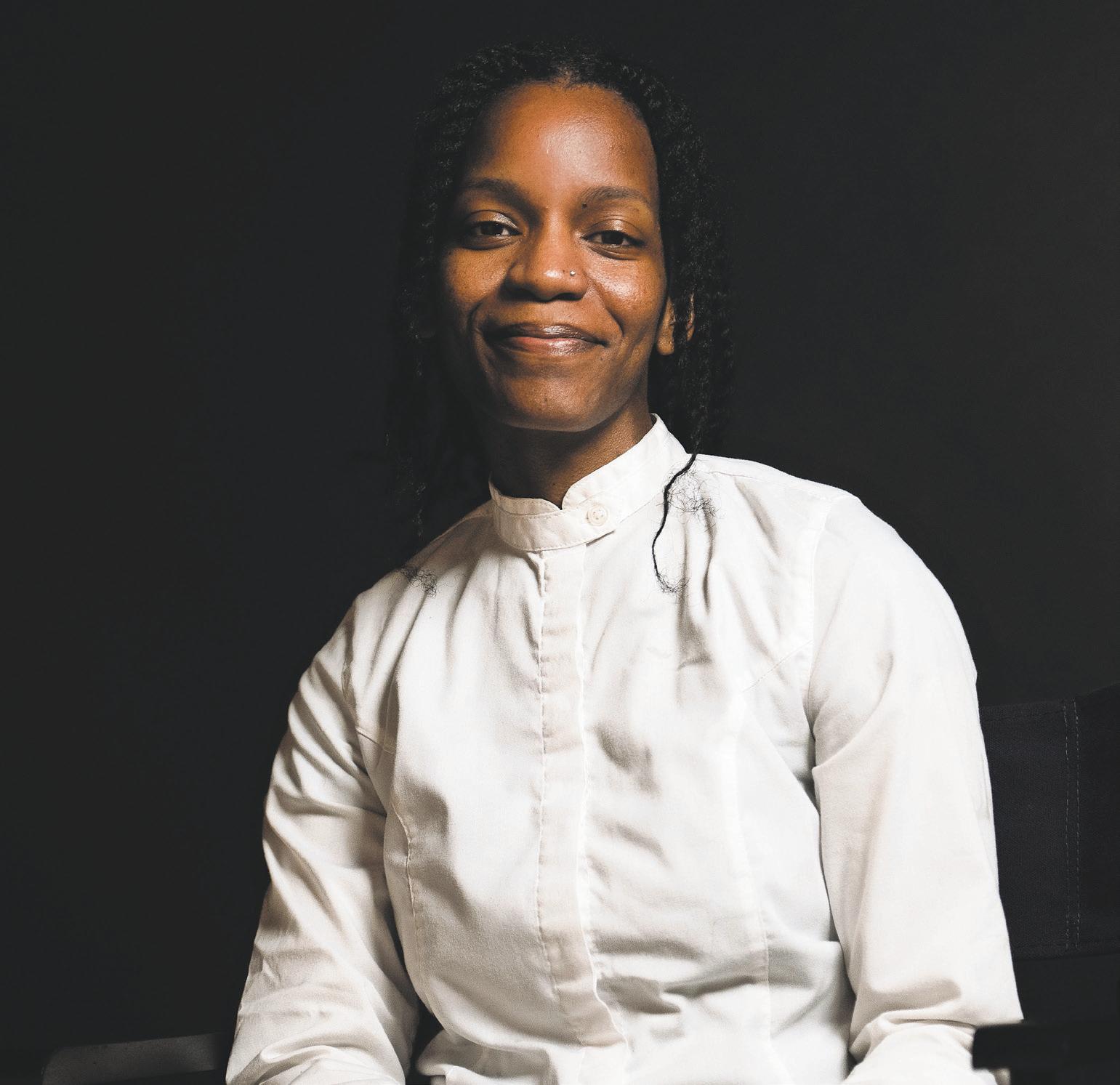
“I realized that I was going to open my own business when I would go home and talk to my family about all the things that I was making at work, and they were like, ‘ That sounds incredible,” Pearson (above) said. Photo by Tabius McCoy/The Atlanta Voice
Leading Out Loud: Black Women Mayors on Civic Service
By ISAIAH SINGLETON
Many gathered at the McKenzie Office Park in College Park for the 3rd Annual
“Meet the Mayors of Georgia” event hosted by the Georgia Real Estate Investors Association.
This highly expected community event featured distinguished municipal leaders from across Georgia, including Riverdale Mayor Evelyn Wynn-Dixon, Warner Robins Mayor LaRhonda W. Patrick, and South Fulton Mayor Carmalitha Gumbs.
The evening offered an opportunity for meaningful dialogue on local governance, regional collaboration, and community engagement.
The night began with a few icebreakers for the all-female, all-Black mayors, leading into topics ranging from why they became mayors to data centers, advice, and
“Our job is to educate our community about what data centers mean and let them draw their own conclusion on that. When it comes to the tax incentives and things that they’re receiving, I won’t say that I necessarily agree with the amount of tax incentives that they are giving,” said
more. Wynn-Dixon said she has been the mayor of Riverdale for the last 18 years. She said it was never her desire to be mayor at first, but later changed her mind after she progressed in life.
“After having my three kids, my ex-husband decided he wanted to leave me. I was homeless on welfare, sleeping in my car. What gave me the courage to run for mayor is I told God if he delivered me from my lights and gas being turned off and put my children through school, I’ll make my life a magnificent obsession helping other people,” she said.
Gumbs said she saw what was happening in the City of South Fulton and all over metro Atlanta before she became mayor. With the passing of her mother, Gumbs had the opportunity to return to Virginia to spend time with family, and during that time, she took a step back and reevaluated her life. This turned into the spark that made her want to make a difference.
“Becoming mayor was not in my bingo card. I never, ever thought that I would be the mayor of South Fulton, but it needed leadership at that time, and I was leading teams. I worked in corporate America. I knew that I had the opportunity to really engage people. I’m just a people person, and I knew how to collaborate,” she said.
Patrick said she ran for mayor because she wanted to be the change she wanted to see when she was in college at Georgia State.
“My senior year I got to work at the Georgia Assembly with the House of Representatives and then full-time admin staff for the Senate before going to law school,” she said. “When I was there, I got to see the real deal when it came to laws being made or not made in our state. This made me, in turn, say I want to run.”
Both Gumbs and Patrick were asked about the mindset on balancing the concerns of data centers and where they’re built, how they’re built, amid balancing concerns and the alluring prospect of the tax dollars.
“In Middle Georgia and especially Warner Robins, we have none. We have had some look at us, and we’re right next to Forsyth Monroe County, and there was a huge fallout with the residents on a potential data center coming to the community,” Patrick said. “Our job is to educate our community about what data centers mean and let them draw their own conclusion on that. When it comes to the tax incentives and things that they’re receiving, I won’t say that I necessarily agree with the amount of tax incentives that they are giving.”
“We have been hit with quite a bit of data centers wanting to come to our area. I do believe that there is a push for cities of color, because they do think about money in front of a lot of these cities and think, ‘oh, well, they’ll just
give in,’” Gumbs said. “In South Fulton, we got caught preaching at the will as a young city.”
The discussion further focused on the challenges and support for small businesses in various cities.
In South Fulton, the primary hurdle is licensing compliance, with 8,900 unlicensed businesses identified. An amnesty day was created to waive back taxes under $10,000, encouraging businesses to come into compliance. The mayor actively supports small businesses by visiting them and promoting them.
In Warner Robins, the city highlights local businesses and encourages community support through events like Small Business Saturdays. However, financial help programs are lacking, focusing instead on easing permit processes and giving business advice. Innovative strategies include integrating businesses into city events and offering unique dining experiences to attract customers.
The conversation later shifted around the importance of engaging younger generations in public service and politics. Patrick emphasizes connecting with youth through internships and community initiatives to foster a
passion for service.
“I love connecting with the middle schoolers, high schoolers and young adults, and inviting them into City Hall, educating them about public service careers in local government, and encouraging them to come out and shadow an internship at the city of Warner Robbins,” she said. “We’re trying to come up with different things to entice them to apply for boards for the younger adults in the city so they get to learn about city business, and this encourage them to volunteer in our community through city initiatives or otherwise, so they can understand what it’s like to give back to serve our community.”
Gumbs discusses making politics relatable by addressing issues like bullying and vaping and starting an intern program to bring fresh ideas. Dixon also stresses the need to teach young people the value of voting and practical skills, criticizing outdated educational practices and urging them to stop sagging.
All mayors said they all agree on the importance of meeting young people where they are to inspire civic engagement and community service.
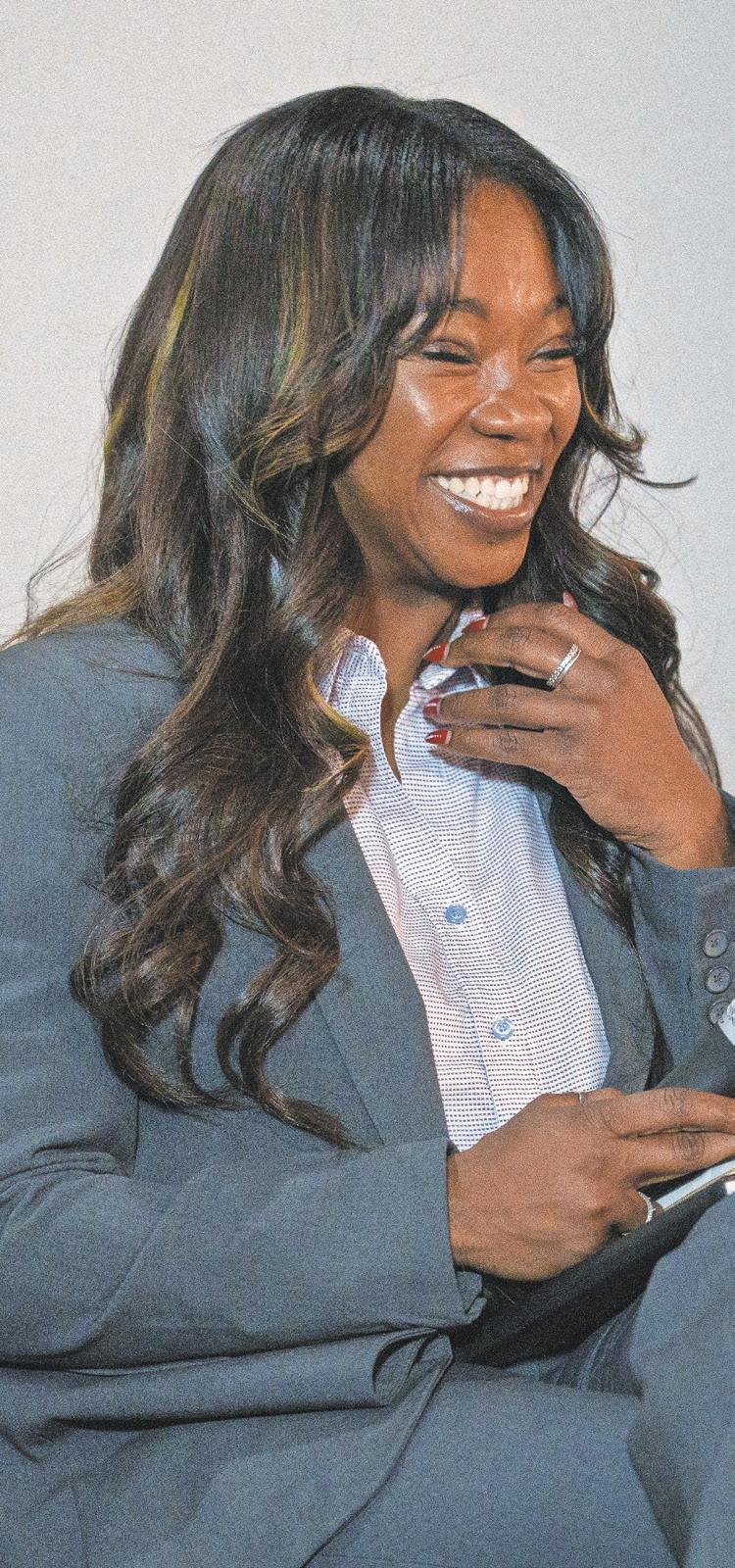
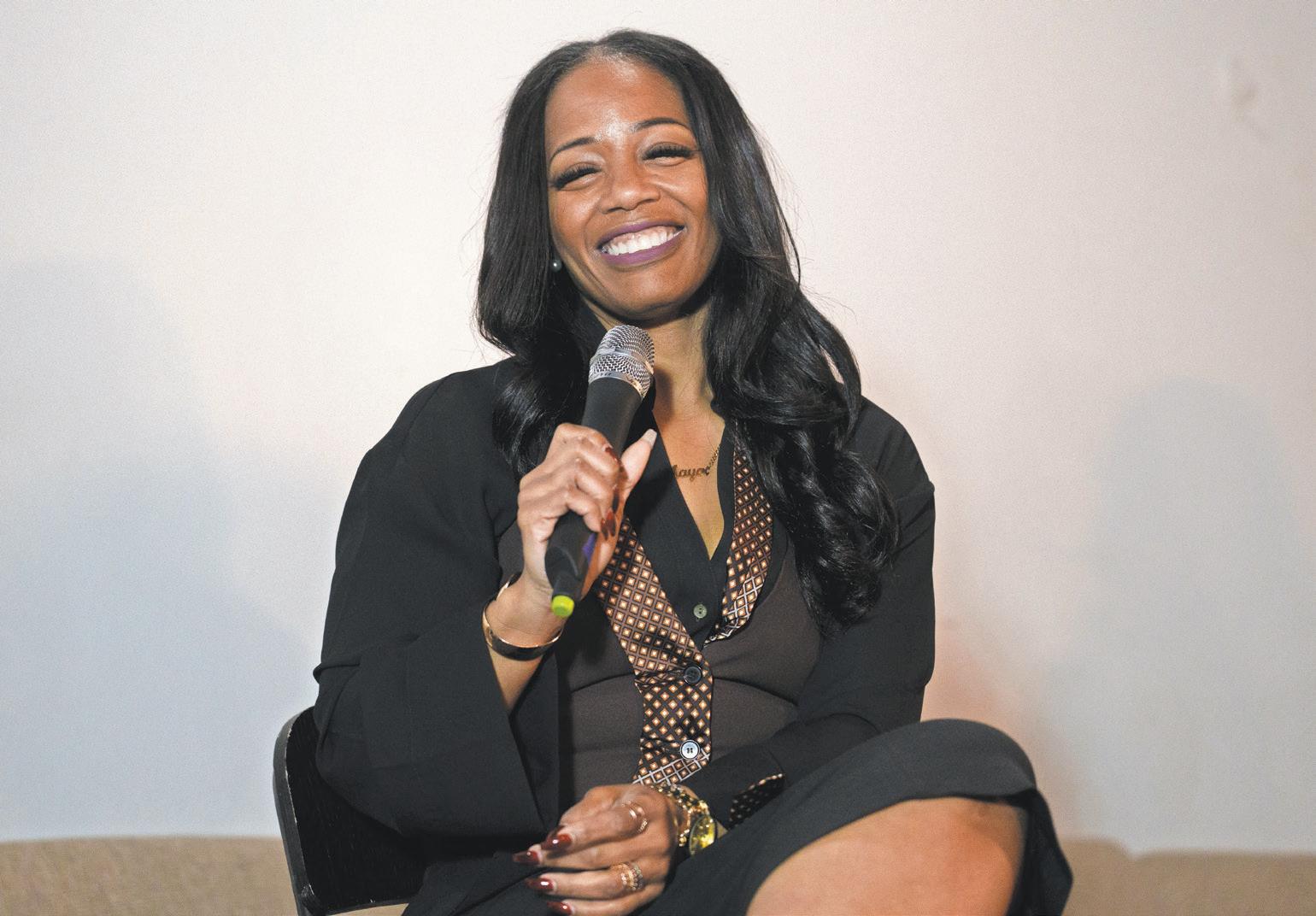
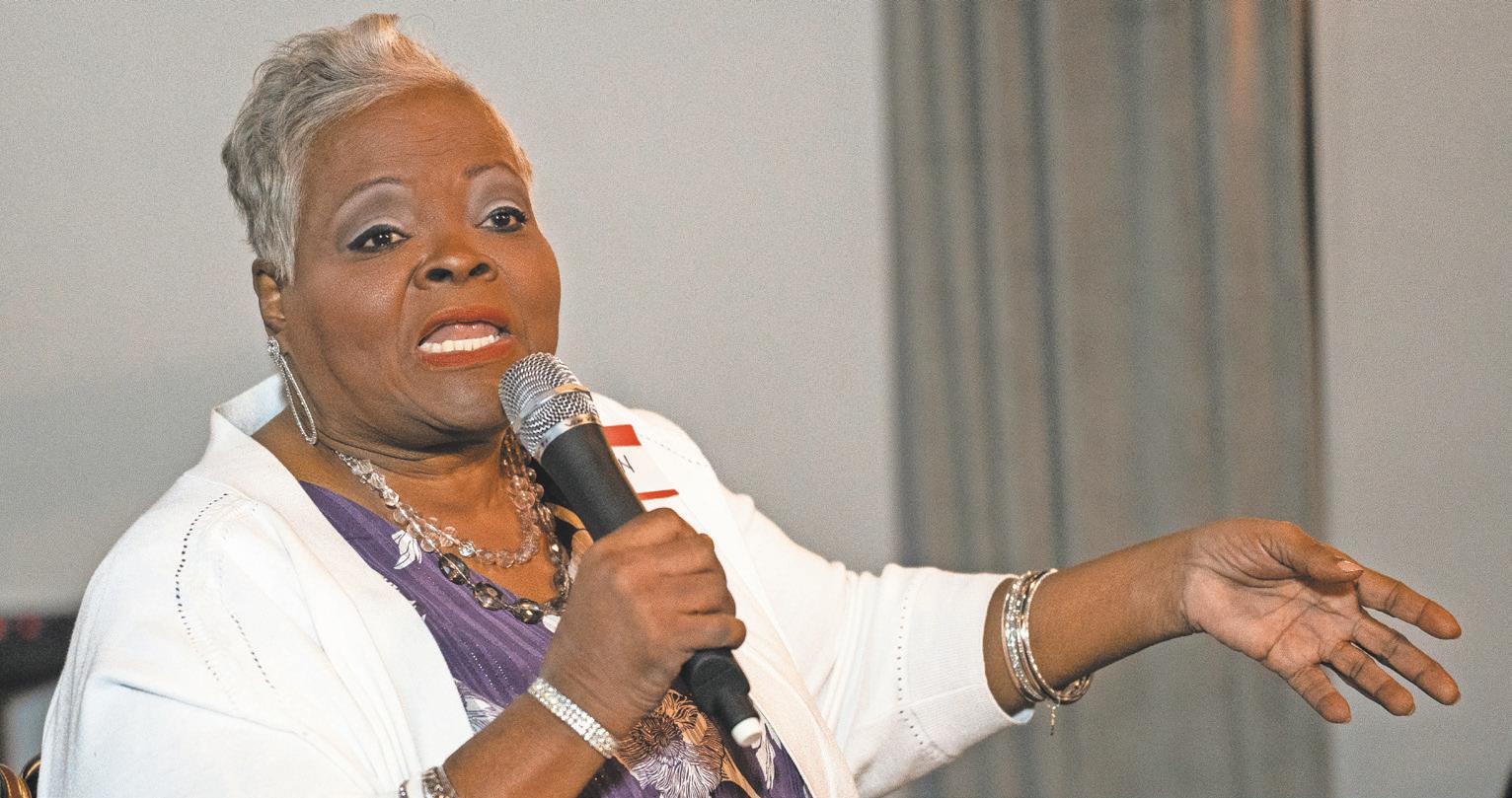
“Becoming mayor was not in my bingo card. I never, ever thought that I would be the mayor of South Fulton, but it needed leadership at that time, and I was leading teams,” said South Fulton Mayor Carmalitha Gumbs (above). Photo by Tabius McCoy/The Atlanta Voice
This community event featured distinguished municipal leaders from across Georgia, including Riverdale Mayor Evelyn Wynn-Dixon (above), Warner Robins Mayor LaRhonda W. Patrick, and South Fulton Mayor Carmalitha Gumbs. Photo by Tabius McCoy/The Atlanta Voice
Warner Robins Mayor LaRhonda W. Patrick (above). Photo by Tabius McCoy/The Atlanta Voice
Voices
The Slow Strangulation of Black Business Opportunity
By CANTRELL DUMAS
In Washington, when a government program comes under scrutiny, the conversation often jumps too quickly from “this needs oversight” to “this should be eliminated.” That instinct is now on display in the debate over the federal government’s 8(a) Business Development Program, a long-standing initiative designed to help small businesses owned by socially and economically disadvantaged individuals compete in federal contracting.
For many Black-owned businesses, 8(a) is often the primary pathway into federal contracting, providing access to capital, experience, and credibility that would otherwise remain out of reach in a system shaped by longstanding racial inequities. Yet even with this program, equal access to opportunity remains elusive. The U.S. Department of Labor reported in 2021 that, despite representing 24% of eligible businesses, minority-owned firms accounted for only 3% of all contract awards.
Oversight
or Pretext? The Politics
Around “DEI”
Critics argue the program is outdated, vulnerable to abuse, and legally fragile. Some have gone further, calling for its dismantling. But this debate is unfolding amid a broader political effort to roll back diversity, equity, and inclusion initiatives, particularly those that acknowledge race as a factor in unequal economic outcomes. In that context, enforcement risks being used not to strengthen the program, but to shrink it.
That contraction is already visible. The Small Business Administration has admitted only 65 companies to the 8(a) program in 2025, compared with more than 2,000 admissions over the previous four years. It also suspended more than 1,000 of roughly 4,300 active firms in January for noncompliance.
The real question is not whether 8(a) is flawless. It is whether policymakers will do the harder work of governing it effectively or use enforcement as a pretext for eliminating one of the few federal tools designed to expand opportunity for disadvantaged entrepreneurs.
How 8(a) Works and What it Actually Offers
The 8(a) program is not a permanent preference or a guaranteed pipeline of contracts. It is a time-limited business development initiative, typically lasting up to nine years, intended to help small businesses owned by socially and economically disadvantaged individuals build the capacity to compete in the federal marketplace. Participants receive contracting opportunities alongside business counseling, technical assistance, and mentoring. The goal is graduation, not dependency.
The program exists because Congress recognized that socially and economically disadvantaged businesses, including many Black-owned
firms, face documented barriers to capital, bonding, and commercial networks. Federal contracting requires past performance, upfront financing, and institutional relationships that many entrepreneurs have historically been denied. 8(a) attempts to narrow that gap.
The “Preferential Treatment” Claim Doesn’t Match the Numbers
Yet labeling 8(a) as “DEI” distorts both its purpose and its results. Black-owned businesses still receive only about 1.5 percent of total federal contract dollars, a fraction of their share of the small business community and the population. Even with 8(a), the gains have been modest. If this is what critics call preferential treatment, it is a remarkably limited one.
The danger is that in the name of eliminating “DEI,” policymakers are dismantling one of the few structured entry points into federal contracting for disadvantaged small businesses without replacing it with anything stronger. That does not punish elites. It harms small firms that rely on federal contracts to build past performance, stabilize cash flow, and create jobs.
What Happens if 8(a) Shrinks Further
Shrinking the program will not produce a more competitive marketplace. It will concentrate federal contracting further among established incumbents, reduce supplier diversity, and weaken the resilience of federal supply chains. The result is not neutrality. It is consolidation, higher barriers to entry, and potentially higher costs for taxpayers.
Reform Is Harder Than Scrapping it
There is no serious dispute that the program faces risks. Problems can arise when a small business functions primarily as a passthrough, when large contracts are awarded without competition, or when agencies fail to monitor performance. These issues deserve attention. But acknowledging risk is not the same as proving a program is beyond repair. Oversight bodies have consistently shown that targeted enforcement, better data, and riskbased supervision work.
The Department of Defense awarded more than $18 billion in contracts to 8(a) firms in 2024. A January memo indicates that the DoD is conducting an 8(a) review intended to eliminate what it describes as unconstitutional and non-merit-based DEI. Eliminating the program would require significant supply chain restructuring and would contradict Commerce Department findings emphasizing the importance of minority-owned businesses for supply chain resilience.
The choice facing policymakers is not between oversight and abandonment. It is between dismantling a flawed but necessary tool or reforming it to deliver better results. A reformed and well-enforced 8(a) program is not a special favor. It is a practical mechanism to expand competition and strengthen the small-business ecosystem. Scrapping it may be politically convenient. Fixing it and demanding that it do more is far more valuable.
Cantrell Dumas is a senior researcher at the Joint Center for Political and Economic Studies.
FOUNDED
May 11, 1966
FOUNDER/EDITOR
Ed Clayton Immortalis Memoria
PUBLISHER/EDITOR
J. Lowell Ware
Immortalis Memoria
The Atlanta Voice honors the life of J. Lowell Ware.
PUBLISHER
Janis Ware
PRESIDENT/
GENERAL MANAGER
James A. Washington 2018-2024
EXECUTIVE ASSISTANT TO PUBLISHER
Chia Suggs csuggs@theatlantavoice.com
EDITOR IN CHIEF Donnell Suggs editor@theatlantavoice.com
GENERAL ASSIGNMENT REPORTERS
Isaiah Singleton isingleton@theatlantavoice.com
Laura Nwogu lnwogu@theatlantavoice.com
Noah Washington nwashington@theatlantavoice.com
BUSINESS REPORTER
Tabius H. McCoy tmccoy@theatlantavoice.com
EDITOR AT LARGE Stan Washington swashington@theatlantavoice.com
ADVERTISING, SALES & CIRCULATION
ADVERTISING ADMINISTRATOR
Chia Suggs advertising@theatlantavoice.com
SALES
RDW Jackson rdwadman@gmail.com
SUBMISSIONS
editor@theatlantavoice.com
DIRECTOR OF PUBLIC RELATIONS
Martel Sharpe msharpe@theatlantavoice.com
CONTACT INFORMATION
633 Pryor Street, S.W. Atlanta, GA 30312 Office: 404-524-6426 info@theatlantavoice.com
Black-owned businesses receive a sliver of federal contract dollars. Now the program designed to narrow that gap is being scaled back. Photo Credit: iStock.com/Wachiwit
‘Faith on the Frontline’ highlights black faith leadership in civil rights movement
By NOAH WASHINGTON
In a week stocked with division in the wake of President Donald Trump’s 2026 State of the Union address, the campus of Morehouse College offered a different message Thursday evening: In trying times, faith endures.
Morehouse College, in partnership with the National Council of Churches of Christ in the USA and the MOSAIC Storytelling Initiative, hosted the world premiere screening of “Faith on the Frontline,” a short film chronicling the NCC’s 75 years of shared ecumenical witness for justice, peace, and moral leadership.
The screening, held in the Bank of America Auditorium inside the Shirley E. Massey Leadership Building, drew a crowd consisting of Men of Morehouse, the spiritually inclined, and religious leaders, all gathered at the invitation of Bishop Vashti Murphy McKenzie, President and General Secretary of the NCC and the first Black woman to hold the organization’s top position, and Dr. Jann Adam, Ph.D., Director of the Institute for International and Experiential Education at the Andrew Young Center for Global Leadership, who hosted the evening.
Dr. Sushama Austin-Connor, Program
Director of the MOSAIC Storytelling Initiative, welcomed attendees on behalf of the MOSAIC team.
“This documentary chronicles the enduring influence of Black leadership in shaping national movements for justice,” Austin-Connor said before the film began.
The documentary chronicles the influence of Black faith leadership in shaping national movements for justice and features former Atlanta Mayor and United Nations Ambassador Andrew Young, who served as NCC president from 2000 to 2001, reflecting on the church’s central role in accelerating the civil rights movement. The film opens on a simple but urgent premise, that God has always called his people to unite, and the stories that follow make the case that the NCC spent 75 years answering that call.
“The churches were coming together to pass legislation,” Young said in the film. “We had the closest to a global ministry.” Young, who began his career with the church in 1955 as a pastor in rural Alabama, later joined the Southern Christian Leadership Conference in 1960 and became its executive director in 1964. He worked closely with
Dr. Martin Luther King Jr., playing a role that was critical in the negotiations and strategies that advanced the civil rights movement.
Young went on to serve as U.S. Ambassador to the United Nations from 1977 to 1979, as a Georgia congressman and as the second Black mayor of Atlanta.
During the post-screening panel discussion, Young recalled the pivotal role the National Council of Churches played in connecting him to Dr. King. After King was stabbed by Izola Ware Curr and relocated to Atlanta to recover, NCC staff reached out to Young, then working as Associate Director of the Department of Youth Work in New York, to help King establish himself in the city. Young credited his years at the NCC with preparing him for that work.
“This is my story too,” Young remarked in reflection during the subsequent panel discussion following the screening.
“We felt it appropriate to close Black History Month with this remarkable collection of stories that can be found in no other repository,” McKenzie said.
McKenzie, who previously served as the 117th bishop in the African Methodist Episcopal
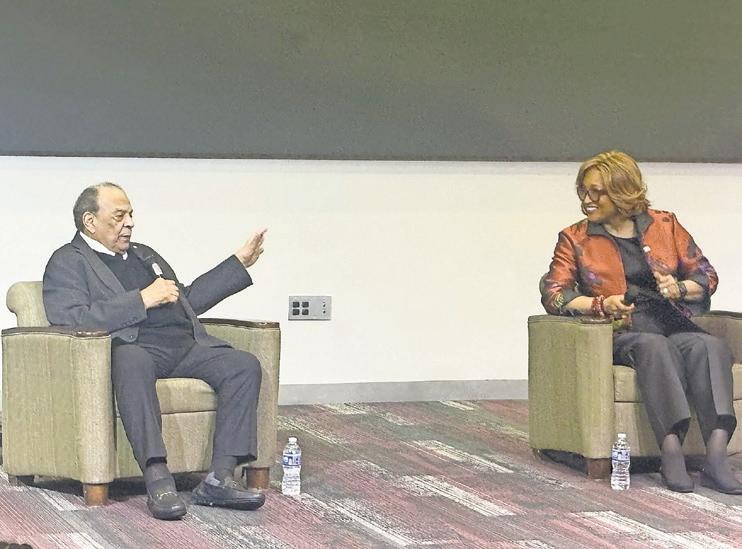
Morehouse College hosted the world premiere of Faith on the Frontline, a documentary marking the NCC’s 75 years of ecumenical leadership, featuring Andrew young reflecting on the church’s role in the civil rights movement. Photo by Noah Washington/The Atlanta Voice
Church and the first woman elected to that post, now leads NCC’s executive operations overseeing 37 denominations, more than 100,000 congregations and 30.5 million people.
Thursday’s screening marked the launch of “Faith on the Frontline” as the first documentary of NCC’s MOSAIC Storytelling Initiative, a five-year project funded by the Lilly Endowment aimed at building a national repository of up to 500 stories of faith, justice, and unity across the United States.
“Our stories matter,” McKenzie said, “not just for bragging rights, but to inspire action from one generation to the next.”
Arena at Southlake: A new era for Clayton County
By ISAIAH SINGLETON
Clayton County is gearing up to welcome a new development to its community.
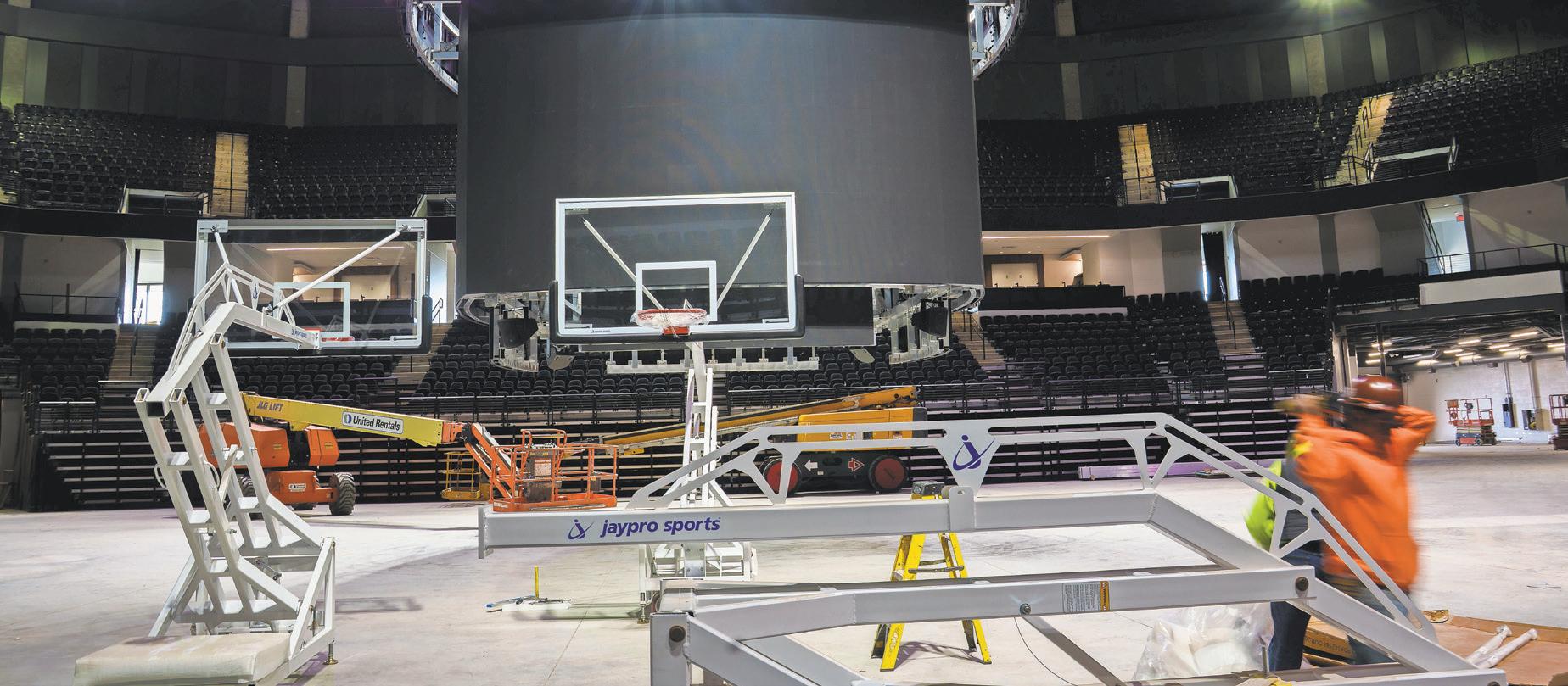
Clayton County Public Schools (CCPS) announced that The Arena at Southlake, metro Atlanta’s first purpose-built mid-size arena, is nearing completion, with a grand opening targeted for March 2026.
The $117 million, 268,000square-foot facility is a transformative investment in education, community, and economic growth across the Southside.
Through a partnership among the Clayton County Board of Education, Clayton County Public Schools, Clayton County Government, and key community partners, an affordable, high-quality venue was originally conceived to host graduation ceremonies for local students.
The Arena at Southlake, located near Southlake Mall in Morrow, has evolved into a premier, revenue-generating destination that can host concerts, sporting events, and major community gatherings, supporting tourism, job creation, entertainment industry training, and long-term economic growth for Clayton County while delivering an exceptional, nobad-seat experience.
At the heart of The Arena at Southlake is an 8,000-seat arena, designed for graduations, concerts, sporting events, conventions, conferences, and large-scale community gatherings. Unlike mega-arenas built for professional sports franchises, its scale prioritizes proximity, sightlines, and audience engagement, creating a more connected, elevated experience for patrons, performers, and presenters alike.
Complementing the arena is a suite of premium and flexible amenities, including:
• A Rooftop Terrace and Conference space for receptions, celebrations, and community activations
• Event Lawn for outdoor events such as small shows and intimate gatherings
• A VIP Lounge and bar area inside the venue, offering enhanced hospitality and guest experiences
• Multiple meeting rooms and breakout spaces to support conferences, civic engagement, and educational programming
• A student-centered content studio and recording studio designed to elevate learning through media production, music, digital storytelling, and creative expression
Chairman of the Clayton County Board of Education District 9 Benjamin Straker said the opening of the facility represents a transformative milestone for the school district and for Clayton County as a whole.
“What was once only a vision is now a tangible investment into the future of our students and our community. We, the Board, offer our gratitude to those who designed and constructed our world-class venue, and we extend a deep appreciation to our county residents whose investment through E-SPLOST transformed a shared vision into reality,” he said. “This bold collaboration will benefit not only our students, but our community and our entire region for generations to come.”
The arena will bring over 300 jobs with it, according to Straker.
Interim Superintendent and CEO of Clayton County Public Schools
Douglas Hendrix Sr. said the Arena at Southlake reflects disciplined leadership and responsible stewardship on behalf of Clayton County’s taxpayers.
“As a Clayton County Public Schools facility, it was secured to serve our students, families, and community. We acknowledge the collective leadership
that helped bring it to fruition. Our commitment is to run it with unity, integrity, and focus on the people it was built to serve,” he said.
Also, the property is run by The Right Productions (TRP Now, Inc.), an award-winning event production, venue management, and operations company specializing in concerts, festivals, and large-scale special events.
CEO of TRP Now, Inc., Shahida Mausi says at TRP Now, their commitment is to serve the students and broader stakeholders of the community while delivering excellent experiences at every event, every time.
“By innovating and collaborating with best-in-class partners, our goal is to create exceptional cultural moments that attract audiences near and far. Premium execution is our foundation: from seamless coordination to premium guest services, we deliver the highest standards because this community deserves it,” she said.
“Looking ahead, we are focused on growth, both as a company and as a catalyst for Clayton County. This arena shows what is possible with
forward-thinking leadership and a dedication to service.”
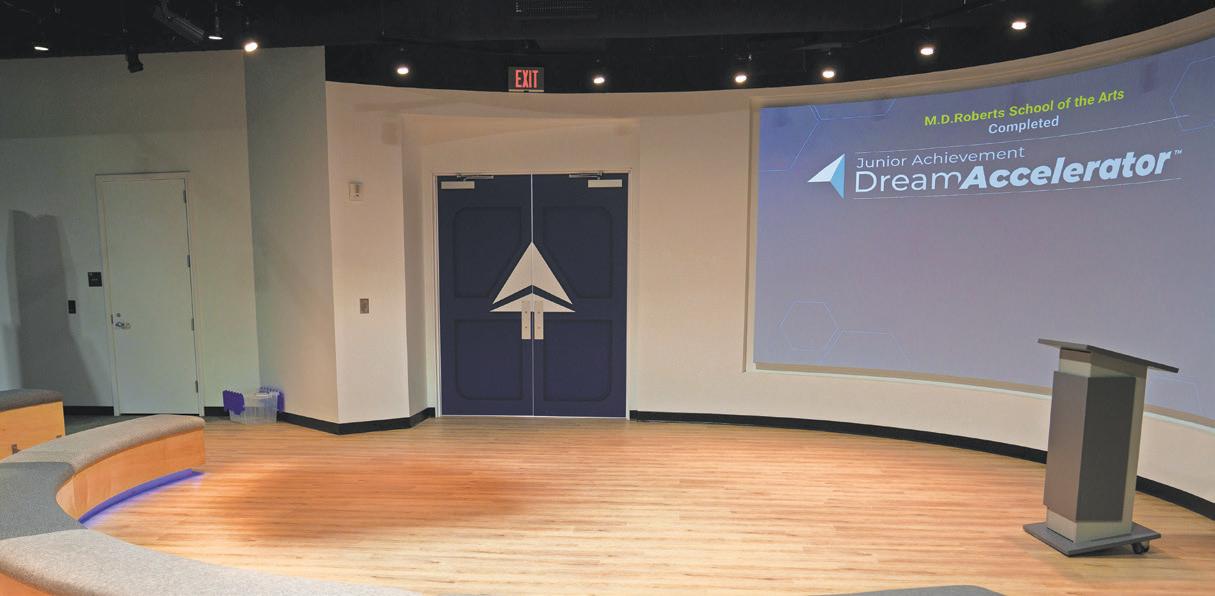
The Arena at Southlake’s educational mission is the Junior Achievement (JA) Delta Discovery Center of Clayton County, an immersive learning hub created in partnership with Junior Achievement of Georgia, Delta Air Lines, and The Delta Air Lines Foundation.
This collaboration underscores the importance of corporate partnership in expanding access, exposure, and opportunity for Students.
Through hands-on simulations focused on entrepreneurship, financial literacy, and career readiness, JA BizTown, JA Finance Park, and the JA Dream Accelerator will provide students with practical experiences that connect classroom learning to future pathways beyond high school.
Clayton County Commissioner Chairwoman Alieka Anderson-Henry said the arena represents a historic and transformative partnership made possible by a $10 million investment from Clayton County Government’s 2021 Special Purpose Local Option Sales Tax (SPLOST).
This investment, she says, helped bring an ultramodern facility to Clayton County, one that generates new revenue and expands opportunities in
a community where the world lands and opportunities take off.
“As a lifelong advocate for expanding access and opportunity, I commend the Clayton County Public School District for its vision, and I am proud of this collaborative effort,” she said. “The Arena will strengthen our local economy, attract new investment, and provide young people with unparalleled experiences that prepare them to lead, both locally and beyond.”
Poised to become a regional landmark, The Arena at Southlake marks a new era for the Southside, one defined by access, excellence, and opportunity.
“We want to provide opportunities for the students at Clayton County Public Schools, and our purpose is clear, by any and every means necessary. This is for our children, this is for the community that loves them, and this is how you build a better tomorrow,” Straker said.
He also says Clayton County has never been the land of the lost.
“Anyone who thought we were, were sadly mistaken. We are people who finally made up their minds to come together and make a difference in the South Metro Atlanta area,” he said.
Photo by Tabius H. McCoy/The Atlanta Voice
The $117 million, 268,000-square-foot facility is a transformative investment in education, community, and economic growth across the Southside. Photo by Tabius H. McCoy/The Atlanta Voice
Clayton County Public Schools announced that The Arena at Southlake (above) will have a grand opening in March 2026. Photo by Tabius H. McCoy/The Atlanta Voice
Rookie Entrepreneur Program: Hawks and Chase unite for growth
By TABIUS H. McCOy Report for America Corp
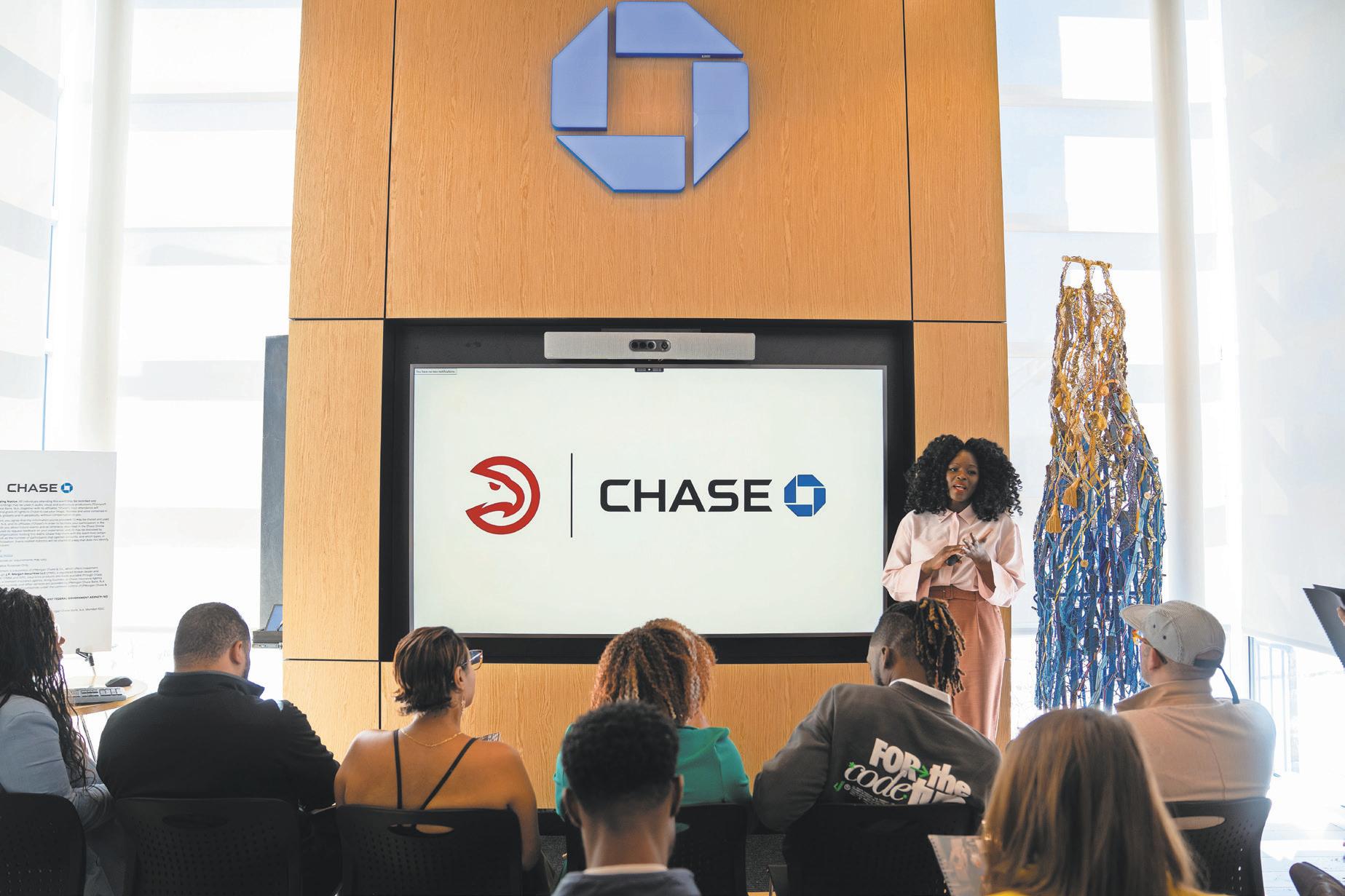
On Saturday afternoon, inside the Chase Community Center branch in Summerhill, ambition sounded like conversation.
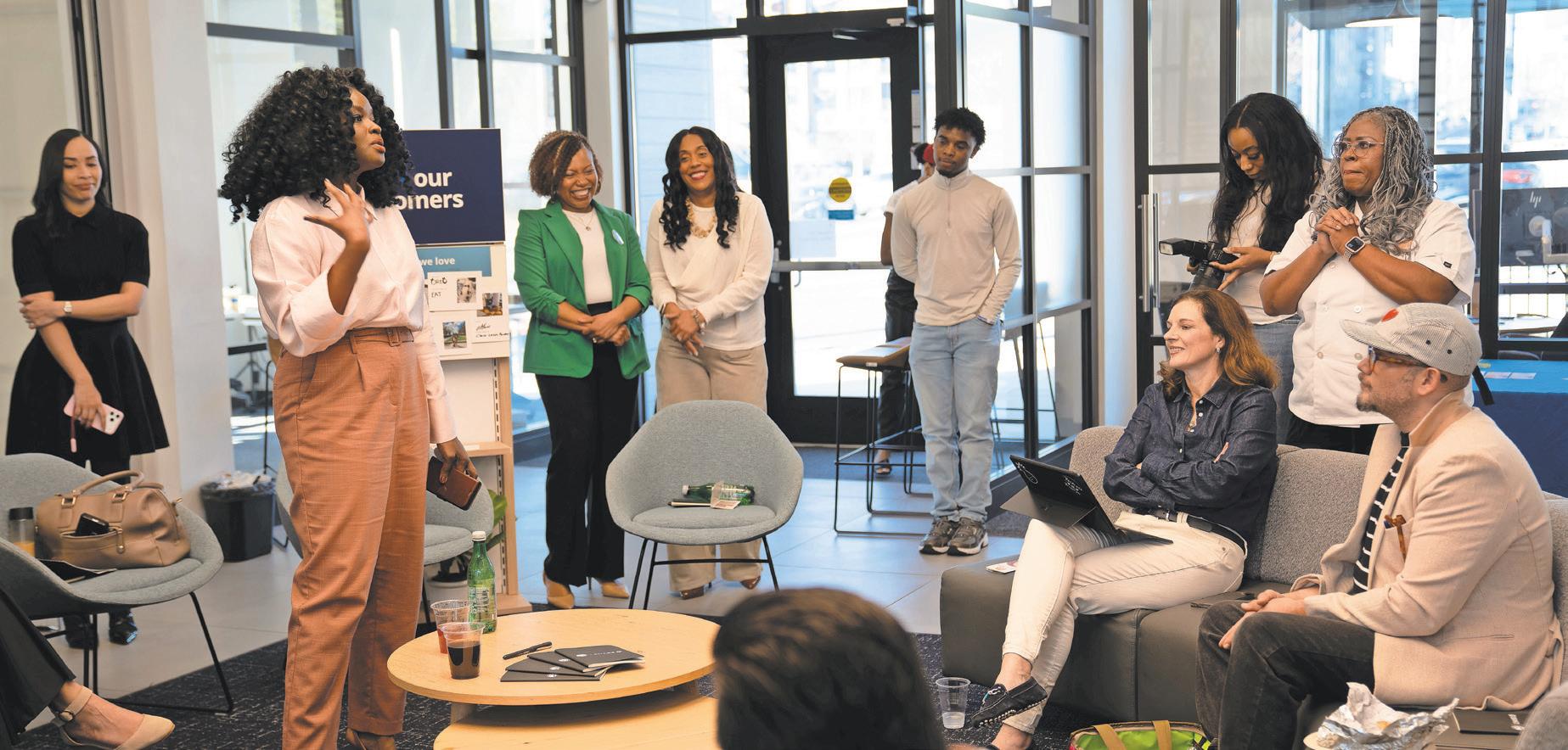
Ten Georgia-based small business owners spanning fashion, food and beverage, media, child development, and retail gathered for the third annual Rookie Entrepreneur Community Program, a partnership between the Atlanta Hawks and JPMorgan Chase designed to equip first-generation and emerging entrepreneurs with the financial tools to scale.
The room carried a quiet intensity. Founders spoke candidly about sustaining their businesses, the early risks, the financial learning curves, and the weight that comes with betting on yourself. Though their industries differed, their realities aligned. Turning passion into longevity requires more than drive. It demands fluency in the language of capital, discipline in decision-making, and access that is not always guaranteed.
“This is our third year of pouring into rookie entrepreneurs with Chase,” said Alexis Roe, vice president of community impact for the Atlanta Hawks and State Farm Arena. “Atlanta’s entrepreneurship ecosystem is massive, but many founders struggle to scale. Working with Chase allows us to provide tangible financial resources that help move
them forward.”
The half-day program began with networking and professional headshots. From there, entrepreneurs moved into workshops centered on personal and business finances, including budgeting, credit building, access to capital, and cash flow management.
Mathilda Lambert, community and business development director for JPMorgan Chase serving Georgia and the Southeast, led a session on credit fundamentals, describing it as essential groundwork for longterm sustainability.
“One of the biggest misconceptions entrepreneurs have is not realizing that their personal credit directly impacts their business credit,
especially in the early stages,” Lambert said. “Building it intentionally from the start is critical if you want access to capital later.”
Lambert said programs like Rookie Entrepreneur exist for founders who often begin with vision but without access to mentorship or structured financial guidance.
“For many of them, when they started, they didn’t know who to ask for help,” she said. “We’re helping close that gap.”
Among the participants was Katrina Sloan, owner of The PlayPad, an indoor playground and activity center in Southwest Atlanta serving children from infancy to age 12. Sloan said the credit workshop offered practical insight she could immediately apply to her growing business.
“I learned how a business line of credit really works, the advantages and disadvantages, and how important it is to pull my full credit report instead of just relying on an
app,” Sloan said. “You need the right tools to grow. Growth does not happen automatically.”
Beyond the workshops, the cohort format created something less visible but equally powerful: solidarity.
“Meeting the other entrepreneurs and knowing I am not alone in this circle, that we all have challenges and wins, has been huge,” Sloan added.
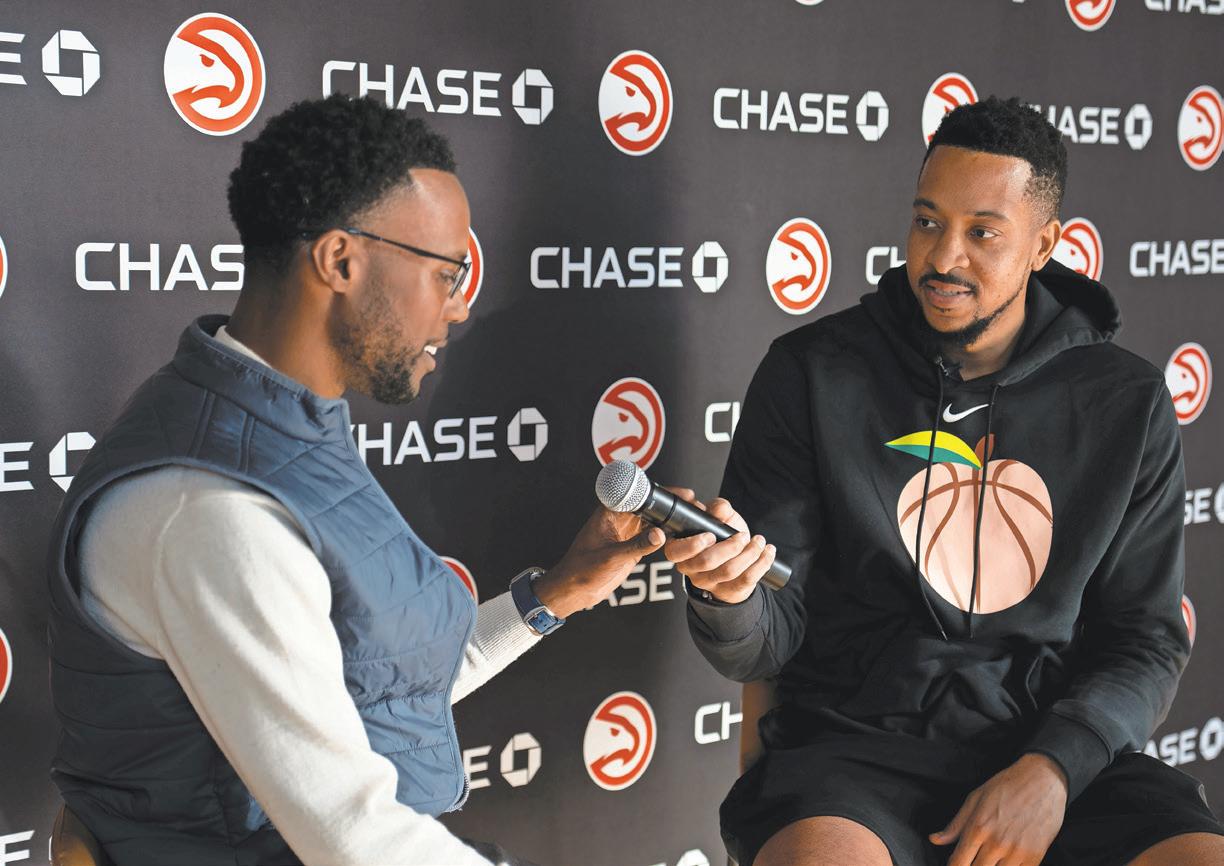
The afternoon included a surprise appearance from guard C.J. McCollum, who spoke about his own entrepreneurial ventures and the parallels between professional sports and business, including preparation, discipline, and longterm strategy. Each entrepreneur also received a $2,500 investment to support business operations, whether for inventory, training, or expansion.
Roe said the alignment between the Hawks and Chase reflects a shared civic commitment to economic empowerment.
“We believe we are a civic asset to the city of Atlanta,” Roe said. “If we can equip people with the tools to build sustainable businesses, we are investing not just in them, but in Atlanta’s future.”
The third annual Rookie Entrepreneur Community Program, a partnership between the Atlanta Hawks and JPMorgan Chase designed to equip first-generation and emerging entrepreneurs with the financial tools to scale took place on Saturday in Summerhill. Photo by Tabius McCoy/The Atlanta Voice
The afternoon included a surprise appearance from guard C.J. McCollum (right), who spoke about his own entrepreneurial ventures. Photo by Tabius McCoy/The Atlanta Voice
“This is our third year of pouring into rookie entrepreneurs with Chase,” said Alexis Roe, vice president of community impact for the Atlanta Hawks and State Farm Arena. Photo by Tabius McCoy/The Atlanta Voice
Black candidates aim to break Georgia’s Secretary of State glass ceiling
By DONNELL SUGGS
Georgia’s qualifying period for statewide elections begins this week and ends on Friday, March 6. Filing the paperwork to continue a campaign for office can be a dream come true for some candidates. Many of those candidates are running for the position for the first time and could be the first Black man or woman to hold that office.
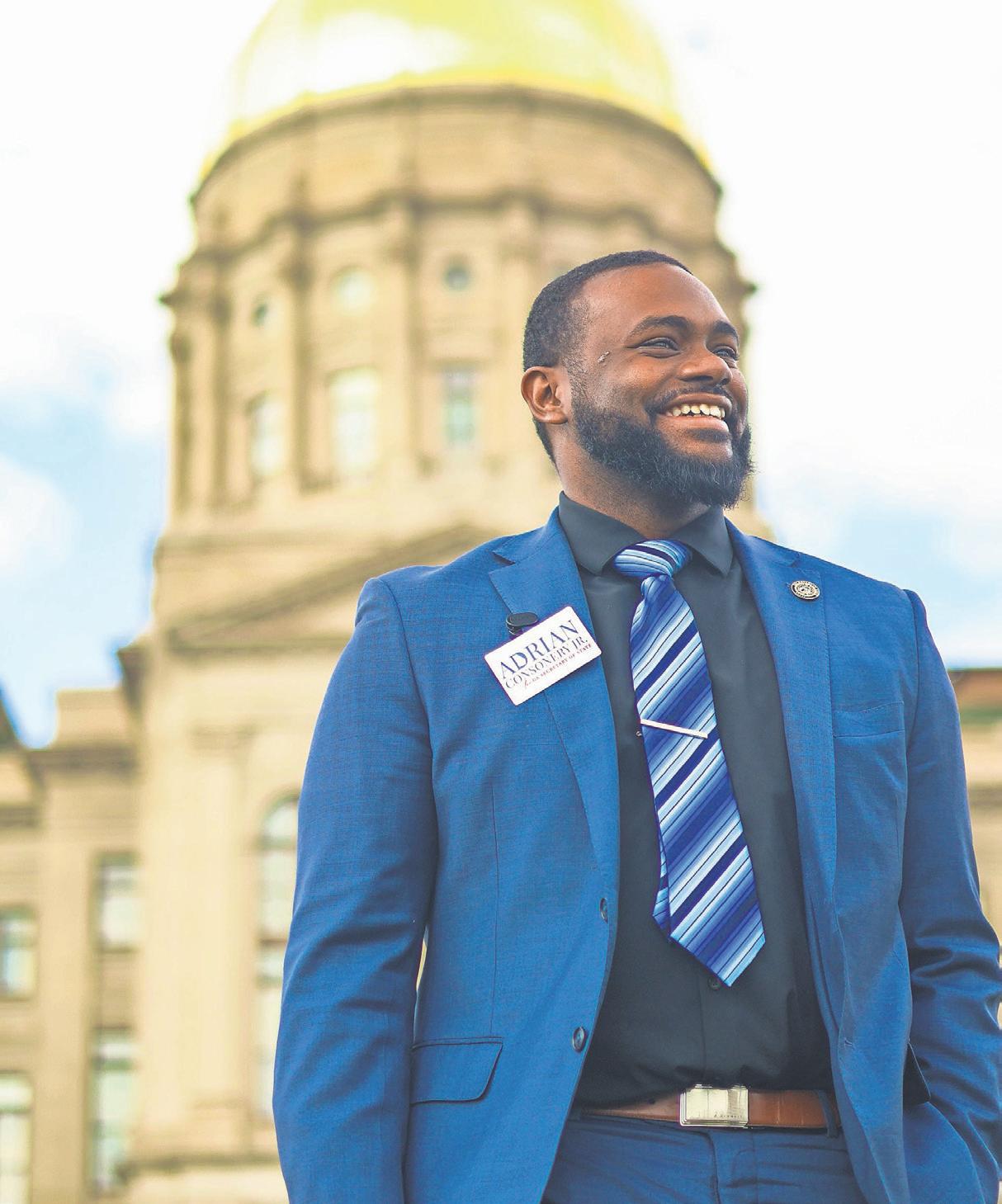
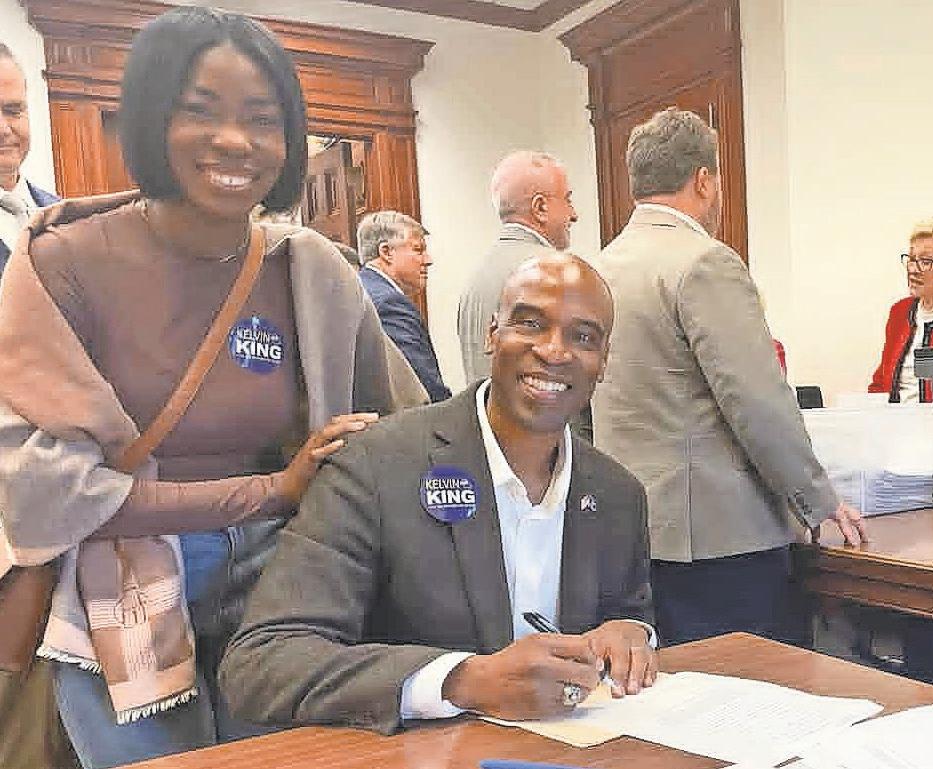
For Penny Brown Reynolds, Adrian Consonery, Jr., and Kelvin King, running to be elected as Georgia’s first Black Secretary of State has become a reality. Reynolds, a former Fulton County Superior Court judge, author, and television personality (see: Judge Penny), and pastor, is running as a Democrat. King, a veteran of the United States Air Force and business owner, is running as a Republican.
In 2026, three Black Americans are up for the job on either side of the ballot. Will there be a Black Georgia Secretary of State? The voters will decide.
There has been a Georgia
secretary of state in office since John Milton, the namesake of the City of Milton, first took office in 1777. From the beginning through the 20th Secretary of State, John Bryan Wilson, who took office in 1931, to the first female Secretary of State, Lera Catherine Cox, in 1999, to the Current Secretary of
State, Brad Raffensperger, who was elected in 2019, Georgia voters have failed to elect a Black American to the office.
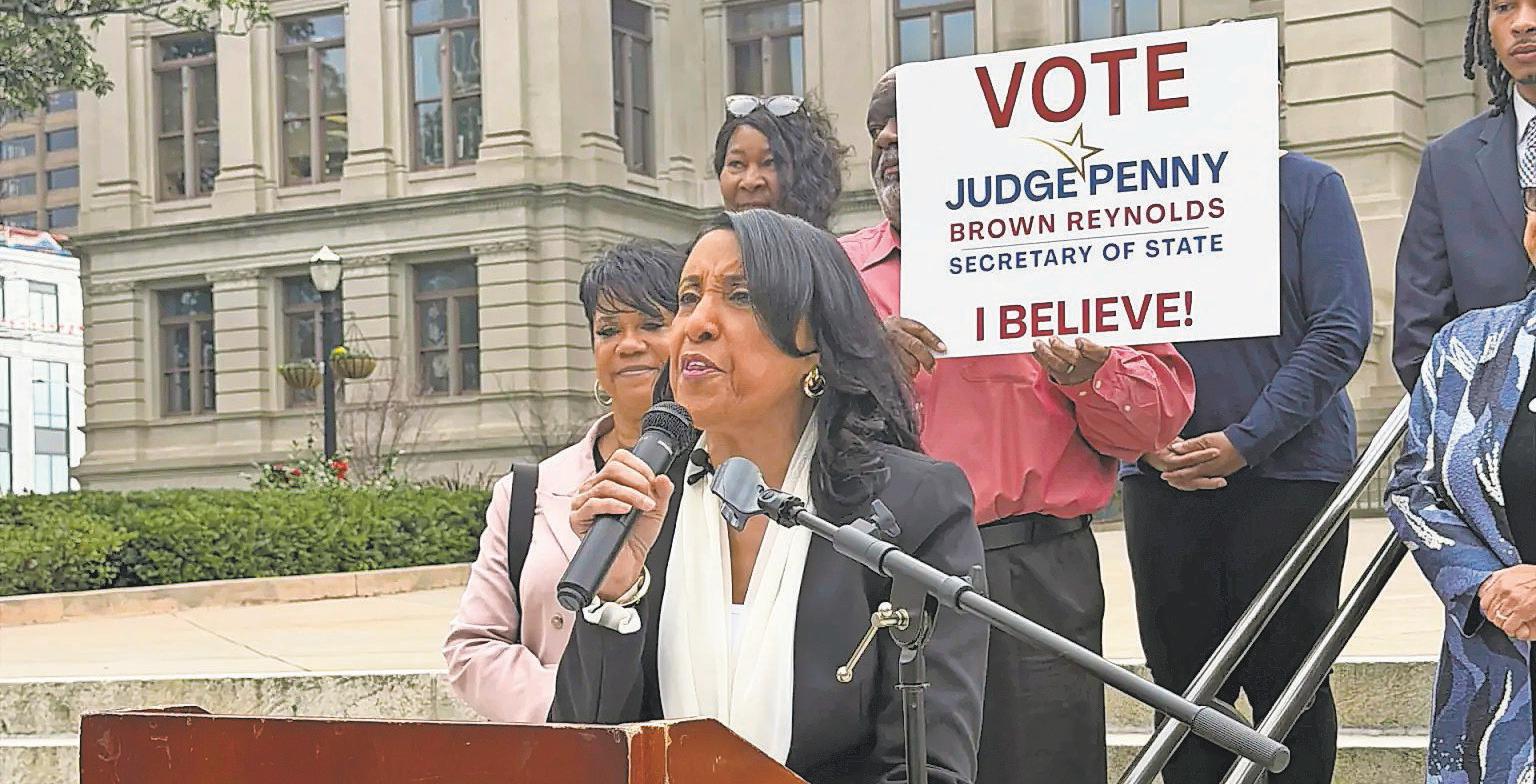
On Monday morning, Reynolds stood on the steps of the Georgia State Capitol and spoke about her journey to this point in her political and professional career. Before the press conference began, she was introduced by her husband, Reverend Edwards Reynolds.
“Without question, I’m the right person for this job because I’m the most qualified,” Reynolds told The Atlanta Voice. “I can win this. We need someone who’s not afraid.”
King and Consonery, Jr. believe they, too, are the right people for the job.
King told The Atlanta Voice that he has a plan in place if he is successful.
“I will immediately execute the necessary steps to restore trust and transparency in our elections; I will improve the operations of the Business Licensing Division so that we are a service provider to our business community; I will also create a Securities Division that actually DOES the job they’re required to do. These goals can only be accomplished by someone with the courage and ability to lead, and I’m the only candidate in this race with that courage and ability.
Consonery, Jr. added in an email, “When elected, I look forward to serving all Georgians equally.”
Reynolds, who called the Secretary of State one of the most important offices in state government, has
experience under the Gold Dome. She previously served as executive counsel to Georgia’s last Democratic governor, Roy Barnes. She was the first Black American person to serve in that role. She would be the first Black American person to serve as Georgia Secretary of State.
During her press conference, Reynolds mentioned her experience being one of the reasons she was the most qualified candidate on either side of the ballot. When asked whether the state of Georgia was ready for a Black woman to serve as its Secretary of State, Reynolds said it was, at least it was for her.
“Georgia is ready for this Black
woman. I was born for this,” she said.
King agrees. “I know that it’s the right time and that Georgia’s ready to elect a Secretary of State who’s Black, with the right credentials and the courage to faithfully execute the lawful duties of the role,” he said.
“I believe Georgia is ready for change,” Consonery, Jr. says. “The status quo of how things have been must be changed. Past administrations have gutted the service aspect of the office to diminish the power and influence the Secretary of State can wield. With that said, I believe Georgia is very ready for change, in whatever form it takes.”
History could be made in November, no matter if Reynolds, Consonery, Jr., or King is in the winner’s circle.
“It would be historic in that I’d be the first Black Republican to win a statewide election in Georgia,” King told The Atlanta Voice via email on Monday afternoon. “However, I think what matters more is not that I was Black and did it, but that I did it without being dependent on powerful political families, lobbyists, or special interest groups. That I did it through working the hardest, having the best message, and operating with the utmost integrity.”
Primary election day is Tuesday, May 19, and a runoff election, if necessary, is on Tuesday, June 19. Election Day is on Tuesday, November 3.
“I will immediately execute the necessary steps to restore trust and transparency in our elections,” Georgia Secretary of State Republican candidate Kelvin King (above) said. Photo submitted by the King campaign
In 2026, three Black Americans are up for the job on either side of the ballot. Adrian Consonery, Jr., (above) a community organizer, is also running for the Democratic seat. Photo submitted by Consoinery, Jr. campaign
“Georgia is ready for this Black woman. I was born for this,” Judge Penny Brown Reynolds (above) said. She is the only Black woman running for Georgia Secretary of State. Photo by Donnell Suggs/The Atlanta Voice
Catching the Moon: Toni Stone’s baseball dream
By NOAH WASHINGTON
Leaving Synchronicity Theatre on opening night, a mother pauses to photograph her two daughters in the lobby. The girls are acting out baseball plays, mimicking what they just saw onstage. That is what legacy looks like, and it is exactly the kind of impact Marcenia “Toni Stone” Lyle has been making for generations, even on those who never knew her name until tonight.
“Catching the Moon: The Story of a Young Girl’s Baseball Dream, “a musical production, is now playing at Synchronicity Theatre on Peachtree Street. The stage play is based on the true story of Marcenia Lyle, a Black girl in the 1930s who overcomes prejudice to pursue her dream of playing professional baseball, while defying societal expectations from family and pushback from coaches. Lyle eventually grows into Toni Stone, the trailblazer who in the early 1950s became the first woman to play professional baseball in the Negro Leagues. The musical brings to life a chapter of American sports history that too few audiences have learned.
Karasytn Bibb, who plays Stone in the production, said stepping into the role demanded more than memorizing lines and blocking. It required getting inside the mind of a woman who refused to be told no.
“She’s so influential and was such a strong person in her own life that I had to make sure that I had her mindset going into this,” Bibb said. “It took a lot of research and a lot of dedication to make sure I’m doing justice to the actual person I’m portraying.”
Director Charity Purvis-Jordan said this moment in time called for exactly this kind of story.
“We’re in a time where you’re challenged on whether you’re going to stick to something or let it go just because people say you don’t fit in or shouldn’t deserve to play,” Purvis-Jordan said. “I just wanted to honor this historical icon that many people don’t even know about.”
There is an almost cosmic symmetry to the show opening in February, the same month baseball legend Hank Aaron was born on Feb. 5. Purvis-Jordan also pointed to a lesser-known historical connection: when Aaron left the Indianapolis Clowns to
integrate Major League Baseball, the roster spot he vacated became the opportunity Marcenia “Toni Stone” Lyle stepped into.
“You got to know this full circle,” Purvis-Jordan said. “It’s just divine timing.”
The show runs for an hour and 15 minutes, with an intermission in between. The production is part of Synchronicity’s family series, fully realized musicals for all ages.
Managing director Celise Kalke said Producing Artistic Director Rachel May selected the show with clear urgency in mind.
“She has an uncanny sense of what to choose for right now,” Kalke said. “This musical is really great for this moment, because we desperately need to feel positive about women and opportunity.”
Purvis-Jordan said she hopes the show reconnects people with something they may have set aside.
“I hope they remember that anything is possible, even for a little girl with a big dream,” she said. “The world is limitless, and the universe will make a path for your dreams to come true.”
“Catching the Moon: The Story of a Young Girl’s Baseball Dream” is now playing at Synchronicity Theatre through March 15.
Face (above), an actor, portrays Clarence, onehalf of the comedic duo that aids Marcenia on her journey to professional baseball. Photo by Noah Washington/The Atlanta Voice
Art imitates life in Sheila Pree Bright’s
“Footwork: Where We Gather”
By DONNELL SUGGS
The eyes of the boy are wide open as he looks at the young man in front of him. The boy was an Atlanta Falcons football fan. The young man, A.J. Terrell, Jr., is one of the starting cornerbacks for the Falcons, an Atlanta native, and one of the team’s best and most popular players. That interaction, along with others between fans and the teams and players they support, shines through in the photography of Sheila Pree Bright and the new exhibition, “Footwork: Where We Gather.”
The exhibition is located in the Michael C. Carlos Museum and will be there through July 19.
Bright calls the collection of work, “capturing a moment” of Atlanta sports, the atmosphere around the professional football, basketball, and soccer that takes place in this city, and the people who make it possible.
“I didn’t want to focus on the players. I wanted to focus on the people,” said Bright, who added that the city is known for its music, Civil Rights legacy, but also its sports.
“Footwork: Where We Gather” will allow many of the soccer fans visiting the city for FIFA World Cup 2026 to get a look at the city’s basketball, futbol, and football fans. The collection includes photography from Atlanta Falcons tailgates, fan gatherings outside of Mercedes-Benz Stadium, minutes before Atlanta United matches, and at the Swag Shop inside State Farm Arena. The latter was taken before the Atlanta Hawks hosted the
Philadelphia 76ers, and while a man was getting a haircut.
The moment was a uniquely Atlanta sports moment. “That’s what I am looking for as an artist. I want people to feel,” Bright explained. “This is really about the people.”
There are photos of a pair of Black Falcons fans who famously dress up before every home game and a group of young Hispanic kids during an Atlanta United match. Some of them are holding Mexican National Team jerseys in hopes of getting them autographed. The girl in the center of the photo has her eyes fixed on something or someone.
The exhibition was curated by Andi McKenzie, the museum’s Curator of Works on Paper. Asked what her favorite photo is, she pointed to the photo of Terrell and that young fan.
“It was the first one I saw when she sent them from Flowery Branch,” McKenzie said. “It has been a joy to work with Sheila.”
Bright said the best part of the exhibition has been the challenge. She has never been a sports fan, but after spending time capturing images at live sporting events in loud stadiums, she is becoming one. “I didn’t particularly care about sports, but I do now,” she said.
The familiar sight of a white “Rise Up” flag dominated the left corner of one photo. Another shows a man smoking a cigar, with clouds of smoke filling the frame. Still another shows a Black woman in a Falcons cowboy hat dancing. Her eyes are hidden by the brim of her hat. The story is being told by her arms in the air and by the snap-like motion of her hands.
Bright spent part of her youth in Germany. Her father was in the United States military, and she remembers how it felt to be a part of a Black family living in Germany. She recalled people reaching out to touch her skin or her hair. She hadn’t returned to the country as an adult, until she took photographs during the Falcons game against the Indianapolis Colts on November 9, 2025.
“It brought back childhood memories,” she said. A photo from that game, a 31-25 Falcons loss, is in the exhibition. In it, there are adults and children, people cheering, and others looking astonished at whatever they were seeing. Bright was focused on the people. That’s what she wanted for “Footwork: Where We Gather.”
“I’m passionate about people. I always had curiosity about different cultures,”
Bright said. “I always want to know about the why in people.”
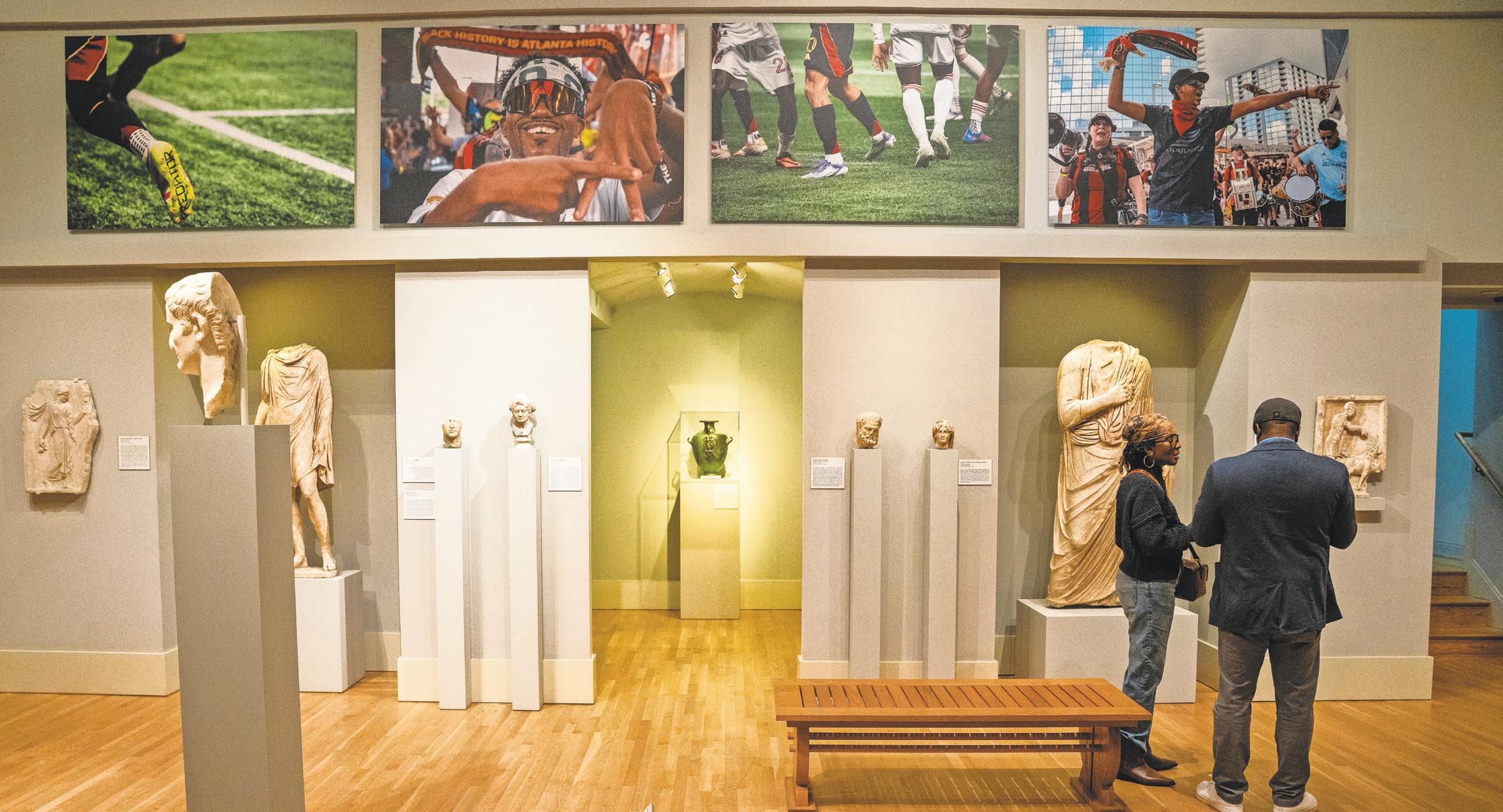
When one enters the exhibit on the first floor of the museum, one will be greeted by Greek statues. Bright believes it is appropriate, given the battles that take place on sporting fields, pitches, and courts around the city.
“I was thinking about the World Cup coming to Atlanta when I saw them,” Bright, a Leica Camera ambassador, said, smiling as she posed for a photo for this story. She was standing below a photo of an Atlanta United supporter flashing a bright smile, wearing sunglasses, and holding his fingers in that time-honored A-Town down style. Behind him was another supporter holding a scarf that read, “Black history is Atlanta history.”
“That’s what this exhibition is about. It’s about decisive moments,” she said.
“I didn’t want to focus on the players. I wanted to focus on the people,” said Bright.
Photo by Tabius McCoy/The Atlanta Voice
Photo by Tabius McCoy/The Atlanta Voice
Sheila Pree Bright (left) explains her philosophy for “Footwork: Where We Gather” with a reporter inside the Michael C. Carlos Museum on Tuesday, March 3, 2026. Photo by Tabius McCoy/The Atlanta Voice
100 Days till FIFA World Cup 2026 is here
By DONNELL SUGGS
There are now just 100 days remaining till the 2026 FIFA World Cup kicks off at Estadio Azteca in Mexico City on June 11, when Mexico plays South Africa. The United States will take part in the tournament for the first time two days later in Los Angeles.
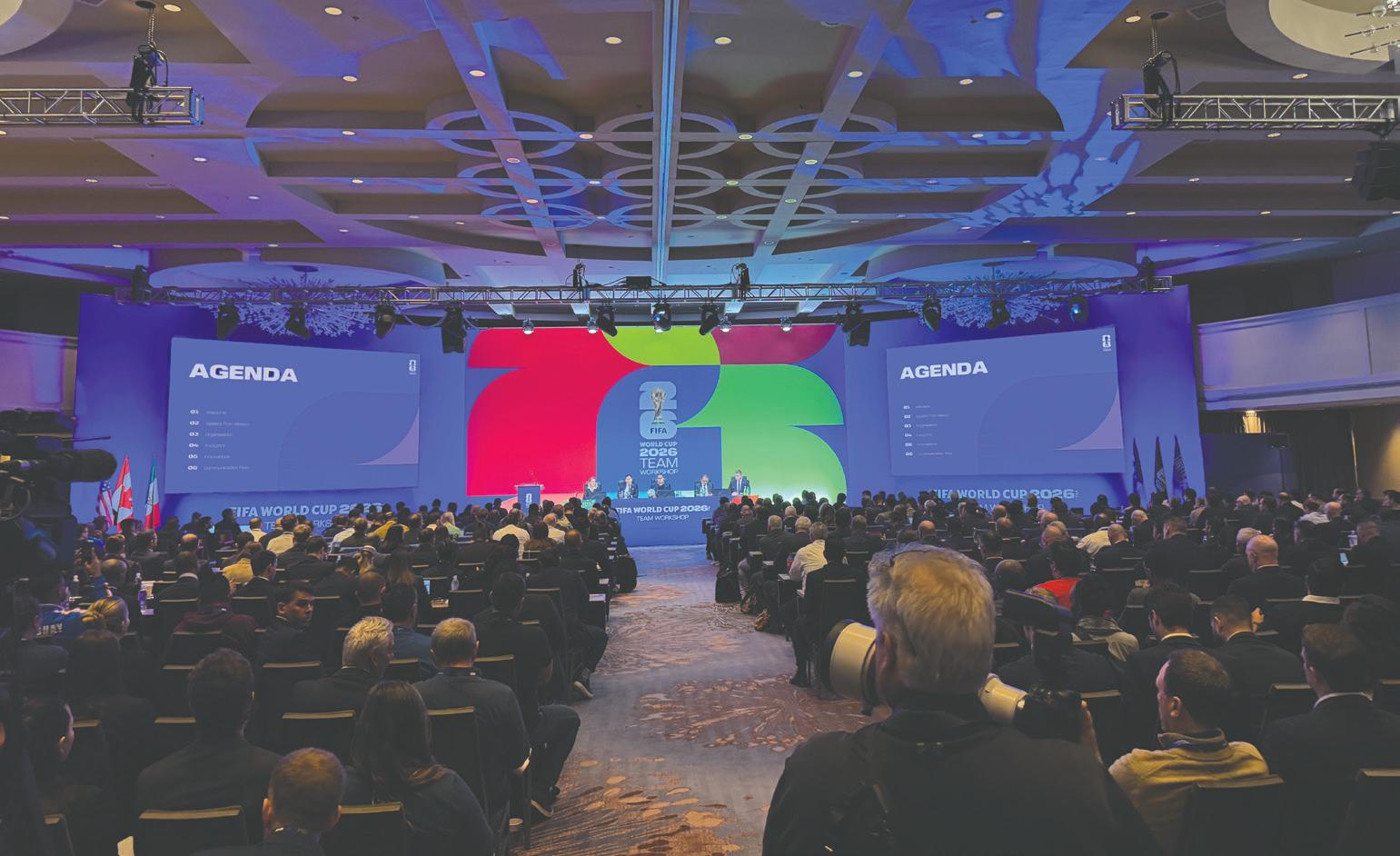
On Tuesday, FIFA set up shop at the Westin Peachtree Plaza to host a massive team workshop. Local and international media were treated to sessions on technology, logistics, fan experiences, and what to expect during the matches at Mercedes-Benz Stadium.
FIFA26 Chief Operations Officer and Chief Event Operations Officer of FIFA Heimo Schirgi addressed the media, which was in a large group, considering the World Cup matches were still over three months away.
“Today we are celebrating 100 days to go, so this is part of our final preparations,” Schirgi said.
With 40 of the qualifying teams sending representatives and/or media to Atlanta to take part in the workshop, stadium tour, and interviews, the World Cup feels closer than ever. Among the logistical questions Schrigi was asked was about the Iranian National Team, which has qualified for the tournament. With a war with the United States of America taking place, getting an entire football club and staff to North America for the
Food
technology, gave a presentation on new technological tools and features that will be in place during the FIFA World Cup 2026. His 15-minute presentation included videos of the auto-offside technology that will be used during the matches, 3-D player scans of each player on all 48 teams, referee bodycams, and Football AI Pro. The latter was explained as a tool that will bring data and in-game video evidence together for more accuracy.
About the offside technology, Runge said, “We want to increase the accuracy of the offside system.”
A pre-recorded welcome video featuring FIFA President Gianni Infantino was played for the media and team representatives. The room was packed with people from across the globe. Some of whom were downtown Atlanta for the first time, but not the last.
World Cup will be interesting.
“ We are taking it seriously, with 100 days to go, we are going to let it take its course,” Schirgi said of the ongoing war. “There are all sorts of things to consider.”
The amount of media credentials and tickets has been “overwhelming,” according to Schirgi. “This is obviously a great situation to be in,” he said.
A World Cup video montage played on a large screen inside Chastain G. Images of Pelé, Maradona, Ronaldo, both the Brazilian and Portuguese soccer stars, Zidane, and Messi flashed across the screen. So did images of the last time the United States hosted the world’s largest and most important soccer tournament.
Sebastian Runge, FIFA’s head of football
Le Nouveau Maquis brings West African cuisine to Tucker
By LAURA NWOGU
Part of Atlanta’s charm lies in its diverse food scene, from the rich culture to the bold flavors. The saying often goes that “Atlanta isn’t a real place,” and what makes it unique is the bustling dining and drinking spots on every corner of the city’s neighborhoods, built to satisfy every palate. Lucky for locals and tourists alike, there’s never a shortage of places to visit, especially when new businesses are rolling in every month.
Here is a roundup of updates on your local favorites and recently opened restaurants.
Local Updates
Le Nouveau Maquis, 4073 Lavista Rd. Suite 369, Tucker GA 30084
Stone Mountain gem Le Nouveau Maquis is opening a second location in Tucker, expanding from its Memorial Drive location and bringing
its West African cuisine to a bigger space. For a decade, Togolese mother and daughter duo Fanta and Fabiola have been serving the East side of Atlanta with dishes that, for a lot of residents, brings a taste of home back to the Atlanta area. In West Africa, a maquis is a popular, casual outdoor restaurant or eatery serving traditional, home-style food and the mother-daughter duo are looking to replicate that feeling in their new space.
The team behind Saints + Council has opened their next venture at Colony Square. The interior of Cuevacía is wrapped in sophistication with cave-like booths and a design that transports its guests to
Northern Mexico. The dishes reflect that, with authentic Oaxacan cuisine that blends northern Mexican influences such as aguachile de camarón, tamal Oaxaqueño, and barbacoa de res, to name a few. The new Midtown restaurant also serves mezcal.
Heritage, 63 Georgia Ave. Bread & Butterfly chef Demtrius Brown has been operating an award-winning dinner series called Heritage Supper Club since 2021. That dinner series will now evolve into a restaurant in Summerhill, contributing to the revitalization of the neighborhood. Much like the popup, the restaurant will focus on the cuisines of Black and brown people, including African, Caribbean, and Afro-American cuisine.
Atlanta will be one of the 16 North American host cities and, on the 30th anniversary of hosting the 1996 Summer Olympic Games, will host the tournament’s semifinals. The city has quickly become one of the country’s soccer hubs. A NWSL franchise was recently announced for Atlanta and will be owned by Arthur M. Blank, who also owns Atlanta United and the Atlanta Falcons.
Schirigi told The Atlanta Voice that the city has been a great partner to FIFA.
“Atlanta is an exciting market. Atlanta shows up as not many cities do,” Schirgi said.
Photo by Laura Nwogu/The Atlanta Voice
With 40 of the qualifying teams sending representatives and/or media to Atlanta to take part in the workshop, stadium tour, and interviews, the World Cup feels closer than ever. Photo by Donnell Suggs/The Atlanta Voice
SENIOR (62+)
Spacious 1-Bedroom Affordable! Rent Based on Annual Income Amenities, Great Location, and Convenient to Marta Please call for detailed information (404) 586-9098
St. Jude Medical in Atlanta, GA seeks quald Supplier Quality Engineer II. Drive imprvmnt & corrective actions in supplier qual, providing tech support during supplier selection & qual. Bachelors or foreign equiv degree in Industrial Eng, Mech Eng, Manuf Eng or retd fld of study w/ an academic or industrial background in: (i) developing acceptance criteria for materials & monitoring supplier perf to drive supplier corrective, & manuf yield issues, & fld failures; (ii) generating & maintaining incoming inspection procedures, training inspection personnel, & sourcing & developing inspection tools & equip; (iii) generating test protocols, monitor testing, issue qual test reports, & apprv components for use in products; (iv) providing input to Design Eng on new component tech & assist in component selection w/ quality & reliability analysis; (v) analyzing defects on incoming materials & drive imprvmnt & corrective action in the qual of components sources from outside suppliers; & (vi) FDA Qual System Regs, industry regs 21 CFR Part 820, ISO 13485 & other international standards. An EOE. 40 hrs/wk. Send resumes to AbbottJobs1@abbott. com or by mail to Abbott Laboratories, Attn: 26J14A, Willis Tower, 233 S. Wacker Dr., Floor 26, Dept. 32, Chicago, IL 60606. Ref- to ad code: SJM-0073-ES
REQUEST FOR BID
Sealed RFP’S for 26RFP1572886B-PS WIOA One Stop Operator will be accepted by the Department of Purchasing & Contract Compliance, online through the Web Grants System via BidNet Direct at https:// www.bidnetdirect.com/georgia/fultoncountyga.govon Thursday, March 05, 2026 at 11:00 A.M. All Bids submitted must be received electronically no later than 11:00 a.m. local (Eastern) time on the stated due date.
Scope of Work: Fulton County, Georgia (“County”) is soliciting Proposals from qualified Proposers to provide One- Stop Operator services in its American Job Center pursuant to the requirements of the Federal Workforce Innovation and Opportunity Act (“WIOA”).
The detailed scope of work and technical specifications are outlined in the Scope of Work of this bid document.
General instructions, specifications and supporting documents for this project can be downloaded through BidNet Direct free of charge at https://www.bidnetdirect.com/georgia/fultoncounty.
Fee: N/A
Bid Bond: N/A
Contract Term: One Time Procurement
Pre-Proposal Conference: was held online via a Web conference on Thursday, March 05, 2026, at 11:00 AM to provide proposer(s) with information regarding this project and address any questions. Join Zoom Meeting Link: https://zoom.us/s/92894617276
Meeting ID: 928 9461 7276
Phone one-tap: +13126266799,,92894617276# US (Chicago) +14702509358,,92894617276# US (Atlanta)
If you have any questions regarding this project please contact Phyllis Stewart, APA, MBA, CPPB at (404) 612-4215 or email Phyllis.Stewart@fultoncountyga.gov.