By ISAIAH SINGLETON
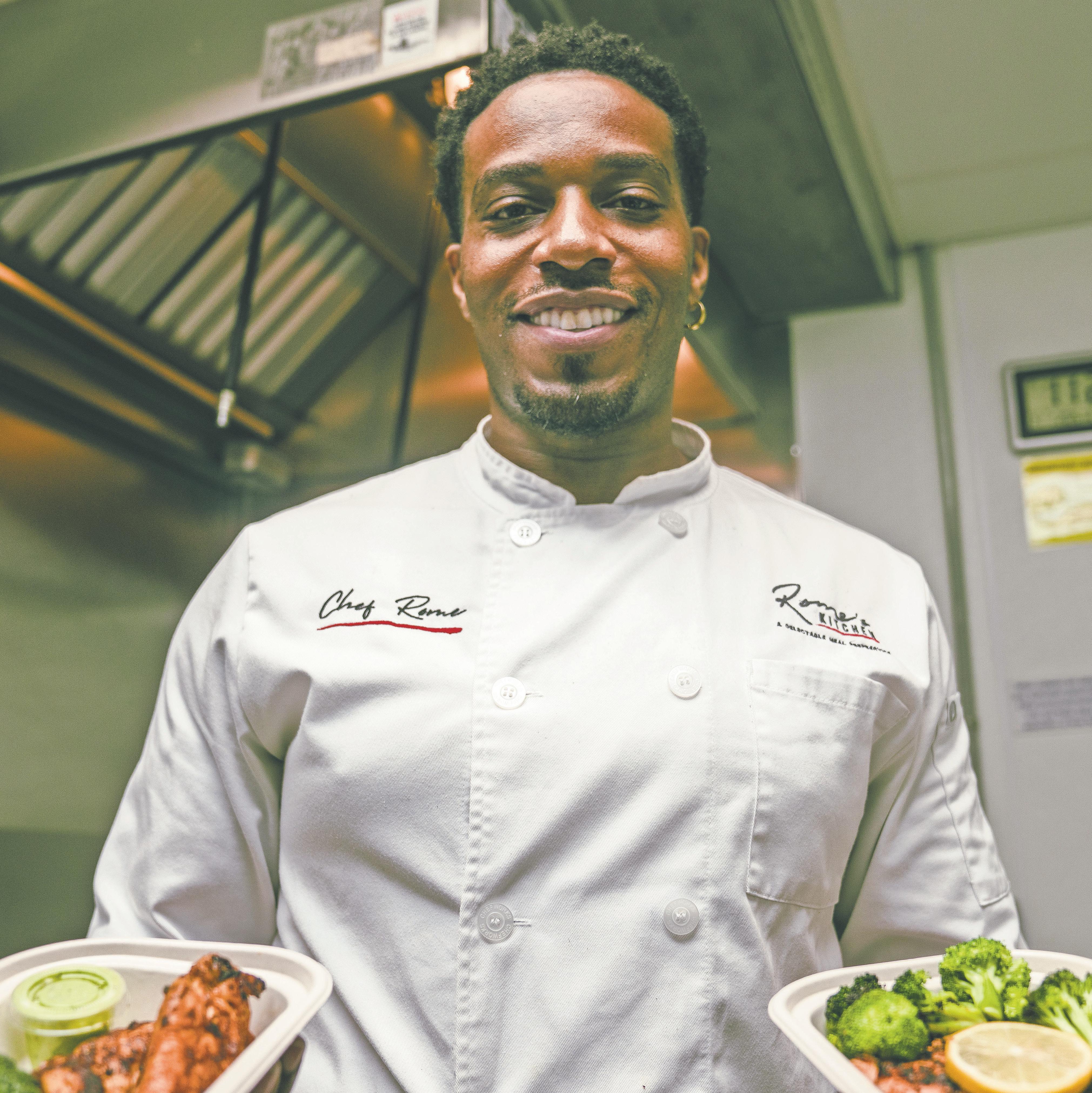
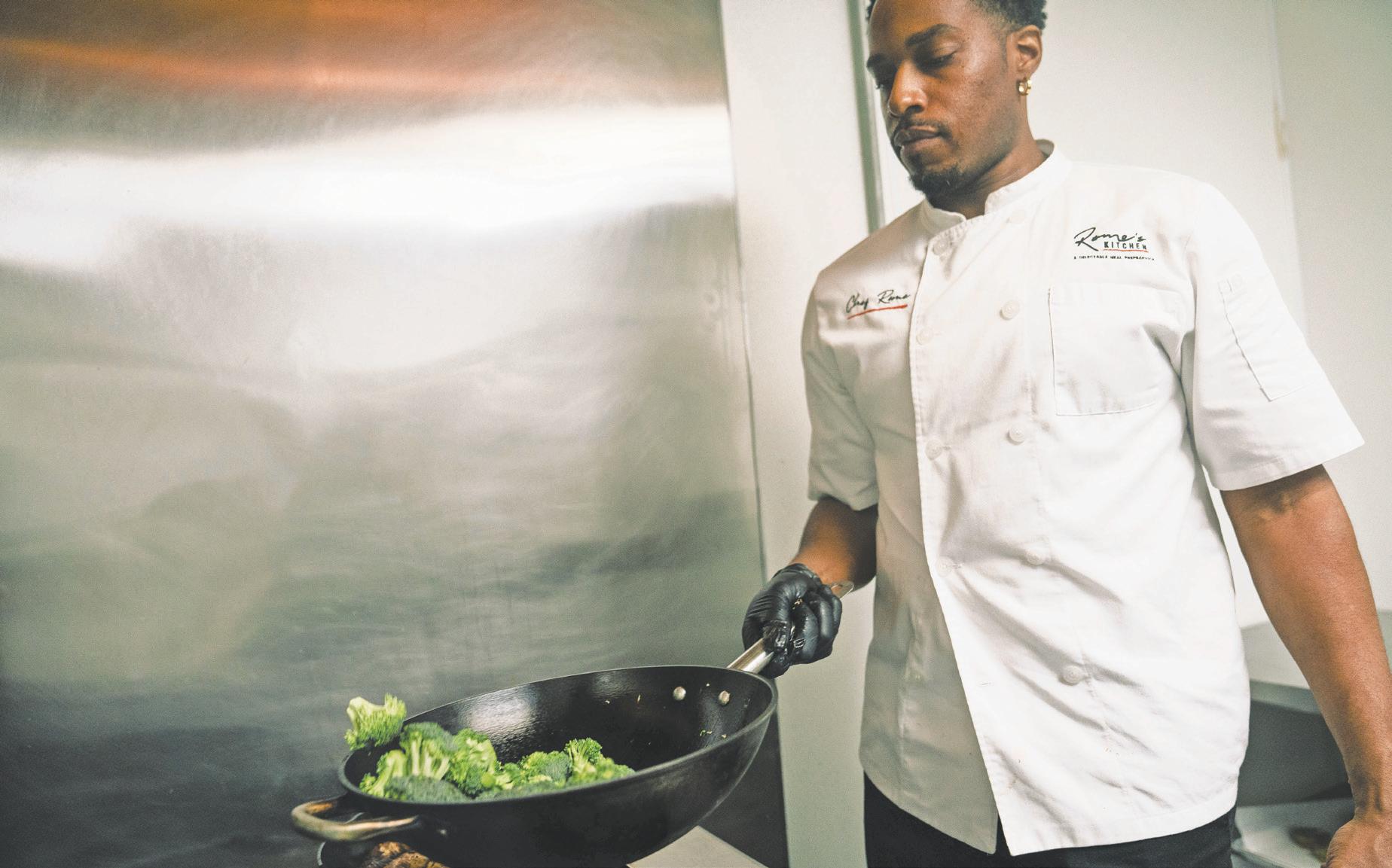
On an early chilly Friday morning inside the commercial kitchen, PREP, chef Rome, founder of Rome’s Kitchen ATL, begins prepping 35 meals for one of his clients while “Int’l Players Anthem (I Choose You) by UGK featuring OutKast is playing in the background.
35 meals normally take him about two hours, because everything is planned out ahead of time.
While making grilled chicken, Mediterranean salmon, seasonal vegetables, and Korean BBQ ground turkey, Rome spoke to The Atlanta Voice about his journey with cooking, being laid off from his corporate job, the importance of meal prepping, and more.
Rome’s Kitchen ATL
Chef Rome’s love of cooking started when he was seven years old, learning from his dad, who was a self-taught chef.
“My dad wanted me to learn how to cook, so he would teach me, and I always stuck with it because I enjoyed doing it,” he said. “It became a passion of mine, and I eventually wanted to elaborate on and learn different things about cooking
Rome’s Kitchen started because he felt there was a need to bridge the gap between nutrition, labor, and enjoying meals that people do not typically see.
“People needed food that was both flavorful and functional,” he said. “As a chef, I understand nutrition, culture, and community, so I felt like Atlanta was the perfect place to do that.”
Rome’s Kitchen ATL began in August 2024, three days after being laid off from a corporate job he had had for years.
“I wanted to do something at that point, something I loved and did not feel like work anymore,” he
said. “I knew cooking was that, and I wanted to give it a shot, so I tried it. Three days after being laid off, I started the business, and I’ve had clients and customers every weekend since.”
Rome says one of the biggest parts to helping him get Rome’s Kitchen ATL started was his ability as a graphic designer.
“I’m also a web designer, so I designed the website and started the Instagram page around the same time I was laid off,” he said. “My personal page took off with support from my followers, and within the first two to three weeks of starting, I was averaging about 70-80 meals a week in my apartment.”
This, in turn, further solidified his passion and direction, as he now meal-preps for his clients full-time.
Rome’s Kitchen ATL focuses on creating healthier options through a meal-prep-style menu, while offering distinct flavors.
“What started as my own Sunday
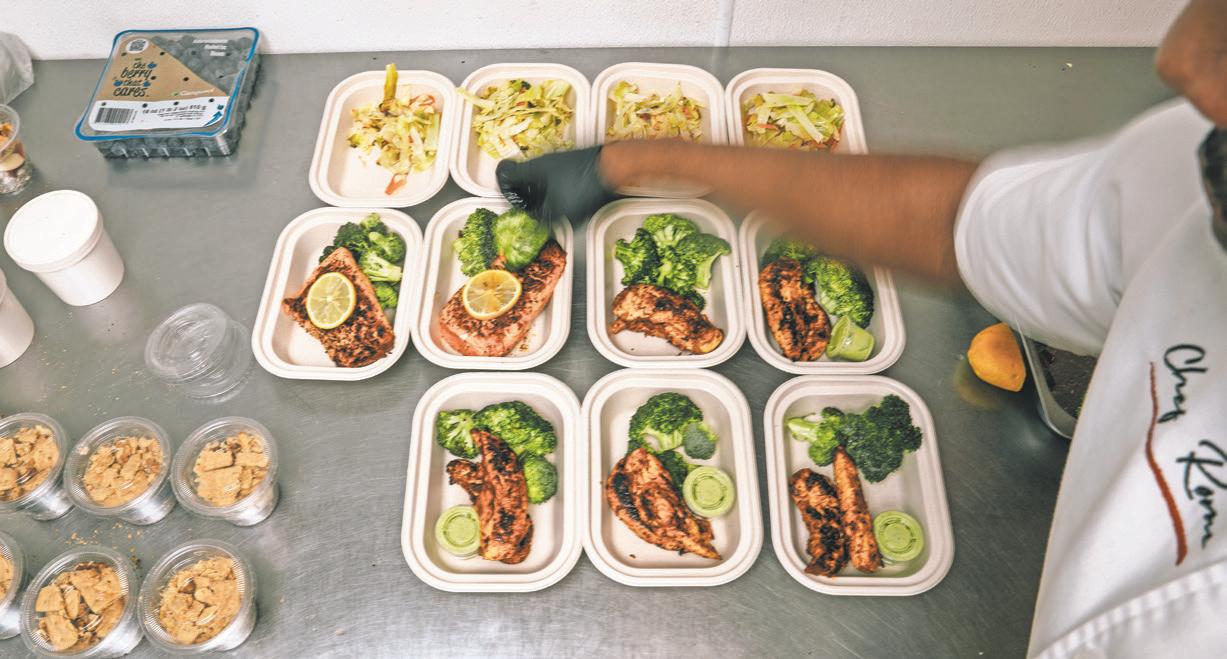
meal-prep routine quickly turned into a concept. I would experiment with different cuisines like Thai and Caribbean, build out menus for myself, and that’s what eventually evolved into Rome’s Kitchen,” he said.
Clients will order their meals on the website by Friday midnight. Rome will do the shopping on Saturday, and on Sunday morning he’s in the kitchen prepping meals for his clients. It’s a 12-hour turnaround from start to finish.
“I start cooking between the hours of four and eight on Sunday mornings and deliver the meals later that night from 4 p.m. to 8 p.m.,” he said.
When it comes to why he wanted to focus on meal preparation, he says he feels there’s a negative connotation around healthy food. He says he wanted to show people you can still enjoy the meals you love, like soul food, by swapping out ingredients and making them something you can eat daily.
“Most meals we enjoy, it’s not something you can eat continuously, so I swap out certain ingredients, make a few changes to it, but I try to stick to the same flavor,” he said.
Additionally, Chef Rome says he has an alternating menu where he brings back items his clients love.
“I challenge myself to explore different cultures through food and keep raising the creative bar. I’m open to experimenting, and that works in my favor because nearly 90% of my clients are long-term subscribers,” he said.
because he loves what he does and his food, and I love to see the smile on his client’s face when they talk about how good the food is,” she said.
As a mother, Jones says, when you see something your child loves to do, continue to encourage them, support them, and be their biggest fan.
“I am his biggest fan, I’m the taste tester, and it’s just a beautiful thing to witness his creations and his dreams come to life,” she said. “I also love to see his clients rave about how he changed their lifestyles, making them healthier.”
Rome says the subscription starts off with four weeks, so you get charged on the same day for four weeks, and you get your meals delivered. “I rotate that throughout the weeks, and my clients love it,” he said. “By Thursday of the following week, after they have received their meals, I send them an email or text for feedback on what they liked, what they didn’t like, or if there are any changes they’d like to see because I care about how they feel. I’m servicing them.”
Support & the future
Rome says his family was not surprised when they learned of his next moves after being laid off.
When he first started Rome’s Kitchen ATL, he wanted to get the biodegradable bowls, but didn’t have the funds for them, so his family all pitched in and got him his first set.
“There’s a group chat with me, my mother, and siblings, and I reached out to my family about me starting the business, and I told them about the bowls,” he said. “They all send me money, and I went to get them right away, and ever since my first week, it’s been taking off. They all were really excited for me and to see where this goes, my mom especially is incredibly grateful and she loves it.”
His mother, Janise Jones, also showed up to the kitchen to express how proud she is of her son and told him to keep moving forward.
“I’m proud of him, and I appreciate the love he put into his food,
In the next five years, Rome sees Rome’s Kitchen ATL expanding to other cities like his hometown, Chicago, and Washington, DC. In today’s time, it’s more convenient to grab meals from fast food restaurants and seek out less unhealthy options. Chef Rome says he also would also like to open a brick-andmortar location for Rome’s Kitchen within the next five years.
“I want to compete with fast food places and let people know there are other options out there that are cleaner. On the menu, you can see all my ingredients down to anything I buy from the store,” he said. “This concept makes people make better decisions because most of the time, people decide to get fast food based on convenience and may not have the accessibility to something cleaner.
He also said sometimes, you may not be able to fully dive into your dream, and you may have to work a normal 9-5 job until you can stabilize yourself.
“You may have to work a corporate job and do both at the same time, but there will come a time and place where you must venture out and step out on faith,” he said. “That was the biggest thing I could have done, which was taking that leap of faith and believing in myself.”

By ISAIAH SINGLETON
The Georgia Senate Public Safety Committee held another hearing for House Bill 61, known as the “Georgia Anti-Squatting Act of 2026”, which aims to hasten the removal of unauthorized occupants from residential properties, including hotels and cars, allowing immediate lockouts, and treating nonpayment as criminal trespass.
The bill was passed by the committee (7-2) in March 2025, which sets up a process for requiring law enforcement officers to remove people accused of illegally staying at a residential property. However, a “zombie bill” resurfaced that would make it easier for extended-stay hotels to evict long-term residents on the spot.
Under House Bill 61, people who stay in residential properties, hotels or cars without the owner’s express permission are guilty of misdemeanor unlawful squatting. Any person violating the law would be subject to having law enforcement officers remove them from the property within 10 days of notification.
Section 5 of HB 61 says if an extended-stay resident fails to pay the hotel fee (or the hotel refuses to accept payment), they can immediately be denied access to the room, their personal property can be seized, and held until any past-due fees are paid, and law enforcement can be summoned to arrest them if they do not immediately vacate the property).
Housing rights advocates argue it harms low-income, long-term residents in extended-stay hotels, especially with children. The bill would change how long-term residents of extended-stay hotels are treated under Georgia law by:
• Allowing immediate lockouts
• Requiring removal without a court process
• Treating nonpayment as criminal trespass
• Reversing the Georgia Supreme Court’s 2023 Efficiency Lodge decision, which recognized long-term residents as tenants entitled to judicial eviction
Many working families, including families with children, use extended-stay hotels as a last housing possibility. These changes could result in removal without sufficient time or legal process to secure alternative housing. Families often pay more than traditional apartment rents for these rooms. Other research shows many residents stay in these settings for extended periods, often for years.
A 2026 Georgia State University study found that in DeKalb County alone, over 4,600 people, including 1,635+ children, live in extended-stay
hotels as “shelters of last resort”. Families spend an average of 77% of their income on rent, with 45% of households staying for 1-5 years, and 16% staying over five years.
Last year, senate republicans implanted the extended-stay eviction provisions from a failed bill, HB 183, into HB 61, which regulates license plates for hearses and ambulances, so the altered HB 61 never passed through any House committee.
Additionally, over 8,800 Georgia kids live in extended-stay hotels, according to Marietta Republican Representative Devan Seabaugh (District 34).
“House Bill 61 is a targeted, balanced, public safety and property rights measure that closes critical loopholes in Georgia law that have been exploited by squatters, fraudsters, and individuals unlawfully occupying property,” he said.
By NOAH WASHINGTON
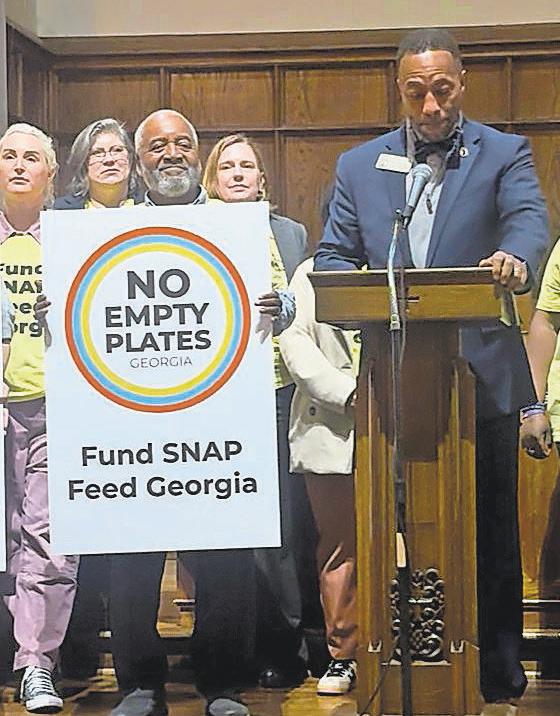
Civil rights groups, lawmakers and community advocates gathered Wednesday, Feb. 4, at Rand Chapel of Central Presbyterian Church to urge legislators to fully fund the Supplemental Nutrition Assistance Program (SNAP). They warned that looming federal cost shifts could deepen food insecurity for families across Georgia.
The press conference, titled “No Empty Plates: Affordability for Every Georgia Family,” was organized by the Southern Poverty Law Center, the Georgia Budget and Policy Institute and a coalition of advocacy groups. Speakers said action is needed this legislative session as federal changes beginning in 2026 shift a greater share of SNAP administrative costs from the federal government to the states.
More than 1.3 million Georgians rely on SNAP to help cover food costs, according
to advocates, including roughly 1.4 million residents statewide, nearly half of whom are children. Nationally, SNAP serves about 42 million people and has been shown to reduce food insecurity by as much as 30 percent, while improving long-term health and educational outcomes.
State Rep. Derrick Jackson, said SNAP recipients are often working families struggling to keep up with inflation and rising grocery prices. He pointed to the federal government shutdown last fall as a warning sign of how quickly food insecurity can escalate.
“When that support wavered, the anxiety in our community was palpable,” Jackson said, noting that food pantries in Fulton and Fayette counties were stretched beyond capacity. “Our food banks are heroic, but they cannot do this work alone.”
Ife Finch Floyd, director of economic justice at the Georgia Budget and Policy Institute, said changes under HR 1, a federal tax
“Importantly, House Bill 61 creates a new felony offense for presenting a fake lease deed or rental agreement to remain in possession of a property. This address is one of the most common tactics used to delay removal,” he said. “This bill is carefully balanced and preserves due process, protects legitimate tenants with valid leases, provides civil remedies for wrongful removal, and includes clear safeguards for both property owners and law enforcement officers.”
House Bill 61, Seabaugh said, is not about eviction reform, but is about addressing situations where no lawful tenancy exists, where property is being occupied through trespass or fraud, and where public safety and property rights are at risk for these reasons.
“House Bill 61 stands for a necessary refinement of Georgia’s squatting laws that reflects the input of law enforcement and industry stakeholders and provides clear constitutional tools to address a growing problem,” he said.
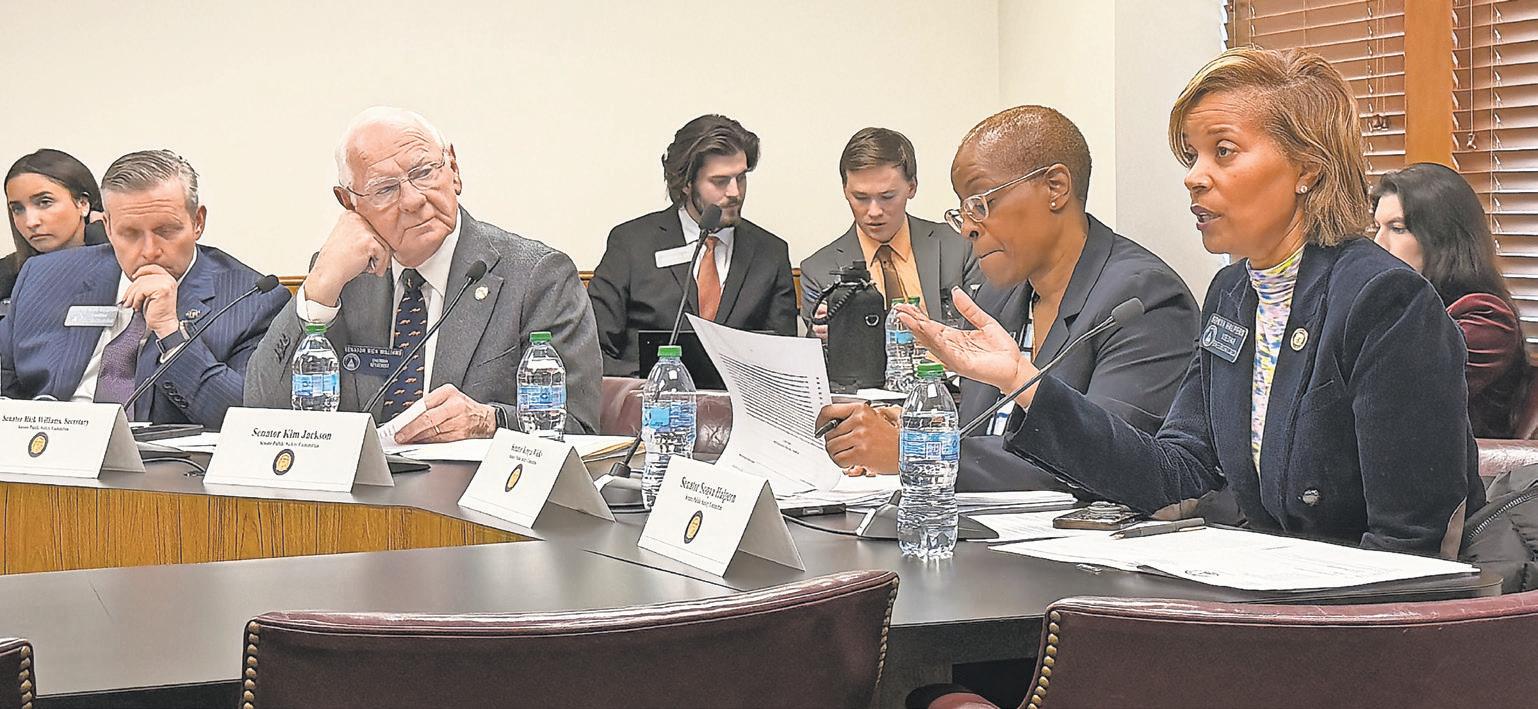
Senator Rick Williams says his concern is about some families living in hotels because they cannot pay the first or last month’s rent.
“They may have been evicted before, they are in hard times, and they have small children,” Williams said. “I would hate to see an innkeeper put a family out with small children during this extremely freezing weather, and these people have nowhere else to go. These are people who are helpless, so how do we help them without hurting them?”
CEO of Explore Gwinnett, Lisa Anders, says in her experience, most people they are currently struggling with are individuals who are systematically abusing the system because they are aware they can.
and spending law passed last summer, would increase Georgia’s share of SNAP administrative costs from 50 percent to 75 percent starting this fall. Without full funding, Finch warned, the state could face nearly $47 million in losses and risk hundreds of millions of dollars in future penalties tied to benefit payment errors.
“SNAP is the largest and most impactful anti-hunger program in the country,” Floyd said. “If we fail to fund administration properly, families will feel the consequences first.”
Isabel Otero, policy director at the Southern Poverty Law Center, said families are being asked to absorb the consequences of political decisions they did not make.
“SNAP is how hundreds of thousands of our neighbors keep food on the table,” Otero said. “Too many families are being asked to carry the cost of choices they did not make and cannot afford.”
By RANN MILLER
Let’s set the record straight: “Say her name” shouldn’t be used for everyone who is unjustly killed at the hands of the state.
To be more specific, it ain’t for white folks. And yes, I meant to say “ain’t.”
The hashtag, #SayHerName, isn’t simply a one-off catchphrase. It is a social justice visibility movement that Dr. Kimberlé Crenshaw, a professor at UCLA Law School and Columbia University Law School, created to highlight law enforcement violence against Black women and girls within an anti-Black society. It shone a spotlight on the killing of Sandra Bland, the 28-year-old Black woman who died in Texas after allegedly assaulting a police officer during a traffic stop.
Since its creation in 2017, it has evolved into a rallying cry — one that has been used way too often for far too many Black women killed by law enforcement or found dead in official custody.
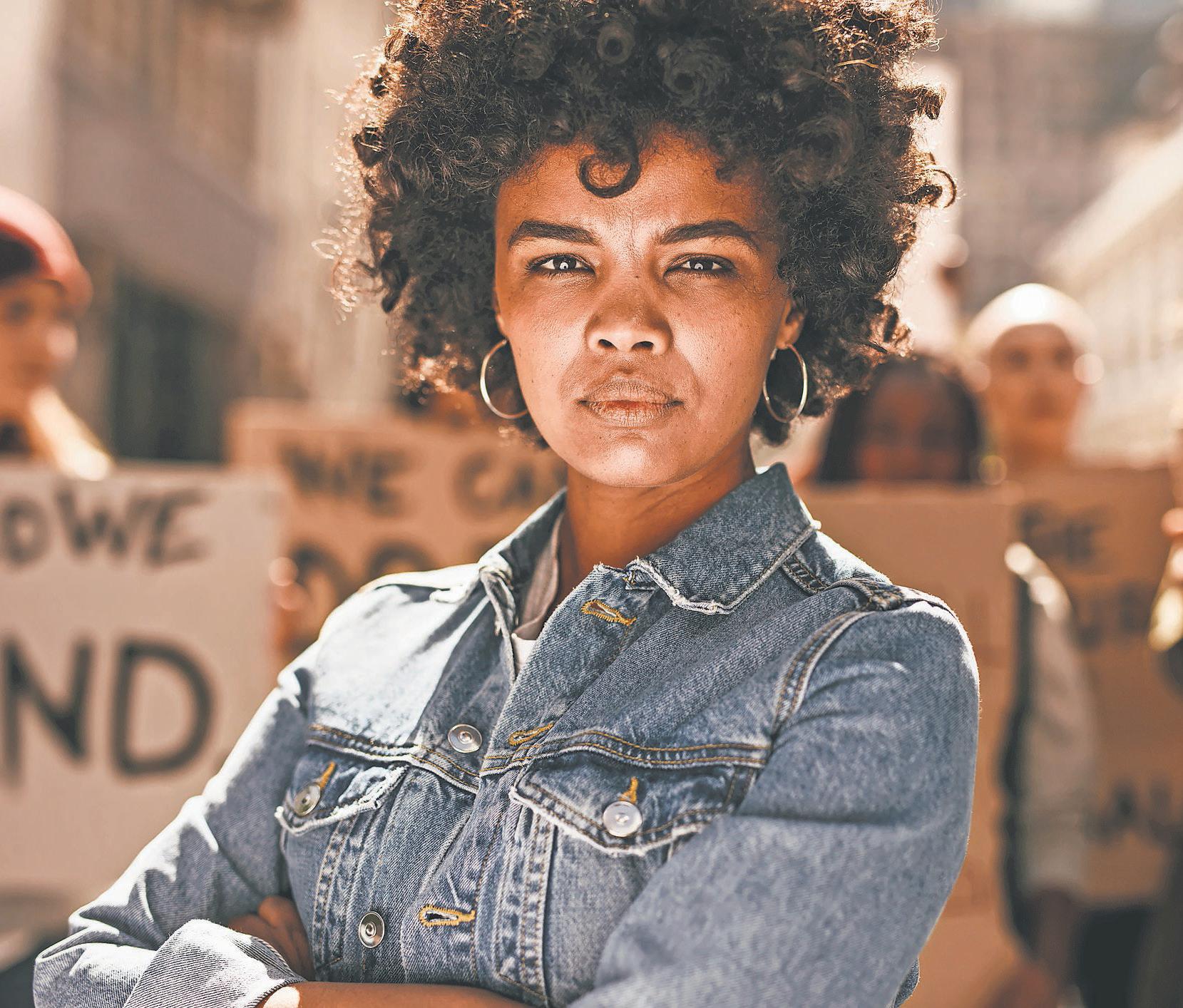
Now, white activists in Minnesota, angry at the federal Immigration and Customs Enforcement agents who killed Renee Nicole Good, are using #SayHerName in social media posts and shouting it in protests on the snow-covered streets of Minneapolis. And it’s not a good look.
ICE, Not Invisibility, is the Problem
Let me be clear: it’s outrageous that an ICE agent shot and killed Good, 37, without justification, at point-blank range, and illegally. The Trump administration made things worse when it branded her a terrorist, sent more immigration agents to the city, and declared it would not investigate her death. People in Minneapolis and across the country are right to demand accountability for her murder, and they are right to demand that ICE leave their city.
But protesters shouldn’t co-opt #SayHerName to do it.
People have been saying Good’s name from the moment she was killed Jan. 7 inside her SUV while attempting to steer away from ICE agents confronting her on an icy residential street. The presence of ICE paramilitary troops is also responsible for the murders of Alex Pretti and Keith Porter, Jr., in Los Angeles.
Within hours of Good’s slaying, the news made national headlines, just like the murders of Heather Heyer, who was run down by a white supremacist during the 2017 “Unite the Right” rally in Charlottesville, Virginia, and Justine Damond, shot to death by a Black Minneapolis cop that same year. Good, Heyer, and Damond were all white women.
But Bland’s death was just as outrageous. She was found hanging in a Walker County, Texas, jail cell three days after a heated confrontation with an officer during a routine traffic stop. A coroner ruled her death a suicide, but her family rejected that. Despite repeated demands, no one
— not the aggressive cop who arrested her, nor the jail guards responsible for her safety — has answered for her death.
If it weren’t for the #SayHerName campaign, few people would know about Bland or the circumstances of her senseless death. That’s not an accident.
Studies show that the murders and disappearances of white women receive disproportionate attention in the news and public discourse, especially when compared to those of Black women. It’s problematic, which is why Crenshaw created #SayHerName in the first place. Before then, Bland was anonymous, and her death was a mystery. The campaign helped her be seen.
More broadly, using the hashtag to protest Good’s killing is yet another example of white people co-opting Black language. The Trump administration has weaponized “woke,” is using the language of the civil rights movement to dismantle actual civil rights, and the far right used “say her name” to publicize the death of a January 6 rioter. Usually, whites talk like Black folks to make a profit, become relevant, become the center of attention, or mock Black people.
Co-opted and Tone-Deaf
It’s a fact that white people appropriate the everyday phrases and cadence of Black speech, too, not just what’s culturally significant; I see it all the time on social media. Unfortunately, I’ve also witnessed white folks do it at work, to sound cool or appear cool to Black people. It’s
problematic, considering how Black language is stigmatized as uneducated or uncouth in certain spaces.
Most importantly, the tone-deaf use of #SayHerName to protest Good’s killing ironically illustrates society’s collective failure to act on behalf of Black humanity, particularly after Black women spoke up.
A Black woman coined the hashtag to rally support for the end of law enforcement killing Black women, but it’s bigger than that. Historically, policy outcomes that benefit Black people typically benefit everyone. The Civil Rights Act of 1964 and the Voting Rights Act of 1965, making it easier for all people to register to vote, are evidence of that.
However, the warnings of Black women are often disregarded and dismissed. Maybe it’s because most folks aren’t Black women, or aren’t emotionally connected to Black women, or simply don’t care about Black women or Black lives in general. But they should.
To interpolate the famous poem, first they came for Black people, but no one spoke out because they weren’t Black women. Then, when they came for those who were silent, the silent found no one was left to speak for them.
Maybe, had they spoken up when Black folks sounded the alarm, laws would have been in place to prevent the murder of Renee Nicole Good.
Rann Miller is an educator, opinion columnist and author or Resistance Stories from Black History for Kids.
FOUNDED
May 11, 1966
FOUNDER/EDITOR
Ed Clayton
Immortalis Memoria
PUBLISHER/EDITOR
J. Lowell Ware
Immortalis Memoria
The Atlanta Voice honors the life of J. Lowell Ware.
PUBLISHER
Janis Ware
PRESIDENT/
GENERAL MANAGER
James A. Washington 2018-2024
EXECUTIVE ASSISTANT TO PUBLISHER
Chia Suggs csuggs@theatlantavoice.com
EDITOR IN CHIEF Donnell Suggs editor@theatlantavoice.com
GENERAL ASSIGNMENT REPORTERS
Isaiah Singleton isingleton@theatlantavoice.com
Laura Nwogu lnwogu@theatlantavoice.com
Noah Washington nwashington@theatlantavoice.com
BUSINESS REPORTER
Tabius H. McCoy tmccoy@theatlantavoice.com
EDITOR AT LARGE
Stan Washington swashington@theatlantavoice.com
ADVERTISING, SALES & CIRCULATION
ADVERTISING ADMINISTRATOR
Chia Suggs advertising@theatlantavoice.com
SALES
RDW Jackson rdwadman@gmail.com
SUBMISSIONS
editor@theatlantavoice.com
DIRECTOR OF PUBLIC RELATIONS
Martel Sharpe msharpe@theatlantavoice.com
CONTACT INFORMATION
633 Pryor Street, S.W. Atlanta, GA 30312
Office: 404-524-6426 info@theatlantavoice.com

SPONSORED BY JPMORGANCHASE
You’ve put in the late nights, the weekends and the hustle. And now, what started as an opportunity to make extra money has turned into an enterprise with real potential.
If you handle everything on your own – logistics, production, marketing, finances and everything in between – you’re part of a growing group of entrepreneurs nicknamed “solopreneurs.” While the image of a small business often includes an owner and a few employees, for many entrepreneurs, “solopreneurship” makes the most sense for their business model and goals.
If you’re considering the solopreneur life or have already launched your business, Nicola O. Roberts, a JPMorganChase Senior Business Consultant in Atlanta , offers five helpful tips for you to grow your business in 2026.
Identify or solidify a business opportunity.
If you want to become a solopreneur or enhance your current offerings, look for a need in Atlanta or come up with an innovative idea.
Maybe it’s a service that can help others or a product that could enhance or simplify their lives.
Once you have your big idea, careful planning and preparation can give your startup its best shot at becoming a success. That can include researching your industry’s trends to see if you’re meeting a niche or a growing need. Look for long-term demand and understand your total addressable market, not just seasonal or trendy success.
Make a business plan.
Start by writing or refining a business description to outline your goals and strategy. Your plan doesn’t have to be long, but it should outline your mission, goals, competitive analysis, marketing approach and financial forecasts.
If you’re already running a business, examine your customer base. Do you have repeat customers? Are they referring others to you? Side hustles that work have a steady and growing customer base. If yours does, it’s a positive sign your business may be ready for the next step.
Maximize savings to impact growth.
Many entrepreneurs use some personal savings to get their businesses started but also pursue business lines of credit or small business loans to fund equipment and marketing plans. No matter how you get started, prioritizing saving along the way will help secure the funds you need to get your business up and running. One powerful tool for solo entrepreneurs is the new Solo 401(k) from JPMorganChase. This plan is designed for business owners without full-time employees, apart from their spouse, and allows for high annual contributions — up to $72,000 for themselves and their spouse — with both pre-tax and Roth options.
The key is consistency. According to data from Chase, while Solo 401(k) accounts are a popular choice for self-employed business owners, 70% didn’t contribute in the past year. Building small, sustainable habits — such as setting up automatic monthly contributions or scheduling quarterly check-ins with a financial advisor — can strengthen follow-through. Over time, these simple actions add up, helping ensure Solo


401(k) accounts reach their full potential and deliver meaningful long-term results. You could also look for additional financing from angel investors—wealthy individuals that can provide small investments, usually in the very early stages of a business. Angel investors accept more risk but want an ownership stake. Crowdfunding can also be beneficial for solopreneurs. With the right product and approach, you can raise small dollar amounts from a large pool of individual online backers with the bonus of connecting with your target customers early on.
Develop your marketing and brand strategy.
Define your brand voice and value proposition and choose the right marketing channels for growth. You might explore channels such as social media, email marketing or paid advertising. As you set a realistic marketing budget, consider the cost of tools, advertising and outsourced services like graphic design or content writing. Start small, measure results and scale what works.
By LAURA NWOGU
With a little over 100 days until the 2026 FIFA World Cup lands in Atlanta, business owners and locals are prepping for the deluge of soccer fans, fun activations, and profitable opportunities that will accompany the biggest sporting event in the world. Atlanta Mayor Andre Dickens and the City of Atlanta’s business leaders gathered on the second floor of City Hall on Tuesday to announce resources and grants designed to help Atlanta entrepreneurs prepare for and participate in major global events.
“When events like the FIFA World Cup 2026, the Super Bowl, the Final Four, and the rest of these events come to our town, I want to see that what they do happens with Atlanta and not to Atlanta. That belief led to the creation of Showcase Atlanta. One of our city’s greatest strengths, both culturally and economically, is our small business community,” Dickens said.
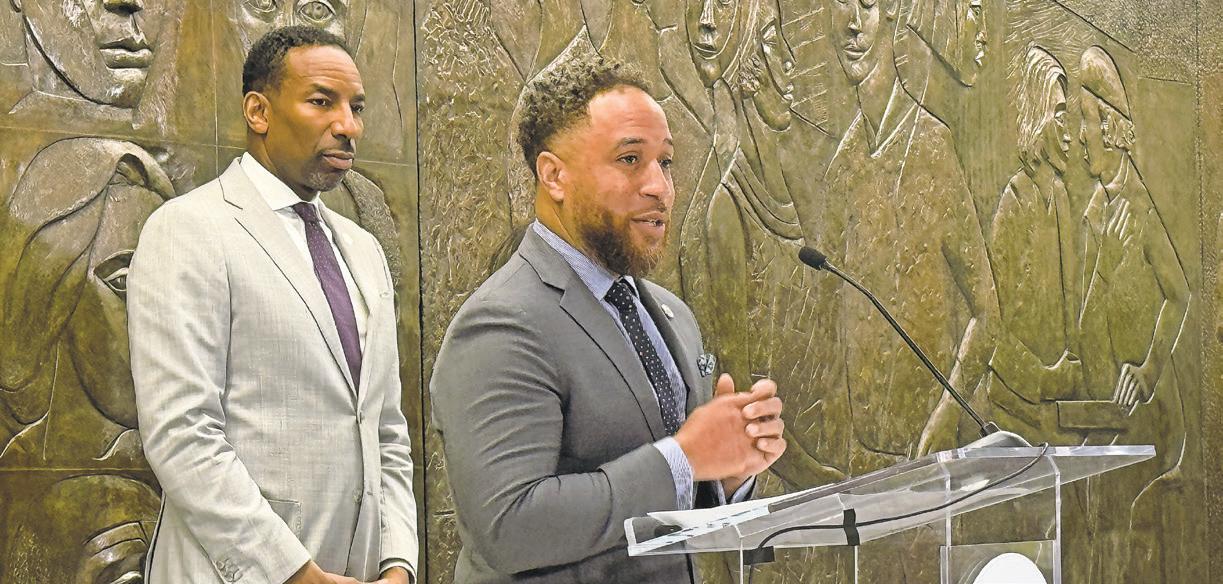
Artsyoung people under 21 who are interested in starting and growing a business. Through the program, young aspiring entrepreneurs will receive tailored training on how to form a legal business, obtain a vendor license, participate in high-visibility marketplaces across the city, and provide pathways to vend at designed city events. A select few will receive a special ATL youth vendor license, which will allow them to obtain funding and a vendor space to sell their goods during the FIFA World Cup.
Showcase Atlanta is a regional leadership initiative dedicated to ensuring Atlanta’s diverse business community is front and center as large-scale events come to the city. At the press conference, Dickens announced the Showcase marketing grant program, which provides eligible businesses in the Downtown Atlanta, Castleberry Hill, and Westside areas up to $5,000 in grants to increase visibility and customer engagement during national and global events.
To qualify, the business must:
• Be a local, small business located in the City of Atlanta
• Have a City of Atlanta business license
• Have been operating and in good standing for the past 12 months Advancing his Year of the Youth initiative, Dickens also announced the Showcase Atlanta Youth Entrepreneurship Accelerator, a program that is a part of the FIFA Human Rights Action Plan. The accelerator program will identify “exceptional”
“We spent some time listening to what businesses are telling us, and they’re telling us what they need: access to, capital, visibility, marketing support, workforce connections, and clear and trusted information around the World Cup events. Today’s announcements highlight access to funding resources, workforce opportunities, pop-up activations, educational workshops, and more,” Dickens said.
The loans will amount to between $5,000 and $15,000 with a 5% match, allowing up to 115 businesses to benefit from the program. Payments on the loans won’t start until August.
A.J. Robinson, president of Central Atlanta Progress, announced the Downtown Pop-up Opportunity Fund, which will award a limited number of grants to eligible landlords seeking to improve and occupy their vacant retail storefronts. Lamar Stewart, interim executive director of Showcase Atlanta, introduced the Small Business Readiness Online platform, where registered small businesses can receive personalized curricula after an assessment to help them gear up for largescale events and open additional funding pathways.
In conjunction with the initiatives that Showcase Atlanta put forth, Eloisa Klementich, president and CEO of Invest Atlanta, announced additional funding for small businesses during large-scale events. The Atlanta Business Readiness Loan Fund is designed to help small businesses prepare and capitalize on large events by aiding them in obtaining the capital to hire staff, purchase inventory, upgrade equipment, and strengthen overall operations.
By NOAH WASHINGTON
Anew photography exhibition opening this week at the High Museum of Art invites visitors to reflect on the emotional weight of modern American life, from suburban expansion and political tension to climate anxiety and uncertainty about the future.
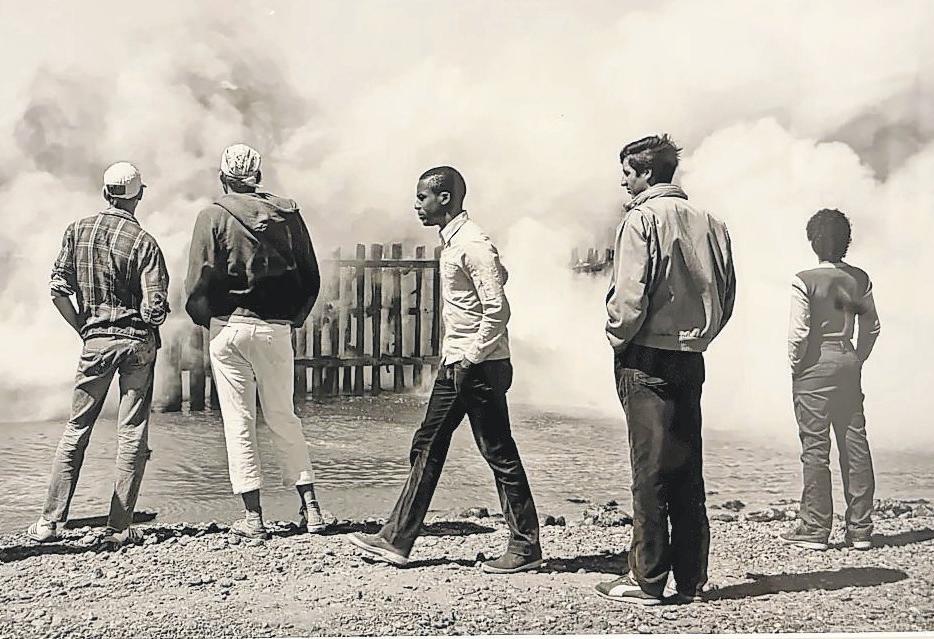
“Blazing Light Photographs by Mimi Plumb” opens Friday and marks the first solo museum exhibition of photographer Mimi Plumb’s work. The exhibition spans more than five decades, bringing together images made from the early 1970s through recent photographs created during ongoing drought conditions in the American West.
Although much of the work was made in California and across the West Coast, Plumb said the themes extend well beyond geography. “The things that I’m looking at are things that are affecting all of us,” she said during a walkthrough of the exhibition. “It’s speaking about what life looks like when you live on the edge of the city, and what the environment looks like. Climate change is what that looks like. The threat of nuclear war, what that feels like.”
Curator Gregory J. Harris said those concerns resonate just as strongly today as when many of the photographs were first made.

“A lot of the work deals with really pressing issues that I think are pretty relatable to people,” Harris said. “This idea of political tension, cultural difference, and instability. The world is changing really quickly, and that’s disorienting.”
The exhibition is organized around three major bodies of work. The earliest photographs were made when Plumb was a teenager, documenting suburban development
outside San Francisco. Images of teenagers wandering construction sites and unfinished neighborhoods capture a sense of boredom and alienation as optimism about progress begins to fade.
“When Mimi was making these pictures, she was only a couple of years older than most of the teenagers who are in the photographs,” Harris explained during the tour. That closeness, he said, creates “a real sense of empathy
and connection” rather than distance.
Later sections of the exhibition move into darker territory, examining environmental damage and the growing presence of military and industrial infrastructure. Harris pointed to images that juxtapose historic homes with construction debris and highways as reflections on the tension between past and present and what that means for the future.
Recent photographs taken near a drought-stricken reservoir continue those themes. Plumb said she sees those images as extensions of the anxieties she felt decades earlier. Harris agreed, noting that the feeling of urgency has only intensified. “I feel more anxious now than I did in the 80s,” he said. “Back then, it felt like we still had time to change things. Now it feels more pressing.” Despite the heaviness of the subject matter, Harris said the work offers a kind of reassurance. “The pictures give shape to these really amorphous emotions,” he said. “Being able to look at them helps you wrap your head around what it’s like to live in discordant times.”
Plumb added that younger viewers have been especially drawn to the work. “Young people really made my work,” she said, explaining that many see their own fears reflected in images made decades earlier.
“Blazing Light” is on view through May 10.



By ISAIAH SINGLETON
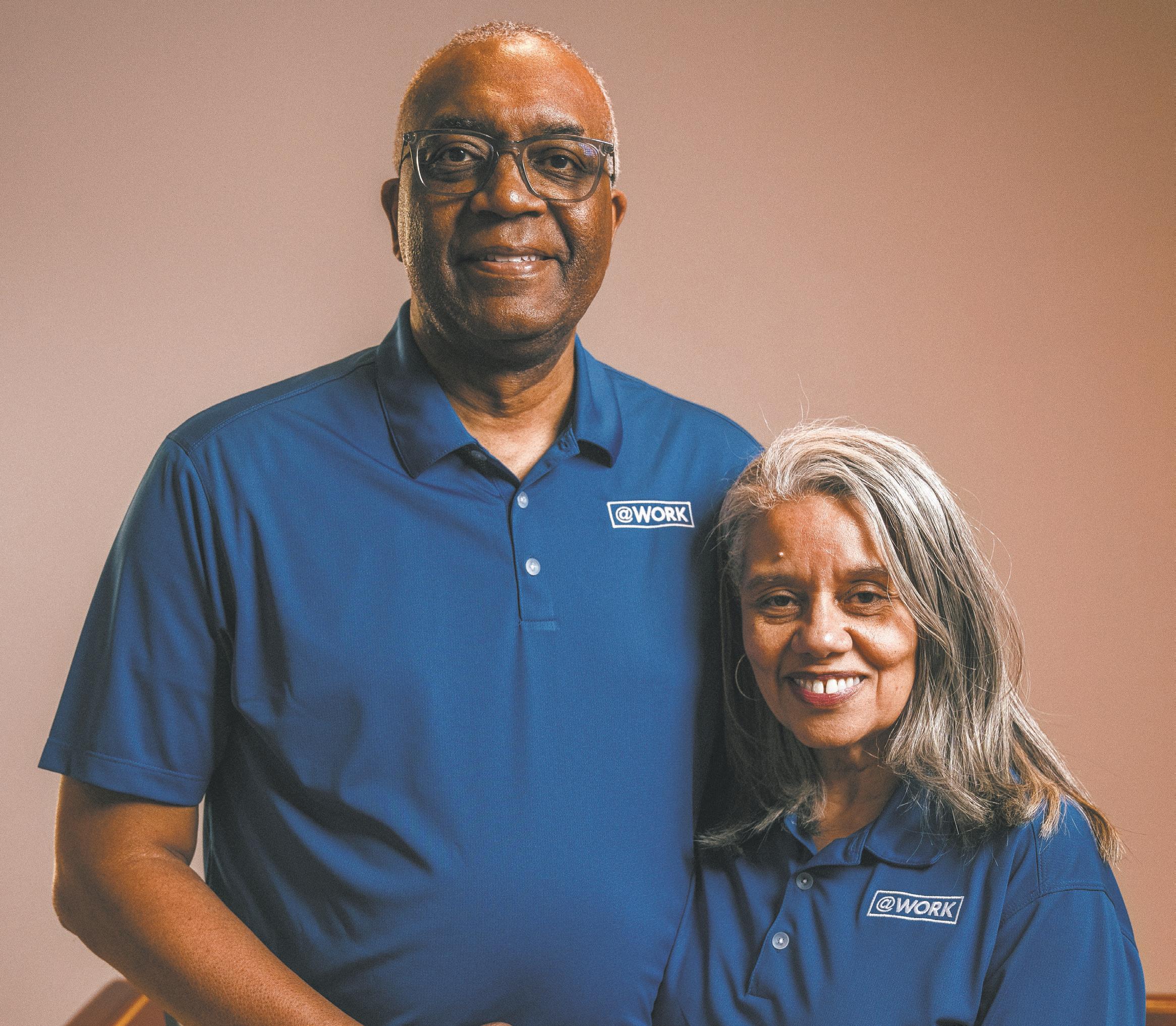
For Bernard and Pamela Solomon, love is more than a feeling, it’s a foundation. Nearly 34 years into marriage, the couple has built a life rooted in faith, family, and service, now embarking on a new chapter as franchise owners of AtWork in Forest Park. The Atlanta Voice: Where and when did y’all meet?
Pamela Solomon (PS): We met at my sister’s wedding. I was coming in from Germany, just for the wedding.
Bernard Solomon (BS): My best friend was the groom, and her sister was the bride. Prior to the wedding, I went with him to visit his girlfriend, and we met unofficially in passing. She didn’t realize that I was going to be her husband.
AV: Do you have any children or grandchildren?
PS: Three children and I am a new grammy. We had two grandkids last year. One is now 10 months old, and one is nine months old. They live in Houston, Chicago, and the baby lives in Arkansas.
AV: What’s the key to a successful marriage?
BS: I think we both will agree that we put God first. That’s the foundation. I attribute a lot of that to Pam, because when we were dating, she came from a family where her father was a pastor, and she sort of laid down the law that if we were going to continue dating, it had to be based on the right stuff. We had a bond based on our spiritual walk from that point forward, because I started getting more serious about my spiritual walk, and it made me a better person, a better boyfriend, and a better husband and father.
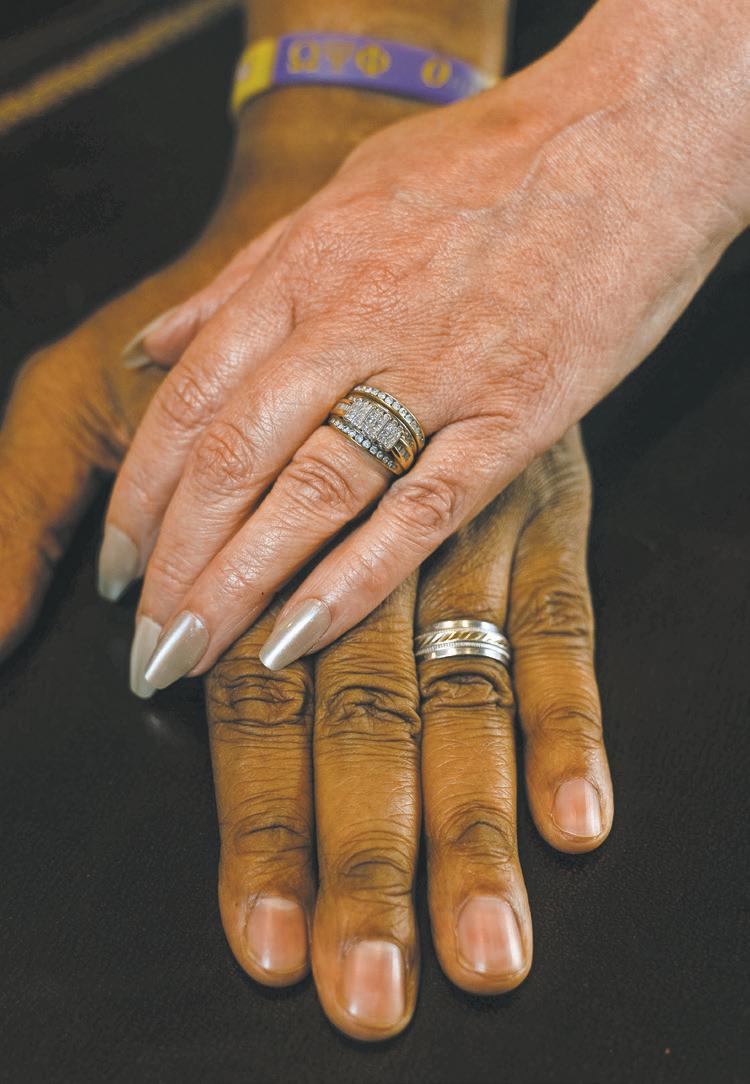
PS: We also pray every morning before we leave the house, and if there’s a visitor visiting in the home, they also come into the circle, and he leads us in prayer every morning.
AV: How do you navigate being in business together with married life?
BS: You must be able to take care of business during business time and then cut it off and take care of family and marriage during that time. Sometimes they intertwine, because if something in my marriage happens during business time, I’m going to cut that off and take care of the most important part of my life, which is the marriage and family part.
AV: Why was AtWork the right choice for you all as business owners?
BS: We did a lot of praying about it. First, I retired in 2023 and both of us have been public servants throughout our careers. Pam has worked extensively with the Veterans Administration, helping veterans and making sure that they’re taken care of after their service. And I’ve been in the public-school sector, and that’s a thankless job. Both occupations
are about giving back to the community, and we were looking at the possibility of owning a franchise and AtWork rose to the top based on the mission of that work.
PS: We’ve met and learned about people who started in talent or as employees who came into an industry, started on the ground level, and have management positions today, that’s what we want. More than just to give a person a job. We want to follow that person, so they succeed, their family succeeds, and changes the course of their lives.
AV: What do you think the next 20 years for you all will look like?
BS: It’s about continuing to set the foundation for our family legacy, to make sure that our children, our children’s children, their children, will have some options as they continue through life. The bulk of our lives, most of our years are behind us, so it’s up to me and Pam to really work on how we can help ensure our kids have viable choices and options to continue what we’ve started.
AV: What advice do you have for younger couples?
PS: Put God first and be kind to one another. Marry someone you trust because I trust him, and he trusts me. I love him and like him a lot, so it’s also why we can do business together, because you need to like your partner, and that would be my advice, those things.
BS: Be adaptable. Sometimes life circumstances will throw some things in the mix, and it may not, you may not be able to rationalize in your mind why your partner is doing certain things, but you must adapt. Give your partner the benefit of the doubt, have those conversations, then 99.9% of the time, things will work out, because if you love each other, then you don’t want to hurt your partner, and if you don’t want to hurt your partner, then you’ll have those conversations that will help you steer back toward a meaningful and productive relationship when things have gone awry.
At the end of the interview, Bernard surprised his wife with a Christian version of a Valentine’s song he wrote to promote a life with the Lord.






By NOAH WASHINGTON
As abortion access continues to narrow across much of the United States, Spelman College created space Monday for students and the public to confront the issue through film, conversation and lived experience.
The historically Black college for women hosted a screening of the HBO documentary short “The Devil Is Busy,” followed by a Q&A with director Christalyn Hampton and executive producer Soledad O’Brien. The 30-minute film, nominated for an Academy Award, follows Tracii (last name not disclosed), the head of security at Feminist Women’s Health Center in Atlanta, over the course of a single day as new legal restrictions and constant protests surround the clinic.
The event was introduced by Shola Lynch, the Diana King Endowed Professor of filmmaking and director of Spelman’s documentary film program. Lynch, who leads the college’s effort to educate what she called “the next generation of narrative nonfiction storytellers,” framed the screening as both a professional opportunity and a deeply personal one for the students in attendance.
Shot in a cinéma vérité style, the film offers a direct look at the daily reality inside the clinic. Patients arrive seeking abortions and other medical services, including routine checkups and preventive care. Tracii and the staff respond with a series of safety measures: checking the building for intruders, coordinating with security guards who escort patients in and out, and using numbered systems
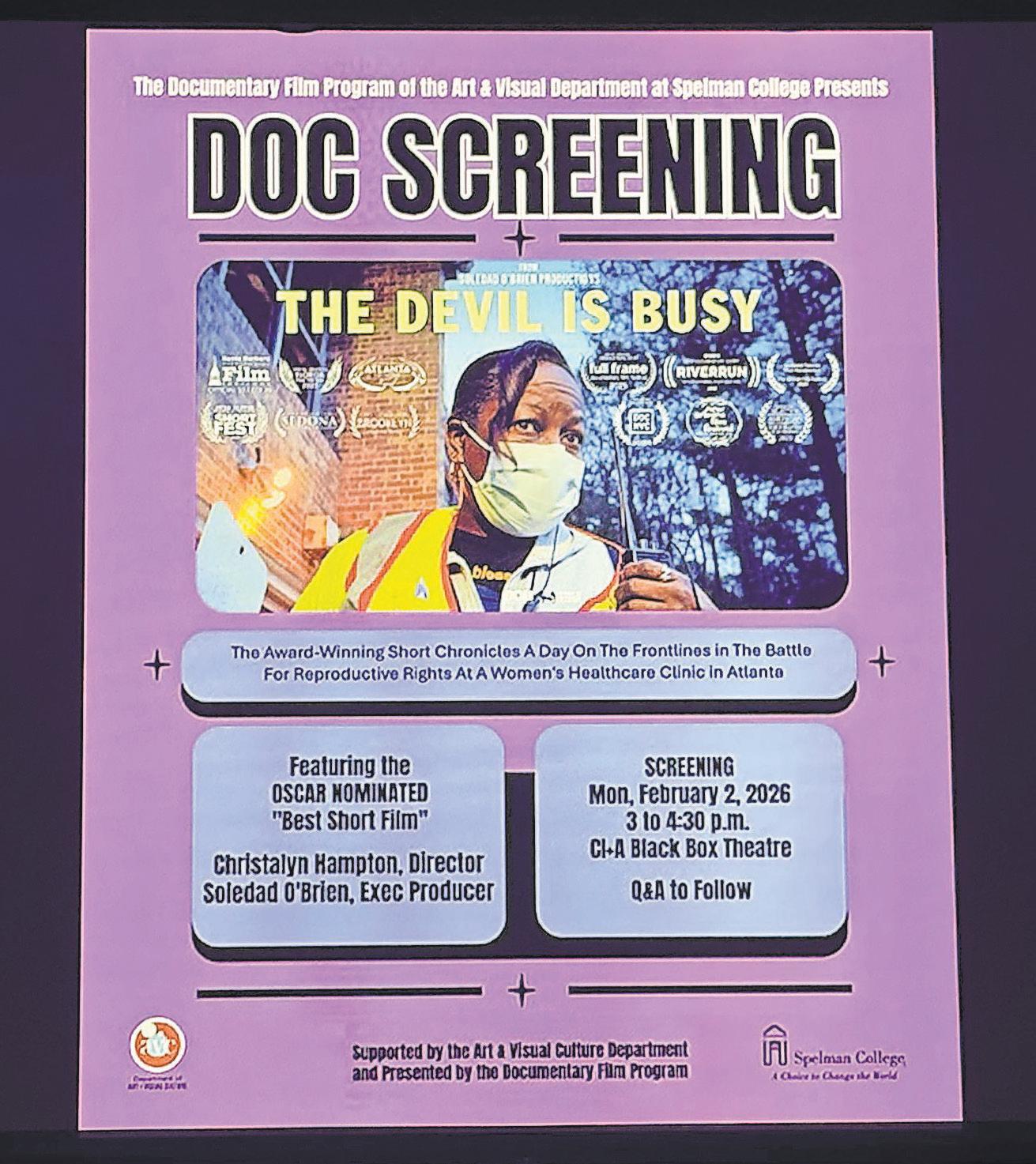
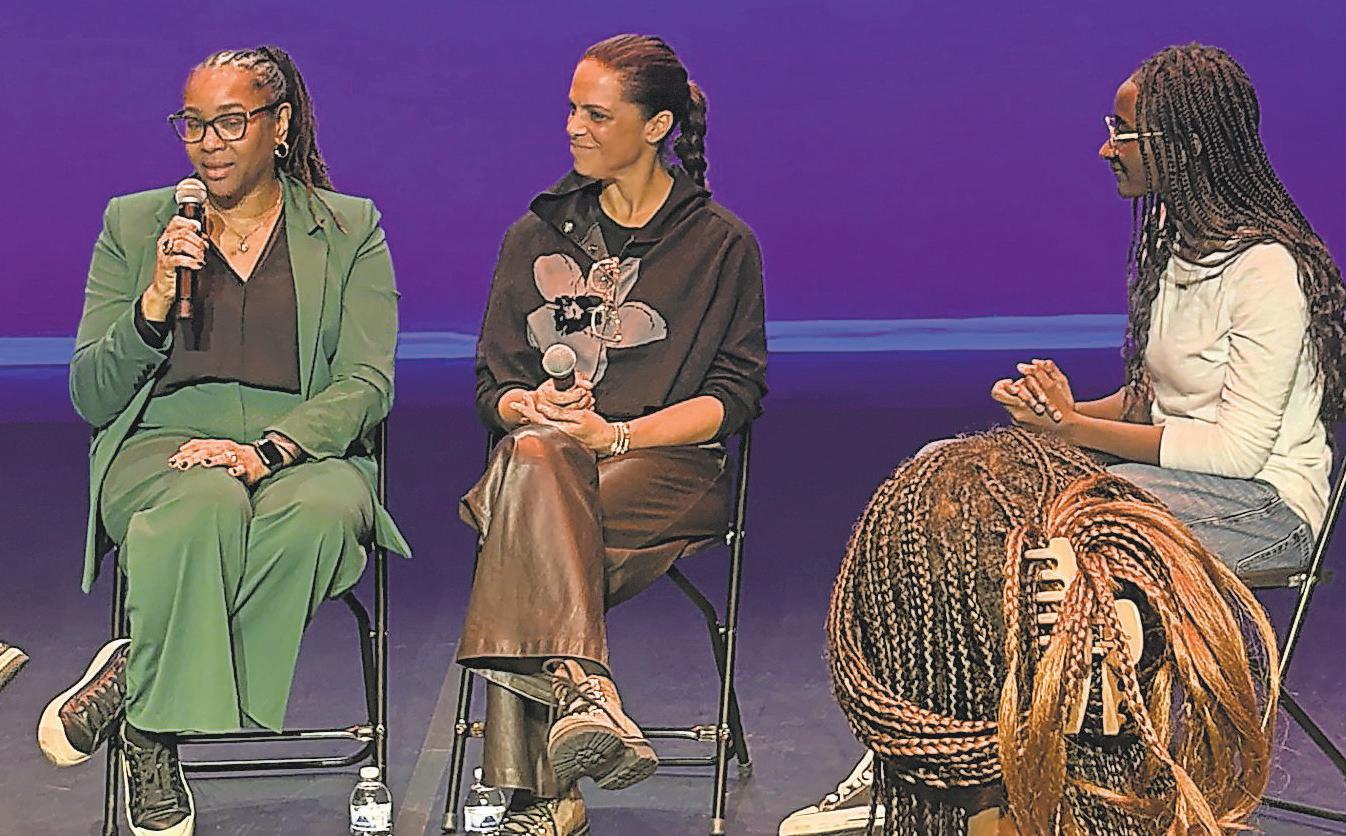
The 30-minute film, nominated for an Academy Award, follows Tracii (last name not disclosed), the head of security at Feminist Women’s Health Centerin Atlanta, over the course of a single day as new legal restrictions and constant protests surround the clinic. Photo by Noah Washington/ The Atlanta Voice
and she and I clicked,” Hampton said during the Q&A. “And then you have the protesters, and I was like, this is an interesting dynamic.”
Hampton described an early moment on the job that made the dynamic unmistakable. During a phone call with her team, the noise in the background drew questions. “They were like, could you go somewhere where it’s quiet,” she said. “I said, no, that’s the protesters, and I’m in an office.”
The film was shot entirely by a crew of women of color, a deliberate choice that Hampton and O’Brien say shaped both the access they were granted and the intimacy of the story they were able to tell.
a decision the team made well before the Supreme Court acted. “We knew that Roe v. Wade was gonna die, even though people would say we don’t know,” O’Brien said. “We knew.” The Ford Foundation provided early funding to help the team figure out what story to tell once the ruling came down.
O’Brien said the project also represented a departure from her usual role in an era when, she noted, “journalists are so not trusted.”
to keep identities private. Tracii also shares her own background, supports nervous patients and deals with protesters who gather outside, quoting scripture in a tone that the film conveys as judgmental rather than compassionate.
The Q&A was moderated by Simone Hammond, president of the Spelman Film Fusion club, and Lydia Scott, a junior documentary filmmaking major and the club’s vice
president. Additionally, two Spelman documentary students also worked on the production of the film.
Hampton, an Atlanta native who took her first dance class at Spelman before building a career in choreography and then documentary filmmaking, said the decision to center the film on Tracii came naturally once the crew arrived at the clinic.
“The first person you meet is Tracii, because she’s the security,
Nearly two-thirds of abortion patients nationally are Black or Latina women, according to the filmmakers, yet those experiences rarely receive sustained media attention. Hampton said the goal was to follow Tracii and the women at the clinic and “make it an immersive experience for the audience.”
O’Brien, a veteran TV journalist marking roughly her 40th year in the industry, said the project grew out of
Georgia’s six-week abortion ban, which took effect after the Dobbs decision, looms over the events depicted in the film, adding urgency to every interaction inside the clinic. The documentary highlights the challenges faced by clinics and the people who work to keep patients safe in the wake of the Supreme Court’s 2022 overturning of Roe v. Wade.
During the film, a line from one of the women at the clinic completely captures the stakes of the story on screen.
“I never thought I’d have more rights 25 years ago than my daughter does now.”
By DONNELL SUGGS
On the morning of Monday, Feb. 2, several moving trucks were idling in the bowels of Truist Park. The trucks, courtesy of Atlanta Peach Movers, were in the process of being loaded with the necessary gear the Atlanta Braves players, coaches, and staff will need while at spring training.
Monday was “Truck Day” and the Braves are headed to their spring training home in North Port, Florida, to prepare for the 2026 season.
Spring training officially begins on Saturday, February 21, with the Braves beginning the schedule on Feb. 22, against the Minnesota Twins, but the tools of the trade need to make it down to the Sunshine State before the team arrives.
Later in the day, the Braves marketing departing allied local press to take a look at some of the promotional giveaways scheduled for the 2026 season. The items on the list include a replica Dale Murphy jersey, a Braves straw cowboy hat, and
bobbleheads of former Braves Javy Lopez and future Cooperstown inductee Andruw Jones, and 1995 World Series hero David Justice, and current Braves stars Michael Harris II and Ha-Seong Kim. The Ha-Seong Kim bobblehead has his name in Korean and in English.
There are also new items. The “Crossover Collection” will have a Drake Baldwin hockey jersey, Michael Harris II football jersey, and a Ronald Acuna, Jr. basketball jersey.
“We got 81 games, so we have a lot of
opportunities to bring fans some new items,” Jori Palmer, the Braves senior director of marketing and advertising. “We try to keep it fresh, keep it relevant.”
The Bobblecards, a combination of bobblehead and a baseball card, will be another surprise giveaway item. The bobblecards are half the height of a traditional bobblehead, and come with the complete stats of the players, similar to a baseball card.
“It’s kind of like a 3-D baseball card,” Palmer said. “It’s a neat spin on a bobblehead.”
FULTON COUNTY ADVERTISEMENT FOR BID

Spacious 1-Bedroom Affordable! Rent Based on Annual Income Amenities, Great Location, and Convenient to Marta Please call for detailed information (404) 586-9098

Sr. Manager, Technical Accounting & Reporting, Atlanta, GA – Req: Bach/forgn equi deg in Acct’g, Busi, Finance, or a rel fld & 5 yrs’ exp in managing full-cycle acct’g & closings, coordinating external audits, conducting technical acct’g research, & overseeing financial planning, risk mgmt, & intercompany transactions for global mftg companies. Must have kwldg of GAAP/IFRS acct’g sytm. CV: Essex Solutions Inc., 5770 Powers Ferry Rd NW, Ste 400, Atlanta, GA 30327.
Sealed Bid for 25RFP1501529A-JWT Mobile Wellness Clinic for the Department of Senior Services will be accepted by the Fulton County Department of Purchasing & Contract Compliance, via Bidnet Direct https:// www.bidnetdirect.com/georgia/fultoncounty.gov. on Tuesday, March 10, 2025. All Solicitations submitted, will be received no later than 11:00 a.m. local (Eastern) time on the stated date. Proposers’ names will be publicly read at 11:05 A.M. local (Eastern) time, via zoom on the stated due date.
Join Zoom Meeting https://zoom.us/j/93053313702
One tap mobile
Meeting ID: 930 5331 3702
+14702509358,,93053313702# US (Atlanta)
+14703812552,,93053313702# US (Atlanta)
Scope of Work:
Fulton County, Georgia (“County”) is seeking a qualified contractor with substantial knowledge and experience to provide Mobile Wellness Clinic services. This is a Medicare benefit service for seniors age 65 and older. Fee: N/A
Term of Contract:
One (1) Year, with two (2) one (1) year renewal options.
PRE-BID CONFERENCE:
Date: Tuesday, February 24, 2026
Time: 10:00 a.m., local time
Link: Web Conference Link: Join Zoom Meeting
https://zoom.us/j/96663400383
Meeting ID: 966 6340 0383 One tap mobile
+14703812552,,96663400383# US (Atlanta)
+14702509358,,96663400383# US (Atlanta)


Every time you play the Lottery, you’re helping our kids get one step closer to their dreams. For over 30 years, the Georgia Lottery has contributed more than $30.6 billion to education. On top of that, over 2.3 million HOPE scholars have gone to college, and more than 2.2 million four-year-olds have attended a Lottery-funded Pre-K Program. That’s a lot of students, so we’ll just say, “Thank You, Georgia!” for all of them.
The Housing Authority of the City of Atlanta, GA (AH) will hold a Public Hearing on Thursday, March 5, 6 - 8p at 230 John Wesley Dobbs Ave. NE, Atlanta, GA 30303 to present and receive comments on its Fiscal Year 2027 MTW Annual Plan (Plan). The Plan outlines AH’s vision and describes planned activities that AH will undertake during the fiscal year. A draft of the Plan is available for review at all AH-owned communities and online at https://www.atlantahousing.org/about-us/ plans-reports/through Friday, March 11, 2026.
You can comment on the Plan in person at the Public Hearing, by email at strategy@atlantahousing.org, or by US mail: Atlanta Housing, OSPRA MTW Office, 230 John Wesley Dobbs Ave. NE, Atlanta, GA 30303. Comments received before March 13 will be included in the Plan. All interested parties, especially families assisted by AH, are invited to attend the Public Hearing. If you require special assistance or accommodation(s) to review the Plan or to attend the Public Hearing because of (1) a disability or (2) limited English proficiency, please call Haniff Graham at 404.817.7493 or send an email to accessibility@atlantahousing.org by February 17, 2026 to request reasonable accommodations for your needs.


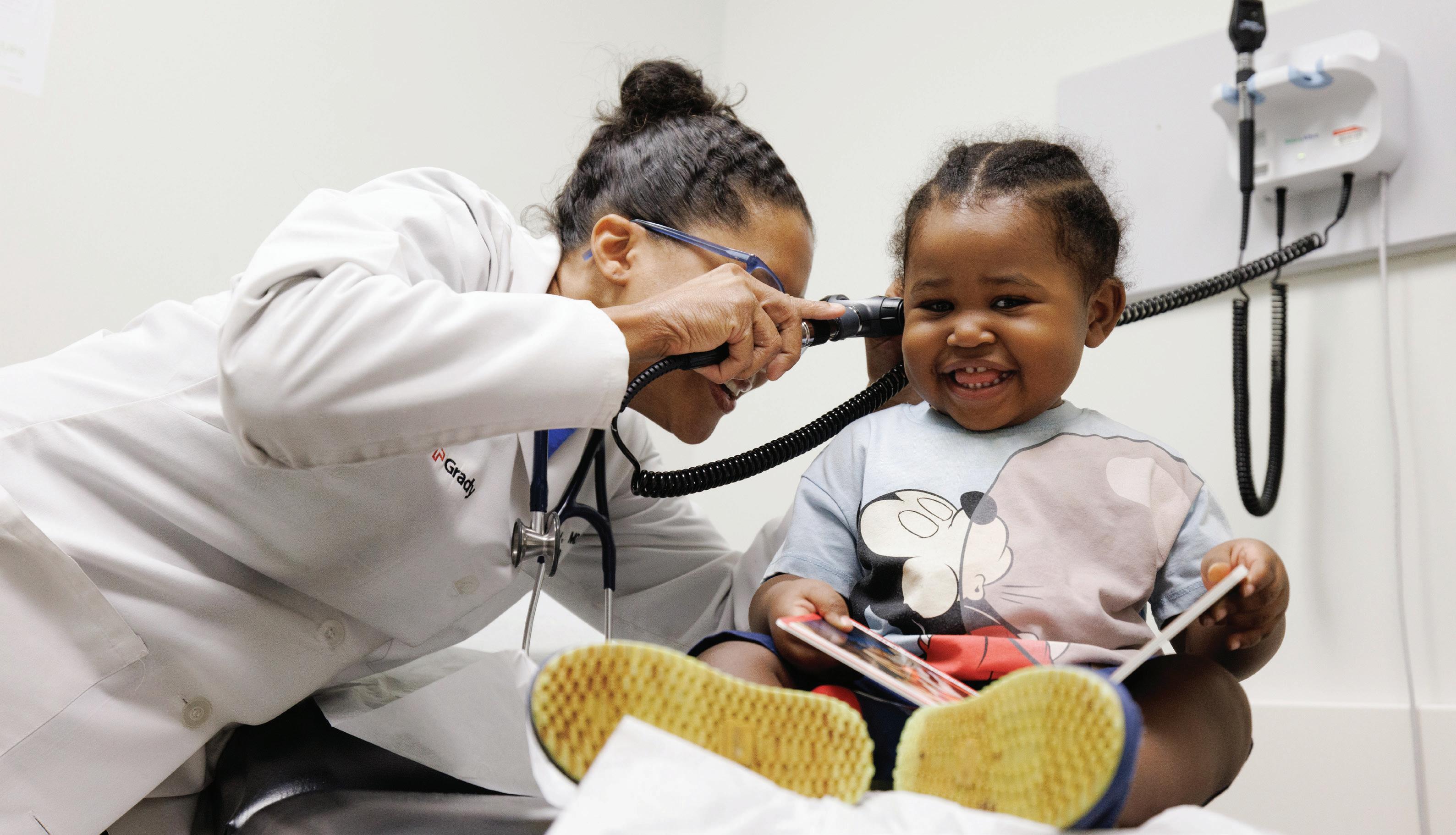
In Atlanta, Black history is woven into every block, every family, every victory.
From the King Center to the West End to South Fulton, our community carries a legacy of courage, creativity, and deep care for one another.
At Grady, we honor that legacy by showing up. Expanding access. Opening more doors. And bringing trusted care closer to home. We’re here to support the health and strength of our communities, today and for generations to come.
Because Black health is part of Black history. We’re here to champion the well-being of every generation.
Always here for Atlanta. All Atlanta. gradyhealth.org