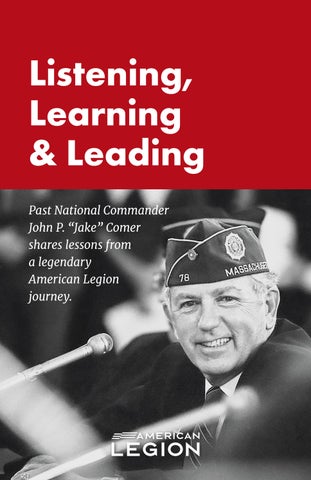
Listening, Learning & Leading

Past National Commander John P. “Jake” Comer shares lessons from a legendary American Legion journey.
Listening, Learning & Leading
Past National Commander John P. “Jake” Comer shares lessons from a legendary American Legion journey.

Jake’s List
Listen and learn.
Do well by your opportunities.
Think about the future.
Provide mentorship. “You’ve got to get around.”
Maintain contact. Ask about joining.
Always be on the lookout for new leaders.
Stay active at the local post.
If you’re not going to give 110%, don’t accept the job.


Leadership lessons started early for John P. “Jake” Comer.
“I grew up in the Depression,” he explains. “I was born in 1932. My life started in the community of Dorchester, Mass., which is a section of Boston, the second of seven children, and the oldest boy. So, it was easy to be in leadership. My mother had to go and work all day long, and my father was a bricklayer, so they were out of the house a lot. Growing up, my older sister became the mother of the house.”
As the elder brother, he assumed his earliest leadership responsibilities, to the family. With their parents working long hours to keep a roof overhead and food on the table, the children had to take care of themselves, and each other, following a strict code of conduct.
“From the time you grow up as a child in an Irish-Catholic home, that type of leadership is instilled in you by your parents. You never talk back to your parents. You never curse. You always listen and do as you’re told. They were very tough parents. They had to be, with seven kids.”
The siblings were close, leaning on each other, delivering newspapers from an early age, looking for ways to scratch together whatever money they could during lean times. “We would walk back and forth to school every day, and also for lunch. It required us to eat at home by ourselves for lunch. So, I was always helping my sister getting everything ready.”
“From the time you grow up as a child in an Irish-Catholic home, that type of leadership is instilled in you by your parents.”
Adult mentors outside the home were equally important to kids at that time. The first of those for young Jake – then known as “Jackie” – was a man named Saul Davis, who owned a small service station along the daily route between home and school.
“I was coming by this gas station one day, and the gentleman called to me and said, ‘I see you come by here every day to go to school.’ And he says, ‘I’d like a hot meal, and I only live four houses up the road. Do you think you could go by every day and bring me down my hot meal?’”
“Well, I’ll have to check with my mother,” the boy told Saul.
“I asked her, and she said, ‘Sure.’ So, I did that every day. I got paid 25 cents a week. To my mother, that was good. His wife would have a meal ready when I would come by at lunchtime, and I would bring it down to him. I was only 7.”
As neighbors did during that time, they looked out for each other. But there was no such thing as a handout. Kids were required to work for anything they got. Every penny mattered. So did every mentor.
Before the age of 10, Jake was hanging around at the garage, talking with Saul and the men who worked there.
“When I was 8 or 9, he had this huge amount of tires that he would roll in and roll out every day from inside his place. He said, ‘Could you help me roll these in every night?’ My mother said, ‘Sure.’ So, I got another 25 cents a week for doing that with him.”
He continued helping, listening and learning, first steps he later found to be essential for leading.
“Lo and behold, as life went on, I was 14 years of age, and I started working for him in the gas station, pumping gas and changing tires, giving oil changes. And at 16, I managed the place. He had great faith and trust in me because he never had to worry about finances or collecting money at the pump. He knew it was all going to go to him. My mother instilled that in me very early.”
He worked for Saul at the service station until he enlisted in the U.S. Air Force in 1951.
“He must have seen something in me. I really don’t know. But it worked. He was an easy boss to work for. He owned the station for many, many years. I remember when I was 16 and had to get my driver’s license. So, I said, ‘Saul, I’ve got to be up to get a driver’s license next week. How am I going to get there?’ The first person that came in that day, he said, ‘Take Jake up for his license.’ That was Bob Cooper. Up we went, got the license, and got back to work … that was the kind of guy he was.”

Children of the Depression learned early that selfsufficiency meant doing well by opportunities, wherever and whenever they might spring up, and taking help when it was offered. Older adults understood that the future depended on young people knowing and embracing such imperatives as a solid work ethic, the value of money and honesty. Saul was
the first of many mentors who instilled in the future American Legion leader an inner compass that would guide him for the rest of his life – in the Air Force, business, civil service, church leadership and as an officer at every level of the nation’s largest organization of military veterans.
“I was in leadership,” he explains, “when I was very young.”

At 93, John P. “Jake” Comer was still in leadership.
In 1963, his journey took an unexpectedly significant turn when he joined The American Legion. He soon became adjutant of Thomas J. Roberts Post 78 in West Roxbury, Mass., and within three years was commander. He moved through the chairs to District Vice Commander, Department Commander’s Aide, District Commander, Department Vice Commander and Department Commander.
In time, he drew national attention. First appointed to serve on the National Commander’s Advisory Committee on Americanism, he was later elected as Alternate National Executive Committeeman and National Executive Committeeman. Twenty-four years after he first donned a blue cap, John P. “Jake” Comer was presented a new red one, that of National Commander. That was Aug. 27, 1987.
His year as the top executive leader for the nation’s largest veterans service organization was by no means a final destination. Anything but.
It was just another turning point, one that would allow him to apply all the lessons of his youth, faith, military service, professional career and mentorship experience to
His early mentors imparted to young Jake Comer the irrefutable characteristic of success in any venture: passion
guide hundreds – if not thousands – who would follow in his footsteps as American Legion leaders. His ongoing presence has been felt among the top officers of the organization for nearly 40 years – after his time as national commander had come to an end.
“The important word about everything we do – you can go back to 1919 up to the present and the future – the word is ‘leadership.’ If you don’t have the leadership to continue that greatness that we do for the veteran, for the disabled, for youth, for Americanism, then it’s a dead issue. You have to get up and speak on the issues and make changes that are important to the future of the organization. Everything that we do is not to think about the past, but it’s to think about the future.”
That may have been on the minds of Saul Davis and other childhood mentors, who believed that future prosperity depended on young people like the little boy of the Depression who grew up working, listening and learning at the service station down the street.
Throughout his time as an American Legion leader, Comer has made it his mission to always be mentoring the next generation of veterans to keep the organization strong, active and influential at the community, state, national and even international levels. The son of Irish immigrants and longtime mentor for Foreign and Outlying Departments and Posts of The American Legion (FODPAL), 20-year president of ANAVICUS (Army, Navy and

As longtime president of ANAVICUS, Comer became known for his one-liners from the podium at bi-annual breakfast gatherings.
Air Force Veterans in Canada United States) and beloved host of the group’s scholarship breakfasts for many years, ardent supporter of the Sons of The American Legion and ambassador of the organization at every level, his love of the organization’s array of purposes, and knowledge about its ways, has made him a treasured resource for those who seek and achieve higher offices. His lessons about the right way to grow in the organization have inspired Legion officers from post historians to national commanders.
When his longtime traveling companion Florence Publicover is asked where Comer’s passions reside, she puts it simply: “There’s not enough words to say about his love for The American Legion.”
In a sense, his early mentors imparted to young Jake Comer the irrefutable characteristic of success in any venture: passion. Many who cared about him when he was young served as beacons through the darkness of the Depression, set a high premium on service to others, discipline, staying connected and, in the case of his first boss, even gave him the name by which he is best known.

“Saul Davis, the owner of the gas station, says to me, ‘What is your name?’
“I says, ‘Jackie Comer.’
“He said, ‘No, no, no. You’re ‘Jakela,’ which is Jewish for ‘Jack.’ So, he is the one who nicknamed me Jake, and I have been Jake ever since. It caught on in the neighborhood, so that’s how I became Jake.”
Failure to go by the name that later became synonymous with American Legion leadership cost Comer his first attempt at a district office, he explains. “I lost by four votes because on the ballot was ‘John Comer,’ and many of my friends couldn’t understand why I wasn’t running.
“I said, ‘I did run.’
“They didn’t see the name Jake on the ballot. So, ever since then, my cards and everything I have done, even in the Legion, it’s always John P. ‘Jake’ Comer. Without that quote, people wouldn’t know me.”
Early on, Jake became known not only by his name but by his presence. A firm believer that American Legion leadership depends greatly on personal networking with members in local posts and districts, he has traveled from meeting to meeting, throughout the Northeast and around the country, even abroad, listening, learning and advising, understanding the triumphs and trials of his fellow veterans, sharing his spirit, and, in so doing, capturing their hearts.
“Jake Comer has probably gone to more Legion functions than anyone I have ever known in my life,” explains Paul A. Morin, one of the leaders Comer mentored, who served as National Commander of The American Legion in 2006 and
2007. “And I’m not just talking national. I’m talking back in Massachusetts. Jake Comer would get a call from a post, ‘Hey, can you come talk tonight?’ He would get in his car and drive to the other end of the state to be at a post meeting to talk. That’s what Jake Comer always did. And he continues to do that type of stuff. He does it all. He still does it all.”
“You’ve got to get around,” he advises rising leaders in the organization. “You go around to all the posts. You don’t take any of them for granted. That’s the leadership you have to personify.”

As a high school student, Comer did not participate in organized sports, working at the service station most every day. But he kept building on his emerging leadership skills, organizing school activities and dances at Cathedral High School and performing in school plays. He also became adept at something else that would serve him well, once again thanks to a thoughtful adult mentor: a nun, Sister Alfredine. She taught him how to type.
Sister Alfredine also showed him why it’s important to work hard, stay focused, be honest and understand that inattention to detail has consequences. “Tough? Let me tell you, my fingers will tell you that. I got the ruler. Not only the ruler but a thick piece of wood that sent me to the principal’s office one time. They hit you off the end of your fingers. That’s what hurt the most. I got to learn pretty fast to mind my own business.”
By the time he graduated from Cathedral, he was typing 80 words per minute. “She was my inspiration. I always looked up to her and thanked her for the typing abilities. She was a mentor, alright. She was outstanding. Every other course
I took in school didn’t help me nearly as much as the typing skills I learned from Sister Alfredine. When I went into the Air Force, they gave you tests to see what you are going to do for four years. They could see right away that I was an accomplished typist.”
As he served in Germany during the Korean War as a teletype operator, Sister Alfredine added another important lesson that Comer would apply in the years ahead: maintaining contact. “She always communicated with me when I was in the military. I always looked up to her and always thanked her.”
After the Air Force – where he said he received good leadership from his lieutenant in Germany – “I went to work for Western Union, which was doing the same thing I did in the service.”
He typed.
He keyed in telegrams of all kinds, to all sorts of people – and of all ages – and handled many that included personal telephone calls. “We’d get a birthday telegram or a congratulations, and I would get on the phone and sing that ‘Happy Birthday’ verse to whoever got the telegram. One day, I get on the phone and say, ‘Is so and so available?’
“They say, ‘What do you mean? She’s only 1 year old.’
“I say, ‘Look, ma’am, this is a telegram made out to her. I don’t care how old she is. That’s my job.’ I had to sing ‘Happy Birthday’ to this 1-year-old.”
Singing telegrams was as natural then to Comer as would be singing Irish ballads in hotel rooms at American Legion conventions in future years.
As he embarked on his professional career, he often made time to stop by the old service station to visit Saul, keeping
that connection alive, and staying in touch with Sister Alfredine.
He did his job so well at Western Union, he was offered a promotion. But taking it would mean moving to New York City. He declined and went to work instead as a door-todoor John Hancock Insurance Co. agent – “hard work,” he remembers – before he landed a position as an assistant tax assessor in Quincy, Mass. “Six months later, one of the three full-time assessors retired, and I was appointed full-time assessor. I did that for about 10 years.”
Just before he moved his family to Quincy, Comer – by this time married to his wife of 44 years, Eileen – was walking across a square one day and ran into a man with whom he had gone to kindergarten. They caught up fast, and Comer learned that the man had also served in the U.S. military during the Korean War and at the time was commander of American Legion Post 78 in West Roxbury. “He asked me
A big home run
A special honor was in store for the first player to hit a home run in the 1975 American Legion World Series in Rapid City, S.D., in recognition of the program’s 50 th year. The ball would be retrieved and sent to the National Baseball Hall of Fame in Cooperstown, N.Y. On the first pitch in his first at-bat, second baseman David Perdios of West Quincy, Mass., parked it.
That was the moment John P. “Jake” Comer truly fell in love with American Legion Baseball. Department of Massachusetts Commander at the time, he had arranged travel to the series for the Morrisette Post 294 team, their parents and followers. Then, after Perdios’ big hit, he arranged to have that 50 th anniversary home run ball delivered to Cooperstown.
about joining. Because of him, I did join. It was the greatest day of my life.”
And, like so many enthusiastic and capable young veterans who join an American Legion post, Comer was appointed adjutant within six months. The key reason, he says, can again be traced back to Sister Alfredine. “I could type 80 words per minute.”
Married with three children and navigating a career, he carved out the time needed to lead his American Legion post and soon was on the rise in his district and department, as well as the commonwealth itself. His children grew up as members of The American Legion Family, and Eileen was a dues-paying member of the American Legion Auxiliary, but her main involvement in the organization was keeping up with her husband and his many travels, in the Legion and otherwise.
Comer worked for the Massachusetts House Ways and

Means Committee for two years and became connected with state politics, which put him into the company of Rep. John Finnegan of Dorchester, who made the Air Force veteran a member of his successful campaign leadership team.
“Then, an opportunity came to direct public housing in Quincy. The mayor came to me, and said, ‘Jake, you’d be perfect for that job. Why don’t you apply for it?’ So, I did and spent 15 years as the director of public housing.”
It was a tall order managing some 9,000 units for lowincome and elderly residents. “We were the ninth-largest housing authority in the commonwealth.”
As he had done before, he made it a point to do well by the opportunity in front of him.
But none of these career developments deterred Comer from his path in The American Legion.
“It was a World War I post – a good post,” he remembers of his first home in the organization. “It didn’t have a bar. We had good meetings. We had great camaraderie.”
Post 87 leaders mentored him and suggested he run for higher offices in The American Legion. “They taught me a lot.” Two in particular – Ralph Hall and Eugene Biagi – “were the two who really started me off.”
Unfortunately, despite in-person appearances at posts throughout the region, that was the year he was not elected because voters didn’t see the name “Jake” on the ballot. He changed that the next time around. “I ran again the next year and topped the ballot.”
He moved from District Commander to Department Vice Commander, collecting more votes than 10 others on the ticket. “They couldn’t understand that. They said that’s never really happened before.”
“You’ve got to get around. You go around to all the posts. You don’t take anything for granted. You visit the post, and then when they go to the ballot, they know who you are.”
The newly elected department officer was happy to share his secret. “I said, ‘Well, you’ve got to get around. You go around to all the posts. You don’t take anything for granted. You visit the post, and then when they go to the ballot, they know who you are.”
Along the way, he received his first white cap, as Aide to the Department Commander, in 1970. In that capacity, he traveled to his first national convention – a truly memorable one – in Portland, Ore., in the tumultuous height of the Nixon administration as Vietnam War protesters threatened to converge on the veterans gathered there. To prevent a confrontation, local authorities scheduled and promoted “Vortex 1: A Biodegradable Festival of Life,” a rock concert outside the city where laws on public nudity and narcotics were temporarily suspended. The protesters changed their plans and migrated to the festival location. Nixon did not attend the convention, sending Vice President Spiro T. Agnew instead, and it went on without incident.
That was the first of what would become many national conventions over the next half-century for the eventual National Commander. “At that national convention, I saw a different level from the department and the district, to see how they operate. You get an understanding of what’s going on. I really started learning a lot from then on.”
Between 1973 and 1975, Comer moved from District Commander to Department of Massachusetts Commander.
His first national appointment – to the Commander’s Advisory Committee on Americanism – was followed by a call from prominent Massachusetts Legionnaire Sam Murphy, who urged Comer to run for Alternate National Executive Committeeman. Comer was elected and soon moved on to serve as the NEC representative of his department in 1981. He made the rare move from that office to National Commander six years later.
Two leaders of the organization, Past National Commander Joe Matthews of Texas and longtime member of the NEC Glenn Green of South Dakota, had taken Comer aside and said, “We think you’ve got what it takes to be National Commander.”
That theory became reality when two of the most influential leaders of the organization’s history –E. Roy Stone and Past National Commander John Geiger –called him in for a meeting. Comer was officially in line.
“I had no intention, not even a prayer, of being National Commander. I didn’t know what it was all about. Then, I started learning.”
Listening and learning always came before speaking and acting for Comer, another attribute he applied habitually in his professional and American Legion careers alike.
And he always made time – somehow – to serve others in the community, especially young people. A board member of the Massachusetts Hospital School for Handicapped Children, he raised more than $3 million for underprivileged children through the Horizons for Youth program, which he started in 1976 when he was Department Commander and continued to serve as chairman for many years.
World War I veteran Butch Kelley, a longtime National

Vice Commander from Boston, had likewise made opportunities for children a top priority of his long public and American Legion life, having served as City Parks Commissioner in Boston and creating healthy recreational opportunities for young people. Comer made that pillar of The American Legion – children and youth – a centerpiece of his work for the organization.
Comer meets with American Legion Founder Kendall Sanders, who points to where he sat in the Legion’s formative Paris Caucus.
Another of Kelley’s characteristics: he could be found at nearly every national convention, seated in the hotel lobby, enjoying a cigar and holding court with Legionnaires from across the country. Today, Comer does the same thing (although not by design and without cigars) like it was second nature. “I was not really following in his footsteps in that way,” Comer explains. “It just happened.”
Morin remembered Kelley in a 2007 American Legion Magazine message as one who “treated national figures and blue-cap Legionnaires with equal ease and respect. He was guided by three simple sentences he told me never to forget: ‘We are fortunate. God has been good to us. We must always help somebody else.’”
Simple sentences. Enduring effect. Such thinking resonated with Comer.
“Butch Kelley became a close, personal confidante,” Comer says. “He nominated me for National Commander … He was
a big, heavy, jovial man. Just an outstanding individual, very respected throughout the national organization.”
Kelley had been a mentor for Morin and Comer alike, and now Morin is in a similar capacity at every level of the organization. “I think it is something that is a tradition within Massachusetts,” Morin says. “Butch Kelley, a World War I veteran, was the main mentor of Jake Comer. And he mentored me. I was a young Vietnam veteran, and I could do some weird things at weird times, and I always remembered Kelley … like one day a World War II guy giving me some static. Kelley called me over and said, ‘Don’t worry about it. You tell them to come see me, and I will handle it.’ In Massachusetts, we have always had a good mentorship team in place.”
No matter the office, Comer says, anytime a leader moves up, “I always assign him a mentor.”
PNC Geiger of Illinois and E. Roy Stone of South Carolina made it clear to Comer that leadership in The American Legion involved a continuous search for people to succeed you. “And they always said, you’re not going to be able to do it from your home. You’ve got to be out there.” And finding a new leader is only the first step in the process. A true mentor stays connected with that individual throughout his or her own journey. Comer was a natural at that.
And American Legion Past National Commander Daniel M. Dellinger of Virginia, who led the organization in 2013 and 2014, carries that lesson forward. “When I talk to people, the first thing I tell them is, ‘Alright, who is your replacement?’” Dellinger says. “‘Because you’ve got to mentor someone to take over for you.’ We’re not going to continue to grow and sustain ourselves if we don’t groom our next leaders. And Jake epitomizes that. I hope I am the same way. I try.”

Comer was elected National Commander at the 69th American Legion National Convention, in San Antonio, Texas.
Geiger and Stone knew that. Comer, mentored by them, acted on their counsel, as did so many American Legion leaders in the 1980s and 1990s. “They were great leaders,” Comer says. “I think about them to this day.”
Whether seated in a hotel lobby and visiting with members as they pass, speaking formally at a post event or just bumping into a Legionnaire in a hallway during a national convention or Washington Conference, “members know they can always stop me and talk to me to get advice,” Comer says. “That’s the way you should be operating.”
In a way, he never stops mentoring.