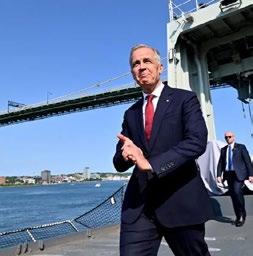
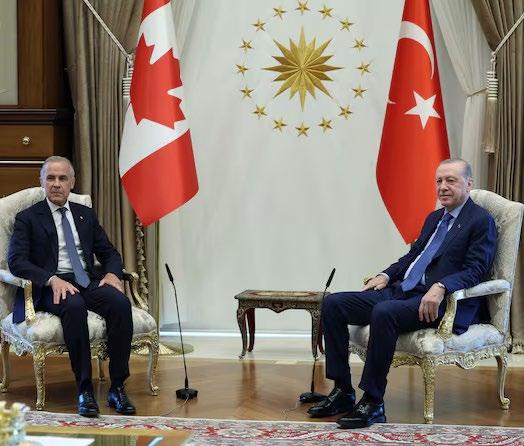
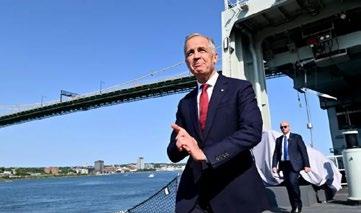
Prime Minister Carney announced on Monday that the government had chosen the company TKMS as the preferred supplier for the multi-billion dollar, 12-vessel contract. Continued on Page 10...
India breaks into China's shipping container monopoly
For decades, India has quietly relied on a product that is so basic to global trade that most people rarely notice it. The steel shipping container powers trade of everything from engineering goods to electronics, yet almost every steel box used by Indian trade comes from China.
India has just taken a symbolic but significant step towards changing that reality with the rollout of its first export-import shipping container manufactured for global deployment. The move marks the beginning of an ambitious effort to enter an industry where China's dominance has remained
virtually unchallenged for decades. Few manufacturing sectors are as concentrated as container production. China accounts for close to 90-97 per cent of global container manufacturing capacity, depending on the segment and year.
Continued on Page 14...
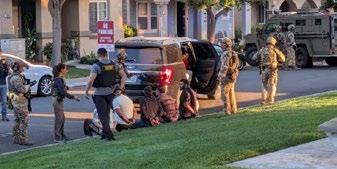
Canadian and U.S. authorities laid out sweeping allegations of racketeering, extortion and murder against a trio of Indian-linked crime syndicates this week.
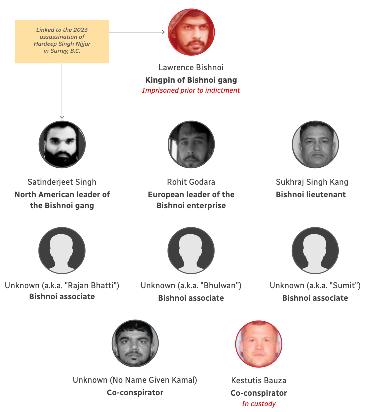
One of the groups — run from a jail cell in India by gangster Lawrence Bishnoi — is charged in incidents linked to the extortion crisis plaguing communities in Ontario and British Columbia as well as the assassination of Sikh separatist leader Hardeep Singh Nijjar in Surrey, B.C., in 2023.
FBI Los Angeles assistant director Patrick Grandy took a victory lap alongside RCMP
Commissioner Mike Duheme, declaring "Operation Hard Ball" a strike "at the heart of three brutal transnational organizations that have terrorized families, exploited communities and stolen lives."
Continued on Page 10...
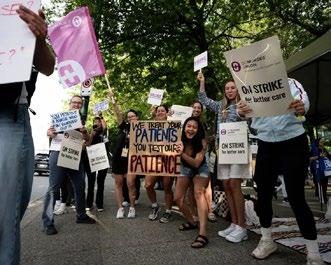
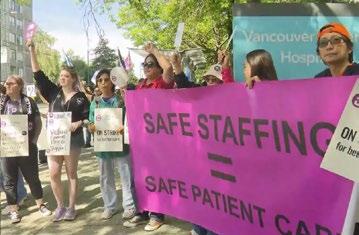
B.C.’s nurses announced on Thursday that job action will expand to additional hospitals and care centres across the province.
This union says this follows the breakdown of negotiations and the declaration of an impasse again at the bargaining table.
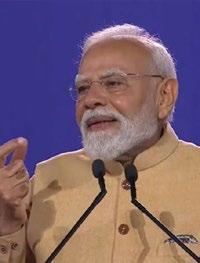
India's aspiration to become one of the world's top three economies at the earliest is driven by the motto of "Grow more, achieve more,"
Prime Minister Narendra Modi said on Thursday while addressing the Indian community in Melbourne as part of his three-day official visit to Australia. Addressing the Indian diaspora at the "Melbourne Meets Modi" event, the Prime Minister said that India of the 21st century is progressing with the vision of becoming a developed nation, with every achievement inspiring the country to set even higher goals. He further noted that every milestone that India attains inspires it to pursue even greater ambitions, adding that the aspirations of its 1.4 billion people drive the nation's progress. Continued on Page 7...
In a release, the union said that starting this weekend, picket lines will be up at major health-care facilities across the Lower Mainland and Vancouver Island.
On Thursday, picket lines were set up at Surrey Memorial Hospital and the Jim Pattison Outpatient Care and Surgery Centre.
“We have reached a critical point in this dispute,” B.C. Nurses’ Union president Adriane Gear said in a release.
“Nurses have bargained in good faith, and we’ve taken measured job action while maintaining essential services to protect patient safety. Continued on Page 10...
British Columbia has recorded its lowest monthly number of suspected toxic drug deaths since before the start of the COVID-19 pandemic in Canada, falling by more than half since their peak.
The Ministry of Public Safety’s preliminary data shows that 109 people died in B.C. in May due to suspected unregulated drug toxicity, which is about 3.5 deaths each day.
That is the lowest level seen since February 2020, when 79 deaths were reported, and is down by about 55 per cent compared to the 242 deaths recorded in December 2023.
B.C. declared a public health emergency over the overdose crisis a decade ago, with the number
of deaths peaking at more than 2,500 in 2023.
The number has dropped steadily since then, with the ministry saying the death rate among people between the ages of 19 and 59 has fallen significantly since 2021.
Most of the deaths this year, 76 per cent, were males, while those between the ages of 30 and 59 account for more than two-thirds of the deaths.
Fluorofentanyl, a more potent form of the opioid fentanyl, was detected in 67 per cent of the deaths, followed by cocaine and fentanyl at 55 per cent.
The ministry statement says smoking is the most common form of consumption at 71 per cent.
ICBC/Personal
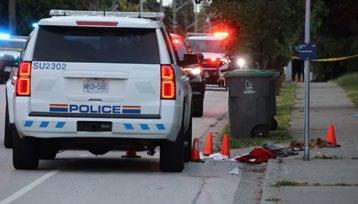
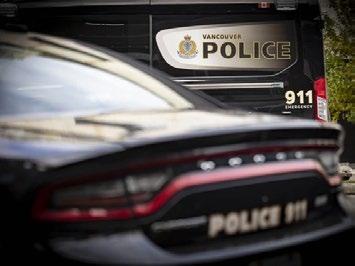
The Independent Investigations Office of BC (IIO) says it is investigating after an officerinvolved shooting that took place Wednesday night.
The IIO says that initial information given by the RCMP’s Surrey Provincial Operations Support Unit (SPOSU) stated that officers were called out after a report that a distressed man had left a home, located at Melrose Drive near Grovesner Road, with an edged weapon. Officers then searched the area to find the man.
“At approximately 8:02 p.m., the man was located by police near 111A Avenue and Wallace Drive,” the IIO said in a news release Thursday morning.
“There was then an interaction which resulted in a Conducted Energy Weapon (CEW) deployment and shots being fired by police.” The man was taken to hospital with serious injuries, the news release says.
“The IIO was notified of the incident shortly after
it occurred and has commenced an investigation,” it said.
The BC RCMP says it was initially called out shortly before 7:30 p.m.
Pictures taken in the area show a large police presence in the area. Multiple articles of clothing can be seen scattered on the ground.
The IIO is the civilian oversight agency that is called in after any police-related incidents that result in death or serious injury, whether or not there are any allegations of wrongdoing.
RCMP in British Columbia say officers deployed in Metro Vancouver waters in support of the FIFA World Cup were diverted to help rescue 11 people, including several youth, from an overturned canoe on the weekend.
Police say in a release that officers patrolling Burrard Inlet were notified Sunday afternoon that a canoe overturned in the waters off Ambleside Beach in West Vancouver.
Four marine tactical vessels responded and found people in the water clinging to the overturned canoe, although some were having difficulty staying afloat. Police say a diver had to enter the
water to help in the rescue, while confirming no one was trapped under the canoe.
All 11 people were eventually pulled from the water, and there were no major injuries despite some suffering from exposure.
Police are reminding people planning to go on the water this summer to have the appropriate safety equipment, including life-jackets, and to be aware of changing sea conditions.
The marine rescue happened a week after a charter boat sinking off Richmond, B.C., that left one woman dead and six people missing and feared drowned.
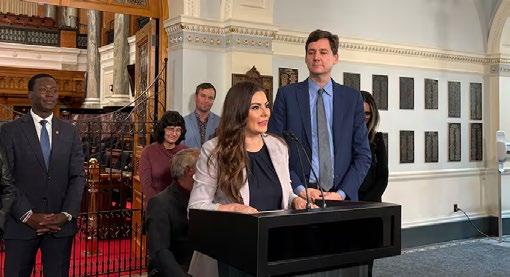
The provincial government announced on Tuesday that it has retained counsel to pursue legal action against OpenAI for its failure to notify law enforcement of threats made on its platform before a mass shooting at Tumbler Ridge Secondary School in February.
The province said it has retained CFM Lawyers in Vancouver and Stranch, Jennings & Garvey, a California-based law firm, to explore all legal avenues to hold OpenAI and its decision-makers accountable.
OpenAI, which said it disabled shooter Jesse VanRootselaar’s account in June over “violent” activity, said in a previous statement that it had also discovered a second ChatGPT account linked to VanRootselaar’s name after the shooting, despite a system that flags repeat policy offenders.
OpenAI ultimately alerted the RCMP to the shooter’s ChatGPT activity after the mass shooting on Feb. 10.
The head of OpenAI, Sam Altman, issued an apology letter to the community of Tumbler Ridge in April.
The attack at Tumbler Ridge Secondary School on Feb. 10 claimed the lives of eight innocent people, including an educator and five children between the ages of 11 and 13, and left 27 others wounded. “Our thoughts remain with the families who lost loved ones, the people who were injured and the entire Tumbler Ridge community,” said B.C. Attorney General Niki Sharma in a statement.
“As the community continues to heal, our government remains focused on supporting
those affected and pursuing accountability. When there are serious concerns that opportunities to prevent harm were missed, we have a responsibility to act. We owe that to the victims, their families and everyone whose life was changed by this tragedy.”
In late April, seven families impacted by the Tumbler Ridge shooting filed lawsuits against OpenAI and Altman in a San Francisco court on behalf of five murder victims and two who were injured.
“These families from the Canadian north have come together and they’ve decided to pursue litigation in the United States on a scale that can hold these companies to account,” Vancouverbased lawyer John Rice with Rice Parsons Leoni & Elliott LLP told Global News.
The claims, which have not been tested in court, state that in the weeks that followed the attack in Tumbler Ridge, “a sickening truth emerged: ChatGPT played a role in the mass shooting and OpenAI could have, and should have, prevented it.”
Any legal action pursued by the province would be separate from the litigation initiated by families and community members in Tumbler Ridge, the government confirmed on Tuesday.
ON man sentenced to life in prison for Vancouver shooting that killed a boy in car
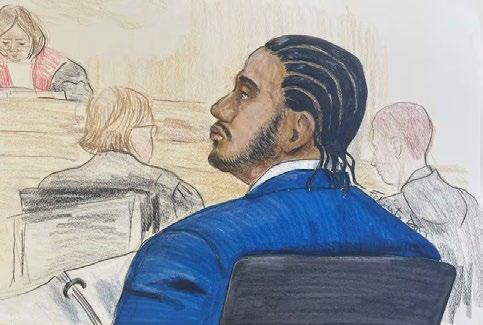
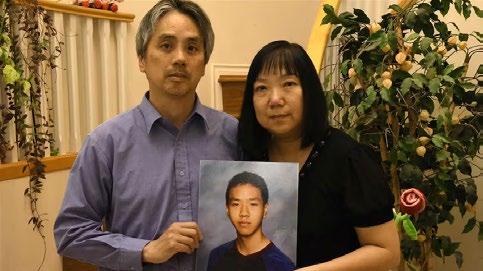
The man accused of killing an innocent teenager and a gang member in a shootout eight years ago has been sentenced to life in prison with no parole eligibility for 17 years.
car on their way home from dinner when he was hit in the chest by a stray bullet from an exchange of gunfire along Vancouver's busy Broadway on Jan. 13, 2018.
Kane Carter was found guilty last December of the second-degree murders of 15-year-old Alfred Wong and 23-year-old Kevin Whiteside. A second-degree murder conviction comes with an automatic life sentence. Accounting for time already served, Carter can apply for parole in 2039.
Wong was riding in the backseat of his parents
Speaking outside the B.C. Supreme Court in Vancouver, Wilfred Wong said his brother Alfred is missed dearly and not a day goes by where the family doesn't think about him.
"It doesn't feel quite like closure but it's a step in the process," he said. "We're thankful that through this system that the city will be safer." The officer in charge of the investigation for the past eight years said Wong's murder caused fear and outrage that an innocent teen was the victim of gang violence.
"What should have been a family night out for the Wong's ended up in a horrifying tragedy that shook the city of Vancouver," said Vancouver police Insp. Mike Heard. "Alfred's death was needless."
Investigators say Whiteside was trying to kill rival gangster Matthew Navas-Rivas as he left a Broadway restaurant when Carter opened fire. Crown prosecutors said during trial that Carter was trying to protect Navas-Rivas. Navas-Rivas was unharmed that night, however he was killed a few months later in a targeted shooting in East Vancouver.
Carter was arrested in 2022 in Gravenhurst, Ont., north of Toronto. In 2024, his first trial was declared a mistrial and a retrial was ordered.
3 South Asian men facing drug trafficking charges from U.S. authorities appear in court
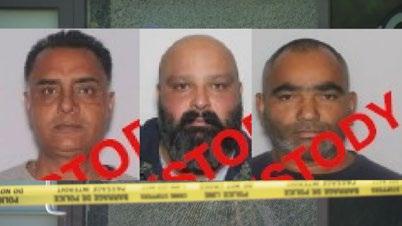
Three men facing drug trafficking charges laid by U.S. authorities are expected to appear in B.C. Supreme Court on Thursday for a bail hearing.
Jaskarn Baghri of Surrey, Ravinder Dhanda of White Rock and Gurtej Singh Smagh of Creston are facing extradition proceedings to the U.S. They were arrested on Tuesday by RCMP officers working in co-operation with American law enforcement on an investigation into Indian crime syndicates called Operation Hard Ball.
The FBI alleges that the men were involved in a drug smuggling operation moving large amounts of cocaine and methamphetamine weekly across the Canada-U.S. border. The three men appeared in court on Tuesday afternoon, one via video link and two in person.
Dhanda has retained the high-profile criminal lawyer, Ian Donaldson, while Smagh has retained Rishi Gill. Baghri did not yet have a lawyer. There is a publication ban on the extradition hearing. In total, 37 people across North America and Europe have been indicted as part of Operation Hard Ball and 27 have been arrested.
Mixed feelings among Penticton-Summerland voters as MLA Boultbee crosses floor to NDP
Residents in Penticton and Summerland are reacting with mixed feelings to the news that their MLA has crossed the floor to the B.C. NDP, with some calling for a byelection and others expressing excitement for the new direction.
Amelia Boultbee was initially elected to the B.C. Conservative Party in 2024, but left the party to become an Independent the following year and, last week, announced she would be joining the NDP.
One Penticton resident said she felt "absolutely betrayed" by the move.
“I can no longer trust Amelia to do what she says she is going to do,” said Daryl Meyers, who has lived in Penticton for over 30 years.
her dissatisfaction with then-leader John Rustad. In announcing her move to the NDP on July 3, she said she felt that party was "best positioned" to help serve her community.
"I want my constituents to know that I would not really be in this position, except for the unreasonable actions of the B.C. Conservatives, and that sitting Independent for eight months really gave me the chance to work with the government, and I am doing this because I know they will be better represented," she told CBC News. She said calling a byelection would be expensive for taxpayers.
"A byelection could cost as much as $1 million. So for all the people who say they want a byelection,
Meyers said she voted for Boultbee in the last election because she didn't want to see the NDP in power. She said many Conservative-leaning voters like herself are confused and upset by Boultbee’s decision to now join the party she once ran against.
“If she feels like [if] she is working in the true form of the constituents, then she needs to resign and then she needs to call a byelection and then we will find out if people have voted for her, or if people have voted for the party,” Meyers said, adding she won't vote for Boultbee in the next election.
When Boultbee left the B.C. Conservative Party in October 2025, she said her decision was driven by
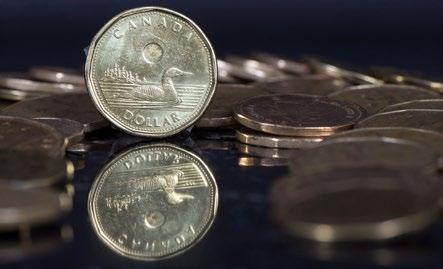
Canadian dollar reaches 14-month low, near 70 cents to the U.S. dollar—main driver is diverging interest rates, not CUSMA
The July 1 deadline to renew the CanadaUnited States-Mexico Agreement (CUSMA) came and went without a renewal, as the Trump administration declined to extend the pact and started the decade-long clock on its potential wind-down. The Canadian dollar, already sagging, touched a 14-month low near 70 cents U.S. last week, and analysts have trimmed their forecasts accordingly.
I have just as many people saying they would not want the $1 million spent, particularly when there is no requirement in our parliamentary tradition to do this."
A political expert says it’s not surprising that some people in Penticton and Summerland may have voter's remorse.
“It is one thing to leave a party to sit as an Independent if that party is not representing your views. It is something else to join the party you were in opposition to,” said University of British Columbia political scientist Stewart Prest.
He said Boultbee will need to a make a strong case to her constituents that crossing the floor was the right move, and that being a government-side MLA is in their best interest. One Penticton voter said they are supportive of Boultbee’s decision to join the NDP.
“I find it a bit exciting to have an ally in Victoria, and someone who can speak for us,” said longtime NDP voter Lori Goldman.
But the currency strategists and economists who spoke to The Hub say the loonie’s dip has less to do with trade negotiations than with a widening gulf between interest rates in the two countries.
“The timing of the move shows this is clearly a rate differential story, driven in particular by Kevin Warsh’s notably hawkish first FOMC [Federal Open Market Committee] meeting as chair,” said Bradley Saunders, North America economist at Capital Economics. “CUSMA uncertainty hasn’t really changed in recent months, as everyone knew the July 1st deadline would be missed.”
this year and sees the Bank of Canada tightening modestly in the coming months in response to inflation and somewhat stronger growth. “All else equal, we think the CAD is somewhere near a [floor] at this point,” he said.
Hwever, analysts believe the impasse with the
U.S. on trade is still a main contributing factor holding the loonie down.
If anything, Saunders argued, U.S. Trade Representative Jamieson Greer’s stated preference for bilateral deals that preserve the “load-bearing pillars” of CUSMA has provided more certainty, not less. Shaun Osborne, chief foreign exchange strategist at Scotiabank Global Banking and Markets, explained how dramatically rate expectations have flipped this year. In January, markets priced in more than 50 basis points of Federal Reserve easing over 2026 and a modest Bank of Canada hike. Then hostilities in the Gulf sent oil prices and U.S. inflation worries higher, and by the end of June, markets anticipated 40 basis points of American rate hikes instead.
Werner Antweiler, professor at the University of British Columbia’s Sauder School of Business, noted that the bond yield spread is currently thought to be the primary short-term driver of the exchange rate—though shocks can knock the relationship out of alignment.
Still, Osborne believes the yield shock “is largely played out.” Scotiabank expects no U.S. hikes
“Without unimpeded access to the U.S. market, Canada is unlikely to see substantial levels of investment to spur growth going forward and this is driving the dollar down,” Concordia University economics professor Moshe Lander told The Hub. “Add to it, Canada’s ability to control inflation better than the U.S., resulting in the interest-rate differential, and the falling price of crude oil and natural gas, a major export for Canada, and the weakening Canadian dollar [will be] even more pronounced.”
Lander believes the dollar could slide lower still, but likely has a floor at 65 cents to the USD. “There is a limit to how fall it can fall before it begins to look like a good opportunity for buyers. Moreover, the further the Canadian dollar falls, the more attractive Canadian goods and services look to Americans, creating an extra source of demand, and second, the more expensive American goods and services are for Canadian consumers, creating a source of inflationary pressure,” Lander explained. “In both circumstances, the Bank of Canada would likely need to increase interest rates, limiting the interest-rate differential between the U.S. and Canada.”
New drug and firearms charges laid against men accused of B.C. murder plot
Three people have been charged in connection to a gun and drug seizure that occurred in Surrey last fall, and two of them are already in custody on murder conspiracy charges, according to B.C.’s anti-gang police task force.
Scott William Telford, Bryce Scott Telford and Candice Ashley Somerville were charged earlier this week in connection to the September 2025 search, the Combined Forces Special Enforcement Unit of B.C. said in a news release Thursday.
The Telfords were charged last fall with conspiracy to commit murder and firearms offences, and have been in custody ever since. A warrant has been issued for Somerville’s arrest, the CFSEU said.
The latest charges stem from a search warrant executed by CFSEU and RCMP Federal Policing Pacific Region investigators as part of an unrelated investigation, according to police.
During their search, officers seized 3D printed Glock firearm parts, a 3D printer that was “actively printing a firearm,” rail kits, ammunition, firearm barrels, a GPS tracker, a loaded 3D printed firearm, methamphetamine, MDMA and cutting agent.
Police said they arrested “multiple individuals” at the time, but those people were later released pending the completion of the investigation.
On Monday, Telfords and Somerville were each charged with one count of possessing a firearm
without the required licence or registration.
Bryce Telford and Somerville were additionally charged with the following, according to the CFSEU:
• Possessing a firearm with readily accessible ammunition
• Unauthorized manufacturing of a firearm
• Possessing computer data capable of being used with a 3D printer for the purpose of manufacturing or trafficking a firearm
• Illegal possession of a firearm for the purpose of transferring it or offering to transfer it
• Possession of MDMA for the purpose of trafficking
• Possession of methamphetamine for the purpose of trafficking
Bryce Telford was also charged with possessing a firearm while prohibited from doing so, police said. The Telfords were already in custody because of their alleged role in a murder plot that was foiled by law enforcement in Kamloops last year. Polce said they uncovered the murder plot while investigating the fugitive murderer Rabih Alkhalil’s 2022 escape from the North Fraser Pre-Trial Centre in Port Coquitlam. Ryan Van Gool is one of the people who allegedly helped facilitate Alkhalil’s escape. He was charged with conspiracy to commit murder in the Kamloops case, alongside the Telfords.
By
Ph: 604-591-5423
Fax: 604-591-8615
editor@theasianstar.com
Editor:
Umendra Singh
Marketing and Sales: Ravi Cheema
604-715-3847
Shamir Doshi
604-649-7827
Harminder Kaur
778-708-0481
Parminder Dhillon
604-902-2858
Pre-Press: Avee Waseer
Production: Ozmo Media
www.theasianstar.com
Global Security Implications Of India’s Military Modernization Drive
Jawad Ali Shah : India’s defence establishment is pursuing an ambitious modernisation drive, with profound implications for regional and global peace and security. On 12 February 2026, New Delhi approved a defence upgrade plan of Indian Rupee 3.6 trillion (approximately USD 40 billion) to modernise the capabilities of its army, navy and air force across multiple domains. This initiative includes the purchase of 114 Dassault Rafale fighter jets, multiple P-8I maritime reconnaissance aircraft, 6 Type-214 diesel-electric attack submarines from Germany, a significant number of artillery and rocket systems and advanced surveillance platforms from various defence partners. With these acquisitions, India aims to tilt the regional military balance in its favour and to project military power with greater reach and lethality.
On 27 March 2026, the Defence Acquisition Council, chaired by Indian Defence Minister Rajnath Singh, also approved Acceptance of Necessity (AoN) for defence proposals worth Indian Rupee 2.38 trillion (approximately USD 25.2 billion). The package spans the Indian Army, Air Force, and Coast Guard and includes air defence tracked systems, Dhanush artillery, medium transport aircraft, S-400 missile defence systems, remotely piloted strike aircraft and heavyduty air cushion vehicles. These acquisitions reflect a significant military build-up in the wake of a crushing defeat India suffered in Operation Sindoor in May 2025.
India’s military expansion carries broader implications for regional and international peace and security. According to data released by the Stockholm International Peace Research Institute (SIPRI) in April 2026, India was the world’s fifthlargest military spender in 2025. New Delhi’s military spending increased from USD 86.1 billion in 2024 to USD 92.1 billion in 2025, placing it only behind the US, China, Russia and Germany. This level of spending reflects a sustained emphasis on force modernisation.
SIPRI Fact Sheet published in March 2026 identified India as the world’s second-largest arms importer during the period from 2021 to 2025,
accounting for approximately 8.2% of global arms imports, with Ukraine ranking first. Notably, India is a large arms importer despite the fact that it is not engaged in any active large-scale conflict.
According to the Global Firepower Index 2025, India fields one of the world’s largest military force, comprising approximately 1.46 million active personnel and around 1 million reserve troops, supported by an extensive paramilitary apparatus numbering over 1.6 million personnel. According to a report carried by The Times of India on 4 January 2026, India has recently raised a drone force called ‘Bhairav’ with over 100,000 operatives, calling it the future warfare force. New Delhi has also heavily invested in many other lethal weapons platforms. These include about 4,200 main battle tanks, 522 fighter jets and a blue-water navy with two operational aircraft carriers, 18 conventional diesel-electric submarines (SSK) and 100 active surface vessels. India has also launched projects concerning space satellite systems, such as the
Indian Space Research Organisation’s Navigation with Indian Constellation (NavIC) regional navigation satellite system. Consequently, this expansive military modernisation, spanning land, sea, air and space domains, reflects a shift toward power projection capabilities, which risks undermining regional peace and stability in an already fragile security environment. India’s planned acquisition of 114 additional Rafale fighter jets, advanced surveillance platforms, and maritime interdiction systems goes beyond routine incremental upgrades. The accelerated pace of these acquisitions appears partly driven by efforts to address capability gaps and restore military credibility following the shortcomings exposed during the May 2025 conflict with Pakistan. The scale and scope of India’s modernisation may also indicate preparations for future aggression against Pakistan, particularly as Indian political and military leaders keep threatening Pakistan with Operation Sindoor 2.0.
Canadian leaders call on Ottawa to support national youth service program with military training
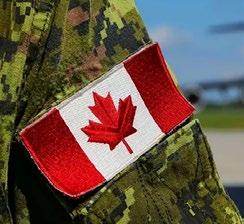
A group of prominent Canadians is urging the federal government to support plans for a voluntary National Youth Service program that would include basic military training.
Engage Canada submitted a proposal to the House of Commons Standing Committee on Finance in May, seeking support to develop the program. Under the proposal, young people aged 18-25 would complete the military training before serving in areas such as emergency preparedness, climate resilience and community service.
The proposal has attracted support from business, military, Indigenous, academic and community leaders, including former Quebec premier Jean Charest, former British Columbia premier Christy Clark, Paralympian Rick Hansen and Chief Wilton Littlechild.
Michael Burns, chair of Engage Canada, said the initiative is designed to address two challenges facing the country: helping young people transition into the workforce while strengthening Canada’s ability to respond to national needs.
youth could help address both those things. It would give young Canadians a meaningful paid opportunity to serve and build their future, while also strengthening Canada’s capacity to respond to national challenges that we face today.”
Engage Canada is asking the federal government to allocate $18.75 million over two years in Budget 2026 to support the program, which would include a competitive application process and compensation for participants’ work — though Burns says the question of what would be a fair wage is yet to be determined.
The organization argues that the proposal comes at a time when Canada is “debating sovereignty, defence readiness, labour shortages, emergency preparedness, and how to better prepare the next generation for civic leadership.”
“I think Canada is facing two significant challenges at the same time,” he said in an interview with National Post. “First, young people are entering adulthood without a clear pathway for employment. A lot of them are lacking skills, a sense of purpose, resiliency, and a sense of belonging.
“The second is that the country has some urgent national needs, including emergency preparedness, climate resiliency, community service, support for seniors, defence, and security issues. A modern national service program for
Its supporters say that Canada must invest in human infrastructure as well as physical infrastructure in order to build a stronger country.
And public opinion polling suggests some elements of the proposal would receive broad support. Last year, a survey from the Angus Reid Institute found that Canadians were overwhelmingly in favour of mandatory national service across a number of fields, which the poll defined as one year of time donated for those younger than 30 years of age.
For example, 74 per cent favoured a year of public health support service, 73 per cent were in favour of environmental support service, 72 per cent for youth service support, and civil protection had 70 per cent in favour.
India aspires to be one of world's top three economies driven by 'Grow more, achieve more' motto: PM Modi
Continued from Page 1...
"The India of the 21st century is working towards the goal of becoming a developed nation. When one dream is realised, a new one is born. It used to be said that one lamp lights a thousand others; today, I say that one dream gives birth to another-thousands of dreams emerge. When one goal is achieved, an even greater resolve takes its place. This is an India that believes in 'Grow More, Achieve More.' We are a nation of 1.4 billion people, brimming with aspirations," PM Modi said. "We aspire to become one of the world's top three economies as soon as possible, driven by the motto 'Grow more, achieve more'," the Prime Minister said, emphasising India's economic ambitions. Highlighting the country's rapid strides in technology and infrastructure, the Prime Minister said India has emerged as the world's second-
largest 5G market and is now working towards developing indigenous 6G technology.
"Today, India has become the world's secondlargest 5G market. India is rapidly working on 'Made in India' 6G technology," he said.
PM Modi also pointed to the significant expansion of India's urban transport network, noting that metro rail services have grown substantially over the past decade.
"Over the past 12 years, the metro network has expanded to more than two dozen cities across India. Today, over 12.5 million people travel by metro in India daily. India possesses the thirdlargest metro network in the world," he added.
The Prime Minister further noted that the country is rapidly expanding its modern rail infrastructure through semi-high-speed services, including the Namo Bharat Rapid Rail and Vande Bharat trains.
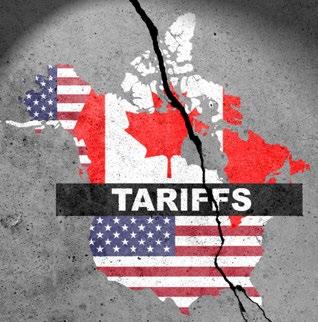
Canada says there’s
no
basis for Trump’s forced labor tariffs
The Canadian government told the Trump administration that new legislation combating forced labor in supply chains should shield Canada from new tariffs.
In a written submission to the United States Trade Representative’s office, the Government of Canada said it “remains committed to working closely with the United States to eradicate forced labor from global supply chains.”
“In light of Canada’s existing prohibition, complementary supply chain transparency measures, newly introduced standalone forced labor import legislation and continued commitment to CanadaU.S. co-operation, Canada respectfully submits that there is no basis for the imposition of additional Section 301 duties on Canadian goods,” the government said in its submission.
10% duties because they are not doing enough to enforce bans on forced labor.
He also proposed a 12.5% duty on dozens of other countries that have partial or no bans on forced labor in supply chains.
Canada already had legislation intended to curb forced labor in supply chains, which requires annual reports to the federal government. But the federal government tabled a bill last month to boost enforcement.
Ottawa’s case was among more than 1,500 written submissions from nations and industry groups ahead of a three-day hearing in Washington on President Donald Trump’s use of Section 301 of the Trade Act of 1974 to rebuild his global tariff wall around the United States.
United States Trade Representative Jamieson Greer announced in March that his office was launching trade investigations into 60 countries, including Canada.
Greer said Canada, Mexico, the United Kingdom and some other countries should be hit with
In separate submissions to the U.S. trade office, Canadian business and industry groups made the case that there are more effective paths to curbing the issue of forced labor than tariffs, particularly in the deeply integrated North American market.
“We urge USTR to assess Canada separately under Section 301 … suspend consideration of the proposed 10% tariff while Canada’s enforcement reforms are implemented and evaluated, and prioritize targeted bilateral enforcement cooperation over broad country-level measures,” Canadian Chamber of Commerce Vice President Matthew Holmes wrote in his submission.
The Section 301 investigations did not come as a surprise. It was clear the United States would be looking at new avenues to impose duties after the U.S. Supreme Court struck down Trump’s favorite tariff tool, which he used for his “Liberation Day” tariffs and fentanyl-related duties on Canada, Mexico and China, earlier this year.
Canada, Turkey formally launch talks on a free-trade agreement
Canada and Turkey have formally launched negotiations for a free-trade agreement (FTA), Canadian Prime Minister Mark Carney's office said on Tuesday.
"The technical teams from both countries will undertake the necessary work to define the scope and ambition of the agreement and prepare for the first round of negotiations," the office said in a statement.
The move follows an agreement last month by Canadian and Turkish trade ministers to begin exploratory discussions aimed at concluding a free-trade agreement.
Beaverlodge RCMP issue Amber Alert for 6-year-old boy,
Mounties near the Alberta-British Columbia border have issued an Amber Alert for a six-yearold boy. RCMP say the boy was last seen across the border in Fort St. John at 9:30 a.m.
They say Lanakai Morrison was taken on Tuesday from the hamlet of Valhalla Centre, roughly 45 kilometres northwest of Grande Prairie. Fort St. John is about 130 kilometres northwest of the hamlet.
Police say Lanakai may be with his mother, 35-year-old Krista Morrison. RCMP say 35-year-old Daniel Ludwig and four-year-old Karl Morrison may be travelling with them.
last seen in B.C.
On Thursday afternoon, RCMP said they now suspect they are driving in a red, 2006 Ford F-350, with Alberta licence plate CXW8820.
An Amber Alert was sent on Thursday evening to people in the Yukon and Northwest Territories, warning they may be heading north.
RCMP said officers were previously looking for a black 2015 Toyota Tundra with Alberta licence plate CTN9517, but that vehicle has since been found.
Anyone who sees them is advised not to approach and to call 911 immediately.
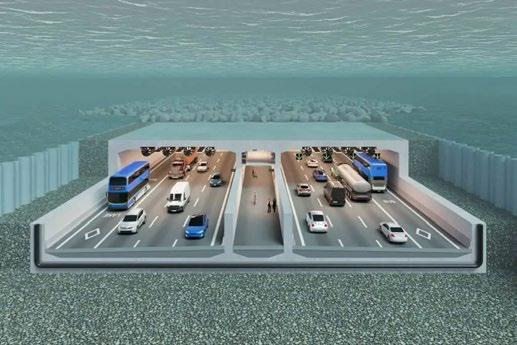
B.C.’s estimate for Massey Tunnel replacement more than doubles to $8.5B
B.C.’s transportation minister says the George Massey Tunnel replacement will now cost about $8.5 billion — nearly twice the 2021 estimate of $4.15 billion for a new eight-lane submersed-tube tunnel beneath the Fraser River.
But the federal government has also promised to kick in $3 billion as part of a memorandum of understanding recently signed with the province.
“This updated budget reflects today’s market conditions, inflation, project scope, and the realities of delivering a project of this size and complexity,” Transportation and Transit Minister Mike Farnworth said on Monday (July 6).
And despite the recent cancellation of the contract with Cross Fraser Partnership to replace the aging four-lane tunnel, Farnworth says the project will proceed as planned, with preconstruction work underway, the environmental
contractors was to ensure the “best possible value” for taxpayers.
He also says the new cost estimate does not change anything about the project, and will not include more features, such as a long-sought-after second exit in Ladner.
“In terms of the second exit, I know that’s something that Delta would like,” he said. “At this point, that is not part of the overall project. That’s not to say that it cannot be, in the future.”
Farnworth also says a federal contribution was expected all along. “We have always made it clear that we expected a federal contribution,” he said.
“That’s always been part of our calculus.”
Ian Paton, the B.C. Conservative MLA representing Delta South, questions how the government can get the project finished by 2031 if the environmental assessment is still not done, and the contractor was just fired.
assessment process expected to conclude by the end of this year, and major work to begin in 2027.
Completion is now expected by September of 2031, rather than December of 2030.
Farnworth said the decision to change
“There’s no talk of who’s even going to build this tunnel,” Paton told Black Press Media. “And yet, they’re saying, don’t worry, it’s going to cost $8.5 billion, and it’ll be completed by 2031.”
Paton says the B.C. government should have gone ahead with a proposed bridge project in 2017, which he believes would be finished by now at a fraction of the cost.
And he argues that would have helped make things like a second Ladner exit easier to fit in and fix the bottlenecks.
“It’s just becoming more and more congested,” Paton said.
Pedestrian struck by cyclist in downtown Vancouver dies
One of the pedestrians struck by a cyclist in downtown Vancouver last month has died.
Vancouver police say that, at about 5:30 p.m. on June 29, a couple visiting from the U.S. was
crossing West Cordova Street at Richards Street. As they were walking across, the pair was struck by a cyclist travelling eastbound on Cordova Street. The 72-year-old man lost consciousness and was taken to Vancouver General Hospital for emergency surgery. The man’s wife suffered minor injuries and recovered.
Police said Wednesday that man died in hospital on Sunday.
The cyclist was not injured and remained at the scene, according to police.
Sgt. Adam Donaldson said in an earlier news release that the couple reportedly had the right of way when a cyclist heading east on Cordova Street struck them.
Statement from the Mayor Locke on Bishnoi gang arrests
Addressing the extortion crisis has been a major priority for the City of Surrey, and we have been pushing hard for a coordinated national response, continued collaboration across all levels of government, and the additional policing and intelligence resources needed to strengthen safety and confidence across Surrey.
Today, I want to thank law enforcement agencies in Canada, the United States, and abroad for working together to disrupt these criminal organizations and hold those responsible accountable.
The individuals behind these extortion schemes have targeted business owners and threatened our communities, and they must face the consequences
of their actions.
This news reinforces what we've been saying for months: the extortion crisis affecting Surrey and cities across Canada is being driven by sophisticated transnational organized crime networks. While these arrests are an encouraging step, there is still more work to do to protect businesses, families, and neighbourhoods from intimidation and violence.
Organized crime has no place in Surrey. Public safety remains my top priority, and we will continue partnering with governments and law enforcement agencies to keep people safe and send a clear message that intimidation, extortion, and organized crime will not be tolerated.
First robotic surgery performed at Surrey Memorial Hospital
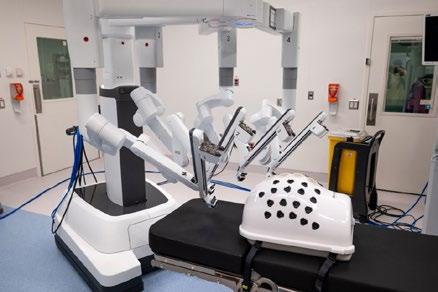
People in Surrey and across the region now have greater access to advanced, minimally invasive surgical care, following the first roboticassisted procedure at Surrey Memorial Hospital.
On June 23, surgical teams successfullyperformed the hospital’s first roboticassisted procedure using the da Vinci Xi system, marking an important milestone for patients, families, and care teams.
“The launch of Fraser Health’s regional robotics surgery program at Surrey Memorial Hospital gives patients access to proven technology that enhances their recovery and gets them back to their families and everyday lives,” says Josie Osborne, Minister of Health in a news release. “This significant milestone is another step we are taking to strengthen health services in Surrey to ensure people can access the care and supports they need.”
The first patient—a 55-year-old woman—had a lung tumour removed and is now recovering.
“The surgery went well and we were able to remove a tumour using minimally invasive techniques,” adds Dr. Ahmad Ashrafi, the regional division head and chief of thoracic surgery for Fraser Health, who led the surgery. “With the robot we can make smaller incisions, so patients experience less pain and scarring and have better recoveries.”
Richmond RCMP officer charged with dangerous driving causing bodily harm
A Richmond RCMP officer has been charged with criminal offences related to a crash that sent five people to hospital, including two pedestrians.
The B.C. Prosecution Service said Friday that Richmond RCMP Const. Beyond Xi has been charged with two counts of dangerous driving causing bodily harm following a crash in Richmond last summer. Xi’s first court appearance is scheduled for Aug. 4.
Shortly after 9 p.m. on July 7, 2025., a marked RCMP vehicle responding to a call with lights and sirens collided with a truck at the intersection of Williams Road and No. 4 Road.
The impact pushed the truck into two pedestrians and a resident of a nearby property.
The RCMP says five people, including the officer and the truck driver, were hospitalized with nonlife-threatening injuries. The two pedestrians were the most seriously injured.
The Independent Investigations Office of B.C. have been investigating the police involvement in this crash.
thoracic (lung, chest, esophagus and stomach) surgeries are the first to benefit from robotic assisted surgery at Surrey Memorial Hospital. People previously referred out of Fraser Health for these surgeries will now be able to receive their care at Surrey Memorial Hospital, reducing stress on patients and their families.
“Introducing robotic-assisted surgery is another step forward in advancing innovation and modernizing health care in Fraser Health,” says Dermot Kelly, President and CEO, Fraser Health. “This technology supports enhanced
The new robotic system allows surgeons to operate from two control consoles within the operating room, performing exact movements with delicate precision and optimal visualization. Robotic instruments are steadier than a human hand, and surgeons get magnified 3D views. The robot is controlled by the surgeon and acts as an advanced tool, supporting better outcomes for patients.
People needing ear, nose and throat (ENT) and
surgical precision and contributes to improved consistency in procedures and outcomes for people. It also helps us attract and retain highly skilled surgical teams, strengthening our ability to provide quality care now and into the future. I want to thank our teams, partners, and the Surrey Hospitals Foundation for their leadership, commitment, and support in making this milestone possible.”
“When we set out to raise $4.5 million to bring robotic-assisted surgery to one of the busiest surgical centres in British Columbia, our donor community responded in an extraordinary way,” says Nicole Robson, President & CEO of Surrey Hospitals Foundation.
B.C. nurses say job action
Continued from Page 1...
The provincial government can end this dispute. It can provide health employers with a mandate that retains nurses, strengthens public health care and prevents further disruption. We are calling on government to act.” Gear also said that the union has heard from members alleging intimidation, coercion and threats relating to refusing nonnursing duties.
Reports include threats of discipline, warnings that nurses could face complaints to the BC College of Nurses and Midwives and pressure to perform non-nursing duties and work mandatory overtime, according to a release from the union. The union also stated it has filed an unfair labour practice application with the BC Labour Relations Board in response to the employers’ attempts to
interfere with lawful job action.
The Hospital Employers Association (HEA) says maintaining safe patient care is key and denies the accusation.
In a statement to Global News, the HEA said that it met with the Nurses’ Bargaining Association (NBA) to continue negotiations.
Extortion, drugs, assassination and transnational Indian crime syndicates: 'Operation Hard Ball' explained
Continued from Page 1...
But the splashy indictment raises as many questions as it answers about Bishnoi and the state of his alleged operations on Canadian soil.
CBC News has spent months combing through criminal cases, attending deportation hearings and interviewing victims to get a picture of the gang's sprawling operation and its involvement in everything from threats to auto fraud to cricket fixing.
What is Operation Hard Ball and why is this all coming out now?
Operation Hard Ball is the name of a "law enforcement action" carried out by FBI and RCMP targeting 37 defendants — including Lawrence Bishnoi, the gang leader who has been imprisoned in India since 2015. Unsealed indictments detail charges against three separate groups: the Bishnoi Organized Crime Group (OCG); a gang run
by another imprisoned Indian national, Jaggu Bhagwanpuria; and an alleged drug trafficking operation led by B.C.'s Ravinder Singh Dhanda. It's important to note that the indictments do not claim any links between the three groups. The U.S. Department of Justice's release says the operation is the result of "a years-long federal investigation into Indian crime syndicates."
Who is Lawrence Bishnoi and how does he operate in Canada?
Bishnoi is a former university student leader who developed a network of associates and followers in that capacity.
He soon "traded campus politics for criminal activity, and refashioned his associates and followers into a criminal organization," the indictment reads. Bishnoi was arrested in 2015 and has been in jail in India ever since. But he has used social media and his network of fanatical supporters to build a global organization.
"Using contraband cellphones and other voice over internet protocol devices smuggled into his jail cell, defendant Bishnoi personally directed political assassinations, murders, shootings, extortions, kidnappings, drug trafficking, human smuggling, and other crimes committed by members and associates of the Bishnoi OCG worldwide," the indictment says. The indictment says the Bishnoi gang has recruited new members "primarily from vulnerable, disadvantaged populations in India" — particularly Punjab state. "Recruitment coordinators ... enticed impoverished minors in India to join the enterprise by promising, among other things, money, notoriety, and protection," the indictment reads.
Canada orders 12 submarines from Germany in largest defence deal of its kind
Continued from Page 1...
The announcement comes just before Carney leaves for a Nato summit in Turkey, where members are expect to face pressure to show they are boosting defence investment. Since taking office, Carney has bumped Canada's defence spending to 2% of GDP, and has committed to reaching 5% by 2035.
According to the government, only one in four of Canada's submarines is currently seaworthy.
The country - which has the longest coastline in the world - is growing increasingly concerned about climate change warming Arctic waters and opening up new fronts for adversaries to attack.
"In a more dangerous and divided world, Canada must be prepared to defend our interests, protect our citizens, build our economy, and secure our future," Carney said. "To that end, we are making the largest defence procurement in our nation's history with speed, ambition, and discipline." The government has not released an estimated cost for the deal.
Speaking in Halifax, Novia Scotia, on Monday, Carney also said the government would enter into negotiations with TKMS to sign a contract, which could take several months. This project is about much more than acquiring submarines," Carney said. "It builds Canadian industrial capacity."
TKMS - the world's largest non-nuclear submarine manufacturer - was competing with South Korea's Hanwha Ocean shipbuilding company for the submarine bid.
The latest fleet of submarines is a part of Carney's effort to increase military spending and intended to bolster the country's maritime
sovereignty, especially in the Arctic.
US President Donald Trump has put pressure on 32 members of Nato's military pact to increase defence spending.
Canada announced in July 2024 that it was seeking a contractor to build the new fleet of submarines, with Carney saying he would decide
the winner to replace the country's aging Victoriaclass vessels, bought in 1998, by this June.
The submarine contract gives Carney "significant credibility" in his efforts to prove he is bumping up defence spending, said David Perry, the president of the Canadian Global Affairs Institute.
"He committed to move the project on a very expedited schedule - astonishingly fast by Canadian standards, and appears to have delivered," he said. "This project will push our core defence speeding up consequentially."
Perry said the Canadian government was focused on awarding the contract to a country with whom it wanted to create a strategic partnership. Carney has sought to strengthen economic and security ties with Europe, as Canada faces trade tensions with the US, its longtime ally to the south.
Australia signs defence alliance with Fiji Dialogue Fiji opposes constitutional overhaul
Dialogue Fiji has urged the Constitution Review Commission to retain the modern democratic foundations of Fiji’s 2013 Constitution while reforming what it describes as an excessive concentration of executive power.
In a detailed submission, the organisation said Fiji needs constitutional reform, but warned that the legitimacy of any changes would depend on a process that is transparent, participatory and trusted by the public.
“The core issue is not whether Fiji needs constitutional reform. It does. The issue is whether the reform process is capable of producing legitimacy. A flawed process may produce a document, but it will not produce a constitutional settlement that the people trust.”
Dialogue Fiji criticised the current five-month review process as rushed and lacking sufficient public deliberation, arguing that comprehensive constitutional reform normally takes between 18 and 24 months and should involve civic education, nationwide consultation, public feedback and careful drafting.
The organisation said the current review
effectively amounts to a full constitutional review because submissions are being invited on the Constitution as a whole, rather than on specific provisions.
It contrasted the current process with the Ghai Commission, describing it as a benchmark for transparency after receiving more than 7,000 public submissions and publishing them online.
Despite its criticism of the review process, Dialogue Fiji said it does not support sweeping constitutional changes. “The weakness of the 2013 Constitution is not that it is too modern. The problem is that it combines progressive citizen equality with excessive executive power. Reform must therefore retain the modern democratic foundations of the Constitution, while correcting the structural concentration of power.”
The organisation called for Fiji to retain key features of the current Constitution, including the abolition of communal electoral rolls, a single national electoral roll, one person one vote one value, open-list proportional representation, secularism, equal citizenry and a fully elected unicameral Parliament.
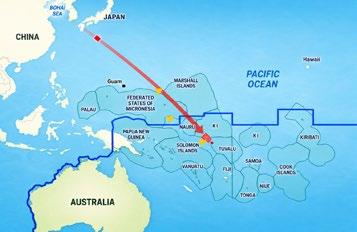
China notified Fiji ahead of Pacific military training exercise
The Government of the People’s Republic of China notified Fiji in advance of its military training activity conducted in the Pacific region on 6 July, assuring authorities that the exercise was routine and posed no threat to the region.
In a statement, the Ministry of Foreign Affairs and External Trade said China had informed the Ministry that the activity formed part of a scheduled military training exercise.
According to the notification, the operation was not directed at any country in the Pacific and posed no security threat to the region.
The Ministry said Fiji remains firmly committed to its vision of the Pacific as an Ocean of Peace, where dialogue, transparency, mutual respect and adherence to international law are the foundation of regional security and prosperity.
It also reaffirmed Fiji’s support for the Rarotonga Treaty and said the country respects development cooperation undertaken within the Pacific region.
The Ministry added that it will continue to engage constructively with all partners to advance Fiji’s foreign policy priorities while supporting a peaceful, stable and secure Blue Pacific region.
Court allows questions over Fiji Airways aircraft lease in pilot injury case
The High Court has ruled that a former Fiji Airways pilot can question the airline about the lease agreement for the aircraft involved in an in-flight pressurisation incident, finding the document could be relevant to determining liability. In a ruling delivered on 24 June 2026, Acting Master Liyanage Kashyapa Wickramasekara held that the aircraft lease agreement is directly material to the negligence claim brought by former First Officer Jitendra Vishal Maharaj against Fiji Airways. Maharaj alleges he suffered serious barotrauma, hearing loss and other medical complications after a pressurisation failure aboard a Fiji Airways aircraft in October 2017. He claims the airline
breached its duty to provide a safe workplace by continuing to operate an aircraft that had previously experienced pressurisation problems.
Fiji Airways opposed questions relating to the aircraft’s lease, arguing the agreement was commercially confidential and irrelevant to the issues in dispute.
However, Acting Master Wickramasekara rejected that argument, finding the lease could contain provisions relating to airworthiness, maintenance obligations and operational responsibilities that may assist in determining whether the airline had actual or constructive notice of defects and whether it complied with its duty of care.
Commission holds final say – Rabuka
PRIME Minister Sitiveni Rabuka says responsibility for deciding what happens to recommendations on the removal of immunity provisions in the 2013 Constitution rests with the Constitution Review Commission.
Mr Rabuka made the comment after the Republic of Fiji Military Forces (RFMF) called for the removal of the immunity provisions in its submission to the commission.
“Nobody has the right to be making their personal or group decisions because those recommendations were made to the commission and it’s up to the commission what they do with
Australia and Fiji signed a major defence treaty on Monday, bolstering ties as Canberra seeks to outmanoeuvre China in the South Pacific.
The Ocean of Peace pact elevates Fiji to one of Australia's few treaty allies and binds each nation to come to the other's "mutual defence".
China sent waves through the region in 2022 when it signed a secretive security pact with the Solomon Islands, stoking fears it could one day lead to a permanent military presence.
Australia has greatly upped its diplomatic efforts in response, securing deals with the likes of Papua New Guinea, Vanuatu and Tuvalu.
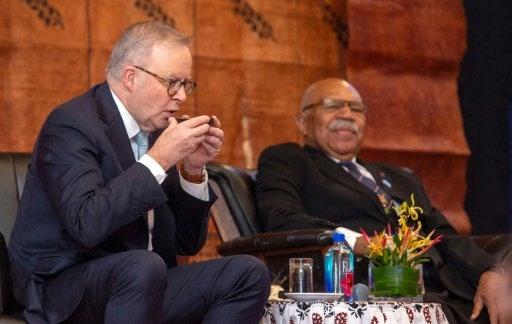
Prime Minister Anthony Albanese signed the pact with his Fijian counterpart Sitiveni Rabuka during a trip to capital Suva.
The pair also signed a second comprehensive treaty covering everything from climate action to economic cooperation.
"When it comes to security issues the Pacific family need to look after our own security," Albanese told reporters.
"The significance of these agreements cannot be underestimated." Photos showed Albanese sipping Fiji's traditional kava drink at a welcome ceremony before the pact was signed.
Fiji joins the United States, New Zealand and
Papua New Guinea as Australia's fourth treatybound ally. Under the deal, the two nations agree to consult each other over any "security-related development" that threatens their sovereignty.
Rabuka tried to quell concerns that China could see the treaty as a snub. "I do not expect China to
have any severe pushback," he told reporters.
"It does not threaten Fiji's relationship with China." The Chinese foreign ministry said on Monday that it hoped the pact would not harm Beijing's interests. "It is hoped that relevant countries will genuinely respect the independence and sovereignty of the island nations, focus on their sustainable economic and social development and refrain from targeting third parties or harming their interests," spokesperson Guo Jiakun told reporters.
Police await forensic results in officer’s death at police post
Police are awaiting forensic test results as investigations continue into the death of a police officer who was found deceased while on duty at the Colo-i-Suva Police Post in the weekend.
Police spokesperson Ana Naisoro confirmed that a post-mortem examination has been completed, with investigators now awaiting the outcome of
it,” he said. However, Mr Rabuka welcomed the military’s decision to make the submission.
“I just welcome the fact that they have made the submission.” The RFMF, in its final submission on Thursday, recommended the removal of the immunity provisions, saying they have created a culture of impunity. It also proposed a truth and reconciliation process as part of wider constitutional reforms. The immunity provisions protect those involved in the 2000 and 2006 coups and the period of military-backed rule that followed, and remain among the most debated parts of the 2013 Constitution.
further forensic analysis.
“The post mortem has been conducted awaiting results of forensic tests on biological samples obtained,” she said.
“This is to assist in determining the circumstances that led to the officer’s death.” Police said investigations remain ongoing.
Wreckage of missing Pakistan cargo Boeing 737 recovered from Arabian Sea
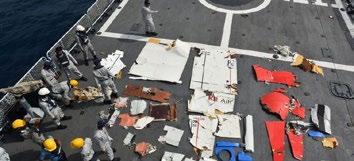
The wreckage of the Boeing 737 cargo plane was found in the Arabian Sea on Wednesday, nearly 12 hours after the aircraft went missing off the Karachi coast, while search operations continued to locate five crew members onboard, according to the Pakistan Airports Authority.
The Pakistan Navy (PN) and Pakistan Maritime Security Agency (PMSA), after an extensive search and rescue operation in the deep sea, located and identified the wreckage of the K2 Airways Cargo Boeing 737. The debris was recovered around 53 nautical miles south of Pakistan's Ormara, the authority said in a statement.
"PN and PMSA after 12 hours of Search & Rescue operations in deep Sea have successfully located and identified wreckage of K2 Airways Cargo B737 which was declared missing last night.
India-Afghanistan review wide-ranging ties as New Delhi reiterates support to welfare, development SOUTH ASIA
India and Afghanistan took stock of the bilateral ties during the 4th round of India-Afghanistan Joint Committee Meeting, here in the national capital on Thursday, the Ministry of External Affairs said in a statement.
India also reassured its continued commitment towards supporting the development of Afghanistan.
As per the MEA, the two sides reviewed the entire spectrum of bilateral relations, including cooperation in the fields of humanitarian assistance, development partnership, food security, healthcare, capacity building, education, sports, trade, visa and connectivity.
The meeting was co-chaired by M. Anand Prakash, Joint Secretary (PAI), Ministry of
The wreckage was recovered from 53 NM South of ORMARA," the statement read on Wednesday.
The authorities said various air and sea-based assets were deployed to locate the aircraft, and efforts were underway to find the missing crew members. The Pakistan-registered Boeing 737 cargo aircraft, operating a flight from Sharjah to Karachi on Tuesday night, reported a navigational system issue while en route, following which it was guided by Karachi Air Traffic Control.
External Affairs of India, and Shuaib Baryalai, Director General, First Political Division, Ministry of Foreign Affairs of Afghanistan.
"The Indian side reiterated its continued commitment to supporting the welfare and development needs of the Afghan people. The Afghan side appreciated India's sustained support and cooperation across various sectors," the statement said. Meanwhile, last week at the press briefing in the national capital, MEA Spokesperson Randhir Jaiswal had reiterated India's assistance to Afghanistan. He said, "We have an ongoing humanitarian assistance cooperation. We have been sending them medicines... and also been offering development projects which can bring benefit to the lives of people there."
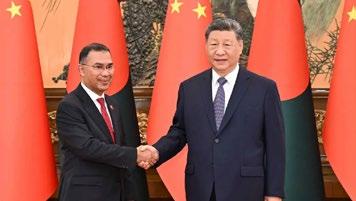
Bangladesh's new government has sought greater Chinese investments and partnership to revive a stuttering economy, even as it attempts to re-balance ties with neighbouring India.
Bangladeshi Prime Minister Tarique Rahman went to Malaysia and China in his first overseas official visit last month, signalling the direction of Dhaka's foreign policy.
Analysts say the choice of destinations reflects Dhaka's effort to recalibrate its strategic priorities. While Rahman first visited Malaysia, his trip to China is seen as the more significant.
India has historically been the traditional port of call for newly-elected South Asian leaders. Some in India have viewed Rahman's China visit as a message to Delhi which has maintained close ties with the ousted Bangladeshi leader Sheikh Hasina.
Among several bilateral agreements, Rahman's outreach to Beijing for help managing the Teesta River and a deal to develop a special economic zone near Mongla port have attracted particular attention. These are closely watched in Delhi as the two Asian giants compete for influence in
Bangladesh. Relations between Dhaka and Delhi turned frosty after the overthrow of prime minister Sheikh Hasina in August 2024 in a mass uprising. She fled the country and took refuge in Delhi. Diplomatic ties remained strained after the interim government led by Muhammad Yunus took office, with India avoiding high-level visits.
After Rahman took over following a landslide victory for his Bangladesh Nationalist Party (BNP) in February, both sides have taken initiatives to reset their ties.
"There is no doubt there has been a relative relaxation of tensions between the two countries," former Indian foreign secretary Shyam Saran told.
India lodges strong objection after incorrect map of Kashmir displayed in Bangladesh, shown as part of Pak
The Modi government has strongly objected to the display of an incorrect map of Jammu and Kashmir at a seminar held in Dhaka, where the region was shown as part of Pakistan. The map was presented by a former Bangladeshi ambassador during the seminar. Coincidentally, Pooja Kumari Jha, Second Secretary at the Indian High Commission in Dhaka, was present at the event. She immediately objected to the map and firmly stated before the audience that Jammu and Kashmir is an integral and inalienable part of India, and that the map being displayed was
incorrect. Following her objection, the former Bangladeshi ambassador apologized and said the map was only symbolic.
Pooja Kumari Jha said, “The map of India displayed here is incorrect. Jammu and Kashmir is an integral and inalienable part of India, and I believe the map presented here is not accurate.” Responding to the Indian diplomat’s objection, former Bangladeshi ambassador Tariq A. Karim offered a clarification. He said that the map was intended solely for symbolic purposes and was not meant to depict actual international boundaries.
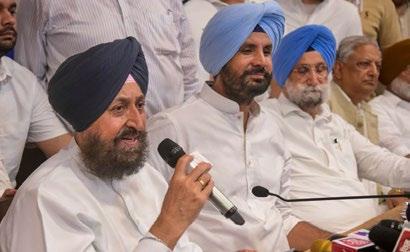
Punjab Congress rift shows signs of easing; anti-Warring camp relents, says ready to hold talks with Baghel
In a sign of a possible easing of tensions in the faction-ridden Punjab Congress, senior leaders opposed to Amrinder Singh Raja Warring continuing as PPCC chief have, after days of deadlock, on Thursday decided to initiate a dialogue with AICC general secretary in-charge Bhupesh Baghel.
Punjab Pradesh Congress Committee president. Several leaders had earlier skipped key meetings and demanded a leadership change ahead of the 2027 Assembly elections.
At a meeting attended by at least seven senior leaders — Charanjit Singh Channi, Sukhjinder Randhawa, Rana Gurjeet Singh, Parminder Pinki, Pargat Singh, Bharat Bhushan Ashu, Barinder Dhillon and Barindermeet Singh Pahra — it was decided to meet Baghel tomorrow or the day after, following consultations with all stakeholders. Rana Gurjeet contacted Baghel on Thursday to schedule the meeting.
The aggrieved leaders will meet Baghel on the condition that Warring is not part of the deliberations, a senior leader said on the condition of anonymity. Sources said most of the leaders present at the meeting expressed resentment over Baghel’s hostile posturing over the past few days.
The development comes amid reported resentment in certain sections of the party, particularly among leaders close to Channi, over the high command’s decision to retain Warring as
Baghel, who has been in the state to hold discussions with party leaders and oversee organisational preparations, has publicly maintained that there is no question of changing the state leadership. He has emphasised that the high command’s decision is final and has been welcomed by most leaders. Welcoming the development, Baghel said, “I received a call from Rana Gurjeet. I will be meeting them. I am going to visit those who are extending the invitation.” With Rahul Gandhi returning from abroad on Friday, Congress leaders are hopeful of an early resolution.
Senior leaders privy to the back-channel parleys said a senior party leader close to Sonia Gandhi had persuaded the unhappy leaders not to publicly defy AICC representatives and instead raise their concerns while maintaining party discipline.
Speaking to The Tribune, Randhawa said all the leaders were disciplined soldiers of the party and would take up their issues with the Punjab affairs in-charge on the party platform. “All senior leaders will collectively meet the party high command. No leader will speak individually. Instead, we will speak together and listen to the views of the party high command.”
Sources said Channi had been working to bring all leaders, including Partap Bajwa, Pargat Singh and Randhawa, on one platform. For the scheduled meeting with Baghel, efforts are underway to bring all leaders, including Bajwa, together to present their grievances before the Punjab affairs in-charge.
Police inspector arrested with heroin in Tarn Taran
The police have arrested a Sub-Inspector (SI) and his accomplice after allegedly recovering 300 gm heroin and Rs 1.27 lakh from their possession.
SSP Surendra Lamba identified the accused as SI Sahib Singh, a resident of Majjupur in Tarn Taran and currently posted as Investigating Officer (IO) at the Khalra police station. The arrested woman has been identified as Kinder Kaur, a native of Mari Udhoke and presently residing at Baba Jallan Colony at Chabal, Tarn Taran.
Apart from recovering narcotics and drug money, police teams have also impounded the car that the two were travelling in. The SSP said acting on reliable input, a police patrol party led by SHO Khalra Baljinder Singh intercepted a Hyundai i20 at Baba Jallan Colony in Chabal area.
During the search in the presence of Deputy Superintendent of Police (DSP) Sukhbir Singh, the police team recovered 300 gm heroin and Rs 1.27 lakh from them. The services of the Sahib Singh
have been suspended with immediate effect. A case has been registered at the Chabal police station. Fazilka cops suspended over drug smuggling.
Ghubaya police post in-charge ASI Gurnam Singh and Head Constable Joginder Singh have been placed under suspension by the authorities in connection with a heroin smuggling case.
The Head Constable was arrested by the Muktsar police on July 4 along with Arshdeep Singh, a resident of Mamdot in Ferozepur district, and Dilsher Singh, a resident of Muktsar district allegedly for possessing 280 gm heroin.
The police also seized a licensed revolver, five cartridges and the accused’s car.
Fazilka SSP Gagan Ajit Singh said Joginder Singh was suspended after his arrest. During the subsequent investigations, the alleged involvement of ASI Gurnam Singh in the smuggling case also came to light, leading to his suspension, he added.
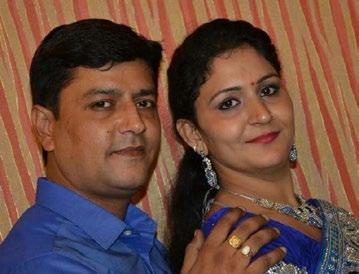
Four members of a family allegedly consumed poison at their house in Officer’s Colony on Wednesday night. The police suspect that a financial dispute within the family may have led to the incident.
Vikas Batish (40) and his 11-year-old daughter Khushi died during treatment. His wife Tamanna (36) and 14-year-old son Kanav remain under medical care.
Civil Lines SHO Vinarpreet Singh said the police received late-night information from Government Rajindra Hospital that four members of a family had been admitted after consuming poison. A team reached the hospital and began investigation. The duty magistrate was called and statements were recorded in his presence.
Preliminary inquiry suggests the family had been facing financial disputes for some time. Batish, a former private bank officer, had been unemployed and reportedly troubled by financial issues.
The police said the magistrate recorded the wife’s statement and that post-mortem examinations of the deceased had been conducted. Victim Vikas Batish, who was living in rented accommodation, had arranged a loan of Rs 55 lakh for one of his
close relatives, who later refused to pay the instalments.
The victim’s wife reportedly gave a statement to a magistrate, following which the police were in the process of registering a case.
It was learnt that on Wednesday evening, Vikas mixed poison in juice. He consumed it first and later offered it to his wife and children.
Sources said the house owner came to know about it when commotion began after the condition of all four started deteriorating.
Soon, local residents gathered around the house. They discovered a suicide note and informed the police. All four were rushed to the hospital.
India,
Russia call for "concerted action" against terror groups, proxies; discuss emerging threats
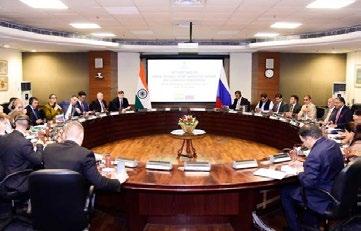
India and Russia called for "concerted action" against terrorist groups, their proxy organisations and affiliates while discussing emerging global and regional security threats during the 14th meeting of the India-Russia Joint Working Group on Counter Terrorism (CT) in the national capital, the Ministry of External Affairs (MEA) said.
The meeting, co-chaired by MEA Secretary (West) Sibi George and Deputy Minister of Foreign Affairs of the Russian Federation Dmitry Lyubinsky, took place on Wednesday, where representatives from relevant departments and agencies of both countries also participated in the discussions.
According to the MEA statement issued Thursday, both sides condemned terrorism in all its forms and manifestations, including cross-border terrorism, and strongly condemned the terrorist attack in Pahalgam, Jammu and Kashmir, on April
22, 2025, as well as the blast near Red Fort, New Delhi, on November 10, 2025.
"Both sides called for concerted action against terrorists and terrorist groups, including those listed in the UNSC 1267 Sanctions Committee and their proxy groups and affiliates," the MEA statement read.
During the meeting, India and Russia shared their experiences in combating terrorism and agreed to enhance cooperation in addressing challenges related to violent extremism, radicalisation, terror financing and the misuse of new and emerging technologies, including digital financial technologies, for terrorist purposes. The two sides also exchanged assessments on current and emerging terrorist threats at the global and regional levels and reaffirmed their commitment to strengthening counter-terrorism cooperation through bilateral and multilateral platforms,
including the United Nations, BRICS, the Eurasian Group on Combating Money Laundering and Financing of Terrorism (EAG), and the Shanghai Cooperation Organisation (SCO).
"The two sides shared their experiences in countering terrorism and agreed to enhance cooperation to address challenges of violent extremism, radicalisation, terror financing and the use of new and emerging technologies and digital
financial technologies for terrorist purposes. They discussed the current and emerging terrorist threats at the global and regional level," the statement read.
"The two sides reaffirmed their commitment to strengthening counter-terrorism cooperation in bilateral as well as multilateral platforms, including at the UN, BRICS, EAG and SCO," the statement added.
The next meeting of the India-Russia Joint Working Group on Counter Terrorism will be held in Russia on a mutually convenient date, the ministry added.
Following the meeting, the MEA in a post on X said that both sides "shared their assessment on regional and global terrorism" and agreed to strengthen cooperation against challenges such as radicalisation, terror financing and the misuse of new and emerging technologies for terrorist purposes.
Indian High Commissioner calls PM's New Zealand visit "historic", first by an Indian PM in 40 years
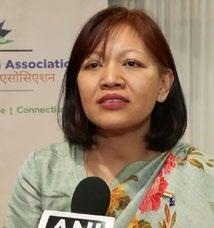
Calling Prime Minister Narendra Modi's upcoming visit to New Zealand "historic", Indian High Commissioner to New Zealand Muanpuii Saiawi on Thursday said it will mark the first visit by an Indian Prime Minister to the Pacific country in 40 years and is expected to give fresh momentum to bilateral ties.
Speaking ahead of PM Modi's arrival on July 10, Saiawi said extensive preparations had been made in coordination with the New Zealand government to ensure the visit was both substantive and memorable.
"Tomorrow we will be receiving Prime Minister Narendra Modi. This will indeed be a very historic visit because it will be after 40 years that any Indian Prime Minister has come to New Zealand. I have been working very closely with the New Zealand government to make this
a very memorable visit in terms of the substance as well as the form and the protocol in logistics," she said. Highlighting the strength of bilateral relations, the High Commissioner said India and New Zealand share warm and friendly ties built on mutual trust.
"India and New Zealand have warm and friendly relations, and our relations are formed based on mutual trust," she said.
Saiawi also highlighted the recently concluded Free Trade Agreement between the two countries earlier this year, saying it would further strengthen cooperation across multiple sectors. Reflecting the strong people-to-people ties between the two countries, the Prime Minister will address a large gathering of the Indian diaspora during the visit, the MEA said.
India breaks into China's steel box monopoly after costly lesson
Continued from Page 1...
The dominance is so complete that shipping lines, exporters and logistics companies across the world have little choice but to source containers from Chinese factories.
India's dependence on these imports was not merely a commercial issue. It reflected the absence of a domestic ecosystem capable of producing containers at scale and at globally competitive prices. While India emerged as one of the world's largest trading nations, it lacked meaningful capacity to manufacture the very steel boxes that move much of international trade. That imbalance became increasingly uncomfortable as geopolitical tensions rose and supply chains became more vulnerable to disruptions. The push for container manufacturing in India can be traced directly to the pandemic years. As global trade patterns were disrupted, containers accumulated in some regions while becoming scarce in others. Exporters struggled to secure boxes. Freight rates surged and supply chains became unpredictable. Indian exporters and importers felt the impact sharply.
The shortage highlighted the risks of depending on a single country for a critical piece of trade infrastructure. What had previously been viewed as a low-priority manufacturing segment suddenly acquired strategic significance. Policymakers began looking at container manufacturing not simply as another industrial activity but as an element of supply-chain security.
The government's response gathered pace over the past two years. Container manufacturing was identified as one of the strategic sectors that India
wants to develop under its broader manufacturing push. The biggest policy intervention came in the Union Budget this year, which announced a ₹10,000 crore Container Manufacturing Promotion Scheme. The objective is to create a globally competitive domestic ecosystem rather than merely establish a few isolated factories.
The scheme proposes capital support for new manufacturing facilities, assistance for expansion of existing units and operational support to bridge the cost disadvantage faced by Indian manufacturers. It also includes provisions for research, testing, skilling and technology development. The government expects the initiative to increase domestic manufacturing capacity dramatically over the coming years and create the foundation for a viable industry.
Building containers may appear straightforward, but competing with China is another matter. Industry executives estimate that containers manufactured in India currently cost 30-40 per cent more than those produced in China. In many cases, the difference can be around $700- 1,000 per container. Chinese manufacturers operate massive, highly automated facilities that benefit from economies of scale developed over decades. They also enjoy deep supply chains for steel, components and specialised equipment. Indian manufacturers are only beginning the journey. Land costs, smaller production runs and the absence of large-scale automation make it difficult to match Chinese prices. The challenge is not merely about producing containers. It is about producing them consistently, efficiently and at a cost that global shipping lines are willing to pay.
Maharashtra becomes ninth BJP state to announce Uniform Civil Code plan
Maharashtra on Thursday became the ninth BJP and NDA-ruled state to announce plans to pass a uniform civil code law. CM Devendra Fadnavis, speaking in the Maharashtra Assembly, announced a committee to draft the UCC law under former Supreme Court juge Ranjana Prakash Desai.
Fadnavis said the committee would have three ex-judges from the Supreme Court and the high court, one constitutional expert, one former bureaucrat and two social sector experts.
The committee headed by Desai will have the following members: former HC Justice RC Chavan,
former HC justice SG Mehere, former chief secretary DK Jain, legal expert Birendra Saraf, social activist Ramesh Patange and educationist Suvarna Rawal. Uttarakhand recently implemented the UCC. Goa has had a uniform law for long. Other BJP states that have announced the UCC plans are Gujarat, Assam, Madhya Pradesh, Rajasthan, UP and Chhattisgarh.
The ruling BJP has taken the state route to implement the UCC. Tribals have been kept out of the UCC purview in Uttarakhand. The BJP has chief ministers in 17 states and with the NDA it governs 22 states.
SC mulls referring legal issues involving bail to Sonam Raghuvanshi to larger Bench
Can mere mention of a wrong provision of law in an arrest memo, specifically a typographical error, be sufficient to invalidate the arrest of an accused?
Faced with this legal question in the case of Sonam Raghuvanshi, who allegedly murdered her husband during their honeymoon in Meghalaya in 2025, the Supreme Court on Thursday hinted at referring the issue to a larger Bench for an authoritative pronouncement.
A Bench of Justice Manoj Misra and Justice Shree Chandrashekhar said it would examine if the Meghalaya High Court was justified in granting bail to Raghuvanshi on the ground that the arrest memo contained a typographical error.
Sonam – a resident of Indore in Madhya Pradesh—is accused of conspiring to kill her husband, Raja, while they were on honeymoon in East Khasi Hills in May 2025. Police alleged that Raja was killed with the help of her lover Raj Kushwaha and three others. Sonam – who was arrested in June 2025, has since been released on bail. She is facing trial in a court in Meghalaya.
arrest and entitle the accused to bail in the “shocking” murder case.
The Meghalaya High Court granted bail to Raghuvanshi on the ground that the police failed to supply proper written grounds of arrest and that there was a “total non-application of judicious mind” as the memo cited Section 403 (which does not exist in the context) instead of Section 103(1) (murder) of the Bharatiya Nyaya Sanhita (BNS).
Solicitor General Tushar Mehta, representing the Meghalaya Government, wondered if mere mention of a wrong provision in an arrest memo, specifically a typographical error, was sufficient to invalidate an
“In this matter, this is a very serious case where bail is granted on the grounds that grounds (of arrest) were not supplied… though at the time of arrest, there is a record that there is a supply of grounds,” Mehta submitted.
“We will consider this matter at length. We will decide whether this requires to be referred to a larger Bench… If this ground is not sustainable, then the bail order goes,”Justice Misra said. The Bench asked Mehta to furnish legible photocopies of documents supplied to the accused and posted the matter for further hearing on July 14.
On July 3, another Bench led by Justice MM Sundresh had refused to stay the high court order granting bail to Raghuvanshi, noting she had already been released from jail even as it expressed reservation over the high court order.
4 years before US, NIA charged Bishnoi of running crime network from jail
In its indictment of Lawrence Bishnoi, the US Department of Justice has only reaffirmed the National Investigation Agency’s (NIA) assertion in its August 2022 FIR that despite being lodged in prison, the gangster had been carrying out criminal activities.
The US indictment order states that Bishnoi, in association with his accomplices, carried out political killings and extortions through VoIP (Voice-Over Internet Protocol) devices and encrypted messaging services from prison.
The FIR was lodged by the NIA against nine accused, including Bishnoi, his brother Anmol Bishnoi, Kala Jathedi and Goldy Brar, under the stringent UAPA for allegedly hatching a conspiracy to carry out terrorist activities in Delhi and other parts of the country. “Some of these gangsters are lodged in jails and are carrying out criminal activities from there. Others are absconding and operating from different parts of the world, including India, Canada, Pakistan, Malaysia, Australia and the UAE,” the antiterror agency had said. The US Department of Justice said that “using contraband cellphones
and other voice-over internet devices smuggled into his jail cell, Bishnoi personally directed his associates to commit political assassinations, murders, shootings, extortions, kidnappings, drug trafficking, human smuggling and other crimes worldwide".
It said Bishnoi, Brar, Rohit Godara and other defendants attempted to extort victims in Los Angeles and Thousand Oaks in December 2025 and January 2026, demanding a payment of $5 million. Bishnoi has been in jail since 2017 after being arrested for his alleged role in ordering murders and operating extortion rackets across states.
In 2021, he was brought to Delhi’s Tihar Jail in connection with a case under the Maharashtra Control of Organised Crime Act. He has been lodged in Gujarat's Sabarmati jail since 2023, where he is learnt to have been placed under isolation. However, the US allegation that he used contraband cellphones and VoIP devices as well as WhatsApp while being in jail has raises questions about how he has been accessing these modes of communication.
Monsoon covers entire country; IMD says below-normal rain from July 15
The southwest monsoon completed its advance across the country on Thursday, a day later than usual, with the remaining parts of Rajasthan, Haryana and Punjab coming under its cover. The monsoon normally covers the entire country by July 8.
The monsoon arrived in the region on July 1 after a delay of a few days and had covered most parts of northwest India by July 3, except for parts of Fazilka and Muktsar districts in Punjab and Sirsa and Fatehabad districts in Haryana.
Its advance had remained stalled along the Barmer-Jodhpur-Rajgarh-Bathinda axis for the past few days, even as many areas in Punjab and Haryana received varying amounts of rainfall.
The India Meteorological Department (IMD) has forecast a continuous wet spell over parts of the region until July 15.
“Weak El Niño conditions are currently prevailing over the equatorial Pacific Ocean. The latest forecasts from the Monsoon Mission Climate Forecast System (MMCFS) and other global climate models indicate that El Niño
conditions are likely to strengthen further during the southwest monsoon season,” the IMD said.
The IMD said a fresh cyclonic circulation is likely to form over the northwest Bay of Bengal adjoining the Odisha and West Bengal coasts, while another cyclonic circulation is expected to develop over Bihar and adjoining areas. These systems are likely to bring light rainfall over east and northeast India, as well as the Western Himalayan region, during the second week of July. According to the IMD, overall rainfall activity is likely to remain below normal across the country. Rainfall is expected to be below normal over the Indo-Gangetic plains, south India and the northeastern states.
For July 11, the IMD has issued a moderate flash-flood risk warning for Uttarakhand’s Pauri Garhwal, Chamoli, Pithoragarh, Bageshwar, Almora, Champawat and Nainital districts.
The IMD had earlier predicted that July would be drier than usual, with rainfall across the country expected to be 94 per cent of the longperiod average (LPA).
India, Australia sign uranium supply pact, expand defence, mineral & maritime ties
India and Australia on Thursday unveiled an ambitious roadmap to elevate their comprehensive strategic partnership, operationalising the civil nuclear agreement to facilitate Australian uranium supplies for India, fast-tracking negotiations on a Comprehensive Economic Cooperation Agreement (CECA) and expanding cooperation across defence, maritime security, critical minerals, cyber technologies and clean energy. Addressing a joint press conference in Melbourne
after the third India-Australia Annual Summit with Australian Prime Minister Anthony Albanese in Melbourne, Prime Minister Narendra Modi described the relationship as a partnership of the future, saying the two countries had emerged as trusted democratic partners in the Indo-Pacific. Modi said India and Australia, as two vibrant democracies and important Indo-Pacific maritime powers, shared a common vision for a free, open and rules-based regional order.