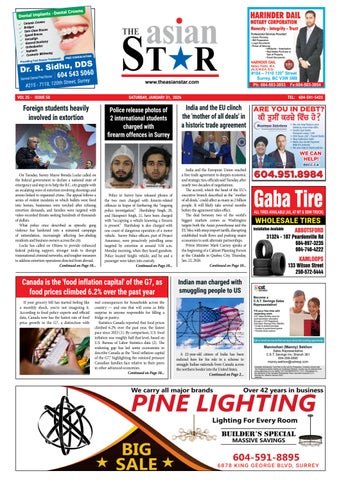
The Asian Star - Jan 31, 2026

Page 1


On Tuesday, Surrey Mayor Brenda Locke called on the federal government to declare a national state of emergency and step in to help the B.C. city grapple with an escalating wave of extortion involving shootings and arsons linked to organized crime. The appeal follows a series of violent incidents in which bullets were fired into homes, businesses were torched after refusing extortion demands, and families were targeted with video-recorded threats seeking hundreds of thousands of dollars.

What police once described as episodic gang violence has hardened into a sustained campaign of intimidation, increasingly affecting law-abiding residents and business owners across the city.

Locke has called on Ottawa to provide enhanced federal policing support, stronger tools to disrupt transnational criminal networks, and tougher measures to address extortion operations directed from abroad.

Continued on Page 10...

If your grocery bill has started feeling like a monthly shock, you're not imagining it.

According to food policy experts and official data, Canada now has the fastest rate of food price growth in the G7, a distinction with

in Surrey have released photos of the two men charged with firearm-related offences in hopes of furthering the “ongoing police investigation.” Harshdeep Singh, 20, and Hanspreet Singh, 21, have been charged with “occupying a vehicle knowing a firearm is present.” Harshdeep is also charged with one count of dangerous operation of a motor vehicle. Surrey Police officers, part of Project Assurance, were proactively patrolling areas targeted by extortion at around 3:50 a.m. Monday morning, when they heard gunshots. Police located Singh’s vehicle, and he and a passenger were taken into custody.

Continued on Page 10...

real consequences for households across the country — and one that will come as little surprise to anyone responsible for filling a fridge or pantry.

Statistics Canada reported that food prices climbed 6.2% over the past year, the fastest pace since 2023 (1). By comparison, U.S. food inflation was roughly half that level, based on U.S. Bureau of Labor Statistics data (2). The widening gap has led some economists to describe Canada as the “food inflation capital of the G7,” highlighting the outsized pressure Canadian families face relative to their peers in other advanced economies.

Continued on Page 10...

India and the European Union reached a free trade agreement to deepen economic and strategic ties, officials said Tuesday, after nearly two decades of negotiations.

The accord, which the head of the EU's executive branch described as the "mother of all deals," could affect as many as 2 billion people. It will likely take several months before the agreement takes effect.

The deal between two of the world's biggest markets comes as Washington targets both the Asian powerhouse and the EU bloc with steep import tariffs, disrupting established trade flows and pushing major economies to seek alternate partnerships.

Prime Minister Mark Carney speaks at the beginning of a Cabinet Planning Forum at the Citadelle in Quebec City, Thursday, Jan. 22, 2026.

Continued on Page 10...

A 22-year-old citizen of India has been indicted here for his role in a scheme to smuggle Indian nationals from Canada across the northern border into the United States.

Continued on Page 2...

Police

Camping fees increase for 59 B.C. parks, non-residents to pay a surcharge

It is going to get more expensive to camp in B.C. this year. BC Parks says it is introducing a new camping surcharge for people living outside of B.C. and updating camping fees for the first time since 2016, following an increase in visitors and extreme weather events.

Camping fees will be updated in 59 highdemand frontcountry parks and four backcountry parks, while fees remain unchanged in 388 parks.

“As British Columbians, we care deeply about our parks and recreation areas, and we recognize the significant cultural, economic and recreational roles they have for communities,” Minister of Environment and Parks Tamara Davidson said in a statement.

Beginning May 15, 2026, non-B.C. residents will pay an additional $20 flat rate for staying in

frontcountry campgrounds, trips to backcountry parks, renting a cabin and using mooring buoys and docks. Camping fees will be updated in 59 high-demand parks and four popular backcountry parks: Garibaldi Park, Golden Ears Park, Joffre Lakes Park and Mount Assiniboine Park. For B.C. residents, updated camping fees in the 59 parks include an average increase of 40 cents per night during shoulder season, an average increase of $13.29 per night during the summer and an average nightly rate of $30.81 in shoulder season and $42.91 in the summer. The fee updates for backcountry camping in Garibaldi Park, Golden Ears Park, Joffre Lakes Park and Mount Assiniboine include an average fee increase of $13.62 per night and nightly fees ranging from $17 to $25 per night, depending on the park.

ICBC/Personal Injury

Immigration

Corporate

B.C. Premier David Eby said what is happening in Surrey with the extortion cases is a “terror attack in slow motion.”

Eby made those comments in Ottawa on Thursday after meeting with the other premiers and Prime Minister Mark Carney.

“What we’re seeing in Surrey is it’s a terror attack in slow motion and you would never dream of giving refugee status to someone who participated in a terror attack, but that’s exactly what’s happening under our current system; that loophole has to be closed,” Eby said.

These comments came on the heels of all the premiers calling on the federal government to pass Bill C-14 as quickly as possible. Bill-C14 aims to make bail tougher for repeat and violent offenders and increase penalties for serious crimes, which is part of the Bail and Sentencing Reform Act. It would also address that “loophole” that allows some suspects of serious crimes to apply for refugee status.

Eby’s comments come after Surrey’s city council approved a motion on Monday night aimed at ramping up efforts to tackle the ongoing extortion-

related violence in the city.

“Therefore, be resolved and moved that the City of Surrey recognizes that it is in a state of emergency due to the extortion and extortionrelated violence which have plagued our city,” Surrey Mayor Brenda Locke said at the meeting.

Locke is also requesting that Ottawa declare a federal state of emergency and reiterated the need for a national extortion commissioner to oversee

a coordinated response. With unanimous support from the council, Locke will now put the requests in writing to senior levels of government and police agencies. The declaration would give the City of Surrey additional temporary powers to tackle the extortion crisis.

The B.C. government is providing $3.3 million toward a comprehensive flood mitigation plan in the Abbotsford-Chilliwack area.

In an announcement this week, the B.C. Emergency Management and Climate Readiness Ministry said the money will support the work of the Sumas River watershed flood mitigation planning initiative.

The group includes the Semá:th, Leq’á:mel and Máthxwi First Nations, the cities of Abbotsford and Chilliwack, and the provincial government. The initiative was created following devastating flooding in the area in 2021 that damaged homes, farms and roads, and caused billions of dollars in damage across the province.

Last December, the area was hit again by flooding but less than in 2021.

Both times the flooding was triggered by intense rains from so-called atmospheric rivers, huge plumes of moisture from tropical storms carried across the Pacific Ocean. Scientists expect atmospheric rivers to increase in severity and frequency because of climate change.

Semá:th First Nation Chief Dalton Silver said the funding will keep the flood-mitigation initiative moving forward. “There is still much work to be

Continued from Page 1...

Shivam, whose last name is not known, is charged with one count of conspiracy to illegally bring aliens to the United States and four counts of illegally bringing aliens to the United States for the purpose of private financial gain.

A federal grand jury in the Northern District of New York returned an indictment on Wednesday charging him for his role in the scheme.

According to court documents, Shivam directed smuggling operations from January through June 2025, coordinating the illegal transport of individuals across the US-Canada border into Clinton County, New York.

done collaboratively, and I hope we can continue this into the future. I also hope that all perspectives are reflected in the planning,” said Dalton.

Said Abbotsford Mayor Ross Siemens: “The December 2025 flood was a stark reminder of how vulnerable Abbotsford is to repeat flooding events and of the critical importance of safeguarding our residents, businesses, transportation corridors, energy infrastructure and provincial food security.”

The emergency management ministry noted work being carried out includes a hydraulic model, risk and ecological assessments, and studies for water quality, fish passage, conveyance, and pump station functionality.

The assessments are meant to identify the most appropriate measures to mitigate flood risk, restore habitat and build resilience throughout the watershed, said the ministry.

Once a plan is complete, it will need to be funded. While the province has provided some funding for flood mitigation, including $76.6 million to upgrade a critical pump station in Abbotsford, it comes nowhere near the money that is needed to upgrade flood mitigation in the Fraser Valley, Metro Vancouver and other areas of the province.

immobilised, while the other was later stopped in Mooers, New York.The vehicles contained a total of 12 undocumented people.

WhatsApp messages between one of the drivers and a number connected to Shivam allegedly revealed coordination of smuggling illegal persons into the US from Canada on numerous occasions in and prior to January 2025, including exchanging proof of life photographs and directions to safe houses in upstate New York, the Justice Department said in a statement.

In January 2025, US Border Patrol agents tried to stop two vehicles travelling in tandem near the USCanada border. Both vehicles accelerated to avoid agents, triggering a pursuit.

One vehicle went off the road and became

If convicted, Shivam faces a maximum penalty of 10 years in prison for each count. If convicted of all four counts of illegally bringing people to the United States, Shivam faces a mandatory minimum sentence of five years and a maximum sentence of fifteen years. He was initially charged by criminal complaint in June last year with one count of conspiracy to transport individuals illegally.

University of Victoria international student attacked, significantly injured

The University of Victoria has confirmed an international student at the school was injured in an attack at a local mall, but police say there’s no indication the case was racially motivated.

Nonetheless the school says in a statement that “hatred, racism and intolerance have no place” in the local community and the university is committed to supporting “a diverse, safe and thriving campus and broader community.”

Police in Saanich, B.C., said Wednesday the attack happened on Jan. 22 just before 9:30 p.m., when patrol officers responded to a report that someone had been assaulted near the Tuscany Village shopping complex.

victim is an international student at the institution and says the school is in contact with them and is offering support.

“This is a horrific incident and our hearts are with the victim, who is currently recovering from their

Police said the victim suffered significant facial injuries and was taken to hospital, but few other details about the attack have been released.

Investigators are looking into the circumstances surrounding the assault and have identified the suspect as a Caucasian man in his late 20s or early 30s.

Jim Dunsdon, the University of Victoria’s associate vice president of student affairs, confirms the

injuries,” Dunsdon said in the statement, adding that students are encouraged to be aware of their surroundings.

“It is terrible to hear of incidents like this, particularly when they victimize someone from our community.”

He said there are on- and off-campus support programs available for those who feel impacted by the attack.

Person hit and killed by train in Fort Langley

A person has died after being struck by a train in Fort Langley. Langley, B.C., RCMP said that at approximately 7:45 a.m., they were called to the tracks near Glover Road and Billy Brown Road.

Police officers rushed to the scene and immediately found the person who had been hit. “Despite life-saving efforts, the individual succumbed to their injuries at the scene,” Sgt. Zynal

Sharoom of the Langley RCMP said in a release.

“Road closures are in effect in the immediate area while our investigators continue their investigation.”

Motorists and other road users are asked to avoid the area and find alternative routes. Anyone who was in the area at the time and witnessed this collision is asked to contact the Langley RCMP at 604-532-3200 and quote file number 2026-3084.

‘Border runner’ arrested in B.C. as illegal crossings becoming ‘more common’: police

A man who illegally crossed the Canada-U.S. border on foot in B.C. Wednesday was arrested, according to authorities, who say these incidents are on the rise.

The Abbotsford Police Department said the “border runner” was taken into custody around 9 p.m. near Zero Avenue and Mt. Lehman Road.

“A police service dog assisted in the arrest, and the man was turned over to CBSA,” a social media post from the department said.

Wednesday’s arrest is the third so far this year made by municipal officers in Abbotsford.

“Unfortunately, illegal border crossings in Abbotsford are becoming more common,” a spokesperson for the Abbotsford Police Department said in a statement to CTV News.

In 2025, the department responded to 42 illegal

border crossings.

“That number reflects only the incidents handled by our officers, not those managed by RCMP teams working in the area,” the statement to CTV News explained.

All of those arrested were subsequently turned over to federal border officials.

Officer testifies immigration file linked accused to Abbotsford murder scene

A police forensic identification officer testified this week that fingerprints found at the scene of a double-homicide in Abbotsford, B.C., were matched to one of the accused using an immigration file.

Const. Kiranpreet Chahal told a B.C. Supreme Court judge he identified fingerprints on a sliding patio door at the home where seniors Arnold and Joanne De Jong were found dead in May 2022.

Chahal, an expert in the examination, development and comparison of fingerprints, spent Wednesday and Thursday on the witness stand.

Gurkaran Singh, Abhijeet Singh and Khushveer Singh Toor—all in their early 20s—are charged with two counts each of first-degree murder in the deaths of Arnold De Jong, 77, and Joanne De Jong, 76. All three have pleaded not guilty.

The Crown previously told the court that Gurkaran Singh arrived in Canada on a student visa less than a month before the killings.

Chahal testified he attended the De Jongs’ residence the day after the bodies were discovered

and was tasked with collecting potential forensic evidence. He said he later identified possible fingerprints on the sliding patio door.

Those prints were submitted to the national Automated Fingerprint Identification System, known as AFIS. Chahal said he received a response the following day indicating a potential match to fingerprints contained in Gurkaran Singh’s immigration file.

After conducting a manual analysis and comparison, Chahal testified he concluded the print found at the home matched the left index finger in Singh’s immigration records.

The Crown alleges the three accused acted together, forcibly confining the couple in separate bedrooms before killing them. Prosecutors also allege the men stole Arnold De Jong’s credit cards, cheques and a power washer, which was later sold.

Court has heard that Abhijeet Singh’s cleaning company had performed work at the De Jongs’ home on two occasions, including in the months leading up to the killings.

Canada and Korea sign MOU for more trade, including autos and minerals

Canada and South Korea have taken new steps to strengthen trade ties that are expected to boost several industrial sectors in Canada, including automotive and critical minerals.

This comes amid the global trade war and U.S. tariffs, which have impacted Canada’s economic growth and job market, forcing the federal government to seek alternative trading partners and work to remove interprovincial trade barriers to reduce reliance on the U.S. On Tuesday, Canada’s Industry Minister Melanie Joly met in Ottawa with counterparts from the Republic of Korea and signed a memorandum of understanding (MOU)

between the two nations. Details of the agreement were outlined in a press release, sent on Wednesday, which includes establishing the Canada-Korea Industrial Cooperation Committee to work together on what it calls “future mobility.”

Areas the committee will focus on, according to the release, include creating a footprint for Korean automotive production in Canada, with electric vehicle manufacturing opportunities among the investments, although no specific amounts were mentioned. AI was also one of the “strategic sectors” mentioned as part of the agreement, but no other details were provided.

Ph: 604-591-5423

Fax: 604-591-8615

editor@theasianstar.com

Editor: Umendra Singh

Marketing and Sales: Ravi Cheema

604-715-3847

Shamir Doshi 604-649-7827

Harminder Kaur 778-708-0481

Parminder Dhillon 604-902-2858

Pre-Press: Avee Waseer

Production: Ozmo Media

www.theasianstar.com

Are Trump's tariffs fueling a boom in trade deals for China and India?

The European Union and India announced a landmark Free Trade Agreement on Tuesday. The two economies, which together represent about a quarter of the world's population, spent nearly two decades haggling over the terms of the deal.

Statements by European leaders suggest the selfproclaimed king of the deal, President Trump, and his tariffs-based trade policy over the last year, likely helped propel the two sides toward a final agreement.

Many of the world's major economies have raced to forge new bilateral agreements as doing business with the U.S. has become suddenly, and in many cases dramatically, more expensive and less predictable.

Indian Prime Minister Narendra Modi called the trade deal with the EU "historic," arguing that it would "deepen the economic ties, create new opportunities … and strengthen the partnership" between the "world's two largest democracies." He said it would "make access to European markets easier for India's farmers and small businesses" and boost his country's manufacturing and services sectors.

The deal will see tariffs slashed across a wide range of products, including textiles, apparel, leather, footwear, gems and jewelry, handicrafts, engineering goods and automobiles. India will also cut tariffs on wine, beer and olive oil imported from the EU. Both economies will get unprecedented, preferential market access to each other's products, their leaders said Tuesday.

Europe's massive auto industry, as an example, will see current Indian tariffs on imported vehicles from the bloc slashed from as high as 110% to 10%.

"We did it, we delivered the mother of all deals," European Commission President Ursula von der Leyen said at the event announcing the deal in New Delhi.

The free trade agreement, which will be formally signed later this year after it's approved by the European Parliament and the bloc's individual member states, will allow free trade of goods between India and the 27 EU nations. Together, India and the EU account for 25% of global GDP

and about a third of global trade, according to a statement from the Indian government. The EU is already one of India's biggest economic partners, with bilateral trade worth around $137 billion in 2024-25. By comparison, bilateral U.S.-India trade in that period totalled around $132 billion.

Separately, India and the EU also agreed on a mobility framework that will ease travel and work restrictions for skilled professionals.

British Prime Minister Keir Starmer landed in China Tuesday, beginning the first visit by a U.K. leader to the country since 2018.

"For years, our approach to China has been dogged by inconsistency – blowing hot and cold, from Golden Age to Ice Age. But like it or not, China matters for the U.K. As one of the world's biggest economic players, a strategic and consistent relationship with them is firmly in our national interest," Starmer said in a statement before leaving for Beijing. "That does not mean turning a blind

eye to the challenges they pose – but engaging even where we disagree. This is what our allies do, and what I will do: delivering for the public, putting more money in their pockets and keeping them safe through pragmatic, consistent co-operation abroad."

Starmer, who traveled with a delegation of representatives from leading U.K. businesses including HSBC and Jaguar Land Rover, was expected to meet President Xi Jinping and Premier Li Qiang to discuss "trade, investment and national security," according to a statement from the British government.

"In a time of growing global instability, where events abroad continue to rebound on people at home, the Prime Minister has promised to act in the U.K.'s national interest," the government said.

President Trump reacted to the agreement by threating to impose 100% tariffs on Canadian imports to the U.S. if it is finalized.

injunction

Longtime fugitive Ryan Wedding sought a court order to prevent his arrest in Mexico's Sinaloa state nearly a year before he was finally taken into U.S. custody last week, according to legal records obtained by CBC News.

The documents, first reported by Sinaloan news organization Riodoce, suggest that Wedding — a Canadian who is accused of leading a cocainesmuggling network linked to the Sinaloa cartel — believed that Mexican authorities were closing in on him in early 2025.

In a Mexican federal court filing in midFebruary, Wedding claimed under oath that state law enforcement had obtained a warrant seeking his arrest and extradition. He said at the time he was living in Los Mochis, a coastal city in the western state of Sinaloa.

The filing came just days after the FBI's manhunt for Wedding ramped up, following the assassination of a witness who had been set to testify against him.

Jonathan Acebedo-Garcia, a longtime drug trafficker who was born in Montreal, was shot by a hit squad in Medellin, Colombia, on Jan. 31, 2025, after Wedding allegedly placed a $5 million US bounty on his head.

Wedding, 44, was taken into U.S. custody in Mexico last week and immediately flown to California, where he faces 17 federal charges, including murder, drug trafficking, witness tampering and money laundering. He has pleaded not guilty. CBC News has reviewed a Nov. 4, 2025, ruling by a federal judge in Sinaloa, who stated he

arrest

year

had no jurisdiction over Wedding's request for an injunction — known as an amparo — because the underlying arrest warrant had been issued in Mexico City.

The partially-redacted ruling seen by CBC does not name Wedding and leaves out his home address in Los Mochis. However, a Mexican court docket lists the plaintiff in the case by his full name, Ryan James Wedding.

His California-based defence lawyer Anthony Colombo told CBC News in an email that he was aware of the 2025 court case. "The use of an amparo is common in Mexico to suppress an arrest warrant that was issued," Colombo said.

The Mexican judge's decision says Sinaloa's public safety director first acknowledged having sought the arrest warrant, but later denied that he'd done so. Cartel expert Nathan P. Jones said in an interview that it's "a classic narco strategy" to use the Mexican legal system to slow down court proceedings.

Jones, an associate professor of security studies at Sam Houston State University in Texas, said it's unlikely Wedding was living at the address he provided.

Continued from Page 1...

A reported says grocery store prices rose about 5% in the past year, while restaurant meals jumped 8.5%. Many Canadians say they are noticing smaller portions and are relying more heavily on sales flyers and visiting multiple stores just to manage weekly food costs.

“I’m buying stuff I used to buy in college and I’m in my mid-30s now,” one Montreal shopper told CityNews. Another described their weekly flyer as their “bible” for finding deals.

While these coping strategies can help in the short term, they come with trade-offs. Tracking discounts and hopping between stores takes time, and cutting back on food quality can carry longer-term health implications.

Several interconnected factors are driving higher food costs. Global supply chain disruptions — including shipping delays, rail bottlenecks and port inefficiencies — add costs before food ever reaches store shelves. Trade tensions and tariffs contribute additional pressure, while extreme weather and climate events affect crop yields worldwide. Geopolitical conflicts, including the war in Ukraine, for example, continue to influence commodity and fertilizer markets.

“Once these factors filter through the supply chain, consumers feel them quickly,” CityNews reported. Andrew Barclay, a senior economist at Statistics Canada, told the news outlet that “the main story for food is almost always weather,” noting that geopolitics has played a growing role more recently.

Federal policy has also affected food prices. According to StatCan, last year’s GST/HST holiday temporarily lowered the cost of certain items, including snack foods and candy, but prices rose again once the tax break ended (3).

Sylvain Charlebois, director of Dalhousie University’s Agri-Food Analytics Lab, told CityNews that without the tax break, food inflation would have been closer to 4.2%.

“There’s greed, absolutely,” Charlebois said. “I

do think that this is something we also need to think about with grocers.”

Even as inflation bites, Canadians can look back on past enforcement actions as a reminder that corporate accountability can return money to households. In 2017, major grocers and bread producers admitted to participating in a bread price-fixing scheme that inflated the cost of packaged bread for years.

Loblaw Companies Ltd. and George Weston Ltd. offered $25 gift cards as part of an early settlement, followed by a broader national class action (4). Court-approved settlements later resulted in additional cash payments, with applications accepted throughout 2025. While the application period is now closed, the program will return money to Canadians who were overcharged, illustrating how vigilance and legal recourse can deliver tangible financial benefits.

It also underscores how Canadian households can be at the mercy of market power when trust is abused — and how easily everyday consumers can be overcharged without knowing it. Food inflation may be structural, but households can still take steps to protect their wallets. Tracking long-term price trends through StatCan data can help identify shifts beyond short-term spikes. Loyalty programs, price-matching tools and community food co-ops can offer modest savings when used consistently. Reviewing receipts over time can also reveal where spending habits have quietly changed.

Even though the bread settlement window has closed, staying aware of restitution programs and class actions remains worthwhile. In a period where groceries, housing and utilities dominate household budgets, every recovered dollar matters. Rising food costs are not just numbers on a receipt. They represent a persistent financial challenge. Understanding why prices are climbing — and where accountability exists — gives Canadians a clearer path to navigating the pressure with more control over their money.

Record number of organ transplants recorded in 2025:

BC Transplant

B.C. Transplant is encouraging more British Columbians to consider signing up to be organ donors after 2025 saw a record 575 people receive life-changing surgeries in the province.

B.C. Transplant oversees organ donation and transplants across the province and has been recording organ transplants annually since it's first kidney transplant in 1968.

These surgeries, B.C. Transplant said, were made possible because of the 232 people who donated, including 146 deceased individuals and 86 living donors, such as for kidney and liver transplants.

"Every deceased donor is a tragedy," said provincial medical director of donation services, Dr. Sean Keenan, "the fact that the families in that time are willing to consider this is just, you know, incredible."

There is no specific reason behind the high number of surgeries performed last year, Keenan said, explaining the donors they had were able to provide more organs and that organs are also transferred between provinces for patients.

majority of people who do, have not registered a decision.

"Those that do, it's much easier for family and loved ones to proceed on their behalf," he said.

He said anyone can register to be a donor, regardless of the medical or health conditions they may have, because multiple tests are done to ensure organs are safe for transplant and it also provides hope to all those waiting for a life-saving organ transplant.

"It's in many ways … hard work by everybody involved and … I think year-to-year variation," he said. Keenan said it's very rare for people to become donors because they need to be on life support, and

Kelowna, B.C., resident Troy Chapman still remembers the call he got on Oct. 4, 2025, when he was told he was finally going to have a kidney transplant that day. Chapman said he had been on the waitlist since May, after experiencing heart failure connected to diabetes, and was on dialysis for two-and-half years.

Cat sitter banned from making claims about human burials at Surrey pet cemetery

It’s a story of alleged lies about what lies beneath.

A consent order issued by a B.C. Supreme Court judge last month has banned a cat sitter from making defamatory claims about both the owners of a disused pet cemetery and the site itself — which is currently facing redevelopment.

Kristin Schumacher was sued by owners of the site, located at the corner of 147A Street and 78 Avenue in Surrey, B.C. They alleged Schumacher made false claims, including that human beings were interred at the half-acre property alongside hundreds of animal companions.

Schumacher started an online petition opposing the redevelopment, contacted elected officials and sought legal guidance for how to stop the project. The consent order means she cannot “author, publish, endorse or republish statements, comments, postings or other communications, of any nature whatsoever, under her name or any aliases, in any forum or media, that is defamatory” of Turnberry Developments, company owner Lynn Weir and the property they own.

The order requires Schumacher to stay 100 metres away from the property and bars her from contacting Weir and her company, while dismissing

all claims against Schumacher without costs. An emailed statement from Turnberry Developments welcomed “the resolution of this matter and the clarity it brings to the public record.”

Schumacher declined to comment, but CBC News obtained a letter she wrote to the company to “express my regret and offer an apology for what I wrote” about Turnberry, Weir and the property.

“I said things about the Property, especially in regards to the presence of human remains, based on information I had gathered but which was not based on solid or reliable evidence or anything that provides proof positive of these propositions,” the letter reads. Tales of animals and humans buried together might make one think of Stephen King’s supernatural horror novel Pet Sematary, but this real-life drama shows how high the stakes can rise when a passion for pets collides with the push for real estate development. According to a 1981 article in The Province, Nellie and Daniel Blair commissioned the pet cemetery in 1952.

“My husband had to go out to the city dump,” Nellie is quoted as saying. “He gave the man a couple of bucks to let him bury her under a tree where she would be undisturbed for a while.

B.C. premier says Alberta separatists seeking assistance from U.S. is 'treason'

B.C. Premier David Eby says Alberta separatists meeting with the U.S. administration and seeking financial backing is an act of "treason," as the issue of national sovereignty loomed over a meeting between the premiers and Prime Minister Mark Carney on Thursday.

"To go to a foreign country and to ask for assistance in breaking up Canada, there's an oldfashioned word for that, and that word is treason," said Eby, ahead of the closed-door meeting in Ottawa.

He was reacting to reports that members of U.S. President Donald Trump's administration have held meetings with members of the Alberta Prosperity Project, a separatist group that is pushing for the western province to become independent.

Alberta Prosperity Project co-founder Jeffrey Rath pushed back against Eby's comments, calling them "defamatory."

"It's a childish temper tantrum on behalf of a spoiled NDP politician," Rath told CBC News. "We're thrilled with Premier Eby losing his little mind today and saying the nasty things he's saying and all the insults that he's levying. It's childish, it's defamatory, it detracts from his credibility."

The group is seeking a possible $500-billion US line of credit from the U.S. Treasury to help bankroll the new country if they come out victorious in a referendum.

An official with the U.S. State Department confirmed the meetings, saying the department "regularly meets with civil society types," but added that "no commitments were made."

"It is completely inappropriate to seek to weaken Canada, to go and ask for assistance, to break up this country from a foreign power and — with respect — a president who has not been particularly respectful of Canada's sovereignty," said Eby.

"I think that while we can respect the right of any Canadian to express themselves to vote in a referendum, I think we need to draw the line at people seeking the assistance of foreign countries to break up this beautiful land of ours," he said.

Alberta Premier Danielle Smith said she "supports a strong and sovereign Alberta within a united Canada," although her critics point out she made it easier last year for an independence petition to succeed.

At a closing news conference Thursday, the premier said she expects the U.S. administration to "confine their discussion about Alberta's democratic process to Albertans and to Canadians," adding she'll raise the issue with both her delegates in Washington and Ottawa.

Asked about the cross-border meetings, Carney would only say he expects the U.S. administration — which has previously made jabs about making Canada the 51st state — to "respect Canadian sovereignty."

The prime minister said Trump has not raised either Alberta or Quebec sovereignty in the leaders' conversations.

"I'm always clear, in my conversation with President Trump, to that effect and then move on to what we can do together," he said.

Manitoba Premier Wab Kinew joked to reporters earlier in the day that all the talk makes him want to have a referendum as well.

Mistaken identity leads to police drawing weapons, handcuffing Prince George school trustee

A school trustee in Prince George, B.C., says she's shaken and scared after being surrounded by police with their guns drawn and then put in handcuffs, in what RCMP say was a case of mistaken identity.

Erica McLean is vice-chair of the local school board, originally from the Gitxsan Nation in Hazelton, as well as an author and athlete who works with youth in the community in northcentral B.C.

She says she was in the parking lot of a local Starbucks Tuesday morning, parked in her vehicle, when an unmarked police car slowly bumped into the front of her SUV, followed by a second one boxing her in from the back. What happened next, she says, was a blur, as she

was surrounded by multiple officers with guns drawn shouting instructions at her.

"I froze," she says. "I couldn't understand, there were a lot of instructions ... I remember thinking if I made the wrong move, there are so many weapons pointed at me, I could die. I really felt like my life was at risk.

"I was afraid that if I put my phone down or took my seat belt off that I could be shot. I was silently whispering, 'What is happening? What is happening? How does this happen?'"

In a statement, RCMP did not dispute McLean's version of events. They said they had received a report of a stolen vehicle the day prior, taken by suspects they believed to "be associated with a local crime syndicate."

On Tuesday, the statement says, a local police unit believed they spotted the stolen vehicle in a parking lot and "our police officers followed their training for what they determined to be a high-risk vehicle stop, which includes using police vehicles to prevent movement of the suspect vehicle and engaging the occupants, in this instance a lone driver, with their firearms drawn.”

Police say 2 men found guilty of murder caught trying to flee BC jail

Two convicted murderers, including gangland hitman Dean Wiwchar, have been charged with attempting to escape from a British Columbia pretrial centre last month.

The Surrey Police Service says in a statement that correctional officers observed the men attempting to escape from the exercise yard at Surrey Pretrial Services Centre on Dec. 7.

It says 40-year-old Wiwchar and 34-year-old Harry Christensen were both charged on Tuesday and remain in custody serving their original sentences as they await new court dates.

Wiwchar was one of four men convicted of firstdegree murder and handed a life sentence for arranging a brazen daytime shooting at a Toronto, Ont., café in 2012 as part of a feud among drug traffickers.

Prosecutors in the trial accused Wiwchar of actually carrying out the killing of John Raposo, who was shot on the patio of the Sicilian Sidewalk Cafe, as soccer fans gathered to watch a Euro Cup

game. Wiwchar also pleaded guilty last year to two counts of conspiracy to commit murder in relation to the killing of a man in the lobby of Vancouver’s Sheraton Wall Centre in 2012 and a plot to kill a second man.

The B.C. Prosecution Service confirmed he was sentenced to 20 years and 18 years concurrently for the B.C. crimes, but was not given credit for presentence custody "as that time has already been accounted for by various other convictions."

The court also imposed a lifetime firearms ban, a DNA order, a no-contact order and a forfeiture order when Wiwchar was sentenced on Dec. 5.

Last March, Christensen pleaded guilty to second-degree murder in the killing of a man in Chilliwack in 2018. B.C. Supreme Court Justice Warren B. Milman's oral reasons for sentencing said Christensen used a handgun to shoot Kyle Cromarty twice from behind "execution-style" in public on the afternoon of Oct. 4, 2018. One of the shots proved to be fatal.

Former university manager charged with fraud, theft from SFU

A former manager at Simon Fraser University (SFU) has been charged with fraud and theft over $5,000.

Kristn Tanya Schiefke is accused of defrauding SFU and stealing from the school between 2018 and 2023, according to charge documents from the B.C. provincial court.

SFU sued Schiefke last September over the matter, alleging she had misappropriated almost $200,000 in funds, according to a civil claim.

Schiefke has denied SFU’s allegations, which have not been tested in court.

CBC News reached out to her lawyer for comment on the criminal charges but did not get a response by deadline.

In its lawsuit, SFU alleged that Schiefke, who was the manager of academic and administrative service at SFU’s school for the contemporary arts from 2012 to 2023, approved several invoices beginning in July 2018 from “KTS Kreations.”

never performed any work for SFU.

And — according to SFU — the organization was actually owned or operated by Schiefke.

SFU paid about $46,500 to KTS or Schiefke directly, as she had asked “that she personally retrieve the cheques for KTS because KTS was located in Ireland,” according to the claim. Schiefke also added her spouse, who works as a drywaller, and his teenage son to SFU’s payroll as a research assistant and project assistant, respectively, SFU alleged.

The invoices were for operations including set design and costume design, but the school said the “unknown entity”

BC woman urges dog owners to watch their pets on walks after husky overdoses on cocaine

Sara Bell had taken her two-year-old husky Nilak to the North 40 Park Reserve in Delta, B.C., when he picked up a napkin off the ground.

“He just swallowed it whole,” said Bell. “So, I wasn't able to get it out of him.”

He had done this before so she didn’t think much of it, until he started acting strangely. Nilak has a condition called Portosystemic Shunt which affects how his liver functions, so Bell rushed him to a veterinarian.

Tests revealed Nilak had ingested and overdosed on cocaine. After some fluids were pumped into his system, he was okay. She posted about it on Facebook, and couldn’t believe how many people said their dogs had also overdosed on drugs they picked up off the street.

“To have something like that happen. And have it happen in that many places, it makes you really scared to take them out for walks,” said Bell.

Mia Riback knows what that’s like.

A few years ago her previous dog found hashish at a campground in Squamish, B.C., and rushed her to the emergency vet nearby.

“I remember thinking, I can't lose my dog, and I was crying the whole way,” said Riback. Years ago, Melissa White also had a similar experience with a previous dog at the North 40. He was rushed to the vet and had apparently ingested cannabis. He's since passed away from natural causes. She’s now extra careful when she takes her current dogs out but knows anything can happen.

The university said it paid $138,734 to Schiefke's spouse and $5,250 to her stepson.
Helps Parents Boost their Education Savings!
India and the EU clinch the 'mother of all deals' in a historic trade agreement

Continued from Page 1...

"This agreement will bring major opportunities for the people of India and Europe," Indian Prime Minister Narendra Modi said in a virtual address to an energy conference. "It represents 25% of the global GDP and one-third of global trade."

The accord will see free trade on almost all goods between the EU's 27 members and India, covering everything from textiles to medicines, and bringing down high import taxes for European wine and cars.

India and the EU also agreed on a framework for deeper defense and security cooperation, and a separate pact aimed at easing mobility for skilled workers and students, signaling that their partnership extends beyond commerce.

The negotiations for the India-EU deal got a new impetus after U.S. President Donald Trump's strong-arm trade tactics, including threatening his European allies with punitive tariffs over their objections to Trump's threats to take control of Greenland. Speaking at a joint news conference in New Delhi with European Commission President Ursula von der Leyen and European Council President António Costa, the Indian leader said the partnership with the EU "will strengthen stability in the international system" at a time of "turmoil in the global order."

Modi, speaking at a joint news conference in New Delhi with European Commission President Ursula von der Leyen and European Council President António Costa, said that the partnership with the EU "will strengthen stability in the international system" at a time of "turmoil in the global order."

"Europe and India are making history today. We have concluded the mother of all deals," von der Leyen posted on X.

In a speech later, she said that the accord was

a tale of "two giants" who chose partnership "in a true win-win fashion." She also said that it sends "a strong message that cooperation is the best answer to global challenges." The deal is expected to further integrate supply chains and strengthen joint manufacturing power between the two economies. It will also cut up to 4 billion euros ($4.7 billion) in annual tariffs for exporters and create jobs for millions of workers in India and Europe. A formal signing of the deal could come later this year after officials go through the legal details of the text and the European Parliament ratifies it. India's trade minister, Piyush Goyal, said that he expected the deal to take effect by the end of the year. India is expected to reduce or eliminate tariffs for 96.6% of EU exports, while Brussels will reciprocate with similar reductions in phases that eventually cover nearly 99% of India's shipments by trade value, according to statements from both sides.

India's sectors poised to gain from the deal include textiles, apparel, engineering goods, and leather, handicraft, footwear and marine products, while the EU's gains will be in wine, automobiles, chemicals and pharmaceuticals, among others.

The European Commission said that tariffs charged by India on EU-made cars will gradually go down from 110% to as low as 10%, while they will be fully abolished for car parts after five to 10 years. Tariffs ranging up to 44% on machinery, 22% on chemicals and 11% on pharmaceuticals will also be mostly eliminated.

On European wine, the tariffs in India would come down from 150% to 20% for premium wines. New Delhi has excluded dairy products such as milk and cheese from the deal, along with cereals, citing "domestic sensitivities" about those products. For its part, the EU won't allow concessional tariffs on imports of Indian sugar, meat, poultry and beef products, Indian Trade Ministry officials said.

Police release photos of 2 international students charged with firearm offences in Surrey

Continued from Page 1...

Police found a loaded handgun during the arrests. Surrey Police Service issued a news release on Tuesday about the charges.

Members of the media called on the police to release the two accused images, as this was something that SPS Chief Norm Lipinski said in a Jan. 20 video update that police would “endeavour to release the names and photos” of people who have been “arrested and charged, specically when we require additional information from the public or when that individual is found to pose a significant risk to public safety,” Lipinksi said. In this case, police released the images in the hope that additional witnesses, victims or associates will come forward with information about what the two accused were doing on or before Jan. 26.

Anyone with information is encouraged to contact the Surrey Extortion Tip Line at 236-4855149 or Crime Stoppers at 1-800-222-8477 or www. solvecrime.ca if you wish to remain anonymous. Former Surrey mayor Doug McCallum is calling on the police to make releasing photos of those charged with extortion-related offences the standard. “The community deserves to know who is involved,” McCallum said. “Extortion thrives in the shadows. The faster photos are released, the faster people can recognize suspects, come forward, and help police dismantle these networks.”

As of Tuesday (Jan. 27), police have not confirmed if there was a shooting on Monday (Jan.

26) or if it was extortion-related, as no victim has come forward.

“Photos will be considered for release on a case-by-case basis and based on the legal necessity to seek assistance from the public with police investigations,” noted a Surrey Police news release Wednesday (Jan. 28).

“The disclosure of these photos in this case is a consistent use disclosure under sections 33(2) (d) and 34 of the Freedom of Information and Protection of Privacy Act whereby police can disclose photos of arrested persons if the disclosure is necessary to further a police investigation into a current crime, or series of crimes, and to seek the public’s assistance for witnesses and victims who may have information.” Harshdeep and Hanspreet remain in custody until their next court appearance on Jan. 30. Surrey Police is in contact with the Canada Border Services Agency, as both are foreign nationals.

Foreign students heavily involved in extortion

Continued from Page 1...

Extortion cases in Canada have exploded over the past decade, mainly in B.C., Ontario, and Alberta, rising more than 300 percent nationwide in the last decade and nearly 500 percent in B.C. alone. In cities like Brampton, Ontario, and Surrey, threats, arsons, and shootings tied to extortion have become routine. The crisis has grown so severe that some families are choosing to leave Canada entirely, returning to India to escape the violence.

Here are five key takeaways from the conversation:

1. Extortion has evolved from domestic organized crime to transnational gangs:

The nature of extortion in Canada has fundamentally changed over the past decade. Chhinzer explained that while extortion traditionally involved established organized crime groups demanding protection money from businesses, the current wave involves something different and more dangerous.

2. South Asian communities in Brampton, Surrey, and Calgary are ground zero Brampton and Surrey have experienced the most dramatic increases in extortion cases, with Calgary also emerging as a hotspot. All three cities have substantial South Asian diaspora populations that Chhinzer says are primarily being targeted by other individuals within the communities.

“These extortions are being committed by young South Asian males, predominantly Sikh, against Sikh families,” Chhinzer said. “And our suspects or accused persons are generally between the ages of 20 and 30. They’re either here on student visas, expired visas, or other types of permits.”

The transnational criminal organizations, with roots in India and Pakistan, understand the community dynamics, making it easier to identify vulnerable wealthy targets and apply pressure.

3. The Bishnoi gang represents a significant transnational threat in Canada

Canada designated the Bishnoi gang as a terrorist organization in late 2023, recognizing

the severity of the threat it poses. The gang, which originated in India, has established deep operational roots in Canada.

“They’re looking for anywhere between $50,000 to $500,000. What they’re doing now is that they’re shooting bullets at their houses and at their businesses…they’re sending text messages, letters, video messages, proxy messages to extort these families,” Chhinzer said.

While the Bishnoi gang is just one of several transnational criminal networks operating in the country, Chhinzer noted that they represent a significant proportion of the extortion activity in Canada.

4. Families are leaving Canada due to the extortion crisis

Perhaps most alarming is the impact on community confidence and safety. Chhinzer revealed that the situation has deteriorated to the point where families are making the extraordinary decision to leave Canada entirely.

The fact that some families view India—a country with its own significant security challenges—as safer than Canada speaks volumes about the severity of the crisis and the perceived failure of Canadian authorities to protect lawabiding citizens.

5. The criminal justice and immigration systems need reform

While police have established task forces and made arrests, the criminal justice system has failed to deliver meaningful consequences, Chhinzer said, with few successful prosecutions.

This failure to secure convictions undermines deterrence and emboldens criminal networks. When asked about policy solutions, Chhinzer emphasized the need for reforms at both the provincial and federal levels to strengthen the justice system’s ability to prosecute these cases effectively. In October 2025 the federal government introduced the Bail and Sentencing Reform Act, a major legislative package designed to tighten bail rules and toughen sentences for repeat and violent offenders, including those charged with violent extortion and organized crime.

$101,041 alleged corruption case:

Court finds father and son have case to answer

The Lautoka Magistrates Court has ruled that a father and son charged with corruption-related offences have a case to answer.

Resident Magistrate Timoci Qaliniuci delivered the ruling yesterday, finding that the Fiji Independent Commission Against Corruption (FICAC) had established a prima facie case against the first accused, Ronald Narayan, on four counts of Abuse of Office and one count of Obtaining a Financial Advantage.

The second accused, Sat Narayan—father of the first accused—was also found to have a case to answer on one count of Obtaining a Financial Advantage.

It is alleged that between September 1, 2016 and October 31, 2017, while employed as an Executive Officer with the Ministry of Health, Ronald Narayan caused ministry tenders for works at Nukuilau Nursing Station, Bukuya Nursing Station, Ba Mission Hospital and Raiwaqa Health Centre to be awarded to Brink Home Builders, a company owned by his father.

The prosecution alleges a financial advantage totalling $101,041.12 was obtained.

In his ruling, Magistrate Qaliniuci said the prosecution’s evidence showed Ronald Narayan issued requests for quotations, participated in tender evaluations for some projects, and failed to declare his interest in Brink Home Builders.

The court also heard that payments amounting to $101,041.12 were made to the company and that Ronald Narayan purchased materials on its behalf.

The Magistrate noted that at the no-case-toanswer stage, the court must assess the evidence objectively, without considering witness credibility or the weight of evidence.

He said the evidence, taken at its highest, touched on the essential elements of all charges.

The matter has been adjourned to February 9, 2026 for mention, with the defence case scheduled to begin on February 13, 2026.

Army to only support – Pio

THE Government has shut down any prospect of a military-led drug sweep, saying the Republic of Fiji Military Forces will not replace the police and that it can only assist under strict legal limits.

Defence and Veteran Affairs Minister Pio Tikoduadua said the illicit drug threat was being treated as a serious national harm, but stressed the response must remain lawful, disciplined and led by the appropriate civilian authorities.

“Drug investigations and enforcement operations must remain led by the Fiji Police Force,” Mr Tikduadua said.

While inter-agency cooperation remained important, he said any involvement of the RFMF could only occur in a clearly defined support role and only with proper legal authorisation.

Any role played by the RFMF would be limited to non-law-enforcement functions such as logistics, transport, planning assistance or mobility support.

“This ensures that military support complements, rather than replaces, civilian policing and preserves clear command, accountability and evidential integrity,” he said.

Mr Tikoduadua said if military support was ever requested, it would be carefully structured to ensure the police retained full control over all law enforcement decisions, including searches, arrests, interviews, evidence handling and prosecutions.

On the legal thresholds for any internal deployment, Mr Tikoduadua said the Constitution does not grant the military primary law enforcement powers.

He said any internal use of the RFMF would have to be consistent with the Constitution and written law, and would require proper written authority under the RFMF Act. Operational requirements would include a formal request from the police department, clearly defined limits on the scope of support, written approvals, clear command and control arrangements, and safeguards to protect constitutional rights, criminal procedure and evidential standards.

Acting PM hits back at critics

Acting Prime Minister Filimoni Vosarogo has defended the Coalition Government against criticism of its handling of the sugar industry, citing record cane payments and increased production over the past three years as evidence of its impact.

Responding to Opposition MP Jone Usamate, Mr Vosarogo said 1.48 million tonnes of sugar cane were harvested during the 2025 crushing season, despite major disruptions including an accidental fire at the Rarawai mill in Ba, labour shortages and logistical challenges.

was the result of ministerial neglect, saying the issue arose from a convergence of accidental, operational and external factors.

He said the Government had delivered the highest cane payments in Fiji’s history, with growers receiving $91.38 per tonne in 2022, $105.08 per tonne in 2023 and $101.13 per tonne in 2024, alongside new incentives and harvesting support programs, lease premium subsidies, enhanced farmer assistance schemes and investments in mechanisation and modernisation.

“These are measurable outcomes, not rhetoric, something Hon Usamate and his FijiFirst government did not even dare to do,” he said.

Mr Vosarogo rejected claims that standing cane

He said the 2025 season was unprecedented, yet mills processed more cane than last year’s 1.33 million tonnes.

Government interventions included extended crushing periods, a $15 per tonne transport subsidy, continued manual labour support through the Fiji Correction Services and the strategic deployment of mechanical harvesters.

He said standover cane was an annual occurrence, even during periods when the Opposition was in government, and acknowledged ongoing challenges posed by ageing mill infrastructure, noting that mills had continued operating at financial loss to support growers.

“It is also a fact that mills have incurred significant costs due to inconsistent cane supply, have remained open beyond scheduled closure dates at financial loss to accommodate growers, and have continued operating even during periods of very poor TCTS, beyond 25 tonnes,” he said.

Teacher’s case delayed

The closing submissions of a teacher from a school in Tailevu facing multiple sexual charges were adjourned after the State indicated it was not ready. The 25-year-old appeared before Justice Usaia Ratuvili for closing remarks.

He is currently facing six counts of rape committed against three students aged 15 and 17 in 2024. The court heard the prosecutor was having difficulty finalising the submissions and therefore

Parents

sought time.

As a result, Mr Ratuvili has directed the state to file the submission by February 6.

The teacher made his first appearance before the Nausori Magistrate’s Court in March 2024.

The man, represented by lawyer Joji Cakau from Vosarogo Lawyers, had his bail extended, with the case adjourned to February 13.

take matters into their own hands

Unsure if the $200 back-to-school assistance would arrive on time, Mere Mata Tuiserene and her husband used their own money to buy school supplies for their four children.

“We decided to buy our children’s school stuff with the money we had because we were not sure whether we would receive the assistance,” Ms Tuiserene said. One child is in Year 11, another in Year 9, while the younger ones are in Years 4 and 3.

The family had submitted forms last year but

received no clear answers despite visits to the Divisional Education Office. She said they did not receive any payment. Questions sent to Education Minister Aseri Radrodro remain unanswered. Divisional Education Office executive officer Jaucoro Sucu said delays were due to incomplete forms, unregistered numbers, and updates to mobile contacts. He confirmed most children affected are now included in upcoming batches for payment.

Police probe viral Ba FSC quarters trespass video

Police in Ba are continuing investigations into an alleged trespassing incident at the FSC compound following the circulation of a disturbing video on social media.

The video, which has gone viral, shows a man allegedly forcing his way into a family home within the FSC quarters and hiding under a bed in a children’s bedroom while the family was having dinner.

The incident is reported to have occurred earlier this week and has raised serious concerns about household safety, particularly for children.

When contacted, police confirm they are aware of the video and say investigations are ongoing. Residents of the FSC compound say the incident has left families shaken, with parents expressing fear over how the individual allegedly gained access to the home and managed to enter a children’s bedroom without being detected. Community members are calling for increased police patrols and stronger security measures within the compound to reassure residents and prevent similar incidents.

SATURDAY, JANUARY 31, 2026

Imran Khan undergoes eye procedure in Islamabad

Pakistan Information Minister Attaullah Tarar confirmed that jailed PTI founder Imran Khan underwent an eye-related medical procedure last week at a hospital in Islamabad.

Speaking to Geo News on Thursday, Tarar said the former prime minister, who is lodged at Rawalpindi's Adiala jail, was taken to the Pakistan Institute of Medical Sciences (Pims) on the night of January 24 for a "20-minute" medical procedure, Dawn reported.

"The eye experts examined him in Adiala jail, after which they recommended that it was necessary to take him to Pims for a small medical process. On Saturday night, he was taken to Pims on the recommendation of these eye doctors and experts," Tarar said.

absolutely healthy." The minister reiterated that "all prisoners" are provided access to doctors and medical treatment under jail regulations. "This is in accordance with the [jail] rules, and he is absolutely healthy," he added.

He added that at Pims, Imran's "eyes were further examined, and after his written approval, a 20-minute medical procedure was performed", following which he was returned to Adiala jail with "important instructions".

Tarar said, "During the medical procedure, his vitals and everything were stable. He's

Asked about concerns about Imran's condition, Tarar again said the PTI founder was "absolutely fine" and stressed that medical experts advised taking him to Pims.

"He is absolutely fine, and he was also perfectly fine when this medical procedure was being performed."

Tarar's remarks came amid claims by PTI earlier this week that Imran had been diagnosed with central retinal vein occlusion (CRVO) in his right eye, "resulting in a dangerous blockage in the retinal vein", Dawn reported.

The party said medical experts had warned the condition could cause permanent damage to his eyesight if not treated promptly.

Also on Tuesday, PTI MNAs filed a fresh petition in the Islamabad High Court seeking permission to meet Imran.

SOUTH ASIA

India cooked Turkey, Pakistan, Bangladesh with EU trade agreement

India’s trade deal with the European Union has caused ripples from across the border to the United States as well. Not only Bangladesh, Pakistan but even the United States and Turkey will feel the heat of the historic trade agreement between India and the EU. Under the agreement, tariffs on over 90 per cent of EU goods exports to India will be eliminated or reduced, including steep duties of up to 44 per cent on machinery, 22 per cent on chemicals, and 11 per cent on pharmaceuticals, which will be mostly phased out.

Notably, the EU–Turkey Customs Union obliges Ankara to match the EU’s common external tariff with any partner country. Ankara has previously raised concerns related to this with the EU, but there has been no headway made to resolve the issue. When the EU lowers tariffs for an FTA partner (like India), Turkey must do the same for that country. However, India won’t have an obligation to do the same to Turkey. It will be interesting to see how Turkey responds to this.

A few months ago, during an interview, Bangladesh’s interim leader Muhammad Yunus said that due to higher US tariffs on New Delhi and lower

Pakistan-Bangladesh direct flights resume after 14 years

Direct air connectivity between Pakistan and Bangladesh resumed after 14 years, with Biman Bangladesh Airlines operating its inaugural Dhaka-Karachi flight, Dawn reported.

The Pakistan Airports Authority (PAA) said in a statement that the Bangladeshi carrier landed at Karachi's Jinnah International Airport on Thursday night, after more than a decade and received a traditional water cannon salute on arrival.

Flight tracking data cited by Dawn showed that Biman Bangladesh Airlines flight BG341 arrived in Karachi at 11.03 pm after departing Dhaka's

Hazrat Shahjalal International Airport at 8.15 pm.

Speaking to reporters at the airport, Sindh Governor Kamran Tessori said cooperation with Bangladesh would extend beyond aviation to other sectors.

Earlier, Pakistan's High Commission in Dhaka said the "fully packed" inaugural flight departed Hazrat Shahjalal International Airport and was seen off by Bangladesh Civil Aviation and Tourism Adviser Sheikh Bashiruddin, Pakistan High Commissioner to Bangladesh Imran Haider and other officials, Dawn reported. Addressing the inaugural ceremony, Bangladesh's adviser for civil aviation and tourism said the Dhaka-Karachi route was aimed at "enhancing connectivity, promoting tourism and strengthening people-topeople links". The statement quoted him as saying, "Bangladesh Airlines will gradually increase flight

on Dhaka, Indian companies may shift their bases to Bangladesh. Also, Bangladesh, being the Least Developed Country (LDC), has zero duty while exporting to the EU, whereas India faced higher duties. This helped Dhaka capture a larger market share in the EU.

A fragile economy struggling to survive, Pakistan is irked with India’s growing ties with the EU. The India-European Union Free Trade Agreement has also irked Pakistan-backed Khalistanis. They feel that close ties between the European Union (EU) and India mean that the latter gains more leverage to target Khalistani elements. The Khalistan groups, which have made countries such as Canada, Germany, and the United Kingdom their base, believe that this proximity between India and the EU would harm their movement.

frequency and reduce airfares to make travel affordable for the people."

During the ceremony, Pakistan's high commissioner referred to discussions between Muhammad Yunus, Bangladesh's interim leader, and Prime Minister Shehbaz Sharif regarding air connectivity. "In view of the vision of the leadership and aspirations of the people of our two countries, during the visit of the Deputy Prime Minister Ishaq Dar to Dhaka in August last year, both sides agreed to take immediate measures for the resumption of direct flights," the statement quoted him as saying.

Property owners rush for registration as govt plans tweaking policy

With the January 31 deadline approaching for registering plots and flats in individual names in cooperative housing societies at a concessional stamp duty rate of 1 per cent, property owners have been struggling to complete the process, even as the government’s policy remains under “modification”.

Official ources said the government was set to amend the policy to make registration mandatory on a prospective basis, instead of retrospectively, as announced when the policy was notified in November last year.

The revised policy is expected to be placed before the Punjab and Haryana High Court on Friday, where petitions challenging the retrospective application of stamp duty are pending.

Sources said the Cooperation Department, which framed the policy, had initially considered levying a lump-sum charge of Rs 1 lakh on all property owners seeking to avail the benefit. The

proposal was later dropped after deliberations.

The policy has triggered resentment among cooperative housing societies. Nearly 50,000 property owners in around 600 cooperative housing societies, mostly in Mohali, said societies in Punjab had enjoyed exemption from compulsory registration and stamp duty for decades. Members argue that withdrawing these exemptions retrospectively forced them to revalidate titles acquired under a tax-free regime and effectively pay stamp duty twice — once for registering the title and again at the time of sale.

Meanwhile, hundreds of owners have been lining up daily at tehsil offices to meet the deadline. As implementation instructions reached district deputy commissioners only in mid-January, many societies have submitted representations to the Chief Minister’s Office seeking an extension of the concessional period.

42.9 kg heroin, grenades seized as cops bust narco-terror network in Amritsar

The Amritsar (Rural) police have busted a crossborder narco-terror network and seized 42.9 kg heroin, four hand grenades and a Star-mark pistol along with 46 live cartridges from Othian village under the Rajasansi police station on Thursday. This is the biggest seizure this year.

The operation was carried out with the support of village defence committees constituted in border villages to strengthen community participation in internal security and anti-drug efforts.

DIG (Border Range) Sandeep Goel said preliminary investigations revealed that the narcotics, arms and explosives were dropped by drones from across the border, pointing to the involvement of an organised cross-border narcoterror module.

He said subsequent investigation led to the detention of two persons, both residents of

Amritsar. Further investigation is underway to trace absconding accused, verify the chain of possession and expose the wider conspiracy.

Acting on specific inputs received through the village defence committee network, police teams intercepted a motorcycle at Othian village. On noticing police presence, the suspects abandoned the motorcycle along with the consignment stashed in two bags and fled towards adjoining agricultural fields.

Govt to mark Ravidas Purb on grand scale

The Punjab Government will celebrate the 650th birth anniversary of Guru Ravidas on a grand scale. The year-long events will be held under the guidance of seers and religious sects.

The events will commence on February 4 with an Akhand Path at Khuralgarh Sahib and conclude in February 2027.

In November, katha kirtan darbar and Begampura event will be held at Khuralgarh Sahib, in which religious and other personalities will also participate.

Cabinet sub-committee chairman Harpal Singh

Cheema chaired the first meeting of the committee here on Thursday. After the presentation of roadmap pertaining to commemorative events in front of the committee, Cheema said the events related to the life, education and travels of Guru Ravidas would be organised in villages across the state from February 26 to February 2027.

Others present on the occasion included Cabinet minister Lal Chand Kataruchak, Tarunpreet Singh Saund, Deputy Speaker Jai Krishan Singh Rouri, Cultural Affairs Adviser Deepak Bali and representatives of the Sant Samaj.

Bhagwant Mann to visit Netherlands, Czech Republic

Chief Minister Bhagwant Mann has planned a trip to the Netherlands and Czech Republic in the second week of February. The move comes after the Centre denied political clearance for his earlier visit to the UK and Israel.

Mann and Punjab Industry Minister Sanjeev Arora are preparing to visit the two countries for a week with an aim to seek industrial investment for the state. Official sources have told The Tribune that the visit was proposed to begin from February 9, subject to the Ministry of External Affairs clearance.

“We have lined up meetings between industrialists in Amsterdam and Prague, and the state government delegation, which will also include

officers from Invest Punjab and the Industries Department,” confirmed a senior government official.

A fortnight ago, the Centre denied to give political clearance for a Mann and Arora-led Punjab government delegation’s visit to UK and Israel without providing a reason.

The state government has been trying to attract industrial investment as it prepares to host the Invest Punjab Summit in March this year. Earlier, Mann and Arora had also led a delegation to Japan and Korea in December 2025 aimed to secure industrial investment. Several MoUs were also signed during the visit.

Ahead of US visit, EAM Jaishankar discusses trade, critical minerals with Gor

External Affairs Minister S Jaishankar on Thursday held discussions with US Ambassador to India Sergio Gor on a range of issues including trade, defence cooperation and critical minerals, just days ahead of his likely visit to Washington for a high-level ministerial meeting.

“Always a pleasure to spend time with @ DrSJaishankar. We had a highly substantive discussion that covered everything from defense, trade, critical minerals and working towards our common interests,” Gor said in a social media post after the meeting, hinting at further bilateral

India’s participation reflects its growing role in global supply-chain diversification efforts, particularly as the US and its partners seek to reduce dependence on dominant suppliers, notably China. The meeting is expected to bring together ministers and senior officials from key partner countries to align strategies on exploration, processing and strategic stockpiling.

Jaishankar’s proposed visit comes amid intensified diplomatic engagement between New Delhi and Washington. Earlier this month, he held a telephonic conversation with Rubio, during which the two discussed bilateral trade, critical minerals cooperation, nuclear energy, defence and broader energy ties. Officials said Jaishankar could also hold bilateral talks with Rubio on the margins of the ministerial to push forward cooperation in these sectors and consolidate ties that have seen some strain due to recent trade frictions.

in

inaugural ministerial aims to strengthen global cooperation on building resilient and diversified supply chains for critical minerals essential for electric vehicles, renewable energy, defence systems and advanced electronics.

The engagement follows soon after the conclusion of the India-European Union free trade agreement, underlining India’s active diplomacy across multiple economic and strategic fronts as it deepens engagement with major global partners on trade, technology and critical infrastructure.

Jaishankar’s participation in the Washington meet is seen as signalling New Delhi’s intent to play a shaping role in emerging international frameworks on critical minerals -- a key pillar of the global energy transition and future technology supply chains -- and the growing strategic depth of India-US ties.

Khalistani Groups and ISI uneasy over top EU Leaders' visit to India on Republic Day 2026

President of the European Council, Antonio Costa, and President of the European Commission, Ursula von der Leyen, will be the chief guests for the Republic Day Parade 2026 in New Delhi on January 26. The two EU leaders will undertake a three-day State Visit to India from January 25. During the visit, the top global leaders will also co-chair the 16th India-EU Summit on January 27.

President Costa and President von der Leyen are scheduled to meet President Droupadi Murmu and will hold restricted as well as delegation-level talks with Prime Minister Modi.

According to a New18 report, the intelligence sources have revealed that the presence of the European Union (EU) did not go down well with the Khalistani groups and Pakistani Inter-State Intelligence (ISI). This is because the attendance of key high-level leaders indicates that there is a growing belief in India's global standing.

The report further stated that EU diplomats visiting India have been briefed about how some Khalistani groups overlap with violent extremist outfits.

Meanwhile, as India prepares to welcome the top European leadership to the Republic Day celebrations, EC President Ursula von der Leyen stated the European Union is close to finalising a Free Trade Agreement with New Delhi and noted that some describe it as "the mother of all deals".

Addressing the World Economic Forum in Davos, she stressed Europe's intent to expand trade and international cooperation. She also referred to the scale of the proposed trade deal with India. ANI quoted von der Leyen as saying, "There is still work to do. But we are on the cusp of a historic trade agreement. Some call it the mother of all deals. One that would create a market of 2 billion people, accounting for almost a quarter of global GDP." According to a release of the Ministry of Defence, the Republic Day celebrations this year at Kartavya Path on January 26, will be a blend of 150 years of the national song ‘Vande Mataram’, India’s military power and cultural diversity.

150 years of Vande Mataram will be the theme of the parade.

Why an India court ruling on a 2018 deal is rattling foreign investors

Foreign investors and private equity firms operating in India are making anxious calls to advisers and lawyers after a Supreme Court ruling earlier this month strengthened the government's hand in tax disputes.

On 15 January, India's top court ruled that US investment firm Tiger Global must pay tax in India on the sale of its stake in e-commerce giant Flipkart to Walmart in 2018. The 152-page judgment overturned a 2024 Delhi high court decision that had allowed Tiger Global to claim tax relief under a decades-old India–Mauritius tax treaty.

The ruling, which could reshape how foreign investors exit their Indian investments, sets out a tougher interpretation of tax treaties. It allows authorities to deny treaty benefits if offshore investment structures are deemed to be sham entities with little commercial substance - even when investors hold valid documentation.

The judgement gives India wide powers to scrutinise any offshore corporate deal. But experts warn it could unsettle international investors and hurt business sentiment.

- 12:00pm - 9:30pm & Saturday-Sunday

Some lawyers who wanted to remain unnamed told the BBC that their clients were worried that the ruling could lead to scrutiny of old transactions and share sales long thought to be settled.

"The judgment opens up unjustifiable windows for tax authorities to scrutinise any offshore corporate deal," says Ketan Dalal, managing director of Katalyst Advisors. "This can undermine policy stability and certainty, which are critical for doing business in India."

The Tiger Global case dates to 2018, when US retail giant Walmart bought Flipkart in one of the largest e-commerce deals of the time. Tiger Global, which invested through three Mauritius-based entities, sold its entire 17% stake for about $1.6bn (£1.19bn).

The transaction initially drew attention as a landmark foreign exit from India's e-commerce sector - before becoming one of the country's most closely watched tax disputes.

Sonam Wangchuk denies asking supporters to overthrow govt

Detained under the National Security Act (NSA), 1980, in Jodhpur Central Jail since September 26 last year, activist Sonam Wangchuk on Thursday denied exhorting his supporters to overthrow the government like Arab Spring and asserted his democratic right to criticise and protest.

On behalf of Wangchuk’s wife Gitanjali Angmo, senior advocate Kapil Sibal told the Supreme Court that the police relied on a selective video to mislead the detaining authority.

“Look at the video. What he says (according to the police) is if the Government of India will not give statehood, he will overthrow the government like the Arab Spring. He does not say so. I will give the transcription (of the video),” Sibal told a Bench of Justices Aravind Kumar and PB Varale.

The Arab Spring is a series of anti-government violent protests that spread across West Asia and North Africa between 2010 and 2018.

The activist was detained on September 26, 2025, under Section 3(2) of the NSA, two days after protests demanding Ladakh’s statehood and the Sixth Schedule status turned violent, leaving four persons dead and nearly 100 injured. Angmo has challenged Wangchuk’s detention, terming it “illegal, arbitrary and unconstitutional”, saying the detention order violated her husband’s fundamental rights guaranteed under Articles 14 (right to equality), 19 (right to various freedoms), 21 (right to life and liberty) and 22 (protection against arrest and detention in certain cases) of the Constitution.

engagement
the coming days. The meeting assumes significance as Jaishankar is expected to travel to the US to attend a critical minerals ministerial meeting hosted by US Secretary of State Marco Rubio in Washington DC on February 4. The

Virat Kohli’s Instagram account deactivated, fans search for answers from Anushka Sharma

Indian cricketer Virat Kohli’s Instagram account has suddenly been deactivated. On Friday morning, fans discovered that Kohli’s official handle, @virat. kohli, boasting over 274 million followers, had completely vanished. Users attempting to access the profile were met

with standard error messages such as "User not found", “This page isn’t available” or “The link may be broken.” The disappearance was first noticed in the early hours of Friday, leaving fans in a state of confusion and panic. The timing of the move has only deepened the mystery. Kohli has been in outstanding form on the field, recently reclaiming the No.1 spot in the ICC ODI batting rankings after a sublime 124-run knock against New Zealand. Kohli’s X account remains active, though he has yet to issue any clarification.

With Kohli gone silent, fans have turned to his wife, actor Anushka Sharma, flooding the comment sections of her recent Instagram posts with questions and humorous pleas for information. However, Anushka has not responded to the comments.

Display name of voters in ‘logical discrepancy’ list: SC to poll panel

The Supreme Court on Thursday asked the Election Commission to display names of those on the “logical discrepancies” list at gram panchayat bhavans and block offices to enable them to submit documents and objections during the ongoing special intensive revision (SIR) of electoral rolls in various states.After the completion of SIR in Bihar, the second phase of the exercise is underway in nine states — Chhattisgarh, Goa, Gujarat, Kerala, Madhya Pradesh, Rajasthan, Tamil Nadu, Uttar Pradesh and West Bengal -- and three UTs – Andaman and Nicobar, Lakshadweep and Puducherry.

Passing general directions for the states where SIR is underway, a Bench of Chief Justice of India Surya Kant and Justice Joymalya Bagchi noted that the EC notices had been issued for three categories – mapped, unmapped and logical discrepancy.

The Bench had passed similar directions on January 19 on the pleas pertaining to SIR in West Bengal.

Besides, the Bench reserved its verdict on a batch of pleas, including the one filed by the Association for Democratic Reforms (ADR), challenging the SIR of electoral rolls in Bihar. The top court is examining if the poll panel has powers under Article 326 of the Constitution, the Representation of the People Act, 1950, and the Rules made under it to carry out the SIR on such a large form. Thursday’s order came after senior advocates Kapil Sibal demanded, on behalf of the DMK, that the electors put in the “logical discrepancies” list be given adequate time and opportunity to claim inclusion in the electoral rolls in poll-bound Tamil Nadu.

The petitioners alleged arbitrariness and procedural irregularities in the SIR exercise in Tamil Nadu, including those related to the “logical discrepancies” category. The top court said under the ‘logical discrepancy’ category, mismatches in father’s name or parents’ age, and a difference in the age of the grandparents were noticed by the authorities.

The arrival of tourists in Himachal Pradesh has surged following fresh snowfall but a controversy has erupted over an alleged obscene behaviour by visitors at popular hill destinations. A video showing a woman removing her clothes and dancing in lingerie in the snow in Manali has gone viral on social media, triggering widespread outrage and a fresh debate on the limits of content creation at tourist spots.

According to reports, the video of the woman dancing in an objectionable manner amid snowfall has been circulating on Instagram and other social media platforms for the past few days. While the video clip is said to have been shot in Manali, it has not yet been officially confirmed. The visuals have drawn sharp criticism from netizens, many of whom have described the act as a display of a “perverted mindset” and an insult to the local culture and traditions. The Manali incident is not an isolated occurrence. Another video from Shimla shows a youth from Haryana allegedly removing his shirt and performing push-ups in public. Both videos have intensified concerns over unruly behaviour by some tourists, especially during the peak season

following snowfall when the state witnesses a heavy influx of visitors. The viral videos have ignited a discussion on social media regarding the boundaries of content creation, freedom of

expression and the need to maintain decorum in public spaces, particularly in culturally-sensitive tourist destinations. Many users have questioned whether the pursuit of online fame and viral content is leading to disregard for social norms and local sentiments.

So far, there has been no official confirmation of any action taken by the authorities concerned in this video case. However, the incident underscores the challenges faced by the administration in regulating behaviour at overcrowded tourist spots and ensuring that local values are respected.

Rupee a 'victim' of geopolitics, hit by dwindling foreign inflows in 2025

As the rupee neared the all-time low of 92 against the US dollar on Thursday, the Economic Survey said the Indian currency has become a "victim of geopolitics and strategic power gap and a casualty of foreign inflows drying up in 2025".

"India runs a trade deficit in goods. Its net trade surplus in services and remittances is not enough to offset it. The country depends on foreign capital flows to maintain a healthy balance of payments. When they run dry, rupee stability becomes a

casualty," the survey said about the rupee, the worst-performing Asian currency in 2025. With the growth being good, outlook favourable and inflation contained, the rupee’s valuation did not accurately reflect India’s stellar economic fundamentals, it said. "In other words, the rupee is punching below its weight," it added, noting that an undervalued rupee in these times did not hurt, as it balanced to some extent the impact of higher US tariffs on Indian goods.

A day after President Droupadi Murmu urged political unity in matters of national interest, Prime Minister Narendra Modi cemented the message further, urging MPs to look for solutions rather than disruptions.

The Prime Minister said, “Tendencies to oppose and dislike are natural in democracies. But everyone agrees that our government has stressed the last mile delivery. We have ensured schemes reach lives and are not confined to files.” “Indian democracy and demography are today a ray of hope for the world. This is an opportunity to respect democratic processes. Today is not the time for disruption, but time for solutions,” the PM added, advising the Opposition not to “sulk and engage in disruptive acts, but to engage constructively in solution oriented tasks”.

The PM was speaking a day after the Opposition MPs interrupted President Droupadi Murmu’s speech over Viksit Bharat and the VB-G RAM G Act.

In his customary address at the start of a Parliament session, the PM mentioned the recently concluded India-EU Free Trade Agreement, saying the pact was for “ambitious and aspirational youth, and a self-reliant India”.

Modi asserted that the confident India of today was a ray of hope and the centre of attraction of the world. “At the start of this quarter, the India-EU FTA shows how bright the future of our youth is,” he said. He urged the industry not to sit smug on the back of FTA gains, but instead to invest in raising the quality bar. He said, “Indian manufacturers will hopefully use this opportunity to enhance their

capacities. Now that we have signed the mother of all deals with the EU, our manufacturers shouldn’t just think that major markets have opened up and the business has eased.”

“This is an opportunity to raise quality. Now that a huge market has opened up, we should take top quality products to the EU. If we do that, we will not only make money but also win hearts. This will enhance both the brand of the company as well as ‘Brand India’,” said Modi.

Ahead of the Union Budget on Sunday, he signalled that reforms were the way forward. “We are on a Reform Express,” he said. Hailing the President’s address to Parliament on Wednesday, he said India was now putting long pending problems behind and entering the era of long-term solutions. This approach, he said, inspires predictability and global trust.

The PM also pledged to keep humans at the centre while embracing technologies. He noted that human centric mindset would never be abandoned during the course of national progress. “We will compete with technology and absorb it. But we will never underestimate the human capacity. We will blend it with technology sensitively,” the PM said amid surge in the use of AI.

Turn static files into dynamic content formats.

Create a flipbook