of refugee claimants will cost Canadians a record $1 billion this year, with some of the beneficiaries continuing to receive free health care despite their claims having already been rejected.
Continued on Page 10...
Tax increases, historic deficits, and record debt make Premier David Eby’s 2026/27 B.C. Budget challenging for B.C. construction businesses, says the Independent Contractors and Businesses Association (ICBA).
The provincial budget includes a torrent of red ink: $36.9BN in deficits over three years ($13.3BN in 26/27, $12.2BN in 27/28, and $11.4BN in 28/29). Since Eby became Premier less than four years ago, the debt has soared from $91BN to $154BN – and will hit $235BN by the end of the decade.
“This budget, taken as a whole, will do little to bolster economic growth or encourage more capital investment in the province,” said Jock Finlayson, ICBA Chief Economist. “The fiscal picture summarized by the Minister of Finance
The B.C. government’s director of policing has denied a request from Surrey’s police chief for a four-month delay of its transition into the Cloverdale neighbourhood.
Surrey police Chief Norm Lipinski said Wednesday in a news release that he asked the province for the extension largely due to the city’s extortion crisis, which has affected the force in an “unprecedented” manner and has led to dozens of officers being assigned to specialized extortion investigation teams.
“While this work is critical to
protecting our community, it has significantly impacted our staffing capacity,” Lipinski said.
However, Glen Lewis, the province’s director of policing and law enforcement, instead told the SPS it is expected to police all of Cloverdale by April 1, according to Lipinski.
The Surrey Police Service became the police of jurisdiction in B.C.’s second largest city in November 2024, taking over from the RCMP as part of a phased transition plan. Continued on Page 10...
is sobering and speaks to poor management of the province’s public finances under Premier Eby since late 2022. There is no plan to return to a balanced operating budget or stem the steady growth in total government debt as a share of our economy (GDP).
Continued on Page 10...
India’s High Commissioner to Canada, Dinesh Patnaik, has said bilateral ties are “extremely good” and firmly “back on track,” expressing confidence that negotiations toward a Comprehensive Economic Partnership Agreement (CEPA) could begin within weeks and conclude swiftly.
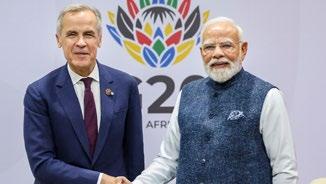
“The current status of the relationship is extremely good. I mean, we couldn’t have asked for anything better given our past history of the last two years,” Patnaik said in an interview with the Financial Post, noting that momentum picked up after Prime Minister Mark Carney met Prime Minister Narendra Modi at Kananaskis during the G7 summit.
In a first such move, the Punjab Police are in the process of getting silver notices issued from the Interpol to freeze moveable and immoveable assets of gangsters living abroad.
The police had recently prepared a list of 61 “most active” gangsters behind extortion threats from abroad, attacks on rival gangsters or targeted killing of politicians/important individuals in the state.
He pointed to the appointment of High Commissioners and a “spate of visits at the level of ministers,” including the foreign, trade, and energy ministers, as well as parliamentary and sectoral delegations.
Continued on Page 13...
Continued on Page 10...
4 extortion investigations launched in Vancouver — the first in the city
B.C.’s most populous city is now part of a growing trend of crime where perpetrators threaten residents and businesses with violence in exchange for money.
The Vancouver Police Department (VPD) said on Wednesday it is actively investigating four extortion files — the first cases reported to police in the city.
“I can confirm that these four are the first four that we’re aware about in Vancouver,” said Const. Darren Wong in an email to CBC News.
The force is offering few details about the cases. It has not said if they involve shootings, as have been common in other jurisdictions with far more extortion, such as Surrey, Delta and Abbotsford.
VPD has also not said when the cases were
reported but that arrests have been made.
“While I cannot comment on specifics about these four investigations as they are all in different stages, I can confirm that we have executed search warrants and arrests and are in the process of collecting more evidence in order to have charges laid,” wrote Wong. The force said the victims all reside in Vancouver, but have businesses in the Fraser Valley. It also said that of the four investigations, VPD has worked with the Surrey Police Service and the B.C. Extortion Task Force on two of them. Police say it’s possible there are other cases in Vancouver and the force is asking
victims to come forward to report the crime.
Surrey up to 53 extortion cases this year Meanwhile, in Surrey, police say there have
ICBC/Personal
been 53 extortions reported to the force so far this year, up until Feb. 16, as well as 11 related shootings and two related arsons. They have targeted 31 victims, 17 of whom were previously targeted.
Surrey has been ground-zero for extortion in the region with the first cases popping up in November 2023. Since then, the Surrey Police Service, along with other police agencies and various levels of government, have scrambled to try and keep up with the pace of the crime.
On Thursday, the federal government announced dedicated financial intelligence experts who will focus on extortion crime targeting Canadian businesses and households as part of the multi-jurisdictional strategy to try and combat the problem.
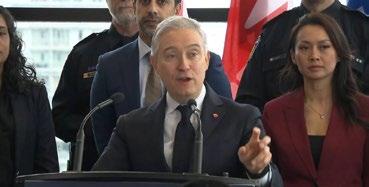
“Our message to criminals is both powerful and simple: Enough is enough,” said federal Finance Minister François-Philippe Champagne speaking from Mississauga, Ont., another extortion hotspot. “We’re going to make their life miserable."
Champagne announced that the Financial Transactions and Reports Analysis Centre of Canada (FINTRAC) will work closely with local law enforcement and prioritize receiving more timely and relevant financial intelligence to identify criminal networks and support investigations.
In a news release Thursday, the government also announced the launch of a partnership between FINTRAC and Canadian banks, credit unions and financial service providers, including cryptocurrencies, to enhance information sharing and provide clear guidance on how to detect extortion transactions.
FINTRAC will also be publishing intelligence on how criminals launder proceeds, the news release said. Surrey police said they are reviewing the announcement and how it will be implemented.
“Generally, however, we can say that any additional tools, resources, or involvement of agencies to assist in combatting extortions and crimes in Canadian communities is welcome,” said Staff Sgt. Lindsey Houghton.
Also on Thursday, Prime Minister Mark Carney was in Surrey meeting with local law enforcement to review changes his government is making to help tackle extortion.
That includes 80 amendments to Canada’s Criminal Code, tightening immigration laws to prevent extortion suspects from claiming asylum in Canada and resources to help victims of the crime. “We are in the process of addressing this issue collectively with law enforcement, with our prosecutors, with our municipalities, with the provinces, with the federal government,” said Carney. “We are going to stamp out extortion.”
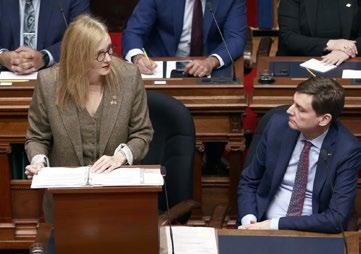
In an effort to curb a ballooning provincial debt, B.C.’s 2026 budget announced significant changes to the tax system, with increases to income taxes and modifications to sales and property taxes.
Finance Minister Brenda Bailey framed the changes, which primarily raise taxes for middle and high earners, as necessary to avoid cutting critical services.
This comes as the total provincial debt, which currently sits at $154 billion, is expected to soar to $183 billion next year.
“We know that many working families are struggling with affordability challenges … and we have to take very measured steps,” said Bailey, who added that those earning less than $140,000 per year will still have one of the lowest tax rates in the country.
“I hope British Columbians will see that we’re taking protective action.” The government estimates that the average British Columbian will pay $76 more on their 2026 income taxes as it raises the basic rate on the lowest tax bracket from 5.06 per cent to 5.6 per cent.
The move marks B.C.'s first universal tax raise since 2008.
However, the maximum tax reduction credit is also increasing by $115 to $690. The province says the bottom 40 per cent of earners will see their personal tax reduced.
Bailey said the government opted against a direct tax increase only on higher income earners to avoid making the overall system “askew.”
She said keeping tax rates low is still a priority for the NDP government, in spite of these changes.
“We remain one of the lowest taxed jurisdictions,” she said.
The provincial portion of property taxes, known as the School Tax, is also set to rise for the most expensive houses next year. For people who own
properties valued between $3 million and $4 million, the tax rate will increase from 0.2 per cent to 0.3 per cent. Anyone who owns property assessed at $4 million or higher will see their tax rate jump from 0.4 per cent to 0.6 per cent.
Property owners who are foreign or don’t pay taxes in B.C. will also pay a four per cent Speculation and Vacancy Tax for the 2027 tax year, an increase from the current three per cent.
B.C. is also changing its controversial Property Tax Deferment Program. While eligible seniors previously paid simple interest on their deferred tax — only accruing interest on their principal payment — they will now pay prime plus two per cent, compounded monthly.
This change for new loans will bring lending terms closer to typical commercial lending terms, according to the province.
This measure, Bailey said, is to dissuade people from using the program as a “cheap source of capital.” PST, the provincial retail sales tax, is being expanded to new services, such as accounting, bookkeeping, engineering and geoscience, security and private investigation and commercial real estate.
It will also be added to other services like cable TV, landline phones, and clothing and shoe alterations, which had previously been exempt from the tax.
5 things to know about B.C.’s 2026 budget
B.C.’s Finance Minister, Brenda Bailey, has delivered the 2026 budget.
Here are five things you need to know.
Raising the deficit
Bailey has promised there would be years of declining deficits, but first it is projected to spike by a hefty 38 per cent to a record $13.3 billion next fiscal year, compared with an updated forecast for the current year of $9.6 billion.
While the deficit is forecast to increase $3.7 billion year on year, Bailey said a “guiding principle” was that the deficit would decrease “over time,” with the ongoing impact of structural changes such as the tax increase and public sector cuts.
Health care
B.C.’s debt is going to continue to grow, with no cuts in the budget this year.
The cost of servicing programs like child welfare, social assistance, and pharmacare is rapidly escalating. “The cost to providing care is increasing,” Bailey said in the budget.
“Our government has been working hard to make sure that British Columbians can access the care they need, when they need it. A lot of progress has been made.
“These projects represent the largest investment in health care infrastructure in B.C. history,” she said. Bailey said a comprehensive review of health authorities has identified administration duplication and redirected savings to the front lines of health care. She said that since the review began, 1,100 administrative positions have been eliminated, closed or left vacant, with those savings to be invested in frontline patient care.
Infrastructure spending
B.C. will pace infrastructure projects “carefully,” Bailey said, to deliver them efficiently without driving up costs. There are delays to seven longterm care projects from Abbotsford to Fort St. John, as well as the second phase of Burnaby Hospital and Cancer Care, and student housing at the University
of Victoria.
“Our priorities are clear,” Bailey said. “Protect and improve core public services that people rely on, like health care and education. Keep B.C., one of the lowest taxed provinces for middle and working class families. Reduce the deficit responsibly over time while protecting what’s working.”
She said three steps will help the province achieve this — make the public sector leaner, pace infrastructure projects carefully and make changes to generate revenue, while taking action to grow the economy and secure the long-term impact of major projects.
Income tax
Bailey said growth in B.C. has not kept pace with the cost of delivering public services, therefore, the province needs to rebuild a stable and sustainable revenue base.
“People earning under $149,000 will continue to pay the lowest personal income taxes in the country,” she said.
“Budget 2026 includes a change to the first income tax bracket of about half a percentage point. We’ll offset the extra costs for lower-income earners by increasing the B.C. tax reduction credit.
PST changes
B.C.’s 2026 budget expands the province’s PST tax base to include professional services, such as accounting and bookkeeping, architectural, geoscientist and engineering services, commercial real-estate fees and security and private investigation services. Bailey said that this change generally aligns B.C. with how other provinces apply sales taxes to these services. PST exemptions will also be removed from some goods and services such as clothing repair materials, services related to clothing and footwear, basic cable television and landline telephone services.
Bailey said that expanding the tax to these services is generally consistent with how tax applies to these services in most provinces.
Protest held against extortion wave in Surrey as 3 foreign nationals charged
A small group of protesters called for more public safety amid a wave of extortion-related violence in Surrey, B.C., on Monday.
It was the same day police announced three foreign nationals were charged after an extortionrelated shooting the previous day.
A rash of extortion crimes have been threatening communities in B.C.'s Lower Mainland, particularly Surrey, for over a year. Officials say the crimes have particularly affected South Asian communities and a provincial task force and reward fund have been set up to deal with the crisis.
At the protest, which took place outside the Surrey Arts Centre, demonstrators called on officials to do more and for residents to report any instances of extortion. "The fear in our community
is because [perpetrators] are not getting punished," said protest organizer Rasinder Kaur.
Kaur claimed that when arrests are made, the perpetrators are let out on bail.
Kaur says she knows many families that have not reported cases of extortion and have simply paid criminals after being threatened. She argues that the issue extends beyond the city's South Asian community and said other people had joined the protest to demonstrate that.
Adam Gu, who held up a sign in a Chinese language that translates to "Fight against extortion, and refuse to be afraid," said that he had been living in South Surrey for nearly two decades.
"I'm a father of two sons. And it's true that we are feeling less safer year by year."
B.C. hikes tax rate as budget delivers record $13-billion deficit
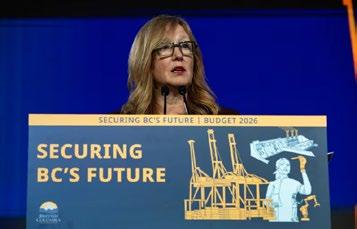
British Columbia Finance Minister Brenda Bailey has unveiled what she calls a “serious” budget for 2026 that raises the base income tax rate while failing to rein in the deficit as previously pledged.
The tax rate on the lowest bracket is being increased by 0.54 percentage points, with government staff saying 60 per cent of tax filers will face higher bills, and the average taxpayer will be hit with a $76 hike.
The budget says increasing the bottom tax rate to 5.6 per cent means a maximum impact of $201 on people earning more than $140,000 without additional credits, while credits for some lower earners are being raised.
Construction of long-term care facilities, student housing and Burnaby’s hospital and cancer facility are being delayed to curtail costs.
The deficit is projected to spike by a hefty 38 per cent to a record $13.3 billion next fiscal year, compared with an updated forecast for the current year of $9.6 billion.
Bailey’s budget speech says she is delivering the plan with a “heavy heart” after the “horrific tragedy” of last week’s mass shootings in Tumbler Ridge, B.C. She had earlier told reporters on Tuesday that the budget was “serious work for serious times.”
“It’s our time to take a pause on some of the things we want to do, to do the things that we need to do,” she said. Bailey said the budget implements “disciplined measures,” including a “leaner” public sector that is forecast to shrink by 15,000 full-time employees over the three-year fiscal plan.
While the deficit is forecast to increase $3.7 billion year on year, Bailey said a “guiding principle” was that the deficit would decrease “over time,” with the ongoing impact of structural changes such as the tax increase and public sector cuts.
“Nobody worries about the deficit more than I do,” she told reporters, adding that “nothing could be further from the truth” than that she had given up trying to cut the deficit.
Shannon Salter, deputy minister to Premier David Eby, said in a recent email that the deficit was “unsustainable.”
Bailey said B.C. would continue to have the lowest income taxes of any province for people earning less than $149,000, while 40 per cent of taxpayers will see a tax saving in 2026 and the lowest earners “will come out ahead.”
She said the budget was not about “new, shiny programs.”
Capital spending is being wound back to $18.7 billion next fiscal year compared with the previous forecast of $20.4 billion, and it is projected to keep falling to $16.1 billion by the 2028 fiscal year.
Bailey said that would involve “re-pacing” construction of several long-term care facilities, Phase 2 of the Burnaby’s redeveloped hospital and student housing at the University of Victoria.
“These are not cancellations, this is a recognition that the province needs to strategically resequence projects to address fiscal pressures,” she told reporters.
MP Matt Jeneroux leaves Conservatives to join Liberals, citing 'national unity crisis'
Another Conservative MP has crossed the floor to join the Liberal Party, nudging Prime Minister Mark Carney closer to the line of a coveted majority.
Alberta MP Matt Jeneroux, who said last year that he planned to leave politics altogether after his name circulated as a potential defector, announced Wednesday he is joining the government after all.
He is the third Conservative the Liberals have picked up, starting with Nova Scotia MP Chris d'Entremont in November and Toronto-area MP Michael Ma in December.
The Edmonton Riverbend MP said in a statement he had conversations with his family over the holidays, when he reflected "on the gravity of the moment that our country is living through" and about the need to "serve even when the path is not easy."
take on a role as a special adviser on economic and security partnerships. The Prime Minister's Office said it's an unpaid role.
"Building a stronger, more resilient and more independent country will require ambition, collaboration, and occasionally, sacrifice," the prime minister wrote. Conservatives had harsh words for their former colleague.
Sitting side-by-side with Carney during a brief photo op in Edmonton, Jeneroux cited the prime minister's speech at the World Economic Forum in Davos, Switzerland in January as a reason for making the jump.
"I think it opened a lot of eyes for Canadians, Albertans, Edmontonians, just how serious this national unity crisis truly is," he said.
"For me it felt disingenuous and quite simply wrong to be sitting on the sidelines anymore. So I reached out to the prime minister's office and will be joining his caucus." Jeneroux sent an email to Conservative Leader Pierre Poilievre, the party's whip, caucus chair and Speaker of the House about his decision around 10:15 a.m. ET, according to a source with knowledge of the events.
Carney announced the news on X one minute later. In that statement, Carney said Jeneroux will
Poilievre said Jeneroux has "betrayed the people of Edmonton Riverbend who voted for affordable food and homes, safe streets, and a strong resource sector."
"Mark Carney is trying to seize a costly Liberal majority government that Canadians voted against in the last election through dirty backroom deals," he wrote on social media.
British Columbia MP Frank Caputo said he "was lied to."
"[Jeneroux] will live with his decisions, character and broken relationships," the Kamloops— Thompson—Nicola MP wrote.
"What do we have beyond our integrity? I’ll sleep fine, staying true to my principles while I continue to fight for my people."
Ontario MP Andrew Lawton noted on X that the "one commonality in the statements" made by d'Entremont, Ma and Jeneroux "is the absence of the word 'Liberal.'" In the days after d'Entremont left Conservative caucus, rumours swirled that Jeneroux would also defect to the government benches. A Liberal source said at the time that Jeneroux had even met with Carney.
Instead, Jeneroux — who served in the provincial assembly before jumping to federal politics in 2015 — surprised political watchers and announced he would resign as a member of Parliament. He denied allegations he was coerced by his own party.
Ph: 604-591-5423
Fax: 604-591-8615
editor@theasianstar.com
Editor: Umendra Singh
Marketing and Sales: Ravi Cheema
604-715-3847
Shamir Doshi
604-649-7827
Harminder Kaur
778-708-0481
Parminder Dhillon
604-902-2858
Pre-Press: Avee Waseer
Production: Ozmo Media
www.theasianstar.com
‘Enough is enough,’ as Ottawa takes steps to halt extortion in Brampton and Mississauga
Stating that “enough is enough,” federal Minister François-Philippe Champagne says more sophisticated resources will be used to crack down on extortion crimes at criminal hotspots across Canada.
Champagne, Minister of Finance and National Revenue, was in Mississauga today (Feb. 19) to announce that financial tracking technology will be used to follow the money trail of extortionists who have been terrorizing business owners and the wealthy in Brampton, Mississauga and other parts of the country.
The federal government initiative will see the resources of the Financial Transactions and Reports Analysis Centre of Canada (FINTRAC) deployed to gain intelligence on criminals through Canadian banks, credit unions, and financial service providers of virtual assets, including cryptocurrencies. This will enable law enforcement to receive more timely and relevant financial intelligence to identify criminal networks and how they launder extortion proceeds.
“Enough is enough. We are going to make the lives of criminals miserable,” said Champagne of the illegal networks that are using threats and violence to demand money from victims.
As part of the program, FINTRAC will embed dedicated liaison officers to work directly with local law enforcement in the most affected areas, such as Peel Regional Police and law enforcement in British Columbia and Alberta. Government officials say these officers will provide specialized financial intelligence expertise, strengthen information sharing, and ensure financial intelligence is supporting enforcement efforts, investigations, and prosecutions.
“For too many Canadian individuals and businesses, extortion is a reality of everyday life — one that brings fear, intimidation, and harm to communities and families alike and that undermines Canadians’ sense of safety,” Champagne said. “These crimes are typically carried out by organized networks operating across borders and using digital platforms. That’s why coordinated action between governments, law
enforcement, and financial institutions is essential and at the heart of today’s announcement.”
The minister said he is confident the program will lead to more arrests and break the criminal network, but he promised that if it doesn’t work, more will be done.
Brampton and Mississauga have been the epicentre for extortionists who typically operate in the South Asian community, selecting businesses and wealthy individuals for money in exchange for safety. If the victim doesn’t pay up, they experience threats, including unwanted visitors who shoot up their homes and businesses.
Many Brampton residents report that gunfire is heard nightly and is so frequent that it often goes unreported, as victims believe police alone are not equipped to deal with the extensive crime wave.
In Brampton and Mississauga, the number of extortion-related crimes has spiked since 2020, with 490 crimes reported in 2024. There was a
slight drop-off in extortion incidents in 2025, but the number of businesses targeted continues to climb, with nearly 200 incidents reported so far in 2025.
In Surrey, B.C., the police department has indicated that foreign students, struggling to make ends meet, have been accepting payments to carry out the threats on behalf of the extortion gangs. Surrey Police have subsequently recorded several videos, some in Punjabi, warning students of the dangers of joining the organized crime networks.
Metro Vancouver’s housing market opened 2026 with a clear shift in momentum: more homes are hitting the market, fewer are selling, and buyers are taking their time.
According to the data analyzed by real estate brokerage and online platform HouseSigma, just 1,470 homes changed hands in January 2026, marking a steep pullback in activity. Sales fell by roughly 30 per cent compared with December 2025 and were also down by a similar margin from a year earlier, which shows how cautious buyers have become at the start of the year.
At the same time, sellers moved in the opposite direction. More than 7,100 new listings were added in January 2026, a sharp jump from December 2025, as many homeowners rushed to test the market after the holidays. The result is a widening gap between supply and demand — one that’s beginning to show up clearly in how long properties are sitting unsold. The number of “property days on market” — a measure that accounts for relisted homes — climbed to an average of 100 days in January 2026. That is the highest level recorded in the recent data and a continuation of a steady upward trend that’s been building since late Summer 2025. Back in August 2025, homes were taking roughly 75 days to sell by this measure; each month since then, the timeline has stretched longer, reaching triple digits at the start of the new year.
Even the standard “days on market” metric, which tracks the time a listing stays active before selling, has pushed past 50 days, up from around 40 days in late Summer 2025 and early Fall 2025. In practical terms, that means sellers are waiting weeks longer for offers, while buyers have more breathing room to shop around, compare options, and negotiate.
Despite the slowdown in sales and the growing pile of listings, home prices have not fallen dramatically — at least not yet. The median sale price across all home types dipped just 0.8 per cent month-over-month to $868,000 in January 2026. That relatively modest decline suggests the market is cooling through activity and timing rather than through sharp price corrections.
Breaking the numbers down by property type shows a similar story: single-family detached houses, townhomes, and condominium home segments have all seen softer sales volumes, while inventory continues to build. The imbalance is giving buyers more choice, but it has not yet forced widespread discounting.
January 2026 looked less like a panic and more like a pause. With buyers stepping back and sellers stepping forward, listings are stacking up and stretching out selling timelines. The early spring market will likely be the next big test: either demand returns as prospective homebuyers reenter after the winter lull, or sellers may start adjusting expectations if homes continue to linger.
According to HouseSigma, the market feels more like a “standoff” than a slide. Buyers are cautious, sellers are still hopeful, and prices are holding in a narrow range — for now.
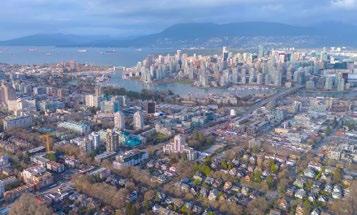
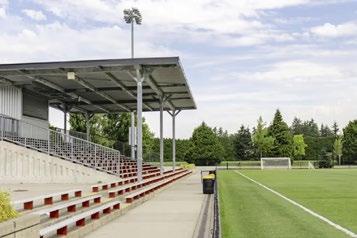
Could the brand new purpose-built, world-class National Training Centre for Canada Soccer be built in Surrey?
The City of Surrey announced yesterday it has officially submitted its expression of interest to the national governing body for soccer to pursue the construction of the massive facility within its jurisdiction. Canada Soccer began the bidding process in December 2025, and the deadline for preliminary submissions from interested municipal governments, provincial governments, soccer clubs, post-secondary institutions, and/or any other interested and relevant entities was last week.
So far, based on previous media reports, there is also interest from locations such as Toronto (Woodbine), Pickering, and Vaughan in Ontario, and Montreal in Quebec.
This is intended to be a permanent legacy project of Canada’s role in hosting the 2026 FIFA World Cup in Vancouver and Toronto. It would unite player development, national teams, coach and referee education, sports science, and community programs under one massive facility, effectively serving to better grow Canada’s next top talent in the world’s most popular sport. Canada Soccer is seeking a development site between 40 acres to 60 acres to build four to eight full-size outdoor natural and hybrid-grass soccer pitches, at least one indoor or covered soccer fields for year-round training, one small soccer stadium, and a high-performance training building with fitness gym, recovery, sports medicine, and analysis facilities.
There would also be dining facilities, parking, and space for future expansion, such as commercial, academic, and hotel uses and other hospitality or community facilities.
In addition to becoming the official training base for national teams, it would also host long-term tenants, such as professional or regional teams.
There should be a demonstration that the location is supported by an ecosystem of elite youth and
professional players to support continuous player development.
The location should be within close proximity to public transit and a major international airport with direct or short-connection flights to European hubs. As well, Canada Soccer notes that preference will be given to locations enabling year-round training, such as through favourable climate and/or indoor facilities, and “joint funding models, landuse partnerships, and community programming integration are considered strong assets.”
The national federation emphasizes that the host location for the National Training Centre would see significant economic, social, and community benefits, including the attraction of visitors, athletes, and teams for national and international tournaments, training camps, and events. With the preliminary submission deadline now passed, the City of Surrey has made its submission public, revealing that it has identified four potential sites for the facility. This includes three locations owned by the municipal government with a large cluster of existing sports fields — the 42-acre Cloverdale Athletic Park (Site A), the 53-acre Newton Athletic Park (Site B), and the 73-acre South Surrey Athletic Park (Site C). The fourth location (Site D) is a 112-acre, privately-owned farm property at 4586 176 St. — within the protected Agricultural Land Reserve, immediately adjacent to the Nicomekl River.
What we have learned about the warning signs of Tumbler Ridge mass shooter
Two days after Tumbler Ridge’s Jesse Van Rootselaar shot and killed eight people in one of Canada’s deadliest mass shootings in almost four decades, a motive for the attack remains unclear and may never be known, according to police.
The channel, which YouTube deactivated later Wednesday for violating community guidelines, had “None of this makes sense” as a description. At some point, the username was changed from JesseBoy to JessJessUwU.
The identity of the perpetrator was confirmed by the RCMP on Wednesday. Van Rootselaar was born a biological male and began to transition to a female about six years ago, Dwayne McDonald, deputy commissioner of the RCMP in British Columbia, said. But as their investigation begins, many wonder if the 18-year-old’s interest in firearms, past mass shootings and drugs — as evidenced on social media — along with a history of mental health interactions with police were warning signs for what was to come.
Once the RCMP confirmed the shooter’s identity, various social media accounts linked to Van Rootselaar have surfaced. All of them are now inactive or marked as private.
Among them was a YouTube account and channel that used a female anime character and a rifle set against a pink-and-white background, likely a transgender pride flag, as the profile image, according to the Vancouver Sun.
The Cambridge Dictionary defines UwU as the characters “used in text messages and on social media to express happiness and cuteness.”
Jennifer Strang, Van Rootselaar’s mother and one of the shooting victims, encouraged Facebook friends to follow the page in a July 2021 post, noting the child “posts about hunting, self reliance, guns and stuff.”
Police said Van Rootselaar’s minor’s firearms licence expired in 2024 and they are investigating whether the guns found at the scene — a long gun and a modified handgun — were legally obtained and by whom as part of the investigation.
Van Rootselaar’s passion for firearms was shared by Strang.
“Think it’s time to take them out for some target practice,” Strang captioned a 2024 Facebook photo of rifles in a hunting box.
The Telegraph also reported that Van Rootselaar, on an undisclosed social media channel but likely Reddit based on a similar report from The Sun, posted about using DMT and psychedelic mushrooms. On one occasion, Van Rootselaar alleged the latter resulted in the family home nearly being burned down.
“I tried shrooms once, it was a small unmeasured dose and it was chill,” JesseBoy347 wrote, per The Sun. “The second time I tried it I took 3 grams of Blue Meanie ground up into some peanut butter and had a complete break from reality and did a lot of irrational things, I felt like I was dreaming. Many consequences ensued.”
Why the B.C. government is not swayed by viral campaign to save the Pattullo Bridge
An AI rendering of what the decommissioned Pattullo Bridge would look like as a pedestrian walkway has attracted plenty of social media attention and even some support from local politicians — but the provincial government says it's a non-starter.
"There's no point in keeping a door open and creating false hope on something that isn't going to happen," said Transportation Minister Mike Farnworth.
The proposal would see the bridge between New Westminster and Surrey preserved and refurbished, upgraded with greenery and benches, with the idea of it becoming a public space and attraction similar to New York City’s High Line, or the types
of pedestrian walkways common in the centre of cities in South America, Europe and Asia.
It comes after a weekend where people were allowed to take a walk on the bridge before it was fully shut down, bringing out thousands of people and sparking plenty of nostalgia and hopes that the bridge could be preserved.
89-year-old Pattullo Bridge permanently closes to vehicles on Saturday
"The Pattullo Bridge could become our regional version of The High Line. Taking a look at how to keep it and turn it into something everyone could enjoy is definitely worth looking at," said Surrey councillor Linda Annis, who is running for mayor with her Surrey First party.
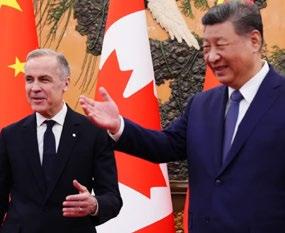
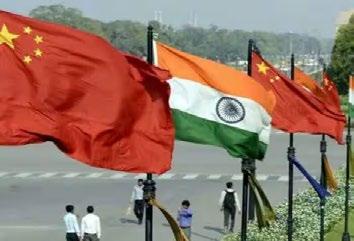
China drops visa requirement for Canadian tourists, business visitors
China is dropping its visa requirement for Canadian tourists and business visitors, a move that has boosted the spirits of Vancouver travel agents following Prime Minister Mark Carney’s efforts to put relations with Beijing on a better footing.
Chna’s Foreign Ministry says Canadians will no longer be required to get visas for 30days stays, starting Tuesday until at least the end of this year.
A month ago, during his visit to Beijing, Carney said Chinese President Xi Jinping committed to visa-free access for Canadians, which China never confirmed.
be much easier now, and Canadians can travel whenever flight tickets are available, skipping the application process, which usually takes several days.
For most Canadian tourists, entering mainland China currently requires a lengthy application process and roughly $140 in fees. Canadians can already enter the Chinese regions of Hong Kong, Macau and Hainan province without a visa.
Glynnis Chan, president of Vancouver-based Happy Times Travel and Tour Ltd., said many of her Canadian clients are cheering the news.
Chan said some have roots in China, and it’s not convenient for them to visit relatives because of the “long and troublesome” visa application process.
“I have been running a travel agency for so long, some of my roles include helping Canadian clients to apply for Canadian tourist visas. This work gave me a headache since the whole process is extremely complicated,” said Chan.
She said applicants are required to provide additional information, such as plane tickets, their family information, destination and booked hotels in China.
But Chan said she is relieved the process will
Margaret Liu, owner of Vancouver-based Formosa Travel Ltd., also welcomed the move. But Liu, who has more than 30 years of experience in the B.C. tourism industry, said she also doesn’t expect to see a surge of Canadian tourists heading to China immediately. Liu said the high travel expenses in China could limit the demand.
“I feel many Canadians might only visit China twice in their lifetime at most, since the flight tickets, accommodations, and travel fees could be pricey altogether,” said Liu.
But she said the new policy could help China’s local economy, which has been slowing down following the COVID-19 pandemic.
Liu said she hopes the new policy will also encourage China to open more direct flights to Vancouver and Toronto.
“I hope it can bring more waves of Chinese tourists to Canada.”
China has dropped visa requirements for other western nations in recent years as it tries to boost tourism following the pandemic. Yet Beijing maintained a visa for Canadians and restricted how many Chinese tourism groups could visit Canada during a years-long diplomatic spat.
In August 2023, China lifted a pandemic ban on group tours to numerous countries but kept its tourists effectively barred from group visits to Canada. It lifted those restrictions last November.
Calls for more information on mental health, gun history of Tumbler Ridge shooter
There are calls to release more information on the mental health and gun issues raised by the Tumbler Ridge mass shooting.
In the days after the tragedy, RCMP said Jesse VanRootselaar had been the subject of several police visits for mental health reasons and had been taken into custody at times for assessment.
Police also said guns had been previously seized from the home, but were returned when the lawful owner asked for them back.
Global News has learned about the existence of documents, sealed by the courts, that could explain why the guns were seized and subsequently returned. “There is in every respect, not just as it relates to these files, a huge compelling public interest for transparency, for accountability, for the release of everything and the answers to all questions,” retired RCMP Supt. Russ Grabb told Global News.
B.C.’s Attorney General, Niki Sharma, said the police are investigating. “They have investigative
tools to get to the bottom of questions I know the public has,” she said.
“I’m going to be watching that investigation along with the premier, and we will make sure that if there are still unanswered questions that we will get to the bottom of that.”
Last week, B.C. Premier David Eby said the provincial government will use any processes available to answer questions surrounding the guns used in the shootings.
Anti-gang unit makes arrests, seizes drugs and weapons in South Okanagan
A B.C. police unit has arrested multiple individuals for drug trafficking offences in the South Okanagan and Similkameen after being deployed to the region last week.
The anti-gang team from the Combined Forces Special Enforcement Unit of British Columbia (CFSEU-BC), along with the RCMP, also arrested a “wanted high-risk offender” in Osoyoos before recovering a stolen vehicle and seizing illicit drugs, cash, and weapons, including firearms. Officers were deployed to Princeton, Penticton, Oliver and Osoyoos, from Feb. 11 to 14, in response to “ongoing drug trafficking activity and emerging violence” in the South Okanagan and Similkameen.
CFSEU-BC called its deployment “a significant blow” to organized crime in the region, in a news release shared Thursday, Feb. 19. “By targeting those who drive violence and instability, we are not only
disrupting criminal networks but also preventing further harm,” Sgt. Sarbjit Sangha said. “Our focus remains clear: remove dangerous offenders, take weapons off the streets, and protect the people who live and work in these communities.”
CFSEU-BC said it will continue to work closely with RCMP detachments across the province to identify and target individuals involved in organized crime.
Supt. Beth McAndie of the Penticton RCMP added that last week’s enforcement led to the arrest of high-risk offenders and disrupted “drug trafficking activity before it escalated further.”
“This operation highlights the strength of our partnerships and our shared commitment to protecting Okanagan communities,” McAndie said, referring to Penticton’s RCMP detachment working with the CFSEU-BC.
Real Canadian Superstore fined for ‘misleading’ Product of Canada displays
Real Canadian Superstore has been fined $10,000 by the Canadian Food Inspection Agency for what the agency says were “misleading” displays about “Product of Canada” labels.
The CFIA says the fine relates to the use of the term, which, along with “Made in Canada,” can only be claimed if specific criteria are met for those items. This comes as the Buy Canadian movement over the past year has seen consumers prioritizing domestically sourced goods and services, and even domestic travel destinations that support the local economy amid U.S. tariffs and threats of annexation by U.S. President Donald Trump.
It wasn’t made clear which products were featured in the “displays” in question at store 1033, which company listings say is located at 51 Gerry Fitzgerald Dr. in Toronto. Real Canadian Superstore is a subsidiary grocery brand under the Loblaw banner of stores.
Global News sent a request for comment to the CFIA on Tuesday, and asked what the specific products were, the nature of the “displays” and how they appeared to customers, and if there are plans to expand the investigation to other stores and products.
Surrey’s police chief is warning his force does not have enough officers, just weeks ahead of assuming responsibility for another part of the city.
Starting April 1, the Surrey Police Service is supposed to be taking over District 4, the Cloverdale area, from the RCMP.
However, Chief Norm Lipinski says 40 officers have been redeployed to the Extortion Task Force and the Surrey Police Service needs about 70 more officers to maintain public safety.
Lipinski says an alternate plan was developed to push that deadline back by four months, but the provincial
government said no. “I am confident, based on the director of policing’s analysis of all the available information, the detailed plans that have been in the works for many months, that we are ready for the District 4 transition,” B.C.’s Public Safety Minister Nina Krieger said. “And again, public safety is our utmost priority and it’s important to note that the RCMP remain fully engaged and will continue to be engaged as we complete the transition to District 4.”
In an internal memo, Lipinski said the Surrey Police Service was consulting the province, police board and legal counsel about the deadline.
A response was not received by publication time.
Loblaw issued a written statement to Global News after a request for comment sent on Thursday.
“We take our labelling and signage responsibilities seriously and are committed to meeting applicable requirements. With thousands of products in our stores, many of which are sourced from different countries regions throughout the year, information can change quickly. While we work hard to keep everything up to date, there are times when signage may not be refreshed as quickly as inventory is replenished,” said a spokesperson for Loblaw.
“We have processes in place to support accuracy, but like any retail environment, there is still the potential for human error. That’s why we’re continuing to strengthen our processes. We’re sorry for any confusion this may have caused. If something doesn’t look right, we encourage customers to let us know so we can correct it as quickly as possible.” In March 2025, at the start of the trade war, the CFIA said it was tracking a rise in complaints about items that may have been mislabelled as “Product of Canada” or had other missing details about the origin of products or ingredients.
A fine of $10,000 for a business is considered a “very serious” violation, according to the CFIA’s administrative monetary penalties list, which includes violations “committed by persons or companies in the course of business or for financial gain, the penalty amounts may be adjusted up or down, depending upon the total gravity value.”
Helps Parents Boost
Canadians now spending $1 billion per year to cover health-care costs
Continued from Page 1...
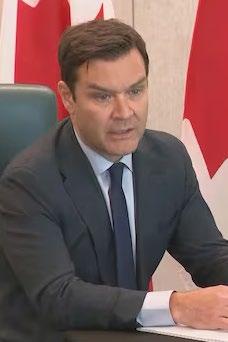
That’s according to a new analysis by the Office of the Parliamentary Budget Officer, and it’s just one of several ballooning costs wrought by the unprecedented number of foreign nationals currently living in Canada by virtue of a claim of refugee status. The Interim Federal Health Program, which offers premium health benefits to asylum claimants, is soon set to hit $1 billion in annual costs for the first time, according to an analysis last Thursday by the Office of the Parliamentary Budget Officer.
This is a five-fold increase from just six years ago, when the program was costing $211 million per year. The analysis also projects that costs are expected to surge for the foreseeable future, with the annual budget likely to hit $1.5 billion as early as 2029.
All told, between now and 2030, Canadians are on track to spend $6.2 billion on health care for refugees or refugee claimants.
“The rising volume of asylum claims, along with the longer duration of eligibility caused by extended determination times, has been an important growth driver in recent years,” reads the PBO report. The report was commissioned following a Conservative-led request made at the House of Commons standing committee on health. In a Thursday statement, the Conservative party noted that the Interim Federal Health Program can be accessed even by asylum claimants who have had their case rejected.
It also offers a higher level of care than that enjoyed by the average Canadian citizen. In addition to hospital care and surgical care, the IFHP also covers dental care, vision care, pharmacare and other services not typically covered by public health plans. “Rejected asylum claimants are now receiving better health care than many Canadians
of refugee claimants
who have paid into a system their entire life,” read a joint statement by Dan Mazier and Michelle Rempel Garner, the shadow ministers of health and immigration, respectively.
It added, “at a time when six million Canadians cannot find a family doctor and are waiting for care, it’s unacceptable that bogus asylum seekers are receiving better health benefits than Canadians.”
As asylum claimants are often allowed immediate access to government benefits, the spike has incurred several uncontrolled surges in federal spending.
In 2024, Conservative MP Lianne Rood published disclosures from Immigration, Refugees and Citizenship Canada finding that some asylum claimants were receiving room and board benefits in excess of $200 per day. While the benefits were not universal among asylum claimants, those accepted to receive food and shelter supports were getting the equivalent of $84 per day for meals and $140 per day for hotel rooms. And this was in addition to a whole latticework of additional federal payouts to asylum seekers, including one that gave $3,000 cash payouts to Gazans entering Canada.
In the budget estimates for 2024/2025, the federal government was already recording more than a billion dollars in annual spending on asylum claimants, of which only $584.3 million was earmarked for the Interim Federal Health Program.
Resettled Gazans received $41 million in various benefits, the Interim Housing Assistance Program was given $400 million, and $66.4 million was described as funding “temporary accommodations to asylum seekers.”
Starting May 1, asylum claimants will have to pay $4 per prescription instead of nothing, and if they access “supplemental health products” such as counselling or dental care, they will have to cover 30 per cent of the bill themselves.
India-Canada ties ‘back on track’
Continued from Page 1...
“There has been a spate of meetings, all of this trying to make up for whatever time we have lost in the past,” he said, adding that discussions have covered areas ranging from national security and law enforcement to mining, energy, education, and artificial intelligence.
Patnaik described the relationship as “back on track, not just back on track, it’s going very strongly,” and said a high-level Canadian visit is expected soon to “literally put the stamp on the relationship having come this far.”
On CEPA, he said “the deal should not be difficult at all,” recalling that both prime ministers at the G20 in Johannesburg decided to launch negotiations. The Canadian side has issued a 90day notice to Parliament, and “the negotiation should now start at the end of February, beginning of March.”
Patnaik argued that economic realities have shifted significantly since earlier free trade talks. “Today, we are the 4th largest economy in the world, soon to be the 3rd,” he said, underscoring
how India’s global position has evolved. He highlighted India’s recent trade deals with EFTA, the European Union, the United States, the United Kingdom, Australia, and the UAE, saying “we have moved forward on a lot of positions which earlier we used to hold on to.”
According to him, many elements are already aligned, given Canada’s trade engagements with the EU and several Asian partners. “So essentially, a lot of the boxes have already been ticked,” he said. Addressing questions about differing values, Patnaik was categorical. “We are both democracies, rule of law, freedom of press, market economy,” he said. He added that the two countries “have only interests which coalesce together” and work jointly across multilateral platforms, including the UN, G7, and G20.
“What is most important in a comprehensive economic partnership is to make it easy for us to address all the sectors,” he said, listing lower tariffs, fewer non-tariff barriers, easier logistics, and stronger cooperation in investment, research, AI, mining, energy, defence, and aerospace.
Debt, Deficits, and a Hidden Construction Tax: ICBA Responds to BC Budget
Continued from Page 1...
This suggests the province’s credit rating – which has already deteriorated sharply since 2022 – may face further downgrades.”
The news is bad for all B.C. taxpayers. First, a personal income tax hike will pull half a billion more out of B.C. workers’ pockets. It gets worse: the NDP are reintroducing bracket creep, which punishes workers who move from one tax bracket to another by taking more out of their paycheques. This makes it more common for a person to get a raise, move up into the next tax bracket, and actually take home less money due to higher taxes.
Beginning October 1st, the Eby Government will add Provincial Sales Tax to architectural services, accounting and bookkeeping, engineering and geoscience services, rental property and strata management services, and commissions on real estate sales on industrial and commercial property. This increases the cost of professional services builders procure on projects and will be factored into bids and project budgets for work starting or extending past that date.
“This government keeps finding new ways to make it more expensive to build. Slapping PST on engineering, architecture, and professional services isn't clever tax policy – it's a hidden construction tax that will show up in every project budget in this
province,” said Chris Gardner, ICBA President and CEO. “Contractors will price it in, but ultimately, the people paying for housing will foot the bill.”
ICBA is also gravely concerned that the Eby Government continues to underestimate the crisis in Lower Mainland homebuilding. While ICBA projects just 34,000 housing starts this year, the NDP claim 44,000 in the Budget documents.
“The Government can claim whatever housing numbers it wants in a budget document, but cranes, permits, and layoffs don't lie. The industry experts and our homebuilder members are expecting far fewer housing starts than the government is forecasting,” said Gardner. “That gap isn't a rounding error – it's a policy failure at all levels of government.”
One of the few silver linings in this Budget is a funding boost for Skilled Trades BC to provide 5,000 more trade spaces, but in a slowing economy, this poses its own challenges.
“More trade spaces sound nice, but contractors aren't scrambling to find workers anymore – they're scrambling to find work,” said Gardner. “With deficits piling up and project timelines being stretched into the future, the pipeline is tightening. You can train all the tradespeople you want, but if the projects aren't there, the jobs won’t be there for these new workers.”
Surrey police chief's ask for transition delay into Cloverdale denied by BC government
Continued from Page 1...
It assumed responsibility for policing first in the Whalley and Newton neighbourhoods, and then took over South Surrey in 2025. That left Cloverdale and Guildford.
The SPS was to expand into south Cloverdale in April and north Cloverdale in July. Lipinski said Cloverdale alone requires about 70 officers.
“Over the past six months, however, Surrey has faced an unprecedented extortion crisis. Addressing this serious and complex issue has required the redeployment of more than 40 SPS officers to specialized investigative teams,” Lipinski wrote.
The chief said the SPS proposed to the province delaying the transition into Cloverdale by four months to “allow us to maintain strong response levels across the city while continuing to address the extortion investigations effectively.”
“I have since been advised by the director of policing and law enforcement services that SPS
has been directed to assume responsibility for all of Cloverdale on April 1, 2026,” Lipinski said.
Surrey’s policing transition has been controversial for years. It was approved under former mayor Doug McCallum, but defeated by his challenger and current mayor Brenda Locke in 2022 when she campaigned and won on her promise to halt the transition away from the federal RCMP. However, the B.C. government forced the city to follow through with a municipal police department.
The province agreed to help fund transition costs, supplying $250 million to the city. As of November 2025, Surrey police said it had 583 sworn officers out of the police service’s stated goal of 860 by the end of the transition. SPS says the transition will be complete in 2027.
“Discussions with the province, the Surrey police board, our unions, and legal counsel are ongoing. I will be able to provide an update once these discussions are concluded,” Lipinski said.
Fire damages Nadi school office and library
The school office block and library at Andrews Primary School in Nadi were badly damaged by a fire early this morning, prompting the postponement of scheduled school activities.
In a message shared on social media, Head Teacher Dharmendra Reddy informed parents and guardians of the incident, describing it as “very sad news” for the school community.
“Our school office block and library has been badly damaged by fire early this morning,” Mr Reddy said.
As a result of the damage, the prefects’ induction programme that was scheduled for today has been postponed until further notice.
No further details were provided on the cause of the fire or whether anyone was injured. Parents and guardians have been advised that updates will be shared as more information becomes available.
Police Commissioner orders investigation into alleged assault by Nausori officers
The Commissioner of Police, Rusiate Tudravu, has directed the Internal Affairs Department to initiate an investigation into Nausori Police following allegations of assault circulated in a social meda video. Commissioner Tudravu said the allegations are extremely concerning and assured the public that the investigation will thoroughly examine all claims relating to the conduct of the officers involved.
“The Fiji Police Force maintains zero tolerance for officers who abuse their authority,” he said. He confirmed that internal disciplinary processes will be initiated as soon as the officers involved are identified.
Commissioner Tudravu said such allegations undermine ongoing efforts to rebuild public trust and confidence in policing, stressing that accountability remains central to police reform.
“These allegations are detrimental to the work being done to restore confidence in the Fiji Police Force,” he said, adding that the matter will be treated as a top priority.
The Police Commissioner assured members of the public that the investigation will be conducted fairly, transparently and in line with established procedures, as the Force continues to reinforce professional standards and ethical conduct among its officers.
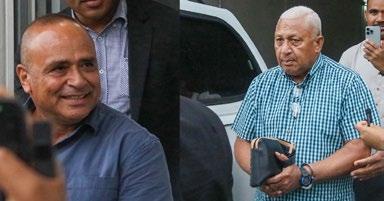
Bainimarama and Qiliho charged with inciting mutiny
Former Prime Minister, Voreqe Bainimarama and former Police Commissioner, Sitiveni Qiliho have been charged with inciting mutiny, and spend the night at Totogo Police Station.
They were taken in handcuffs from the CID Headquarters in Toorak to Totogo Police Station.
Acting Police Commissioner Mesake Waqa confirms the two were questioned in relation to alleged mutiny, and will appear in court today. In a statement after the 2022 general elections on the 22nd of December, the then Police Commissioner Qiliho had said that a decision had been reached to call in the Republic of Fiji Military Forces to
assist Police with the maintenance of security and stability.
Qiliho said this decision was made as more information and reports were received by Police and RFMF of threats made against minority groups who were living in fear following recent political developments.
A meeting was held on that day between the then Prime Minister Voreqe Bainimarama, the then Minister for Defence, National Security and Policing Inia Seruiratu, RFMF Commander and Director General National Security Major General Jone Kalouniwai and Qiliho.
The statement said they came to an agreement for RFMF personnel to assist Police with the maintenance of law and order, amidst growing concerns of racial tension.
Meanwhile in an exclusive interview, Major General Ro Jone Kalouniwai revealed on fijivillage Straight Talk With Vijay Narayan in March 2024 that he was getting calls from certain people after the 2022 general elections to remove certain people from some positions.
Unusual visitors, vessels raise drug concerns
Unexplained land and maritime activity has put residents of Ucunivanua Village on edge, prompting a community-wide initiative to monitor potential narcotics-related threats.
Village spokesman Josateki Rokomalani, 46, said the community has observed unusual visitors and vessels in local waters, raising concerns about security and drug-related activity.
Mr Rokomalani said two Asians arrived last year and returned a fortnight ago, asking for a boat ride into the sea.
“While they claimed to be tourists, their presence raised red flags among locals.”
In addition to the visitors, unidentified yachts have been spotted anchoring in village waters, sometimes accompanied by a van at night.
“The police have been notified of the incidents.”
The community views these occurrences not
merely as trespassing but as a potential threat to safety.
In response, village leaders have launched a campaign to educate youth about the dangers of drugs during regular village meetings.
Mr Rokomalani confirmed that a village bylaw is under discussion, which would allow the removal of anyone involved in trafficking, selling, or consuming narcotics. The bylaw will only be enacted after consultation with the vanua’s leadership.
Emphasising the role of family in prevention, Mr Rokomalani said instilling values at home is critical to protecting the next generation.
“As the twig is bent, so grows the tree.
“Parents must do their part to ensure our youth are safe from the effects of drugs.”
Court orders return of kids
POLICE Commissioner Rusiate Tudravu is urging family members to try and solve matters privately, rather than resorting to social media.
This following a Facebook video incident where two children were recovered from their mother.
Mr Tudravu said the Police officers were carrying out their duty in accordance with the Recovery Order, and the situation should not have escalated, if everyone had cooperated with police.
“We empathise with the children and what the families are going through, however, we also have a duty to carry out,” Mr Tudravu said.
“While we respect the use of social media to raise opinions and issues, we urge members of the public to first try to get both sides of the story, before commenting unnecessarily.”
Mr Tudravu has warned families that resorting
to social media can cause more harm, attracting reactions and comments from those who do not fully understand the real situation.
According to a police statement, the Raiwaqa Police had received a Recovery Order from the Nadi Family Court on Wednesday.
The court order directed police to supervise the return of the two children, and to ensure no breach of peace. “Prior to executing the Recovery Order, an officer discussed the matter with the children’s mother, and after some time, she agreed to cooperate, by handing over the two children to the applicant,” a statement from police said.
“It was during the recovery process that relatives tried to interfere, further aggravating the situation, which was captured on video and shared on social media.”
Former ILSC secretary jailed five years for corruption offences
A former secretary of the Independent Legal Services Commission (ILSC) convicted of multiple corruption-related charges has been sentenced to five years in prison with a non-parole period of four years.
Afrana Nisha was sentenced by Magistrate Shageeth Somaratne today. Nisha was convicted on seven counts of Falsification of Documents and two counts of Obtaining a Financial Advantage. She was acquitted on one count of Obtaining a Financial Advantage.
The court heard that between July 2012 and
November 2014, Nisha falsified cheques by forging the signatures of former Solicitor-General Sharvada Sharma and lawyer Ana Tuiketei. She listed herself and ILSC Commissioner Paul Madigan as payees to obtain financial gain.
In one instance, Nisha falsified a cheque for $3450, naming Ms Tuiketei as the payee, and instructed an ILSC receptionist, Vandana Raj, to cash the cheque and return the proceeds to her. Appearing for prosecution was Joshua Francis Prasad while Nisha’s lawyer Ruth Fa appeared on behalf of Iqbal and Associates.
SATURDAY, FEBRUARY 21, 2026
Questions mount over CTD encounter killings in Balochistan
The Counter Terrorism Department (CTD) has reported that six armed men were killed during an intelligence-led raid in Barkhan, claiming that security forces remained unharmed in the exchange of fire. However, the incident has triggered renewed controversy after some of the deceased were identified as previously missing persons, as reported by The Balochistan Post.
According to the Balochistan Post, CTD officials stated that the operation was launched after receiving confidential information about the presence of armed suspects in the area.
Authorities said that when personnel moved in, a gun battle ensued, resulting in six fatalities.
‘Deal’
The bodies were later transferred to Rakhni Hospital for legal procedures. The department maintained its position that the deceased were militants killed during an armed confrontation. Subsequent identifications, however, have raised doubts about the official narrative.
Local sources stated that three of the men were known as Akbar, son of Nawab Khan Domki; Budha, son of Muhammad Murad Lashari; and Makhan, son of Mureed Lashari, all previously listed among Baloch missing persons. Families and rights advocates alleged that the individuals had earlier been subjected to enforced disappearance.
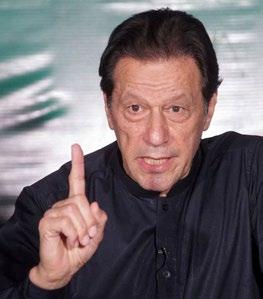
offered to Imran Khan twice, refused to accept: Pakistan PM Sharif’s aide
A close aide of Pakistan Prime Minister Shehbaz Sharif has said that jailed former premier Imran Khan was offered a “deal” twice but he declined to accept it.
“Two serious attempts were made to cut a deal with Pakistan Tehreeki-Insaf (PTI) founder Imran Khan in the past, but they failed,” Adviser to the Prime Minister on Political Affairs
Rana Sanaullah disclosed in a talk show on Wednesday evening. “The first attempt was led by Federal Interior Minister Mohsin Naqvi and thenKhyber Pakhtunkhwa Chief Minister of Pakistan Tehreeki-Insaf Ali Amin Gandapur before November 26, 2024, and the second was made by a few people from abroad in the recent past. Imran Khan initially agreed but
later backed out of the deal,” Sanaullah said.
“We want a political solution to this problem, but Khan is not willing to find a way out,” he added.
Sanaullah, a close aide to Pakistan Muslim League-Nawaz (PMLN) head Nawaz Sharif, further said Khan wants the incumbent government to be packed and he comes to power.
Defending three-time premier Nawaz Sharif cutting a deal with the military establishment, Sanaullah said: “Nawaz Sharif is a seasoned politician. He found a way forward for himself and his party.”
Khan’s lawyer, Salman Safdar, told the Supreme Court last week that the 73-year-old former premier had lost 85 per cent of vision in his right eye in jail.
SOUTH ASIA
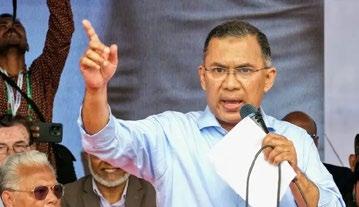
Post-poll Bangladesh faces many challenges but rapprochement with India is a silver lining
The new government of Bangladesh headed by Tarique Rahman of the Bangladesh Nationalist Party (BNP), has a range of issues facing it as it assumes office on Tuesday.
But there is a silver lining – the fraught relations with neighbouring India, which is the regional power with deep economic and security stakes in Bangladesh, have visibly improved. With this it will be curtains down on a number of economic problems and on anxiety about security.
Bangladesh’s economy had suffered since the July 2024 violent movement that overthrew the dictatorial regime of Sheikh Hasina. The Interim government led by Dr. Muhammad Yunus struggled to pick its way through the political and economic mess, partly created by the “July revolution” and partly by a trade war with India.
Today, the Tarique Rahman government has the onerous task of putting the economy back on its feet. And to do that, he will have to bury the hatchet with India and get trade barriers lifted reciprocally. Equally importantly, major issues that have bedevilled bilateral relations for decades such as the sharing of the Ganga and Teesta river waters and the controversies over the supply of power across the border, have to be addressed.
According to The Daily Star, Bangladesh is plagued by three deep-seated vulnerabilities (1) persistently weak tax revenues, (2) the fundamental fragility in the financial sector and (3)high inflation.
In 2024–25, growth slowed to 3.97% from over 7% in 2022. The poverty rate, based on the international $3/day (2021 PPP) threshold, is projected to rise to 8.9% pushing an estimated 1.2 million people into vulnerability. Extreme poverty in Dhaka is forecast to rise to 9.3%, affecting roughly 3 million people.
Non-food inflation rose to 9.13% in October 2025.House rents, transport fares and household
essentials have become increasingly unaffordable. The employment rate dropped to 56.7% in 2024, with job losses most visible in the service sector which employs the most.
In March 2025, Moody’s Investors Service downgraded Bangladesh’s banking system outlook from “stable” to “negative”. Bangladesh now holds the highest Non-Performing Loan (NPL) ratio in Asia. According to the Asian Development Bank’s Financial Stability Monitor (2025), NPLs rose to 20.2% of total loans in 2024 and 36% in 2025. Non-banking financial institutions (NBFIs) had bad loans increasing to 33.83%.
Deposits have slowed, and many banks are struggling to meet reserve requirements, further restricting credit flow to the private sector, the daily said. One of the major causes of the banking crisis is that under the government headed by Sheikh Hasina, several banks and financial institutions were “looted” and the money stashed away abroad by cronies of the regime. However, the post-election political situation is conducive for economic development and reform. Over 60% of the people who voted in the referendum on reforms held on February 12 along with the parliamentary elections, said “yes” to the reform package.
The BNP-led coalition is in a commanding position in parliament with a two third majority. The ruling party has 209 seats out of roughly 299 directly elected seats.
EC asks Punjab, Haryana, HP and other states to gear up for SIR
The Election Commission on Thursday directed the Chief Electoral Officers (CEOs) of 22 states and Union Territories, including Punjab, Haryana, HP and Chandigarh, to start preparations for the special intensive revision (SIR) of electoral rolls "at the earliest".
While the SIR has been completed in Bihar, the exercise is almost over in nine states and three UTs. The work is now set to begin in the remaining 17 states and five UTs.
The CEOs of the 22 states and UTs have been asked to “complete preparatory work” related to SIR “at the earliest”. The SIR in the states and UTs will coincide with the first phase of Census-2027, under which the house-listing work is to be conducted in
the first phase between April and September.
In a letter to the CEOs of Andhra Pradesh, Arunachal Pradesh, Chandigarh, Dadra and Nagar Haveli & Daman and Diu, Haryana, Himachal Pradesh, Jammu and Kashmir, Jharkhand, Karnataka, Ladakh, Maharashtra, Manipur, Meghalaya, Mizoram, Nagaland, Delhi, Odisha, Punjab, Sikkim, Tripura, Telangana and Uttarakhand, the poll body said the pan-India SIR of voters' list was ordered in June last year. The letter recalled that the EC had, on June 24 last year, ordered that SIR would be undertaken across the country and directed all CEOs, except Bihar, where the exercise started in June 2025 itself, to initiate pre-revision activities for the exercise.
SGPC gives 72-hour ultimatum to Golden Temple head granthi Giani Ragbir Singh over corruption claims
The SGPC executive has given Giani Ragbir Singh, head granthi of Golden Temple, a 72-hour ultimatum to provide written evidence supporting his corruption allegations against SGPC and the Badals.
The decision follows a meeting at the SGPC office, where the executive expressed concern over Singh’s allegations made without solid proof. SGPC president Harjinder Singh Dhami stated that Singh has defamed the institution and will face action if he fails to submit evidence within the stipulated time.
Regarding allegations by former Jathedar Giani Harpreet Singh against SGPC about funds related to land acquired under the GMADA scheme at Gurdwara Sri Amb Sahib, Mohali, and the sale of land belonging to Gurdwara Sri Bhatha Sahib, Ropar, Dhami said these allegations are completely baseless and demanded a public apology, threatening defamation cases.
SGPC also condemned an attack on a Sikh man in Australia, urged the government to intervene, and criticised the rejection of Prof Devinderpal Singh Bhullar’s release plea, calling it anti-Sikh.
Punjab cops to seek first-ever Interpol notices to freeze gangsters’ assets abroad
Continued from Page 1...
Extradition proceedings against 38 of them are already underway, DGP Gaurav Yadav had announced last week. The Bureau of Investigation (BOI) of the Punjab Police is handling this process.
ADGP LK Yadav, Director-BOI, told The Tribune that Interpol started issuing silver notices — a color-coded alert designed to help member countries trace, identify, monitor, and recover criminal assets linked to serious offences such as fraud, corruption, drug trafficking and organised crime — in January 2025.
Unlike a red notice, which seeks the arrest of individuals, a silver notice focuses on locating laundered proceeds, including properties, vehicles, bank accounts, and businesses. This enables the global organisation to freeze and seize assets, hitting criminals where it hurts the most — their finances. The first silver notice was issued on January 10, 2025, at the request of Italian authorities to seize assets of a senior mafia figure. By mid-2025, over 50 such notices were issued during the pilot phase, which was set to run until November 2025, before its full implementation.
“Just as assets of criminal elements can be seized in India under the Prevention of Money Laundering Act or Narcotic Drugs and Psychotropic Substances Act, such accounts can be frozen abroad through a silver notice. It’s a
potent tool to block their financial power and network,” said ADGP LK Yadav.
The police will approach countries through the Central Bureau of Investigation (CBI), India’s nodal agency for Interpol matters, to facilitate the issuance of these notices and subsequent freeze of asset.
The state police have launched an offensive against criminals under the “Gangstran Te Vaar” initiative. In the first phase of “Operation Prahar”, a 72-hour crackdown initiated on January 20, safe houses, weapons supply chains, and communication networks linked to 61 foreignbased gangsters were targeted, leading to over 3,256 arrests.
During Operation Prahar 2.0 launched on February 9, thousands of individuals have been arrested and 128 weapons recovered. A dedicated Anti-Gangster Task Force police station with statewide jurisdiction has also been set up in Rajpura. DGP Yadav has declared 2026 the “Year against gangsters”. “We will not leave any space for gangsters. Their entire network will be eliminated,” Yadav said, as he vowed to thwart conspiracies by Pakistan military and Inter-Services Intelligence to fuel unrest by arming gangs.
Since the launch of the campaign, the police have conducted nearly 17,000 raids and arrested more than 9,000 individuals.
Indian student Saketh Sreenivasaiah found dead days after going missing in US
A 22-year-old Indian postgraduate student who went missing in the US less than a week ago has been found dead, the Indian mission here has said.
Saketh Sreenivasaiah, a student at the University of California, Berkeley, hailing from Karnataka, had been missing since Monday.
The Indian consulate in San Francisco on Sunday (local time) confirmed the recovered his body, while assuring all necessary assistance for the repatriation of his mortal remains to India at the earliest.
“The Consulate deeply regrets to inform that local police have confirmed the recovery of the body of the missing Indian student, Saketh Sreenivasaiah,” it said in a post on X.
Extending condolences to his loved ones, the Consulate said it “stands ready to provide all necessary assistance to the family, including coordination with local authorities and arrangements for the repatriation of mortal remains to India at the earliest.” Sreenivasaiah was enrolled in the Master of Science programme at the University of California, Berkeley. His backpack, with his passport and laptop, was found on a doorstep in the Park Hills neighbourhood, The Berkeley Scanner news portal had reported.
Earlier, local police had urged anyone with information about Sreenivasaiah to notify local law enforcement.
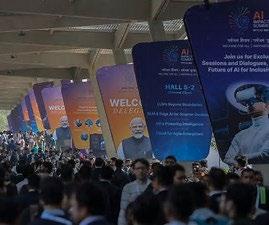
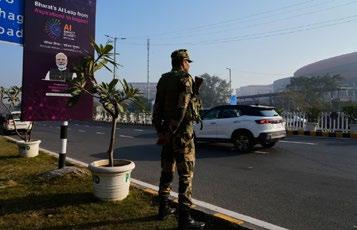
UAE's Burj Khalifa celebrates India's AI Impact Summit in New Delhi
The world's tallest building, Burj Khalifa, shone brightly to celebrate India's hosting of the AI Impact Summit in New Delhi, showcasing the growing India-UAE ties in technology and innovation.
Sharing the video of Dubai's Burj Khalifa on X, the Indian Embassy in the UAE said, "The world's tallest building celebrates India AI Impact Summit2026! The iconic Burj Khalifa shines bright for the India AI Impact Summit 2026. A powerful symbol of the growing India-UAE partnership in tech, innovation & AI." The India AI Impact Summit 2026 has indeed drawn global attention, with leaders like French President Emmanuel Macron and tech giants like Google, Microsoft, and Nvidia announcing significant investments in India's AI ecosystem.
The summit, hosted under India's expanding digital policy framework, comes at a time when AI governance is a major global issue. With India currently holding the BRICS presidency under Narendra Modi, the French leader highlighted what he described as a unique opportunity for Paris and New Delhi to align their global platforms to promote responsible AI development.
The India AI Impact Summit has brought together government policymakers, industry AI experts, academicians, technology innovators and civil society from across the world at New Delhi to advance global discussions on artificial intelligence. The India-AI Impact Summit 2026 is a landmark global event held from 16 to 21 February 2026 at Bharat Mandapam, New Delhi.
China may back India’s permanent UNSC seat bid
Beijing appears to see India as an important global partner rather than a rival. Officials are showing an understanding and respect for New Delhi’s goal of getting a permanent seat on the United Nations Security Council (UNSC). Diplomats say that translating this gesture into concrete action will depend on Beijing’s next moves, but its softer approach shows a diplomatic success for India.
India has been seeking a permanent seat on the UNSC for many years and has support from the United States, the United Kingdom, France and Russia. China used to block it with technical objections, but experts say its recent recognition shows it now sees New Delhi’s growing influence and leadership in BRICS.
The strategic dialogue also focussed on rebuilding bilateral relations. Both sides emphasised that peace and stability in border regions is the foundation of their partnership. The two sides agreed to resolve disputes not only at the military level but also through political and strategic engagement. Progress along the Line of Actual Control (LAC), including troop withdrawals, was reviewed in detail.
The talks also highlighted practical measures to ease people-to-people connections. Visa procedures are expected to be simplified, and an updated air services agreement is planned to resume direct flights between the two neighbours. The successful restart of the Kailash Mansarovar pilgrimage was highlighted in the meeting, with expectations of further expansion in the future.
On the multilateral front, India’s BRICS
presidency this year received support from China, which committed to aiding the successful organisation of the summit and participating in discussions on strengthening cooperation. Trade and economic ties are also being explored afresh. This indicates a potential deepening of
bilateral engagement. New Delhi and Beijing are showing signs of thawing long-frozen ties, as a recent strategic dialogue revealed a change in China’s position. According to the Ministry of External Affairs, during the high-level talks, China expressed comprehension and respect for India’s ambitions for a permanent UNSC membership. This is the first time Beijing has openly addressed the issue.
The statement is especially important because China has long been considered the main obstacle to India’s path to a permanent seat in the UNSC. The talks between the two nations involved India’s foreign secretary and China’s executive vice foreign minister. They laid the groundwork for future bilateral relations and indicated a possible change in China’s approach to global diplomacy.
India doubles down on state-backed venture capital, approving $1.1B fund
India has cleared a $1.1 billion state-backed venture capital program that will channel government money into startups through private investors, doubling down on its effort to finance high-risk areas such as artificial intelligence, advanced manufacturing, and other sectors broadly referred to by the industry as deep tech.
First outlined in the January 2025 budget speech by India’s finance minister, the ₹100 billion fund won cabinet approval this week (more than a year after the speech), allowing the government to move ahead with deployment. A previous iteration of the program, launched in 2016, committed ₹100 billion to 145 private funds that have invested more than ₹255 billion (about $2.8 billion) in over 1,370 startups, according to official data released on Saturday.
The program is structured as a fund of funds, a common venture capital model in which governments back startups indirectly by committing capital to private investment firms. It is designed to take a more targeted approach than its 2016 counterpart, focusing on deep tech and manufacturing startups that typically require longer time horizons and larger amounts of capital, while also backing early-stage founders, expanding investment beyond major cities and strengthening India’s domestic venture capital industry, particularly smaller funds, per the Indian government.
The cabinet approval follows recent changes to India’s startup rules aimed at easing pressure on deep tech companies. New Delhi doubled the period for which such firms are classified as startups to 20 years and raised the revenue threshold for startup-specific tax, grant, and regulatory benefits to ₹3 billion, or about $33 million, up from ₹1 billion previously.
The approval comes just ahead of the government-backed India AI Impact Summit, where global AI companies, including OpenAI, Anthropic, Google, Meta, Microsoft, and Nvidia are set to participate alongside Indian corporates such as Reliance Industries and Tata Group. India, the world’s most populous country and one of its largest internet markets with more than a billion online users, has become an increasingly attractive arena for global tech companies looking
At the announcement on Saturday, IT minister Ashwini Vaishnaw highlighted the scale of India’s startup expansion, pointing to figures shown on a presentation slide indicating the number of startups has grown from fewer than 500 in 2016 to more than 200,000 today. The slide said more than 49,000 startups were registered in 2025 alone, the highest annual total on record.
to expand their user base.
At the same time, private capital has become harder to secure. India’s startup ecosystem raised $10.5 billion in 2025, down just over 17% from a
earlier, even as investors grew more selective and sharply reduced the number of deals. The number of funding rounds fell nearly 39% to 1,518 transactions, according to data from
India hosts a high-stakes AI summit, drawing 20 leaders and top tech CEOs
India is hosting an artificial intelligence summit this week, bringing together heads of state, senior officials and tech executives to New Delhi for a five-day gathering highlighting the growing global importance of the technology.
Organizers said the India AI Impact Summit is the first such summit being held in the Global South to discuss the technology developed and dominated by wealthy companies based in rich countries. It comes at a pivotal moment as AI rapidly transforms economies, reshapes labor markets and raises questions around regulations, security and ethics.
From generative AI tools that can produce text and images to advanced systems used in defense, health care and climate modeling, AI has become a central focus for governments and corporations across the world.
The summit, previously held in France, the U.K. and South Korea, has evolved far beyond its modest beginnings as a meeting tightly focused on the safety of cutting-edge AI systems into an allpurpose jamboree trade fair in which safety is just
one aspect.
The summit begins Monday and will be attended by 20 heads of state and government, including French President Emmanuel Macron and Brazilian President Luiz Inácio Lula da Silva. India’s Prime Minister Narendra Modi will address a session Thursday.
Google’s Chief Executive Sundar Pichai, Qualcomm’s CEO Cristiano Amon, OpenAI’s CEO Sam Altman, Microsoft’s President Brad Smith and AMI Labs Executive Chairman Yann LeCun are also expected to attend.
Indian executives are hoping the summit will reflect the country’s recognition as an enabler of national capabilities, economic resilience and long-term capabilities.
“As India continues on the journey to become a developed nation by 2047, AI has a critical role to play in strengthening large scale systems, from energy and manufacturing to public infrastructure,” said Sumant Sinha, the CEO of the NASDAQ-listed ReNew, a clean energy company. Like previous editions, the India AI Impact Summit is not expected to result in a joint binding political agreement. It’s more likely that the event could end with a non-binding pledge or declaration on goals for AI development.
Last year’s edition, the Paris AI Action Summit, was dominated by U.S. Vice President JD Vance’s speech in which he rebuked European efforts to curb AI’s risks by warning global leaders and tech industry executives against “excessive regulation” that could hobble the rapidly growing AI industry.
French President Emmanuel Macron on Thursday said India and France would jointly shape the future of artificial intelligence, highlighting India’s digital public infrastructure as a model for inclusive technological growth and strategic autonomy.
Addressing the India AI Impact Summit alongside Prime Minister Narendra Modi, Macron said India had demonstrated how technology could transform everyday life, citing digital identity, largescale payments and health platforms that brought millions into the formal economy.
investments in sovereign large-language models and secure infrastructure. Together, he added, the two approaches could offer a balanced global framework that avoids dependence on a handful of dominant technology ecosystems.
“What was once impossible — financial access for millions — became reality through India’s digital architecture,” he said, describing the country’s interoperable public digital systems as a “civilisational shift” rather than merely a technological advance.
The French leader noted that artificial intelligence had now become a central arena of geopolitical competition, but argued that India and Europe were pursuing an alternative path based on independence, cooperation and responsible innovation.
He said India’s strategy of building smaller, task-specific AI models and expanding affordable computing capacity complemented Europe’s
Macron highlighted growing bilateral collaboration in healthcare AI, language technologies and sustainable computing, including joint research partnerships and tools aimed at supporting Indian languages and public services.
He also emphasised workforce development, noting India trains hundreds of thousands of engineers annually and has one of the world’s largest developer communities, making it central to global AI innovation.
Calling for wider international cooperation, Macron said India’s partnerships, including emerging technology initiatives with Gulf countries and Africa, reflected a broader push to ensure AI benefits developing nations rather than deepening inequalities.
“The future of AI will belong to those who combine innovation with responsibility,” he said, adding that Paris and New Delhi would work together to create technology that was accessible, safe and sustainable.
Prime Minister Narendra Modi on Thursday sought global standards for artificial intelligence and advocated strong ethical commitments as the cornerstone of the world's AI development and governance architecture.
Inaugurating the India AI Impact Summit at Bharat Mandapam, where he later addressed the Leaders' Plenary, PM Modi batted for democratisation of AI and unveiled India's MANAV vision for the segment. In the presence of world leaders, including UN Secretary-General Antonio Guterres, French President Emmanuel Macron, Brazilian President Luiz Inacio Lula da Silva, Swiss President Guy Parmelin and who’s who of the AI world, Modi elaborated the humancentric acronym.
Artificial intelligence must empower people, not concentrate power. This was the central message from OpenAI CEO Sam Altman as he echoed Prime Minister Narendra Modi’s call for the democratisation of AI at the India AI Impact Summit. In a separate panel discussion, Anthropic co-founder and CEO Dario Amodei too underlined how India could play a pivotal role in ensuring AI’s benefits reach the wider Global South.
Altman said India’s scale and democratic framework uniquely position it to shape the global AI future. “India, the world’s largest democracy, is well placed to lead in AI, not just to build it, but to shape it and decide what it is important to move quickly on,” he added. Pointing to rapid technological progress, Altman noted how fast systems were advancing. “We’ve gone from AI systems that struggled with high school-level math to systems that can do researchlevel mathematics now,” he said, adding that early
"I present the MANAV vision for AI where M stands for moral and ethical systems, A for accountable governance, N for national sovereignty, A for accessible and inclusive; and V for valid and legitimate," said the PM, noting that India's MANAV vision for AI would become a vital link to the welfare of mankind. PM Modi's speech on Thursday included real-time translation in the sign language using AI, reflecting India's commitment to inclusion. "We will always work to ensure that technology and public discourse are accessible to persons with disabilities," PM said. The speech was also dubbed live in 11 Indian languages: Assamese, Bangla, English, Gujarati, Kannada, Malayalam, Marathi, Odia, Punjabi, Tamil and Telugu.
forms of superintelligence might emerge soon.
“On a current trajectory we believe we’re only a couple of years away from early versions of true superintelligence,” he said.
However, he stressed that access, not just capability, would define AI’s future. “Democratisation of AI is the only fair and safe path forward,” Altman said. Warning against concentration of power, he added, “The centralisation of this technology in one company or country can be a deeply undesirable future.”
Altman also addressed concerns around employment, saying AI would inevitably disrupt the job market, but argued that such transitions had accompanied every major technological shift.
“Technology always disrupts jobs. We always find new and better things to do,” he said, adding while some current roles might become obsolete, AI would expand human capability and create new forms of work.