The Archipelago Press February 2026 - Volume 1, Issue 8
Transportive stories by island-born hands, across shores
Mother of Peace: Un-Peace-ing the Myth of EDSA as the Peaceful Revolution
If you ask activists in the Philippines, aside from sharing admiration for “Rosas ng Digma” by Musikangbayan, there is a distinct moral militancy in joining large mobilizations. It is not only anger; it is not only hope. It is a strange uplift, the feeling that your private dread about the country is suddenly public, shared, amplified. The first time I joined the EDSA People Power commemoration, I
The Fiery February of 1945
Words and images by
Bernard Supetran
This February is by far the most event-filled month of the year with the seemingly endless string of celebrations and religious observances, including the start of the Lenten season and Ramadan. And then of course, there’s the ubiquitous town fiestas and tourist festivals punctuated by parades and street dances.
was swallowed by a crowd of students, religious groups, vendors, workers, titas (aunts) in yellow shirts, and farmers who had traveled overnight. It was, as we call it, a multisectoral mobilization. That day, activism did not feel lonely.
Because it can be lonely. Wanting change is a dreadful path. It demands patience, estrangement, and the willingness to stand where it is inconvenient. Like Robert Frost’s “The Road Not Taken,” there is the lingering awareness
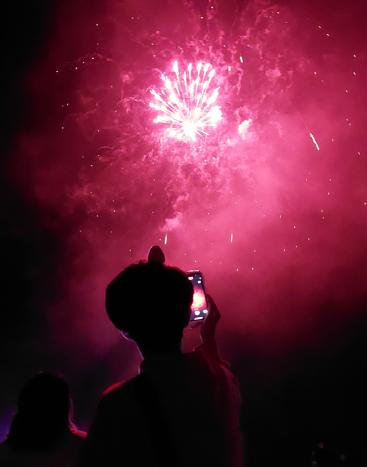
Eighty-one years ago, this month was nowhere near the jovial mood that we are basking in today. For many Filipinos, February 1945 was a bittersweet and surreal experience as they witnessed the closing months of the Second World War in the Philippines.
While the major amphibious landings of the Allied Forces happened a few months earlier, it was in the supposed month of love when the fury of the war was felt the strongest.
For several towns – such as Nasugbu, Batangas;
ACTIVISM OFTEN FEELS LIKE THAT: MORALLY NECESSARY YET SOCIALLY ISOLATING. YET, IN MASS MOBILIZATION, THE ROAD WIDENS. THE FIGHT IS SHARED. STREETS ARE RECLAIMED BY MARCHING BODIES AND CHANTING VOICES. THE COLLECTIVE REMINDS US THAT ORGANIZING IS BOTH A BURDEN AND SUSTENANCE.
San Marcelino, Zambales; Meycauayan and Valenzuela in Bulacan, and Cainta and Angono in Rizal – their liberation from the Imperial Japanese Army were the proverbial walk in the park, with very little or no resistance from the opponent.
Thanks to the underground resistance posed by local guerrillas since the surrender of the Americans in 1942, enemy positions had been greatly weakened and made vulnerable when the main strike force from the Allies came.
10 11 9 8 7 5 4 3 2 6
Letter from the Editorial Team
Insights
» Mother of Peace: Un-Peace-ing the Myth of EDSA as the Peaceful Revolution
Insights | Destinations
» The Fiery February of 1945
» Pamintuan Mansion: From Katipunan to a Historical Site
Insights
» The Monument of Ka Popoy Lagman: A Socialist Leader’s Symbol of Defiance in Marikina City
Destinations
» UPLB Freedom Park: A Place to Rest, Celebrate, and Freely Express
Destinations
» A Journey to Bondoc Peninsula
» A Month in Paradise: Remembering the Start of PostPandemic Travels
Entertainment
» Crossword Puzzle
» Editorial Cartoon
» Poetry: Kanaway (Seagull)
Culture & Heritage
» What’s in an Igorot Name?
Insights
» 100 Mountains, Almost
Culture & Heritage
» No, Some(One) Asked
Insights
» Life and Its Melons
that choosing differently means walking without guarantees and sometimes walking alone.
Words and images by
Benj Gabun Sumabat
Editorial Team
Letter from the Editorial Team
On Freedom and Revolutions
When we talk about travel, nothing defines the experience more than the spirit of freedom. One could argue for adventure, but for one to relish adventures, one must first have the freedom to move.
It is thus fitting that this issue is released a week after the 40th Anniversary of the EDSA People Power Revolution. As the largest civilian-led revolution in the history of the Philippines, it is often called the “bloodless revolution” that ousted a 20-year dictatorship marred by violence and brutality. The stories in these pages invite us to examine our definition of true freedom, of revolutions — including EDSA and the colonial eras that still has their perilous roots implanted in our soil.
Undoubtedly, this issue is a highly political one. It’s a deep dive into Philippine history and into the individual journeys toward freedom born from the legacy of our forefathers. To honor the revolutions they fought, we must recognize that movement itself is a privilege — and that travel, as always, is political.
Mother of Peace: Un-Peace-ing the Myth of EDSA as the Peaceful Revolution
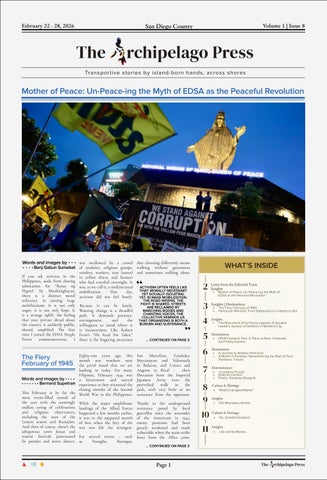
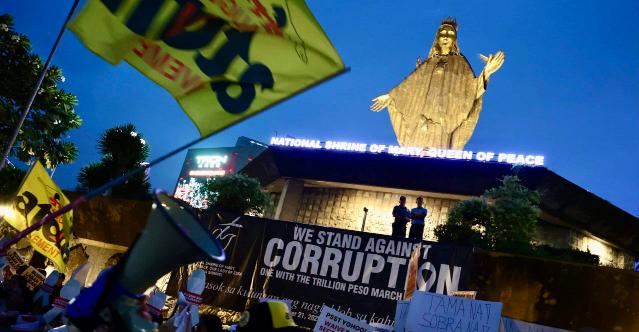
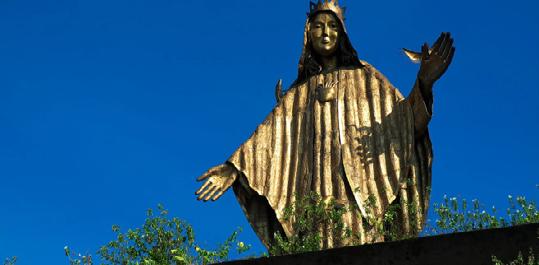
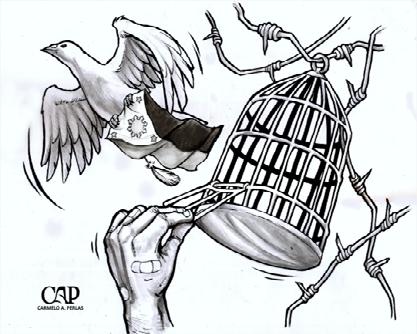
Built in 1989 along Epifanio de los Santos Avenue in Quezon City, the EDSA Shrine –formally the Our Lady of Peace Shrine – commemorates the 1986 People Power Revolution that ousted Ferdinand Marcos Sr. Mary stands elevated as Queen of Peace — arms open, serene. The architecture invites contemplation and frames the revolution as bloodless, prayerful, almost miraculous. It sacralizes the uprising. And this is where my unease begins.
To “un-peace” EDSA is not to deny February 1986. It is not to belittle civilians who faced tanks unarmed, nor to dismiss the religious sectors whose faith animated resistance. It is not to deny that a dictator was forced into exile. But it is to ask what it means that we remember it primarily as peaceful. What forms of struggle recede when serenity becomes the dominant image?
The spectacle is familiar: nuns with rosaries, civilians kneeling on asphalt, soldiers lowering their guns. These images deserve remembrance. Yet they risk flattening the years that preceded them: years of martial law repression, labor strikes violently dispersed, student activism surveilled, rural insurgencies born from landlessness, enforced disappearances that left families suspended between hope and mourning. The four days of February did not emerge from stillness. They were sedimented by fear, organizing, clandestine meetings, and bodies that had already endured violence. EDSA was never detached from bloodshed. It was shaped by lives marked
by repression. The uprising cannot be abstracted from the violence that necessitated it.
The shrine monumentalizes revolution. It also monumentalizes a particular memory of it. It softens rage and frames democracy as a granted petition rather than the culmination of protracted struggle. Peace becomes aesthetic, marble, light, uplifted arms, rather than material.
When I joined the commemoration, I felt pride and tension. Pride in inheriting collective action. Tension in how easily the language of peace circulates without confronting the structural violence that persists. The Trillion Peso March on February 25, 2026, the fortieth anniversary of EDSA, again brought thousands to the same avenue,demanding accountability over alleged corruption and government transparency. Permits were secured. Police were on alert. Traffic advisories were issued. Protest unfolded within state procedures. The spirit of 1986 was invoked. Peace was emphasized with the bureaucratic sanitization of “assembly permits” and “national holidays.”
But peace, when left unexamined, can be co-opted. It can pacify dissent, especially when filtered through liberal middle-class sensibilities. As Arundhati Roy reminds us, “non-violence is a powerful political theater when there is an audience.” But what of those far from cameras and cathedrals, whose forests are militarized and whose villages burn? What form of non-violence is available to them? Who is watching?
TO CALL RESISTANCE PEACEFUL WITHOUT NAMING THE VIOLENCE THAT NECESSITATED IT AND THE VIOLENCE THAT PERSISTS RISKS MISTAKING CALM SURFACES FOR JUSTICE. DO NOT ROMANTICIZE BLOODSHED, NOR ARGUE THAT VIOLENCE AUTHENTICATES STRUGGLE. BUT I AM WARY OF HOW PEACE, ELEVATED INTO MYTH, DOMESTICATES MEMORY. IT TRANSFORMS REVOLUTION INTO SPECTACLE, EXPORTABLE, TEACHABLE, SAFE. IT REASSURES THE NATION THAT DEMOCRACY WAS RESTORED CLEANLY, AS IF HISTORY RESETS WITHOUT RESIDUE.
To un-peace EDSA, then, is to insist that peace is not merely the absence of gunfire on a February afternoon. It is the presence of justice in the years that follow. It is refusing to let marble serenity eclipse repression and resistance. It is acknowledging that even today, we struggle for genuine and lasting peace, not an image of harmony, but material conditions that allow a Filipino family to live with dignity.
Activism may still be a lonely and even deadly road. In the current political state of our country with the son of the Dictator who was ousted in the EDSA People Power uprising as our president, perhaps EDSA commemoration reminds us to rethink what ‘peace’ means to us. Perhaps, the peace that we want is the peace that is lasting, genuine, and the kind of ‘peace’ that acknowledges the structural systems that perpetuates these injustices. Instead of looking for the
same kind of image, symbols, and metaphors for ‘peace,’ perhaps it is high time for us to turn it into something that will organize us into action.
The Fiery February of 1945
Ecija, and Los Banos, Laguna by joint American special forces and Filipino guerrillas.
number of them almost swept under the rug of history.
For a dose of adrenaline and movie-like combat, Filipinos look for conspicuous acts of bravery above and beyond the call of duty. We can look at the daring raid of the Japanese concentration camps in Cabanatuan, Nueva
The Cabanatuan episode inspired the creation of a Hollywood-produced movie “The Great Raid” in 2005.
While many rejoiced with the end of the three-year bondage, it was a time of grief and mourning for many towns that bore the brunt of the cruelty of war, a good
Among the gory chapters of the war are the massacres of thousands of civilians by Japanese troops in Real, Quezon; and that in Calamba, Laguna and Pamintahan in Lipa, Batangas on February 11 and 27, respectively.
Of course, there’s the infamous Battle of Manila a monthlong siege that began on
Pamintuan Mansion: From Katipunan Hideout to a Historical Site
If its walls could speak, the Pamintuan Mansion would tell a centurylong story of power and resistance.
In recent years, Pampanga’s Angeles City has been shedding its old “red-light” image and replacing it with something that better depicts Kapampangan culture and history through its culinary scene, museums, and heritage houses – all rich with untold stories. These days, more visitors come not just to eat, but to wander, look closer, and satisfy a growing curiosity about the city’s past.
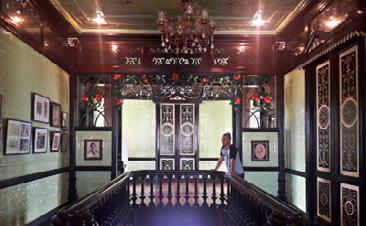
One of the most interesting stops in the city’s heritage district is the Pamintuan Mansion
Built in the 1880s by Mariano Pamintuan and his wife, Valentina Torres, the house became a witness to several pivotal moments in Philippine history. Toward the end of Spanish rule, it served as a secret meeting place for the Katipunan. Not long after, it became the headquarters of General Antonio Luna.
During the PhilippineAmerican War, the mansion
briefly held a more significant role. When Emilio Aguinaldo moved the seat of government from Kawit to Angeles, the house became the seat of the First Philippine Republic. From one of its windows, Aguinaldo watched a military parade on June 11, 1899, the eve of the first anniversary of Philippine independence. The following day’s celebration was held at the nearby Holy Rosary Parish Church
In November 1899, the city fell into American hands, and the Pamintuan Mansion was used as the residence of General Arthur MacArthur Jr., the father of Douglas MacArthur, who served as American GovernorGeneral of the Philippines for a year beginning in 1900.
But the story doesn’t end there. During World War II, the Imperial Japanese Army used the mansion to house officers and kamikaze pilots.
After the war, it briefly became a clubhouse for an American organization before operating for a time as a small bed and breakfast. The Pamintuan family sold the property in 1959, after which it came under the lease of the Pampanga local government.
In the early 1980s, the building served as a branch of the Bangko Sentral ng Pilipinas (Central
February 3 and left the city in rubble, with more than 100,000 fatalities due to Japanese atrocities or a “friendly fire” - unintended civilian casualties - from the Americans.
In several churches and schools, and practically every nook of the city was a battleground or a slaughterhouse of hapless residents.
Lasting for over a month, the bloody street battles made Manila the world’s second most-destroyed city during World War II, with many heritage structures either bombed or burned to oblivion.
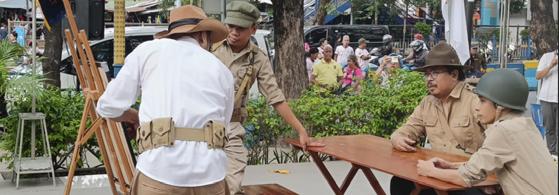
Traditional commemorative programs today constitute wreath-laying, military honors, and a slew of mostly-repetitive speeches, and whenever practicable, reenactment of key local historic events.
For the National Historical Commission of the Philippines
Bank of the Philippines). And on June 17, 2010, it was turned over to the National Historical Commission of the Philippines
(NHCP), which transformed part of the house into what is now known as the Museum of Philippine Social History
and the Philippine Veterans Affairs Office of the Department of National Defense, the lead government agencies for these observances, these anniversaries are opportunities to heal old wounds and continue moving on to a new phase of life. Despite death and destruction, there are countless bright spots and heartwarming stories and sublime sacrifices made by nameless heroes that must be told to inspire the current generation.
Eight decades on, we can only be thankful we were born in a much better, albeit less heroic, point in time. Every time you relish the romance of February, may we remember that 81 years ago, someone paid dearly with their life, so we can sip wine and feast on a romantic dinner or a sumptuous Chinese lauriat meal.
A Throwback to ArchitectureMagnificent
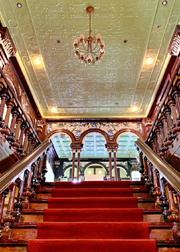
Even before you step inside, the mansion makes an impression. Its graceful curves and slender columns immediately evoke the elegance of late 19thcentury homes built during the Spanish colonial era. A bit of research reveals that its design drew inspiration from houses in Toledo, Spain, themselves shaped by Mudejar (Moorish-influenced) architectural influences.
An exterior staircase leads to the main entrance, where another grand stairway carries visitors up to the second floor. Inside are nine galleries displaying traditional clothing, artworks, and artifacts that trace the country’s social history.
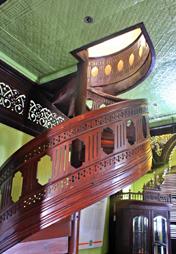
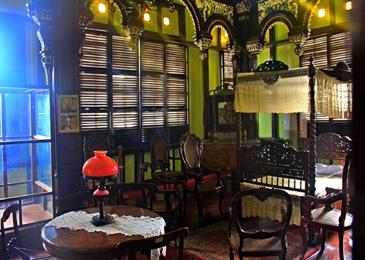
Throughout the spacious interior, traces of the past remain everywhere: old wooden furniture, Art Nouveau-framed family photographs, carved figures, religious statues, and delicate heirlooms once owned by the Pamintuans. A narrow spiral staircase climbs to a rooftop tower that doubles as a small veranda, offering a view of the town below.
For a house that has stood for well over a century and passed through so many hands, the mansion remains remarkably well-preserved. Standing there, it’s hard not to think the same thing: if the walls of the Pamintuan Mansion could speak, they would have more than a century of stories to tell.
Words and images by Marky Ramone Go
The Monument of Ka Popoy Lagman: A Socialist Leader’s Symbol of Defiance in Marikina City
On
of
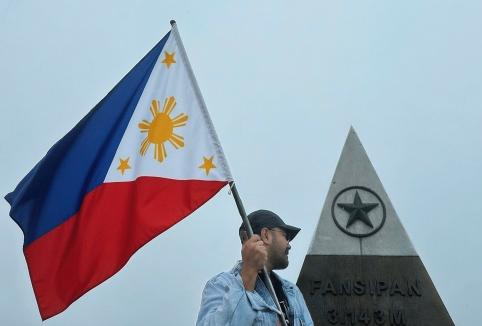
If it’s true that the spirits of the departed roam the earth, then the late labor leader Filemon
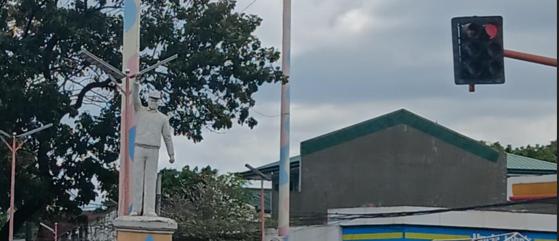
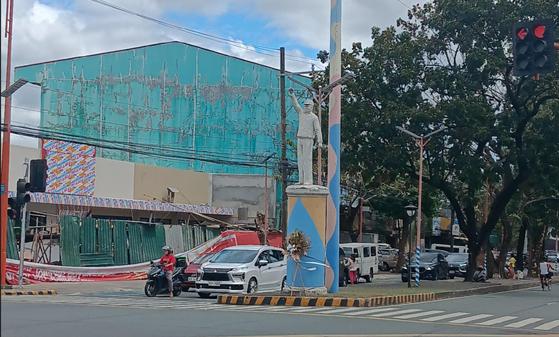
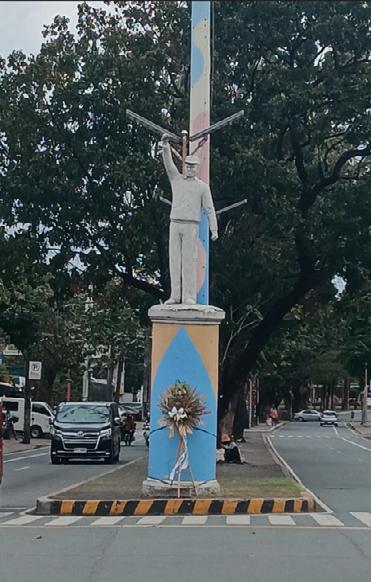
“Ka Popoy” Lagman’s soul would have been squirming upon the sight of his own memorial statue right in the middle of a busy intersection of Barangay Concepcion Uno, Marikina City. It wouldn’t be because it wasn’t composed of high-grade materials like bronze or granite. Neither would it be due to its artistry not being polished enough that his older sister Nilda remarked when it was unveiled in 2001, “It doesn’t look like him.”
Rather, it would be for the reason that any public statue draws attention toward who it represents and hints, however slightly, of propagating a Stalinist cult of personality that Ka Popoy stood against. He would’ve been more embarrassed to see that the opposite sides
of Bayan-Bayanan Avenue that lead to his monument were lined up by more statues representing different types of workers, each with an engraved sign: “Naghihintay ng Bayani” (Waiting for a Hero), at the base. (It must be a great relief for him now that these inanimate figures who were holding out for a hero have been removed.)
A Credo for Others
Ka Popoy was always about the other — the Filipino working class, most poignantly. When he was alive, he tried to attend as many family gatherings as he could even amid the dangers of carrying out his revolutionary tasks. It is no exaggeration to claim that these attempts entailed risking his life, especially when he was still fighting underground as the former secretary of the Manila-Rizal Regional Party Committee of the Communist Party of the Philippines (CPP).
Yet, despite his desire to be with his family during important celebrations, he had long since ceased celebrating his own birthday. One time, over the
phone, his beloved mother Cecilia invited him to pay them a visit on his birthday so the family could celebrate. He bluntly answered, “Ma, you know that I don’t celebrate my birthday.” An indefatigable cadre, what he really meant to say was that he was busy writing papers and preferred not to be distracted from his urgent task as a dedicated revolutionary leader—even on his natal day.
I also have a stark memory of the time we visited him while in detention in 1994, when he strongly objected to the original name of the newly found movement organized to call for his release, the “Free Lagman Movement”—all the more that it was abbreviated into his first name, “Filemon.” He insisted and prevailed that they make it a call not just for his freedom but for all political prisoners, and to rename it accordingly.
Assassination
Ka Popoy was the chairman of the socialist labor group, Bukluran ng Manggagawang Pilipino (Solidarity of Filipino Workers), when he was assassinated on February 7,
2001. Prior to his death, he steered the Sanlakas party-list group into winning a seat in the House of Representatives in the 1998 elections, with labor leader (and now Marikina City councilor) Rene Magtubo as representative. It was a trailblazing win as Sanlakas was only one of two progressive groups that won a congressional seat that year; the other being Akbayan. Currently, there are more progressive partylist groups that are truly representative of the various marginal groups in Philippine society, like those belonging to the Makabayan Bloc.
During the January 2021 EDSA II uprising that saw the ouster of then-president Joseph Estrada, Ka Popoy and his group issued the sharpest call to action: “Resign All!” For them, it was the opportune time to put the best Filipino leaders at the helm of the government. They wouldn’t settle for the expediency of replacing Estrada with the incumbent vice president Gloria Macapagal-Arroyo (GMA).
The call went unheeded: GMA was sworn in and succeeded Estrada as the new Philippine president. In less than a month, Ka Popoy was shot dead in University of the Philippines (UP) Diliman, and the new administration soon went on a killing spree against leftist activists, labor leaders,
and members of progressive groups. It was also plagued by a series of corruption scandals, which is all the more a vindication of “Resign All!”
Installation of Monument
Ka Popoy’s statue in Marikina was installed and unveiled a few months after his death, by his friend, the city’s then mayor Bayani Fernando, who passed away in 2023. Whether Ka Popoy (whose father, Pedro Lagman, hailed from Floridablanca) would have liked it or not, his memory is honored as the first of three public monuments of socialist leaders unveiled in the Philippines, alongside two others who have Kapampangan roots: the Pedro Abad Santos Monument in San Fernando City and the Luis M. Taruc Hukbalahap Monument in the Municipality of San Luis It may have been an unlikely friendship between a socialist labor leader and a local politician and businessman, but Ka Popoy remained uncompromising in his revolutionary principles throughout the relationship. During his eulogy, the mayor fondly (though perhaps with a little chagrin) shared, “Ka Popoy is my friend, but it didn’t stop him from instigating the workers of my business to hold a strike!”
UPLB Freedom Park: A Place to Rest, Celebrate, and Freely Express
Beyond
and recreation,
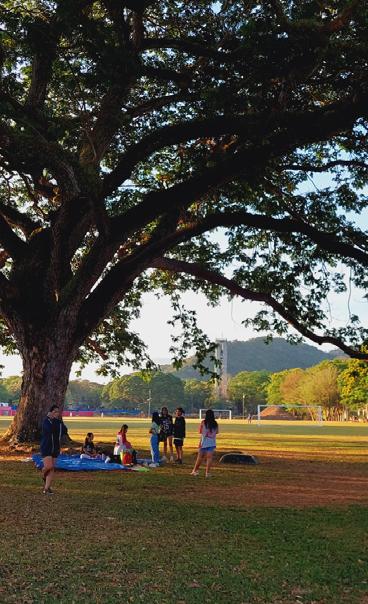
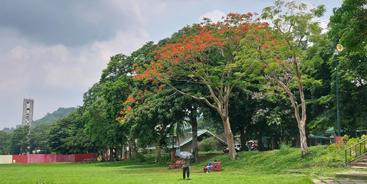
Located at the foot of Mount Makiling in Laguna, Freedom Park’s sprawling green space comes alive with people lounging under its trees, students practicing for activities, joggers making their rounds, athletes playing soccer, and passersby weaving through it all. A true “third space”, this park at the University of the Philippines Los Baños (UPLB), Laguna is open not just to the UPLB community but to people of all ages and backgrounds.
Rest, Gatherings, and Protest
Freedom Park’s grounds are a welcome respite for many. Its trees, mostly acacia, provide ample shade, and the mountain breeze keeps the air pleasantly
cool on most days. During summer, the narras and fire trees bloom in vivid colors. The park’s grassy surface is perfect for picnics; I’ve had my happy share of these in my time both as a visitor and later, as a resident of Los Baños.
I personally love the white egrets flying on the west side of the park, near the acacia tree’s wide-spreading branches, well-known as the ‘Fertility Tree’ among the UPLB community. Close to it is the Carillon Tower, aptly built in the park to commemorate a hero who fought for the Philippines’ freedom: Jose Rizal.
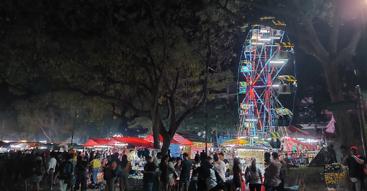
The park hosts two memorable annual celebrations: the Feb Fair every Valentine’s week, and the graduation ceremony for UPLB students. Free and open to all, the former attracts crowds not just from the campus but from other provinces and from Manila. Traffic comes at a standstill and accommodations and transient houses usually go fully booked around this time.
Similar to a perya or amusement park experience, Feb Fair goers can go on theme park rides like the ferris wheel, play games and win prizes, eat at food booths, and buy clothes, accessories, and other merchandise. What makes the experience unique, though, are the nightly concerts featuring local bands and booths by student organizations, with interesting activities and products including fresh produce from indigenous communities.
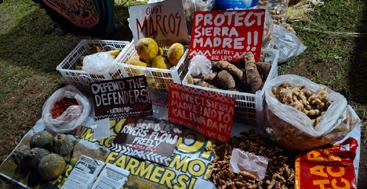
Beyond a celebration, the Feb Fair is also a venue for free expression. Some student organizations use their booths to raise awareness for their advocacies, such as environmental protection and community rights. Meanwhile, those at the concert stage occasionally lead protest chants calling out the government’s questionable practices, including the most recent corruption involving flood control projects.
The Feb Fair’s long history of advocacy dates back to September 1972, in protest against Martial Law. Since then, it has integrated advocacy in its messaging. Each year, the theme focuses on promoting social and political awareness, with this year being “Himagsik” (Revolt), particularly against corruption.
A History of Confinement
Before Freedom Park became an established space for celebration and expression, part of it was a space for confinement. In 1943, Japanese occupation authorities established a detention facility for civilian prisoners from the United States and Allied nations. With the Santo Tomas Internment Camp in Manila exceeding its capacity, Japanese officials had sought to isolate detainees from local Filipino supporters who had been secretly supplying them with additional food and information.
Prisoners at the internment camp in UPLB were forced to construct barracks on the campus grounds, including a part of the now-Freedom Park. One Japanese officer intentionally slashed rations and withheld food supplies. Many suffered from malnutrition. Some died from related diseases as a result.
On February 23, 1945, Americans, with the support of Filipino guerrillas, executed a daring rescue
from the air and land for the 2,000-plus prisoners. This would later be known as “The Raid on Los Baños.” It would take time after World War II for Freedom Park to transform into the refuge for free assembly and expression that it is now.
I write this near the anniversary of the 1986 People Power Revolution, which was instrumental in lawfully taking back people’s right to freedom of expression in Freedom
Park and in other places in the Philippines. Prior to the EDSA revolt, many Filipinos were arrested, tortured, and killed on mere suspicion of inciting sedition against the then-Marcos administration. I’ve had the privilege to meet a few who survived torture.
Today, the UP community and those committed to upholding human rights continue to speak their mind and hold the government in check, not only in Freedom Park, but in other venues as well.
Words and images by Rhea Claire E. Madarang
the Silver Jubilee of the First Public Statue
a Socialist Leader in the Philippines
rest
UPLB’s Freedom Park is a place for free expression, celebration, and protest.
Words and images by Karlo Lagman Sevilla III
A Journey to Bondoc Peninsula
Bondoc Peninsula offers a raw and refreshing side of Quezon that’s waiting to be explored.
Words by Gelyka Ruth Dumaraos
by Ramir Cambiado
You may have found yourself in Quezon Province—in the busy city of Lucena, during the Pahiyas Festival in Lucban, or simply passing through Sariaya, Tayabas, or Gumaca on the way to the Bicol Region.
But have you ever turned toward the Bondoc Peninsula?
This side of the province holds off-the-beaten-path destinations that are quiet, unassuming, and every bit as stunning as the rest of Quezon.
Traditions and Sweeping Landscapes
Located in the southeastern part of the province, Bondoc Peninsula encompasses 12 municipalities and is bordered by the waters of Ragay Gulf, Sibuyan Sea, and Tayabas Bay.
With coastal and hilly municipalities, this extensive peninsula features destinations where one can embrace stillness, reflect, and immerse oneself in history and nature.
A five- to six-hour drive from Manila, you can start by heading to General Luna known as the heart of Bondoc Peninsula. Featuring faithbased tourism activities, the town’s streets come alive during the Holy Week.
Many also look forward to the Parade of Centurions throughout the Holy Week, with locals, mostly aged 7 to 30, parading with vibrant Roman centurion costumes made of crepe paper.
Rain or shine, they’d walk around town carrying their heavy ensembles as a symbol of sacrifice and devotion. Beginning in 1974, this practice has been passed down from generations and is quite similar to Marinduque’s Moriones Festival.
Another highlight of the festival is the Estokadahan a mock sword fight between centurions held at the town plaza.
While similar observances were once common in nearby towns like Macalelon it is in General Luna where this tradition is preserved through the years.
One can visit the Divine Mercy Hermitage too – a place to meditate and enjoy scenic landscapes. Beside the chapel on a hill is a 50-foot
A Month in Paradise: Remembering the Start of Post-Pandemic Travels
A lookback at savoring the first days of freedom after the global pandemic
Words and images by Christian Sangoyo
I remember when the world stopped because of the pandemic. For two long years, we were mostly confined to our homes. When the virus began to wane, we started to go outside — warily, still a little afraid, but also excited to take small steps into the world.
It was a few months after the lockdown that my wife and I finally decided to resume
traveling. Our plans were complicated by something new: our two-year-old son. With the threat of the COVID-19 virus still relatively fresh, we were hesitant to board a plane and mingle with people.
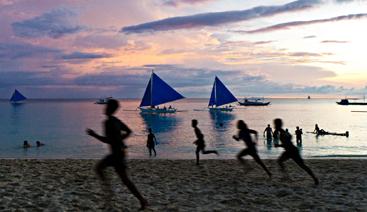
Equipped with a full dose of precautionary vaccines, we put our masks on and braved the crowds at the airport. Our destination – one of the most crowded beaches in the Philippines: Boracay.
Upon landing at Caticlan Airport, more crowds awaited at the jetty port. Sweltering behind masks, we persisted.
image of the Divine Mercy that offers panoramic views of vast coconut plantations within General Luna and its neighboring towns.
In the afternoon, you can catch a dramatic sunset along the baywalk or see the town’s lighthouse facing Tayabas Bay. From here, you can enjoy a glimpse of the island-
Once in Catanauan – Bondoc Peninsula’s most populated municipality – don’t miss a sunset in one of its sugary, cream-colored beaches. There’s no party scene here – just unpolished seaside resorts offering guests a laidback hideaway. Grab a couple of sinaludsod na balinghoy (cassava pancake) – a popular delicacy in town – and pair it with freshly brewed coffee.
Alibijaban Island a secluded paradise known for its beige sandbar and pristine waters ideal for snorkeling. It is also known for its 140 hectares of undisturbed mangrove forest within the Alibijaban Island Wilderness Area Within this protected area, 22 mangrove species have been recorded.
While the town is one of the most remote in the peninsula,
province of Marinduque. For some travelers, it serves as a jump-off point for a quick day trip, specifically to popular Maniwaya Island
On the outskirts of General Luna heading toward Catanauan, you can stop for brunch at Belrico Cafe and Restaurant a family-owned roadside eatery with al fresco dining. Order a couple of home-cooked meals and coffee, then enjoy them underneath coconut trees or in one of their open-air kubo (native hut)
Finally, we made it. Boracay. The endless expanse of sand and sea. Outside. At last.
Our base was Ferra Hotel a boutique hotel a few steps from Bulabog Beach—a lesserknown and less crowded sibling of the famous White Beach
In those days, we’d find an isolated spot to spread our beach blanket on, and dream the nightmare of the last couple of years away under the shade of a coconut tree. Kid A, who once literally shook with fright when brought outside, was running around and savoring every grain of sand that passed through his fingers. The calm cerulean waters of Bulabog Beach were something new to him; it didn’t scare him.
The first few days were beset with a certain stiffness in our movements. Crowds still terrified us. But as the days passed, we began to calm down. Our fright slowly ebbed with the tides. We started to move more freely.
Afternoons were spent on al fresco huts fronting the beach, with cold beers on our table. Kid A ran around with other kids across coconut-
History and a Diverse Ecosystem
In Mulanay take a trip down history and see the Kamhantik Archaeological Site within the Buenavista Protected Landscape. This ancient settlement, also named Kamhantik Complex was discovered to have pre-colonial artifacts such as ceramics, tools, and burial jars that are said to date back to the Metal Age.
Further south in San Andres take a 20-minute boat ride to
fringed white sand, their parents also having glasses of pilsners on their own tables.
Friendly banter was exchanged, reminiscing years past when everyone traveled without care to the ends of the earth.
Our friends soon joined us for a long overdue get-together. From Friday video chats with beers in our respective houses, we’re now sitting next to each other at one long table, sharing food and refreshments in real life. Kid A finally met our friends and treated them as if they had always been part of his world. At night we’d go out with him in tow, playing on the sand beside us.
Eventually, they returned to Manila, and we were left on our own again. From a flurry of activities, we reverted to our slow island routine.
Late breakfasts. Mornings at the beach. Cheap carinderia meals for lunch. Siesta under the coconut trees. Twilight. Dinner. Beer. Sleep.
With nothing but time to spare, we explored most of the beaches of Boracay—Puka, Diniwid, and White Beach but always returned to our favorite, Bulabog Beach. We
it rewards you with spots worthy of exploration. Take a refreshing dip beneath the 20foot drop of Nabaroto Falls or hike to the rolling Makapaya Hills at sunrise or sunset.
These are just a few of Bondoc Peninsula’s many attractions. From small-town traditions and laid-back beach escapes, to diverse ecosystems and rolling hills, the Bondoc Peninsula offers plenty for freedom-loving adventurers. All that’s left to do is for you to discover it.
dined everywhere—from inexpensive meals at Andok’s and fast food comfort food, to expansive buffet spreads at five-star resorts. We walked and walked along its shores – sometimes chased by stray dogs in secluded areas.
Finally, we were back in the groove. Boracay reopened the world to us. And after almost a month-long stay on the island, we boarded the plane again, this time to travel back home. We knew this time: it wouldn’t take another two years before we boarded another.
Kanaway
By Ronan R. Lingatong
Usa ka alimpos nga nag-alirong
Ibabaw sa miakal nga duut
Mabati nimo ang dahunog
Sa agik-ik sa ilang pag-inilugay
Motugdang sila daw bomba
Nga mitibugsok sa Palestine
Apan dili mabati sa kalibotan
Ang tiyabaw sa gipanubad:
Mga mungaw ug bulinaw’ng miulpot
Naningkamot intawn silag sibat
Gikan sa hulga sa sambagon
Gipangita ang dagat sa kagawasan
Apan sa paghaw-as sa ilang pag-ikyas
Nahiagian sila sa mga manunubad sa kawanangan
Ing-ana ang hulagaway sa henosidyo sa lawod
Ug lantawa ang pagkahurot sa ilang duut
Ang pag-ulbo sa ilang kisaw
Ug ang pagkapusgay sa buwa
Sa ilang kalingkawasan
Apan wala gihapon ta
Maminaw sa mga balak
Nga midagsa sa atong lapyahan
Seagull
A waterspout rotating
On the feasting shoal
You can hear them
Wailing for rivalry
They devour like bomb
Falling in Palestine
But the world can’t hear
The screams of the devoured:
Sardines and anchovies leaping
They’re trying to escape
From the threat of skipjack tuna
Finding the sea of freedom
But when they surfaced their flee
They’ve been found by the sky beasts
That is the image of the genocide on sea
And look how their shoal disappear
The burst of their rustle
And the breaking of the foam
Of their liberation
But we never listen
To the poems
Washed ashore
Ronan R. Lingatong is a fisherman from Baybay City, Leyte. He is a fellow of regional and national creative writing workshops and is published in various literary journals, magazines, and newspapers in the country.
ACROSS
2. Island in Bondoc Peninsula known for its 140-hectare mangrove forest
Annual Valentine’s event in UPLB promoting socio-political awareness
1880s mansion in Angeles City; Katipunan hideout
Kankanaey for ‘fellow villager’
EDSA monument commemorating the 1986 People Power Revolution
City where Ka Popoy Lagman’s statue stands DOWN
1. Month-long siege that began in Feb 1945 and left Manila in rubble
Traveling in the Philippines: A Cartoon Series
The Archipelago Press 02282026
We accept previously unpublished poems on place, migration, movement, memory, and Filipino culture in English, Filipino, and other Philippine languages and dialects from Filipinos across the world. For non-English poems, please provide an English translation. Indicate your preferred byline (a pseudonym is fine).
Please submit just one (1) poem as a Word document or pasted in the body of your email to editorial@thearchipelagopress.com with the email subject: Poetry: Your Name – Poem Title
Accepted poems will be paid 500 Php and featured in our weekly issue and our website.
If you don’t hear back from us within 30 days of submission, please give us a nudge.
Images
What’s in an Igorot Name?
(celebrity) names and mashups of our parents’ names.
Kabayan also had Americansounding names? Plus, I knew I was reading stories from decades or centuries ago.
Words and images by
Heather Ann Pulido
Supplemental image by Joseph Tabadero
I’m certain that today, giving traditional names is no longer a widespread practice in Benguet. It is even less common for Cordilleran families who migrated to Baguio.
If a rose by any other name would smell as sweet, would an Igorot with an American name still be an Igorot?
I have had to grapple with this question twice in the last three years. Today, I will attempt an answer.
Story Behind the Story
Outside my hometown, I have been asked to make the names of the characters in my children’s fiction more “Cordilleran.”
From high school to university, I’ve been assigned to read Cordilleran stories whose characters were named “Lumnay,” “Aliguyon,” and “Bugan.” Even so, I never stopped to think about the “Cordilleran-ness” of my name. Why would I, when my siblings, friends, and even my cousins from Kapangan and
If you look at geography, economy, and migration history, it is easy to understand why. So many of our kailyans (fellow villagers) and relatives from Benguet have (willingly or unwillingly) given up so much to move to the city in hopes of getting better education, jobs, or healthcare. Our proximity to Baguio— former colonial hill station and current economic hub—is as much a blessing as it is a curse.
I also acknowledge that English names might have been given to our foremothers as a way to help them “blend” into metropolitan centers, or maybe even to avoid discrimination and unwanted attention. But make no mistake: the Collins and Jacksons of my ili (home) are not named after American soldiers or diplomats but country singers who have serenaded their parents in the silence of their farms or trucks hauling sayote (chayote) from Kapangan to La Trinidad.
Another Story About Names
I’ll admit I wasn’t always happy to be called Heather. I even wrote a book in 2019 about a girl who wanted to change her name. I thought of this plot because as a child, I wanted to be a “Jenny” or “Belle” to be more like my classmates and favorite movie characters.
In researching this story, I learned that the practice of bestowing “Igorot names” was more common in Mountain Province and Kalinga. Mr. Columbus Atitiw of the Saint
Louis University Museum (now called the Museum of Igorot Cultures & Arts) also explained
that names in the Cordillera used to come from physical features and other attributes a child was seen to possess after birth. As Ted Feliciano posted on his Facebook page, The Cordilleran Sun it was common for our ancestors to be called “Kitongan” or “Ingaan” – monikers inspired by their most prominent facial features (kitong is forehead and inga is ear in Kankanaey).
In recent years, these traditional names have been passed down to honor clan ancestors, or to remember grandparents who passed away. Sometimes, their names are given as is, but more frequently, they are bequeathed as second names or nicknames.
Even if I wrote a book about Igorot names and how they’ve become rare enough in Baguio to warrant teasing from other children, it seemed to have no effect on the world. Years later in Manila, I was still asked why my Cordilleran characters did not have Cordilleran names.
Why NamesStorybook Matter
Literature shapes the perception of people outside and also within their land.
As a Cordilleran writer, I maintain that books shape how we tell stories of
American names like Heather, Abigail, Patrick, and Richard are a reflection of this colonial history, much like how many Filipinos’ Spanish last names are a legacy of the Spanish occupation. It is true that some of our names were suggested by or taken from nurses, teachers, or missionaries—some of whom may have been American. But just like other Filipinos, we also have our fair share of artista
ourselves, and ultimately, how we see ourselves. So when someone says, “Why does this character not have an Igorot name?”, they are also asking me why I’m called Heather and not (insert your idea of an Igorot name here).
Books, especially for children, should teem with possibility. They should not force characters into boxes, especially not the lockbox of indigenous essentialism. Contradictions and fraught histories should be allowed space, even in rooms as small as a character’s name.
Regardless of its origins, a child’s name still carries a family’s dreams and wishes. It tells the story of parents’ passions and quirks. It holds their own names and histories.
I was named after my mother’s friend from college, an exchange student from the United Kingdom. My second name “Ann” was derived from “Susan”, my mom’s name.
And yes, “Heather Ann” is an Igorot name—even if I was born in Baguio City and I’ve lived here all my life, even when I’m not wearing a tapis (a wrap-around cloth), and even if my Kankanaey is peppered with Ilokano.
Heather is an Igorot name, because I am an Igorot.
100 Mountains, Almost
Two decades, 97 mountains, and a mid40s woman’s new appreciation for hiking on her own terms.
Words and images by Christine Fernandez
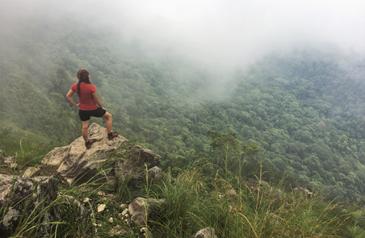
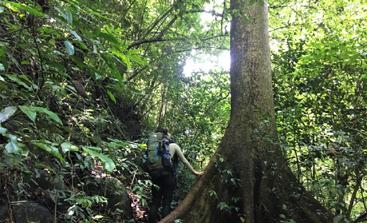
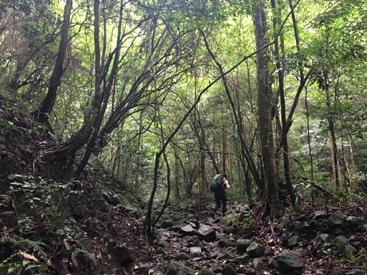
My knees rose higher than usual as we tackled the steepest part of the trail. My shirt clung to my body with sweat, though my lungs didn’t burn.
I had chosen a slow, steady pace – just enough to keep moving without my heart leaping from my chest. The gentler rhythm allowed me
on medical school. His conundrum amused me; after all, I’m no longer a student worrying about such things. It has been 20 years since I graduated.
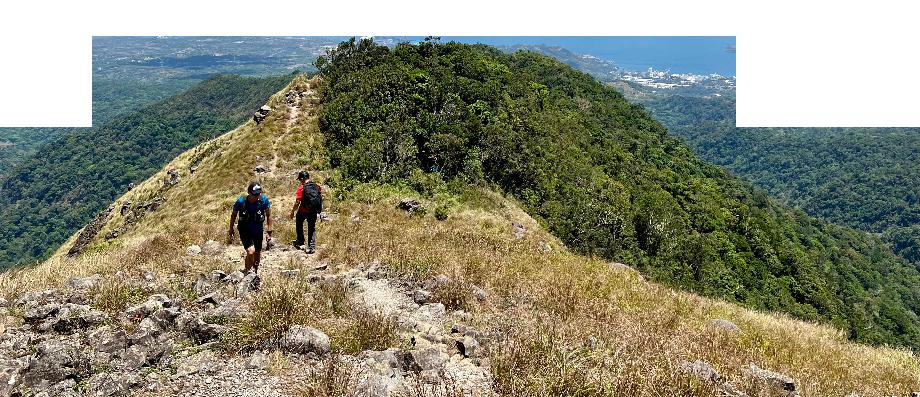
Engrossed in our conversation, we didn’t realize we had arrived at Tarak Ridge, a popular vantage point in the Mariveles Mountain Range that I have visited many times before. It was such a warm conversation that lent itself to a brotherly hug. I caught the curious look of my friend, who had organized the hike, who wondered why I, usually averse to touch, hugged
to notice moss clinging to rocks and insects crawling through the boulder crevices. I only wished I’d spotted the green viper my friends ahead had paused to admire.
I had also fallen into step with a college student I’d met only a few hours earlier. While our companions pushed ahead, we drifted behind, talking about his dilemma: whether to take on a greater responsibility – one that could open other opportunities – or to focus
someone I had just met. Later, the young man returned to his friends, and I turned my
peaks and Mariveles Bay.
My face burned from the heat.
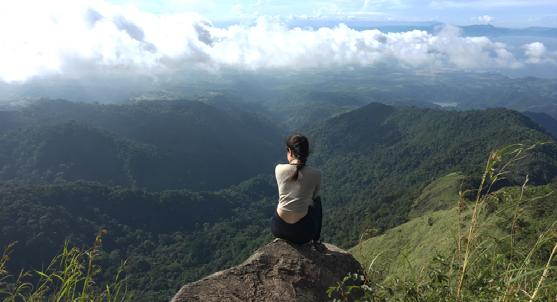
As hunger set in, I slumped onto the grass and dug for snacks in my backpack. The summit was only 30 minutes away. While others headed for the peak, having scaled it previously, I chose to skip it, savoring the view and the moment instead. I happily settled into the grass, snacking and chatting with Pat, a friend I hadn’t seen in years.
Reflections on Hiking
It was the extra time brought by the COVID-19 pandemic that got me started on counting the mountains I’ve climbed. The tally now stands at 97, but I’m not rushing. It was never about the number of summits for me, but about making time to go out for a hike for as long as I can, enjoying the trail and pausing for interesting plants and insects along the way. Some peaks I gladly return to, like Mount Makiling or Mount Manabu, for those very reasons.
These days, my hiking trips are fewer, and I haven’t attempted
enjoy the mountains but I now choose more manageable routes, or trails that can be completed in less than five hours, rather than the extended day hikes I used to enjoy, such as Mount Tapulao, Mount Pulag or a traverse from Mount Kitanglad to Dulang-Dulang, which often took 10 hours or more to finish.
I notice the little signs of aging: my laptop screen
healthily while preparing for the trails I still love. I’m not closing the door on longer, difficult climbs. I’ve met hikers older than me who are stronger than ever, reminding me that endurance isn’t limited by age.
There are countless challenging trails across the Philippines - Mount Guiting-Guiting in Romblon, Mount Halcon in Mindoro, Baluy Dako in Panay
zoomed to 150%, or my chin quietly growing a twin when I overindulge in carbs. Yet, there’s a freedom in letting go of expectations. I’m no longer driven by how fast I should
and
challenges. And then
Part-interrogation, partintrospection about the waning practice of giving traditional names in Benguet
Island - offering both logistical
physical
there are the fun, lighter hikes: Mount Timbak in Benguet, the country’s ninthhighest peak; Mount Lantik
No, Some(One) Asked
But that’s a lousy excuse.
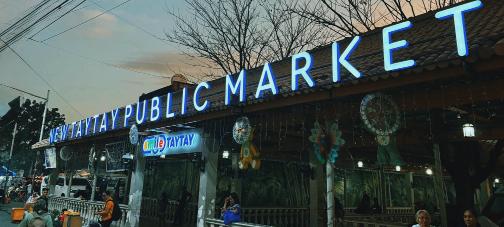
The simplest answer is the truest: “I’m from Taytay, Rizal, Philippines.”
There is a particular tone strangers use when they ask it. Light. Curious. Harmless, even.
“So, where are you from?”
Taytay is unremarkable, aside from the tiangge (flea market)—a sprawling ecosystem of dirt-cheap garment sellers where mannequins wear better dresses than most of us. Nothing particularly historic happened there, at least nothing that comes with
I would talk about beaches with sand so fine it could be sold as coffee creamer. I would narrate our culinary stories, how adobo tastes different in every household, how sinigang is less a dish and more an anthropological thesis disguised as soup. I spoke of fiestas and jeepneys and the choreography of Manila traffic. Most of it fell on dead air, the way jokes do when you miscalculate the audience.
The news they hear is catastrophe, typhoon, flooding, corruption, and occasionally, viral song performances.
cultural performance.
It ends where it should.
It is not the question that unsettles me; it is the complexity of the topics
It is the most ordinary question one can ask during a trip. It hovers between small talk and pop quiz on identity. It is meant to fill the space between “Hi!” and the first shared laughs over beer. And yet, for reasons I cannot fully explain without sounding overly dramatic, it has always felt like an oral defense.
Perhaps because the convenient reason is that I am the product of generations’ worth of opposing parental advice, otherwise known as intermarriages. I am Vietnamese, Indian, Southern Han Chinese, Mongolian, and then Filipino, in that descending order of percentage, according to a DNA test that felt less like FYI and more like a genealogy bombshell.
“Franken-DNA,” if you will.
A pie chart of migrations, colonizations, trade routes, and some of my great-greatgrandmothers who fell in love with the “wrong” men.
a commemorative marker. It does not elicit gasps the way Balabac, Palawan does. Or Siquijor Island, with its mysticism and sensationalized folklore. When you say you’re from those places, strangers lean forward. Their eyes soften. They begin listing beaches and stories they have Googled.
“Taytay? Is that where Alex and Toni Gonzaga are from?”
Seriously?
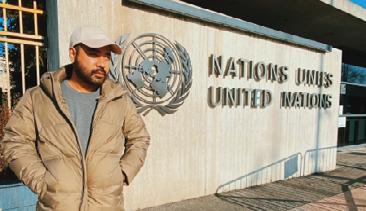
The difficulty multiplies overseas. When someone asks where I’m from and I say “Philippines,” I brace myself. Prepare to not hear the end of Manny Pacquiao or Catriona Gray. Occasionally, a request to sing.
“Oh, Philippines, the Pacific islands?”
“Oh, aren’t you Latino?”
“Oh, is that in Asia?”
I used to pitch the country like an unpaid tourism intern.
There are days when it feels more convenient to say, “I live in Singapore.” Which is technically not wrong. The conversation shrinks immediately. Efficient. Polite. Sterile. Singapore requires no defense, no geography lesson, no impromptu
that ensue. The obligation to represent. To defend. To clarify that we are more than disasters and pageants. That our English is not borrowed but reclaimed. That our history is not a footnote. It can be a good conversation starter
over beer, yes, but finding an exit point from a subtle interrogation disguised as curiosity is its own labor.
Sometimes I want to answer differently. To compose something that captures the essence rather than the coordinates.
“I’m from somewhere where church bells ring and echo at 6 p.m., where the scent of baking pandesal mingles with mountain mist, where people speak in an inflection that sounds like home even when it is scolding you.
I’m from tricycles and sari-sari stores and neighbors who know your business before you do.”
But that answer takes time. And strangers on trips are usually in a hurry.
I dream of the day when I will say it plainly, without the rehearsed add-ons.
No buts. No howevers. No justifications needed.
I’m from the Philippines. From Taytay, Rizal.
Life and Its Melons
A retrospective on the disasters that dismantled one life and built another.
In 2009, my dad and my sister were granted entry into Toronto, Canada. Because I was over 21 when my mom filed her sponsorship application, I was suddenly left to fend for myself in the “thirdworld country” I call home.
They left me with a 1996 Honda Accord – a vehicle a troubled and unemployed boy in his late twenties could not afford to run or maintain.
The CycloneCatastrophic That Was Ondoy
We were still in the middle of a drinking session when it started to pour. In San Andres Bukid, Manila, the streets would flood up to your ankles after 15 minutes of heavy rain. It would rain nonstop for almost 12 hours.
I watched the water inevitably creep through the garage. In no time, it made its way through the front door and into the living room. Not long after, I had to get off my ass to move appliances, furniture, and the car to higher ground.
Ondoy dumped the equivalent of a full month’s worth of rain in less than half a day. There would be no ground high enough for the car.
Drowned and Out
I could barely see the side mirrors of the Accord as I approached it. The car I could not afford to run was now flooded. And it would stay in that state for months.
When I finally got it to run, I decided to sell it to any fool who would take it on as a project car. I got Php 60,000 for it and placed a down payment on a 2011 Yamaha Mio Fino, a stylish scooter I fancied after watching
metro to cover various events.
Before I got a scooter, it took a lot of walking, queuing, sitting in traffic, and sweating to get anywhere. On it, it would take me however long Google said it would take (often less).
Jude Law’s rendition of Alfie
Less than three months after I got it, it was stolen from my cousin, who had borrowed it while I was out of town.
Kymco Like 125
After almost six months, I got the insurance money and opted for a scooter that thieves tended to fancy less: a grey Kymco Like 125. Some might argue that its more minimalist retro stylings better fit my intended use. At that time, I was working for a print publication — a job that required me to go around the
It was cheap to run, maintain, and park. I was free from the daily torture that was Metro Manila commuting.
Work from Home
At the tail end of 2018, the print publication I was working for could no longer justify its business model in a media landscape increasingly dominated by online platforms and digital advertising. I would be unemployed for the first time in nine years.
Fortunately, I was absorbed by my friend’s digital marketing agency as a full-time work-fromhome employee. It was a lifealtering transition. I no longer had to have the maddening morning rush for breakfast. I could finish the job and spend time exploring other interests instead of battling my countrymen in the war zone of rush hour.
Slow Living
It’s been over seven years since I had to clock in at an office. In that time, my being has evolved from one always in a rush to nowhere to one marked by slow mornings and intentional choices.
It took a series of unfortunate events, but I finally got here.
If you’re still reading, I hope that you, too, find your freedom, whatever that means to you.
The final installment in the No One Asked Series: On the age-old question of “Where are you from?”
Words and images by Ron Cruz
Words and images by Timothy Jay Ibay
Address: 630 1st Avenue, PMB, 318, San Diego California, USA 92101