
Transportive stories by island-born hands, across shores
Transportive stories by island-born hands, across shores
History and might will never concede; they endure within us as memory, rhythm, and lessons, vital to strengthening our roots.
Words by Ron Michael Lucas Images by Rutherson Alanano
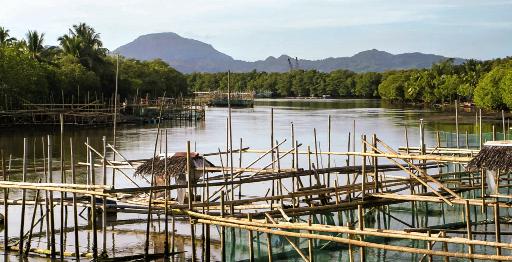
It was on the river that I first fell in love with Butuan. Not in a classroom, not in a museum, but in a dragon boat. I spent mornings with my teammates, paddles slicing through the wide, brown currents, muscles straining against the river’s
relentless flow. Every stroke was a conversation with the water: the same river that once carried balangays laden with gold, warriors, and merchants, connecting islands and empires. I could feel the city’s history in the rhythm of my breath and the surge of the current. In that water, the remnants of a lost kingdom that had ruled the river centuries before came alive to me.
I first encountered Butuan City as a Political Science student.
Words and images by Christian Sangoyo
vegetables, meats, bottled whatnots, the freshest seafood, and everything else in between.
I was there to learn about modern governance, elections, and administrative structures.
WALKING ALONG THE AGUSAN RIVER IN NORTHEASTERN MINDANAO, IT STRUCK ME THAT POWER ONCE FLOWED NOT FROM OFFICES OR LECTURE HALLS, BUT THROUGH WOOD AND GOLD, TIDES AND TIDES OF TRIBUTE.
The past pressed against the present in ways I could almost touch.
... CONTINUED ON PAGE 2
home—as nanay and tatay slid packets of crispy okoy and delectable kakanin on our table every Sunday as they arrived back from the market for a week’s worth of food to cook.
Letter from the Editorial Team Insights
» Like Butuan, Kingdoms Never Vanish
Culture & Heritage
» The Malabon Market Food Jaunt
Outdoors
» Starting The Year Right
Culture & Heritage
» Never Just Bitter: Notes from Guest Haven Coffee
Art & Lifestyle
Entertainment
» Crossword Puzzle
» Editorial Cartoon
» Poetry: At a bus ride to Cubao, I think about God
Culture & Heritage | Outdoors
Markets excite me. The vibrant atmosphere. The no-frills food stalls. The market goers in their come-as-you-are attire. But above all, I love the food being hawked alongside the chaotic menagerie of fresh
One particular market I really love to go to is our very own
Now all grown up, I literally dream of what I would eat at the market the

Malabon Central Market . I literally grew up eating most of what it offers—but not at the market itself, but at
night before a scheduled visit to Malabon’s bayan
... CONTINUED ON PAGE 3
» En Route to Sagada: Journal Notes from the 10th Cordillera Creative Writing Workshop 10 11 9 8 7 5 4 3 2 6
» This Arnis Hub in UP Diliman Keeps the Precolonial Sport Alive
» Under Restless Skies: Stormy Camping in Palauig, Zambales
Outdoors | Destinations
» Continuation: Under Restless Skies: Stormy Camping in Palauig, Zambales
» The Remote & Rugged Charm of Itbayat Island, Batanes
Destinations | Outdoors
» Continuation: The Remote & Rugged Charm of Itbayat Island, Batanes
» Keeping Time with the Mountains in Sagada’s Paytokan Trail
Art & Lifestyle | Destinations
» The True Portrait of the Filipino as an Artist
» A Slow Getaway to Biliran


Editorial Team
Resilient. That’s how most people, outsiders included, perceive Filipinos in general. We’ve assumed it to be the best part of ourselves for so long that it has become part of our socially conditioned DNA – and overtime, a liability more than it is a virtue.
In this issue, we propose something more than the status quo: steadfastness.
Within these pages you will find stories about the resolute spirit that defines the Philippines: from ancient kingdoms and a precolonial sport that persist despite modern distractions; to public market stalls and artisanal coffee shops thriving corporate giants; to art and spaces that foster genuine community; and to off-beaten paths that require courage to pursue.
While resilience calls for us to constantly adapt, steadfastness asks us to be firm and unshakeable. It is a necessary anchor as we move in a desensitizing, often grim world — the light we need to remain one archipelago.

Government buildings and classrooms rise atop streets once marked by hierarchy and ritual. Churches occupy ground where authority had been exercised through kinship, alliance, and maritime skill. Walking past the museum, I realized I was studying power not in theory but in material residue. Here, precolonial sovereignty collided with modern administration, and the collision was astonishing.
Even the names tell stories. The Agusan River, the streets, the barrios —everything carries memory. Structures of authority persist, not in domination, but as rhythm: labor along the river, commerce flowing from market to market, elders and historians still asserting what counts as legitimate memory.
The city’s claim as the site of the first Catholic Mass in the Philippines adds another layer. History has long placed it in Limasawa, Leyte but documents, oral memory, and river-borne artifacts insist that Butuan hosted the celebration first—particularly in Mazaua known today
Barangay Masao, Butuan . This past remains in disputes, museums, and in whispered conversations among local historians.
Butuan taught me that states do not disappear; some are simply renamed, misremembered, or quietly absorbed. The structures of power—the alliances, trade networks, and rituals— linger on. The past does not vanish; it simply transforms, hidden in plain sight.
Severino Profeta Reyes FOUNDING EDITOR
Allandale Antenero FOUNDING TRAVEL WRITER
Gretchen Filart MANAGING EDITOR
Maia Imperial EDITORIAL DESIGNER
Carmelo Perlas EDITORIAL CARTOONIST
CONTRIBUTING WRITERS
Alyssa Danielle Navarro (Poetry)
Benj Gabun Sumabat
Bernard Supetran
Christian Sangoyo
Christine Fernandez
Gelyka Ruth Dumaraos
Heather Ann Pulido
Marky Ramone Go
Kara Santos
Karlo Lagman Sevilla III
Ron Michael Lucas
Timothy Jay Ibay
CONTRIBUTING
PHOTOGRAPHERS
Ramir Cambiado
Rutherson Alanano Xian
*Some images from the UP
Baguio Cordillera Creative Writing Workshop
GOT QUESTIONS OR SUGGESTIONS?
Email us at: editorial@thearchipelagopress.com
Theopinionsandstatements expressedinthispublicationare thoseoftheauthorsanddonot necessarilyreflecttheviewsofthe editorsorTheArchipelagoPress.
Theinformationcontainedherein isforinformationalpurposes only.Whileeveryeffortismadeto ensureaccuracy,TheArchipelago Pressassumesnoliabilityorresponsibilityforanyerrors,omissions,oranyactionstakenbased ontheinformationprovided.
Nopartofthispublicationmay bereproduced,distributed,or transmittedinanyformorbyany meanswithoutthepriorwritten permissionofthepublisher.
©2026TheArchipelagoPress. Allrightsreserved.
I was meant to study politics in Butuan, but what I found was history in constant conversation with the present. The Agusan River, which once carried balangays and gold, carried me and my team across its breadth. It reminded me that kingdoms never disappear; they persist as memory, as rhythm, as a lesson — a vital reminder of our roots and our might as people.
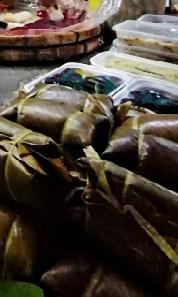
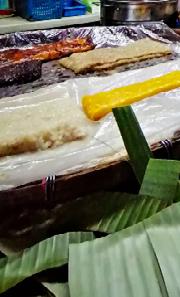
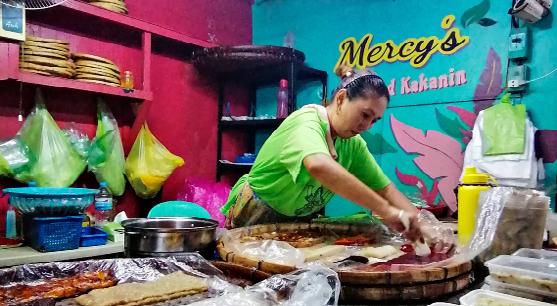
Jaunt wheel-like bilao filled with a variety of kakanin (rice cakes). Besides sapin-sapin , the bilao also has strips of mais kalamay, ube kalamay, kutsinta kalamay , kamoteng kahoy regular biko and bikong puti
Just across from Mercy’s is Amor’s Puto Special, which offers freshly cooked (that is, you can watch staff preparing it inside their stall) pizza-sized platters of puto made from rice and topped with grated cheese and sliced salted duck eggs.
Before heading back home, make sure to grab a bottle of atchara a handful of Chinese kikiam
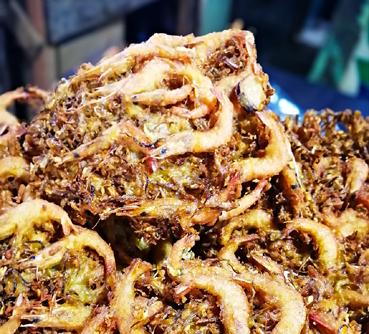
First on my list is crispy okoy —deep-fried fritters made from a batter of galapong and mung bean sprouts, topped with huge unpeeled shrimp. There’s a nameless one at the gate of the market, and there’s Yolly’s Okoy which is a few steps in. Both are offspring of the original stall that started selling okoy in Malabon during the ‘60s.
I usually grab one of these, then head over to the carinderias inside – Marie’s Lugawan my usual spot – to sit and pair it with. The choices would be either a bowl of pancit luglug lies in the noodles used— palabok while ones. The meat toppings also differ: pork the former and pork the latter. Both are
topped with an orange-colored sauce (made from fish sauce, shrimp stock, and achuete ), chopped green onions, sliced eggs, and labok or tinapa flakes.
If I’m particularly hungry, I’d add a helping of sumpia (fried vegetable lumpia) or lumpiang sariwa (fresh lumpia ) on the side. In Malabon, both are usually wrapped with the same flimsy wrapper, giving them a slightly salty flavor.
Dessert is just a hop away at Mercy’s Assorted Kakanin. This is our favorite stall for
contributions to the country: its Pancit Malabon.
This particular pancit is different from palabok and
or foiled rellenong bangus at the market. Or take home one of Malabon’s most important
luglug in that its sauce—which is already mixed in with the noodles—uses crab fat and
Malabon’s Public Market does not have a stall Dolores
Rizal
is only a minute or two away on foot. One of our go-to posts for special occasions, they serve Malabon in the city — the ultimate final stop before burping your way

A glimpse into how I kickstarted 2026 with the ride of the year.
I don’t know what it is with me and motorcycles, but no amount of meditation, mindfulness practice, or inner work can seem to eradicate my reflex to pin the throttle when another rider – usually a stranger – goes inordinately fast. My ego won’t allow it. I will show how superior I am at riding fast — or at least try to and fail with my heartbeat through the roof and my limbs palpitating from adrenaline.
technical corners, I glimpsed a smaller displacement bike in my mirrors, tailing me close enough for me to hear its exhaust.
I gave a friendly nod – and pinned it. I was in a good riding flow and thought I’d get rid of this little bike within three corners. I didn’t. For what seemed like half an hour, the capable fellow was happy being stuck to my rear wheel, surely capable of overtaking me, but delighted to pressure me instead.
I knew he was thinking how this big bike-riding fool had nothing on him. I was sure of it judging by the grin plastered on his half-face helmetwearing mug. Thankfully,
Fast corners, pristine tarmac, spectacular views – this best describes my new favorite road. It was my second time in the past three months riding this fun stretch that connects Baguio and the province of Benguet to Nueva Vizcaya. The first time was when we spent a lovely weekend at Slab Haus in Bokod, Benguet.
At the time, it had been years since I had ridden to the North. Back in 2021, I was still learning the art and science of cornering a motorcycle. With five years of invaluable riding experience since, I couldn’t help but carve these twisties, only taking a breather when I’d catch the Agno and Santa Cruz Rivers snaking through
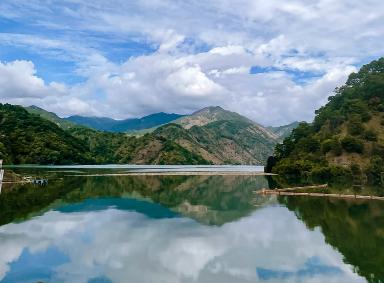
Suyo-Cervantes Road, Ilocos Sur
This was the best stretch of twisty roads since Sagada. Everything else had been wet, choppy, or both. As I was enjoying its endless
the amazing close-up views of the Cordillera mountains gave me an excuse to pull over to soak in the grandeur of the landscape. I was planning on dapping him up for riding well, but the d*ckhead rode away.
the stunning mountain range from the corner of my eye.
For this ride, we were making our way from Baguio, via Ambuklao Dam, to the terraced
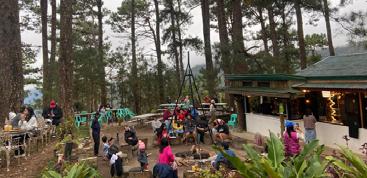
In the early 2000s, Sagada sounded to me like a destination reserved for the brazen, iron-butt traveler. Back then, I was told it took seven more hours from Baguio City, thanks to the long, narrow, and unpaved stretches of Halsema Highway, where navigating mud and landslides made traveling to Mountain Province grueling and arduous. Fast forward to 2026, and Sagada is a road trip I would recommend over the traffic-infested streets of Baguio every single time.
After allowing their burgers to decide where we would stay for the night, we left Misty Lodge and Cafe and geared up for Sagada Cellar Door to reward ourselves with a couple of pints of craft beer. A lovely
For dinner, we headed to one of the oldest and most iconic culinary institutions in town.
True to its name, Log Cabin pairs its genuine log structure with a large stone fireplace, heavy wooden tables, and dim, warm lighting. My buddy, Enzo, and I decided it was best to spend our time waiting for a table while working on a bottle of gin. As such, I no longer recall what I ordered. I only remember it to be good.
As we were chilling in San Juan, La Union before heading home, Enzo said the idea behind the ride was to go on what could otherwise be deemed the “ride of the year” at the start of the year, so that everything else would be a welcome bonus.

Notes on stubbornness and single-origin coffee from a conversation with a sustainable coffee shop owner
Words and images by Heather Ann Pulido
Supplemental images by Gretchen Filart
Stubbornness runs in my blood.
blockers to manage my anxiety, worsened by clashes with my late grandmother’s family. For a few months, I had been living on tea. But I just couldn’t give up my cup of joe.
There is a lot of stubbornness that dwells in this story. But this is also a story about coffee and care, as I chanced
liked. When I started earning enough to buy something other than instant cappuccino, I found most cafe blends too bitter or sugary. I reached a point when I wondered if I just wasn’t cut out for fancy drinks. I survived college on 3-in-1 coffee, after all.
“Coffee is not just bitter,” she told me. Quality coffee, according to her, has a distinct flavor profile that could include notes of strawberry or chocolate, depending on the beans and processing methods.
I got it from my mother who, against her doctor’s orders, would buy maja blanca from the ladies who peddled it in the palengke Got it from my grandmother, who refused to expand her outdoor kitchen because it meant cutting down the eggplant she grew from seeds. Got it from a father who ran from his mother, wife, and kids with only the clothes on his back.
It is no surprise then, that shortly after my cardiologist advised me early in 2023 to strike coffee from my diet, I sneakily sipped on an iced latte with a single shot of espresso. I had been prescribed beta
and the sought-after Baguio roastery, The Red Soil Coffee
What’s Brewing at Guest Haven?
Guest Haven’s roots are in the bed and breakfast business.
Two years after they opened their B&B, the duo decided to brew their own coffee exclusively for their guests — and they loved it! Seven years later, the couple would open their first cafe.
“Many of our suppliers have been our partners since 2012,” Ma’am Venus enthused.
advice and began taking two espresso shots with my latte. I haven’t gone back since.


This was also how they acquired new products: local coffee beans and marmalade.

Because of their longstanding community partnerships, they were able to secure quality beans and baked goods in 2021, when most new businesses were struggling to find their footing.


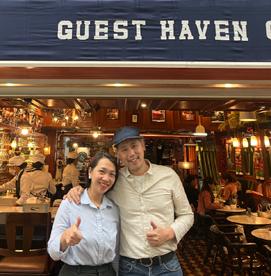
upon them three years ago in Guest Haven Coffee a specialty coffee shop with two locations along Session Road.
After three years of chitchatting at their cafe bar, I sat down with Venus Carling, one-half of the couple from Mountain Province who owns Guest Haven Coffee. She and her husband, Gino Carling, have been in the hospitality industry for 14 years.

I told Ma’am Venus - as I call her - that it took me a long time to find an espresso-based drink I genuinely
I could in fact almost smell the chocolate from their cafe latte, my go-to. The card it came with identified the beans as 100% Benguet arabica: 75% from Kibungan and 25% from La Trinidad. When mixed with milk, the beans are expected to bring out notes of “butter, tropical fruits, and milk chocolate.”
She explained that the farmto-cup model distinguishes specialty from commercial coffee. They source beans from neighboring suppliers who handpick organic coffee cherries from their modest farms. When regional yield runs low, the couple sometimes orders coffee from Davao and Bukidnon. They then partner with local coffee processors
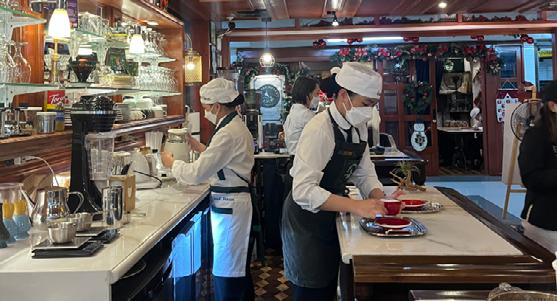
Initially, the Carlings had been scouting for an office for Sir Gino’s architectural practice. They found a vacant room on the top floor of the Patria de Baguio building, near the Baguio Cathedral. Inspired by the room’s Juliet balcony, Architect Carling opted to design a charming coffee shop instead. He revamped the old office interiors to match the building’s Europeanstyle facade.
This elevated design, coupled with their monogrammed cutlery pouches and stylish uniforms, is replicated in their Vaga branch. They serve their drinks in fancy glass goblets instead of plastic cups — a decision that also supports their larger sustainability efforts.
Through the strength and lightness of Guest Haven’s brew, I have traced my own connections to coffee and met comfort. I taste notes of honey in memories of my Mama selling coffee to vendors shivering in the wee hours. I catch the unmistakable aroma of my Lola’s kapeng barako, heated over her dalikan (Kankanaey for “stove” or “fireplace”) and shared with neighbors who gather at dawn to swap stories and warm up.
I’m happy to report that I am now equipped to sense and seek many more notes in my life than “burnt” and “stale.” Thank heavens for my stubbornness.

For Ma’am Venus, coffee is life itself. That is gospel here in the Cordillera highlands, where a cup of hot coffee shields against the biting cold.
Last year, I finally took her


“Travel, I realized, sometimes clarifies the kind of community we are still searching for—and the kind we are capable of building.”
It was around three o’clock when I finally secured a seat on a Baguio-bound bus from Cubao. I decided to sleep through the rainy six-hour trip. The route was point-to-point; there was no possibility of getting lost. When I woke up, it was already a quarter before 10 in the evening, and the bus had arrived in Baguio City.
From the terminal, I took a taxi to our temporary lodging at the UP Baguio dormitory.
“ Manong, idjay man University of the Philippines— UP,” I said, carefully putting my Ilokano to use and emphasizing the full name. A friend had warned me that taxi drivers often mishear UP as UB or UC, both of which are also located along University Drive. With my unaccustomed lungs struggling against Baguio’s hills and my two large traveling bags, even a short walk would have been too much.
After checking into our lodging, I lay down and ordered dinner. One thing about Baguio is that despite being a city, it grows quiet when the fog settles in—which is to say, almost every day. Baguio City is a city in lowercase— which is to say, it is a city but with seemingly calmer air.
As I was lying on the bed, someone knocked. I assumed it was the food delivery, but to my surprise, it was Sir Rai Salvador, the director of the 10th Cordillera Creative Writing Workshop and the reason for this trip. It was our first meeting. He immediately apologized for what he called the “old” room, which struck me as unnecessary. The room was more than decent, especially considering our early call time the next day for the drive to Sagada, where the
he left, my food arrived. I ate alone at a small table outside the room. Baguio, with all its colonial history and gentrified present, still belongs—at least in feeling—to its people. I come home to Baguio more often now than I do to Cagayan or Ifugao, partly because it is closer to Quezon City, where I currently live, and partly because my kuya once lived and married here before leaving to work overseas. Baguio satisfies a particular geographical melancholia in me: a longing for places where my idea of “home” remains unfinished. Negotiated, but still reachable.
Unlike other writers who insist on constantly writing through travel, I have never developed that kind of free-spirited attentiveness. When I travel, I am either thinking too much— about the past or the future— or I am completely asleep. My mental and physical energy are limited, and new places often disrupt my ability to rest. My therapist once suggested that my body registers unfamiliar
Considering my psychiatric history, this explanation makes sense.
The next morning, we gathered at UP Baguio. It was my first time meeting some writer friends beyond Facebook profiles and literary celebrations. It was also far too early for me. Without coffee, my brain and social instincts refuse to function before 10 in the morning. We were all quiet, shy, like children on the first day of school, instinctively carving out small, temporary territories for ourselves until we were called into the van.
Sagada welcomed us with cold air and a careful slowness. After settling our bags in the cottages, we went to Dogo Siwang Arts Hub where the opening program of the Cordillera Creative Writing Workshop (CCWW) was held. We were greeted by one of the resident artists, Ma’am Gwen Gaongen. The workshop was born in Sagada, and as the organizers explained, bringing
been centered in Manila. It created a space where writing from the regions could develop on its own terms—rooted in land, memory, language, and community rather than institutional prestige. What makes the workshop distinct is that it is organized largely by its own alumni. Generation after generation, writers return not as authorities but as caretakers, holding each other’s work with intimacy and accountability. It is a workshop sustained less by hierarchy and more by kinship.
That evening, we had dinner at Gaia Café , a place made famous by the film That Thing Called Tadhana . Over pinikpikan and cups of strong barako coffee, I learned that the owner of Gaia was a fellow in the very first CCWW, which was held in Sagada. Watching the conversations unfold felt like witnessing a reunion of people who once shared (and are still sharing) a youthful devotion to art and literature— now older, grounded—but still tethered to the same, if not better,
Philippines,” now struggles with overpopulation, water shortages, and the displacement of its own residents. Tourism, when driven solely by capital, commodifies culture and turns communities into attractions.
In Sagada, there are attempts to resist this: regulated tourism, community-based homestays, and town hall gatherings modeled after the dap-ay , where collective decisions are made. Still, the threat remains. We passed a massive hotel under construction—an eyesore, for me, and a reminder of how easily “development” can erode the very things it claims to celebrate.
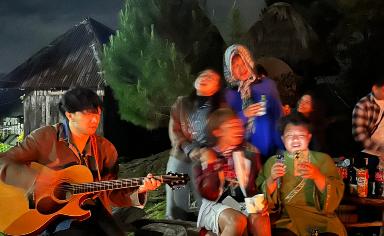
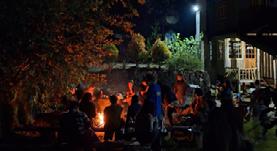
After four days of intensive writing, critique, and conversation, the workshop ended with a poetry night by a bonfire, warmed by gin and shared laughter. Tears were shed and wishes were whispered into the fog. What stayed with me was not just Sagada’s capacity to inspire creativity, but its model of community. It offered me a space to negotiate my ambitions and my disillusionments—as a writer, as a person, as an emerging poet from the regions now based in the dense and saturated terrain of Metro Manila. The community extended beyond Sagada itself. It existed in us—10 writing fellows, who journeyed there together and shared drafts, silences, jokes, and vulnerabilities. There is a particular sense of belonging that comes from building a community around a shared language—whether that language is literature, inside jokes, or one’s mother tongue.
When I returned to Manila, it took months before I could write about Sagada. I resurrected my journal, piecing together fragments written during breaks. These fragments helped me remember how the people I met and the histories I encountered, seemingly rearranged something in me.


At a bus ride to Cubao, I think about God

By Alyssa Danielle Navarro
I think about who the God I pray to used to be
an endless string of rosary beads, clutched so tight trips to Marilao to witness the Divine Mercy showered upon sinners like me then it turned into a kind of discipleship my entire body dipped in the holy water of a swimming pool somewhere in Makati
I used to be so certain that God lay there among the throng of believers but now, I’m not so sure
there is no real clarity (at least, not yet) but the desperation creeps back in my faith, the last thread of sanity and I hear myself pleading to a nameless God they are everywhere the void, the shining sun the things that keep me alive like the carabaos kneeling in submission every summer
I weep on my knees oh, nameless God hear my cries engulf me in darkness accept my offering
4. A type of pancit in Malabon that uses pancit luglug uses thicker noodles 7. The capital of Biliran
8. A Kankana-ey custom of lighting sa-eng to remember the dead 9. The Philippines’ national martial art and sport
1.A sudden burst of strong wind with heavy rain common in the afternoon
Ivatan boat that ferries passengers to Itbayat 3. A husband-and-wife-owned single-origin, sustainable coffee shop in Baguio
Southern Luzon province where Alitaptap Artists Community rests
Alyssa Danielle Navarro is a writer and researcher from Pulilan, Bulacan. Shebelievesthatpoetry,likebread,isforeveryone.


The Archipelago Press 02072026
We accept previously unpublished poems on place, migration/ movement, memory, and Filipino culture in English, Filipino, and other Philippine languages and dialects from Filipinos across the world. For non-English poems, please provide an English translation. Indicate your preferred byline (a pseudonym is fine).
Please submit just one (1) poem as a Word document or pasted in the body of your email to editorial@thearchipelagopress.com, with the email subject: Poetry: Your Name – Poem Title
Accepted poems will be paid 500 Php and featured in our weekly issue and our website.
If you don’t hear back from us within 30 days of submission, please give us a nudge.
A history of arnis and how this precolonial Philippine national martial art finds a home in UP Diliman
Words and images by Karlo
Lagman Sevilla III
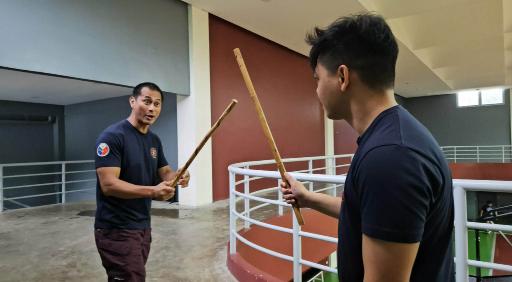
Nearing the Ylanan Gym I hear the first staccato wave of clacks emanate from the area inside where lecturer Nathan Dominguez teaches the national martial art in PE class. The Ylanan Gym, where arnis is taught, and the Martial Arts Room inside the University of the Philippines - Diliman (UPD) DMST Complex, where the Tellu Bituun Bagani club trains, are located at the northernmost part of the verdant UPD campus, at the intersection of Commonwealth Avenue and Ylanan Street in Quezon City.
I turn nostalgic as moments from three decades past invade my mind’s eye; when my ears were regaled by the rhythmic percussion and my eyes were fixated on the dizzying hand speed with which arnisadors wielded their wooden sticks, one crashing against the other in offense, defense, and in between.
It’s the Vanguard Building martial arts room again, one Saturday afternoon in the dwindling last quarter of 1998.
The Lema Scientific Kali Arnis System (LESKAS) Club, based in the Diliman campus of the country’s leading university, generously lent the space to our wrestling sessions, which ran from 4:00
PM to 6:00 PM. After our class on the rubber mat, arnisadors took center stage to commence their deadly Cariñosa, wooden sticks firmly in their hands, as daylight loosened its grip and dusk began to cloak the campus.
Arnis traces its roots way back to Philippine precolonial history when the natives of our archipelago trained and fought in weapon-based fighting using
Ideas abound on the exact origin of arnis given the scarcity of historical documents to back up any particular narrative. Many suggest that it is originally a foreign art, imported from beyond the country. In his article, Arnis: A Question of Origins (Rapid Journal, 1997), anthropology professor and arnis scholar and instructor Felipe P. Jocano Jr. disputes this:
“To state, therefore, that its origins lie outside the Philippines is misleading, for
our identity as Filipinos.”
Currently, arnis is considered the Philippines’ National Martial Art and Sport by virtue of Republic Act No. 9850 of 2009 It also mandates that it be taught in schools nationwide and played as a regular sport of the annual Palarong Pambansa
That arnis is formally taught, studied, and practiced in UPD further ensures the survival and promotion of the country’s indigenous martial art and sport. And, I dare say
sticks, swords, and knives. The use of rattan sticks among arnis practitioners eventually became popular when the three-century Spanish colonial era prohibited the Filipinos from carrying swords. Our ancestors were also compelled to camouflage the practice of the art under the guise of the performing arts: folk dancing and theater art.
it disregards the unrecorded but no less real experiences our forefathers went through in simply trying their best to survive. What is also important is that we remain open-minded, willing to improve our understanding of the origins of this martial art. Such open-mindedness is useful inasmuch as it provides us with further insights into
that one welcome advantage of this martial art compared to others is its inclusivity.
Looking at the jovial faces of the trainees, one couldn’t help but notice the diversity: they come and strike in different sizes, of builds widely considered as athletic and otherwise. Their differences in demeanor are also perceptible,
with some unmistakably on the extroverted side, while others are more reserved. Regardless of differences, they are all one in making music with their sticks and true Filipino martial artists in their own right.
One morning, nearly a decade ago, I challenged my fifthgrade son, Mikael Fedor, to test the arnis skills he learned in PE class. With his dark brown kamagong stick in hand, I’ll try to subdue him with my bare hands. By then, I had been practicing and teaching grappling for almost two decades, but mainly as a sport and so much less as a form of self-defense outside the mat.
Unlike some of my friends who belong to the Filipino Martial Arts (FMA) community, I was neither into self-defense against weapons nor disarming.
But I had to satisfy my curiosity and ego and placed my faith in the following plan: feign a kick, and when that distracts him, grab him before he gets the chance to strike. Mikael accepted the challenge. We stood face-to-face two meters apart. I raised my right foot and extended my leg towards him at a 45-degree angle, and the next instance I was on the bedroom floor writhing in pain. I grimaced and groaned in a fetal position with both hands cupped on my shin. I ended up on the wrong end of somebody else’s highlight, along with the abrupt realization of why weapons are weapons— and arnis sticks are no less.
On what spending two days in a camping tent with gusty winds and rain can teach you about storms and life
Words by
Gelyka Ruth Dumaraos
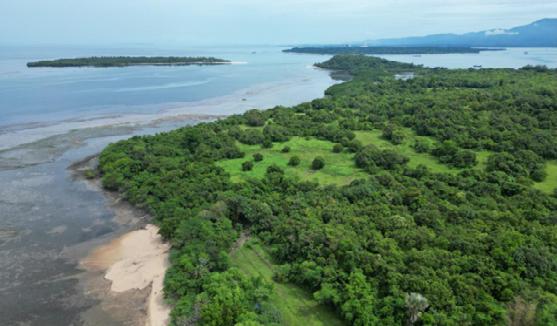
Images by Ram Cambiado Deep into the remote shores of the small coastal town of Palauig you’ll find Camp Sitio Tangal , an expansive ground where camping still feels truly like camping. Here, it’s quiet, open, and unpolished. There are no flashy banners, no grand entrances, just welcoming staff and a place that blends in with nature instead of trying to stand out.
Camping should be uncomplicated, easy, and simple. You pitch a tent, share a meal, and let time pass by. But what happens when a storm becomes part of the stay?
In Zambales, where the land sits between sea and a mountain range, campers come for the space and quiet, but sometimes, learn to welcome even the most unexpected turns in the weather.
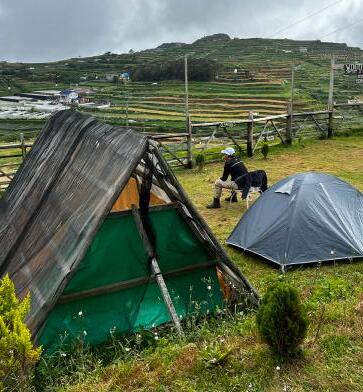
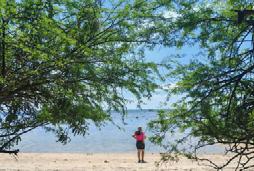
The camping ground is set on a four-hectare farm facing the West Philippine Sea. Campers are adequately spaced out across a long stretch of beach shaded with trees. You won’t feel that it is crowded even on
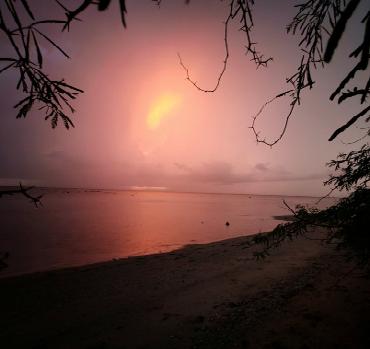
But amid the calm, there’s also some anxiety about whether your tent can survive the ordeal.
In a brief chat with camp manager Neil Gamboa, he talked about the tribunada —a sudden burst of strong wind accompanied by heavy rain, commonly in the afternoons and during the wet season. It lasts anywhere from 30 minutes to an hour. For first-time campers, it can feel dramatic; scary even.
We experienced the tribunada two days in a row during our stay. The first one was just an hour after we arrived. Luckily, we were able to set up camp and have everything in place. After a couple of lightning strikes at a far distance and some silent prayers after, the skies cleared, and it was peaceful once again.
It was more intense on our second day. The sun was strikingly hot at 4:00 PM, and we were relaxing by the beach, each with coffee in hand when the clouds suddenly went dark. Downpour hit – loud, fast, and unsettling. Prior to our visit, we watched videos and posts about the tribunada before our visit. But you realize it’s a different story when you’re out there. We secured our gadgets inside the tent and strengthened our ropes, hoping our pegs would not pull out from the ground.
For locals though, it’s just another day. Neil walked in the rain like it’s routine and came to our camping area for a casual check-in, calmly assuring us that this tribunada will stop soon,
moving to camper after camper with the same reassuring smile.
True to his word, the tribunada arrives loudly, sometimes with thunder and lightning, always with heavy rain and strong winds. It comes briefly, then leaves. The beach returns to its stillness, and everybody comes out of their tents or homes as if nothing ever happened. It becomes just another topic in conversations over a bonfire.
Outside of these brief moments of turbulence, Camp Sitio Tangal is all about ease and escape. Fellow campers flock there for same reason: to slow down by the sea and enjoy the quiet. Here lies an unspoken understanding: respect the land, and it will reward you with an unforgettable experience.
When the tents come down, I love that Zambales doesn’t rush you out. Nearby, Bagsit River offers a cool freshwater dip. If you have more time, you can hop on a boat and head on a day trip to Magalawa Island . Farther north, Coto Mines in Masinloc offer more rugged camping options.
For those driving back to Manila, there are quieter pockets in Botolan or at the weekenders’ favorite surfing spot, Liwliwa in San Felipe Cruising through the long highway in Zambales, you’ll realize Zambales has the best of both worlds. Coastal towns roll in once more as the mountains fade into the distance.
We stopped at Kopi Kubo

Collective stall in Cabangan one of the local coffee spots along Zambales and into Pangasinan. They offer black coffee by the side of the road – an ideal ending to a stormy camping trip.
Experiencing the tribunada for two consecutive days adds another perspective. What initially feels scary becomes almost impressive. Nature flexes its full might to ground you. The roaring wind tells you to hush, sit back, and
simply listen. To focus on things you can control in your little tent, like heating up your stove for a simple soup. Under restless skies, you come to understand: you must learn to sit through it because like any storm in life, it will pass.
a weekend, and you still enjoy some privacy if you’re a couple or on a solo camp trip. Birdsong can be heard with lapping waves and the soughing of trees.
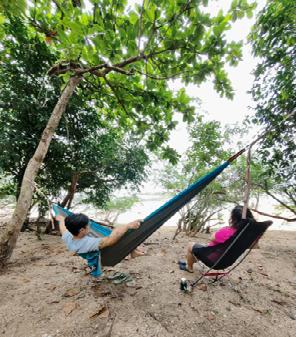
During low tide, the shoreline stretches farther than expected. Boats dot the horizon. With rock beds surfacing from midday to late afternoon, some would wander farther out, scanning the shallow waters for small fish or shells. Amid laidback days that call for a nap on a hammock, a fish on the griller, and time stretching endlessly, campers experience a different kind of reset here.
On history, humility, and how small we are against wind-carved cliffs and topsy-turvy seas
Words and images by Marky Ramone Go
On the journey back to Batan Island, I found myself fighting off nausea aboard a small faluwa , the Ivatan boat built for the rough, unpredictable currents between the islands. With its open deck and deep hull, it rose and plunged over the heaving Philippine Sea. I gripped the rails, steadying my balance, silently praying that my stomach doesn’t turn against me. To distract
myself, I replayed the past three days in my mind.
Itbayat came in flashes, like scenes from a film. Rolling hills rising toward jagged limestone cliffs. Vast grasslands where cows and goats wandered as if they owned the island. I had heard stories from friends and thought I knew what to expect. I didn’t. The island felt bigger, wilder, more cinematic than I had imagined.
Even arrival was a test.
Disembarking from the faluwa meant timing your steps with the waves. “You’re lucky the sea wasn’t that high today,” a local told us in Tagalog. Four in our group were already seasick.
On an island without a modern port engineered to withstand such a rocky shoreline, locals have come to accept the treacherous ritual of embarking and disembarking as part of everyday life.
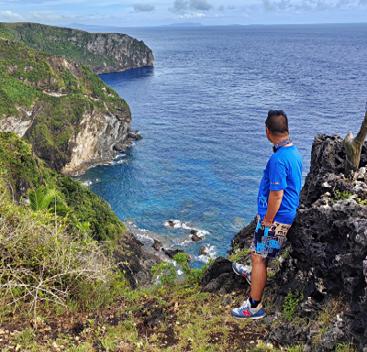
Once inland and away from the swells, we laced up our hiking shoes. The countryside revealed itself in steady climbs. Rapang Cliff felt like stepping into another realm, its flat, sea-facing ridges reminding me of The Wall in Game of Thrones The five-kilometer hike stretched longer than expected, not because of difficulty but because of the postcard-like scenery. We kept stopping to catch
our breath, take photos, and enjoy moments with nature.
At Mauyen Cliff , beauty came with a warning: the dropoffs commanded respect. We reminded one another not to inch too close – else, it’s Sayonara world’. Even from a safe distance, the 360-degree panorama of sea and sky delivered that mix of awe and adrenaline. It was a cinematic mic drop to end our first day.
Cavaywan Lake offered a different mood. Its still waters projected calm, but the surrounding reddish soil told another story. Our
among the country’s earliest human settlements.
Nearby stands the Axurud a boat-shaped stone tomb pointed toward the sea. It is thought to hold the remains of an Austronesian-speaking family who lived here between 2,000 and 4,000 years ago.
The direction in which it was pointed is deliberate. For early settlers, the sea was both highway and horizon. In death, the spirit was believed to return to the ocean, completing its journey. Archaeological findings trace these settlers to Formosa, modern-day Taiwan,
shaped languages and cultures across the Philippines and the Pacific.
Standing there, I found myself revisiting the old question of who came first: The Negritos believed to have crossed ancient land bridges from Borneo? Or the boat people from Formosa? The debate continues.
With only around 13,000 tourist arrivals in Batanes in 2024 and less than 10 percent reaching Itbayat, the island remains one of the country’s least visited destinations.
Most travelers stay in Batan and Sabtang . Few brave the
That may slowly change.
As Itbayat gains attention and discussions of improved infrastructure surface, the Tourism Promotions Board of the Philippines (TPB) emphasizes a community-first approach. The aim is lowimpact, “leave no trace” travel that protects fragile ecosystems, preserves Ivatan culture, and ensures locals benefit directly.
After more than a decade of imagining that faluwa ride, I finally crossed to the island I once skipped on my first Batanes trip. Now I understand the hesitation and the reward. Itbayat is home to stunning hills
turn into spontaneous exchanges of greetings. Strangers talk to you as if they’ve been expecting you. Guides double as storytellers, equal parts historian and comedian. The scenery feels like it was carefully composed by the greatest filmmakers: with Terrence Malick’s moody reflections, a hint of Wes Anderson, yet the sweeping drama of Braveheart.
As our faluwa neared Batan and my motion sickness slowly eased, I realized something. Itbayat didn’t just give me landscapes. It gave me perspective on history, on humility, on how small we are against wind-carved cliffs and topsy-turvy seas.
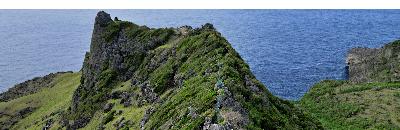
Every step through Sagada’s sacred mountainous landscape is a lesson in the art of slow travel.
Words and images by Kara Santos
In a span of three hours, I found myself trekking with a view of lush mountains, gazing up at century-old coffins perched on cliffs, and wading through rocky streams of an underground river. I was on a solo trip in Sagada, a town in the Mountain Province in the Cordillera Region. Every second felt precious.
To make the most of my limited time, I decided to trek the Paytokan Trail right after I had woken up at the crack of dawn in hopes of witnessing a sea of clouds blanketing the landscape from Marlboro Hills
Despite not being a morning person back home, the mountain town seemed to come with a built-in alarm clock that jolted me awake. In Sagada, adventures are ripe for the picking even before the sun rises. I wanted to seize every minute to taste everything it had to offer.
The Paytokan Trail is a two to three-hour long guided hike that passes through several traditional and religious areas in town. Guides are required to ensure that visitors remain respectful of local traditions and leave the natural sites as they found them.
The trail starts at the Church of St. Mary the Virgin an Episcopal church adorned with stained-glass windows. Built in 1904, it’s said to be the oldest church in the region, with locals continuing to restore and preserve its original structure. A cluster of rocks serves as the altar’s base, adding to the church’s earthly aura.
From the church, my guide and I walked toward Echo Valley a sightseeing spot overlooking limestone cliffs and lush pine forests. Historically, locals used to shout in the valley to announce the arrival of a new, deceased member of the community, their voices resonating below.
Hikers, however, are advised to minimize noise and avoid shouting. Shrieking in laughter or yelling out profanities about work or heartbreak, as
some unruly tourists often do, is considered disrespectful.
Nearby is the Sagada Town Cemetery It can be quiet on an ordinary day, but I recall witnessing a vivid local ritual here during a previous visit more than a decade ago. Every year on November 1, locals observe Panag-apoy , which translates to “lighting a fire.”
Rooted in the Kankana-ey customs of remembering the dead, the tradition involves using sa-eng or pinewood to light bonfires on graves in honor of the departed. The fires are meant to symbolize warmth, light, and guidance for souls.
Minutes later, we arrive at the Hanging Coffins of Sagada , the most accessible spot that shows the Igorot culture’s ancient rituals and burial traditions. Wooden coffins dangle from cliffs and caves, each suspended to the sides of the limestone cliff in Echo Valley. My guide explained that the people of the Cordilleras believe that the higher the dead are placed, the greater the chance of their spirits reaching a higher state in the afterlife. While most burial spots are hidden in the mountains, this particular spot can be appreciated from afar along the trail.
Walking down to the bottom of Echo Valley takes us to Baw-eng Coffee Farm
where visitors normally learn more about the various coffee beans that grow in the area.
Having visited on a weekday during the low season, the coffee shop was closed, as most locals tend to other tasks if they’re not expecting tourists.
I find it amazing that a farmto-cup cafe can be found seemingly in the middle of nowhere. It’s a worthy stop midway for a coffee break.
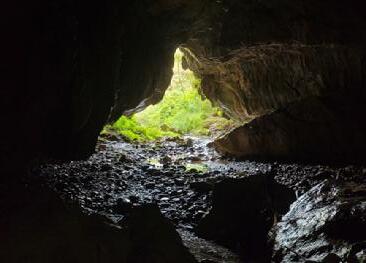
We continued our trek to the Sagada Underground River which involves wading through shallow ankle-deep waters and climbing up boulders through Latang Cave With nothing to see in the icy cold darkness, I stash my phone away safely and focus my attention on stepping carefully over the rocky terrain and try not to slip into the water. Minutes trickle by in the dark before we reach the other
end of the cavern. From there, we trek through a narrow, muddy footpath that eventually leads to a tiny waterfall.
Bokong Falls offers a refreshing spot for tourists to take a dip – if they want to brave the cold, that is. The waterfalls may be small at just 20 feet high, but they contain a deep natural pool for cooling down. I was content to spend some time here in silence, splashing my face and dipping my feet in the pool. I felt exhausted, yet somehow invigorated. I often find myself killing time in the noisy, traffic-choked and fast-paced city where I live. Yet I count the days when I can pause and soak in the stillness of the mountains and nature once again, like my time in Sagada, where every moment is well-spent.
are inspired by exploits of its homegrown maestro, National Artist Lucio San Pedro.
Feel the creative heart and soul of the Philippines in these art destinations.

There is an old local saying goes that when God sowed all the creative talents to humanity, Filipinos seem to have caught them all. While apparently said in jest, such an anecdote couldn’t be closer to the truth. Pinoys excel in every artistic realm: from music and dance, to visual arts, to theater and performing arts, to literature — both here and abroad.
As we celebrate National Arts Month this February, there is no better time to put the spotlight on such artistry. Officially established in 1991 by virtue of Presidential Proclamation No. 683,
the month-long observance honors our innate creativity and cultural heritage all over the archipelago. Led by the National Commission for Culture and the Arts (NCCA), with the support of provincial, city, and municipal governments, this year’s celebration is themed, “Ani ng Sining: Katotohanan at Giting,” emphasizing art as a reflection of truth, courage, and community.
Beyond government-sanctioned activities, art is a way of life for many people in the countryside who consider their craft an extension of their being and a reflection of the local soul, as much it is as a means of livelihood.
In reference to the late National Artist Nick Joaquin’s famed novel, let me take you to some of the must-visit communities which live and breathe art 24/7; those that stand as the true portrait of the Filipino as an artist
In a world that often encourages constant movement and packed itineraries, Biliran reminds one of the joys of slow travel.
Words and images by Bernard L. Supetran Words and images by Christine Fernandez
I didn’t know much about Biliran, an island province in Eastern Visayas – and that felt like reason enough to go. What little I found online highlighted the usual attractions - island hopping to Sambawan or Maripipi, and visits to the province’s many waterfalls. But I was just as curious about the everyday stuff: what the people were like, what the downtown area looked like, and how it felt to walk around its streets like a local.
The trip took about five hours: a flight from Manila to Tacloban City, followed by a van and a tricycle to reach Naval, the provincial capital. Every leg of the journey was straightforward, with transportation readily available along the way.
Downtown Naval was modest and familiar, with fast-food chains, a department store, and a busy public market all within walking distance. It felt like any small provincial town, only
blessed with a majestic view of the Tres Marias Mountain Range – a constant backdrop.
Wanting to get a feel for what it was like to be a local, even if only for a short while, I first stopped for a quick lunch at Cusina de Salas a modest eatery recommended by a friend who had discovered it during a visit in 2017. With delicious, quality food, it was no surprise it remains a local favorite to this day. After lunch, I headed to the public market to buy fruits and local delicacies.
In need of caffeine a little past noon, I headed to one of the air-conditioned cafes in town. Two cups of coffee later, with a bagful of mangosteen, lanzones and oranges slung over my shoulder, I made my way toward my accommodation for the night, Agta Beach Resort, another 30 minutes away. From Naval, I flagged down a tricycle, whose kind driver refused to overcharge me, making the ride easy and comfortable.
Even before we fully set off, I felt a wave of dizziness creep in, likely due to lack of sleep,
Dubbed the country’s “Art Capital”, it is a haven of painters, brass band musicians, sculptors, literary and performing artists, and other contemporary art makers.
Feast your eyes on the myriad paintings at the Blanco Family Art Museum Nemiranda Arthouse, Balagtas Gallery, Art Camp Tambayan, and Balaw Balaw Restaurant’s Ang Nuno Gallery – home of the iconic Higantesgiant papier-mâché figures - associated with the town.
Another urban artscape you shouldn’t miss is the Doña Aurora Street relief mural, where the residence of National Artist Carlos “Botong” Francisco stands.
At the foothills of the Sierra Madre lies AngonoBinangonan Petroglyphs, the 2,000-year old prehistoric rock art cave maintained by the National Museum which attests to the locals’ millennia-old artistic DNA.
On top of countless visual artists, the town is also brimming with brass band musicians who
Angono in the province of Rizal is home to thousands of artists because of its aweinspiring scenery of the Sierra Madre Mountain Range and the Laguna de Bay.
heat, and too much caffeine. As we left downtown and traveled along the highway, the view shifted. Tres Marias came into full sight, their green slopes stretching against the clear skies. I felt instantly recharged. The cool January air felt wonderful as it brushed against my skin.
When I finally arrived at the resort, I was welcomed with warm smiles, as if I were a frequent guest. I unpacked without hurry, then sat at the desk peeling fruit, the juice oozing from my fingers. These fruits felt like the perfect snack: no sugar crash, just wholesome nourishment. Alone in that room, with the sound of the sea nearby, I felt truly settled and relieved that the videoke a nearby resort didn’t reach my room.
After resting, I headed to Mondelos Nature Park a thirty-minute ride away in the municipality of Kawayan I found this spot the oldfashioned way: by browsing
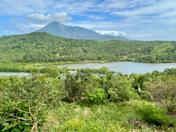
And if you drive around the nearby lakeshore towns of Binangonan, Cardona, Baras, Morong, Antipolo, and Tanay, you will discover that the town’s artistic spirit is contagious.
Known for its cool climate and restaurant rows, upland Cavite is also making itself known as an art getaway with its creative galleries and museums tucked within its interior roads.
Disconnect from the outside world at Shambala Silang Living Museum, an art enclave named after a mythical Tibetan village. It houses a yoga and labyrinth walk garden, organic farm, slow food resto, indigenous art gallery, antique shop, and an Ifugao Rice Terraces-themed resort.
Alitaptap Artists Community is a sprawling private sanctuary and garden resto in Amadeo featuring resident visual and musical artists who offer an immersive experience to visitors.
Baguio City
Last but not the least: Baguio City. Named as the UNESCO Creative City of Crafts and
Google Maps and following curiosity rather than trends.
Perched at a higher elevation, the park offered sweeping views of both coast and mountains, including Mount Panamao and Subing-Subing Hill
There were plenty of quiet corners, and more than once, I realized I had unintentionally wandered into the private moments of dating couples. They were in their own little world, unbothered by a stranger happily wandering around and admiring the flowers.
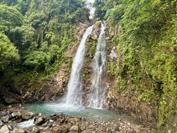
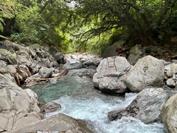
Biliran is known for its waterfalls, and I didn’t want to leave without seeing at least one. I asked a motorbike driver to take me to the nearest falls. From the park, we rode into the mountains along steep, winding roads in Almeria, which turned the journey into an unexpected core workout. I had to readjust constantly just to stay balanced. Thankfully, the driver brought
Folk Art the Summer Capital is known for its creative industries such as traditional Cordilleran weaving, woodcarving, tattooing, and silverwork –all of which have cultivated a strong grassroots following.
The city positions itself as a mountain haven for creative identity through initiatives such as the Creative Baguio City Council, the Ibagiw Creative Festival, and various communityfounded creative hubs.
Must-sees are BenCab Museum by renowned painter Ben Cabrera, Ili-likha Artists Village by National Artist Kidlat Tahimik, the Tamawan Village, and not to mention scores of other quaint and art spaces scattered in the nooks and crannies of the city.
With the sought-after Panagbenga Festival taking place this February, guests can look forward to admiring art pieces and antique collections, watching performance arts, or interacting with local artists in between the colorful parade of flowers.
Beyond the formalities of the National Arts Month, Filipinos everywhere will continue to breathe and live their creative pursuits as an expression of the indomitable Filipino soul.
along his female friend, who sat between us, making the ride feel more comfortable, especially during the downhill stretches when being pressed together thigh-to-thigh was inevitable.
When we arrived, it was a brief five-minute walk down a concrete staircase, with dense greenery closing in on both sides. The sound of rushing water from Ulan-Ulan Falls grew louder with each step. Standing there, surrounded by nature, a familiar feeling settled over me. I live for these moments!
I didn’t do much the next day. I had a simple breakfast of fish, rice, and eggs while watching the sea, savoring its stillness.
My weekend in Biliran was short but soul-nurturing. It left me with a calm that lingered even after I returned home. In a world that often encourages constant movement and packed itineraries, Biliran reminded me of the joy of traveling at my own pace — and that, perhaps, I was getting too old for motorbike rides.





The Archipelago Press
Address: 630 1st Avenue, PMB, 318, San Diego California, USA 92101
Phone number: +6195191063
Email: info@thearchipelagopress.com
Website: www.thearchipelagopress.com
Social media: www.facebook.com/thearchipelagopress https://www.instagram.com/thearchipelagopress https://www.tiktok.com/@thearchipelagopress https://x.com/TheArchipelagoP https://www.youtube.com/thearchipelagopress