
Transportive stories by island-born hands, across shores

Transportive stories by island-born hands, across shores
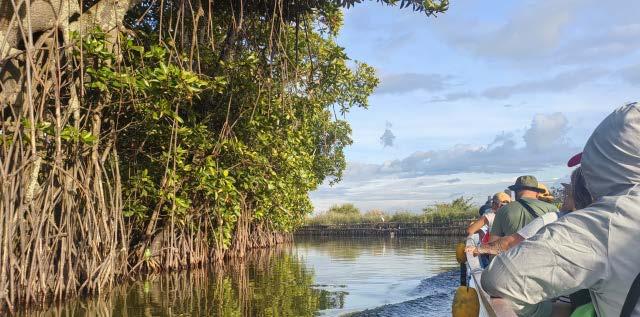
As climate change accelerates coastal flooding, a vast land reclamation project backed by a corporate giant is reshaping the shoreline and may be hastening the ground’s descent.
Words and images by Marky
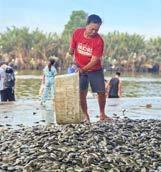
A small cat padded cautiously across the wet concrete, a tilapia nearly half its size dangling from its mouth. Behind it, heaps of fish lay scattered across the wet
floor of a low-roofed shed that serves as the Panasahan Fish Port in Malolos, Bulacan
At the edge of the Kalero River , one of the narrow waterways that thread through Bulacan before emptying into Manila Bay, a motorized boat eased into dock. Its catch was hoisted into a metal container by three fishermen and slid across the floor toward the shed. Moments later, another boat arrived, this one carrying not fish but passengers: a reminder
that in this part of the province, water remains a vital thoroughfare as much as a source of livelihood.
“They probably came from Pamarawan,” said Jing Ordona, our guide and the lead organizer of the coastal tour. His ManiLakad curated tours focus on history, local culture, and community life. Pamarawan, he added, was our next stop.
(Part 4 of The Mundane Series)
The Psychology of Travel Souvenirs
Words and images by Ron Cruz
Souvenirs act as “tangible anchors” of a travel experience— at least if you ask Littrell et al. (1993). They’re the physical evidence that you were, in fact, somewhere else and not merely trapped in yet another existential rot inside a cubicle in BGC.
Here you are, after paying thousands of pesos for flights, hotels, and insurance. And sure,
you promised yourself this trip would be spontaneous. “By the seat of your pants,” you said, like a disheveled indie-film protagonist

surrendering to fate and not the version of yourself hunched over your phone calculating roaming charges. Yet, anticlimactically, the moment you land in a new city—eyes still adjusting from cabin lights, pores recalibrating to unfamiliar humidity—you find yourself marching straight into the least spontaneous place imaginable: that halogen-scorched boutique nook of a souvenir shop. Touching keychains shaped like miniature Tokyo Tower and contemplating buying a mug the moment the green siren beckons you from the corner.
10 11 9 8 7 5 4 3 2 6
Letter from the Editorial Team
Insights
» Along the Coast of Bulacan, Climate Change and Corruption Raise Questions About the Cost of Progress
Insights | Destinations
» You Came, You Saw, You Bought a Magnet
» Siargao for the Non-Partying Tita
Outdoors
» Greener on the Other Side: Riding Through Occidental Mindoro
Outdoors
» Where to Go on a Siquijor Loop
Entertainment
» Crossword Puzzle
» Editorial Cartoon
Poetry
» Why There is No Rape in Bontoc
Destinations
» Of Lemon Pies and Getting Lost in Sagada
Destinations
» In-Between Days: Our Baguio Year-End Tradition
Art & Lifestyle
» On the Walls of Luisa’s Cafe: Creative City in Crisis
Art & Lifestyle | Culture & Heritage
» Continuation: On the Walls of Luisa’s Cafe: Creative City in Crisis
» Pancit Batil Patung: Stirring the Flavors of Tuguegarao City
Culture & Heritage
» Continuation: Pancit Batil Patung: Stirring the Flavors of Tuguegarao City

January 24 - 31, 2026
trip. Remind you of what exactly?
That you survived immigration?
For our final issue for January, we take our shovels and dig into lingering traces of the past: from the psychology of mementos to simple meals shared with the dead, to a sinking island community in Bulacan and other places now altered by commercialization and capitalism.
Understandably, this issue deals with man’s relentless and contradictory attempt to transform a place only to yearn for its old self. The stories inside tell us of a universal truth: in our attempt to reclaim a place as we remembered it, we often return to the understated and important work of slow living.
Remnants continue to shape us and offer solace, even after a place itself has transformed to something else. They are proof that nothing truly ends in this world. These soul spaces sit in the cobwebbed recesses of memory— always accessible, never destroyed, even when humans do in pursuit of something better They are proof that sometimes new is not always better; and that slowness where the heart knows it’s somewhere safe and calm, outpaces fast by a hundred miles.
Along the Coast of Bulacan, Climate Change and Corruption Raise Questions About the Cost of Progress
We boarded a lantsa (a motorboat without outriggers) which our boatman said could carry more than 30 people. Our group of 15 sat comfortably, one or two in a row. had the sense that the boat was designed for this purpose: to ferry residents between barangays now living in island communities
project. “Look at the original level of the road,” he said, gesturing toward a classroom door now nearly half-buried by layers of concrete.
Another resident explained that seawater reaches the streets during high tide, a daily occurrence.
“Ankle-deep when it rains lightly, knee-deep when it rains hard, and waist-deep and up during a typhoon,” she told us in Tagalog.
final turning point in 2011, in the aftermath of Typhoon Mina. Today, the eerie remains of the abandoned Santo Niño Church in Sitio Torres and the Santa Cruz Chapel in Sitio Pariahan stand as solemn reminders of what the sea has claimed.
Editorial Team
Severino Profeta Reyes FOUNDING EDITOR
Allandale Antenero FOUNDING TRAVEL WRITER
Gretchen Filart MANAGING EDITOR
Maia Imperial EDITORIAL DESIGNER
Carmelo Perlas EDITORIAL CARTOONIST
CONTRIBUTING WRITERS
Benj Gabun Sumabat
Christian Sangoyo
Christine Fernandez
Gelyka Ruth Dumaraos
Harold Fiesta (Poetry)
Heather Ann Pulido

That the taxi fare felt like emotional robbery? That your first thirty minutes weren’t awe-filled but steeped in WiFi separation anxiety?
And then there’s the pasalubong Filipino pasalubong culture is a study in guilt economics. You hand your colleagues a gaudy buy-1take-1 keychain as a compensatory mechanism, a way of saying: “Thank you for doing my work while I sunbathed in Siargao and hunted for AFAM.
Here’s a trinket.
You’re welcome.” The louder the SIARGAO printed on the item, the more sophisticated the workplace manipulation. A gaslighting masterclass. Then, just to salt the wound, you sprinkle the crumbs of the dry piaya you panicbought 15 minutes before boarding.
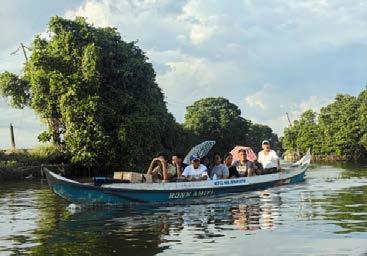
off the coast of Bulacan mainland.
As we passed through a narrow channel flanked by mangroves, imagined its potential as an ecotourism site. Our boatman, Nicole, told us the area is home to several bird species that stop by during migration season.
In this coastal town, where rain falls nearly year-round, even in summer, flooding has become an ordinary fact of life. With livelihood centered on fishing and smallscale salt-making, Pamarawan appears to hold real potential for community-based ecotourism.
Our motorboat journey continued to another island called Binuangan Along the way, we passed the area designated for the planned new Manila International Airport where tracks and massive tractors moved busily across the site.


We spotted a hilltop that appeared snowy, only to learn from a local that it was actually the Navotas Landfill. Along the community’s shore, heaps of trash are carried in by the tides. Among them is a collection of church bells from sunken churches, including those of Santo Niño and
One thing our Bulacan Coastal Tour taught me is that you can’t really reclaim land from the sea. While Manila’s
Marky Ramone Go
Kara Santos
Ron Cruz
Timothy Jay Ibay
CONTRIBUTING PHOTOGRAPHER
Ram Cambiado
GOT QUESTIONS OR SUGGESTIONS?
Email us at: editorial@thearchipelagopress.com
Theopinionsandstatements expressedinthispublicationare thoseoftheauthorsanddonot necessarilyreflecttheviewsofthe editorsorTheArchipelagoPress.
Theinformationcontainedherein isforinformationalpurposes only.Whileeveryeffortismadeto ensureaccuracy,TheArchipelago Pressassumesnoliabilityorresponsibilityforanyerrors,omissions,oranyactionstakenbased ontheinformationprovided.
Nopartofthispublicationmay bereproduced,distributed,or transmittedinanyformorbyany meanswithoutthepriorwritten permissionofthepublisher.

Why do we do this? Why do we succumb to the gravitational pull of trinkets? Are they substitutes for treasure loot, modern-day quest markers, side missions you automatically unlock the moment you buy yet another same-designdifferent-print, all-made-inChina mug? Maybe souvenirs
are symbols, or totems of the traveler’s feat, reflecting interests, values, and aspirational identity.
They say you are what you collect.
It’s the visual representation of your unconscious personality. If you collect magnets, you probably have attachment issues, clinging to metal surfaces because humans are too unstable. If you collect “I Love”
shirts, maybe you fall too easily for people who merely hold the door for you. And if you collect mugs, perhaps you are like mugs of coffee: warm— and occasionally full of yourself.
You’ve barely stepped into the sunlight of a new corner of the world, scarcely inhaled the foreign pollution, and you’re already thinking of objects that will remind you of the
(In my humble opinion, souvenirs shouldn’t be given as pasalubong Why would someone want an “I Love Dili” refrigerator magnet when they don’t even know where— much less what—Dili is?)

But 20 trips later, we realize the truth: it’s just clutter, dust magnets,
and, quite literally, added baggage. And no matter how we convince ourselves that these are artifacts of sorts—reminders of that “mysterious Middle East immersion,” (a.k.a. that five-hour Dubai layover)—they’re really just badges of how our life has been a series of amuse-bouche travels: tiny, forgettable, indulgent nibbles. Eventually, though, you start to see that the value of souvenirs is not in the object but in the ritual that precedes it. Zauberman, Ratner, and Kim (2009) describe this as “strategic memory protection.” The act of looking, choosing, even haggling becomes a small performance of presence. A way of convincing your future self that you were truly there. And maybe that’s the quiet magic of souvenirs: in an era of online shopping, algorithmic distraction, and TikTokerased attention spans, the effort it takes to acquire them becomes the tactile proof that for one fleeting moment, you were fully, stubbornly, undeniably present.
How one tita enjoys Siargao slow and unhurried
Words and images by Christine Fernandez
Like any normal day, I had been up before the sun, craving a cup of strong coffee and a filling breakfast to start the day. I begin with an early morning walk from my hotel to the cafe, a 3.6-kilometer route passing a quieter section of Tourism Road, the main street in Siargao’s tourist hub, General Luna I was meeting a much fitter friend, who was staying at a different hotel and, instead of walking, decided to run, giving himself more time to linger in bed while I set off just past 6:00 AM. The town was still waking up—stray dogs included, a worry of mine on walks and hikes.
I arrived at the popular Shaka Café unscathed, a pack of ferocious stray dogs merely imagined. There were plenty of empty tables, and I found a spot just a few feet from the water where I could take in the view of Cloud 9 a surfing spot known for its long wooden boardwalk stretching from the shore to the sea. One cup of coffee and a panini later, my friend arrived in all sweaty glory, and we settled for smoothie bowls—a
fitting treat in an island best known for waves and barefoot days. The seaview, the soft morning light, and the company of a friend made it feel as if my day was already made.
Mornings like this remind me why I had been drawn to Siargao in the first place. Beyond the surf culture, the island offered an abundance of fresh food, from tropical fruit to cafes and restaurants. Buko juice (coconut water) was everywhere, as is good coffee. Travelers on a plant-based diet would have plenty to enjoy, as healthy options were plentiful—something my body had begun to gravitate toward in my 40s.
By midmorning, the island had fully awakened. The main road grew busier with motorbikes and travelers heading to some of the island’s gems: Sugba Lagoon, the islands of Daku, Naked, and Guyam; Magpupungko Rock Pools, and the Maasin River to name a few. But we stayed off the busiest paths, with no itinerary to follow, wandering where we felt like going. The freedom of having no schedule made the mornings stretch longer, quieter, and more satisfying.
Afternoons were for quiet time. Sometimes we returned to the hotel to rest; other times, my friend and I went our separate ways—iced
coffee in hand, letting the leisurely pace of the island unfold around us. I watched vendors on bicycles making their way from house to house, selling snacks, and discovered little shortcuts leading back to my hotel. Shirtless surfers cruising past on motorbikes with their boards had become a familiar sight. Even in these simple moments, the island felt alive yet unhurried, as if time itself moved a little slower here.
Before 2018, the island was known for its quieter, more laid-back charm, though it was surfing that cemented its place as a top tourist destination. These days, it has also become popular for late-night parties and a livelier tourist scene. But for me, the food, its natural beauty, and the easygoing vibe of the locals are just as alluring.
I love how Siargao embraced the early risers, the people-watchers, and travelers who measure their joy not by photos or parties, but by quiet moments of reflection. By the time the island’s midday sun climbed high and the crowds filled the streets, I had already walked, eaten, sipped coffee, and watched the sunlight shimmer across the sea.
By the end of the day, the tourists would come and go. The island remained patient and unhurried. In Siargao, I did not need to keep up. I only needed to arrive, to take in the quiet mornings and the warm sun. And somehow, that was more than enough.


How a man who loves Puerto Galera came to admit that the mountains are greener on the other side.
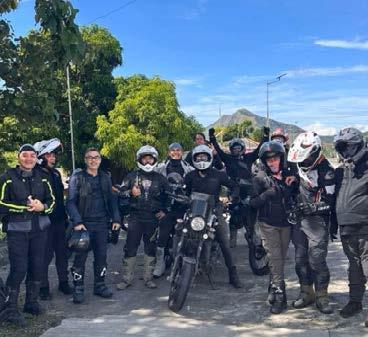
Our group of 12 motorcycles dwindled to two as the heavy downpour—sprinkled with sets of lightning that spiked the middle of the road like celestial waypoints flashing across our path—forced the others to rethink their life choices as they slipped into their rain gear.
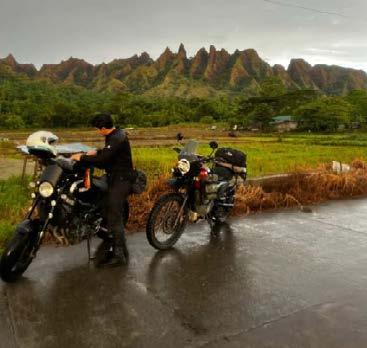
magic mushrooms. Suffice it to say, seeing Devil’s Mountain up close made it well-worth getting drenched.
It got darker and darker as we approached the tourist landmark we went out of our way to see. During what had been otherwise perfect riding weather, ominous rain clouds, and lightning concentrated exactly where we were headed, gave us a bit of pause.
Because of the unsettling tempest brewing over the horizon, we thought it was best to ask the locals working at the 7-Eleven if we would still be
It got darker still as we approached our destination. The roads became increasingly slippery as rainwater pooled and visibility shrank to no more than a few feet. As Jojo and I soldiered on, I found myself howling with laughter at the absurdity of our mission while half-expecting to see nothing.
Suddenly, it sprang into our view: a collage of angular peaks, contoured by unique shades of brown and green. Somehow, in spite of the storm front
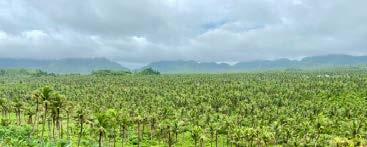
Devil’s Mountain in the town of San Jose may have been the highlight of that first day riding around Occidental Mindoro but it certainly wasn’t the only spectacle that lit our senses with awe. Town after town, the province randomly scattered unique topographical features. It was as though the western part of the island was landscaped by a toddler’s whim, with random government buildings casually flanked by stunning jagged backdrops. And the roads? They were close to
able to see Devil’s Mountain if it poured. The answer my motorcycling buddy, Jojo, came out of the door shouting was, “All roads going there are paved!”
Magic of Mountainsthe
swelling all around it, Devil’s Mountain remained luminous. It seemed to me that the mountainscape intentionally tested our resolve before rewarding us with its grandeur.
By then, my laughter resembled that of someone who had taken a good amount of
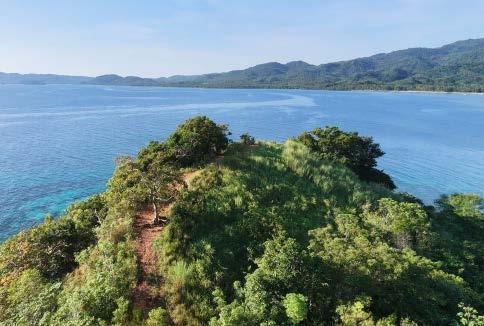
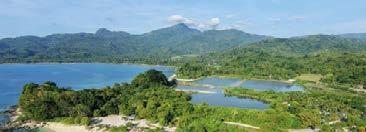
perfection: immaculate stretches of asphalt, stitched together by corners that enticed everyone to ride more spiritedly. Even as dusk transitioned to night, the roads were so well-lit that the cornering party carried on up to Buktot Beach in Mansalay Occidental Mindoro was a joy to ride.

Oriental Contrast
As a millennial whose first travel experiences prominently included Puerto Galera’s White Beach, Oriental Mindoro holds a special place in my heart. Even as I learned to loathe the cluttered cacophony of five different songs playing simultaneously amid the murmur of crowds, the town of Puerto Galera was still one of the first places I visited when I got into motorcycle touring.
I would tuck myself away at Talipanan Beach , feeling superior to those who only knew White Beach. If I wanted excellent pizza and pasta, Luca’s was just a few minutes walk from
Bamboo House , my de facto home on the island. And if I craved Japanese, Abe Chang and her one-woman-run izakaya was a 10-minute ride away. The roads going around the mountains to and from Calapan Port are scenic and twisty. And because of these, I always kept coming back.
However, Occidental Mindoro just seems more interesting to look at. Plus, its roads more consistently provide the nudging to play around. I have no doubt in my mind that I will be back lounging at Talipanan Beach someday, not too far in the future. But I will most likely do so after looping the island from Abra de Ilog

January 24 -
A traveler shares the best spots to explore along Siquijor’s 72-kilometer circumferential roadspots on two wheels
Words and images by Kara Santos
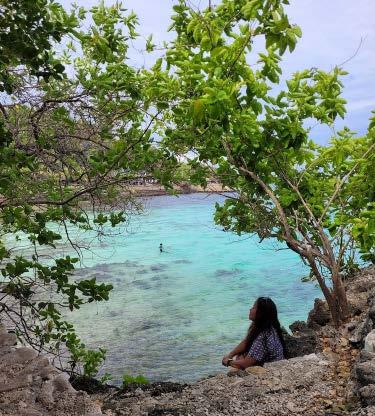
The island of Siquijor has long been linked to stories of witchcraft, folklore, and the occult. But if I could bottle the island’s essence, it would taste like a soul-healing elixir rather than a deceptive love potion or toxic brew.
During my last trip to the intriguing island more than
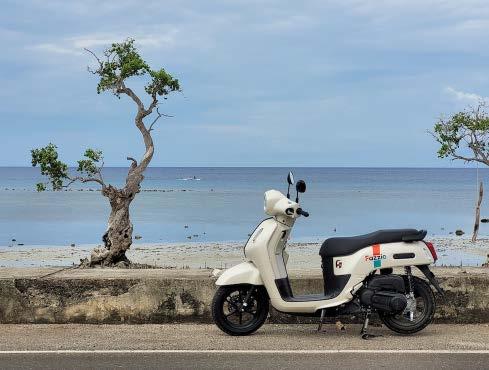
Since public transportation is sparse in some areas, solo travelers find two-wheeled travel the best way to uncover the island’s secrets.
Arriving and exploring
Coming from Dumaguete, I arrived by ferry at the Siquijor port . Located southwest of the island, the capital is the central hub, with St. Francis of Assisi Church being the main landmark. Convenient motorcycle rentals are available outside the port, ready for the road ahead.
Most resorts are located in San

a decade ago, I was eager to once again soak up the island’s mystical properties that first bewitched me. With enchanting spots scattered along its 72-kilometer circumferential road, Siquijor invites exploration.
Juan another 15 to 30-minute drive away. I booked a secluded garden room at Baha Bar, home to the island’s first and only microbrewery. The resort’s stunning restaurant and bar look like a mix between a tropical villa
and a sugar baron’s mansion.
Driving counterclockwise from the resort, the first point of interest is Capilay Spring Park a public park in San Juan with spring-fed swimming pools that draw their water from the surrounding mountains.
Despite being located in the middle of a plaza across a street lined with banks and commercial businesses, the area is surrounded by lush greenery.
A few minutes’ drive away is the Enchanted Balete Tree a 400-year-old tree with a natural spring. Superstitious folk believe the tree is home to spirits from the underworld. These days, tourists flock to get their feet nibbled by fish in the spa pool beneath the tree’s roots.
Nearby souvenir stalls sell love potions in vials, wooden hexes, charms, amulets, mini-voodoo doll keychains, and magnets with witches on broomsticks.
A short detour will take you to Cambugahay Falls a multitiered waterfall known for its crystal-clear, turquoise blue pools. While delightfully deserted and peaceful the first time I visited, this area has become a tourist hotspot for swimming, cliff jumping, rope swings, and fairy walks over the water.
I drive onwards to the town of Lazi, where the Lazi Church and Lazi Convent are located.
The church, founded in 1857, was declared a National Cultural Treasure by the National Museum of the Philippines, while the convent is one of the largest built during the Spanish colonial era.
Recently restored, the bahay na bato structure, built of coral stones and hardwood, houses the
Siquijor Heritage Museum which contains important church relics and paraphernalia.
I continue towards laid-back coastal town with lush scenery on the east coast.
A wooden sign points to the entrance of Salogdoong Forest, leading to a snaking forest path and a cove where a cliffdiving spot, popular with thrillseekers, awaits. It’s a peaceful spot to shoot the breeze while overlooking the ocean.
The Isok House ramshackle house considered a local landmark in the town of Enrique Villanueva, has seen better days. Other spots, like the Marine Sanctuary, require a day of diving to fully appreciate.

In the port town of Larena in the northeast, I find that Guiwanon Spring Park the once scenic mangrove forest park with boardwalks, is no longer accessible to the public.
My last stop before heading back is Siquijor’s Kilometer
Zero marker beside a sarisari store. The nondescript signpost serves as a reference point for all roads on the island.
Satisfied with having looped the island for a second time, I head back to my resort for dinner. Baha Bar’s regular menu features Filipino cuisine making use of the freshest catch of the day and ingredients from their own farm. Dishes are based on the Filipina owner’s recipes, growing up in Surigao, Mindanao.
My visit happens to fall on a Friday, when the bar offers lechon buffet dinners, attracting locals and tourists alike. As dusk settles, the dining hall fills with chatter over meals, mingling with live music from a local band.
From a tourist’s point of view, there’s really not much to see along some stretches of the highway. Anyone can easily loop the island in two hours or less. But like all good things in life, the journey is best savored slowly. Beyond sights to visit along the highway, Siquijor’s magic sparkles every time you pause to breathe and enjoy life’s little pleasures. The quiet, dusty roads provide enough distance for the breeze to blow away the cobwebs in your head as you drive. Stumbling upon quiet spots that offer views along the coast can sometimes be more satisfying. There’s no need to rush when you’re on island time.

Into This Week’s Crossword Puzzle
ACROSS
2. Filipino tradition of bringing gifts and souvenirs home
4. Treehouse-inspired café in Sagada
8. A classic Tuguegarao noodle dish with carabeef, vegetables, and egg
DOWN
1. Main tourist hub in Siargao
3. Famous Hiking spot in Baguio City where the Apache Trail is found
5. Art exhibit recently held in Luisa’s Cafe in Baguio
6. Mountain in San Jose, Occidental Mindoro known for angular peaks
7. Famous multi-tiered waterfall in Siquijor known for its turquoise blue pools
8. A submerged fishing community in Bulacan that’s home to 3,300 residents
*Tune into to the next issue for the answers!
Sometimes, getting lost and the slow life are exactly what we need.
There’s a tiny pressure that comes with visiting a place as storied as Sagada. After the long way up to this mountain town, there’s a feeling that you have to “earn” the trip. Every hour and every peso must be repaid by ticking off every possible activity on a crowded itinerary. This was how I thought when I was in my early 20s.
Spelunking, catching the sunrise, and trekking the mountains— all these seem fun, yes. But there comes a time when you just want to go easy on the itinerary and ignore the checklist.
The next day was my partner’s birthday, and the plan was to just go around town and maybe find a pie to serve as his birthday cake. Walking a few meters from our accommodation, we saw Sagada Lemon Pie House along South Road.
This wooden house turned café and restaurant serves tangy, citrusy lemon pies, pastries, and rice meals. It’s a quiet, rustic café that feels like you’re at your grandma’s old house. We ordered a slice of lemon pie with a nicely baked buttery crust, smooth
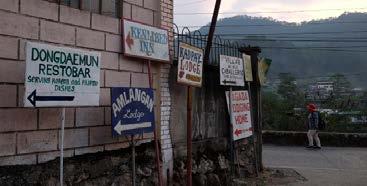
you. Minutes turned into a long stretch of silence; all of a sudden, there were no jeepneys, no tricycles, not even a local to point us in the right direction. It was just us breathing heavily and a map that seemed as confused as we were. We were officially lost.
We eventually retraced our steps and found a small crossing we had completely missed earlier. We hiked up a narrow street until finally, a treehouse-inspired café appeared.
Gaia Café is a library café that screams art in every corner. It makes you want to spend your entire day there reading, writing, or just reflecting on
As we sipped our freshly brewed coffee, we thought about how getting lost didn’t feel like a mistake anymore. We’re here,
A man appeared with two slices of light, crumbly lemon pie. They were soft and airy, a citrusy treat to cap off the day. It was quite a celebration, indeed.
Maybe it’s the tired legs and aching back of my “ auntie ” era speaking, but for our first visit to Sagada we didn’t want a packed schedule. We didn’t want to conquer the place. We just wanted to be there.

By Harold Fiesta
The line of og-ogfu winds along the trail, broken only at the height of noon— when the safeng is uncovered, when bowls catch the steam of watercress broth.
Young men stack stones on the edge of the slope— steadying each other on the slide. Strong: bodies like boulders, muscles rising and falling in the slumbering sea of mud and snails.
Others patch collapsed terraces or pull out weeds and mimosa.
The women begin the planting— bare-chested, they sow the ease of a future harvest. Humble maiden-breasts
bent to the mud, yet mocking the sharp points of the fale and hills, the flowering of male papayas when a pair of testicles touches them.
For only in their calloused palms can the golden tears of rice be coaxed to fall.
A hawk glides through the sky, half-blinded by flashes of sun, by the shimmer of irrigation in the paddies— invited to fold its wings for now, to perch on a hanging cliff, and ascend the sky’s terraced stair.

The Archipelago Press 01312026
Coming from the highest highway point in Tinoc, Ifugao, and riding through the vegetable paradise that is Buguias in Benguet on our motorcycle, the air shifted as we crossed into Mountain Province. We went slowly and surely, tackling the twisties in Mount Data in Bauko, before arriving in Sagada at half-past lunchtime.

When it was time to leave, we took the road less traveled— literally. Instead of the usual bus routes, we steered our motorcycle toward Cervantes, Ilocos Sur It was a descent through what felt like unending mountains. Driving through it, I was secretly wishing for a retirement home somewhere in the highlands. What happiness and peace it could be to have a place here, where the sun and heaven feel so much closer, and the cool wind blows constantly.
HaroldJohnL.Fiesta,anIlokanoandanativeofSantaIgnacia,Tarlac hasreceivedrecognitionfromtheBienvenidoLumberaandSaranggola Awards.Hisdebutpoetrybook,“PanunumbaliksaGomorrah”,was publishedbyVibalFoundationin2025.

We accept previously unpublished poems on place, movement, memory, and Filipino culture in English, Filipino, and other Philippine languages and dialects from Filipinos across the world. For non-English poems, please provide an English translation. Indicate your preferred byline (a pseudonym is fine).
Please submit just one (1) poem in Word format to editorial@ thearchipelagopress.com, with the email subject: Poetry: Your Name – Poem Title
Accepted poems will be paid 500 Php and featured in our weekly issue and our website. If you don’t hear back from us within 30 days of submission, please give us a nudge.
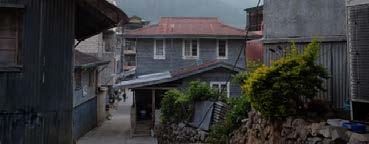
It felt like we were finally exhaling after an exhausting ride. We rode through the quiet streets and rested our tired bones for a while before heading to the information office to register our names. Once there, I saw the brochures for caving and trekking and thought, “That looks fun,” but my heart was already set on the view from our bed and breakfast. I booked a room facing a quiet, pine-covered rocky mountain. Since we arrived on a weekday, we felt like we were the only ones enjoying the view.
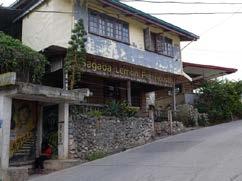
custard, and light meringue. Their egg pies looked enticing, too (my next target for our next visit).
By lunchtime, we took a onekilometer walk to Gaia Café fully trusting Google Maps. But Sagada has a way of humbling
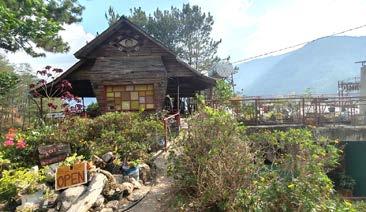
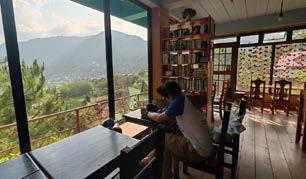
life like the characters from the movie That Thing Called Tadhana (a scene was shot in the café, too!). Shelves filled with books, artistic curtains, wooden furniture, and a souvenir shop showcasing local woven products and delicacies welcome guests.
The moment we stepped inside and found a corner overlooking the sweeping rice terraces and Ambasing Valley , exhaustion dissipated into thin air.
Gaia Café sources ingredients from the community for its mostly vegetarian menu. We tried their tomato basil pasta, and the Gaia Sandwich, which consisted of their homemade burger patty, tomato slices and ketchup.
enjoying a lovely lunch over a spectacular view of the terraces.
Continuing our little pie pilgrimage, we hailed a tricycle to Maggie’s Lemon Pie near Saint Mary’s Church.
Did we miss out on the famous caves or the Kiltepan sunrise? Yes. We did not see the Hanging Coffins and the Marlboro Hills either. Yet, we didn’t feel like we missed a thing. Chasing lemon pies and getting lost were exactly what we needed. Maybe that’s the essence of discovering a new place. It is an experience that is uniquely ours.

We packed our bags a few hours after Christmas and headed to the bus station. Our destination?
A city colder than Manila in December: Baguio City
For a couple of years now, it has been our family’s year-end tradition to celebrate the limbo days between Christmas and New Year high up in the mountains of Benguet. Residing in Luzon, my wife, my kid, and I are lucky to have visited plenty of times and seen most of what Baguio City has to offer. Still, the city and its laid-back vibe beckon.
We’d usually get the cheapest room near the city’s main artery, Session Road. As we don’t take taxis and usually just walk, we find this base convenient for our daily excursions.
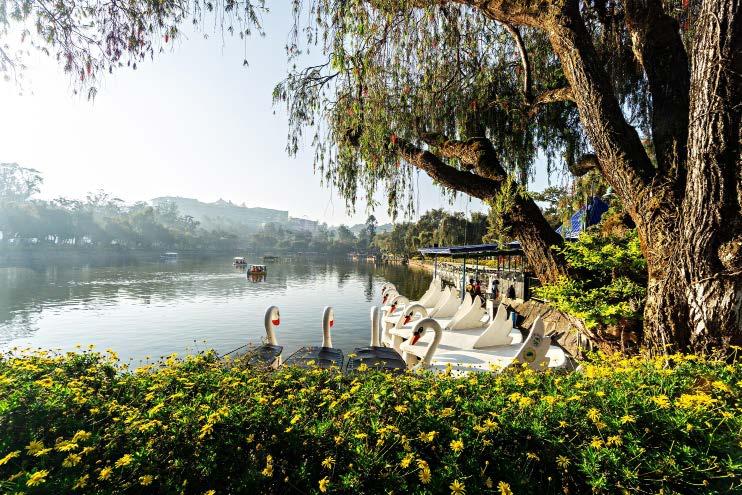
Our first day is usually spent at Burnham Park —watching swan boats glide across the willow-fringed man-made lake. Savoring the cool weather, we relive past Baguio trips, bemoaning the vendors selling cheap instant coffee at the park.
If it was a Saturday, we’d head toward the nearby Children’s Park . We’d spread a blanket below the pine trees and have our longsilog —the longganisa bought from Baguio’s Public Market ( Alabanza , our fave brand) and cooked at our lodging prior. We’d wait for the weekly kids’ storytelling session hosted by the Baguio Public Library. Afterwards, our kid joins the swarm of children playing along the city’s expansive playground, before enjoying a round of biking.
Sundays are special. We’d get up early in the morning for Session Road to have a hearty breakfast at one of the city’s OG restaurants, Jack’s . We’d have Jack’s Rice—a delicious symphony of eggtopped rice, roasted chicken, pork liempo , lumpiang shanghai, and the freshest highland veggies.
Then, it’s a whole-day affair at Session Road as the road closes its byways to cars to give way to pedestrians. Locals and visitors flock to the road, browsing through pop-up stores, snacking on street food, watching local bands play, cheering on street dancers b-boying and strutting their stuff, and admiring artists coloring the pavement with chalk.
The last one is our Kid A’s favorite. We’d buy him his own set of colored chalks and watch
him get lost in his street doodles. Another favorite is when a band asks the crowd to join them in the traditional Bendian dance as they play mountain songs. I’d join too if I wasn’t too shy!
A visit to the hiking trails along Camp John Hay is a permanent part of our tradition. We’d start at the Apache Trail from Scout Barrio ’s overgrown baseball grounds, then get literally lost among Baguio’s pine forests.
Kid A would hug us, telling us how much he loves hiking— the pines towering above, the pine needles underfoot, and the silent sound of the forest.
We’d emerge at the John Hay Filling Station and continue on to the sloping pine hill picnic grounds, where we’d finally have our breakfast—another round of Baguio longsilog , of course. We’d spend a couple of hours doing nothing, listening to ‘80s New Wave music from our portable speaker while Kid A runs around the trees, collecting acorns, and befriending random kids.
Before returning to the city center, we’d have our first and last expensive coffee for the year at a popular coffee shop in John Hay—more for the memories of yesteryears and the feel of having coffee under pine trees than anything else. If you want

something less commercial, there’s Choco-laté de Batirol
On a particular day, my wife would leave early on her own for an annual visit to M N M L S T her favorite tattoo studio in the city. She’d have her old tattoos touched up and sneak in a new one or two.
On such days, it’s just me and Kid A. We’d take out a Jollibee breakfast and head over to the Melvin Jones Grandstand watching kids play football across the field as we devour our Chickenjoy and burger steak. Eventually, we’d find ourselves on the field, too, tossing frisbees to each other.
We’d then head over to the underground part of the Maharlika Livelihood Center to look for this particular trip’s keychain— the kid’s favorite memento.
The murals along Cervantes Street are normally our background as we wait for the wife to finish her tattoo session. Lunch would be at Cathy’s Fastfood a Binondo-esque older-than-your-great-grandma Chinese restaurant selling the best fried chicken in the city.
Evenings find us shuffling drinking spots in town—sitting at the Art Deco-inspired Volante’s in Session Road, or enjoying a panoramic city view from their SM Baguio branch, or the snazzy rooftop bar at Abanao Square; or karaoke at Igorot Café Wherever it is, Baguio’s weather is perfect for a bottle or two of beer.
Eventually, the last day of the year arrives, and it’s time to go back to Manila. But before we bid the city goodbye, we make our way to the Baguio Market for fresh veggies, bags of local coffee, and freshly baked cinnamon bread— the warmest mementos from the coldest city in the Philippines.
On the ongoing struggles of the Baguio artist community in the UNESCO Creative City for Crafts and Folk Art, from the lens of the Luisa’s Cafe exhibit that opened in late 2025
Words and images by Heather Ann Pulido
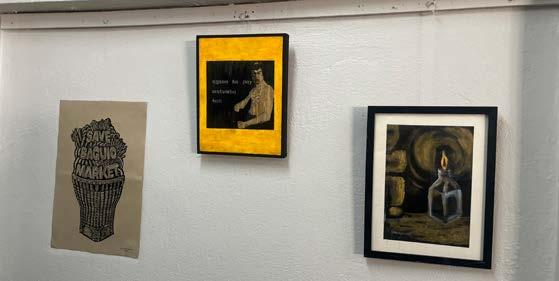
In the last month of 2025, the walls of Luisa’s Cafe their photographs and paintings for placards and other protest art.
Popular for its special and siopao known locally as a hangout for journalists, writers, and artists. The second floor usually showcases artworks for sale.
But this time, the featured art holds a mirror to social conditions in Baguio City, especially for artists.
The ongoing exhibit is nicknamed “ Ibagtit portmanteau of Ilokano words Ibagiw , or “person from Baguio” and the governmenthosted creative festival; and meaning “crazy”. The paintings, black and white placards, and mixed media installations tell a story of artists’ hopes fractured by a tourismdriven “Creative City.”
Before the Ibagtit unrest in the creative sector had been brewing for several weeks. In mid-November, multidisciplinary artist Angelo Aurelio posted a video of him examining his mural, “ Pandemic Mural unceremoniously removed
from the Baguio Cultural and Convention Center frontage and discarded like trash. A miniature version of this mural, surrounded by sentiments written like graffiti, is now on display at Luisa’s.
Aurelio explained in an interview
On November 23, while the Ibagiw Festival was drawing to a close, Aurelio led a tight circle of artists in a silent protest outside the BCC where he danced in the midst of lit candles.
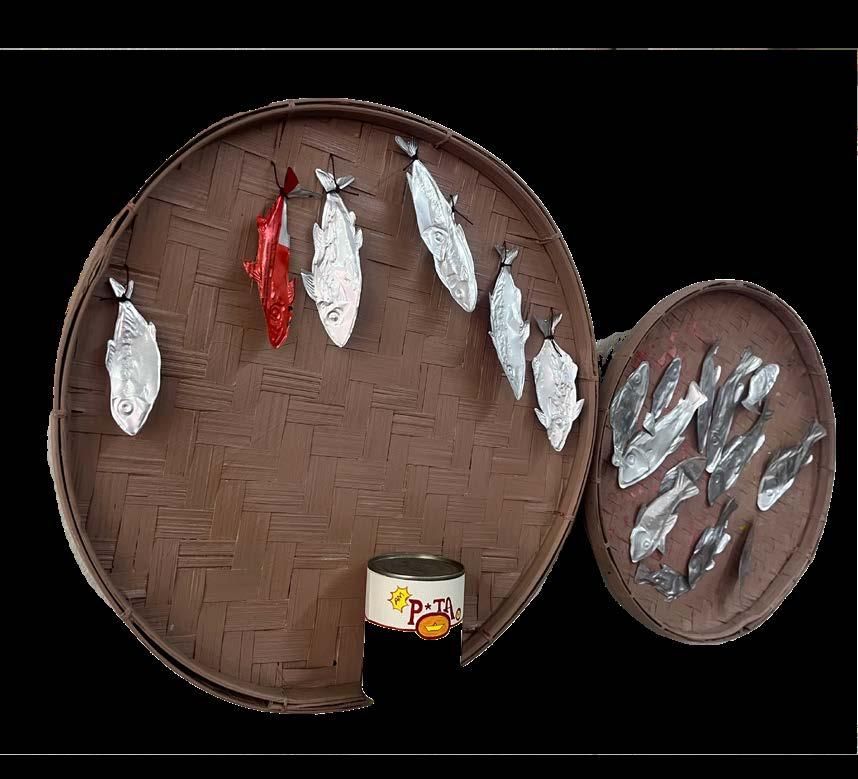



#ArtIndustryReform and #ArtistSupport.
One striking story was shared by singer-songwriter Ivee Bongosia:
“I remember singing on a 12 noon slot for ‘Creative Sundays’ then, under the heat of the sun. Ni bottled water walang binigay (They didn’t even hand out bottled water.) Then you could hear ads of sponsors being played while prepping your set.”
Another widely shared post came from musical director Jessica Ladines-Mirandilla. She spoke of an incident where her music team was not given meals, fees, or even a simple thank you after their performance.
Mirandilla and Aurelio are two of the loudest voices in the newly formed Baguio Artist Welfare Community (BAWC)
Founded in the aftermath of the Ibagiw Festival protests, BAWC aims to carry the grievances and aspirations of the art community forward. They started strong by submitting an open letter to Mayor Benjamin Magalong, Chairman of the Baguio Creative City Council, urging him to investigate irregularities and unfair practices in the government’s dealings with the art community. Their online petition for the resignation of City Tourism supervising officer
Aloysius “Alec” Mapalo has garnered 775 signatures as of this writing. Mapalo’s
In recent years, Ibagiw events have also become increasingly exclusive and detached not only from the creative sector but also
stage the festival for any one particular sector: not for tourists alone, nor for the social elites, nor for the culturati, nor for

In a Facebook post, former Ibagiw Festival director and director Karlo Altomonte clarified the rationale for Ibagiw. “We didn’t
staged for the artists and artisans, and the whole community was invited to celebrate with us.

The exhibits were open to everyone. The performances were open to everyone. The workshops and other activities were open to everyone.
Watching the process of the artisans as they imagined, wove, created was open to everyone. The artist talks were open to everyone. And whenever food was served, it was for everyone.”
It’s not the first time Aurelio and his work are capturing nationwide attention.
Along with local artists like Tatay Kidlat Tahimik and the progressive artist group Sulong Likha Aurelio has consistently expressed solidarity with the vendors and supporters of the Baguio City Public Market. He was one of the performers in the October 26 solidarity event held in front of the Fish and Meat Section of the palengke
The event was the first major post-pandemic protest against market mallification. It was co-organized by multimedia firm Fridge TV and the local
necessary reminder that Baguio artists are regular citizens after all. We love our public market. We need affordable

Back at Luisa’s Cafe, there are artworks that touch on issues of the market redevelopment and rising food prices. To me, this serves as a
food. We deserve to be respected, appreciated, and duly compensated for our labor.
How food can be a story of becomings, endings, and returns
Words and images by Benj Gabun Sumabat
The last meal my Papa and I shared was a bowl of Pancit Batil Patung
Whenever I eat it now, the steam rising from the bowl lifts more than the scent of soy and garlic. It lifts the geography of home, the heat of Tuguegarao afternoons, and the quiet patience of my father’s hands stirring sawsawan on a chipped saucer. Pancit has become a geography I must enter slowly as I attempt to “go home” and unfurl the map of memories that this food lays on the table.
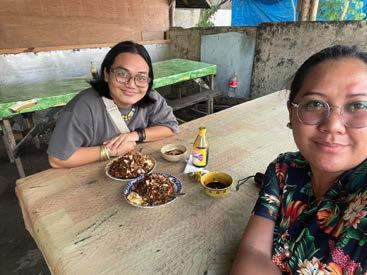
Growing up, summer vacations meant going home to Cagayan. The long ride from Ifugao bent through mountain roads and softened into the flat heat of the Cagayan Valley. Tuguegarao was never just a stopover. It was a ritual that we understood; we could not pass the city without eating Pancit Batil Patung

Hunger and habit braided together, even when money was tight. Even when fatigue settled
into aroma by garlic and soy.
Acclaimed Filipina food writer
in any case I can’t, the untouched part can be brought home.

Around it were the small routines that made the meal ours. Papa sliced red onions generously and squeezed kalamansi into soy sauce, his hands deliberate and unhurried as he made sure that he squeezed every last drop of the kalamansi before throwing the skin off and fishing the kalamansi seeds on the bowl using a fork. The sawsawan had to bite and had to wake the tongue. Even though the pancit looks so overwhelmingly flavored, Cagayanos know that it is how you mix and prepare your sawsawan that completes the Batil Patung experience.
Pancit Batil Patung is a dish of accumulation. Homemade noodles softened in broth. Monggo sprouts and kabatiti lend sweetness and snap. The soft custard of a raw egg stirred at the last minute— batil , to mix; patung to layer. Each panciteria in Tuguegarao claims a signature: some add kalamares lumpiang shanghai , crisp pork belly, even pig’s brain. Yet the old-school version keeps to essentials, honoring the labor of carabao meat minced finely, coaxed
Ifugao to Cagayan, where I would begin a different life. At the diversion road, we stopped at Jren’s Panciteria school, fluorescent-lit, the kind of place where plastic stools remember the weight of regular customers. The panciteria was simple, made of bamboo walls and galvanized roof and long tables covered with colorful linoleum mats. Papa ordered two plates this time. Perhaps he sensed that childhood was ending, that sharing would soon become solitary. Or perhaps he just realized that as I grew older and probably bigger, it is time that I learn to eat on my own plate. While waiting, he prepared the sawsawan as he always did, careful with the onions, and patient with the squeeze of Then he taught me how to eat.
“Madim nga ilaoklaok said. Don’t mix everything. He emphasized that eating the pancit should be by layer and per bite in order to finish it, or
The trick, he explained, was to keep from being overwhelmed by umami Eat from the edges.
Respect the architecture of the bowl. Pancit Batil Patung after all, is
stirred yet layered, a lesson in restraint. So I followed him: tasting the noodles first, then the vegetables, then the meat. Finally, the egg, folded in slowly, binding everything into warmth. That day, I finished my first solo plate. Papa watched, smiling, like I just learned to ride my bicycle without the training wheels. The last time we ate it together, the routine repeated itself. The same stop in Tuguegarao. The same ordering. The same sawsawan At the time, it felt ordinary— another punctuation mark in a long drive home. I did not know I was memorizing him. I did not know I would soon be eating for one.
Now, every bowl returns me. The clatter of spoons against porcelain. The sharp sweetness of onion. The zesty bloom of kalamansi The heat that beads on the forehead. Pancit is no longer just sustenance but an invocation of these small encounters that I can still remember since a decade after my Papa died. In Quezon City, in cafeterias that imitate the dish, I search for the laddit’s chew,
for the carabeef’s deep savor. The taste is never exact. Perhaps grief alters seasoning. Perhaps memory insists on fidelity the present cannot provide.
In Filipino households, pancit marks beginnings—birthdays, graduations, and long life. We serve it to wish for continuity. Yet the Pancit Batil Patung I carry is a meal of endings and returns. It teaches me how to eat the past: slowly, by layer, resisting the urge to stir everything at once. When I mix the egg into the broth, I recall the minced memories of childhood and moments with Papa. When I lift the noodles, I lift a road from Ifugao to Cagayan, the summer dust, the promise of arrival and summer vacations. When I taste the onion’s sting, I remember his thrift and tenderness, how love often arrived in shared plates and plastic take-outs.
Doreen Fernandez believed that food tells us who we are and where we have been.
For me, Pancit Batil Patung tells me who I am becoming: a child who learned to eat on my own, a son who keeps returning to his hometown and memories as I navigate my becoming in an unfamiliar city. Home, I have learned, is not only a house in Cagayan or a city called Tuguegarao. Home is a bowl set down gently, steam rising, waiting to be stirred. And every time I eat pancit now, I sit across from him again, our spoons moving in gentle symmetry, the layers loosening, the past held warm in my hands.






The Archipelago Press
Address: 630 1st Avenue, PMB, 318, San Diego California, USA 92101
Phone number: +6195191063
Email: info@thearchipelagopress.com
Website: www.thearchipelagopress.com
Social media: www.facebook.com/thearchipelagopress https://www.instagram.com/thearchipelagopress https://www.tiktok.com/@thearchipelagopress https://x.com/TheArchipelagoP https://www.youtube.com/thearchipelagopress