The Archipelago Press January 2026 - Volume 1 Issue 3
Transportive stories by island-born hands, across shores
Red Brick and Reveries: Coming of Age at Saint Philomena Parish Church
An in-depth reflection on the complexities of growing up queer within religious institutions and the discovery of wholeness and divinity within a queer identity
by
Every queer child carries a moment, sometimes a series of moments, when they are made to account for themselves. It may not always be a formal coming-out story, but rather a question delivered with suspicion and fear: “Lalaki ka ba?”
It is a question posed to every young boy who exhibits traces of femininity. This demands not just an answer, but a performance, one that affirms the stability of gender and reassures those who ask that nothing has gone wrong. To answer “Oo, lalaki ako” is to participate in
a script that forecloses complexity. For queer children growing up within religious institutions, these moments become formative. They shape how we learn to inhabit our bodies, how we negotiate visibility, and how we understand belonging.
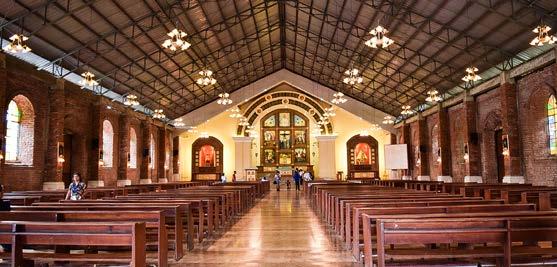
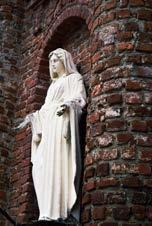
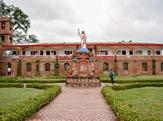
In the small municipality of Alcala, Cagayan, Saint Philomena Parish Church stands as a relic of authority and devotion. Built in 1845 by Dominican missionaries, it remains one of the widest red-brick churches in Northern Luzon, named after Saint Philomena, the virgin and martyr. The church is a pilgrimage site in every Visita Iglesia , and a symbol of Catholic endurance in the region. Within its compound also stands the high school where I spent my junior years: the Lyceum of Alcala Inc., a school founded and managed by the
Savoring the Flavors of Quiapo: A Manilakad Food Crawl and Heritage Tour
A sojourn into the underrated and overlooked soul of the Philippine capital through one of its most colorful, culturally diverse areas
Nothing captures the chaos and color of Manila quite like Quiapo.
Combining Catholic tradition and Muslim faith, this cultural melting pot offers bargain hunts, traditional healing, and unique street food you won’t find in fast-food joints or typical Filipino restaurants.
Come January, millions of barefoot devotees transform the narrow streets into a sea of Traslacion pilgrims making their way to the main landmark: Quiapo Church, home to the miraculous Black Nazarene.
Tuguegarao Archdiocesan School System (TASS). The church and school were not separate institutions in my adolescence; they were overlapping structures that governed time, movement, discipline, and morality. Growing up queer within this space meant learning how to survive inside systems that demanded reverence while implicitly refusing recognition.
COMING FROM A SARADO KATOLIKO (STRICTLY TRADITIONAL ROMAN CATHOLIC) FAMILY, QUEERNESS WAS TREATED AS SOMETHING UNSPEAKABLE—A POTENTIAL SHAME THAT HAD TO BE MANAGED RATHER THAN UNDERSTOOD.
... CONTINUED ON PAGE 2
Curiously, religious artifacts and medicinal herbs used by faith folk healers are hawked next to cheap gadgets and adult sex toys outside this “church of the masses.” Nearby, tapered alleys hide repair shops for typewriters and film cameras—relics of a bygone era.
... CONTINUED ON PAGE 3
10 9 8 7 5 4 3 2 6
Letter from the Editorial Team Insights
» Red Brick and Reveries: Coming of Age at Saint Philomena Parish Church
Culture & Heritage
» Savoring the Flavors of Quiapo: A Manilakad Food Crawl and Heritage Tour
Destinations
» Mary’s Canteen: Hangar Market on a Plate
Culture & Heritage
» Beyond the Bookshelves: Historic Manuscripts at the National Library’s Permanent Gallery
Entertainment
» Crossword Puzzle
» Editorial Cartoon
Poetry
» Viridian Forest
Destinations
» Sundays on Tando Beach
Destinations
» Camiguin: Refreshingly Unchanged
Art & Lifestyle
» Do’n Sa Saguijo
Insights
» The Corners of Panglao that Stayed the Same
Words by Benj Gabun Sumabat Gretchen Filart
Words and images by Kara Santos
Images
Letter from the Editorial Team
On Nostalgia
Nostalgia is often viewed through the lens of pain and sorrow – so much so that in the late 17th century, Swiss medical student Johannes Hofer, who coined the term, believed that it was a psychological affliction of “demonic cause.”
But it’s also worth remembering that half of the word derives from the Greek word for homecoming (nostos).
Re-membering is a return home. It’s finding meaning over and over again in accessing something familiar—to things we held close, before letting them go. Isn’t life an act of letting go?
This issue opens with a coming-of-age story by a queer writer parsing the complex threads that connect their identity with home, continuing with soul-searing stories of writers who delve into the past through food and revisit places they’ve grown fond of (including a visceral poem about childhood—the first of many we aim to host!) before ending with a story on how, sometimes, it’s not memory or a place that changes, but the lens through which we now see it as we inhabit this existence. Step inside. You might find something here that will remind you of how a homecoming feels.
To be a queer femme boy in a conservative environment was to exist under constant scrutiny, as if my presence alone threatened the moral coherence of family and faith, and community. During my four years within the church compound, I learned quickly that survival required compensation. I became the “smart kid,” the reliable student, the one who always said yes to school and church obligations—a youth minister, choir member, student leader, even played Jesus Christ in a Christmas play on the last day of
dered garments, carefully placed crowns, flowers arranged with devotion. I was drawn to their theatricality, their excess, their unapologetic ornamentation. There was something queer, I realize now, in my fascination. The church’s marble floors and vast interiors gave me a feeling I could not name then—a sense of awe mixed with longing. The sacred space that disciplined me was also the space that stirred desire, imagination, and identification. At night, the church became a kind of drag without the linear separation and impositions, it was both the sacred and the profane.
admire the saints, but only as long as I did not resemble them too closely in my excess.
By my final years in high school, the cost of “toning down” became unbearable. I began wearing makeup, asserting a visibility I had long postponed. The response was swift and punitive. I was called into offices, reprimanded, and disciplined. The message was clear: the Church could accommo-
de Gallo This overachievement was not simply teenage ambition but a defense mechanism. As Judith Butler argues, gender is not an inner truth but a repeated performance shaped by norms and sanctions. In my case, intellect and obedience became acceptable performances that masked the queerness I was told to tone down.
I stayed late after school, often lingering past the 6:00 PM Angelus bell. In the evenings, the church transformed. The compound became a park: children ran across the carabao grass, families gathered on brick benches, and the church façade glowed under white lights. I would sit there quietly, staring at the saints—at their embroi-
Queer theologian Marcella Althaus-Reid insists that theology is never neutral; it is shaped by bodies, desires, and power relations. Catholic spaces like Saint Philomena Parish Church are often imagined as morally pure, yet they are saturated with sensuality—incense, candlelight, gold, fabric, ritual. My attraction to these aesthetics complicated the idea that queer-
ness and Catholicism are irreconcilable. Still, my belonging remained conditional. I could
A
date me only up to a point. As Martin Manalansan writes, queer subjects in religious and postcolonial contexts often survive through negotiation, constantly adjusting themselves to dominant moral regimes. But negotiation has limits. When I refused further erasure, the Church closed its doors to me.
At the time, the
Editorial Team
Severino Profeta Reyes FOUNDING EDITOR
Allandale Antenero FOUNDING TRAVEL WRITER
Gretchen Filart MANAGING EDITOR
Maia Imperial EDITORIAL DESIGNER
phrase comforted me. Now, I resist its premise. My queerness is neither sin nor failure. Queerness can be understood not as deviation, but as a site of divine creativity and relationality. I was not seeking refuge because I was broken; I was seeking recognition because I was whole.
Saint Philomena Church remains. At night, its red bricks absorb the dark, holding the day’s heat the way bodies hold memory. When I come home and pass by the church in the evenings, I see children playing in its shadow—feet skimming the steps, laughter cutting through the hush after prayer. Some of them are queer kids too, playing with the santan flowers or ceremoniously laughing with their girlfriends. They sit where I once sat, lean against the same walls, trying out the shape of their bodies in a place that has always watched closely.
What I understand now is not only how exclusion happens, but how it forms us. This place taught me how
institutions press themselves into flesh, how faith can bruise and bless in the
Savoring the Flavors of Quiapo: A Manilakad Food Crawl and Heritage Tour
Continued from front page
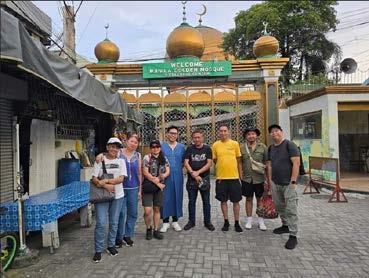
Stalls near Quiapo Church offer nostalgic treats like lumpia and hopia, along with trending “viral” street eats. Outside the Golden Mosque a central place of worship for the Filipino Muslim community, one can relish authentic Maranao food and get a full meal for under 100 PHP.
Casa Consulado (Iturralde House) , an abandoned heritage house originally built in 1926 that once hosted the Consulate of Monaco.
same gesture, how survival often begins as careful performance— lowered eyes, measured gestures, and calculated responses. This did not require leaving religion behind, but staying long enough to reckon with it: to learn, in the dark, among hymns and children’s voices, that reverence does not demand silence. That truth, whether whispered, laughed into being, or carried quietly home at night, remains truth all the same.
A Creative Way to Explore Quiapo
One weekend, I found myself exploring Quiapo on a food crawl and heritage tour led by George “JP” Ordoña. The intrepid traveler and tour guide behind Manilakad offers creative tours that reveal lesser-known aspects of Manila’s history, architecture, and local life.
Our group met at San Sebastian Church , a National Cultural Treasure and the country’s only steel church. Its Gothic style, constructed with German stained glass and Belgian steel, reflects European influences.
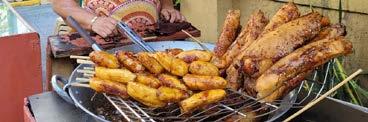
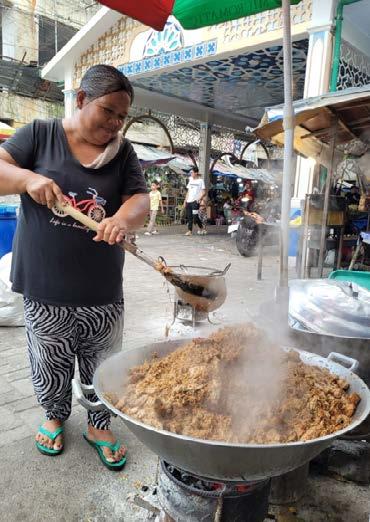
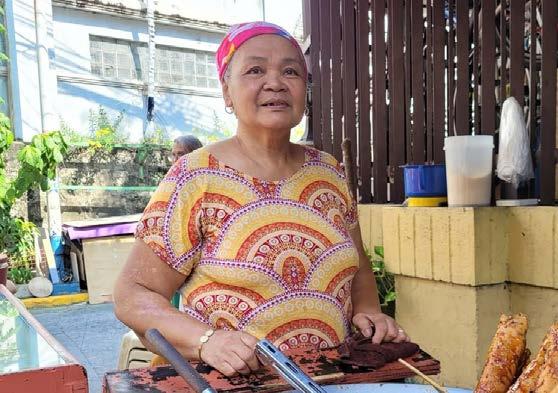
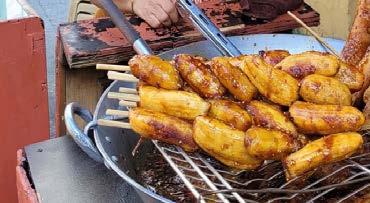
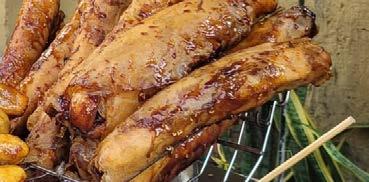
Our first food stop behind the church was Aling Mely’s stall. Over a sizzling pot, she shared how she has been selling turon (deep-fried banana rolls) and banana cue since 1981 and has managed to send six of her kids to school on turon . Each gigantic piece, filled with 4 bananas and drizzled with sweet sesame sauce, costs just 25 PHP.
The humble stall along Calle San Sebastian sits next to
Continuing our stroll, we admired other remaining century-old structures. Some heritage houses were in various states of urban decay and occupied by informal settlers. Most have been demolished in favor of high-rise buildings, condominiums, and parking lots.
Our next food stop was Bakerite , a historic bakery established in 1946. Founded after World War II, the homegrown brand popularized “Tasty” bread and sells pastries like pan de sal and pianono
In between bites, JP pointed out notable examples of adaptive reuse. A house originally built in 1904 now operates as the Tanduay Fire Station . The Art Deco Lateral Apartments in Recto were retrofitted into Youniversity Suites —a modern food hub, hotel, and dorm for students.
The highlight was the Muslim Quarter , an area reminiscent of busy Mindanao markets, with authentic Muslim and halal cuisine. After traveling all over Mindanao, I was excited to reconnect with familiar favorites.
The bustle of urban activity reminded me of the vibrance of Sulu, Tawi-Tawi, and Marawi.
vendors were selling Muslim garb, bakas (smoked yellowfin tuna) on skewers, and sakurab (native scallion), an essential ingredient for palapa —a spicy Maranao condiment that can liven up the simplest meals.
For dessert, we visited Landap Cafe outside the Manila Golden Mosque. Adorned with miniature houses, this quirky cafe is a great place to cool down over Teh tarik, Lassi and Roti Canai.
After browsing native handicrafts under the bridge toward Quinta Market , we followed the blaring horns of city traffic to a row of panciterias Still too full to eat, we made shopping detours instead at Kape Kabuhayan for coffee beans and Excelente for ham, and various bakeries for hopia tasting.
The tour ended at Quiapo Church , where a maze of stalls offered everything from dragonfruit juice to chocolate muron (rice cakes from Eastern Visayas), to bargain biryani. By the time we got there, the classic shop Globe Lumpia was closed, but we had more than our fill—belly, sights, and all.
Gritty and imperfect, Quiapo is a mess. But it’s the mess of the real Manila. The streets may not be as pretty as Intramuros or as trendy as Binondo. But there’s a sense of life and community that reflects Manila’s soul—underrated, overlooked, flawed, yet somehow authentically alive.
After buying pastil (15 PHP) to take home, we settled at Pater ni Intan’s stall for a fiery meal of Chicken Piaparan with turmeric rice (30 PHP). Nearby, For guided walking tours, contact George Ordoña of Manilakad at 09606975930 or email gpo.islander@gmail.com
If you’re craving a unique culinary adventure, consider savoring the flavors of Quiapo.
Misa
Red Brick and Reveries: Coming of Age at Saint Philomena Parish Church
teacher once told me, gently, that “the Church should be a refuge for sinners, not a museum for saints.”
Mary’s Canteen: Hangar Market on a Plate
A deep dive into a hidden Hangar Market gem, its decades of service and the woman behind its lasting legacy
Words and images by Heather Ann Pulido
Mary Pul-oc opened her Hangar Market eatery to address a simple yet vital question: Sino ang nagpapakain ng mga taga-palengke? (Who feeds the people of the market?)
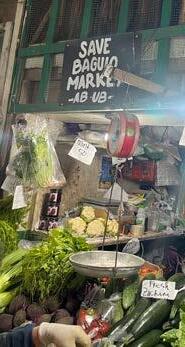
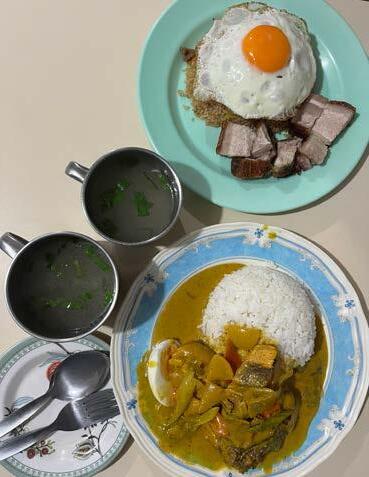
Currently, 4,000 vendors in the Baguio City Public Market feed a population of 400,000— plus over a million tourists per year. Mother Mary’s Canteen, also known as Mary’s Canteen, located at Stall 432 on the first floor of the Hangar Market, is the only eatery inside the city’s famous vegetable market. It serves Chinese cuisine seasoned to the Filipino taste. For one, they use lechon kawali in their lechon beans. Their chicken curry is mildly spiced, creamy, and just a little sweet. Manang
guests as diverse as the produce sold in Hangar.
Through conversations with her restaurant staff and suki (patrons), I learned that Mary was more than a restaurant owner— and the secret behind Mary’s Canteen’s growing popularity.
Who was Mother Mary?
An Ibaloy from Atok, Benguet, Mary Montes Puloc, also fondly called “Mother Mary,” was first and foremost a vegetable vendor. Before managing her own restaurant, she owned a puwesto (spot) in the vegetable section of the Hangar Market, known as a “ bagsakan area”—a primary point of distribution for highland and lowland vegetable traders. According to research by Baguio instructor Benjamin Meamo III, the Hangar Market was the original vegetable trading station for Baguio City and neighboring La Trinidad.
Elvira, a canteen server, told me that Mother Mary’s father had Chinese roots.
Established in the 1970s, the canteen now serves vendors, marketgoers, and
When she was younger, Mary would climb delivery trucks loaded with beans so she could find and mark the best ones to bring to her stall—a story she shared with Mary Esguerra, a former OFW who moved back to Baguio in 2002. The
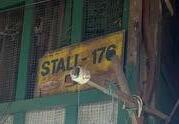
older Mary used to sell beans right across from Esguerra, who now sells lettuce, tomatoes, ampalaya and other leafy greens at Stall 176.
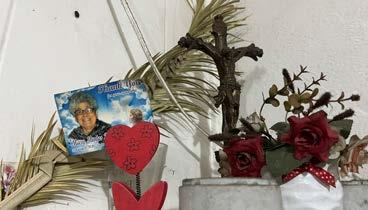
She describes the older Mary as a disciplinarian who was also a beloved leader of the Baguio City Public Market vendors. Mother Mary was also one of the lead protesters in the Uniwide market rehabilitation project in the 1990s and was recognized as an Outstanding Woman Leader of Baguio in 2009. She served the Hangar Market Vendors Association (HAMAVEAS) as president until her death in 2015, at age 76.
What is Canteen’sMary’s“Secret”?
I suppose it is safe to say that Mother Mary’s strictness is also reflected in the quality of the canteen’s food. For over 20 years, Esguerra has remained a loyal suki of Mary’s Canteen, often ordering the eatery’s specialty: Mary’s Rice, a mixture of fried chicken, lechon kawali , chopsuey, and plain rice, topped with fried egg. With its generous portion size at 190 PHP, it truly is a “worker’s meal,” as Baguio-based food vlogger ShaJrine aptly described it.
Just like her mother, Josephine Mayaco—Mother Mary’s eldest daughter—ensures that the canteen serves everything fresh and affordable by sourcing ingredients from the public market daily, including vegetables and meat. By working with suki suppliers who offer produce at a low cost, they are able to deliver on Mary’s Canteen’s promise: “Where food cost[s] less.”
Employees also speak fondly of Josephine—or “Ma’am Jojo”— who took the helm several years ago. Manang Teresita, a canteen employee since 2000, said she has chosen to stay because of her kind boss.
With Hangar Market vendors still its biggest patrons, Mary’s Canteen opens between 5:00 and 6:00 AM and closes at 4:00 PM.
How Mother Mary Lives On
The story of Mary’s Canteen is the story of Hangar’s Vegetable Market on a plate.
The beans of the Cordillera highlands meet the bawang of the Ilocos region. The crisp and bitter ampalaya complements the tenderness of the stir-fried pork. Heaps of filling and nutritious meals line the bellies of the Hangar Market folk, who then supply marketgoers with ingredients for their own healthy meals.
Mother Mary’s leadership and advocacy also persist.
In the vendor-led movement against a mall giant’s bid to redevelop the market,
January 18 - 24, 2026
Beyond the Bookshelves: Historic Manuscripts at the National Library’s Permanent Gallery
Reliving history in a way no classroom could replicate inside an underrated museum in Manila
Words and images by Marky Ramone Go
For years, Manila has functioned as a layover, a city travelers pass through on their way to the country’s more photogenic islands.
Independent tour guides hope to change that.
Following the launch of the Intramuros Administration’s “Don’t Skip Manila” campaign, various historical walking tours that aim to reintroduce the capital as a destination rather than a pitstop are now being offered to tourists and residents alike. The overall message is simple: the nation’s stories abound here.
Manila’s roster of wellcurated museums is proof of this, offering transiting visitors a good reason to stay in the city, and residents to rediscover their hometown.
There’s the old commercial corridors of Binondo and Escolta; and the National Museum complex. Inside the complex is a quartet of institutions devoted to fine arts, anthropology, natural history, and astronomy.
Within a walkable radius of each other are Fort Santiago and Intramuros, where the San Agustin Church Museum, Casa Manila, and Museo de Intramuros are situated. Along Roxas Boulevard, one will find Museo Pambata. And just steps from these vast collection of museums, near Luneta Park, the National Library’s Permanent Gallery offers another surprise revelation, a reminder that the capital still hides stories waiting to be uncovered, as this writer discovered on a random Tuesday— something I always wanted to do—at the invitation of a few history-obsessed friends.
More than Just a Place for Books and Archive Documents
Securing a library ID for the National Library was surprisingly smooth: a quick five-minute registration and pose for an ID photo, and my ID card came out hot from the printer, giving me the freedom to return anytime.
The night before, our friend Stephen Pamorada, heritage advocate and Manila tour
guide, sent a message in our group chat. “Be ready to lay eyes on Rizal’s original manuscripts of Noli Me Tanger e and El Filibusterismo .” It made us excited. And then came a follow-up message: “That’s not all.”
Philippine national anthem, Marcha Nacional Filipina with music by Julián Felipe and lyrics by Jose Palma. Pieces of furniture, such as Manuel L. Quezon’s presidential desk and chair were on display, too.
Mother Mary’s suki friend, and namesake was one of the staunchest protesters. I also first met Manang Elvira and Ma’am Josephine in protests and petitionsigning activities organized by the Save Baguio Market Movement. Mary’s Canteen donated meals to volunteers.
Esguerra told me this is to be expected. “Mother Mary’s children grew up in the market. It’s no wonder they take after her.”
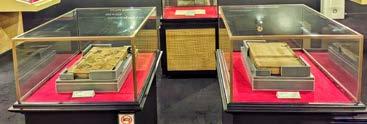
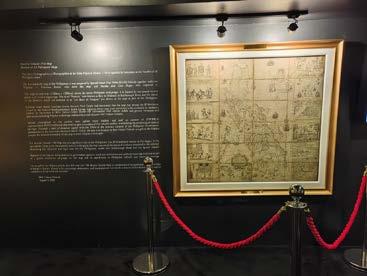
“That’s not all” meant an impressive list of documents pertaining to Philippine history: De Molucis Insulis the earliest written account of our archipelago following Magellan and Elcano’s first circumnavigation of the world, published in 1523; handwritten notes by Jose Rizal, Apolinario Mabini, and Emilio Aguinaldo; and the 1743 Murillo Velarde Map, the first detailed map of the Philippines and a pivotal document that helped secure the Philippines’ victory over China at the Hague’s Permanent Court of Arbitration. The map shows the contested Spratly Islands as part of the country.
There were also printed issues of La Solidaridad, the trial records of Andres Bonifacio and his brother Procopio; Pedro Paterno’s 1885 novel Ninay the first ever to be written by a Filipino author; the Treaty of Biak-na-Bato and one of the first copies of the
The list extended further: Antonio de Morga’s Sucesos de las Islas Filipinas , annotated by Rizal, and the original 1898 Declaration of Philippine Independence itself.
For decades, the United States had insisted on celebrating Philippines Independence on July 4 to align it with their own Independence Day. In 1962, President Diosdado Macapagal ordered its commemoration to June 12, and two years later, through Republic Act No. 4166, formally declared the date as the nation’s official Independence Day.
These documents, their pages yellowed and ink faded, bear the weight of that historic afternoon on June 12, 1898, at 4:20 PM, when General Emilio Aguinaldo proclaimed independence in Kawit, Cavite. They are, in a sense, the nation’s birth certificate.
I saved my last wide-eyed stare for the final display in the Permanent Gallery, what I considered the collection’s most significant pieces: the original manuscripts of Jose Rizal’s Noli Me Tangere and El Filibusterismo alongside the original copy of Mi Último Adiós . Standing before them, I felt goosebumps. Here were words penned under immense weight of Spanish colonialism, words that would ultimately seal Rizal’s fate and cement his place as the nation’s national hero.
To see these inked letters that had survived the passage of time in person, along with the other historical documents in the Permanent Gallery, was like witnessing history itself in a way no classroom lesson could ever replicate.
Macapagal said of the decision: “There had been other Asian revolutions before. But the revolution which culminated on June 12, 1898, was the first successful national revolution in Asia since the coming of the West, and the Republic to which it gave birth was the first democratic Republic outside of the Western Hemisphere.”
TAP
Into This Week’s Crossword Puzzle
ACROSS
4. The massive January procession in Quiapo attended by millions of barefoot devotees
7. Last name of the author who wrote Noli Mi Tangere
8. The architectural material of the Saint Philomena Church in Alcala
9. A relatively unknown public beach in Guimaras where locals gather on Sundays
DOWN
1. Renowned beach town in Bohol where Alona Beach is situated
2. Province in Mindanao where the Sunken Cemetery is located
3. Deep-fried banana rolls sold by Aling Mely in Quiapo for 25 PHP
5. Bar in Makati that’s considered one of the country’s most iconic and enduring live music venues
6. Name of the ‘Outstanding Woman Leader’ who founded the only eatery inside the Hangar Market
*Tune into to the next issue for the answers!
Sundays on Tando Beach
A remembrance of a lazy Sunday on a relatively unknown beach in Guimaras that felt as warm and comforting as the Filipino sun
Words and images by Christian Sangoyo
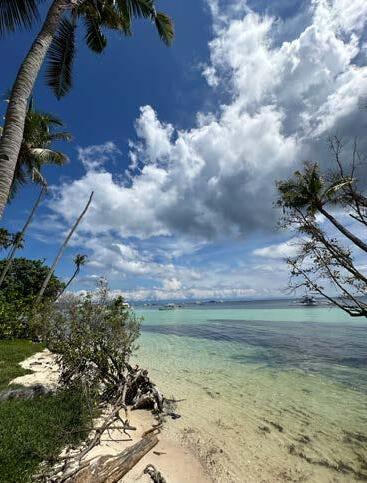
“Tatay, nakakalangoy na ‘ko! ” Kid A exclaimed as he dog paddled, the calm, cyan waters rising to his toddler chin. The late afternoon sun glimmered against the waters of Tando Beach in the island-province of Guimaras as Bob Marley wailed about how he shot the sheriff, but not the deputy. Aside from a few kids giggling and making a boat out of a seawashed log, we had the entire stretch of beach to ourselves.
Fortunately, we spied a relatively unknown beach during our hike from the island’s main road. “That’s our beach,” my wife said.
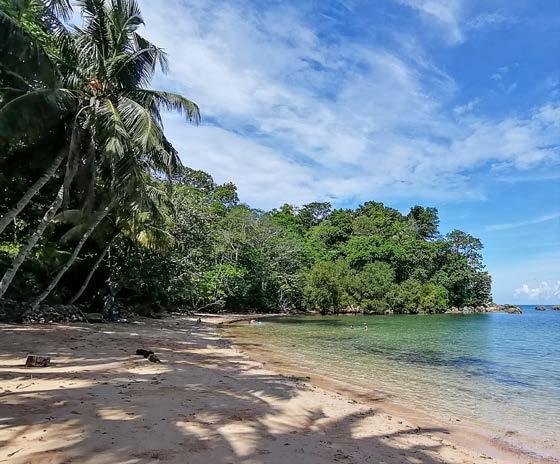
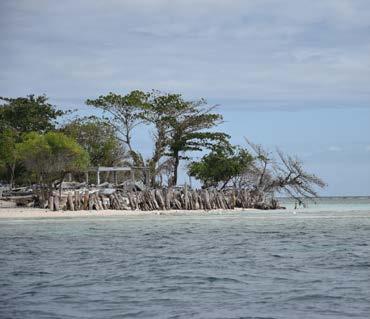
With a beach mat, snorkeling gear, sand toys, and snacks in hand, we made our way to Tando Beach, named after the barangay it was situated on. Coconut trees lined the soft, cream-colored sand, where a makeshift swing was tied around the branches of a talisay tree. Dried seagrass and driftwood, along with flotsam— food wrappers, ripped fishnets, and a lonesome slipper, among others— were strewn on the shore.
The Filipino Dream: A Cartoon Series
Viridian Forest
By Harold Fiesta
Papang is haunted by the ghost of the bicycle in the backyard.
Its bones, twisted and bare, lie open to the rain— a frame in mourning, needing to be wheeled to the scrapyard’s chapel of rust.
“It’s falling apart! Still biking at witching hour— even the dead can smell the metal!” Mamang chants her scorn, clattering pots, throwing glances like knives toward Papang, who scowls at the youngest, enthralled and unmoving in his insect hunt on the glowing screen:
Ledyba. Catterpie. Wheedle.
Papang won’t meet my eyes. And I hesitate
to rise, to buy his cigarettes. I trace the path of my boyhood once more— that same unlit street still waiting to be paved with forgiveness.
Here, I first learned to fear the belt, not ghosts.
Here, to smirk was sin, and frowning, defiance.
It was by the ar-arusip tree, beneath the crossing wires, where he once fed me the beetle I captured.
And his voice echoed, sharp as dog-bark in my mind:
“Must I ride a wheelchair just to buy a pack of smokes?!”
We accept poems on place, movement, memory, and Filipino culture in English, Filipino, and other Philippine languages and dialects from Filipinos across the world. For non-English poems please provide an English translation. Indicate your preferred byline (a pseudonym is fine).
Please submit just one (1) poem in Word format to editorial@ thearchipelagopress.com, with the email subject: Poetry: Your Name – Poem Title
Accepted poems will be paid 500 Php and featured in our weekly issue and our website. If you don’t hear back from us within 30 days of submission, please give us a nudge.
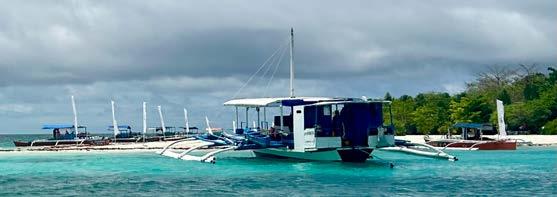
We were on the Guimaras leg of our Western Visayas tour with our toddler. Having flown to Iloilo City the night before, we wasted no time taking a onesong boat ride to the province early the next day. This short trip across the Strait of Iloilo is made possible via the openair outriggers that ply the Fort San Pedro-Jordan Wharf route.
Serene Saturday
We stayed in one of the southernmost and remotest lodges in the island, Nature’s Eye Resort an off-grid, cliff-hugging accommodation in the town of Nueva Valencia. It was the Habagat season, and we were forewarned not to stray too far from the resort’s in-house beach due to strong waves.
Kid A began picking up every piece of trash he saw. It was a practice that we taught him when we did a month-long stay in Boracay during the pandemic.
“Trash hero!” he exclaimed as he brought back and gathered handfuls of debris, in a dry part of the beach.
We spent the afternoon just wading through the water and snorkeling, with a small school of fish following us around. We had earlier thought of enrolling him in a swim school, but were thankful that we decided not to, as he suddenly learned how to swim on his own!
As the sun dipped below the horizon, we returned to shore to find that someone
already swept up the trash that our kid collected. It boosted my faith in the community, seeing the locals care for Tando Beach despite it being a fee-free public beach.
Spirited Sunday
Right after a hearty silog breakfast and fresh Guimaras mangoes, we wended our way back down to Tando Beach.
This time, we didn’t get to have the beach to ourselves for long. Within minutes, parents and kids arrived. A few more aunts and uncles followed, holding plastic containers and cauldrons. A picnic spread was soon laid out, and breakfast commenced.
More groups turned up,
each staking their claim on the sand. And as Pinoy weekends go, different speakers started booming across the stretch—some playing budots beats, some Visayan songs, and others, staples from Aegis. Soon, the inevitable videoke session began. We let Bob Marley rest, and just soaked in the local vibe.
Tando Beach, it turns out, is a weekend favorite among locals in the area. Unlike most tourists who detest crowds, places organically filled with locals are something we enjoy.
Nanays and tatays, lolos and lolas, and titos and titas soon jumped into the warm waters. A rocky islet several meters from the shore welcomed its first group of
The deserted beach was now replaced with a fullblown fiesta. It was a heartwarming sight to behold: an unadulterated, unfiltered, and authentic Pinoy beach gathering, sans the pretensions of tourist-posturing and Instagram aesthetics. It’s noisy and chaotic, but it’s as familial and warm as the rays of a Sunday morning sun, filtering across a relatively unknown Guimaras beach.
kid swimmers. Make-believe castles, moats, and volcanoes were soon erected on the shore. Even the secluded mangroves at the far end of the beach found its explorers.
January 18 - 24, 2026
Camiguin: Refreshingly Unchanged
One traveler reflects on three visits to Camiguin over 17 years and how it reveals an island that has largely stayed the same
Words and images by
Christine Fernandez
Supplemental images by Gretchen Filart
The same warm weather and blue skies greeted me when I returned to the island-province of Camiguin in Mindanao, as if no time had passed. In reality, it has been 11 years since my last trip, when two friends and I explored most of the island’s tourist attractions, including a day hike up its most prominent mountain, Mount HibokHibok. Back then, I arrived by boat from Cagayan de Oro, the main gateway to Camiguin.
While the boat service is still a popular way to get here, this time I flew from Manila— first to Cebu, then onward to Camiguin Airport via a small turboprop plane. The journey has changed, but the island’s slow, quiet rhythm hasn’t—at least from the perspective of a visitor like me.
Airports, I find, often offer a glimpse of what to expect from a place. Camiguin Airport, despite being in the provincial capital of Mambajao, is small, basic, and laid-back. It doesn’t take long to walk from the runway to the baggage carousel.
Aside from the terminal and a
handful of nearby food shops, there isn’t much infrastructure around. Stepping outside, passengers are greeted by smooth roads lined with huge, untamed trees. Motorelas, or tricycles, are among the main ways to get around the island, and it was easy to find one waiting just outside.
Before heading to our accommodation, we indulged in Italian food. Camiguin is home to several excellent Italian restaurants and other local eateries that offer veganfriendly options, reflecting the mix of people who have chosen to make the island their home.
Across from the airport, we enjoyed La Dolce Vita’s brickoven pizzas and freshly made pasta.
For my sister and me, the pizza and pasta were just a warm-up. We had a more adventurous reason for revisiting Camiguin: we were joining an open-water swimming event, with two family members in tow as eversupportive cheerleaders.
New Additions: Sporting Events
In recent years, sporting events have become a new reason for athletes and outdoor enthusiasts alike to visit Camiguin. Triathlons, open-water swimming events,
running races, and organized hikes bring an exciting energy to the island, allowing participants to experience the island’s beauty up close.
Our two-kilometer swim began on a stretch of fine black sand, with White Island visible at the starting point, before we headed out along the shoreline.
The Old Staples
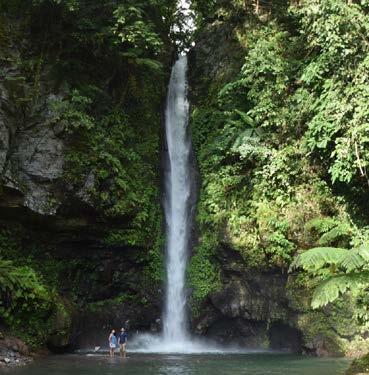
Yet, even with these additions, the island’s classic spots— the Sunken Cemetery, Katibawasan Falls, White Island, Ardent Hot Springs, Mantigue Island, the walkway to the old volcano, and Mount Hibok-Hibok remain essential stops on any curious traveler’s itinerary.
Our stop in the downtown area to pick up supplies at the island’s only department store, Gaisano, reminded us of the island’s slow pace of life. Though there were more people and vehicles, the atmosphere remained unhurried. As soon as the sunlight faded, stores began closing, and before long, we were walking along empty streets. The main tourist area along Camiguin Circumferential Road is where you’ll find most of the
restaurants, cafes, and resorts, and it’s no surprise that this is where most of the buzz is. Yet, compared to other provincial capitals, it still feels remarkably tamed.
Before going home, we made one last stop at Daos Plantbased Kitchen , a vegan restaurant near the back of the airport run by a friend who had chosen to settle on the island. Located just a short walk from the sea, it offered a relaxed setting for a memorable meal, beautifully plated and genuinely delicious. Even our meat-loving companions were delighted. I couldn’t have thought of a better way to end our trip.
You won’t find towering shopping malls or amusement parks here, and that’s exactly what draws me to Camiguin. The island offers something far rarer: unhurried moments and a peaceful vibe, with beaches just a few minutes away. It’s a stark contrast to urban life, where the streets are noisy, access to nature is limited, and a five-kilometer trip can take two hours.
From my first visit in 2008—a quick solo trip in my 20s— to two more trips since, Camiguin has remained largely unchanged. And that’s precisely what makes it so appealing. The island doesn’t try to impress with modern spectacles like towering buildings or infrastructure built for social media posts. Instead, its natural beauty and welcoming people let the scenery speak for itself.
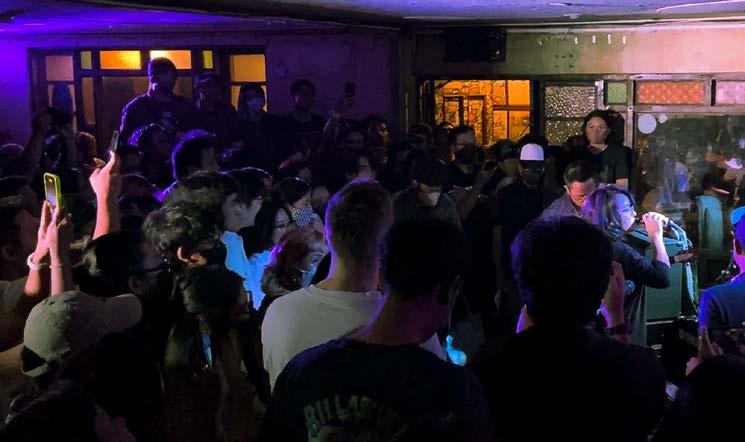
Do’n Sa Saguijo
A nostalgic, first-person chronicle across different eras of one of the country’s most iconic and enduring live music venues
I picked my head up from the floor, as the staff were tidying up, hazily coming to realize that I had likely passed out and spent most of the night having people step over my wreckage. Fortunately, the staff didn’t seem to mind; I had a full pitcher of icecold water waiting for me as I regained consciousness – a kind gesture to help me come back to my senses and recover enough to get myself home.
I’m not sure who I was there to see that night. My memories from the aughts are usually anecdotal and frequently incoherent. Because I had
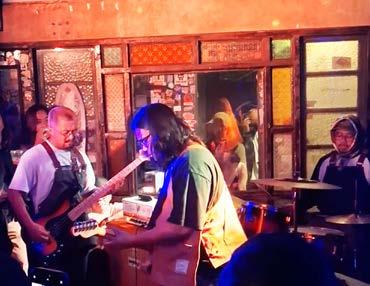
On any given day, you could catch local rockstars like Raymund Marasigan, Pepe Smith, or Ian Tayao performing with whichever band they were working with at the time. But more often, you’d stumble upon up-and-coming musicians honing their craft just before they became household names or fixtures on Myx.
It was such an intimate vibe that you could eavesdrop on Jett Pangan of The Dawn and Diego Castillo of Sandwich working their charm on the ladies, smoke with Gina Alajar and Alessandra De Rossi in the parking lot, or trade contraband with Pinoy rock luminaries who shall remain unnamed – sometimes all in one night
The 2010s and the Live Music Hiatus
I barely had enough money for a couple of beers in Sagujio when I was in my 20s. So when I could finally afford a meal there, I recall being seated on the floor at the foot of the band as Autotelic played their hits, gorging on my burger and fries as I enjoyed this next wave of Pinoy bands.
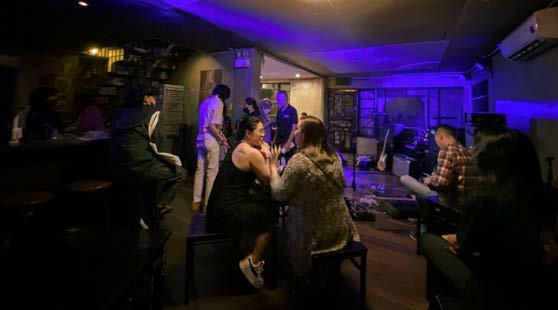
However, like many scenesters and alcoholics of the 2010s, I was lured by the sights and haunts of Poblacion. It felt like, as more people reveled in Poblacion’s trendy spots and diversifying culinary scene, the more difficult it became to find spots where you could simply find a seat, order a drink, and enjoy live music that wasn’t from a cover band.
disappeared from eye level, I remember seeing a text from my date, who was not amused that I blew her off. I would’ve told her the truth, but I was more concerned about missing a set from Kat Agarrado. Or was it Karl Roy?
Hometown
Born and raised on the side of San Andres Bukid, just over a block away from Kamagong Street and San Antonio Village in Makati, I always considered myself an honorary citizen of Binay country. As such, Saguijo was one of my go-to spots for catching the vibrant live music scene of the 2000s, fondly recalled by those old farts who lived through it as the “OPM Renaissance.”
Midlife Visits
Fortunately, the pandemic seemed to make people miss bands. And as the 2020s forged past the absurdity of social distancing, I began seeing gig schedules on my timeline once again. Eventually, I would find my way back to Saguijo, enticed by a lineup that featured S.O.S. (formerly She’s Only Sixteen) and a reunion set by Techy Romantics. Within the first minute of “7 Years,” everyone in that room was transported back to whatever quarter-life crisis, angst, and unrequited delusions they had in their 20s.
I would soon discover the joys of bird .—a sound the kids describe as “vibecore infused with shoegaze and dreampop textures.” I’m not exactly sure what that means, but I kinda get it. I’ve also become fond of Raymund Marasigan’s new outfit, Party Pace, a delightful subgenre the band describes as “a genre-defying mix of dreampop, post-rock, and hip-hop.”
The local music scene is thriving. Also, the kids don’t drink anymore.
Words and images by Timothy Jay Ibay
The Corners of Panglao that Stayed the Same
by years, mistakes, and small miracles. The view was wounded yet healed. A little blurred, but visible all the same.
On how sometimes, it’s not the world that has changed, but our lens
and
It’s been ages since I last wandered alone. I thought solitude would bring some kind of poetic revelation, like bumping into an old lover in a train station or hearing a forgotten song that suddenly rearranges the furniture of your soul. Instead, what I found was less cinematic but strangely more profound: a quiet kind of clarity. The sort that arrives unannounced and catches you off guard while you’re in your boxers and can only offer a 3-in-1 coffee.
I was in Panglao, Bohol, a place I used to associate with sunburns, cheap rum, and the kind of youthful optimism that made you think you could live forever on grilled liempo and drunken promises. Back then, every trip felt like a montage waiting to happen. This time, I was anticipating the island to shock me with how much it had changed over the years.
But what unfolded surprised me. The energy was different. The motorbike rides felt slower, the music from the beach bars less urgent, and the sea—still impossibly blue—seemed to dance to a softer tune. Even Alona Beach, usually bursting with tourists and itinerant vendors
For a second, I thought he was joking. But he meant it and spoke with such conviction that I briefly considered canceling my countryside tour plans and staying for a Chickenjoy lunch. Maybe he was right. After all, in a world that keeps changing, there’s something oddly comforting about knowing that Jollibee will always taste exactly the same.
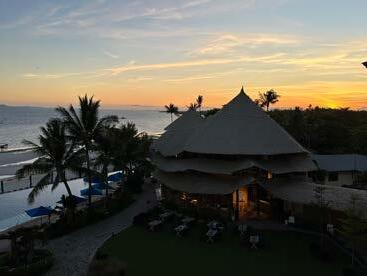
Later that afternoon, I found myself at an old resort along Dumaluan Beach, the kind of place that still plays Bonnie Bailey tracks without irony.
to afford the drinks I used to only photograph for free. The bartender, who might’ve been a toddler the last time I came here, had a man bun and a tattoo of a wave curling around his forearm. I wasn’t surprised when my Long Island arrived with a pretentious dried orange slice. A bit of an afterthought, but a thought nonetheless.
As I stared at the expanse of the sea, with Cebu blurred by the ocean haze, I realized it wasn’t Panglao that had changed; it was my lens. The coconut trees were still performing their
Our gaze, I’ve come to realize, is strung with banderitas of choices. Those little triangular flags of memory and decision stretched across the cord of time. Some are bright with triumphs, others tattered from the storms we’ve endured. Together, they make a colorful mess of who we
that once made you feel alive. Maybe growing up is just learning to sit still—to listen to the water lapping at the shore without needing it to say something profound.
Nothing out there has really shifted. The tides still come and go; the world still spins with or without our permission. What’s transformed is how we see. We’re no longer looking through the clear pane of youth but through a looking glass, with ourselves now part
selling pearls, looked like it finally had a chance to exhale. At one point, I asked a local tricycle driver where the best place to eat was. He looked at me, thought for a moment, and with all the confidence of a man holding the island’s culinary secret, said, “Sir, Jollibee po, sa kanto ng Alona.”
I used to sit there years ago, broke and dehydrated, trying to look deep while writing in a notebook I never finished. It felt strange, returning to a scene that hadn’t changed, except now I was on the other side of the demographic divide: older, sunblocked, moisturized, and finally able
lazy sway, the stray dogs still owned the coast, and the same salty wind still tangled itself in people’s hair. Panglao, true to its naturally festive spirit even in its leanest season, banderitas and all, remained unapologetically itself. I was seeing it through a different window now, one smudged
are: imperfect, contradictory, but beautifully ours.
I used to think clarity came in grand revelations, like a sunrise cracking the sky open. But sometimes it appears while you’re people-watching by the beach, sipping on a syrupy drink, and realizing you no longer crave the noise
of the frame. And maybe that’s the whole point: to return to the same places, to walk the same paths, and realize that while the scenery stands still, we’ve become the moving parts, adorned with our own colorful banderitas Yes, a bit cluttered, but joyfully celebrated.
The Archipelago Press
Address: 630 1st Avenue, PMB, 318, San Diego California, USA 92101