Vol. 39, Issue 1 Aug. 27, 2026 College
04 merger
Independent Student voice of Boise State since 1933
In the face of budget cuts, the university merged the College of Education and College of Public Service.
05
AI gym equipment
Campus Recreation staff say the $160,000 investment removes barriers to exercise.
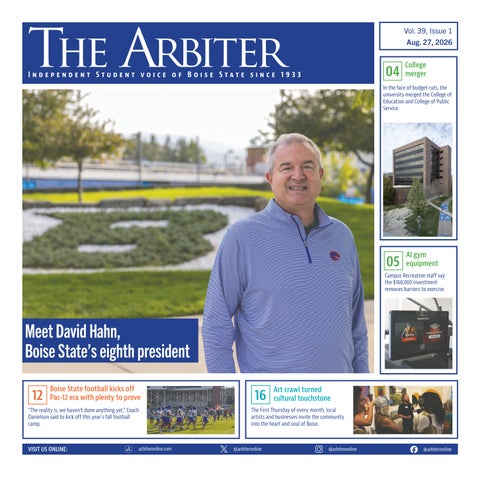
Meet David Hahn, Boise State’s eighth president 12
Boise State football kicks off Pac-12 era with plenty to prove
“The reality is, we haven’t done anything yet,” Coach Danielson said to kick off this year’s fall football camp.
VISIT US ONLINE:
arbiteronline.com
16
Art crawl turned cultural touchstone
The First Thursday of every month, local artists and businesses invite the community into the heart and soul of Boise.
@arbiteronline
@arbiteronline
@arbiteronline
EDITOR-IN-CHIEF
Emily Carmela Nelson
editor@stumedia.boisestate.edu
ON THE COVER:
MANAGING EDITOR
David Hahn, Boise State’s newly appointed eighth president, plans to bring student concerns to the forefront of the university now that he has entered, in his words, its “wonderful, synergistic world.” Get to know him on page 10.
editor@stumedia.boisestate.edu
HOW TO REACH US:
Aidan Mattingly EDITOR Jack McElwee REPORTER Hailey Danner REPORTER
CONTACT US:
OPINION
editor@stumedia.boisestate.edu 208.426.6302
opinion@stumedia.boisestate.edu
Zaccary Kimes NEWS
news@stumedia.boisestate.edu
PHYSICAL LOCATION:
April Campos
Located on first floor of Lincoln Avenue Garage Suites
CULTURE
MAILING ADDRESS:
culture@stumedia.boisestate.edu
Student Media MS 1340 1910 W University Dr. Boise, ID 83725-1340
Vivian Navarro Cortes Cole McAdams
EDITOR
EDITOR REPORTER
SPORTS
FIRST THUR WELCOME TSDAY: O IDAHO! 5-8PM • BUS TER’S KITCH EN
sports@stumedia.boisestate.edu
Jake Zamora Emilia Rose Nowinski
RS. THUU TH RS.
EDITOR
SSEEPPTT
REPORTER
0 033
ASSIGNMENT DESK pitch@stumedia.boisestate.edu
Phoenix Willard Savannah Sanchez Landon Myers Sofia Davis
REPORTER REPORTER REPORTER REPORTER
DESIGN AND PHOTOGRAPHY design@stumedia.boisestate.edu digitalcontent@stumedia.boisestate.edu
Makena Walker DESIGN MANAGER Abby Herbert GRAPHIC DESIGNER Mia Strand ILLUSTRATOR Keara Antonelli DIGITAL CONTENT MANAGER Scout Hoots DIGITAL CONTENT PRODUCER Bryce Goldinger DIGITAL CONTENT PRODUCER OUTREACH AND ADVERTISING Distributed biweekly throughout the academic year, The Arbiter is the official independent newspaper of Boise State University where student editors make all content decisions and bear responsibility for those decisions. The Arbiter’s budget consists of fees paid by the student body and advertising sales. Additional copies can be picked up free of charge at the Student Media office.
ads@stumedia.boisestate.edu
Allie Chon Ashlie Robben
ADVERTISING MANAGER SOCIAL MEDIA & OUTREACH COORDINATOR
CHECK OUT ALL BOISE STATE DINING EVENTS @BOISESTATEDINING dineoncampus.com/BoiseState
PHOTO OF THE WEEK Volleyballl Scrimage Scout Hoots
TURN YOUR UNWANTED MUSIC/VIDEO INTO CASH! WE ARE BUYING ALL FORMATS: VINYL CDs CASSETTES DVDs/BLU-RAY TURNTABLES CD PLAYERS CASSETTE DECKS AMPS/RECEIVERS
1105 W. Idaho St. Downtown Boise (208) 344-8010 ● therecordexchange.com
NEWS NEWS@STUMEDIA.BOISESTATE.EDU | ARBITERONLINE.COM
COLLEGE OF EDUCATION AND SCHOOL OF PUBLIC SERVICE BEGIN TWO-YEAR MERGER The colleges will take two years to fully integrate, with no immediate changes to students’ degree paths. Hailey Danner | News Reporter | Photo by Keara Antonelli
A
fter a major college restruc‑ turing, Boise State com‑ bined the College of Edu‑ cation and School of Public Service into one, bringing together 15 undergraduate degrees and 20 graduate programs. Although both colleges were for‑ mally combined on July 1, integrating their new academic and administrative operations is expected to take about two years, according to Andrew Finstuen, former College of Education dean and interim dean of the newly established college. The merger comes in the aftermath of the university absorbing a 3% budget cut, The Arbiter previously reported. Boise State officials emphasized that students will face no immediate disrup‑ tion to their classes, major requirements, or progress toward graduation. “Your programs and curriculum aren’t changing. Yes, there’s a new name, but you’ll take the same classes and move through your degree as planned—there won’t be disruption to your degree path‑ way,” Finstuen said. Boise State plans to reinvest admin‑ istrative savings from reduced overhead directly into hiring new faculty, growing student program budgets, and funding research centers, Idaho EdNews reports. According to Boise State’s website, the integration will “utilize each college’s strengths in policy and governance, and faculty expertise in education and public service.” “The School of Public Service and the College of Education are two of our most public‑service‑focused colleges, so leadership saw a strong mission align‑ ment between them, along with an
4
August 27, 2026
opportunity to gain some administrative efficiencies,” said Finstuen. However, Lauren Kelley, one of the student government senators for the School of Public Service, expressed concerns about how students may lose a sense of identity due to merging the two colleges. “One of my immediate concerns was that College of Education and School of Public Service students might lose their sense of ownership over their own colleges,” Kelley said. “I feel like in uni‑ versity having a sense of ownership over something is really important.” Former School of Public Service sen‑ ator Charlotte McNeely said the merger came as a surprise to her. She felt caught off guard by the decision, especially as a student representative. “I definitely was really shocked, and I felt kind of blindsided because I was
| ARBITERONLINE.COM
serving as the representative for the school,” McNeely said. “If they are to ever do something like this again … my request would be to have a bit more student involvement and transparency.” Throughout the summer, a planning committee overseeing the merger has met three times already and continues to hold several more meetings before the start of fall semester. “We did meet with students to hear lots of questions, and we’ll do more of that in the fall,” Finstuen explains. The merger timeline will depend on several factors, including receiving state approvals, updating policies, keeping student services running during the transition and aligning academics with student support services. The university will continue to share details involving programs, resources and administrative changes over the next two years. Mc‑
Neely and Kelley hope Boise State will inform students about future changes like this. Both also believe that students should be more involved in decisions that affect them. “Even though we can’t change the outcome of the merger, we really want to make it a smooth transition, not one that creates more tension than there needs to be. Rather than fighting the outcome, what can we do with it to create the best experience for students overall,” Kelley said.
NEWS
BRAIN MEETS BRAWN WITH BOISE STATE’S NEW AI-POWERED GYM EQUIPMENT Campus Recreation staff say the $160,000 investment removes barriers to exercise Aidan Mattingly | News Editor | Photo by Aidan Mattingly
W
alking into a gym for the first time comes with a list of questions — Which machine should I use? How much weight should I lift? How many reps should I do? And am I even doing this right? Boise State’s newest strength equipment aims to answer those questions before students have to. Campus Recreation invested approximately $160,000 into 12 EGYM strength machines that use individual measurements, strength testing and fitness goals to personalize workouts. Boise State is one of 10 universities utilizing the equipment and participating in EGYM’s REV10 initiative. “Our goal here is to remove barriers and to make the gym accessible to both a person who’s never lifted before and those who are more advanced,” Director of Campus Recreation Katie Burns told The Arbiter during an EGYM demonstration. “It allows anyone to be able to walk up to these machines and figure out how to lift weights efficiently.” The Rec Center now has an additional five upper-body machines, five lower-body machines and two core machines. EGYM also launched a fitness app giving students access to personalized features after completing an onboarding process, though an account is not required to use the machines. The onboarding process takes approximately five to 15 minutes, according to Burns. Users enter information about their fitness experience and goals before completing measurements and tests that evaluate areas including strength and flexibility. From there, EGYM builds a profile around the user. Once someone logs into a machine, the equipment can adjust its positioning based on the person’s measurements, recommend resistance
and guide the user through repetitions and range of motion. Strength tests help establish how much resistance a user should start with. EGYM then stores those results and can adjust future workouts as the user progresses. EGYM’s Genius AI technology can also use fitness goals, experience and available workout time to determine exercises, sets and repetitions. The system extends beyond completing repetitions — users can earn points, reach different statuses and compete on leaderboards that periodically reset. Workouts completed outside the EGYM machines can also contribute to a user’s profile through the app. Jared Cox, Campus Recreation’s associate director of programs and communication, said the technology attracted the department partly because it could serve students who already exercise regularly while lowering the learning curve for others. “But truly, I think it goes back to the ability of it breaking down barriers for people who are new and not sure how to get started,” Cox said. At the same time, the equipment does not remove every responsibility from the person exercising. Zac Cintron, Campus Recreation’s fitness coordinator, said EGYM can serve as a learning tool by guiding beginners through proper form, resistance, rest periods and set and repetition structures. Those features can help students build enough knowledge and confidence to eventually navigate other parts of a gym. Cintron also said EGYM still lacks the human element of personal training. The technology cannot observe someone exercising in real time, recognize when adjustments are needed, ask follow up
questions or apply professional judgment to an individual’s situation. “There is a level of collaboration and discourse that doesn’t exist when consulting technology,” Cintron said. “So, in my professional opinion, EGYM provides an excellent autonomous starting point to make strength training more approachable, but I don’t see it replacing the relationship between client and coach that personal training provides.” Cintron also cautioned students against allowing fitness technology to dictate their relationship with exercise. Wearables and fitness equipment can produce large amounts of performance data, but he said users can become too focused on optimizing individual scores or workouts instead of recognizing normal fluctuations in performance. “Technology should be a tool that supports someone’s fitness journey, not
something that makes them feel incapable of exercising without it,” Cintron said. The machines can still teach some fundamentals. EGYM uses guided visualization called “The Curve” to show users how to move through an exercise. Cintron said it can improve movement awareness and consistency, but students still need to pay attention to technique and how their bodies feel. He also emphasized that progress does not always mean adding weight. Beginners can improve through increased comfort, movement efficiency and consistency before numerical strength gains appear. For Burns, guidance remains one of EGYM’s biggest benefits. Staff plan to remain near the machines during the beginning of the school year to help students get started.
August 27, 2026
| ARBITERONLINE.COM
5
NEWS VIOLENT CRIMES ON THE GREENBELT SPARK CONVERSATION ABOUT CAMPUS SAFETY Jack McElwee | News Reporter | Photos by Keara Antonelli
T
he Department of Public Safety is emphasizing the importance of resources available to students after Boise Police responded to a homicide near 11th Street and Pioneer Parkway and a woman was attacked near S. Ferguson Street in early July. These crimes were jarring to the Boise community, however Lt. Chris Davis with Boise Police stressed Boise is “still very safe. “ “The state of Idaho and the city of Boise are extremely safe compared to the rest of the United States,” Davis said. “The city of Boise is very safe within the state of Idaho. Idaho has a very low crime rate [and] the city of Boise has a very low crime rate.” Junior mechanical engineering student Granite Stephens agreed too. “I feel pretty safe on the Greenbelt,” Stephens said. “I have not had any bad experiences.” Neither crime took place on campus and the Greenbelt is considered safe according to both Boise State officials and Boise Police. The safety of the Greenbelt on campus is bolstered with blue light phones, lights and security cameras. “We do have a fairly safe stretch of greenbelt,” said Tana Monroe, associate vice president of the Department of Public Safety. “It’s well lit. It has the blue light phones where people can push the buttons and get a hold of 911 dispatch and our security officers, our public safety office.” Boise State also utilizes a mobile app called Rave Guardian, allowing users to contact emergency services and communicate with university dispatchers. The app essentially acts as a direct hotline to campus security or police. “So what you can do is you can text our dispatchers, you can immediately call 911,” said Monroe. “It also at that time sends the GPS coordinates of where the phone is, and so we can call the person
6
August 27, 2026
and then immediately dispatch police and security to their location.” The app also contains a safety timer function for additional security. The timer can be set for any length of time and if not deactivated, will automatically alert either a set emergency contact, or campus security.
Lt. Davis also encouraged students to have access to the app. “Everybody on campus should download Rave Guardian and have it on their phone,” Davis said. “There’s a ton of different resources on there.” As for what students can do to keep safe, both Monroe and Lt. Davis empha-
The Boise River Greenbelt on Tuesday, Aug. 26.
| ARBITERONLINE.COM
sized staying aware of your surroundings as a key way to stay safe. They both recommended removing earbuds or any distractions and for students to be aware of their surroundings when using the Greenbelt.
NEWS RIVERFRONT PLAZA IS ON PAUSE AS ALBERTSONS LIBRARY REMODEL RAMPS UP Landon Myers | Reporter | Photo by Bryce Goldinger
B
oise State students will have to wait a little longer for the Riverfront Plaza. After a multiple month-long review process, Campus Operations delayed the project until 2027 as the university moves forward with renovations to Albertsons Library. The delay comes after the Permanent Building Fund Advisory Council’s review took longer than expected. “Many of the university’s public works projects, especially those of this magnitude, must go to the Permanent Building Fund Advisory Council for review and authorization,” wrote Drew Alexander, associate vice president of Campus Operations, in an email to The Arbiter. “With the final design and bidding process still remaining, we chose to postpone the anticipated start of construction to spring/ summer of 2027.” Despite the delay, Campus Operations believes the Riverfront Plaza is a vital piece for the future of Boise State’s campus. “A key theme of the Master Plan is building a more student-centered campus,” said Alexander. “One that embraces its riverfront setting rather than turning away from it.” The university’s location along the Boise River gives students access to the neighboring Greenbelt. According to Campus Operations, students felt that embracing the nature where the university resides would improve the environment of campus. “Students have consistently told us they want more spaces to socialize, relax and decompress between classes,” said Alexander. The 10-year master plan is the culmination of the ideas brought to Campus Operations by students. The master plan outlines the project in full, with the intentions of creating “a welcoming setting for informal gatherings and everyday campus life.” Other
planned elements include an entrance to the north side of the Albersons Library, bike parking and flexible open areas to provide a “third-space” for students. The plaza’s proposed location also offers some more safety along the Greenbelt according to Alexander’s email, “Beyond programming and placemaking, an activated riverfront space has a practical community benefit— improved safety along a well-traveled stretch of the Greenbelt.” With the increase in activity near the plaza, visibility is a key part to ensuring safety according to the details laid out in the master plan. The Riverfront Plaza is projected to cost $2 million, with the project funded through student facility fees. The facility fee is part of the tuition as full time students pay $694.80 per semester towards it. Campus Operations will shift focus to remodel Albertsons Library. Most of the renovations will focus on the library’s first floor, with plans to update the carpeting, paint, and furniture, with a new north entry that “leverages the plaza and riverfront
Rendering of Riverfront Plaza proposal from Campus Operations. amenities.” The remodel is expected to be completed in spring 2027.
August 27, 2026
| ARBITERONLINE.COM
7
OPINION OPINION@STUMEDIA.BOISESTATE.EDU | ARBITERONLINE.COM
MISINFORMATION ACTIVELY THREATENS THE FUTURE OF IDAHO’S MEDICAL SCENE April Campos | Opinion Editor | Illustration by Mia Strand
T
he beauty of a dandelion captivates anybody who looks at it. While seemingly harmless, upon closer inspection one will find that its enchanting seeds serve only as a means of propagating the weed. Medical misinformation behaves the same way. The longstanding public distrust in medical professionals is nothing new. In the years after the COVID-19 pandemic, misinformation became a massive threat to modern medicine. What makes these issues especially dangerous is the political voices behind them. Voices like Dr. Ryan Cole, a licensed physician and board-certified clinical pathologist whose political platform has propelled a new wave of medical misinformation in Idaho. This misinformation threatens to hurt our rural communities even more than before. 38% of rural physicians reported encountering “a great deal” of misinformation among their patients according to The Physicians Foundation. This is due to systemic barriers such as distance, financial strain and physician mistrust. Misinformation is especially rampant in Idaho, with over 28% of residents living in rural areas of the state according to the Idaho Department of Labor. The vulnerability of these areas make it easy for politicians to appeal to already growing public distrust in scientific guidance. A resounding example of this is the re-appointment of Dr. Ryan Cole on the Central District Health Board, a multi-county regional organization that serves Ada, Boise, Elmore and Valley county. In the past, Dr. Cole’s position in the medical field has been met with
8
August 27, 2026
distrust due to his long-standing vocal opposition to vaccines, mask mandates and hospital treatments. Dr. Ryan Cole’s growing platform on social media and news outlets creates a space for him to continuously promote misinformation. The Washington Medical Commissions reported Dr. Ryan Cole abused his position as a doctor by making false statements on COVID-19 vaccines and mask effectiveness. Along with this, he provided patients with ivermectin to treat COVID-19 without meeting the patient to document past history and informed consent. It’s important to ask if these actions are representative of the District Health Board in our counties. What makes a politician’s platform especially dangerous, is when they hold no repercussions for the public discrediting of scientifically proven research. Instead those challenges fall on medical professionals all around the state. Michael Kunz, a supervisor of laboratory operations at Saint Luke’s Boise Medical Center, has witnessed the growth of misinformation throughout his career. “Medical misinformation can contribute to delayed care, preventable illness and even harm from ineffective or harmful treatment/medication.” said Kunz “Not only threatening individual wellness but also public health infrastructure.” As politicians continue to use their platform to denounce and discredit scientific research, we lose trust in the licensed professionals who hold together the fabric of our communities. This new generation of doctors, physicians, researchers and lab scientists carry a great deal of responsibility in entering a field
| ARBITERONLINE.COM
that has been overrun with the erosion of public trust. Nimo Abdi, a senior undergraduate student at the College of Idaho studying Biomedical Sciences and Philosophy describes how this rapid growth fails to meet the expectations of citizens. “Politcal bodies hold the ultimate power not only in funding a healthcare system, but also in building an infrastructure that will truly serve the people,” said Abdi. “Our greatest solutions are built by turning our frustrations and passions into actionable change for all.” Madison Kincaid, president of the pre-med club at Boise State provides a similar statement. “It motivates me to be the change and not let misinformation taint people’s view on healthcare,” said Kincaid. “As someone in healthcare, I do value the people we work with and the people that are taking care of others.” Kincaid explains that as a student entering this field, the constant erosion of patient and doctor trust is strong reasons she believes her work is important. Students studying to work in the medical field like Kincaid and Abdi serve as reminders that misinformation
actively threatens the future of medicine in Idaho. When individuals such as Ryan Cole blur the line between presenting as a doctor vs a politician, it propels false ideas into a position of power. When we fail to recognize the harm that politicians can do to the medical field, we open the chances of continual misinformation and neglect in our state. The responsibility of acknowledging the importance of scientific guidance falls on our politicians to ensure they understand the communities they represent. Dr. Ryan Cole has continuously proved disregard for factual guidance. The future of medicine belongs in the hands of those who are willing to preserve it, not hurt it.
OPINION
TARGETED LAW DRIVES UNHOUSED COMMUNITIES FURTHER FROM SHELTERS April Campos | Opinion Editor | Graphic by Makena Walker
F
ear is a continual barrier to progress in our state. Fear pushes people away from communities that need the most help. Fear is the result of a government so indifferent to the struggle of its citizens it chooses to criminalize their actions rather than provide proactive solutions. Fear creates an environment of ignorance about homelessness in Idaho. In 2025, over 9,000 Idahoans sought homelessness services and at any given night roughly 3,000 Idahoans went to bed in a shelter or outside, according to a study conducted by The Idaho Housing and Finance Association. The unhoused crisis is one of the most urgent matters in Idaho politics and recent legislation enforcement is one of the driving factors in its growth. After two violent attacks occurred on the Greenbelt earlier this summer, Idaho’s governmental agencies took measures to increase security around the Greenbelt. This manifested through the increased enforcement of pre-existing House Bill 1141, commonly referred to as the Galloway Bill, which authorizes a statewide ban of unauthorized outdoor habitation including tents, public camping, sleeping or other temporary accommodations. State Representative Mike Moyle explained his issues with the City of Boise’s lack of enforcement for the Galloway Bill in a press release where he stated, “The law doesn’t need to be strengthened or changed — it just needs to be followed.” Legislators like Moyle believe that this could have been a preventable issue, paving the way for more rigorous enforcement of the law in Boise. When enforced, the bill results in a $10 ticket which can total over $50 with added fees. The result of the legislation created unprecedented struggles for both individuals and shelters throughout Idaho.
“Now that the law has been consistently enforced it’s made people scatter,” Jessica Abbot, executive director at Corpus Commons, a day time homeless shelter in Boise, said, describing how engaging with and locating guests has become a difficult task due to new public enforcement of the bill. “They might be in a day and then they go and hide in places that aren’t feasible. It’s pushed them out further towards the river, towards Nampa and other spaces along the Greenbelt.” Abbott explains many guests find locations farther away from law enforcement and stay constantly moving onfoot to prevent possible citations. With increasing temperature and decreasing air quality, the unpredictability of when guests come and go at day shelters could be the difference between life and death for these individuals. After the Galloway law was originally passed in 2025, Abbott said that most of the responsibility to care for these communities was left up to shelters all around Idaho. Without outside funding, raising money, providing resources and
finding volunteers becomes a difficult task that many local shelters struggle to sustain. “There’s concerns there, and in that we totally understand,” said Abbott. “But criminalizing and punishing somebody for going through a crisis is not a solution.” The inability for cooperation between state legislators and local shelters creates a barrier that impedes further coordination on how these individuals can get the resources they need. “Homelessness can happen to anyone,” Kristin Contreras, shelter coordinator in Caldwell for Advocates Against Family Violence, said of the societal stigma surrounding homelessness. “A lot of the phone calls and the questionnaires that we’ve been getting are from people who are just homeless and have had sexual violence in their past.” Contreras explained the mentality of looking the other way is harmful due to its inaction and creates large barriers in advocating for these communities. The continuous cycle of passivity drowns out
the work done by both independent and federally funded organizations in Idaho. The mayor’s Advisor on Homelessness in the city, Jessica Barawed, provided a statement on the City of Boise’s path to investing in these individuals. “We believe lasting solutions require both safe public spaces and meaningful pathways to shelter and permanent housing,” Barawed explains. These pathways include the city’s Our Path Home program which is a public-private partnership between Boise and Ada county to aid in the prevention of homelessness. Through temporary rental assistance, financial aid for utility bills and partnership work alongside landlords for eviction-prevention, Our Path Home assisted thousands of Idahoans receive resources. The Galloway Law continues to halt preventable action against homelessness and its consequences have pushed many shelters three steps back in the process. Change in Idaho starts with individuals, who advocate, donate, volunteer and ultimately ask more of our politicians, to protect all Idahoans.
August 27, 2026
| ARBITERONLINE.COM
9
Emily Carmela Nelson | Editor-in-Chief Design by Makena Walker, Photo by Keara Antonelli
“A university is this wonderful, synergistic world”
Picture a beautiful, intricate watch. On its face, the hands move smoothly, keeping precise time with what seems like little effort. Flip it over, take off the back and the illusion disappears. Suddenly, there are gears, coils and countless moving parts working together to make it run. That, David Hahn said, is how he views a university. “If you really step back and think about it, everything is a system,” Hahn said. “Your human body is a system, the Earth is a system, the university is a system.” It’s an analogy he had used several times that week, he told The Arbiter in a late July interview, one month into his presidency. Earlier that week, Hahn, his wife and their dog, Ophelia, had officially made the move to Boise from Tucson, where he spent nearly seven years as the dean of the University of Arizona’s College of Engineering. Engineers, he said, are trained to break down problems into their fundamental pieces, understand how those pieces inter-
act and bring them together to find a solution. “As an engineer, I embrace those parts and I embrace the people that make those parts work,” Hahn said. “When you do that, suddenly you’ve got that culture of greatness.” At the University of Arizona, Hahn tripled research expenditures, played a key role in securing more than $45 million in state legislative funding for the College of Engineering and expanded its academic offerings. His tenure working across the university to create new connections between engineering and other disciplines, including a joint degree with the business college and an applied humanities track for engineering students. In a message announcing Hahn’s departure from the university to faculty, staff and students in the College of Engineering they praised him for fostering a “strong culture of teamwork, mutual respect and collegiality.”
That same culture was evident in how he responded when one Arizona parent came to him with a problem. Terry Matsunaga’s son had graduated from the College of Engineering but was struggling to launch his career. It wasn’t a question of talent, Matsunaga told The Daily Wildcat, the student newspaper at University of Arizona. His son was autistic, and he was having difficulty navigating the social demands of the job search. Matsunaga, a professor of neurosurgery and biomedical engineering, suspected other engineering students who are autistic might face similar barriers. His solution? Working alongside Hahn and Wendy Parent-Johnson, the director of the university’s Sonoran Center for Excellence in Disabilities, to establish a program for neurodivergent students to prepare for the workforce. In 2020, the three worked to establish what would become IDEAS in Mind, a program that prepares students who are autistic or neurodivergent for the work-
place through vocational support services and mentoring. The program has since helped dozens of students find engineering internships, The Daily Wildcat reported. In a statement to The Arbiter, Matsunaga described Hahn as “instrumental” in the establishment of the program. “IDEAS in Mind came to fruition with Dean Hahn’s gracious assistance and our shared vision for finding career positions [for] students on the spectrum,” he wrote. Hahn has spent more than half of his 28 years in academia as a leader. Still, he said, he sometimes thinks of himself as a faculty member and professor first. “What’s always guided me is being rooted in the fact that we’re an educational institution,” he said. “We take young students and give them the tools in and out of the classroom to achieve [their] greatest potential, and that’s what it’s all about.”
“Leadership is the ability to bring pieces together.”
Hahn’s presidency began with little fanfare. He arrived on campus after a presidential search that stretched more than a year and stalled for months as it unfolded under a new state law that allows Idaho’s public universities to conduct much of the selection process behind closed doors. By the time Hahn was named the sole finalist for the position in June, there was little time — and few students around — to get to know the person who would soon lead the university. He inherits Idaho’s largest four-year university, including its budget shortfalls, ambitious research goals and turbulent relationships with state lawmakers after years of political tension. So how does a president connect with a campus community that had little chance to get to know him before he arrived? His answer is to start now. “You know, the process is the process, right?” Hahn said when asked how he plans to connect with Boise State commu-
nity members who wanted more involvement in the presidential search. “State law dictated the process.” He pointed to interviews and meetings he had with students, faculty, alumni and other university stakeholders before being named the sole finalist, as well as the twoweek public review period that followed. During the required review period, the university held a one-hour public forum in the Jordan Ballroom with a virtual attendance option where students, faculty and staff could ask questions of Hahn. The State Board of Education also invited members of the public to submit feedback on Hahn’s potential appointment. “There was a lot of engagement,” he said. “…I went home from that public commentary period feeling like, ‘wow, I really made the right choice.’” When The Arbiter requested the public’s feedback on Hahn’s appointment, the State Board refused to provide them, citing a public records exemption covering
“information relating to a public employee or applicant.” For Hahn, the search is behind him, and the work of building a reputation at Boise State is just beginning. “Now as president, I have the opportunity to take [my work as dean] to the next level,” he said. “To take all the interconnected pieces and help bring us together — you, me, the faculty, students, staff — to look for those opportunities of synergy and collaboration. Leadership is the ability to bring pieces together and do things that ultimately benefit [students].” As university president, Hahn views his role as an opportunity to “transform lives,” and said that process starts with visibility and listening. “What shapes me as a president is collaborating across campus,” he said. Hahn plans to meet with student leaders, whom he described as partners in identifying problems and developing solutions. “Come to me with some initiatives we can tackle together,” he said. “What I can do for student leaders that have ideas in projects is help implement those. I can help fund those — we have to agree on what they are, but things that advance the experience here, I’m going to be all about.” He views relationships with student leaders as a “two-way street” and plans to ask them to bring ideas and projects to him so he can help move them forward. For now, that approach is more about creating a process for those conversations than laying out specific initiatives of his own. Campus safety offers one example of what that will look like. Hahn described himself as a “big believer in campus safety” and said it will be a “centerpoint” of his presidency. But when asked what specific initiatives he plans to pursue, he instead pointed to listening to problems students might bring to him. “What’s interesting about a thing like campus safety is when you have a great experience, you don’t think a lot about it, and that’s what I want. I’m sure that our students are going to come to me with ideas like ‘Hey, we’ve noticed this, and can you help us here?’ and the answer is going to be ‘Yeah, let’s collaborate on that.” That same philosophy will shape how Hahn approaches initiatives already un-
derway at the university, like the pursuit of R1 research status and the merger of the College of Education and School of Public Service that began this July. In regards to R1, Hahn arrives at a university that has already done much of the work. Boise State is pursuing classification as a top-tier research institution, with the next designation cycle expected in spring of 2028. “The credit goes to many people that have come long before I showed up — I think we’re pretty much there,” Hahn said. He added he views the designation as more than a ranking. “It brings pride. It means that our faculty are conducting original research … doing relevant work that brings dollars to this university that will fund graduate students.” As president, Hahn views research and education as part of the same system. “I don’t like to separate the education and research mission because they’re heavily intertwined and they feed off of each other,” he said. When the university announced plans to merge the College of Education and School of Public Service and dissolve the School of Innovation and Design last spring, student leaders involved in the programs told The Arbiter they felt “caught off guard” by the transition. The move came in the aftermath of the Joint Finance-Appropriations Committee’s (JFAC) decision not to restore a 3% budget cut for the next fiscal year. “In higher ed today, there’s always a balance of funneling our dollars and your tuition dollars to the front line of education,” Hahn said. “That’s in the classroom and in the laboratory, there’s always the cost of doing something that has an administrative cost as well, such as deans and associate deans. It’s always desirable to find the right economy scale. One does not want to have too many small colleges.” He emphasized that while it is impossible to have colleges with equal enrollments, “you don’t want 100 [students] here and 1,000 there, or 5,000 here and 400 there. I’m very happy with our academic structure.” At the same time, Hahn acknowledged that some students may view the merger as a negative, but he expects the new structure to create new opportunities. “I’m sure there’s people that felt like this was a loss of identity, but a university
‘A UNIVERSITY IS THIS WONDERFUL, SYNERGISTIC WORLD’ |
EMILY CARNELA NELSON
is this wonderful, synergistic world. Over time what’s going to happen is there’s going to be new collaborations and opportunities for students that people never even thought about. I think we’re in a good place, I think we found that optimal spot.”
I think they all understand a bright future for Idaho is rooted in education,” he said. Gov. Brad Little echoed that sentiment in a statement to The Arbiter welcoming Hahn to Boise State. He described the university as an important part of preparing Idaho’s “next generation of leaders, innovators and workforce talent” and pointed to Hahn’s background in engineering, research and workforce development as a fit for Idaho’s “continued growth and opportunity.” “We welcome Dr. Hahn and look forward to working together to build on Boise State’s strong momentum,” Little wrote. Hahn said he doesn’t want to approach lawmakers asking for more money — in his words, “no one wants to be treated like an ATM.” “Lets find things that we can agree are good for Idaho, good for the economy, good for the stewardship of our citizens,” he said. “If we find that common ground, I’m optimistic we can advance this university, build strong relationships and go from there.” His strategy emphasizes compromise over confrontation. But it also leaves one question looming over Hahn’s presidency — what happens when the areas of disagreement are the ones that matter most? He doesn’t seem particularly worried. “Anyone that’s savvy and listening will see areas that maybe you’re not going to agree on, so just move away from it,” he said. “Find the things you do agree on, and you don’t have to worry about the
“What is my role as a connector, as an advocate? It’s to find common ground.” Hahn arrives at Boise State after years of tension between the university and Idaho’s political leaders. Under his predecessor, Marlene Tromp, the university faced repeated clashes with lawmakers over issues including diversity, equity and inclusion, campus policies and state funding. Those disagreements put Boise State at the center of Idaho’s broader political battles over higher education. The tension was still visible as Tromp prepared to leave Idaho for the University of Vermont presidency in spring of 2025. That March, JFAC voted to cut Boise State’s budget by $2 million. The reduction amounted to less than 1% of the university’s budget, but lawmakers framed the cut as a message to the university. “They need to start listening to this body,” Rep. Josh Tanner, the House’s assistant majority leader said at the meeting, questioning whether cutting the university’s budget by $2 million was “enough.”
“Hopefully this sends a slight message to them to straighten their act up.” Sen. Codi Galloway unsuccessfully tried to persuade JFAC not to make the cut, saying that because Tromp was leaving Idaho for Vermont, “There has been a course change. There has been a correction.” Hahn said he hasn’t studied “the granularity of what went wrong” during Tromp’s tenure. But his own approach, he said, comes back to one core principle — seeking common ground. He added that advocacy is one of a university’s president’s most important responsibilities. “I’m the number one advocate, champion and cheerleader for Boise State University to all people at all times,” Hahn said. He doesn’t define advocacy as winning every argument, but rather building relationships. “What is my role as a connector, as an advocate? It’s to find common ground. It’s not to argue with people.” Legislative relationships shouldn’t be limited to annual trips to the Capitol, he said. Instead, he envisions a “365-day relationship” built on periodic meetings, coffees and breakfasts — all in hopes of getting to know lawmakers “first as people.” For Hahn, that work starts with something he believes virtually every Idaho lawmaker can agree on — wanting a better future for the state. “Every single person in the state house wants to see a bright future for Idaho, and
other ones. I think that’s a good philosophy in life.”
“I hope this is the last stop.” With his first semester as Boise State’s eighth president just underway, Hahn is most looking forward to something familiar — campus coming back to life. It’s something he has experienced many times throughout his career in academia, but this fall will be his first as a university president. ‘You know, it’s always so great to see the students come back in August full of energy,” he said. “The new students are excited and wide-eyed, and so are our seniors in their last year. The students provide the energy of a campus.” And Boise, he said, is already starting to feel like home. Hahn has spent the beginning of his presidency describing himself less as a changemaker and more as a listener — someone who wants to build through collaboration and finding common ground. Whether that holds true when those priorities collide will be one of the defining questions of his tenure. For now, though, he is settling in. “I hope this is the last stop,” he said, smiling. “I mean, a university president at a great school that’s going places in a place I want to live. That should be it.”
CULTURE CULTURE@STUMEDIA.BOISESTATE.EDU | ARBITERONLINE.COM
BLUEBIRD SOCIAL GIVES EMERGING LOCAL SONGWRITERS A STAGE From the pages of a journal to the pedestal of the stage, this venue is giving Boise’s songwriters the spotlight. Vivian Navarro Cortes | Culture Editor | Photos by Scout Hoots
F
or many, a song can spend a lifetime quietly hidden in the pages of a journal, in a notes app or a 3 a.m. recording before it ever reaches the ears of an audience. Bluebird Social provided Treasure Valley musicians the opportunity to let those songs shine on stage at their first “Songwriters Showcase” early this month. The showcase is one small part of what owners of the venue describe as a mission to curate a creative space where up-and-coming and established songwriters alike can dip their feet in Boise’s music scene and connect with audiences through the vulnerability that comes with performing an original piece of art. “From our vendors, to our artists and our staff, we want Boise to take over this space,” Lyelca Rodrigues, creative director of Bluebird Social said, emphasizing that Bluebird Social strives to create an inclusive space where Boise residents can expand out of their comfort zones, experience new things and meet new people. Bluebird Social first opened its doors in early June and has since hosted various events, including a World Cup watch party, showcases highlighting local and national artists and even beginner pilates classes. Located along the Greenbelt, the venue has something for everyone — whether you want to listen to some live music or an outdoor space to do your homework. For local and emerging artist Olivia Frost, having access to a legitimate venue makes all the difference to establishing musicians, “I absolutely love what Bluebird’s doing because it is such a legit stage, and they give the opportunity to smaller artists to perform.”
Frost also adds that Bluebird Social’s marketing allows the Boise music community to connect with each other and discover music they may have never heard of. “Having this environment where it feels really safe to play your music means everything to songwriters, especially up-and-coming artists,” she said. However, having such an opportunity doesn’t necessarily make performing on stage any less nerve-wracking. Christine Nygard, a local Boise musician and performer, explains that the songwriting process for many artists begins with a lot of self-reflection, making performing a finished piece that much more personal. At the same time, she said, opportunities like Bluebird Social’s Songwriters Showcase allow musicians to be able to move through their nerves. “People are going to come out of their shell. The more there are, the more community there is,” Nygard said. Rodrigues emphasized the Songwriters Showcase is a reflection of Bluebird Social’s bigger vision: to create community through events. “Bluebird Social wanted to be that sort of space where you can come in and talk to anybody,” he said. Variety is intentional, with fun and community-driven events, such as Float Fest with DJs along the river and a musical lineup for Oktoberfest, Bluebird Social hopes to allow people the opportunity to expand out of their comfort zones and explore new things; and in the case of the Songwriters Showcase, new music. The Boise scene can’t evolve with musicians alone, they need an audience willing to listen. Venues like Bluebird
Social who are willing to take a chance on emerging artists and provide them a space to share their voices with the community encourages others to do the same. As Boise’s songwriting commu-
nity continues to grow, more emerging artists might be given the opportunity to play the songs that otherwise would stay within the pages of a journal.
Aled Roberts and Nathan May take the stage at Bluebird Social.
August 27, 2026
| ARBITERONLINE.COM
13
CULTURE FIRST THURSDAY STARTED AS AN ART CRAWL. NOW IT’S A BOISE TRADITION Phoenix Willard | Reporter | Photo by Zaccary Kimes
O
n the first Thursday of every month, downtown Boise transforms into a community hub. Businesses on every corner open their doors with special events, featuring local artists and discounted prices, and locals and newcomers alike are given the special opportunity to explore the city’s new and long-time businesses with Idaho roots. The event began as an art crawl, but over the years First Thursday began inviting retail spaces, restaurants and hotels to participate in their own way. Organizers say a core value of the event and several participating businesses is providing an affordable chance to get to know downtown Boise. “There is a heart and a soul in [downtown Boise] that there isn’t in other places,” JW Robb, activation manager at Downtown Boise Association, the nonprofit organization that hosts the monthly event, said. “[First Thursday] offers an opportunity to come explore downtown Boise in a world where people are a lot more economically challenged.” First Thursday recently began assigning different themes each month. September’s theme is in tandem with the Boise Art Museum’s yearly Art in the Park event. The Downtown Boise Association is hosting a live painting session featuring local artists in the Grove Plaza with Boise Art Museum. “There are new things going on downtown all the time,” Robb said, “even if you went 20 years ago, 10 years ago, last month, it’s going to be different.”
Nelli Garibyan’s Idaho Art Gallery, on the corner of Idaho and Capitol, features a new artist every month for First Thursday. In September, visitors will have the pleasure of seeing Martha Channing in the solo showcase room. Channer’s showcase – Archaeology: Hidden Treasures – is a “mixed media immersive exhibition that explores symbolism, mythology, and the hidden landscape through the unconscious,” Garibyan explained. “I feel really, really fortunate to get to meet and know these [artists]. They’re so creative and they’re so deep,” Garibyan said, “They’re lovely people and I get to help them try to propel their career forward and it’s kind of a gift – a gift I didn’t know I wanted or needed.” Garibyan wants her gallery to make art accessible and affordable, inviting customers to view art with no entry fee. “My hope during First Thursday [is that] people feel like they’re part of a community,” Garibyan said, “I think art is really important. There’s a lot of things happening in the world that are ugly and I think art can turn that around,” Just down the street, Randy Van Dyck, owner and operator of Capitol Contemporary Gallery, remembers when First Thursday was simply an art crawl. As a long-time Boise resident, Van Dyck experienced the event from every perspective — a business owner, an artist and a customer. “It was cool to grow it into something that was much bigger than just a gallery
walk, [but] I’ve always thought of it as an art walk. I’ve never thought of it as anything else,” Van Dyck said. “It allows people to come in and go through a gallery without feeling any pressure.” For September’s First Thursday, Capitol Contemporary will feature artists Linda Williams and Anne Peterson. Peterson is known for abstract, colorful work, while Williams art focuses on landscapes as well as the interiors and exteriors of many downtown businesses. “[Linda Williams] does some really amazing work of restaurants, businesses and landscape work,” Van Dyck said. “[They are] two of the sweetest, kindest artists you will ever meet.” Van Dyck hopes First Thursday allows longtime art lovers and newcomers alike to enjoy high quality art, keep the artistic spirit alive and give local artists a chance to showcase their work outside of their studios. For those more interested in creating art, Lenses & Brushes is an art and photography studio on Eighth and Broad that opens its doors for First Thursday. The owner, Heidi Cabrera, describes the studio as “a hub for film photography, digital photography and painting.”
Additionally, her business acts as a retail space with cameras and film for sale as well as a public rentable darkroom in Boise. “I really want people to have a space where it’s not about perfection,” Cabrera said, “It’s about community. It’s about making something, trying something new.” Cabrera hopes that Lenses & Brushes will allow Boise artists to find a community space to both create and view art. In September, her business will feature local photographer and artist Chris Collins for First Thursday. “He does a lot of different mediums,” Cabrera said, “[he does] film photography, he makes zines, he has patches and different things that he sells.” Cabrera tries to stray away from rigid guidelines or formats when she features artists, making each experience a little different. The art crawl turned cultural touchstone invites crowds of artists, business owners and customers alike to engage in downtown life at the beginning of each month – creating an affordable and welcoming atmosphere in downtown Boise.
Birds of prey demonstration at Capital Contemporary Gallery.
14
August 27, 2026
| ARBITERONLINE.COM
THE BASQUE MARKET CELEBRATES 20 YEARS OF ‘KOMUNITATEA’ IN BOISE
CULTURE
Cole McAdams | Culture Reporter | Graphic by Makena Walker
B
oise’s beloved Basque Block, a landmark stretching a few red-brick buildings and a lauburu-lined street, has everyone coming for the rich culture, and staying for the fresh-made paella from the Basque Market. The market’s mission of preserving the culture originating in the Iberian Peninsula, hits 20 years under husband and wife Tony and Tara Eiguren. He and his wife, both of Basque-heritage, began as volunteer caterers for the Basque Center, later turning into a dream of owning the back-then market that was up for sale. “When I was teaching, it felt like we were making a difference in some little monster’s life,” Eiguren remarks. “Here, you’re just running a restaurant, but then it started occurring to me: People can eat anywhere, but hopefully they’re getting something special out of us promoting the culture.” Paella, the national dish of Spain, is a staple in Basque cuisine and a main-selling point for the market. Every Wednesday and Friday, Tony Eiguren stands out in the street and prepares a 60-plate paella using ingredients that are Basque and Boise-friendly. Ingredients like imported Valencian rice and semi-cured chorizo give the dish a Basque-flair. “My grandparents all spoke Basque and found each other here in Boise,” Eiguren said. “[My grandfather] came out here at the age of 16 by himself — no language, no nothing. He was going to come out here, get rich, and then go back. He didn’t get rich or go back.” Eiguren’s grandfather was not alone, with an influx of Basques immigrating in hopes of seizing opportunities out west, cementing their lifestyle and culture. The proud culture continues to call Idaho home after establishing themselves in the community. “The Basque found this niche working within the sheep industry in the
American West, that was their foot in the door,” said Patty Miller, the Basque Museum and Cultural Center director. “The idea of community has been an important part of keeping our culture going. I really like to say that the Basque story is the ‘American story.’” The Basque stayed in the American west out of necessity to work, risking their culture and language dissipating in the process. “They were just in survival mode — they’re just trying to create a home for themselves in a completely foreign land,” Miller said. “And then the next generations are looking back — where did we come from?” Dr. John Bieter, director of Basque Studies at Boise State, asserts that Boise is home to the largest concentration of Basque outside of their home-region. “One friend of mine over [in the Basque Country] says, [Boise] is like Mecca; everybody needs to go to Boise at least some time in their life.” Bieter explains the deep-rooted history of the Basque language being taught at Boise State, starting all the way back in the 1940s under the former Boise Junior College and continuing past the 1970s when study abroad programs were implemented. “If my grandparents came here, they would’ve never imagined a Basque Block, they would’ve never imagined their children or grandchildren would be at a university learning Basque,” Bieter said. “We have to look at what we have here through the eyes of different generations. Each of them really gains something out of the time period they live in.” Now that the roots are planted, the grandchildren and great-grandchildren of Basque people are able to relearn what was once forgotten. “The actual definition of a Basque is Euskaldun, ‘those who have Euskara’ — the Basque language,’” Miller explains. “Are you Basque because you’re born in
the Basque country? If maybe your family was from Nigeria, but you were born in the Basque country, you’re Basque.” With the philosophy in mind of anyone being able to be Basque by just knowing the language, the culture centers on an expanded sense of “komunitatea” — translating to community. “[That guy] was in the dancers with my parents, and now he’s volunteering over at the museum,” Eiguren said waving to a passerby whilst making paella on the street. “People walk by and say ‘hi’ to everyone.” As the market grows into features and folds on the Food Network and Condè Nast, the neighborly civility Eiguren is
drawn to remains the same as it was back in 2006. “It’s good to be wanted, and we’re getting the whole block out there; they’re coming for us and we say, ‘hey have a drink over there,’” Eiguren points out. “The sad part is that there are times where there’s not enough room for your regulars — the locals — just because of our small size.” Locals and tourists alike can enjoy the Basque Market’s 20th Anniversary Celebration on Sunday, Sept. 13. The festivities start at 4:00 pm and continue throughout the night with a “family dinner” and all-out party at The Basque Center.
August 27, 206
| ARBITERONLINE.COM
15
CULTURE IN GARDEN VALLEY, ACTORS FIND COMMUNITY UNDER STARLIGHT Savannah Sanchez | Reporter | Photo courtesy of Starlight Mountain Theater
U
nder the night sky in the small town of Garden Valley, Idaho, Starlight Mountain Theatre draws in hundreds of visitors each year to watch timeless stories unfold on stage. The theatre, just a little over an hour drive away from campus, showcased a variety of star-studded musicals this summer, including ‘Charlie Brown,’ ‘Frozen,’ ‘Sugar’ and ‘Legally Blonde.’ Starlight Mountain Theatre’s rich history in theatrical storytelling began in the summer of 2000. “It had always been his dream to start his own summer stock theatre company,” Artistic Director Skye Davis said of his father, Eddy Davis, who moved from Georgia back to his hometown of Garden Valley to build the theatre. Before opening Starlight, Eddy taught theatre classes at Middle Georgia State University. Inspired by former students who expressed feeling boxed-in while performing and working at other summer stock theatres throughout the country, Starlight quickly became the space his students yearned for. “It kind of gave him the push that he needed to make his dream, to actually start it and make it happen,” Davis explained. Brooke Reed, an actress at Starlight this season, expressed how different Starlight is to other theatres she’s performed in. “Starlight is the best theatre environment I’ve ever had the privilege to work in,” Reed said. “I have never felt so cared about as an actor as I do here, and that’s incredible.” Reed said Starlight gives the actor the opportunity to remain true to themselves. “They really give us freedom to push creative boundaries in certain ways,” she said. While some Idahoans drive hours to see shows at the theatre, the town of
16
August 27, 2026
Garden Valley, with a population of just under 500, plays a huge role in supporting and caring for the cast of Starlight. “We invited the town to come see our final dress rehearsal of Frozen, like just people in the community, and they literally made this incredible barbecue for us,” Reed said while reminiscing on her favorite memories at Starlight. With a cast this year of 25 full-time actors, some of which come from different parts of the country, missing home can come easily. “We have our Starlight mom, like the people who give us the best hugs if we’re missing home, “ Reed said. “I’m lucky because I’m from Boise, but you know, there’s people from Texas, from New York City, who can’t just drive home easily.” The core cast lives together over the summer in a dedicated actor house to
help build community amongst the crew. “We would have a whole day of rehearsals starting at 9 o’clock in the morning, and we won’t finish cleaning up the theatre after the show until like 11:30 p.m., “ Reed explained. “Yet we still all sit together at the theatre and talk for like an hour, because we just all love spending that time together so much.” Hunter Adams, an actor who has been with Starlight for two years, highlighted the unique feeling of rehearsing a show for just two weeks before opening night. “Starlight has really shown me that you can put together a show in like three seconds because we’re such a small time constraint,” Adams said. As Starlight Mountain Theatres’ summer season comes to a close in the next few weeks, their season closer, ‘Into the Woods,’ looks to grab the hearts of the
‘Charlie Brown’ performed by Starlight Mountian Theater actors over the summer.
| ARBITERONLINE.COM
audience while reflecting on the cast’s experience at Starlight. “‘Into the Woods’ is a really good allegory for this whole experience with the other Starlight actors, and it’s just ‘oh, we come from different places and different stories, but we’re mixing and interweaving together,’” Adams said. Davis preserves his father’s memory, mentioning the core of starlight that actors should not forget. “Dad used to say that when people come and watch you perform five years later, they’re not going to remember if you messed up a line, if you stumbled in your choreography or if your voice cracked in the big note of your song,” Davis said. “But what they will remember is how you make them feel.” ‘Into the Woods’ will run at Starlight Mountain Theatre from Aug. 26 to Sept. 7., with tickets ranging from $38 to $45.
SPORTS SPORTS@STUMEDIA.BOISESTATE.EDU | ARBITERONLINE.COM
BOISE STATE FOOTBALL KICKS OFF PAC-12 ERA WITH PLENTY TO PROVE Jake Zamora | Sports Editor | Photo courtesy of Darin Oswald of the Idaho Statesman
E
arly wake-ups. Late-summer heat. Ear-piercing whistles. Grueling workouts. All part of the demanding rhythm of fall camp, but a sure sign that Boise State football is getting closer. Boise State’s 2026 fall camp officially began on Aug. 3, with their two intrasquad scrimmages played on Aug. 15 and 22, all in preparation for the team’s season opener at Oregon on September 5. This year marks the school’s first season in the revamped Pac-12 conference, and head coach Spencer Danielson was blunt when it came to what this year will demand from the program. “The reality is, we haven’t done anything yet,” Danielson said. “We’ve won three straight conference championships, we’ve done a lot of good things, but we also have a lot of things we have to learn and grow from… What we did last year was not good enough.” The Broncos will navigate their new conference with a relatively even mix of returning starters and new faces. Redshirt senior quarterback Maddux Madsen returns for his third straight year as the Broncos’ signal-caller, with explosive running backs Sire Gaines and Dylan Riley returning to the anchor backfield. Three starting offensive linemen, Jason Steele, Roger Carreon and Daylon Metoyer, return as well, with wide receiver Ben Ford back in the fold as a reliable option in the passing game. Another pass-catcher, Akeem Wright, has quickly turned heads in camp, with Danielson praising the De Anza College transfer after the first scrimmage, saying
he’s continued to have “a really, really good camp.” Wright, fittingly nicknamed “Nitro” for his blazing speed, previously played at the Division III and junior college levels. His journey to Boise was rooted not only in hard work, but in the confidence that the Baltimore native has shown since he stepped foot on campus. “Being in [Division III] kept me motivated. Seeing my competition, I always thought to myself, ‘I don’t belong here,’” Wright said. Cam Bates, another wide receiver, has made multiple highlight-reel catches throughout camp and could make a bigger impact come the regular season. Bates, who played in all 14 games for the Broncos last year, has been “reaping the fruits of his labor,” according to Danielson, noting the work the junior put in during the offseason. Fellow receivers Darren Morris, a transfer from Southern, and Rasean Jones, a true freshman, have also performed well, highlighting one of the most dynamic, albeit inexperienced position groups. In the trenches, Colorado State-Pueblo transfer Tyler Ethridge appears to be the frontrunner to replace Kage Casey at left tackle. The 6-foot-3, 300-pound Ethridge was a standout for the ThunderWolves, anchoring the line as a starter for three years. On the other side of the ball, defensive end Max Stege, nose tackle David Latu and edge rusher Jayden-Virgin-Morgan all return to anchor the Bronco front, with linebacker Boen
Phelps and defensive back Jaden Mickey providing experience on the back end. With four of last year’s starting defensive backs gone, the secondary has become another competitive position group. Derek Ganter Jr., a transfer from Eastern Washington who’s garnered praise from the defensive staff, is ready to make an impact. “It’s a blessing of an opportunity. This is what I asked for,” Ganter said. “I wanted to play with the best and have the opportunity to earn a bigger role. Everything is in front of me, and this is exactly what I asked for.” The opportunity Ganter speaks of is similar to that of the entire program. For Boise State football, this year’s move to the Pac-12 brings a new slate of opponents, unfamiliar territories, a
higher level of competition and ultimately, uncertainty. And with two weeks remaining before the Broncos’ season opener at Oregon on September 5, there’s still work to be done. Position battles will take shape, long days will test the roster and each rep will separate the difference-makers from the rest. Until the first whistle in Eugene, fall camp will continue to develop and prepare the team, shaping the uncertainties that lie ahead in Boise State’s inaugural Pac-12 season.
August 27, 2026
| ARBITERONLINE.COM
17
SPORTS BOISE STATE ATHLETICS REPORTS $2 MILLION BUDGET DEFICIT The department warns losses could reach $18 million next year Jake Zamora | Sports Editor | Photo by Scout Hoots
B
oise State’s athletic department reported a $2 million budget deficit for fiscal year 2026 to the Idaho State Board of Education at an Aug. 13 meeting, warning that the deficit could reach $18 million in 2027. Athletic Director Jeremiah Dickey and Interim Chief Financial Officer Stacy Pearson met with the board at Idaho State University where the pair reported on the athletic department’s finances, attributing the deficit to revenue-sharing with players, as well as major lawsuits filed by the Mountain West against schools that left the conference for the Pac-12. The report indicated the department had spent $10 million on revenue-sharing, a system where schools use a portion of the money generated from athletics to directly compensate athletes. The original Name, Image and Likeness model, which was passed by the NCAA in 2021, allowed student-athletes to make money from individual endorsements only. But after a federal judge approved the House v. NCAA settlement in 2025, schools were allowed to set aside a portion of their athletic revenue to directly pay athletes. The ability of student-athletes to earn money, which has changed the landscape of college athletics since 2021, has created disparity among schools. “We don’t need what everyone else has,” Dickey said to the board. “We just need more than we currently have.” As big-name universities go to greater lengths to financially compensate their athletes, smaller-market schools like Boise State are forced to compete as best they can, sometimes stretching budgets in the process. With the NCAA increasing the amount schools are allowed to spend on
18
August 27, 2026
revenue-sharing from $20.5 million to $21.3 million, Dickey expressed that the department’s spending in that area is likely to rise in FY 2027, saying that the university is “falling behind” nationally.
“It is a challenge for us,” Dickey said when asked about revenue-sharing. “Obviously we’re behind. We’re trying to keep pace with those we compete with.” On top of the $10 million spent on revenue-sharing, the department took a big hit when the Mountain West sued Boise State and the four other departing schools, seeking $100 million total in “exit fees,” and an additional $55 million from the Pac-12 in “poaching fees.” The parties settled earlier this month, with Boise State, Colorado State, Fresno State, SDSU and Utah State each owing $9.8 million in exit fees, according to reporting from the San Diego Union-Tribune. However, a Mountain West bylaw that allows the conference to withhold annual distributions from a school as soon as it submits a formal notice of departure caused the conference to withhold $46.9 million total from the five departing schools from the July 2025 and July 2026 distributions. This means the universities, including Boise
| ARBITERONLINE.COM
State, now owe the conference a total of $2.1 million. Despite legal battles and other challenges, the Boise State athletic department remains confident it can offset any deficit. “[We] are looking to our reserves to say, ‘if there is a deficit, we have a strong balance sheet and financials as well as reserves that we look to backstop that deficit,’” Pearson said. “We do anticipate ending FY 26 in a strong financial position, even with some of the deficits.” Part of the department’s confidence stems from the fact that Boise State Athletics ended FY 2025 with an $11.4
million surplus, providing a cushion for the financial losses experienced in 2026. Boise State football’s trip to the College Football Playoff, which earned the university $8 million, as well as the success of a Post Malone concert held at Albertsons Stadium were the two main contributors to the surplus, according to the university. During the meeting, State Board Executive Director Jennifer White confirmed the department’s confidence, explaining that Boise State has reserve funds to sufficiently absorb financial losses, and issues with the athletic department’s budget will not affect the university as a whole.
SPORTS NEW NORTH END ZONE IS MORE THAN LUXURY SEATING. HERE’S WHAT’S INSIDE Emilia Rose Nowinski | Sports Reporter | Photo by Keara Antonelli
T
he year-long effort to expand seating in Albertsons Stadium’s North End Zone has transformed into a completed multi-purpose space designed to benefit fans, students and athletes year-round. What started as a plan to fix structural issues and add premium seating quickly grew into a broader investment for Boise State’s athletic department. Built comparable to the Stueckle Sky Center, the facility is designed to host game-day fans, campus events, create student job opportunities and provide resources for student-athletes. Nathan Burk, chief operating officer for Boise State’s Sports & Entertainment Group, said the space is already being used for events beyond sports. “It’s available to everybody… Campus events have a significant discount from public rates and we host a lot of the fraternities and sororities,” Burk said. “It’s comparable to any other rentable space on campus.” The North End Zone Concourse With 12 field-level suites, 44 loge boxes, 148 ledge seats and 882 club seats, premium fans can experience game-days differently. Just beside the student section, the concourse will be accessible to all fans throughout the stadium, with more than 100 new points of sale for food, drink, and merchandise, according to Burk. As Boise State football’s popularity increases, Burk said affordable options remain a priority, with the stadium offering standing-room tickets for sold-out games at a low price. “Some of them have really great views,” Burk said, “for 15 to 20 dollars, it’s hard to beat … it feels like a center-field view … hang out and catch part of the game.” Field-Level Club Prior to kickoff, players have the unique opportunity to enter the field
through the North End Zone. As fans create a human tunnel in the club, players will walk from their locker room through a hallway filled with smoke and blue and orange lights. A roll-up door reveals the team in front of a neon white LED “Broncos” sign, where players will run between the crowds before stepping onto the blue. After showcasing the experience to the football team, the long-term project was met with excitement and satisfaction. From enhanced fan experiences to details such as foggy etched windows representing Idaho mountain ranges, the North End Zone was designed to create a sense of community. Burk said the experience was meant to connect student-athletes and fans. “We represent much more than just athletics at Boise State,” Burk said. “We represent a community, an area, a state and we wanted that reflected in the design.” North End Zone ticket holders will have the opportunity to experience dining in the field-level club which is designed with wood and stone to represent a McCall lodge. Aside from gamedays, the lounge will be used to benefit student-athletes through post-practice team meals. After three years playing for Boise State, senior offensive lineman Carson Rasmussen expressed his gratitude towards the project. “The North End Zone has been great,” Rasmussen said in a fall camp press conference. “We’re really blessed to get this new end zone and it’s going to be really cool for the games this year.” Fueling Station The fueling station gives the nutrition department a proper workspace while providing student-athletes the resources they need to stay active and properly nourished. Assistant Athletic Director of Perfor-
mance Nutrition at Boise State, Sam Wade, said that providing student-athletes a central hub for nutritional support is necessary for success. “They are students first… They have really high expectations to not only compete in the classroom, but then also on the field,” Wade said. “This is a way to help them succeed in all aspects of being a student-athlete.” Recruiting Lounge Aside from event use, the recruiting lounge serves two main purposes: providing a game day space for recruits, and bridging the gap between fans and players through providing space for game day media coverage. Inside, a monochrome mural showcasing running back Ashton Jeanty on top of a packed stadium wraps the room. After the game, the room shifts and an oversized LED screen and surrounding studio lights become a press conference
backdrop for players and coaches. Foothills Club Exclusive to North End Zone ticket-holders, this concourse-level space overlooks the field through floor-toceiling windows wrapping three sides. A long bar on the fourth side keeps fans stocked with drinks throughout the game. The athletic department announced in mid-August that First Federal Bank will sponsor the space, with branding featured on the room’s exterior. Murals highlighting historical moments in Boise State football history wrap the outside. The North End Zone has already hosted Banana Ball and student-athlete meals, but fans get their first taste of the 360-degree concourse on Sept. 12 when Boise State opens its home slate against Memphis.
August 27, 2026
| ARBITERONLINE.COM
19