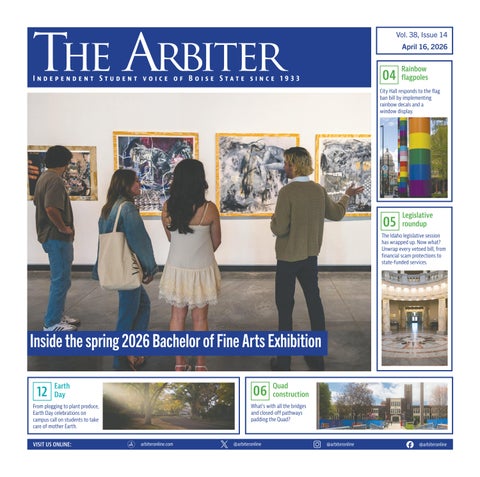
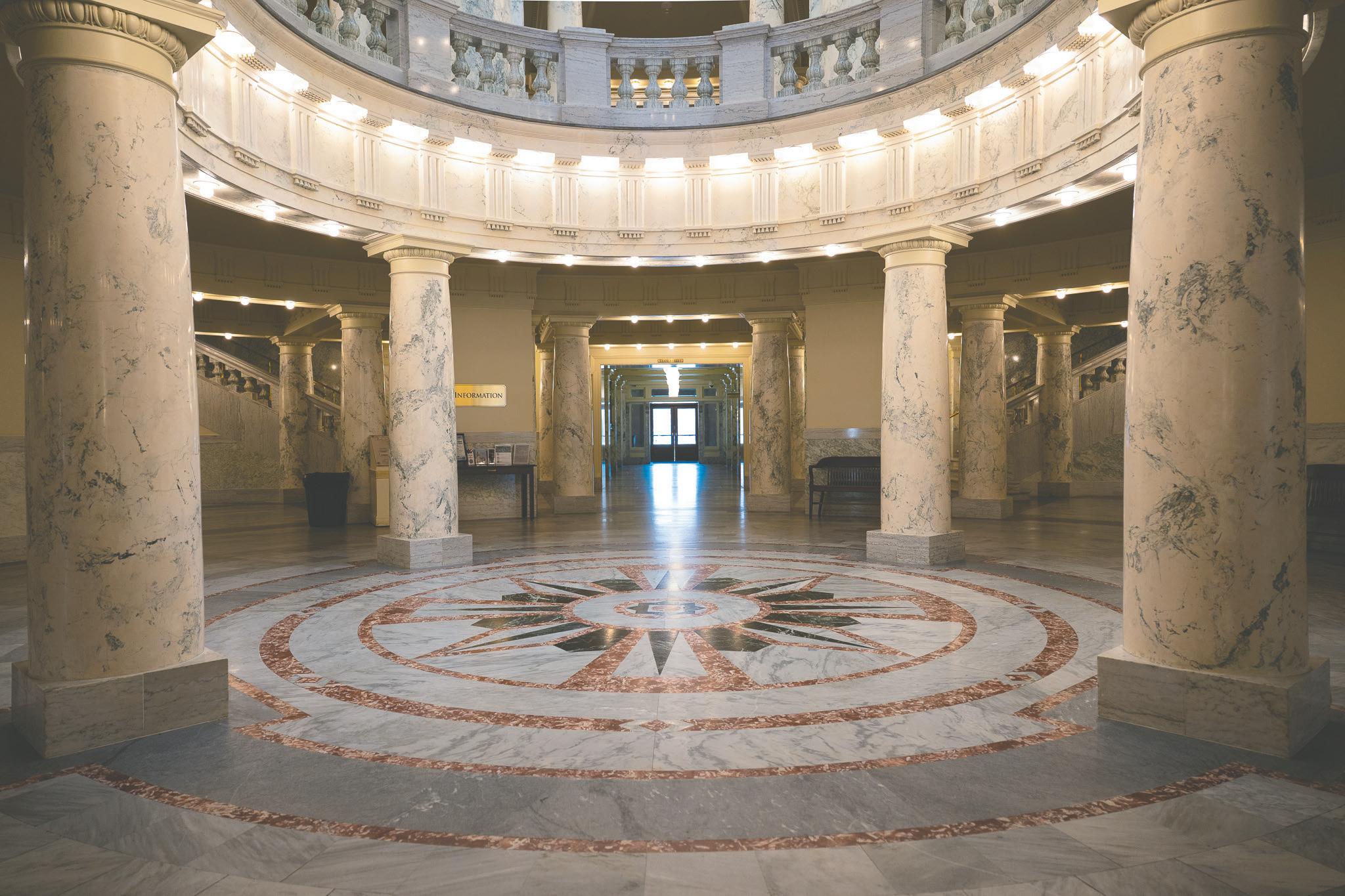
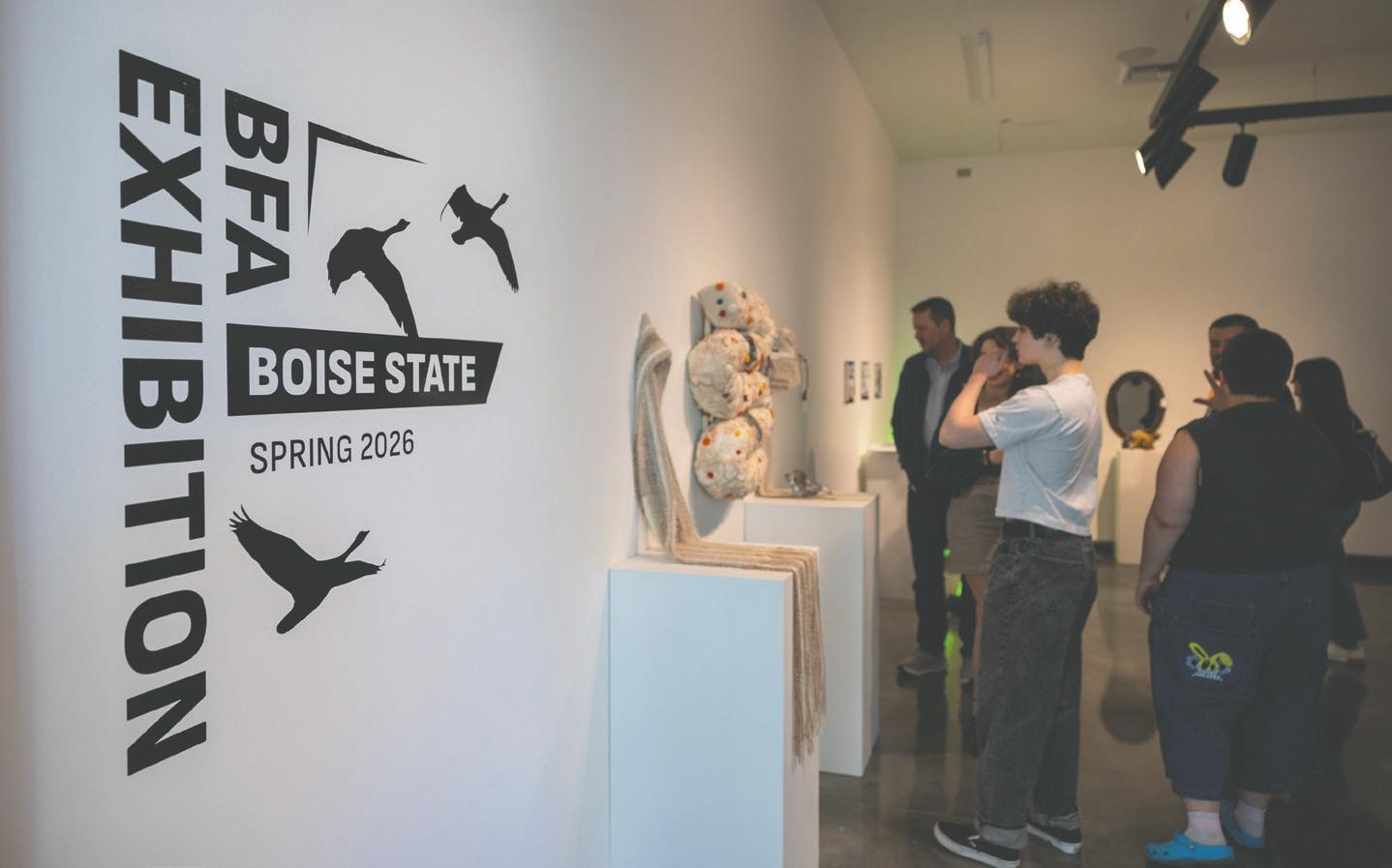
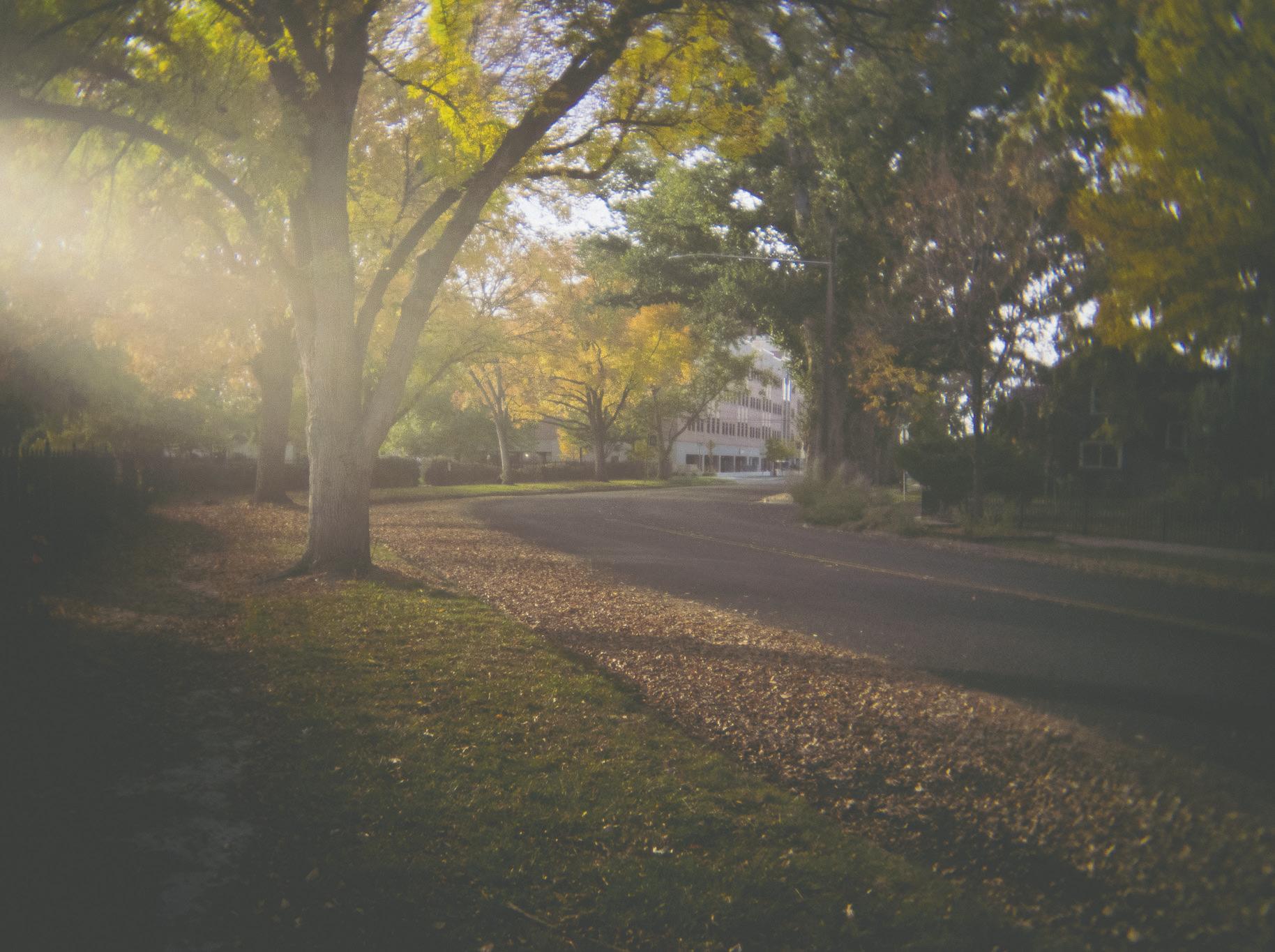
14 students, mere weeks away from walking the graduation stage, had one last hurrah, showcasing their work to professors, peers and patrons in meaningful mediums. The 2026 Bachelor of Fine Arts Exhibition, hosted at the Blue Galleries, presented dedicated work from 14 graduating students. Flip to find out about the techniques used and stories told within three students' works.
digitalcontent@stumedia.boisestate.edu
Digital Content Manager-
Digital Content ProducerIllustrator -
Omar Saucedo
Carter Nash
Marketing & Advertising
Advertising & Sales Manager
Zach Cerepa
ads@stumedia.boisestate.edu
Marketing Manager
Karley Rodriguez
marketing@stumedia.boisestate.edu
Distributed biweekly throughout the academic year, The Arbiter is the official independent newspaper of Boise State University where student editors make all content decisions and bear responsibility for those decisions. The Arbiter’s budget consists of fees paid by the student body and advertising sales. Additional copies can be picked up free of charge at the Student Media office.
HOW TO REACH US:
CONTACT US:
editor@stumedia.boisestate.edu
208.426.6302
PHYSICAL LOCATION: Located on first floor of Lincoln Avenue Garage Suites
MISSION:
As a student-run organization, we produce accurate and hyper-local information through non-partisan and socially responsible media.
MAILING ADDRESS: Student Media MS 1340 1910 W University Dr. Boise, ID 83725-1340
‘ACTS OF CRUEL INDECENCY REQUIRE NONVIOLENT, CREATIVE RESPONSES’
Boise answers flag ban with rainbow flagpoles
Emily Carmela nelson | Editor-in-Chief | Photos by Keara Antonelli
When Josh Lee first came to Boise to interview for a senior pastor position at Boise First United Church of Christ, a progressive Christian congregation, he knew the environment would be a “little less inclusive” than his and his husband’s hometowns of New York and Chicago.
While walking through downtown Boise, one thing stood out.
“To walk past City Hall and look up and see that rainbow flag, I took a deep breath of relief,” Lee said. “Even though the state may have a very different stance, the city welcomed us in such an extravagant way.”
Boise First United Church of Christ was the first church in Idaho to become what Lee describes as “affirming.” In 1991, then-pastor Nancy Taylor hung a Pride flag outside the church, signaling a commitment to LGBTQ+ inclusion.
“Most [members of the LGBTQ+ community] drive by a church and assume that they’re not welcomed, so the easiest way to communicate the opposite is to put a flag out front to say ‘I know in most churches you’re not welcome, but in this church, we roll a red carpet out to say all are welcome here,’” Lee said. “It meant a lot to see a city do that in their own way.”
On Transgender Day of Visibility, Pride flags that had flown in front of City Hall for over a decade were retired following Governor Brad Little’s signing of House Bill 561, which restricts the type of flags allowed to be hung on government property. Government entities that violate the law face a $2,000 civil penalty per flag, per day.
Lee criticized the timing, noting the bill was signed on a day meant to celebrate community.
“What a choice to sign those two bills on Transgender Day of Visibility,” Lee said, referring to the flag ban as well as House Bill 752, which criminalizes people who “knowingly and willfully” use a bathroom or changing room designated for the opposite sex. “There were so many bills that got passed in the House and in the Senate, and the Governor never signed them, [knowing the next day that] the bills he doesn’t sign or chooses to veto automatically become law. He chose to sign those two bills, to put his name on them and endorse them.”
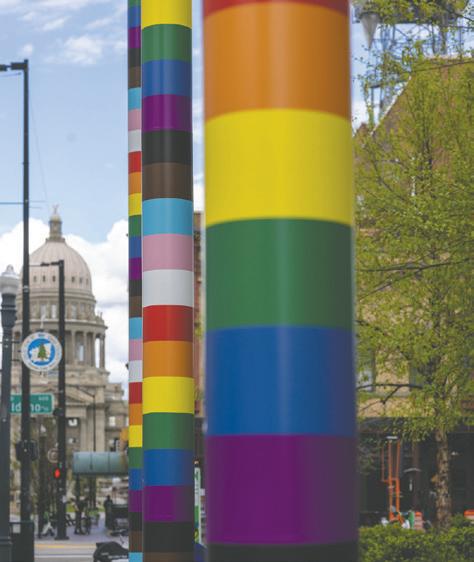
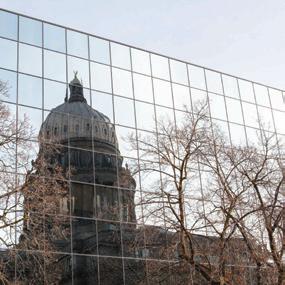
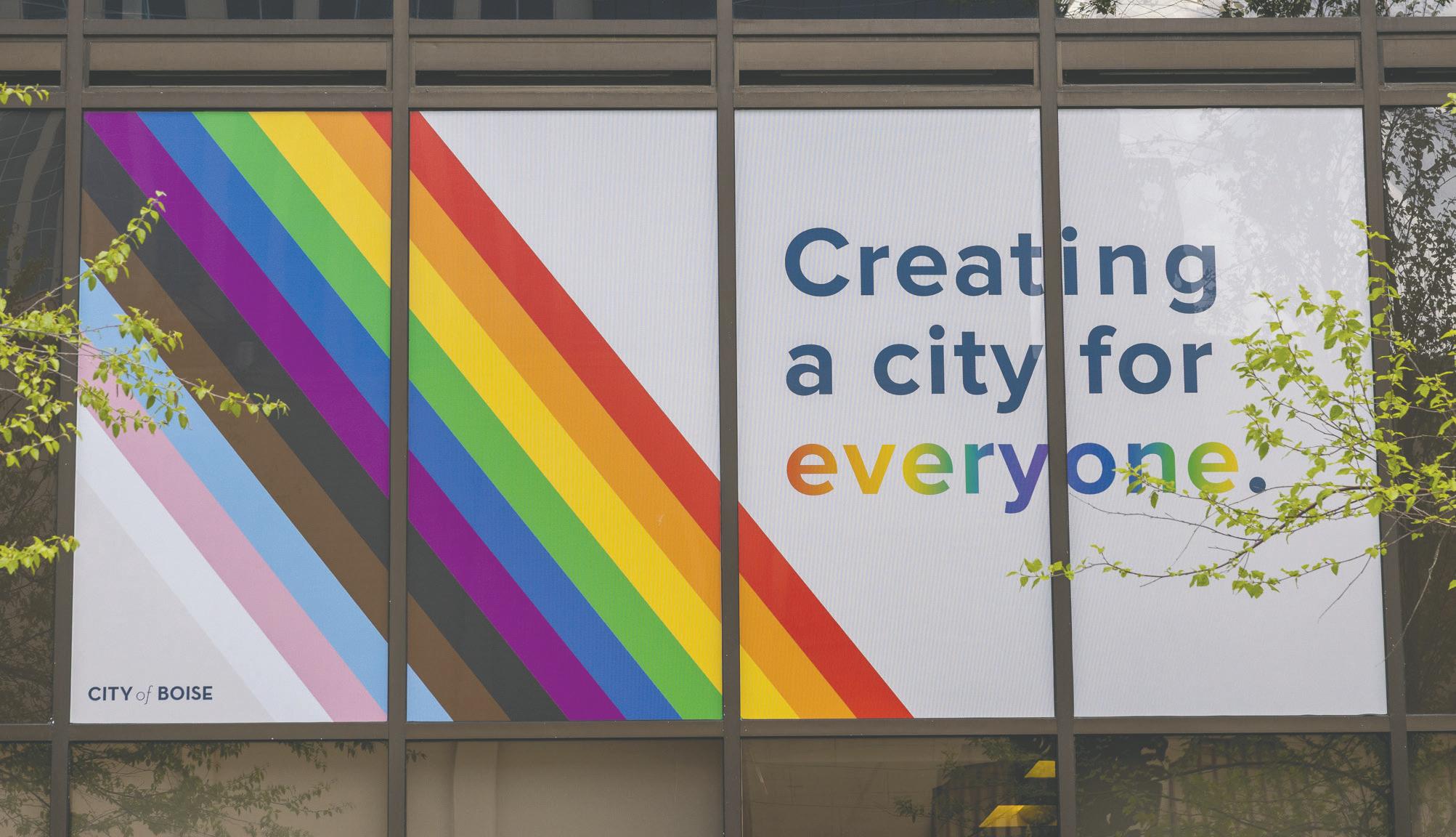
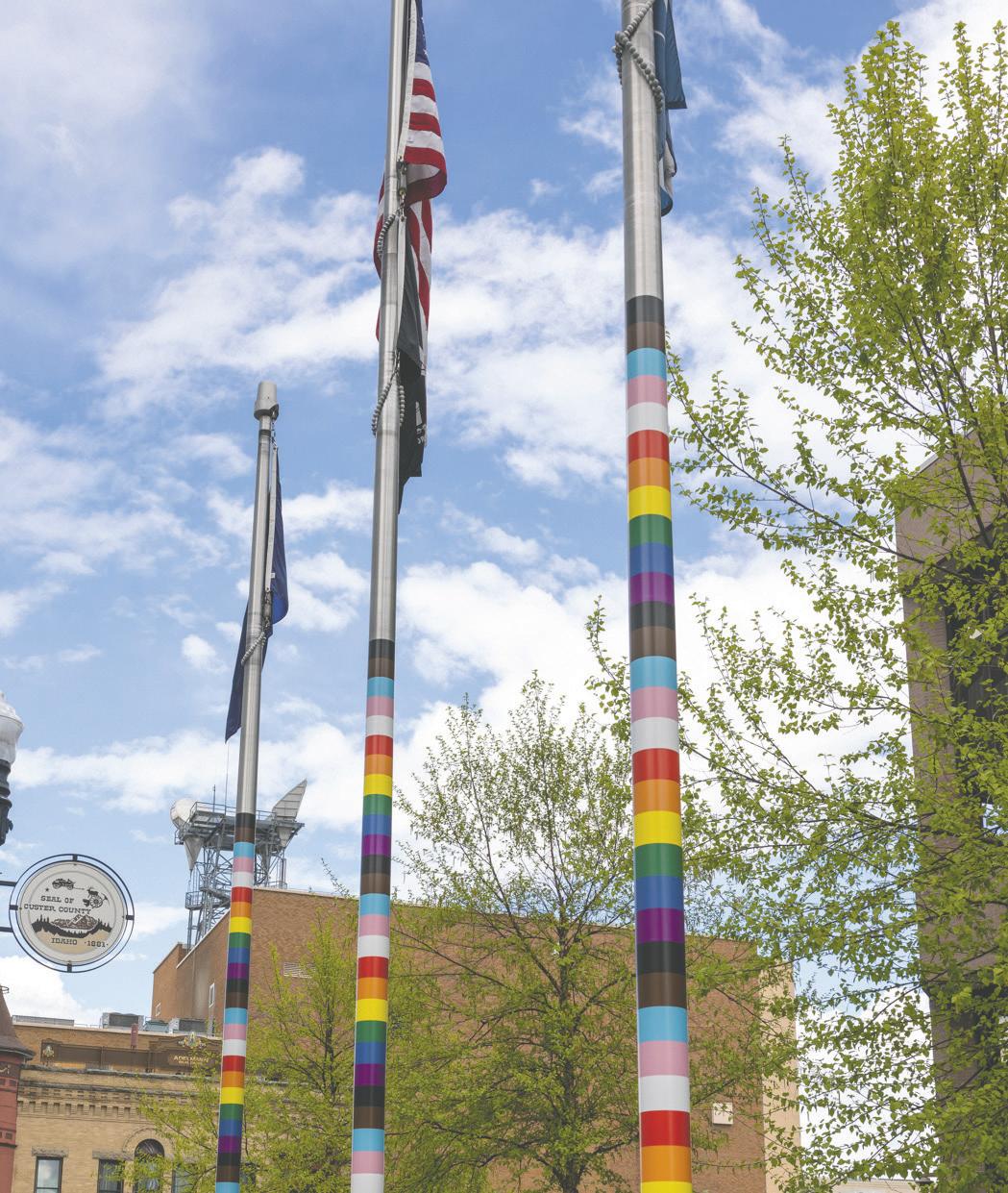
Just days later, the city responded by wrapping the City Hall’s flagpoles in Pride colors, installing a window display that reads ‘Creating a city for everyone” and illuminating the building with the colors of the transgender Pride flag.
The window display and flagpole decals cost $5,931.87, according to a city spokesperson.
“The art additions to City Hall demonstrate our unwavering commitment to the people that call Boise home and to the values that we uphold every day of being a safe and welcoming city for everyone,” Mayor Lauren McLean said in a statement to The Arbiter.
Before the decals went up, Lee discussed a potential workaround with the mayor’s office of purchasing the plot of land where the flags once stood. Because the church is not a government entity, HB 561 would not apply.
He compared this possibility to the Boise Junior Chamber of Commerce’s ownership over the strip of land Ta -
ble Rock’s 60-foot steel cross sits on and how the 10 Commandments are on display in front of many United States courthouses.
While he’s not sure if this action is necessary after the city’s response, he believes this is a roundabout way cities can approach restrictions on expression.
“Acts of cruel indecency require nonviolent, creative responses,” Lee said.
Preston Pace and Bonnie Violet Quintana, co-founders of Trans Joy Boise, believe while the decision to decorate the City Hall is a “great show of solidarity and defiance,” it leaves them wondering how the city will continue to protect the LGBTQ+ community — specifically those who identify as transgender and nonbinary.
“I’m so appreciative of [the mayor] taking such a bold stance, because that is so rare not only in this state or city, but this country. It’s incredibly brave.” Pace said. “I also believe she has the power to carry this momentum and do more for us, because she’s established herself as a
champion for [the LGBTQ+ community’s] rights. I’d like to see what she does with that moving forward, because she has a whole city of people looking to her for action.”
Governor Brad Little and Representative Ted Hill, the sponsor of HB 561, did not respond to The Arbiter’s request for comment in time for publication.
FIVE BILLS VETOED AFTER THE LEGISLATIVE SESSION ADJOURNED
olivia Brandon | Managing Editor | Photo by Omar Saucedo
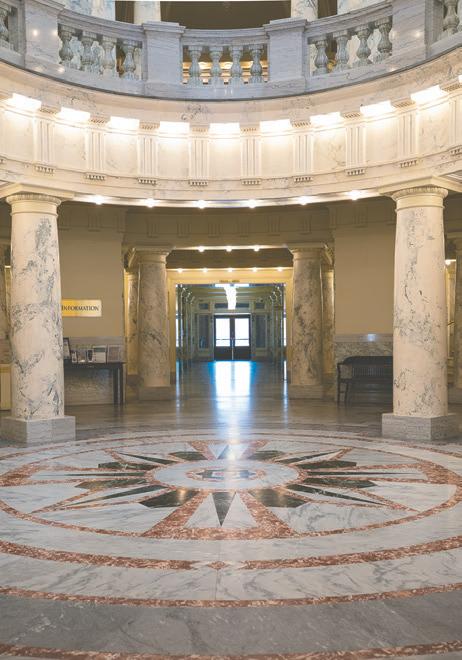
Following an 82-day legislative session filled with major budget cuts and bills regarding education, immigration and LGBTQ+ rights, Governor Brad Little vetoed five bills less than a week after the session ended.
As the session has already come to a close, legislators are unable to override any of these vetoes.
House Bill 674
HB 674 aimed to update Idaho law related to the discontinuation of telephone services in Idaho. Seeking to streamline the regulatory process, the bill would rely on the Federal Communications Commission (FCC) to approve a company’s decision to stop utilizing the service, instead of requiring the state of Idaho to do an additional review.
Governor Little expressed concern the bill could result in “rural Idahoans losing access to essential telecom services if the federal government acts without state input.”
Representative Vander Woude, one of the bill’s sponsors, did not respond in time for publication.
House Bill 758
HB 758 sought to clarify issues presented in HB 243, which passed last session. The bill states in-home day care providers can monitor children using “videoing devices,” and for the purposes of licensing, in-home day care providers do not need to count their own children.
While the bill’s statement of purpose says these clarifications will “allow inhome day-care providers to continue to operate safely,” Gov. Little disagreed. In his veto letter, Little said the legislation “threatens child safety” and “could eliminate licensing and fire inspection requirements for providers.” Little ended the letter by saying “rooting out child abuse” is one of his top priorities and that the bill “puts too much of our [legislators] good work at risk.”
In a statement to The Arbiter regarding the veto, Representative Barbara
Ehardt said she was disappointed by the Governor’s decision.
“I was mostly disappointed because I was bringing this legislation at the request of constituents whose businesses in Southeastern Idaho were unfairly having a standard applied to them that the rest of the state didn’t have applied,” Ehardt said.
Ehardt claims she met with Health and Welfare Director Juliet Charron and two of her associates, who she said felt the best way to solve issues the original legislation presented was to “clarify it statutorily.”
“The Governor was concerned because of the fraud that is being exposed in so many ‘Day Care’ businesses in Democrat states,” she said, saying she understands the governors’ hesitancy but that she was “trying to solve the problems her constituents were experiencing.”
House Bill 968
While Little approved the majority of the bill, he line-item vetoed two components of HB 968. The bill would have allowed the Idaho Legislature to move funding intended to finance an additional 27th payroll period scheduled for 2028 to the General Fund. Another element that was vetoed prevents the transferring of funds into the legislative account from the permanent building fund by the Idaho Legislature.
In his rationale, the Governor wrote: “While I support prudent investment in state facilities, this appropriation is inconsistent with the long-term purpose and stability of the Permanent Building Fund. Maintaining the integrity of this fund ensures the state can responsibly address future capital needs.” Little continued, stating his submitted budget “recommended transfers from the Permanent Building Fund due to canceled projects,” but the funding was to be transferred to the general fund, not to “unrelated accounts.”
House Bill 975
HB 975 would have ensured funds in the Budget Stabilization Fund would not be transferred, even if the fund balance exceeded 15% of General Fund revenues. Little said “locking excess funds” in reserves limits the state’s ability to address “emerging needs, sustain core services and respond to economic shifts.”
The governor is specifically concerned about financing fire-season prevention measures, as the legislature rejected the Governor and the Land Board’s calls to prefund the Fire Suppression Fund.
Representative Petzke, one of the bill’s sponsors, did not respond in time for publication.
Senate Bill 1359
In an effort to reduce scams targeting senior citizens, SB 1359 states kiosk operators would have to “register with the state, provide clear fee and exchange rate disclosures, post fraud warnings, maintain transaction records, and implement reasonable transaction limits and basic fraud-prevention safeguards.”
In his reasoning for vetoing the bill, Little cited the legislation’s “ambiguous” language.
In a statement to The Arbiter, Senator James Ruchti disagreed that the language was unclear. “The language was not ambiguous,” he said. “Representative Manwaring and I are both attorneys and value well-written legislation. We worked hard to get the language right and feel confident we did.”
Additionally, Little advised, “stakeholders work with the Idaho Department of Finance to revisit this bill with the tighter definitions, clear enforcement standards, and a realistic implementation framework.”
“The Governor’s comments surprise me. We worked very closely with the Idaho Department of Finance and incorporated almost all its suggested changes,” Ruchti said in response. “At no time did the Department express concern about the language of the bill being ambiguous or lacking clarity in definitions or rules. We always stand ready to meet with stakeholders, including the Department, but that is obviously a two-way street. Both sides must communicate clearly.”
The legislature has the option to call itself back into session, but completely new bills must be written and identified in a petition.
april 16, 2026
WHAT’S GOING ON IN THE QUAD? INSIDE THE MAJOR CONSTRUCTION PROJECT DISRUPTING CAMPUS COMMUTES
Emily Carmela Nelson | Editor-in-Chief | Photos by Omar Saucedo
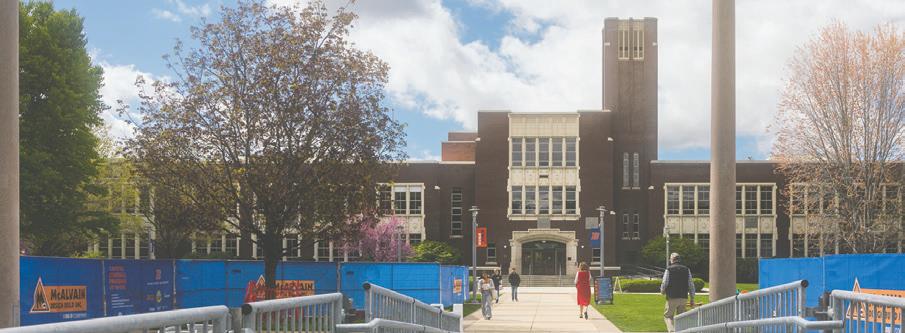
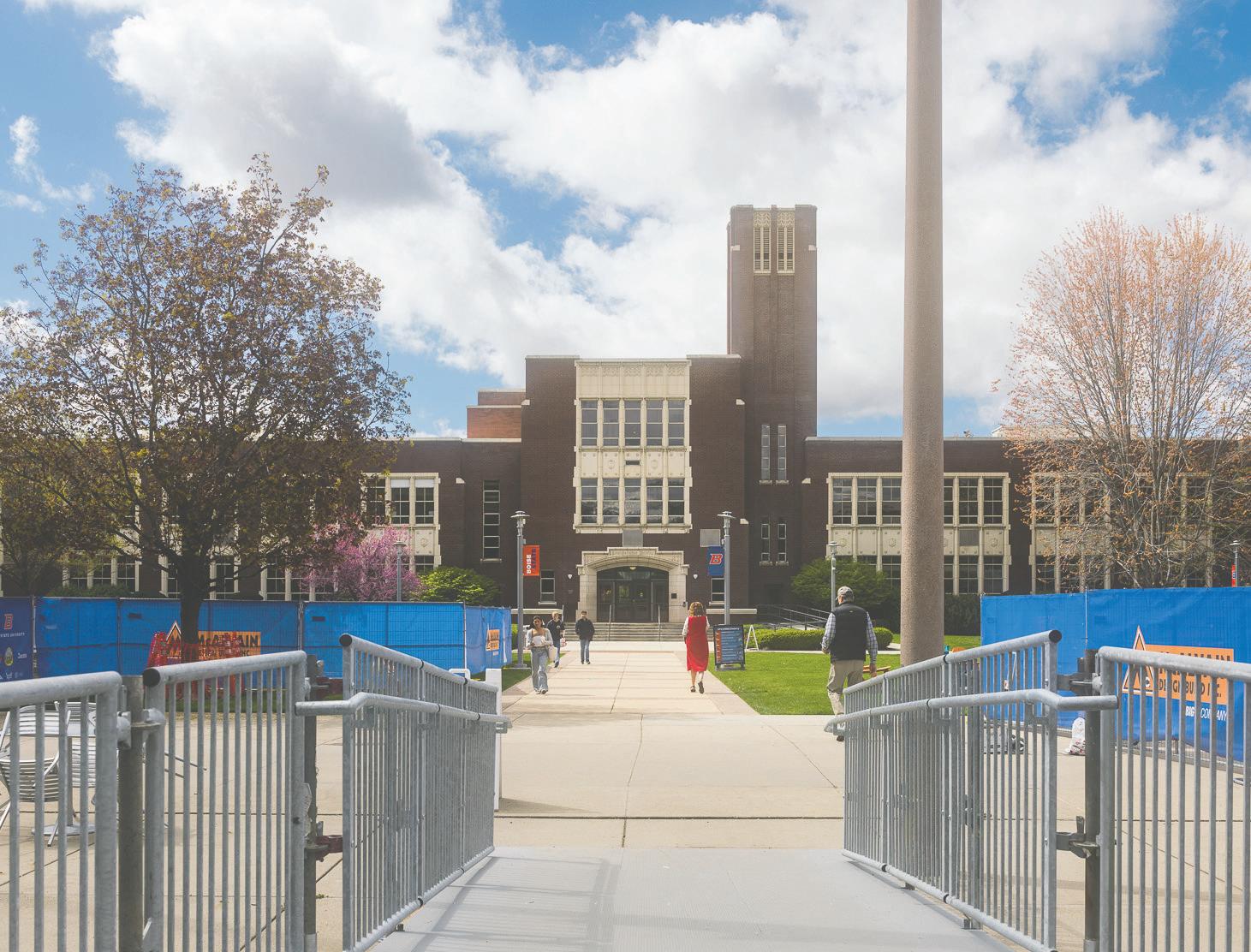
Whether it’s planning a different route to class or scheming how to Photoshop a blue tarp out of your senior photos, the construction in the Quad has become impossible to ignore.
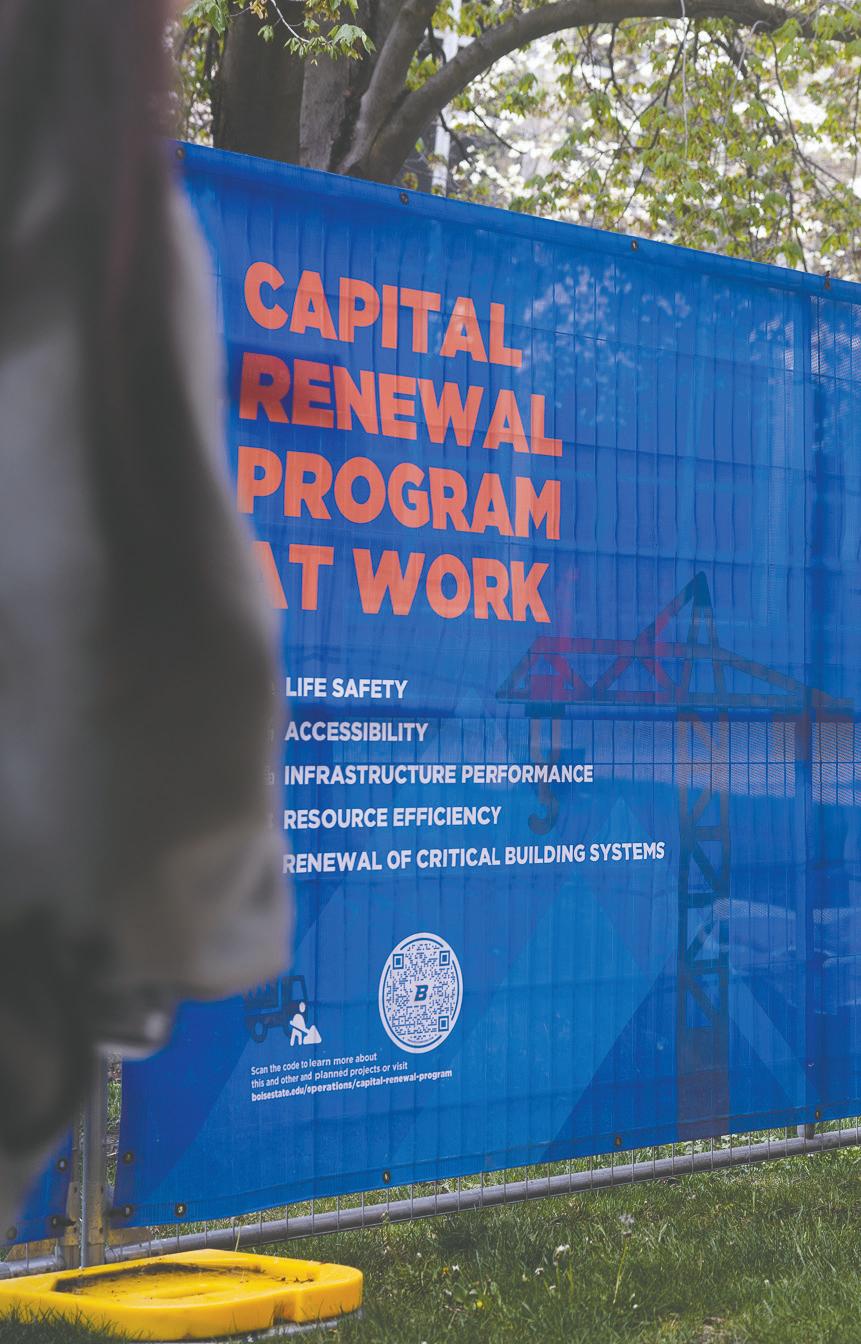
At the center of the disruption is a major repair and renewal project targeting the nearly 100-year-old steam tunnels beneath campus, according to Drew Alexander, vice president of campus operations. The project is housed under the Capital Renewal Program, the university’s $90 million dollar project focused on revitalizing campus structures.
Originally installed in 1941 to heat the Administration Building, the steam tunnel system now serves as a critical piece of campus infrastructure, providing heating, cooling and hot water throughout Boise State. While the steam system has expanded over time, the current project is the first “full fledged repair” the system has seen.
Alexander acknowledged the strain.
“This project asks for a lot of campus,” he said.
So why not wait until summer?
Construction begins each spring as temperatures rise, allowing buildings to temporarily go without full heating and cooling services. Crews typically shut the system down in late April and work through mid-October, aiming to complete as much work as possible before the cold weather returns and minimize further campus disruptions.
“Ideally, like with a lot of our projects, we would have it during the summer window,” Alexander said. “But due to the complexity and scope of trying to finish in three phases, we have so much work to do throughout the academic year.”
Another phase is scheduled to begin in 2027, though Alexander expects the current phase to be the most disruptive.
Jude Hicks, a junior, said the detours add three to four minutes to his daily
commute.
Hicks expressed frustration that study spots, like the Albertsons Library, are difficult to get to and often noisy. “You can try to study, but it’s pretty difficult. It is crazy loud.”
Aside from being inconvenient, the construction can obstruct views for bikers, pedestrians and those on scooters.
Rebekah Parsons, graduate student, experienced this firsthand. On April 6, she was longboarding home from the climbing gym and someone on an electric scooter crashed into her, causing her to break her nose.
“I’m going around the tent that is in front of Riverfront, where they have the whole area blocked off,” Parsons recalls. “As I round the corner, this guy on a motorized scooter is coming from the opposite direction, and he’s also coming around the blind corner and going way faster than I am. We completely collided.”
Parsons acknowledged that other factors were at play in the collision, such as the speeds both parties were traveling at. “It sucks that we’re all a little bit inconvenienced by it [the construction], but I prefer this to not having sidewalks that work. I prefer this to potholes — so I’m really not that beat up about it.”
Alexander emphasizes while the benefits of this construction may not be felt within the typical four to five year window students are on campus, the impact of this project will leave the university in a better place for years to come.
“These are generational impacts for campus that are going to add up to 30, 40, 50 additional years of ensuring that the learning that happens here continues to happen in an efficient, predictable and comfortable way,” Alexander said. “There’s a long term lens here that we’re hoping students can lean into and appreciate.”
INTERFRATERNITY COUNCIL WINS BIG CONNECTING STUDENTS TO DISCOUNTS
Jack McElwee | Intern Reporter
Boise State’s Interfraternity Council (IFC) is being featured at the national level.
Members of the council recently attended a conference in Anaheim, California, where they took home several prestigious national awards.
The group won Council Compass Awards for Collaboration, Innovation, Education and Accountability, as well as the Dr. Will Keim Change Making Experience Award.
“The stuff that we’re actively doing … is unseen at a national level, no other university is accomplishing it, and no other university is accomplishing these things in the little bit of time that we have,” said Dominic Mancini, president of Boise State’s Interfraternity Council.
Mancini received the Marilyn Fordham Undergraduate Award for his work as IFC’s Chief Justice Officer, the position he held before becoming president. The award is given to a council member who has made a significant systemic change in their fraternal program.
Boise State’s sudden surge in awards was unexpected, as the school has historically never taken home an award, according to Mancini.
“We basically ran that conference, in a way. Everyone knew Boise State,” Mancini said.
Dustin Fisher, IFC’s Chief Public Relations Officer, also attended the conference, describing the council’s wins as “incredible” for the university.
“It’s really awesome to show a little presence of ‘Blue Turf thinking’ [on a national level],” Fisher said.
This recognition is no coincidence. Before he was elected president, Mancini served as IFC’s Chief Justice Officer and said he pushed that position to the next level.
“Around two years [ago], when I stepped into the role, [previous leadership] did absolutely nothing with it. They just threw it on their LinkedIn,”
Mancini said. “I knew that I needed to change that.”
After he stepped into the position, he began setting up meetings with university administrators to ask how he could best hold chapters accountable and improve relationships between IFC, the Dean of Students and local law enforcement.
During his time as Chief Justice Officer, Mancini restructured the judicial process and changed over 200 bylaws while also building a strong relationship with the Dean of Students’ office. This allowed the IFC judicial system to deal with cases that in the past had been taken care of by either local law enforcement or the Dean of Students’ office.
Mancini has spearheaded a push to increase visibility for Greek life on campus, leading to significant growth in Boise State’s chapters, according to Fisher. The growth is so large IFC believes Greek Life is outgrowing the Student Union Building and is looking for alternative meeting places in the future.
“[A Greek Lodge, I call it. It’s a big Greek building for our university that’s designated to Greeks, because trying to rent [a] room in the Student Union Building is impossible,” Mancini said.
The lodge is still in the brainstorming phase, but Mancini hopes it will open in the next five years.
During his time as president, Mancini hopes to tackle men’s mental health, address sexual assault on campus and continue facilitating Greek life’s growth on campus.
“At Boise State University, our Greek life is absolutely blowing up,” Mancini said. “Everyone’s coming here. Everyone wants to be a part of it, and we’re the ones that are setting the precedent for that.”
Emily Carmela Nelson | Editor-in-Chief | Illustration by Amber Jansson
For college students, saving money often comes down to knowing where to look.
Surprised by the number of his peers who didn’t know the amount of student discounts available to them, Luca Collins, associate vice president of academic affairs, set out to create a straightforward way for students to save, on and off campus.
That idea became the ASBSU Student Discount Legislative Committee, which Collins now chairs. Launched last semester, the committee aims to make Boise State and the greater Boise community more affordable and accessible for students on a budget.
Committee members meet regularly to connect with local businesses and ask if they offer student discounts. If they do, the business is then added to an ASBSU web page, complete with links, locations and details about the deal.
So far, the web page currently boasts over 20 available student discounts, ranging from global streaming services to
10% off at local record stores.
“It’s an expanding thing,” Collins said. “If you check it today and there’s something you wouldn’t necessarily use, you could check it the next week and there might be five new places you actually would want to check out and receive a discount at.”
Although Collins is graduating, he is working with committee members to ensure the project continues to grow after his departure. Looking ahead, he hopes the committee can strengthen its relationships with Boise’s businesses and even encourage them to support student clubs and organizations through donations.
“I hope it inspires more ideas,” Collins said. “You can really do something — make change and affect student lives. It’s not that hard. I just got a few people to call businesses, one person built the website and we just went from there.”
The student discount page can be found at boisestate.edu/asbsu/committees/student-discounts/.
16,
OPINION
SUBSCRIPTION MODELS HIJACK FORGETFUL CONSUMERS FOR PASSIVE PROFIT
It started small at first. You signed up for a free month of Canva Pro just to add a little pizzazz to your mid-term presentation. The card on file was a formality. You fully intended to cancel the service next month to dodge the $15 fee.
Well, one month quickly turned into two and snowballed into a full year. Pretty soon, you’re $180 down, and you haven’t made a snazzy presentation since March of last year.
While companies like Canva email account charge reminders to consumers, not every company is as dutiful, which puts the burden of subscription monitoring on consumers. The sheer amount of available (and unnecessary) subscription options invading our economy hijacks the inattention of young consumers for profit.
“Close to a dozen of them,” said junior Cooper Thompson, regarding the number of services he subscribes to. “It’s definitely my fault for not keeping track, but sometimes the cost is small enough that I don’t notice it until it’s a couple [of] months later.”
Thompson is not alone. A 2021 survey conducted by West Monroe found 89% of consumers underestimated how much their subscriptions were costing them. It does not help that lavish subscription spending is prevalent amongst college-aged students, who spend an average of $377 a month on subscriptions.
Subscription-based services are exploding in popularity as of late, bolstering a 435% increase in the last decade, according to The Subscription Economy Index in 2021. Pair that expansion with the allure of cheap short-term convenience for consumers and suddenly there’s inflation, a subscription market that eclipsed half a trillion dollars worldwide last year.
april 16, 2026
“Even established companies — from furniture to fashion to food — are getting into the subscription game,” said Dr. Samia Islam, an associate professor of economics. “We are seeing the bandwagon effect among businesses. Soon, consumers will not know any other way of engaging and transacting in the market, except for perhaps basic needs.”
Businesses from all walks of life are starting to lean into the online economy’s momentum to support their bottom line. Even in industries where it’s extremely unnecessary to implement a monthly payment.
From AI LLMs to toothbrushes, it seems the new way to increase revenue is to lure a consumer into a subscription and hope they forget about it.
“The idea of a subscription model is that it is just frictionless. It frees you up,” said Anne Hamby, co-director of the College of Business and Economics behavioral lab. “It can be problematic because if we forget about it and we’re not using the service or product, then we are not getting the value that we’re paying for.”
The momentum produced by these models is what makes them so valuable for business.
But that value is relative for consumers.
An example can be found in late March of this year, after Netflix raised the prices of all three subscription plans — for the second time in a single year. Their cheapest plan increased from $7.99 to $8.99 for the privilege of streaming the services’ dwindling content library, accompanied by ads, of course.
“It hasn’t been worth it lately,” said Thompson. “I usually subscribe when there is a show I want to watch, but after I finish it, I don’t use it [Netflix] for a
while after that.”
It’s hard to believe that in the ever-so-distant year of 2019, customers were paying the same price for an ad-free experience. It can be difficult to gauge the rationale behind these price hikes besides typical corporate greed.
“Over the arc of subsequent years, subscription models have become sort of trendy,” said Hamby. “Other businesses sort of viewed the unintended consequence of the model, namely how people forget, and saw that they can have some free revenue.”
There is something frustratingly lethargic about this method of revenue generation from a consumer standpoint. Have companies really become so lazy they don’t even want to work to convince consumers for a dollar? Instead relying on the diminishing attention span of their consumer base to support their bottom line.
“Customers are prone to inattention, we have too much going on to be able
to spare the bandwidth to read the fine print,” said Islam. “While it is generally assumed that all consumers are taking the time to do their own homework before they make a choice in the market, businesses use ‘framing’ that plays on the buyer’s emotions and sensitivities.”
It’s a bit of a grey area on who is really at fault for any excess payments. On one hand, the Federal Trade Commission (FTC) could require businesses to implement manual renewal systems instead of automatic resubscriptions. Alternatively, maybe consumers need to be a bit more attentive to who they’re subscribed to through calendar reminders and good old financial responsibility.
However, the fast-paced nature of the digital economy makes this the slightest bit difficult.
Re-upping a subscription manually may be the tedious, albeit necessary solution for forgetful college students wondering where that $15 mysteriously disappears every month.
Zaccary Kimes | Opinion Editor | Graphic by Naomi Brown
AI-GENERATED SLOP POLLUTES ADVERTISEMENTS AND CHEATS CONSUMERS
Cole McAdams | Assignment Reporter | Graphic by Naomi Brown
No one likes sitting down on the couch to watch a movie only to be interrupted by an eye-roll inducing ad. However, something about this commercial doesn’t seem right: uncanny humans, low-resolution animals and stretching lampposts on a street catch the eye.
Is this AI-generated?
From 2024’s Coca-Cola Christmas commercial to the infamous Super Bowl Svedka Vodka ad, AI-generated advertisements are a growing phenomenon and companies are cashing in.
The advertising trend raises questions about consumer ethics and personal beliefs. The Federal Trade Commission (FTC) prohibits “unfair or deceptive acts or practices” in marketing, raising the question of whether AI ads should be held to the same standard.
Oftentimes, these ads present a sham
interpretation of their product or include world-building aspects entirely fabricated by machine-learning software. Last summer, Jeep released a commercial showcasing the evolution of their Jeep Cherokee. From the abnormal process of the car transforming in the commercial, to how the blurry background scenery tricks the consumer’s mind — it all leaves a head-scratching takeaway. Jeep doesn’t outright acknowledge the use of AI in the ad, misleading customers into believing a product sloppily generated in an ad; quality is forgotten in favor of convenience.
Lucas Fleege, President of Business Professionals of America (BPA) for Boise State, embraces aspects of AI usage in business, emphasizing the early-stages of how businesses play around with this software.
“We’re still trying to play around with
how AI can either help or hinder us [businesses] in the future,” Fleege said. “Business is very cutthroat. If you’re not doing it, your competitors are doing it.”
Fleege noted the cost-effective nature of using AI in a marketing campaign, leading to bigger corporations increasing their profit margins, which, simply put, means more money in their pockets. These practices are good for business, but where do we draw the line between inventive business decisions and insincerity of audience awareness?
The uncanny images lack physical awareness, desperately trying to seem “real,” distract and take you out of what the ad is trying to promote. AI-marketing is not a true representation of life, something only humans possess the ability to convey through art.
“A dangerous part of what AI is creating right now is authenticity,” said Sean McDonald, CEO and Founder of Bäst Branding Agency, a local creative services agency. “There’s a limit because it’s a digital entity that doesn’t completely understand physical space humans do, and we’re always going to catch that.”
At Bäst Branding Agency, McDonald and his team use AI as an everyday tool in data collection, idea generation and image creation. He said although his team needs to “re-input [AI output] into a set of human eyes,” the tool is helpful in the creative process. At the same time, AI is yet to reach the “fool-proof” phase marketers might wish for.
“My brain has its own data source, and that’s the data that I’m pulling from to create [ideas]. AI has a much bigger data source to pull from, and [it] can do the very same,” McDonald said.
Often, we confuse AI for being “complex” when it simply has access to a large amount of data. Humans feed AI this data and experience, but AI content will always lack quality. “Slop,” a term that is thrown around online when referring to generative AI, describes the messy, clunky mess from these programs. This is
in large part due to AI never experiencing life or coming up with new, original ideas; it’s all pulled from other sources to churn out the desired product.
“[AI] is sourced from so many other places that it can’t be held to one liability standard — it’s bits and pieces from everywhere,” McDonald explains. “[The image] is not considered royalty-free, because you’re creating it through your unique prompts.”
From an artistic standpoint, Graphic Design major Alyssa Clegg highlighted the difference between “art” made by artificial intelligence and art made by humans.
“[Artists] tend to credit the people that gave them inspiration — even if it’s entirely different from their source material, you can see the process,” Clegg said. “I always want to know the process. If it’s just mindlessly spit out for you, there’s no story behind it. I can’t connect to it in a way that I can connect with actual human-made art.”
Creating is a fundamental part of being human, and an integral part of the human experience is expressing ideas through art. Commercials aren’t always high-brow art pieces, but the consumer is often able to see the effort humans put into these campaigns; with AI, all that effort is tossed away like trash.
“If there’s no humanness behind it, how can someone be expected to spend their time with that product [if] whoever pushed it out didn’t even bother to spend their time advertising,” Clegg questioned. “Art is one of the main things that keeps people and society going. You don’t need it to survive, but we do it to live.”
The AI storm won’t dissipate and will continue to acid-rain down on consumers as they are expected to accept this new norm. Serious regulations must be upheld, as companies will continue to prioritize uncanny human faces over the real ones that buy their products.
april 16, 2026
|
INSIDE BOISE STATE’S SPRING 2026
BFA EXHIBITION
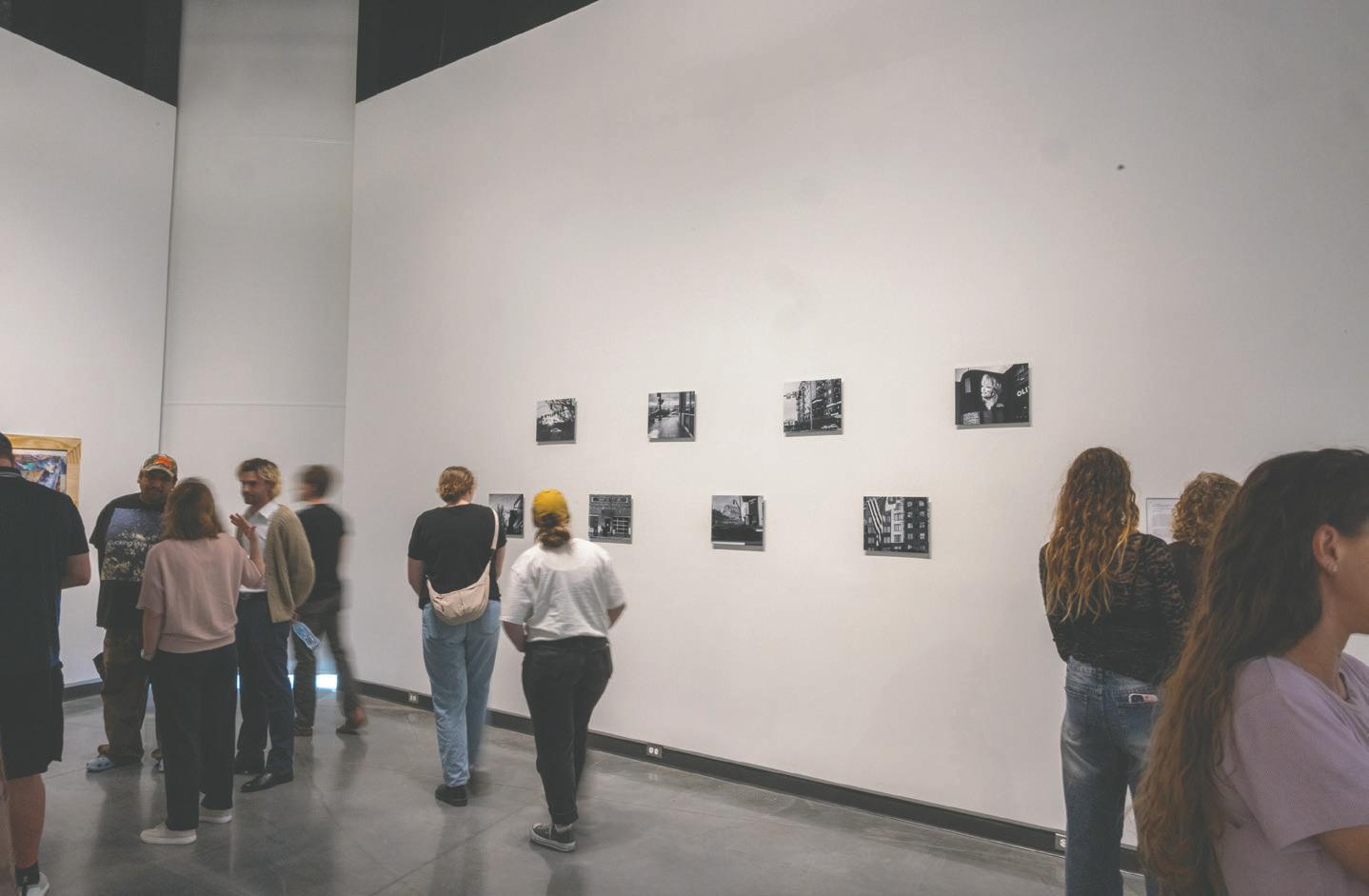
At this exhibition, walking into the gallery means stepping into 14 different ways of seeing the world all at once.
Candid Boise street scenes line one wall, while fractured layers of paint and photography across the room blur to create a dreamlike scene. Around the corner, creatures emerge that seem to have stepped straight out of a graphic novel.
The 2026 Bachelor of Fine Arts Exhibition opened on April 10 at the Blue Galleries on the first floor of the Center for the Visual Arts, featuring work from 14 graduating seniors. The exhibition serves as a capstone for BFA students and is free and open to the public, remaining on display through May 1.
The gallery shifts into a collision point of process, identity and the question every graduating artist is quietly trying to answer: what now?
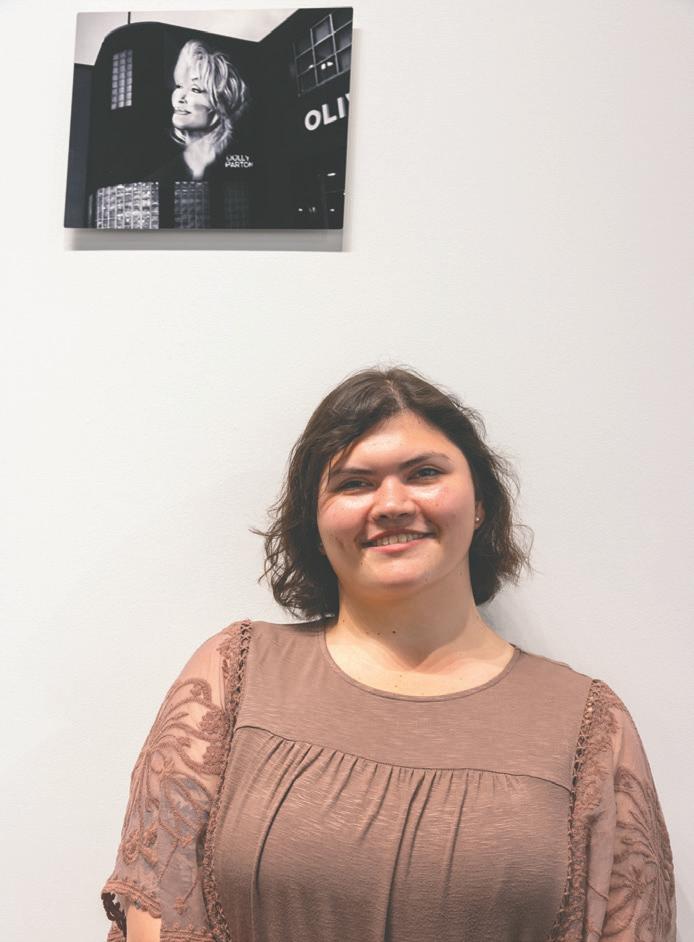
For photography student Frannie Pasternak, the answer came when she finally took the time to slow down and start truly looking.
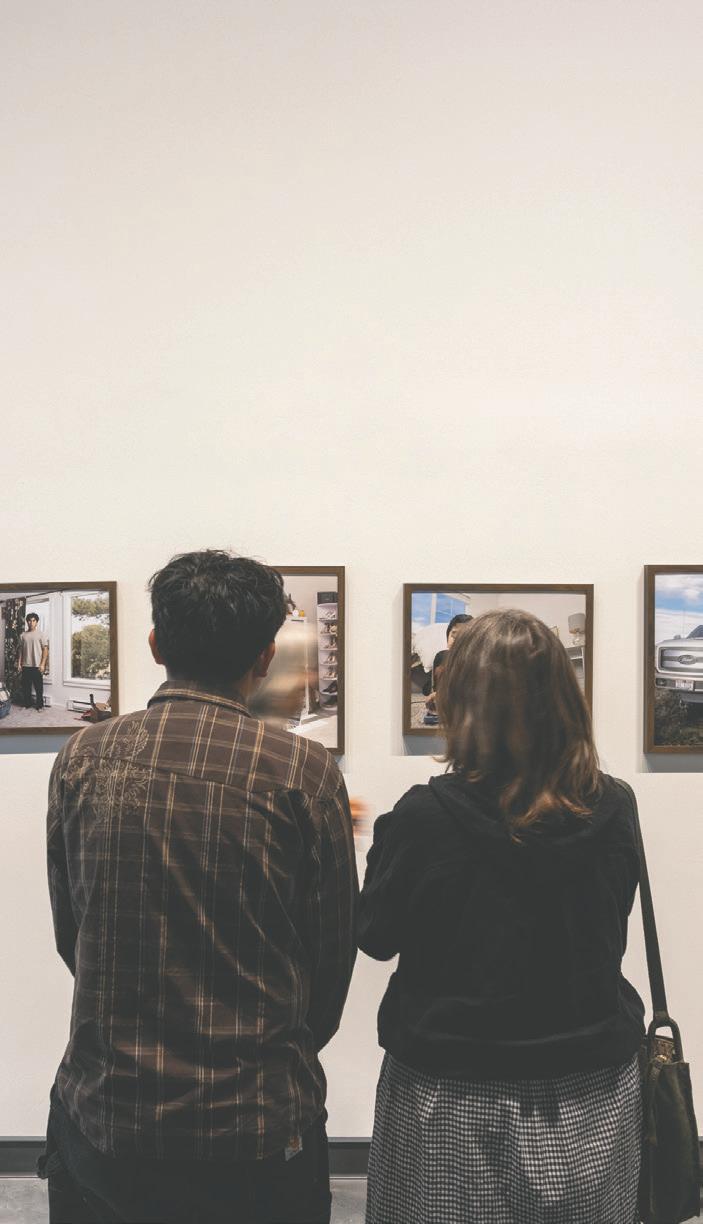
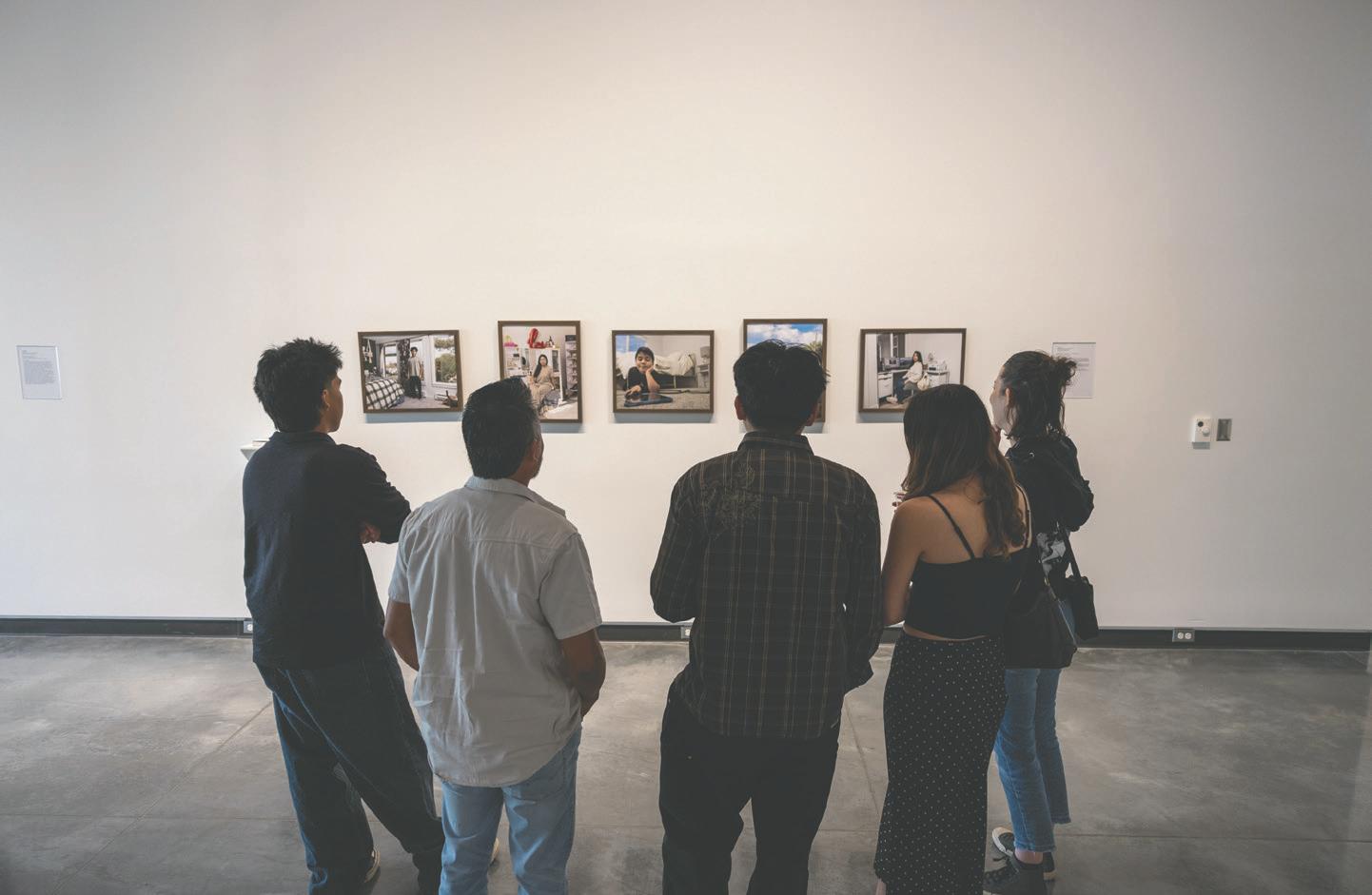
“This is the first year in a long time that I’ve had the opportunity to really work with my camera and have the things I capture truly mean something,” she said in her artist statement. “After years of experimenting and crafting, I noticed that capturing candid scenes is what I enjoy doing most.”
What she produced was a series of photographic prints, showcasing images taken out of instinct rather than staging. Pasternak used no heavy manipulation and did not attempt to overwork what already existed in front of her.
“I realized I don’t do well with a lot of editing or conceptual things,” Pasternak said. “I love taking documentary-type photos of things that are real and candid.”
Her images leave space for interpretation, and that openness shows up in how viewers connect to them in unexpected ways. One photograph taken of a Boise apartment, for example, reminded her mother of Chicago, making the two cities feel momentarily interchangeable.
Other reactions came from people recognizing details in Boise they had passed without noticing, suddenly becoming the focus of attention.
“I heard at least five people say, ‘I didn’t know we had that here,’” Pasternak said. “Most of them added that made them like the photos even more.”
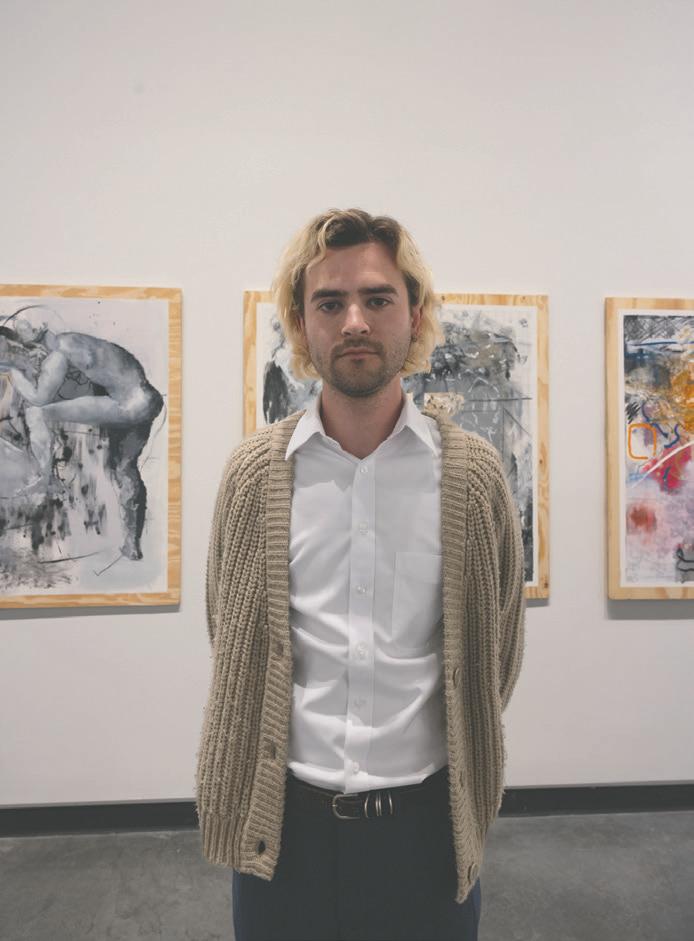
To the left of the gallery’s walls, Ethan Meeker’s work explores the space between painting and photography, where images don’t settle into a single form.
What looks stable at first quickly shifts the longer it is viewed, with figures dissolving into texture and surfaces folding into something hard to pin down.
“I’ve been trying to get in between painting and photography more recently,” Meeker said. “I think historically, they’re a lot more similar than we like to think.”
In his artist statement, he expands that idea beyond his own practice, tracing image-making back through older visual systems.
“How is an image created, and what are the conditions for its manifestation?” Meeker wrote. “Photography is the central practice that my work gravitates around.”
Rather than answering that question, his art operates inside it. It doesn’t attempt to answer how images are formed, so much as it reveals how unstable they already are once they exist.
“This work is a reabsorption of my environment,” he said. “A confusing slur of images, meanings and causes.”
While Meeker’s world resists stability, fellow artist Savannah Humpherys’ work
Isabella Williams | Culture Reporter | Photos by Keara Antonelli
builds an entire world of its own.
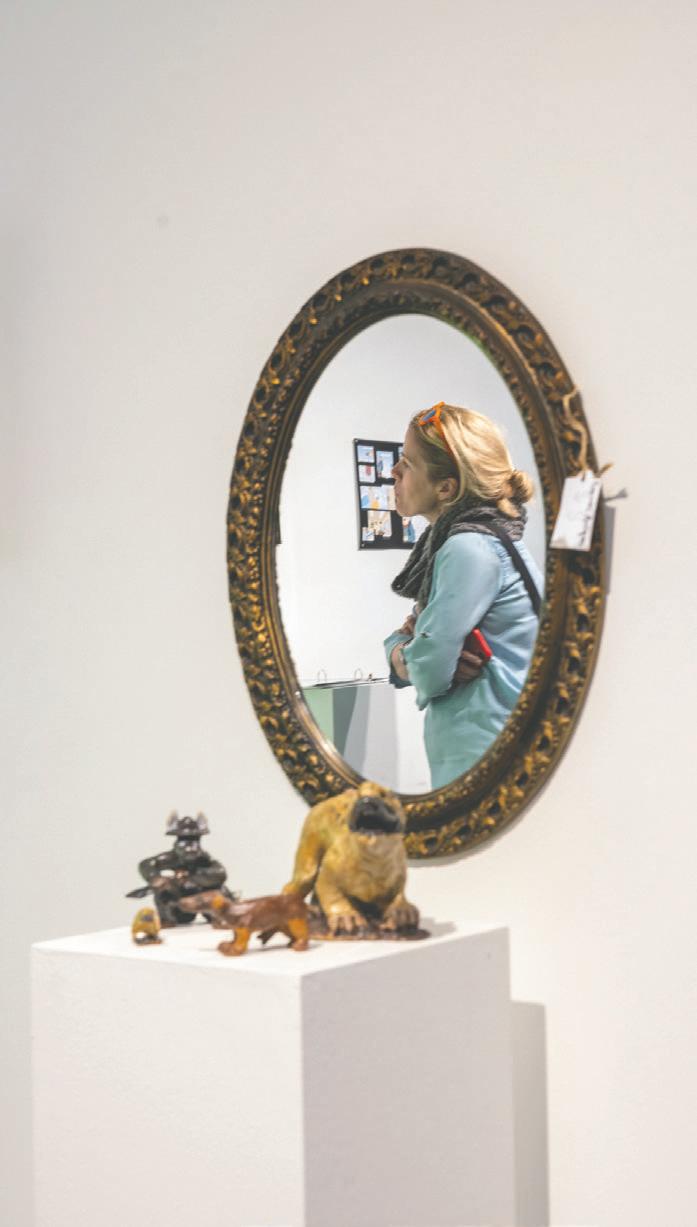
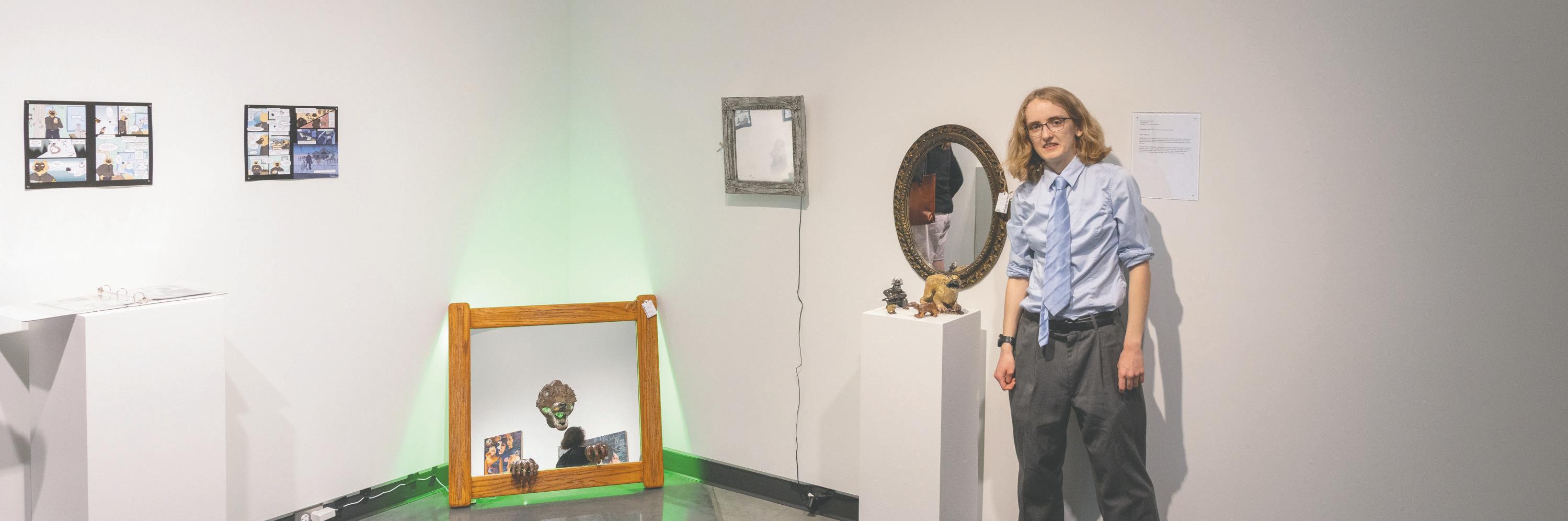
Their series, Silverwatch, expands an eight-page comic they began developing throughout college into a full installation of digital prints, ceramics and mirrors. Instead of remaining on the page, the narrative is reconstructed in three dimensions, allowing viewers to step into fragments of the story as if they are moving through it.
At the center of that world is Salem, a character whose life begins to unravel after a display breaks in the antique shop where she works.
“Salem works at an antique shop to pay for college,” Humpherys wrote in their artist statement, “but what she doesn’t know is that one of the mirrors on display is haunted. That is until one day, she trips and breaks it.”
From that point, the work expands outward into a constructed universe of objects, creatures and environmental details. Beyond the illustrated scenes from the story, Humpherys incorporates physical components from the comics as well.
At first, Humpherys didn’t plan to be part of the BFA exhibition at all, since Illustration majors aren’t required to participate in the same way as other studio disciplines.
“Initially, I wasn’t going to be in the show,” Humpherys said. “However, I changed my mind in favor of joining because I saw it as an opportunity to have a bigger goal to work towards. I think that worked, because now I’m finding that the exhibition has in fact made me more confident in my own abilities as a creator. ”
The exhibition itself feels in motion, where ideas are still being tested through material, process and form as each practice continues to evolve.
The 2026 Bachelor of Fine Arts Exhibition opened on April 10 at the Blue Galleries on the first floor of the Center for the Visual Arts, featuring work from 14 graduating seniors across several art mediums. The exhibition serves as a capstone for BFA students and is free and open to the public, remaining on display through May 1.
What remains is the sense that the work continues beyond the gallery, still moving forward as it leaves the walls behind.
S avannah h umphery with their artwork
G roup ob S ervin G o mar S aucedo ’ S photo S erie S
F rannie p a S ternak
e than m eeker with hi S artwork G roup viewin
F rannie
ternak
photo
CULTURE
HOW THE CAMPUS COMMUNITY IS CELEBRATING EARTH DAY
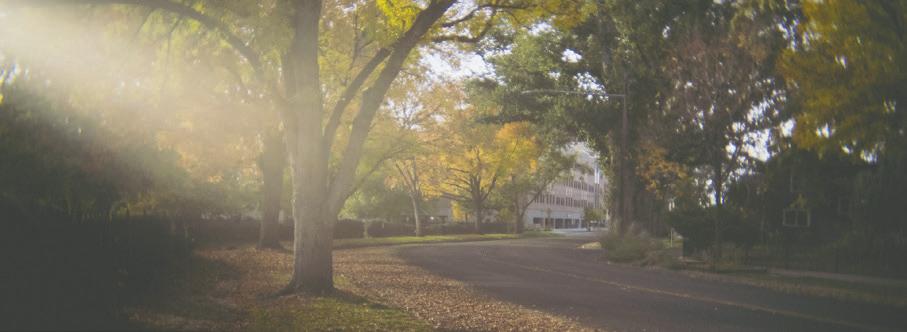
In 2026, the global theme for Earth Day is “Our Power, Our Planet,” encouraging people around the world to show up and use their voices and actions to advocate for the planet.
On Boise State’s campus, student organizations and the Office of Sustainability are taking that objective very seriously, offering several opportunities for the campus community to get involved and make a difference for the environment.
“A big part of what we do is student involvement, and we think that this month of Earth Day is a great opportunity to provide student involvement events and to get some recognition about what it means to participate in Earth Day,” Environmental Compliance and Sustainability Manager Jennifer Ellis said.
Earth Day will take place on April 22, and the Department of Sustainability
is inviting all students to participate in Earth Day events leading up to the holiday.
“Our most popular [activity] tends to be plogging,” Ellis said, referring to the activity of picking up litter while jogging (or walking). “It’s easy, it’s tangible, it’s fun, it’s rewarding. You can see a result at the end of the hour.”
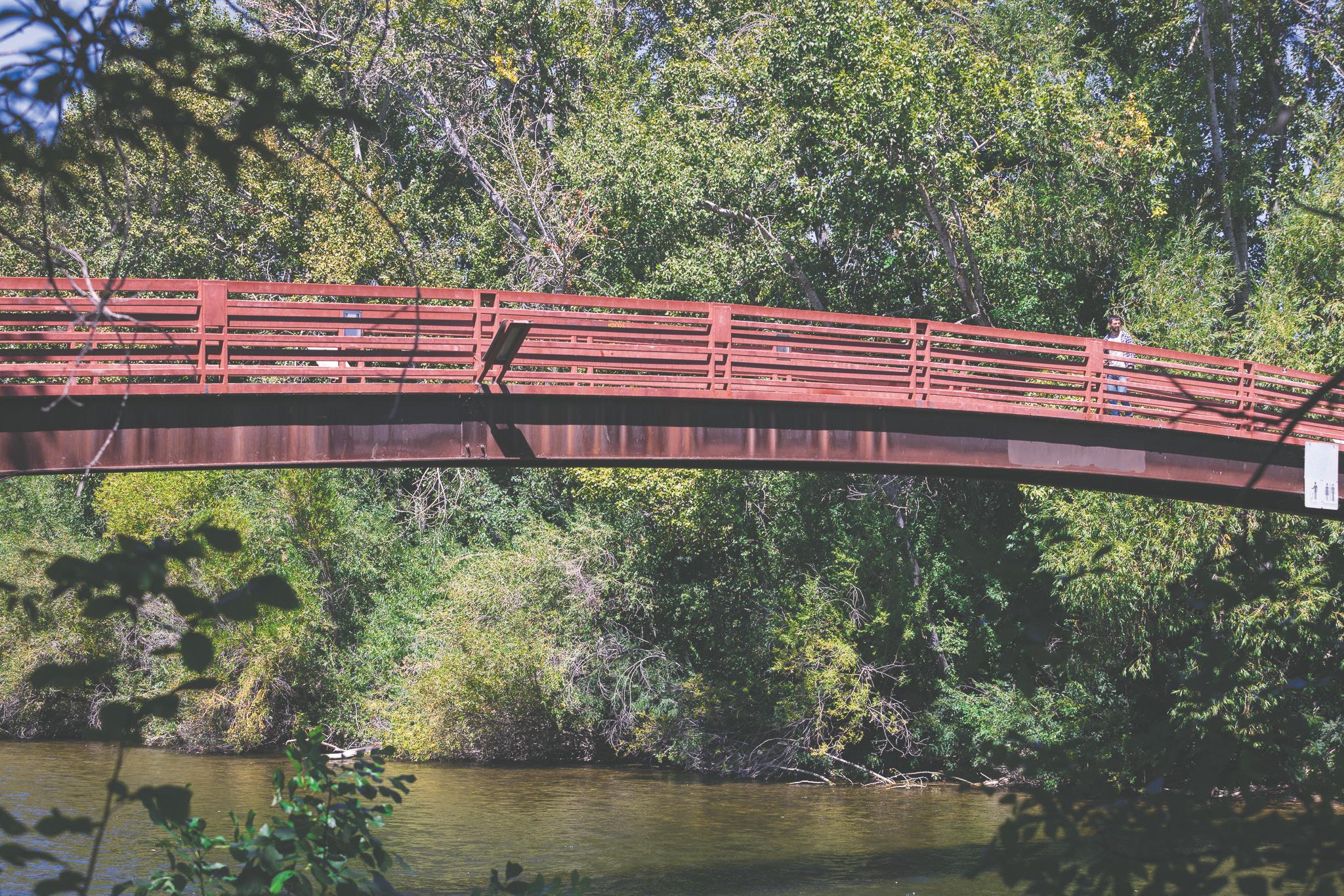
The department will host plogging gatherings every day during Earth Week, from April 21 to 24. The cleanups will happen for one hour each day, from noon to 1 p.m. starting at the Friendship Bridge.
Ellis said events like plogging often make students feel rewarded, giving them the satisfaction of doing something concrete to make a difference.
Another Earth Day event Ellis highlighted was the Sustainability Tour taking place on April 22. The hour-long guided campus walkthrough will showcase some of the notable sustainability
features of campus.
The tour will start at the Student Union Building and finish at the COBE building, showing attendees prominent campus features such as solar energy stations, the Bee Team apiary, buildings heated by geothermal energy and more.
Ellis added that those who cannot attend the sustainability tours in-person can view the department’s Virtual Sustainability Tour to learn more about campus sustainability features and initiatives.
There will be several other events hosted by the Department of Sustainability before Earth Week, throughout Earth Week and beyond. Ellis said some of these include the Annual Tree Planting Ceremony to preserve Boise State’s status as a certified Tree Campus on April 16, a Greenbelt Bike Ride hosted in partnership with the Cycle Learning Center on April 21 and a Garden Clean-Up in the campus community garden on April 24.
Beyond the official university-sponsored events, student organizations are
coming together to make their own Earth Day impact.
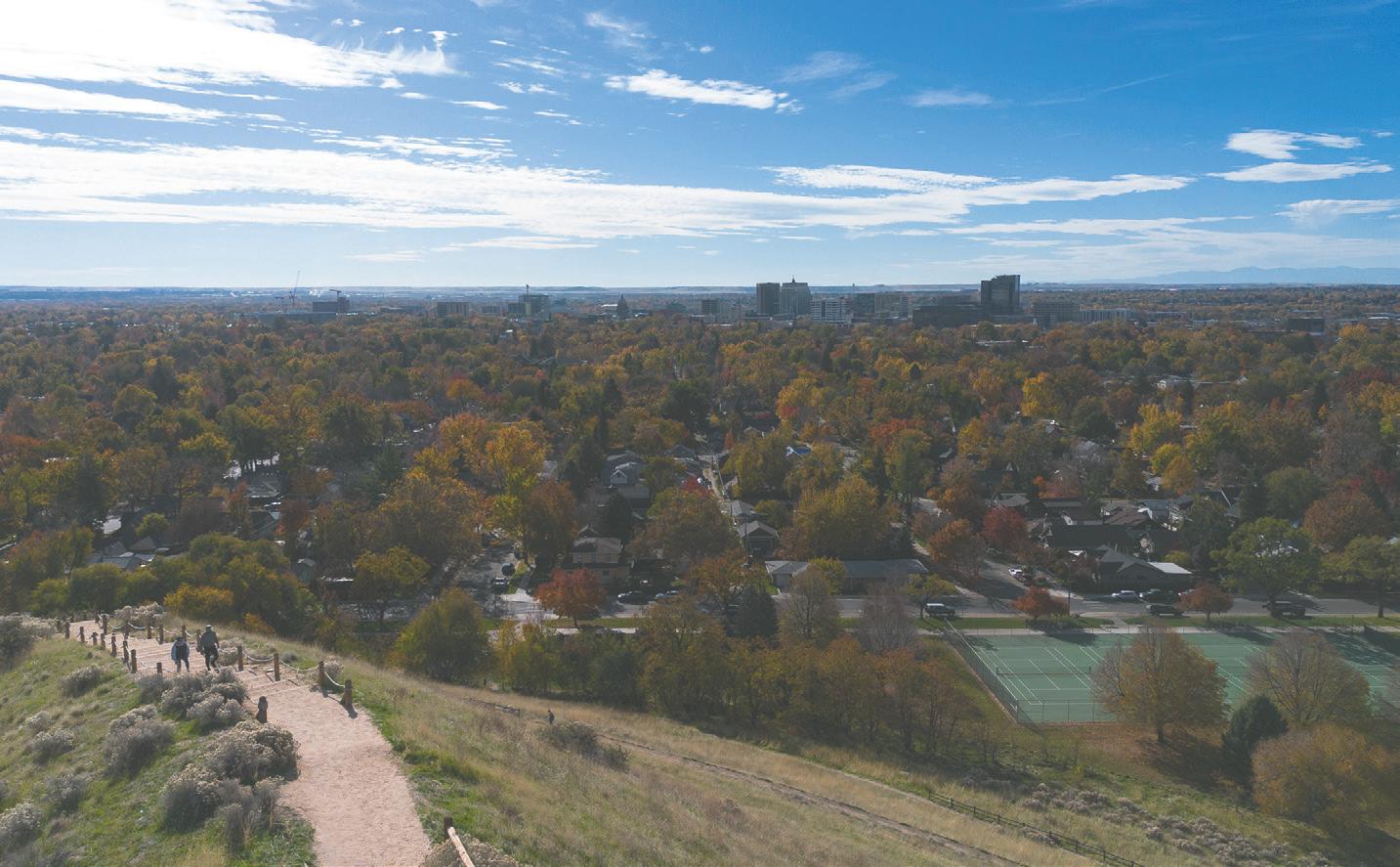
Community Garden Club President Abigayle Ellsworth said their group is planning a special Earth Day hike at Camel’s Back Park. The club, and anyone else interested in joining, will meet on April 22 and 1 p.m. at the park, and will pick up trash along the way.
The club spends most meetings in the campus Community Garden where members grow plants and flowers, teaching students how to garden and donating their produce to the Campus Food Pantry. To celebrate Earth Day they decided to get out and explore more of what Boise nature has to offer.
“It is a community garden, so it’s good for us to go out into the community, and especially with students on campus, sometimes people get a little stuck in that area,” Ellsworth said. “It’s good to show people other places and areas they can explore on their own, and it has a fantastic view of Boise. It’s just a great opportunity to get up into the hills and
Julianna Kelsey | Culture Editor | Photos by Omar Saucedo
appreciate our valley and the environment.”
Ellsworth said she sees Earth Day as a reminder to appreciate the beauty of the world around her.
“Earth Day is great,” she said. “Especially right now, it’s super needed — remembering to appreciate those things, especially when we don’t exactly live in a society that necessarily values nature all that much a lot of the time.”
Those interested in getting involved with the Community Garden Club can learn more on their CampusGroups page or on their Instagram, @bsucommunitygardenclub.
Environmental Club Vice President Boden Bisgard said their group is planning an Earth Day protest at the Capitol in conjunction with the Youth Salmon Protectors. They will be meeting at the Capitol building at 3:30 p.m. on April 22 with a variety of local organizations and community groups.
“The idea of the protest is to elevate youth voices around climate issues,” Bisgard said. “We want to give people a space to not only get out and communicate with other environmental professionals or environmental students, but give them a space to elevate their voice
BAKING CLUB MAKES MONDAY NIGHTS A LITTLE BIT SWEETER
As the end of the semester approaches, a brand-new club is baking up a fun new way to escape everyday stress while making new friends, memories and recipes.
on a statewide, and hopefully national, level.”
Bisgard said organizing the protest has been “a lot of work,” requiring a lot of outreach to try and get students and organizations at the high school, college and community levels involved. According to him, many are afraid to speak up and act in today’s political climate.
“There’s plenty of reasons not to act,” he said. “There are so many fears and anxieties that you could have about taking action and making your voice heard, but you only get so many chances in a life to really make an impact. This is one of those chances.”
The Environmental Club works throughout the entire school year, doing hands-on environmental work and community engagement. Students interested in getting involved for Earth Day and beyond can learn more on the club’s CampusGroups page or on their Instagram, @environmentalclubbsu.
Whether it’s by attending an event or simply taking a moment to appreciate the natural beauty of Boise, Earth Day is a reminder that the responsibility to keep our campus, and planet, beautiful falls on all of us.
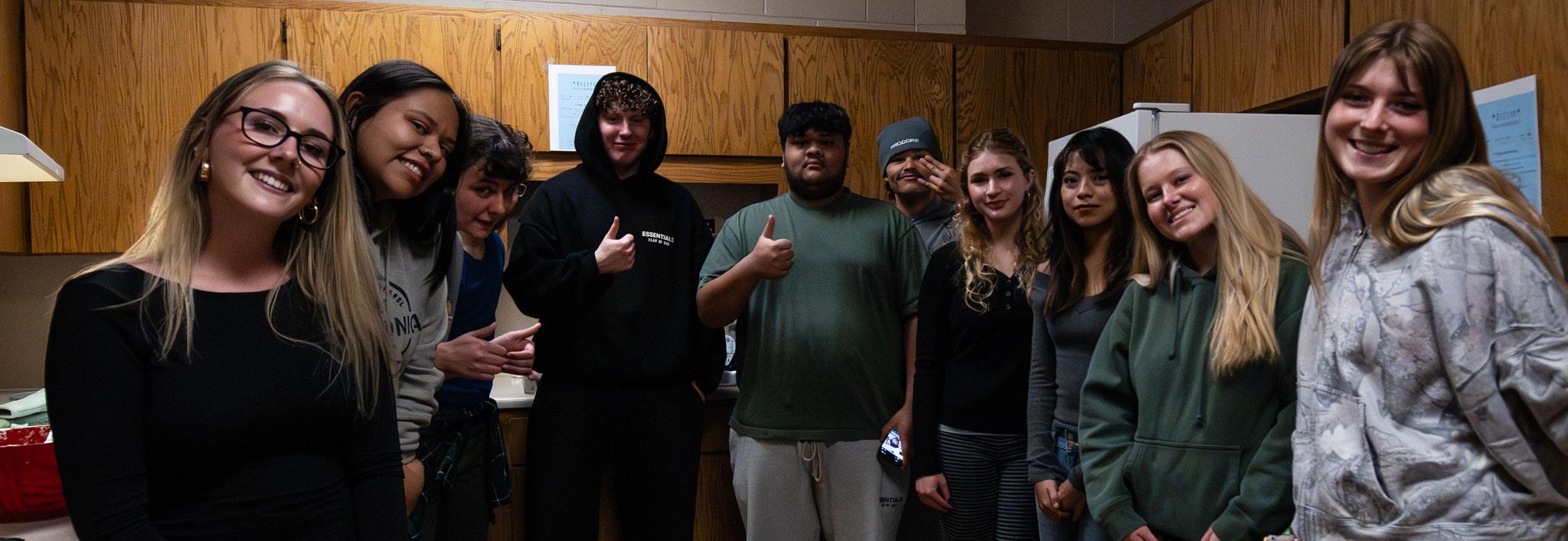
Roommates Danica Cutler, a freshman studying biology and Mackenzie Riemer, a freshman studying pre-nursing, enjoyed making different dessert recipes together in the Towers Hall kitchen to decompress after a long week.
When the pair was looking for a club to join, they struggled to find one that felt like a good fit. Instead, they had the idea to start something entirely new.
“Some clubs are really specific, and some of them don’t meet very often,” Cutler said. “So, we were like, ‘How about a Baking Club? That sounds like something people would like to do.”
Cutler and Riemer thought other students could benefit from the stress relief of baking, just like they did.
The roommates felt baking was the perfect activity to bring people together, with Riemer describing baking as “very inclusive”.
“There are no skills you already need to know,” she said. “Whether [students are] just looking at a recipe card or have a lot of prior knowledge, everybody can be included in it, because there’s no skill set that’s already required for it.”
Riemer also said learning new recipes is a great learning experience. Getting the opportunity to experiment and prac -
tice through the club will be especially beneficial to college students who might not have access to a kitchen.
“In college, we have such limited space for ingredients and things,” she said. “This is a perfect way to make use of what we have around.”
The club had its first meeting on Monday, April 6. Cutler and Riemer said 12 students attended.
“I’m so excited about it,” Riemer said about the turnout. “I honestly was not expecting a really great outcome because it was kind of random, and nobody really knows who we are. Everyone was super into it and really excited about the opportunity to bake with other people.”
While the first meeting was all about planning what’s next for the club, the attendees’ excitement stood out to Cutler and Riemer.
“We talked about what we wanted out of the club, what recipes we wanted to make, when we wanted to meet, fundraisers we wanted to do and we showed the kitchen off,” Cutler said, adding that while they initially planned to meet once every other week, the excited club members wanted to meet weekly to make the most of the remainder of the semester.
The club is open to all students and will hold meetings at 5:15 p.m. on Mondays in the Towers Hall kitchen for the remainder of the semester. Those interested in joining can learn more on the club’s Instagram, @bakingclubboisestate, or on the club’s CampusGroups website. | ARBITERONLINE.COM april 16, 2026
Julianna Kelsey | Culture Editor | Photo by Carter Nash
CULTURE
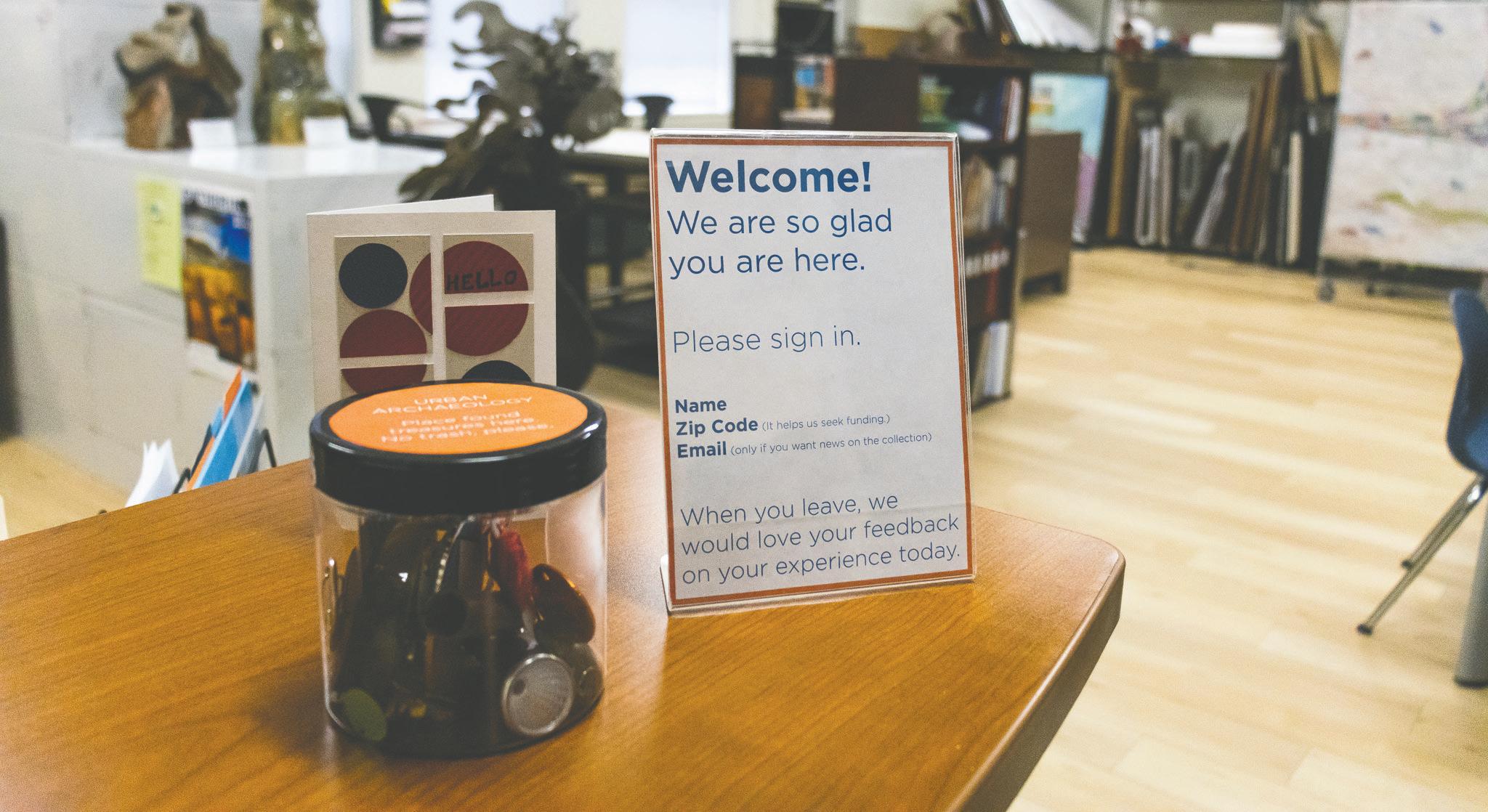
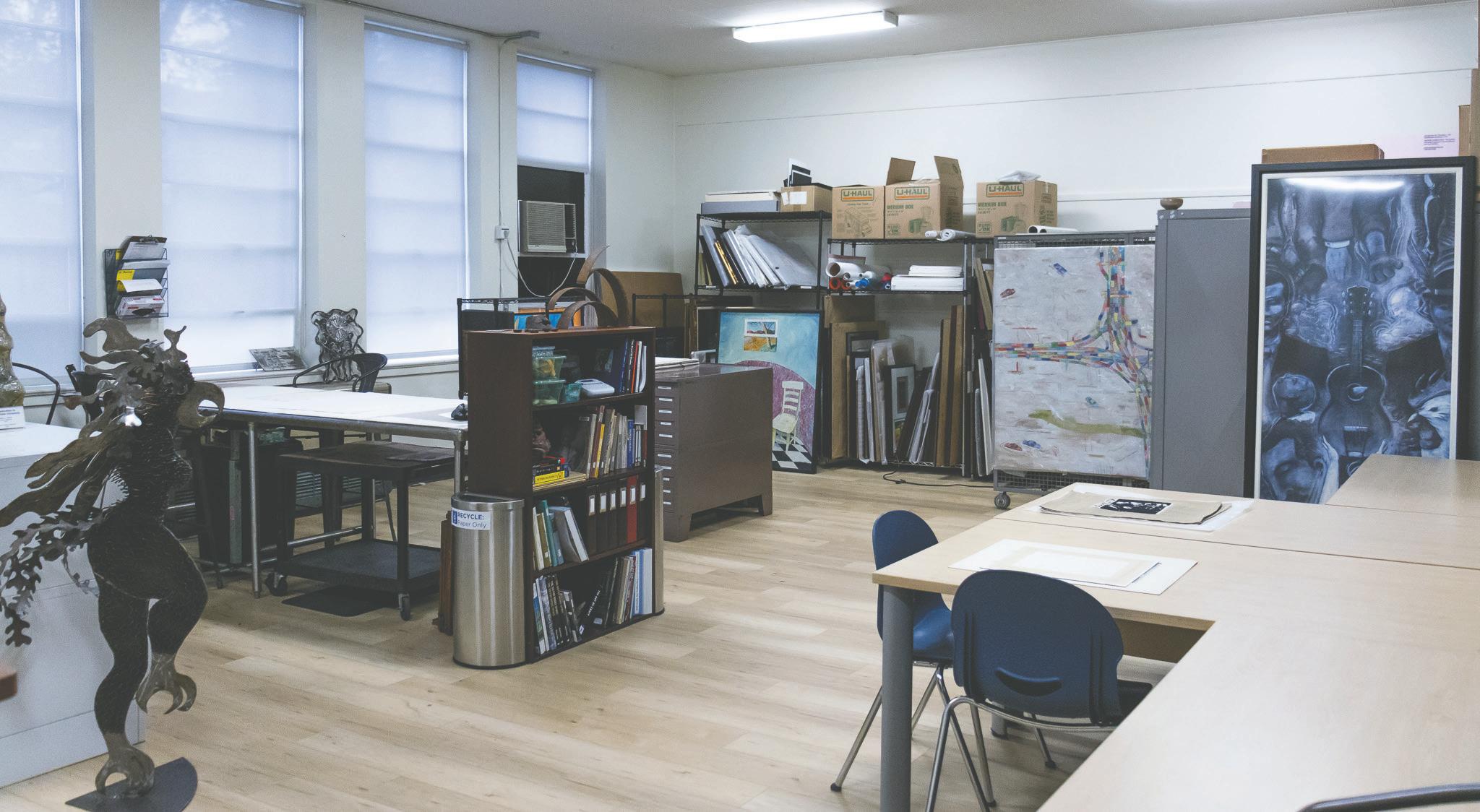
PRINT STUDY ROOM INVITES STUDENTS TO EXPLORE HISTORIC ART COLLECTION
Julianna Kelsey | Culture editor | Photos by Julianna Kelsey
Beyond the chaos of quad construction and impending final exams lies a quiet corner of campus where the outside world fades away.
The new Print Study Room offers a space for students to take a break and immerse themselves in the magic of art and history.
“The idea [behind the room] is that students, faculty and community members can come here,” Director of University Art, Fonda Portales said of the expansive art collection. “You don’t need an assignment, you don’t need an agenda, you don’t need some kind of objective. You can just come and hang out.”
The art in the Print Study Room was previously in storage and spread through three office spaces. According to Portales, the rooms were cramped and unwelcoming, and art was frequently damaged when moved through the tight spaces.
Portales spearheaded the Print Study Room project, bringing the collection to a place visitors can view and interact with the works.
In the Print Study Room, visitors will find thousands of both original artworks and prints, sculptural pieces and historical items.
The artwork in the collection is rotated and displayed in different areas of campus. As Director of University Art, Portales curates these public artwork displays.
“Most of the collection is on display somewhere,” Portales said. “It’s really all over campus.”
Portales explained public art helps shape the identity of the campus community by giving students artwork to connect with throughout their time on campus.
“There are students who study under specific pieces, and they’ve chosen that study spot because they really want to be by that artwork,” she said. “Maybe they’re not looking at it the entire time, but they’ve chosen that space to become part of their sense of belonging in a space.”
In addition to curating art, Portales and student assistants preserve and catalog the art in the collection. The space is climate-controlled and lighting is intentionally designed to protect the fragile art.
Portales spends a lot of time educating herself and others on how to best care for these pieces.
“A lot of it is educating myself on how to be a first-line defense in that process of protection,” she said. “I’m an art
historian, but my background is in Mesoamerican art history. It’s really not in printmaking, so I’ve had to learn a lot.”
The preservation and printmaking techniques have attracted students and professors in non-artistic fields of study to visit. Recently, a Materials Science class visited to learn about the transfer processes used in printmaking, and how they are similar to semiconductor manufacturing techniques.
“It was just really cool to see the same technique being applied to something that wasn’t semiconductors, or even manufacturing or engineering related,” said Yvette Russell, a Materials Science major who visited with her class.
Russell said her time in the Print Study Room was a “nice change of scenery.”
“It was a nice relief and a break away, even if it was still considered class time,” she said. “It felt more calm and relaxing.”
Student organizations have utilized the space for meetings and activities as well. A group of Interfraternity Council leaders recently visited the space. Interfraternity Council President Dominic Mancini organized the visit alongside Portales, choosing artwork for the seven men to observe and discuss.
“The first two pieces we looked at were intense,” Mancini said. “A lot of lines, drawings, interpretations, people. This was overwhelming for the group, as it took them a lot of time to warm up to the idea of talking about the art. Eventually, the conversation led to us relating to personal experiences and connecting the two pieces together.”
This is what Portales calls “slow-looking” — the act of viewing art for extended amounts of time, observing and reflecting on how it makes you feel.
According to her, this practice is valuable in an increasingly digital world.
“There is nothing as sweet as seeing something in person, being a few inches away from it and looking at the object through a loop to see all of its fine details and to see some of those textures that you just can’t see through digital mediation,” she explained.
The tangible artwork is the perfect medium for students to explore if they want to escape the frenzy of digital media constantly swarming around them.
“Learning to slow down is a really good skill to practice,” Portales said. Students or community members interested in visiting the Print Study Room can contact Portales to schedule an appointment.
STUDENT SELLS BEGINNER-FRIENDLY PLANTS AT THE BOISE FLEA MARKET
Phoenix Willard | Staff writer | Photo by Kylar Kast
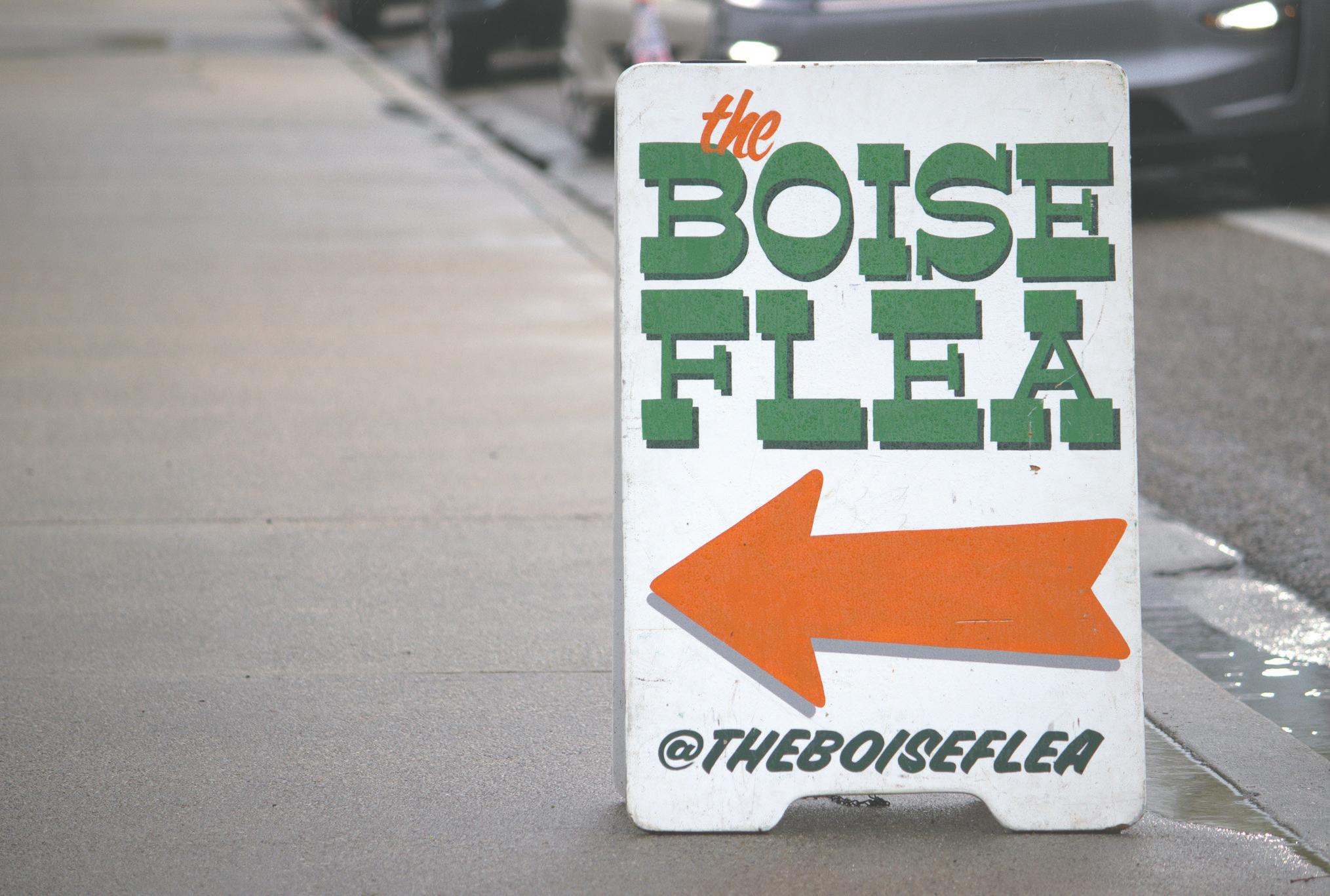
Ten years ago, the Boise Flea Market was born from a love of finding vintage treasures. The street-style market full of vintage goodies and handmade items is held on Sundays every summer in the Albertson’s Stadium parking lot.
With a large variety of small businesses tabling at the market, walking through the busy aisles and eyeing the stalls is something every Boise resident should experience, even if you don’t plan on buying anything.
Boise Flea Market founder and operator, Erinn Urquiaga, looks for opportunities to work with students as often as possible.
“I feel like I need to give back to young entrepreneurs because that’s how we give back to our communities,” Urquiaga said, noting that the flea offers discounted booth rent for students in partnership with the university.
Young entrepreneur Jenna Plum, a business administration student, leapt at the chance to sell her own product at the flea: plants.
At this year’s market, Plum will sell a wide array of beginner-friendly, low-maintenance plants including pothos and spider plants, ideal for student life and dorm living.
After moving into her first apartment, Plum and her roommates decided to fill the space with plants. Shortly after, most of the plants were dead.
“I’ve noticed a lot of people don’t understand how to water plants,” Plum said, “I totally killed [my first plant] because I thought you were supposed to water it every day.”
A detailed care guide designed by Plum comes with the purchase of any plant, including information about light requirements, watering instructions, soil preferences, repotting instructions and pet safety.
Plum’s plants are cut and propagated, meaning taking a cutting from a larger parent plant to grow new plants, from a variety of sources, including her mother’s plants and others she sourced from local shops.
Growing the plants herself allows for detailed and accurate care guides, with the goal of ensuring all plants will thrive in their new homes.
“The hardest part is just waiting,” Plum said, “it is kind of like watching grass grow.”
Plum said keeping plants improves serotonin, relieves stress and anxiety and keeps the air fresh and clean. For Plum, plants also provide a sense of routine. Growing up in a house full of greenery, her passion for plants has been a long
time coming.
“My love of plants definitely started from my mom,” she said.
Cassie Findling, Plum’s mother, spent many days of Plum’s youth gardening.
“I always tried to get her to come outside and garden with me,” Findling recalled.
When Plum moved out and realized how much she missed her mother’s plants, her new apartment quickly became a jungle.
When Plum decided to sell plants at the flea market, her mother was proud to see her own passion instilled in Plum.
“I never know what to expect with Jenna,” Findling said, “It did surprise me, but didn’t all at the same time.”
For Plum and Findling a love for plants seems to be genetic. When Findling was a young girl, her mother and grandmother would collect flowers and trade with their friends at church.
“My grandma always said that you never say thank you for flowers because they’re supposed to be shared,” Findling said, adding that she still has tulips and daffodils gifted from her mother and grandmother growing in her garden today.
This sentiment holds true for Plum.
“I’m most excited [to see] people smile,” Plum said. “I like making people happy, especially if it’s something that’s personal to me.”
SPORTS
A JOURNEY ROOTED IN LOYALTY: MADDUX MADSEN RETURNS FOR FIFTH YEAR
Madsen enters third year as starting quarterback and fifth year at Boise State, rarities in today’s college game
In 2026, the idea of a college football quarterback entering his third straight year as a school’s starter is almost entirely foreign.
Name, Image and Likeness (NIL) and the transfer portal have transformed bigtime college football into an NFL-esque model, with financial incentives and immediate playing time often outweighing student-athletes’ desires for long-term development and program loyalty.
Because of this, players bouncing around between three, four or sometimes even five schools throughout their college careers has become somewhat standard.
Today, only a small group of college football players spend their entire careers at one school, an increasingly rare path in the modern game.
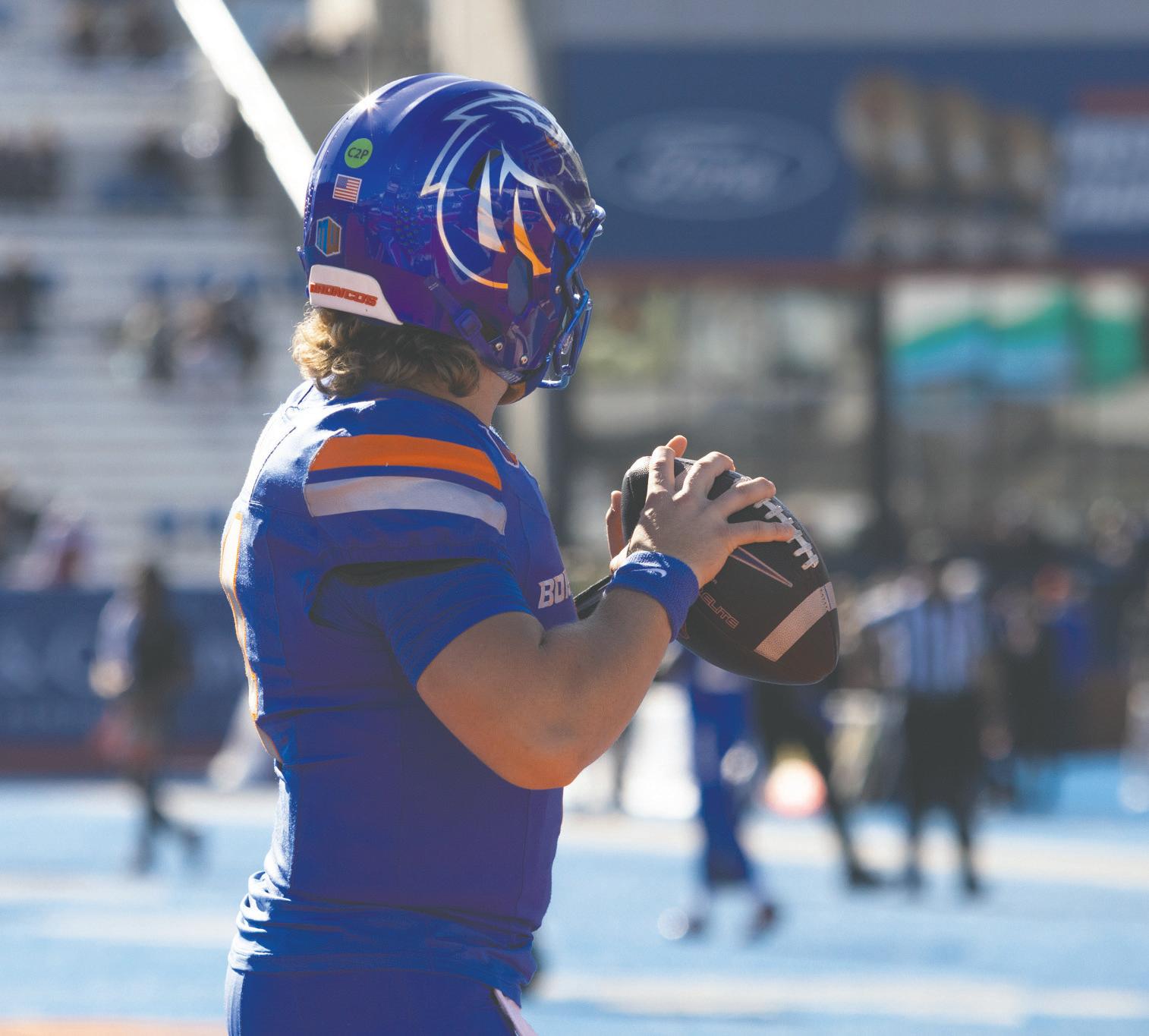
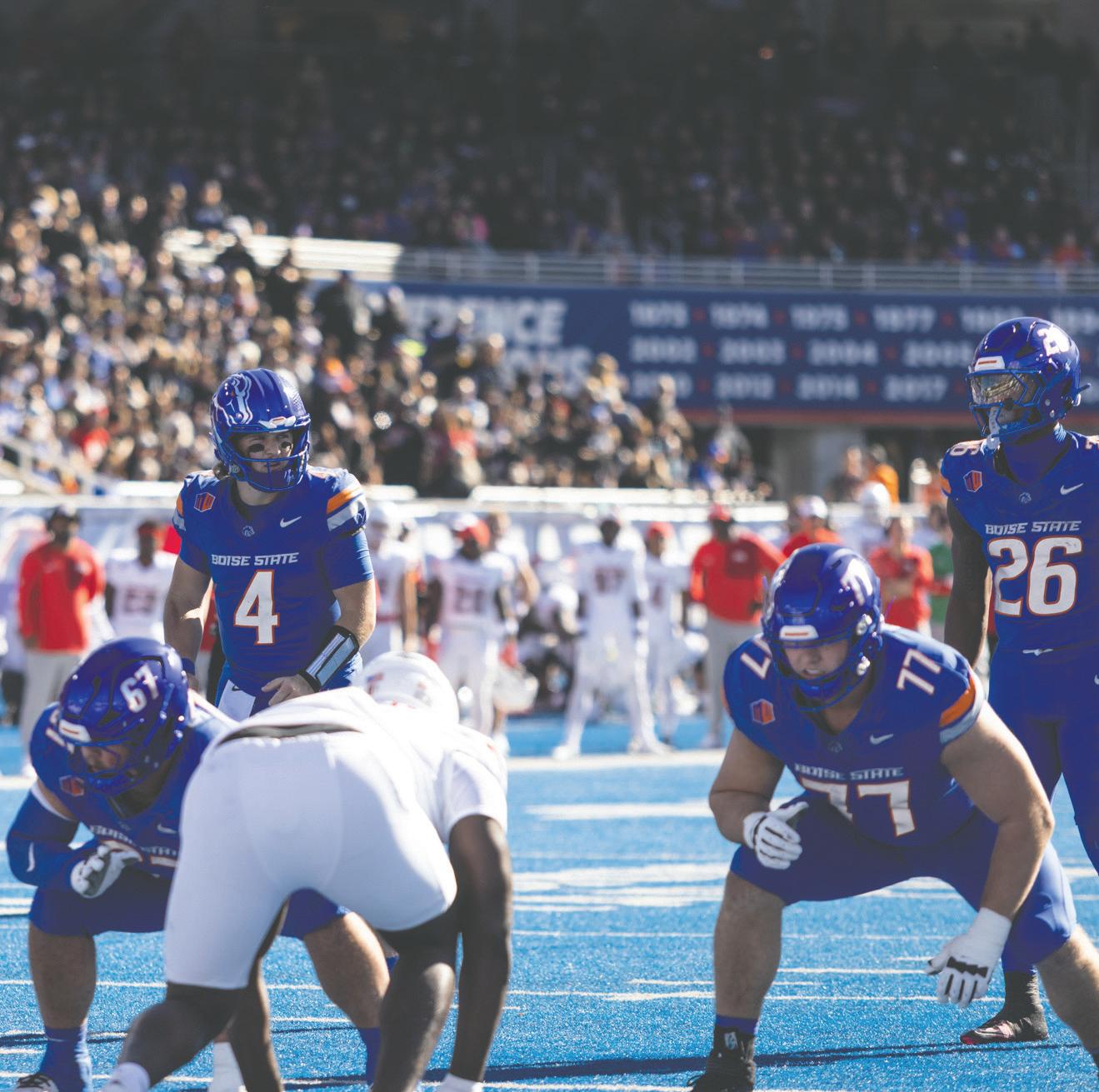
Boise State quarterback Maddux Madsen is one of them.
The redshirt senior is entering his third year as the Broncos signal caller. As the starter, he’s led the team to back-toback conference championships and a 19-6 record.
A member of the program since 2022, this upcoming fall will mark Madsen’s final year of eligibility.
“It’s a huge deal to be here for five years,” Madsen said when asked about his feelings entering his senior year.
“Playing in the same place for five years, you don’t see that very often. I take a lot of pride in that and everything that I want to give to this program.”
The Utah native was a three-star recruit in the 2022 class coming out of American Fork High School. Rated the No. 21 recruit in the state per ESPN, Madsen threw for over 4,000 yards and nearly 50 touchdowns as a junior.
The 5’10” pocket passer committed to Boise State on July 6, 2021.
Beginning his career in a backup role to Taylen Green, Madsen saw action in just one game during his true freshman season. He made his collegiate debut on Nov. 12, 2022, at Nevada, where he threw for 43 yards on three completions.
Entering 2023, Madsen’s redshirt freshman year, Green remained the starting quarterback. In a position most players would’ve run from into the arms of the transfer portal, Madsen remained in Boise, honing his craft each day until his time came.
When it came, he was ready.
After Madsen made nine appearances in 2023 that included one start, his first true test arrived in the form of USC transfer quarterback Malachi Nelson.
Many outsiders expected the former five-star recruit to beat Madsen out for the starting job, with Nelson’s high-profile talent and flashy image overshadowing the more lightly-touted Madsen.
But in a program like Boise State’s, flashiness means nothing, and tenacity is everything.
Madsen outperformed Nelson during the spring and summer and was named the starter heading into 2024 fall camp.
Once named QB1, Madsen never looked back, leading the Broncos to back-toback conference titles in 2024 and 2025 as the team’s starting quarterback.
As a redshirt sophomore, his first year as the starter, Madsen threw for just over 3,000 yards and 23 touchdowns, both leading the Mountain West. He guided the Broncos to a College Football Playoff berth, where they lost to Penn State in the Fiesta Bowl.
Madsen appeared on multiple preseason award watchlists before 2025, including the Maxwell Award. In ‘25, Madsen threw for 2,334 yards and 18 touchdowns on 176 completions. Plagued by an injury late in the season that caused him to miss multiple games, Madsen returned for the conference title game and was named Mountain West Championship MVP after throwing for 289 yards and scoring four total touchdowns in the contest.
Described by head coach Spencer Danielson as the “heartbeat” of the team, Madsen provides an elite spark that sometimes gets overlooked.
“Maddux Madsen is one of the best quarterbacks in the country,” Danielson said. “If [people] don’t [believe that], I tell them, ‘please watch the film.’ Just because he’s maybe not 6’5” or what people think equals elite, Maddux Madsen is an elite quarterback. We put a ton on [him], and he never flinches, loves his team and comes to work every day with a smile on his face looking to get better.”
The responsibilities that come with being Boise State’s starting quarterback mirror the balancing act Madsen managed as a dual-sport athlete in high school.
Jake Zamora | Sports Editor | Photos by Carter Nash
In 2022, his senior year, Madsen transferred to nearby Lehi High School for the spring semester to play baseball under his father, who was an assistant coach at the time. He was named 5A Player of the Year and led Lehi to its first state championship since 1981 while hitting .455 with 42 RBI.
A former pitcher and infielder, Madsen is fittingly named after Hall of Fame pitcher Greg Maddux, with his middle name, Jeter, being a nod to longtime Yankee captain Derek Jeter.
The tight-knit bond Madsen shares with his family — including his five siblings, all named after baseball stars — has surely kept him grounded throughout his journey in Boise. Now, after marrying his wife, KarLei, in March, he enters the season with added motivation. Since stepping foot on campus in 2022, Boise State quarterback Maddux Madsen has grown tremendously, both on and off the field.
The Banana Ball Championship League, better known as Banana Ball and made famous by the Savannah Bananas, arrives in Boise this summer, bringing one of the fastest-growing spectacles in sports to Albertsons Stadium. Demand surged immediately, with both nights selling out through a lottery-based system after more than 40,000 fans joined the priority list for roughly 6,500 available tickets.
Nathan Burk, senior associate athletic director, who oversees facilities, events and operations at Boise State, said the response confirmed exactly what his team expected.
“People are hungry for live entertainment,” Burk said. “We’ve seen a lot of demand for this show and for people to come in and experience something different in Albertsons Stadium.”
“It opens the door for people who aren’t as into the sport because it creates a different atmosphere,” Pepin said. “An event like this shows Boise has a strong baseball fan base, especially for a city without a team to rally around.”
Banana Ball reimagines the sport with a more interactive, entertainment-driven approach. The format emphasizes constant action and fan involvement, creating an experience that feels more like a live show than a traditional game.
“It’s basically like the Harlem Globetrotters of baseball,” Josh Brown, a Boise State junior, said. “You’re not really going just for a traditional game, you’re going for the entertainment and how fun it is.”
Brown said the energy and unpredictability help explain why the event continues to grow.
Being patient and buying into a program’s culture despite no immediate playing time is a feat in itself that not many college football players in today’s age can say they’ve accomplished.
Madsen’s poise, work ethic and maturity have guided him to his starting role and cemented his legacy as one of the best quarterbacks in program history.
Despite social media criticism directed towards the quarterback during the team’s rough stretch last year, running back Sire Gaines has made it clear he’s ride-or-die for Madsen heading into 2026.
“I don’t care what anybody says, that’s my quarterback,” Gaines said. “Everybody can say what they want to say, but I’m riding with Maddog until the wheels fall off. When you talk about a true quarterback that’s leading, that’s Maddux Madsen.”
Banana Ball flips traditional baseball on its head. Games avoid long innings, eliminate bunting and walks, and include unique rules such as fans recording outs by catching foul balls. Players dance between pitches and lean into a style closer to a performance than a standard game.
For a city without a professional baseball team, the event brings a rare opportunity to see the sport in a new format inside a major venue.
Burk said the event fits a broader push to expand how Boise State uses its facilities beyond football.
“We’re trying to hit all areas of the market,” Burk said. “Everything from high-end concerts to family-friendly entertainment. Banana Ball fits right into that.”
Drew Pepin, a Boise State freshman and longtime baseball fan, said the unique format can feel excessive compared to traditional baseball, but still sees its value.
“It’s more interactive with fans than a traditional baseball game,” Brown said. “There are things going on all the time, so it doesn’t feel slow like a normal game can.”
As summer approaches, the excitement surrounding Banana Ball has already taken shape in Boise. With both nights sold out and interest continuing to grow, the event now moves from anticipation to reality.
SPORTS
HOME STREAK ENDS AS BRONCOS FALL DURING BEACH BASH MATCHES
Aidan Mattingly | Sports Reporter | Photos by Carter Nash
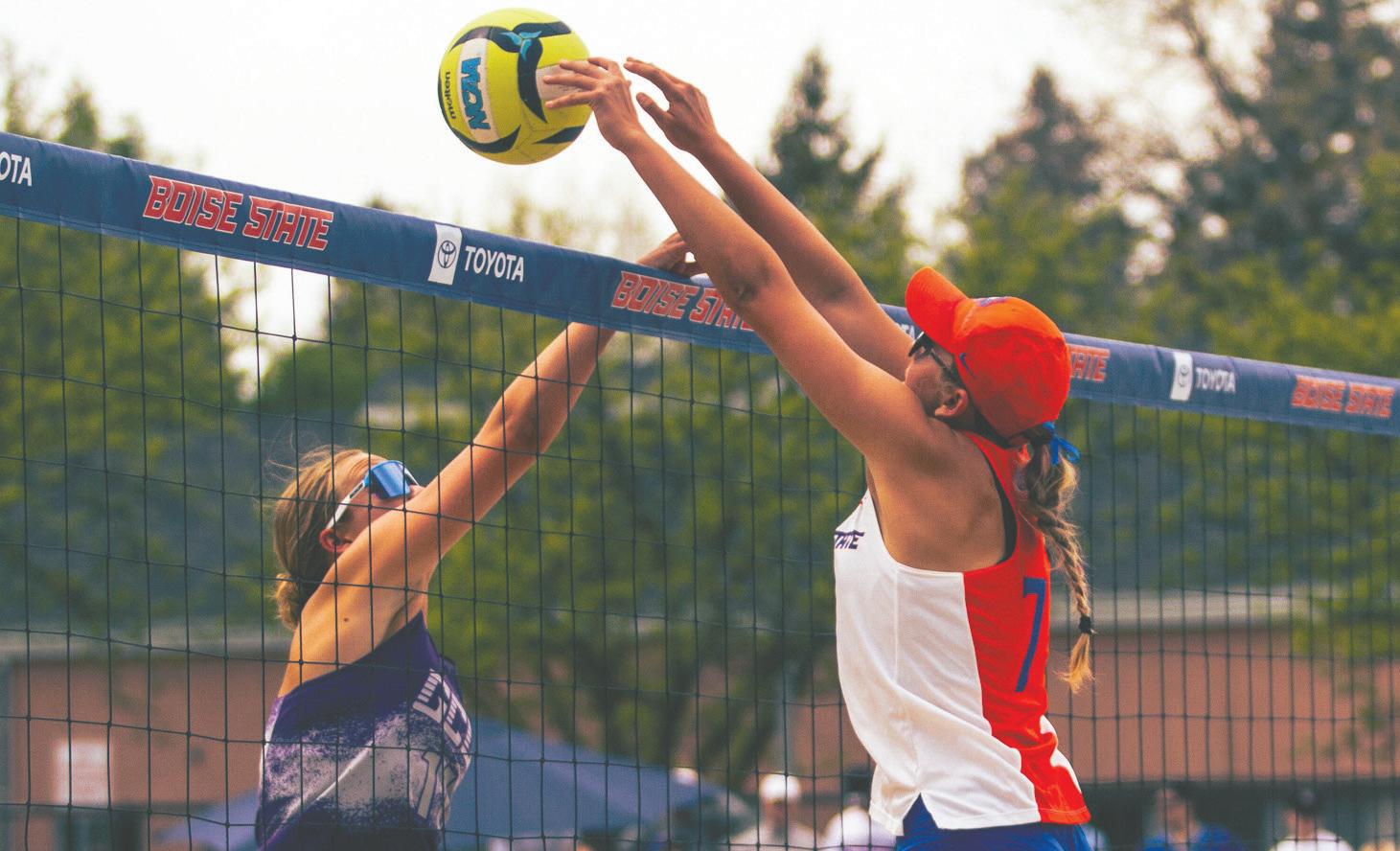
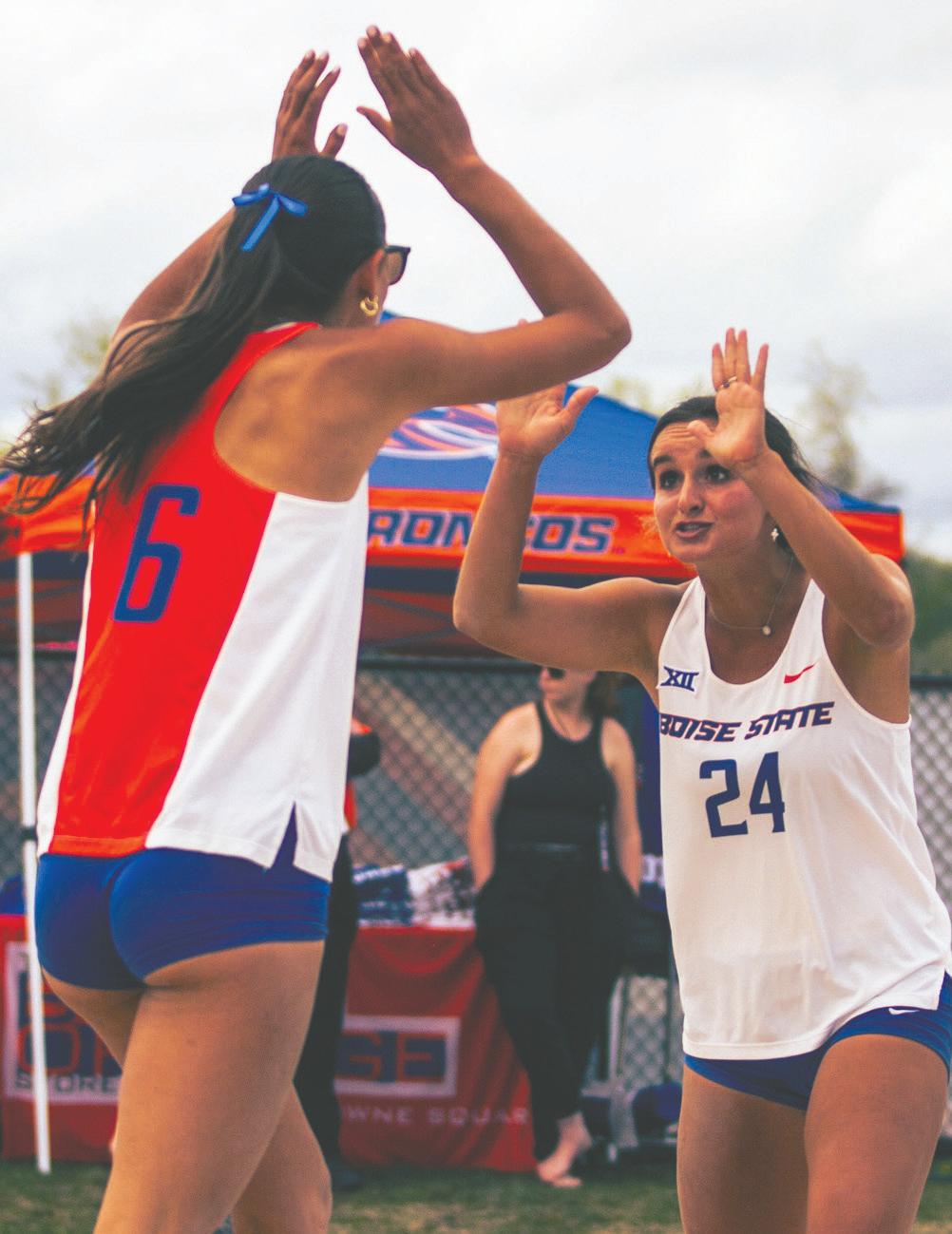
Boise State beach volleyball saw one of their most consistent stretches come to an end Saturday, falling to No. 11 Grand Canyon and Washington at the Boise State Beach Bash and snapping a 26dual home winning streak dating back to 2020.
The No. 19 Broncos (15-13) entered the weekend unbeaten at home for nearly four years, but a pair of tightly contested duals flipped late and closed the home slate on a different note.
Boise State opened strong against Grand Canyon, building an early 2-0 lead behind wins from Addison Moss and Elli Wolthuis at the No. 4 spot and Ava Anderson and Addison Wolden at No. 2. Grand Canyon responded with three straight victories, including a clinching win on court one to complete a 3-2 comeback.
The Broncos tried to build momentum heading into the second dual against Washington, where Anderson and Wolden delivered another straight-set win at the No. 2 position to give Boise State its only point of the match. Washington answered across the rest of the match, winning the remaining four courts to secure a 4-1 victory.
The Huskies opened with a straight-set win on court one and added a three-set win at No. 3 to take control of the dual. Washington continued to apply pressure in key spots, closing out the match with a sweep at the No. 5 position.
Head coach Alex Venardos said opposing defenses disrupted Boise State’s rhythm throughout the day.
“Both teams defensively took away a lot of our common tendencies and forced us into boxes,” Venardos said. “We’ll go back and look at the film to see what kind of adjustments we can create before next weekend.”
Despite the losses, Anderson and Wolden remained one of Boise State’s most consistent pairs, earning wins in
both duals. Moss and Wolthuis also contributed with a win against Grand Canyon, helping the Broncos take an early advantage before the Lopes rallied.
Chemistry has remained an important piece of the puzzle, especially for experienced players like Avery Allen, who pointed to connection over pure skill as a difference-maker on the sand.
“I think chemistry is really important,” Allen said. “Our playing styles and personalities really mesh well, and sometimes that matters more than the actual skill itself. I try to slow the game down — in between points, I just breathe, reset and treat it like 0-0. That helps keep me grounded and balanced.”
Taking a step back and processing how to rebound from a deficit has truly shaped the Broncos and the way they manage high-pressure situations. They rely on cohesion and trust between partners rather than forcing plays in big moments.
For a veteran group, Saturday also carried a larger perspective beyond the final scores.
Allison Alden, one of the program’s most experienced players, said the focus remains on how the team finishes the season and the growth behind it.
“As a team, we want to make it to the NCAA Tournament again,” Alden said. “But individually, I just want to end my senior season proud of who I’ve become and how far I’ve come.”
The weekend still included dominant moments earlier in competition, with Boise State earning wins over South Florida and Florida International. But clashes with No. 11 Grand Canyon and a high-powered Washington squad ultimately gave Boise State its first home losses in years.
Saturday also marked the final home appearance for Boise State’s senior class, a group Venardos credited for shaping the program’s recent success.
“These seniors have been the face of the program for four years,” Venardos said. “They’ve represented us so well on and off the sand. We’re going to take advantage of the time we have left with them.”
With the home winning streak now behind them, Boise State turns toward their postseason push. The Broncos travel to the Aiki Invitational in Seattle on April 17–18, where they will face Oregon, Portland, Florida Atlantic and
Washington in their final regular-season tune-up.
After years of dominance on their home courts, the next step comes on the road — with a chance to reset, adjust and carry momentum into the postseason.
This is the perfect time to plan and envision who you strive to be and in the upcoming days, embody your dreams.
CANCER
It’s not looking good for your professional career life, but this is a great time where those side projects start happening. Indulge in the side quests, don’t worry about your career.
Leave people who aren’t benefiting your life behind and make room for new, exciting people to enter your life. New friends, yay!
ARIES TAURUS GEMINI
Your social intelligence, or EQ if you will, has been elevated! Everyone is drawn to your aura! Connect with people and organize a really chill cult.
VIRGO LEO
If an opportunity to travel presents itself, take it! Pack your bags and live your jetsetting dreams. Amazing opportunities are approaching. Get on board!
Don’t play anything safe this week. Take the risk or lose the chance. Look into financial investments, financial success is on the horizon if you choose correctly.
SCORPIO LIBRA
Be suspicious of those admiring you. Serious soul merging connections are approaching you, make sure they have good intentions.
CAPRICORN
Close relationships feeling distant? Extend an olive branch. Your home and family life will improve in the upcoming weeks.
Health = wealth for you in the upcoming weeks. Your financial state depends on whether your mind and body are healthy. Make going for a walk your first investment.
SAGITTARIUS
Be consumed by your creativity, make art. Drama is also coming your way, so prepare. Or even better, combine the two and make some dramatic art.
AQUARIUS PISCES
Have some heart-toheart conversations with the people around you. Start the projects you’ve been putting off. Start building the life you wish you had.
Life loves you, and your finances are starting to look stable. Everything seems to be lining up for you. You’re on a winning streak, you lucky duck.
3. Doing this avoids parking tickets.
4. __ have I ever
5. A store may do this after you “find” a dented can.
8. This was a sign of middle school friendship online.