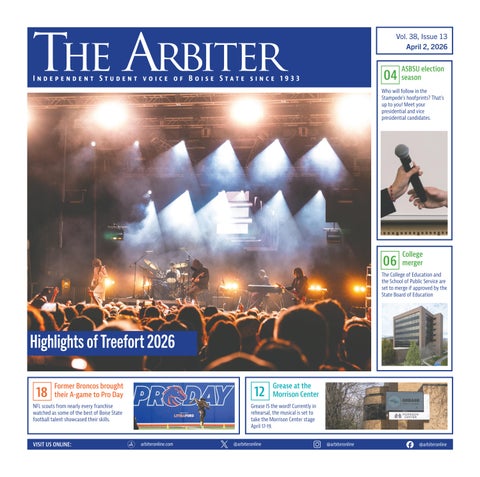
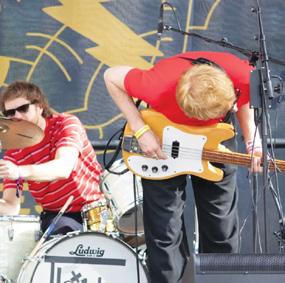
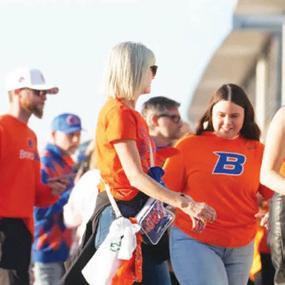
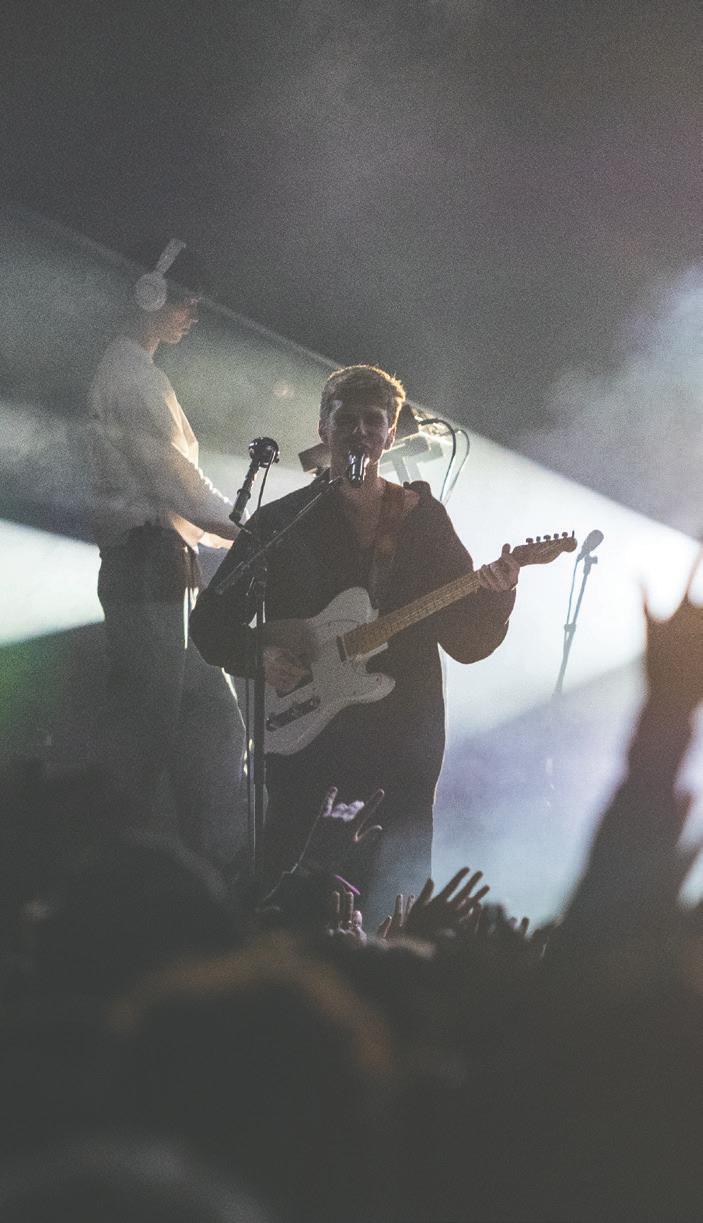
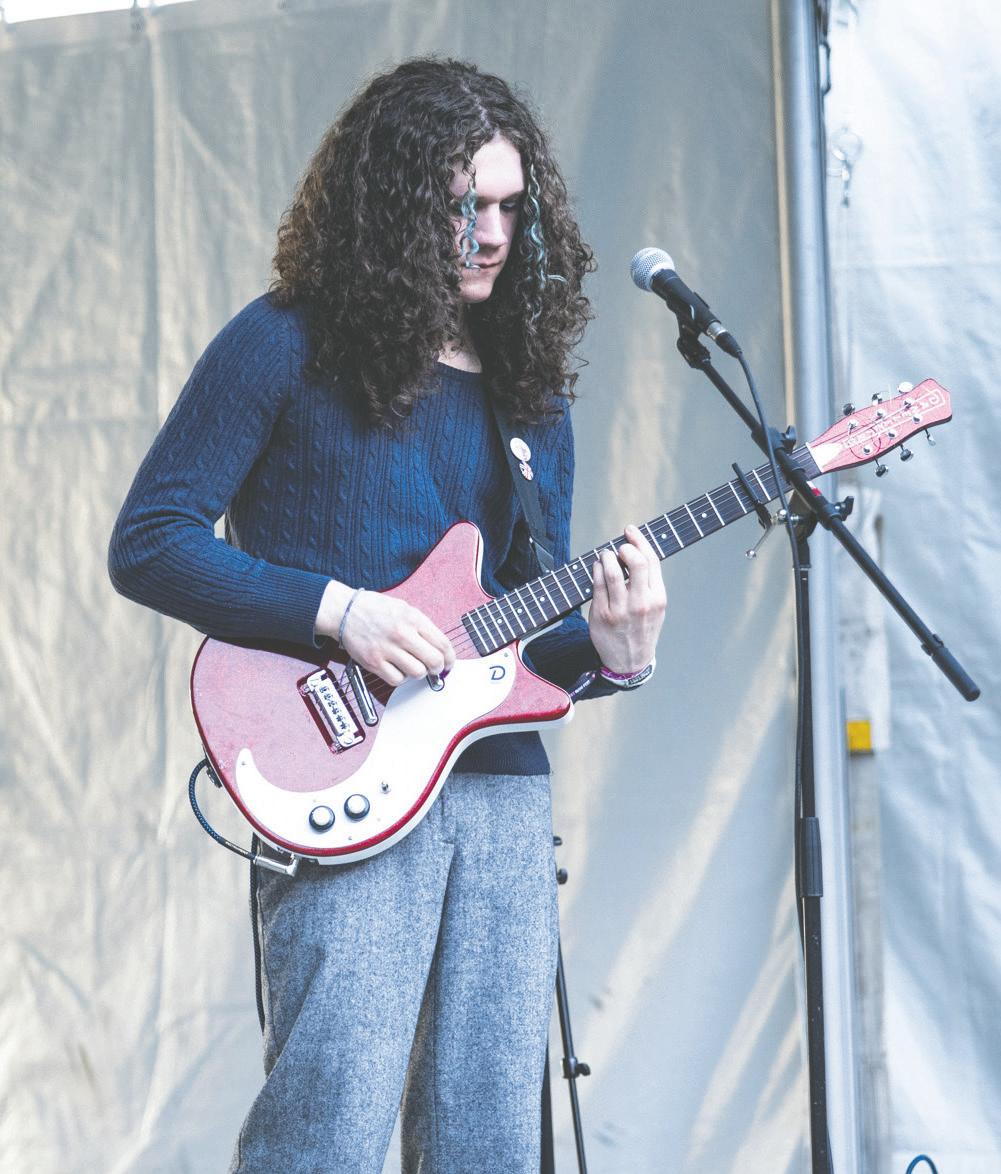
From main stage powerhouses to more intimate venues that featured no less talented musicians, this Treefort was one for the books — or the Instagram feed. Read on to hear highlights from the festival headliners.
PHYSICAL LOCATION: Located on first floor of Lincoln Avenue Garage Suites
As a student-run organization, we produce accurate and hyper-local information through non-partisan and socially responsible media.
NEWS
THREE PRESIDENTIAL TICKETS ARE RUNNING TO LEAD ASBSU. HERE’S
Emily Carmela
OWHAT YOU NEED TO KNOW
|
ver the past week, students interested in leadership positions within the Associated Students of Boise State (ASBSU) have been campaigning on campus. From issues of campus affordability, transparency and promoting campus resources, each campaign has a vision for what it wants to bring to the Boise State student experience.
Meet your 26-27 presidential and vice presidential candidates.
Rebecca Kay, David Bru
Rebecca Kay, presidential candidate, and David Bru, vice presidential candidate, are looking to be changemakers in ASBSU. Kay and Bru are campaigning with The Stallions.
Kay is a junior studying Marketing and transferred to Boise State after receiving her associates degree at CWI. During her time at CWI, she served as student body president and “fell in love with” student government. Currently, she serves in the role of non-traditional student representative for ASBSU.
Bru is studying Illustration, and also made the transfer from CWI to Boise State. Bru served as a senator during his time at CWI and spent a semester as the underserved populations representative for ASBSU.
The pillars of Kay and Bru’s campaign are allowing students to be involved in major decisions, advocating for student needs and remaining transparent with the student body. Their campaign statement on ASBSU’s website states they are here to “lead with action” and are dedicated to bringing ASBSU “directly to you.”
In an interview with The Arbiter, the duo said if elected, they would begin hosting weekly open public works meetings in Albertsons Library, where members of ASBSU could work on legislation in collaboration and constituents could give their input on bills being developed. They also emphasized holding office hours, something Kay previously did in her leadership position at CWI.
The team would also like to “close the gap” between students and ASBSU, as well as within ASBSU itself. To do this, they would host team bonding events internally, actively meet with all club
leaders and respond to criticism and negative perceptions of ASBSU publicly.
“People who have problems with the university, people who have problems with ASBSU — that is who we’re running for,” Bru said.
Kay and Bru are also campaigning on the promise of helping students pay for parking passes. Bru mentioned they could potentially redirect ASBSU funds to subsidize parking passes for lower-income students and those who receive scholarships that do not cover parking. Kay also said she would like to work with university departments to identify
or recommend students who would qualify rather than ASBSU selecting them.
Charlotte McNeely, AJ Salvetti
Charlotte McNeely, presidential candidate and AJ Salvetti, vice presidential candidate, are looking to blaze new trails for ASBSU. McNeely and Salvetti are campaigning with The Trailblazers. McNeely says her passion for politics began as early as fourth grade. She currently serves as the ASBSU senate lead and School of Public Service senator.
Nelson, Olivia Brandon
Editor-in-chief, Managing Editor | Photo by Omar Saucedo, Illustration by Naomi Brown
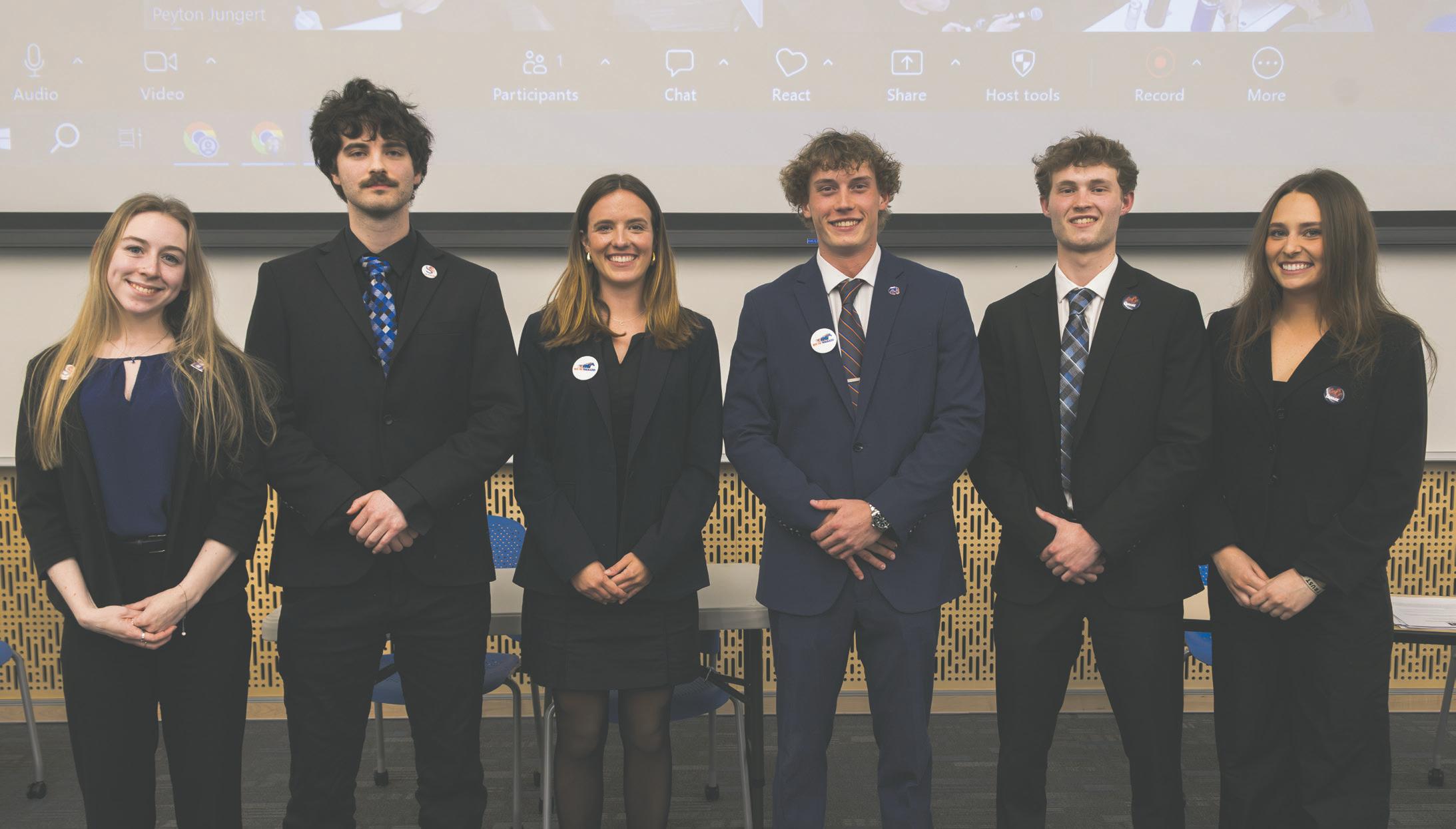
From left to right: Rebecca Kay, David Bru, Charlotte McNeely, AJ Salvetti, Carson Cole, Maddy Riley
California Native Salvetti, is the current president of Sigma Chi and said that’s where his style of leadership was formed. “I really just enjoy making sure that everyone feels like they’re involved and that they have a place in whatever community or organization it may be.”
The key pillars of the Trailblazers campaign are affordability, advocacy and “uplifting the student experience,” according to their bio on ASBSU’s website.
The duo seeks to promote scholarships, limit fees and make receiving funding for clubs easier.
McNeely and Salvetti also want “stronger student representation in decisions that impact campus life” and to spread awareness of on campus resources like the Campus Food Pantry and counseling services.
McNeely highlighted the importance of transparency in student government, noting that as someone with a bacground in student media, ASBSU should have an active newsletter and consistently communicate with outlets.
McNeely touched on the team’s mental health initiatives as well as making students aware of what is available to them on campus.
“How can we work to make BSU a place that’s safe for all that has resources for mental health, that has resources for food, for all of these different aspects, and that goes into our goal of protect ing that holistic student?” she asked. “If that holistic student is just going to school and working, because they have to pay for that — you can’t do that. You need to have all those pieces fall into place. That is something that we will be working on 100% next year, to cater to that holistic person, because they matter.”
Carson Cole, Maddy Riley
Presidential candidate Carson Cole is a junior study Finance, Accounting and ITM. Cole has served as ASBSU’s Associate Vice Pres ident of Academic Affairs, an Assembly
member and a member of the Government Relations Committee.
Vice Presidential candidate Maddy Riley is a junior studying Health Science and has no prior experience in ASBSU.
According to their campaign statement on ASBSU’s website, the duo aims to “energize, engage and empower” students at Boise State. Their platform includes increasing “official collaboration” among student organizations, Greek life and campus leadership, improving the allocation of funds for student clubs and identifying additional funding sources outside of ASBSU. The duo also emphasizes they will ensure tuition, parking and housing will become more affordable while securing additional scholarships.
Cole and Riley are campaigning with The Charge.
The Arbiter contacted all candidates for interviews. The Charge candidates responded but said they were unable to participate before the publication’s deadline.
Voting for the 2026 elections will be held April 7-8. Elections will be conducted through an online ballot, which will be sent to all students via their student email account.
BOISE STATE ATHLETICS IMPLEMENTS FACE ID TICKET TECHNOLOGY
For Boise State Athletics, fiddling with your phone to pull up a ticket while in line for games might just be a thing of the past.
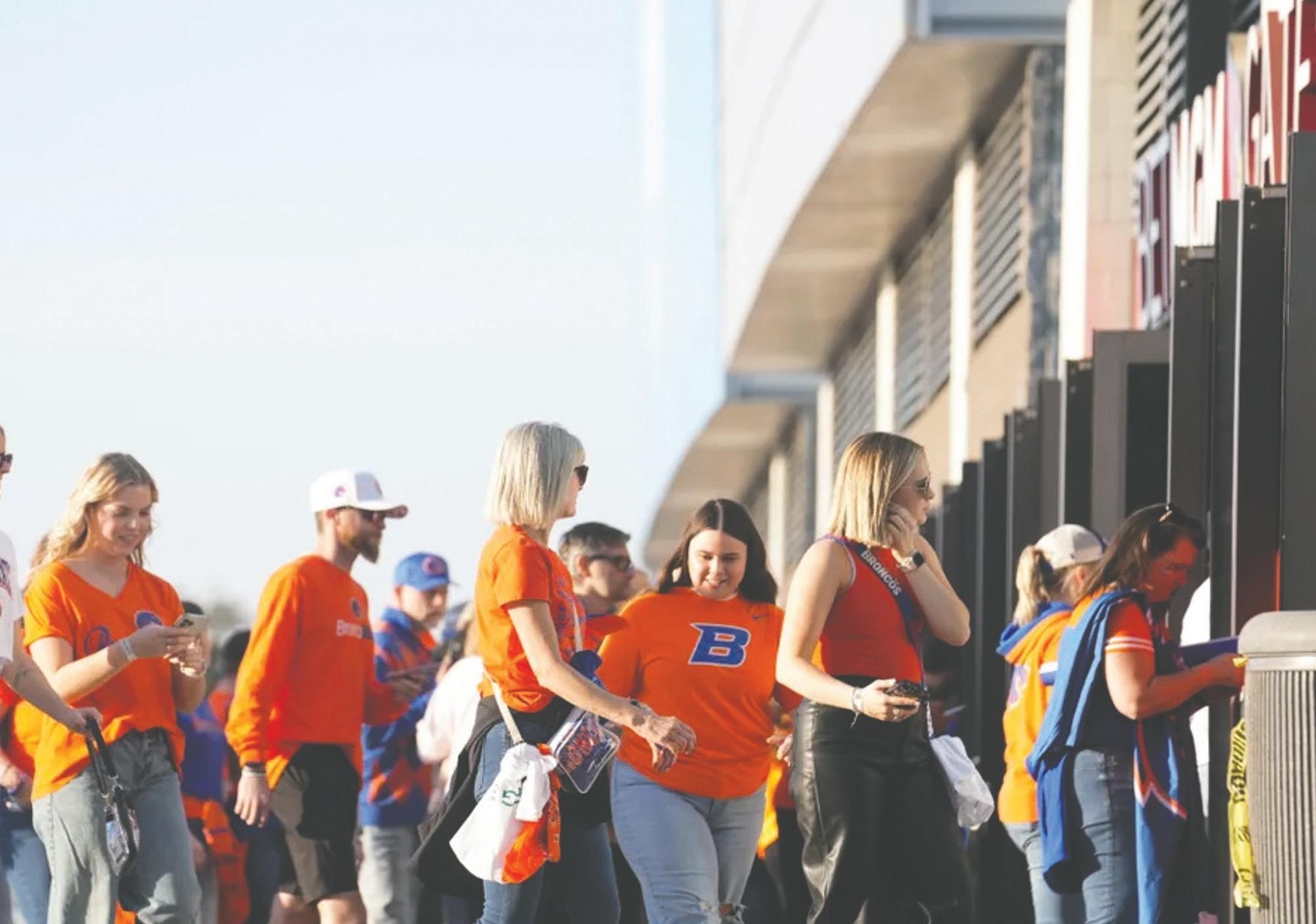
For the last five games of the basketball season, Boise State Athletics implemented face identification technology through a third-party organization, Wicket. Currently described as a “premium entry” for students, Chris Hall, assistant athletic director for event services, said he wanted to get the technology out in front of donors and spectators before fully launching the service across university athletic events.
“The facial authentication becomes a token tied to your Ticketmaster account through Wicket — but it’s never data stored or data kept,” Chris Kutz, senior associate athletic director, external affairs, said.
Kutz explained nearly 100 people at each of the five games have used face ID through the pilot program, and that it has cut the wait time for lines in half.
Hall added the technology also streamlines the process of scanning multiple tickets or transferring them.
“If there are five tickets tied to my Ticketmaster account, instead of me swiping and tapping to gain entry, I can just select the ones that are here, and then everything else works straight through our Bronco sports app and Ticketmaster to transfer any unused tickets to other people who may come to the game later.”
The process is simple: log in to Ticketmaster, snap a selfie and let the tablet scan your face in line.
Hall said while a decision hasn’t been made, the end goal is to expand to all athletic events, including football so that “once you’re in the system,” you’re covered across sporting events.
“We want to make sure the experience to get in our stadiums is easy and no one’s missing kickoff or missing opening tip because the lines outside the door,” Kutz said.
april 2, 2026
Olivia Brandon | Managing Editor | Photo courtesy of Joe Rondone
‘I’M REALLY CONCERNED ABOUT WHAT THE FUTURE FOR BSU LOOKS LIKE’: STUDENT
LEADERS EXPRESS CONCERNS OVER LACK OF TRANSPARENCY IN COLLEGE MERGER
Olivia Brandon | Managing Editor | Photos by Keara Antonelli
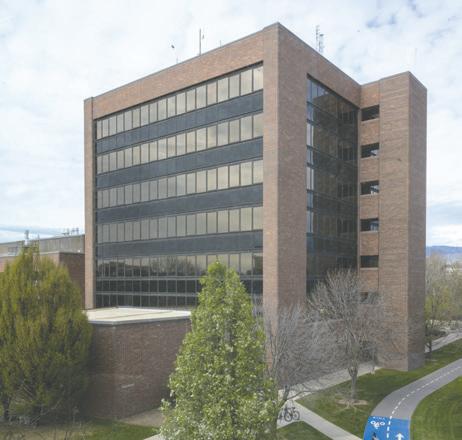
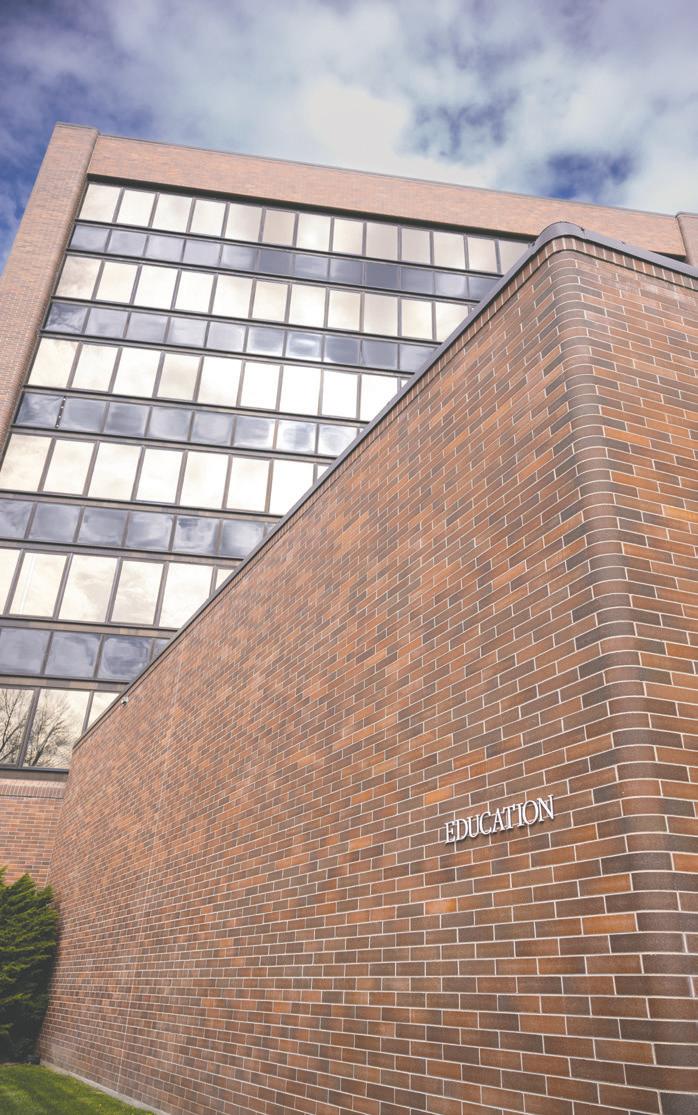
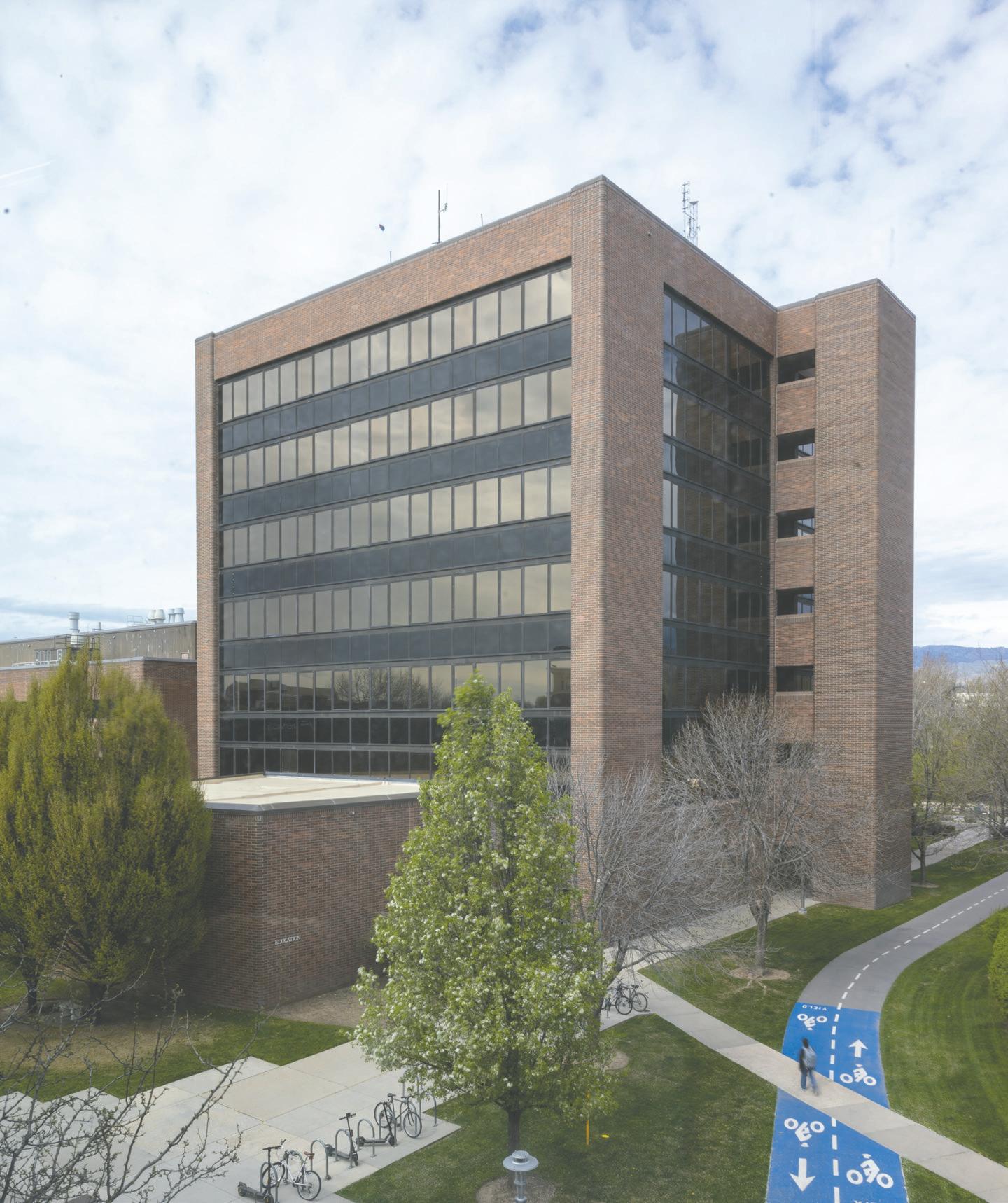
In early March, Boise State University announced plans to merge the College of Education and School of Public Service and completely dissolve the School of Innovation and Design.
The move comes in the aftermath of a 3% budget cut for the university and JFAC’s decision not to reverse budget cuts for the next fiscal year. As reported by Idaho Ed News, that reversal could have resulted in Boise State receiving 2.7 million dollars.
While university faculty were alerted of the change in a letter from Interim President Jeremiah Shinn and Interim Provost Zeynep Hansen, many student leaders felt they were left in the dark regarding the merger.
In the letter to staff, Shinn and Hansen said both colleges’ missions “centered around serving” the state of Idaho.
“I was super caught off guard,” Charlotte McNeely, senate lead for ASBSU
and school of public service senator said. “I’m here to serve the students of the School Public Service, and not being able to totally fulfill that, because [of] being blindsided, was a little bit of a disappointment.”
McNeely said she believes the colleges are far too different to be combined and worries there won’t be a clear sense of the merged college’s focus. Additionally, as ASBSU currently has two senators for each college, she worries that number will be reduced due to the College of Education and SPS combining.
“That’s a really concerning thing,” McNeely said in reference to the number of senators in ASBSU potentially being decreased. “Regardless of the size, they [the colleges] are extremely different and have different representational needs.” McNeely also alluded to concerns regarding advising and staffing.
On March 9, 2026, McNeely, alongside Alana Heusser, senator for the college of education and additional members, introduced Resolution 5, which calls for transparency and the consideration of students and staff should the merger be approved by the State Board of Education. The resolution was passed the following day and marked the first time in nearly half a decade that students at large introduced and presented legislation.
Alana Heusser, senator for the college of education, explained her main issue with combining the two colleges stems from how many certifications and tests are needed to become an educator.
“There’s a big concern with advising, especially for education, because there are so many tests and certificates that you have to take and so many steps you have to go through the process of to get certified,” Heusser said. “Making sure that students are able to meet with advisors and the advisor positions aren’t
cut. Based on the communication we’ve got from the college, I don’t think any of those advisor positions are going to be taken away or combined. It would be concerning if advisors had to have more students on their caseload, because a lot of people already have a hard time getting a hold of advisors and having advisors answer questions.”
Though she has her concerns, Heusser believes the process will be organized and won’t hinder anyone from receiving
their placement and student teaching.
“It’s unfortunate that this change has to happen because of the state of public education and funding for education. It’s a super unfortunate change. But I really do trust the university that students are going to be protected and that it’s not really going to negatively impact anyone.”
If approved by Idaho’s State Board of Education, the merger would go into effect July 1, 2026.
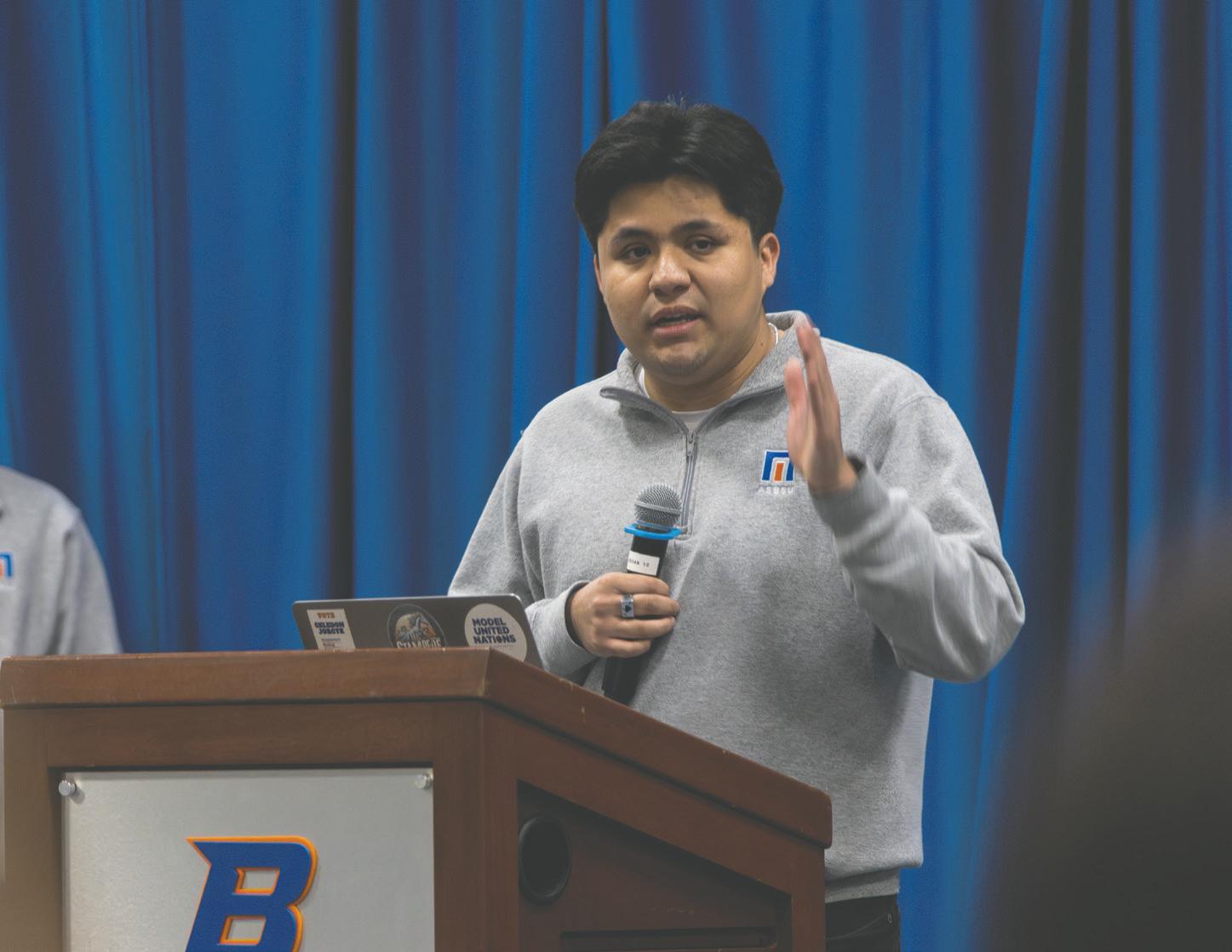
CADE SYVOCK ALLEGES ASBSU PRESIDENT ISSAC CELEDON THREATENED HIS EDUCATION AND BRIBED HIM. IN RESPONSE, CELEDON CITES MISCOMMUNICATION
Olivia Brandon, Emily Carmela Nelson | Managing Editor, Editor-in-Chief | Photo by Omar Saucedo
On Tuesday, March 24, Cade Syvock, who was formerly involved in ASBSU’s Government Relations committee, posted a carousel on Instagram containing screenshots alleging that Student Body President Issac Celedon threatened his education and attempted to bribe him.
Syvock claimed on January 18 that Luca Collins, associate vice president of academic affairs for ASBSU, offered him the position of School of Public Service Senator. After accepting, Syvock said Celedon asked that his confirmation be pushed out to the following week, to which he agreed.
Over the next two weeks, Syvock said he sent 10+ messages to Celedon regarding his appointment after first attempting to contact Collins, and received no response. Shortly after, Gabby Wong was appointed to the position.
Syvock eventually approached Celedon in person at an ASBSU meeting, where he claims he expressed his disappointment in not being appointed to the position and the lack of communication involved.
“I feel like some of this has to be made public,” Syvock said in his recount of the conversation with Celedon. “You put [out] a statement on January 23 about open communication and transparency, and you failed to show that.” In this conversation, Syvock claimed Celedon’s response was, “‘If you even think about it, we will be having a meeting with your deans.’”
“Most people don’t have a meeting with deans to settle a friendly dispute,” he continued. “It came off like ‘your education will be impacted.’”
Syvock said the main criticism he is receiving on his social media post is that Celedon did not owe him a response. “That’s a really bad stance for student government,” he said.
The ASBSU constitution does not require student leaders to provide reasoning or communication to members who have not been officially appointed.
Syvock claimed he was offered a position in general assembly if he “kept quiet” about the situation.
“When I went to go interview for it, I said that I would be open to it. I would have been the on-campus employee assembly member, but I said that I would not drop this situation,” he said. “If I’m representing students, this is something that would be in their interest — and so they didn’t offer it to me. I would have taken it if it was offered to me, but it essentially was ‘keep quiet or you don’t get it.’”
When asked about the situation, Celedon said he felt badly about the miscommunication and said he wanted to find a way for Syvock to be involved. ASBSU Vice President Ethan Mariner then reached out to Syvock to interview for the assembly member position.
Celedon said he was not in attendance at the interview, but believes Mariner had concerns regarding Syvock’s previous negative feelings.
“Cade wasn’t given the [assembly] position because of concerns that he was just going to come in and come after me. If your notion is to come after people, guns blazing and not do work a legislator should be doing — is that going to be conducive to teamwork?” Celedon said.
Mariner confirmed Celedon’s account of the conversation.
“My full gathering of the reason why he wanted to be in the organization was to go after Isaac,” Mariner said. “My response to him was, ‘If you want to pursue disciplinary actions against Isaac, and based off of how you feel this situation went down, I’m not going to say you can’t. Go for it. But I’m not going to let you into our organization knowing you have ill will against our president.’
It just didn’t make sense. Pretty much the minute he started speaking [in] that manner, I ended the meeting and said, ‘Best of luck.’”
Although he noted it was speculation, Syvock said he believes Government Relations Officer Austin Rose, who he said came to his defense, was relieved of his duties due to speaking out about the situation.
The Arbiter reached out to Rose, who stated while he has not been removed from the position, Celedon has taken over his responsibilities as of March 25. Rose claimed when he asked Celedon why his duties were revoked, Celedon said, “Because I said so,” and “This decision is final.”
After being reached out to for comment, Celedon claimed the only responsibility Rose no longer has is acting as the point of contact for the America 250 event.
Although Celedon said he disputes Syvock’s claims and recount of events, he
did note he was fully responsible for any unclear communication regarding the appointment.
“What we should be at fault for is the miscommunication,” Celedon said. “Yes, 100%, I will say, I’ll take responsibility solely, and I don’t put any blame on Luca [Collins]. He had just stepped in [to the role].”
In reference to the claim that Celedon threatened Syvock’s education, he claimed Syvock said he was going to speak to his dean, to which Celedon suggested the three of them sit down for a “mediated conversation.”
“That claim is a really big stretch of everything,” Celedon said. “But at the same time, do people honestly think that one student leader, [it] doesn’t matter the title, has the position or the power to utilize a dean to threaten someone’s education? One, that’s a huge lawsuit. Two, that’s not how things work here at this university.”
april 2, 2026
BOISE IS BOOMING, BUT IDAHO’S $7.25 MINIMUM WAGE STILL HASN’T CHANGED
Aidan Mattingly | Sports Reporter | Photo by Omar Saucedo
While Boise has become one of the fastest-growing cities in the country, Idaho’s minimum wage has not changed in more than 15 years.
The state’s minimum wage mirrors the federal minimum wage, which Congress last increased over a decade ago. Since then, Idaho’s economy has changed dramatically. Boise is one of the fastest-growing metro areas in the country, with housing costs surging and wages rising across industries.
Despite those changes, state lawmakers have shown little interest in raising the legal minimum wage.
Rep. Steve Berch said Idaho has a long history of tying its minimum wage to the federal rate rather than setting a separate state wage.
Idaho is one of about 20 states that still follow the federal minimum wage, while 30 states and Washington D.C. have set higher pay floors in response to rising costs of living.
“The state’s policy is to keep the state’s minimum wage the same as the federal minimum wage,” Berch said. “So if the federal wage goes up, the state wage
would go up accordingly.”
This reflects the broader philosophy of many lawmakers in the Legislature, particularly within the majority party.
According to Berch, some lawmakers question whether a minimum wage should exist at all, arguing the free market should determine what workers earn.
In his view, minimum wage laws were originally designed to protect workers from exploitation and provide a basic floor for earnings.
“A minimum wage is supposed to be a safety net so people aren’t exploited,” Berch said. “But with a minimum wage of $7.25 today, it’s almost like we might as well not have one.”
While Idaho’s legal minimum wage has remained stagnant, wages across the state have risen significantly in recent years.
Data from the U.S. Department of Labor shows while the state’s minimum wage has remained at $7.25 since 2009, most workers in Idaho earn significantly more.
According to the department, average weekly wages in Idaho rose about 63 percent between 2015 and 2025, increasing from roughly $734 to $1,195. Average hourly wages also climbed from about
$22.30 to $35.15 during that period.
Recent wage data shows the 10th percentile wage in Idaho is about $14 per hour, meaning roughly 90 percent of workers earn at least that amount.
Only about 2-3% of Idahoans earn minimum wage. Labor officials say the gap between the legal minimum wage and actual wages reflects strong demand for workers as Idaho’s population and economy have grown.
Population growth has helped drive demand for goods and services across the state, contributing to job growth and rising wages in many industries.
Economist professor Rafael Ribas said those increases show the labor market has already pushed many wages above the legal minimum.
“In sectors like food service, wages have already moved well above the minimum wage,” Ribas said. “Employers had to raise wages because they couldn’t find workers at the minimum.”
Even so, Ribas pointed out the purchasing power of minimum wage has steadily declined as inflation has raised the cost of everyday goods. That decline has become especially noticeable in cities like Boise, where population growth and housing demand have driven up the cost of living.
Affordability challenges in Idaho stem from multiple economic forces, not just wages. Housing shortages, population growth and limited supply have all contributed to increasing living costs in fast-growing areas.
“When costs rise because supply isn’t keeping up with demand — especially housing — raising the minimum wage alone doesn’t necessarily solve that problem,” Ribas said.
Instead, policymakers often have to consider a broader mix of solutions when addressing affordability, including housing supply, economic development and workforce policies.
Berch agreed the issue extends beyond wages alone.
While he believes the minimum wage should eventually be revisited, he said raising it alone would not address the broader affordability challenges facing Idaho residents.
“If you look at where the minimum wage was the last time it was raised and adjust it for inflation, it would probably be closer to something like $15 an hour today,” Berch said.
Still, he said the broader economic picture also depends on whether Idaho continues to attract employers that offer higher-paying jobs. This includes investing in education, workforce development, and economic growth to expand career opportunities across the state.
Berch pointed to Idaho’s past economic development history as an example. Companies like Hewlett-Packard once brought thousands of well-paying jobs to the Boise area, helping raise wages and strengthen the local economy.
Those kinds of employers not only create jobs but also push wages higher across industries, as businesses compete for workers in a growing market.
Attracting similar employers in the future could play a significant role in improving wages and affordability across the state.
“If we want to make Idaho more affordable, we need to create more opportunities for higher-paying jobs,” Berch said.
As Boise and other parts of Idaho continue to grow, the debate over minimum wage is likely to remain part of a larger conversation about affordability, economic development and the state’s future workforce.
“If people want the Legislature to focus on affordability, health care, good wages and infrastructure,” Berch said, “then they need to elect people who prioritize those issues.”
HUNTING,
IDAHO’S
SOON-TO-BE
OFFICIAL STATE SPORT
Idaho now has an official state sport, all thanks to the testimony of a Twin Falls fourth grader. Signed into law by Governor Brad Little on March 20, House Bill 652 formally recognizes hunting as Idaho’s state sport. The bill was first brought to the attention of the Resources and Reservation Committee on Feb. 17. Sponsored by former Mayor of Twin Falls, Rep. Don Hall (R), who was unable to attend the committee hearing, the bill was presented in his absence by Rep. Grayson Stone (R), who introduced testimony from 9-year-old Betty Grandy.
The homeschooled student from Twin Falls testified to the committee while studying Idaho’s history and realized that Idaho lacked an official state sport. Through her own personal neighborhood newspaper, “The Grandy Gazzette,” she released a survey to her 45 subscribers asking what they would choose as Idaho’s state sport.
In her testimony to both legislatures, she said, “Hunting was a clear winner.” Adding that the designation can be seen as a celebration of the state’s history, wildlife and love for nature. In her testimony, Grandy mentioned getting the chance to meet Governor Brad Little, who she says encouraged her to make the bill happen.
The committee gave the bill a due-pass and brought it to the House Floor on Feb. 23, receiving a unanimous 63-07. The Senate State Affairs Committee
reviewed the bill, which was once again met with a due-pass, and the Senate Legislature passed the bill with 34-0-1 on March 12.
The bill’s fiscal note and statement of purpose claimed there would be no impact on local or state government. Many of the committee members praised Grandy for her testimony, and as she stepped down from the stand, she was met with applause as she walked back to her parents.
Vincent Kuehlthau, the president of Boise State’s Sporting Arms Club, supports the bill. Seeing this as a major step forward for firearm safety, he hopes more people are willing to go out and take a hunter’s education course after the passing of the bill.
“We want to spread the awareness of firearm safety and it helps support our goals in how we want the younger generations to understand how firearms work and how to safely operate one,” he said.
The Executive Director of the Idaho Wildlife Foundation, Nick Fasciano, was another supporter of this bill.
Fasciano said the bill will help in spreading awareness of Idaho’s conservation efforts. “Hunting has always been a part of Idaho’s culture. This bill is a big deal that can help people truly understand what hunting actually does.”
HB 652 is scheduled to take effect July 1, 2026, making Idaho the 20th state to have an official state sport.
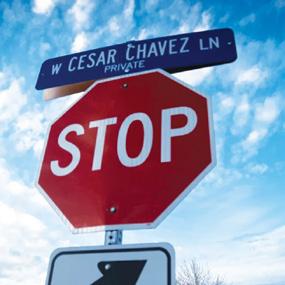
UNIVERSITY WEIGHS POTENTIAL RENAMING OF CESAR CHAVEZ LANE
One of Boise State’s most utilized roadways may soon carry a new name.
The school announced in an email sent to faculty, staff and students that the university is considering renaming Cesar Chavez Lane in light of recent findings.
A recent New York Times report brought allegations of sexual assault and rape against former labor rights activist Cesar Chavez.
Chavez, who is among the most venerated figures in the Latino civil rights movement, founded the United Farm Workers of America, the largest farmworkers union in the United States.
According to the report from the Times, Ana Murguia and Debra Rojas said they were sexually abused by Chavez repeatedly between 1972 and 1977. Both women were minors at the time.
The findings quickly sparked an outcry as entities nationwide have moved to scrub Chavez’s name from notable infrastructure. In Los Angeles, two schools bearing Chavez’s name are already in the process of being renamed. Additionally, the state of California renamed Cesar Chavez Day to Farmworkers Day, ahead of the March 31 holiday.
Back home, Boise State officials are evaluating a potential name change of the school’s Cesar Chavez Lane.
“In response to these allegations, university leadership will seek input from the campus community regarding a potential name change for this campus road,” the university said in a press release.
Cesar Chavez Lane was formerly called Campus Lane until a student-led campaign in 2006 pushed for its renaming after Chavez.
This campaign was partially born out of the 2004 renaming of The Pavilion to Taco Bell Arena (now Extra Mile Arena). At the time, Taco Bell faced scrutiny over its lack of response to a tomato
worker’s strike in Florida.
As previously reported by The Arbiter on March 6, 2006, Boise State applied for Campus Lane to rename Cesar Chavez Lane soon after the campaign. That same day, Laurence Blake, the university’s planning director at the time, sent an email to the City of Boise requesting the name change to be approved.
While other entities across the country have moved quickly to rename roads and schools, Boise State said the name change could take some time.
“If a name change is pursued, the university will follow Ada County and the City of Boise’s formal process, which could take a few months,” the university said in a press release.
The university said further information and updates will be shared in the coming weeks as feedback is collected from faculty, staff and student government via a survey.
Mason Maurice | Staff Writer | Photo by Kylar Kast
Jack McElwee | Intern Reporter | Photo by Carter Nash
TREEFORT
FROM RELAXED INDIE TO SYNTH-POP DIVAS, TREEFORT’S 2026 MAINSTAGE PERFORMANCES HAD SOMETHING FOR EVERYONE
Naomi Brown | Design Manager | Photos by Omar Saucedo, Naomi Rivera
FLIPTURN
When entering the Flipturn show expecting a chill concert full of mellow indie songs, I was pleasantly surprised by the high energy they brought to the stage. The crowd was hanging on to every note, swaying and dancing to the music. Despite being toward the back, I was able to hear the atmospheric guitar reverb crystal clear. The video playing alongside their performance created a cohesive retro-VHS style, featuring the group’s logo and various icons like a disco ball. Throughout the show, the video remained minimalistic until the last song, which featured a full animation. The animation told a short story of an astronaut and a cowboy and incorporated bright colors and space-like ethereal gradients. This concert was full of electric energy, an excited crowd and Flipturn’s upbeat indie music.
april 2, 2026
Seeing Magdalena Bay live was a dream come true. Experiencing their ethereal, fun and experimental pop music live made me feel like I was floating on air. The performance was complemented by the captivating visuals of their iconic angel-winged eyeball and various footage from their music videos. Every screen on the stage used visuals to elevate the performance, especially during instrumental portions. While watching, it became very evident the band puts great care into the whole show, even adding creative details such as concealing instruments inside of props. Magdalena Bay really embodied the storytelling of the music itself with lead singer Mica Tenenbaum shapeshifting throughout the concert. As the themes changed, so did Tenenbaum’s outfits as she transformed into a sunflower, a demon, fire and an angel. When Tenenbaum asked the crowd to sing along, they enthusiastically joined in as the lights glittered down, an angel singing in our ears alongside ethereal instrumentals.
MAGDALENA BAY GEESE FATHER JOHN MISTY
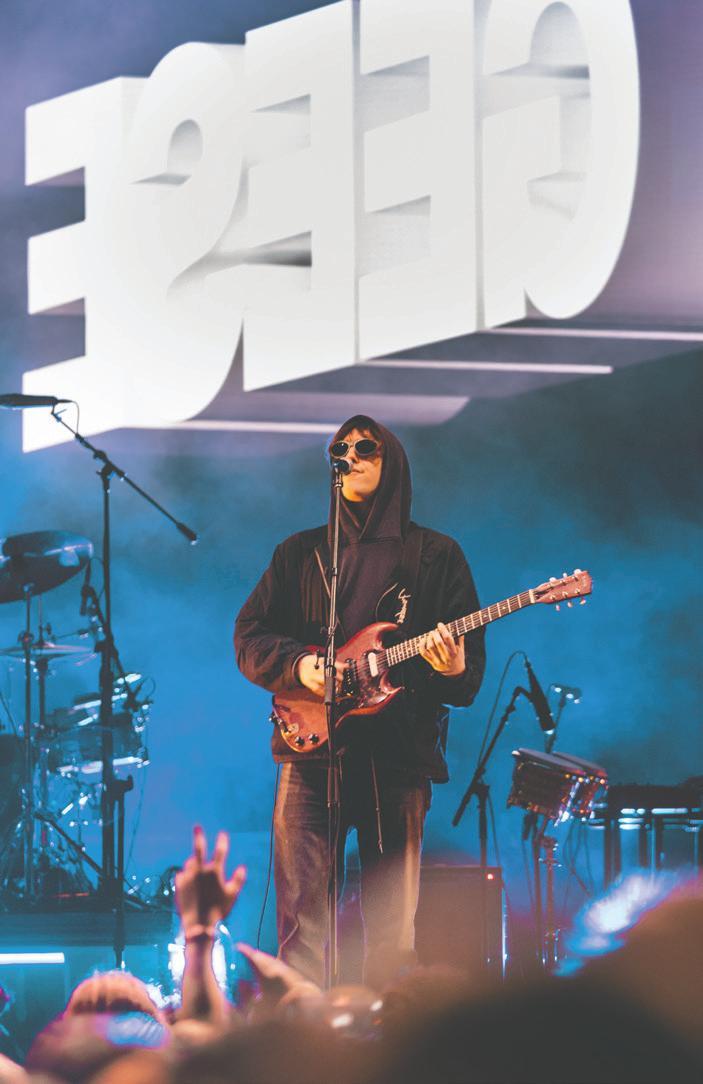
Geese delivered a truly authentic performance, putting the majority of care into the sound quality and music itself rather than the visual aspect of their show. The band members didn’t move around the stage as much as other artists, and Cameron Winters was a mysterious figure in a hoodie and sunglasses with a distinct deep and mumbling voice. Only one screen was used throughout the show, with just one video playing on loop — the 3D word “GEESE” written in Helvetica Bold slowly spinning throughout the entire show. The crowd was made up of many tall individuals, and as someone who is 5’4”, I was on my toes and hopping to see the stage. As one of their more mellow songs was playing, people were crowd surfing, excitement radiating through the crowd. The audio quality was perfect, with the twangy guitar traveling throughout Julia Davis Park. Geese’s music sounds like it is meant to be heard live.
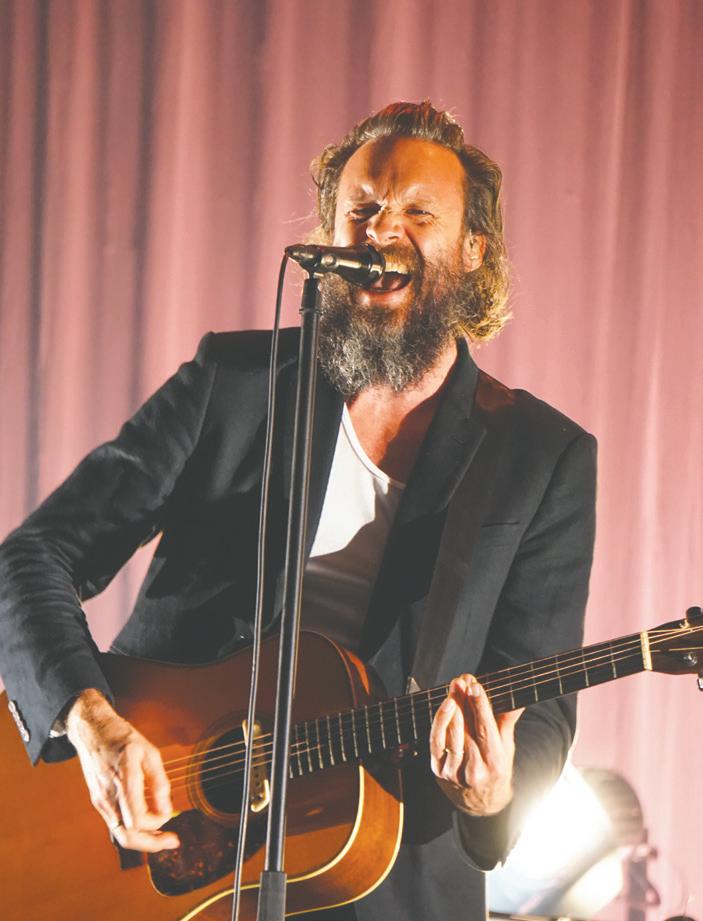
Father John Misty didn’t spend as much time on the visual components of the venue and instead put more energy toward curating a specific ambience. He had a red curtain behind the band and primarily used stage lights on the actual stage more than the overhead lights. The show felt more like a band’s live session rather than a big concert, making it more personal for the audience. Hearing brass instruments live is always a great experience, and this was no exception. The saxophone solos were immaculate to hear live. Many people were dancing in the crowd, and while his concert wasn’t as packed as other headliners at Treefort, attendees truly made use of the space. The lead singer, Joshua Tillman, utilized the entire stage in his performance as he sang. Pacing back and forth as he sang directly to certain audience members, Tillman created a sense of intimacy and clearly demonstrated his passion for music. Father John Misty creates truly heavenly music, and as the songs reached the climax, audience members couldn’t help but raise their hands in the air.
STUDENT SONGWRITERS TAKE THE STAGE AT TREEFORT
Isabella Williams | Culture Reporter | Photos by Carter Nash
On Friday night, Boise State students turned nerves into notes, transforming jitters and adrenaline into melodies that filled the air with raw emotion.
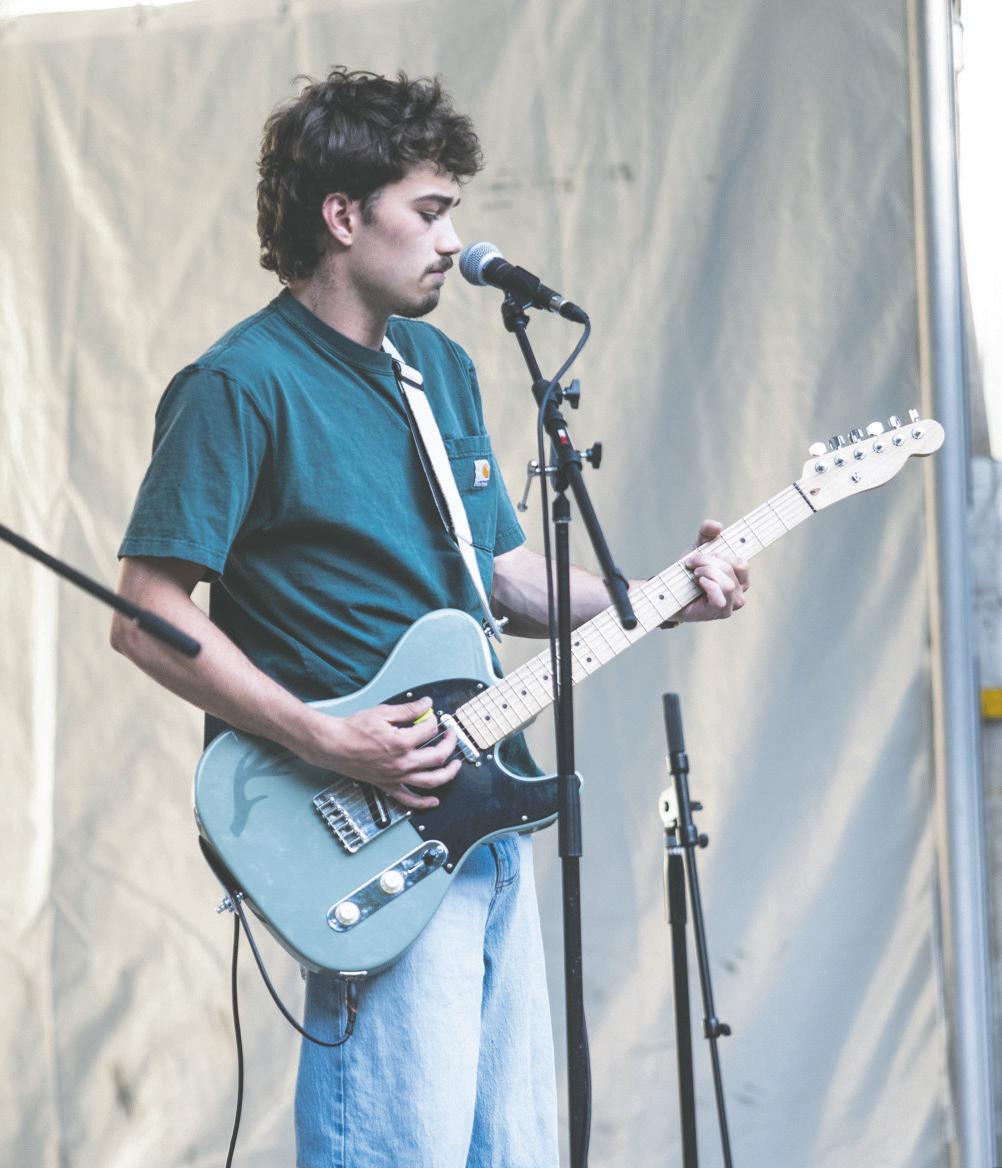
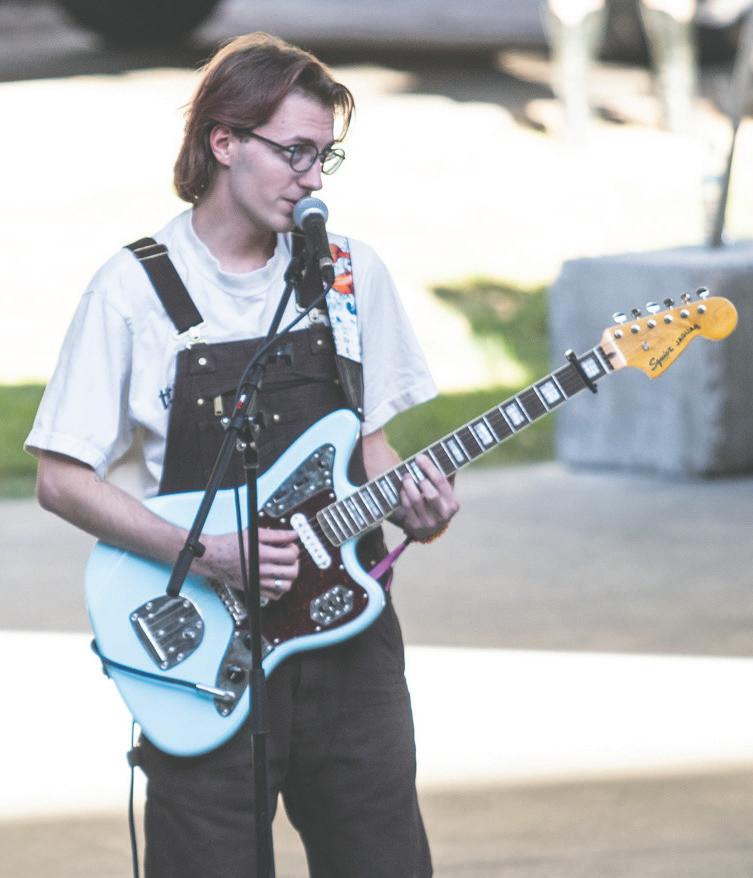
At the first-ever Bronco Singer/Songwriter Competition as part of Treefort Music Fest, students took to the stage to perform original songs. The growing talent of Boise’s student music community was on full display as students told personal stories.
The event, organized by Boise State’s Side B: Bronco Songwriting Collective, aimed to expand creative opportunities for all students, whether they were in the music program or not. A workshop held the day before the performance brought students together with experienced songwriters and members of the Idaho Songwriters Association to provide feedback, generate ideas and help finalists refine their pieces before stepping onto the stage.
For many of the finalists, the experience was a defining moment — an opportunity to perform original work in front of peers, faculty and a festival audience.
Christine Nygard’s performance of “Shivering” was one of those moments.
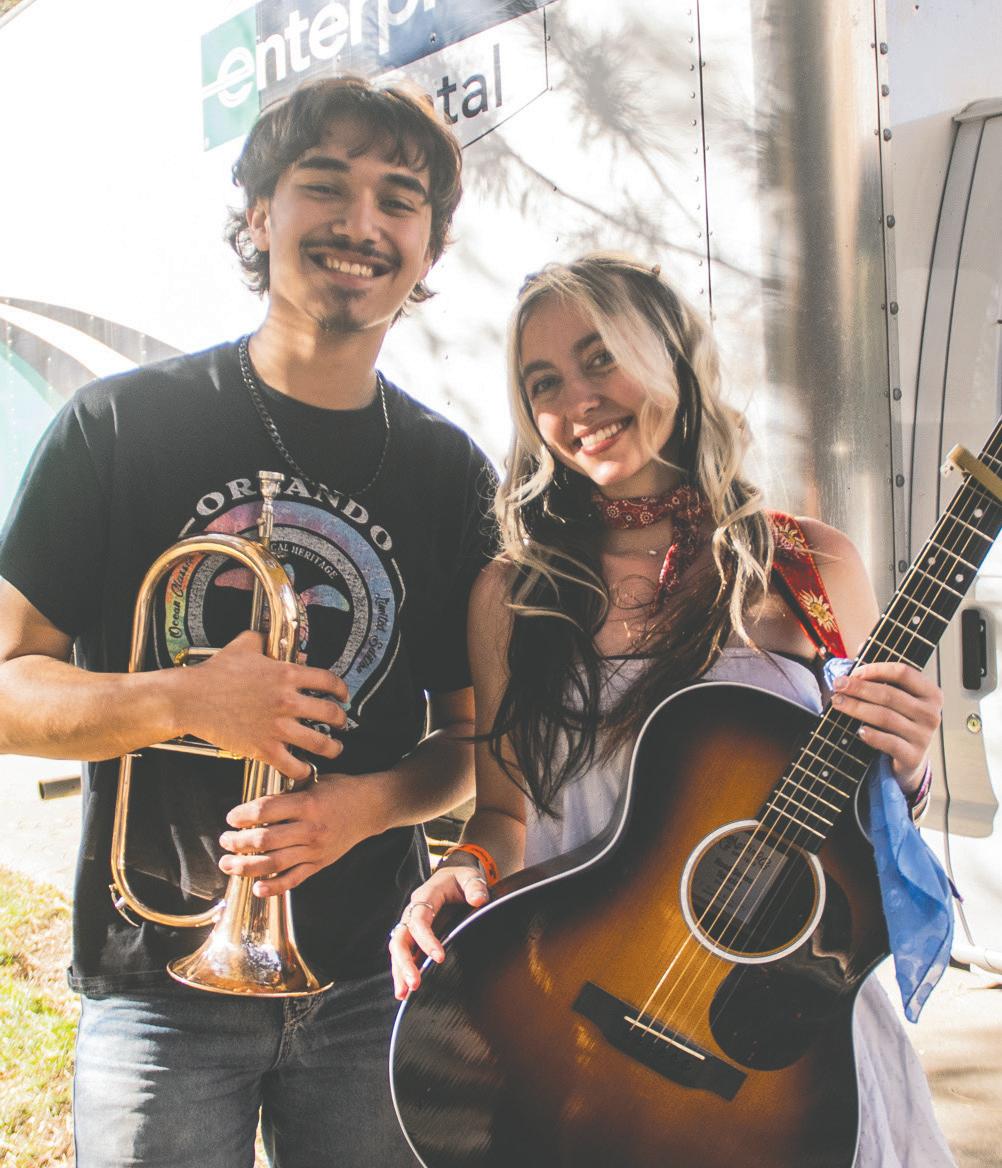
The piece explored the uncertainty of entering adulthood with vulnerability and depth. Her performance included fellow student Kitchen Sanderson on flugelhorn, a partnership that arose through the competition itself.
“I don’t think I would have reached out to him if it wasn’t for this opportunity,” she said. “It motivated me to make it happen.”
Beyond performing, Nygard saw the competition as a snapshot of the creativity flowing through the local music scene.
“Boise is a living and breathing creative ecosystem, and it starts really blooming around this time of year,” she said. “Being involved in the music scene as much as I can, I felt more and more inspired after each performance I witnessed at Treefort. My professors, peers, fellow musicians and creatives made me excited for what’s to come for music at Boise State.”
Another finalist, Andon Jay, brought a distinct emotional texture with his song “Mr. Melancholy Wants to Rule the World”, which explored inner struggles through the perspective of a personified emotional state. The character of Mr. Melancholy, drawn from the film “I Saw the TV Glow,” serves as a symbolic
“big bad” within the show’s mythology, representing an ever-present threat the protagonists must face.
“It’s like an internal conversation… refusing to feel big emotions, but it grows into something uncontrollable,”
Jay explained.
Jay, performing with his band ECHOBLOOM, will join Nygard again on May 5 at The Olympic Venue in Downtown Boise.
For first-place winner Arie VanDenBerg, the competition was a whirlwind of nerves, excitement and validation. His song spoke to a period of burnout and uncertainty during the semester, ultimately delivering a message of perseverance.
“I was down at school … my classes were really hard and I was just struggling,” he said, in reference to the song’s inspiration. “The song was a metaphor for getting through that feeling, showing that there’s always hope out there.”
VanDenBerg said he didn’t expect to win, which made the announcement feel especially rewarding.
“It was just an overjoyous feeling. A big confidence boost for me,” he said.
Even in the moment of recognition, VanDenBerg emphasized the
camaraderie that shaped the evening. Instead of rivalry, the competition was marked by encouragement and collaboration, with friendships and connections emerging as a major takeaway for participants.
“It really didn’t feel like we were competing against one another, “ he said. “We were all together, supporting each other.”
The competition offered practical incentives that support student artists’ next steps, including a one - year $1,000 Love MISSA Songwriting Scholarship and a professional recording session for the winner. Other finalists were offered additional recording opportunities.
For VanDenBerg, the night was a source of motivation for what’s next. He plans to use the momentum to book more local gigs, record new music and continue building his career as a local artist.
The Bronco Singer/Songwriter showcase was a moment for artistic affirmation, a celebration of student voices and a launching point for continued creativity at Boise State. For these students, channeling their emotions into sound marked the start of a much larger journey.
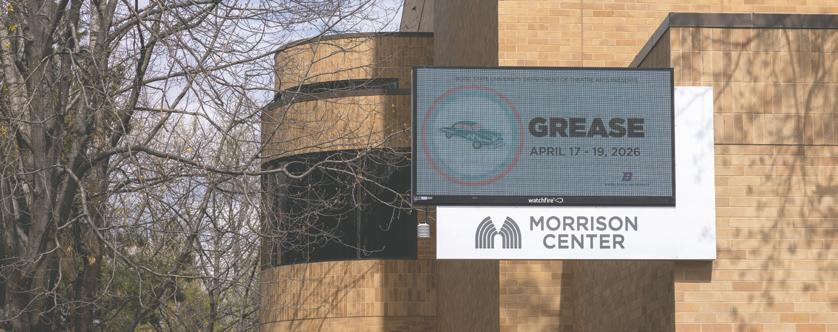
A ‘PARTY ON STAGE’: ‘GREASE’ BRINGS 1950S FLAIR TO THE MORRISON CENTER
Emily Carmela Nelson | Editor-in-Chief | Photos by Keara Antonelli
The magic of an iconic 1950s-era doo-wop musical is set to take on the Morrison Center stage.
Boise State’s Theatre Arts Program is cruisin’ for a bruisin’ as it closes out its “Rebels, Radicals and Rockstars” season with “Grease.” Returning to the Morrison Center’s main hall for the first time in two years, the cast and crew say the production will feel like a “party on stage.”
Emily Berner, the senior who will star as Sandy, said she’s dreamed of this role since she was a little girl.
Sandy’s rebellious love interest, Danny, will be played by Isaiah Raasch, who is also finishing his senior year. Raasch’s favorite part about preparing for a production is rehearsals — describing the quiet moments of seeing the show come together as “electrifying.”
The two have performed alongside one another in various productions over the past few years, cultivating their undeniable onstage chemistry.
“Getting to play this role with Isaiah — it’s such an honor,” Berner said. “We’ve been friends for quite a few years, so it’s really nice to have that full circle moment and end our senior year this way.”
“Sometimes it’s hard to play Danny. He’s really mean to Sandy, and I have to be mean, but it’s so fun,” Raasch said. “We have such good rapport on stage, and I can trust that whatever I give, she’ll give back in a good push-and-pull kind of way.”
For those even vaguely familiar with “Grease,” it is clear the heart of the show lies in its flashy dance numbers paired with equally bold greaser fashion and preppy looks.
Neekey Habibi, assistant costume designer, works closely with students in the Theatre Arts Program’s costume lab to create each piece featured in the show.
“I’m really happy that I am able to have this experience and be so trusted in a process that is going to go on the Morrison Center stage,” Habibi said, “It is so rewarding when you put a costume on one of the actors and see them come to life.”
Because of the musical’s high-energy choreography, Habibi studies the way clothing impacts movement and how the two work in tandem to bring the show to life. She often collaborates with Camille Wilcox, the production’s dance captain on costuming decisions.
“Every fitting I’ve been in, the first question has been ‘Can you move in this?’ ‘Do you feel comfortable in this?’” Wilcox said. “A lot of the time, the forethought has already been brought in.”
Wilcox said planning choreography for the Morrison Center’s main stage is no small task. Theatre Arts productions are typically staged in the Danny Peterson Theatre, an intimate black box space with just over 200 seats. In the main hall, dancers must rethink logistics on a much larger scale.
On rehearsal days focused on dance numbers, Wilcox arrives two hours early to prepare choreography alongside Emily Nash-Gray, business operations coordinator and choreographer.
“Those challenges are great to work with because we don’t experience them very often,” Wilcox said. “It makes us become really creative with how we stage things.”
Wilcox highlighted the size of the cast. With 24 dancers across the leading cast and ensemble, Wilcox moves between warming up performers, teaching
choreography and offering one-on-one guidance on complex movements.
“I sometimes feel like I’m a little fairy for [cast members] that maybe have a look in their eye that’s a little confused,” she said. “One of the great things about this cast is that we have such a wide variety of dancers, and everyone is so ready to jump into it.”
One of the musical numbers the team is most collectively excited for audiences to see is the opening number, “Grease (Is the Word).”
“I feel like that’s got to be my favorite song”, said Emma Corolla, who plays Rizzo. “I’ve had it on my playlist for years, and the dance is so fun. It is such a high energy number.”
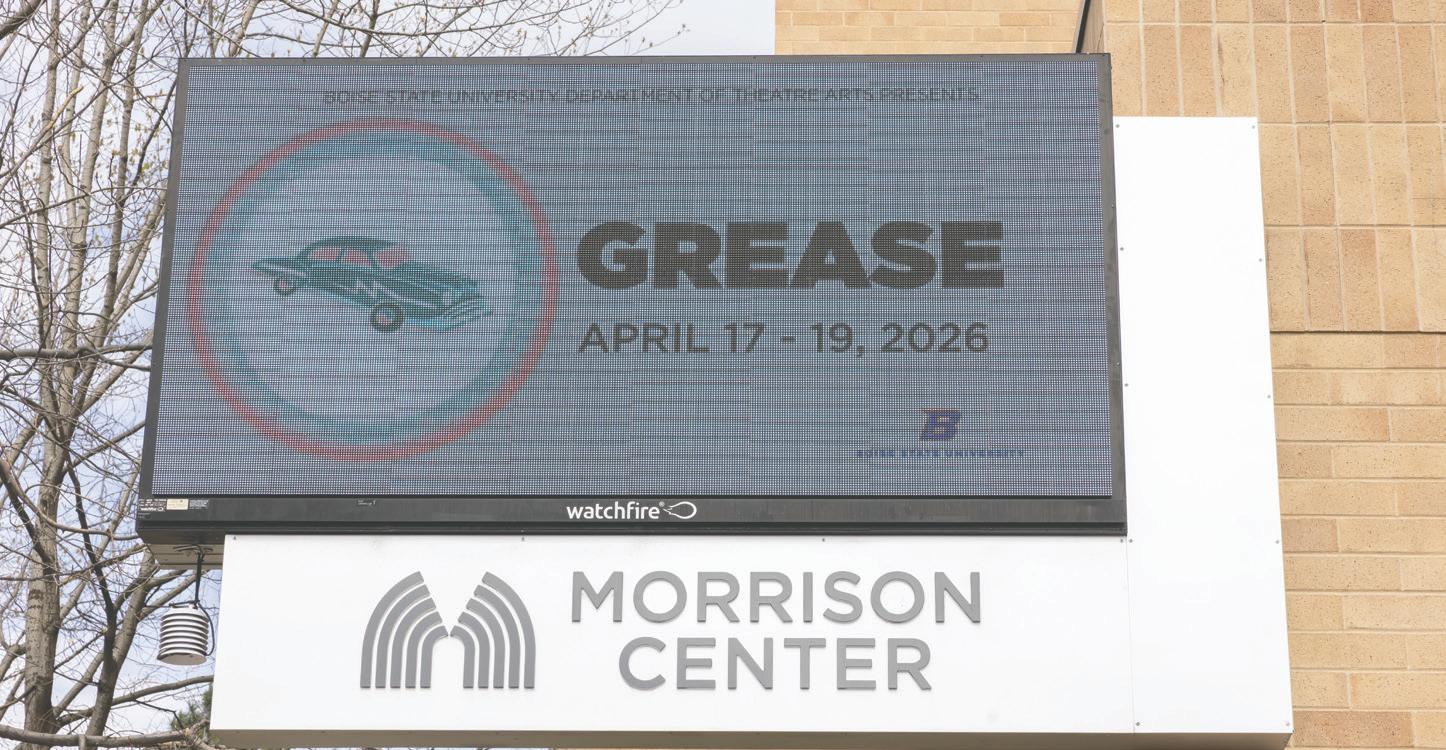
“Grease” will run at the Morrison Center from April 17-19.
Students, staff and faculty are eligible for one complimentary ticket by presenting their Boise State ID in-person at the Morrison Center Box Office.
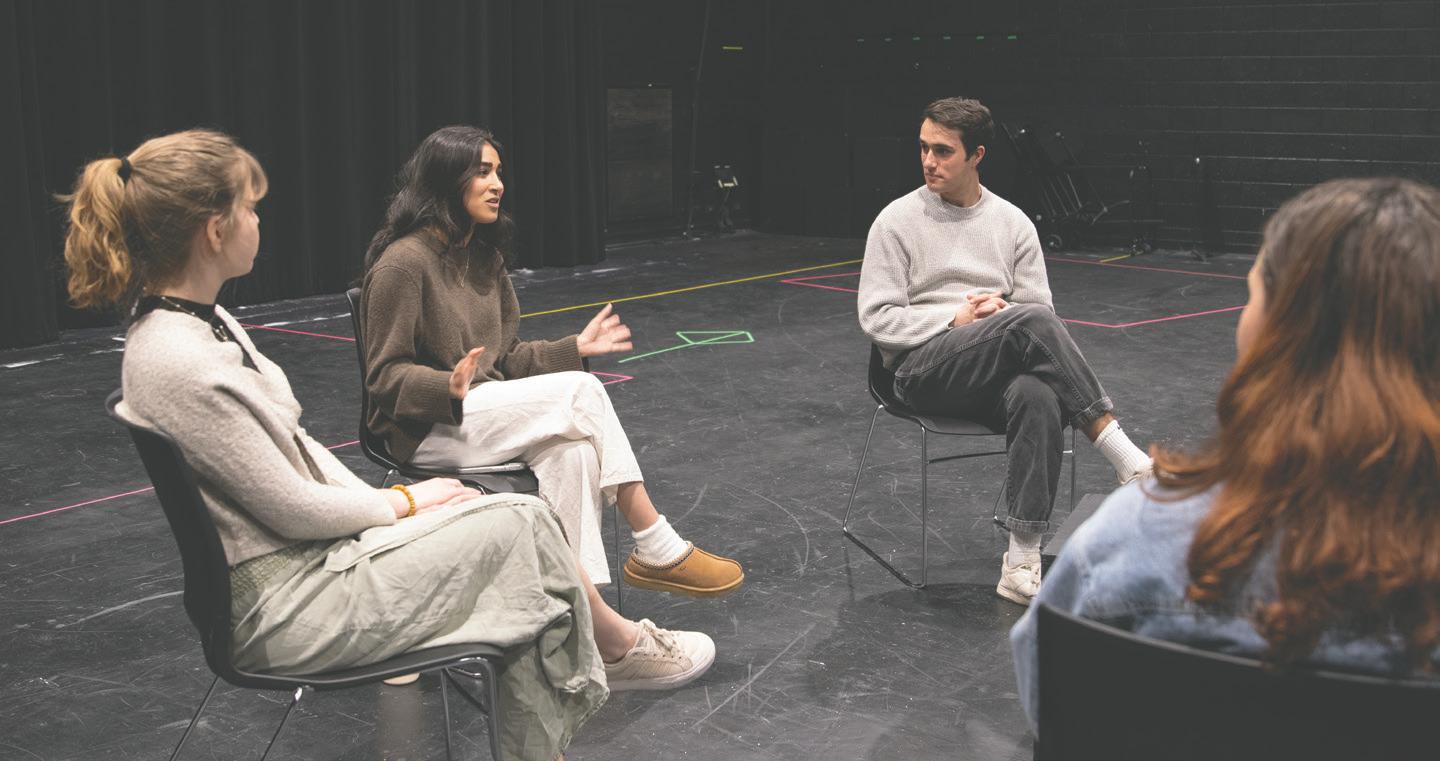
Emily Berner, Neekey Habibi and Isaiah Raasch in an interview with The Arbiter.
ART STUDENT FINDS JOY THROUGH HARDSHIP IN ‘CREATIONS COLORS’ EXHIBIT
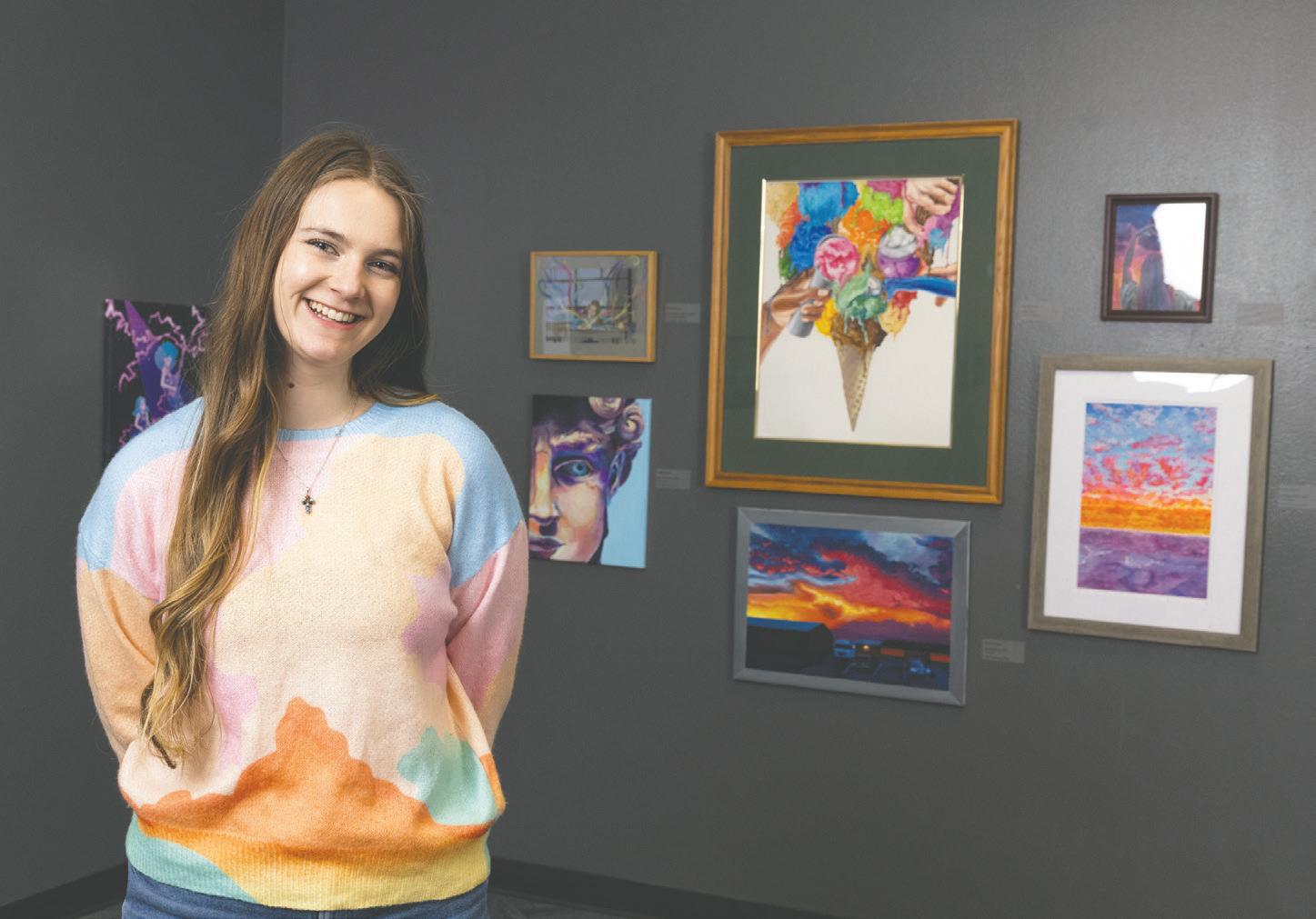
Elizabeth Orlovich, a junior studying Illustration and Arts Entrepreneurship, has been using art to express her emotions since she was a little girl.
“When I was a little kid and I would get super excited or super angry or really big emotions that I couldn’t explain, I would draw pictures of how I felt, and I’d shove them under my door,” she said.
Like many children, Orlovich experienced difficulty expressing complex feelings. She learned how to communicate through her drawings, something her mom, Amy Orlovich, remembers well.
“She would draw a picture of [something] like a little girl crying, and then words coming out of somebody else’s mouth,” she recalled fondly, adding she kept some of those drawings and holds on to them even now. “That was her way of saying she was mad or sad.”
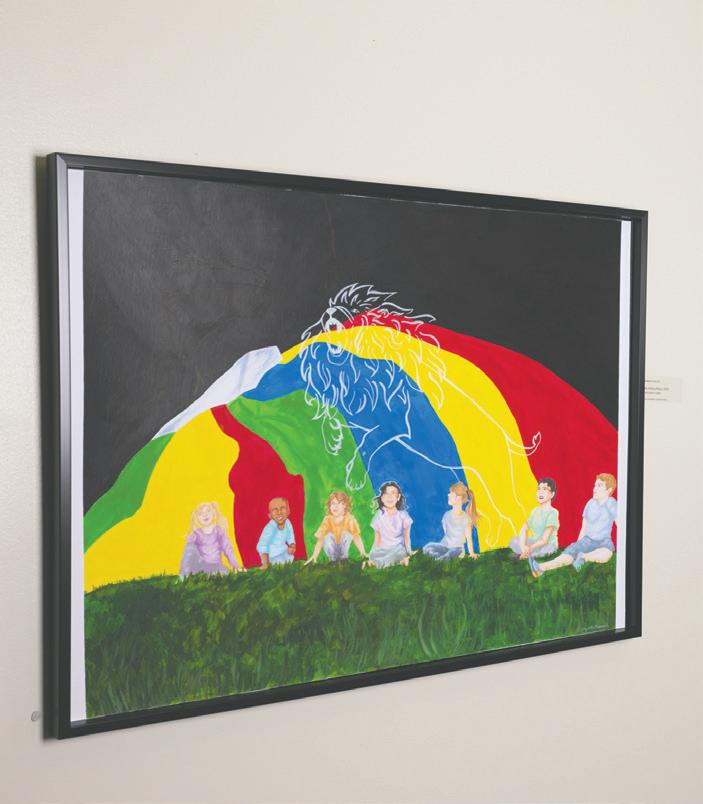
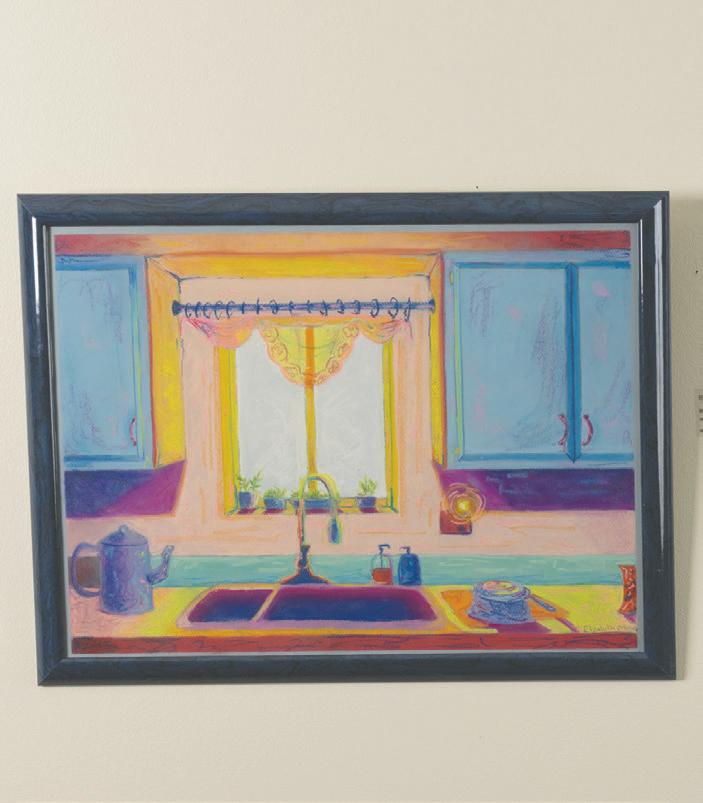
Now, through her arts education at Boise State, Orlovich continues to use her art to process emotions and experiences. Her bright, colorful exhibit, “Creations Colors,” now on display in the Student Union Building Trueblood Pop-Up Gallery until May 10, highlights the beauty and joy of Orlovich’s life, even through difficult times, including the painful chronic illness she battles every day.
“I have always been drawn to bright colors and happy joyful things, and for a very long time, I felt like that was the opposite of what artists do,” Orlovich said. “A lot of artists express what they’ve been through in a very brooding, dark way.”
Rather than focusing on the pain she was in, Orlovich found freedom in using vivid colors and joyful imagery to showcase the bright spots of her experiences.
“Whenever I would try to make art that would show the pain I was in, it almost just dragged me down into a hole. It was like a pit that I couldn’t get out of,” she said. “I decided that I couldn’t decide what my health was, but I could
decide what I focused on.”
From sunsets and sunflowers to brightly-colored kitchens and ice cream cones, Orlovich aims to inspire joy and optimism with her art.
“If I can show people that they have the ability to choose joy despite hardships, that’s the whole point,” she said.
Orlovich describes her style as “joyful” and “painterly” with “lots of emotions” built in. For the viewer, Orlovich’s use of color is striking.
“I love when everything is so vibrant, like how the lighting looks ten minutes before sunset,” she said. “I just love bright colors.”
Orlovich’s chronic illness has shaped her experiences, but doesn’t define her. On a more personal level, her Christian faith is at the core of who she is and everything she creates.
“I don’t think there’s a way to ever exclude my faith from my art,” she said.
Orlovich started her education at Boise State studying Biology, but decided to switch after having a dream she felt was from God, inspiring her to share her talents and pursue art. She said she felt much happier after switching her major to Illustration.
In “Creations Colors,” just as her experiences with chronic illness inspired the optimistic imagery, Orlovich’s faith manifests in the bright colors and upbeat themes. Her testimony and chronic illness journey are uniquely tied, both on and off the canvas.
Sharing such personal art is a vulnerable experience, according to Orlovich, but she hopes “Creations Colors” can have an impact on those who need it most.
“The best art is the stuff that’s vulnerable, because so many people believe that we’re so disconnected from each other and [no one] will understand [their] story or struggle, when in reality, everyone has struggles,” she said. “In the same way that art was a respite for me, I’d like [my art] to be peaceful and remind people of
good memories.”
Orlovich’s middle school art teacher, Annie Haynes, said Orlovich has always been a talented and driven artist, and is glad to see her continuing to create in college.
“It’s so good to see a student continue to pursue [art],” she said. “She’s still pursuing it with this unabandoned love, and I’m excited to see where her art goes and who it reaches, just to see what people are inspired by it.”
Orlovich’s mom, who has seen her daughter’s art progress from underthe-door doodles to a reflection on her chronic illness and faith journey, said she is proud of Orlovich’s optimism and joyful passion.
“In spite of her pain and hurting, she’s always been able to see the beauty in things,” she said. “She has done a lot to teach me how to see the small and beautiful things in life that I might have missed otherwise.”
CULTURE
BRINGING BOOK LOVERS TOGETHER, ONE STOP AT A TIME
Cole McAdams | Assignment Reporter | Photos by Carter Nash
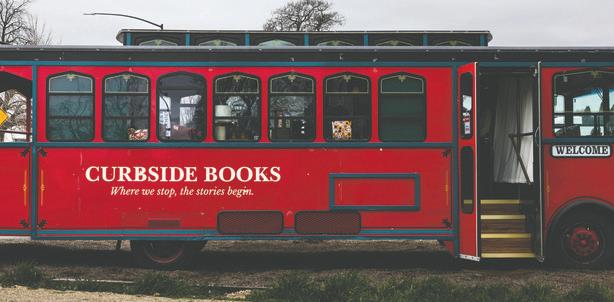
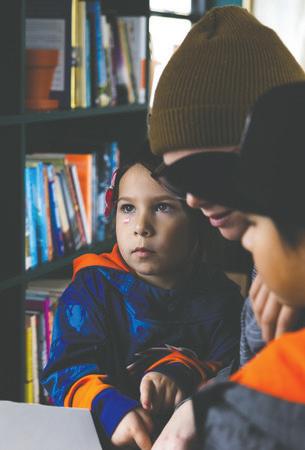
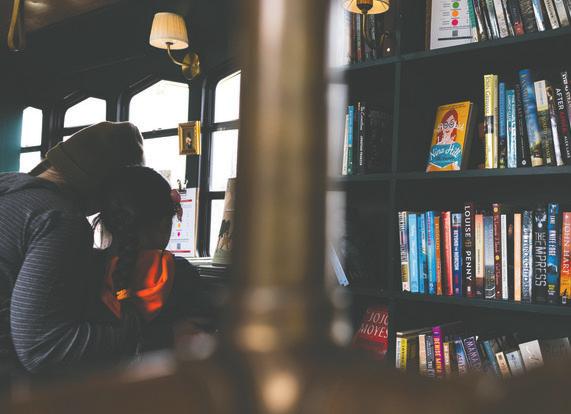
Popping up on streets around the Treasure Valley, a bright red trolley car sporting green accents and plenty of windows joins other Boiseans on the road. While this trolley might look typical on the outside, if you were to peek into its windows, you’d see something unique: bookshelves.
Curbside Books, the mobile bookstore owned by Dani Scovel, brings books to customers across the Treasure Valley and aims to bring joy and fun to the community.
“I’m out partner[ing] with coffee shops and wineries to add on an unexpected moment with a trolley of books,” Scovel said. “When I grew up on the [northwest] side of town, this didn’t exist — a neighborhood space for people that’s unexpected.”
‘Unexpected’ couldn’t be a better way to describe Curbside Books. The unique business model allows Scovel to reach book lovers while going at her own speed as she grows her brand.
Starting as a kiosk popping up at bars and venues like the Botanical Garden, Scovel quickly cultivated a following. While scrolling through Facebook Marketplace one day, she stumbled upon a trolley for sale, and an idea was born. Through a trolley broker, she found her place of operation — though it needed a lot of TLC.
“That was a process, figuring out how to renovate a trolley, because no one knows what to do with it. How do you build bookshelves to stay while you’re moving around?” Scovel said.
Through trial and error while creating the bookstore on wheels, Scovel looked to the community for answers. The owner of Dee’s Ice Cream Trolley, located in Hyde Park, answered the call and walked Scovel through the early stages of their trolley renovation process.
The Facebook Marketplace post may have made her dream feasible, but Scovel’s first inspiration for a mobile bookstore came from the novel “The Bookshop on the Corner” by Jenny Colgan. The story features a woman who loses her job and reawakens her love of reading by owning a mobile bookstore.
“My world has gotten really small, and what I wanted was to be back in the community,” she said. “That’s really why I stuck with the mobile bookstore idea, and that’s why I want to stay mobile.”
In addition to serving her community, the desire to create a mobile bookstore came in large part from her best friend and grandma, Marie. Growing up, the pair would go to bookstores and libraries to read over coffee and tea. This routine slowed down as she grew older, reaching a point where she couldn’t go out as easily as before. Scovel recalls Marie encouraging her to allow her ideas to come
off the page.
“When it got to the point where she couldn’t get to libraries or bookstores anymore, she didn’t want to [bother] anyone,” Scovel said. “I actually have my text messages from her of when the idea happened and reading ‘Bookshop on the Corner.’ She never got to see any of that come to reality.”
In addition to creating a third space for the community and providing an accessible option for individuals with disabilities, Scovel has taken plenty of personal enjoyment from her business. For over 10 years, Scovel’s day job had her coordinating with artists for film and stop-motion projects. Despite being surrounded by artists, there was something she felt was missing in her career: creating.
“I was hoping, through osmosis, I would be able to create something worthy of hanging out with [the artists],” she said. “This is the first time I’ve actually been the one creating, so now it’s my turn to create something.”
With Scovel in the driver’s seat, Curbside Books is bringing Boise book
lovers together. Scovel’s website features a calendar showing which coffee shop and bar she’ll park in front of next. The future of Curbside Books is as bright as the trolley headlights, creating a local treasure that Grandma Marie would be proud of.
ALUMNI-OWNED ARCADE CELEBRATES JAPANESE CULTURE
Phoenix Willard | Staff Writer | Photo by Kylar Kast
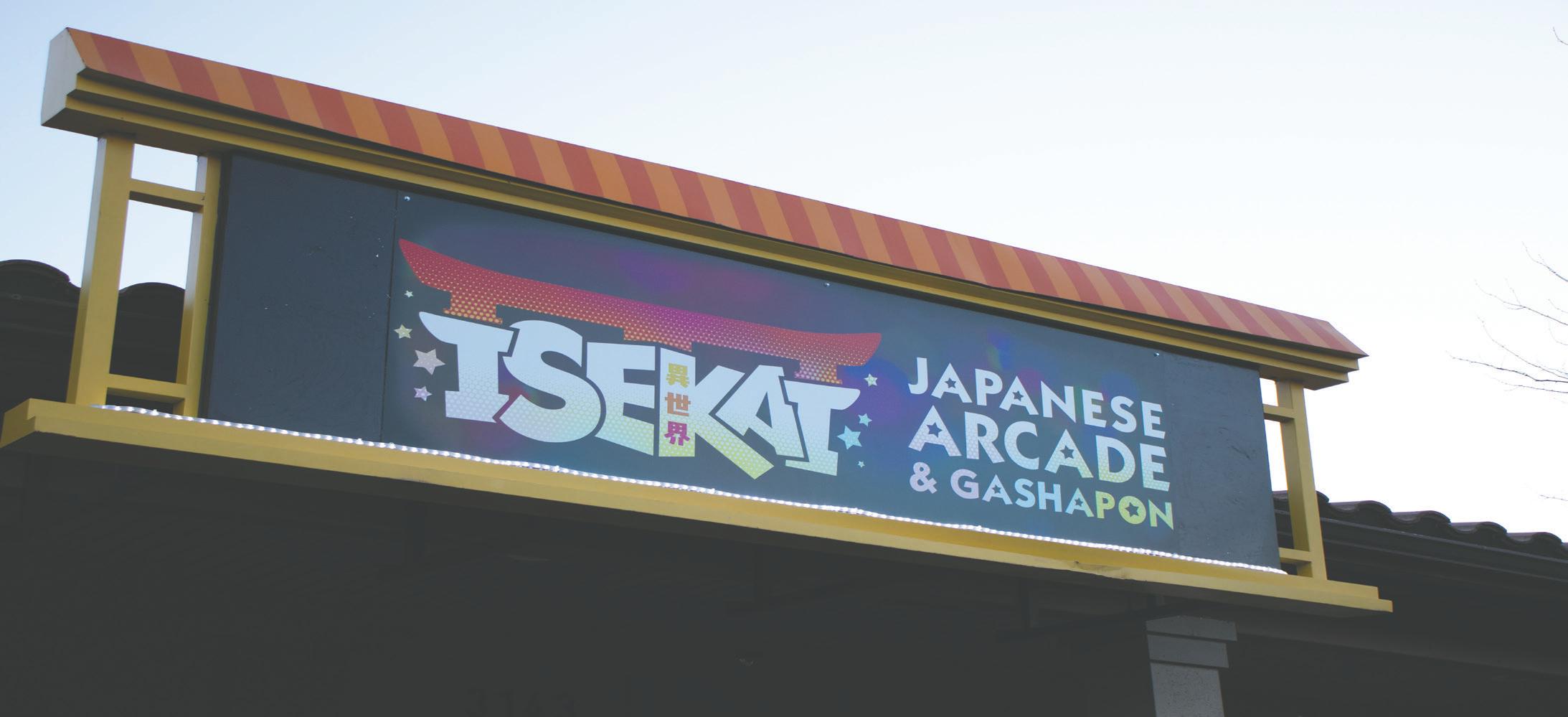
The cranking handles, dropping capsules and Japanese pop music welcome visitors as they walk under the red torii gate into Isekai Arcade. Japanese claw machines stocked with plushies and figurines line the walls, and in the middle of this street-style arcade lies the main attraction: gashapon machines.
Typically found in train stations or outside convenience stores, Gashapon machines are common among the bustling streets of Japan. These machines contain keychains, figurines and a variety of pop-culture merchandise.
As the toys tumble down the chute of the gashapon machine, customers excitedly await their mystery prize.
When Matthew Gillikin, a Boise State alumnus, and his wife, Susie Gillikin, a Boise State administrative assistant for the computer science program, visited Japan in 2024, these machines and toys inspired the opening of what is now Isekai Arcade. The pair wanted to bring this beloved piece of Japanese culture to Boise, Idaho.
“You take a moment out of the world to remember the core joy of receiving a gift as a child,” Matthew said of the Gashapon experience.
That childlike wonder is part of the appeal, but it’s not just about the toys. Honoring Japanese culture is integral to Isekai Arcade’s mission.
After their visit to Japan inspired them to start Isekai Arcade’s parent company, Chibi POP Toys, in 2024, this journey led them to open the brick-and-mortar arcade in October 2025. The arcade brings authentic Japanese culture and the wonder of gashapon to the United States through collectibles.
Isekai Arcade frequently hosts events for Japanese holidays. For the recent celebration of Girls Day on March 3, they handed out gift bags full of treats and a free arcade token to any girls who visited Isekai.
For the upcoming Golden Week, a week-long cluster of Japanese holidays including Showa Day, Constitution Day, Greenery Day and Children’s Day, the Gillikins are searching for a taiko drumming group to perform at the event and bring authentic Japanese music to the arcade for the spring festival.
Immense research goes into these events to ensure a respectful and accurate representation of Japanese culture.
The Gillikins work closely with the local Japanese community and draw on their extensive time spent in Japan.
Gashapon machines are sourced through highly specialized supply chains, honoring well-known Japanese figures such as digital pop icon Hatsune Miku or Mofusand, the cat dressed in marine animal outfits. Many of these trinkets are unique to Japan, with very few gashapon items available in the United States.
Although gashapons have been Americanized into blind boxes, for the Gillikins, the transactional nature of blind boxes doesn’t match the experience and authenticity of gashapon.
“Japan has been doing gashapon for decades — long, long before America
decided to jump on it with the blind boxes,” Susie Gillikin said.
“You don’t always get what you want with gashapon, but you love what you get,” Matthew Gillikin added, explaining how the gashapon machines bring the immersive experience of a true mystery.
Along with distributing joy via gashapon and honoring Japanese culture, the Gillikins have worked to turn Isekai Arcade into a community hub. With the help of Marketing Director Demi Erwin, Isekai Arcade draws in crowds with every event. The team is constantly coming up with new event ideas and sharing information on their social media pages.
“We try to do things that incorporate not just the Japanese community, but also the local community,” Erwin said.
For Erwin, everything fell into place as soon as they stepped foot into the arcade before its official opening last summer.
“When I moved here in 2020, it was very isolating,” Erwin said. “But [Isekai Arcade] really made me feel like I had a connection to something.”
The Isekai team hosts themed events around current pop culture and media, such as their PopMart fan event, Chibi
Godzilla pop-up event and Pokémon Day celebration. By prioritizing free entry to events, Isekai encourages people to show up and have fun, even if they aren’t interested in the gashapon or claw machines.
“We never thought something like this could exist in Boise,” Erwin said.
The team at Isekai Arcade emphasizes their love for the Boise community by adorning the walls with local artists’ creations for sale without taking any consignment fees — something nearly unheard of in the art community. Erwin urges local artists and photographers to utilize Isekai as an artist’s space.
In its short time, the Isekai team has cultivated something extremely special: a community space for all Boise locals, from all walks of life, to enjoy and explore Japanese culture. From seasoned cosplayers and gashapon enjoyers to little kids begging their parents for another token, they welcome everyone with open arms.
“We wanted to create a magical space for people,” Matthew Gillikin said — and this hidden gem turned community space does just that.
| ARBITERONLINE.COM april 2, 2026
SPORTS
LAWMAKERS URGE CONGRESS TO SET NATIONAL RULES FOR COLLEGE ATHLETICS
Aidan Mattingly | Sports Reporter | Photo by Keara Antonelli
As NIL deals, athlete transfers and looming revenue-sharing changes continue to reshape college athletics, Idaho lawmakers are asking Congress to step in.
Senate Joint Memorial 114, introduced by Sen. Ben Adams, urges Congress and Idaho’s congressional delegation to create a national framework governing issues like NIL compensation, the transfer portal and athlete revenue sharing.
Adams said the current landscape of college athletics has become increasingly driven by financial competition between programs.
“The biggest issue right now is that it’s a money race,” Adams said. “It’s whoever spends the most. You’re seeing programs that were once average suddenly become competitive because they’re able to outspend everyone in NIL.”
The memorial passed the Idaho Senate unanimously and now moves to the Idaho House. If approved, it would be sent to Congress as a formal request from the Idaho Legislature urging federal lawmakers to create consistent national standards for college athletics.
Adams said the lack of national regulation has created an uneven playing field between universities across the country.
“You can’t have Ohio State, Miami, Florida State, Penn State and Oregon running on one set of rules they can afford while everybody else is running on a different set of rules they can’t,” Adams said. “That’s not a healthy system for college sports.”
Adams also pointed out the rise of the transfer portal has made college athletics harder for fans to follow, noting players moving between several programs during their careers make it difficult for supporters to stay connected to a team.
On Friday, March 6, several Boise State officials testified in support of the memorial during committee hearings, saying federal action may be necessary to stabilize college athletics as NIL spending, transfer rules and conference realignment reshape the competitive landscape.
Interim president Jeremiah Shinn told lawmakers the financial model supporting college athletics is becoming increasingly unstable as resources are concentrated among the sport’s wealthiest programs.
“The financial model underlying college athletics is unstable,” Shinn said. “The math simply no longer works, and schools outside the power two conferences face a very short runway if we don’t find a way to stabilize the system.”
Boise State athletic director Jeremiah Dickey said the lack of consistent national standards has created uncertainty for schools trying to compete in the rapidly changing landscape of college athletics.
“Different colleges and different states are playing by different rules,” Dickey said. “When an industry is unwilling or unable to govern itself, sometimes we have to ask Congress to step in and help create a framework that brings consistency.”
The financial pressures shaping the highest levels of college football could eventually ripple throughout the entire college sports system, affecting programs well beyond the sport’s biggest stages.
Those concerns extend beyond football and basketball. Programs at various levels of competition have begun cutting sports, raising concerns that smaller or non-revenue programs could be especially vulnerable if financial disparities continue to grow.
State football coach Spencer Danielson testified in support of the memorial, warning lawmakers that the current landscape risks shifting college athletics toward a system driven primarily by money rather than development.
“A lot of places focus on the transaction — pay for a player, bring them in and move on,” Danielson said. “We don’t want to be a transactional institution. We want to develop young people and help transform their lives.”
Danielson said Boise State’s philosophy centers on building relationships with players and helping them grow both on and off the field, a model he believes could become harder to maintain if college sports continue moving toward a system dominated by short-term financial incentives.
His comments reflect a broader concern shared by many college coaches: that rapid changes brought by NIL deals and the transfer portal could
fundamentally reshape how programs build teams. Instead of developing athletes over several seasons, programs may increasingly rely on quick roster turnover driven by financial offers and transfer opportunities.
Adams said one possible solution could involve financial guardrails similar to those used in professional sports.
“A salary cap would be great — an NIL cap,” Adams said. “Here’s the ceiling. Everybody can compete under the same structure instead of just whoever can spend the most.”
If approved by the Idaho House, the memorial would be sent to Idaho’s congressional delegation as a formal request urging federal lawmakers to consider nationwide standards. The goal is not to eliminate opportunities for athletes, but to ensure programs across the country are competing under the same rules as college athletics continues to evolve.
Boise
NICK PERSING’S JOURNEY TO THE FINISH LINE
Maximus Molina | Staff Writer | Photo courtesy of Jamey Price
As Led Zeppelin blares in the AirPods of professional racecar driver and Boise State senior Nick Persing, he leans up against his Lamborghini with his Bronco-branded cowboy hat.
Soon, the music is replaced by a V10 engine that erupts to life under his right foot.
Persing’s passion for racing started early. His father, Jon Persing, recalls his earliest memory of Persing and his hunger for speed.
“When Nick was six months old, if I slowed the car down below 80 miles an hour, he’d start crying,” Jon Persing said. “I’ll never forget when the light turned green and we were next to another car with a big wing on it, and he said, ‘one, two, three, go!’”
Persing first got behind the wheel of a kart at 8 years old. While most kids his age spent time with friends or playing video games, he was sharing stories from the racetrack.
Although the road to racing was, in some ways, as natural as breathing, it wasn’t without hurdles.
When the Persing family began traveling nationally in 2017, it became difficult for him to maintain a social life. However, his schools were supportive of his passion, making it easier to manage both schoolwork and racing.
“When he would go back to school, it was very tough, because most people at his school didn’t understand racing or even karting,” Jon Persing said. “He still had plenty of friends at school, but it made it hard for him to relate to the guys at the school.”
Because of racing’s lack of popularity compared to sports like football, Persing sometimes found it difficult to relate to his peers.
“It’s a very niche sport that people don’t understand and because of that, I have a deeper connection with my racing friends,” Persing said. “I still keep in touch with a lot of them, even from when I was like 12 years old racing go-karts.”
Persing lives in a fraternity house just off campus, “Tri Delta Grand Prix”.
“It’s really humbling when you see him go out there and perform at such a
level that he does and then comes home and he’s just one of our best friends,” Matthew Sales said when asked what it’s like having a professional racing driver as a roommate.
By balancing the chaotic schedule of racing and classes, Persing motivates his friends to do the same. His time management and discipline show his roommates it’s possible to chase something demanding without faltering.
“It drives us to be better and better ourselves, because someone like him is out there doing so much, it makes us want to do even more,” Sales added.
Despite Persing’s early love for racing, his parents had to convince him to continue after a rough patch where he was on the brink of giving up. Coming off a karting season in which he struggled, he found himself questioning his racing future.
“I finished only two races that season because I either had a mechanical [issue] or something [else]. The next year, I was fully planning on quitting,” Persing said.
His parents’ reasoning for pushing him to continue another year was simple.
“It was in his soul,” Jon Persing said.
An equally impactful factor in Persing’s career comes in the form of a quote by legendary racer Michael Schumacher: “I’m not the greatest racing driver of all time, I’m the hardest working racing driver of all time.”
Persing’s hard work and determination led to his first karting win in 2011 at 12 years old.
Today, that journey has led to a seat with one of the best teams in the Lamborghini Super Trofeo Series, Wayne Taylor Racing. In 2025, his fourth year with the team, he experienced ups and downs but managed to secure three wins and finish third in the standings to close a strong season.
While many students balance work and school, the pressure is magnified for Persing. He has to track his carb and fluid intake before races to avoid heat exhaustion, as cockpit temperatures can exceed 100 degrees Fahrenheit. His job is highly results-based; a bad season could mean demotion, a major setback in his pursuit of climbing the ladder to IMSA’s top level.
When he returns to campus on Monday, he blends in like everyone else. While completing his business administration degree, he also plans to add a minor in engineering — all while traveling in and out of Boise for race weekends.
This year, Persing was promoted to the top car at Wayne Taylor Racing alongside his Swedish teammate and defending champion, Hampus Ericsson.
Persing’s hard work and determination have pushed him through racing against more experienced drivers.
He recently delivered a strong performance with Ericsson, finishing second in both races at Sebring, Florida. Fans can watch him compete in the No. 1 car on IMSA’s YouTube channel or IMSA.com. He now prepares for the May 1–3 race at Laguna Seca, where he won in a photo finish last year.
| ARBITERONLINE.COM april 2, 2026
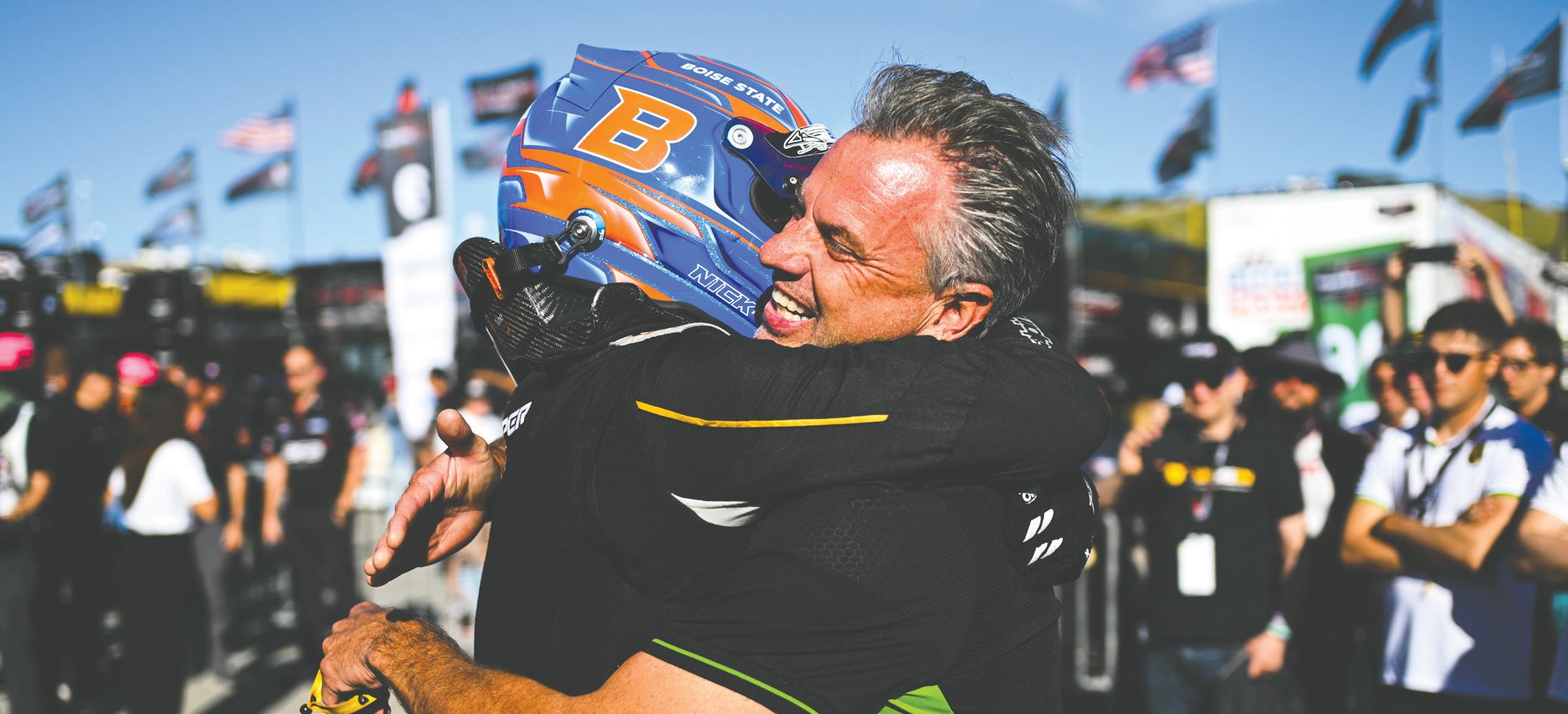
Embracing each other are father and son Nick (left) and Jon Persing (right) after two wins.
SPORTS
18 FORMER BRONCOS MAKE THEIR NFL CASE AT 2026 PRO DAY
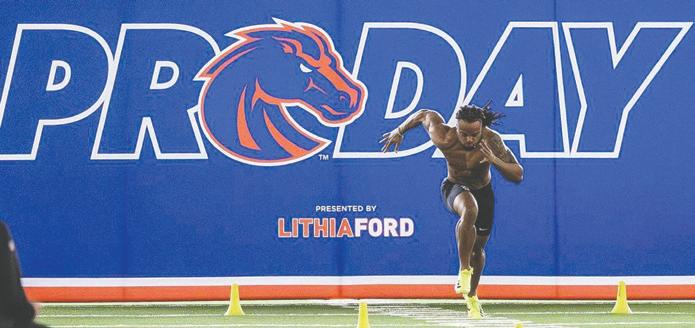
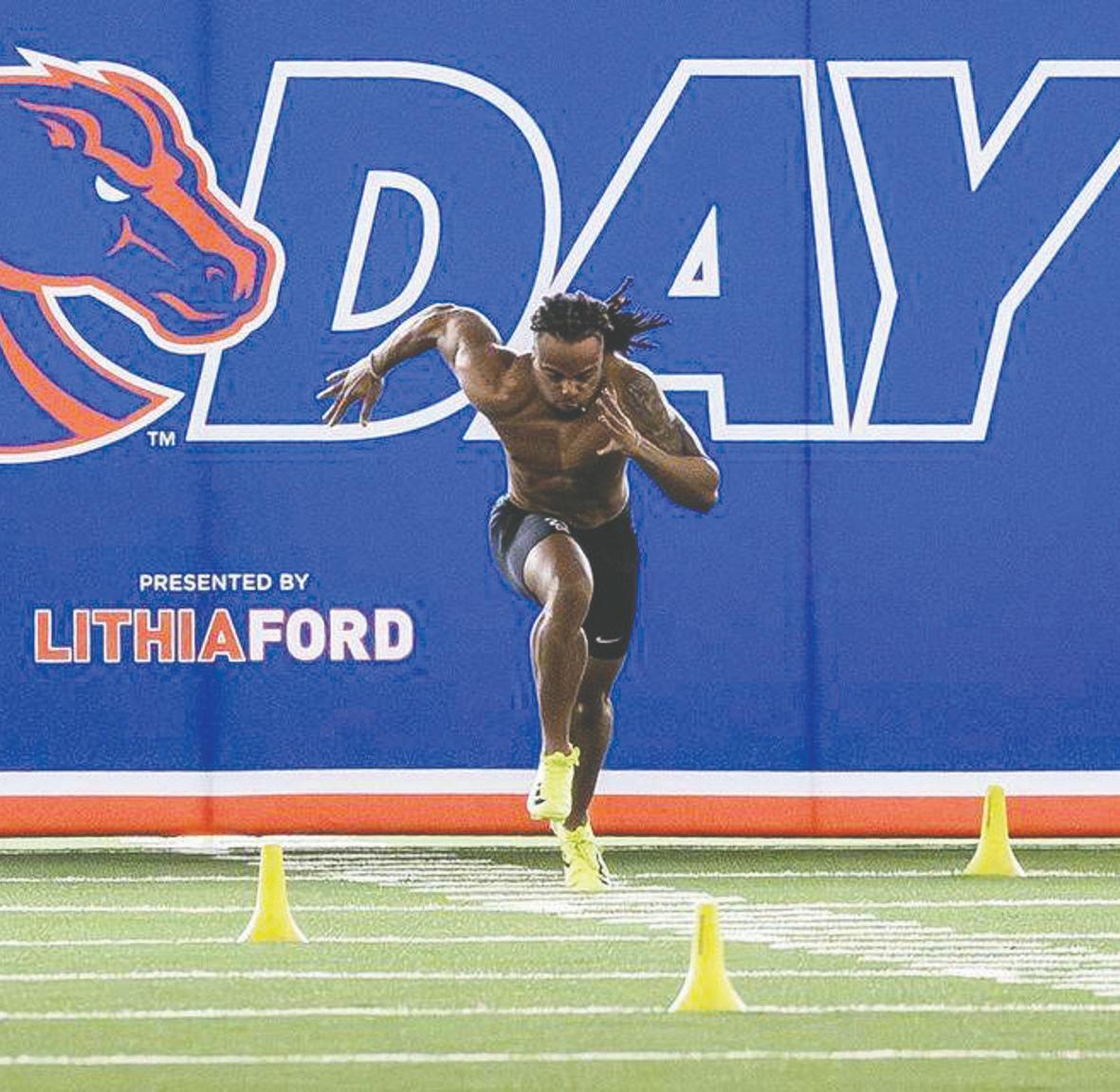
On March 23, scouts from nearly every NFL franchise flooded Boise State’s football facilities to watch 18 former Broncos put their skills on display at their 2026 Pro Day.
With offensive tackle Kage Casey being the only Bronco to receive an invitation to this year’s NFL Scouting Combine, Pro Day gave overlooked prospects a chance to prove their worth and make their case as potential draftees in front of 26 different teams.
The morning kicked off at Bleymaier Football Center, where players took part in the vertical jump and bench press, aiming to highlight their raw strength and explosiveness.
To say defensive back Zion Washington accomplished showcasing both those traits would be an immense understatement.
The Frisco, Texas native put up a 41.5 inch vertical jump. Wowing scouts, media members, teammates and coaches alike,the nearly 3.5 feet leap would’ve landed Washington inside the top-10 best verticals at this year’s NFL Combine had he participated.
Washington continued to impress when the Pro Day shifted to the Caven-Williams Sports Complex, blazing through his 40-yard dash in a lightning-fast 4.39 seconds, the fastest time of the day.
An undeniable presence throughout his time in the Bronco secondary, Washington finished his redshirt senior season with 66 total tackles, averaging 5.5 per game while starting all 12 contests he appeared in. His four Academic All-Mountain West selections reflect his intelligence and work ethic, qualities that scouts consider key intangibles at the next level.
“Whatever God blesses me with,” Washington said when asked what he thinks he is deserving of based on his Pro Day performance and game film.
“I know I’ll get an opportunity and it just depends on how I go about the opportunity that’s going to really matter. From here on out, I’m just preparing for the next step.”
Defensive lineman Braxton Fely’s bench press performance sent a surge of energy through the weight room when he busted out 38 reps, turning scouts’ heads in the process.
Fely’s showing on the bench press reflects the brute strength that the twotime All-Mountain West honoree brings to the field.
In his senior season, Fely ranked second on the team with 5.5 sacks in addition to notching 6.5 tackles for loss.
His standout pass-rushing ability and Pro Day performance garnered attention from the Denver Broncos, who, Fely says, gave him kudos at the end of the day.
“I’ll give you my all,” Fely said when asked what he could bring to NFL franchises. “I’m a hard worker. I know a lot of people say that, but when it comes down to it, that’s one of the things that I emphasize my gameplay on. Just giving my all for the people around me.”
Boise State’s only 2026 NFL Combine invitee, offensive tackle Kage Casey, took part in the Pro Day as well.
Riding the momentum from a strong combine performance that helped boost his draft stock, Casey turned in another solid showing at Pro Day.
The 6’5’, 311 lb Casey jumped for a 31-inch vertical, displaying the lower-body explosiveness that helped him earn the reputation as the best offensive lineman in the Mountain West, a claim backed up by his two All-Mountain West First Team selections and projection as an early-round pick.
A handful of other Broncos made their marks as well, posting solid numbers in key drills, showcasing strong technique in workouts and drawing attention from scouts.
One of the more notable drills was Matt Lauter’s three-cone drill, which he moved through in just 7.02 seconds, a time considered elite among tight ends. In 2024, Lauter was named to the All-Mountain West First Team after totaling 47 receptions for 619 yards and a team-leading seven touchdowns. His nearly 50 catches set the single-season mark for a Boise State tight end.
As Boise State football’s Instagram described it, defensive back Jeremiah Earby, known as “Jay Boogie” on the platform, was “coming in hot,” running a 4.44 40. In 2025, the Bay Area native stayed stapled to his assignments all season, defending 13 passes, tied for most in the entire conference.
Other notable players who turned in well-rounded workouts included
wide receiver Latrell Caples, running back Malik Sherrod, defensive back A’Marion McCoy and edge rusher Malakai Williams.
Having done all they can and leaving everything on the field, the 18 Pro Day participants will continue to put in work and refine their craft as they prepare for the 2026 NFL Draft on April 23.
While their time on the blue turf has ended, the league-hopeful Broncos will always know they can call Boise home.
“It’s super special coming back in here,” Lauter said when asked what it meant to him to return to Boise for Pro Day. “We put a ton of hard work into this program. It just feels like home again.”
Question all the relationships in your life right now. What do they mean to you?
CANCER
Seek out these unexpected magical moments, as they will grow into great payouts.
LIBRA
Commit to yourself and become a whole person before you extend your love elsewhere. Avoid codependency with others.
CAPRICORN
Listen to messages from the stars. Let go of materialism. The universe is trying to tell you something.
Stop adding things to your to-do list, there is not enough time in the world to complete all of your projects. Instead, think about what you can do at this moment.
ARIES TAURUS GEMINI
Be creative! Make art!
VIRGO LEO
You must think out of the box. Get out of your comfort zone and try out new ideas in order to ease the confusion of your work life.
SCORPIO
Secrets and scandals will arise that must be weighed by the critical scales of justice. Your decisions will reshape your understanding of what matters in a relationship.
Be vulnerable with yourself and your loved ones. Cultivate your energy into turning a new leaf by being your authentic self.
SAGITTARIUS
Get involved with your community and go down the path that you are passionate about. The world needs more people like you.
AQUARIUS PISCES
It’s going to be a chill week. The stars don’t have anything crazy planned out for you guys so take this time to really just hang out.
ACROSS
3. You must have these to enter the movie theater.
5. Cease to happen.
6. Publicly Display.
7. Persuade.
DOWN
1. It covers your phone, laptop and glasses.
2. Back to the __.
4. “Alright pal you’ve crossed the __!”
5. Musicians perform on these.
Write down all your ideas. Competition is in the air and right now you’re winning. Keep that passion and creativity going and really make the most of this week.