The Appalachian Tuesday. September 15, 2015
QUIDDITCH
see THEAPPALACHIANONLINE.COM
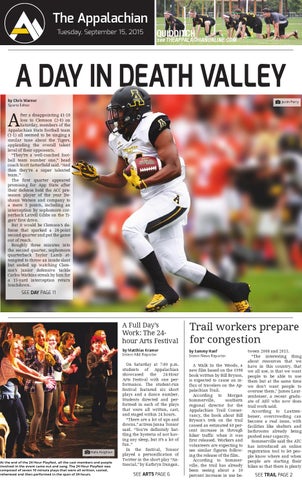
A DAY IN DEATH VALLEY by Chris Warner
Justin Perry
Sports Editor
A
fter a disappointing 41-10 loss to Clemson (2-0) on Saturday, members of the Appalachian State football team (1-1) all seemed to be singing a similar tune about the Tigers, applauding the overall talent level of their opponents. “They’re a well-coached football team number one,” head coach Scott Satterfield said. “And then they’re a super talented team.” The first quarter appeared promising for App State after their defense held the ACC preseason player of the year Deshaun Watson and company to a mere 3 points, including an interception by sophomore cornerback Latrell Gibbs on the Tigers’ first drive. But it would be Clemson’s defense that sparked a 28-point second quarter and put the game out of reach. Roughly three minutes into the second quarter, sophomore quarterback Taylor Lamb attempted to throw an inside slant but ended up watching Clemson’s junior defensive tackle Carlos Watkins streak by him for a 15-yard interception return touchdown.
SEE DAY PAGE 11
A Full Day’s Work: The 24hour Arts Festival
Trail workers prepare for congestion
by Matthias Kramer
by Sammy Hanf
Intern A&E Reporter
Halle Keighton At the end of the 24 Hour Playfest, all the cast members and people involved in the event came out and sang. The 24 Hour Playfest was composed of seven 10 minute plays that were all written, casted, reheresed and then performed in the span of 24 hours.
On Saturday at 7:00 p.m. students of Appalachian showcased the 24-Hour Arts Festival with one performance. The student-run festival featured six short plays and a dance number. Students directed and performed in each of the plays that were all written, cast, and staged within 24 hours. “There are a lot of ups and downs,” actress Jenna Tonsor said. “You’re definitely battling the hysteria of not having any sleep, but it’s a lot of fun.” In the festival, Tonsor played a personification of Twitter in the short play “Antisocial,” by Kathryn Dungan.
SEE ARTS PAGE 6
Intern News Reporter
A Walk In the Woods, a new film based on the 1998 book written by Bill Bryson, is expected to cause an influx of travelers on the Appalachian Trail. According to Morgan Sommerville, southern regional director for the Appalachian Trail Conservancy, the book about Bill Bryson's trek on the trail caused an estimated 60 percent increase in through hiker traffic when it was first released. Workers and volunteers are expecting to see similar figures following the release of the film. According to Sommerville, the trail has already been seeing about a 10 percent increase in use be-
tween 2008 and 2015. “The interesting thing about resources that we have in this country, that we all use, is that we want people to be able to use them but at the same time we don't want people to overuse them," James Lautzenheiser, a recent graduate of ASU who now does trail work said. According to Lautzenheiser, overcrowding can become a real issue, with facilities like shelters and bathrooms already being pushed near capacity. Sommerville said the ATC has introduced an online registration tool to let people know where and when people are starting their hikes so that there is plenty
SEE TRAIL PAGE 2
news
2
Community gathers for documentary about Cone family
by Sammy Hanf Intern News Reporter
L
ast Thursday, locals gathered to see Denim Dynasty, a documentary about the influential Cone family and their textile empire. The film was directed by Beth Davison, director of interdisciplinary studies and co-director of documentary film studies at ASU and drew a crowd of nearly 100 locals to the Belk Information Commons where it was shown. Also in attendance were members of the Cone family who were introduced in the
question and answer session immediately following the film. The film attracted special interest for the residents of the Blowing Rock region due to the Cone families donation of 36,000 acres of land to be used as a state park. The land, which also has a manor that is accessible to the public, was a motivating factor in deciding the subject of the film. “It’s beautiful, it’s well used and fairly well maintained and so I think just being out there and enjoying it,” Davison said about the park. According to Davison, research for the film was done
through the use of seven different archives, the largest of which being UNC, home to the Cone Corp. records. During the film’s creation, Davison said that students were a big part of the process, taking part in the research and editing of the film. Interest was not confined to the legacy of the Cone’s. Many attendees wanted to know about the current state of the larger mills mentioned in the film. Some of which, according to Davison, are still operational and produce expensive high-quality denim. Davison said there are plans to take the film out of the re-
gion because she sees a connection through the prevalence of textile mills across the country and the lives shaped by the industry’s influence. She sees a link between the Cone story and the present day by way of the manufacturing boom in other countries. “I think we see in China, in Bangladesh where people are coming off the farms and out of the villages into the urban centers to work in these textile companies and build the garments that we wear,” Davison said, “That used to be produced in North Carolina and other places.”
Zululand University Chorale visits Boone by Regina Nasrallah Intern News Reporter
More than 200 people gathered in the tudor revival sanctuary of St. Luke’s Episcopal Church to hear the voices of the University of Zululand Chorale on Friday. Fifteen members of the 90 member Chorale are visiting Boone and Appalachian State University this month to perform. The group enjoyed the season’s first App State football game, visited and performed with students of Watauga Residential College, toured the App State campus and performed throughout Watauga county. Chorale director Bhekani Buthelezi, a former visiting lecturer at Appalachian State, said he feels at home on the campus. “[The football game] was fun, especially when we said ‘App State, App State,’” Buthelezi said. “The atmosphere and the flare and pride of ASUthat was wonderful, that was overwhelming.” Friday’s concert brought a diverse crowd to St. Luke’s: se-
rious musicians, members of the church, students and staff from Appalachian State, and Watauga County residents. The parking lot was completely full, with cars spilling out onto the grass. The performance began with a standing ovation from the crowd, before the chorale began to sing. Once the audience settled down the chorale began its performance.
TRAIL
CONTINUED FROM PAGE 1 of space for all hikers to camp. “That's the first order of business is to try to encourage people to spread out through space and time,” Sommerville said. Other problems caused by neglect or misuse can be exacerbated with more traffic, such as littering or graffiti.
Most of the songs were in Zulu or Swahili and only a few in English. The traditional music was notably upbeat, with members of the Chorale clapping, swaying and dancing to the rhythm. During the last song, Buthelezi encouraged members of the audience to clap and move with the chorale. The entire audience stood and moved together in the small church.
“It is amazing,” Buthelezi said. “You are just on another level. When we are rehearsing at the university, we are technically correct, but when we are here, you know the spirits and the environment everything was just right and with the right people.” The chorale members wore traditional South African clothing, tied together with umqele, traditional
“Carrying trash is part of the job but not the part of the job that we like to do,” Lenny Bernstein, the 2014- 2015 president of the Carolina Mountain Club said. According to Morgan, almost all of the the work on the trail is done by volunteers, which the ATC and the 31 trail clubs that oversee different sections of the trail hope to see more of to balance out the expected traffic increase. To Lautzenheiser, the important
head gear worn by the males, and ubuklali, beads worn on the head and neck by the females. Buthelezi wore a shirt designed like the South African Flag and red Converse to match. The University of Zululand Chorale will be collaborating in performance with ensembles on campus at the Broyhill Music Center’s Rosen Concert Hall on Sept. 16.
part of trail work is to foster a sense of stewardship and for people to value the existence of the Appalachian Trail even if they don't get to use it themselves. “For me, the rewarding aspect now is not so much giving back to the land but getting other people to buy into that aspect, to get them to buy into that aspect of service and valuing a resource that they may never even see,” Lautzenheiser said.
Get all your App State news on-the-go at
Theater Troupe Returns to Boone For Fourth Consecutive Year
TheAppalachianOnline.com!
Find us on social media!
The Rural Academy Theater Travelling by horse-drawn wagon and putting on a magnificent show, these artists travel across North Carolina to celebrate theater and heritage.
Sanford Mall 8:00pm Free th Thursday September 17 , 2015 apps.appstate.edu apps@appstate.edu
Join.
$10 / $7 in adv
apps.appstate.edu apps@appstate.edu
4
a&e
Film Tour benefits ASU Fly Fishing Club
by Katie Murawski A&E Reporter
T
he Fly Fishing Film Tour kicked off on Friday at the Schaefer Center with proceeds benefiting the Appalachian State Fly Fishing Club. Shea Tuberty, co-chair of sustainability counsel at Appalachian, described the film tour as “like a one day version of the [Banff Mountain Film Festival] with a focus in Fly Fishing.” Tuberty described the central theme as sustainability, also a central focus of Appalachian State University. The films took place all over the U.S. and around the world in Cuba, Honduras, Mongolia and other countries. They encouraged the audience to get outside and “find your wild,” Tuberty said.
Boone is home to the majority of fly-fishing spots in North Carolina, Tuberty said. “There are over 15 fly fishing shops and guide services in or around Boone, so there is definitely a need for that field,” he said. Project Healing Waters, a national nonprofit organization, was one of the beneficiaries of the film tour. Project Healing Waters creates “camps” for veterans or active military servicemen struggling with Post Traumatic Stress Disorder, Tuberty said. According to the organization's website, Project Healing Waters “Provides basic fly fishing, fly casting, fly tying and rod building classes, along with clinics ... All fly fishing and tying equipment is provided to the participants at no cost. Fishing trips, both one day and multi-day, are also provided free of charge to participants." “One of the things that is so wonderful
about fly fishing is that it calms you down and takes your mind off your worries- it is almost hypnotic,” said Tuberty. Boone is currently trying to create their own “camp” with Project Healing Waters called Trout Unlimited, ASU fly fishing club member Jeremy Barnes said. Funding and recruitment for the project is handled by Project Healing Waters while the Boone and Blowing Rock area provides space, timing and fly-fishing guide services, Barnes said. Chetola Resort in Blowing Rock will also provide rooms free of charge for a week so the veterans have a place to stay. According to Barnes, the fly fishing film tour hopes to accumulate more attendees at next year's film tour as well as more awareness about Camp Healing Waters in Boone.
Mick Jenkins opens up with personal second album by Abi Shaki Intern A&E Reporter
Mick Jenkins new album, Wave[s], (2015) centers on the artist’s personal growth and colorful arrays of musical ideas compared to his first album, “ The Water[s].” The latter endured powerful testaments to Black Lives Matter, resembling pioneers such as rap group N.W.A., and placed Jenkins on the same level as contemporaries Chance the Rapper and Vince Staples. The Chicago native relished in the city’s poetry scene and embodied his experiences through striking lyrics in The Water[s]. Wave[s] is nothing short that. Jenkins undresses his heart, opening up about his past with drugs and the starry-eyed fever dream of society. The symbolism
of water as a tool for cleansing the mind and body does not drive the Wave[s] as much as it did for The Water(s), however, it’s a still a strong component in the structure of the new EP. Although Jenkins is still infatuated with H2O, it doesn’t necessarily dictate Wave[s] like it strongly did for The Water[s]. Guided by tracks like “Jazz,” “The Waters” and “Martyrs,” The Water[s] embodies submergence of heavy rhythms while analyzing personal feats such as self-destruction, anguish and a false sense of hope. Jenkin’s new EP has less of an emphasis on self-seriousness and more on transfiguration for the better while encouraging the audience to see past the inherent fake-ness of society’s superficiality. The EP also centers around fluid
ARTS
CONTINUED FROM PAGE 1 Tonsor sought to embody Twitter and made an account for the first time in order to get into character. “I had never used [Twitter] before,” she said. “I had to learn all the lingo.” The play “Antisocial” was a biting social comedy that satirized our generation’s obsession with social media. Twitter, Tinder, Pinterest, Instagram and even Myspace made appearances. According to Tonsor, many of the plays performed that night were comedies. Tonsor participated in last year’s festival. The predominantly comedic performances were no accident, she said. “We had predominantly comedic plays [be-
vibes and dreamy synths. The hazy beats that guide tracks like “Your Love” and “Get up Get Down” leaves open space for dancing. Assisted by producers Kaytranada, Lee Bannon, Stefan Ponce and ThemPeople, Wave[s] is struck with radio-ready rhythms and acid jazz similar to Kendrick Lamar’s “To Pimp a Butterfly”. Wave[s] opens with “Alchemy,” in which Jenkins displays his confidence by calling out society’s profound golden values overlaid on a high-bass beat with curvatures of synths. Jenkin’s strong, deep voice embodies a sense confidence that forces the listener to understand what Jenkins is about. In “Alchemy,” there are moments when Jenkins unapologetically reassures the separation from what he knows is
cause] last year we had a lot of dramas, which was a [challenge] to watch one after the other,” she said. However, more than comedies were showcased. A dark and philosophical play entitled “Bomb Shelter” by Morgan Stewart exposed the audience to a challenging ethical dilemma. Furthermore, this year marked the first time dance and fight choreography were integrated in the performance, according to junior theater performance major Ian Lawrence. Ian Lawrence wrote, directed and choreographed the fight scenes in three individual shorts, titled “Struggles with Life (and the People in It),” “Final Boss: Girlfriend,” and “Drunken Boxing.” “They wanted to get choreography for dance and I
real and what is fake. “Curing my countenance, creating this gold from the led in my pencil/I think I’m an alchemist, and it’s gone take courage no cowardly dogs in the pound/we don’t want ‘em round”. These lyrics set the tone for the rest of the album. Tracks like “Get up Get Down” and “Your Love” relentlessly showcase Jenkins transfiguration to more shifty and groovy beats. His lyrics tell of getting off drugs for his father. “Couple of ounces, no, it wasn’t too bad, cup full of water/ I be missing my dad”. “P’s and Q’s” takes a simple guitar hook paired with an an energetic arc of a drum beat to create a template for free flowing rhymes. Tracks like “Piano” and “The Giver” are built upon hypnogogic synths, displaying Jenkins ability
got the idea to ask Cody [the event’s organizer] if I could write some choreo, ‘Can we get some fight scenes in there?’” Lawrence said. “I had just had some fight experience over the summer- I got certified with the Society of American Fight Directors.” Lawrence was also involved with the festival last year, he said. “[This year] we cleaned up the process a lot more,” he said. This was the main reason behind better organization after the event’s organizer had to “pick up the pieces from last year.” Junior theater education major Jonathan Cody Watkins was the one who organized the event. This year marked the first time such a position was filled. “It was [a tough job],” he said. “I’m running on three hours of sleep 36 hours
Mick Jenkins ‘Wave[s]’
to hone his hooks. Wave[s] is a sonic, physical and emotional change for Jenkins. The artist deals with “on the surface” ideas of society, soberness, love and heartbreak. It's an album that showcases Jenkins flourishing talent for trapping hooks and seemingly fluid rhythms. The album forges lagoons of deep thought through auditory realms, heightening Jenkins as an artist to look out for.
ago.” But the lack of sleep didn’t dampen his spirits. “My mom’s an organizer, so I love this sort of thing,” he said. In terms of this year’s performance as compared to last year’s, Watkins said the dance and fight choreography are the biggest changes. “We didn’t have [dance and fight choreography] last year, and we are so thankful to have it,” Watkins said. While the performances were stressful and challenging, the participants were unanimously positive in their reactions. “It’s really rewarding, especially if you learn your lines because it’s really nice to say, ‘Oh my gosh, I learned a script in a night without any sleep and then performed it the next day!’” Tonsor said.
5
classifieds
CRIME LOG BOONE Sept. 11 12:24 a.m. | Underage Consumption of Alcohol Gardner Hall A student was arrested for underage consumption of alcohol. Sept. 11 10:27 p.m. | Larceny Hoey Hall Larceny of a bicycle
Sept. 11 3:36 a.m. | DWI Holmes Convocation
Parking Lot A man was arrested for DWI
Leads exhausted
Sept. 9 2:42 p.m. | Misdemeanor Larceny Appalachian Panhellenic Hall Under Investigation Aug. 24 1:22 a.m. | DWI Hardin Street Prosecution declined Aug. 23 3:17 a.m. | Vandalism Lovill Hall
Aug. 23 11:38 p.m. | Underage Consumption of Alcohol Justice Hall A student was arrested for underage consumption of alcohol Aug. 22 11:46 a.m. | Underage consumption of alcohol Legends Parking Lot A student was arrested for underage consumption of alcohol
The Appalachian is also online: VISIT
LIKE US
TheAppalachianOnline.com The Appalachian
FOLLOW US
@TheAppalachian
FOLLOW US
@TheAppalachian
WATCH US
TheAppalachian
Place your classified ad here $20 per week email business @theappalachian.com
The Appalachian 217 Plemmons Student Union, Boone, N.C. 28608 828 • 262-6149
Copyright Š 2014 The Appalachian
WHO ARE WE? The Appalachian, a student-run publication at Appalachian State University, strives to provide fair and accurate news for the campus community; to inform, entertain and create a forum for ideas; to provide an outlet for reader's opinions; to be a champion for student, faculty, staff, and community interests; and to remain independent, exercise and ensure its First Amendment rights.
EDITORIAL BOARD Editor-in-Chief Malik Rahili Managing Editor Andrew Clausen Visual Managing Editor Justin Perry News Editor Carl Blankenship A&E Editor Kelsey Hamm Sports Editor Chris Warner Graphics Editor Samantha Cordialini Opinion Editor Lauren Burrows Photo Editor Alex Gates Video Editor Jennifer Rhodes
BUSINESS OFFICE Business Manager Ignacio Martinez-Alvarez
ONLINE Web Manager Dylan Dow Marketing Director Stephanie Sansoucy
ADVISER
Assistant Director, CSIL Allison Bennett Dyche
Contact Information EDITOR-IN-CHIEF (828) 262-6149 BUSINESS OFFICE (828) 262-2157 ADVISER OFFICE (828) 262-2245
Associated Collegiate Press
11
Quidditch
Photos by Alex Gates
The Appalachian Apparators, Boone’s community quidditch team, hosted their first full-sized tournament this weekend. The Apparators’ two squads competed against a total of seven other teams with the varsity squad going to finals against UNC Chapel Hill and earning second place in the first tournament of the season. Lock Haven Quidditch, DC Quidditch Club, and the Virginia Tech Phoenixes were a few of the other teams who attended.
VALLEY
The Mountaineers headed into Clemson, South Carolina on Saturday, hoping to come away with an upset in Death Valley. Appalachian State started off the game with staunch defense, but the offensive side of the ball couldn’t match the intensity. Costly turnovers and untimely penalties all played a part in the 41-10 loss as the Mountaineers head into a bye week before facing off against Old Dominion on Sept. 26. Photos by Justin Perry and Chris Deverell
OF DEATH
opinion
8
Role of college athletics has become distorted Kevin Griffin Opinion Writer
It is hard not to love college sports, especially if you are a student. The events provide not only a sense of excitement, but also of identity and community. If you want an example, just think of the effect our victory over Michigan in 2007 has had on our campus over the years. However, despite the importance of all of those positive aspects of college sports, it is becoming increasingly necessary to face the fact that the role of college sports in universities has become indefensibly distorted. When you actually think about it, the fact that public universities are so heavily involved in commercialized sports seems strange. Why do public universities, which are ostensibly defined by their public educational mission, so eager to embrace big time college sports? Why do they allow large commercialized sports entities to exist on their campuses and draw
on university resources? In a report released in February, economists Allen Sanderson and John Siegfried posed these questions and provided some of the reasons this happens. Some of the main reasons colleges court big time sports teams include: hope of greater state funding, increased private donations and increased enrollment. Basically, it is about money, which I find incredibly sick. Why should educational institutions have to depend on something so removed from their actual mission for financial support? The presumption that sports can bring money to universities turns out to be as wrong as it is disturbing. Sanderson and Siegfried, in pointing out these cases, also noted that the literature tends to show that college sports are frequently a poor means of generating revenue for schools. In fact, they often end up costing schools. In 2013, the NCAA reported that only 20 schools in FBS actually brought in more money than they spent. This causes universities to make up the difference in various ways, including student fees–and a lot of them. That same year, a Bloomberg View article cited re-
search from scholar Jeff Smith which showed that athletic fees collected by the NCAA from students at Division I schools came out to around $2 billion. Since our move to Division I, we have already seen some of the troubling effects. Our athletic fee is one of the highest fees that we all, as students, pay. Perhaps it is a bit soon to gauge the full effect of the conference change on the university, but already this semester we are faced with a potent symbol of the current system: Thursday night game day parking. As Chancellor Everts said in a campus-wide email, there will be restrictions on student parking on campus the day of the game. The email suggested that, though it was not required, faculty should consider leaving early on those days. That awkward and inconvenient plan epitomizes the distorted, intrusive role the current system of athletics holds at universities. The NCAA is constantly making ludicrous claims to support its own power. The organization likes to maintain the value of amateurism while running what is clearly one of the most commercial sports enterprises in the country. This is a situation that ex-
acts costs from not only athletes, but also other university students and the general public. And throughout out all of it, the organization avoids accountability to those who support it. The large sums of money generated make any voluntary change of the system unlikely, although I hope that will change. Ultimately, I feel the best resolution of this situation would be to find a way to continue university athletics in a way that does not improperly interfere with the mission of universities. In practical effect, that will probably mean either a dramatic reduction in the power of the NCAA or perhaps the complete abolition of that institution. Given the rampant hypocrisy and parasitic practices of that organization, either outcome would be welcome. I see no reason why we cannot retain the sense of fun and community that make sports such an important part of college under a different, more just system. In the end, the system needs to change because, with a few highly-placed exceptions, the current system is harmful for everyone. Griffin, a junior journalism major from Madison, is an opinion writer.
‘The Martian’ sets our eyes on the red planet Matt Zothner Opinion Writer
If you haven’t heard of or read “The Martian,” then you better get to doing that. This self-published novel by Andy Weir about an astronaut stranded on Mars has been heralded as one of the most scientifically accurate sci-fi stories of our time. Even NASA, who the protagonist in the novel works for, has officially consulted on the science behind the film. Perhaps the genre of sci-fi has a new market: sci-realism? The most intriguing part about this novel-turned-big-budget-film, opening Oct. 2, is that it does not depict a negative vision of the near future. In contrast, it shows the not-so-common story arch of humans pushing into the
All opinions expressed on this page are that of the writer and not The Appalachian as a whole.
unknown for scientific and technological progress, not out of apocalyptic fear. The plot is a lot to take in because the novel doesn’t shy away from factual science. In fact, the author researched for months to make it as realistic as possible, according to Business Insider. Just as “Interstellar” piqued the interest of black holes, physics, and reaching other planets, “The Martian,” too, will get more people interested in the ideas of space travel. “Although the action takes place 20 years in the future, NASA is already developing many of the technologies that appear in the film,” according to NASA. The importance of this book and film cannot be underplayed. Science fiction has always, and will continue to, inspire the upcoming generation of scientists and astronauts. The 15-year-olds dreaming of going into space right now are the ones that will make the trip to Mars. The content of this book is important in the topic
of STEM (Science, Technology, Engineering and Math) education, which is something the United States has been lacking in. Even if the government keeps cutting NASA’s budget, there are still a handful of private companies working relentlessly to get to Mars in our lifetime. SpaceX, an ambitious rocket company led by an even more daring individual, Elon Musk, is one of these companies pushing for a mission to Mars. Musk’s goals are lofty, and his dreams seem intangible, but he states that humans will land on Mars and start a colony by the 2030s, as evidenced by the SpaceX T-shirts that read “Occupy Mars.” The challenges are evident and the government will need lots of convincing, but I’m certain that with the popularity of “The Martian,” as well as continuing support from private space companies, we could be setting foot on the red planet in our lifetimes. Zothner, a junior marketing major from Cary, is an opinion writer
Let us know how we are doing. Submit a letter to the editor online at The AppalachianOnline.com
app news
9 Submit Announcements App News is a service of the Division of Student Development. Email dycheab@appstate.edu. Submissions should not exceed 100 words and must include the event title, date/time, location and cost, and a contact email, phone and/or URL. Announcements will be edited as needed and will run as space allows. Preference given for events that are free or have a nominal cost. QEP funding opportunity To promote global learning for students, the Office of the QEP invites faculty, staff and administrators to apply for up to $8,000 in QEP funding under categories including: Learning Communities, Education Abroad Training, Infusion of Global Content, Targeted Areas, Innovative Technologies, and Other. Submit proposals at http://qep. appstate.edu/funding/funding-opportunity-application. Proposals and letters of recommendation are due before noon Sept. 25. Free guided meditation Held noon-12:30 p.m. in Attic Window (room 137C), PSU. Hosted by Wellness and Prevention Services. Benefits of meditation can include a decrease in anxiety and stress, an increase in emotional stability and creativity, increased ability to focus and concentrate, lower blood pressure, a decrease in tension related pain, and an improved immune system. No meditation experience necessary. Drop-ins welcome.
Navigating college The group will explore healthy lifestyle choices and the impact of alcohol and other drug use in college. Students are invited to the Wellness and Prevention Services office to join a mindfulness-based group focused on the impact of alcohol and other drug use while in college, incorporating resilience building, high risk substance use prevention and harm reduction strategies by way of stress reduction, healthy decisionmaking and group support to assist in personal growth and success as a college student. The group will meet 5:30-7 p.m. Wednesdays, room 306, Reich College of Education. Contact Ben Asma at asmabt@ appstate.edu or (828) 262-3148. “Border Odyssey” Lecture With Charles Thompson of the Duke University Center for Documentary Studies, 5-7 p.m. Sept. 15, room 114, Belk Library. Free and open to the public. Presented by the Department of Anthropology and Department of Sustainable Development, the lecture is an exploration of the U.S./ Mexico border and the challenges it presents for the people of both nations. Both the book and companion website travel the entire 1,969 miles, offering resources for additional study, an interactive map that allows you to travel town by town, through photographs, text, and audio to guide from Boca Chica, Texas to Tijuana, California. “A Journey to the Center of Your Brain” Lecture with The New York Times science journalist Carl Zimmer, 7
p.m. Sept. 16, Schaefer Center. Free and open to the public. Zimmer is an expert on topics ranging from biology and evolution to parasites and viruses. In addition to writing the weekly Matter column in The New York Times, he writes for National Geographic and other publications. His campus visit is sponsored by the University Forum Committee and University College, with additional support from the Joan Askew Vail Endowment and the Office of Multicultural Student Development. Park Place grand reopening The grand reopening celebration will be Sept. 21-25 at Park Place in Trivette Hall. The upgrades to Park Place, the dining venue overlooking Appalachian’s scenic Duck Pond, included an expanded service area with an open kitchen, the Asian Bar and a larger salad and dessert bar. The newly renovated Trivette Hall opened in August 2014. Turchin Fall Lecture Series All lectures are at 7 p.m. in the Turchin Center Lecture Hall. For more information, go to http://tcva. org/exhibitions. • Sept. 23: Intervention: Kirsten Stolle • Oct. 14: “The Performance Review: Endia Beal” (formerly titled “Can I Touch It) • Oct. 21: “Back to Boone: The Editorial Cartoons of Andrew David Cox” • Nov. 11: “Beth Hetland” • 2 p.m. Nov. 6: “Cartoon College,” film screening in conjunction with the exhibition At the Junction of Words and Pictures: The Tenth
Anniversary of The Center for Cartoon Studies,” followed by a panel discussion with Alec Longstreth and Jen Vaughn.
Hughlene Bostian Frank Visiting Writers Series All programs are free and open to the public. • Distinguished Professor of Creative Writing, poet and editor R.T. Smith, will present a craft talk from 2-3:15 p.m. and will read from his work at 7:30 p.m. Sept. 24, Table Rock, Room, PSU. His works include “In the Night Orchard: New and Selected Poems” and “The Red Wolf: A Dream of Flannery O’Connor.” • Denise Giardina, author of “Storming Heaven,” will present a craft talk from 9:30-11 a.m. in Table Rock Room in PSU, and will read from her work at 7:30 p.m. Oct. 20, Parkway Ballroom, PSU. • Black Mountain College literary historians William C. Rice and Katherine Chaddock will read from their works at 7:30 p.m. Oct. 27, Parkway Ballroom, PSU.
Boyles Distinguished CEO Lecture Series Bonnie Schaefer, co-owner of Westglow Resort & Spa and former CEO of Claire’s Stores, will speak at 10 a.m. Oct. 13, Holmes Convocation Center. To accommodate attendees, event shuttles will run from Peacock Circle/Rivers Street Parking Deck to Holmes Center beginning one hour prior to the lecture. Call 828-262-6247 for more information.
September
sunday
monday 13
tuesday 14
wednesday 15
16
Scott Turner Schofield: Ending Gender As We Know It: Living Beyond Male and Female, 7 p.m., Parkway Ballroom, PSU, free
18
19
“The Godfather, Part II” screening, 7 p.m., Greenbriar, PSU, $1
“Jurassic World” screening, 7 p.m. and 9:30 p.m., I.G. Greer, $2
“Jurassic World” screening, 7 p.m. and 9:30 p.m., I.G. Greer, $2
“Border Odyssey” lecture by Dr. Charles Thompson (Duke University), 5 p.m., room 114, Belk Library, free
Travers Brothership with Dr. Bacon concert, 9:30 p.m., Legends, admission: $4-$6
Susan CernyakSpatz: “Nazi Perpetrators Through the Eyes of the Victims,” 7 p.m., room 114, Belk Library, free
“The Godfather, Part Elizabeth Chapa II” screening, 7 p.m., student voice Greenbriar, PSU, $1 recital, 8 p.m., Recital Hall, free Bubble Soccer, 1-5 p.m., Sanford Mall, free
Passion to ACTion Volunteer Fair, noon-3 p.m., Parkway Ballroom, PSU
University of Zululand guest choir Evening of Encores, concert, 6 p.m., 8 p.m., Rosen Con- Rosen Concert cert Hall, free Hall, free
21
17
saturday
Tai Chi (students only), 5 p.m., Turchin Center, free
Jeff Lindsay presents “The Mind Behind Dexter,” 7 p.m., Parkway Ballroom, PSU, free
20
friday
thursday
22
23
Rural Academy Theatre, 8 p.m., Sanford “Contact” artist Mall, free reception with Alec Castillo and ChasStyles & Complete tan Swain, 6 p.m., concert, 10 p.m., Looking Glass GalLegends, admislery, free sion: $7-$10
24
25
Tai Chi (students only), 5 p.m., Turchin Center, free
“The Godfather, Part III” screening, 7 p.m., Greenbriar, PSU, $1
“Mad Max: Fury Road” screening, 7 p.m. and 9:30 p.m., I.G. Greer
“The Godfather, Part III” screening, 7 p.m., Greenbriar, PSU, $1
Bent Frequency guest saxophone and percussion concert, 8 p.m., Rosen Concert Hall, free
Homecoming Blood Drive, 8 a.m.-7 p.m., Holmes Convocation Center
Visiting Writers Series: Book reading with R.T. Smith, 7:30 p.m., Table Rock, PSU, free
“Mad Max: Fury Road” screening, 7 p.m. and 9:30 p.m., I.G. Greer, $2
Turchin Center Lecture Series: Kirsten Stolle, 7 p.m., Turchin Center, free
“Jurassic World” screening, 7 p.m. and 9:30 p.m., I.G. Greer, $2
International Sports Festival, 3-7 p.m., Sanford Mall, free Contra Dance with George Segebade w/ Footspring, 7:15 p.m., Legends, admission: $3-$5
26
“Mad Max: Fury Road” screening, 7 p.m. and 9:30 p.m., I.G. Greer, $2
INTERESTED IN GETTING PUBLISHED? LIKE ART, POETRY, PROSE, FASHION, PHOTOGRAPHY, MUSIC OR DESIGN?
Submit your work to The Peel!
Forum Series
Carl Zimmer
“A Journey to the Center of Your Brain”
WEDNESDAY, SEPTEMBER 16, 7PM SCHAEFER CENTER FOR THE PERFORMING ARTS 733 RIVERS STREET, BOONE, NC Free and Open to the Public Award-winning science journalist Carl Zimmer is a columnist for The New York Times and an expert on topics ranging from biology and evolution to parasites and viruses. Zimmer writes regularly for National Geographic, The New York Times – where he writes the Matter column – and other major publications. He has also written ten widely praised science books. Zimmer has lectured at many of the country’s leading universities, medical schools, and museums, and is a frequent speaker at scientific conferences. He has enthralled audiences with insightful, engrossing talks on topics ranging from the cutting edge of medicine, to the history of the scientific revolution, to the wonderful creepiness of parasites.
www.universityforum.appstate.edu University Forum Committee and University College, with additional support from the Joan Askew Vail Endowment and the Office of Multicultural Student Development
11
sports
Weekend shut out for women's soccer
by Monica Crawford Intern Sports Reporter
Game 1 (Friday, 5 p.m.)
The Appalachian State women’s soccer team (4-2) started their weekend on a high note with a solid victory against previously undefeated High Point University (4-1-2). It took a full team effort to keep the High Point Panthers’ aggressive offense from putting the ball in the back of the net, but the Mountaineers were able to create a lot of movement off the ball in order to get the 1-0 win. “I think that we all just worked really hard,” junior forward Aubrey Fletcher said. “We worked as a unit. That’s what we were focused on today. Last weekend we kind of struggled with working as a unit, and I think that since we worked as a unit we all worked off each other.” The first half of the game saw a lot of action in the middle of the field because of High Point’s high defensive line. Senior midfielder Jenni Loveless controlled the middle of the field for the Mountaineers and created several opportunities for the offense. One of their best opportunities came off of a free kick in the last minute of the first half. Senior forward Jenn Bass took a hard hit in the middle of the field and earned the kick for the Mountaineers. Sophomore midfielder Morgan Mosack was able to get a head on the ball and almost scored, but a deflection by a High Point
defender kept the ball from going in. Despite a scoreless first half, the Mountaineers came out fighting in the beginning of the second half. The team moved off of the ball well, and senior defender Merlin Beckwith intercepted a Panther pass and took the ball up the field. Beckwith slotted the ball through the Panther defense to senior forward Sam Childress, who shot far post to get the goal for the Mountaineers in the 11th minute of the second half. “We always know Merlin tries to get into the attack, so we try to use that to our advantage,” Childress said. “Merlin took a player on, and they left me onside, and she just slotted me in. I was almost a little too calm under pressure, but fortunately it hit the post and took a good bounce for me.” This early second half goal came as a confidence boost for the Mountaineers and helped them keep the intensity up. “[Scoring early] definitely puts pressure on our team, but it’s a good kind of pressure,” Loveless said. “It’s a pressure that every ball matters and, you know, every 50/50 ball matters, and every sprint matters. It keeps the pace of the game up, and it keeps everyone’s intensity up.” The Mountaineers held their composure for the rest of the game in order to keep the Panthers off of the scoreboard. This was a huge victory for the team who sees High Point as one of their
DAY
CONTINUED FROM PAGE 1 The ill-advised throw came after the App State struggled mightily running the ball, accumulating a meager 3 yards in the first quarter. It wasn’t his first of the game, and it wouldn’t be his last, either. “They are athletic, fast, physical, they’re a good secondary,” Lamb said. “I’m not saying that had everything to do with [the loss], but that had a lot to do with it.” Satterfield also boasted about the talent in Clemson’s secondary. “What they have in their secondary, their starters, there’s three guys that are NFL-bound, probably after this year,” Satterfield said. “They can man you up, and when they do that they let their safeties run free, so they were getting an extra hat on our running game.” Lamb threw his first interception on arguably the Mountaineers best drive of the first half. Beginning on their own 30-yard, the Mountaineers drove all the way to the Clemson 24-yard line, thanks to a defensive penalty and a 27-yard screen reception by sophomore running back Terrence Upshaw. But following the screen, Lamb took a shot to the right side of the end zone attempting to connect with junior tight end Barrett Burns, who was open -- for a second. That was, until Clemson’s junior 6-foot-5-inch safety Jayron Kearse came flying across the field and outmuscled Burns for an interception. “Even though they’re so young defensively, that secondary is the best thing I’ve ever faced,” Satterfield said. “They make it so hard on you. There’s not any holes where you can go get a ‘free’ five yards.”
biggest rivals. “When we play High Point it’s always a defining game for us, so I think the fact that we beat an undefeated team really shows what we’re capable of,” Bass said. Game 2 (Sunday, 1 p.m.) In their game against the Marshall University Thundering Herd, the Appalachian State Mountaineers fought long and hard in their defensive third in order to keep the Herd from scoring and ended the game with a 0-0 tie. The Herd had been averaging 20 shots per game so far this season, and were riding on a six-game winning streak, but the Mountaineers were able to break the streak. Behind the defense, senior goalkeeper Megan Roberson had nine saves and earned her second shutout of the weekend. “Megan was great off her line today,” head coach Sarah Strickland said. “She made a couple of great saves that were outside the box. It’s great to have that rock in the net.” The Mountaineers created a few scoring opportunities in the first half of the game, including a combination play from Mosack to freshman forward Kat Greer. It was in the second half, though, that the Mountaineer defense stepped up and shut down the Herd. Marshall had 11 shots in the second half of the game, and their fast paced offense kept App State’s defense busy. “We did a good job of step-
Lamb continued to struggle following his pick-six, throwing yet another interception only two plays later. After a 2-yard rush by junior running back Marcus Cox, Lamb offered up another donation to the Clemson defense. This time, it was junior linebacker Ben Boulware with the interception. The repeated Mountaineer turnovers, coupled with the fact that Clemson dominated time of possession, exhausted the App State defense, making them vulnerable. The Boulware turnover opened the floodgates for the Tigers’ offense. “The three [interception] second quarter just killed us,” Lamb said. It would only take one minute for Watson to connect with graduate receiver Charone Peake for a 24-yard touchdown, putting them up 17-0 with 10 minutes left in the second quarter. Peake became Watson’s best friend in the second quarter, amassing four catches for 86 yards and two touchdowns-- the second coming two drives later on a 59-yard strike as he slipped behind the Mountaineers’ secondary. Eighty-six yards and two touchdowns were both career highs for the graduate receiver. The offensive explosion by Clemson in the second quarter frustrated junior linebacker John Law, who felt that every area of the defense had some responsibility for the loss. “There was stuff that everybody could improve on,” junior linebacker John Law said. “We gave up too many deep balls, we didn’t defend the run as well as I wanted to.” Clemson took a 31-0 lead into the half, and never looked back. Watson only played two drives in the second half, scoring on a one-play, 41-yard
ping and squeezing,” Fletcher said. “That’s something that we had been working on. We were just passing off players back and forth, making sure that everyone was covered.” Despite the fact that Herd had the ball in Mountaineer territory for most of the second half, the score remained 0-0 and the game went into overtime. The Mountaineers had multiple shots in overtime, but were unable to find the net. Senior goalkeeper Megan Roberson said the team must work on finding that offensive spark to put them above their opponents. “I think for us, it’s going to be putting the ball in the back of the net,” Roberson said. “Any game that we’ve lost or tied, it’s been that we just haven’t scored. I think we’re creating great chances, but it’s just going to be finding that one shot.” The Mountaineers showed one final burst of energy in the 22nd minute of overtime when Fletcher attempted to volley a corner kick into the goal, but the ball was deflected by the Herd and the game ended in a tie. Even though it was not the result that they had hoped for, the Mountaineers saw the game as something to be proud of. “Obviously if we could finish that would be great,” Strickland said. “It’s weird because soccer is one of the few sports that you can tie in, and it doesn’t have to be a win or a lose. But for us even a tie against a team is a good result.”
touchdown pass to speedy sophomore receiver Artavis Scott. The Mountaineers began to gain some momentum when Clemson put in their second-team defense, but it never really felt like they were catching up-- the damage had been done. After a field goal in the third quarter, Lamb finally connected with Barrett Burns in the end zone on a 1-yard touchdown pass. It was Lamb’s only pass of an eight-play, 80-yard scoring drive in the fourth quarter, and the Mountaineers only touchdown of the day. A few players stood out despite the blowout loss. Marcus Cox reached the 100 yard mark once again, making him only the seventh running back in App State’s history with 2,800 career rushing yards. Terrence Upshaw also finished with 69 rushing yards, 52 of which came on a single carry in the fourth quarter. Senior defensive end Ronald Blair put forth probably the most admirable individual performance, amassing two sacks and eight total tackles, something which specifically caught the head coach’s attention. “He stood out for us out there,” Satterfield said. “He looked like he belonged in this game, and he does. He’s that kind of player. He played really well.” Lamb said the team needed to put the loss behind them “As a whole we’ve just got to step it up and forget about this loss,” Lamb said. “It’s gone. [We have to] take this off week and use it to our advantage.” App State enters a bye week, giving them time to rest, repair, and prepare for their next game against Old Dominion on Sept. 26. Kickoff is set for 3:30 p.m.
App State volleyball strong throughout invitational 12
Photo courtesy of App State Athletics
Outside hitter Jess Keller celebrates after a successful play during game one of the Appalachian Invitational against Missouri. Appalachian State finished the invitational 2-1 after playing Missouri, Liberty and the Charlotte 49ers.
by Noah Gerringer
Mountaineer volleyball finishes tournament 2-1
Intern Sports Reporter
Game 1
(Friday 7:30 p.m.)
A
ppalachian State Volleyball (4-3) took on Missouri (6-0) in a long hard-fought battle in the first of three games at the Appalachian Invitational. Quickly losing the first two sets 25-23 and 25-21, the Mountaineers held on to try to pull themselves back from the deficit. Falling behind in the first set, App State never really controlled the game. However, they did manage to tie the game at 15 points to force a Mizzou timeout. Refusing to go away, they later tied the game again at 22 points. Yet again, Missouri’s control factor became an issue as App State failed to stop them run to 25 and lost the first set. “Coming out flat in our home gym can’t happen,” head coach Matt Ginipro said. In particular, Senior outside hitter Jess Keller started the first two sets hitting poorly. That was, until she remembered it was her birthday. Keller went off in the final three sets, with over 21 kills on her 21st birthday, hitting right at .300 for the night. She couldn’t quite pinpoint the exact reason for her incredible performance. “I just think I did a better job elevating, swinging high and finding seams in the block,” Keller said. Similar to the first two sets, Keller followed her teammate with 35 assists in the third set, 47 in the fourth and a match high of 55 in the final set. Corrigan is no stranger to motivation. She constantly encouraged and pushed her teammates to play harder, even when they were down 0-2. The energy certainly affected the game, helping lead the Mountaineers to victory in the third and fourth sets. The fifth set was one for the books, as the two teams traded leads seven times throughout the pace of the game. Unfortunately for App State, they couldn’t hang on, and the Missouri Tigers took the final set 20-18.
Game 2
(Saturday 12:30 p.m.)
I
n the second game of the Appalachian Invitational, the Mountaineers (4-4) faced off against the Liberty Flames (4-3). Liberty, scoring the first point in every set but one, managed to keep up with App State and force a fifth set. Brown had 54 assists, while Corrigan and Keller had over 20 kills a piece, leading the team to win the final set 15-10. “At least we came up on the right side,” Coach Ginipro said shortly after the game. Starting the match off with a point by Liberty and a few mishits by App, Liberty took a quick 15-9 lead. After a Mountaineer timeout, the team quickly began to gain some momentum and tighten the gap. Liberty head coach Shane Pinder, however, knew how good Appalachian State can be with momentum behind them, and quickly put an end to it with a timeout of his own. The rest of the set went the same way, with Liberty calling timeouts whenever the black and gold would inch closer, resulting in the first set going Liberty’s way 25-23. “It’s annoying,” Ginipro said, followed by a quick laugh. “We found that the team that wins the most three-point runs wins the game, so that’s our goal.” This came true, as the Mountaineers went on to win the next two sets 25-23 and 25-13. However, more mishits and common errors denied Appalachian the chance to close it out in four sets and Liberty won 25-21. With only two timeouts taken by Liberty in the fifth and final set, Paige Brown and the others were able to extinguish the Flames. Brown said her continued success in the assist column is driven by a desire to help propel the offense as a whole to higher levels. “I just want us to have the best offense in the conference,” Brown said. “I want us to have the highest hitting percentage and I want us to have the most kills per set.”
Game 3
(Saturday 7 p.m.)
F
or App State’s final game of the tournament, they took on the Charlotte 49ers (3-5) in a quick and what some would call relieving three-set match. After coming off of two five-set matches already, the Mountaineers came out to just play and win. Ginipro said having to play two games in one day made his game plan pretty simple. And that is exactly what they did. Charlotte did the opposite of Liberty, barely calling timeouts, allowing the Mountaineer offense to gain momentum, quickly pulling out to a 6-2 lead and later 14-7. With Keller’s kills and Brown’s assists, App easily took the first set 25-13. The second set was won by the trio of Keller, middle blocker Ashton Gregory, and Corrigan. Each with a significant amount of kills, they managed to hold off a fighting Charlotte team and take the set 25-21. “I’m a perfectionist,” Gregory said about her powerful performance. “When I’m under pressure I think it’s fun, those are the moments I live for.” With no timeouts called in the third set, Paige Brown was able to be her usual self with 35 assists, and help Keller do the same with 13 kills, the most from anybody in the match. With Gregory not far behind in kills, Ginipro said her fire and refusal to lose was, “the gift of a transfer.” Gregory transferred from Furman after being named the SoCon Player of the Year and an All-American Honorable Mention Award recipient in 2014. As the Mountaineers look forward, Brown says that there is more work to be done. “The best thing about this preseason is that we’ve seen all of our weaknesses and now we can address them going into conference,” Brown said. The team looks confident heading into Tuesday’s match against Western Carolina at 6:30 p.m.