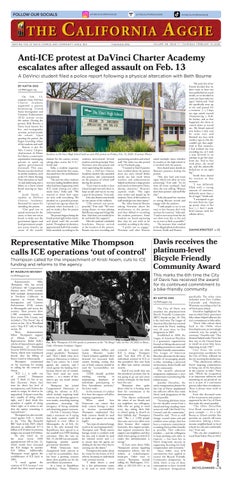
Issue 17 - February 19th, 2026

Page 1


Anti-ICE protest at DaVinci Charter Academy escalates after alleged assault on Feb. 13

A DaVinci student filed a police report following a physical altercation with Beth Bourne

On Feb. 13, students from DaVinci Charter Academy organized a protest denouncing United States Immigration and Customs Enforcement (ICE) actions across the nation. During the protest, Beth Bourne, a Davis local known for her anti-transgender activism, arrived outside the school. Upon spotting the protest, she began recording videos of the students and staff.

Bourne is also the Yolo County Chapter chairwoman of Moms for Liberty, a conservative organization encouraging parents to speak up against governmental overreach. This year, Bourne was also involved in similar incidents, such as the UC Davis Turning Point altercation on April 14 and undressing into a bikini at a Davis school board meeting on Sept. 18.

Jacob Smith, a student at DaVinci Charter Academy, discussed his reason for attending the protest.

“Our goal was to spread awareness for the cause, to have our voices heard, to make sure the government figures and local government people just across America are aware of the youth’s

disdain for the current actions taking place across the U.S.,” Smith said.

Sofia, a student organizer who only shared her first name, discussed how the mobilization was planned.

“Me and two other students were just reading headlines about what had been happening [with ICE raids] during our ethics study class,” Sofia said. “We wanted to show how upset we were with everything. We decided on a peaceful protest; I printed out sign-up sheets for anybody who’s interested, [...] and we made a flyer for protest [information].”

The protest began during the fourth period right before lunch, and lasted until the seventh period. Throughout its duration, approximately half of the student body attended, according to the

students interviewed. Several teachers and the principal, Peter Newman, were also present and were supervising the students.

Erin, a DaVinci Charter Academy student who attended the protest, also commented on the presence of school staff during the protest.

“I just want to make it clear [the principal] was only there to keep us safe and was in no way a part of the protest,” Erin said.

Erin also shared some details on the nature of the walkout.

“[The protest] was pretty peaceful,” Erin said. “We were saying chants, we were playing Bad Bunny songs and things like that. And then cars would drive by and honk [for support].”

After the students’ scheduled lunchtime, Bourne arrived at the location of the protest. Bourne was seen recording and

questioning attendees and school staff. The video was also posted on her Facebook page.

“I wanted to find if parents were notified about the protest since my son’s school didn’t notify me last week when teachers and administrators helped orchestrate a huge protest and march to downtown Davis, during classtime,” Bourne’s caption reads. “My signs were stolen and ripped up by students. None of the teachers or staff would give me their names.”

The video featured Bourne asking Newman about his involvement in the protest, and then shifted to recording the student protesters. Some students are heard expressing that they do not wish to be recorded, according to the video.

“I prefer not to engage,” Newman said after Bourne

Representative Mike Thompson calls ICE operations ‘out of control’

Thompson called for the impeachment of Kristi Noem, cuts to ICE funding and reforms to the agency

Representative Mike Thompson, who has served California’s 4th Congressional District since 1999, recently held multiple demonstrations in Northern California in response to United States Immigration and Customs Enforcement (ICE) actions in Minneapolis and across the country. These protests drew 1,500 community members from across Yolo County and included a “Fire Noem” day of action on Jan. 28 in Woodland and a “Stop ICE” rally in Napa on Jan. 30.

These demonstrations follow Thompson’s support of Illinois District 2 Representative Robin Kelly’s articles of impeachment against Department of Homeland Security (DHS) Secretary Kristi Noem, which were introduced shortly after the killing of Renee Good in Minneapolis. Thompson commented on his reasoning for joining in calling for the removal of Noem.

“ICE [...] is really out of control,” Thompson said. “I think it’s fair to say that [Secretary Noem has] risen far above her level of incompetency, and I believe she needs to resign, be fired or be impeached. It doesn’t seem like she’s capable of doing what’s right, and I don’t think this president is capable of doing what’s right, so it seems to me that the option remaining is impeachment.” Thompson has also recently voted against H.R. 1, known as the “One Big Beautiful Bill,” back in July 2025, which allocated an additional $77.3 billion to ICE when its previous budget was around $10 billion.

He also voted no on the most recent DHS appropriations bill on Jan. 22, which would have increased the ICE budget by another $10 billion. Additionally, Thompson voted against the establishment of ICE back in 2003.

“I voted against the creation of ICE because I was afraid that there wasn’t proper

Rep. Mike Thompson (CA-04) speaks to protesters at the “No Kings” rally on Oct. 18, 2025 in Davis, Calif. (Christian Cendejas / Aggie)

oversight and there weren’t proper guardrails,” Thompson said. “And I think what we’re seeing in Minnesota is evidence that I was correct. So I voted against the creation, and I voted against the funding for it because they’re out of control. They don’t need any more money — as a matter of fact, they’ve got too much money there now.”

Thompson has joined Congressional Democrats in calling for reforms to ICE, which include requiring body cameras, not allowing agents to wear masks, reworking training procedures, increasing the stringency of hiring standards and obtaining proper warrants.

On Feb. 2, Secretary Noem made a statement on X saying that body cameras would be deployed to every officer in Minneapolis. As of Feb. 10, this is the only demand that Republicans have agreed to as the standoff over DHS funding continues. After the vote on Feb. 13, the bill was not passed, beginning another partial government shutdown.

While Democrats have championed body cameras as a tool for accountability, there has been a growing concern about their possible use for the surveillance of protestors.

In a letter to Republican leadership, House Minority

Leader Hakeem Jeffries and Senate Minority Leader

Chuck Schumer qualified their demand for increased body camera funding, noting that use of body cameras should be used for “accountability, not tracking.”

“[DHS should] prohibit tracking, creating or maintaining databases of individuals participating in First Amendment activities,” the letter reads.

At the moment, it’s unclear if or how this request will affect ongoing negotiations.

When asked how Democrats can ensure that body camera footage is used to increase accountability, Thompson emphasized that body cameras should be used to make sure agents are acting legally.

“Any type of camera footage needs to be used appropriately,” Thompson said. “Body camera footage needs to conform with the law, and it should be used for internal review and [...] to ensure that the agents are abiding by the law when they’re carrying out the duties.”

Thompson also spoke about his vision for the future of ICE reform, focusing on individuals with criminal records.

“I think there’s a need for a law enforcement entity to be used to arrest violent

criminals — that’s not what ICE is doing,” Thompson said. “Less than 14% of the individuals arrested by ICE in this president’s first year back in office had violent criminal records. And if you recall, that was this president’s promise that he was going to go out and arrest violent criminals. So that hasn’t been the case.” Thompson then spoke about what he is hearing most from his constituents at his demonstrations.

“Our district understands the values of our friends and our neighbors, our colleagues, folks who are going to work every day, taking their kids to school, going to church on their Sabbath day,” Thompson said. “The [...] 1,500 people that came out to my rallies were there because they support humanity, they support people, they support community, they support our neighbors and they think what’s going on with ICE under this administration is wrong.”

To learn more about Mike Thompson’s actions regarding immigration reform, visit his website at mikethompson. house.gov. Other ways to contact Thompson include calling his Washington, D.C. office at 202-225-3311 or via email.

asked multiple times whether he teaches at the high school or is involved with the protest.

Erin shared some details on Bourne’s presence during the protest.

“She also had anti-trans signs, which isn’t what we were protesting,” Erin said. “So we were all more confused. And then she was yelling ‘Women don’t have penises’ and stuff like that.”

Sofia discussed her reaction to seeing Bourne record and engage with the students.

“I told people to try to not react to her, because she’s only out here for reaction,” Sofia said. “I said to turn away from her, do not show your face to her and try to react as little as possible.”

The moment then resulted in the alleged physical altercation between Smith and Bourne.

“Me and a few of my friends decided that we don’t want to have our faces published on social media, so we decided to cover our faces with our signs,” Smith said. “And she specifically went up to me and paused for a moment. [...] I kept my sign raised, started championing a little bit louder, and as that happened, she chose to crouch down to record me. My friend noticed this before I did, and he came over and blocked my face with another sign so that she couldn’t get that angle. And at that moment, I had realized she was recording me, so I took a step forward in an attempt to get her away from me. And as that took place, she stood up, and she physically kicked me in my right leg.” Smith then shared his reaction to that moment.

“I was definitely filled with a strong amount of emotions, definitely more than a bit of anger,” Smith said. “I attempted to get her away from me, I got up pretty close to her face [...] And I made brief contact with her cellular device.

Bicycle Friendly Community Award

This marks the 6th time the City of Davis has received the award for its continued commitment to a bike-friendly community

The City of Davis was awarded the platinum-level Bicycle Friendly Community (BFC) Award on Jan. 29. This is the sixth time The League of American Bicyclists has renewed this award for Davis, marking over 20 years since its first designation in 2005.

Established in 1880, the League of American Bicyclists is a grassroots organization focused on biking education and spreading awareness to create safe and bike-friendly communities.

The League of American Bicyclists advocates for the many benefits of encouraging people to bike, including a protected environment, better health and a safer community.

The award’s platinum designation emphasizes a city’s commitment to prioritizing bike infrastructure.

Jennifer Donofrio, the senior transportation planner for the City of Davis, emphasized the collective efforts that made Davis’ sixth designation of this award possible.

“Sustaining platinum status for two decades comes from a shared and long-standing vision across city staff, [the Davis] City Council and the community,” Donofrio said. “Even as staff change, council terms end and residents come and go, there has been a consistent commitment to making Davis as bike-friendly as possible. That collective mindset — and the willingness to keep pushing each other to improve — has been key to Davis’ long-term success in supporting bicycling for both transportation and recreation.”

“Davis’ bike culture dates back to the 1960s, when bicycling became an increasingly common way for people to commute,” Donofrio said.

“That demand helped make Davis the first city in the United States to install on-street bike lanes, beginning in July 1967.” Cory Frost, the active transportation coordinator for the City of Davis, reflected on the city receiving this distinction.

“This distinction reflects Davis’ ongoing commitment to being one of the best places in the country to bike,” Frost said. “While the recognition is an important milestone and something we are proud of, we see it as part of a continuous process rather than an endpoint. There is always more work to be done.” Frost also discussed some of the investments and projects supported by the City of Davis that made the award possible.

“The Olive Drive/Pole Line Road connection is a great example — it’s a Safe Routes to School corridor that provides an entirely off-street connection, linking a lowerincome neighborhood to local schools in a safe and comfortable way,” Frost said.

“The city also completed a Local Road Safety Plan in 2023,

Since 2003, over 870 communities have applied to receive the Bicycle Friendly Community designation. In 2026, Davis is one of three communities to have received the platinum designation specifically. The other cities included were Fort Collins, Colorado and Madison, Wisconsin, according to the City of Davis press release. Donofrio highlighted the ways in which Davis’ prominent bike culture helped influence the city’s commitment to bike safety.

Students at Da Vinci High School hold an anti-ICE protest on Friday, Feb. 13, 2026. (Courtesy Photo)
BY KATYA OKS city@theaggie.org

UC Davis presents 15th annual ‘Super Science Day’

On Feb. 21, 12 locations are set to showcase

biodiversity-themed collections on campus

The 15th Annual UC Davis

Biodiversity Museum Day is a “Super Science Day” that is set to feature 12 museums and collections. The event will occur from 9 a.m. to 5 p.m. on Saturday, Feb. 21.

The Anthropology Museum, Arboretum, Bee Haven, Bohart Museum of Entomology, Botanical Conservatory, California Raptor Center, Center for Plant Diversity, Design Museum, Museum of Wildlife and Fish Biology, Nematode Collection, Paleontology Collection and the Phaff Yeast Culture Collection make up the 12 different collections that will be featured.

“We wanted to highlight all the special facilities and special collections that are scattered all throughout campus and off campus,” Tabatha Yang, the chair of the UC Davis Biodiversity Museum Day, said. “We have all these amazing resources and scientists, and they are the gems of campus. This is the only day that they shine and open their doors.”

The event is designed so that individuals can explore the campus at their own pace. Yang suggested visiting only two or three museums at a time, in order to fully explore what each museum has to offer.

“If you attended the

[Biodiversity] Day last year, expand your horizons and select some other museums or collections you didn’t visit to learn more,” Yang said in an article published by the Department of Entomology and Nematology (ENT). “We have experts in our fields who have dedicated their lives to science. What better way than to learn from scientists who are passionate about their work and eager to talk to visitors?”

The Department of ENT plans to showcase the Bohart Museum, The Bee Haven and the Nematode Collection. The Bohart Museum is home to 8 million different insect specimens; native bees, spiders and orchid bees will be spotlighted in The Academic Surge hallway.

At the end of the event, there will be a Speakers’ Series held from 4 to 5 p.m. The Speakers’ Series will review the collections for those who weren’t able to attend every section of the event. The speakers include Bee Haven Education and Garden Coordinator Samantha Murray, Doctoral candidate Pallavi Shakya, UC Davis Earth and Planetary Sciences Research Assistant Tracy Thomson and Collection Curator and Research Microbiologist Kyria BoundyMills.

“[The speakers are] going to give 10-minute talks about science that is accessible to everyone,” Yang said. “It is

something new we are trying for the 15-year anniversary.”

The event typically draws an audience of more than just students — parents and individuals from the Bay Area and Sacramento areas also attend. This event is a calmer version of Picnic Day, according to Yang.

“Students get to see what resources they have [available to them],” Yang said. “It could be resources for an internship, an interest in a new minor and meeting other students, graduate students, post doc[torates], faculty and staff.”

For this year’s event, the Biodiversity Museum Committee held a T-shirt design contest in September. The two winners were Christopher Mulligan, a fifth-year doctoral student in paleontology, and Haylie Wilcox, a first-year pursuing a Master’s degree in entomology and nematology. Volunteers will be wearing shirts featuring their designs throughout the event.

“We spent the fall working on the contest and getting people excited for Biodiversity Day,” Yang said. “This one event brings everyone together. We are all distinct, separate collections — we are in different departments and different colleges even — but this event unites all of us.”

For more information on the upcoming Biodiversity Museum Day, visit the event website.

ASUCD’s proposed 2026-27 budget marked by cuts to

units, student pay

The Association is recovering from a $400,000 deficit and faces declining undergraduate enrollment

The Associated Students, University of California, Davis (ASUCD) — the governing body of the undergraduate population which employs over 1,000 students — has released its 2026-27 President’s Proposed Budget. The proposed budget came one week before budget hearings are scheduled to start, during which the budgets for ASUCD’s units and bodies will be voted on and adjusted by the ASUCD Senate.

The proposed budget is released by the ASUCD Management Team, which includes the ASUCD President, Internal Vice President, Business Manager, Controller (the Association’s chief financial officer) and Vice Controller. The team met with unit directors to discuss and balance units’ proposed budgets in advance of the Feb. 13 release.

This year, the team also released a President’s Proposed Report to further break down and explain planned cuts. The major challenge for the Association is a budget cut across the board — which follows a $400,000 deficit from the 202425 academic year — as well as an expected decline in student fees.

As a result, ASUCD’s units have been forced to make a 10% cut to their budgets, with the exception of Unitrans and the Coffee House as commercial units.

Ahead of the release of the proposed budget, ASUCD President Amrita Julka, a third-year political science and human development major,

explained the Association’s need to safeguard and protect basic needs resources.

“We are definitely prioritizing basic needs above all else,” Julka said in an interview with The Aggie in January. “With all these cuts, there are some places where some units may have to scale back more than others just to prioritize basic needs for students.”

The Management Team made efforts to meet with units to discuss the budget cuts and balance budgets amongst the many cuts, according to Controller Trinity Chow, a fourth-year neurobiology, physiology and behavior major.

The proposed budget includes the use of a new tiered hours system, through which student employees will be assigned different numbers of paid hours for different weeks throughout the quarter. The Management Team says this will allow for more flexibility within budget allocation for salaries and pay.

Hourly wages were also adjusted, with an unspecified number of student employees to start receiving lower wages. In a memo, Chow informed ASUCD personnel to expect broad pay cuts.

“After completing a majority of the budget consultations, the management team has decided to adjust wages so that some positions will be making a lower hourly wage than they are currently making this year,” the memo reads. “These changes will most likely (we have a few more make-up consultations left) impact everyone.”

The change is a move toward standardizing wages and

employee responsibilities across ASUCD, an effort to meet the needs of all the Association’s bodies amid austerity measures. The proposed budget also no longer leaves the Association in a deficit, with $30,361.65 left unallocated to specific units so that that the Senate can later assign during budget hearings. The Management Team intentionally left funds unallocated, according to the President’s Proposed Report.

“The Management Team encourages the Senate to use the unallocated funds to advocate for their platforms instead of harshly cutting other budgets,” the report reads. Most units were successful in reducing their budgets by the 10% goal, by adjusting staff’s weekly hours, using the tiered hours system and — in some cases — cutting positions.

Others did not meet the budget reduction goal but were still published as part of the proposed budget for consideration by the Senate. Those units include Creative Media, which handles most of ASUCD’s marketing, and Picnic Day; both units’ proposed budgets stand around $20,000 over the intended 10% cut.

However, the discrepancies from any individual units were largely accommodated by cuts to the Senate’s spending account and reductions to the hours of student government staffers. ASUCD Senators’ proposed hours a week is 12, down from 14.

The Management Team also chose to set aside 0.5% of the total available income subsidy toward ASUCD’s General Reserves.

City of Davis releases refreshed bike map to include cyclists and electric vehicle users

The updated resource includes new routes, safety information and electric mobility regulations

The City of Davis recently announced the release of its newly updated bike map. The map displays the city’s network of bike lanes, shareduse paths, off-street trails and recommended routes, providing residents with a vital resource that makes it more accessible to get around Davis.

The front side of the map depicts multiple routes, as well as locations of key landmarks including Davis City Hall, Davis Senior Center, Davis Arts Center and more.

The reverse side of the map includes useful resources for commuters, including rules of the road and key traffic laws, resources and contacts for local mobility and community organizations, guidance on electric devices as well as a Davis Bike Loop feature.

Cory Frost, active transportation coordinator for the City of Davis, and Jennifer Donofrio, senior transportation planner, explained the city’s goals behind updating their bike map at this time.

“The city updates the Davis Bike Map periodically to ensure it reflects current conditions,” Frost and Donofrio said via email. “This includes changes to bicycle infrastructure, updates to laws and rules of the road and refreshed safety tips and supplemental resources included on the map. The previous edition was published in 2019, and given how much has changed since then, it was the right time for a comprehensive update.”

They described the most significant changes compared to the previous version of the map.

“One of the most significant updates was a new focus on

electric devices,” Frost and Donofrio said. “E-bikes, e-scooters and other electric mobility devices have become increasingly popular in Davis, and it was important for the map to reflect these changing mobility trends. The updated map includes information on laws that apply specifically to e-bikes and e-scooters, as well as a new table that clearly explains how different device types relate to California regulations, including helmet requirements, licensing and what types of infrastructure each device is allowed to use.”

A few of these include regulatory laws surrounding driver’s license and helmet requirements, along with pathways and bike lanes. The laws include specifications for each vehicle, ranging from human-powered bikes to Class 1 and 2 e-bikes to electric carts.

Donofrio and Frost explained how the updated map seeks to reflect the planned bicycle improvement in the City of Davis.

“A range of stakeholders were involved in the update process, including community members and local bicycle advocacy organizations,” Donofrio and Frost said. “Once a draft version of the map was completed, it was shared with this group for feedback. We received input from multiple perspectives, which helped us better understand what users find most useful and important. That feedback directly informed the final product, leading to changes such as adjustments to colors, wording, and overall clarity.” Copies of the updated Davis Active Transportation Map are now available in several locations, including Davis City Hall, the Mary L. Stephens Davis Branch Library, the Davis Senior Center and many local bike shops. The city encourages residents to grab a copy and enjoy exploring Davis. Donofrio and Frost explained how they hope that residents and visitors will utilize the updated bike map.

“The City hopes residents and visitors use the bike map as a practical tool for getting around Davis,” Donofrio and Frost said. “The map highlights a wide range of route options and infrastructure types, allowing people to choose what feels most comfortable for them — whether that’s completely off-street paths, onstreet bike lanes or a mix of both. It also serves as an educational and reminder tool for rules of the road and safety information, particularly related to electric devices. Even experienced riders can benefit from having this information easily accessible on the back of the map.”

“The updated map reflects all existing bicycle infrastructure within the City of Davis and on the UC Davis campus,” Donofrio and Frost said. “In addition, we introduced a hatched pattern to identify areas that are currently under construction. This was done to acknowledge ongoing and planned developments in both the city and the university that will result in future bicycle infrastructure improvements. Since the map is updated every few years, this approach allows us to highlight what’s coming while clearly indicating that those facilities are not yet open or available on the date the map was published.” Donofrio and Frost gave insight into the map development process and which community groups were involved in its creation.

The Bohart Museum of Entomology is one of 12 participating museums for Biodiversity Museum Day on Feb. 21, 2026. (Christian Cendejas / Aggie)

UC Davis hosts Pulitzer Prize winner Anne Applebaum

Applebaum emphasized the threats to modern-day democracy

Journalist and historian Anne Applebaum speaks about her new book “Autocracy, Inc.” at the Jan Shrem and Maria Manetti Shrem Museum of Art. (Isabel Reyes / Aggie)

On Feb. 9, Pulitzer Prizewinning journalist and historian Anne Applebaum headlined the annual Eugene Lunn Memorial Lecture Series. Held at the Jan Shrem and Maria Manetti Shrem Museum of Art, Applebaum’s speech addressed the contents of her 2024 publication, “Autocracy Inc.,” which documents the increase in democratic backsliding and consolidation of political power by elites.

Applebaum noted the rising presence of autocracies as a major hurdle for democracy, both at home and abroad.

“Nowadays, autocracies are run not by one bad guy, but by sophisticated networks composed of kleptocratic financial structures, security services, military police, sometimes paramilitaries, surveillance and professional propagandists,” Applebaum said. “The members of these networks are connected, not only within a given country but between countries: sometimes among many countries.”

Autocratic regimes attempt to usurp freedoms through propagandizing their own system while attempting to underline the faults and degeneracies of democracy,

according to Applebaum. She further discussed that autocracies often rely on the usage and manipulation of shell corporations, anonymous trusts, cryptocurrency and offshore bank accounts to combine political power with wealth, allowing autocracies to manage affairs and increase their potency.

“In practice, what this means is that the corrupt statecontrolled companies in one dictatorship do business with corrupt state-controlled or semistate, semi-private companies in another [country],” Applebaum said.

Applebaum highlighted the Russian, Chinese, Iranian and North Korean regimes, among others, as prime examples of these autocratic systems. Her primary concern resided in America’s changing domestic atmosphere under the current administration, which has, according to her, continued to show glimpses of these autocratic tendencies. The enemy of any such power, Applebaum asserted, is the common people and those who seek a liberal democracy.

“This administration does not define itself as a leader of any kind of democratic alliance,” Applebaum said. “Instead, Donald Trump has begun to align American foreign and domestic policies with the values and practices of the autocratic world.”

Applebaum’s content on

autocratic regimes served as somewhat comforting for students who recognize that their world is changing.

“It put words to the emotions that I’ve been feeling — and I know a lot of my peers have been feeling — about the current administration,” Hannah Rollick, a first-year international relations major, said. “It’s good to keep talking about it.”

For Nancy Price, a Davis resident of over 50 years, Applebaum’s words were a reminder of the significant shift in American politics and the importance of staying engaged.

“I must say, it was a very interesting lecture,” Price said. “I think that we could sit here for another three, four or five more hours and discuss where we’re headed in this country [...] That’s really part of the point [Applebaum] made — our responsibility as individuals, citizens and community members. We have the opportunity to act, either as individuals or collectively, and talk about the changes we need in this country: to make it more democratic, egalitarian and have policies that benefit all people.”

Applebaum emphasized the importance of knowing one’s power to influence change in America’s democracy — a point that second-year environmental engineering major Alexandra Wolan resonated with.

“People get upset about how the country’s being run or who’s in power, but then they don’t go vote, they don’t engage in discussion [and] they don’t actually ‘be’ citizens,” Wolan said. “You can’t get mad about that if you’re not actually involved in it.”

Applebaum concluded by sharing actions that both students and community members alike can take to combat what she described as the rise in autocratic rule in the U.S.

APPLEBAUM on 9

Alpha Tau Omega fraternity begins recruitment on UC Davis campus

ATO joins UC Davis’ Greek life following investigations, shuttering of other campus fraternities

This spring quarter, the UC Davis community will welcome a new fraternity on campus: Alpha Tau Omega (ATO). Established in 1865 at the Virginia Military Institute in Richmond, the organization joins the 12 current fraternities on campus under the Interfraternity Council (IFC) at UC Davis.

Samuel Satterfield, ATO’s director of expansion and alum of the University of North Alabama, says the decision to establish a chapter in Davis was due to the uniqueness of its campus and student population.

“Davis does not attract one type of student or guy,” Satterfield said. “There are guys who come to campus, and they know they want to join a fraternity. And those guys go through the rush process, and they go ahead and join one of the existing groups.”

Satterfield explained that ATO seeks to stray away from the negative stereotypes some fraternities have garnered, offering an alternative.

“There are also a lot of very high quality men on any campus that are not looking to join any fraternity,” Satterfield said. “Maybe they have a negative stigma about fraternities. Maybe they don’t want to be hazed. Maybe they think it’s just about the parties. Maybe they think, ‘I’m not really into drinking, so I’m not going to join a fraternity.’ At ATO, we want to build something that goes beyond that.”

ATO identifies itself as a fraternity built upon the values of leadership development and campus involvement, encouraging members to be involved in community

engagement.

“We want our guys to find something on campus that they can get involved with outside of ATO,” Satterfield said. “We are all really fortunate to be able to attend college, which puts every student in a very unique position. There are so many college students who never really get off campus and into the community. We really want to encourage our members to say, ‘Let’s get off campus, let’s give back, let’s help those around us and really bring a positive light to campus and also to our organization.’”

Currently, the ATO chapter at UC Davis only has a few members leading up to their official start in spring; none were made available for comment. ATO has a history of bad student news coverage and has barred current members from commenting on their involvement with the newly established Davis chapter, according to Satterfield.

“In the past, we’ve been burned by student journalists,” Satterfield said. “We’ve had pleasant conversations, and then it turns out it’s a sting piece about how terrible we are. It’s just a policy that we have.”

ATO’s establishment came after it was approved by the IFC in spring 2025 to open a chapter. IFC votes to approve potential new fraternities every two quarters, according to IFC President Maksymilian Wozniak, a third-year aerospace engineering major.

“There wasn’t any reason such as, ‘We’re losing chapters, let’s add more,’ just a periodical vote,” Wozniak said. “We decided not to approve any more chapters for this coming school year, so the next expansion vote should take place next spring, which means any new chapters that might come to campus will be coming in Winter 2028 at the earliest.”

In the 2025-2026 school year, several IFC fraternities either ceased operations or are under sanction. At the moment, two fraternities are currently under investigation for undisclosed reasons and have ceased operations: Alpha

ASUCD Senate discusses accusations of nepotism over passing of bill

Tensions rose at the Feb. 12 meeting over alleged special treatment in club event funding

At their Feb. 12 meeting, the ASUCD Senate faces accusations of nepotism from one of their own after Senator Ezra Rubin protested the passing of Senate Bill (SB) #49. The bill, which allocates $437 to the office of Senator Jenna Younes to purchase a portion of the dinner at the Pakistani Student Association (PSA) Iftar, was passed with 12 yes votes, 1 no vote from Rubin and 1 abstention.

Rubin took issue with the event being funded by Senate Reserves rather than by the Club Finance Council (CFC), a program funded in-part by ASUCD and student fees that offers grants to Registered Student Organizations (RSOs) for events and activities. According to the bill, PSA sought the help for funding through Younes’s office after not receiving a response to a grant application from the Cross Cultural Center (CCC).

Shortly after the bill’s passing, Senator Aaron Heth was asked to read a statement by Rubin on his behalf; Rubin had attended the meeting over Zoom and had connectivity issues.

“This isn’t an event issue,” Rubin’s statement said. “This isn’t a money issue. It’s an

relationships between PSA and a member of the table — Younes — granted them special treatment.

“The fact that the PSA happens to have a relationship with a member of the Senate table should not offer them a special privilege to have their event funded by the Senate when many other RSOs lack that access to the Senate table,” Rubin said. “It is unfortunate to hear about what happened with PSA not being able to hear back from CFC, but that’s an issue that should be resolved within the CFC.”

Gamma Rho and Beta Chi Theta.

Theta Chi is currently on conditional registration status after violating university policy prohibiting the “manufacture, sale or distribution of alcohol,” according to the Center for Student Involvement (CSI). They are banned from hosting or participating in any social activity until the end of winter quarter.

Similarly, Phi Delta Theta is also on conditional registration status until the end of spring quarter for violating the same alcohol policy as Theta Chi, as well as for engaging in “conduct that threatens the health or safety of any person; behavior in which a reasonable person would be placed in fear of bodily harm or the conduct would reasonably cause bodily harm to a person,” per the CSI.

In December 2025, the Chi Phi fraternity ended operations indefinitely in Davis due to violations of alcohol and hazing.

The recent restrictions and closure of many chapters has impacted the IFC community and resulted in difficulties socializing with other members of Greek life, according to Wozniak.

“The community’s just getting so much smaller than what we’re used to,” Wozniak said. “We are coming off the biggest IFC recruitment cycle we’ve ever had [in the fall], but even though the community is getting larger in numbers, the fact that chapters are getting shut down just makes it so much harder to socialize.”

“This isn’t an event issue. This isn’t a money issue. It’s an equitability issue.” Ezra Rubin ASUCD Senator

equitability issue. Club Finance Council is ASUCD’s service to provide funding for club events. It is designed to be equally accessible to all Registered Student Organizations and ensure content neutrality in its allocations.”

Rubin’s statement continued, arguing that personal

the Senate. “With all due respect I ran on bridging the gap between RSOs and ASUCD,” Younes said. “God forgive me for doing my job. I’m sorry that you feel that way Ezra, but you know all RSOs are welcome to come here and request help for whatever event they want to do and I’m

International Student Representative Robi Castaneda also commented on the matter, noting his recent collaborations with RSOs for the ASUCD Office of the International Student Representative Spring Festival.

“I know some of us have objections about collaborating with RSOs because we see a perceived level of favoritism there,” Castaneda said. “But I feel like that doesn’t really make sense. I collaborated with RSOs, [Senator] Luis [Garcia] has collaborated with RSOs. So what is to say those collaborations are not nepotism?

Younes responded to Rubin’s statement, saying any RSO is welcome to ask for help from sure most of the table will be in support of it.”

If we aren’t collaborating with RSOs, then what’s the point? Let’s be so for real.”

The crest of Alpha Tau Omega (ATO). (Courtesy / Samuel Satterfield)

GUEST OP-ED: America turns 250: Who really counts as American?

A border that moves makes US citizens feel like targets

This year, the United States is celebrating its 250th birthday. This birthday party will have fireworks, large parades and lengthy speeches about freedom and its basis in America. The American Dream is the concept of freedom itself, available to all Americans who come to this land to accomplish their dreams. But the current state of immigration enforcement raises the question: Who really counts as American?

Despite all the beliefs we celebrate — such as liberty, equality and opportunity — the reality is that some American citizens feel like they don’t fully belong in this country. For me, 2026 is an opportunity to look honestly at the systems we’ve established to administer immigration policies, and ask if they really match our national values.

When most people think of “the border,” they think of a tall fence or a thick wall. But the power of the border can travel. It shows up in stores, at job sites and even in homes. The government has made an

immigration machine that can be implemented almost anywhere.

In August 2019, United States Immigration and Customs Enforcement (ICE) agents raided poultry processing plants in Mississippi and detained close to 700 undocumented workers. In September 2025, ICE agents stormed a Hyundai plant in Georgia and arrested 475 workers, the majority being South Korean nationals.

All of this is a part of Operation Metro Surge, “the largest immigration enforcement operation ever

carried out.” The operation infamously took the life of Veterans Affairs Nurse Alex Pretti, and is a glaring example of the detainment of U.S. citizens and violence that has been occurring. These incidents are scarily indicative of a mobilized border.

As a second-generation Korean American, this question of who belongs in this country hits differently. I was born here. Both of my parents immigrated as young children and grew roots here. But examining the current landscape of immigration enforcement makes me feel like the border

can show up anywhere. This enforcement isn’t qualified in many cases, with those deemed “un-American” having a target on their backs. As our nation turns 250 years old and we think about what it means to be American, we have to ask: Is our current immigration enforcement aligned with our national values? Our generation has to be brutally honest with ourselves and see where we’ve succeeded as a country and where we fall short. If we want to keep calling ourselves the “Land of the Free,” we need to ensure that the systems

designed to protect Americans do not fail those they are meant to serve. Who really counts as American? Why do some American citizens feel as if they have a target on their backs? Are we truly a “land of the free” now? Some food for thought as we celebrate our nation’s 250th.

Disclaimer: The views and opinions expressed by guest contributors to The California Aggie belong to them alone and do not necessarily indicate the views and opinions held by The California Aggie.

Gavin Newsom hopes you won’t notice this gas mileage tax

Our ignorance permits government mistakes and heinous fees

By now, the controversies surrounding United States Immigration and Customs Enforcement (ICE) are plastered on every news outlet’s front page. Every day a new story transpires and another protest assembles, but information about state affairs gets lost in the chaos.

Voting on state bills is just as important as voting in presidential elections — and in the same way, we need to be aware of the things that occur in the state we live in. This is not to say that we should disregard national events, but that allowing them to consume our focus permits legislators to take advantage of their constituent’s diverted attention.

On Jan. 29, 2026, California Assembly Bill 1421 (AB1421) passed. While it hasn’t garnered a lot of media coverage, the little attention it has received was heavy criticism and panic over the gas mileage tax. Democratic Assembly

members Lori Wilson, Cecelia Aguiar-Curry and Blanca Rubio have disproved misconceptions in a KCRA interview with Wilson. Wilson stated that the proposal doesn’t create a new tax, but is a continuation of a 2012 study on declining fuel revenues with the alternative of electric vehicle (EV) usage. The problem is that switching to clean-energy transportation with EV usage results in a decrease in gas purchasing, and thus a decrease in tax revenue for road repairs or other related issues. Thus, a proposed solution is a gas mileage tax — a tax on drivers per mile. However, we don’t have enough information to adequately outline this tax. While imposing an expensive registration fee or a gas mileage tax on only EV drivers seems like a good solution, doubletaxing acts as a punishment for EV drivers and discourages consumers from purchasing EVs. On the other hand, taxing the low and middle class — people with families commuting to work and school — isn’t viable or

just. It would cause this group to also be double-taxed: punished for simply having a family or working to support them. While AB1421 does not actually impose any tax, the purpose of the study is to collect enough data to draft a proposal, which is set to be revisited in 2027. The people are right to be outraged; California already has one of the highest gas tax prices in the nation (currently at 61.2 cents per gallon), along with a tax on car registration and insurance, so charging an additional tax per mile driven seems outrageous. Wilson, in the interview, discussed a possible tax discount for the low and middle classes, but even so, this proposal is a harmful policy. If lawmakers truly cared about the wellbeing of the people, they would not treat us as experiments and create new taxes as a solution to a failing program — they’d reevaluate the state budget (and hence, the state’s budgeting methods) to allocate funding more effectively for modern circumstances. Further, while studies can be incredibly

Consumerism rebranded

informative, there’s a fine line between collecting data for a solution and treating people as test subjects.

California isn’t the only state facing this dilemma, but other states have reached more fair and effective solutions.

Florida, the state with the second highest number of registered EVs, relies on the redistribution of sales tax on electricity to replace the declining revenue from fuel tax. Other southern states such as Georgia, Kentucky, Iowa and Oklahoma have also imposed taxes on electricity.

The real concern is not who the gas mileage tax should target, but where those funds are funneled. Some of the revenue may go to transportation and road construction; at the same time, there also exists a mysterious tax surcharge in California totalling $59 billion since 2015 — a tax that’s implemented after all necessary taxes and programs are accounted for.

It doesn’t seem like the true consequential problem is in fuel taxes, but rather in the fact that

Has thrifting culture resulted in a new kind of materialism?

Last summer, my friend and I decided to visit the Goodwill bins in Sacramento as a postfinals reward. I was no stranger to the perils of the bins, having heard stories of friends finding used diapers and sanitary pads hidden among the chaos. Yet, the pay-by-the-pound system was far too enticing, so we snapped on our rubber gloves and began sorting through the piles.

As the afternoon progressed, I was becoming increasingly aware of a sinister presence lurking just beside us. It was a relatively unassuming group of boys who were sitting at the front of the store. They seemed harmless at first, but as my friend and I picked through the clothes, I noticed some of them had turned to observe us as they muttered amongst themselves. I was confused, but I dismissed

their stares as mere curiosity. After a few minutes, the doors to the warehouse opened and a worker rolled out a new bin of clothes. Without warning, the boys abruptly sprang from their seats and descended on the bin before anyone else could get to it. It was only as I watched them claw through the clothes with a ferocity comparable to that of a ravenous pack of wolves that I realized what they were: Depop resellers — people who patrol Goodwill bins to buy out thrifted items at their original price, only to sell these clothes at a vastly inflated price on popular websites like Depop or at flea markets.

Over the course of the last few years, Generation Zers have grown increasingly enthusiastic about thrifting. It’s no surprise that thrifting has garnered such popularity, as its core principles align with Gen Z’s generally progressive ideals. Thrifting is a relatively low-cost activity,

which naturally makes it an affordable alternative to firsthand shopping. As young people struggle to afford basic costs of living, romanticizing frugality and democratizing fashion have become mainstream. Gen Zers also tend to be more concerned about the worsening state of our environment than previous generations, and thrifting is a practice that invariably helps keep clothes away from landfills.

It’s reasonable to assume that the environmentalist and egalitarian values behind thrifting would help remedy the constant flow of materialistic microtrends across social media platforms. After all, the wastefulness required to adhere to the everchanging trend landscape is an inherent antithesis to the core principles of thrifting.

Thrifting has allowed us to reconcile the pressure to stay “on trend” with a desire to remain politically conscious; it gives us

Pulled for a chat at the Panopticon

The rise of surveillance TV

In 2024, when Rob Rausch dismissed Leah Kateb on national television in Love Island Season 6, my world was turned upside down. I had always prided myself, to some degree, on my faculty for consuming reality TV “ironically.” Yet, somehow, I found myself sucked into the spectacle almost instantly, as if I had no real control over my body and mind.

Reality television has long been dismissed as lowbrow, almost in the same, hushed tone as the idea of gossip — as if watching it makes you an unproductive member of society. Although it remains true that there is less value in participating in mass surveillance, peoplewatching is a skill in itself. Michel Foucault, a French intellectual and critic, uses English philosopher and jurist Jeremy Bentham’s conceptual prison design of the panopticon as a metaphor for the mechanism of power. Bentham discovered that by forcing inmates to

self-regulate out of fear of being watched, prison guards were able to foster a sense of authority (whether or not they were guarding the prison at the moment). Foucault claimed that the uncertainty of knowing whether or not they were being surveilled guaranteed their self-monitoring, which he believed made them internalize this surveillance and ensured discipline. Whether a villa in Mallorca (Love Island), a restaurant in West Hollywood (Vanderpump Rules) or a castle in Inverness (The Traitors), the center still holds.

Reality TV’s reinforcement of the panopticon isn’t the newest idea we’ve had, yet classic surveillance models (like the one in “Big Brother,” for instance) have extended to shows like “Love Island” or “Vanderpump Rules.” These shows don’t track the lives of celebrities, and so do not rely on audience recognition.

a significantly less harmful way to consume fashion. However, it’s a superficial solution to the deeper issue behind modern overconsumption: materialism induced by a desire to keep up with the products, microtrends and lifestyles being sold to us on every platform at every turn. It’s resulted in a pattern of overconsumption we convince ourselves is sustainable, in which our impact on the environment is negated, but the fundamental desire to consume is still overtly prevalent.

As thrifting continues to soar in popularity, social media has become saturated with content advising audiences on where to thrift, how to find better pieces and what vintage brands to look out for. The TikTok-ification of thrifting has transformed the practice from a sustainable way to curate a personal style into another exhausting means of keeping up with online trends. Social media’s fascination

California is bad at budgeting — an issue that’s not exclusive to the Transportation Department. The California High-Speed Rail, for example, has increased their budget astronomically to $128 billion from the original promised $34 billion. In 2022, California Governor Gavin Newsom’s Department of Finance embarrassingly miscalculated $165 billion in revenue tax, burying California in intergenerational debt.

When a family undergoes financial difficulties, a budget is strictly implemented and adhered to. When the government undergoes financial difficulties, the solution is always

to tax the people; to suck hardearned money out of its citizens to fix avoidable mistakes or fund questionable projects. We aren’t paying enough attention to the things occurring in front of our very eyes, in the very cities we live in. Awareness of national events is important, but don’t neglect the state ones: it’s the reason why these mistakes by legislators are continuously repeated.

Disclaimer: The views and opinions expressed by individual columnists belong to the columnists alone and do not necessarily indicate the views and opinions held by The California Aggie.

with thrifting has empowered an even more insidious group — resellers. Like the group of boys from the bins, resellers browse thrift stores to buy pieces at their secondhand price and artificially mark up their prices to turn a profit. Resellers operate by snagging trendy vintage pieces from cheaper, secondhand stores and curating a catalogue of thrifted items to sell at absurdly high prices. This practice inherently excludes people who may genuinely rely on the affordability of thrift stores, as there are no rules that regulate acceptable markup prices. A quick scroll through Depop reveals that one seller markets an Amazon tube top as a “statement piece” and another prices a polyester top at $42.70.

NOVA MAI / AGGIE
THRIFTING
JESSICA KIRKPATRICK / AGGIE
DARIXA VARELA MEDRANO / AGGIE

Ongoing apartheid and genocide in Palestine and the complicity of the United States

Israel is reportedly using illegal and horrific thermobaric weapons against Palestinians

WRITTEN BY THE EDITORIAL BOARD

Since Oct. 7, 2023, mainstream media outlets have largely painted an inaccurate picture of the livelihoods and suffering of the Palestinian people. A genocide has been livestreamed and simultaneously mislabeled right before our eyes, with some — including supporters, benefactors and governments — trying to convince us that we have been seeing something that we’re not. This level of violence is consistently overlooked, legalized under domestic and international law and, worst of all, endorsed — by world leaders, by the administration of the United States and by companies with unchecked global and financial power. Mass media outlets finally began to call the genocide a genocide far too late; once they did, many acknowledged and discussed it — but Palestine has somehow again faded from the main conversation. Numerous proposed United Nations resolutions have been vetoed by the U.S., with the latter being the only vote against a ceasefire in September 2025. Notably, Israel has violated the most recent ceasefire proposition at least 1,620 times between Oct. 10, 2025 and Feb. 10, 2026. Now, in the “second stage” of the ceasefire deal, not even the points proposed in the first stage have been followed. Humanitarian aid is still being restricted, attacks have not

halted by any means and Israel has not withdrawn from the “yellow line” drawn throughout the Gaza Strip territory.

U.S. President Donald Trump has also created a Board of Peace without the inclusion or involvement of Palestinians to determine the future of their land. The Board is proposing an eerily similar approach to past organizations that have also worked from the top down, excluding Palestinians from their own narrative and perpetuating a system of apartheid.

This genocide has a history extending back well over a century; the current apartheid system in Israel has stripped Palestinians of their legal rights, along with the human right to exist peacefully. Palestinians live under constant surveillance; drones incessantly buzz above their heads, while videos show music teachers turning it into a melody to calm their students. Everyday acts of resistance by Palestinians serve as a reminder of the frustration we should feel over our inability to effectively defend their right to autonomy.

Men, women, children and entire families — 2,700 families, to be specific — have been martyred and erased from Palestine. The “ceasefire” in the territory is continuing in full force, and Israel has only just acknowledged that it has killed more than 70,000 Palestinians, 20,000 of them children. More journalists have been killed in Palestine since October 2023 than in any modern conflict — at least 260 have been reported

dead as of 2026. The accepted total is approximately a onetenth estimate of numbers put forward by researchers last year, estimating that up to 680,000 Palestinians have been killed since 2023. These numbers, which were released September 2025, are likely still largely underestimated.

In the meantime, new weaponry created by Israel and largely funded by the U.S. continues to end lives through some of the most violent means imaginable. Recent investigations show that up to 3,000 Palestinians have been evaporated by U.S.-supplied thermobaric weapons: weapons that obliterate matter through enormous amounts of heat.

Dr. Munir al-Bursh, the director general of the Palestinian Ministry of Health in Gaza, explained the biological impact of such extreme heat on the human body to Al Jazeera.

“The boiling point of water is 100 degrees Celsius [212F],” al-Bursh said. “When a body is exposed to energy exceeding 3,000 degrees combined with massive pressure and oxidation, the fluids boil instantly. The tissues vaporise and turn to ash. It is chemically inevitable.”

As lawyer Diana Buttu, a lecturer at Georgetown University in Qatar, pointed out, the supply chain in itself of weapons like these are evidence of worldwide complicity.

“We see a continuous flow of these weapons from the United States and Europe,” Buttu said. “They know these

weapons do not distinguish between a fighter and a child, yet they continue to send them. [...] The world knows Israel possesses and uses these prohibited weapons. The question is why are they allowed to remain outside the system of accountability.”

The use of weapons that do not distinguish between combatants and noncombatants is a war crime, according to international law. However, time and time again, these identifiers designed to ensure justice and peace ultimately amount to nothing. Complicity, unfortunately, exists everywhere. The British Museum recently removed the word Palestine from many of its exhibits, citing it as “inaccurate.” Israeli athletes are still permitted to compete under their flag in the Winter Olympics, unlike Russian and Belarusian athletes who participate as individual neutral athletes in part due to the ongoing war in Ukraine.

Make reading sexy again

Reading skills, like muscles, need to be exercised

I find reading and running to be similar: not in a literal sense, but rather in their application (or lack thereof).

In other words, while we do not learn to run in the same sense that we learn to read, we unlearn both of them in the same way — by forgetting to care. As part of my New Year’s resolutions, I resolved to stay off of social media, which has given me ample time to rediscover the basics. In giving up Instagram, Snapchat and TikTok, I find myself halfway through February reaching for a book in most spare moments (all the times I would have otherwise spent doom scrolling). Considering that — and I’m embarrassed to admit this — I haven’t read a book in quite some time, this change of pace is rather fascinating. In just this short stint of reading, I’ve gained a great deal of appreciation for the activity. Beyond that, though, it’s taught me that reading must

be practiced simply because it provides entertainment, produces sympathy and gives rise to action.

Just as with running, reading becomes difficult when we forget to practice. Because we know we always could, the thought that we could do it better seems to fade — if we were being chased or happened upon a menu without pictures, we could surely run or read. So, why go for a jog or pick up a Jane Austen novel? Practicing may not feel necessary, but people say that “practice makes perfect” for a reason: it makes you both enjoy reading more and makes you better at it.

My current book of choice is “Franny and Zooey” by J.D. Salinger. Just like aspiring English teachers and moderate psychotics, I loved reading “The Catcher in the Rye,” also by Salinger, so this seemed like a natural choice for a new novel. I’m also reading it because I realized that, without social media, I missed drama. I missed hearing about someone else’s adventures and going on a vicarious journey at any moment of the day. Without having TikTok to hold my

hand through every moment I wanted to escape, I needed a new fix. Historically speaking, interpersonal drama has been critical to teaching sympathy to the masses. For instance, “The History of Mary Prince” provides a biography of Prince’s encounters as an enslaved person with the most inhumane factions of humanity. Her detailed description of the subjugation and degradation of basic mind and bodily autonomy made people understand that flesh makes humanity, rather than skin color; it literally took reading her personal account for people to understand that. Without being forcibly transported into someone else’s mind, people stayed comfortably in their own narratives; there came a hysteria caused by the realization that the “other” is just another revolutionized abolitionism.

Reading provided a vehicle into other people’s lives and minds that otherwise did not exist.

It is not just sympathy we are forced to reconcile from reading, but also a call to action. Books have the power to change our perception of

And they’re gross because they’re poorly designed

On the whole, public restrooms are unpleasant spaces. Between thin, grayblue walls, strangers perform the private and intimate acts of daily maintenance — relieving themselves, managing menstrual products, changing clothes, injecting insulin, adjusting medical devices, changing colostomy bags — all while hyperaware that a gap in the door might reveal their all too recognizable shoes. Loud hand dryers, fluorescent lighting and astringent chemical cleaning agents bombard the senses. Women’s restrooms have fewer toilets per capita due to their lack of urinals, creating longer queues — especially given women’s more frequent caregiving responsibilities for children and the elderly.

Sociologist Norbert Elias argues that modern society has developed increasingly strict rules about bodily functions and privacy. What medieval people did openly — relieving themselves, discussing bodily processes — has become progressively more shameful and “disgusting” to us. This “civilizing process” means that even as our world becomes objectively safer through scientific advances, our disgust with our own bodies intensifies. If you’ve visited the San Francisco exploratorium and hesitated to drink from their water fountain made from a toilet bowl, you’re familiar with this feeling. You wouldn’t pack your lunch in a bag intended for dog poop, even if it was pristine; the cleanest public restroom is a culturally dirty space.

Yet, despite our increased disgust with bodily processes, I’ll admit that cultural taboos about grossness don’t explain all of the discomfort we (germaphobes at least) feel when stepping into the Olson Hall public restrooms, touching a trash can’s lid while disposing of waste or watching a trumpet player empty her spit valve onto the concert hall floor. When products and

spaces are designed for actions deemed culturally gross — bodily excrement and waste disposal — poor design and disgust have a chicken-andegg relationship embodied by public restrooms.

Poor public restroom design stems from disgust — no one wants to engage seriously with bathrooms as a design challenge. One architect noted that “clients often view these spaces as 150% utilitarian, which can also limit your design options.” But the relationship runs both ways. Poor design also reinforces disgust — public restrooms could be far less hostile if designers weren’t operating under the assumption that these spaces don’t deserve careful thought.

Toilet paper is a great example of this design conundrum. In its cheap, public restroom form, it’s abrasive, prone to tearing and requires constant refilling. We require our hand soap to be antibacterial, yet don’t hold toilet paper to even this low bar. These design flaws are fundamental to toilet paper, in part because it’s viewed culturally as an accessory to a gross action. Yet it remains the predominant form of

Editorial Board

ALYSSA CREVOISERAT Editor-in-Chief

MAYA KORNYEYEVA Managing Editor

VINCE BASADA Campus News Editor

JORDAN POLTORAK City News Editor

MOLLY THOMPSON Opinion Editor

ZOEY MORTAZAVI Features Editor

SAVANNAH ANNO Arts & Culture Editor

MEGAN JOSEPH Sports Editor

KATIE HELLMAN Science & Tech Editor

Managing Staff

JENNA LEE Photo Director

NOELLE ESCALANTE Layout Director

SAVANNAH BURGER Design Director

SAM RUIZ New Media Manager

KAYLIE HUANG Social Media Manager

JULIAN MONTANA Website Manager

JULIA CROSSAN Distribution & Outreach Director

YILAN LI Translation Director

CARMEN RODRIGUEZ-ZARATE Translation Director

JENNY DYE Copy Chief

ALYSSA PULIDO Copy Chief

LAURIE PEDERSON Business Development Manager

the world if we give them the opportunity to reveal new truths to us. Size doesn’t matter — even a small book can

post-toileting sanitation, partly because thinking about alternatives is also gross. No one wants to suggest sanitary wipes or bidets, even if they’re more sanitary and (in some cases) cheaper. Poor design produces disgust, just as disgust produces poor design.

My own neuroses about germs aside, the harms produced by this relationship between grossness and design tend to affect marginalized groups most strongly. Gendernonconforming individuals face surveillance and harassment in gendered bathrooms, yet proposals for gender-neutral multi-stall facilities — with floor-to-ceiling doors that would improve privacy for everyone — are met with resistance because they force people to confront bathroom design as a serious problem.

Parents struggle with flimsy, unsanitary fold-down changing tables — often relegated to only women’s restrooms — because infant waste management is treated as an afterthought. Insulin users require

cause change. Mao Zedong’s “Little Red Book,” the book that set ablaze China’s cultural revolution, is just one example

of a philosophy that drove the people to act. Reading drives people to envision a different world, and as a result, people mobilize. Just as with running, we often think of reading as reflexive. We do it without thinking — like unintentionally reading a street sign, a road designation or the name of a restaurant — but reading is so much sexier than we give it credit for. The role reading has played in our lives has changed through history, but people have been and can be moved by nothing more than the words on a page. We ought to give words new life. We ought to make reading sexy again, because anything less would be shortchanging society the chance to escape themselves, feel with others and find inspiration for action.

Disclaimer: The views and opinions expressed by individual columnists belong to the columnists alone and do not necessarily indicate the views and opinions held by The California Aggie.

WREN TRAN / AGGIE
NOVA MAI/ AGGIE
New York University Professor Harvey Molotch noted that “silence about the issue persists, largely because of cultural taboos that discourage any discussion about alleviating design flaws.” These people
JESSICA
READ MORE ONLINE

ARTS & CULTURE

Commentary: Remembering Catherine O’Hara

Honoring the late Catherine O’Hara and the many iconic roles that made us all fall in love with her

On Jan. 30, the news of Catherine O’Hara’s death broke the hearts of many. O’Hara, 71, was taken from the world too soon; the beloved actress’ death left fans of her work feeling a very real sense of loss in their own lives.

It’s hard to come across someone who hasn’t seen, or at the very least, heard of her many iconic roles. O’Hara wasn’t just a talented actress or even a brilliant comedian, but a comforting presence across cinema and television.

For many actors in the field, they’ll find themselves characterized by a singular role that the public associates most with them. However, for a talent like O’Hara, fans may find multiple roles of hers that they remember fondly.

With her beginnings in sketch comedy, it should be no surprise that she thrived in many humorous roles. O’Hara’s stardom can be traced back to 1976 with her appearance on “Second City Television” alongside Eugene Levy, a longtime friend and coworker, and other notable comedians.

It wasn’t until “Beetlejuice” (1988), however, that the world truly fell in love with O’Hara. This Tim Burton film featured O’Hara as Delia Deetz, the stepmother of a young and moody Lydia Deetz (Winona Ryder). For a character whose primary characteristic is antagonism, O’Hara nonetheless portrays Delia with effortless charm, especially with the iconic

“Day-O” scene in mind. If not introduced to her through “Beetlejuice,” then many young fans met her as Kate McCallister, Kevin McCallister’s mom from “Home Alone.”

The Christmas classic is often remembered by the iconic line delivery of O’Hara yelling, “Kevin!” when she realizes she has left her 8-year-old son at home while on a plane to Paris. This role allowed O’Hara to not only show off her comedic chops but also to warm spirits with her valiant journey home to her son.

Even in stop-motion animation, O’Hara managed to capture hearts; “The Nightmare Before Christmas” (1993) features O’Hara playing the gentle rag doll Sally. O’Hara perfectly captures Sally’s kind heart with her voice acting and her unforgettable singing, which is hauntingly beautiful.

“Best in Show” (2000) is considered to be one of the standouts of the Hollywood mockumentary genre. In the film, Levy and O’Hara reunited with a magnetic chemistry that fits perfectly into the film’s chaotic, comical environment.

The scene where the two sing “God Loves a Terrier” is nothing short of hilarious and exemplary of the duo’s shared talents.

While these earlier projects cemented O’Hara as one of the greats in our lifetime, she has maintained her momentum across many iconic works in more recent years. Among these, one renowned sitcom stands above the rest: “Schitt’s Creek” (2015-2020).

The show’s plot follows a wealthy family who loses their fortune and is forced to move

to the only asset they have left: the small town of Schitt’s Creek. O’Hara stars alongside series creator Levy as the family’s mother and father, respectively.

O’Hara plays Moira Rose, a former soap opera actress with an affinity for wigs — a role that resulted in an Emmy, Golden Globe and Critics Choice award for O’Hara. Much of what made the show so loved has to do with O’Hara’s natural charm while embodying the character’s eccentricity. If viewers weren’t a fan of her before, they definitely became one after taking in “Schitt’s Creek.”

“Being in Catherine O’Hara’s orbit was a beautiful, magical gift,” Jennifer Robinson, O’Hara’s “Schitt’s Creek” costar, said in USA Today. “She was an absolute star who never understood why people made such a fuss about her.”

O’Hara managed to make an impression on thousands of people with her comedic genius and vast talent. The exact opposite of a one-hit wonder, O’Hara was extraordinary in her 50-year career. Though it may feel that she has been taken from us far too soon, we can always turn to the plethora of characters she has given us over the years. Thank you, Catherine O’Hara, for all the laughter you brought to this world.

Album: “The Crux” by Djo (2025)

You have probably recently learned that Joe Keery (stagename “Djo”) is not only an actor, but also a musical artist. His viral song, “End of Beginning,” reached the No. 1 spot on Spotify for multiple days in a row. If you’re even slightly interested in hearing more of his music, then his newest album, “The Crux,” is a great place to start. In a departure from his previous albums that were heavily synth-based, “The Crux” is distinctive for its more natural, guitar-driven sound. Djo creates such a relatable feeling throughout his lyrics, which explore fear of the future, the search for love, breakups, accepting identity and even longing for the safety of our parents. I love this album because it really does feel like a natural expression of a normal 20-something-year-old’s emotions. With a mix of soft jams, piano-driven ballads, choirs and what seems like 30 different guitar sounds, this album is absolutely in my top 10 most enjoyable listens ever.

Album: “Viva La Vida or Death and All His Friends” by Coldplay (2008)

I am here to tell you that this is the greatest album of all time. Whether you like some Coldplay songs or think they’re an awful band, I need you to listen to this album from start to finish. You’ve likely heard the most popular song from the album, “Viva La Vida,” but there is so much more raw emotion and sound across the record that needs your attention. Almost every song flows into the next. You get an array of emotions, from angst and regret to uncertainty and confusion, to pure bliss and a celebration of life and love. The album cover, a painting of the French Revolution, perfectly represents the sound of the album. It presents listeners with a journey where hardships, the reasons we might willingly put ourselves through them and the process of discovering purpose in life are center stage. Coldplay’s fourth album, produced by Brian Eno, is such a complete record — one with absolutely no skips. Playing the album all the way through in a single listen is one of the greatest possible experiences in life.

Album: “The New Abnormal” by The Strokes (2020)

This album is amazing and probably the fastest record to ever reach alltime favorite status in my imaginary tier list — an amazing statement considering I had never even heard of The Strokes before this album (which was actually their sixth release). Classified by some as a postpunk or garage rock band, the album The Strokes present is much more mature than the emo, teenager vibe you might be imagining. The album’s sound is a mix of synths and electric guitars, with some songs leaning more to one side than the other. The themes include remembering the past, moving toward the future, getting older and the connections we make throughout life. There is plenty of energy and moments of reflection in this album, which creates an emotional experience for any listener. Fun fact: “The New Abnormal” was the first vinyl I ever owned, which I bought two weeks after discovering the album.

Album: “Band On The Run” by Paul McCartney and Wings (1973)

Most people have heard of the Beatles and Paul McCartney. “Blackbird,” “Yesterday,” “Let It Be” and “Hey Jude” are some of the most popular songs ever released. But did you know that McCartney released his own music even after the Beatles broke up? “Band on the Run” is Paul’s fifth album post-Beatles and his third with the band Wings. The album opens with title track “Band On The Run,” a 5-minute medley which is basically three songs in one. Presenting a chaotic, silly but comfortable sound, the song sets the stage for the rest of the album. As always, McCartney’s vocals stand out and lead the way. Depending on the song, his voice changes between being soothing and an energy-filled, closeto-shouting sound. Combined with some amazing guitar playing and catchy basslines, “Band on the Run” is one of my favorite McCartneyinvolved albums ever.

Review: Markiplier’s ‘Iron Lung’ is a conceptual, claustrophobic first foray into horror filmmaking

The popular YouTuber’s self-directed, self-financed and self-starring adaptation of the 2022 horror game is slow yet excellently unnerving

arts@theaggie.org

In April 2023, the popular gaming YouTuber Mark “Markiplier” Fischbach announced that he would be adapting “Iron Lung,” a 2022 indie horror game made by David Szymanski, into a selfdirected film. Though not the first time the YouTuber had ventured beyond the familiar waters of Let’s Play content, this project looked to be his most ambitious endeavor yet.

Markiplier, who has 38.3 million YouTube subscribers as of February 2026, had already released a number of creative filmmaking projects on his channel by the time of this announcement. Most notable among them are a handful of choose-your-own-adventure stories in which the viewer can uncover countless imaginative endings.

These projects reflected Markiplier’s interest in more daring and professional creative ventures prior to picking up “Iron Lung.” However, the project marked a definitive step forward — not just in the tonal shift from imaginative comedy to horror, but in that it would be released theatrically and produced on a budget of $3 million.

The opening of “Iron Lung” introduces us to a future where human technology has advanced

enough to allow space travel and the settlement of new planets. However, a mysterious and devastating event known as the Quiet Rapture has suddenly vanished all inhabited planets from existence, leaving only small pockets of human life drifting on space stations throughout the universe.

Running out of resources and desperate for any chance at survival, the only living humans have begun last-ditch efforts to reap what they can from the few remaining planets. This is the struggle that calls Markiplier’s protagonist, known only as “Convict,” to strike a deal with the remaining human authorities — in exchange for his freedom, he will undertake a dangerous mission exploring a moon covered in an ocean of blood.

Convict’s situation is dire. Welded into the small submarine with scarce controls but for a navigation panel and a camera to document his findings, the task he must undertake plunges him into unknown dangers with little defense. Still, he is desperate for freedom — desperate enough to endure the nightmare of the submarine for the promise of his life finally being his own again. The horror of “Iron Lung” is largely conceptual and atmospheric in nature, though it continually ramps up throughout the film’s runtime. That the film’s premise is so unique and unnerving sets it apart from the contemporary

horror genre upon its very first scene; however, viewers hoping for a traditional horror experience won’t find it in the slow psychological unease that “Iron Lung” constructs.

One particularly effective directing choice that Markiplier uses involves trapping the audience within the submarine alongside Convict. In the brief returns to the surface that Convict makes, the camera never leaves the sub; other people are only seen through foggy glass, their voices muffled by the layers of metal holding Convict in.

When paired with the ambience of the dimly lit, barren interior of the submarine, this narrow focus creates a suffocating feeling of claustrophobia for the viewer that builds suspense and unease. It emphasises the utter horror of Convict’s circumstances by projecting the discomfort of his situation directly onto the audience.

Still, this atmosphere can be stifling in less intentional ways. With a runtime of 2 hours and 5 minutes, “Iron Lung” must stretch its small-scale concept over a long period of time, which sometimes hurts its pacing. Though the film’s choice to linger on the unsettling details of the submarine’s interior builds discomfort, it can also slow the story to its detriment.

Likewise, much of the dialogue is difficult to comprehend, via indistinct sound mixing and overlapping

speech. Coupled with the incredibly surreal and conceptual aspects of the film, which blur the audience’s perception of reality and call backs to events before the story’s start, the experience of watching “Iron Lung” can be at times rather confusing.

Convict himself begins the story as closed-off and dryly sarcastic, but the increasing peril of his situation slowly breaks his mental defenses and fortitude. It is not until later in the film, as Convict begins to descend into complete panic, that Markiplier gets to show the depth of his talents as an actor. He injects wild desperation into his voice and body language to viscerally and effectively convey the Convict’s collapsing mental state.

For Markiplier and his fans, “Iron Lung” has proved to be a triumph. Initially planned to be released for only a small number of theaters in North America, the effort of fans to convince their local theaters to show the film led to it being picked up by over 4,000 theaters internationally, including Cinemark, Regal Entertainment Group and AMC. Likewise, the film opened to a strong $18.2 million sales on its first weekend. In a livestream broadcasted during the film’s release weekend, Markiplier spoke tearfully to his audience about how grateful he was for everything it had become.

“I just don’t want you guys to ever think it’s impossible,” Markiplier said via livestream. Indeed, what stands out the most about “Iron Lung” is the clear passion with which it was made. Markiplier’s dedication to

telling the story of the original game with inventiveness and care shines through in every one of the film’s scenes. Even where the film struggles, it stays afloat thanks to the sheer artistic passion with which it was made.

arts@theaggie.org
VINEY TOM / AGGIE
WREN TRAN/ AGGIE
Movie poster for “Iron Lung,” Youtuber Markiplier’s debut film. (Markiplier Studios / fair use)
Actress Catherine O’Hara at the 2024 Toronto International Film Festival. (Courtesy of John Sears / Creative Commons, CC-BY-4.0)

Muslim students at UC Davis observe Ramadan through

faith, community and campus support

Students reflect on their experiences of practicing Ramadan while at university

Muslim students at UC Davis are observing Ramadan, an annual month of fasting, reflection and generosity, this February and March. Many students use this time to strengthen their religious practices while continuing to pursue their academic and extracurricular activities.

Ramadan is the ninth month in the 12-month Islamic lunar calendar. This year, Ramadan is estimated to begin Feb. 17 and end March 19., though the exact date depends on the sighting of the moon. During this period, Muslims fast daily from dawn to sunset, abstaining from food and drink. It is a month that emphasizes self-discipline and encourages compassion.

Many students share that Ramadan is a period that provides an opportunity for them to reflect on their faith and instill better habits.

“One of the main strategies I try my best to incorporate during Ramadan — to balance my academics with fasting and other acts of worship— is being more intentional with my mindset and daily habits,” Maseera Ansari, a second-year biological sciences major, said. “Before Ramadan begins, I make a list of goals and focus on getting rid of distractions so I can use my time as efficiently as I can. This includes limiting my social media use, avoiding pointless scrolling and listening to less music.”

These mindful changes help students like Ansari feel the virtues of the month.

“I noticed how this shift in my mindset gave me a greater sense of peace and clarity, and it definitely played an important role in helping me stay on top of my coursework and other extracurriculars last Ramadan,” Ansari said.

Other students create similar goals to enter the month with a purposeful and peaceful mindset.

“I try to set clear spiritual and educational goals for myself daily during Ramadan

in order to keep myself motivated,” Salma Farahat, a second-year managerial economics major, said. “Creating goals helps me carve out time in my schedule to balance my responsibilities while still staying spiritually connected.”

Students also shared how participating in Ramadan while being away from home has shaped their relationship with faith and practice.

“[Fasting in] university has made me become more independent in a way,” Sharmeen Eshal, a second-year biochemistry and molecular biology major, said. “For example, my mom would wake me up for suhoor every day, and she was the one making most of the iftar when I was at home. In university, I have to do everything on my own: wake up for suhoor, make suhoor and then make iftar. In a way, the university experience has taught me more about myself and how I would spend Ramadan when I am alone.”

Various groups on campus, including the Muslim Student Association (MSA), the Pakistani Student Association (PSA), the Afghan Student Association (ASA) and the Arab Student Union (ASU), host events such as iftar during Ramadan. Iftars are meals that are eaten when breaking the fast at sunset, and these events provide students with the ability to connect with other students observing Ramadan.

“For me, the most challenging part of Ramadan being in university was dealing with feelings of homesickness. I’d constantly miss my family and feel like there were things I was missing out on [by] not being home during such a meaningful time,” Ansari said. “Despite this, I think that it [cultural clubs] has made me appreciate the importance of community even more because they really helped fill in those gaps. I’m forever grateful for the friends and found family I made along the way.”

Eshal noted that these gatherings help to create a sense of community, especially for those observing Ramadan away from

home.

“Various clubs on campus host many cultural iftars and suhoors, which is really helpful because it gives a space for friends to bond,” Eshal said. “For many people who are away from home, this ends up being really nice because they still get a chance to be around other people rather than being alone.”

Despite balancing the rigor of academic responsibilities, students reflected that Ramadan remains an important and meaningful part of their winter quarter.

“The most challenging part about fasting as a student has been balancing studying and exams,” Farahat said. “Since finals week falls on the last few days of Ramadan this year, it’s even more difficult to be intensely studying for your finals while being low on sleep and fatigued from the fast. But Islam is a very community-oriented religion, and it’s emphasized even more during Ramadan. I try to surround myself with like-minded friends as they encourage me to stay on track without burning out.”

Some students adjust their academic routines and schedules during Ramadan. For example, many use designated reflection rooms on campus located in various spaces to coordinate their schedule around prayer times. Some rooms are located in the Student Community Center (SCC), the International Center, Tercero Residence Halls and in the Women’s Resources and Research Center.

“One of the highlights of spending the majority of my Ramadan [at university] was seeing how much effort the campus community put in to make Ramadan feel special for everyone,” Ansari said. “One campus resource that I found really helpful was the designated prayer space in the [SCC]. Having the space made managing staying on track with my prayers so much more convenient.”

Ansari also noted the accessibility and inclusivity of having prayer rooms on campus.

“During hectic or stressful times, it gave us a quiet place to reflect,” Ansari said. “The prayer room was only a four to five minute walk away [from the library], which made it super convenient to just pause, pray and recharge before I returned to my tasks. Looking back, I’m so grateful to have had access to these resources. They really showed me how much of a difference small acts of kindness and a support system can have [on] maintaining a sense of community and connection during such an important time.”

UC Davis Fashion and Design Society prepares for their quarterly student-run market

Handmade clothing, art and accessories will be up for sale at the Memorial Union East Quad

Note from the editor: As of Feb. 17, the FADS market has been postponed due to weather conditions. Please view the Instagram account @fadsatucd for further updates regarding a new event date and time.

With the weather warming up, a wardrobe update is definitely justified; thankfully, UC Davis’ fashion students have you covered. On Feb. 22 from noon to 4 p.m., student designers and vendors will gather together on the East Quad of the Memorial Union (MU) to host the Fashion & Design Society (FADS) quarterly market.

The market will include student-made and vintage fashion, art and handmade goods of all kinds. In a collaboration with Prod. Davis, student DJs will also provide a soundtrack for the event.

Amy Lee, co-president of FADS and fourth-year communication and cinema and digital media double major, revealed the work done behind the scenes to ensure the market runs smoothly.

“The hardest thing this year was securing a location,” Lee said. “We used to do the market in Cruess Hall, but because it gathered a lot of attention, the department deemed it a fire hazard.”

Vivian Le, co-president of FADS and fourth-year design major, shed light on the planning and logistics behind the event.

“There are a lot of protocols we have to follow,” Le said. “We have to shut off the sprin-

klers [and] follow safety procedures on how we’re going to lay out the vendors.”

Last year’s vendors included UC Davis Alumna Sara Lindstrom, the 2024-2025 FADS president, who runs the handmade design business Undoing the Laces. As a returning vendor to the market over the past three years, Lindstrom shared the impact of the experience.

“It was nice to see people actually care about my designs,” Lindstrom said. “By the second or third market, people recognized my brand and were excited to see my pieces in person.”

As of today, Lindstrom has over 50,000 followers on her Instagram account, @undoingthelac3s; however, this was not always the case.

“I had never really gotten attention from social media or gone viral, so it was really exciting to see people come up to me and say, ‘Hey, I saw you from that TikTok.’” Lindstrom said. “They would say, ‘I came here all the way from Sac,’ or from Roseville or even the Bay Area. That was really exciting to see.”

Another vendor, UC Davis alum Robert Nykodym, spoke on the trends they noticed at previous markets.

“My friend Delilah’s booth had a lot of eclectic pieces that she collected over the years and she was selling almost everything for $5, which made her super popular,” Nykodym said.

“I think having a low price point for used fashion is super important right now, because of how inflated prices have become on Depop and in thrift stores.”

Nykodym also touched on Lindstrom’s designs for Undoing the Laces.

“[Lindstrom’s] shop was also super popular with her custom fur-lined shorts and other handmade pieces,” Nykodym said. “Looking at both her and Delilah’s booths, I’d say people really wanted unique statement pieces with special details like a custom trim, bright color or fun print.”

While vendors bring their own unique styles and trends to the market, there is an underlying theme of community to FADS as a whole. With such a large club presence at school, Lee elaborated on the importance of events like the market for the artistic community at Davis.

“There’s a lot of creatives here at Davis, and sometimes they don’t have outlets to show off their work,” Lee said. “We really want to support small businesses and let people be able to sell their pieces and promote themselves.”

Le also reflected on the impact of the market, noting the eco-friendly mission behind the organization.

“FADS is about promoting sustainable fashion,” Le said. “A lot of people I know, whenever they come to the market, usually try to get rid of their older clothes. It creates this cycle of sustainable fashion where people are swapping out clothes or getting new ones.”

The FADS market on Feb. 22 is set to provide art, fashion and music to the UC Davis student community. To learn more about FADS and upcoming events, visit their website at fadsatucd.org.

Review: ‘The Secret Agent’ rivetingly depicts life under

authoritarianism

The acclaimed Brazilian political thriller balances brutality with empathy

Our newest inductions into the cinematic pantheon have little in common, but if they share any trait, it’s this: So often, their protagonists are struck by the beauty and terror of memory. Whether due to tragedy, resilience or resistance, characters struggle with the legacy of generations past. While many recent features have addressed this only peripherally, “The Secret Agent” brings the power of history to the forefront, and in the process, creates a “sui generis” thriller as powerful as it is engaging.

“The Secret Agent” is thematically centered around the brutality of Brazil’s military dictatorship, as Armando Solimões (Wagner Moura), an academic pursuing innovative research, flees from his university after his colleagues are threatened and assumes a new identity as Marcelo Alves in the Northern Brazilian city of Recife.

The film has been nominated for four Academy Awards, including Best Picture and Best Actor for Moura. It marks the fourth feature for Kleber Mendonça Filho, director and former film critic, who also penned the script.

The film’s nearly three-hour runtime is certainly not unearned — at no point did any scene induce boredom — but the screenplay’s structure might

feel too back-heavy to some. Due to the film’s expansive ensemble and layers of subtext, it takes an exceedingly long time for all the story’s pieces to fall into place; by the time it feels like the film has truly “begun,” it’s already half-over. But while the journey may lose some, the destination more than makes up for it. The shot composition and editing are superbly wellmatched to the neo-noir style

in which an additional piece of

Movie poster for “The Secret Agent.” (Neon / fair use)
2025 FADS market at Cruess Hall. (Courtesy of Amy Lee)
NOVA MAI / AGGIE
the film pursues. Cinematography buffs may note the film’s occasional use of split-diopter shots,
convex glass is placed over

FEATURES

What does constant headphone usage mean for students?

Students and faculty discuss the implications of widespread headphone usage

On an early Monday morning, you hop off the bus and start walking toward your first class. As you hear the soothing beat of your favorite song playing in your AirPods, you cross the street and navigate your way through the crossing bikes and electric scooters. An athlete on a scooter nearly clips a pedestrian. A prospective student tour gathers near the benches ahead of you, the tour guide beginning to engage with the group. Three friends walk past you, talking enthusiastically. So much is happening around you, and yet, none of it really reaches you.

You see all kinds of students as you pass through campus, nearly all of them also wearing some form of earbuds or headphones as they walk through the space — unless conversing with friends or within a group.

More often than not, students will choose to listen to some sort of mediated sound, playing through earbuds or headphones, while walking alone through campus. While this behavior may be seemingly innocuous, what does it show about our campus culture?

What motivates students to use earbuds and headphones so consistently that people rarely walk alone without them?

“I am almost always wearing headphones,” Sophie Cabrera, a third-year art history major, said. “I can’t lie, I like to romanticize my life, and having a constant stream of Taylor Swift makes it easier to do so — otherwise, I’m just listening to the ambient sounds of people almost getting into electric scooter accidents and Unitrans trying to navigate around campus.” Cabrera elaborated on how a desire for comfort typically leads her to wear headphones, especially since choosing not to would mean feeling like the odd one out.

“During the day, I feel more comfortable with headphones,” Cabrera said. “Everyone around me is wearing them, so I would feel awkward sitting on the bus and being the odd one out without music.”

Additionally, Cabrera expressed that having a source of music or media to listen to

during the day can work as a stress reliever and distraction: a form of control.

“I would probably be more stressed than anything without them,” Cabrera said. “When I’m not listening to music, a lot of my thoughts revolve around my studies or my social life, and it all builds up so much that I feel like my to-do list for my life is inescapable. I feel overwhelmed instead of motivated. The stimulation helps me distract myself from my other responsibilities. Unlike my classes or my day-to-day, the music I choose to listen to is controllable. It’s a very small way that I can have control while I’m trying to navigate my way through the quarter.”

Cassandra Lee, a secondyear cognitive science major, also described how wearing headphones can give her a sense of safety while walking through campus.

“I do feel safer when wearing headphones because it kind of gives off a memo that I am incognito, so I get to be in my own headspace,” Lee said. “Without them, I would feel a little anxious because I often overthink, so if I have no distractions, my mind will keep running, and I would be a little bored since I have nothing to keep my mind occupied.”

Wearing headphones can make a solo walk feel entertaining, comfortable and socially safe, according to students. Headphones or earbuds can also nonverbally communicate a boundary to others who may wish to interact with them, acting as an indicator of conversation avoidance.

“Wearing the headphones can put [the person] in an antisocial mindset, in my opinion,” Virginia Hamilton, a UC Davis professor in the Communication Department, said. “And the person outside of it has the choice of caring whether they have something in their ears, or making what I think could be a false assumption that they don’t want to talk to you because they’re listening to something.”

Choosing whether or not to read headphones as a social cue depends heavily on the context of the relationship and the external environment, according to Hamilton.

“You could have nothing in your ears and be thoroughly uninterested in meeting people,” Hamilton said. “I never have anything in my ears, and I’m thoroughly uninterested in meeting people, usually. I’ve changed over the years — I’m much more friendly to strangers than I used to be — but having anything in my ears has never impacted that feeling. If you talk

to somebody who has something in their ears, they’re often very friendly. It depends on the person.”

Headphones, then, may not truly cause social withdrawal, but they can still shift perception, even subtly. Hamilton also echoed students’ accounts of wearing headphones in order to look occupied and avoid being perceived as lonely — a similar behavior to scrolling aimlessly on your phone in a socially stressful situation.

“Maybe some people are using it to ease loneliness or make themselves feel socially comfortable,” Hamilton said.

Media scholars have performed research dating back to the 1980s on the “Walkman effect,” which describes how personal audio devices allow people to curate their own experiences within a public space, layering their individually chosen sound over shared environments. This might not necessarily indicate antisocial behavior, but more of a broader trend that people are choosing curated solitude over ambient presence and mindfulness.

Research on media consumption and the uses and gratifications theory suggests that people actively choose media to fulfill specific needs, such as distraction, mood management or identity reinforcement. In viewing this campus phenomenon from this lens, one can see how headphone usage can function as a tool for self-regulation and instant gratification.

“It’s generational, but it’s also human,” Hamilton said. “Some people can meditate, and others think that’s torture. What would I do with my mind if it’s not stimulated by something external? It’s candy. It’s dopamine. Scholars study this. It moves our hormones in feel-good directions.”

The concern, for Hamilton, is not that this widespread headphone usage prevents interpersonal relationships outright, but rather that it signals a broader cultural shift

beyond campus.

“Is it getting in the way of making friends? I’d say no, not so much,” Hamilton said. “But it’s not helping, because we’ve become so entertained in other ways. The issue is whether people even want relationships. They’ve got their parasocial connections, the celebrities they track. There are so many electronic sources that make us feel connected to society, and it isn’t a warm body doing that. That has huge implications, even for survival. We’re getting information about relationships and identity from concepts, not people. It makes us live in fantasy worlds instead of experiencing another human being.”

Hamilton noted how there’s always value in communicating with another human being in a real way, even — and sometimes especially — through involuntary interactions, which can sometimes be partially inhibited by headphone usage.

“In the workplace, you’re forced into relationships with people you didn’t choose,” Hamilton said. “That’s where you realize how cool it is to engage with people you wouldn’t have otherwise. That’s what makes us grow and feel deeply satisfied in a social world. We are more dogs than cats, and we’re acting like cats.”

Still, the heavy AirPod usage might not truly signal a social decline so much as a shift in how solitude is experienced, according to Hamilton. Walking alone, in the past several decades, has no longer become a time for silence, mindfulness or a focus on everyday ambience. It means a podcast playing in your ears, a comfort album on repeat and an overall curated emotional state. This ubiquitous headphone usage may not directly make us antisocial, according to students, but it does normalize a form of curated solitude that could subtly reshape how we experience shared spaces, how available we are for spontaneous connections and how present we can truly be.

Environmental sustainability is a frequently discussed topic, leading many people to look into more eco-friendly swaps for the products they buy. This is especially true for feminine hygiene products, which often contain environmentally toxic “forever chemicals” that can take 500 to 800 years to decompose.

Facing this problem headon, two UC Davis friends and alumni teamed up with OVO, a sustainable menstrual product company, to help protect the planet while also prioritizing women’s health and supporting programs that supply underserved communities with menstrual products.

Morgan Babauta, a 2025 UC Davis alumna with a Bachelor of Sciences (B.S.) degree in managerial economics, explained that OVO’s mission helps cut down on the waste produced by the menstrual care industry while also protecting the planet’s resources.

“OVO is a plant-based, plastic free, industrially compostable menstrual hygiene brand that is better for you and for the planet,” Babauta said. “OVO even plants a real tree with every customer’s first online order [...] You can name your tree, follow its growth and see how much carbon your tree has sequestered to date. You can even write to the farmer who planted your tree.” Rather than utilizing cotton, which uses large amounts of water to grow, OVO’s pads feature bamboo, which regrows quickly, requires less pesticides and water and produces 35% more oxygen than the same amount of trees. OVO’s products are also made with cornstarch bioplastic instead of plastic wrappers, and come in recycled cardboard boxes. For Babauta, these factors make OVO a company she believes can help women feel secure about helping the planet while staying informed about their menstrual products.

“A lot of people don’t realize what’s really in the products they use,” Babauta said. For example, most of the period products out there are misleadingly labeled as organic, natural and good for you, but they still contain plastics. I bet most people who took a look at the ingredients in their period products right now would see ingredients such as super absorbent polymers (SAPs) or polyethylene. Most SAPs are derived from crude oil and polyethylene is the most commonly produced plastic in the world. I think it’s important to produce a product that doesn’t

contain these unsustainable ingredients.”

Aishwarya Santosh, a 2025 UC Davis alumna with a B.S. degree in marine and coastal science, is another OVO employee. Santosh noted that the chemicals in many popular menstrual products can cause negative health effects in women.

“Many products, especially period products, have all sorts of labels thrown on them to make them seem like they’re good for you or the planet, but so many people don’t know what these labels actually mean,” Santosh said. “We always say that people take the time to dissect the ingredient labels on food packaging when they go grocery shopping, but they don’t do it for the products they put between their legs.”

Chemicals present in many menstrual products can be especially harmful, as vaginal tissue is highly permeable; absorbing chemicals in pads and tampons have been proven to act as endocrine disruptors, often leaving noticeable impacts on women’s health.

Amelie Chang, a fourth-year biological sciences major and the sustainable menstruation chair for the Davis Period club, explained that part of the reason why toxic chemicals in menstrual products continue to persist is due to society’s undervaluing of women’s health.

“Female health is kind of stigmatized and not talked about as much, but a lot of commercial, disposable tampon and pad brands like Tampax or Always [have] been found to have toxic chemicals in them,” Chang said.

Babauta and Santosh’s contributions to OVO prove that students can apply their goals and aspirations while at UC Davis to their post-graduate lives as well — something many students may be thinking about as spring quarter fast approaches.

“It’s amazing to see how just two people with a vision can bring something so impactful to fruition,” Santosh said. As students navigate the countless decisions that come with this stage of life — whether that be their career plans or even something as simple as what brand of pads they buy — Santosh and Babauta remind students that they can live out their values in every part of their lives.

“We both have always been passionate about contributing positively to the environment and being part of something bigger that will have a lasting impact,” Santosh said.

‘It’s brutal out here!’: big corporations and the music industry

From Ticketmaster to AI music, students discuss the emphasis of the industry on economic gain

However, as the music industry has grown, so has its stress on economic gain.

Ticketmaster — a company used as a source for selling tickets for concerts and other shows — recently went under fire for raising prices and making it difficult for the average person to attend a concert.

When popular musician Harry Styles announced his 2026 tour “Together, Together” with tickets on sale through Ticketmaster, he opted to perform a 30-night run in New York City’s Madison Square Garden venue: making it even more expensive for many outof-state fans to see his concert.

During the pre-sale for the “Together, Together” tour, fans witnessed a spike in ticket prices. Tour ticket prices reached $1,000, high in comparison to the average ticket price of his last tour, which ranged between $100 and $750.

“I fear there must be some miscommunication here. $1,000 per ticket? Taking a breath costs $20 in the economy. Are you and I holding hands the entirety of the show? Because what do you mean?” a fan said on Threads, according to The Hollywood Reporter.

In fact, the Rolling Stones have reported that fans have even started selling their blood to afford tickets to Harry Styles’ tour. Daniella Barone, a Harry Styles fan from Florida, has resorted to donating her blood as a means of raising money to afford a plane ticket to New York

City and a ticket to the tour.

“I can only eat once a day, but I’ve done it before!” Barone said while discussing her budget plans to attend the concert, according to iHeart Radio.

UC Davis students have their own varying opinions on the impact of large corporations on the music industry.

“I’ve never bought tickets on Ticketmaster,” Eliza King, a firstyear anthropology major, said.

“But I definitely have friends who have. [I can see how] it’s frustrating, and like a scam basically. It discourages me from buying tickets for sure.”

The rise of ticket prices may mean an unequal chance for many groups to experience their favorite artists’ live music.

King continued to describe the inaccessibility of ticket prices in relation to fans and scammers.

“I know in the past, smaller groups [scammers] have been taking hold of [tickets] and then, like, big industries [are] are kind of grow[ing],” King continued.

“Then, it’s inaccessible for people who lose the [tickets].”

While many suggested that at present, live music feels unaffordable for the average person, others don’t seem to mind the hike in prices.

“Well, ticket prices have been more expensive, which is crazy,” Alissa Esteve, a fourthyear plant biology major, said.

“Do I care, though? Not really.

It just makes people not want to go to concerts, I guess, because it’s just too expensive.” Artificial intelligence

(AI) music has impacted the music industry. A Time article suggested that at least six AI songs have appeared on the charts in the past few months.

“In a way, you’re not giving these new artists a chance and you’re making music based on AI,” Arianna Canchola, a fourthyear animal biology major, said. Many agree that the humancentric creation of music is what makes the art form so enjoyable to the masses.

“AI music is wild [...] I don’t like it, I think it’s weird,” Esteve said. “I think it’s weird because it’s computer-generated. Like, yeah, it has the algorithm or whatever to follow [off] of what it thinks it should write based on people’s experiences. But [...] I think it takes away the creativity that is naturally produced in humans. [AI music] might be trendy for a bit. But, I don’t think it could ever really, truly mimic a true artist [...] true creativity [...] true experiences.”

While UC Davis students have their own opinions on the impact of big corporations on the music industry, the societal influence of music stays current. To many, human-created music remains a powerful source of connection.

JASON XIE / AGGIE
JESSICA KIRKPATRICK / AGGIE
NOVA MAI / AGGIE
KELLIE LU / AGGIE

The Davis Party Bike: spontaneity and artistic collaboration on wheels

Built in 2017, the Davis Party Bike has since become a unique community art project

The Davis Party Bike is somewhat hard to describe. As a homemade pedal-powered bus that can be powered by up to eight people, it’s a collage of various parts — from a rear axle from a Toyota to a front end from a Volkswagen bug.

Aaron Shaw began the project with a friend in 2017, after seeing a Craigslist listing for a half-finished party bike, initially intended by the poster poster to be similar to the Sac Brew Bike.

“It’s the craziest thing I’ve ever bought on Craigslist,” Shaw said.

After hauling the pieces up to Davis, the two began working on the Davis Party Bike. Since then, the bike has hosted and participated in a multitude of events, from a Valentine’s Daythemed karaoke night to a St. Patrick’s Day performance by local band Paddy on the Binge to participating in UC workers’ strikes and the No Kings protest.

Taking care of the Davis Party Bike is no easy feat, as it can only be stored outside and requires regular maintenance. Shaw’s bike repair business, @

davisbikedoctor, does this work for the approximately 20-footlong party bike. One of Shaw’s favorite memories of the bike is from this summer. On a particularly hot day, a group took the Party Bike downtown, loaded with water guns. They came across a group of kids in town for a soccer tournament and started a water fight — they sprayed the kids and handed out water guns so the kids could spray them back.

“It was just so ridiculous,” Shaw said. “But it worked.”

Shaw enjoys the spontaneity of the project, particularly when it allows people to form connections.

“It’s kind of like a big fun toy that I get to play with with a bunch of other people, my friends and strangers and all,” Shaw said. “It really connects people. Especially when we take it out and you end up meeting people who are just out on the town and did not expect to see this thing, or get on [it], and have this experience. But they did, and they end up meeting people on the bike, and I end up meeting them. Everyone’s super stoked.”

Input from Davis community members is an integral part of the Davis Party

Bike. “I like to think of it as sort of like a community art project, honestly,” Shaw said. “It’s not really a business. It’s here [...] to keep Davis weird and surprise people and bring joy.”

Shaw hopes community members view the project as an opportunity to express their own creative visions.

“I really encourage collaboration,” Shaw said. “So, if anyone wants to do an event or contribute to it in an artistic sense, like painting or some sort of leaving their mark on it, I see it as a community art project. I’m really excited when people want to contribute.”

For those interested in staying up-to-date with the Davis Party Bike’s events, hosting an event of their own or otherwise collaborating with the bike can find more information on the Davis Party Bike’s Instagram, @ davispartybike.

Does anyone actually do their course readings?

Students grapple with staying motivated for assignments and relying on AI

she argued, is worth the extra time and energy.

Today is Monday. You open your general education course syllabus to see that by Wednesday, you are expected to read 30 pages of dense 16thcentury prose to prepare for a class discussion that will only last an hour. Besides the essay due by the end of the week, readings for three other classes and every other academic responsibility you must fulfill, you are then again assigned several new readings for Friday’s class.

For many college students, juggling academics, extracurriculars and a social life means maximizing every minute. So, when tools like artificial intelligence (AI) and the Internet offer the opportunity to reduce hours of close reading to a summary that takes just a few minutes, it can be difficult to imagine why the extra hours would be worth it. Sarah Velardez, a first-year environmental science major, enjoys her Greek, Roman and Near Eastern Mythology class, but the dense readings demand hours she doesn’t always have.

“I do have to force myself to do [readings] sometimes, but a lot of times I’ll give myself a reward [after],” Velardez said. “But I will say that it is increasingly difficult. It’s like — how easy would it be to access it, just like a quick summary — and be done with it in 5 minutes?” Nonetheless, even for a class unrelated to her major, Velardez pushes through. The work itself,

“I think that people do notice when you’re actually putting in the work,” Velardez said. “I feel like I’m honing a work ethic right now, and I feel like that’s what’s really going to work.”

For students in readingheavy disciplines, Velardez believes the practice is even more important.

“I think if you’re going into a religious studies major and that’s going to be your career and you’re not doing the readings, [then] why would you major in that?” Velardez said. “Because if you don’t like to put in the work now, you’re not going to want to do it when you’re having to work 40 hours a week, actually [reading] as a job.”

However, students like Bhargav Kapur, a secondyear molecular and medical microbiology major, believe using AI and similar tools to summarize texts can help make sense of class material. One example Kapur provided is for a religious studies class, in which the papers vary from the scientific research papers he is used to.

“A lot of it can be very theoretical, and stuff that you wouldn’t think about as a [science, technology, engineering and mathematics (STEM)] major,” Kapur said. For Kapur, AI doesn’t replace reading or understanding, but rather points out themes and certain arguments from the text he may have completely missed.

“[AI] helps me think of

things, or identify things from the readings that I wouldn’t have otherwise,” Kapur said. “I would ask it, ‘Okay, I’m on page four of this entire document. I really do not understand what this section is leading toward or what the author is trying to convey — could you help me break down some of the language that is being said or define some of the terms that I don’t understand?’”

But more than that, Kapur believes that in some areas, AI simply has an advantage over human readers.

“I guess [an advantage is] speed, for one, and kind of like the comprehension and sometimes the summary of all of it,” Kapur said. “Because that’s one thing [AI’s] good at that us humans are not typically very good at. We can get to the end of a really long research paper and then we look back and we’re like, ‘I don’t know what I just read.’ Whereas the AI can usually come up with some kind of good summary. But that is to say that the summary should be treated as a summary.”

Lucy Lamadrid, a secondyear philosophy and political science double major, believes that the importance of doing the readings for class goes beyond academics; to her, interpreting literature on your own is necessary for critical thought.

“There were times when I couldn’t do the reading in time for the class, [and] I couldn’t really formulate an opinion,” Lamadrid said. “I just had to go off of what other people were telling me, and I couldn’t really have my own take on things. And I think that for myself to fully understand a text, I should be able to have my own opinion of what is being said.”

Being able to closely read is a fundamental and crucial skill for analyzing texts, according to a study conducted by Harvard University. The study asserts that close reading entails “reading out of” a text rather than “reading into” it. Engaging too deeply into summarizing instead of reading, to that end, may limit your ability to truly understand the central arguments presented by academic texts.

“If you choose to become a political scientist, you’re going to be looking at a lot of people writing these research analyses on a bunch of statistical data,” Lamadrid said. “How are you going to know where people’s issues lie if you look at a chart and you can’t interpret any of the information?”

Rather than doing the readings solely for the purpose of learning the content, Lamadrid encouraged approaching readings as a way to practice attentiveness and patience.

“Being able to focus on something for a long amount of time without having to check your phone or get distracted, that’s so incredibly valuable,” Lamadrid said.

BY AMRA ABID features@theaggie.org
WREN TRAN / AGGIE
CALEB CHEN / AGGIE

SCIENCE AND TECH

UC Davis Health is the first medical center in the world to use a novel device to treat leaky heart valves

The device functions as an alternative to surgical methods and allows for quicker recovery

In November 2025, UC Davis Health became the first in the world to successfully use a novel catheter device — Abbot’s G5 MitraClip and TriClip — to treat mitral and tricuspid regurgitation, or leaky heart valves. Leaky valves can occur when the valves of the heart don’t “fully seal,” leading to backflow (or “regurgitation”) of blood, according to the Cleveland Clinic.

Over time, this places chronic stress on the heart, and can ultimately lead to heart failure, according to the Mayo Clinic. Both the mitral valve (between the left atrium and left ventricle) or tricuspid valve (between the right atrium and right ventricle) can be affected.

If treated surgically, treatment involves repair or replacement of the damaged valve. At the discretion of the medical team, the surgery may be open heart or minimally invasive, which have recovery periods of six to 12 weeks or two to four weeks, respectively. However, not all individuals diagnosed with valve regurgitation are eligible for surgery. Risks, such as arrhythmias, clotting, tissue damage and pneumonia, become amplified with age or in individuals with pre-existing conditions such as diabetes,

according to the National Institutes of Health (NIH).

This was the case for James Young, an 86-year old former athlete who was diagnosed with a leaky mitral valve. An unideal candidate for surgery, he reflected via an interview with the University of Maryland on his prognosis had he not been offered an alternative.

“My quality of life was going to continue to deteriorate,” Young said.

This is where Abbott’s Transcatheter Edge-To-Edge Repair (TEER) technology comes in, the most recent versions of which have been pioneered at UC Davis. The MitraClip and TriClip allow for a “low risk” and non-surgical method of valve repair for the mitral and tricuspid valves.

The TEER device is passed from a vein in a leg to the heart via a catheter, a hollow tube. Once in the heart, the device then repairs the valve by “clipping together [...] flaps of tissue,” according to an Abbot Press Release.

Compared to surgical treatment, this method only requires a one night-long hospital visit, with patients returning to routine tasks within 2 to 3 days, according to the University of Florida. This is in contrast to the relatively long recovery periods for surgical procedures. Young commented on his own short recovery period in an interview with the University of Maryland.

“It was fantastic that I only had a one-night stay and returned to work in just one week,” Young said.

Dr. Gagan D. Singh, professor of Internal Medical Cardiology at the UC Davis School of Medicine, compared the Abbot’s TEER technology to existing treatment options.

“There are few safe and effective treatment options with this degree of efficiency,” Singh said in an interview with UC

Cyclone RoboSub: UC Davis’ only underwater robotics team

UC Davis student-run underwater robotics team is set to partake in international RoboSub competition

Robots have been an increasingly present phenomenon in our everyday lives. Some restaurants, for instance, use robot waiters that serve food directly to their customers, while other establishments, such as car manufacturers, use robots as a part of their assembly line. A common feature of robots that we tend to see every day is that they are operational on ground, but not in water.

RoboSub is an international underwater robotics competition that challenges students to design autonomous underwater vehicles that can be used to perform certain tasks both independently and under human supervision.

Cyclone RoboSub at UC Davis is a student-run engineering organization composed of over 50 student members who manage everything from business to public relations to systems architecture.

Peter Webster and Jason Daniel Pieck are both fourthyear mechanical engineering majors who co-founded the team in 2022 out of a shared desire to pursue robotics beyond high school.

“We noticed that there was a missing opportunity,” Webster said. “There was a niche that wasn’t being filled with robotics here at Davis. We discussed it a lot, did [...] research, contacted other teams and the competition organizers, and eventually settled on the idea that if anyone could start it, we could probably get something good up and running.

The rest is history.”

Currently, Cyclone RoboSub has over 11 subteams with multiple members dedicated to each process. With a large

number of members, the team has evolved a unique culture of communication, collaboration and mentorship.

“We want to create a culture where people feel like they can come to the team and they can get hands-on experience and do really interesting projects,” Webster said. “We would like to be an organization on campus that provides people with the opportunities to get the handson skills that will make them successful.”

William Barber, a thirdyear computer science and engineering major, shared some of the strategies to the team’s success in managing the vast number of subteams.

“This year, we’ve created more subdivisions than we used to have […] The way we coordinate these teams and help them to actually work together rather than working separately is through a weekly leadership meeting,” Barber said. “We write updates about what we’ve accomplished, what we’re hoping to do and any input we need from other sub-teams to make this work.”

To further enhance the communication, Alexander Zamora, a fifth-year mechanical and aerospace engineering major, explained the overlapping meetings that help facilitate cross-team collaboration.

“Overlap is a big thing when we’re trying to all coordinate and work together,” Zamora said. “I know both William and I spend a lot of time overlapping on each other’s meetings to make sure that the robot will run for the next day, or for the next week or for the next pool test.”

Although they are still a new team, Cyclone RoboSub has constantly grown, experimenting with new features to strengthen their robot. Barber explained

some of the software updates that they have been working on.

“One of the things we’ve been going for this year on the software side is modularity, because what we found last year was that our software stack was not modular at all,” Barber said. “It was very hard to replace a software design idea or to work out where something was broken, because it was a big glob [of code].” Barber then introduced a new system, the Robot Operating System (ROS), that the team is currently implementing.

“ROS is a middleware that we’re mainly using as a way to pass messages between running processes,” Barber said. “We have a little process called a ‘node’ that performs a certain job, such as activating the robot’s thrusters. Another node can then get input from either controls or a command line tool and tell the thrust node what to do.”

Zamora further explained how this new system is benefitting the team.

“Having the computer run the controller, or whatever software on the control side that we want to test on the team laptop instead of deploying it right away, is probably the biggest improvement this year,” Zamora said. “It really is more modular, and that really helps us improve our data exporting and controlling this year.”

The MitraClip and TriClip G5 system is the most recent version of this device. In November 2025, a team led by Singh at the UC Davis Health Center became the first in the world to successfully use the G5 system to treat both mitral and tricuspid regurgitation. This isn’t the first time UC Davis Health has been a key leader in the use of novel surgical techniques and technologies to

treat leaky heart valves. In April 2024, the cardiology team at UC Davis Health was one of the first healthcare systems in the United States to adopt a prior model of the TEER system, the G4, according to a UC Davis Health press release. Other medical systems have also begun adopting the TEER system. The procedures are being performed in multiple centers across the U.S. — including at the aforementioned St. Joseph

Davis, offer hope for individuals who may not be ideal candidates for open-heart surgery, but still require treatment for leaky heart valve disease.

AI-planned rover route sheds light on the future of space exploration

Developments in pre-planned Martian rover routes may allow humans to effectively traverse new frontiers

From Dec. 8 to 10, amidst the parched sands of the Martian surface, the National Aeronautics and Space Administration’s (NASA) Perseverance Rover travelled along its first-ever route solely devised by another machine.

On any usual day on the red planet, Perseverance drives itself along a route that NASA’s Jet Propulsion Laboratory (JPL) and its expert teams pre-plan. But in this case, generative artificial intelligence (AI) came up with the route instead.

Professor Sanjay Joshi, a researcher at the UC Davis Department of Mechanical and Aerospace Engineering, explained the importance of a pre-planned route for the rover by illustrating the expansive distance between Earth and Mars.

“It can be up to 20 minutes to get a signal from Mars to Earth,” Joshi said. “Let’s pretend we are on Earth, and we see our rover approaching a canyon through its camera. We press the ‘Stop’ button on Earth [but] by the time the signal gets there, our rover may be at the bottom of the canyon.”

Now, if not live, then how do scientists pilot our friendly Martian robot?

“We usually use waypoints,” Joshi said. “These are specific landmarks on Mars that we ask the rover to reach and then stop at [...] At each waypoint, we can make sure the rover reached the

correct location.”

By using these waypoints as a sort of checkpoint, the rover can cover many distances on its own, while scientists back home make sure it’s not in any trouble. However, controlling the rover is only half the story; to determine where these waypoints actually are, scientists analyze large amounts of terrain data — including high-resolution images taken from orbit, elevation models and slope data — to ensure that the rover doesn’t end up stuck or colliding with its surrounding environment.

Input into various AI models, this data allowed them to identify surface features like outcrops, bedrock and sand ripples. From this, Perseverance’s driving path and all waypoints can be mapped.

After confirming this route with an inconceivable amount of variables and checks, Perseverance managed to travel over 1,000 feet along the Martian surface: an accomplishment never seen before.

Could this be what it means to explore from a distance so large that light itself takes 20 minutes to arrive? Will it get to the point where new frontiers become so exotic that AI will need to replace human planners?

While it may seem promising, the issue is that AI, at least in its current form, is still too new. And applying it to spaceexploration efforts? That’s even newer. Many of those questions simply cannot be answered yet.

But science is often about reasonable speculation, and there are many conceivable questions

we could ask about the future of using AI in our exploration of the cosmos. Joshi explained the potential future dynamic between AI, scientists on the ground and astronauts in space.

“The easy answer is that [humans and AI] will need to work together,” Joshi said. “Humans have extremely good problem-solving skills and intuition built up over time that’s hard for any computer to match. But computers can take in vast amounts of information [...] and find issues or opportunities that a human would find hard to keep up with.”

At the new frontiers of space exploration, AI may become a critical tool — we’ve seen it succeed with Perseverance on a whole other planet, but that doesn’t mean things will necessarily get easier for us. Autonomy by itself doesn’t guarantee safety, and it’s dependent on how it is used, according to Joshi. However, further integrating and developing AI may very well let humanity take its next steps into the cosmos, with both flesh and machine in hand.

UC Davis Medical Center in Sacramento, Calif. (Sacha Chickering / Aggie) Davis Health.
ROBOSUB on 12
CALEB CHEN / AGGIE
Logo for Cyclone RoboSub, an underwater robotics club at UC Davis. (Courtesy of Jason Daniel Pieck / Creative Commons, CC-BY-NC-SA 4.0)

SPORTS

UC Davis women’s lacrosse hosts Stanford

The Aggies were unable to equalize against Stanford

DANIELLE WIRNOWSKI

sports@theaggie.org

UC Davis women’s lacrosse hosted Stanford University on Feb. 7 at 1 p.m. for the first conference match of the season. The Aggies fought hard against Stanford in all four quarters of the match, but were unable to equalize.

The first quarter started off strong for Stanford, as they were able to score in the first 20 seconds of the match. UC Davis quickly followed up with a goal in the last six minutes of the first quarter. The Aggies defense stopped Stanford from scoring anymore goals until the last three minutes of the first quarter. During the first quarter, each team saw two penalties: Davis with two green cards (resulting in a two-minute penalty) and Stanford with one green and one yellow (resulting in a three-minute penalty).

The Aggies were unable to score during the second quarter of the match, while Stanford scored 10 goals and increased the score to 12-1. The Aggies then received a green card penalty during the second quarter in the last 10 seconds of game play, which prevented them from scoring. Stanford was able to start off the third quarter strong with a goal; however, it was quickly followed up by Audrey Carr, a second-year human development major, who

scored within the first three minutes of the third quarter. Stanford scored an additional goal just two minutes later, but the Aggies were prepared. Holly Smith, a first-year communication major, was able to score and

lessen the score gap. The third quarter ended 19-3, with Stanford still in the lead. The Aggies were the only team to receive penalties within the third quarter, one green card and two yellow cards for a total of three cards.

The Aggies started the fourth quarter off strong, with a goal scored by Ava Horrocks, a first-year human development major. However, Stanford did not give up in the last quarter, as they went on a scoring drive for a total of three more goals.

The Aggies finished the game strong with back-to-back goals, scored by Horrocks and Jane Fox, a second-year social sciences major. These last two goals brought the score to 237, allowing Stanford to take the victory.

UC Davis men’s basketball defeats UC Santa Barbara 85-75

FEB. 8 - FEB. 14

FEB. 15, 2026

With a win to start out the season, the women’s lacrosse team secured a final score of 13-6 against Florida State University (FSU). Hat tricks from Jane Fox, a second-year design major and Catie McCauley, a third-year psychology major, led the Aggies to the victory. After FSU scored the first goal of the game, the Aggies came back fighting, securing two points. Although by halftime the game was tied at 4-4, the Aggies went into the second half fighting, as they had nine goals against FSU’s two. The game finished at 13-6 with the Aggies securing their first win of the season. 13-6 (WIN)

MEN’S TENNIS

FEB. 14, 2026

4-3 (WIN)

To start the match, the UC Davis men’s tennis team secured the first and second place spots in the doubles points against Utah State University. Lucas Bollinger, a fourth-year political science major, fought hard to secure first place in singles, with a three-set victory over Utah State. Perry DiGiulio, a second-year undeclared major, and Kurt Miller, a third-year human development major, earned the third and sixth place spots in singles, contributing to the Aggies’ overall points. With the top spots in doubles and three singles winners, the UC Davis men’s tennis team defeated Utah State, 4-3.

MEN’S BASEBALL

FEB. 13, 2026

Strong 3-pointers allowed the Aggies to hold the lead

On Feb. 5 the UC Davis men’s basketball team faced off against the UC Santa Barbara (UCSB) Gauchos at home. Coming into the game, the Gauchos boasted an 8-3 conference record and occupied the No. 2 spot in Big West standings. Despite this, the Aggies were able to beat the Gauchos for the second time this season, with a final score of 85-75.

The two teams were even at the start, but the Aggies started to surge ahead at the 7-minute mark when Connor Sevilla, a third-year managerial economics major, hit a 3-pointer. It was shortly followed by two more 3-pointers by Carl Daughtery Jr, a fourth-year communication major, and Isaiah Chappell, a second-year economics major. This barrage of back-to-back 3-pointers boosted the Aggies to a seven-point lead and gave them good momentum.

Both teams started to get rougher, committing multiple fouls and turnovers. However, the Aggies were able to slow it down and regain control.

Another 3-pointer by Omer Suljanovic, a first-year human development major, gave the Aggies a double-digit lead.

A series of fouls and missed shots by the Aggies allowed the Gauchos to creep back, getting within two points of the Aggies score with just under 7 minutes left in the half. The Aggies fought to defend their lead, with Chappell scoring five straight points at the end of the first half, going into halftime with an eight-point lead.

In the first half, the Aggies were on fire from the 3-point line, shooting 6-11 (more than 50% accuracy) as a team. On the other hand, the Gauchos struggled from the three, going only 1-8.

Gauchos within one point of the Aggies. With 12:36 minutes remaining, UCSB tied the game up and then took a two-point lead with free throws.

However, the Gauchos were only able to hold their lead for about 20 seconds as the Aggies fought to close out the game. A dunk by Niko Rocak, a Masters

Wilson was the biggest contributor to Aggie scoring, with a game-high and careerhigh of 24 points. He also had a team high of six rebounds. Daughtery Jr., Chappell, Rocak and Sevilla also hit double-digit scoring. The recorded attendance for the match was 1,811, the

“We know they’re going to hit shots down the stretch. Every team does. That’s just what good teams do ... It’s just a matter of us sticking to our values, sticking to what we do, and we’re able to come out with a win”

2-12 (LOSS)

In the season opener for the UC Davis men’s baseball team, the Aggies fell to the University of Texas (UT) at Austin, 2-12. As the number three-ranked team in the country, the UT Austin Longhorns came ready to play. Although UC Davis scored first, securing a run in the opening frame, they could not hold on to the lead. After the first inning, the Longhorns secured seven runs in just the first five innings of the match. UC Davis made another run in the seventh inning with a walk. However, the Longhorns were able to secure another five runs to end the game with a final score of 2-12.

Although Marcus Wilson, a second-year human development major, hit a 3-pointer to start the second half, the Gauchos were able to regain some momentum.

“We’ve had a bit of a trend where we come out and start the second half with not the same intensity, and teams will go on little runs,” Sevilla said. “So just eliminating that we know will help us down the stretch, especially when we get closer to March.”

The Gauchos gained energy when Aidan Mahaney hit three 3-pointers and CJ Shaw had two fastbreak layups in the first 5 minutes of the second half. Their quick scoring put the

of Business Administration student, a corner three by Daughtery Jr. and a dunk by Nils Cooper, a third-year communication major, put the Aggies up by five with less than 10 minutes to go. Strong free throw shooting also helped the Aggies get ahead, going 15-15 on free throws in the second half. With 6:36 minutes of the game remaining, the Aggies got their lead up to 10 points and comfortably coasted to the end.

“We know they’re going to hit shots down the stretch: Every team does,” Sevilla said. “That’s just what good teams do. It’s just a matter of us sticking to our values, sticking to what we do, and we’re able to come out with a win.”

second highest attendance of any home game this season. It was second only to the Causeway Cup against Sacramento State University on Nov. 14, 2025, and the high turnout of Aggie fans was felt through their cheering and enthusiasm.

“It just gave everyone energy,” Sevilla said. “Even though they went on their little run, the crowd [was] getting into it — just keeping the [crowd’s] energy up helped us keep our energy up. That was just huge,” Sevilla said. With the win, the Aggies improved their conference record to 7-5. They have just two more home games on Feb. 14 and Feb. 26 before they head into the postseason.

COLINA HARVEY sports@theaggie.org
GURNOOR KAUR / AGGIE
The Aggies are set to host University of Southern California (USC) on Feb. 20 at 4 p.m. This game will feature a Gunrock plushie giveaway at the University Health Stadium.
Connor Sevilla UCD Men’s Basketball
UC Davis midfielder Catie McCauley (21) and UC Davis defender Ella Stephens (33)
defend against a Stanford attack on Feb. 7, 2026. (Christian Cendejas / Aggie)

Sudoku

Enter digits from 1 to 9 into the blank spaces. Every row, column and 3x3 square must contain each digit. Each Sudoku has a unique solution that can be reached logically without guessing.

Answer to previous puzzle 2/12/26

Crossword

that the system is working and that biking is truly part of everyday life here.”

“I attempted to get her away from me, I got up pretty close to her face [...] And I made brief contact with her cellular device. It was not strong contact, it was just a light tap. So I was not doing any physical harm to [Bourne’s] body in the way that she did to me.” Shortly after, police arrived at the school and Smith filed a police report.

The DaVinci Charter Academy did not provide a comment on the situation at the time of writing this article.

Sofia reflected on the events and Bourne’s presence.

“She’s a really hateful person, and her being there didn’t stop us from our initial goal of protesting ICE,” Sofia said. “She can’t silence us with whatever she was trying to do.”

“The city also completed a Local Road Safety Plan in 2023, which uses collision data to identify high-risk locations and prioritize safety improvements for people biking and walking.” Frost also expounded on the further implications of this designation.

“Being a Bicycle Friendly Community directly supports sustainability goals because every trip taken by bike is one less trip made by car,” Frost said. “[This] reduces greenhouse gas emissions and also decreases congestion, improving safety and comfort for all roadway users.”

Donofrio expressed how the award is only one of many examples that the City of Davis’ work in sustaining citywide bike culture is effective.

“It’s gratifying to see that [collective] effort acknowledged at a national level,” Donofrio said. “Seeing people of all ages biking to school, work and errands — it’s a visible reminder

“The point of being in a democracy is that you can be [politically] involved at any level if you want; No one is stopping you,” Applebaum said. “Take democracy and civic engagement seriously, because, aside from whatever else you do or whatever job you have, you are also a citizen and so you too have a right to learn about [it], to teach it, to debate it, to improve it and defend it.”

ATO will continue recruitment until the end of winter quarter, establishing a founding pledge class that will carry on into next quarter. Satterfield said that despite the connotations fraternities may have on UC Davis’ campus, ATO hopes to demystify those beliefs through their initial process of recruitment. Satterfield says that no alcohol will be present at any of ATO’s recruitment events at Davis.

“For us, it starts with recruiting the right guys,”

Satterfield said. “We are very upfront that we are a non-hazing fraternity and that we take being anti-hazing very seriously. The number one reason why a lot of guys don’t join is because they are scared of being hazed. For us, everyone’s joining on the same level.” Meanwhile, Wozniak says IFC continues to work on making Davis’ Greek life culture safer.

“As much as you can say about us [IFC] making mistakes and doing all this bad stuff, we really, most of the time don’t,” Wozniak said. “We know what it’s like to be on probation. And

we do everything to avoid it. Every chapter has sober security. We have safe rooms. We have all these policies, all these bylaws, because it’s in our best interest to not get in trouble and not getting caught has never worked. I think a lot of people think we’re still trying to get away with stuff when, in reality, we’re not doing stuff.”

And yet, the site metrics show that multiple people have sent offers to the seller or have the items in their carts, indicating their intent to buy it. Despite the flaws of the system, it’s undeniably successful.

The inflated prices associated with curated thrift have distorted the practice into a modern status symbol that works in tandem with shifting microtrends to feed a culture that encourages overconsumption. As resellers raid thrift stores, they shamelessly profit off what used to be an anti-capitalist and environmentally conscious movement.

It’s unrealistic to demand individual change as a means to overcome our cultural obsession with consumption, especially in a country that rewards excessive accumulation. It’s especially difficult to divorce ourselves from the pressure to consume in a technological landscape that survives — nay, thrives — on pushing adverts to our feeds.

All we can do is be critical of the pieces in our carts and ask ourselves: Do I really need another pair of low-waisted, straight-cut jeans? After all, it’s only a matter of time before it’s replaced by 2016 skinny jeans as the next “need to have” item in your closet.

Japan’s high-tech toilets show that public facilities can be luxurious when more effort is allocated towards them and European restrooms with floorto-ceiling stalls demonstrate that privacy is achievable. But producing this change requires us to do something incredibly uncomfortable: think seriously and at-length about something we’ve been taught to avoid. Worse, we’ll be required to speak publicly about actions we usually refer to through euphemism — people don’t just go into the restroom to “rest.”

Disgust, however visceral it feels, shouldn’t dictate how we design spaces that everyone needs. The solutions exist; we just need to get over ourselves long enough to implement them.

The film also makes frequent use of wipes and dissolves to transition between scenes, along with seemingly unmotivated zooms at the end of shots. This is because not only is “The Secret Agent” set amongst the backdrop of the 1970s, but it also reflects the filmmaking of that era in both content and form.

Mendonça has cited the influence of the New Hollywood movement, including Directors Martin Scorsese and Brian De Palma. New Hollywood often interrogated the inconsistent ethical codes on both sides of the law, forcing the audience to reckon with how characters find meaning in arbitrary and brutal societies. This tonal nuance suits a story like “The Secret Agent” perfectly.

For instance, although Alves flees from violent government forces in South Brazil, he nevertheless must collaborate with a corrupt municipal police chief in Recife. Steven Spielberg’s “Jaws” (1973), often screened at the cinema where Alves’ father-in-law is a projectionist, also takes on a metatextual role within the film.

However, many of the 1970s classics featured protagonists who acted more like stoic paragons of hyper-masculinity than three-dimensional characters. Instead, Mendonça’s filmmaking allows space for the characters to truly sit with their emotions and reckon with the authoritarian regime under which they live.

Moura, who gained prominence for his role as Pablo Escobar in the Netflix series “Narcos” (2015-2017), delivers a knockout acting achievement more than worthy of the many awards it has received so far. Moura’s performance, reserved

and simple at first, reveals itself to be a nesting doll that gives the audience more to chew on with every new line delivery or passing glance.

Dual roles, all the rage as of late, require a rich understanding of multiple characters’ psychological nuances, and Moura’s emotional tightrope act is no different. In flashbacks that show Alves’ life before he became Marcelo, his confidence gives a glimpse into a man who has not yet been terrorized by the regime; this bygone assertiveness makes Alves’ pain in Recife all the more searing.

The film does not center only on Alves’ chilling predicament, however. Many important scenes are cross-cut with a historian, Flavia, listening to recordings of Alves in the present day. The recordings are then presented to Armando’s now-adult son, Fernando, who is also played by Moura.

Flavia, through this listening, becomes an audience conduit, now privy to the history but unsure what to make of it. This temporal construction is a stroke of genius on the part of Mendonça, who was awarded Best Director for the film at the Cannes Film Festival last year. He has noted how, during the filmmaking process, he foregrounded the film’s political themes with the context of current Brazilian politics, which have been characterized by democratic backsliding in recent years. Through this epilogue, the audience must wrestle with the same question as Flavia: How should we look towards the past? “The Secret Agent” provides the answer: not through sterile analysis and emotional remove, but through intensely personal moments of love, anguish and tenderness. Then, and only then, do we have the power to use history not as a means to justify our pessimism, but instead to color the present with the hues of memory.

Beyond the competition,

Cyclone RoboSub is making strides in collaborative research on campus through its research sub-team.

“Our research sub-team is composed of environmental engineers and people interested in field operations working with researchers within UC Davis to figure out how we can equip our vehicle with environmental sensors and aid in data collection,” Webster said.

“We’re hoping to also expand that and bring people outside of engineering, like students interested in environmental/ marine science, into this team

to contribute to that effort at some level.” Pieck further explained where they hope to take this work in the future.

“This quarter, we just started a new sub-team aimed at design people/majors who are interested in [user-interface, user experience (UI-UX)] development,” Pieck said. “We are really trying to break beyond the boundaries of engineering only, and [we are] trying to get people involved in projects because engineering problems are everywhere and you need people from all disciplines to be successful.”

Cyclone RoboSub is set to compete in the international RoboSub competition this summer in Irvine, Calif. For more information about the organization, visit cyclonerobosub.github.io/.

13

Montoya explained that her characters exist independently of the romance that she writes for them. Before pinning anything else down, Montoya carved out the backstory for Esmeralda, the novel’s female protagonist. “She’s a child that’s been left behind,” Montoya said. “She lives her life trying to prove her worth, and that carries her throughout the entire story. Everything she does is because she has this hole in her heart. How does that affect you as you grow into a young adult?”

Montoya also described the romance of “Carnival Fantástico” as a “second-chance romance,” shaped by miscommunication between Esmeralda and her love interest, Ignacio. Underneath the romance, the novel’s story is also shaped by a resource war that alters the lives of the characters.

“That subplot comes from my own perspective in life, and having my eyes opened over the last few years to what’s really happening,” Montoya said. “Thank God for social media, because it gives us a glimpse into the world that’s unfolding instead of what we’ve been told.”

Instead of existing parallel to the protagonists and their love story, the political and economic underpinnings of the novel’s setting directly inform its characters’ identities and developmental arcs.

14

“It’s gonna be really good for the community because it’s open until midnight and it’s an alternative to [Raising] Canes,” Ralston said. “It’s literally on G street and right next to Shipwrecked.”

Neighbor to a variety of college bars, the restaurant’s after-hours schedule provides easy access to late-night cravings. Whether patrons are looking for a convenient midnight snack or a casual mid-day meal, Crazy D’s is a new “hot” option for Downtown Davis food-goers.

inevitable.

This recursion between poor design and disgust isn’t

‘The Drowsy Chaperone’: A time-bending production coming to the UC Davis stage

UC Davis Department of Theatre and Dance sets the stage for an ambitious musical comedy opening Feb. 26 in the Wright Hall’s Main Theatre

Entering a world of ritzy costuming and jazzy overtures, the UC Davis Department of Theatre and Dance undertakes

“The Drowsy Chaperone” as its winter quarter production. Led by Director Rhett Guter, winter 2026 Granada artist-in-residence, the show presents a story parodying the musical genre itself.

The show starts in the apartment of a Broadway fan (Man in Chair), but expands into a 1920s world as he puts on the record for a fictional musical and narrates to the audience throughout. Spoofing on early 20th-century musicals, the show features a wedding, oil magnates, Broadway starlets, a scheming manager and just about every convention of the genre, including the titular Drowsy Chaperone.

Guter discussed the ways his production brings the audience into this world.

“We start in the Man in Chair’s apartment,” Guter said. “It’ll be framed off [by an] all black border, all this furniture and [with] not a lot of space. Then, those borders literally push out and the furniture sort of expands as these characters arrive. It’s like his whole imagination just opens up and we play inside his world.”

Guter brings his expertise not just as an award-winning director, choreographer and actor, but as a magician, staging aspects unique to this production of the musical.

“I wanted to bring some magic elements to the show,” Guter said. “Traditionally in the opening scene the characters appear from different furniture, which we sort of homage to, but I wanted to have a handful of characters emerge from the record and for it to feel like a magic trick, as if they’re emerging out of nowhere.”

Guter also shared the impact

of the show as a referential piece to the history of musicals.

“I appreciate the way it attempts to be sort of a love letter to musical theatre,” Guter said. “It also pokes fun at itself, even parodying and satirizing some of the more problematic history of musical theatre, all while saying [that] art is complicated. What I love about this piece is that it’s about someone sharing art with the audience and really talking through their complicated emotions about themselves as a person.”

The production features students, alumni and faculty. Seona Sherman, a fourth-year English major who plays the Drowsy Chaperone, shared the experience of working with the crew and 21 cast members.

“It’s been more fun with more people,” Sherman said. “As an actor who’s always felt like the smaller the cast, the more limited opportunities there are for other people to learn and grow, having such a big cast is actually really valuable.”

Being part of the production provides Theatre and Dance credits from the 180 course series, making it a learning experience for students. Having Guter as the director was a decision that the cast found meaningful.

“It’s really cool to work with [Guter],” Sherman said. “One of the reasons why I wanted to work with the [UC Davis Theatre and Dance Department] was because I wanted to grow as an actor. Here I really feel like

we get to make this professional connection in the field, but also grow so much.”

The nature of the show also brings creative challenges to the crew as they attempt to stage for many moving parts: the cast, a monkey puppet and a life-sized plane, to name a few.

Stage Manager Mario Sandoval, a fourth-year theatre and dance major, shared his experience putting the show together.

“The conversation is sometimes a bit eccentric,” Sandoval said. “I was down in the costume shop last week, and they asked me if I could bring the monkey puppet down to get its costume fitted.”

Sandoval also discussed what it meant to hold a key role in put-

ting on such a large production.

“We’re not just putting on plays to put on plays,” Sandoval said. “I think every story that we tell to the audience has a meaning or thematic message behind it. To know and be a part of the process of it starting from nothing, to then watching it on opening and closing night — that, to me, is the reward and what I love to see.”

Despite the comedic tone of the show drawing from stock characters, the production hopes to present a complex view of musicals, art and memory.

march 5th 10am - 2pm

For the cast, the presence of the audience is a motivating factor that pulls the production together.

“Ultimately, the real power of art, specifically theater, is that it is a communal experience that we share together,” Guter said.

“The Drowsy Chaperone” will be hosted at the Wright Hall’s Main Theatre on Feb. 26-27 and March 5-6 at 7 p.m. and Feb. 28 and March 2 at 2 p.m. Tickets can be purchased online, by phone at 530-7522471 or at the UC Davis Ticket Office from 10 a.m. to 5 p.m.

“We’re really being challenged by our director, who acknowledged that on the surface, [the show is] not being taken seriously,” Sherman said. “But as he likes to [say], we need to fill the characters with life. You need to fill the characters with depth, so that the audience understands there’s layers to it.”

Author Angela Montoya unveils ‘Carnival Fantástico’ at The Avid Reader

The romantic fantasy author discussed inspiration for her latest novel, from resource wars to friendship

On Feb. 6, author Angela Montoya visited The Avid Reader to discuss her third and latest novel, “Carnival Fantástico,” published on Feb. 3.

Like her previous works, “Sinner’s Isle” and “A Cruel Thirst,” “Carnival Fantástico” is a blend of romance and fantasy, colloquially termed “romantasy.” However, Montoya noted that the process of writing her latest novel felt different from her previous endeavors.

“This time around, I trusted myself to tell the story and let it unfold more slowly, instead of hitting my readers with action right away,” Montoya said. “I learned from my other two stories that I could take the time to dive into this world a little more.”

“This story was a snowballing build,” Montoya said. “We had finished ‘A Cruel Thirst,’ and I was wondering what I was going to do next.”

Montoya was also inspired by “Revelle” (2023) by Lyssa Mia Smith; she complemented both the book and its author in her discussion.

“I started thinking, maybe I could try writing a story like that too, with Latinx characters,” Montoya said. “It’s automatically different from traditional iterations of these tropes because, unfortunately, a lot of people haven’t experienced Latinx characters before.”

Latinx characters are featured as protagonists in all of Montoya’s works. The nature of her novels as romantic fantasies is also influenced by Mexican culture, folklore and mythology.

“In ‘A Cruel Thirst,’ I wasn’t drawing on Eastern European vampire folklore, but Mexican folklore,” Montoya said.

Montoya also explained that her writing is guided by

Montoya’s setting for “Carnival Fantástico” was inspired by books like “The Night Circus” (2011) and “Caraval” (2016), which feature their protagonists navigating mysterious, tense circumstances in circus or circus-adjacent settings, intertwining elements of fantasy and romance.

her awareness of the need for positive Latinx representation in media.

“Often, Latinx men are portrayed in only one light, as cartel members or villains,” Montoya said. “Those aren’t the men I’ve had in my life. I wanted to portray men that I know, like my son, partner and father, who are good, kind, beautiful men.”

In her work, Montoya aimed to push back against negative stereotypes and highlight the complexity and humanity of her characters.

“All three of the young men I write have not been your typical alpha-dude jerk,” Montoya said. “They’re not unkind, and that was purposeful. Every young man that I write is sensitive, sweet, pure-hearted and courageous. Maybe it takes a little time, but they’re good humans.”

Seona Sherman as title character The Drowsy Chaperone in the UC Davis Theater and Dance production of “The Drowsy Chaperone.” (Courtesy of Carol Kepler)
Author Angela Montoya speaks at a Q&A for her newest novel, “Carnival Fantástico,” at the Avid Reader Bookstore on Feb. 6, 2026 in Davis, Calif.(Andrew Huang / Aggie)

Crazy D’s Hot Chicken opens G Street location

A social media hit, the hot chicken spot draws late-night bar-goers and college foodies alike

On Jan. 31, Crazy D’s Hot Chicken opened the doors to its newest franchise location in Downtown Davis. The latest business to take up residency on G Street, Crazy D’s menu boasts a variety of offerings; From fried chicken of varying spice levels to smashburgers and french fries, Crazy D’s is bringing Nashville heat to the Davis restaurant scene.

A nationwide franchise, the new Davis location is currently only the second in California. The first of the two Nashville hot chicken spots operates out of a Chevron station on Main Street in Woodland. After opening two years ago, the Woodland location experienced overwhelming support from the community.

Ankush Walia, owner of both Crazy D’s Hot Chicken locations, described the process of opening a restaurant in Davis.

“We saw that this street had been dead for a couple of years now,” Walia said. “We wanted to bring life back with our flavorful chicken.”

The opening was advertised around Downtown Davis and on social media, with food review reels filling the location’s Instagram feed. Hoping to connect with the UC Da-

vis student community, Walia reached out to local college influencers to help promote the new location online.

Katie Do, a fourth-year psychology major, who goes by the username @Kayteaaz on social media, made a reel on Crazy D’s grand opening that was reposted by the restaurant’s Instagram account and has since garnered over 2,000 views.

Discussing her experience filming content at the restaurant, Do highlighted the establishment’s future plans.

“I got to speak to the owner, and he was telling me about all the things they had planned for the community,” Do said. “They are still working on a student area where they actually preserved parts of the old Woodstock’s that were there before.”

Known by many as the former home to Davis’ Woodstock’s Pizza, Walia highlighted his own fond memories and goal of preserving the past.

“This location is very historic,” Walia said. “When I was young, I used to come in and eat Woodstock’s pizza here. We kept a lot of the original things from the building [...] We have a wall upstairs that still has the old names of UC Davis kids.”

In addition to preserving the city’s sentimental history, Crazy D’s plans to positively contribute to the Davis community through fundraisers and events.

“We’re doing a fundraiser for the engineering team at UC Davis this coming Feb. 23,” Walia said. “We want to do a lot of events going forward this year, and our goal is to keep the consistency, the better food and always give out the best service possible.”

The owner’s efforts to advertise through social media have been largely successful; with the recent closure of Davis’ Nash and Proper, another fried chicken spot, Crazy D’s is a hot topic online, according to Justin Li, a fifth-year food science major.

“I found this place out on TikTok,” Li said. “When [Nash and Proper] closed, the only other alternative was Bruxie, right next door. I don’t really like Bruxie, so I was like, might as well try here [...] I’m always down for a new restaurant in Downtown Davis.”

Amanda Ralston, a fourthyear economics major and Crazy D’s first-timer like Li, highlighted her positive experience at the new Nashville hot chicken joint.

“It was super fast,” Ralston said. “The fries and their sauce were really good [...] [My boyfriend] got a sandwich that had coleslaw on it, and that was pretty good, too.” Given its location on G Street, Ralston emphasized the convenience of the new Crazy D’s.

12

Sudwerk Brewery hosts ‘Astronomy on Tap’

Dr. Sean Carroll and Dr. Andrew Wetzel give astrophysics talks to Davis community

Davis students and families gathered at Sudwerk Brewery on Thursday, Feb. 5, to hear talks on supernovae and the fate of the cosmos by Dr. Sean Carroll, a professor of natural philosophy at Johns Hopkins University, and Dr. Andrew Wetzel, a professor of astronomy and physics at UC Davis. The monthly event was put together by the Davis chapter of Astronomy on Tap (AoT), an organization that hosts science education events at local bars and breweries.

AoT was founded in 2013 in New York City by Physicists Meg Schwamb and Emily Rice. It has since expanded to cities across the United States and to international locations including Canada, Chile and Taipei. The Davis Chapter of AoT was founded in 2018 and is currently led by graduate student Kelsey Glazer and the UC Davis Physics and Astronomy Department along with graduate students Paige Kelly, Darshana Mehta and Emily Hoang and UC Davis Associate Project Scientist Sam Schmidt. They host AoT events at Sudwerk brewery on the first Thursday of every month.

Glazer spoke about what AoT brings to Davis.

“It’s a way to get the community together and essentially get to hear about the latest and greatest stuff going on in the field,” Glazer said. “The heart of AoT comes from the general public of Davis, where we pull in parents, students, teachers, retirees, everyone across the spectrum.”

Brian Khov, a third-year physics major who attended the event, shared his enthusiasm.

“I just really love astro stuff, it relates a lot to physics and I think it’s one of the most interesting things,” Khov said. “With astronomy, you just

look out and see the stars, and I think it’s just one of the most beautiful sights you could ever have. Astro[nomy] is just so cool.”

Wetzel also spoke about the value of the AoT events.

“Meeting people who are just [as] enthusiastic about astronomy helps fuel my interests,” Wetzel said. “I feel a certain sense of responsibility or duty because I’m funded by the state, [and] I get a lot of federal grants, so I consider a part of my job is not just to write papers that are mostly read by other experts but to communicate those findings.”

The AoT organizers also gave a presentation on current science news, including the announcement that the James Webb Space Telescope had recorded the most distant galaxy ever discovered on Jan. 28; an update on the launch date of Artemis II, the first manned NASA mission around the moon since the Apollo 17 flight; and the detection of a new supermassive black hole collision which helped confirm Einstein’s theory of general relativity.

Carroll focused his talk on the scientific concept of entropy and its importance to the study of cosmology.

“Everything you do, all the eating of food and sweating and making noises and everything, increases the overall entropy of the universe,” Dr. Carroll said. “In the future, there’s going to be a bunch of black holes, because all the stars in the uni-

verse will fall into black holes eventually [...] Stephen Hawking says [the black holes] will radiate away into nothing, and the future of the universe, as far as we know, is empty, cold, desolate space. Enjoy your drinks now. There’s no beer being served in what we call the dark energy-dominated universe.”

Wetzel also described his research on the evolution of the Milky Way Galaxy at UC Davis, and explained that the upcoming launch of the Nancy Grace Roman Space Telescope will greatly aid in his research.

“What I do is I take the laws of physics as we know it and translate them to computer algorithms, and then use them to generate models of our Milky Way Galaxy,” Wetzel said. “Thus far, we’ve only been able to chart a tiny, tiny fraction of the stars in our Milky Way Galaxy. But the Nancy Grace Telescope will produce a catalogue of some 20 billion more individual stars. It will make Hubble seem like tunnel vision.”

Wetzel also focused his discussion on the study of supernovae.

“Ultimately, supernovae were vital to the emergence of life,” Dr. Wetzel said. “Most of the carbon oxygen [and] iron [in our galaxy] were produced in these supernova explosions. So think about it: most of the oxygen you’re breathing right now was created in a supernova explosion.” The next AoT talk will be held on March 5 at Sudwerk Brewery.

Sudwerk Brewing Co. in Davis, Calif. (Aggie File)
Crazy D’s Hot Chicken on G Street in Davis, Calif. The restaurant opened on Jan. 31, 2026. (Sacha Chickering / Aggie)

Turn static files into dynamic content formats.

Create a flipbook