

![]()


The group’s Feb. 3 demonstration led to a march around campus against U.S. action in Latin American and Venezuela
BY GIA LOOMIS & RIVERS STOUT campus@theaggie.org
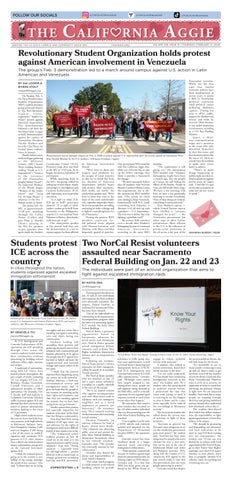
On Tuesday, Feb. 3, the Davis Revolutionary Student Organization (RSO), a political student group previously known as the Revolutionary Student Union, organized a “Yankee Go Home” protest against American imperialism. The demonstration followed a call from the Antiimperialist League to hold demonstrations against the capture of Venezuelan President Nicolás Maduro and his wife, Cilia Flores, by United States military forces in January. Shortly before noon, students began gathering at the Memorial Union’s (MU) South Patio, holding banners reading “Death to U.S. Imperialism”; “Victory to the resistance of the Venezuelan people/¡Yankui Fuera!”; the Industrial Workers of the World slogan “Workers of the world, unite!” and “Long live Al-Aqsa Flood,” a reference to the Oct. 7 Hamas attack on Israel.
The group left the MU at approximately 12:20 p.m., marching through the Coffee House (CoHo) and past Peter J. Shields Library, pausing at the Silo for speakers to give speeches, then again inside the Student

Community Center (SCC). Protestors made their way back to the MU at 12:45 p.m. At its height, the protest had about 70 participants.
While marching back to the MU, the group rallied by yelling out several chants, mostly criticizing U.S. Immigration and Customs Enforcement (ICE) and expressing anti-imperialist sentiment.
“It is right to rebel; ICE, ICE go to hell!” protestors chanted. “It is right to rebel; yankee, yankee go to hell! From Venezuela to the Philippines, stop the U.S. war machine! From Palestine to Mexico, these border walls have got to go!”
One anonymous speaker at the protest said they saw the demonstration as a way to express support for those affected
In cities throughout the nation, students organized against escalated immigration enforcement

BY GRACIELA TIU features@theaggie.org
As U.S. Immigration and Customs Enforcement (ICE) operations are still spreading through cities across the country, students in and around these communities continue protesting by holding school walkouts, rallies, vigils, marches and strikes.
A multitude of universities, along with UC Davis, have hosted protests throughout the past couple of weeks, including UC Los Angeles (UCLA), UC Berkeley, Purdue University, Cornell University and a substantial number of other universities. On Thursday, Feb. 5, faculty, staff and students at Columbia University blocked traffic to protest against ICE and demand that their university take action to protect international students, leading to the arrest of 12 protestors.
High school students across the country have also held their own protests, with high schools in Baltimore, Indiana, Iowa, New Hampshire, Madera, Calif. and Los Angeles, Calif. being a few of the many to publicly organize and condemn ICE presence in U.S. cities. Ananya Vyas, a third-year animal science major, explained her perspective on the national movement against ICE.
“I think the national protest going on in the country is very telling of the energy amongst the youth of our country,” Vyas said. “It shows how we are using
our rights and our voices like a standing unit against something very real that’s facing our communities.”
Students leading and attending these protests and gatherings ultimately aim to show solidarity with communities and families affected by ICE, grieve the people that ICE agents have harmed or killed, advocate for organizational and national change and inspire others to do the same.
“I think that the protests that have been happening across our nation are really powerful,” Siobhan Maloney, a third-year environmental science and management major, said. “It gives me hope that the people in our country are standing up for their rights and freedoms, and that they are standing against the tyranny that we have been seeing from our government.”
Another reason these protests feel especially important for students is because of the hope that they bring to communities.
Vyas described how seeing students of all ages come out and advocate for the rights of immigrants amid such a difficult period of time means a lot to her.
“The widespread school walkout protests on Jan. 30 stood out to me most as it was organized and executed by young students,” Vyas said. “Seeing students — especially from my old high school — protest filled me with so much hope, as younger generations are helping lead this anti-ICE movement.
by American intervention abroad.
“We’re here to show our support and solidarity for the people of Latin America as they try to break free from the shackles of American imperialism [which] haunt and destroy their continent, their world, our world,” the anonymous speaker said. “We’re here to show that even in the heart of the most unbelievably evil, capitalist-imperialist beast, there exist people that are willing and trying to make a change and to fight for something better for all of humanity.”
During the protest, RSO members expressed farleft political views, aligned with Marxist-Leninism and Maoism, with Marx and Mao frequently quoted in speeches.
One anonymous RSO member told The California Aggie that, while not everyone has to take up the RSO’s ideology, they think it provides a framework for change.
“We don’t necessarily believe that all students must become Marxist-Leninist-Maoist to join this organization, not at all,” the anonymous RSO member said. “The reason we think [our ideology] helps Venezuela, domestically with ICE [and] everything with Palestine, is [because it is] all tied up with capitalism — U.S. Imperialism. The only way to defeat that is by fighting capitalism itself.”
The protest held relevance even a month after Maduro’s kidnapping because of continued American intervention, according to the same RSO
member.
“The exploitation is still going on,” the anonymous RSO member said. “Maduro’s kidnapping might have been a month ago, but the people of Caracas are still feeling the effects of the bombs. People in Gaza are still under direct siege. We have a war looming with Iran, we have a war potentially looming to invade Greenland. None of these things are isolated, everything is interconnected.”
Since Maduro’s capture — which United Nations experts have labelled a “systemic disregard for peace” — the Venezuelan government has taken steps to allow further privatization. Most relevant to the U.S. is the reduction of private-sector restrictions in the oil sector, a key part of the
Venezuelan economy. While not the first time that similar economic policies have been implemented in recent years, it marks a shift in Venezuelan political consensus amid political unrest following Maduro’s capture. During his time in office, public support for Maduro was mixed, and while he won the 2024 election, it was under suspicious circumstances, according to a UN Fact-Finding Mission.
Jasper, a thirdyear communication major and a protestor at the event who only identified themselves by their first name, said that demonstrations like the one at UC Davis are crucial ways for students to make their voices heard in politics.
“There’s so many things happening in politics right now that we need to speak out against and be aware of,” Jasper said. “I feel like it’s part of our jobs as students to rebel and use our voices to speak.”

The individuals were part of an activist organization that aims to fight against escalated immigration raids
BY KATYA OKS city@theaggie.org
During separate incidents on Jan. 22 and 23, two individuals who volunteer for NorCal Resist were physically assaulted. The suspect, Daniel Grafton, as confirmed by Sacramento Police, has since been released.
One of the individuals was volunteering in the organization’s Accompaniment program, while the other was protesting against ICE outside the John Moss Federal Building.
NorCal Resist, a grassroots organization based in Sacramento, advocates for social justice and community care. NorCal Resist provides several immigration defense resources, such as Know Your Rights workshops, deportation defense and accompaniment services.
Following the incident, Norcal Resist posted a written statement on their Instagram, calling the assault on its members “brutal attack[s].”
The NorCal Resist member who was attacked on Jan. 23 was a court watch volunteer, recording on a public sidewalk at the time of the assault.
“He is [a] marine veteran who supports accompaniment and court observation work in solidarity with our immigrant neighbors and as a moral imperative to preserve our democracy,” the statement read. “He is currently receiving medical attention after sustaining several injuries.”
Autumn Gonzalez, an attorney volunteer for NorCal Resist, shared more details. “Our volunteer was observing public areas at and around the John Moss Federal Building in downtown Sacramento when he was violently attacked,” Gonzalez said. “The attacker was eventually arrested by law enforcement.”
Gonzalez also shared the duties and responsibilities of court watch volunteers.
“Our court watch program is a daily presence at the federal building, where we provide

assistance to folks going into their court appointments, as well as United States Citizenship and Immigration Services (USCIS) and [U.S. Immigration and Customs Enforcement] ICE field office appointments,” Gonzalez said. “Although court arrests have largely stopped in our immigration court, people are still regularly being detained at the field office, and it’s critically important for our regional rapid response network to catch those events when they happen.”
The statement then noted a prior incident that occurred on Jan. 22, when another individual who was also protesting near the John Moss Federal Building was attacked.
“Our neighbor was hit with a DHS vehicle and violently tackled and detained by the Department of Homeland Security (DHS),” the statement reads. Gonzalez noted that these incidents speak to a larger national trend concerning immigration enforcement.
“There has been a nationwide increase in violence against legal observers and protestors who are shining a light on DHS abuses,” Gonzalez said. “It is clear that DHS has been given the goahead by the White House to
engage in violent, unlawful activity with impunity.”
A student, who wished to remain anonymous, shared their initial reaction to the news.
“I’m not really [surprised]; ICE has already been conducting immigration removals in the area,” the student said. “As a student who has participated in political actions before, I understand the risks that come with [doing so and] it is worrying to see this happen so close to home and by a state actor, especially in the wake of the two killings in Minnesota recently.”
The anonymous student also talked about the current state of activism in light of these incidents.
“Activism in general has [become] more dangerous as we see this totalitarian government gain more power,” the student said. “Activism has been more dangerous for people who aren’t citizens for over a year now; this can be seen in the case of Mahmoud Khalil and other pro-Palestine activists. This, along with the murder of U.S. citizens by ICE agents in the past month, make it clear that this government does not want people protesting its actions.” Gonzalez noted that despite
the current political climate, she still feels hope for the future.
“It’s incredible to see so many people continuing to step up and say they’re ready to get involved, even with the murders of activists Renee Good and Alex Pretti,” Gonzalez said. “However scary it is for us as activists, it’s important to keep in mind how terrifying the political climate is right now for our impacted families. And it feels like so many people are stepping through their fear and getting mobilized anyway, because they understand how absolutely critical this is.” The student then shared their belief that fellow students have the responsibility to fight against government actions they believe to be unjust.
“We should be protesting and demanding our university and local authorities to do more to stop ICE from coming into our communities,” the student said. “If you can, you should be in contact with local organizations like NorCal Resist, go to their ‘Know Your Rights’ trainings, save their ICE report number in your phone, learn how to properly identify ICE vehicles, [and] do anything and everything you can.”
Anti-trafficking advocates and survivors spoke about prevention and answered frequently asked questions

BY MADELYN SEVIGNY city@theaggie.org
In recognition of Human Trafficking Awareness Month, Empower Yolo and Soroptimist International of Davis hosted their annual community event to spread awareness about human trafficking.
Empower Yolo is a sexual assault and domestic violence resource center that “provides 24-hour crisis intervention, emergency shelter, confidential counseling, training, legal assistance and other services for individuals and families affected by domestic violence, sexual assault, stalking, human trafficking and child abuse,” according to their website.
Soroptimist International is a global organization dedicated to education, gender equality and female empowerment.
Community members first gathered for a resource fair at Veterans Memorial Center, where they could learn about public services and ways to

get involved. Organizations in attendance included the UC Davis Center for Advocacy, Resources & Education (CARE), 3Strands Global, the California Civil Rights Department, Yolo County Victim Services and others.
A presentation was then given by Yolo County District Attorney Investigator Mathew Jameson, who specializes in human trafficking and sex-related crimes. Jameson explained that human trafficking consists of labor and commercial sex trafficking, with commercial sex being more prevalent. The definition of sex trafficking is the “recruitment, harboring, transportation, provision or obtaining of a person” for the purpose of a commercial sex act, in which “a commercial sex act is induced by force, fraud or coercion or in which the person forced to perform such an act is under the age of 18 years,” according to the Yolo County District Attorney’s office.
Jameson emphasized the prevalence of traffickers using online spaces and social media to recruit victims. Victims are often runaway or foster youth, those facing neglect, past trauma or those looking for work who are promised false employment. Traffickers and sex purchasers, known as “Johns,” don’t often have specific traits and could be anyone, according to Jameson. Following Jameson’s
presentation, a victim of trafficking spoke on how vulnerability can be abused by traffickers, as well as the importance of building community with those around you. She said that everyone should pay attention, say something if they think something is going on and know the resources that are available to them.
The presentation concluded with a community panel that included survivors, social workers, advocates and law enforcement.
Celina Alveraz, the executive director of Empower Yolo, explained that trafficking is a local issue that impacts people in Yolo County.
“People often don’t think or believe that trafficking exists locally,” Alveraz said. “I think a lot of people think it’s more of a global or international problem, but the reality is it happens here in our own backyard.”
Last year, Empower Yolo supported 35 survivors of human trafficking, according to their website. Alveraz noted that outreach events are important to support survivors and inform them of available resources.
“A lot of violence and abuse [victims] live in shame and secrecy, and so the more we can break the silence and speak out, we can better support survivors,” Alveraz said. “And so, it’s really important for us to send a message to survivors that we’re

here for them, that we care about them, we see them and we want to offer any support and services that we can.”
Alveraz also offered ways that community members can get involved in anti-trafficking efforts.
“There’s many nonprofits here where folks can donate money,” Alveraz said. “Individuals, groups, clubs organizations can get involved by donating supplies and items that we can provide to survivors [...] We are always taking supplies, and we have a wish list on our website where folks can donate items that way. If folks are interested in getting more involved in supporting survivors, there’s organizations here, such as ours, where they can become volunteers.”
Tracy DeWit, the assistant treasurer and chair of the Anti-trafficking Committee at Soroptimist International of Davis, explained some of the hands-on work their organization does to support survivors.
“We were able to put together 20 backpacks — emergency backpacks — that provide basic necessities for survivors,” DeWit said. “So, we donate those backpacks to Empower Yolo, and they are a frontline organization that meets the survivors at the hospital or at the police station, and, if appropriate, they will bring one of those backpacks.”
DeWit also highlighted the importance of their work and focus on making a direct, positive impact.
“I think it’s important to know that when there are things like this happening in our community, that even though the goal is seemingly insurmountable, it’s still very important, even if one individual has help out of an abusive situation,” Dewit said.
To learn more about Empower Yolo and their antitrafficking work, visit their website at empoweryolo.org.
The National Human Trafficking Resource Center’s toll-free hotline is 888-373-7888.
The council voiced desire for a stronger legal framework to protect the immigrant population
BY YUENJO FAN city@theaggie.org
On Feb. 3, the Davis City Council convened for its first general meeting of the month.
Largely focused on community concerns about United States Immigration and Customs Enforcement (ICE), the meeting centered on the city’s intent to move toward a Sanctuary City Ordinance.
While a resolution acts as a formal declaration of sentiment or stance, an ordinance turns this declaration into a legally binding action with higher legitimacy and authority. The City of Davis currently has a sanctuary city resolution, but not an ordinance.
Kelly Stachowicz, Davis assistant city manager, touched upon the city’s current stance on being a sanctuary city.
“The city does have a sanctuary city resolution that first came to be in the 1980s and has been revised and updated two times since,” Stachowicz said.
“The last time [it was updated] was about a decade ago. Each time it has been expanded and reworded to address the issues that were pertinent for that period in time.”
Recently, the Davis public has increasingly voiced concerns that the current resolution may not be strong enough to enforce Davis’ sanctuary city stance.
Many public commenters cited the ICE-related incidents in Minnesota, fearing that such circumstances may make their way to the City of Davis. Other commenters expressed unease about the number of Flock cameras — surveillance camera systems powered by artificial intelligence (AI) and operated by law enforcement — within the city. The city of Davis currently operates at least sixteen of these surveillance cameras.
As explained by Stachowicz, the presence of increased surveillance technology has prompted the city’s Human Relations Commission to request that the Davis City
Council move forward with a legally binding Sanctuary City Ordinance.
“[The Human Relations Commission] is asking to draft an ordinance related to sanctuary status, and for the council to direct staff to review the language in the draft developed by the commission,” Stachowicz said. “If [the city council] is interested in an ordinance or something of that nature, we [would] need to involve other resources: the city attorney, namely.”
The recommendation for a Sanctuary City Ordinance was unanimously supported by all members of the city council, including Davis Mayor Donna Neville.
“I am very supportive of the council adopting a Sanctuary City Ordinance: that is where I ultimately want us to land,” Neville said. “I want us to be as strong and protective as [we] possibly can be. The real issues that we deal with are largely the concerns around federal preemption.”
Josh Chapman, council member and former Davis mayor, echoed Neville’s sentiment.
“I am in alignment in support of us doing an ordinance and this process being undertaken through our staff team,” Chapman said. The council also vowed to continue the city’s alignment with the California Values Act, a state bill passed in 2017 that restricts local and state law enforcement cooperation with immigration enforcement. Davis Police Chief Todd Henry addressed the Davis City Council on how the Davis Police Department is handling the current situation with regards to immigration enforcement.
“We’ve had these internal conversations as to how we give guidance to our officers,” Henry said. “How do we avoid a violent confrontation with another armed law enforcement entity? We’ve also had these conversations with our school districts.
CITYCOUNCIL on 9

Paris Banh Mi brings signature banh mi, pho and pastries to Davis
BY MICHELLE BEKHTEL city@theaggie.org
Paris Banh Mi Cafe & Bakery opened its doors on Jan. 31 at The Davis Collection, marking the franchise’s newest Northern California location and expanding its mission of blending Vietnamese flavors with French baking traditions. The Davis shop is co-owned by Liem Nguyen, alongside partners Ken Tran and Nhi Tran.
The decision to expand into Davis was personal for the ownership team. Nguyen explained that the Tran family was motivated by their connection to the university community.
“[Nhi Tran’s] daughter goes to school at UC Davis, so they decided to create the shop for students to come and study,” Nguyen said.
The franchise’s roots stretch across continents. Nguyen shared how the original founder’s culinary background shaped the current menu. Hien Tran was raised in Paris and co-founded the restaurant with Doan Nguyen who owned a chain of bakeries in Saigon.
“[Hien Tran] learned how to make the cake and sandwiches [in France],” Nguyen said.
“After that, he took his whole family and moved to the United
States and started a small banh mi store based in Orlando, Florida.”
The café is known primarily for its banh mi sandwiches, which in Vietnamese translates to “bread.” They came to be because of French colonization in Vietnam, which introduced baguettes to the cuisine. The sandwiches contain different fillings such as pork, chicken or tofu and vegetables like cilantro, cucumber, radish and pickled carrots.
In addition to Banh Mi, the Davis location offers pho, boba tea, fresh pastries and specialty drinks, including slush milk teas and French-style baked goods that are crafted daily, according to Nguyen. For first - time visitors, Nguyen emphasized the popularity of one particular item.
“A must-try sandwich is the Combination; it’s the best seller,” Nguyen said.
The Combination Banh Mi features ham, pork bologna, pâté (a mixture of seasoned, ground meat), mayonnaise, jalapeños, cucumber, pickled daikon (white radish), carrot and cilantro.
Other customer favorites include grilled pork sandwiches and the café’s signature pho — a Vietnamese soup. Nguyen highlighted the care that goes
into preparing the broth for the pho, which is cooked for 24 hours on a low heat.
The franchises’ broader identity is a fusion of Vietnamese street-food staples and French baking techniques. The café emphasizes fresh baguettes, croissants, pastries and handcrafted beverages such as boba teas.
Beyond the menu, the Davis Paris Banh Mi location was intentionally designed to serve as a study-friendly environment for UC Davis students. The interior features an abundance of faux greenery, warm lighting and a decorative Eiffel Tower structure that reflects the café’s French influence. A Buddha statue and Vietnamese design elements further highlight the blend of cultures that defines the brand.
Nguyen described the effort that went into creating a welcoming atmosphere.
“We spent a lot of time decorating this store because we want the students to come in and enjoy the vibe so they can study and enjoy some food in our store,” Nguyen said. With its combination of Vietnamese flavors, French baking techniques and studentoriented design, Paris Banh Mi’s arrival in Davis has created a new study space in the Davis Collection.


Redesigned rooms include spaces themed to the Arboretum and the Eggheads, with more decor to come

BY RACHEL TRAN campus@theaggie.org
for students,” Nusbaum said. “We chose the specific themes to represent a wide variety of aspects of the campus that would be visible and relatable to the broadest spectrum of people.”
The remaining five group study rooms are set to be renovated throughout the rest of winter quarter; all eight of them will be done by the end of March. Each room will have its own unique theme, including the history of Shields Library, Unitrans, animals and the University Farm, Aggie Traditions and Athletics and water towers.
features a fun fact related to its theme, and a QR code for those interested in learning more.
Shields Library Night and Weekend Assistant Bianca Iosif, who leads the project’s creative vision and is responsible for all the decoration in the study rooms, hopes students will get some newfound enjoyment from using the spaces.
Next time you book a study room in Shields Library, you might notice some new campus-themed decorations. Inspired by different UC Davis landmarks, mascots and traditions, eight of the library’s reservable group study rooms are being redecorated. Three — the Arboretum Room (204), the Egghead Room (202) and the Bicycle Room (320) — have recently reopened for student use.
of Communications Jessica Nusbaum said that the remodeled rooms are an effort to make study spaces more attractive to students.
Shields Library Director
“The inspiration for the project as a whole was part of looking for ways to make the library more welcoming
Previously, the study rooms’ blank white walls were adorned with only a white board and a TV for screen projection. Now, each room will have unique, curated decorations, including real-life traffic lights for the Unitrans and Bike-themed rooms and donated uniform shirts from UC Davis varsity sports teams. Each room also
“I am very excited to see the visions I had for the rooms come to life for everyone to enjoy,” Iosif said. “My goal [...] is not only to make the study rooms more engaging visually, but also to make them educational. My hope is that what students discover through these ‘mini historical exhibits’ will enrich their experience of this beautiful campus.”
Many of the new decorations are reused or upcycled pieces that uphold the library’s 2021 LEED Gold Certified Building designation for sustainability. One example are the photo frames in the
Arboretum Room, which are made from branches that have fallen off trees in the Arboretum and from wood taken from the library’s old shelving. Another is the radiator grill and other parts taken from actual commuter buses for the Unitrans room, which will also display physical signs that were previously placed around campus.
“We’re really proud of all the work we have done together with the campus, even though it’s an older historic building,” Nusbaum said. “When doing this project to make the group study rooms more fun and more engaging, we wanted to do that in a way that would have the lightest possible footprint from a sustainability and environmental impact standpoint.”
The four IET computer labs available to all students will be replaced with an expanded virtual computer lab
BY RACHEL TRAN campus@theaggie.org
Students who use one of UC Davis’ on-campus computer labs will soon need to log off for the last time, as the university prepares to permanently close the four labs managed by UC Davis Information and Educational Technology (IET) this summer.
The IET computer labs — also known as the Open Access labs — are available for use by all UC Davis students and affiliates. They differ from other labs, which are available for use by specific university programs or fields of study. They provide access to a plethora of licensed
software packages, including R and Stata, for students who may be unable to access or afford purchasing them on personal devices. The four Open Access Labs are currently located at 91 Shields Library, 78 Hutchinson Hall, 15 Olson Hall and in 2214 Teaching and Learning Complex (TLC).
The move was announced by IET in late January, and cited reduced traffic and usage as factors in the decision. While no specific date has been given, the locations are scheduled to close sometime in June. A fifth Open Access Lab, located in Wellman Hall, was permanently closed in September 2025. The 18 on-campus
Purpose of the Study:
To gather health and nutrition data from the population of Davis, CA and surrounding areas. What you will do: Complete an online questionnaire about your stress levels and causes of stress, your body measurements, food consumption, and gut health.
computer teaching classrooms — which are used for scheduled courses and instruction — will remain open and unaffected by the change. On-campus printing services will also be maintained.
To replace the computer labs, IET announced the launch of the Virtual Computer Lab Pilot to expand and improve students’ digital experience through better virtual access to computer lab programs. The pilot’s goal is to provide students more flexibility when working on projects by giving them the ability to access specialized software anytime and anywhere.
“The university is committed to providing
With a $120 million donation from the Weill Family Foundation, the UC Davis School of Veterinary Medicine has been renamed to the UC Davis Joan and Sanford I. Weill School of Veterinary Medicine, or the UC Davis Weill School of Veterinary Medicine. ever toward veterinary medicine in the world, and one of the largest in UC Davis’ history.
You may participate if you are: 18–65 years old
Joan and Sanford ‘Sandy’ I. Weill have historically donated to various institutions; their latest to UC Davis makes their
Currently living in Yolo, Sacramento, Solano, Sutter, or Placer counties
• Able to complete an online questionnaire in English
Take a survey to see if you may qualify. Scan the QR code or call 530-754-8544.
students with an enhanced technology experience supporting their educational journey,” IET said on their website. “As new tools emerge and technology evolves, IET is exploring options to deliver expanded access to specialized software via a Virtual Lab while ensuring students continue to have printing and computer resources.”
Aside from reduced foot traffic, IET noted that students have complained in the past that the computer labs’ weekend schedules and hours did not provide enough flexibility.
“With on-demand access to specialized software through a secure online environment,

IET
or


In the spirit of Valentine’s Day, enjoy some historical love stories

BY SABRINA FIGUEROA sfigueroaavila@ucdavis.edu
With Valentine’s Day quickly approaching, the season of love is officially here. While the constant barrage of romantic rhetoric can become draining, I’ve learned that the best way to enjoy this time is by appreciating that love exists and always has — it’s innately human. Here are some of my favorite historical depictions of love that have shaken both my brain and soul:
Orpheus and Eurydice: This story starts with two mortals, Orpehus and Eurydice, falling in love. On their wedding day, Eurydice gets bitten by a snake and instantly dies. Devastated by her death, Orpheus travels to the Underworld, charming Cerberus (the three-headed guard dog) and Hades with his music — enough to make Hades agree to Eurydice’s return. However, Orpheus may return Eurydice to the mortal realm on one
condition: He can’t turn around to look at her as he leaves. But, just as they are about to exit the Underworld, he turns around to make sure Eurydice’s there. With that confirmation, she is gone forever. There are many interpretations as to why he may have done so, but the consensus is that it wasn’t because he didn’t love her — it’s the very opposite. Love makes us as hopeful as it makes us fragile and doubtful; this is one of those stories that, no matter how many times you hear it, still makes you think (and hope) that there’ll be a happy ending.
Achilles and Patroclus: During the Trojan War, Achilles and Patroclus were inseparable war “companions.” Their story begins when Achilles refuses to fight in the war — Patroclus is instructed to convince Achilles to rejoin the fight, but ultimately fails to do so. Instead, he asks him if he could borrow his armor to scare off the Trojans. Achilles agrees, but as Patroclus dons
his armor, he is killed, leaving Achilles lonely and grieving. Achilles ends up rejoining the war for revenge, killing Patroclus’ assassin even though he’s been warned that he would die for committing such an act.
In a dream, Patroclus asks Achilles if they can be buried together — their bones and ashes mixed in the same urn — and in the end, that is how they spend their afterlife. While Homer never explicitly states they are lovers, many have interpreted their relationship to be romantic. No matter what, their relationship highlights the devotion and loyalty that love can bring — both in life and in death.
Popocatépetl and Iztaccíhuatl: Princess Iztaccíhuatl and warrior Popocatépetl fell in love. However, Iztaccíhuatl’s father disapproved of Popocatépetl, but allowed them to marry if he could return victorious from a war.
Upon Popocatépetl’s leaving, Iztaccíhuatl’s father tricked her
into thinking that her lover died in combat. Shattered by this, Iztaccíhuatl died of a broken heart. When Popocatépetl returned, he found her dead and was determined to find the most beautiful place to bury her, but he too died from a broken heart before he completed the task. The gods, moved by their passion, turned them into volcanoes that can be seen in Izta-Popo Zoquiapan National Park in Mexico. This Aztec myth is a classic tale of love overcoming obstacles — whether that be disapproval or death, love is eternal and prevails. The fact that humans created a love story for two volcanoes centuries ago, two hearts forever beating for one another, gives hope for love in the future.
Elizabeth Bennet and Mr. Darcy: Whether it’s the original book or the countless “Pride & Prejudice” movie adaptations, the love story between Elizabeth Bennet and Mr. Darcy is popular for a reason. More realistic than many others and much less tragic, this story demonstrates how social classes — like race, age, gender and class — can play a part in our choice of a life-long partner. But, while our beliefs may sometimes discriminate, love may not. What sticks with me the most here is that in the end, Ms. Bennet and Mr. Darcy’s relationship blooms out of mutual respect and understanding, despite previous, prejudiced beliefs. In truth, love is messy and odd, yet we fall into it regardless. It is love that forces us to keep trying to explore these complex connections we have with other people, which is half the fun.
The evolution of Valentine’s Day rhetoric
BY ABHINAYA KASAGANI akasagani@ucdsvis.edu
One cannot move through the world this time of year without being bombarded by the influx of Valentine’s Day emblems in red, pink or white — or the equally predictable wave of unmoving opinion pieces that have something to say. This article, however, refuses to join the stack of millions advocating for the celebration of Valentine’s Day, nor does it admonish anyone for partaking in its capitalist sensibilities.
For years, the flurry of Valentine’s Day opinion pieces has failed in making original claims for or against the celebration of Valentine’s Day. “The Price of Love: Capitalism’s Grip On Valentine’s Day.” Cool, what hasn’t been commercialized? “Even more
than April 1, Valentine’s Day is for fools.” Sure, but couldn’t that be said about any holiday?
“Love me, love me not: Why Galentine’s Day should be equally celebrated as Valentine’s Day.” You’re your own person, go nuts. The anti-Valentine’s Day argument is tired, because frankly, no tradition that involves gift-giving can ever be removed from the urge to swipe a card.
Birthed amidst a culture of disillusionment and cynicism regarding the idea or act of romance, the anti-Valentine’s rhetoric has left Feb. 14 fighting a losing battle. For years, not engaging with the tradition seemed like the more appropriate, responsible option when it came to this romantic tradition. Recently, however, there’s been a more pronounced shift in how people have taken to posting their partners online, on
random holidays, with captions like “My boyfriend hasn’t asked me to be his egg for Easter yet?” or “He hasn’t asked me to be his Valentine.” This conversation is polarizing; ideas like “princess treatment” or “bare minimum” have managed to skew the standards of dating entirely, with everyone feeling the need to either go big or go home. In placing an exorbitant amount of pressure on their partners to show up for them in extravagant ways, people have begun to forget what the day is entirely about. Companies have begun staving off usual criticisms about their integrity with cards that read, “happy, unimaginative, consumerist, entirely, arbitrary, manipulative and shallow interpretation of romance day,” leading most people to misguidedly believe that big corporations are now on their side. Helen Fisher,

an anthropologist at Rutgers University, commented on this foolishness: “This isn’t a command performance. If people didn’t want to buy Hallmark cards… Hallmark would go out of business.” Pretending that we ourselves are not contributors to this phenomenon is frankly laughable.
NOVA MAI / AGGIE

BY NEVAEH KARRAKER nakarraker@ucdavis.edu
A night full of aesthetically pleasing snacks, photoshoots and the most ridiculous conversations about men — the bad dates and the new crushes and plenty of giggles — is quintessential girlhood. Who doesn’t love girl talk? And yet, one thing in common with most women I know is the men they deliberate about dating are just, to put it bluntly, ordinary guys. They talk about how kind he is, how he pays first, how he’s responsible because he has a job and how he dresses respectfully. And, while those seem like green flags, isn’t that simply the bare minimum? Don’t the same women who glorify these things meet that exact same criteria? Women also have jobs, go to school and pay for their own things. The women who often complain about a man’s lack of commitment are often the most talented, ambitious, hardworking, selfless and internally beautiful people I’ve ever met. They’re club presidents, women in science, technology, engineering, and mathematics
(STEM),
artists — and they don’t just daydream about these aspirations, they actively and relentlessly pursue them. For generations, the traditional role and defining value of a woman was to take care of housework and raise children. This past century, however, has been revolutionary for women, with the first wave of feminism securing women’s suffrage rights in 1920 and the second wave focusing on social issues in the 1970s. In the past, marriage was essentially mandatory for women, as it allowed them to have financial stability and social approval.


MAI / AGGIE


Adding to this conversation is Chante Joseph’s article “Is Having a Boyfriend Embarrassing Now?” from late last year, which caused an immediate ruckus by those who took offense at being disliked for “loving their boyfriend.” While others pointed out that they completely missed the point, this signified a shift in the discourse surrounding romance. Apart from this conversation being nauseatingly heteronormative, it prompted people to either prove their allegiance to female friendship or “reclaim or romanticize their single life.” Enter Galentine’s Day. The concept was likely first introduced in 2010 by “Parks and Recreation” protagonist Leslie Knope, who organized a holiday for her friends to celebrate their platonic love for one another. Mentions of Galentine’s Day in my friend groups have skyrocketed this year, and while some use the day to truly appreciate their friends, others opt to use it to collectively circumvent the loneliness brought forth by Valentine’s Day, in a Singles Awareness Day (SAD) way. VALENTINES on 9 READ

BY MOLLY THOMPSON mmtthompson@ucdavis.edu
I tend to think about romance a lot. I don’t know if it’s a product or a cause of my habits, but I’ve always had a not-insignificant portion of my maladaptive brainspace dedicated to fantasies of grandeur and melodrama. Maybe I can blame it on Taylor Swift’s “Fearless” album or Emily Henry’s “Beach Read,” or maybe it’s just the way that I am that causes my affinity for such hopelessly romantic media, but the fact is true regardless: I have big dreams and an overactive imagination. I’ve always felt like my
brain was much more powerful than my body — like I could dream up far more than I could manifest. And, while I haven’t lost my propensity for idealism, I’ve certainly learned to embrace a more realistic perspective than I was capable of exhibiting when I was younger. But, if I could go back in time — if I could give myself and my notorious flights of fancy a little advice — this is what I’d want to say. I would tell 13-year-old me to take a deep breath. She was good at listening to her gut and avoiding people that weren’t good for her, but she was so scared that she took it too far. Like when the boy from choir asked her out (a few days after Valentine’s Day because
he chickened out), it was fine for her to say no but it was probably overkill to avoid his eye contact for eight months afterwards. The deep, heavy feeling of dread in her stomach was important to acknowledge, but to her detriment, she let it consume her. She loved romance in theory — she played “How You Get The Girl” from 1989 on a loop every day and re-read “The Selection” series like it was a competitive sport — but the reality of it intimidated her. I wish I could tell her that the stakes aren’t as high as they feel, and that it’s not scary when it’s the right person. I also wish I could tell her to ditch the side bangs. At 16, my romanticism began to grow intertwined with anxiety. The fantasies of my midhigh school self were as robust as ever, fueled by the “folklore” album and Rainbow Rowell’s vampire stories.

‘Tis the season of love and loneliness. From the recently broken-hearted and the longjaded bachelors to the hopeful lovebirds and delusional yearners, each Valentine’s Day ushers in a complex slew of emotions. No matter how you are feeling as the holiday approaches, rejoice in knowing that whatever you are experiencing, you are not alone.
Whether the holiday is riddled with thorns or adorned with rose petals, your fellow Aggies are searching for the ultimate love advice. Under pseudonyms, each member of the Editorial Board has compiled the perfect tips for each anonymous inquirer. Read on for the answers to all of your burning questions:
Boyfriend Material:
“How do I ask a girl to be my girlfriend without it sounding awkward? Every iteration of the question that I can think of just sounds so cringy, I almost can’t bring myself to say it. Is it possible to ask in a way that sounds cool and suave? I figured if anyone would have a good answer, it would be writers, so please help me out.”
— Boyfriend Material
Dear Boyfriend Material, Maybe this isn’t exactly the advice you wanted to hear, but I think a huge part of getting into romantic situations is learning how to withstand making yourself cringe sometimes. There is no perfect turn of phrase that will make the situation less awkward as long as you feel awkward about it in your own head. Love is great, but it’s also humbling —
that’s part of what makes it feel so vulnerable and scary at times — and sometimes to get to the end point we want, we have to say things that sound cringe, but really aren’t. Literally asking the question “Will you be my girlfriend?” isn’t cringe — it’s definitely the thought of yourself saying those words that is making you feel like it is. You need to let yourself feel what you feel in order to be happy, and a huge part of that is getting over the cringe and just saying what you want to say. If this person is worth your time and wants to be in a relationship with you, it won’t matter how you ask or what words you say. If you’re really feeling nervous, set up a romantic situation and let your actions speak for you — you could even buy flowers and write the big question on a note, if you really can’t bring yourself to say it. That being said, I think you should say it; it’s a good exercise in letting yourself be romantic and learning to grow comfortable with yourself in that setting. It will feel less and less cringe once you realize: a) everyone who dates has to say one of the ‘will you be’ or ‘can I be’ lines for the relationship to start, b) it will more than likely be reciprocated and then you’ll be too happy to remember why you thought it was cringe to begin with and c) we comfortably become versions of ourselves that not-in-love us would think are cringe — but once we are, it feels natural. Don’t overthink it: No matter how you ask, think of the end results instead of about yourself saying the words. It’ll be worth it!
Love, A cool and suave writer
20-year-old Virgin: “I feel like, compared to my peers, I’m incredibly inexperienced. I haven’t hit any of the relationship or romantic milestones that most people have in high school, and I’m well into college. It’s hard when I hear my roommates and friends and classmates talking about sex when I haven’t even had my first kiss. Have I missed my window of opportunity? How can I either get over this FOMO, or put myself out there?”
— 20-year-old virgin
Dear 20-year-old virgin,
While friends and foes alike seem to have it all figured it out, this road is not as untrodden as it may seem. I, too, was once a 20-year-old virgin and thus, feel exceptionally qualified to give advice on all matters related to courtship. While I may be writing in ancient speech, you possess much more youth than that of my script. Internet culture and social pressure create false urgency — so-called ‘rites of passage,’ like teenage romance and university dalliances, are arbitrary hallmarks of a life well-lived and youth well-spent.
Therein lies the crux of romantic insecurity. I’d sit here with my ink and quill to remind you of how young you are — you are an overflowing fountain of youth! — but that strays from my point. Love is not synonymous with youth. There is no time limit on romantic milestones, and as one of the many blessings of free will, you reserve the right to experience the years of your life as you please. Date, or don’t date. Kiss, or don’t kiss. Have sex, or don’t have sex.
In all my infinite wisdom, assessing one’s true feelings and readiness is most important. There’s a difference between wanting to try something new and feeling pressured to meet an expectation — whether it’s set by you or the people around you. Romantic love is not the barometer of human connection, and there are lords and ladies in the land who have belles and beaus a plenty, but who wish for simple companionship or selfdiscovery. If you want to give romance a try: Dabble with dating apps (even if you never take it further than creating an account), exist in public spaces when you can (choose the coffee shop over your bedroom or the park bench over your couch) and say yes when romantic opportunities arise (or ask them out yourself). You, brave knight, can meet someone at any time and will take the plunge when the moment feels right.
Soldier

Editorial Board
ALYSSA CREVOISERAT Editor-in-Chief
MAYA KORNYEYEVA Managing Editor
VINCE BASADA Campus News Editor
JORDAN POLTORAK City News Editor
MOLLY THOMPSON Opinion Editor
ZOEY MORTAZAVI Features Editor
SAVANNAH ANNO Arts & Culture Editor
MEGAN JOSEPH Sports Editor
KATIE HELLMAN Science & Tech Editor
JENNA LEE Photo Director
NOELLE ESCALANTE Layout Director
SAVANNAH BURGER Design Director
SAM RUIZ New Media Manager
KAYLIE HUANG Social Media Manager
JULIAN MONTANA Website Manager
JULIA CROSSAN Distribution & Outreach Director
YILAN LI Translation Director
CARMEN RODRIGUEZ-ZARATE Translation Director
JENNY DYE Copy Chief
ALYSSA PULIDO Copy Chief
LAURIE PEDERSON Business Development Manager Managing Staff
In the spirit of Valentine’s Day, enjoy some historical love stories

BY SABRINA FIGUEROA
sfigueroaavila@ucdavis.edu
Like any other teenage girl, I spent my high school years completely enamoured with the romantic comedy (rom-com) genre. This obsession coincided with the rise of “BookTok,” a subgenre of TikTok users who use the app as a forum for book reviews and recommendations. Every other person on my For
You page was telling me to stop scrolling because they knew about a book that I just “had to” read. The books that BookTok is enamoured with are hit-ormiss — especially in the romcom genre. For every “Beach Read,” there’s a “The Spanish Love Deception”— which is to say, for every book that makes the reader want to cry and make a wedding-themed
BY VIOLET ZANZOT
vmzanzot@ucdavis.edu
How absolutely, unbelievably, unequivocally romantic was it when Frank Sinatra said: “Your looks are laughable, unphotographable yet you’re my favorite work of art”?
Undoubtedly, there is no other man who could call someone funny-looking and have it sound so very sweet.
The thesis of Sinatra’s message is that the imperfections of the woman he treasures make her all the more perfect to him — his “funny valentine.” What makes this kind of love so good is his reverence for everything about her that is messy: to love her because of her flaws, rather than in spite of them. If it is the quirks we are prompted to appreciate, does there ever become a uniqueness
that exceeds capacity for regard? When does the observer notice something that goes beyond the scope of appropriate adoration? When does a pattern or a preference become a fetish or a kink? When does desire become disgusting, taste become tacky or fondness become fraught? Socially, we seem to know there is a line that exists when a preference in attraction becomes perverse. We see these questions play out all around us: TV shows and movies that feature an older guy with his young, hot wife; red rooms and Romeos and Juliets. In those moments, we seldom ask ourselves: Is this a fetish — a kink or a type that is repeated? Do they only like each other because their families don’t? We know there is a line between “dirty” and “wrong,” but it isn’t always so defined. We, as a society, tend to understand that being “into older
Pinterest board, there’s another one that’s objectively awful. This is particularly interesting because romance as a genre is known for being cliché; the predictable cocktail of emotions promised to the reader leaves little room for surprises. There must exist some ontological property that makes certain romances more enjoyable to readers, even if they’re all cut from the same cloth. There are a few characteristics
that make any book good. Writing blogs will cite the importance of world building, pacing and an engaging plot — but all of these, I believe, are symptomatic of good writing anyways. I think that the greatest common denominator amongst the best romance novels is that they’re all rooted in emotional realism, even if the plots themselves feel fantastical. It wouldn’t be accurate to say that rom-coms are beloved
guys” is generally acceptable, but dating your married professor isn’t. There is a clear difference between saying “A lot of the girls I’ve dated are Asian” and “I like Asian girls.” There is a clear difference between saying you “Live on the edge romantically” and you’re “Dating someone to upset mom and dad.” These distinctions almost feel innate. When you hear of instances that are off from the norm, you feel forced to flinch, just slightly, and make a face like you smelled something rotten. I believe that context is often the difference between what is uncouth and what is permissible — context can cushion the blow, if you will. Using a less abrasive example, I was once asked why girls only like tall guys. I argued the premise of this question relies on a false pretext; girls, in fact, do not only like tall guys. Personally, I like to feel small.
Feeling small, for a 5-foot-4-inch girl does not always require a 6-foot-5-inch giant (though it can). When given the rationale behind my preference, it’s easier to understand. I like to think I’m not weird for preferring taller (or maybe just stronger) guys because I want to feel small relative to my partner — if you contextualize my preference, you can sympathize with me. That being said, context alone cannot be the hero for every kink or socially unacceptable preference. There are, of course, the preferences that are too “taboo.” I think a lot of that stems from internalized messaging that forbids us from rationalizing our desires, because sometimes things are wanted inexplicably. Sometimes the only thing that stops someone expressing a specific want is knowing that if they said it out loud it would sound wrong — it
because they allow readers to picture themselves in the characters’ shoes. I’m not a blonde literary agent, but I loved Emily Henry’s “Book Lovers” to pieces. I don’t have a Ph.D. in analytical magic, but “Katabasis” was the first book I’ve read in a while that I genuinely couldn’t put down. When I read these books, I rooted for the protagonists and love interests because I felt like I was on the same emotional journey as they were.
The most important factor in writing a successful romance novel is the author’s ability to conceptualize and convey human emotion. Though it’s a well-known fact that people make ill-advised decisions when they’re emotional, it’s hard to root for a fictional character when you can’t fully understand the emotional context they’re acting within. For this reason, romance authors have to do a lot of emotional heavylifting to make the characters relatable to the reader. Without establishing this kind of relatability, characters may seem irrational or weak-willed: as exemplified by the backlash that Colleen Hoover’s “Ugly Love” received because the protagonist kept running back to a man whose only personality traits were being aloof and attractive.
On the flipside though, when emotional realism is done well, it can be one of the most satisfying kinds of stories to read.
Romance novels are built around the characters’ inner worlds — their fears, motivations and wounds — and allowing the reader to understand and become invested in a couple without being didactic or overstating what should be implied requires authors to master a difficult combination of subtlety and empathy. Many people stereotype the romance genre as “superficial;” something that only teenage girls and lonely women read. It’s easy to point to the outrageously bad books and say, “See, you guys will read anything!” However, it’s not that this range of quality reflects the genre itself; rather, it proves how difficult it is to write a good rom-com. BookTok has dissected the world of rom-com literature into simple, recipe-like components, labeling books based on the tropes they include (such as “enemies-to-lovers” or “secondchance-romance”) and, in the process, watering down the importance and meaning behind this genre. At their cores, these stories remind us about the value of our emotions, the importance of staying in touch with them and just how powerful they can really be.
Disclaimer: The views and opinions expressed by individual columnists belong to the columnists alone and do not necessarily indicate the views and opinions held by The California Aggie.

is this “wrongness” that I find to be so fascinating. Through writing this, I was hoping to understand it more: to better understand the social constraints that police sexuality and romantic desire. Some things just seem bad to want, but then you watch shows and movies that feature these odd-ball couples that
work because of (not in spite of) all of their quirks. You see age differences and gendered power dynamics and sex toys and still feel like it’s all romantic because… it’s romantic. The love of Harold and Maude, Anastasia and Christian, Elio and Oliver (to name a few quirky couples) feel pure because of the emotions behind them. FUNNY

BY SAVANNAH BURGER arts@theaggie.org


Video Game: “Kitty Powers’ Matchmaker” (2014)
Dying to test your prowess as the world’s premier matchmaker? This 2014 dating-simulator game is unlike any other! Made by drag queen personality Kitty Powers, “Kitty Powers’ Matchmaker” puts you in the shoes of a town’s newest matchmaker of the Kitty Powers enterprise. This game is oodles of fun: I used to watch YouTubers play it all the time way back when, and I play it whenever I need a laugh with friends or by myself. In the game, you have multiple clients that come to you in dire need of love, and you match them based on aesthetics, careers, habits, horoscopes and more. Once you set two people on a date, you coach your main client through a secret mic, having to navigate the conversation and complete mini games to get the pair to fall deeply in love! It’s ripe campiness, British puns and sappy romance. The game is also extremely inclusive in its diversity of characters, featuring same-sex couples with no discrimination. A new, updated version of the game is coming out soon, now with nonbinary characters as well.
Song: “Just The Way You Are” by Billy Joel (1977)
A soft-rock single by Billy Joel from his fifth studio album, “The Stranger,” this song perfectly communicates what it means to love someone. The track takes the viewpoint of someone in a relationship, telling their partner that they need not change themselves or make themselves more sophisticated, as they are loved just as they are. This is easily one of my favorite Billy Joel songs, and I always think of my boyfriend when I hear it. The saxophone played by Phil Woods is absolutely beautiful, and the song is such a simple and yet poignant way to express love for another person — warts and all.
TV Show: “Our Flag Means Death” by David Jenkins (2022)
“Our Flag Means Death” is a hilarious, touching and campy rom-com set in the early 1700s, during the Golden Age of Piracy. The show follows Stede Bonnet (Rhys Darby), also known as the Gentleman Pirate, and Edward Teach (Taika Waititi), otherwise known as Blackbeard. Both pirates are of opposite aesthetics and natures. The Gentleman Pirate grew up rich and lavish, and decided to become a pirate for fun, abandoning his family for his new lifestyle. Blackbeard, on the other hand, is a genuine, cold-blooded killer with a checkered past and a terrifying reputation. Both pirates and their more-than-alternative crews get stuck with one another, and over the course of two seasons, a beautiful and heartwarming love blossoms between the two captains. This show is as humorous as it is endearing and inclusive, and the found-family trope never fails to get me. Even though the series was unfortunately cancelled after its second season, it’s still absolutely worth the watch.
Movie: “Xanadu” dir. Robert Greenwald (1980)
“Xanadu” is quite possibly the most unique, epic and mind-blowing musical-fantasy-romance movie in the galaxy. Starring the amazing Olivia Newton-John, Michael Beck, and musical legend Gene Kelly (in his last film role), this movie is a powerhouse of talent. Not to mention, all of the music for the film was done by Newton-John in collaboration with the legendary electric-rock band, Electric Light Orchestra. The film is centered around Sonny Malone (Beck), who plays a copyist-painter that wants more in life to express his creativity. Kira (Newton-John), one of Zeus’s nine muses, descends to Earth from the heavenly ether to inspire Sonny to team up with retired Musician Danny McGuire (Kelly) to make an intergalactic, big-band, electric-rock roller-rink called Xanadu. During the construction of this amazing place, Sonny and Kira, of course, fall in love. This movie is mystifying and quirky, with one heck of a soundtrack. It’s a must-watch!


The night of Urdu poetry performance featured music, celebration and a love for language

BY HANNAH OSBORN arts@theaggie.org
In the UC Davis Activities and Recreation Center (ARC) Ballroom on Feb. 4, students, alumni, faculty and community members gathered for a night of celebration and appreciation of South Asian culture at ShaamE-Ghazal.
Shaam-E-Ghazal is an event which features the performances of ghazals, a form of poetry popular in the Urdu literary tradition. Last week’s event was the third annual UC Davis Shaam-E-Ghazal, courtesy of a campus faculty and staff team headed by Lecturer in Hindu and Urdu Shagufta Fatema.
“When I started thinking about Shaam-E-Ghazal, it was just one of those random days,” Fatema said. “We were singing together — me, my friends and my class — and we wanted to sit together [and] enjoy on a bigger platform.”
As The California Studio: Manetti Shrem Artist Residencies’ winter quarter spotlight artist, Chacon spoke in depth about many of his distinctive works
BY JONAH BERMAN arts@theaggie.org
On Feb. 5, installation artist and composer Raven Chacon gave a public lecture hosted by The California Studio: Manetti Shrem Artist Residencies program at UC Davis.
Chacon, who originates from Fort Defiance, Navajo Nation, has been creating art in multiple mediums for over 20 years. His work has been exhibited at the Los Angeles County Museum of Art and the Whitney Biennial, and he was awarded the Pulitzer Prize for Music in 2022 and the MacArthur Fellowship in 2023.
During the lecture, Chacon used his sharp insights and dry wit to guide the audience through his oeuvre, highlighting works from multiple stages in his career. He began by focusing on the first piece he ever created: “Field Recordings” (1999).
Chacon formulated the piece — which consists of different audio tracks — while pondering the importance of silence, especially in natural locations.
“The idea was to go to different locations around the Southwest,” Chacon said. “They were places I considered to be very quiet. The idea was that I would find a very quiet day, no wind, no people around, no cars on the road or airplanes in the sky, and make a field recording of that place.”
The near-silent tracks were then volume-adjusted to be as loud as possible, placing newfound emphasis on our most
silent and unnoticed landscapes.
“I wanted to think about how the process of recording can be something that’s anthropological, or even ethnographic,” Chacon said. “I think today we often hear this term ‘land acknowledgement,’ but looking back now, I see these as acknowledgements of these places.”
Chacon further showcased his unique knack for innovation within the musical medium through “Report” (2001).
Conceived while he was attending college, Chacon wanted to challenge himself with a composition for a restrictive instrument.
“So what can I do — what instrument can I write for that can’t play melodies, you can’t control the volume, you can’t really harmonize, you can’t change the sound?” Chacon said. “So I decided to write a piece for guns.” Before playing a video recording of the piece for the audience, Chacon elaborated that the piece is not explicitly pro- or anti-gun, but rather a reflection on the uniqueness of the weapon and a recognition of the land upon which it is often fired.
“In every gunshot you can hear the echo of the valley, you can hear the sound of the place again,” Chacon said. Although he has received most of his acclaim for his compositions, Chacon has also created multiple installation artworks, especially as part of the Indigenous artistic collective Postcommodity. With that group, he created “Repellent

Fence” (2015), a work that was displayed in multiple incarnations, but originated from the idea of a bird repellent balloon sold on Amazon. The advertisement inspired Postcommodity to remake the product in order to craft a political statement.
“If a 10-inch balloon could scare away pigeons, then maybe a 10-foot balloon could ward off western civilization,” Chacon said.
The repellent balloon was first flown above the office of Maricopa County Sheriff Joe Arpaio, who has been criticized for his racist and anti-immigrant rhetoric. Later, Postcommodity installed a chain of balloons adjacent to the United StatesMexico border wall.
“The goal was to make 24 balloons and fly them in contrast, and in conflict, to the U.S.-Mexico border,” Chacon said. “The Repellent Fence is a 2-mile-long land art installation that is in every way different than the U.S.-Mexico wall. It’s different in materials [and] our
fence is also temporary. We’re not pretending it’s going to last forever.”
Chacon also described in detail his process for creating “Voiceless Mass,” which won him the Pulitzer Prize for Music in 2022. Commissioned by the Present Music ensemble in Milwaukee, Chacon was initially skeptical of whether he should agree to compose, as the performance was set to occur on Thanksgiving and inside a Catholic cathedral.

The encouragement and enthusiasm toward sharing a love for language is at the heart of the events’ continued success, Fatema explained.
“I [shared] this idea with my friends in the community, and they were so excited,” Fatema said. “So I saw a very invisible demand, need, excitement [and] curiosity among the community first. They initially helped me, [saying] ‘I know this person. He might be interested.’ These were not professional singers, they just had a common love for the language and they wanted to cherish Urdu with us.”
Prior to the performances, a dinner was provided which included biryani, paneer, naan, rice, chickpea salad and suji halwa, a sweet semolina dish.
The festivities were then initiated by Komolika Basu, a fifth-year cinema and digital media and theatre and dance double major, who performed two ghazals and a song from the Bollywood film “Dil Hi To Hai” (1963). The lyrics were displayed in Urdu and English.
A series of opening performances commenced, where students, community members and alumni sang and spoke ghazals to an engaged audience, clapping along to the rhythm of the poems.
A formal welcome was then conducted, which included an introduction of the team behind Shaam-E-Ghazal. Also included was an overview of the seven campus groups and organizations involved in the event: the Department of Middle East/South Asian Studies (ME/ SA), Hindi-Urdu Club, Middle Eastern, North African and South Asian Resource Center (MENASA), Cross Cultural Center (CCC), Pakistani Student Association, Muslim Faculty Staff Association (MFSA) and the Asian American, Native American and Pacific IslanderServing Institution Initiative (AANAPISI).
Following a speech by Fatema, students in the Urdu program performed a song that displayed their progress in the language. Fatema explained the importance of UC Davis’ Urdu program to the Shaam-E-Ghazal Event. “It’s a very emotional
event for me because two years ago, Shaam-E-Ghazal was the event where we introduced the upcoming Urdu program to the community and to the students,” Fatema said.
Students in the Urdu program not only sang at the event, but decorated the space as well, writing paragraphs featured on a photobooth.
“The photobooth will also have my students’ paragraphs written in the Urdu language,” Fatema said. “So this whole event is celebrating the Urdu language primarily, and then all the other [Middle Eastern/South Asian] languages.”
The rest of the event was dedicated to a concert by Professional Musical Artist Dhruv Sharma, a first for Shaam-E-Ghazal.
“In our earlier events, we did not have any professional performers,” Fatema said. “This year, we were so ambitious, and we wanted to bring something [and] level up, so we did hire somebody who was going to perform for the event.”
Sharma captivated the audience of around 200 attendees with his singing and distinctive vocal looping, paired with a deftness on acoustic guitar. At various times in his performance, he had the audience sitting against the stage, clapping, dancing and singing along. During his set, Sharma also included time for audience requests, which were met with cheer as he began to play.
“Performing at UC Davis for Shaam-e-Ghazal was a deeply moving experience that felt less like a formal gig and more like a soulful homecoming,” Sharma said via email. “The warmth with which the university welcomed me back made the transition from the memories of my own student days to the stage feel seamless and incredibly special. The true magic of the evening, however, belonged to the audience. There is no greater gift for an artist than a room full of people who listen with their hearts. Their encouragement was profound, offering the kind of ‘daad’ and spirit that pushes a performer to find new depths in every note.” Sharma also shared his experience of performing for the Davis community and being part of the festivities.
“Beyond the music itself, I am genuinely elated to see how vibrantly Urdu, Hindi and South Asian culture is being nurtured within the student associations,” Sharma said. “Seeing our heritage celebrated with such sophistication and passion by the next generation is both inspiring and humbling. I left the stage feeling energized, grateful and profoundly optimistic about the future of our cultural arts at UC Davis.”
The event captured a thriving community in Davis surrounding the celebration of the Urdu language. While Shaam-E-Ghazal 2026 has successfully passed, anyone who enjoys music, poetry, food and a good time can mark their calendar for next year.
In the meantime, interested students can look into joining the Urdu Program, the HindiUrdu Club or attend events and workshops hosted by MENASA.

BY AMBER WARNKE features@theaggie.org
UC Davis, known for its ties to the outdoors and its agricultural reputation, attracts many students who are interested in spending more time in nature.
However, to Aggies who may be new to the Davis area, the idea of planning an entire camping trip can feel daunting, with so many different aspects to consider when it comes to the great outdoors.
One of the most difficult aspects of planning a camping trip for students can be finding a campground — Davis is close to a variety of national and state parks and forests, which can be hard to choose between.
Julian Korchin, a fourthyear environmental policy analysis and planning major, has spent time visiting a variety of camping locations around the Davis area. She offered some recommendations for those eager to set up a camping trip with friends or family.
“Bodega Bay on the Sonoma coast is beautiful, especially in the spring, but in the winter, it can be really wonderful too; all over Tahoe there are [also] great camping spots,” Korchin said. “A couple weekends ago, I went to Lassen National Park, which is amazing and beautiful. It’s a little bit of a longer drive, but Yosemite is not that far. It’s only
3 or so hours, and it’s absolutely worth it when you’re there.”
Other locations include Point Reyes National Seashore, a 1.5-hour drive from Davis, where campers can hike and see tule elk, elephant seals and whales. Another option is Calaveras Big Trees State Park, a 2-hour drive from Davis. Calaveras hosts giant sequoias, the world’s largest trees, as well as pines, rivers, meadows and fishing and swimming spots.
El Dorado National Forest is roughly a 1-hour drive from Davis, and offers dispersed camping in which visitors can camp for free outside of campgrounds. This forest offers countless hiking and camping spots, as well as salmon fishing opportunities and the famous Desolation Wilderness area.
Even when exploring nearby campsites, busy college students may still find it daunting to
dedicate an entire weekend to stepping away from their typical responsibilities. However, the decision to take a break from school by camping can actually help Aggies find stress relief throughout the hectic quarter, according to Korchin.
“I think that my favorite part of camping is that it’s a lifestyle that feels different enough from the way that I usually spend my time, that it really feels like an escape,” Korchin said. “Sleeping in a tent on the ground, seeing the stars, eating camping food [...] just really feels like a chance to disconnect from normal life, especially during the school year.”
Even once students find the time to pick out a campsite and get school work out of the way, Aggies may still find it hard to get all their camping gear together.

From a quick glance to a belly rub, these unofficial campus ambassadors play a big role in campus community
BY AMBER DUHS features@theaggie.org
Part of the excitement of being on a college campus are the little secrets, inside jokes and hidden spots that students are introduced to upon arrival. With study spots only upperclassmen know and university stories passed down via a long game of telephone, UC Davis has one of its own campus quirks: two elusive campus cats. Cheeto the cat has long been revered as the UC Davis campus celebrity. Treated almost as an urban legend, firstyears, fourth-years and parents alike shared their most recent sightings, stories and updates on Cheeto — all hoping to catch a glimpse of him.
“I actually think that my mom told me [about Cheeto] when I was applying,” Kathryn DeShields, a first-year animal science major, said. “She was like ‘UC Davis has this famous campus cat — he’s a campus celebrity, you have to go see him.’” Most often seen prowling around the Physics Building on campus, Cheeto has his own bed, food and even street signs put up by physics students. Cheeto also boasts one of the highest Rate My Professors scores on campus, with a solid 5/5 and 100% retake rate. The class he’s claimed to teach perfectly: LOAF101.
“He’s so cute: I love him because when I feel bored or stressed, I’ll go to find him and play with him,” Zoey Zhu, a first-year biological sciences major, said. Cheeto isn’t UC Davis’ only campus cat, however, as this past year students have found, named and celebritized a brown tabby cat named Angus. Angus can most often be found prowling around the Tercero dormitory halls, lying in the green lawns and getting lots of attention. Like Cheeto, Angus is viewed by students as a good luck charm during tough times: a living, mobile version of the Bookhead Egghead, an art installation outside Peter J. Shield’s Library that students have taken to visiting during exam seasons for good luck.
“A bunch of people say that Angus is like a little good luck charm like how Cheeto is — they’ll go pet him before midterms, or they’ll go pet him before a test,” Eva Trejo, a firstyear environmental science and management major and the cocreator of the “Angus the Cat” Instagram account, said.
The fame of both of these campus cats has moved off of warm lawns and hidden pathways and onto Instagram, amassing a combined 17,000 followers. Students who see the cats and take photos can submit them to the accounts via direct message, to be posted for all to
see, comment and like. Cheeto has even amassed more followers than UC Davis Chancellor Gary May.
“We were like, ‘Since he’s such an amazing cat, we should share him with everybody,’” Trejo said. “We decided to create [an] account for him and start posting pictures and taking [sub] missions from people who [saw] Angus that day.”
Beyond the cuteness they contribute to campus and the semblance of a scavenger hunt on sunny days, the cats are more than just a fun sighting. They can be a comfort to those needing extra companionship, as well as a reminder of the pets students have waiting for them at home.
“I feel like it really brings a piece of home here,” DeShields said. “You can’t FaceTime your pets[and] there’s no real way of having that connection when you’re not physically at home. I feel like [Cheeto] brings a level of comfort when I’m here.”
Campus cats bring a sense of camaraderie and community to the UC Davis campus, as experienced by many over the years.
For the more than 40,000 students who currently attend UC Davis, Cheeto and Angus provide the opportunity to come out of a long class and find a cute cat to take a breather and process their day with.
Raging snowstorms in the East
As snowstorms persist, the dangers of extreme weather become more apparent
BY VRITI SHAH features@theaggie.org
In recent weeks, a series of turbulent snowstorms has held its reign of terror over areas from the Midwest to the East Coast — spanning roughly 2,000 miles across the country. With more than 8 million people under storm warnings and 2 million under blizzard warnings, the intense storms are impacting a vast majority of the nation.
The powerful snowstorms have been hazardous for residents, with at least a dozen states declaring a state of emergency. CBS News confirmed — as of Jan. 27 — there are at least 39 deaths from the snowstorms in Pennsylvania, Kansas, Texas, Louisiana, Mississippi, Tennessee and New York. Even Florida — a state commonly known for its year-round warm weather — has experienced snowfall and flurries. Given the ongoing snowstorms, many are feeling apprehensive about the apparent role of climate change in the
creation of such extreme weather patterns. Others, however, suggest that the extremities of weather — such as the snowstorms — are proof that global warming is a hoax.
UC Davis students have their own varying opinions on the snowstorms and the impact of climate change.
“I think [the snowstorms are] just a marker of how extreme weather patterns have become — as a result of climate change — of course,” Neeta Prasanna, a firstyear microbiology major, said. “I think that the snowstorms getting more severe and affecting people’s lives more [is] just an indication of how much more severe things are getting.”
For Prasanna, the severity of the snowstorms was a signal of the climate crisis. Others noted that the intensity of climate change is exemplified through all types of extreme weather, regardless of temperature.
“I do think [the snowstorms are] a huge climate change indicator,” Eshaal Khalid, a fourth-year anthropology major, said. “We recently had a lot of

fog here in California, and it was really dense. It wasn’t anything we had before — it was actually cold. Some were saying it was colder than it was on the East coast [at times].


The new student-led record label kicks off winter quarter with its first handful of music events
BY MIRIAM RAMAKRISHNAN arts@theaggie.org
If you happened to bike over the Route 113 overpass on Jan. 30, you may have heard your favorite local bands doing sound checks for the night’s house show.
Partridge Records, UC Davis’ student-run record label, threw their “Dead of Winter” show on Friday, Jan. 30. Featuring local bands Shmoozi, Budget Cut, Porcelain Sun and Tastes like TV Static, the event buzzed with energy driven by ripping guitar solos, explosive drums and basslines you could feel through the floor.
Caleb Lim, the president of Partridge Records and secondyear statistics and economics double major, shed light on why he started the organization.
“I started [Partridge Records] originally to prop up the Davis music scene,” Lim said. “There are a lot of great bands, and I thought it would be super cool to sign people to our label and help promote their music.”
Creating a club from scratch, however, didn’t come easy, according to Lim.
“Last year, I created a post on Reddit asking for anyone to join and help me,” Lim said.
“I think I got one application for each role, but everyone in Partridge has done really well and worked really hard.”
Iris Shih, the events lead for Partridge Records and third-year environmental toxicology major, also spoke to the label’s origins and what makes Partridge unique.
“A lot of the music groups that already existed before Partridge were about bringing good music to Davis, which is not necessarily a bad thing, but it means that they were sourcing their bands and artists from outside,” Shih said. “We just try to take what Davis already has, because we have a lot of music and culture here, and amplify

it by giving them spaces to perform.”
Shih reflected on her thoughts about Friday’s “Dead of Winter” show and passed on a message to other Davis bands.
“I just hope that people were able to come out and have fun since it’s about uplifting the artists that we have, and hopefully everyone found new bands that they liked,” Shih said. “On that note, if you’re a local Davis band or artist, I would encourage you to reach out to Partridge. We’re working on signing artists over the next few quarters, which means that we guarantee them at least two performance opportunities a quarter.”
Mia Armenta, the lead singer of Shmoozi and fourthyear biological sciences major, spoke about her onstage persona and the sound of the Partridge Records band.
“My band personality is definitely not the same off the stage: I do like to go out and party, but on campus I’m usually pretty quiet and keep to myself,” Armenta said. “I think that aligns with the band, since we’re definitely leaning towards
a more alternative rock, indie sound which is awesome since it’s a very fluid genre.”
When it comes to spark and energy, Armenta also shared her favorite track from Shmoozi’s setlist.
“From the songs we played on Friday, I really enjoyed playing this song called ‘Lucille’ by Little Richard, which is such a good change of pace from the rest of our setlist and a lot of fun to play,” Armenta said. “It was one of our drummer’s song picks — he loves disco, blues and all of that.”
Partridge Records’ next event is for lovers — a Valentine’s Day show at RockBand University. To see the aforementioned Shmoozi along with local bands: Love, Georgie; Budget Cut; First Name Basis; Suits; and Danzar. Doors will open at 6:30 p.m. with music starting at 7 p.m.
Similar to a “stoplight party,” attendees are encouraged to wear red or pink if they’re single, purple if “it’s complicated” and black if they’re taken. With Partridge Records, you can fall in love with the music or someone new: It’s your move.
In honor of Valentine’s Day, UC Davis students reflect on some of their favorite works and tropes of the romance genre
BY JULIE HUANG arts@theaggie.org
The subject of love is ubiquitous across storytelling, but it manifests in countless ways. Expressions of romantic love are no exception. In fact, they may even be the rule: continuously pioneering a plethora of tropes that either stand the test of time or reveal themselves to be a fast-fading fad.
Regardless of the times, consumers of romance each have themes and angles that they continue to gravitate towards when it comes to enjoying a good love story. With Valentine’s Day just around the corner, UC Davis students provide some fitting recommendations for your next binge watch.
Tatiana Romero, a thirdyear human development major, listed “10 Things I Hate About You” (1999), “Another Cinderella Story” (2008) and “Bridgerton” (2020) as some of her top picks in romantic media.
“I definitely look for stories where the love interests have to yearn for each other,” Romero said. “I love when the yearn factor comes in and they have to prove themselves to the person that they’re pining for.”
Ava Meade, a third-year English major, named “When Harry Met Sally” (1989) as her favorite romance movie, citing the in-depth development of their onscreen friendship as the element that resonates with her most.
“A lot of romance movies today feature love at first sight,” Meade said. “In ‘When Harry Met Sally,’ they don’t like each other at first, and it’s beautiful to see them grow closer and gain feelings. They actually learn about each other and see all the messy things that people don’t see at first sight.”
One of the strengths of romance media is its ability to mirror the lived experiences of those who engage with it.
“I love ‘When Harry Met Sally’ because it reminds me a lot of my own relationship, where we became really good friends before we even started falling in love with each other,” Meade said. “The film focuses on moments that modern media deems too unimportant to show onscreen, but really make up most people’s relationships.”
Meade’s favorite suggests that, while sweeping gestures of love can be entertaining, media that depicts the simple, everyday companionship may be more grounded in reality and represent positive understandings of what romantic love usually looks like.
“Not everyone’s going to be able to relate to the grand displays of falling in love that are portrayed on screen,” Meade said. “It creates these unrealistic images of what love should be and makes them out as necessary, even though momentous displays are not indicative of whether your love is healthy.”
Students share that fictional narratives within the romance genre have often informed the expectations that consumers set for themselves.
“I see certain things in movies that make me think about what I want in a future relationship,” Romero said. “On the flip side, when I see the characters not putting up with certain situations, it opens my eyes and makes me realize what I want to avoid in my own life.”
Suhani Mishra, a secondyear medicinal chemistry and drug design major, noted the power of love stories that stay with their audiences for multiple years.
“When Valentine’s Day comes up, I usually go back to old pieces that I really like,” Mishra said. “I rewatch old media all the time, and when I watch something that I used to love as a kid, I often see it from a new perspective that I didn’t have when I was younger.” Mishra named “To All The Boys I’ve Loved Before” (2018) as one of her favorite romantic comedies, one she’s loved ever since she first watched it as a teenager. As preferences change and develop over time, however, not all narrative conventions and tropes age equally well.
“Airport confession scenes are something that I now have a love-hate relationship with,” Mishra said. “It can be cheesy, looking at the same sequence of the characters running to each other. On the other hand, it can be cute. It’s definitely not realistic, but I understand the sentiment of wanting to leave everything behind to be with the person you love.”
Engaging with romance
media can be a highly individual activity. One of the benefits of consuming a piece of media alone is the ability to engage in genuine emotional reactions without fear of judgment from others.
“When I was watching ‘Bridgerton,’ I was giddy and talking to myself,” Romero said, “If I was watching with someone else, I wouldn’t be as open with my comments.”
In some cases, though, inviting a loved one to share the experience can add a new dimension of enjoyment.
“If I really love a film, I’ll share it with my partner and make him watch it with me,” Meade said. “I think it’s great to see other representations of love, especially love that matches what your own relationship has been built on.”
Ultimately, romance media features a blend of realism and wish-fulfillment that caters to a wide range of tastes and expectations, but this can make it difficult for consumers to find the work that truly encapsulates what they want to see onscreen.
“Romance movies are sometimes unrealistic, in the sense that someone makes a grand sacrifice,” Mishra said.
“Sacrifices make sense sometimes, but it’s unsatisfying when the woman gives up a job that she loves or moves somewhere new for the man.” Within the sea of romancecentered movie options, the pieces that stand out the most may be those that contain depictions of genuine connection between two people.
“Movies don’t need to include a big gesture to be worth watching,” Romero said. “They just need to include both perspectives so that we can see both sides of the love story.” The stories that students choose to consume this Valentine’s Day — ones that reflect their real-life values — offer insight into the qualities that resonate most when it comes to love and romance.

“It’s not about the spectacle, but about how you feel,” Meade said.

From fudge to hot cocoa, vendors and attendees come together to celebrate all things chocolate

BY PIPER AWEEKA city@theaggie.org
At 2 p.m. on Sunday, Feb.
1, a line of chocolate enthusiasts trailed from the front doors of the downtown Davis Odd Fellows Lodge. Once inside, scents of cocoa confectionery and the booming accordion of the local band According to Bazooka filled the air.
Established in 1870, the Davis Odd Fellows Lodge has hosted many of the organization’s charitable gatherings. With all ticket proceeds going toward funding children’s programs, the 2026 Odd Fellows Chocolate Festival marks the seventh annual year of celebration.
Juelie Roggli, appointed secretary for the Odd Fellows, co-hosted this year’s festival alongside her husband, Kurt Roggli. Between running up and down the Lodge’s carpeted stairs, J. Roggli highlighted the immense preparation the event required.
“Oh, we started planning this in late October,” J. Roggli said. “[T]here’s 20 of us on the committee, that’s how much it takes to put this on. Because of that, it’s probably gone more
smoothly than ever.”
The lodge’s floors were filled with both returning and new chocolate vendors.
Katey McLachlan, co-owner of The Chocolate Bar Davis and Chocolate Festival first-timer, described what makes her company’s confections unique.
“We started our business last October and joined the Davis Farmers Market in November,” McLachlan said. “[Scott Dardenelle, co-owner] is the chocolatier; we do bean to bar.”
While explaining their business model, McLachlan emphasized the influence that parenting has had on her work.
“What’s better to sell than chocolate,” McLachlan said.
“Scott and I have so much fun coming up with new ideas, new flavors, especially as we’re both parents. Part of our goal for this summer [...] is that we’re offering kids camps. We really want to be beyond just a store.”
Other vendors, such as Love BB, were also new additions to the festival.
Nich Beebee, co-owner of the local business, was surrounded by his three children helping with the Love BB booth.
“My wife actually started this,” Beebee said. “It’s called
Love BB, she’s an incredible gift-giver and she started by making lip balms [...]. We love getting to know people so most of our business is at the [Davis] Farmers Market, craft market or just community events.” Beebee shared the origin of the company’s chocolatiering success.
“We made our [hot] cocoa [...] and people started wanting to buy it,” Beebee said. “Juelie [Roggli] actually purchased our cocoa before. She reached out to us and said, ‘Hey, we’d love to have you guys here.’” J. Roggli, continuing her check-ins with Odd Fellow committee members, commented on the projected success of the event prior to the day of the festival.
“Well, I think you can tell by the crowd that we sold out,” Roggli said. “It’s so inexpensive to come to this, and we’re drawing in a lot of university students, which is a great thing [...]. We’d like them to know about the Odd Fellows and the things we do.”
Sophie Gelinas, a first-year biochemical engineering major, accompanied by two friends, explained how she discovered the festival.
Enter digits from 1 to 9 into the blank spaces. Every row, column and 3x3 square must contain each digit. Each Sudoku has a unique solution that can be reached logically without guessing.
Answer to previous puzzle 10/01/25

PAGE 1
Seeing so many people, even too young to vote, refuse to sit silently while so much violence is happening in our country makes me believe we can really make a difference.”
Jan. 30, a day many called a “National Shutdown” in protest of ICE, marked a day of large walkouts, marches and strikes across the country. UC Davis students also organized their own protest on that day, with many viewing it as an opportunity to fight for issues close to their hearts.
“I chose to attend the event the day that I heard about it because I viewed it as an opportunity to help bring change into our system,” one UC Davis student, who wished to remain anonymous due to safety concerns, said. “When I hear about all the policies that have been implemented to separate hard-working families from each other, it makes me feel extremely upset.”
The student discussed how, during that protest, organizational leaders emphasized how staying connected with one another and sharing updates surrounding ICE agents can work as a helpful tool.
“They spoke about many important things, but the most crucial was ways to connect with your community to ensure safety,” the anonymous student said. “It’s so helpful to communicate with your neighbors, so I think they did a great job emphasizing that.”
The protests from Jan. 30 and the weeks beyond have promoted a sense of momentum in pushing back against ICE operations throughout the country. Students feel that a substantial factor of the success of the national pushback is remaining consistent with protesting efforts.
“Our primary source of raising awareness is creating
conversation,” Vyas said.
“Showing the people in leadership that we’re not just gonna let whatever’s happening keep on happening. I think it’s really important that we continue supporting these protests. Continue giving them our viewership by advocating for our rights, and having the media cover them. It is the most important, so we keep talking about it. The conversation doesn’t die out. It’s not just a trend.”
2
So, we’re working through contingencies, [because] this is a very complex issue; we do have some restrictions around what we can and can’t do. There are also concerns about safety for the officers, safety for the community and so those are things that we will continue to work through.”
Throughout the meeting, Neville reaffirmed the commitment of Davis law enforcement to the California Values Act. She also acknowledged the process required to pass an ordinance and asked the public to temper expectations for an immediate solution.
“We are limited tonight to [only] providing further feedback to staff about what our expectations were from the Human Relations Commission,” Neville said.
The city council cautioned the public that — though the city will continue to take protective actions — federal law ultimately takes precedence over state power in immigration. Neville then voiced her gratitude for the numerous public comments throughout the night, many of which came from personal experiences and places of deep concern.
“I want to say how appreciative I am of the many public comments that we received over the last 24 hours about the issue,” Neville said.
Iosif emphasized that many of the decorations came from on-campus organizations, including the Department of Animal Sciences, the Bike Barn, UC Davis Athletics, UC Davis Student Success and Equity Innovation and the UC Davis Veterinary Medical Teaching Hospital. There were also several contributors outside of UC Davis, including the Davis Bike Collective, Ken’s Bike-Ski-Board and Sierra Hills Framing.
The cost of refurbishing all eight study rooms came out to under $7,500, and was covered by contributions to the Library Annual Fund. The fund allows small-dollar donations and flexible support for updates to library facilities and spaces.
Students can reserve group study rooms for up to 2 hours at a time on the library’s website. The library noted that availability will be limited as the remaining rooms undergo renovations, though some rooms may be available on a drop-in basis.
“By augmenting the Virtual Lab, IET is redesigning support for campus open-access computer labs to better meet student needs and increase access, while stewarding fiscal responsibility,” Kisliuk said. “We are investing in services to improve student access through this pilot.”
The decision to close the labs has received mixed responses from students, with some even launching an online petition to try to convince the university to keep it open. In a discussion on the UC Davis subreddit, r/UCDavis, one user lamented the labs’ closing.
“UCD has made its budget cuts and, sadly, I don’t think

there is a way to change this decision,” a Reddit user said. “I did some research, and all of the other UC’s have some sort of laptop lending service. I hope that UCD will at least do this with some of the computers from the labs.”
Others raised concern over students being able to access online resources if they do not own personal computing devices.
“If the university expects people to use online communication for classes/ jobs/etc, then the university needs to provide computers that people can use for that,” another commenter said. “I myself use the campus computer labs at least once a week.”
On that same Reddit post, some users explained that they saw the move as a step forward, noting their belief that the computer labs had become obsolete.
“I don’t see a compelling reason to keep the general computer labs open,” a Reddit user said. “They made sense years ago when personal computers were expensive and not everyone had access to one at home. But today, computers are everywhere.”
After June, students will still be able to access other non-IET operated on-campus computer labs through specific colleges and departments, including the College of Agricultural and Environmental Sciences, the College of Engineering and the Department of Design. However, these resources may be limited in capacity and restricted to students based on their major and/or college.
Charlotte and King George
Queen
Although I do not usually care for monarchs or their marriages (as many matches were simply strategic), I find their relationship to be incredibly sweet and loving. Despite how taxing it was to take care of an ill king, it was love that made Queen Charlotte stay — a case for many people, even today.
Overall, love is complex. I cannot tell you if everyone who ever encounters love will experience it the way the people in these stories have, but I can say that they prove that humans are innately romantic. Love and the happiness, tragedy and lessons that may come along with it are simple pleasures worth living for.
subdued by the repeated backlash surrounding the holiday, the public hate for the holiday hasn’t put too much of a damper on the festivities, with aggregate Valentine’s Day spending expected to reach $29.1 billion this year, according to the National Retail Federation.
While there is no obvious “right” way to celebrate Valentine’s Day, it doesn’t hurt to critically assess the extent to which we are playing into the systems we attempt to denounce. Determining how we can ethically dip our toes in the consumerist pool before losing ourselves in it entirely remains tricky.
Yet, when it comes to matters of the heart, no one is satisfied with an evidence-backed stance. It’s especially comforting, during times like these, to know that love is in the air and that we retain an inexhaustible capacity for love outside of romantic partnerships. Ultimately, no matter how one celebrates, they are choosing to celebrate each other. Rejoice in the fact that it is completely optional to buy into the rhetoric that’s so strongly pushed this time of year — allow your love to exist however it so desires. Valentine’s Day is yours to celebrate as you wish.
Passion can often make up the difference when desire lacks good reason. When people are driven by a sense of real, true love, it’s easy to excuse a lot that might feel unacceptable otherwise — and maybe that’s okay. Maybe there is no valentine too funny if there is genuine care behind it. Kinks are only creepy when they’re rooted in untold traumas and emerge from depravity, but they’re kind of beautiful (in a sick, twisted… funny way) when they’re motivated by love. I guess the moral of the story is that this Valentine’s Day, don’t be a creep: Lead with love.
Luckily, there are a variety of ways students can access necessary supplies. Breana Marin, a fourthyear human development and psychology double major, recommended that students look for ways to budget while preparing for a trip, rather than buying a large amount of gear all at once.
“Buying equipment secondhand has been really nice,”
Marin said. “I’m a big Facebook Marketplace-r and I have found a tent, a backpack, a camping stove [and] hiking shoes [...] for super cheap.”
Students looking for another resource beyond Facebook Marketplace can check out Easy Wind Gear, a secondhand outdoor gear shop in Downtown Davis. Aggies can also rent supplies from Outdoor Adventures if they don’t want to buy their own supplies, as the office rents out everything from tents to kayaks. Students can even check out free camping supplies from the Mary L. Stephens public library, which allows people to borrow more than just books. The library also checks out hiking backpacks, nature identification guides, binoculars and telescopes, among other items. The library also offers California State Parks passes, which allow users to gain free access and parking into over
Once students are all ready for a trip, they can find ample benefits from going camping, according to Everett Segel, a Davis resident of 24 years who grew up going camping in areas around Davis.
“Camping is a great way to get a digital detox and go see the wonders of nature,” Segel said. “You’re able to get away from light pollution and you’re able to actually see the stars.” Spending time outdoors is a proven way to boost the immune system, cognitive and mental health, while also correlating with greater sense of meaning and purpose in life. The quarter system moves quickly, so many students may find it helpful to take a break and embrace the great outdoors every once in a while, according to Marin. “The world is a beautiful place, and people should go outside and look at it,” Marin said.
“There were little billboard things around town,” Gelinas said. “I was walking to drop off a package and I saw [the billboards] and thought, ‘That sounds fun’ and so I invited my friends.” Other student attendees were not so new. Carson Knox and Tatum Tamura, both fourthyear environmental science majors, explained how they found themselves at the event.
“We came last year just because we saw a ton of flyers around town,” Knox said. “We ended up entering the Cookie Bake Off Contest. We did so-so, but this year we were like, ‘Well now we have to run it back and hone our recipe.” Upstairs, as According to Bazooka’s tunes continued to fill the room, cookie judging began. Nearby, two Davis Odd Fellows members were busy passing out striped paper bags filled with warm popcorn. Elizabeth Lasensky, a member of the Davis Odd Fellows, smiled while highlighting the joy the Chocolate Festival has continued to bring the Davis community.
“I’ve been a member here for 10 years,” Lasensky said. “Look at all the people. People are smiling, and they’re happy, and you know what? That’s a great thing these days. If we can provide a little happiness, isn’t that great?” Though the Davis Odd Fellows have not yet announced whether the festival will return in 2027, the organization’s online calendar is updated frequently with upcoming events.

Students and alumni share fond memories of Claude, the California Academy of Sciences’ albino alligator
Claude passed away in December 2025 at the age of 30
BY NAREN KRISHNA JEGAN science@theaggie.org
On Dec. 2, 2025, the California Academy of Sciences announced that its beloved albino alligator, Claude, passed away at the age of 30.
After Claude’s passing, a necropsy conducted at UC Davis School of Veterinary Medicine revealed the cause of death to be liver cancer, with evidence of associated liver failure.
In San Francisco, celebrations of life began immediately. Some people made life-sized Claude-shaped sourdough loaves of bread, a new namesake street and numerous storytelling circles. Megan Stehle, a secondyear environmental toxicology major, shared her appreciation for Claude.
“I’d say that I’m a really big Claude fan,” Stehle said. “I don’t see how anyone couldn’t be. I mean, not only is it really cool that people can say that they’ve had the privilege of viewing an albino alligator close up, but Claude himself was just really an exceptional being.”
Albino alligators are exceptionally rare; their characteristic, pale-white skin is due to a genetic mutation that prevents melanin production. Sticking out in the wild, their lack of camouflage makes them easy prey for predators and valuable for poachers due to their scarcity.
Louie Leon, a UC Davis alumnus with a Bachelor of Arts in Cinema and Digital Media, is a Bay Area native who recalls visiting Claude multiple times.
“I’m a big fan of crocodilians, and it’s a marvel that Claude was able to survive at all,” Leon said. “He was amazing to see, but there was a realization that alligators, especially ones with albinism, aren’t the most active animals. I think I only saw him move twice. One time I saw him go from the land into the water, which was cool.”
Lydia Wang, a third-year biotechnology major, was another one of the lucky few to see Claude in action.
“I remember seeing Claude when I was younger and recently went back to see him with my girlfriend and her family,” Wang said. “He’s always been one of my favorite parts of the California Academy of Sciences.

Claude the albino alligator in his swamp at the California Academy of Sciences in San Francisco, Calif. Claude passed away
It felt like seeing an old friend.”
To many UC Davis students and alumni, it is clear that Claude played a huge role — not only as an icon of the California Academy of Sciences and the city of San Francisco, but also for individuals.
“I think if I had to say what my favorite sighting of him was, it would be from a visit during a time when my dad was in the hospital,” Stehle said. “It’s kind of crazy to say, but seeing Claude just lazing about managed to inspire something inside of me. Seeing a creature as rare and improbable as him made me feel a sense of hope — like everything was going to be okay. It still seems so silly to look back and say I was inspired by an albino alligator, but he was just that amazing.”
“I was sad, but it wasn’t shocking,” Leon said. “Knowing how old he was and how hard it was to live as an albino ectotherm, he realistically should have died years ago […] Still, I’m glad he lived a full, healthy life considering the cards he was dealt.”
Wang shared some of the emotions she felt after reading the headlines.
Claude left a mark on the millions of visitors who saw him
“Devastation,” Wang said.
“My girlfriend’s mom texted to see if I was ok after she heard the news as well, which I was not.” Stehle recalled the shock they felt after hearing of Claude’s passing.
“A part of me didn’t want to believe it,” Stehle said. “Even now, there still remains a heavy sadness in my heart for him.
At the very least, I can take comfort in the knowledge that he was loved by many, and that he will definitely not be forgotten by anyone anytime soon.”
Claude was not only special in his rarity as an albino alligator; he meant many things to the individuals who saw him. Although he has passed on, the smiles and memories that he brought to those who visited him at the Academy will not soon be forgotten.

BY EMILIA ROSE science@theaggie.org
leaves little
“I
occasionally stay up past my usual bedtime if I’m feeling extra energetic, hanging out with friends or cramming for a test.”
Diego Lopez, a first-year physics major, described more or less the same type of schedule.
“I usually get 8 hours [of sleep],” Lopez said. “I stay up only when I have big exams coming up, so I tend to study a little more for them.”
Experts often cite that a healthy amount of sleep is around 8 hours; by conventional definitions, then, these students are doing everything right. However, getting a good night’s rest might be a bit more complicated than originally thought. Recently, consistency and sleep timing have been shown to be just as important factors in your long-term health.
Of course, this spreads beyond the habits of just some students. In fact, a new study out of the Oregon Health and Science University reported that consistent, insufficient sleep correlates with a lower average life expectancy across individuals in the United States.
“We tested the associations between insufficient sleep and life expectancy at the county level, while controlling for common adverse health behaviors (i.e. smoking, diet, and inactivity),” the study reads. “Insufficient sleep was significantly negatively correlated with life expectancy in most states from 2019 to 2025, such that lower sleep insufficiency was associated with longer life expectancy.”
Patrick Fuller, a professor in the UC Davis Department of Neurosurgery, described his perspective on this study and the true essence of its meaning.
“The study legitimately shows that counties with more short sleepers have lower life
expectancy,” Fuller said. “I think this is a key conceptual point […] at the population level, small shifts in average sleep duration can move mortality curves.”
At the country scale, no single night stands out — the effect only appears when you compound thousands of ordinary nights together.
You might think that as long as you get the average number of hours or more, your life expectancy will improve and you’ll be officially sleeping healthily. However, there is more to it than just the numbers.
Christelle Anaclet, an associate adjunct professor in the UC Davis Department of Neurosurgery, explained the importance of sleep timing in the context of the circadian rhythm.
“The circadian rhythm is a rhythm of 24 hours […] synchronized by the light,” Anaclet said. “Deep down, we have a small nucleus named the suprachiasmatic nucleus […] a small master clock. They impose this rhythm to the entire body, regulating the timing of hormonal secretion, of sleep, of metabolism. The timing of sleep is very important […] More important than the duration of sleep.”
Additionally, Anaclet described the sleep cycle, which occurs every night that we sleep.
“In humans, we are distinguishing three major vigilance stages: wakefulness, non-REM sleep and REM sleep,” Anaclet said. “Non-REM sleep is subdivided into three stages: drowsiness (stage one), light sleep (stage two) and deep sleep (stage three). And these cycles last 90 minutes.”
Now, applying this knowledge of sleep stages to our

sleeping habits, an interesting finding emerges.
“If, for social reasons, you cannot go to bed, you are not going to start with the first cycle […] missing the first cycle is going to miss a lot of deep sleep […] adding some REM sleep at the end […] that’s going to make you more tired,” Anaclet said. “Circadian misalignment is when your rhythm of activity is not aligned with the rhythm of your body […] and it has been shown also that circadian misalignment is a risk factor for all diseases.”
Putting all this together — the complex factors of the circadian rhythm, sleep cycles and habits of consistently staying up — we arrive at a more nuanced understanding of healthy sleep.
Getting 8 hours consistently is not enough by itself. Instead, sleeping at a time that aligns with your circadian rhythm so that you can go through all your needed sleep phases is key. Not doing so might be fine day-to-day, but long term — compounded over years and even decades — this adds up to an increased risk of a wide range of physiological conditions such as cardiovascular disease, diabetes and high blood pressure.
When feedback is delayed and the cost is invisible, healthy sleep becomes a long-term gamble. There are so many factors to account for, and the consequences for decisions now may add up in the future.
Biologically, our understanding of healthy sleep is well-studied. So regardless of the reason we choose to stay up late, we know the risks to gambling with our health. Is it a gamble worth taking? That is not an answer science can provide.
The New England Patriots leave in heartbreak as the Seahawks celebrate with another Vince Lombardi Trophy
BY DANIELLE WIRNOWSKI sports@theaggie.org
On Sunday, Feb. 8, at 3:30 p.m., Levi’s Stadium in Santa Clara, Calif. hosted the National Football League’s (NFL) LX Super Bowl, featuring the Seattle Seahawks facing off against the New England Patriots. This match comes just 11 years after the Seahawks and the Patriots last competed in Super Bowl XLIX in 2015, where the Patriots won.
This Super Bowl marks the Seahawks’ second Super Bowl title; the last time they claimed Denver Broncos. Throughout the game, the Seahawks dominated the Patriots, preventing them from scoring for the first three quarters of the game. The Seahawks scored four field goals within the first three quarters, along with two touchdowns in the third and fourth quarters, winning with a final score of 29-13.
turnovers to the Seahawks and threw two interceptions. Seahawks linebacker Uchenna Nwosu capitalized on these mistakes, returning one of those interceptions in the fourth quarter for a 45-yard touchdown.
This victory comes as a result of the Seahawks defense, which prevented Drake Maye, the Patriots’ quarterback, from completing passes. Maye was sacked a total of six times across the game, making history as the first quarterback to receive the most sacks in a season, at 21 total. Maye also caused three


Devon Witherspoon, Derick Hall, Byron Murphy and other members of the Seahawks’ defense — coined the “Dark Side” — kept the Patriots from scoring with repeated tackles and constant coverage.
On the Seahawks’ offensive side, running back Kenneth Walker III was able to rush for 135 yards and secure 26 receiving yards. Cooper Kupp, a wide receiver for the Seahawks, achieved 61 receiving yards throughout the game.
The Patriots, on the other hand, had a total of 252 passing yards, with Maye rushing for 27-yards and wide receiver Mack Hollins securing 79 receiving yards.
For the halftime show, artist Bad Bunny ushered in the culture and history of Puerto Rico to the Super Bowl. Bad Bunny used symbols of Puerto Rico in his performance, which was entirely in Spanish. He also incorporated various celebrities within his performance, such as Lady Gaga, Cardi B, Pedro Pascal, Alix Earle and others.
Sam Darnold, the quarterback of the Seahawks,


With the team’s third consecutive win, the Aggies beat the Mustangs by nine points. Despite going into the half with a points deficit, the Aggies were able to work together and take the lead. Marcus Wilson, a second-year human development major, led the charge, securing a total of 24 points for the Aggies throughout the game. Connor Sevilla, a third-year managerial economics major, also helped the Aggies take the lead, scoring 19 points just in the second half of the game. Forcing 19 turnovers in the match, the Aggies’ strong defense allowed them to defeat Cal Poly SLO.

6, 2026

16-3 (WIN)
UC Davis just pulled through with a win against the UC Irvine Anteaters, winning 4-3. The Aggies dominated the doubles matches, winning first and second place and clinching the point against the Anteaters. The Aggies were able to secure three of the singles match wins and points fast; however, the Anteaters retaliated, obtaining three wins and three points to cut the deficit. The victory came down to a final singles match, which started in favor of the Anteaters in set one. Maya Youssef, a fourth-year psychology and political science double major, came back to win the remaining sets and secure the final point for the Aggies.

Dominating throughout the day, the UC Davis equestrian team beat the Minnesota Crookston 16-3. Starting the meet off with Fences, UC Davis took the lead, with every rider scoring above 80. Lauren Kolbe, a third-year political science major, snagged the highest score of the event with 88 points, winning a Most Outstanding Player (MOP) award for her performance. In the Western Arena event, the Aggies won two of the available points, with Minnesota securing the remaining two points. In Flat, the Aggies also took four of the five available points to further their lead over Minnesota. In Reigning, the final event of the meet, the Aggies secured all five of the available points and left victorious.
led a touchdown drive in the fourth quarter that lasted just over five plays, for a total of 37 yards, taking up only 1:46 of clock time. The Patriots quickly followed this score with a 65yard drive over three plays, along with a touchdown in just over a minute of gameplay. The Patriots then stopped the Seahawks from any scoring drives for the remaining 8 minutes, then quickly followed up their previous touchdown with another 65-yard eightplay touchdown drive. Despite the back-toback scoring drives from the Patriots, the Seahawks were able to secure the victory as a result of the points they scored earlier in the game. Maye completed seven passes in the final moments of the match, the most completions he had all game. Ending the Patriots’ historic season comeback, the Patriots left Santa Clara emptyhanded, while the Seahawks walked away with another Super Bowl championship win under their belt. They now join the select group of NFL franchises with more than one Super Bowl title, as the 20252026 NFL season officially comes to an end.

Women’s water polo goes 2-2 at Triton Invite, placing 10th out of 16 teams
While the Aggies took down San Diego State and Claremont-Mudd-Scripps, they could not get past UC San Diego and University of Michigan
BY EMMIA RIVERA sports@theaggie.org
On the weekend of Jan. 30, the UC Davis women’s water polo team traveled to UC San Diego (UCSD) to participate in the Triton Invite, a threeday tournament with 16 other teams from around the country.
On day one, the Aggies took on the host team, the UCSD Tritons. The two teams were very evenly matched, with the Aggies recording 28-shots against the Tritons’ 26. UC Davis came out ahead early when Sadie Henry, a third-year neurobiology, physiology and behavior major, netted the first goal of the game. The Tritons scored three goals in a row to end the quarter and went into the break leading 5-4.
In the second quarter, the Aggies were outscored again, leading to a halftime score of 8-6. In the third quarter, the Aggies fought to catch up to the Tritons, with back-toback goals by Ashley Wallin, a fourth-year psychology major, and another by Henry. Going into the fourth quarter, the Aggies trailed by only one goal.
In the fourth, the Aggies tied up the game 10-10 with a goal from Gianna Nocetti,
a fifth-year mechanical engineering major. With less than two minutes to go, the Tritons fired back with a goal of their own. Bridget Miller, a third-year human development major, scored one last goal for the Aggies in crunch time, tying the game up again. With just six seconds to go, the Tritons managed to score a winning goal, edging out the Aggies 11-12. Wallin had an impressive team high of four goals in the match up and Henry was close behind, recording three.
On day two, the Aggies’ first matchup of the day was against the Claremont-MuddScripps (CMS) Athenas. In the first quarter, Miller opened the scoring with back-to-back goals and ended the quarter with a hat-trick. In the second quarter, the Aggies shut out the Athenas, building up a 7-1 lead by the halfway mark. The Athenas pushed to close the lead with three goals in the fourth quarter, but the Aggies comfortably secured the win, with an end score of 12-5. Miller finished with a gamehigh of four goals.
In their second game of the day, the Aggies played the San Diego State University (SDSU) Aztecs. The match
was even in the first half, with the Aggies holding a one-goal lead at halftime. However, in the second half, the Aggies surged ahead, scoring five goals while the Aztecs only had one. The game ended with a score of 11-6, marking the second win of the day for the Aggies. On day two’s matches, Miller combined for an impressive six goals.
On the third day of the tournament, the Aggies played the University of Michigan Wolverines in a ninth-place match. In the first quarter, each team had two goals, with Nocetti and Liberty Massman, a fourth-year human development major, both scoring. However, the Wolverines surged ahead in the second, leading the Aggies by three goals at the half.
In the second half, Michigan’s scoring did not let up; they ended up beating the Aggies 11-5. As a result, the Aggies placed 10th in the tournament out of 16 teams. Next up on the schedule, the Aggies are set to attend the Midwest Invite Women’s Water Polo Tournament on Feb. 14 and Feb. 15 in Ann Arbor, Michigan. They will then transition to the Big West Competition.


