

![]()


The overturning of Aaron David Heth’s disqualification knocked candidate Kelly Zamudio off the winning podium
BY VINCE BASADA campus@theaggie.org
In a rare development, the Associated Students, University of California, Davis (ASUCD) Fall Elections results have been re-issued and changed, with one previously disqualified candidate elected as a student senator — unseating a formerly elected candidate in the process.
Aaron David Heth, a third-year political science major, won his bid to have his disqualification overturned by the ASUCD Judicial Council, responsible for hearing elections contests. His win was announced to the public late Monday by the ASUCD Elections Committee, overturning the original results released on Nov. 15. Heth — who ran with the transportation-focused Aggie Alliance slate — was initially disqualified by the Elections Committee before ballots closed on Nov. 14 after an anonymous student reported that Heth had unduly incentivized the

casting of votes. The Committee subjected his alleged actions to voter intimidation, according to Judicial Council memos obtained by The Aggie. The Judicial Council, however, felt that the singular, anonymous complaint did not meet the burden of proof to merit such a strong consequence. “In deciding this case, we are cognizant of the potential consequences of allowing such
a disqualification to stand,” the Judicial Council’s decision, issued Nov. 25, reads. “Should Candidate Heth’s disqualification be upheld, a precedent would be set of allowing single anonymous complainants to render candidates ineligible for office. This is both unreasonable and unfair. With no conclusive evidence and no face to assign to the complainant, we are inclined to overturn.”
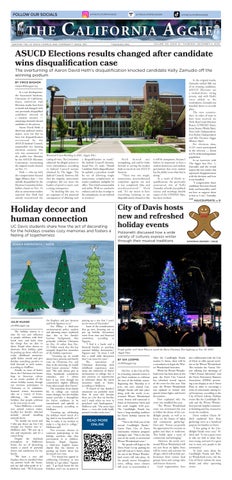
UC Davis students share how the act of decorating for the holidays creates cozy memories and fosters a feeling of togetherness

the fireplace and put lanterns and little figurines on it.”
The holiday season is a time for rest and reflection as people celebrate with their loved ones and hold close the things that are dear to them. People often choose to showcase their holiday spirit by putting up decor, which can evoke childhood memories, uplift darker moods and give families something positive to look forward to each season, according to HuffPost.
Amidst an array of festive decor, the Christmas tree looms large in American culture as an iconic symbol of the winter holiday season; though not everyone participates in Christmas or its traditions.
Seasonal winter decorations take on a variety of forms, reflecting the numerous holidays that people celebrate as the year nears its end.
Vanya Malhotra, a secondyear animal sciences major, recalled her family’s informal attitude toward installing seasonal decor.
“It’s mainly my mom and I who put decor up, but I do wrangle my brother into it,” Malhotra said. “We put up a tree and ornaments, and it’s a casual thing.”
Despite the laid-back atmosphere in Malhotra’s home, the act of decorating retains a touch of personal charm and satisfaction for her family.
“We have a very old fireplace that we installed when my parents built the house, and my dad takes pride in it,” Malhotra said. “We’ll decorate
Ava Pelkey, a third-year environmental policy analysis and planning major, explained that, due to her family’s German background, they primarily celebrate Christmas on Dec. 24 rather than Dec. 25. Pelkey noted that this has uniquely shaped her memories of the holiday experience.
“Growing up, we would always have presents and family time on Christmas Eve, and then in the morning, we would find Santa’s presents,” Pelkey said.
“My aunt always gets us these handmade countdown calendars, and I always have it up, even though my countdown’s slightly different from other people that I know.”
The transition from family life to college can include many changes, but the holiday season provides a throughline for festive traditions to be remembered and upheld, or even increased, according to Malhotra.
“Growing up, celebrating the holidays wasn’t much of a big deal in my household, so I like to make it my mission to make it a big deal in college,” Malhotra said.
Not everyone chooses to continue participating in the holiday activities that they participated in as children, however. Thanh Nguyen, a third-year English major, shared that his interest in putting up festive decor has decreased over time.
“I’ve found less appeal in celebrating Christmas or any holiday as I get older,” Nguyen said. “I go back home for the holidays, and I see no point in
putting up a tree that I won’t see for most of December.”
Some of the considerations that go into choosing not to put up holiday decorations come from time and financial constraints, according to Nguyen.
“I find it a hassle and a financial burden to purchase seasonal holiday decorations,” Nguyen said. “At most, I will buy a small table decoration that I can reuse for years.”
The association of Christmas decorating with childhood experiences may mean the reduction of festive involvement in college, but it also presents an opportunity to reminisce about the warm memories made at home, according to Malhotra.
“A bunch of [my family’s] ornaments are probably more than 10 years old, because there are a lot that my brother and I made when we were in preschool and kindergarten,” Malhotra said. “My mom kept those — even the really badly painted wooden-stick ones.”

Heth denied any wrongdoing, and said he looks forward to serving the student body as one of six new ASUCD Senators.
“There was one single, anonymous, uncorroborated complaint against me and it was completely false and unsubstantiated,” Heth said. “It’s my intent to have everything [relating to my disqualification] released so that
it will be transparent, because I believe it’s important to have a student democracy and student government that every student has the ability to see what they’re doing.”
As a result of Heth’s requalification, the previously announced win of Kelly Zamudio, a fourth-year political science and sociology double major of the UNIDAD Slate, has been revoked.
Polzonetti discussed how a wide variety of cultures express winter through their musical traditions
In the original results, Zamudio ranked fifth out of six winning candidates. ASUCD Elections use a ranked-choice voting system, and with Heth’s votes added to the recalculation, Zamudio was knocked down to seventh place.
The new senatorselect, in order of most to least votes received, are Heth, Rosa Linda Martinez Ruano
Jenna
Nate
Ezra
and Mia
Per elections data, 2,132 voters participated in the election — about 6.67% of the undergraduate population. In an interview with The Aggie late Dec. 1, Zamudio said she would respect the new results, but expressed disappointment with the decision and how it was handled.
“I congratulate those candidates that were elected fairly and honorably, and I am here to support them as best as I can,” Zamudio said.


BY GIA LOOMIS city@theaggie.org
On Dec. 4, the City of Davis is hosting seasonal events to get Davis residents to celebrate the start of the holiday season. Beginning this Thursday at 6 p.m., the city’s annual Candlelight Parade will take place along with the newly re-envisioned Winter Wonderland event. Events will surround G Street in Downtown Davis and last until roughly 8:30 p.m. The Candlelight Parade has been a long-standing tradition for Davis’ holiday seasons for decades.
“This is the 44th year of the annual Candlelight Parade,” Carrie Dyer, City of Davis community relations program manager, said. “This is the first year of the newly re-envisioned Winter Wonderland event.”
The parade will begin at the Davis Food Co-op parking lot and will end on G Street, where the rest of the Winter Wonderland events will take place. As the parade moves throughout town, rolling street closures will occur to accommodate it.
After the Candlelight Parade reaches G Street, there will be a countdown to begin the Winter Wonderland festivities.
While the Winter Wonderland event has been done in the past, the Davis City Council has refreshed several aspects of the event for this year. This year, the Winter Wonderland was updated to feature new special winter lights and festive decorations.
Dyer explained why the event was modified this year.
“The Winter Wonderland event was envisioned this year to follow the theme of the candlelight parade, as well as to focus on the beauty of lights and community gathering,” Dyer said. “Events can provide the opportunity for everyone to gather and share in traditions. This builds upon a sense of community and belonging.”
However, the newly envisioned Winter Wonderland will not just focus on lights; there will be events and activities for all ages, which will include performances from various local groups, horse and carriage rides and mascot characters. Local organizations have
also collaborated with the City of Davis to offer special activities at the Winter Wonderland. This includes the Varsity Theatre offering free showings of “Olaf’s Frozen Adventure” and the Davis Downtown Business Association (DDBA) presenting a tree display at the E Street Plaza in order to encourage a sense of community among local businesses, according to the City of Davis’ website. Holiday events like the Candlelight Parade and the Winter Wonderland provide helpful community-building and free, interactive events for residents. Davis resident Gloria Aldrich explained how these gatherings serve as a beneficial purpose for families in Davis.
“I love going to the Candlelight Parade every year,” Aldrich said. “It was a great event to take my kids to when they were young, and now it’s a great way to meet new people in the community.”
To learn more about the Candlelight Parade and Winter Wonderland event, visit the City of Davis’ website for more details and other upcoming events.
President Amrita Julka alleged harassment of women of color by white males within ASUCD
Julka did not name the alleged harassers, but noted that they do not sit on the ASUCD Senate

BY LILY KENROW campus@theaggie.org
The head of UC Davis’ student government is alleging multiple cases of harassment of women of color within the Associated Students of UC Davis (ASUCD) by white males.
The allegations were made at the ASUCD Senate meeting on Nov. 20, when ASUCD President Amrita Julka, a thirdyear political science major, brought up concerns during an open forum.
“This whole quarter we have had personnel issues, and these issues have been very disturbing to me because they specifically surround white men harassing women of color,” Julka said. “I don’t even have to get into why that is so detrimental to an association run by women of color. It just kind of goes to show you that you can hold these high positions and still have to deal with these issues on a daily basis.”
Though no names were disclosed during the meeting, Julka set a very serious tone for the room and expectations for the table.
“I want to put my foot down — right here right now — and say that [these instances are] not something we are going to be tolerating in this association at all,” Julka said.
“If there are issues, you can go to those people directly. You can have mature conversations with them. We are not going to be badmouthing people to one another. We are also going to be making sure that we are being respectful in our actions.”
While Julka runs the ASUCD Executive Office, ASUCD student supervisors cannot fire student employees. Terminations can only be carried out by university career staffers.
Julka also invited members of the Senate table to discuss with her any concerns or challenges they have — assuring the table she is an advocate for them and their safety — and asked the table to stand with and support those who are facing these challenges.
Internal Vice President Dhilena Wickramasinghe, a fourth-year sociology major, also offered the Personnel Committee — consisting of herself and ASUCD Controller Trinity Chow, a fourth-year
neurobiology, physiology and biology major — as a resource for the table.
Wickramasinghe also clarified that the alleged harassers were not members of the Senate table.
“The instigators in this situation are not anybody on this table — these are outside of the Senate table — but it is important to acknowledge [the issue] as a table,” Wickramasinghe said.
In an interview after the meeting, Julka alleged that there were two white men within the ASUCD who had perpetuated the behavior. She noted that she spoke out against them in order to prevent similar instances of harassment from happening in the future, and to encourage staffers who may be experiencing workplace harassment to speak out.
“I just wanted to call out that behavior during open forum, because I think if I don’t, who will?” Julka said.
“[ASUCD] is literally run by a woman of color — run by women of color. It’s just unacceptable behavior in this day and age, and we’re not going to stand for it.”

Former UC Davis Fire Chief charged with misappropriation of funds has mental health diversion denied
Nathan Trauernicht is accused of misappropriating $42,000 in overtime pay to his former executive assistant
BY LILY KENROW campus@theaggie.org
Former UC Davis Fire Chief Nathan Trauernicht, who was charged with misappropriating funds late last year, had his request for a mental health diversion denied in an appearance before the Yolo County Superior Court on Nov. 10.
Trauernicht is accused of misappropriating funds from Oct. 16, 2021 to July 22, 2023, approving fraudulent time sheets that resulted in $42,000 in overtime pay for his thenExecutive Assistant Meagan McFadden, over the two-year period.
To qualify for the mental health diversion, the defendant must be diagnosed with a mental disorder as defined in the Diagnostic and Statistical Manual of Mental Disorders; the disorder must be proven to have been a significant factor in the commission of the charged offense.
While Trauernicht is eligible due to his diagnosis of several mental health disorders, he was determined by the judge in his case to be unsuitable for the diversion due to the lack of connection between his mental disorders and his offenses, according to The Davis Enterprise.
His diagnoses include anxiety, attention deficit hyperactivity disorder, post traumatic stress disorder and depression.
Suitability for the diversion would have meant his felony charge would be resolved. Judge Paul K. Richardson noted that Trauernicht had received high praise in performance reviews during the time period he is alleged to have approved McFadden’s

overtime hours, which rebuts the claim of connection between Trauernicht’s mental health and his crime.
Trauernicht joined the UC Davis Fire Department in 2008 and served as fire chief for nearly 13 years before he resigned on Oct. 1, 2024. Nathaniel Hartinger was named interim fire chief in his place, before being named permanent fire chief on Aug. 7, 2025.
The prosecution has argued that the reason for Trauernicht’s approval of McFadden’s timesheets was not Trauernicht’s mental health, but rather his pursuit of a romantic relationship with McFadden. Steven Plesser, Trauernicht’s defense attorney, denied this notion in a statement to KCRA 3 last year.
“This indictment is wholly misguided and appears to be based entirely on speculation of an improper relationship
between Mr. Trauernicht and Ms. McFadden that simply did not exist, and of which there is no evidence,” Plesser said. In court, Plesser argued that his client’s many mental health diagnoses prevented him from having the attention for the menial tasks of his job, a claim which Richardson ultimately rejected. Trauernicht faces charges along with McFadden, who was charged with misappropriation of public money in a separate case, as well as embezzlement by clerk and perjury. McFadden is set to next appear in court on Dec. 12. Trauernicht’s case now proceeds to the trial-setting stage, and he is scheduled to return to court on Dec. 22. He remains out of custody on his own recognizance, on the condition that he is not put in any position of control over public funds.
The Davis Phoenix Coalition organized a community event honoring trans victims of hate crimes
BY SONJA WOOLEY city@theaggie.org
The Davis Phoenix Coalition (DPC), a local social justice organization that leads anti-bullying campaigns, LGBTQ+ advocacy and community organizing for Latinx families, recently held a community memorial in recognition of Transgender Day of Remembrance on Nov. 21 in Central Park. Transgender Day of Remembrance is an international annual event first organized in 1999, meant to draw attention to and memorialize transgender people who have been killed because of transphobic violence.
The community organizers constructed an ofrenda with electric candles, a trans flag and small photos of those who had passed away in order to honor the transgender individuals who have been killed in the United States in the past year. The memorial included a choral performance and sing-along by the Davis chapter of the Raging Grannies, a group of peaceful protestors that advocate for human rights through music.
Jeanette Vance, a longtime Davis resident and member of the Raging Grannies, spoke about the organization’s work.
“[The Raging Grannies group is] for women of a certain age who [want] to change the circumstances of the world and work towards social justice, climate concerns and fairness for all people,” Vance said. “We always regret [...] that the things we started out singing in 2017 are still concerns today. But change happens in small increments, and we hope that by doing our part, we can make things better over time.”
During the event, the DPC organizers read aloud the names and short biographies of the 32 transgender and genderexpansive people who had been killed in the U.S. in the past year, 56% of which were Black transgender women.
Among those killed were: Cameron Thompon, an 18-yearold from Tuscaloosa, Alabama; Ra’Laisa Wright, a 25-year-old from Minneapolis, Minnesota; and Santonio Coleman, a 48-year-old from Athens,

Georgia.
Sandre Henriquez Nelson, a DPC board member, added that there are more names they may be unaware of.
“Some of these people may also be from 2023 or 2021,” Henriquez Nelson said. “But [DPC] are just now finding their names because the traditional media misgenders them. There’s a lot more names out there that, unfortunately, we don’t know about.” DPC Chair Anoosh Jorjorian also reported on the state of trans youth in Davis.
“People think of Davis as generally liberal, and that can be true in that people have stated liberal values,” Jorjorian said. “Whether that manifests in day-to-day life depends. [Trans youth] are still facing a lot of homophobia and transphobia in schools from elementary school on. It may also be surprising to find out that there are kids who are being kicked out of their houses for being trans. But the difference is that for every one person who is openly discriminating against our trans kids, we have five people who stand up and say ‘No, it’s not okay.’” Amanda Oyao, the outreach specialist for Elevate Queer Yolo, an organization that supports LGBTQ+ youth ages 12-26 in Yolo County by giving them access to basic needs, spoke to the crowd.
“It’s beautiful in this dayand-age to get to do things in person,” Oyao said. “It’s great to share information on Instagram, but it’s great to get that physical
presence to see the people who are here to support Davis youth and, honestly, each other and just the queer community as a whole.”
The Transgender Day of Remembrance event in Davis was held three weeks after an alleged hate crime occurred in Sacramento against Alvin Prasad, who was attacked at Bandlands, a popular LGBTQ+ club in the Lavender Heights district, and remains in a coma. Nelson reflected on the incident and his interactions with Prasad.
“I have met the gentleman,” Nelson said. “[He is a] sweet guy [who] gives you the shirt off his back [and] just loves the community. Unfortunately, he was attacked similarly to the attack that started the Davis Phoenix Coalition.”
The attack Nelson mentioned referred to a violent incident in 2013, when the son of Gloria Partida, Davis city council-member and co-founder of DPC, was attacked because of his sexual orientation.
Liam Lunberg, a Davis resident who helped organize the event, spoke about the emotions he felt present within the community.
“Everybody’s scared,” Lunberg said. “Everybody’s angry too, but just mostly scared, and some people are so much to the point that they’re not even wanting to come out. But we’re at least showing people that you’re not getting rid of us, we’re not going anywhere. [We’ve] been here a long, long, long, long time.”
Polzonetti expounded on the various ways in which cultures and musical genres affect the expression of winter in song
BY JONAH BERMAN arts@theaggie.org
As UC Davis students approach the holiday season, a litany of rich musical traditions will be awaiting them. Both classical and modern holiday tunes will reverberate throughout family gatherings, grocery stories and shopping malls alike, adding a flair to the season that would be inaccessible without these melodic bundles of joy.
Music associated with the holidays and winter draws on a rich array of histories and cultural traditions.

UC Davis Professor of Music Pierpaolo Polzonetti, who focuses on the nuances of Cuban music, jazz and opera, discussed the many ways in which holiday music can be more than meets the ear.
This is in spite of the fact that in modern-day America, we are inundated with massive amounts of Christmas music, some of which Polzonetti described as “sound wallpaper.”
“We are bombarded by Christmas songs,” Polzonetti said. “The soundtrack is almost unavoidable.”
Most of the holiday music heard in malls or stores is queued with the goal of appealing to the broadest possible audience, rather than focusing on any particular niche or tradition. This has expanded around the world as American radio has rapidly grown over the past few decades, according to Polzonetti.
Much of this modern American holiday music, however, is rooted in older traditions.
“There’s a lot of ancient folk tradition that ends up there, often evoking the bagpipes, hurdy-gurdy, or other instruments,” Polzonetti said. “Because traditionally the street musicians were playing those, trying to make a buck. Now everything ends up in the big melting pot of the Christmas playlist.”
Polzonetti also discussed the variety of techniques that classical composers would use to create a sensory feel for the winter months.
“Music can’t lower the temperature, it can’t be wet, but it can trigger a reaction in the psyche,” Polzonetti said.
For example, in the works of Antonio Vivaldi and Fanny Mendelssohn, both composers sought to recreate the psychological effects of winter.
“What you hear is not so much a rendition of the stormy weather of winter, but the effects of cold on the skin,” Polzonetti said. “It’s really about the suffering of the human body.”
However, some classical composers took a different approach, such as in Franz Schubert’s “Winterraise.”
“Here, Schubert doesn’t represent anything that has to do with cold, or snow, or temperature,” Polzonetti said. “It’s all a metaphor for the loss of love.”
Jazz and holiday music also have a unique relationship. Polzonetti explained that historically, the two often intertwined in unique ways.
“During the swing era, songs like ‘Jingle Bells’ were set for jazz orchestra and used in dancehalls for Christmas parties,” Polzonetti said. Furthermore, many might musically associate the holiday season with the relaxing jazz piano work of Vince Guaraldi, who provided the score for the “Peanuts” animated special, “A Charlie Brown Christmas,” (1965).
However, Polzonetti explained that this appropriation of jazz can, in some ways, be in conflict with the genre’s founding goals.
“We need to think of the adapting functions of jazz in society,” Polzonetti said.
“All of this is unfortunately removed from the origins of jazz as African-American
music, Afrocentric music, that was developed to fight against extreme injustice. When it’s associated with comfort, we might forget that the roots of this music are in injustice and inequality.”
Polzonetti also remarked on how the physical conditions of a place influence what’s depicted in the music of that culture. For example, in Cuba, winter temperatures remain comparatively high, so Cuban music is less likely to discuss frigidity as an aspect of the holiday season.
“The songs associated with winter are more about eating Christmas food, like stuffed turkey,” Polzonetti said. “But it doesn’t sound any different than the songs that they have for other periods of times.”
Polzonetti also pointed out how the effects of climate change can even impact the music we listen to.
“One thing I can say is that global warming has changed the way winter is perceived even in places that traditionally produce a lot of winter music, like Italy,” Polzonetti said. “‘Winter’ by Vivaldi was felt differently in the eighteenth century than it is now.”
Ultimately, each new piece of holiday music can be seen as akin to a falling snowflake, splendidly intricate in its own unique way.
The season’s sounds can range from relaxing to rapturous, varying from decade to decade, but regardless, will always be a part of the winter memories we hold so dear.
The California Department of Housing and Community Development has required the amendment of the measure to allow for more affordable housing BY MADELYN SEVIGNY city@theaggie.org
Measure J/R/D, also known as the Citizens’ Right to Vote on Future Use of Open Space and Agricultural Lands, is an ordinance that requires a citizen vote on general plan amendments that redesignate land on the outskirts of the city from agricultural use or open space to urban use.
The measure was initially passed as Measure J in 2000, and was renewed in 2010 and 2020 as Measures R and D, respectively.
On Oct. 8, the City of Davis held a Joint Commissions Special Meeting to discuss amending Measure J/R/D. The meeting was held in response to a request to amend Measure J/R/D by the California Department of Housing and Community Development (HCD). Barbara Archer, public information officer for the City of Davis, explained why the state of California asked the city to amend this measure.
“In order to get our housing element passed, the state asked us to at least look at Measure J/R/D because we weren’t meeting housing goals, [which] most cities are not,” Archer said.
In order to get the housing element passed by the state, the City of Davis agreed to add Policy 2.6 in the 2021-2029 Housing Element, which said, in part, that Davis must revise the language in Measure J/R/D that would exempt it from a public vote, according to the staff report.
In a statement via email before the joint commissions


BY KHADEEJAH KHAN campus@theaggie.org
Following mass faculty mobilization, the University of California Office of the President (UCOP) has reversed its decision to end funding for the hiring incentive within the UC President’s Postdoctoral Fellowship Program (PPFP).
The announcement was made in a letter by UC President James B. Milliken to the UC chancellors on Nov. 18.
“After learning more about the history and success of the program and weighing the thoughtful perspectives that have been shared, I have concluded that barring extraordinary financial setbacks, the PPFP faculty hiring incentive program will continue,” Milliken said in the letter.
The PPFP is a highly competitive program in the UC, offering postdoctoral research fellowships across all 10 campuses. The program has an acceptance rate of less than 5%; only 30 fellows are accepted each year across the UC system. It includes a generous hiring incentive, with current and past PPFP fellows paid $85,000 per year for the first five years of
their ladder-rank positions.
The program has been a part of the UC system since 1984 and has historically incentivised women and minorities to pursue research within the UC system. Per a 2014 UC press release, some 75% of PPFP participants go on to tenure track positions at colleges or universities, more than half at a UC campus.
At each campus, fellows are expected to participate in academic life, pursue full time research, meet regularly with their assigned faculty mentor and avoid outside employment or additional commitments like teaching.
After news broke in early November that UCOP planned to rescind funding for the hiring initiative, a coalition of faculty systemwide issued a letter demanding the reinstatement of funding, calling on the UC to affirm its “core values of excellence, integrity, equity, diversity, and inclusion (Regents Policy 4400).” Over 1,000 faculty signed on to the letter in under two weeks.
“Targeting PPFP is an assault on the values of the University of California and a pre-emptive concession to the federal attack on our in-
stitution and higher education more broadly,” the letter read.
For Michael V. Singh, former PPFP fellow and UC Davis professor of Chicana/o Studies, the removal of the hiring incentive fell in line with a larger trend of universities removing programs and initiatives relating to diversity, equity and inclusion, following executive orders by President Donald Trump. Last March, the UC removed the requirement for diversity statements as part of faculty hiring.
“There’s structural reasons — as to why when you’re applying for jobs — that lead to faculty of color, women, first-generation college students, not getting hired,” Singh said.
“The PPFP program felt like it was one program to try to repair that in such a way,” gonna remove [the hiring incentive].’” UC Davis Middle Eastern history Professor Stacy Fahrenthold has mentored three different fellows. A firm believer in the mission of the public university, Fahrenthold didn’t just see the defunding of a hiring incentive as a loss for the program but as a loss for the university as a whole.
POSTDOC on 9
JASON XIE / AGGIE

meeting, Archer clarified that the City is looking to amend Measure J/R/D by expanding the scope of exemptions to the measure, intending to make building affordable housing more achievable.
City of Davis Director of Community Development and Sustainability Sherri Metzker started the meeting with an overview of the gathering’s purpose, along with details about Measure J/R/D. Her presentation was followed by comments given by each commission in turn. The commissions in attendance were: the Climate and Environmental Justice Commission; Fiscal Commission; Open Space and Habitat Commission; Planning Commission; and Social Services Commission. Vince McLaughlin of the Planning Commission provided his perspective on the public’s opinion on Measure J/R/D and how it would impact the ability to amend the measure. “It seemed to me the electorate [during the original adapta-
tion of the measure] fell generally into three categories,” McLaughlin said. “There were thoughtful and conscientious people that were pro [Measure J/R/D], there were thoughtful and conscientious people that had legitimate objections to the project, then there’s a large contingent in the population that are just [not in my backyard] (NIMBYs). We’re going to have a real uphill battle here trying to pass a J/R/D amendment, because it’s the same electorate.”


The rise of platforms like Substack make it easy for anyone to publish their work, but does it come at the cost of the art of writing?
BY ABHINAYA KASAGANI akasagani@ucdavis.edu
I first made my way onto Substack — an online publishing platform for writers and creatives — in the fall of 2022, deliberating for months before posting a disorganized listicle that should’ve never seen the light of day. I occasionally wish I had been too young at the time to have free rein over the Internet, because some parental controls might’ve saved me the embarrassment of splaying my personhood recklessly for the masses to see. If you manage to find my Substack after this, I ask that you not let it color your perception of me.
The rise of Substack, which launched in 2017, is remarkable. The publishing platform is designed to allow its users to produce long-form essays or multimedia content without the hassle of situating it in the cultural dialogue by adhering to journalistic style rules. Ironically, a post on Medium claimed that Substack “[empowers] creators and journalists to build a better internet […] growing exponentially while other
platforms [are] declining.”
In recent years, the digital gates of publishing have opened themselves to anyone and everyone willing to enter, democraticising literature and journalism. Without having to jump through the hoops of traditional publishing, people are more compelled to share their ideas with the world — feeling less intense judgment from their peers makes it an effective mode of communication. The marketing pitch goes something like this: If it’s accessible to everyone, why not try your hand at it? Even if it’s a shot in the dark, take a stab at it via pencil or keyboard, and maybe you’ll eventually find something valuable to say by its end.
The Internet, however, has conscripted the population into the role of passive consumers, which the people have made no attempts to disprove. Posting now has become a means of performing identity; of translating the private to the public. While it is an accessible form of communication (one that rarely requires payment), the rise of self-publishing reads as a widespread encouragement of personal branding. Take Charli XCX, for
instance — her move to Substack essentially extends her curated identity into the journalist sphere. Readers fall under the illusion that they know her, as if she is “relatable,” despite fundamental differences in lifestyle. She spends a large part of her Substack post attempting to convince her audience that being a “pop star” isn’t all it’s made out to be — that it’s occasionally embarrassing.
More broadly, other celebrities — for example, Rosalia, Pamela Anderson and Lena Dunham — have made their way to Substack, compiling their thoughts into an almost public diary; mimicking a time when celebrities like Halsey and Lana Del Rey were releasing poetry books despite having no prior literary training or experience. Their unwarranted peddling of content feels as if it sidelines the actual craft of writing in favor of gaining attention or profit. Despite how the ease of publishing allows the influx of content to grow, not all of it is immediately worthwhile — so, choose wisely.
While it is interesting to consider the earlier connotations of self-published works being disregarded for their informality,
The rise of “algospeak” has created a new era of self-censorship
BY SABRINA FIGUEROA AVILA sfigueroaavila@ucdavis.edu
I’ve spent a lot of my time at The California Aggie writing columns about language, and so have many others. But, my writing comes from a place of good intention — literacy and critical thinking are important, especially in an age where the Internet is democratized to the point where misinformation and disinformation run rampant. One thing I have yet to see discussed, however, is the impact of social media on the language we use and how it could possibly affect us in the process.
Social media — particularly TikTok, Instagram and X — has been credited with changing the way we communicate: a concept coined “algospeak” by Adam Aleksic, a linguist and content creator. This includes the use of emojis, the creation of new expressions and, of course, words.
This is, in part, because some social media apps, like TikTok, can ban you for using provocative words which violate their community guidelines. Perhaps you’ve seen or said words like “grape” instead of “rape,” “unalive” in place of “commiting suicide” or “pew pew” in reference to guns — these are examples of algospeak. At first, this was the Internet community’s not-so-sneaky way of getting around guidelines, filters and algorithms that could restrict them, but now it’s seeped into our everyday vernaculars. If we need to talk about something graphic or sensitive, we can opt to use one of these words to make the subject more palatable. On the surface, using these words might seem harmless.
‘What

But in reality, it is censorship; on social media, app developers and algorithms are quite literally censoring users’ language. This is due to Section 230, where platforms are allowed to moderate their own services by removing content that violates their own standards — however, these guidelines do not apply to real life. Once we start using it in person, where we are allowed to talk freely without a tech company breathing down our necks, it becomes selfcensorship.
Additionally, the more we beat around the bush, the more we become desensitized to the issues the words are actually referring to. Rape, suicide, guns, death, porn and sex are all topics that can be shocking when discussed out loud, but some of them — like rape and suicide — should be regarded as heavy, serious topics; they should not be normalized. Using the actual word instead of their “lighter” versions has more impact to get your points across, not to mention that people who don’t go on social media might not even understand what’s being
said if they hear these algospeak words. These words can dehumanize the people who have gone through harsh events. They trivialize both these experiences and the victims themselves, which deserve to be talked about seriously and without being sugarcoated or diminished. Many victims already feel small, overlooked or silenced, and dumbing down the words we use to discuss their experiences only harms them more. From social media to the press and to the government, the language we use matters. Many are already desensitized from continuous exposure to violent, graphic content or dehumanizing language that pops up in the media; we must be intentional and careful with our choice of words. Our voices are truly ours and can be weapons against our oppressors — don’t censor yourself.
Disclaimer: The views and opinions expressed by individual columnists belong to the columnists alone and do not necessarily indicate the views and opinions held by The California Aggie.


such platforms now make it easier by removing any need for micromanagement. When one isn’t preoccupied with the other aspects of literary production, they become more available for the task at hand. Substack tracks your metrics and increases your visibility so there are none of the usual unnecessary channels to go through: One does not need to find editors and publishers or vie for approval.
But the craft of journalistic writing is a craft nonetheless. Now that your work is spoonfed to an audience and can bypass the often-embarrassing “likeshare-subscribe” model, what do
you have to lose? The question that arises here is: Is publishing something online all it takes to be a writer, or is there more to it?
While platforms like Substack might encourage people to peddle their personas through their work, they forget that “branding” isn’t why we write. This curation-focused drafting and rewriting of public personas in order to perform as a “writer” is simply a facade without the skills that require sustained thinking about topics of interest. Nowadays, you can be anything when self-proclaimed; even with purely regurgitated
gibberish masked in the form of hot takes, life advice, self-mythologizing and selfdepracating accounts of one’s recent weeks (which do no one any good), you can call yourself a “writer.” The argument becomes less about skill and more about artistic intent — sure, writing can be just as cathartic as it is revelatory, but there is a thin line between the private and public where one
Are we uplifting political figures or further pushing an exhausted narrative?
BY GEETIKA MAHAJAN giamahajan@ucdavis.edu
Anyone who has studied, watched or even tried to explain a piece of political news understands that it’s a complicated topic. Behind every movement, political figure and action, there are hundreds of smaller religious, historical, economic and contextual actors. Deciphering the political happenings within another nation can almost seem as complicated as learning their language. Yet, the western world, either as cause or consequence of its international sphere of influence, doesn’t shy away from pulling political actors from the east and making an example out of them.
“Western presentations of foreign political figures are frequently oversimplified to elevate or promote their own stories or importance.”
Geetika Mahajan
Nearly everyone I went to school with knew about Malala Yousafzai; her story was equally tragic, inspiring and foreign. The idea that a young girl could be shot simply for wanting to go to school was so abhorrent to me at the time, and it was unthinkable
that this was the lived reality for women across the planet. After Yousafzai’s story made global headlines, she was welcomed into the western political sphere — a Nobel Prize and bestselling novel cemented her place as a public figure in the Englishspeaking world.
Still, there is a lot about Yousafzai’s story that was conveniently left out when she was meeting Obama or being handed the Nobel prize. A story about a young girl stopped from going to school by Muslim extremists is both palatable to Americans and elevates the west.
The truth paints the United States in a much more unfavorable light; groups like the Taliban emerged as a direct consequence of the billions of dollars the U.S. sent to Afghan rebels for the purpose of defeating the Soviet Union. In the following decades, U.S. military involvement in Afghanistan further intensified power vacuums and reinforced a fragmented political landscape that allowed the Taliban to thrive.
Cutting out essential portions of the narrative in order to promote a digestible, self-serving story is a frequently utilized, manipulative tool in American politics. Adopting complicated eastern political figures only to westernize them is a phenomenon that’s been recurring for decades; the first mentions of Mahatma Gandhi and his impact within the Indian independence movement in most history books focus on the fact that while Gandhi was a prominent figure in Indian history, he was one out of many freedom fighters who toppled the British Raj. Yet, mythologizations of his “anti-
violence” movement almost made it sound like he killed the British Empire with kindness, once again oversimplifying a complicated political movement to promote a specific idea. The “successful peaceful protest” angle can definitely be useful, especially for subduing the millions of people unhappy with the racism and elitism inherent within American society. Whether it was the Black Lives Matter (BLM) movement of 2020 or the pro-Palestine demonstrations across college campuses, the U.S. government loves to tell people that peaceful protest is a tried-and-true method for making change. Framing Gandhi’s protest as a strategy for success promotes the idea that violent institutions can be defanged nonviolently — which has definitely come in handy for a country that still profits off of slave labor. Western presentations of foreign political figures are frequently oversimplified to elevate or promote their own stories or importance. This doesn’t mean that figures such as Gandhi and Yousafzai weren’t recognized or changemakers in their respective countries, but it does emphasize the importance of scrutinizing their appearances in our own history books and the roles they play in our political philosophies. Frequently, the most important part of the narrative is not what is being said about them, but why they’ve been included in the first place. Disclaimer: The views and opinions expressed by individual columnists belong to the columnists alone and do not necessarily indicate the views and opinions held by The California Aggie.
your major tells you about what your star sign says about your personality’ test
Oh my God, please tell me who I am
BY MADISON SEEMAN meseeman@ucdavis.edu
Your horoscope says that Venus is the reason you’re all out of whack, the Myers-Briggs Type Indication (MBTI) test says you have the same personality type as the Joker and your major says you’re majorly in need of a break. What even is a personality? Is it quantifiable? Merriam Webster’s dictionary defines “personality” as the “totality of an individual’s behavioral and emotional characteristics,” but the uQuiz I found says it can be measured by Pokémon Type. Because I don’t have enough on my plate right now, I spent hours of my life trying to get to know myself and the concept of personality itself. I started with the classics.
My MBTI is a typical introverted, intuitive, feeling and perceiving (INFP) and the last Enneagram test I took said I was 8 x ⅔ + 4 - 20, with a wing of the imaginary value i. Can an enneagram be negative? Can an enneagram tell you which of the thousand faces on Hinge is hiding your college sweetheart? Can an enneagram tell you whether or not that’s something you really want? Then I got deeper — I started taking insightful, underground personality tests you’ve probably never heard of. I got a good grade on the IDR Labs Likeable Person test, which is obviously more reliable than my score on the IDR Labs Dark Traits test (I don’t want to talk about it). My Rorschach test said “Try again later,” and my Magic 8 Ball
started leaking into the shape of a little blue man cowering in fear. Reddit said my Magic 8 Ball might be broken, and that the blue liquid leaking out may or may not be poisonous. Everything I’ve read about my sun sign — Aries — seems to imply I’m full of irrational anger and malicious intentions. I know this may upset some Aries astrology-heads out there, but I’ve chosen to claim Pisces, my sign according to the new astrology rules NASA announced back in 2016, even if I do agree adding the Ophiuchus sign is a little blasphemous.
When I looked up my birthday on one guy’s advertisement-littered astrology blog, it solemnly informed me that my birthday makes me prone to heart disease. A different blog said I have
“an army of admirers,” which I think I prefer! My mother said I have a family history of struggling to admit when I’m wrong, but my new sun sign, Pisces, says I’m “wise and full of spiritual depth,” so I think people should probably listen to me.
Now, as someone who’s taken many, many tests, I’m ready to drop some knowledge on you, dear reader. Highly qualified armchair psychologists say that any personality tests taken during a cloudy finals week are void, and my Magic 8 Ball (now held together by duct tape) agrees you might want to try again when you’re in a better mood.

Recent mass shootings remind us of the continued widespread harm firearms inflict on modern life
WRITTEN BY THE EDITORIAL BOARD
As many families gathered and enjoyed the Thanksgiving weekend, too many across the nation were forced to face the consequences of gun violence.
In Washington D.C., a shooting against two members of the National Guard on Thanksgiving Eve left 20-yearold Army Specialist Sarah Beckstrom dead and Staff Sergeant Andrew Wolf in serious condition.
In California, a shooting on Black Friday at the Valley Fair Mall in San Jose injured three. A 17-year-old suspect has been identified by police, who have said the shooting during the busiest shopping day of the year was “gang-motivated.”
And, on Saturday, a shooting at a 2-year-old’s birthday party in Stockton left 11 injured and four dead, including three minors; the victims were aged 8, 9, 14 and 21. The circumstances in each incident are different, and the Editorial Board is by no means trying to conflate these unique scenarios and tragedies into one nondistinct event. What we do recognize is that gun violence — and the culture around
it — remains pernicious in American society. As of Dec. 1, there have been 13,501 shooting fatalities in the United States in 2025, according to the Gun Violence Archive (GVA). The U.S. gun homicide rate is 26 times that of similar high-income countries, and the GVA counts 380 mass shootings in the country so far this year. As of 2022, the U.S. had 121 firearms for every 100 residents.
The role of the Second Amendment of the Constitution — the right to bear arms — remains complicated. Most Americans agree that there should be stricter gun control laws, with 61% of those surveyed saying that it is too easy to legally obtain a firearm, according to a 2023 survey by the Pew Research Center. Around half said that they view gun violence as a major problem. Instead of taking decisive action against the leading cause of death of children in America, President Donald Trump has instead decided to take retribution on the millions of migrants seeking entry into the U.S. and shift focus away from firearm regulation. His argument stems from the fact that the National Guard
shooter is an Afghan national, granted asylum to the U.S. after the country’s withdrawal from Afghanistan.
The latest changes to immigration policy have been sweeping and swift. They include bars on issuing visas to Afghan nationals, a pause on new asylum claims and a revised green card vetting process. The Trump administration had previously made plans to reassess the asylum claims of refugees made under President Joe Biden.
These policy changes may just be the beginning. In a statement on social media on Monday, Secretary of Homeland Security Kristi Noem called for a “a full travel ban on every damn country that’s been flooding our nation with killers, leeches, and entitlement junkies.”
It is clear that the administration’s actions are misguided and opportunistic. Rather than whole-heartedly addressing gun control through new policies or executive orders, the President has instead chosen to further the anti-migrant, xenophobic rhetoric which has become synonymous with his time in office.
The Editorial Board
A not-so-merry standard encounters a camaraderie
BY NEVAEH KARRAKER nakarraker@ucdavis.edu
The quote “Let’s enforce the idea that women are born equal, not made equal by their experiences,” was written in fading sharpie on the walls of the women’s restroom in Bainer Hall on campus.
More anonymous quotes:
“Stand strong, young women.
XO from a 66yo grandma and former teacher,” and “Si se puede cariño <3.” In the science, technology, engineering and math (STEM) world, women often stand alone in a room full of men. We’re required to be polished and poised — if we choose not to wear makeup or dress more casually than business attire, our voices go unheard and our authority is doubted. In comparison, no one bats an eye when a man shows up in a wrinkly T-shirt and with obstinate bed-head. This discriminatory double standard is so familiar and ingrained in society that most women have just accepted it.
Yet, most women don’t publicly criticize this misogyny — not because it goes unnoticed, but out of fear of being accused of “overreacting” or being “too emotional.” To challenge these inequalities would be to risk losing the fragile respect we already struggle to earn.
And so, the partiality becomes an isolative sentence: silently noticed by many, voiced by few. When it is voiced, it’s only for the eyes and ears of other women — in this case,
somewhere as informal as a bathroom.
The encouraging messages painted on the walls all address the same social issue of immoral standards. There’s a subtle privacy to nameless confession — an ironic safety in exposing yourself through graffiti in a public restroom. Vulnerability is much less of a burden when shielded by anonymity. Almost all women, multigenerational and culturally diverse, can relate to the sexism in the STEM branch, but discern that they must endure it privately.
Holidays are a direct parallel of this: The same emotional suppression exists, but in a different setting.
There’s an expectation to be fully present, joyful and grateful as we decorate the Christmas tree or attend a family function. Instead of an expectation of professionalism at work, we’re expected to bring a feminine positivity to gatherings.
Despite the season of celebration and joy during the holidays, seasonal depression is a universally common struggle. Yet, it may not all be due to the drop in temperature or stressful exams; emotional struggles also interrupt the festivities and dim the twinkling lights. Rather than acknowledging and attending to those feelings, we mask our grief, fake a smile and hope to (somewhat) enjoy the day — if we can survive the stiff environment at all. Amidst the togetherness, we feel dreadfully isolated as we convince ourselves we’re a liability.
While vulnerability during the holidays may not come with
the safe disguise of anonymity — like the walls of the women’s bathroom in the engineering building do — the people we enjoy celebrating with should still be a source of comfort. It’s important to recognize that both joy and grief can coexist during the holidays. It’s not a weakness, and it doesn’t jeopardize the festive spirit; it proves we’re all human.
If you succumb to the sorrow of the early nights over winter break, remember that the quiet encouragement that is written on the walls of Bainer Hall surrounds you. Whether it’s friends, family or even a stranger who understands more than you might expect, let others in and let them support you.
Although the holidays encourage brightness, exultation and togetherness, what is needed most during this time is compassion.
If some graffiti written by a stranger can be sincere enough to inspire, imagine the power of intentional interactions. Beyond enclosed walls, true support is simultaneously present for both accomplishments and hardships — proving strongest when it’s shared in the open; vulnerability has an unexpected effect as it breaches the bridge to form an intimate connection. Perhaps this season and beyond, let’s give ourselves and others the permission to be open and authentic.
Disclaimer: The views and opinions expressed by individual columnists belong to the columnists alone and do not necessarily indicate the views and opinions held by The California Aggie.

condemns the federal government’s blatant attempts to manipulate the narrative and wrongfully place blame on vulnerable communities in the U.S. Instead of addressing the root causes of gun violence and the system that perpetuates it, the administration has prioritized scapegoating entire demographics and upholding white supremacist ideologies that are becoming far too common.
“The annual chance of being injured by a foreign-born mass shooter was about 1 in 94.7 million, and the chance of being injured by a nativeborn shooter was about 1 in 6.9 million per year,” a Cato Institute study reads.

Editorial Board
ALYSSA CREVOISERAT Editor-in-Chief
MAYA KORNYEYEVA Managing Editor
VINCE BASADA Campus News Editor
JORDAN POLTORAK City News Editor
MOLLY THOMPSON Opinion Editor
ZOEY MORTAZAVI Features Editor
SAVANNAH ANNO Arts & Culture Editor
MEGAN JOSEPH Sports Editor
KATIE HELLMAN Science & Tech Editor
Managing Staff
JENNA LEE Photo Director
NOELLE ESCALANTE Layout Director
SAVANNAH BURGER Design Director
SAM RUIZ New Media Manager
KAYLIE HUANG Social Media Manager
JULIAN MONTANA Website Manager
JULIA CROSSAN Distribution & Outreach Director
YILAN LI Translation Director
CARMEN RODRIGUEZ-ZARATE Translation Director
JENNY DYE Copy Chief
ALYSSA PULIDO Copy Chief
LAURIE PEDERSON Business Development Manager
Travel encourages an invaluable shift in perspective

BY VIOLET ZANZOT vmzanzot@ucdavis.edu
Daft Punk once created a song with a duration of 7 minutes and 9 seconds, the only lyrics being “Around the world, around the world” — and I think I finally get it now. Three simple words repeated a lot of times, and for what reason?
Maybe it’s a fun song to listen to during dark, late nights, but maybe, more romantically, it’s because the idea of traveling “around the world” is so utterly fantastic — maybe it deserves 7 minutes and 9 seconds on repeat. This over-analysis of Daft Punk’s song lyrics is all to say that travel is good; it is good and it does good. Travel is substantive, in that it teaches a person to be a better citizen of the world. It changes you. That’s why Pitbull went from “Mr. 305” to “Mr. Worldwide” when he began to explore the world and gained global appeal, because, once you see it you never go back. You always know your “normal” is only one way of being. For the last two and a half months I have been keeping up with any-and-all beloved Aggie readers from London, where I have been doing the UC Davis program in international relations at the London School of Economic and Political Science. It has been my esteemed pleasure to share any insights I may have, and let this great city influence and inspire me.
The greatest lesson I’ve learned over the course of my time here is that travel is the greatest teacher. Since I arrived in September, I have seen barely a fraction of the city (on account
of it being so huge), and I have been lucky enough to explore Cardiff, Dublin, Vienna, Prague and Berlin on weekends. I’ve become friends with my nearest pub’s bartender, found my favorite coffee shops and Westend shows and scraped my knee playing pick-up “football.”
I‘ve learned through experiences and conversations with strangers that, though we find meaning in different things globally, at our core, it is our ability to make meaning that connects us. I was in line for border control in Prague, when the man behind me seemed visibly upset about the long “queue.”
He was sighing and looking around anxiously. We locked eyes, and I sent him a look of silent commiseration, before he said, “It never used to be like this before Brexit.” Before Britain left the European Union (EU), the British could use the line for EU passport holders, which tended to be much shorter.
It’s funny: You can learn so much in school about the impact of geopolitics on people, but only when you experience it firsthand does it actually make sense. There is clear political turmoil in England, and the widespread Euroskeptism is palpable. I think in the United States, it’s easy to feel removed from other people across the world. But, through learning about the divisiveness of Brexit and then seeing it up close — from one polarized state to another — the world felt a little less separated. Not only does traveling give you a unique insight into outside cultures, but it also allows you to see your home country from the outside. Witnessing firsthand how the British perceived Brexit — while simultaneously learning
its mechanics in lectures — made it seem both simpler and more complicated. Likewise, realizing how people see the U.S. was all the more enlightening. Watching the fascination in people’s eyes when you reveal your country of origin (America) is unmatched — and definitely humbling; patriots to non-U.S. countries don’t hold America in such a high regard. It is flawed and disgraced in many ways, but revered all the same. More than anything, it’s the curiosity that is revealing: The same intrigue I have for them, they have for me. When you step into a new world, when you try their “biscuits” and take their “lifts,” it’s all too easy to feel like an outsider. But if you can embrace, chase and learn to love that feeling, it becomes easy to learn something new about yourself, your world and their world, and to find a world in between that you can share. It is absolutely a luxury, but, if you can, perhaps you should; the best way to conquer the idea of “normal” is by seeing your world from the outside and another world from within.
Disclaimer: The views and opinions expressed by individual columnists belong to the columnists alone and do not necessarily indicate the views and opinions held by The California Aggie.

BY SAVANNAH ANNO
arts@theaggie.org


Album: “Ego Death at a Bachelorette Party” by Hayley Williams (2025)
While there’s nothing niche about Paramore — the iconic pop-punk band behind “Misery Business,” “Still Into You” and “Decode” from “Twilight” — I will argue that lead singer Hayley Williams’ solo discography is still severely underappreciated.
“Ego Death at a Bachelorette Party” is a critical examination of Williams’ personal and professional lives over the past two decades, inspired by a newfound independence after her 20-year contract with Atlantic Records came to a close. Tracks like “Ice in My OJ” and “Hard” offer punchy, confident reflections on her time as a public figure, while slower ballads like “I Won’t Quit on You” and “Dream Girl in Shibuya” deconstruct her complex relationship with Taylor York, Paramore’s lead guitarist. In the collection of 20 different songs, there’s not a corner of her life Williams doesn’t touch on; creating a versatile amalgamation of themes that range from anti-depressants to betrayal to Tennessee’s systemic racism. While this could be a daunting task for other artists, Williams has both the vocal talent and genre-blending ability to match her writing. “Ego Death at a Bachelorette Party” is all of Paramore’s punk, indie-rock punch — perfectly intermeshed with Williams’ own individual, experimental pop sound.
Book: “Katabasis” by R.F. Kuang (2025)
While some have argued R.F. Kuang’s writing since “The Poppy War” trilogy is too dense or impossible to get through, I believe the critiques are simply a product of user error. While “The Poppy War” is true, epic historical fantasy, Kuang’s “Babel” (2022) and “Katabasis” (2025) are works of dark academia; products of her own experience as a graduate student. “Katabasis” follows two Cambridge doctoral candidates who are studying a form of magic that operates on philosophical principles. While the terminology may seem daunting, Kuang takes the time to explain every niche reference and citation. After the untimely death of their advisor leaves them with slim post-graduate prospects, ex-friends and present-day-rivals Alice Law and Peter Murdoch travel to Hell in an attempt to revive their professor’s soul.
As the pair journey through the desolate landscape — imagined through real-life literary texts like Dante Alighieri’s “The Divine Comedy” and T.S. Eliot’s “The Waste Land” — Kuang weaves through the complexities of Alice and Peter’s past relationship and how they arrived at the point of tension and coldness that readers observe at the beginning of the novel. Not only do these flashbacks reveal the nature of the pair’s dynamic, but also the true nature of the man they’re so desperately trying to save. A love story filled with mathematical algorithms (that you by no means have to understand), logical proofs and endlessly frustrating miscommunication, you can’t help but root for Alice and Peter’s seemingly hopeless happy ending as the novel drags you further and further down into its enrapturing academic mystery.
Song: “Tunnel Vision” by Magdalena Bay (2024)


Imaginative, alternative and relentlessly addicting, Magdalena Bay is high off the 2024 release of their second studio album, “Imaginal Disk” — currently preparing for their first European headline tour. A solidified synth-pop duo, Magdalena Bay takes their listeners on a journey through space and time with a dreamy, experimental sound. “Tunnel Vision” blends bright, twinkling keys with a groovy drumline, with lead singer Mica Tenenbaum telling a story of self-reflection and the realization of past mistakes. Along with other personal favorites like “Angel on a Satellite” and “The Ballad of Matt & Mica,” “Tunnel Vision” exemplifies the very best qualities of the musical duo, who constantly create tracks that transport their listeners up and out of this world.
Movie: “Oh, Hi!” dir. Sophie Brooks (2025)
Sticking with recency, “Oh, Hi!” is the latest in a hopefully forever-growing list of dark romantic comedies written and directed by women. “Oh, Hi!” starts like every perfect dream: Logan Lerman is sitting in the car, singing along to the radio and whisking his girlfriend Iris (played by Molly Gordon) away for a romantic weekend in Ojai, California. Iris, understandably entranced with Lerman’s character Isaac, couldn’t be any happier — she and her boyfriend are experiencing one of the first important milestones for every new couple. That is, until she learns that Isaac never officially accepted the title of “boyfriend.” So, Iris does what any respectable young woman suffering from a situationship would do (if it wasn’t illegal), and holds him hostage in their Airbnb.
Criminally funny, “Oh, Hi!” is an extreme look into modern love. While the shock-value of the witty, raunchy satire remains high throughout the entirety of the film, its humor functions to punctuate the slower moments of reflection on Iris and Isaac’s relationship. Each side of the story is revealed through heartwarming, romantic flashbacks that make you empathize with the pair as they both grapple with the end of their situation, still trying to figure out what they meant to each other amidst the chaos of their trip. Complete with a killer soundtrack and warm, idyllic visuals, “Oh, Hi!” is a perfect balance of comedy and contemplation.
Why Gen Z is still obsessed with “Stranger Things” as it premieres its final season
IQRA
BY
AHMAD arts@theaggie.org
When “Stranger Things” first flickered onto screens in 2016, it wasn’t just another piece of nostalgia-laced science fiction: It became a phenomenon powerful enough to turn the world upside down.
For Gen Z, many who grew up alongside the cast and watched the series evolve across its five seasons, the show has consistently commanded their attention upon each return.
Set in 1980s Indiana, “Stranger Things” chronicles the lives of a group of best friends, Will, Mike, Dustin and Lucas, whose ordinary world fractures when Will mysteriously vanishes on his bike ride home after a night of playing Dungeons & Dragons (D&D). Their search for answers leads them not only into the dark shadows of their small town, but to Eleven, a quiet girl with a buzzed haircut and the unnerving power of telekinesis. What begins as a quest to find a missing friend quickly unravels into an encounter

Review: Daniel Caesar’s ‘Son
The R&B artist experiments with soul, gospel and soft rock influences to examine themes of religion, love and the self

BY SOPHIE LIN arts@theaggie.org
In an era where R&B often favors fleeting hooks and hyperpolished production, Daniel Caesar’s return with his fourth studio album “Son of Spergy” asks listeners to recognize his soul. Released on Oct. 24 following a two-year hiatus, this album is a deeply intimate, almost confessional journey. Without losing sight of the singer’s R&B roots, Caesar delves into themes of reconciliation, troubled relationships and religious values.
“Son of Spergy” is among his most innovative and intimate works, featuring 12 tracks with collaborations from Yebba, Blood Orange, Bon Iver and even Caesar’s father, Norwill Simmonds. Laced with hazy, psychedelic vocals and nearly gospel-like elements, the album provides plenty of room to unpack the layers of slow-paced intensity.
The album’s opening, “Rain Down,” is nothing short of transcendental, with heavy Christian themes evoking a spiritual, reverent atmosphere. Layered with audio snippets of Caesar’s aunt speaking and the repetitive phrase “Lord, let your blessings rain down,” the track adds extra lyrics of ethereal melancholy, creating the feeling of a meditative and pleading chant. Featuring British artist Sampha, the song’s near-sacred feel invites curiosity and serves as a gateway into the album’s core religious conflict.
Following “Rain Down” is one of the album’s three pre-release singles, “Have a Baby With Me.” This track is the definition of yearning, blooming with a bittersweet guitar melody that carries the weight of a painful realization: “There’s no time to believe what we could be.” It’s a gut-punching
confession of vulnerability and longing, perfectly capturing that moment of holding onto the idea of “forever,” even when you recognize the crumbling reality of a relationship. The album’s rhythm picks up with “Call on Me,” introducing a grittier bass element that injects a funky, soft-rock feel — still troubled, but now moving. The track showcases Caesar’s sonic versatility, not rejecting intimacy and vulnerability for a second.
“Son of Spergy” then ebbs and flows into my personal favorite, “Baby Blue.” A calming, ethereal and beautiful track, “Baby Blue” feels like the slow tide of the ocean, filled with soft guitar, strings and delicate drumming. The track’s emotional impact is sealed with the closing audio clip of Caesar’s father, Simmonds, preaching the gospel: a brilliant way to reinforce the album’s weighty religious themes through the incorporation of family. The musical style here blends soul, gospel and soft rock influences to create a calming yet profound atmosphere.
“Root of All Evil” takes on a jumpier, lighter note with a Mac DeMarco-esque rhythm that almost deceptively contrasts against the raw lyrical content. The lyrics grapple with religious themes, singing “Am I a man or a beast? Somebody please discipline me, for I’m a sinner,” which perfectly captures a gritty internal struggle beneath the facade of normalcy. Caesar provides an honest lens into the often messy and conflicting side of faith and morality. One of the album’s most popular tracks, “Who Knows,” has garnered over 34 million streams on Spotify; it tells the story of uncertainty and yearning better than any other on the album.
with sinister forces and an otherworldly, parallel dimension that challenges the concept of reality itself.
As the series premieres its final chapter — with volumes releasing on Nov. 26, Dec. 25 and Dec. 31 — its influence feels impossible to ignore.
With all four previous seasons charting on Netflix’s Top 10 list and setting viewership records, the show’s reach has stretched far beyond its sci-fi niche.
But, how did “Stranger Things” come to resonate so profoundly with a generation raised on hyper-connected media, visual storytelling and a relentless churn of pop-culture cycles?
Retro-rewind and Nostalgia
A central part of the series’ appeal lies in its meticulous curation of 1980s aesthetics and pop culture.
From the use of iconic tracks like Kate Bush’s “Running Up That Hill” and The Clash’s “Should I Stay or Should I Go” to film references ranging from “Stand by Me” (1986) to “The Goonies” (1985) and even “The
Terminator” (1984), the series utilizes homages to connect with various viewers.
It’s a big Halloween bowl of retro candy,” James Poniewozik wrote for The New York Times. “It is, in other words, a human-made equivalent of the algorithm.”
“Stranger Things” exemplifies the way streaming television repurposes pop culture touchstones audiences already love, by packaging them into a bingeable, immersive viewing experience, according to Poniewozik.
In this sense, the series does not simply evoke nostalgia, but embodies the streaming era itself: a medium defined by discovery, recommendation and the philosophy that “If you liked that, you’ll like this next,” according to Poniewozik.
These retro elements are not only decorative, but serve as a bridge between generations, according to Lubna Beary, a second-year cognitive science major.
“I obviously didn’t grow up in the 80s, but I did grow up listening to a lot of 80s American music and movies because of
my dad,” Beary said. “So in that sense, I did experience nostalgia whenever I would notice a reference to an old movie or heard a familiar tune. References in general are always well-received by an audience, and help people feel more connected to what is going on by linking what they are already familiar with to something new and exciting.”
The show also exemplifies the nostalgia Gen Z chases through retro music, older movies and vintage fashion, according to Shaffana Mustafa, a second-year statistics and economics double major.
“I feel like Gen Z is heavily inspired from previous eras,” Mustafa said. “We’ve seen the return of low rise jeans, Y2K fashion, etc., and “Stranger Things” is very reminiscent of past eras. It also brings back nostalgia of magical and supernatural stories we grew up reading like Harry Potter and Jurassic Park.” While the referential aesthetics of the show were key in shaping viewers’ fascination with the series, so did its original, now-emblematic moments,

according to Chloe Zarrinkelk, a second-year linguistics major.
“I remember the image of Joyce’s Christmas lights and letters being everywhere,” Zarrinkelk said. “It was just so new for us at the time; everyone was addicted.”

The radio station will be relocating to TB-24, taking its music and memories along with it

UC Davis’ student-run radio station, KDVS 90.3FM, has plans to move out of Lower Freeborn Hall in spring quarter of 2026. Due to Lower Freeborn being declared seismically unsound in 2018, the station will be relocating to building TB-24, housed near the Associated Students, University of California, Davis (ASUCD) Bike Barn.
After beginning operations in 1964 as KCD in Beckett Hall — a formerly all-male dorm located in present-day Regan Hall in Segundo — ASUCD applied for an educational FMbroadcast license and moved KDVS to Lower Freeborn in 1966.
Over the years, KDVS has established itself as the largest physical music collection west of the Mississippi, holding thousands of color-coordinated cassettes and records. Several years of music history and culture are wrapped up in the basement where the station resides; vintage posters and stickers cover almost every available surface, while “The Stacks” contain floor-to-ceiling shelves of vinyl records and CDs.
KDVS Music Co-Director Avery Infantas, a third-year genetics & genomics major, is directly involved in the station’s
move.
“We’re going to take what we can to the new station, but it’s a smaller space and we can just redecorate with the new things that we acquire,” Infantas said. “A lot of our old posters are going to be preserved at the library.”
Beyond the tangible music library, KDVS has thorough roots in recording and mixing performances in their live Studio A. Covered in signatures by innumerable bands, the soundproofed room has been affiliated with many different artists. Pavement’s first show recording, for example, was made in the Lower Freeborn space; the same room where artists such as Bob Marley, the B-52s and Talking Heads have all performed their music.
The station, which holds approximately 150,000 pieces of physical media, must be entirely packed up and moved across campus. Some aspects of the station are being changed in order to fit into the smaller space, including the way their physical media is packaged.
“We’re re-sleeving CDs into plastic sleeves so that they take up less space,” Infantas said. “We’re going to have high-density shelving so that more things can fit in a smaller space.”
that come with its location, especially for members of corestaff that spend hours in Lower Freeborn.
“It feels very tight-knit when everything is all in the basement like this,” Infantas said. “I think part of what contributes to that is the fact that there isn’t access to WiFi down here, so you’re forced to kind of actually talk to other people.”
Having no online connection to the outside world through a phone or computer gives the station a pre-internet feel — almost freezing it in time. This, coupled with the visible history etched into every surface of KDVS, creates a sense of interrelation between current staff and DJs from decades past, according to Infantas.
Infantas also detailed that the move is a big change for the station — the amount of time that the radio has been here means that the small details will be the things that people miss the most.
The benefits of baking as a hobby, with student recommendations to get you started
NATALIE SALTER arts@theaggie.org
In our digital age, it has become a respite for us to pursue offline, hands-on hobbies.
The act of creating something tangible rather than consuming an endless scroll of online content has been suggested as immensely beneficial and gratifying. Amongst these endeavors, culinary hobbies can be especially rewarding, with the act of making food being as personally fulfilling as it is a means of community building; we share meals with each other as a gesture of love and care.
With this in mind, baking is a particularly wonderful pastime for anyone seeking an offline hobby. While you might be craving a homemade sweet treat year round, there’s something especially magical about baking during the colder months of the year. The temperamental weather and cold, dark days of winter make it all the more cozy and comforting to pull a batch of homemade cookies or a loaf of warm bread out of the oven.
From sweet to savory, simple to complex, there are a myriad of baking recipes waiting to be tried. As such, it can be difficult to decide where to begin, especially if you’ve never tried your hand at baking before.
Beginning bakers may want to start out with simple, onebowl recipes with few steps. Cookies are always a reliable and delicious choice. They’re endlessly customizable too; for example, you can enhance classic chocolate chip cookies by sprinkling sea salt on top, or by adding butterscotch chips for extra sweetness.
For a seasonal flair this December, gingerbread cookies are a special treat to try making.
“Every couple of years, me and my younger brother pull out this gingerbread recipe, and it

brings us back to when we were little,” Noorah Dhamim, a third-year applied chemistry and forensics double major, said.
“Half the fun was in shaping the dough into various odd-looking gingerbread shapes; the other half came from decorating — we would make the kitchen a mess with icing smeared everywhere.”
Many other recipes include a creative, decorative element, turning them into artistic projects as much as culinary ones. Loaves of focaccia bread can be adorned with herbs and vegetables to make edible pictures. Pies, which already have endless possibilities for sweet and savory fillings alike, can be given unique crust designs.
If you’re struggling to pick a flavor to pursue, try matching the vibes of the season.
“One of my favorite recipes, especially for the fall, is a Dutch caramel apple pie,” Venessa Cuevas, a third-year English major, said. “Not only is it deliciously sweet, but it helps make the house feel so cozy as you channel the autumn vibes into a pie.”
On a more intimate level, the memories entwined with the food we bake can make them all the more significant. Our culinary traditions are often deeply personal, linked to our family histories, cultures and personal experiences. The holidays in particular are rich in these traditions, and perhaps you might select a recipe that is tied to one of them.
“Now, this simple act of baking gingerbread cookies has become a tradition, one consistent no matter how busy each of us is,” Dhamim said. “It was never really about the recipe, but more about the memories growing up together and creating something that brings us closer to each other year after year.” If you don’t have a longstanding baking tradition, you can always begin one now — in the future, it may become something more special and meaningful than a simply delicious hobby to share with your loved ones. At the very least, it will provide you the wonderful sort of fulfillment that


Whether it’s Chinese food or a pickle ornament in a tree, food is an essential mode of family connection
HANNAH OSBORN arts@theaggie.org

Beyond the technical aspects of moving, there are emotional ties to the space
“It does, in a way, feel like the charm of the station is going to be reduced because we’re not in a literal basement anymore,” Infantas said. “It’s certainly going to be different because I’m afraid that it won’t be as close-knit, but I’m still excited to see how it goes because I like the challenge of moving everything and seeing what it will look like in the end.”
The station, having existed for such a long period of time, has involved itself in both state and federal history. From interviewing Ronald Reagan to over-the-phone interviews with Angela Davis and Cesar Chavez, KDVS has a rich past embedded deep in its original building. While having to relocate outside of Lower Freeborn Hall may seem like a loss to many core staff members, KDVS’ history and culture is not only woven into the fabric of the building, but that of its team — a group that is working to bring about a brand new era of the station after its physical move.

As fall quarter comes to an end, students are given the chance to take a break from academics and spend more time with loved ones. For many, the break will be a time to gather with family; something that 69% of Americans have reported looking forward to the most each winter.
Food is often a fundamental part of these gatherings. While the food eaten with family and friends over the break won’t look the same for everyone, each cuisine reflects unique holiday traditions.
Naya Cardiff, a thirdyear international relations and political science double major, has observed the way her family’s gatherings have changed over the years, visible in what food relatives brought to her parent’s Thanksgiving.
“Back when we used to have big family meetings, it would be kind of whatever anyone brought,” Cardiff said.
“But because my grandparents — although one of them is Vietnamese — have always tried to assimilate into white culture, and also because my godparents are from the South, it would be very traditionally Americana, the turkey and the stuffing and all that stuff.”
Cardiff noted that as her Thanksgivings got smaller over time, the food began to shift to cater to different family members’ tastes and backgrounds.
“My mom’s going to make a lasagna and my dad’s going to make a Welsh chicken [this year],” Cardiff said. “My dad’s just using this as an excuse to make all of his Celtic food.”
For Cardiff’s family, there
is also a longstanding tradition that separates how they celebrate Thanksgiving and Christmas. While they make food and come together for the former, she explained that going back home to Oakland for Christmas is a different story.
“The family tradition on Christmas has always been, and always will be, [that] we go to Chinatown and we find a Chinese restaurant to go to,” Cardiff said. “It stems from the Chinese/Vietnamese side of the family and [that] no one’s in Chinatown on Christmas, so it’s just really easy to go find a restaurant that is uncrowded and really good.”
For other students, food may also be related to activities their family participates in. Such is the case for Levi Klouse, a third-year history major, who described a German Christmas tradition involving pickles.
“So, you hide a pickle ornament in the tree,” Klouse said. “The kids have to go find it, and the first person to find it, you get an early Christmas present. It’s really hard to find it sometimes because it’s green and blends in.”
Klouse also shared some of the foods his family makes for the holidays and how they enjoy these dishes, including his regional favorites.
“Personally, my favorite thing that gets made every year is this corn casserole, because we’re from Illinois and we like corn,” Klouse said. “My sister really likes cranberry jello and then we usually make some kind of garlic knots or some breaded roll. I think one of my favorite things is when it turns into a potluck Thanksgiving and everyone brings something, so then it’s super random.”
Sometimes cooking the
food comprises the entire tradition itself, along with the memories that come with it. Lailey Elliot, a second-year anthropology major, shared how she and her parents bake cookies together during the holidays.
“We make a whole host of German Christmas cookies,” Elliot said. “We make zimsterne, which are these little cinnamon stars. We make linzer cookies, which are my favorite; they’re almonds with jam in the middle. This is a pretty big undertaking for three people. I have great memories of getting together and making all these cookies with my mother — we like sweets.” Spending time together was a throughline for what made their food traditions special. Cardiff described why the presence of food is essential to the interactions at her family gatherings.
“For me, food is just a convenient excuse to get everyone in an area that doesn’t have a TV to distract them, which is a good time to talk,” Cardiff said. “Last Christmas, there was considerably less TV because it was a time for us to enjoy each other’s presence. The importance of the food isn’t so much the food itself, although the food is really good, but the fact that [it] allows people to just sit down and talk and not be distracted by all the things.” Whether sharing conversation over favorite dishes or learning recipes from relatives, food serves as a way to connect us to others and share traditions, according to Cardiff. In this season where we have more chances to dedicate ourselves to others, food allows us to bridge the gap, to make memories and to enjoy our time with each other.

With fall quarter coming to a close, several units and commissions presented to the Senate
BY AALIYAH ESPAÑOL-RIVAS campus@theaggie.org
Nine Associated Students, University of California, Davis (ASUCD) units presented their quarterly reports to the student government Senate at their penultimate meeting of the quarter, held on Nov. 25.
KDVS90.3FM, a freeform radio station on campus, began with updates on their slated move from their offices in Lower Freeborn to TB-24, a building near the Silo that also houses the Bike Barn. There is still no concrete timeline for the move or demolition of Lower Freeborn, as KDVS’ physical media collections must be re-sleeved and archived by hand, according to KDVS General Manager Teddy Torres, a fifth-year geology and Native American studies double major.
KDVS currently houses over 160,000 pieces of physical media, the largest collection west of the Mississippi.
“We are not moving the station until [re-sleeving] is completed,” Torres said. “I’m going to [estimate that] around spring quarter [is] the earliest we can try to move by.”
Picnic Day then presented their quarterly report, having recently announced their 2026 theme: “The Journey Home: Destination Davis.” Picnic Day 2026 is scheduled for Saturday, April 18. The theme was chosen to reflect the different journeys UC Davis students, alumni and employees take during their time at Davis, according to Picnic Day Chair Trinh NguyenDiem Vo, a fourth-year psychology major.
“It encapsulates the deeprooted connection to UC Davis and also celebrates the many paths that lead us home to Davis,” Vo said.
Vo also announced the “Picnic in the Park” event slated for Jan. 9, 2026. The event, which has not been hosted since before the pandemic, is a “mini” event to give students a glimpse of what is set to be offered at Picnic Day.
Next, Housing and Transportation Advocacy Committee Chair Chad Pugliese, a fourth-year community and regional development major, discussed ongoing collaborations with different City of Davis advocacy groups and campus outreach efforts.
Following the discussion, the Undocuscholars Advocacy and Aid Committee (UAA) presented strides made during fall quarter, including several successful events.
Namely, Banda Night — a music event in collaboration with Senator Luis L. Garcia, which had high attendance — and a crafting event to send cards to children’s immigration centers, in collaboration with the Chinanx Latinx Collegiate
Association, were successful. Currently, the UAA is seeking to transition from a one-personled committee to a larger team of students, as Chair Rosa Linda Martinez Ruano, a third-year sociology and community & regional development double major, departs the role to join the ASUCD Senate.
The Academic Affairs Commission (AAC) highlighted a financial aid workshop collaboration with Aggie Compass, the awarding of 50 ASUCD scholarship applications and an increase in engagement on their Instagram page.
Next quarter, the commission noted their plans for
spending tracker as soon as any
spending bill passes.
During open Senate discussion, many senators inquired about the exact number left in the Senate reserves budget, used for funding legislation and emergency legislation needs.
As of week eight, there was some $70,000 left in reserves — meaning around 20% of the reserves had been spent — according to Bhayana.
Student Affairs
Presentation:
Tim Jefferies, an advocate for student and community safety with UC Davis Student Affairs, held an informal focus
“Crash data shows that over the course of the last three years, not only have e-mobility crashes gone way up, they’ve gone way worse.”
Tim Jefferies Student and community safety advocate
hosting more consistent tabling on campus, commissioner-led projects and ASUCD Senate collaborations.
The Environmental Policy and Planning Commission (EPPC) spotlighted various events and collaborations, and noted that it is currently working with the City of Davis to increase student involvement in environmental policy and planning at the city level. EPPC is also working with ASUCD units to improve their sustainability efforts. EPPC Chair Sriya Batchu, a fourthyear environmental policy analysis and planning major, also reminded senators about attending at least one of their weekly meetings, saying only four out of the 12 senators attended an EPPC meeting this quarter.
“We have four awesome senators who have come to at least one of our meetings,” Batchu said. “We have quite a few senators that were unable to attend any meetings. We do have one more meeting [left in the quarter] if you’re interested.”
Lastly, the Senate heard a presentation from the Internal Affairs Commission (IAC).
IAC Chair Muskaan Bhayana, a second-year political science and economics double major, said that the commission reviewed 26 bills this quarter and introduced 14, with hopes to improve the
group to discuss possible ticketing enforcement on campus to combat bike and electric scooter crashes.
“Crash data shows that over the course of the last three years, not only have e-mobility crashes gone way up, they’ve gone way worse,” Jefferies said. “Think brain bleed, seizing, coma, like, really, really severe injury from student crashes. I don’t think anyone is pro-ticket, but I’m definitely anti-coma, right? We can’t not do something about the severity of what’s going on right now.”
The proposed ticketing enforcement seeks to give a $20 ticket to speeders as a first offense, while also including an education model that would allow students to bypass paying their ticket by watching educational safety videos.
Jefferies also highlighted the Moving Forward Together project, an ongoing sustainable transportation and campus planning initiative launched in 2024.
Confirmations:
The Senate confirmed Aitana Sahni, a third-year transfer student, as a new judicial council justice.
They also confirmed Nico Singh, a second-year bioengineering major who serves as a commissioner on the Gender and Sexuality Commission, as the unit director for Pride.
May formally apologized for a March email regarding Students for Justice in Palestine and addressed the increased presence of law enforcement on campus
BY LILY KENROW campus@theaggie.org
In his annual visit to the Associated Students, University of California, Davis (ASUCD) Senate at their Nov. 20 meeting, Chancellor Gary May gave a speech, thanking the table for their work and sharing some recent highlights and challenges for the UC Davis community. May notably highlighted the campus response to the pause in Supplemental Nutrition Assistance Program (SNAP) benefits and engaged in an open discussion with the table.
The first question directed toward May was asked by Transfer Student Representative Imani Nur, which focused on May’s March 21 campus-wide email regarding Students for Justice in Palestine (SJP) for their demonstration on March 11.
“We’ve received complaints from concerned community members about recent student activities, including the Students for Justice in Palestine demonstration on March 11, and those allegations are being reviewed at the highest level of the university,” the email reads. “I want to state as strongly as possible that we will not tolerate hatred against any individual or group, or any activities directed at any individual or group in ways that violate UC policy.”
Nur explained why she took issue with May’s wording.
“You singled out Students for Justice in Palestine,” Nur said. “Despite [SJP] being one of 15 groups coordinating the event. Many students feel this framing contributed to a hostile environment for Palestinian, Muslim and Arab students.”
May responded in acknowledgement, noting that he has had similar conversations with the Palestinian Life Advisory Committee.
“I take full ownership for what I wrote,” May said. “I own it, but I regret it. I didn’t have complete information, and I shouldn’t have written what I wrote. I apologize to the student body, to the Palestinian students and to SJP in particular.”
He attributed his language at the time to external pressures, particularly surrounding budget cuts and cuts in federal funding.
“During that time, and actually still, we were feeling tremendous pressure from external forces such that my judgement was impaired in trying to alleviate some of that pressure and keep things like federal funding flowing,” May said. “But I now realize that was a mistake on my part.”
Nur then asked if any investigations have been opened into non-UC affiliated agitators who she alleges stalked, harassed, doxxed and threatened students for the past two years.
May responded by emphasizing the difficulties for the university in investigating or taking action against nonuniversity affiliates unless a crime is committed.
“We’re sort of in a position where our hands are tied, because we are a public university and most of these things happen in public spaces,” May said. “If there’s any harassment or criminal activity, yes, then we can take action. But beyond that, there’s not much that could be done.”
Nur went on to point out
Section 100013 of University of California (UC) regulations, which states that no nonaffiliate on university property shall “knowingly and willfully interfere with the peaceful conduct of the activities of the campus or facility by intimidating, harassing or obstructing any University employee, student, or any other person.” It also prohibits nonaffiliates from lingering without any lawful purpose, which she alleged some individuals have been doing.
Nur then asked May why the university has not taken action against the individuals by not enforcing Section 100013 and leaving students feeling unsafe.
“I’m not right now familiar with the status of any complaints against those individuals and how those were adjudicated,” May said. “I suspect sometimes it’s [a] lack of evidence, sometimes it’s other reasons, but I don’t personally do those investigations.”
While the university has offered an increase of police presence on campus as a safety measure, Nur noted that the Council on American-Islamic Relations’ (CAIR) 2025 civil rights report showed a 71.5% increase in law enforcement encounters, many in the context of student activism.
“For Muslims, Arab and Palestinian students, police presence often heightens fear rather than safety,” Nur said. “Given this documented trend, and students’ lived experiences, why does the administration continue to default to public policing as a primary safety response, rather than implementing alternatives that do not put these communities at further risk?”
May responded by saying that in some cases, event organizers requested the presence of law enforcement.
“Oftentimes, the police
presence is requested by the individual or the organization that is having an event,” May said. “We try to respond to those requests. We tend to try to have a very lowkey presence — plain clothes, AggieHosts, etc.” When asked to commit to a meeting with ASUCD, SJP and the Muslim Student Association (MSA) to address the increase of Islamophobia and create a tangible and effective response, May agreed.
Other issues brought up by the table were student food insecurity, rising housing costs within Davis, resources for undocumented students and international students, legal aid with visas and student safety and lighting on campus.
Interim Senator Livreet Sandhu also brought up concerns over commencement, recounting a personal experience of being barred entry to the Golden 1 Center in June due to family members carrying a kirpan — a Sikh ceremonial dagger. Sandhu asked what May would do to ensure the incident would not happen again. May acknowledged the incident with an apology but said that the Golden 1 Center is a private entity rented for graduation, with their own policies and procedures.
“I think, quite frankly, they weren’t prepared for the ceremonial dagger that the Sikhs use,” May said. “We have had some conversations now — my understanding is that we’ve come to an understanding with Golden 1. We did follow up with their personnel and [tried] to explain the meaning of why [kirpans] are carried by Sikhs and why [they] should be allowed.”
The floor was then opened up to discussion with the public. One speaker, who wished to only be identified as a Palestinian student, asked May again about Section 100013 and brought up the Davis Oct. 7 Coalition, identifying them as a non-student group who has consistently appeared at SJP events and allegedly violated UC policy.


During the meeting, councilmembers and impacted community members reviewed challenges and necessary improvements
BY VRITI SHAH features@theaggie.org
On Nov. 18, the Davis City Council met to discuss and review the Homelessness System of Care in Davis. The meeting focused on program updates concerning the Davis Daytime Respite Center and the Davis Homeless Outreach program.
The state and future of the Davis Daytime Respite Center, which provides resources to Davis’ unhoused population, were previously discussed at a Sept. 16 City Council meeting. The first meeting focused specifically on the feasibility of the City of Davis to continue service of the Center and to temporarily keep its current location amidst a change in providers.
Dana Bailey, the social services and housing director, reflected on what has been accomplished by the Social Services Commission since the first discussion. During her presentation, Bailey noted that as research is being conducted to find alternative locations for the center, operations were temporarily brought in-house.
The Davis Homeless Outreach Program was also discussed during the meeting. The program currently partners with organizations such as CommuniCare + Ole, Turning
Point Community Services, St. Vincent de Paul and Davis Public Safety to provide outreach services to Davis’ unhoused population.
Bailey then addressed a future challenge: that policies and funding concerning homelessness and housing “are increasingly subject to change on the federal, state and local level,” making the funding that is available to the city and such programs highly unreliable.
Bailey and her team spoke about the shift in priorities they anticipate due to changes in funding.
“Yolo County [will be] required to shift funding priorities from homelessness programs as well as face [a] 5% reduction in local prevention dollars,” Bailey said.
She also mentioned that the funding that will be available will mainly focus on treatment for substance use and mental illness, rather than assist unhoused individuals in gaining financial self-sufficiency. Bailey then concluded the presentation with a set of staff recommendations.
“[We need to] continue Davis Daytime Respite Center operations at the existing location,” Bailey said.
“[We also need to] pivot from a contractor model to using in-house City staff, adding two new full-time equivalent (FTE) positions to
operate the Respite Center.”
The meeting then turned to a public comment section. A public commenter, who wished to remain anonymous, shared their personal experience and concerns with the Respite Center. The individual experienced homelessness in Davis in the past, and is a UC Davis alum.
“It does upset me to know there are these resources, but they’re guarded, so they’re not really helping the people that could use them, which is just a disservice to this city and to the money to wherever it’s being allocated,” the individual said. “I currently live [...] near the Respite Center, and we just got broken into not too long ago.
[...] Again, I was in this position where I was homeless, you know, so I have compassion for other unhoused people, but I feel like something new has to happen so that there can be accountability, change and hope for these [unhoused] people. Because, if there are all these resources that people don’t know or can’t even use, what’s the point of having all this stuff allocated for them?”
Oliver, a homeless individual in Davis who only shared his first name, spoke about his experience with the Respite Center and its current shortcomings.
“The Respite Center is an invaluable resource, [but] there’s

an incredible amount of potential
[for the Respite Center] that is not being tapped,” Oliver said.
“When I first started going to the Respite Center — when it was still communicable — we had computers, we had laundry and we had showers and on and on. Now we don’t have computers [...] [nor] laundry. Why does it make sense if the city and the organizations already haven’t been able to communicate enough to meet these basic functions, why would it make sense to bring in an outside contractor to fail again?” Oliver also discussed his personal experience with the Outreach Program and criticized it at its current state.
“The connections to care
[are] garbage, the wraparound services [are] garbage, everyone ends up on the street again,” Oliver said. “I don’t know where the money goes. The outreach team, that’s just the cops light. They just
Enter digits from 1 to 9 into the blank spaces. Every row, column and 3x3 square must contain each digit. Each Sudoku has a unique solution that can be reached logically without guessing.
Answer to previous puzzle: 11/20/25

FROM PAGE 1
“However, I’ve been told by a lot of people around me that it’s better to be known as somebody who lost with integrity than to be a student that is associated with harassing other students for votes and overall cheating. Regardless, I wish them the best.”
Zamudio, who also serves as vice-chair of the ASUCD Academic Affairs Commission, said she learned of the Judicial Council’s ruling in favor of Heth before the Thanksgiving break through internal student government channels. However, she did not learn about the recall of her win until the news was made public on Monday.
“I was left out of the loop,” Zamudio said. “I was just filled with anxiety because I just wanted a definitive answer. I don’t think it was fair to me, even if the answer was ‘yes’ or if it was ‘no’ that I got the position. It just really affected me.”
ASUCD Elections Officer Jack Wang, a third-year political science and sociology double major, said in an email that the fall election presented “unorthodox situations” which he hopes will be safeguarded against in the future. Wang finishes his one-year term as elections officer at the end of the quarter.
“After the voting is complete, the Elections Committee, including me, will try to work to address what has happened and propose solutions in the winter quarter,” Wang said.
Heth’s fellow Aggie Alliance slate member Ryan Kan, a
third-year political science and economics double major, was also disqualified. He faced accusations of repeated voter intimidation by several nonASUCD affiliated individuals, and is alleged to have commandeered voters’ phones in order to cast votes for himself and other members of his slate. Kan contested the decision in a separate case, though the Judicial Council sided with the Elections Committee in upholding his disqualification given the amount of evidence against him.
“I disagree with the Elections Committee and how they handled [my disqualification], but I respect their decision,” Kan said in an interview.
The senators-elect will soon join the student government’s most powerful legislative body, responsible for overseeing the Association’s $22 million annual budget and a myriad of student units and programs. They will be sworn in at the ASUCD Senate’s last meeting of fall quarter on Dec. 4.
“The hiring incentive is one piece of a much larger set of initiatives to promote service to a diverse California public,” Fahrenthold said. “It’s often presented as if we’re giving these emerging scholars a foot in the door, but it’s actually the opposite. UC reaps the benefit from this relationship. And faculty like me receive the benefit of developing collaborations with postdocs.”
Many faculty were concerned about the lack of consultation with the Academic Senate and faculty regarding the defunding of the hiring initiative. Fahrenthold and American Studies Professor Julie Sze, a former PPFP fellow and fourtime PPFP mentor, questioned the lack of faculty shared governance in this process.
“When I heard of the announcement, I was absolutely stunned,” Sze said. “In the two weeks, you saw all of [the faculty] being mobilized around this.”
For faculty who advocated to keep the hiring incentive, the reinstatement of funding feels like a reminder of the power of organizing. Still, Sze notes that the future of the program and higher education as a whole depends on the ability of faculty to remain organized.
“It’s definitely evidence that organizing can have an impact,” Sze said of the UCOP’s reversal. “But every victory has to be followed up on. The idea that this organizing is effective is a really powerful one, and it’s a really important one, especially now.”
“I think it’s always good to take every victory when it comes and acknowledge the limits, and then keep on staying organized,” Sze said. “That’s actually the most important part.”

to be an interrogation, a revision and a production, one would have to consider more than just the traction a piece of writing gains. It brings with it certain responsibilities: openness to suggestions, criticisms and other sustained ways of considering the world.
I have a professor who loves to say that the act of writing is difficult, because if it were easy, everyone would do it. Sometimes, it is disillusioning to learn that anyone can be a published writer at the click of a button. While I think it is wonderful that publishing platforms like these have made published writing accessible, I disapprove of the idea that getting words on the page automatically confers the status of “writer.”
While recognizing that having a voice is not synonymous with having an audience, one must consider not only the accessibility of the communication mode but also their individual ability to be impactful. Those who can’t do, no longer teach — instead, they’ve taken to their digital soapbox, writing about their experience “doing” in hopes that they eventually get closer to any semblance of a point.
Buzzfeed quizzes are untrustworthy (I consider myself more of a Luigi than a Bowser), but any uQuiz made by a decent middle schooler will be reliably eye-opening — it’s amazing what your favorite Mitski lyric can tell you about what “Peanuts” character you are. And I hate to break it to you, but that “Am I Gay?” quiz isn’t going to tell you anything you don’t already know. Another heads up: A quick look through the reliably dedicated “#MBTI” tag on TikTok — the most-trusted source of 9 in 10 psychologists — will tell you that the “16Personalities” test is not a reliable way to get your MBTI. If you’re going to put yourself in a box, make sure it’s a credible one. It can also be difficult to reconcile differing results. If the Big Five test says that you’re incredibly agreeable, but your star sign doesn’t agree, who can you trust? You might need to take a test on whether you’re more spiritual or logical to get your answer. When you have a headache, WebMD will say you might have cancer, but your star chart still says you’re a triple Virgo — my (taped together)
Magic 8 Ball says “Try again later.”
It’s easy to lose yourself in finding yourself. Your friends might say you’re obsessed, and your parents might struggle to find a delicate way to tell you that you’re going a little too far. But, it’s not your fault — that’s just the Snoopy in you (or at least that’s what that “Peanuts” personality test says).
Filled with pensive lyrics that evoke common feelings about the future, the song’s lyric “Is it a crime to be unsure?” feels like a direct window into the anxiety of modern life and the fear of falling behind. The album’s sweet, simple melody and honest delivery allow uncertainty to resonate deeply.
Tracks like “Touching God” and “Sign of the Times” are a joint introspective rumination, asking questions like “Is it my fault? God decides who stays, who goes,” which forces the listener to confront heavy themes of fate, blame and divine will.
“Moon,” featuring indie artist Bon Iver, offers a beautifully slow, intimate experience, with the lyrics accompanied by light piano chords that sound like trickling water. The songwriting expresses self-reflection as he sings, “I’m not who I want to be at the moment; maybe soon.”
Critically underrated, “Emily’s Song” serves as an ode to a past lover. He recalls soulful memories in the line, “We used to stay up for hours, many nights,” and concludes with “I just wanna thank you for being my mirror,” which offers a moment of gratitude for a significant past relationship.
“No More Loving (On Women I Don’t Love)” addresses family themes and features his younger brother, known as 646yf4t. The album then closes with “Sins of the Father” (featuring Bon Iver), and concludes with the choral
elements and religious themes that permeate the entirety of the album.
“Son of Spergy” is a rewarding exploration of a man grappling with universal struggles, delivering his most innovative and intimate work to date and successfully weaving together the lush, soulful R&B his fans adore with complex gospel influences. It’s an album that requires thoughtful unravelling of its raw lyricism and production subtlety.
Peters discussed the current pressing need for international activism — especially from voices as influential as Yousafzai.
“It’s important for people like Malala to take a stand,” Peters said. “It’s great to have people who are working towards making [the world] better and more accessible for women, especially since they are already discriminated against.”
Yousafzai finished her interview by sharing the main message of her memoir: Making mistakes and struggling doesn’t mean you are unsuccessful, it just means that you are human.
“The message is that — when we go through the lowest point in our life [or] when we feel anxious — it doesn’t describe us, it doesn’t make us weak, it is all a part of us being human,” Yousafzai said. “The most important thing is that we stay true to ourselves. It’s okay not to have an answer to every question. You know, we should just allow ourselves to navigate our way through these experiences. The most important thing is for us to ask for help and support when we need it and — especially to students and people here — it’s so important that you enjoy your time and have a lot of fun as well.”


This midnight study spot features weekly themed menus and a club designed to leave a lasting impact
Every student knows the struggle: It’s midnight, and despite the mountain of work you have left, you’re entertaining the idea of just going to sleep. A coffee — or even just getting up to move around or chat with some friends — could keep you awake, but where does a space that offers these outlets exist? This issue is exactly what The Midnight Grind (TMG) seeks to fix.
TMG is an on-campus club that hosts weekly evening events dedicated to creating spaces where students can enjoy a beverage or snack and study with friends.
“On campus, but also downtown, all the coffee shops close around 8 p.m. or even earlier, and I just hated the 24hour [study] room,” Hannah Xu, a fourth-year human biology major and one of the three board officers of TMG, said. “I was really looking for a space where people could connect and study together late at night, and also provide a healthy alternative to activities on campus where people could chill, play games [and] do group projects. That was kind of how it all started.”
TMG was founded in January of 2025 as an entrepreneurship project. After some consideration, its three founding board members agreed that there was a lack of third spaces on campus open late at night — a resource gap at an institution where the norm is students staying up late to finish homework or study for tests — and were inspired to turn their project into a reality.

“I initially created the whole branding system [and] visual guide for our social media and all of our print media as well […] Basically, everything that you see up front is pretty much hand-designed by me or one of our team members.” Currently, TMG has been hosting weekly events on Fridays, growing their following, connecting with more and more students and fulfilling their desire to provide a fun and welcoming space on campus.
“We’ve seen immense [growth] in numbers,” Xu said.
“[At] the last [meeting], we had 130 people sign up to come and we had 101 people show up at the actual event, so that was fantastic to see: great turnouts. We sell out every single popup, which is crazy, and we keep doubling up on the quantities of food we make.”
When looking into the future, TMG hopes to expand its hours of operation to more effectively meet students’ studying needs and grow a wider support network, according to Xu.
After completing the requirements to establish the club, the board members needed to decide what the process flow for events looked like. How could they get students into a space in the evening hours? What food and drinks could they sell? What were the organizational logistics?
This is where TMG Board Member Jeffrey Li, a fourth-year animal science major, came in as the go-to person for everything logistics-related.
“There’s a lot that goes into [planning events],” Li said. “We start by thinking about a theme […] and then we think about what menu items [we] want to do. Then, the event coordinators will talk to the food leads about
“We really brainstormed and had multiple meetings with mentors […] to decide what kind of route we wanted to go down, because there were a couple of pathways,” Xu said. “We could do the club route [or] we could become an actual company and do a startup. I think for us, we realized the most sustainable and realistic way of having something that’s more ongoing and having it be some sort of a legacy that we had in Davis was to go through the RSO [Registered Student Organization].”
what vision they have, but also whether that’s actually doable or not […] Once we secure that, we need to finalize the menu items. We need a specific ingredient list for each menu item, and then we can go ahead and book our location.”
TMG is unique — not only because it offers this rare third space for students, but because each of its events has a specific menu.
This menu is crafted, created and served by board members and volunteers, more affectionately known as host members, according to Li.
“For [the] food team, I work with our members to come up with the menu,” Kaitlyn Chang, a fourth-year design and computer science double major, said. “We do a lot of research

on our ingredients and try to figure out what’s in our budget [and] what we can offer for a good price. We debate on prices a lot. I’m always the contender to bring the prices down, because I know I don’t like buying expensive things.”
These weekly menus usually correspond to a set theme, which is decided by board members and other team members.
“We get creative with it — we pitch a lot of ideas to the event coordinators, who are responsible for running and planning out the events,” Chang said.
Each pitch has set parameters to ensure that every student who attends a TMG meeting can find something to enjoy.
“Our general guideline for our menu, as of right now, is we
have one caffeinated drink, one non-caffeinated drink and then at least one snack or food item,” Chang said. “If we can, we’ll do at least one sweet and one savory, but it really does [change] week-to-week and [depends on] if we’re doing a theme.”
After deciding on a theme and its corresponding menu, a meeting time and date is set. At this time, TMG confronts the task of garnering student interest in attending their club meetings: this is where Chang’s additional responsibilities come into play.
“For the social media team, I’m mostly responsible for driving the content and figuring out what to post [and] when to post it — laying out the details of what information needs to be shared at what time,” Chang said.
“We really want to host every single night, because you don’t just study on a Friday night,” Xu said. “We want it to be a space where people can think of TMG [...] when they want to do a group project or grab a drink at night, you know, things like that. And so, I think that’s kind of the dream.” Li shared his sentiment on the increased growth of their cause and the physical differences he saw being made.
“It’s been really rewarding to see all the hard work [pay] off, and how we really are filling in a gap that we see on campus, because that’s how this whole thing started,” Li said. For a late-night study spot or a relaxed place to grab a coffee and a cookie after a busy week, look no further than The Midnight Grind.
Founder Hannah Xi invites all UC Davis students to attend their final pop-up event of the quarter, which will be held at 7 p.m. Dec. 5, 2025, in California Hall: a winter-themed study night for students to cozy up and prepare for finals.
Yousafzai’s speaker event served as an inspiration for UC Davis students
BY VRITI SHAH features@theaggie.org
Malala Yousafzai is a renowned Pakistani activist, best known for her advocacy for the right of education for girls and women from all around the world. As a teenager, she worked to spread awareness by speaking at events and running a blog that urged governments to lift the ban on women’s education. Due to her outspoken activism, Yousafzai was targeted and shot by the Taliban in October of 2012, but fortunately lived to tell her story.
At 16 years old, Yousafzai started the Malala Fund, an organization that fights for the freedom of girls’ education and for the “more than 122 million girls [that] are out of school today.” The Malala Fund works to enable “transformative change from reducing school costs for girls living in rural areas in Pakistan to supporting young mothers to go back to school in Nigeria to driving global policy change that impacts millions of girls,” according to the organization.
In 2013, Yousafzai published her award winning memoir “I am Malala,” which detailed her first-hand experience fighting for women’s educational rights and her violent encounters with the Taliban. In 2014 — at just 17 years old — she was awarded the Nobel Peace Prize, and is the current youngest winner in history.
Now, 12 years after the release of her first book, Yousafzai has just published her second memoir “Finding My Way.” In this more recent autobiography, she details her journey after surviving the attack by the Taliban.
Most notably, Yousafzai discussed her learning experiences growing up — recalling trying cannabis in college, which led to a triggering of her post traumatic stress disorder (PTSD) — and her changing relationship with therapy. She also described stumbling her way into finding love and the universal struggles that go along with coming of age: especially in the public eye.

On Nov. 18, Yousafzai spoke about her newest memoir, “Finding My Way,” with UC Davis Chancellor Gary May at the Mondavi Center for the Performing Arts. The event, “An Evening with Malala Yousafzai,” was one of the fastest-selling speaker events in Mondavi history.
UC Davis students that were present at the event described their admiration for Yousafzai from a young age and into adulthood, explaining how their perceptions of her shifted after reading her new memoir.
“Well, I first heard about her story in seventh grade and, as an American student, I feel like we don’t really hear about how education in non-American parts of the world is,” Renata Lee, a third-year art history major, said.
“I think it’s just, like, an eyeopening experience to people who have the privilege to go to school and may not know [the privilege of education].”
Other students suggested that it’s Yousafzai’s illustration of the relatable struggles she has faced that empowers readers by proving you can be struggling your way through your 20s and simultaneously be an accomplished activist.
“I remember reading about her when I was in elementary school and thinking that she’s like this […] higher-level
person,” Morgan Peters, a fourth-year psychology major, said. “But she’s really just like us. Like, she’s in her 20s [and] she was a college student and so I really resonated with that. She’s able to do all of these things and, like, advocate for people with her book and stuff while also being relatable instead of [...] unattainable.”
Amber Campos, a fourthyear political science major, described another inspirational aspect of Yousafzai’s memoir, which has brought appreciation for the privilege of education offered to UC Davis students.
“Honestly, I learned about her from elementary school and just hearing her story [was] super inspirational,” Campos said. “I think for students specifically, it makes us kind of appreciate our education, especially as women.”
While Yousafzai has made a vital impact in the freedom of education for girls all over the world, the work is not yet over.
“We’re kind of in a world right now that has made a lot of progress in terms of human rights, like education,” Peters said. “But, we still are clearly suffering in some areas and the human rights of people around the world are being threatened right now.”
EKATERINA MEDVEDEVA science@theaggie.org
The beginning of November marked a particularly exciting time for the faculty and students at the UC Davis Physics and Astronomy Department. Adam Riess, a co-winner of the 2011 Nobel Prize in Physics for his contribution to cosmology, gave two lectures at UC Davis: one on Nov. 3 at a department colloquium on the implications of data from the James Webb Space Telescope (JWST) for Hubble Tension, and another on Nov. 4 about the history and methods of the expansion of the universe.
In the 1990s, Riess, who is now a professor at Johns Hopkins University, was part of the High-z Supernova Search Team led by Brian P. Schmidt of the Australian National University. The team’s goal was to measure the rate of deceleration of the expansion of the universe by comparing the observations of close and distant Type Ia supernovae, which occur about once every 50 years within the Milky Way galaxy, according to NASA. At the time, while it was known that the universe was expanding thanks to Edwin Hubble’s measurements, it was believed that its expansion must be slowing down due to the gravitational pull of the matter toward itself. This would imply that, at some point, the universe would stop expanding and instead would start collapsing onto itself in an event known as “The Big Crunch.”
a talk on cosmology at UC Davis

In 1998, the High-z Supernova Search Team found that the universe was, in fact, expanding at an accelerating rate. In particular, it was Riess’ analysis of “deceleration” of the universe’s expansion that first revealed this.
“The closest to a eureka moment I had was when I was working on relating the amount of deceleration to how much matter was in the universe,” Riess said at the public lecture. “When I ran the calculation, I got something that didn’t make sense — I got a negative mass for the universe. After a few days, I injected the
idea of introducing Einstein’s cosmological constant into the equations and found that they fit very well, that we had pretty good confidence that this was a necessary part of the story of the universe. In fact, that most of the universe would be in this form.” Before it was known that the universe was expanding, it was thought to be static. This was the time when Albert Einstein was developing his theory of general relativity. In order to mathematically make the universe static, he introduced the cosmological constant that had the effect of a repulsive
force that balanced out gravity. However, upon Hubble’s discovery of the expanding universe, he removed it, calling it his “biggest blunder.”
With Riess’ team’s discovery, it was reintroduced under what later became the concept of dark energy — repulsive force of empty space, marking a pivotal point in cosmology and opening numerous new avenues for research.
During the Nov. 3 colloquium, Riess discussed data from JWST; in particular, the rate of the expansion of the universe obtained from its
measurements of cepheids, an alternative for supernovae for this type of calculation. This confirmed previous results from Hubble Space Telescope, while deepening the so-called Hubble Tension as it diverges from the rate calculated via measurements of the Cosmic Microwave Background (CMB).
“[The colloquium] was difficult to follow as an undergraduate, and there was so much information to digest — but it was nevertheless worth attending,” Oliver Ortiz Garcia, a fourthyear physics major with an
Diving into how UC Davis students use our fossil collection and what fossils reveal
EMILIA ROSE science@theaggie.org
Buried away in the Earth and Planetary Sciences (EPS) building are rooms full of life from times long past. Creatures older than the university campus — even older than humanity itself — are all tucked away inside a department many students often never set foot in.
Built with support from faculty, students, donations and fieldwork, the fossil collection owned by the University of California, Davis has an array of specimens ranging from tiny ammonite shells to a replica Tyrannosaurus rex skull hung in the main entrance.
Now, ancient specimens don’t just show up in a university building: someone had to find, collect, clean and catalogue them. So, how did those billions of years of history end up here?
Sandra Carlson, an invertebrate paleontologist at UC Davis, explained the origin of the university’s fossil collection.
“The paleontology collection was established when Cordell Durrell was Chair [of the geology department],” Carlson said via email. “[Durrell] was not a paleontologist himself, but he built up these various collections from his own fieldwork and from gifts of fossils from UC Berkeley Museum of Paleontology, as well
as research collections made from UC Davis faculty and students.”
There are many methods of fossilization, including permineralization, where dissolved minerals can fill up the space inside organisms and crystallize. There are also trace fossils, which are imprints that record the activity of certain organisms — like tiny footprints or some other remnant of their existence. While fossils are most often hard remnants of the organism, like shells and bones, soft tissues can sometimes also be preserved in low-oxygen environments, as long as they are buried quickly and in a place where sedimentation rates are high.
Given the diverse fossil collection that UC Davis holds, how do students actually use these fossils, and what do they learn from them? David Gold, a geobiologist at UC Davis, discussed the many ways students interact with and learn from the collection.
“We have done a big revision of our [EPS 107] course […] so that the class really takes advantage of the fossils we have […] We do a lot of activities that real paleontologists would do,” Gold said. “We’re using a lot of our fossils to actually go and run those experiments [and] do the sorts of research that a paleontologist does.”
The hands-on access to the
fossil collection allows students to learn about the scientific implications of these preserved remains, such as discovering new information about past ecosystems and life forms, according to Gold. Furthermore, Gold noted that fossils may help reveal the connection between ancient organisms and their impact on our perspectives of the world; the crux of interdisciplinary reason.
“Particularly when I’m teaching, I think back to the people in Victorian times who were just starting to find the first dinosaur bones,” Gold said. “People were really just starting to understand that the world was so old — to discover that the world used to be populated with […] life forms that are nothing like we see today.”
In digging up those first fossils, humans found an entire world forgotten in dirt and time. The discovery shifted the perspective of how we think about the world — the narrative arc we were accustomed to and humanity’s place within it.
“What’s amazing about [fossils] is we all want to understand where we come from and what the world is like,” Gold said. “I’m fascinated by the fact that there were all these unusual life forms that once existed on this planet. By understanding them, it helps us think about what our place is, what our relationship to the natural world
astrophysics emphasis, said. “I was introduced to a lot of interesting physics and getting to hear a Nobel Laureate’s story from the Laureate himself felt really special. Adam Riess’ story is very inspiring.”
The public lecture presented by Riess on Nov. 4 covered the topic of the expansion of the universe more generally. It featured the story of how his team made the discovery about the accelerating expansion rate, which he supplemented with pictures of his original notebook. In this notebook, he performed the calculations and communicated with his team as they cross-checked the results.
“The introduction of the cosmological constant was the most interesting part of the presentation,” Brian Khov, a third-year physics major, said. “Riess simply used that constant out of pure ‘confusion and desperation’ which, miraculously, ended up working to help explain why the universe is expanding at an accelerated rate.”
The audience frequently engaged with the lecture, with many attendants, both students and community members, asking insightful follow-up questions.
“I found Dr. Riess’ public lecture to be extremely insightful, and it revealed a large dilemma in astrophysics that I was unaware of,” Kiran Mody, a fifth-year physics major, said. “I think it is important for students and members of the public to attend these lectures because they allow us to understand the kind of research that is being done at the highest caliber in a way that is digestible.”

is, what our responsibilities might be and what it means to us as a species. That’s one of the fun things about paleontology. It’s a gateway […] to understand all different disciplines. There is the human side of it. What does it mean to be members of an Earth that’s got this long history without us?”
Ultimately, these fossils demonstrate that humanity is part of a larger evolutionary story arc; one that stretches beyond our own time, according to Gold. As hallmarks, as insights across all disciplines and as tools to see beyond our own time, fossils serve as windows to both scientific and philosophical meaning. For students who want to get
involved and learn more about UC Davis’ fossil collection, the good news is that one does not have to major or minor in related disciplines to participate. To start, students can join Gold’s mailing list through a link at the bottom of the website fossils. ucdavis.edu: This is where Gold posts all volunteer opportunities and updates about the collection.
Additionally, the EPS department encourages students to pay a visit to their building and observe the T. Rex skull and the sabertooth cat skeleton in the main entrance, as well as the numerous scientific posters around each floor.
“My plan over the coming year or two […] is to get a lot more [fossils] in the public,”
Gold said. “So, even if there isn’t a committed lab to study dinosaurs, for example, there will be a bunch of displays around the building that people will be able to interact with and enrich their learning. They can actually see, and in some cases, touch real fossil specimens and not just hear about them.”

Inside California Governor Gavin Newsom’s recent executive order supporting beneficial fire
LILA MAGBILANG science@theaggie.org
To many, the whiff of fire in the air is cause for alarm. From the apocalyptic orange sky looming over the Bay Area in 2020 to the inferno that swept through Los Angeles County in early 2025, the regime of devastating wildfires has come to characterize the past decade. More often than not, smoke is a sign of destruction; an indicator of homes and ecosystems incinerated. But that’s not how it always was — in fact, California was meant to burn. Fire has always played a large role in California’s history. The state’s biodiversity is rich in native plants that depend on fire for reproduction (the Giant Sequoia and Manzanita both need fire to release their seeds, for instance), and Native American communities have used fire to steward the land for centuries.

On Oct. 29, California Governor Gavin Newsom issued Executive Order N-3525, which encourages the use of beneficial fire. In the wake of massive cuts to the United States Forest Service, the order attempts to mitigate the potential destruction caused by wildfire on lands impacted by staffing shortages and the recent government shutdown. The order describes the benefits of controlled burns, stating that “Beneficial fire has a proven track record of restoring the health of California’s fireadapted landscapes, and of limiting the intensity and severity of subsequent wildfires,
thereby reducing the risk of large, catastrophic wildfires.”
It then offers a list of orders that work to streamline the permitting process, such as directing the California Environmental Protection Agency (CalEPA) to fasttrack beneficial fire projects, partnering with the California Air Resources Board (CARB) to create a smoke management plan and prioritizing consultation with Native American communities.
Saba Saberi, a doctoral student in the fire ecologyfocused Safford Lab, described the difficulties surrounding getting fire on the ground in the first place.
“You do a lot of planning [for] months, if not years, in advance,” Saberi said. “We want to do it when there’s [a certain amount of] relative humidity and fuel moisture. When that day comes, [...] if the weather doesn’t agree with the bounds of your prescription, you can’t do it.”
While predicting nature’s
clock can be a difficult challenge, bureaucratic regulations also ensure further restrictions on fire, according to Saberi.
“[The executive order] is intended to make the bureaucratic side of it easier,” Saberi said.
Many environmental regulations work to deter or limit the organization of controlled burns. Andrea Duane, a postdoctoral scholar in the Safford Lab, elaborated on this juxtaposition.
“[The order] was pointing to the CARB agency, [in an attempt to] to reduce the strong limitation in terms of air quality that some of the prescribed burns have,” Duane said.
Though burning is essential to many landscapes, the smoke produced contributes to poor air quality — an immediate red flag for environmental regulators like the California Environmental Quality Act (CEQA) and CARB. However, a small, controlled
burn produces far less smoke than a raging wildfire — in a state where fire is intricately intertwined with the landscape and ecosystem, there’s no way to eliminate smoke from the equation, according to the rationale behind Newsom’s executive order.
Despite the overall benefits of the directive, there remains some confusion surrounding this executive order. To Tessa Putz, a doctoral student in the Safford Lab, the timeline is still murky; with the executive order coming out in late October, a large part of the fall fire window has already passed.
“I don’t foresee there being much benefit this fall, especially given the wet fall,” Putz said.
“It’s good that we’re saying this, but at the same time, a lot of the logistical stuff often does end up being reactionary more than it is proactive […] This is a great way to start kicking off allocating resources, but what we really need is to tie in with the federal partners to get things done.”
If nothing else, the fact that prescribed burns have had a larger presence in legislation is an overwhelming positive. Nina Fontana, a professional researcher in the Department of Native American studies, is hopeful about what this order can do for the future of fire.
“People look to California when it comes to more progressive environmental action,” Fontana said. “So, if this turns out to be really effective I think it could be a really good example.” California is one of many states whose lands need controlled fires. With Indigenous perspectives and traditional land management strategies being emphasized more strongly in recent legislation, perhaps the tides of destructive wildfire will start to change, according to Fontana. This executive order hints at the strategy that, sometimes, you need to fight fire with fire.
The Aggies put up a good fight, but were unable to secure victory
BY DANIELLE WIRNOWSKI sports@theaggie.org
The UC Davis Aggies faced off against Boise State University (BSU) on Nov. 11 in Boise, Idaho. This was the fifth time in the history of the Aggies women’s basketball program that the team has played BSU.
The first period of the matchup against BSU saw a lot of back-and-forth between the two teams, each scoring one after another. The Aggies started off with the lead due to a basket made by Ryann Bennett, a second-year psychology major.
The Aggies had a total of three turnovers from BSU, compared to the six turnovers that BSU secured. UC Davis also racked up a total of five steals across the period, versus the three that BSU had from the Aggies. The first period ended with a score of 17-18, with BSU in the lead.
The second period started with a substitution from the Aggies, as well as a basket made by Nya Epps, a fourth-year communication major. Megan Norris, a fifth-year political science major, quickly followed up with another basket.


The second quarter saw numerous substitutions from both teams, resulting in a total of 18 changes. It also saw a total of five fouls — four of which were from BSU. The second quarter ended with a score of 34-41, with the Broncos maintaining their lead.
The Aggies attempted to maintain the lead against the BSU Broncos for most of the quarter, but BSU was able to pull ahead and stay ahead from the fifth game minute.
The third quarter started with three substitutions from the Broncos and a steal by Norris for the Aggies. The Aggies scored in the second minute of the period with a 3-pointer by Bennett; this quarter saw plenty of action, as there were a total of four steals and seven turnovers from both teams. Compared to the second quarter, the Aggies had a total of five fouls, while BSU had six.


NOV. 28, 2025

The third quarter ended with a score of 56-70, with BSU still in the lead.
The fourth quarter began with back-to-back scores from BSU, with one basket made by Bennett for the Aggies in between. By the end of the second minute, the score was 58-79, favoring BSU.
The Aggies, over the course of the quarter, received 10 fouls compared to BSU’s four. They also made a total of four 3-pointers across the quarter, equivalent to the amount that BSU made.
The game ended with a score of 77-91, with the final victory going to BSU. The Aggies then travelled to Stanford, California, to play Stanford University on Nov. 20. The UC Davis women’s
basketball team began the game with a fighting spirit, stopping Stanford from scoring until the third minute of the game. They quickly scored soon-after, entering a series of back-andforth baskets until the Aggies got three free throws. The first quarter ended with a score of 8-15, in favor of Stanford. The second quarter started with substitutions and two free throws from Stanford. Despite the strong start, the second quarter saw relatively few actions in terms of turnovers, steals, and fouls for the Aggies. The start of the third quarter saw substitutions from both teams, with Stanford scoring in the second minute; Stanford also received a total of 11 fouls, six of which were against UC Davis. After the second and third quarter the score was 3356, with Stanford holding onto their lead. The fourth quarter saw the most turnovers across the entire game — a total of six, two of them from the Aggies. It also featured the most steals, with three from both teams. Despite the strong effort the Aggies put up against Stanford, the overall score was 45-70, with Stanford taking the victory. The Aggies look forward to their next game, where they play the University of Hawai’i on Dec. 4 at home.
The Aggies will compete in the Big West Championship as the first seed


The UC Davis women’s volleyball team has been unbeatable all season, recently securing a spot in the Big West Championship finals. Ranked No.1, the team had a bye (automatic advancement) going into the quarterfinals; they then played in the semifinals against UC Santa Barbara and won. The Aggies saw a four set win over UC Santa Barbara, thanks to third-year human development major Mia Starr who achieved 21 digs and 40 assists — a season-high. Fourthyear aeronautical engineering major Jade Light continued to shine as she led the offense with 15 kills. The team dominated their first game in the championship, and is looking to continue the streak into the finals.


NOV. 23, 2025
BY COLINA HARVEY sports@theaggie.org


12-11 (WIN)
UC Davis football had a great weekend in Idaho, returning victorious from their game against the University of Idaho Vandals. UC Davis scored two touchdowns in the first quarter, with the first featuring a front flip into the endzone by fourth-year sociology major Ian Simpson, and the second an eight-yard touchdown pass received by fourth-year managerial economics major Samuel Gbatu Jr. Despite two touchdowns by the Vandals in the second and fourth quarters, the Aggies continued their momentum and scored two more touchdowns — one by second-year human development major Caden Pinnick and another by second-year undeclared major Stacy Dobbins. In the end, the Aggies defeated the Vandals.


MEN’S
NOV. 8, 2025
On Nov. 23, the UC Davis women’s volleyball team wrapped up their historic regular season. Their win over California State University, Bakersfield (CSUB) brought their conference record to 16-2 — the program’s record for most wins in a single season.
In addition to their unparalleled record this season, the Aggies also managed to go undefeated on Davis territory, winning all nine of their home games.
The team’s only conference losses were away games against California Polytechnic State University, San Luis Obispo (Cal Poly SLO) and Long Beach State University (LBSU).
The third set was extremely close, and saw both teams trading points for the entirety of its duration. The Aggies started to fall behind late in the set, but clutch kills by Breeze Czapinski, third-year international relations major, and Brooke Hibino, third-year biological sciences major, kept the UC Davis team in the game.
The Aggies trailed by one point with a score of 27-26, giving CSUN a chance to win the set; however, three backto-back kills by Jade Light, fourth-year aerospace science and engineering major, tied the game and won the set for the Aggies.
In the fourth set, the Aggies had a chance to finish the game, but were unable to capitalize on the opportunity.
They allowed CSUN to build a large lead, eventually losing the set by 10 points. In the final set, the score stayed tight until the end, where the Aggies scored four straight points to take the game.


77 - 56 (WIN)
Starting the match and the season off strong, the Aggies came out with an early lead fast into the game against University of Louisiana. Right from the start, they had a 15-0 run — never giving up the lead. Third-year communication major Nils Cooper led the Aggies in points, with a total of 18 by the end of the match. Master of Business Administration (MBA) graduate student Niko Rocak also led the team with 16 points and three blocks. Overall, the team had a strong match, and secured a 21-point win over Louisiana.
In their second-to-last game of the season on Nov. 20, the Aggies faced the California State University, Northridge (CSUN) Matadors at home. The Aggies beat the Matadors in straight sets in October, but this time, the Matadors were much more competitive and took the game to five sets.


The Matadors immediately took the upper hand by winning the first set, 21-24. They built up a sizable lead and maintained it throughout the set.
In the second set, the Aggies built up a sizable lead and were able to equalize.
They won the first five points, and kept the lead until the end of the set, giving CSUN no chance to catch up. The Aggies eventually took the set with a final score of 25-17.
A kill by Light was the final point that sealed it for the Aggies.
The win over CSUN officially made Head Coach Dan Conners the winningest coach in program history.
The Aggies’ last game against CSUB was an easier win than the one against the Matadors; they managed to take down the Roadrunners in three straight sets. The Aggies won each set by a margin of at least five points.
Ally Chandler, third-year human development major, Light and Czapinski all recorded doubledigit kills.
With the win, the Aggies secured the Big West regular season title: a first-time achievement for the program. They also earned a first-round bye in the Big West Championship tournament, guaranteeing them a spot in the semifinals. To honor the team’s hard work on the court, many players received conference awards. Light was named Big West Player of the Year and received a spot on the All-Big West First Team. Light led the Big West this season in both points and kills per set, recording an average of 4.50 and 3.99, respectively. She also ranked among the top 20 for digs and service aces per set. Second-year landscape architecture major Ximena Cordero Barr and third-year human development major Mia Starr were named All-Big West First Team, along with Light. Barr was also named Big West Libero of the Year, while Starr was selected as Big West Setter of the Year. Further, Chandler made the All-Big West Second Team, Czapinski received an honorable mention and Hibino made the All-Big West Freshman Team. To top it all off, Conners was named Big West Coach of the Year. The start of the Big West Championship for the Aggies was on Nov. 28 in Long Beach, where the team beat UC Santa Barbara. The team then moved to the finals, where they unfortunately lost to Cal Poly with a final score of 1-3. The team will now move into its offseason training and say goodbye to graduating fourth-years.