
8110 Main Rd
Berlin Heights, Ohio · An 1883 Victorian Estate on Seven Acres
Eight revenue streams analyzed, three operating scenarios modeled, and a five-year ramp projection — for an investment-minded buyer evaluating 8110 Main Rd as a hospitality and events business.
PROPERTY
MLS #
ANALYSIS PREPARED
8110 Main Rd 5129986 May 2026
Berlin Heights, OH 44814 Erie County, Ohio Josh Anton · Jaclyn Drager
The Agency Cleveland Northcoast
EXECUTIVE SUMMARY
The opportunity, in plain terms.
8110 Main Rd is a rare combination of physical infrastructure, location, and regulatory readiness for a hospitality and events business. The 1883 Victorian residence sleeps a large group across seven bedrooms with nine baths, an elevator, and an in-law apartment. A separate 6,000 sq ft Amish timber-frame bank barn — fully insulated with structural insulated panels for year-round use — provides event space with kitchenette framing and a full bath. Septic systems have been updated to accommodate large gatherings in both structures. The property sits on seven acres with a 1.25-acre pond, fruit trees, and an additional 16.134 acres available for purchase.
The core thesis: a single buyer can operate weddings, corporate retreats, family reunions, sports-tournament group lodging, photography rentals, boutique inn stays, and specialty events from this one property without further structural investment. Most competing venues have to bolt one of those capabilities onto the other. Here, both the residence and the event-grade barn are already built, already updated, and already permitted for the kinds of gatherings the seller has hosted (including a recurring community event with the local Boy Scouts). The venue's natural positioning is intimate luxury — events of approximately 100 guests in a private, residential setting — a category underserved in Northeast Ohio and distinct from large-scale wedding venues operating nearby.
WHAT THIS REPORT COVERS
The pages that follow inventory the income-producing infrastructure on site, frame the local market context (Cedar Point, Sports Force Parks, the Lake Erie wine trail, and the existing Berlin Heights wedding venue two miles away), and analyze eight distinct revenue streams the property is set up to generate. Three operating scenarios — conservative, moderate, and aggressive — are modeled, along with a five-year ramp projection, a sensitivity table, and a buyer-profile match section. Operating costs, startup capital, tax structure considerations, and risk factors are all addressed.
A note on these projections. All figures in this analysis are estimates built from published Ohio wedding-industry data, Sandusky market short-term rental benchmarks, comparable wedding venue revenue reports, and industry-standard operating margin assumptions. They are not predictions, guarantees, or representations of achievable performance. A prospective buyer should consult their own accountant, attorney, and financial advisor, and conduct independent due diligence on all assumptions before purchase.
Infrastructure that's already paid for.
Most properties marketed as "wedding-venue potential" require significant capital before they generate a dollar. 8110 Main Rd is unusual because the expensive infrastructure is already in place — including the items that typically cost the most and take the longest to permit.
The Residence 6,181 sq ft finished; 7 BR / 6 full + 3 half BA; elevator (basement → 2nd floor); in-law apt with kitchen; third-floor finished attic with full bath and 10-ft ceilings; walkout basement
The Carriage Barn 40×54 ft footprint, 6,000 sq ft across three floors; SIP-insulated for year-round use; main level framed for kitchenette; 3rd floor full bath; lower-level kitchenette, laundry, bath, and workshop
Septic Systems Updated to accommodate large gatherings and parties in both the house and the barn
Accessibility Wheelchair-accessible approach with ramp; accessible bedroom, full bath, washer/dryer; standby generator; smart thermostats throughout
The Grounds 7 acres; 1.25-acre pond; fruit trees; landscaped; private drive; additional 16.134 acres available for purchase
Mechanicals Completely renovated in 2000: HVAC, electrical, plumbing; central air; gas + wood fireplaces; sound system; security system; spray-foam insulation
Boutique inn / B&B / whole-house luxury STR for 20+ guests; wedding-party lodging built in
Wedding ceremony & reception space; corporate retreat venue; year-round operation rare among NE Ohio barn venues
The single largest hidden cost for most barn-conversion ventures. Already done here.
Multi-gen events, ADA-compliant corporate clients, broader wedding market reach
Outdoor ceremonies, photography settings, paid fishing events, garden tours, scenic seclusion ~50 min from Cleveland
Hospitality operations require modern systems and reliable year-round comfort. Already in place.
Bottom line. The capital expenditures that most aspiring venue or inn operators take three to five years to recover have already been completed. A buyer is acquiring a turn-key, revenue-ready platform — not a renovation project.
MARKET CONTEXT
Why Berlin Heights, of all places.
Berlin Heights is a village of 651 residents sitting in the geographic center of one of Ohio's strongest year-round visitor markets. Guests seek the rural seclusion the property offers, but proximity to anchor attractions drives the demand that converts to revenue.
Cedar Point
Cedar Point Sports Center + Sports Force Parks
Lake Erie Wine Trail
~20 min 3.4M+ annual visitors during May–October. The dominant lodging demand engine for the entire Sandusky MSA.
~25 min
Put-in-Bay / Kelleys Island
Cleveland / Toledo / Columbus
~15 min
Year-round tournament complex: 10 hardwood courts, 20 volleyball courts, 12 turf baseball fields, championship arena. Stay-to-play model directs visiting teams to local lodging partners.
More than a dozen wineries — Firelands, Mon Ami, Quarry Hill, Heineman's. Drives wedding, anniversary, bachelor/bachelorette weekend, and adult-getaway demand.
~30 min Island ferries from Sandusky and Port Clinton. Group lodging on the mainland is in high demand during peak season.
55 / 60 / 110 min
OHIO WEDDING INDUSTRY — SIZING
Three major metros within an easy drive. Cleveland is the primary feeder for weddings, weekend getaways, and corporate retreats.
Ohio hosts approximately 58,500 weddings annually, generating $1.8 billion in total wedding spend with an average wedding budget of $31,078 (Wedding Report, 2025). Average venue spend nationally is $12,200 per The Knot's 2026 Real Weddings Study; Ohio venues typically capture $5,700–$10,500 for venue-only rental, with weekend-package destination venues commanding $10,000–$15,000+. The Northeast Ohio Century Farms benchmark for a full-weekend peak-season wedding is $10,500. Average Ohio guest count is 121–131, which aligns squarely with the Carriage Barn's capacity profile.
SANDUSKY MSA — SHORT-TERM RENTAL MARKET
Sandusky's short-term rental market shows an average daily rate of $325 and average occupancy of 42%, with average monthly host revenue of $24,256 across 539 active listings (AirDNA, Sandusky market overview). The market is highly seasonal with peak demand June–August driven by Cedar Point, supplemented by shoulder-season demand from Cedar Point Sports Center tournaments. A whole-property luxury rental at this scale and finish would compete in the top decile of the market.
The Farm 1893 — same village, different model.
Any honest analysis of 8110 Main Rd has to start with The Farm 1893 — a wedding venue at 12211 Berlin Road, less than two miles away. The Farm 1893 is a direct comp and a direct competitor. Understanding how that venue operates defines the lane 8110 Main Rd can own.
Location
Status Operating; booking 18+ months out
Lot Size ~10 acres
Main Venue Packing House: 42×55 + 59×75 sections
Wedding Capacity 275 max
Available for purchase
7 acres (+16.134 add'l available)
6,000 sq ft Amish timber-frame barn (3 floors)
Intimate scale; ~100 guests max
Year-Round Capable Yes (HVAC) Yes (SIP-insulated; full HVAC)
On-Site Lodging 16–25 guests in grain bins / loft
Historic Anchor 1893 packing house (renovated)
Bridal/Groom Prep Dedicated bridal barn
Ceremony Options Indoor, covered porch, lawn
Booking Model Weekend-only (Fri 3pm – Sun 11am)
HOW THE LANES DIFFER
20+ guests in 7-BR primary residence
1883 Victorian residence (restored 2000)
Residence serves as bridal/groom prep
Comparable; pond + 7 acres add settings
Flexible — daily, weekend, weekly possible
The Farm 1893 is a scale wedding venue — 275-guest capacity, weekend-only packages anchored by their renovated packing house, with grain-bin overnight accommodations purpose-built for bridal parties. They serve couples whose primary criterion is space for 150+ guests at a working-farm setting.
8110 Main Rd's natural lane is intimate luxury: a restored 1883 Victorian estate serving up to approximately 100 guests in a private, residential setting — the experience couples flying to Vermont, the Hudson Valley, or the Berkshires currently pay a premium to access. Add a fully residential primary house that operates as a stand-alone inn or large-group rental independent of the barn, and the property generates revenue 52 weekends a year, not just 25–30 wedding weekends. The two assets stack rather than compete with each other.
Strategic implication. The Farm 1893 and 8110 Main Rd are not competing for the same Saturday couple. Couples wanting 200+ guests at a working-farm venue go to The Farm. Couples wanting an intimate weekend at a restored Victorian estate go to 8110 Main Rd. The Farm 1893's 18-month booking horizon and waitlisted summer dates are evidence that demand in this submarket exceeds local supply — and that the intimate-luxury lane is largely unserved nearby.
THE FARM 1893
8110 MAIN RD
12211 Berlin Rd, Berlin Heights
8110 Main Rd, Berlin Heights
THE EIGHT REVENUE STREAMS
How the property generates income.
The pages that follow break down each of the eight modeled revenue streams. Each section presents conservative, moderate, and aggressive scenarios with stated assumptions. The streams are not all independent — a wedding weekend and a sports tournament weekend can't occupy the same dates — and the consolidated three-scenario forecast on page 14 accounts for these calendar interactions.
01
Weddings
Anchor revenue. Year 1 ramp through stabilized destination tier.
03
Whole-House Lodging (B&B / STR)
Non-event nights generating $900–$1,500+ per booking.
05
Specialty Events
Supper clubs, wellness retreats, cooking classes, wine dinners.
07
In-Law Apartment Lease
Steady-state long-term residential rental income.
02
Corporate / Private Events
Weekday and shoulder-season fill. Retreats, rehearsals, parties.
04
Sports Tournament Group Lodging
Stay-to-play teams visiting Cedar Point Sports Center.
06
Photography & Film Location
Editorial, commercial, bridal-magazine, and film shoots.
08
Community / Pond Events
Boy Scout fishing derby template, garden tours, holiday markets.
Streams 01 through 04 are the four largest revenue contributors in every scenario. Streams 05 through 08 are smaller individually but together can add $40K–$170K of annual gross revenue at very low incremental capital cost — most of them simply monetize calendar time the larger streams don't claim.
Weddings — the anchor.
Ohio wedding venues capture an average of $5,700–$10,500 per event for venue-only rental, with weekend-package venues commanding $10,000–$15,000+ per booking. Intimate-luxury estate venues (restored historic homes serving 80–120 guests in markets like the Hudson Valley, Vermont, and the Berkshires) regularly capture $12,000–$22,000 per weekend by selling exclusivity rather than scale. 8110 Main Rd's natural lane is this intimate-luxury category: the all-inclusive package — ceremony space, reception barn, bridal and groom preparation, and overnight lodging for the wedding party — is delivered on a single private estate to a capped guest count of approximately 100, which is the differentiation rather than a limitation.
Conservative Year 1–2 ramp
Moderate Year 2–3 stabilized
Aggressive Year 3+ destination tier
$10,000/event × 15 weddings — entry-level pricing while building reputation and review base. Mid-week and winter dates excluded.
$13,000/event × 25 weddings — stabilized weekend booking through May–October peak with limited shoulder dates.
$16,000/event × 24 weddings — intimate-luxury positioning with strong listings on The Knot, WeddingWire, Zola, and premium referral channels.
KEY ASSUMPTIONS & LEVERS
$150,000
$325,000
$385,000
■ Ohio peak wedding season is May–October. Realistic capacity is 25–30 weekend weddings per year before saturation.
■ Pricing tiers assume venue-only fee; couples bring their own caterer, bar, and DJ. Vendor referral commissions are not included in these projections.
■ Aggressive tier requires destination-quality photography, an active social presence, and strong listings on the major wedding marketplaces.
■ A licensed in-house bar program operated by the owner (rather than BYOB) typically adds 4–6 percentage points to venue margins per industry data.
■ The Farm 1893's 275-guest packing house and 18-month booking horizon establish a price-discovery ceiling for the Berlin Heights submarket.
REVENUE STREAM 02
Corporate retreats and private events.
Corporate events drive weekday and shoulder-season utilization, filling the calendar between weekend weddings. Northeast Ohio firms in legal, healthcare, financial services, and manufacturing actively book off-site retreats, leadership offsites, client appreciation events, and rehearsal dinners. 8110 Main Rd offers something most Cleveland-area venues can't: a private estate setting within an hour of three major metros.
USE CASES THE PROPERTY ENABLES
Corporate retreats (1–3 days). Leadership offsites for 20–40 people. Residence sleeps the team; barn hosts working sessions; pond and grounds enable team-building.
Client appreciation events. Law firms, wealth management offices, and medical groups host their best clients in a setting that becomes part of the story.
Small weddings & rehearsal dinners. Couples doing a 50–80 person primary wedding at a Cleveland venue frequently want a smaller, more intimate rehearsal location. Berlin Heights is already the drive their family is making.
Family reunions (multi-night). 20+ on-site sleeping capacity plus accessibility features makes multi-night, multi-generational reunions rare in NE Ohio — an underserved segment.
Holiday parties. Q4 corporate holiday parties extend the operating calendar into December — a month a wedding-only venue does almost no revenue.
$2,500 average × 16 events/year — primarily smaller, single-day bookings. $40,000
$4,000 average × 25 events/year — mix of single-day and multi-day retreats. $100,000
$5,500 average × 30 events/year — established reputation, multi-day retreats dominate.
$165,000
Why corporate matters. Weekday and shoulder-season utilization. Weddings fill weekend dates; corporate fills the calendar between them. This is the difference between a $300K business and a $600K business.
Whole-house lodging — boutique inn or luxury STR.
When no event is booked, the residence itself is a revenue-producing asset. Three operating models worth considering — and they are not mutually exclusive.
THREE LODGING MODELS
Whole-property luxury STR. List the entire property (residence + grounds + optional barn) on Vrbo, Airbnb Luxe, and Plum Guide for large groups. Sandusky's average ADR is $325 across 539 listings; a top-decile property in this market commands $800–$1,500+/night during peak season. Best fit for sports-tournament family groups, multi-generation Cedar Point trips, and family reunions.
Operated boutique inn / B&B. Active hospitality model — owner or hired innkeeper manages individual room bookings. Higher gross per night across multiple bookings, but materially higher operating intensity (breakfast service, daily cleaning, on-site presence). Best fit for an owner-operator who lives on the property.
Hybrid event-and-stay model. Wedding parties pay an overnight package as part of the venue rental. Reunion families book the whole property. Non-event weekends list as STR. This is the model most successful estate venues run — capturing headline wedding revenue plus shoulder-night utilization. MODEL
Conservative Event-only model
Moderate
Hybrid event + STR
Aggressive Active boutique inn
$900/night avg × 50 nights — lodging only when event is also booked; no active STR program.
$1,000/night avg × 85 nights — event-attached lodging plus active Vrbo/Airbnb listing for non-event weekends.
$1,200/night avg × 117 nights — full innkeeper operation with regular B&B bookings supplementing events.
$45,000
$85,000
$140,000
REVENUE STREAM 04
Sports tournament group lodging.
Cedar Point Sports Center and Sports Force Parks operate a stay-to-play tournament model: visiting teams must book local lodging through approved partners. The facility features 12 turf baseball fields, 10 hardwood basketball courts (or 20 volleyball courts), a championship arena, and an esports facility — and it runs tournaments year-round, including the shoulder months when Cedar Point itself is closed.
Sample tournament calendar includes Turkey Stuffer Basketball (November), Early Bird Volleyball Extravaganza (December), Jingle Bell Jam HS Basketball (40+ programs, late December), Double Play Baseball and Round Tripper Tournament (spring/summer), Coaster Classic Softball (June), and US Cheer Productions cheer & dance championships. The pattern: a 7-bedroom estate that sleeps 20+ is the right size for one travel team plus parent groups — and the dates fall during months when wedding demand is near zero.
12 tournament weekends × $2,000/weekend (Fri–Sun group rental) — entry into Sports Force Parks partner channel. $25,000
18 tournament weekends × $3,000/weekend — established partner listing with repeat-team relationships. $55,000
Aggressive
22 tournament weekends × $4,300/weekend — premier partner status with multiple team affiliations and dedicated marketing. $95,000
Why this stream matters most. Tournament weekends largely fill the calendar between wedding weekends — late fall, winter, and early spring — turning what would otherwise be a 25–30 weekend wedding business into a 45–50 weekend year-round hospitality business. This is what separates the moderate and aggressive scenarios from the conservative one.
REVENUE STREAM 05
Specialty events — retreats, suppers, classes.
Specialty events are smaller-format, higher-margin bookings that fill the weeknight calendar and build community around the property. Each category is modest individually but together they meaningfully extend the operating footprint with very low incremental capital cost. The kitchen, dining rooms, barn space, and grounds already support every use case below.
CATEGORIES
Wellness retreats. Weekend yoga retreats, women's circles, journaling/writing retreats. Typical group: 12–20 people; pricing: $3,000–$8,000 per multi-day event.
Supper clubs & wine dinners. Partner with a local chef and a Lake Erie winery; ticketed dinners for 30–50 guests at $75–$125/person, venue captures $2,000–$5,000 per evening.
Cooking classes. Hands-on classes with regional chefs; typical pricing: $85–$150 per attendee × 12–16 attendees = $1,000–$2,400 per session, with venue capturing $750–$1,500.
Holiday markets & craft fairs. Ticketed seasonal events featuring local makers — Christmas market, spring craft fair, fall harvest event. Vendor booth fees + ticketed entry combine for $2,500–$6,000 per event.
Historic-home tours. Berlin Heights has an active Historical Society. A paid annual tour of the most historic Victorian in town (coordinated with garden clubs and historical societies) generates $500–$2,000 per event with very high margin.
8 events × $1,200 average — limited programming, mostly cooking and wine.
22 events × $1,600 average — mix of retreats, dinners, and classes through shoulder season.
32 events × $2,200 average — established programming calendar with anchor partners. $70,000
REVENUE STREAM 06
Photography & film location rental.
Restored 1883 Victorian estates with original western pine floors, stained-glass windows, grand staircases, and period detail are sought out by editorial and commercial photographers, bridal magazines, regional film productions, music video shoots, and brand photography. The property's location within an hour of Cleveland and Toledo puts it within practical commute range for production crews.
MARKET RATES
Editorial stills (engagement, family, bridal). $300–$700 per half-day session; 1–4 sessions per booking day. Common throughout peak photography season (April–October).
Commercial / catalog photography. $1,500–$3,500 per day for brand, lookbook, and catalog shoots.
Bridal magazine editorial. $2,000–$5,000 per day. Berlin Heights is reachable from Cleveland, Pittsburgh, and Detroit fashion markets.
Regional film & commercial production. $3,500–$7,500+ per day including crew amenities. Less frequent but high-value when booked.
Music videos. $2,000–$5,000 per day. Independent and regional artists actively seek estate properties for video shoots.
6 bookings/year × $1,700 average — primarily editorial stills with one commercial booking.
12 bookings/year × $2,100 average — established location listing on Peerspace / Giggster / Locations Hub.
20 bookings/year × $2,750 average — premier location with editorial features driving inbound demand.
REVENUE STREAMS 07 + 08
Steady-state lease and community events.
STREAM 07 — IN-LAW APARTMENT LEASE
The property includes a first-floor in-law apartment with its own kitchen, laundry, bedroom, and accessible bathroom — plus a separate addition apartment with full kitchen, living area, dining area, and full bath. Either unit can be leased on a long-term residential basis to generate baseline cashflow without any impact on event operations. The most common use case: lease one apartment to a property manager or innkeeper as part of their compensation package.
$1,200/month × 12 months — single in-law apartment leased at market rate.
$1,400/month × 12 months — modest annual escalation, single unit.
$1,650/month × 12 months — premium pricing reflecting property amenities; tenant gains use of grounds.
STREAM 08 — COMMUNITY & POND EVENTS
The seller already hosts an annual Boy Scout fishing derby on the 1.25-acre pond — evidence the property is configured for outdoor community events. A paid version of this template scales easily: fishing club tournaments, corporate team-building fishing days, school field trips, garden-club tours of the orchard and grounds, seasonal pumpkin patch events, and holiday light displays. The grounds carry these uses with effectively zero additional infrastructure required.
CONSOLIDATED FORECAST
Three scenarios. Honest numbers.
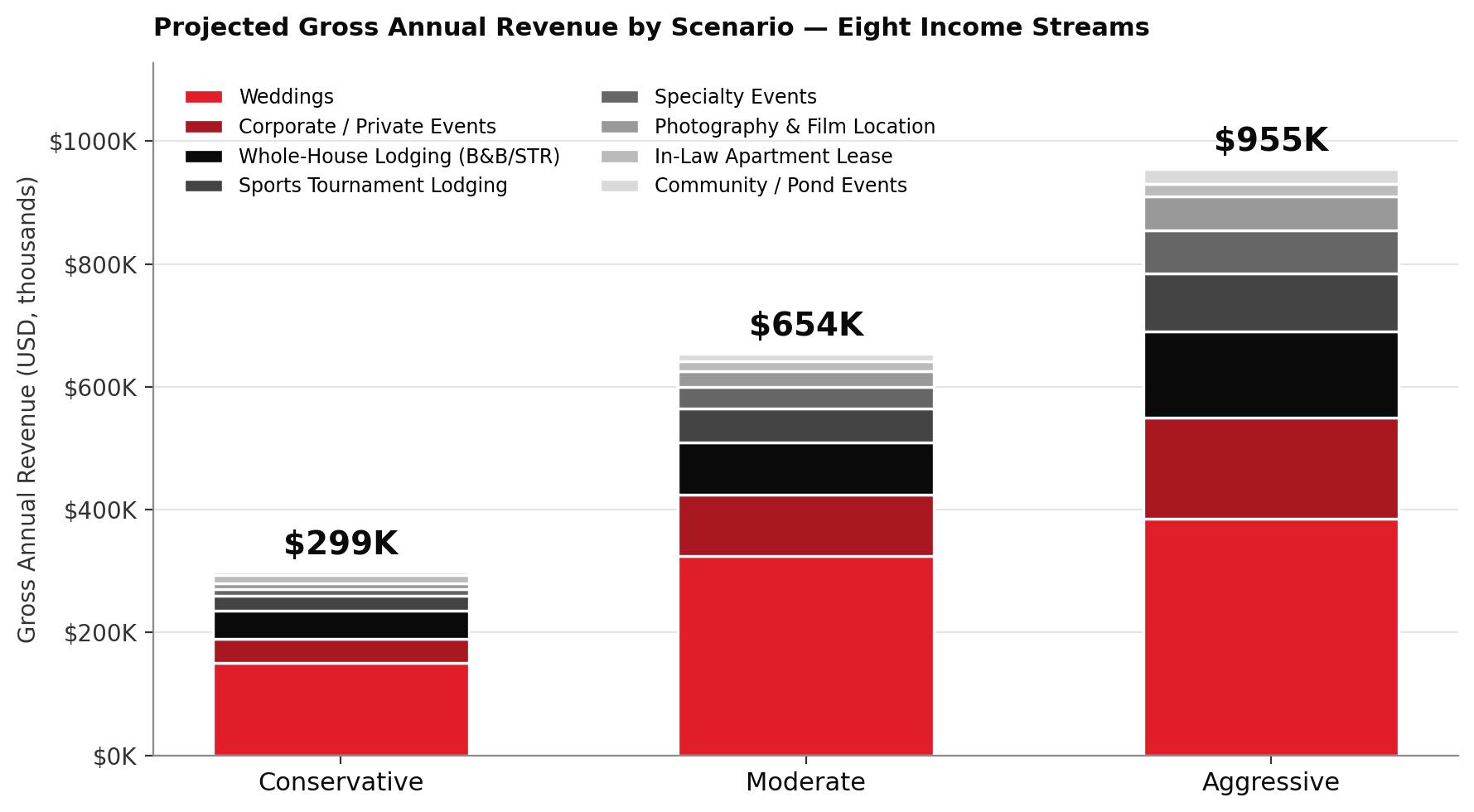
Each scenario reflects a different operating intensity and ramp time. None is a guarantee. All assume an operator who actively markets and manages the property — this is a hospitality business, not a passive-income asset. The stream totals below already account for calendar overlap: weekends used for sports tournament groups, for example, are not also booked for weddings.
FIVE-YEAR RAMP
How the business builds over time.
Hospitality businesses do not stabilize overnight. The chart below illustrates a moderate-case ramp: Year 1 reflects a partial-year launch with photography, branding, and listings going live mid-cycle; Year 2 captures a full operating year with reputation still developing; Year 3 is the stabilized moderate scenario from page 14; Years 4–5 reflect modest growth from repeat business and price escalation. Each operator's ramp will look different — Year 1 in particular is highly sensitive to launch timing relative to the wedding-booking cycle.
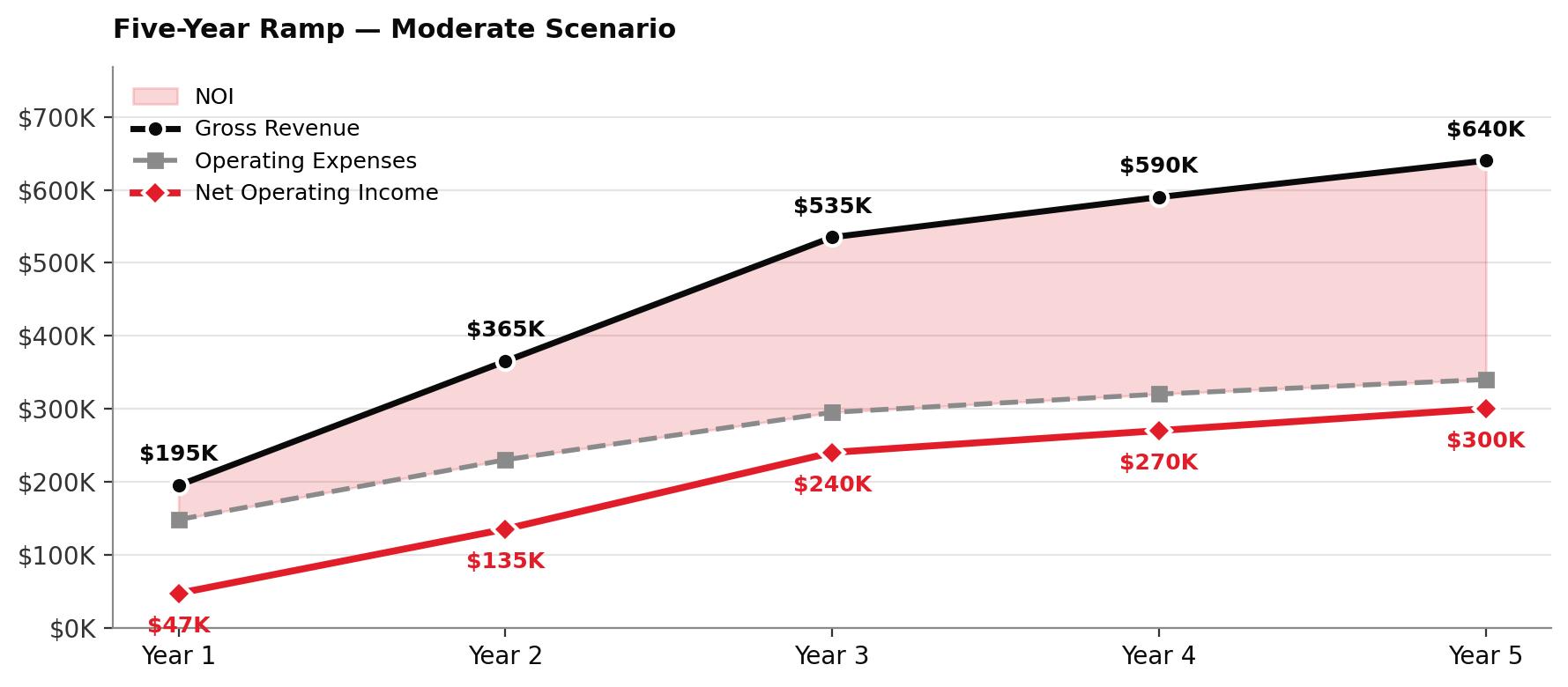
Year 1 reality. The biggest risk to Year 1 is timing: weddings book 12–18 months ahead. A buyer closing in summer will miss most of the following year's peak wedding bookings unless they move quickly on photography, listings, and pricing. Sports tournament lodging, STR, photography, and corporate events are less sensitive to advance booking and provide most of Year 1 revenue.
How NOI moves with the biggest variables.
Wedding volume and average wedding price are the two largest individual drivers of NOI. The heatmap below shows how the moderate-scenario NOI changes across a range of plausible wedding-business outcomes, holding the other seven revenue streams constant at moderate-scenario performance.
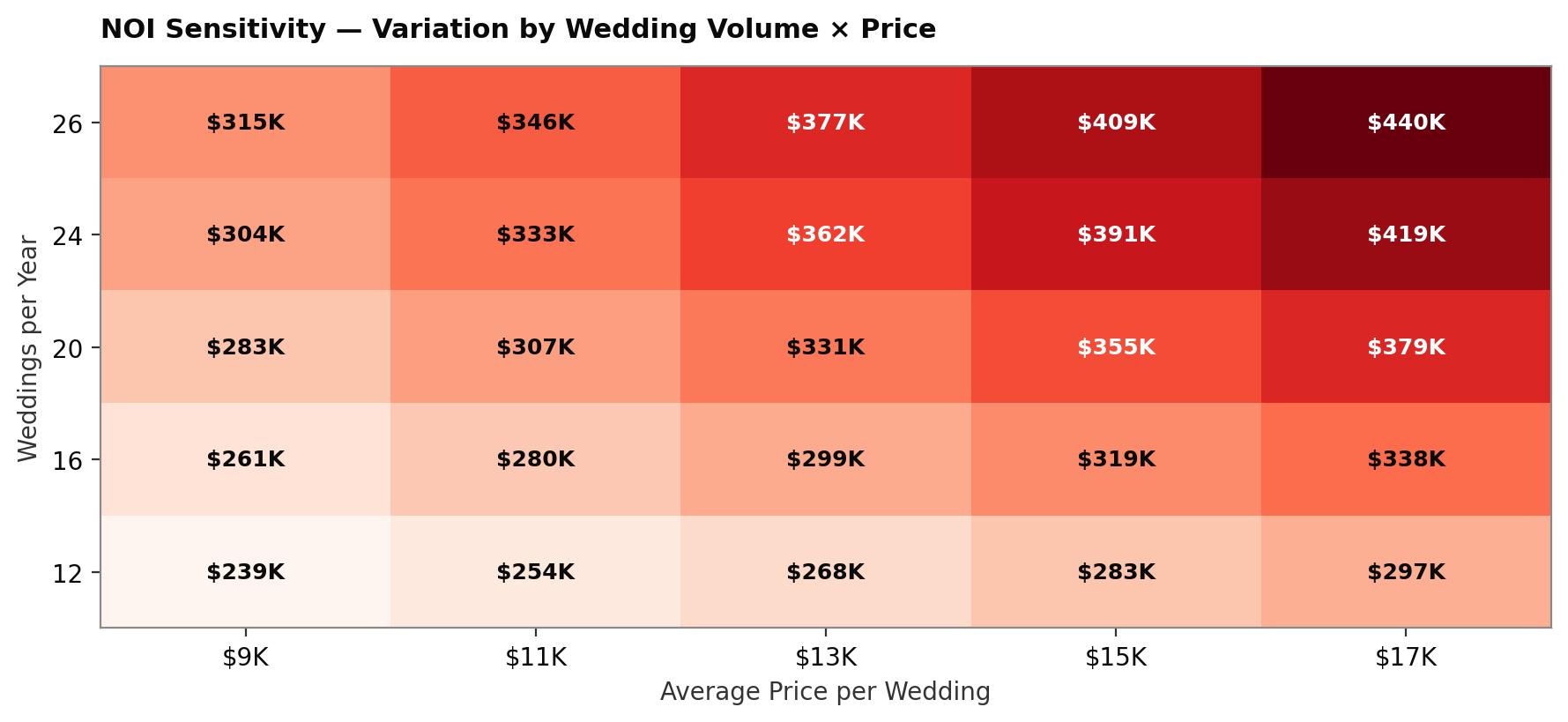
Assumes moderate-scenario performance on all other revenue streams and a 60% NOI margin on wedding revenue specifically (higher than blended; in-house bar and operator labor add to wedding-segment margin).
HOW TO READ THIS
Each cell shows the estimated annual NOI at that combination of wedding volume (rows) and price-per-wedding (columns). The bottom-left cell ($240K NOI at 12 weddings/year × $9K each) reflects an underperforming wedding business; the top-right ($440K at 26 weddings × $17K each) reflects an intimate-luxury venue operating near capacity. The moderate scenario from page 14 — approximately 25 weddings × $13K each — sits near the center of this grid.
The pricing lever moves more NOI than volume. Going from 16 weddings to 24 weddings at $13K each adds ~$62K of NOI. Going from $11K to $17K average price at 20 weddings adds ~$72K. Intimate-luxury venues that underprice waste their largest revenue lever — and frequently fail to attract the destination-couple buyer who actually wants to spend $15K+.
CALENDAR UTILIZATION
How the year actually fills.
The chart below shows what the moderate scenario looks like month-by-month. Weddings concentrate in May–October. Sports tournament group lodging fills much of November–April. Corporate events and non-event lodging nights run year-round, providing baseline calendar utilization in every month.
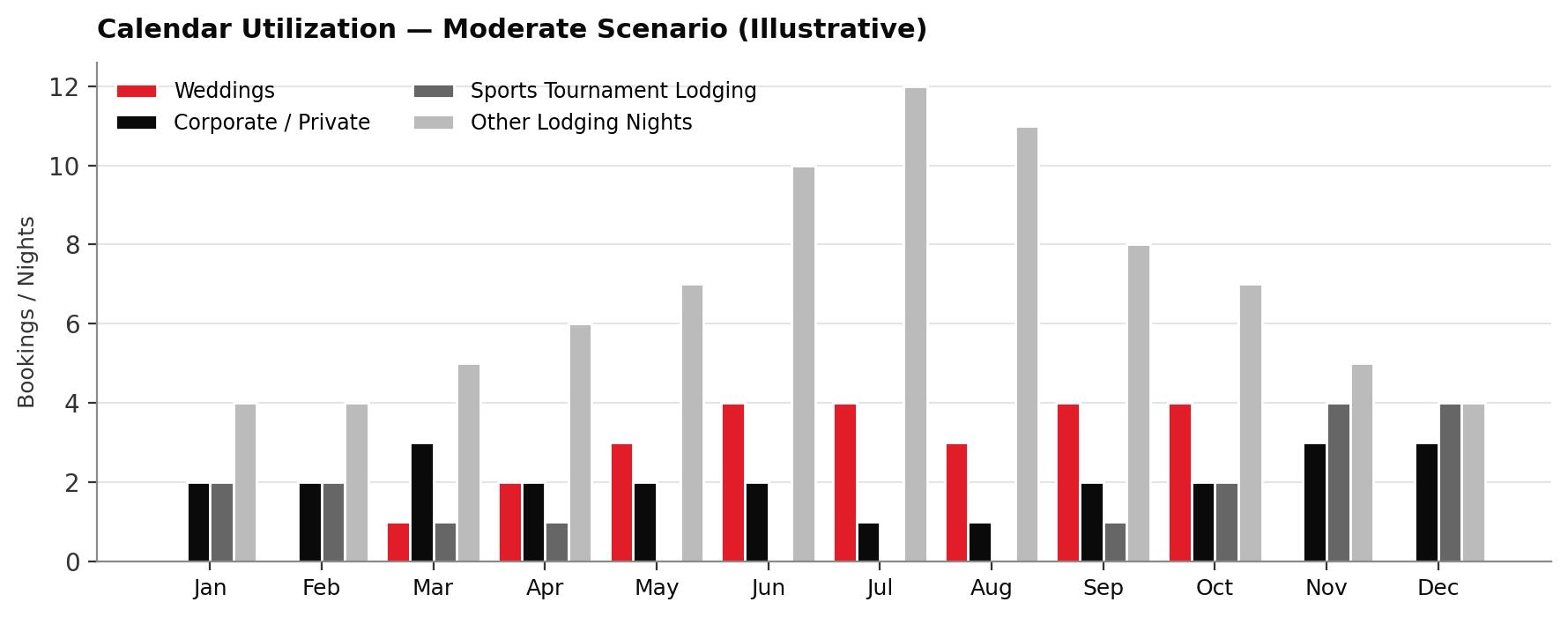
The summer wedding-driven peak. June through October typically drives 70%+ of wedding revenue. Every Saturday in that window is a $10K–$17K decision; a no-booking Saturday in July is the single most expensive operating mistake. The shoulder corporate floor. January–April and November–December would be near-zero revenue for a wedding-only venue. Corporate retreats, sports tournament groups, and specialty events keep the calendar generating $25K–$50K per month even in the shoulder season.
The lodging baseline. The residence is on market as STR or boutique inn on non-event nights year-round. This is the difference between a single-use venue and a diversified hospitality business.
OPERATING COSTS
Where the spend goes.
Wedding-and-events venues typically run at 40–50% operating margins in stabilized years (PerfectVenue 2026 benchmark; ProjectionHub). The moderate scenario above assumes a ~45% NOI margin. The line items below explain where the spend goes and what scales with event volume.
Property taxes
Insurance (event + liability)
Utilities
Maintenance & reserves
Staffing / contract labor
Marketing & platforms
Supplies / linens / consumables
Licenses, permits, professional fees
$5,000–$12,000 2024 taxes are $5,122 (homestead classification). Commercial event use may trigger reclassification by the Erie County Auditor.
$8,000–$22,000
$12,000–$25,000
Commercial property + liability + event coverage. Liquor liability adds materially if bar is in-house.
Two large structures, year-round HVAC. SIP insulation in the barn keeps winter costs down relative to comparable barn venues.
$15,000–$32,000 Grounds, mechanical systems, pond, septic — historic homes need a dedicated reserve regardless of operator intensity.
$60,000–$170,000 Event coordinator, cleaning crew, bartenders, grounds, innkeeper. Scales directly with event and lodging volume.
$15,000–$45,000 The Knot, WeddingWire, Zola, Vrbo / Airbnb / Peerspace listings; paid social; professional photography refresh annually.
$8,000–$22,000 Event supplies, linens, restroom consumables, guest amenities, B&B breakfast inputs.
$5,000–$15,000 Health department, liquor permits, CPA, attorney, POS / booking software, payment processing.
STARTUP CAPITAL
What it takes to launch.
Above and beyond the property acquisition price, an investor-buyer should plan for the following one-time launch costs to bring the property to revenue-ready. These figures are incremental to acquisition and exclude purchase-money financing costs.
CAPITAL EFFICIENCY
Industry data suggests new wedding venue developments often require $300,000 to $1,500,000+ in initial capital expenditures, depending on whether the site requires new construction, septic, parking, or structural work. 8110 Main Rd's launch budget sits at a fraction of that range because the property already has the barn, septic, accessibility infrastructure, kitchens, and mechanicals in place. A buyer's incremental capital is going to brand, marketing, and FF&E — not to building the venue itself.
TAX & CAPITAL STRUCTURE
Considerations worth diligencing.
Several tax and capital structure angles meaningfully affect after-tax economics for a buyer of this property. None should be assumed without confirmation by the buyer's accountant and attorney — but each is worth investigating during due diligence.
Federal Historic Preservation Tax Credit. An 1883 structure may qualify for the 20% federal Historic Preservation Tax Credit if listed on the National Register and rehabilitated to Secretary of the Interior standards. Berlin Heights has an active Historical Society; pre-listing inquiry and a qualified tax-credit consultant are the right first steps.
Ohio Historic Preservation Tax Credit. Ohio's state-level historic tax credit program offers up to 25% credit on qualified rehabilitation expenses, capped per project. Stacks with the federal credit when both apply.
Ohio CAUV (Current Agricultural Use Valuation). The 16.134 acres available for purchase, if used agriculturally (orchard, fruit trees, hay, or grazing), may qualify for CAUV property tax treatment — potentially reducing the carrying cost of the additional acreage significantly.
Property tax reclassification risk. Current $5,122/year tax bill reflects homestead residential classification. Active commercial event use may trigger reclassification by the Erie County Auditor. Buyers should pre-clear the operating plan with the auditor's office to avoid surprises.
Conservation easement on excess acreage. A buyer who wants to keep the additional 16+ acres rural and undeveloped may qualify for a conservation easement deduction, reducing federal tax basis while permanently protecting the buffer around the operating property.
Cost segregation study. Mixed-use commercial conversions typically benefit from a cost segregation study to accelerate depreciation on FF&E, land improvements, and barn interior components — meaningful in years 1–3 against operating income.
Financing structure options. Owner-occupied buyers can use conventional residential financing. Investor buyers operating the property as a business typically use commercial / mixed-use financing with 25–30% down, 20–25 year amortization, and a DSCR test against projected NOI. Lenders with experience in boutique hospitality assets will be more comfortable with the projections than a standard residential lender.
RISKS & DUE DILIGENCE
What could break the model.
Every revenue projection sits on a stack of assumptions. The honest ones name what could go wrong. The items below are the variables a serious buyer should pressure-test before closing.
Zoning & conditional use. Berlin Township zoning permits the residence; commercial event operation may require a conditional-use permit or variance. The seller has historically hosted gatherings, but a buyer should confirm zoning compliance for paid event operation as a condition of purchase. This is not optional due diligence.
Competition with The Farm 1893. The Farm 1893 is established and booking 18+ months out. They will win some of the bookings 8110 Main Rd targets. Mitigation is positioning — estate / historic-home angle vs. their farm-modern angle, plus capacity for events outside their weekend-only model.
Operating intensity. A passive owner who lists the property and waits for inbound inquiries will underperform the conservative scenario. This is a hospitality business, not a rental property. A buyer should plan to either operate it themselves or hire an experienced events/innkeeper manager.
Seasonality concentration. Wedding revenue is concentrated in 25–30 Saturdays per year. A weak weather year, a delayed launch, or weak photography in Year 1 can lose an entire booking cycle. Sports tournament lodging, corporate, and STR diversification reduce — but do not eliminate — this risk.
Septic capacity & large-event compliance. The seller indicates septic was updated to accommodate large parties in both structures. A buyer should verify the system's design capacity, permit history, and Erie County Health Department approval for the specific event sizes in their operating plan. A 200-guest wedding has different requirements than a 50-guest corporate event.
Liquor licensing. Ohio liquor licensing for event venues (D-permits) is achievable but takes time and is location-conditional. Build the timeline into the launch plan.
Insurance availability. Historic structures, large gatherings, and commercial liability combine to make insurance underwriting more involved than for a typical residence. Bind quotes before closing, not after.
Property tax reclassification. As noted in the tax section, commercial event use may trigger reclassification by the Erie County Auditor. The conservative scenario assumes a modest increase; verify in advance.
Wedding-industry cycle risk. The wedding industry is cyclical and economically sensitive. Recessionary periods compress wedding budgets, push couples toward smaller events, and lengthen booking lead times. Diversified revenue streams mitigate but do not eliminate this exposure.
None of these risks is disqualifying. All are routine for hospitality real estate. They are itemized here because a buyer who underwrites them going in builds a stronger pro forma — and a more durable business.
Who this property actually works for.
Not every buyer should run 8110 Main Rd as an active business. The property works across several distinct buyer profiles, and naming them helps right-size the operating plan to the buyer.
The Owner-Operator. Lives in the residence; operates the venue and inn as primary business. Captures the highest NOI margins because labor is partly their own. Best fit for a hospitality-experienced couple or family. Likely scenario: moderate to upper-moderate revenue, highest margins.
The Investor with Hired Manager. Treats the property as an income-producing business and hires a venue manager or innkeeper. Slightly lower NOI margin due to labor cost, but more passive ownership. Likely the highest-revenue scenario because management is professional. Best fit: an investor with capital but limited operating bandwidth.
The Lifestyle Buyer with Income Offset. Buys the property primarily as a personal estate; runs limited events (8–12 weddings, occasional corporate) to offset ownership costs. Conservative revenue, but the property functions as both home and business. Best fit: a professional or retired couple who wants the estate experience without running a full hospitality operation.
The Family Compound & Reunion Hub. Multi-generational family use as primary purpose. Lists for STR and limited events when not in family use. Lower revenue, but high personal-use value. Best fit: a family willing to forego active income for the property as legacy and gathering place.
HOW TO USE THE SCENARIOS
An owner-operator should typically model toward the moderate scenario in years 2–3 and use the conservative scenario for stress-testing financing coverage. An investor with a professional manager should model toward the moderate-to-aggressive range, but expect the higher labor line in the operating costs section. A lifestyle buyer should model toward the conservative scenario or below, treating event income as defensive cashflow rather than primary return.
METHODOLOGY
Sources, assumptions, and exclusions.
DATA SOURCES
■ The Wedding Report — 2025 Ohio Wedding Market Statistics: 58,483 weddings annually; $1.8B market; average spend $31,078; average guest count 121–131.
■ The Knot & Zola — 2026 Real Weddings Studies: average national venue cost $12,200 (2024); average total wedding cost $34,200–$36,000.
■ PerfectVenue / ProjectionHub — wedding venue operating-cost benchmarks: average $467K annual revenue; 20% net margin baseline; 40–50% stabilized margins.
■ Wedding Venue Mavericks & Financial Models Lab — venue revenue ranges ($100K–$700K typical small/mid; $1M+ at destination tier).
■ Northeast Ohio comp: Century Farms (peak-season full-weekend wedding venue rate $10,500).
■ The Farm 1893 (12211 Berlin Road, Berlin Heights) — public website, The Knot, and WeddingWire listings.
■ AirDNA — Sandusky short-term rental market data: 539 listings, 42% average occupancy, $325 ADR, $24,256 average monthly host revenue.
■ Cedar Point Sports Center / Sports Force Parks — public tournament schedule, stay-to-play partner model, facility capacity (12 turf baseball fields, 10 hardwood courts, 20 volleyball courts, championship arena).
■ Cedar Fair Entertainment / Six Flags — public attendance reporting: 3.4M+ annual Cedar Point visitors.
■ Shores & Islands Ohio — Lake Erie Wine Trail directory and regional tourism data.
■ Property data: MLS #5129986 and Erie County Auditor parcel #01-00089.000.
WHAT THIS ANALYSIS DOES NOT INCLUDE
■ Vendor referral commissions and add-on revenue (catering, DJ, photography). These can add 5–15% to gross revenue but vary by operator.
■ Sale or development of the additional 16.134 acres. Land value not modeled.
■ Federal or Ohio historic preservation tax credits. Potential value not modeled; requires a qualified tax-credit consultant.
■ Cost segregation depreciation benefits. Potential value not modeled.
■ Depreciation, interest expense, or other tax shielding. NOI figures are pre-tax operating income, not net cash flow after debt service.
■ Operator's salary draw. Most owner-operators draw $30K–$80K/year before NOI. The numbers above assume operator labor is captured in the staffing line.
■ Branding premium. A property successfully positioned as a regional destination venue can charge 25–40% more than the moderate-scenario assumptions used here.
■ Inflation and price escalation beyond the modest growth shown in the five-year ramp.
DISCLAIMER & CONTACT
Important notices and how to learn more.
DISCLAIMER
This analysis has been prepared by The Agency Cleveland Northcoast for informational and educational purposes only. All revenue estimates, operating cost assumptions, forecasts, scenarios, and projections in this document are based on published market data, industry benchmarks, and publicly available comparable information. They are not predictions, guarantees, or representations of achievable performance. Actual results will vary based on operator execution, market conditions, regulatory changes, and unforeseen factors.
This document does not constitute financial, legal, tax, accounting, or investment advice. Property zoning, septic capacity, accessibility for commercial use, tax classification, and licensing requirements are stated based on publicly available information and seller representations; independent verification is the buyer's responsibility. All prospective buyers should consult their own qualified accountant, attorney, financial advisor, and lender, and should conduct independent due diligence on all assumptions, representations, and figures contained herein prior to purchase.
Property information is derived from various sources including MLS listings and public records, which may not be fully accurate. The Agency Cleveland Northcoast, Josh Anton, and Jaclyn Drager make no representations or warranties as to the accuracy, completeness, or suitability of any information contained in this analysis for any particular purpose. This document is not an offer to sell, or a solicitation to buy, securities or real estate.
LEARN MORE
For additional information about 8110 Main Rd, to request the property feature list, to schedule a tour, or to discuss this analysis in detail, please contact:
The Agency Cleveland Northcoast
Josh Anton
PHONE (216) 469-1456
EMAIL josh.anton@theagencyre.com
Jaclyn Drager
PHONE (828) 514-9918
EMAIL jaclyn.drager@theagencyre.com