THE FINANCIAL FREEDOM FRAMEWORK Transforming Bookkeeping into Business Growth
📌 Front Matter & Introduction The Cost of Financial Blindness
In the fast-paced landscape of modern commerce, entrepreneurs frequently fall victim to a dangerous condition known as financial blindness. This phenomenon occurs when a business owner operates day-to-day without a clear, real-time understanding of their true financial health. Instead of analyzing sophisticated statements, many founders manage their operations by simply checking their live bank balances. This approach is highly volatile. A healthy bank balance can easily mask deep operational inefficiencies, such as shrinking gross margins, unsustainable customer acquisition costs, or upcoming un-budgeted tax obligations. Managing an enterprise strictly by cash-at-hand is like driving a vehicle forward while looking exclusively in the rearview mirror; it tells you where you have been, but fails to warn you about immediate obstacles ahead. True corporate scaling demands a shift from gut-based decision-making to databacked financial strategy. Without clear numbers, an enterprise cannot accurately calculate its cash runway, evaluate inventory turn metrics, or safely determine when to hire new personnel.
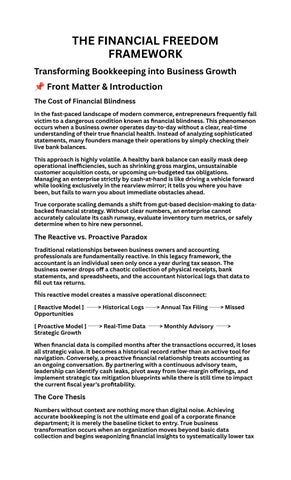
The Reactive vs. Proactive Paradox Traditional relationships between business owners and accounting professionals are fundamentally reactive. In this legacy framework, the accountant is an individual seen only once a year during tax season. The business owner drops off a chaotic collection of physical receipts, bank statements, and spreadsheets, and the accountant historical logs that data to fill out tax returns. This reactive model creates a massive operational disconnect: [ Reactive Model ] Opportunities [ Proactive Model ] Strategic Growth
──> Historical Logs ──> Annual Tax Filing ──> Missed ──> Real-Time Data ──> Monthly Advisory ──>
When financial data is compiled months after the transactions occurred, it loses all strategic value. It becomes a historical record rather than an active tool for navigation. Conversely, a proactive financial relationship treats accounting as an ongoing conversation. By partnering with a continuous advisory team, leadership can identify cash leaks, pivot away from low-margin offerings, and implement strategic tax mitigation blueprints while there is still time to impact the current fiscal year's profitability.
The Core Thesis Numbers without context are nothing more than digital noise. Achieving accurate bookkeeping is not the ultimate end goal of a corporate finance department; it is merely the baseline ticket to entry. True business transformation occurs when an organization moves beyond basic data collection and begins weaponizing financial insights to systematically lower tax