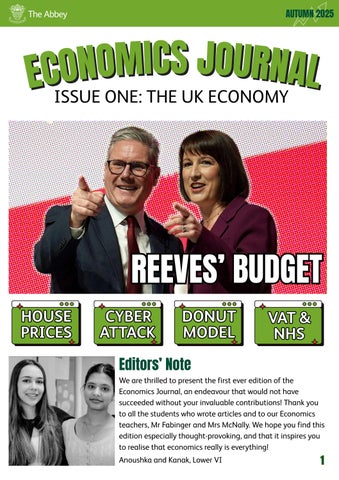

ISSUE ONE: THE UK ECONOMY
Editors’ Note
We are thrilled to present the first ever edition of the Economics Journal, an endeavour that would not have succeeded without your invaluable contributions! Thank you to all the students who wrote articles and to our Economics teachers, Mr Fabinger and Mrs McNally. We hope you find this edition especially thought-provoking, and that it inspires you to realise that economics really is everything!
Anoushka and Kanak, Lower VI
The Autumn budget
Labour’s budget:
Short-term fix, long-term risk
Scotland and the budget
Unaffordable housing
Raworth’s donut model
Cyber attacks and our economy
The privatisation of the NHS
Cognitive bases in Econ
VAT on private schools: A student’s POV
As we open this edition of our student‑led Economics Newsletter, I want to welcome not just our budding economists, but every curious reader. You don’t need to study economics to feel the effects of what’s happening in the world right now: rising prices shaping how far your money goes, shifting interest rates influencing everything from mortgages to student loans, and global events - like changes in trade between major countries or fluctuations in energy markets - affecting the cost of everyday essentials. I hope that you will find the articles in this newsletter both informative and insightful, sparking a curiosity to learn more. Economics is for everyone, not just Economists, Politicians and Journalists.
Mrs McNally, Economics Teacher
The Autumn budget
by Annabel T, Lower VI
What is the 2025 Budget?
On the 26th of November, the UK government (led by Labour Chancellor Rachel Reeves) announced the Autumn Budget 2025 - where the government dictates how much tax we pay, how services such as the health system will be funded and what major plans for the next few years will look like The idea is that the government wants to balance:
Key public services (like the health system, schools etc )
Government spending (managing debt and public money responsibly)
Living costs for people
The big changes (and what they mean) This Budget includes many tax-raising measures:
Freezing income tax thresholds, which means that the threshold at which people start paying standard/higher income taxes stay the same
From 2029, a change to pension savings through ‘salary sacrifice’: only the first £2,000 saved by the scheme will get the full tax benefits Anything beyond that will have National Insurance charges. (Say you wanted to put £3,000 into your pension savings, while £2,000 of this will be free from tax, the remaining £1,000 will have National Insurance charges)
Taxes on property, savings interest and dividends (money from investments or rental income) will go up by 2p on those rates, meaning landlords or people with investments might pay more
The Positives
While the media may paint the budget as a financial horror story, the Budget does try to help with services and support us. The government is putting more money into health and social care in England. Over the next few years, the budget for health care will (though perhaps less than hoped) increase in real terms, after accounting for inflation. £300 million has been allocated for new technology for the NHS to open new “Neighbourhood Health Centres” to, in Reeves’ words, “cut NHS waiting lists” On welfare and social support, one big change in the budget is scrapping the twochild benefit cap, assisting more families than before and reducing child poverty. Regarding living costs, there are plans to freeze train fares and keep prescription charges the same for next year in certain areas, which could potentially help people who heavily rely on public transport or NHS prescriptions.
What’s causing the backlash?
While some people say it’s “fair” to ask wealthier people and investors to pay more so services can improve, others, especially younger people or working-class families, may end up worse off Due to inflation, an increase in wages may sound great, however the frozen thresholds would mean more people are either eligible to pay their taxes or may even need to pay a higher percentage of income tax than before. There’s also the chaos surrounding the public finances, which were leaked early before the official announcement This stirred confusion and criticism adding onto the tense atmosphere surrounding the topic for the past weeks leading up Additionally, some worry that while the NHS and public services got some money, it might not be enough since demand is high, costs are rising and price inflation could undercut what’s budgeted
Final Thoughts
The Budget means there should in theory be better NHS access and support for families, but it also means harder times for many when tax thresholds stay frozen or savings get taxed more Like many changes, it depends on who you are Wealthy investors or big property owners might be paying more, which would most likely make the budget a nightmare for them Families of 2 or more with limited ways to provide for their children should feel more secure and protected, leading to a positive outlook on the budget Personally, I think it’s fair that everyone should pitch in for public services such as the NHS, however I feel it’s important to remember ordinary people don’t wake up one morning with millions in their pockets
Labour’s budget: short-term fix, long-term risk by Ashika H, Lower VI
Background before the Budget
Rachel Reeves prepared to deliver her budget, but her government has already faced criticism for confusion and mixed messages. In recent months, Labour had suggested several possible tax rises only to reverse many of them. This unsettled investors and confused the public. Labour won a huge majority, but their ability to act was still very restricted. Their promise not to raise the four biggest taxes left them vulnerable to economic problems. Slower productivity growth could create a £20 - 30bn hole in the budget by 20292030.
Her last budget left almost no spare money in case economic forecasts changed. Ideally, she should have tried to create a £30bn safety net to reassure investors and give businesses more confidence. However, achieving this would have been extremely challenging
How the Budget will raise money
Government spending had risen significantly in recent years, and ministers had hinted at further spending In order to stay credible, Labour needed
clear plans to control costs, especially in areas like pensions and disability benefits. Even with spending restraints, tax rises were unavoidable A broad income - tax rise would have been the most efficient option, but Reeves had recently backtracked on this. Instead, she relied on a series of smaller tax changes, such as higher property taxes on expensive homes These measures may not have raised enough revenue and could have had a greater negative impact on the economy
Supporting economic growth
The budget included few measures to support economic growth, such as reducing marginal tax rates or changing planning rules. Some policies, such as changes to employment rules and migration may have slowed growth even more It also did little to encourage investment or improve productivity
Without stronger support for businesses and skills development, long-term economic growth could be weak. The budget focused more on short-term fixes than on building a stronger economy for the future.
What this means for the future?
Reeves’ budget mainly filled the shortterm financial gap with small tax increases, limited spending cuts and some new spending promises. While this may have eased market worries temporarily, it could slow economic growth and reduce confidence in the government’s financial plans in the long - term.
Scotland and the budget
by Astrid R, Lower VI
Scotland’s economy is the largest of the devolved countries, worth about £204 billion per year and its population at 5.5 million. The Budget delegated £510 million of resource funding and £310 million capital funding. Resource funding is money which is used for short term needs such as public services and development projects Scotland’s interest rates are falling in an effort to increase spending, and the additional funds in the Budget should help the Scottish Government to tackle pressing issues such as rising demand for healthcare due to a population which is ageing faster than the UK average, and child poverty.
An increase in government spending would, of course, as a component of AD, increase spending and this in turn, might increase business confidence and investment which has, like the rest of the UK, remained weak since the 2008 financial crisis
The Budget also makes further efforts to increase business confidence by investing in
businesses across the country through the British Businesses’ Bank Investment Fund for Scotland. Supporting businesses will increase competitiveness in the markets, which will in turn incentivise businesses to increase productivity and lower prices.
The tax brackets of Scotland are different to the rest of the UK, as it is a devolved policy area (which means that the Scottish Government has authorisation to control it). Only the higher tax brackets will freeze, with the lower levels rising to accommodate for inflation which should also increase spending compared to the rest of the UK as people would be taxed less The Budget outlines investment into renewable energy in Scotland, including £17.3 million into the Aberdeen Energy Zone which is a programme which aims to transition Scotland away from fossil fuels into renewable energy. They have also outlined Scotland as a target for an AI Growth Zone, which would utilise extra energy generated by the grid, and would generate jobs as well as making the UK a global competitor in the AI industry.
These investments could boost business and consumer confidence, and increase the productive capacity of the Scottish economy, alongside the £310 million of capital funding which is funding which is used for long term investments Some of this £310 million is expected to be used for housing and infrastructure, but the rising construction costs lowers the real purchasing power of this money, although it should still increase the economy’s productive capacity
Unaffordable housing by Pippa S, Lower VI
UK homes aren’t actually becoming more affordable even if the data seems to say so.
New figures from Lloyds Bank suggest that housing is getting easier for first time buyers to afford. They report that the average first time buyer home now costs just under six times the average salary, this is the lowest ratio since 2015. Other lenders and government statistics show a similar trend because wages have risen while house prices have grown more slowly.
You may be thinking this sounds like good news, but using price to earnings ratios alone gives a misleading idea of what people can really afford The main issue is that these ratios ignore mortgage rates. When interest rates are low it means buyers can borrow more money, which pushes up prices So comparing today’s ratio with old “normal” levels such as 4.5 times earnings doesn’t work Borrowing conditions today are very different from ten or twenty years ago.
In cheaper areas, having two incomes might explain the difference between local earnings and what buyers actually earn. But in more expensive regions, the gap between a typical buyer’s income and the average salary in that area is much larger
In cheaper areas, having two incomes might explain the difference between local earnings and what buyers actually earn But in more expensive regions, the gap between a typical buyer’s income and the average salary in that area is much larger
Nationwide reports that first time buyers spend 34% of. their post tax salary on their mortgage and in London it’s as high as 56% These numbers seem extremely high, and they are, but only because they’re based on average earnings for everyone and not the people actually buying homes When we look only at first time buyers, the average mortgage payment is around 21% of gross income across the country and 23% in London. These are more realistic figures, but they still don’t prove that homes are becoming truly more affordable
Overall, the data makes things look better than they really are because it’s based on general averages rather than on actual buyers. So even though the headline figures suggest housing affordability is improving, the real situation for first time buyers has not changed nearly as much
Raworth’s donut model
by Kendra N, Lower VI
The Doughnut Model is a 2012 model by economist Kate Raworth for sustainable development and contains 2 rings - the inner ring (or social foundation) and the outer ring (or ecological ceiling). It is a compass for human prosperity, and through this model a regenerative and distributive economy can be achieved The social foundation is based on sustainable development goals, through these people’s needs are met - water, food, health, education, income & work, peace & justice, political voice, social equity, gender equality, housing, networks, and energy This inner ring aims to leave nobody in the hole facing critical levels of human deprivation
However, as we use Earth’s resources we should not overshoot the ecological ceiling, with the 9 planetary boundaries being climate change, ocean acidification, chemical pollution, fertiliser use, freshwater withdrawals, land conversion, biodiversity loss, air pollution, and ozone layer depletion. These are critical life supporting systems that make life work in a stable way
In my opinion, this model is crucial to sustainable development. Endless growth shouldn’t be the goal for sustainability, but thriving in balance between the inner and outer ring. It got much traction (especially from indigenous cultures, less from western), and the sense of a dynamic circle is a recurring feature, serving the model as a mindset recovery program for those with a Western industrial economic education - can people recover from thinking endless growth is progress? Although there’s several overshooting of the outer ring and falls in the gap, with enough emphasis on doughnut economics one day these won’t be as prominent
Kate Raworth
Cyber attacks and our economy
by Aiza S, Lower VI
In the past decade, we have seen a staggering rise in the advancement of technology New innovations have led to breakthroughs in healthcare, expanded access to education as well as instant global connection through social media Moreover, there has been a significant positive impact on the world’s economy For example, businesses which had to hire employees to do repetitive, tedious work, now use automated machines to complete them; this allows the human capital to focus on creative or problem-solving tasks.
Despite the myriad of benefits, technology has also had negative impacts on the UK economy, such as the dire problem of cyberattacks. A cyberattack is defined as “ a malicious attempt to gain unauthorized access to, disrupt, or damage computer systems.” Hence, they can lead to the disclosure of important information, identity fraud, financial loss and damage to an organisation’s reputation Consequently, with the rise of new technologies, the UK economy is becoming increasingly susceptible to destructive cyber attacks.
M&S Data Breach
In the last 12 months, the Cyber security breaches survey 2025 states that “ over 4 in 10 businesses and 3 in 10 charities have experienced any kind of cyber security breach or attack in the last 12 months”. Admittedly, the security of many consumer-loved brands now seem vulnerable, as we saw in the M&S cyber attack
Earlier this year in April, the well-known company was affected by a cyber incident and it was admitted that “ some personal customer data has been taken”. The hackers, who are suspected to be “Scattered Spiders”, used social engineering tactics such as phishing emails These compelled employees to provide them with access credentials. Ransomware was then deployed to encrypt sensitive information of M&S customers and company details Accordingly, prevention measures were swiftly placed such as the suspension of click and collect, online orders and contactless payments in many stores Unfortunately, this led to many “bare shelves” in the once fully-stocked stores of M&S and an overall decline in sales. Due to the attack, the company faced an immense loss of £300 million, which amounted to 30% of their annual profits Additionally, consumer confidence saw a dive as many were concerned with accessing the website as well as using online payment methods
How does this affect our economy?
Increasing cyber attacks can have a drastic effect on the UK economy and we may see an inward shift of aggregate demand (AD) which is the total demand for goods and services at a given price level in economy An inward shift of AD can lead to a decrease in a country’s GDP. There are various reasons for this, such as a fall in consumer spending as it is the single largest component of AD If there are continuous data breaches in major companies, then many may resort to reducing expenditure on UK based companies and purchase products
from brands outside the UK. Furthermore, business confidence and investment may reduce as companies will fear that their production will be disrupted by malicious attacks and hence many will cancel or postpone investment projects, which can also negatively affect AD. Additionally, companies may be forced to invest in cyberattacks prevention measures,
and although this benefits consumers, production costs will increase as well as as the need for employees who work in the sector.
Despite this, one benefit of an increase in cyber- attacks is an increase in government spending. If attacks continue to rise, the UK government may be forced to increase cyber-security, which can be beneficial to the UK in the long-run as strong national cybersecurity also attracts overseas investors which can lead to an outward shift of AD. Subsequently, our long-run aggregate supply, which is the total output an economy can produce when all factors of production are in use, may see an outwards shift A change in the state of technology, such as the investment for breakthroughs in sectors of cyber-security, can lead to an outward shift of the LRAS curve.
Can we make the result of cyber attacks positive?
In conclusion, as we continue to see an unequivocal rise in the use of technology and its negative effects such as cyber-attacks, the UK economy and specifically business may see negative impacts. However, if the government chooses to actively participate in the prevention of such data breaches and promote the safety of public information, we will be able to see positive changes to our economy Therefore, cyber attacks can be seen as not only a challenge but also an opportunity to build a resilient digital economy.
Sources
https://www gov uk/government/statistics/cybersecurity-breaches-survey-2025/cyber-securitybreaches-survey-2025
https://www.bbc.co.uk/news/articles/c0el31nqnpvo https://www.bbc.co.uk/news/articles/c93x16zkl9do https://corporate marksandspencer com/cyberupdate
The privatisation of the NHS
By Giselle W, Lower VI
Should the NHS be priovatised?
The NHS is a public healthcare service in the UK but as the government spending continues to pile on for necessities instead of investment in productivity, should it remain as a public service or should it be privatised in order to cut costs and generate revenue which may indirectly increase the potential output for the UK? Will a society that follows the ideology of Laissez-faire work?
Firstly, pro-privatisation means there are more choices for patients In the UK, around 16 million adults, or ⅓ of the working-age population see private medical insurance as ‘essential’ because the NHS is relatively inefficient due to high demand If there were more private companies, patients would have more options and choose the doctor, hospital, and kind of treatment they desire. Moreover, this data shows the demand for private healthcare already exists, indicating that it would be a successful industry if it was being invested sufficiently. This is a market failure as there is a clear demand and positive externalities, but the market does not allocate enough resources to meet these demands, seeing as only 8% actually purchase those services which is underconsumption A reason for this might be a high barrier of accessibility as the average monthly cost for private medical insurance in the UK is around £79.59 for an individual, insinuating a distributional failure as the market gives choice only to those who can afford it
Secondly, since the NHS is available to everyone, the waiting list is estimated to be 7 5 million after the pandemic, underscoring the inefficiency of the service as there is no price signal to ration usage For example, some might use the A&E for minor issues and some book GP slots when not needed. If it were privatised, it means the demand for the service is going to fall due to affordability, which eliminates overconsumption.
Meanwhile, the people who want or need healthcare can switch to a substitute, such as a cheaper preventative, e.g. meds or community healthcare, or some will drop out of the private market entirely.
Thirdly, the quality of healthcare the NHS will be able to provide will increase To give an example, the staff is going to serve fewer people, which means there is less congestion in each hospital and an increase in capacity Staff are more likely to spend more time with each patient, so fewer mistakes would be made Moreover, the quality of resources will increase as the patients have to pay for them, so firms have the income to invest in better machines/meds In a society where healthcare is privatised, there will be perfect competition This means the firms are going to try to stand out from each other, therefore, they might increase the quality of treatments and efficiency providing a better service for the patients/consumers
Lastly, the UK needs £242bn for healthcare annually; however, the government is facing a persistent budget deficit and the highest debt burden since the 60s while increasing spending needs due to public services and welfare. A way to tackle this would be raising taxes, which is against political motives, especially during stagnant wages and inflation Privatising the NHS will be a method to cut costs and allow the budget to be
reallocated to education, defence, debt interest, etc… Furthermore, if the government keeps majority ownership or shares in the NHS, it means the patient fees can be one of the direct incomes for the government and they are able to generate more income from selling part of the NHS shares to private investors, leading to a huge one-time capital injection As people have more choices between private companies, it means the demand for the NHS decreases, and the government can cut costs such as reducing the amount of employees, infrastructure and admin, achieving a higher net revenue
On the other hand, the argument that the quality of healthcare increases if the NHS was privatised is proven to be false. Research done by Ben Goodair and Aaron Reeves in 2023 found that higher regional privatisation correlated with more deaths from treatable causes. An estimated 557 additional deaths may be linked to NHS outsourcing parts of its services to private companies due to a long waiting list between 2013-2019. This is called creeping privatisation - the NHS stays publicly funded, but the delivery of services is partially private. This can be explained as the main intention for private companies is to minimise costs and maximise profits, so they are more likely to cut corners such as exploiting staff, lower continuity of care and focus on quick/cheap procedures.
Some might argue that setting policies and standards for the government to monitor could reduce the risks of such tragedies from happening, but this is not sustainable as the government is already stretched thin by the lack of resources, which means it is nearly impossible for them to allocate any expenditure for this Additionally, private firms do not have the same transparency obligations as the NHS, which means the patients may suffer from cost inconsistencies and inflation.
Evidence to support this is that during COVID-19, outsourcing highlighted minimal oversight of private companies. In records of the British Medical Association, the details of many high-value contracts were published long after the legal deadline, indicating the lack of accountability and transparency as it is difficult to scrutinise the deals or how taxpayer money was spent.
Using the US as an example, its privatisation of healthcare comes with worse health outcomes, such as a higher rate of heart attack and cardiovascular disease deaths (38% greater than that of England and Wales). This is because Americans face an affordability challenge to access healthcare; an average person spends £2,770 per capita on health in the UK compared to £6,365 in the US. This means that wealth directly determines the level of care you will receive, demonstrating inequality. If the UK follows the same route, it means the public health will decrease significantly and exacerbate the inequalities between the more affluent and poor regions A worsening health implies a weaker workforce as more people are likely to be chronically ill and the life expectancy might drop, followed by the retirement age This has a notable impact on the productivity of the UK’s economy.
In conclusion, I believe the privatisation of the NHS will certainly bring in fiscal economic benefits in the short run, however, I disagree with the degradation of human lives being reduced to solely an economic factor; everyone deserves a certain level of healthcare especially when we are in a developed country such as the UK In addition, the privatisation of the NHS does not guarantee economic growth in the long run due to the decline in quality of public health, resulting in a weaker workforce and productivity.

Cognitive biases in econ
by Dheeksha D, Lower VI
This article examines how cognitive biases influence human decision making in economic and everyday contexts. While traditional economics theory assumes that individuals are rational agents who maximise utility, behavioural economics demonstrates the real decisions often debated from rational predictions due to systematic cognitive errors This article explores the five major biases - anchoring, loss aversion, confirmation bias, overconfidence, and the availability heuristic - drawing on research from psychology and economics. Each bias is defined, illustrated with real-world examples, and connected to practice consequences in markets, policy and consumer behaviour.
We are not as rational as we think?
Rather than processing every piece of information analytically, people rely on mental shortcuts that simplify complex decisions These shortcuts are efficient But they can also introduce systematic distortions known as cognitive biases. Investors may hold declining stocks because they fear losses, consumers may judge prices based on initial anchor, and voters may trust dramatic headlines over statistical evidence
Loss Aversion : ‘Losses Loom Larger than Gains’ (Kahneman & Tversky)
The idea that losses carry greater emotional weight than gains has deep evolutionary roots Throughout human history, individuals who were more cautious and attentive to danger were more likely to survive and pass on their genes GCSE Biology describes this principle through ‘Survival of the Fittest’ - a term introduced by Herbert Spencer and later incorporated into Darwin’s theory of evolution Because avoiding threats was essential for survival, the human mind developed a tendency to react more strongly to potential harm than to potential rewards
As a result, anchoring has wide-reaching effects on economic behaviour. It shapes how people perceive prices, evaluate salary offers, estimate risks, and make forecasts, systematically biasing decisions across markets and everyday consumer contexts.
The first number Wins : The art of anchoring
On Black Friday, a television advertised as “$999, now $499” feels like an exceptional bargain because shoppers compare the discount price directly with the original $999. This reflects anchoring bias, a cognitive tendency in which people rely too heavily on the first piece of information they receive - a phenomenon first identified by Amos Tversky and Daniel Kahneman. In this case, the initial price of $999 acts as the anchor, shaping how consumers evaluate the lower price
Anchoring occurs because the brain naturally seeks confirmation and attaches itself to the initial reference point, adjusting only partially from it This happens even when the anchor is arbitrary or irrelevant Tversky and Kahneman’s (1974) foundational experiments illustrated this effect, which was later supported by research from Ariely, Loewenstein, and Prelec (2003), showing that people’s willingness to pay could be influenced by unrelated cues such as the last digits of their social security number
Kahneman’s dual-process theory (Figure 1.2) offers further insight into why anchoring is so persistent. According to this framework, Type 1 processes rapidly and intuitively activate anchor-consistent information, while Type 2 processes attempt to adjust away from the anchor in a slower, more deliberate manner. This gap between intuitive anchoring and incomplete correction explains why individuals - from consumers to investors and negotiators - regularly deviate from rational-choice predictions
Loss Aversion : ‘Losses Loom Larger than Gains’ (Kahneman &
Tversky)
The idea that losses carry greater emotional weight than gains has deep evolutionary roots Throughout human history, individuals who were more cautious and attentive to danger were more likely to survive and pass on their genes Over time, this survival mechanism solidified into a psychological pattern known as loss aversion. Losses often trigger a more intense emotional response because they serve as internal warnings, encouraging us to proceed carefully. This cognitive bias has significant implications for both consumer behaviour and investor decisionmaking. One example is the Nikola Corporation case. An investigation by Hindenburg Research revealed exaggerated claims and staged demonstrations, causing the stock price to fall by more than 40% and remain highly volatile. Despite clear warning signs, many investors held onto their shares - or even bought more.
Blind sports of the Mind : Confirmation Bias
Many examples in behavioural finance show that investors often fall into confirmation bias, favoring data that aligns with their prior views while discounting information that contradicts them. When decisions are shaped by these mental shortcuts, their accuracy and value can become distorted. Confirmation bias is a human tendency, not unique to investors, and avoiding it requires intentionally examining evidence that challenges our assumptions - something most people struggle to do consistently. Because confirmation bias shapes how individuals process information, it also influences consumer behaviour. Marketers and branding professionals frequently exploit this by crafting messages that align with what consumers already believe, using familiar narratives or exaggerated claims to strengthen a product’s image. Research by Oxera on consumer decision-making showed that participants tended to gather minimal information when evaluating inexpensive items but became overly thorough when assessing costly products.
Conclusion: Time’s Up
FIGURE 1 1
Prospect theory curve, shown in figure (1.1). The graph demonstrates the stronger emotional impact of losing, while the gains side is flatter and concave, indicating a more muted reaction to positive outcomes
Figure 1.2
Daniel Kahneman’s dual-system model explains how confirmation bias operates across both modes of thinking in the brain
The examples discussed throughout this article show that cognitive biases are a major contributor to how we think and act when it comes to buying things, making financial decisions, developing business strategies, and creating government policy While simply knowing about cognitive biases is not enough to eliminate their effects, it is a great first step to developing tools and methods that can help people and organisations make more informed, less biased decisions.
VAT on private schools: a student pov
by
Samaira A, Upper IV
Tax A topic we all hear about - sometimes endlessly, sometimes not enough. Early in November, the MP representing Reading Central, Matt Rodda, visited The Abbey, which could be viewed controversially as Labour are the party imposing the educational VAT. Here, I will share my perspective on these questions I didn't manage to ask Mr. Rodda, or get a direct answer to, and will attempt to explain the impact of 20% VAT on education from a student point of view.
Should Labour be targeting families and schools for tax revenue?
It is often assumed that students at private schools come from very wealthy families - which is often not the case. Many parents sending their children into private education are middle class (with roughly a third of families below the 80th earning percentile, and around 16% below average income), choosing private schools because they prioritize education. Due to sheer motivation, they often find ways to send their children to private schools, such as applying for scholarships (and bursaries when necessary) to help make the fees more affordable For very wealthy individuals tax can often be avoided through loopholes, but not for middle class families. The VAT ends up hitting hard, and on the wrong group; not billionaires and trillionaires, but middle class families These parents might not have disposable income to afford sending siblings once fees have been raised, meaning they lose childcare stability (SENDCO, wellbeing, academic support), and have to make significant lifestyle changes. The VAT has a ripple effect: around 3-7% of parents pull out, local state schools suddenly have increased demand and pressure, class sizes get too large for the limited supply of teachers and resources. It could be argued that if the goal is fairness and equity, Labour should be targeting tax avoidance, unearned wealth and/or high profit corporations - NOT families prioritising education
Why are we paying for other people's education too? - Is it fair?
It could be said that it is unfair that these families are paying tax on the already high fees along with regular tax on everything else, and now 20% more on education. This is on top of taxes which already contribute to the state school system, which private school families are already not benefitting from The revenue for the tax is said to go into funding state schools, however, I believe this is (partially) unfair Some state school parents, who choose not to send their children to private schools, eventually get a similar standard of education for free; research indicates that even within the top 10% of income earners, about 80% of families send their children to state schools. Admittedly there are many families who do care about education but simply can't afford itaround 31% of families in state schools are below average income but nevertheless, many state school families are actually at a similar standard to private school families, as they save thousands annually by not spending on education. It could be argued that many families don't even have the ‘thousands’ to begin with, which is completely understandable - the purpose of this debate is not to promote private education or demote state, but to say: just because the revenue is going towards a certain type of school, doesn't mean it should be sourced from the other
Opportunities and girls education
It is widely known that girls in school statistically perform better in single sex settings, however, rising fees will, and have pushed many girls out of an environment where they thrive academically and socially The change disproportionately affects girls' confidence, especially in areas like STEM and leadership roles, leading to fewer girls qualifying for high - prestige jobs such as future scientists, innovators and entrepreneurs. If Labour really cares about raising school standards for ‘all our children’, they wouldn’t price families out of private education, which heavily undermines the statement. The impact on the education system? Fewer high performing girls schools, overcrowding in the state system, and lower academic diversity; education becomes less about quality, and more about geography and luck.
Conclusion
Overall, I believe private school families are carrying a significant burden; girls' education opportunities are being risked (and sometimes lost); and in the end, we should be protecting these opportunities rather than making them less accessible It's a shame education has been targeted - an extremely valuable resource - as opposed to other areas, impacting hundreds of thousands of pupils. VAT on private schools may seem simple, but the real impact is a lot more complicated.