


Dr. Megan Duncan Executive Director m.duncan@theaaea.org
Dr. Karla Neathery
Assistant Executive Director k.neathery@theaaea.org
Sarah Jerry Director of Professional Development s.jerry@theaaea.org
Siri Briggler Professional Development Coordinator s.briggler@theaaea.org
Sharon Chuculate Fiscal Services Coordinator s.chuculate@theaaea.org
Sheila White Bookkeeper s.white@theaaea.org
Dr. Bryan Duffie
Membership & Mentorship Supervisor b.duffie@theaaea.org
Alyse Mattox Communications & Technology Specialist a.mattox@theaaea.org
Melanie Thrasher Business Analyst m.thrasher@theaaea.org
Molly Franxman Administrative Assistant m.franxman@theaaea.org
Mike Mertens Consultant m.mertens@theaaea.org
Lenett Thrasher Consultant l.thrasher@theaaea.org
School Law & Finance Conference, June 1, 2026
Veterans Park Community Center, Cabot
AASEA Conference, June 9-10, 2026
Benton Event Center
ASPMA Custodial Conference, June 11, 2026
Searcy High School
Certified Facilities Director (CFD) Classes, July 16, 2026
Baldwin & Shell Construction Company, Little Rock
CASBO Certification Classes, July 22-23, 2026 UCA Brewer-Hegeman Conference Center
AAEA Summer Conference, July 27-29, 2026
Statehouse Convention Center/Marriott Hotel
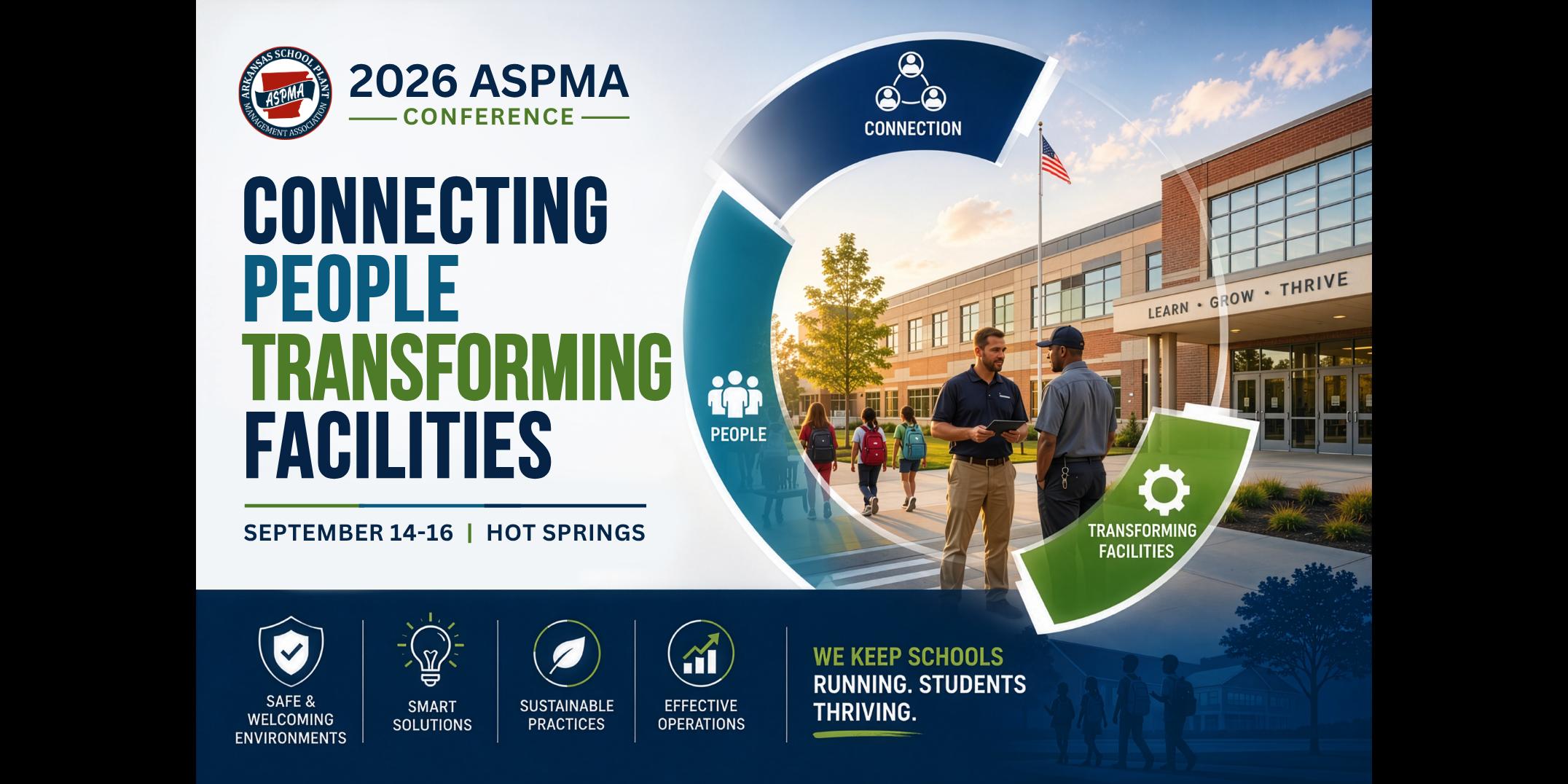
ASPMA Conference & CFD Classes, September 14-16, 2026
Hot Springs Convention Center
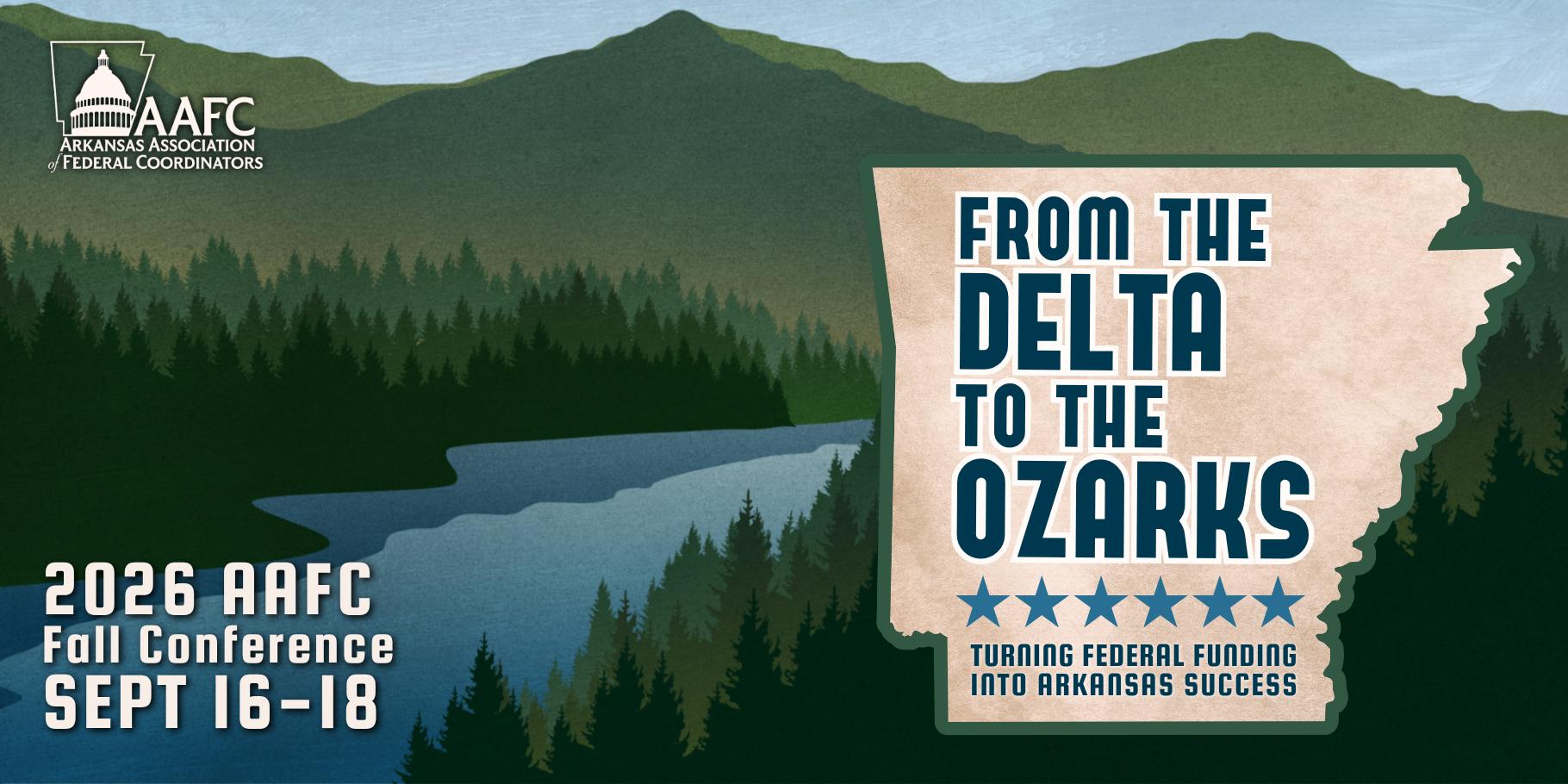
AAFC Fall Conference, September 16-18, 2026
Hot Springs Convention Center
ArkASPA Fall Conference, September 29, 2026 Wyndham Riverfront, NLR
AAGEA New Coordinator Workshop, October 7, 2026 Benton Event Center
AAGEA Conference, October 8, 2026
Benton Event Center
CASBO Certification Classes, October 21-22, 2026 UCA Brewer-Hegeman Conference Center
AACTEA Fall Conference, October 29, 2026
UACCM, Morrilton
AAEA Fall Conference, November 10, 2026
Benton Event Center
For more information, visit theaaea.org/events.
Dr. Jason Reeves
AAEA President
Assistant Superintendent, Alma
Dr. Jeremy Owoh
AASA President Superintendent, Jacksonville North Pulaski
Carise Echols
AAESP President-Elect Elementary Principal, Conway
Jason Selig
AASSP Past President Director of Instruction, Lake Hamilton
Pam McCammon AASBO Past President Chief Financial Officer, Greenbrier
Crystal Fluker
AAMLA President Junior High School Assistant Principal, Brookland
Shawn Burgess
ArkASPA President Chief of HR/Compliance Officer, Little Rock
Dr. Jared Cleveland AAEA President-Elect Superintendent, Springdale
Dr. Karen Walters AASA President-Elect Superintendent, Bryant
Betsy Laughter AAESP Past President Elementary Principal, Marion
Jennifer Turner AACTEA President CTE Coordinator, Guy Fenter Educational Cooperative
Kelli Gordon AASEA President Special Education Director, Conway
Raymond Reynolds ASPMA President (until Sept) Maintenance/Facilities Supervisor, Searcy
Dr. Megan Duncan AAEA Executive Director
Stephanie DeFoor
AAEA Secretary ElementaryGreenbrierPrincipal,
Gary Williams AASA Secretary Superintendent, White Hall
Charles Nelson AASSP President Junior High School Principal, Greene County Tech
Amy Robson AAFC President Federal Program Coordinator, Flippin
Dr. Kelli Martin AACIA President DeputyGreenbrierSuperintendent,
Cedric Hawkins ASPMA President (begin Sept) Deputy Superintendent, West Memphis
Charles Warren
AAEA Past President Chief Financial Officer, Fort Smith
Shavon Jackson
AAESP President Elementary Principal, Russellville
Pam Dean AASSP President-Elect High School Principal, Stuttgart
Carol Longino AASBO President Chief Financial Officer, Magnolia
Valerie King AAGEA President Director of Gifted Programs, Siloam Springs
Darrell Parks TEL-AR President Technology Director, Hoxie
Elite
American Fidelity Assurance Co.
Coryell Roofing and Construction
NIET - National Institute for Excellence in Teaching
TIPS The Interlocal Purchasing System
Presidential Curriculum Associates
Educational Benefits
Solution Tree
Prestigious
Renaissance Learning
Stephens
Distinguished ABCover
Arkansas Army National Guard
Apptegy
Bailey Education Group Bark
Capturing Kids’ Hearts
Colleges of Education & Health Professions - UofA
Lifetouch National School Studios
Distinguished (continued)
Modern Classrooms Project
Nabholz | Entegrity Energy Partners
Diamond
Baldwin & Shell
First Security Beardsley
Imagine Learning
Lexia Learning
The Kirkland Group
Platinum
AAMSCO
Architecture Plus
C.R. Crawford Construction
Goalbook
Hight Jackson Associates PA
HMH | NWEA
Just Right Reader
Legacy Construction Management
Phoenix Contractors
Polk Stanley Wilcox Architects
Powers of Arkansas
Pro Service Builders
Progressive Technologies
Platinum (continued)
SEAS Education
Gold
CDI Contractors
Cromwell Architects Engineers
Cynergy Rehab Group
ESS
IXL Learning
Kinco Constructors
Middleton Heat and Air
Paragon Architecture
Pearson
Reach University
Sibme
WER Architects
White River Services and Solutions
Silver
American Bus Sales
EDT Solutions LLC
French Architects, PA
K12 Tutoring
Staying Home Corporation
Strategos Group

In the heat of July, our school plant managers, maintenance teams, and custodial teams are working hard to ensure facilities are being prepped and ready to serve children. Each leadership team is finalizing the last minute details before children return and providing professional development to staff members. It may sometimes feel like things have not slowed down during the summer. And yet, one of the most impactful parts of our work is gaining momentum through developing the policies that shape our children. School leaders can sometimes feel disconnected from the policymaking process. We are serving children, creating solutions, and caring for our teammates and community members. The legislative world can seem far away and sometimes complex, fast-moving, and full of decisions. We each need to take time to collaborate with our legislators. As educational leaders, we are a trusted voice, a respected expert, and an advocate for children and educators in our communities.
Few understand the realities of public education in Arkansas better than the educators who are leading the work each day. Legislators rely on each of us to help them understand the impact of legislative decisions, not in theory, but in how those decisions may directly impact our children in classrooms, cafeterias, transportation, or boardrooms.
When we collectively and respectfully work together to identify opportunities, our legislators and state leaders listen and value your input. Your voice and insight make a difference. When we share the successes of our children, it changes perspectives and the call to create policy opportunities to enhance those experiences in the classroom. We can work together as teammates clearly, respectfully, and consistently to develop helpful policies to improve our practice.
Advocacy for children happens in many ways. Sometimes it may be in a formal setting through a committee meeting at the Capitol, and other times it is in more casual moments. It may be a conversation with a local school board member, a thank-you note to a supportive legislator, or a call to a legislator to share an idea for new policy.
If you’re not sure where to begin, start local:
• Build relationships with your state representative and senator. Invite them to visit your school and interact with you, your team, your children, and families. Not just for a ribbon cutting or special event, but for ongoing, real conversations.
• Share student success stories and data from your children in newsletters or briefings.
• Encourage staff and families to understand the legislative process and how decisions are made. Small efforts add up, and investments in relationships with our state leaders help to create a culture of informed and empowered leadership over time.
Legislators and state leaders work hard year-round and now is the time to build the relationships to ensure positive outcomes for children. Now is the time to get connected with your local and state leaders who each have the same passion to serve their region as we do as educational leaders.
Our schools are not systems, they are our communities. They are filled with children who deserve thoughtful, informed decisions from each of us as the adults who are charged with leading them. We can work together to make sure those decisions reflect our collective wisdom, our experience, and an unwavering commitment to seeing our children across the state perform at high levels of academic excellence.
Dr. Karla Neathery, AAEA Assistant Executive Director

My district received Teacher Salary Equalization Funds during the 2025-2026 school year. Will we still get this funding for 2026-2027?
Yes. If your district qualified for Teacher Salary Equalization Funds (TSEF) during the 2025–2026 school year, you will continue to receive this funding for 2026–2027. Over the next two school years, TSEF is being phased into the LEARNS Minimum Teacher Salary and Raise Funds.
These funding adjustments comply with two key pieces of legislation:
• Act 909 of 2025 (amending Ark. Code § 6-20-2305(b)(6)(A)(iii)), which sets the TSEF allocation at $100 per ADM for the 2026–2027 school year, and $50 per ADM for 2027–2028.
• Act 157 of the 2026 Fiscal Session, which repealed Ark. Code § 6-20-2305(b)(6)(B)(iv) to remove the provision that previously froze TSEF at prior-year rates.
For more details, please review the Commissioner’s Memo on Changes to Teacher Salary Equalization and LEARNS Salary Funding.
If you have questions for Dr. Neathery, email her at k.neathery@theaaea.org .
Submitted by the National Institute for Excellence in Teaching

Leaders from across the state gathered at the NIET Summer Institute (NSI) to plan for a successful start to the new school year. Here are three priorities districts are focusing on and how NIET training and support are helping drive the work:
1. Supporting teacher growth through observation and feedback. Trumann School District’s Director of Teaching and Learning, Kerri Box, noted that her district's work with NIET has set her team up for success by grounding leaders in coaching-focused observations and feedback cycles. At Trumann High School, Assistant Principal Lora Stogsdill has seen the value of walkthroughs and observations that provide meaningful feedback. NIET training on observation and feedback is available free of charge to all districts for two more years, along with access to an extensive video library of classroom lessons.
2. Turning student data into instructional action. Kerri Box described how her team is using summer planning time to analyze year-end data to refine their long-range plan before students return. She and her team brought their draft plan to NSI to identify next steps, strengthen coherence, and return with a clear strategy based on end-of-year data.
3. Protecting time for meaningful professional learning. Springdale Public Schools Assistant Principal Emma Clay and Instructional Facilitator Amy Forte described how collaborative learning structures are supporting teachers and providing something they can “count on every single week.” Prioritizing collaborative learning time as schedules are put in place ensures teachers have ongoing support once the school year begins.
With the new school year around the corner, investing in stronger observation and feedback cycles through NIET training, analyzing student data, and protecting collaborative learning time are three key strategies educators are pursuing to give all students the opportunity for success. To learn more about joining an upcoming training or if you are interested in our customized support, contact NIET Executive-in-Residence Karli Saracini at ksaracini@niet.org or Central Regional Director Amy Gayle at agayle@niet.org

Dr. Jason Reeves, AAEA Board President
As I prepare to begin my 23rd year in education, 10th year as an administrator, second year in a central office position, and my year serving as President of AAEA, I've spent considerable time reflecting on what message might be most valuable to school leaders across Arkansas.
I remember sitting in my office in September 2025 as a first-year superintendent in Mountainburg Public Schools asking myself a simple question:
"How do I know where to focus my efforts?"
There were countless issues competing for attention. Staffing concerns. Budget questions. Facilities needs. Parent concerns. Compliance requirements. Every item crossing my desk felt important. It's easy in school leadership to become overwhelmed by the flood of needs, especially the urgent ones, and lose sight of what is most important.
As I reflected on that challenge, I was reminded of the story of Mary and Martha in Luke 10. Martha was consumed with the many tasks that needed to be accomplished, while Mary focused on what mattered most in that moment. Regardless of one's faith background, the leadership lesson is timeless: if we're not careful, the urgent can crowd out the important.
That lesson brought me back to a simple idea that has guided me throughout my career:
Keep the main thing the main thing.
We find ourselves leading during a time of significant change. New initiatives emerge. Expectations evolve. Accountability measures shift. Staffing challenges persist. Communities look to schools to meet an evergrowing list of needs. The demands on school leaders have never been greater.
Yet amid all the change, pressing needs, and daily responsibilities, I continue to come back to one fundamental truth: For schools, the main thing has always been—and will always be—high levels of teaching and learning for every student.
That may sound obvious, but anyone who has spent time in school leadership understands how difficult it can be to maintain that focus. Every day brings new emails, meetings, concerns, deadlines, compliance requirements, and unexpected challenges. Important matters demand our attention. Urgent situations require our response. Before long, entire days can pass without meaningful conversations about instruction or student learning.
Peter Drucker (The Effective Executive) once wrote that there is nothing so useless as doing efficiently that which should not be done at all.
School leaders understand this tension well. We can become exceptionally efficient at managing schedules, reports, procedures, and countless operational tasks while unintentionally spending less time on the very reason our schools exist.
The challenge is not determining whether those responsibilities matter. They do. The challenge is ensuring they never overshadow our primary purpose. Every decision we make should ultimately lead us back to a simple question:
How does this improve teaching and learning for students?
When we discuss budgets, we should be discussing how resources support learning. When we discuss staffing, we should be discussing how great educators impact learning. When we discuss facilities, schedules, programs, and priorities, we should be considering how those decisions create better opportunities for learning. The work may look different from district to district, but the purpose remains the same.
Simon Sinek often speaks about the importance of understanding our "why." In education, our why is not a program, initiative, or strategic plan.
• Our why is students.
• Our why is the kindergartner learning to read.
• Our why is the middle school student discovering confidence.
• Our why is the high school senior preparing for life after graduation.
When leaders remain connected to that purpose, decisions become clearer. Priorities become easier to establish. Resources become easier to allocate. Most importantly, people understand what truly matters. Leadership is influence. Whether we realize it or not, we communicate our priorities every day.
If our conversations focus on learning, teachers understand that learning matters. If we spend time in classrooms, teachers understand that instruction matters. If we celebrate student growth, students understand that learning matters. Our influence is often less about what we say and more about what we consistently pay attention to.
As Arkansas educators prepare for another school year, there will be no shortage of challenges to navigate. There will also be incredible opportunities to serve students, support teachers, and strengthen our schools.
My hope is that we embrace those opportunities while remaining grounded in our purpose.
The landscape of education will continue to evolve. New initiatives will come and go. Expectations will change. Challenges will emerge.
But the mission remains:
• Helping students learn.
• Growing great teachers.
• Creating schools where every child has the opportunity to succeed. That is the work. That is the mission. That is the main thing. And as leaders, our responsibility is to keep it there.
As you prepare for this upcoming school year, ask yourself three questions:
• What receives the majority of my time and attention each week?
• Does my calendar reflect my instructional priorities?
• How do I communicate the importance of teaching and learning to my staff?
Those questions can help us take an honest assessment of where our focus truly lies. At the end of the day, every employee in our school system, from classroom teachers to bus drivers, paraprofessionals to principals, cafeteria staff to custodians, plays a role in supporting student success. Our responsibility as leaders is to help every employee understand how their work contributes to the larger mission.
When people understand the mission, they find purpose. When they find purpose, they become more invested. And when an entire school community is united around high levels of teaching and learning for every student, remarkable things happen.
So as another school year begins, I encourage you to remain focused on what matters most, and Keep the Main Thing the Main Thing.

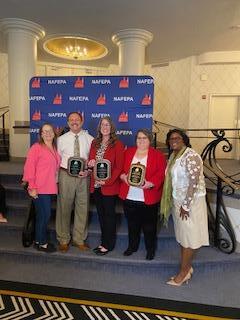
Terry Darnell, Federal Programs Coordinator, Green Forest Schools, started his career right out of college in Oklahoma, coaching basketball and teaching science. He says, "As a teenager, I wanted to be a teacher, coach, or a wildlife ranger! I loved sports growing up and coaching became an extension of that passion. My interest in science, fueled by my teachers, guided me to that subject area." After a short time out of education, he met and married his wife, and they made their way to Arkansas where he coached and taught for 12 years at Magnet Cove High School and Middle School. At the encouragement of his superintendent, Terry moved into administration and served as the Elementary Principal at Magnet Cove for three of those years. He then moved to North Arkansas where he became the Assistant Junior High Principal at Harrison for 9 years. After a 2-year administrative stint in Tennessee, he returned to Arkansas to serve as Green Forest's High School Principal. Five and a half years later, he became the Federal Programs Coordinator at Green Forest. "This will be my 7th year in this position, and it is the most fun I have had in education!" he states.
Terry says that one of his favorite things about being a Federal Programs Coordinator is being able to "take an idea from a teacher, find the funds to support it and see the students benefit from an opportunity. There is so much behind the scenes that takes place and I really enjoy being a part of that process." The most challenging part of the role is "compliance, following the necessary guidelines, making sure district funds are spent properly, and navigating the FGMS/GMS system!" To anyone considering a similar career, he advises: "Education can be very rewarding as you see students attain success during their high school years then as they blossom after college! It is so special to hear from former students! Always be of a mindset to learn." He also emphasizes the importance of taking a personal interest in each and every student, stating "the sweetest sound a person can hear is their name! I have always tried to remember every student’s name. When I am in the hallway, on the bus or at a school event, I try to call their name and give them a feeling of importance, that they are being heard."


What major changes have you seen in education during your career?
Gone are the “good ole days.” School is much more regulated, evaluations are so much more thorough and effective, collaboration is greater between educators. Students’ interests have changed as our culture has changed.
What might other administrators be surprised to know about you?

I am active with our church and rotate monthly giving sermons with the other men. Played basketball in college at NWOSU, in Alva, OK before there was a three-point shot and was listed as six foot in the program!!!
What is the most daring thing you’ve done?
I have parasailed behind a pickup with an army surplus harness and 150 feet of rope across the wheat fields of Oklahoma and jumped off a bridge into Dale Hollow Lake in Tennessee.
What do you enjoy doing during your time off?
I enjoy anything outdoors, hunting, fishing, and gardening.
What is one of the things on your “Bucket List?”
We have a special spot down in Florida and I would like to take a month to spend time on the beach, listen to the waves, and truly relax.
If you weren’t in your current position, what would you be doing?
I think I would like to be running an event center, providing education on outdoor topics, hobbies and interests to help people gain fulfillment by reaching their goals.

What are the goals you are still working toward?
We have a 10 acre farm in North Arkansas and would love to get that established as a place where our family and friends could come visit, rest and enjoy the outdoors.
My wife and I enjoy traveling. We have many places in the U.S. and abroad we would like to go.
What do you see as the biggest benefit of AAEA membership?
Education, like many other things, cannot be navigated alone. The collaboration between members of the AAEA and AAFC has been a large part of supplying that help and guidance.








Join us for the 2026 AAEA Summer Conference, Vision to Impact: Be the Change, on July 27-29, 2026, at the Statehouse Convention Center and Marriott Hotel in Little Rock, AR. The event will feature keynote speakers, over one hundred breakout sessions from inspiring educational leaders, an exhibit hall, and hospitality events. Join administrators from across the state to learn, network, and celebrate your love for public education!

Submitted by Dr. Gene Kerns, Chief
Academic Officer, Renaissance

Education has always evolved alongside major technological shifts - from the printing press to the internet. Today, artificial intelligence represents the next inflection point. But as history shows, the introduction of new tools alone does not transform learning. What matters is how those tools are applied to improve access, coherence, and outcomes for students.
AI is already making it easier for educators to create worksheets, draft letters home, generate images, and more. Yet early implementations reveal an important limitation: when AI operates without context, disconnected from curriculum, assessment, and the day-to-day realities of the classroom, it often falls short of delivering meaningful learning gains. In some cases, it can even create additional challenges, from misaligned instruction to increased cognitive load for educators.
This moment calls for a shift in how we think about AI in education. Rather than viewing it as a standalone tool, forward-thinking districts are exploring AI within a coherent Educational Intelligence System - one that connects curriculum, assessment, and practice in ways that support both teachers and students.
At its best, AI should enhance, not replace, the role of educators. Teachers remain central to fostering critical thinking, guiding learning experiences, and building relationships that technology cannot replicate. Effective AI solutions, therefore, are those that amplify teacher insight by bringing together meaningful data and translating it into actionable guidance.
To explore these ideas further and see how AI can support a more connected, data-informed approach to teaching and learning, read the full whitepaper.
CoSN is a great resource for school technology administrators. Check this page monthly for links to articles to assist technology leaders as they navigate through digital learning transformations.

CoSN Podcast Series - “Screen Time in Schools: Policy, Research, and Reality”
CoSN Statement on FCC Review of the E-Rate program
EmpowerED Superintendent edLeader Panel Broadcasts
CoSN Membership


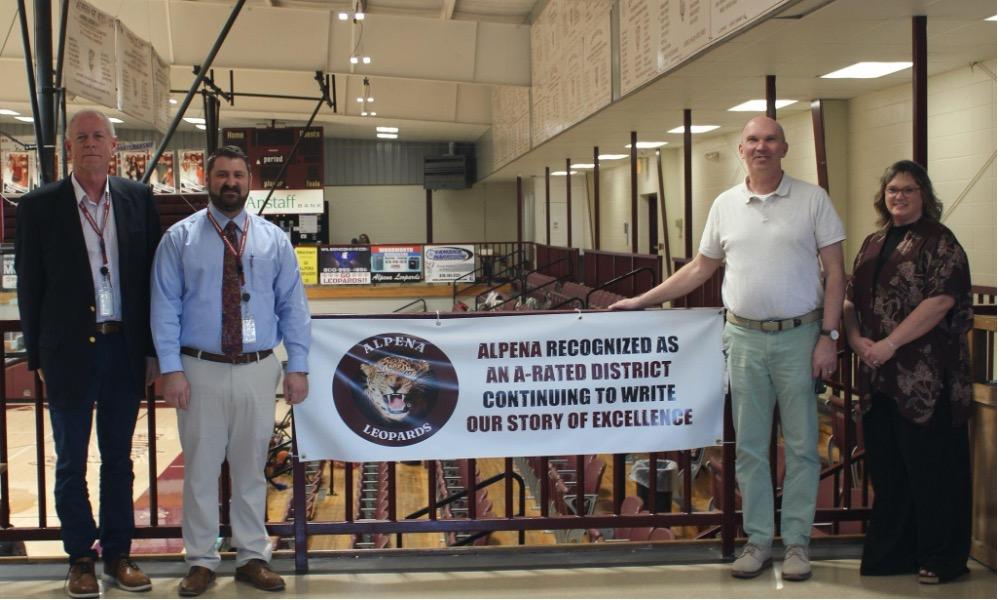
At Alpena Public Schools, a shared vision guides the work: supporting educators through ongoing collaboration and coaching; protecting the instructional time of all children through consistent, supportive systems; and ensuring every child continues to grow academically, experiences a strong sense of belonging within the school community, and graduates prepared for future success.
District leadership is guided by Mr. Anthony Dowdy and supported by an aligned leadership team that includes Sara Curry, Director of Curriculum and Instruction; Michael Smith, K–12 Principal; and Mark Welch, Dean of Students. Each brings a distinct area of responsibility while working closely together to strengthen instruction and ensure children experience meaningful learning every day.
The leadership team also recognizes the strength of Arkansas’s new and rigorous assessment and accountability system, which provides clear standards and meaningful insight into how children are learning and growing. At Alpena Public Schools, this information guides instructional decisions, professional learning, and the support provided to children so educators can respond intentionally to each child’s progress.
Across Alpena Public Schools, educators regularly engage in data conversations that examine student learning and identify instructional strategies that help children grow. These discussions allow educators to look closely at patterns in student performance and determine how individualized instruction can strengthen outcomes for every child.
These conversations extend into classrooms through regular walkthroughs and instructional feedback. Classroom observations provide opportunities to refine instructional strategies and maintain alignment with grade-level standards. Teaching the standards remains a priority across the district, ensuring children experience strong and consistent instruction in every classroom.
Professional learning remains an ongoing process. Meaningful improvement requires more than an initial training session. Educators receive continued support through coaching, collaboration, model lessons, and follow-up learning opportunities that strengthen implementation over time.
During training sessions, educators participate in modeled lessons that demonstrate how engagement strategies and proactive classroom practices help maintain a focused learning environment. When additional expertise strengthens this work, the district connects with external partners. Cooperative specialists, curriculum experts, and instructional consultants provide training and guidance that deepen instructional practice and expand the resources available to educators.
As the district deepened its focus on instruction, attention also turned to protecting the time children spend learning. In response, Mr. Welch developed a discipline framework designed to support educators and students while maintaining positive learning environments.
During training sessions, the framework is modeled so educators can see how engagement strategies and consistent expectations work in practice. Educators receive support with de-escalation and engagement strategies to address challenges early and keep children connected to learning. When additional support is needed, structured interventions focus on helping children develop positive behavior skills.
Counselors, families, school resource officers, and administrators work together to support children during these interventions. Detention and in-school support include opportunities for reflection, skill development, and continued academic expectations so children can return to class better prepared for success.
Documentation, transparency, and communication remain important parts of this work. Each step within the discipline process is carefully recorded so patterns can be monitored, communication with families remains clear, and expectations stay consistent across the district. This transparency strengthens trust and helps families understand how the school community supports their child.
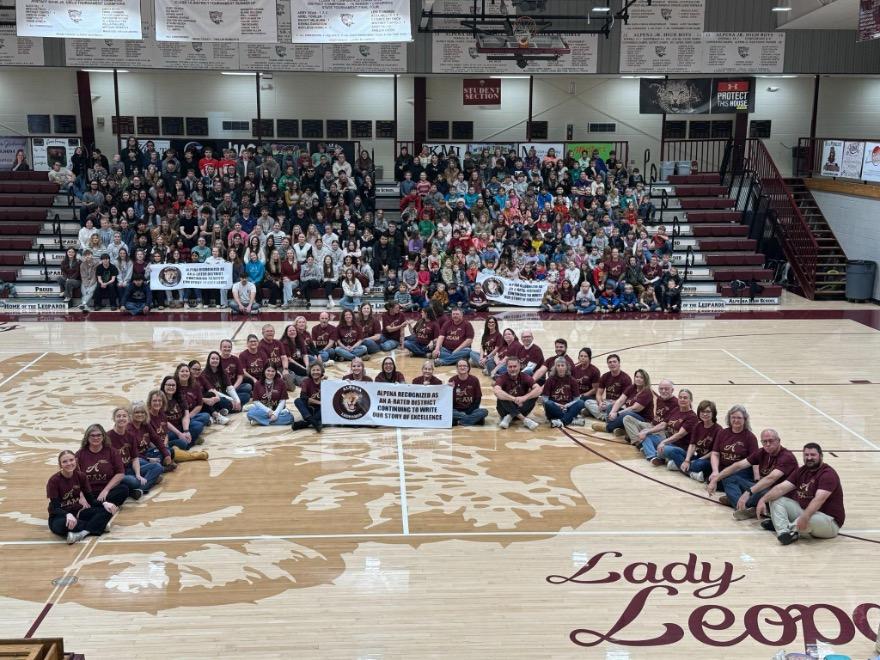
Throughout the district, progress is recognized and celebrated. When Alpena Public Schools children earned an A rating, the celebration brought children and educators together to recognize the collective effort that made the achievement possible. The moment reflected the hard work taking place in classrooms across the district.
In those classrooms and hallways, the systems supporting that success remain in motion. Educators collaborate, instruction stays focused, and learning time is protected. This shared commitment across the school community ensures every child has the opportunity to succeed.
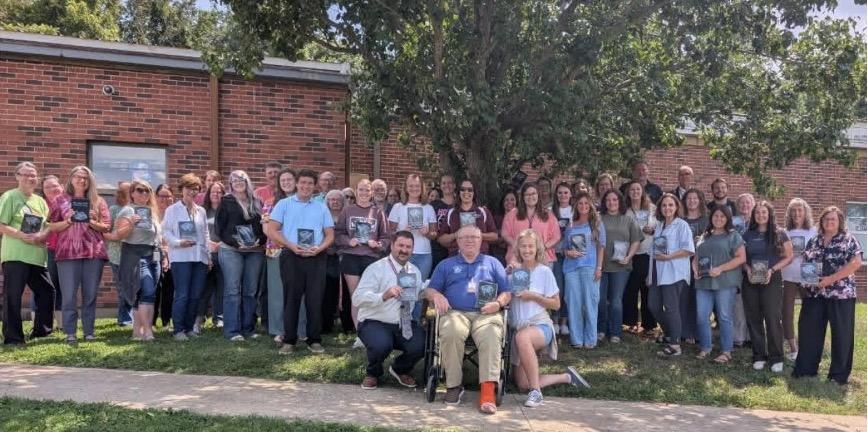

The AAEA Job Board is a calendar-year subscription that assists districts with the ever-increasing challenge of recruiting quality staff. It is a significant resource for educators, both in-state and out-of-state, seeking employment in Arkansas schools.
Over 165 school districts are participating in the program, which has been extremely helpful to schools and educators over the years. The site is used year-round and is accessed extensively during the second semester. It is not unusual to see over 400 jobs posted on the Job Board at one time. With an account, school districts may post unlimited job vacancies throughout the year.
To subscribe (by district) or to post job openings, contact our office at 501-372-1691.
District
Academics Plus Charter School
Barton School District
Brinkley School District
Camden Fairview School District
Fort Smith Public Schools
Jacksonville North Pulaski School District
ResponsiveEd Arkansas
ResponsiveEd Arkansas
Position
2026-2027 Elementary Assistant Principal
K-3
High School Principal (7-12)
K-12 Special Education Director
CFMS Assistant Principal
Dean of Students
DOD STARBASE Coordinator
Assistant Headmaster and College and Career Counselor
Campus Director
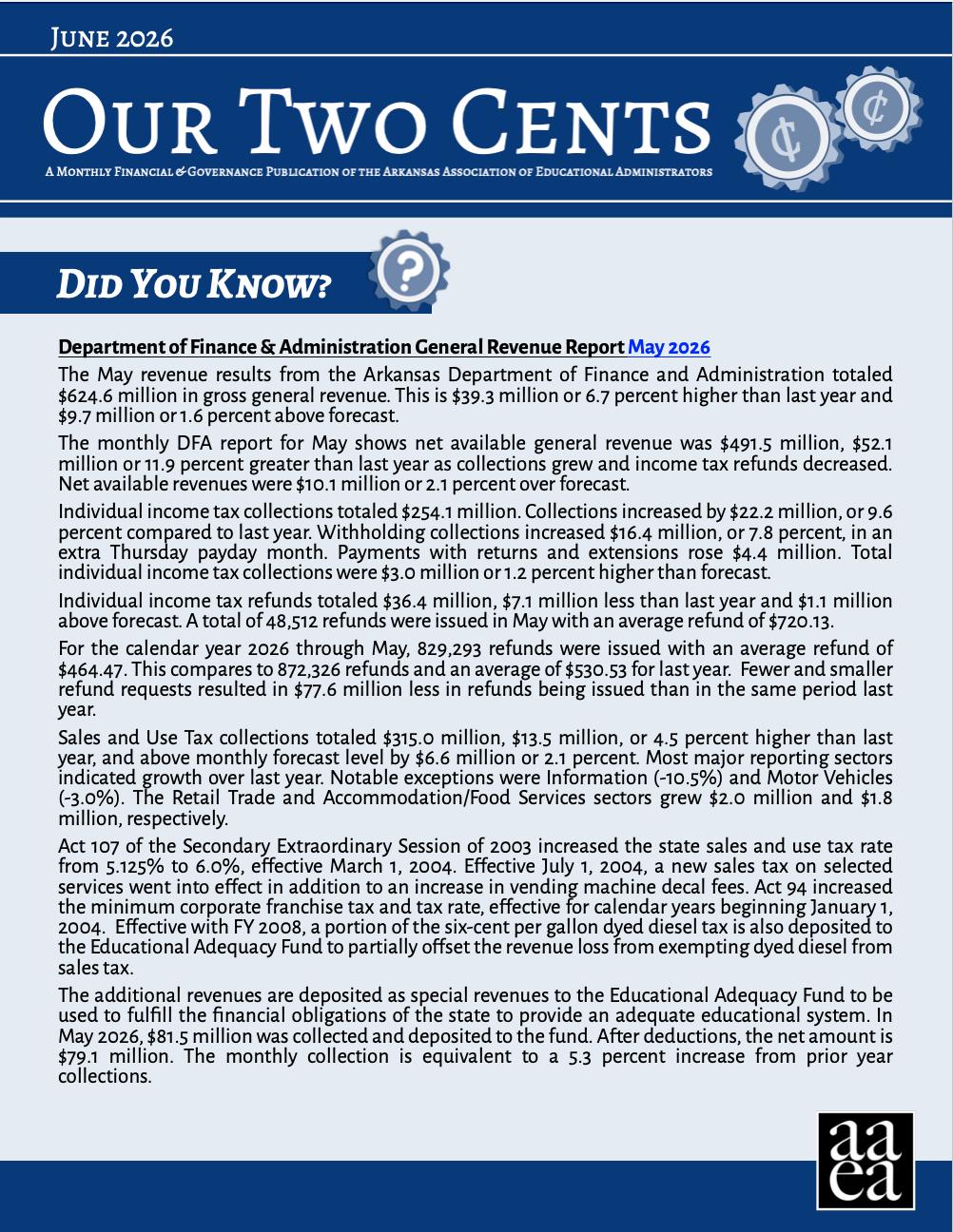

The May revenue results from the Arkansas Department of Finance and Administration totaled $624.6 million in gross general revenue. This is $39.3 million or 6.7 percent higher than last year and $9.7 million or 1.6 percent above forecast.
The monthly DFA report for May shows net available general revenue was $491.5 million, $52.1 million or 11.9 percent greater than last year as collections grew and income tax refunds decreased. Net available revenues were $10.1 million or 2.1 percent over forecast.
Individual income tax collections totaled $254.1 million. Collections increased by $22.2 million, or 9.6 percent compared to last year. Withholding collections increased $16.4 million, or 7.8 percent, in an extra Thursday payday month. Payments with returns and extensions rose $4.4 million. Total individual income tax collections were $3.0 million or 1.2 percent higher than forecast.
Individual income tax refunds totaled $36.4 million, $7.1 million less than last year and $1.1 million above forecast. A total of 48,512 refunds were issued in May with an average refund of $720.13.
For the calendar year 2026 through May, 829,293 refunds were issued with an average refund of $464.47. This compares to 872,326 refunds and an average of $530.53 for last year. Fewer and smaller refund requests resulted in $77.6 million less in refunds being issued than in the same period last year.
Sales and Use Tax collections totaled $315.0 million, $13.5 million, or 4.5 percent higher than last year, and above monthly forecast level by $6.6 million or 2.1 percent. Most major reporting sectors indicated growth over last year. Notable exceptions were Information (-10.5%) and Motor Vehicles (-3.0%). The Retail Trade and Accommodation/Food Services sectors grew $2.0 million and $1.8 million, respectively.
Act 107 of the Secondary Extraordinary Session of 2003 increased the state sales and use tax rate from 5.125% to 6.0%, effective March 1, 2004. Effective July 1, 2004, a new sales tax on selected services went into effect in addition to an increase in vending machine decal fees. Act 94 increased the minimum corporate franchise tax and tax rate, effective for calendar years beginning January 1, 2004. Effective with FY 2008, a portion of the six-cent per gallon dyed diesel tax is also deposited to the Educational Adequacy Fund to partially offset the revenue loss from exempting dyed diesel from sales tax.
The additional revenues are deposited as special revenues to the Educational Adequacy Fund to be used to fulfill the financial obligations of the state to provide an adequate educational system. In May 2026, $81.5 million was collected and deposited to the fund. After deductions, the net amount is $79.1 million. The monthly collection is equivalent to a 5.3 percent increase from prior year collections.
This segment features content from other AAEA publications. Our Two Cents is a monthly publication available to subscribing districts. The following excerpt comes from the June 2026 issue. Interested in more from Our Two Cents? Contact our office at 501-372-1691.