Bringing Awareness: Diabetes Month
ashiriah WilliaMs THE SOUTHERN DIGEST
November, being National Diabetes Awareness month, is a chance for people to come together to bring attention to a life-altering disease. Diabetes is prominent within the black community, so it is always important to indulge in the knowledge of diabetes.
The main types of diabetes can be recognized as, Type 1, Type 2, Prediabetes, and Gestational Diabetes. Type 1 Diabetes is when glucose levels in the blood are too high due to the body not being able to make enough insulin, while type 2 is when the body does not take advantage of the bodies insulin correctly. Prediabetes is when the glucose levels in the blood are high, but not high enough to be considered type 2 diabetes. Gestational diabetes is a diabetes found in pregnant women with higher sugar in the blood than usual.
Southern University attendee and nursing major, Zaniah Duriso explains, “Diabetes, to most, is not seen as a serious disease, which is apart of the problem. It can seriously affect one’s health, such as one’s eyes. Diabetes has been known to cause blurred vision and affect the skin. It should always be taken serious in all types and situations.”
Lahoma Vernon, a black teacher at Mount Hermon School in Mount Hermon, Louisiana living with the disease, relays her situation and struggles by stating, “I’ve had this terrible immune system disease since 2006. I was diagnosed with it a few months after my mother passed.I always link it to stress or depression, however it is said it’s hereditary. My mother had a combination of both, which was very dangerous. She had many strokes, heart attacks, as well as an eye disease.”
Diabetes attack many organs in the body, but the eyes and kidneys are a main target. Even though the disease has been known to make one weak, it can be managed with constant monitoring of food/drink intake, taking meds properly, and exercising.
The Louisiana teacher also adds, “I suffer with Type 2, and I can tell you, diabetes is a mean disease, and destroys so many lives, but I will not let it get me down..”
As a witness to the tragedies of
Decades of Trimming and Achieving: SULC honors Longtime Barber, Irvin, Sr.
Jada Manuel THE SOUTHERN DIGEST

The Southern University Student BAR Association Diversity Committee presented the “Creating a More Respectful World” award to Robert J. Irvin, Sr., a barber for 58 years of service. Irvin Sr. along with his wife, three children and siblings are all alumni of Southern University.
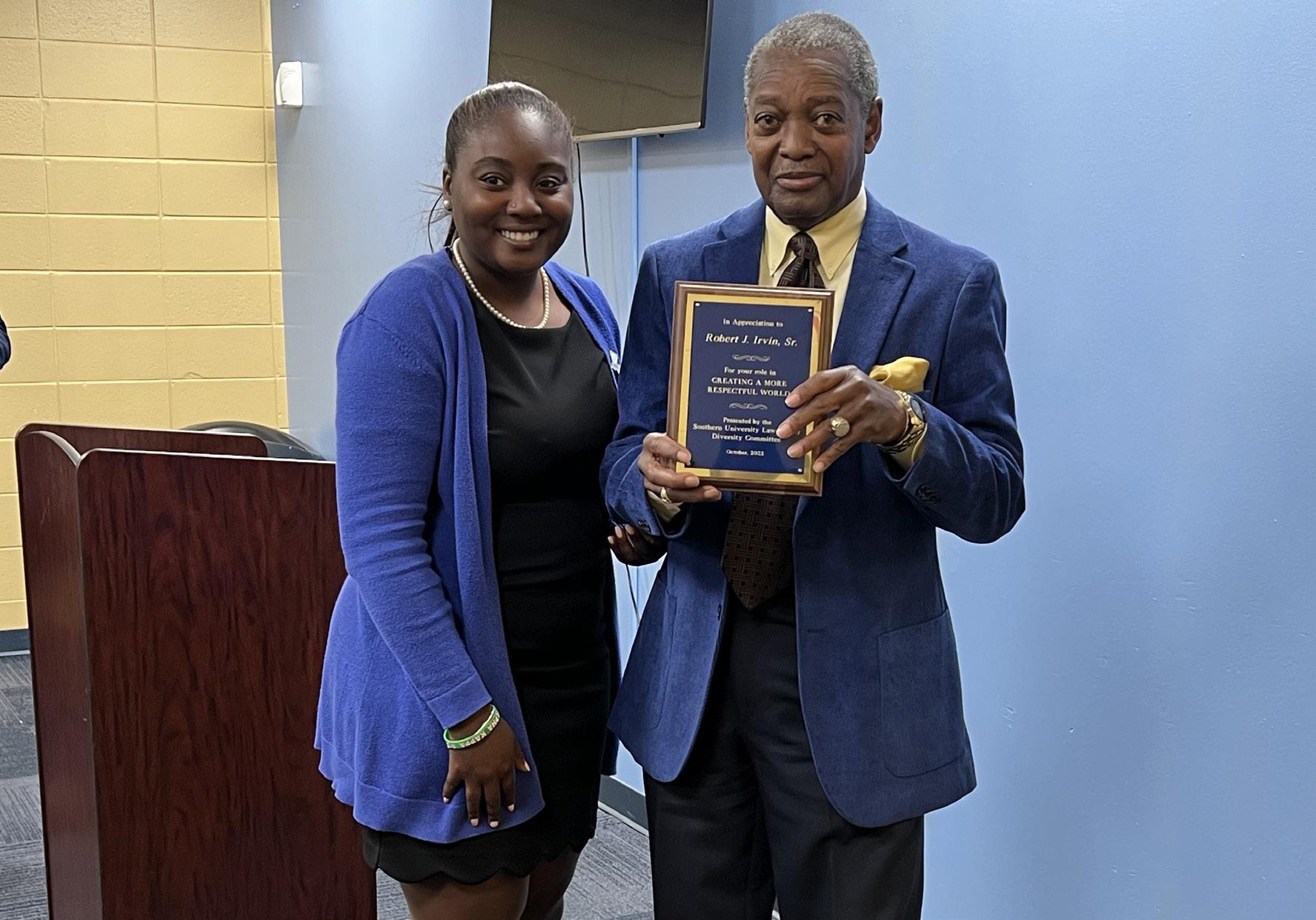
Mr. Irvin is the first person in the award’s history to receive the award who did not attend the Southern University Law Center (SULC). The plaque originated in Baton Rouge at a time near the murder of Alton Sterling and
that of the Baton Rouge Police officers, explained by Professor Micheal C. Garrard.
Student Kawana Drake created
a design for Fall Fest of 2016 that epitomized the message of the Southern University Law. The plaque was created and presented to honor Drake for
her humility. The award has since been presented to other
Commemorating the Old School for the Blind and Deaf at Southern University
 Brittany Patterson THE SOUTHERN DIGEST
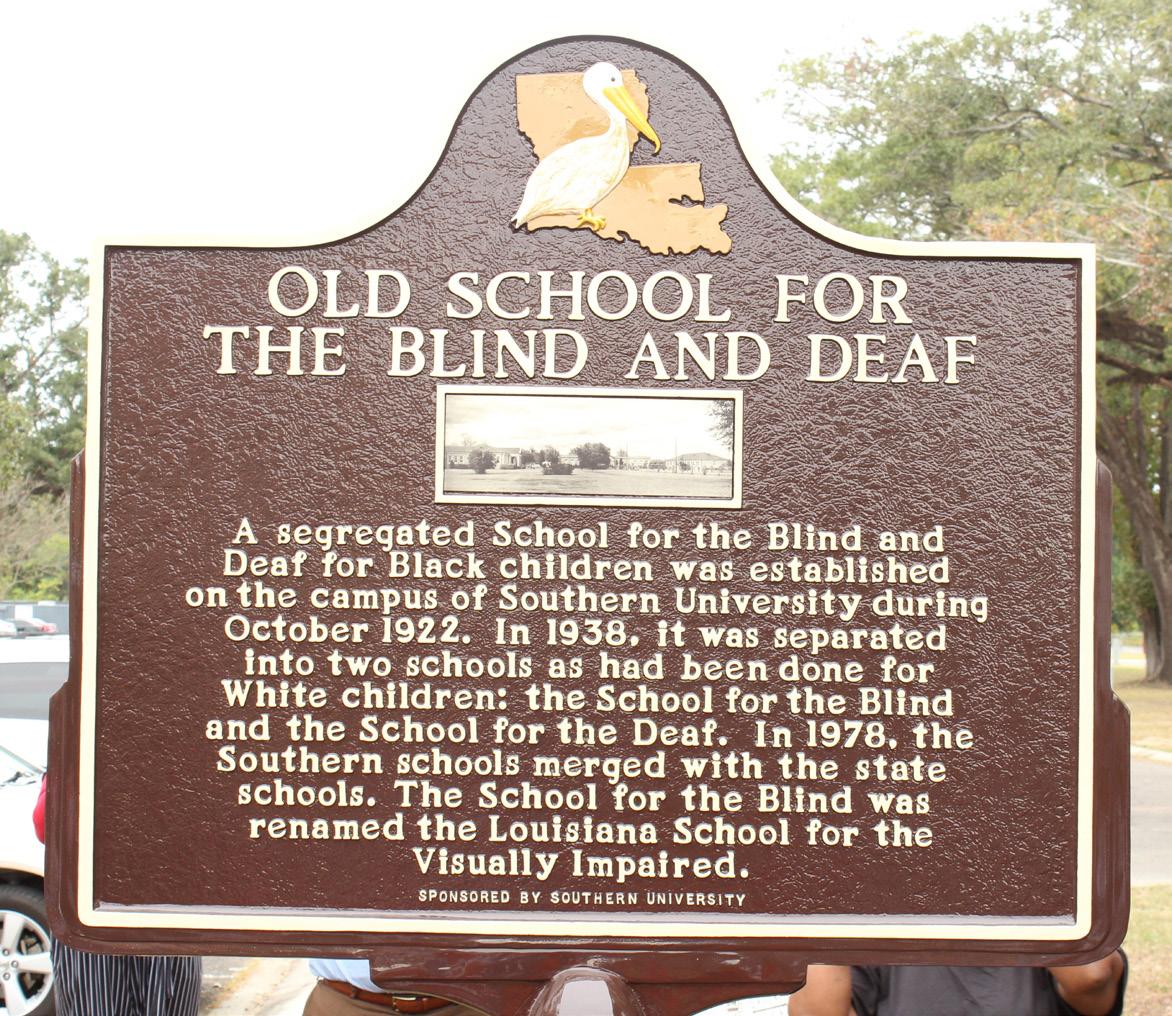
A new State of Louisiana Historical Marker is now located on the Southern University and A&M College campus at the corner of Swan Street and Henry Cobb Street for the Old School for the Blind and the Old School for the Deaf. The Louisiana State School for the Blind Negroes was started in October 1922, and the Louisiana State School for the Deaf Negroes started in October 1938.
Lynne M. Coxwell, director of Research at the Louisiana Office of Tourism spoke briefly at the dedication ceremony. “The Old School for the Blind and Deaf is one of 882 Louisiana State Historical Markers to date that have been produced since 1950. These schools are examples of perseverance and fulfilling a need in the community,” Coxwell stated.
According to The Archives, Manuscripts and Rare Books Department at John B. Cade Library, the State School for Blind
Negroes opened with 16 students under the management of the State Board of Education at the beginning of the school. By 1945, the school had four buildings on the campus of SUBR, 13 instructors and 55 students. The Deaf School added years later had 44 students with 7 instructors. For 40 years the Louisiana State School for Deaf Negroes operated as a predominantly segregated institution. It was the last black deaf school to close its doors.
In 1978, the Louisiana School for the Negro Blind and the Louisiana State School for the Blind merged and became the Louisiana State School for the Visually Impaired. Likewise, the Louisiana State School for Deaf Negroes merged with the Louisiana State School for the Deaf and became the Louisiana School for the Deaf. Both schools are now located on Brightside Lane, south of downtown Baton Rouge on a 116-acre campus.
Alvin Daniels, alumnus of the Old School for the Blind discussed on his personal experience.
“As time progressed, it taught us to be with our peers and people like us. We drew a bond here,” he continued, “It taught us to be someone, to be a man… If it had not been for that, I wouldn’t be standing here today.”
Daniels stated that certain family members were blind, so not only did he attend the Old School
for the Blind, but other family members as well.
Joseph Sarpy, Alumnus of the Old School for the Deaf described his experiences with fond memories of the faculty. “It was a brand-new school for me and that was where I was going to
See IRVIN page 3
November 1, 2022 . Volume 79 . Issue 7 THE OFFICIAL STUDENT NEWSPAPER OF SOUTHERN UNIVERSITY AND A&M COLLEGE, BATON ROUGE, LOUISIANA
See DIABETES page 3
Longtime Barber, Robery J. Irvin, Sr. smiles alongside Law student Victoria Grant as she presents him with the “Creating a More Respectful World award on Friday, October 28. (Jada Manuel /DIGEST)
See OLD SCHOOL page 3
Historical Marker - Knykolas Ross/DIGEST
“I heard someone say one time that if you have a job that you love doing, then you’ll never have to work a day in your life,”- Robert Irvin, Sr.
SOUTHERN UNIVERSITY
SUITE 1064 T.H. HARRIS HALL POST OFFICE BOX 10180
BATON ROUGE, LA 70813
PHONE: 225.771.2231
FAX: 225.771.5840
ONLINE @ www.southerndigest.com
STUDENT MEDIA OFFICE
Director Jermaine Proshee Publications Mgr. Devin Hadrick
Business/Advertising Mgr. ................ Alyse Shelton
CONTACTS (area code 225)
Student Media Newsroom 771.2231
Advertising Office 771.5833
Director’s Office 771.5812
FALL 2022 STAFF (Issue 7)
Editorial Team Member (news) Jenna Benard/Brittany P.
Editorial Team Member (sports) Alexis Easton
Editorial Team Member (features) Kynnedi Jackson
Editorial Team Member (photos) Issac Armstrong
Editorial Team Member (opinion) Isaiah Clay
Staff Writers: Ashiriah Williams Ashley Lovelace Yasmine Love Imani Badie Laila Hazel Christopher Toler, Jr. Khalani Lloyd Taylor St. Vilus Maya Rosser Isaiah Clay Jaidyn Nix Ti’Ja Taylor
Jada Manuel
Staff Photographer: Christian Phillips Sandi Higgins Knykolas Ross
SUBMISSIONS POLICY
The Southern DIGEST welcomes letters from readers commenting on current issues and other matters of general interest to the SU family and public. We set aside this space to publish these letters for others to enjoy. This newspaper is not responsible for individual opinions expressed on its editorials, commentaries, ans speakouts. The Southern DIGEST reserves the right to edit any contributions and or reject them without notification. Authors are encouraged to limit the length of submissions to 300 words. Letters should not include libelous statements. Offensive and personal attacks will not be permitted. The DIGEST will not print “open letters” addressed to someone else. All contributions must be type written, signed and must include the author’s address and phone number. Unsigned letters will not be printed. Southern University students should include their majors, hometowns and year in school. When referring to specific DIGEST articles, please include the date and title. All materials should be directed to the editor in chief of The Southern DIGEST, P.O. Box 10180, Baton Rouge, La. 70813. Materials may be delivered by hand to the DIGEST office located in Suite 1064 Harris Hall or can be e-mailed to digest@subr.edu.
PUBLICATION ASSOCIATIONS
The Southern DIGEST is a member of the National Association of Black Journalists (NABJ), Associated Collegiate Press (ACP), College Media Advisers Association (CMA), Full member of the Associated Press (AP) and the Louisiana Press Association (LPA).

The Office of Student Media is a department in theDivision of Student Affairs.
WHAT’S HAPPENING ON CAMPUS
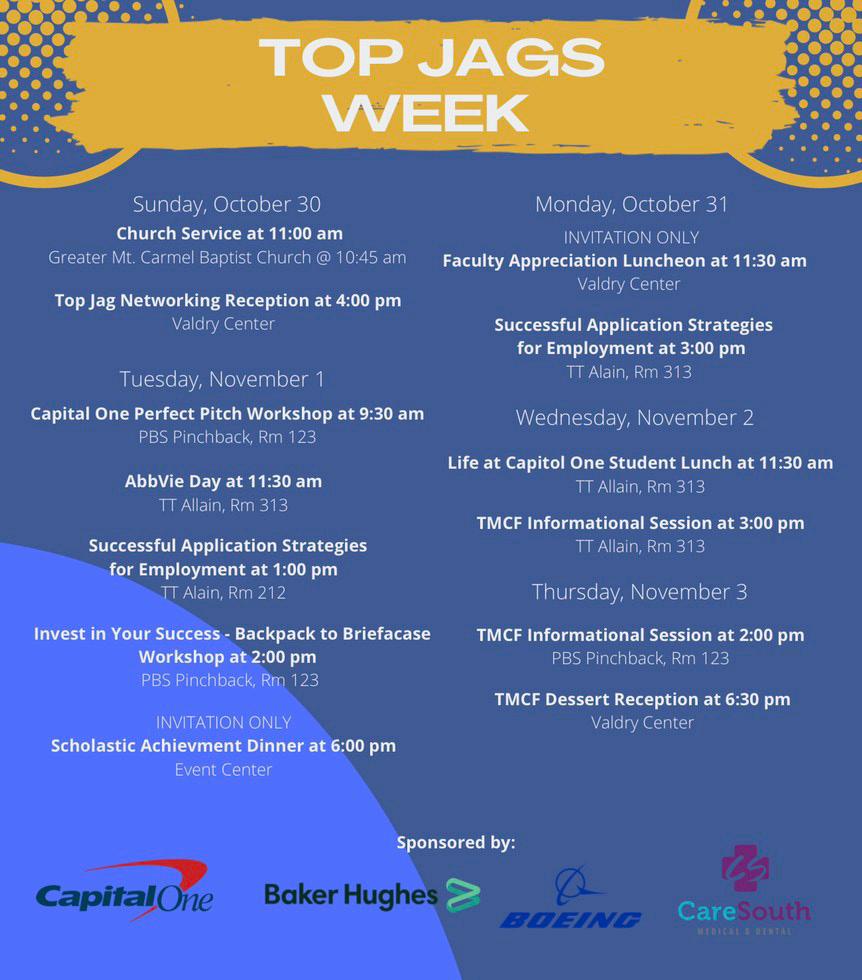
TOP JAGS WEEK
Monday, October 31, 2022 come join us for Faculty Appreciation Lunch at 11:30am in the Valdry Center. Invitation only.
Successful Application Strategies for Employment at 3:00pm in TT Allain, Rm. 313 Tuesday, November 1, 2022
Capital One Perfect Pitch Workshop at 9:30am in Pinchbank, Rm. 123

AbbVie Day at 11:30am in TT Allain, Rm. 313
Successful Application Strategies for Employment at 1:00pm in TT Allain , Rm. 212
Invest in Your Success-Backpack to Briefcase Workshop at 2:00pm in Pinchback, Rm 123 Scholastic Achievement Dinner at 6:00pm in Event Center
Wednesday, November 2, 2022
Life at Capitol One Student Lunch at 11:30am in TT Allain, Rm 313
TMCF Informational Session at 3:00pm in TT Allain, Rm 313
Thursday, November 3, 2022
TMCF Informational Session at 2:00pm in Pinchback, Rm 123
TMCF Dessert Reception at 6:30pm in Valdry Center
SOUTHERN UNIVERSITY GOSPEL CHOIR
Malik Atkins & Co. Presents: “The Live Experience” - Revival Edition Union Antioch Baptist Church
When: November 6, 2022 at 5:00 pm
Where: Union Antioch Baptist Church 4249 Shaffett Lane, Zachary, LA 70791
136TH CHURCH ANNIVERSARY
When: November 13, 2022 at 9:15am
Where: New Gideon Baptist Church 2252 Balis Drive, Baton Rouge LA, 70808
HBCU HIRE
When: November 16, 2022 at 12:00pm
Where: https://meet.goto.com/377148653


THE CHOIR EXPERIENCE
Fall 2022 Concert: Join Southern University Gospel Choir
When:November 18,2022 at 7:30pm-9:15pm
Where: Gloryland Baptist Church 6745 Greenwell Springs Road Baton Rouge, LA 70805
“SU” STAIN THE YARD: hosted by Minority Association of Pre-Medical Students at SouthernUniversity and A&M College (SU MAPS)
When:November 19,2022 at 6:00am-12:00pm
Where: Honors College
CAREER SERVICES
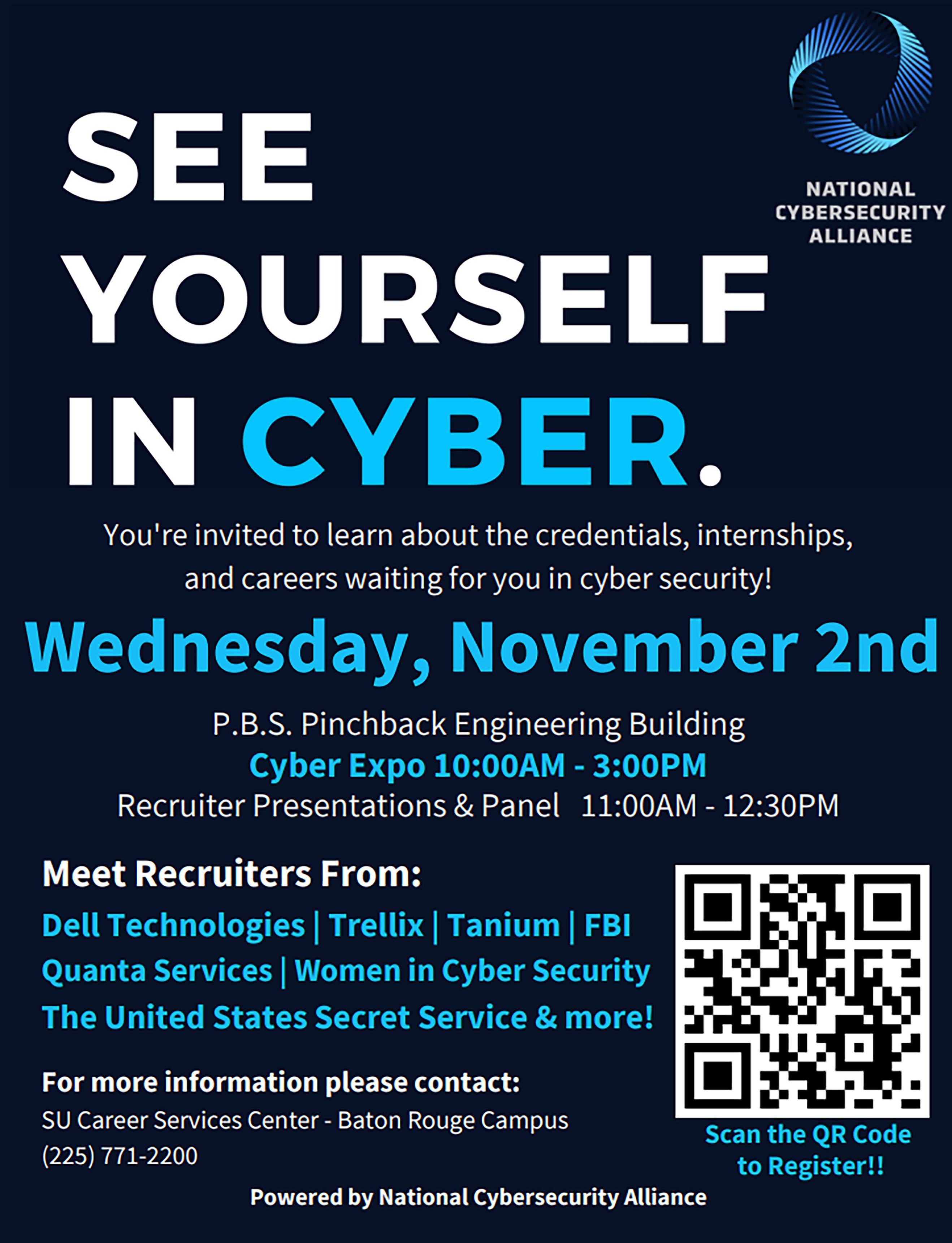
SEE YOURSELF IN CYBER: CYBER EXPO
When Wednesday, November 2, 2022 from 10:00 am to 3:00pm
Where: Pinchback Hall
*Staff list will be updated each week NEWS www.southerndigest.com
The Sentinel of an Enlightened Student Body Since 1926
Page 02 | Tuesday, November 1, 2022 If so, please consider Procter & Gamble To apply: www.pgcareers.com Search for one of the following Requisition #’s: • Manufacturing Engineer Intern: R000060405 • Manufacturing Engineer Full Time: R000060401 Are you looking to start an exciting career with a Global Manufacturing Company? As a THANK YOU for applying we will consider you for a scholarship of $400.00 (upon successful completion of both corporate assessments) JOIN US for an on campus Information Session! Location: Pinchback Engineering Building Room: #115 Date: Thursday, 11/3/22 Time: 5:00 6:00 PM P&G product giveaways, Test Prep Review and Pizza will be provided, hope to see you there! ☺
students, Diversity Committee members, and graduates of the Law Center.
“Providing not only grooming services, but life lessons to all those who visit the barber shop,” said Co-Chair of the Diversity Committee Victoria Grant as she presented the plaque to Mr. Irvin. Irvin shared the special ceremony with friends and family who traveled to attend the event from Gonzales and Darrow, Louisiana.
“I heard someone say one time that if you have a job that you love doing, then you’ll never have to work a day in your life,” said Irvin on why he’s continued his dedication to
Southern University and the barbershop.
When asked what he felt was his most meaningful contribution to the university, Irvin recalled one Chicago student from over twenty-five years ago as a freshman walking into the barbershop to whom he offered his advice. Irvin said the young man was shocked that anyone was even paying attention to him as his family was so far away, but he took heed of the advice offered to him and got his act together.
The same student returned twenty-five years later as a parent of his own freshman asking Mr. Irvin to extend the same courtesy
to his son and thanking him for how he looked out for him as a freshman himself. Irvin enjoys the nicknames that he’s received from the students over the years like “Pop” and “Unc”. He admitted, “The youngsters keep me abreast on what’s going on in the world.”
Attorney Donald Dobbins was the guest speaker and emotionally told personal accounts of Mr. Irvin’s generosity as he helped him throughout his time at Southern in undergraduate and graduate school. “He is not only a humble man, but a man of resilience,” said Dobbins.
Who’s Boyfriend?: The GroupMe from Hell

November, being National Diabetes Awareness month, is a chance for people to come together to bring attention to a life-altering disease. Diabetes is prominent within the black community, so it is always important to indulge in the knowledge of diabetes.
The main types of diabetes can be recognized as, Type 1, Type 2, Prediabetes, and Gestational Diabetes. Type 1 Diabetes is when glucose levels in the blood are too high due to the body not being able to make enough insulin, while type 2 is when the body does not take advantage of the bodies insulin correctly. Prediabetes is when the glucose levels in the blood are high, but not high enough to be considered type 2 diabetes. Gestational diabetes is a diabetes found in pregnant women with higher sugar in the blood than usual.
Southern University attendee and nursing major, Zaniah Duriso explains, “Diabetes, to most, is not seen as a serious disease, which is apart of the problem. It can seriously affect one’s health, such as one’s eyes. Diabetes has been known to cause blurred vision and affect the skin. It should always be taken serious in all types and situations.”
Lahoma Vernon, a black teacher at Mount Hermon School in Mount Hermon, Louisiana living with the disease, relays her situation and struggles by stating, “I’ve had this terrible immune system disease since 2006. I was diagnosed with it a few months after my mother passed.I always link it to stress or depression, however it is said it’s hereditary. My mother had a combination of both, which was very dangerous. She had
many strokes, heart attacks, as well as an eye disease.”
Diabetes attack many organs in the body, but the eyes and kidneys are a main target. Even though the disease has been known to make one weak, it can be managed with constant monitoring of food/drink intake, taking meds properly, and exercising.
The Louisiana teacher also adds, “I suffer with Type 2, and I can tell you, diabetes is a mean disease, and destroys so many lives, but I will not let it get me down..”
As a witness to the tragedies of the disease, one should always take caution when in the line of fire. One way to prevent the disease is to stay active. Being physically active can result in losing weight, lowering the sugar in the blood, and keep the blood sugar within range! Another is involving healthy fats in ones diet. Healthy fats include, but are not limited to— canola oils, nuts, salmon, and tuna. Diabetes is a life altering disease, but is manageable. Awareness for diabetes is imperative, and should also be normalized.
learn. At first it was difficult, as time went on, I made it through,” Sarpy communicated.
His favorite teacher was Louise Smith. Smith was a teacher at the Old School for the Deaf. One of her instructors at Alabama State encouraged her to work at the Old School for the Deaf. “That’s what I did, once I graduated, I came to Southern University to teach,” Smith said.
Amina Mitchell, junior Disability Services major from Dallas, TX stated how she felt about the ceremony. “I love seeing the alumni of the Old School of the Deaf and Blind coming together as a current student at Southern University who is hard of hearing,” she detailed. “Seeing how people who have similar disabilities as me and hearing what they have accomplished since graduating is amazing to witness.” Mitchell then stated how she hopes to bring awareness concerning the hard of hearing and deaf community to SU’s campus.
Senior political science major Clifford Choates from San Jose, CA stated his views at the dedication ceremony. “It makes me proud to see the support for the deaf and blind members of our SU community. The history our school has, is amazing,” he exclaimed.
DIABETES from page 1
the disease, one should always take caution when in the line of fire. One way to prevent the disease is to stay active. Being physically active can result in losing weight, lowering the sugar in the blood, and keep the blood sugar within range! Another is involving healthy fats in ones diet. Healthy fats include, but are not limited to— canola oils, nuts, salmon, and tuna. Diabetes is a life altering disease, but is manageable. Awareness for diabetes is imperative, and should also be normalized.
SUBMISSIONS/OPINION POLICY
The Southern DIGEST welcomes letters from readers commenting on current issues and other matters of general interest to the SU family and public. We set aside this space to publish these letters for others to enjoy. This newspaper is not responsible for individual opinions expressed in submissions, editorials, opinions and commentary pieces. It is the sole opinion of the writer and does not reflect the views of any professional faculty, staff or administrator of the University.
The Southern DIGEST reserves the right to edit any contributions and or reject them without notification. Authors are encouraged to limit the length of submissions to 300 words. Letters should not include libelous statements. Offensive and personal attacks will not be permitted. The DIGEST will not print “open letters” addressed to someone else. All contributions must be type written, signed and must include the author’s address and phone number. Unsigned letters will not be printed. Southern University students should include their majors, hometowns and year in school. When referring to specific DIGEST articles, please include the date and title. All materials should be directed to the editor in chief of The Southern DIGEST, P.O. Box 10180, Baton Rouge, La. 70813. Materials may be delivered by hand to the DIGEST office located in Suite 1064 Harris Hall or can be e-mailed to digest@subr.edu.
NEWS www.southerndigest.com
IRVIN from page 1 The Sentinel of an Enlightened Student Body Since 1926 Tuesday, November 1, 2022 | Page 03
OLD SCHOOL from page 1
iMani Badie
THE SOUTHERN DIGEST
DIGEST
ART NEWS OPINION
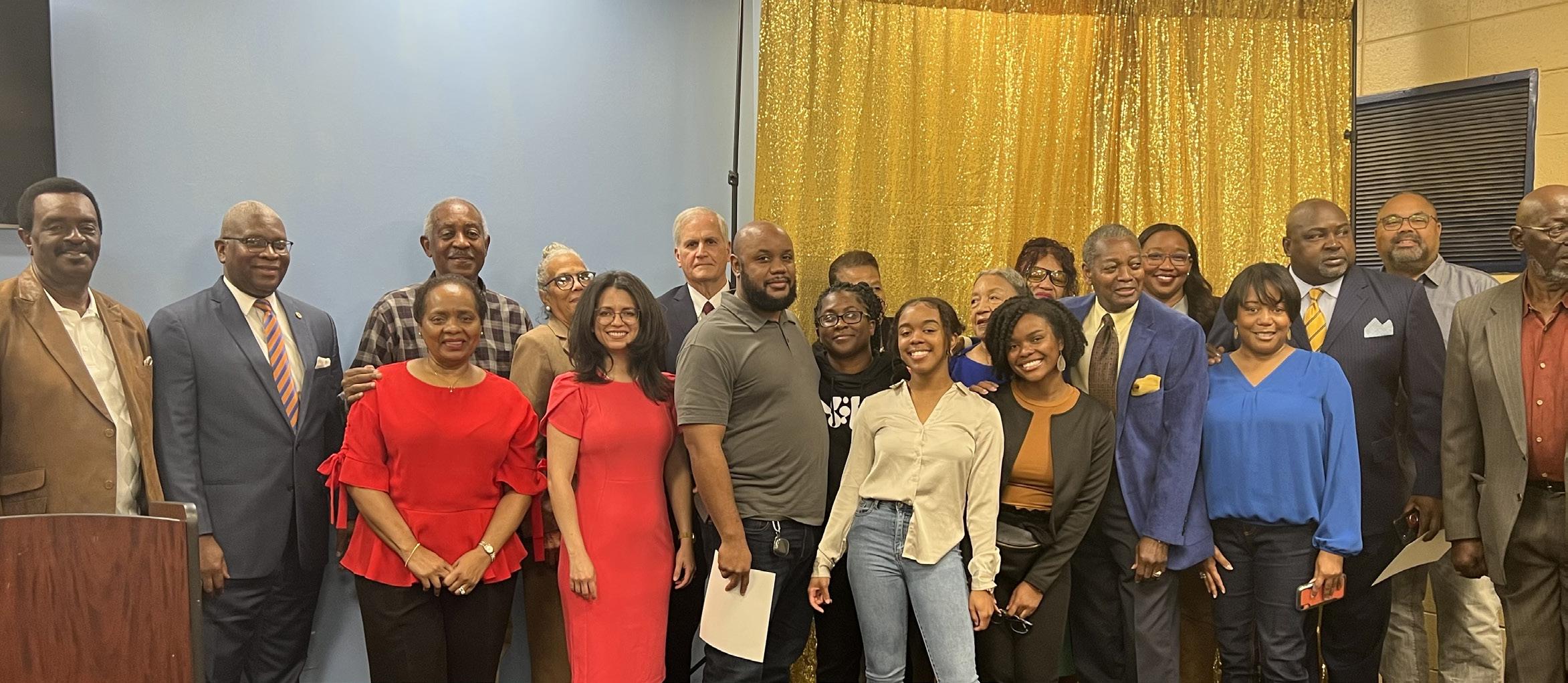
Award recipient Robert J. Irving, Sr. is joined by family/friends after his award ceremony on Friday, October 28. (Knykolas Ross/DIGEST)
When It Rains, It Pours: Jags scoreless in Jackson
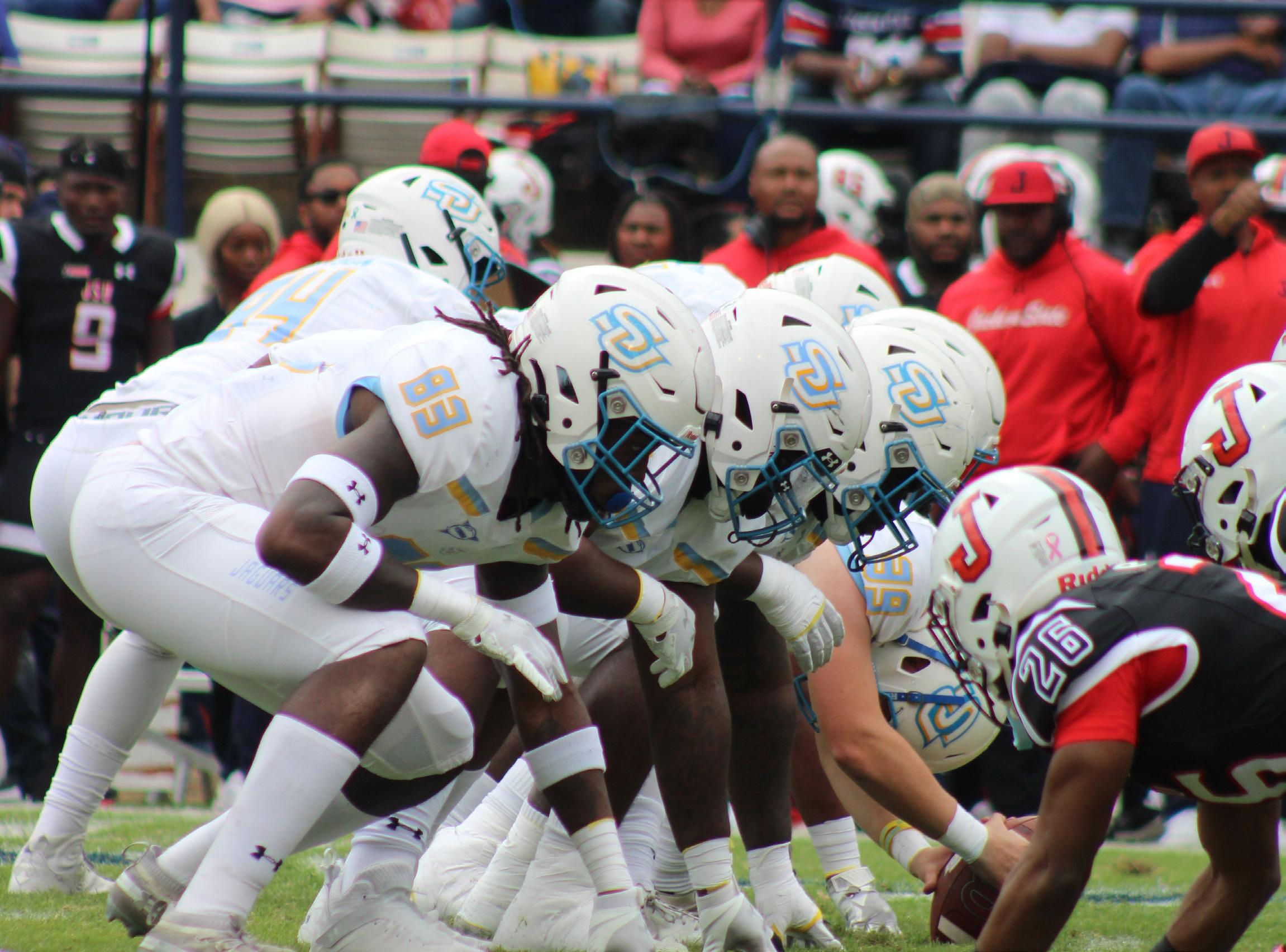
The 64th annual Boombox Classic was held this year in Jackson, Mississippi at Veterans Memorial Stadium. The much-anticipated rivalry game had an amazing atmosphere as usual, but even better ESPN’s most famous pregame show College Gameday came to town. The game also had a little more meaning this time around because it is the last Boombox Classic to be held on either school campus for the next 2 years as it will be played in Birmingham, Alabama instead. Southern came into the game looking to knock off undefeated Jackson State, but they would play a complete game of football.
The Jags had an uphill battle already with the atrocious weather conditions with the wind and rain. The SU Dog Day defense came out the gates fired up stopping Jackson State on 4 and 1s on JSU’s first two possessions. However, the offense could not capitalize, which ended up being the theme of the game. SU would try to get on the board with field goals, but JSU’s top-rated defense would block sophomore kicker Joshua Griffin on his first attempt followed
Undefeated No More: Jags Win, advance to SWAC Championship Tournament
 ti’Ja taylor THE SOUTHERN DIGEST
All eyes were on A.W. Mumford Stadium as the Lady Jags took on the Lady Tigers for their final home game of the season. Jackson State came into the game undefeated in conference play in the SWAC. The Jags were also making sure they clinch their spot in the SWAC tournament in Prairie View, Texas while playing spoiler to the undefeated Lady Tigers.
On a cool fall evening, setting up a great day for soccer, both teams did not waste any time. The Tigers played vicious defense against the Jags, but they didn’t let that stop them. The Lady Jags came with intensity on defense the whole game. Ending the first half with a save by sophomore goalkeeper Sydney Bellamy.
Opening the second half, the Jags came out even stronger than the first half. Both teams kept the same momentum eager to get a win. However, the Jags seemed to want it more and they had numerous shots that were close to going in. The crowd was on their feet for the entire second half as both teams could
have won. As the game neared the end, the pressure was on to score. With that being said, sophomore midfielder Victoria Thomas get her first career game-winner.
The goalie for the Lady Jags kept a good eye during the game including 4 saves for the night for Bellamy. It was a well-earned win for the Lady Jags and A.W. Mumford Stadium. was rocking the whole night. Senior defender Cordney
Armstrong shared her thoughts on the team’s result.“The air was different I knew all my teammates wanted it before the game started. As we played the game we dominated the entire time, it was clear we were the better team.”
Junior midfielder/forward Deja Griffin added her thoughts team’s performance by stating “We put pressure on them for 90 minutes. For us as a team and a program, this is big. This gives
us momentum going into the tournament. Overall, it’s great to have everyone come together to play and get the win.”
It was clear fan support was there and sophomore Agribusiness major, Mykah Mares, from Houston, Texas had this to say, “As a supporter of SU Soccer, it was amazing to see their teamwork come into play. I feel like you can
really see everything that they had been working on over the season bring them their success,” Mykah Mares a sophomore Agribusiness major from Houston, Texas.
Bellamy blocked the last shot and that was the game! The Tigers had been undefeated all
SPORTS www.southerndigest.com The Sentinel of an Enlightened Student Body Since 1926Page 04 | Tuesday, November 1, 2022
The Jaguars were no match for the top ranked Tiger defense going scoreless in their match up on Saturday, October 29.
(Terren Thomas/DIGEST)
eric White THE SOUTHERN DIGEST
See SCORELESS page 5
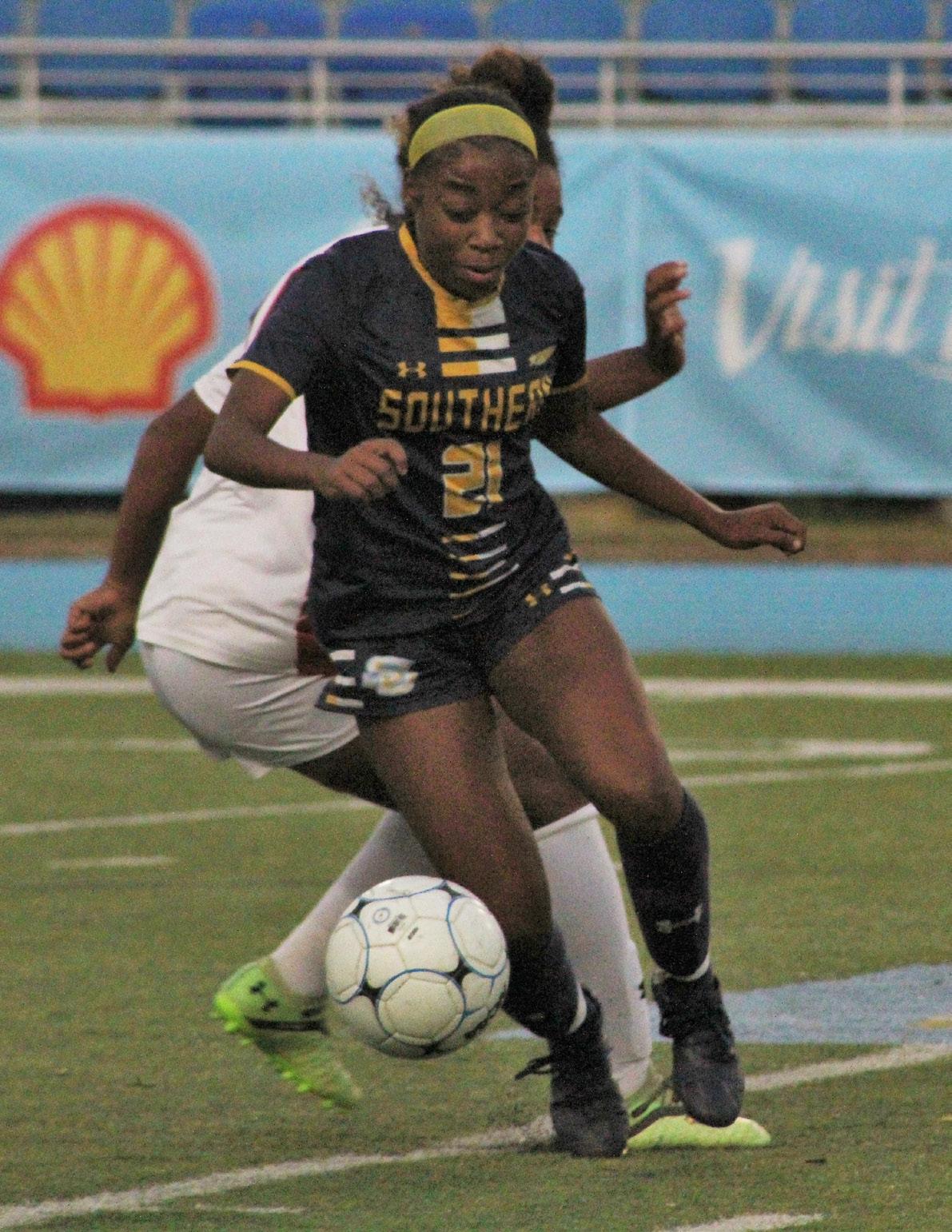
Junior, Middle Defender, Alayla Jackson dodges a Jackson State defender to resecure the ball. (Kynkolas Ross/DIGEST)
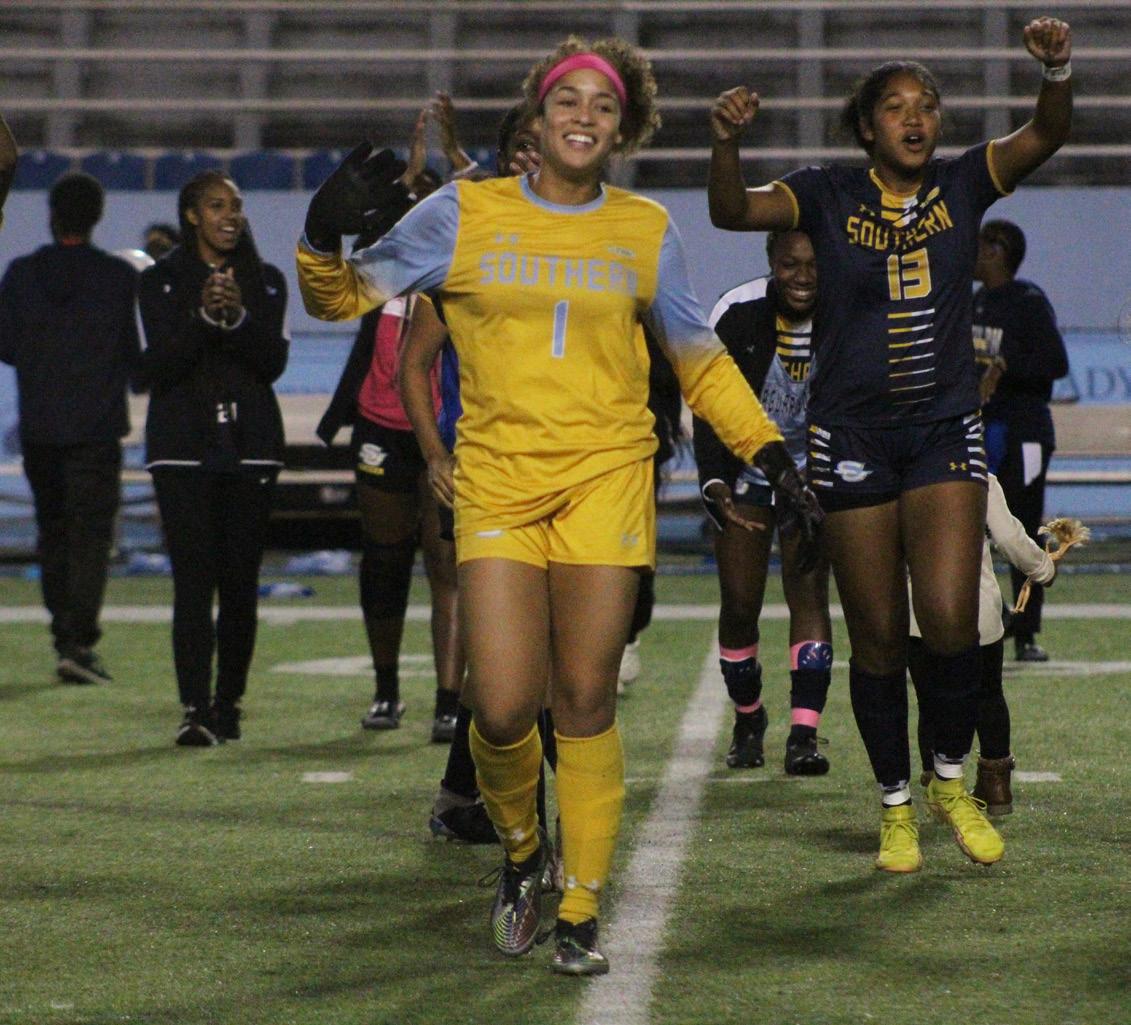
The Jaguar soccer team celebrates as they defeat Jackson State to advance to the conference tournameny. (Kynkolas Ross/DIGEST)
See SOCCER page 5
College Gameday: HBCU Narrative Changing?
 eric White THE SOUTHERN DIGEST
It is no doubt that ESPN’s most famous pregame show is College Gameday. College Gameday goes to campuses around the country for football and basketball and holds a live 3-hour show. We are in football season and typically the show would go to power 5 schools like Alabama, Ohio State, LSU, Texas, and many others. However, they have been to FCS schools like North Dakota State and James Madison multiple times. Unfortunately, HBCUs have seen the same treatment before the last two years the shows have only been to an HBCU event twice. Those appearances were the 2005 Bayou Classic and 2008 Hampton vs FAMU. However, the narrative may be changing in the last two years HBCUs have been getting featured on the show more often.
In 2021, the show went to the MEAC vs SWAC challenge between North Carolina Central vs Alcorn State. Of course, most recently it went to Jackson State vs Southern. This
officially makes two consecutive years where HBCUs have been featured on the most famous show. The show made it their mission to see what the culture is about including them featuring the bands, Greeks, and history of our legendary campuses. In addition, on the great rivalry game getting the spotlight they also made sure to feature another
Are HBCUs finally getting the exposure they’ve been looking for?
another HBCU.
We all love our HBCUs. We support them unconditionally and represent them any chance we get. The love that we have for our HBCUs isn’t being shown or seen. With social media being the largest source of exposure, there isn’t much being shown for HBCUs.
So my question is, with social media having such a huge impact on the world right now, do you think the HBCUs around the country are getting the exposure they’ve been looking for and deserve? I feel as if HBCUs don’t get the recognition they deserve. You may see them on your Tiktoks or Instagram all the time, but you rarely see them on the big screens. The exposure they have is limited to only being on certain platforms. I know I see my beloved HBCU all over my For You Page and my timelines, but I never see them on tv unless it’s a big game against
I feel like these hard-working athletes deserve to be seen on more than just a phone, they need to be on the big screen just like everyone else. The popularity of HBCUs is only getting larger by the year, the publicity can’t be just limited to just a couple of apps. Let’s be real. The extra exposure will make our teams feel like they have that extra support from more than just their local area, they can feel the support from all over the country, even internationally. With the lack of exposure, our players and teams are being robbed of many opportunities. It’s unfair seeing mostly PWIs on tv while all this talent is on TikTok. The exposure is not there and this needs to be changed ASAP. These students work too hard not to get the recognition they deserve. Do you feel your school is getting the exposure they’ve been looking for?
classic game called the Magic City Classic between Alabama A&M vs Alabama State.
The visit to College Gameday was truly an experience that will be historic for both campuses. For the College Gameday Crew, they seemed to be woke to the fact that hour schools are amazing, and we have so much spirit as the crowd showed.
Unfortunately, they chose JSU to win and they were correct, but both fanbases represented well. It is safe to say that HBCUs are coming back and that this is only the beginning. We have made our name known to all big networks and they will at least feature us once every year. We hope to continue this trend because HBCUs matter.
by a missed kick. After these blown opportunities, it appeared the Jags were in for a long day in Jackson.
One of the more notable things was the unnecessary penalties the Jags committed. The Jags’ defense gave a lot of yards to JSU on their scoring drives due to being offsides or having neutral zone infractions. Also, the Jags’ offensive line had many false starts. The team just seemed out of their comfort zone and could never get back on track. On the other hand, officiating seemed not to be fair on both sides. Anyone can point out the notable missed calls the refs did not make. This would eventually lead to head coach Eric Dooley’s explosion on the sideline before the weather delay.
No doubt the crowd is used to seeing a competitive ball game between the two football squads, but that was not the case. JSU offense did not have off-thechart numbers but capitalized on SU errors and would take the life out of the Jags. The score would be 22-0 at halftime and the Tigers would add on in the second half to win 35-0. This makes the second time this season the Jags would be shut out completely against a SWAC opponent with the first being against Texas Southern.
The Jags would only finish with 221 yards of offense. Sophomore quarterback Besean McCray would go 9 for 26 with only 85 yards passing with an interception. He followed up with a statement “We got to capitalize on a short field, we didn’t get any points and that’s on me as the leader of the offense.” Coach Dooley shared his thoughts on the game by saying “Every time we had something going, something would break down and that’s on me.” A lot of accountabilities are being held. The Jags will now have to win out to have a chance to get to the championship, and due to the loss, it will be played back at Jackson. Southern will play FAMU next Saturday at 5 P.M.
season until they came to the bluff. Southern now has the most wins in a season and in a conference since 2013. This was the last home game of the season. The Jags have secured a spot in the SWAC championship tournament being the #3 seed starting November 3 in Prairie View, Texas. The team will face the University of Arkansas Pine Bluff at 7 PM on Thursday.
SPORTS www.southerndigest.com The Sentinel of an Enlightened Student Body Since 1926 Tuesday, November 1, 2022 | Page 05
The Southern University cheer squad at the ESPN College GameDay site at Jackson State (Courtesy/Justin Ford)
SCORELESS from page 4
yasMine love THE SOUTHERN DIGEST SPORTS COMMENTARY
SOCCER from page 4
CAREERS www.southerndigest.com The Sentinel of an Enlightened Student Body Since 1926Page 06 | Tuesday, November 1, 2022



CAREERS www.southerndigest.com The Sentinel of an Enlightened Student Body Since 1926 Tuesday, November 1, 2022 | Page 07 Ochsner Health invites applicants for the 2023 2025 Administrative Fellowship Finance Program. The Finance Fellowship is a two year paid leadership program, which serves to develop and foster professional development and provid e a broad experience within an inclusive and diverse organization . During this time, fellows have the opportunity to engage in multiple projects throughout rotations (i.e., Revenue Cycle, Reimbursement, Value -Based Care, Hospital/Clinic, etc.) to cultivate leadership and financial competencies that are critical to the success of a healthcare administrator . This fellowship is a tremendous opportunity for post-graduate students and professionals who seek training and leadership skills for a future career in Healthcare! Administrative Finance Fellowship Applications Now Open We are now recruiting talented and highly motivated post graduate & professionals for the 2023 2025 Fellowship Program. Program Dates: July 2023 July 2025 Application Deadline: January 7th, 2023 Program Eligibility: Graduates Degree (Preferred degree includes MBA, MSF, MACC, MHA) Upcoming Recruiting Events Informational Zoom Session Thursday October 20 th, 2022 @ 4:00 – 5:00 PM CST Event Details: Program current & former fellows will present on program details and information. (Scan QR Code to enter event. Passcode: 509018) Learn More & Apply: (For additional details on recruiting events or application process, see below) www.ochsner.org/finance concentration Informational Zoom Session – Tuesday December 6 th, 2022 @ 12:00 1:00 PM CST Event Details: Program current & former fellows will present on program details and information. (Scan QR Code to enter event. Passcode : 183425) Meet & Greet Event Thursday November 10th, 2022 @ 4:30 6:00 PM CST Event Details: Join us for a meet & greet with program preceptors, and current & former fellows Location: Ochsner Brent House Hotel Atrium @ 1512 Jefferson Hwy, New Orleans LA 70121 This event has limited spots. Please RSVP to FinanceAdminFellow@ochsner.org to confirm attendance. FinanceAdminFellow@ochsner.org
Campus Dining: Unsung Heroes
that want to dine in or to-go, there are other individuals they may encounter.
UnSung Heroes are individuals who receive little to no recognition. This series is to shed light on the many individuals across our great campus that take great care in servicing students, faculty, and alumni. First, Southern University Campus Dining is home to several individuals including many individuals who has served students, alumni, and faculty for over 10 years.
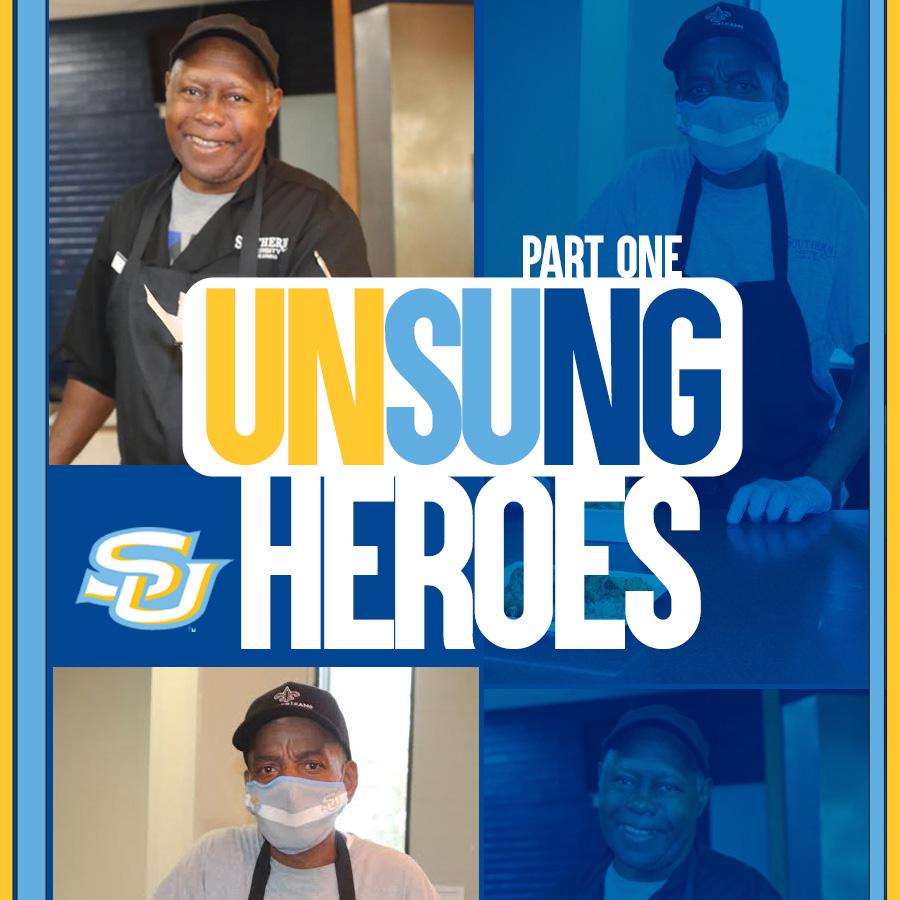
As you enter Mayberry Dining Hall, one friendly face you will encounter at the front door is cashier, Joyce Hatch. She has worked at SU for over 25 years. When asked why Southern University instead of a different place of employment, her response showed the reasoning for dedication.
“Because I love my job and I love our customers,” Hatch declared. Her fondest memory of working on-campus is the love she received one birthday. “My fondest memory was on my birthday. A lot of students surprised me with gifts.”
Her message to the students at Southern University is “Keep your mind on your school-work!” Staying focused on the objective which is getting an education and graduating is important for a successful school year.
Once customers decide on whether
One food service worker is Yverne Hills. She has worked for campus dining for 17 years.
Her love of Southern University is the evidence in the longevity of her employment. “I have always loved Southern. I like watching SU Football and was excited when I was told about the opportunity to work here before leaving New Orleans,” Hills exclaimed with excitement.
After Hurricane Katrina, Hills relocated to Baton Rouge. “My fondest memory was when I arrived in 2005. Workers and managers were very hospitable and welcomed me with open arms after a traumatic experience during Hurricane Katrina.”
Hills declared her love and support of the SU community. “I love them all and appreciate working with them. I really accept them as family. Its also so nice to be remembered by old students through the years when they come back to visit.”
On Stir-fry in Mayberry Dining Hall is Johnny Hamilton, food service worker. Hamiliton has worked at campus dining since 2009. When asked why work at Southern University Campus Dining, his answer was “Because I absolutely love my HBCU!” Not only do he love his HBCU,
but he also loves his students and serving them as well.
When asked about his fondest memory working at SU, he replied, “That would have to be the good times we have with our students at Spring Fest every year!”
Customers at the dining may choose to eat from the grill. This is where you may
Carrying the Torch: Mr. & Miss. Honors College
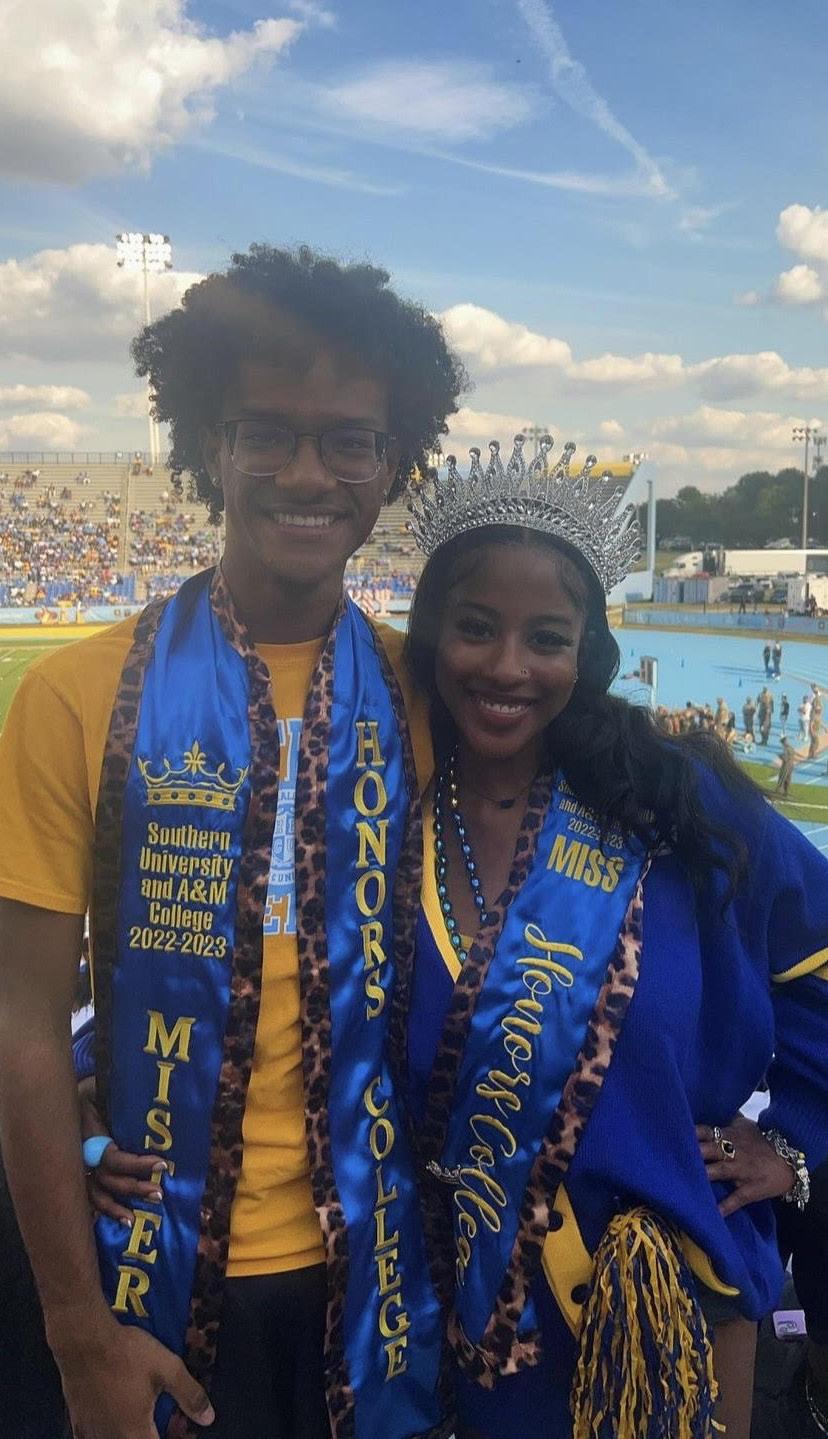
The Dolores Margaret Richards Spikes Honors College hosted a week of events through October 24 - October 28 in celebration of the “Top Tier” students who have been awarded honors. Events such as a pumpkin painting, a picture day, and a quiz bowl were all the rage for honors students during this week. At the center of these events is two faces who represent the college: Shaure Brewer, Mr. Honors College, and Gabrielle LeNoir, Miss. Honors College.
The two were elected on September 24, 2022 and have been a shining light on the Honors College since their tenure. “As Mr.Honors College I make sure to present myself as a positive and notable representation of the DMRS Honors College each and every day,” said Brewer. Appearances at the 92nd Miss Southern’s Coronation and various other events around campus have been some highlights for the two royalties. “Along side of my Miss Honors College, our overall goal is to provide our fellow honors students with priority status to key educational and outreach opportunities with their career and life goals in mind. With proper structure, mentoring, and discipline, we ensure that our honors students will succeed in all of their endeavors.”
On top of being representatives for the DMRS Honors College, Mr. and Miss. Honors College are encouraged to host events ranging from community service
to gleeful festivities and fundraisers for the college. “Hosting the events for Honors College week was definitely a highlight of mine,” Brewer states.
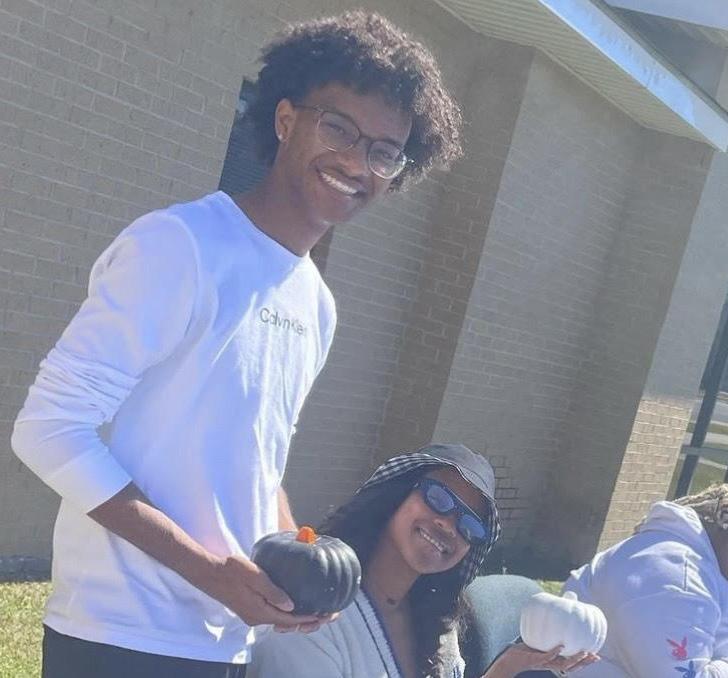
A few members of the Honors College share similar sentiments about the events that have taken place. The pumpkin
painting was a big one with Ataja Williams, a junior majoring in nursing stating, “It gave students a chance to explore their creative side and take a short mental break away from classes.”
Saraa Abdullah, the sophomore representative for the Honors College, was also enthused about the euphoria surrounding the events of the week. “I got a better chance to connect with the staff and students of the honors college, all while having fun.” Moments like these are just a few benefits of being an honors student. To qualify for honors, a student must have a 3.0 GPA in all course work pursued, a 3.3 GPA in all honors work pursued, and at least 32 credit hours to include: 6 hours of Honors Colloquia, 2
find Tony James and his famous, “Tony” burger.
Known to many as “Mr. Tony”, Tony James, food service worker has worked at campus dining for over 25 years. James
Back in Action: Southern’s Speech and Theatre Program
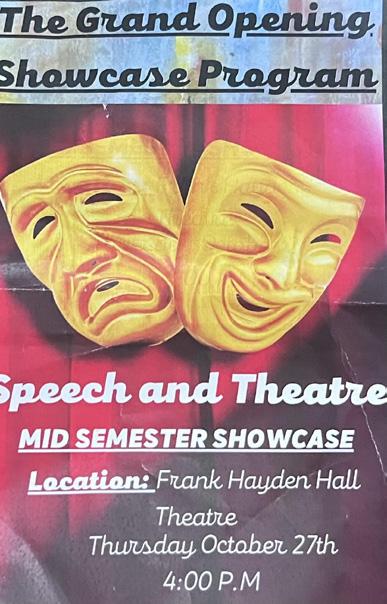
Now coming to the stage, we have Southern University’s Speech and Theatre Program. Yep, you heard it right. They are back and they are ready to hit the ground running. On Thursday, October 27, the Speech and Theatre department held their mid-semester showcase, “The Grand Opening” in the school’s theater located inside of Frank Hayden Hall. This was the department’s first show in several years. As you can imagine many people were on edge to perform being they were the ones that will get the department rolling again. The show began with an all inclusive warm-up where each performer was able to broadcast their way of warming up as the others followed. Giving performers a chance to get
FEATURES www.southerndigest.com The Sentinel of an Enlightened Student Body Since 1926Page 08 | Tuesday, November 1, 2022
DIGEST ART/ PHOTO SANDI HIGGINS
Brittany Patterson
THE SOUTHERN DIGEST
See HONORS page 10 See HEROES page 10
Mr. Honors College, Shaure Brewer and Miss Honor’s College, Gabrielle LeNoir both shed smiles while attending a home football game in A.W. Mumford Stadium. (Courtesy: Instagram)
isaiah clay and Kynnedi JacKson
THE
SOUTHERN DIGEST
Kynnedi JacKson THE SOUTHERN DIGEST
See THEATRE page 10
Mr. Honors College, Shaure Brewer and Miss Honor’s College, Gabrielle LeNoir help during a Halloween event on campus (Courtesy: Instagram)
Mental Health and its growing effects

 iMani Badie THE SOUTHERN DIGEST
Did you know that 50 million people across the world are suffering from mental health? Even 73% college students are having a hard time coping with mental illness. As a college student it is hard to cope with new environments, the troubles of making new friends or even trying to stay on top of all your work. Here at Southern University the Counseling center is available to all students on campus to ensure them that everyone matters, and you are never alone! Mental Health can affect the way a person thinks, eat, or even cause them to stop doing the things that they love to do the most.

The counseling center provides tips for settling into college such as “enjoying yourself, getting involved and communicating”. They also offer group or individual therapy to assure the students feel comfortable. Sophomore Courtney Davis, majoring in Criminal Justice stated that “mental health is something that everybody should take serious”. Courtney feels that the schools should discuss mental health more often, so that the signs can be more aware in the environment.
Getting in touch with the founder sophomore, majoring in psychology, Skye Williams of @HBCUsafespace
on twitter. Skye says that she decided to “create an outlet for people battling things such as depression, anxiety, and anything that they may have trouble with”. Skye also explains that “as African Americans many of us have generational
trauma that can take a toll on our mental health”. The importance of mental health should receive more attention than it has been receiving and it is up to us as HBCU to imply that we can make change within the world.
 ART
ART
We must all strive to be the best we can be and continue our legacy for those who fight daily. For our fallen Jags and peers all around.
FEATURES www.southerndigest.com The Sentinel of an Enlightened Student Body Since 1926 Tuesday, November 1, 2022 | Page 09
Get accepted to college Open personal Checking Account Move out of Mom & Dad's house EFCU Rewards Checking Choose Cash Back or High Yield *Restrictions may apply No Monthly Service Fee Unlimited ATM Fee Refunds Nationwide* Must be 18+ to open checking account Adulting 101 DIGEST
HEROES from page 8
NBA YoungBoy Releases New Album
Youngboy never misses when it comes to music. NBA Youngboy, also known as Kentrell Gaulden, has been dropping albums like it’s nothing. His most recent album called “Ma’ I Got A Family” has a lot of hit songs throughout it. The album has 19 songs, and it dropped on October 21, 2022. The cover of the album shows Kentrell, Jazlyn Mychelle, and two babies. Jazlyn is Kentrell’s current girlfriend and one of his babies’ mothers. “Ma’ I Got A Family” is top three on apple music right now. Kentrell just never misses. In the album, there aren’t any hardcore, aggressive songs. Kentrell went with a unique, soft, and pleasing type of sound. I like a lot of songs on his album, but the

one song that stands out to me is “Rose Gold.” From the smooth and mellow beat to the flow of words in the song, it is very astonishing. When Youngboy continuously rhymes with the beat, it amazes me. I will literally sit there and ask myself, “Why is he going so hard on this beat like that?” When I listened to “Rain,” I was really tuned in because he was basically saying that he wants to be alone, but he still wants someone who is going to be there for him. He is technically saying give him his space so he can get himself together, but still be there for him when he needs you. A lot of time we need our space to collect ourselves and we also need someone who we can rely on at any time.
In a song on the album called “Kentrell Talk,” Youngboy talks with his fans
telling them his opinion on how he feels about the rap game. This really surprised me because he never expresses himself in the way he did in this song. He will always express his feelings in a song but he has never talked to us like he was having a conversation with us. He is telling us that the rap game is fading away because of the fans. Fans are quick to judge a rapper because they do not carry themselves like other rappers they listen to. Everyone has their own way of expressing themselves. If you’re going to be that picky towards a rapper then you should just stick with your Pop or R&B artist.
Overall, Youngboy will continue to drop the heat, and I will continue to enjoy every last song he drops for his fans.
said, “Southern University is the best place to work, and the people are great. They show respect for me and call me Mr. Tony.”
Since the invention of the “Tony” burger and its success, James beams with pride each time a customer asks for one. “Every time students and staff come up to the grill with a big smile and ask for a “Tony” burger is always a fond memory for me,” James said.
His message to students is to “Keep coming to Mayberry and keep sending me those awesome surveys! I love it!”
Another individual, LaTisha Williams, retail manager located in the Smith-Brown Memorial Student Union, has worked for campus Dining for 22 years.

“SU is home,” Williams contributed as the reasoning behind her dedicated service. With SU being home, the students are like family to her. Her message to the students is “Never give up. With God, all things are possible.”
HONORS from page 8
hours of Honors Thesis, and 9 hours in a junior or senior level course in the student’s major area.
All in all, we can say that it was an honorable week for members of the Dolores Margaret Richards Spikes Honors College.
THEATRE from page 8
comfortable on stage before diving into their individual acts. Performers had a chance to tell their stories through their work. We heard from eight individuals all putting their unique spin on things. The showcase had everything you could think of. There was comedy, seriousness, life-lessons, and more. There were also two rounds of improvisational theatre scenes. The audience was encouraged to throw out select topics for performers to go off of and bring the ideas to life.
“Southern has so much talent, I can not wait to see the program grow and really tap into its full potential. It was almost like a breath of fresh air, seeing something so different take place on our campus”, said Rondreka Zenon, a junior psychology major, who had heard about the show from a friend. The theatre world is a completely different field from other shows we see here at Southern. Now that the program is back, we can definitely start expecting more.
One of the directors, Dr. Nico Zaunbrecher, professor of speech and theatre, department of fine and performing arts, was very elated to see the show come together, “we haven’t been on this stage in you know how long…I can’t wait to put on more shows for you guys.” Both directors, Zaunbrecher and Dr. Bonny McDonald alluded to future shows to be bigger and better, also bringing a different approach for upcoming shows.
To top it all off, performers were awarded certificates for their participation and they were also granted a compliment by the department’s dean, who was very pleased with the show. She encouraged students to stay on top of things because they were all very talented and she knows they can go far. Congratulations to the speech and theatre department on a successful showcase. Stay updated, you do not want to miss any upcoming shows.
FEATURES www.southerndigest.com The Sentinel of an Enlightened Student Body Since 1926Page 10 | Tuesday, November 1, 2022
courtesy: Google
christoPher toler Jr
THE SOUTHERN DIGEST Join our team! Barista We are seeking Baristas with a passion for guest service and providing a quality product each and every day! Please call between 8am 1pm to schedule interview. Port Allen, LA CC’s Coffee House 3857 La. Hwy 1 South, Port Allen, LA, 70767 To learn more about this position email us at ccsportallen@hunsgrove.com or call (225) 615 8585
Are HBCU Students in Danger?
Gun violence is a recurring issue in society and a very prominent issue in the Black community. Many shooting incidents have occurred during homecoming week for a handful of HBCUs. Unfortunately, it seems to be the actions of nonstudents who are ruining events for first-time students and instilling fear in their minds. I do not think that it is fair for visitors to be welcomed on our HBCU campuses with open arms just so we can receive gun violence in return for our own kind.
Following the homecoming concert, there was a shooting at a party nearby Southern University. The Kappa Luau was an event filled with students who were enjoying their homecoming experience. The shooting occurred during the closing of the event, and unfortunately, 11 people were shot during the incident. However, no one suffered any fatal injuries. As an on-campus student, I feel like oftentimes our events are ruined by people who do not currently attend the University. Sad to say, but it seems as if our current students are forced to suffer due to the implantation of new
rules, the cancellation of other events to come, and the fear of attending another event in the future.
Recently, Clark Atlanta students were disrupted by gunshots at 12:30 midnight during their homecoming week. In total, four people were injured and many were left afraid. After speaking with a friend who is also a Clark student, he explained to me that their campus is usually strictly for students. However, during homecoming season, the campus is open without gates or barriers. In relation to gun violence, our rival school Grambling
State University endured a homecoming tragedy last year. During this incident, there was one death and seven injured. Hopefully, their homecoming, which is scheduled for the beginning of November, is a safe affair for students, alumni, and visitors.
To avoid more incidents like these, I have a few suggestions as we move into the following semester. To start, I feel like we need to be more thorough when it comes to security. During the Luau, security seemed to do a slight pat down, and women were not searched at all. Due to the thickness of the line, many
people were able to squeeze inside the party without being properly searched. My next suggestion would be that in cooperation with our school’s budget, we invest in a Boom Barrier at each checkpoint. This will allow visitors both oncampus and off-campus students to scan their student IDs and receive access to enter the campus. Lastly, as a community, we need to leave the violence alone. There are so many people who have lost their lives to gun violence and it should not occur on Southern’s campus or any campus for that matter.
Who is homecoming really for?
taylor st vilus THE SOUTHERN DIGEST
It’s that time of the year when alumni and students gather together to celebrate their love for their beloved school.
Homecoming is a treasured tradition that many schools across the nation all partake in. From September through November, schools host a week-long celebration allowing students current and former to
fellowship altogether. With the many activities hosted to bring everyone together, Twitter begged the question; Who is homecoming really for?
Some users felt that after five years graduated, it was inappropriate for those alumni to go and mingle with current students. Others felt that homecoming, based on the name alone, was for those who graduated to come back and enjoy the reunion of fellow
Beyoncé Confirms Renaissance Tour in Summer 2023
taylor st vilus THE SOUTHERN DIGEST
Beyoncé’s Renaissance album was released in July of this year. After 3 long years since her last project, “The Lion King: The Gift,” fans flipped when she released the album. Though it has been months, there still haven’t been any visuals released with this project, which is quite odd for Queen B. Beyoncé is known for airing monumental visuals that take the world by surprise. I guess the tour announcement is worth more than the visuals, right? I already know the stage design is going to be spectacular.
Twitter was in shambles after finding out about her summer tour. Tweets about people selling kidneys, their homes, and even clearing their savings accounts were made to buy tickets. According to Vivid Seats, the average ticket cost is $165. Her last tour dates back to 2018 the “On the Run II” tour with her husband Jay-Z, so a new one was definitely overdue.
The announcement was unquestionably made in a unique way… at a charity event. At the Wearable Art Gala, she auctioned a concert ticket package. This event was hosted by Beyoncé’s mother and
stepfather Richard and Tina Knowles Lawson, the founders of WACO Theater Center.
The package was valued at $20,000 including a chance to see Beyoncé on her Renaissance tour, 2 first-class United Airlines Polaris tickets to select cities, with 3-night hotel accommodations at a Marriott property. To add the cherry on top, the package also included 2 tickets and a guided backstage tour at the Renaissance concert by Tina Knowles-Lawson. The winning bidder paid between $45,000 to $50,000, according to Variety.
Immediately this shocked people because she heedlessly announced that she was going on tour, but in the most daring way—supporting her family’s theater center, which is a cultural institution for performing and visual arts; sharing stories of the African Diaspora. Yes, it was different, but in an exceptionally humble way.
Make sure you have your notifications, email sign-ups, and outfit ideas on deck because I’m sure these bad boys are going to sell faster than Telfar bags. See you in Summer 2023 Beehive!
peers.
I asked the opinions of students and alum and this is what they had to say. “I believe that homecoming gives us the chance as students to really enjoy what our school has to offer but also network and meet those who came before us. I definitely see alumni enjoy it more but I feel like it’s for everyone to come and have fun!” said Kamani Cannon, a junior criminal justice major.
Alumni feel as if it’s definitely meant for them. “I feel that homecoming is for the graduates and alumni of Southern University. Festivities might be for the students but I believe to truly enjoy homecoming, you have to be an alum.” Dr. Robert Chambers, a southern graduate. I personally believe that Southern’s infamous homecoming is truly for the graduates and the “old heads”.
We as students definitely get
to enjoy the perks of what comes with homecoming, but I believe it isn’t until we graduate that we will get the true feeling of coming home, and that’s what homecoming is all about. The love and joy spread through the week have reminded students and alumni alike that Southern is truly home for all of us.
Staying focused: Why You Shouldn’t Date in College
As seen by the “Whose (ninja emoticon)” group chat, true love does not exist. It’s simply a fable curated by fairytales and storybooks. And this is why you should not wish to fall in love while in college.
For starters, you should prioritize your school work. Fall in love with those books and multiple-paged, doublespaced, APA-formatted essays. Then, and only then will your mouth salivate at the sight of a green “submitted” check on your screen as opposed to a red “declined” FaceTime phone call. It’s really all a science. Once you can find joy and happiness through your work, who needs love, right?
Secondly, they are probably
The Southern
seeing other people. Not to rip a few bandaids off, but this is college. Very few people are trying to settle down and find a wife or a husband at this point. It’s a given that most will try to date as many as possible to find “the one,” and, quite frankly, it’s probably not anybody on your current roster, sis or bro. And before you ask, “who hurt you?”
I’ll save you the heartache… I only have room for 400-ish words.
Finally, it’s my opinion that your best relationships will likely come later on in life. After the players have played, the cheaters have cheated, the talking stages have talking staged, and the heartbreak playlists have been playlisted, you will finally determine what you will and won’t accept in a committed
SUBMISSIONS POLICY
relationship. Your experiences of despair and loneliness will only turn into something beautiful, and you will be open to receiving and reciprocating a solid, unwavering commitment. So don’t lose hope, just hang in there a little while longer.
But, in case you haven’t realized this is a satire, let’s not lose sight of what we came here for: that glorious moment when we cross those blue and gold sands into the Jaguar Nation on graduation day. We’ll receive our degrees and the group chats, text message threads, and adolescent drama of the past will be memories emblazoned in the fabrics of our college years. So, with all this to say, leave the group chats alone and do you, regardless.
the
not responsible for
It is the sole opinion of the writer and does not
the views of any professional
staff or administrator of the University.
The Southern DIGEST reserves the right to edit any contributions and or reject them without notification. Authors are encouraged to limit the length of submissions to 300 words. Letters should not include libelous statements. Offensive and personal attacks will not be permitted. The DIGEST will not print “open letters” addressed to someone else. All contributions must be type written, signed and must include the author’s address and phone number. Unsigned letters will not be printed. Southern University students should include their majors, hometowns and year in school. When referring to specific DIGEST articles, please include the date and title. All materials should be directed to the editor in chief of The Southern DIGEST, P.O. Box 10180, Baton Rouge, La. 70813. Materials may be delivered by hand to the DIGEST office located in Suite 1064 Harris Hall or can be e-mailed to digest@subr.edu.
OPINION www.southerndigest.com The Sentinel of an Enlightened Student Body Since 1926 Tuesday, November 1, 2022 | Page 11
DIGEST welcomes letters from readers commenting on current issues and other matters of general interest to
SU family and public. We set aside this space to publish these letters for others to enjoy. This newspaper is
individual opinions expressed in submissions, editorials, opinions and commentary pieces.
reflect
faculty,
laila hazel THE SOUTHERN DIGEST
isaiah clay
THE
SOUTHERN DIGEST

TOP JAGS www.southerndigest.com
The Sentinel of an Enlightened
Student Body Since 1926Page 12 | Tuesday, November 1, 2022 THE OFFICIAL STUDENT NEWSPAPER OF SOUTHERN UNIVERSITY AND A&M COLLEGE, BATON ROUGE, LOUISIANA
