
College Councils Pass New Core Curriculum
By SIENNA REINDERS EDITOR-IN-CHIEF
Fordham University’s Lincoln Center College Council and Rose Hill College Council voted to implement a revised core curriculum on March 19. Next, the revised curriculum will be voted on by the Arts and Sciences Council, then by the Fordham faculty and finally by the Board of Trustees on April 23. If the proposed curriculum is passed by all of these groups, it will move into the implementation phase and be fully administered for the class of 2031, according to Professor of English and American studies Glenn Hendler.
The revision of Fordham’s core curriculum has been a five-year process involving several faculty committees, the most recent being the Core Reconciliation Committee. A different draft of the core curriculum was voted down by the college councils last spring. Now, the newly revised curriculum is progressing into its final stages of approval.
Hendler said that he is excited the college councils voted to pass the proposal, but added that the vote was closer than he would have liked.
“I am very happy that it passed,” Hendler said. “I mean, it was a mixed feel … I wanted it to be more enthusiastic. I would like people to be excited by the core.”
The main change to the core curriculum is a reduction from 17 to 12 classes. Other changes include a requirement of one philosophy and one theology class — as opposed to the previous requirement of two classes for each discipline — both of which will now be taken exclusively in the first year. First-year students will also take a New York Experience class. Additionally, students will take one language course — the current requirement is four — and three Eloquentia Perfecta courses — the current core curriculum requires four.
SEE CORE, PAGE 5
USG Holds State of the Students Town Hall
By EMMA LEONARDI & SIENNA REINDERS
The Fordham University’s United Student Government (USG) held a State of the Students Town Hall on March 20 to discuss their ongoing contraceptive policy proposal. Other USG commissions and committees also tabled at the event to garner student support for their respective ongoing initiatives and proposals.
The event began with an introduction from USG Executive President Lucas Hjertberg, FCRH ’26, who read an excerpt from a 1967 editorial from The Ram explaining the long-standing discourses surrounding the contraceptive distribution on the Fordham campus. He continued by previewing the event and explaining why USG hosted it.
“The intention to gathering here today is not just to show
the administration, ‘Hey, we have a lot of support for this one,’ but when students really care about an issue, no matter where they fall on it, that they deserve to be listened to, and that they can mobilize when the time is necessary,” Hjertberg said.
USG’s Contraceptive Policy Commission — which includes Vice President of Committee on Sexual Misconduct Aidan
SEE STATE, PAGE 4
Jewish Studies Department Opens New Exhibit
By KAT ROSSI ASST. NEWS EDITOR
A new exhibit highlighting several centuries-old Jewish traditions and contemporary interpretations of ritual art is
now on display in Fordham University’s William D. Walsh Family Library, and it offers viewers a unique vision into the intersection of history, identity and also relating to the community involved.

“Today we celebrate the opening of the exhibition of the historic Torah binders from the Czech mostly Czech lands shown for the first time in the outside of Europe for the first time in the United States and outside Europe … these binders are not only the material survivors of the Holocaust but traces of the lives of ordinary people in small and many from small communities,” said Magda Teter, chair of the Jewish Studies Department.
Titled “Binders of the Covenant,” the exhibit combines historic Torah binders known as “wimpels” from Central Europe, alongside contemporary artwork and photography, formulating what organizers described as
SEE EXHIBIT, PAGE 4
TripleNegative Breast Cancer Research
By SIDNEY BLASCO FEATURES EDITOR
One Fordham University biochemistry professor Ipsita Banerjee, Ph.D., is conducting remedy research for a treatment for an invasive and aggressive form of breast cancer.
Banerjee is working on what she described as bionanotechnology, specifically developing novel biomaterials for targeted therapeutics, the tissue engineering for organ regeneration and also neurodegenerative diseases. She has been working on cancer related research at Fordham for 15 years. For the past three years, she has focused on triple-negative breast cancer. Unlike types of estrogen-positive breast cancer or other types of cancer, which she said have more available therapeutics, triple-negative breast cancer doesn’t work with certain kinds of treatment.
“Triple-negative breast cancer has a very low survival rate; it normally doesn’t respond to hormone therapy,” Banerjee said.
While there are drugs being developed for triple-negative breast cancer, there are side effects that come with it, according to Banerjee.
“And that essentially is as a result of the fact that your drug is not only attacking the cancer cells,” Banerjee said. “It’s also attacking the normal cells.”
For Banerjee’s work, the goal is to make sure that the therapeutics can target specific cancer cell lines but not bind to normal cells.
“That way you have lesser side effects and it’s also more targeted,” Banerjee said. “The dosage required is gonna be less compared to what you would get for an IV, which would be essentially like systemic, which means it goes to the entire body, all cells. So it’s looking at really
SEE RESEARCH, PAGE 5
The United Student Government (USG) collected data on student opinions on Fordham’s current policy.
A torah scroll and wimpel on display in Walsh Library.
KAT ROSSI/ THE FORDHAM RAM
SIENNA REINDERS/THE FORDHAM RAM
PUBLIC SAFETY BRIEFS
Fire Alarm
March 21
11:39 p.m.
On Saturday, March 21, at 11:39 p.m., a fire alarm went off in Finlay Hall. The supervisor and FDNY responded. The investigation revealed the basement compactor smoke alarm triggered the alarm. There was no smoke or fire.
The supervisor reset the alarm panel.
Fire Alarm
March 22
8 p.m.
On Sunday, March 22, at 8 p.m., a fire alarm went off at Arthur House. The supervisor and FDNY responded. The investigation revealed a student cooking food triggered the alarm. The supervisor ventilated the area and reset the alarm panel.
Bathgate Ave
March 22
10:30 a.m.
On Monday, March 23, at 10:30 a.m., a non-Fordham community member reported via email that on Saturday, March 21, at 5:30 p.m., they were parking their car on Bathgate Avenue where a group of students were blocking the parking spot, drinking and smoking marijuana. The reporter honked their horn. One of the participants made an obscene hand gesture and began cursing at the reporter, encouraging a physical confrontation. The reporter contacted the NYPD to respond.
St. Patrick’s Day Reflection With Elderly Jesuits
By MATTHEW DOHERTY & SIDNEY BLASCO
On Tuesday, March 17, Fordham University students visited the Jesuits living in Murray-Weigel Hall as part of a program co-sponsored by Campus Ministry and Pedro Arrupe Volunteers (PAV).
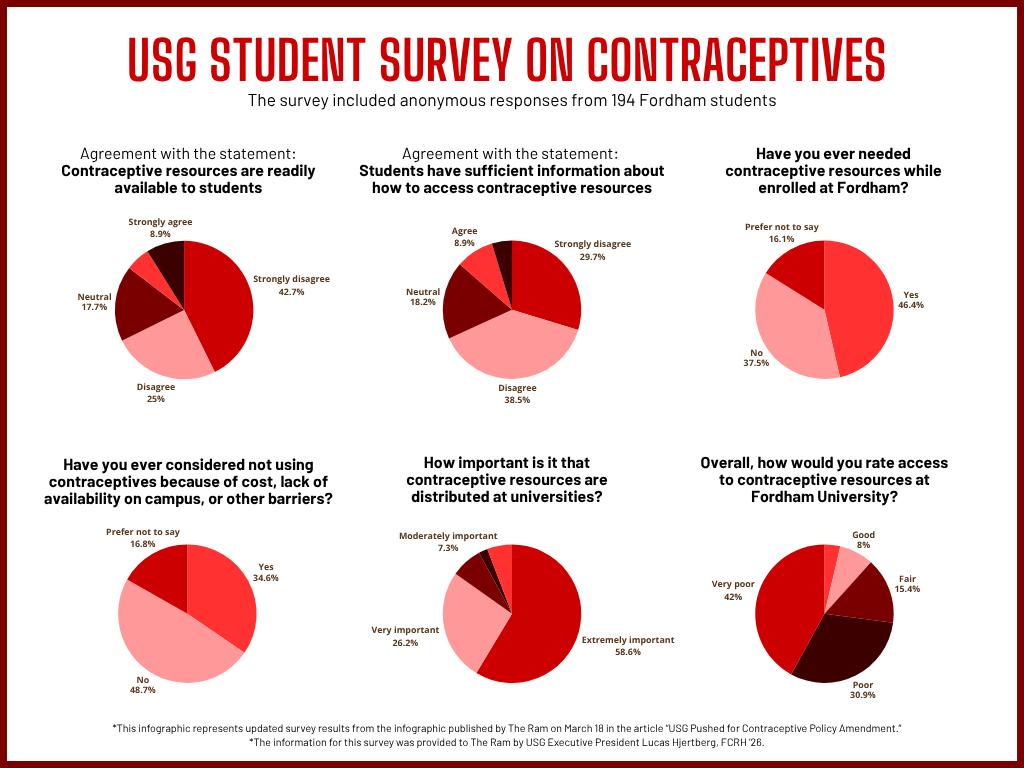
During the program, student volunteers and the residents learned the lyrics to the song “When Irish Eyes are Smiling” during their discussions about the history of the Jesuits and the lives of the residents of Murray-Weigel Hall. The event also held a group prayer with a rendition of “Ave Maria” played on the violin. However, the bulk of the event focused on students meeting and conversing with the residents of Murray-Weigel Hall.
“These are discussion-based conversations, typically about a spiritual theme, but we also make it social,” said Robert Parmach, Ph.D., director of Ignatian initiatives. “At times, we’ll make it topical given the holiday that’s approaching.”
The Murray-Weigel Hall is a retirement home on Rose Hill outside the gates of Finlay Hall, where elderly Jesuits live, according to Parmach.
“There are a number of Jesuits residing there, some of whom need medical care, some of whom are now no longer working full-time, in status of positions, but are there for a variety of reasons, reasons after their full-time ministry has been done already,” Parmach said.
According to Parmach, the hall mostly hosts residents from the Jesuits’ U.S.A. East Province. Nearly 60 retired Jesuit residents live in MurrayWeigel Hall through Archcare, a senior care organization which operates under the Archdiocese of New York.
Parmach reiterated the connection of these events to Fordham’s Jesuit mission as well as the ultimate goal of social justice.

developed a sense of critical reflection, dialogue and prayer.”
While this specific event emphasized Fordham’s Jesuit tradition, Director of Service, PAV and Spirituality Carol Gibney, noted the importance of including other faiths in Campus Ministry events.
“We are a Catholic university, Jesuit university, but we are also multi-faith these days,” Gibney said.
Parmach also commented on including students outside of PAV in the event.
“I thought it was a really fun event. I think it’s great to connect with these retired priests, and I think isolation can be a big issue for the elderly,” Mobley said. “It was very fun and high-spirited, and I spent a lot of time smiling.”
Gibney and Parmach both reiterated the connection between these events and Fordham’s Jesuit mission to the goal of social justice.
“These things at times could be service-oriented, at times they could be more discussion-based and they deal with a variety of different opportunities,” Parmach said. “It could be with youth, it could be with the elderly, it could be a park cleanup, [or] it could be with NYCHA Housing.”
Follow The Fordham Ram on Instagram, Facebook, TikTok and X
@TheFordhamRam
Thursday March 26
International Waffle Day ... The Marketplace 12 p.m.
The Marketplace will be having a waffle station in honor of International Waffle day. Stop by at 12 p.m. to grab a waffle and add yummy toppings.
“Pedro Arrupe was a former superior general of the Jesuits in the sixties, and his work really centered on healthcare advocacy, but also social justice and reflection,” Parmach said.
“A lot of these programs that PAV runs are ones that really get students to engage in spiritual matters, but also to make sure that they have
“There was a significant crew there from Pedro Arrupe,” Parmach said. “But there were also some other students, some of whom were in my class, some of whom are just simply undergraduate students, who had heard about it and wanted to come.”
Madison Mobley, GSB ’26, said that she attended the event through Smart Women Securities, which she said promotes PAV events.
“Pedro Arrupe was a former superior general of the Jesuits in the sixties, and his work really centered on healthcare advocacy, but also social justice and reflection,” Parmach said.
“A lot of these programs that PAV runs are ones that really get students to engage in spiritual matters, but also to make sure that they have developed a sense of critical reflection, dialogue and prayer.”
Parmach also commented on the variety of events that are sponsored by both PAV and Campus Ministry.
This Week at Fordham
Friday March 27
Saturday
Sunday March 29
Gibney summarized PAV’s overall mission by focusing on the volunteer events with local communities.
“Our faith calls us to do things of that nature, whether it’s in our own family or whatever communities we’re in,” said Gibney .
Parmach touched on the previous topical events that were had at Murray-Weigel Hall.
“There are opportunities for students, faculty, staff and the Jesuits to meet one another,” said Parmach, “[and] to have some on-theground conversations about things that matter.”
Monday March
The entry of Murray-Weigel Hall on the Rose Hill campus.
COURTESY OF BISHOP ACCOUNTABILITY
Residents of Murray-Weigel Hall and Fordham students listening to Irish-themed music.
MATTHEW DOHERTY FOR THE FORDHAM RAM
Rams Parade Down Fifth Avenue
By SIDNEY BLASCO FEATURES EDITOR
Fordham University has marched in the New York City St. Patrick’s Day parade since 1937 — aside from three years during World War II, 2020 and 2021 due to the COVID-19 pandemic — and this year was no exception.
Led by this year’s Grand Marshal, Robert J. McCann, the university was situated more than an hour into the parade lineup.
The event has traditionally featured an alumni brunch at various clubs in New York City, serving as a precursor to the main event. This year’s brunch was held at the Harvard Club.
“A couple years ago, it was actually [at the] Yale Club,” said Heather McWilliam, Marymount College ’88. “I think that the Yale Club’s a prettier room [but] this was a better brunch.”
Marymount College officially merged with Fordham in 2007, due to financial difficulties at the college. Marymount alumni were invited to the brunch as part of an expanded
By SIENNA REINDERS EDITOR-IN-CHIEF
The Fordham University United Student Government (USG) met on March 19 to hear a presentation from a Fordham administrator, conduct a special election and pass budget requests.
The meeting opened with a presentation from Fordham Director of Federal Affairs Abby Paulson, who informed USG members that the Pell Grant is expected to see funding reductions starting next school year. She said that Fordham is concerned that the Trump administration and Congress will propose cuts to the program, but that Fordham’s administration is mobilizing to ensure such cuts do not take place. She did not specify what actions Fordham is taking.
Paulson emphasized that she wants to communicate with USG to galvanize student voices against potential cuts to Pell Grants. She also said that she wants to hear which federal issues USG members are concerned about so that she can bring student voices to Congress. Executive President Lucas Hjertberg, FCRH ’26, asked how much of the student population at Fordham receives Pell Grants, to which Paulson replied around 25%.
Next, USG conducted a special election for the Class of 2028 Gabelli Senate seat. There were two candidates, Theo Yonly, GSB ’28, and Jason Vo, GSB ’28, who both gave speeches to USG.
yet collective “Ramily.”
In the main room, large paintings adorned the walls, chandeliers hung from the tall ceiling and two violinists were serenading the attendees, fostering a classy ambience.
The circular dining tables were set with caps decorated with Fordham’s new logo and sashes at every seat, which marchers were mandated to wear as they took part in the parade. Before entering this main dining room, guests filled their plates with catered food such as eggs Benedict, a variety of pastries and assorted meats.
Guests were ushered to their seats by current members of the Student Alumni Ambassadors program. One of those students, Risa Iwazaki, FCRH ’26, said she has seen the program grow during her time at Fordham since she witnessed its initial creation.
“Fordham alumni are always so kind and generous, and especially as a senior, being able to see my development as a student from freshman year being a part of the RAM line, I noticed that alumni are always
very generous and willing to donate to a lot of different programs where we call them and see if their passions align with our current values at Fordham,” Iwazaki said.
During the brunch, President Tania Tetlow gave a sixminute speech on IrishAmerican history in NYC, its modern relevance and Fordham’s Jesuit values.
She began with a brief explanation of the history of Fordham’s relationship with Harvard, and then discussed the Irish potato famine of the 1850s and the influx of the Irish community into the city.
“Almost a million [Irish] streamed into New York,” Tetlow said. “Against all odds, the Catholic churches took care of those immigrants.”
She also spoke about current developments at Rose Hill, specifically the new science building being planned, along with the importance of Fordham in America, concluding with a toast to the United States and to “our beloved Fordham.”
Guests had 45 minutes to finish their plates and chat
with fellow alumni sitting at their table. They then made their way around the block to West 45th Street, before turning onto Fifth Avenue.
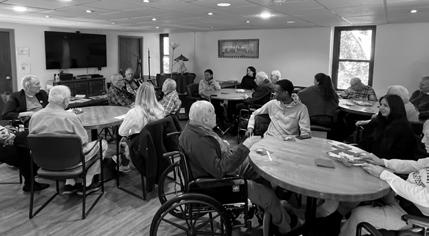
Fordham’s section of nearly 500 people was a sea of white caps with the Fordham “F” and maroon sashes that were handed out beforehand. In the bitterly cold temperature, spirits were nevertheless high as the group was waiting to begin marching.
For the next two hours,
USG Holds Special Election
Yonly spoke about his past leadership experiences, including his role as a firstyear vice president in the Residential Hall Association (RHA). Vice President of Facilities and Dining Madeline Ando, FCRH ’27, asked Yonly what he believes is the most pressing issue on campus. He said it’s important to protect students from developments at the federal level, including program cuts and immigration issues. Vice President of Sustainability Ayden Johnson, FCRH ’27, asked what specific plans Yonly has for USG. Yonly said that he wants to work on connecting Gabelli students to organizations and internships outside of Fordham.
Vo then gave his speech. Regarding his leadership experience, he said that he is currently a part of RHA and the Marketing Committee. Vice President of Gabelli School of Business Hunter Golson, GSB ’26, asked what Vo would be able to do and gain access to as a senator that he can’t do on the committees he is currently on. Vo said he believes he will be able to work more directly with students in a senator position.
Hjertberg then led all gallery members outside while USG conducted a closed-door voting session on the senate seat. After the vote, Executive Vice President Andrew McDonald, FCRH ’26, came outside to announce that Vo had won.
Fordham’s Black Student Alliance Club was then presented with the club of the month award for February.
Next, there were three new club presentations. The Music Production Club sent a video to USG with their presentation. In the video, Thomas Lapus, FCRH ’28, said the Music Production Club had previously existed at Rose Hill, but had not been active for the past few years. He explained that the club intends to connect students interested in music and audio engineering, and that club meetings would focus on teaching students how to edit audio. He requested funding for software and the budget request passed unanimously.
Eliza Collins, FCRH ’26, presented the Bronx Political Consulting (BPC) club, for which she is the co-founder and executive vice president. Hjertberg is the club’s executive president, but he did not participate in the presentation. Collins said that BPC is a student-led organization and professional development club that engages in legislative advocacy and provides free consulting services to campaigns and organizations. She also explained that the club is strictly non-partisan. She requested $400 per semester for Pugsley’s Pizza and $60 per semester for a Canva subscription. The budget request passed unanimously.
The final new club to present was Public Health Advocates. Club President Daniel Perez, FCRH ’27, said that the goals of the organization are to introduce Rose Hill students to what public health looks like and inspire them to speak up about local and global public
health issues. Aside from education, he said the club will include keynote speaker events and site visits to local public health organizations. Regarding the club’s budget, they requested $200-$400 for merchandise, $300-$700 for food, $200-$300 for transportation, $300-$600 for keynote speakers and $150-$250 for miscellaneous supplies. The budget request passed unanimously.
USG then moved on to additional budget requests. Vice President of Diversity and Inclusion Layla Sayegh, FCRH ’27, requested funding for the Diversity Action Coalition’s Women’s History Month event and Bronx Appreciation Week. Vice President of Student Life Luc Angus, FCRH ’26, submitted a request for the inauguration of the McShane Creative Commons and to receive supplies for the mural they are creating.
USG’s Vice President of Sustainability Ayden Johnson, FCRH ’27, requested funding for the cat houses initiative. Class of 2028 Senator Regan Healy, FCRH ’28, requested $1,000 for USG’s menstrual product initiative. There was also a budget request for Packets and Pastries, held on March 18, and for a tablecloth for the International Integration Committee’s alumni panel. Additionally, Vice President of Fordham College Rose Hill Mary Hawthorn, FCRH ’26, requested funding for graduation chords and Panda Express catering for an
the “Ramily” marched in the parade, surrounded by the echoing crowds’ cheers behind the barricades for six blocks.
The American, Irish, Fordham and Vatican City flags were billowing in the wind at the helm of the parade, with Tetlow wearing green Adidas Sambas as one of the leaders of Fordham’s march.
This nearly 90-year-old tradition is planned to take place yet again next year on St. Patrick’s Day.
upcoming panel. All budget requests passed unanimously. During USG’s updates, McDonald announced that Fordham will be renting two live rams for the 2026 commencement. He also said that there will be a joint event with USG, RHA, Commuting Students Association and Campus Activities Board on April 26, which will involve food trucks and tabling. Additionally, he mentioned that USG elections will officially start on April 1. Ando presented updates for the Sustainability Committee. She mentioned the initiative to build cat houses for stray cats on campus and said they plan to use non-toxic paint and will hold a competition for naming the cat colonies. She said the event date for painting the cat houses has not yet been decided.
Class of 2027 Senator Anna Gayton, FCRH ’27, gave updates for the International Integration Committee. She said there will be an international alumni panel on March 27 from 7-9 p.m. in Bepler Commons. She also said they are working with the Office of International Services on creating the Mentor-Mentee Program. Additionally, she said she and Vice President of International Integration Jenny Hong, FCRH ’28, are working with the Office of Undergraduate Admissions on a proposal to update admissions videos to include more languages. The next USG meeting is schedueled to take place on Thursday, March 26.
SIDNEY BLASCO/ THE FORDHAM RAM Fordham community members marched in the annual St. Patrick’s Day Parade.
Students Voice Opinions at USG’s State of Students
FROM STATE PAGE 1
Costella, FCRH ’27, Senator Henry Carstens, GSB ’29, Senator Audrey Shooner, FCRH ’28, Senator Domenick Fedele, FCRH ’29 and Senator Anna Wiss, FCRH ’26 — then gave a presentation on what their proposal entails.
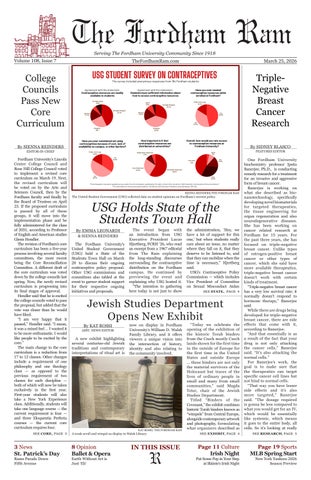
The proposal calls for the amendment of Fordham’s policy with on-campus contraceptive distribution, which currently prohibits the distribution of contraceptives “on Fordham University property, using University resources, and at University-sponsored events,” according to university policy. USG’s commission wants to change the wording to omit the language that bans their distribution while on university property. At the event, Carstens explained that the goal of their proposal is to restore students’ autonomy.
“While retaining the university resources and universitysponsored events, we believe that this [amendment] does not demonstrate that Fordham is endorsing the change, but rather returning the autonomy to the students,” Carstens said.
Carstens also emphasized that their proposed policy amendment does not ask Fordham to fund contraceptives and does not intend to elicit the university’s endorsement.
“We are not asking for Fordham to provide contraceptive resources. We are not asking for Fordham to fund contraceptive resources and we are not asking Fordham to endorse the use of contraceptive resources,” Carstens said.
“What we are asking for is for an amendment that allows students to independently manage and distribute their own resources. We believe we should give the power back to the students to decide, as many other Jesuit universities do.”
The commission members also noted that sexually
transmitted diseases (STDs) and sexually transmitted infections (STIs) disproportionately affect some of Fordham’s student demographic groups.
“USG also wants to recognize that this issue does not affect all Fordham students equally,” Costella said. “It has a greater impact on low-income and LGBTQ+ students. In addition, it affects students who have not received proper comprehensive sexual education before coming to Fordham.”
The USG presentation also included updated results from the recent USG student survey conducted to assess student support for their proposal and their opinions on the accessibility of contraceptives on campus. The USG survey received 194 responses and indicated overall support for USG’s proposal, with 92% of respondents saying that it is moderately, very or extremely important for contraceptive resources to be distributed on college campuses.
After the USG presentation, Fedele presented an endorsement on behalf of Professor Cristina Traina, Avery Cardinal Dulles, S.J., chair under the Catholic theology department at Fordham University. In her letter to USG, Traina outlined four reasons arguing why she would be endorsing this proposal.
The first point was on the fact that other Jesuit institutions allow for the student-to-student distribution of contraceptives.
The second point regarded the moral argument of preserving the common good.
“In the past, Catholic institutions refused to endorse or provide needle exchanges for people who use injectable drugs because doing so publicly, scandalously involve Catholics in facilitating or even encouraging sinful drug use,” Traina said. “Instead, many contemporary Catholics argue realistically
that preserving the common good requires containing disease … The moral primacy of institutional purity has given way to the moral primacy of the common good, which is in line with Catholic principles of social justice. The same logic applies to contraceptives and student sexual health.”
Her third point applied the idea of freedom of conscience to sexual relations and sexual health matters.
“Over sixty years ago, Dignitatis Humanae endorsed universal freedom of religion and conscience. Methodists, for example, consider sexual relations a matter of private consent and safe, contraceptive sex a moral requirement of ethical sex,” Traina said. “Fordham should not make it more difficult for these students to fulfill their religious conscience obligations.”
Her final point concerned compliance-based ethics versus the ethics of virtue, citing both Pope Francis and Pope Benedict XVI.
“Pope Benedict XVI even said that, in some circumstances, using a condom ‘in the intention of reducing the risk of infection’ can be ‘a first step in a movement toward a different way, a more human way’ of living our sexuality,” Traina said.
In her letter, Traina called upon the university to take more significant action regarding the handbook policy.
“I also suggest that the University remove language about contraception from its student handbook altogether,” Traina said.
Following the presentation of Traina’s support, several other student groups expressed their opinions about the policy amendment proposal, many of them also endorsing USG’s efforts.
Two members of Fordham’s College Democrats spoke first, endorsing the proposal and
saying that USG isn’t asking much of the university.
“As it stands, the language in Fordham’s student handbook on this topic is incredibly outdated and constrictive,” Audra Morrison, FCRH ’29, shared for College Democrats. “We are not asking for anything radical or burdensome on the university’s part. We are simply asking for less infringement on our reproductive rights on campus.”
Next, the president of the Fordham Respect for Life club Abigail Adams, FCRH ’26, spoke on its behalf.
“I am confident that the on-campus distribution of contraceptives would weaken the university’s ability to live out its mission of cura personalis,” Adams said. “A Fordham that permits on-campus distribution of contraceptives is a Fordham without integrity.”
She went on to state that Fordham can’t “cherry-pick” the values it follows if it wants to truly be aligned with its Jesuit values.
“Catholic universities carry a particular responsibility to all values which they represent, even the controversial ones,” Adams said.
She also mentioned the possible side effects of some birth control as a reason why it should not be distributed to students.
“Physically, Plan B can cause headaches, upset stomach and can cause one to feel lightheaded. There is a mess of safety liabilities in allowing external groups to distribute pills, which women ingest into their bloodstreams,” Adams said.
Members of USG’s Committee on Sexual Misconduct and Adam Serfillipi, FCRH ’26, and Isabella Lipayon, FCRH ’26, both former editors-in-chief of The Paper, also spoke, all of whom gave their endorsement.
Global Markets President
Jonathan Singh, GSB ’26, endorsed the proposal on behalf of the Fordham club. He said that all students on campus face the same concerns regarding things such as sexually transmitted infections and also sexually transmitted diseases, and all students should have access to resources.
“The students who [we] represent deserve to feel safe on this campus, not just financially safe, not just professionally prepared, but personally safe,” Singh said. “No student should have to fear … because a student representative isn’t allowed to help them. That’s a gap that doesn’t need to exist.”
Several members of Fordham’s unofficial unofficial chapter of Young Democratic Socialists of America (YDSA) club who have previously led efforts to distribute contraceptives off campus, spoke in support of the proposal.
“I’m here today to speak in support of this,” said YDSA President Matthew Smith, FCRH ’27. “However, I would like to go further and say that this is literally the absolute bare minimum. We are simply asking for the administration to remove a clause that prohibits organizations and students from distributing contraceptives.”
Other students who offered their opinions, also endorsing the proposal, included Raine Rodriguez, FCRH ’28, Jenna Cain, FCRH ’27 and USG Vice President of Facilities and Dining Madeline Ando, FCRH ’27.
Carstens and Hjertberg ended the event by thanking everyone for coming and encouraging attendees to visit the tables at the back of the room, other USG’s committees who were gathered support for their respective initiatives and proposals.
Jeffery Orenstein Speaks at Exhibition Opening
FROM EXHIBIT PAGE 1
a dialogue between the past and present. The collection, displayed in the university’s Jewish studies research space, marks the first time many of these artifacts have been exhibited outside of Europe.
During the 1800s, Jewish families in Central Europe donated these kinds of binders to synagogues, where they were used to wrap Torah scrolls on important occasions in their child’s life, such as a bar mitzvah or the Shabbat before a wedding. Over time, the materials and styles evolved, incorporating silk, velvet and painted inscriptions in languages such as German, Czech and Yiddish. The exhibit showcases these historical artifacts and examines their cultural significance. The
binders serve as both religious objects and also genealogical records, preserving personal and communal histories.
Many of the artifacts on display at Fordham are tied to the history of the Memorial Scrolls Trust, which preserves Torah scrolls and related objects rescued from Nazioccupied Europe. During the war, more than 200,000 Judaica items were collected and stored in Prague, where they were preserved largely intact despite the Holocaust.
Chair of the Memorial Scrolls Trust Jeffery Orenstein spoke at the exhibition’s opening. He emphasized that the purpose of exhibitions like these is preservation and education. As Holocaust survivors pass away, artifacts like these binders play an increasingly
integral role in transmitting historical memory.
“Often described as silent witnesses, they survived whereas the people who used them did not, and they now serve as a reminder of both Jewish life and Jewish loss during the Holocaust,” Orenstein said. “They’re a powerful link between past and present.”
In addition to historical pieces, the exhibit features contemporary works that reinterpret the tradition. Artist Rachel Kanter contributes a series titled “Community Wimpels,” which explores the meaning of community through textile art. Drawing inspiration from both ancient Jewish texts and modern experiences, Kanter’s work connects the past and present through several shared artistic practices.
“My work speaks to the question, ‘What makes a community?’” Kanter said.
She noted that community values are shaped by shared stories and collective memory.
Kanter said her pieces highlight diverse influences, which includes immigrant experiences, as well as the agricultural communities and creative networks.
“For this series, it’s the immigrant community that brought my grandmother to America, the community of farmers who grow our food and the artist and maker communities that create meaning in everyday objects,” Kanter said in an email to The Ram.
Kanter’s inclusion in the exhibit also underscores the ongoing relevance of traditional
forms. With the incorporatinon of hand embroidery and textile techniques, her work mirrors the craftsmanship of earlier generations of women who created wimpels. While the creation of wimpels has declined in recent decades due to their replacement with items such as engraved ritual objects or donation funds, the tradition continues to inspire new forms of artistic and cultural expression, such as Kanter’s embroidery, which is currently on display in the exhibit alongside wimpels. The exhibit is open to the public in the Walsh Library’s first-floor exhibition hall and the Judaica Research Room on the fourth floor and invites visitors to reflect on the enduring role of ritual objects in shaping both personal and also with the communal narratives present.
Core Curriculum Revision Moves on to Next Steps
Hendler explained that the Reconciliation Committee spent the whole fall semester meeting with faculty to collect feedback on the previously drafted core revision. After creating a new draft, they shared a proposal with faculty and students in January and received lots of feedback, which they incorporated into a finalized proposal this month.
Hendler said they were very open to input throughout the revision process and tried to address all suggestions in the proposal.
“We solicited input, input came to us and we responded,” Hendler said. “Every single comment that came to us, from faculty and from students, got a response in writing in the core document itself.”
Hendler said the two main goals with the new core were to make it smaller and more interdisciplinary.
“This new core is exciting and interdisciplinary,” Hendler said. “I think interdisciplinarity is there not just in the, what we are calling the integrative courses, the Fordham Core seminar … But even in the inquiry courses, there is an imperative to look outside your discipline.”
Fordham’s United Student Government (USG) Vice
President of Fordham College Rose Hill Mary Hawthorn, FCRH ’26, is part of the Fordham College Rose Hill Dean’s Council and participated in the college council vote. While she was unable to attend the voting session in-person, she sent a delegate, USG Senator Anna Wiss, FCRH ’26, on her behalf. Hawthorn said she voted to implement the new curriculum because she feels it will further Fordham’s community mission.
“Some of the modifications to the core are really emphasizing the notion ‘Fordham is my school, New York is my campus’ to really encourage students to bring all that they’ve learned within the classroom to the greater New York area, which I think is a great idea and one of the reasons I wanted to vote yes,” Hawthorn said in response.
Hawthorn also said that by decreasing the core curriculum requirements, students will have more opportunities to explore new disciplines.
“It’s allowing students to fulfill certain requirements and explore greater areas of academia through an even wider net of courses,”
Hawthorn said. “I think something that’s really great about this core revision is the fact that students will have
even more opportunities to take an abundance of classes and really nurture that sense of cura personalis.”
The Fordham Arts and Sciences Council will vote on the revised core on March 25. If it passes, it will go to a faculty vote via the Qualtrics platform, according to Dean of Arts and Sciences Jessica Lang, Ph.D.
“If the vote is favorable at
the Arts and Sciences Council tomorrow, then it moves to a faculty vote,” Lang said in an email to The Ram. “The Arts and Sciences faculty (tenure and tenure track) will have a window of time to vote once we return from Easter Break. I will oversee the email communication sent to faculty that includes the link to the Qualtrics ballot.”
Hendler said one big change
they have made to the core curriculum during the revision process is implementing the ability to revise the document in the future through a faculty vote, without having to go through the entire revision process.
“One of the peculiar things about this is, we want to make our job irrelevant,” Hendler said. “We want to make it so that we never have to do this again.”
Targeted Therapeutics For Breast Cancer Research
targeting very specific cancer cells by designing, you know, peptide therapeutics.”
While this particular research is not yet published, Banerjee said it is looking promising. She said she has published work with other types of cancer. Depending on the material that Banerjee and the students in her lab are using, there are differences in activity with the cell lines, and that depending on the construct, it targets different receptors.
The funding for Banerjee’s research comes from student and also department funding.
Gabriella Cicero, FCRH ’27, Liana Cutter, FCRH ’27 and Julia Fiorenza, FCRH ’26, are all working in her lab on targeted therapeutics and currently receiving spring research grants.
“I love this research and it’s my passion, but I also wanna make sure that the students, once they graduate, end up in really top places and have good careers,” Banerjee said.
She noted that she holds high expectations for all the students who work in her lab.
“They know that if they’re gonna be in my lab, they have to work hard,” Banerjee said. “They have to put in a lot of time, and not all students are ready for that.”
Banerjee’s guiding philosophy is that if her students meet her halfway, she will work with them
to help them achieve success.
Cutter has been working on this project since her first year at Fordham. She described the work as equivalent to taking care of a newborn child.
“You need to come in and make sure they’re still alive, make sure they don’t get sick, make sure they have enough food,” Cutter said.
Another important aspect of the research is understanding that cancer cells don’t exist in isolation, according to Cutter.
“[The cells] exist in a more complex environment,” Cutter said. “When you do research, you have to take into account that your cells in a real human person aren’t just cancer cells by themselves, so if your peptide can kill cancer cells, great, but we also need to make sure that it’s not killing everything else around it.”
One difficult aspect of research in general is the inherent failure that comes with it, according to Fiorenza.
“A lot of research is actually just getting unexpected results and trying to figure out why you got them and maybe repeating an experiment that didn’t necessarily go your way,” Fiorenza said.
Cicero also commented on the opportunity given to Banerjee’s students.
“I think it’s really cool that at least we do some of that research here at Fordham,”
Cicero continued. “Especially because it’s a small school that we can work with that and address it.”
Cicero, Cutter and Fiorenza said they want to continue with science research after they graduate and noted that the research they are doing here directly correlates with their future career aspirations. Cutter said her favorite part about working with Banerjee is how she challenges her.
Fiorenza said Banerjee’s passion for scientific research is infectious, igniting her own sense of enthusiasm for it.
“When I first met her, you could really tell when she was talking about it,” Fiorenza said. “She loved it so much and she was so dedicated to it and this was her life.”
Banerjee had seconded this statement.
“The research is a 24/7 job ... I mean, that’s just my passion. This, if I had a choice, that’s all I would do.”
The research is still in its beginning phase, according
“We’re not told, ‘hey, go do this, and this is how you do it,’” Cutter said. “She teaches us how to do it, but then expects us to be able to think independently and to think as scientists and figure it out on our own.”
to Cutter. There are still animal trials that need to be conducted and revisions to be made, meaning it could take 10 to 20 years for this to become a medication that people can utilize as an effective cancer treatment mechanism.
For now, Cutter noted that she would like to see their lab and the chemistry department at Fordham get more recognition from the Fordham community.
“I think it’s really underrecognized because there’s so much awesome stuff that’s going on at Fordham right now, in all the science departments,” said Cicero. FROM RESEARCH PAGE 1
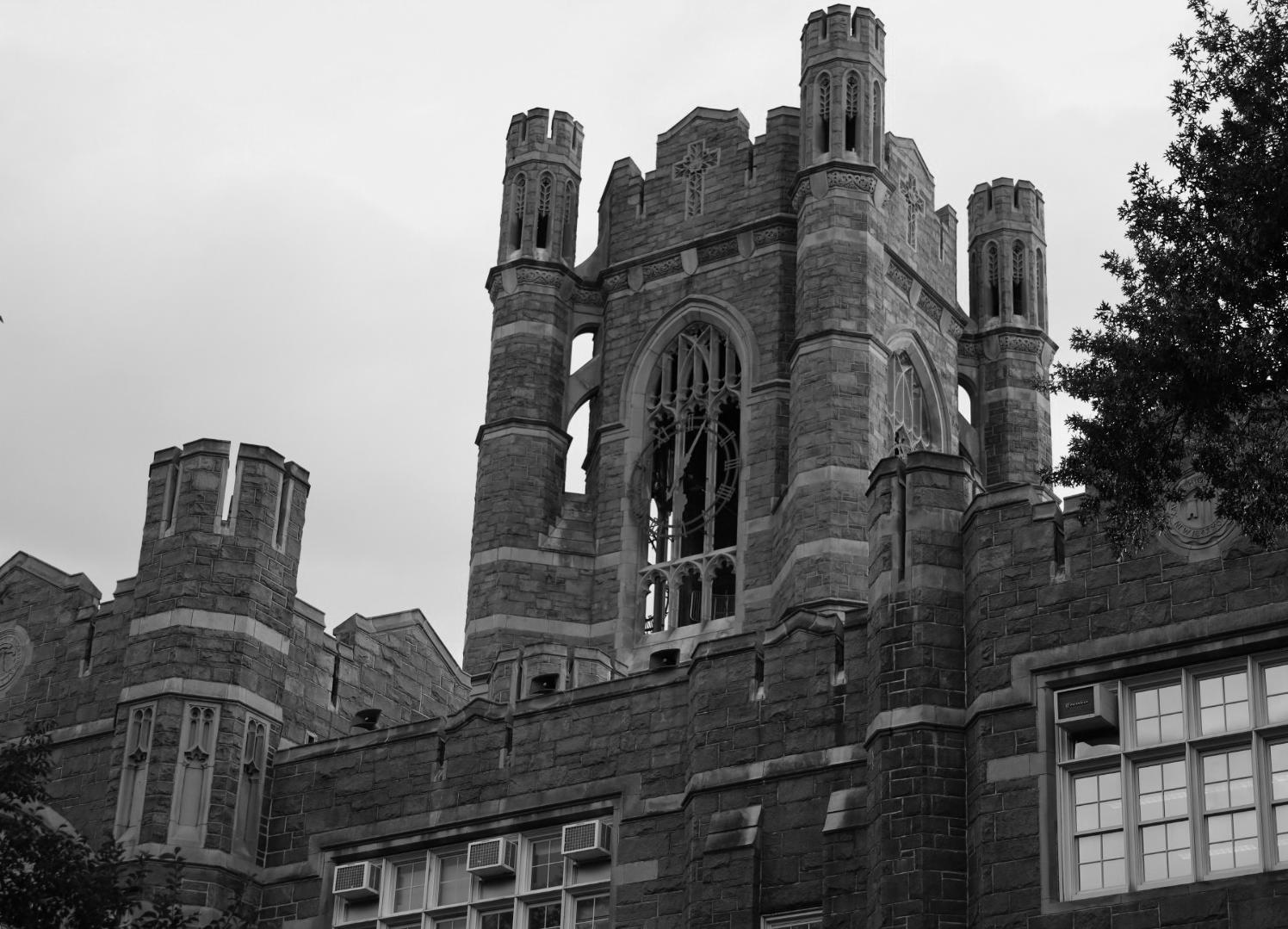
The Fordham College at Rose Hill core curriculum is currently under revision.
MARY HAWTHORN FOR THE FORDHAM RAM
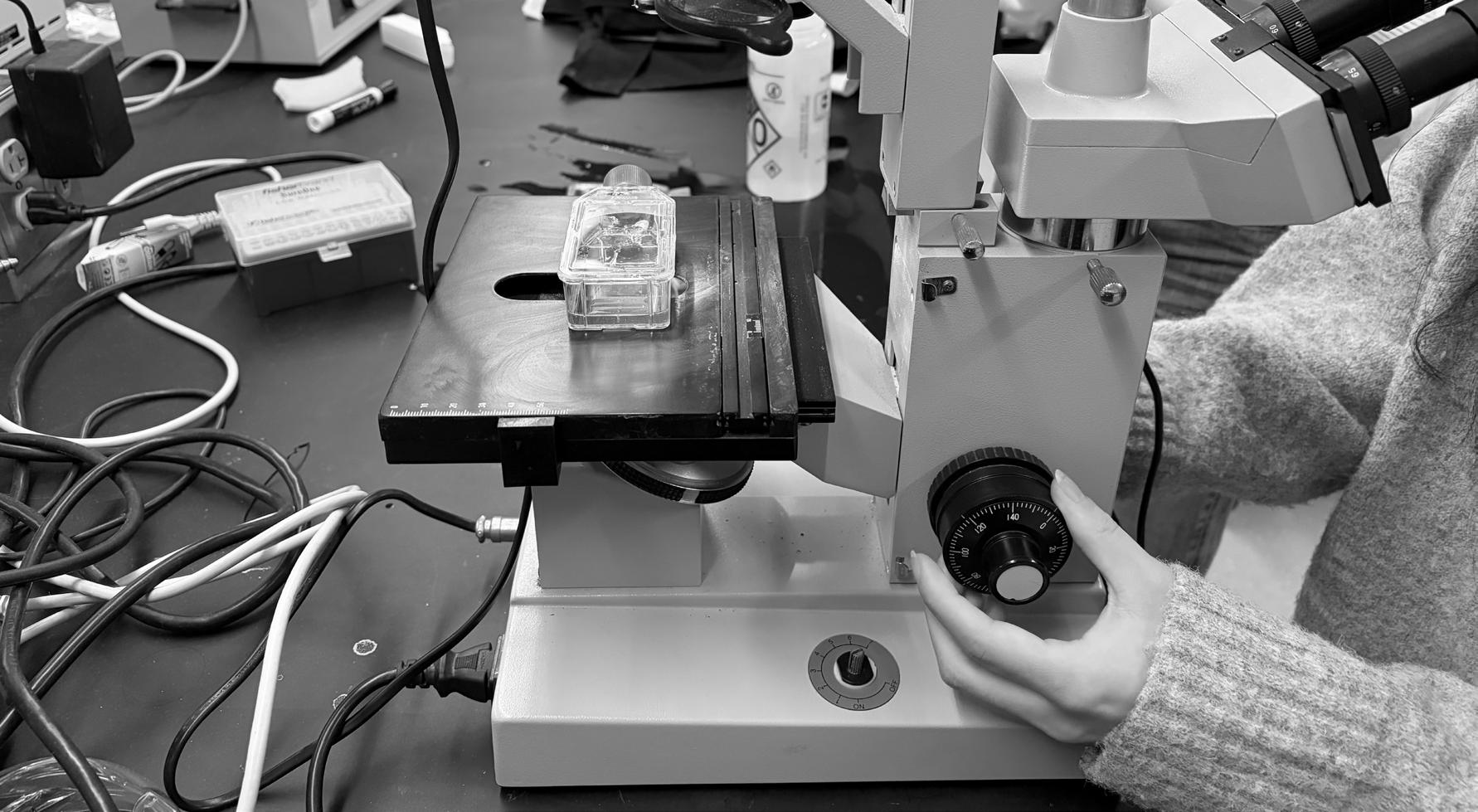
Breast cancer cells being used in Ipsita Banerjee, Ph.D., laboratory research.
SIDNEY BLASCO/ THE FORDHAM RAM
SLC Meets to Discuss Improvements to Orientation
By EMMA LEONARDI NEWS EDITOR
The Fordham University Student Life Council (SLC) held its third meeting of the semester on Wednesday, March 18, to discuss changes to the orientation process and receive updates from council members.
The meeting kicked off with an invitation from SLC Chair Reese McDonald, GSB ’26, for Senior Associate Director for Student Formation Angelo Coppotelli V to present regarding changes to the process of orientation for the incoming class of 2030.
Coppotelli noted that Fordham will try to build on various first-year orientation program changes enacted in the fall of 2025, such as Rose Hill students spending a portion of their orientation at the Lincoln Center campus under the idea of “OneFordham.” Coppotelli asked the council for feedback on changes they have or could
By KAT ROSSI ASST. NEWS EDITOR
Fordham University’s Graduate School of Social Service (GSS) convened students, faculty and international partners for a discussion on women’s healthcare, which focused on maternal mortality and global health equity.
This conference was organized by Fordham Master of Social Work (MSW) students participating in the school’s United Nations Internship Experience in coordination with their faculty advisor, Elaine Congress, Ph.D. The event highlighted disparities in outcomes while emphasizing the vital role social workers play in advancing equitable healthcare worldwide.
In an interview with The Ram, Congress said that the event’s topic was rather natural. “There are about five million [social workers] in the world, and we’re concerned about social justice issues,” Congress said. “There are a lot of social justice issues involved in terms of healthcare.”
“This event reflects our shared commitment to [the advancement of] women’s rights to equitable and quality health care worldwide,” said Connor White, communications director of GSS. “Equipping future social workers with global perspectives is essential, as they are often on the front lines supporting vulnerable populations.”
Student organizer Elena Soler, GSS ’26, described the forum as both timely and necessary, because the event coincided with the 70th
make to this process by posing a series of questions.
The first question concerned what kind of information new students would need the most during orientation.
United Student Government (USG) Vice President of Budget and Finance Peter Grimes, FCRH ’26, shared that he thought orientation leaders should offer more guidance to new freshmen.
Coppotelli agreed, noting that the orientation for the class of 2030 has already been changed to be four days long in order to spend more time with new students.
Senior Resident Assistant Justina Diaz, FCRH ’26, added that she thinks students are not given a proper explanation of what’s expected of them when first arriving at Fordham. Diaz recommended giving a standardized presentation on Fordham’s expectations to all orientation leaders to help with this issue.
In response to Diaz’s idea,
Assistant Dean for Seniors at the Gabelli School of Business Jenna Cook, Ph.D. suggested that orientation leaders talk about the path to graduating, with topics such as what students should be taking and how major/minor requirements can overlap with courses in the core curriculum within their attributes.
USG Executive President Lucas Hjertberg, FCRH ’26, noted that the Fordham study abroad office should be more involved in the orientation process in order to help advise incoming students on how to academically prepare for classes offered abroad.
Coppotelli’s second question for the council concerned the experiences and resources new students should have to aid them in connecting with the Fordham community and finding a sense of belonging on campus. McDonald noted that student panels discussing such resources may be more effective than those presented
by faculty. Cook suggested a club fair catered specifically to first-years to help them figure out where they belong and what sort of activities and organizations they want to participate in at Fordham.
The council then shifted from discussing fall orientation for the class of 2030 to listing organization-specific updates.
The Campus Activities Board (CAB) shared that Spring Weekend programming will run from April 20 through April 26. CAB President of Operations Emma Seber, GSB ’26, noted that the vice president for communications position under CAB is open.
Hjertberg shared that USG’s proposal to provide free menstrual products in university dorms is currently under review, with facilities suggesting a three-way split of the $3,000 cost between ResLife, the Residence Halls Association (RHA) and USG. Hjertberg also noted that it is unusual for USG to cover part
GSS Talks Women’s Healthcare
anniversary of the United Nations (UN) Commission on the Status of Women.
“Of course, it had to be about women. And we chose health care just because … healthcare right now is being attacked in our country,” Soler said.
A central theme of the event was the presence of structural barriers within the healthcare systems. Presenters shared how inequities that are embedded in policy, training and institutional practices often result in delayed diagnoses, inadequate treatment and unequal access to care.
Maria Treloney Perlett, GSS ’26, addressed the phenomenon of medical gaslighting, which is when patients’ symptoms are dismissed or attributed to emotional causes without proper investigation, and drew on her personal experience with endometriosis.
“When dismissal becomes patterned across many patients, it is no longer personal, it becomes systemic,” Plet said.
“Medical gaslighting is a health equity issue rooted in how systems are designed.”
Maisha Cogle, GSS ’26, highlighted disparities in maternal health outcomes among Black women in the United States. She noted during her presentation that despite advances in medical technology, the U.S. continues to report higher maternal mortality rates in Black women than in other high-income countries.
“These disparities exist regardless of [one’s] education or income, showing that postpartum mortality and dangers is a structural issue rather than an individual one,”
Cogle said. “Behind these numbers there are real people whose voices deserve to be heard.”
Cogle emphasized the need for policy interventions, such as extending postpartum Medicaid coverage and implementing mandatory bias training for health care providers.
The discussion on health also expanded internationally, incorporating global perspectives on environmental determinants of health. Sophie Balson and Jemimiah Giles-Cook, medical students at the University of Notre Dame-Sydney, examined the intersection of climate change and women’s health, noting that environmental crises impacts women and girls disproportionately.
“Four out of five people displaced by climate impacts are
women and girls,” Giles-Cook said. “Women and children are 14 times more likely to be displaced, face violence and experience adverse health outcomes during environmental disasters.”
Mental health and social stigma were also key areas of the webinar’s focus, particularly in discussions surrounding menopause and postpartum care. Monica Mendez, GSS ‘26, highlighted how cultural taboos and inadequate medical training contribute to the marginalization of women’s experiences, often discouraging them from seeking support.
“Silence around these issues leads to suffering,” Mendez said.
“Education and open dialogue are essential to breaking stigma and improving outcomes.”
The event concluded with a
of the cost for a proposal like this. Executive Vice President of the Commuting Students Association (CSA) Jasmine James, FCRH ’26, noted that the nap pod has been moved to Walsh Library Room 108B. Executive President of RHA Anna Callendrillo, FCRH ’26, shared that, following the conclusion of Spring Weekend, the Big Four (USG, RHA, CSA and CAB) will be having a brunch on April 26. Additionally, there will be a Pugsley’s Pizza van outside of the Mcshane Campus Center on April 30 for a separate event.
Senior Associate Dean of FCRH David Swinarski told SLC that voting on the Core Curriculum revision has officially begun, and that it will apply only to future students if enacted.
The next SLC meeting of the semester will be on April 29. This meeting will also be the last SLC meeting of the semester before next year.
call to action, urging attendees to carry the conversation forward into professional and community work. Organizers stressed that awareness alone is insufficient without concrete steps toward reform.
Soler told The Ram that the best way to get involved with women’s healthcare inequality, in education or active work, whether through academia or outside it, is through community outreach.
“Always look within your own community,” Soler said on this topic, echoing her own experience. “Get involved with what you see when you walk out of your home right now … I think oftentimes as students, we’ll, like, detach ourselves and look at what’s happening in the world, but we’re also a part of the world.”
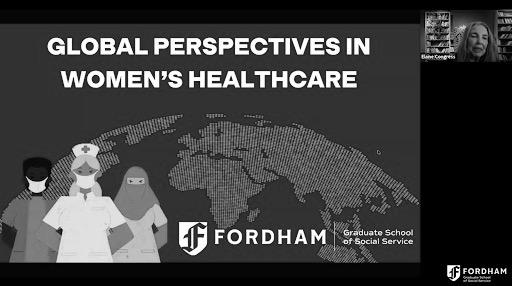
Elaine Congress, Ph.D., the faculty sponsor, introduces the event.
KAT ROSSI/THE FORDHAM RAM

Serving the Fordham University campus and community since 1918
The Fordham Ram is the university journal of record. The mission of The Fordham Ram is to provide a forum for the free and open exchange of ideas in service to the community and to act as a student advocate. The Fordham Ram is published every Wednesday during the academic year to all campuses.
Website
TheFordhamRam.com
Email Address
theram@fordham.edu
Editor-in-Chief
Sienna Reinders
Managing Editor
Ian Nelson
Production Editor
Sarah Verrastro
Editorial Director
Molly O’Connor
Multimedia Director
Hannah Sullivan
Business Director
Nishanth Aduma
News Editor
Emma Leonardi
Features Editor
Sidney Blasco
Assistant News Editors
Jordan Donegan
Kat Rossi
Opinion Editor
Loresa Zeqiraj
Assistant Opinion Editors
Erynn Sweeney
Gabriel Capellan
Culture Editors
Lara Ejzak
Makenzie Smith
Assistant Culture Editor
Kelly Buban
Sports Editor
James Nelson
Assistant Sports Editors
Molly Friedman
Ethan Bess
Copy Chief
Indigo Towers
Executive Copy Editors
Emily Mitton
Uma Petzke
Emma Kelner
Elaina Gibson
Photo/Graphics Editors
Emily McCall
Wilson Speller
Digital Producers
Haniyyah Usmani
Han Le
Marisa House
Advertising Directors
Violet Wallace
Juan-Pablo Valencia
Rishika Lingamdinne
Faculty Advisor
Beth Knobel
Editorial Policy
The Fordham Ram’s editorial reflects the editorial board’s opinions or views.
Opinion Policy
The opinions expressed in this publication are those of the authors. They do not necessarily reflect the opinions or views of The Fordham Ram.
Submission Policy
The Fordham Ram Reserves the right to reject or edit any submission for any reasion, without notice. Submissions become the exclusive property of The Fordham Ram. No part of The Fordham Ram may be reproduced without written consent.
Correction Policy
The Fordham Ram is committed to fair and accurate reporting. If you are aware of an error, please contact us at fordhamramonline@gmail.com
Being an international student, I often treat traveling as a routine, while in reality, I hardly recognize that the ability to cross borders is a privilege most people will never experience.
I still vividly remember my first time travelling alone , which was the summer I left for Fordham. Standing at Hanoi’s Noi Bai International Airport with three heavy suitcases, my family and I were taking our last photos before my flight to New York. Still, I wonder what my parents saw when I was at the security gate waving my final goodbyes. I thought they saw a mature version of me, but now I feel like they saw a little girl who threw a tantrum years ago because she didn’t want to study abroad. At 18, navigating the airport felt like independence and chaos at the same time. I got to experience traveling for the first time in Taiwan, running to catch the next flight and waiting at the passport control line at John F. Kennedy Airport. This flight remains truly meaningful, as it marks the start of my study abroad journey in the U.S. However, that experience is far from universal. According to the International Air Transport Association (IATA), in 2023,
OPINION
From the Desk | Han Le
Who Gets to Travel
“approximately 78% of the world population has never flown,” and this figure varies widely by region. Only about 20% of people worldwide have ever been on a flight. Although air travel is growing, it is still out of reach for a major portion of the global population. This is due to many factors such as financial inequality and accessibility.
I have heard many pieces of advice for young people on how they should “travel more, explore more and get more experiences.” From my perspective, that advice assumes equal access, which is nonexistent. The most important barrier is financial hardship as international flight tickets are becoming increasingly unaffordable. Statistics from the U.S. Bureau of Labor Statistics in 2025 show that the consumer price index for airline tickets rose by 25%, outpacing inflation. Another difficulty is mobility privilege. The main issue is that many individuals don’t have a valid passport to even exit their home country, and if they do, a low-ranking one poses great difficulty in obtaining a visa. Last summer, I was back in Vietnam to visit my family when there was a pause in the grant and extension of the F-1
visa globally, which caused distress for many students and families. I received many phone calls from my parents and friends asking about updates on the process and planning for what would happen if we could not get back to Fordham in time. Fortunately, the embassy announced that the process went back to normal after a few weeks, which gave us great relief. But I know the steps of obtaining a visa can be very complicated and are different for each country. Experiences like these highlight that the ability to travel is not simply about willingness or curiosity but one shaped by policies and documentation, which are often unpredictable. They remind us that for many, mobility is not guaranteed but conditional.
Editorial | Ozempic
Recognizing my privilege does not diminish the experience of traveling but rather makes it more meaningful. Looking back, my first flight alone without my family was both a personal milestone and an important opportunity granted to me by my family, one that I did not fully understand at the time. Being able to study, travel and live in a new country has significantly broadened my perspectives and allowed me to form long-lasting relationships that would not have been possible had I stayed in Vietnam. I’m reminded often to be grateful that I can explore the world at a young age and know that I can visit my family in Vietnam again despite being 8,000 miles away.
Skinny is Back and Scarier Than Ever
“Do you think she’s on it?” “There’s no way she lost it naturally, right?” “Can you believe how thin she’s gotten?” These are the questions on everyone’s minds as we find ourselves in the depths of the age of Ozempic. Everywhere you look, all you can see are protruding bones and tightened skin. Your favorite body-positive singer, the actress you hadn’t realized had any weight to lose and even your old teachers, it feels like everybody is on a glucagon-like peptide-1 (GLP-1).
GLP-1 agonists are medications that promote weight loss and lower blood sugar levels, often to treat Type 2 diabetes and obesity. They work by mimicking the hormone that triggers the release of insulin from the pancreas, blocking glucagon secretion, slowing stomach emptying and increasing how full you feel after eating. By triggering this hormone, the medications help manage blood sugar and decrease appetite.
The Ram does not mean to discount the medical value of GLP-1 drugs, but instead warn about the dangers of both misuse and overuse, as well as the powerful impact of the image of a thinner body standard on society. Though they can be very helpful for some in addressing medical issues, there are increased risks of gastrointestinal problems, pancreatitis and decreased kidney function. Additionally, while they are not chemically addictive, they can
easily be misused by those with access, such as the upper class and celebrities. These drugs are for people medically diagnosed with diabetes or obesity, but they are not proven to be safe for those attempting to lose weight casually or for cosmetic purposes. When a user stops taking the drugs, the weight comes back, risking the creation of a dangerous cycle of overusing the drug to stay at a desired weight or look.
The recent Academy Awards on March 15 put the drastic nature of this weight-loss trend on full display, with the most popular accessory of the night being exposed ribs and collar bones. Actresses who were already extremely thin now appear emaciated, and all who admit how they did it excuse their choice in the name of “health.”
One celebrity outside of the entertainment industry who might be the most shocking proponent of weight loss drugs is Serena Williams. Last August, the world-class tennis player and four-time Olympic gold medalist revealed that she had been taking a GLP-1 while announcing her partnership with Ro, a telehealth weight loss company where her husband, Alexis Ohanian, is an investor on its board. Since starting the drug, she has lost 34 pounds and claims she is the healthiest she has ever been. Yes, Serena Williams, one of — if not the — greatest athletes of all time, is apparently just now at her healthiest because of a
weight loss drug.
What does this say about society’s definition of health? If even our strongest and most dominating athletes cannot feel “healthy” until they are palatably thin to the world, how can any of us ever be comfortable in our own skin?
Although it is certainly uncomfortable to think about, our body shapes and sizes frequently go in and out of style. Celebrities dictate those trends because of their easy access to plastic surgery, medical assistance and other cosmetic advantages. From heroin chic in the 1990s to the Brazilian butt lift craze in the 2010s, it is impossible to always keep up with beauty trends. Still, we are pressured into trying, and as a result, hating ourselves for not looking like the people we see in our media.
Compared to the ’90s and 2000s, when extreme thinness was last in fashion, our access and exposure to the media has exponentially increased due to social media and more advanced cell phones. This exposure hits adolescents the hardest, due to being in such a critical age of development and often having increased time on social media. A 2023 study by the U.S. Department of Health and Human Services found that 95% of youth ages 13-17 are on social media, more than a third saying they were on it “almost constantly,” and nearly 40% of children ages 8-12 are on social media. This increased media
usage is alarming, but it isn’t going anywhere, and the content that these young people are consuming can have extreme effects on their mental health and body image.
Social media use often leads to social comparisons, especially for adolescent girls who are constantly being shown what the “ideal woman” looks like through influencers and female celebrities. This comparison can lead to body image issues through the internalization of beauty standards and ideals of thinness. It can also motivate and trigger the development and/or worsening of eating disorders, which are unfortunately extremely common these days. Across the globe, 22% of children and adolescents exhibit disordered eating. This statistic is frightening but true, and it will likely only increase as more and more young people are given access to social media, where they are faced with constant images of thinness
As a media-driven society, we are obsessed with looking like anyone but ourselves, and bringing back a frail and emaciated appearance as the “ideal body” can only bring extreme dangers to our population, especially for women and our youth. Though GLP-1s like Ozempic could be life-changing for some, this fad could result in an extreme increase in negative body image, leading to severe eating disorders that threaten the lives of much of our society.
By KELLY BUBAN ASST. CULTURE EDITOR
Growing up as a dancer, before I traded ballet slippers for a swim cap, I learned early on that some art forms don’t just entertain people; they shape how you are meant to understand the discipline, beauty and expression that exist in the world. Going to winter shows like the Radio City Rockettes and “The Nutcracker” was something I looked forward to every year. From a young age, I loved listening to the shows’ music, watching the dancers move across the stage and sitting in a dark theater with a bunch of strangers all absorbing the same story. These experiences have stuck with me.
When Timothée Chalamet suggested in a Variety interview that he didn’t want to work in ballet or opera house because “no one cares about this anymore,” it felt both dismissive and an out of
OPINION
Earth Without Art is Just ‘Eh’
touch comment to make.
Chalamet made the comment while speaking with Matthew McConaughy, then joked that Variety might lose “14 cents” in viewership over his remarks. Whether it was intended as humor or not, his comment created a clear implication: ballet and opera are viewed as archaic art forms clinging to relevance in a world that appears to have moved on. Chalamet received immediate backlash from artists and public figures like Misty Copeland, Steven Spielberg, Andrea Bocelli and Whoopi Goldberg, who criticized the statement as reductive and harmful to communities that have spent decades preserving these traditions.
While some people may agree with Chalamet, it is not justifiable to say “no one cares” about ballet and opera, even though he may not be entirely wrong. Because ballet and

By EMMA KELNER EXEC. COPY EDITOR
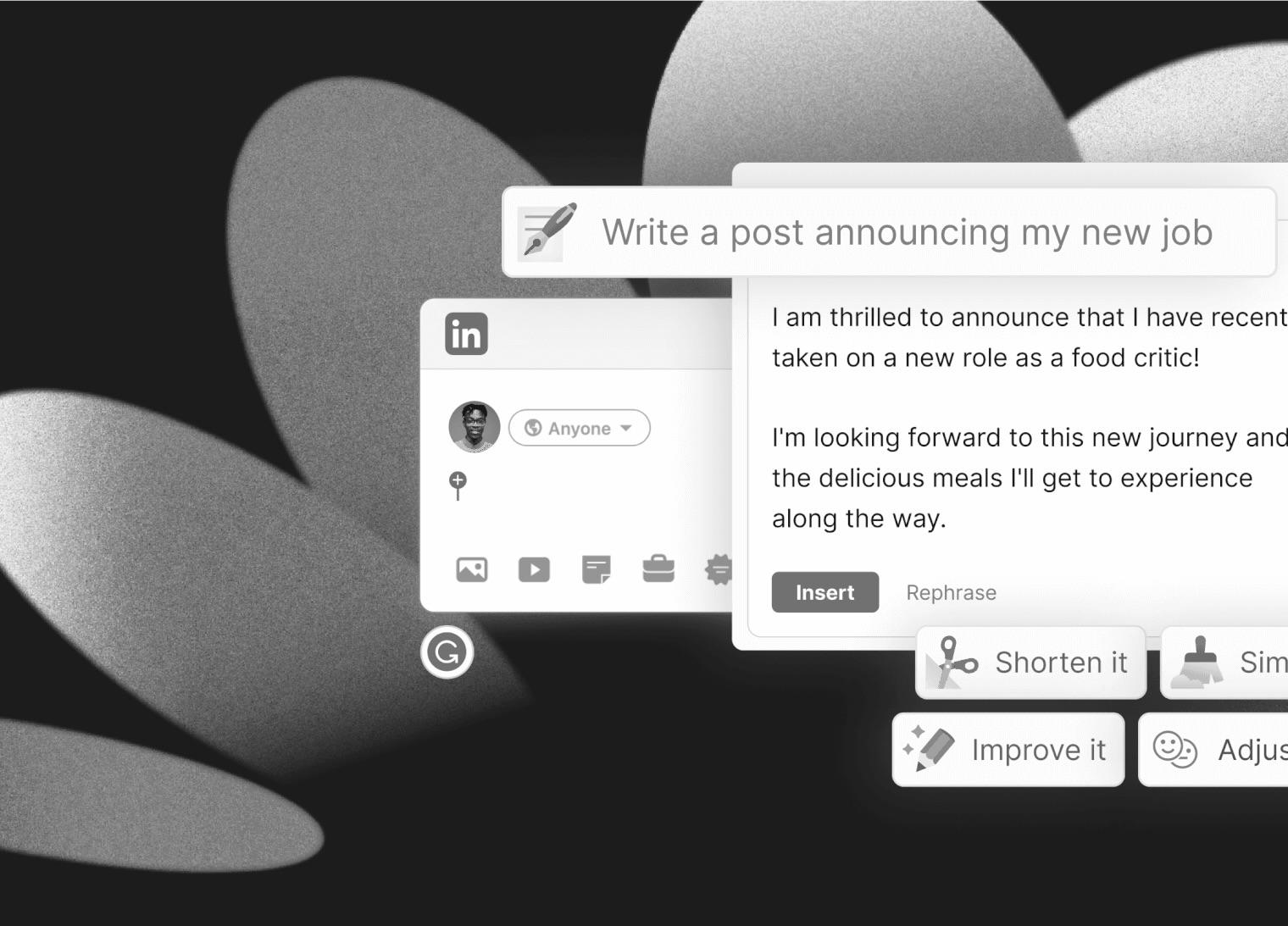
When I think of AI, I imagine the incredible processing power of large language models (LLMs), like ChatGPT and Google Gemini. An LLM is an artificial intelligence algorithm that uses large data sets and deep learning models to summarize and generate new content. LLMs are also closely associated with the term “generative AI,” a type of LLM specifically designed to generate text-based content.
But crucially, when I think of AI tools, I do not imagine Grammarly. That’s because, while Grammarly uses AI, it is not known for its powerful text generation. As such, I strongly believe that Fordham University’s AI tool initiative, which provides all Fordham students with free Grammarly Premium, is far more of an aid than a hindrance to students’ intellectual development. Grammarly has the potential to strengthen, rather than weaken, students’ writing. While Grammarly is not perfect, it should not be dismissed like the rest of generative AI, as it can help ameliorate some of the effects of students’ K-12 education. In 1985, the National Council of Teachers of English
opera aren’t typically trendy on social media, aren’t always easily digestible, can have high ticket prices that make them exclusive and intimidating dress codes, it’s understandable why someone might say these art forms are “dying.”
However, to say that “no one cares” ignores the reality that thousands of people still dedicate their lives to these art forms. It ignores the packed performances, the sold-out runs and the young dancers and singers training for years in pursuit of something they believe matters. It ignores the work being done to make these arts more accessible and relevant. Institutions like Lincoln Center for the Performing Arts and the Metropolitan Opera made significant efforts to reach wider audiences, offering student tickets, 30 Under 30 prices and live-streamed performances. Companies like the New York City Ballet continue to innovate while preserving tradition, proving that these “old” art forms are still evolving.
At Fordham, we have the opportunity to see firsthand how valuable these experiences can be. In a city that is always defined by constant motion, stepping into a theater can almost feel like an out of body experience. Ballet and opera force you to slow down by demanding your attention in a way that most modern entertainment doesn’t. There are
no quick cuts and no scrolling, just movement and music; watching a story unfold in real time. This sort of immersion is rare nowadays, and it is something worth protecting.
More than that, these art forms provide an escape, not in the sense of avoiding reality, but in the sense that it presents a different way to process it. Ballet tells stories without words, relying on physical expression to convey emotion. Opera amplifies the human experience through music, turning even the most ordinary feelings into something unforgettable. In both cases, the audience is invited to feel deeply, to sit with discomfort, joy or sorrow without immediately moving on to the next thing.
If ballet and opera want to survive and thrive, they need to continue breaking down the barriers that have historically limited their reach. This means not only making tickets more affordable but also rethinking how these performances are marketed and who they are for. This could come from embracing diversity and changing original storytelling, but overall realizing tradition doesn’t have to be exclusive.
The responsibility for keeping these art forms alive doesn’t fall on one group alone. Performers, institutions themselves, educators and audiences all play a role. But perhaps most importantly, it requires a shift in mindset. Instead of
Grammarly is a Friend, Not AI Slop
passed a resolution to discontinue the isolated teaching of grammar based on two studies that claimed grammar instruction had “harmful effects.”
However, both of these reports have been proven to be based on incorrect and misconstrued data. In fact, new studies show that direct, explicit instruction in grammar improves students’ knowledge of grammar conventions and writing skills. Unfortunately, the 1985 resolution is still in effect today, and its influence can be seen in students across the country. Professors report that many college students today struggle with grammatically correct writing, and many cite poor grammar education in grade school as the primary cause.
Considering this, Fordham’s offering Grammarly Premium for free is a boon. Some may argue that grammar-checking can become a crutch, preventing students from truly learning grammar conventions. However, when correcting sentences, Grammarly AI explains why such a correction is necessary. For example, if a sentence is missing a period at the end, Grammarly writes, “All sentences must have some form of punctuation at the end.
Statements should end with a period (.).” While some students may accept the suggestion without examining its reasoning, students motivated to improve their grammar can learn the basics through Grammarly. Slowly but surely, their writing will improve. As Fordham does not offer a “Grammar 101” course, Grammarly offers a wonderful, supportive tool. It’s not a full solution, but it’s a helpful one.
Grammarly can even be beneficial for students with a solid grasp of grammar conventions. Humans are not machines; it’s impossible to catch every mistake. That’s why authors have editors, bosses have secretaries and students have Grammarly! Of course, it’s important to remember that Grammarly is not perfect either. Ideally, Grammarly and the student user can balance each other out: what one misses, the other will (hopefully) catch.
That said, Grammarly’s generative AI features are not as clear-cut in their benefits. Grammarly offers an array of AI tools catered to students, including AI-generated essay titles, abstracts, personal statements, thesis statements, topic sentences and, perhaps most
asking whether ballet and opera are still relevant, we should be asking why we’re so quick to declare them irrelevant in the first place. I joked with my friends that I “miss when Timothée was Timothée and not Timothy” — a half serious comment about how his perspective seemed to change overnight. But underneath that joke is a real frustration with how easily influential voices can shape narratives. When someone with a platform suggests that an art form doesn’t matter, and on the other hand, when their comments inspire nearly every award winner at the Oscars to criticize them, it influences public opinion both negatively and positively.
As the saying goes, Earth without art is just “eh.” A world without art, without ballet, without opera, is just “eh.” While ballet and opera may not dominate headlines or social media feeds, their value can’t just be measured in clicks or views. It’s measured in the lasting impact they have on the people who experience them. So no, ballet and opera are not dying, but they do need defending, and this may just start with refusing to accept the idea that “no one cares” — because clearly, many of us still do.
importantly, “beautiful, AIcrafted poems for any occasion or theme.” Some tools could actively weaken students’ writing skills, like the thesis and personal statement generators. However, all professors at Fordham must implement one of Fordham’s three generative AI policies: “No-AI,” “LimitedAI” or “Full-AI.” Under the first of these policies, AI is not permitted whatsoever. Under the second and third policies, AI usage is permitted, but only with proper citations. Thus, the risk of outsourcing generative AI is diminished, though enforcement of these
policies varies widely. Ultimately, whereas generative AI can detrimentally impact students’ intellectual development, Grammarly AI can potentially help rectify the lack of grammar education in grade school through explanations of grammar conventions. If universities want their students to write well, they shouldn’t fear tools like Grammarly — they should teach students how to use them wisely.
Ballet and opera are still valued in the art world despite Chalamet’s comments.
COURTESY OF THE HIBERNIA
Kelly Buban, FCRH ’29, is a journalism major from Middlebury, Connecticut.
Emma Kelner, FCLC ’29, is an economics and history double major from Staten Island, New York.
COURTESY OF GRAMMARLY
Fordham students have access to Grammarly, so it should be utilized.
OPINION
Don’t Forget That We Are Students First
By EMMA KELNER EXEC. COPY EDITOR
“Learning is not attained by chance; it must be sought for with ardor and diligence”
-Abigail Adams.
As college students, there is one constant in our lives: studying. Or, more specifically, studying when you want to do other things, like working, hanging out with friends or going to The Ram’s copy nights. Despite all the things you’d rather be doing, as a college student, you owe yourself a committed, deliberate approach to studying, as it can shape both your learning and your life.
Before we can discuss the benefits of studying, we must define what studying is. Some students may say it’s staring at a page of notes until your eyes water, while others might
say it’s drilling flashcards until your mind goes numb or putting your notebook under your pillow before you go to sleep and hoping for the best.
The Oxford Dictionary claims that study is the “devotion of time and effort to the pursuit of knowledge, esp. by means of written sources, observation, or experiment.”
That definition is a little vague, but it’s tough to define something as broad as studying. Let’s narrow our scope to what studying does to you — or rather, what studying does to your brain.
Studying rewires your neural pathways, creating new connections and strengthening old ones in a process known as neuroplasticity. That same process helps you learn a new language or instrument — and helps your brain rewire
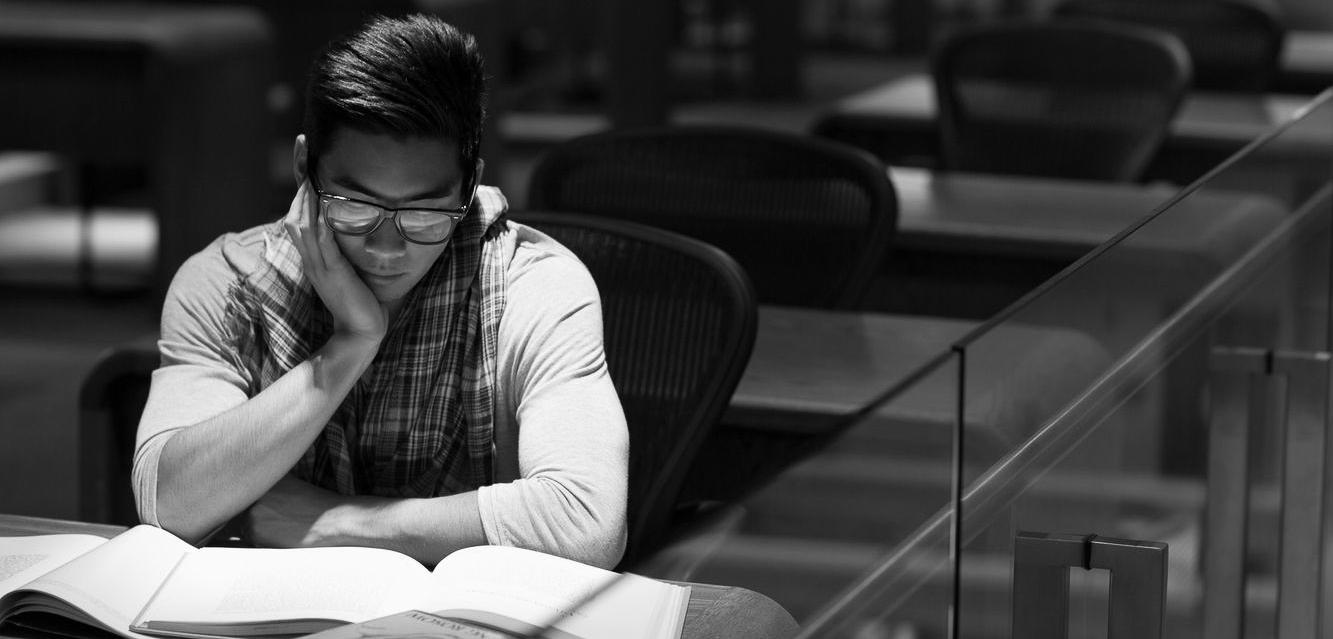
after a traumatic brain injury. Evidently, studying isn’t just good for your GPA; it’s good for your brain. It has benefits that can span for your entire life, yet many students aren’t taking full advantage of it.
The College Student Report, an annual survey conducted by the National Survey of Student Engagement, found that most college students study for less than half of the expected time. Furthermore, some students spend time studying using passive strategies, like rereading notes and textbooks, which have little to no benefit on test performance. But by approaching studying with purpose, students can make the most of their time.
With all that being said, do not take this to mean I love studying. I enjoy it, sure, but sometimes, I’d rather be doing something else. Sometimes, I’d rather be doing literally anything else. When it’s time to study chemistry, for example, I consider painting something just so I can watch it dry. Since studying can be unpleasant, effective studying is all about the approach.
First, you cannot view it as a chore. Let me paint you a picture. It’s a Tuesday morning, and you’re home from break. You were planning to wash the dishes after breakfast, but then your mom asked you to wash
DHS Shutdown is Not Only
By LORESA ZEQIRAJ OPINION EDITOR
The state of airports and the Transportation Security Administration (TSA) in our country is not only a nuisance for so many people; it’s frightening. We need to be more concerned about our government’s inaction to end this government shutdown.
A partial government shutdown began on Feb. 14 due to funds lapsing and is still affecting the Department of Homeland Security (DHS), including TSA. The agencies are now operating without full funding, as about 50,000 TSA employees are working without pay. As of this week, United States Immigration and Customs Enforcement (ICE) agents have been deployed to 14 airports to help during the DHS shutdown.
Airport wait times are increasingly affecting travelers and U.S. citizens are not able to fly domestically on time in certain states. Right now, it’s uncertain whether lawmakers will reach an agreement and end this partial shutdown, which would restore funding to both DHS and TSA.
President Donald Trump has said he won’t make a DHS funding deal until Democrats support the “SAVE American Act.” This requires individuals to provide documentary proof of U.S. citizenship when
registering to vote, along with photo identification to vote in federal elections. Democrats are opposing this bill at the moment because they claim it would create unnecessary barriers to voting.
Congress also failed to pass a bill that would temporarily fund TSA workers and not all of DHS, which has led to the state of airports we’re seeing today. As of March 24, Trump is refusing endorsement of the GOP’s proposed deal to end the shutdown. It’s one thing for political parties in Congress to be opposing each other and blocking bills from passing; this happens all the time. It’s another when the president refuses to support either party in attempting to end the critical situation TSA is facing.
ICE has incited fear all over the country, and DHS procedures of implementing the mass deportation plan of the Trump administration have received overwhelming backlash and condemnation from many Americans. Deploying ICE agents may not be a direct way of carrying out a mass deportation order, but it is undoubtedly intimidating. This action places American citizens under a new type of scrutiny and surveillance in an environment where it isn’t expected. It’s similar to the approach in increasing security in NYC subways that
them. Do you want to wash the dishes anymore? No, you don’t. Studying is the same way! If you view it as an obligation, you either won’t do it or you’ll do a terrible job out of displeasure. This is known as the framing effect: the way information is presented and understood influences decision-making and perceptions. And framing isn’t only about willingness — it affects motivation and engagement. As such, we must consider reframing how we go about our schoolwork.
I always reframe my approach before I sit down to study. I think about why I chose my majors: because I enjoy them and find them interesting. So when it’s time to read 100 pages for history class, I say (out loud — that part is very important), “I get to learn history, and I will enjoy it!” And I do the same for economics — but substitute the word “history” for the word “economics.” This tool works for me! It’s up to you to find the mindset that works for you. Now that you’ve got an approach, you need to figure out how exactly you should study, which can vary dramatically across majors. For humanities majors, studying is mostly writing, synthesizing and explaining texts. When I was studying for a history midterm
last semester, I taught my mom everything we were learning by explaining it to her in my own words. My poor mother now knows everything — and I mean everything — about the Cherokee Removal of 1838 and the enclosure of Appalachia.
STEM majors, on the other hand, focus more on mathematical problem solving, so studying is more about handson practice than reading. For example, in statistics, my professor provides “Practice on Your Own” (POYO) questions, and before every test, I’ll complete each POYO problem at least twice. But no matter your major, you must engage in active study techniques, like connecting topics to real life and explaining material out loud. These techniques are proven to increase retention and grades, as well as boost neuroplasticity.
But remember, these benefits come only from effective study. As Abigail Adams wisely said, you do not learn passively — you must make a consolidated, purposeful effort to learn. So finish reading this paper, save or recycle it, open a book and get to work!
Inconvenient, Its Concerning
New York Governor Kathy Hochul used when she deployed National Guard troops to NYC subway platforms. However, the lack of efficiency within several airports in this country raises questions beyond law enforcement and traveler convenience.
Flying on airplanes and traveling far distances are not natural human rights, but the ability to travel and migrate is a freedom. In “The Handmaid’s Tale” television series, an adaptation of the novel by Margaret Atwood, an extremist group takes over the government and systematically takes away freedoms, starting with the ability to travel. All borders are closed off to prevent American citizens from leaving the country and airports are shut down. In the novel, this rapid and chaotic closure of borders and restriction of travel are crucial in the turnover of a new oppressive regime. When this happens in the show, airports become overcrowded. Watching the news and seeing the same today in New Orleans and Houston, this parallel to “The Handmaid’s Tale” came to mind.
I’m not saying our country is undergoing an extreme regime change, but what I’m trying to call attention to is that the ability to travel is an incredibly significant freedom. Until 1991, Albania
was under the dictatorship of Enver Hoxha, and he stopped people from leaving the country as a way of isolating the people under his regime. Borders were heavily guarded and were called “death zones.” Unauthorized travel was outlawed, and border patrol was instructed to kill anyone trying to flee into Greece or other bordering states. A specialized border force and heavy surveillance by the secret police were created in order to control the population. Again, I am not saying our country is under a dictatorship, but this historical example is just one that we should reflect on.
It’s important to understand what our freedoms are as American citizens.
Humans aren’t inherently granted the right to travel, but it’s a fundamental freedom due to its symbolization of personal liberty, support of economic opportunity and enabling of other democratic rights. When we see our government fail to protect this freedom and fight for its citizens, we should be concerned and take action. TSA workers should never be working without pay, especially not in a country that is considered the “leader of the free world.” Congressional members should be compromising for the sake of their constituents, not refusing to reach an agreement because of other political matters. Both parties are placing the blame on the other, but as American citizens, we need to collectively blame all of our leaders because they’re failing us. The situation we’re in now could keep escalating and worsen, but hopefully, we will see a resolution soon.
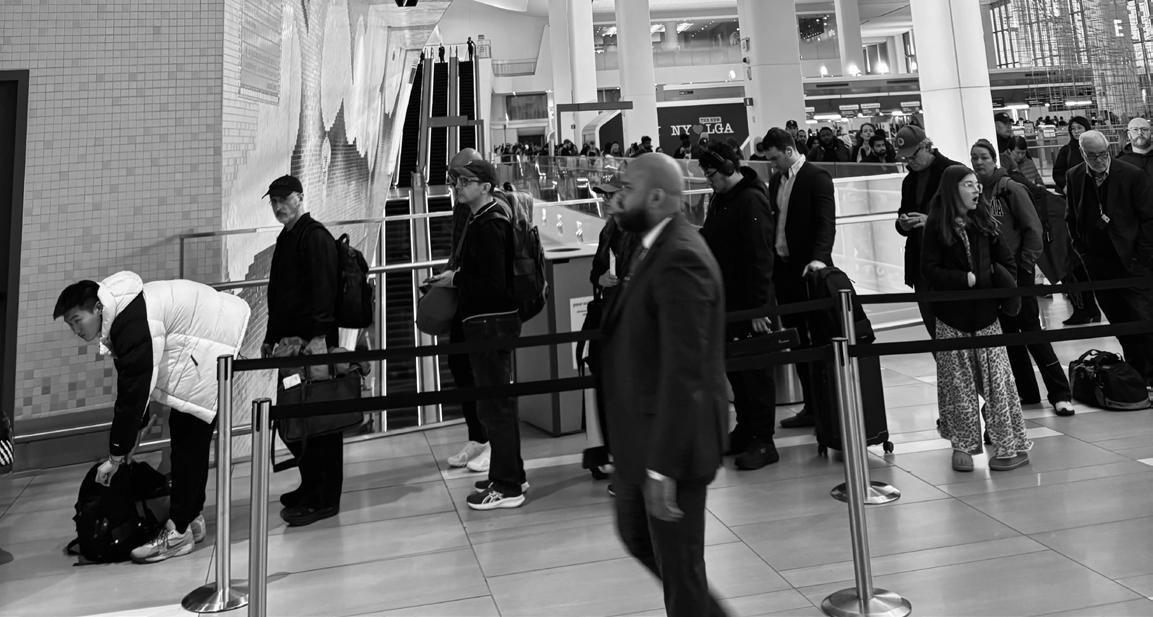
The DHS shutdown has caused long lines at airports.
LAURYN SWEENEY FOR THE FORDHAM RAM
Emma Kelner, FCLC ’29, is an economics and history double major from Staten Island, New York.
Loresa Zeqiraj, FCRH ’28, is an international studies major from Yorktown, New York.
COURTESY OF THOUGHTCO
Most students study for less than half of the time that is expected of them.
Take a Break: Find Balance Beyond Campus
By MARIAM AHMED CONTRIBUTING WRITER
There are many ways that students like to spend their breaks, but at the heart of any successful break are rest, reset and reconnection to what makes you who you are. Some students go home to spend time with family, some go on vacation, some go to work and some go to visit friends. Regardless of how students choose to spend their time away from school, they require a break from the intensity of academic life to recharge before continuing on with the next semester. The ability to
choose how to spend time is what makes breaks so valuable. Unlike the schedule that students follow in college, breaks allow them to fill their days with whatever they find most meaningful, whether that be sleeping, exploring or doing absolutely nothing. Life is vastly different when you’re on break compared to when you’re at Fordham. There is a constant routine when you’re at Fordham, dictated by class, work and social obligations. There is a sense of schedules and a lack of time. When you’re on break, there is a lack of structure, a sense of fluidity.
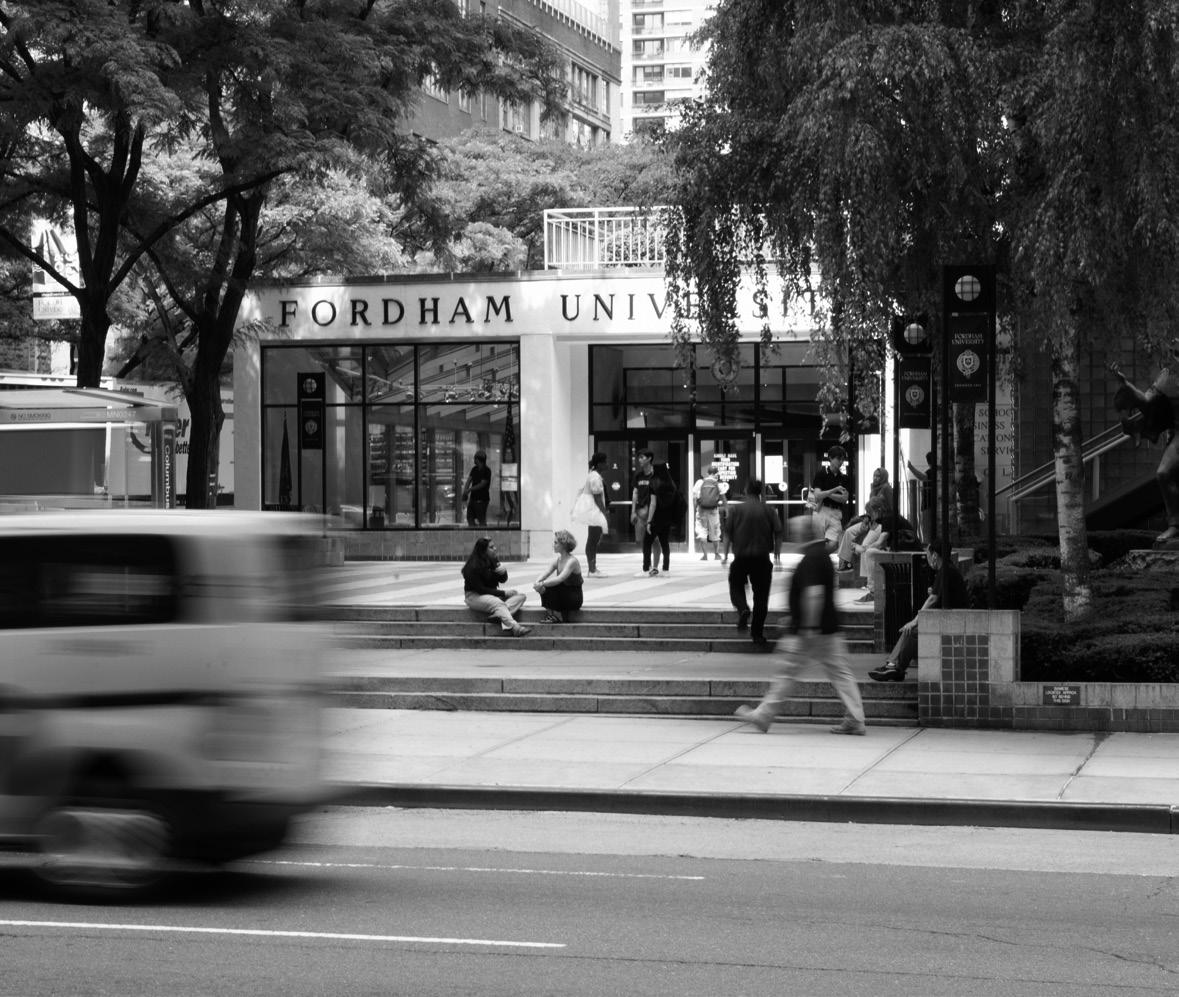
You have control over your own time, which you do not when you’re at Fordham. Even small things, like food or the people you’re surrounded by, can start to change. Being at home, for instance, can mean being surrounded by warm, traditional food and being in comfortable environments.
On the other hand, being away from Fordham also makes you appreciate the everyday routine. One thing I miss the most is the convenience of being close to my friends. This is because, on campus, it is very easy to see people on a daily basis without having to plan. This is one thing that we tend to miss when we are no longer on campus. I especially miss Fordham when the weather is nice. Some small things, such as sitting at Eddies or taking a walk around campus, can help relieve tension.
Being away can also serve as a reminder of why I chose Fordham in the first place. The school provides a special environment because it is near New York City, but it also provides its own environment. Many people are not able to find that at home. It also helps me remind myself of the privilege that it is to be in an environment where I can be independent but also have access to so many things.
Break can alleviate homesickness in an unexpected way. Sometimes college can feel very overwhelming because of its routine nature. Being away can allow you to recharge emotionally so that you can return to school with a better state of mind.
This break, I used the time to travel to London and Paris. This was beneficial for me because I was able to experience new places and broaden my perspective beyond my daily life as a student. The excitement of the trip was something to look forward to during my stressful midterms. The experience was not only pleasant, but also beneficial. Sometimes, being too involved in school life can limit your perspective; taking a step away from it helps to reconnect with the world at large.
A worthwhile vacation is not only about doing something exciting, but also about finding time to recharge. This can include spending time with friends, re-engaging with hobbies or simply taking a break without feeling guilty. Spring break is unique to other academic hiatuses due to it falling at a time when students are exhausted from midterms. Due to its placement in the middle of a semester, spring break holds a sense of urgency,
giving it high means for utilization. The most effective way to utilize time off is to find a balance between detachment and reconnection. It is not always possible to be physically detached from school, but emotional detachment is necessary. A break is a time to be disconnected from academic pressures and focus on other aspects of life that are often neglected during the academic semester. These include relationships, individual interests and self-reflection. It is also a time to appreciate how far you have come throughout the semester and to recognize the efforts you have put into your work.
A break is ultimately important because it gives you a chance to gain some needed perspective. It gives you a chance to reflect on what you are passionate about and come back to campus with newfound motivation. Time off is important because, without it, you will find yourself stuck in a cycle of constant work. A break comes to interrupt this cycle, reminding you that there is more to life than work.
Fordham students recently had their annual spring break.
COURTESY OF FORDHAM UNIVERSITY
Mariam Ahmed, FCRH ’26, is a psychology major from Yonkers, New York.
Put Some Pep in Your Step at Sláinte’s Irish Night
By ALANA JONES CONTRIBUTING WRITER
This past Saturday, Fordham’s Irish dance club, Sláinte, hosted its 11th annual Irish Night, an evening celebrating Irish culture through dance and song. The performance featured original choreography from Sláinte, as well as performances from the B-Sides, the Satin Dolls, the Hot Notes and the Ramblers.
Sláinte performed nine dance numbers, including traditional classics like Riverdance and Lord of the Dance, as well as dances to modern songs like ROLE MODEL’s “Sally, When the Wine Runs Out” and RAYE’s “Where is My Husband?”
Fordham’s a cappella groups showcased a classic Irish song, “Irish Blessing,” and the Satin Dolls sang “The Parting Glass.” The setlist also included modern hits like “Come On Eileen,” inspired by Celtic fiddle playing and addresses Irish-Catholic repression.
Sláinte has a tradition of incorporating pop culture into its performances, staying up to date and bringing Irish dance with it. This year, they performed a dance to “The Rocky Road to Dublin,” inspired by the Oscar-winning film “Sinners,” with a vampire hiss at the finish. Sláinte also performed the choreography they brought to Villanova
University for competition.
The choreography, entitled “Sláinte in the Fast Lane,” was set to Rihanna’s “Shut Up and Drive,” with Sláinte members dressed in Formula 1 jackets and sunglasses. When the dancers took their sunglasses off and placed them in their hair, the crowd went wild.
Allison Engelhart, GSB ’27, Sláinte’s marketing coordinator, shared her thoughts on the evening. “Irish night is so much fun because we get to share what we have worked so hard on all year, while also sharing an important piece of our culture. This year, having Irish night fall the week of St. Patrick’s Day felt very special,
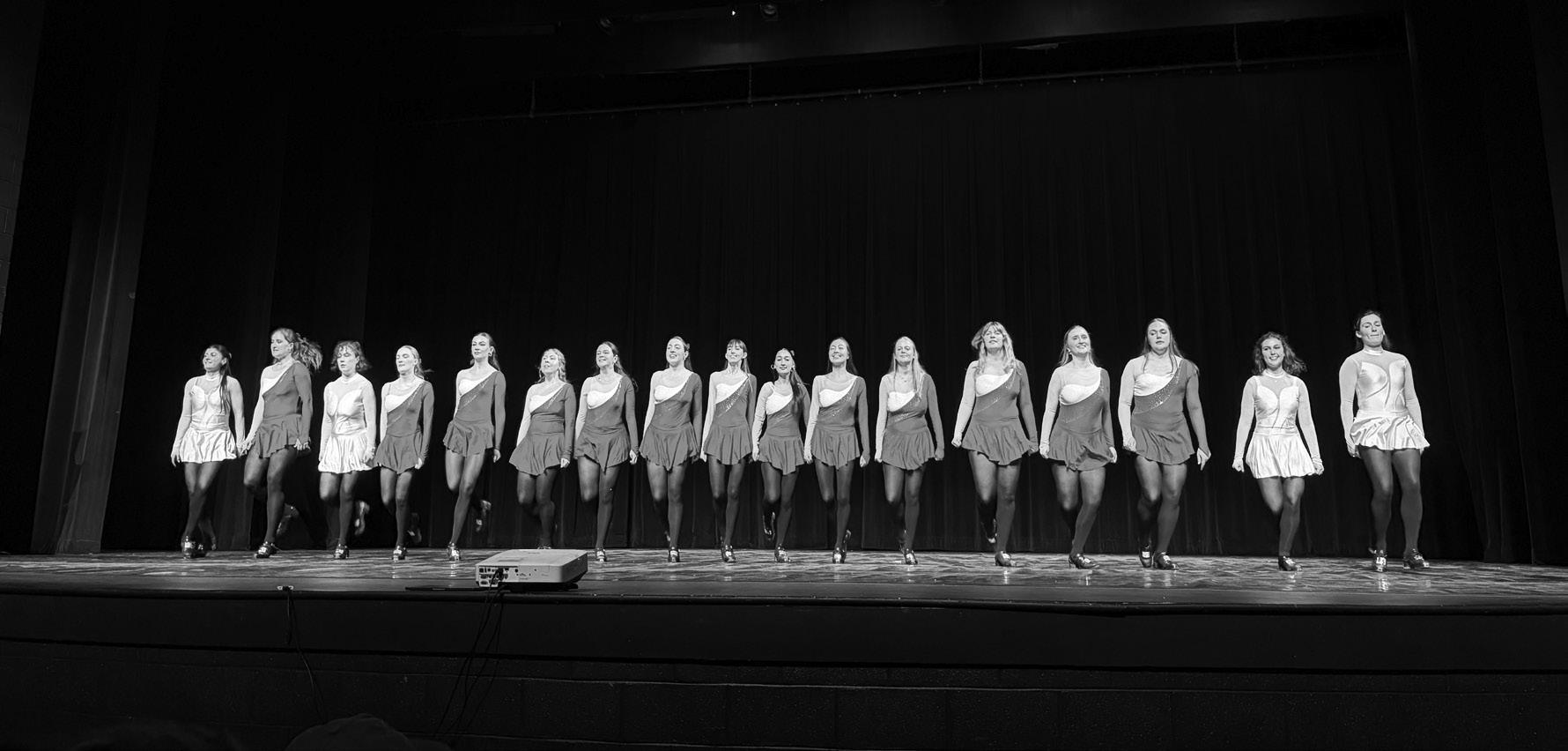
By ELAINA GIBSON
EXEC. COPY EDITOR
Sometimes, our childhood dreams and memories of exploration pave the way for our future interests and career paths. Not only do we take these experiences and use them as fuel for our own story but we also feel called to provide similar opportunities and spaces for the younger generations to take part in as well. This has been the case for Mari Arnold, FCRH ’29, a co-founder of STEAMTEEN, a non-profit organization whose mission is to create free science, technology, engineering, arts and math (STEAM) events for New Haven, Connecticut, teens.
Arnold credits her mother for feeding her curiosity and involving her in many handson STEAM-inspired events at local libraries, museums and camps as a young child. She participated in a coding program at Yale University in the fifth grade that particularly sparked her interest.
“They had this program for young girls where I learned the basic intro to Python and I actually fell in love with it,” Arnold said. “From there I was like this is so cool and loved being able to learn how to program and wanted to expand my knowledge.”
She continued to sign up for more camps and even began teaching herself advanced coding
and I could feel the Irish night energy leading up to the night,” Engelhart said.
“We also get to see some of our favorite alumni back to visit, which is an extra special part of the night!” she said. As is tradition, Sláinte alumni were invited onstage to perform a short show and bring the longstanding Fordham Irish dance community together. One of the final dances, the senior dance, was titled, “Seniors … but They’re in a Boy Band” with a mashup of multiple boy band hits, including songs by Big Time Rush, One Direction, 5 Seconds of Summer and BTS.
My friends have come to the consensus that Irish Night is our favorite night of the year. Mia Juday, FCRH ‘27 attended the event and said, “The environment is super welcoming. They gave out energy drinks and programs, and everyone went crazy when the lights went out and they started dancing.” Juday added, “Everyone was dancing to the songs we knew, and we had a blast!” Juday also enjoyed the dances to modern hits, saying, “I liked the ‘Where is my Husband?’ dance, and the senior boyband dance! Those were so much fun.”
One of the greatest joys of cultural art forms is sharing
Her Passion is Her Power
and website design techniques out of pure enjoyment of the craft. But by integrating herself into STEAM spaces, Arnold became aware of the barriers she and others faced in the field. Whether these obstacles were financial, gender-based, being overly selective or having a lack of quality instruction, she took it upon herself to fill the gap.
Fast forward to her freshman year of high school when she and a friend got the idea for STEAMTEEN, a program with the goal to provide inclusive and free STEAM education to students in the area. They strive to create a community where middle and high schoolers of all backgrounds can envision themselves in STEAM careers and build connections with experts in the field. Having the leadership team entirely made up of youth efforts furthers the objective of showing kids there is room for them in the STEAM space, even if it is self-made.
“A lot of schools are really underfunded and so it’s not fair to have your ability to do things decided based on a lottery system of how much money you have,” Arnold said. “You deserve that education no matter who you are and no matter what your background is.”
Arnold’s steadfast dedication to her organization is evident in her sacrifices and efforts to secure financial support. Before obtaining grants from other non-profits, STEAMTEEN’s
first event was a completely self-funded endeavor which included a partnership with her former employer, the Peabody Museum. With over 40 eager participants, Arnold hosted an event featuring STEAM activities and teachable moments, along with guest speakers from various local universities, during which discussions of interesting developments across different fields ensued.
With this being only one of many events STEAMTEEN has put on over the last two years, it is an empowering example of how a single person’s passion can inspire a new generation to take part in an industry they would otherwise be unaware of.
Even after graduating from high school and moving to New York, Arnold remains an active leader in STEAMTEEN and continues her advocacy for inclusion. She was recently a virtual guest speaker for the Engineering and Science University Magnet School’s chapter of Future Business Leaders of America (FBLA) week, where she discussed her journey of being a woman in a STEAM-based leadership role and what it means to hold that position.
“There have been times when I’m the only woman in the room at a programming session or something,” Arnold said. “I feel like that’s when you are driven by your passion, which helps you break down
them, and the atmosphere at Irish Night is electric every year. Watching the result of months of Sláinte’s hard work is aweinspiring and always a treat.
The amount of work Sláinte’s presidents put into the event was evident, and it undoubtedly paid off. Engelhart said, “It’s a great time to send off our seniors and give them thanks for their hard work in the club — and a special shoutout to our presidents Meghan Naughton and Julia Morales because they have done so much work to prepare us for Irish night and set up this wonderful event.”
Bringing traditional cultural art forms, like Irish step dance, into modern culture demonstrates that Irish culture is alive and continues to evolve, while remaining true to its history and spirit. Watching collegiate performers combine tradition with popular culture alongside talent and dedication was a moving and exhilarating experience.
The a capella groups that performed all have upcoming shows you won’t want to miss. The Spring Teaser will include performances from the Ramblers, the Hot Notes, the B-sides, the Satin Dolls and Lincoln Center’s F-Sharps. Join Fordham’s a capella groups on Keating first floor on March 27.
the barriers and realize what really matters to you.”
Arnold explains that by not adhering to the cookie-cutter mold often expected of a student in STEAM, she relies on her passion to sustain the ambition needed for her educational pursuits. Between studying integrative neuroscience on the pre-med track to running a certified nonprofit to partaking in lab research positions and so much more, she understands the necessity of inclusive STEAM educational opportunities and aims to integrate these values in
her future career.
“It’s rough because a lot of people might underestimate you or not take you as seriously, so then I have to work even harder,” Arnold said. “I think that’s why I do what I do because I want to help others who are facing the same challenges.”
By finding a support system of fellow women in STEAM who invested time and care into helping her navigate the complicated domain, Arnold looks back with gratitude to those who believed in her and propelled her success.

Arnold inspires kids to get involved in STEAM while maintaining her schooling.
MARI ARNOLD FOR THE FORDHAM RAM
Sláinte performed a mix of traditional Irish and contemporary numbers at Irish Night at Fordham Prep on March 21.
ALANA JONES FOR THE FORDHAM RAM
Who’s That Kid | Mari Arnold, FCRH ’29
Why The World Really Adores a ‘Love Story’
By DOVE AJMANI CONTRIBUTING WRITER
Love him or hate him, Ryan Murphy is back, and with a new addition to his somewhat controversial biopic universe. Known for hit dramas like “Monster: The Jeffrey Dahmer Story” and his retelling of the Menendez brothers’ case, Murphy is now turning his sights on a new genre: a love story. His newest limited series, “Love Story,” follows the whirlwind romance between John F. Kennedy Jr. and Carolyn Bessette. The Hulu original begins with the couple’s meetcute and follows them to their eventual tragic passing. But what makes this adaptation so compelling for such a large audience? Is it the world’s deep fascination with the Kennedy family dynasty, a need for
romance or the spot-on casting? While those reasons may be the first pull for many viewers, the real star is how the show captures nostalgia through set design, a beautifully composed soundtrack, fashion, cinematography and iconic ’90s tropes, all of which encompass the media’s craving for comfort and familiarity.
Bessette makes for the ideal archetype of a lead in a ’90s romcom: a business fashionista who carries herself effortlessly and does what she wants rather than being dependent on others. Kennedy is the wealthy heir to one of America’s most powerful and well-known political dynasties, while also possessing the qualities of a classic heartthrob: attractive, charming and, of course, filthy rich.
The show offers a mediatized
New York the world is all too familiar with: streets crowded with yellow taxis, plumes of steam rising from the pavement, people biking to work in business - casual uniforms of oversized blazers, slip skirts and loafers. The cinematography does the rest; from moody and grainy to bright, warm tones, it brings aspects of New York to life that viewers seem to miss, even though many have never actually lived it.
The nostalgia has sparked a new wave of ’90s fashion obsession on social media. Every other scroll on Instagram seems to have a video of Bessette and Kennedy, with captions such as “Bring Back ’90s Fashion” or “When Can We Start Dressing Like This Again?” There have even been look-alike contests built around the fascination and romanticization of Kennedy

and other men who embody his style and phenotype.
Not to mention the ’90s-chic it-girl aesthetic, which is highly prevalent in Bessette. From her personal style to her mindset, she leans into sleek minimalism, using nude and neutral palettes that fuel a street casual style but are also business-ready. Her “give no crap” mindset is inspiring when so many feel pressured to conform with unrealistic expectations rather than choosing what’s actually right for them. Sadly enough, the it - girl look of the ’90s has been replaced by matching sets from Alo or Lululemon, which is why audiences crave nostalgia.
This is where the soundtrack comes into play, pulling the audience to yearn more; not only does it tie the scenes together effortlessly, but it also matches and carries each scene’s aesthetic, mood and emotions perfectly. So much so that the songs could even be considered their own character through the enhancement of pivotal moments.
The first episode begins with Kennedy being so taken by Bessette that he decides to visit her at her job at Calvin Klein under the false pretense of wanting a new suit. One thing led to another, and he slyly asked her out. As he leaves with a smirk on his face, Lenny Kravitz’s song “It Ain’t Over Til It’s Over” begins to play, perfectly encapsulating the scene with high hopes and energy, making the audience twirl their hair and kick their legs, excited to see this new romance blossom.
In episode four, there is a scene where Kennedy and Bessette are at a small-town
bar and Sade’s “No Ordinary Love” starts playing on the jukebox, very antique and very right. Bessette, shocked, asks if he likes the song, and he replies, “What animal doesn’t like Sade?” And he’s right. Sade brings the scene to life through her angelic vocals, capturing the intensity of young love blossoming before the audience’s eyes. With a song as popular as “No Ordinary Love” — which would have been everywhere in the ’90s — fostering an appreciation for the classics and yearning for the past, even though some of the viewers may have never experienced life before the 2000s.
Later, Jeff Buckley’s “Lover, You Should’ve Come Over” plays after an argument between the two, and the placement is painfully perfect. The song is already a heart - tugger on its own, but paired with the scene’s emotional tension, it adds layers of yearning between Kennedy and Bessette. Together, they bring fairy-tale fantasy that almost everyone has craved at some point: the most desired person in the room choosing you, sweeping you off your feet. After all, this trope has been the basis for countless movies and TV shows over the years.
Unlike the fairytale ending Kat and Patrick had in “10 Things I Hate About You,” a poetic ending was, unfortunately, not in the cards for the young couple. It will be interesting to see how their story unfolds on the big screen and whether their story gets its justice. It feels like all of America is on the edge of our seats waiting for new episodes to drop on Hulu every Friday.
Wait All the Time. Disco, Eventually
By EMILY MITTON EXEC. COPY EDITOR
Shortly after finishing up my final midterm (by shortly, I mean walking straight from my exam room to the Ram Van) on March 6, I set off for my reward: the Harry Styles pop-up event in Brooklyn. After staying up late into the night to celebrate the release with friends, I figured that I should make the most of my experience in New York City by attending one of the few exclusive pop-up events being held around the world. Since the dates for the event were announced just days before spring break began, I was ecstatic that I could make it for opening night. After racing against the clock to make it before the popup opened at 4 p.m., I exited the Bedford subway station and claimed my spot in line just 10 minutes before doors opened. My spot was not ideal given that I was in the back of a line that wrapped around
multiple blocks, but this was to be expected considering the popularity of the event, so I prepared myself for the hours ahead of me in the best way possible: making new friends. My favorite thing about this event, outside of the pop-up itself, was how fun and friendly the environment was. This turned out to be especially meaningful to me as I waited in line for over four hours. As soon as I arrived, I got compliments on my outfit, was asked about my opinions on Styles’ new album “Kiss All the Time. Disco, Occasionally” and questioned if I won the Ticketmaster war of getting concert tickets. These experiences, among many others, not only made my experience of being able to attend the pop-up itself special, but also gave me a newfound appreciation for the Harries (Styles’ fanbase), being able to socialize with kind and enthusiastic people all night. Another fun addition to standing in line was being chosen as one of the attendees
“street interviewed” by TickPick. I have always seen the street interviews go viral on TikTok and thought it was very fun to be chosen as a participant at this event. The interviewer’s questions were ideal for me, given that they all related to Styles.
After a long, early evening filled with excitement and conversation, I was able to enter the doors of the popup beside my newly-formed group of friends. The doorway transported us from the lively streets of Brooklyn into an upbeat, disco-inspired space. Coming face-to-face with a giant portrait of Styles on the wall provided a perfect photo opportunity to kick off our journey through the experience. While more images of Styles were scattered throughout the room, the space was also heavily inhabited with tomato visuals, including tomato wallpaper and a greenhouse with real tomatoes inside.
The visuals greatly captured the album’s theme and energy
between its two distinctive moods: kiss and disco. On one hand, the “Disco, Occasionally” album influence was prominent throughout the space with the inclusion of neon lights and a massive disco ball. They echoed the record’s synthheavy, danceable melodies. Still, this high-energy duplicity was grounded by the more intimate “Kiss All the Time” aesthetic. This was demonstrated through the warmth of the tomato-filled greenhouse and the tactile charm of the kitchen set-up. These visuals mirrored the way the album flutters between upbeat, angsty anthems and raw vulnerability. Walking through the venue felt like stepping inside a physical manifestation of Styles’ subconscious, where the vulnerable and electric coexist in a chaotic, yet beautiful harmony.
Beyond the pop-up’s stunning, representative visuals, there were fun activities to partake in through the space. One of my favorite parts of the pop-up was that after purchasing exclusive
merchandise including baby tees and tote bags (although this wasn’t required to enter), the waiting room was a real disco space, complete with a disco ball, fun lights and Styles’ “Kiss All the Time. Disco, Occasionally” album playing loudly. I additionally enjoyed the “portal” experience where guests got to interact with other pop-ups around the world through a screen, posing within a kitchen set-up as Styles was depicted in the images and taking photos at a photobooth on my way out. This pop-up further enhanced my already high opinion of Styles’ new album. Creating unique, exclusive experiences around the world for fans to experience upon the release of an album not only increases promotion for the album itself but also connects fans on a deeper level. I believe that the success of this pop-up will only encourage artists to continue hosting similar experiences of their own for fans to enjoy and bond at.
New hit Hulu series “Love Story” takes the viewer through a personal telling of John F. Kennedy Jr.’s romance.
COURTESTY OF VARIETY
By ADISA BALIC CONTRIBUTING WRITER
“Kiss All the Time. Disco Occasionally,” Harry Styles’ most recent album, sounds like a bold and exhilarating advancement in his music. Styles really embraces a new and more experimental style rather than adhering to what has previously worked, and it truly pays off. The album blends disco, synth-pop and a little darker edge that feels energetic and mature, giving it a dreamy, late-night vibe.
You can tell that this album is unique from the first song, “Aperture.” The song’s deep bass and synths are layered throughout the
CULTURE
Harry Styles’ New Era
production to create an immersive rather than merely catchy sound. You sort of sit in the music, rather than just listening to it. Additionally, the record benefits from its regularity rather than feeling repetitive. It creates a sense of unity throughout the entire production, as if all of the songs are part of the same universe.
The background of this album adds more significance as to why it is so important to Styles, as he has expressed his desire to “fall in love with music again” following his break from writing and performing. This concept for his new album seems to be the cornerstone of the entire
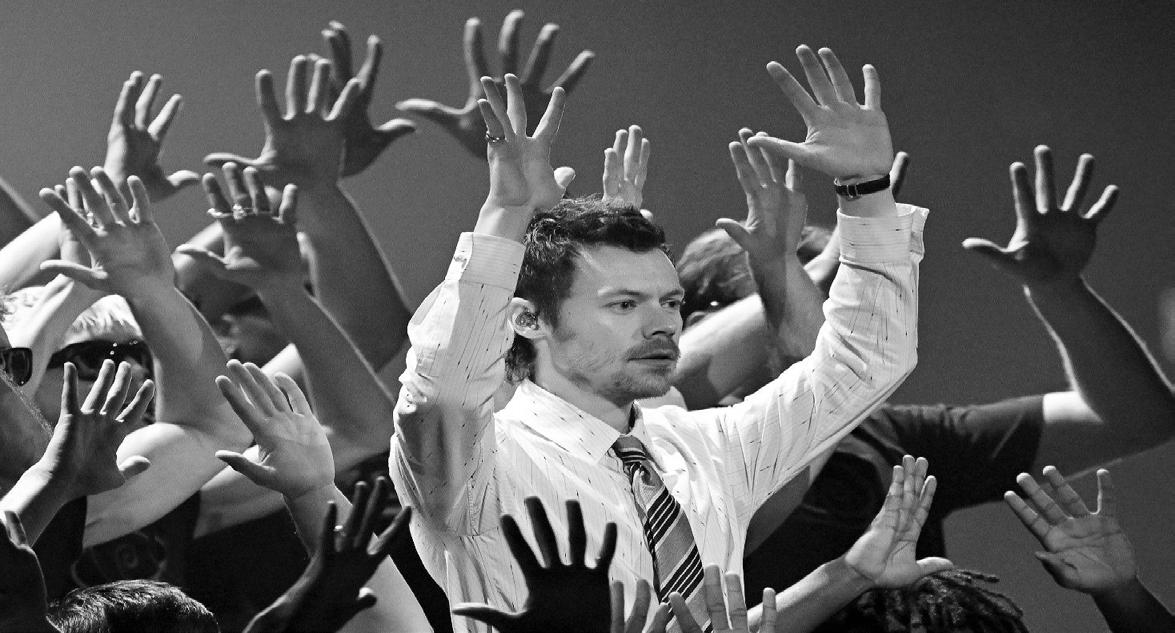
endeavor. He took the time to rediscover what music truly meant to him rather than hurrying into another release or attempting to duplicate the popularity of his earlier albums. “Kiss All the Time. Disco Occasionally” seems to be the outcome of that process; it’s a rediscovery for both Styles and listeners rather than being merely just an album.
Throughout each track, you can hear his feelings of freedom and wonder, as if he’s letting himself try new things without any pressure. He seems to be creating music because he truly wants to, not because he has to, an endeavor that doesn’t feel calculated or forced. In this sense, the record becomes a reflection of Styles’ development rather than merely a change in his sound. It depicts an artist who took a break, reconsidered his connection to his work and returned with a more defined sense of purpose. This gave the record a more genuine vibe and explains why it sounds so different from the rest of his discography; it’s about regaining enthusiasm rather
than fulfilling expectations. This new music also aligns with the issues Styles has begun to delve into, which is what truly sticks out.
The album’s lyrics explore identity, vulnerability and the intricacies of love, but they do it in a more reflective manner than he has previously done. Songs like “Coming Up Roses,” which displays a softer, more emotional side while still fitting into the album’s general vibe, are excellent examples of this. Here, his voice seems more deliberate, less about grand, dramatic moments and more about nuanced emotion.
Another noteworthy piece is “Paint by Numbers,” particularly in the way it addresses public perception and status. The song feels intimate because of the selfawareness in the lyrics, as if he is sharing something genuine with the audience. Then there’s “Season 2 Weight Loss,” which gives the record greater depth and a bit darker, more powerful intensity. It demonstrates that there is still space for diversity and surprise even within this unified sound.
This album’s dedication to
its mission is among its most striking features. Styles is building a whole experience rather than attempting to follow trends or produce clear hits. Together, the lyrics, the production and the general tone produce something that seems deliberate and creative. Because there is so much detail in the music, this is the kind of album that may grow on you with every listen. For him, this change in style also seems like a logical progression. He is clearly pushing himself artistically rather than sticking to the same formula, and the music in this album reflects that confidence. The album seems new and exciting because it features a performer who is at ease taking chances and experimenting.
With all things considered, “Kiss All the Time. Disco Occasionally” is a powerful and unforgettable contribution to Styles’ discography. It might not be what some listeners expected, but that is what makes it so excellent. It shows a different side of him, one that is more daring, evocative and confident. This album is unquestionably exceptional for people who value development and originality.
Authors Give Voices to Jane Austen’s Forgotten Characters
By MAKENZIE SMITH CULTURE EDITOR
Jane Austen’s ladies are no longer waiting for their happy endings. In honor of the author’s 250th birthday, the publishing house Simon & Schuster set out to free Austen’s minor female characters from their confines of limited dialogue and scarce on-page presence with “imaginative reboots” of their stories. Eight authors took part in writing short stories and bound them into an anthology titled “Ladies in Waiting: Jane Austen’s Unsung Characters.”
The collection of stories was released back in November 2025, but Fordham University got an inside scoop into the making of these narratives on Thursday, March 19. Two of the authors visited one of the university’s most coveted English classes, Jane Austen in Context, taught by Susan Greenfield, to discuss their writing processes and inspirations for the project.
Eloisa James is a bestselling historical romance author, as well as a former Shakespeare professor at Fordham under her given name Mary Bly. Her contribution to the anthology is titled “Sense, Sensibility, and Snapdragons” and takes on Margaret Dashwood, the younger sister of the main protagonists from Austen’s “Sense and Sensibility.”
James’ inspiration for her short story began with a dubious critique of Austen’s claim on the genre. Despite Austen’s world
being overtly romanticized in the modern day, James finds inconsistencies in her classic romances.
“When I read Austen, I filled in all the gaps. And I do think that she deliberately leaves spaces for you to fill in the gaps. She leaves space for your imagination to move forward into something that’s not on the page,” said James.
“My feeling would be that she left space for desire and that the reader fills it in, that every page that is read is going to be different for a reader.”
In her short story, James transformed Margaret from a side character into the heroine of her own story, filling the gaps of her character. This change reflects James’ dissatisfaction with Margaret’s older sister, Marianne, being reduced into sensibility by marrying for money at the end of Austen’s novel. Instead, James wrote Margaret as a woman who refuses to be sensible by wanting something better than her sister’s marriages through a desire of adventure, true love, writing and knowledge. Although more subdued than her other romance novels, James grants Margaret a love interest through her childhood best friend who she calls “Squibby.” The author’s writing style is usually more explicit, yet she took a step back with this project to showcase just how powerful desire can be on its own.
“Desire is much more interesting than sex itself on the page,” said James.
“Desire can make everyone feel, remember times when they themselves were really desired and desiring and it’s something that young women struggle with a lot.”
Fellow bestselling author Karen Dukess also took part in this project. She was a former newspaper reporter in Florida and a magazine publisher in Russia. Dukess similarly developed a main character out of a younger sibling from “Pride and Prejudice,” creating the story “What Georgiana Wants” based on Georgiana Darcy, the sister of Mr. Darcy.
Dukess’ short story highlights the same struggle of desire. Although the story lacks an overarching love story, Dukess matched James’ theme of yearning and spun it within the context of overflowing senses and hyperawareness of emotions. This author’s short story is a radical shift from Austen’s lack of descriptive bodily sensations. “I wanted to write about [Georgiana] as someone who didn’t know what to do with the fact that she had desire that she felt was inappropriate,” said Dukess.
A simple day in the life of a well-off married woman with two wonderful children unfolds into an exploration of a sensuous garden and an overflow of memories with another man. This day leads her to understand her raw desires. “[Georgiana] is just sort of starting to think about things differently to not just be afraid…of her own emotions
and her own feelings, but to start entertaining the idea that she could have a private world of her own,” said Dukess. A central theme of desire woven within both short stories is evident in the fact that both authors took inspiration from Austen’s world and characters, yet also took their own creative license and continued to write in their own style for the modern day audience.
James shared insights into her writing style and process, one that involves extensive planning and inspiration from other sources. “Every single character you write has got to have a huge amount of you in them, and [Margaret] has a huge amount of me,” said James. Margaret shares James’ profession and habit of being an author who narrates what goes on around her — something both the author and the character do so much that they both did so while being proposed to.
Dukess revealed that her writing process looks a bit
different. She claims to be a more instinctual writer and lets the characters tell her where they want to go. She gets into the minds of her characters through what she called “play acting,” a process in which she imagines herself as both characters in the midst of dialogue.
Each story is different, yet each author used her unique skills to craft underdeveloped female characters their very own storylines, moving them out of the shadows of their older protagonist siblings. In doing so, the anthology of “Ladies in Waiting: Jane Austen’s Unsung Characters” opens a space for female characters to shine no matter how minor or major they are to the stories of their counterparts. Every woman deserves to have their story told, and giving a voice to these overlooked perspectives echoes the purpose of valuing a vast number of female narratives just in time for Women’s History Month.
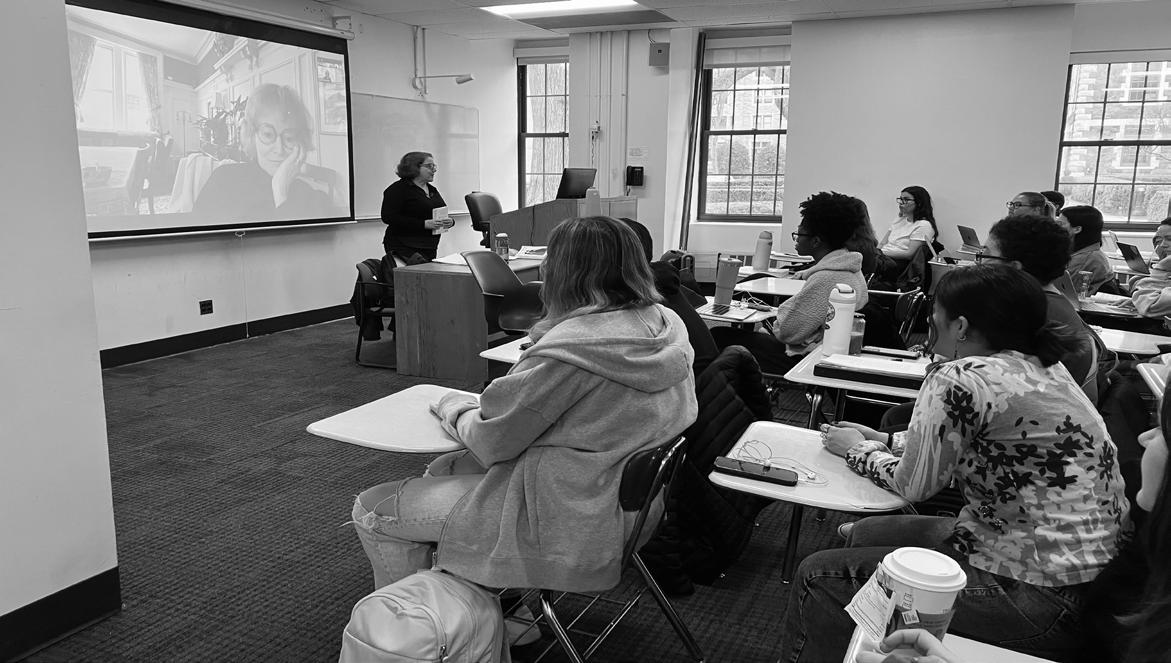
Harry Styles throws up jazz hands duing his BRIT Awards performance.
COURTESY OF THE WEEK
Eloisa James (left) and Karen Dukess (right) speak with Fordham students.
SUSAN GREENFIELD FOR THE FORDHAM RAM
Baczynsky’s Meat Market On Second Avenue
By SIDNEY BLASCO FEATURES EDITOR
The East Village Meat Market, which locals may know as Baczynsky’s, was established over half a century ago in the Ukrainian village on Second Avenue between Sixth and Seventh streets. Open from 8 a.m. to 4 p.m. every day except Sunday, Baczynsky’s brings in a wide variety of characters throughout the day.
Baczynsky’s is currently owned and run by Andrew Ilnicki, who immigrated to New York City from Poland in 1980 when he was just 17 years old, in search of a new life.
“America for us was a land of opportunity,” said Ilnicki. “My dream was to come to New
York, so I came during the summer, like July. And right after that I started working at the meat market on Second Avenue as a pack man.”
The market was already open and running when Ilnicki came to America, but luckily for him, they were looking for a butcher. His path to employment should be an inspiration to everyone struggling with their internships and jobs search.
Ilnicki saw an advertisement in the newspaper that the meat market across the street was looking for a butcher. Keep in mind this was a 17-yearold boy who just came from Poland. His only contacts were his 18-year-old brother and his aunt. He lived across

By EMILIA PINTO CONTRIBUTING WRITER
When you need a meal that feels fresh, flavorful and impressive without spending hours in the kitchen, shrimp tacos are always a great choice. They are quick to prepare, easy to customize and perfect for sharing with family or friends. With warm corn tortillas, well-seasoned shrimp, crunchy coleslaw and a creamy citrus sauce, this recipe has the perfect balance of texture and flavor. Best of all, it comes together quickly, making it ideal for a weeknight dinner or a fun weekend meal.
Shrimp Tacos
Makes about four servings
Ingredients:
Sauce:
1 cup sour cream or plain
yogurt
Juice of 2 limes
1 teaspoon onion powder
1 teaspoon garlic powder
1 teaspoon salt
Coleslaw:
3 cups shredded cabbage
3/4 cup chopped cilantro
2 tablespoons chopped chives
3 to 4 tablespoons prepared
sauce
Topping:
1/2 avocado
1/2 mango (or pineapple, optional)
the street from the meat market, so he went in for an interview. The owner looked him over and said “nope,” but Ilnicki didn’t take that for a final answer.
“I had an aunt, she brought me here,” said Ilnicki. “So he talked to her. [The owner said] ‘I’m looking for a butcher, not for a boy.’ But as we were walking out, he started yelling, ‘alright, I’ll take him.’ And that was the beginning.”
Ilnicki was physically fit, able to work with his hands, eager to learn how to make the sausages and talk to new people. The other workers were much older than him, some with kids who were in high school or getting degrees. They were pestering him about going to college, so Ilnicki took their suggestion and went to New York University.
“So during the day, I start [at] eight o’clock in the morning. I work here until six o’clock, 6:20,” Ilnicki said. “I was in Shinkin Hall taking the classes until 10 p.m. and that, to get the degree took me six years.”
Ilnicki was then offered a job at a bank on Park Avenue. He went in on his first day, sat in his cubicle for a couple of hours and quit that same day.
“I looked one way, I looked another, he took me for lunch,” Ilnicki said, regarding the professor who worked
at the bank and who offered him the job. “I came and I say, ‘thank you this is not for me.’ And I came back here, ever since I never left it.”
Baczynsky’s wouldn’t be what it is without Ilnicki. It may have taken time to go from butcher boy to owner, but it was time well worth it. Everything in the shop is made in-house, from the kielbasa to the cheese blintzes to the barrels of pigs soaking in brine.
People come from all over the city to buy the delicassens from the meat market, and some have been coming for decades.
Norbert Jay is one of Baczynky’s regular customers. His unique story about how he got to know Ilnicki is one of many.
“I met Andrew many years ago,” said Jay. “I shopped at Baczynsky’s for my weekly supplies, and he was there and we were nodding acquaintances.”
Jay’s favorite product is the loops of kielbasa that are hung in the window. He sends them to his daughter in Spain, to his granddaughter in Florida and he even brought one to a Thanksgiving meal. But he didn’t know much about Ilnicki — only that he was responsible for the products at the meat market.
“Recently I started to take
Modern Meals: Shrimp Tacos
Juice and zest of 1 lime
Shrimp:
500 grams shrimp, thawed
3 tablespoons chili powder
2 teaspoons smoked paprika
1 1/2 teaspoons cumin
1 teaspoon garlic powder
1 teaspoon salt
Also needed: Corn tortillas
Olive oil or neutral oil for cooking
Recipe:
Begin by making the sauce.
In a small bowl, combine the sour cream or yogurt, lime juice, onion powder, garlic powder and salt. Stir until the mixture is smooth and creamy, then set it aside. This sauce will be used both in the coleslaw and as a topping for the tacos.
Next, prepare the coleslaw. In a medium bowl, combine the shredded cabbage, chopped cilantro and chopped chives. Add 3 to 4 tablespoons of the sauce and toss everything together until the cabbage is evenly coated. Set the coleslaw aside so the flavors can blend while you prepare the rest of the ingredients.
As for the topping, place the avocado, mango, lime juice and lime zest in a small bowl. Mash and mix until combined. You can leave it slightly chunky for more texture or mash it until
smoother depending on your preference.
Pat the shrimp dry with a paper towel and place them in a bowl. Add the chili powder, smoked paprika, cumin, garlic powder and salt. Toss well until all of the shrimp are evenly coated with the seasoning.
Heat a drizzle of oil in a large pan over medium-high heat. Once the pan is hot, add the shrimp in a single layer. Cook for about two to three minutes on one side, then flip and cook for another one to two minutes, or until the shrimp are pink, lightly golden and fully cooked through.
Warm the corn tortillas in a dry pan or directly over a flame for a few seconds on each side until soft.
To assemble the tacos, spread a spoonful of the avocado-mango topping onto each tortilla. Add a layer of coleslaw, then top with the cooked shrimp. Finish with an extra drizzle of sauce and serve immediately.
These tacos are easy to adjust to your taste. You can swap the mango for pineapple, leave the fruit out entirely or add extra toppings like jalapeños, cheese or hot sauce. However you make them, they are a simple and delicious meal that feels fresh and satisfying every time.
early morning walks and it brought me past the butcher shop,” said Jay. “Often, Andrew was at the window arranging things, and we did more than nod at each other, we stopped and chatted a little bit. And these chats became longer and longer until we looked forward to them every morning.”
As Ilnicki is often at the back of the shop in the kitchen, it wasn’t every day that they interacted.
“But the times that we did meet made the day for me, it was as if things were going to go well because I was able to talk with Andrew about inconsequential things,” Jay said.
Jay and Ilnicki continue to have their early morning chats, and will continue to do so for as long as they both stick around Bacsynsky’s. Knowing where you’re buying your food from, knowing what’s in it and having a relationship with the guy who’s making it is rare and is what makes this place so special.
Baczynsky’s is modernizing, with Ilnicki’s son joining the business, improving marketing and encouraging new customers to start to shop there as well. But as long as Ilnicki is alive and healthy, he will be at his shop furthering its legacy and greeting Jay every morning.

Norbert Jay (left) and Andrew Ilnicki (right) inside Baczynsky’s Meat Market.
SIDNEY BLASCO/THE FORDHAM RAM
A pair of delicious shrimp tacos perfect for college students to enjoy.
CLARA PINTO FOR THE FORDHAM RAM
CULTURE
Editor’s Pick | Character
Arsène Lupin: A Dishonest Man of His Word
By IAN NELSON MANAGING EDITOR
In December of 1887, in Beeton’s Christmas Annual, the story “A Study in Scarlet” by Sir Arthur Conan Doyle was first published. The story introduced the world to the deerstalker cap-wearing, pipesmoking detective Sherlock Holmes of 221B Baker Street. The story is riveting, but it did not launch Holmes and Watson out of obscurity. That moment didn’t come until 1891 with Doyle’s “A Scandal in Bohemia,” the story that set in motion the meteoric rise in popularity of Holmes and Watson. But this article isn’t about Sherlock Holmes and Dr. Watson, so I turn to the French.
In February of 1905, after years of success for Doyle, Je sais tout magazine founder Pierre Laffitte requested a French rival to the immensely popular British detective. Seeking to create a unique adventure serial, he commissioned fellow journalist and amateur novelist Maurice Leblanc to perform the task. Five months later, on July 15, 1905, Leblanc gave him “L’Arrestation d’Arsène Lupin” (“The Arrest of Arsène Lupin”). From the moment of his debut, Lupin was a massive success in France and later worldwide, but I find that Sherlock Holmes, although possibly deservedly, attracts people much more than Lupin does. But I will try to convince nonetheless.
Lupin, Lupin, where do I begin?
In 2021, Netflix released the show “Lupin,” starring French
actor Omar Sy, who plays Assane Diop, a master thief who models his crimes after the character Arsène Lupin. I remember watching the show, mesmerized by the finesse and style with which Sy portrays his Lupin-esque character. So much so that 14-year-old me decided to “read”?
For some context, I was never a reader. A movie-watcher? Sure. A TV-enjoyer? Definitely. But never a reader. Yet, within a week of finishing the show’s first season, I had the Arsène Lupin box set on my desk. Five years later, I’m a subscriber to a bibliophile’s way of life.
Lupin is a suave master of disguise, an escape artist and a brilliant mastermind. He operates with wit and flair; he steals from the rich and corrupt, often, but not always, aiding the innocent. His signature move of announcing his crimes in advance knowing full well that nobody can get in his way once he has can get in his way once he has set his mind to something, exhibits a borderline reckless confidence that immediately had me rapt.
A scene in the first Lupin book, titled “Arsène Lupin, Gentleman Burglar,” features Lupin breaking into the house of a baron, not taking anything and then leaving a note which reads, “Arsène Lupin, gentleman-burglar, will return when the furniture is genuine.” It is a display of fantastic power. He declares without a doubt that he is inevitable. Even with all his confidence, he still fears his own insignificance. He says,
“The essential point is that the public may be able to refer to my work and say, without fear of mistake: Arsène Lupin did that!” He is a showboater. He wants to win, but more than anything, he has a competitive nature that makes him want everyone else to lose.
In a way, Lupin is a French Robin Hood; in more ways, he is not. He steals from the wealthy, but where Robin Hood steals for others, he steals for himself. And as the French response to Sherlock Holmes, he and Holmes, too, share some qualities. Both are brilliant and possess exceptional deductive skills, immense charm and a love for disguise. They even interact in the second Lupin book, kind of. In the second Lupin installment, he must face off against the brilliant and undefeated British detective Herlock Sholmès
and his confidant Dr. Wilson. Mr. Leblanc, you’ve done it again! How could you think up something so clever? My personal favorite of the Lupin series is book three, “The Hollow Needle.” The story follows a murder investigation that leads to a hidden royal secret: the Hollow Needle, a hollowedout rock formation on the Normandy coast containing the legendary treasure of the French kings. Lupin’s main adversary is a young detective named Isidore Beautrelet, who discovers Lupin’s involvement and begins a battle of wits with him. Beautrelet, alongside Sholmès and recurring Lupin antagonist Ganimard, pushes Lupin to the brink. Lupin struggles more in those 300 pages than he does in the first two books combined. Lupin is a character who
draws people in. He appears in about 24 of Leblanc’s original books, including novels and short story collections. He has been adapted in film, including the 1932 “Arsène Lupin.” There are multiple TV series featuring or inspired by him, including the modern “Lupin” and the long-running anime franchise “Lupin III.” He has been viewed in almost every form of media, making him one of the most adapted characters of all time.
Arsène Lupin, GentlemanBurglar, the suave mastermind behind some of the greatest thefts that never happened, has etched himself a permanent spot in my brain. So much so that I plan to visit the reallife Hollow Needle at the cliffs at Ètretat if ever I make my way to France. Alas, I don’t think the treasure of French kings awaits me.
The Fordham Ram Crossword - Board Game Edition
A sketch of Arsène Lupin looming in the streets of Paris from the Magnetic
COURTESY OF MYSTERY TRIBUNE

Varsity Scores & Stats
The New-Look Mets: 2026 Season Preview
By GRACE MCCARRON SPORTS EDITOR EMERITA
When the New York Mets take the field in Queens on Opening Day, March 26, some familiar faces will be missing, with newcomers in their places.
Mets fans will grimace at the memory of a disappointing 2025 campaign. The Mets finished 83-79 and missed the playoffs, merely a year after reaching the National League Championship Series. Through June 12, the Mets went 45-24, the best record in the MLB, but the team collapsed down the stretch.
The President of Baseball Operations David Stearns orchestrated an overhaul of the Mets roster following the lackluster 2025 season. Gone are Pete Alonso, Edwin Diaz, Brandon Nimmo and Jeff McNeil, who were four of the longest-tenured Mets. It was an active offseason in Queens, as it needed to be. While it was understandably difficult for fans to let go of many pieces of the Mets’ core, especially considering the magic experienced only a season ago, there was little justification for keeping things the same.
Here now? New arrivals to Flushing include big names such as Jorge Polanco,

Bichette, Devin Williams, Luke Weaver, Marcus Semien, Luis Robert Jr. and Freddy Peralta. Several of these players will be transitioning to new positions as members of the Mets. This season, Polanco will be placed at first base for the first time in his career, while Bichette has been learning third base throughout spring training, even receiving advice from beloved former Mets third baseman David Wright. On the pitching side, things will look a little different. The
rotation, one of the bigger weaknesses the Mets dealt with last season, will be critical. The arrival of new ace Peralta solidifies a Mets rotation that will also have young phenom Nolan McLean, who started the World Baseball Classic championship game for the United States. Williams will be the Mets’ closer, making the move across town after spending an up-and-down 2025 with the New York Yankees, replacing Díaz, who left for the powerhouse
of a team, the Los Angeles Dodgers.
Speaking of the Dodgers, it’s important to remember that it will be extremely tough for any team to thwart them, as they have three former Most Valuable Players in their lineup and major offseason additions of Díaz and All-Star right fielder Kyle Tucker. There are other potentially difficult opponents in the National League East division as well, particularly in the Atlanta Braves and Philadelphia Phillies.
That said, fans should be excited for the Mets’ new look. For much of 2025, they were one of the best teams in the league, and they’ve added some impactful players to hopefully start to fix what was broken last season. Plus, star outfielder Juan Soto enters his second season with the Mets after hitting 43 home runs and stealing 38 bases last season, the first player in Mets history to go 40/30. Should he keep this up, he will once again be a contender for the National League MVP award.
Whatever ends up happening, everyone starts at the very same place on Opening Day. My calendar is certainly marked for the excitment of March 26.
Go Big or Go Cold: Cup Playoff Predictions
By ETHAN BESS ASST. SPORTS EDITOR
The Stanley Cup Playoffs are one of the most exciting postseasons in the sports world. They’re structured into rounds with division winners playing the lowest-seeded wild card playoff team in both conferences. It takes 16 wins to get the Stanley Cup, which is considered by many hockey fans to be the most important trophy in the sport.
The Stanley Cup Playoffs are set to start on April 18, and there are still teams battling for their respective spots. The only team that has clinched a spot so far is the Colorado Avalanche, which currently has the best record in the NHL at 46-1310 with 94 points. According to FanDuel and betMGM, the Avs are currently the favorites to win the Stanley Cup; however, the team with the best record in the league hasn’t won the Stanley Cup since the Blackhawks did so in 2013. With all that said, let’s look at the current Stanley Cup Playoff picture with a few predictions.
If the Stanley Cup Playoffs started today at the time of this writing, in the West the Avalanche (C1) would play the Predators (WC2), the Stars (C2) would play the Wild (C3), the Ducks (P1) would play the Mammoth (WC1) and the Oilers (P2) would play the Golden
Knights (P3). Over in the East, the Sabres (A1) would play the Red Wings (WC2), the Lightning (A2) would play the Canadiens (A3), the Hurricanes (M1) would play the Bruins (WC1) and the Penguins (M2) would play the Blue Jackets (M3). These matchups could prove to be some of the best the NHL has seen in a long time, especially the Oilers and the Golden Knights. These are two Pacific Division teams that know each other well and have faced off twice in the playoffs in the last few seasons. The first came in 2023 and the second in 2025, with the Golden Knights winning the former and the Oilers winning the latter. One team that has seemingly emerged out of nowhere is the Buffalo Sabres. Through their first 17 games, the Sabres were 5-8-4. Now, as the playoff race heats up, they sit comfortably atop the Pacific Division along with the Eastern Conference’s best record.
The Stanley Cup Playoffs are very unpredictable, as although there are only 16 teams and upsets can happen all the time. A good example came just last year when the Los Angeles Kings went up 2-0 on the Edmonton Oilers in the first round, only to lose the next four games and get eliminated by the Oilers for a fourth consecutive year.

Los Angeles was favored to win the series due to home ice and the desire from fans and players alike to break the losing streak against Edmonton. However, as any hockey fan found out shortly after, the Oilers still had the Kings’ number. Since the Kings are very likely to not make the postseason this year, Edmonton will have a different road. For the Western Conference Final, I see a likely 2022 WCF rematch between the Avalanche and the Oilers. I say that because it seems as if the Oilers are hungry and poised to finally bring the cup to Edmonton. However, they will have a formidable opponent in Colorado. I would favor Edmonton in
this scenario as they have the experience of getting to the Stanley Cup Final, appearing in back-to-back Cup Finals In the Eastern Conference, I see an ECF matchup between the Buffalo Sabres and the Pittsburgh Penguins. The Sabres now look like the hottest team in the Eastern Conference on the back of Ryan McLeod and Jordan Greenway. As for the Penguins, Sidney Crosby is still a force to be reckoned with, even at the age of 38, leading the team in points with 62. The Eastern Conference has proven to have stronger competition than the Western Conference.
Given that fact, the possibility of a seven-game ECF between the Sabres and the
Penguins is very likely. In this scenario, I would pick Buffalo.
I see a Sabres-Oilers Cup Final in 2026. The implications of this matchup would be huge as Buffalo would be looking at its first Stanley Cup. Meanwhile, a Canadian team hasn’t won the Stanley Cup since the Canadiens won it in 1993 over the Los Angeles Kings. Edmonton would not only be playing for themselves but for national Canadian pride. I see an Oilers victory in this scenario due to the mentality of Connor McDavid wanting to bring the cup to Edmonton. As great as the ride would be for Buffalo, I see a possibility of them losing despite their home ice advantage.
Bo
COURTESY OF INSIDE THE RINK
Connor McDavid hopes to lead the Edmonton Oilers to a Stanley Cup victory.
COURTESY OF PALM BEACH POST
Bo Bichette will add power and agility to the Mets’ lineup.
Women’s Tennis Tops St. Joe’s
By JOE HENRY ASST. SPORTS EDITOR EMERITUS
For a large portion of the past three months, Fordham’s Hawthorn/Rooney Courts in the the northwestern corner of the Rose Hill campus have been covered in a foot-tall mound of snow. As the weather warms, so has Fordham Women’s Tennis, which finally got to grace their native courts Sunday afternoon.
The outdoor home opener made for an exclamatory win, with the Rams reaffirming their status as one of the Atlantic 10 (A-10)’s best in a 4-0 thrashing of St. Joseph’s University.
The win over the 1-12 Hawks — who ranked thirdto-last in the A-10’s preseason poll but received a first-place vote — moves Fordham to 8-9 (3-0 A-10), and extends their season-long winning streak to four.
Helping to lead the way were the Rams’ first two A-10 weekly award winners of the year, freshman Valerijia Kargina and sophomore Paola Dalmonico. Kargina took home Rookie of the Week laurels during the team’s 3-0 week in South Carolina, while Dalmonico took home Performer of the Week honors.
Each contributed to a win in
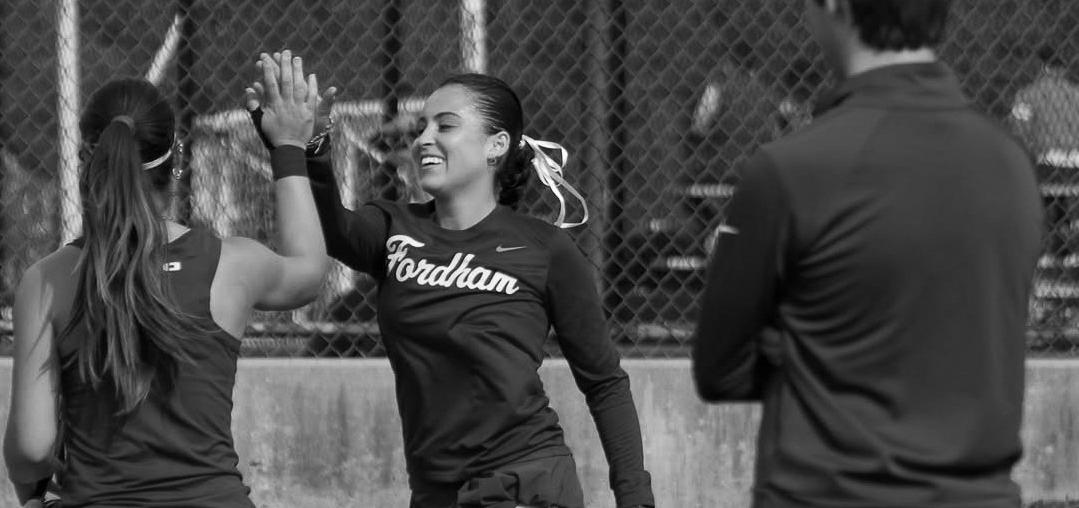
doubles, where Kargina and junior Lily Chitambar took the No. 2 contest, 6-1, and Dalmonico won at No. 3, also 6-1, with sophomore Catalina Padilla.
In singles, the reigning A-10 Performer of the Year senior Nevena Kolarevic continued to get some rest, with her teammates carrying the group to a 4-0 finish.
Padilla slotted up to the No. 2 spot for the first time in her career, earning a 6-2, 6-1 win, her fourth in a row at singles.
At No. 3, junior Julianne
Nguyen became the third Ram in as many weeks to notch a double bagel, going 6-0 to nab what was also her fourth straight solo win.
Junior Aya Matsunaga got in the mix to finish the match off, taking home a 6-2, 6-0 win, making her 4-0 on the campaign when playing at No. 5.
Amid the winning streak, Fordham’s command of each match is almost understated by the final score. The Maroon have won by a combined 19-0 score, yes, but their combined
46-1 record across all sets is even more eye-catching.
Against the Hawks, Fordham won 81 of the 101 total games played, allowing a St. Joseph’s opponent to reach three games in just one of 15 sets, including those that went unfinished.
Historically, it’s perfect timing — fifth-year head coach
Mike Sowter’s teams tend to hit full stride in late March, with the Rams now rattling off late-season win streaks of four or more in three straight seasons. The Sowter-era
Rams seem to have mastered the art of peaking at the right moment.
Fordham will stay home for each of their final five matches, including their final two of the A-10 season against Davidson College and the University of Rhode Island, both top-five teams in the league.
First, the Rams will host the 1-6 Long Island University this Saturday at 1 p.m., with a chance to take down the Sharks for a fourth straight year.
F1 Madness in Australia and China
By ARHANA KARSALIYA CONTRIBUTING WRITER
The 2026 Formula 1 season has already delivered chaos, confusion and just enough delusion to keep fans emotionally unstable. In other words, it’s off to a perfect start.
Let’s begin, of course, with Ferrari fans. No matter what happens on the track, their optimism deserves recognition. In their minds, every year is their year, and somehow that belief survived even after the season opener at the Australian Grand Prix. At the Albert Park Circuit, Ferrari showed flashes of pace but, as always, couldn’t quite put everything together. Strategy calls felt like they were made based on vibes instead of data. While the car didn’t look terrible, it also didn’t look like a championship winner. Still, Ferrari fans left Melbourne thinking, “Okay, but if we fix one thing” — which is exactly how the cycle continues.
The Australian Grand Prix itself was early-season chaos in the best was. New cars, new dynamics and teams still figuring out their setups led to a race that felt slightly unhinged. Some drivers looked sharp right away, while others lacked in that regard. Reliability already seemed

like an issue for several drivers, with small mistakes turning into big consequences. It wasn’t a total disaster, but it was messy enough to make one thing clear: this season is not going to be a predictable one.
Then came the Chinese Grand Prix, and somehow things escalated. If Australia was messy, China was pure chaos.
The headline? Rookie driver Kimi Antonelli won. In just the second race of the
season, the podium looked like someone hit shuffle on the entire grid. Position 1 (P1) went to Antonelli, the future of Mercedes, and apparently already the present. Winning this early in one’s career in that kind of race is rare. Right behind him was George Russell, who has quietly stepped into the role of experienced leader at Mercedes. And then in P3: Lewis Hamilton. Yes, that Lewis Hamilton — the former Mercedes icon is still
showing up on the podium like it’s second nature.
But the real story of China wasn’t just the podium; it was the chaos behind it. Seven drivers failed to finish the race, turning it into a survival test more than anything else. Among those struggling was Max Verstappen, whose early-season form has been shockingly unstable. Red Bull, once completely dominant, suddenly looks vulnerable.
The car isn’t as reliable, and mistakes are creeping in.
Seeing Verstappen crash out feels unnatural, like the entire grid has entered an alternate reality.
Meanwhile, McLaren fans are in full panic mode. Oscar Piastri has yet to complete a single lap this season. Two races, multiple Did Not Finishes, zero progress. At this point, it’s less about performance and more about finishing a race. For a team that had strong expectations coming into 2026, this is far from ideal.
And then there’s Pierre Gasly and Ollie Bearman. Both known to be in lower-ranking racing cars, the duo have quietly outperformed expectations, somehow sitting with more points than Verstappen. If that doesn’t sum up how strange this season has been, nothing will.
So where does that leave us after two races? Ferrari fans are still convincing themselves that everything is fine, Mercedes might actually be building something serious, Red Bull looks human for the first time in years and McLaren is trying to remember how to finish a race.
Now that Melbourne and Shanghai are in the rearview, the 2026 season has made one thing very clear: nothing makes sense. And honestly, that is what makes F1 special.
Women’s Tennis Dominated St. Joseph’s University in their home opener.
COURTESY OF FORDHAM ATHLETICS
The Formula 1 season has featured twists and turns.
COURTESY OF THE NEW YORK TIMES
New York Yankees 2026 Season Preview
By JOE HENRY ASST. SPORTS EDITOR EMERITUS
It’s been 16 years since the New York Yankees won the World Series. For 16 long years, Yankees fans have convinced themselves that the winningest team in baseball history will regain its dominance in the MLB, only to be let down come October. The question still stands: Do the 2026 Yankees have the depth to reclaim the championship legacy they built decades ago? As fans, we prepare to hold our breath, waiting for our team to deliver when the pressure is at its peak.
Ask any Yankee fan, and they will say the offseason was profoundly disappointing for thedevelopment of this team. The biggest offseason headline for the Yankees was the re-signing of star outfielder Cody Bellinger to a five-year, $162 million deal. In December 2025, two strong, yet unreliable closers ended their stint with the Yankees: Luke Weaver and Devin Williams. The only major pitching acquisition was starter Ryan Weathers, formerly of the Miami Marlins. We yearn for bold moves and risky trades that change the dynamic of the team. General Manager Brian Cashman and Manager Aaron Boone left much to be desired this winter.
Yankees spring training sparked more questions than it answered. Most notably, the team is entering the regular season with only a four-man starting pitching

rotation. Max Fried is set tomake the Opening Day start against the San Francisco Giants. Cam Schlittler, Will Warren and Ryan Weathers will follow. The Yankees are starting their second consecutive season without Cy Young winner Gerrit Cole. Cole made one successful spring training start, albeit pitching only one inning, and is hoping to return to the big leagues in late May or early June. 2024 American League Rookie of the Year Luis Gil also did not make the rotation due to his inconsistent performances in spring training. Fans will have to hope the four-man depth is enough to support this team until the long-awaited return
Athletes of the Week
Each week, The Fordham Ram’s Sports section honors two athletes for their on-field performances as their “Athletes of the Week.”

Rams junior Julianne Nguyen played a key role in Fordham’s dominant win over St. Joseph’s University. Nguyen won her singles match 6-0 paired with senior Nevena Kolarevic in a doubles victory.
of Cole and veteran lefty arm Carlos Rodón.
Concerns aside, the team’s foundation remains solid and healthy, though fans can expect significant differences from last year’s standard lineup as the season kicks off. Shortstop Anthony Volpe will start the year on the injured list, but some may not be too bothered by this loss. Volpe has proved incredibly inconsistent and middling throughout his career so far.
The eyes now turn to Jose Caballero to fill that hole at shortstop. Young phenom Jasson Domínguez was optioned to Triple-A late in spring training despite a strong showing.
The Yankees are squaring off
against an American League (AL) East division that is arguably the most formidable it’s been in decades. The Toronto Blue Jays are coming off a World Series appearance where they gave the powerhouse Los Angeles Dodgers a run for their money. The Baltimore Orioles have given themselves a great chance by acquiring power hitter Pete Alonso and building on young talent such as Gunnar Henderson. The Boston Red Sox will also capitalize on young talent such as Roman Anthony, who proved himself at the World Baseball Classic earlier this month. Lastly, the Tampa Bay Rays are not strong contenders in this highly competitive
division due to their pivot toward a youth-heavy rebuild. Standing atop the AL East will be an impressive feat on its own.
The Yankees’ storied history is built on legendary names; while today’s roster is equally stacked, the true challenge lies in molding these individual stars into a cohesive, championship-caliber team. Aaron Judge has proven himself to be one of the greatest baseball players in history, but he continues to struggle in high-pressure situations. Jazz Chisolm Jr. has voiced his urge to join the 50home run and 50-stolen-base club. He must remain consistent and reliable throughout the season to become the weapon he wants to be. The Yankees may also rely on top pitching prospects Elmer Rodriguez and Carlos Lagrange to step up in the dog days of the summer. In the past, this team has relied heavily on the power of the bats and let the defense slide, leading to many errors. Pivoting to a focus on tactical, intentional defensive play could be the last piece for this team. Playing a scrappier game is the new trend for professional baseball. Hitting singles, stealing bases, bunting and risky baserunning are tools that must be utilized. This agile, contact-oriented style diverges from the more veteran-heavy power approach of the past, but it’s a gamble the Yankees must take to finally secure another World Series title. Finding the perfect balance between raw power and a “scrappy” situational approach will be the key to ultimately unlocking this roster’s full potential.
Varsity Calendar
Graduate Student Robbie Stewart was lights out on the mound in Fordham’s 4-3 victory over Richmond University. In 4.1 innings, Stewart struck out four and didn’t allow any hits.
Track
Julianne Nguyen Junior Tennis
Robbie Stewart Graduate Student Baseball
The Yankees will look to capture their first World Series since 2009.
OF PINSTRIPE ALLEY
By JAMES NELSON SPORTS EDITOR
Baseball fans have become spoiled recently. After the seven-game classic that was the 2025 World Series, baseball picked up right where it left off: high-stakes games between talented teams. The 2026 World Baseball Classic (WBC) saw dramatic battles between incredible national teams from around the globe.
A few WBC rosters captured media and fan attention, perhaps none more than Team U.S.A. Captained by three-time American League Most Valuable Player Aaron Judge, the team featured immense talent on both sides of the ball. On the pitching side, they had the undisputed best starters in baseball, Tarik Skubal and Paul Skenes, joined together alongside Logan Webb and Nolan McLean to create a formidable rotation. However, Team U.S.A.’s lineup may have been even more anticipated. Aside from Judge, their batting order included stars like Bobby Witt Jr., Bryce Harper, Kyle Schwarber, Cal Raleigh and several more All-Stars. In a tournament filled with stacked rosters, Team U.S.A. stood out as the heavy favorite.
Team U.S.A. flexed its strength early, defeating its first two opponents in pool play by margins of eight and 10. Then, in a tightly contested game against Team Mexico, the U.S. managed a 5-3 victory. Standing at a 3-0 record, the U.S. had not yet clinched a spot in the next round when they faced off against Team Italy. In an interview before the game, Team U.S.A. Manager Mark DeRosa appeared to believe the team had already earned a trip to the knockout round.
Overtime: Baseball Shines at WBC

“We want to win this game, even though our ticket’s punched to the quarterfinals,” DeRosa said in an interview on MLB Network. DeRosa’s false statement quickly went viral on social media; the results of the game certainly did not help DeRosa clear his name. Team Italy seized a commanding 8-0 lead by the sixth inning. Despite a late rally from Team U.S.A., Team Italy held on, securing an 8-6 win. Fans and media speculated that DeRosa was still unaware of his team’s standing in the tournament due to veteran first baseman Paul Goldschmidt starting over the more dangerous Harper. In a post-game interview, DeRosa claimed he misspoke; still, Team U.S.A. was in jeopardy of failing to clear the initial round of the WBC.
The only lineup that appeared to match Team U.S.A. in terms of firepower was that of Team Dominican Republic (DR). The starting nine included Fernando Tatis Jr., Juan Soto, Vladimir Guerrero Jr. and many more. Team DR put on a
spectacle, scoring double-digit runs in their first three games before defeating Venezuela 7-5 to move to 4-0.
Led by Shohei Ohtani, Team Japan also posed a threat, as the defending champions from 2023. The team dominated, going a perfect 4-0 in pool play and clinching a spot in the quarterfinals. With other favorites Team U.S.A. and Team DR stood strong on the other side of the bracket, Team Japan was well-positioned to reach the championship game. Team Venezuela faced off against Team Japan in the quarterfinals. In arguably one of the best games of the tournament, the two squads went back and forth. Venezuelan star Ronald Acuña Jr. launched a home run off of Yoshinobu Yamamoto on the second pitch of the game. In the bottom of the first inning, Ohtani responded with a home run of his own, tying the score at 1-1. At the end of the fourth inning, Team Japan had jumped ahead 5-2. A Maikel Garcia two-run blast in the fifth brought Team
Venezuela within one, and a three-run homer from Wilyer Abreu in the sixth put Team Venezuela on top 7-5. Team Venezuela never relinquished the lead, ousting Japan with a final score of 8-5.
On the other side of the bracket, Team U.S.A. and Team DR took care of their respective quarterfinals opponents, setting the stage for an epic confrontation in the semifinals. In a low-scoring game, pitching and defense made all the difference. A pinpoint throw from Judge to nab Tatis Jr. attempting to reach third base in the bottom of the third inning was set to be the highlight of the game until the controversial final pitch. Trailing by only one run, Team DR brought the tying run to third base with the winning run at the plate in the form of Ketel Marte. Team U.S.A. closer Mason Miller delivered a full count breaking ball visibly below the strike zone and was still awarded the strikeout by the umpire. The call received heavy backlash and ended an otherwise thrilling
game on a sour note. With Team U.S.A. locked into the championship, Team Venezuela faced Team Italy in the other semifinal game. Team Italy was the last remaining undefeated team in the bracket after upsetting Team Puerto Rico in the quarterfinals, 8-6. Team Italy took and held the lead until the seventh inning when Team Venezuela chained base hits together to drive in three runs and overcome the deficit. With a final score of 4-2, Team Venezuela advanced to the championship for the first time in WBC history.
In the championship game, Nolan McLean took the mound for Team U.S.A. while Eduardo Rodriguez started for Team Venezuela. A sacrifice fly from Garcia and a home run from Abreu put Team Venezuela ahead 2-0. Team U.S.A. bats were tamed by a stellar start from Rodriguez and strong showings from the Venezuelan bullpen. Heading into the eighth, Team U.S.A. had only managed two hits when Harper stepped into the box with a runner on first. Harper drilled a two-run home run, his first of the tournament, to tie the game. Team Venezuela responded in the ninth with an RBI double from Eugenio Suarez, moving the score to 3-2. The lead held in the bottom of the ninth, giving Venezuela its first WBC championship. Notably, Judge failed to rise to the moment, a now recurring theme of his career; the captain went 0-4 at the plate, including three strikeouts.
Treated to an unforgettable tournament with twists and turns, baseball fans now turn their attention to the start of the MLB season.
COURTESY OF THE JAPAN TIMES
Venezuela trumps the U.S. in the WBC final.