The Fordham Ram Serving The Fordham University Community Since 1918 September 16, 2026
TheFordhamRam.com
Volume 108, Issue 12
What is the Residence Halls Association?
First-Years Call Finlay Hall Home
By MAGGIE WILSON
By EMILY CORDERO-NUNEZ CONTRIBUTING WRITER
CONTRIBUTING WRITER
The newest undergraduate class has recently been welcomed to Fordham University. But some first-year students are not residing in the typical residence halls in the southwest corner of campus. Instead, they are living in a building historically meant for upper-classmen: Finlay Hall. Finlay was once categorized by Fordham as an upperclassmen residence hall. Its 202627 housing rates likewise place Finlay under the category of “Rose Hill Upperclass Student Halls.” First-year students moved into their assigned residence halls on Saturday, Aug. 22, while returning students moved in on Aug. 24 and 25. The unusual assignment came as Fordham prepared for its second-largest incoming class in University history. Fordham announced Aug. 27,
they both went on to have very successful careers in acting and business, respectively. Throughout their postgrad lives, the two have continued to support their alma mater, both serving on the University’s Board of Trustees and returning to campus to inspire future generations of students. During the conversation, Carter and Washington
The Fordham Residential Halls Association (RHA) is one of the four biggest clubs on Fordham’s campus. Its aim is to ensure that the residence halls on campus are “continually livable … by serving as the official governing body between students living on campus and University staff and administration,” according to the official website. “RHA is the voice of the halls,” Executive Vice President Rachel Wanagosit, GSB ’27, said. Resident assistants aim to support individual students, resolve conflicts and enforce housing rules, whereas RHA advocates for student rights, changes housing policies and creates innovative solutions in residence halls. Their focus is to help students living in residential halls communicate
SEE FRIENDSHIP, PAGE 4
SEE RHA, PAGE 5
SEE DORMING, PAGE 5
TAYLOR HA FOR THE FORDHAM RAM
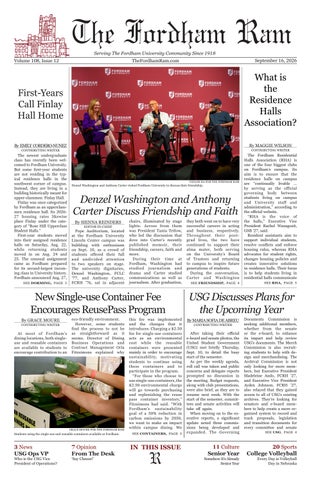
Denzel Washington and Anthony Carter visited Fordham University to discuss their friendship.
Denzel Washington and Anthony Carter Discuss Friendship and Faith By SIENNA REINDERS EDITOR-IN-CHIEF
Pope Auditorium, located at the Fordham University Lincoln Center campus was bubbling with enthusiasm on Sept. 10, as a crowd of students offered their full and undivided attention to two speakers on stage. The university dignitaries, Denzel Washington, FCLC ’77, and Anthony Carter, FCRH ’76, sat in adjacent
chairs, illuminated by stage lights. Across from them was President Tania Tetlow, who led the discussion that dove into Carter’s recently published memoir, their friendship, careers, faith and more. During their time at Fordham, Washington had studied journalism and drama and Carter studied communications as well as journalism. After graduation,
New Single-use Container Fee Encourages ReusePass Program By GRACE MOURE CONTRIBUTING WRITER
At most of Fordham’s dining locations, both singleuse and reusable containers are available to students to encourage contribution to an
eco-friendly environment. However, some students find the process to not be as straightforward as it seems. Director of Dining Business Operations and Contract Management Orla Fitzsimons explained why
GRACE MOURE FOR THE FORDHAM RAM
this fee was implemented and the changes that it introduces. Charging a $2.50 fee for single-use containers acts as an environmental cost while the reusable containers were presented mainly in order to encourage sustainability, motivating students to continue using these containers and to participate in the program. “For those who choose to use single-use containers, the $2.50 environmental charge will go towards purchasing and replenishing the reuse pass container inventory,” Fitzsimons had said. “With Fordham’s sustainability goal of a 50% reduction in carbon emissions by 2030, we want to make an impact within campus dining. We
Students using the single-use and resuable containers available at Fordham.
SEE CONTAINERS, PAGE 5
3 News USG Ops VP
IN THIS ISSUE
Who is the USG Vice President of Operations?
7 Opinion From The Desk ‘Say Cheese!’
R
USG Discusses Plans for the Upcoming Year By MARIA SOFIA DE ABREU CONTRIBUTING WRITER
After taking their official e-board and senate photos, the United Student Government (USG) met briefly Thursday, Sept. 10, to detail the busy start of the semester. As per the weekly agenda, roll call was taken and public concerns and delegate reports prompted no discussion in the meeting. Budget requests, along with club presentations, were also brief, as they are to resume next week. With the start of the semester, committees and senate activities will take off again. When moving on to the executive reports, a significant update noted three commissions being developed and expanded. The Governing
11 Culture Senior Year
Somehow It’s Already Senior Year
Documents Commission is seeking additional members, whether from the senate or the e-board, to enhance its impact and help review USG’s documents. The Merch Commission is also recruiting students to help with design and merchandising. The Archival Commission is not only looking for more members, but Executive President Madeleine Ando, FCRH ’27, and Executive Vice President Ayden Johnson, FCRH ’27, also relayed that they gained access to all of USG’s existing archives. They’re looking for senators and e-board members to help create a more organized system to record and track proposals, legislation and transition documents for every committee and senate SEE USG, PAGE 4
20 Sports College Volleyball Every Day is Volleyball Day in Nebraska
NEWS
Page 2
PUBLIC SAFETY BRIEFS
September 16, 2026
What Clubs are Students Joining?
Goupil Hall Sept. 12 5:50 p.m.
On Saturday, Sept. 12, at 5:50 p.m., there was a fire alarm in Martyrs’ Court Goupil Hall. The supervisor and FDNY responded. The investigation revealed multiple heat sensors in the boiler room triggered the alarm. The supervisor contacted facilities to replace the defective sensors.
Walsh Hall Sept. 12 3:03 a.m.
On Saturday, Sept. 12, at 3:03 a.m., there was a stuck occupied elevator in Walsh Hall. The supervisor responded and called the FDNY to free the student The supervisor notified the elevator company to inspect the elevator.
Walsh Hall Sept. 13 2:01 a.m.
On Sunday, Sept.13, at 2:01 a.m., there was a stuck occupied elevator in Walsh Hall. Then the supervisor responded and called the elevator company. A technician freed the occupants.
2458 Arthur Avenue Sept. 13 5 p.m.
On Sunday, Sept. 13, at 5 p.m., there was a fire alarm at 2458 Arthur Avenue (Arthur 2). The supervisor and FDNY responded. The investigation revealed a student cooking food triggered the alarm. The supervisor ventilated the area.
O’Hare Hall Sept. 13 9:32 p.m.
On Sunday, Sept. 13, at 9:32 p.m., there was a smoke alarm in O’Hare Hall. The supervisor and FDNY responded. A defective smoke alarm in a room triggered the alarm. The supervisor called the RDOD. The room residents were relocated. The supervisor prepared a work order to have the system inspected and the smoke detector replaced.
Follow The Fordham Ram on Instagram, Facebook, TikTok and X @TheFordhamRam
Wednesday Sept. 16
COURTESY OF HECTOR MARTINEZ AND REBECCA ROSEN
Fordham students fill Edwards Parade to line up for this years club fair.
By MURIEL CORLEY CONTRIBUTING WRITER
As Fordham students transitioned into the first day of classes on Aug. 26, they had the opportunity to attend the annual club fair from 1-5 p.m. Club leaders and members of more than 240 student organizations ranging from ping pong to puppy yoga lined their tables along the perimeter of Edwards Parade at the Rose Hill campus. At the conclusion of the fair, most clubs reported an increase in student interest this year. Jordan Beck, GSB ’28, the men’s president of club volleyball, stated that they drew in about 180 people for their email list. Beck mentioned that there has been a “jump in interest” on the men’s side as tryouts are becoming more competitive each year. Emma Shields, FCRH ’27, the women’s president of club volleyball, said that the majority of the sign ups were women, with 120, and 60 were men. Shields said that for the women’s team, these numbers are “consistent with prior years,” with a bit of growth. Overall, the club leaders noticed an uptick in club volleyball interest from the Lincoln Center campus and graduate students. According to Beck, the increase correlates with volleyball being the
fastest-growing men’s sport and the most played sport for women in America today. Spikeball, a club that made its debut at the fair this year, was another popular choice amongst students. Grey Fraser, GSB ’29, formed the club with Caeden Joyce, GSB ’29, in October 2025. “It was a pretty insane day,” Fraser said, reporting just over 500 sign ups for spikeball. “I’m not sure what makes us on the biggest clubs list, but hopefully we are up there.” Fordham’s ultimate frisbee team also seems to have sparked major interest in new students. The club said that because of the “huge crew” of new students, indicated by the over 300 people on their mailing list, the first week of practice could not be co-ed. The men’s frisbee practice took place on Sept. 2, and women’s practice took place the following day on Sept. 3. Regarding student involvement, the Campus Activities Board (CAB) reported 768 sign ups at the club fair, a tremendous increase from last fall’s 245 sign ups. Based on a total of 164 applicants, 47% were first-years, 38.4% were sophomores, 12.8% were juniors and seniors accounted for less than 2%. CAB’s General Board said this year’s firstyears “all seem very ambitious” and are hoping to find
a new circle at Fordham. The sophomore interest, they stated, is the result of people who wish to be more involved after their first year. El Grito, the Latin American Society, received roughly 280 new sign ups, a mix of firstyears and also upperclassmen. Beatriz Montero, FCRH ’27, the club’s president, said this trend is similar to past semesters. She believes that new student interest stems from the club’s “drive to push toward more interactive and engaging club meeting topics,” as well as their growth on social media. MODE Magazine, an art, fashion and culture publication created in 2013, was mentioned by many students when asked what caught their attention at the fair. Kamalani Soriano, FCRH ’27, the editor-in-chief of MODE, recalled that over 500 people showed up to the club’s table. MODE received 432 sign ups, with 102 of those people reporting to the first meeting on Sept. 1. Of the 102 meeting attendees, 52% were first-years, 29% were juniors, 12% were seniors and sophomores only accounted for 6%. “I feel like our club was huge [my] freshman year,” said Soriano, who eventually joined the magazine her sophomore year. She observed that
This Week at Fordham
Thursday Sept. 17
Friday Sept. 18
Saturday Sept. 19
prior to this year, not many people knew about MODE due to a lack of in-person meetings and marketing for the club. “This year, as editor-in-chief, I was like, I only have a year to make this club the best that it can be,” Soriano said. Soriano pushed for the Office of Student Involvement (OSI) to allow MODE the space and time for in-person meetings this year. She also mentioned urging OSI to increase MODE’s budget so the club can host guest speakers and serve food at meetings, which she hopes will draw in more members. Elene Gorgadze, FCLC ’29, MODE’s social media editor, thinks that the club has the potential to be much bigger because of the artistic culture at Fordham. She hopes to expand MODE’s social media presence. “We haven’t really marketed towards Lincoln Center yet,” she said. “So many people over there would probably love to join, and they just don’t know about it yet.” River Werner, FCRH ’30, joined MODE in hopes of doing “a little bit of everything.” “I’m probably going to write an article, take some pictures or do costume design,” she said, highlighting the flexibility of MODE for beginners.
Sunday Sept. 20
Student Life Council Child and Women’s Breaking Ground Fordham vs Loyola Tennis Crosscourt Meeting Lecture Info Session University Classic ... ... ... ... ... Bepler Commons 3 p.m.
Dealy E-530 4 - 5 p.m.
Zoom 12:30 - 1:30 p.m.
Moglia Stadium 2 p.m.
USTA National Tennis Center 9 a.m. - 1 p.m.
The University Student Life Council will have their weekly meeting to discuss current activities, events, student government and collaborative efforts between students and faculty.
Meg Gardinier, secretary general of ChildFund Alliance, will speak at Fordham about promoting the rights, well-being and accountability of children and women around the world.
The Information Session will highlight career opportunities at Breaking Ground, a nonprofit serving vulnerable New Yorkers through homelessness outreach and support services.
The Fordham Rams men’s soccer team will face the Loyola University Chicago wolves at Moglia Stadium at Jack Coffey Field this Saturday.
The Fordham Tennis Crosscourt Classic will bring together alumni, supporters and friends for a ProAm tennis tournament at the USTA National Tennis Center, home of the U.S. Open.
NEWS Who is the USG Vice President of Operations?
September 16, 2026
By EMMA LEONARDI NEWS EDITOR
Elected this past spring, the United Student Government (USG) Vice President of Operations for the 2026-27 school year is Berkley-Ayne Dorsten, FCRH ’27. The Ram sat down with Dorsten to learn who she is as a student and what plans she has for her role. Dorsten is an international political economy major with a minor in business, studying at Fordham College at Rose Hill. She is from Chicago, Illinois, where she has lived all her life, supporting the Chicago Cubs. A fun fact about Dorsten is that she is forklift certified. Growing up, Dorsten had ambitions of becoming a movie director, specifically using stop motion as her craft, but now is likely to pursue a career in supply chain or trade compliance. Outside of USG, Dorsten is involved in the women’s club soccer team and is captain of the intramural basketball team, “The Benchwarmers.” The team is the only all-girls intramural team, and they give out two awards each game: Most Valuable Player (MVP) and Best Fan Award. Their Instagram is [fubenchwarmers], although the account
is officially unaffiliated with Fordham University. Dorsten enters her new USG role with some background in the organization already. She joined the operations committee during her first year at Fordham before running her sophomore year under special election for a class of 2027 FCRH Senate seat. She was elected, but only held that position for one semester before going abroad in the fall of her junior year. When she returned in the spring, she ran again under special election for the same seat but wasn’t elected. Dorsten has also been a part of the communications committee, the committee for sexual misconduct and the facilities and dining committee, serving as vice chair of the operations committee during both her sophomore and junior spring semesters along the way to becoming vice president of operations. Dorsten has many goals for her position this school year, including but not limited to, and in no particular order: Dorsten said she would like to streamline the new club process. She specifically noted a desire to make the process faster, as well as managing expectations. For the latter part, Dorsten noted
that Fordham has over 170 clubs and organizations, so if someone wants to make a new club/organization, the likelihood of it already existing at the university is high. “I know that we say that if we don’t have it, you can create it,” Dorsten said. “But there’s a very good chance we do have it.” In the same vein, Dorsten noted that she would like to audit the clubs already in existence to see where approved clubs stand. She shared additional details on how this might affect clubs that get approved as well. “The goal would probably be to work with budget and also maybe student experience … tweaking the process to give clubs like a probationary period where it’s that first year, we’re really gonna make sure you can stay afloat,” Dorsten said. Dorsten also said she wants to make sure clubs are appropriately using their budget following the increase of the student activity fee. She also noted that she wants to make sure all clubs receive adequate funding, not just the biggest ones. Dorsten is also hoping to raise more awareness about operations and what the committee does outside of
the club approval process. According to her, the operations committee does a lot more than Fordham students know about. For example, they handle conflict resolution within clubs and organizations. This can include personal relationship drama, issues with constitutional interpretation, feelings of dictatorship, etc. Any club member, whether they are on the executive board or not, can go to Dorsten and her team and discuss the conflict.
Page 3
The faculty advisor for the operations committee is also in attendance in case there are any higher concerns. Dorsten is glad to be focusing her efforts in USG on clubs as she feels they have been important to her Fordham experience. “Clubs are a vital part of the Fordham community,” Dorsten explained. “I found my community through clubs, and I want that longevity to be there for people long after I’ve graduated,” she said.
COURTESY OF BERKLEY-AYNE DORSTEN
Berkley-Ayne Dorsten, FCRH ’27, spoke about her plans as VP of Operations.
Who is the CSA President? By ALEXANDER MCGILL CONTRIBUTRING WRITER
The Commuter Student Association (CSA) elected their new executive board this past spring. Nushana Alam, FCRH ’27, is a computer science major and the new president of CSA. She has been with CSA since her first year and has worked her way from being first-year program coordinator to being the president. “I was a freshman program coordinator,” she said. “Then I was a sophomore vice president. Then I was the executive program coordinator. And now I’m the executive president. So I feel like I really built my way up.” Alam noted that, for her, a big reason for joining CSA initially was the community aspect. “When I first applied, a lot of my friends applied with me as well,” she said. “My teams were always filled with my best friends. That was the best part for me.” She said she also enjoyed being part of a group that has a shared sense of identity. “It’s really nice to see people who are passionate about commuting students and, in general, commuters,” Alam said. When Alam joined CSA as a first-year, she said that the
association was very different from what it is today. “When we first came in, they gave us a little closet space in OMA (Office of Multicultural Affairs),” she said. “When I tell you, you literally opened it and it was basically those three cabinets. It was literally just that.” Alam also noted that student interest in the organization has increased over the years. “In previous years, especially my first year, we didn’t have the most turnout for events and stuff like that,” she said. “But we were always a very tight-knit community, so we always tried to do our best.” To elevate the organization and increase engagement, club members strove to carry out initiatives and follow through on policies, according to Alam. “We plan, and we try to get things out,” she said. “We try to get them passed. We try to make sure those policies and initiatives actually go out and that people can see them happen.” A CSA policy is a more longterm goal that could potentially take years of proposals, meetings with administrators, budget planning and revisions to eventually achieve, according to Alam, while an
initiative is a more concrete project that is usually carried out in a shorter time frame, like a semester or academic year, and requires less bureaucratic processing and meetings with administrators. Alam shared her personal experience with Fordham administration being receptive to CSA proposals, stating that it’s often a case-by-case basis. “I mean, it really depends,” Alam said. “You really don’t know if there’s something in administration that’s like, ‘Oh, you really can’t do that.’ Or sometimes we really do have to pivot.” Alam also shared that in her first and second years, CSA was primarily focused on policies rather than initiatives. Then, beginning in her junior year, they started shifting their efforts toward initiatives. One initiative that Alam was personally involved in was the nap pod. “That was an initiative rather than a policy, and we were able to complete that within a year, which we were so excited about because we felt so accomplished,” Alam said. “Having that feeling of, ‘Oh wow, I can actually create a change,’ is something that’s so important for our members. And to see that accomplishment in real life, being able to see the nap pod and be like, ‘We made that’ — it feels
so good to say that.” Another example of an initiative that Alam worked on in her sophomore year involved umbrellas. “We created the umbrella initiative, where we got a bunch of umbrellas, bought them, and were able to give them out to commuters when they needed them,” Alam said. Some policies that Alam is currently spearheading within CSA are the long-term desire for a commuter lounge, as well as more affordable food access for commuters and inclement-weather attendance protections, where commuters won’t be penalized as harshly for lateness or absences caused by severe weather. About the feasibility of a commuter lounge, Alam said the issue is with finding a potential location. “Whenever I think about it, and whenever the rest of the members think about it, it’s like ‘Where would we even put that?’ That’s the thing, being able to have that specific space,” she said. Alam is also trying to push for commuters to have more affordable dining options. “There are different problems that different people experience,” Alam said. “One that I can say is finding meals on campus where you don’t
have to spend like $30. Just trying to find something on campus to eat without breaking your bank.” CSA is also responsible for hosting events that both commuters and residents are invited to attend. The largest event hosted by CSA is the Thanks-Give-Away (TGA), an annual fundraiser, where CSA collects funds and food for donation. “It’s a huge event,” Alam said. “We give everything to charity. Last year, Alam was executive program coordinator of CSA and was in charge of TGA. She said they had to choose a theme for the event, and coordinate the decor, activities and food accordingly. “Last year our theme was ‘Teen Beach Movie.’ So we had a mechanical surfboard, we had açaí bowls and stuff like that,” Alam said. “We had spray-painting bucket hats, rubber duckies and other things.” Planning TGA and seeing the interest in the event grow, as well as helping CSA grow as a whole, has been incredibly special for Alam. “CSA is definitely, I would say, a family,” Alam explained. “I feel like that’s something that everybody says now, so it feels overused, but it’s our genuine feeling. We’ve been a family,” she said.
NEWS
Page 4
September 16, 2026
Washington and Carter Discuss Self-Purpose FROM FRIENDSHIP PAGE 1
both explained that even though they weren’t the best students, their experiences at Fordham set them up for their future career successes. “Fordham opened up an opportunity for expression,” Washington said. “I got really confident in who I was, and I felt I wasn’t chasing a dream. I was chasing what I was supposed to be.” The men have been friends for about 50 years, beginning when they were students. Tetlow asked the two how they maintain their close relationship after all this time. Washington replied, saying that even as time goes on, their friendship feels the same as it did years ago. Carter added on to that, explaining the basis for their long-lasting friendship. “We all say we love our friends, and sometimes that makes you expect things from your friends,” Carter said. “And 50-some years we’ve known each other, the expectations of our friendship are nothing more than being who we are.”
Carter also mentioned that Washington is his daughter’s godfather and he is Washington’s son’s godfather, and recognized that these relationships represent the depth of their friendship. “That friendship is what kept us together,” Carter said. “And it grew to feeling more like family.” Tetlow then moved the conversation to talk about a memoir that Carter recently wrote, titled “This I Know,” and asked him why he wrote the book. Carter said that when he retired in 2015, he had three goals: spend more time with his family, see the world and write a book. Regarding his goal to write a book, he said he wanted to write about his life experiences, including his faith, his relationships and his time at Fordham. Carter said it was hard to dive into these topics in a book because it required vulnerability, but that he felt he accomplished what he was called to do. “I believe the desire to write it was cathartic,”
Carter said. “The response from people, especially my family, the touch points were the things they realized about me that they didn’t know. And for me, that was welcoming.” In the book, Carter asks, “What do you do for others that gives you a purpose-driven life?” according to Tetlow. Using the book as a segue, she posed this question to both men. Washington responded very matter-of-factly. “I’ll answer with almost the same words. What you do for others gives you purpose in life,” Washington said. The crowd of students chuckled at his succinct statement. Carter then gave a slightly more elaborate answer. “As weird as this may seem, you gotta listen for your calling,” Carter said. “Each of us is anointed with some special something. And if we don’t pay attention to that, we don’t always know what it is we’re supposed to do. And I listen for that. Sometimes it’s noisy. Sometimes it’s messy,
but you gotta get through that.” Tetlow also asked both of them what their faith means to them in their life as men of deep faith. Washington once again responded succinctly, stating that faith is a journey. “It’s not like you go one day, ‘oh I have deep faith, and now everything’s perfect,’” Washington said. “Where I started, and continue to this day, is to re-read the Bible, cover-to-cover … I just take my time. Things that I didn’t understand sixteen years ago, I understand now.” Washington summarized this method of studying the Bible into a concrete statement. “Sometimes you can read it. Sometimes you can understand it. But almost always you gotta go through it,” he said. Carter also explained how he views faith and how it plays a role in his life. “Faith for me is not certainty,” Carter said. “Faith is the ability to choose God in the middle of uncertainty.” The last question Tetlow posed to Carter and Washington
was how they find hope amid the current political atmosphere in the U.S., specifically regarding attacks on diversity and inclusion initiatives. Washington said that during these times, we have to focus on what we can do better ourselves instead of dwelling on what others are doing wrong. “The hardest thing to do is look in the mirror. The easiest thing to do is blame someone else,” Washington said. “It’s so easy to go, ‘if we could just get them right. If we could just fix her or fix him, then we …’ but we don’t look in the mirror. That’s where we should start. ‘Well, what can I do better?’” After the discussion had conclude, listeners erupted in applause and spectators stood up to give the speakers a standing ovation. As attendees began to disperse, many reflected with their friends on the humor, wise advice and eloquent words that were delivered throughout the event, and some students approached the men to thank them for the evening.
USG Introduces New Advisor and Updated Website FROM USG PAGE 1
class. Ando emphasized the importance of students knowing they can access all legislation passed by USG so they can see the work their representatives do daily. Apart from commissions, USG announced that the special election date has been moved to two weeks after the meeting date, which is now Sept. 24. More information is to come, and the meet-thecandidates event will be held this Friday after the senior toast at 8 p.m. As former Assistant Dean of Student Affairs Catharine McGlade parted ways with Fordham a little over a week ago, USG and all other Office of Student Involvement (OSI) clubs and activities will now be overseen by Juan Carlos Matos, assistant vice president of student affairs for diversity and inclusion. As the new advisor, Matos introduced himself at the USG meeting, explaining his role and willingness to help, while acknowledging that OSI is down five staff members and that he is taking on a lot of work, therefore asking for some grace in the process. The meeting continued on to advisor, e-board and senate reports. Vice President of Operations Berkley-Ayne Dorsten, FCRH ’27, explained that the operations committee held its first meeting yesterday, with seven new members present. The committee is adding a new audit subcommittee that will oversee specifically how clubs are doing after they
NYAH RODRIGUEZ FOR THE FORDHAM RAM
Fordham University’s United Student Government (USG) met for the second time this semester to discuss the upcoming year.
have been accepted. Dorsten pushed for this new subcommittee to ensure that all 170-plus clubs at Fordham are actively following their constitutions and budget guidelines. The floor voted in favor of the new addition. Vice President of Budget and Finance Siri Bhat, GSB ’27, Vice President of Student Life & Experience Roger Chmielowiec, FCRH ’27, Vice President of Fordham College at Rose Hill (FCRH) Grace Shin, FCRH ’28, Vice President of Gabelli School of Business Roxana Villanueva, GSB ’27, Vice President of Health and Security Aidan Costella, FCRH ’27 Vice President of Facilities and Dining Lauren
Gracia, FCRH ’29 and Vice President of International Integration Jenny Hong, FCRH ’27, all reported on the start of their committees. Bhat explained that the budget committee will hold its first appeal meeting soon, as multiple clubs are asking for funding. The FCRH committee held its first meeting on Monday, Sept. 14, in which it welcomed new members. The GSB committee was still actively interviewing for council positions, as they had 103 applications. The sustainability committee, as detailed by Vice President of Sustainability Demitrius Farias, held its first meeting last Wednesday,
which 45 people attended. They discussed a new temporary subcommittee regarding the St. Rose Garden, Fordham’s student-run garden. The subcommittee is to jumpstart progress and set a foundation, but will potentially turn into a club. The USG Vice President of Diversity and Inclusion Daniel Rodriguez-Meneses, FCRH ’28, held his committee’s first meeting of the semester, during which the merging of the Diversity, Equity and Inclusion (DEI) and Programming subcommittees was discussed. Big updates came from the USG Vice President of Communications and Marketing, Ari Patel, GSB
’29, who later received a shoutout during the good of the order. Patel held his first meeting last Tuesday, and he also contacted Fordham’s Marketing Association to push out more applications to join and help USG. Additionally, Patel updated the USG website and its Google Calendar, so everyone can see what USG is actively doing. All USG representatives can now add their events to it, which is available to all Fordham students. A USG legislation tracker is also currently being linked, delegates’ pages are being updated and social media is promoting the upcoming first-year senate elections.
NEWS
September 16, 2026
Page 5
Upper-Classmen Resident Halls Assigned to Some First Years FROM DORMING PAGE 1
that “approximately 2,650 students make up the class of 2030. The incoming class is substantially larger than the previous year’s class of more than 2,400 first-year students.” Fordham’s housing materials indicate that housing placement will depend on demand for a given year. Fordham’s housing application page states that “firstyear students may be assigned to triple rooms.” Fordham’s residence-hall listings include converted triples in addition to standard doubles and triples. As part of their housing accommodations, Fordham also guarantees housing for four consecutive years to undergraduate students admitted with housing. Jennifer Petra, associate vice president of Communications for Fordham University, confirmed that 56 first-year students are living in these residence halls traditionally
designated for upperclassmen. Petra also confirmed that the housing arrangement is a result of the size of the class of 2030. For Richelle Tan, GSB ’30, a first-year living in Finlay Hall, the assigned housing has had no significant impact on her day-to-day living experience. “In terms of living with upperclassmen, I believe that it hasn’t affected my living situation whatsoever,” Tan said. “I’ve noticed that everyone mostly goes in and out, so I barely have any conversations with any of them. However, I would love to meet them and be friends with my fellow upperclassmen dorm mates.” Contrary to Tan’s opinion, Claire Munoz, FCRH ’29, shared her thoughts on firstyears living in a hall meant for upperclassmen, stating that she can see both the positive and negative outcomes of the arrangement. “I get its ups and downs, it’s nice to be able to meet people
HANNAH SULLIVAN/THE FORDHAM RAM
Many first-year students are calling Finlay Hall, historically an upperclassmen dorm, home this year.
that are in a different grade,” Munoz said. However, Munoz has noticed a lot of noise complaints, saying that she believes “there’s a lot of people that have not
gotten used to living in a shared space.” Socially, Munoz also feels the arrangement has created some division within the dorm, even though she does not personally
reside with a first-year. “I think it does create a division between freshmen living with freshmen and upperclassmen with each other,” Munoz said.
Dining Director Discusses Single-Use Container Program FROM CONTAINERS PAGE 1
are inviting everyone to take advantage of the Reuse Pass, a program that is free as long as containers are returned within three days.” Students may return the reusable containers within a three-day period, and on day six they receive a text notifying them to return their used containers to the appropriate bin. If containers are not returned after 14 days, students are charged a $5 late fee.
Charlotte Cosgrove, FCRH ’30, thought that the reuse passes and how to use them were not effectively communicated to students. “I’ve seen people confused about the containers,” Cosgrove said. “I think the scanning and adding of the reuse passes to their wallet could have been communicated better. Also, some people don’t know how to do that, so they just need some guidance. The containers are great,
however when the return bins are full you have to go search for a new one. If someone is unaware of where the bins are, it can be hard for students to find them.” The program has been implemented across both the Rose Hill and Lincoln Center campuses. Sofia Salum, FCLC ’29, said her experience with the program is off to a great start. “I’ve ended up relying more on my friends at RH to return
the containers for me because I’m constantly coming and going between both campuses, so remembering to take it can be a bit annoying,” Salum said. Salum also noted that lines across dining locations haven’t been as long because of the program. “So far I haven’t really experienced any sort of longer lines because of the pass, but that could also be because I usually order it on Grubhub or late enough that it’s not so
busy,” Salum said. Cosgrove, however, felt the opposite. “I have experienced longer lines especially at Urban Kitchen, since that’s the main place where the containers are used,” Cosgrove said. Despite longer lines, student participation in the program has skyrocketed. “Participation has grown substantially,” Fitzsimons said. “In the past seven days, 7,000 containers have been checked out.”
President and Vice President Explain What RHA is
MAGGIE WILSON FOR THE FORDHAM RAM
The Residence Halls Association (RHA) has divisions in each dorm building on the Rose Hill campus.
FROM RHA PAGE 1
issues in the dormitories to administrators. One example of RHA’s solutions for residence hall issues is installing water fountains in the Queen’s Court dorm. “The Queen’s Court water
fountains, that was RHA,” Wanagosit said. Additionally, last school year RHA placed free menstrual products in the laundry rooms of every dorm building. If the products cannot be located or they have run out, you can contact RHA by emailing
them at RHA@fordham.edu or sending them a DM on Instagram [@fordhamrha]. Executive President Wesley Brown, FCRH ’27, noted that advocating for students isn’t their only goal. “[RHA] is one of the largest programming clubs on
campus,” Brown said. “We put on at least 120 events a year.” This year, both Brown and Wanagosit have said they want to continue hosting key events. “It’s a great way to get involved in your dorm and community,” Brown said. On Friday, Aug. 28, during the first week of the 2026-27 academic year, RHA hosted the Pugsley’s Pizza Truck outside the McShane Student Center for several hours. This was the first event hosted by RHA during the current school year. Some annual events to look forward to include the Thanksgiving “Turkey Hunt” and an egg hunt around Easter. They are also planning to host another “Barnyard Bash” similar to the one hosted during the 2025-26 school year, where students will be able to enjoy barnyardthemed activities in the spring. “I would like events to have a more high impact focus on philanthropy,” Wanagosit said. One example she gave of a
past philanthropic event was a backpack-filling event held in the Loyola Hall Residential College. As according to Wanagosit, these events help people get involved and create more meaning surrounding the activities for residential students. There are currently eight spots on RHA’s executive board, including executive president, executive vice president, chief operations, chief financial, chief events, chief communications and two co-chief marketing officers. On the RHA General Board there are five leadership positions per dormitory open to students, including hall president, hall vice president, hall treasurer, hall secretary and hall programmer. For the 2026-27 academic year, the elections for the General Board positions were held Sept. 10 at 9 a.m. to Sept. 13 at 11:59 p.m. when students voted for candidates who have been campaigning since Sept. 6.
Page 6
OPINION Mitigating the Usage of AI in the Courtroom
September 16, 2026
By ELINOR RYAN CONTRIBUTING WRITER
Numerous cases of AI hallucination (generative-AI engines fabricating information) in litigation have shown, once again, that the AI bandwagon is dangerously attractive. Specifically, AI is not (yet) capable of the level of attention to detail that is required for legal work — and its implementation may stymie the next generation of lawyers if we’re not careful. In general, it is my opinion that it is prudent and humane to reserve for human beings (and, therefore, not offload it to AI) any decisions or work that may have material effects on any facet of human life at any scale. I know that might seem ridiculously conservative but I find discomfort in the idea of humans being replaced by AI.
Accordingly, AI in the litigation branch of the legal world should generally be out of the question. Appellate or corporate law may be different stories, since the work of these is generally more research or statute-focused, but litigation is an inherently human process. Even though the American Bar Association has stated that “judicial officers must remain vigilant in ensuring that AI serves as a tool to enhance, not replace, their fundamental judicial responsibilities,” some lawyers have opted to indeed replace their own judicial responsibilities with AI-generated research and/or evidence. This practice of lawyers implementing generative AI and not certifying its output has unfortunately become so ubiquitous that a federal judge in Mississippi caught both the
COURTESY OF BRITANNICA
Lawyers who use false AI-generated information can be punished for it.
lawyers representing the plaintiff and the defendant of the case over which she was residing using false AI-generated evidence in their arguments. On top of the possibility of AI hallucination, since AI draws its information from the entire internet it is easily capable of citing information that was truly posted but is opinion-based, false or otherwise unreliable. As a result, it is imperative that all information produced by AI, for legal use or otherwise, should be thoroughly vetted and sourced before being considered applicable. All four lawyers who had falsely claimed their AI-hallucinated information was true were swiftly dismissed from the case and fined. According to the New York Times, “two of the lawyers have been barred for two years from appearing in the U.S. District Court for the Northern District of Mississippi,” which I don’t think is severe enough punishment. Lawyers found in similar circumstances are often fined a few thousand dollars, which is insignificant for those whose hourly rates sometimes climb to over $3,000. I stand more on the side of penalizing through debarring lawyers (permanently or temporarily) and requiring thorough professional development courses. Some may argue that the ineffective nature of this type of training should render its implementation useless, but I think the tedious, grueling nature of training courses like this could perhaps, itself, be part of the punishment. Nobody wants
to sit through mindnumbing, hours-long training courses that interject with pop quizzes every few minutes, so perhaps lawyers will think twice before relying on the work of AI. Even though AI usage might appear to streamline the mundane and tedious facets of a lawyer’s job, its implementation to replace these tasks has longterm implications for the future of the legal profession, monetarily and otherwise. One of the biggest questions hanging over the legal world is whether lawyers will move away from the time-honored tradition of hourly billing rates, which actually punishes increased efficiency. Since many expect that lawyers’ AI usage should generally cut down on time spent combing through documents or writing motions and briefs, some wonder if the hourly billing model will become obsolete, if legal services will soon become cheaper and quicker or if firms will introduce an altogether new pricing structure. The Thomas Reuters Institute says hourly billing will not become cheaper — that’s certain. Since “lawyers are incredibly adept at finding ways to fill their time, and generally what they find as a replacement often is of higher value than what was replaced,” Reuters expects that lawyers will use this time saved to (hopefully) vet AI-generated product or otherwise enhance their legal output at the same price point. Reuters has also offered a few alternative approaches to pricing models, including fixedfee arrangements, success-based
pricing, subscription models and value-sharing arrangements. Most of these already exist, and are also described by Legora, who offers another, newer option: the billable token model. This is “a markup model for AI work that mirrors the economics of the billable hour, but built for a world where the associate doing the work is an agent, not a person.” Adopting this model, a firm pays for AI software to take over more rudimentary tasks, and then builds that expenditure into its client pricing. This, ideally, is supposed to cut down on time and effort for lawyers, and cost for clientele. The other long-term concern that comes with offloading basic tasks to AI is that those tasks have historically been delegated to the younger, less experienced lawyers of any given firm. If AI takes over first drafts and other elementary legal work, how will the next generation of lawyers learn, train and gain experience, or get their foot in the door of the world of law? Completely devolving these duties to AI tools will slam the door in the faces of aspiring lawyers and hinder the next generation of successful partners and lawmakers. Time and AI wait for no man — legal practice will inevitably integrate the juggernaut known as AI into normal protocol. So the only thing to do is mitigate: Punish the irresponsible usage of AI and leave room for the lawyers of the next generation. Elinor Ryan, FCRH ’29, is a journalism major from Austin,
Organization is the Key to a Busy Life By HANNA DIETTE CONTRIBUTING WRITER
Organization can often be daunting, as everyday life is full of tasks that need to be completed, assignments that need to be finished and places we have to be. With so much going on, it seems even more overwhelming to try to organize it all. However, I believe that organization can be the key to eliminating the staggering amount of work that needs to be done in the week — not to mention it also leaves more room for spontaneity. There are plenty of obvious benefits to staying organized: improved sleep, less stress and improved overall happiness. But despite the benefits, students struggle to manage their time or accomplish everything in a week. In a survey conducted of undergraduate students, 31% identified feeling overwhelmed with too many responsibilities as one of the biggest challenges to completing their degree. As a college student, it can often feel like there is always something that needs to be done. An assignment is due tomorrow, a club meeting starts
in an hour or your laundry has been sitting in the corner of your room for a week, yet you somehow promised your friend you would have time to go out with them. For me, the hardest part of being organized is simply starting the process. Between having to balance the busy life of a student and making time for things you enjoy, it’s difficult to justify spending even more time planning when you already have so much on your plate. Sometimes, I would rather just start working on an assignment than spend 20 minutes figuring out exactly when and how I am going to do it. However, organization does not have to be complicated. It can mean a detailed schedule, a simple to-do list or even a haphazardly placed Post-it note on the wall reminding you to do that one thing you always seem to forget. There is no requirement to have a color-coded calendar, perfectly planned morning or every hour of your day accounted for to be organized. There is such a thing as organization going “too far.” For example, the idea of a “Sunday Reset” has been rising in popularity across TikTok, with various influencers across the
platform making videos of themselves preparing for the week ahead by cleaning their spaces, changing their sheets, meal prepping and planning their week. At its core, the idea has appeal in taking a little time before the week begins to declutter your space or do your laundry. But social media has a way of deviating even the simplest things, like laundry, into another standard we feel like we have to meet. A Sunday reset does not need to come in the form of a spotless apartment, a refrigerator of perfectly prepared meals and a color-coded agenda. Maybe a weekly reset means ordering your favorite meal, binge-watching a show or simply relaxing before the week starts. The purpose of organization should be to make your life easier, not to give you another thing to feel guilty about. This is especially crucial when it comes to spontaneity. One of the biggest opponents of spontaneity is an overly meticulous schedule. If every hour of your week is already accounted for, what happens when a friend asks you to dinner or wants to go see a show?
EMILY MCCALL/THE FORDHAM RAM
Organization can be daunting but eases the stress of a busy schedule.
Personally, I don’t think being organized takes away from those moments. If anything, staying organized can make spontaneity easier to achieve. When I know what assignments I have coming up and what responsibilities I need to take care of, I can feel that much more comfortable stepping away from my schedule, knowing that I haven’t forgotten something for the week. I don’t have to spend an entire dinner worrying about the paper I forgot to write or the laundry that is still sitting in the corner of my bedroom. Instead, planning ahead allows me to enjoy the spontaneous moments when they arise rather
than thinking ahead to what I haven’t completed. Ultimately, I don’t think the goal of staying organized should be to control every aspect of our lives. It should make the parts we cannot control a little easier to manage. Organization should give you freedom and make room for more spontaneity in your life. The best system is not necessarily the most detailed or most aesthetic one. It is simply the one that makes the most sense for you.
Hanna Diette, FCRH ’30, is a political science major from Redondo Beach, California.
OPINION
September 16, 2026
R
Serving the Fordham University campus and community since 1918 The Fordham Ram is the university journal of record. The mission of The Fordham Ram is to provide a forum for the free and open exchange of ideas in service to the community and to act as a student advocate. The Fordham Ram is published every Wednesday during the academic year to all campuses.
Website TheFordhamRam.com Email Address theram@fordham.edu Editor-in-Chief Sienna Reinders Managing Editor Ian Nelson Production Editor Sarah Verrastro Editorial Director Molly O’Connor Multimedia Director Hannah Sullivan Business Director Nishanth Aduma News Editor Emma Leonardi Features Editor Caydence Jones Assistant News Editors Gabriel Capellan Grace Kawecki Opinion Editor Loresa Zeqiraj Assistant Opinion Editors Erynn Sweeney Elaina Gibson Culture Editors Lara Ejzak Makenzie Smith Assistant Culture Editor Kelly Buban Sports Editor James Nelson Assistant Sports Editors Molly Friedman Ethan Bess Copy Chief Indigo Towers Executive Copy Editors Emma Kelner Amelia Stricherz Hannah Michalowski Mia Smith Photo/Graphics Editor Emily McCall Wilson Speller Digital Producers Han Le Haniyyah Usmani Social Media Director Marisa House Advertising Directors Violet Wallace Juan-Pablo Valencia Rishika Lingamdinne Faculty Advisor Beth Knobel Editorial Policy The Fordham Ram’s editorial reflects the editorial board’s opinions or views. Opinion Policy The opinions expressed in this publication are those of the authors. They do not necessarily reflect the opinions or views of The Fordham Ram. Submission Policy The Fordham Ram Reserves the right to reject or edit any submission for any reason, without notice. Submissions become the exclusive property of The Fordham Ram. No part of The Fordham Ram may be reproduced without written consent. Correction Policy The Fordham Ram is committed to fair and accurate reporting. If you are aware of an error, please contact us at fordhamramonline@gmail.com.
Page 7
From the Desk | Indigo Towers
‘Say Cheese!’ One of the things that drew me to Fordham University was the size of its undergraduate student population. Having attended a small boarding school, I warmed to quaint campuses densely packed with students that you became familiar with by the year’s end. While I knew I couldn’t expect to learn every other Fordham student’s face and name by the end of the fall term or even the first year, I wanted to carry on with a similar sense of community. During my first week of classes, I ignored the urge to stare at my phone while navigating from class to class. Instead, I kept my gaze moving from face to face, learning who the other early risers were as I trudged to my 8:30 a.m. classes or noting the various forms of caffeine upperclassmen carried — personally, I’m a proponent of a White Monster. When schedules solidified and the same slew of students walked with me to and from classes, I began engaging with them. I found the easiest and most effective way to do so — especially as a shy, wee first-year — is with a smile. We’ve all heard about the contagious benefits of smiling, but it seems Charnin’s famous lyrics, which debuted in the 1977 Broadway musical “Annie,” have fallen on deaf ears. Perhaps we have been pestered too often to smile that in stubborn opposition we have
sworn ambivalence. Although it could also just be that we are distracted. Distracted by our phones, our thoughts or other people’s thoughts of us and it prevents engagement with those directly in front of us. Thus, I offer a brief reminder: Social synchronization is the widespread biological phenomenon that describes animals’ unconscious tendency to imitate one another’s movements during interactions. In 2012, cognitive neuroscientists at the California Institute of Technology (Caltech) performed a study that measured brain activity between two participants synchronizing body movements. The Caltech study found that body-body synchrony and brain-brain synchrony between participants increased after brief social interactions. One co-author of the study, former postdoctoral scholar Kyongsik Yun at the University of Tokyo, wrote that “[i]t appears that when a cooperative relationship exists, two brains form a loose dynamic system.” In other words, when you adorn a genuine smile, it has the potential to elicit not only the physical imitation of your smile, but also a neural reaction. Smiling produces neural reactions that have many positive benefits. According to behavior change expert Mark Stibich, Ph.D., smiling triggers the release of happy chemicals like
dopamine and serotonin, as well as specific neuropeptides that increase neural activity. While I hope these studies have been illuminating, the power of a smile has been proven to me most through my experiences here. Throughout my time at Fordham, I have maintained my practice of smiling, and it has benefited me in countless ways. Convenient connections with Public Safety members, my position as The Ram’s Copy Chief and front-desk assistant at Ram Fit, supportive relationships with professors and amazing friendships — they all began with a friendly smile. While these connections are meaningful and I don’t know where I would be without them, I am most grateful for the brief moments of community established with each exchange
of smiles. Even when faint and wavering, that instant of connection ties two Fordham community members together in a passing moment. Ultimately, my message is this: When you see Fordham Rams, smile at them because they also chose Fordham, because they are part of your community, because they are going through similar experiences or simply because you accidentally made eye contact with them and it’ll diffuse the awkwardness. Smile because you enjoy being at Fordham or because you want to support others who aren’t. Smile because it shows Fordham faculty and employees you care. Smile because we’re too young to be bitter. Smile because it takes little-to-no effort or time, and it costs you nothing. Smile because it feels good and because it’s good for you.
Editorial | Climate Debt
Who Pays the Price of Climate Change?
Climate change is no new phenomenon, and it’s probably safe to say that the majority of the developed world acknowledges its existence and increasing urgency. But many of us in the United States and other wealthy countries are able to move environmental issues from the top of our priority list because the impacts are not yet extreme or dire in our lives. The same cannot be said for developing nations like Nepal, which are currently bearing the brunt of climate change impacts, without carrying any of the responsibility for it. China, the U.S., India, Russia and Indonesia account for 50.1% of the world’s population, but they represent 62% of global greenhouse gas emissions. Developing countries like Nepal, who contribute less than 0.1% of global emissions, suffer the consequences of the actions of that 62% with climate disasters they are not equipped to take on. The most recent major instance was the flash floods on Aug. 26 in Nepal and Tibet. Over 1,300 people were killed in this disaster, and around 5,000 remain missing. Scientists have determined that these floods were caused by
an avalanche in the Himalayan mountains, triggered when the bedrock beneath a melting glacier gave way at an elevation of about 17,000 feet. This magnitude-5.2 seismic event sent millions of metric tons of rock and ice down the mountainside, picking up water and sediment as it rushed through dozens of miles of rivers and tributaries. Floods due to monsoons in the Himalayas are not uncommon in Nepal, but the melting glaciers and increased rainfall due to climate change have ramped up their severity and frequency. Though this event has moved out of the news cycle for the most part, the impacts civilians are facing are far from over. The devastation of these floods is more than the loss of human life, it is the destruction of everything these villages have ever known. Roads and bridges torn to pieces, agricultural fields ruined, food markets destroyed, over 20,000 homes demolished, all of their work lost to a disaster entirely out of their hands. We may be able to forget about this as the next big story takes over our feeds, but the reality is much harsher for the people left to rebuild their entire lives. These types of stories are not
isolated to Nepal. According to the World Bank in 2023, the poorest countries in our world have been hit with around eight times the amount of natural disasters in the last decade compared to three decades ago, resulting in three times the amount of economic damage. As these countries try to develop into thriving nations, they are continuously shoved back down by the environmental response to wealthy nations’ behaviors. Since 1960, climate change has increased economic inequality between wealthy and poor countries by 26%. Extreme weather conditions result in $520 billion in consumption losses each year, pushing 26 million people into poverty annually. In the aftermath of the floods, Nepal is asking big polluters to do their part to help them rebuild. They are demanding $20 million in compensation to recover from the devastation that was greatly intensified by wealthy polluting nations. The concept of wealthy nations owing poor countries compensation for climate change impacts can be referred to as climate debt. The principles of distributive justice, the idea that all
parties have the right to an equitable distribution of goods and services, can be applied to the question of how to address this debt. In order to even out the playing field, wealthy countries owe it to poor countries to limit their emissions and do their part to reduce climate change. This effort has yet to happen in a significant way, so the next best thing would be for rich nations to financially compensate developing countries in proportion to their carbon footprints. Everything we do has an impact on other people in our world. How we eat, where we shop, what we buy; none of it is as simple as it seems. As the largest polluter in the world and one of the wealthiest nations, the U.S. has a duty to use its resources to decrease emissions and provide aid for those countries that are being impacted by the polluting economy we benefit from. This midterm election season, please do not forget about the environment as you cast your ballots. Whether or not you feel climate change is affecting you now, we will all feel the consequences of our actions sooner than we think.
Page 8
OPINION From Ashes to Aftermath: 9/11 Lessons
September 16, 2026
By ETHAN BESS ASST. SPORTS EDITOR
The attacks of Sept. 11, 2001, occurred 25 years ago, and in those 25 years, the United States has learned a lot of lessons. At the same time, there have been many lessons that have gone unlearned. In the wake of 9/11, unity swept the United States in ways that one could not describe if they weren’t alive to see it. As a 21-year-old college student, I am among those who weren’t around at the time. Nonetheless, the world that we inherited needs to be analyzed. Although 9/11 was a horrific tragedy and a serious crime that showed the height of what evil, horror and criminality can look like, the
response of the U.S. government following 9/11 represented a very similar path of evil, horror and criminality. With the Bush Doctrine, the United States gave itself the right to wage preventive war against countries it viewed as a threat or a challenge to U.S. hegemony. This legislation resulted in wars in Iraq and Afghanistan. Expectedly, after such a tragedy, Americans asked, “Why does the Muslim world hate the United States?” George W. Bush attempted to answer this question in his Sept. 20, 2001, address to a joint session of Congress. During the speech he said to the American public, “They hate our freedoms. Our freedom of religion. Our freedom of speech. Our freedom to
COURTESY OF WIKIPEDIA COMMONS
The anniversary of 9/11 invokes reflection on U.S. war efforts and foreign policy.
vote and assemble and disagree with each other.” Such rhetoric may sound comforting, especially after a horrific day like 9/11, but it ignores what drives hatred against the United States. Questions about this driving factor were answered by Osama Bin Laden in his 2002 letter to the American people. In the translated text, Bin Laden lays out his grievances against the United States, such as the U.S. having military bases in Saudi Arabia, heavily favoring Israel and excusing atrocities of Palestinians. The UN imposed sanctions against Iraq, and supported the slaughter of Muslims in Somalia, Kashmir and the 1982 Israeli invasion of Lebanon. Within the letter, Bin Laden also cites Quran verses like 4:76 in which Allah calls for Muslims to fight against the friends of Satan and uses religious polemics directed at Jewish people. Bin Laden’s actions and words were heavily condemned by the international community, including within the Muslim world. Somewhere in the middle there was a sect of Muslims that hated Bin Laden, but also hated the U.S. As described by Noam Chomsky on Democracy Now! and the Wall Street Journal, these Muslims didn’t hate the United States for its freedoms, the people or its culture, but were rather deeply hostile towards U.S. foreign policy in the region. The funding of proxy forces like the Mujahideen in
Afghanistan in the 1980s, support for brutal dictatorships like the Shah in Iran and Hosni Mubarak in Egypt and the blocking of democratic movements because they conflicted with U.S. oil interests were among their objections. One could very well see that while the Wahhabism elements of Al Qaeda had grievances against the United States rooted in U.S. actions, the rest of the Muslim world held many of those same grievances but rejected the terrorist methods of Al Qaeda. As the years since 9/11 continued to pass, that sentiment only grew with actions under the Bush, Obama, Trump and Biden administrations. The U.S. invaded Iraq in 2003 under the guise of Saddam Hussein having weapons of mass destruction. After none were found, the U.S. stayed there for an additional eight years, which culminated in Torture at Abu Ghraib and the rise of ISIS. Early on in his presidency, Barack Obama overthrew Muammar Gaddafi in 2011 alongside NATO which caused Libya to turn into a failed state and have open air slave markets. In President Donald Trump’s first term, he increased drone strikes by 432% and killed Qasem Soleimani, an Iranian general helping the U.S. fight ISIS. Former President Joe Biden bankrolled arms to Israel to help them commit genocide in Gaza after they were attacked on Oct. 7, 2023, and in Trump’s
second term, he has dragged the U.S. into an illegal and offensive war against Iran with some strong persuasion from Israel. While one could continue to talk about the foreign policy crimes the United States has engaged in, it’s important to remember this: attacks and hatred never come out of a vacuum. Although it can stem from a place of bigotry and non-compatibility, most of the animosity against the United States in the Middle East stems from foreign policy actions and selective support instead of blind hatred for American culture and people. The CIA coined a term for this type of phenomenon: “blowback.” Blowback is loosely defined as negative consequences from covert or overt U.S. foreign interventions in other countries. As the war in Iran continues to rage on, currently with Iran stalling all diplomatic discussions until Trump leaves office in 2029 and 3.2 million Iranians being displaced, we are very likely creating another monster to try and contain in the future. If the United States continues to pursue imperial hegemony at the expense of the rest of the world, it will only invite more animosity towards the country and radicalize a new generation of terrorists
Ethan Bess, FCRH ’27, is a film and television major from Roanoke, Texas.
Little Albania Has Always Been Here By MELISA BUJAJ CONTRIBUTING WRITER
The debate that Mayor Zohran Mamdani’s Immigration Map has stirred is completely understandable and truthfully, unsurprising. It’s worth noting that Mamdani claimed he would be revising the map, given that it was created in 2023 and compiled by previous administrations. However, the debates resurfacing because of the map have already been circulating for years. Calling Arthur Avenue “Little Albania” instead of “Little Italy” is one of those previously debated possibilities that was formalized in the map. I would argue that this unexpected revision is actually an incredibly accurate and authentic description of what the beloved neighborhood has come to look like. The Bronx is already home to the largest Albanian population in New York, and a closer look at the inner workings of Arthur Avenue reveals that this development is not as unexpected as some may think. Beyond the shops and cafes inspired by Albanian cuisine, there are, of course, Latin American and Italian pastry shops, restaurants, cafes and more. However, whenever you walk into any of
the shops, you will find that many are run and operated by Albanian workers and chefs, no matter the promoted ethnicity of the establishment. For example, the well-known Michelangelo’s Restaurant is dedicated to “providing authentic Italian-American food in the atmosphere you would experience in Italy,” even though the restaurant is Albanian-owned (the owner is Elizabeth Kajtazi). Additionally, Tony and Tina’s Pizzeria, before its unfortunate closure, similarly promised delicious Italian cuisine despite being founded by an immigrant from Kosovo, Tony Kajtazi. The concept of a Little Albania may still seem foreign to those who have only seen it as Little Italy, but the prospect makes much more sense given the close-knit relationship between the two cultures. The history of Albanian and Italian connection is extensive — there has always been familiarity and proximity between the two nations where, at their nearest points, only 50 miles separate the countries. In a 2024 article from the Bronx Times, Bronx historian emeritus and history professor at Fairleigh Dickinson University Lloyd Ultan claimed that the pattern of immigration is to find
groups and communities of familiarity. When the early 20th century brought a large influx of Italian immigrants to New York, particularly to Belmont, political unrest in Albania was surging. In line with Ultan’s way of thinking, beginning predominantly in the 1960s, many Albanians sought to immigrate where they felt they had the closest connection. As there were “no Albanian neighborhoods” at the time, they followed the next best symbol of affinity: the Italians in New York. They began working in the booming Italian establishments, often behind the scenes as kitchen-staff or dishwashers. This gradual dedication led to a natural growth of Albanians as official business owners and Arthur Avenue-entrepreneurs. As Little Italy has grown over the years, more Albanian establishments have opened. The Mergimtari Deli, for example, is an Albanian name that translates to expatriate, or someone who has left their native country. It may also be surprising to realize that several of Fordham students’ favorite study spots are Albanian owned. Luna Cafe is owned by the Albanian Demaj family, Prince Coffee House is owned by the Kosovobased Devolli Cooperation and Dea Restaurant is run by the
Albanian Kolndrekaj family. Çka Ka Qëllu, an unmistakably Albanian restaurant chain whose name translates to “whatever we have” or “whatever there is,” is an ode to Albanian traditions of welcoming and hospitality. This means that whatever we have is promised to be offered and shared wholeheartedly with guests as though they were family. Even beyond these favorite establishments, there is Albanian history coursing through the streets as seen and formalized in May 2022. On the intersection of Crescent Avenue and Adams Place is Gjergj Kastrioti Skenderbeu Way, named in honor of the Ottoman-era warrior who defended Albania so fiercely that his name still inspires awe and reverence more than 500 years later. The closer you look, the more you understand just how much Albanians have made a place for themselves on Arthur Avenue. It has simply come time for a cultural succession, which is why the name Little Albania is favorable. A new name is not an erasure of the substantial impact that Italian heritage held on Arthur Avenue, it is merely a natural transition and adjusted spotlight on another heritage and people. In a few
years, I would not be surprised if Little Albania becomes something else entirely, embodying another culture more organically because that is the nature of immigration and cultural collaboration. Traditions and people are constantly moving and having their respective moments in the limelight. Even though it is Albania’s turn as the pillar of Arthur Avenue, the beauty of this multicultural avenue is its fluidity and coexistence with various ethnic customs, which will never be erased or washed away, no matter its official title. Personally, I have lived in New York my entire life and considered Arthur Avenue my second home long before I was a Fordham student. My ethnic heritage as an Albanian raised a quiet joy within me upon Little Albania’s formalization. Many other Albanian-Americans share my feelings of joy, because for so many Albanians that constantly long for the country they left behind and cling to the customs they fear losing, Little Albania presents an invaluable solace of cultural comfort and preservation.
Melisa Bujaj, FCRH ’28, is a political science major from Westchester, New York.
OPINION The Layers of Trump’s Absurd Renaming Spree
September 16, 2026
By DOMENICK FEDELE CONTRIBUTING WRITER
On Sept. 6, President Donald Trump posted an AI-generated video of himself changing the name of New Mexico to “New America” on Truth Social. Trump asserted that it was a much more “prestiguous” name for one of the “great vote cheating states of all time.” (Trump’s baseless claims of election fraud have been completely debunked numerous times). Trump’s renaming nonsense is nothing new. On Aug. 27, he signed an executive order renaming Lake Ontario to “Lake America” for federal government purposes. On his first day back in office, a similar order renamed the Gulf of Mexico to the “Gulf of America.” Shortly after signing the “Lake America” order, Trump suggested renaming the Strait of Hormuz to the “Strait of Trump.” All of the renaming attempts have invariably been accompanied by an avalanche of AI slop, graphics and videos, including an AI-generated video of a group of “Donald Ducks” (they are geese) protecting “Lake America” with assault rifles. Yes, this was a real post by the president of the United States.
Absurd AI-generated videos posted by the leader of the free world aside, the logic behind these name changes is just as ridiculous, at least on the surface. Almost nobody is going to actually adopt the new names in daily life. A USA Today analysis from a year after the “Gulf of America” change found essentially no adoption of the name among Gulf Coast tourists and residents, which includes some of Trump’s strongest supporters. The “Lake America” change is far too new for similar data, but the backlash has been far stronger than over the Gulf name change. The Gulf and Lake of America are not becoming part of the majority of people’s vocabularies, and the name change legally only applies to the federal government. Moreover, the “Lake America” order is almost certainly illegal for multiple reasons, including for violating the 1794 Treaty of Canandaigua with the Seneca Nation. The federal government has absolutely no authority to change the name of the state of New Mexico, never mind an international waterway in the Middle East. In a practical
sense, these are some of the dumbest and most pointless proposals in history. That analysis on legality, however, only holds when evaluating the efforts on the surface. The point was never to actually get people to adopt these ridiculous names or craft legally-sound orders. The goal was to generate media attention and public outrage over absurd (and impossible) name changes to distract from the fact that the Trump administration is an unmitigated disaster across the board on issues far more important than cartographical shenanigans. Most importantly, the United States is losing the Iran War and has been completely humiliated in the process. Full stop. On Sept. 10, Acting Navy Secretary Hung Cao admitted that Iranian forces “blew the hell out of Bahrain.” The United States Navy is currently assessing whether Naval Support Activity Bahrain, the crown jewel of its Middle East power projection abilities, can even be repaired or if it will need to be abandoned. Trump has claimed countless times that the U.S. has achieved total victory over Iran. Losing access, possibly
permanently, to your most important Middle East naval base is apparently now an indicator of total enemy destruction. Perhaps “The Art of War” needs a new edition. Eighteen servicemen and women have lost their lives in the past six months fighting a war that the United States allegedly won on March 20. We know that nearly 800 more have been injured, despite Pentagon efforts to be as non-transparent as possible. Claiming that the conflict is somehow not a war and “small potatoes” is surely solace to the families of the Americans injured and killed in the effort to destroy Iran’s alleged nuclear program. The Trump administration celebrated the “obliteration” of Iran’s nuclear program after strikes last June. In March, Trump launched the current war against Iran to “eliminate the imminent nuclear threat.” Which, I guess, is supposed to make total sense if you don’t think about it for more than three seconds. Returning to the Trump renaming spree with this in mind leads to a vastly different conclusion. Directing
Page 9
attention away from the war the U.S. is losing terribly (and almost certainly committing numerous war crimes enroute to this humiliation) and toward AI-generated videos of geese with Trump hair is simply good politics. Morally bankrupt and incredibly unbecoming of the office of the presidency, but effective nevertheless. Nobody demonstrated this fact better than the New York Times, in which the Aug. 28 recap of the top headlines read as follows: “Six Months of War, and Trump’s Push for ‘Lake America.’” Six months of devastating, illegal and losing war efforts should be the top story. An absurd-on-its-face effort to rename a lake as part of a temper tantrum against one of America’s closest allies (which itself, is probably part of the distraction) is not. How we cover and react to the unprecedented actions of this administration truly matters, and falling for the low-hanging ragebait plays right into the hands of those waging one of the dumbest wars in American history.
Domenick Fedele, FCRH ’29, is a political science major from Yorktown, New York.
Don’t Escape Reality, Romanticize It By YULIA UVAROVA CONTRIBUTING WRITER
Oh op-ed, how I love the way you allow me to express myself. Romanticizing the minuscule aspects of life can sometimes feel very fulfilling. As I am writing, I’m noticing and emphasizing all of the small things that are making it enjoyable — the sunlight on my back, the classical music in my headphones and the delicious iced latte next to me, just to name a few. Escapism, or the act of using something as a means of escaping reality, can be tied to a very active imagination, such as reading and becoming a little too involved in a fictional universe. I believe that romanticizing life is a balancing act. While it can give people positive feelings about the simple things in life, if they are not careful, it can lead to escaping from reality and into the views and perceptions of others. It’s worth noting that romanticizing can be a very healthy way of looking at life in a positive light. A lot of people often have trouble keeping their thoughts in the present. Mind wandering, which occurs when you are doing one thing but thinking about something totally different at the same time, is incredibly common. Romanticizing life can actually be very helpful when trying to be mindful and keeping
your thoughts in the present moment. If you are constantly noticing what is going on around you and amplifying it positively in your head as a means of romanticizing life, mind wandering will subside. Since romanticizing makes it easier to consistently think positively, it can eventually increase overall quality of life. Neuroplasticity, the brain’s ability to change both structurally and functionally at any time in life, causes the parts of your brain that process these positive thoughts to strengthen over time. With every positive thought that enters your mind, more positive thoughts will continue to enter your mind, making the act of romanticizing life seem almost vital for a heightened wellbeing. Lilyanna Bickley, FCRH ’28, said, “Romanticizing creates positivity, but I don’t do it enough that I’m escaping reality. It’s more of a positive outlook to life.” For all people, but college students especially, romanticizing life can help with getting through tougher periods. Audrey Kim, GSB ’28, stated, “I think it makes life more enjoyable to have that attitude. It makes everything kind of funny, even stuff I don’t like.” Not everything has to be amazing all the time, but sometimes it can help to change the negatives into positives. Most people who know what
“romanticizing life” means, most likely see it online. It’s common to see trends of people “romanticizing fall” or “romanticizing school” all over Instagram and Tiktok. Kim used to have a pretty large social media presence on her Instagram private story, and she said, “Recently I have stopped posting so much on my stories. It has felt like more of a chore for me to be doing that. Yeah, sometimes it’s funny, but sometimes it gets to a point where it’s more of an overload and I’m more like, ‘why am I doing this?’ I don’t like how everything needs to be tracked, and that’s not how you should live your life.” There is a fine line between romanticizing your life with it helping you live more in the moment, and stepping out of the moment because you are romanticizing your life on social media. If what people are seeing online is deemed as “aesthetic,” they will feel the need to live up to that, impacting their perception of “ordinary” life. Social media is not an accurate representation of people’s lived realities, and many people are escaping reality through romanticizing their lives on social media. Bickley stated that she romanticizes the good aspects of her life on social media but not the bad ones, saying that “It’s harmful [to romanticize] because
it doesn’t show the full reality of life. I only post the positive aspects and so does everyone else, so it’s hard to see the full reality. It makes you compare yourself to others.” When it gets to the point where you are trying to prove to other people that your life is “romantic,” you are probably not fulfilled enough yourself. I have fallen victim to attempting to romanticize my life on social media. And although I still enjoy the occasional social media post now and then, I no longer need to look at my life through the lens of my Instagram account to deem it worthy. When you are solely focused on romanticizing in this specific form,
you are escaping from reality. You are living inside either your social media account, or in other people’s perceptions of you, which you then start to internalize. Romanticizing can either be public or private. A positive perception of yourself and your life occurs when romanticizing privately in your head or even out loud to loved ones. However, romanticizing life to the public eye through social media is a slippery slope that may lead to using aesthetic posts and outside perceptions as proof of self worth. Yulia Uvarova, FCRH ’28, is an economics major from New Canaan, Connecticut.
EMILY MCCALL/THE FORDHAM RAM
Romanticizing life can help you have a more positive attitude.
Page 10
OPINION The Kennedy Center for Presidential Priorities
By LEILA CARSON CONTRIBUTING WRITER
Throughout President Donald Trump’s second term in office, he has devoted himself to a plethora of tasks that seemingly do nothing for the greater good of the country but instead do plenty for the greater good of his ego. At the forefront of these actions is his attempt to rename the Kennedy Center of the Performing Arts to the “John F. Kennedy Center for the Performing Arts, Restored and Renovated by President Donald J. Trump.” This is not only legally impermissible but is also an extremely questionable use of presidential time and federal resources. Although the Kennedy Center restoration was not on Trump’s program of campaign promises, it has, surprisingly, received more attention than most of the other items. During the 2024 election cycle, Trump repeatedly promised to lower gas prices,
September 16, 2026
an issue that directly affects millions of Americans each day. However, American citizens continue to face ever-rising prices at the pump. Rather than keeping that promise at the forefront of his agenda, he has devoted an overwhelming amount of political and legal attention to a dispute over the name of a national memorial that he legally cannot change. This makes the dispute over the name of the Kennedy Center altogether redundant, given the fact that what Trump is trying to do is impermissible. The issue that should be focused on here is not simply that Trump is pursuing a legally unsound name change, but rather that he is choosing to devote a significant amount of presidential attention to an issue that does not address the concerns or wellbeing of Americans. Trump’s decision to focus so vigilantly on adding his name to the Kennedy Center while simultaneously
COURTESY OF THE ATLANTIC
President Donald Trump is attempting to rename the Kennedy Center
neglecting the needs of his citizens reflects an overly inflated ego and desperate desire for attention. Professor Arnold Linhardt, a political science professor at Fordham University and former chief of staff to New York Congressman, Eliot Engel, stated in an interview that “[this is] just one of the numerous attempts by a megalomaniac to leave his imprint on American culture,” and that “[the] Kennedy Center is one of the best known cultural institutions in the country, [so this] has grabbed everyone’s attention.” A large part of Trump’s argument for adding his name to the Kennedy Center is that it is in need of major renovations that, according to him, only he is capable of providing. The president has repeatedly emphasized his role in overseeing the Center’s renovation, arguing that his involvement warrants his name being displayed on the building. However, the renovations do not give Trump the authority to rename the Kennedy Center. The federal government has separately set aside funding for the Center’s repair, meaning that the restoration done on the building is not solely accredited to Trump, even if he claims that he is the only person who has been able to make these renovations possible. In addition to this, the courts have already ruled that the Kennedy Center’s board does not have the authority to rename the institution. In May 2026, a federal judge ordered that Trump’s name be removed from the building
after ruling that the board had overstepped the boundaries of its authority, and an appeals court subsequently declined to block that ruling when the administration tried to have it overturned. Despite the legal restrictions, Trump and the board have continued to pursue the name change, raising questions about the limits of presidential authority. In 1964, President Lyndon B. Johnson signed Public Law 88-260, which renamed the National Culture Center to the John F. Kennedy Center for the Performing Arts to honor the late president, turning the building into a living memorial. The law established the name of the building through an act of Congress, meaning that changing the name is not within the authority of the Kennedy Center’s board or the president alone. By continuing to pursue a name change despite these clear restrictions, Trump is attempting to exercise authority over an institution in a way that very clearly conflicts with established law. Due to the fact that the Kennedy Center is designated as a memorial through federal legislation, changing the name would require Congressional action rather than a decision from the president or the Center’s board. “[It] was all decided when the Kennedy Center was built. Congress has the input. The board can make decisions about the center, but it shouldn’t be in the hands of the president alone,” said Linhardt. The legal restrictions that surround the Kennedy Center make Trump’s
continued pursuit of the name change even more difficult to justify. Rather than simply an attempt to renovate or improve a national cultural institution, the effort has required a significant amount of political and legal attention despite the fact that courts have already upheld that the power belongs to Congress alone. This, again, raises the larger question of presidential priorities. The controversy surrounding the Kennedy Center is, in its broadest form, about the use (or rather, misuse) of presidential power and the priorities that determine where government time and resources are spent. The Kennedy Center was established by Congress as a living memorial to John F. Kennedy, yet the Trump administration has continued to pursue a change that falls outside of the bounds of its authority. The time and effort that are being spent on this issue are particularly difficult to justify when the outcome does not change the day-today lives of the American citizens that the president was elected to serve. Continuing to fight over the name is less about improving the institution and more about the willingness to spend time and resources pursuing something that does not fall under presidential authority. The Kennedy Center’s name should not require repeated legal battles simply because the president wants his name attached to it. Leila Carson, FCRH ’30, is a political science major from Waipahu, Hawaii.
CULTURE The Fall Bible of ‘Gilmore Girls’
September 16, 2026
By KELLY BUBAN ASST. CULTURE EDITOR
When I first watched “Gilmore Girls,” nearly 10 years ago, after my mom begged me to try the first episode of the “A Year in the Life” reboot Netflix had just released, I was immediately hooked. At that moment in time, I did not quite understand the cultural significance that Lorelai and Rory Gilmore, along with the fictional town of Stars Hollow, would have on me. Growing up and living in the small town of the very diner that inspired Luke’s, along with my love for reading and school, I knew that I needed to emulate the entire show as much as possible, and this cycle repeats each fall. The easiest place to start is your closet. Early “Gilmore Girls” fashion is a good place to start for what to wear once the temperature drops below 70 degrees. While Rory is featured in her Chilton uniform frequently, which consists of plaid skirts and a school blazer, her out-of-class outfit is easier to recreate. A chunky sweater over a collared shirt, paired with jeans and flats or loafers is all it takes to channel Rory while walking around campus. For something more Lorelaiinspired, take a few more
fashion risks. Her wardrobe jumps from CBGB t-shirts and cut off shorts, to statement coats, leather jackets and multi-color sweaters. The contrast between mother and daughter is part of what makes the show’s fashion so memorable. Rory dresses ready to spend the day in the library, while Lorelai is ready for anything. One of my all time favorite episodes, “The Lorelais’ First Day at Yale” (season four, episode two), when Rory arrives at college, shows them both sporting the ultimate early-2000s movein wardrobe: flare jeans, polo t-shirts and a sweatshirt tied around their waists. I think that if there were to be an episode to think about while deciding what to wear to class on a chilly September morning, this would be it. Nobody makes studying look quite as enjoyable as Rory Gilmore. Her desk is covered in books, and libraries are her favorite places. In “The Deer Hunters” (season one, episode four), her determination to succeed at Chilton reaches a breaking point after she stays up studying for a Shakespeare test. While intentionally sleep depriving yourself is one Rory habit best left in Stars Hollow, her enthusiasm and drive are worth borrowing. Find a quiet corner of William D. Walsh Library or
head somewhere off campus when you need a change of scenery. There are a plethora of libraries and cafes in New York City that offer an equivalent to Rory’s Yale, Luke’s diner and Chilton study environments. The key is making the experience feel intentional. Rory didn’t have the ability to doomscroll forever, so neither should you. Put your phone away, bring a coffee, make an unnecessarily detailed to-do list and give yourself a few uninterrupted hours to work. Just do not take inspiration too literally from “The Deer Hunters.” Being as academically ambitious as Rory is one thing; screaming “I got hit by a deer!” after missing an exam is another. Eat like a Gilmore! A truly accurate lifestyle would involve pancakes for breakfast, takeout for dinner and enough candy during a movie marathon to concern a dentist. One of the best examples is in “A Deep-Fried Korean Thanksgiving” (season three, episode nine), when Lorelai and Rory attempt to attend four Thanksgiving dinners in a single day. Order pizza with your roommates and watch a terrible movie. Get pancakes for breakfast on the weekend. Pick up snacks before watching another episode. Better yet, have your own Friday night dinners!
Friday nights at Emily and Richard Gilmore’s house are rarely peaceful. They are, however, consistent. You can borrow the tradition without the family arguments and passive-aggressive comments over cocktails. Pick one night each week to have an actual dinner with friends. Put your phones away and make this night something that everyone can expect each week. “Friday Night’s Alright for Fighting” (season six, episode 13) might not exactly advertise the benefits of family dinner, as the evening descends into the most chaotic and humorous arguments in the series, but it does demonstrate why these dinners matter so much. College schedules get busy quickly. Having one recurring tradition with the people you care about is as Stars Hollow as it gets. Ultimately, having annual “Gilmore Girls” rewatch is
Page 11
not really about trying to remember the feeling of living in a small Connecticut town and going to prep school. The show fits September and the fall because it captures something appealing about starting over. Rory begins a new school, new semesters and eventually a new life at Yale and beyond. Lorelai constantly takes on new challenges while trying to rebuild the life she wants. Stars Hollow itself remains comfortably familiar in the background, full of routines and traditions that make all of those changes feel a little less intimidating. So wear the sweater. Order the coffee. Carry the slightly too heavy book around. Find a new study spot, make plans with your friends and spend a Saturday afternoon walking around New York. Just remember to live your life like a Gilmore this fall!
COURTESY OF THE EVERYGIRL
“Gilmore Girls” showcases classic 2000s fall energy.
Somehow it’s Already Senior Year By JULIA BURNHAM CONTRIBUTING WRITER
It feels like only yesterday it was Aug. 27, 2023, and I was moving into Loschert Hall 231 to meet the roommate I found on Instagram for the very first time (love you, Lauren). As any normal new college student would be, I was riddled with anxiety about every little thing — from the kind of friends I was going to meet to the going-out tops I would wear. Somehow, now, it’s Aug. 29, 2026 when I’m sitting down to write this. The last three years have gone by faster than I ever could have imagined, even though they have held everything from performing at Carnegie Hall twice with the University Choir to spending this past semester in Granada, Spain, living with the most amazing 40 people ever. People always say, “enjoy every moment, time will fly,” and I honestly find that to be one of the most repetitive, annoying idioms ever. But, like many of those perpetual proverbs, it wound up true for me. It’s been surreal to realize this is truly my last year of college. The start of this academic year holds a mix of all the emotions possible — nostalgia for the time I had “Tumblr Girls” by G-Eazy
on repeat and showered in a communal bathroom, stress about my E-Board positions and the already-due homework, excitement for what so many people I know have called “the best year of their life.” I won’t lie and say that statement doesn’t pressure me to have high expectations for everything, but it also reminds me to ground myself in the present. Senior year is far too late to be anything else. Witnessing the class of 2030 interact with campus for the first time was especially full-circle, since I had the privilege of being a New Student Orientation leader, a front-row seat to their adaptation to this new environment and moving into Martyrs’ Court (a consistent thought throughout this: “Wow, I’m so old”). This past first day was the start of all the “lasts” that I’ll experience this year. It’s the last first day of school that I’m going to spend with my graduating class — and friends — all living in the same place. Anyone who has an Instagram account could see that various other class of ’27-ers, myself included, posted a “last first day of school” photo on their story with all of their closest friends. Of course, this is a trend, and that’s a large portion of why people partook, but it’s also a solemn
acknowledgment that this is the start of the end for all of us. Even before that, at the iconic candlelight ceremony this year, the orientation seniors all lit their candle from the eternal flame before any of the other classes (and many tears were shed). I look forward to Fordham’s iconic traditions: Senior Toast, my last President’s Ball and, way down the line, the Senior Ball at Cipriani in May. These “lasts” are a big part of what makes senior year so special, but also simultaneously what makes it
so poignantly painful. If you’re reading this and you’re a first-year, I’m going to tell you exactly what I just told you that annoyed me: Make every moment count. I don’t just mean this because of how fast it will all go, it’s more about doing everything you can. Don’t be afraid to put yourself out there, whether it’s through joining as many clubs’ email lists as you possibly can or being your real self with others. I know it’s so tempting to try and put on the front you think people will like best, especially your
Burnham and her friends on the first day of senior year.
first semester when you’re meeting so many new people at once, but letting your guard down and being honest about all the little things that make you you — that’s going to bring you your “people.” I won’t pretend everything will fall into place at once, but one day you will look back and realize everything that happened to you played a role in creating your best life. Cherish it all, good or bad, trust me. One day you’ll be grateful for it. And to my class of 2027, happy senior year. The best is yet to come.
JULIA BURNHAM FOR THE FORDHAM RAM
CULTURE
Page 12
September 16, 2026
Neighborhood Guide: Park Slope By EMILY MCCALL PHOTO EDITOR
As students, our schedules can become jam-packed with classes, work, clubs and other extracurricular activities that seem to take over our lives. It is in times like these that we must take a step back and take a break from these pressures. The best way to do that? Going out and exploring the city that we live in and all that it has to offer.
In need of a break after the first few days of classes, my friends and I chose to take a day trip down to Brooklyn and explore the neighborhood of Park Slope. Just northwest of Prospect Park, Park Slope is home to tree-lined streets, brownstones and an unspoken rule that all residents must have a dog that goes everywhere with them. To start off this guide, one must know how to get here. At times Brooklyn can feel
EMILY MCCALL/THE FORDHAM RAM
From restaurants to retail, Park Slope has everything for a weekend day-trip.
impossibly far away from Rose Hill, but in reality you only need two trains to get there. So, walk up Fordham Road and hop onto the D train, where you can relax until West Fourth Street station. Then transfer to the F before getting off at Seventh Avenue Station right on the edge of Park Slope. This route drops you in the perfect location to begin your excursion. Seventh Avenue is full of different stationary stores, gift shops and bookstores. Whether you are looking for something in particular or just wandering around window shopping, it has something for everyone. One particular location that caught my eye was Community Bookstore, the oldest operating bookstore in Brooklyn. Not only did it have a wide variety of genres and topics, but it also had a small pond hidden behind it that is home to their turtles. Some other stores to stop in include Mr. Boddington’s Studio, Blok Haus and Woods Grove. We continued down Seventh Avenue until the end, eventually reaching Flatbush Avenue. A block east is Grand Army Plaza, a great location to relax and enter Prospect Park. Heading to the west side, my friends and I continued up Flatbush
until we reached our intended lunch destination, Psta. With fresh, homemade pasta and tasty sauces, Psta is unlike your typical sit-down style Italian restaurant. Instead, it creates a unique, fast-paced take-out style experience starting at only $11.95. We selected the Rome and Napoli style meals which are cacio e pepe and smoked spicy vodka sauces, respectively. Following this lunch break, we continued back down Fifth Avenue in the opposite direction we had walked up Seventh. For anyone looking for good thrift shops that aren’t overpriced, this is the perfect street for you. Life Boutique Thrift, Slope Vintage and Beacon’s Closet are among these. From loafers priced as low as $5 to pea coats for $16, each had a large selection of styles. As we continued walking, we stumbled upon a small community garden called Green Space on President Street, in which local residents sat listening to live music. We stopped and chatted with a couple and their dachshund puppy about their lives. This goes to show just how open and welcoming the community within this neighborhood is. Even though this garden was not as grand as Prospect Park,
it felt more intimate and part of the culture than a more touristy destination. Only a few blocks away from here we stopped by Culture Yogurt for some frozen yogurt, which we ate at Old Stone House of Brooklyn. Though it was too late to explore the inside of the Revolution-era home, the grounds and park surrounding it made for a nice, shady place to sit down and take it slow. The long day of shopping and walking concluded at La Fleur Rouge, a Chinese-French fusion restaurant located on Fifth Avenue. With novel menu items such as French onion spring rolls and shrimp French toast, it is something entirely unique. The dark lighting and casual yet chic atmosphere make it the perfect place to sit and chat long after our plates were cleared. I chose to feature this neighborhood because I had lived here for a short period of time when I was young and wanted a chance to see it again now that I am back in the city once more. Although I don’t remember living here, I can see why someone would choose to. Park Slope may not be the most touristy or textbook “New York spot,” but it is the perfect place to wind down and take it easy.
Shoes and Symbolism at The Weitzman Shoe Museum By MAGGIE GARZA STAFF WRITER
Fashion has long been about more than just clothes and accessories. Beyond elements like color, silhouette, fabric and design, fashion is imbued with social and cultural significance. Clothing, shoes and accessories are all crafted with intention and are meant to tell a story, even in the most mundane contexts. This idea is explored at The New York Historical’s Weitzman Shoe Museum, which opened on June 18 and is currently an ongoing exhibition. For college students with ID, admission is only $13. Named after the famous shoe designer Stuart Weitzman and his wife, businesswoman and philanthropist Jane Gershon Weitzman, the new Weitzman Shoe Museum features a collection of shoes. Some were designed by Weitzman, others commissioned from artists by Gershon and the rest date from the late 19th century to the late 20th century. The exhibition is formally titled “Walk This Way” and first went on view at the New York Historical in 2018. It has since traveled throughout the United States, as well as Spain, before reclaiming its current home at the New York Historical. “Walk This Way” aims to not only showcase the evolution of shoe design throughout history, but also explores the history of American women
through fashion. Many of the shoes on display date back to time periods as diverse as World War I, the Women’s Suffrage Movement and the Golden Age of Hollywood. The shoes on display from these periods illustrate the ways in which shoe design was shaped by the events of that era. One example is the buttoned boots on display that were designed by H.H. Gray’s & Son circa 1918. These boots, which feature a low heel and buttons down the front, were worn during World War I by female nurses and ambulance drivers who worked for organizations like the Navy, the Army, the Salvation Army or the Red Cross. These shoes, while being feminine and elegant, were also functional and enabled women to dress effectively for their jobs in order to serve their country during wartime. The Red Cross Noiseless shoes, which were also designed during this time period by Krohn-Fechheimer & Co., are another example of a shoe that was designed to meet the changing needs of American women, particularly as they entered the workforce through careers in government, reform organizations, social work, public health and technology. While the design of the shoe was not marked by a singular event like World War I, it is an example of how fashion is shaped by individual needs and
lifestyle. The shoe was designed to work well with menswearesque clothes that women began wearing as they took on new careers, demonstrating how fashion can be used to convey and breach gender roles, as these women did by entering male-dominated workspaces. This points to how fashion and shoe design are embedded with symbolic meaning. In addition to chronicling the evolution of shoe design as shaped by historical events and social needs, “Walk This Way” also features a collection of shoes commissioned by Gershon from various artists. These designs, while not meant to be functional, are crafted using materials such as ceramic, copper wire and found items. Some are even modeled after iconic objects, such as the yellow taxi cab and a Radio Flyer wagon. This collection shows us the ways in which fashion and shoe designs are art forms where designers can experiment with material, color, shape and other aesthetic features to express creativity and convey cultural meaning. This is a theme Weitzman explores in his own work. For example, the pair of cowboy boots he designed for Beyoncé for the 2024 Olympic Games where she introduced Team USA connect to Beyoncé’s album from that same year, “Cowboy Carter,” which explored notions of what it means to be an
American. Through employing an iconic cultural symbol like cowboy boots, Weitzman’s work is aligned with this theme of American identity. Gershon’s shoe collection is accompanied by Weitzman’s collection from other designers that have inspired his designs. This collection features shoes of different styles, including mules, clogs and pumps. Designers are always in collaboration with each other, building off of
each other to create something unique. Designs can stay the same or be transformed, as evidenced by the shoes in “Walk This Way.” Those who are interested in fashion as a symbol of culture and history should not hesitate to check out this exhibition. It is sure to inspire viewers to think about the role shoes play in our everyday lives, as both functional and symbolic objects with their own histories.
MAGGIE GARZA FOR THE FORDHAM RAM
“Walk this Way” portrays the relation between history and footware.
CULTURE ‘Sterling Point’: Found Family, Lost Plot
September 16, 2026
By VALERY BRADY STAFF WRITER
Amazon Prime Video has closed out its summer lineup, “Obsession is in Session,” with “Sterling Point,” a comingof-age drama with family secrets, siblings, love triangles and enough twists to keep you clicking “next episode.” The series follows 17-year-old New Yorker Annie Jacobson, played by Ella Rubin, who travels to Muskoka, Canada, after her estranged adoptive grandfather dies and leaves a remote island property to her and her twin brother. Annie soon begins uncovering secrets about her family that have been buried for years. The dialogue is one of the
show’s strongest features. “Sterling Point” may be one of the first shows in our time to actually portray Gen Z and the way they speak correctly. From Annie’s breakdown about realizing she knows herself pretty well, except when it comes to guys, to the iconic bar bathroom scene, the dialogue feels natural instead of like actors memorizing a script. Part of that could be because director and writer Megan Park encouraged the actors to improvise and make the dialogue their own. It makes the show feel much more real and the jokes all the more hilarious. Rubin’s portrayal of Annie also feels incredibly relatable. She has a face that somehow
looks familiar yet feels fresh, with comparisons to everyone from Anne Hathaway to Julia Roberts. Annie isn’t some perfectly-written teenage girl character who always knows what to say. She overshares, doubts herself, rambles and spends most of the season witnessing everything she thought she knew about her family slowly fall apart. Rubin does a great job of making Annie likable rather than just another character in a comingof-age show. Despite the love triangle between Annie, Rory and Ellis, the show never feels like a young adult romance at its heart. Annie’s relationship with her long-lost sister Ramona is just as important, if not
COURTESTY OF DEADLINE
Ella Rubin as Annie Jacobson in the new Amazon Prime Video original “Sterling Point.”
more so, than her relationship with the boys. Ramona is suddenly learning life-changing information and has to decide whether she wants to accept this new family or continue taking care of herself as she always has. Ramona starts out hating Annie, but slowly they develop a genuine sisterhood — from hair-braiding to teaming up against their brother — where they actually want to be in each other’s lives. The love triangle is shockingly healthy. Rory is the typical city guy who would’ve fit into Annie’s life before Muskoka, while Ellis is the island boy she never expected to fall for. The feud between them is real, but it never becomes toxic; both try to win Annie over without tearing each other down. It was the first time in a long time that it was actually hard to root for only one guy because both are just so great. Most importantly, the romance never steals the show from everything else Annie is trying to figure out. Connor, played by Keen Ruffalo, was one of the biggest surprises of the cast. At first, he comes across as the clueless man-child brother who provides some comic relief. However, as the season goes on, it’s revealed that Connor downplays his intelligence because Annie is known as “the smart one” in the duo. Ruffalo does a great job of making Connor funny without making him seem as though he is only there for comic relief. Bo Bragson’s Oona is another character I hope gets more attention in season two. On the surface, she is carefree, flirty and always seems to know how to have a good time. But underneath that, she is responsible for her younger sister after their mother ran
Page 13
off with her boyfriend. Her abandonment issues and tendency to flee when things get hard eventually become a major part of her relationship with Ramona. The show only scratches the surface of Oona’s backstory. While the relationships in the show are solid, the plot was, at times, shaky. Annie is 17 and going into her senior year of high school. The idea of a minor flying out of the country and spending the entire summer on a remote island without her father’s knowledge is hard to grasp. Her impending return to New York is also postponed for a year, meaning Annie’s senior year of high school is … undecided. Considering the season opened with Annie getting denied from a Wharton summer program, it’s hard to believe she would throw her academics out the window. Beautiful selfdiscovery journey or not, no one who’s Ivy League-bound would take a gap year before even graduating from high school. The family’s secrets are also messy and hard to fully buy into. Sterling Point is a tiny, close-knit island, yet characters somehow manage to keep massive secrets about paternity and family history hidden for years. Despite a few plot issues, “Sterling Point” was an amazing watch. With Annie remaining in Sterling Point, Ramona heading to New York, Oona’s storyline still largely unexplored and Connor beginning to uncover the truth about their biological parents, there is clearly plenty left to explore. Even if season two doesn’t answer all of those questions, I’ll still be watching, even if it’s just for the hilarious dialogue and authentic acting.
Together, Together, Forever and Always By ROBERT SPENCER CONTRIBUTING WRITER
I am not going to lie, I was unfamiliar with Harry Styles a month ago. Yes, I knew of his One Direction days, his public image and possibly a song or two. But if you had walked up to me and asked me to name two songs he sang, I genuinely could not give you a correct answer. Now, everything has changed. I probably know more than two dozen of his songs and listen to him for hours a week. That is how good the Harry Styles concert was. It turned an oblivious, uncultured person like me into a bandwagon larper for anything he has made. The production was amazing, music was stupendous and Styles’ presence was unreal. I am a person who loves stage design, so the strobing lights and animated floor Styles walked on hooked me from the
start. The circular floor portrayed different images, lights and colors that corresponded to each song throughout the night. In the best venue in the United States, Madison Square Garden, the atmosphere could not be rivaled. Floors were bouncing and people were jumping, making a crowd of strangers feel more like a community. During the softer, more vulnerable tracks, the floor would shift into muted pastels and slow-moving patterns, almost breathing with the music. Then a song would kick into a high gear and suddenly the whole floor was strobing reds and golds, pulling the entire arena’s energy up with it. Styles’ set list itself was impeccable. It consisted of “Dance No More,” which flowed straight out of Jamie xx’s opening set before I’d even settled into my seat, followed by “Carolina,” “Music for a Sushi Restaurant” and
“Cinema.” Then came the onetwo punch of “Adore You” and “Watermelon Sugar,” followed by “Taste Back,” which folded in a surprise nod to Underworld’s “Born Slippy” that had the whole floor buzzing. “Sweet Creature” slowed things down before the second act kicked off with “The Waiting Game,” “Satellite,” “Are You Listening Yet?,” “Ready, Steady, Go!,” “Pop” and “Season 2 Weight Loss.” The third act was where the night reached its peak: “Kiwi,” complete with full band introductions and a sly reference to LCD Soundsystem’s “Daft Punk Is Playing at My House” rolled into “American Girls” and then “As It Was.” The fourth act pulled everything back down to earth with a piano-and-strings version of “Carla’s Song” and “Coming Up Roses.” The encore closed things out with a string-laden “Sign of the Times” and an extended, atmospheric intro
into “Aperture” to send everyone home. Afterward, my voice was hoarse and my legs were sore. I’ve truly never enjoyed an experience more. Styles’ songs blend tempo and emotions masterfully, pulling me in from the start. After attending Styles’ concert, “Kiwi” has become my favorite song of his.
If anyone has the chance to go before the tour ends, I would strongly recommend it. From personal experience, making an impromptu trip to Madison Square Garden, buying cheaper tickets from Seatgeek right before Styles comes on and enjoying the experience for a tight hour and 45 minutes is worth it.
COURTESY OF THE NEW YORK TIMES
Harry Styles amazed his audience of both longtime and new fans on his tour.
CULTURE
Page 14
September 16, 2026
Editor’s Pick | Music
Call Tyler, The Creator if You Get Lost By GABRIEL CAPELLAN ASST. NEWS EDITOR
Tyler, The Creator has been in my top five most-streamed artists for the past three years and in my top 10 moststreamed songs of all time, he’s half of the list. To say that I love his music would be an understatement. I was in my junior year of high school when I started
listening to him. At the time, he had released “Call Me If You Get Lost: The Estate Sale,” a deluxe edition of the original “Call Me If You Get Lost.” The album is embedded with themes of love, selfdiscovery and fame. I loved the base album, but I loved the additional tracks even more. I remember the week it dropped so clearly. It was almost spring break and I was
getting ready to go to South Korea with my school. I was excited about it because it would be the first time I had traveled without family. My friends and I had been hyping up this trip ever since we were selected to go. It was one of those same friends who told me about Tyler and that he was dropping music that same week. Friday morning came along
COURTESY OF SPOTIFY
The album cover for “Call Me If You Get Lost: The Estate Sale” features acrylic artwork by Gregory Ferrand.
and I downloaded the album to listen to it on the flight and the rest of the trip. What I didn’t account for was that since I was going to be in a different country, I wouldn’t have cell service to stream other songs except for the downloaded album. At the time, I thought it would be a problem. Looking back on it now, I’m so happy I didn’t have the option to listen to anything else. I have fond memories of running around all day in Seoul, then going back to the hotel and listening to songs like “HEAVEN TO ME.” The song is about Tyler being grateful for the life he has. In his youth, he struggled to pay for gas, and now “he has so many cars he can start up.” I think the song spoke to me so much because of how calming it felt. I was grateful to go on a trip I thought would be impossible, but here I was running around a foreign country, meeting new people and making life-long memories. The sound of this album is very different from Tyler’s past work. “IGOR” and “Flower Boy” played with heavy melodies and storytelling that defined who he was until this release. The closing song, “SAFARI,”
is by far my favorite and severely underrated. The song opens with a flute until Tyler starts his verse, where he’s talking about traveling the world and experiencing something outside of your comfort zone. Then it erupts into a beautiful climax featuring horns, a strong baseline and DJ Drama narrating “Catch us if you can, once in a lifetime.” Tyler honed in on his growth in this verse and it stuck with me. The thought of traveling and seeing something so different than what you’re used to and experiencing it with no real expectation was the most liberating feeling I’ve ever felt. It served as the perfect conclusion to an album that, in my eyes, is perfect. This album is made for people who love rap for its storytelling ability, and Tyler delivered beautifully on it. The album has a song for everyone. If you’re a fan of dreamy R&B, listen to “WUSYANAME” or “WHARF TALK.” If you want hard rap, listen to “STUNTMAN” or “JUGGERNAUT.” If you want deep storytelling, listen to “MASSA” or “WILSHIRE.” No matter what you choose, I can assure you, it will be a wonderful listen.
Getting Stuck in Schmigadoon! on Broadway By IMOGEN BUCK CONTRIBUTING WRITER
My absolute favorite thing to do as a college student in New York City is to experience the art and culture that is everywhere, particularly through seeing Broadway shows. I am an avid theatergoer, and there is nothing I love more than experiencing my favorite productions for the first time and being able to delve into the passion of the city’s theater community. Recently, I had the opportunity to see Broadway’s new Tony-award-winning Best Musical, “Schmigadoon!” To say I had a blast would be an understatement. Based on the Apple TV show of the same name, “Schmigadoon!” combines the nostalgic feel-good nature of many classic musicals, including “The Sound of Music,” “Carousel” and “Oklahoma!” with a modern twist and perspective. Following modern couple Melissa Gimble and Josh Skinner, “Schmigadoon!” appeals to both theater lovers and haters alike. After straying from a couples retreat, they find themselves stuck in the town of Schmigadoon, which they very quickly learn is not any ordinary town; it is a musical in itself. In Schmigadoon nothing functions as it does in the real world, and they learn
that in order to leave this magical town and head home to New York, they must find true love, whether it be with each other or any of the other characters within the town — all caricatures of stereotypes from the Golden Age of musical theater. There are many different elements in the production that piqued my interest, which also helped create a very well-done musical comedy for a wide range of audiences. However, for me, the highlight of the show did not come through the script or the score, although both are excellent and serve as a testament to the artistry of writer and creator Cinco Paul. Nor did it come in the form of the incredibly detailed hand-painted sets from set designer Scott Pask, though they were stunning and unlike any sets I’ve seen on Broadway in quite a while. The highlight of the show, rather, was the company putting their absolute best foot forward to combine so many stories and emotions, all interwoven with the same hope and joy that the show is built on. It is clear upon viewing that the company cares deeply about their craft and truly loves what they do, which is reflected in their performances and the reactions of the audience. A couple of cast members in particular stand out, including
Tony nominee Sara Chase as Melissa, whose comedic perfection is elevated by her charm and wit, as she calls out the elements of Schmigadoon that seem outdated, to say the least. Another standout performance is from Izzy McCalla as Emma Tate, who perfectly executes a major tap number at the opening of Act 2, and alongside Chase functions as the heartbeat of the show,
adding empathy and love to a town that tries to hide passion from the outside world. The ensemble is also unmatched, with dance skills unlike any I have seen. Gatelli’s whimsical choreography creates a thrilling new world for the audience. I would recommend this show to anyone looking to have a little fun. The show has something for everyone, and I believe everyone can find a
character they connect with in the town of Schmigadoon. I cannot wait to keep going back and introducing others to the show! Schmigadoon’s motto, as the town’s mayor (portrayed by Brad Oscar) proudly proclaims, is “We always strive for peace and happiness,” which to me is exactly what this show brings; joy, bliss and a momentary escape.
IMOGEN BUCK FOR THE FORDHAM RAM
The cast of “Schmigadoon!” address the audience after their performance.
CULTURE
September 16, 2026
Page 15
Who’s That Kid | Aubrey Zvovushe-Ramos GSB ’29
Slugging in Style
Zvovushe-Ramos said. It was through her dedication and hard work that she achieved this goal. It is not just the sport itself that has kept her motivated, but the people she has met while playing it as well. “I think that the relationships of teammates are unbreakable bonds and it is a unique type of relationship that you can not get anywhere else,” Zvovushe-Ramos said. Between consistent practice and traveling for games, she has had the chance to create meaningful connections with all of her teammates. They push each other to do their best both on and off the field, doing extra reps, studying together or just keeping each other on track. “We make sure we’re all doing what needs to get done so that we can be successful,” she said. Even with the busy schedule that comes with being an athlete, Zvovoushe-Ramos still makes time to run her nail business for Fordham students called “Aubbienails.” She began learning how to do nails during high school when she got tired of the high prices of salons and over time, she grew her skills. After doing her friends’ nails for some time, she realized that she could make a business out of this. “I have to manage my business properly and make sure customers come back for more,” Zvovushe-Ramos said. With her social media platforms, she has been able to reach a large array of regular clients. She utilized
By EMILY MCCALL PHOTO EDITOR
At Fordham University, the opportunities are endless. Students can take classes of their choosing, join clubs, get jobs and go out to explore the city. Some focus on one thing: a club they are passionate about, a team they are committed to or just prioritizing classes. However, few students make the time to take advantage of it all, though the handful that do go above and beyond. Aubrey Zvovushe-Ramos, GSB ’29, is majoring in business administration with a concentration in marketing. She is a Division 1 athlete on Fordham’s Atlantic 10 (A-10) championship softball team, scoring 10 runs in the 2026 season and achieving the A-10 Commissioner’s Honor Roll. She is also an entrepreneur — she started her own nail business in high school, which she has continued in college by utilizing her social media skills to market her business towards students. Not everyone can tackle this much on their schedule, but Zvovushe-Ramos treats it like it’s nothing. She began playing softball at seven years old and before that played soccer, so she has been used to this busy lifestyle for a long time. When she first started playing softball, she was reluctant but eventually fell in love with the sport. “As I got older, it was something I couldn’t imagine my life without, which led me to want to play at the collegiate level,”
photos and marketing tactics such as saying she charges “less than half salon prices” to get her start and has been able to grow through consistent posting and word of mouth. The experience from both starting and running her own business has helped her to understand more about her major, and in particular, marketing. What began as watching YouTube tutorials for her own nail art has expanded into management and professionalism, and taught her a lot about managing everything that she has on her plate. “Last year, I definitely burnt myself out trying to squeeze nail appointments in 15 minutes after finishing practice. This year, I know how much time I need in between each activity in order to do everything at a relaxed and calm pace,” she said. These skills were not something that just happened, but were learned through her consistent determination and work ethic. Even with all of this, however, Zvovushe-Ramos has continued to remain dedicated to her schoolwork, achieving Dean’s List both semesters of her first-year. She did not let her busy schedule deter her, but leaned into this lifestyle and saw it as an opportunity to bring her learning outside of the classroom. Even though there are times when it can feel overwhelming, she knows that the end result will make it all feel worth it. One of the main things that keeps her
motivated, she mentioned, is the support of her mom. “She set a great example for me of what it’s like to work hard for the things you want and she is the biggest reason why I push myself every day,” Zvovushe-Ramos said.
COURTESY OF FORDHAM SOFTBALL
Zvovushe-Ramos poses for a picture as she gets ready for the year ahead.
The Fordham Ram Crossword - Broadway Musicals Edition 1 2
3
4
5
6
7
8 9
10
Across 4. Extra! Extra! Read all about it! 5. Hey, not too much on my dancing feline friends. 6. The ten dollar founding father. 7. Isn't it amazing what baking can do? 9. I feel like Nicole (Kidman)! 10. Wilkomen! Bienvenue! Welcome!
Student, athlete and entrepreneur — ZvovusheRamos has filled her time at Fordham so far with trying to do it all and achieving it. Make sure to check out her social media, @aubbienails, and book an appointment!
Down 1. Loaf of breeeeeaaaaad! 2. Mean girls if Regina was murdered. 3. All you gotta do is say his name three times! 5. The name on everybody's lips is gonna be... 8. This title appropriates my Massachusetts lingo.
Page 16
ADVERTISEMENT
September 16, 2026
SPORTS
September 16, 2026
Page 17
Previewing the 2026-2027 NFL Season
Varsity Scores & Stats
By DEREK BEAULIEU CONTRIBUTING WRITER
Water Polo San Jose State Fordham
10 14
Pepperdine Fordham
12 16
Men’s Soccer Fordham St. John’s
0 2
Columbia Fordham
1 0
Women’s Soccer Fordham Yale
1 5
Fordham Columbia
2 1
Fordham Stonehill
1 1
Volleyball Fordham Bryant
3 1
Fordham Merrimack
3 2
With Week 1 of the NFL season officially underway at the time of this writing, there’s a lot that I just cannot wait to predict incorrectly today. NFL predictions are often wildly inaccurate, and even the best analysts can predict some things that seem plausible before Week 1, only to be proved wildly insane at midseason or after the season is over. To begin, the teams with the highest expectations are the ones that made their respective conference finals or the Super Bowl itself. For the reigning champion Seattle Seahawks, losing star running back and Super Bowl MVP Kenneth Walker III is a big hit, but it’s impossible to say they have lower expectations than a repeat. Meanwhile, the New England Patriots have a chip on their shoulder coming into the season after losing the previous Super Bowl in quite an embarrassing fashion. During the Week 1 Super Bowl rematch, Drake Maye began his third year supplying the stadium with meatball subs. New England’s offseason additions have not seemed fruitful. Trading Kayshon Boutte and adding AJ Brown has not improved Maye’s receiving core, mostly due to the fact that AJ
COURTESY OF BUFFALO BILLS
The Bills are one of the favorites heading into the 2026-27 NFL season.
Brown was immediately injured. While New England will likely make their appropriate adjustments and find success this season, the hate watchers will win for now. While I could talk about the super team brewing in Los Angeles, even after their loss to San Francisco in Australia, I will instead talk about the Chicago Bears. While the ending to their playoff run was expected, they truly showed out in a multitude of ways last season, typically in ways that people would never have expected, especially from “da Bears.” Their 21-3 comeback against the Green Bay Packers in the playoffs was quite memorable. Chicago won many games in exciting fashions last season, and Caleb Williams and
crew will likely take another step forward in a division that did not see much improvement. Bear in mind, the Detroit Lions will likely bounce back after a disappointing 2025-26 campaign. For my under-the-radar team, it has to be the Carolina Panthers. While 8-9 is not an impressive record by any means, there were times when Carolina looked like a 12-win team. Taking down the Los Angeles Rams in an electric duel in the regular season just to have an even greater duel in the playoffs really opened a lot of eyes to the Panthers, but there are still many doubters. Their offseason additions of Jaelen Phillips and Devin Lloyd should improve their defensive scheme. In his fourth NFL season, Bryce Young
will likely take another leap, especially since he has a sleeping giant at receiver in Jalen Coker. While his season as a whole wasn’t remarkable, the plays that Coker did make were extremely impressive, capped off by a fourth quarter touchdown against the Rams in the playoffs. There are several rookies to look out for this year. The most obvious choice is the first overall pick and Heisman winner Fernando Mendoza, who’s coming off a perfect season and National Championship win with Indiana University. After being drafted by the Raiders, he added Las Vegas to his LinkedIn. My main focus is going to be on the number five overall pick Arvell Reese. The Ohio State Buckeye turned New York Giant showed off at the NFL Combine and during the 2025 season, booming past offensive linemen for ten tackles for loss and six and a half sacks from the linebacker position. This addition to the Giants’ defense should give the young and impressive offensive duo Jaxson Dart and Cam Skattebo more breathing room and less pressure to score than last year, possibly pushing them into consideration for the top of the NFC East, considering the Philadelphia Eagles, Dallas Cowboys and Washington Commanders have not impressed anyone this offseason.
LeBron James to the Sixers: Championship Bound? By JACK WARD CONTRIBUTING WRITER
On June 30, it was publicly announced that LeBron James was going to continue his NBA career for the upcoming 202627 season, marking 23 years of playing basketball professionally. James informed the Los Angeles Lakers that he would not be returning and instead entered free agency. For the next month, basketball fans everywhere theorized where James might end up. Would he return to Cleveland? Team up with Stephen Curry and the Warriors? Join Giannis Antetokounmpo’s Miami Heat? Or help Anthony Edwards win Minnesota its first-ever championship? The question of James’ decision was not one that was exclusively held by the fans. The NBA Commissioner Adam Silver chose to wait for James to make his choice of team to announce which teams would be playing on opening day and the other nationally televised games. No one but James himself knows when his career will come to an end, so for many, seeing him play is of the utmost priority this regular season. Many teams were in the mix for James’ services, but after a month of waiting, it was announced to the world that he had signed a two-year, $8 million contract with the Philadelphia 76ers. The City of Brotherly Love
brought Lebron on to serve as a facilitator and an engine for the explosive offense they already built. Joel Embiid, Tyrese Maxey and V.J. Edgecombe were great starters for the playoff team that made it all the way to the Eastern Conference Semifinals in the 25-26 season. Over the offseason, they made a big trade, sending over Paul George, two first-round picks and two second-round picks to the Boston Celtics for star guard and former Finals MVP Jaylen Brown. After acquiring Brown, the table was set for Philadelphia to pursue James and hope that he would accept a smaller contract than the star is used to being offered. This way they could continue to live comfortably below the First Apron within the salary cap table while still carrying multiple former MVPs and MVP finalists. Over this past offseason, Philadelphia has also been attempting to beef up their bench, signing smaller names such as Dean Wade, Ariel Hukporti, Anfernee Simons, Caleb Love and Kentavious Caldwell-Pope to an already postseason-ready bench. Barring injuries, the moves that the 76ers have made for this upcoming season make them a favorite to finish second within the Eastern Conference, only trailing behind the 202526 NBA Champions, the New York Knicks. While the East is
predicted to be a lot more competitive this year, Philadelphia has set itself up nicely with a combination of stars and solid rotation players to be one of the top seeds in the 2026-27 playoffs. Teams that might compete with Philadelphia and New York for those top spots in the conference include the likes of the Cleveland Cavaliers, who have been consistently great in the regular season, but lose their steadiness come playoff time. The forimidible 2024-25 Eastern Conference Finals Champion Indiana Pacers are expected to become competitive once again now that their star guard Tyrese Haliburton is coming back from an achilles injury. Up north, the Toronto Raptors were already a competitor in the Eastern Conference with Scottie Barnes as their star, but they traded for Kawhi Leonard this offseason, returning him to Canada, where he led the franchise to its first-ever championship in 2019. The Boston Celtics are expected to remain in competition with Philadelphia even after trading their second-best player to them for an aging Paul George. Jayson Tatum returning to being an everyday player for Boston and to the strong team that was already built around him will allow them to remain title contenders even without Jaylen Brown.
COURTESY OF THE NEW YORK TIMES
Lebron James headed to the Philadelphia 76ers in historic signing.
While the Sixers look great on paper, the main danger this team will face across an 82-game season is the always prevalent injury bug. At James’ advanced age of 42, he is a lot more likely to get hurt. Despite being seen as an “iron man” of sports throughout his long and storied career, seldom missing significant time due to injury, he hasn’t been able to play a decent amount of games due to being hurt in the latter half of his time with the Lakers. Besides James, the 76ers’ star center Joel Embiid has had a long streak of missing games due to injury throughout his career. Despite being an MVP quality player, winning the award for his play in the 2022-23 season, he has missed over 50% of the games he could’ve played since being
drafted in 2014. Lebron James joining the Philadelphia 76ers has been seen as controversial by some. Many believe adding a fourth team to his Basketball Reference page dilutes his career even more than they already believe it has been by James not being a “one-team player.” This move has also been seen by some as a positive last hurrah for an aging superstar. James chose what will most likely be the last team he ever plays for in the NBA based more on the team’s competitive viability and how much his skills would complement the already existing team. He has been respected by many as the choice of a true competitor wanting to say his final goodbye to the sport he loves with dignity.
SPORTS Formula 1: Monza Circuit Recap
Page 18
By ALLISON FORNEY CONTRIBUTING WRITER
If there was one Formula One (F1) race this season where expectations meant absolutely nothing, it would be the Monza Circuit. Not only did Pierre Gasly manage to drag his Alpine to first in qualifying (which is about as likely as a minivan winning a drag race), but also Lightning McQueen — making a special guest appearance — started the race with a lap around the track, and Kimi Antonelli, freshly 20 years old, went from 19th to first place, becoming the first Italian to win at Monza in 60 years. No one does home wins quite like the Italians. Ferrari is treated as second only to the Church in Italy, just as Charles Leclerc, Ferrari’s golden boy, is viewed as second only to the Pope in the eyes of the Tifosi (superfans). When Ferrari wins at home, the crowds become a sea of red and the celebration doesn’t end for hours. The Tifosi do not simply watch the sport; they worship their team and their drivers. The fans in red placed all their hopes and prayers on Leclerc starting fourth, but by the end of the afternoon, they had been answered by Mercedes. Antonelli has been the topic of F1 news for quite some time now. He made his debut
20 year old Kimi Antonelli took first place at the Monza Circuit.
at 18 years old last year as Toto Wolff’s teenage gamble to fill the seat left behind at Mercedes by seven-time World Champion Lewis Hamilton. This season, that gamble has paid off. Antonelli spent 2026 breaking records race after race, becoming the youngest championship leader in F1 history and the youngest-ever race winner, as well as putting together the strongest points-scoring start to a season in a decade and winning five Grands Prix in a row. However, it seemed his lucky streak had run dry before the race even began, as a power-unit penalty dropped him to start 19th despite qualifying seventh. Before Monza, Antonelli held a comfortable 59-point lead over
second-place George Russell in the Drivers’ Championship. The penalty looked like a gift for Mercedes driver Russell, finally giving him an opportunity to close the gap with his kid teammate, who had been embarrassingly outperforming him all season. As the lights went out, disaster struck almost immediately for the Tifosi. On the second lap, Leclerc lost control of the rear of his vehicle while battling McLaren’s Oscar Piastri for fourth and crashed hard into the barriers, bringing out the red flag. Meanwhile, Antonelli had quietly climbed seven places to 12th. As Ferrari’s hopes of a home victory crashed into the barriers with Leclerc, Italy’s last hope was making
COURTESY OF PEOPLE.COM
his way along the track. To no one’s surprise, gaining seven places wasn’t enough for Antonelli. With a fresh set of medium tires after Leclerc’s crash, he tore through the field to seventh, and still wasn’t done. By Lap 18, Antonelli was first, gaining 18 positions in 18 laps. His lead, however, was anything but steady. He and Russell began trading first back and forth, allowing Max Verstappen of Red Bull in third to close the gap. Eventually, Mercedes stepped in and told the teammates to “stop yo-yoing” and focus on building the gap ahead of Verstappen, to which Antonelli responded, “You want me to just sit behind or what?” Even still, Monza was not done with its surprise twists. Lance
September 16, 2026
Stroll of Aston Martin, unsurprisingly to some, crashed and triggered a Virtual Safety Car, giving Mercedes the perfect opportunity to pit Antonelli for another set of medium tires. The stop dropped him back to sixth. Suddenly, many of the positions Antonelli had spent the first half of the race fighting for were gone, and if he wanted a home win, he would have to do it all over again. Antonelli would do just that. By Lap 36, he had fought back to second place. Now, all that stood between him and a historic victory was his teammate and a few more laps. With Russell nearly nine seconds ahead, Antonelli began hunting him down. On Lap 49 of 53, Antonelli seemingly had him. Antonelli made his move at the first chicane but went wide into the gravel, seemingly throwing away the positions he had spent the entire race gaining, losing and making up again. However, the Tifosi’s prayers had been answered one way or another. Just one lap later, Antonelli pounced on Russell again, and this time Russell couldn’t hold him back. The young Italian had finally made his way from 19th to the checkered flag, and now the Monza stands must have been thinking: Who needs Ferrari red when you have Mercedes silver?
Controversy Sweeps the WNBA By KURT SIPPEL STAFF WRITER
The WNBA has undergone significant changes since its inception in 1996. It has reached the pinnacle of its popularity just in time for its 30-year anniversary. Players’ salaries are the highest they’ve ever been, fans are packing stadiums on a nightly basis and the fans at home are watching the game more than ever. But through all of that positive growth, political discourse and tension have left fans and athletes navigating a league where the dominant conversation isn’t about basketball. In recent years, the WNBA has become a hotbed for culture war issues. On July 8, a group of 11 Republican lawmakers sent a letter to league commissioner Cathy Engelbert demanding the league take “accountability” for “multiple attacks” on Indiana Fever point guard Caitlin Clark. The letter suggested that some of the perceived attacks may have been “racially motivated” against Clark and asked the Department of Justice to open an investigation. Around the same time, Clark’s teammate Sophie Cunningham told ESPN, “I also think that love is truth, being honest. And I want to protect young girls in
COURTESY OF PEOPLE.COM
The commentary surrounding the WNBA has shifted away from basketball.
a locker room or young girls in sports who shouldn’t have to go against biological men.” An anti-transgender rally was organized outside of the Barclays Center on Aug. 22, where a Fever versus New York Liberty game was taking place. The rally was in support of Cunningham’s comment and organized by a group called XX-XY Athletics, an apparel company founded by author and former gymnast Jennifer Sey. This spawned dueling protests from transgender support groups before the game, as well as fans holding up signs during the game showing support for transgender athletes. Around the league, wherever the Indiana Fever traveled to, protests both for and against transgender people broke out. Games in Chicago and Portland, among several other cities, had protests due to Cunningham’s comments.
While this was transpiring, former NBA player Enes Kanter Freedom (formerly Enes Kanter) announced that he was going to declare for the 2027 WNBA draft. He decided to make this statement as a way to protest the league’s “undefined rules” on who qualifies to play in the league. This caused further disputes across the league, culminating when Kanter was sitting in the front row of a Chicago Sky game wearing a t-shirt that read “WOMAN noun. adult human female.” Sky player Natasha Cloud started shouting at Kanter, and he stepped towards the court before security swiftly ejected him from the game. The WNBA has become less of a major league where the best of the best professional athletes come for fans to marvel at and root for. It’s constantly getting picked apart
under a microscope by any group or person that wants to hyperfixate on something and spin it to fight for their agenda. The reason for this is likely that the WNBA is a league like no other, made up of 70% Black players, and according to The Guardian, around 25-30% queer players. It is low-hanging fruit for a conservative agenda hyper-focused on race and the perception of LGBTQ+ people in America. According to Media Matters for America, Fox News dedicated around 13.5 hours and 206 whole segments to the WNBA this year. During one of these segments, Fox and Friends host Brian Kilmeade remarked, “I cannot believe how much we are talking about the WNBA.” Lawrence Jones, another Fox News commentator, added that “It’s not about basketball at all, it’s all about the other drama.” The admission from Jones puts it perfectly, as these hosts are not really interested in attempting to have a conversation about basketball. Jones even went on to say, “The whole thing is ridiculous that we are to this point. Like, Caitlin [Clark] got 30 points the other night. This would be something that we would be talking about, like, that’s historic … but instead we are
talking about drama. And that’s not a league that is going to be taken seriously. You never talk about this sideline stuff in the NBA, and you just want to see a good game, and they are destroying it, they are destroying the league.” While it may seem these hosts and others have an interest in talking about the basketball aspect of things, they don’t. They would much rather sit and speak about how there was an injustice against Clark because of a hard foul, or that a player might have used too much force boxing out a rebound from her. This has created a toxic culture around the league, especially in online spaces, where many who aren’t even watching the league are spreading hate towards the WNBA and its players. It has made it so that real fans have become uncomfortable with the environment that has surrounded this league. In the past 30 years, the WNBA has attempted to foster an environment of inclusion, diversity and equity. But on the 30th anniversary of the league, during which more people are watching and attending than ever, there are protests outside of games. The media coverage that was fought for for so many years is shining a light on all the wrong things.
SPORTS
September 16, 2026
Page 19
Recapping the 2026 U.S. Open By EMA GJENASHI CONTRIBUTING WRITER
On Aug. 30, the 146th rendition of the U.S. Open Tennis Championships commenced in Flushing, New York. As one of the four Major Tournaments, also known as Grand Slams, on the calendar, the U.S. Open attracts attention and athletes from all over the world, and this year was no exception. There was fierce competition on all levels, including singles and doubles play in both the men’s and women’s brackets. In Men’s Doubles, the No. 8 seeded partnership Christian Harrison of the United States and Neal Skupski of the United Kingdom won the title. This is the duo’s second Grand Slam tournament win of the year, as they won the Australian Open back in January. They didn’t drop a single set during the tournament. In star-studded Women’s Doubles, the first-seeded partnership of American Taylor Townsend and Czech Katerina Siniakova won, completing the career Grand Slam as a partnership (winning all four majors throughout the span of a career). Notably, in the same draw, the Williams sisters, Venus and Serena, made an appearance after the latter’s retirement in the same tournament four years prior. They lost in the first round. In the Women’s Singles draw, all went largely as expected. All four top seeds made it to the semifinals, with the top two seeds facing each other in the final. Coming into the tournament, the number one ranking was in contention for the top four seeds as
well. Aryna Sabalenka, the two-time defending champion, was coming in as world No. 1, a position that she has had locked down for 99 consecutive weeks. However, No. 2 Elena Rybakina, No. 3 Jessica Pegula and No. 4 Coco Gauff were all in the running to claim the spot from her, with Rybakina, hailing from Kazakhstan, having the best chances. For any of the other women to have a chance at the ranking, they needed to win the tournament and not have Rybakina make it to the semifinals. If Rybakina made it to the semifinals, she would become world No.1 regardless of the results of the other three women, since she beat Zheng Qinwen in the quarterfinals to advance and claim the top spot. Even after losing the No. 1 ranking, Sabalenka still had a title to defend, which she would have to do against the woman who took her ranking from her. Sabalenka and Rybakina faced off in the final, a rematch of this year’s Australian Open
Women’s Singles final, which Rybakina won. Sabalenka was also the two-time defending champion then, and had not won a single Grand Slam tournament this year. Both women are known for power hitting and big serving, but what more often characterizes their rivalry is their demeanors. Rybakina is notoriously soft-spoken and calm, to the point of her non-reaction to winning her first major back in 2022 becoming a meme in the tennis community. On the other hand, Sabalenka is fiery and loud, roaring with each shot and becoming as much of a personality off the court as on it. This dynamic was again on display here in the final, which ended with Rybakina calmly walking to the net and lightly smiling, while Sabalenka on the other side smashed her racquet in fury. Rybakina defeated Sabalenka 6-4, 5-7, 6-2 to claim her first U.S. Open title and third career Major. In the Men’s Singles draw, the
Each week, The Fordham Ram’s Sports section honors two athletes for their on-field performances as “Athletes of the Week.”
Senior middle blocker Tatum Holderied was a key contributor in the Rams’ victory over Merrimack University on saturday. Holderied lead the team with 11 kills, good for a .429 hitting percentage. On the defensive side, Holderied recorded three solo blocks and three block assists.
Andras Toth Junior Water Polo
HOME AWAY
Wednesday Thursday Sept. 16 Sept. 17
Friday Sept. 18
Saturday Sept. 19
Football
WILLIAM GEORGE & MARY MASON p.m. 16p.m.
Men’s Soccer
LOYOLA CHICAGO 2 p.m.
GEORGIA SOUTHERN INVITATIONAL
Water Polo
BUCKNELL
MXC
JASPER FALL
WXC
JASPER FALL
Men’s Tennis
Sunday Sept. 20
LOYOLA CHICAGO 1 p.m.
Women’s Soccer
Volleyball Junior attacker Andras Toth was the difference maker in Fordham’s narrow 14-12 win over Pepperdine University on Friday. Toth lead the Rams with five goals, including a goal in the last minute of the game to finalize a Fordham victory.
opposite could be said. Going into the tournament, world No. 1 Jannik Sinner announced he would not play due to injury, the first time ever that the men’s world No. 1 would not play in Flushing. In contrast, however, world No. 3 and defending champion Carlos Alcaraz announced his return after six months away from the tour due to injury. As a result, Alcaraz was seeded second, and world No. 2, while reigning French Open champion Alexander Zverev was seeded first. The first week of play resulted in the carnage of seeded players. Seven of the top 10 seeds went down in the first week, including the shocking exit of No. 4 Novak Djokovic, widely considered one of the best players of all time, who lost to Mariano Navone in five sets in the first round. This was the first time he was knocked out in the first round of a Major since 2006. He was seen weeping on court, waiting for Navone’s serve to come his way in the
Varsity Calendar
Athletes of the Week
Tatum Holderied Senior Volleyball
COURTESY OF USOPEN.ORG
At this year’s U.S. Open, emerging stars clashed with established names.
final set. No. 3 Felix AugerAliassime, known for being particularly skilled on hard courts, was knocked out in the second round. No. 5 Flavio Cobolli, finalist at the French Open, was bounced in the third round. Despite all of this, both Zverev and Alcaraz comfortably made it to the second week of the tournament. In the quarterfinal, Alcaraz faced off against No. 8 Ben Shelton, a former NCAA Men’s Singles Champion at the University of Florida. In a stunning upset, Shelton toppled the Spaniard in five sets, then made it through the semis, securing his spot in the final along with Zverev. In the final, Shelton had the chance to become the first American man since Andy Roddick in 2003 to win the U.S. Open. He was also the first Black man to reach a Major final since 1996. Similar to the women’s final, the style of play was largely focused on big serves; the crowd played a massive role, constantly cheering the American on. Despite this, Shelton struggled to find rhythm, getting broken by Zverev in the first game of the match. After losing the first two sets, it seemed that Shelton was done for, until he found a spark with both the crowd and his play, and won the third set. But even after Shelton tried to crack the door open, Zverev slammed it shut in the fourth and final set. Zverev defeated Shelton 6-3, 7-6(2), 5-7, 6-2. Tennis is a ruthless game. It is requires just as much mental fortitude as it does physical ability. It makes players, and breaks them. And for a select few players, this tournament is one they will never forget.
10 a.m.
10 a.m.
10 a.m.
FAIRFIELD INVITATIONAL
Monday Sept. 21
Tuesday Sept. 22
Page 20
SPORTS Every Day is Volleyball Day in Nebraska
September 16, 2026
By IAN NELSON MANAGING EDITOR
During the 2025 women’s college volleyball season, ABC/ ESPN/ESPN2 combined to air a record 33 women’s college volleyball matches, which is more than any previous year, as the sport’s popularity continued to skyrocket. The growth in viewership led to ESPN’s most-watched women’s college volleyball regular season, averaging about 190,000 viewers and finishing up 36% year after year. In 2025, ESPN aired three of its five most-watched games ever, including its largest regular-season audience for Nebraska-Kentucky (1.2M viewers). The American Volleyball Coaches Association (AVCA) First Serve also delivered ESPN’s top regular-season match on Aug. 24, as Stanford-Nebraska drew 596,000 viewers. There seems to be a common denominator between these two records: Nebraska. Memorial Stadium, home of the University of Nebraska’s (UNL) football team, has been sold out for every home football game since Nov. 3, 1962. An average of 86,000 people pack the bleachers for wins, and more often in recent years, for losses. But unfortunately for the Big Red’s football
Nebraska Women’s Volleyball continues to set records.
team, they don’t actually hold the attendance record in their own stadium. Instead, that record is owned by the Nebraska women’s volleyball team. On Aug. 30, 2023, UNL hosted the inaugural “Volleyball Night in Nebraska” and made history in the process. It was a low-80s, high-70s night in Lincoln as the Cornhuskers’ volleyball team was set to face the University of Nebraska at Omaha (Omaha) in front of 92,003 fans. This feat broke several records. First, it destroyed the NCAA Volleyball Record, eclipsing the prior indoor NCAA volleyball record of 18,755 fans. It surpassed the U.S. Record for a women’s sporting event of 90,185 fans at the 1999 Women’s World Cup Final. And most impressively, it broke the world record
COURTESY OF CNN
for the highest attendance at a women’s sporting event, surpassing the previous record of 91,648 fans set during a 2022 UEFA Champions League soccer match in Barcelona. Another record Nebraska women’s volleyball holds, overshadowed only by Nebraska’s own football team, is its streak of over 353 consecutive home match sellouts, the longest in NCAA women’s sports. This streak of consecutive sellouts of the Bob Devaney Sports Center has lasted since 2001. Nebraska fans are some of the most dedicated in the country, as seen in these impressive sellout streaks. This is further demonstrated by Nebraska volleyball’s most recent accomplishment: packing Wrigley Field. Wrigley Field is one of the most iconic venues in Major League Baseball
and has been the home of the Chicago Cubs for the past 110 years. Nebraska showed up to play the University of Missouri with an official attendance of 43,067 people, the second-largest crowd in Wrigley Field history. The only event they fell short of was a matchup between the Chicago Cubs and the Brooklyn Robins (Dodgers) in 1930. Considering all this, it seems fair to say that Nebraska is at the root of volleyball’s surge in popularity over the last few years. But it goes even further than just college volleyball. Back in 1989, Major League Volleyball was in its third season when it folded midway through due to a severe shortage of money and mounting financial losses. 35 years later, the first match under the new Pro Volleyball Federation (now Major League Volleyball) was played on Jan. 24, 2024, by the Omaha Supernovas and the Atlanta Vibe. The Supernovas would win a five-set thriller and eventually go on to win the 2024 championship. Today, Omaha controls the U.S. pro volleyball attendance chart, now holding 19 of the top 20 spots. The top five most-attended matches in U.S. history were set by the Supernovas in 2025, with six of the top eight overall. Plus, 12 of
Omaha’s 2025 home matches rank in the top 20. With a tip of the cap to Nebraska sports fans, the Supernovas’ average attendance ranks among global leaders by surpassing league averages from the WNBA (9,807) and the Professional Women’s Hockey League (7,260). In Lincoln, the Cornhuskers sit at 6-0 early in the 2026 season. They have a team comprised of some of the best players in the country, including senior Bergen Reilly, the 2025 AVCA National Setter of the Year and three-time AVCA All-American; senior Harper Murray, a three-time AVCA All-American and 2023 Big Ten Freshman of the Year; and senior Andi Jackson, the 2025 AVCA National Middle Blocker of the Year and a twotime AVCA All-America First Team. They also have an impressive backcourt with junior Olivia Mauch and senior Laney Choboy. It will be interesting to see how far this team can go and what other records they could break. For now, it is too early to tell with so much of the season left to go, but under second-year Head Coach Dani Busboom Kelly at the helm and a roster with talent, experience and depth, they should be on track for another stellar season.
Overtime: Understanding Mental Health Advocacy in the MLB By MOLLY FRIEDMAN ASST. SPORTS EDITOR
In the April 2025 Netflix docuseries “The Clubhouse: A Year with the Red Sox,” star outfielder Jarren Duran publicly opened up about the severe mental health struggles that tainted his professional career. However, his journey since speaking out hasn’t been smooth — it has included multiple highly publicized angry outbursts and unprovoked profanity directed toward fans. As stories similar to Duran’s surface over time, we are forced to accept the truths around the mental strain produced by being a professional baseball player that are seldom addressed by the league or media. A key piece to conceptualizing why baseball players are incredibly susceptible to mental health concerns is to understand how the game is built upon routine failure, with scarce successes sprinkled in every other day. An exceptional hitter these days hits .300 or above, meaning 70% of the time the player walks away from the plate disappointed. Most of the league hits in the .220 to .270 range, which equates to only about a quarter of the at-bats being successful. Playing in the MLB means failing over and over again, with the disappointment of the crowd loud
in your ear. Even though pros build up coping mechanisms to handle crowd hostility and poor stats, the sheer volume of time around the game makes long-term psychological wear almost unavoidable for some players. Players are undeniably vulnerable and until recently, there were no measures in place to support them through the grueling 162game seasons. Back in 2023, a writer for The Athletic, Brittany Ghiroli, published an article titled “‘Way more common than people realize’: How some in MLB are bringing mental health into focus.” Her aim was to shed light on the many stories of anxiety and depression affecting players and how many have benefited from speaking out about their struggles publicly. Vocalizing their concerns has either inspired others to seek help by normalizing the issue or forced the MLB and other organizations to confront this issue. Ghiroli highlighted former Colorado Rockies closer Daniel Bard, who spoke out in 2023 about his struggles with anxiety and how he needed to take time away from the game. Bard became an inspiration to players across the league, as most were not comfortable voicing their concerns about their mental health. “Multiple people interviewed
for this story pointed out that Bard coming forward … spotlights how intrinsically connected mental health is to mental skills and performance,” said Ghiroli. Stories highlighted by Ghiroli such as Bard’s are positive examples of how speaking out can better the game. But not all stories have this happy fairytale ending. Let’s circle back to Duran and the rough path back from speaking out. Duran originally found himself in hot water back in August of 2024, when he was suspended for two games from the Red Sox for yelling a homophobic slur at a fan. He later issued a public apology, saying that he would “work on being better.” Red Sox CEO and President Sam Kennedy voiced his dismay with Duran but praised Duran’s ability to acknowledge his wrongdoing and apologize. This was just the beginning of it for Duran. Days after he publicly addressed his mental health struggles and opened up about the attempt on his life in 2022, he got into yet another altercation with a fan in Cleveland. He was seen being physically restrained and yelling at a fan who allegedly said something that “crossed a line.” Then in 2026, Duran yet again involved himself with a fan by gesturing the middle finger towards the crowd in a game against
the Twins in Minneapolis. Allegedly, a fan was heckling Duran about his past mental health struggles. It is a complicated and controversial issue and fault cannot be placed all on one party, but nonetheless, it shows the mental wear and burden experienced by professional baseball players trying to make it big in the league. Verbally abusing and treating these players as inhuman entities has become incredibly normalized by fan bases to the point where it is negatively affecting players. There needs to be a culture shift from baseball admirers to treat these players with the respect they deserve, no matter if they are meeting the incredibly high standards
set for them. Duran’s messy history underscores the toxic consequences of viewing athletes purely as commodities for fan consumption rather than human beings under immense pressure. Mental health is an undeniable concern and factor in professional baseball and must be treated with the grace and severity that it deserves. As stories such as Bard’s have entered the conversation, the game has seen a noticeable improvement. Taking time to work on a player’s mental health benefits everyone involved: teammates, coaches, managers, family and fans. Stepping back and asking for help should be the new normal in Major League Baseball.
COURTESY OF CNN
The mental health of MLB players has long been neglected.