
New Core Curriculum Officially Passes
By SIENNA REINDERS EDITOR-IN-CHIEF
Fordham University’s Board of Trustees voted to implement a new core curriculum on April 23. The proposal passed with “overwhelming support” from the board, according to Vice President of Marketing and Communications Justin Bell, who was unable to provide a specific vote count.
University President Tania Tetlow, who serves on the board and participated in the vote, expressed her support for the curriculum’s approval.
“I am thrilled that Fordham’s Board of Trustees has approved our new Core Curriculum, marking a historic milestone for our university,” Tetlow said in an email statement forwarded to The Ram from Bell.
The new curriculum was developed with the goal of making it smaller and more interdisciplinary, according to Glenn Hendler, Ph.D., professor of English and American studies, and is set to involve a reduction in the core classes from 17 to 12. Tetlow explained that these changes will benefit students while upholding Fordham’s Jesuit tradition.
“What excites me most about this renewed Core is its deep sense of purpose,” Tetlow said. “It reflects the best of our proud heritage of Ignatian pedagogy and Jesuit mission, not simply as a set of requirements, but as a way to help students connect the dots across disciplines, engage more deeply with their own learning, and ask what kind of lives they are called to lead.”
The new passing of the curriculum comes after a five-year effort to develop a revised core curriculum. The revision process has involved several phases, all of which were spearheaded by various faculty member committees.
“This achievement is the
CORE, PAGE 4
Spring Weekend With Arms Wide Open
By SIDNEY BLASCO FEATURES EDITOR
The Fordham University Campus Activities Board (CAB) hosted their annual Spring Weekend event last week, featuring a carnival, a speaker event, a comedy show, a brunch on Edward’s Parade and the main concert.
Spring Weekend started off on Friday, April 23, at 6:30 p.m. with a Spring Carnival
in Fordham’s Parking Lot A. The event featured a campusrenowned mechanical bull, electric swings, a pirate ship, jumbo hamster ball racing and a rock climbing wall, among other activities. Additionally, there were three food trucks with various choices: fries, ice cream and hot dogs.
“I love a little adventure, and I love fitness and activity, so the opportunity to go rock climbing was really exciting
for me as well as getting just to hop on a few rides with my friends,” Nyah Rodriguez, GSB ’29, said.
However, Rodriguez also described the long lines for certain food trucks, saying she was unable to get fries or ice cream due to them.
“There was no line for the hot dogs, so that’s why I hopped on that line,” she said.
Another Fordham student,
SEE SW, PAGE 4
Fordham Students Launch Autosport 501(c)(3)
By JORDAN DONEGAN ASST. NEWS EDITOR
At a university often defined by its business school and its convenient location within New York City, two
Fordham University students have been channeling their academic interests and also profound passion for race car driving with a goal of establishing a new nonprofit.
Founded by their current
presidents, Alvaro Hachuel Jr., FCRH ’27, and Jeremy Tolmochow, FCRH ’28, Ram Motorsport Racing is a preprofessional nonprofit 501(c) (3) organization whose mission
SEE RACE CAR, PAGE 5

USG Passes Menstrual Product Proposal
By GRACE KAWECKI CONTRIBUTING WRITER
Alongside the Fordham Residential Hall Association (RHA) in addition to the Office of Residential Life, Fordham’s United Student Government (USG) has begun implementing its approved proposal to install feminine hygiene product dispensers in Fordham University residence halls.
The product initiative was championed by USG senator Regan Healy, FCRH ’28, who explained that the idea for this effort originated from hearing numerous student concerns about the dire need for easy, affordable access to feminine hygiene products, especially on college campuses.
This need has affected the Fordham student body, as according to the USG Menstrual Products Proposal.
“More than 4 in 5 students (84%) in the U.S. have either missed class time or know someone who missed class time because they did not have access to period products, according to Thinx & PERIOD,” the proposal said. “A study of 471 U.S. undergraduate university students who menstruate found that 14.2% could not afford menstrual products at some point in the past year.”
Healy laid out that USG’s current Executive President, Lucas Hjertberg, FCRH ’26, had a similar idea at one point, but that it came to fruition in the fall of this school year when she spearheaded this measure.
“Being a senator, our thing is to make the university and student life the best it can be for its people, its residents, its students,” Healy said. “I thought this would be a great opportunity to have this done, and since I have the power as a senator, I thought it would be great to implement.”
After her idea for this
, PAGE 5
Students “felt the rain on their skin” this Spring Weekend with three full days of music, food and an improv show.
Fordham students recently founded a pre-professional 501(c)(3) nonprofit organization involving autosports.
ALVARO HACHUEL JR. FOR THE FORDHAM RAM
SIDNEY BLASCO/THE FORDHAM RAM
PUBLIC SAFETY BRIEFS
Unauthorized Leafletting
April 24
9:53 a.m.
On Friday, April 24, a Walsh Library employee reported a poster taped to the front of the Reference Desk. The investigation revealed the student offender was authorized to put up the poster but placed it in an unauthorized location.
Fire Alarm
April 24
2:25 p.m.
On Friday, April 24, a fire alarm went off in Finlay Hall. The supervisor and FDNY responded. The investigation revealed the smoke detector in the basement trash compactor room had been activated. Investigation in the trash compactor room confirmed a strong smell of marijuana. The supervisor ventilated the area and reset the alarm panel.
Smoke Alarm April 26 9:57 p.m.
On Sunday, April 26, a smoke alarm went off in Campbell Hall. The supervisor and FDNY responded. The investigation revealed a student cooking food triggered the alarm. The supervisor ventilated the area and reset the alarm panel.
USG Sustainability Committee Celebrates Earth Week

USG celebrated Earth Week with a series of events, including one where students painted seashells.
By JORDAN DONEGAN ASST. NEWS EDITOR
For Earth Week, which took place from Monday, April 20, through Friday, April 24, the Fordham University United Student Government (USG)’s Sustainability Committee held a series of themed events, such as an Earth Week trivia game and a Fordham Flea Market. The programming had an overarching goal of reminding Fordham students of the importance of caring for the planet and appreciating the natural world, according to the USG Vice President of the Sustainability Committee, Ayden Johnson, FCRH ’27.
Shell” event, where participants were invited to paint shells brought all the way from one of the committee members’ homes in Maine. Students were invited to take the shells home to use for decorative purposes, but Johnson said that he also hopes to place some of them in St. Rose’s Garden to beautify it and to include students’ interaction with nature.
to paint a pot and use it to plant a seed. This event was held on Edwards Parade, and students got to take their plant home to watch it grow.
Follow The Fordham Ram on Instagram, Facebook, TikTok and X @TheFordhamRam
“It’s really important to let students engage with activities like this because many of us are from New York City or the tri-state area, and it’s not necessarily the most naturedense,” Johnson said. “We’ve got a lot of nature, we’ve got a lot of green around us, but for a lot of us being from big cities, we forget that we’re on such a green planet and we actually have to do our part as global citizens of the planet.”
The Sustainability Committee hosted a total of five events, all centered around fostering a greater connection with the Earth and nature among the Fordham community. They kicked off their Earth Week celebration with a “Paint a
This
Thursday April 30
Soccer Tournament
...
Murphy Field 1-4 p.m.
Fordham Women’s Soccer is hosting a 5v5 end-of-semester co-ed soccer tournament that all students are welcome to sign up for. Spend the day outside in the sun playing ball.
Friday May 1 Improv Musical
Blackbox 8 p.m.
For the fourth year in a row, “Stranded In Pittsburgh” is putting on an improv musical as their last show of the year. Bring your friends and soda cans, and party hard with student comedy.
Following the “Paint a Shell” event, the group held its annual Earth Week trivia game. On Tuesday, students competed to win prizes by answering a variety of trivia questions that surrounded the environment and the Earth as a whole. Johnson emphasized his committee’s commitment to securing prizes aligned with Earth Week’s mission. He detailed the importance of supporting such efforts within Earth Week initiatives.
“We are very intentional about our prizes,” Johnson said. “They are from organizations where our money will go directly to supporting a wildlife sanctuary, or really cool things that could be sustainable or whatnot, so giving promotions to organizations like that is a big part of our Earth Week as well.”
The third event that the committee hosted took place on Wednesday, and it gave participants the opportunity
For the fourth event, the Sustainability Committee held its monthly Fordham Flea Market, organized by Fordham Flea, a subcommittee of the Sustainability Committee. For the market, members collect donations from Fordham’s Office of Residential Life, which they then sort, organize and resell, using the profits to sustain the committee.
Allie Mayerson, FCRH ’28, co-chair of Fordham Flea, explained the planning process for the week’s events, along with some challenges the committee faced in its planning.
“Earth Week for us is definitely a big effort,” said Mayerson. “We’re all kind of coming together thinking of ways that are not only sustainable and teach about sustainability, but that are also interesting to students in that students want to engage in, which can be hard. We know that a lot of Fordham students love sustainability, but it’s not the most interesting thing in the world to talk about.”
She stressed the importance of celebrating Earth Week, especially in the current state of the environment.
“With the current state of the climate and the environment,
Week at Fordham
Tuesday May 5
Late Night Breakfast ... Marketplace 10 p.m.
Bring your friends to Late Night Breakfast at the Marketplace for classic favorites, warm beverages, and good company! Take a break from exam cramming to enjoy waffles and yummy food.
Friday May 15 Baccalaureate Mass ... Rose Hill Gymnasium 6 p.m.
Celebrate the class of 2026 as we send them forth in prayer and with our blessings. There will be music performed by orchestra students beginning at 5:30 p.m. and continuing into the night.
it is important to remind people that the Earth is not to serve us, but rather we should appreciate and care for the planet that existed before us,” Mayerson said.
USG’s Earth Week event sequence wrapped up with one final event, “Make a Bouquet,” where attendees made flower arrangements using flowers from a local florist. Johnson explained that this event was his personal favorite of the week, as he got to channel his love for flowers into a project while supporting local florists.
“A big thing for me is supporting our local florists,” said Johnson. “I go there all of the time for flowers, so I know them, and they are great people, and they deserve our money more than anything.”
Johnson explained that events like these that are held throughout Earth Week enable his committee to engage with Fordham’s community beyond its regular initiatives such as tabling.
“This is how we get our voice out a lot of times, besides our monthly tabling events,” Johnson said. “Earth Week is just a great way to do that and promote environmentalism and caring for the planet, and also engage with all other events that promote environmental studies and sciences on campus.”
Saturday May 16 Commencement
Rose Hill 10 a.m.
The deans of the University will present their graduates and President Tetlow will confer the degrees on our graduates. There will be a guest speaker and honorary degree recipient.
AYDEN JOHNSON FOR THE FORDHAM RAM
USG Meets for Final Time of Spring Semester
By EMMA LEONARDI NEWS EDITOR
The Fordham University United Student Government (USG) held their last weekly meeting of the semester on April 23 to hear new club proposals and recognize their senate and executive members for their work during the spring semester.
The meeting began with Executive Vice President Andrew McDonald, FCRH ’26, asking for the remaining prospective new clubs to present their proposals.
The first club to present was the Historical Review. According to the presenters, the club would be a space for history lovers to publish research papers, essays, artwork, op-eds and more, with the club publishing a magazine at the end of each semester to commemorate student work and celebrate history. There would also be peer editing sessions, seminars with the Department of Archives and Special Collections and professorled workshops. The club was approved with only one USG member in abstention.
The next club to present was the Table Tennis Club. The proposal included a mission to provide recreational and competitive table tennis games for Fordham students, regardless of skill level. The club would also provide lessons to new students on the basics of the game. In terms of budget, the club asked for three initial $500 tables, paddles and four packs of 20 balls. The presenters noted that even though there are already table tennis tables on campus, they don’t believe the club can function with the current tables. The club was approved by all but four who opposed and two who abstained.
The third club proposal was Mariachi Los Rams, which seeks to establish a Mexican ensemble that plays mariachi music. The band would include trumpeters, violinists, bassists and guitarists and was inspired by the presenters’ observations that Fordham has symphony and jazz ensembles, but no mariachi group. The club would highlight different aspects of Mexican culture and perform mariachi music. The group has already done performances at Fordhamthe presenters noted their past collaborations with clubs VIVA and El Grito and have future plans to work with the Center for Community Engaged Learning and Office of Multicultural Affairs. The club was unanimously approved.
The following club to present was the Gaelic Society. The aim of the club would be to revive the historical Rose Hill Gaelic Society to discuss, participate and appreciate Irish culture
at Fordham. The presenters cited Fordham’s strong ties to Irish American history as their inspiration. The club would involve screenings of Irish movies and discussions of the Irish language. They would also play Gaelic football against other universities and participate in the New York City St. Patrick’s Day Parade. The club was approved with one abstention.
The fifth club to present their proposal was Students Providing Aid. This club would be part of an existing national-level organization dedicated to college students to create and distribute aid for underprivileged children. The club was unanimously approved.
The last club to present was the New York-Malawi Student Mentorship Program. The purpose of the club would be to support Malawian youth with educational and career guidance and mentorship. The club cited the existing international initiative as motivation to make this club and noted that it would differ from Global Outreach, a service program at Fordham, because of its longer-term aid. They would also facilitate retreats to African cultural centers in NYC. The club’s faculty advisor would be John Gownley, Ph.D. The club was approved with three abstentions.
Following the new club presentations, McDonald asked for updates on internal USG proposals.
Vice President of Diversity and Inclusion Laila Sayegh, FCRH ’27, updated USG on her proposal regarding an accessibility audit for Fordham. According to Sayegh, the audit proposal consists of more short-term requests and includes a proposed map of accessible spaces on campus. Sayegh noted that she had met with Fordham Vice President of Equity and Inclusion James Felton, as well as
Fordham’s Americans with Disabilities Act coordinator , and that Fordham’s accessibility committee will meet on May 6 to discuss the proposal further.
Next, USG Vice President of Facilities and Dining Madeleine Ando, FCRH ’27, informed USG of updates regarding her proposal for cat houses to be placed on Fordham’s campus. Ando requested funding for four houses to accommodate up to 28 cats to help provide shelter for them during the winter.
Ando also presented her joint proposal with Vice President of Sustainability Ayden Johnson, FCRH ’27, to put stickers on windows around campus to prevent birds from flying into them. The pair has met with the Vice President of Administration Marco Valera, who said that they could absolutely implement these stickers.
Senators Joseph Onorato, FCRH ’26, Whitney Egbe, FCRH ’28, and Karaam Youssef, GSB ’26, updated USG on their proposal to add more machines to the cardio area of RamFit in order to address the issue of treadmill congestion. The trio suggested getting rid of ellipticals and the Jacob’s Ladder in place of more treadmills, citing their survey of the student body in which 58% reported waiting more than 20 minutes for a treadmill, while 0% reported usage of the Jacob’s Ladder.
Egbe also presented her proposal for industrial heaters for Collins Hall, noting that the auditorium doesn’t have heat and also doesn’t have the infrastructure to add it. Egbe suggested industrial heaters to combat the extreme cold temperatures for students who perform there and picked a heater that has the lowest potential for being a fire hazard, according to Egbe. The heater would cost $3,000; Egbe spoke with Student Involvement about the proposal, but has not yet
spoken to Facilities.
Senator Domenick Fedele II, FCRH ’29, shared his proposal for creating a club dining dollar catering fund, where money would be given from USG and Fordham Dining to give clubs dining dollars to use on catering via Ram Dining. He also noted that the proposal includes a commuter student scholarship program and a fund for dining dollars.
Senator Katelyn Martins, FCRH ’27, updated USG on the proposal to amend USG’s bylaws, specifically surrounding making delegates non-voters on USG matters. Martins noted that she has contacted Assistant Dean of Student Involvement Catharine McGlade, who has yet to respond.
Following the proposal updates, USG Executive President Lucas Hjertberg, FCRH ’26, presented the senator of the month for March and April and also the vice president of the semester.
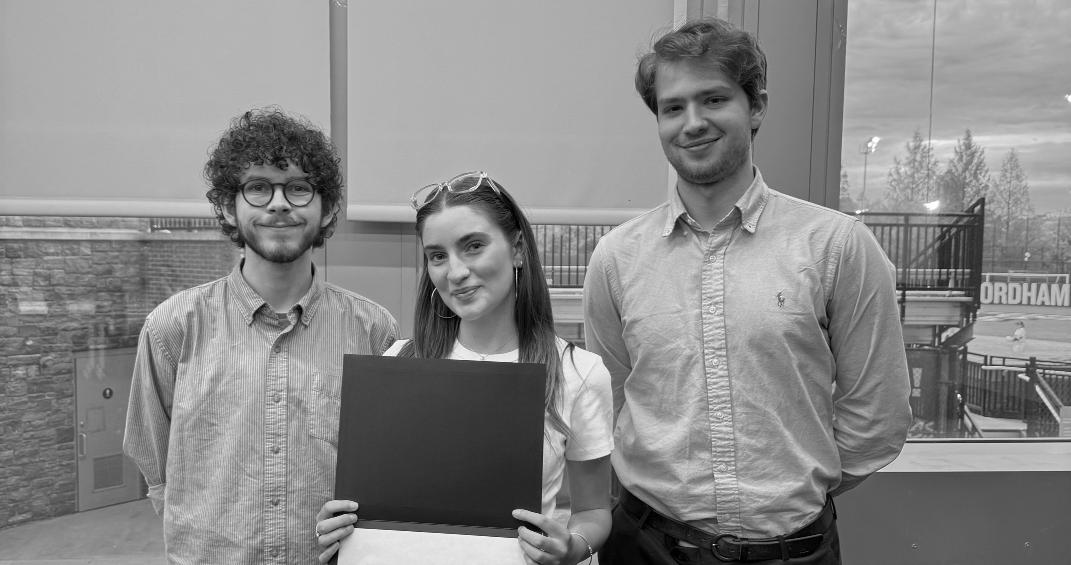
Senator Regan Healy, FCRH ’28, won Senator of the Month for the combined months of March and April.
The two vice presidents of the semester were Vice President of Budget and Finance Peter Grimes, FCRH ’26, and Sayegh.
Hjertberg shared that the USG Inauguration for the 2026-27 academic year will occur on April 27.
Hjertberg also gave updates, including notes on current executive proposals. Regarding the FCRH Mentorship Program, Hjertberg and Senator Ava Cascella, FCRH ’26, met with Vice Provost for Student Success Elizabeth Rainey, Ed.D., to discuss the proposal and how it would mimic the Gabelli School of Business’ current First-Year Advising Mentors program. The FCRH program would be peer-to-peer and mandatory for all first years. The proposal aims to target retention rates, and it won’t be implemented until the fall of 2027 at the
earliest, he explained.
Additionally, he updated USG on the Student Governance Initiative, a new proposal that would allow USG to be a stakeholder in future administrative meetings.
The rest of the USG executive board gave individual committee updates as well.
Vice President of Operations Tina Pathak, FCRH ’28, shared that all club proposals are complete, and the ones currently being reviewed by McGlade will be pushed to the fall semester.
Vice President of Student Life Luc Angus, FCRH ’26, held a transition meeting with the 2026-27 Vice President of Student Life Roger Chmielowiec, FCRH ’27.
Vice President of the Gabelli School of Business Hunter Gholson, GSB ’26, shared that the Gabelli School of Business will be holding an end-of-year event to serve as a mixer for upper and underclassmen.
Johnson shared that Earth Week was very productive, although the river clean-up on April 25 had to be canceled.
Sayegh noted that the Diversity Action Coalition is holding a fundraiser for the ongoing United Nations crisis relief.
Ando shared that she met with Director of Dining Business Operations and Contract Management Orla Fitzsimons and Executive Vice President of the Commuter Student Association Jasmine James, FCRH ’26, to review the commuter student fund.
The contraceptive commission shared that they are having a meeting with McGlade to discuss the document and that Dean of Students Kevin Williams is awaiting its receipt from McGlade.
To end the meeting, it was announced that Senator Henry Carstens, GSB ’29, will be taking over as vice president of communications.
USG will meet again in the 2026 fall semester under new, recently elected leadership.
BERKLEY-AYNE DORSTEN FOR THE FORDHAM RAM
Senator Regan Healy, FCRH ’28, won Senator of the Month for March and April.
Natasha Bedingfield Headlines Spring Weekend Concert
Eva Verstegen, FCRH ’28, also commented on the long lines.
“A lot of people were waiting for ice cream and fries,” Verstegen said. “So I think not everybody got to enjoy the food and they probably should have got more.”
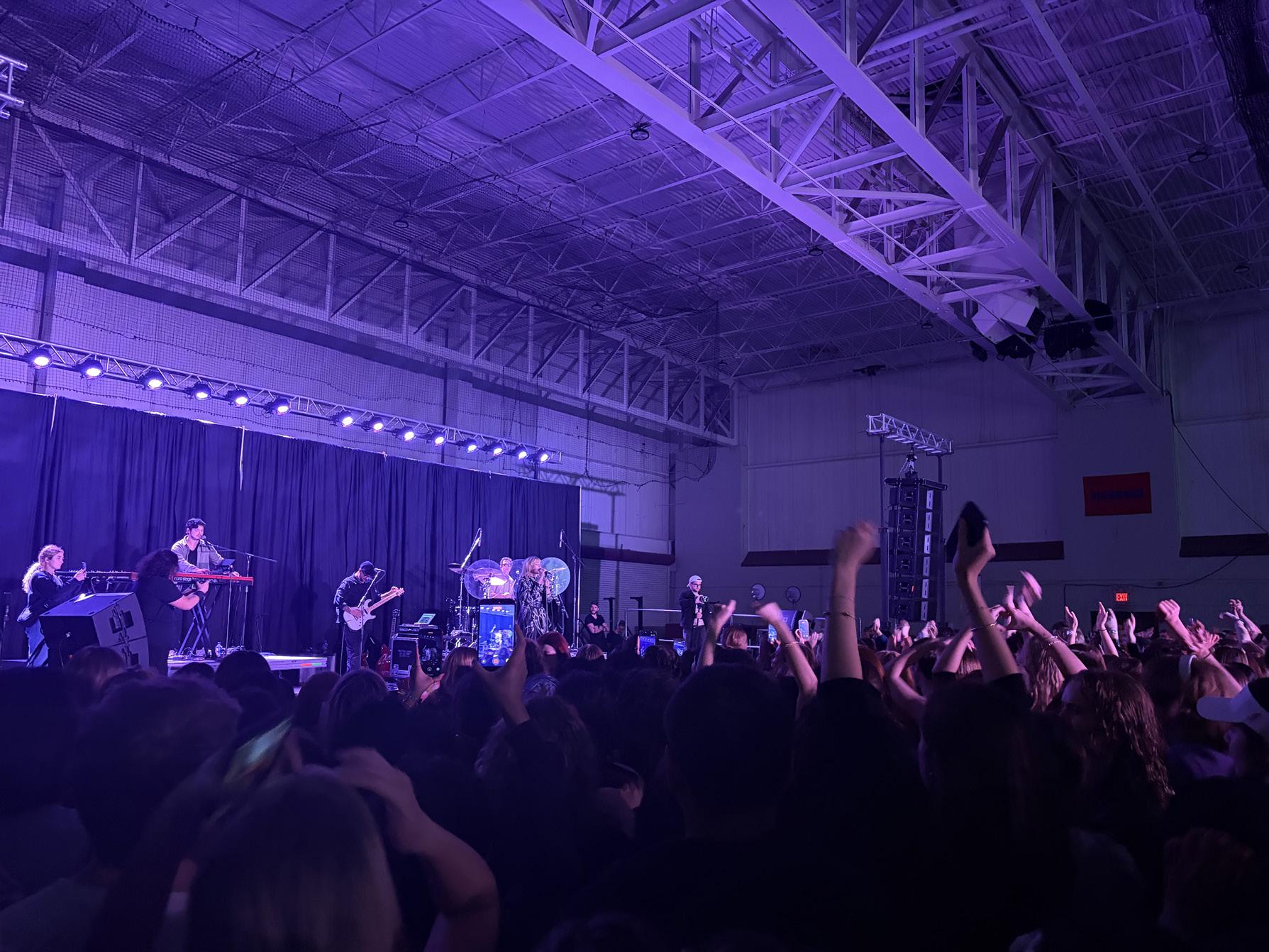
The next day, Saturday, April 25, consisted of a concert. Fordham student band Irish Exit opened the show. They won their place on the lineup by taking first place at Rodrigue’s Battle of the Bands competition. Indie folk-pop artist Del Water Gap performed next, before Natasha Bedingfield headlined the show.
Due to the rainy weather, the concert was held inside the Lombardi Field House. Students noted they wished the show was outdoors on Martyrs’ lawn.
“Do I wish it was outside? Yes, but that can’t happen, so good on them for making it work,” said Sophia Puccini, GSB ’26.
Puccini attended every single event: the Victoria Justice speaker event, the carnival and the concert, and she said they were some of the best she’s seen since being at Fordham.
Bedingfield is known for her 2004 Grammy-nominated hit “Unwritten,” which was featured in the 2023 rom-com “Anyone But You.” Some other hits of hers include “Pocket Full Of Sunshine,” which was also featured in the rom-com, “Easy A,” alongside songs such as “These Words” and “Soulmate.”
“Natasha Bedingfield is a very iconic artist,” Puccini said. “We like to celebrate all the things we have left and those last couple weeks until graduation.”
Del Water Gap is the solo project of songwriter and producer Samuel Holden Jaffe, according to his website. Matt
Levanduski, GSB ’26, said his curiosity about the artist brought him to the field house.
“Del Water Gap seemed like a cool band,” Levanduski said. “I haven’t really heard much of them, so it’s kind of cool to get out of my wheelhouse and kind of hear some different music.”
Levanduski also said his ties to CAB motivated him to attend the concert.
“I have a few friends here and a lot of people on CAB that I know, so I wanted to come out and support them,” Levanduski said.
For Maeve McCurdy, FCRH ’27, the free admission was reason enough. She said she went to the concert regardless of her devotion to the lineup.
“I go to concerts a lot, but paying for them is always tough,” McCurdy said. “But it’s free so it helped me go.”
McCurdy, who also attended last year’s Spring Weekend concert, said she liked the lack of pressure of the weekend.
“I like that there’s no pressure to go and you don’t have to go to all of [the events],” McCurdy said. “You can kind of pick and choose which ones you want to go to.”
Oliver Fontaine, GSB ’26, said he hasn’t been to any of the Spring Weekend concerts since he came to Fordham and that he wouldn’t be attending this year’s concert either. He attributed this decision to not being a concert person.
Another Fordham student, Piper Okonofua, FCRH ’28, said she was happy to be introduced to Bedingfield.
“I would never have ever seen her in real life besides this, so honestly it was a good way to be opened up into her music and that type of music and everything,” Okonofua said.
In the fall, students were able to fill out a form with requests for Spring Weekend artists. However, not all students

filled it out. Levanduski and Fontaine both said they didn’t fill out the form.
“I realize I’m just at the mercy of what the popular student body wants, so I just leave it to them,” Levanduski said.
The last day of Spring Weekend consisted of “Brunch With The Big Four” on Eddies from 11-1 p.m., bingo at 2 p.m. at Fordham Prep and an improv show with various cast members of Saturday Night Live (SNL) at 8 p.m. at Fordham Prep.
Out of the many students
The Ram talked to, none of them attended the brunch. Rodriguez cited exhaustion from Saturday’s concert as the primary contributing factor towards her decision not to go.
“I think the concert took up a lot of my energy the day before,” Rodriguez said. “So I think everybody was just exhausted and still adjusting
in the morning, getting ready for bingo, of course.”
According to Rodriguez, bingo was a major hit.
“It was so exciting, it was so intense, we had so many different patterns that I hadn’t even done before,” she said. “It was so funny because we were playing bingo and every single round this guy kept saying bingo and he didn’t have it. And so eventually people started booing and yelling at him, telling him ‘You need to leave’ and all of that, and by I think maybe the fifth time he called bingo incorrectly, they actually kicked him out and told him he had to leave.”
Rodriguez said that the SNL event, which opened with Henry Tremblay, FCRH ’26, who gave a standup show, followed by the guests’ improv sketches and unpublished SNL sketches, was also a good time.
“I think most people would agree with this statement, but the live comedian was 100% the
best event out of everything,” Rodriguez said, commenting that it was geared towards the students. “I really appreciated that Fordham let the comedians speak as freely as they wanted to tell the jokes that they wanted to, they didn’t censor, which we really appreciated.”
Verstegen also said she enjoyed the final event of the weekend.
“I’m not familiar with the SNL cast that well, so it was kind of new for me, but it was very funny and they had a Fordham student open with his standup set, which was really, really great,” Verstegen said.
The details for the Spring Weekend in 2027 have yet to be announced, but ideas are already in the air.
“If we could have a Ferris wheel in the parking lot and then a really cool photo op, I think that would be really sick,” Rodriguez said.
Core Curriculum Passes with a Class of 2031 Start
FROM CORE PAGE 1
direct result of years of intensive, thoughtful, and collaborative work led by our faculty, who have engaged deeply in the practice of discernment to reimagine how we prepare our students for the world,” Tetlow said.
After the revised curriculum was finalized, it was voted on by Fordham College Rose Hill (FCRH) and also by the Fordham College Lincoln Center (FCLC) Councils on March 19. It was passed by both of these groups, with a vote of 26 in favor, 17 opposed and two abstentions from FCRH and a vote of 22 in favor, 16 opposed and three abstentions from FCLC.
The core curriculum was then voted on by the Arts and Sciences Council on
March 25, who passed the proposal with a vote of 33 in favor, 13 opposed and two abstentions. After that, the
curriculum went to a vote of the faculty, who approved with 163 in favor, 65 opposed and 15 abstentions
for the complete tally.
The final step in approving the new curriculum was a vote by the Board of Trustees. Now
the revised core curriculum will enter the implementation phase. The new curriculum will likely be implemented for the class of 2031, according to Hendler.
In her statement to The Ram, Tetlow thanked faculty members, explaining that the revision process required dedicated effort. She added that the curriculum intends to provide students with an education that is tailored to our changing social landscape. “I want to extend my deepest gratitude to the faculty and the committees who have driven this process with such grit and devotion,” Tetlow said. “You have done the hard work of balancing our 500-year-old educational fundamentals with the urgent need to pivot toward the future.”
Del Water Gap performed before Natasha Bedingfield, playing hits such as “Perfume” for the crowd.
EMMA LEONARDI/THE FORDHAM RAM
The Fordham University core curriculum revision has officially passed and will be implemented for the class of 2031.
EMILY MCCALL/FORDHAM RAM
USG Works to Implement Menstrual Products Proposal
effort came about in the fall of 2025, Healy approached the RHA Executive President Anna Calendrillo, FCRH ’26, who was supportive of the initiative, but instructed Healy to write up an official proposal before bringing it to the Office of Residential Life and their Director Dean Charles Clency.
According to Calendrillo, Regan promptly drafted a proposal, and it was then given to Clency in the spring 2026 semester.
“It was honestly one of the quickest turnarounds I’ve ever seen,” Calendrillo said. “I’ve never seen everything go so smoothly – she wrote up a great proposal. We looked it over, we made a couple tweaks.”
According to Healy, these products will be available in metal dispensers located in each Fordham dormitory’s laundry room on the Rose Hill campus, including pads and tampons, and will be accessible to all students. They will dispense a combination of Original Regular Tampax Tampons and also unscented Naturelle #4 Maxi Pads.
The installation system for these hygiene products parallels a similar Columbia
University initiative that installed feminine hygiene products throughout dorm laundry rooms.
Healy also detailed that five boxes of each product will be purchased in the first round, and the proposal informs that each box will contain either 500 tampons or 250 pads.
The number of products in the future will depend on the number of students within each dormitory’s, USG’s Menstrual Product Proposal states.
According to the USG Menstrual Product Proposal, the total cost for the actual dispensers and first round of products will be split between USG, the Office of Residential Life at Rose Hill and RHA, with each organization owing around $1,057.12.
This first round of products will accommodate the 2026 academic year, and Campus Operations/Facilities will maintain the future products.
After this first round of products, the university’s Campus Operations will begin purchasing them on a weekly basis, with facilities restocking the menstrual products around twice a week in the future.
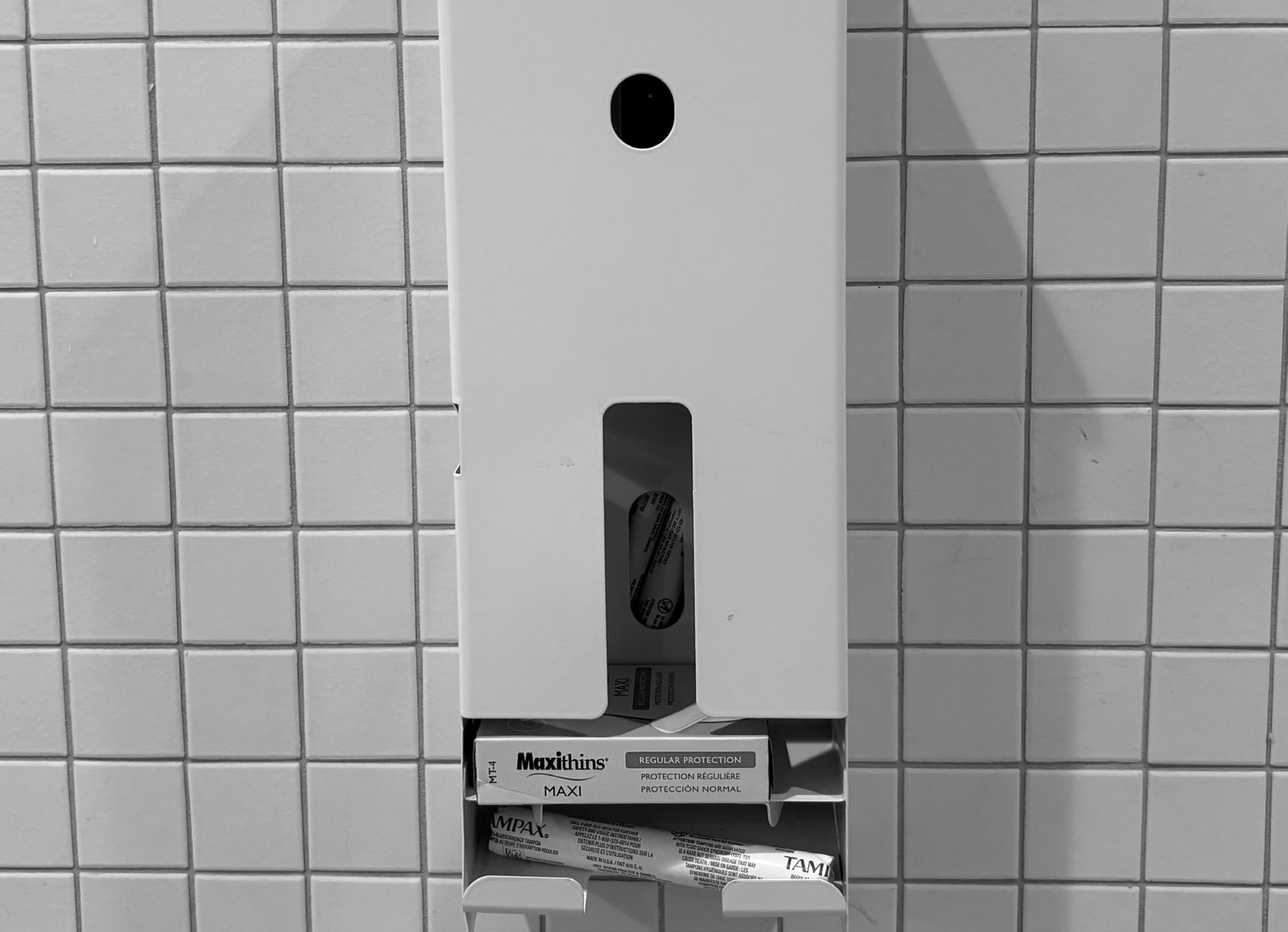
Calendrillo argued that feminine hygiene products are necessary for everyone who experiences a menstrual cycle to have easy access to.
“[Menstrual products are] something as simple as needing toilet paper in your bathroom,” Calendrillo said. “It’s not really up for debate and something that everyone needs access to
because over half the population here is experiencing this.”
In an email to The Ram, the Office of Residential Life detailed their stance on this initiative.
“Students need access to menstrual products in their dorms so they can get them right when they need them, without having to leave their
living space or search across campus,” they said.
Isabella Arno, GSB ’29, stated that it is important for Fordham to install these products in dorms.
“Some people can’t afford them and they’re really expensive,” Arno said. “I feel like it’s just convenient for them to be there.”
Students Lauch a Nonprofit and Autosport Organization
FROM RACE CAR PAGE 1
is to make motorsports and their educational components more accessible to the Fordham community. The organization functions as a registered 501(c) (3) nonprofit rather than a traditional Fordham club, and aims to give its members the opportunity to participate in motorsports, whether through racing, engineering or business initiatives.
The preprofessional aspect, according to Hachuel, is divided into three primary categories: the actual racing component, the business and the engineering and physics. These three realms are combined into a single program aimed at equipping Fordham students with resume boosters and the necessary skills to understand the operations of race car driving.
“It’s basically all of the aspects of racing when it comes to the driving, we teach them the engineering and the knowledge about how to work a car ... the media behind how to manage sponsorships,” Hachuel said.
According to Hachuel, the idea for this club initially emerged in April 2025, and became an official organization in November 2025. It has since recruited more than 50 participants and members, most of whom are from the Fordham community.
Prior to coming to Fordham, Hachuel lived in Spain, where
he raced competitively until both the logistics of moving away to college and motorsport racing’s high financial demands eroded his ability to participate in the sport. His inability to race drove him to champion the nonprofit with Tolmochow, who, along with Hachuel, is an engineering and physics major who wanted an outlet to channel his passion for the sport.
“I generally just thought it wasn’t fair for people just to overall not be able to take part in this fun sport,” said Hachuel, when discussing motivations behind starting the nonprofit.
Ram Motorsport Racing will partake in races against other universities with similar programs, such as Texas A&M University, as part of the Collegiate Racing Series (CRS), in addition to racing in other associations, such as the Eastern Motor Racing Association and the National Auto Sport Association.
Hachuel explained that he felt Fordham lacked an auto sports association for students to develop their professional skills, regardless of their major.
“Living in New York, I kind of missed that motorsport vibe, and as a physics and engineering major, I felt that the program was lacking a program like that,” Hachuel said. “I said, ‘Why don’t I just make my own program

like this and turn it into an educational program?’”
Within the group, Tolmochow is responsible for all educational components in the engineering and physics areas of the program. He has already presented lectures to members on the vehicles’ systems, but the organization plans to shift to bringing in licensed professionals to give lectures on the technical elements of physics and engineering.
“What you learn in class, you learn a lot of theory, and what Alvaro and I are trying to do is put an application to that theory and get students to have experience that they could put on their resumes,” Tolmochow said.
Hachuel also explained that the vast majority of the educational components are being led by the students within the organization.
“We teach everything,” Hachuel said. “We teach the engineering kids exactly what we need to teach them because in a race, say something goes wrong, and they have to fix the car, or they have to know everything.”
While the organization is not affiliated with the university, they have a written agreement with it about how the organization operates within Fordham. According to Hachuel, they are also supported by faculty members of the Fordham physics
department and additional external sponsors.
Hachuel and Tolmochow both laid out the ongoing management and also the time required to run a nonprofit, from filing with the Internal Revenue Service to maintaining relationships with these sponsors. Since January, Ram Motorsport Racing has raised roughly $40,000 toward its $80,000 goal.
They have hosted events where members can gather to learn about autosports, including one last month right outside Fordham’s gates at Pugsley’s Pizza. They are set to take part in three upcoming races, the next of which is on July 31 in Atlanta.
The proposal will allow for dispensers to be placed within dormitory laundry rooms.
Ram Motorsport Racing has multiple sponsors, including Pugsley’s Pizza.
ALVARO HACHUEL, JR. FOR THE FORDHAM RAM
OPINION
RServing the Fordham University campus and community since 1918
The Fordham Ram is the university journal of record. The mission of The Fordham Ram is to provide a forum for the free and open exchange of ideas in service to the community and to act as a student advocate. The Fordham Ram is published every Wednesday during the academic year to all campuses.
Website TheFordhamRam.com
Email Address theram@fordham.edu
Editor-in-Chief
Sienna Reinders
Managing Editor
Ian Nelson
Production Editor
Sarah Verrastro
Editorial Director
Molly O’Connor
Multimedia Director
Hannah Sullivan
Business Director
Nishanth Aduma
News Editor
Emma Leonardi
Features Editor
Sidney Blasco
Assistant News Editors
Jordan Donegan
Decker Rossi
Opinion Editor
Loressa Zeqiraj
Assistant Opinion Editors
Erynn Sweeney
Gabriel Capellan
Culture Editors
Lara Ejzak
Makenzie Smith
Assistant Culture Editor
Kelly Buban
Sports Editor
James Nelson
Assistant Sports Editors
Molly Friedman
Ethan Bess
Copy Chief
Indigo Towers
Executive Copy Editors
Elaina Gibson
Emily Mitton
Emma Kelner
Photo Editor
Emily McCall
Wilson Speller
Digital Producers
Marisa House
Han Le
Haniyyah Usmani
Advertising Directors
Violet Wallace
Juan-Pablo Valencia
Rishika Lingamdinne
Faculty Advisor
Beth Knobel
Editorial Policy
The Fordham Ram’s editorial reflects the editorial board’s opinions or views.
Opinion Policy
The opinions expressed in this publication are those of the authors. They do not necessarily reflect the opinions or views of The Fordham Ram.
Submission Policy
The Fordham Ram Reserves the right to reject or edit any submission for any reasion, without notice. Submissions become the exclusive property of The Fordham Ram. No part of The Fordham Ram may be reproduced without written consent.
Correction Policy
The Fordham Ram is committed to fair and accurate reporting. If you are aware of an error, please contact us at fordhamramonline@gmail.com.
From the Desk | Rishika Lingamdinne
Being Sustainable Means Being Yourself
I don’t think sustainability starts with what you buy; I think it starts with whether you know why you’re buying it. For a long time, I thought having style meant keeping up. New jeans when silhouettes changed, new tops when colors shifted, new everything when the algorithm decided something else mattered. It felt productive, like I was refining something. Except it wasn’t refinement, it was reaction.
The more I paid attention, the more I realized that most of my wardrobe had nothing to do with me. That’s the silent problem with fast fashion. It doesn’t just move quickly; it removes the need to think. Trends arrive fully formed, styled and validated. You don’t have to ask what works anymore, you just have to decide if you want it. And most of the time, the answer is yes, even if it doesn’t last.
Industry data reflects this shift. Consumers today buy more clothing than ever before, yet wear each piece significantly fewer times. Clothing has become temporary, practically disposable. But what doesn’t get talked about enough is how that cycle affects the way we see ourselves. When everything is replaceable, nothing feels like it belongs to you.
That’s where intentionality becomes not just a sustainability
buzzword, but more so an entire way of thinking. A capsule wardrobe is often framed as a minimalist solution but I think this misses the point. It’s not about owning less for the sake of it, it’s about owning things that make sense for you, like pieces you reach for without overthinking, fabrics you’re comfortable in or silhouettes that feel consistent across different parts of your day. Building that kind of wardrobe takes time, as it requires you to notice patterns in your own behavior — what you actually wear, not what you think you should wear. What you keep coming back to, even when other options exist.
That process is almost meditative. You start paying attention in a different way. You stop impulse buying because you know, almost immediately, whether something fits into your life or not. And when it doesn’t, you let it go without trying to justify it. This is where sustainability becomes real, not performative. It’s not about buying “eco-friendly” versions of the same impulsive choices; it’s about reducing the need to consume in the first place.
Fast fashion thrives on uncertainty. It works best when you’re not sure who you are, because then it can keep offering you false promises — a new version of yourself every week, a new aesthetic to try on and a new reason to buy
something that feels necessary in the moment and irrelevant a month later. When you know yourself, your preferences, habits and comfort, your decisions become quieter. You buy less, but you wear more. You repeat outfits without thinking about it. You stop needing constant novelty to feel put together.
There’s also a certain confidence in that. Not the kind that comes from having the right pieces but the kind that comes from consistency. When your wardrobe aligns with you, getting dressed stops being a question — it becomes a routine. On a campus like Fordham, where everything moves quickly, that kind of stability matters more than it seems. There’s already enough noise, academically, socially and professionally. Your wardrobe doesn’t need to be added to it. Intentional buying
Editorial | Fireproof the Bronx
doesn’t mean you never engage with trends. It just means you engage differently; you filter instead of absorb. You take what works and leave what doesn’t, without feeling like you’re missing out.
Over time, that builds something more valuable than a trend-driven closet. It builds a sense of identity that isn’t easily replaced. Sustainability, in that sense, is not just about the environment. It’s about longevity in how you present yourself. It’s about creating a system that doesn’t require constant updating. And maybe that’s the shift that matters most. Moving away from consumption as a default, and toward choice as something deliberate. Because the most sustainable wardrobe isn’t the one with the best labels or the most conscious branding. It’s the one that actually reflects you.
An Open Letter to Mayor Mamdani: Fireproof the Bronx
Dear Mayor Mamdani,
By now, we are sure that you have heard about the devastating five-alarm fire in Belmont that completely destroyed a multi-purpose building, killing two people, including 17-year-old Michelle Gonzalez, injuring 11 others and displacing about 80 families on April 21. The community has come together in an incredible show of unity to support the victims of the fire, but their warmth should not be the only thing in response to this tragedy.
According to residents of the building that burned, there were no fire alarms or sprinklers to alert those inside the building of the fire, which prevented some from getting out in time. Additionally, the front and roof doors were kept open, creating a wind tunnel through the stairway that accelerated the spreading of the fire, trapping the two victims in the stairs. These conditions are unacceptable, and Bronx residents should be able to find affordable housing without compromising their safety.
Thankfully, the sense of community in Belmont runs strong, so victims of this fire have not been left entirely to their own efforts to rebuild. The Belmont Catholic community has come together at Our Lady of Mount Carmel to support the community, filling up the basement with donations of clothing, food and hygiene products. Additionally, they are providing lawyers, case managers and social services to help families with relocation, immigration or anything else they need to put their lives back together. The kindness and generosity of this community should not go unnoticed, but the city needs to intervene to prevent the conditions that led to this event from becoming a pattern.
Emergencies in the Bronx are not treated equally compared to the other boroughs. The Bronx faces the longest emergency response times of any borough, and ambulance response times throughout New York City as a whole are getting worse. On top of issues with response time, heating is not guaranteed in New York
City apartments, with the majority of the 901 underheated buildings being in the Bronx. This systemic neglect often leads to an uptick in space heater use, which can result in devastating fires like the 2022 Twin Parks fire that killed 17. Without consistent updates and improvements to buildings, Bronx residents are left to live in matchboxes, simply hoping that their building, and all of their belongings with it, will not be the next to become engulfed in flames.
We sincerely appreciate the work you have done as mayor in these first few months, and hope you can extend that to our community and the larger Bronx community to ensure their safety just as much as the other boroughs. Your enforcement actions towards landlords to promote the rights of tenants, invest in housing quality and accelerate affordability have made a massive impact on New Yorkers. Additionally, your commitment to improving bus traffic on Fordham Road to make our commuters’ lives easier shows us that you are invested in our community.
We ask that you take this momentum and bring it to Bronx landlords to crack down on fire safety regulations in all buildings, especially apartments and affordable housing. Our central call to action to you, Mr. Mayor, and all New Yorkers, is to invest in fire prevention in the Bronx. Fire safety measures should be a guarantee for everyone in New York, not just a privilege for those of a higher economic status. Our city should require landlords to have working fire alarms, smoke detectors and sprinkler systems throughout their buildings to reduce the risk of fire-related injuries and deaths as much as possible. We ask that this be put on an efficient timeline to fireproof the Bronx before any more incidents like the fire in Belmont devastate other communities. We thank you for your time, and hope you use your power to help our community and prevent future fires in the Bronx that unjustly harm New Yorkers.
Sincerely,
The Fordham Ram E-Board
OPINION
We Should Say No to Prediction Markets
By GABRIEL CAPELLAN ASST. OPINION EDITOR
Kalshi and Polymarket are the newest ways to gamble in America. Where they differ from other betting sites such as DraftKings or FanDuel Sportsbook is that they offer prediction markets. These markets are based on anything ranging from politics to pop culture. Furthermore, instead of winning money, users win crypto that they can trade for money. This is extremely pervasive and outright dangerous. These apps shouldn’t be mainstream in
our culture, nor should we try to be accepting of them.
To understand what I was looking at, I downloaded Kalshi and peeked at their “markets” and I was appalled. I was greeted with multiple pots having over $1 million in them, along with thousands of markets open at any given moment. The Wall Street Journal reports that Kalshi earns $1.5 billion in revenue and is worth $22 billion; — seeing the insanely high number of markets being valued over $1 million, this doesn’t come as a surprise to me.

From this alone, I felt a sense of “double gambling.” You would need to win the prediction bet and then you need to trade the crypto you won — which has failed before — and cash out. Double gambling is alarming and has too high stakes for simple wagers that could be done on other apps, like FanDuel or DraftKings, that automatically give you the money you won fair and square. The main demographic for these apps is males aged 2534, with Hispanic and Black men being half of the participants. This is something that I take a bit more personally. This is because I remember in high school when some of my friends would open up these apps and post their bets or parlays, hoping they’d win and more often than not, it would result in a loss. This always confused me since I couldn’t understand the thrill of putting your money on the line just to always lose the bet.
Furthermore, the BETS OFF proposal would ban individuals from betting on “political events, war, terrorism, and government actions.” This new act is designed to combat these prediction markets and limit them. It was proposed because of users betting on politically sensitive events like U.S.-Israeli airstrikes on Iran and the
raid on Venezuela. However, my question lies in why U.S. lawmakers are trying to keep apps like Polymarket and Kalshi available, even if they are limited in what users can bet on. These apps are clearly dangerous to the public, especially when the larger pots are in politics, where some have an inside force shaping the outcome of the wager.
As to why they haven’t been scrutinized entirely by Washington, D.C., lies in the fact that they are lobbying for their own survival. Kalshi has around 90% of their market shares in the United States and both Kalshi and Polymarket have spent around $1 million in federal lobbying in 2025. By paying for favorable treatment from Washington, Kalshi can keep out of trouble.
However, the entire country is not on board with this. Sports betting is banned in 11 states and legalized in some capacity in 39. Since it’s not fully legalized, I have some hope in the BETS OFF act being passed as Kalshi and Polymarket are turning professional events into self-fulfilling games for viewers, bringing a feeling of dystopia. For example, a U.S. soldier who was part of the Venezuela raid betted on it happening and won over $400,000. The fact that
someone could do this further reinforces the fact that it’s fixed and feels unsustainable.
A research study done by the Pew Research Center found that Americans perceive sports betting as a bad thing for society and sports. In July 2022, 32% of participants said sports betting was a bad thing, and in 2025, 43% of participants said it was a bad thing. This change in percentage isn’t surprising to me because in that same time, the market for sports betting has gone from $412 million to $987 million. The growth present here is a reason for trouble showing that it’s reaching further into our culture when it shouldn’t be. In the one day I spent searching through Kalshi to understand how it works, I was left disgusted. I do not believe American culture should be synonymous with gambling, especially when we are gambling crypto, a currency that is known to fail time and time again. This phenomenon of prediction markets, to me, marks the beginning of a dystopia in the making.
The Tipping Jar Should Be a Choice
By EMILY MITTON EXEC. COPY EDITOR
My favorite part about going out in New York City is knowing that whatever establishment I go into, there will be a screen flipped around to me asking for a 20% minimum tip… is something that I, and I’m sure many others, would never say. What was once a simple way of saying “thank you” for excellent service has turned into a mandatory social task for going into a business. In New York City, tipping has shifted from a voluntary reward into an inherent guilt trip, leaving consumers torn between their empathy for workers and frustration with a system that feels increasingly exploitative. Whether you’re grabbing a sandwich from the local deli or buying a $7 latte from Blank Street, the prompt has become inevitable and unavoidable. Simultaneously, the expected tip percentage seems to be growing while the service that is received has slowly begun to decrease. This trend reveals an ever increasing disconnect between the effort involved and the reward expected.
What started as tipping for exceptional service or a curated experience has turned into providing a compensated reward for simply completing a transaction. Instead of entertaining the increasingly demanding tip culture, I strongly believe that these workers should just be getting paid a livable wage by the businesses themselves, but that is a topic for another time.
The shift from the classic tip jar to the digital tablet (such as Square or Toast) doesn’t just exude a change in technology; it is a masterclass in social engineering. In the past, adding loose change or bills into a jar was a private and anonymous act of kindness. Now, the transaction has shifted to become a public performance of one’s character (or at least feels like it). For example, when a barista spins the transaction screen around, they are often standing less than two feet away and watch as your fingers hover over the 18%, 20% or 25% buttons. To click the “No Tip” option feels like a personal slight and a public declaration that you don’t value the work of the person standing in front
of you. This exact feeling is where the guilt in NYC tipping culture thrives. In a city where we pride ourselves on being resilient and exceptionally prosperous, we are surprisingly vulnerable to the silent judgment of a digital interface. This subtle form of “guilt-tipping” bypasses the logic of the service provided and taps directly into our self-constructed societal responsibilities. Underneath the friction of the “to tip or not to tip” debate lies a systemic abandonment of responsibility. The American tipping model has transformed into a convenient loophole for employers to outsource their payroll to the customer’s conscience. In New York City especially, where the cost of living is ever rising, we are aware that the service workers rely on these gratuities to survive. Yet, by making the consumer the primary supporter of a worker’s occupation, the system has transformed a simple purchase into an ethical dilemma. We are no longer just buying a product, but subsidizing a business’s labor costs one tap at a time. This tipping environment has created something coined
as “tip fatigue,” which is backlash from consumers against the increase of digital tip prompts at places such as retail counters, cafe pick-up spots and even self-serve kiosks. When every interaction within the service industry is handled with the same weight as a sit-down meal, the value of the rewarded gesture is severely diluted, coming from a place of expectation rather than genuine gratitude.
Ultimately, the responsibility of earning enough for a livable wage is not in the hands of the consumer, but the employer. While the impulse, or even expectation, that
supporting those who keep the city running is noble, it should never be coerced. Until fair pay is included within the price of the product, New Yorkers will continue to feel guilt and the employee’s expectation when the glowing white screen is turned around to face them, and left wondering when a fair price stopped becoming enough to cover the cost of the work.

Tipping culture in New York has become exploitative and forced.
COURTESY OF BOULDER WEEKLY
Gabriel Capellan, FCRH ’28, is a journalism major from the Bronx, New York.
Emily Mitton, FCRH ’29, is a journalism major from Lisbon, New Hampshire.
COURTESY OF PYMNTS
Prediction markets like Kalshi and Polymarket are dangerous for users.
By
As students in Introduction to Disabilities Studies, we had the opportunity to personally audit and view different assessments of various spaces at Fordham’s Rose Hill campus. The purpose of this endeavor was to better understand how accessible the place many of us call “home” actually is. Students in our class examined The Grotto and McShane Campus Center, through which we found that Rose Hill is very inconsistent when it comes to accessibility, with some spaces being very well thought out and others lacking the basics.
One common problem in many campus spaces is the high pressure required to push/pull doors. One group found that the average amount of pressure required to open any of the double doors to enter McShane was 20 pounds.
Is Everyone Really Welcome?
The recorded pressure exceeds the Americans with Disabilities Act (ADA) guidelines, which set the maximum at five pounds. This makes such spaces extremely difficult for people who are not able-bodied to access. In these moments, independence is lost and students are forced to rely on others simply to access everyday campus spaces. Plus, exceeding the five-pound door limit isn’t just inconvenient; it may be a compliance issue.
According to an email from the Office of Disability Services (ODS), the number of registered students, excluding the law school, is 2,169. According to the fall 2025 census, Fordham’s undergraduate population totaled 11,000; therefore, the ODS population represents a significant proportion of the undergraduate student body. To become registered with ODS, Fordham requires recent psychological

By EMMA KELNER
EXEC. COPY EDIOR
The COVID-19 pandemic has changed student behavior and screentime, dramatically worsening students’ in-class conduct. Despite this change, school boards’ expectations of teachers have remained the same, leading to increased rates of teacher burnout and stress. Nevertheless, by implementing new cellphone policies such as less screentime, schools can help alleviate some causes of teacher burnout and improve student focus.
Students’ cognitive development lagged during the pandemic. Reading scores and math skills declined from kindergarten to sixth grade after the pandemic caused an abrupt transition from in-person to online schooling.
To make matters worse, students began using their phones in class more. In a 2023 study, 72% of high school teachers reported that students’ cellphone use is a major problem in the classroom, and 70% of teachers surveyed said students misbehaved more in 2023 than they had in the fall of 2019. Taken together, these statistics may indicate that in-class phone use increased following the pandemic, making it harder for students to focus in class.
A Rutgers-New Brunswick study found that students allowed to use devices for non-academic purposes during lectures
documentation (within six months) and an official letter from a licensed mental health professional detailing the diagnosis, onset and impact. For learning disabilities or ADHD, a neuropsychological report or Individualized Education Program document (within four years) is required, with possible supplemental updates. For physical or medical conditions, a recent doctor’s letter explaining the condition and its impact, and for temporary conditions, updated documentation every two weeks. Therefore, 2,169 may not reflect the actual number of students eligible for ODS services. This shows that there are many kinds of disabilities, and Fordham must always strive to improve the accessibility of our campus.
The Grotto is an example of how essential campus spaces remain inaccessible to many students. It is the only campus deli, yet it fails to accommodate all students. The Grotto does not have an automatic door system or a ramp to facilitate wheelchair users’ entry. Additionally, the aisles are narrow, measuring approximately 46 inches. When the fridge doors open, the aisle is only 26 inches wide, making it nearly impossible for more than one person to use it without bumping into each other. Per the ADA, the minimum clear width for single wheelchair passage should be 32 inches, making The
Grotto’s compliance inconsistent. Imagine a student who uses a wheelchair attempting to enter The Grotto during a busy lunch hour. Without an automatic door or ramp, they may be unable to enter at all or may have to wait for assistance from others. Once inside, the narrow aisles and crowded layout make it difficult to navigate the space comfortably or safely.
During rush hour, the ordering station lacks organization. Some students stand in line to place their order, while others navigate through the crowd to grab a snack or pick up their Grubhub order. As individuals move in different directions within a small area, the space becomes loud and crowded. For students with sensory sensitivities or anxiety disorders, the crowded and disorganized environment of The Grotto during peak hours can be overwhelming. The combination of noise and tight spaces may discourage them from using a space that is otherwise central to campus life.
While many campus spaces fall short, the design of the newly renovated McShane Campus Center demonstrates that more inclusive alternatives are both possible and already being implemented at Fordham. McShane includes features that create a more accessible space. As presented by one of the groups in our class, the ramp leading up to the Marketplace
We Should Put the Phones Away
performed worse on end-of-term exams by at least 5%, illustrating the detrimental effects of device use on long-term retention. This lack of retention causes students to fall even farther behind pre-pandemic benchmarks, as they struggle to recall what they learned to make up for pandemic-induced learning gaps. When electronic devices were permitted in class, performance was poorer for students who did not use devices, as well. In-class cellphone use harms all students, even those who don’t use their devices in-class.
Even though in-class cellphone use is known to be a problem, many teachers report poor, impractical cell-phone policies in their schools. In 2024, 60% of high school teachers reported that, while their school district had cellphone-use policies, they were difficult to enforce, with 66% claiming the discipline practices at their school were very or somewhat mild.
All this evidence suggests that, even when schools had phone policies, they failed to deter students from using their phones in class, forcing the instructor to spend more time trying to get students off their phones. 70% of teachers report spending more time addressing behavioral issues than they did before the pandemic. These behavioral issues are difficult for teachers to address while simultaneously teaching a classroom full of students, especially
when considering the need to fill post-pandemic gaps in student knowledge.
These struggles with student behavior are stressful for teachers: 45% of teachers cited managing student behavior as a top source of job-related stress. As a result of this stress and subsequent burnout, many teachers are now considering finding a different career. In 2025, the Center for American Progress reported that 70% of teachers with five or fewer years of experience have either left or considered leaving their profession.
The situation is dire, but hope is not all lost. Slowly but surely, teachers have been reporting improvements in their teaching conditions and mental health. What’s leading the charge?
Improved cell-phone policies.
While certainly not a panacea, stricter cellphone policies can improve focus and encourage students to engage with material by removing the constant distraction of phones. Take, for instance, New York State’s Phone-Free Schools Law. This law prohibits the “unsanctioned use of smartphones and other internet-enabled personal devices on school grounds in K-12 schools for the entire school day.” It also allows schools to develop their own plans for device storage. By granting schools flexibility in developing their own storage strategies, the Phone-Free Schools Law ensures that schools can
dining hall serves as the primary walkway rather than existing off to the side. This is an example of an inclusive design. Individuals with and without mobility-related needs naturally share the same walkway.
Overall, there is a lot that Fordham can do to make campus more accessible for everyone. Installing automatic doors across high-traffic buildings would ensure compliance with ADA guidelines while easing access for all students. Interior layouts, particularly in spaces like The Grotto, should be reevaluated to widen aisles and improve navigation, especially during peak hours. Clearer organization of ordering and pickup areas could also reduce congestion and overstimulation.
Beyond merely infrastructural changes, the university should commit to regular accessibility audits and enforce existing standards more consistently. By implementing these changes, Fordham can move beyond partial accessibility and toward a campus environment that is genuinely inclusive of all the members of its community.
Ian Nelson, FCRH ’28, is an English major from Hyde Park, New York.
Radha Ramani Pilli, FCRH ’28, is a biological sciences major from Long Valley, New Jersey.
create policies that best fit them, rather than forcing all schools to adopt a rigid policy that may not be feasible or effective.
One school that has implemented this law is Staten Island Technical High School, a public, specialized high school in New York City. At Staten Island Technical, students are expected to put their phones in “phone pouches” distributed to each student during homeroom. Students are not permitted to use their phones in the school building before or during the school day, and personal or school-issued tablets and laptops are only allowed with teacher direction for educational purposes.
According to Robert Rams, the band and strings director at Staten Island Technical High School, the school’s policies have been effective. “I do think [phones] are less of a distraction. You don’t see them out as often,” said Rams. [The new phone policies] improved focus majorly, majorly… Because now students are not dabbling on their phones throughout class.” Evidently, phone policies can and do improve the teacher experience.
One common criticism of phone policies is that students will be unable to reach their parents in an emergency. However, by allowing students to keep their phones in a pouch in their backpacks, the administration ensures that, in the event of an
emergency, students can contact their parents. Barring emergencies, the phones remain out of students’ hands, making teachers’ lives easier.
Another common argument is that cellphone policies will force teachers to spend instructional time enforcing cellphone policies. But teachers are already spending educational time trying to get students off their phones. With stricter policies there will be consequences for using a phone during class time. Without these policies, teachers are still policing, but they have little disciplinary power.
“The phone pouches have made my job easier because now I don’t have to be yelling, ‘put the phone away,’ or listening to a thousand-dollar phone hit the floor off a music stand,” said Rams.
Overall, though the pandemic has changed student behavior, schools have been slow to adapt. School cellphone policies are a way to “return to normalcy,” a normal in which teachers don’t need to constantly reprimand students for being on their phones. And by ensuring that teachers don’t need to spend as much class time scolding students for using cellphones, schools can help teachers do what they do best: teach.
Emma Kelner, FCLC ’29, is an economics and history double major from Staten Island, New York.
Fordham needs significant improvement to accessibility policies.
EMILY MCCALL/THE FORDHAM RAM
RADHA PILLI & IAN NELSON
CULTURE
Spring Weekend Brings Pockets Full of Sunshine to Fordham
By KELLY BUBAN ASST. CULTURE EDITOR
On the last weekend of the semester prior to exam season, Fordham’s Campus Activities Board (CAB) Spring Weekend brought a mix of anticipation and skepticism this year. With the weather taking a turn for the worse on Saturday, students took advantage of the Friday night carnival and speaker Victoria Justice, both leading up to the main event. The concert offered a lineup featuring Del Water Gap and Natasha Bedingfield. While some students questioned the choices ahead of time, the
afternoon turned out to be less about the performers’ names and more about how the crowd did or didn’t show up.
Due to the rain that persisted all day, the concert was moved inside to the Lombardi Field House instead of being on Martyrs’ Lawn. This changed the overall vibe of the day, and caused the stage set up to divide the room; however, the effectiveness of the lights helped to curate the atmosphere as best it could, giving students the opportunity to sit down and enjoy some food while still listening to the performers.
Del Water Gap, an indie band based in Brooklyn, New York,
opened the night with a set that showcased their talents fairly well. The strong line of songs, including “Dollhouse,” “All We Ever Do Is Talk,” “High Tops,” “Purple Teeth, The Bravery,” “Perfume” and their most popular: “Ode to a Conversation Stuck in Your Throat.” Their performance was consistent, and it was very clear they knew how to engage an audience as openers. That being said, they’re still very much in that “on the come up” phase. Their sound is somewhat niche, and while that worked for fans, it didn’t fully translate to the entire crowd. Some students were clearly enjoying it, singing

along and engaged, while others seemed much less connected. It wasn’t an inherent lack of effort on his part, it was more about whether his style matched what people expected from a Spring Weekend performer.
Most people were there for the headliner Natasha Bedingfield whose discography resurged in popularity after her song “Unwritten” was featured in the 2023 film “Anyone But You.”
Bedingfield’s set brought a different kind of energy as it was more recognizable and nostalgic (which is always fitting for the end of the school year).
Her biggest hits, “Pocketful of Sunshine,” “These Words” and “Unwritten” all received strong reactions, the crowd loosening up and genuinely participating. A remix moment of incorporating songs like “Running Up That Hill,” by Kate Bush, and deciding to say the pop culture phrase “6/7,” helped to keep her setlist unexpected, standing out as some of the more creative parts of the night.
Between songs, she took time to talk to the audience, focusing on themes like students being the future and having power to make change. Those moments were genuine and gave her performance a more personal feel. She also incorporated covers, adding variety even when they didn’t land with the entire audience.
The biggest issue of this concert wasn’t either artists’ performance; it was the crowd. “Outside of [Bedingfield’s] most well-known songs, the energy dropped noticeably. There were
times people just stood there, especially near the front and all around me,” said Emily Berry, FCRH ’27.
It created a disconnect where the performer was clearly trying to engage, but the audience wasn’t always giving that energy back, which may have been in part due to the indoor set up. These awkward moments, especially when “people would only really be engaged through filming on their phones and not being in the moment,” Ruby Venditto, FCRH ’29, remarked, really were make or break moments of the concert.
Overall, the concert wasn’t necessarily bad, it just depended on what you were looking for. If you were already a fan of Del Water Gap, their set was a highlight. If you came for Bedingfield’s hits, those moments were delivered. But in between, the lack of consistency in the crowd’s engagement caused parts of the night to feel a lot less energetic than it could have been. People around me spent a lot of time comparing Fordham’s performers to “more popular” and “bigger” performers like Flo Rida, and comparing this year’s performers to last year’s ROLE MODEL.
Spring Weekend is supposed to be one of those events where the energy carries the experience. This year, even with its ups and downs, the concert still gave students a chance to come together, hear live music, enjoy a break from the usual weekend routine and soak up the last few moments of the academic year together.
‘Paul Takes the Form of a Mortal Girl’ Book Review
By AYDEN SUBER CONTRIBUTING WRITER
“Paul Takes the Form of a Mortal Girl” resists simple categorization. I read it while lodging on a winter vacation in the frozen wonderland of New Hampshire. As subzero temperatures threatened to turn my head into an ice block, the novel challenged me to think beyond binary frameworks of identity. It was Andrea Lawlor’s tantalizing story of intimate exploration that set my mind ablaze, delivering a satisfying warmth to my trip. Upon finishing the novel and discovering that Lawlor is a Fordham University graduate, I felt compelled to discuss their literary achievement.
The novel follows Paul Polydoris, a shapeshifter who morphs his body to resemble the gender he feels most connected to in any given moment. This fantastical premise serves as the lens through which Lawlor explores the fluidity of gender expression and how it is socially negotiated. Paul’s ability is supernatural, but the cultural and psychological stakes of it are materially present throughout the novel’s
narrative. His shapeshifting offers a sensitive reflection on gender-nonconforming and transgender experiences.
The novel is a living cultural artifact that captures the texture of queer life in the 1990s at a level of detail that could only be generated through the author’s lived experience. Allusions to “Paris Is Burning” (1990), “Querelle” (1982) and “Some Like It Hot” (1959) — films torn straight from the queer canon — don’t just stimulate the reader with nostalgia; they function as entry points into the shared language of the community. Musical references to Patti Smith and The Smiths situate the narrative within an angsty aesthetic moment. Lawlor asks readers to enter their world, offering knowledge of cultural production: how a queer mind navigates existence in a heteronormative society.
For a chunk of the novel, Paul lives as Polly. Their main physical form changes, granting them access to many aspects of life associated with femininity and lesbianism. This includes feelings of alienation from one’s own community. Polly’s longtime friend Jane struggles with Polly’s fluidity, yet this
friction was not the end of the intricate relationship between them as friends.
One of the most striking cultural touchstones in the novel is its engagement with the Michigan Womyn’s Music Festival. The gathering was controversial because of the exclusionary policies towards female-identifying people. Lawlor uses this tense setting within feminist and queer movements in a way which exposes the fractures involved with political belonging. Polly’s presence at the music festival underscores the instability of rigid identity categories and challenges readers to reconsider the boundaries of community labels. Ultimately, the reader must consider Polly’s very being. Race in the novel is not incidental. Paul/Polly’s Greek identity is woven into their encounters and relationships in a way that shapes the social dynamic. As Paul moves with different degrees of racial privilege depending on how he is perceived (sometimes as non-white), the ability to shift between genders doesn’t erase the social realities of race. Instead, the narrative highlights how bodies are treated differently
depending on their racialized context. Lawlor’s portrayal of queer communities in the 1990s reveals varying experiences, showing how hierarchies persist in marginalized spaces. Even as characters are threatened by structures of inequality, class informs the narrative as readers witness Paul’s ability to travel and drift between scenes; a certain economic flexibility.
Paul/Polly’s story is inspired by Virginia Woolf’s “Orlando: A Biography” (1928). Like her titular character Orlando, Paul traverses gender boundaries with an ease that defies conventional realism. Where Woolf’s work is a restrained and mystical allegory, Lawlor’s novel is unapologetically explicit, grounding its exploration of gender in the physicality of sex and desire. They are shameless in their insistence on confronting the messiness of desire, the contradictions with labeling identity and the explicable ways our bodies carry meaning. The structure of the novel places it in conversation with a powerful lineage of postmodern queer literature that refuses to code the human experience for “straight” audiences, like Robert Glück’s “Jack the Modernist” (1985).
However, where Glück’s novel was written pre-AIDS, “Paul Takes the Form of a Mortal Girl” confronts the crisis with emotional gravitas.
Throughout the novel, Lawlor inserts mythological interludes that explain and complicate Paul’s way of life. These mininarratives are speculative, hinting at definitive origins while suggesting that identity can be narrated into being. In this sense, the novel asks imperative questions: What does it mean to create oneself? What does it look like to inhabit a body of your choice in a world that has the power to define that body for you? What does it mean to have ownership of your body? These questions cascade, although exploring them reveals the ways capitalism exploits gender differences and encourages biological essentialism. Through this very queer lens, we may consider how much of who we are is chosen, how much is imposed and how much is something in between. In its willingness to be unfiltered about sex, desire and identity, “Paul Takes the Form of a Mortal Girl” offers one of the clearest developments on what it means to be human.
Bedingfield’s performance received mixed reviews from the student body.
KELLY BUBAN/THE FORDHAM RAM
‘Marjorie’ and the Memories Which Hold Us Together
By ERYNN SWEENEY AST. OPINION EDITOR
Whenever I go home to California, one of my favorite things to do is to go for a drive with my mom. As we sit in the car together, we head to a variety of places — maybe just cruising around our neighborhood, heading to our local coffee shop or to the stretch of the Pacific Coast Highway not too far away. Wherever we are going and no matter how long the trip may last, we have music for the journey blasting through the car’s stereo. For the most part, choosing songs is easy, as we enjoy many of the same artists. Our general consensus, however, diverges for a particular artist by the name of Taylor Swift.
Although my mom has never been the biggest fan, I am slowly (but surely) trying to convert her.
One of the songs that I found sure to be effective in doing so is “marjorie” from the (entirely underrated!) “evermore” album.
It is the story of Swift’s maternal grandmother, Marjorie Finlay, who passed away in 2003. Marjorie was an opera-singer, a classically trained virtuoso who decided to pursue music during undergrad after singing in her high school choir in Mexico, Missouri. She pursued what she loved in life, even when it took her far away from home. She moved to Cuba and then Puerto Rico to sing in the country’s Symphony Orchestra and supper clubs like Club La Concha in Condado.

Rather than simply recounting her grandmother’s history, however, Swift uses the song as an instrument to connect their stories together across time. It is a story of grief; Swift regrets not having made better use of her grandmother’s wisdom and wishes she could ask her just one more question or just learn one more thing about “how to be.”
It is a story of longing; Swift searches for something as tangible as “grocery receipts” to bring her back to the times they had together in the past, to bring her grandmother back with her in the present. But most of all, it is a story of love, a kind of love that remains even when physical presence is gone. It is through her expression of the longing to be with her grandmother that Swift realizes she is already and always with her in a loving spirit. “I know better / that you’re still around,” she sings.
Marjorie passes on wisdom and ties things together; she encourages Swift to be a little bit “kind” and a little bit “clever,” to be a little bit “polite” and a little bit “powerful.” Her love is big enough to hold all the pieces of who her granddaughter is and to help her embrace each of these pieces for herself.
The chorus of the song remains mostly the same during each time it is sung, except for a slight change. The first time around, Swift says that she can feel Marjorie “talking” to her.
The second time around, she can feel her grandmother “listening” to her and the third time around, she can feel her grandmother “singing” to her.
The transition from talking, to listening, to singing paints a full picture of what a loving relationship looks like. It is one where we give and receive; it is one where we celebrate. It is one where we are sustained in our struggles and where we know we are not alone.
For Swift, Marjorie was someone who not only believed in her, but wanted to be with her. Marjorie’s love sustained her as she lived and told her story and as Swift lives her own. Although her dreams may be backlogged, they are not gone; what Marjorie loved is continued in Swift and the life she lives.
As I listen to Swift tell Marjorie’s story, I cannot help but think about my own grandmother. Her name was Donna. She was a writer and had to drop out of school to raise her family. I think she gave me her “backlogged dreams” of poems and prose. I think she is with me as I am writing
now. She lived in a time when things felt a lot more permanent than they do now; she wrote on a typewriter, and her decisions felt like something she could not change. I think she would have loved Google Docs because you can make mistakes, go back and change them. I think she would be happy that I am in a place where I can make mistakes, where I can learn.
When I play my mom this song in the car, I know my efforts to convert her into a Swiftie have been successful. She cries, I cry. We know Donna is crying too. We know she is talking, listening and singing right along with us, giving us her backlogged dreams from the backseat of the car, giving us her love that can hold all of the things we cannot hold on our own, giving us her voice in the hopes that we might find ours. I never met my grandma. But I feel like I know her, and I know she is with me. In the meantime, I am going to keep asking my mom about her to piece together her story. I am going to try to keep her dreams alive, to keep learning and writing and making mistakes.
So thank you Taylor Swift, for putting into words what I have known all along, that Donna is with me — always.
The Fountain Bookshop: A Sweet Treat in the Heights
By SARAH VERRASTRO PRODUCTION EDITOR
Just a short walk from the lovely Fort Tryon Park in Washington Heights — home to the Met Cloisters — is a bright teal bookshop with an ice cream window.
I came across this bookstore by chance while looking for something to do after my first trip to the Met Cloisters. If you know me, you know I’m always looking for a new independent bookstore to try on any city adventure.
The Fountain Bookshop is one of my favorite bookish finds so far in my time living in New York City. Appearing quaint on the outside, the shop actually extends quite far back and has a lower level with tons more books to browse for all ages. And browse I did. I examined the entire store, which has a lovely collection of both popular and lesser-known books of all genres in both English and Spanish. On the cotton candy pink wall at the front of the shop, new releases, staff recommendations and books by local authors are highlighted in an array of front-facing covers. The store also sells bookish candles and matches, mugs, tote bags, stickers, jewelry and more, mostly from local artists and entrepreneurs.
But that’s not all. The first thing on your right when you walk through the door is a large ice cream counter. Set up diner-style, there are bar stools and jars full of toppings and scoops, not to mention the menu behind the counter. This menu includes ice cream flavors with creative names such as “killer chocolate” and “mint summer night’s dream,” as well as soda flavors because, yes — they have a soda fountain too!
Believe it or not, the soda fountain is not the only place the name came from. According to a feature article from Time Out New York, the shop is named after owner Karah Rempe Pinto’s grandmother, whose maiden name was Fountain.
Unfortunately, I was unable to get in contact with the store to find out more information about its history or present; however, the staff was extremely friendly, and I feel certain they would love to answer any and all questions.
In fact, they were so lovely and welcoming that the store felt homey and comfortable; like going to your grandma’s house and getting to do all your favorite things. Simply put, The Fountain Bookshop made me feel like a kid again.
So, of course, I couldn’t leave without trying the ice cream, especially when I spotted the
chai latte flavor. Fountain offers paper cups for take-out orders as well as fancy glass cups and spoons with handles longer than my face for those who want to partake at the counter. Naturally, I chose the latter. The chai latte flavored ice cream was decadent, sweet and creamy, a perfect texture and taste. I spent my time at the counter examining the turquoise blue shelves packed with more books — preorders,
as I came to learn in my observations — and the various amenities used to create the sweet treats they offer.
This charming indie bookshop/ice cream bar also hosts book clubs and events such as local author talks/signings, bilingual story times and book launches, which are advertised with flyers on the walls, as well as on their Instagram: @fountainbookshopnyc.
According to a recent post,
they trialed the new summer menu items at an event — surely something to look forward to post-finals. All in all, you best believe I will be back here; I’m not a soda gal, but maybe Fountain can convert me, because I think I need to try that too! For now, the mug on my desk with a painting of the storefront reminds me of my first wonderful experience at this sweet treat of a bookshop.

Marjorie, Taylor Swift’s grandmother.
COURTESY OF ROLLING STONE
SARAH VERRASTRO/THE FORDHAM RAM
The entrance to the Fountain Bookshop invites readers in with promises of soda and iced cream.
CULTURE
Who’s That Kid | Tiziana Villavicenio, GSB ’28
Sophomore Tiziana Villavicenio’s Fordham Adventures
By LORESA ZEQIRAJ OPINION EDITOR
For Tiziana Villavicenio, GSB ’28, discovering how to be comfortable with being uncomfortable has been the mindset driving her Fordham experience. While she’s only a sophomore, Villavicenio has seized so many priceless opportunities — some that have strengthened her interest in marketing, some that have immersed her into Fordham’s Latinx community and others that can’t be passed up as a college student in New York City. Meeting new people, learning new things and acquiring newfound independence is the essence of the college experience, and Villavicenio is living it!
Villavicenio owes much of her positive experience at Fordham to the Gabelli School of Business (GSB). One notable opportunity she has received there, which she attributes to the school’s merit, is
an internship during the second semester of her first year. According to Villavicenio, GSB prepares students for their careers not by doing the work for them but by showing them the steps involved and supporting them as they navigate their respective fields.
GSB uses its advantages as a school based in New York City and truly paves the way for resilient creatives in the fastpaced world of business.
When asked what GSB has to offer her, she said, “Being part of Marketing Scholars is a great opportunity for Marketing students as the program does multiple site visits in New York City. I was able to go to Disney’s and Estee Lauder’s headquarters in New York City this semester and got insider information.”
Villavicenio is a marketing major and her interest in the field has not only continued during her first two years of college; GSB has fostered a reality where she can learn

‘Drop
By LEIA DEMARCO LABARBIERA CONTRIBUTING WRITER
I was, in fact, one of those girls who was obsessed with Olivia Rodrigo in the early 2020s. “Sour” was one of my favorite albums to listen to during the COVID-19 pandemic, as it represented the idealized yet dramatic teenage life I had yet to — and feared I would never get to — experience.
The music invited me into a romanticized world where emotion was strictly organized into three categories: longing, heartbreak and teenage angst. Listening to “Sour” temporarily suspended time, allowing me to live vicariously through Rodrigo’s experiences with deep-seated insecurity and traitorous love. Her lyrics triggered nostalgia for things I did not have yet, like a driver’s license, but also validated deeply personal emotions. I remember being especially connected to a particular line in “Brutal” in which Rodrigo rhetorically questions the existence of her “teenage dream”
hands-on about the industry, network and be confident in her abilities.
Aside from her academics and nurturing her career, Villavicenio is active on campus through Fordham Global Outreach (¡GO!) and El Grito. Global Outreach is a program at Fordham that offers students cultural immersion in other countries through service and is intended to promote social justice and community engagement. While the program is centered around exploring international inequalities, anti-oppression and anti-racism efforts, it also provides students with a once in a lifetime experience during their college years.
What better way is there to become comfortable with discomfort than by going abroad to someplace unfamiliar?
Villavicenio did just that: “I decided [at the] last minute to apply. I thought Global Outreach was a unique opportunity that Fordham provides and I applied to go to El Salvador because my friends’ family is from there … I wanted to learn more about her culture, but also immerse myself in a Latino country where I could practice my Spanish.” While Villavicenio was motivated to join the program for its Jesuit values, she also had a personal stake compelling her to embark on such an adventure.
The trip to El Salvador gave Villavicenio a new perspective on the world that many of us don’t realize throughout
our daily lives in the Bronx or Manhattan. “At Fordham, we’re all in this tiny bubble and the media has a huge effect on what we believe is true. Last year, El Salvador was a big topic in the USA … After speaking to different small communities throughout El Salvador, we learned that the media in El Salvador was corrupted and only addressed things that made them look good,” said Villavicenio. “I learned of the importance of leaving your country or the environment you grew up in, to see things for yourself, talk to locals, learn about the country/community you’re in and reflect each day on the experience you had.”
She was so inspired and impacted by the program that she wanted to do her part in encouraging others to consider partaking, so she became a part of the Global Outreach Directors Advisory Board under the Marketing Committee. Through this role, she has been able to promote previous ¡GO! experiences, interview participants and post on the ¡GO! Instagram in the hope of reaching more students.
After her first club fair, Villavicenio knew she wanted to join as many clubs as possible, which led her to also join El Grito. She described the appeal of the club by saying, “El Grito specifically stood out to me because I remember they were blasting reggaeton and were encouraging everyone, regardless if you were Latino or not, to join. It was
Dead’ to Feel Alive
in a tone that can only be described as pure, unadulterated rage. To me, that phrase epitomized all the resentment I, like so many other teenagers, felt for the circumstances we were living through, especially at such an uncertain time in our own lives.
However, by the time “Guts” came out, just two years later, I felt too far past this phase in my life to really warrant listening to Rodrigo’s music. Don’t get me wrong, I definitely enjoyed her second album (songs like “get him back!,” “love is embarrassing” and “so american” are actually some of my favorites of her entire discography) but I was now more inclined to view the emotional vulnerability she expressed in her music as a manifestation of naivety rather than courageousness regarding love and interpersonal relationships. Maybe it was just me, but it somehow felt like the more she tried to prove her originality, the more she ended up coming across like a Taylor Swift wannabe with a bit of a whining problem.
That said, when she announced “drop dead,” her
first single off her third album, “You Seem Pretty Sad for a Girl so in Love,” I was compelled to listen. The song starts off with a simple bouncing beat reminiscent of ’80s British synth pop — making her lyrical reference to “Just Like Heaven” seem like a very intentional choice. This motif is enhanced by Rodrigo’s creation of a heavenly dreamscape in which she spends her nights using her “feminine intuition” to manifest a “vision” of “forever” love. The lover she conjures is described almost as a fantastical being, an “angel on the walls of Versailles” that she is “paranoid” she possibly “made up.”
Here, she evokes an intricate conception of what it feels like to be “alive,” ironically causing her to fear she may “drop dead.” This representation of a “pretty boy” whose love could make you want to “throw up” is simultaneously relatable and idealistically dream-like, allowing the song and Rodrigo herself to come off as extremely endearing throughout. The last chorus solidifies this sentiment, as a layered harmony brings the song to its climax,
their welcoming and positive energy that made me so excited to attend the first meeting … It was one of the first communities I was able to build at Fordham.”
During the first half of her sophomore year, she took on the role of public relations liaison and is ending the year as the social media coordinator. So far, she has brought a lot of attention to the club, amassing over 20,000 views on five posts across TikTok and Instagram. Villavicenio found purpose in this club, stating that “[It’s all about] educating and celebrating Hispanic culture on campus.” El Grito isn’t merely a club for her; it has become a family here on campus.
At Fordham, she has met so many new people and learned something different from each of them. Through clubs and programs like El Grito or ¡GO!, and even through her experiences in GSB like Ground Floor and Consulting Cup, Villavicenio has grown as a person.
Villavicenio isn’t finding herself at Fordham; she’s creating the version of herself that you’re reading about. She believes that you get out of Fordham what you put in, meaning that she will reap all the benefits Fordham has to offer so long as she makes the active decision to get involved and push her comfort zone. Trying new things through campus involvement is key to her positive Fordham experience.
creating a satisfyingly sugary-sweet ending.
It seems that Olivia Rodrigo finally found her “teenage
dream” — even if she isn’t necessarily a teenager anymore. And maybe that means we eventually can too.

Villavicenio posing in front of the Mayan pyramids in El Salvador.
TIZIANA VILLAVICENIO FOR THE FORDHAM RAM
Olivia Rodrigo swings above Versailles as she sings her heart out.
Homemade Lentil Soup: Rich, Smoky Comfort in Every Spoonful
By ESTRELLA PALLARÉS MEDINA CONTRIBUTING WRITER
A comforting bowl of lentil soup is a perfect way to warm up on a chilly spring day. The signature taste of this dish, paired with its health benefits, stems from the fact that it only uses pantry staples but adds tons of flavor through the sautéed veggies and tomatoes
that form the base of the soup. Make sure to take your time sautéing the veggies, puréeing them into a smooth sauce and simmering your lentils in the sauce until they absorb all the flavors, resulting in a thick, hearty soup!
One of the best parts of this soup is how well it freezes for future lunches. For instance, on a Sunday, cook up a big pot, freeze in individual

servings, then thaw to have as lunch throughout the week. If you add a bit of chorizo to the soup (or have some already), it adds an amazing smoky richness, elevating this from just a “comfort food” to a “must have!”
The Base:
○ 1 medium onion (sliced)
○ 1 red pepper (chopped)
○ 2 carrots (chopped)
○ 2 sticks of celery (chopped)
○ 3 garlic cloves (minced)
The Flavor Boost:
○ 1/2 cup of tomato sauce
○ 1 tablespoon of paprika
○ Pepper to taste
The Heart Of The Soup:
○ Two cups of green or brown lentils (rinsed)
○ 2 peeled potatoes (cut into cubes)
The Base:
○ 1 tablespoon of chicken broth powder
○ Water
○ 2 tablespoons of olive oil
Optional Add-ins:
○ Chorizo (150 grams sliced or crumbled)
○ 2 bay leaves
○ Fresh parsley (for garnish)
Preparation:
1. Put olive oil in a skillet over medium-high heat, then add the chopped onion, red pepper and celery. Cook the mixture until the vegetables are soft and the onions are somewhat clear.
2. After the vegetables are cooked, add 2 minced garlic cloves and cook for 1-2 minutes, or until the garlic is potent. Then, pour 1/2 cup of tomato sauce into the skillet with the cooked vegetables.
3. Once blended, pour the mix into the blender with the sautéed vegetables (oil included). Add a bit of water to help get the blending process started (the more there is, the easier it should be to blend), then blend until completely smooth.
4. After blending all ingredients together, pour the mixture into a larger pot. Add the rinsed lentils, cubed potatoes and chorizo (if using). Add enough water to cover all ingredients in the pot by at least 2 inches.
5. Add chicken broth powder,
paprika and bay leaves (if using). Thoroughly mix.
6. Lower the heat after boiling the soup, then cover it and cook slowly for about 35-45 minutes. Continue stirring the soup every 15-20 minutes to see if additional base is needed. Be aware of how much liquid has evaporated, as during simmering the soup will thicken, causing the lentils to stick to the bottom of the pot and increasing the risk of burning them. Stir the soup continuously to avoid burning the lentils.
Serving suggestions:
You can eat this soup alone, or you could enhance it by pairing it with one of these items:
● Bread: A fresh, hot baguette or a crusty sourdough to sop up the smoky broth works perfectly with this dish.
● Lemon: A bit of freshsqueezed lemon juice, added just before serving, will add brightness and complement the earthy flavors of the lentils.
● Salad: A light salad dressed with lemon vinaigrette provides a nice contrast to the rich, hearty warmth of the soup.
The Fordham Ram Crossword - Chick Flick Edition
2. "What happens if a car comes?" "We die."
3. "What, like it's hard?"
4. "Always a bridesmaid..."
6. "Is butter a carb?"
8. "Screw 'em if they can't take a joke!" 10. "Thirty and flirty and thriving!"
A warm bowl of lentil soup is a quick and easy recipe for any college student. COURTESY OF COOK2EATWELL


Varsity Scores & Stats
Legends Made, Legacies Changed: WrestleMania 42
By ETHAN BESS ASST. SPORTS EDITOR
Last weekend, WWE held its biggest annual event of the year: WrestleMania. The 42nd WrestleMania took place in Las Vegas at the same venue that last year’s event was held in. This WrestleMania, like every one since the year 2020, was split into two nights, April 18 and 19.
While there were many great matches on both cards, some stood out more than others. Some prime examples include Oba Femi vs. Brock Lesnar, CM Punk vs. Roman Reigns for the World Heavyweight Championship and Cody Rhodes vs. Randy Orton for the undisputed WWE Championship. Most of the results that came from this match card were expected; however, there were some matches that surprised fans. For example, AJ Lee vs. Becky Lynch for the Women’s Intercontinental Championship received tremendous praise.
These matches proved to be crucial for the show, each having a unique appeal. Brock Lesnar and Oba Femi’s match on Sunday served as a passing of the torch. In the buildup around this match, Femi and Lesnar showed no fear of each other. They first faced off at the Royal Rumble, where Lesnar

eliminated Femi, who lasted approximately 40 minutes in the match. Femi and Lesnar developed a heated rivalry, which included many brawls on Monday Night Raw. They eventually came to grips with each other at WrestleMania, where Femi defeated Lesnar in convincing fashion with a chokeslam and his fall from grace powerbomb. After the match, Lesnar left his boots and gloves in the ring, potentially indicating his retirement. If it is the end of the road for Lesnar, he has definitely had a great career.
CM Punk vs. Roman Reigns for the World Heavyweight Championship was a standout match from the weekend. After winning the Royal Rumble, Reigns and CM Punk had a tumultuous feud leading
up to WrestleMania. Things got personal in a Raw segment when Punk mentioned the deceased father of Reigns. While Punk eventually said that he regretted the insult, there was no turning back. In the match itself, Reigns defeated Punk, winning the World Heavyweight Championship. With this victory, Reigns begins another world championship streak after previously holding the Universal Championship for 1,316 days.
The main event of Saturday, Cody Rhodes vs. Randy Orton for the WWE Championship, is also worth analyzing. Rhodes and Orton have quite a bit of history together as they were both originally part of the faction Legacy. In the run-up to the show, Orton was portrayed as the heel to Rhodes’ face
persona, pulling sneak attacks and sabotaging Rhodes. He eventually found out about a mysterious caller who had been advising Orton to attack Rhodes, and that person was Pat McAfee. He helped Orton all the way up until WrestleMania, even attacking Rhodes before the match started. Rhodes ultimately defeated Orton, retaining the WWE Championship, but was attacked by Orton after the match. In the post-match ambush, Orton delivered his signature punt kick to Rhodes. WrestleMania 42 proved to be a mixed bag compared to other recent WrestleManias such as 30, 37, 39 and even 40. WrestleMania will always be the pinnacle of wrestling excellence for fans worldwide. As per the WWE, they have finally decided to take the brand global, as WrestleMania 43 next year will be in Riyadh, Saudi Arabia. Certain aspects of next year’s WrestleMania will probably center around integrating into the Saudi Arabian fanbase while having excellent matches. One could argue that if you want to drive up viewership, you would have to include matches to the caliber of Punk vs. Reigns or even Lee vs. Lynch, like we had this year. If WWE wants to continue their efforts at expansion, that is what they will have to do.
Too Many Ads, Too Many Apps: Reality of Watching Sports
By ARHANA KARSALIYA CONTRIBUTING WRITER
If you’ve tried to watch a game lately, you’ve probably experienced this moment: you sit down, snacks ready, only to realize the game isn’t on the channel you expected. So you switch apps … then another … and suddenly you’re Googling where to watch your own team. By the time you figure it out, you’ve already missed the first quarter and sat through five ads.
Welcome to modern sports. Across leagues like the NFL, NBA and MLB, fans are getting hit from all directions: higher ticket prices, nonstop advertisements and a confusing mix of cable and streaming services. It’s frustrating, but it’s also not random. There are several reasons why sports feel harder and more expensive to enjoy than ever before. Let’s start with the ads, because honestly, they’re the hardest to ignore. Commercial breaks feel longer, jerseys have sponsor patches, stadiums are covered in brand logos and even replay reviews are sometimes “presented by” a company. The reason is simple: Live sports are one of the last things people still watch in real time. Unlike movies or shows, fans don’t skip games; they watch live, which means advertisers are willing to pay a premium. Leagues and networks know this, so they lean into it. More ads equals more
money, and right now, no one involved is willing to give that up.
Then there’s the issue of ticket prices. Going to a game used to feel like a fun outing. Now it can feel like a financial decision. Between the ticket itself, parking, food and merch, a single game can cost hundreds of dollars. Why?
Demand is still high, and teams know fans are willing to pay for the experience. On top of that, teams are investing heavily in new stadiums, luxury suites and high-end fan experiences. Those upgrades aren’t cheap, and the cost often gets passed on to the fans sitting in the regular seats.
But the biggest headache for many fans is how complicated it’s become just to watch games at home. In the past, you could rely on a few major channels. Now, leagues sell their rights to multiple companies to maximize profits. That’s why one game might be on ESPN, another on Amazon Prime and another on Apple TV. From a business perspective, it’s smart: competition between networks drives up the price of these deals. But from a fan’s perspective, it’s exhausting. You’re not just following your team anymore; you’re managing subscriptions.
So where is all of this heading?
The short answer is sports are probably going to become even more commercialized,

COURTESY OF EL
Sports have become significantly more complicated, specifically around streaming and ticket pricing.
but also more personalized. Don’t expect a sudden drop in advertisements. If anything, ads are likely to become more integrated and targeted. Instead of watching a random commercial, you might see ads tailored to you based on your browsing data. It sounds convenient, but it also means ads aren’t going anywhere — they’re just evolving. At the same time, the streaming chaos might eventually settle down. Leagues are starting to realize that making games too hard to find can
actually hurt their audience. We could see more bundled packages or league-specific platforms that bring games back into one place, just in a modern, streaming-friendly way. Think of it like cable 2.0 but more flexible.
There’s also a chance that fan pushback will force some changes. If enough people stop attending games or cancel subscriptions, leagues may need to rethink pricing and accessibility. But as long as demand stays strong, and it usually does, major shifts will be slow.
IN
Ultimately, every decision, from ad placement to streaming deals, is about maximizing revenue. That doesn’t mean the experience has to get worse, but it does mean fans will have to navigate a more complicated system. If it feels like watching sports has turned into a parttime job, you’re not wrong. The challenge for leagues moving forward is figuring out how to keep making money without pushing fans too far. At some point, even the most loyal fans might decide it’s just not worth the hassle.
PAIS
ENGLISH
COURTESY OF 8 NEWS NOW
Roman Reigns had a dominant preformance at WrestleMania in Las Vegas.
Fordham’s Historic Run Ends in A-10 Finals
By JOE HENRY ASST. SPORTS EDITOR EMERITUS
When two rams meet in the wild, they collide head-on, slam horns and stun each other. Then they do it again. And again. That’s exactly what the rivalry between Fordham and Virginia Commonwealth University (VCU) rivalry has looked like for the past few years.
For a third time in four years, Fordham University Women’s Tennis met VCU in the Atlantic 10 (A-10) championships for a “Battle of the Rams” to decide their seasons.
In 2023, Fordham stunned VCU to win its first-ever title. In 2025, VCU stunned Fordham in the semifinal en route to the A-10 trophy. To call 2026’s title match “stunning” would be an understatement.
In college tennis, a threehour match is considered long. Saturday’s final took over five. “It was a wild way to end the season,” said Fordham Head Coach Michael Sowter.
The road to the championship felt like fate. Fordham, the tournament’s top seed, crushed the University of Dayton in Thursday’s quarterfinal, 4-0, then breezed by Davidson, 4-1, in Friday’s semifinal. VCU, the No. 2 seed, beat Saint Louis University, 4-0 and scraped by against the University of Richmond, 4-2.
Both teams entered with unblemished 7-0 records in-conference, VCU on a four-match winning streak and Fordham winners of their last 11.
With the forecast in Orlando, Florida, projecting evening rain, the final was moved from their initial start time of 5:30 p.m.
to 2:30 p.m.
Dark clouds forecasted trouble to come, and the teams began their third match of the last 72 hours.
The Black and Gold appeared well-conditioned in doubles, earning the match’s first point with wins on courts two and three. For the first time since March 8, Fordham had to play from behind.
“The difference between us winning the doubles and losing the doubles point was two or three points in some key situations,” said Sowter. “I said we just need to get 1% better [in singles] … and just fight for every single point.”
Maroon did exactly that, evening things quickly in singles behind senior co-captain Nevena Kolarevic, who took just over an hour to win at court one, 6-2, 6-2. As VCU inched ahead with a win at court two, Kolarevic’s doubles partner and co-captain, junior Julianne Nguyen, did what she’s done all season: she found a way to win tight sets. Nguyen’s 6-4, 6-4 finish at No. 6 brought the match to a 2-2 tie.
As coaches and players hemmed in towards courts three, four and five, junior Lily Chitambar took her No. 5 matchup, 6-3, 6-2, bringing Fordham within one point of a championship.
On court three, freshman Valerija Kargina fought to stave off a straight-set sweep against VCU junior Miriam Ibrahim. On court four, sophomore Catalina Padilla hoped to end things with a sweep of her own before VCU sophomore Andrea Magallanes escaped with a 6-4 set two win to force a third frame.
Meanwhile, Ibrahim stormed
Athletes of the Week
Each week, The Fordham Ram’s Sports section honors two athletes for their on-field performances as “Athletes of the Week.”
Beeman Junior Softball

back against Kargina in a set two tiebreaker to win court four, 6-3, 7-6 (9-7), and tie the match, 3-3.
With Padilla up 1-0 against Magallanes, all parties converged on court No. 4. Set three had just become the championship-deciding set.
The anticipation mounted as the two sophomores battled: 1-1, then 2-1 Padilla, then 2-2 — each side four points away from the title.
Over in New York, Natasha Bedingfield sang “feel the rain on your skin” to a sea of Fordham students at the Spring Weekend concert. Heeding her call, the sky opened up and rain poured down on Orlando.
The match was put on pause, and both sides took shelter. With the weight of a season resting precariously on their shoulders, Padilla and Magallanes could do nothing but wait.
“I’ve never been part of a rain delay before and never been in that situation where it’s come down to the final match on the final day,” said Sowter. “[Magallanes] was definitely struggling physically before the rain delay, so it was definitely a game changer.”
It took nearly an hour for the rain to stop. It took another 50 minutes to dry the playing surface. After 15 minutes of warmups, all eyes returned to court four.
Within the blink of an eye, Magallanes took 14 of the match’s final 16 points to pull away with a 6-2 win and earn VCU the championship.
On the far side of the court, Magallanes dropped her racket and let out a cry hours in the

making. On the near side, Padilla was met by two-dozen outstretched arms — embraces that carried a catharsis of pain, yes, but of overwhelming pride too.
“I just told the ladies that I was really proud of them,” said Sowter. “They’ve represented the school really well. They’ve represented themselves really well.”
The result soured what was a historic run for the Maroon, who had won their last 11 matches by a combined 53-1 score — the best 11-match stretch since online record-keeping began in 2006. The win-streak ranks as the second-longest in that span, and the team’s 10 straight sweep victories from March 11 to April 23 is by far the longest since that 2006
benchmark.
“We had a phenomenal season regardless of how the last match ended up, and we left it all on the court,” said the fifthyear head coach. “It just happened that the fate of the rain gods had a different plan for us on Saturday.”
The Padilla-Magallanes marathon took four hours and 15 minutes. Their teammates traded chants of “For-dham” and “V-C-U” as the final set unfolded. The phrase heard the most?
“I love you, Cata.”
While the Rams fell one step short of their championship goal, the match highlighted what made this team special: willingness to fight through adversity and passionate play born out of love for one another.
Varsity Calendar
Junior pitcher Holly Beeman turned in another impressive start this Sunday against Saint Joseph’s University. Beeman struck out five over seven innings, allowing two earned runs without a single batter walked.
Sophomore Chase Hanawalt dominated his outting against George Mason University on Sunday. Hanawalt tossed seven strong innings, allowing only one earned run over 95 pitches.
Rams Walk Off to Complete Sweep of George Mason
By JAMES NELSON SPORTS EDITOR
Fordham Baseball dominated a three-game set this weekend against George Mason University. Strong pitching and timely hitting were key in the Rams’ sweep over the Patriots.
In game one, the Rams’ offense was sparked by sophomore shortstop Anthony Grabau. Recently named A-10 Player of the Week, Grabau stayed hot, launching a solo home run in the third inning. In the fourth, a series of Patriots mishaps allowed the Rams to extend their lead. First, Rams sophomore catcher Caden Young scored from third on a passed ball. Later in the inning, Grabau was able to reach base courtesy of a dropped third strike, which also allowed another unearned run to score. To cap off a disastrous fourth for the Patriots, Fordham graduate student Joey Donnelly singled to right field, driving in two and bringing the Rams’ lead to 7-2.
On the mound, sophomore Beau Elson went seven innings, allowing only two earned runs and punching out six over 90 pitches. The Rams put the game out of reach scoring in the seventh and eighth, sealing an 11-4 victory.
By JAMES NELSON SPORTS EDITOR
Despite making a few notable additions during the offseason, the New York Mets have picked up exactly where they left off in 2025: playing abysmal baseball. After opening the year with a record of 7-4, the Mets went on a 12-game losing streak, including sweeps at the hands of the Athletics, Los Angeles Dodgers and Chicago Cubs. Out of the 12 losses, the Mets scored two runs or fewer nine times. After finally breaking the streak with two straight wins against the Minnesota Twins, the Mets returned to form, losing three in a row to the Colorado Rockies. When a team collapses like the Mets, fans and media analyze the failure at different levels to determine who is to blame. The discussion starts with the players on the field; a little over one month into the season, the Mets’ roster has very few bright spots. Veteran shortstop Francisco Lindor has struggled immensely on both sides of the ball. In several instances, Lindor has forgotten how many outs there are or has not been properly positioned to turn a double play. Throughout the Mets’ 12game stretch of despair, the offense only managed 21 runs while striking out 95 times. In three games, the Mets’ lineup could not get an extra-base hit. Newly-acquired infielder Bo Bichette sported an
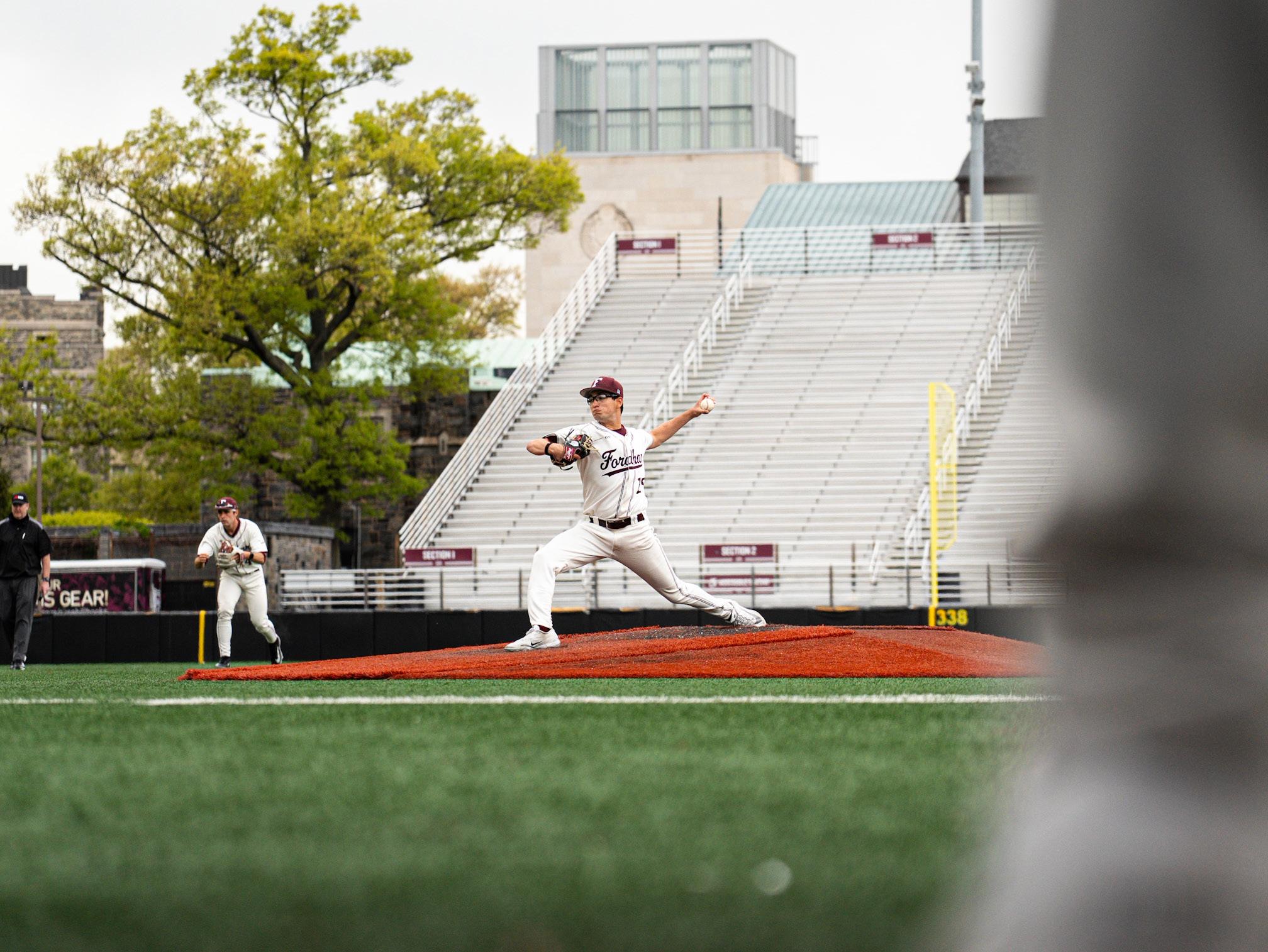
In game two, Rams sophomore Chase Hanawalt dueled against Patriots sophomore Jake Drumm in a low-scoring affair. Drumm pitched six innings to the tune of two earned runs and five strikeouts. As good as Drumm was, Hanawalt outdid him, lasting seven innings
and allowing only one earned run. Drumm’s two runs allowed proved fatal for the Patriots, as the score held at 2-1, giving the Rams a narrow victory.
In game three, the Rams quickly found themselves behind. A four-run Patriots second inning derailed Rams junior
Aidan Dowd’s start. Dowd pitched into the fourth before the Rams turned to their bullpen. Trailing 4-0, the Rams began to mount a comeback. Young got Fordham on the board in the fourth with an RBI groundout.
In the eighth, Donnelly tacked on another run with an RBI
Overtime: Is it Time to Panic?

on-base percentage of .286 and a slugging percentage of .326, another target of blame for fans. Bichette was signed in the offseason to bring power back to a Mets lineup that lost one of its key players: first baseman Pete Alonso, who has the most home runs in Mets franchise history. Thus far, Bichette has not found his stride at the plate, as he currently possesses a negative Wins Above Replacement and below league average On-base Plus Slugging Plus.
On the pitching side, Nolan McLean and Clay Holmes have given fans a reason not to fully give up on the team. Holmes, who is only in his second season as a starting
pitcher, turned in multiple strong outings over the losing streak. McLean, however, has captured leaguewide attention for his outings to kick off the 2026 season. In all three of McLean’s starts during the losing streak, he pitched into the seventh inning, allowed three runs or fewer and struck out at least eight. The concern, of course, for Mets fans is that McLean’s stellar performances have been going to waste due to the inept offense.
In all fairness, Mets star outfielder Juan Soto missed the entirety of the bad stretch with a calf strain. Unfortunately, when Soto returned against the Twins, Lindor exited the game due to the exact
double, one of his four hits in the game. The Rams entered the ninth inning down by two and facing a loss. The first two batters of the inning made outs, and the Patriots looked to have secured a win. Two life-or-death Ram base hits put runners on second and third for sophomore utility player Taylor Kirk. Kirk singled to right, driving in two and tying the game.
The score held, pushing the matchup into extra innings. After a scoreless tenth and eleventh, the Rams crowded the bases in the twelfth. With one out in the inning, Grabau was hit by a pitch; a double from Donnelly moved Grabau to third. Rams junior designated hitter Madden Ocko grounded the ball to first, allowing Grabau to score the winning run. The Rams finished off a sweep of George Mason in walk-off fashion.
The real story of game three was Fordham’s bullpen. After Dowd’s exit, the Rams’ relievers combined for eight and onethird innings of shutout pitching. After the sweep, the Rams are fifth in the A-10 conference standings; they will head to the University of Rhode Island to face off against the sixth seed this weekend.
after missing the playoffs in 2025, ridding the team of most of its veterans was a huge risk on Stearns’ part.
The additions that Stearns did make were puzzling to fans. Alongside Bichette, Stearns traded for Marcus Semien and signed Jorge Polanco. All three of these players’ strongest positions are second base. To start the season, Bichette was stationed at third base and Polanco at first, both playing new positions for the first time in their careers. In the midst of the losing streak, the Mets let multiple players take pregame warmups at first base, signaling they are not satisfied with Polanco’s defensive performance.
same injury. While Lindor hasn’t been the most productive player as of late, he is still an essential piece of the Mets’ lineup and a leader in the clubhouse.
While the players certainly deserve blame for the skid, many fans and media have expressed their anger with the Mets’ front office. Mets General Manager David Stearns has received blame for his roster construction, which arguably led to this disaster. Over the offseason, Stearns parted ways with some of the longest tenured players in the Mets organization, including Alonso, Jeff McNeil, Brandon Nimmo and Edwin Diaz. While the Mets were in need of an overhaul
Losing Diaz to the Dodgers has also left fans infuriated with Stearns. Diaz served as the anchor to the Mets bullpen for six seasons; he was regarded as one of the best closers in baseball throughout his tenure. Stearns attempted to replace the loss with relievers Luke Weaver and Devin Williams, both of whom have had shaky starts to their Mets careers.
It is still early in the season, and players like Lindor and Bichette have great potential and will surely bounce back. McLean looks to be establishing himself as one of the top starters in all of the MLB. The Mets have dug themselves into a deep hole: No team has ever lost 12 straight and gone on to make the playoffs. If the Mets don’t overcome the odds, fans will expect big changes on and off the field.
COURTESY OF FORDHAM ATHLETICS
The Rams played sound baseball against George Mason University.
COURTESY OF HEAVY SPORTS
The Mets have a skid to address.