IEM
The Institution of Engineers, Malaysia
www.myiem.org.my KDN PP 1050/12/2012 (030192)
ISSN 0126-9909
eISSN 3083-8215
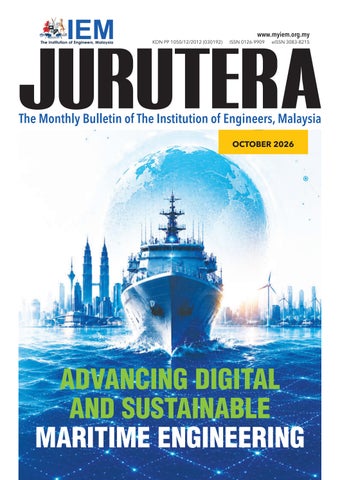
OCTOBER 2026
ADVANCING DIGITAL AND SUSTAINABLE MARITIME ENGINEERING
JURUTERA Monthly Bulletin
Introductory Rate for New Advertisers RM 3,200/page *
(NP RM4,900)
Full-Page, Full-Colour Advertisement • This one-time-only special rate offer is for new advertisers. • Space availability is subject to booking on a first-come-first-served basis. • Clients will provide ready-to-print artwork in PDF format with 300dpi. Full page: 210mm x 297mm, 3mm extra bleed sizes for 4-sided. • Advertising space must be utilised before 31 December 2026. • *Please note that the above rate will be subjected to 8% SST. For overseas advertisers, an additional 25% will be charged. • Rate shown above excludes 15% advertising agency commission. • Payment term: Full advance payment. • Artwork submission deadline is on (or before) the 1st week of the prior month of publication. • After the material deadline, no cancellation or alteration to the advertisement will be entertained. • Any cancellation after signing the advertising order will result in a 50% penalty charge.
Circulation & Readership Profile JURUTERA has an estimated readership of 200,000 professionals. Our esteemed readership consists of certified engineers, decision making corporate leaders, CEOs, government officials, project directors, entrepreneurs, project consultants, engineering consulting firms and companies involved with engineering products and services.
• The publisher reserves the right to edit, revise or reject any advertisement deemed unsuitable or inappropriate.
Name of Company: Address: Tel:
Fax:
Contact Person (s):
Email Address: Publica�on month/s: Company’s Stamp & Authorised Signature
Date
Joseph How +6011 1234 8181
Shirley Tham +6016 283 3013
Contents
OCTOBER 2026
Message from the Editor: Digital & Sustainable Maritime Engineering To transform the maritime industry with digital innovation, decarbonisation, and resilient Ir. Stephanie maritime infrastructure, excluding intelligent Sim Hui Kheng ports, autonomous ships, digital twins, predictive Principal Bulletin Editor maintenance and alternative marine fuels, engineering is transforming the way the maritime domain is designed, operated, and sustained. This month, the focus is on technologies and engineering practices which are pointing the way to the future of Malaysia’s maritime industry. As a maritime country, our competitiveness is closely linked to the added value of advanced digital solutions to sustainable engineering solutions which will boost safety, operation efficiency, environmental management, and life-cycle performance. Modern naval and maritime engineering is not limited to ship design. It includes the optimisation of coastal infrastructure, offshore assets, port operations and marine logistics using a systems thinking and data-driven approach. Multidisciplinary collaboration, strong engineering governance, and a focus on innovation for economic development while maintaining environmental responsibility will be critical to success. Discover how engineers can create a more resilient, a greener and a smarter maritime ecosystem. Hopefully this issue brings new ideas and opportunities for creative cooperation in moving forward for the next generation of maritime engineering excellence.
Cover Note
05 Advancing Digital & Sustainable Maritime Engineering
Cover Story
06 Engineering Expertise as an Instrument of National Influence: Malaysia at the International Maritime Organisation
Features
20 Control Systems in Marine Application 24 Malaysia’s Marine Technology Blueprint: Engineering the Ocean Future 29 What AIS Data Taught Engineers in Hormuz Crisis
Forums
32 AI in Design, Construction, Operation, and Maintenance of Maritime Industry 35 Visit to Bukit Jugra Lighthouse 37 Singapore International Conference on Asian Tunnelling
06
37
News from Branch
39 Strengthening Collaboration Through Flood Mitigation Knowledge Sharing
Reflection
42 Engineering AI Era: Reflections on IEM IMPACT 2030 from the Commercial Frontline
39
Engineer’s Lens
43 Millennium Bridge at Salford Quays
32
Pink Page
44 Professional Interview
43 35
Online Issue
JURUTERA-i
Journal
Visit the IEM website at https://www.myiem.org.my/ or scan the QR code to read online
FEEDBACK
JURUTERA Monthly Review Share your comments and feedback here
Lorem ipsum dolor sit amet, consectetuer adipiscing elit, sed diam nonummy nibh euismod tincidunt ut laoreet dolore magna aliquam erat volutpat. Ut wisi enim ad minim veniam, quis nostrud exerci tation ullamcorper suscipit lobortis nisl ut
Print Service
Special Promotion
Annual Reports • Booklets • Brochures • Buntings • Business Cards CD / DVD Replications • Calendars • Cards & Invitations • Certificates Custom Printings • Envelopes • Folders • NCR Bill Books • Notepads Leaflets • Letterheads • Paper Bags • Posters • Stickers • Others
Joseph How +6011 1234 8181
Shirley Tham +6016 283 3013
COVER Note
IEM Registered on 1 May 1959
Ir. Prof. Dr. Ching Yern Chee Chairman, Marine Engineering & Naval Architecture Technical Division (MNATD)
IEM COUNCIL SESSION 2026/2027
President: Ir. Yau Chau Fong Deputy President: Ir. Chen Harn Shean Vice Presidents: Ir. Prof. Dr. Tan Chee Fai, Ir. Prof. Dr. Lau Hieng Ho, Ir. Yeong Chin Chow, Simon, Ir. Abdul Razak Yakob, Ir. Prof. Dr. David Chuah Joon Huang, Ir. Dr. Lee Yun Fook, Ir. Hj. Abrizan Abdul Kadir Honorary Secretary: Ir. Alex Looi Tink Huey Honorary Treasurer: Ir. Prof. Dr. Wong Yew Hoong Immediate Past President: Ir. Prof. Dr. Jeffrey Chiang Choong Luin Past Presidents: Academician Tan Sri Dato’ Seri Ir. Prof. Em. Dr. Chuah Hean Teik, Dato’ Ir. Dr. Lim Chow Hock, Ir. Dr. Tan Yean Chin, Ir. Ong Ching Loon, Dato’ Ir. Prof. Dr. Norlida Buniyamin Civil Representative: Ir. Chong Boon Hui Mechanical Representative: Ir. Cheng Yew Leong Electrical Representative: Ir. Kwok Yew Hoe Structural Representative: Ir. Lim Su Hian Chemical Representative: Ir. Kim Kek Seong Other Disciplines Representative: Ir. Dr. Dhakshyani Ratnadurai Multimedia Representative: Ir. Dr. Siti Aisyah Anas Women Engineers Representative: Ir. Prof. Dr. Zuhaina Zakaria Young Engineers Section Representatives: Mr. Lim Yiren, Mr. Darshan Balasubramaniam, Ms. Ong Ye Shian, Mr. Chuah Pei Lim, Mr. Teoh Chi Yang Council Members: Ir. Dr. Angelia Liew San Chuin, Ir. Prof. Dr. Zuhaina Zakaria, Ir. Begum Irdawati Dowlad Rahuman, Ir. Chong Chee Yen, Ir. Khoo Chee Min, Ir. Ahmad Rafidi Mohayiddin, Ir. Dr. Chan Swee Huat, Ir. Alex Looi Tink Huey, Ir. Sukhairul Nizam Abdul Razak, Dato’ Ir. Ting Chek Choon, Ir. Dr. Norashikin M Thamrin, Ir. Lee Cheng Pay, Datuk Ir. Chin Tet Fu @Willy, Ir. Gs. Br. Dr. Zarabizan Zakaria, Ir. Choo Lay Guat, Ir. Dr. Siow Chun Lim, Ir. Assoc. Prof. Dr. Leong Kah Hon, Ir. Dr. Sara Lee Kit Yee, Ir. Chan Wah Cheong, Ir. Dr. Marianah Masrie, Ir. Stephanie Sim Hui Kheng, Ir. Dr. Tan Inn Shi, Ir. Tajul Ariffin Mohamed Nori, Ir. Ng Sing Min, Ir. Ooi Mong Lee, Wendy, Ir. Rusnida Talib, Ir. Harris Abd Rahman Sabri Council Member by Invitation: Datuk Ir. Ho Hon Sang, Dato’ Indera Ir. Dr. Ahmad Sabirin Arshad, Ir. Dr. Sanjayan K.V. Velautham Branch Chairman 1. Penang : Ir. Dr. Lee Choo Yong 2. Southern : Ir. Kong Weng Keong 3. Perak : Ir. Dr. Tiah Oon Han 4. Pahang : Ir. Harzah Mazni Ramli 5. Kedah-Perlis : Ir. Jamaluddin Abdullah 6. Negeri Sembilan : Ir. Richard Khoo Nee Keong 7. Kelantan : Ir. Che Sufian Che Hussin 8. Terengganu : Ir. Zakaria Abdullah 9. Melaka : Ir. Sh. Ja’afar Sh. Ismail 10. Sarawak : Ir. Dr. Angelia Liew San Chuin 11. Miri : Ir. Chan Yen San, Stephanie 12. Sabah : Ir. Tan Kok Jyh STANDING COMMITTEE ON INFORMATION AND PUBLICATIONS 2026/2027
Chairman, InfoPub & Chief Editor: Ir. Prof. Dr. Lau Hieng Ho Vice Chairman & Principal Bulletin Editor: Ir. Stephanie Sim Hui Kheng Secretary: Ir. Assoc. Prof. Dr. Hum Yan Chai Chairman and Project Leader Jurutera-i: Ir. Alex Loo Tink Huey Principal Journal Editor: Ir. Dr. Bhuvendhra Rudrusamy Chairperson IEM Webportal: Ir. Dr. Tan Inn Shi Chairman, Sub Committee on Resource Centre: Ir. Wan Rizaluddin Abdullah Wan Ali Infopub Past Chairman by Invitation: Ir. Abdul Razak Yaakob Committee Members: Ir. Begum Irdawati Dowlad Rahuman, Ir. Tajul Ariffin Mohamed Nori, Ir. Dr. Hong Kai Sze, Ir. Prof. Dr. Teo Fang Yenn, Ir. Dr. Hasril Hasini, Ir. Dr. Tan Kim Seah, Ir. Lau Tai Onn, Ir. Yee Thien Seng, Ir. Wong Chee Fui, Ir. Dr. Lau Chee Yong, Ir. Razmahwata Mohd Razalli, Ir. Lee Chang Quan, Ir. Assoc. Prof. Dr. Moey Lip Kean, Ir. Ahmad Rafidi Mohayiddin, Ir. Tay Siang Hui, Ir. Kho Tuck Sing, Ir. Anizahyati Alisibramulisi, Ir. Dr. Aidil Chee Tahir, Dr. Tee Boon Tuan, Ms. Michelle Lau Chui Chui, Ms. Loo Suk Sin, Mr. Darshan Balasubramaniam, Mr. Chin Zehong BULLETIN EDITORIAL BOARD 2026/2027
Chief Editor: Ir. Prof. Dr. Lau Hieng Ho Principal Bulletin Editor: Ir. Stephanie Sim Hui Kheng Secretary: Ms. Michelle Lau Chui Chui Committee Members: Ir. Begum Irdawati Dowlad Rahuman, Ir. Tajul Ariffin Mohamed Nori, Ir. Dr. Tan Kim Seah, Ir. Razmahwata Mohd Razalli, Ir. Prof. Dr. Teo Fang Yenn, Ir. Lau Tai Onn, Ir. Yee Thien Seng, Ir. Ahmad Rafidi Mohayiddin, Ir. Dr. Lee Choo Yong, Ir. Lee Chang Quan, Ir. Dr. Lau Chee Yong Dimension by Invitation: Ms. Shirley Tham, Ms. Sofia Hanis Mohd Uzir THE INSTITUTION OF ENGINEERS, MALAYSIA Registration No.: 1356 (Selangor)
Bangunan Ingenieur, Lots 60/62, Jalan 52/4, P.O. Box 223, (Jalan Sultan), 46720 Petaling Jaya, Selangor Darul Ehsan. Tel: 603-7890 0130 Fax: 603-7957 7678 E-mail: sec@iem.org.my Homepage: http://www.myiem.org.my © 2026, The Institution of Engineers, Malaysia (IEM) and Dimension Publishing Sdn. Bhd.
Advancing Digital & Sustainable Maritime Engineering The maritime industry is entering a new era, one shaped by digitalisation, artificial intelligence, automation, and the need for sustainability. These developments are transforming the way maritime assets are designed, constructed, operated, and maintained, while creating new opportunities to enhance safety, efficiency, resilience and environmental performance. As Chairman of the Marine Engineering & Naval Architecture Technical Division (MNATD), I am pleased to introduce this issue of JURUTERA with the theme, Advancing Digital & Sustainable Maritime Engineering, which reflects the importance of embracing emerging technologies while maintaining our commitment to responsible engineering practices. The advancement of our maritime sector will require stronger collaboration between engineers, industry, academia, government agencies and professional institutions. Equally important is the development of a workforce equipped with strong engineering fundamentals and competencies in digital technologies, data analytics, automation and sustainability. Through knowledge sharing, innovation, and professional collaboration, we can help shape a smarter, safer, and more sustainable maritime future.
DIMENSION PUBLISHING SDN. BHD. [ 199701034233 (449732-T) ] Level 18-01, PJX-HM Shah Tower, No. 16A, Persiaran Barat, 46050 Petaling Jaya, Selangor Darul Ehsan, Malaysia. Tel: +(603) 7493 1049 E-mail: info@dimensionpublishing.com Fax: +(603) 7493 1047 Website: www.dimensionpublishing.com Chairman Robert Mebruer
For advertisement placements and subscriptions, please contact:
CEO/Publisher Shirley Tham shirley@dimensionpublishing.com
DIMENSION PUBLISHING SDN. BHD. [ 199701034233 (449732-T) ] Tel: +(603) 7493 1049 Fax: +(603) 7493 1047 E-mail: info@dimensionpublishing.com Website: www.dimensionpublishing.com
Head of Marketing & Business Development Joseph How joseph@dimensionpublishing.com Production Editor Tan Bee Hong bee@dimensionpublishing.com Contributing Writers Putri Zanina putri@dimensionpublishing.com Hanna Sheikh Mokhtar hanna@dimensionpublishing.com Senior Graphic Designer Sofia Hanis Mohd Uzir sofia@dimensionpublishing.com Graphic Designer Nicole Theng nicole@dimensionpublishing.com
Subscription Department E-mail: info@dimensionpublishing.com JURUTERA MONTHLY CIRCULATION: OVER 40,000 COPIES Submission or placement of articles in JURUTERA could be made to the: Chief Editor THE INSTITUTION OF ENGINEERS, MALAYSIA (IEM) Bangunan Ingenieur, Lots 60/62, Jalan 52/4, P.O. Box 223 (Jalan Sultan), 46720 Petaling Jaya, Selangor, Malaysia.
Advertising Consultants Tham Choon Kit ckit@dimensionpublishing.com
Tel: +(603) 7890 0130 Fax: +(603) 7957 7678 E-mail: pub@iem.org.my Website: http://www.myiem.org.my
Accounts Cum Admin Executive Yong Yen Yin yenyin@dimensionpublishing.com
Published by: The Institution of Engineers, Malaysia (IEM) Publishing Consultant: Dimension Publishing Sdn. Bhd. Printed by: Thunder Print Sdn. Bhd. (Licence No: 048515)
PUBLICATION DISCLAIMER The publication has been compiled by both IEM and Dimension with great care and they disclaim any duty to investigate any products, process, services, designs and the like which may be described in this publication. The appearance of any information in this publication does not necessarily constitute endorsement by IEM and Dimension. There is no guarantee that the information in this publication is free from errors. IEM and Dimension do not necessarily agree with the statement or the opinion expresssed in this publication. COPYRIGHT JURUTERA Bulletin of IEM is the official magazine of The Institution of Engineers, Malaysia (IEM) and is published by Dimension Publishing Sdn. Bhd. The Institution and the Publisher retain the copyright over all materials published in the magazine. No part of this magazine may be reproduced and transmitted in any form or stored in any retrieval system of any nature without the prior written permission of IEM and the Publisher.
6
OCTOBER 2026
JURUTERA
•
COVER STORY
THE INSTITUTION OF ENGINEERS, MALAYSIA
Engineering Expertise as an Instrument of National Influence:
Malaysia at the International Maritime Organisation
COVER STORY
THE INSTITUTION OF ENGINEERS, MALAYSIA
• JURUTERA
OCTOBER 2026
7
For engineers, professional influence need not end at the design office, laboratory, shipyard or plant floor. At the International Maritime Organisation (IMO), technical expertise can shape international regulations, safeguard national interests and influence the future of global shipping. In this interview, Ts. Dr. Julyus Melvin Mobilik, Maritime Attaché and Alternate Permanent Representative of Malaysia to the IMO, discusses engineering knowledge, policy, negotiation, and diplomacy converge as well as why Malaysian engineers have a greater role to play on the international stage.
For many engineers, professional life is defined by technical challenges: Designing systems, solving problems, improving efficiency, ensuring safety or maintaining infrastructure. Yet engineering expertise can extend far beyond these conventional roles. At international level, technical knowledge can influence regulations, shape policy and advance a country’s strategic interests. Few arenas demonstrate this more clearly than the International Maritime Organisation (IMO), the United Nations agency responsible for establishing the global regulatory framework for international shipping. For Malaysia, participation at the IMO is particularly strategic. The country is closely associated with the Straits of Malacca, one of the world’s busiest maritime routes, while its maritime sector encompasses ports, shipping, offshore activities, shipbuilding, marine engineering, and environmental management. Decisions made at the IMO, therefore, have implications, not only for shipping, but also for Malaysia’s trade, energy transition, maritime security, environmental commitments, and technological development. Representing Malaysia in this international environment is Ts. Dr. Julyus Melvin Mobilik, Maritime Attaché and Alternate Permanent Representative of Malaysia to the IMO in London. A maritime professional with more than 27 years’ experience in maritime administration, training, marine safety and environmental management, Dr. Julyus previously served as Director of the Shipping & Seafarer Development Division and Maritime Transport Training Institute (MATRAIN) Malaysia
Marine Department. His academic background includes a PhD and Master’s Degree in Environmental Science from Universiti Malaysia Sarawak (UNIMAS) and a Bachelor’s Degree in Marine Science from Universiti Putra Malaysia (UPM). He is also a Chartered Member of the Chartered Institute of Logistics & Transport (CMILT) and a Professional Technologist (P.Tech). His professional and research interests include marine pollution, marine debris management, coastal ecology, maritime sustainability, and environmental protection in shipping operations. His experience at the IMO offers a broader lesson for the engineering profession, that technical expertise can become an instrument of national influence when combined with policy understanding, communication and diplomacy.
Technical Presence in Heart of Global Maritime Regulation
The Maritime Attaché Office is part of the Maritime Division of the Ministry of Transport (MOT) Malaysia and operates from the High Commission of Malaysia in London. Its core function is to provide Malaysia with a permanent technical presence at the IMO. The IMO develops global rules covering shipping safety and security, marine environmental protection and the facilitation of international shipping. Its work encompasses matters ranging from ship design, construction, equipment, manning, and operations to marine pollution prevention, legal and liability issues, and administrative procedures affecting international maritime trade.
8
OCTOBER 2026
Dr. Julyus describes the office as a bridge between international regulatory developments and Malaysia’s domestic maritime interests. “Our core function is to serve Malaysia’s permanent technical presence at IMO, which is a UN specialised agency that sets global rules for shipping safety, security, marine environment protection, and trade facilitation,” he says. The work is continuous. The office attends and monitors developments at IMO meeting sessions including the five main committees (MSC, LEG, MEPC, FAL, TC), seven sub-committees (SSE, SDC, PPR, HTW, NCSR, III, CCC) and working/ technical/drafting groups, including the IOPC Fund, IMSO and, the highest meeting level, the IMO Council. Technical developments discussed in London are communicated to the Ministry of Transport in Putrajaya, which coordinates with the relevant Malaysian agencies, particularly the Malaysia Marine Department. The office also works with the Malaysian Maritime Enforcement Agency (MMEA), the Maritime Institute of Malaysia (MIMA), port authorities, industry players such as PETRONAS, MISC and shipyard organisations, and professional bodies, where relevant, such as the Institution of Engineers, Malaysia (IEM). The process illustrates an important aspect of the role of engineering in public policy. Technical information does not remain within the specialist community but must eventually be translated into national positions, domestic regulations, and practical measures affecting industry.
From Technical Expert to International Negotiator
As the Alternate Permanent Representative, Dr. Julyus works alongside the Permanent Representative of Malaysia to the IMO, the High Commissioner of Malaysia to the United Kingdom.
JURUTERA
•
COVER STORY
THE INSTITUTION OF ENGINEERS, MALAYSIA
Malaysia delegation participated actively during IMO Technical plenary session
The distinction is important. The High Commissioner represents Malaysia at diplomatic and highlevel governmental level, attending meetings such as the IMO Assembly and Council as well as dealing with matters requiring high-level political or geopolitical engagement. Dr. Julyus’s role is primarily technical and operational. He attends committee and workinggroup meetings, presents Malaysia’s national position, follows negotiations and serves as a key technical contact between the Malaysia Marine Department and the IMO. “As the alternate permanent representative, my role is technical and operational — ensuring continuity behind the discussions,” he says. The technical nature of the work, however, does not make it straightforward. IMO meetings can extend for weeks as member states work towards consensus on highly complex matters. Bilateral and multilateral discussions also take place, including engagements or cooperation involving ASEAN and other regional organisations. One of the most important issues currently occupying the IMO is the transition towards netzero shipping. This brings together engineering, marine environmental,
economics, fuel technology, ship operations, safety, infrastructure and international policy.
Net-Zero Framework: Where Engineering Meets Policy
The IMO’s proposed Net-Zero Framework represents one of the clearest examples of how international regulation can influence the engineering future of an entire industry. The framework is intended to establish binding global measures to reduce greenhouse gas (GHG) emissions from international shipping and to move the sector towards net-zero emissions by or around 2050. Its development brings together several interrelated areas, including GHG reduction, alternative fuels, maritime safety, digitalisation, autonomous shipping, cybersecurity, and seafarer competency. The framework includes a Global Fuel Standard, which would require ships, generally those above 5,000 gross tonnage, to progressively reduce the life-cycle GHG intensity of the fuels they use. It also includes a proposed pricing and penalty mechanism. Ships that fail to meet the required targets would need to purchase remedial units, with the framework
COVER STORY
THE INSTITUTION OF ENGINEERS, MALAYSIA
Malaysia delegation participated actively during IMO NCSR12 technical discussion session
proposing different pricing tiers. Tier 1 is around US$100 per tonne of CO2 equivalent, while Tier 2 is around US$380 per tonne of CO2 equivalent. Ships performing better than the required standard can potentially generate surplus units for trading. The revenue obtained would be contributed to an IMO Net-Zero Fund intended to support the transition, including rewarding the use of zero- and nearzero-emission fuels and supporting developing countries. The framework was agreed in principle at the Marine Environment Protection Committee’s 83rd session in April 2025, although its formal adoption was subsequently delayed following contentious negotiations. Further discussions and refinement of implementation arrangements continue. For engineers, the importance of this process lies in what happens beyond the policy document. International targets ultimately have to be translated into ship design, propulsion systems, fuel infrastructure, retrofit technologies, operational procedures and new competencies. The wider IMO discussion therefore extends beyond GHG reduction to alternative fuels, autonomous ships, maritime cybersecurity, digitalisation and seafarer training.
• JURUTERA
OCTOBER 2026
9
Malaysia delegation to the 13th Sub-Committee on Navigation, Communications and Search and Rescue (NCSR13) focus on the Safety of Navigation and SAR agenda
“All IMO meetings, whether main Committee or Sub-Committee sessions, will focus on these pillars to ensure that discussions remain aligned with the intended priorities and objectives,” says Dr. Julyus. The scale of transition is illustrated by the IMO’s revised 2023 GHG strategy which establishes an ambition for international shipping to achieve at least a 20% reduction in total annual GHG emissions by 2030 and to strive for 30%, compared with 2008 levels. By 2040, the aim is at least 70% and to strive for 80%, while the ultimate objective is to achieve net-zero GHG emissions from international shipping by or around 2050. In practical terms, this translates into a trajectory towards approximately 30% reduction by 2030, 80% by 2040 and 100% by 2050. Two important mechanisms already improving ship efficiency are the Energy Efficiency Existing Ship Index (EEXI) and the Carbon Intensity Indicator (CII). EEXI is a technical design measure of energy efficiency, while CII assesses the operational carbon intensity of a ship. Meeting these targets is not simply a matter of adopting new fuels. Shipowners are considering speed reduction, energy-efficiency
improvements, changes in ship design and retrofitting existing vessels. Alternative fuels such as methanol, ammonia, hydrogen, LNG and biofuels are being examined, but each presents technological, economic, safety, infrastructure and life-cycleemissions challenges. “Currently, shipowners still face the problem of getting their supply of alternative fuel, such as ammonia, and getting retrofitting done to their ships with the use of ammonia,” says Dr. Julyus. The challenge is particularly significant because most of the existing global fleet will have to be adapted rather than immediately replaced. This raises another engineering question: Who has the facilities, technology and skilled workforce to retrofit large numbers of ships within the required timeframe? For Malaysia, this may represent both a challenge and an opportunity. Developing domestic capability in ship retrofitting, alternative-fuel systems, energy efficiency and associated engineering services can reduce dependence on overseas facilities while creating new areas of expertise.
10 OCTOBER 2026
JURUTERA
•
COVER STORY
THE INSTITUTION OF ENGINEERS, MALAYSIA
Council Membership & Malaysia’s Strategic Voice
Malaysia’s influence at the IMO is strengthened by its membership of the IMO Council, which it has held since 2005. Membership provides more than an opportunity to vote in elections. It gives Malaysia a voice in determining the organisation’s work programmes, strategic direction and budgetary matters. “Council members are steering the organisation and setting the strategic directions,” says Dr. Julyus. For Malaysia, this is particularly significant because of the Straits of Malacca. The strait is associated with Malaysia but involves three littoral nations — Malaysia, Singapore and Indonesia — and is one of the world’s major international shipping routes. The geopolitical importance of major maritime chokepoints has become increasingly apparent. With around 100,000 vessels passing through the strait annually, any disruption or loss of confidence in the safety of the route can have significant consequences for international trade and shipping costs. Malaysia therefore has both an international responsibility and a national interest in maintaining the safety and security of the strait.
Straits of Malacca: Engineering Safety
At the interview, Prof. Dr. Adi Maimun Abdul Malik, a member of IEM’s Marine Engineering & Naval Architecture Technical Division, asked what Malaysia must do to guarantee the safety of ships passing through the Straits of Malacca. Dr. Julyus explains that responsibility for the safety and compliance of individual vessels rests primarily with their flag states. Malaysia, as a coastal state, has a different but equally important responsibility: To ensure the safety of navigation within its waters. Vessels passing through Malaysian territorial waters are required to comply with relevant international requirements and to provide mandatory reports to the coastal state’s Vessel Traffic Services (VTS) operators. These shore-based professionals monitor
Malaysian delegation to the 84th IMO Marine Environment Protection Committee (MEPC84) sessions led by the High Commissioner of Malaysia to the UK and Permanent Representative of Malaysia to the IMO, TYT Dato' Zakri Jaafar
and manage vessel movements to support safe navigation. “As a coastal state, we must ensure we receive their communication. That’s how we ensure the strait is safe,” says Dr. Julyus. With 200-300 vessels passing through the strait each day, the scale of monitoring is considerable. Dr. Julyus sees opportunities for technologies such as artificial intelligence (AI) to assist in checking and cross-referencing information transmitted by vessels against existing databases. This is another example of engineering expertise becoming integral to national maritime governance. The future of safe navigation will increasingly depend on the integration of communications, data, AI, surveillance, and maritime systems.
From Marine Engineering to Maritime Diplomacy
Dr. Julyus believes Malaysia has considerable expertise in marine engineering and naval architecture, although these disciplines do not always receive the recognition accorded to other engineering fields. Marine engineers and naval architects perform complementary roles: They focus on the machinery and systems which operate vessels, while naval architects are responsible for vessel design and performance. Yet Dr. Julyus believes Malaysia needs to place greater emphasis on these areas as part of a broader maritime strategy. His experience at the IMO has also demonstrated
that technical competence must be complemented by the ability to communicate and negotiate. “It is very important for a technical person to have good interpersonal communication skill, particularly when engaging in discussions to reach consensus on technical improvement issues and enhancement of IMO conventions/guidelines text.” International negotiations require engineers to understand not only technical principles but also economic realities and the interests of different countries. The debate over biofuels as alternative fuel illustrates this complexity. Malaysia may see palm oil as an important potential feedstock, while other countries promote alternative sources such as sugar and corn. A technically sound proposal must therefore also be communicated within a complex economic and geopolitical environment. Dr. Julyus says engineers involved in policymaking must learn to “see” what is unsaid and to anticipate how an issue may develop. This is where engineering expertise becomes a form of national influence.
How International Maritime Rules Are Made
The development of international maritime regulations also reveals why sustained technical participation matters. Dr. Julyus notes that developing an international convention can take 10-20 years, while amending an existing convention may take five to 10 years.
COVER STORY
THE INSTITUTION OF ENGINEERS, MALAYSIA
The reason is that IMO decisionmaking is fundamentally consensusdriven. The development of the International Convention on Liability & Compensation for Damage in Connection with the Carriage of Hazardous and Noxious Substances by Sea (HNS Convention) illustrates the lengthy process. Discussions began in 2004 and consensus on major issues, including the scope of chemicals and applicable levies, was reached only years later. The convention builds on the experience of the IOPC Fund Convention, which deals with oil pollution compensation, but extends the scope considerably to hazardous and noxious substances. For Malaysia, implementation requires coordination among agencies including the Department of Chemistry Malaysia, Department of Environment and the Ministry of Finance, as the country considers the appropriate national legal and institutional framework. A related instrument, the Protocol on Preparedness, Response & Cooperation to Pollution Incidents by Hazardous & Noxious Substances (OPRC-HNS Protocol) extends international preparedness and response arrangements to pollution incidents involving hazardous and noxious substances. It requires participating states to establish national systems and emergency plans, while ships carrying hazardous substances must maintain appropriate shipboard pollution emergency plans. Such examples demonstrate that international engineering and technical policy is rarely an overnight process. It requires persistence, evidence, negotiation and coordination across institutions and countries.
The Next Maritime Frontier
Beyond decarbonisation, the IMO is addressing a range of emerging technologies and operational challenges. These include Maritime Autonomous Surface Ships (MASS), digitalisation, cybersecurity, alternative fuels and the development of the Maritime Single Window (MSW).
• JURUTERA
Malaysia is already moving towards greater digitalisation. The MSW provides a centralised electronic platform for information required for the arrival, stay and departure of ships, cargo and crew. Malaysia is developing and piloting its system, with the Klang Port Authority involved in the pilot, while efforts are being made to consolidate port operations nationally. E-navigation is also being introduced to digitally monitor vessel movements, including those in the Straits of Malacca and ships entering and leaving ports. The Malaysia Marine Department is further introducing virtual aids to navigation — digital markers broadcast through radio signals to specified GPS coordinates and displayed on a ship’s navigation system — reducing reliance on physical structures such as lighthouses, beacons and buoys. The system has begun in the Straits of Malacca, with plans for wider deployment. These developments create opportunities across engineering disciplines, including systems engineering, software, communications, cybersecurity, data management and artificial intelligence.
Preparing Engineers for Maritime Future
Autonomous shipping is another area where technology is advancing faster than regulation. The IMO has developed a MASS Code, but Dr. Julyus stresses that it is currently a voluntary rather than a mandatory instrument. The IMO continues to gather information and assess the viability and suitability of autonomous operations. Importantly, technology does not eliminate the human dimension. “We still need humans to work on the vessels,” says Dr. Julyus. Issues such as crew competency, welfare, and fatigue therefore remain central, even as vessels become increasingly automated. This reinforces Dr. Julyus’s broader argument that Malaysia’s priority should be capacity development. Professionals who have manual know-how must
OCTOBER 2026
11
develop technological know-how for the future. Engineers need to equip themselves with AI, digitalisation and emerging maritime technologies, while universities and industry must create opportunities for research to move into practical application. Prof. Dr. Adi highlighted the value of bringing researchers and industry together, citing research into Air Lubrication Systems, which use air beneath a ship’s hull to reduce drag and potentially lower fuel consumption and emissions. Such initiatives can help close the gap between theoretical research and commercial application. Government support, including research grants and mechanisms that connect universities with industry, can strengthen Malaysia’s maritime technology ecosystem.
Towards Malaysian Maritime Vision
Underlying many of the issues discussed is a larger question: Does Malaysia have a sufficiently integrated policy for its maritime future? Dr. Julyus believes this is an area requiring greater attention. “Malaysia does not have a roadmap and clear policy as a maritime nation. We have been talking on a piecemeal basis only,” he says. Different organisations and universities may be pursuing valuable initiatives, but without a common strategic direction, efforts can remain fragmented. He feels that a national maritime policy should provide a framework connecting shipping, ports, shipbuilding, marine engineering, offshore activities, energy transition, education, research, and environmental sustainability. Such a framework can also help determine where Malaysia should build domestic capability. Retrofitting, alternative fuels, digital maritime systems and other emerging technologies can become areas of strategic engineering development if supported by coherent policy and investment. Looking towards 2035, Dr. Julyus sees this as essential to strengthening the country’s position
12 OCTOBER 2026 as a maritime nation. “Malaysia must have a maritime policy that can be translated across industry sectors. If we don’t develop shipping, it’ll be challenging for us to increase trade,” he says. He also calls for greater recognition of marine engineering as an important professional field. “We must embark on engineering expertise, not only in civil, mechanical and so on, but also in marine.”
Wider Role for Engineers
The experience of representing Malaysia at the IMO offers a compelling reminder that the engineer’s role can extend far beyond technical execution. Engineers bring evidence-based thinking, systems understanding, and problem-solving capabilities to complex policy discussions. But when technical expertise enters the international arena, it must be accompanied by communication, negotiation, diplomacy, and an understanding of national economic and strategic interests. For young engineers, this creates an alternative career pathway, one that combines engineering with leadership, policy and international representation. Dr. Julyus’s advice is particularly relevant. “When we are in a policy-making position, we must go beyond our specialisation and acquire communication and negotiation skills,” he says, describing this as “diplomatic consensus communication” – maintaining technical principles while communicating them in a way that allows parties with different interests to reach agreement. The objective is not simply to win an argument, but to achieve an outcome that can move an international process forward. For IEM and other professional bodies, this presents an opportunity to encourage engineers to develop competencies beyond their core disciplines and to engage more actively in national and international policy.
Legacy of Representation
After three years representing Malaysia in London, Dr. Julyus regards his strongest contribution as
JURUTERA
•
COVER STORY
THE INSTITUTION OF ENGINEERS, MALAYSIA
having served the country’s interests wholeheartedly. “In whatever negotiations at IMO level, I represented Malaysia wholeheartedly. I have been here three years and have given all my commitment to my role to serve our nation and protect our interests,” he says. He is particularly proud of promoting the importance of the Straits of Malacca and reinforcing Malaysia’s role as a responsible custodian of the strategically important waterway. “I am proud to promote Malaysia and the Straits of Malacca.” But his ambition extends beyond his own tenure. “I want to leave behind the message that more technical personnel should attend IMO discussion sessions to develop the maritime, shipping, and ports sector as well as to contribute to efforts in truly making Malaysia a maritime nation.” That aspiration captures the wider significance of his experience. The value of engineering expertise is not limited to the solutions engineers create as it also lies in their ability to influence the systems, standards and policies within which those solutions operate. For Malaysia, greater participation in international organisations such as the IMO can strengthen our ability to anticipate technological change, protect national interests, and contribute meaningfully to the development of global standards.
Conclusion: Engineering as National Influence
The story of Malaysia’s engagement with the IMO is ultimately about more than maritime regulation. It is about how a technically informed professional can carry national interests into an international forum where decisions taken today may shape industries for decades. From the safety of vessels navigating the Straits of Malacca to the transition towards net-zero shipping, from alternative fuels and autonomous vessels to digitalisation and cybersecurity as well as from international conventions to the development of domestic maritime
capability, the issues before the IMO increasingly demand the integration of engineering, economics, policy and diplomacy. For Malaysian engineers, this represents both a responsibility and an opportunity. Engineering expertise can inform better policy. It can help Malaysia negotiate from a position of knowledge. It can identify emerging technologies, assess their practical and economic implications, and ensure that international standards reflect realities on the ground. Most importantly, engineers can become active participants in shaping the future rather than simply adapting to decisions made elsewhere. The experience of Dr. Julyus demonstrates that the engineer’s professional journey can extend from technical practice into leadership, policy and international diplomacy. In doing so, engineering becomes more than a profession; it becomes an instrument of national influence, enabling Malaysia to not merely respond to global change, but also to have a voice in shaping it.
Interviewee's Profile Ts. Dr. Julyus Melvin Mobilik is the Maritime Attache and Alternate Permanent Representative of Malaysia to the IMO, London. He has over 27 years’ experience in maritime administration, training, marine safety, and environmental management. He holds a PhD and Master’s Degree in Environmental Science from Universiti Malaysia Sarawak (UNIMAS) and a Bachelor’s Degree in Marine Science from Universiti Putra Malaysia (UPM). His expertise includes maritime transport, marine environmental protection, sustainability, and maritime education and training. He is also a Chartered Member of the Chartered Institute of Logistics and Transport (CMILT) and a Professional Technologist (P.Tech). His research interests include marine pollution, marine debris management, coastal ecology, maritime sustainability, and environmental protection in shipping operations.
The
Coming Klang of Valley
MRT
Joseph How +6011 1234 8181
Shirley Tham +6016 283 3013
ADVERTORIAL
ARIEL INDUSTRY STANDARD ARIEL 1:2026
THERMAL ENERGY STORAGE (TES) TANK FOR DATA CENTER RAISING THE BAR: WHY MALAYSIA’S DATA CENTRE BUFFER TANKS NOW DEMAND A HIGHER STANDARD A practitioner’s guide to ARIEL 1:2026 - Malaysia’s first organisation standard for Thermal Energy Storage (TES) Tanks, and why Professional Engineer endorsement and structured organisation standard ARIEL 1:2026 are strongly encouraged for every buffer tank installation.
The Last Defence
Line
of
Thermal
Malaysia stands at the epicentre of Asia’s data centre expansion. With billions of Ringgit flowing into mission-critical server infrastructure across Johor, Cyberjaya and Kuala Lumpur, the engineering community faces a critical question: are the mechanical systems underpinning these facilities designed, tested and certified to the standard these assets truly demand? Behind every server rack sits a Thermal Energy Storage (TES) tank - commonly referred to as a buffer tank - whose sole purpose is to maintain uninterrupted
DISCLAIMER - This article is published for general professional information and educational purposes only. It does not constitute legal, insurance, regulatory or financial advice. Nothing in this article should be construed as a guarantee, warranty or representation that compliance with ARIEL 1:2026 will satisfy the requirements of any specific insurance policy, regulatory authority or legal proceeding. Owners, operators and specifying engineers are solely responsible for verifying with their insurers, legal advisers and relevant authorities whether ARIEL 1:2026 meets the specific requirements of their circumstances. Acceptance of any organisation standard as substantiation for an insurance claim is at the sole discretion of the relevant insurer. Descriptions of third-party incidents in this article are drawn exclusively from publicly reported sources; no findings of fault, negligence or liability are intended or implied against any named party. The Institution of Engineers Malaysia, Enlighted Solutions Sdn. Bhd. and SIRIM Berhad accept no liability for any loss or damage arising from reliance on the contents of this article.
ADVERTORIAL
What Is a TES Tank and Why Does It Matter to All Engineers? A TES tank stores a reserve of chilled water, typically at 7-12 degrees Celsius, within the cooling circuit of a data centre. During normal operation, chillers maintain supply temperature continuously. But chillers can trip; power can fail. In those critical seconds and minutes before backup systems restore service - generators, UPS units, standby chillers - the TES tank discharges its cold reserve into the circuit, preventing the data hall temperature from rising to levels that trigger equipment shutdown. For a hyperscale data centre, even a brief thermal excursion can cascade into tens of millions of Ringgit in losses. TES tanks operate as vertical or horizontal cylindrical pressure vessels at design pressures of 6 to 16 bar, with capacities of 2 m3 and above. Civil engineers address foundation adequacy and structural loading. Structural engineers check wind load and seismic considerations. Electrical engineers integrate the Chiller Plant Optimisation System (CPOS) and UPS power supply. M&E engineers specify the complete hydronic circuit. Understanding ARIEL 1:2026 is therefore relevant across all disciplines - not merely mechanical.
Key Technical Requirements of ARIEL 1:2026 ARIEL 1:2026 establishes minimum requirements across the full lifecycle of a TES tank. The provisions that every engineer should be aware of are outlined below.
1
Materials and Construction
The tank body must be fabricated from carbon steel to ASME SA516MGR70 or stainless steel to ASTM A240 Type 304, supported by certified mill certificates. Internal coatings must include epoxy primer with a minimum dry film thickness (DFT) of 75 micrometres, or cathodic protection epoxy enamel at a minimum 125 micrometres. External insulation - closed-cell polyurethane foam or equivalent - must limit heat gain to no more than 0.5 degrees Celsius under a 45 degrees Celsius ambient temperature. chilled water supply when the primary chiller trips or utility power fails. It is, in effect, the last line of thermal defence for the data centre. Yet until this year, Malaysia had no formal organisation standard governing its design, fabrication, testing and performance certification. That gap has now been addressed through ARIEL 1:2026, an organisation standard developed by Enlighted Solutions Sdn. Bhd. (ESSB) in collaboration with SIRIM Academy Sdn. Bhd., a subsidiary of SIRIM Berhad, through a multi-stakeholder involving DOSH Malaysia, academia and industry practitioners - is Malaysia’s first structured organisation standard for Thermal Energy Storage tanks. Every engineer in Malaysia, regardless of discipline, needs to understand what it requires and what it means for professional practice.
2
Structural Design and Hydrostatic Testing
All tanks must be designed to ASME Section VIII (Boiler and Pressure Vessel Code) with welding joint efficiency of at least 85%. A hydrostatic test at 1.3 times the design pressure, held for a minimum of 30 minutes, is mandatory - with no visible leakage, sweating or structural deformation permitted. Critically, this test must be witnessed and certified by an Authorised Inspecting Body (AIB). A signed AIB certificate is a condition of acceptance, not an optional courtesy.
3
Thermal Performance: The Figure of Merit (FOM)
At the heart of ARIEL 1:2026 is the Figure of Merit (FOM), which must reach a minimum of 85%. The FOM measures how effectively the tank stratifies cold and warm water layers - a high FOM means the tank delivers usable cold water for the maximum possible ride-through duration. The Froude number of the internal diffuser must not exceed 1.0, thermocline thickness must be compliment to the required FOM, and diffuser outlet velocity generally must remain below 0.6 m/s.
4
CFD Validation: Engineering Rigour, Not Marketing
Before fabrication is approved, the diffuser design must be validated by Computational Fluid Dynamics (CFD) simulation using a platform such as MIDAS NX, ANSYS Fluent, CFD validation should employ sufficiently refined transient 3D modelling capable of resolving diffuser-induced flow behaviour under realistic operating conditions. Simulation must cover 3D transient modelling, full design flow rate, design delta-T, charging and discharging cycles, pressure drop across the tank, and chiller trip scenarios. This transforms what was previously a subjective design claim into a mathematically verified, auditable deliverable.
ADVERTORIAL
“A TES tank failure in a data centre does not merely trip an alarm - it can trip the entire facility. ARIEL 1:2026 is intended to reduce the probability and severity of thermal instability events through structured engineering validation."
A Professional Obligation: Recommend PE Endorsement for All Future Buffer Tanks The publication of ARIEL 1:2026 carries a clear professional recommendation. The standard strongly recommends that mechanical engineering works involving pressure-containing systems and complex cooling plant seek approval by a registered Professional Engineer (PE) in the Mechanical discipline, registered under the Registration of Engineers Act 1967 and holding a valid Practising Certificate issued by the Board of Engineers Malaysia (BEM). This PE endorsement applies at two critical stages. At the design stage, the PE must confirm the structural and hydraulic workability of the TES tank - including pressure vessel calculations, diffuser sizing, foundation adequacy, wind load assessment and CFD report validation. At the performance testing stage, all discharging performance tests must be validated and formally approved by a Mechanical PE before results are accepted as compliant with the standard. For mission critical cooling applications, PE endorsement should be treated as best engineering practice. All buffer tanks - whether in data centres, hospitals, district cooling plants or industrial facilities - are strongly recommended to carry PE endorsement as a condition of specification, procurement and commissioning acceptance. This is not bureaucratic formality. It is the engineering profession’s assurance to the public, to operators and to insurers that the equipment is fit for its critical purpose, reviewed by a qualified professional who bears personal and professional accountability for that assessment.
Protecting Your Client: Engineering, Legal and Insurance Coverage ARIEL 1:2026 offers engineers a structured framework to ensure that clients are protected not only from engineering failures, but from legal exposure and insurance disputes. The standard achieves this through three complementary mechanisms that every specifying engineer is strongly encouraged to adopt.
1
Performance Testing: Evidence, Not Assurance
Under ARIEL 1:2026, a structured discharging performance test must be conducted under controlled conditions using calibrated instruments prior to delivery to site - PT100 temperature sensors at plus or minus 0.3 degrees Celsius accuracy and flowmeters at plus or minus 1% accuracy. Data is logged at five-second intervals throughout the discharging cycle, with an alert threshold set at 1.3 degrees Celsius above the initial stabilised tank temperature. All results must be printed in hard copy and co-signed by all parties. This test report becomes documentary proof of actual thermal performance - transforming a vendor’s promise into a verified, signed, auditable fact capable of withstanding legal scrutiny.
2
Structure Validation: Meeting the Insurer’s Threshold
A TES tank licensed under organisation standard ARIEL 1:2026 framework carries a product certification against a published, independently developed and through collaboration with SIRIM, Malaysia’s leading industrial research and technology organisation. Many equipment and business interruption insurance assessments require evidence that critical plant and equipment have been designed, manufactured, tested or assessed against recognised technical requirements as part of the supporting documentation for risk evaluation. Conversely, a tank that has not been certified under ARIEL 1:2026 or an equivalent recognised standard may complicate insurance claims assessments and weaken evidentiary support during dispute resolution on the basis that the equipment did not meet any recognised standard at the time of procurement. In a data centre context where business interruption claims can reach tens of millions of Ringgit, this is not a theoretical risk. It is a foreseeable and preventable consequence that specifying engineers have a professional duty to advise their clients to avoid. However, the onus remains on the client to verify with their insurance provider whether ARIEL 1:2026 meets the specific evidentiary requirements of their policy in the event of a claim, as acceptance of any organisation standard as substantiation is at the sole discretion of the insurer.
3
Legal Defensibility: The Auditable Compliance Trail
In the event of an incident - structural failure, cooling loss, data centre downtime - a structured validated tank with a PE-endorsed design, an AIBwitnessed hydrostatic test, and a PE-approved performance test result creates an auditable compliance trail. Each step is documented, signed, dated and verifiable. This chain of evidence protects the owner, the consultant, the specifying engineer and the installing contractor alike.
ADVERTORIAL
Table 1
PILLAR
WHAT IT DELIVERS
WHO IS RESPONSIBLE
1
PE Endorsement
Validates engineering design integrity of a pressure - containing system serving critical infrastructure; creates personal professional accountability under the Registration of Engineers Act 1967.
Mechanical PE with valid BEM Practising Certificate
2
Structured Validated Framework jointly collaborated with SIRIM
Confirms the tank meets a published, independently verified organisation standard; may assist in satisfying insurer documentation requirements for equipment certification; Documentation generated through compliance assessment may assist in meeting insurer requirements for technical due diligence and risk evaluation and may be used as supporting evidence in the event of an incident or business interruption, subject to individual policy terms and conditions.
Tank Manufacturer & Authorised Inspecting Body (AIB)
3
Performance Testing Prior to Delivery to Site
Provides documented, calibrated, signed proof that the tank delivers its specified thermal capacity; creates verifiable evidence for insurance claims and legal proceedings; validates CFD simulation results.
Mechanical PE + Authorised Inspecting Body (AIB)
Without this trail, each party faces significant and potentially unquantified liability in a dispute where the burden of proof rests on them to demonstrate that the equipment was fit for purpose. With it, that burden is substantially reduced. The combined cost of SIRIM certification, PE endorsement and performance testing is generally modest by comparison to the potential cost of a single undefended insurance claim or legal action following a data centre outage.
“Structured Validation is not a luxury - it is your client’s first line of defence in an insurance dispute, and your profession’s assurance that the tank performs exactly as specified.” “No cooling system can eliminate all operational risk; however, structured validation substantially improves confidence and resilience. ARIEL 1:2026 is intended to reduce the probability and severity of thermal instability events through structured engineering validation.”
The Three Pillars of Client Protection Engineers specifying TES tanks for any application should ensure all three of the following are in place before a Certificate of Practical Completion is issued (Table 1).
Conclusion: A Standard for the Profession, By the Profession ARIEL 1:2026 is more than a technical specification. It is a statement of professional intent - that Malaysia’s engineering community will not allow critical infrastructure to be built without proper accountability, proper verification and proper protection for the clients and the public who depend on it. For engineers specifying, designing, reviewing or approving any buffer tank installation from this point forward, the message is unambiguous: recommend on PE endorsement at design and testing stages; it is strongly encouraged to insist on structured validated framework as a strongly recommended procurement condition; and insist on a documented, co-signed performance test before any Certificate of Practical Completion is issued. Your professional obligation, your client’s legal protection and their insurance coverage all depend on it.
Author: Ir. Raymond Ong, P.Eng, MIEM (BEM PEPC No. C112495)
ARIEL 1:2026, Thermal Energy Storage (TES) Tank for Data Center - ESSB & SIRIM Berhad, 2026. | ASHRAE Handbook, Latest Edition, Chapter 51 - Thermal Storage. | ASME BPVC Section VIII, Division 1. | Registration of Engineers Act 1967 (Malaysia). | Occupational Safety and Health (Plant Requiring Certificate of Fitness) Regulations 2024. | Data Center Dynamics, “BA and CBRE settle dispute over 2017 data center outage” (2019). | Computer Weekly, “OVHCloud facing client compensation class action claim of EUR 10m over March 2021 datacentre fire” (2022). | Bloomberg, “CME Data Center Outage Caused by Human Error, CyrusOne Says” (December 2025). | Network World, “Cooling crisis at CME: A wakeup call for modern infrastructure governance” (2025). | Data Center Dynamics, “Data center power surge and cooling failure brings down Microsoft Azure services”(2023). | The Register, “Microsoft blames outage on small staff, automation failures”(2023). | Network World,“AWS hit by US-East-1 outage after data center thermal event” (2026). | IT Pro, “The AWS outage explained: What happened, who was impacted” (May 2026). | Uptime Institute, “Annual Outage Analysis 2023” - 60% of data centre outages now cost over USD 100,000. The authors acknowledge the contributions of the ARIEL 1:2026 Project Committee, SIRIM Berhad, DOSH Malaysia, and all industry stakeholders who participated in the development of this standard. Disclaimer: IEM and Dimension do not give any warranty as to the completeness or accuracy of any information, instruction, advice and/or opinion stated in this Publication and IEM and/or Dimension shall not held responsible for the outcome of any action or decision based on such information, instruction, advise and/or opinion. Unless specified, nothing herein shall be deemed to be an endorsement of any product or opinion by IEM or Dimension.
20 OCTOBER 2026
JURUTERA
Control Systems in Marine Application by:
Ir. Prof. Dr. Ab Saman Abd Kader Professor at Universiti Teknologi Malaysia. He has a PhD and 3rd Class Marine Engineer certification.
Control system engineering is the engineering disciplines (application of mathematics, empirical evidence and scientific, economic, social, and practical knowledge in order to invent, innovate, design, build, maintain, research, and improve structures, machines, tools, systems, components, materials, and processes) which applies control theory to design systems with desired behaviours. Empirical evidence, data or knowledge, also known as sense experience, is a collective term for the knowledge or source of knowledge acquired by means of the senses, particularly observation and experimentation. Empirical evidence is information which justifies a belief in the truth or falsity of a claim. In the empiricist view, one can claim to have knowledge only when one has a true belief based on empirical evidence.
Figure 1: Bad weather and sea condition during ship operation (Source: The Wreck, by Knud-Andreassen Baade c.1835)
•
FEATURE
THE INSTITUTION OF ENGINEERS, MALAYSIA
order to achieve a desired goal. One can distinguish two classes of systems for which control theory plays an indispensable role, namely man-made systems and biological systems. A controller is designed, which monitors the output and compares it with the reference value. The difference between actual and desired output, called the error signal, is applied as feedback to the input of the system, to bring the actual output closer to the reference. Some topics studied in control theory are stability (whether the output will converge to the reference value), controllability and observability. Extensive use is usually made of a diagrammatic style known as the block diagram. The transfer function, also known as the system function or network function, is a mathematical representation of the relation between the input and output based on the differential equation describing the system.
Background
Past incidents have led to disasters related to control system problems such as when the control system fails and before the era of modern control. Among the improvements which have been taken in control systems and impacts are: i. Early ship control. ii. Modern ship control. iii. Modern offshore system control. iv. Schematic diagram in modern offshore system control. Future prospects for further research for further improvement are: i. Dynamic positioning (DP). ii. Remotely operated vehicle (ROV). iii. Sea glider. iv. Active heave compensator. v. Gyro stabiliser. vi. Auto piloting navigation system. Before the use of modern control systems in numerous marine operations especially at sea and, in particular, ship operations – the risks were real and resulted in many failed operations. Figure 1 shows how bad weather and sea conditions can affect the ability to maintain the right speed, right stability and right direction to the destination point.
Theory on Control
Control theory is an interdisciplinary branch of engineering and mathematics dealing with the behaviour of dynamical systems with inputs, and how their behaviour is modified by feedback. The usual objective of control theory is to control a system, often called the plant, so that its output follows a desired control signal, called the reference, which may be a fixed or changing value. Control theory is a branch of Applied Mathematics dealing with the use of feedback to influence the behaviour of a system in
Figure 2: When the control system failed and malfunctioned (Source: Courtesy of Huffington Post, Gregory Palast, Journalist for the BBC, 2010)
FEATURE
THE INSTITUTION OF ENGINEERS, MALAYSIA
OCTOBER 2026
• JURUTERA
Similarly, when a control system fails to function effectively, disaster will almost surely happen. In Figure 2, we can see the impact to the sea and environment when, in 1989, a tanker ship, the Exxon Valdez, failed to steer safely, resulting in the ship grounding and the spilling of crude oil.
Early Ship Control System
There are quite a number of disadvantages in early control systems due to conventional technology such as: i. Lack of reliability. Need to be monitored manually as exact control action was only applicable in one operating condition (leading to comments that it was a moderator, not a controller). ii. Bulky size. The hardware, such as the computers, were bulky and a very big area was required to house the computer and instrumentation devices. iii. Slow response. This was due to heuristic tuning methods of PID controllers. Sometimes, the tuning parameters need to be manually tuned as some of the parameters changed in the system plant.
Modern Ship Control
In the modern control system of a ship, many parts of the system will be fully integrated and automated, resulting in better and more effective control of the intended operation to achieve a safe and environmentally-friendly operation. See Figure 3 below.
21
Nehemiah Prestress 1140945-A
Nehemiah-OVM provides the following products and services: - Post-tensioning solution provider - Carpark Flat Slab - Transfer Plate - Beams, Box Girders - Alternative design solutions - Cable systems (stay cable, main cable, hanger)
- Bridge bearing and expansion joint - Construction solutions (heavy lifting, ILM, etc) - Monitoring, repairing and strengthening for structures
Figure 3: Modern ship control system (Source: Courtesy of NTNU, 2010)
Advantages of Modern Ship Control System
i. Real time monitoring and analysing. New technology in control systems allows users to monitor and analyse in real time, with single or multiple input to output systems. ii. Increased reliability. Modern sensors and actuators enable more accurate and reliable readings than those obtained using previous methods. iii. Optimisation. Optimisation of the control system will allow reduction in fuel consumption and, in turn, reduce the operating cost of ship voyage.
Future Marine Control Systems
Dynamic Positioning (DP) is a computer-controlled system that automatically maintains the position and direction of a vessel. A DP System is a computercontrolled system used to automatically maintain the position and heading of a vessel without the use of mooring lines and/or anchors.
Nehemiah Prestress Sdn Bhd (1140945-A) No. 45-3, Jalan PJU 5/20 The Strand, Kota Damansara 47810 Petaling Jaya Selangor Darul Ehsan Tel Fax Email
Nehemiah : 603-61426638 A member of the Nehemiah Group : 603-61426693 : enquiry-pt@nehemiah-grp.com Certified by the European
Organization for Technical Approval
22 OCTOBER 2026
JURUTERA
•
FEATURE
THE INSTITUTION OF ENGINEERS, MALAYSIA
A Sea/Ocean Glider is an Autonomous Underwater Vehicle (AUV) developed for continuous, long-term data acquisition for oceanographic applications. It is designed for missions lasting many months and covering thousands of kilometres. In military applications, the Seaglider is more commonly referred to as an Unmanned Underwater Vehicle (UUV).
Figure 4: Dynamic Positioning System (Source: Courtesy of Moxa, 2010)
Figure 5: A Remotely Operated vehicle (ROV) (Source: Courtesy of Oceaneering, 2010)
Figure 7: Heave compensator (Source: Courtesy of National Oilwell Varco)
Figure 6: Sea/ Ocean Glide (Source: Courtesy of Kongsberg Maritime)
A Remotely Operated Vehicle (ROV) is a mobile device tethered underwater. It was developed for submersible operations in the Oil & Gas industry and subsea surveillance. This unoccupied underwater robot is connected to a ship by a series of cables which transmit command and control signals between the ROV and its operator, allowing the remote navigation of the vehicle.
Figure 8: A Gyro Stabilizer (Source: Courtesy of Power & Motor Yacht)
FEATURE
THE INSTITUTION OF ENGINEERS, MALAYSIA
• JURUTERA
OCTOBER 2026
23
An Automatic Identification System (AIS) transmits a ship’s position so that other ships will be aware of its position. The International Maritime Organisation and other management bodies require large ships, including commercial fishing vessels, to broadcast their position with AIS to avoid collisions. The AIS is an automated tracking and Figure 9: AIS System (Source: http://www.life-raft.com/49887/AIS - Automatic-Identification-System.html) collision-avoidance system Active heave compensation is a technique used in that continuously broadcasts the identity, position, speed, lifting equipment to reduce the influence of waves upon and course of a vessel over VHF radio frequencies to offshore operations. It has a control system that uses nearby ships, coastal authorities, and satellites. power to drive the lifting gear to keep the load stabilised along a vertical axis to compensate for any movement of Conclusion the platform specific point, using power to gain positional Control Engineering is an important aspect to be considered accuracy. in ships and offshore industries. Without modern control A Gyro stabiliser uses a rotating flywheel to generate systems, a system cannot be optimised and this will lead moments that change the amplitude of the oscillating to added cost of operation and maintenance. motion of ship. This control system reduces the tilting The implementation of the latest technology in modern movement of a ship or aircraft. It senses orientation by control strategy is vital for ensuring reliability, safety, and using a small gyroscope and counteracts rotation by smoothness of ship and offshore systems. In turn, this will adjusting control surfaces or by applying force to a large reduce the cost of maintenance and operations although gyroscope. the initial outlay may be higher.
24 OCTOBER 2026
JURUTERA
•
FEATURE
THE INSTITUTION OF ENGINEERS, MALAYSIA
In recognition of the strategic importance of these marine resources, the Government has introduced the Malaysia Blue Economy Blueprint (MBEB) to position the ocean as a key driver of sustainable economic growth and national development. However, increasing pressure is also being exerted on the marine environment. Significant challenges continue to be posed by the following: • Illegal, Unreported and Unregulated (IUU) fishing. • Marine pollution. • Coral reef degradation. • Coastal erosion. • Climate change. • Maritime border encroachment. • The growing complexity of offshore infrastructure. These challenges cannot be effectively addressed through conventional approaches alone. The adoption of advanced engineering solutions, robotics, artificial intelligence (AI), autonomous systems, and digital technologies will be required to strengthen maritime surveillance, improve resource management, and ensure the long-term sustainability of our marine resources.
Malaysia’s Marine Technology Blueprint: Engineering the Ocean Future by: Ir. Prof. Dr. Mohd Rizal Arshad Robotics and marine systems expert with 25 years’ experience. Dean of School of Robotics at Xi’an Jiaotong-Liverpool University (XJTLU), TaicangSuzhou, China.
The nation that masters its oceans
will secure its future. Malaysia has long been recognised as a maritime nation. Throughout history, our economic development, security, and prosperity were shaped by the sea. However, despite being one of the largest maritime domains in South-East Asia, greater emphasis had traditionally been placed on the development of landbased resources rather than on marine assets. This imbalance can no longer be sustained. An Exclusive Economic Zone (EEZ) of approximately 556,000 sq km, almost 1.7 times larger than our land area, is under the nation’s jurisdiction. The ocean can no longer be regarded as merely a source of fisheries and offshore hydrocarbons. Instead, it should be recognised as the next frontier for economic growth, technological innovation, food security, renewable energy, environmental sustainability, and the protection of national sovereignty. Therefore, the question is no longer whether investment in marine technology should be made. Instead, the more pressing question is whether Malaysia can afford to not make such an investment.
The Ocean, Our Greatest Strategic Asset
Almost every sector of our economy is supported, directly or indirectly, by the oceans. More than 90% (by volume) of global trade is transported by sea, while Malaysia’s economy is heavily dependent on maritime transportation through some of the world’s busiest shipping lanes. In addition, critical national sectors, including fisheries, offshore energy, ports, tourism, coastal communities, and globally significant marine ecosystems, are sustained by the marine environment.
New Era of Marine Engineering
A new era of marine engineering is currently being driven by rapid advances in robotics, AI, autonomous systems, and digital technologies. Across the world, intelligent marine systems are increasingly being deployed to complement or replace conventional operations which have traditionally depended on ships and human operators. Continuous, autonomous, and cost-effective operation over vast ocean areas is now being made possible through these technological advancements. Examples of these emerging technologies include: • Autonomous Underwater Vehicles (AUVs). • Autonomous Surface Vessels (ASVs). • Marine robotic systems. • Ocean sensor networks. • AI-assisted maritime surveillance. • Underwater wireless communication systems. • Digital twins for offshore infrastructure. • Autonomous environmental monitoring platforms. Through the application of these technologies, underwater pipelines can be inspected, coral reefs can be continuously monitored, illegal fishing activities can be detected, offshore infrastructure can be surveyed, disaster response can be enhanced, and maritime domain awareness can be significantly improved. In many cases, these objectives can be achieved with greater operational efficiency, lower life-cycle costs and reduced risks to human life than conventional methods. An increasingly autonomous ocean is therefore being envisioned, where real-time monitoring, intelligent decisionmaking, and predictive maintenance are enabled through interconnected marine technologies. Malaysia should not be positioned merely as an end user or purchaser of these advanced systems. Instead, the capability to design, develop, manufacture, and commercialise indigenous marine
FEATURE
THE INSTITUTION OF ENGINEERS, MALAYSIA
OCTOBER 2026
• JURUTERA
25
Figure 1: Strategic national priorities in marine technology future
technologies should be established so that the nation can emerge as a regional technology leader rather than remain solely a technology consumer. Figure 1 shows five strategic national priorities which Malaysia should pursue.
National Marine Technology Blueprint
Figure 2: Three phases for National Marine Technology Blueprint
The implementation of a proposed National Marine Technology Blueprint should be guided by a structured three-phase strategy extending to 2050. This phased approach will enable national capabilities to be systematically developed, progressively commercialised, and ultimately positioned for global leadership. Phase 1 (2026-2030) – Build Capability: Priority should be given to strengthening research and development in strategic marine technologies, developing a highly skilled engineering workforce, establishing national marine technology testbeds, and building an integrated ocean data infrastructure.
26 OCTOBER 2026
JURUTERA
•
FEATURE
THE INSTITUTION OF ENGINEERS, MALAYSIA
Phase 2 (2030-2040) – Industrialise Innovation: Focus should be placed on commercialising locally developed technologies, expanding domestic manufacturing capability and strengthening industry-academia collaboration. Support should be provided for start-ups and small and medium-sized enterprises (SMEs), while export opportunities and resilient local supply chains should be developed to enhance industrial competitiveness. Phase 3 (2040-2050) – Global Leadership: Malaysia should be positioned as a regional and international leader in advanced marine technologies through the adoption of AI-enabled ocean management systems, autonomous marine platforms, and internationally recognised engineering standards. A globally competitive marine technology ecosystem should be established to support sustainable Blue Economy development (see Figure 2). Through the systematic implementation of these three phases, a progressive transformation – from research to innovation, innovation to industrialisation, and industrialisation to national prosperity – can be achieved, thereby strengthening Malaysia’s technological sovereignty, economic resilience, and long-term maritime sustainability.
Conclusion
Throughout the development of our country, national progress has been driven by engineering excellence. Today, a new engineering frontier is being presented — the sustainable protection, management, and utilisation of our marine resources. Future ocean infrastructure should extend beyond ports and vessels to embrace autonomous systems, AI, intelligent sensor networks and other advanced marine technologies. We possess the strategic location, marine resources, engineering talent, and industrial capability needed to become a regional leader in marine technology. Through a shared national vision and a comprehensive Marine Technology Blueprint, our oceans can be protected, sustainably utilised, and transformed into a lasting source of prosperity for future generations. REFERENCES [1] Academy of Sciences Malaysia (ASM). Malaysia Blue Economy Blueprint (MBEB), 2025. [2] Government of Malaysia. Thirteenth Malaysia Plan (2026–2030). [3] Maritime Institute of Malaysia (MIMA). Malaysia Blue Economy and Maritime Outlook. [4] Economic Research Institute for ASEAN and East Asia (ERIA). Malaysia Blue Economy: Position, Initiatives and Challenges. [5] United Nations Conference on Trade and Development (UNCTAD). Review of Maritime Transport 2024. [6] Food and Agriculture Organization (FAO). Fishery and Aquaculture Country Profile: Malaysia. [7] Southeast Asian Fisheries Development Center (SEAFDEC). Fisheries Country Profile: Malaysia. [8] International Maritime Organization (IMO). World Maritime Report. [9] Department of Fisheries Malaysia. Annual Fisheries Statistics. [10] Department of Statistics Malaysia (DOSM). Selected Agricultural Indicators.
Print Service
Special Promotion Business Card - 54mm x 90mm Gloss / Matt Art Card (Full Color)
260gsm 200pcs 300pcs
40 RM 50 RM
310gsm 200pcs 300pcs
50 RM 60 RM
Annual Reports • Booklets • Brochures • Buntings • Business Cards CD / DVD Replications • Calendars • Cards & Invitations • Certificates Custom Printings • Envelopes • Folders • NCR Bill Books • Notepads Leaflets • Letterheads • Paper Bags • Posters • Stickers • Others
Joseph How +6011 1234 8181
Shirley Tham +6016 283 3013
FEATURE
THE INSTITUTION OF ENGINEERS, MALAYSIA
• JURUTERA
What AIS Data Taught Engineers in Hormuz Crisis by:
• Assoc. Prof. Dr. Ahmad Faisal Mohamad Ayob Specialises in ocean engineering, digital twins, autonomous marine systems, AI, and maritime applications.
Engineer’s View of a Geopolitical Crisis
• •
OCTOBER 2026
29
and destination data. Platforms like ShipTracker (shiptracker.seatospace. com) aggregate this in near real-time, enabling maritime intelligence that was unimaginable a decade ago. Key Engineering Takeaways: • AIS data enables real-time detection of tanker diversions, anchorage clustering, and route shifts around hostile zones. Malaysia sits at the downstream end of a supply chain beginning in the Persian Gulf; Hormuz risk is Malaysian energy risk. PETRONAS has strengthened its position through STS operations and diversified crude sourcing. Digital maritime intelligence is now a core engineering discipline, not a specialist add-on. South-East Asia is better positioned than Europe due to geographic proximity and established Gulf energy relationships.
• The Strait of Hormuz, a narrow 33-nautical-mile passage between the Arabian Peninsula and Iran, is the world’s single most consequential maritime chokepoint. Approximately 21 million barrels of crude oil pass through it every day, which is roughly 20% of global petroleum consumption. When political tensions at the strait escalate, the consequences ripple outward far beyond the Persian Gulf, reaching every port, refinery, and petrol pump in South-East Asia. For Malaysian engineers, this is not an abstract geopolitical concern. PETRONAS, Malaysia’s national oil company, sources a substantial share of its crude feedstock from the Gulf. The voyage of Ocean Thunder, a 164,772 DWT Suezmax crude tanker, makes this dependence concrete. As reconstructed from Automatic Identification System (AIS) position data (Figure 1), the vessel loaded in the Persian Gulf, transited the Strait of Hormuz, crossed the Indian Ocean, and passed through the Straits of Figure 1: AIS-reconstructed voyage of Ocean Thunder (IMO 9416422), a 164,772 DWT Suezmax Malacca and Singapore Strait crude tanker, from Persian Gulf anchorage to PETRONAS Pengerang Integrated Petroleum to discharge at the PETRONAS Complex (PIPC) in Johor. AIS position reports over 90 days. (Source: ShipTracker ISDB) Pengerang Integrated Petroleum Complex (PIPC) in Johore, home to the Rapid refinery, AIS: Safety Engineering Tool Malaysia’s largest, with a processing capacity of 300,000 The engineering community has long treated AIS primarily barrels per day. Disruption at one end of this long chokepointas a collision avoidance aid, the shipborne equivalent to-refinery chain creates real consequences at the other. of aviation transponders. At scale, however, AIS data What has changed in the 2026 crisis is the depth of becomes something considerably more powerful: A realsituational awareness now available to maritime engineers time diagnostic of the global maritime system’s health. and risk analysts. The AIS, a radio-based transponder At the peak of the 2026 Hormuz crisis, following network mandated for vessels over 300 GT, generates the outbreak of the US-Israel-Iran conflict in late 2025, a continuous global stream of position, speed, heading, ShipTracker’s AIS database recorded 978 vessels
30 OCTOBER 2026
JURUTERA
•
FEATURE
THE INSTITUTION OF ENGINEERS, MALAYSIA
Table 1: Live AIS Snapshot — Key Statistics (ShipTracker ISDB, 24 June 2026) simultaneously within the Strait of Hormuz and its approaches, including Metric Live Value 342 tankers. On 24 June 2026, the Tankers in Persian Gulf region 360 vessels live feed showed 360 tankers still Tankers near Malaysia / Malacca Straits 1,039 vessels operating in the Gulf region, with 94 in Average speed at Hormuz TSS (94 tankers observed) 7.7 knots (baseline: 12-14 kt) the Hormuz TSS box. The database tracks 58 VLCCs and 237 large tankers VLCCs tracked (>200,000 DWT) 58 vessels (>100,000 DWT), with Liberia (LR) Large tankers tracked (>100,000 DWT) 237 vessels leading flag registries at 102 tankers, Top flag registry — Liberia (LR) 102 tankers followed by Marshall Islands (MH) with Top flag registry — Marshall Islands (MH) 78 tankers 78, both open registries favoured for operational flexibility. Three specific AIS-derived signals proved most valuable to maritime safety engineers: • Anchorage clustering: An abnormal density of stationary vessels in Fujairah, Khor Fakkan, and Sohar roads indicated masters holding position pending route clearance, a classic pre-disruption pattern. • Speed anomalies: Transiting tankers reduced speed from a Figure 2: Crude oil flow through the Strait of Hormuz, from tanker flag registry through typical 12-14 knots to 7.7 knots, vessel class to destination region (thousand barrels per day). Flag counts from a 40% reduction, consistent with ShipTracker ISDB (24 June 2026): Liberia 102, Marshall Islands 78, Singapore 32, heightened threat awareness and Panama 25. The Malaysia/SEA corridor is highlighted in cyan. close-quarters maneuvering. • Destination ambiguity: A rising share of tankers Turning Crisis into Strategic Advantage broadcasted “For Orders” or left the destination field Malaysia’s position in the 2026 Hormuz crisis was one of blank: The spot-market signal that charterers were relative strategic advantage. Several factors converged to withholding routing decisions pending market clarity. make Malaysia, and specifically, PETRONAS, more resilient For a marine engineer managing fleet risk, these signals than its European counterparts. constituted actionable intelligence. The ability to detect • Geographic proximity. At approximately 3,500 nautical them hours before supply disruptions occurred provided miles via the Straits of Malacca, the Persian Gulf-tothe window needed for contingency plans: Rerouting via Malaysia crude route is one of the shortest transoceanic the Cape of Good Hope, accelerating STS operations off routes in the world. The Cape of Good Hope rerouting, Fujairah, or securing alternative crude cargoes. which added 3-4 weeks and 60-70% in fuel cost to European voyages, was a far less attractive option for The Hormuz Bottleneck: Engineering the Risk Malaysian-bound cargoes. From a marine engineering perspective, the Strait of • Diversified sourcing strategy. PETRONAS had Hormuz presents a unique concentration of navigational progressively diversified its crude mix, blending Gulf and geopolitical risk. The IMO-designated Traffic Heavy Sour with West African and domestic Malaysian Separation Scheme (TSS) divides the strait into two twocrudes. The PSR refinery’s crude switching capability, mile-wide lanes (one inbound, one outbound) separated itself an engineering achievement, meant that partial by a two-mile median zone. This means the world’s Hormuz disruption did not require a full reconfiguration. largest crude tankers transit through a corridor barely wider than many port approach channels. South-East Asia Holds Steady When Iran’s IRGC conducted mine-laying operations Unlike Europe, which experienced spot crude prices above in early 2026, AIS data captured the fleet response in US$110/barrel in early 2026, the ASEAN region maintained real time: Masters shifted track laterally by 4-6 nautical relatively stable fuel supply through geographic proximity and miles towards the Omani coast, accepting a modest established bilateral energy agreements. Table 2 summarises route extension to gain meaningful standoff from the the AIS-observed supply impact across key nations. threat area. This pattern became visible within hours of Malaysia’s outcome – zero refinery shutdowns, stable the mine-laying reports. domestic fuel prices, and uninterrupted crude throughput Double-hull construction, mandated under MARPOL – validates long-term strategic investments in energy Annex I since 1994 and universally required after 2010, diversification and STS operational capability. The bilateral substantially reduced the probability of oil release from energy partnership with the UAE (Malaysia-UAE CEPA) and low-yield mine blasts. The engineering investment made long-term supply agreements with Saudi Aramco provided 30 years ago started paying dividends in 2026. contractual protection against spot market volatility.
FEATURE
THE INSTITUTION OF ENGINEERS, MALAYSIA
OCTOBER 2026
• JURUTERA
31
Table 2. AIS-Observed Tanker Calls and Supply Impact by Country, Q1 2026 Country / Buyer
Primary Gulf Source
Tanker Calls Q1 2026
Supply Impact
Malaysia (PETRONAS)
UAE, Kuwait, Saudi Arabia
38
None
Singapore (refining)
Saudi Arabia, Iraq
54
Minimal
Thailand (PTT)
UAE, Oman
29
None
Indonesia (Pertamina)
Saudi Arabia, Kuwait
41
Minor delay
Vietnam (PVOil)
Oman, UAE
18
Minor delay
Japan / South Korea
Saudi Arabia, UAE, Kuwait
147
Significant
Europe (aggregate)
Saudi Arabia, Iraq
83
Severe
chokepoints. But it compresses the information gap between an emerging threat and an informed response, enabling engineers to act before disruption becomes supply failure. For Malaysia and PETRONAS, the crisis validates long-term strategic investments: Energy partnership diversification, STS operational Figure 3: AIS-counted tanker transits through the Strait of Hormuz TSS, capability, refinery crude July 2025 to June 2026. The crisis onset (November 2025) triggered a 47% reduction in flexibility, and the bilateral monthly transits by February 2026, with recovery observed from March 2026 onward. relationships that secured (Source: ShipTracker ISDB) continued Gulf supply through the most volatile quarter in recent memory. The outcome, Evolving Role of Marine Engineer zero refinery shutdowns, stable domestic fuel prices, The 2026 crisis has accelerated a transformation already and uninterrupted crude throughput, was the product of underway in the profession. Three skill domains have engineering foresight embedded in policy. emerged as critical for the marine engineer of the future. For members of IEM and the engineering profession • Geospatial data analysis. The ability to interpret AIS who work across marine engineering, naval architecture, position streams, filtering noise, identifying anomalies, and energy systems, the message is clear. The maritime and constructing voyage reconstructions, is now a core sector is becoming a data-intensive discipline. competency. Understanding what a speed reduction Skills which define a competent marine engineer in 2030 from 13 knots to 7.7 knots in a mined zone means will include geospatial data analysis, algorithmic anomaly requires engineering judgement that no algorithm can detection, and systems-level risk modelling, alongside fully replicate. foundational knowledge of hydrodynamics, structures, • Supply chain risk modelling. Modelling the downstream and propulsion. The engineers who bridge these domains consequences of Hormuz transit delays, including will determine how Malaysia navigates not just the Hormuz refinery crude stock drawdown rates, product price crisis of 2026, but also every disruption that follows. pass-through timelines, and emergency stock trigger levels, requires a systems-engineering mindset bridging naval architecture and energy economics. • Cybersecurity of AIS infrastructure. GPS spoofing, the broadcasting of false position signals to mask the true location of a vessel, was documented in Hormuz approaches during the crisis, with at least 23 vessels showing anomalies inconsistent with their reported speed and heading. Detecting AIS spoofing is now a maritime engineering challenge requiring algorithmic approaches from radar and sensor fusion domains.
Digital Anchor of Maritime Safety
The 2026 Strait of Hormuz crisis has demonstrated that real-time AIS intelligence fundamentally changes the risk calculus of operating in contested maritime environments. It does not eliminate the risk as tankers continue to sail through one of the world’s most dangerous
32 OCTOBER 2026
JURUTERA
FORUM
•
THE INSTITUTION OF ENGINEERS, MALAYSIA
AI in Design, Construction, Operation, and Maintenance of Maritime Industry
by: Ir. Prof. Dr. Ching Yern Chee
academics, professional institutions, and students to explore emerging technologies and practical approaches for Malaysia’s maritime transformation. The conference was organised under the leadership of Ir. Prof. Dr. Ching Yern Chee, Organising Chairman of MMIIC 2026, with a strong emphasis on strengthening collaboration among industry, academia, government, and professional institutions in technology development, innovation, and workforce readiness.
Enabler of Maritime Transformation
AI is becoming an important engineering tool throughout the maritime asset life-cycle. In ship design, it can support design optimisation, hydrodynamic prediction, computational modelling, and energyefficiency analysis. During construction, Technical Forum at MMIIC 2026 featuring insightful discussions and knowledge sharing intelligent systems can improve among industry experts and maritime professionals on the latest developments, production planning, quality inspection, challenges and opportunities in the maritime industry robotics, and process optimisation. For vessel operation, AI-enabled analytics The maritime industry is undergoing rapid transformation can support route optimisation, fuel management, driven by artificial intelligence (AI), digitalisation, automation performance monitoring, and autonomous or semiand the global transition towards sustainable and resilient autonomous systems. In maintenance, predictive operations. Recognising these developments, the IEM analytics and digital twins can identify equipment MNATD organised the 3rd Malaysia Maritime Industry degradation early, enabling more effective maintenance International Conference (MMIIC 2026) on 4 August 2026 at planning and reducing unplanned downtime. MMIIC the Malakoff Auditorium, Wisma IEM, Petaling Jaya. 2026 therefore focused on not just whether AI should With the theme, Artificial Intelligence (AI) in the Design, be adopted, but on how AI can be responsibly and Construction, Operation & Maintenance of the Maritime effectively implemented to address real engineering and Industry, the conference brought together engineers, operational challenges. industry practitioners, government representatives,
Keynote presentations by industry and academic experts at MMIIC 2026
FORUM
THE INSTITUTION OF ENGINEERS, MALAYSIA
• JURUTERA
Paper presenters with their Certificates of Appreciation, presented by IEM Deputy President Ir. Chen Harn Shean
Group photo of the participants
Industry, Academia & Keynote Perspectives
The conference brought together participants from naval architecture, marine engineering, offshore and oil & gas industries, robotics, structural integrity, marine technology, government, and academia. It featured keynote presentations offering complementary industry and academic perspectives. YBhg. Dato’ Capt. Dr. Jaffar Lamri, President and Group Chairman of CME Group, offered insights into AI as a strategic enabler for a safe, smart, and sustainable maritime industry. Ir. Mohd Fadly Asmaai, Chairman of the Malaysia Joint Branch of RINA and IMarEST, provided perspectives on emerging maritime technologies and AI applications, including machine learning, digital twins, autonomous systems, and realtime analytics. The international academic perspective was provided by Assoc. Prof. Xin Wang (Singapore Institute of Technology) whose expertise in marine hydrodynamics, computational fluid dynamics, ship energy efficiency and design optimisation highlighted the role of advanced computational technologies in developing more efficient and sustainable vessels. Together, the keynote sessions demonstrated that successful AI adoption must deliver both engineering value and operational benefits.
Developing AI-Driven Engineering Solutions
One key highlight was the forum titled Developing AI-Driven Engineering Solutions for the Malaysian Marine Industry, moderated by Prof. Adi Maimun. The panellists were Ir. Prof. Dr. Mohd Rizal Arshad, Ts. Egbert Adolf Naintin, Ir. Assoc. Prof. Dr. Eng. Ahmad Fitriadhy, Prof. Norhazilan Md Noor, and Captain Ir. Dr. Arman Ariffin.
OCTOBER 2026
33
34 OCTOBER 2026
JURUTERA
The discussion explored practical requirements for AI implementation in Malaysia’s maritime sector, highlighting data quality and cybersecurity, the application of AI to real engineering problems, the continuing importance of human expertise and professional judgement, and regulatory readiness for autonomous systems, digital twins, safety, certification, and cybersecurity.
AI, Sustainability & Workforce Development
The technical programme reflected the multidisciplinary nature of maritime engineering, covering naval architecture, marine and ocean engineering, sustainable engineering, mechanical and electrical engineering, materials, chemical and polymer engineering, environmental engineering, computer science, automation, control, and engineering education. A central message of MMIIC 2026 was that digitalisation and sustainability should advance together. AI can support maritime decarbonisation through fuel and route optimisation, propulsion efficiency, predictive maintenance, and improved logistics. Digital twins and AI-enabled monitoring can enhance engineering design, asset management, and environmental performance. The transition towards AI-enabled maritime engineering will require new skills in data analytics, AI, automation, digital technologies, and sustainability. Therefore, universities,
•
FORUM
THE INSTITUTION OF ENGINEERS, MALAYSIA
industry, and professional organisations have important roles in developing multidisciplinary education, training, and continuous professional development.
Towards a Future-Ready Maritime Industry
Malaysia has strong capabilities in shipbuilding and ship repair, offshore engineering, marine transportation, ports, naval architecture, and marine engineering. Continued collaboration among universities, industry, government, regulators, and professional institutions will be critical in translating AI research into deployable engineering solutions and commercially viable maritime technologies. The success of MMIIC 2026 was made possible through the collective commitment and dedication of the MNATD organising committee, keynote speakers, technical presenters, panellists, collaborating organisations, the Royal Malaysian Navy (TLDM), sponsors, industry partners, and participants from industry and academia. Their valuable contributions strengthened the conference as a platform for knowledge exchange, professional development, and the advancement of Malaysia’s maritime engineering community. The future of maritime engineering will be shaped by the convergence of engineering excellence, artificial intelligence, and sustainability.
FORUM
THE INSTITUTION OF ENGINEERS, MALAYSIA
operations and adverse weather conditions. Due to its commanding location, the lighthouse remains an essential Aid to Navigation (AtoN) despite the widespread use of satellite navigation systems such as GPS and electronic chart display systems. The management, operation, and maintenance of lighthouses in Peninsular Malaysia are carried out by Lembaga Dius Api and administered by Jabatan Laut Malaysia (Marine Department Malaysia) under the Ministry of Transport Malaysia. Lembaga Dius Api is responsible for providing and maintaining marine AtoN, including lighthouses, navigation beacons, lighted and unlighted buoys, leading lights, and other marine navigational markers. These facilities support safe navigation within Malaysian waters and international shipping routes, particularly along the Straits of Malacca, one of the busiest maritime corridors in the world. Participants also learnt about the transition from manually operated lighthouse systems to modern automated facilities requiring minimal human intervention while maintaining high operational reliability. The reinforced concrete tower was designed to withstand coastal wind loading, heavy rainfall, high humidity, lightning strikes, saltladen marine environments, and long-term structural deterioration. At the heart of the lighthouse is an optical system housed within the lantern room. Modern lighthouse systems utilise high-intensity lighting combined with precision optical lenses to project a concentrated beam over long distances. Each lighthouse emits a distinctive flashing pattern, enabling mariners to identify individual lighthouses accurately. Mr. Nasruddin delivered an engaging briefing on the operational role of the lighthouse. The official
Visit to Bukit Jugra Lighthouse
by: Ir. Roznan Abdul Rashid
On 16 May 2026, The Institution of Engineers Malaysia (IEM) organised a visit to Bukit Jugra Lighthouse in Banting, Selangor. This is one of the country’s most significant maritime navigation landmarks. The event was aimed at providing engineers with a deeper appreciation of the operational, maintenance practices, and historical significance of lighthouse systems in supporting maritime safety. The participants were welcomed by Mr. Nasruddin, the maintenance personnel at the lighthouse, who gave an informative briefing covering the history of the lighthouse, its operational functions, maintenance activities, and its continued importance in modern maritime navigation. The Bukit Jugra Lighthouse (Rumah Api Bukit Jugra) is strategically located on Bukit Jugra, 146 metres above sea level and overlooking the mouth of the Langat River and the Straits of Malacca. The present lighthouse tower was built in 1976 by the Marine Department of Malaysia to replace earlier navigation facilities in the area. The reinforced concrete tower is 25m high, giving the lighthouse a focal plane that allows its light to be seen over long distances by vessels navigating one of the world’s busiest shipping routes. Before satellite navigation was available, lighthouses were the primary visual navigation reference for mariners. Every lighthouse is assigned a unique flash sequence, allowing navigators to identify their location using nautical charts. The Bukit Jugra Lighthouse continues to function as an active navigational aid, particularly during night-time
• JURUTERA
OCTOBER 2026
35
light characteristic is Flashing White every 10 seconds (Fl.W.10s) with a nominal range of approximately 24 nautical miles. The electrical system typically consists of main electrical power supply, backup power supply (emergency generator), automatic light controllers, rotating beacon mechanism, monitoring and alarm systems, lightning protection, and earthing system. Automation enables the lighthouse to operate continuously with high reliability and minimal manual intervention. Preventive maintenance is critical because any interruption to the lighthouse operation may compromise maritime safety.
Mr. Nasruddin provided valuable insights into the history, engineering design, operation, and maintenance of one of the lighthouse. The visit also highlighted the role played by Lembaga Dius Api and Jabatan Laut Malaysia in ensuring the continued reliability of Malaysia’s marine aids to navigation. IEM would like to offer its appreciation to Jabatan Laut Malaysia for providing the opportunity and approval to visit the lighthouse. The visit broadened the participants’ understanding of lighthouse engineering and reinforced the vital role that well-maintained navigational infrastructure continues to play in supporting maritime safety and protecting lives at sea.
FORUM
THE INSTITUTION OF ENGINEERS, MALAYSIA
• JURUTERA
Singapore International Conference on Asian Tunnelling The Singapore International Conference on Asian Tunnelling (SICAT) 2026 was held on 3-4 September 2026 at Parkroyal Hotel, Singapore. It was organised and hosted by the Tunnelling Underground Construction Society of Singapore (TUCSS), led by its President, Mr. Chang Kin Boon. One keynote opening address was delivered by its special guest, Mr. Andrea Pigorini, President of the International Tunnelling Association (ITA), based in Chatelaine, Switzerland.
Prof. Dr. Chiang presenting his paper on Strategic Technology Transfer in Mega Infrastructure: A Case Study of the ECRL Project
OCTOBER 2026
37
by: Ir. Prof. Dr. Jeffrey Chiang
On the first day, 11 speakers presented topics ranging from innovative tunnelling technologies and problems associated with such projects as well as proposed solutions. The speakers were from Singapore, Japan, Korea, China, Australia, Taiwan, and Indonesia. The next day saw 12 speakers from China, Malaysia, Australia, Hong Kong, Singapore and Thailand. Ir. Prof. Dr. Jeffrey Chiang, the Malaysian representative, delivered his paper on behalf of SEGi University and The Institution of Engineers, Malaysia (IEM). His topic was Strategic Technology Transfer in Mega Infrastructure Project: A Case Study of the East Coast Rail Link (ECRL) Project. Prof. Chiang’s paper focused on the human aspects of learning, understanding, adapting, applying, and eventually, ownership of the technology by relevant stakeholders in Malaysia which included the Malaysian Government, local practicing professionals (such as engineers, technologists and technicians, as well as contractors), suppliers, and groups involved in the whole supply chain and network. In his closing remarks, he highlighted the importance of the ECRL project as a test bed of innovation and noted the challenges Malaysia would face. If the technology transfer from the Chinese engineers and contractors to local engineers and practitioners is implemented successfully, then the project will be testament and a showcase of how a newly developing country like Malaysia can harnessed its human resources to raise its technological edge to the next level.
Prof. Dr. Chiang receiving a token of appreciation from Mr. Chang Kin Boon, President of Tunnelling Underground Construction Society of Singapore
Joseph How +6011 1234 8181
Shirley Tham +6016 283 3013
NEWS FROM BRANCH
THE INSTITUTION OF ENGINEERS, MALAYSIA
• JURUTERA
Strengthening Collaboration Through Flood Mitigation Knowledge Sharing The Institution of Engineers, Malaysia (IEM), Pahang Branch was invited to participate in the 15th International Mechanical Engineering Conference (IMEC), at the NED University of Engineering & Technology (NEDUET) in Karachi, Pakistan, on 30 January 2026. The invitation, extended by the Institution of Engineers Pakistan (IEP), Karachi Centre, one of the co-organisers of the conference, reflected the strong relationship and collaboration between engineering institutions in Malaysia and Pakistan. IEM Pahang’s Vice President, Ir. Dr. Haji Salimi Md Saleh, delivered a keynote address on Sustainability Flood Mitigation Strategies in Malaysia: Mechanical Engineers’ Perspectives. This offered an opportunity to share Malaysia’s experience in managing and mitigating flood risks, particularly through engineering approaches which can contribute towards sustainable and effective flood prevention. Flooding remains a major environmental and infrastructure challenge faced by many countries, including Malaysia and Pakistan. Rapid urbanisation, changing rainfall patterns, inadequate drainage capacity, and increasing development in flood-prone areas further highlight the importance of effective flood mitigation strategies. In this context, knowledge exchange between engineers from different countries can contribute to the development of practical and sustainable solutions suited to local conditions.
OCTOBER 2026
39
by: Ir. Dr. Asnul Hadi Ahmad
In his presentation, Ir. Dr. Haji Salimi shared several techniques and approaches applied in Malaysia to reduce the impact of major flooding and to improve flood management. From a mechanical engineering perspective, flood mitigation extends beyond conventional drainage infrastructure. It involves an integrated approach incorporating water management systems, hydraulic and mechanical equipment, pumping systems, flood control structures, monitoring mechanisms, and appropriate maintenance strategies. The presentation also highlighted the important role of engineers in supporting national flood mitigation efforts. Mechanical engineers can contribute their expertise to the design, operation, and maintenance of mechanical systems associated with flood control and water management. Such multidisciplinary collaboration is essential to ensure flood mitigation infrastructure remains effective, reliable, and sustainable throughout its operational life. Ir. Dr. Haji Salimi is one of Malaysia’s experts in flood mitigation and prevention. His participation in the conference provided an avenue to share the Malaysian engineering experience with an international audience and demonstrated the role that IEM members can play in promoting Malaysian engineering knowledge and expertise internationally.
40 OCTOBER 2026
JURUTERA
•
NEWS FROM BRANCH
THE INSTITUTION OF ENGINEERS, MALAYSIA
IMEC 2026 was officially launched by the Vice Chancellor of NEDUET, Prof. Dr. Muhammad Tufail (left), and the President of IEP, Engr. Sohail Bashir (right)
IEM Pahang’s participation in the event was also built on an existing academic and professional collaboration involving Universiti Malaysia Pahang Al-Sultan Abdullah (UMPSA) and NEDUET. The collaboration, led by Assoc. Prof. Ir. Dr. Asnul Hadi Ahmad, who is also a committee member of IEM Pahang, was part of an International Grant under the Erasmus+ Capacity Building in Higher Education (CBHE) programme. The initiative involved several partners, including NEDUET and the Institution of Engineers Pakistan. The collaboration demonstrated how academic institutions and professional engineering organisations could work together to strengthen international capacity building. Through conferences, technical presentations, research activities, and professional networking, engineers and academics from Malaysia and Pakistan can exchange knowledge, share experiences, and explore opportunities to address common engineering challenges. The 15th IMEC served as a platform for technical knowledge exchange and strengthened professional relationships between the participating institutions. IEM Pahang’s participation further supported
the connection between IEM and IEP while contributing to the broader objectives The keynote speech was delivered online from Malaysia by IEM Pahang of the UMPSA-NEDUET Vice President Ir. Dr. Haji Salimi, collaboration. with President of IEP, Engr. Sohail From the Malaysian Bashir, and Vice President – Mechanical & Allied, IEP, Engr. Ayaz Mirza, perspective, sharing our pictured during the session experience in flood mitigation with Pakistani engineers allowed a wider exchange of ideas and may support the development of solutions appropriate to Pakistan’s environmental and geographical conditions. At the same time, Malaysian engineers can benefit from the experiences, challenges, and innovative practices of their Pakistani counterparts. Looking ahead, the continued cooperation between UMPSA, NEDUET, IEM and IEP could provide opportunities for joint research, technical exchanges, professional development, student engagement, and knowledge transfer in areas of mutual interest. Ultimately, engineering collaboration should extend beyond individual conferences and events. Building long-term partnerships and maintaining continuous professional dialogue can enable engineering institutions to contribute more effectively towards addressing shared challenges and promoting sustainable development. The participation of IEM Pahang at the 15th IMEC marked a meaningful engagement in strengthening engineering relations between Malaysia and Pakistan. The collaboration provided the foundation for future cooperation between IEM and IEP, while creating opportunities for engineers and academics from both countries to exchange knowledge and contribute towards safer, more resilient, and sustainable communities.
42 OCTOBER 2026
JURUTERA
•
Engineering AI Era: Reflections on IEM IMPACT 2030 from the Commercial Frontline
REFLECTION
THE INSTITUTION OF ENGINEERS, MALAYSIA
by: Ir. Dr. Nagappan Annamalai
On 18 April 2026, I sat in the hall at Wisma IEM and listened to our incoming President, Ir. Yau Chau Fong, articulate a vision that felt both timely and personal. As someone who spent each working day navigating the intersection of commercial strategy and artificial intelligence, I felt his words mapped almost exactly the challenges I encountered in practice. When he introduced the IEM IMPACT 2030 framework and its six strategic pillars, I found myself nodding, not just as a member of the Institution, but as a practitioner who had seen first-hand what happened when engineering expertise met the demands of a rapidly shifting technological economy. The question is no longer whether AI will reshape engineering. The question is whether engineers will shape AI or simply be shaped by it.
Framework That Speaks to the Real World
IMPACT 2030 is built on six pillars: Innovation, Membership, Professionalism, Advocacy, Collaboration, and Transformation. On the surface, these are familiar institutional priorities. But when read through the lens of commercial AI deployment, each pillar takes on a sharper and more urgent meaning. Take Innovation. I regularly engage with organisations eager to adopt AI but are struggling to do so responsibly. The gap is rarely about technology but rather, it is about engineering judgment. Ir. Yau’s emphasis on making IEM a digital-first institution and introducing initiatives such as Engineering Outlook and Innovation Intelligence, is not simply a modernisation effort. It is a commitment to equip members with the contextual awareness to ask better questions when a vendor promises transformative outcomes from a large language model or an automation platform. Good AI strategy is, at its core, good systems engineering. Understanding constraints, managing failure modes, and communicating risks clearly to nontechnical stakeholders are not new skills for engineers. They are foundational skills. What is new is the landscape in which they must be applied.
Professionalism in Age of Algorithmic Decision-Making
Ir. Yau described IEM as the ethical compass of the engineering profession. That phrase carries considerable weight when you consider what is being deployed in commercial AI today via automated credit scoring, predictive maintenance systems, and recruitment tools which screen candidates before a human even reads a resume. Engineers are frequently in the room when these decisions are made. Whether we choose to raise the hard questions or to remain silent, is a matter of professional conduct as much as technical competence.
Advocacy: Engineer’s Voice in Policy Rooms
Engineers are rarely at the table when AI governance policies are being shaped. Policymakers are moving quickly, but the technical depth needed to craft workable regulation often lags the ambition of national frameworks. Ir. Yau’s plan to develop Subject Matter Experts within IEM’s ranks is a concrete step toward closing that gap. Regulatory clarity reduces commercial risk, creates a level playing field, and gives organisations trying to do things properly, a stable foundation to build on. On Collaboration: Building a responsible AI solution requires expertise across software engineering, data science, legal and compliance, and operations where all working with genuine mutual understanding. Engineers in commercial AI are often the only person in a cross-functional team who holds both the technical architecture and the business objective in mind simultaneously. That bridgebuilding capacity is a professional skill worth developing explicitly, and IEM’s expanded partnerships with universities, government agencies, and international bodies create the right conditions to do so. An engineer who signs off on an AI system should hold themselves to the same standard of rigour as one certifying a structural design. That expectation does not yet exist uniformly. IEM has a mandate to help define it.
What This Means for the Next Generation
The engineers who will be most valuable in the coming decade are not necessarily those who can code the most sophisticated models. They will be the ones who can think clearly about systems, communicate uncertainty honestly, and hold the line on professional standards when commercial pressure pushes in the other direction. These qualities are timeless and are exactly what IEM IMPACT 2030 is trying to cultivate at an institutional level. Engineering rigour, accountability, ethical conduct, and continuous learning are not obstacles to innovation. They are the foundation.
ENGINEER'S LENS
THE INSTITUTION OF ENGINEERS, MALAYSIA
• JURUTERA
OCTOBER 2026
43
Millennium Bridge
at Salford Quays
Completed in 2000, the Salford Quays Lift Bridge spanning the Manchester Ship Canal in Greater Manchester, England, provides a pedestrian link between Salford Quays and Trafford Wharf. What makes this 91.2m bridge unusual is that the entire pedestrian deck can be lifted to allow large vessels to pass beneath it. Designed as a vertical lift bridge, the deck can be raised 18m to maintain navigation along the canal. The four towers on either side are not mere architectural features but are, instead, an essential part of the lifting system. Counterweights move within the towers to help raise and lower the deck. The design provides a practical solution to an interesting engineering challenge: To provide a permanent pedestrian crossing while keeping the waterway accessible to large vessels.
The bridge itself is made of steel, with two inclined arches supporting a relatively lightweight deck. Keeping the structure light is particularly important in order to allow the bridge to be lifted. At first glance, the four towers appear as part of the architectural design. But once we understand how the bridge works, their engineering purpose becomes clear. The Salford Quays Lift Bridge demonstrates that structural form, mechanical function and architectural design can be integrated into one single solution.
Photography by: Ir. Prof. Dr. Zuhaina Zakaria
44 OCTOBER 2026
JURUTERA
Date: 22 September 2026
To all Members,
•
89599
The following is a list of candidates who are eligible to sit for the Professional Interview for the year 2026.
119018
Ir. Alex Looi Tink Huey IEM Honorary Secretary NEW APPLICATION NAME CHEMICAL ENGINEERING
QUALIFICATION
SIM EE AI, ABIGAIL
ME HONS (THE UNI. OF NOTTINGHAM) (CHEMICAL, 2014)
KHAIRUL ARIFFIN BIN SHAPIAI
BE HONS (UPM) (CHEMICAL, 2005)
APPLICATION FOR CORPORATE MEMBER NAME ELECTRICAL ENGINEERING
QUALIFICATION
SU TING YAN
BE HONS (UNIMAP) (ELECTRICAL, 2019) PhD (UNIMAP) (2025)
MECHANICAL ENGINEERING RAFHAN BIN PAHARAL RADZI
BE HONS (UiTM) (MECHANICAL, 2005)
MEMBER TRANSFER M'SHIP NAME NO. CIVIL ENGINEERING
QUALIFICATION
123273
OON CHERN EN, AARON
BE HONS (UTAR) (CIVIL, 2023)
125033
MOHAMAD RIZAL BIN ABDULLAH BE HONS (UTM) (CIVIL, 2020)
68677
ALMANDO BIN ABBIL
BE HONS (UTM) (CIVIL, 2017)
135499
PATHMANAATHAN A/L JEGANATHAN
BE HONS (UPM) (CIVIL, 2001)
54686
ROMEO DIN HAMID
BE HONS (UTHM) (CIVIL, 2016)
ELECTRICAL ENGINEERING 119658
MUHAMMAD AZLAN BIN AHMAD @ ABDUL RAHIM
BE HONS (UMP) (ELECTRICAL - ELECTRONICS, 2012)
49397
BANGKAR ANAK RABAR
BE HONS (USM) (ELECTRICAL & ELECTRONIC, 1996)
137231
WAN MUHAMAD HAKIMI BIN WAN BUNYAMIN
BE HONS (UiTM) (ELECTRICAL, 2022)
127774
LONG MUHAMMAD ILYAS BIN LONG ZOR
BE HONS (UTM) (ELECTRICAL, 2021)
MATERIAL ENGINEERING 116636
GOH YINGXIN
BE (UM) (MATERIALS, 2010) PhD (UM) (2015)
MECHANICAL ENGINEERING 112333
HON KAH JYUN, BRANDON
BE HONS (TAYLOR'S) (MECHANICAL, 2017)
114359
RAVIVARMAN SELVARAM
BE HONS (UNITEN) (MECHANICAL, 2015)
128966
MOHAMAD FAEZ BIN AYUB
BE HONS (UTM) (MECHANICAL, 2015)
65718
NUR SULIANI BINTI AB MANAF
BE HONS (UTHM) (MECHANICAL, 2013) ME (UTHM) (MECHANICAL, 2018)
TRANSFER TO CORPORATE MEMBER M'SHIP NAME QUALIFICATION NO. CHEMICAL ENGINEERING 37725
NG LAW YONG
BE HONS (UKM) (CHEMICAL, 2009) MSc (UKM) (CHEMICAL & PROCESS, 2011) PhD (UKM) (CHEMICAL & PROCESS, 2015)
CIVIL ENGINEERING 52564
CHIN KIEN FEI
BE HONS (UM) (CIVIL, 2007)
119011
HO WAI HON, COLIN
BE HONS (UKM) (CIVIL, 2021)
102288
MOK TAI HAN
BE HONS (USM) (CIVIL, 2021)
86230
ALIF AZNI BIN AHMAD ZAINUDDIN
BE HONS (UiTM) (CIVIL, 2017) ME (UTM) (FORENSICS, 2025)
ELECTRICAL ENGINEERING 48043
LEONARD AROKIASAMY LOURDES
BE HONS (UNITEN) (ELECTRICAL POWER, 2005)
49808
MOHD NASHMEN BIN HASAN
BE HONS (UTHM) (ELECTRICAL, 2012)
MOHD HAFIZI BIN SURANI
BE HONS (UiTM) (ELECTRICAL, 2011)
MATERIAL ENGINEERING
LIST OF CANDIDATES ELIGIBLE TO SIT FOR THE PROFESSIONAL INTERVIEW FOR THE YEAR 2026
If there are any Corporate Members who have objections against any candidate deemed unsuitable to sit for the Professional Interview, a letter of objection can be submitted to the Honorary Secretary, IEM. A letter of objection must be submitted within one month from the date of publication.
PINK PAGE
ELECTRONIC ENGINEERING 118140
According to the IEM Bylaws, Section 3.8, the names listed below are published as eligible candidates to become Insitution Members, provided that they pass the Professional Interview in 2026.
PROFESSIONAL INTERVIEW
THE INSTITUTION OF ENGINEERS, MALAYSIA
LEE HWANG SHENG
BE HONS (UM) (MATERIALS, 2005) PhD (NATIONAL UNI. OF SINGAPORE) (2012)
MECHANICAL ENGINEERING TAN HOCK CHOY
BE HONS (COVENTRY UNIVERSITY) (MECHANICAL, 1998)
LIST OF DONORS TO THE WISMA IEM BUILDING FUND The institution expresses its gratitude to all who have contributed to the Wisma IEM Building Fund. IEM members and readers who wish to make a donation may do so by downloading the form from the IEM website at http://myiem.org.my or by contacting the secretariat at +603-7890 0130 / 136 for further information. The list of contributors for August 2026 is as shown in the table below: No.
Members No.
Name
1
80569
Ir. Chee Hon Cheong, Alexander
2
48090
Ir. Pee Ye Wai
3
114706
Mr. Hiu Fu Shun
4
136892
Mr. Cheng Tone Vei @ Tee Tone Vei
5
116216
Ir. Muhamad Ehsan Zainon
6
119709
Mr. Mohd Hafizul Mohamed @ Abu Bakar
7
96089
Ir. Lee Wei Cong
8
109059
Mr. Loong Kun Wei
9
21277
Mr. Narendran Maniam
10
136894
Mr. Muhammad Khairul Naim Saaey
11
28350
Ir. Abdul Hanan A.Rahman
12
89669
Ir. Mohamad Hafeez Abdul Rahim
13
136888
Ir. Low Jia Wang
14
136893
Ms. Sivasanghari Karunakaran
15
136886
Ir. Ooi Hua Ken
16
136891
Ir. Abdul Rahman Dinbandali
17
50135
Ir. Chieng Beng Yuan
18
114882
Ir. Herman Yahya
19
136887
Ir. Mohd Asmadi Mohd Umar @ Kasman
20
136476
Ir. Rohani Haji Mohamed Noor
21
17751
Mr. Mohd Rosli Ishak
22
114689
Mr. Muhamad Aizuddin Mohd Kamel
Joseph How +6011 1234 8181
Shirley Tham +6016 283 3013