IEM
The Institution of Engineers, Malaysia
www.myiem.org.my KDN PP 1050/12/2012 (030192)
ISSN 0126-9909
eISSN 3083-8215
AUGUST 2026
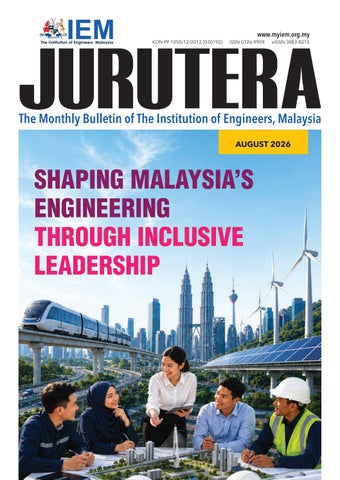
SHAPING MALAYSIA’S ENGINEERING THROUGH INCLUSIVE LEADERSHIP
JURUTERA Monthly Bulletin
Introductory Rate for New Advertisers RM 3,200/page *
(NP RM4,900)
Full-Page, Full-Colour Advertisement • This one-time-only special rate offer is for new advertisers. • Space availability is subject to booking on a first-come-first-served basis. • Clients will provide ready-to-print artwork in PDF format with 300dpi. Full page: 210mm x 297mm, 3mm extra bleed sizes for 4-sided. • Advertising space must be utilised before 31 December 2026. • *Please note that the above rate will be subjected to 8% SST. For overseas advertisers, an additional 25% will be charged. • Rate shown above excludes 15% advertising agency commission. • Payment term: Full advance payment. • Artwork submission deadline is on (or before) the 1st week of the prior month of publication. • After the material deadline, no cancellation or alteration to the advertisement will be entertained. • Any cancellation after signing the advertising order will result in a 50% penalty charge.
Circulation & Readership Profile JURUTERA has an estimated readership of 200,000 professionals. Our esteemed readership consists of certified engineers, decision making corporate leaders, CEOs, government officials, project directors, entrepreneurs, project consultants, engineering consulting firms and companies involved with engineering products and services.
• The publisher reserves the right to edit, revise or reject any advertisement deemed unsuitable or inappropriate.
Name of Company: Address: Tel:
Fax:
Contact Person (s):
Email Address: Publica�on month/s: Company’s Stamp & Authorised Signature
Date
Joseph How +6011 1234 8181
Shirley Tham +6016 283 3013
Joseph How +6011 1234 8181
Shirley Tham +6016 283 3013
Contents
AUGUST 2026
Cover Note
05 Leadership, Legacy and the Future We Build
Message from the Editor: Diversity and Inclusivity Engineering has always been driven by innovation, resilience, and the pursuit of solutions Ir. Stephanie that can improve society. As Malaysia progresses Sim Hui Kheng towards a sustainable and knowledge-based Principal Bulletin Editor economy, the engineering profession must also embrace diversity and inclusive leadership as key drivers of excellence. This edition of JURUTERA highlights the significant contributions of women engineers who continue to make an impact in technical fields, sustainability, digital transformation, governance, and leadership. Their achievements demonstrate how diverse perspectives strengthen decision-making, foster innovation, and build greater trust within organisations and the profession. Studies have shown consistently that inclusive organisations are better equipped to address complex challenges, adapt to change, and achieve sustainable outcomes. Recognising and empowering talent, regardless of gender, is therefore not only a matter of fairness but is also essential for the continued growth of the engineering profession. We hope this issue inspires engineers, organisations, and future leaders to cultivate inclusive workplaces where everyone can contribute meaningfully to help shape a profession that reflects the diversity of society while advancing engineering excellence, innovation, and sustainable progress for Malaysia.
06
39
Cover Story
06 Luminaries of Change: Diverse Voices Guiding Malaysia’s Future Engineering Beyond Technology
Features
14 Women Powering Malaysia’s Nuclear Future 18 Transforming Malaysia Through Women’s Digital Leadership 25 When Senyar Came A-Calling
Special Report
22 IEM IMPACT 2030 M2 Initiative: Seamless Professional Membership Pathway
Forums
30 Building Bridges Across Malaysia: Memorable Visit to IEM Sabah Branch 33 Advancing Engineering Intelligence Across ASEAN 36 Leadership Shapes Participation, Culture, and Organisational Growth 39 Role of Technical, Policy & Regulations Division in Driving The Energy Commission’s Transformation
Engineer’s Adventure
30
41
41 When Water Became Earth: Timeless Intelligence of Human Adaptation in Guangfulin
Engineer’s Lens
43 Grandeur of the Grand Canyon
Pink Page
44 Professional Interview
36
43 Online Issue
JURUTERA-i
Journal
Visit the IEM website at https://www.myiem.org.my/ or scan the QR code to read online
31 August
Hari Merdeka Malaysia Independence Day
COVER Note
IEM Registered on 1 May 1959 IEM COUNCIL SESSION 2026/2027
Ir. Prof. Dr. Zuhaina Zakaria Chair, IEM Women Engineers Section 2026/2027
President: Ir. Yau Chau Fong Deputy President: Ir. Chen Harn Shean Vice Presidents: Ir. Prof. Dr. Tan Chee Fai, Ir. Prof. Dr. Lau Hieng Ho, Ir. Yeong Chin Chow, Simon, Ir. Abdul Razak Yakob, Ir. Prof. Dr. David Chuah Joon Huang, Ir. Dr. Lee Yun Fook, Ir. Hj. Abrizan Abdul Kadir Honorary Secretary: Ir. Alex Looi Tink Huey Honorary Treasurer: Ir. Prof. Dr. Wong Yew Hoong Immediate Past President: Ir. Prof. Dr. Jeffrey Chiang Choong Luin Past Presidents: Academician Tan Sri Dato’ Seri Ir. Prof. Em. Dr. Chuah Hean Teik, Dato’ Ir. Dr. Lim Chow Hock, Ir. Dr. Tan Yean Chin, Ir. Ong Ching Loon, Dato’ Ir. Prof. Dr. Norlida Buniyamin Civil Representative: Ir. Chong Boon Hui Mechanical Representative: Ir. Cheng Yew Leong Electrical Representative: Ir. Kwok Yew Hoe Structural Representative: Ir. Lim Su Hian Chemical Representative: Ir. Kim Kek Seong Other Disciplines Representative: Ir. Dr. Dhakshyani Ratnadurai Multimedia Representative: Ir. Dr. Siti Aisyah Anas Women Engineers Representative: Ir. Prof. Dr. Zuhaina Zakaria Young Engineers Section Representatives: Mr. Lim Yiren, Mr. Darshan Balasubramaniam, Ms. Ong Ye Shian, Mr. Chuah Pei Lim, Mr. Teoh Chi Yang Council Members: Ir. Dr. Angelia Liew San Chuin, Ir. Prof. Dr. Zuhaina Zakaria, Ir. Begum Irdawati Dowlad Rahuman, Ir. Chong Chee Yen, Ir. Khoo Chee Min, Ir. Ahmad Rafidi Mohayiddin, Ir. Dr. Chan Swee Huat, Ir. Alex Looi Tink Huey, Ir. Sukhairul Nizam Abdul Razak, Dato’ Ir. Ting Chek Choon, Ir. Dr. Norashikin M Thamrin, Ir. Lee Cheng Pay, Datuk Ir. Chin Tet Fu @Willy, Ir. Gs. Br. Dr. Zarabizan Zakaria, Ir. Choo Lay Guat, Ir. Dr. Siow Chun Lim, Ir. Assoc. Prof. Dr. Leong Kah Hon, Ir. Dr. Sara Lee Kit Yee, Ir. Chan Wah Cheong, Ir. Dr. Marianah Masrie, Ir. Stephanie Sim Hui Kheng, Ir. Dr. Tan Inn Shi, Ir. Tajul Ariffin Mohamed Nori, Ir. Ng Sing Min, Ir. Ooi Mong Lee, Wendy, Ir. Rusnida Talib, Ir. Harris Abd Rahman Sabri Council Member by Invitation: Datuk Ir. Ho Hon Sang, Dato’ Indera Ir. Dr. Ahmad Sabirin Arshad, Ir. Dr. Sanjayan K.V. Velautham Branch Chairman 1. Penang : Ir. Dr. Lee Choo Yong 2. Southern : Ir. Kong Weng Keong 3. Perak : Ir. Dr. Tiah Oon Han 4. Pahang : Ir. Harzah Mazni Ramli 5. Kedah-Perlis : Ir. Jamaluddin Abdullah 6. Negeri Sembilan : Ir. Richard Khoo Nee Keong 7. Kelantan : Ir. Che Sufian Che Hussin 8. Terengganu : Ir. Zakaria Abdullah 9. Melaka : Ir. Sh. Ja’afar Sh. Ismail 10. Sarawak : Ir. Dr. Angelia Liew San Chuin 11. Miri : Ir. Chan Yen San, Stephanie 12. Sabah : Ir. Tan Kok Jyh STANDING COMMITTEE ON INFORMATION AND PUBLICATIONS 2026/2027
Chairman, InfoPub & Chief Editor: Ir. Prof. Dr. Lau Hieng Ho Vice Chairman & Principal Bulletin Editor: Ir. Stephanie Sim Hui Kheng Secretary: Ir. Assoc. Prof. Dr. Hum Yan Chai Chairman and Project Leader Jurutera-i: Ir. Alex Loo Tink Huey Principal Journal Editor: Ir. Dr. Bhuvendhra Rudrusamy Chairperson IEM Webportal: Ir. Dr. Tan Inn Shi Chairman, Sub Committee on Resource Centre: Ir. Wan Rizaluddin Abdullah Wan Ali Infopub Past Chairman by Invitation: Ir. Abdul Razak Yaakob Committee Members: Ir. Begum Irdawati Dowlad Rahuman, Ir. Tajul Ariffin Mohamed Nori, Ir. Dr. Hong Kai Sze, Ir. Prof. Dr. Teo Fang Yenn, Ir. Dr. Hasril Hasini, Ir. Dr. Tan Kim Seah, Ir. Lau Tai Onn, Ir. Yee Thien Seng, Ir. Wong Chee Fui, Ir. Dr. Lau Chee Yong, Ir. Razmahwata Mohd Razalli, Ir. Lee Chang Quan, Ir. Assoc. Prof. Dr. Moey Lip Kean, Ir. Ahmad Rafidi Mohayiddin, Ir. Tay Siang Hui, Ir. Kho Tuck Sing, Ir. Anizahyati Alisibramulisi, Ir. Dr. Aidil Chee Tahir, Dr. Tee Boon Tuan, Ms. Michelle Lau Chui Chui, Ms. Loo Suk Sin, Mr. Darshan Balasubramaniam, Mr. Chin Zehong BULLETIN EDITORIAL BOARD 2026/2027
Leadership, Legacy and the Future We Build
August is always a meaningful month for Malaysians. As we celebrate Merdeka, we are reminded that our nation’s progress is built on the contributions of many people, including engineers whose work touches lives every day. This special issue of JURUTERA, curated by the IEM Women Engineers Section, explores the theme, Shaping Malaysia’s Engineering Through Inclusive Leadership. Our cover story features three engineering leaders from diverse sectors whose journeys highlight the many pathways to leadership within the profession. Readers will also find stories of engineers contributing in diverse fields, from nuclear technology and digital transformation to professional service and community engagement. Together, they remind us that engineering is not just about technology and infrastructure but that it is also about people, leadership, and creating opportunities for future generations. As we reflect on our nation’s journey and look towards the future, may these stories inspire all engineers to continue learning and contributing to a stronger and more inclusive Malaysia.
DIMENSION PUBLISHING SDN. BHD. [ 199701034233 (449732-T) ] Level 18-01, PJX-HM Shah Tower, No. 16A, Persiaran Barat, 46050 Petaling Jaya, Selangor Darul Ehsan, Malaysia. Tel: +(603) 7493 1049 E-mail: info@dimensionpublishing.com Fax: +(603) 7493 1047 Website: www.dimensionpublishing.com Chairman Robert Mebruer
For advertisement placements and subscriptions, please contact:
CEO/Publisher Shirley Tham shirley@dimensionpublishing.com
DIMENSION PUBLISHING SDN. BHD. [ 199701034233 (449732-T) ] Tel: +(603) 7493 1049 Fax: +(603) 7493 1047 E-mail: info@dimensionpublishing.com Website: www.dimensionpublishing.com
Head of Marketing & Business Development Joseph How joseph@dimensionpublishing.com Production Editor Tan Bee Hong bee@dimensionpublishing.com Contributing Writers Putri Zanina putri@dimensionpublishing.com Hanna Sheikh Mokhtar hanna@dimensionpublishing.com Senior Graphic Designer Sofia Hanis Mohd Uzir sofia@dimensionpublishing.com
Subscription Department E-mail: info@dimensionpublishing.com JURUTERA MONTHLY CIRCULATION: OVER 40,000 COPIES Submission or placement of articles in JURUTERA could be made to the: Chief Editor THE INSTITUTION OF ENGINEERS, MALAYSIA (IEM) Bangunan Ingenieur, Lots 60/62, Jalan 52/4, P.O. Box 223 (Jalan Sultan), 46720 Petaling Jaya, Selangor, Malaysia.
Chief Editor: Ir. Prof. Dr. Lau Hieng Ho Principal Bulletin Editor: Ir. Stephanie Sim Hui Kheng Secretary: Ms. Michelle Lau Chui Chui
Graphic Designer Nicole Theng nicole@dimensionpublishing.com
Committee Members: Ir. Begum Irdawati Dowlad Rahuman, Ir. Tajul Ariffin Mohamed Nori, Ir. Dr. Tan Kim Seah, Ir. Razmahwata Mohd Razalli, Ir. Prof. Dr. Teo Fang Yenn, Ir. Lau Tai Onn, Ir. Yee Thien Seng, Ir. Ahmad Rafidi Mohayiddin, Ir. Dr. Lee Choo Yong, Ir. Lee Chang Quan, Ir. Dr. Lau Chee Yong
Advertising Consultants Tham Choon Kit ckit@dimensionpublishing.com
Tel: +(603) 7890 0130 Fax: +(603) 7957 7678 E-mail: pub@iem.org.my Website: http://www.myiem.org.my
Accounts Cum Admin Executive Yong Yen Yin yenyin@dimensionpublishing.com
Published by: The Institution of Engineers, Malaysia (IEM) Publishing Consultant: Dimension Publishing Sdn. Bhd. Printed by: Thunder Print Sdn. Bhd. (Licence No: 048515)
Dimension by Invitation: Ms. Shirley Tham, Ms. Sofia Hanis Mohd Uzir THE INSTITUTION OF ENGINEERS, MALAYSIA Registration No.: 1356 (Selangor)
Bangunan Ingenieur, Lots 60/62, Jalan 52/4, P.O. Box 223, (Jalan Sultan), 46720 Petaling Jaya, Selangor Darul Ehsan. Tel: 603-7890 0130 Fax: 603-7957 7678 E-mail: sec@iem.org.my Homepage: http://www.myiem.org.my © 2026, The Institution of Engineers, Malaysia (IEM) and Dimension Publishing Sdn. Bhd.
PUBLICATION DISCLAIMER The publication has been compiled by both IEM and Dimension with great care and they disclaim any duty to investigate any products, process, services, designs and the like which may be described in this publication. The appearance of any information in this publication does not necessarily constitute endorsement by IEM and Dimension. There is no guarantee that the information in this publication is free from errors. IEM and Dimension do not necessarily agree with the statement or the opinion expresssed in this publication. COPYRIGHT JURUTERA Bulletin of IEM is the official magazine of The Institution of Engineers, Malaysia (IEM) and is published by Dimension Publishing Sdn. Bhd. The Institution and the Publisher retain the copyright over all materials published in the magazine. No part of this magazine may be reproduced and transmitted in any form or stored in any retrieval system of any nature without the prior written permission of IEM and the Publisher.
6
AUGUST 2026
JURUTERA
•
COVER STORY
THE INSTITUTION OF ENGINEERS, MALAYSIA
Luminaries of Change:
Diverse Voices Guiding Malaysia’s
Future Engineering Beyond Technology As they go about their daily lives, Malaysians rely on systems they rarely stop to think about — highways, electricity networks, industries, and technologies which quietly keep the nation moving. Behind these systems are engineers whose responsibilities increasingly extend beyond technical design into leadership, strategy, and shaping the future. The engineering profession today extends far beyond technical problem-solving. Today’s engineers are expected to navigate uncertainty, lead multidisciplinary teams, balance commercial realities, embrace emerging technologies, influence organisational strategy, and contribute to national development. Increasingly, they are called upon to shape policy, inspire innovation, and prepare future generations to lead. To understand what engineering leadership demands in this new era, we speak to three distinguished engineering leaders whose careers span highway infrastructure, power transmission, industry, and corporate transformation: Datuk Nik Airina Nik Jaffar (Managing Director and Chief Executive Officer of PLUS Malaysia Berhad), Ir. Racheal Lim (former Chief Transmission Officer of Sabah Electricity Sdn. Bhd. and now an engineering consultant) and Dato’ Indera Ir. Dr. Ahmad Sabirin Arshad (Group Chief Executive Officer of Boustead Holdings Berhad).
COVER STORY
THE INSTITUTION OF ENGINEERS, MALAYSIA
• JURUTERA
AUGUST 2026
7
Although their professional journeys are remarkably different, their reflections converge on one powerful message, that engineering leaders of tomorrow will not be defined solely by technical brilliance. They will distinguish themselves through technical credibility, the ability to embrace transformation, and an unwavering commitment to developing people. Together, these qualities will help shape the future of the engineering profession and its contribution to Malaysia’s continued development.
Written by: Ir. Prof. Dr. Zuhaina Zakaria, Ir. Zainab Kayat, Ir. Rusnida Talib & Ms. Michelle Lau
8
AUGUST 2026
Credibility: Foundation of Leadership
The saying, “Rome wasn’t built in a day”, reminds us that enduring achievements are built through vision, expertise, and perseverance. Nation-building is no different. While economic progress is often measured through infrastructure and statistics, its true foundation lies in the people whose knowledge and leadership make that progress possible. Engineers are among these nation builders. They design systems which keep societies moving, industries productive, and communities connected. Alongside educators, scientists, healthcare professionals, policymakers, and countless others, they contribute to the collective expertise that strengthens the nation. Reflecting on his own career, Dato’ Indera Ir. Dr. Ahmad Sabirin often returns to one simple principle, that technical expertise earns respect, but credibility is built on years of consistently making sound decisions. His own career reflects this philosophy. Rather than remaining within a single specialisation, he has moved from marine engineering to mechanical engineering, aerospace, satellite development, industrial research, and eventually corporate leadership. As he puts it, he “started from sea to space” and believes, that engineers should continually challenge themselves rather than repeat the same experience throughout their careers. Having spent decades in power transmission and system operations, Ir. Racheal Lim has led engineering teams responsible for one of Sabah’s most critical infrastructure systems. She says technical excellence develops sound judgement and enables leaders to make informed decisions when safety, reliability, and operational performance are at stake. More importantly, it gives teams confidence in their leaders, allowing them not merely to direct work, but also to guide organisations through increasingly complex challenges. Leading Malaysia’s largest highway concessionaire, Datuk Nik Airina oversees a network that
JURUTERA
•
COVER STORY
THE INSTITUTION OF ENGINEERS, MALAYSIA
serves millions of road users every day. Her perspective is shaped by an engineering career that has taken her through design, project management, construction, operations, and maintenance before assuming corporate leadership. Experiencing each stage of an asset’s life-cycle has given her a broader appreciation of how engineering decisions affect not only project delivery, but also long-term operations, customers, and society. This explains why she believes engineering decisions should always be viewed across the entire asset life-cycle. Success is measured not only by technical performance or the initial investment, but also by long-term sustainability, operational efficiency, resilience, customer value, and broader societal impact. Together, their perspectives reinforce a common message: Technical excellence remains the foundation of engineering leadership. Yet, in today’s increasingly complex world, technical expertise alone is no longer enough.
From Technical Experts to Transformation Leaders
All three leaders shared a common view: Technical competence may open the door to leadership, but it is the ability to adapt, innovate, and influence others that enables leaders to remain effective. The era when engineers could thrive solely within technical disciplines is rapidly disappearing. Today’s leaders must understand finance, communicate across diverse stakeholders, evaluate investment risks, appreciate customer expectations, and make decisions that balance engineering excellence with commercial sustainability. “Leaders must be willing to change or be changed” is the simple philosophy that has guided Dato’ Ahmad Sabirin throughout his career. Having worked in academia, research, technology, manufacturing, and corporate leadership, he has seen first-hand how industries evolve and knows that continuous learning is essential.
Digitalisation, artificial intelligence, sustainability, and emerging technologies continue to reshape industries at an unprecedented speed. Engineers who continue learning remain relevant and those who stop learning, risk limiting both their own careers and the organisations they lead. Dato’ Ahmad Sabirin also encourages engineers to broaden their perspectives beyond technical expertise by strengthening their communication skills, financial literacy, and understanding of business. In his view, these capabilities enable engineers to lead organisations rather than simply contribute technical solutions. Young engineers should also step forward rather than wait for opportunities. Leadership, he believes, begins by volunteering for responsibilities, embracing new challenges, and gaining the confidence to contribute beyond one’s formal role. Datuk Nik Airina believes the future belongs to hybrid engineers, professionals who combine strong technical foundations with complementary expertise in areas such as business, sustainability, digital technologies, artificial intelligence, law or finance. As engineering challenges become increasingly interconnected, tomorrow’s leaders must be comfortable working beyond traditional engineering boundaries and collaborating with professionals from diverse disciplines. In her view, technical expertise remains the foundation, but it must be complemented by broader perspectives and a willingness to keep learning. Engineers who understand both technology and the wider business, regulatory, and societal landscape will be better equipped to anticipate change, make balanced decisions, and lead organisations into the future. Datuk Nik also emphasises that better engineering outcomes are achieved when different disciplines work together and diverse perspectives are considered from the outset. Drawing on her own career, she encourages young engineers to look beyond traditional career pathways.
COVER STORY
THE INSTITUTION OF ENGINEERS, MALAYSIA
• JURUTERA
AUGUST 2026
9
Dato’ Indera Ir. Dr. Ahmad Sabirin Arshad
Ir. Racheal Lim
Datuk Nik Airina Nik Jaffar
Engineers who complement their technical expertise with knowledge of digital technologies, business, finance, sustainability, or law will be better equipped to lead increasingly complex organisations. She also believes that universities can play a greater role by providing more opportunities for interdisciplinary learning, allowing graduates to develop the hybrid capabilities that industry increasingly demands. Ultimately, transformation is not driven by technology alone. It is also driven by engineers who are willing to broaden their perspectives, embrace change, and lead beyond their technical disciplines.
not just infrastructure. She believes engineers grow when leaders create opportunities, share knowledge openly, and build confidence in others. As she puts it, growth often begins when someone believes in you first. Her career reflects this philosophy. In 2024, she became the first and only woman in Malaysia accredited as a 275 kV Electrical Service Engineer, a milestone in the field of high-voltage transmission engineering which reflects decades of technical expertise and professional competence. Characteristically humble, she says simply: “I just wanted to do my best. I did not set out to be the first.” For her, technical competence is more than professional achievement as it is also the foundation upon which trust, sound judgement and leadership are built. Leaders who have walked the technical path are better equipped to guide others through complex, highstakes environments where safety, reliability, and precision cannot be compromised. Yet she also believes that technical strength alone is not enough. True engineering leadership emerges when leaders challenge people without diminishing them, creating an environment where individuals feel safe to contribute
ideas, to learn from mistakes, and to continue growing. When engineers are trusted to think instead of to just execute, innovation becomes a natural outcome of the culture. Datuk Nik Airina echoes this philosophy through a broader organisational lens. From her perspective, the increasingly complex challenges facing the engineering sector cannot be solved by any one single discipline. They demand open communication, multidisciplinary collaboration, and a willingness to integrate diverse viewpoints. The strongest outcomes, she notes, are achieved not through individual brilliance alone, but also through teams aligned by shared purpose and mutual respect. She believes that creating an environment where different disciplines work together openly is essential for better engineering decisions and stronger organisational performance. Across all three conversations, one theme surfaces repeatedly: Leadership is measured by not only what we personally achieve, but also by the people we help develop. Whether through mentorship, sharing knowledge, or creating opportunities for younger engineers, all three leaders see developing others as one of their most important
Leadership’s Greatest Legacy: Developing People
Yet as our conversations progressed, one theme emerged more strongly than any other, that leadership is ultimately about people. Projects are completed. Technologies evolve. Infrastructure is eventually upgraded or replaced. The one legacy that continues to influence organisations long after individual projects have ended is the people who have been developed along the way. For Ir. Racheal Lim, shaping Malaysia’s engineering future is ultimately about building people,
10 AUGUST 2026
JURUTERA
•
COVER STORY
THE INSTITUTION OF ENGINEERS, MALAYSIA
technologies, EV charging networks, and future mobility solutions. These developments reinforce her belief that tomorrow’s engineers must become hybrid professionals capable of integrating engineering with digital and business expertise. The trio’s shared vision is clear. Tomorrow’s engineers will need to think beyond their own disciplines, work effectively with others, and remain open to learning throughout their careers. These qualities will not only strengthen engineering organisations but also help Malaysia respond to increasingly complex challenges with confidence and resilience.
Building More Than Infrastructure
responsibilities. Developing people, it becomes clear, is not simply one aspect of leadership but rather, it is one of the most enduring legacies a leader can leave behind.
Shaping Malaysia’s Future
The future of Malaysia will be determined by not only the infrastructure it builds but also by the engineers it develops. Collectively, their perspectives point to a new generation of engineers who remain technically grounded while embracing lifelong learning, communicating effectively, understanding business, and leading confidently beyond their technical disciplines. Dato’ Ahmad Sabirin believes education remains the most important investment in Malaysia’s engineering future. He advocates a culture of lifelong learning in which engineers can continue developing new knowledge and skills throughout their careers rather than viewing education as something that ends with a degree.
However, knowledge alone is not enough. Ir. Racheal shares a similar view that Malaysia does not lack capable engineers. Instead, she believes that the greater challenge lies in developing confidence, ownership, and the willingness to step forward. With the right guidance, mentorship and opportunities to take responsibility, today’s engineers have the potential to become trusted leaders of tomorrow. As engineers grow in confidence and leadership, the demands of the profession continue to evolve. Datuk Nik Airina believes future engineers must broaden their capabilities beyond traditional engineering boundaries. She encourages engineers to develop complementary expertise in digital technologies, sustainability, finance and business while staying grounded in strong engineering fundamentals. Looking ahead, she sees our highways evolving into smarter and more sustainable infrastructure through AI-enabled predictive maintenance, digital
Listening to the three leaders reveals that there is no single pathway to engineering leadership. While their careers span different industries, different responsibilities, and different experiences, their values remain remarkably aligned. Each demonstrates that leadership is built on three enduring qualities: Technical excellence that earns credibility, adaptability that enables transformation, and a genuine commitment to developing people. Engineering has never been solely about designing highways, transmission systems, industrial facilities, or corporate strategies. These are simply the visible outcomes of a much greater purpose. At its heart, engineering is about building confidence, creating opportunities, strengthening communities, and enabling nations to progress. As Malaysia continues to evolve, engineers will remain central to shaping its industries, economy, infrastructure, and society. Yet, perhaps their greatest contribution will not be in the systems they design or the projects they deliver but will be in the leaders they cultivate, the organisations they strengthen, and the future generations they inspire. Ultimately, as Dato’ Ahmad Sabirin reiterates, the true purpose of engineering is not simply to build infrastructure, but to create a better quality of life for society.
The
Coming Klang of Valley
MRT
Joseph How +6011 1234 8181
Shirley Tham +6016 283 3013
14 AUGUST 2026
JURUTERA
•
FEATURE
THE INSTITUTION OF ENGINEERS, MALAYSIA
capacity and number of reactors, based on data from the International Atomic Energy Agency (IAEA) Power Reactor Information System (PRIS) database as of June 2025[1]. Nuclear power plants and technologies have improved over the years, with many failproof barriers to ensure safety and to prevent meltdown in the nuclear core. Engineering expertise plays an instrumental role in ensuring safety and reliability of nuclear power plants, which ultimately will be able to boost public confidence in nuclear energy. To safeguard Malaysia’s energy mix and to support the long-term sustainable development of nuclear energy locally, a key question remains: How can this be achieved? Human capital, talent retention, and leadership diversity are crucial in such high-impact technologies to ensure local talents can be nurtured and developed in this field. At the same time, more should be done by the various stakeholders in support of nuclear power generation to improve public perception of nuclear power, ensuring this reliable and efficient source of energy can play an instrumental role in diversifying the country’s energy mix. Historically, the field of engineering, particularly nuclear-related disciplines, were male-dominated with limited female representation in technical and leadership roles. However, this trend has steadily evolved alongside Malaysia’s expansion in science and technology education and now, women are a significant proportion of STEM students and professionals.
Women Powering Malaysia’s Nuclear Future by: Ir. Assoc. Prof. Dr. Serene Lock Sow Mun Associate professor championing women's STEM leadership and sustainability energy solutions.
Ms. Choong Pooi Ying Aspiring corrosion engineer passionate about corrosion management, engineering education, sustainability, and green technology.
Nuclear power, despite being reliable and efficient, has always been seen as a controversial and relatively dangerous source of energy due to past histories. According to data reported by the Energy Commission Malaysia, Malaysia’s current energy landscape remains heavily reliant on non-renewable fossil fuel resources, with fossil-based generation accounting for over 90% of the electricity subsector’s energy mix, whereas renewable energy sources, such as solar and hydro power, contributes to the remaining energy mix for power generation. The ongoing global geopolitical instability has contributed to heightened volatility in non-renewable energy markets, leading to concerns over global energy security and a substantial increase in fossil fuel prices worldwide. This has prompted governments to issue urgent measures and statements to manage potential shortages and to curb panic buying. In light of these challenges, an important question emerges: What if nuclear power is incorporated into Malaysia’s energy mix? Nuclear and nuclear-adjacent technologies have been developed and used for many years in the field of power generation, medical, industrial, and research applications. Although nuclear energy is often viewed with caution due to high-profile major accidents such as Chernobyl and Fukushima Daiichi, it cannot be denied that nuclear power plants have been running with minimal issues in countries such as the United States, Europe (France and Russia), China and South Korea. Figure 1 is a tabulation of major nuclear reactors worldwide, categorised according to their total installed
Figure 1: Global distribution of major nuclear reactors, summarising the number of reactors and their corresponding installed capacities by country (Source: IAEA Power Reactor Information System database[1])
FEATURE
THE INSTITUTION OF ENGINEERS, MALAYSIA
AUGUST 2026
• JURUTERA
In nuclear and radiation sciences, women have increasingly contributed in research, regulatory, and applied domains, including medical physics, radiation safety, and nuclear research. Organisations such as Women in Nuclear (WiN) Malaysia have played a pivotal role in building networks, promoting awareness, and encouraging female participation across academia, industry, and policy. Both internationally and locally, there has been a growing emphasis on gender inclusivity and equitable leadership representation. Initiatives such as the 30% Club, a global movement advocating for increased female representation in leadership roles, have played a significant role in accelerating progress towards more diverse and inclusive governance across sectors. Milestones such as the appointment of female directors-general in key nuclear agencies highlight progress in breaking traditional barriers. More broadly, Malaysian organisations are adopting policies which support women’s career advancement, including leadership pathways, flexible work arrangements, and diversity-driven initiatives. Importantly, the inclusion of women enhances decision-making in safety-critical domains such as nuclear engineering. Diverse perspectives can contribute positively to more comprehensive risk assessment, innovation, and stakeholder engagement, all which are critical elements in high-reliability systems. As Malaysia advances its nuclear ambitions, the growing presence of women engineers is not only a matter of equity but is also a strategic advantage in building a resilient, safe, and socially trusted nuclear ecosystem. The emergence of women engineers in our nuclear ecosystem reflects a broader national shift in STEM participation and institutional inclusivity. Women engineers in Malaysia are increasingly driving technical excellence across the nuclear value chain, contributing to research, applied engineering, and innovation that supports national development and energy readiness. Within the Malaysia Nuclear Agency, scientists and senior women engineers from multidisciplinary engineering backgrounds play vital roles in advancing the nation’s nuclear science capabilities. As of March 2026, the official leadership directory of Malaysian Nuclear Agency shows seven women leaders holding director positions, indicating the growing role and leadership contributions of women in Malaysia’s nuclear sector[2]. Dr. Julia Abdul Karim and Dr. Hasni Hasan provide key leadership in engineering and technical direction, while Dr. Zainah Adam, Dr. Zaiton Ahmad, Dr. Fairuz Suzana Mohd Chachuli, Ms. Nor Aishah Sulaiman, and Ms. Hasnida Samsudin contribute significantly through their technical expertise and support in strengthening research, development, and implementation activities across the nuclear science domain. Collectively, their contributions extend beyond strengthening domestic technical capacity to encompass active participation in international knowledge transfer and scientific engagement. This includes collaboration with global nuclear research networks, contribution to technical discussions and standards development, and dissemination of research findings which enhance Malaysia’s visibility in the international nuclear science community. Through their involvement in radiation applications, research coordination, industrial irradiation programmes, and the development of scientific infrastructure, they continue to reinforce Malaysia’s capability in delivering safe, innovative, and application-driven nuclear technologies while strengthening its position within the global nuclear knowledge ecosystem. In the international nuclear landscape, Dr. Nur Shahidah Abdul Rashid stands out as a notable Malaysian woman making significant contributions in the global nuclear sector. She is the only Malaysian woman working as a nuclear safety engineer in France, where she is actively involved in civilian nuclear design, governance, and safety regulation. Dr. Nur Shahidah has contributed to the international nuclear safety arena through her involvement with Autorité de sûreté nucléaire et de radioprotection (ASNR), France’s nuclear regulatory authority. In this role, she has been
15
Nehemiah Prestress 1140945-A
Nehemiah-OVM provides the following products and services: - Post-tensioning solution provider - Carpark Flat Slab - Transfer Plate - Beams, Box Girders - Alternative design solutions - Cable systems (stay cable, main cable, hanger)
- Bridge bearing and expansion joint - Construction solutions (heavy lifting, ILM, etc) - Monitoring, repairing and strengthening for structures
Nehemiah Prestress Sdn Bhd (1140945-A) No. 45-3, Jalan PJU 5/20 The Strand, Kota Damansara 47810 Petaling Jaya Selangor Darul Ehsan Tel Fax Email
Nehemiah : 603-61426638 A member of the Nehemiah Group : 603-61426693 : enquiry-pt@nehemiah-grp.com Certified by the European
Organization for Technical Approval
16 AUGUST 2026
JURUTERA
•
FEATURE
THE INSTITUTION OF ENGINEERS, MALAYSIA
actively engaged in the assessment and review of licensing frameworks for advanced nuclear technologies, including Small Modular Reactors (SMRs) and Advanced Modular (a) Reactors (AMRs), while contributing to environmental and human safety assessments through radionuclide and toxic chemical contamination modelling and the development of mitigation and management strategies. Malaysia’s nuclear industry has witnessed many women engineers spearheading critical roles in shaping nuclear governance, regulatory systems, and national capacity development. Dr. Siti Aiasah Hashim is a founding member of WiN Malaysia and served as its President from 2019. She made history in 2021 as the first female Director-General of the Malaysian Nuclear Agency. Through her role, she has actively promoted nuclear and radiation technologies to industry, leveraging her 30 years of experience in the field. Through WiN Malaysia, (b) she has strengthened advocacy for nuclear energy by expanding Figure 2: Infographic illustrating (a) women’s participation in the nuclear industry (Source: Organisation for Economic Co-operation and Development (OECD) Nuclear Energy the network of women nuclear Agency (NEA)[3]) and (b) Net public support for nuclear energy disaggregated by gender, professionals, providing mentorship, *represents non-nuclear nations (Source: Radiant Energy Group) training, knowledge-sharing, and the next generation of technical leadership contributing professional support. This initiative has encouraged the to applied nuclear science and engineering development greater participation of women in the nuclear sector by within national institutions; she is the Deputy Secretary addressing key challenges, fostering collaboration, and General (Energy) at the Ministry of Energy Transition & facilitating meaningful dialogue. At the highest level of Water Transformation (PETRA), leading national efforts in nuclear regulation, Dr. Hajjah Noraishah Pungut and Ms. energy transition. Hajjah Monalija Kostor, serving as the Director-General In addition, Ms. Siti Safinah Salleh, Chief Executive and Deputy Director-General of the Department of Atomic Officer (CEO) of Energy Commission (ST) Corporation Energy respectively, provide national leadership in nuclear and former CEO of MyPOWER Corporation, has been safety governance and international representation. instrumental in strengthening Malaysia’s energy They have strengthened Malaysia’s nuclear regulatory regulatory framework and driving key reforms in the by advancing the safe, secure, and peaceful use of electricity and piped gas supply industry under PETRA. radioactive materials, nuclear and radiation technologies. Collectively, these contributions demonstrate a robust Under their leadership, the Department of Atomic ecosystem where women engineers and scientists actively Energy is overseeing more than 2,000 active licences shape Malaysia’s nuclear governance, policy alignment, in sectors such as oil and gas, manufacturing, research, and institutional resilience towards clean energy transition and medical applications, ensuring robust governance and diversification. and compliance. They both played a central role in Despite the significant contributions of women to strengthening Malaysia’s regulatory alignment within Malaysia’s nuclear science and technology landscape, the international nuclear landscape through adherence challenges remain in achieving broader representation to International Atomic Energy Agency (IAEA) safety at senior strategic, technical, and decision-making standards and regulatory frameworks. Their efforts have levels. While women have demonstrated excellence in supported the harmonisation of national practices with research, engineering, regulatory oversight, and scientific global requirements, particularly in ensuring robust safety, leadership, their participation in leadership pipelines within security, and operational compliance across nuclear highly specialised and safety-critical domains remains science and technology activities. Within Malaysia’s comparatively limited. According to survey carried out scientific ecosystem, Ms. Mareena Mahpudz represents
FEATURE
THE INSTITUTION OF ENGINEERS, MALAYSIA
AUGUST 2026
• JURUTERA
by the Nuclear Energy Agency (NEA) in 2023, women represented less than 20% of the nuclear workforce, while accounting for only ~20% of the STEM workforce and less than 20% of senior leadership positions[3]. Based on another survey conducted by Radiant Energy Group in 2023, the gender gap remained significantly pronounced in the nuclear sector[4]. Women often cite concerns regarding safety risks and the potential for nuclear energy deployment to delay the transition towards renewable as key reasons for their limited support. Expanding opportunities for women to assume greater leadership roles in technical management, policy formulation, and organisational governance are essential for strengthening the sector’s long-term resilience and diversity. Another challenge lies in the demanding nature of careers in the nuclear field, where regulatory compliance, research excellence, engineering responsibilities, and operational oversight require sustained commitment in highly regulated and technically intensive environments. Ensuring that talented women are supported through mentorship, leadership development programmes, professional networks, and inclusive workplace policies will be critical to fostering career progression and retaining expertise within the sector. At the same time, women leaders are uniquely positioned to address one of the most important challenges facing the nuclear industry related to public perception and acceptance. Concerns surrounding nuclear safety, radioactive waste management, and the legacy of major nuclear accidents continue to influence public perception of nuclear technologies. Through effective science communication, stakeholder engagement, education, and community outreach, women leaders can play a transformative role in building public trust and strengthening societal understanding of the benefits and risks of nuclear technologies. Looking ahead, Malaysia also faces broader sectoral challenges, including the need for sustained investment, long-term policy certainty, and continued development of national capabilities in nuclear safety, security, emergency preparedness, waste management, and supply chain readiness. These challenges, however, present opportunities for a new generation of women scientists, engineers, educators, and policymakers to contribute to the nation’s nuclear development agenda. By strengthening leadership pathways, promoting gender diversity, and fostering international collaboration, Malaysia can further leverage the talents of women to drive innovation, enhance national competitiveness, and shape a safe, sustainable, and globally connected nuclear future. Inspiration and visibility remain central to developing future women engineers in Malaysia for advancing nuclear ecosystem. International initiatives such as the IAEA Marie Skłodowska-Curie Fellowship Programme (MSCFP), Lise Meitner Programme Women in Nuclear (WiN Global) continue to provide structured pathways for leadership development, mentorship, and technical training in nuclear science and engineering.
17
In Malaysia, senior female figures play a visible role in mentoring and guiding the next generation of engineers through institutional leadership, outreach programmes, and professional engagement. These efforts are further supported by local universities, Malaysian Nuclear Agency (Agensi Nuklear Malaysia), regulatory agencies, and IEM, which collectively provide platforms for STEM outreach, internships, and professional development. Through these ecosystems, young engineers are exposed to realworld applications in radiation science, reactor simulation, regulatory systems, and energy engineering, which help bridge the gap between academic training and professional practice. Inclusive leadership ensures that talent is not only developed but also retained and empowered to contribute meaningfully to national innovation and resilience. The ambition of nuclear power generation in Malaysia is not a dream, but a strategic necessity to ensure sustainability and variability in our energy mix. Through nuclear power generation development policies, local talent development, foreign technical exchange and, most importantly, strategic management to foster positive public perception towards nuclear energy, Malaysia can progressively turn this vision into reality. Achievements by trailblazers such as Dr. Siti Aiasah Hashim and Hajah Noraishah Pungut, women can prove they are not peripheral to the field but rather, are central to its success. REFERENCES [1] International Atomic Energy Agency (IAEA). Power Reactor Information System (PRIS) [2] Malaysian Nuclear Agency (Agensi "Organisational Chart." (accessed 2026).
Nuklear
Malaysia),
[3] Organisation for Economic Co-operation and Development (OECD) Nuclear Energy Agency (NEA), "Gender Balance in the Nuclear Sector," 2023. [4] Radiant Energy Group, "Public Attitudes toward Clean Energy," 2023.
DEEPEST CONDOLENCES On behalf of The Institution of Engineers, Malaysia (IEM), we extend our heartfelt condolences to the bereaved family of Ir. Haji Mohamed Ali bin Yusoff on his passing. We honour and deeply appreciate his long-standing contributions to IEM included serving as Vice President (1993/1994), Council Member (1995/1996, 1998-2001, 2002-2005, 2006-2009 and 2009-2012), Member of the Standing Committee on Examinations & Qualifications (E&Q) since 1994, Member of the Standing Committee on Corporate Affairs (CA), Member of the Standing Committee on Admissions and Practical Training (APT), Member of the Accreditation Board and Scrutineer for the Council Elections.
18 AUGUST 2026
JURUTERA
•
FEATURE
THE INSTITUTION OF ENGINEERS, MALAYSIA
for high-performance AI data centres, where substrates must manage extreme thermal loads and signal integrity at nanoscale geometries. Meanwhile, Sharala Axryd approaches the transformation context from a different vantage point but arrives at a structurally related diagnosis. After telecommunications roles at Maxis and Actix exposed her to data as a commercial asset, her founding of CADS in 2015 was motivated by a question that remains relevant today. Why should a talented Malaysian professional need to leave the country to realise full economic potential? CADS, positioned as ASEAN’s first applied data science centre, was built as a systemic response to the gap between available talents and the capability Malaysia’s digital economy requires. Both women identify brain drain as a structural risk rather than a human resources inconvenience. Sharala frames it with precision. Brain drain occurs not only when professionals emigrate, but also when they remain underutilised, when a competent accountant cannot read a data dashboard, or when a nurse cannot navigate a digital health system. This “invisible brain drain”, as she characterises it, represents a diffuse but compounding loss of national capability. Yap’s response is structural. Talent must be retained through operations which require and reward high-order engineering skill, as AT&S’s embedded R&D activities and university-level substrate education initiatives in Kulim demonstrate.
Transforming Malaysia Through Women’s Digital Leadership by: Ir. Assoc. Prof. Dr. Mah Siew Kien Dean of Faculty of Computing & Engineering, Quest International University, she is passionate about advancing women in engineering and strengthening Malaysia’s technology pipeline.
Malaysia’s digital economy transformation is no longer a policy aspiration. It is an engineering challenge that’s being solved in real time at every level of the technology stack. From advanced Integrated Circuit substrates powering next-generation AI accelerators to human capital frameworks which help professionals reason with data, the infrastructure of a digital nation is both physical and cognitive. Two leaders operating at opposite ends of this spectrum offer a clear lens through which to examine Malaysia’s technological trajectory. Ms. Yap Suan See, SVP, Managing Director and Managing Director Malaysia at AT&S, anchors Malaysia’s microelectronics ambitions in Kulim, where the country’s first high-end IC substrate production facility is operating and expanding. Ms. Sharala Axryd, founder and CEO of the Centre of Applied Data Science (CADS), advances the human capital dimension by building AI and data capability across Malaysia’s workforce. Together, their work maps the twin imperatives of Malaysia’s engineering future, building the infrastructure and developing the people who can use it.
Industry & Digital Transformation
The ASEAN technology landscape is increasingly defined by the convergence of advanced semiconductor manufacturing, artificial intelligence infrastructure, and data-driven enterprise operations. Malaysia sits at a critical junction within this convergence, having attracted significant investment in both semiconductor fabrication and digital services in the past decade. However, the risk of becoming a production node without commensurate intellectual capital, assembling and manufacturing for global firms without retaining the engineering decisionmaking, remains a live concern. At AT&S Kulim, Yap Suan See’s mandate is to establish Malaysia as more than a manufacturing location. AT&S describes itself as the first producer of high-end IC substrates in Malaysia, supplying sophisticated substrates for AMD data centre processors and AI accelerators. The Kulim campus has fully utilised its Phase 1 land capacity, with the second plant targeting operational readiness by 2026. This places Malaysia in the global supply chain
Technical Challenges & Engineering Solutions The engineering challenges embedded in AT&S’s Kulim operations are substantive. IC substrate manufacturing for high-performance data centre applications demands mastery of moulding-lamination, material science for thermal management, and the continuous development of new process know-how. In 2025, the AT&S Technology Development in Kulim executed a project on Moulding Encapsulation, a new direction in encapsulation material exploration which required evaluation of grinding tools, lamination techniques, and multiple material trials. Moulding compound was selected specifically for its thermal management properties, a critical requirement for data-centre-grade substrates where heat dissipation directly affects processor reliability and longevity. The project succeeded under the leadership of a predominantly female engineering team, including Shah Aifa Shah Johan as Project Manager and Siti Nurfathirah Izhar as Project Coordinator. The outcome, namely the new AT&S process know-how that meets critical product quality thresholds, has since attracted multiple followon moulding-related projects. This is not an incidental detail but rather, evidence to show that the talent pipeline which AT&S has invested in, is capable of producing commercially significant R&D output. The technical challenges Sharala addresses are of a different class but equally concrete. Scaling AI adoption
FEATURE
THE INSTITUTION OF ENGINEERS, MALAYSIA
• JURUTERA
across an enterprise requires solving more than a training problem. Her diagnosis is precise. Completing a course and applying a skill are two completely different things, and organisations routinely conflate them. CADS AI, an intelligence system developed to profile skill gaps, behavioural readiness, and role-based learning needs, is an attempt to operationalise the difference. Such tools do more than measure progress. They surface hidden talent gaps that conventional training audits miss and help distribute learning interventions equitably across roles and functions. Rather than generic, volume-based training programmes which satisfy HR compliance without changing workflows, CADS deploys targeted, measurable interventions tied to operational change. The system’s architecture reflects an engineering logic in which diagnosis precedes prescription and measurement validates outcome. The interoperability challenge is also present in Sharala’s work, though expressed differently. Digital transformation that is siloed within a single sector creates bottlenecks rather than transformation. CADS therefore operates across government-linked companies, government agencies, healthcare systems, financial services, manufacturing, and education, a deliberately cross-sector deployment model designed to prevent the fragmented adoption patterns that limit systemic impact.
Data Governance, Sustainability Frameworks & Systems Architecture
The AT&S approach to sustainability in Kulim is best understood not as a compliance posture but as an engineering leadership decision. The plant operates under internationally recognised management systems spanning energy, environment, safety, and quality, and aligns its supply chain practices with globally accepted labour and responsible sourcing standards. What matters for engineering leaders is not the list of certifications, but what they make possible, a governance architecture that allows an advanced manufacturing facility to be held to account at every operational level, by external auditors, by financiers, and by its own management systems simultaneously. The capital structure reflects the same logic. AT&S has secured sustainability-linked loan (SLL) financing from both the International Finance Corporation and Maybank, with loan terms tied directly to measurable emissions reduction targets and a pathway to full renewable energy sourcing. For Yap and her leadership team, this means sustainability performance is not just a reporting function but a financial obligation with tangible consequences, governed by the same engineering discipline applied to yield rates and process quality. Given that a Malaysian commercial bank was among the first in the region to extend such a facility to a multinational manufacturer in the semiconductor sector is, in itself, a signal that the financial infrastructure needed to sustain this model is maturing alongside the industrial one. Sharala’s governance framing operates at the policy and institutional level. She situates AI literacy as national infrastructure, not a line item within corporate training
AUGUST 2026
19
budgets. This reframing affects how investments are evaluated and sustained. National infrastructure is built with long-term horizons, maintained against degradation, and measured against systemic rather than individual outcomes. Treating digital capability the same way changes the investment logic. The question is not “what returns does this training programme produce for this organisation?” but “what capability does this investment create for the national system?”. The Harvard Business Analytics Programme partnership has reinforced CADS’s belief that Malaysian professionals across disciplines are capable of worldclass data thinking when given structured access and the right environment. It provides an externally credible reference point for the quality of human capital that deliberate investment can produce. For Sharala, this is not simply a partnership. It is evidence for a policy claim that Malaysia’s talent deficit is structural rather than innate, and therefore correctable.
Talent Development, Skills Architecture & Workforce Capability
Yap’s career spans 30 years across Applied Magnetics, Seagate Technology, Finisar Malaysia (now Coherent Malaysia), and AT&S, traversing hard disk drive components, optoelectronics, and advanced IC substrates. This breadth is not incidental to her leadership philosophy. She describes the early years of her career as deliberate capability accumulation, learning new disciplines and taking on responsibilities without anticipating immediate returns, on the premise that acquired competence is permanently owned. Her rise from Operations Manager at Finisar’s greenfield Malaysia start-up to Vice-President of Operations and Managing Director over 20 years, reflects the compounding effect of that early investment. Her advice to aspiring engineers and women in technical leadership is framed in terms of grit, adaptability, and continuous learning, but she is precise about what learning means. It is not confined to formal instruction. Networking, engaging in substantive conversations, and understanding diverse perspectives are all legitimate learning channels. This position treats contextual intelligence, namely understanding how different parts of a system interact, as an engineering competency, not merely a social skill. Sharala’s talent development architecture is broader in scope and more systematically designed. Her observation that invisible brain-drain, namely the under-utilisation of capable professionals already in Malaysia, is as damaging as emigration reframes the talent problem beyond retention. The workforce intervention is not only to train more engineers, but also to raise the digital capability floor in every profession. CADS works with finance professionals, healthcare workers, supply chain managers, educators, and civil servants for this reason. Making every Malaysian professional “dangerous with data”, as Sharala puts it, changes the economic calculation around whether to remain in Malaysia or seek opportunity elsewhere.
20 AUGUST 2026
JURUTERA
•
FEATURE
THE INSTITUTION OF ENGINEERS, MALAYSIA
when making location decisions. Tax incentives and infrastructure matter, but the decisive question is whether firms can hire locally and build sustainably. Every time a data professional, AI engineer, or digitally capable policy analyst leaves for Singapore, London, or San Francisco, Malaysia emits a market signal that it cannot retain what it grows. Investors read that signal. Building an AI-literate workforce across all sectors, not just technology, changes the investment conversation from passing-through capital to long-term partnership. The ASEAN dimension is also implicit in AT&S’s sustainability-linked loan financing. The Maybank SLL represents the first such facility by a South-East Asian commercial bank to AT&S, a structural first that Ms. Yap Suan See, Senior Vice President and Managing Director, AT&S Malaysia positions Malaysia’s banking sector as a credible partner for ESG-aligned manufacturing investment Both leaders place particular weight on women in at the regional frontier. This is not merely symbolic. It technical talent development, though from different demonstrates that Malaysia’s financial infrastructure can organisational contexts. Yap points to AT&S Malaysia’s support the capital instruments which globally competitive 0.75:1 female-to-male engineer ratio as a deliberate manufacturers require, and this, in turn, supports the case outcome of equal-opportunity practices and structural for deeper regional manufacturing investment. supports, including flexible work-from-home arrangements. Sharala’s mentorship work is cross-sector. A woman in public health who leads with data is, in her view, as powerful an agent of change as a woman in software engineering. Diversity in STEM, as she frames it, cannot be reduced to coding bootcamps. It must build digitally confident women in every profession, because the alternative is an AI-shaped future designed without the perspectives of those who must navigate it.
Regional & ASEAN Considerations
Malaysia’s positioning within the ASEAN digital economy is shaped by competition for investment and talent. Both Yap and Sharala address these dimensions, and their combined analysis suggests that the two are more tightly coupled than policy frameworks typically acknowledge. Ms. Sharala Axryd (centre) receiving the SME & Entrepreneurship Business Award Yap’s framing is direct. The AT&S Kulim campus contributes to our semiconductor ecosystem Forward-Looking Insights through production output, university substrate education Yap’s vision for Malaysia’s digital economy is circular and programmes, localisation of vendor networks, and interconnected because digital technologies enhance development of domestic supply chains for high-end services that produce societal value, creating demand manufacturing. These activities address the second-order for further digital capability. She grounds this abstraction question that matters most for long-term competitiveness, in assisted living for an ageing population, enabled namely whether Malaysia’s semiconductor presence is by live-streaming, remote monitoring, and connected generating indigenous technological capability or merely health infrastructure. This example shows how the end hosting foreign process execution. applications of advanced semiconductor manufacturing, Sharala addresses the investment question through the including substrates produced in Kulim for AI accelerators, lens of workforce quality. Her argument is that sophisticated ultimately connect to human welfare outcomes. The international capital, hyperscalers, deep technology firms, supply chain from substrate to social impact is long, but and advanced manufacturers evaluate workforce depth it is coherent.
FEATURE
THE INSTITUTION OF ENGINEERS, MALAYSIA
• JURUTERA
Sharala’s forward projection is explicit and specific. She predicts that within the next decade, Malaysia’s most valuable export will be AI-literate human capital, comprising professionals across all sectors who can use, govern, adapt, and build with AI responsibly. This is a significant claim. It repositions Malaysia’s development narrative away from commodities and manufactured goods, towards human capital as the primary export. The condition she attaches is equally significant. This future is only reachable if Malaysia creates conditions in which its best talent chooses to stay, not because they have no better option, but because Malaysia is genuinely where opportunity is alive. Both leaders in different registers point toward the same strategic imperative that Malaysia’s digital future depends on the co-evolution of physical infrastructure and human capability. Neither is sufficient alone. An advanced semiconductor facility without a domestically capable engineering talent pool is a production node, not a technology hub. A dataliterate workforce without the industrial base to employ it meaningfully will simply emigrate to where the infrastructure exists. The two must be built together.
An Integrated Mandate
The combined narrative of Yap Suan See and Sharala Axryd does not resolve into a simple lesson. It resolves into an integrated mandate. Malaysia’s engineering leadership must advance at the hardware layer by producing world-class substrates, building ESG-compliant manufacturing infrastructure, and attracting sustainability-linked capital. It must also advance at the human layer by building AI literacy as national infrastructure, eliminating invisible brain drain, and ensuring that the diverse perspectives required to govern AI responsibly are present where decisions are made. Both Yap’s trajectory (from production floor engineer to semiconductor managing director in three decades) and Sharala’s (from telecommunications analyst to founder of ASEAN’s first applied data science centre) show what sustained investment in technical competence and adaptive leadership produces. Their work in Kulim and across Malaysia’s enterprise landscape is not parallel. It is interdependent. The substrates that AT&S manufactures will power the AI systems that CADS is building the workforce to use. The workforce CADS develops will staff the engineering organisations that Malaysia needs to advance its semiconductor supply chain. For practitioners, academics, and policymakers reading this, the implication is concrete. Inclusive leadership in Malaysian engineering is not a value statement. It is a technical requirement for building a digital economy that is coherent, resilient, and capable of retaining the talent it develops. Malaysia now has important foundations in infrastructure and human capital, and the next challenge is to connect them more deliberately.
AUGUST 2026
21
22 AUGUST 2026
JURUTERA
IEM IMPACT 2030
•
SPECIAL REPORT
THE INSTITUTION OF ENGINEERS, MALAYSIA
by:
M2 Initiative: Seamless Professional Membership Pathway
Ir. Dr. Lee Yun Fook Vice President of IEM (Chairman of the Standing Committee on Admissions & Practical Training) and Chairman of M2 Initiative.
STRATEGIC PLANNING THE INSTITUTION OF ENGINEERS, MALAYSIA
The Institution of Engineers, Malaysia (IEM) has always been committed to nurturing engineers throughout their professional journey. Under the M2 Initiative of the IEM Strategic Plan IMPACT 2030, IEM introduces a Seamless Membership Pathway that provides continuous guidance and structured support from the moment engineering students join IEM until they achieve Corporate Membership (MIEM) and successfully complete the Outcome-Based Professional Interview (PI 2.0). This initiative reflects IEM’s commitment to developing competent, ethical, and industry-ready engineers while making the pathway towards professional recognition more structured, supportive and achievable.
From Student to Corporate Member
The engineering profession is a lifelong journey of learning and competency development. Through the M2 Initiative, IEM provides continuous engagement at every stage: Student Member → Graduate Member → Corporate Member (MIEM) → Professional Interview (PI 2.0) Upon graduation, Student Members are encouraged to register as Graduate Members of IEM, ensuring uninterrupted membership and access to comprehensive professional development programmes.
Personalised Mentorship
One of the definitive pillars of the M2 Initiative is its elite Mentorship Programme. Every Graduate Member is granted the exclusive opportunity to select an experienced, practising engineer from IEM’s prestigious pool of certified mentors. This dedicated mentor provides invaluable, realworld guidance on: • Career planning and professional development. • Competency development. • Engineering ethics and professionalism. • Preparation towards Professional Engineer registration. • Readiness for Corporate Membership and Professional Interview. This mentorship ensures that graduates receive practical advice and professional guidance throughout their engineering journey.
Building Technical Competency
Professional competency requires continuous learning and exposure. To support Graduate Members, IEM offers a comprehensive range of:
• Technical courses. • Structured training programmes. • Professional development seminars. • Continuing Professional Development (CPD) activities. • Technical talks and workshops. The programmes are carefully designed to enhance technical knowledge, engineering judgement and professional competencies as required under the Engineering Competency Standards.
PI 2.0 Workshops – Preparing Candidates for Success
As Graduate Members gain professional experience, IEM conducts dedicated PI 2.0 Workshops to prepare applicants for the Outcome-Based Professional Interview. These workshops help candidates: • Understand the Outcome-Based Assessment framework. • Prepare competency-based evidence. • Document the 18 competency elements. • Prepare the Technical Annex. • Organise submission documents systematically. • Understand interview expectations. The workshops significantly improve the applicants’ readiness before they submit their applications.
Outcome-Based Professional Interview (PI 2.0)
When candidates are ready, they may submit their application under the IEM Outcome-Based Professional Interview (PI 2.0). Unlike traditional assessment approaches, PI 2.0 adopts a competency-based peer review process which evaluates whether candidates have demonstrated the required professional competencies expected of independent engineering practitioners.
SPECIAL REPORT
THE INSTITUTION OF ENGINEERS, MALAYSIA
• JURUTERA
Assessor Review Before Interview
A distinctive feature of PI 2.0 is the pre-interview Assessor Review. Before the Professional Interview is conducted, IEM appoints an experienced assessor with expertise in the candidate’s engineering discipline to review the submission documents. The assessor focuses particularly on: • The 18 competency elements. • Technical Annex. • Competency evidence. • Completeness and quality of documentation. Where necessary, the assessor provides constructive advice and recommendations to improve the submission and to enhance the candidate’s readiness for the Professional Interview. This review process allows candidates to strengthen their submissions before the assessment, thereby improving their confidence and increasing their likelihood of success.
Peer Review by Experienced Engineers
The Professional Interview under PI 2.0 is conducted through a robust peer review process. Each candidate is assessed by two experienced interviewers from the same engineering discipline or area of specialisation. This ensures the assessment is fair, objective, competency-based and relevant to the candidate’s professional practice. The interview evaluates whether candidates have demonstrated the competencies required to practise independently as professional engineers.
AUGUST 2026
23
•
Upon obtaining the candidate’s consent, IEM will issue a notification letter to his/her employer, acknowledging this important professional accomplishment. These initiatives recognise the candidates’ achievements while encouraging continuous professional development and enhancing professional visibility within the engineering community.
Supporting Engineers Every Step of the Way
The M2 Initiative transforms professional development into a structured and supportive journey rather than a single assessment event. Through mentorship, structured competency development, technical training, assessor guidance and rigorous peer review, IEM provides engineers with the necessary support to progress confidently from Student Member to Graduate Member, Corporate Member and ultimately towards registration as a Professional Engineer. By investing in its members at every stage of their careers, IEM continues to strengthen the engineering profession and to develop highly competent engineers who are ready to serve Malaysia and the global engineering community.
Recognition Upon Passing PI 2.0
Successful candidates receive more than Corporate Membership. In addition to being admitted as Corporate Members (MIEM), candidates who successfully complete PI 2.0 will also receive an IEM Professional Interview (PI 2.0) Certificate, recognising their achievement in meeting internationally benchmarked professional competency standards. The PI qualification is recognised as being substantially equivalent to the competency requirements under the International Professional Engineers Agreement (IPEA), enhancing international professional mobility.
Additional Benefits
To celebrate and recognise this significant professional milestone, IEM provides several value-added incentives. Successful PI 2.0 candidates will receive: • 10 complimentary IEM webinars (with an estimated value of approximately RM300) within 12 months of passing PI 2.0, allowing them to accumulate up to 20 CPD hours. • A congratulatory announcement on IEM’s official social media platforms and e-Bulletin to recognise their professional achievement. IEM M2 Initiative — Supporting Engineers Every Step of the Way. A Seamless Pathway from Student to Professional Excellence.
FEATURE
THE INSTITUTION OF ENGINEERS, MALAYSIA
• JURUTERA
AUGUST 2026
25
drawing strength from an unusually warm sea and the moisture laden winds of the north east monsoon. By nightfall, wind speeds had accelerated to 65 km per hour. Twelve hours later, Tropical Cyclone Senyar was born. As a tropical cyclone, Senyar was rare in SouthEast Asian waters although not unprecedented. In 2001, Typhoon Vamei had shattered tropical storm rules when it formed in the South China Sea about 1.4 degrees north of the equator. Cyclones rarely ever form within five degrees of the equator where Coriolis forces, which provide energy to create the circular motion of winds, are weakest. Vamei remains on record as the closest to equator cyclone ever observed. It made land-fall on the south-eastern coast of Johor and traversed westwards towards the Bay of Bengal. Vamei’s trail of flood and landslides left RM14 million in damages and forced 13,000 people to evacuate. Senyar, while weaker in wind intensity, claimed its own place in climate history as the first tropical cyclone to emerge over the Straits of Malacca. It peaked at 85 km per hour as it crossed westwards over Langsa and Medan in Sumatera, unleashing record-breaking rainfall before it did something that stunned meteorologists: Senyar reversed its direction and headed eastwards across the Straits again towards Peninsular Malaysia. It made a second landfall on the coast of Selangor and Negeri Sembilan at 11 p.m. on November 2025. No cyclone in recorded history had ever crossed over from the North Indian Ocean Basin into the Western Pacific Basin.
When Senyar Came A-Calling by:
Dato’ Ir. Nor Hisham Ghazali Former Director General of the Department of Irrigation & Drainage Malaysia and Chair of the IEM Disaster Risk Reduction Advisory Board.
South-East Asia has long been scarred by occasional storms which leave destruction in their wake. Their names alone — Greg, Vamei, Haiyan, Pabuk — are enough to awaken memories of drowned villages, broken livelihoods, and landscapes scoured bare by wind and water. Each left behind a chronicle of ruin etched into communal memory. These storms were the harbingers of killer floods and landslides throughout the region. Collectively, they taught us lessons that shaped the content of disaster management manuals for South-East Asia. In late November 2025, Tropical Cyclone Senyar came along to write its own chapter in the annals of meteorology. When Senyar made landfall in parts of Indonesia and Malaysia on 26-27 November 2025, meteorologists were left feeling uneasy. This was no ordinary storm. First spotted some 100 km off the north east coast of Sumatera, Senyar challenged the long-standing rule that tropical cyclones did not form close to the equator. Moreover, none had ever emerged from the confined waters of the Straits of Malacca.
Cooking Up a Storm
The formation and movement of Senyar defied conventional understanding and drew the attention of meteorologists worldwide. At around 8.00 a.m. on 25 November 2025, a deep meteorological depression had formed 58 km north-east of Lumut. It crept across the Straits of Malacca,
The Borneo Vortex & the Triple Storm
There were too many ingredients in the atmospheric pot that eventually produced Senyar. In November 2025, a meteorological condition in the Indian Ocean called the Negative Indian Ocean Dipole, had caused sea temperatures in the eastern Indian Ocean, including the Straits of Malacca, to rise above normal. Temperatures in the shallower waters of the Straits were reportedly 1.5oC higher than the usual 28.5oC. This meant the atmosphere could take on an additional 14% of moisture. Then came a strong northerly cold surge – the cold winds from Siberia and China that typically swept down the South China Sea and fed moisture into our north-east monsoon. This time it was a particularly strong cold surge which lasted from 21 November to 1 December 2025. The Borneo Vortex, a well-understood seasonal feature created by winds bouncing off the Borneo terrain, typically signals the oncoming peak of the north-east monsoon. However, on this occasion, a strong and sustained vortex became the catalyst for a very fast forming cyclone. While Senyar was in the tropical depression stage, two other systems were brewing off the coasts of Philippines and Sri Lanka. About 1,500 km away in the Indian Ocean,
26 AUGUST 2026
JURUTERA
•
FEATURE
THE INSTITUTION OF ENGINEERS, MALAYSIA
tropical cyclone Ditwah formed on 22 November 2025, adding lots of moisture into the air for monsoonal winds to carry. Meanwhile, 2,500 km away in the west Pacific, off the coast of the Philippines, typhoon Koto was also brewing and eventually emerged on 25 November 2025. This third storm, being the stronger system with windspeeds peaking at 140 km per hour, created the reverse pull that drew Senyar eastwards across Peninsular Malaysia.
Source: Indian Meteorological Dept.
Rain & Flood
Typhoons typically lose their energy when they make landfall but this also means that the tight circle of swirling air weakens the structure that permits it to contain the moisture it gathers over the length of its travelled course. Upon landfall, the cyclone meets a rising terrain and the air is pushed upwards to cooler altitudes where it can no longer hold as much moisture. The unstable spiral around the eye that holds in the atmospheric moisture is released and the result is rainfall – torrential and widespread. In North Sumatera, Aceh felt the full brunt as Senyar unleashed torrents of rain. At Malikussaleh Airport, 310 mm of rainfall was recorded in a single day. Other stations across Aceh recorded over 400 mm within 48 hours. Antecedent conditions prepare the stage of how severe flood impacts may become. Having endured nearly a month of monsoonal rains, the soils of North Sumatera were near fully-saturated. Major rivers such as Kreung Kreuto and Batang Toru had already burst their banks a couple of days before Senyar made landfall. With the land being unable to absorb more water, the additional rain that accompanied Senyar resulted in direct surface run-off overflowing into villages and towns. Floodwaters surged and mudslides followed even as Senyar began to reverse its course eastwards. The damage to infrastructure and property – which included 46,000 homes, power transmission lines, roads, and bridges – were estimated at over US$4 billion. In the past 25 years, 37 flood events had occurred in the Temiang River basin in Aceh but none were more severe than Senyar’s floods. A state of emergency was declared to facilitate deployment of aid. Even so, mobilisation of assets to the affected areas was
FEATURE
THE INSTITUTION OF ENGINEERS, MALAYSIA
• JURUTERA
AUGUST 2026
27
Aftermath & Reflections
difficult since floods had cut off the major transport routes connecting north Sumatera to its neighbours. The death toll stood at over 1,200. In Malaysia, rainfall stations from Kedah to Johor recorded 3-day totals of 200-300 mm, making the year’s north-east monsoon particularly severe. With that came the imminent flooding. Communities were once again confronted with the familiar, exhausting rites of evacuation and recovery. Over 34,000 people were displaced and 3 deaths were recorded. Crossing Peninsular Malaysia, Senyar struck Thailand’s southern province of Songkla. The city of Hat Yai, the southern gateway into Thailand, recorded 300 mm of rain in a single day. The flood that followed reached 2.4 m in depth and trapped over 1.2 million tourists, many of them Malaysians. With 276 deaths and economic losses estimated at RM47 billion, this was one of the most devastating storms to have ever impacted the city’s economy. The factors that spared Malaysia from even greater economic losses was that Senyar missed areas of both high economic activity and high population density. Only Negeri Sembilan suffered slightly from flash floods, damages to offshore installations due to strong winds, and coastal properties due to high waves along the coast.
Floods are devastating when they hit regions with massive economic assets such as natural and manmade amenities that attract tourists and locals. Urbanisation often compromises the natural ability of the land to absorb rainwater and floods. Without adequate mitigative measures in place, these areas are primed for disaster. Without investment in long-term disaster risk reduction, the value of present economic assets may be wiped out in one tropical storm or two. In the aftermath, Indonesia immediately suspended all mining licences in the Batang Toru watershed and initiated a review of zoning plans. It also pledged to enhance its early-warning system focusing on actuating local responses to forecasts. Thailand is also in the process of updating its climate risk maps, particularly of key economic areas and will revamp its disaster management machinery through increased data integration for forecasts and earlywarning. Senyar has raised questions about preparedness, infrastructure resilience, and the adequacy of long standing disaster risk assumptions. Climatologists now caution that events such as Senyar may be signals of a warming ocean and shifting monsoon dynamics, signs that climate is no longer behaving according to its traditional pattern. Senyar’s behaviour was not by singular cause but a fatal concoction of several seasonal events. The significant challenge to meteorologists is how they can monitor seasonal climatic phenomena effectively as they interact and transform, and issue the appropriate warnings with reasonable accuracy, before these become tropical cyclones. Senyar did more than soak lands and swell rivers. It delivered a psychological blow, a reminder that what we once dismissed as impossible may simply have been postponed. The high cost of damage it brought have an undeniable anthropogenic factor. Rare and extreme events are, in fact, a glimpse into a future scenario of how abysmal things can be if we are caught unprepared. Planning and designing for that scenario requires substantial financial outlay and the flood mitigation infrastructure may be physically massive. Ultimately, whether we choose to design for a 100-year or even 1,000-year return period scenario will be based on the economic value of what we intend to protect. In Malaysia, the government has introduced a 200-year Average Recurrence Interval design
28 AUGUST 2026
JURUTERA
criteria into flood mitigation projects. The future-proofing of development, particularly those with premium economic value, under an extreme climate change scenario may soon become more acceptable. The money we spend on adaptation can assure not only a better performing system or structure but it can also increase the chances that the benefits of other socio-economic targets will be fully realised. In a not-too-distant future with tropical cyclones in the Straits of Malacca, the risk profile of the region now changes and with that, so too must the engineering. Coastal and maritime structures will soon have to be designed for higher waves associated with storm surges. Buildings will have to cater to higher wind loads and the increased risk of coastal flooding will also be unavoidable. Looking back at 2014, the benchmark “Yellow Flood” which hit Malaysia initiated two things: The creation of a RM550 million early-warning and forecasting flood programme and a restructuring of our nation-wide disaster management framework. There are unmistakeable similarities in the post-Senyar actions by our neighbours. Extreme events are the test of current resilience. Also, to ensure we survive the future, it is essential to maintain that memory of devastation and narrative of urgency as we put mitigation plans into action. In the words of Japanese physicist Torahiko Terada, “Natural disaster strikes just when we have forgotten them.” REFERENCES [1] Yuk Sing Lui, et al (2026). Tropical Storm Senyar—The First Observed Tropical Cyclone Forming over the Strait of Malacca and Moving Eastwards into the South China Sea; https://doi.org/10.3390/atmos17030275 [2] Yulihastin, Erma. (2026). The Origins of the Senyar Tropical Cyclone over the Malacca Strait, Indonesia. https://doi.org/10.21203/rs.3.rs-9374711/v1 [3] https://jakartaglobe.id/news/cyclone-senyar-that-killed-116-insumatra-is-moving-toward-malaysia-bmkg-says [4] https://www.channelnewsasia.com/asia/indonesia-sumatra-floodscyclone-senyar-climate-change-5563616 [5] https://www.bbc.com/news/articles/c5y9ejley9do [6] https://www.bangkokpost.com/world/3147302/tropical-storm-deathscross-600-in-southeast-asia-over-4m-affected [7] Muhammad Rais Abdillah et. al (2026); Synoptic Drivers of Tropical Cyclone Senyar and Long-term Change in Near-Equatorial Tropical Cyclones over the Maritime Continent https://doi.org/10.22541/ essoar.177248986.68667068/v1 [8] https://news.mongabay.com/2026/01/after-cyclone-senyar-indonesiaprobes-whether-development-amplified-scale-of-disaster/#:~:text=After%20Cyclone%20Senyar%2C%20Indonesia%20probes%20whether%20development%20amplified%20scale%20of%20disaster [9] Impact of Tropical Cyclones - “Malaysia's Experience” by Nursalleh K Chang @ Nursalleh Bin Kasim; Malaysian Meteorological Department. https://typhooncommittee.org/docs/EXOTICCA/2oc/TC_ MALAYSIA_20170908.pdf [10] https://theconversation.com/sumatras-flood-crisis-how-deforestationturned-a-cyclonic-storm-into-a-likely-recurring-tragedy-271302 [11] https://th.boell.org/en/2026/03/09/deforestation-and-disasters-flashfloods-indonesia
•
FEATURE
THE INSTITUTION OF ENGINEERS, MALAYSIA
IEM Council and Management would like to extend our heartiest congratulations to Ir. Ong Pang Wei for being conferred the Pingat Jasa Masyarakat (P.J.M.) by Tuan Yang Terutama Tun Dato' Seri Utama Haji Ramli bin Ngah Talib, Yang di-Pertua Negeri Pulau Pinang, in conjunction with His Excellency's 85th birthday. Ir. Gs Dr. Chang Chun Kiat for being conferred the Pingat Jasa Kebaktian (P.J.K.) by Tuan Yang Terutama Tun Dato' Seri Utama Haji Ramli Ngah Talib, Yang di-Pertua Negeri Pulau Pinang, in conjunction with His Excellency's 85th birthday. Ir. Chun Teik Cheow for being conferred the Darjah Johan Negeri (D.J.N.) by Tuan Yang Terutama Tun Dato' Seri Utama Haji Ramli Ngah Talib, Yang di-Pertua Negeri Pulau Pinang, in conjunction with His Excellency's 85th birthday. Tuan Wan Ishak Soed for being conferred the Darjah Johan Negeri (D.J.N.) by Tuan Yang Terutama Tun Dato' Seri Utama Haji Ramli Ngah Talib, Yang di-Pertua Negeri Pulau Pinang, in conjunction with His Excellency's 85th birthday. Dato' Ir. Tan Eng Hock for being conferred the Darjah Setia Pangkuan Negeri (D.S.P.N.) which carries the title Dato', by Tuan Yang Terutama Tun Dato' Seri Utama Haji Ramli Ngah Talib, Yang di-Pertua Negeri Pulau Pinang, in conjunction with His Excellency's 85th birthday.
30 AUGUST 2026
JURUTERA
•
Building Bridges Across Malaysia: Memorable Visit to IEM Sabah Branch
FORUM
THE INSTITUTION OF ENGINEERS, MALAYSIA
by:
Ms. Michelle Lau
Ir. Prof. Dr. Zuhaina Zakaria
Ir. Rusnida Talib
We continued with a visit led by Ir. Lydia Kristen to the IEM Sabah Training Centre at KKIP, home to SEQU-TAS Offshore Safety and TAS Institute of Oil & Gas. More than just an impressive training facility, the centre stands as one of IEM Sabah’s proudest achievements and a testament to visionary leadership. Made possible through a RM500,000 grant from the Chief Minister, YAB Tan Sri DSP Musa Aman in 2012, Past and present WE Chair – Sabah Branch and the unwavering support from From left: Ir. Shevon Chia Pei Shun (Chair, 2011-2012), Nor Shakinah Awang Raiman donors, industry partners and (Chair, 2024-2026), Lydia Lisa Edward (Chair, 2026 to Present), Prof. Ir. Dr. Zuhaina Zakaria, Chair, IEM Women Engineers Section, Ir. Aishahturizdah Ashgul engineering professionals, the (Chair, 2022-2024), Pengiran Noraini @ Dayang Ku Noraini Pg Mohd Hussein Al-Hashim facility demonstrated what could be (Chair, 2019-2021), Ir. Leona Ng Sook Han, PMP (Chair, 2017-2019), Retty Felicia Simok accomplished when a professional (Chair, 2015-2017). Not in the photograph is Ir. Racheal Lim (Chair, 2012-2015) institution works collectively towards a shared vision. It continues to play an important role As part of the Women Engineers (WE) programme to in developing competent engineers and strengthening visit IEM branches in Malaysia, a delegation comprising Malaysia’s technical workforce. Ir. Prof. Dr. Zuhaina Zakaria, Ir. Rusnida Talib and Ms. Although the plan in the evening to reward us with a Michelle Lau was in Kota Kinabalu for a visit to IEM view of the spectacular sunset over the South China Sea Sabah Branch. The trip, coinciding with IEM Sabah’s 51st was thwarted by the weather, the rain did little to dampen Anniversary Dinner, provided an excellent opportunity to our spirits. Surrounded by fellow women engineers, the strengthen relationships while celebrating the branch’s evening was filled with laughter, stories and meaningful remarkable milestone. conversations. We discussed our diverse engineering From the moment we arrived, we experienced the careers, the different industries we represented, and warm hospitality that Sabah was so well known for. We explored ideas on how we could collectively inspire more were welcomed by members of the IEM Women Engineers young women and students to pursue engineering while – Sabah Branch. Ir. Jenny Koo personally received us at expanding the reach and impact of Women Engineers. the airport before leading us through a carefully planned Saturday morning offered a welcomed change of itinerary which perfectly blended fellowship, learning and pace. Before the day’s programme began, we wandered local culture. through the lively Anjung Kinabalu, enjoying the sights, Our first stop was at the well-known Yit Foh Coffee sounds and aromas while checking out authentic Sabahan Kopitiam, where we enjoyed Sabah’s famous Tenom keepsakes. Later, we met the IEM Sabah Exco over a coffee while catching up with fellow engineer Ir. Syahbrina traditional Kadazan-Dusun lunch, where we were treated Haji Osin. It was a simple but meaningful start which to local delicacies including Pinasakan, a comforting fish allowed conversations to flow naturally as we exchanged dish infused with the tanginess of bambangan, Tuhau (a experiences from various WE activities and development.
FORUM
THE INSTITUTION OF ENGINEERS, MALAYSIA
• JURUTERA
Visit to Mini Live Plant – 3 Phase Separator
uniquely fragrant wild ginger condiment, and Linopot, rice wrapped in leaves which reflected Sabah’s rich indigenous traditions. Every dish told a story of the state’s cultural heritage. That said, there was one culinary adventure we collectively decided to postpone for another day: Butod, Sabah’s well-known sago worms! Among the many highlights of our visit was learning about the inspiring journey of the IEM Sabah Women Engineers (WE) Group. Established in 2011 under the leadership of Ir. Shevron Chia, the group had grown into a vibrant platform that championed the advancement of women within the engineering profession. During the 51st Anniversary Dinner, it was recognised for having had more than a decade of meaningful contributions through initiatives such as innovation camps, public speaking workshops and engineering career talks for schools. These programmes had not only inspired countless young minds to explore engineering but had also nurtured confidence, leadership and professional growth in women engineers. Their journey was a testament to what could be achieved through passion, perseverance and a shared commitment to empowering the next generation. The celebrations also marked the 15th Anniversary of the IEM Sabah Women Engineers Group, bringing together past and present Chairs to commemorate this important milestone. The gathering symbolised the group’s enduring legacy and honoured the collective dedication of those who have shaped its growth an impact over years. Visits such as this remind us that every IEM branch has unique strengths, experiences and success stories worth sharing. By learning from one another, we strengthen not only our professional networks but also our collective ability to encourage greater participation of women in engineering leadership. Together, we can build stronger branches, nurture future talent and contribute meaningfully to Malaysia’s continued growth and development. Our sincere appreciation goes to the entire IEM Sabah Branch, the Women Engineers Group and all committee members whose warmth, hospitality and meticulous planning have made this visit both memorable and meaningful. As one journey concludes, another begins. We look forward to visiting other Women Engineers branch on this nationwide journey of collaboration, friendship and shared purpose: One Branch, One Conversation and One Inspiration at a time.
AUGUST 2026
31
Print Service
Special Promotion
Annual Reports • Booklets • Brochures • Buntings • Business Cards CD / DVD Replications • Calendars • Cards & Invitations • Certificates Custom Printings • Envelopes • Folders • NCR Bill Books • Notepads Leaflets • Letterheads • Paper Bags • Posters • Stickers • Others
Joseph How +6011 1234 8181
Shirley Tham +6016 283 3013
FORUM
THE INSTITUTION OF ENGINEERS, MALAYSIA
AUGUST 2026
• JURUTERA
33
by:
Advancing Engineering Intelligence Across ASEAN International Women in Engineering Day (INWED) is celebrated annually on 23 June to recognise the achievements and contributions of women engineers worldwide while inspiring future generations to pursue careers in engineering. Launched by the Women’s Engineering Society (WES), United Kingdom, INWED has grown into a global movement celebrated in over 100 countries. The 2026 theme, #EngineeringIntelligence, highlights the role of engineers in applying knowledge, innovation, technology, and professional judgement to address increasingly complex societal challenges.
Event flyer
In conjunction with INWED 2026, the IEM Women Engineers (WE) Section, in collaboration with Women Engineers – ASEAN Federation of Engineering Organisations (WE-AFEO), organised a regional webinar forum titled Engineering Intelligence: Shaping the Future Through Collaboration & Innovation on 23 June 2026.
Ir. Prof. Dr. Zuhaina Zakaria
The webinar brought together engineering leaders from Malaysia, the Philippines, and Singapore to explore how engineering intelligence was transforming decisionmaking, infrastructure development, innovation, and sustainability. The event attracted engineers, academics and young professionals from the ASEAN region, providing a platform for knowledge sharing and regional collaboration. It commenced with welcome remarks by Ir. Prof. Dr. Zuhaina Zakaria, Chair of the IEM WE Section, who highlighted the significance of INWED and this year’s theme, #EngineeringIntelligence. This was followed by remarks from the WE-AFEO Chair, Ir. Setyawati Yani, who emphasised the importance of regional collaboration in advancing engineering excellence, leadership, and professional development across ASEAN. Following this was a series of presentations by speakers from Malaysia, the Philippines, and Singapore, each offering perspectives on how engineering intelligence is being applied within their respective fields. Opening the presentation segment, Datin Ir. Nor Ziha Zainol Abidin, Head of Corporate Ventures Development at Tenaga Nasional Berhad (TNB), delivered a presentation on Engineering Intelligence for Energy Innovation & Business Transformation. She highlighted how the energy sector was transitioning from a relatively predictable operating environment to one characterised by volatility, uncertainty, complexity, and rapid technological change. Her presentation emphasised the need for engineers to balance competing priorities such as decarbonisation, energy security, innovation, reliability, and affordability while navigating emerging trends including renewable energy integration, electrification, artificial intelligence, cybersecurity, and regional initiatives such as the ASEAN Power Grid. From the Philippines, Engr. Estrellita Cabebe Bordallo, owner of ECB Land Surveying Services, shared insights on Geospatial Intelligence: Mapping Communities, Infrastructure & Opportunities. She demonstrated
34 AUGUST 2026
JURUTERA
•
FORUM
THE INSTITUTION OF ENGINEERS, MALAYSIA
Speakers' profiles
how geospatial intelligence had evolved beyond traditional mapping to incorporate technologies such as GIS, remote sensing, drones, LiDAR, IoT, cloud computing, artificial intelligence, and digital twins. Through practical examples, she illustrated how location-based intelligence supported disaster risk reduction, transportation planning, utilities management, urban development, agriculture, and environmental sustainability.
Closing the presentation segment was Er. Sharron Ng, Director of ECAS Consultants Pte Ltd and a Council Member of The Institution of Engineers, Singapore (IES). She spoke about Singapore’s experience in enhancing construction through digital collaboration and innovation and highlighted how digital technologies were transforming the construction industry through improved collaboration, productivity, supervision, and traceability. Using examples such as Remote Site Supervision (RSS), she demonstrated that digital innovation could strengthen project delivery, support workforce transformation, and accelerate the industry’s digitalisation journey. Next was an engaging interactive forum moderated by Ir. Prof. Dr. Zuhaina Zakaria. Discussions centred on the evolving meaning of engineering intelligence, the balance between technology, data, and human judgement, as well as the skills engineers must develop to remain relevant in an increasingly intelligent and connected world. Despite coming from different sectors, the speakers delivered a common message, that engineering intelligence was ultimately about making better decisions. While technology continued to evolve rapidly, success depended not only on technical expertise but also on the ability to exercise sound judgement, collaborate effectively, and understand the broader impact of engineering solutions on society. The forum concluded with a reminder that rapid advances in digital technologies, artificial intelligence, and sustainability initiatives were reshaping engineering practice. To remain relevant, engineers must continuously update their knowledge, adapt to new technologies, and remain open to cross-sector collaboration. The webinar demonstrated the value of bringing together engineering leaders from across ASEAN to exchange experiences and perspectives. From energy transition and geospatial intelligence to digital innovation in construction, the discussions reinforced the important role engineers played in helping societies navigate technological change while pursuing sustainable development.
Print Service
Special Promotion Business Card - 54mm x 90mm Gloss / Matt Art Card (Full Color)
260gsm 200pcs 300pcs
40 RM 50 RM
310gsm 200pcs 300pcs
50 RM 60 RM
Annual Reports • Booklets • Brochures • Buntings • Business Cards CD / DVD Replications • Calendars • Cards & Invitations • Certificates Custom Printings • Envelopes • Folders • NCR Bill Books • Notepads Leaflets • Letterheads • Paper Bags • Posters • Stickers • Others
Joseph How +6011 1234 8181
Shirley Tham +6016 283 3013
36 AUGUST 2026
JURUTERA
•
FORUM
THE INSTITUTION OF ENGINEERS, MALAYSIA
by:
Leadership Shapes Participation, Culture, and Organisational Growth Leadership is more than holding a position of authority; it is the ability to influence culture, shape direction, and create an environment where others are motivated and inspired to contribute, grow, and eventually lead in turn. These behaviours often become the standards others emulate, ultimately defining how an organisation evolves. In engineering and professional institutions alike, progress does not happen by chance. It is driven by leadership that fosters trust, encourages participation, and creates opportunities for individuals to step forward, contribute, and develop. Innovation itself is not purely technical as it is also a socio-technical process shaped by people, mentorship, culture, and the environment in which professionals operate. This was evident during the 67th Annual General Meeting & Annual Dinner of the Institution of Engineers, Malaysia (IEM) on 18 April 2026. More than an annual
Ms. Michelle Lau
gathering, the event reflected how strategic and sustained leadership could shape an organisation’s trajectory, expanding its professional reach, strengthening networks locally and across the ASEAN region, as well as creating pathways for broader participation throughout the engineering fraternity. One visible indicator of this progress is the increasing diversity within the IEM Council. In the past decade, representation has expanded significantly, reflecting the institution’s growing inclusiveness and its ability to encourage wider participation from across the profession, from academia to industry and from the public service sector to multinational corporations and small medium enterprises. In 2014, only two women served on the IEM Council. Over the years, this number remained relatively modest, fluctuating within a small range. More recently, however, a steady increase has been observed. Female
From left: Ir. Raftah Mahfar, Ir. June Lau Yuk Ma, Ir. Dr. Leong Wai Yie, Ir. Yau Chau Fong (IEM President 2026-2027), Ir. Dr. Mah Siew Kien, Ir. Rusnida Talib, Ir. Dr. Noorfaizah Hamzah and Ir. Assoc. Prof. Dr. Syuhaida Ismail
FORUM
THE INSTITUTION OF ENGINEERS, MALAYSIA
representation grew from 11 to 19, and now to 21 members, accounting for approximately 27% of the elected Council members. While such figures may be compared against recognised diversity benchmarks such as the 30% Club, the greater significance lies not in achieving the numbers but also in what it represents. Such progress does not occur in isolation. It is the result of deliberate leadership to create broader pathways, sustained advocacy, and a culture where individuals are encouraged to step forward and serve. A key figure in this journey is YBhg. Dato’ Ir. Prof. Dr. Norlida Buniyamin, whose presence and leadership since 2015 have helped inspire and support many engineers to participate more actively within the institution. Equally noteworthy is YBhg. Datuk Ir. Rosaline Ganendra, one of the two women serving on the Council in 2014; her professional accomplishments and leadership in the engineering consultancy sector continue to inspire many. Recognition is also due to leaders such as Ir. Sharifah Azlina Raja Kamal Pasmah, whose technical expertise, corporate leadership, and pioneering efforts in Building Information Modelling (BIM) contributed meaningfully to the profession. Contributions at various levels of the institution have also played an important role. The Women Engineers (WE) Section, through its past Chairs, has created platforms which encourage participation, professional development, and engagement among members. At the Annual Dinner, the organising committee had created a special segment to recognise these wonderful women who led the section to its present status. Likewise, at Branch level, leaders such as Ir. Chan Yen San, Ir. Stephanie, Ir. Dr. Angelia Liew San Chuin, and Ir. Lim Su Hian, continue to serve with distinction, supported by equally committed teams and members who make such leadership possible. Importantly, this progress is not driven by women alone. It has been made possible through the support of mentors, peers, advocates, and leaders,
• JURUTERA
both men and women, who recognise that strong institutions are built through collective effort, not individual agendas. Diversity and inclusion flourish when leadership creates an environment where capability, contribution, and commitment are recognised above all else. Strong organisations thrive when leadership promotes psychological safety, values diverse perspectives, and enables collaboration over hierarchy. Equally important is empathetic leadership, understanding the aspirations of members, creating space for contribution, and empowering others to lead. Ultimately, leadership is not measured solely by results, but by how many others it enables to grow. As IEM continues its journey forward under the leadership of President Ir. Yau Chau Fong and the newly elected Council, there is strong confidence that it will continue to grow as an inclusive and dynamic
AUGUST 2026
37
platform for engineers. This ongoing progress is built on the foundation laid by past Presidents, whose support and leadership over the years have enabled various initiatives to grow and sustain meaningful participation across the institution. With continued emphasis on participation, mentorship, and collaboration, IEM is well positioned to strengthen its role both nationally and within the broader ASEAN engineering community. Congratulations to all newly elected Council members. While not every contributor has been specifically named, every individual who serves, supports, mentors, advocates, and volunteers, plays a part in shaping the profession. No contribution is too small, and none go unnoticed in the collective progress of our engineering community. Lastly, a special thanks to Puan Norimah for extracting the historical details which enabled this article.
Joseph How +6011 1234 8181
Shirley Tham +6016 283 3013
FORUM
THE INSTITUTION OF ENGINEERS, MALAYSIA
AUGUST 2026
• JURUTERA
Role of Technical, Policy & Regulations Division in Driving The Energy Commission’s Transformation
39
by:
Ir. Shamila Ariaratnam
energy efficiency, energydata monitoring and analytics, and strategic planning and programme implementation. Its responsibilities include developing Minimum Energy Performance Standards, establishing energy-rating frameworks, promoting energy-efficient technologies, developing industrial benchmarking systems, and supporting evidence-based regulatory decisions. The Act applies to several key groups: Large energy consumers in the industrial and commercial sectors, specified buildings, manufacturers and importers of energyusing products, Registered Energy Managers, Registered Energy Auditors, and registered training institutions.
Ir. Zulkiflee Umar, Director of the Technical, Policy & Regulation Division at the Energy Commission of Malaysia was the invited speaker at a talk organised by the Electrical Engineering Technical Division (EETD) on 13 June 2026. He began by introducing the new organisational structure and key functions of the division. Malaysia’s energy-efficiency journey has evolved steadily over the past three decades — from promotional programmes and voluntary initiatives to the establishment of a comprehensive regulatory framework. The implementation of the Energy Efficiency & Conservation Act (EECA) 2024 [Act 861] marks a major milestone by providing a structured approach to improving energy performance across industries, commercial facilities, buildings and energy-using products. Enforced on 1 January 2025, the EECA applies to Peninsular Malaysia and the Federal Territory of Labuan. The Act was developed to strengthen energy-efficiency initiatives, optimise energy demand, and promote efficient and sustainable energy-consumption practices. It also supports Malaysia’s commitment to reducing carbon emissions and achieving carbon neutrality by 2050. The EECA has built upon numerous Ir. Zulkiflee Umar receiving the Certificate of Appreciation from Ir. Kwok Yew Hoe, national initiatives introduced since Advisor of EETD. Looking on is Ir. Alex Looi Tink Huey, Deputy Chairman of the EETD the Seventh Malaysia Plan. Key An organisation may be identified as an energy developments include the Malaysian Industrial Energy consumer when its total energy consumption equals or Efficiency Improvement Programme in 1999, Malaysian exceeds 21,600 gigajoules over 12 consecutive months. Standard MS 1525, energy audits in government This is approximately the equivalent to six million kilowattbuildings, the Efficient Management of Electrical Energy hours of electricity annually, or 500,000 kilowatt-hours per Regulations 2008, the Green Building Index, Minimum month. The threshold therefore primarily applies to largeEnergy Performance Standards, and the National Energy scale facilities rather than small and medium enterprises. Efficiency Action Plan 2016-2025. More recent initiatives Energy consumers subject to the Act must appoint include Building Energy Intensity labelling, Energy a Registered Energy Manager, develop and implement Performance Contracting pilot projects, the Sustainability an energy management system, submit annual energyAchieved via Energy Efficiency programme, and Energy efficiency and conservation reports, and conduct periodic Audit Conditional Grants. energy audits through a Registered Energy Auditor. The The Energy Commission’s Energy Efficiency and Energy Commission will monitor compliance through Conservation Regulatory Section supports implementation the Energy Management Information System and may in five principal areas: Energy-efficiency regulations conduct compliance audits under the Act. and standards, building energy efficiency, industrial
40 AUGUST 2026
JURUTERA
Implementation is already progressing. As of April 2026, 104 notices had been issued under Section 3 of the EECA. The first phase focused on major commercial and industrial energy users, including shopping malls, data centres, universities, hotels, airports, large office buildings, petrochemical facilities and port operations. Retail and commercial facilities represented the largest group among the initial energy consumers identified. Looking ahead, the Energy Commission has outlined a five-year industrial energy-efficiency development plan. Energy-data reporting through the Energy Management Information System will support the development of industry benchmarks. Future activities include developing benchmarking methodologies, consulting industry stakeholders, and conducting a benchmarking study for the cement industry, leading towards the first phase of voluntary cement-industry benchmarking by 2030. The EECA represents more than a regulatory obligation. It introduces a systematic, data-driven approach to energy management and creates opportunities for engineers, energy managers, auditors, and industry leaders to improve operational efficiency. Through effective implementation and collaboration among regulators, industries, and professionals, the Act can reduce energy costs, enhance competitiveness, and accelerate Malaysia’s transition towards a sustainable, energy-efficient, and low-carbon future.
•
FORUM
THE INSTITUTION OF ENGINEERS, MALAYSIA
ENGINEER'S ADVENTURE
THE INSTITUTION OF ENGINEERS, MALAYSIA
AUGUST 2026
• JURUTERA
41
by:
When Water Became Earth: Timeless Intelligence of Human Adaptation in Guangfulin On a recent visit to Shanghai, I had the opportunity to explore Guangfulin Cultural Relics Park, a place where history did not feel displayed but rather, was quietly embedded in the land itself. I arrived with no technical expectations, yet the experience gradually unfolded into a slow and reflective walk through a landscape shaped by water, time, and early human adaptation. The first impression was the openness. Wide stretches of still water mirrored the muted Shanghai sky, occasionally disturbed by gentle ripples carried by the wind. Wooden walkways guided me across soft, undulating terrain where grasslands blended seamlessly into the horizon. The environment felt intentionally unhurried, as though inviting observation rather than demanding attention. Natural and designed elements coexisted without disruption, creating a sense of balance that encouraged reflection at every step. As I continued my walk, I learnt that Guangfulin was one of the most significant Neolithic archaeological sites in the lower Yangtze River basin, dating back approximately 4,000-5,000 years. Long before modern Shanghai became a global metropolis, this land supported early communities living in close relationship with a constantly changing water environment. Archaeological traces (pottery fragments, stone tools, and remnants of dwelling) suggested a society that was highly adaptive and observant. I began to imagine how life might have unfolded here: Settlements originally closely tied to water, where daily survival depended on rivers, seasonal floods, and wetlands. Over time, these communities gradually adapted, shifting from living directly within water-rich environments to more stable, elevated, and structured forms of settlement as their understanding of the terrain evolved.
Ir. Irene Lock Sow Mei Award-winning PETRONAS chemical engineer, water technology specialist, and office bearer of the IEM Women Engineers Division.
A thought emerged and it stayed with me: Belief here seemed to rise from water, moving slowly toward the earth. It felt symbolic of how human understanding evolved from dependence on water to a deeper awareness of land, stability, and permanence.
From an engineering perspective, the site reflected timeless principles. Settlement patterns demonstrated intuitive geotechnical awareness, while the water systems mirrored natural hydrological adaptation. The gradual shift in habitation also reflected early forms of resilience thinking, and the overall environment embodied an intuitive systems approach, where water, soil, and human life existed in continuous interaction. As I exited Guangfulin Cultural Relics Park, I was left with a lasting reflection, that engineering was not only a modern discipline but also a continuation of an ancient dialogue between humans and the earth. From observation to adaptation, and from adaptation to structured knowledge, the evolution of civilisation had always begun with the ground beneath our feet.
ENGINEER'S LENS
THE INSTITUTION OF ENGINEERS, MALAYSIA
AUGUST 2026
• JURUTERA
Grandeur of the
Grand Canyon
Standing at the rim of the Grand Canyon, it is clear that photographs do not capture its true scale. The canyon stretches for 446km, reaches up to 29km wide, and drops more than 1.6km deep in some places. Looking out from one rim, the opposite side appears more like a distant mountain range rather than the other side of a valley. The exposed layers of rock are equally fascinating. They reveal nearly two billion years of geological history. Meanwhile, down below, the Colorado River continues to flow, just like it has done for millions of years, to slowly carve this awesome landscape. The features of the canyon are continually changing, even today. The Colorado River, along with the wind, rain, and erosion, continues to slowly reshape the landscape. Engineers design systems which may last for decades… perhaps a century if we are fortunate. Yet here is a landscape shaped slowly by water and nature over millions of years. It is a quiet reminder of how powerful natural processes can be.
Photography by: Ir. Prof. Dr. Zuhaina Zakaria
43
44 AUGUST 2026
JURUTERA
Date: 22 July 2026
To all Members,
LIST OF CANDIDATES ELIGIBLE TO SIT FOR THE PROFESSIONAL INTERVIEW FOR THE YEAR 2026 The following is a list of candidates who are eligible to sit for the Professional Interview for the year 2026. According to the IEM Bylaws, Section 3.8, the names listed below are published as eligible candidates to become Insitution Members, provided that they pass the Professional Interview in 2026. If there are any Corporate Members who have objections against any candidate deemed unsuitable to sit for the Professional Interview, a letter of objection can be submitted to the Honorary Secretary, IEM. A letter of objection must be submitted within one month from the date of publication. Ir. Alex Looi Tink Huey IEM Honorary Secretary
•
PINK PAGE
PROFESSIONAL INTERVIEW
THE INSTITUTION OF ENGINEERS, MALAYSIA
121861
AHMAD FARHAN BIN ARUL HISHAM
BE HONS (UTP) (MECHANICAL, 2020)
93909
PUA HAU KUAN
BE HONS (UNI. OF BRADFORD) (MECHANICAL, 2010)
MECHATRONICS ENGINEERING 104790
JAGADESWARAN A/L VIJAYA KUMARAN
BE HONS (USM) (MECHATRONIC, 2022)
TRANSFER TO CORPORATE MEMBER M'SHIP NAME NO. CIVIL ENGINEERING
QUALIFICATION
32642
BE HONS (UTM) (CIVIL, 2007) ME (UTHM) (CIVIL, 2022)
AZRUL BIN HASSAN
54569
CHRISTOPHER ANAK KAYAD
BE HONS (UiTM) (CIVIL, 2003)
38408
LING KUO BAO, JACKY
BE HONS (UMP) (CIVIL, 2011)
107515
LAI YI HOONG
BE HONS (COVENTRY UNI.) (CIVIL, 2020)
119946
MUHAMMAD SHAHRIN BIN CHE MOHD NOOR
BE HONS (UiTM) (CIVIL, 2021) MBA (UNITAR) (2022)
33390
SYAHRIL AMRI BIN ABD MALEK
BE HONS (UiTM) (CIVIL, 2011)
127778
TEE LIN YEW
BE HONS (UNITEN) (CIVIL, 2022)
127347
CHAI JIN CHERN
BE HONS (MONASH) (CIVIL, 2019)
90740
KUEK CHAI JIAN
BE HONS (THE UNI. OF ADELAIDE) (CIVIL & STRUCTURAL, 2018)
68133
QUALIFICATION
NUR HAIDA SHAHIRA BINTI RAZAK
BE HONS (UTHM) (CIVIL, 2017)
NAME MECHANICAL ENGINEERING
80720
QUSANSSORI NOOR BIN RUSLI
BE HONS (UiTM) (CIVIL, 2011) MSc (UiTM) (GEOTECHNICAL, 2016)
YIP KAY HOU
BE HONS (UNSW) (MECHANICAL, 2018) ME (MONASH) (ADVANCED RENEWABLE & SUSTAINABLE ENERGY, 2021)
30903
SITI AMINAH ABBAS
BE HONS (UTP) (CIVIL, 2009)
94668
AHMAD NAFEK BIN AUGUST FOUZY
BSc (UNI. OF DUISBURG-ESSEN) (STRUCTURAL, 2015) BE HONS (UKM) (CIVIL & ENVIRONMENTAL, 2016)
LIM HORNG PIN
BSc (UNI. OF MANITOBA) (MECHANICAL, 1997)
30887
ERUWAN GERRY BIN NORSEN
BE HONS (UTP) (MECHANICAL, 2002)
RAJKUMAR NAIDU A/L NAGATHANDARN
BE HONS (KLIUC) (CIVIL, 2010) ME (UPM) (STRUCTURAL & CONSTRUCTIONS, 2015)
NEW APPLICATION
APPLICATION FOR CORPORATE MEMBER
ELECTRICAL ENGINEERING 73917
MUHAMMAD AZIQ BIN HANUAR
BE HONS (MMU) (ELECTRICAL, 2015)
49438
PEH KOK JOO
BE HONS (UNITEN) (ELECTRICAL POWER, 2006)
25861
MOHAMAD RAZALI BIN ROHANI
BE HONS (UTM) (ELECTRICAL, 2003)
NAME CIVIL ENGINEERING
QUALIFICATION
AHMAD NAZRUL BIN ISMAIL
BE HONS (UMS) (CIVIL, 2017)
CHAI KOON WAH
BE HONS (UTM) (CIVIL, 2005)
ROSHEN A/L PERUMAL
BE HONS (UTP) (CIVIL, 2020)
MECHANICAL ENGINEERING
TAN JUN YONG
BE HONS (MONASH) (CIVIL, 2018)
45045
ELECTRICAL ENGINEERING KUM YOKE LAM
BE HONS (UNITEN) (ELECTRICAL POWER, 2014)
ELECTRONIC ENGINEERING SHASIKUMAR A/L RAMAN
BE HONS (MMU) (ELECTRONICS TELECOMMUNICATIONS, 2010)
AHMAD FIRDAUS BIN ABD RAHMAN
ME HONS (THE UNI. OF SHEFFIELD) (MECHANICAL, 2014)
LING GUANG WEI
BE HONS (UM) (MECHANICAL, 2018)
MOHD SABRI BIN MINHAT
BE HONS (MMU) (ELECTRONICS - ROBOTICS & AUTOMATION, 2009) ME (UTM) ((MECHATRONICS & AUTOMATIC CONTROL, 2016) PhD (UTM) (ELECTRICAL, 2022)
APPLICATION FOR ENGINEERING TECHNOLOGIST MEMBER NAME ELECTRICAL ENGINEERING
QUALIFICATION
MOHD FARIDZ BIN IBRAHIM
BE TECH HONS (UNIKL-BMI) (ELECTRICAL, 2013)
MEMBER TRANSFER M'SHIP NAME NO. CIVIL ENGINEERING
QUALIFICATION
112475
BE HONS (UMP) (CIVIL & ENVIRONMENTAL, 2013)
CHAN MEN HOO
ME HONS (THE UNI. OF NOTTINGHAM) (MECHANICAL, 2012)
84726
MOHAMMAD ZULHUSNI BIN RAZALI
BE HONS (UM) (MECHANICAL, 2016)
111603
MOHD HAFIZ BIN ABD KARIM
BE (KOBE UNI.) (MECHANICAL, 2009)
13284
NG ENG AAN
BE HONS (UTM) (MECHANICAL, 1994)
MECHATRONICS ENGINEERING 132603
MECHANICAL ENGINEERING
AZALEA SHEZDIANA BINTI BADRULSHAH
RAVINDRAN A/L KRISHNAN
BE HONS (UNISEL) (MECHATRONICS, 2011)
LIST OF DONORS TO THE WISMA IEM BUILDING FUND The institution expresses its gratitude to all who have contributed to the Wisma IEM Building Fund. IEM members and readers who wish to make a donation may do so by downloading the form from the IEM website at http://myiem.org.my or by contacting the secretariat at +603-7890 0130 / 136 for further information. The list of contributors for June 2026 is as shown in the table below: No.
Members No.
Name
1
13505
Mr. Chua Boon Hwee
2
121736
Mr. Zaini Saat
3
135948
Mr. Muhammad Aizat Abu Bakar
4
128998
Mr. Goh Hui Jack
5
111774
Mr. Bong Pei Chien
6
69767
Ir. Intan Nurfauzirah Shafiqah Hamzani
7
135949
Mr. Shahrul Amirul Sivagnanam
8
135950
Mr. Raja Muazzam Shah Raja Mokhtar
104277
LIEW WEI CHERN
BE HONS (UTAR) (CIVIL, 2016)
9
101949
Ir. Mihrjeev Singh
86155
NG WEI HAN
ME HONS (THE UNI. OF NOTTINGHAM) (CIVIL, 2015)
10
105249
Mr. Chew Zhao Yin
78983
TAN HENG LIANG
ME (UNI. OF LONDON) (CIVIL & ENVIRONMENTAL, 1999)
11
135947
Ir. Teng Yeung Hao
96142
YEE JASON
BE HONS (UTAR) (CIVIL, 2021)
12
27084
Ir. Lee Sze Howe, Alvin
ELECTRICAL ENGINEERING 121642
AQIL HUSSAIN BIN SHAMIM HUSSAIN
BE (UM) (ELECTRICAL, 2002) MBA (THE UNI. OF LIVERPOOL) (BUSINESS FINANCE & MANAGEMENT, 2003)
13
75301
Mr. Tam Zhi Yang
14
132530
Mr. Muhammad Irfan Sharafi Zakaria
15
80968
Ir. Tan Yi Jie
16
116620
Mr. Kesavan Panjavarnam
122793
CHIN JING EN
BE HONS (UCSI) (ELECTRICAL & ELECTRONICS, 2022)
17
132617
Mr. Chong Man Yuen
127769
CHOONG WAI HOONG, BRYAN
ME HONS (THE UNI. OF NOTTINGHAM) (ELECTRICAL & ELECTRONIC, 2016)
18
113113
Mr. Muhammad Syazwan Zawawi
19
135723
Mr. Ahmad Muzammir Muhammad
134353
LYE JIA ZHEN
BE (UM) (ELECTRICAL, 2015)
20
44154
Ms. Chue Sze Lyn
116705
MICKLEY BIN YAHYA
BE HONS (UiTM) (ELECTRICAL, 2014)
21
135946
Ir. Einthiran Rajalingam
131090
MOHD IKHSAN BIN KAMARUDIN
BE HONS (UiTM) (ELECTRICAL, 2012)
62661
MOHAMAD AMIRUL ASYRAF BIN RAMLEE
BE HONS (UTHM) (ELECTRICAL, 2018)
MECHANICAL ENGINEERING 107628
PRAVEENA NAIR A/P SIVASANKARAN
BE HONS (UMP) (MECHANICAL-MANUFACTURING, 2009) ME (UM) (ENGINEERING, 2011) PhD (UM) (PHOLOSOPHY, 2016)
111893
MUGUNTHAN A/L KUPPUSAMY
BE HONS (UCSI) (MECHANICAL, 2014)
FEEDBACK
JURUTERA Monthly Review Share your comments and feedback here
Lorem ipsum dolor sit amet, consectetuer adipiscing elit, sed diam nonummy nibh euismod tincidunt ut laoreet dolore magna aliquam erat volutpat. Ut wisi enim ad minim veniam, quis nostrud exerci tation ullamcorper suscipit lobortis nisl ut
Sdn. Bhd.
No. 45-3, Jalan PJU 5/20, The Strand, Kota Damansara, 47810 Petaling Jaya, Selangor Darul Ehsan. 603-61426638 603-61426693 jasonklc@nehemiah-grp.com / tancc@nehemiah-grp.com enquiry@nehemiah-grp.com 012-2880918 (Mr. Jason Khor) / 012-2186693 (Ir. Tan CC) www.nehemiah-grp.com/towoong