The Hoya: The Guide: December 5, 2025

Page 1


DANCE In its 31st year, Rangila's lively energy blew away Tanvi Gorripati (CAS ’27). B2

FILM ‘Sentimental Value’ is a sorrowful, emotional masterpiece, says Eliana Kut (CAS ’29). B4

CONCERT Penelope Snoep (CAS ’29) lauds LCD Soundsystem’s dynamic stage prescence. B6

DECEMBER

5, 2025

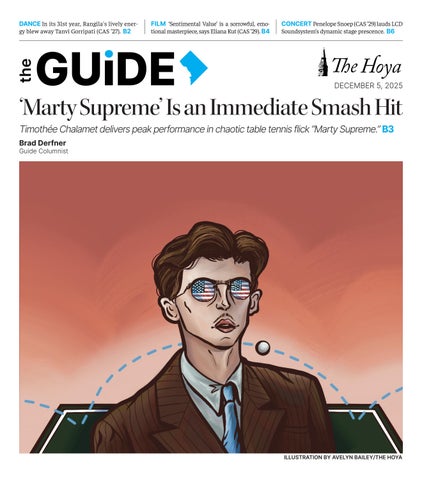
‘Marty Supreme’ Is an Immediate Smash Hit

Timothée Chalamet delivers peak performance in chaotic table tennis flick “Marty Supreme.” B3

Brad Derfner

Guide Columnist

ILLUSTRATION BY AVELYN BAILEY/THE HOYA

Rangila’s Skybound 31st Breaks Records Celebrating Culture, Community, Arts

Now in its 31st year, Georgetown Rangila has once again afirmed its position as one of Georgetown University’s most beloved and impactful traditions. This year’s showcase, a vibrant and ambitious production, brought more than 500 students to the stage and raised over $150,000 for The Hope Foundation for Women and Children of Bangladesh, a nonproft organization dedicated to improving maternal and child health in underserved communities. The announcement of the fundraising total drew thunderous applause and set the tone for an evening defned by passion and community pride.

Rangila 31 unfolded as a kaleidoscope of South Asian culture and dance traditions, each performance ofering a distinct narrative while contributing to the collective performance. This year’s performance was particularly memorable, not just because of the range of styles and regions represented, but also because of the overwhelming joy that radiated from every corner of the stage.

The show began with a classical invocation, a grounding and reverent opening that paid homage to classical South Asian performance

traditions. With graceful postures, clean lines and controlled rhythmic footwork, the invocation served as both a welcome and a blessing. It was a ftting prelude that connected the modern show to its centuries-old artistic roots.

From this opening, Rangila moved into its first full dance segment with the unmistakably vibrant Ramta Raas, inspired by Gujarati tradition. The rhythmic beat of the dandiya sticks and the iconic circular formations of garba immediately energized the crowd as the dancers channeled the communal joy of Navaratri. Pakistani Mastani followed, shifting the energy towards a different region’s vibrant diversity. The piece moved through the various provinces of Pakistan, celebrating their cultural and stylistic differences. The dancers brought an infectious enthusiasm to the stage, embodying the carefree and joyous spirit of mastani.

The show then transitioned into Suave Taal, an elegant fusion of Latin and South Asian dance forms. Salsa, bachata and famenco blended seamlessly with South Asian rhythms, creating a smooth and dynamic piece. Next came Lekali Nepali, which showcased the musical and dance traditions of Nepal. Incorporating infuences from the Newar and Magar communities, the choreography

balanced folk steps with modern stylization, giving the piece a warm and lively atmosphere.

Southern Suvai brought a blast of high energy movement from India’s southern states, Tamil Nadu, Karnataka, Kerala, Andhra Pradesh and Telangana. With its mix of kuthu, folk styles and hip hop, the piece lived up to its name, suvai — meaning “taste” — by offering a flavorful and bold experience. After that came Old School, a delightfully nostalgic tribute blending retro Bollywood and Tollywood hits with American tracks. The choreography embraced theatricality, humor and instantly recognizable iconic film gestures, earning loud cheers and laughter from the audience.

At the midpoint of the show, Studio Rangila shifted the focus to vocal and instrumental performance. Featuring a range of languages and musical styles, this segment reminded audiences of the breadth of South Asian artistic expression beyond dance. The energy surged again with Bulldog Bhangra, a perennial favorite known for its athleticism and formations. The dancers’ stamina and perfect timing captured the celebratory essence of the Punjabi folk tradition.

Arab Fusion introduced a rich mixture of dabke, belly dance and contemporary choreography set to Arabic, Tamil, Hindi and Persian music,

@GEORGETOWNUNIVERSITY/ INSTAGRAM

The record-breaking 31st edition of Georgetown Rangila was a captivating exploration of South Asian culture and tradition, Tanvi Gorripati (CAS ’27) says.

creatively celebrating cross-cultural exchange. Classical Fusion offered a shift toward refinement, blending elements from Bharatanatyam, kathak, Kuchipudi, Odissi and other classical forms with contemporary movements. Bangla Maja, a new addition to this year’s lineup, brought an explosion of charm, highlighting the spirit of Bengali culture. Desi Beat closed the main show with a modern fourish. With its hip hop foundation infused with South Asian musical motifs, the segment delivered a high-energy fnale that left the hall buzzing. But the show did not end there. As is tradition, the show concluded with Senior Shandaars, heartfelt and high-energy fusions that brought together senior dancers from across earlier performances. These segments carried an emotional weight that was palpable in the room. The seniors danced not only with passion but with gratitude and the pride of four years of memories, friendships and rehearsals culminating in one fnal appearance. The dances served as both a closing celebration and a passing of the torch, capturing the spirit of community that makes Rangila more than just a show. Across each performance, the unifying thread was joy. Not every dance was equally polished, and some performers were clearly more seasoned than others, but technical diferences never overshadowed the joy of the experience. What mattered was the unfltered happiness on every dancer’s face, the wide grins, the laughter shared on stage and the contagious excitement that pulsed through Gaston Hall.

If the show had one weakness, it was the amount of talking between the dances. While the coordinators’ remarks and the message from The Hope Foundation were both meaningful and essential, some of the hosts’ transitions felt lengthy enough to interrupt the momentum built by the performers. Still, this minor issue did little to diminish the night’s impact.

Rangila 31 was a radiant celebration of identity, artistry and community, a showcase that blended joy with purpose. In a record-breaking year, Rangila brought together over 500 performers and raised $150,000, keeping its reputation as one of Georgetown’s most powerful expressions of collective spirit and community.

‘Marty Supreme’ Doesn’t Miss a Single Shot

Brad Derfner

Guide Columnist

“Marty Supreme,” Josh Safdie’s frst solo efort since separating from his brother and longtime writing and directing partner Benny Safdie, unfurls with the same ferocious pulse that defnes his earlier work, but broadens into something bigger and, strangely, more hopeful.

Set in the 1950s, the flm follows Marty Mauser (Timothée Chalamet), a young man defned equally by his position as a professional table tennis player and his hustler attitude. Armed with a monumental ego and pathological confdence, Marty ricochets between New York’s shady underground rooms and the glamor of the Ritz London, firting with greatness at various table tennis world championships. Chalamet’s performance is full of constant motion, speaking and moving quickly, and the flm matches the pace, progressing with a choreographed chaos.

Although largely advertised as a sports biopic dramedy, the flm is much more reminiscent of “Uncut Gems,” the Safdie Brothers’ most recent efort as a duo, and bridges conventional

genre labels. While it features what may be the most electrifying table tennis sequences ever released in theaters, the flm focuses more on Marty’s personal life and what he sacrifces in order to play at the highest level.

Over the two-and-a-half hour runtime, Marty’s journey unfolds across continents and relationships, giving us an audacious, globe-trotting story full of laughs and tension. The London detour, which includes Marty making a string of inappropriate jokes to a journalist and a chance encounter with a celebrity, particularly hums with trademark Safdie drama. Other subplots, like one with a gangster’s runaway dog, veer towards excess, but even at its most unwieldy the messiness is always intentional, as if Safdie wants us to experience the world through Marty’s eyes.

Visually, “Marty Supreme” is stunning, a product of both Jack Fisk’s meticulous production design and Darius Khondji’s experienced camerawork. New York City’s Lower East Side has a true lived-in feel, managing to capture the city in a state between revitalization and decay, while sets like the aforementioned Ritz London are extremely memorable. The table tennis sequences

are among the flm’s best, as Safdie and Khondji allow the tiny white ball to dictate the camera’s movement. These scenes feel as tense as any chase sequence could, creating kinetic matches that thrill without disorienting the viewer.

Daniel Lopatin’s score is another notable craft. Driven by synths, it clashes with the midcentury setting in the best way, creating a dissonant efect that mirrors Marty’s jittery nature. In the same vein, the needle drops, including “Forever Young” by Alphaville and “Everybody Wants to Rule the World” by Tears for Fears, are anachronistic, but they always feel purposeful. Just like the flm itself, the music refuses to ft within any expected lines.

Timothée Chalamet has truly never been better — his portrayal of Marty is all dangerous charm, and he leans into the character’s showmanship in a way that’s both hilarious and disarming, especially when he weaponizes crass humor. However, it’s in the flm’s closing section, where Chalamet softens the arrogance and lets us past Marty’s walls, that he showcases a level of maturity beyond his previous roles. This fnal emotional pivot mostly lands, in large part

IMDB

“Marty Supreme” is a chaotic, unpredictable, absolute smash of a film, Brad Derfner (CAS ’27) says.

because Chalamet manages to make the viewer root for a morally-gray protagonist.

The supporting cast is, similarly, excellent in both performances and casting. Odessa A’zion plays Rachel, Marty’s on-and-of love interest, with tenacity, and shows what can happen to people who get caught within Marty’s hurricane. Gwyneth Paltrow brings glamor to her role as Kay Stone, a retired actress who works opposite her husband, Milton Rockwell, played by Kevin O’Leary of “Shark Tank” fame. O’Leary is the flm’s biggest surprise, playing a cartoonish capitalist who acts as one of Marty’s many adversaries with unexpected mastery. Tyler Okonma — better known as Tyler, The Creator — is full of life, and his Wally gives Marty a much needed reality check during one of their misadventures.

In the awards race, the flm has set itself up for a signifcant run. With A24’s backing and overwhelmingly positive critical reviews, including a 96% on Rotten Tomatoes, Timothée Chalamet has already solidifed his place as a frontrunner for Best Actor at the Academy Awards. A Best Picture nomination is also highly likely, as are potential nominations in Best Original Screenplay, Best Film Editing and several craft categories. Safdie’s chances for Best Director feel genuinely 50/50, though the Safdie brothers’ miss with “Uncut Gems” and Benny Safdie’s going solo this time around may give him a much needed boost. Paltrow and A’zion could both fnd their way into Best Supporting Actress nominations, but they both seem unlikely to happen as of now.

Ultimately, “Marty Supreme” is a wild and exhilarating ride, if not occasionally a tad overstuffed. Josh Safdie manages to balance his signature chaos with an emotional core that felt missing from “Uncut Gems.” The film is definitely one of the year’s boldest gambles, and only time will tell if A24 will recoup the $70 to $90 million budget, the studio’s highest ever. At its core, Safdie has crafted an off-the-walls, 1950s period character study that moves at the speed of Marty Mauser’s ambition itself, led by what is easily the most frenzied performance of Timothée Chalamet’s career.

‘Sentimental Value’ Explores Emotion of Realism

“Sentimental Value” stands out as one of the most beautiful and impactful flms of the year. Not only does it meaningfully explore complex themes of death, abandonment and family, it also features stellar performances and beautiful cinematography. “Sentimental Value” is an unforgettable flm that will remain at the forefront of cinema in the near future.

The flm is primarily in Norwegian with English subtitles, but features some English-speaking parts. Set in Norway, it follows two sisters, Nora Borg (Renate Reinsve) and Agnes Borg Pettersen (Inga Ibsdotter Lilleaas), as they reconcile with their absent father, Gustav Borg (Stellan Skarsgård). Gustav, a flm director, asks Nora, a stage actress, to play the

lead role in his upcoming flm. When she refuses, he asks Rachel Kemp (Elle Fanning), a famous American flm actress, to take on the role instead. This movie-within-a-movie follows the life of Gustav’s deceased mother, who took her life after struggling mentally due to years of enduring Nazi persecution and torture. While he attempts to reach out emotionally to Nora through the creation of the flm, she struggles with her own mental health and repeated panic attacks. After Agnes convinces Nora to at least read their father’s screenplay, Nora agrees to take on the role.

The flm’s imagery, centered on the Borgs’ house and the generations who have lived and died there, stands out. Nora describes the house as living and breathing — a sentient object that responds to its surroundings. Their home and its changes represent familial identity and intergenerational

trauma, at certain points exemplifed by a crack in its foundation that continues to grow. The camera focuses on this crack during scenes of emotional instability, and it is repaired only after Nora and Gustav reconcile, when they remodel the house for the flming of their movie.

Through a blend of symbolic imagery and purposeful cinematography, a beautiful form of storytelling emerges. This fusion allows director Joachim Trier to seamlessly overlay the storylines of each character while switching between time periods, fading to black between each chapter. This distinct method of storytelling favors simplicity and clarity through its camerawork, focusing on one person or object at a time to emphasize each actor’s small, simple actions. These actions — a glance, a sigh — result in cohesiveness and emotional permanence. The

IMDB

Eliana Kut (CAS ’29) finds “Sentimental Value” to be a beautiful and relatable portrayal of a fatherdaughter relationship.

balance between large, dramatic scenes and simpler moments provides a realistic representation of both everyday confict and long-standing emotional trauma.

Every poignant scene, however, would have been less impactful if not for the outstanding performances of Reinsve, Skarsgård, Lilleaas and Fanning. Reinsve and Skarsgård portray the raw, fragile bond between an estranged father and his oldest daughter phenomenally. Though he was absent for much of Nora’s life, Gustav feels a much deeper connection to her than she believes. Skarsgård excellently portrays the archetype of a longing, distraught artist with intense vulnerability.

Reinsve’s performance stood out to me for its powerful believability and relatability. She embodies the spirit of a typical oldest sister, burdened with responsibility at too young an age, unable to reach out for support, whilst maintaining the image of a perfect girl who has it all together. Each supporting performance was equally stunning, with Lilleaas showcasing the deep inner turmoil of the conficted younger sister and Fanning perfectly conveying Rachel’s frustration at her inability to embody the lead role.

The flm beautifully navigates the idea of art as a healing process. It tactfully combines performance, cinematography and symbolism into a cohesive, impactful narrative about family bonds and trauma. It maintains a consistent pace, and the simple score complements the flm’s nature. I thoroughly enjoyed the entire movie’s raw, realistic portrayal of relationships and beautiful storytelling. I expect the flm to continue to impact and inspire both the flm industry and moviegoers for years to come.

In uencer Rida Ali on South Asian Social Media Presence

The largest diference between our frstgeneration relatives and us, besides a dismal global economy and a questionable political environment, is perhaps the internet. With the usage of technology exponentially increasing, simultaneously making everyone more connected and more isolated, South Asian representation and activism are taking a new face. Pakistani American digital storyteller Rida Ali joined Georgetown University’s South Asian Society on Nov. 7 to discuss this changing landscape amid a rise of digitallydriven Gen Z movements in South Asia.

With a bachelor’s degree in global studies and media from New York University and a master’s degree in South Asian studies from the University of London, as well as a highlyfollowed Instagram page dedicated to South Asian issues, Ali may be the most qualifed person to discuss this topic.

Over the course of the evening, Ali masterfully wove a cross-generational narrative of South Asian activism, likening social media today to radio in the 1940s and Gen Z activists to noncooperation freedom fghters from the 1920s. Referencing the governmental changes in Bangladesh, Nepal and Sri Lanka, as well as the victory of South Asian Zohran Mamdani in New York City’s mayoral race, Ali highlighted

how social media is being used to mobilize, organize and embody youth-led change.

By comparing recent South Asia-centric protests using motifs from the anime “One Piece,” to the importance of Faiz Ahmad Faiz’s poetry during the Indian independence movement, Ali underscored how South Asia’s social changes have always been pushed by media and art.

Referring to the usage of social media to underline injustices in the subcontinent from Balochistan to Kashmir, Ali said social media’s power is similar to that of more traditional protests.

“There’s not much diference between you and someone who started an encampment to stop the Vietnam War or apartheid in South Africa,” Ali said at the event. “You are people with cultural capital and can change the world.”

In the same way radio democratized information to accomplish what Ali terms “distance decay,” social media’s hashtags have revolutionized media and political movements, becoming the primary platform for South Asians to express and communicate sociopolitical opinions. Ali’s talk ended with an acknowledgement of the ways social media can be used to misinform or selectively censor and peddle certain limited narratives. Her fnal advice to the audience was that social media is only a beginning — users must entertain thoughts they disagree with and be critical of the media they consume.

ON YOUR RADAR

‘A CHRISTMAS CAROL’

A holiday staple comes to Washington, D.C., in the Ford’s Theatre’s bold and dynamic adaptation of Charles Dickens’ festive classic “A Christmas Carol.” Join the miserly protagonist Ebenezer Scrooge as he journeys through the ghosts of Christmas past, present and future in a music-infused, children-led annual tradition. Get your tickets here until Dec. 31.

With lively quiz opportunities that offered prizes, audience engagement through physical media and a Q&A, Ali’s talk was illuminating and highly interactive. Later that week, I had the honor of sitting down with Ali to dive deeper into the topics she touched on in her discussion, focusing on South Asians and our social media accounts.

At the beginning of our conversation, Ali adopted a positive stance on social media, illuminating how it has been used to disrupt stereotypes and increase solidarity across the subcontinent. It has allowed people like Ali to carve out an alternative space from the mainstream, one where the narrative power fnally rests in their hands.

Ali said social media has allowed the community to break certain barriers in discussing identity and brought more nuance to issues of caste, language and religion.

“Being South Asian has become something I’ve been proud to claim over the years due to social media,” Ali told The Hoya. “It has also shown that South Asia is not a monolith.”

Ali also spoke about social media’s power to enact positive change within the relationship between homeland desis and the diaspora. Because South Asian immigrants follow homeland South Asians and vice versa, social media is a platform that has helped bridge the gap between the otherwise distanced twin communities.

Finally, Ali spotlighted some of the pitfalls of social media she’d mentioned

in her talk, saying she sees social media exacerbating the tensions between older and younger generations of South Asians.

“Social media is not a space for productive disagreement. It has a polarizing factor, creating a bubble that people do not see outside of,” Ali said. “For disagreement, we need face-to-face conversation.”

Ali also said she believes that, while social media has done more good than harm, it has normalized overgeneralizations and concentrated people’s feeds with neat infographics and social justice slideshows, making the information people consume dilute and undetailed.

Ali ended our conversation with two pieces of advice related to these issues that stuck out to me, giving advice for how our generation should moderate social media use.

“One, go outside and live in the real world, and two, read,” Ali said. “Read anything and everything that makes you curious, that challenges you, makes you think.”

For a social media infuencer delivering a talk on social media, Ali’s words were impactful because they pushed us beyond the realm of the online. For her, that is how we can ethically and critically engage with digital platforms.

Information disappears into the void of social media everyday. But the real lives of South Asians are not as superfuous. So, what South Asians must do with our social media is build something that will outlast the trend cycle.

ZOOLIGHTS

THIS WEEK’S THEME: Calm Before the Winter Storm

The National Zoo’s popular and highly-anticipated winter classic “ZooLights” is back until Jan. 3. Attendees can watch a festive lantern display of land and sea animals including giant pandas, birds and oceanic creatures or catch a nightly musical performance under the glow of one million LED lights. Tickets must be purchased online beforehand.

KOREAN TREASURES EXHIBIT

With a diverse collection donated by the Samsung Group in memory of the late Samsung chairman, the National Museum of Asian Art’s “Korean Treasures: Collected, Cherished, Shared” exhibit is one of the can’t-miss highlights of this winter. Running until Feb. 1, the exhibition spans across histories and locations, tracing the nuanced and historical legacies of the Korean subcontinent.

ICE RINK AT THE SCULPTURE GARDEN

The National Gallery of Art’s annual ice skating rink in its famed Sculpture Garden is open until Mar. 1. Skaters of all levels can enjoy a glide on the ice with a view of the Gallery’s stunning sculptures, dazzling lights and an iconic silhouette of the National Mall. Student tickets can be purchased online for $12.

Returning in Full Force, LCD Soundsystem Stuns Knockdown Center for Residency

LCD Soundsystem, an indie electronic band from Brooklyn, N.Y., returned to New York this fall for its annual three-week residency. The band — formed in 2002 and composed of James Murphy, Nancy Whang, Pat Mahoney, Tyler Pope, Al Doyle and Korey Richey — broke up in 2011 with a goodbye concert at Madison Square Garden but reunited in 2016.

Since the 2017 release of their album “american dream,” the band has been touring annually and has become more popular with younger generations. This year, LCD Soundsystem is playing 12 shows at the Knockdown Center in Queens, N.Y., marking the band’s ffth annual residency. While the shows don’t difer much from those of previous years, they still hold the same magical, emotional and uniting energy.

I saw the band perform Nov. 22, the third night of its frst weekend. The setlist featured LCD Soundsystem’s top hits mixed

PENELOPE SNOEP/THE HOYA

Penelope Snoep (CAS ’29) says LCD Soundsystem is here to stay after attending a show during their fifth annual residency.

with a few lesser-known songs. The band opened with “Movement,” a song with powerful bass and thumping guitar, which was accompanied by bright, fashing green lights that felt rave-like.

This intense beginning quickly shifted with the second song, “oh baby.” “Oh baby” is essentially my favorite song of all time, and the live performance was truly incredible. White and pink lights twinkled of the disco ball hanging above the band, sending sparkling shadows dancing across the ceiling. The music vibrated throughout the space, creating a feeling of transcendence as Murphy sang, “Yeah, You’re already gone / We are already home / And my love life stumbles on.”

“Oh baby” was followed by “Get Innocuous!,” “You Wanted a Hit” and “Tribulations,” each of which brought upbeat energy back to the concert. The lights changed to more intense red and blue colors as the beat got stronger. The music and bass surged into the crowd, and everyone was more than listening — they were feeling the music. Young and older attendees alike jumped

and danced to the music, and positive energy fowed through the venue.

The performances of “I Can Change,” “tonite,” “Home” and “Someone Great” especially stuck with me. The songs, all of which were already excellent, were phenomenal live. The songs’ pulsing rhythms were crisp, and the lyrics were raw and emotional. Whang, the synthesizer and keyboard player, brought an electric shine to each song, especially in “Someone Great,” and her energy was special, too — she’s cool, and it showed.

I found that “On Repeat” and the frst two parts of the six-component “45:33” fell a bit short, possibly because the crowd’s energy seemed to fall as fewer people knew these songs. Though this may have been more of an audience faw, I couldn’t help but wonder if the concert would have been stronger had LCD Soundsystem chosen to play more of their big songs, like “Daft Punk Is Playing at My House,” “All I Want” or “Time to Get Away.”

LCD Soundsystem often ends their concerts with the same encore: “Dance Yrself Clean,” “New York, I Love You but You’re

Bringing Me Down” and “All My Friends.” The lineup of these three songs is powerful — the frst brings a rambunctious bounciness to the crowd, the second a deep love for the city the concert was performed in and the third an emotional roller coaster of love and coming-of-age. This dynamic trio of songs brought together the diverse crowd of strangers as they experienced the same feelings and milestones expressed in the songs, regardless of age or background. What especially stood out to me about LCD Soundsystem’s performance was its simplicity — the music speaks for itself. James Murphy doesn’t need big screens or dances to grab the audience’s attention. He sings, and listeners can tell he feels the music as he jumps with his fans. The disco ball, while unassuming, refected the lights in a unique way, mirroring the beats of LCD Soundsystem’s rhythmic songs. LCD Soundsystem might not be anything new, but as they’ve continued to return for each residency, the strength of their performance has only grown, uniting old and new fans under their classic hits.

‘Eternity’ Shows an Enchanting Yet Imperfect Romance

In the slowly dying genre of romantic comedies, “Eternity” is a welcome surprise. In a deckedout purgatory where the deceased decide how to spend their eternity, Joan (Elizabeth Olsen) is caught between choosing an afterlife with her husband Larry (Miles Teller) or her lost love Luke (Callum Turner). “Eternity” has an interesting setting and premise, combining romance with musings on life after death. However, much of this exploration is no more than surface level.

Central to “Eternity” is the love triangle between Joan, Larry and Luke. While the flm seems to attempt to transition this romantic pull into a deeper discussion of the implications of an eternity together, its initial commitment to the romance throws the exploration of balance.

The dynamic between Joan, Larry and Luke serves as much of the flm’s comedic fodder. With afterlife coordinators Ryan (John Early) and Anna (Da’Vine Joy Randolph) serving as the delightful commentators in the ongoing chaos. The many tussles between Larry and Luke are also hilarious as Teller and Turner bounce of each other incredibly well, their on-screen chemistry fueling the impact of their banter. The separate connections between Joan and both Larry and Luke, while not completely entrancing, work. Joan and Larry feel much

like an old couple, characterized by mutual warmth and understanding. Their shared comfort serves to justify Joan’s hesitation to choose Luke, her frst love, who has waited nearly 45 years in the afterlife to spend eternity with her and is played by a dreamy Turner — his frst meeting with Joan even resulted in a wave of delighted gasps in the theater. Next to the more understated dynamic of Joan and Larry, Olsen and Turner portray the sparks of a shy, unsure frst love, resulting in a subtle emotional distance between Joan and Luke.

“Eternity” is both a comedy and a romance, but it gets too caught up in both genres to do the story’s drama justice. There are hints of refection on the vastness of life and all its regrets, hardships and joys, but they simply do not get enough focus in the story. These ideas are introduced and partially developed, but never receive the attention they need to be properly integrated into the larger narrative.

Joan is the primary example of this. To decide who to spend her eternity with, the coordinators allow her to spend a day in eternity with each man. Many of Joan and Luke’s interactions are rooted in regret and a hope to continue a relationship that had been tragically cut short by Luke’s passing. With Larry, Joan gets the chance to refect on the life she has lived and the relationship she has built with him. However, the closest the pair ever comes to discussing their lives is a botched conversation during a boat ride

on their date in a beach paradise. There is so much potential in Larry and Joan’s conversations to fully explore what their lives and relationship meant to each other in the face of choosing an eternity, yet this potential is left frustratingly unrealized. The film’s tendency to introduce but never develop its characters frequently makes the story feel overstuffed. In a moment when Joan travels through the back doors between the eternities, the script reveals the bad memories buried behind the eternities’ goodness. Joan literally squeezes through nightmares as she tries to make it back

to the main station. It’s a beautiful, haunting landscape that’s presented, but the audience is only allowed into this hidden place for a mere 10 minutes, leaving a story beat that could be more impactful if further explored and developed. While charming, “Eternity” presents a heartwarming story that does not fully realize its potential. It gets caught up in the whirlwind of its romance, forgetting that the best romances are often supported by more profound refections on life, desire and regret, which the flm merely uses to trace the outlines of its intriguing yet underdeveloped world.

“Eternity” ushers in the return of romantic comedies, Grace Ko (CAS ’27) says.
‘Nouvelle Vague’: Are a Girl, a Gun All You Need for a Film?

Is everything flmable? Richard Linklater’s “Nouvelle Vague” argues in the afirmative, opening with the questions that animated a generation of French flmmakers. Set in 1959 Paris, the flm follows the true story of Jean-Luc Godard (Guillaume Marbeck) as he directs “Breathless,” his frst feature and a project that helped spark the revolutionary flm movement of the French New Wave (Nouvelle Vague in French).

The story traces Godard’s desperation to become a director through his chaotically unique yet passive creative approach. “Nouvelle Vague” aims to pay homage to Godard and the birth of a new flm movement, yet the flm lacks innovation and becomes trapped in its own desire to imitate, inherently contradicting the New Wave’s main intentions.

French flms are beloved classics for a reason: They are mysterious, passionate and, well, French. However, “Nouvelle Vague” tries too hard to embody these traits, as is evident in Godard’s portrayal, which lacks a clear character arc. When frst introduced, Godard is a flm critic who constantly dons a tailored suit and black sunglasses. He feels frustratingly impenetrable and Marbeck’s

delivery of what should be raw and vulnerable monologues, such as when he yells at his crew to leave the set for the sake of capturing “the authentic and reality,” feels comically monotone. The flm insists that Godard is a visionary, but Marbeck’s performance leaves the audience feeling detached. Marbeck’s rhythm, though initially entertaining in its frankness, becomes repetitive and predictable.

Similarly, the cadence of the story’s trajectory feels consistently of. Scenes that should build emotional momentum fall fat, lingering too long on trivial conversations and speeding past key moments. The imbalance is evident in the dissonant portrayal of Jean Seberg (Zoey Deutch), a famous American actress who joins Godard’s cast. Seberg’s abrupt shift from contemplating quitting while frustrated at Godard’s lack of direction to suddenly and inexplicably being eager to aid the production is disorienting. Rather than capturing the New Wave’s oscillating chaos, the flm insists on profundity without ever showing or earning it.

Theflmfurthercompoundsthisinconsistency problem by introducing an excessive number of characters, including producers, friends, actors and lovers, with no clear arc or purpose. In one scene, director Roberto Rossellini (Laurent Mothe) advises Godard to lose the subplots of his flm to make it easier, which ironically is where “Nouvelle Vague” stumbles.

Without the follow-through of these side characters’ subplots, Godard’s character lacks

intimacy and humanity, appearing a bit too cold and nonchalant. I appreciate the flm’s attempt to simplify the sheer number of characters by having each arrival punctuated by a stylized close-up and name card. However, this approach just sets the audience up for disappointment as we get snippets and tastes of subplots that lead nowhere and conversations that feel less like character development and more like fller.

Another major fault is the script’s overuse of quotes from other artists and lines that try too hard to be one-liners. Though Godard famously alluded to and directly cited quotes from artists ranging from T.S. Eliot to Leonardo da Vinci, the script’s overreliance on quotations makes the flm feel uncreative and repetitive. It begs the question of whether Linklater even understood the Nouvelle Vague movement’s intentions and Godard’s goal of defying tradition, making new and being revolutionary.

Additionally, nearly every scene contains an attempt for the flm’s big line. These lines include: “To be alone is to ask questions. To make flms means to answer them,” “Reality is not continuity” and “All you need for a flm is a girl and a gun.” Though these are solid lines and refect Godard’s approach to flm, collectively, they drown, becoming dull statements rather than profound revelations.

The flm’s ending attempts to rescue the flm through irony, with Godard and

his collaborators sitting in a small theater watching the completed “Breathless.” They comment on how “disgusting” it is, declaring it the “worst flm of the year.” It’s a clever way to attempt to reframe the viewer’s perspective for salvation purposes; however, a knowingly mediocre flm is still a mediocre flm.

Despite its narrative shortcomings, “Nouvelle Vague” is undeniably aesthetically beautiful. Shot on flm and entirely in black and white, the cinematography captures a truly romantic Paris. It features scenes of characters smoking in cafes, sunlight fickering on the Seine and an overall balance between the symmetrical and asymmetrical. The jazz score also injects a liveliness and comfort into a flm that otherwise feels tonally fat. Moments when the camera lingers on a street musician or drifts through a crowded bar come closest to capturing the New Wave’s authentic spontaneity.

“Nouvelle Vague” falters not because of its lack of ambition, but because it misunderstands what made the New Wave revolutionary. The flm mistakes imitation for homage and quotes as a stand-in for ideas — in striving to capture Godard’s characteristic referentiality, it only attains mimicry. The flmmakers perfectly achieve the surface-level aesthetic, but miss the core: a genuine desire to say something urgent. For all its stylistic devotion, “Nouvelle Vague” remains curiously hollow, making it a flm about revolution that never dares to revolt.

IMDB

Danny Brown Is a Rap Star, Pop Star, Rock Star, Star Performer

Danny Brown is no stranger to the rap scene; he’s been pumping out music since 2010, yet with each new release, he fnds a way to reinvent himself as a musician and a performer. His Stardust Tour for his new album “Stardust” is no exception, as Brown’s consistent genre-bending sound, blending everything from rap to hyperpop, continues to amaze, this time alongside breakout hyperpop artists Femtanyl and Underscores as his openers. I had the fortunate opportunity to attend his show in Sacramento, Calif., and see the Stardust Tour for myself.

Unlike many tours, openers Femtanyl and Underscores play a key role in Brown’s show. Both are featured on his new album, with Femtanyl featured on the track “1L0v3myL1f3” and Underscores on “Baby” and “Copycats,” and have emerged as stars in the ever-growing hyperpop scene. Characterized by frantic synths and creative sampling, both opening sets immediately captured my attention. Femtanyl’s confdence on stage had the crowd erupting with energy. Underscores paralleled it with a similar bouncy energy, her hair fowing in the wind from her

stage fan. She performed her latest single, “Do It,” and the crowd burst with vitality to its hypnotic electronic key hits and catchy chorus.

A light cube sat at the center of the stage, awaiting Brown’s entrance. As the lights dimmed, the crowd roared when Brown exploded onto stage, opening with “Starburst.”

As the frst single of his newest album, “Starburst” is a sharp and wonderfully weird piece of experimental hip hop. The Stardust Tour, along with the album, is Brown’s frst since getting sober. At a time when he struggled to return to music, he found solace in the digicore sound of Underscores. This frst introduction to this new, fresh sound led to him further collaborating with other hyperpop and digicore artists like Jane Remover and Frost Children, both of whom collaborated on the album.

The energy Brown brought to every song reverberated through the venue, embodied by the booming bass and seen in my vibrationally shaky footage. By keeping his openers’ vigor and carrying it throughout the entire show, Brown achieved something I can credit very few performers with doing.

The bumping house hit “Lift You Up” had the crowd open a mosh pit, as neon lights fashed rhythmically with his groove. The

CROSSWORD

variety felt natural as he transitioned into the glitchy “Green Light” featuring Frost Children. The entire crowd, including me, screamed “Green light!” as Brown hit a dance move from inside a light cube.

The Stardust Tour and “Stardust” as a whole were a milestone for this underground internet music community, seeing artists across the spectrum coming together for the project. During the show, Brown performed “Psychooboost,” a track from Jane Remover’s 2025 project “Revengeseekerz,” which Brown features on. The pit surged, heads banging in unison and moving like a wave through the crowd.

The true magic of the show was in Brown’s performances with his openers back on stage.

“Copycats,” my personal favorite track from “Stardust,” was stellar live, and the connection between Brown and Underscores is palpable.

In an interview with music magazine Fader, Underscores described Brown’s sincerity, saying how passionate he is for music.

“You can tell he really loves the music, there’s no ulterior motive,” Underscores said.

“Baby” was also amazing, with a remarkable performance from the duo. Where Brown brought unfettered energy, Underscores brought swagger.

Femtanyl also made her return to the stage, bringing an opposite, yet just as welcome, energy to contrast Underscores. Now, while Brown brought his same unfettered spirit, Femtanyl was rowdy and came in with something to prove. Stomping her feet and screaming into the microphone, she held back none of her punches, raising her gloved fst in the air at the end of the performance. Brown uniting such diferent artists and melding them both perfectly with his style was something of awe, and I’ve never seen anything like it.

Throughout the show, Brown expertly controlled the crowd despite never directly speaking to the audience — at least, not until the very end. As the instrumental closer for his album “All4U” began playing, he addressed the crowd and talked about how “Stardust” was his frst project since getting sober, saying that at the end of the day, “I do this all for you.” Ending on an emotionally vulnerable performance, he took his bow, closing one of the best shows I’ve seen in 2025.

If I could describe Danny Brown in one word, it would be “everchanging.” The Stardust Tour showed how, even after more than 15 years in his career, Brown keeps fnding ways to reinvent himself, all while acknowledging how far he’s come as an artist and as a person.

This Week’s Theme: Bookworms

Turn static files into dynamic content formats.

Create a flipbook