CAMPUS CREATIVES Singer-songwriter Lucia reflects on music with Isabelle Cialone (CAS ’27). B2
CONCERT Yung Gravy at GPB’s Spring Concert energized students, says Eliana Kut (CAS ’29). B4
FILM Juan Almanza (CAS ’29) says ‘The Super Mario Galaxy Movie’ is fat, overstufed. B6
APRIL 17, 2026
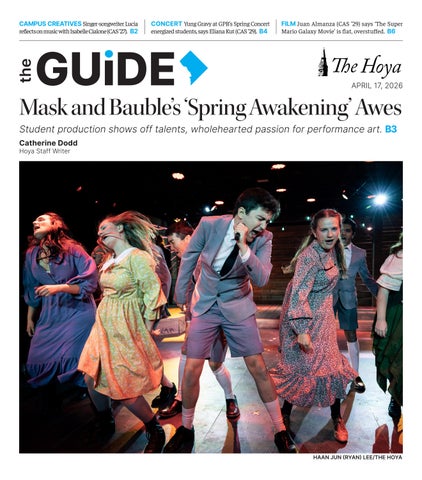
Mask and Bauble’s ‘Spring Awakening’ Awes
Student production shows off talents, wholehearted passion for performance art.
Catherine Dodd Hoya Staff Writer
HAAN JUN (RYAN) LEE/THE HOYA
CAMPUS CREATIVES
Singer-Songwriter Lucia On Introspection, Political Responsibility, Self-Doubt in Music
Isabelle Cialone Senior Guide Editor
In November 2025, singer-songwriter Lucia Zambetti (CAS ’26), whose stage name is simply Lucia, released her frst extended play, “In Love & war.” I caught Lucia just in time to chat with her about the place of music in her life, her creative process and her studies’ infuence on her music before she graduates this May.
Since she frst began releasing music in 2019, Lucia has amassed over nine million streams across platforms. Her 15-song discography, consisting of 10 singles alongside her fve-song EP, melds indie folk and rock sounds with poignant lyrics, often weaving together vivid stories and — fttingly, given she majors in philosophy — venturing into existential lines of questioning.
Although each song on “In Love & war” was written as its own distinct single before being compiled into a project and released, Zambetti said the songs were tied together by their personal, philosophical refection on various forms of passion and discord.
“The through line for all the songs in ‘In Love & war’ is how my brain is either always focused on love in any regard, or on some
sort of war in any regard, whether it’s real or more metaphorical,” Zambetti told The Hoya “I think that that’s a very human experience.”
The relatability of the sentiments Lucia expresses in “In Love & war” certainly speak to the humanness of such considerations. The EP’s opener, “The circus song,” uses an extended metaphor of a clown abandoning the narrator with her circus animals to convey themes of dependency and misplaced trust, while “No barracks, No men” explores attachment and idolatry in relationships with religious imagery swathed in beautiful, heartbreaking bittersweetness.
These philosophical ponderings not only pervade Lucia’s music but also her approach to music as a career. Zambetti said that she both questions the industry and pushes herself to create with intention and authenticity as a result of her philosophy degree and her constant contemplation of morality.
“It’s defnitely caused me to question a lot of the things that I’ve learned about the music industry and promotion and social media right now, which has a lot of existential crisis-inducing feelings sometimes,” Zambetti said. “But it makes me feel like I’m thinking about what I’m doing and being intentional with my art
and trying to fgure out the best way I can be genuine about it, because that’s all that really matters to me at the end of the day.”
For Zambetti, this intention fulflls what she sees as an artist’s duty; she said artists are forced to navigate the complex distinction between romanticization and good-faith conversation on current events, given the intrinsically political nature of music as an art.
“I think there’s a really thin line between not aestheticizing, but romanticizing ongoing strife for more of a material reason, and the opposite, which is provoking conversation and talking about something that is an experience,” Zambetti said. “So, I do wholeheartedly think that artists have a duty. I don’t think that there can really be a separation between art and solidarity. I think music is inherently political.”
For example, the titular song of Lucia’s EP contains certain lyrics that take on double meanings, both applying to the metaphorical war within the relationship she sings about, and that can be made more politically applicable, like an explicit condemnation of war. Zambetti has also used her music and platform to contribute to social change, participating in the September 2025 Labor Solidarity Concert
JASMINE CRIQUI/THE HOYA Isabelle Cialone (CAS ’27) sat down with singersongwriter Lucia Zambetti (CAS ’26) to discuss art as a contemplative and politically engaged endeavor.
planned by Georgetown Coalition for Workers’ Rights, as well as the upcoming Labor Solidarity May Day concert cosponsored by numerous Georgetown clubs and departments.
But music is not only about duty for Zambetti, who said that music has occupied a central place in her life given her family’s own musicality and the way it brings them together, though she did not always see it as such.
“For the longest time, I was like, I don’t want to make music,” Zambetti said. “I don’t want to be like my family. I wanted to make art, like studio art and paintings, and that stuf never really went anywhere, and I fnally came to terms with how integral music has been in my life.”
“In a lot of ways, it’s just been so grounding for my family and what brought us together, and the glue between a lot of my and my friends’ interactions,” Zambetti added. “So, there’s no life for me besides music.”
In some ways, Lucia also mediates understanding her life through music. The practice of songwriting is an introspective one, Zambetti said, with lyrics often arising from her subconscious, occasionally surprising her.
“It’s almost like journaling. For me, I have a really hard time journaling and being honest with myself in that way, and putting it into these words puts things more into perspective,” Zambetti said. “So I’ve defnitely learned things about myself through writing music, and sometimes I’ve been shocked out of this and tried to make sense out of the lyrics that I just wrote.”
For Lucia, the songwriting process is tantamount to an intrusive urge that overcomes her in waves, sometimes leading to doubt that she will ever be struck with another bout of inspiration again.
“A lot of my songwriting process comes very sparsely, but naturally,” Zambetti said. “So if I’m writing a song, it’s like something will come to me, either through improvising on an instrument, and then the words will follow, or hearing something in my head and having to go do it.”
“Sometimes I get nervous that I’m never gonna write a song again, because I don’t feel that very often,” Zambetti added. “But then when it comes, I don’t know, it’s kind of like a rash or something where it’s all of a sudden there, and then you have to itch it, and then it’s gone — and then it comes back.”
All Shall Know the Wonder of Mask and Bauble’s Production of Rock Musical ‘Spring Awakening’
Catherine Dodd Hoya Staff Writer
For a musical that discusses subject matter as serious as “Spring Awakening” does, its charming innocence, relatability and humor should be impossible. Regardless of how miserable the musical’s characters are and how they are tortured by circumstance, it could not be more clear that the cast is absolutely thrilled to be a part of this production.
Mask and Bauble Dramatic Society’s spring show this season is the cult-classic, rock musical “Spring Awakening.” The musical, which is based on the 1891 play of the same name, made its Broadway debut in 2006 and explores the trials of adolescence in all of its uncertainty, tumult and confusing sexuality. The play explores these themes within the context of the socially oppressive 19th-century Germany, which ignores the plights of young people and enforces its strict expectations upon the play’s characters.
The lives of the adolescents of this fctional provincial town are defned by their inability
to express themselves and their desires, catalyzing a doomed, painfully naive relationship between the curious Wendla Bergmann (Chiara Volpi, SFS ’28) and the intelligent, rebellious Melchior Gabor (Colin Wechsler, CAS ’26). Their chemistry and evident dedication to their respective roles completely make the show, as the plot revolves entirely around their interactions and the intertwining journeys that their characters embark on throughout the production.
The leads’ performances are masterfully supplemented by a well-rounded cast of secondary characters, namely Melchior’s best friend, Moritz Stiefel (Samuel Levinger, SFS ’29), and fellow teenager Ilse Neumann (Sophie Maretz, CAS ’26). Moritz follows a particularly tragic trajectory, which Levinger portrays incredibly convincingly and navigates with obvious devotion. Maretz, as Ilse, brings a lower vocal register to group numbers that integrally rounds out the composition.
The supporting cast’s musical abilities elevate all the ensemble numbers, of which there are many. “Touch Me” was particu-
larly memorable, featuring solos by Georg Zirschnitz (Rishu Nevatia, CAS ’27) and Otto Lämmermeier (Massimo D’Onofrio, CAS ’28) and choreography that perfectly encapsulated the song’s wistful, dreamlike cadence.
Beyond the stellar performances, the choreography, costuming and set design all came together to form a gorgeous picture of lost innocence and the trials of youth within this small German town. The stage’s wooden structure seamlessly transformed from a school to a hayloft to a meadow without much suspended disbelief required. The choreographers created inventive ways to utilize the black box space and extend the action beyond the wooden stage, almost directly into the audience, making for a more immersive experience. Additionally, the costuming saw no major deviations from the costuming of past iterations of the musical, instead upholding the simple, questionably historically accurate, yet recognizable costumes that fans already associate with the show. This is seen most notably in Wendla’s white dress in “Mama
HAAN JUN (RYAN) LEE/THE HOYA Catherine Dodd (CAS ’29) praises Mask & Bauble’s “Spring Awakening” for its strong performances and skillful production.
Who Bore Me” and the school uniform that the adolescent boys sport for the majority of the show.
It is obvious that no detail was overlooked and that everyone even remotely involved in the production of the show believed wholly in its purpose and its success. Leaving the theater, I was overwhelmed by the love and respect that the entire cast and crew so obviously held for the source material. The delicacy and care that the music, script and themes were handled is not to go unnoticed, and it is completely essential to the degree to which audience members feel invested in the lives of these teens whose own lives are in a world so far removed from ours.
Though this world is incredibly far removed from ours chronologically, the elements restricting self-expression in the world of “Spring Awakening” are not completely foreign to modern American society, which is precisely why the musical remains such a beloved, important show today. At the time of the publication of the original play, it was commonly banned or censored due to public outcry against its themes of sexual liberation and the confusing nature of adolescence.
In light of various attempts to censor the play and ongoing public discomfort over the graphic subject matter, the themes of “Spring Awakening” prove to be essential to share. Wendla, Melchior and the other teenagers experience the dangers of navigating adolescence in an oppressive, conservative society that prioritizes social conformity over honesty. Echoed by the actors returning to stage in modern-day clothes for the closing musical number “The Song of Purple Summer,” the musical’s selling point is its ability to be daringly universal and speak to the feelings of forced repression that are far from foreign to modern teens.
GPB’s Spring Concert Amazes as Yung Gravy Headlines
Eliana Kut Hoya Staff Writer
The Georgetown Program Board (GPB) held its annual Spring Concert on April 10. This year’s fantastic lineup, featuring student opener Cornerbooth, indie rock band Good Neighbours and rapper Yung Gravy, kept the energy fun and upbeat for the entire concert at McDonough Arena. I arrived at the venue 20 minutes early and was able to get within a few feet of the stage, which made for a fantastic concert experience. From the very beginning, everyone in attendance brought enthusiasm and energy. The frst performance of the night came from student band Cornerbooth, which graced the arena with several original songs and a cover. Their smooth, alternative, indie rock sound was fun to listen and dance to. Cornerbooth’s beautiful vocals and haunting but catchy songs defnitely made me a fan. After catching everyone’s attention with their performance, Cornerbooth ended their set with a stunning rendition of “Baby Come Back” by Player, a sly hint at Yung Gravy’s later cover of the same song. Cornerbooth’s alternative sound proved a perfect transition to Yung Gravy’s openers, the London indie rock duo Good Neighbours. From the moment the duo entered the stage, I knew I was in for a fantastic time. Though I was only familiar with a few of their songs, I still fully appreciated Good Neighbours’ energy and talent. Between their songs, the duo hyped up the
crowd, encouraging us to sing along and wave fashlights. I haven’t been in many audiences where the entire crowd seemed to be enjoying themselves, but this was defnitely one of them. Good Neighbours performed some of their more popular songs like “Ripple” and “Home” and kept the good energy going the whole time.
Like Cornerbooth, Good Neighbours’ tracklist consisted of smooth but upbeat indie rock songs. I didn’t know how well their sound would serve as an opener for Yung Gravy, but their tireless energy and fun presence proved the perfect lead-in to the main performance. Both members, Oli Fox and Scott Verrill, frequently switched between instruments, showcasing their talent and versatile sound and vocals. Good Neighbours proved to be such an amazing time that I thought they could have defnitely performed as the night’s main performance.
Soon after Good Neighbours’ set ended, Yung Gravy’s DJ, DJ Tiiiiiiiiiip, came on stage and began mixing various upbeat club songs in anticipation of Yung Gravy’s set. It was a fantastic way to maintain the energy while shifting the genre from indie rock to hip-hop. After several songs, Yung Gravy came onto the stage, and there was an immediate frenzy throughout the audience. Starting of with one of his earlier singles, “Magic,” Yung Gravy immediately commanded the room with the fan favorite. The night’s setlist included songs such as “Betty (Get Money),” “C’est La Vie” and “Mr. Clean.” The audience was screaming along to every song, and Yung Gravy matched the
energy by making dance circles in the audience, throwing cereal and roses and crowd-surfng a miniature stufed Jack the Bulldog. At the height of his performance, Yung Gravy even changed into a Georgetown jersey with his name on it, a fun tribute that really completed the night. Transitions between each of his songs were flled with fun moments like these, especially since he prioritized audience involvement. There wasn’t a boring moment in Yung Gravy’s set, and his appreciation of his DJ, fans and audience was evident. He wasn’t just an artist showcasing his songs; he was truly the epitome of a performer.
The entire concert was structured wonderfully, with fantastic transitions between artists and a growing energy with each set. GPB’s Spring Concert proved to be a fantastically fun and impressive night. The inclusion of smaller but growing bands like Cornerbooth and Good Neighbours was one of my favorite parts, as they showed that large commercial popularity isn’t necessary for a successful performance. Yung Gravy’s audience-centered set made for the perfect end to an already fantastic night. If GPB continues to bring the energy of this concert to future Spring Concerts, I can only see an extremely popular concert series ahead.
MATTHEW GASSOSO/THE HOYA Eliana Kut (CAS ’29) found GPB’s Spring Concert to be greatly entertaining.
Searching for a Way Out in the Endlessly Liminal ‘Exit 8’
Brad Derfner Guide Columnist
“Exit 8” exists as an unusual paradox, much like the endless subway corridor that acts as the main setting for the flm’s events. “The Exit 8” is a 2023 Japanese indie video game released by Kotake Create, where players progress by perpetually walking down an abandoned hallway, noticing small changes called “anomalies.” In a world where flm adaptations of video games seem to be of generally low quality (I’m looking at you, “Return to Silent Hill”), choosing source material that ofers so little in the way of narrative drive or characters may seem like a bad production decision. However, director Genki Kawamura, alongside writing partner Kentaro Hirase, produces an engaging psychological exercise in “Exit 8,” one that successfully translates the game’s central mechanics into a controlled cinematic experience.
The flm opens with The Lost Man (Kazunari Ninomiya) riding in a crowded subway car. The car is full of commuters, and, despite chaos occurring around him, he pays little attention, choosing to turn back to his phone. This opening is shot from a frst-person viewpoint and memorably refects the flm’s video game
roots. After reaching his station, The Lost Man fnds himself — predictably — lost in a repeating underground passageway with signs indicating he can only leave through “Exit 8.”
Through trial and error, The Lost Man learns he must determine whether each new version of the hallway contains an anomaly, defned simply as any diference from the original version of the hallway, progressing through the “levels.” Any mistake will reset his progress back to Exit 0. Instead of relying on classic, overt horror flm threats like monsters to raise the stakes, Kawamura and Hirase opt to subtly create tension solely from the dread of being stuck in a liminal space, keeping the flm closer to the source material. This, combined with The Lost Man’s despair from his failed attempts, successfully create an emotional cinematic experience for viewers.
Kawamura also focuses on turning the hallway into the “uncanny valley” through unnerving sequences in which The Lost Man slowly searches the environment for anomalies that might not even exist. These scenes can drag on but are where “Exit 8” is its most efective. The flm calls on the viewer to search for anomalies alongside The Lost Man, turning the usually passive experience
of watching a movie into a participatory task — much like a video game.
I was surprised at how well the film maintained this tension. The tight 95-minute runtime helps prevent the film from feeling too repetitive, a nearly impossible task for a film that takes place only in a hallway. Moreover, the gradual escalation from small visual shifts, like a door handle moving to the center of a door, to more surreal sequences, such as a flood, raises the stakes while holding the film together. The production designers clearly worked overtime for the larger scenes in the third act, but their minimalist approach in the beginning, including subtly tweaked signs, is key to the film’s progression.
Thematically, the introspection of “Exit 8” on the boredom of mundane life and routine shines through. The incorporation of Escher’s “Möbius Strip II,” a woodcut that depicts a series of ants walking along a Mobius Strip — a topological object in the form of a loop with only one continuous surface — as one of the posters in the hallway refers to this idea of mundanity. Like the ants that endlessly walk along the strip, both The Lost Man and the everyday workers from the train are also trapped within a loop, unable to move on with their lives. However, the flm’s attempt to expand its
thematic signifcance is actually its largest faw. Kawamura introduces a thread involving a child also lost in the hallway. Combined with a clunky exposition that informs viewers of The Lost Man’s attempt to abandon his newborn child previously, the flm is clearly trying to showcase a growth in The Lost Man as he accepts a responsibility greater than himself.
Unfortunately, the relationship between The Lost Man and The Boy (Naru Asanuma) feels less genuine and more symbolic, which lessens the climax’s emotional impact. This emotional weakness is sadly compounded by Ninomiya’s worsening performance. Early on, Ninomiya plays The Lost Man with an engaging combination of confusion and alertness, but, as the flm continues, The Lost Man becomes increasingly disengaged from his situation. Although this shift may be intentional to align with the themes concerning the boredom of life, in actuality, the role just feels less dynamic. Even so, “Exit 8” is consistently watchable, even if largely due to the structure and design rather than any emotional revelation found in the third act. The loop functions as a shockingly efective narrative base, but the execution falls short, leaving a flm that just doesn’t quite stick with me.
At First, ey Were Cast, en ey Were Cast Aside
Anandita Agarwal Guide Columnist
Recently, my roommate and I fnally got around to watching “Bend It Like Beckham.” As a South Asian myself, the depictions of BritishPunjabi identity felt humorously hyperbolic. What may have been revolutionary in its 2002 release comes across as cliche and stereotypical today. However, it felt almost believable because of the authenticity Parminder Nagra injected into her portrayal of the central character, Jesminder “Jess” Bhamra. An actress of immense talent and skill, I was sure I would fnd a wealth of movies on Nagra’s IMDB page, even if I could not recall seeing her star in any big hits. I was shocked to fnd that the most notable thing that Nagra has been featured in over the 25 years since the release of “Bend It Like Beckham” was “ER.”
I could not help but feel something was wrong, especially when I compared Nagra’s career with that of fellow white cast member Keira Knightley — for whom “Bend It Like Beckham” set of a starry trajectory with her portrayal of secondary character Juliette Paxton. Combining this with how the “Bridgerton” Season 2 cast member Charithra Chandran recently spoke about feeling overlooked even after the immense success of “Bridgerton,” a concerning pattern begins to
emerge about how Hollywood sees South Asian women — or rather, how Hollywood does not see South Asian women.
Chandran, in an interview with Josh Smith on his “Great Chat Show,” explicitly attributed her invisibility in Hollywood to discrimination on the basis of her skin tone. Despite “Bridgerton” purposefully casting South Asian women for its second season — continuing its controversial yet much-watched tradition of telling “racebent” Regency love stories — both the leading South Asian women from its second season have been notoriously overlooked. Simone Ashley, the second season’s star and sister to Chandran’s character in the show, also said in March 2025 that she felt sidelined because of her identity.
Ashley’s interview was three years after the release of her explosive “Bridgerton” season. It was a part of a press run for “Picture This,” another “race-bent” South Asian retelling of a previous Australian movie, and posited her as a South Asian actress changing the trend of being neglected in flm. Yet “Bridgerton” castmate Chandran’s comments showcase that little has actually changed in the past year.
More disingenuously, Ashley herself was again victim of the same trend she is supposedly dismantling when her role in “F1: The Movie” was famously cut and reduced to
ON YOUR RADAR
ILLUSIONS IN BLOOM
Running until May 10, the Museum of Illusions D.C. will transform into an interactive experience centered around Washington, D.C.’s cherry blossoms. Featuring the work of local D.C.-Maryland-Virginia (DMV) area artist Hiba Alyawer, curators have transformed rooms in the museum into vivid recreations of D.C.’s famous flowers, alongside two special workshops focused on painting and plants. Tickets start at $28.95 with senior and child discounts.
a non-speaking cameo. Despite spending a considerable amount of time promoting the movie — all the way until the early premieres — and even having a planned romance with one of the leads, Ashley’s story was cut in favor of more screen time for Brad Pitt. Only a week before her 2025 interview, Ashley had gone on “Who What Wear” to discuss how much her role in “F1: The Movie” had meant to her.
The cruel irony is further heightened when one considers how “Bridgerton” creator Shonda Rhimes continuously emphasizes that her goal for the show has been to uplift marginalized women into roles where they can also be seen as fun, desirable and sexy. I guess Hollywood never got the memo, especially when you compare Ashley’s career with how her “Bridgerton” co-star Jonathan Bailey has had a remarkable rise into the limelight since the show’s release.
The pattern does not just start with Nagra and end with Chandran and Ashley. Ambika Mod, the star of Netfix’s heartbreaking 2024 show “One Day,” went on record a year after the show’s release to speak about how she, as a Brown woman, does not have access to the same opportunities as her co-star Leo Woodall. It is even more striking when you consider how Mod, just like Ashley, was positioned as breaking the box South Asian women are placed in when
By Anandita Agarwal
AMERICA’S STATE FLOWERS
Taking place in the U.S. Botanic Gardens’ Conservatory from April 10 to Oct. 12, “America’s State Flowers” is a floral exhibition honoring U.S. flowers in celebration of the country’s 250th anniversary. Featuring the official flowers of each state or territory, the exhibition includes living plants, artistic displays, botanical illustrations and herbarium specimens.
“One Day” frst came out. It is also important that “One Day” is another South Asian “race-bent” story, just like “Picture This” and “Bridgerton”; Mod’s character is white in the source material, a book of the same name by David Nicholls. Research published in 2024 from the Toronto Metropolitan University found that most South Asian women do not identify with the representation they see on screen. Despite that context, the few that make it are often seen as revolutionary or trailblazing. However, when you consider that many of them often disappear from the mainstream all too easily, we must question the authenticity of Hollywood’s representation goals.
In light of this, maybe the solution to Hollywood’s “cast”-aside problem is not to cast another woman of color just to tout her as “changing the mold.” Maybe the real solution is to give us authentic South Asian stories, for South Asian women, by South Asian women, that do not just “race-bend” an already-existing story.
Yes, of course, Keira Knightley can bend it like Beckham. But are we forgetting that the whole point of the movie was about how Jess could also bend it like Beckham? And, more importantly, how she defnitely deserved to bend it like Beckham.
THIS WEEK’S THEME: Spring in The District
21ST EMANCIPATION DAY FESTIVAL
On April 19, D.C. Mayor Muriel Bowser and DMV residents will participate in a series of parades, reenactments and cultural events in honor of Emancipation Day. Occurring in Freedom Plaza and completely free, the festival will honor D.C.’s Black history. Visitors can pay homage to the signing of the historic Compensated Emancipation Act of 1862, which emancipated enslaved people in the District, and can learn about the ongoing fight for racial equality.
PINK LANTERNS AT CITYCENTERDC
Take a stroll through the CityCenterDC, a downtown shopping and dining complex, this weekend to witness the annual return of the much-loved and much-anticipated Pink Lantern installations. As spring reaches its height, these pink lanterns adorn Palmer Alley every year to accentuate the sweet-smelling flowers. The lanterns are “in bloom” until May 9 and the visit is completely free.
e Super Mario Galaxy Movie’ Is Space
Junk: Super Shiny, but Completely Useless
Juan Almanza
Deputy Guide Editor
“The Super Mario Galaxy Movie” has had so much buzz around its release that it’s hard to know where to begin when reviewing it. Not only does the movie bear the grand burden of living up to the legacy of the titular, critically acclaimed video game it is adapting, it also has to follow up its predecessor, “The Super Mario Bros. Movie,” which is one of the highest-grossing animated movies of all time. Then again, “Super Mario” is such a popular franchise that, regardless of the movies’ quality and their ability to meet expectations, they are bound to gross millions. It’s Mario Bros! It’s bound to be good, right?
Unfortunately, “The Super Mario Galaxy Movie” did the bare minimum. The movie felt like an hour and a half of jangling keys, with the characters feeling more hollow than they did in its predecessor and endless cameos shoved into a plot with very little meat on its bones.
The frst half of the movie is somewhat strong, with the frst scene delivering a battle
between the movie’s new villain, Bowser Jr. (Bennie Safdie), and the mother of the cosmos, Rosalina (Brie Larson). At the same time, Mario (Chris Pratt) and Luigi (Charlie Day) are busy helping the Tostarenans of Tosterena Town, a location taken from the video game “Super Mario Odyssey,” where they discover Yoshi (Donald Glover). From there, the trio returns to the Mushroom Kingdom, where Princess Peach (Anya Taylor-Joy) and Toad (Keegan Michael-Key) have just received an urgent SOS from Rosalina, sent by one of her lumas, Rosalina’s star children. While Princess Peach and Toad leave to rescue Rosalina, Mario, Luigi and Yoshi must watch over the miniature Bowser (Jack Black), who has been kept in the Mushroom Kingdom since his defeat in the previous movie.
If that all sounds like an absurd number of plot points and cast names to prattle of in one go, that’s because it is. All those events happen in about the frst 15 to 20 minutes of the movie, leaving little room for the plot to breathe, and the rest of the movie sufers from this same pacing. Plot points follow one another at breakneck speed, and every
character is fattened to become set pieces in the movie’s already fat plot. The flm seems wholly uninterested in delivering on any of the ideas it introduces, whether it be Bowser’s relationship with his son, the sisterhood between Rosalina and Peach, or even something as fundamentally “Mario” as the relationship between Princess Peach and Mario. The dialogue is quippy, quotable line after quippy, quotable line, and you can forget about character motivations, because those are absent too.
To give the flm some credit, the movie’s animation and actual coherent plot sequences are stellar. The scenes depicting Peach and Toad shooting across the galaxy in a literal shooting star feel vivid and rich, and the scale of Bowser Jr.’s planet lair is impressive. The cameos are fun as well, and I can’t deny that my inner child jumped with glee at getting to see the Pikmin on the big screen, even if it was only for a couple of seconds. However, some of the cameos felt forced, and, at times, entire plot points centered around unnecessary cameo setups that felt empty.
IMDB
“The Super Mario Galaxy Movie” is disappointingly overstuffed and underdeveloped, says Juan Almanza (CAS ’29).
In fact, the hollowness of the movie’s events is too widespread to ignore. A good flm knows how to weave together these theatrical spectacles with genuinely good storytelling and writing, which end up giving those same spectacles more weight. “The Super Mario Galaxy Movie,” again, seems uninterested in doing so. There are entire portions of this movie which an editor could have either fully cut out or even minorly edited, and the entire plot would be left intact. The movie succumbs to this growing trend within animation to infantilize its audience, relying on shock and awe, or “jangling keys,” rather than presenting a good story.
The movie being made for kids also gives it no justifcation to be this incoherent. Has everyone collectively forgotten about the works of art that are “The Incredibles,” “Spider-Man: Across the Spider-Verse” or even Illumination’s own “Despicable Me”? These are so-called “kids’ movies” that still manage to knock it out of the park with their empathetic characters and masterful writing, something that “The Super Mario Galaxy Movie” fails to do due to its overindulgence in cameos and valuation of hype over good. Even the one character in the movie that displays any bit of personality — that being Bowser with his redemption arc — has his character progression abandoned in favor of making him the main villain toward the end, yet again, without development, explanation or justifcation.
When all of its forces come together, “The Super Mario Galaxy Movie” somewhat delivers on its promise of being an authentic “Super Mario Galaxy” movie, but its emphasis on motifs and cameos and its lack of any engaging plot or characters also hollow out what made the stories and nostalgia around the “Super Mario” franchise so special.
‘
Steam, Schmear, Steep Prices: PopUp Bagels Opens in DC
Aarushi Maskara Hoya Staff Writer
The bagel options in Washington, D.C., have long been limited and largely underwhelming. But, PopUp Bagels, a Connecticut-born chain with 29 locations nationwide, recently opened its doors in Georgetown. PopUp bagels may not be your traditional bagel shop, but it’s a more-than-welcome addition to the neighborhood. It has a concise menu and a line out the door, which is either a red fag indicating yet another overhyped place or a promise. In this case, it is closer to the latter.
The anticipation starts before you even step inside. Employees take your order on paper bags outside, and the line moves with surprising speed thanks to an efective system. When you enter the store, you hand the cashier your bag, pay for your order and receive your bagels and schmears.
The bagels themselves are solid, though they are not spectacular in the way the line might lead you to believe. Anyone who grew up in New York or New Jersey will likely tell you their neighborhood spot is better. But what PopUp Bagels does exceptionally well is freshness — watching steam rise as you rip a freshly baked bagel just hooks you.
PopUp’s serving style tagline is “Grip, Rip, and Dip.” The bagels come untoasted, which means you are ripping into something soft, delicately chewy and steaming rather than biting into a crispier classic. Scooping cream cheese onto the bagel directly from
the tub makes the whole thing feel less like a traditional bagel order and more like a breadand-dip situation, the bagel functioning as a vessel for the schmear. The bagel favors themselves are limited and stay consistent: plain, everything, sesame, poppy seed and salt.
Where PopUp Bagels becomes more interesting is its schmears. The rotating cream cheese favors function as the real pull. The novelty of the new favors turns the basic bagel order into a tasting experience that keeps people coming back. The scallion cream cheese, a permanent menu item, was reliable and exactly what it should be. The cake batter cream cheese, paired with a salt bagel, was surprisingly good, with that sweet and salty favor perfectly balanced. My one complaint is that their cream cheese tubs are far too big — something that feels rather intentional. With the fun favors, I’m enticed to get more than one, yet with three bagels and two cream cheeses, we fnished maybe a quarter of each tub. On the bright side, I’ve got cream cheese for days to eat with subpar dining hall bagels. The interior of the store is small with barely enough room to stand, but it is decorated with a clear sense of brand identity. On the left wall, there is a variety of merchandise to purchase with a “Grip, Rip, and Dip” neon sign on top of a collage of pictures. The decor gives it almost a Y2K fun feeling. The slogan — “Not famous, but known” — runs on the wall above the counter, along with a pair of Georgetown University and George Washington University (GW) rowing paddles as
a nod to the neighborhood. The founder is a GW graduate who has always wanted to “come back here and bring something fun to the city.”
There is limited seating outside, but on a weekend like this past one, that is not necessarily an issue. Take your bag down to the waterfront just a block away and enjoy some fresh bagels with a peaceful view and calming breeze of the river. There is truly nothing more Georgetown than that.
The Georgetown experience, unfortunately, extends to the prices. Three bagels and two tubs of cream cheese cost me about $25. To be fair, the tubs are generous, but a comparable order elsewhere, such as in an NYC local shop, would still cost substantially less.
PopUp Bagels merits a visit. It in no way redefnes what a bagel is, but it understands how to turn creative cream cheese favors and branding into an experience worth lining up for.
Is Another Adaptation of ‘Hamlet’ Really Necessary?
Eliza Doty Deputy Guide Editor
Going into Aneil Karia’s newly released adaptation of Shakespeare’s beloved tragedy “Hamlet,” all I could ask myself was, “Do we really need another one?”
From its opening moments, the flm, starring Riz Ahmed, signals an ambitious attempt to reinvent a story that has already been told countless times. Returning home after his father’s death and grappling with grief, Ahmed’s Hamlet discovers his uncle is soon to marry his mother. Karia’s direction takes on a unique Hindu-English perspective, as the flm is set in modern-day London and follows a rich British South Asian family, implementing cultural and traditional elements such as costuming and music. However, the flm often fnds itself caught between reinvention and full loyalty to the script, ultimately unable to commit to either. The beginning of the flm immediately establishes its tone and successfully diferentiates itself from other, more traditional adaptations. Instead of jumping right into Shakespearean dialogue, it begins with extended silence and depictions of
traditional Hindu funeral practices. This choice demonstrates Karia’s eagerness not to create an exact replica of “Hamlet,” but instead to apply the narrative to a culture, not the other way around. It is in these moments the flm feels most persistently and unapologetically unique. However, this initial boldness and individualism becomes less consistent throughout the course of the flm, showing up strongly in some moments and completely forgotten in others. Because of this, the flm seems hesitant to confdently embrace its reimagining of the classic.
Ahmed’s performance as Hamlet is, at times, the film’s strongest element. His raw portrayal of grief in the opening scenes is pungent; he holds a sense of vacancy, numbness and denial until, finally, emotion breaks through in his soliloquy. However, as the film progresses, Ahmed’s performance begins to fall apart, with his tonality becoming increasingly inconsistent. His delivery shifts awkwardly between formal Shakespearean cadence and a more modern rhythm and language, creating a sense of strain rather than depth. This is seen particularly in later soliloquies, where his vocal fluctuations feel forced rather than expressive, and ultimately cause the pungency and lyrical beauty to lose significant meaning.
This inconsistency extends beyond Ahmed’s performance into the flm’s broader narrative choices. Early on, Hamlet’s visible grief following his father’s death establishes a strong emotional foundation for the narrative to rest on. Yet this emotional environment is abruptly disrupted when he fnds himself in a strip club shortly after his father’s wake. The shift in tone and setting seems to be there solely for shock value and for the sake of reimagining with a modern touch, instead of as an intentional choice that adds to the story. The flm oscillates between strict loyalty to its source text and attempts at modernization without ever blending the two seamlessly. The overall character arcs and interactions also seem to lack continuity and rely too heavily on the presupposition that the viewer is familiar with the play. Hamlet’s relationship with Ophelia (Morfydd Clark) in the beginning is slow to start and focuses only on moments that undermine the supposed love they have for each other in the play. Their relationship’s progression is barely shown or developed on screen. Ophelia’s descent into madness is also far too quick and remains undocumented until its peak. Despite her lack of on-screen progression, Clark’s acting stands out as one
of the strongest performances.
To its credit, the flm’s score remains efective and ofers an additional layer and atmosphere of tension to the flm. It maintains a presence that is not overbearing but tastefully pungent; it serves to highlight Hamlet’s internal confict without overwhelming the audience. In times of pause and silence between dialogue, the music works in tandem with the contemplative moments that allow these scenes of grief and emotional intensity to linger. The score, composed by Maxwell Sterling and Aditya Prakash, melds traditional Carnatic music with modern cinematic sound and is particularly strong in its execution of the flm’s purpose of cultural reinterpretation. Ultimately, Karia’s rendition of “Hamlet” succeeds in diferentiating itself from the already crowded artistic adaptations of the play; however, it falters in its full execution and commitment. The flm introduces a compelling and creative lens, taking on a South Asian perspective, yet remains constrained by its loyalty to the original text. In attempting to balance innovation with tradition, it achieves neither in full, leaving the viewer with a flm visually and sonically beautiful, but creatively and narratively inconsistent.
CONNOR EMMERT/THE HOYA
Aarushi Maskara (MSB ’28) enjoyed the bagels at Georgetown’s newest bagel fixture.