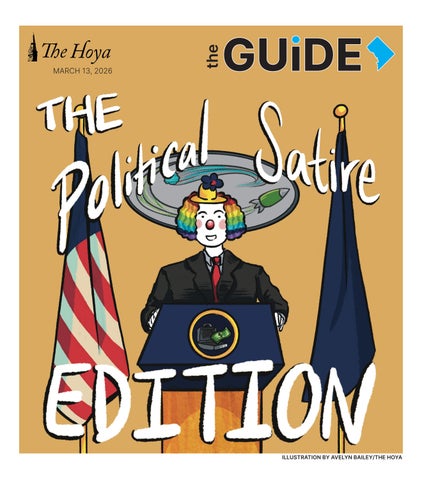
MARCH 13, 2026

![]()

MARCH 13, 2026

Tanvi Gorripati and Isabelle Cialone Senior Guide Editors
Politics presents itself as serious, authoritative and inevitable, especially in our modern climate. One of the most enduring ways that people have confronted the unwavering attitude and bleak realities of political power is not through speeches or manifestos, but through laughter. Political satire thrives on this very contradiction. It undermines the seriousness of political institutions and fgures that present themselves as untouchable by turning them into something ridiculous. Instead of directly criticizing this power, taking it at its merits, satire laughs at it.
Political satire is not just jokes about politicians. It also exaggerates real systems, institutions, rhetoric and behaviors to expose their contradictions and faults. The best satire is often only slightly more absurd than reality — it identifes a weak point in political institutions and pushes it further, resulting in a product that is both comical and didactic.
Political satire has a rich history across numerous media types, from early satirical writings and cartoons — like Jonathan Swift’s 1729 essay “A Modest Proposal” decrying English indiference toward Irish sufering or Benjamin Franklin’s 1754 “Join, or Die” woodcut urging colonial unity — to today’s wealth of movies and shows. Around the world, during various regimes and political systems, satire has been used to highlight political incompetence and counteract propaganda, conveying criticism that transcends the time period in question. Today’s satire takes its shape in Taika Waititi’s heartbreaking critique of propagandistic indoctrination in “Jojo Rabbit” to Stanley Kubrick’s exposé of the libidinal underpinnings of war in “Dr. Strangelove” and Adam McKay’s discussion of incompetent politicians and greedy corporate self-interest in “Don’t Look Up.” The historical and modern criticisms these flms lodge resonate even today, proving the timelessness of the genre — or perhaps the unchanging nature of the fawed systems being critiqued.
Today, satire feels more necessary and perhaps more difficult than ever. Modern politics operates in an environment saturated with propaganda, branding and constant messaging. Populist movements in particular thrive using simplified narratives and emotional appeals, often turning politics into illusions of absolute truths and practiced outrage rather than a measured, goodfaith tussle of competing ideas. In that kind of media environment, direct criticism can feel powerless, as facts alone are rarely able to discredit a narrative designed to ignore and withstand them. However, satire works diferently. By exaggerating the rhetoric, imagery and behavior of political movements, it exposes their defects and contradictions. When propaganda insists on projecting strength and inevitability, satire responds by highlighting the petty and often absurd reality behind the narrative. Laughter serves as a way to strip institutional power of its mystery. By refusing to take authority at face value, satire encourages audiences to question what they are being told and why. At a time when political messaging often aims
to dominate the conversation by fooding its audience with information, that refusal may be the most useful tool in invalidating propaganda. However, the genre of political satire is not without its flaws. While they might succeed in offering up timely humor and provoking individuals’ scrutiny of the politics in question, that is often the extent to which they inspire change. When the people involved in producing that media neglect to be involved in any other conscious or more militant effort to inspire change, the value of political satire feels somewhat stifled. Nonetheless, political satire remains a vital part of the national conversation and the recent surge in satirical movies condemning American politics is a testament to its necessity at this time. This special issue of the Guide explores political satire across flm, television and comedy — from Cold War black comedy to modern media critiques. What connects these works is their shared goal to laugh at what insists on being taken seriously, because sometimes the most efective way to challenge power is not to shout back at it, but to laugh.
Catherine Dodd Hoya Staff Writer
A satirical comedy about a 10-year-old aspiring Nazi, “Jojo Rabbit” immediately establishes a provocative premise and the need to justify it.
Set in Nazi Germany toward the end of World War II, director Taika Waititi’s 2019 flm follows Johannes “Jojo” Betzler (Roman Grifin Davis), a devout member of the Hitler Youth. Jojo frequently converses with his imaginary friend, a satirized, bufoonish Adolf Hitler, played by director Waititi. Jojo’s mother, Rosie Betzler (Scarlett Johansson), secretly opposes the Nazi regime and hides a 16-year-old Jewish girl, Elsa Korr (Thomasin McKenzie), in their attic. Upon discovering Elsa in the attic, Jojo is forced to reckon with her kindness and humanity that challenges the hateful antisemitism he has been indoctrinated into believing.
“Jojo Rabbit,” despite covering the most serious of topics, is a deeply funny flm, satirizing the political climate of Nazi Germany. Lies spread about Jewish people are exaggerated to the point of hilarity. Jojo frmly believes that he could fnd out if someone was Jewish by feeling their head for horns, which mocks Nazi lies and the foolishness of blindly believing them.
The absurd comedy Waititi opts for is a response to the absurdity of war and Nazism; it properly frames Nazi ideology as absolutely ridiculous and unjust. At the same time, the film doesn’t lose sight of the horror behind the satire. The tone abruptly shifts when Jojo innocently follows a butterfly, which leads him to the gallows where he finds his lifeless mother, presumably executed for opposing the Nazis. The tonal shift of the movie accurately captures the real, horrific dangers of hateful rhetoric despite the fact that the bigotry of the Nazi party is, by nature, ridiculous.

Following this shift in tone, the film closes with a scene of Elsa and Jojo stepping outside, met with a joyous, liberated Germany. Elsa, who once said that the first thing she would do if she were free was dance, slowly begins to move, with Jojo joining in, their dance accompanied by “Helden,” the German version of 1977’s “Heroes” by David Bowie. The song was originally written about lovers from East and West Berlin when the city was separated by the Berlin Wall. Just like in the song, the duo has dreamed of a world where they can be free, a freedom Elsa finally feels after years of hiding. By incorporating music from decades after the film’s setting, especially “Helden,” a song written at a different time of political instability and oppression within Germany, Waititi enforces the timelessness of the themes in “Jojo Rabbit.”
This timelessness lends itself to the film’s unsettling relevance in today’s political climate.
“Jojo Rabbit” explores how young people, specifically young men, can be drawn into increasingly radical political identities in attempts to conform or discover a sense of belonging. In the modern digital landscape, warnings against falling prey to propaganda and misinformation are more needed than ever. With online echo chambers and “manosphere” digital communities only growing, the dangerous pipeline towards nationalist and altright extremist ideology remains real and dangerous for young, impressionable boys; Jojo’s interest in Nazism is truly a misdirected reach for connection. In an era marked by deepening political polarization and relentless digital propaganda, “Jojo Rabbit” is a comical, enjoyable reminder that hatred is learned, but that it can also be unlearned. “Jojo Rabbit” does more than just mock Nazis and condemn bigotry; it also argues that empathy, human connection and love are the only forces capable of disarming hatred.Yes, love is a duty. But it should also be so much more.

Eliana Kut Hoya Staff Writer
“Thank You For Smoking” is a witty, entertaining and biting comedy that satirizes the tobacco industry with panache. With critiques aimed at both sides, targeting leaders of the industry and those advocating against tobacco, director Jason Reitman is able to skillfully navigate the world of political lobbying and advertising more largely.
Released in 2005 and based on the 1994 novel of the same name, the flm centers on Big Tobacco spokesman Nick Naylor (Aaron Eckhart), a lobbyist who argues there is no link between
tobacco use and any form of lung disease. A brilliant debater, Naylor is able to make convincing arguments throughout the flm by spinning his opponents’ arguments into contradictions. As the flm progresses, Naylor has to balance being a good father to his son, Joey (Cameron Bright), with his own fring from his company after a reporter (Katie Holmes) exposes him. Naylor ultimately fnds success as a consultant for phone companies and their representatives, helping them counter claims that phones cause cancer.
The flm is successful in its caricature of lobbying and corporate interests, skillfully analyzing and attacking both sides of tobacco campaigns. Though some of the humor might be considered
too obvious or on the nose, I found it hilarious and perfectly exaggerated — operating in just the way I would expect of a satire. “Thank You For Smoking” never runs the risk of its exaggerated messages being taken too seriously. Through its parody of sleazy corporate leaders and backstabbing Capitol Hill representatives, the movie is able to slyly pinpoint its thesis in each portrayal. Though the movie emphasizes pro-smoking campaigning, its ultimately anti-smoking message is obvious.
The world of scheming activists and lobbyists in the flm feels true to the present day, as each character maintains a certain generality, making the movie applicable to any industry in any
time period. Eckhart’s performance particularly stands out as his bold and intriguing portrayal meshes well with the rest of the cast. His comedic timing perfectly matches the flm’s witty script and tone.
Though the flm sometimes lacks in plot progression, instead choosing to focus on purely comic scenes, I thoroughly enjoyed it. Both subtle and more obvious humor are expertly interlinked to craft an engaging yet scathing commentary. The talented supporting cast complements each other in unexpected ways, and I found myself wanting to see a sequel. I haven’t seen a disappointing Reitman flm yet, and “Thank You For Smoking” is defnitely one of his best.
Cialone Senior Guide Editor
Poisoned by his paranoid fear that the Soviets are fuoridating American water to pollute citizens’ “precious bodily fuids,” U.S. Air Force Brigadier General Jack Ripper (Sterling Hayden) orders his unit’s B-52 bombers to execute Wing Attack Plan R, efectively bypassing the usual chain of command to drop nuclear bombs on the Soviet Union. The aircrafts commence their two-hour journeys to various targets and all hell breaks loose. Or at least, with the rapidly approaching threat of nuclear annihilation, it should. Instead, there is a bafling nonchalance among the oficers and government oficials in the face of this looming threat. The key to understanding the flm is through its vision of war — as man’s outlet for his repressed sexual urges. Men, at least those in the United States’ war room, are driven by a primal, libidinal infatuation with violence, and the power to drop a nuclear bomb is the epitome of this blinding virility. This central critique of war is primarily conveyed by caricaturistic military oficers and politicians. At times almost overly on the nose, the flm is ultimately doused in the perfect amount of biting satirical humor. This humor is complemented by the agonizing suspense built up as the bombers near their targets, blissfully ignorant of the metaphorical dick-measuring contest taking place in the name of U.S. military and foreign policy.
Wing Attack Plan R is first issued by Ripper as a means of exacting revenge on the Soviets, whom he blames for draining his formerly powerful sexual essence or his “bodily fluids,” as he refers to it.
In the war room, General Turgidson (George Scott) urges the wholehearted embrace of this mission, seduced to obliviousness by the prospect of asserting his own macho masculinity. The eponymous Dr. Strangelove (Peter Sellers), on the other hand, understands the devastating effects dropping the bombs would have — and it only makes his fetishistic obsession with nuclear power even stronger. Unable to control his right arm, which jerks around incessantly and occasionally defaults to a Nazi salute, Strangelove’s character blurs the lines between violence and sexuality.
While the war room becomes an echo chamber for proponents of Ripper’s orders, President Merkin Mufley (Peter Sellers) seems a shocking breath of fresh, pacifc air. But, as with any president, he only disappoints. Deciding it is necessary to call the Soviet Union’s fctional Premier Dimitri, Mufley ultimately propositions him, coyly firting as they edge around the ever-increasing likelihood of mass nuclear destruction.
Of course, the Soviet Union has an automatic Doomsday Machine that is not only impossible to disable, but has somehow been kept completely secret from the rest of the world and will lead to radioactive fallout with the power to create a fatal 93-year “doomsday shroud” around the planet. At this point, it couldn’t possibly get more absurd — and yet somehow, the flm does just that.
With each increasingly ridiculous turn of events, Kubrick’s critique of the performance of war becomes all the more scathing, yet remains deviously comical. The film’s simultaneous humorous and anxiety-inducing capacities are anchored by the all-around stellar performances, especially from Sellers in his triplicate roles as Muffley, Dr. Strangelove and Group Captain Lionel Mandrake. As the siloed off B-52 crews forge
on, preparing to die heroically for their country, unaware they are going to kill all of mankind and its future, dread manages to creep in alongside the wicked glee the satire inspires. Capable of sparking boisterous laughter and bleak, cynical reflection with the same ridiculous line or event, “Dr. Strangelove or: How I Learned to Stop Worrying and Love the Bomb” is a masterclass in the genre of political satire.

ILLUSTRATION BY EGE ALIDEDEOGLU/THE HOYA
“Dr. Strangelove” balances humor and bleakness well, Isabelle Cialone (CAS ’27) says.
Francis Rienzo Hoya Staff Writer
In a movie featuring absurd comedy and bizarre story elements, “Borat” reveals an abundant amount about American politics and the public. Sacha Baron Cohen stars as the titular character, an immigrant hailing from Kazakhstan who goes to the United States to make a documentary. Cohen cleverly uses the character as a vehicle to explore the existing biases, stereotypes and issues within American society. While “Borat” is occasionally a hard watch, as Cohen has no shame in Borat’s actions (including running naked through a conference with real people, not actors), it’s still a hilarious watch with a message that remains relevant.
Borat becomes obsessed with Pamela Anderson’s “Baywatch” character, C.J. Parker. He begins
a journey across the country to get to her, only to fnd himself stuck in various misadventures along the way. Borat doesn’t know anything about American customs or etiquette, so it is up to locals to teach him about the lifestyle, from driving to proper table manners. These moments stand out as particularly hilarious, as Borat continues to shock and confuse the people around him. It’s not only funny, but it also reveals Americans’ unscripted, authentic thoughts and judgments.
Borat is sexist, racist, antisemitic and, overall, a complete bigot. He does not hold back while sharing his views, like when he meets with a panel of feminists and says that women have brains the size of squirrels. Borat shares these views with others in the flm, some feeling just as comfortable voicing their own opinions. For example, Borat joins a group of frater-
nity brothers who concur with him in saying that women should be enslaved. The brothers continue on and say that, in the United States, it’s unfair that “minorities have all the power.”
The context of “Borat” is essential in framing the flm: After Sept. 11, 2001, xenophobia toward the Middle East became rampant, and Bush-era American imperialism began to intrude upon daily life. So, while Cohen’s fctional character from Kazakhstan lives an outlandish life and his beliefs feel particularly absurd, he shares his beliefs with many Americans.
“Borat” also reveals the casual racism beneath politeness and American customs. When Borat is at an etiquette dinner with white American southerners, they believe that he can be “Americanized.” However, they call the cops when he invites a Black prostitute in to join them, no lon-
ger believing he is capable of assimilation. The scene is hilarious in its absurdity, using social commentary on Southern hospitality to convey its satirical punches. The fact that much of the flm is real, not staged, makes it even more impactful; these reactions are horrifyingly genuine.
The flm is a masterpiece of satire through its showcasing of real reactions to the bigoted character of Borat. It almost makes the real people look dumber than him as they agree with Cohen’s character’s ridiculous and often ofensive opinions. After the flm’s release, several people who appeared in it tried to sue or publicly denounced their portrayals. Specifcally, two of the frat brothers sued for defamation. But nothing about their portrayals was false — “Borat” had revealed their true opinions, making a spectacular political satire while doing so.


Nora Toscano Executive Editor
There is no piece of media that excels at political satire quite like “Veep.” It’s not just Julia Louis-Dreyfus’ six consecutive Emmys for her portrayal of Selina Meyer, Armando Iannucci’s genius and provocative writing or a stacked cast that doesn’t have a second string. It’s everything about the show: every insult directed at Jonah Ryan, every atrocious and ofensive misstep Selina’s staf makes, every chaotic sequence of events that bears a shocking resemblance to American political reality.
Running from 2012-2019, “Veep” follows Selina Meyer, the United States’ frst female vice president, as she grapples with the pitfalls of being one heartbeat away from the presidency — a job she likens to being “declawed, defanged, neutered, ball gagged and sealed in an abandoned coal mine under two miles of human shit.” The series sees Selina’s ascendency to the presidency after the sitting president steps down, her re-election campaign, electoral loss and eventual bid for the White House again.
“Veep” never explicitly specifes which party Selina and her team belong to; in a 2016 interview, Louis-Dreyfus admitted that real politicians on both sides of the aisle have told her they view the characters as members of the opposing party. Keeping Selina’s party intentionally vague makes the series timeless and authentic, clean from the partisan vitriol that fnds its way into much of today’s political comedy. Meyer’s staf is

so ridiculous, so corrupt, so incompetent yet calculated. “Veep” doesn’t glorify Washington, D.C., doesn’t ofer it any platitudes or saving graces. It’s ofensive in all the ways we hope our politicians aren’t but know deep down that they are.
In season three’s “The Choice,” for example, Selina’s staf is forced to refne her stance on abortion as her presidential campaign looms.
As her team crafts a statement, Press Secretary Mike McClintock (Matt Walsh) and Selina’s assistant Gary Walsh (Tony Hale) line up a row of fruits corresponding to the size of a fetus at each week of pregnancy, asking Selina to pick one to determine the cutof point at which she’ll announce abortion should be legal. If that sounds like a wildly insensitive way to determine a stance, that’s because it is — and it’s one of the less objectionable PR solutions in the show.
When Mike suggests beginning Selina’s statement with a reference to her gender, she cuts him of, saying, “I can’t identify myself as a woman. Men hate that, and women who hate women hate that, which I believe is most women.” The entire conversation is absurd and completely insulting, but so much of it rings true in the real political climate. There are clear through lines between Selina’s hesitance to use identity politics and real longstanding debates about whether the United States can elect a female president. The episode, while outlandish, exemplifes what “Veep” does best: It pushes such realities to their absolute extremes, forcing us to question what good our government is ever capable of achieving.
“Veep” shines not only in its brilliant comedic writing, but in its talented ensemble cast. Part of what makes the show’s political landscape so authentic is the wide number of characters who reappear throughout the show, weaving in and out of plotlines and then taking a few episodes or even a whole season or two of. This brings viewers inside D.C.’s insider political culture and builds tension between characters over the seasons as they navigate political hurdles and crises. While every cast member deserves high praise, Timothy Simmons’ portrayal of the ever-infuriating and antagonistic Jonah Ryan is notable. Selina’s staf lovingly refer to Jonah, a White House stafer and later New Hampshire representative, as Jonad, Jack and the Giant Jackof, the Pointless Giant and One Erection, to name a few (and those are the least ofensive). Reid Scott and Anna Chlumsky play Dan and Amy, two of Selina’s stafers with romantic tension and power-seeking competitiveness, beautifully, their chemistry a constant triumph throughout the show. And I’ll forever have a soft spot for Gary Cole’s Kent Davidson and Kevin Dunn’s Ben Caferty, Selina’s oldest and most trusted advisors. Cole and Dunn play their characters’ learned cynicism and complicity in a corrupt system artfully, nailing home the notion that you must abandon all sense of human decency and morality to be successful in American politics. Of course, Hugh Laurie portrays Tom James, Selina’s charming but twisted eventual running mate, charismatically, teaching
ILLUSTRATION BY EMILY WANG/ THE HOYA
Nora Toscano (CAS ’27) says “Veep” epitomizes the genius of political satire.
me at the ripe age of 16 that I can, in fact, be attracted to those 40 years my senior.
The show’s most poignant satire isn’t any of Selina’s lobbed insults at her colleagues, male military oficers being unable to fnd the opening of Selina’s crypt (which is conveniently shaped like certain female genitals) or even an episode where Dan and Amy try to swing an election in Selina’s favor by stopping a recount in Nevada and then starting it up again (this episode aired in 2016 in a pinnacle moment of foreshadowing I don’t even think “The Simpsons” has ever reached).
What makes the show so iconic and authentic is its greatly successful satiric ending. In the fnal episode, as Selina fghts to be her party’s presidential nominee, she must select Jonah as her running mate, which spurs both Amy and Kent to quit. Jonah epitomizes everything abhorrent about politics; he’s a nepo baby who rose to power by relying on misinformation and prejudice, who spreads anti-vax propaganda and is wholly idiotic and incompetent. But when his supporters are necessary for Selina to secure the nomination, she allows the worst candidate imaginable to become the second most powerful person in the country. And when Selina needs to promise a religious candidate that she will overturn gay marriage if elected in exchange for his support, she does it despite having a married lesbian daughter, efectively alienating her only child. The damage to Americans and those closest to her doesn’t matter as long as she wins.
Compounding her callousness, Selina is forced to choose between herself and Gary, the only person who stayed by her side throughout the ups and downs of her career, as her ex-husband’s illegal fnancial activity comes to light. She chooses herself, letting FBI agents arrest Gary as she steps onto the stage and accepts the nomination in the show’s fnal moments.
To win the presidency, Selina had to become so corrupt that even her most loyally depraved and power-hungry stafers abandoned her. And that is political satire at its best. When Selina fnally gets a moment of peace in the Oval Ofice after her inauguration, she instinctively calls out to ask Gary for something, only for no one to answer. There’s no one left. She’s destroyed every semblance of good that ever existed in her staf. It’s because of this that, without fail, “Veep” will always be uncontestedly the best of the best, setting the bar for political satire in a way that defnes both comedy and how we think about those who govern us.
Penelope Snoep Deputy Guide Editor
“Don’t Look Up” is concerningly real. While the flm, directed by Adam McKay, elicits continuous, easy-to-come laughter, it is glaringly refective of today’s political environment. Like many other political satires, “Don’t Look Up” follows an end-ofthe-world plot, so while deeply, darkly funny, upon deeper refection, it is actually quite depressing. McKay leaves no stone unturned in his satirical critique of American politics and media, with characters fulflling every celebrity, politician and citizen stereotype in order to paint a complete picture of American culture. Produced in 2021, in the midst of the COVID-19 pandemic, “Don’t Look Up” perfectly satirizes the moment’s scientifc doubt, fueled by the government and media, along with the incessant trend culture of social media.
“Don’t Look Up” follows timid Michigan State University astronomy professor and astrophysicist Randall Mindy (Leonardo DiCaprio) and micro-bang red-haired Ph.D. candidate Kate Dibiasky (Jennifer Lawrence) after Kate’s discovery of a comet. Kate and Mindy discover that it is not a regular passing comet, but
eone that will almost certainly make impact with Earth, triggering complete species extinction in six months and 14 days. Mindy and Kate, along with Teddy Oglethorpe (Rob Morgan), head of NASA’s Planetary Defense Coordination Ofice, are tasked with alerting the rest of the world of its impending doom. When the three try to bring their fndings to the White House, they fnd that the self-obsessed, head-in-the-clouds President Orlean (Meryl Streep) and her obnoxious nepobaby-son-turned-Chief of Staf Jason Orlean (Jonah Hill) truly couldn’t care less, instead questioning how such an announcement might afect Orlean’s midterm outcomes.
In desperation, Mindy, Kate and Oglethorpe decide to leak the news to the press, using a connection to get into morning talk show The Daily Rip. When the hosts, Jack Bremmer (Tyler Perry) and Brie Evantee (Cate Blanchett), jokingly handle the world-ending announcement, Kate essentially crashes out and instantly becomes a meme, while Mindy, who had taken Zoloft beforehand, is quickly promoted to the status of internet celebrity. Despite his dificulty speaking with confdence, Mindy is deemed the “world’s sexiest scientist” and starts having an afair with Brie Evantee. He also later gets caught up in President
Orlean and billionaire CEO of company BASH Cellular, Peter Isherwell’s (Mark Rylance) plan to try to turn the deathly comet into trillions of dollars worth of resources.
It’s pretty easy to garner that a lot of plotlines and character stereotypes are squeezed into the two-hour-and-18-minute runtime. There’s the self-interested politician, the greedy billionaire mega-corporation CEO, the nerdy-alt scientist, the overwhelming media, the aloof celebrities, the teenagers disillusioned with the world and so on and on. However, McKay is successful in hitting pretty much every nail on the head. Sure, it’s somewhat blunt, but it’s funny, and the in-your-face nature of the satire is purposeful. McKay’s digs at the media, corporations, politics and people’s desire to ignore negative information are prevalent and don’t take a lot of media literacy to identify. Such clarity, though, plays into the flm’s overall critique of human nature — making it feel stylistic.
Still, there are some parts that feel a little too obvious. At one point, Mindy fnally comes to his senses and, while in an interview on The Daily Rip, launches into an exasperated rant: “Would you please just stop being so pleasant? I’m sorry, but not everything needs to sound so goddamn clever or charming or likeable all
the time. Sometimes we need to just be able to say things to one another. We need to hear things!” While Mindy’s statement rings true and serves an important role in his character development, such a monologue feels a little too on the nose to be interesting.
In the fve years since the release of “Don’t Look Up,” the flm only feels more relevant. Widespread distrust of the truth, perpetuated by misinformation from the government and the media, has only become more of an issue. Proft continues to be prioritized by the state and corporations over climate and human rights, mirroring the issues raised in “Don’t Look Up.” Government corruption and cronyism are perhaps more prevalent than ever, a manifestation of continued emphasis on politicians’ personal gain over the common good.
Unfortunately, such continued relevance only makes “Don’t Look Up” more depressing instead of funny; instead of being satirical, it’s our reality. However, I would argue that despite being darkly realistic, “Don’t Look Up” isn’t the type of flm to make viewers believe it is hopeless, regardless of the flm’s ending. Instead, it is a reminder to really look around, to reject anti-truth propaganda and to fght against our current political situation through personal and group eforts.
Grace Ko Guide Columnist
In the sleepy city of Omaha, Nebraska, high school student Tracy Flick (Reese Witherspoon) and teacher Jim McAllister (Matthew Broderick) are at each other’s throats. Directed by Alexander Payne, “Election” follows McAllister, a history teacher whose life is perfect except for the existence of one overachieving student, Flick. And there’s no better way for McAllister to take revenge than in the high-stakes game of a student council election. Determined to knock her down a peg, McAllister convinces popular football player Paul Metzler (Chris Klein) to enter the race for student council president — a race Flick has bet her whole life on.
“Election” shines in leaning toward the subtleties of the absurd, particularly in its characters and their motivations. For example, McAllister initially appears as your typical average man with a supposed passion for teaching high schoolers. But this clean image is quickly blurred by his dubiously unwavering support for his friend and former teacher Dave Novotny (Mark Harelik), who was fred for his inappropriate relationship with Flick. Despite his claims of self-awareness, McAllister’s narration rarely matches his actions throughout the flm. McAllister’s descent into madness is framed by this discordant narration, which perfectly fts the flm’s brand of muted chaos. Against McAllister, Flick is the perfectly imperfect student. Witherspoon’s pitchperfect performance paints a character whose identity is defned by her achievement, and she
excellently portrays the way that that complete obsession both fulflls and isolates her. Despite her will to become a pristine politician, she is just a teenager with huge ambition. Her overthe-top nature drives her best moments, such as when she rips down every poster of Metzler in a rampage before driving to an abandoned power plant to get rid of the evidence.
These character foils frame the school election, providing an interesting view on the very nature of elections. The fully grown McAllister’s use of Metzler to secretly push his agenda against a high school student turns a previously irrelevant high school event into a pivotal race — the public’s attention becomes overwhelmed by the personal battle of these two fgures in the high school ecosystem.
Next to these interests, Tammy Metzler (Jessica Campbell) is a fascinating wildcard. Tammy, Paul’s younger sister, joins the election to spite her exgirlfriend Lisa Flanagan (Frankie Ingrassia), who broke up with Tammy to sleep with her brother and become his campaign manager. Tammy is never once invested in the election, giving her speech on the unseriousness of the system, proposing to completely end the student council as a whole. Despite her rise in popularity, the administration punishes Tammy for her speech. The system must stand above everything else and, with that, Tammy’s popularity is invalid.
Tammy’s electoral run is by far the flm’s most interesting storyline. In a simpler flm, Tammy may have grown interested in the election itself after her spark of popularity, yet she never develops this interest. Instead, Tammy fgures out a way to get into an all-girls Catholic school

ILLUSTRATION BY ISABELLE CIALONE/THE HOYA “Election” likens high school elections to real politics, says Grace Ko (CAS ’27).
where she is likely to meet a new partner, tired of trying to date within her public school. Her motivation never changes and, in one of the flm’s most intriguing scenes, Tammy takes the blame for Paul’s ripped-up campaign posters, taking the fall for Flick. Tammy’s resulting suspension is ultimately worth celebrating for her, as she is fnally sent to the school of her dreams.
Despite the impact of the characters’ personal lives on their decisions, the central tension between McAllister and Flick comes back to the election itself and what it says about politics as a whole. The two opposing parties, their underlying agendas and the system that ensures that processes are
kept in place are all key parts of today’s real-world elections. In making these connections, the film shows the wide variety of chaos such a system can support, yet how unwilling the electoral system is to embrace that chaos.
“Election” is an interesting display of the deceptively simple nature of high school elections. Though political elections are usually considered an entirely separate process from their high school counterparts, the film shows how strangely similar they can be. “Election” takes these parts and pushes them to the max, delivering a film that’s all the more relevant as its high school politics are delivered in a charmingly sly story.

Anandita Agarwal Deputy Guide Editor
Amazon. Afirmative action. Saudi Arabia. Oil. This may seem a random list of some of the most controversial topics of the last decade, but in reality, what each of these have in common is that they were once covered in highly contested, eponymous TV episodes by Hasan Minhaj. In 2018, Minhaj, fresh of of a highly-watched and praised run on “The Daily Show,” launched “Patriot Act With Hasan Minhaj” on Netfix, an episodic comedy talk show that dove deep into politically and culturally relevant Asian American issues. South Asian comedy was never the same. Over the span of two years, the show went on a six-volume run, garnering both acclaim and controversy, but nonetheless winning an Emmy, a Peabody and two Webby awards. The show accumulated a cult following, with exclusive deep cuts and clips posted on YouTube racking up millions
of views. Named for the highly contentious Patriot Act that was passed after Sept. 11, 2001, Minhaj once stated that he envisioned “Patriot Act With Hasan Minhaj” to be different from other political comedy shows by being both “timely and timeless.” In the spirit of that sentiment, I decided to embark on a much-needed rewatch over spring break.
“Patriot Act With Hasan Minhaj” encapsulates the best parts of the hopeful Democratic naivete that gripped America during the aughts of Trump’s first administration while still being hilariously self-aware. It perfectly mixes appreciation and criticism for the United States, reminding audiences of what the country of freedom was meant to be, masterfully delivered through snappy one-liners and self-aware, tongue-in-cheek irony.
Much of the show’s appeal is carried by Minhaj’s special signature charm: declarative politicking that somehow does not feel patronizing when placed between his excellent comedic timing and capacity for Asian jokes. This charm helps
create a wonderful pat-on-the-back sentiment at the end of every episode as both the viewer and Minhaj step away from the show knowing they have done the heavy work of understanding the United States yesterday, today and tomorrow without becoming preachy or serious.
A prime example of this is Minhaj’s memorable deep dive into student debt and socioeconomic instability in “Student Loans.” Using the image of a gun shooting a racer in the foot at the starting line to illustrate the scale of the student debt crisis, Minhaj takes on a light-hearted yet deeply informative tone, reminiscent of the best parts of “Last Week Tonight With John Oliver.” But, as Minhaj has often elucidated, what makes his show stand out is the perspective he brings as a Muslim Indian American, a fresh outlook in the late night comedy genre.
Any rewatch of “Patriot Act With Hasan Minhaj” would be bereft and incomplete without a consideration of both the internal and external controversy the show was often at the center of, even in its short
run. Allegations of overlooking fact checkers, mistreating female employees and even bending the knee to the combined powers of Netflix’s corporate money and the threat of a tyrannical monarchy have dulled some of the show’s moral high ground. The implications of such serious controversies have reverberated not just throughout the show but through the late-night genre altogether. Moreover, the backlash generated by some of the nation-states and actors Minhaj covered — often in a negative light — such as the Indian Modi government in “Indian Elections” or the Philippines in “Brazil, Corruption and the Rainforest” have made the show one of the most standalone and impactful pieces of political comedy from our time.
While the racial jokes can sometimes get excessive and the meta-ethics of the show can certainly be debated, “Patriot Act With Hasan Minhaj” can be praised on the sole virtue that it redefined what it means to be patriotic and what it means to be American, which is much needed in today’s world.
Aarushi Maskara Special to the Hoya
When Stephen Colbert occasionally revives his conservative pundit alter ego on “The Late Show,” the character immediately launches into confident political analysis. His arguments sound bold and authoritative, but very obviously fall apart about halfway through the sentence, revealing their weakness. Originally introduced on “The Colbert Report,” Colbert’s alter ego mocks the style of cable news commentary, drawing inspiration from hosts like Bill O’Reilly, for whom confidence can sometimes matter more than logic. Unlike other political comedians who criticize pundits from the outside, Colbert’s satire works because he actually becomes the pundit himself. Even years after the original show ended, the character still works because the type of commentary it mocks persists and feels quite familiar.
Part of the brilliance of Colbert’s character is how closely it resembles the people he’s
imitating. Colbert is not creating an obviously ridiculous caricature of a conservative pundit; instead, he imitates the tone and structure of cable news commentary almost perfectly. The delivery sounds familiar enough that the satire sometimes feels indistinguishable from the format it mocks — so much so that viewers initially thought the character was serious when it was frst introduced. By copying the style so closely, Colbert reveals how theatrical political commentary can become.
This approach connects to one of the most memorable ideas from “The Colbert Report”: “truthiness.” Colbert originally coined the term to describe believing something because it feels true rather than because it is supported by evidence.
The pundit persona runs entirely on that logic as facts become less important than instinct.
One of the clearest examples of this satire appears in the recurring segment “The Word.”
In these monologues, Colbert’s alter ego speaks directly to the camera while text appears beside
him on screen. Colbert’s role delivers the character’s political message, while the on-screen text reveals what he actually means by what he says. The persona never acknowledges the contradiction and continues delivering the argument with deadpan delivery. The humor in these segments is not always laugh-out-loud funny. Instead, it often feels more witty and observational. Much of the comedy comes from recognizing Colbert’s persona as a refection of a media personality who acts this way unironically.
The viewers’ recognition allows the character’s humor to remain relevant. In several recent appearances, Colbert’s pundit persona returns to comment on current political debates. Even for viewers who were too young when “The Colbert Report” originally aired, the persona feels recognizable today.
If anything, the modern media environment makes the satire even more recognizable. Television commentary and social media debates often reward bold, sensationalized claims over
reasoning. Colbert’s persona exaggerates that dynamic to show how easily strong, sensational opinions can pass as calculated analysis in modern political commentary. At the same time, the structure of the joke can occasionally feel predictable. Because the segment follows such a recognizable rhythm, Colbert’s humor sometimes feels stale. It works best for short, sporadic segments that beneft from the delivery rather than the surprise. Importantly, the satire also punches up. Colbert doesn’t use the character to mock ordinary voters or individual political beliefs. Instead, the target is the media personalities and political figures who shape political commentary. The fact that Colbert can still bring back this character more than a decade after “The Colbert Report” ended says a lot about the power of satire. The character works because the style of commentary it mocks has never really disappeared. As long as absurd political commentators exist, Colbert’s character will continue to sound strangely familiar.
Mauro Mazzariello
Hoya Staff Writer
Every now and then, you watch a movie and come away stumped that you’ve never seen it before. More commonly, you might recognize a particular scene because it has become prolific across social media platforms. But because of this, the brilliance of a work of art in totality — and the message it is trying to convey to the audience — does not always translate into the success it deserves. As novelist Milan Kundera points out in his book-length essay “The Curtain,” a truly great work of art is able to reveal something universal about the human condition, to put into words a previously unexpressed but shared experience. Chris Morris’ black comedy “Four Lions” is one of these hidden gems that speaks to a shared truth. A hilariously dark exploration of the dangers of conformity and radicalism, the 2010 film provides a near constant stream of laughs while retaining its central message.
“Four Lions” follows four hilariously inept Muslim men living in England as they attempt to bring

their mission of jihad against the West to fruition.
The group is led by the most competent Omar (played brilliantly by Riz Ahmed). As the one chosen to join the Mujahideen, Omar is the glue holding the group together, even though he ultimately does not make the grade (DO NOT skip the credits, they hold some true gems). Caught in the middle, Omar returns to England with the determination to lead the block-headed Waj (Kayvan Novak), the utterly ridiculous Barry (Nigel Lindsay) and the unfortunate Faisal (Adeel Akhtar) in a noble (and completely unauthorized) jihad. Later, they recruit the sophomoreish Hassan (Arsher Ali) to their group. The movie seamlessly glides through their numerous misadventures and humorous incompetence as they struggle to fulfill their mission. This might make the movie sound like it covers a heavy topic not suitable for a comedy. The irony was not lost to me as I struggled to write a first draft of this article during a five-hour layover between London and Washington, D.C. Terrorism and religious fundamentalism are innately serious topics that have only grown more poignant since the movie’s
release in 2010. But the unexpected levity the movie infuses in such a controversial topic is exactly what makes the viewing experience so rewarding.
The brilliant poise and humor with which the script brings to the surface the hypocrisy and inane thought processes of the group not only provide a good laugh, but allow for a deeper understanding of the forces that drive them. To borrow from punk terminology, Barry is a poser: From his self-appointed nickname, Azzam Al-Britani, to his wickedly irrational patterns of logic throughout the movie, Barry underscores how dangerous it is for a person to subscribe to a cause without truly understanding it. Still, he provides great comedic relief. Hassan perfectly exemplifies the perils of conformity, starting off as a prankster (and truly awful rapper) who seeks brotherhood with the group despite not truly believing in their mission. Omar himself becomes a symbol of the pressures of conformity, realizing too late that his strong-armed methods toward the reluctant Waj were wrong.
As an interesting side note, it was only on my fifth viewing that I realized a poignant parallel in
the movie’s excellent usage of Toploader’s “Dancing in the Moonlight” (although I did deduct half a star solely because I favor the King Harvest version). The song was written with deeper traumatic themes in mind, but the happy melody helps the listener glide through them, a concomitant (yes, I did just learn this word, it means a natural accompaniment) to the dark satire of “Four Lions.”
In an age where the line between caricatures and reality is becoming harder for the average person to distinguish, “Four Lions” stands out as a symbol of the ways in which politics can be more skillfully and obviously satirized to reveal a deeper message while still maintaining a degree of levity. The most efective forms of satire are those that can understand a point of view so deeply they are able to highlight the inherent contradictions of an identity with mocking humor, and “Four Lions” excels at the task. It never abandons its core theme of the pitfalls of conformity, especially in relation to radical ideology, with the well-written jokes — providing an excellent cushion for the audience to fall back on.
Sophie Erlinger Hoya Staff Writer
Contrary to what the title might suggest, “Dick” is an alternate history political satire, written and directed by Andrew Fleming. The flm follows teens Arlene (Michelle Williams) and Betsy (Kirsten Dunst), who become President Nixon’s (Dan Hedaya) dog walkers during the Watergate scandal, also becoming the faces behind the informant known as ‘Deep Throat’ who leaked information to The Washington Post.
The plot is just as ridiculous as this concept sounds. Humor is at the forefront, from a scene where the girls unknowingly give the president brownies laced with Betsy’s brother Larry’s (Devon Gummersall) pot, to the name ‘Deep Throat’ coming from Larry’s porn to Nixon insisting the girls call him Dick (hence the title), leading to as many dick jokes as you would expect. By far, my favorite comedic yet historical detail was that Arlene leaves an 18-and-a-half minute love note on a tape in the White House, explaining the infamous gap in evidence.
Using these plot points turns a serious scandal in U.S. history into a compilation of teenage shenanigans — perhaps an apt commentary on the way intense political moments often look like nothing more than teen girls bickering. Betsy and Arlene’s interactions with these supposedly strong men highlight just how underqualifed many people in power
are. For example, when the girls are frst given their jobs as dog walkers, the president and his council start a bickering match about what country started the Vietnam War, eventually asking Arlene, a 15-year-old girl, for advice.
Aside from the plot and characters, I also adore how “Dick” is so refective of its times, plural. The soundtrack and set design perfectly capture the 1970s hippie chic, immersing viewers in Watergate-era America. Contrastingly, the humor and dramatic acting style are so clearly a product of the 1990s, drawing clear inspiration from “Saturday Night Live” (which many “Dick” cast members, such as Will Ferrell, Jim Breuer and Harry Shearer come from).
This flm stood out to me personally as a teenage girl who feels passionately about social issues but struggles to understand some of the more intricate political structures. However, I bet many Americans of all ages and genders would agree. Betsy and Arlene, although often clueless and self-centered, know what is happening in the government is wrong. Much of the confict and misunderstanding comes from them trying to solve problems but not really knowing what to do.
Similar to the Watergate period, today there is a sense of hopelessness in America. With the controversy surrounding the release of the Epstein fles and the condemnation of the government’s immigration enforcement tactics, rates of public trust in the U.S. government are approaching an all-time low.
“Dick,” in combining humor and historical truth to allow teenage girls and stoners to make a diference alongside journalists and Congress, gave me hope.
In the fnal scene, Arlene and Betsy cut and sew the American fag into outfts in between a shot of Nixon boarding the helicopter, leaving the White House after he resigned. The girls then
unfurl a banner reading “You suck, Dick. Love, Deepthroat” on a balcony along the fight path. This last moment is simultaneously powerful and hilarious, encapsulating the flm’s overall excellence in melding these tones.
Although Watergate itself feels so far away, the themes of “Dick” are ever-present. Change will happen, even if right now it feels impossible.

Juan Almanza Deputy Guide Editor
Kim Jong Un, since taking power in North Korea in 2012, has both eluded the media and simultaneously maintained the Kim family’s cult of personality. Aside from ruling the country with an iron fst, Kim is reported to enjoy American basketball. In 2014’s “The Interview,” the in-universe Kim Jong Un (Randall Park) is also a big fan of the American tabloid TV show “Skylark Tonight,” hosted by Dave Skylark (James Franco) and run by Aaron Rapaport (Seth Rogen). After learning of Kim’s fanboy status, Skylark Tonight manages to land an interview with Kim in the heart of North Korea. The catch? The CIA has given them an additional task: assassinate the North Korean dictator.
“The Interview” made waves even before it was released. When North Korea caught wind of the news that the movie was being produced, North Korea’s Ministry of Foreign Afairs declared that the movie’s release would be an intolerable act of war. The threats became so prevalent that Michael Lynton, former CEO of Sony Pictures, said former President Barack Obama chastised him for greenlighting the movie. The release was also the centerpiece
of the 2014 Sony Pictures hack, when hacker group “Guardians of Peace” leaked a slurry of data and claimed to have seized over 100 terabytes of information, all with the demand to not release “The Interview,” with the FBI later confrming that the hack was the work of the North Korean government. Meanwhile, threats were made against movie theaters that led to the cancellation of the wide theatrical release.
Sufice to say, North Korea is not happy this movie exists. I, however, am quite happy this movie exists.
Now, don’t take my positive rating as an indication that this movie is somehow a masterpiece, because it is far from it. This movie is a vulgar, only somewhat funny, badly colorgraded attempt at recreating the edgy magic that movies like “Team America World Police” thrived on. Rogen and Franco knock it out of the park, though, coming from a fan of both of their work, that isn’t much of a surprise. Franco stellarly plays the naive and hedonistic yet lovable Dave Skylark, and Rogen’s depiction of Aaron Rapaport as a tired media producer and an aspiring reporter feels like it was made for him.
The assassination plot is simple: shake hands with the dictator with a contact-transmitted poison and wait for the rest to unfold. It would
have gone swimmingly, had Skylark not become smitten with Kim for the disdain they have both faced from people who don’t understand them. The two men’s similarities are uncanny. Being a looked-down-upon talk show host and ruling a country of starving and sufering people apparently have the same capacity to make one feel truly alone. As they party, with Skylark seemingly forgetting all about the assassination plot and instead being wooed by nude North Korean women, Rapaport grows anxious.
The plot is foiled by Skylark’s naivete, and it isn’t until one of Kim’s close advisors and chief propagandists, the beautiful Sook-Yin Park (Diana Bang), reveals herself as an ally to the two Americans that things get back on track. She orchestrates a new plot: they’ll interview Kim and humiliate him in front of the public to destroy his cult of personality. It is also signifcant to note that, soon after, she reveals her attraction to the overweight and “hairy” Rapaport (again, played by Rogen) in a passionate scene (can you tell the flm was co-directed by Rogen?).
What follows can only be described as the pinnacle of political satire, as a now-enlightened Skylark puts pressure on Kim during his interview. Consequently, Skylark exposes Kim’s weak points to the North Korean public, making
him cry and even poop his pants, all on a live, international broadcast. As this is all happening, Park and Rapaport fght of the North Korean soldiers trying to break into the broadcast room. Ultimately, they all escape on a tank, Skylark’s new North Korean puppy in tow.
Even as Kim tries to stop them and preps nuclear missiles for launch, they fre the tank’s artillery at his helicopter and blow him up in a truly awesome slow-motion scene where the fery wreckage becomes a backdrop for the rolling tank and Katy Perry’s “Firework” adds a nice needle drop to boot. It’s nothing short of selfindulgent fun, and it totally succeeds in this.
Normally, a flm like this wouldn’t get much attention and, at times, the depiction of the North Korean attitude and frankly, insecurities, feels overblown, but considering that such a silly, unserious flm spawned real cyber terrorism and almost life-threatening terrorism, the North Korean government only proved the movie right in its satirical claims. Park does phenomenally at playing the role of the brutal dictator and simultaneously horribly insecure Kim in the flm. Even at its most vulgar or even unfunny moments, the cast’s charm manages to put a gloss on the mediocre script, and its satirical wit ends up being right on the money.

By Jackson Roberts
1. River of southern Africa
8. “Foolish” singer
15. Butter knife golf club
16. Jon of “The Daily Show”
17. What’s sent on Signal or WhatsApp
19. 16-Across’ successor Trevor
20. Suffragist Carrie Chapman
21. Zuri, Emma and Luke’s brother on “Jessie”
22. Salt pair, musically
23. “You don’t have to tell me twice!”
25. It’s scanned when checking out
29. What you might add to “perro” to make it smaller
30. Dig up, as in a body
31. Brag or boast of an accomplishment
32. __ Kappa Epsilon
35. What you might have as a long-time viewer of 16-, 19-, 50- or
58-Across
38. Gossip
39. Plane prefix
40. The meat, one might say, of a meal
41. Neither pair
42. Take aback
43. Home of the University of Arizona
47. “Is not!” retort
48. Senior Features Editor Kendall
49. Start of many a guess in, say, 20 Questions
50. Jay of “The Tonight Show”
54. Birthplace of the Bard, erroneously
58. The last “The Late Show” host
59. The smart faction in “Divergent”
60. Official name for the lack of a sense of smell
61. Many karate teachers
Where a recording is caught
As _____: Grouped together
John, Peter and Francis, abbr.
“For ____ a jolly good fellow…”

11. In the know
12. Keep up at night
13. Roman fountain and tourist attraction
14. San Francisco ice cream sandwich brand
18. Long Island Rail Road and N.Y.
City Subway manager
22. Fish or Florida beach city
23. Apple’s music marketplace
24. Became a fan of
25. Not good or better
26. Cars usually have two
27. Mother of Zeus
28. Snooker stick
29. iPhone platform
31. Chicken general?
32. Drive-____
33. Amarna-period Egyptian sun god
34. Opposite of new
36. Go awry
37. Old Pontiac muscle car
42. Comments to the audience in a play
43. Puccini opera
44. Muckraker Sinclair
45. Charles, in Calabria
46. Pavement units
47. Military info. acquisition and analysis
49. Ancestor of I and J
50. Young chaps
51. Former Editor in Chief Steele
52. “It wasn’t me!”
53. Bucks
55. Pro ____, for the time being
56. “TGI” day
57. Female counterpart of a monk