
GU Students Disconcerted By Increasingly Common Political Violence in US
Michael
Scime Hoya Staff Writer
In the week following the Sept. 10
assassination of conservative activist Charlie Kirk, Georgetown University students expressed fear, uncertainty and a renewed commitment to dialogue amid an increasing trend of political violence in the United States.
Kirk was fatally shot during a campus event at Utah Valley University while on the first stop of a tour for his political advocacy nonprofit, Turning Point USA. His assassination followed multiple major incidents of political violence in 2025: Minnesota State Speaker Melissa Hortman and her husband were killed in their home in June; an arsonist set fire to Pennsylvania Governor Josh Shapiro’s home in April; an Immigration and Customs Enforcement officer was shot and injured in July; and two Israeli Embassy staffers were killed outside the Capital Jewish Museum in May.
As experts become increasingly concerned about political violence across the United States, many Georgetown students have prioritized civil discourse while reckoning with growing hostility and partisanship in U.S. politics.
Knox Graham (SFS ’27), who met Kirk while interning at the 2024 Republican National Convention, said that even in a time of fear and violence, he is encouraged by civically minded students around him prepared for change.
“We are in a troubled period right now, but I don’t think that is something to be frightful about, because the times that we’re in call for good people, earnest people, enthusiastic people,
public servants to stand up and to contribute to a better country than the one that we’ve been offered,” Graham told The Hoya
“Even in fear, I still see hope, because I see people who are not resigned to what we’re in,” Graham added. “I see people who are eager and willing and desiring to change it.”
Katie Taffe (CAS ’27), who is from Minnesota and interested in pursuing a career in government, said that while she has felt safe at on-campus political events, Kirk’s assassination shocked her.
“All of the campus events with political speakers I’ve been to have felt incredibly safe,” Taffe wrote to The Hoya. “There have been events where people have expressed their disagreement with speakers in a peaceful manner, even if they were contentious. The shooting in Utah corrupted the nature of free speech, and even though I still feel safe on campus, it definitely will be on my mind when I attend events here at Georgetown in the future.”
Georgetown student organizations and academic groups regularly host speakers in Red Square, Gaston Hall and other venues, some of which have invited protest or condemnation. In 2020, students walked out in protest during an event with Kirk and Eric Trump (MSB ’06) hosted by Georgetown University College Republicans (GUCR).
Georgetown recently received an “F” grade for free speech from the Foundation for Individual Rights and Expression, a nonprofit tracking free speech nationwide, though it jumped 111 spots among universities nationwide overall.
See VIOLENCE, A7

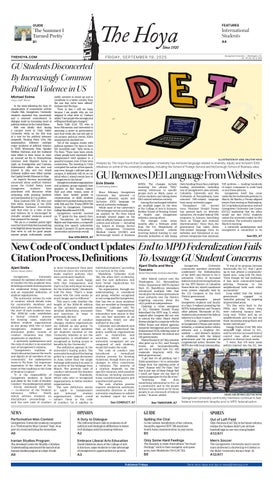
Analysis by The Hoya found that Georgetown University has removed language related to diversity, equity and inclusion (DEI) initiatives on some of the university’s websites, including the School of Foreign Service and McDonough School of Business sites.
GU Removes DEI Language From Websites
Evie Steele Contributing Editor
Since February, Georgetown University has removed or changed diversity, equity and inclusion (DEI) language on several university webpages.
While most of the university’s DEI webpages remain unchanged, an analysis by The Hoya found multiple altered pages on the sites of affinity houses, university centers and schools — including the School of Foreign Service (SFS), Georgetown University Medical Center (GUMC) and McDonough School of Business
New Code of Conduct Updates Citation Process, Definitions
Ajani Stella Senior News Editor
Georgetown University released its updated student code of conduct for this academic year, detailing a revised citation process for residential living violations and an expanded definition of student organizations.
The university revises its code of conduct, which details rules for community members and disciplinary procedures, before the start of each academic year. The 2025-26 code establishes a formal citation process for housing cases, explicitly defines student organizations as any group with two or more Georgetown students and eliminates public records of conduct violations less than suspension or expulsion.
A university spokesperson said the code of conduct is an essential part of Georgetown’s mission.
“Georgetown’s tradition of Jesuit education honors the worth and dignity of all members of our community,” the spokesperson wrote to The Hoya. “An important expression of the values at the heart of this tradition is the Code of Student Conduct.”
“It is the responsibility of Georgetown students to know and abide by the Code of Student Conduct,” the spokesperson added. Nicole Abudayeh (SFS ’26) — co-director of the Student Advocacy Office (SAO),
advises students on
code of conduct
is more transparent than past iterations since the university made explicit policies that were previously implicit.
“We are very much happy with that transparency, and that’s in line with what we want for the student body,” Abudayeh told The Hoya. “That’s a large reason why the code seems so much longer and so different.”
This year’s code doubles the length of the 2024-25 edition as the university extensively detailed definitions, processes and sanctions in ways it previously did not.
With the code of conduct changes, student organizations are defined as any group “in which two or more members are Students enrolled at the University, whether or not the organization is established or recognized as having access to benefits by the University.”
The definition appears in the university’s hazing policy. The university formalized the hazing policy in a nine-page document in June, rather than the single webpage addressing it as seen in an archive of the webpage from March. The previous code of conduct referenced the Student Organization Standards, which only refer to recognized organizations, to define student organizations.
The new definition seems to apply to independent and informal student organizations, which could subject them to the code of conduct “as it applies to
individual students,” according to a section in the code.
Madeleine Callender (CAS ’26), the other SAO co-director, said the new definition will have broad implications for student groups.
“An organization, through our understanding, is considered any group, whether recognized or not recognized by Georgetown, that has two or more members that are enrolled as Georgetown students,” Callender told The Hoya. “What organizational misconduct now means is that you can face sanctions as an organization, which are also outlined in the code.”
Callender and Abudayeh said that, as they understood the policy, unofficial organizations such as fraternities and sororities, which are not university recognized yet are composed of only students, would fall under the code.
The code of conduct also introduced a formalized citation process for housing violations, though there are no changes to what constitutes a violation. The severity of a citation depends on the specific violation, with possible violations including excessive noise, unauthorized guests and unauthorized parties.
The new citation process requires residential assistants, community directors or other university employees to submit an incident report for every
See CONDUCT, A7
(MSB). The changes include removing the phrase “DEI,” erasing references to specific groups such as Black, queer or Latinx students and taking down DEI-related websites entirely.
Among the unchanged websites are multiple pages on the sites of the College of Arts & Sciences, Berkley School of Nursing, School of Health and Georgetown Athletics, among others.
The changes come seven months after a February order from the U.S. Department of Education directed schools receiving federal funding to end diversity initiatives or risk losing
their funding. Since then, multiple leading universities, including two of Georgetown’s peer schools, Columbia University and the University of Pennsylvania, have removed DEI-related language from many university pages.
Throughout his second term, President Donald Trump has pushed back on diversity initiatives. He ended federal DEI programs in January, describing them as “illegal and immoral discrimination.” Since then, the government has taken down DEI-related language from its websites and threatened to sue private companies that maintain
DEI policies — leading hundreds of major companies to scale back or end those policies. Georgetown itself has come under fire for its diversity policies: In March, Ed Martin, a Trump-aligned lawyer then serving as Washington, D.C.’s top federal prosecutor, warned Georgetown University Law Center (GULC) leadership that his office would not hire GULC students unless the university ended its DEI curriculum. The university rejected Martin’s warning. A university spokesperson said Georgetown is committed to its See DEI, A7
End to MPD Federalization Fails To Assuage GU Student Concerns
Ajani Stella and Nora Toscano
Senior News Editor and Executive Editor
After federal control over the Washington, D.C. Metropolitan Police Department (MPD) expired Sept. 10, Republican lawmakers introduced multiple bills that would give the federal government more authority over the District, reigniting concerns about the city’s political independence.
Claiming a crime emergency in D.C., President Donald Trump federalized the MPD Aug. 11, which expired after Congress did not vote to extend the order. Mayor Muriel Bowser pledged to cooperate with the White House and federal agencies, except for Immigration and Customs Enforcement (ICE), relieving some of the tension between the federal and city governments.
Maeve Kramer (CAS ’26), a student who grew up in D.C., said Trump’s moves are incomprehensible, and she is worried how D.C. will cooperate long-term with the federal government.
“I get that it’s all political, but I think sometimes I try to rationalize things from the opposing point of view,” Kramer told The Hoya. “And this is just one of those things that I could not figure out any kind of rational argument for the life of me.”
“Anything that does something substantial to D.C. as a community and to the people without being voted on by those people is an overreach of federal power,” Kramer added.
See TAKEOVER, A7
Georgetown University community members previously condemned the federalization of the MPD and threats to D.C.’s autonomy. Critics of increased federal control cite its implications for the 1973 District of Columbia Home Rule Act, which transferred some powers originally held by the U.S. Congress to the local District government. Two lawmakers joined Georgetown students and faculty at a Sept. 9 walkout protesting the MPD’s federalization and Trump’s other policies. Thousands of D.C. residents also protested the federal takeover in a Sept. 6 march.
Colie Long — a program associate at Georgetown’s Prisons and Justice Initiative, a criminal justice reform advocate and a longtime D.C. resident — said Bowser’s decision to collaborate with the federal government and the potential of congressional action threaten the MPD’s ties with local communities.
“It was of no purpose, because historically, the D.C. that I grew up in was always a communitybased area,” Long told The Hoya “Even though we had problems, it was more community-based policing. Everyone in the neighborhood held each other accountable.” Long added that the federal government engaged in “selective policing” by targeting impoverished areas.
“It’s like we’re back in the 1950s and ’60s, where they were enforcing vacancy laws,” Long said. “Police pull up on neighborhoods and you just see them harassing young black and brown individuals.”
Joseph Stocker (CAS ’28), who attended high school in D.C., said he worries increased federal control may allow national politics to obscure local needs.
“I worry that it’ll leave some politics injected into the D.C. law

ILLUSTRATION BY ARIA ZHU/THE HOYA
HAAN JUN (RYAN) LEE/THE HOYA Georgetown University community members continue to fear federal involvement despite end to MPD federalization.
of her column, Anandita Agarwal (SFS ’28) examines South Asian representation in pop music.
Left Field
Eilat Herman (CAS ’26), in her latest column, wishes the Yankees didn’t put all their baseball eggs in one very young basket. A12/A11
Madeleine Ott (CAS ’26).
Georgetown University men’s soccer team delivered
shuttering 4-0 defeat to the Rider University Broncs Sept. 13.
OPINION
Resolve GU Political Polarization
The United States hosts a horrific history of political violence — a history bleeding into the present.
The Sept. 10 killing of conservative political activist Charlie Kirk on a college campus follows an uptick of political violence across the country. Just this past year, the country has seen the high-profile shootings of two Minnesota state lawmakers, an act of arson at Pennsylvania Governor Josh Shapiro’s home and two assassination attempts on President Donald Trump.
Political violence is not a problem exclusive to one political ideology — its contributions to the backsliding of stable democracy are universally damaging. It is never permissible.
An assassin killed Kirk while he was on a university campus, a place purported to promote open and free dialogue. At Georgetown University, a place where Kirk visited five years ago to speak about Trump’s first term, free speech and activism are well known among students. If we wish to work towards the ideal of free speech in U.S. politics, students must fight polarization on campus and beyond.
The Editorial Board strongly condemns any reaction that celebrates or weaponizes this murder. Some point to Kirk’s statements about the Israel-Hamas war to warrant his death, while others — including Vice President JD Vance — blame an alleged vast left-wing terrorism network. Either way, calling this anything other than a tragedy diminishes the fundamental loss of life.
The on-campus reaction was commendable at first. The Georgetown University College Republicans (GUCR), Georgetown University College Democrats (GUCD) and Georgetown Bipartisan Coalition (GBC) issued a joint statement in the aftermath calling for an end to political violence.
“There is absolutely no place, nor any justification, for any form of political violence in America,” the groups wrote in the statement.
The Editorial Board strongly supports this message. At the same time, we deplore the incendiary post that GUCR published a day later, largely defeating the purpose of a joint statement. In the statement, GUCR attributes the rise in political violence to the left.
“This heinous act further enlightens the troubling increase of political violence in our country, fomented by polarizing actions from the left,” the group wrote. It is impossible to discuss this issue without acknowledging the inflammatory nature of Kirk’s rhetoric — in many ways, he enabled the current era of political polarization. On Jan. 6, 2021, when thousands of Trump supporters marched in Washington, D.C., protesting the certification of the 2020 election results, Kirk funded travel expenses for 80 busloads of protesters. Many of these protestors went on to storm the U.S. Capitol in the ensuing insurrection.
Cosmo Salicone (SFS ’28) — director of community at Georgetown’s chapter of BridgeUSA, a youth movement to fight political division — said Kirk’s style was often not conducive to productive discussion.
“While Charlie Kirk did create opportunities for students to engage in cross-ideological discussions, his style generally fostered argumentative and heated debates rather than meaningful conversations,” Salicone wrote to The Hoya
HOYA HISTORY
Still, the Editorial Board recognizes that Kirk attempted to create political discourse on college campuses. Though it regrettably took the form of “culture wars” and rants against diversity initiatives, Kirk’s willingness to be challenged went beyond many other political figures. He often manned a “Prove Me Wrong” table and invited students to challenge his political views.
Jordan Van Slingerland (SFS ’26), president of the Tory Cohort in the Philonomosian Society, said Kirk’s debating model encouraged dialogue and interaction between opposing viewpoints.
“What Charlie did day-in, day-out, may be one of the best antidotes to what I see as a ‘pandemic of non-engagement’ from many left-wing organizations on this campus with their conservative counterparts (that being the lack of willingness to engage with conservatives),” Van Slingerland wrote to The Hoya
Students should appreciate this willingness to be challenged. Politically, Georgetown remains largely homogenous: A 2024 survey found that students were over six times more likely to identify as liberal than as conservative. In largely homogenous places like Georgetown, it is easy for students to remain in conversations with like-minded people. However, each student has the power to seek out differing viewpoints, breaking these echo chambers.
Instead of conversing with the aim of changing someone’s mind, invite dialogue for the sake of learning. Often, as Kirk did, we listen to the opposing side so we can refute arguments without considering their reasoning. Pursuing good faith discourse is how you fight against ideological siloing. When we recognize what shapes a point of view, it is easier to discover common ground.
On campus, there are many ways that Hoyas can improve upon how they engage with differing views.
Attend a debate society meeting, even if the prospect of speaking up overwhelms you. Debate societies offer a wide range of viewpoints, and hearing from multiple perspectives in real time can be illuminating.
Ask questions when you don’t understand the reasoning behind a stance. The political organizations on our campus table in Red Square for a reason — they make themselves visible so you can use them as a resource.
William Mead-McCaughan (CAS ’27), who has tabled for multiple organizations, said he believes the practice helps drive necessary campus discourse.
“Tabling allows differing views to be visible, in the same place, and at the same time,” Mead-McCaughan wrote. “It encourages conversation.”
The Hilltop also offers a myriad of speaker events and discussion groups. Even if you disagree with the speaker or the issue, go to these events. There is nothing to be lost and everything to be gained from open conversations.
Above all, approach opposing viewpoints with respect. The only way to fight polarization is through understanding and empathy, not increased argumentation and division.
The Hoya’s Editorial Board is composed of six students and is chaired by the opinion editors. Editorials reflect only the beliefs of a majority of the board and are not representative of The Hoya or any individual member of the board.
Letter: On Georgetown’s Overreaction
February 14, 2014
To the Editor:
The cascade of whining and ignorance written by nearly 300 Georgetown graduates and found on the university’s Facebook page in regard to my recent article on the citizen’s responsibility to protect liberty is very interesting. It testifies as to just how close Georgetown is to becoming a member in good standing of the Ivy League: ignorant of U.S. history, anti-American and not at all bothered but rather enthusiastic about the advance of tyranny in America under the auspices of the national government’s executive branch. My article, of course, never “called” for the assassination of Obama or Cameron. It was, rather, a warning to them, their parties and to their successors that no republican people is obliged to sit quietly like lapdogs and watch their nation become a tyranny, although those Georgetown graduates who commented on Facebook appear to be largely that poodle class. The U.S. Constitution’s Second Amendment, of course, expresses the idea of the citizen’s duty to resist tyranny much more clearly and concisely than I ever could.
Whether The Hoya or its readers like it or not, both the Obama and Bush presidencies were marked by studied advances toward tyranny. Foreign wars without a congressional declaration of war; signing statements and executive orders to circumvent laws or make them dead letters; and amending laws with the stroke of the executive pen are all unconstitutional measures which — if not opposed by means appropriate to the times — will make the national government a tyranny. Perhaps such an advance to tyranny is okay with Georgetown and its graduates, but it is not okay with me, and I think not okay with plenty of other Americans.
A good many of the comments on the Facebook page also cry out in apparent pain: “What are the Jesuits doing letting Scheuer teach at the university?” Simply put, I am the best at what I do; indeed, no one’s predictions of where the war on Islam is going have been more accurate than mine since 2002. But I think the just-noted question would have been a good one had it been truncated
to “What are the Jesuits doing?” Clearly, what they are not doing is teaching with any talent, depth or frankness — given the substance of the Facebook comments — about the history of liberty in the United States and Anglo-American world; the founders’ views on the issue or the work of our English forefathers, which provided the basis for the founders’ thought. Even with this clear failure, one might have thought that Georgetown’s Jesuits would at least have been teaching St. Paul’s guidance that rulers are to be obeyed only so long as they rule justly. The idea of “unlimited obedience to rulers” cannot be found in St. Paul’s writings, although it is rife among my Facebook critics. Perhaps it is time for Georgetown’s Jesuits to return both St. Paul and crucifixes to the classroom, if only to repair some of the damage my Facebook critics caused to the university’s claim of producing superior graduates who are ready — God and St. Paul help us — to be America’s future leaders.
Michael F. Scheuer
The Editorial Board “Resolve Polarization on Campus” thehoya.com IN THIS WEEK’S ISSUE
Pursuing good faith discourse is how you fight against ideological siloing. When we recognize what shapes a point of view, it is easier to discover common ground.

On Sept. 10, right-wing political activist Charlie Kirk was assassinated on a college campus in Utah. This week, the Editorial Board condemned the use of political violence, analyzed Kirk’s legacy, and encouraged students to fight polarization on campus.
In order to gauge student opinion, students were asked if they believed Georgetown students should make a greater effort to engage with peers who hold opposing political views. Of the 193 respondents, 74.1% said yes, 19.2% said no and 6.7% said they were unsure.

Founded January 14, 1920
Maren Fagan, Editor in Chief
Patrick Clapsaddle and Nora Toscano, Executive Editors
Madeline Grabow, Managing Editor
Ruth Abramovitz, News Editor
Ajani Stella, News Editor
Sophia Lu, Features Editor
Saroja Ramchandren, Features Editor
Thejas Kumar, Opinion Editor
Ella O’Connor, Opinion Editor
Tanvi Gorripati, Guide Editor
Grace Ko, Guide Editor
Nate Seidenstein, Sports Editor
Madeline Wang, Sports Editor
Angela Lekan, Science Editor
Ruth Noll, Science Editor
Rohini Kudva, Design Editor
Madeleine Ott, Design Editor
Aria Zhu, Design Editor
Caroline Brown, Copy Chief
Evan Ecklund, Copy Chief
Jackson Roberts, Copy Chief
Fallon Wolfley, Blog Editor
Amanda Bloom, Multimedia Editor
Kate Hwang, Multimedia Editor
Meghan Hall, Photo Editor
Haan Jun (Ryan) Lee, Photo Editor
Board of Directors
Jack Willis, Chair
Catherine Alaimo, Amber Cherry, Lauren Doherty,
Lindsay Eiseman, Caleigh Keating, Georgia Russello
Peter Sloniewsky, General Manager
Sophia Williams, Technology Director
EDITORIAL CARTOON by Anish Raja
Don’t Rely on the Safe Route
At Georgetown University, there is a premium on knowing: the right answer in class, the right internship for summer, the right job after graduation. Those who play this game well often pull ahead. But here’s the truth I wish I knew as a student: Being okay with not knowing matters more than what you know. Each semester, the McDonough School of Business (MSB) lobby is filled with students in navy suits juggling case-preparation sessions and coffee chats. On the Hilltop, there is often an unspoken belief that the “right” next step is consulting, banking or law. I once followed that path, starting at Goldman Sachs as an analyst. For many Hoyas, that sounds like the definition of security. But I left Goldman Sachs to build Venture for Canada, a nonprofit that has since raised over CA$80 million and helped more than 10,000 young people launch their careers. This experience taught me something that life from a cubicle never could: Uncertainty, when embraced, can become your greatest advantage.
My first takeaway is about risk. Nassim Nicholas Taleb, a Lebanese American essayist and statistician, coined the term “antifragile” to describe systems that do not just survive stress but actually grow stronger from it. Careers can be antifragile too. At Goldman Sachs, my role seemed stable, but I quickly learned that even the most prestigious industries are fragile — markets crash, firms merge, regulations shift. Now artificial intelligence (AI) and automation are reshaping whitecollar jobs, from banking analysts to junior lawyers. Playing it safe will not insulate you from disruption. Of course, not every Hoya has the same freedom to take risks. For first-generation students or those supporting family, the stakes can be much higher. That is why it helps to think of risk in smaller, more accessible ways. On campus, risk might look like trying a course outside your major, joining a club that intimidates you or pursuing an unconventional internship. These experiments carry little downside but build the adaptability you will need in a world defined by uncertainty.
My second takeaway is about how you treat yourself when things go wrong. In my first years building Venture for Canada, rejection was incessant from funders, partners and prospective employees. Early on, I would beat myself up over every mistake. That habit began at Georgetown: As a student, I pushed myself so relentlessly that I experienced panic attacks.
I thought the only way to succeed was to work harder and to measure myself up against classmates who seemed to have it all figured out. The pressure to know every answer and secure the perfect internship left little room for mistakes or for kindness toward myself.
I eventually learned resilience requires not just grit but also selfcompassion. Hoyas know the feeling of falling short: the consulting interview that ends in silence, the fellowship rejection email, the case competition loss, the grade that stings. The instinct is to compare yourself to peers who look like they have everything figured out. But comparison is a trap.
Research shows self-compassion fosters resilience and reduces anxiety. Georgetown’s Jesuit value of “cura personalis,” or care for the whole person, is not just about how we treat others. It is also about how we treat ourselves. Extending that compassion inward when things do not go as planned is what allows you to recover, reflect and keep moving forward.
My final takeaway is about mindset. Thriving in uncertainty means approaching your career like an entrepreneur, even if you never start a company. An entrepreneurial mindset is about curiosity, initiative and problem-solving. It is about seeing constraints as opportunities. When I launched Venture for Canada, I had to experiment constantly, iterate on programs and adjust to setbacks. That mindset, more than any technical skill, made the difference. And it is one every Hoya can practice.
Georgetown is the perfect place to build this muscle. Join a student group and test a new idea. Take advantage of entrepreneurship initiatives on campus. Ask hard questions in class instead of waiting for the “right” answer. Each of these choices develops the resourcefulness and initiative that employers and the world need most.
Looking back, my cubicle at Goldman Sachs seemed like security, but the bigger risk would have been never leaving it. Uncertainty is not a curse to avoid, it is a teacher — and Georgetown is the perfect place to practice learning from it. So before you default to the “safe” pipeline, ask yourself: “What would I do if I were not afraid of the risk?”
The answer to that question may change your life, as it did for me.
Scott Stirrett (SFS ’13) is the founder of Venture for Canada and the author of “The Uncertainty Advantage: Launching Your Career in an Era of Rapid Change.” He is a former opinion columnist for The Hoya.

Expand Flex Access to Improve Student Life
For more than 22 years, the Georgetown University Grilling Society (GUGS) has fired up grills in Red Square every Friday, serving its signature half-pound burgers to the Georgetown community. What began as a student-run food stand has grown into a campus tradition that brings Hoyas together: the students behind the grill, the university staff stopping by for lunch, the neighborhood residents wandering through, the graduates returning for the memories and even the occasional furry friend (fun fact: Crouton, the three-legged dog, has a “Gold Card” granting him a lifetime of free GUGS burgers).
The Georgetown University Student Association’s (GUSA) newly introduced bill, “An Act to Support Flex Dollar Expansion,” presents a unique opportunity to strengthen student initiatives like GUGS by expanding the dining system in ways that empower student life. If implemented, it would allow student groups such as GUGS and GU Bubble to accept Flex dollars, making it easier for students to sustain these initiatives.
GUSA will likely pass the bill on Sunday. However, GUSA legislation is non-binding, and, as such, the ball would fall into the court of Student Affairs — which liaises with clubs and
Make Room for Intellectual Discovery
What defines a liberal arts education, and what is distinctive about a Georgetown liberal arts education?
As I settle into my first semester as dean of the College of Arts & Sciences, I find myself regularly pondering these questions. To the general question, a liberal arts education is fundamentally a process of discovery. For discovery to occur, this process must take place in an environment where we do not simply accept views different from our own, but rather actively encourage dialogue among alternative perspectives. I urge you to embrace the discomfort that comes with confronting viewpoints different from your own. You will emerge from that confrontation as a more thoughtful and more resilient person.
A journey through the liberal arts begins with a core curriculum that introduces students to alternative ways of knowing and thinking and provides the foundation of their education. Through the arts, humanities and languages, students develop an understanding of how to interpret and express the human condition. Through the social sciences, students discover different ways of explaining the dynamics of society. The natural sciences not only explain the ways that the world around us works, but also introduce students to a rigorous process for discovering the causes and consequences of natural phenomena, while the computational sciences provide us with methods for analyzing and understanding that world. When this core curriculum succeeds, it allows students to see the connections, tensions and complementarities of different disciplines. Students learn substance while developing ethical positions on challenging issues. They discover alternative ways of addressing the problems that confront us and, in the process, discover themselves — their passions, interests and identities that drive their educational choices beyond the core curriculum. In my
own formative education at Colgate University, I recall fondly a first-year seminar that I took on “Nationalism and Music” with Laura Klugherz, a professor of music as well as an accomplished concert violinist. The seminar taught me the power of the arts as a form of political expression and cemented my interest in the study of international politics. Neither would have happened without the interdisciplinary study characteristic of a liberal arts education. What, then, is distinctive about a Georgetown liberal arts education? Discovery at a research university like Georgetown does not solely take place in the classroom. It also occurs in labs and libraries. Research — the process of uncovering and developing new knowledge — is fundamental to the liberal arts as we enact it at Georgetown. When students work in a lab or examine archival documents with a faculty member, they appreciate more meaningfully how knowledge is derived. As just one example, I have met students who have traveled with professor Sarah Johnson to engage in research on climate change in Antarctica. The experience is profound, contributing meaningfully to professor Johnson’s research while providing students with a firsthand understanding of how scholars study the world. This active participation leads to another distinctive element of a Georgetown liberal arts education: the process of discernment that Jesuits embrace. For our students, this is an essential part of their formation. As our President Emeritus John J. DeGioia (CAS ’79, GRD ’95) summarized in 2024, discernment allows us to examine our relationships with God through education. “Look for what brings consolation and trust it. Look for what brings desolation… and study it,” DeGioia said. “This attention will illuminate — will shine a light — on our interior lives and enable us to experience the presence of God in our lives.”
That light shining in a liberal arts education is a product of the challenges students encounter, both the frustrating desolation that we find and the reassuring consolation that strengthens us.
In the College, we foster this dichotomy of desolation and consolation by encouraging students to confront ideas that are unfamiliar and uncomfortable to them. Dialogue among those with different perspectives and life experiences may leave students uncertain about what they thought were core beliefs. The reconciliation of these discordant views is where discovery and discernment meet — where the light goes on, formation occurs and students begin to discover their true passions and beliefs.
A Georgetown liberal arts education is a journey of discovery that takes place in the classroom, the lab, the dormitory and the dining hall.
Vigorous disagreements in Harbin that may leave a student with that feeling of desolation can turn into the finding of common ground and consolation over a meal at Leo’s.
Liberal arts education involves critiquing existing knowledge and participating in the creation of new knowledge. It is confronting uncomfortable moments that leave one feeling disconcerting desolation, but finding in other moments reassuring consolation. In the end, it is about shining that light on our interior selves through an education that will best prepare our students to address the challenges that lie beyond the front gates. Together, our obligation is to provide the foundation for discovery and discernment that is essential to a Georgetown liberal arts education.
David M. Edelstein is the dean of the College of Arts & Sciences as well as a professor in the School of Foreign Service, department of government and the Center for Security Studies at Georgetown University.
oversees all core aspects of student life — and Auxiliary Business Services — which handles the logistics of providing dining related services. In short, Student Affairs and Auxiliary Business Services hold the authority to extend Flex access to additional organizations. Indeed, if implemented, expanding Flex access would help long-standing Georgetown traditions like the GU Farmers Market and GUGS’ weekly grills grow even stronger, and would represent an incredible victory for GUSA, financial accessibility and the student body.
At its core, GUGS follows a simple model: It is run entirely by students passionate about grilling, selling burgers for just about as much as it costs to make them. For just $5, students get a burger that GUGS advertises as “pound-for-pound,” the best deal in the DMV. Our friends at GU Bubble operate similarly. Every Wednesday, alongside the food trucks that roll into Red Square for the Georgetown University Farmers Market, Georgetown Bubble sells bubble tea to the wider Georgetown community.
Allowing groups like GUGS and GU Bubble to accept Flex dollars — which all Hoyas on a university meal plan are given — would not only help to eliminate the financial burden to
participate in these core Georgetown traditions, but also reinforce them as accessible experiences. Both groups pride themselves on delivering high-quality, affordable food and drinks. Yet, many students are restricted by their meal plans and cannot regularly budget for food outside of them. Flex dollar access would level the playing field, ensuring every student can fully participate in campus life. Furthermore, Flex access would also amplify the convening power of these campus institutions. The Corp offers the best example of this model in action. The ability to pay with Flex dollars at its locations has helped turn their shops from simply places to buy coffee into essential shared spaces for Georgetown students. Given the convenience and proximity to cheap coffee that is already covered by the meal plan, the seating area outside Midnight MUG is a favorite for teaching assistants to host office hours. MUG and Hilltoss are often full of students meeting friends or taking advantage of the study spaces. By expanding Flex dollar access to more student organizations, the university administration could replicate this effect. One of Student Affairs’ pathways to achieving its mission is building environments by fostering community and shared
commitment to others. Imagine more students grabbing bubble tea or a hot dog between classes, more students gathering over burgers in Red Square and Copley Lawn, eating and conversing with staff, peers or graduates they’ve never met. It would mean more students coming to the farmers market, making friends and enjoying great food. What better way to foster community than that?
Expanding Flex access is about more than convenience — it is an investment in the traditions, communities and studentrun organizations that make Georgetown distinctive. Student Affairs and Auxiliary Business Services’ implementation of this bill would mark a significant step toward improving our food scene, empowering Georgetown’s vibrant and inclusive campus life and supporting the student passions that keep it running. Let’s expand Flex now. Ben Manens is a senior in the School of Foreign Service and the President of the Georgetown University Grilling Society (GUGS). Saahil Rao is a junior in the School of Foreign Service and the Speaker of the GUSA Senate.
Restore Student Leadership in MSAB
In Georgetown University’s McDonough School of Business (MSB), undergraduate clubs are beacons of student life, intended to foster student leadership, professional development and personal growth. Unfortunately, failures of the very body designed to support these clubs cause them to fall short of their potential.
The McDonough Student Advisory Board (MSAB) oversees the funding, training and support for all undergraduate clubs housed within the MSB. As the 2024-25 MSAB new club development chair, I witnessed firsthand how this advisory board fell short of its purpose.
Miscommunication between members was common, leading to decisions made without advance notice or a proper quorum. For example, in Fall 2024, the MSAB denied access to benefits (ATB) status — which provides university recognition and resources to student clubs — for two potential clubs with the vote of just two of the seven MSAB members, a violation in procedure.
We must demand reform or replacement of the current system so the MSAB can support the organizations that make MSB student life special.
Today, MSB student leaders echo my frustrations, recognizing the need for student-led change.
James Beit (MSB ’26) is the former president of the Philonomosian Society, which left the MSAB this semester. He said he experienced a drastic lack of communication from the MSAB.
“It was the world’s worst game of telephone,” Beit wrote.
This poor communication is perhaps most pronounced in the board’s general membership policy, requiring any MSB club seeking ATB to be open to the entire undergraduate population. While inclusivity is a worthy pursuit, its blind application undermines the specialized and highly-sensitive work many MSB student organizations produce.
Anvitha Reddy (SFS ’26), CEO of the Hilltop Microfinance Initiative (HMFI), said the general membership policy drove HMFI to leave the MSAB.
“Much of our work, such as underwriting loans and handling sensitive client information including Social Security numbers, is highly personal, and we did not feel comfortable sharing it with large groups of general members whose long-term commitment to HMFI was uncertain,” Reddy said.
“Because general members could not engage in tangible work, we found it difficult to find ways this program would be beneficial, helpful and additive to the first-year experience,” Reddy added.
When real clients and data are on the line, general membership is not inclusive — it is irresponsible. Furthermore, while the general membership policy works when paired with guidance and training, most clubs lack the resources to make it meaningful, frustrating both club leadership and members.
To solve this problem, the MSAB must differentiate between trainingoriented clubs — like Smart Women Securities or First Generation Investors — and client-facing clubs like Hilltop Consultants. The first group can focus on broad access and mentorship, while the second can be selective to ensure the quality of their work. It is the best of both worlds: genuine inclusivity and uncompromised excellence. Forcing all clubs into the same rigid mold serves no one.
Undergirding these policy failures is a deeper structural flaw. Unlike in the Student Activities Commission (SAC) or the Media Board, which oversee clubs beyond the MSB, administrators have the final say in all MSAB decisions, leaving student leaders with little autonomy in designing programming. As such, the MSAB fails to reflect the everchanging needs of its organizations.
If the MSAB is to serve its purpose, it must change in three key ways.
First, MSB club leaders must be allowed to vote for MSAB members rather than deans appointing them. The current system enables favoritism and hinders leadership development. As an alternative, consider past proposals for student government such as “The Yard” as a blueprint. Here, MSAB board members would be elected from among the leadership of clubs, and no student organization would hold more than one seat to ensure fairness. Students deserve to choose who represents them.
Second, the MSAB must reinstate monthly assemblies in which club leaders can voice concerns and collaborate. During my time on MSAB, there were no assemblies, severely hampering communication. Reinstating monthly assemblies would rebuild the MSAB’s accountability and help execute its mission of fostering student leader collaboration.
Finally, the MSAB must be rebranded. At Georgetown, the name “MSAB” has become synonymous with ineffectiveness because many see it as a board that no longer works for the average MSB student and one evidently not run by students. A new name constructed around the genuine reforms noted above will mend fractured trust. These reforms are not radical; rather, they are rooted in Georgetown’s long tradition of student governance. The MSAB has great potential, and I still believe in its ideals; however, in its current iteration, Georgetown’s student leaders must consider replacing the MSAB with a new advisory council altogether — one which prioritizes the needs of its clubs over the agendas of their administrators. If the MSB truly believes “student organizations are at the heart of life at Georgetown,” then it must let its students lead.
Vincent Barahona is a junior in the McDonough School of Business and the School of Foreign Service.
VIEWPOINT • BARAHONA
VIEWPOINT • MANENS AND RAO
VIEWPOINT • EDELSTEIN

International Students Face Hostile Political Landscape Amid Visa Uncertainties
Long wait times, new interview mandates and social media surveillance leave students in limbo about the future of their immigration status under the Trump administration’s new policies.
Bridget Galibois Deputy Features Editor
Serhii Li (SFS ’28) always dreamed of attending college in the United States.
Coming from a small town in the southern Kherson region of Ukraine, Li was ecstatic when he received visa approval in 2022 to attend the Future Leaders Exchange (FLEX), a U.S. Department of State program granting Eastern European and Eurasian high school students a fully funded academic year of study in the United States. Since receiving his admission letter to Georgetown University, Li has continued studying international economics.
As of late, though, Li has become concerned about his upcoming visa reapplication process, given the new vetting policies enacted by the Trump administration.
Since January, Trump has issued several executive orders on immigration, prompting enhanced vetting for visa applicants, which includes monitoring an applicant’s online presence. The State Department has also mandated that visa applicants set their social media profiles to public. Previously, F-1 visa applicants had more flexibility and were able to apply for visas at U.S. embassies or consulates outside their home country. Li said the unpredictable vetting process has created a precarious situation for international students who have been trying to keep track of the ongoing changes.
“The visa issuing system is not really developed yet,” Li told The Hoya “We are all very scared when everything changes all of a sudden.”
“In my mind, there’s a lot of anxiety — there’s a lot of uncertainty for the international students, and I am in the same spot,” Li added.
When Julia Wang (SFS ’27) returned to the United States from China this past summer, she faced extensive questioning at customs, which she said she had never encountered before.
“This time they asked me multiple questions,” Wang told The Hoya “Like, why do you go to China? Why were you in China? Why were you in China for the summer?”
“I remember being very nervous in my mind because I’ve heard from a lot of people that it’s not looking great for international students, and there are a lot of cases of visas being revoked,” Wang added.
Leandro Guevara Neyra (CAS ’28), an international student from Peru, said the current visa application process has been more stressful compared to his visa application in the summer of 2024.
“I think that especially now, they’re asking you for all your social media before you apply; so not only your Instagram, but absolutely every social footprint you’ve ever had,” Guevara Neyra told The Hoya. “You have to submit that to the embassy before applying for your visa, so they can do a background check on you, which is something I didn’t have to do.” Guevara Neyra added that the process makes people feel more vulnerable than necessary.
“I think it’s a process that is very dehumanizing,” Guevara Neyra said.
“I think that, especially in embassies in Latin America, there is a trend that
people are just genuinely mean. I was with my dad, and I was very stressed. For most international students, just being in the line and then being in the process means being very stressed.”
A university spokesperson said international students play an integral role in the Georgetown community, highlighting Interim President Robert M. Groves’ Feb. 24 message to the community on its mission and values.
“Georgetown’s mission, including that we are ‘founded on the principle that serious and sustained discourse among people of different faiths, cultures, and beliefs,’ continues to guide us,” the university spokesperson wrote to The Hoya
Georgetown offers some resources for international students and scholars, including the Office of Global Services (OGS), which provides advising and support to international students, and Undocumented Student Services, which offers support to students without citizenship.
Despite the university’s support, international students at Georgetown have experienced difficulties in their visa application process, including long wait times and social media checks. Students have struggled to navigate the visa process, prompting concerns that their visa renewals will be delayed or rejected.
Before and After Executive Orders
When Kateryna Kvasha (SFS ’28), an international student from Ukraine, was applying for a visa in 2022, she said she needed to complete an obligation form online in order to receive a visa interview.
“I feel like I didn’t stress that much about the online application,” Kvasha told TheHoya. “It was just a bit lengthy, but it wasn’t that difficult.”
Kvasha added that when she received a visa interview, she was somewhat nervous.
“The interview part was the one that I was worried about, but it was in 2022, before the new administration; there were no concerns at that point,” Kvasha said. “I was only worried about what kind of questions they’re going to be asking me at the interview.”
When she started high school in the United States after moving from China in 2019, Wang said her visa application process was straightforward and easy to complete.
“It was really easy when I applied to high school, because the policy was way friendlier toward international students and Chinese students back then,” Wang told The Hoya This past summer, however, when Wang was working on her visa reapplication, she said the much slower processing time left her without a passport for a month.
“I did not get my passport back after a month, because they said that there is some required background check that is needed for me and my visa,” Wang said. “This is something that didn’t happen to me when I applied for my F1 visa when I was a high school student.”
Mark Vodianyi (GRD ’26), a student from Ukraine who applied for a visa in 2022, said the process was easy.
“They asked a few questions, like, ‘What am I going to study in the
U.S.? What do you want to do?’” Vodianyi told The Hoya
An international student from Ukraine, who requested anonymity for fear of government retaliation, also said their first visa application process in 2022 went smoothly.
“The first time it was pretty chill,” the student told The Hoya. “I was back in Belgium and I submitted my application, then I had an interview. They asked me a couple of questions — basic questions, like, ‘What do you want to study? Why?’ And then it got approved immediately, and I picked up my passport in a few days — it was really smooth.”
The international student’s visa renewal process in May 2025 took much longer than their initial application. Their visa had been renewed in a third-party country other than their home country and the United States, so the student waited until the semester was over to renew their visa in Germany.
The student said their second visa took weeks longer to receive than their first visa three years earlier.
“They told me, ‘Oh, your documents are fine; we don’t have any questions, but we want to check your social media,’” the student said. “And for this reason, they did not approve my visa immediately.”
The student said that, in order to receive their visa, officials at the United States consulate informed them that they needed to make their private social media account public.
“I had to wait for three weeks for them to check my social media accounts,” the student said. “I had to give them all of the links; my accounts had to be public.”
The student was not sure if their accounts were still being monitored, but said they kept their accounts public just in case.
“They were really concerned with media presence,” the student added. “I don’t know what exactly they were looking for, but it was scary at the time.”
Now, international students must go through the visa application process in their country of citizenship, a requirement that was not previously in place. In December 2022, the State Department waived in-person visa interviews at consulate offices for F-1 and J-1 visa recipients, expediting the visa application process and allowing students to apply from countries where they do not hold citizenship. However, the Trump administration announced in September 2025 that non-immigrant visa applicants must seek an interview at a U.S. embassy or consulate in their home country.
KnowYour Rights
Some international students have called for the university to offer professional legal advice so that students do not get lost in the immigration system.
Vodianyi said that, on top of the administration’s crackdowns on immigration, the limited availability of resources regarding immigration law makes it only more difficult to know what to do.
“More has to be done in terms of creating a legal office for OGS — they wouldn’t consult on anything that
has to do with immigration,” Vodianyi said. “I wish we had a legal office at Georgetown with a licensed lawyer who could provide consultations for the Georgetown community.”
OGS has ramped up its response to provide resources to international students. Since January 2025, OGS has sent more than 20 immigration updates, ranging from country-specific announcements regarding South Sudanese and Chinese passport holders to updates about the visa interview waiver process.
Additionally, OGS began sending monthly newsletters with resources to F-1 and J-1 visa recipients in April 2025. These newsletters include information on recent immigration changes, advising appointments and travel signatures. Throughout the school year, all newsletters included reminders to international students to carry forms of identification, including passport, ID, records of F-1 or J-1 visa and I-20 forms, on their person at all times.
To support students managing the immigration system’s complexities, some student organizations have begun facilitating “Know Your Rights” trainings. Georgetown’s chapter of the legal nonprofit American Civil Liberties Union (ACLU) held workshops to inform students, including international students, of rights conferred by the U.S. Constitution.
Advait Swaroop (CAS ’27), the Georgetown ACLU’s external activism director, said the organization has planned extensive “Know Your Rights” training sessions to help international students understand their access to resources.
“I also think it’s important to emphasize that international students are not alone in this fight,” Swaroop told The Hoya. “Many in our community strongly oppose recent attempts to restrict free expression and other key rights, particularly when aimed at international students. There is broad solidarity in ensuring their voices are heard and their rights respected.”
Restrictions on the visa process have raised concerns about free speech across the country.
In a Jan. 31 update, the OGS informed Georgetown community members of the State Department’s enhanced vetting processes for visa applicants, which included screening for antisemitic activity. They provided a White House-issued fact sheet, which referenced the administration’s move to cancel student visas of all Hamas sympathizers on college campuses.
Following this, on March 17, 2025, federal immigration officials detained Georgetown postdoctoral researcher Badar Khan Suri based on allegations that his posts on X qualified as antisemitic and justified his deportation. Khan Suri posted frequently on X in support of Palestine. Khan Suri opposed Israeli actions on X and did not advocate for breaking the law.
Suri’s detention raised questions about free speech rights for visa-holders on Georgetown’s campus and across the country. In an email sent on March 25, 2025 regarding the detention of Badar Khan Suri, Inter-
ILLUSTRATION BY
Students call for more clarity in the visa application process and petition for greater legal support from Georgetown University as they confront changing immigration regulations in the current political climate.
im President Robert M. Groves said that free speech is integral to Georgetown’s Jesuit values.
The State Department later announced new visa restrictions on May 28 targeting foreign nationals who censor U.S. citizens’ speech.
Guevara Neyra said the unclear visa process has caused him to worry about legal red lines regarding free speech.
“I think that the bigger problem is that this is very confusing,” Guevara Neyra said. “No one really knows what’s the limit. No one knows how much you can say. How much can you not say? When am I gonna get targeted? When is this gonna raise a flag? Can I say political stuff in class? What if someone records me? What if someone who just doesn’t like me posts this?” Guevara Neyra said this uncertainty has raised questions about what free speech looks like for international students under the current political administration.
“Freedom of speech is not fully eliminated for international students, but it’s just very hard to protest,” Guevara Neyra said. “It’s very hard to put your thoughts on an Instagram story. It’s very hard to talk about the things you would like as the rest of the Georgetown community does, because of your specific position as an international student.”
An Uncertain Future
With frequent changes in visa policies, students are uncertain about the future of their visa applications and immigration statuses.
Vodianyi — who is currently studying in the United States on temporary protective status (TPS), a legal status the Biden administration created for foreign nationals who are unable to return safely to their home country under current conditions — said a lack of clarity in the process has left him unsure about his future standing in the country.
“The future of my TPS status is unknown,” Vodianyi said. “It is still pending on the decision, so nobody knows whether they’re going to continue it or cancel this program.”
Vodianyi added that the U.S. Department of Homeland Security’s (DHS) recent cancellation of TPS status for individuals from Venezuela and Haiti created an uncertain future for Ukrainian students who are in similar circumstances.
“Ukraine is kind of in the same class, so I’m not sure how this administration is going to move forward with this legal protection,” Vodianyi said.
A second international student, who requested anonymity for fear of government retaliation, agreed that the removal of certain legal protections, especially limitations on free speech, worried them.
They said they were fearful of having their social media accounts surveilled by the State Department, given the unpredictable political climate. They worried their online speech and digital footprint, including their activism in groups supporting Palestinian liberation, would be tied to political movements, putting their visa at stake.
“I had a little bit of a scare earlier this year when they said they were
going to look through social media accounts and see if there were any signs of pro-Palestinian support, things like that,” the student said.
“I actually did go through my entire following list just to see if there was anyone very openly encouraging the Palestinian cause.”
“I unfollowed a few people because of that, not because I disagree with their views, but just for my general safety — you just never know,” the student added.
Guevara Neyra said he now worries that classroom conversations and dayto-day interactions taken out of context might derail his future.
“Saying something that is wrong could cost you your visa, which means almost everything you’ve worked for in high school, middle school, for almost all of your conscious life,” Guevara Neyra said. “For me, it would mean going back to Peru, which is a place I love, but is not where I wanted to be in college, nor where I want to end up at the end of my life. So it would feel like a huge step back.” For international students who hope to stay in the United States after graduating, OGS offers career resources and post-graduate guidance. However, some students are not fully satisfied with the range of services OGS offers.
Reesa Bhowmik (SFS ’26), an international student from Singapore, said OGS was helpful when it came to routine questions, but recent holdups in the visa process have left many international students with more complex concerns in limbo.
“They’re pretty decent at most questions that you might have that are very straightforward,” Bhowmik said. “At the moment, it gets a little complicated. I’ve seen that they usually don’t have any answers or support.”
Anshuraj Pal (CAS ’27), an international student from India, said OGS not only struggled to communicate clearly with students but also did not offer specific guidance on travel.
“For my friends who go to UMich Ann Arbor, they got explicit notices to not travel back this summer,” Pal told TheHoya. “OGS here did not give us any explicit notice. They just told us, if you travel, do so at your own risk.”
“Even when I tried to consult with OGS regarding that, they basically said, ‘We are not in any position to give you any advice on that. You’ll have to talk to an immigration lawyer,’” Pal added.
“OGS is hands-off in that sense.” Bhomwik said the current landscape has made it very difficult for international students to focus on their studies, instead creating an unnecessarily hostile atmosphere.
“At the end of the day, all of those factors, all of those misconceptions about international students, only harm the community in the long run,” Bhomwik said. “Most international students are not here to speak out against the government or create any kind of mass unrest at the end of the day. They’ve all sacrificed so much and moved across the world to come to college in America.”
“I’m here to get an education. I’m here to experience college life in America and everything that comes with that,” Bhomwik added.
ROHINI KUDVA/THE HOYA
GU Medical School Professor Named Endowed Chair in Pediatric Oncology
Kaitlyn Lee
Science Deputy Editor
Dr. Jeffrey Toretsky — chief of pediatric, adolescent and young adult hematology and oncology at the MedStar Georgetown University Hospital and professor of oncology at the Georgetown School of Medicine — was formally named the inaugural Hyundai Hope on Wheels endowed chair in pediatric oncology at a Sept. 7 ceremony in Riggs Library.
Hyundai has donated more than $7 million to pediatric cancer research at Georgetown since 2004, and the Hyundai Hope on Wheels endowed chair position will provide ongoing support for faculty and their research programs. The award follows Toretsky’s decades of contribution to the field of pediatric oncology and comes amid federal funding cuts to scientific research.
Dr. Akyut Üren, a professor in the department of oncology and a colleague of Toretsky’s, said Hyundai’s philanthropy will continue to be significant in MedStar Georgetown’s efforts to progress pediatric cancer research.
“It is especially valuable these days because the research fund-
ing is really going down,” Üren told The Hoya. “In these difficult times, having a private company funding pediatric cancer research is really important. It is not just making a little contribution to an ongoing project; they’re making things happen.”
Üren added that Hyundai’s contributions will allow them to pursue more resource-intensive projects that otherwise might not have received support from faculty.
“The amount of money they are providing with these grants is really significant,” Üren said.
“Now you can really think outside the box and you can try more risky projects that everybody wants to try, and usually you get the bigger return or more important findings because you try those things that nobody has tried before.”
Toretsky is an expert on Ewing sarcoma, a rare pediatric cancer that develops in the bones or the soft tissue that surrounds them. The strategy for combating Ewing sarcoma varies from other cancers. For example, Toretsky’s research specifically targets the EWS-FLI1 protein, which is essential for tumor cell surviv-
al. Torestky’s team discovered TK216, a small molecule that blocks the EWS-FLI1 protein, and recently conducted the first in-human clinical trial to test the molecule’s efficacy in targeting Ewing sarcoma.
Torestky said his experiences with patients, care teams and the research gaps in Ewing sarcoma therapies have kept him deeply committed to the field since his undergraduate years.
“It was a combination of these wonderful relationships you have with patients, and the opportunity to use research to have an impact on survival,” Toretsky told The Hoya. “I don’t disparage any other areas of medicine, but everybody who I’ve met in this space has this amazing level of care for patients.”
Toretsky said he appreciates the support he has received from teachers, students and patients, as well as the critical role of Hyundai and Georgetown’s leadership.
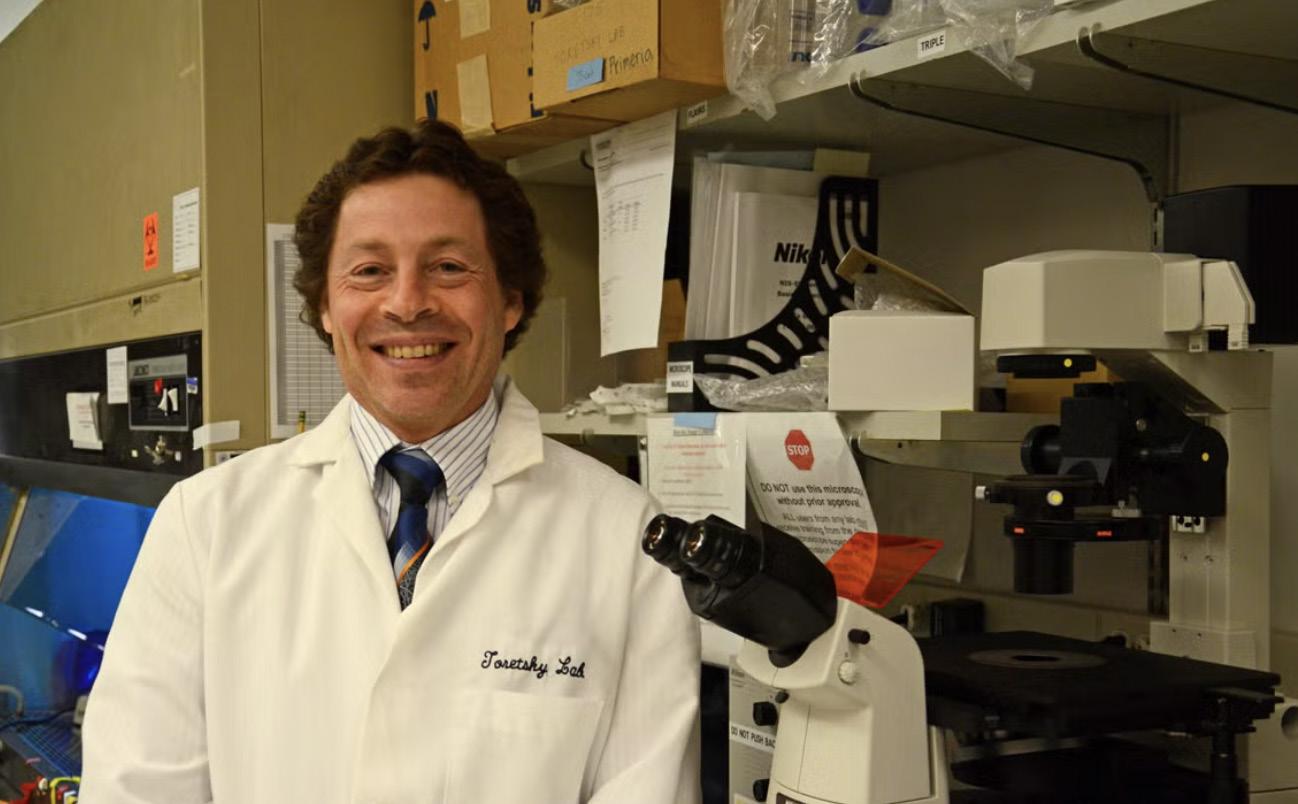

“I talked about gratitude — gratitude to all of my teachers and students and everybody that I’ve had along the way, and the patients who I’ve taken care of,” Toretsky said. “My gratitude to Hyundai and Kevin Riley, who’s an enthusiastic Georgetown alum who made all of this happen, and also my gratitude to the leadership at Georgetown.”
Dr. Anton Wellstein, a professor of oncology who runs a molecular and cell biology research lab, said Torestsky, whom he mentored, is fiercely determined to advance pediatric cancer research.
Epidemiology Professor Emphasizes Biological,
Angela Lekan Senior Science Editor
An epidemiology professor at the University of North Carolina at Chapel Hill (UNC) discussed a population-based study she leads that aims to understand the social and molecular determinants of breast cancer outcomes at a Sept. 11 Georgetown University event.
Melissa Troester, a professor of epidemiology at the UNC Gillings School of Global Public Health and leader of the Carolina Breast Cancer Study (CBCS) at the Lineberger Comprehensive Cancer Center, hosted the first session of the 2025-2026 Oncology Grand Rounds lecture series. The seminar focused on CBCS research regarding the social and biological outcomes of breast cancer.
Laura Rozek, the co-leader of the Cancer Prevention and Control Program at Georgetown’s Lombardi Comprehensive Cancer Center, introduced Troester and her work, explaining its connections to Lombardi.
“Her research really touches on a lot of the things we like to do here at Lombardi,” Rozek said at the event. “She focuses on biomarker development and validation and genomic methods that are combined with epidemiologic methods and breast cancer.”
Breast cancer is the most common cancer for women in the United States, with around 270,000 women diagnosed and 42,000 dying from the disease every year, according to the Center for Disease Control (CDC).
Troester began the seminar by explaining how her study applies multimodal learning to breast cancer research. She said this process involves analyzing various factors, including biological, social and geographical ones, to understand why individuals with the disease have different outcomes.
“It’s usually thinking about combining multiple elements that have information about an underlying phenomenon,” Troester said. “So in the case of breast cancer, this could be combining genomics with tissue level, information, organs, organismal level data, things about behavior, biobehavioral information and then ultimately, community information and geography. So the goal is to combine all these things in a person-centered way so we can better understand why people have different outcomes.”
This multimodal approach to research is highly relevant to the CBCS, which has been ongoing for over 30 years and began with the goal of recruiting groups disproportionately underrepresented in breast cancer studies, such as Black women and younger women.
With this goal in mind, Troester said there is a disparity in breast cancer recurrence rates.
“At 7 years, almost 11% of Black women have had a recurrence whereas white women have only had 6%,” Troester said. Troester said CBCS’s research also found differences in treatment, with Black women receiving more chemotherapy instead of endocrine therapy, which is
the standard of care for hormone receptor-positive breast cancer.
“So what we found in our data is that Black women with more aggressive tumors were getting more chemotherapy, but unfortunately — and this is inconsistent with the guidelines — they were getting less endocrine therapy,” Troester said. Endocrine therapy, also known as hormone therapy, is used after surgery to reduce the risk of the cancer returning in the future. It works by blocking hormones like estrogen and progesterone that can attach to receptors on breast cancer cells and help them grow.
Genomic tests can help predict the likelihood of cancer recurrence by analyzing a tumor’s specific genes.
Troester’s research found that genomic tests based on proliferation, or cancer growth rate, were more accurate than Oncotype DX (ODX), a type of test based on estrogen response, in predicting recurrence. She said they were able to improve the ability of ODX by adjusting it to account for the fact that not all women received the same therapy.
“There’s nothing wrong with ODX,” Troester said. “It is tracking relevant biology. It’s just it’s tracking biology that assumes that the standard of care will be met and that proliferation will be controlled by the endocrine therapy. And that is not what’s happening in the real world.”
Troester also said that individuals in lower-income communities tend to face barriers in receiving genomic testing.
“We also have observed in our data that even when we get innovations that are meant
“Dr. Toretsky is a force of nature and of unlimited enthusiasm in his pursuit of Ewing sarcoma causes and cures,” Wellstein wrote to The Hoya. “He reaches far beyond pediatric cancer, diving into mechanisms that drive cancer cells and finding ways to interrupt their transformation. This is a well-deserved recognition that will inspire him even further.”
Social Factors in Breast Cancer Patient Outcomes
to address disparities that we don’t always receive them,” Troester said. “About 40% of women who are eligible for ER-positive, HER2-negative testing for genomic assays get it, and the people who don’t get it tend to have lower education and income, and they tend to be in those communities that have low assets or low affordability.”
Alexa Garber (CAS ’28), a Georgetown pre-med student, said she believes this type of research is highly important to ensure everyone receives adequate care.
“I think it is critical that researchers continue to focus on these social determinants and what kind of effect they have on our population’s health,” Garber told The Hoya. “It’s just so important to ensure that all people are included in healthcare and everyone is able to receive the treatments they need to live fulfilling lives.”
Troester emphasized the importance of taking social context and community-level data into consideration to improve population health on a wider scale, stating it is only with such information that steps can be taken to improve population health on a wide scale.
“What I think we really want to build, and which data science is making possible with some significant limitations that we’re still going to have to figure out, is the idea that we could take all of the social context and the learning healthcare systems and our community level data, and build the tools that allow us to implement projects that lead to improved population health,” Troester said.
Florida’s End of Vaccine Mandate Spurs Health Concerns
Toretsky said that as he works toward finding effective treatments for Ewing sarcoma, he remains driven by the patients he has cared
for and the stories they have shared, recalling one particular encounter that inspires his research.
“The patient said to me, ‘I know that I’m not going to live long enough to get this drug that you’re developing, but it gives me a great deal of comfort to know that you’re working on it,’” Toretsky said. “That’s probably one of the most profound things I’ve ever heard from a patient.”
SCIENCE AT THE CROSSROADS
Federal Leadership in Flux Leads to Vaccine Confusion
Ellie Ward Science Columnist
Federal vaccine leadership has undergone several changes over the past few months, leading to substantial revisions to vaccine regulation and rhetoric within the federal government. In response to chaos at the federal level, states have begun individually attempting to inform residents on vaccine recommendations and regulate vaccine access.
Robert F. Kennedy Jr., secretary of the U.S. Department of Health and Human Services (HHS), has shaken up the federal government’s vaccine management personnel since the beginning of the summer. In June, Kennedy fired all 17 members of the Advisory Committee on Immunization Practices (ACIP), an advisory committee that develops vaccine recommendations, based on unsubstantiated conflict of interest claims. Kennedy also fired the director of the Centers for Disease Control and Prevention (CDC), leading several other department leaders to resign in protest.
The proposed replacements for ACIP leadership appear to lack substantial backgrounds in the vaccine field, raising concerns among experts, including Dr. Yvonne Maldonado, a former member of the ACIP and pediatrician at Stanford University. Furthermore, Jeffery Koplan, former CDC director, is quoted in NPR, referring to the situation regarding ACIP leadership replacements as “a royal muddle,” full of people “who are not experts in the field.”
Niyat
Theodroes Science Writer
Florida announced Sept. 3rd that it plans to become the first state in the country to eliminate all vaccine mandates, including those required for public school students.
The decision, made by Governor Ron DeSantis and Surgeon General Joseph Ladapo, marks a significant shift in current health policies, as all 50 states previously required students to receive vaccines for diseases like measles and chickenpox before entering school. Supporters argue that the change protects liberty and personal rights, but critics argue it could lead to preventable diseases returning in schools.
Throughout Georgetown’s scientific community, the transition has brought up concerns of collective care and possible implications.
Joseph Kanjiramkuzhey (SOH ’28), a pre-medical student from Florida, said he was surprised and concerned by Florida’s decision to make the change.
“At first, I was shocked. I did not know how to feel because, back home, everyone understood the importance of vaccines and how crucial they are.” Kanjiram-
kuzhey wrote to The Hoya. “Vaccines have been tested, proven effective and have even eradicated diseases from the human population. For that reason, removing the vaccine mandate felt like a drastic decision.”
Florida already banned COVID-19 vaccine requirements for students in November 2021, but prior to DeSantis’ announcement, it still required students to have immunization forms for common childhood illnesses. While many states have exemptions for religious or personal reasons, Florida would be the first state to eliminate all vaccine requirements.
Emily Mendenhall, a medical anthropologist and director in Georgetown’s science, technology and international affairs program, said Florida’s move reflects a cultural shift away from collective care.
“Public health is all about caring for people and creating policy that protects the most vulnerable among us,” Mendenhall told The Hoya. “The culture has shifted towards prioritizing individualism over protecting children, the elderly and those who cannot be vaccinated.”
Herd immunity refers to the prin-
ciple that when enough people in a community are immunized, it re-
duces the spread of disease and creates protection for those who cannot receive vaccines themselves. Without vaccine coverage, these populations face greater risk of infection.
Mendenhall added that she was not surprised by the mandate elimination, but expressed frustration over potential implications for Floridian families.
“I’m disappointed because I have friends and family in Florida with kids with disabilities, and they are really scared to send their kids to school,” Mendenhall said. “A lot of this anti-vaccine work tells us more about culture and politics than it does about health.”
Charlotte Park (CAS ’27), who studies biology of global health, said she has similar concerns, pointing to how the change reflects the larger debate of balancing freedom and public health.
“In my global health classes, we’ve discussed vaccine mandates and the tension between individual freedom and the common good,” Park told The Hoya “The end of Florida’s vaccine mandate is very concerning and goes against longstanding public health recommendations.”
Mendenhall said Florida’s decision is only one example of the
growing hostility toward public health workers.
“The threat to public health is not only just intellectual, but it’s visible and violent,” Mendenhall said. “This vaccine mandate in Florida is just the most obvious thing.”
Mendenhall said the change is unlikely to directly affect Georgetown students in the short term; however, it could contribute to long-term risks if the change spurs a movement toward vaccination decline nationwide.
“You can still vaccinate your children, but it means those who don’t have that choice will be less protected. That’s the whole idea of a vaccine –– herd immunity protects the vulnerable,” Mendenhall said.
Kanjiramkuzhey said the Florida decision underscores the necessity of high-level, or R1, research universities in promoting accurate, science-based information about health policy.
“This situation highlights the importance of science and technology,” Kanjiramkuzhey said. “As an R1 institution, our responsibility is to share reliable information so that people understand how essential it is to get vaccinated.”
Additionally, some government leaders — including Kennedy and Dr. Matthew Memoli, principal deputy director of the National Institutes of Health (NIH) — have begun to eliminate stringent vaccine guidelines from public health recommendations. Without these guidelines, decisions that used to be straightforward for students and for the university become unanswered questions. Where should people look for clear information to make informed vaccination decisions — D.C. public health agencies, home state officials or perhaps non-governmental organizations? What measures should the university take to protect public health on a campus where we all live and work in such close conditions? Will vaccine access remain equitable for students across campus?
Kennedy testified before the U.S. Senate about his role as HHS secretary Sept. 4. During the hearing, Kennedy alleged that only one of the many vaccines required for children in the United States — a figure he estimated to be between 69 and 92 — has undergone clinical trial testing. In reality, of the approximately 20 vaccines required for children, most have been studied in clinical trials with placebos, with the only exceptions being the newest renditions of some vaccines. Meanwhile, NIH whistleblowers have accused Memoli of downplaying the value of vaccines for public health; Memoli allegedly claimed vaccines are not as important as having a “healthy population” when it comes to address-
ing the highest childhood influenza death toll since 2009. The added vaccine skepticism in federal leadership comes amid news that the NIH is eliminating many vaccine research projects at universities and adding significant barriers to funding applications for vaccine research. With funding already generally harder to procure for a university’s scientific research efforts, vaccine labs are likely to encounter a series of additional obstacles. For professors who have dedicated their life’s work to vaccine science and students hoping to enter the field, these obstacles are threatening. These changes leave significant questions surrounding what access to vaccination will look like going forward, as both health insurance and access depend on ACIP and other federal recommendations. For Georgetown students, this may look like getting different health care access at home and on campus or seeing different health care access for their family and friends at other universities. Furthermore, the politicization of historically trusted government organizations has drastically reduced clarity in sourcing scientifically accurate public health information, particularly for the average citizen. State-level leaders are now asking the same questions, with many arriving at radically different conclusions about how to answer them. California, Oregon and Washington have formed a political alliance on health care charged with making vaccine recommendations based on science, which they believe the federal government has strayed from in favor of political ideology. Eight more states in the Northeast are considering a similar coalition, which includes gaining vaccine access directly from manufacturers instead of going through the federal government. New York and Massachusetts have also taken action, declaring a state of emergency regarding COVID-19 vaccine access and ensuring insurance companies are held responsible for state vaccine recommendations, respectively.
In contrast, Dr. Joseph Ladapo, the surgeon general of Florida, who called vaccines a poison, is working to end vaccine mandates of any kind in the state. Little has come out yet in terms of a plan of action in other Republican-led states. However, Kyle McGowan, former CDC chief of staff, has warned that each state is likely to develop its own unique policy toward vaccines, a trend reminiscent of state approaches to the COVID-19 pandemic. Such partisan policy segregation is raising concerns about consumer confusion, which will further segregate the lifestyles of people around party lines, despite the fact that a Washington Post poll from summer 2025 saw 81% of parents nationwide supporting some vaccine mandates for schools, with religious exemptions. The current state of vaccine access and research is in flux, but as individual states continue to take action, Georgetown students are likely to see friends and peers living in the United States navigate 50 unique sets of vaccine policy and access depending on which state they call home.
GEORGETOWN UNIVERSITY
Dr. Jeffrey Toretsky was named the inaugural Hyundai Hope on Wheels endowed chair in pediatric oncology for his decades of contribution to the field at a Sept. 7 ceremony in Riggs Library.

IN FOCUS
GUTS Drivers Face Benefits Change in New Policy

A third party will soon assume management of Georgetown University Transportation Shuttle bus drivers, threatening their access to university benefits, according to interviews with seven drivers and documents
At Vigil, GU
Students Mourn the Death Of Conservative Activist Charlie Kirk
Ruth Abramovitz Senior News Editor
Georgetown University students
mourned conservative political activist Charlie Kirk, who was assassinated Sept. 10, at a vigil held on the Old North steps Sept. 12. Kirk, the founder of conservative youth advocacy organization Turning Point USA, was fatally shot while speaking at Utah Valley University as part of The American Comeback Tour, during which he planned to visit colleges throughout the fall.
About 30 students attended the vigil, organized by the Georgetown University College Republicans (GUCR), where speakers condemned political violence and pledged to emulate Kirk’s commitment to engaging in dialogue with people across the political spectrum.
After an opening prayer for Kirk in front of a cross-shaped display, members of the GUCR board invited students to share their thoughts on Kirk and the current political moment.
Knox Graham (SFS ’27), GUCR’s director of political affairs, said Kirk’s death was so difficult because he saw Kirk as not only a conservative leader, but an emblem of free speech and meaningful debate.
“He, for his entire professional life, did what we do, but to the fullest extent possible,” Graham told The Hoya. “He spoke with people about his ideas, and he wanted to share with people about his ideas, and he wanted to hear from them too. That’s something that we should all strive to emulate.”
On his social media platforms and podcast, “The Charlie Kirk Show,” Kirk routinely debated left-leaning individuals. Kirk, whose tagline was “Prove Me Wrong,” also consistently took questions from both supporters and critics when speaking on college campuses.
Luke Madden (SFS ’28), who attended the vigil, said Kirk gave him confidence to be outspoken about his conservative beliefs while growing up in Los Angeles, a liberal-leaning area.
“He proved to not just me, but I think to everyone who has been afraid to share their ideals, to stand up for their values whether American, conservative, religious, and prove that it’s not just okay to defend them, but that is the only thing you can do,” Madden said in a speech at the vigil.
Jordan Van Slingerland (SFS ’26), the GUCR director of campus affairs, said he feels conservatives on college campuses are living in immense fear following the shooting.
“Since Wednesday afternoon, I’ve been sick, sick from fear for our country, sick from fear for this community, sick from fear for my younger brother, who now wonders if he can go out on campus wearing the Trump hat that he so likes to wear, speaking his mind the way he wants to,” Van Slingerland said to attendees. “And I’m not afraid to say that that fear is fear that I have too.”
At Bowdoin College, a vigil for Kirk scheduled for Sept. 14 was canceled by the school due to an external threat identified by Maine State Police. Historically Black colleges and universities (HBCUs) across the country also received false threats Sept. 12 in the aftermath of the assassination, prompting several universities to cancel classes.
Gabe Ciralsky (SFS ’29), who attended the vigil, said Kirk’s death made him feel an indescribable grief.
“He was a person who got me into politics,” Ciralsky told The Hoya . “If it weren’t for Charlie Kirk, I probably wouldn’t be at Georgetown right now. I wouldn’t be inter -
ested in politics to the degree that I am right now.”
Ciralsky added that, in light of the shooting, it was difficult to begin college at a university like Georgetown, which he called a “cathedral of political thought.”
“If you can’t go out to a college campus, a university, which is meant to foster all sorts of ideas, diverse thought, thought from the furthest points of the left and the furthest points of the right and anywhere in between, without having to worry about your safety, I think that’s horrific and upsetting,” Ciralsky said.
Slingerland said that in remembering Kirk, he finds renewed confidence in his beliefs.
“Clearly something needs to be changed in the way that we think as an American society, and I just think for me it’s going to be — particularly as I’m now a senior here — a little bit less backing down,” Slingerland told The Hoya . “I’m going to be a little bit more proud of the opinions I have.”
Graham said Kirk’s legacy is up to students, who must commit themselves to continuing political discourse.
“You should talk with everyone on campus,” Graham said at the vigil. “You should talk with every Hoya who will listen to you. You should talk about what you think and how you feel and what you believe, because it’s important. Because if we stop talking, bad things happen.”
“Georgetown is too great a place for us to close up and for us to make our campus a place where something like this could happen — because it’s not,” he added. “It’s a place for people from all across our country to come with different opinions and with different ideas and exchange it in the capital of our country.”
Sofia Thomas GUSA Desk Editor
Your news — from every corner
WHAT’S NEW ONLINE?
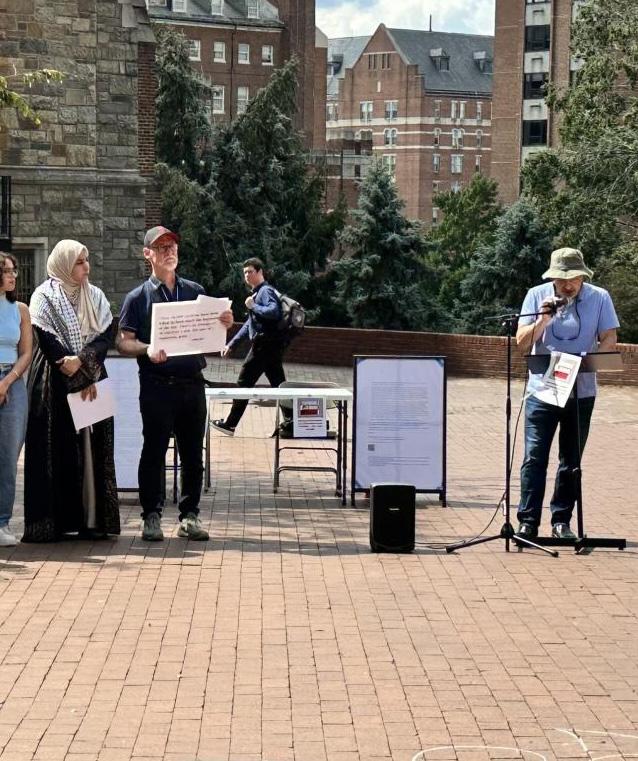
GU Community Honors Children Killed in Gaza
A Georgetown University faculty group organized a vigil Sept. 11 to commemorate children killed in Gaza and petition the university to hold town halls discussing the humanitarian crisis.
See The Hoya’s website for more daily news updates throughout the week.
Georgetown University ranked 129th out of 257 colleges and universities in an annual ranking of freedom of speech and expression on college and university campuses.
The Foundation for Individual Rights and Expression (FIRE), a controversial nonprofit dedicated to defending the freedom of speech and expression, released the sixth annual edition of its College Free Speech rankings. The 2026 report ranked Georgetown 111 spots higher than its 240th ranking in 2025 with a 57.3 overall score, over double the 2025 score.
A university spokesperson said Georgetown is committed to protecting community members’ right to free expression and speech on campus.
“Georgetown’s long-standing Speech and Expression policy protects the fundamental right of members of our community to free expression, dialogue and academic inquiry,” a university spokesperson wrote to The Hoya. “We respect the rights of members of our community to express their personal views and are committed to maintaining the values of academic freedom and serving as a forum for the free exchange of ideas, even when those ideas may be controversial and objectionable to some.”
“Georgetown is committed to ensuring that all members of our community have a safe and welcoming place to learn and receive the support they need to do so,” the spokesperson added.
FIRE surveyed student experiences and analyzed each school’s official student expression policies. The 2026 report featured a revised scoring method by assigning colleges bonuses for adopting the Chicago Principles, a set of free speech policies released in 2015 by the University of Chicago that many other universities have adopted. FIRE also added bonuses for universities that issued statements of institutional neutrality, committing to not take stances on social and political issues as an organization.
Georgetown adopted the Chicago Statement for Free Speech in 2017, but the university has not adopted an institutional neutrality statement. According to FIRE, the Chicago Statement is a strong defense of free speech at academic institutions.
FIRE also considers speech and expression controversies on campuses, including attempts to block speakers from coming to campus. Georgetown had three total speech controversies, all considered deplatforming, according to FIRE. In 2025, the postponement of the Georgetown chapter of Students for Justice in Palestine’s speaking engagement with Ribhi Karajah resulted in a subtraction of one point from Georgetown’s overall score. Karajah — who is a member of the Popular Front for the Liberation of Palestine, a left-wing extremist pro-Palestinian organization — spent time in prison for his involvement in a roadside bombing.
FIRE has faced criticism for financial relationships with conservative think tanks such as the Charles Koch Institute, which promotes conservative economic policies. The nonprofit also takes donations from center-left organizations such as the Knight Foundation, a free speech group, and Bloomberg Philanthropies, which donates to a variety of political and philanthropic causes.
FIRE reported increases in Georgetown’s rankings in five out of six categories: comfort expressing ideas, self-censorship, disruptive conduct, administrative support, openness and political tolerance. Georgetown’s score for self-censhorship did not change.
Kendan Hopkins (SFS ’29) — a member of Georgetown University Right to Life, a student organization that advocates against abortion — said he was surprised by other students’ comments while tabling with Right to Life.
“I’ve never been cursed at, flipped off and otherwise yelled at more in two days than what happened in my entire life,” Hopkins told The Hoya “You don’t realize how much putting your face out there and putting your
opinions out for the public, it really gets you some negative attention.”
“I definitely agree that self-censorship is very common on campus, also just from the experience of friends I’ve made who are also more conservative,” Hopkins added.
Nico Cefalu (CAS ’27), the president of Georgetown’s American Civil Liberties Union chapter, said he has seen students express hesitance to share their opinion on campus for fear of retaliation by the Trump administration.
“I feel like this is generally a result of a fear of expressing opinions that are out of step with those of other students on campus,” Cefalu wrote to The Hoya. “But more recently, I’ve noticed people being afraid of some sort of reprisal from President Trump.” FIRE surveyed 211 undergraduate students at Georgetown in partnership with the research organization College Pulse. Thirty-seven percent of surveyed students said they have self-censored on campus at least once or twice a month, while 76% of students said they think shouting down a speaker to prevent them from speaking is acceptable, at least in rare cases. 27% of students said using violence to stop someone from speaking on campus is acceptable, at least in rare cases.
Sean Stevens, FIRE’s chief research advisor, said the 2026 report marked an increase in students’ support of violence instead of peaceful protest across political affiliations in a Sept. 9 press release.
“More students than ever think violence and chaos are acceptable alternatives to peaceful protest,” Stevens said in the release. “This finding cuts across partisan lines. It is not a liberal or conservative problem — it’s an American problem.” Cefalu said he feels that FIRE’s higher ranking of Georgetown’s free speech is accurate.
“I am really happy to hear that Georgetown has moved up in the rankings,” Cefalu wrote. “In my opinion, this is a pretty accurate reflection of the state of freedom of expression on campus.”
Men Bring Feminist Lit, Guitars, Sense of Irony to Performative Man Contest
Ruth Abramovitz Senior News Editor Georgetown University students competed in a student-run “performative man” contest Sept. 14, embracing a viral, satirical trend that has sparked similar contests across the country. After social media posts satirizing the “performative man” stereotype proliferated throughout 2025, the first performative male contest was organized July 20 in New York’s Washington Square Park, with competitions in other cities and college campuses cropping up throughout the following months. Men who take part in the pageantry show up as heightened caricatures of the stereotype of a man who expresses certain interests, fashion tastes and beliefs to win women’s romantic attention.
Nick Hasbun (CAS ’28) decided to host the contest at Georgetown after winning second place in the Washington, D.C. performative male contest Sept. 2. He said he organized the Georgetown contest to allow students to break away from what he feels is a prep-school culture on campus.
“Sometimes it’s definitely a more polished student body,” Hasbun told The Hoya. “But something like this
is so fun because it’s like, ‘You know what? We can have fun and not have to wear suits and ties and be business students. We can screw around and have fun and embrace more indie and alternative cultural stereotypes.’” At the Georgetown contest, the lines between performance and authenticity were blurred. Men who entered the contests said they realized their music and fashion tastes fit the stereotype, and showed up to poke fun at themselves and those who have adopted the same interests performatively.
The contest drew a crowd of over 150 on Copley Lawn, with 25 students competing for the coveted spot of most performative man.
Exemplifying the ironic, unserious nature of the contest, two of the contestants were gay women.
Each contestant began by introducing themselves, giving a “fit” breakdown and displaying a cumulative eight guitars, three copies of “All About Love” by bell hooks and two vinyls of Clairo’s most recent studio album, “Charm.” Some contestants had more choreographed introductions, playing their guitars, blasting music from speakers clipped onto their belt loops or throwing tampons into the audience.
Hasbun then asked each contestant to name three women, and, giv-
ing the competition a Georgetown twist, asked which woman they would choose to be the first female president. After receiving a chorus of “Kamala Harris,” “my sister” and “Lana Del Ray,” among other responses, Hasbun brought out his mother, Sonia King, to ask the final question.
“How do you mend a woman’s broken heart?” King asked the crowd.
The crowd then selected the top contestants by cheering for their favorite candidate, bringing Nolan Seebeck (CAS ’29) and Aadhav Rajesh (CAS ’27) to the position of finalists.
Seebeck said he crafted his outfit intentionally for the contest.
“This is a sweater that was thrifted by my close friend, who’s a woman,” Seebeck told The Hoya
“This is a Chappell Roan shirt that I purchased at a local record store. I have my tote bag from the Trident Bookstore — it’s a great spot, you should really check it out. I’ve got my carabiner with my speaker playing Radiohead, currently.”
Seebeck said his message to the Georgetown community is to keep embodying the values of the performative man.
“Keep being performative.
Keep respecting women,” Seebeck said. “Understand that race is a social construct and
that we need to break down those barriers.”
Radesh, the other runner-up, told the crowd about his ratings on Letterboxd, a movie-rating app, and flagged his singer-songwriter Instagram account. He said his friends helped him prepare for the contest.
“I cropped this shirt after I thrifted — don’t look at the hem too close to me; it’s coming out,” Radesh told the crowd. “My matcha. My white roommate bought this as reparations.”
Guitar slung over his shoulder, Rajesh said he didn’t consider himself to be faking any of these interests, but continued to lean into the joke.
“I think it’s really an authenticity of your spirit,” Rajesh told The Hoya
“When I’m not reading bell hooks or listening to Clairo, I’m really just trying to get into community and listen to women so I can learn how to better myself as a man.”
King, a professor at St. Petersburg College, said it is valuable for students to take a break from a consuming political environment through these contests.
“We all know that it’s a very divisive and polarizing environment in general right now, and it is critical to have these types of engagement activities for the student body to let off steam and just share in this comedy,” King said.
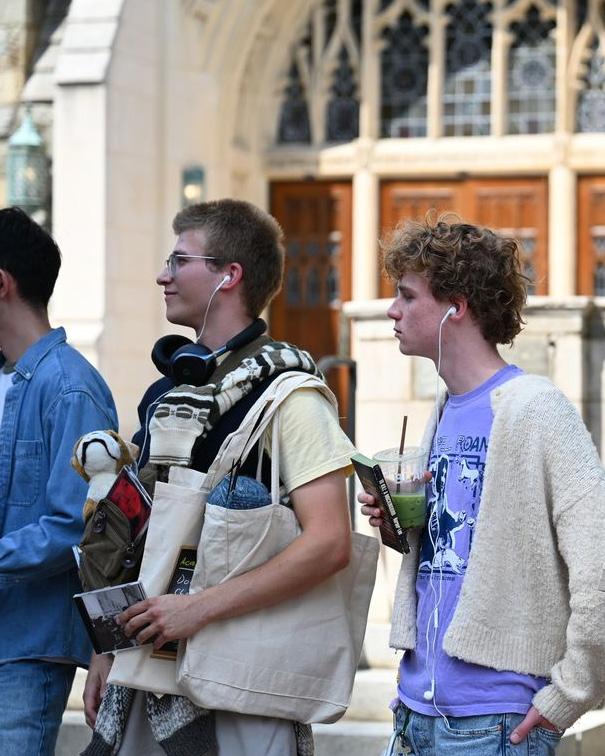
HAAN JUN (RYAN) LEE/THE HOYA
reviewed by The Hoya.
MEGHAN HALL/THE HOYA
Twenty-five students faced off in the “performative man” contest, sporting wired headphones and tote bags.
In Wake of Political Violence Increase, GU Community Expresses Fear, Hope
VIOLENCE, from A1
Maria Halter (CAS ’27) said she feels she needs to continue speaking out on political issues in the face of increasing division.
“I’m personally not doing much different, but I know people who are and who are taking precautions to prevent harm from those who may spark political violence,” Halter wrote to The Hoya. “I feel as though I come from a place of privilege to not have to hide as much, but I will continue to speak out and uplift others’ voices for those who feel targeted from such violence.”
Though grappling with the violence, students such as Taffe reaffirmed their commitment to political advocacy.
Taffe said that, even in the face of escalating political violence, standing down would allow the perpetrators — such as Vance Boelter, charged with murdering the Hortmans — to win.
“I think that what people like Vance Boelter want to happen in the face of these events is for people to be afraid and for people to not want to go into government work and to say,
‘You know what? That’s not for me, and I don’t want to risk my personal safety over the greater
good and helping other people,’” Taffe said.
“I don’t think that we would be honoring the legacy of Speaker Hortman and other people who have suffered political violence by just shutting down and not fighting for the things that we care about and continuing to pursue our passions and helping other people,” she added.
As students consider involvement with politics, Minnesota State Representative Mike Freiberg (COL ’99), who had an extensive professional relationship with Hortman, said he hopes Hortman’s assassination will lead to increased protections for lawmakers and government officials.
“Hopefully, if there’s any students out there considering public service in this regard, it’ll be safer going forward than it has been,” Freiberg told The Hoya in June.
Alyvia Bailey (CAS ’26), who works in conservative politics, said growing political violence nationwide has only reinforced her commitment to dialogue.
“The one thing that has always been a priority to me is bipartisanship,” Bailey wrote to The Hoya. “The reason I came to Georgetown is because I knew I would be surrounded by ideas that differed from mine,
consistently challenging me to evaluate my own beliefs. There is no right answer in politics, but there is a right way, through respectful discussion and inquiry with others.”
Ellie Heller (CAS ’27), who is originally from Minnesota, said political violence makes it even more important for politically passionate students to pursue government.
“People understanding the risks that polarization poses to our democracy and America — those are the types of people that we really need to occupy roles of leadership and public service,” Heller told The Hoya “And so I think that using that as a rallying cry and a reason to only study harder and get more involved is super important.”
Bailey said she hopes the current era of political violence will inspire U.S. leaders and citizens to stymie the tide of political violence.
“I really hope that this is the low point, and from here on out, I really hope that from both sides of the aisle, we can turn our messaging towards unity rather than division,” Bailey said. “I think right now, more than ever, we have to do that, or it’s only going to get worse.”

New Code of Conduct Improves
Clarity, Delineates Organizations
CONDUCT, from A1 violation, without any warnings. The incident reports then enter into the formal disciplinary or educational conference process.
James Beit (MSB ’26), who lives in Ida Ryan & Isaac Hawkins Hall, said he received an excessive noise complaint Aug. 29 that he believes was unnecessarily formalized because of the reformed citation process.
“Dealing with this process has been very cold; it’s been very unfriendly,” Beit told The Hoya “It’s not as transparent.”
Tina Solki (MSB, SFS ’26), a senator for Georgetown’s student government, the Georgetown University Student Association (GUSA), said the citation process puts a high burden on residential assistants (RAs) to enforce the code of conduct.
“I feel like the role of an RA is not to be a cop on your floor,” Solki told The Hoya. “It’s not to police you. It’s to remind you of community standards and work to uphold them jointly. It’s not like a one-sided imposition of the rules. It’s guiding us towards communal understanding and respect for them.” The university also changed its record-keeping rules; sanctions less than suspension or expulsion do not go on a student’s permanent record, meaning they remain internal to university records and are not sent to potential employers or graduate schools.
Abudayeh said it was a “positive change” that balances accountability with preparing students for success.
“As long as you complete whatever sanction you’re given on time and you follow the process and finish your process, you’ll go back in good standing, and the university won’t have anything to report outside,
unless you get suspended or expelled,” Abudayeh said.
Callender said she is concerned that students will not understand the new disciplinary process.
“If there is anything that we’re worried about, it is that students won’t have a full understanding of how the process has shifted and therefore will commit to sanctions from the alleged violations of residential living expectations without knowing the possibility of appealing those sanctions,” Callender said. Abudayeh encouraged students to reach out to SAO,
saying student advocates seek to help their peers.
“We know the average Georgetown student is not sitting in Lau reading through these 50 pages making note of what’s changed,” Abudayeh said.
“So our role on campus is to be that group of informed peers.”
“We hope that students come to us anytime they get any sort of accusation, whether it’s something as small as a noise complaint, all the way up to something that might lead to a bigger sanction, because that’s what we’re here for,” Abudayeh added.
Some GU Websites Remove DEI Amid Changing Political Climate
DEI, from A1
“Georgetown is not moving away from its Catholic and Jesuit mission, which states that ‘... the university was founded on the principle that serious and sustained discourse among people of different faiths, cultures, and beliefs promotes intellectual, ethical and spiritual understanding,’” the spokesperson wrote to The Hoya “‘We embody this principle in the diversity of our students, faculty and staff, our commitment to justice and the common good, our intellectual openness and our international character.’”
“The Jesuit values demand that Georgetown maintain a faculty, staff, and student population that values variation in all attributes relevant to human knowledge,” the spokesperson added.
Affinity Houses and LGBTQ Resource Center
On Feb. 24, The Hoya archived over 70 DEI-related university sites on the web archiving site archive. today, which takes and preserves snapshots of websites. Comparing snapshots of previous and current versions of university websites allows changes made since February to become visible.
This analysis found that since February, the LGBTQ Resource Center and affinity houses have removed language from their mission statements to no longer reference “the queer community” or “students of color.”
The LGBTQ Resource Center edited a passage from its previous mission statement, “The LGBTQ Resource Center supports the queer community at Georgetown through resources, outreach, advocacy, and programming,” to remove the words “the queer community.”
The affinity houses Black House and La Casa Latina, housed under the Center for Multicultural Equity and Access (CMEA), have also edited passages from their mission statements. As of February, Black House’s mission statement described its purpose as “to assess and meet the needs of students of color by implementing programs, events, and dialogue in a community-centered space. Fostering community for students of color.”
The words “students of color” are no longer in its mission statement: “To assess and foster community for students by implementing programs, events, and dialogue in a community-centered space.”
La Casa Latina’s mission statement now describes the house as providing space where “Latinxs and their friends and allies can share their narratives, access resources integral to success on the Hilltop, and engage in vital discussions,” with the words “and their friends and allies” added since February.
CMEA, La Casa Latina and the Black House did not respond to specific requests for comment.
Darius Wagner (CAS ’27), vice president of Georgetown’s student government, the Georgetown University Student Association (GUSA), said GUSA opposes the decision to remove DEI language.
“The recent federal actions targeting DEI originating from the Trump Administration are direct attacks on vulnerable communities within our campus and ultimately weaken Georgetown’s ability to fulfill its Jesuit mission,” Wagner wrote to The Hoya. “Georgetown has a responsibility to safeguard its students and uphold its core values, rather than yield to political pressure from the federal government.”
University Schools
Three university schools have taken down or edited DEI-related pages.
GUMC removed a DEI resource list from the Lombardi Comprehensive Cancer Center’s website, while the MSB removed a page outlining “The 7Cs of DEI.” Both pages now direct to error pages.
The SFS, which recently redesigned its website, modified three of its DEI webpages. Pages titled “Diversity, Equity & Inclusion,” “About DEI” and “DEI Resources” now redirect to “Community in Diversity,” one of Georgetown’s Jesuit values.
Though much of the text from the February “Diversity, Equity & Inclusion” page remains present on the new “Community in Diversity” page, the new page, unlike past versions, explicitly describes diversity efforts as linked to the university’s Jesuit values.
“These principles shape our efforts to create a learning environment where every member of our community is respected, supported and empowered to contribute,” the new page reads.
On the February “DEI Resources” page, the SFS listed links to onand off-campus resources, linking directly to a Center for Social Justice (CSJ) statement on Black Lives Matter, Counseling and Psychiatric Services (CAPS) support groups for LGBTQ+ students and students of color, and Office of Student Equity and Inclusion (OSEI) resources for Black students, faculty and staff.
Now, the SFS lists resources on a page called “Campus Resources for Community and Support,” available via the “Community and Diversity” page. The new list lacks links to the Black Lives Matter statement, support groups and OSEI resources. The SFS and MSB did not respond to specific requests for comment. A GUMC spokesperson directed The Hoya to the university spokesperson’s statement.
Marium Ihsan (CAS ’28), GUSA’s director of diversity and community development, said the changes to resource lists could inhibit students from finding support.
DC Takeover’s
“A lot of these organizations are there to provide students with additional support in terms of social identities, racial identities, gender identities,” Ihsan told The Hoya. “When you start filtering out your language, I think that’s a way of saying that we don’t really know how to provide for you or what the resources we can provide for you are.”
University Centers and Student Health Other modified pages include those on the Student Health Services and CMEA sites.
CAPS’s current support groups page, located on the Student Health site, now explicitly states that all groups are open to every student, “regardless of race, national origin, sex, gender identity, sexual orientation, or any other characteristic protected under University policy.”
In Spring 2025, CAPS support groups included Mosaic, a “support space for Black Indigenous People of Color (BIPOC)-identifying students,” the Queer Support Space and Trans and Non-Binary Support Space, described as support spaces for queer and trans and non-binary students respectively, according to CAPS emails to students. CAPS had described Mosaic and Queer Support Space similarly since at least the Fall 2022 semester and the Trans and Non-Binary Support Space similarly since Fall 2023. CAPS no longer offers Mosaic. Its current “Truth, Empowerment and Advocacy Support Group” aims to support students “whose experiences are shaped by their identity, culture andnavigatingspaceswheretheymay be underrepresented.” The Trans and Non-Binary Support Space and Queer Support Space are now described as “designed to address issues of interest to” students identifying as trans, nonbinary or queer. The Student Health Center did not respond to a specific request for comment on Mosaic’s removal. Despite these alterations, most of the DEI pages The Hoya archived remain unchanged. The McCourt School of Public Policy and GULC main diversity pages remain up, as do pages celebrating LGBTQ+, Native American, Black, Asian American and Hispanic heritage and culture. Ihsan said the university community needs to prioritize diversity and inclusion regardless of whether those principles appear on university sites.
“Giving students on campus — especially marginalized groups, people of color, people who feel like they are threatened — the assurance and support that as a student body, we will collectively be there and stand up for them and with them as well, is really important,” Ihsan said. “We maintain the principle that we will still talk about and initiate those discussions and continue that dialogue.”
End Prompts Federal Legislation, Continuing Concerns
TAKEOVER, from A1 enforcement system,” Stocker told The Hoya. “There probably should have been a little more of a fight put up. I’m just concerned about what that involvement will look like going forward.”
Advait Swaroop (CAS ’27) — director of external activism for Georgetown’s chapter of the legal nonprofit American Civil Liberties Union (ACLU) — said he is concerned Trump will decide to take over the MPD again.
“While the president may be satisfied for now with the condition of the District, this may change at any moment, and he retains the power to re-impose his authority at any time; only once the foundational issues regarding the enforcement of immigration and criminal law are reconciled between the local and federal government will the District achieve a definitive outcome,” Swaroop wrote to The Hoya
William Banks, professor emeritus of law and public administration at Syracuse University, said Bowser’s cooperation will ensure the federal government continues to exert influence over the MPD.
“Not extending the emergency has little consequence, mainly because D.C. officials have agreed to most of the changes and new personnel sought by the feds,” Banks wrote to The Hoya. “In addition, because
Trump commands the National Guard he doesn’t require an emergency declaration to deploy them in the district. Congress can change the underlying rules at any time, expanding or contracting D.C. sovereignty.”
Bowser created a new city agency, the Safe and Beautiful Emergency Operations Center (SBEOC), Sept. 2 to coordinate the District’s relationship with federal law enforcement.
Even while pledging cooperation with the federal government, Bowser said ICE was incompatible with the MPD’s mission.
“Immigration enforcement is not what the MPD does,” Bowser said at a Sept. 10 news conference. “And with the end of the emergency, it won’t be what MPD does in the future.”
In response, Trump said he would consider federalizing the MPD again.
Congress is also considering a suite of 13 bills targeting D.C. autonomy, seeking to exert greater federal control over the District. Four of those bills overhauling the D.C. criminal justice system passed the U.S. House of Representatives earlier this week but will likely face challenges in the Senate. Swaroop said he is worried threats to D.C.’s autonomy ultimately damage to the District.
“I fear that many of the bills moving through the House that seek to change D.C.’s criminal-
justice rules (including measures that would affect juvenile prosecution and local judicial selection) or to extend presidential emergency powers over MPD generally seek to further strip the district, a city of over 700,000 residents, of its few rights to autonomy and self rule,” Swaroop wrote. “It also seeks to undercut decades of locally driven public-safety and law-enforcement reform.” Stocker said the bills could restrain D.C.’s ability to fight back against possible encroachment by the federal government in the future.
“I think it’s a bad thing that D.C. doesn’t have enough autonomy now to resist federal overreach,” Stocker said. “I’d be worried that the little autonomy D.C. has would be shrunk even more.” Kramer urged officials and residents to oppose Congress’ bills, saying threats to D.C.’s institutions jeopardize the District’s independence.
“It’s death by 1,000 cuts,” Kramer said. “If you keep introducing smaller bills that take away some kind of smaller power from D.C., it gets to the point where, does home rule really even exist at all?”
“I feel like we have to fight every single one of these battles,” Kramer added. “Otherwise home rule is going to die in darkness, and we’re not going to notice it until it’s too late.”
GEORGETOWN UNIVERSITY
ANTHONY PELTIER/THE HOYA
Georgetown University students grappled with an increase in political violence following the assassination of conservative activist Charlie Kirk, whom students mourned in a Sept. 12 vigil.
New McCourt Professors Welcome Criminal Justice, Education Experts
Emily Dabre Graduate Desk Editor
The Georgetown University McCourt School of Public Policy welcomed four new faculty members in Fall 2025, the university announced Sept. 8.
The four new faculty members — Amanda Lu, Roman Rivera, Chris Warshaw and Diane Schanzenbach — bring expertise in fields including criminal justice, policing, education and state politics. The new additions come as part of a university push for new faculty to join the Capitol Campus, which houses McCourt, as it struggles to attract existing faculty.
McCourt Dean Carole Roan Gresenz said the new professors will bring valuable experience and contributions to the curriculum.
“Each of these new faculty members brings something new to the McCourt School, expanding our course offerings and areas of expertise,” Gresenz wrote to The Hoya. “Amanda, Chris, Roman and Diane all have impressive credentials and backgrounds, and I look forward to seeing their many contributions in the years ahead.”
Lu, a new assistant professor of policy and faculty director for academic programs in policy practice, comes to McCourt from Stanford University after a career as a high school math teacher and post-doctoral studies in public education policy.
Lu said she is excited to work at the Capitol Campus and wants to engage with students at an uncertain political moment.
“D.C. is a place where we’re learning a lot about what government has historically done and what it
will do in the future,” Lu told The Hoya. “It’s a place of deep uncertainty, but it’s also a place of possibility. What will get built out of that uncertainty and how young people will navigate it — watching that, being part of that, is really exciting to me, especially as a teacher who really believes that young people should define what the future looks like.”
Rivera, a new assistant professor of public policy, is a labor economist who recently completed a post-doctoral degree at Princeton University. Rivera, who earned a Master of Public Policy at the University of Chicago and his Ph.D. in economics from Columbia University, will focus on the economics of policing and crime with work in the McCourt Massive Data Institute, an interdisciplinary research group using data for policy analysis.
Rivera said one of his goals for future students is for them to immediately notice clickbait and misrepresentation of data in the news.
“I hope they would be able to read a clickbait article where it talks about some crazy research that found some amazing effect, and then go, ‘Yeah, that’s probably not true,’” Rivera told The Hoya. “I think that’s probably the most valuable thing that econometrics and statistical inference will give you — is to see through clickbait and lies.”
Schanzenbach, the new McCourt chair, was a nonresident senior fellow at the Brookings Institution and a member of the National Academy of Education. Schanzenbach is an economist who studies policies that target low-income children and families.
Schanzenbach said she is delighted to become a member of the McCourt community.
SFS Center Announces Iranian Studies Program During Expert Book Talk
Sofia Thomas GUSA Desk Editor
A professor of Middle East studies highlighted Iran’s national security grand strategy and its evolving domestic debate during a Georgetown University event Sept. 15, where a university academic center announced a new undergraduate Iranian studies program.
The Alwaleed Center for Muslim-Christian Understanding (ACMCU), an academic center fostering interreligious dialogue, hosted Vali Nasr, a professor of international affairs at Johns Hopkins University, to discuss his new book, “Iran’s Grand Strategy.” ACMCU director Nader Hashemi also announced an initiative in the School of Foreign Service (SFS) titled the Iran Project, a lecture and guest speaker program that aims to eventually expand into a certificate and minor in Iranian studies.
Hashemi said Nasr provided the opportunity to announce the new initiative for SFS students.
“Today we’re using his presence here to announce a new initiative at the School of Foreign Service at Georgetown called the Iran Project,” Hashemi said at the event. “It seeks to expand, deepen and enrich the study, teaching and public debate on Iran at Georgetown.”
The SFS currently only offers a minor in Persian language and culture, which briefly discusses Iranian history, culture and politics.
Nasr said it is important to look at Iran through the lens of the nation’s overarching objectives, as his book does.
“The idea of a grand strategy refers to the idea that the country has a broad objective or a broad security concern that it organizes its politics and its affairs around. It’s very clear that over the past 40 years, Iran has largely been organized around its national security interests,” Nasr said at the event. “Its economy, its politics, its journey are all built around this grand vision of how to maintain its independence from the United States. It’s very clear that looking at ideology or religion or theocracy does not actually explain the way in which the Islamic Republic has evolved and where it is heading.”
Nasr said he believes the 12day conflict between Iran and Israel in June shows that Iran’s strategy is not sustainable.
“This latest war may show Iran that even though it still believes in that grand strategy, it can no longer prosecute it,” Nasr said. “It can also no longer prosecute it because the costs of this confrontation with the U.S. are not sustainable
“I am excited to contribute to a growing, thriving intellectual environment at McCourt and at Georgetown,” Schanzenbach wrote to The Hoya. “I have really enjoyed talking with other faculty members and students about the work we are doing to better understand and design public policies. I hope to be able to find new ways for us to work together, gain from each others’ perspectives and contribute to our shared mission.”
Warshaw, a political scientist focusing on elections and public representation, comes to Georgetown from George Washington University’s Department of Political Science, and before that from the Massachusetts Institute of Technology.
Warshaw, who will teach policymaking to graduate students, said he was drawn to Georgetown due to the focus on public service.
“I’ve long admired Georgetown’s commitment to fostering public service. So I was excited about coming to work at Georgetown’s policy school and teaching students interested in making a difference in the world through public service,” Warshaw wrote to The Hoya. “I want to give students the skills to navigate the intersection of politics and the public policy process.”
Schanzenbach said Georgetown’s energy, values and local celebrities convinced her to join the school.
“I was drawn to Georgetown because of the energy of the McCourt School and Georgetown’s Jesuit values, including engagement of the whole person, free exchange of ideas and public service,” Schanzenbach said. “The only other thing I’d add is I’m really looking forward to meeting Jack the Bulldog sometime soon.”
Government Professors Analyze Constitutional Issues, Assess Trump’s Prospects at Supreme Court
Ajani Stella Senior News Editor
economically and militarily and because the Iranian public is no longer supportive of this strategy.”
Hashemi said he found the level of anti-Americanism in Iran confusing, especially when considering historical examples such as Vietnam.
“I’m trying to understand the depth of the anti-Americanism that resides within the political imagination of Iranian hardliners, particularly the supreme leader and his supporters,” Hashemi said. “Take Vietnam: 2 million people were killed from the Vietnam War as a result of American intervention. It’s a very different story. Relations are very warm; economic ties are very strong. You don’t see this level of anti-Americanism.”
Nasr said the Iranian public is increasingly debating and challenging Iran’s national priorities.
“I think we have to sort of distinguish between judgment and rationality,” Nasr said. “In other words, you could say that the Iranian judgment about what should be their national interest and whether it’s the correct national interest is now increasingly open to question and not just by outsiders, but actually by a lot of people within Iran.”
Nasr said Iran’s focus on protecting its national security and independence has been its focus since Iran’s founding.
“But what is very clear in the Islamic Republic is that it sees this task of protecting its national security as the most fundamental challenge that it faces,” Nasr said. “And the key question is who is it trying to protect its independence and national security from, and the answer to that is the United States.”
Nasr said unlike Vietnam, Iran has no incentive to reconcile its differences with the United States.
“Vietnam became interested in burying the hatchet with the U.S. after China invaded it in 1979,” Nasr said. “Iran does not face a similar kind of strategic threat. All the strategic threats that it faces are coming from the U.S.”
Hashemi said the new Iran Project at Georgetown will give students the chance to engage with Iranian and Middle East politics in a more thoughtful manner.
“Given the important role that Iran plays in the politics of the Middle East and the huge amount of news that it routinely generates, there’s a huge chasm between the news that Iran generates and the actual discussion in a serious, objective and scholarly way,” Hashemi said. “At Georgetown University, the Iran Project seeks to fill that chasm.”
A Georgetown University constitutional law professor and the government department chair analyzed current Supreme Court cases and their political implications during a Sept. 16 event.
Joseph Hartman, a government professor, and Anthony Arend, the department chair, detailed two ongoing legal cases involving President Donald Trump: challenges to his sweeping tariffs on foreign countries and his dismissal of a Federal Reserve Board governor. The event, which was coordinated with the university’s Office of the President, celebrated Constitution Day, the anniversary of the signing of the U.S. Constitution on Sept. 17, 1787.
Hartman said Trump’s attempted dismissal of Federal Reserve Governor Lisa Cook raises constitutional questions over the president’s unilateral authority to dismiss independent executive department officials.
“It’s likely that where we’re going to end up is much less limitation on presidential control in terms of termination and more restriction
on Congress’s ability to limit that in any way,” Hartman said at the event. “So you can look at the entire administrative apparatus as probably moving from insulated expertise that’s nonpartisan to a position that’s much more within the control of elected officials.”
A federal circuit court ruled Sept. 15 that the termination violated Cook’s right to due process. Though she is an executive branch official, the Federal Reserve Act specifies presidents can only dismiss governors “for cause.” Trump pointed to allegations against Cook of mortgage fraud, though she has not faced any charges.
Arend said legal challenges to Trump’s tariff policy — which is based on a broad interpretation of a 1977 law designed to authorize a response to an “unusual and extraordinary threat” — will test the Supreme Court’s willingness to overturn lower courts’ rulings, which have found the tariffs to be illegal.
“If you read the lower court’s decision, in my view, they’re airtight,” Arend said at the event.
“But the way the Supreme Court has been ruling, the way the Supreme Court has been overturning precedents, it would not sur-
prise me if the Supreme Court ends up ruling that the president does have this authority, despite the opinions of lower courts.”
The Supreme Court scheduled oral arguments for the tariff case in November. The termination case is also expected to reach the Supreme Court soon.
At the event, multiple students expressed concern that the Supreme Court has become a partisan battleground and lost some of its political independence. Many experts have also pointed to increasing ideological divides along party lines among the justices.
Arend acknowledged those worries but said he believes the rule of law will prevail.
“There are a lot of things that are bubbling up; there’s so many cases out there we’re having stays that we’re having injunctions, all this stuff,” Arend said.
“But we haven’t yet, in my view, reached that point yet.”
Hartman said he believes the justices are not as partisan as they are ideological, pointing to the extensive judicial experience that Justices Samuel Alito, Clarence Thomas and Robert Kavanaugh and Chief Justice John Roberts have.
“I tend to think it’s less about political partisanship than about either ideological or jurisprudential views, and I think you can see that with them,” Hartman said. “There’s no question in my mind that the bias toward deference to the executive with respect to this kind of thing is very much a part of at least three or four of these justices, and has been for a long time.” Hartman added that he thinks many elected officials appear to have lost their commitment to institutional independence.
“The party seems to have completely overtaken the institution,” Hartman said. “And where I’m looking now, parties seem even more overly dominant relative to the institutional loyalties. I mean, I’m not sure where that goes.” Arend said the tariffs case will hinge on how Trump interpreted Congress’ 1977 statute and what powers it confers on the executive.
“It’s going to come down to, ‘Did Congress have the authority to delegate this to the president?’” Arend said. “If the answer is no, which the lower courts have ruled, that’s going to be a huge setback for the entire foreign policy of the Trump administration.”
GU Commemorates 60 Years of Interreligious Doctrine
Nicolas
Abreu Events Desk Editor
Georgetown University celebrated 60 years of “Nostra Aetate,” the Catholic doctrine promoting Jewish-Catholic relations and interreligious understanding, with a lecture series sponsored by academic groups Sept. 15 and 16.
“Nostra Aetate,” meaning “in our time” in Latin, is a 1965 doctrine from the Second Vatican Council denouncing antisemitism and encouraging the development of Jewish-Catholic relations and broader interreligious dialogue. The Georgetown event was a collaboration between the university’s Office of the President, the Berkeley Center for Religion, Peace and World Affairs and the American Jewish Committee, a national Jewish advocacy group.
Interim University President Robert M. Groves said this interreligious understanding is central to Georgetown’s mission, tracing its roots to the Jesuits who founded the university.
“The Jesuits boldly formed this school open to all religions,” Groves said at the keynote event. “It was an attribute that, at that time, was just allowed in the state of Maryland, but then
made permanent in 1791 with the First Amendment to the Constitution. Our mission statement here at this university affirms the founding principle that serious and sustained discourse among people of different faiths, cultures and beliefs promotes intellectual, ethical and spiritual understanding.”
Rabbi Noam Marans, the American Jewish Committee’s director of interreligious affairs, said this doctrine has defined Jewish relations with the Catholic Church for the past 60 years.
“Catholics could and should understand Judaism as intrinsic to Catholicism and see Jews as dearly beloved brothers, even elder brothers and Marian sisters,” Marans said at the event. “A vast infrastructure of Catholic institutions, documents, teachings and guides was created to serve this new Catholic reality, and we are the beneficiaries of six decades of that investment.”
Marans said this new approach to Jewish-Catholic relations also denounced previous Catholic teachings hostile to Jewish faith, which was especially crucial in a post-Holocaust world.
“For Jews, ‘Nostra Aetate’ meant that the Catholic church rejected
two millennia of anti-Jewish Catholic teaching that had contributed to hate and violence directly at Jews,” Marans said. “That was and is a big deal, a game changer and no small matter in a post-Holocaust Christian self-reflection.”
Several events after the conference’s keynote address focused on the initial reception of “Nostra Aetate” and its historical significance as well as current Catholic-Jewish dialogue. The conference also held discussions regarding the legacy of “Nostra Aetate” and promise for the future in regard to Christian relations with both Muslim and Dharmic faiths.
Archbishop Flavio Pace, vice president of the Holy See’s Pontifical Commission for Religious Relations with Jews, said the Catholic Church’s declaration came at a time where a “Christian conscience” was necessary to reject the antisemitism that led to the Holocaust.
“The Church was emerging from one of the most devastating manifestations of the mystery of evil,” Pace said at the event. “It demanded from the Christian conscience a clear response, including the key rejection of any expression or interpretation that might have contributed historically to antisemitism.”
In light of the ongoing Israel-Hamas war, Marans said it is crucial both Jewish and Catholic people continue to hold each other accountable.
“We must be candid in identifying serious strains at the highest levels of Catholic-Jewish relations in the wake of the war that followed October 7, 2023,” Marans said. “It requires more conversations, not fewer, on the centrality and complexity of the state of Israel in Jewish identity and on Catholic theology of the land. If we do not figure out how to speak about the difference of opinion regarding Israel, Catholic-Jew relations will remain vulnerable.” Pace said that although interpreting and discussing “Nostra Aetate” itself is important, the doctrine is most effective in how it is lived out by Catholics and Jewish people themselves.
“We see it pointless to discuss doctrine ‘Nostra Aetate’ purely academically,” Pace said. “The time in which we are living demands fewer pronouncements or exhaustive studies and more people who embody in their daily lives the spirit of that dogma, which 60 years ago transformed the perspective of Jewish-Christian dialogue.”
GEORGETOWN UNIVERSITY
Four new faculty members at the Georgetown University McCourt School of Public Policy bring expertise in criminal justice, policing, education and state policies, starting in Fall 2025.
Berkley School of Nursing Celebrates Launch of Doctoral Nursing Program
Former Ohio Senator Praises Free Trade, Urges Tariff Caution at GU Policy Event
ment for it, and make it effective,”
Allister Adair
Pritika Patel Academics Desk Editor
Georgetown University’s Berkley School of Nursing celebrated the launch of its new doctoral program in nursing, the university announced Sept. 11.
Designed for experienced nurses as a full-time doctoral program based at the Capitol Campus, the program prepares graduates to be leaders for change in nursing. The inaugural cohort will engage in coursework and dissertation research that will focus on ethics and health equity.
Program Director Edilma Yearwood said she and her colleague, Dr. Kelley Anderson, designed the program to fill a gap they saw in other doctoral nursing programs by combining ethics and equity.
“When Dr. Kelley Anderson and I put this program together, we looked at the strengths of the university, but we also looked at what our competitors had in their Ph.D. nursing programs, and we didn’t find any that had these two things pulled together: ethics and equity,” Yearwood told The Hoya. “So, I think we are unique in that space and have an opportunity to make significant contributions to the profession and to nursing science.”
Dr. Rick García — whose research centers on health equity — said the program has broad potential impact.
The program incorporates rigorous coursework across ethics, equity, policy and research methods to provide students with multidisciplinary training. In the first year, students will take foundational courses such as “Philosophy of Science and Foundations in Nursing Science” before progressing to more quantitative and qualitative research methodology in the second year. The final two years are dedicated to dissertation proposal defense and research.
Yearwood said the program is designed to foster collaboration and mutual learning between faculty and students.
“We want to create environments of learning where we are co-learning,” Yearwood said.
“We are going to learn as much from these Ph.D. nursing students as they’re learning from us, and we want to see how we can work together to move nursing science forward.”
“The students are already very accomplished clinicians, so they bring rich health care experiences to the learning environment,” Yearwood added.
Sydney West (GRD ’29), a member of the inaugural cohort, said she was drawn to the program’s integrated approach to ethics.
“I am grateful for the ethics infrastructure that is so well integrated into the program because I think this lens is crucial for the kind of research that I aim to do,”
“From a faculty perspective, I am most excited to see how this long-awaited Ph.D. program focused on ethics and health equity will shape the future of nursing science, education, practice and policy,” García wrote to The Hoya. “The dissertation research our students undertake, and the funded programs of research they will later build, will extend the impact of Georgetown nursing far beyond the classroom.”
West wrote to The Hoya. “I chose Georgetown for this reason and for the program’s focus on interdisciplinary collaboration.”
West added that her background in humanities made Georgetown an especially good fit.
“As someone who brings both a humanities and nursing background to doctoral work, I feel that the program at Georgetown is uniquely reflective of my talents and of the work that I hope to do,” West wrote. “I am thrilled to be mentored and supported by like-minded faculty at Georgetown, and I look forward to being a pioneer for subsequent cohorts of Ph.D. students.”
Intima Alrimawi, a faculty member in the program whose research focuses on bettering care for disadvantaged families, said faculty guidance is key to the program.
“As a faculty member in the Ph.D. program, I see my role as a mentor,” Alrimawi told The Hoya “We mentor a doctoral student as they refine their research and grow, personally and professionally, in their Ph.D. journey, and build their scholarly skill.”
García said the program reflects Georgetown’s broader mission of purpose-driven education.
“Within the broader Georgetown community, the program embodies the University’s mission to educate ethical scholars and leaders who will contribute to the common good,” García said. “By investing in this program, Georgetown has signaled its recognition of nursing’s essential role in shaping the health of individuals, families and communities locally, nationally and globally.”
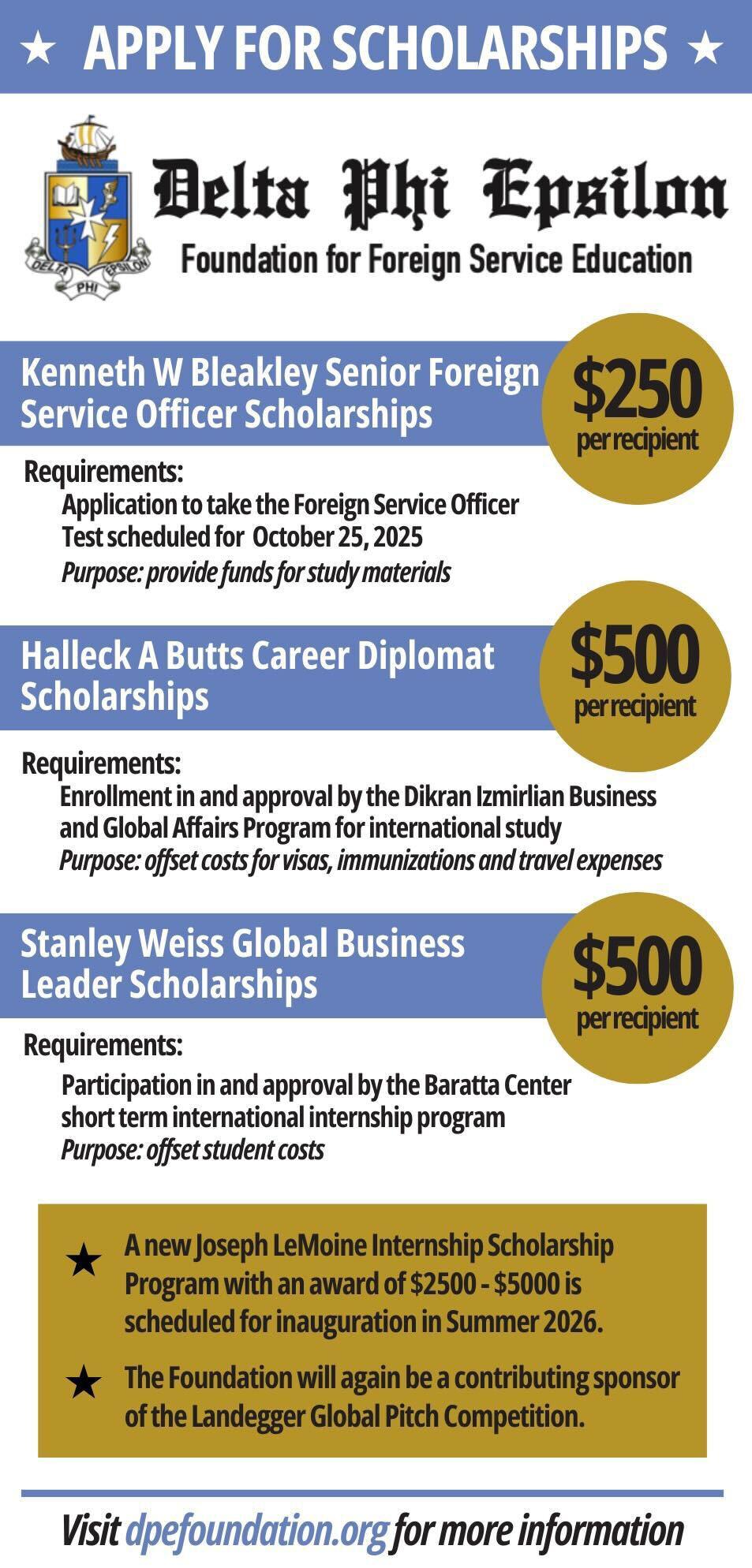
Special to The Hoya
Former Sen. Rob Portman (R-Ohio) argued globalized free trade creates broad benefits but harms some U.S. workers amid President Donald Trump’s increasing tariff policy during an event at Georgetown University’s McCourt School of Public Policy on Sept. 16. Portman, who served as the U.S. trade representative from 2005 to 2006, praised targeted trade deals but warned that Trump has seized unjustified emergency powers to circumvent congressional approval with his tariff policy. Ana Swanson, a trade and international economics reporter for The New York Times, moderated the event, which was sponsored by the Georgetown University Law Center’s Institute of International Economic Law.
Portman said that though international trade is a net positive for the United States, politicians must speak to communities feeling left behind, especially those working in sectors that have moved overseas, such as manufacturing.
“Trade has a lot of benefits in a broad context, but it also has negative impacts that are felt more acutely within a community,” Portman said at the event. “The workers in Ohio I’ve represented in the House and the Senate are generally skeptical because they figure they’re not getting a fair shake. And, in many cases, they’re right.”
“You have to make the argu-
Portman added.
Portman represented Ohio’s second congressional district from 1993 to 2005, resigning partway through his final term when he was appointed U.S. Trade Representative by President George W. Bush. He was elected senator in 2010, besting his Democratic opponent by 17.5 points. After winning reelection in 2016, he declined to seek a third term, retiring in 2023.
Portman offered praise for Trump’s trade negotiations with other countries and said the government is working hard to negotiate deals that will benefit the United States.
“I think it’s been pretty effective,” Portman said. “You can look at it in different ways, I suppose, but we’ve worked on agreements with the E.U. and Japan and Korea and the U.K., and we’re hoping to get something together with China.”
The Trump administration invoked the International Emergency Economic Powers (IEEPA) to impose tariffs on many countries, using the emergency law that sidesteps Congress’s authority. To justify his orders, Trump has cited a need for economic autonomy and for a solution to the ongoing fentanyl crisis along U.S. borders.
Portman said he sees the lack of retaliation from other countries in response to the tariffs as evidence that the administration’s strategy has been successful.
“Not a single country has retaliated, which has surprised me,” Portman said. “But I think a lot of it is because they do want to be working with us and with our market.” Portman said that while the fentanyl-based tariffs, which target Canada, Mexico and China, could constitute a national emergency in the eyes of the courts, the trade deficit reciprocal tariffs do not.
“Tariffs based on fentanyl could be a national emergency,” Portman said. “A lot of the other tariffs do not qualify. If they’re reciprocal tariffs in place because we have had a trade deficit for decades, that’s probably not an emergency.”
The U.S. effective tariff rate, the average duty levied against all foreign goods, stood at 15.8% in August, down from a 22% high in April but up significantly from 2.3% at the end of 2024. Despite changes in American policy, Portman said globalization remains strong, with new free trade deals between countries replacing those nations’ prior agreements with the United States.
“Increased trade is occurring in Southeast Asia, amongst countries that we consider developing,” Portman said. “They’re on the move.” Portman said global trade remains strong despite the Trump administration’s recent actions.
“People ask if globalization is dead, I paraphrase Mark Twain: ‘The death of globalization is greatly exaggerated,’” Portman said.

Art All Night Exhibits Celebrate Small Businesses, Local Art in Georgetown
Annika McCanne Hoya Staff Writer
The Georgetown neighborhood celebrated art, music and performance for Art All Night, Washington, D.C.’s free latenight art festival that hosted art shows across 16 locations on Wisconsin Avenue Sept. 12.
Art All Night, which expanded to Georgetown in 2021, included various exhibits, crafts in the Georgetown Neighborhood Library and a pop-up from the British International School. The events were hosted and coordinated by Georgetown Main Street, an organization dedicated to building an inclusive community that supports diverse small businesses.
Rachel Shank, the executive director of Georgetown Main Street, said the organization chose to get involved with Art All Night to bring some of Washington, D.C.’s nightlife back to the area with a Georgetown twist.
“It doesn’t necessarily need to be traditional nightlife events, and it can be an opportunity to showcase all of the arts and cultural institutions that we have in Georgetown,” Shank told The Hoya. “It was a really unique opportunity to receive citywide sponsorship to host an event that we’ve never done before to showcase the creativity of our community.”
Shank added that Georgetown Main Street is hoping the art showcases the diversity that she believes makes Georgetown so valuable.
“I think there’s a bit of a perception that Georgetown, the neighborhood, has not always been welcoming, and I think Georgetown Main Street and a lot of our community partners are really trying to be intentional about changing that narrative,” Shank
said. “Especially in the commercial corridor where most of our businesses are either minority- or immigrant-owned businesses.”
Art All Night D.C. was originally founded in 2011, inspired by France’s all-night art festival Nuit Blanche, and has since grown to include 20+ neighborhoods across all eight wards, with over 180,000 annual attendees from across the D.C.-Maryland-Virginia area.
Art All Night also included culinary arts exhibitions, such as the African Union, which handed out samples of traditional African foods and treats, including a tea ceremony from Morocco and Ethiopian food.
Toby Shu (CAS ’28) said this year was his first time attending Art All Night, and he was excited to try the different food on display.
“I didn’t really know anything about Art All Night,” Shu told The Hoya. “I heard about it the night before and went to check it out with some friends and was really impressed. There were so many different stalls with samples to try from different cultures, and it was a really cool way to experience all of those cuisines.”
Amelia Giordano (SFS ’26), another Georgetown student who attended the event, said she loved seeing the attendees enjoy the small businesses and homemade crafts on display.
“I loved seeing so many handmade crafts like knitted scarves, paintings and jewelry — it had such a nice local and independent feel, which you don’t get as much in D.C.,” Giordano wrote to The Hoya “The food, music and people selling homemade art made me feel like I was at my farmers market at home, which is such a different vibe to what Georgetown normally has!”
Giordano added that the individual vendors did a great job encouraging people to make connections and strike up conversations.
“Art, especially small-scale, independent and accessible art like what was at the Night Market, is a fantastic mode of building community,” Giordano wrote. “Seeing students, local families and tourists all admiring someone’s craft brings people together in supporting each other and the neighborhood.” Isabelle Harvey, a D.C. resident who attended Art All Night, said she appreciated the emphasis on local artists.
“It also brings visibility for artists and their work, which I think is really important in a time when D.C. feels somber and overly serious,” Harvey told The Hoya. “It’s a way to brighten up D.C., bring people together with a sense of joy and also draw attention to artists who deserve to be seen.” Shank said art and third spaces are important in bringing people together to celebrate cultural differences.
“Art is essential to the cultural zeitgeist, to telling stories and to community,” Shank said. “You can go into these spaces during Art All Night, and it’s free. You can go and you can just be and exist in the community with other people, and you don’t necessarily need to have dialogue with them. You can sort of just exist in these spaces with them.” Shank added that it is the individuals and small businesses that make an event like Art All Night so special.
“This event is by the community, for the community,” Shank said. “Even though Georgetown Main Street is the organizer of the event, so many of the incredible people and institutions of Georgetown make this possible.”
GEORGETOWN UNIVERSITY
Former Sen. Rob Portman (R-Ohio) warned against sweeping tariff policy and praised free trade during a Georgetown Unviersity McCourt School of Public Policy event Sept. 16.
Hult Sports Staff Writer
In a weekend to forget for the Georgetown University men’s tennis team, the Hoyas lost all but three matches at the Orange and Blue Classic in Charlottesville, Va., hosted by the University of Virginia (UVA) Sept. 12-14. The Hoyas fell in straight sets in every singles match for an inauspicious opening to the year.
The three-day Orange and Blue Classic featured singles and doubles competition against players from UVA, Duke University, Virginia Commonwealth University (VCU), the University of Pennsylvania (Penn) and Virginia Tech.
The Hoyas, who returned seven players from last season, faced UVA, Duke and VCU on Friday and Saturday, and Penn and Virginia Tech on Sunday. The weekend also marked the collegiate debuts of first-years Jonah Hill, from Potomac, Md.; Joshua LammBocharov, from Gibsonia, Pa.; and Cyrus Zia, from Washington, D.C. On Friday, Georgetown faced UVA in six singles matches and Duke in one singles match and lost all seven in straight sets.
Sophomore James O’Sullivan and Zia both had the most competitive appearances on the first day.
O’Sullivan, after losing the first set 6-2 to UVA’s Jangjun Kim, fought back for a tiebreaker in the second set. He ultimately fell 7-6 (4) in the
tiebreaker. Zia played UVA’s Mans Dahlberg closely, but fell 6-4, 6-2. On Sunday, Lamm-Bocharov came close to forcing a decisive third set against Penn’s Nischal Spurling but lost the tiebreaker in the second set and the match.
O’Sullivan, on Sunday, played the tightest singles match of the weekend, taking Virginia Tech’s Ilyas Fahim to three sets before falling 4-6, 6-4, 5-7. Sophomore Jacob Mann also pushed opponents to the brink, winning the first set of three against Virginia Tech’s Drew Fishback and forcing a tiebreaker against VCU’s Mats Bredschneijder.
Other Hoyas were also unable to break through their higher-ranked opponents from the other schools.
The doubles portion of the event was slightly better for Georgetown, picking up three wins across the weekend. The doubles matches were each one set. While the Hoyas lost their three doubles matches on Friday, they bounced back stronger in the final two days of the event.
Graduate student Burke Pablo and senior Zamaan Moledina had the most success as a doubles pairing, going 2-2. After a 6-2 Friday loss to UVA’s Dahlberg and Dylan Dietrich and a 6-3 loss early on Saturday to Duke’s Gerard Planelles Ripoll and Dylan Long, the pairing fought to a tiebreaker. Against Drew Fishback and Nicolas Iantosca of Virginia Tech, the Hoya pairing only allowed
only one point in the tiebreak, winning the tiebreaker 7-6 (1).
Pablo and Moledina returned to action on Sunday, taking on Penn’s Vojtech Vales and Spurling. The two sides could not be separated throughout the match, and again went to a tiebreaker. A back-andforth tiebreaker ended with Pablo and Moledina taking a mini-break for a 7-6 (5) win.
While Lamm-Bocharov and O’Sullivan played their singles matches tightly but were unable to win, they had more success as a doubles pairing. Taking on VCU’s Bredschneijder and Kostiantyn Mantach, the Hoyas comfortably took their third doubles match of the event. Lamm-Bocharov and O’Sullivan conceded only two sets for a 6-2 win for Georgetown.
Georgetown will continue its fall calendar Sept. 26 at the Blue Hen Invite in Newark, Del., hosted by the University of Delaware. In October, the Hoyas will split up, sending some players to the ITA Regional Championships in Blacksburg, Va., Oct. 9-13 — a qualifying tournament for the college tennis championship. Others will go to the Commanderin-Chief’s Challenge at Army-Navy Country Club in Arlington, Va., Oct. 10-12, where the Hoyas will take on players from three service academies — the U.S. Military Academy, the U.S. Naval Academy and the U.S. Air Force Academy.

COMMENTARY
Hoyas Struggle at Orange and Blue Spanish Pro Cycling Race Disrupted By
Daniels Underwhelms in GB Loss
Herweck Deputy Sports Editor
Sophomore sensation
quarterback Jayden Daniels was unable to take the Washington Commanders to 2-0 after putting up a poor performance against a tough Packers team in Green Bay, Wis.
The Washington Commanders (1-1) traveled to take on the Green Bay Packers (2-0) Thursday night at Lambeau Field. Both teams, who are top contenders in the National Football Conference (NFC), had commanding victories last week and looked to carry that success forward and remain undefeated. Washington’s defensive unit struggled at first, allowing multiple first downs and accruing a costly defensive pass interference penalty on cornerback Marshon Lattimore near midfield. The Commanders were able to recuperate quickly after a pass deflection in the endzone to force a turnover on downs from the Packers. The Commanders were unable to continue this positive momentum; they saw a threeand-out on their first offensive drive and allowed the first score of the game on the next defensive drive. After Packers quarterback Jordan Love completed a 57yard pass to tight end Tucker Kraft, Love scrambled for a 14yard first down, which included a hard hit from a much larger defender. On the next play, Love threw the first touchdown of the game to wide receiver Romeo
Doubs. With a made extra point from kicker Brandon McManus, the Packers led the game 7-0. The Commanders offense continued to stall as they totaled 19 yards on their next two drives, which both ended in punts. The Packers were able to score on their next drive — which came on the back of another Kraft reception for 17 yards — putting his first half totals at 3 receptions and 89 yards. Packers running back Josh Jacobs proceeded to punch it in for a 2-yard touchdown run, followed by another made extra point by McManus to increase the Packer’s lead to 14. The Commanders were finally able to get on the board by means of a 51-yard field goal from kicker Matt Gay. Both teams then proceeded to attempt long field goals to end the first half, but both Gay and McManus missed their attempts.
Gay started the second half the same way he ended the first: with a missed field goal, this time a 52-yard attempt. McManus followed up this apparent kicker’s duel with a made field goal after Love failed to score on the first three downs in the red zone, bringing the score to 3-17 Packers.
Daniels was finally able to find the endzone near the beginning of the fourth quarter by means of a connection with tight end Zach Ertz for a 20yard touchdown reception. After a good extra point from Matt Gay, the score tightened to a one-touchdown deficit for the Commanders at 10-17.
Increasingly-Common Protests
Madeline Wang Senior Sports Editor
ATHLETICS MEN’S TENNIS
Unfortunately for the away team, Love was able to find Kraft in the endzone on the very next drive, adding to an already excellent game for the young tight end. With his third made extra point of the game, McManus raised the score to 10-24.
McManus followed with his second field goal, this time from 56 yards, to raise his team’s lead to three possessions.
Daniels started the comeback effort off strong with 8 points from a touchdown pass to wide receiver Deebo Samuel Jr. and a 2-point conversion reception to wide receiver Luke McCaffrey, brother of All-Pro first-team running back Christian McCaffrey. The score then stood at 18-27. The Commanders were unable to score on their next possession, practically wrapping up the game for Green Bay after quarterback pressure from All-Pro first-team defensive lineman and recent trade acquisition Micah Parsons.
The Packers easily handled the Commanders on the backs of 292 yards and 2 touchdown passes from Jordan Love and one of the best tight end performances of the season so far from Tucker Kraft with 124 yards and a touchdown on 6 receptions.
Micah Parsons had a great game with his new team as well, leading the way to a victory of 18-27 by means of half a sack and 3 quarterback hits.
The Commanders are next in action back at home, hosting the Las Vegas Raiders (1-1) at Northwest Stadium in Landover, Md., Sept. 21.
The 2025 Vuelta a España came to an unwonted close Sept. 14, not because of who won the race — that part was quite typical. Danish cyclist Jonas Vingegaard picked up his third Grand Tour win, and team Visma-Lease a Bike notched their fifth Vuelta win of the past seven years and second Grand Tour win of the season. The unusual came in the form of the finish — and podium presentation. The final stage of the race was cut short some 58 kilometers from the finish due to protests, and the podium ceremony took place in a car park atop a podium fashioned from cool boxes.
The Vuelta a España is a multistage road cycling race held in Spain each year over three weeks in August and September. The Vuelta is one of three Grand Tours — the other two being the Giro d’Italia each May and the preeminent Tour de France, which takes place each July. This year’s Vuelta marked the 80th edition of the race, a testament to the rich history of the sport.
The race saw familiar favorites picking up stage wins and a top 10 ranking full of recent podium finishers, up-and-coming young riders and a couple of surprises.
Team Visma-Lease a Bike had three riders in the top 10 — Jonas Vingegaard in first, 2023 winner Sepp Kuss from the United States in seventh, and Matteo Jorgenson also from the United States in 10th. Despite VismaLease a Bike’s top 10 presence, UAE Team Emirates XRG actually won the Vuelta’s team category — a competition in which the times of each team’s three best performers in each stage are summed across the race.
Visma-Lease a Bike and UAE Team Emirates XRG have dominated performances in this year’s Grand Tours. Visma rider Simon Yates won the Giro d’Italia, and UAE notched the team competition there. UAE rider Tadej Pogačar came out on top in the Tour de France, and Visma secured the Tour’s team classification. UAE, returning as the team winner of the Vuelta, also banked the stage five team time trial win.
Vingegaard and Belgian sprinter Jasper Philipsen led the race in stage wins, both amassing three. Yet, Danish Mads Pedersen won the green jersey and points competition — a contest where riders accumulate points based
on their finish place in each stage and performance at intermediate sprints — by 80 points. For context, Pederson finished the race with 277 points, more than double his next sprint competitor Philipsen’s 135 points and ahead of the overall and three-time stage winner Vingegaard.
Australian UAE rider Jay Vine won the polka dot jersey and king of the mountain classification by coming over the most climbs in top positions.
23-year-old Matthew Riccitello of the Israel-Premier Tech team won the youth competition for riders under the age of 26 and placed fifth in the general classification, which is where this year’s Vuelta changes from mostly expected to a little out of the ordinary.
Riccitello’s fifth-place finish marked the best of his career after finishing 30th in last year’s Vuelta. Two-time Olympic mountain bike cross country champion Tom Pidcock also had a breakthrough Grand Tour season, finishing third. 21-yearold Giulio Pellizzari finished sixth in his third Grand Tour, following a sixth place finish in this year’s Giro d’Italia.
Diving deeper into the unorthodox nature of this year’s Vuelta, protests interrupted eight stages of this year’s race. The protests were proPalestinian in nature and targeted against Riccitello’s team, Israel-Premier Tech. In stage five, half of the IsraelPremier Tech team was forced to stop during the team time trial after a makeshift barrier was pulled across the road in front of them. In stage 10, a rider crashed after protesters compressed the peloton. Stage 15 saw another rider down, who was later forced to abandon the race. Racers were forced to abandon stage 11 just 3 kilometers from the finish, and no winner was declared. Stage 16 faced a similar fate, cut 8 kilometers short, though a winner was declared.
The individual time trial in stage 18 was shortened to less than half its original distance.
The final stage was once again cut short and the podium presentation revoked as more than 100,000 people took to the streets of Madrid in protest.
To be clear, protests in professional cycling are nothing new. In this year’s Tour de France, a pro-Palestinian protester also took to the course. Back in 2022, climate activists chained themselves together and sat in
the middle of the road, halting the race for 15 minutes. In 2018, French farmers protesting declining agricultural subsidies were teargassed by police, and so were some cyclists, inadvertently delaying the race. This year’s Giro d’Italia was also the subject of a pro-Palestinian protest involving a rope across the road. While professional cycling is not immune to protests, this year’s Vuelta protests occurred on a rather unprecedented scale. The last time a Grand Tour was stopped due to protests was nearly 50 years ago during the 1978 Vuelta. This year’s Vuelta stages ranged in length from the heavily shortened 12.2-kilometer individual time trial to over 200 kilometers, with most being around 160 kilometers. It would be impossible to police an entire 160-kilometer course, leaving room for protests to occur. This year’s Vuelta protests likely did not have an effect on the race results. Vingegaard won over UAE rider Joao Almeida by 1 minute and 16 seconds, though the stages cut short were not necessarily inconsequential. Stages 11 and 16 were both classified as medium mountains, and mountainous stages are typically where riders make up the most time. Time trials provide the other greatest opportunity for gaining time, and this year’s was cut in half. This year’s shortened stages were not insignificant, but it is highly unlikely the stages running to completion would have yielded a different race leader.
Partway through this year’s race, Vuelta technical director Kiko Gonzalez said the IsraelPremier Tech team should leave the race.
“There is only one solution: for the Israeli team to recognize that their presence here does not promote safety,” Gonzalez told reporters. Days before the race, IsraelPremier Tech lost their leading rider; as Canadian Derek Gee said, “certain issues simply made my continuation at the team untenable.” In combination with the aftermath of this year’s Vuelta, this brings into question the future of the team. Next year’s Tour de France Grand Départ is slated for Barcelona. The city of Barcelona has already called for Israel-Premier Tech’s exclusion from the race. Given the end of this year’s Vuelta, it will be interesting to see what changes — if any — take place ahead of next July.
Historic GU McDonough Arena Gets New Floors, Upgrades for Seating
Ethan Herweck Deputy Sports Editor
Georgetown University recently conducted a significant renovation of McDonough Arena, a historic venue and the largest indoor space on the Hilltop Campus.
Many Georgetown Athletics employees said they feel as though the renovations to McDonough Arena will boost the atmosphere and experience for fans while creating a better playing experience for teams.
McDonough Arena, originally opened in 1952, has continuously been home to the women’s basketball and volleyball programs, which continue to be the main draw of fans to the arena. Men’s basketball also played in the arena until 1981, when the team relocated for the first time to Landover, Md., to accommodate a growing crowd, before settling into their current home at Capital One Arena. Since then, the team has occasionally returned to McDonough Arena to play low-attended nonconference games.
McDonough Arena also serves as a concert venue — among the historic acts to play in the arena include Ray Charles, the Who and the Grateful Dead. Following the 1969 Grateful Dead concert — attended by a revelrous crowd of 6,000 — the university banned concerts in McDonough Arena until 1971. Now, McDonough Arena hosts the Georgetown Program Board’s Spring Concert.
Construction on the arena
started in mid-May this year, almost immediately following the conclusion of the Spring 2025 semester, and continued until the beginning of the Fall 2025 semester.
The building received a new floor, and the university replaced its bleacher seats with stadium seats with backs.
Lee Reed, Georgetown’s athletic director, said the bleacher upgrades represent a step forward for the programs and will create a more comfortable and exciting environment for the students attending games at McDonough Arena.
“The upgrades to McDonough Arena have made an immediate impact in our game presentation and atmosphere,” Reed said. “The court has a fresh and modern look, while the chairback seating gives our fans a comfortable setting to cheer on our student-athletes.”
Another feature of the renovation is additional seating near the baseline, which Reed said will drive a louder atmosphere during home games.
“With additional seating on the baseline, we have increased our vantage points to watch a game and created a true homecourt advantage,” Reed said. “We are incredibly grateful to our Georgetown community for their help in these efforts.”
Georgetown women’s basketball Head Coach Darnell Haney said the renovation will improve fan experience and allow
players and spectators to more fully enjoy home games.
“The facelift that we’ve received in McDonough Arena is nothing short of amazing,” Haney told The Hoya. “The new seating and gym floor increases and improves our fan experience, adds to our ability to recruit and gives our players and staff a new sense of pride in our home.” In a video posted to their Instagram, the volleyball team also expressed shocked and excited reactions to the upgrades. Volleyball Head Coach AJ Bonetti said he is excited to see the arena realizing its full potential.
“The day I stepped foot on campus, I was excited about the potential of McDonough Arena. The potential of what it could become with just a little bit of TLC. I’m so happy to see those improvements already as I start year three at the helm of Hoya volleyball,” Bonetti told The Hoya
“The improvements that have been completed make this one of the absolute best venues to play in. Our student-athletes have enjoyed the upgraded space, and I’m sure the basketball programs will as well,” Bonetti added.
Haney said the women’s basketball team is excited to play in the renovated arena as well. “Kudos to Lee Reed and the whole team of people who have supported and spearheaded this renovation,” Haney said. “Our group is excited about the opportunity to call this new-look McDonough Arena home.”
ALL-PRO REELS/FLICKR
The Washington Commanders dropped their first of the season to the fellow championship contender Green Bay Packers by a score of 27-18.
Ava
Ethan
Where Have All The Yankees Gone?
HERMAN, from A12
Gary Sánchez and Gleyber Torres played worse defense than the current team does, which is a fairly impressive feat. Justus Sheffield, Estevan Florial, Albert Abreu and Oswald Peraza are remembered for being forgettable. And don’t even get me started on twin problem children Clint Frazier and Miguel Andújar.
In sum, kids didn’t pan out. And that makes perfect sense — prospects aren’t guaranteed to be good. One out of 10 18-year-old shortstops will turn into Derek Jeter. The other nine? More like Anthony Volpe.
So why does General Manager Brian Cashman treat them like untouchable bars of solid gold? If the vast majority of prospects fail to live up to their expectations, why is he so hesitant to trade them for experienced players with track records of success?
In 2017, for example, rumors swirled that the team was considering trading for one of a handful of the best pitchers in the league at the time: Madison Bumgarner, Zack Wheeler, Noah Syndergaard or Robbie Ray. Cashman reportedly said the team was “willing to consider” trading Frazier or Andújar.
Spoiler alert: That didn’t happen. None of those players ended up in pinstripes, and Frazier and Andújar contributed 0.0
and 1.2 Wins Above Replacement (WAR), respectively. Both were eventually designated for assignment (DFA) by the Yankees. More crudely, they were kicked off the team and the Yankees received nothing in return.
“Nothing” could have been a top-of-the-line pitcher. Instead, we filled the gap with a revolving door of middling relievers and the occasional DFA-ed light-hitting infielder.
Oh, but why should we trade for a top-of-the-line pitcher? We have
“Someone Who Might Be Almost as Good as Derek Jeter in Five Years But Also Might Turn Out Bad” at home. In what twisted world does that make sense?
Certainly, the fans are to blame for some of this. We — for some strange reason — become attached to players the second they are drafted by the Yankees. We follow them as they swap out one minor league uniform for another, and become defensive when trade rumors swirl. And then if they do not meet expectations, we rage and write (albeit excellent, right?) columns about why they should have been traded.
But Brian Cashman is not a fan. He has a responsibility to avoid becoming attached to players just because he drafted them.
Because that icing on the cake in 2017? It quickly aged into seven years of spoiled leftovers — and there was never a cake at all.


MEN’S SOCCER
Homestand Ends With Hoyas 5 Game Win Streak
RIDER, from A12
First year defender Will Caldwell, who scored his first career goal in the Sept. 9 match against James Madison, seemed to lead the Hoyas’ defense, expertly heading out the ball on multiple occasions. Caldwell was named the Big East defensive player of the week for his efforts on both ends of the pitch. Zengue led the Hoyas’ offense, picking up 2 goals and inching ahead of Baker as the new squad leader in scoring. Viera was named to the Big East weekly honor roll after netting 2 goals in the Hoyas’ match against James Madison and tallying an assist and penalty kick against Rider.
When asked about the Hoyas’ shift in momentum throughout the season, Head Coach Brian Wiese said Big East play will constitute a new phase of their season.
“What are we — five games unbeaten?” Wiese told the Hoya . “We talk about it and can we get to six now?”
“Now this first phase of the season’s over, and we have the Big East, which is a whole different kettle of fish that we have to manage,” Wiese added.
The Hoyas will open Big East play Friday, Sept. 19 in a match against Butler University (25) in Indianapolis. There, they will look to secure their 6th unbeaten game in a row and start league play with a win.

Lafayette Powers For Patriot League Opener Win
LAFAYETTE, from A12
recovered a fumble lost by DeNobile while he was attempting to escape a sack.
The Hoyas were able to retake the lead on a 32-yard field goal from sophomore kicker Thomas Anderson, making the score 2421. Edwards quickly answered, plowing through the Hoyas’ defense and into the endzone for a 28-yard touchdown run, taking a 28-24 lead. The Hoyas then drove 65 yards down the field, ending with a Savion Hart punch-in rushing touchdown, Georgetown taking the lead 31-28.
Lafayette’s offense continued stepping up as they paraded down the field to get to the Hoyas’ goal line, but they were met by a Georgetown defense ready to stop them. The Hoyas forced the Leopards into a 4th and goal from the 1-yard line, where Edwards was able to sneak in for the touchdown, taking back the lead at 35-31. With the ball and less than 10 minutes left, The Hoyas could not convert on a make-or-break drive.
Lafayette took advantage of the opportunity for insurance as Edwards broke away for another long 51-yard touchdown run to increase Lafayette’s lead to 42-31 with about six minutes to go.
The game was coming to an end, and a win was still within reach for the Hoyas. The Hoyas’ offense felt pressure to stay alive, and it got to them with an interception by Leopard defensive back Jalen Edwards. The Hoyas were able to get the ball back with 1:55 to go. Georgetown was struggling to make moves, but with a near-perfect screen pass to Hart, the Hoyas were close to getting into the endzone to put the game back within reach.
Georgetown’s final hopes rested on an onside kick. The ball bounced around, but it ultimately ended up in the hands of a Lafayette player. With that, the game was over. Edwards continued his spectacular form, finishing the game with 255 rushing yards and 4 rushing touchdowns in just under 20 carries. The Georgetown offense was also quite relentless and versatile in their attack — Lauter threw at a 60% completion rate to 10 different players and 2 touchdowns, both to Isaiah Grimes. Likewise, Hart punched in 2 touchdown runs, all of which combined for 37 total points. It was a thriller with an unfortunate result, but this game should leave fans with hope for the season outlook due to a powerful offense, and as long as they can solidify the defense, there’s no telling what this team can accomplish.
RECRUITING, from A12
has also been a top target for Georgetown. Samuels took an official visit to the Hilltop campus Sept. 5-7. Samuels also received interest from Kentucky but canceled a visit to Lexington at the end of August. ESPN ranked Samuels as the 10th-best recruit in the country, and he would mark a significant get for Georgetown.
Alex Constanza, a four-star forward, also took an official visit to campus this summer. Constanza has also visited the University of Kansas, University of Illinois and Syracuse. The 6’8” guard would be a significant contributor on both ends of the court and a dynamic addition who could become an NBA prospect.
The Hoyas also made it into the finalist lists for a pair of four-star forwards, Jayden Hodge and Luca Foster. Hodge plays for Montverde Academy, a Florida prep school with a pedigree of developing professional-level talent — including Cooper Flagg, Cade Cunningham and Derik Queen. Luca Foster, a Pennsylvania native who plays for Link Academy, a prep school in Missouri, received other offers from Big Ten and SEC schools, along with Big East rival Villanova.
The Hoyas have focused heavily on forward recruiting in the class of 2026, but will probably look to move some to more of a guard role as they make the transition to college.

MEGHAN HALL/THE HOYA
The Georgetown Hoyas scored a decisive 4-0 victory over the Rider University Broncs in their Sept. 13 matchup, prolonging their win streak to five games.
GEORGETOWN ATHLETICS
Head Coach Ed Cooley added five transfers to the men’s basketball team, and has focused his recruiting efforts on the high school class of 2026, including multiple five-star prospects.
MEGHAN HALL/THE HOYA
Senior wide reciever Jimmy Kibble was a key offensive contributor, with 6 catches for 97 yards.

FRIDAY, SEPTEMBER 19, 2025
TALKING POINTS

Georgetown vs. Temple
Sept. 19 @ 1 p.m.
Kehoe Field
Over the summer, McDonough Arena recieved a face-lift, exciting the volleyball and women’s basketball teams.
MCDONOUGH ARENA NUMBERS GAME See A10
Now we have the Big East, which is a whole different kettle of fish that we have to manage.
Men’s Soccer Head Coach Brian Wiese
OUT OF LEFT FIELD
Aaron Judge Is Somehow Not A World Series Champion
Eilat Herman Sports Columnist
I was devastated after the New York Yankees lost the 2017 American League Championship Series (ALCS) to the cheating Houston Astr*s. But I was only a little devastated, not throw-remote-at-the-TVand-then-go-cry-and-take-allmy-posters-down devastated. For one, I didn’t yet know the Astr*s were cheating.
But also, we weren’t supposed to be this good — we weren’t even supposed to make the playoffs. The plan was to introduce the “Baby Bombers” in 2017, suffer a year or two of growing pains and then watch them become a dynasty. The rings would come later; this ALCS performance was just icing on the cake. Or so I thought. It has been seven long years since. None of them have ended with a parade. I’ve graduated high school and almost finished college. At this rate, I’ll have graduated law school and passed the bar before the Yankees feel like winning again. Maybe they’ll need a lawyer.
Maybe as their lawyer, I could spend some time and investigate what, exactly, happened — why the Baby Bombers just never grew up.
Two-time-MVP Aaron Judge aside, the promising young core with sky-high expectations gave me a lot more headaches than they did victories. Luis Severino was really good, then really injured, then really on the Mets.
See HERMAN, A11
For the first time under Head Coach Ed Cooley, Georgetown men’s basketball has no first-year players.
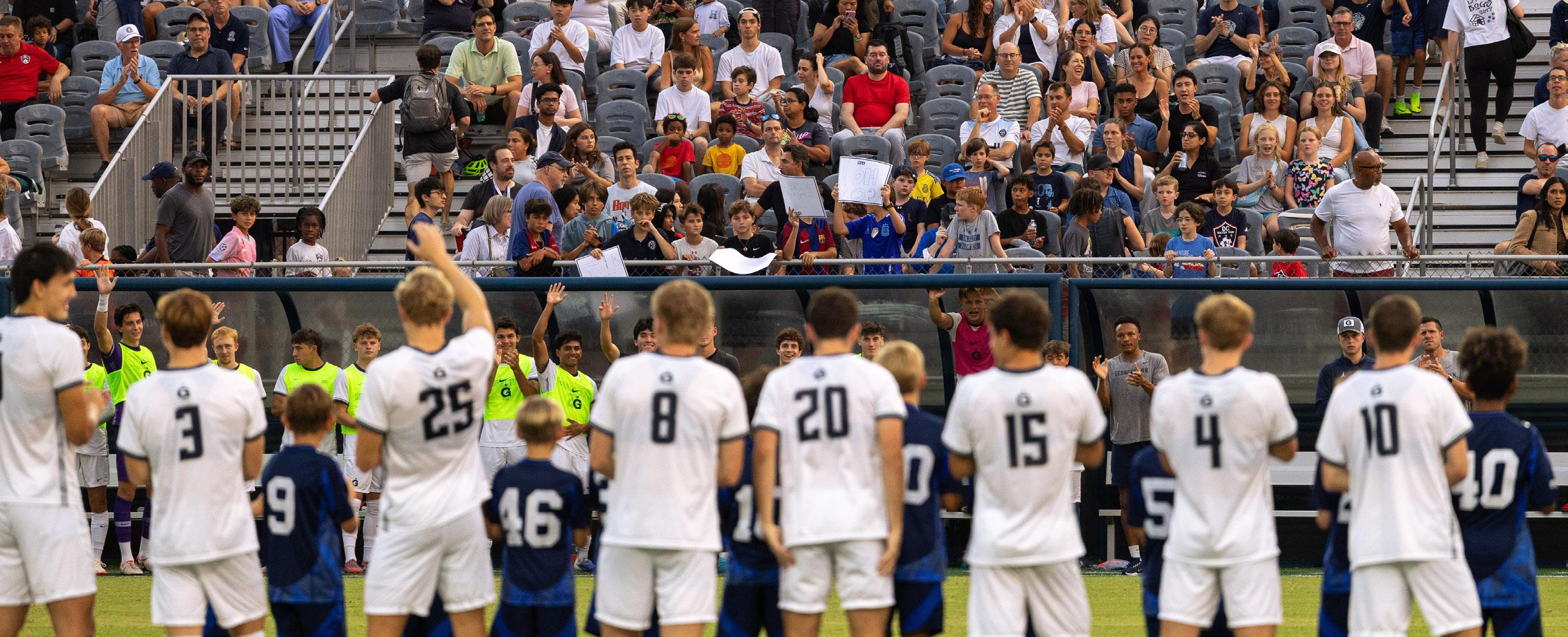
The Georgetown University men’s soccer team finished a six-game homestand, including tightly-fought matches against three nationally-ranked opponents, with a 4-0 blowout of Rider University. The game against Rider marked Georgetown’s fifth game in an unbeaten streak.
Hoyas Rout the Broncs to Finish GU Homestand
Madeline Wang Senior Sports Editor
The Georgetown men’s soccer team (3-2-2) defeated the Rider University Broncs (1-51) Saturday, Sept. 13 under the lights of Shaw Field. The Hoyas came into the match having taken down James Madison University in a 4-0 shutout Sept. 9, a result they repeated against Rider. Georgetown scored 4 goals Saturday night and kept Rider to a singular shot on goal, blasting them 4-0. Rider has not played a single ranked opponent this season, and yet they still entered the match having lost 4 of their previous 6 matches, holding a singular win to their name. The Hoyas, on the other hand, had taken down the at-the-time No. 3 University of Pittsburgh (33-1) and drew the at-the-time No. 1 Vermont (5-0-3) and No. 14 Duke (2-0-3) in their previous 3
matches. From the start, it was clear who had the expected advantage, and the Hoyas were quick to broadcast this.
In the fifth minute of play, sophomore midfielder David Urrutia put up the Hoyas’ first shot on goal, sending a ball towards the low center straight into Rider goalkeeper Marius Helias’ hands. A minute later, senior midfielder Max Viera was taken to the ground and earned Georgetown a penalty kick.
Senior midfielder Zach Zengue lined up for the shot, sent the ball flying into the back of the net and put the Hoyas up 1-0. Georgetown continued making offensive advances and dominating possession, sending up 6 more shots on goal in the subsequent 20 minutes of play. In that time, Rider seemed to find a single possession of opportunity. The Broncs sent out one shot attempt in the 12th minute, which was deftly blocked by the Hoya
defense, and a subsequent shot attempt less than 30 seconds later, which went sailing far over Georgetown’s goal and the backstop, ending up on West Road.
The Hoyas quickly regained possession, and in the 25th minute, sophomore forward Mitchell Baker put up 2 shots on goal — both blocked — before Viera found the ball at the left corner of the box. Viera flipped it to Zengue, who sent the ball straight into the back of the net to put Georgetown up 2-0. With this goal, Zengue secured the third brace of his Georgetown career.
Georgetown made substitutions in the 28th and 35th minute, and the players off the bench continued the Hoya dominance. In the 44th minute, junior midfielder Matthew Van Horn sent the ball up the pitch to junior midfielder Mateo Ponce Ocampo, who launched it from the left corner of the box
Offense Dominates But Hoyas Fall Short
Fenton Perez Sports Staff Writer
The Georgetown University football team (2-1, 0-1 Patriot League) fell short in a 37-42 shootout thriller against a fiery offense performance from the Lafayette College Leopards (2-1, 1-0 Patriot League) Saturday, Sept. 13. The Hoyas came into Saturday’s game with a 2-0 start to the season, dominating Davidson College and beating Wagner College in an unusual home game. The team opened Patriot League conference play against Lafayette, looking to build on their perfect start to the season.
The Hoyas set the tone early with a touchdown pass from senior quarterback Danny Lauter to find junior tight end Isaiah Grimes in the end zone, driving 74 yards in 5 minutes and 38 seconds in the first drive of the game. Lafayette running back Kente Edwards, who had a phenomenal game Sept. 6 at Stonehill College with 127 yards and 3 touchdowns in only 12 carries, picked up where he left off, scoring a 70-yard rushing touchdown down the left side as Lafayette spared no time to tie the game. On the following drive, the Hoyas ultimately failed to convert a crucial fourth-and-16, and sophomore kicker Thomas Anderson missed a field goal to give the Leopards another drive. Lafayette quickly marched down the field with a 44-yard pass from quarterback Dean DeNobile to wide receiver Mason Kuehner, ending their second drive with a second

straight into the back of the net, earning his second career goal to put Georgetown up 3-0.
As the sun began to set, so did Rider’s chances of securing a win — or even a goal. At the end of the first half, the Hoyas had put up 11 shots, all of which were on goal. The Broncs had put up 4 shots, with none being on goal. Despite a comparatively low fan presencem with 529 attendees compared to recent 1000-plus crowds, Georgetown dominated the pitch both offensively and defensively.
This trend continued into the second half. Despite Rider holding the ball for a few minutes at the start of the half, the Broncs failed to truly progress up the pitch other than earning their only corner of the match.
Following many less-thanideal shot attempts, the Hoyas found an opportunity in the 82nd minute off a corner. Sophomore midfielder Jack Brown received the ball from junior midfielder
Matthew Helfrich and looked to take a shot, sending the ball towards the left corner of the net. Sophomore defender Jack Lindimore leaped into the air and headed the ball in, netting his first career goal to put Georgetown up 4-0. The final 8 minutes of play saw both teams seek a goal to no avail. Throughout the second half, Georgetown put up another 11 shots to add to their 11 from the first half, though only 6 of these were on goal, correlating to the Hoyas’ singular goal this half. Rider, on the other hand, put up a singular shot the entire half — and it was on goal. Sophomore goalkeeper Charlie DeMarco — who entered the pitch for the first time in his career in the 82nd minute — recorded Georgetown’s only save of the match, earning himself a share of the clean sheet.
Coach Cooley Leads The Recruiting Trail
Nate Seidenstein Senior Sports Editor
For the first time under Head
Coach Ed Cooley, the Georgetown University men’s basketball team has no first-year players on its roster. While the Hoyas added six high-major players in the transfer portal who promise to be key components this season, they have focused their high school recruiting efforts on the class of 2026.
The recent approval of the House settlement allowing colleges to directly pay student-athletes has upended recruiting. The settlement’s framework permits institutions to spend $20.5 million across all sports on their players.
was a TTO player throughout high school.
Georgetown has already secured one commitment for next year, 6’9” forward Justin Caldwell. Caldwell, who plays for Fayetteville Academy in North Carolina, is a consensus four-star recruit. Caldwell chose the Hoyas over high-major competition including the University of Maryland, University of South Carolina and Villanova University. Cooley and his staff have been heavily recruiting other standout high school players, too.
Five-star guard Jordan Smith Jr. has to be at the top of any recruiting big board. Smith, from Fairfax, Va., is ranked as the No. 2 player in his class by ESPN. Smith is yet another TTO player. Smith was selected for the United States’ gold-medal under-19 FIBA World Cup team, for which he was a starter and averaged 8.4 points, 2.7 rebounds and 1.6 assists in the tournament. Smith recently announced six finalists in his recruitment to On3 Sports’ Joe Tipton. He included Georgetown, alongside Duke University, University of Kentucky, Indiana, University of Arkansas and Syracuse University. Along with Smith, the Hoyas have maintained significant interest in other local players. Qayden Samuels, a five-star guard who plays at Bishop McNamara High School in Forestville, Md., touchdown and taking their first lead of the game at 14-7. Georgetown’s offense then failed to respond and ended their second drive in a row with no score. Soon after, DeNobile aired out a deep pass to a wide-open wide receiver Elijah Steward for yet another touchdown to increase their lead to 14. The Hoyas had to answer, but still found themselves unable to cut into the Leopards’ lead. The tide of the game quickly changed; as Lafayette was knocking on the door of the end zone, Georgetown senior
linebacker Naiteitei Mose stripped the ball from DeNobile and ran 99 yards to the house for a huge boost from the Georgetown defense to keep the game close. Immediately following, the Hoyas were able to stop the Leopards’ offense and force a punt. The Hoyas quickly capitalized in the two-minute drill with an incredible one-handed catch from senior wide receiver Jimmy Kibble through pass interference. They followed up with a 2-yard rushing touchdown from sophomore running back Sav-
ion Hart, capping off the drive with a score to tie the game 21-21 under a minute to go in the half. Lafayette was not ready to head into the break tied and started marching down the field quickly, but their drive ended quickly with a sharp interception by Georgetown junior safety Bijay Boldin. The Leopards started the second half looking to reclaim their form from the early snaps of the game, but the Hoyas had other plans as junior linebacker Cody Pham
See LAFAYETTE, A11
Georgetown also faces its own challenge. Former Assistant Coach Kenny Johnson left this summer for Indiana University. Johnson, prior to his job on Cooley’s staff, was a coach with the Team Takeover (TTO) AAU basketball organization. Once at Georgetown, he helped recruit multiple TTO graduates to the Hilltop — Malik Mack, Caleb Williams, DeShawn Harris-Smith and Isaiah Abraham. Cooley tapped former University of Virginia Associate Head Coach Jason Williford, who has his own deep recruiting connections in the Washington, D.C. metropolitan area, to fill Johnson’s place. Williford’s hiring means that the TTO pipeline may still be intact — his son, Austin Williford, now playing at St. Joseph’s University,
HAAN JUN (RYAN) LEE/THE HOYA
ANTHONY PELTIER/THE HOYA
College’s football
Hoyas.
MEN’S BASKETBALL
MEN’S SOCCER