FEATURES
GUIDE
Public Service Careers
‘Dancing With the Stars’
A4
B1
Since 1920
THEHOYA.COM
Georgetown University • Washington, D.C. Vol. 108, No. 2, © 2026
FRIDAY, SEPTEMBER 11, 2026
Students, Faculty Petition GU to Update Employment Policy After Labor Disputes Nico Abreu and Noah De make working conditions worse on campus today,” Clark told The Hoya. Haan Executive Editor and Senior News Editor
Over 250 Georgetown University community members as of Sept. 10 signed a petition demanding the university amend its Just Employment Policy (JEP), which guarantees fair compensation for all full-time employees and contractors. The Georgetown Coalition for Workers’ Rights (GCWR), a labor rights student advocacy group, spearheaded the petition 21 years after Georgetown first approved the JEP. Among other demands, the petition calls on the university to revise how it calculates a living wage and preserve employment seniority status for contracted workers if a change in vendors occurs. Elinor Clark (CAS ’27), GCWR’s facilities team lead, said the revisions are necessary to improve labor conditions and close alleged loopholes in the current policy. “When it was created, it already had loopholes built in, which continue to
The JEP was approved in 2005, following months of student organizing and an eight-day hunger strike. According to the contract, it intends to provide sufficient compensation for full-time employees to afford housing, child care, health care, transportation and food, among other unlisted costs. The policy has not been significantly altered since its inception. A university spokesperson said through the JEP, Georgetown is dedicated to providing just wages to its faculty, and annually adjusts them to remain competitive with the Washington, D.C. labor market. “Georgetown University, as a Catholic and Jesuit institution, is committed to providing fair and competitive compensation packages for University employees and full-time contract workers who provide services on our campuses in Washington, D.C.,” the spokesperson See LABOR, A7
MATTHEW GASSOSO/THE HOYA
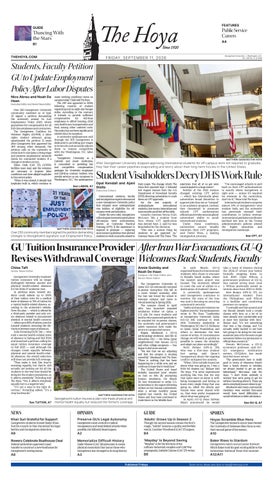
After Georgetown University stopped approving international students for off-campus work not required to graduate, they feel their career pipelines evaporating and worry about their long-term futures in the United States.
Student Visaholders Decry DHS Work Rule Opal Kendall and Ajani their major. The change, which The rejections that all of us got were “I’ve encouraged schools to pull Hoya first reported Sept. 7, followed unanticipated to a huge extent.” back on their CPT authorizations Stella Executive Editors
MATTHEW GASSOSO/THE HOYA
Over 250 community members signed the petition demanding changes to Georgetown’s signature Just Employment Policy.
International students, faculty and immigration experts denounced a new Georgetown University policy that stripped most undergraduate visa holders of eligibility for offcampus work authorization. Under the new rules, Georgetown will only grant international students off-campus work authorization, known as Curricular Practical Training (CPT), if the experience is required to graduate — replacing more lenient guidelines that allowed students to work most jobs related to
two August memos from the U.S. Department of Homeland Security (DHS) directing universities to crack down on CPT approvals. For the vast majority of undergraduate international students, that means internships and summer jobs are all but off the table. Leandro Guevara Neyra (CAS, McCourt ’28), a student from Peru whose CPT application was denied Sept. 2, said he was blindsided by the decision. “This was a normal thing for students to get approved on,” Guevara Neyra told The Hoya. “The
Neither of the DHS memos changed existing CPT policy — which has historically given universities broad discretion to approve jobs they see as “integral” to an academic program. Instead, they threatened to prosecute schools’ CPT authorization officials and revoke noncompliant universities’ ability to enroll international students. Under these conditions, universities cannot tenably maintain their CPT programs, said David Ware, a leading immigration attorney.
to exactly where Georgetown is right now — unless it’s required for everyone in the curriculum, don’t do it,” Ware told The Hoya. International students comprise almost 19% of Georgetown’s total student body, and the university has previously stressed their contribution to tuition revenue. International graduate enrollment declined last year as the Trump administration’s policies altered the higher education and immigration landscape. See CPT, A7
GU Tuition Insurance Provider After Iran War Evacuations, GU-Q Revises Withdrawal Coverage Welcomes Back Students, Faculty Chloe Taft
Annie Quimby and Noah De Haan
Senior News Editor
Campus Life Desk Editor and Senior News Editor
Georgetown University students’ tuition insurance will no longer distinguish between mental and physical health-related absences for the 2026-27 academic year. In previous years, insured students could redeem up to 100% of their tuition costs for a medical leave of absence or 75% of tuition for a mental health-related absence, according to the university’s website. Now, the plan — which is offered by a third-party provider and only covers absences related to documented physical or mental health concerns — offers up to 80% of tuition costs for insured students, removing the distinction between types of absences. Julia Strimling (SON ’26) — who took a mental health-related leave of absence in Spring and Fall 2024 and launched a petition calling for equal tuition insurance coverage in Fall 2025 — said although the changes create equality between physical and mental health-related absences, the overall reduction still does not provide full coverage. “They make it look like they’re ensuring equality, but they’re still actually not looking out for all the students in the way they should be doing for the student population, so it affects everybody,” Strimling told The Hoya. “Yes, it affects everybody equally, but in a negative way.” “It’s not a step in the right direction,” Strimling added. “It’s a step backwards.” See TUITION, A7
MATTHEW GASSOSO/THE HOYA
Georgetown’s tuition insurance plan now treats physical and mental health equally but reduced the former’s coverage.
The Georgetown University in Qatar (GU-Q) community resumed in-person instruction this fall in a move toward normalcy after the Iran war forced the school to evacuate campus and move to virtual learning in Spring 2026. The campus closed in April after Iran launched repeated retaliatory strikes on Qatar, a U.S. ally. For many students and faculty, who expressed gratitude to be reunited for in-person classes, the university and government’s safety measures have made the return to campus feel secure. Rogaia Abusharaf, a GU-Q anthropology professor, said life in Education City — the Doha, Qatar neighborhood that houses GU-Q and other college campuses — has begun to feel more normal. “We feel that we are adjusting and that the campus is running smoothly,” Abusharaf told The Hoya. “There is nothing that has been happening for a while now, and we continue to hope that it would last.” The United States and Israel initially launched joint attacks on Iran on Feb. 28, prompting Iranian retaliation. On March 29, Iran threatened to strike U.S. universities in the region following strikes on two Iranian universities. After a 60-day hostility pause expired last month, the United States and Iran have continued to trade blows in the Middle East.
In early March, GU-Q organized buses for international students who chose to evacuate to Riyadh, Saudi Arabia, where the nearest open airport was located. The university offered to cover the cost of airfare to a destination of students’ choice. A university spokesperson said Georgetown continues to monitor the state of the Iran war and is focusing on ensuring community security. “Safety and security remains our highest priority,” the spokesperson wrote to The Hoya. “Leadership at Georgetown University Qatar (GU-Q) will continue to work with University leadership in Washington, DC; the U.S. Embassy in Qatar; Qatar Foundation; and others to determine the best course of action. If circumstances change, we will work as quickly as possible to assess the situation and adapt our plans accordingly.” Ruth Kidane (SFS-Q ’29), who was a first-year student last spring, said Qatar’s transparency about the ongoing conflict mitigated her anxiety. “When I first initially found out about what was going on, I was a little bit shaken up,” Kidane told The Hoya. “I’ve never experienced anything like this. But the way that Qatar went on about it, with being transparent and letting us know every single thing that was going on, albeit the details and visuals were never shared with us, they were pretty transparent about what was going on.” In April, GU-Q Dean Safwan Masri announced he would
take a leave of absence during the 2026-27 school year before formally stepping down in July 2027. Clyde Wilcox, a government professor at GU-Q, was named acting dean June 1. Wilcox previously served as interim dean from 2021 to 2022. Alex Bonjoc (SFS-Q ’27), an international student from the Philippines, said Wilcox is a familiar and comforting presence on campus. “I normally saw him around, and my friends already took a couple classes with him, so a lot of us were already very comfortable and at least very familiar with him,” Bonjoc said. “It’s not something that was a big change, and I’m actually really excited to see how he’s going to be doing for the next academic year or for the next couple semesters before our permanent or official dean comes in.” Dennis McCornac, a GU-Q economics professor, said GUQ’s emergency notification system, GUQAlert, has made him feel more secure. “The government here is really good in terms of whenever there’s been a bomb, drones or missiles, we always tended to get an alert beforehand,” McCornac told The Hoya. “I don’t think anybody is worried that we’re going to get hit without knowing about it. There are alerts; everybody knows where to go.” Abusharaf said many community members were worried first-years would have travel difficulties or would withdraw or defer admission. See GU-Q, A7
NEWS
OPINION
GUIDE
SPORTS
Khan Suri Grateful for Support
Preserve GU’s Legal Autonomy
‘Adults’ Grows Up in Season 2
Hoyas Scramble Blue Hens
A6
A2
B4
A10
Georgetown students hosted Badar Khan Suri for a teach-in that chronicled his legal battles and immigration detention.
Georgetown must commit to radical transparency and resist federal attacks when possible, the Editorial Board argues.
Though the second season misses the first’s magic, “Adults” remains a quirky, worthwhile watch, Caroline Woodward (CAS ’27) argues.
The Georgetown women’s soccer team bested the University of Delaware Blue Hens to win their second game of the season.
Rowers Celebrate Boathouse Deal
Memorialize Difficult History
‘Mayday’ Is Beyond Saving
Baker Rises to Stardom
A8
A3
B6
A12/A11
Federal authorities approved a land transfer to construct a new boathouse for Georgetown’s rowing teams.
Zadie Weaver (CAS ’28) advocates to create physical memorials that honor those who Georgetown has wronged in its long history.
“Mayday” is for the few fans of the military-industrial complex and Cold War propoganda, Isabelle Cialone (CAS ’27) writes.
Published Fridays
Georgetown men’s soccer junior forward Mitch Baker took his goal-scoring skills to the Indonesian National Team this summer.
Send story ideas and tips to tips@thehoya.com
A2 | THE HOYA
THEHOYA.COM | FRIDAY, SEPTEMBER 11, 2026
OPINION IN THIS WEEK’S ISSUE
EDITORIAL
“
Stand With Your Students, GU The Trump administration made headlines last Following the new DHS guidance, however, year for attempting to directly exert control over Georgetown halted CPT approvals for work that is universities through funding freezes and high-pro- not a curricular requirement — meaning the vast file lawsuits. Now, the White House has shifted fo- majority of undergraduate students will no longer be cus to demands that reference universities’ interest approved. Though the DHS directives are not legally in “public trust.” In an Aug. 3 letter, U.S. Secretary binding, the federal government has threatened to of Education Linda McMahon called on U.S. uni- revoke noncompliant universities’ ability to enroll versities to cease affirmative action, hire more con- international students and indict designated school servative faculty, crack down on campus protests officials for perjury if they fail to follow them. and combat grade inflation, among other demands. At the same time, Georgetown has stood firm on a Last week, Georgetown University leadership told number of key issues. In July, the university opposed The Hoya they were “reviewing” the letter. Trump administration proposals that would impose Georgetown’s past record of responses to federal greater federal control over funding requests and pressure offers a spotty road map of what’s to come. restrict academic collaborations with foreign govThe university has stood strong on a number of is- ernments. The same month, Georgetown endorsed sues, but it has also bent the knee to many federal Harvard University’s lawsuit suing the government demands. Amid renewed governmental pressure over the freezing of its federal funding, arguing it over diversity, equity and inclusion (DEI) initia- jeopardizes academic and economic advancement. tives, faculty hiring and international student work In March 2025, then-Georgetown University Law authorizations, administrators must safeguard Center Dean William Treanor rejected the then-inGeorgetown’s independence and be transparent terim U.S. attorney for the District of Columbia’s call about policy changes’ impact on students. to end the school’s DEI curriculum. A Georgetown spokesperson said the school is These rejections of government pressure committed to maintaining its Jesuit values under demonstrate the university’s continued commitevery presidential administration. ment to its core values, despite the potential risks “Georgetown works with many parts of the federal of opposing federal demands. The Editorial Board government, and with each presidential administra- commends the university administration on tion, regardless of party or president, to further causes maintaining its independence in these decisions. aligned with its values; to weigh in on issues that disDarius Wagner (CAS ’27), GUSA president, said the tinctly affect higher education; and to ensure the safe- university’s response to federal action has been mixed. ty and security of every member of the Georgetown “I appreciate the fact that Georgetown has set up community,” the spokesperson wrote to The Hoya. a firewall to protect our academic freedom,” WagIn 2025, Georgetown eliminated the Young Lead- ner told The Hoya. “I would say there’s definitely ers in Education, Advocacy & Dialogue (YLEAD) more progress to be made in the ways in which the pre-orientation program, which focused on iden- student body is informed on decision-making.” tity-related dialogue, replacing it with a separate Still, while we may disagree with some of the unipre-orientation program that does not include pro- versity’s recent policies, the Editorial Board undergramming related to identity or diversity. George- stands Georgetown needs to tread carefully. In the town also removed or altered DEI-related language case of CPT changes, fierce resistance to the federal on some university webpages last year. Both changes government could end international student enrollfollowed federal attacks on DEI initiatives, though ment. As of last year, international graduate enrollthe university has said it is not moving away from its ment already faced a projected 20% decline. Violating fundamental Jesuit value of diversity. other directives could lead to cuts in federal funding. While it’s easy to dismiss these changes as superfi- In 2024, the university received $267 million in fedcial, they signal the university diverging from its mis- eral financial aid support and $195 million in federal sion and have tangible impacts on students. Incom- research support, and cuts to these funding sources ing students develop conceptions about Georgetown would upend key parts of university life. based on the information they’re exposed to early on. The solution to this is twofold. Firstly and most When DEI language is removed from pre-orientation importantly, Georgetown must maintain its auprograms and university webpages, it signals a less tonomy where possible. In areas like DEI, faculty welcoming environment. These actions demonstrate hiring and collaborations with foreign universithat Georgetown is caving to federal demands, jeop- ties, Georgetown should prioritize its long-held ardizing both its autonomy as an institution and its values over federal directives. commitment to serving its communities. However, in areas where this independence is Ayesha Murtaza (SFS ’29), a Georgetown Universi- impossible, such as with the CPT changes, Georgety Student Association (GUSA) senator, said the uni- town owes students transparency. After Georgeversity’s treatment of DEI practices has made her town’s changes to CPT authorizations, the university feel unwelcome. changed a single sentence on its website and only in“It’s very off-putting to be a person of color and dividually notified international students about the go to Georgetown now, versus before, almost like policy change. The Office of Global Services only postwe aren’t guaranteed identity-based protection on ed a policy update two days after The Hoya first reportcampus,” Murtaza wrote to The Hoya. ed on the issue. This lack of clarity is unacceptable. In an August interview, University President Presidential administrations change, but GeorgeEduardo Peñalver said the term DEI has become a town should not be looking to change with them. “lightning rod” for political pressure, and the uni- Allowing temporary, outside influence to take priorversity continues to value its ideals. ity reduces student and community voices, moving “We are committed to living out our Jesuit and the university in the direction of serving government Catholic mission, and we believe every human be- bureaucrats. It also jeopardizes our unique Jesuit ing was created in God’s image and is imbued with education made up of values like cura personalis, or human dignity, and we are committed to a univer- “care of the whole person,” community in diversity sity that reflects the richness of the human race,” and academic excellence. Ultimately, Georgetown’s Peñalver told The Hoya. responsibility to provide an education and repreMost recently, federal pressure has taken the sent its students supersedes any political agenda. form of the U.S. Department of Homeland Security (DHS) issuing new guidance for international The Hoya’s Editorial Board is composed of six stustudent internships. Many international students dents and is chaired by the Opinion editors. Editorials rely on Curricular Practical Training (CPT), which reflect only the beliefs of a majority of the board and has historically allowed students on F-1 visas to are not representative of The Hoya or any individual work off-campus jobs related to their field of study. member of the board.
HOYA HISTORY
The Editorial Board
“Stand With Your Students, GU” thehoya.com
POLL
This week, the Editorial Board discussed how the Georgetown administration has responded to increased federal government pressure, arguing that the university must stand up for its values while providing increased transparency on important policy changes. To gauge student opinion, The Hoya asked its readers if the Georgetown administration has handled recent federal government pressure well. Of the 64 respondents, 46.9% said yes, 31.3% said no and 21.9% said they were unsure.
EDITORIAL CARTOON by Apara Chandavarkar
Since its first issue in 1920, The Hoya has served to inform Georgetown’s campus dialogue. The following article is a glimpse into The Hoya’s rich history, allowing readers to appreciate the evolution of college journalism.
House Resolution Endangers Federal Financial Aid February 20, 2011
The House of Representatives passed on a continuing resolution early Saturday morning that proposes drastic funding cuts to federal financial aid. The continuing resolution, which now faces a Senate vote, would fund the federal government through September and make cuts of more than $60 billion from the 2010 budget. The federal Pell Grant program would be cut by $845 per student, down to $4,705 from $5,550, according to Associate Vice President for Federal Relations Scott Fleming. During the last academic year, 830 Georgetown University stu-
Presidential administrations change, but Georgetown should not be looking to change with them. Allowing temporary, outside influence to take priority reduces student and community voices, moving the university in the direction of serving government bureaucrats.
dents received a Pell Grant as part of their financial aid package, according to a Jan. 13 letter from University President John J. DeGioia. Along with cuts to Pell Grants, the continuing resolution eliminates funding for the Supplemental Educational Opportunity Grant program, an additional form of need-based federal aid. This would reduce the program’s grants to Georgetown by over $1.8 million, according to Fleming. The resolution also makes minor cuts to other aid programs, but those will have only a minimal impact on Georgetown students, Fleming said.
LETTER TO THE EDITOR AND VIEWPOINT POLICIES The Hoya welcomes letters and viewpoints from our readers and will print as many as possible. To be eligible for publication, letters should specifically address a recent campus issue or Hoya story. Letters should not exceed 300 words. Viewpoints are always welcome from all members of the Georgetown community on any topic, but priority will be given to relevant campus issues. Viewpoint submissions should be between 600-700 words. The Hoya retains all rights to all published submissions. Send all submissions to: opinion@thehoya.com. The Hoya reserves the right to reject letters or viewpoints and edit for length, style, clarity and accuracy. The Hoya further reserves the right to write headlines and select illustrations to accompany letters and viewpoints. CORRECTIONS & CLARIFICATIONS If you have a comment or question about the fairness or accuracy of a story, contact Executive Editors Nico Abreu, Opal Kendall or Ajani Stella at executive@thehoya.com. NEWS TIPS News Editors Noah De Haan and Chloe Taft: Email news@thehoya.com. Guide Editors Anandita Agarwal and Isabelle Cialone: Email guide@ thehoya.com. Sports Editors Sam Fishman and Ethan Herwick: Email sports@thehoya. com.
The Office of Federal Relations and the Office of Financial Aid are actively working to prevent major cuts from being implemented and are keeping students on federal aid informed as the process goes into the next round. Fleming said he had already created the Federal Student Financial Aid Network, which informs students on aid of upcoming votes and potential cuts. He is also encouraging students to call their representatives in the House. Caitlin Mac Neal and Mariah Byrne
GENERAL INFORMATION The Hoya is published once a week during the academic year with the exception of holiday and exam periods. Address all correspondence to: The Hoya Georgetown University Box 571065 Washington, D.C. 20057-1065 The writing, articles, pictures, layout and format are the responsibility of The Hoya and do not necessarily represent the views of the administration, faculty or students of Georgetown University. Signed columns and cartoons represent the opinions of the author(s) and do not necessarily represent the editorial position of The Hoya. Unsigned essays that appear on the left side of the editorial page are the opinion of the majority of the editorial board. Georgetown University subscribes to the principle of responsible freedom of expression for student editors. The Hoya does not discriminate on the basis of age, gender, sexual orientation, race, disability, color, national or ethnic origin. © 1920-2026. The Hoya, Georgetown University weekly. No part of this publication may be used without the permission of The Hoya Board of Editors. All rights reserved. The Hoya is available free of charge, one copy per reader, at distribution sites on and around the Georgetown University campus. Email: editor@thehoya.com Online at www.thehoya.com Circulation: 1,000
Founded January 14, 1920
Nora Toscano, Editor in Chief
Nico Abreu, Opal Kendall and Ajani Stella, Executive Editors Jackson Roberts, Managing Editor Noah De Haan, News Editor Chloe Taft, News Editor Jacqueline Gordon, Features Editor Serene Pai, Features Editor Thejas Kumar, Opinion Editor Leo Zhang, Opinion Editor Anandita Agarwal, Guide Editor Isabelle Cialone, Guide Editor Sam Fishman, Sports Editor Ethan Herweck, Sports Editor Angela Lekan, Science Editor Eva Siminiceanu, Science Editor Lucy Jung, Design Editor Anish Raja, Design Editor Allison Ma, Copy Chief Yaya Hang, Multimedia Editor Miranda Kristina Santiago, Multimedia Editor Matthew Gassoso, Photo Editor Ella O’Connor, Audience Editor Caroline Woodward, Audience Editor
Board of Directors
Paulina Inglima, Chair
Ruth Abramovitz, Bethe Bogrette, Maren Fagan, Tanvi Gorripati, Aamir Jamil, Annikah Mishra
Connor Manrique-Johnson, General Manager Rosie Garner, Director of Business Operations Jackson Roberts, Technology Director Jacob An, Director of Logistics Stefano Rangel Haddad, Director of Outreach
Andrew Jiang Annie Quimby Liv Sanchez Brendan Fijol Joshua Lou Michael Shtrom Caroline Garland Sophia Tully Caden Larrenaga Juan Almanza Eliza Doty Grace Ko Eliana Kut Penelope Snoep Finn Balon Golnar Jalinous Jacob Nolan Sasha Ahmad Jaya Alenghat Kaitlyn Lee Adhithi Rajesh Maddie Williams Autumn Dunlop Abby Kopf Emilie Andrews Grace Bauer Elizabeth Hoerter Ruby Lillie Grace Rutherford Connor Emmert Rohini Kudva
Academics Desk Editor Campus Life Desk Editor Graduate Desk Editor City Desk Editor GUSA Desk Editor Events Desk Editor Deputy Features Editor Deputy Features Editor Deputy Opinion Editor Deputy Guide Editor Deputy Guide Editor Deputy Guide Editor Deputy Guide Editor Deputy Guide Editor Deputy Sports Editor Deputy Sports Editor Deputy Sports Editor Deputy Science Editor Deputy Science Editor Deputy Science Editor Deputy Science Editor Deputy Science Editor Deputy Design Editor Deputy Design Editor Deputy Copy Editor Deputy Copy Editor Deputy Copy Editor Deputy Copy Editor Deputy Copy Editor Deputy Photo Editor Director of Human Relations
THE HOYA | A3
FRIDAY, SEPTEMBER 11, 2026 | THEHOYA.COM
OPINION
VIEWPOINT • CORCORAN
Explore Catholic Studies
I
n May 2026, Pope Leo XIV issued his first papal encyclical, “Magnifica Humanitas” (“Magnificent Humanity”). Writing about how we can “improve and beautify the world,” Leo calls us all to consider how we can best be communal human collaborators, instead of yielding to automation. At the text’s core is his repeated affirmation of both human dignity and humanity writ large. While the news cycle mostly focused on Leo’s call to “disarm” artificial intelligence (AI), the document is also a call to preserve human-generated creativity: “Humanity — in all its grandeur and woundedness — must never be replaced or surpassed.” As Georgetown University’s new director of Catholic studies, I am thrilled this encyclical has landed at a critical time for your education here. As the oldest Catholic and Jesuit university in the United States, Georgetown is well-positioned to examine the widespread implications of this document. “Magnifica Humanitas” shows how Catholic studies can bridge disciplines and offer unique insights into other fields of study. By exploring Catholic studies, you can learn how the Catholic intellectual tradition has shaped what it means to be a Georgetown community member. I was on campus on May 8, 2025, when Healy Hall’s clock tower began to chime at 12:09 p.m. with the news that the College of Cardinals had elected a new pope. As I watched the livestream coverage of the white smoke emerging from the chimney of the Sistine Chapel in Vatican City, we came to learn that thenCardinal Robert Prevost, from Chicago’s South Side, would be the Catholic Church’s first U.S.born pope. Since that historic day, I’ve observed widespread interest in topics related to Catholicism, and I hope we at Georgetown can build a culture of encounter that connects students, faculty and staff through Catholic studies. To start, I am bringing together some of our illustrious faculty across different academic disciplines to closely examine “Magnifica Humanitas” together. The Oct. 22 event, “Keeping the Humanities Magnificent in the Age of AI,” will show you what it looks like when academics across disciplines examine one source together and extract fascinating insights relevant to each of their distinct fields. Beyond “Magnifica Humanitas,” there are many ways to explore Catholic studies at Georgetown. Consider applying for the Figge Fellowship,
one of the centerpieces of Georgetown’s program. While the methods of Catholic social thought and Jesuit priorities of research, reflection and action are central to the program as a whole, individual fellows develop analytical frameworks for their own projects that they draw from the full range of world faiths. Last year’s topics included modern Christian masculinity, online queer Arab communities and atheist charity — subjects that touch on a variety of religious, cultural and intellectual traditions. In the Catholic studies minor, available to students in all schools, you can investigate how Catholicism has had a significant and complex impact on our world from its origins two millennia ago to the present day. Many of your courses already touch on Catholic studies, and, as a result, the interdisciplinary minor fits well within your liberal arts degree. For instance, “Conflict in Northern Ireland” (history), “Ancient to Medieval Art” (art history), “Dogs and Theology” (theology and religious studies) and “Religion, Ethics and World Affairs Seminar” (international affairs) all fall under the umbrella of Catholic studies. For those interested in justice and human dignity, and who value what the Church calls “the preferential option for the poor,” Catholic social teaching has its applications within society’s political, economic and cultural structures. Whether you were moved by something in your “Problem of God” course, listened to the concert choir sing sacred music, appreciated the medieval and Renaissance galleries in the National Gallery of Art, or engaged with the Center for Social Justice Research, Teaching, and Service (CSJ), you’ve already experienced Catholic studies’ impact on your Georgetown career. Pope Leo not only cites Christian thinkers but also refers to Plato as a guidepost: “The deepest and most important things are learned only after much time and effort, by engaging in discussion with others, ‘striking upon’ ideas and experiences together like flint until the spark of understanding is kindled within us.” Catholic studies at Georgetown brings together ideas, disciplines, traditions, professors and students in ways that challenge us to think more deeply and see the world differently. Come join us. Vanessa Corcoran is the director of Catholic studies at Georgetown University.
MATTHEW GASSOSO/THE HOYA
COLUMN • WEAVER
Establish A College Burial Ground Memorial
A
t the start of this academic year, I served as an orientation advisor, helping a small group of new students acclimate to Georgetown during New Student Orientation (NSO). As part of orientation, we showed a video of Georgetown’s history, which depicted an array of professors and administrators explaining the university’s history. The video, which is now private on YouTube, was shown to every first-year Georgetown student. While I appreciate the university dedicating time to introduce new students to Georgetown’s complex history, we should push administrators to create more physical, permanent tributes for these controversial stories. One piece of this history, which I will cover briefly because The Hoya has previously covered it in length, is the College Burial Ground, where the Reiss Science Building and Pedro Arrupe, S.J. Hall now stand. 900 people, including enslaved and free Black residents of Georgetown, as well as Catholic parishioners, were buried here between 1818 and 1833. In 1953, as the university was expanding, this burial ground was built over; only 50 of the 900 bodies were transferred to a nearby cemetery. Despite the university administration including Professor Rothman’s explanation of this
COLUMN • WOODWARD
history in their orientation video, no memorial or marker for these 850 people exists. To be clear, I’m not surprised this memorial does not exist; Georgetown has a long way to go before reconciling our deeply troubled past with slavery and mistreatment of Black members of Georgetown. But it still felt like the university administrators were throwing their hands up as if to say, “What a shame no one has done something yet!” Whether this ignorance is intentional or not is of little relevance to me. Either way, it is now in students’ hands to advocate and see this project to fruition. If Georgetown is as committed to its Jesuit mission as we claim, then this memorial is crucial. Cura personalis — or, “care for the whole person” — includes care for the person after death. There is a bleak disparity between the well-maintained Jesuit cemetery sitting in the heart of campus that not only has each grave marked, but also a sign reading “out of respect for those buried here, please do not walk or step on the graves,” and the estimated 850 unmarked graves, built over, with no acknowledgement that they were ever there. Moreover, if Georgetown is to claim that we are an elite university, priding ourselves on academic rigor and intellectual stimulation that seeps into every aspect of our lives,
then we must acknowledge our history entirely. It is anti-intellectual to tout parts of our history — the statue of John Carroll, plaques for the Philodemic society and Bill Clinton’s school photo — while leaving others in the shadows, hidden in videos we watch during NSO and never again. A history professor in a Georgetown classroom would be expected to teach the entirety of a historical event no matter how disgraceful; the university must then hold itself to the same standards. An institution that cares about intellectual rigor will acknowledge all viewpoints and sides of history, prioritizing truth and allowing students to grapple with bad parts of our past. I also cannot engage in this conversation without recognizing the ongoing advocacy for the GU272, the 272+ slaves that Maryland Jesuit priests sold in 1838 to save the university from bankruptcy. While the Leavey Center displays a screen with the names of the individuals sold by the university, there is no monument for the GU272 either. Furthermore, the screen feels too subtle of a memorialization for the enslaved people who are the reason Georgetown exists. Though the people buried under Reiss differ from the GU272, together, they show a pattern. Georgetown can name its wrongs, but it balks at a permanent place to mark,
mourn and educate about the people whom the university sold and paved over for its own survival. University administrators should establish a College Burial Ground memorial. Defend what it means to be an institution of higher education, especially one guided by Jesuit values. If this cause matters to you, continue to put pressure on the administration and tell your friends. Consistent advocacy from all students who care will go much farther than this article or a Georgetown University Student Association resolution. But most importantly, learn all the history you can. We can’t trust that what happened yesterday will be memorialized today, and we can’t trust that the memorials we have today will still be standing tomorrow. So when you’re in your Reiss 103 lecture or cooking in the Arrupe kitchen, remember what lies beneath you, especially when there is no sign to tell you. I am hopeful that the administration will listen to students and construct this memorial. But even if they do not bother enshrining a memory, they cannot take away your ability to do so. Zadie Weaver is a junior in the College of Arts & Sciences. This is the fourth installment of her column “Institutions and Their Ills.”
COLUMN • SINDRAM
Navigating Friendships, Roommates Learn Beyond Your Assigned Readings
W
elcome back, advice lovers! I hope you had a relaxing summer and didn’t get into too many shenanigans. With a new semester starting, relationship and roommate drama tend to emerge alongside typical academic stress. Do not fret, as Calling in With Caroline is back to assist with any and all issues! While I am a slightly different Caroline, I hope to provide the same caliber of excellent advice as my incredibly talented predecessor! So, if you have a question, submit it to this anonymous form, and I’ll help you out while you help me carry on this column’s legacy. My roommate and I share a room but have our own areas separated by a wall. She sometimes comes over to my section during times when I just don’t want to deal with other people. I don’t want to hurt her feelings; we’re really good friends, but I need some alone time. How do I tell my roommate that I sometimes need to be alone? Roommate conversations and callouts are understandably stressful — they can be awkward, tense and confrontational. However, this absolutely does not have to be the case. In fact, open talks with roommates often lead to a more positive living environment for both of you. If you let resentment or anger build up, especially when you have to interact a lot, the other person usually can tell. Direct, open and kind communication is key here. Provide clear reasoning, and make
it known that they are not the issue and that there are certain times of the day when you just need to decompress. I would be as specific as possible with these times so the burden is not on them to figure out your mood or daily needs. This can help show them that you still care deeply about your friendship; sometimes you just need a little alone time — most people do! How do you quit a friend you made freshman year that now sees you as a really close friend but you find them annoying and draining but don’t know what to do? Sometimes, friendships run their course. This is an unfortunate fact of life. However, before taking any drastic measures, approach this situation with compassion. Reflect on why you find this person annoying and draining now — do you talk about tiring subjects or do you feel they rely on you too much when you do not have the bandwidth? If there is any part of you that wants to salvage the friendship, I would identify the reasons for your own feelings and try to have a conversation with the person about changes that could be made for you to rebuild your relationship. However, if you feel this person truly does not bring value to your life and are set on cutting them off, do so with compassion, especially if they view you as a close friend. You don’t have to reach out to hang out, but if they do, consider spending some time with them. If you are not able to, communicate that honestly and clearly.
I have a close male friend who I recently have been spending more time with than usual. I really like him as a person and recently I am wondering if I like him more than a friend. He is also very tall. How can you tell the difference between developing feelings for a close male friend vs just being close to a male who happens to be tall? That’s a tough one. Platonic and romantic feelings can often overlap in any close relationship, and telling the difference is especially challenging when the person is attractive. This may require some serious soul-searching to figure out. Picture the two of you doing romantic things, such as going on dates or hanging out in more intimate ways. Monitor how much you find yourself really wanting to see them at any given moment. Remember, though, that you can appreciate someone’s looks, personality or presence without having romantic feelings. It is perfectly acceptable to have close, platonic male friends without feeling anything for them. This style of friendship is not something our culture often imparts on women, so it is hard to determine your personal boundaries. Believe in your feelings above all else, and do not feel influenced by possible outside forces, such as the everclassic friends-to-lovers romantic comedy. Good luck! Caroline Woodward is a junior in the College of Arts & Sciences. This is her first installment of the column “Calling in with Caroline.”
I
t’s Tuesday at 3:30 p.m., and your last class in the Intercultural Center (ICC) has just let out. Your professor mentions that office hours have moved, today only, to 3:30 p.m., because her daughter is in town from New York. The usual slot runs up against your two-anda-half-hour seminar on Wednesdays, so you decide to go. Her office in New North is small. A thin film of dust sits on the screen of her Dell monitor. Resting against the back wall is a stack of leatherbound books. The air conditioning rattles low the entire time. You don’t think you have long. You stay a while anyway. She asks how you are, and you tell her you’re buried in internship applications. You ask about the outline for your first paper, and she tells you to rearrange the entire thing, which means you get 10 minutes at your friend’s Tombs night, if that. On your way out, she hands you a book to read in your free time. The outline is what you came for; the book is what you leave with. Nothing in that hour was required of either of you, and none of it will show up anywhere. Measure your education in days rather than semesters, which means going to office hours, treating your professors as people with lives and lessons worth extracting and doing the same with the peers sitting next to you. That is why I am starting this column. Every week I will take an hour a professor has already set aside and ask a single open-ended question, one you might ask at the tail end of office hours, once the paper has been dealt with and there is still time left. I want
those answers on the page because they are the part of an education invisible on a syllabus. Hearing these answers often enough is what loosens the habit of measuring a life in summers and semesters. Officehoursarethemostgenerous thing Georgetown University offers. Several hours a week, someone who has spent a career thinking carefully about something will sit in a small room and think about it with you — for as long as you stay. Many students pay an extraordinary sum to be here, and this part of the arrangement costs nothing extra, has no cap and becomes mostly unavailable the day we graduate. Still, only a small fraction of college students take advantage of them, and the same story seems to be true at Georgetown. While I am grateful they exist, I too am not at all sure I have treated them with the seriousness they deserve. In my experience, Georgetown students tend to evaluate their lives at long intervals. The units of assessment are periods judged in retrospect by whether they are resolved into a firm, fellowship or medical school. Admissions, hiring and credentialing all evaluate a person by what they generated within a fixed window, and students learn to see themselves the same way. The cost is that days matter only as inputs to a result not yet arrived. A Tuesday stops being something you live and becomes something you spend. The liberal arts tradition holds the opposite view, and Georgetown says so itself: The university describes “cura personalis,” care of the whole person, as knowing a
student “beyond what a transcript can reveal.” That is not a claim about career placement but a claim about focus. It puts the real work of an education on the reading you actually finish, on the conversation that continues past the point of utility and on the daily discipline of taking other people seriously. Georgetown has not settled the question for us. It runs a career center and a Jesuit mission at once. What it does do is ask every professor to hold office hours, blocks of time that produce no grade, satisfy no requirement and appear on no transcript. The obligation that falls upon students is small and daily rather than large and eventual. Finish the work because it makes you a more complete person, not because it produces a number. Go to office hours with a question rather than a grade dispute, and stay long enough to hear the answer. I made a version of this argument last semester: Daily routines deliberately maintained are what steady us against the uncertainty we cannot control. We are constantly told to prepare for what comes after. I am starting this column from the opposite conviction — that the preparation and the thing itself are identical, and that both are happening on a Tuesday afternoon in a small office in New North, whether or not you decide to walk over. Josine Sindram is a sophomore in the School of Foreign Service. This is the first installment of her column “Office Hours.”
THEHOYA.COM | FRIDAY, SEPTEMBER 11, 2026
A4 | THE HOYA
FEATURES
As Federal Jobs Disappear, GU Students Feel Public-Sector Work is Out of Reach
ILLUSTRATION BY ANISH RAJA/THE HOYA
Georgetown students report growing disillusionment with public-sector careers after the Trump administration blocked many traditional pathways to government service.
The Trump administration has slashed the federal workforce, a typically robust source of employment for Georgetown graduates. Now, students face an uncertain public sector and increasing pulls to private jobs.
Jacqueline Gordon and Caroline Garland
Senior Features Editor and Deputy Features Editor
P
ierina Anton (GRD ’23) had spent eight years preparing for her dream moment to go abroad as a foreign service officer for the U.S. Agency for International Development (USAID) when she got a phone call telling her she had been placed on leave during mass layoffs. Anton, who graduated from Georgetown University’s master’s program in international economics and development, was set to leave for Senegal just a few weeks later and had passed her French language exam two days earlier. But USAID was all but defunct after the Trump administration gutted it throughout 2025, as 80% of programs were terminated — affecting around 10,000 employees. USAID’s collapse was a wakeup call, Anton said, that showed students like her that the second Trump administration had reshaped public service. “It was obviously devastating having to figure out a pivot career-wise,” Anton told The Hoya. “I’ll never forget this,” she added. Now, Anton works as a regional social impact manager at the credit card company Visa, after her chance of a government career had fallen apart. USAID cuts reflect a wider pattern among government jobs. President Donald Trump has leveled the federal workforce, which shrank by almost 238,000 employees last year. Trump then implemented new politicized employment policies in departments, which previously were perceived as bipartisan and separate from the president’s purview. Many traditional career pathways to the federal government, including college internships for the executive branch, also remain blocked or narrowed. At Georgetown, which has long touted its public-service mission, students interested in government work now grapple with an increasingly politicized federal workforce that has fewer jobs and little stability. Some, like Anton, have switched to the private sector with hopes to continue their passion for public service through larger corporations. Others have redoubled their public-service efforts — but outside of the federal government. Laura Sheehan, an associate director for Georgetown’s graduate career counseling, said the federal government’s unpredictability has dispirited some prospective workers. “The concept that the government is stable has definitely shifted in dramatic ways,” Sheehan told The Hoya. “That means that some people are not going into the government that thought they would in the beginning, although there are some people that are still equally committed to government service and to public service and are finding different ways to get in there.” After the mass layoffs of USAID employees in early 2025, a university spokesperson said Georgetown has many resources for students interested in nonprofit public-sector work. “Georgetown faculty work or have worked in a variety of industries, from state and local government to associations, nonprofits and the private sector,” the spokesperson wrote to The Hoya in February 2025. “We encourage students to draw from their experiences and advice. Georgetown’s location in Washington provides additional opportunities, including events and
networking at think tanks and nonprofits, often offered for free.” Students also have access to resources through Georgetown’s Office of Federal Relations, which shares internship opportunities and help to provide graduate contacts on Capitol Hill — as well as flags possible applications for graduate staffers, according to Katy Button, associate vice president for federal relations. The Hoya spoke with over 30 students who said the Trump administration’s actions have shifted their career trajectories. Besides a massive upheaval of federal employment opportunities, jobs that remain have been stripped of some appealing qualities, including stability and independence for federal workers. Students and faculty said this shift in the federal government is also reflected in other public-service-focused employment opportunities. A White House spokesperson did not respond to a request for comment. Jordan Smith (SFS ’28), who wanted to work at USAID before it collapsed, said she is disappointed the political climate is pushing her classmates toward the private sector despite other ambitions. “They’ve ended up working in the private sphere doing stuff they don’t necessarily morally align with, mostly because those jobs are available,” Smith told The Hoya. “I also found people putting off going into the workforce by going to grad school, and hoping that the dust will settle.” “It’s sad,” Smith added. “I think there used to be more opportunities for people who actually want to do good in the world — and you can’t ask people to decide between doing good and putting food on the table.” At the Gates of the White House As Trump’s 2024 presidential campaign gained traction, James Baust (MSB ’27) knew there would be major shifts in the public sector. Then in his sophomore year, Baust abandoned his plans to study government and transferred to the McDonough School of Business (MSB). Baust said Trump’s election — particularly the president’s opposition to diversity, equity and inclusion (DEI) initiatives — made him reconsider his future. “Ethically and morally, I would not want to work for the Trump administration,” Baust told The Hoya. “The way that they target programs and how they got rid of DEI, and they were very picky with the way that they selected interns and/or hired people, that’s just something I didn’t really want to be a part of.” “The political climate definitely affected my attitude towards wanting to be a part of the government,” Baust added. Living just miles from the centers of U.S. power, proximity to the federal government is often ubiquitous in many students’ Georgetown experience. But Trump’s efforts to embed ideology into the traditionally bipartisan workforce have made many students question their willingness to put their political beliefs aside. Peter Levine, a Tufts University civil service professor, said Trump’s presidency has disenchanted prospective public-service workers in a way he has never seen before. “A lot of people would say, ‘I’ll go work for the State Department or the Department of Justice or what-
ever, regardless of who the president is, because I’m becoming a civil servant and I’ll be there for many presidents,’” Levine told The Hoya. “But that’s probably going to be less valid for almost everybody, regardless of your political views, now that Trump has pretty much permanently reduced the independence of this civil service,” Levine added. Trump, for instance, introduced application questions asking nearly all prospective federal employees how they would help implement his directives and to name two executive orders or policy initiatives that are significant to them. Dhruv Shah (SFS ’26), Georgetown University College Democrats’ former co-chair and professional development director, said ideological differences make School of Foreign Service (SFS) students reluctant to work for the federal government. “This administration has politicized the public service when it is supposed to be nonpartisan and that has obviously disillusioned people who are already in it and who would’ve wanted to join,” Shah wrote to The Hoya. “It’s undeniable that the political climate has affected people’s post-grad plans,” Shah added. The shift in the appeal of public sector work has also been felt amongst graduate students. Amy Mattock, Morgan Lynn-Alesker (LAW ’07) and Caroline Springer (LAW ’90) — assistant deans at the Georgetown University Law Center — said law students also face uncertainty in public-sector careers. “Many students who came to law school with the intention of entering the federal government are instead now looking for more secure career opportunities in state and local government, clerkships and law firms, following federal hiring freezes, layoffs and program changes,” Mattock, Lynn-Alesker and Springer wrote to The Hoya in a joint statement. Putra Kusdarman (GRD ’22) — who, like Anton, pivoted from a career in USAID consulting after being laid off in May 2025 — said the Trump administration’s indefinite suspension of USAID dissuaded him from the public sector. “After 2025, it’s hard for me personally to look into the way the public sector is being run right now and align with some of the different things that they are proposing or implementing,” Kusdarman told The Hoya. “Part of the reason why I wanted to be in the public sector was I wanted to make sure that I worked within an ecosystem that aligns with some of my beliefs, some of my values, and after the dismantling of USAID, it left a pretty sour taste in my mouth.” Smith, who had to abandon her plans to join USAID, said limited access to the public sector is dashing the dreams of many government-hopefuls who come to Georgetown expecting a direct career pipeline. “Part of the reason I chose Georgetown was that I thought I would be in a really good position postgrad to get employment,” Smith said. “Right now I’m not seeing that.” Leaving the Public Eye As access to the public sector wanes, undergraduate students are flocking to private companies. Students say that given the stress and financial
instability already associated with a public sector job, securing a private sector job seems like the safer path. Carrie Wang (SFS, MSB ’25), a business and global affairs graduate who was once interested in a career in USAID but has now shifted to corporate law, said Trump’s actions pushed many of her classmates into more traditional business recruitment. “You feel so much pressure to consulting recruit, finance recruit, in a time where you feel so stressed out to get a job,” Wang told The Hoya. “I already felt very pushed towards it, but especially after that happened, I felt very discouraged from going into the public sector,” Wang added. “Honestly, at this point, I’m very glad that I made the switch because it feels like a very uncertain time to be going into public sector work.” The SFS, which is perceived as a leader in producing foreign service officers, has historically placed a large number of students in positions in the U.S. Department of State and U.S. Department of Defense. However, in 2025, the top industry for graduates was management consulting at 15.35%. In the SFS’ graduate programs, over 30% fewer graduates entered the public sector in 2025 compared to 2024. Wang said the Trump administration’s presence throughout the federal government has encouraged her and her friends to begin working in the private sector and join the public sector once federal dynamics have changed. “A lot of people feel like it’s smarter now to start off in private, because then you can lateral over into a higher position in the public sector than you would have had if you had started out in the public sector and gone up the whole time,” Wang said. Georgetown students are not alone. The Trump administration’s massive layoffs — reaching nearly 400,000 — spurred many federal employees to seek out private-sector jobs. Sheehan, the graduate career counselor, said the SFS created “Pivot with Purpose,” a seminar series that ran through April 2026 to support laid-off federal workers transitioning their careers. “Those are pipelines for us: the U.S. government, the intelligence community and international development,” Sheehan said. “International development was not just USAID, but all of the companies that did work on behalf of USAID all across the world.” “We immediately started pulling together resources for alumni,” Sheehan added. Kezia Hutabarat (SFS ’29), an international student currently living in Qatar, said the private sector is especially more stable for international students because private companies are often more willing to spend money on visa sponsorship — which has become increasingly contentious as the Trump administration seeks to restrict foreign workers. “I don’t doubt that there are several international students who want to immediately go into public service, but I think within the community it’s split between students who are willing to take that risk and put their foot forth in foreign service, foreign policy, versus the students who probably want to build a foundation in the private sector or in arguably higher-paying jobs,” Hutabarat said. Sheehan said that for graduate students, many of whom joined
Georgetown with a specific professional goal, the pull to the private sector is particularly acute. “There’s still that service element; it’s just in a different venue in a lot of places, and in some respects, it might be better because a lot of private sector places pay more than the government jobs did,” Sheehan said. “It really is not good or bad, just different.” Renavigating the Public Sector For Georgetown students who remain interested in working in the public sector, many are forging paths outside of the federal government. Kusdarman — who now works for Visa on global corporate initiatives that aim at community sustainability — said he had to find a new outlet for international development work after USAID was dismantled. “I was just more concerned about the mission alignment of what I want to do,” Kusdarman said. “Once I accepted that aspect about myself, after tons of reflection, I decided that I can do this in so many different places, whether that’s the private sector, whether that’s the local government, whether it’s in the civic space.” Nadia Brown, chair of Georgetown’s women’s and gender studies program, said the current political climate is forcing students to find creative ways to continue advocacy work. “It’s difficult to do a lot of gendered work or queer activism in today’s climate with the restrictions that the Trump administration has put on these organizations,” Brown told The Hoya. “You’re going to do the work anyway; it’s just finding out how to do it, and this is where good leaders are born because you get to throw ideas out.” Tina Solki (SFS, MSB ’26), who is currently teaching English in Tajikistan on a Fulbright scholarship, said students should not feel discouraged from pursuing public service, like in the U.S. Department of Justice (DOJ), at all due to the Trump administration. “I would just say not to lose the forest for the trees,” Solki told The Hoya. “If you come into school wanting to work in development somewhere, wanting to work in regulation, wanting to work at the DOJ, you want to do that for a reason, there’s something in you that’s driving you to do that, and it’s not because of the organization.” Nearly halfway through Trump’s second term, some students have redoubled their service efforts — only now outside the federal government, shifting a traditional Georgetown career path that kept students in Washington, D.C. Alex Johnston (GRD ’03), the linguistic department’s career management director, said she believes public-sector jobs will return in full force in the future. “The only constant is change, and things will come back around,” Johnston told The Hoya. “If you had dreams of making an impact in the federal government or in the nonprofit sector, in international aid or education, areas that are being suppressed right now, I feel that this is a cycle and we should come out of the cycle.” “We historically have,” Johnston added. Roan Bedoian (CAS ’28), an American studies student minoring in women’s and gender studies, said Trump’s attacks on social issues she cares about
have only pushed her to pursue a public sector career more. “Ideally, I would like to be dedicating as much of my career as possible to community nonprofit work where I get to see the real impact of my work on real people’s lives,” Bedoian told The Hoya. “That has always been important to me.” “I’ve definitely been motivated more to push for social impact in my own career because I’ve seen how much more it’s been needed since the Trump administration began,” Bedoian added. Mattock, Lynn-Alesker and Springer — the Georgetown Law deans — said one option for law students is doing public service work at private firms. “We’ve also seen a dramatic increase in the number of students interested in public interest firms, as evidenced by the creation of the Georgetown Plaintiff’s Law Association,” Mattock, Lynn-Alesker and Springer wrote. “Some of these students would have alternatively been interested in the federal government, but others are forgoing big law to pursue smaller, public interest-oriented firms.” Juliana Swartz (CAS ’27), who is pursuing political communications and worked as a press intern for the Massachusetts State Senate, said students should look to non-federal government positions. “At whatever level, especially if you want to go into the federal level, first getting local or state experience, I think, is a great idea,” Swartz told The Hoya. “Especially right now, given the chaos throughout the federal government, the lack of available jobs, now is really a perfect time to do that.” The ideological shift and lack of job security within the federal government has spread to the nonprofit sector too, as 73% of nonprofits report feeling increased pressure, financial instability and low morale — discouraging students from nonprofit work as well. Anjali Ofori (CAS ’27), an American studies major, said students must continue pursuing jobs in the public sector to begin work on ameliorating the impact of Trump’s actions. Full disclosure: Anjali Ofori (CAS ’27) previously served as an Opinion deputy editor for The Hoya in the Spring 2025 semester. “I think it’s naive for me to say, but the Trump administration — hopefully, what is happening now — won’t last forever,” Ofori told The Hoya. “Even the effects that are happening now are going to have long-lasting effects, but I think that people not taking that on, or people not willing to put themselves out there to make it work and make it better, will also perpetuate the long-lasting effects.” “Someone has to do it, and someone has to fix it,” Ofori added. As she starts her social impact career at Visa, Anton said she has been inspired by graduates’ and students’ steadfast pursuit of serving others amidst persistent federal issues. “The public sector will remain something that is important, and we definitely need good, ethical public servants to go through Georgetown and other institutions and do that work,” Anton said. “When you have a heart for this work, and when you have a heart for service and helping others, it doesn’t matter where you are, you’re always going to be a helper,” Anton added.
THE HOYA | A5
FRIDAY, SEPTEMBER 11, 2026 | THEHOYA.COM
SCIENCE
GU Lab Develops Stroke Recovery Approach to Advance Patient Care Madeline Williams Deputy Science Editor
A Georgetown University professor is working to develop a new approach to understand the biology of stroke recovery through biomarker identification. Dr. Matthew Edwardson — an associate professor of neurology and physician with MedStar Georgetown’s Stroke Program — directs the Biomarkers of Stroke Recovery Lab at the Georgetown University Medical Center, which works to characterize human brain repair after stroke. At the lab, Edwardson’s recent efforts have included co-authoring new guidelines for future stroke recovery research and identifying biomarkers associated with stroke recovery. As part of this new initiative, Edwardson will continue to explore biomarkers, or quantifiable biological changes that are potentially indicative of clinical outcomes, as a way to individualize stroke recovery by better understanding stroke biology. Edwardson said that using biomarker identification to understand the underlying biology of stroke recovery might allow for the development of patient-specific therapies that will be effective during rehabilitation. “As a clinician I see that physical and occupational therapists really try to tailor their care for each patient, but that this could be improved if they knew what to expect with regard to each patient’s recovery,” Edwardson wrote to The Hoya. “For example,
if we expect a particular patient to get very little recovery on one side, they might focus more on compensation strategies to perform activities of daily living with the unimpaired limbs.” Edwardson served as co-chair for a taskforce in the fourth Stroke Recovery and Rehabilitation Roundtable (SRRR-IV), the most recent meeting of multidisciplinary taskforces facilitated by the International Stroke Recovery and Rehabilitation Alliance. Edwardson co-authored a new set of guidelines, resulting from SRRR-IV, that aim to inform future research efforts and clinical care worldwide with regards to stroke recovery. Edwardson’s paper, which was published in the International Journal of Stroke on Aug. 18, recommends identifying and analyzing biomarkers throughout stroke recovery that could potentially be used to influence stroke rehabilitation care. Edwardson said it is critical that future research in the field occurs internationally across vast patient populations. “As a researcher, I have conducted many single center biomarker studies at Georgetown. While these are exciting, it is difficult to know whether the results are reproducible and apply to other populations of stroke patients more broadly,” Edwardson wrote. “This initiative will allow us to develop biomarkers with more solid experimental evidence to inform the international stroke community about recovery biology.”
The taskforce recommends large-scale biomarker identification through -omics based research, which involves analyzing the genetic content (genomics), genetic changes (epigenetics), RNA content (transcriptomics), protein content (proteomics) and metabolite or small-molecule content (metabolomics) of given patient samples. Nola Melvin (CAS ‘27), a former patient care technician at MedStar Georgetown’s emergency room who cared for stroke patients, said that care for these patients is very complex and is necessary to prevent serious complications. “When a stroke patient comes into the ER, there is such a rush to get labs, vital signs, CT scans, to identify the stroke. Medication can be given within a short timeframe to dissolve the blood clot. Patients who have not gotten this medication face a dire outcome,” Melvin wrote to The Hoya. “They often lose control of muscles in the face, arm, leg and their quality of life decreases drastically. I hope this research is able to identify methods and treatments for stroke recovery soon.” Edwardson said the paper could lead to legislation that prevents the denial of access to care based on molecular biomarkers, citing the Genetic Information Nondiscrimination Act’s (GINA) effect on genetic testing. “There is an important precedent called the GINA Act, which prevents insurers from denying coverage based on genetic testing,” Edwardson said. “This paper might help lead to future
MATTHEW GASSOSO/THE HOYA
Dr. Matthew Edwardson, the director of the Biomarkers of Stroke Recovery Lab at Georgetown University School of Medicine, is working on new approaches to improve stroke recovery.
laws to prevent denial of access to care based on other types of molecular biomarker data.” Ryan Ruhde (MED ’33), a dual-degree physician-scientist trainee at Georgetown who is interested in investigating how cognitive tasks may help support functional recovery from stroke, said he is encouraged by the new research. “Being interested in both this sort of basic science and clinical practice moving forward, it’s exciting to see that Dr. Ed-
wardson’s research is happening at Georgetown,” Ruhde wrote to The Hoya. “It reinforces that there are many important resources and investigators here to support a well-rounded training experience focused on stroke recovery and rehabilitation.” Edwardson said that multidisciplinary international discussions like SSSR-IV are vital to hear other perspectives and provide broad recommendations for future research endeavors.
“We had no idea people in the stroke recovery community were worried about predictive biomarkers being used to deny access to care,” Edwardson wrote. “It was only after we had an in-person meeting in Aberdeen, Scotland, related to this SRRR effort that we learned of this from other rehabilitation scientists. This was the impetus for us to switch the main purpose of these biomarkers from prediction, to understanding the underlying biology.”
GU Fellows Complete Summer Research Projects Physics Students Honored With Research Scholarship
Kaitlyn Lee
Deputy Science Editor
Georgetown University undergraduate students submitted their final deliverable for the Center for Research and Fellowships (CRF) Summer Research Fellows program Sept. 2. The students spent 10 weeks pursuing independent research projects or working on a professor’s research and received a $6,000 stipend from the program to fund their work. Students studied various topics from neuron development to mammal ecology, producing reports while gaining sustained research experience. Anthony Orphanos (CAS ’29) said the fellowship provided him with an introduction to research through the Georgetown Earth Commons’ Mammal Conservation Lab. Orphanos served as the lead author on a manuscript explaining his research on supay chacra, a scarcely studied Amazonian microhabitat containing colonies of lemon ants. He found that several Amazonian species may favor feeding in supay chacra over other areas of the forest, particularly when fruit is scarce. Orphanos said his summer work has shaped the career opportunities he hopes to pursue in the future. “My research experience has interested me to follow a career in research and pursue internships at the Smithsonian working with mammals,” Orphanos wrote to The Hoya. Orphanos said the program and his principal investigator’s (PI) support made his research possible. “I needed funding to help cover equipment costs and other expenditures related to the fieldwork, so I worked with my PI to develop a plan for a research project
the CRF approved and graciously funded me for,” Orphanos wrote. Orphanos concluded his fellowship by submitting a research poster encapsulating his work from the summer. While the fellowship introduced Orphanos to research, Benjamin Cohen (CAS ’28), a pre-medical student, continued research on the neurology of the inner ear that he began during his first year at Georgetown. Cohen investigated how Semaphorin-5A, a protein associated with neurodevelopmental disorders, might influence neural activity. Cohen used genetically modified mice lacking Semaphorin-5A to conduct his research. He found that the observed increase in neuronal activity may not be due to changes in the number of ion channels in the cell membrane as previously suspected, since the ion channel levels in the knockouts were not significantly different from those in normal mice. Cohen said that his results indicate that the increased neuronal activity in mice may instead be due to how the ion channels are transported to the cell membrane. “The knockout mice demonstrated a slight reduction in the phosphorylated (active) form of the ion channel trafficking protein CRMP2 in both the brain and cochlea, suggesting that hyperexcitability could stem from unsuccessful delivery of channels to the cell membrane,” Cohen wrote to The Hoya. Cohen, whose fellowship culminated in a scholarly report, said he was grateful to CRF for alleviating much of the financial pressure on his lab and furthering his appreciation for the research process. “I am incredibly grateful to the CRF for providing a uniquely focused opportunity to advance my research, while easing the financial burden on
Andrew Jiang
Academics Desk Editor
MATTHEW GASSOSO/THE HOYA
Georgetown students completed a 10-week program that allowed them to pursue independent research projects over the summer.
the Coate Lab and deepening my appreciation for the perseverance, resilience, and humility that research cultivates,” Cohen wrote. Nazgol Missaghi (CAS ’28) said she used the fellowship to study how proteins involved in neuronal signaling interact in Drosophila melanogaster, a species of fruit fly commonly used as a model in scientific research. Missaghi said she investigated whether a particular protein, Metalloproteinase-2, may play a role in releasing Endostatin, another protein that may be involved in communication between neurons. “I am studying how one protein may act like a biological ‘scissor’ to release another protein that helps neurons maintain stable communication,” Missaghi wrote to The Hoya.
Missaghi said understanding these mechanisms could provide insight into various neurological conditions. “Studying these mechanisms will help reveal how disruptions in synaptic communication contribute to conditions such as Alzheimer’s disease and epilepsy,” Missaghi wrote. Missaghi said the fellowship was a valuable experience because it provided the opportunity to focus deeply on her research and thrive within her lab community. “CRF allowed me to pursue my research in a much more focused and sustained way while being fully immersed in a lab community I adore,” Missaghi wrote. “The Maillard Lab has been a brilliant setting to grow as a researcher: to ask questions, make mistakes, learn, and have the space to succeed.”
Thunderstorm Brings Extreme Lightning, Topples Trees Angela Lekan and Eva Siminiceanu Senior Science Editors
Georgetown University students faced unexpected challenges navigating campus after a severe thunderstorm hit Washington, D.C., on Sept. 3. The 90-minute storm brought a combination of heavy rain and powerful 64 mph winds, causing around 300 tree topplings and cutting power for thousands of D.C. area residents. The storm also had a particularly high lightning strike rate, averaging 68 strikes per minute during its peak. Stacy Liu (SOH ’28), who was stuck outside during the storm, said it was one of the most serious she had ever experienced. “It was definitely the most extreme thunderstorm I’ve ever gotten caught up in,” Liu wrote to The Hoya. “I was completely drenched within 3 minutes of being outside, and so much water got in my eyes that my visibility was heavily impacted.”
The storm’s distinctive lightning flashes were caused by the collision of water droplets, and with other particles in the upper part of the storm’s cloud. Strong winds push water particles to the freezing upper part of the storm cloud, which towered about 20,000 feet above the ground. At such low temperatures, water droplets freeze and collide with hail and other particles. This knocks negatively charged electrons off the particles to the bottom of the cloud. The negative bottom portion of the cloud creates an electric field with the positively charged ground, generating lightning when the electrons rush to the ground. Charlotte Phillips (CAS ’28), who watched the storm from her on-campus apartment, said she was shocked by the strikes’ frequency. “It was like there was lightning every second,” Phillips wrote to The Hoya. “I have never seen so much in my life.” Molly The Losen (SOH ’28), who was also on campus for the storm, said the weather was comparable
to hurricanes she witnessed in her Florida hometown. “Those were some hurricane-level winds, and I’m from Florida,” The Losen wrote to The Hoya. The storm reflected a trend of severe weather across the East Coast in the past few months — since 1958, the U.S. northeast has experienced a 55% increase in extreme precipitation. Studies have shown that climate change may be responsible for the increased intensity of these storms. Cynthia Wei, a science, technology and international affairs professor, said temperature increases can cause more intense weather events. “We can’t pinpoint this specific thing to climate change, but we have patterns of overall increasing warming that is driving more extreme weather,” Wei told The Hoya. The storm toppled numerous trees across the District, damaging cars and property. A large portion of a tree on Copley Lawn, as well as a small tree outside of the Reiss
Science Building, fell on campus. Wei said tree loss reduces tree cover and shade, which can make the city feel warmer on hot days. “It is quite hot in D.C., and the urban heat island effect is going to get worse, and one of our main ways to deal with that is having a lot of trees,” Wei said. “Losing two, three hundred trees around the city, that’s one additional negative impact beyond the immediate physical damage to property.” Wei said monitoring tree health can prevent storm damage. “In some cases, trees that were already in need of some maintenance — weaker trees that are maybe dead — those have a propensity to fall and can cause harm,” Wei said. Wei said she hopes extreme weather events highlight the impacts of climate change for more people. “Broadly speaking, with a storm like this, I hope people are more motivated to think about the impacts of climate change and do the things that we can still do to mitigate, but also to adapt to it,” Wei said.
Two Georgetown University graduate students won an internal scholarship recognizing their physics research, the university announced Sept 2. The Professor Walter G. Mayer Endowed Scholarship Fund, named after late Georgetown physics professor Walter Mayer, recognized doctoral candidates Colin Langton (GRD ’27) and Raheen Iqbal (GRD ’27) for their work in experimental physics. This is the first time the scholarship was awarded to a pair of students, who join 11 previous recipients of the scholarship since it was inaugurated in the 2014-15 academic year. Iqbal — who researched liquid-liquid phase separation, a process in which a homogenous liquid solution splits into two distinct solutions — said she was grateful to win the scholarship after putting so much time into her project. “I was also pleasantly surprised,” Iqbal wrote to The Hoya. “Research often involves long periods of experimentation, troubleshooting and uncertainty, so receiving this recognition was extremely encouraging. It made me feel that my work and the effort behind it were valued by the Georgetown community.” Her research found that adding small molecules to the original solution could effectively reduce the reaction’s temperature, which can help protect thermally sensitive materials. Langton, who studied the behavior of microscopic magnetic materials in computer memory chips, said he was humbled to receive the award. “I felt very honored,” Langton wrote to The Hoya. “I appreciate the support from the department, and it was really rewarding to see the work I have put into my research recognized by the faculty.” The scholarship covers the full student stipend for the academic year. Daniel Blair, a physics professor who chairs the selection committee, said the recipients represent the best of Georgetown’s graduate researchers. “The department feels that the recipients of this fellowship set a standard for research excellence that benefits the entire physics community here at Georgetown,” Blair wrote to The Hoya. Iqbal said her advisor, Edward Van Keuren, provided instrumental support throughout the research process. “Professor Edward Van Keuren has played an essential role by providing guidance, helping me interpret the results, and encouraging me to explore the problem from different perspectives,” Iqbal wrote. “I have also benefited from discus-
sions and assistance within our research group and department.” Langton said the physics department’s lab rotation system helped him choose his final placement with physics professor Kai Liu. “The physics program at Georgetown lets you rotate through labs before selecting an advisor, which gave me time to see what suited my interests best,” Langton wrote to The Hoya. “I chose Dr. Kai Liu’s lab for his experimental focus on nanomagnetism, where I can build physical samples and directly test the results.” Langton’s work in nanomagnetism, which studies microscopic magnets, hopes to improve traditional two-dimensional computer chips’ speed and capacity by replacing them with more complex three-dimensional structures. Langton said he hopes to broaden participation in academic research at Georgetown and the wider Washington, D.C. community. “With this scholarship, I hope to advance Georgetown’s research footprint through published work while mentoring undergraduates in the lab,” Langton wrote. “I also hope to be able to give back to the local D.C. community through scientific outreach to emphasize the importance of pursuing research to the younger generation. This includes mentoring third and fourth grade students at the local Georgetown Boys and Girls club to show them basic handson science experiments.” Langton said he hopes to continue his research and gain practical experience before returning to academia. “I want to spend the first part of my career building real-world technology,” Langton wrote. “Long term, I would love to bring that practical industry experience back into academia as a college professor.” Iqbal said she desires to promote excitement about science both on and off campus. “This scholarship will help me continue developing my research and sharing it with the broader scientific community,” Iqbal wrote. “I hope that my work will contribute to Georgetown’s interdisciplinary research environment by connecting ideas from physics, chemistry, materials science and biology.” “In the future, I would like to mentor younger students and help create a supportive research environment in which students feel comfortable asking questions, learning new techniques, and developing independent ideas,” Iqbal added. “I also hope to represent Georgetown through conference presentations, publications, and collaborations with researchers at other institutions.”
THEHOYA.COM | FRIDAY, SEPTEMBER 11, 2026
A6 | THE HOYA
NEWS IN FOCUS
PAGE SIX
Former Peñalver Advisor named GU Chief of Staff
Your news — from every corner of The Hoya
WHAT’S NEW IN SPORTS? The Tracker: Following GU Women’s Basketball in the Transfer Portal Check out The Hoya’s timeline of Georgetown women’s basketball roster commitments following the closure of the transfer portal as the Hoyas pick up new players and finalize their roster. MATTHEW GASSOSO/THE HOYA
Georgetown University announced its new chief of staff, who previously held the same position under University President Eduardo Peñalver for three years at Seattle University on Sept. 8.
All articles are available on thehoya.com. Photo by Matthew Gassoso/The Hoya
Reporter Peter Bergen Donates Archive Amid Deportation Legal Battle, Khan To GU Documenting Rise of Al-Qaida Suri Grateful for Community Support Paulina Inglima
Chair of the Board of Directors
Georgetown University’s Lauinger Library (Lau) will permanently host a 150,000-page archive of documents detailing al-Qaida’s rise and the war on terror after a journalist’s donation on the 25th anniversary of 9/11. The collection of rare documents is the accumulation of 38 years of work by CNN national security correspondent Peter Bergen, who was the first journalist to interview al-Qaida leader Osama bin Laden, who orchestrated 9/11. The collection — which is one of multiple memorials Georgetown hosted for the 25th anniversary of the attacks, including a dedicated mass — joined Lau’s Booth Special Collection. Bergen said he hopes the collection, which includes reporting files, correspondence, interview recordings, government records and photographs, will help develop an accurate historical record of the terrorist attacks. “Documents tend to be less misleading than people,” Bergen told The Hoya. “Not always, but, at least most of the time. I wanted these things to be available decades from now, generations from now. 9/11 was one of the hinge events in American history, and these documents are kind of part of that story.” Georgetown Library Dean Alexia Hudson-Ward said the exhibit, named the Peter Bergen Papers, allows students to move beyond the textbook straight to the source. “What drew us to the collection was its extraordinary depth as it represents decades of primary-source documentation from a journalist who has spent much of his career studying al-Qaeda, Osama bin Laden, terrorism and the U.S. response to these issues,” Hudson-Ward wrote to The Hoya. “Taken together, they provide researchers with an unusually rich record through which to examine a consequential period in recent history.”
University President Eduardo Peñalver announced the donation in an email to community members Thursday, saying the anniversary of the attacks is a moment for remembrance and reflection. “The University recently accepted the donation of a new collection featuring more than 150,000 primary source materials, assembled by the journalist Peter Bergen during his years reporting on Al-Qaeda and those responsible for the September 11 attacks,” Peñalver wrote in the email. “Portions of this extensive collection are now available to Georgetown University community members and researchers for analysis and study. This vast collection is currently undergoing processing and digitization, with the goal of expanding access over the coming year.” Bergen, who organized the collection while researching for his 2021 book, “The Rise and Fall of Osama bin Laden,” said he began discussing a donation to the university with Walsh School of Foreign Service (SFS) terrorism professor Bruce Hoffman after finishing his book. Hoffman said he was excited when Bergen reached out to him about the donation. “I immediately knew from my familiarity with Peter’s work over the past 25 years that these materials were a treasure trove of rare, oneof-a-kind items and thought that students and scholars would benefit enormously from access to Peter’s archive,” Hoffman wrote to The Hoya. Bergen said Georgetown was a natural fit for the collection, as a top university for terrorism studies located in one of the cities most affected by 9/11. Lauinger Library is still processing the documents through the Booth Family Center for Special Collections, but a portion of them are available to the public online. Students and researchers can reach out to library staff to access the full inventory.
Bergen said once the decision for the donation was made, a three-year process of cataloging and transferring 70 boxes of hard materials, and around 3,000 online files, began. “I held on to a lot of these things because I’m sort of a pack rat, and much to the annoyance of my wife,” Bergen said. “But you know, I think that I knew that at some point I just felt it would be useful for other researchers.” The collection includes 100 issues of Al-Jihad magazine, which Bergen referred to as the “in-flight magazine,” of al-Qaida, as well as a translation of the bin Laden family diary. It also contains a religious edict distributed at al-Qaida’s sole press conference in 1998, and referred to by Bergen as the “religious authorization for 9/11.” Hoffman said the fatwa is an invaluable item to the collection. “The most important document in the entire collection, in my opinion, is the size of a matchbook,” Hoffman wrote. “That is extremely rare and provides clear evidence of Bin Laden’s intention to attack the United States three years later.” Hudson-Ward said the collection is more valuable because it comes to the university when many students were not alive for the 9/11 attacks. “That is especially meaningful now because most of our undergraduate students and many graduate students have no lived memory of September 11,” Hudson-Ward said. “This collection allows them to encounter that history through its documentary record and to ask their own questions of the evidence.” Hoffman said the timing of the archive’s arrival at Georgetown, for the 25th anniversary of 9/11, is especially meaningful. “It is a priceless archive and will be of immense use to students,” Hoffman wrote. “Coming to Georgetown on the 25th anniversary of the 9/11 attacks makes the timing of its arrival all the more significant and meaningful.”
Brendan Fijol City Desk Editor
Formerly detained Georgetown University postdoctoral researcher Badar Khan Suri expressed resolve and gratitude for the university community’s support at a Sept. 8 teach-in. Khan Suri, who was detained for 58 days in Spring 2025 by federal immigration agents, is currently embroiled in a legal battle contesting his ability to stay in the country and was ruled deportable by an immigration judge in November. At the event, hosted by Georgetown’s Alwaleed Center for Muslim-Christian Understanding (ACMCU) and Hoyas for Immigrant Rights (HFIR), Khan Suri fielded questions from students and spoke about his experience in detention and throughout his legal challenges. Khan Suri said he does not want to be known nationally for his detainment, instead telling students to focus on broader injustice. “It should be a case study for you guys,” Khan Suri said at the event. “We should move on because someone somewhere is always suffering. Someone somewhere will always suffer.” Khan Suri said gratitude is a critical part of overcoming adversity, a skill he said he learned growing up as part of a Muslim minority in India. “When you are a minority, you are privileged because you are not taking everything for granted,” Khan Suri said. “You know that, ‘Oh, things could have been better,’ and you are seeing it from that perspective.” Khan Suri also condemned the Trump administration for targeting Georgetown and the ACMCU by detaining him. In July 2025, former Interim President Robert M. Groves testified before Congress about the university’s response to antisemitism and Qatari influence on Georgetown’s curriculum. A subsequent report published by the U.S. House of Representatives accused
the university of fostering antisemitism, which campus leaders denied. Khan Suri said the administration has relied on hypocritical means to target the university for its connection to Arab states. “Georgetown University is a giving institution; it took its school to these Arab countries and is educating students there with their Christian, Jesuit values and American values, and most of the students at the Qatar campus are women, so it’s such a good thing,” Khan Suri said. The government cited Khan Suri’s academic activity and social media posts in internal memos to justify his detainment. They also referenced his wife, the daughter of a former Hamas official who has since disavowed the militant group. Khan Suri said he expected better treatment for his wife and family. “I expected the United States government to take care of me,” Khan Suri said. “I expected them to stop this rubbish.” “My crime was that I married a wrong person, a person who was of Palestinian heritage,” Khan Suri added. Izzy Volpe (SFS ’27), an HFIR member and former student of Khan Suri’s who helped organize the teach-in, said she admires Khan Suri’s persistence despite consistent attacks from the Trump administration. “His mindset of gratitude and just persistence honestly still baffles me,”
Volpe told The Hoya. “I’ve lived a very privileged life and so hearing his perspective — and even saying that there is a certain level of privilege that comes with being a minority because of your consciousness of how things could be worse and your gratitude for those things — has really humbled me.” Volpe, who became close to Khan Suri and his family while working with HFIR and taking his class, said Khan Suri’s resilience is critical in inspiring activism. “It is radical in a way because you’re not looking away from the disparities and the marginalization, but you’re choosing to actively create a life that is joyful to you, and that’s full of love, and that hopefully ripples out to create larger change,” Volpe said. A July 23 appeals court ruling affirmed Khan Suri’s right to petition the federal government for release from federal immigration detention while his case is argued in court. Khan Suri’s lawyers will argue against his deportation at a Sept. 15 hearing. Khan Suri said he was thankful for support from the Georgetown community and encouraged students to use his experience as a learning opportunity in civic engagement. “I’m extremely grateful,” Khan Suri said. “This is more than enough, and you guys should see this as a case study to build your societies, to build broken immigration systems in your country.”
AJANI STELLA/THE HOYA
Formerly detained postdoctoral researcher Badar Khan Suri considered the legal proceedings surrounding his deportation.
Archbishop, Technology Scholars Advocate for Human Dignity in AI Revolution Andrew Jiang
Academics Desk Editor
A Catholic archbishop and a panel of artificial intelligence (AI) experts argued that expanding technology should not supersede human dignity at a Sept. 9 Georgetown University event. Archbishop Gabriele Caccia, the Apostolic Nuncio of the Holy See to the United States, urged Catholics to foster public debate over AI’s impacts on job security and individuality. The panelists, who joined Caccia in Gaston Hall, also warned attendees about the dangers of commercializing human intelligence. The speakers largely drew from arguments made in Pope Leo VI’s May encyclical “Magnifica Humanitas” (“Magnificent Humanity”), which argues that technological innovation should respect the dignity of all people rather than benefitting the few. Caccia said the pope’s AI stipulations come from the belief that individual souls are sacred. “All these guidance are based on a central point that each human being in our vision is created in the image of God,” Caccia said at the event. “He has something more than human in His humanity, and these should be always recognized. It’s the foundation stone on which to build any future. If we don’t respect that, we become like objects.” “Each one is unique,” Caccia added. “Each one is called life by
somebody bigger than us. Each one has a purpose.” Despite the attention it received, “Magnifica Humanitas” does not recommend any specific policy solutions toward AI usage. University President Eduardo Peñalver said Georgetown is answering Pope Leo’s call to action by encouraging community involvement and accessibility to AI. “In his encyclical, Pope Leo posed a specific challenge to universities and, by implication, Catholic universities in particular, to lead the way in advancing understanding of this new and rapidly evolving technology, and in crafting responses to it that emphasize the importance of subordinating AI for human purposes, human dignity and the common good,” Peñalver said at the event. Peñalver announced a plan Sept. 3 that will set a university-wide framework for AI use, following multiple AI initiatives launched in August. The College of Arts & Sciences also inaugurated an AI ethics and application certificate this semester, and in February, the university announced plans to give students premium access to Gemini, Google’s AI assistant. Anna Rowlands, a professor of Catholic Social Thought and Practice at Durham University, said the role of the church is not to offer solutions, but to foster discussion. “One of the things that’s most misunderstood about the encycli-
cal is people who react by saying, ‘Well, it’s kind of useless because it’s really generic, and it needs to be a blueprint that just lists on solutions,’” Rowlands said at the event. “The task of the church is not to offer solutions — which doesn’t mean solutions can’t be found, Rowlands added. “But that’s what the process of us learning how to think through and reason through and reflecting these questions together is meant to produce.” The “Magnifica Humanitas” reaffirmed the church’s commitment to social justice, faith and the gospel in an AI economy. Its release comes amid growing concerns of entry-level job security, AI-based data leaks and resignations from tech engineers over AI capabilities. Caccia said the key to establishing AI consensus is cooperation between opposing groups. “There is not one answer. It is not just a political answer, but it’s not just the technical answer or the economic answer,” Caccia said. “You have to put all the stakeholders around the table and find a common way in which everyone has his own role to play.” Jasmine Sun, a journalist who covers technological innovation in Silicon Valley, said the views of many tech industrialists contrast greatly from those of the general public. “Silicon Valley leaders are not trusted messengers of what an ideal AI future ought to look like,” Sun said at the event.
“They will articulate a vision, a utopia that may be utopia to them, involving immortality or a world where nobody has to work anymore,” Sun added. Molly Kinder — the CEO of the Breakwater Initiative, an AI-focused policy organization, and a former senior fellow at the Brookings Institution on AI policy — said she worries the commercialization of AI could harm job security. “I have a deep fear when I think about the seven generations question of, ‘Is AI going to commoditize cognition?’” Kinder said at the event. “What would that mean for the kinds of jobs that so many of us gain so much satisfaction from? I think there’s a lot of really hard questions ahead.” “We’re moving toward a world where AI is getting dangerously good at potentially surpassing humans at work,” Kinder added. “How do you reconcile that? How do you reconcile an economy that’s used up to have profit motives to replace humans at work? And these are really, really hard questions. They’re not easy policy answers.” Young adults are growing increasingly concerned about AI use and threats to job opportunities, polls show. Lukas Pitman (SFS ’27), who attended the event, said the panelists’ conversation offered an example of positive leadership amid ongoing political conflicts.
“I would definitely say it gave me hope,” Pitman told The Hoya. “I think one of the questions that was addressed tonight was more leadership, that in a time where across the entire world politicians and other traditional leaders have basically been discredited, there’s never been a time, I think, at least right now, that there is as little trust in political leaders as we are living in.” “People feel alone, hopeless, and with the encyclical, I think the pope not only is calling out there is a path forward,” Pitman added. “We can address these issues, getting to the heart of it, that we are human beings first and not just machines to be utilized for an economy based on AI.” Caccia said the pope’s encyclical and subsequent discussion may help find answers to the questions AI poses to society.
“Global answers mean everyone also should say something and understand the other, and this is the methodology that the pope wanted to implement,” Caccia said. “We don’t pretend to have the answer,” Caccia added. “We try to put some questions that can help us to find common answer, and to work together for the future of every one of us.” Caccia said he hopes that the church’s commitment to public discourse can produce solutions to ease growing anxiety as AI continues to develop. “I am confident, as I said, that together we can face this situation and find a way,” Caccia said. “If you want to go fast, go alone,” Caccia added. “If you want to go far, go together, and I think we have to go very far, and that’s why we have to go together.”
MATTHEW GASSOSO/THE HOYA
A Catholic archbishop and a panel of artificial intelligence analysts centered technology’s human impacts and potential detriments.
THE HOYA | A7
FRIDAY, SEPTEMBER 11, 2026 | THEHOYA.COM
NEWS
GU Petition Calls for Better Worker International Students See Harm Treatment, Labor Policy Changes In Off-Campus Work Restrictions LABOR, from A1
wrote to The Hoya. “The minimum total compensation requirement in the Just Employment based on a variety of factors, including input from the Advisory Committee on Business Practices, the salary and benefits structure of Georgetown employees, existing University collective bargaining agreements and the University’s overall financial resources and ability to sustain academic excellence.” The spokesperson added that the university reviews wages annually. Georgetown’s minimum compensation is $20.82 per hour, which exceeds the D.C. minimum of $18.40 per hour. Gregory Afinogenov, the Georgetown chapter president of the faculty union American Association of University Professors, said he signed the petition because he believes the JEP has recently failed to protect faculty. “It’s made Georgetown a model for how to treat workers, how to interact with unions and all the other kinds of things, and has aligned Georgetown’s practice with Catholic principles of ‘cura personalis,’” Afinogenov told The Hoya. “But the role of the Just Employment Policy has been eroded over the past few years, especially since COVID because the university has declared more and more different financial contingencies.” “The Just Employment Policy was good for its time, but it’s time for it to be strengthened,” Afinogenov added. In addition to preserving employment status and increasing wages, the petition calls for an annual review of the JEP, requests a “democratic” process for considering future changes and demands a broadened set of employee benefits — including access to documents in any language, safety resources for hazardous equipment and flexibility during inclement weather or campus closures. It also includes specific proposed amendments. Earlier this year, campus advocates organized in support of Georgetown University Transportation Shuttles bus drivers as they disputed bus pickup locations and for facilities workers
as they renegotiated their contracts. Students organized several demonstrations for these causes throughout the spring semester, including a walkout during Georgetown’s senior convocation. Jackson Schnabel (SFS ’27), an advocate who signed the petition, said the policy should best represent the Jesuit values the university extols. “I think when you look at the values that this university defines itself as ‘people for others,’ the ‘faith that does justice,’ those are great aspirations to fight for, to drive you,” Schnabel told The Hoya. “And I think having a true just employment policy that does provide justice, that represents that we’re people fighting for others, trying to improve each other’s lives, is really important.” “Those values brought a lot of people to this school, and it’s really important that the school does everything that it can to uphold those values,” Schnabel added. Clark said the petition is the culmination of years of campus labor advocacy. “We have been meeting with workers since before my time at Georgetown, and many of the grievances that they come to us with are systemic issues,” Clark said. “They are not the result of individual situations or managers. They are a result of Georgetown’s policy failure, and we believe that if Georgetown is claiming to care about their workers, that they should actually do it.” In the two decades since the JEP was adopted, several groups of campus workers have successfully negotiated with the university for expanded labor rights, including security guards, dining hall workers and resident assistants, among others. Clark said Georgetown workers’ pay, which was double D.C.’s minimum wage in 2005, now only outpaces the District’s compensation requirements by $2. “At the end of the day, a living wage needs to be able to pay the bills, buy groceries, live in the community where one works, and at the moment, Georgetown workers are not being paid a living wage,” Clark said. Afinogenov said updating the JEP policy venerates Georgetown’s history.
“I’ve been here for almost 10 years now, and I think in this time, I’ve come to understand Georgetown as an institution with its own history, like all institutions have,” Afinogenov said. “And the Just Employment Policy is part of that history. But over time, it’s really become part of the logic of what makes Georgetown work.” Darius Wagner (CAS ’27), the Georgetown University Student Association president, said the petition is a call to action for Georgetown’s administration to engage with employees and advocates. “This petition shows Georgetown students care and that we all need to do a better job of treating our workers with the dignity and respect that they deserve,” Wagner told The Hoya. “And that the administration can be a partner on this, but can be a leader on many fronts. And so I hope that they take away that this is students and workers that are asking Georgetown to live up to its Jesuit values in the same way that we all strive to do in our day-to-day lives.” Sam Baghdadchi (CAS ’29), secretary-treasurer for Georgetown’s resident assistant union who signed the petition, said a revised JEP is crucial to preserving the university’s Jesuit identity. “I think it 100% should be revised,” Baghdadchi told The Hoya. “I think for a university that declares cura personalis and with the Jesuits being so closely affiliated with labor and social justice and work on that, I think it’s only right that we treat our workers the same way.” “I think labor has changed, wages have changed, the facilities that workers are working in have changed, and the employment hasn’t,” Baghdadchi added. Clark said the petition intends to foster discussion between administrators and university employees. “Georgetown wants to treat its workers with dignity, and we want to make sure that Georgetown knows how to do it,” Clark said. “This is how to treat workers with dignity: listening to them, hearing their concerns, creating a policy that addresses their stated policy was first set needs.”
GU Provider Changes Insurance Plans, Reduces Medical Payout TUITION, from A1
The insurance plan costs $627 annually for on-campus residents, which is an increase from last year. To receive coverage for the 20262027 academic year, students were required to pay by Aug. 26. In a letter to Georgetown students on its website, A.W.G Dewar — the company that offers Georgetown’s tuition insurance — wrote that the plan aims to minimize financial burdens on students. “Given the significant costs involved in financing a Georgetown education, we are concerned about the student who suffers a serious illness or accident and has to leave the University before the semester is completed,” the website reads. “In many instances, this means not only the loss of time invested in studies but also the loss of the semester’s costs.” A.W.G. Dewar did not respond to requests for comment. A university spokesperson directed questions to A.W.G. Dewar. Robert Farrington — founder of The College Investor, an organization that offers students financial advice and higher education news — said tuition insurance is a worthwhile investment for students who are taking out student loans or have other financial pressures. “Tuition insurance can be a good investment if paying for college is a financial stretch for you or your family, more so if you are taking out student loans,” Farrington wrote to The Hoya. “For a lot of families, college is the second- or third-largest investment they ever make in their lifetime, and the statistics on finishing college are startling.” “Using a product like tuition insurance can help offset some of the cost in the case of an unexpected covered event,” Farrington added. Georgetown’s total cost of attendance reached over $100,00 this year. The university has raised tuition costs, which increased by 4.75% from the 2025-2026 academic year, for five consecutive years.
Nashua Haque (MED ’29) — who serves on the Student Advisory Board of Counseling and Psychiatric Services (CAPS), a university resource that provides free, confidential mental health services for Georgetown undergraduates — said the tuition insurance system may encourage uninsured students to choose between their health and financial security. “Students shouldn’t have to choose between protecting their own health and protecting their financial interests,” Haque told The Hoya. “If taking a medical leave of absence is necessary, then the financial consequences of it shouldn’t be the drivers of the decisions they’re making.” Without insurance coverage, the proportion of tuition a student can redeem due to a leave of absence reduces as the semester progresses. The final day a student could receive a full refund for this academic year was Sept. 8 — the Tuesday immediately following the Add/Drop period — and the final day of the Fall 2026 semester to receive any refund is Oct. 27. Kaylee Matas Cabezuelo (CAS ’28) — president of IfYoureReadingThis, a mental health advocacy group on campus — said the parity between both tuition plans signifies that mental health concerns are equally important as physical health concerns. “Both of these things aren’t things that you choose to have happen to you, and in both cases, they can be very serious, and so I think that I do agree that they should be treated on the same level,” Cabezuelo told The Hoya. “I have friends who have taken a leave of absence, and honestly, sometimes leave of absence is exactly what they need to come back stronger and better,” Cabezuelo added. Zahra Izzi (SOH ’27), another member of the CAPS Student Advisory Board, said removing the distinction between the insurance plans helps legitimize mental health concerns on a university-wide level. “I also think it just provides some legitimacy to prove that a mental condition does cause or can cause actual medical implications and
can prove to be debilitating to the level that a physical impairment can be, and I think that having some parity on a monetary level can sometimes signify that to a greater extent,” Izzi told The Hoya. Olivia Williams (MSB ’28) — a representative for Georgetown’s chapter of The Hidden Opponent, a national, athlete-focused mental health group — said costs of treatment for both mental health and physical problems add to the rising cost of tuition. “It’s not really something you can plan for, and so with tuition being so high, it’s definitely a real problem if somebody was experiencing a crisis or an issue and had to leave because typically — whether it’s medical or mental health related — the treatment that you’re seeking for that can also be costly,” Williams told The Hoya. Izzi said the tuition insurance system — which is only available to students who pay before the semester begins — does not support students who may need unexpected mental health support. “It definitely monopolizes on individuals who are worried that something’s going to happen to them, and so they’re like, ‘Okay, let me pay into this as a safety net,’” Izzi said. “But it’s complicated because, number one, how are you ever going to know if you have a physical impairment, and to that same extent, how are you going to know if you end up having a mental health crisis?” The number of students nationwide using tuition insurance has remained low, according to Farrington. Strimling said that although the plan has removed the distinction between types of absences, the coverage reduction is disappointing. “Even though they technically have increased parity between the health-related withdrawal and physical health-related absence, it’s not actually an expansion of access itself, so I would just say that it’s a very non-genuine way of going about responding to student activism.” “That’s not the way to solve the parity problem,” Strimling added.
CPT, from A1
In the two memos, the DHS cited an alleged rise in CPT fraud, which the agency spokesperson said the White House sought to eliminate. “Schools and employers should consider themselves on notice: Under President Trump, abuse of this generous system will no longer be tolerated,” the spokesperson wrote to The Hoya on Sept. 7. That logic, Ware said, “is complete and total bullshit.” “All of a sudden, Shazam!” Ware said. “We get this broadcast message with no grace period, no indication whether or not it’s retroactive.” He added that he expects litigation to challenge DHS’ approach that has upended longstanding practice. Anshuraj Pal (CAS ’27), who is from India, said international students don’t have the time to wait for litigation. “Can I even get a job after graduation?” Pal told The Hoya. “Because the pipeline has been severed.” Peter G. Ghazarian, an international education professor at the State University of New York, Oswego, said schools’ individual CPT authorizers are more vulnerable than large institutions. “By targeting those individuals specifically, they’re aiming for that weakest link in the hopes that they push policy in favor of their very aggressive reading,” Ghazarian told The Hoya. Now, only undergraduate majors in the School of Nursing (SON) and School of Health (SOH), as well as many master’s programs, qualify for CPT authorization. No undergraduate program in the College of Arts & Sciences, School of Foreign Service or McDonough School of Business is eligible, according to a university document published Aug. 28. Together, the SON and SOH make up less than 7% of Georgetown’s U.S.based undergraduate population. Andrew Bennett, the government department chair, said internships are crucial to future careers and the new policy blocks international students from an integral part of the Georgetown experience. “By restricting that, it’s really shutting down the avenues for international students to become a productive part of the American economy,” Bennett told The Hoya. Akshit Jain (SFS ’28), a student from India who had to decline an internship offer because of the new policy, said he does not know how to proceed. “You build your skills and acumen via internships that you do during your time at Georgetown, and now I just don’t see how I can build those skills,” Jain told The Hoya. “I really don’t have the
roadmap that I did have.” Guevara Neyra said the government’s suggestion that elective internships are not essential to college is blatantly false. “Studying and having classes is extremely important, but I think that everyone would agree that professional experience is necessary for students, especially in a working environment where, for you to get a job, you need to have a lot of experience,” Guevara Neyra said. Without the opportunity to pursue elective CPT, many international students are limited to on-campus employment, much of which requires federal work-study that is only available to U.S. citizens. Some students may choose to apply for Optional Practical Training (OPT), a more flexible system traditionally used for 12 months of post-graduation work, during their academic career. It can unlock summer work opportunities, but takes longer to authorize than CPT and counts against post-grad visa duration. As a result, Ware said precompletion OPT is typically unadvisable but is now the only recourse for many undergraduate students. “I usually advise folks against pre-completion, but now with these new restrictions on CPT, it’s going to have to become more of an option for some people.” Guevara Neyra plans to use this system, known as pre-completion OPT, next summer, which he said is the only reason he can pursue a career in investment banking. Pal said students must start being realistic about finding post-graduation work in the United States. “You’re doubly screwed over in that case,” Pal said. “It’s just a bad place to be if you are an international student and trying to recruit for a finance job in the U.S.” “If you don’t have a reasonable way of getting any work experience in the United States, it is very unlikely you will get a job,” Pal added. The majority of international students contacted by The Hoya declined to speak on the record for fear of retaliation, citing guidance from immigration lawyers to avoid public statements. In April, Megan Kludt, a former immigration judge and current attorney, told The Hoya that she now has to ask clients about their social media presence for the first time when advising noncitizens. Bennett said that climate has spilled into the classroom. “It’s really distorting the classroom, our politics, our culture,” Bennett said. “For somebody who’s an academic and who prizes truth above all, to have people censoring themselves in the classroom is just absolutely opposite
of what we’re trying to achieve.” “This is really an Orwellian state of affairs, and it puts a chill on the classroom,” Bennett added. Georgetown’s move coincides with similar changes from peer institutions across the country. Many of these universities, however, sent a general message informing all international students of their new policy — unlike Georgetown, which initially updated only a single sentence on the Office of Global Services (OGS) website. Two days after The Hoya publicized Georgetown’s changes, OGS posted a policy update notifying international students that “optional” experiences are no longer eligible for CPT. Multiple Georgetown international students contacted by The Hoya were unaware the university had taken action. A university spokesperson declined to comment beyond the OGS statement, which also pledged to notify students of any additional changes. Pal said the university’s conduct makes him feel like his experience isn’t a priority. “Students plan their entire years and schedules around the fact that they might have a job,” Pal said. “There’s a lot of writing, a lot of time, a lot of money, a lot of resources, riding on these applications going through. OGS not being able to recognize that in one simple email is disheartening.” The Trump administration has also overhauled the U.S. studentvisa system, including capping visa durations at four years no matter the program length and weighing a $100,000 fee on OPT. Ghazarian said international students lack clear guidance amid the flurry of new regulations. “The lack of certainty of knowing what’s true and what’s not true, and having to rely on non-authoritative sources of information to read the tea leaves about what’s going on, adds to this general sense of anxiety among international students that are currently in the United States,” Ghazarian said. Though he understands the pressure to follow federal directives, Guevara Neyra said OGS owes international students greater transparency, especially as they navigate an increasingly fraught immigration landscape. “You should at least give an explanation to all of the students who are paying your tuition, who are making the exact same effort, if not more, to go into your classes and get accepted into a university like Georgetown,” Guevara Neyra said. “At the end, that lack of care is the one that I find particularly striking, especially because Georgetown’s identity revolves so much around the idea of justice.”
After Iran War Closures, GU-Q Community Returns to Campus GU-Q, from A1
fact that anything could happen at any moment, and that we may have to return to remote work,” Aboueldahab wrote to The Hoya. “But there is a general feeling of normalcy, and the return to campus has been seamless.” Paul Musgrave, a GU-Q government professor, said he feels a sense of normalcy, comparing the war to Washington, D.C.’s ongoing deployment of the National Guard. “Every country has risks,” Musgrave wrote to The Hoya. “We constantly receive emails, and some of us even texts, about the risks at the D.C. campus — and this is something we talk about in class and between classes. But life continues here as it does in many countries, and on a daily basis we pay less mind to it than my D.C.-based friends and colleagues do to the presence of the National Guard in their city.” Bonjoc said living in Qatar throughout the war felt less
dangerous than it may have seemed externally. “I feel like there was a lot of fearmongering, especially towards people that weren’t necessarily here,” Bonjoc said. “The people that essentially experienced the whole thing last semester — it was fair that a lot of students left the country — but at the end of the day, I think we just really went back to how we were running, how the community was running.” Akramov said although the threat of war looms, the GU-Q community has maintained a positive attitude. “I feel pretty secure and pretty safe, and it’s just a thought that, ‘Oh, this might start again,’” Akramov said. “But then again, as I said, even when things escalate, people are pretty optimistic that everything is going to work out fine, and they’re not that scared or really worried about it.”
“But they came,” Abusharaf said. “So we have the entirety of the first-year students here.” Abusharaf said the spring evacuations made the community reflect on safety and be wary about future developments in the war. “I think what happened really affected what had been taken for granted about the safety and about the future, and about the future in terms of what is going to happen next,” Abusharaf said. Bonjoc said she feels more prepared to handle any safety concerns this semester. “The administration, the staff were very accepting and very receptive in regards to the worries about the students or their families,” Bonjoc told The Hoya. “I think it’s just a lot more preparation on our end with students, with the community, with the staff.” Javohir Akramov (GU-Q ’27), an international student from Uzbekistan, said recent actions by the U.S. military have some students afraid of what the fall semester may bring. “But so far, it’s all right,” Akramov told The Hoya. “It’s still uncertain — there is still a possibility that there might be more escalation, and we might have to take some safety precautions. But for now, everything seems fine.” Noha Aboueldahab, a GU-Q international law professor, said community members are wary that developments in the war could prompt Georgetown to move GEORGETOWN UNIVERSITY back to asynchronous learning. Community members at Georgetown University in Qatar “Things seem relatively stable, though we are all conscious of the returned to normal operations amid continual regional conflict.
A8 | THE HOYA
FRIDAY, SEPTEMBER 11, 2026 | THEHOYA.COM
NEWS
GU Rowers Celebrate Land Approval for New University Boathouse Annie Quimby
Campus Life Desk Editor
Federal authorities approved a deal Sept. 3 that would allow Georgetown University to build a new boathouse for its rowing teams. The National Capital Planning Commission, a federal agency that oversees urban planning in Washington, D.C., approved the National Park Service’s (NPS) request to transfer multiple land parcels along the Georgetown Waterfront Park to city authorities. The transfer would allow the university to lease two lots to construct a new boathouse facility for its four rowing teams and open an adjacent lot for boat storage and public docking. Noelle Winegar (CAS ’27), women’s open-weight rowing team co-captain, said Georgetown rowers are grateful for the opportunity to have their own practice space. “It’s so exciting,” Winegar told The Hoya. “Although the majority of the people who are on the team right now aren’t going to be able to row out of that boathouse as Georgetown athletes, we are all just so grateful at the prospect of having a shared space for our rowing team specifically.” Georgetown’s rowing teams — which include women’s lightweight, women’s open weight, men’s lightweight and men’s heavyweight teams — currently practice at Thompson Boat Center, located along the Georgetown waterfront. Georgetown teams share space at the
center with The George Washington University’s teams and other high school teams. Georgetown received regulatory approvals for construction earlier this year. The planning commission’s vote means the D.C. mayor must now formally ask the Council of the District of Columbia for legislative approval. Winegar said the new boathouse will bolster Georgetown’s competitive rowing reputation. “To have our own space down there as the Georgetown Rowing Boathouse is, without a doubt, going to help legitimize our team within athletics and also within national rowing,” Winegar said. In exchange, Georgetown will donate a parcel of land to NPS that will act as a boundary for the Chesapeake and Ohio Canal National Historical Park. Austin Forrester (CAS ’27), a varsity women’s lightweight rower, said a dedicated boathouse would help players with early-morning practices. “It’s less so about the distance for us, and more so that added wake-up time in the morning is really tough,” Forrester told The Hoya. “I know a lot of people get up around 5:15, which is really, really early, even when practice starts at 6:00 or 6:30.” “We practice earlier than any other team,” Forrester added. Isabel Ramírez-Knott (CAS ’28), women’s lightweight rowing junior captain, said early wakeup times impacted her daily life during her first year on campus when she would walk to practice. “I had less time to do my homework, study and hang out
with my friends and everything because I felt like so much of my timing of when I was going to bed revolved around how much time it would take to walk to practice,” Ramírez-Knott told The Hoya. Forrester said the new boathouse will help team members find their own space. “We don’t have our own locker rooms,” Forrester said. “We share space with the men’s team and the other women’s teams.” “It’d be super nice to have our own space, and I think then we could dictate our schedule a little bit more,” Forrester added. The university has been advocating for the construction of a boathouse since as early as 1998. Since then, federal and local authorities have considered various deals but never reached a final agreement. Winegar said she is hopeful the new boathouse will give future Hoya rowers an important community space. “I really want the next generations of people who are going to have that boathouse, who are going to have a locker room, a shared space to build identity — I want them to really understand through that opportunity that every ounce of effort that they put in is being given back to them with recognition of a shared space and with legitimacy of having our own boathouse,” Winegar said. “I think that that is something that’s going to be very fulfilling for future generations and will probably contribute to more longevity and their commitment to the team,” Winegar added.
MATTHEW GASSOSO/THE HOYA
Federal officials approved a transfer of authority over land that would allow Georgetown University to lease lots for its rowing teams along the Georgetown Waterfront Park.
GU Welcomes Military, GU-Q Professor Awarded Prestigious Canadian Diplomacy Fellows After Fellowship for Research on Gulf State Migration State Department Cuts Brendan Fijol City Desk Editor
Joshua Lou
GUSA Desk Editor
Georgetown University’s Institute for the Study of Diplomacy (ISD) welcomed its first cohort of former foreign service professionals following Trump administration restrictions, the university announced Aug. 31. ISD — led by director Barbara Bodine, who previously served as Ambassador to the Republic of Yemen — offered the annual fellowship to a group of foreign service officers and military personnel to teach or research at Georgetown for the 2026-27 academic year. This year’s cohort — which includes former ambassador to Lebanon Elizabeth Richard; former ambassador to Kazakhstan Daniel Rosenblum; and U.S. Lieutenant Colonel and military strategist David Kogon — joins the university in a period of uncertainty for foreign service officers, following Trump administration attacks on the Department of State’s programs and employees. Until last year, the cohort of serving diplomats and officers would spend a year at Georgetown as an ISD fellow before returning to government service. In February 2026, the Trump administration shut down a long-standing pipeline of active-duty fellows from the State Department and the military to dozens of universities, including Georgetown. Richard said she was able to help ISD remodel their program around other newly retired ambassadors despite the Trump administration’s new restrictions. “We wanted to keep the mission of ISD going,” Richard told The Hoya. “I had just retired, and I recruited a number of other very senior people, including John Bass and Daniel Rosenblum.” Richard said diplomacy remains necessary in global politics. “The most successful battle is the one you don’t have to fight, and that’s the mission of diplomacy: to make good things happen for our country and for others,” Richard said. “The toughest thing about diplomacy is that your greatest successes are often bad things that didn’t happen.” Kogon said he believes that foreign service and military officers have an obligation to teach the next generation of global leaders. “I firmly believe that it is incumbent on practitioners to develop the next generation of strategic leaders, and I am deeply grateful to Ambassador Bodine for affording me the opportunity to do so,” Kogon told The Hoya.
Rosenblum, who is teaching the history course “The Russian Empire Strikes Back” at the School of Foreign Service (SFS) this semester, said he hopes to bring his diplomatic experience to students’ learning experience. “I’m not an academic, but what I bring to the classroom is really my experience in the field,” Rosenblum told The Hoya. “I’m not teaching the course purely as a history course; it’s looking at this relationship between Russia and its former colonies and how the U.S. responded to things that Russia did in the last 35 years. It’s asking, ‘What did the United States do in response and why? How did we use the diplomatic, political, and military levers that we have to respond?’” “That’s something that you could definitely talk about from a book,” Rosenblum added. “But having lived it, I can talk about it in a way to my students that really resonates with them.” Richard said her work in the foreign service has given her skills that cannot be learned in an academic setting. “You can’t learn judgment in a classroom,” Richard said. “Like Mike Tyson said, ‘Everybody has a plan until you get punched in the face.’ Same thing with the military: no plan survives first contact with the enemy.” In early 2025, President Trump issued an executive order to overhaul the Foreign Service to ensure ‘‘faithful and effective implementation” of his foreign policy agenda. By July 2025, 1,107 civil service officers and 246 foreign service officers were fired. Richard said students considering a career in the foreign service should not be deterred by Trump administration cuts to the Department of State. “If you’re interested in doing it, just do it,” Richard said. “The spectacle that we all saw last year with people carrying boxes out of the office will pass. We are always going to need public servants that are willing to go out there in the world and do the best they can for this country.” Rosenblum said the world will always need diplomats. “There is absolutely a future for diplomacy,” Rosenblum said. “It’s going to be something our country needs. Even though there are some setbacks now and some things being done that will damage our capacity, it’s all the more reason to get into this field in the future because we’re going to need to rebuild that capacity.” “My request to students is to be patient and stay the course,” Rosenblum added.
A Georgetown University in Qatar (GU-Q) professor was awarded a prestigious fellowship to catalyze dialogue on Gulf State migration, the university announced Aug. 30. Zahra Babar, executive director of the Center for International and Regional Studies at GU-Q, will serve as a fellow at the Global Migration Institute (GMI) at Toronto Metropolitan University to highlight the voices of migrants from the Gulf States. Babar’s past work has focused on labor migration governance in the Gulf, highlighting the policy of “sending countries” — countries that send more immigrants than they receive — which she believes receive less focus than receiving countries. Babar said the fellowship will further her ability to bridge understandings of migration policy while challenging traditional simplistic mindsets about migration in Gulf Cooperation Council (GCC) states, a political and economic coalition of six Middle Eastern countries.
“There are great deal of similarities both in sort of governance architecture and the ways in which migrants are governed, as well as lived experiences of immigrants,” Babar told The Hoya. “That has been something that’s quite hard because many people in other parts of the world who are not familiar with the context of Qatar and the other GCC states tend to think that this can’t be true.” Babar’s work at GMI will involve researching and teaching workshops as the institute seeks to bring a comparative lens to its scholarship. While she has previously facilitated the recording of oral histories for Qatari migrants, the fellowship will allow her to engage in discussion with other migration scholars studying migration narratives in Canada. In October, she will co-host a workshop on sending-state migration policy with other GMI scholars. Babar said she is interested in looking at how the GMI works with Canadian advocacy groups to support migrants and understand the public narrative around migration in Canada. “We live in a time where globally there is — in almost every
migration context — a lot of negative sentiment that’s very politicized about immigration and migrants,” Babar said. “So how are institutes like the Global Migration Institute trying to work with advocacy groups to challenge the assumption that immigration is a negative thing?” GMI, funded by the Canadian government, is a hub for global migration scholars and partners with other migration research organizations to aggregate global immigration data. Through research, the center aims to understand the impacts of migration on local, national and global scales. Mohammed Ali Al-Abdullah (SFS-Q ’27), who took Babar’s class “Doha Seminar: Borders” in Fall 2025, said he appreciated Babar’s emphasis on bringing nuance to conversations about Gulf migration. “She created a space where you were encouraged to question established assumptions, defend your arguments and pursue ideas that genuinely interested you,” Al-Abdullah wrote to The Hoya. “She has an exceptional ability to take issues such as citizenship, migration, borders and belonging, particularly in
the Gulf, and show how much deeper their historical and political roots actually are.” Ema Eguchi (SFS ’27), who spent a semester at Georgetown’s Qatar campus and took Babar’s class “Doha Seminar: Borders” in Fall 2025, said Babar’s experience is a critical part of how she understands migration issues. “Her experience sharing insight from interviewing migrant workers in Qatar, as well as traveling to South Asia and beyond to also look at host country experiences, were insights that were extremely valuable,” Eguchi wrote to The Hoya. “Whether it was analyzing how colonial histories influenced borders in the Gulf, or pursuing our own personal projects to examine specific case studies of ‘borders,’ it was an eye-opening course to be in.” Babar said she hopes to utilize her fellowship at GMI to humanize migrant narratives. “That was really part of this idea of trying to find ways of engaging people in this research, especially not just from a research perspective, but because it’s such an important human issue,” Babar said.
CALL Partnership to Fund Federal Internship Stipend Liv Sanchez
Graduate Desk Editor
Georgetown University’s Capitol Applied Learning Labs (CALL) will partner with a national nonprofit organization to fund student work in government internships starting Spring 2027. The Partnership for Public Service, which supports civil servants, will fund a $3,500 stipend for students working in federal internships, the CALL announced in August. The program is the first time the CALL — where undergraduate students attend classes on the Capitol Campus for one semester — will provide monetary and network support for students in federal government internships. Melissa Bernard, the CALL’s professional development and programs manager, said the program aims to show students potential careers in government. “We want students to have both a meaningful internship experience in public service and the support to make the most of that experience,” Bernard wrote to The Hoya. “The internship itself provides an opportunity to gain firsthand experience working in government, while the CALL will complement that experience with professional development, advising, and opportunities for reflection and connection with other students.” The partnership comes as the second Trump administration over-
hauls the federal workforce and cuts many government positions. According to the Pew Research Center, the workforce shrank by almost 238,000 workers in 2025. Bernard said the new partnership will support students exploring public service careers. “We see the program as a way to lower some of the barriers students face in entering federal service while helping them build the skills, networks, and understanding of government that can support a longer-term career in public service,” Bernard added. Previously, the CALL facilitated students’ work in internships in both the private and public sectors, including jobs at the D.C. attorney general’s office, lobbying firms and political campaigns. The new partnership focuses specifically on support for federal government positions. For former CALL participants, the recent announcement is a welcome extension of the support they received. Anna-Sophia Peña (CAS ’27), who participated in the CALL and interned with the Washington, D.C. district attorney in Fall 2025, said Bernard and other CALL leaders were crucial to her Washington, D.C. internship. “They hooked me up with an interview for the attorney general’s office for D.C., and that was something that I ended up working for throughout the semester,” Peña told The Hoya.
“It was completely funded by the program,” Peña added. “Being in the workspace and knowing that I was getting paid was great.” Diya Patel (CAS ’28), who worked for a lobbying firm while at the CALL in Fall 2025, said the CALL broadened her perspective on government operations and policy. “I worked on a whole host of policy issues and got lobbying experience just by being at the CALL and through the connections that they had, which was really great,” Patel told The Hoya. “It allowed me to see a different side of policy and the way that our government system and our federal lobbying system works, and get to work with people at the grassroots level.” “It was really interesting and great to form those connections while not being on campus and rather being downtown,” Patel added. The Partnership for Public Service will also provide professional development and career services to students, including an online guide with federal hiring tools and virtual career bootcamps. Ben Winslow (CAS ’27), a former CALL student who worked on Virginia Governor Abigail Spanberger’s campaign, said he has appreciated the CALL’s work to get him a paid internship. “I worked on a couple of different races, but I was housed with the governor’s campaign, and that was an awesome experience,” Winslow told
The Hoya. “It was primarily virtual, so I could have done it anywhere, but being at the CALL was nice because they had a lot of resources related to working your internship, advice, and a bunch of different spaces you could do virtual work in.” “I wanted a paid internship, but nothing really came through, and so this was a good way for me to do something that I wanted to do, and then also make some money off of it,” Winslow said. Bernard said the collaboration advances the CALL’s previous efforts to support students with work experience. “We recognize that finding and applying for federal internships can be particularly complicated, especially for students who don’t already have familiarity with government hiring systems or established professional networks,” Bernard said. “The Partnership for Public Service has already built relationships with federal agencies and organizations, so this collaboration helps simplify that process and makes these opportunities more accessible to Georgetown students.” “Our goal is for students to leave the program not only with experience on their resume, but also a stronger sense of where their interests and skills might fit within public service, plus a network of professionals and peers they can continue to draw support from in the future,” Bernard added.
THE HOYA | A9
FRIDAY, SEPTEMBER 11, 2026 | THEHOYA.COM
NEWS
Journalist Tracks Pre-9/11 Islamophobia, GU Latino Policy Organization Rebrands Stories of 4 Families With New Book To Highlight Roots, Increase Inclusivity Michael Shtrom Events Desk Editor
A prominent journalist argued that 9/11 accelerated but did not originate Islamophobia in the United States at a Georgetown University event about her new book Sept. 8. Rozina Ali’s new book, which follows Islamophobia’s domestic rise, argues that the United States struggled with anti-Muslim hatred long before the 9/11 terrorist attacks inspired a new wave of hostility. Ali’s book tracks Islamophobia through the lens of four families, whose stories frame discrimination trends over the past eight decades. Ali said she focused her book on Muslim-American families to highlight their diversity, which she said racist rhetoric can obscure. “Racism flattens humanity,” Ali said at the event. “It flattens a person into anonymity. It doesn’t matter who you are, what you believe or what your motivations are. One of the reasons that I wanted to make this a narrative book and wanted to explore Islamophobia through different families was to show that Muslims in the United States are quite diverse, but they also have diverse religious beliefs and diverse political beliefs.” The post-9/11 era saw a rampant increase in Islamophobia as politicians and pundits targeted Muslims at large for the terrorist attacks. Over the last decade, the Trump administration has restricted immigration from some majority-Muslim coun-
tries and spread Islamophobic rhetoric, heightening tensions. Mobashra Tazamal — associate director of Georgetown’s Bridge Initiative, which researches Islamophobia and hosted the event — said Ali’s book shows that Islamophobia is a long-term issue. “Today, we focus primarily on the 9/11 attacks as the point following which institutional Islamophobia heightened,” Tazamal said at the event. “However, the origins of these policies actually go back decades. Rozina’s book delves into the lives of four families and demonstrates how much of today’s political rhetoric and policies can be traced back decades rather than something unique to the Trump administration.” Ali said the book helps refute the mainstream view that Trump introduced Islamophobic rhetoric. “Mainstream media networks and pundits pointed to him as this crude, absolutely horrible anti-Muslim president as if he was the creator of these things and this rhetoric,” Ali said. “They were painting him as someone who is unique and someone who’s so different from the establishment, but really his rhetoric and his policies aren’t that different from what’s occurred in previous administrations.” Tazamal said Ali’s use of specific stories uniquely demonstrates the reality of Islamophobia. “This book is one of the first of its kind I’ve read on this topic that is truly a nonfiction novel,” Tazamal said. “It has characters
and feelings and stories, and it isn’t just relegated to the data that we would so often focus on in this field of work. It truly presents the experiences of Muslim and Arab Americans in a format I don’t think we’ve had before.” Tazamal said Ali’s research echoed her family’s experience after 9/11. “Post-9/11 attacks, self-censorship was the norm due to the very real fear of being targeted by the state,” Tazamal said. “I remember, growing up, my mom would always say ‘They’re going to kick us out of here. They can do that.’” “I remember thinking it’s not possible because I’m a citizen, very much believing in the American justice system,” Tazamal added. “Then, I learned more about the abuses and violence enacted by U.S. authorities on Muslims both at home and abroad. That’s where my rose-tinted-glasses view of the U.S. slowly shattered.” Ali said the aftermath of 9/11 perpetuated existing Islamophobic practices across the United States, which Trump has continued to take advantage of. “Muslims and mosques were being surveilled all around the country,” Ali said. “Law enforcement, the FBI and police undercover informants had been going to mosques and noting license plate numbers not just after 9/11, but even in the 1990s. It may have been astonishing and shocking to a lot of Americans, but, for the families I spoke with, this was just more of the same. He was just saying it out loud.”
Howard University Civil Rights Professor Named GU Law Human Rights Chair Liv Sanchez
Graduate Desk Editor
A Howard University law professor and civil rights scholar has been named Georgetown Law’s 2026-27 Robert F. Drinan, S.J., Chair in Human Rights, the Law Center announced Aug. 31. Justin Hansford (LAW ’07), a professor of law and executive director of the Thurgood Marshall Civil Rights Center at Howard University, is a career human rights and civil rights lawyer. As the Drinan Chair in Human Rights, which aims to honor the legacy of Fr. Robert Drinan, S.J., Hansford will engage directly with law students and deliver the position’s annual lecture to the student body. Hansford said his time as a law student at Georgetown shaped his career path around advocacy. “I really have to give Georgetown a lot of credit for the success of my career, because it was the first time that I had a chance to really become immersed in human rights advocacy as someone who wanted to be a human rights lawyer at the time,” Hansford told The Hoya. Elisa Massimino, a former Drinan Chair and current visiting professor, said the position promotes dialogue with students, especially through the teaching of a two-credit course in the spring. “The Drinan Chair comes to Georgetown for an academic year, and they engage with the students, with the law school community and the Georgetown community more broadly,” Massimino told The Hoya. “They give a lecture, the annual Robert Drinan Lecture on Human Rights, and teach a course at the law school.” Hansford will give a lecture this fall on human and civil rights, engage with Georgetown’s law school com-
munity and teach a two-credit seminar in the Spring 2027 semester. Hansford said his class as chair will focus on social justice in the United States. “What I’m planning to do is talk about human rights and racial justice,” Hansford said. “I hope to teach people about some of these fights that people have done in the past for racial justice as a human right, and hope they’ll learn how to do that themselves.” Hansford said he is prepared to bring expertise from his 20-year career, including representing the family of Michael Brown, the 18-year-old Black teenager killed by police in Ferguson, Mo., in 2014. “I’ve done a lot of work in the last 20 years on issues that are really controversial,” Hansford said. “I worked with the Black Lives Matter movement, I helped to represent the family of Mike Brown before the United Nations and I’ve been vocal about supporting reparations campaigns, not just domestically but internationally.” Hansford was also appointed by the Biden administration to the United Nations Permanent Forum on People of African Descent, and founded the Georgetown Journal of Law and Modern Critical Race Perspectives during his time at Georgetown. Massimino said the position was founded in honor of Drinan, a Jesuit priest, lawyer and former congressman who protested the Vietnam War and advocated for the impeachment of President Richard Nixon. “The Drinan Chair was created by friends and of and colleagues of Father Drinan, who was a legendary person in the human rights movement,” Massimino told The Hoya. “He was the first priest elected to Congress.”
Massimino said Hansford was selected for the position because of his experience in civil rights. “We usually look for somebody who has the time to really engage with the Georgetown community and be present,” Massimino said. “I’ve been following his work for a long time. One of the things that really made him an attractive candidate for the Drinan Chair was the way that his entire career in human rights has really been focused at bridging that divide between civil rights and human rights.” David Koplow, a current professor who taught Hansford while he was a Georgetown student, said Hansford stood out for the legal work he did with asylum-seeking refugees. “Many years ago, Justin was a student, an outstanding student, in a law school clinic that I taught here at Georgetown, called the Center for Applied Legal Studies,” Koplow told The Hoya. “In the Center for Applied Legal Studies, students such as Justin represent refugees who are seeking asylum in the United States because of persecution in their homelands.” “Justin then was a champion of human rights, and it makes all kinds of sense to me that he has continued in that career, and that he would be a suitable holder of the Drinan Chair,” Koplow added. Hansford said he hopes to make people understand the importance of racial justice and human rights during his time as chair. “The history of racial justice lawyering in the human rights sphere is going to be part of the discussion,” Hansford said. “I think a lot of people, when they think about racial justice and human rights in the United States, think of it as a civil rights issue or think of it as just politics. They don’t really understand that from the beginning, it’s been a human rights issue.”
MATTHEW GASSOSO/THE HOYA
Justin Hansford (LAW ’07), a Howard University professor, has been appointed the 2026-27 Drinan Chair in Human Rights, Georgetown University Law Center announced Aug. 31.
Brandon Fijol City Desk Editor
A Georgetown University Latino community initiative will rename itself in an effort to broaden its reach on the university’s Capitol Campus, the group announced Sept. 1. The Georgetown Latino Policy Initiative, a McCourt School of Public Policy student group focusing on domestic policy issues affecting Latino communities, will go by “McCourt Avanza.” The group’s leadership said the namechange decision aimed to include more students, harken to cultural Latino roots and break the monotony of Georgetown’s myriad club acronyms. Dalia Rodriguez Garnica (GRD ’27), the group’s president, said the name “Avanza” — Spanish for “advance” — helped center the organization around its core mission of pushing Latino voices to the frontline of policy discussion at Georgetown. “We wanted to have that identity part show through who we were,” Rodriguez told The Hoya. “We wanted it to be recognizable immediately that we are an organization that’s more or less focused on Latino perspectives or the Latino voice or Latino community.” The initiative, which was founded in 2023 to serve McCourt students, regularly hosts speakers from the public and private sectors to speak about issues impacting U.S. Latino communities, such as housing, education, health and technology. The new name seeks to emphasize the important role of Latino communities in today’s politics. Joel Viera (GRD ’28), Avanza’s treasurer, said he wanted the name to signify inclusivity for a broader
community of individuals interested in looking at policy through a Latin American lens. “We’re trying to create a space for not just Latino students, but students who are interested in working in communities that may primarily be Latino, or more primarily communities of color,” Viera told The Hoya. Dalia Rodriguez Garnica said the organization aims to expose students to original arguments in preparation for policy careers. “For us it’s just very important to be, like, ‘Hey, even if you’re not Hispanic or Latino identifying, these voices matter, and these voices are something that you’re inevitably going to work with and for,’” Rodriguez said. Julisa Rodriguez (CAS ’28), an Avanza member, said she values how the new name celebrates her identity. “As someone who grew up in a majority-immigrant and Latino community, the name resonates with me because it reflects the longstanding struggles that these communities still face today,” Julisa Rodriguez wrote to The Hoya. Viera said the organization’s leadership balanced grounding Avanza in Latino heritage while finding a name that wouldn’t turn away prospective members of diverse backgrounds. “One of my issues with that, especially with student organizations that may come across as too identity-focused, is that if you don’t have enough people who are part of that identity group, then they’re less inclined to join,” Viera said. Dalia Rodriguez Garnica said she felt the initiative’s former acronym, GLPI, got lost among a sea of acronyms in the Georgetown lexicon.
“We had our new students come in, and I wanted a name that would feel easy to say, easy to recognize, easy to feel attached to, and I find that the acronyms just don’t quite do it for us in terms of building the identity,” Rodriguez said. Although the organization is currently located only at the Capitol Campus, Dalia Rodriguez Garnica said they hope to expand links between McCourt and the Hilltop Campus. “The Hispanic and Latino community appears to me very well established on the main campus,” Rodriguez said. “I think there’s a lot of opportunities for undergrads, and we’re sort of hoping to be a bit of a liaison to expanding that community now on our campus.” Viera said one path to bridging the two campuses would be to partner with other Latino student groups on the main campus, which he hopes McCourt’s joint program in public policy (JPPP) can help with. “I think it’s going to take a little while for us to get there, but with McCourt having that JPPP program where we do have undergraduate students, I would love for us to have some kind of presence on main campus as well, and not just be you know a McCourt exclusive student organization,” Viera said. Viera said the rebranding ultimately aims to boost inclusivity without straying from Avanza’s roots as a Latino policy organization. “I wanted to be like, ‘Hey, everyone is welcomed here,’” Viera said. “The guest speaker may be Latino, or they may have primarily worked with Latino communities, but the work that they’re doing may overlap with work that you’re interested in, even if you’re not Latino.”
MATTHEW GASSOSO/THE HOYA
Focused on increasing awareness of policy issues affecting Latino people, the Georgetown Latino Policy Initiative renamed itself as McCourt Avanza, the group announced Sept. 1.
McCourt School Names Sixth Cohort Of Technology, Public Policy Fellows Milan Varma
Features Staff Writer
Georgetown University’s McCourt School of Public Policy’s Tech & Public Policy Center (TPP) announced its sixth cohort of fellows Aug. 31. The Fall 2026 cohort includes fellows who hold positions in the United Kingdom’s government, U.S. Congress and technology-focused nonprofits. The fellows all share an interest in artificial intelligence (AI) governance and plan to use their specific experiences to promote dialogue about AI in government. Maria Sanchez, the program’s associate director, said the fellows were chosen deliberately to strengthen expertise and perspective on technology at McCourt. “We also just look at our fellows from a cohort standpoint,” Sanchez told The Hoya. “We try to see what expertise complements each other, and also fills gaps across tech policy areas not covered by McCourt faculty.” The tech and public policy program supports research and brings together experts to explore challenges posed by AI and digital platforms. The AI-focused cohort, which comes following University President Eduardo Peñalver’s initiatives to increase the university’s expertise on AI, will join Georgetown’s community to host discussion groups, office hours, site visits and one larger public event. Travis Moore, founder of TechCongress, a company that provides technology-related expertise to members of Congress, said the U.S. government will
soon need to create legislation to regulate the use of AI. “I think we are at a very, very unique and important moment where the rules are going to be written for how AI is deployed and its effect on the country, and I think we need far more people at the table participating,” Moore told The Hoya. Kira Tebbe, senior manager at the Aspen Institute Financial Security Program, which works to make long-term financial security a national priority for all American households, said she is unsure of the role AI will play in government affairs. “I would say I’m cautiously optimistic about the role that AI can play in government, but really with an emphasis on caution,” Tebbe told The Hoya. “There have been a number of other new technical frontiers over the last few years, or even few decades, that the government has kind of consistently been behind the ball on.” The U.S. federal government, as well as some state governments, has already begun using AI technologies for internal processes to increase efficiency amid growing concerns about ethical AI use. Moore said one of the focuses of his work will be to shed light on the inner workings of the U.S. government. “These institutions are a black box, and so one of the things that I want to help do is demystify that,” Moore said. “We built an eight-week training program that, at the front end of our fellowship for our fellows, helps people understand how the insti-
tution works, how it doesn’t, who holds the levers of power, how you build effective relationships and what are the tools in the legislative toolbox.” “I think democratizing that knowledge is really helpful and important, so I’m excited about being at Georgetown to have both the platform to better share that knowledge,” Moore added. Sanchez said that during their time at Georgetown, the fellows will join a community that evolves alongside the technology itself. “Fellows also gain a lot from this too,” Sanchez said. “They’re joining an academic community, they’re getting challenged by students and often staying as mentors even after their formal tenure ends.” Moore said he is excited to lead a visit alongside Tebbe to the House Digital Service, an in-house digital design and information technology team launched by the U.S. House of Representatives to modernize congressional technology and infrastructure. “They are the ones that are writing the rules for and the guidance for how the House of Representatives will deploy AI,” Moore said. Tebbe said the opportunities are aimed at students who are engaged and interested in handson learning about AI. “Folks will be able to walk away with an appreciation for this emerging technology of generative AI and also all of the in-practice considerations for how to deploy it effectively, and pitfalls to avoid, and other considerations that folks may not even be aware of just through their studies so far,” Tebbe said.
A10 | THE HOYA
FRIDAY, SEPTEMBER 11, 2026 | THEHOYA.COM
SPORTS FROM SECTION 105
WOMEN’S SOCCER
The College Eligibility Arms Race Hoyas Pluck Blue Hens, Reenter Win Column After Losing Streak S.H. Ratliff III and Luke Neumann Sports Columnists
Georgetown University basketball’s recruiting saga this summer introduced many Hoya fans to the complex world of NCAA eligibility. In late June, the NCAA enacted its new five-in-five ruling, which said most NCAA athletes now have five years of continuous eligibility, rather than the previous five years to play four seasons. However, the NCAA said five-in-five does not apply retroactively, blocking the high school class of 2022, such as Vince Iwuchukwu, from playing. In general, this rule is meant to streamline eligibility and reduce the number of athletes using the court system to bypass the NCAA. For now, an appeals court has let the NCAA maintain its restrictions, but many athletes, including Iwuchukwu, are now engaged in individual legal battles to retain eligibility. Given the fluidity of NCAA rules and court rulings, how should Georgetown proceed? For your columnists, it’s an inherently impossible question to answer with consistency. First, allowing former pros undermines the idea of a “student-athlete.” To some degree, the amount of money in name, image and likeness (NIL) deals has undermined that distinction. Former pros on college teams would be the death knell of prototypical student-athletes. Second, the growing quality gap within Power Five and between Power Five and mid-majors is surely bad for the sport. Coming off of a March Madness that saw few upsets, it is unclear if the NCAA wants to encourage parity or lean into a model that focuses heavily on the heavyweights.
Big East foes St. John’s and We believe the traditional student-athlete model and a wide Providence College are attempting to breadth of quality programs that bring in former professional players, can make a March run is optimal such as Dink Pate, for the upcoming for ensuring college basketball season. While it is too late, and remains strong. Allowing former perhaps unnecessary, for Georgetown pros would undermine this model to do the same, there is no valor in because they would likely choose to handicapping a team in defense of play for top-end Power Five teams. a prelapsarian (adj. “characteristic With all that said, here comes of or belonging to the time or state the biggest caveat from any opinion before the fall of humankind”) college writer: Georgetown should recruit basketball landscape. Additionally, the Hoyas have lost former professionals anyway. If courts continue expanding tight recruiting races for top-ranked eligibility for former professionals high school graduates to schools and the Big East declines to impose such as the University of Arkansas its own restrictions, Georgetown and the University of Alabama. If and other Big East programs could pros coming back to the college gain access to a pool of experienced ranks becomes the new norm, players that competing conferences Georgetown Head Coach Ed Cooley may have better luck winning pro have voluntarily excluded. It seems that, with five-in-five recruiting battles for established rules and the number of temporary players than being deadlocked for restraining orders courts are high-potential high school recruits granting, professionals will be who have no guarantee of turning allowed to play. As a program, into productive college players. For the goal is to win by any means evidence of this, one needs to look no necessary. If that means rolling out further than Providence Head Coach a starting lineup of five guys who Brian Hodgson’s aforementioned played in the G-League or overseas, recruitment of Dink Pate. At the end of the day, professional so be it. St. John’s University has proven this model works, as Coach experienceshouldnotautomatically Rick Pitino has publicly said he disqualify a player, but everyone prefers experienced players over should operate under the same continuous age and enrollment highly touted freshmen. The Big East is basketball-centric eligibility window introduced and therefore particularly suited by five-for-five. This prevents to allow pros. Unlike the SEC and older, established professionals Big Ten, it does not have to design from playing in college while still its eligibility philosophy around allowing former European players protecting the character of college and young G League players to football. The SEC must worry about switch to the NCAA. But in the players coming back to college after meantime, Georgetown should use as much leeway as the rules allow, an NFL camp or contract. If the rules don’t change, whether they are set by the NCAA Georgetown would be locked into or the courts. As long as it doesn’t a prisoner’s dilemma with other land the Hoyas on the wrong side Big East programs. The bottom of sanctions, the program’s doctrine line is that if other teams go low, should be: Win by any means necessary. Georgetown needs to go lower.
FIELD HOCKEY
GU Struggles Against Towson, Bests Lock Haven in Gripping 6-0 Shutout Violet Hall
Special to The Hoya
The Georgetown University field hockey team fell to the Towson University Tigers on Sept. 4 but rebounded against the Lock Haven University Eagles on Sept. 6. In the first game, Georgetown (22) came up short against the Tigers (1-2), who pulled out a 3-1 victory after outshooting the Hoyas 11-7. Towson held a 7-4 edge in shots on goal. Georgetown controlled the offense in the first quarter of the game, taking 4 shots to Towson’s 0. Junior forward Katherine Malloy scored the first and only goal for the Hoyas off an assist from junior midfielder Kate McManaman. In the second quarter, Towson took control and put up 9 shots to Georgetown’s 1 and earned 4 penalty corners. The Tigers capitalized on this shift in momentum to score twice with goals from sophomore midfielder Ava McConnell and junior midfielder Anouk Westerink, taking a 2-1 lead. Georgetown had a chance to tie in the third quarter with shots from both first-year midfielder Tatum Johnson and junior midfielder Colleen Maloney, but neither could break through Towson goalkeeper Riley Redding.
One minute into the fourth Duff had Georgetown’s first and quarter, Georgetown junior forward only save of the game. Riley Fitzgerald received a yellow After Lock Haven’s junior card. Towson capitalized less than forward Maddie Friend received two minutes later, with McConnell’s a yellow card, Georgetown senior second goal of the game, which back Caroline Suko scored made the final score 3-1. the game’s first goal with an Georgetown’s sophomore assist by junior midfielder Kate goalkeeper Alex Duff recorded 4 McManaman two minutes into saves to Towson’s 3, but it wasn’t the third quarter. Junior forward enough to save the game. Katherine Malloy immediately Two days later, the Hoyas subbed in for Suko before bounced back against Lock Haven McManaman ended the quarter (1-2) in a 6-0 Pennsylvania game. with a goal, giving Georgetown a The Hoyas outshot the Eagles 27-1 2-0 lead before the fourth quarter. and held a 17-1 edge in shots on goal. Junior forward Riley Fitzgerald Georgetown controlled the game opened up the Hoyas’ quarter offensively but struggled to push with a goal in the first 16 seconds through for a goal early on, going — before she incurred her second into halftime with a 0-0 scoreboard. yellow card of the weekend. In the They were finally able to score in next five minutes, Maloney and the third quarter and delivered a McManaman — both with senior resounding 4 goals in the fourth. midfielder Elena Perez Alajandro’s In the first quarter, Lock assist — scored goals in a flurry Haven’s Quinty van Luijk saved of offensive excitement. Senior all 3 of Georgetown’s shots. The midfielder Izzy Lee closed the Hoyas did not allow the Eagles game with the final goal for the any shots but struggled with fouls Hoyas, winning the game 6-0. — they had 16 to Lock Haven’s 3 Georgetown’s Lock Haven win during the first quarter. not only evened their record In the second quarter, the to 2-2, but it also marked the Hoyas took 8 shots to Lock Hoyas’ highest-scoring game in Haven’s 1 and earned 4 penalty four years. corners. Georgetown worked The Hoyas will return to to clean their game up as they action Sept. 11 against the moved from 16 fouls in the first University of Richmond Spiders quarter to just 6 in the second. (3-1) in Richmond, Va.
RAFAEL SUANES/GU ATHLETICS
The Georgetown University field hockey team achieved its first shutout of the season after winning 6-0 against the Lock Haven University Eagles.
Jacob Nolan
Sports Deputy Editor
Sealed by sophomore forward Aliza Mannon’s first career goal, the Georgetown University women’s soccer team topped the University of Delaware Blue Hens 1-0 Sept. 10 for the team’s second win of the season. The Hoyas (2-2-2) handed Delaware (3-1-3) their first loss of the season, with Mannon’s goal early in the second half proving to be the deciding factor. As the Blue Hens failed to generate enough scoring chances, Delaware failed to get on the scoreboard even after graduate goalkeeper Reiley Fitzpatrick exited the match midway through the first half. Georgetown has dominated the all-time series against the Blue Hens, with a perfect 8-0 record. The two teams last met in 2017, when the Hoyas once again bested Delaware 1-0. The Blue Hens nearly took the lead just five minutes into the match. Midfielder Brooke Vogel slipped through the Georgetown defense and latched onto a long ball before moving it across the penalty box to forward Cassandra Saldarini, whose wide-open shot sailed just over the crossbar. Over the course of the next 20 minutes, the two teams traded possession, but neither could find a clear route to the goal. Sophomore forward Abby Droner had the next real chance of the match in the 28th minute. Receiving a cross in the middle of the box, Droner volleyed the ball towards the net, but her effort, like Saldarini’s earlier, flew high. Just two minutes later, Droner fouled Delaware forward Olivia Bley outside of the box, awarding the Blue Hens a free kick. The ensuing kick soared past the box to midfielder Maura Fisher, who sent a weak shot wide of the post. In the 32nd minute, Delaware midfielder Adiat OlaogunDickson split the defense and passed the ball through to forward Taisiya Reid for a breakaway chance. Fitzpatrick stepped out to challenge the breakaway, diving to block the shot and colliding with Reid. The ball rolled over the top of Fitzpatrick and was cleared by the Hoyas before the Blue Hens could capitalize on the rebound.
Fitzpatrick, who eventually stood up and walked off the field under her own power, did not return to the match. Senior goalkeeper Alexa Hadley came on to make her season debut in Fitzpatrick’s place. Less than two minutes after the game resumed, Mannon scored what she thought was her first career goal after junior forward Caroline Spengler stripped a Delaware player of the ball and set Mannon up on the edge of the box for a strike that nestled into the bottom left corner. Unfortunately, the goal was called back after video review, confirming that Mannon was offside when Spengler touched her the ball, so the half ended scoreless. Georgetown started the second half on the front foot, taking the lead in the 60th minute off of Mannon’s official first career goal. Senior midfielder Maya Wiese passed to Droner, who evaded a defender and flashed the ball across goal. Mannon
moved in front of the Delaware defenders and redirected the ball in with her right foot to give the Hoyas a 1-0 advantage. There was no video review this time to overturn her goal. The Blue Hens nearly tied the match in the 77th minute, when a pass eluded the Hoya defense and found Olaogun-Dickson in the middle, who was immediately pressured and unable to find a shooting angle. She passed back to midfielder Willa Pratt, who unleashed a powerful left-footed shot towards the right side of the net. The shot beat Hadley, but rebounded off the post into Hadley’s lap, who clutched it gratefully. Delaware would not generate a serious chance for the rest of the night, and Georgetown returned to the win column with a 1-0 victory. The Hoyas will hope to start a win streak when they return to Shaw Field on Sept. 16 to take on the George Washington University Revolutionaries (3-2-2).
MATTHEW GASSOSO/THE HOYA
The Hoyas returned to the win column against the Blue Hens, behind sophomore forward Aliza Mannon’s first career goal.
MEN’S SOCCER
Hoyas Lose Thriller to No. 2 Terps, Snapping 4 Game Winning Streak Finn Balon and Sam Fishman
Deputy Sports Editor and Senior Sports Editor
The No. 5 Georgetown University men’s soccer team fell to the No. 2 University of Maryland Terrapins 3-2 Sept. 7 in one of the most anticipated NCAA men’s soccer matchups of the season. Despite an early Georgetown (41-1) goal, Maryland (5-0-0) kept its offensive pressure up throughout the game. The Terrapins’ 3 goals were too much for the Hoyas to withstand as they struggled to generate offensive pressure. In the seventh minute, the Terrapins had their first scoring opportunity of many when junior goalkeeper Charlie DeMarco was beaten by a shot from the edge of the penalty box, but the ball rolled just wide of the right goal post. A Georgetown free kick nine minutes later set up junior forward Mitchell Baker with a header, which found its way via rebound to junior defender Tate Lampman. Lampman put the ball in the back of the net to give the Hoyas an early 1-0 advantage. Maryland wasted no time responding. Midfielder Albi Ndrenika scored in the 19th minute to even the match at 1-1. Georgetown lost their way briefly after the goal, but the Hoyas regained their footing as the half progressed, stealing more possession from the Terrapins. Five minutes later, Georgetown earned another free kick and maintained possession through the 25th minute to win a corner. Senior midfielder Matthew Van Horn’s kick put the ball right in front of
goal, but Maryland goalkeeper Laurin Mack’s diving save kept the Hoyas from taking the lead. Two minutes later, a dangerous Terrapins free kick went off the left goalpost, but forward Neri Rodrigo put it in from the rebound to give Maryland a 2-1 lead. After senior defender Matthew Helfrich was injured in the Hoyas’ previous game against the Oregon State University Beavers, Head Coach Brian Wiese said first-year midfielder Terrance Reynolds did his best in relief, but that it will take time for the defense to re-gel with Helfrich out. “You threw him into the fire with a road game at Maryland in a high-pressure situation, and he handled it really well,” Wiese said. “He’s learning on the job. I don’t think we could ask more of him; his effort is fantastic. It’s just a new group of four guys that have to get used to each other.” The teams traded possession the rest of the half. Georgetown had limited chances to even the score after its initial strike, and still trailed at the break. The Terrapins had one good chance to end the half well, but they sent the ball just wide of the post. Wiese said his team struggled to find its rhythm in the first half. “When you come here, the game’s got an energy to it that you have to manage, and we didn’t manage it the first half,” Wiese told The Hoya. “Maryland was playing the game with an energy they wanted, and we never settled the game how we needed to settle it.” Nonetheless, the Hoyas started the second half strong. Maryland midfielder Leon Koehl received
a yellow card in the 46th minute and, six minutes later, junior forward Jordi Sada-Paz earned Georgetown a corner kick. The Hoyas, however, could not manage to even the score off the cross. In the 55th minute, Van Horn’s shot was on target, but Mack protected the Terrapins’ one-goal lead. Another Hoya corner came five minutes later, but Maryland’s strong defense continued to keep Georgetown scoreless in the second half. Junior midfielder Jack Brown crossed the ball in, but the Hoyas were unable to capitalize on it. In the 64th minute, the referees reviewed a penalty in the Hoyas’ favor, but ultimately upheld the call on the field — Georgetown did not get a chance to even the score. A few minutes later, Baker had a clean shot in front of the goal, but could not control the ball. The decisive blow came in the 81st minute when Terrapin forward Said El Eyssami’s shot found the back of the net, putting Maryland up 3-1 and ending Georgetown’s night. Still, the Hoyas had some fight left in them. Four minutes later, senior midfielder Eric Howard sent a bullet from the left side of the box into the goal’s bottom right corner, assisted by senior defender Oliver Stafford. Howard’s strike cut the lead to 3-2, but it was too little, too late for the Hoyas. Maryland’s 3 goals proved too much to compete with, and Georgetown lost for the first time this season. The Hoyas return home Sept. 11 for a matchup with No. 15 High Point University (2-2-1) as they look to get back to winning ways.
THE HOYA | A11
FRIDAY, SEPTEMBER 11, 2026 | THEHOYA.COM
VOLLEYBALL
SPORTS MEN’S SOCCER
Hoyas Improve to 4-2, Earn Hoyas Dominate Oregon State in Clash First Shutout of the Season Between Two Top 10 Ranked Teams VOLLEYBALL, from A12
In the third set, the Hoyas and Demon Deacons traded blows as neither team could hold a lead for long. Midway through the set, Ploder and Mitchell contributed multiple kills, powering a 9-3 run as Georgetown took a 21-15 lead. McGregor recorded 3 of the 4 final kills to secure a 25-20 win. Both teams exchanged early leads in the fourth set until a 6-1 run gave the Hoyas a 20-15 lead. Wake Forest went on a 3-0 run, followed by a 3-0 response from Georgetown. After an error on the serve from Albaugh, Mitchell recorded the final 2 kills to win the match. The Hoyas improved to 4-2 after the weekend’s invitational, a welcome improvement over the team’s 1-5 start last season. Additionally, Ploder and Lee-Caracci earned All-Tournament Team honors for their performances throughout the weekend. Head Coach AJ Bonetti said he was grateful to schedule tough teams for the early season slate. “It’s great to schedule opportunities like this for our team to prove to ourselves how far we have come,” Bonetti said in a GU Athletics press release. “Great teams win; all facets of our game were firing today. Proud of the effort today and over the entire weekend!” Georgetown will face the Morgan State University Bears (1-5) on Sept. 11 in Baltimore, Md., the Loyola University Maryland Greyhounds (2-3) on Sept. 12 in Washington, D.C., and the University of Maryland, Baltimore County (3-1) on Sept. 13 back in Baltimore, Md., in the Battle of the Beltway tournament.
out both sets 25-18 and take the match. In the second match of the weekend, the Hoyas swept the Wildcats (28-26, 25-22, 25-18), overcoming deficits in the first two sets for the team’s first sweep of the season. Davidson struck early, taking a 7-3 lead. A counterattack led by senior middle blocker Kamryn Lee-Caracci put Georgetown up 11-10. The set remained contentious until a late Wildcat error, followed by a winning kill from junior outside hitter Dionna Mitchell, gave the Hoyas the set and a 1-0 lead in the match. The second set was tight until Davidson took a 20-16 lead late. Powered by three kills from Ploder, Georgetown rallied and fought back to tie the set at 2020. Lee-Caracci then recorded 2 kills and 2 blocks to secure a 2522 win for the Hoyas. Georgetown led throughout the final set, establishing a 16-11 lead. Ploder and Mitchell contributed kills late in the set, completing the 3-0 match sweep with a 25-18 win. The Hoyas also closed out the weekend with a 3-1 win (18-25, 25-19, 25-20, 25-19) over the Demon Deacons. Wake Forest came out hard in the first set, taking an 8-2 lead and forcing a Georgetown timeout. Despite strong play from Lee-Caracci and Ploder, the Hoyas were unable to regroup and dropped the opening set 25-18. Georgetown established an early 6-4 lead in the second set as Mitchell and sophomore outside hitter Katherine McGregor recorded early kills.
BEAVERS, from A12
“I think the team energy is just flowing, and it’s really fun to be a part of,” Baker told The Hoya. The Hoyas wasted no time reapplying offensive pressure in the second half as a shot by junior forward Jordi Sada-Paz in the 51st minute was barely saved by diving Oregon State goalkeeper John Nicolson. SadaPaz had another chance four minutes later, missing just right of the net. In the 68th minute, senior defender Matthew Helfrich, part of a defensive unit that has now kept three clean sheets in a row,
was forced off the field injured. Helfrich did not return to the game. DeMarco made a couple more saves in the dying minutes, and the match ended 3-0. Head Coach Bryan Wiese said the team’s quick, explosive start was crucial to their win. “Getting goals in the first half was massive, especially against a team like Oregon State that can make you chase and run,” Wiese told The Hoya. The Hoyas look to keep rolling in a huge Labor Day tilt at the No. 2 University of Maryland Terrapins (4-0-0) on Sept. 7, which will be Georgetown’s biggest test of the season thus far.
MATTHEW GASSOSO/THE HOYA
The Hoyas won four in a row including Oregon State, until they fell in their matchup later in the week against Maryland.
WOMEN’S SOCCER
Hoyas Contain Cavaliers with Strong Defense CAVALIERS, from A12 Four minutes later, Mannon received a pass from Droner and took another shot just wide of the goal to send the teams into halftime scoreless. The Cavaliers came out fast to start the second half, recording a shot on goal just four minutes in. Fitzpatrick made a diving save, and the rebound went wide of the post, keeping the game level. Six minutes later, Droner skipped by a Virginia defender on the left wing and crossed the ball to Mannon, who sent it wide of the net. The Cavaliers nearly took the lead in the 63rd minute, but Delinsky forced Virginia forward Aniyah Collier to shoot from a wide angle. Fitzpatrick saved the attempt off her shoulder, knocking the ball wide. Eight minutes later, Cavalier forward Addison Halpern received a long pass and moved into the box. Fitzpatrick came off her line, eliminating any angle Halpern had to shoot. Halpern passed the ball back to forward Allie Ross, whose
subsequent shot was blocked by Hanson at the top of the box. With two minutes remaining, Mannon raced down the field to beat out a Virginia defender for the ball. Entering the box and cutting inside, her shot sailed just over the crossbar. Less than a minute later, Collier took a shot that beat Fitzpatrick, but it went wide. The game ended scoreless. Nolan said the team’s defensive stability provided a foundation for the offense to play with more freedom. “The back six did a real good job for us,” Nolan told The Hoya. “That allowed us to attack with two or three, and even right at the end, we had a really good chance where we could have won the game.” The Hoyas’ defensive effort earned them a 0-0 draw with one of the top teams in the country, a welcome rebound after losMATTHEW GASSOSO/THE HOYA ing their last home outing 2-1. Georgetown women’ s soccer drew the No. 12 Cavaliers, Georgetown will return to action Sept. 10 at the University of Dela- their best result against a ranked opponent this season. ware Blue Hens (3-0-3).
MEN’S SOCCER
Mitchell Baker Makes International Debut for Indonesia BAKER, from A12
ART PITTMAN/GEORGETOWN ATHLETICS
The Hoyas won 2 of 3 matches at the Wake Forest Invitational, including a sweep over Davidson College.
SUDOKU 2
6
5 9
7
5 2
9 2
4
5
3
1 1
9
7
6 4
1 6
2
6
5
3
7
8
4
5
4
1
LAST ISSUE’S SOLUTIONS
9
3
2
4
6
1
7
5
8
4
6
7
8
9
5
2
1
3
1
5
8
7
2
3
4
6
9
3
1
6
2
4
7
8
9
5
2
9
4
3
5
8
1
7
6
8
7
5
6
1
9
3
2
4
7
4
9
1
8
6
5
3
2
6
2
3
5
7
4
9
8
1
5
8
1
9
3
2
6
4
7
Baker said he does not view this newfound fame as an added source of pressure, but rather a source of joy. “It’s a really exciting thing,” Baker said. “I think it’s really exciting to see kids have your shirt or people supporting you, and the support from the country’s been amazing, and I’m very grateful for all of it.” Many of Baker’s Indonesian teammates have experience playing in Europe, including 31-year-old midfielder Thom Haye, who assisted two of Baker’s goals against Cambodia. Haye has played 236 matches in the Eredivisie, the Netherlands’ top professional division, and 10 games in the UEFA Europa League, Europe’s second-tier club competition. Another of his teammates, fullback Eliano Reijnders, has made 107 appearances in the Eredivisie and is the younger brother of former AC Milan and Manchester City midfielder Tijani Reijnders. Baker said spending time with experienced players like Haye and Reijnders, as well as working with the national team staff, was immensely valuable. “I’ll bring back some of the habits here,” Baker said. “Just the experience of playing for your country, playing in front of so many people, I can bring back here and hopefully help the team.” Back in Washington, D.C., Baker picked up multiple personal preseason honors. He was named the BIG EAST Preseason Offensive Player of the Year and was included on TopDrawerSoccer’s Preseason XI, a lineup of college soccer’s best players in every position. Baker has also already been named to the BIG EAST Weekly Honor Roll twice this season for his performances. The Hoyas, for their part, were ranked No. 5 in the NCAA in the United Soccer Coaches’ preseason poll. They have started the season hot, winning four in a row after drawing 1-1 to the University of
North Carolina Tar Heels in their season opener Aug. 20. During their winning streak, the Hoyas trounced both the then-No. 19 Duke University Blue Devils and the then-No. 10 Oregon State University Beavers, thanks in large part to Baker, who scored braces in both matches. The Hoyas briefly slid to No. 6 in the nationwide rankings but have since moved up to the No. 4 spot after narrowly losing to the No. 2 University of Maryland Terrapins 3-2 Sept. 7. In the game, Baker’s header off a free kick led to a rebound goal, putting the Hoyas 1-0 up after 16
minutes. He fell just short of getting on the scoresheet himself, though, partially due to a lack of service from his teammates. Though his team lost for the first time this season, Baker and the Hoyas are still well positioned to compete for titles this season. Georgetown swept the Big East regular season and tournament titles in 2025 and advanced to the NCAA Elite Eight, where they fell at home to the North Carolina State University Wolfpack 3-2, and will look to replicate that in-conference success and make a deeper push in the NCAA tournament this year.
Baker said he is highly optimistic about the Hoyas’ prospects this season. “We have a lot of returning guys from last year, so we’ve got quite a strong team, quite an old team,” Baker said. “I think we’ll just keep building game by game, take it slowly and, you know, hopefully reach our goal of winning at the end of the year.” Baker will look to get back on the scoresheet when the No. 4 Hoyas (4-0-1) take on the No. 23 High Point University Panthers (2-1-1) on Sept. 11 at 7 p.m. on Shaw Field.
MATTHEW GASSOSO/THE HOYA
Mitchell Baker scored a hat trick in his international debut this summer for the Indonesian national team at the ASEAN Championship.
Sports
WOMEN’S SOCCER
Georgetown @ George Washington Sept. 16 @ 7:30 p.m. Shaw Field
FRIDAY, SEPTEMBER 11, 2026 TALKING POINTS
MEN’S SOCCER
NUMBERS GAME
The Georgetown University men’s soccer
Great teams win; all facets of our game
team fell just short in a top five matchup
were firing today. Proud of the effort
against the Maryland Terrapins.
today and over the entire weekend!
See A10
Volleyball Head Coach AJ Bonetti
6
The Georgetown University field hockey team shut out Lockhaven University by 6 points.
VOLLEYBALL
Hoyas Sweep Davidson at Wake Forest Tournament Jacob Nolan
Deputy Sports Editor
Despite dropping their weekend opener, the Georgetown University volleyball team continued their strong start to the season by winning their final two games in the Wake Forest Invitational. After losing to the University of Central Florida Knights (UCF) (5-1) on Sept. 4 to open the weekend, Georgetown (4-2) earned their first sweep of the season against the Davidson College Wildcats (2-4) on Sept. 5. The Hoyas concluded the weekend with a 3-1 win over the Wake Forest University Demon Deacons (2-4) on Sept. 6. Georgetown conceded its first match 3-1 (21-25, 25-16, 25-18, 25-18) to UCF in a back-and-forth series. The Hoyas jumped out to an early 14-5 lead in the first set, until the Knights retook the momentum with a 7-3 run. Junior middle blocker Berkeley Ploder, who was named to the Big East Weekly Honor Roll, led Georgetown’s attack to close out the first set, recording the final 2 kills for the Hoyas. The Knights took control in the second set, taking a 15-6 lead. Late errors from UCF, along with kills from Ploder and senior outside hitter Grace Albaugh, were not enough for Georgetown to overcome their early deficit as they fell 25-16 in the second set. The Hoyas and the Knights traded kills back and forth in the final two sets, with Georgetown chasing UCF’s early leads. The Knights went on runs to close See VOLLEYBALL, A11
MATTHEW GASSOSO/THE HOYA
The No. 5 Georgetown University men’s soccer team steamrolled the No. 10 Oregon State University Beavers 3-0 Sept. 4, off two more goals from rising star junior forward Mitchell Baker and stellar play on the defensive end of the field led by Matthew Helfrich.
MEN’S SOCCER
Hoyas Trounce No. 10 Beavers, Win Fourth in a Row Finn Balon
Deputy Sports Editor
The Georgetown University men’s soccer team cruised past the Oregon State University Beavers 3-0 Sept. 4. The match was expected to be tough for the No. 5 Hoyas (4-0-1), with the No. 10 Beavers (2-1-1) being their highestranked opponent of the season so far. However, Georgetown comfortably handled business Friday night, earning their fourth win in a row in a dominant fashion, highlighted
by a first-half brace from junior forward Mitchell Baker. Both sides were switched on early, with the Hoyas being awarded a free kick in the fifth minute of the game. The ball was crossed into the box, but junior midfielder Aidan Godinho sent a powerful shot over the goalpost. The Hoyas dominated possession early with back-toback corners in the 14th minute, putting the pressure on the Beavers. A minute later, senior midfielder Mateo Ponce Ocampo assisted junior midfielder David Urrutia, whose shot from
outside the box was deflected in for a long-range goal, giving Georgetown an early 1-0 lead. In the 19th minute, the Hoyas continued their offensive dominance over Oregon State. Senior midfielder Eric Howard crossed the ball into the box, where junior forward Mitchell Baker met it with his head and redirected it into the bottom right corner of the net to make it 2-0. The Hoyas almost struck again one minute later, with Baker on a breakaway, but he missed wide left. Georgetown earned two more corners in the 22nd and 26th
minutes but were unable to convert them. Oregon State had a shot on goal in the 27th minute, but it was saved by junior goalkeeper Charlie DeMarco. Another chance came for the Beavers in the 29th minute, but forward Aidan Marquez’s shot was just off target, and DeMarco managed to keep his clean sheet. An offside call took away what would have been an incredible goal in the 32nd minute, as clean passing from the Hoyas led to what would have been a Godinho header goal off an assist from Baker’s head.
A second Baker goal came in the 36th minute off a deep pass from junior midfielder Jack Brown. Baker ran onto the ball in behind before skipping between two defenders, leaving him alone in front of goal, where he slotted the ball home to extend the lead to 3-0. The goal marked Baker’s second brace in a row and fifth goal of the season, placing him in the top five Division I scorers. Baker said the team’s offense has reached new heights lately. See BEAVERS, A11
MEN’S SOCCER
WOMEN’S SOCCER
Hoyas Hold No. 12 UVA to Scoreless Draw Baker Stars for Hoyas, On International Stage
Jacob Nolan
Deputy Sports Editor
Led by a stout defense and stellar goalkeeping, the Georgetown University women’s soccer team held the No. 12 University of Virginia Cavaliers to a scoreless tie Sept. 6. Though the Hoyas (1-2-2) and the Cavaliers (4-0-2) traded shots at the goal, Georgetown’s offense failed to find the back of the net for the third time in 2026. Still, graduate goalkeeper Reiley Fitzpatrick recorded 2 saves — her second clean sheet of the season — helping the Hoyas put out their best result against a ranked opponent this season. Head Coach Dave Nolan said the result proves his young team is growing and that they can hang with top competition. “It’s a good result against a very good team,” Nolan told The Hoya. “We’re a young team, we’re getting better each game, and we’re learning every game what we can and cannot do.” “Today we learned we can defend against a very good team,” Nolan added. “On another day we may have stolen that game with two or three really good counterattacks.” Virginia dominated possession early, moving the ball between defenders and midfielders to avoid Georgetown pressure. In the fifth minute, sophomore forward Abby Droner moved the ball up the left wing and attempted a cross into the middle, but her effort was blocked by a Cavalier defender who sent the ball out of bounds for the Hoyas’ first corner. Senior de-
Sam Fishman
Senior Sports Editor
MATTHEW GASSOSO/THE HOYA
The Hoyas held the No. 12 Cavaliers to a scoreless draw, largely thanks to a fierce defensive effort and graduate goalkeeper Reiley Fitzpatrick’s second clean sheet of the season. fender Kaya Hanson booted the corner kick into the middle of the box, but Virginia goalkeeper Victoria Safradin made a leaping catch to block Georgetown from scoring. The Hoyas had another chance in the 17th minute — coming off Georgetown’s second corner, the ball was headed away from the goal right to junior forward Caroline Spengler, whose quick shot was blocked by a Virginia defender. Five minutes later, Cavalier forward Carrie Helfrich received a pass and broke through the Hoyas’
defense, getting a shot off from a tough angle. Fitzpatrick batted the ball away right to defender Kyra Koopman, who tapped the ball into the net, but the goal was called off for a handball on the goalscorer. Midway through the half, junior defender Cassie Delinsky was fouled along the sideline after stripping a Cavalier midfielder of the ball. Spengler received a pass off the free kick and moved the ball forward for a corner. On the resulting set piece, the ball was headed multiple times before falling to
sophomore forward Aliza Mannon, who headed it just wide of the post. Mannon had two more chances to score late in the half. In the 38th minute, she received a long pass from the defense and moved up the left wing to shoot at the middle of the net, though Safradin just barely got a hand to the ball. Spengler recovered the rebound and passed to junior midfielder Lizzie Heller, who booted the ball from the top of the box only for it to be cleared away. See CAVALIERS, A11
Visit us online at thehoya.com/sports
Georgetown University men’s soccer junior forward Mitchell Baker is no stranger to scoring goals — he bagged 14 for Georgetown in 2025 and already has 5 in just six games this season. Before his junior season, however, Baker took his goalscoring talents global. Though he grew up in Melbourne, Australia, Baker’s maternal grandparents are Indonesian immigrants, and in July 2026, Baker received Indonesian citizenship of his own. Just weeks later, he debuted for the country’s national team in the 2026 ASEAN Championship, a friendly tournament between 10 Southeast Asian countries. Baker said he quickly embraced his Indonesian roots. “I have a lot of family in Indonesia, and my grandparents are from Indonesia, so it felt like home once I got there,” Baker told The Hoya. “The experience was unbelievable. I felt so much pride playing for the national team, and to score and to win a game with them was amazing.” Baker got off to a flying start in Indonesian red and white, scoring a hat trick in his international debut July 27 to lift his country over Cambodia 5-1. Baker said he has never been more nervous than he was before that game.
“To score early was a really big relief, and then to score a hat trick was pretty amazing,” Baker said. “It was a dream come true, really.” On July 31 during his second match, a 3-0 win over Timor-Leste, Baker scored again. He did dry up after that, however, failing to score in the team’s final two matches against Vietnam and Singapore. After Indonesia fell short of qualification for the tournament’s knockout round, Baker returned to Georgetown in time for the start of the 2026 NCAA season. During his tenure with the national team, Baker started four games, scoring 4 goals. Indonesia is home to almost 300 million people, and the country’s love for soccer runs deep. Top European teams routinely play friendly matches in front of packed stadiums and, in recent years, the Football Association of Indonesia has made efforts to recruit foreign-born players of Indonesian descent like Baker. While some Indonesians object to recruiting foreign-born players for the national team, many enthusiastically support the team and its new stars, as evidenced by Baker’s near-overnight stardom. This summer, he gained hundreds of thousands of Instagram followers, and his post highlighting his debut hat trick received over half a million likes. See BAKER, A11