
Veteran, Former GU Coach Sues, Alleging Employment Discrimination, Retaliation
Noah De Haan and Chloe Taft
Campus Life Desk Editor and Graduate Desk Editor
A former Georgetown University
track and feld associate head coach is alleging in ongoing litigation that the university failed to accommodate her veteran, disability and pregnancyrelated accommodations.
In April 2024, Kaymarie Williams asked university administrators to allow her to return to work after she was honorably discharged from service in the National Guard. Nearly two years later, she is in active litigation with the university, alleging employment discrimination.
Williams filed an official complaint in federal court on June 27, 2025, contending the university failed to promptly reinstate her as an employee and did not meaningfully engage with her requests for disability and pregnancy accommodations — claims Georgetown has denied.
Georgetown contests Williams’ discrimination claims and alleges
that university oficials made a concerted efort to reemploy her after her National Guard service.
The lawsuit accuses the university of violating the Uniformed Services Employment and Reemployment Rights Act of 1994 (USERRA), a federal law protecting employment rights for veterans and reservists, including requiring employers to rehire them.
It also alleges, under the Americans with Disabilities Act (ADA), that the university illegally treated Williams differently due to her “serviceconnected disabilities,” and violated several other federal and Washington, D.C. laws prohibiting discrimination on the basis of sex, pregnancy and veteran status, including Title VII.
The university asked the court to dismiss Williams’ USERRA, ADA and Title VII claims, arguing that it ofered Williams positions at the university after she was discharged and ofered accommodations for her pregnancy and disabilities.
Williams’ attorney, Roland Blackman, said the university See LAWSUIT, A7
GU Community Protests Israel-Hamas War
Chloe Taft Graduate Desk Editor
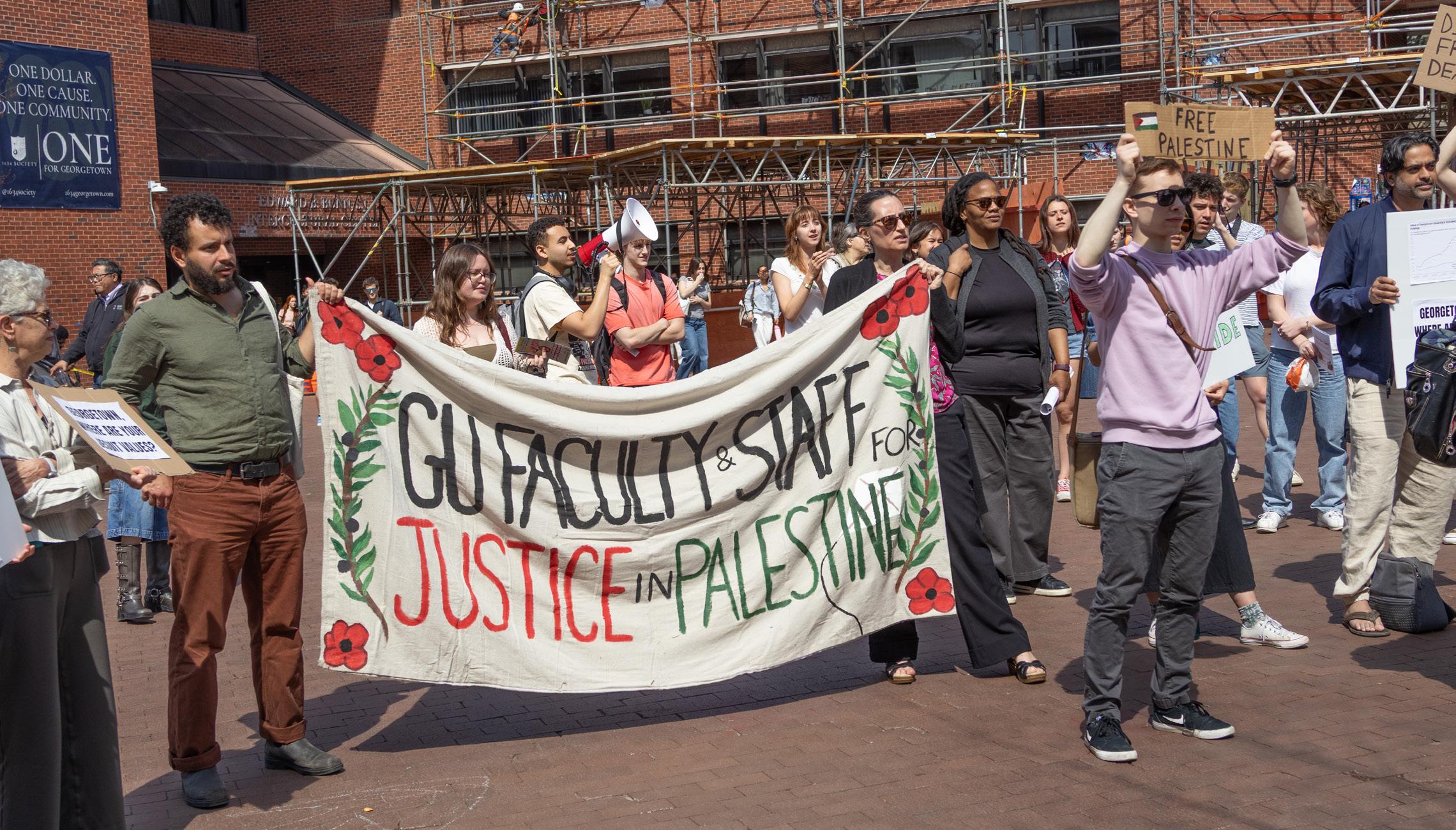
Over 50 Georgetown University students and faculty members condemned the IsraelHamas war and U.S military action in the Middle East during a Red Square protest March 26.
Georgetown’s chapter of Faculty and Staf for Justice in Palestine (FSJP), an organization that supports Palestinian liberation, held the rally in collaboration with various student activist groups, including Georgetown’s chapter of Students for Justice in Palestine (SJP).
GU Leaders Condemn House Investigation on Antisemitism
Ethan
Herweck House Desk Editor
Georgetown University faculty leaders denounced a March 17 report by Republican lawmakers on a U.S. House of Representatives committee accusing the university of fostering antisemitism.
In the report, the Committee on Education and the Workforce accuses Georgetown of spreading antisemitic rhetoric through its centers focused on Middle East studies and student groups at both the Hilltop Campus and Georgetown University in Qatar (GU-Q). A university spokesperson and program leaders disputed the report’s fndings, highlighting the importance of academic freedom and human rights advocacy.
A university spokesperson said, despite disagreement with the report’s fndings, the university will work with the committee to foster a welcoming environment.
“We disagree with the characterization of Georgetown in this report,” the spokesperson wrote to The Hoya. “However, we will continue to cooperate in good faith with the Committee while upholding our mission and continuing to promote an environment where all members of our community are welcomed and supported.”
In July 2025, interim University President Robert M. Groves testifed before the committee in a hearing about campus antisemitism,
where members of Congress questioned Groves about alleged acts of antisemitism on campus and criticized the university’s fnancial ties to Qatar. In response, Groves avoided defending individual faculty members but reafirmed Georgetown’s commitment to interreligious dialogue and academic freedom.
The report specifcally focuses on Georgetown’s Center for Contemporary Arab Studies (CCAS) and Alaweed Bin Talal Center for Muslim-Christian Understanding (ACMCU). It claims the CCAS and ACMCU perpetuate antisemitism and vilify Israel through their reading lists for students, curricula, and partnerships with organizations such as the Middle East Studies Association (MESA), a nonproft organization focused on Middle Eastern academia.
The report also includes allegations against other institutions, such as Harvard University and Northwestern University, whose leaders also testified before the committee at separate hearings.
The report claims speakers hosted by the centers spread anti-Israel rhetoric, such as Palestinian pastor Munther Isaac, whom the report cites as saying “Palestinian resistance is… not fueled by hate, it’s the natural resistance that any occupied people, any colonized people would undertake.”
It also claims Jewish members of MESA have left the organization due to anti-Israel sentiments, citing the Anti-Defamation
League — an organization that aims to combat antisemitism — which gave MESA a “major concerns” rating on its academic association integrity index.
CCAS Director Fida Adely said the center uses Georgetown’s Jesuit values to foster dialogue about the Arab world.
“CCAS is committed to rigorous interdisciplinary scholarship that is grounded in diverse perspectives,” Adely wrote to The Hoya. “In our 50 year history, we have maintained a strong commitment to ethical engagement with the issues that are of central importance to the Arab world. We are unequivocally against all forms of hate and bias, and fully embrace Georgetown’s Jesuit values of academic freedom and a commitment to justice and the common good.”
The report also alleges that the center’s fundraising eforts for an endowed chair in Palestinian studies demonstrate Georgetown’s “one-sided narratives.” Currently, the university has a chair in Jewish civilization in the Center for Jewish Civilization.
ACMCU Director Nader Hashemi said the report weakens the defnition of antisemitism by wielding it against universities.
“What I do worry about is that this weaponization of antisemitism to silence academic freedom and prevent any manifestation of discussion
See REPORT, A7
Afiliated community members condemned Georgetown’s alleged ties to companies that sell technology to Israel’s military, such as Alphabet and Amazon.
Elliott Colla, a Georgetown professor of Arabic and Islamic studies who spoke at the rally, said he is disappointed that Georgetown invests in companies tied to the Israel-Hamas war.
“There’s so many things to love about Georgetown, and it’s because of that that it is shocking and alarming that Georgetown allows itself to be caught up in this illegal war on the level of fnancial investments, on the level of moral
investments,” Colla told The Hoya
“We have faculty and staf and students who are sponsoring war criminals. We have faculty advocating illegal war crimes, and we have administrators who are punishing students for advocating for peace.”
“There’s a lot we’re not living up to, and because of that, we are now part of this war machine,” Colla added.
In April 2025, Georgetown’s administration rejected a student referendum demanding that the university divest from companies with ties to the Israeli military, which passed with 67.9% of the vote.
According to September 2025 flings, the university has increased its direct holdings in Alphabet and Amazon — companies cited in the referendum as related to the development of Israeli military technology — following the referendum.
A student from SJP speaking at the rally said the university’s administration has failed to address the student referendum in support of divestment.
“We went through all the proper channels, and the university disenfranchised us,” the speaker See PROTEST, A7
GUTS Drivers Union Dispute Maryland Pickup Site With GU
Ajani Stella Senior News Editor
Georgetown University and the union representing its bus drivers continue to clash over a proposal to move buses to a Maryland depot three months after the union frst denounced the plan, according to emails obtained by The Hoya and interviews with drivers. The university informed Georgetown University Transportation Shuttle (GUTS) drivers in
January that it expected them to begin picking up and dropping of buses at a Hyattsville, Md., location rather than at the Hilltop Campus, prompting the union to send a cease-and-desist letter. The Maryland depot, approximately 15 miles from the Hilltop, houses the ofice for Abe’s Transportation, the third-party company that the university planned to subcontract drivers through last semester.
Since January, drivers have argued that the move to Maryland would cost them time and mon-
ey and disrespects their position as university employees. Drivers also fear it would grant more authority to Abe’s Transportation, despite the university reversing its initial plan and pledging that drivers would remain direct employees of the university. The university has not yet required that drivers report to the Hyattsville location.
Roberta Paul, the university’s senior director of employee and labor relations, informed union
See GUTS, A7

Transportation
Maryland would cost them time and money while disrespecting their
HAAN JUN (RYAN) LEE/THE HOYA
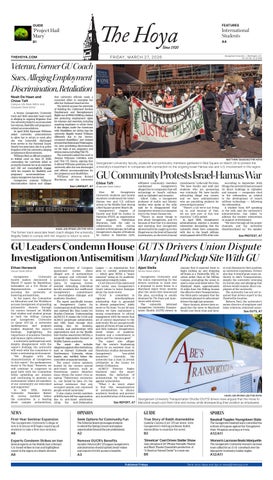
The former track associate head coach alleges the university illegally failed to comply with her request to return to work.
MATTHEW GASSOSO/THE HOYA
Georgetown University faculty, students and community members gathered in Red Square on March 26 to protest the university’s investment in companies with connection to the ongoing Israel-Hamas war and U.S. involvement in the region.
HAAN JUN (RYAN) LEE/THE HOYA
Georgetown University
Shuttle (GUTS) drivers have argued that the move to
position as employees.
Cialone (CAS ’27)
(CAS ’29)
Women’s Lacrosse Beats Marquette The Georgetown University women’s lacrosse team rallied for an 11-10 comeback over the Marquette University Golden Eagles. A12/A11
OPINION
EDITORIAL
Build GU’s Community, Explore More Than Pre-Professional Opportunities
On a campus flled with high-performing, ambitious students, carving out time for fun can become an afterthought. We dedicate our energy to classes, internships and the next professional opportunity, often making it dificult to justify doing anything else. So, when opportunities for balance are created, it is ultimately up to us, the students, to support them.
On March 12, the Georgetown Program Board (GPB) announced that Yung Gravy will headline its annual spring concert on April 10. The Editorial Board strongly encourages students to support Georgetown’s community by attending the spring concert and exploring other opportunities beyond the pre-professional to enjoy their college experience.
Amelia Giordano (SFS ’26), president of GPB, said that she is excited for students to attend and help build community.
“We hope students can appreciate how great of an opportunity this is –– to see an artist as big as Yung Gravy for $10, right on campus, alongside all our friends and other students,” Giordano wrote to The Hoya. “These events always create a sense of Georgetown pride and spirit and can help to create the community which can sometimes feel lacking on campus.”
The inherent pressure to secure a successful future post-Georgetown can lead students to disregard activities that don’t seem immediately conducive to career advancement. Students have consistently expressed stress and criticized this pre-professional culture at Georgetown, whether through The Hoya’s Opinion section or in casual conversations with friends. These discussions often call on students to be more intentional about cultivating their relationships and investing in the Georgetown community while they are still here on campus.
However, this call to action falls fat when students fail to take advantage of the very opportunities, including GPB’s concert, that are designed to build that community. While events such as campus concerts or sports games may seem frivolous and secondary to more “productive” tasks, they can play a crucial role in fostering connection –– if we let them. Choosing not to engage in these events only reinforces the culture that many students complain about.
Studies have consistently shown that student involvement is positively related to academic performance, cognitive development and overall well-being in college. Conversely, a lack of involvement in campus activities often correlates with a weaker sense of belonging.
The key takeaway from these fndings is that any –– not just preprofessional or career-focused –– student organizations can bring about these
HOYA HISTORY
benefts. The misconception many Georgetown students hold is that clubs that serve solely to bring joy or entertainment have less value than those defned by prestige and competition. Once we recognize that this isn’t the case, it becomes clear that fun community building isn’t an impediment to success –– it’s a critical part of it.
Ayushi Das (CAS ’27) said she has never attended the spring concert because of her lack of interest in the artists.
“I have yet to attend one of GPB’s spring concerts,” Das told The Hoya. “I understand that some artists are far too popular to come play at Georgetown, but so far none of GPB’s choices have enticed me.”
While we do not expect every student to enjoy the headliner, showing up to the concert is not just about seeing Yung Gravy –– it is about signaling that our community matters. It may seem like a small or insignifcant step, but attending the spring concert is a chance to help facilitate a broader shift in the campus climate at Georgetown, where students can fnd a balance between pursuing their goals and enjoying leisure activities.
Julia Agrawal (CAS ’29) said she is looking forward to the communal aspect of the concert rather than the performance itself.
“While I’m not familiar with a lot of Yung Gravy’s music, I’m really excited for the opportunity of the concert on campus,” Agrawal wrote to The Hoya. “I think the spring concert is a great way for students to get together and do a fun community activity before spring semester ends.”
Furthermore, the Editorial Board acknowledges that this time of year, more so than others, is particularly stressful for students as fnal exams and summer internship deadlines approach. Still, even amidst the academic and professional anxiety, it is important that we make time for both events that allow us to decompress and simply enjoy ourselves.
Many of us chose Georgetown, knowing that we were entering a culture seemingly set in stone. However, the responsibility for creating a strong sense of community ultimately lies in stepping back from the pre-professional rat race and supporting the events available to us. If Georgetown students truly want to foster a stronger sense of belonging –– not just through shared academic and professional stress –– it starts with showing up.
The Hoya’s Editorial Board is composed of six students and is chaired by the opinion editors. Editorials refect only the beliefs of a majority of the board and are not representative of The Hoya or any individual member of the board.
Since its first issue in 1920, The Hoya has served to inform Georgetown’s campus dialogue. The following article is a glimpse into The Hoya’s rich history, allowing readers to appreciate the evolution of college journalism.
Bringing It All Back Home
October 21, 1994
Many Georgetown alumni are looking forward to the annual homecoming festivities this weekend, but 1993 graduate Tony Braithwaite had his own homecoming earlier this fall. Braithwaite returned to Georgetown last month to open for comedian Jake Johannsen in an event sponsored by the Georgetown Program Board. Braithwaite wowed the packed Leavey Center ballroom crowd with jokes about Georgetown and life in general. He left the audience rolling with laughter when he impersonated celebrities ranging from Katherine Hepburn to Ronald Reagan to Bill Clinton in a rousing rendition of the Georgetown fght song.
“Lie down forever, lie down?” Braithwaite asked, “what kind of fght song is that?” But wimpy fght song or not, Braithwaite was happy to be back at Georgetown.
“I had a wonderful time doing the GPB show,” Braithwaite said. “It was a great opportunity and it was so nice to come back and visit here.” Georgetown is, in Braithwaite’s words, his third home. He recently returned to his “first” home in Philadelphia after spending a year in Los Angeles, Calif. “I feel like I took a sabbatical for a year,” Braithwaite said. “L.A. was a learning experience in which I learned that I did not want to live out there or be a part of that culture.”
Braithwaite said he was very happy to return home from the West Coast. “I did not feel like L.A. was a recapitulation of my 22 years. It’s very look oriented and I didn’t like that. Georgetown, my parents and the Jesuits have taught me that I can never compromise what I want to do and what I’m good at,” he said.
Braithwaite attempted to “make it big,” in L.A., and although he did not get any “big breaks” he said he felt that he learned a lot about the acting and comedy professions as well as the attitudes in L.A.
“There are no crowds to please in L.A.; it’s all flm and TV,” Braithwaite said, “New York — Broadway — is the place for serious stage actors to go.” And Braithwaite intends to go there. New York is a short trip from his home in Philadelphia and he plans to audition in the Big Apple as often as he can. When he’s not in New York, Braithwaite can be found at either St. Joseph’s High School where he teaches religion and sexual education to 9th and 10th graders or at the Philadelphia Drama Guild. He also opens in comedy clubs in the Philadelphia area.
Braithwaite said he enjoys teaching and likes the idea of giving something back to his own high school. “When I was thinking about leaving L.A., I needed a reason to come home and they
had a job opening. It’s funny to go back as an alum. All of the teachers I had as a student are still there,” Braithwaite said.
He said he tries to make his class fun and not approach the students as an authority fgure.
“I’m very up front with my class. They know that I’m a prep alum and they know about my comedy career. I had to draw the line though when they asked if they could call me Tony,” he said.
Braithwaite said returning home to his family in Philadelphia, his high school and fnally Georgetown have been some of the greatest decisions of his life.
Braithwaite met Comedian Jerry Seinfeld in L.A. and while they discussed the diferences between L.A. and New York Seinfeld said home (the East Coast for both comedians) is like a shirt that fts. It may not be right for anyone else, but it’s perfect on that one person.
And coming home looked good on Braithwaite, in his eyes and in the eyes of all the Georgetown students who watched in wonder as a fellow Hoya returned to entertain them all.
Braithwaite said he loved getting feedback from and amusing a live audience, especially a Georgetown audience. “I want to keep entertaining live crowds,” Braithwaite said. “I derive what makes me special from a live audience.”
IN THIS WEEK’S ISSUE “
If Georgetown students truly want to foster a stronger sense of belonging –– not just through shared academic and professional stress –– it starts with showing up.”
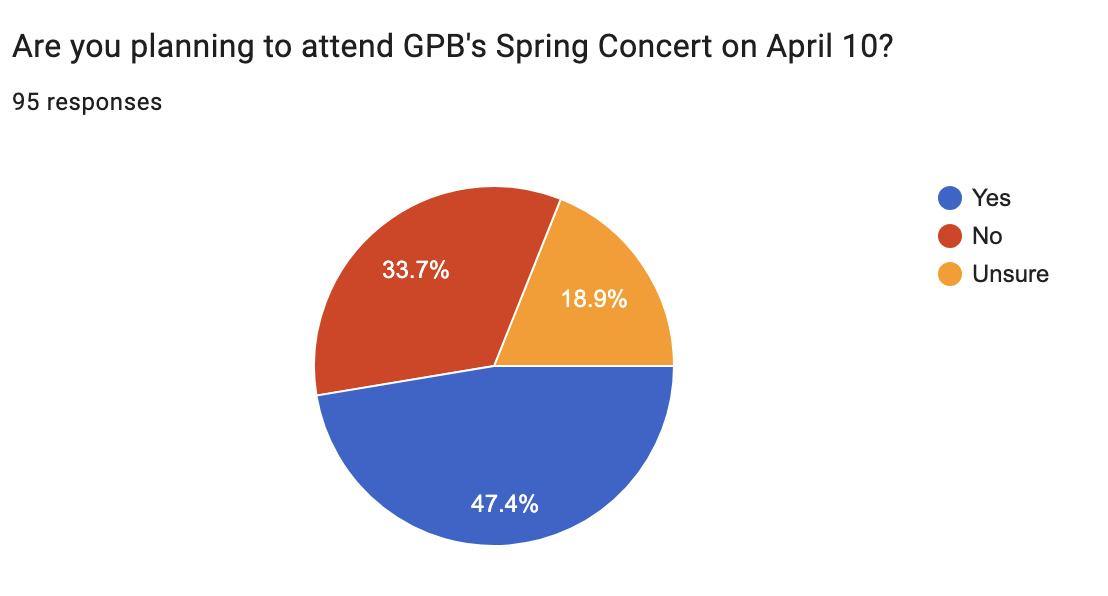
On April 10, the Georgetown Program Board (GPB) will host its annual Spring Concert, featuring Yung Gravy as the headliner. This week, the Editorial Board strongly encouraged students to attend this event in order to cultivate a strong
sense of community on campus. In order to gauge student opinion, students were asked if they were planning to attend GPB’s Spring Concert. Of the 95 respondents, 47.4% said yes, 33.37% said no and 18.9% said they were unsure.
EDITORIAL CARTOON by Abigail Kopf
Founded January 14, 1920
Maren Fagan, Editor in Chief
Ruth Abramovitz, Aamir Jamil and Nora Toscano, Executive Editors
Nico Abreu, News Editor
Ajani Stella, News Editor
Paulina Inglima, Managing Editor
Opal Kendall, Features Editor
Saroja Ramchandren, Features Editor
Annikah Mishra, Opinion Editor
Ella O’Connor, Opinion Editor
Isabelle Cialone, Guide Editor
Tanvi Gorripati, Guide Editor
Nate Seidenstein, Sports Editor
Maddie Taylor, Sports Editor
Angela Lekan, Science Editor
Eva Siminiceanu, Science Editor
Avelyn Bailey, Design Editor
Lucy Jung, Design Editor
Grace Bauer, Copy Chief
Jackson Roberts, Copy Chief
Shira Oz, Blog Editor
Fallon Wolfley, Blog Editor
Kate Hwang, Multimedia Editor
Michael Scime, Multimedia Editor
Matthew Gassoso, Photo Editor
Caroline Woodward, Audience Editor
Board of Directors
Patrick Clapsaddle, Chair
Bethe Bogrette, Julia Butler, Amber Cherry, Made-
line Grabow, Mia Streitberger
Peter Sloniewsky, General Manager
Olivia Zhang, Director of Business Operations
Rosie Garner, Director of Logistics
Connor Manrique-Johnson, Director of Outreach
Jackson Roberts, Technology Director
Join Democracy Initiative
If the story of the 20th century was the triumph of democracy, the story of the 21st century thus far seems to be democracy’s decline. Citizens, politicians, nongovernmental organizations and other groups and individuals all bear some responsibility to react to the current moment.
We think it is also important that universities respond. Institutions of higher education are often among authoritarians’ frst targets. They should thus be frst-movers in debate and action. And, in fact, scholars around the world are working hard to understand the causes, consequences and nature of democratic backsliding, disseminate that understanding and train the next generation of politicos.
Yet, the project of preserving democracy is a collective one. It cannot be done only by listening to experts; the path to protecting and improving democracy must be developed democratically. The newly formed Georgetown Democracy Initiative encourages everyone in the Georgetown community to engage with us as we seek to empower and celebrate research, teaching and programming on democracy at Georgetown University.
There are clear signals that democracy needs protecting.
Quantitative measures of democracy, such as the V-Dem (Varieties of Democracy) project and The Economist’s Democracy Index, show systematic declines in how many people live in democracies and in how democratic those countries are. Countries that have experienced democratic backsliding range from longestablished democracies to countries that democratized more recently.
Hungary, an exemplar of postCold War democratization in Eastern Europe, has become what prime minister Viktor Orbán calls “an illiberal state,” in which the ruling Fidesz party has consolidated control over the media, civil society institutions and the conduct of elections. Venezuela’s democratic institutions endured for forty years before the governments of Hugo Chávez and Nicolás Maduro concentrated power in the executive and undermined other institutions’ ability to check that power. In India, the world’s most populous democracy, Prime Minister Narendra Modi has used the powers of office to marginalize the opposition. While reasonable people might disagree about the scale and nature of the threat to democracy in the
United States, one belief unites many: Our country is no longer a shining city on a hill. To ofer just one example, President Donald Trump and many Republicans say that the 2020 election was fraudulent, while most Democrats believe these claims are a pretense for eforts to suppress the opposition.
Scholarship helps us understand what is happening with democracy around the globe, but the contributions of academia to real live politics travel a long path. Researchers’ findings trickle into practice through interaction with practitioners, through broad dissemination among the public and through the education of the next generation of statespersons.
The current moment demands more than this slow and imperfect pipeline. The Georgetown Democracy Initiative aims to accelerate that engagement in three ways: It directs resources to scholars investigating pressing questions in democracy and creates opportunities to present and develop that research; it foments fruitful exchange between academics and practitioners; and it brings directly into the conversation Georgetown’s bright and civic-minded students.
We aim to create many such avenues, from fostering conversations on artifcial intelligence (AI) and democracy, as we did this past week, to ofering research grants to students. One good opportunity for students is our frst Democracy Initiative council meeting on April 21.
This work adds to the already considerable amount of research, teaching and programming on democracy at Georgetown. Our university, with its reputation for bipartisan dialogue, is an ideal place to have these conversations. We are accustomed to speaking with and listening to people we disagree with — and we embrace rather than shy away from those disagreements, even when they are with people in power. It is time to make democracy itself a focus of those conversations. Georgetown University is the best university in the most powerful city on earth. We know politics. We have a responsibility and an obligation to lead constructive dialogue in this challenging moment. The Georgetown Democracy Initiative seeks your help in doing so.
Hans Noel and Diana Kapiszewski are codirectors of the Georgetown Democracy Initiative and associate professors in department of government
Condemn GUCR’s Actions, Find Inspiration in Faith
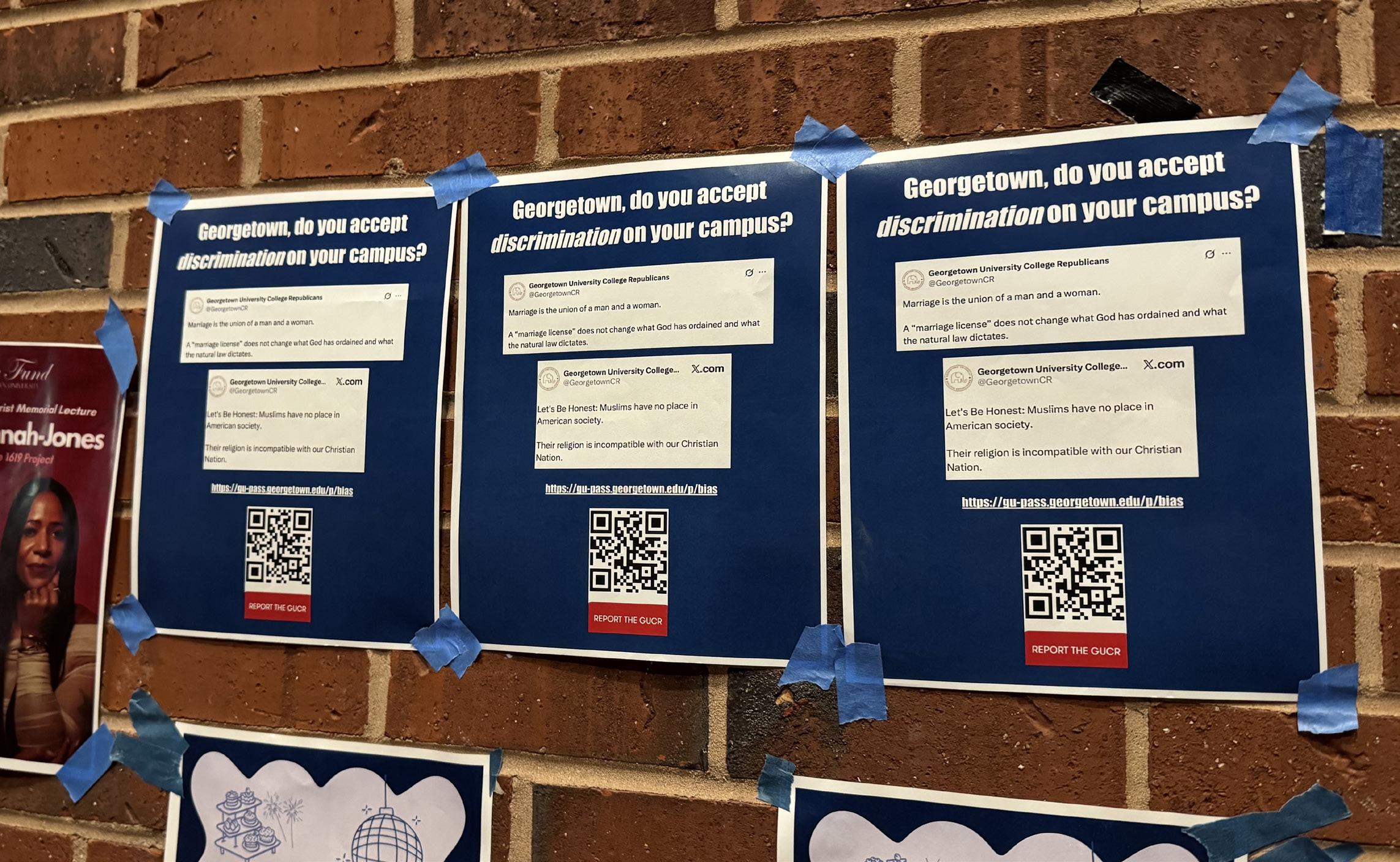
On March 10, I opened my phone to a plethora of texts from my friends, mostly along the lines of, “What in the world did GUCR just post on Twitter?” I read the screenshots of the Georgetown University College Republicans’ (GUCR) post, which stated, “Let’s Be Honest: Muslims have no place in American society. Their religion is incompatible with our Christian Nation.” Having been unplugged from social media for the previous few weeks, I watched in horror as my friend pulled up GUCR’s X account. Then another showed me Instagram. It seemed like everyone was talking about the post. I was blindsided, and it felt as though everything was imploding around me.
At the time, I was GUCR’s vice president. I resigned early last week because I abhor these posts that violate my values, and it saddens me that they were made in the frst place. We are directly witnessing the rise of right-wing “Christian” extremism on our campus, which necessitates a conversation with those who may be involved. These tweets are inherent contradictions of their claimed justifcation. As a leading Republican on this campus, I want to set the record straight. More importantly, I want to call on Christians and conservatives on this campus to make an efort
Revoke GUCR’s University Bene ts
Iwas raised, like many of the members of the Georgetown University community, in a large Catholic family. Our traditions were shaped by multiple ethnic influences, but were grounded in the same faith. It was in a Catholic elementary school, enrolled alongside classmates of many beliefs, that I first learned about Islam. Years later, this religious diversity is still something I value greatly in my time here at Georgetown, even as I now fall more in line with being a humanist atheist. As for the debate of which faith is more moral, more pure or more deserving of salvation, I have no stake in the fight other than I believe humans deserve respect, dignity and safety. Georgetown prides itself on being an inclusive and implicitly progressive community committed to social equity, exploration of ideas and honoring individuals’ unique needs and abilities. On March 8, the Georgetown University College Republicans (GUCR) tweeted “Let’s Be Honest: Muslims have no place in American society. Their religion is incompatible with our Christian Nation.” This post refects none of Georgetown’s principles. This is not political expression but an outright dehumanization, and we must treat it as such. Georgetown’s leadership must not allow student organizations to publicly deny membership to an entire religious group under the guise of theological debate. If the university refuses to impose meaningful consequences such as eliminating funding, it undermines the very values it claims to uphold. GUCR’s response to the backlash, that the post was published without the executive board’s knowledge, is revealing in practice. In addition to being a student, I am also a communications consultant. I hold the keys to a number of clients’ social
media accounts, and posting from an official organizational channel is a deliberate action that usually requires review. If the executive board did not authorize the message, that points to a failure of leadership and oversight. Operational issues aside, GUCR’s oficial response’s pivot to criticism of Sharia law only reinforces their Islamophobia. Reducing an entire religion to its most extreme or politicized interpretations is an illegitimate critique and act of prejudice — full stop. As if this ignorant characterization was not bad enough, the oficial position they ofered instead doubled down on Islamophobia and xenophobia, albeit in a more academic tone. Both their original post and follow-up statement erase the diversity within Islam and fatten millions of people into a single, harmful narrative.
If we are going to scrutinize religions based on their most oppressive interpretations, we should be consistent. Christianity, too, has been used to justify harm — particularly toward women, LGBTQ+ folks, Black, Indigenous and other people of color. Selectively applying that same scrutiny to Islam is not principled; it is a convenient tactic to promote Islamophobia.
This has consequences greater than just being one bad social post — it reinforces stereotypes that contribute to the inaccurate and harmful national narrative about Muslims. According to the 2025 American Muslim Poll from the Institute for Social Policy & Understanding, Muslims are the most likely religious group to report having experienced religious discrimination in the prior year. Georgetown’s own student organization standards are clear: student groups that target groups based on protected characteristics, including religion, are prohibited.
These policies exist to protect students and defne the boundaries
of acceptable conduct within this community. When a universityrecognized organization publishes a statement excluding an entire religious group, and then doubles down in an attempt to revise it, it fails to meet those standards.
The question isn’t whether the post was offensive; it’s whether Georgetown is willing to enforce its rules.
Allowing the organization to continue without meaningful consequences is not a politically neutral choice. It is equally a signal to Muslim students that their belonging is conditional, as it is a signal to other organizations that there is flexibility in how the university enforces policies prohibiting discrimination.
Georgetown has an opportunity and a responsibility to be clear about what kind of community it wants to be. Revoking funding or access to benefits moves beyond statements of condemnation. It is a concrete enforcement mechanism built into the university’s own policies for organizations that foster intolerance.
Georgetown should also consider whether additional measures are warranted, like holding leadership accountable, requiring education on bias and inclusion or formally reviewing whether they should be allowed to associate themselves with the university at all.
Taking these actions would reinforce that university standards mean something and are consistently applied. And that while student groups are free to express ideas, they are still accountable for how they use university resources and platforms.
Georgetown must determine if its commitment to inclusion is real or merely an empty promise invoked when it suits the university’s interests.
Jennifer Peters is a graduate student at the Georgetown School of Continuing Studies.
to build community with those of diferent backgrounds and beliefs.
Over the past week, the university community has rightfully reignited conversations about the Spirit of Georgetown. Each of these tenets instructs our community on how to lead successful and fulflling lives not just on campus, but far beyond. Conversations centered around them often lead to a stronger sense of community and global identity on this campus. One conversation that I believe needs to be had plainly, especially at a Catholic university, is the fact that this rhetoric from GUCR contradicts the fundamental message of the Christian Gospel.
In the Book of John, Jesus approaches a Samaritan woman at a well. She asks him why a Jew would associate with her, given that Jews have no dealings with Samaritans. Later, Jesus reveals to her that he is the Messiah. On a surface reading of the passage, Christians should take note that Jesus makes an efort to reveal himself to one of the people most reviled by his society. On campus, we should extend this kindness in the same way by reaching out to those who do not share the same background.
Upon deeper exploration, one realizes that this woman is the frst person to whom Jesus reveals his divinity. This is no mistake: He who Christians are called to follow
not only made an active efort to reach out to those outside of his mainstream society, but he did so frst. He even stayed in their community and lived among them. This passage has clear implications. Rhetoric that calls for the marginalization of people on the grounds of religious diference is not just anti-American and antiGeorgetown — it is anti-Christian. Jesus did the opposite of these posts and so should every person who claims to follow him.
I have been on the GUCR board since December 2024. I was elected in December 2025 as GUCR’s vice president. I know Georgetown’s conservative community well. Even though there are sadly some in our community who support these posts, in my experience, the vast majority of Republicans at Georgetown agree that these posts are horrendous and inconsistent with Republican values. I also know that the remaining GUCR board members feel the same. The buck should stop with us.
During this delicate time, it is more critical than ever that each student on this campus makes an efort to connect with those from diferent backgrounds and form a community. As Christians and conservatives, we should go out of our way to serve those of diferent religious and political beliefs. They are critical parts of
our community and our common humanity, and we would not be Georgetown without them. We have the unique opportunity to put these ideals into action. This time is one where many conservatives need to rebuild trust with those from diferent backgrounds. One of the best ways to do this could be by grabbing a meal at Leo’s with them. Or, we can take the time to attend one of the many roundtables that Georgetown hosts every week. Mutual trust is inherently built in mutual understanding. For the political organizations here on campus, it is more important than ever to increase interaction with those who disagree. To some degree, our faiths should transcend our political diferences. Our political clubs should coordinate joint service activities, such as a Saturday morning at the nonproft D.C. Central Kitchen, in order to preserve Georgetown’s sense of People for Others. My plea to everyone at Georgetown, especially Christians, is to do what Jesus did. Love, welcome and serve those who are diferent. We are stronger and better of when we do that.
Devin Short is a sophomore in the College of Arts & Sciences and McCourt School of Public Policy.
Oppose Destructive Criticism at GU
When I was back in my hometown of Houston, Texas, for spring break, I met with my AP English literature teacher from high school for cofee. My teacher, like me, was a serious pianist growing up, and during our conversation, I recounted my personal experience with Georgetown University’s music community.
I left Georgetown’s music department after my frst semester because the environment mirrored what my teacher and I discussed: There seems to be a near-universal culture of cutting people down in classical music. However, this phenomenon does not solely apply to classical music. Too often, I’ve seen Georgetown students in various contexts tear each other apart as a product of the competitive atmosphere we maintain. This culture of knocking our peers down is a direct contradiction of the university’s values of justice and promoting the common good. As Georgetown students, we must do better in upholding the values that set our university apart by revising our culture of criticism. During my frst semester at Georgetown, my co-curricular activities revolved entirely around music. I took a chamber music course, competed in the GU Orchestra’s concerto competition and wrote the music for a Mask & Bauble production. It was a lot of work, but not a major jump from what I was doing in the pre-college program at Rice University in high school. At Rice pre-college, I was grilled on stage during masterclasses by tenured professors and once had my piano teacher call me in for an
emergency lesson immediately after my performance. Still, at Georgetown, I received an unprecedented amount of destructive criticism from both my peers and professors.
As a frst-year composing music for a major student theater production, I already faced a tall order. While I received excellent support from the directing staf, the instrumentalists repeatedly tore my score apart, giving unsolicited critiques in front of other musicians and directing staf. My musical decisions were publicly belittled, which made me question my competence as a musician. I had a similar experience in the Chamber Music Ensembles Program (CMEP), a classical music performance class at Georgetown, except the source of my public humiliation was a professor. During dress rehearsal, when I didn’t deliver the verbal introduction to my performance the exact way the professor wanted, the professor interrupted me after every sentence and angrily told me to rewrite my speech in front of the entire class. In hindsight, I realize that my speech did not follow the professor’s instructions, but the way he publicly criticized me felt unnecessary and unprofessional.
My experience in the music community at Georgetown is refective of the Hilltop’s larger culture of destructive criticism.
Last semester, in my “Financial Accounting” class, I overheard a group of club leaders discussing the applications they received for their clubs. I was appalled by how callously they knocked their own peers in public. I saw them crowding around one student’s computer as she
scrolled through Google Forms responses and said to the group, “Yeah, we’re not letting her in.” What is particularly ironic about the incident is that they were evaluating applications for a pre-professional club, but the way they publicly discussed what was supposed to be private information was grossly unprofessional. This was on top of the fact that the language they used was hurtful and not constructive at all.
When people say that criticism is necessary for growth, they refer to constructive criticism, not the kind of criticism that we see too often at Georgetown. Remarks like, “Yeah, we’re not letting her in” or picking at the faws in one’s work without an actionable recommendation are not only hurtful, but they also don’t help people improve. There’s no point in making these comments because there’s no tangible beneft.
A common counterargument made when people speak out against the culture of destructive criticism at Georgetown is that they are not tough enough to endure the “real world” or the “corporate world.” However, while the real world may be harsh, this is an extremely dismissive response that glosses over the core issue: that destructive criticism is wholly unnecessary for our intellectual development. If Georgetown students truly care about becoming productive citizens, we must combat this norm that ultimately harms our productivity.
Julia Nguyen is a sophomore in the School of Foreign Service. This is the fourth installment of her column, “The Stories That Cultures Tell.”
MAREN FAGAN/THE HOYA
VIEWPOINT • NGUYEN
VIEWPOINT • SHORT
VIEWPOINT • PETERS

Amid Visa Uncertainty, GU International Students Call for Integrated Career Guidance
International students say the university’s Office of Global Services offers little professional support and has persistent issues with timely communication.
Nam Nguyen
and
Bridget Galibois Features Staff Writer and Deputy Features Editor
eronica Varela Pascual (SFS
V’26), an international student from Panama, gave up a potential three-year extension to her student visa when she chose not to major in a science.
Now, two years after declaring her international politics major, Varela Pascual said her job opportunities are more limited.
“I wasn’t sure if I wanted to even try and fnd a job in the U.S.,” Varela Pascual told The Hoya. “I never really looked into that, but I wish I would have known how much more dificult it is to apply to jobs if you don’t have the three-year extension.”
Varela Pascual said job security was not her focus as a frst-year.
“I knew what I wanted to study, and that wasn’t my priority at the time,” Varela Pascual said. “Maybe now I kind of regret that.”
After the completion of an academic program, international students in the United States have 60 days to leave the country, enroll in another program, change their visa status or apply for Optional Practical Training (OPT), a temporary authorization for F-1 student visa holders to work in their feld of study. The OPT program extends student visas for up to an additional 12 months, or, for work in science, technology, engineering and math (STEM) felds, an additional 36 months.
Since January 2025, the Trump administration has issued over 100,000 visa revocations and expanded security screening of international students’ online presence. The administration has also proposed a shorter grace period for F-1 visa holders after the completion of their academic program.
Julia Wang (SFS ’27), an international student from China, said the federal environment has made job searches more dificult.
“The administration is really becoming very narrow in terms of why you’re here, and if you don’t have a justifcation, for students it’s hard to fnd a job here,” Wang told The Hoya “I know a lot of people who want to continue their studies, just so they can have more time to fnd a job.”
While international students account for just 6% of the national higher education population, they make up about 19% of Georgetown’s full-time student body. Amid federal policy changes, however, the university is predicted to experience a 20% decline in international graduate student enrollment.
A university spokesperson said international students are essential to Georgetown’s campus landscape.
“Our international students are integral members of our University community,” the spokesperson wrote to The Hoya. “Georgetown is guided by its mission, which highlights the importance of serious and sustained discourse among individuals of different faiths, cultures and beliefs.”
At Georgetown, the Ofice of Global Services (OGS) helps international students and scholars navigate the visa application process, while the
Cawley Career Education Center ofers professional guidance. Still, international students say neither ofice provides necessary pre-professional guidance, complicating their job search in an already uncertain immigration environment. Wang said international students have unique needs and would beneft from more specialized career support.
“I know that the school ofers a lot of help to students who are not international students in terms of job seeking, and then there’s not so much for international students,” Wang said. “It would be great if the same amount of help could be levied for international students as well.”
All Over the Map
While some peer schools, such as Cornell University and the George Washington University, ofer dedicated career coaches for international students, Georgetown does not.
Students say OGS’ support is limited to administrative matters, like vis a sponsorship and legal protections, and career advice — traditionally limited to Cawley — often excludes the international student experience.
Tanya Tkachenko (SFS ’26), an international student from Ukraine, said she hopes to stay in the United States after graduation, but has received little university support.
“I’ve been talking to advisers and diferent resources that are available at Georgetown, and, typically, they don’t really have any help,” Tkachenko told The Hoya “They don’t really know what to say. It’s more general — like try emailing companies, using flters when you search for jobs.”
“Coming back home is just simply not safe right now, and I don’t have anywhere else to go,” Tkachenko added.
OGS and International Student Services, which supports Georgetown University Law Center students, employ a total of 20 staf members to serve the university’s 2,980 international students and 665 international scholars — averaging to about 182 community members per adviser.
Leandro Guevara Neyra (CAS ’28), an international student from Peru, said OGS communication delays have made job applications more dificult.
“OGS is also very unresponsive,” Guevara Neyra told The Hoya. “Just send them an email, sometimes they’ll answer, sometimes they won’t, or sometimes they will answer after you needed an answer.”
“That generates a little bit of a complication when you’re doing the whole process,” Guevara Neyra added. “It’s defnitely very stressful.”
To apply for an of-campus job while in school, international students must be approved for Curricular Practical Training (CPT), which authorizes F-1 students to work parttime in a feld related to their major.
Guevara Neyra said the CPT process complicates internship planning and makes career exploration difficult.
“The whole process to request the CPT is quite exhausting,” Guevara Neyra said. “You have to fll out the paper, make sure that the dates align, make sure that your justifcation with your dean is right to justify the CPT, make sure that you’re within the operational times of OGS and that all of these work in synchrony.”
To be eligible, students must have declared a major, which Georgetown only allows most students to do beginning in the spring of their frst year, and take a designated university course to fulfll the program’s curricular training requirement.
Kezia Hutabarat (SFS ’29), an international student from Indonesia, said these conditions have prevented her from pursuing an internship.
“We can only start an internship during the summer after our frst year, and even then, starting an internship means that you need to formally declare your major before everybody else,” Hutabarat told The Hoya. “As a freshman, I feel like it hasn’t been my biggest priority, knowing that a lot of internships can be restricted.”
“OGS only talks about the rules,” Hutabarat added. “They don’t talk about how you can implement or navigate them exactly. They can tell you, ‘You can start a summer internship after your frst year,’ but the list of internships is not there.”
Gavin Liu (SFS ’29), an international student from China, said these work restrictions, coupled with Georgetown’s pre-professional culture, make him feel like he’s behind his peers.
“The culture is very intense,” Liu told The Hoya. “I think I sort of underestimated the kind of competition that exists in Georgetown before I came here. I’ve always been one of the best students at my high school. But coming to Georgetown, in this super competitive environment, I feel like sometimes I’m not even competitive enough — especially as an international student.”
Liu said students must go out of their way to fnd career support, relying on their peers over university resources.
“I didn’t see a lot of support — maybe on a student level — but university mentorship programs for international students don’t really exist,” Liu said. “There are a lot of things that exist within schools, or within clubs there are mentoring programs, but OGS doesn’t have any.”
Degrees of Uncertainty
In 2025, the federal government enhanced security screening for H-1B visa applications, which employers sponsor for foreign skilled workers, and imposed a $100,000 fee for new applicants. As a result, many white-collar companies have slowed foreign recruiting.
Given the volatility of federal policy, Tkachenko said she wished university resources were more up to date.
“When I did speak to Cawley, there were some resources that were available online or advisers
they direct you to, but most of them are very outdated,” Tkachenko said. “They would have information about some companies like ‘these companies used to hire international students, or they are friendly with visas,’ but that information is not actually true anymore, at least for the new administration.”
“There’s not really a lot of understanding on what international students could be doing,” Tkachenko added. “There’s general workshops, general ideas, but there’s not really a specifc kind of direction.”
Following the Trump administration’s policy changes, the share of full-time positions in the United States that cover H-1B visa sponsorship has decreased from 10.9% in 2023 to just 1.9% in 2025.
Phuong Ha (MSB ’26), an international student from Vietnam, said these changes have impacted her job search.
“Nowadays, because of the administration, I have to use networking more, and leverage that, and start of the conversation saying that I’m an international student, this is what I might need, and ask if they’re willing to take that risk or not,” Ha told The Hoya
“A lot of companies said that they don’t want to take on the risk that in the future they would have to give me an H-1B,” Ha added.
The H-1B application process requires employers to pay high fling fees and fle extensive paperwork to prove that no U.S. citizen could fll the position. National demand also far exceeds actual approvals — though about 339,000 foreign workers applied in the last cycle, only 85,000 were successful.
Anshuraj Pal (CAS ’27), an international student from India, said the sponsorship process discourages employers from hiring international applicants.
“A lot of employers will just fat out refuse to consider your application, because you might need sponsorship in the future, or if you’re an OPT student,” Pal told The Hoya “Even if it doesn’t require much documentation on their part, they just don’t want to risk not having an intern for a while.”
Tkachenko said she has received similar rejections after sharing her visa status with jobs.
“I’m pretty sure it’s automatic, because I would get an email a second later saying, ‘Thank you for applying, but we decided to move forward,’ which is crazy because I know realistically nobody even saw my resume,” Tkachenko said.
OPT ofers students additional time after their F-1 visas would typically expire to fnd an H-1B sponsor. While general OPT extends student visas by just one lottery cycle — 12 months — the STEM OPT program allows students to work in the United States for up to three cycles, or 36 months.
Only certain majors qualify for STEM OPT. For Georgetown students, this includes 18 degrees across four undergraduate
schools — ranging from international economics in the School of Foreign Service (SFS) to operations and analytics in the McDonough School of Business (MSB).
Liu, who is majoring in science, technology and international affairs (STIA), said he is lucky to be studying a subject that is both STEM OPT-eligible and aligned with his interests.
“I always wanted to study STIA, so it worked out for me,” Liu said.
“But I know a lot of students in the SFS are forced to choose either international economics or STIA because these are the only two STEM majors that will give them three years of OPT after graduation.”
“We are forced, or kind of limited, to choosing STEM majors if we want to work and stay in the U.S.,” Liu said.
In 2024, national participation in STEM OPT increased by 54%. The extension increased visa sponsorship success rates by 19% among undergraduate students and 45% among graduate students.
Varela Pascual said she wished the university provided more guidance about the diference between STEM and non-STEM OPT.
“I don’t think it was really emphasized how much of a diference it is,” Varela Pascual said.
“But maybe that’s also a current job market thing — that people are less willing to hire if you don’t have the three-year OPT.”
Tkachenko, who is applying for non-STEM OPT, said few non-business employers have the resources to sponsor H-1B visas, disproportionately impacting students who want to pursue humanities and social sciences.
“It’s mostly big corporations and corporate companies that are geared towards MSB,” Tkachenko said. “Georgetown is the best for foreign service, but most think tanks or smaller consulting frms still would prefer Americans.”
“So from my own experience, I’ve been reaching out to people, I’ve been reaching out to alumni, and they all have the same thing to say — ‘we would love to help you, but we don’t know anybody who’s hiring right now,’ Tkachenko added.
Visa Versa International students say federal policy changes have permanently changed their post-graduation goals.
Jingyi Liu (SFS ’25), an international graduate from China, said she is applying for a green card, which ofers permanent residence and work authorization, because law frms are increasingly reluctant to sponsor international students.
“That is why I am stuck here,” Jingyi Liu told The Hoya. “I want to go to law school, and I know I want to do big law, but law school is such a big investment, and I cannot risk doing three years of law school and then not being able to do the big law route, because the law frms no
longer sponsor. That is why I had to redo a green card application.” Universities have revised their applications in response to federal changes. Columbia Law School, for example, will require international students to explain why they are interested in pursuing studies in the United States, starting Fall 2026. Jingyi Liu said this uncertainty has made law schools more cautious about admitting international students.
“Law schools are also wary about accepting international students now,” Jingyi Liu said. “It’s not explicitly stated, but they want students who are employable in the U.S., and international students are a big risk and liability for their ranking.” Ha said the uncertainty surrounding visa sponsorship has led her to consider employment in other countries.
“Personally, I still plan to be in the U.S. post-grad,” Ha said. “But I think I’ve become more open to relocating or working somewhere else, just because currently you cannot really force something to happen if all the policies don’t support it.” Wang also said the political environment has deterred her from remaining in the United States.
“I always wanted to stay here after graduation but I don’t think that’s really possible nowadays,” Wang said. “That really makes me rethink some of my choices.”
“I originally wanted to go to law school here in the U.S.,” Wang added. “But now I don’t think about that. I think about how I can go to law school in countries that are more friendly for me to get a job.”
While he still wants to work in the United States after graduation, Gavin Liu said his expectations are changing.
“I think it doesn’t change my desire to stay in the U.S., to work for a few years, but it does make me think about the practicality of it, like whether it’s feasible or not,” Gavin Liu said. “A big concern is that there’s a big chance I have to go back to China to work after graduation.” Hutabarat said international students are well equipped to adapt to new environments, giving them the unique opportunity to work elsewhere.
“I feel like this is a beneft of being an international student,” Hutabarat said. “There are many options beyond just staying in this country. We can go out, and we also have a very diferent background compared to being born and raised in America, so we can navigate different places without being stuck to where we go for undergrad.” Pal said changes to work authorization requirements and lacking university support have required students to adapt.
“If you’re already here, I guess you just have to accept it,” Pal said. “Plan accordingly. You don’t really have much of a choice.”
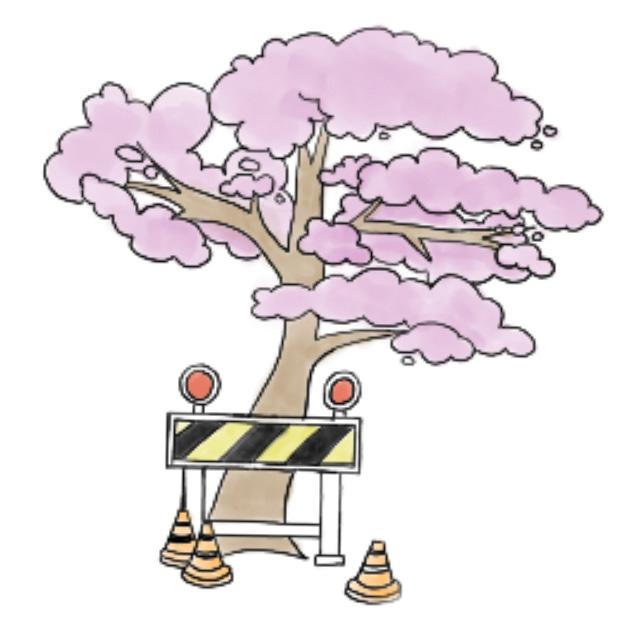
Signaling a Climate Shift, DC’s Cherry Blossoms Bloom Unusually
Mia Shujath Science Writer
Washington, D.C.’s cherry blossoms draw thousands of visitors to the Tidal Basin each spring, but in recent years the iconic blooms have been arriving earlier than expected. As climate change shifts seasonal patterns, scientists say the timing of peak bloom — the period when 70% of the blossoms are open — is becoming less predictable, though it generally continues to trend earlier. The change is subtle year-to-year, but the broader pattern over decades signals a shift in ecosystem behavior in response to warming temperatures.
Dagomar Degroot, a professor of environmental history at Georgetown University, said longterm data shows a clear pattern despite annual variability.
“Overall, human-caused global warming is leading to an earlier peak bloom,” Degroot wrote to The Hoya The timing of the blossoms depends heavily on temperature, particularly the transition from winter to spring. Cherry trees require a period of cold winter weather to keep their buds dormant, followed by a stretch of mild temperatures to trigger
blooming. As winters and springs warm, that balance is shifting.
Lucy Zipf, a plant ecologist and assistant teaching professor of environment at Georgetown, said warming spring temperatures are the primary signal for cherry trees to begin fowering.
“These warm early spring temperatures are occurring earlier in the year than they have in the past,” Zipf wrote to The Hoya. “As a result, cherry tree fowering is advancing.”
The peak bloom now occurs, on average, nearly a week earlier compared to when Japan frst gifted the trees to the United States in 1912, according to Zipf.
However, the relationship between temperature and bloom timing is not entirely straightforward. While warmer springs encourage earlier fowering, warmer winters could complicate that trend. Cherry trees need a period of cold (typically between 32 and 45 degrees Fahrenheit) to properly prepare for spring growth. If winters become too mild, the trees may not receive the signals they need to bloom on time.
Degroot said this could eventually counteract earlier spring blooms.
“It’s conceivable that, in the fu-
Early
ture, warming winters could actually delay peak bloom here in D.C., as in some other places,” Degroot wrote.
Beyond shifting festival dates and tourist schedules, earlier blooms may have deeper ecological consequences. The cherry blossoms are not just ornamental; they play a role in the reproductive cycle of the trees and in supporting pollinators such as bees.
Zipf said fowering is closely tied to the activity of pollinators, which rely on nectar and pollen as food sources. In turn, the trees depend on these insects to transfer pollen and enable reproduction.
“This is a super important relationship for both the pollinator and the plant,” Zipf said.
As climate change alters seasonal timing, there is growing concern these relationships could fall out of sync. If cherry trees bloom earlier but pollinators do not emerge at the same time, both could be afected. This type of mismatch — known as a disruption in phenology, the study of seasonal life cycle events — has already been observed in some ecosystems.
Zipf also said the consequences could extend beyond pollinators.
“Changes in plant growth and pro-

ductivity have ripple effects through entire ecosystems,” Zipf said. If trees fail to produce fruit due to unsuccessful pollination, it could impact other species that rely on those fruits for food later in the year.
While specifc studies on D.C.’s cherry blossoms are limited, the potential for similar efects remain. Students in the District have also noticed the changes.
Allie Chevance-Singh (SOH ’29), a human science major, said
Scientist Highlights Cognitive Decline Findings
Madeline Williams Deputy Science Editor
A neuroscientist from Stanford University presented his research on the impact of young blood on aging brains at a Georgetown University event March 11. Tony Wyss-Coray’s lecture was the latest in the GU Distinguished Scientist speaker series, which brings in researchers from around the country to share fndings with afiliates of the Georgetown University Medical Center. WyssCoray discussed recent technological advances that allow estimation of the brain’s biological age and proteins associated with cognitive decline that show promise for potential interventions to maintain cognitive function at an old age.
G. William Rebeck, a professor in the department of neuroscience, introduced Wyss-Coray as a pioneer of intersecting felds, emphasizing Wyss-Coray’s start in immunology before transitioning to neuroscience research.
Rebeck said Wyss-Coray’s research holds promise in identifying ways to afect the aging process at a molecular level.
“The story we’ll hear about today is one that has caught the imagination of scientists all over the world,” Rebeck said at the event.
“It is this example that we can actually do things to delay aging in a thoughtful and logical way.”
Aging is a key driver of cognitive decline. Wyss-Coray’s lab explores how the brain’s resilience can be translated into treatments to maintain cognitive function into old age.
Wyss-Coray said one aspect of his research focuses on blood as an endophenotype, or a marker of a specific disease.
“First, when we asked what goes into the brain from the circulation, we observed, by comparing the blood composition of patients with Alzheimer’s disease to healthy controls, that there are big diferences between younger and older people in the composition of the blood,” Wyss-Coray said at the event.
Wyss-Coray said studies using the parabiotic model, suturing an old organism to a young organism and linking their bloodfows, have allowed for the study of the efect of young blood on an old organism.
“Both spinal fuid and blood from young animals are able to reverse many aspects of brain aging at a molecular, cellular and functional level,” Wyss-Coray said.
“If you take blood or the liquid fraction, again, plasma from old mice into young or if you study the parabiosis model, you see an acceleration of brain aging, again, at multiple diferent levels.”
Wyss-Coray said his research also looked at age gaps — the diference between a person’s estimated biological age for an organ, calculated from protein biomarkers, and their actual chronological age.
“When you ask which organ, which age gap, is the best predictor of mortality, surprisingly it’s the brain.” Wyss-Coray said. “People with old brains have the highest mortality, and also the opposite is the case. People with the youngest brains live the longest, and together with the young

Stanford neuroscientist highlighted the molecular processes behind aging at a March 11 Georgetown University
immune system, there is sort of a slightly additive efect.”
Wyss-Coray also discussed the fndings of rare plasma positive microglia or highly active immune cells in the brain. While the specifc function of these microglia is unknown, it is notable that uptake decreases in old mice.
“We fnd overall that these circular proteins are taken up readily into the brain,” Wyss-Coray said. “The uptake shifts from specialized receptor mediated to non-specifc with age, these specialized microglia take up plasma proteins in region specifc ways, and they are specialized for phagocytosis, synaptic protein uptake and antigen presentation.”
Chloe Luwa (CAS ’27) said the seminar provided a unique opportunity for both experienced and novel researchers to learn about current research.
“It’s fascinating to see how new research is able to predict risk for neu-
rodegenerative diseases such as ALS and Alzheimer’s based on molecular cues.” Luwa wrote to The Hoya. “Especially for diseases that we still don’t fully understand the mechanisms for, it’s exciting to see that advances are being made in this field.”
Wyss-Coray said his research fnds that plasma proteomics may be able to provide individual insight into human cell and organ physiology, specifcally the age of a specifc cell or organ, to identify disease susceptibility.
“With the aging of the brain, the risk for Alzheimer’s and mortality can be predicted based on levels of neuronal, synaptic and oligodendroglial proteins in the blood.” WyssCoray said. “Plasma protein organ and cell signatures provide insight into organismal aging patterns, and they can identify extreme organ and cell-agers who are susceptible to specifc diseases or are resilient.”
Researcher Warns About Potential AI Hallucinations
Jaya Alenghat
Deputy Science Editor
A postgraduate researcher at the National Institutes of Health (NIH) argued “hallucinations,” or false information produced by large language models (LLMs), make artifcial intelligence (AI) hazardous at a March 17 talk.
Brandon Colelough, who is also a doctoral candidate at the University of Maryland, spoke at the iteration of the Bhussry Seminar Series, a weekly research seminar hosted by the Georgetown University Medical Center, explaining how LLMs can hallucinate in diverse ways. Markus Hofman, a Georgetown oncology professor, organized the event in response to growing faculty interest in understanding AI hallucinations. Colelough said hallucinations are a central challenge in modern AI systems because they often appear convincing.
“A hallucination in a large language model is a plausible yet non-factual assertion of content — false or fabricated information or outputs that are inaccurate, irrelevant or simply don’t make factual sense,” Colelough said at the event. “A hallucination, in very short detail, is when a large language model produces something that is incorrect.” Colelough said these errors are not rare glitches but a core part
of AI systems since LLMs are trained to recognize patterns in massive datasets (the pre-training corpus) and predict the next word in a sequence, rather than actually understand information.
“At the end of the day, all of these things within a large language model are just numbers,” Colelough said. “All large language models do is next token prediction based on the pre-training corpus that they have and maybe some fancy fne tuning afterwards.”
Colelough said the models operate in what researchers call a “black box” because of this structure, meaning their internal processes are not easily understood or explained.
“The model here does something interesting and we get the response that we want, but it’s not very explainable,” Colelough said.
Hofmann said the lack of transparency in these “black box” systems, where layers of numerical calculations drive outputs that researchers cannot easily interpret, contributes to the persistent problem of hallucinations.
“In the end, these are black boxes,” Hofmann wrote to The Hoya. “We start to understand them more and more, but in the end, it is the meaningless numbers in between that we cannot evaluate. Further research is necessary in the future.”
Colelough illustrated this problem by describing a time he asked ChatGPT’s Model 4.0 to explain a scientifc study that did not exist and the chatbot produced a detailed and confdent response.
Colelough said this tendency to generate convincing but incorrect information also complicates claims that newer “reasoning” models represent a major breakthrough.
“ Don’t believe the hype in all of computer science when it comes to large reasoning models,” Colelough said. “They cannot actually reason.”
While these systems may appear to think through problems step by step, Colelough argued that LLMs still rely on pattern recognition rather than true reasoning, adding that current eforts to improve AI performance have not been shown to reduce hallucinations.
“There’s no evidence at the moment as to whether or not using any of the methodologies that are somewhat efective to increase benchmark scores, such as reinforcement learning, human feedback, supervised fne tuning, instruct tuning, reasoning tuning, any of them, decrease hallucinations,” Colelough said. “It may, but we don’t have the data on that and I would hypothesize that no, it does not.”
As AI tools become more widely used in academic and professional settings, the persistence of hallucinations raises concerns
about how much trust users should place in these models.
Students who use these tools say the uncertainty makes careful use especially important. Siona Misra (CAS ’29), a computer science major, said individuals must use caution when using AI.
“To really address and take into account hallucinations, you want to make sure you either know about the topic before blindly asking AI or you can tailor your question to ask it to explain its thinking, provide you with sources or by breaking down your question into smaller, easier to understand questions,” Misra wrote to The Hoya Hofmann said that with proper training and education, he believes students will be able to use AI as a helpful resource while limiting hallucinations-driven errors.
“I teach students in a dedicated class how to reliably use AI in everyday usage and in their research and work,” Hofmann wrote. “I believe they do well and avoid mistakes with this kind of training.”
While students can be trained to understand AI’s limitations, Colelough emphasized that these errors are inevitable.
“All of the open source models hallucinate, all of the closed source models hallucinate,” Colelough said. “You cannot get away from the fact that they will hallucinate regardless of what you do.”
the cherry blossom season feels less predictable than it once did.
“It used to feel like you could count on a certain week to go see them,” Chevance-Singh told The Hoya. “Now it feels like if you don’t pay attention, you might miss it.”
The shifting timeline also has implications for the city’s annual National Cherry Blossom Festival, which is planned months in advance. Earlier or less predictable blooms can make it harder
THE POLICY PROGNOSIS
Lack of Research in Health Supply Chains Diminishes Potential
Focus on Patients
Shiva Ranganathan Science Columnist
Previously, this column has scrutinized the lack of accountability in hospital systems, health insurance companies, pharmaceutical manufacturers, pharmacy beneft managers (PBMs) and their negotiators for raising U.S. health care costs. However, far more fnancial incentives exist to overcharge consumers for medications and services, and scarcely discussed negotiators may be taking revenues at every stage of the supply chain.
Group purchasing organizations (GPOs) are unifed contractors that use the combined leverage of many partnered hospitals to bargain health supply prices.
Despite what the name implies, GPOs do none of the buying themselves. Instead, they negotiate for lower costs of care on behalf of their hospitals.
In theory, these contractors would be expected to allow health care services to decrease costs and increase accessibility. However, GPOs have been criticized for their anticompetitive practices and exploitation of loopholes in the Sherman Antitrust Act, a law that outlaws monopolization and attempts to preserve competitive markets.
These loopholes allow GPOs to demand excess fees from pharmaceutical companies and their PBMs — middlemen that negotiate drug prices with insurance companies — to carve out contracts. Efectively, what starts as only contracted hospitals paying GPOs becomes pharmaceutical producers also being bullied into paying them — and not just large companies like Pfzer. Whether these leveragers are harmful to patient health costs or not, skepticism and additional review are sorely needed from sources outside GPOs themselves. Laws on anticompetitive practices of Medicaid and Medicare middlemen have been negligibly revisited, with the most recent laws tracing back to 1992. The exclusivity power large GPOs hold has earned them scrutiny from the Federal Trade Commission (FTC). Opaque contracting clauses delay time from prescription to drug delivery for patients, which has been speculated to be linked to the current drug shortage in the U.S.
Several articles online articulate the positive impacts of these organizations, but often lack published data or feature a buzzword-style “fact or myth” format. The majority of these publications appear to have conficts of interest, being written by GPOs themselves.
Similar to GPOs, policy rarely targets pharmaceutical wholesalers.
Wholesalers purchase drugs from manufacturers and distribute them to pharmacies and hospitals, especially those in their own supply chains. Just three entities control 90% of wholesales — AmerisourceBergen, Cardinal Health and McKesson Corporation. The wholesale market produced $18 billion in proft in 2016, indicating a point of analysis for policymakers trying to reduce health costs for patients. Similar to PBMs, wholesalers have an incentive to obscure true prices from consumers. By diferentiating the average wholesale price (AWP) from the wholesale acquisition cost (WAC), these entities can earn far greater revenues than the base price pharmacies contract them for. In this way, the wholesaler makes extra money that otherwise would have gone to subsidize lower drug costs for consumers, as pharmacies are otherwise able to ofer higher discounts if their revenue allows them to do so. None of this is to suggest that wholesalers do not at all positively infuence drug supply chains for consumers. Having specialized distributors can amplify the speed dispensaries can carry rare, lifesaving medications for patients at. However, the key to holding these organizations accountable is transparency. Wholesalers and GPOs primarily share two traits in common: consolidation and contractual opacity. The centralized nature of middlemen means numerous systems back each entity, whether it be through manufacturers with wholesalers or insurers and hospitals partnering with GPOs. To break apart these large monopsonies, the typical policy is enhanced oversight from the FTC. Proft-reporting standards should be raised not only on paper, but in enforcement, with clear accounting at every stage of behemoth supply chains and for all contracted entities. As for contract publicity, it is dificult for the government to insert itself into agreements that have long been made solely between private entities. A compromise must be reached with aggressive lobbyists to increase transparency of negotiations, such as subsidizing wholesalers if they publish contracts for sales of medications. The ideal should be to amplify research on understudied entities like GPOs or wholesalers. These two operators represent just two of numerous players between drug producers, insurers, pharmacists, doctors and the patients they all theoretically aim to treat. This ideal will create a more transparent market that is more patient-centered.
HAAN JUN (RYAN) LEE/THE HOYA
MADELINE WILLIAMS/THE HOYA
event.

IN FOCUS
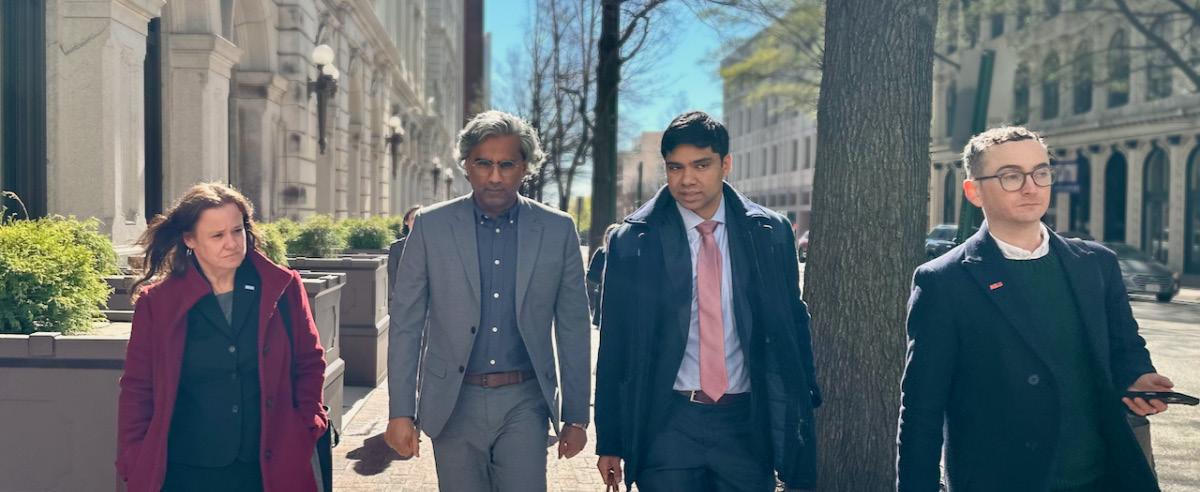
Lawyers Argue Jurisdictional Issues in Khan Suri’s Case
Levi Edelstein
Special to The Hoya
Georgetown University’s Of-
fce of the Student Ombuds (OSO), which provides confdential counseling and mediation to students, released its annual report March 19, indicating a decrease in student visits despite an increase in hours served.
The report, which covers the 2024-25 academic year, shows a 5% decline in student visits compared to the 2023-2024 year, with an overall increase in the number of hours logged with students. OSO was established by the Offce of the Provost in 2021 as a location for confdential confict resolution for university students.
Daniela Brancaforte, the director of the ofice, said the ofice anticipated the decrease in visitors.
“The most notable change this year was a slight decline in the number of visitors by about 5% after several years of steady growth of almost 20% each year following the ofice’s opening in 2021,” Brancaforte wrote to The Hoya. “This kind of leveling of was expected as the ofice matures, and we don’t see it as cause for concern.”
The previous 2023-2024 report refected a 19.2% increase in student visits. The ofice provides confdential consultation, group visits and informal mediation.
Brancaforte said the decrease in total student visits enabled the OSO to spend increased time with individual students.
“We see this as a refection of deeper engagement,” Brancaforte wrote. “Students are bringing more nuanced concerns that beneft from longer, more thorough conversations, and we’re committed to giving each visitor the time they need.”
Darius Wagner (CAS ’27), president of the Georgetown University Student Association (GUSA), said OSO is a valuable resource for Georgetown students.
Andrew Jiang Hoya Staff Writer
A panel of Democratic U.S. senators argued for a comprehensive party platform and greater civic dialogue to counteract the Trump administration at a Georgetown University event March 23. Former Sen. Jon Tester (D-Mont.) moderated four sitting senators — Sen. Michael Bennett (D-Colo.), Sen. Dick Durbin (D-Ill.), Sen. Jeanne Shaheen (D-N.H.) and Sen. Tina Smith (D-Minn.). At the event, hosted by Georgetown’s Institute of Politics and Public Service, the panelists debated how the Democratic Party should approach midterm elections to promote government accountability, prevent polarization and regain legislative power.
Bennett said the Democratic Party’s failure to ofer voters a convincing agenda contributed to President Donald Trump’s electoral victory in 2024.
“I blame Trump for a lot of things, but getting elected is not one of the things that I blame him for,” Bennett said at the event. “He was elected once
“Being able to have someone that’s able to give you both career advice, advice about the trajectory of your academic experience, but also whether you’re having any struggles in the classroom or struggles ftting into the Georgetown environment, just having a resource that’s there for any and all your needs is truly essential and it’s good to know that is an option for students,” Wagner told The Hoya Brancaforte said OSO is important for students of all backgrounds and highlighted that visitor demographics were shifting to include more male students.
“A signifcant portion of our visitors this year identifed as frst-generation students, students with fnancial need, or international students, which underscores how important it is that the OSO remain a welcoming and accessible resource for students from all backgrounds,” Brancaforte wrote. “We also saw an increase in the percentage of male-identifying students utilizing the ofice, which is an encouraging sign that awareness is growing across the campus community.”
Brancaforte said that, like previous years, mental health and well-being remained the leading motivation for student visits.
“What the data refects, I think, is that academic life, particularly in a rigorous environment like Georgetown, involves real pressures,” Brancaforte wrote. “Students are navigating demanding coursework, complex relationships with faculty and peers, fnancial concerns, questions about their futures, and in many cases, they are far from home and their support networks.”
In both 2023-24 and 2024-25, issues of respect and treatment were leading student concerns for the ombuds ofice. In its report, OSO called on the university to invest in initiatives that enhance peer relationships.
Bella Fankhauser (SFS ’28) — event coordinator of Active
by the American people. The American people took four years of and then they sent him back again because the Democratic party, which is the opposition party, could not, did not have a compelling vision about what the future of the country was going to look like.”
Smith said Democrats need an economic plan that levels the playing ground for everyday people.
“We need to have a proactive, forward-looking plan that is about unrigging the economy so that it works for regular people and isn’t just creating an environment where the wealthiest and the biggest corporations can beneft,” Smith said at the event.
“In some parts of this country, big corporate entities are buying up houses faster than anybody can even buy them,” Smith added. “I mean, they’re paying cash for houses and then turning them over into rentals. That is unacceptable. We should be against that as the Democratic Party.”
Following several successful 2025 elections in New York City, Virginia and New Jersey, where high costs of living were efective drivers of voter turnout, Democrats are
Minds, a student organization that raises mental health awareness — said OSO’s visibility could improve on campus.
“I know that they have a lot of functions on campus and they’re kind of almost like a behind-thescenes actor,” Fankhauser told The Hoya. “So I think in some ways that they defnitely do have an impact on campus, they’re here for a reason, but I think you don’t always see it as a visible interaction.”
Maeve Cassetty (GRD ’26), a research assistant for OSO, said the ofice is seeing success in its outreach initiatives.
“We had a big Valentine’s Day event with a therapy dog, hot chocolate and donuts last month, and I’ve seen the ofice’s dedication to outreach and ensuring that students know how to fnd the OSO and what it is that we do,” Cassetty wrote to The Hoya Brancaforte said the report found that students often approached the ofice with concerns about artifcial intelligence (AI) and academic integrity.
“One trend that stood out was an increase in students raising concerns related to AI use and academic integrity,” Brancaforte said. “Many of these students were experiencing real stress and confusion about what was expected of them.”
University administrators announced Feb. 23 that Georgetown intends to partner with Google Gemini in Fall 2026, bringing new AI tools to students, faculty and staf on campus.
Brancaforte said many students are unaware of the OSO and that increasing students’ knowledge is crucial to boosting attendance.
“We hear regularly from visitors who say, ‘I wish I had known about you sooner,’” Brancaforte wrote. “This isn’t about promoting the ofice for its own sake, it’s about making sure every student knows they have a confdential, informal place to think through their concerns.”
emphasizing afordability as a key issue. Democrats have carried this message as the main issue in the midterms, running younger, more relatable candidates for voters.
Durbin, who is retiring from Congress in 2026 after serving for over 40 years, said the next generation of Democrats must promote ideas that will emotionally resonate with voters.
“The next generation of Democratic leadership and candidates have to come up with some exciting new ideas that really touch the heart and soul of the voters,” Durbin said at the event.
Durbin is the current minority whip and has been the leading Democrat on the Senate Judiciary Committee since 2021.
Nolan Seebeck (CAS ’29), who attended the event, said he felt empowered by the senators’ words but also disappointed at the lack of discussion on detailed policy initiatives that could move the party forward.
“I think leaving something like this, you can’t help but feel like your role is important and that there’s things to be done as a young person,” Seebeck told The Hoya. “But I think I also came
WHAT’S NEW IN NEWS?
Georgetown Restaurant Week
Check out The Hoya’s coverage of the inaugural, student led Georgetown Restaurant week, which aims to make restaurants in the Washington, D.C. area more accessible to the university’s students.
All articles are available on thehoya.com.

Noah De Haan Campus Life Desk Editor
The Georgetown University College of Arts & Sciences (CAS) will require all first-year students to participate in a first-year seminar, CAS Dean David Edelstein announced March 23.
First-year seminars allow students in the College to engage with a small group of peers on topics chosen by professors, including educational opportunity, borders and creative drawing. The seminars — which previously required an application that rejected some students — aim to provide frstyear students with intellectually stimulating small communities.
Edelstein said the requirement is the result of signifcant positive feedback from past frst-year seminar participants.
“For the frst time this fall, CAS frst-years will be required to take a seminar,” Edelstein wrote in the announcement. “We have heard from many of you about the deep impact that a frst-year seminar had on you, and we are excited to be able to ofer them now to all incoming frst-year students.”
Seminars are capped at 20 students, with 30 seminars offered in the Fall 2025 semester. Currently, 46 seminars are listed for the Fall 2026 semester.
Sherry Linkon, who taught a seminar last fall on labor and work, said she enjoys teaching first-years and assisting their adjustment to college life.
“I love getting to work with new students,” Linkon wrote to The Hoya “They bring so much enthusiasm into the classroom, but they’re also navigating signifcant changes in their lives. The seminars provide both intellectual and social space for them. The small classes let us develop relationships that often carry across their time at Georgetown.”
Michael Kessler, a government professor who teaches a seminar on the interaction of theology and labor, said he enjoys teaching his seminar and looks forward to more students participating in the opportunity.
with a slight bit of frustration for the Democratic Party and the idea that I think I would have liked to have heard a bit more like clear legislative ideas.”
Bennet said the Trump administration lacks accountability, citing Trump’s decision to strike Iran in February.
“He didn’t consult seriously with the agencies of government,” Bennet said at the event.
“He didn’t consult seriously the people that, if you were planning something this massive, that you’d want to put in a room to fght it out, to argue it out.”
Shaheen said that while she is a Democrat, she views it necessary in public service to represent her constituents’ interests.
“I’m a partisan. I’m a Democrat,” Shaheen said at the event.
“I’ve been a Democrat my whole political life and I care about the Democratic Party, but I also think I have a responsibility to represent the people of New Hampshire.”
“In order to do that, I got to work with my Republican colleagues,” Shaheen added.
Justin Galdemez Lazo (SFS ’29), another student who attended the event, said the dialogue
“I started teaching one about 10 years ago,” Kessler told The Hoya. “The combination of a small class size with the opportunity to slow down and dive deep into a topic is a really fun and rewarding experience at any stage, but es pecially at the start of your college journey. I am most thrilled that the experience will now be shared in common among all first-years.”
Janie Boom (CAS ’28), who took a first-year seminar on the First Amendment in Fall 2024, said her seminar established comradery and enhanced her initial Georgetown experience.
“I think first-year seminars have a really important impact on the freshman year experience,” Boom told The Hoya. “I hope that there are more efforts at community building within a first-year seminar. I know we got dinner with my professor, or we had snacks at his house, which was a highlight of my semester. I hope that the funds for that continue.”
Maurice Jackson, a history professor who teaches a first-year seminar on jazz music, said non-lecture style classes improve student reasoning.
“Increasingly, the seminar becomes very important,” Jackson told The Hoya
“Good lectures can be very important, but especially in the social sciences, right of the bat,
helping students learn a proper way of thinking of participating is important also,” Jackson added. Kessler said the new requirement bolsters the college’s curriculum.
“This is a huge development for the College and David and interim Provost Soyica Colbert, (and their colleagues) deserve a lot of credit for implementing this, especially while facing tough fnancial headwinds,” Kessler said. “There is perhaps no greater testament to the central work of these seminars — developing critical thinking skills, respectful dialogue with others and the intellectual freedom to explore new ideas — than to insist upon their value and expand them even while facing economic pressures.” Jackson said the seminars provide an opportunity for students to engage in intensive learning.
“People won’t admit it, but students really, probably have become adjusted to working with less vigor than they were four or fve years ago,” Jackson said.
“That’s for many reasons — it can be because of COVID, it can be because of the attacks on education, things like that. Well, the seminar has a chance to revitalize that, to show the importance of this thing we call learning, the importance of ideas.”
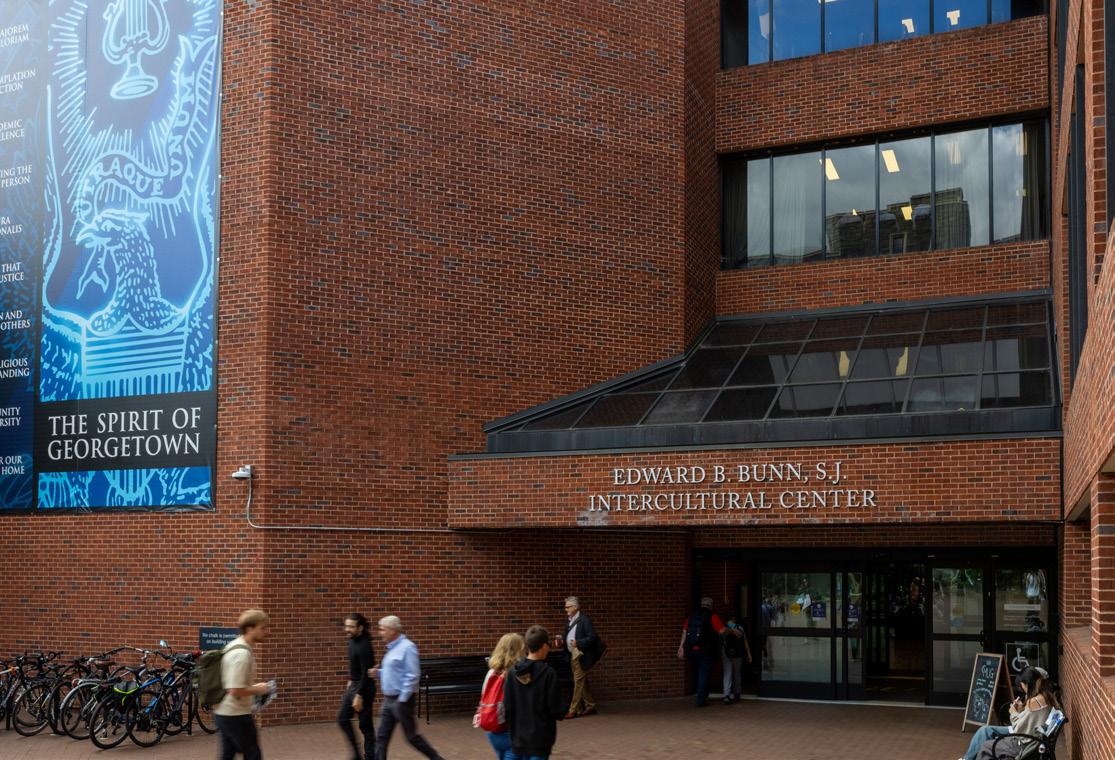
made him more informed on the Democratic campaign platform going into the midterms.
“I think it gave a more mellowed out take on what the Democrats need to do and I think that for the most part, is pretty informative and more excited to see what this Democratic strategy is going forward,” Galdemez Lazo told The Hoya.
Bennett said it is important
that Democrats formulate a new voter coalition to regain control of Congress and the presidency.
“It is incumbent on us to fgure out how to build quickly, to build an American majority that can not just win the presidency, but can win the Senate back as well,” Bennett said. “And that has nothing to do with Trump, that has to do with us.”
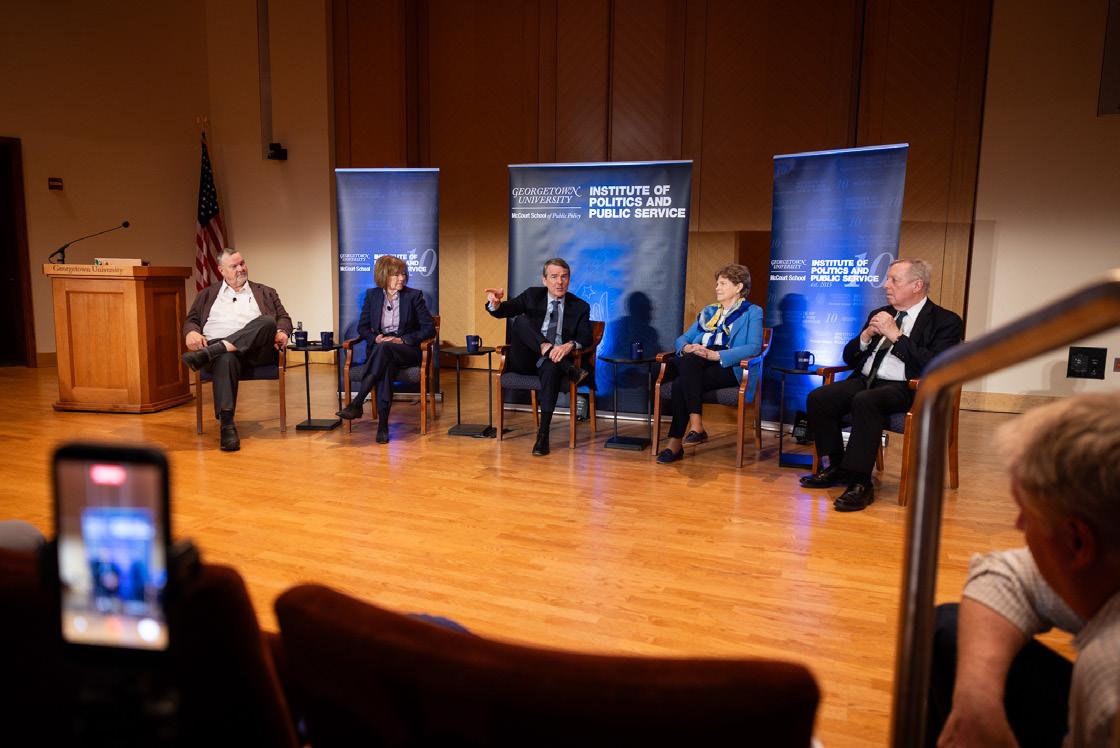
AJANI STELLA/THE HOYA
Badar Khan Suri’s federal appeals case, which was debated in front of an appellate court March 17, has the potential to shape how federal courts broadly understand their role in active immigration court proceedings.
COURTESY OF ANNA CANIZALES
A panel of Democratic senators argued for a stronger focus on affordability in the party’s platform for the 2026 midterm elections.
HAAN JUN (RYAN) LEE/THE HOYA Georgetown University will require all first-year CAS students to participate in a first-year seminar beginning Fall 2026.
Community Rallies Against Investment
PROTEST, from A1
said at the rally. “The university had its mind made up all along. The university never cared about what we wanted.”
At the time, interim University
President Robert M. Groves immediately declined to implement the referendum’s demands, citing academic freedom and the university’s responsibility to “deepen engagement and foster dialogue between scholars and societies.”
Anna Broderick (SFS ’26), an SJP member who attended the rally, said students and faculty at the rally were demanding that Georgetown divest from companies with ties to military operations in Israel and Iran.
“We came out to demand that, firstly, the U.S. stops intervening and stops their imperialist aggression in Iran and in the region, but also, more specifically, that Georgetown cuts all ties to the military industrial complex and the Zionist entity and all ties to the genocide and imperialist aggression,” Broderick told The Hoya
A university spokesperson previously told The Hoya that Georgetown’s Committee on InvestmentsandSocialResponsibility makes recommendations to the university’s board of directors on how to best implement Georgetown’s socially responsible investment policy and considers proposals from university community members.
The Middle East has faced ongoing military and political confict since the creation of the state of Israel in 1948, which led to the displacement of hundreds of thousands of Palestinians.
The current Israel-Hamas war escalated the confict when it began Oct. 7, 2023, when Hamas and other militant groups attacked Israel, leading to an
aggressive military response and a widespread humanitarian crisis.
A growing body of scholars and advocates have accused Israel of committing genocide in Gaza, including the International Association of Genocide Scholars — made up of the world’s leading genocide scholars — and a United Nations commission. Israel has consistently denied claims of genocide, often characterizing such claims as antisemitic or anti-Israel.
At the rally, faculty and students held signs such as, “Students say divest” and “Georgetown, where are your Jesuit values?” and led chants such as “Students united will never be defeated” and “Georgetown, Georgetown, you can’t hide — you’re committing genocide.”
Jackson Schnabel (SFS ’27), another SJP member, said faculty solidarity shows widespread support for Palestinian liberation.
“This isn’t just something that the students think,” Schnabel told The Hoya. “It’s something that everyone involved in our community is demanding. It’s not unique to just us. The faculty demands it, everyone knows that this is wrong, and everyone is willing to show out and demand for justice.”
Jo Moreau, a senior at Seattle University (SU) visiting Georgetown who attended the protest, said student involvement in the rally was inspiring.
“I think students organizing is really important,” Moreau told The Hoya. “These aren’t my leaders, but I think leaders everywhere should hear the message of the students — their tuition money is going towards things that are funding death and violence.”
Schnabel said he was glad to see continued support from the Georgetown community.
“It really encourages me to
see that Georgetown students are continuing to show out, to continue to put pressure on the university,” Schnabel said.
Colla said the university should uphold its commitment to Jesuit values in conversations regarding the Israel-Hamas war.
“There’s a struggle over what our values are,” Colla said. “They put banners up around campus talking about Jesuit values. And I’d say most of my students, most of my colleagues, admire those slogans and the values that they espouse. The problem is we need to live by those.”
Moreau said Eduardo Peñalver — Georgetown’s incoming president and the current president of Seattle University — has not been responsive to student protests at Seattle University, and Georgetown student organizers must be prepared to put pressure on him.
“I’m thinking about the response that we’ve had, the student organizing that we’ve had at SU, and how Peñalver has responded to that has been unwelcoming and unreceptive,” Moreau said. “So I’m wondering how he’s gonna handle this. The student organizing at Georgetown is, in my opinion, stronger, and your presence is louder. People are more involved.”
“He should be scared, he should be afraid of your presence and the voices that are here,” Moreau added.
Broderick, one of the SJP members, said the students and faculty involved in the rally ultimately want the administration to hear their demands.
“We want a chance to sit at the table with administrators and for them to listen to what the students, the faculty, the staff, the workers, everyone wants,” Broderick said.
“We want to stop our complicity in the genocide,” Broderick added.
Drivers, University Debate Pickup
GUTS, from A1
representatives March 18 that Georgetown plans to “move forward” with the shift to Hyattsville beginning the week of March 23.
“It is important to note that the current approach — requiring bus drivers to report to Main Campus and making buses available there — is not sustainable,” Paul wrote in an email to the union. “Beginning next week all drivers will be required to report to the Abe’s Transportation location going forward.”
However, at a March 24 meeting, university representatives and drivers agreed to seek a compromise, according to multiple drivers present.
A university spokesperson said meetings with the drivers have been “collaborative and productive” and said a fnal plan will beneft both parties, but reafirmed the importance of the Hyattsville depot.
“The new bus depot will support vehicle maintenance, cleaning, fueling and electric charging,” the spokesperson wrote to The Hoya. “This facility represents a significant capacity expansion and is designed to accommodate the evolving operational and sustainability needs of the university’s transportation system.”
The university has sought to move management of GUTS to Abe’s Transportation since September 2025, citing rising costs and complexity. In December, Georgetown said Abe’s Transportation would assume all management of GUTS. Still, the university continues to directly employ GUTS drivers, which allows them to retain university benefits. A month later, the union alleged in its cease-
and-desist letter that the attempted move to Hyattsville was retaliation for the drivers’ monthlong campaign to remain university employees.
On Feb. 17, Paul asked union representatives if any drivers would be willing to volunteer to pick up or drop off buses from Hyattsville. The university did not offer any additional compensation, though drivers would be paid for their trip to and from Maryland.
Angel De La Rosa Pena, a representative for the union, 1199SEIU, said no drivers volunteered and expressed safety concerns about the pickup location.
“I visited the site and I must inform you that the conditions and overall safety of the area are not adequate at all,” De La Rosa Pena wrote in a Feb. 23 email.
“The location includes a lot with a storage container, which raises additional safety and security concerns — especially for drivers working at night,” De La Rosa Pena added. “In speaking with employees from a nearby shop, I was informed that the company only acquired the space recently.”
Roy Linton, a GUTS driver, said driving to Hyattsville without additional compensation is untenable.
“That’s going to be a lot of driving, a lot of back and forth,” Linton told The Hoya. “I don’t think that is going to work. They’re going to have to cut your schedule short in the evening or in the morning.”
Michael Fleming, another GUTS driver, said the attempt is yet another instance of disrespect.
“There’s a lack of communication with us and they keep dropping the ball,” Fleming told The Hoya. “The way they deal with us lacks respect.”
Throughout Fall 2025, GUTS drivers and students engaged in a campaign against the university’s attempts to subcontract through Abe’s Transportation. Throughout the campaign, drivers criticized the university for allegedly failing to upload the Just Employment Policy, which governs how the university engages with workers.
Alvaro Barberena, another GUTS driver, said he felt like the university was trying to force a decision on drivers without their input, drawing parallels to the previous campaign.
“They thought they were going to be able to just make a decision, make us do whatever has been their power to do and force us and it didn’t work like that,” Barberena told The Hoya “So this is where we are right now.”
“It’s, again, the university making plans without thinking,” Barberena added.
Elinor Clark (CAS ’27), who helped lead the GUTS campaign in the fall, said forcing GUTS drivers to go to the Abe’s Transportation headquarters in Maryland separates them from the university community.
“They are removed from Georgetown’s community,” Clark told The Hoya. “Georgetown is deliberately attempting to remove bus drivers from Georgetown’s community.”
Fleming said he sees the university’s actions as an attempt to encourage them to leave.
“It seems to me like they’re trying to push us to Abe’s or make us quit,” Fleming said.
“Angry, tired, frustrated, all of the above — that’s how I feel,” Fleming added. “When I come to work now, it’s ‘what’s next? What are they going to do to us next?’”
GU Sued for Alleged Job Discrimination
LAWSUIT, from A1
ignored Williams’ requests to return to work.
“She’s looking for reemployment,” Blackman told The Hoya. “She’s expecting to receive a paycheck. And those benefts and health insurance and the standard package that she had before and just to continue to receive those things as a Georgetown employee. But instead, she was ignored.”
A university spokesperson declined to comment on the ongoing litigation. The university’s attorneys also declined to comment.
Williams coached Georgetown’s track and feld team from August 2021 until she was deployed to the North Carolina National Guard on Feb. 1, 2023. According to her civil suit, she remained an oficial employee of Georgetown without a position until Oct. 16, 2025, when the university terminated her employment.
The Hoya reviewed 282 pages of case documents and reviewed the litigation with fve experts in employment and discrimination law to understand the allegations.
Adam Augustine Carter (CAS ’87, LAW ’91), an employment lawyer and USERRA expert, said a veteran is entitled to reemployment by their previous employer if they fulfll four conditions: notifying their employer of their service, serving less than fve years, being honorably discharged and giving prompt notice of their return.
“If those four things are present and only those four things, you have an absolute right to this term called re-employment,” Carter told The Hoya.
After notifying the university of her discharge and service-related disabilities April 4, 2024, Williams submitted three accommodation requests between May 2024 and October 2025.
In her initial email to human resources (HR) informing them of her discharge and disability status, Williams stated she could return to work immediately. She asserted her qualifcations for positions beyond a coaching role, citing her master’s degree in leadership. On May 16, 2024, Williams said that she was pregnant and only interested in remote or hybrid roles.
After informing the university of her discharge, Williams worked with an HR representative to apply to 14 roles at the university between March 14, 2024 and March 26, 2025.
In a Dec. 18, 2024, email to an HR representative — eight months after her initial request — Williams said she had not heard back from the university.
“I have applied for several positions, both hybrid and inperson, and I remain open to any role that I qualify for,” Williams wrote in the email.
“This lack of communication and resolution has been incredibly frustrating, as I have been actively waiting for an opportunity to return to Georgetown. The delay has also caused signifcant stress and uncertainty, as it directly impacts both my professional career and personal well-being.”
Title VII of the Civil Rights Act of 1964 prohibits employment discrimination based on several conditions, including sex and pregnancy status. Williams alleges the university did not
provide accommodations for her pregnancy and therefore violated Title VII.
In April 2025, Georgetown ofered Williams a business administrator position and withdrew it three days later.
In September, Williams was ofered an HR position, which she claimed would be medically unsuitable. Williams’ complaint states that the university’s next correspondence was her Oct. 16 termination letter.
Blackman said the lawsuit is based on the university’s alleged violation of USERRA protections by failing to assign Williams a position or compensate her.
“She sued because Georgetown did not provide her reasonable accommodation, they did not meaningfully engage in the interactive process in her request for reasonable accommodation and she, as a vet who had been honorably discharged from the military, was in need of being promptly placed back into her employment status at Georgetown,” Blackman said.
Williams claims that the university violated USERRA by not re-employing her, not engaging with her request for re-employment for nine months and not accommodating her service-related disabilities.
In the university’s motion to dismiss the case, Georgetown claims it did not violate USERRA because Williams was ofered several positions, including her original coaching role. The university claims Williams did not provide proof of an explicit disability and that Williams’ termination was due to unreasonable accommodation requests.
Additionally, the university says they accommodated Williams’ disabilities and her pregnancy to the greatest extent possible, but were unable to fnd roles that met her qualifcations and needs.
Kyndra Rotunda, a professor of military law at Chapman University, said the lawsuit alleges that Georgetown may have violated USERRA by failing to reemploy Williams.
“According to the complaint, it appears that Georgetown is not and has not fulflled its legal obligations to a former employee, Ms. Williams, who was deployed in service of her country,” Rotunda wrote to The Hoya. “The US Employment and Reemployment Rights Act (USERRA) requires that returning service members be reemployed without disadvantages; in the same or a substantially similar position.”
Carter said federal law requires reemployment — employees must be placed on a payroll, but are not required to return to a specifc position.
“Re-employment means coming back to work and getting back on a payroll,” Carter said. “It does not mean ‘oh, you have to apply for this job or that job.’ It should be, ‘welcome home’ and arms open from the employer — ‘come back, we’ll put you on payroll and put you back on all the benefts and then we will fgure out what job you do.’ Not, ‘We have to fnd the right job that you’re medically capable of doing.’” In a parallel claim in the lawsuit, Williams alleges that her Oct. 16 termination was retaliation for her repeated accommodation requests and complaints.
After seven months without communication from the university’s HR department, Williams fled a complaint with the Department of Labor’s Veterans’ Employment and Training Service (VETS), a federal organization that helps veterans fnd employment, on Dec. 16, 2024.
Three months later, on Feb. 10, 2025, Williams fled her frst complaint with Georgetown’s Ofice of Institutional Diversity, Equity & Afirmative Action (IDEAA), which began an internal process to assess her case. The lawsuit alleges the university then retaliated against Williams for her complaints with VETS and IDEAA by rescinding two job ofers — the business administrator and HR roles — and later terminating her. Successful retaliation claims include an employee engaging in a legally protected activity, an adverse action by the employer and a clear link between the events.
In its motion to dismiss, the university argues it could not have engaged in retaliation under Title VII because it claims Williams is not protected under the statute because her legally protected activity does not involve her race, religion or sex. It further argues that since Georgetown ofered Williams employment, there was no retaliation.
On Oct. 17, the day after Williams’ termination, university lawyers fled a motion to dismiss the case.
In its response, the university said Georgetown attempted to reinstate Williams as a coach and ofered a position that respected her accommodations.
“Namely, her Complaint fails to state a claim because Plaintif admits that Georgetown ofered both to reinstate her to her original position, and then, following a request for an accommodation, ofered to reassign her to a position that comported with the accommodation she requested,” the motion reads.
Blackman said Georgetown’s motion to dismiss ofers conficted arguments.
“Georgetown argues that they had no knowledge that she had a disability, but in another instance, in the termination letter, they said that they’re terminating the reasonable accommodation process, which is only applicable if a person has a disability,” Blackman said. “So it’s unclear what Georgetown’s argument is, but it’s clear that they’re making two arguments at the same time that confict with each other.”
Following a hearing on Dec. 18, 2025, the case now awaits mediation, a process in which a neutral third party attempts to settle a lawsuit.
Blackman said Williams hopes her case encourages the university to amend their policies around disability accommodations.
“There’s no doubt about Georgetown’s contribution to public service and hopefully her case is an opportunity for Georgetown to revisit its policies to make sure that when students, when faculty, when employees, when they do their public service, that Georgetown upholds its end of the bargain and makes sure that they’re protected and makes sure their rights are not violated,” Blackman said.
Facing Congressional Antisemitism Inquiries, GU Leaders Defend Programs
REPORT, from A1 or support for Palestinian rights on this campus, is actually cheapening the concept of antisemitism, which is a very real problem in this world,” Hashemi told The Hoya “So from that perspective, the report does damage to the real fght against antisemitism,” Hashemi added. “And then, in more substantive ways, there’s an attempt to pressure universities with these false allegations of antisemitism, by trying to silence freedom and discussion for academic centers like mine.”
Several prominent Democrats have criticized congressional Republicans and President Donald Trump, arguing they are using antisemitism as a way to control U.S. universities. In March 2025, the Trump administration revoked roughly $400 million in grants and contracts to Columbia University, alleging inaction regarding the persistent harassment of Jewish students.
Hashemi said the report indicates that some members of Congress disregard academic freedom and human rights, citing the International Court of Justice (ICJ)’s classifcation of the IsraelHamas war as apartheid.
“The people behind this report hate those two things,” Hashemi said. “They don’t believe in academic freedom. They want to silence it so that only a pro-Israel voice is heard, and they don’t believe in universal human rights. They believe in supporting the state of Israel as currently constituted, which, according to international law, is guilty of the crime of apartheid.”
The report also claims GU-Q spreads antisemitism through its support for faculty who have made allegedly antisemitic comments, failure to spread “Western values” abroad, and granting Qatar’s government infuence in the United States through the satellite campus. The report also claims GU-Q has
not disciplined any students or faculty for antisemitism since Hamas’s Oct. 7, 2023, attack on Israel and the resulting war.
The university spokesperson said the university does not allow infuence in its administration of GU-Q, and the campus exists to educate students abroad.
“Georgetown is a global research university guided by a Jesuit commitment to engage all over the world to promote the common good,” the spokesperson wrote. “Our campus in Qatar has helped educate nearly 1200 students in international afairs and advances American educational values while maintaining our unwavering commitment to academic and religious freedom, and inclusion and non-discrimination.”
“We independently manage our activities on all campuses including curriculum, research, and faculty hiring and report foreign gifts and contracts as
required by federal law,” the spokesperson added.
Adeena Hossain (SFS-Q ’27), a GU-Q student, said she has not seen the Qatar campus advance antisemitism.
“These are serious accusations that are claiming that students and faculty at our campus are acting with discrimination or hostility towards Jewish people, which is simply not the case,”
Hossain wrote to The Hoya
“Georgetown actively upholds its commitment to interfaith dialogue, and I have seen that dialogue happen in practice.”
Hossain also said she views the report as an insult because of its allegations that GU-Q does not promote “Western values.”
“‘Western values’ are treated in the report as a sort of tangible package that students studying on the Qatar campus lack, which is patronizing and ignorant,” Hossain wrote. “Critical thinking, pluralism, and free inquiry are not Western inventions. If anything, GU-Q
strengthens those values by channeling them in a diverse environment where students are constantly challenged to engage across diferent cultures and perspectives.”
“I would invite anyone who wrote this report to have a single conversation with a GU-Q student,” Hossain added. “The attempts to paint us as brainwashed, closeminded, or hateful are not only wrong but insulting.”
Darius Wagner (CAS ’27), president of the Georgetown University Student Association (GUSA), said the Republican authors of the report are not genuinely concerned about antisemitism, citing the Trump administration’s broader attacks on higher education.
“It’s truly jarring to the extent that congressional Republicans are co-opting antisemitism as an issue in order to attack college campuses,” Wagner told The Hoya. “We have already routinely seen that the Trump administration and
congressional Republicans have not taking the serious issue of antisemitism.”
“So just forgive me, but I don’t fnd this report to be accurate or sympathetic to any causes to reducing hate on our campus, especially reducing antisemitism,” Wagner added. Hossain highlighted the importance of academic freedom on human rights issues, saying a Georgetown degree teaches students to exercise free speech.
“While I cannot speak for every faculty member and student, I strongly believe that students have the right to speak up for what they believe is right, and that a university setting is precisely where that should happen,” Hossain wrote. “The education we are receiving at Georgetown is teaching us to think carefully, argue precisely, and stand behind causes we believe are just. As far as I am concerned, this is the degree working exactly as it should.”
Dominican American Poet Navigates Bilingualism, Identity in Poetry
Pritika Patel Events Desk Editor
A Dominican American poet argued for poetry’s importance in connecting identities at a festival hosted by Georgetown University’s Lannan Center for Poetics and Social Practice on March 24.
The Lannan Literary Festival, an annual three-day festival, invites prominent writers, artists and scholars to analyze literary developments at Georgetown.
Hosted in collaboration with Georgetown’s Disability Cultural Center and the Laboratory for Global Performance and Politics, this year’s festival focused on how literature helps individuals navigate transformation and featured Julia Alvarez, a Dominican American poet, novelist and essayist.
Alvarez said poetry has helped her reconcile her English and Spanish-speaking identities.
“I loved poetry, because poetry to me was a way I could speak Spanish and English,” Alvarez said at the event.
“It was a cadence in a musical and it reminded me of my native language.”
Alvarez’s work draws on her experiences growing up between the Dominican Republic and the United States. She is the author of several acclaimed books, including “How the García Girls Lost Their Accents,” which won the New York Times notable book of 1991 and “In the Time of the But-
terfies,” which explores family dynamics, immigrant diasporas and adolescent transformations.
Alvarez said she tries to internalize poetry that resonates with her, memorizing it for future inspiration.
“What I do when I love a poem is I try to commit it to memory because I want to have it inside me at that cellular level,” Alvarez said. “So I have a number of poems that are important to me, beginning with the one that’s an epigraph in the book.”
Alvarez’s “How the García Girls Lost Their Accents” follows four Dominican sisters navigating identity, family dynamics and coming of age after immigrating to the United States and has been translated into 11 languages across 15 countries since its publication. The novel cemented Alvarez — who later became a writer-in-residence at Middlebury College and received the National Medal of Arts — as a leading voice in Latino literature.
Alvarez said she has rituals and beliefs that guide her creative process and help her transition between projects.
“I do have my rituals and I have my little icons,” Alvarez said. “And when a book is done, they have to go away and give me space. So I usually have a ritual of internment which brings me away.”
Alvarez said reciting poems aloud helps her to hear the natural rhythms of language and experiment with voice and cadence.
GU to Launch Master’s In Sports Operations, Environmental Health
Chloe Taft
Graduate Desk Editor
Georgetown University will launch two master’s programs in environmental health and sports operations in Fall 2026, program leaders confrmed to The Hoya on March 23.
The Master of Science in Climate, Environment & Health (CEH), a one-year degree at the Capitol Campus, will focus on the intersection of global health and climate policy. The Executive Master’s in Global Sports Strategy & Operations — a hybrid program in collaboration with the sports business school within Manchester City Football Club, a Premier League soccer team in the United Kingdom — will offer professionals an accelerated degree in sports management from Georgetown’s School of Continuing Studies (SCS). Both programs were frst approved by Georgetown’s board of trustees in June 2025.
Jessica Kritz, a global health professor who co-designed the CEH program, said the program aims to teach students about the intersection of climate change and global health.
“The master’s program is an accelerated program designed for students who are interested in the intersection of environmental change with human health,” Kritz told The Hoya. “The focus of the program is collaborative problem-solving. So to distinguish this program from an environmental health program, for example, is the fact that the program is designed to explicitly teach students evidence-based processes, design and skill development, to resolve complex challenges at this intersection and confict challenges.”
Barry Goldwater, the faculty director of the sports strategy program, said the SCS developed the program in collaboration with Manchester City to ofer high-level education in sports operations and management.
“There are challenges and opportunities in global professional sports and this is a landscape that just keeps changing and evolving, so our approach is going to be both comprehensive and accessible,” Goldwater told The Hoya The degree includes fve remote courses on leadership, business operations, governance, emerging technologies and a capstone fnal project, as well as in-person residencies in Manchester, Washington, D.C. and New York City.
Kritz said that although the CEH program was initially intended for students with a background in environmental policy or public health, applicants without experience in either have also expressed interest.
“We all have lived experience with issues at the intersection
“When you live with the song and you see there’s a kind of tenderness and compassion for that moment — knowing that you didn’t know where this was going and I still don’t — you have to forget what you’ve done when you’re in the service of this new work,” Alvarez said. “And you have that feeling in your spine when you do a craft that you learn certain things on an almost cellular level.”
Alvarez said her childhood experiences memorizing poetry shaped her understanding of language and community.
“I really found rhythmically a connection with poetry,” Alvarez said. “And I would memorize a poem that I loved, because that was something that came from my childhood.”
Alvarez said she wrote her novel “In the Time of the Butterfies” to better understand her parents’ generation and the experiences that shaped them.
“I feel like ‘In the Time of the Butterfies’ was the book I wrote for the lost generation because they came of age dreaming of dictatorship, censorship and fear,” Alvarez said. “And so I wanted to understand because I always thought, ‘why did you let this happen?’”
Alvarez said she approached her work not just as a historical or intellectual exercise, but as a way to internalize her parents’ stories.
“I wanted to understand my parents’ generation but I didn’t want to understand it intellectually,” Alvarez said. “I wanted to integrate it and the task of a writer is not to solve the prob-
lem, but to state it correctly. So I wanted to understand and have answers, but didn’t really want answers.”
Alvarez said literature helps her feel connected with people
through history and distance.
“The one thing about stories of literature is that we’re all connected,” Alvarez said. “You can read the stories from 2500 B.C. and I’m in there in that story.”
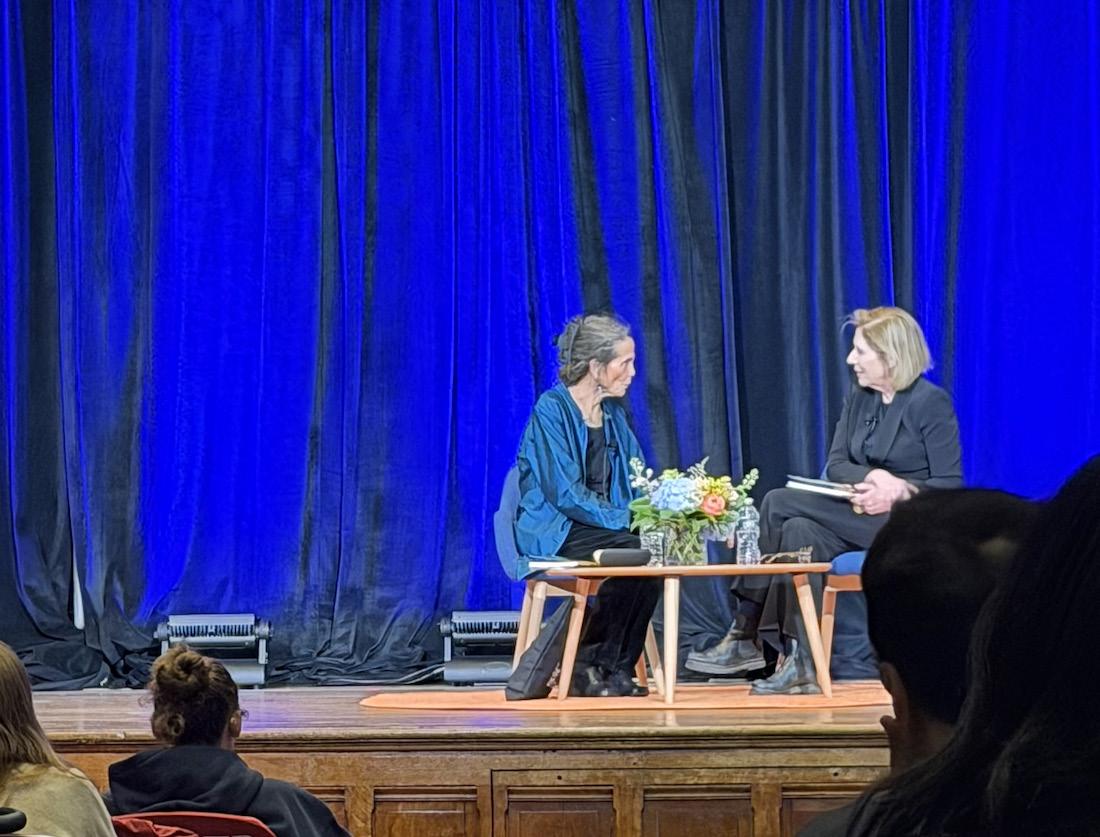
Julia Alvarez, Dominican American
“Visitations” at the opening night
Fearing Further Destabilization in the Region, Experts On Middle East Condemn US-Israeli Strikes on Iran
Joshua Lou Hoya Staff Writer
of the environment and health,” Kritz said. “Some of us study that and some of us don’t. What we thought is really interesting is seeing the number of students who have come to the program because they have encountered natural disaster in their personal life.”
Clare Buckley (SOH ’24, GRD ’25), who helped plan the CEH degree as a research assistant, said the team behind the program wanted to create a master’s degree that was not available elsewhere, saying the majority of similar programs focus only on environmental health.
“I feel like we noticed washing out of the word ‘climate’ in our research,” Buckley told The Hoya . “I think the fact that we’re providing coursework that’s specifically about climate change sets us apart from some of the programs that just do environmental health.”
“It being a one-year program was also unique,” Buckley added. “We wanted to focus on affordability and access.”
Students in the CEH program will take courses on scientifc methodologies specifc to health and the environment, data visualization, policy design and management. Other universities, including Johns Hopkins University, The George Washington University and Harvard University, ofer graduate degrees in environmental health policy.
Goldwater said the SCS’s program will focus largely on global sports.
“We are certainly going to pay attention to football because we have the beneft of Man City,” Goldwater said. “That’s only where we begin. There are sports that have a global profle, so we’re also going to be investigating basketball, golf and tennis, a variety of diferent global sports and looking at diferent phases and segments of operations and strategy, how decisions are made, how diferent venues are managed, how diferent events are presented and the fan engagement that’s associated with them and how the business is run.”
Buckley said she is hopeful for the future of the CEH degree despite a shift in the higher education landscape caused by the Trump administration’s eforts to eliminate grants and funding for science programs at universities across the United States.
“Now international development and environmental health have become so politicized that I am obviously more pessimistic and sad about it, to be candid with you,” Buckley said. “But I think the purpose of the program and the fact that Georgetown was willing to invest and start this up anyway, is a testament to the fact that they are a very future-thinking university.”
Several experts on the Middle East criticized ongoing joint U.S.-Israeli strikes on Iran at a March 24 event hosted by Georgetown University’s Alwaleed Center for Muslim-Christian Understanding (ACMCU).
Yousef Munayyer, head of the Palestine/Israel program at Arab Center Washington DC, a research institute focusing on Middle Eastern politics; Nader Hashemi, director of the ACMCU; Marwa Daoudy, a Georgetown professor of international relations; and Giorgio Cafero, an executive at the company Gulf State Analytics, considered how U.S. involvement in Iran, and Israel’s regional hegemony goals, have caused unrest in the region. Fida Adely, a Georgetown Arab studies professor, moderated the event, titled “The U.S.-Israeli War on Iran: Perspectives from the Region.”
Munayyer said Israeli policy has recently shifted to seek regional dominance in the Middle East, which motivates the current war.
“Israeli capabilities and the extent to which the United States was willing to support the Israeli military has changed, which has allowed Israeli decision-making to shift from security seeking through a set of deterrent relationships in the region, whether with Hamas or Hezbollah or Iran, to hegemony,” Munayyer said at the event.
“And frankly, Iran stands in the way of that.”
On Feb. 28, 2026, the United States and Israel launched joint airstrikes on Iran, killing Supreme Leader Ayatollah Ali Khamenei and targeting Iran’s nuclear and military infrastructure. Iran responded with retaliatory missile and drone strikes. The confict has caused more than 1,800 deaths, including eight U.S. service members, as of early March.
Munayyer said the Trump administration’s decision to begin war with Iran was influenced by a potential decline in public opinion ahead of the November midterm elections.
“Opinion polls show that the American public is becoming more critical of sending military support for Israel,” Munayyer said. “We have elections coming up here in the United States and Israel, so if it was going to happen with Netanyahu and President Trump, this was surely the greatest amount of political freedom they were going to have.”
Hashemi said this war marks the continuation of decades-long Western involvement that has interfered with Iran’s governance since the mid-20th century.
“At this moment, the United States responded, not by apologizing for the 1953 coup but sanctioning them,” Hashemi said at the event.
In 1951, Mohammad Mosaddegh was democratically elected as Iran’s prime minister to nationalize Iranian oil felds. A 1953 coup, partially funded by the U.S. and U.K. governments, removed Mosaddegh and restored Shah Mohammad Reza
Pahlavi as Iran’s leader. After 26 years, a coalition of opponents overthrew the Shah and replaced him with Ayatollah Ruhollah Khomeini, the frst supreme leader of Iran.
Hashemi said the current war in Iran has hindered the country’s democratization eforts.
“I continue to be a strong critic of the Islamic Republic of Iran,” Hashemi said. “It has a horrific human rights record, but the biggest losers of this war will be the people of Iran. Crippling sanctions and the prosecution of an illegal war via massive aerial bombardment severely undermine the prospects for genuine, organic political change in Iran.” Daoudy said Israel has recently adopted a more aggressive foreign policy strategy in its military strikes over the past three years.
“One has to remember that on the day of the collapse of the Assad regime, the frst thing Israel did was destroy all military capabilities, bombing Syria hundreds of times in the same day,” Daoudy said at the event. “It has become normalized that we have killed civilians alongside massive displacement against all rules of international humanitarian law.”
On Oct. 7, 2023, Hamas attacked Israel and killed approximately 1,200 people. In response, Israel launched an invasion and a successive war on Gaza, causing widespread displacement and 72,000 deaths since 2023. The Israel-Hamas war is the latest stage of a decades-long military and political confict between Palestinians
and Israelis, following the creation of the state of Israel in 1948. Cafero said the Gulf Cooperation Council (GCC), a regional security alliance of six states bordering the Persian Gulf, has been dragged into the confict as targets of Iranian aerial strikes.
“All six of the GCC states tried very hard, especially the Sultanate of Oman, to convince Trump that bombing Iran would be a dangerous and reckless move,” Cafiero said at the event. “They also went out of their way to communicate to Iran that if the U.S. or Israel would bomb Iran, the GCC states would take no part in that. Unfortunately, the Islamic Republic immediately started waging drone and missile strikes on all six states, claiming that those operations against Iran were done from bases on the Arabian Peninsula.” Iran has repeatedly launched strikes on several GCC countries for their ties to the United States since the ofensive strikes began Feb. 28. In addition to his analysis, Hashemi said students can play an active role in supporting Iranian freedom and possibly settling the confict in the Middle East.
“Our job, especially for the future leaders of this country, is to dismantle the propaganda machine that tries to have us believe that war is peace, that some Middle East dictators are allies and moderates while others are enemies, and that occupation is freedom,” Hashemi said. “Then, and only then, can the Iranian people exercise their own power and reclaim their future from both the theocrats who rule over them and the imperialists.”
Popular Bagel Franchise to Open Storefront in Georgetown
Jacqueline Gordon Academics Desk Editor
A Connecticut-based bagel franchise will open a location in the Georgetown neighborhood April 10, a company spokesperson confrmed to The Hoya on March 24.
PopUp Bagels, a franchise that sells a variety of bagels and spreads, is set to open on Wisconsin Avenue, according to a company spokesperson. Famous for its “grip, rip and dip” motto, PopUp has 28 other locations across the United States.
Brian Harrington, a Washington, D.C. partner for PopUp Bagels, said the Georgetown location is the start of PopUp’s expansion into the D.C.-Maryland-Virginia (DMV) area.
“There’s a real neighborhood culture in Georgetown that aligns with PopUp Bagels perfectly,” Harrington wrote to The Hoya “We’re not just opening doors, we’re joining communities.”
“Starting our DMV footprint in the heart of D.C. gives us the opportunity to build meaningful connections from day one and expand thoughtfully throughout Virginia and Maryland,” Harrington added.
PopUp, which was founded in 2020 in Westport, Conn., sells bagels in batches of three, six, 12 and 30. The store features a small menu and ofers customers the option of fve diferent bagels — plain, everything, poppy seed, salt and sesame — and fve diferent spreads, including two weekly specialty favors.
Sophia Tremblay (CAS ’27), an undergraduate from Boston, said PopUp Bagels is a source of nostalgic comfort.
“I remember it a lot in high school, and it was a really big thing for me and my friends,” Tremblay told The Hoya. “I remember when it opened too, it was so fun, and just the concept of it is so cool, like how you have to rip the bagels and dip them rather than cut them.”
“When I heard it was opening up here, it felt like a little piece of Boston was coming here, even though I don’t think it originated in Boston, but it’s just the idea of it, and I think it’s better than Call Your Mother personally,” Tremblay added. Sophia Dessi (CAS ’28), an undergraduate from Westchester, N.Y., said she enjoyed going to PopUp with her sister in her hometown.
“The closest location is like 40 minutes from us, so we just get in the car, go 40 minutes, get a PopUp, and literally eat like two or three bagels each on the way back,” Dessi told The Hoya. “It’s a lot, but it’s great — like doing the diferent cream cheeses, different butters — and it’s just a really good bagel.”
Ginny Marshall (CAS ’29), an undergraduate from New England, said she is not looking forward to the opening because PopUp does not feel authentic.
“I’m not very excited about PopUp coming to Georgetown in part because I don’t think it’s very good,” Marshall told The Hoya. “I don’t appreciate the whole tearing experience; it’s not really what I’m looking for when I want a bagel, but I’m also not looking forward to it because I’m growing a bit tired of all these chains coming to Georgetown.”
“It’s starting to feel like every week I’m seeing new announcements about popular chains coming to Georgetown, and I’m not super enthusiastic about that,” Marshall added.
“I think that is fun and something new for people who are used to, I guess, Call Your Mother is the big bagel place here, but I think it’s an innovative spin that people will be excited about,” Dessi said. The store, which will be located at 1078 Wisconsin Ave. NW, will fll in the spot previously occupied by Mason’s Famous Lobster Rolls and Paul Bakery. PopUp will join Call Your Mother, Einstein Bros. Bagels, Café con Bagel and Wisemiller’s Grocery & Deli as another bagel spot within the Georgetown area. Dessi said she thinks the store will benefit Georgetown residents overall.
“I think I would be upset if it were replacing a smaller business, but, I think, in general, I’m happy to see D.C. get more quality bagel spots,” Dessi said. “I feel like a lot of people who live in D.C. from the Northeast; that’s a big part of home that they miss, and so
Dessi said the appeal of PopUp Bagels is their unique approach to the bagel experience, in which customers rip of a piece of the bagel and dip it in cream cheese.
PRITIKA PATEL/THE HOYA
poet and novelist, spoke about her upcoming collection
of Georgetown’s 2026 Lannan Literary Festival on March 24.
Middle East Studies Expert Draws Parallels
Between Jewish, Palestinian Re ections
Sofia Thomas GUSA Desk Editor
A Middle East expert and author argued that Palestinian and Jewish peoples should recognize commonalities in their histories and experiences at a Georgetown University event March 23.
Sara Roy, an associate at the Center for Middle Eastern Studies at Harvard University, argued for a thoughtful examination of the historic parallels between the Holocaust and the current occupation of Gaza and the West Bank. Georgetown’s Alwaleed Center for Muslim-Christian Understanding (ACMCU) hosted the event, titled “Reflections on Gaza, Judaism and the Holocaust,” in partnership with several university centers and departments, as well as Georgetown University Qatar.
Roy said her research on the economic development in Palestine is deeply informed by her parents, both of whom are Holocaust survivors, as well as her time spent with Palestinians living in areas occupied by Israel.
“In my research, there have always been two alternating and deeply interconnected texts, which have, over four decades of research and writing on the Israeli-Palestinian crisis, informed all of my work: my personal history as a child of Holocaust survivors and my lived experience with Palestinians under Israeli occupation,” Roy said at the event.
“For 40 years of sustained work, I was consistently told that these two texts must always be kept apart and safe, never placed within the same moral classroom,” Roy added.
“Any attempt to bring them together, no matter how carefully, to disrupt the isolation of one and challenge the political confnement of the other and argue for their fragile
overlapping was treated as an act of betrayal and desecration.”
Israel has maintained military occupation of the West Bank and East Jerusalem since 1967, which several international organizations, such as the United Nations and the International Court of Justice, consider occupied territory. The ICJ has ruled that Israeli settlements in the West Bank violated international law.
Roy said her parents’ stories of the Holocaust shaped and motivated her research, which includes work on the political and economic development of the Gaza Strip and West Bank.
“The stories my mother and father told me and the images they transmitted were ones I carried with me into Gaza,” Roy said. “And while their stories were not always present in my work, they inspired it and were the reason I was there. Looking back, it could not have been otherwise.
Nader Hashemi, the ACMCU director who introduced Roy at the event, said Roy began research in the region in the mid-1980s, focusing on economic and political development.
“More broadly, she began her research in the Gaza Strip, in the West Bank in 1985 with a focus on the economic, social and political development of the Gaza Strip and on U.S. foreign assistance to the region,” Hashemi said at the event.
Roy said her book draws parallels between Jewish and Palestinian experiences by emphasizing loss and humanity under oppression.
“In my book, I argue for an essential unity between Jewish life under the Germans and Palestinian life under the Israelis,” Roy said. “At its core, this unity involves an ecumenical understanding of the experience of subordination and the irretrievability of loss, the dissolution of place, a shared humanity
and its role in resisting brokenness in the face of destruction.”
The region has faced ongoing military, social and political confict, which heightened after the 1948 establishment of the state of Israel. The current war began when Hamas attacked Israel on Oct. 7, 2023, killing about 1,200 people and taking hundreds of hostages. Israel subsequently invaded Gaza, leaving at least 80% of the population displaced and resulting in the deaths of over 70,000 people.
Having researched in Palestine for decades, Roy said witnessing Palestinians’ experiences during the current confict was unprecedented and reminded her of her father’s account of the Holocaust.
“I have seen a great deal of sufering in my 40 years of work in Gaza and the West Bank, but in that time, I never saw anything like the suffering of Gazan starving children over the past two years,” Roy said.
“My frst thought when I looked at photos of these children was of my father at the very end of the war, after Auschwitz, there was no photo of him that I ever saw, but painful descriptions of what he looked like.”
Roy said she encourages a thoughtful, critical comparison between the Holocaust and the current occupation of the West Bank and Gaza as a means of deepening understanding of the shared histories of oppression.
“The time has come to embrace the historical analogies and parallels between the Holocaust and the occupation explicitly, without fear, shame or favor, arguing for the need to compare carefully and thoughtfully,” Roy said. “Because it is through the imperative of comparison, which is not the same as equivalence, that we understand, giving voice to words long smothered.”
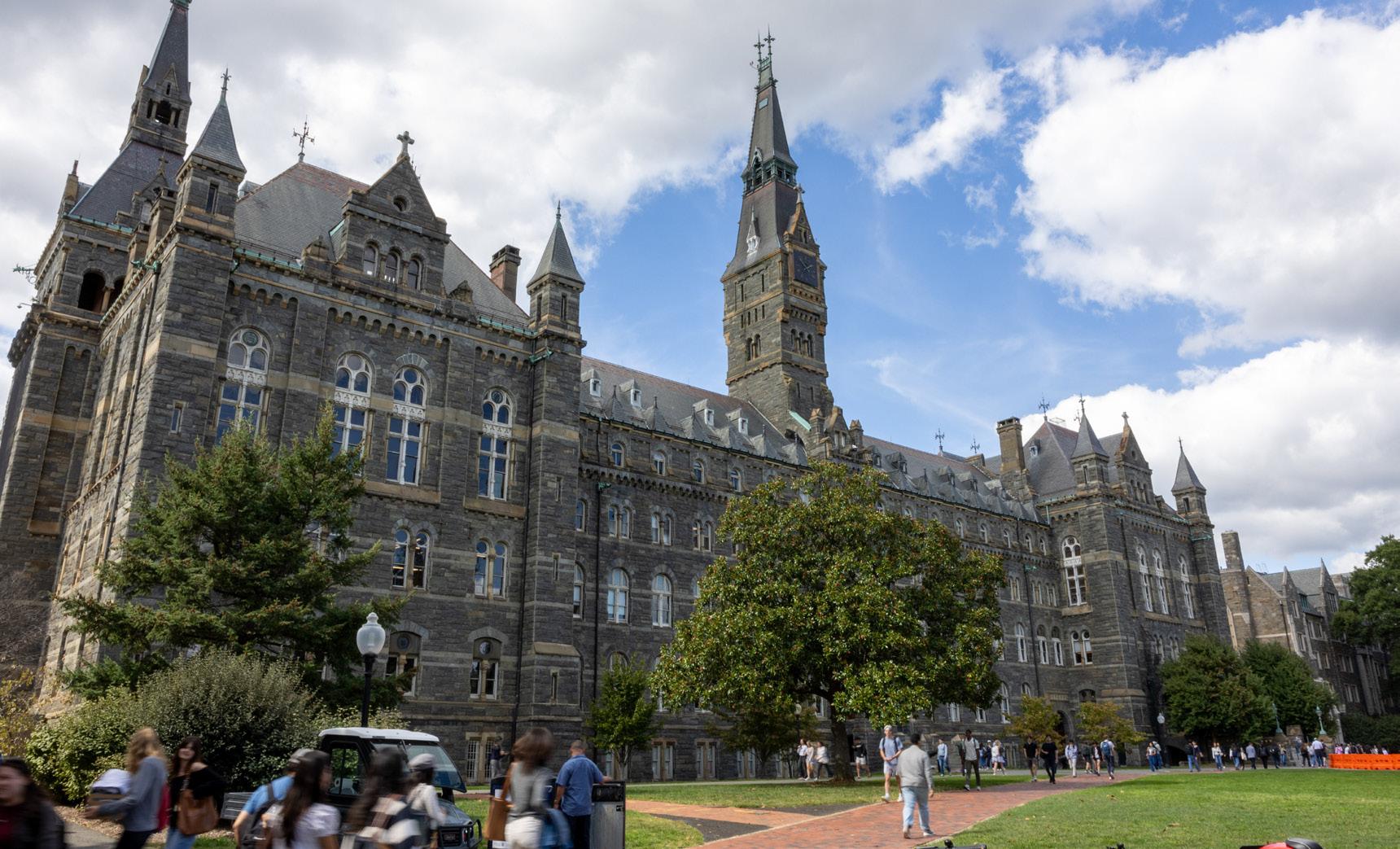
College to Launch Interdisciplinary AI Certificate Program in Fall 2026
Luke O’Connor
Special to The Hoya
The Georgetown University College of Arts & Sciences (CAS) will launch an artifcial intelligence (AI) certifcate program for undergraduate students beginning in Fall 2026, the university announced March 17. The College’s new nine-credit certifcate will consist of three classes focusing on diferent aspects of AI usage. The certifcate aims to provide students with a liberal arts approach to AI through ethical, practical and interdisciplinary lenses.
Sue Lorenson, the College’s vice dean for undergraduate education, said the three-course format was intentionally designed to expose students to the diferent facets of AI.
“We wanted to lean into what Georgetown generally, and the College of Arts & Sciences in particular, does well: an interdisciplinary, liberal arts approach to big questions,” Lorenson wrote to The Hoya. “We weren’t trying to replicate what a school of engineering or computer science would do; we wanted to do what we could ofer that those programs can’t.”
The certifcate’s courses include “The Problem of AI,” which focuses on the ethical and social intersections of AI; “The Science of AI,” which examines the mechanisms and boundaries of AI; and “The Applications of AI,” which explores the practical implementation of AI.
David Edelstein, dean of the College, said the combination of technical and social coursework sets the certifcate apart from similar programs at other universities.
“The three categories of courses comprising the certificate — the science of AI, the applications of AI and the problem of AI — include both the technical aspects of AI, but also attention to its societal and ethical implications,” Edelstein wrote to The Hoya. “That attention — and the humanistic foundation that informs it — distinguishes the College’s liberal arts approach to these issues.”
The certificate follows a Feb. 23 announcement from interim President Robert M. Groves to gradually incorporate Gemini, Google’s AI assistant and other generative AI tools into university programs and processes to aid faculty, staff and students. Lorenson said the three domains are designed to work in collaboration with one another.
“It’s a three-legged stool: A student who takes only the ethics course may leave without sufficient technical grounding to evaluate the claims they’re critiquing,” Lorenson wrote. “A student who only takes the science course may leave without the frameworks to ask whether any of it should be built in the first place. And a student who only learns to use AI tools fluently in a particular field, without the ethical or technical foundations, is just a power-user, not a thoughtful one.”
Zach Krivonak (CAS ’29), a current government student in the College who has closely followed the development of AI, said his classes have already begun to grapple with AI.
“My ethics professor has already had two assignments where we’ve had to incorporate AI in some way,” Krivonak told The Hoya. “One of them was to interview AI and test its ethical boundaries and then the other one
GU Financial Research Center Selects Former Federal O cial as New Leader
Noah De Haan Campus Life Desk Editor
A former U.S. government oficial assumed the role of the executive director of Georgetown University’s Psaros Center for Financial Markets and Policy on March 23.
Michael Piwowar (GRD ’94), who previously served on the U.S. Securities and Exchange Commission (SEC) and was most recently a senior advisor at the Milken Institute, an economic think tank, began the new position March 23. Georgetown established the Psaros Center, a hub for research and leadership in economic policy within the McDonough School of Business (MSB), following the Great Recession of 2008, to focus on thought leadership at the intersection of finance and policy.
Piwowar said being appointed executive director is a major accomplishment and culminates decades of his work in finance and with the center.
“It’s sort of a capstone in my career,” Piwowar told The Hoya. “I’ve been an academic and I’ve worked at the intersection of fnancial markets and policy my entire career. I’ve worked with the center in various capacities over the past several years — I’ve been a distinguished fellow, I’ve been on the advisory board — and when the opportunity came up, it was just the perfect time and the perfect opportunity for me to join.”
After earning his doctorate degree from Pennsylvania State University, Piwowar worked as a professor at Iowa State University before entering the public sector. Following his time at the SEC, Piwowar began working at the Milken Institute while remaining on the Psaros Center’s advisory board.
Reena Aggarwal, the Psaros Center’s founding director, said
she created the center to foster fnancial leadership and combine research with policymaking.
“I started the center with the global fnancial crisis 15 years ago, when there was a leadership void inside of the fnancial sector and policy area,” Aggarwal told The Hoya. “My belief was that Georgetown has to be responsible and step up and help both market participants and policy makers after the crisis.”
“Georgetown is very well known in policy, Georgetown is very well known in fnance and it brings both fnance and policy together,” Aggarwal added. “It’s a huge competitive advantage for us at Georgetown.”
Aggarwal said Piwowar’s experience in both the public and private sectors — including serving as the executive director of the Milken Institute and on the Council of Economic Advisers for Presidents George W. Bush and Barack Obama — prepared him to take on the executive role.
“He has been in the policy and regulatory world at the highest levels for a long time, including at the Securities and Exchange Commission and the White House,” Aggarwal said. “He has a tremendous background in the policy world. He also has really good connections to the private sector, and he appreciates an academic institution.”
“He understands Georgetown’s values, and he embraces them,” Aggarwal added. “He works very collaboratively, and he’s known as a thought leader. It was an easy decision.”
Maude Ashra, one of the center’s associate directors, said Psaros flls a gap in nonpartisan fnancial research, and Piwowar’s experience in academics will enhance the center.
“We really want to be the destination, and we’re kind of unique in our own way,” Ashra told The
Hoya. There are no other centers like this in any other institutions — if we talk about think tanks, they’re always one way or the other, Democrat or Republican, and we’re kind of right in the middle there, unbiased.” Piwowar, who had Aggarwal as a professor while earning his master’s of business administration (MBA) at Georgetown, said she directly infuenced his decision to pursue a career in fnance.
“I was a student back in the 1990s and Professor Agarwal was my core MBA fnance professor,” Piwowar said. “Up until that point, I hadn’t really considered fnance in terms of a career. I had my background, my undergraduate was in liberal arts, and I really liked economics and statistics, but I hadn’t really had exposure to fnance, and that was really where my love and passion for fnance began.”
“I’ve always remained connected with Reena in various ways, and when she started the center in 2008 I was so happy to see her do that,” Piwowar added.
Aggarwal said having two former students directly involved with the center is gratifying.
“One former student, Mike Psaros, made the investment and made the Psaros center possible because of the transformational gift and commitment,” Aggarwal said. “Then to have another student — Mike Piwowar, another former student of mine — to come in and lead the center in the next phase and be the executive director, as a professor it’s just so rewarding and satisfying. Two very distinguished people who have had amazing careers, and they come together in different ways to really take Georgetown to the next level.”
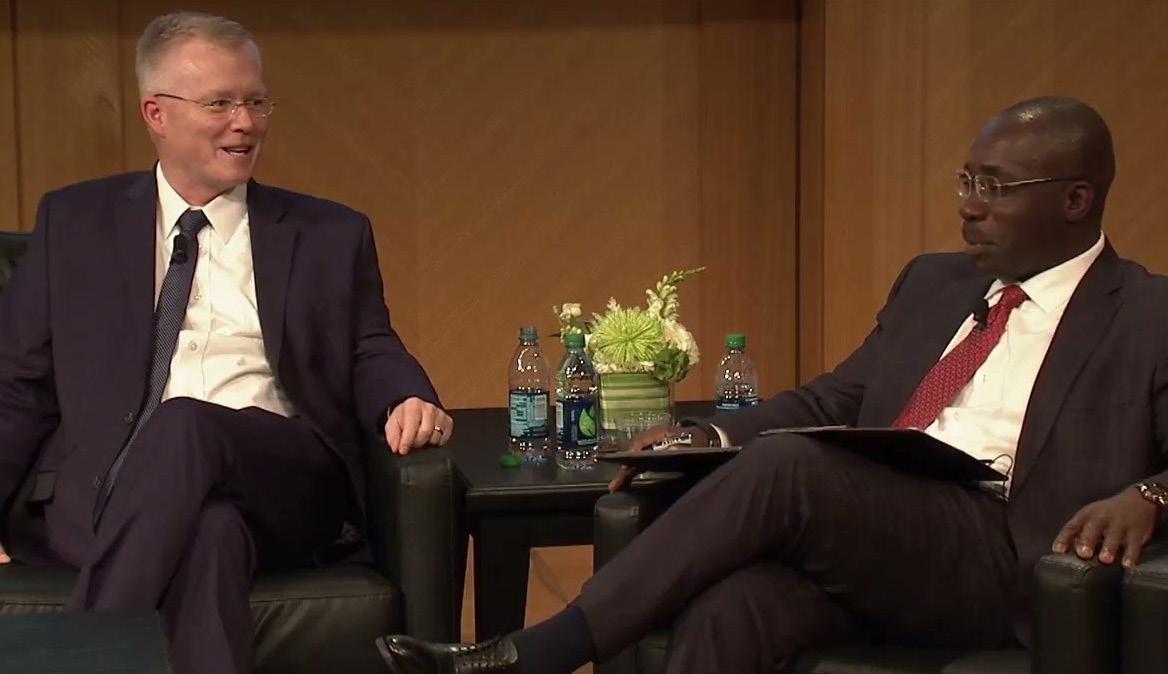
GUSA Senate Rejects Student Activity Fee Limitations, Passes 2027 Budget
Sofia Thomas GUSA Desk Editor
was also an interview about interviewing a person and using AI with that, so it’s shown up in coursework.”
Lorenson said students will be able to tailor the certifcate to their own academic interests.
“The certificate is intentionally choose-your-own-adventure,” Lorenson wrote. “A computer science student might already have the technical background, but then become intrigued by the policy or ethics angle, while another student might take an ethics of AI course as a core requirement and then realize they want to learn more about how AI works (science) and is being used (applications).”
Krivonak said the certifcate may be useful for students interested in technology.
“I could see where this would be useful for all people, particularly if they have an interest in technology or are taking the tech and ethics minor, which is pretty popular, so I could see that being important there,” Krivonak said.
Lorenson said she hopes students will connect what they learn from the certifcate to their individual academic interests.
“A government major might leave the program with a better understanding of how AI affects democratic institutions, national security, regulation, and public decision-making,” Lorenson wrote. “A biology or pre-med student might focus on how AI is transforming scientific research and healthcare delivery.”
“What we hope every student shares, regardless of their starting point, is the capacity to think critically and carefully about AI’s role in their field and in the world,” Lorenson said.
The Georgetown University Student Association (GUSA) Senate approved the final budget for fiscal year 2027, but rejected legislation that would limit the percentage of funds that can be allocated to advisory boards at its March 22 meeting.
The senate voted down a bylaw amendment that would prevent the Financial Appropriations Committee (FinApp) from allocating more than 35% of the Student Activities Fee (SAF) fund, the fund that supports undergraduate organizations, to a single advisory board. The senate then unanimously approved FinApp’s $1.3 million budget for FY 2027, which fulflled 71.3% of recipients’ budget requests.
This fulfillment marked a 13.1% decrease from the previous fiscal year, in which 84.4% of requests were met.
Senator James Beit (MSB ʼ26), who introduced the allocation cap bill, said it is important FinApp does not allocate the Student Activities Commission (SAC), an advisory board that serves the majority of student organizations, more of the SAF fund than in previous years.
“By and large, I think there are many problems with the FinApp process,” Beit said at the meeting. “I will say we’re doing the best job we can do. However, I do not think we can do such a job if we were to allocate SAC even more money than we do now.”
SAC received $400,000 for FY 2027, which is 30.03% of the total budget. In FY 2026, SAC received $395,000, which was 29.66% of the total FY 2026 budget.
Han Li (CAS, McCourt ʼ26), FinApp chair, said placing a cap on allocations limits FinApp’s abili-
ty to serve student organizations and adequately allocate the budget among organizations.
“Every single one of them has different needs,” Li said at the meeting. “Every single one of them serves different interests on campus, with different kinds of students, and when they come in and ask us for funding, we treat every single one individually. Having any sort of overarching, like all groups must adhere to this policy for allocation, handicaps our ability to actually do our jobs as the ones allocating the budget.”
Tyler Chase (SFS ʼ28), FinApp’s vice chair, said a cap on allocation would unfairly limit student advisory boards that require more funding, such as SAC and the Advisory Board for Club Sports (ABCS).
“I think the main goal of the FinApp committee is to ensure that every dollar does the most for the student body that it can,” Chase said at the meeting. “And with that said, I think to put a cut-off at 30 or 35% — it’s arbitrary and directly opposed to that goal. I think you’re limiting people, even if they’re possibly doing the best work and I don’t see why we should be punishing SAC or the larger groups for being larger groups.”
Beit said the bill creates a cap to ensure that FinApp does not allocate more than 35% of the SAF to any single advisory board.
“For the past four years, we’ve hovered around this 30% mark,” Beit said. “On this bill, our cap is 35%, something we’ve not done in the last four years. I honestly think we need to reevaluate how we run FinApp as a process if we’re going to give any one group more than 35% of the funding, especially when our oversight is so limited.”
allocation cap bill failed
ʼ28), Constantine Filippatos (SFS ʼ29), Jacob Intrator (CAS ʼ27) and Beit voted in favor of it. While increasing investment in other boards, the fnal budget cut $13,182 — a 13.88% decrease from the previous fscal year — from the Media Board, which allocates funding to student publications. Li said FinApp cut funding from the Media Board to add oversight on the annual spring concert hosted by WGTB, a student-run radio station.
“The Media Board cut is primarily because we just don’t want them to do the spring concert the way they’ve been doing it,” Li said. “When they try to outsource to another outside performer, it can cost a lot of money. So we totally scrapped that event, changed that budget. So the entirety
The
6-15; only Senators Christian Spadini (CAS ʼ26), Asha Gudipaty (CAS, McCourt ʼ27), Zadie Weaver (CAS
Michael Piwowar (GRD ’94), who previously served as an advisor for the Securities
Exchange Commission (SEC), assumed the role of executive director of the Psaros Center March 23.
HAAN JUN (RYAN) LEE/THE HOYA
The College of Arts & Sciences (CAS) will be launching a nine-credit certificate focused on the interdisciplinary aspects of artificial intelligence (AI) usage beginning in Fall 2026.
Before Entering Portal, Lewis Was a Key Player
LEWIS, from A12
you’re seeing your star players leave the team, it kind of discourages students to really feel dedicated to their program if their star players aren’t feeling that same dedication,” Sparacino told The Hoya Lewis’ departure reflects a broader challenge facing college basketball in the past few years. The rotation of players through the transfer portal is not an issue isolated to Georgetown. Between the 2019-2020 and 20232024 seasons, men’s basketball transfer portal entries increased 78.24%.
Mike Fahy (SFS ’27) said, while disheartening, Lewis’ decision didn’t come as a shock.
“It’s obviously disappointing as a Hoya fan to see such a great player leave the program,” Fahy wrote to The Hoya. “But I wouldn’t say that I’m completely surprised by the move, given the propensity of transfers in college basketball right now.”
With the transfer portal oficially opening April 7, Cooley will need to explore all available options to fll the gap in production
left by Lewis’ departure. The roster makeup is further complicated by uncertainty surrounding senior center Vince Iwuchukwu, who will need the NCAA to grant an eligibility waiver to return for another season.
Some fans expressed confdence in Georgetown’s staf based on previous transfer portal recruits.
“His portal track record is great with Peavy last year and KJ this year, so I have faith in the results of the next few months,” Hassner added.
Others, including Sparacino, said there is a need for greater program success to drive player retention.
“Maybe we could start winning, that would be huge,” Sparacino said. “If we started winning, people wouldn’t leave.”
Despite clear uncertainty facing Georgetown’s roster, Fahy said he recognizes that ofseason roster revitalizations are possible in modern college basketball.
“In the current college basketball environment, teams can undergo quick turnarounds with one successful ofseason,” Fahy said.
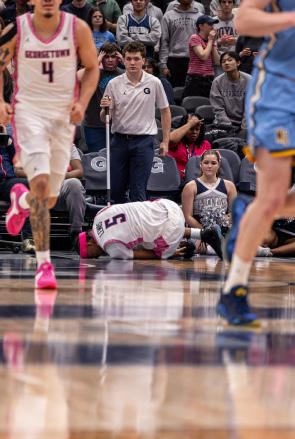

MEN’S LACROSSE
Syracuse Shuts Down Hoyas’ O ensive Star Power
SYRACUSE, from A12
Rory Connor scored his first goal of the day to snap Syracuse’s scoring streak with 2:21 remaining until halftime.Just8secondslater,Codywon the faceoff and carried the ball down the field, scoring his first career goal and giving the Hoyas a much-needed boost to keep the game within striking distance at 12-6 going into the break.
The Orange continued to showcase their talented ofense in the second half, scoring 3 straight goals in the frst eight minutes of the third period to go up 15-6 on the Hoyas. After Syracuse was called for an illegal cross-check, sophomore attacker Jack Ransom caught defenders out of position to put Georgetown back on the board at 6:24. Ransom scored again just 50 seconds later, followed by a Liam Connor goal at 3:23.
Rory Connor scored with just over two minutes remaining to make it a 5-goal game, but his younger brother Liam was handed an unsportsmanlike conduct penalty in a scrum after the goal. Syracuse midfielder Luke Rhoa capitalized on the extra-man opportunity just 20 seconds later, putting the Orange up 16-10. With 25 seconds remaining in the third period, Hottle scored to increase Syracuse’s lead to 7.
Georgetown junior midfielder Jack Schubert scored midway through the fourth period, injecting some life back
into the Hoya squad. At 7:11, Liam Connor scored Georgetown’s third man-up goal of the year to bring the score to 17-12. Syracuse was called for more penalties as the game drew to a close, but the Hoyas were unable to convert. The final goal of the game came when Orange midfielder Michael Leo, while Syracuse was down a man, caught junior goalkeeper Anderson Moore out of position to put the Orange up 18-12. Despite the loss, Liam Connor continued his strong campaign, recording 2 goals and 5 assists. Additionally, first-years Cody and Bickel each scored, while first-year Mason found the back of the net twice. Georgetown’s leading scorer and NCAA goals-per-game leader Rory Connor was held to only 2 goals.
Warne said that limiting the Hoyas’ offensive stars was a key strategy for the Syracuse defense.
“Every coach wants to scheme for a guy not to have any points. But I think limiting and earning goals is something every coach wants to do defensively. If they’re going to get it, they’re going to earn it,” Warne said at the post-game press conference.
“I think he did an awesome job of just keeping us out of rhythm.”
The Hoyas remain on the road, traveling to Colorado next Saturday, March 28, to open up Big East play against the No. 14 University of Denver, a tough squad that has played recent top-ranked teams down to the wire.
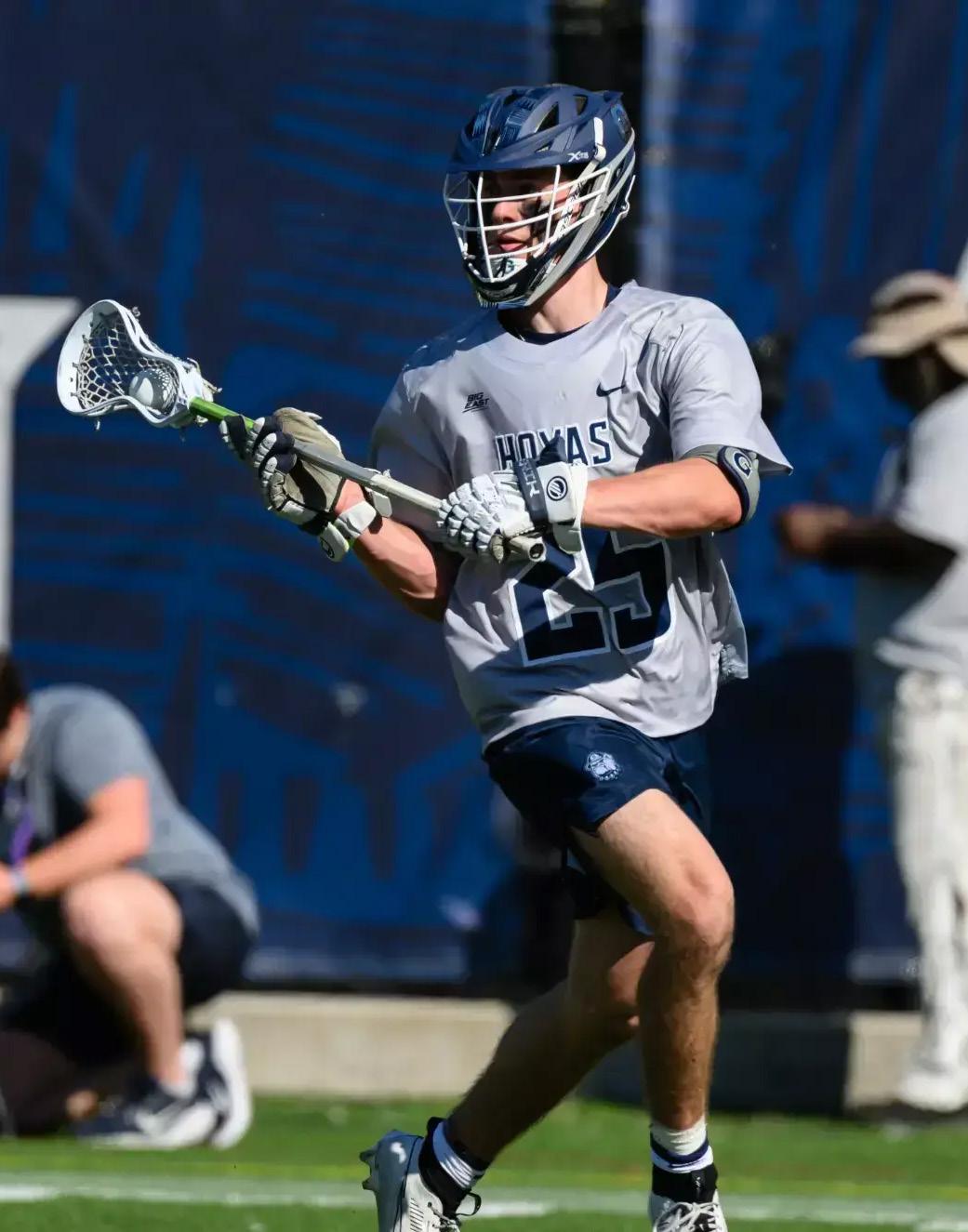
Hayden Cody (above) scored once, but the Hoyas were unable to keep up with Syracuse’s high-flying offense.
Late Rally Powers Hoyas to 1-Goal Victory over MU
from A12
MARQUETTE,
Golden Eagles 7-5 lead going into the half.
Georgetown showed a revitalized defensive presence after halftime. The Hoyas tightened their coverage and began forcing turnovers, with contributions across the unit from sophomore defender Christina King, junior midfelder Reagan Ziegler and sophomore defender Izzy Appelt. Early in the third quarter, Marquette momentarily increased its advantage to 3, but Georgetown responded quickly. Driggs’ assist on a goal by frst-year midfelder Betsy Burton ignited the Hoyas’ ofense, and junior midfelder Danica Blix’s subsequent goal reduced the margin to 1.
After Marquette extended its lead to 9-7, Georgetown made a vital comeback in the fnal seconds of the third quarter. Driggs scored her fourth goal of the afternoon on a man-up feed from Burton, bringing the Hoyas within 1 at 9-8 heading into the last period.
Georgetown dominated in the fourth quarter. Junior attacker Lauren Steer started the scoring with a composed free-position goal, equalizing the game at 9-9. Driggs scored again less than a minute later, fnishing on a pass from Davies to give
the Hoyas their frst lead since the second quarter. Georgetown kept the pressure, and with 7:37 left, Davies scored the game-winning goal to increase the Hoyas’ advantage to 11-9. Marquette responded with a goal to trim the lead to 1 and applied pressure in the fnal minutes, refusing to go quietly. But when it mattered most, Georgetown’s defense held frm. The defensive unit continuously disrupted Marquette’s fow and cleared the ball well. Graduate goalkeeper Leah Warehime led the efort with multiple pivotal stops down the stretch, including a critical save on a free position. Driggs led a well-rounded Georgetown attack with 5 points on 4 goals and 1 assist. Burton added a goal and an assist, while Davies earned 3 points, including the game-winning goal. King dominated the ground ball game on defense, and the Hoyas recorded turnovers from seven diferent players in a well-coordinated team efort. Warehime fnished with 12 saves in the cage, playing a pivotal role in preserving the narrow victory. With the win, the Hoyas will return to the Hilltop to host the University of Connecticut Huskies (3-6, 0-1 Big East) on Saturday, March 28, at noon.
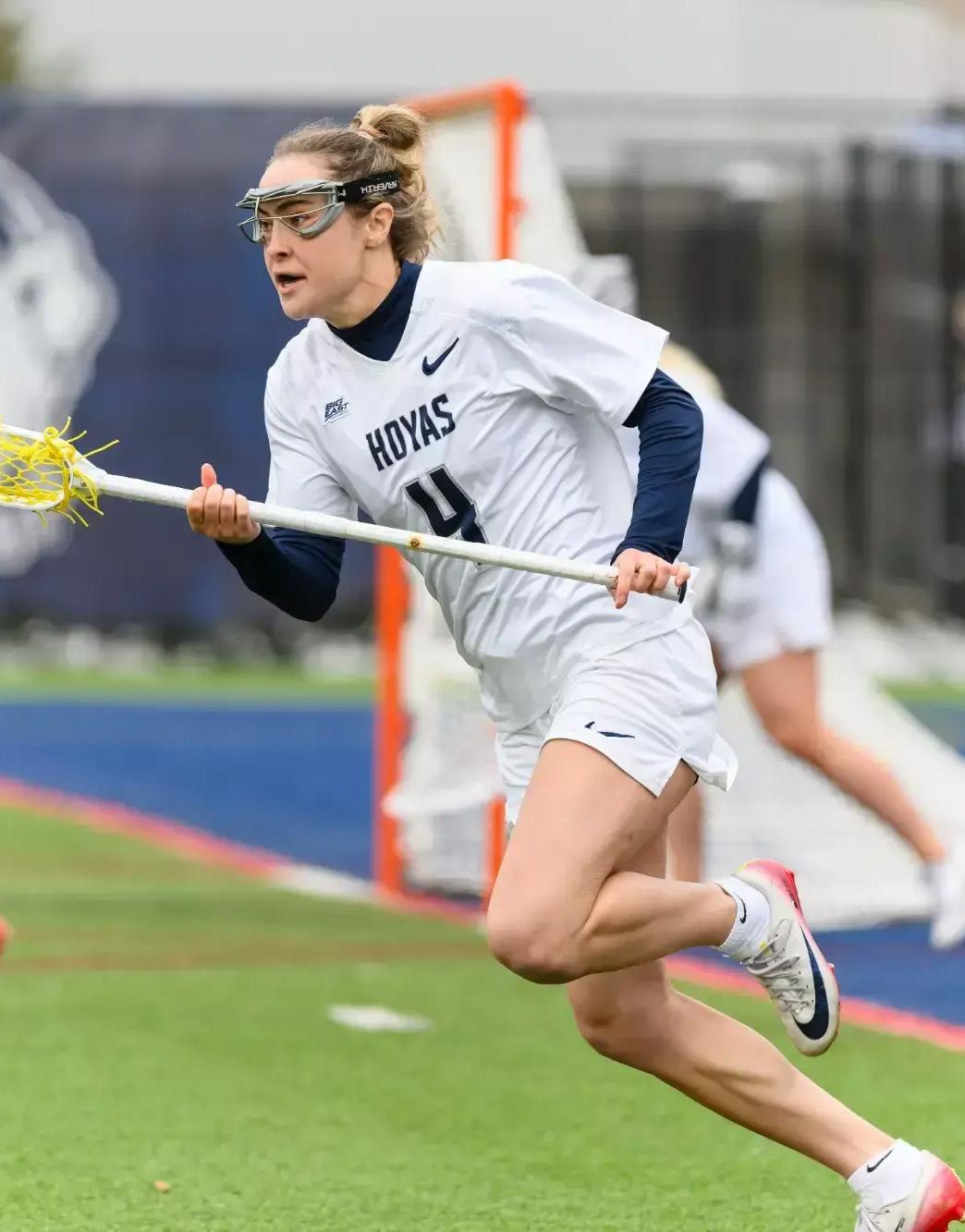
YOUNGSTOWN, from A12
hit from senior left felder Tra-
vis Ilitch created a scoring opportunity before Peek drove in a run with a groundout, and Shefield followed with an RBI single to center. The two-run inning was defned by contact and situational execution rather than extra-base power — an intentional approach stemming from runners left on base during games one and two of the series.
“After Friday night, we had left so many guys on base, I challenged them ofensively to say, ‘Hey, we gotta put the ball in play,’” Georgetown Head Coach Edwin Thompson told The Hoya postgame.
After Seid exited, Georgetown turned to its bullpen, which has been a strength for much of the season but had shown signs of inconsistency in recent close games.
First-year right-hander Max Whitmer entered in the seventh and recorded two quick outs, with one coming on a highlight reel leaping grab from Ilitch at the wall in left feld. However, Alex Jang spoiled the inning with a two-out solo home run, cutting into the lead as the ball continued to carry in the warm weather. Whitmer limited the damage afterward, keeping Georgetown ahead and in control of the game.
The exclamation point for the Hoyas came in the bottom
of the seventh, when they took full advantage of a series of defensive and pitching miscues by Youngstown State.
After working two outs, the Penguins appeared close to escaping the inning before a passed ball shifted the momentum. Solomon delivered again, driving a double into the gap to bring home a run. From there, the inning unraveled for Youngstown State. Reliever Jake Ferretti struggled to fnd the zone, issuing multiple walks and committing a balk before a throwing error brought in another run without a ball leaving the infeld. Georgetown continued to apply pressure, putting balls in play and forcing the Penguins to execute defensively, which they failed spectacularly to do. By the time Youngstown brought in a third pitcher in the inning, the Hoyas had added two more runs and clearly had all of the momentum in their favor. By the top of the eighth, it was clear the bullpen had shaken of any previous rough outings and frmly limited any chance of a Penguin comeback. Sophomore right-hander Ethan Rucker delivered a clean eighth inning, getting 2 batters to strike out, which reset the tone after the earlier home run. In the bottom half, Georgetown threatened again, but a well-executed 1-6-3 double play ended the inning.
Thompson also emphasized the collective efort behind the performance.
“We don’t just have one guy; guys step up through the weekend, and I’m really proud of how we competed,” Thompson said postgame. “We’re all in on being our team, helping our team win in whatever way possible.”
With the multi-run lead heading into the ninth, Georgetown turned to senior closer Andrew Jergins for the last half frame. The Hoyas got the fnal 3 outs without issue, with Seid picking up the win and Jergins the save, while improving their record to 15-10 on the season. Georgetown will be back on the diamond Friday, March 27, when they head to Greensboro, N.C., for a three-game series against North Carolina A&T (5-18).
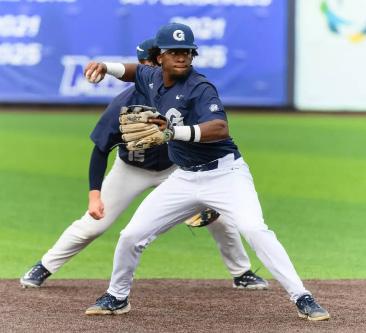
ART PITTMAN/GEORGETOWN ATHLETICS
Danica Blix (above) scored against Marquette for the win.
Before Entering Portal, Lewis Was a Key Player
LEWIS, from A12
you’re seeing your star players leave the team, it kind of discourages students to really feel dedicated to their program if their star players aren’t feeling that same dedication,” Sparacino told The Hoya Lewis’ departure reflects a broader challenge facing college basketball in the past few years. The rotation of players through the transfer portal is not an issue isolated to Georgetown. Between the 2019-2020 and 20232024 seasons, men’s basketball transfer portal entries increased 78.24%.
Mike Fahy (SFS ’27) said, while disheartening, Lewis’ decision didn’t come as a shock.
“It’s obviously disappointing as a Hoya fan to see such a great player leave the program,” Fahy wrote to The Hoya. “But I wouldn’t say that I’m completely surprised by the move, given the propensity of transfers in college basketball right now.”
With the transfer portal oficially opening April 7, Cooley will need to explore all available options to fll the gap in production
left by Lewis’ departure. The roster makeup is further complicated by uncertainty surrounding senior center Vince Iwuchukwu, who will need the NCAA to grant an eligibility waiver to return for another season.
Some fans expressed confdence in Georgetown’s staf based on previous transfer portal recruits.
“His portal track record is great with Peavy last year and KJ this year, so I have faith in the results of the next few months,” Hassner added.
Others, including Sparacino, said there is a need for greater program success to drive player retention.
“Maybe we could start winning, that would be huge,” Sparacino said. “If we started winning, people wouldn’t leave.”
Despite clear uncertainty facing Georgetown’s roster, Fahy said he recognizes that ofseason roster revitalizations are possible in modern college basketball.
“In the current college basketball environment, teams can undergo quick turnarounds with one successful ofseason,” Fahy said.
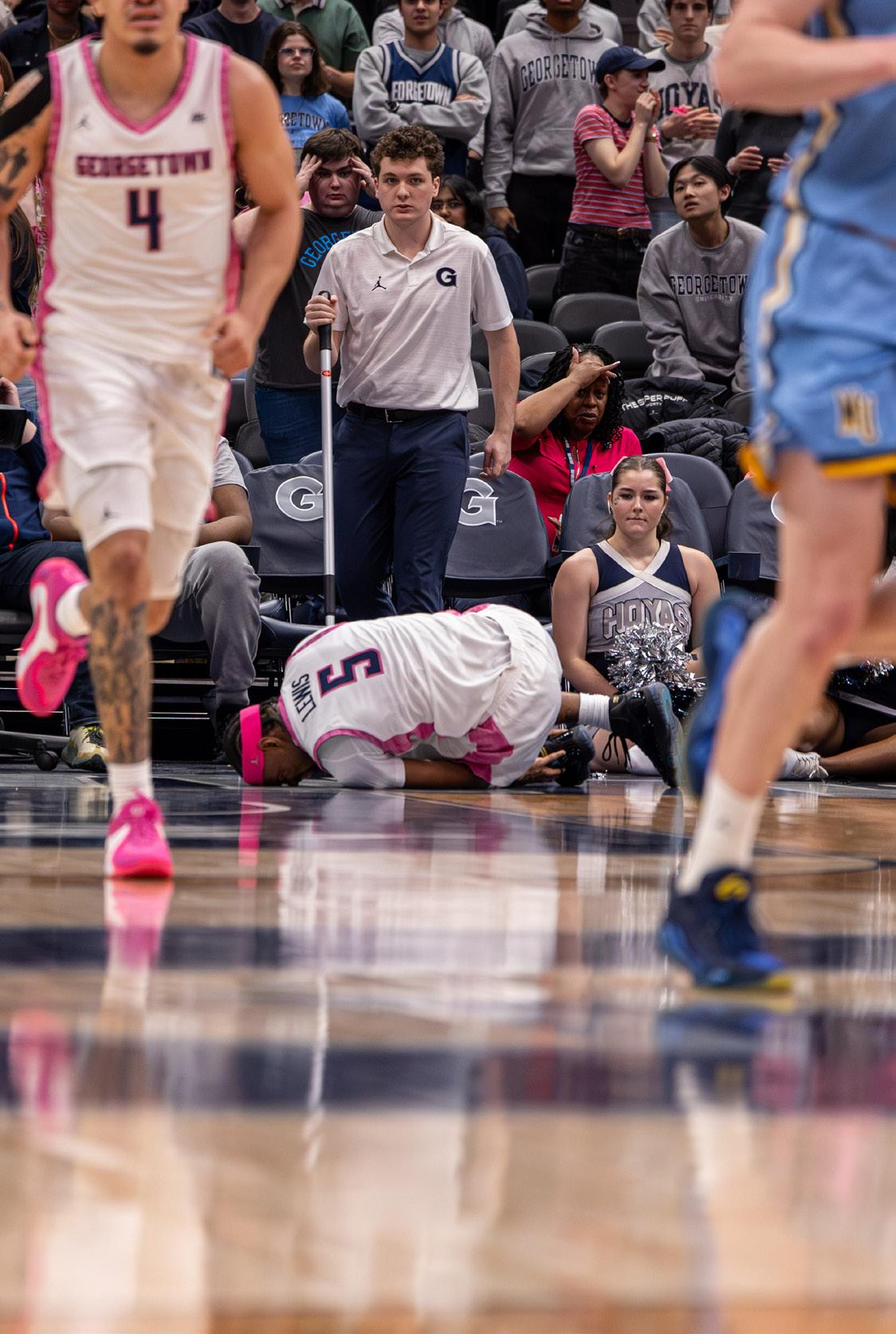
MEN’S LACROSSE
Syracuse Shuts Down Hoyas’ O ensive Star Power
SYRACUSE, from A12
a few and roll with it,” Warne added.
Rory Connor scored his first goal of the day to snap Syracuse’s scoring streak with 2:21 remaining until halftime.Just8secondslater,Codywon the faceoff and carried the ball down the field, scoring his first career goal and giving the Hoyas a much-needed boost to keep the game within striking distance at 12-6 going into the break.
The Orange continued to showcase their talented offense in the second half, scoring 3 straight goals in the first eight minutes of the third period to go up 15-6 on the Hoyas. After Syracuse was called for an illegal cross-check, sophomore attacker Jack Ransom caught defenders out of position to put Georgetown back on the board at 6:24. Ransom scored again just 50 seconds later, followed by a Liam Connor goal at 3:23.
Rory Connor scored with just over two minutes remaining to make it a 5-goal game, but his younger brother Liam was handed an unsportsmanlike conduct penalty in a scrum after the goal. Syracuse midfielder Luke Rhoa capitalized on the extra-man opportunity just 20 seconds later, putting the Orange up 16-10. With 25 seconds remaining in the third period, Hottle scored to increase Syracuse’s lead to 7.
Georgetown junior midfielder Jack Schubert scored midway through the fourth period, injecting some life back
into the Hoya squad. At 7:11, Liam Connor scored Georgetown’s third man-up goal of the year to bring the score to 17-12. Syracuse was called for more penalties as the game drew to a close, but the Hoyas were unable to convert. The final goal of the game came when Orange midfielder Michael Leo, while Syracuse was down a man, caught junior goalkeeper Anderson Moore out of position to put the Orange up 18-12.
Despite the loss, Liam Connor continued his strong campaign, recording 2 goals and 5 assists. Additionally, first-years Cody and Bickel each scored, while first-year Mason found the back of the net twice. Georgetown’s leading scorer and NCAA goals-per-game leader Rory Connor was held to only 2 goals.
Warne said that limiting the Hoyas’ offensive stars was a key strategy for the Syracuse defense.
“Every coach wants to scheme for a guy not to have any points. But I think limiting and earning goals is something every coach wants to do defensively. If they’re going to get it, they’re going to earn it,” Warne said at the post-game press conference.
“I think he did an awesome job of just keeping us out of rhythm.”
The Hoyas remain on the road, traveling to Colorado next Saturday, March 28, to open up Big East play against the No. 14 University of Denver, a tough squad that has played recent top-ranked teams down to the wire.
Hayden Cody (above) scored once, but the Hoyas were unable to keep up with Syracuse’s high-flying offense.
Late Rally Powers Hoyas to 1-Goal Victory over MU
MARQUETTE, from A12
Golden Eagles 7-5 lead going into the half.
Georgetown showed a revitalized defensive presence after halftime. The Hoyas tightened their coverage and began forcing turnovers, with contributions across the unit from sophomore defender Christina King, junior midfelder Reagan Ziegler and sophomore defender Izzy Appelt. Early in the third quarter, Marquette momentarily increased its advantage to 3, but Georgetown responded quickly. Driggs’ assist on a goal by frst-year midfelder Betsy Burton ignited the Hoyas’ ofense, and junior midfelder Danica Blix’s subsequent goal reduced the margin to 1.
After Marquette extended its lead to 9-7, Georgetown made a vital comeback in the fnal seconds of the third quarter. Driggs scored her fourth goal of the afternoon on a man-up feed from Burton, bringing the Hoyas within 1 at 9-8 heading into the last period.
Georgetown dominated in the fourth quarter. Junior attacker Lauren Steer started the scoring with a composed free-position goal, equalizing the game at 9-9. Driggs scored again less than a minute later, fnishing on a pass from Davies to give
the Hoyas their frst lead since the second quarter. Georgetown kept the pressure, and with 7:37 left, Davies scored the game-winning goal to increase the Hoyas’ advantage to 11-9. Marquette responded with a goal to trim the lead to 1 and applied pressure in the fnal minutes, refusing to go quietly. But when it mattered most, Georgetown’s defense held frm. The defensive unit continuously disrupted Marquette’s fow and cleared the ball well. Graduate goalkeeper Leah Warehime led the efort with multiple pivotal stops down the stretch, including a critical save on a free position. Driggs led a well-rounded Georgetown attack with 5 points on 4 goals and 1 assist. Burton added a goal and an assist, while Davies earned 3 points, including the game-winning goal. King dominated the ground ball game on defense, and the Hoyas recorded turnovers from seven diferent players in a well-coordinated team efort. Warehime fnished with 12 saves in the cage, playing a pivotal role in preserving the narrow victory. With the win, the Hoyas will return to the Hilltop to host the University of Connecticut Huskies (3-6, 0-1 Big East) on Saturday, March 28, at noon.
YOUNGSTOWN, from A12
hit from senior left felder Tra-
vis Ilitch created a scoring opportunity before Peek drove in a run with a groundout, and Shefield followed with an RBI single to center. The two-run inning was defned by contact and situational execution rather than extra-base power — an intentional approach stemming from runners left on base during games one and two of the series.
“After Friday night, we had left so many guys on base, I challenged them ofensively to say, ‘Hey, we gotta put the ball in play,’” Georgetown Head Coach Edwin Thompson told The Hoya postgame.
After Seid exited, Georgetown turned to its bullpen, which has been a strength for much of the season but had shown signs of inconsistency in recent close games.
First-year right-hander Max Whitmer entered in the seventh and recorded two quick outs, with one coming on a highlight reel leaping grab from Ilitch at the wall in left feld. However, Alex Jang spoiled the inning with a two-out solo home run, cutting into the lead as the ball continued to carry in the warm weather. Whitmer limited the damage afterward, keeping Georgetown ahead and in control of the game.
The exclamation point for the Hoyas came in the bottom
of the seventh, when they took full advantage of a series of defensive and pitching miscues by Youngstown State.
After working two outs, the Penguins appeared close to escaping the inning before a passed ball shifted the momentum. Solomon delivered again, driving a double into the gap to bring home a run. From there, the inning unraveled for Youngstown State. Reliever Jake Ferretti struggled to fnd the zone, issuing multiple walks and committing a balk before a throwing error brought in another run without a ball leaving the infeld. Georgetown continued to apply pressure, putting balls in play and forcing the Penguins to execute defensively, which they failed spectacularly to do. By the time Youngstown brought in a third pitcher in the inning, the Hoyas had added two more runs and clearly had all of the momentum in their favor. By the top of the eighth, it was clear the bullpen had shaken of any previous rough outings and frmly limited any chance of a Penguin comeback. Sophomore right-hander Ethan Rucker delivered a clean eighth inning, getting 2 batters to strike out, which reset the tone after the earlier home run. In the bottom half, Georgetown threatened again, but a well-executed 1-6-3 double play ended the inning.
Thompson also emphasized the collective efort behind the performance.
“We don’t just have one guy; guys step up through the weekend, and I’m really proud of how we competed,” Thompson said postgame. “We’re all in on being our team, helping our team win in whatever way possible.”
With the multi-run lead heading into the ninth, Georgetown turned to senior closer Andrew Jergins for the last half frame. The Hoyas got the fnal 3 outs without issue, with Seid picking up the win and Jergins the save, while improving their record to 15-10 on the season. Georgetown will be back on the diamond Friday, March 27, when they head to Greensboro, N.C., for a three-game series against North Carolina A&T (5-18).

ART PITTMAN/GEORGETOWN ATHLETICS
Danica Blix (above) scored against Marquette for the win.
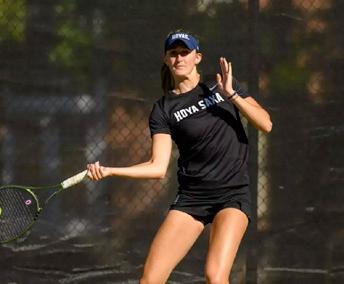
Hoyas Rally to Defeat Golden Eagles in Big East Opener
The No. 23 Georgetown University women’s lacrosse team opened Big East play in a dramatic fashion March 21, rallying for an 11-10 comeback win over the Marquette University Golden Eagles at Valley Fields in Milwaukee.
The Hoyas mounted a fourth-quarter surge on both sides of the feld to secure their frst Big East win of the season. Georgetown improved its overall record to 6-3 (1-0 Big East), while Marquette fell to 5-4 (0-1 Big East).
The contest began with a backand-forth intensity that did not let up. Georgetown scored just 35 seconds into the game, as senior attacker Gracie Driggs converted a free-position shot to give the Hoyas an early edge. Marquette responded less than two minutes later with a manup goal, setting the tone for the frst quarter with pendulum-like movement between the teams. A goal from junior attacker Anne McGovern and another from Driggs helped Georgetown maintain its pace, while frst-year attacker Molly Davies scored late in the frst to even the score at 4-4.
The Golden Eagles took control in the second quarter, taking advantage of the Hoyas’ mistakes and going on a three-goal run. Despite sophomore attacker Sophia Loschert’s crucial fnish in the second quarter, the Hoyas were unable to hold onto the ball for long stretches. Marquette’s heavy pressure resulted in several mistakes for the Hoyas, leading to a
See MARQUETTE, A11
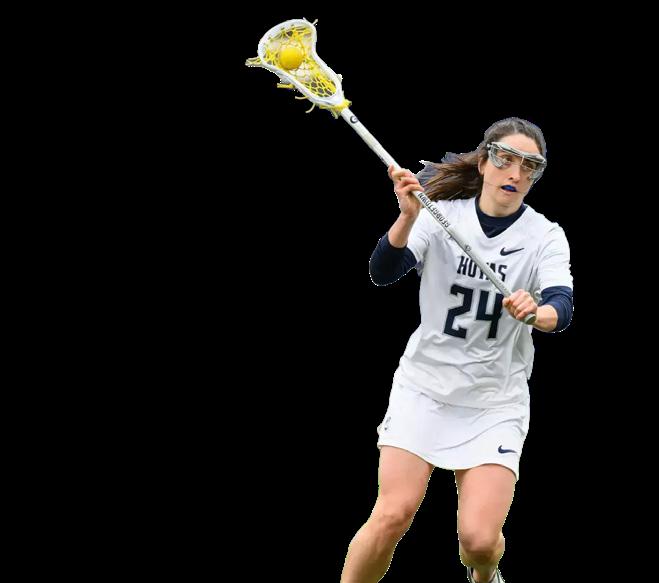
TALKING POINTS
Limiting
Georgetown vs. Connecticut
March 26 @ 12 p.m.
Cooper Field
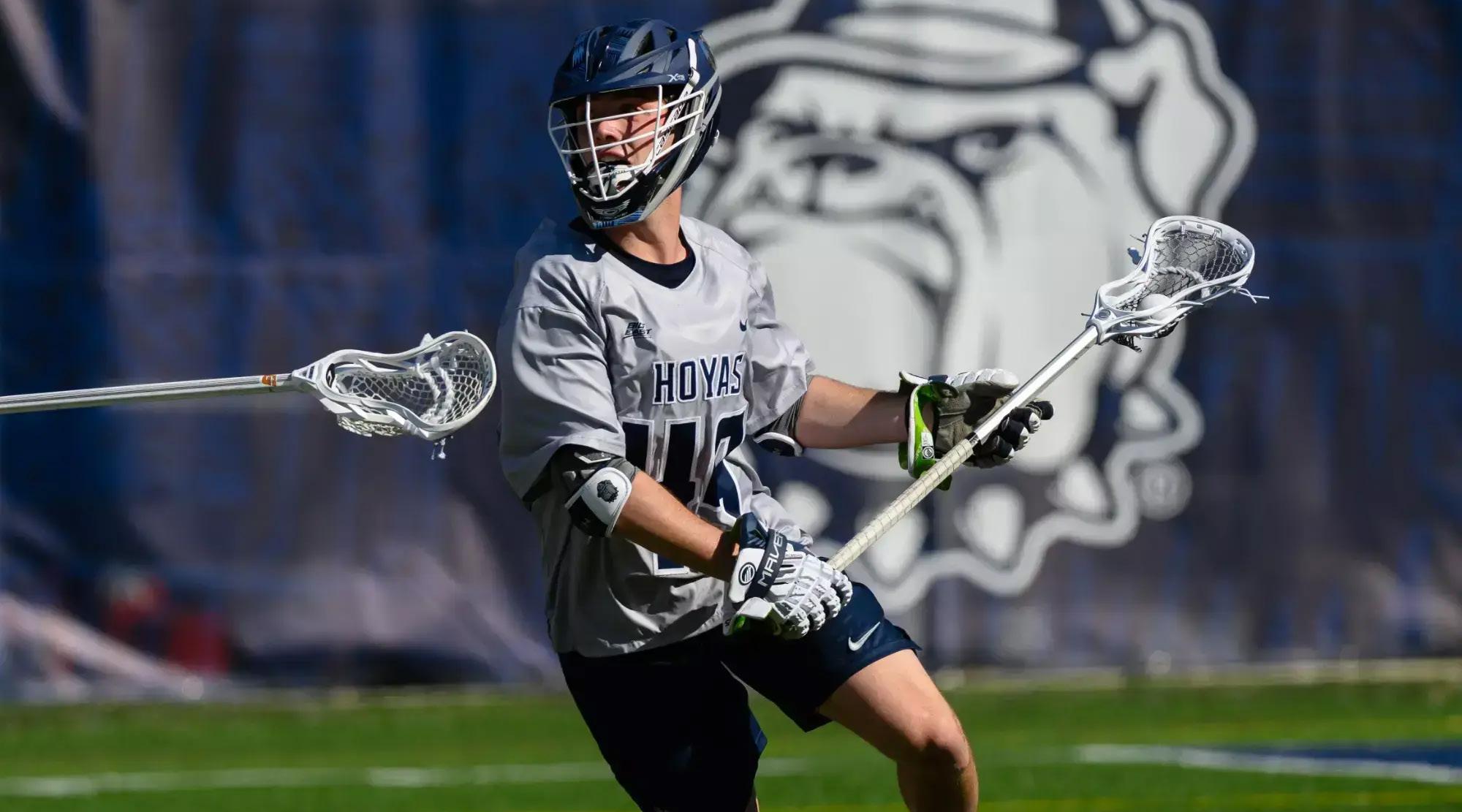
Jacob Nolan Hoya Staff Writer
Despite an early lead, the No. 13 Georgetown men’s lacrosse team failed to hold of the No. 8 Syracuse University Orange’s explosive ofense in an 18-12 loss on the road March 22. The matchup was the frst time since 2021 the Hoyas (3-4) squared of against the Orange (8-2) and marked only their second meeting since 2013. Before Syracuse left the Big East in 2013, the two teams met every year, but matchups between the rivals have been sparse since.
The Hoyas started the game strong, jumping out to an early 2-0 and then 3-1 lead. First-year midfelder Jake Bickel opened the scoring at 13:14 of a feed from junior attacker Liam Connor in front of the net. Senior midfelder Joe Cesare put Georgetown up 2-0 at 11:50 with his second goal of the year, again assisted by Connor. Syracuse midfelder Matt McIntee put the Orange on the board at 9:14, but frst-year Georgetown midfelder Natty Mason responded with his second goal of the season less than a minute later to put the Hoyas back
up by 2.
After graduate attacker Rory Connor was denied by the post on back-to-back shots, the Orange began to take control of the game. Syracuse midfelder Wyatt Hottle made it a 1-score game at 2:38 before Syracuse converted on their extra-man opportunity to tie the game up at 3-3 after frst-year faceof specialist Hayden Cody was called for a pushing penalty late in the period. Capitalizing on a turnover from junior midfelder James Carroll, Syracuse attacker Finn Thomson scored with just 27 seconds left in the period to give the
Lewis to Transfer, GU Students Bid Farewell
Just
Lewis’ deparure, first reported on March 24, marks the first roster change at the start of a critical offseason for the Hoyas as they enter year four of Head Coach Ed Cooley’s rebuild.
Lewis, who was named to the allBig East third team March 8, led the Hoyas in scoring this season, averaging 14.9 points, 5.0 rebounds and 2.5 assists per game before he suffered an ankle injury in February.
Before transferring to Georgetown last year, Lewis played for the University of Arizona, where he averaged 6.1 points as a first-year and 10.8 points as a sophomore. A versatile guard, his transfer to Georgetown was viewed as a key addition to the Hoyas’ roster. Students and fans are responding to Lewis’ announcement with both appreciation for his impact and concern about Georgetown basketball’s future. Nicole Hogge (SON ’27), vice president of Hoya Blue, said Lewis had a strong infuence on the program.
“While we are disappointed to see that KJ Lewis has entered the transfer portal, Hoya Blue is grateful for the year KJ has spent at Georgetown,” Hogge wrote to The Hoya. “He was a great addition to the team, to the program and truly embodied the Georgetown spirit.”
Others pointed to Lewis’ oncourt impact this season.
Michael Hassner (SFS ’28), as-
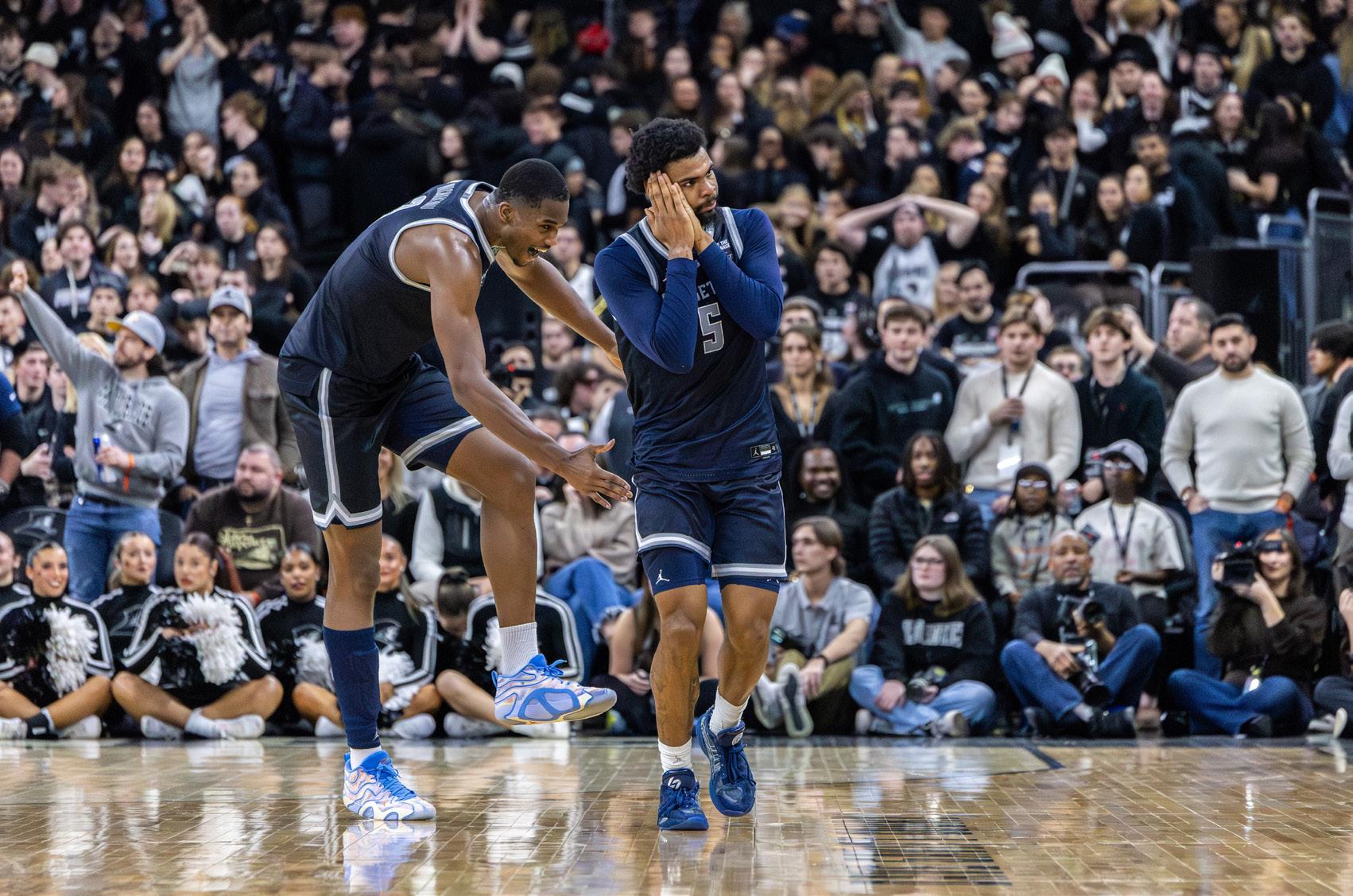
sistant conductor and manager for the Georgetown University Pep Band, said Lewis was a key two-way player for the Hoyas. “I think he was really great for Georgetown, and a force on both ofense and defense,” Hassner wrote to The Hoya At the same time, Hassner noted that Georgetown showed signs of growth without Lewis after he sustained a season-ending left ankle injury Feb. 24. In his absence, the No. 11
seed Hoyas upset the Big East tournament’s No. 6 seed DePaul University and No. 3 seed Villanova University. This stretch of play contributed to a complex response from fans that considered both Lewis’ individual skill and the possibility of the Hoyas succeeding without him. Still, some students expressed concern about how increased roster turnover affects fan engagement, an issue that has plagued the Hoyas for years — this season, home games
averaged a reported attendance of 5,862. Meanwhile, from 2005 to 2013, reported home game attendance consistently averaged over 10,000. Briana Sparacino (SFS ’25, GRD ’26), a former Hoya Blue board member, said continuously rotating rosters makes the team harder to connect with.
“I think constantly having a changing roster, where from year to year,
Orange their frst lead of the game.
Syracuse extended their lead early in the second period before Mason brought the Hoyas back within 1 at 9:14. Just 14 seconds later, Syracuse attacker Joey Spallina took the ball down the feld and scored to retake his team’s 2-goal lead. Spallina’s goal kickstarted a nightmare six minutes for the Hoyas. The Orange capitalized on weak defensive play and goaltending over the next 5:23 to score 6 more goals, giving themselves a 12-4 lead with 3:37 left in the half.
Georgetown Head Coach Kevin Warne said the Hoyas were unable to
control the pace of the game, which allowed multiple uninterrupted stretches of Syracuse’s ofense.
“With them, it’s controlling the pace,” Warne said at the post-game press conference. “I’m not sure we did a consistent job of doing that.” “It was like elementary lacrosse. And what happened was maybe we missed a ground ball or maybe we take a shot within 15 seconds of the shot clock. Maybe if we had a little more pace, a little more patience, a little more discipline. One thing leads to another and they were able to get
Colin Dhaliwal Special to The Hoya
Coming of a strong stretch of play, the Georgetown Hoyas returned to Capital One Park on March 22 to take on the Youngstown State University Penguins. Led by a commanding start from graduate left-hander Spencer Seid and strong situational hitting at the plate, the Hoyas controlled the entirety of the game and secured a 6-3 win.
Seid, making his sixth start of the season, entered the afternoon with a 2.93 ERA and continued to show why he has been a strong option for Georgetown Head Coach Edwin Thompson in the rotation. However, the Penguins (3-17) struck frst in the opening inning, as frst baseman Nathan Beckley turned on a pitch and sent a line-drive home run to right feld, giving Youngstown State an early 1-0 lead.
Georgetown (15-10) threatened in the bottom half of the inning but could not convert. Graduate shortstop Connor Peek drove a deep fy ball to the track in left center, but it was caught for an out. While senior frst baseman Jeremy Shefield worked a walk and advanced into scoring position, the Hoyas left him stranded to end the frame.
From there, Seid settled in, worked a clean second inning, and navigated trafic in the third, where he loaded the bases after a
pair of walks. Seid responded with one of the biggest moments of his outing, striking out outfelder Brady Shannon to strand all three runners and keep the defcit at one. After tying the game in the third inning on an RBI single from Sheffeld, the Hoyas manufactured a run in the fourth. Graduate second baseman AJ Solomon led of with a single and advanced on a sacrifce bunt before Peek delivered a two-out RBI single to center, giving Georgetown a 2-1 lead. Seid continued to work eficiently through the middle innings, including a quick ffth inning in which he needed just 8 pitches to retire the side. Even when Youngstown State threatened again in the sixth, Seid remained composed, keeping the Hoyas in the game. A dropped fy ball to start the inning in right-center allowed Brayden Kuriger to reach third with no outs, but Seid responded with 3 strikeouts, two of them on three pitches, to escape the inning unscathed. He punctuated the sequence with a fst pump as the Georgetown dugout erupted behind him. The Hoyas extended their lead in the bottom of the sixth with a frame that defned their ofensive approach on the day. Solomon once again set the tone with a leadof single, and Georgetown kept the line moving. A sacrifce bunt and a base
Liv Villella Deputy Sports Editor